EP1545296B1 - Kalibrationstechnik für nichtinvasive medizinische vorrichtungen - Google Patents
Kalibrationstechnik für nichtinvasive medizinische vorrichtungen Download PDFInfo
- Publication number
- EP1545296B1 EP1545296B1 EP03764446A EP03764446A EP1545296B1 EP 1545296 B1 EP1545296 B1 EP 1545296B1 EP 03764446 A EP03764446 A EP 03764446A EP 03764446 A EP03764446 A EP 03764446A EP 1545296 B1 EP1545296 B1 EP 1545296B1
- Authority
- EP
- European Patent Office
- Prior art keywords
- tissue
- recited
- physiologic
- physiologic parameter
- parameter
- Prior art date
- Legal status (The legal status is an assumption and is not a legal conclusion. Google has not performed a legal analysis and makes no representation as to the accuracy of the status listed.)
- Expired - Lifetime
Links
Images




Classifications
-
- A—HUMAN NECESSITIES
- A61—MEDICAL OR VETERINARY SCIENCE; HYGIENE
- A61B—DIAGNOSIS; SURGERY; IDENTIFICATION
- A61B5/00—Measuring for diagnostic purposes; Identification of persons
- A61B5/145—Measuring characteristics of blood in vivo, e.g. gas concentration or pH-value ; Measuring characteristics of body fluids or tissues, e.g. interstitial fluid or cerebral tissue
- A61B5/14539—Measuring characteristics of blood in vivo, e.g. gas concentration or pH-value ; Measuring characteristics of body fluids or tissues, e.g. interstitial fluid or cerebral tissue for measuring pH
-
- A—HUMAN NECESSITIES
- A61—MEDICAL OR VETERINARY SCIENCE; HYGIENE
- A61B—DIAGNOSIS; SURGERY; IDENTIFICATION
- A61B5/00—Measuring for diagnostic purposes; Identification of persons
- A61B5/02—Detecting, measuring or recording for evaluating the cardiovascular system, e.g. pulse, heart rate, blood pressure or blood flow
- A61B5/021—Measuring pressure in heart or blood vessels
- A61B5/02133—Measuring pressure in heart or blood vessels by using induced vibration of the blood vessel
-
- A—HUMAN NECESSITIES
- A61—MEDICAL OR VETERINARY SCIENCE; HYGIENE
- A61B—DIAGNOSIS; SURGERY; IDENTIFICATION
- A61B5/00—Measuring for diagnostic purposes; Identification of persons
- A61B5/145—Measuring characteristics of blood in vivo, e.g. gas concentration or pH-value ; Measuring characteristics of body fluids or tissues, e.g. interstitial fluid or cerebral tissue
- A61B5/1495—Calibrating or testing of in-vivo probes
Definitions
- the present invention is directed generally to medical devices and more particularly to techniques to calibrate non-invasive devices.
- Optical spectroscopy techniques have been developed for a wide variety of uses within the medical community. For example, pulse oximetry and capnography instruments are in widespread use at hospitals, both in the surgery suites and the post-op ICU's. These technologies have historically been based on absorption-based spectroscopy techniques and have typically been used as trend monitors in critical care environments where it is necessary to quickly determine if a patient's vital parameters are undergoing large physiologic changes. Given this operating environment, it has been acceptable for these devices to have somewhat relaxed precision and accuracy requirements, given the clinical need for real-time point-of-care data for patients in critical care situations.
- Both pulse oximeters and capnography instruments can be labeled as non-invasive in that neither require penetrating the outer skin or tissue to make a measurement, nor do they require a blood or serum sample from the patient to custom calibrate the instrument to each individual patient.
- These instruments typically have pre-selected global calibration coefficients that have been determined from clinical trial results over a large patient population, and the results represent statistical averages over such variables as patient age, sex, race, and the like.
- the invention provides a method of calibrating a non-invasive sensor for a first physiologic parameter In tissue and an apparatus for determining a value of a first physiologic parameter within tissue as defined by the appended independent claims. Preferred or advantageous features of the invention are set out in dependent sub-claims.
- the present invention relates to an approach to calibrating a first non-invasive sensor in which the tissue being measured is modulated in some way so as to alter the value of the parameter being measured by the first sensor.
- a second sensor detects another parameter that also changes with the modulation.
- the second sensor is absolutely calibrated. Where there is a known relationship between the first and second parameters, a calibration may be derived for the first sensor.
- One embodiment of the invention is directed to a method of calibrating a non-invasive sensor for determining a value of a first physiologic parameter within living tissue.
- the method includes non-invasively measuring first values of the first physiologic parameter and of a second physiologic parameter in the tissue. A known relationship exists between the first and second physiologic parameters.
- the tissue is acted on so as to change the first and second physiologic parameters.
- Second values of the first physiologic parameter and of the second physiologic parameter in the tissue are then measured.
- the measurements of the first and second values of the second physiologic parameter are absolutely calibrated.
- a calibrated value is then determined for at least one of the first and second values of the first physiologic parameter from the first and second values of both the first and second physiologic parameters.
- Another embodiment of the invention is directed to an apparatus for determining a value of a first physiologic parameter within tissue.
- the apparatus includes an uncalibrated, first non-invasive sensor for measuring the first physiologic parameter of the tissue, and a calibrated, second non-invasive sensor for measuring a second physiologic parameter of the tissue.
- a processor is coupled to receive first and second signals from each of the first and second non-invasive sensors. The processor calculates a point-slope calibration for the first physiologic parameter from the first and second signals from each of the first and second non-invasive sensors when a characteristic of the tissue is modulated between the first and second signals.
- the present invention Is applicable to medical devices and is believed to be particularly useful for calibrating non-invasive medical devices at the point of care.
- a set of calibration coefficients is determined using the known chemical relationship between at least a first physiologic parameter (P1) and a second physiologic parameter (P2), where the physiologic parameters P1 and P2 can be measured non-invasively.
- P1 and P2 may be related to optical spectra that be measured directly.
- the technique can accommodate a third physiologic parameter (P3), which may participate in the equilibrium process between physiologic parameters P1 and P2.
- the invention Is directed to a technique to calibrate a medical device which has a measurable signal, S, whose dependence is governed by equation 1, in only two steps, by using a known relationship among the physiologic parameters P1, P2, and P3.
- Pn is the n th physiologic parameter and use may be made of the relationship between the physiologic parameters to reduce the number of measurements needed. In the above case n measurements may be required if no relationship among the parameters is identified.
- FIG 1A A list of steps of an embodiment of a protocol 100 to calibrate a non-invasive medical device is depicted in FIG 1A.
- This particular embodiment is directed to a protocol for calibrating a device used to measure one physiologic parameter, P1, using calibrated measurements of a second parameter, P2.
- a known relationship, of the type listed as expression (1), exists between the first and second parameters via a third parameter, P3.
- the third parameter remains unchanged when a stimulus is applied to the patient.
- the protocol 100 may yield quantitative results when a known chemical equilibrium/stoichiometry expression is known between the physiologic parameters of interest.
- the first physiologic parameter is measured with a non-invasive device that has been pre-calibrated for the first physiologic parameter.
- the first non-invasive device may measure the first physiologic parameter using any type of non-invasive modality, such as optical, electrochemical, acoustic, magnetic resonance, biochemical or osmotic assist.
- Measurement step 104 determines the first value of the second physiologic parameter, the measurement 104 being taken with a non-invasive device which reports precise, but yet un-calibrated results.
- the device used for measuring the second physiologic parameter may use any suitable non-invasive modality, such as optical, electrochemical, acoustic, magnetic resonance, biochemical or osmotic assist.
- the two measurement devices may be housed within the same mechanical structure. The measurements of the first and second physiologic parameters may take place at substantially the same time and at substantially the same physical location.
- protocol step 106 a stimulus is applied to the patient, the stimulus changing both the first and second physiologic parameters.
- the stimulus in protocol step 106 is applied to the patient non-invasively.
- the stimulus may be applied at the same physical location that measurements 102 and 104 were taken.
- any suitable stimulus that affects the desired physiologic parameters may be used. It is important to understand that the stimulus applied to the patient may be a systemic change or a local change.
- a systemic change is one that is applied to a large part, or substantially all, of the patient's body, as might be expected, for example, with the application of one or more drugs.
- a local stimulus is one that is applied to the patient's body in substantially only the location of the assay.
- the application of localized pressure, localized induced temperature changes (heating and/or cooling), directed ultrasonic energy or the like, may result in local changes to physiologic parameters.
- protocol step 108 a second measurement of the first physiologic parameter is recorded with the calibrated non-invasive device.
- protocol step 110 a second value of the second physiologic parameter is measured with the precise, but yet un-calibrated, non-invasive device.
- the measurement steps 108 and 110 may be made at substantially the same time after application of the stimulus in step 106, or may be made while the stimulus is still being applied. In addition, the measurement steps 108 and 110 may be made at substantially at the same physical location as the measurements taken at steps 104 and 106.
- the known relationship between the first and second physiologic parameters is used to eliminate the dependence upon any other physiologic parameter which may participate in the chemical equilibrium between the first and second physiologic parameters.
- the third physiologic parameter is substantially unchanged by the stimulus applied to the patient in step 106 .
- the third physiologic parameter may be eliminated using the first and second measurements of the first and second physiologic parameters. If the known relationship involves additional physiologic parameters, then additional measurements of the first and second physiologic parameters may be made at different levels of applied stimulus, and the additional measurements used to eliminate the additional physiologic parameters.
- the calibration coefficients for the second physiologic parameter are calculated at protocol step 114.
- the two calibrated data points may be used to calculate calibration coefficients for the non-invasive device for the second physiologic parameter.
- the first and/or second parameters may be relatively time-independent, varying slowly with long-term physiological changes in the body over minutes or longer.
- the first and second parameters may also be time-variant.
- blood gas and pH level may have pulsatile characteristics that depend on the pulsatile nature of the blood flow.
- physiologic parameters of the tissue bed that are isolated from the pressure variations of pulsing arterial blood, are less likely to have pulsatile characteristics and are more likely to take on characteristics that drift over time.
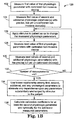
- FIG. 1B Another embodiment of a protocol 120 for calibrating a sensor for measuring a physiologic parameter P1 that is related to other parameters through a complex expression of the type described with reference to expression (2) is illustrated in FIG. 1B.
- the signal S' is related to n parameters, although not all n parameters necessarily change with application of the stimulus to the patient. Those parameters that do not change, or whose change is insignificant, under application of the stimulus to the patient may be treated in the analysis as constants. Accordingly, N sets of measurements need to be made, where N is the number of parameters that change with application of the stimulus.
- the protocol 120 commences with a measurement of the first physiologic parameter using a calibrated sensor, at step 102.
- first values of the second physiologic parameter, and additional physiologic parameters are measured, at step 124.
- the second physiologic parameter is the parameter whose sensor is being calibrated in the protocol, and is measured using a sensor that is uncalibrated but precise.
- the additional parameters may be measured using uncalibrated but precise sensors, or using calibrated sensors, or a combination of un-calibrated but precise, and calibrated sensors.
- the stimulus is applied to the patient at step 126, so that the values of the measured physiologic parameters change.
- the next value of the first physiologic parameter is measured using the calibrated sensor.
- the next values of the second parameter and the additional parameters are measured.
- the number of measurements made for each parameter should be at least equal to the number parameters being measured, N.
- Each measurement for a parameter is made at a different level of applied stimulus, so that the parameter takes on a different value. If it is determined that an insufficient number of measurements has been taken, then the protocol returns to step 126 and the stimulus is applied at a new level so that the measured parameters adopt new values. The protocol continues to accumulate measurements of the different parameters at different levels of stimulus until the number of measurements reaches N.
- the known relationship among the different measurements is used, at step 134, to eliminate any dependence on any parameters that do not significantly change under the stimulus. This permits calibration coefficients to be calculated for those physiologic parameters that were measured using precise, but yet un-calibrated sensors.
- FIG. 2 depicts steps of an embodiment of a protocol 200 to calibrate a non-invasive optical pH sensor.
- the change in bicarbonate level is insignificant because the normal bicarbonate level is quite large, typically in the range of 23 to 25 milli-equivalents per liter.
- the protocol 200 utilizes this physiologic situation to simplify the calibration procedure of the non-invasive optical pH sensor as is outlined below. Accordingly, the change in bicarbonate level is taken to be substantially constant under localized changes of pH. Therefore, only two physiologic parameters, CO 2 and pH are measured, and so only two measurements for each parameter are required.
- the first value of the CO 2 concentration is measured with a calibrated non-invasive device.
- the CO 2 concentration may be measured indirectly by measuring the partial pressure of CO 2 of the tissue (commonly designated as pCO 2 ) generated in its gaseous form.
- the relationship between dissolved CO 2 and the CO 2 partial pressure, pCO 2 is given by equation 4, below:
- Total Carbon Dioxide dissolved Solubility coefficient * pCO 2
- Approaches for non-invasively measuring the CO 2 concentration of tissue include optical methods, such as near-infrared absorbance measurements, in particular, a method for measuring the CO 2 content of tissue using an optical approach is discussed in U.S. Patent Application Serial No. 10/162,028 titled, "Noninvasive Detection of A Physiologic Parameter Within A Body Tissue of A Patient", by inventors Edward J. Anderson et al.
- step 204 the first value of physiologic parameter pH is measured, the measurement being taken with a non-invasive pH measuring device which reports precise but yet un-calibrated results.
- a non-invasive pH measuring device which reports precise but yet un-calibrated results.
- One approach to non-invasively measure pH is based around a measurement of the fluorescence of NADH, whose fluorescence efficiency is dependent on the local pH. This approach is discussed further in U.S. Patent Application Serial No. 10/195004 titled, "Non-invasive Measurement of pH", by inventors Victor Kimball, Steven Furlong, and Irvin Pierskalla, Altera Law Group Docket # 1535.2US01, filed on even date herewith.
- the CO 2 and pH measurement devices may be housed within the same mechanical structure and the measurements may take place at substantially the same time and at substantially the same physical location.
- protocol step 206 a stimulus is applied to the patient, the stimulus changing both the CO 2 and pH physiologic parameters.
- the stimulus in protocol step 206 to the patient is applied non-invasively and the stimulus is applied at the same physical location that measurements 202 and 204 were taken.
- Any suitable stimulus that affects the desired physiologic parameters may be used.
- the stimulus may affect the parameter directly or indirectly.
- Indirect affects may result, for example, by stopping blood flow to the tissue being assayed or by changing the metabolism of the tissue being assayed.
- An example of a direct effect is injecting a quantity of one of the physiologic parameters being measured, for example, glucose or electrolytes.
- a systemic change in the physiologic parameters may be expected, for example, after the administration of a drug that affects metabolism: the induced change in the body's metabolism results in a systemic change in the CO 2 and/or pH values of the patient, which may be measured at the measurement site.
- a local stimulus such as the application of localized pressure, localized induced temperature changes (heating and/or cooling), directed ultrasonic energy or the like, may also produce a change in the physiologic parameters.
- a drug may be administered so that it has a local effect, for example by being applied topically via a DMSO solution absorbed into the tissue.
- a second measurement of the physiologic parameter CO 2 is recorded with the calibrated non-invasive device, at step 208.
- a measurement is also made, at step 210, to record a second value of the physiologic parameter pH with the precise but yet uncalibrated non-invasive device.
- the measurement steps 208 and 210 may be made at substantially the same time after the stimulus in protocol step 206, and substantially at the same physical location as measurement steps 204 and 206. The measurements in steps 208 and 210 may be made while the stimulus is being applied or after the application of the stimulus has ceased.
- step 212 the known relationship between the physiologic parameters CO 2 and pH, as given by equation (3) is used to eliminate the dependence upon the bicarbonate ion concentration, [HCO3 - ], the bicarbonate ion concentration being substantially unchanged by the stimulus in protocol step 206 to the patient. This is described further below.
- the two, or more, calibrated data points are used to calculate calibration coefficients for the non-invasive pH device.
- Equation (8) highlights an important aspect of the present invention.
- the protocols described above with reference to FIGs. 1A, 1 B and 2 may be used also for quality assurance following calibration.
- the pH sensor Once the pH sensor has been calibrated, it may be used over a prolonged period, for example for many minutes, or some hours, taking measurements of pH at regular intervals. It is useful to perform periodic quality assurance checks to ensure that the sensor has not drifted out of calibration. This may be done, after taking a measurement of pH and CO 2 , by applying the stimulus to the patient and re-measuring the levels of pH and CO 2 under the stimulus. The calibration coefficients for the pH sensor may be recalculated and compared to those currently in use.
- the coefficients are within an acceptable error range of the current coefficients, then use of the current coefficients may continue, or the coefficients may be automatically updated with the new coefficients. If the newly calculated calibration coefficients are outside the acceptable error range, then the coefficients are typically updated with the new values. The user may also be notified that the coefficients have been changed.
- a processor/controller module 302 may contain various sub-systems and a central processing unit to control the timing, delivery, routing and post processing of signals for the monitoring device 300.
- An interface 304 connects the controller module 302 to a first non-invasive physiologic sensor 312, which may be housed in a patient interface module 310.
- the first non-invasive sensor may be based on any type of non-invasive sensor including, but not restricted to, optical, electro-chemical, acoustic, magnetic resonance, biochemical or osmotic assist.
- the interface 304 is an optical interface, and may include a fiber optic waveguide or a fiber optic bundle, or discrete bulk optical components such as a condensing lens or a series of condensing lenses.
- the patient interface module 310 may provide protection from such unwanted outside influences as stray light, fluid spills, and the like.
- the first non-invasive physiologic sensor 312 may be in direct physical contact with the patient's tissue surface 318.
- the tissue may be organ tissue, epithelial tissue, skin or any other type of tissue that is being assayed non-invasively.
- An interconnect device 306 connects the controller module 302 with an optional stimulus transducer 314, which may also be housed in the patient interface module 310.
- the stimulus transducer 314 is advantageously included in the patient interface module 310 when the stimulus applied to the patient is a local stimulus, although it may also be included when the applied stimulus is systemic.
- An interface 308 connects the controller module 302 with a second non-invasive physiologic sensor 316, which may also be housed in the patient interface module 310.
- the stimulus transducer 314 and the non-invasive sensors 312 and 316 may be mounted sufficiently close so that the same location of the tissue 318 is both stimulated and measured.
- the interface 308 is typically an optical interface.
- FIG. 3B An example of an end-on view of the interface module 310 is schematically represented in FIG. 3B, showing the non-invasive physiologic sensors 312b and 316b and the stimulus transducer 314b.
- FIG. 3C Another example of an end-on view of the interface module 310 is schematically represented in FIG. 3C, showing the relative locations of the non-invasive physiologic sensors 312c and 316c relative to the stimulus transducer 314c.
- the spacing between the first physiologic sensor and the stimulus transducer may be the same as the distance between the second physiologic sensor and the stimulus transducer. In such a case, the tissue assayed by the first sensor is advantageously subject to the same magnitude of stimulus as the tissue assayed by second sensor.
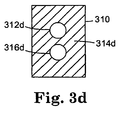
- FIG. 3D Another embodiment of an interface module 310 is schematically illustrated in FIG. 3D, in which a large portion 314d of the face represents the stimulus transducer.
- the physiologic sensors 312d and 316d are surrounded by the stimulus transducer 314d.
- Such an embodiment advantageously ensures that the level of stimulus applied to the site assayed for the first physiologic parameter is similar to that applied to the site assayed for the second physiologic parameter.
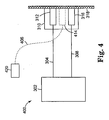
- FIG. 4 schematically depicts another embodiment of the invention. Elements that are the same as shown in FIG. 3A are labeled with the same reference number.
- the stimulus transducer 414 is not integrated within the patient interface module 310, and external controller unit 420 is a stand-alone unit separate from the main controller/processor unit 302.
- the stimulus transducer 414 may be removed from the patient when the device is not being calibrated, or may be left in place.
- the stimulus transducer may also be used for occasional quality assurance checks while the device is in use.
- the stimulus transducer 414 may also be replaced by alternative devices which stimulate the patient's tissue 318 by pressure, temperature, acoustic or other such appropriate stimulating techniques.
- FIG. 5 A particular embodiment of an optically based, non-invasive physiologic monitoring device 500 is depicted in FIG. 5. This embodiment may be particularly useful for conducting assays in a lumen, such as the esophagus.
- a processor/controller module 502 may contain the electro-optic sub-systems and a central processing unit to control the timing, delivery, routing and post processing of signals for the monitoring device 500.
- An optical interface 504 connects the controller module 502 to a first non-invasive optical physiologic sensor 512, which may be housed in a patient interface module 510.
- the optical interface 504 may be a fiber optic waveguide or a fiber optic bundle, or discrete bulk optical components such as a condensing lens or a series of condensing lenses.
- the patient interface module 510 may provide protection from such unwanted outside influences as stray light, fluid spills, and the like.
- the first non-invasive optical physiologic sensor 512 may be in direct physical contact with the patient's tissue surface 518.
- the interconnect device 506 connects the controller module 502 with the stimulus transducer 514, which may also be housed in the patient interface module 510.
- the optical interface 508 connects the controller module 502 with a second non-invasive optical physiologic sensor 516, which may also be housed in the patient interface module 510.
- the stimulus transducer 514 and the non-invasive optical sensors 512 and 516 may be mounted sufficiently close so as to stimulate and measure the tissue response at substantially the same physical location.
- An Inflatable bladder 520 may be incorporated into the patient interface module 510 for those applications where the sensor is inserted into a body cavity or orifice.
- This embodiment is advantageous in applications where it is desirable to apply pressure from the back surface 518b of the patient's epithelial tissue surface 518b to either mechanically secure the sensor against slippage during measurement or to apply additional pressure stimulus to aid in the calibration process.
- Other patient interface geometries and alternative sensor configurations are described in U.S. Patent Application Serial No. 10/162,028 titled, "Noninvasive Detection of A Physiologic Parameter Within A Body Tissue of A Patient", by inventors Edward J. Anderson et al.
- a patient monitor that includes sensors for measuring pH and CO 2 may be combined with other sensors for measuring other physiologic parameters, such as O 2 sat, O 2 , hematocrit, and the like.
Landscapes
- Health & Medical Sciences (AREA)
- Life Sciences & Earth Sciences (AREA)
- Physics & Mathematics (AREA)
- Heart & Thoracic Surgery (AREA)
- Molecular Biology (AREA)
- Veterinary Medicine (AREA)
- Biophysics (AREA)
- Pathology (AREA)
- Engineering & Computer Science (AREA)
- Biomedical Technology (AREA)
- Public Health (AREA)
- Medical Informatics (AREA)
- General Health & Medical Sciences (AREA)
- Surgery (AREA)
- Animal Behavior & Ethology (AREA)
- Cardiology (AREA)
- Optics & Photonics (AREA)
- Physiology (AREA)
- Vascular Medicine (AREA)
- Measurement Of The Respiration, Hearing Ability, Form, And Blood Characteristics Of Living Organisms (AREA)
- Investigating, Analyzing Materials By Fluorescence Or Luminescence (AREA)
- Investigating Or Analysing Materials By Optical Means (AREA)
Claims (43)
- Verfahren zum Kalibrieren eines nichtinvasiven Sensors im Hinblick auf einen ersten physiologischen Parameter in Gewebe, das die folgenden Schritte beinhaltet:(a) nichtinvasives Messen erster Werte für den ersten physiologischen Parameter und einen zweiten physiologischen Parameter im Gewebe, wobei eine bekannte Beziehung zwischen dem ersten und dem zweiten physiologischen Parameter besteht;(b) nichtinvasives Messen zweiter Werte für den ersten physiologischen Parameter und den zweiten physiologischen Parameter im Gewebe, nachdem auf das Gewebe eingewirkt wurde, um den ersten und den zweiten physiologischen Parameter zu ändern, wobei die Messungen des ersten und des zweiten Wertes des zweiten physiologischen Parameters absolut kalibriert werden; und(c) Bestimmen eines kalibrierten Wertes für den ersten und/oder zweiten Wert des ersten physiologischen Parameters anhand des ersten und des zweiten Wertes von sowohl dem ersten als auch dem zweiten physiologischen Parameter.
- Verfahren nach Anspruch 1, wobei das nichtinvasive Messen des ersten und des zweiten Wertes für den ersten Parameter das Messen von Licht beinhaltet, das von dem Gewebe empfangen wird.
- Verfahren nach Anspruch 1, wobei das nichtinvasive Messen des ersten und des zweiten Wertes für den zweiten Parameter das Messen von Licht beinhaltet, das von dem Gewebe erhalten wird.
- Verfahren nach Anspruch 1, wobei die Werte für den ersten und den zweiten physiologischen Parameter in derselben Region des Gewebes gemessen werden.
- Verfahren nach Anspruch 1, wobei das nichtinvasive Messen der ersten Werte für den ersten physiologischen Parameter das Anregen des Gewebes mit Anregungslicht und Erfassen eines resultierenden Fluoreszenzsignals beinhaltet.
- Verfahren nach Anspruch 1, wobei das Einwirken auf das Gewebe das Aufbringen eines systemischen Reizes auf das Gewebe beinhaltet.
- Verfahren nach Anspruch 1, wobei das Einwirken auf das Gewebe das Aufbringen eines Reizes auf das Gewebe beinhaltet, der auf eine Region des Gewebes begrenzt wird, wo der erste und der zweite physiologische Parameter nichtinvasiv gemessen werden.
- Verfahren nach Anspruch 1, wobei das Einwirken auf das Gewebe das Verabreichen eines Arzneimittels an den Patienten beinhaltet, dessen Gewebe untersucht wird.
- Verfahren nach Anspruch 1, wobei das Aufbringen eines systemischen Reizes auf das Gewebe das Verändern einer Stoffwechselrate des Gewebes beinhaltet.
- Verfahren nach Anspruch 1, wobei das Einwirken auf das Gewebe das Aufbringen von Druck auf eine Region des Gewebes beinhaltet, wo der erste und der zweite physiologische Parameter gemessen werden.
- Verfahren nach Anspruch 1, wobei das Einwirken auf den Körper das Verändern der Temperatur in einer Region des Körpers beinhaltet, wo der erste und der zweite physiologische Parameter gemessen werden.
- Verfahren nach Anspruch 1, wobei das nichtinvasive Messen der zweiten Werte für den ersten physiologischen Parameter und den zweiten physiologischen Parameter das Messen der zweiten Werte für den ersten physiologischen Parameter und den zweiten physiologischen Parameter gleichzeitig beinhaltet.
- Verfahren nach Anspruch 1, wobei der erste physiologische Parameter der pH-Wert ist.
- Verfahren nach Anspruch 13, wobei das Messen des pH-Wertes die Durchführung einer Fluoreszenzmessung von NADH in der Region des gemessenen Gewebes beinhaltet.
- Verfahren nach Anspruch 13, wobei der zweite physiologische Parameter die Konzentration von CO2 ist.
- Verfahren nach Anspruch 1, wobei die bekannte Beziehung zwischen dem ersten und dem zweiten physiologischen Parameter einen dritten physiologischen Parameter einschließt.
- Verfahren nach Anspruch 16, wobei der dritte physiologische Parameter durch das Einwirken auf den Körper im Wesentlichen unbeeinflusst bleibt.
- Verfahren nach Anspruch 16, wobei das Bestimmen des kalibrierten Wertes für den ersten und/oder den zweiten Wert des ersten physiologischen Parameters das Bestimmen eines Wertes für den dritten physiologischen Parameter anhand eines Verhältnisses zwischen i) der Differenz zwischen dem ersten und dem zweiten Wert des zweiten physiologischen Parameters und ii) der Differenz zwischen dem ersten und dem zweiten Wert des ersten physiologischen Parameters beinhaltet.
- Verfahren nach Anspruch 18, wobei das Bestimmen des kalibrierten Wertes für den ersten und/oder den zweiten Wert des ersten physiologischen Parameters ferner das Berechnen des kalibrierten Wertes mit dem Wert des dritten physiologischen Parameters und wenigstens dem jeweiligen kalibrierten ersten oder zweiten Wert des zweiten physiologischen Parameters beinhaltet.
- Verfahren nach Anspruch 1, wobei die bekannte Beziehung zwischen dem ersten und dem zweiten physiologischen Parameter pH = pK - log([CO2]/[HCO3-]) ist, wobei pH der erste physiologische Parameter und [CO:J der zweite physiologische Parameter sind.
- Verfahren nach Anspruch 1, wobei die bekannte Beziehung N physiologische Parameter zueinander in Beziehung setzt, die sich auf eine Einwirkung auf das Gewebe hin verändern, um den ersten und den zweiten physiologischen Parameter zu verändern, und wobei auf das Gewebe N-1 Mal eingewirkt wird, um N Messungen von jedem der N physiologischen Parameter bei unterschiedlichen Reizniveaus durchzuführen, die sich von dem Einwirken auf das Gewebe ergeben.
- Verfahren nach Anspruch 1, das ferner das nichtinvasive Messen der zweiten Werte des ersten physiologischen Parameters und des zweiten physiologischen Parameters in dem Gewebe beinhaltet, während auf das Gewebe eingewirkt wird.
- Verfahren nach Anspruch 1, wobei das Gewebe Epithelgewebe ist.
- Verfahren nach Anspruch 1, wobei das Gewebe ausgewählt wird aus Hautgewebe, Muskelgewebe und Organgewebe.
- Verfahren nach Anspruch 1, das ferner das Durchführen aufeinander folgender nichtinvasiver Messungen des ersten physiologischen Parameters des Gewebes und Bestimmen der jeweiligen absoluten kalibrierten Werte des ersten physiologischen Parameters anhand des ersten und des zweiten Wertes von sowohl dem ersten als auch dem zweiten physiologischen Parameter beinhaltet.
- Verfahren nach Anspruch 25, das ferner das Wiederholen der Schritte (a) - (c) nach dem Durchführen der aufeinander folgenden nichtinvasiven Messungen und Ermitteln, ob sich die Kalibrierung eines Instruments zum nichtinvasiven Messen des ersten physiologischen Parameters geändert hat, beinhaltet.
- Vorrichtung (300) zum Bestimmen eines Wertes eines ersten physiologischen Parameters in Gewebe (318), die Folgendes umfasst:einen nicht kalibrierten, ersten nichtinvasiven Sensor (312) zum Messen des ersten physiologischen Parameters des Gewebes (318);einen kalibrierten, zweiten nichtinvasiven Sensor (316) zum Messen eines zweiten physiologischen Parameters des Gewebes (318); undeinen Prozessor (302) zum Empfangen erster und zweiter Signale vom jeweiligen ersten und zweiten nichtinvasiven Sensor (312, 316) und zum Berechnen kalibrierter Werte für den ersten physiologischen Parameter anhand der ersten und zweiten Signale vom jeweiligen ersten und zweiten nichtinvasiven Sensor (312, 316), wenn ein Charakteristikum des Gewebes (318) zwischen den ersten und zweiten Signalen moduliert wird.
- Vorrichtung (300) nach Anspruch 27, wobei der erste nichtinvasive Sensor (312) ein Sensor auf optischer Basis ist.
- Vorrichtung (300) nach Anspruch 27, wobei der zweite nichtinvasive Sensor (316) ein Sensor auf optischer Basis ist.
- Vorrichtung (300) nach Anspruch 27, wobei der erste nichtinvasive Sensor (312) ein pH-Sensor ist.
- Vorrichtung (300) nach Anspruch 27, wobei der zweite nichtinvasive Sensor (316) ein kalibrierter, nichtinvasiver CO2-Sensor ist.
- Vorrichtung (300) nach Anspruch 30, wobei der pH-Sensor Anregungslicht im Wellenlängenbereich von 300 nm - 400 nm ausstrahlt.
- Vorrichtung (300) nach Anspruch 30, wobei der pH-Sensor für das Gewebe (318) ausgestrahltes Licht in einem Wellenlängenbereich von 400 - 600 nm erfasst.
- Vorrichtung (300) nach Anspruch 30, wobei der pH-Sensor Fluoreszenz von NADH im Gewebe (318) erfasst.
- Vorrichtung (300) nach Anspruch 27, die ferner ein Patientenschnittstellenmodul (310) zum Aufnehmen des ersten und des zweiten nichtinvasiven Sensors (312, 316) umfasst.
- Vorrichtung (300) nach Anspruch 27, die ferner einen Modulator (314) zum Modulieren des Charakteristikums des Gewebes (318) in der Region des Gewebes (318) umfasst, wo der erste und der zweite physiologische Parameter gemessen werden.
- Vorrichtung (300) nach Anspruch 36, wobei der Modulator (314) ein erweiterbares Element (520) zum Aufbringen von Druck auf die Region des Gewebes (318) beinhaltet, wo der erste und der zweite Parameter gemessen werden.
- Vorrichtung (300) nach Anspruch 33, wobei der Modulator (314) ein thermisch ansprechendes Element beinhaltet, um die Temperatur der Region des Gewebes (318) zu verändern, wo der erste und der zweite physiologische Parameter gemessen werden.
- Vorrichtung (300) nach Anspruch 36, die ferner ein Patientenschnittstellenmodul (310), den ersten und den zweiten nichtinvasiven Sensor (312, 316) und den Modulator (314) umfasst, der in dem Patientenschnittstellenmodul (310) untergebracht ist.
- Vorrichtung (300) nach Anspruch 39, wobei der Modulator (314) von dem Patientenschnittstellenmodul (310) entfernbar ist, wobei der erste und der zweite nichtinvasive Sensor (312, 316) aktiviert werden, um nach dem Entfernen des Modulators (314) von der Patientenschnittstelle (310) jeweils Messungen des ersten und zweiten physiologischen Parameters durchzuführen.
- Vorrichtung (300) nach Anspruch 27, wobei der Prozessor (302) Kalibrierungskonstanten für den ersten physiologischen Parameter anhand des ersten und des zweiten Signals von jeweils dem ersten und dem zweiten nichtinvasiven Sensor (312, 316) berechnet.
- Vorrichtung (300) nach Anspruch 41, wobei der Prozessor (302) kalibrierte Werte für den ersten physiologischen Parameter anhand von Messsignalen erzeugt, die von dem ersten nichtinvasiven Sensor (312) und den Kalibrierungskonstanten empfangen werden.
- Vorrichtung (300) nach Anspruch 42, wobei der Prozessor (302) die Kalibrierungskonstanten prüft, indem der erste und der zweite physiologische Parameter vor und nach dem Aufbringen eines Reizes auf das Gewebe (318) gemessen werden.
Applications Claiming Priority (3)
| Application Number | Priority Date | Filing Date | Title |
|---|---|---|---|
| US195120 | 2002-07-11 | ||
| US10/195,120 US6865407B2 (en) | 2002-07-11 | 2002-07-11 | Calibration technique for non-invasive medical devices |
| PCT/US2003/021604 WO2004006760A1 (en) | 2002-07-11 | 2003-07-09 | Calibration technique for non-invasive medical devices |
Publications (2)
| Publication Number | Publication Date |
|---|---|
| EP1545296A1 EP1545296A1 (de) | 2005-06-29 |
| EP1545296B1 true EP1545296B1 (de) | 2007-12-26 |
Family
ID=30114906
Family Applications (1)
| Application Number | Title | Priority Date | Filing Date |
|---|---|---|---|
| EP03764446A Expired - Lifetime EP1545296B1 (de) | 2002-07-11 | 2003-07-09 | Kalibrationstechnik für nichtinvasive medizinische vorrichtungen |
Country Status (6)
| Country | Link |
|---|---|
| US (1) | US6865407B2 (de) |
| EP (1) | EP1545296B1 (de) |
| JP (1) | JP2005532867A (de) |
| AU (1) | AU2003251847A1 (de) |
| DE (1) | DE60318323T2 (de) |
| WO (1) | WO2004006760A1 (de) |
Families Citing this family (169)
| Publication number | Priority date | Publication date | Assignee | Title |
|---|---|---|---|---|
| US6675031B1 (en) | 1999-04-14 | 2004-01-06 | Mallinckrodt Inc. | Method and circuit for indicating quality and accuracy of physiological measurements |
| US6748254B2 (en) | 2001-10-12 | 2004-06-08 | Nellcor Puritan Bennett Incorporated | Stacked adhesive optical sensor |
| US7190986B1 (en) | 2002-10-18 | 2007-03-13 | Nellcor Puritan Bennett Inc. | Non-adhesive oximeter sensor for sensitive skin |
| US20190357827A1 (en) | 2003-08-01 | 2019-11-28 | Dexcom, Inc. | Analyte sensor |
| US7299082B2 (en) * | 2003-10-31 | 2007-11-20 | Abbott Diabetes Care, Inc. | Method of calibrating an analyte-measurement device, and associated methods, devices and systems |
| US7162288B2 (en) | 2004-02-25 | 2007-01-09 | Nellcor Purtain Bennett Incorporated | Techniques for detecting heart pulses and reducing power consumption in sensors |
| CA2558239A1 (en) * | 2004-03-06 | 2005-09-22 | Calisto Medical, Inc. | Methods and devices for non-invasively measuring quantitative information of substances in living organisms |
| US9636450B2 (en) | 2007-02-19 | 2017-05-02 | Udo Hoss | Pump system modular components for delivering medication and analyte sensing at seperate insertion sites |
| US20100331646A1 (en) * | 2009-06-30 | 2010-12-30 | Abbott Diabetes Care Inc. | Health Management Devices and Methods |
| US7657295B2 (en) | 2005-08-08 | 2010-02-02 | Nellcor Puritan Bennett Llc | Medical sensor and technique for using the same |
| US7590439B2 (en) | 2005-08-08 | 2009-09-15 | Nellcor Puritan Bennett Llc | Bi-stable medical sensor and technique for using the same |
| US7657294B2 (en) | 2005-08-08 | 2010-02-02 | Nellcor Puritan Bennett Llc | Compliant diaphragm medical sensor and technique for using the same |
| US20080314395A1 (en) | 2005-08-31 | 2008-12-25 | Theuniversity Of Virginia Patent Foundation | Accuracy of Continuous Glucose Sensors |
| US20070060808A1 (en) | 2005-09-12 | 2007-03-15 | Carine Hoarau | Medical sensor for reducing motion artifacts and technique for using the same |
| US7904130B2 (en) | 2005-09-29 | 2011-03-08 | Nellcor Puritan Bennett Llc | Medical sensor and technique for using the same |
| US7869850B2 (en) | 2005-09-29 | 2011-01-11 | Nellcor Puritan Bennett Llc | Medical sensor for reducing motion artifacts and technique for using the same |
| US8092379B2 (en) | 2005-09-29 | 2012-01-10 | Nellcor Puritan Bennett Llc | Method and system for determining when to reposition a physiological sensor |
| US7899510B2 (en) | 2005-09-29 | 2011-03-01 | Nellcor Puritan Bennett Llc | Medical sensor and technique for using the same |
| US8880138B2 (en) * | 2005-09-30 | 2014-11-04 | Abbott Diabetes Care Inc. | Device for channeling fluid and methods of use |
| US8062221B2 (en) | 2005-09-30 | 2011-11-22 | Nellcor Puritan Bennett Llc | Sensor for tissue gas detection and technique for using the same |
| US7483731B2 (en) | 2005-09-30 | 2009-01-27 | Nellcor Puritan Bennett Llc | Medical sensor and technique for using the same |
| US8233954B2 (en) | 2005-09-30 | 2012-07-31 | Nellcor Puritan Bennett Llc | Mucosal sensor for the assessment of tissue and blood constituents and technique for using the same |
| US7881762B2 (en) | 2005-09-30 | 2011-02-01 | Nellcor Puritan Bennett Llc | Clip-style medical sensor and technique for using the same |
| US7486979B2 (en) | 2005-09-30 | 2009-02-03 | Nellcor Puritan Bennett Llc | Optically aligned pulse oximetry sensor and technique for using the same |
| US7555327B2 (en) | 2005-09-30 | 2009-06-30 | Nellcor Puritan Bennett Llc | Folding medical sensor and technique for using the same |
| US7885698B2 (en) * | 2006-02-28 | 2011-02-08 | Abbott Diabetes Care Inc. | Method and system for providing continuous calibration of implantable analyte sensors |
| US7826879B2 (en) | 2006-02-28 | 2010-11-02 | Abbott Diabetes Care Inc. | Analyte sensors and methods of use |
| US9675290B2 (en) | 2012-10-30 | 2017-06-13 | Abbott Diabetes Care Inc. | Sensitivity calibration of in vivo sensors used to measure analyte concentration |
| US8346335B2 (en) | 2008-03-28 | 2013-01-01 | Abbott Diabetes Care Inc. | Analyte sensor calibration management |
| US8140312B2 (en) | 2007-05-14 | 2012-03-20 | Abbott Diabetes Care Inc. | Method and system for determining analyte levels |
| US7630748B2 (en) | 2006-10-25 | 2009-12-08 | Abbott Diabetes Care Inc. | Method and system for providing analyte monitoring |
| US8219173B2 (en) | 2008-09-30 | 2012-07-10 | Abbott Diabetes Care Inc. | Optimizing analyte sensor calibration |
| US7618369B2 (en) * | 2006-10-02 | 2009-11-17 | Abbott Diabetes Care Inc. | Method and system for dynamically updating calibration parameters for an analyte sensor |
| US7653425B2 (en) | 2006-08-09 | 2010-01-26 | Abbott Diabetes Care Inc. | Method and system for providing calibration of an analyte sensor in an analyte monitoring system |
| US8473022B2 (en) | 2008-01-31 | 2013-06-25 | Abbott Diabetes Care Inc. | Analyte sensor with time lag compensation |
| US9392969B2 (en) | 2008-08-31 | 2016-07-19 | Abbott Diabetes Care Inc. | Closed loop control and signal attenuation detection |
| US8224415B2 (en) | 2009-01-29 | 2012-07-17 | Abbott Diabetes Care Inc. | Method and device for providing offset model based calibration for analyte sensor |
| US8374668B1 (en) | 2007-10-23 | 2013-02-12 | Abbott Diabetes Care Inc. | Analyte sensor with lag compensation |
| US9326709B2 (en) | 2010-03-10 | 2016-05-03 | Abbott Diabetes Care Inc. | Systems, devices and methods for managing glucose levels |
| US7522948B2 (en) | 2006-05-02 | 2009-04-21 | Nellcor Puritan Bennett Llc | Medical sensor and technique for using the same |
| US8073518B2 (en) | 2006-05-02 | 2011-12-06 | Nellcor Puritan Bennett Llc | Clip-style medical sensor and technique for using the same |
| US7477924B2 (en) | 2006-05-02 | 2009-01-13 | Nellcor Puritan Bennett Llc | Medical sensor and technique for using the same |
| US7507019B2 (en) | 2006-05-19 | 2009-03-24 | Covidien Ag | Thermometer calibration |
| US20070268954A1 (en) * | 2006-05-19 | 2007-11-22 | Sherwood Services Ag | Portable test apparatus for radiation-sensing thermometer |
| US8145288B2 (en) | 2006-08-22 | 2012-03-27 | Nellcor Puritan Bennett Llc | Medical sensor for reducing signal artifacts and technique for using the same |
| US8219170B2 (en) | 2006-09-20 | 2012-07-10 | Nellcor Puritan Bennett Llc | System and method for practicing spectrophotometry using light emitting nanostructure devices |
| US8190224B2 (en) | 2006-09-22 | 2012-05-29 | Nellcor Puritan Bennett Llc | Medical sensor for reducing signal artifacts and technique for using the same |
| US8396527B2 (en) | 2006-09-22 | 2013-03-12 | Covidien Lp | Medical sensor for reducing signal artifacts and technique for using the same |
| US8175671B2 (en) | 2006-09-22 | 2012-05-08 | Nellcor Puritan Bennett Llc | Medical sensor for reducing signal artifacts and technique for using the same |
| US7869849B2 (en) | 2006-09-26 | 2011-01-11 | Nellcor Puritan Bennett Llc | Opaque, electrically nonconductive region on a medical sensor |
| US7574245B2 (en) | 2006-09-27 | 2009-08-11 | Nellcor Puritan Bennett Llc | Flexible medical sensor enclosure |
| US7890153B2 (en) | 2006-09-28 | 2011-02-15 | Nellcor Puritan Bennett Llc | System and method for mitigating interference in pulse oximetry |
| US7796403B2 (en) | 2006-09-28 | 2010-09-14 | Nellcor Puritan Bennett Llc | Means for mechanical registration and mechanical-electrical coupling of a faraday shield to a photodetector and an electrical circuit |
| US7680522B2 (en) | 2006-09-29 | 2010-03-16 | Nellcor Puritan Bennett Llc | Method and apparatus for detecting misapplied sensors |
| US8175667B2 (en) | 2006-09-29 | 2012-05-08 | Nellcor Puritan Bennett Llc | Symmetric LED array for pulse oximetry |
| US7476131B2 (en) | 2006-09-29 | 2009-01-13 | Nellcor Puritan Bennett Llc | Device for reducing crosstalk |
| US8068891B2 (en) | 2006-09-29 | 2011-11-29 | Nellcor Puritan Bennett Llc | Symmetric LED array for pulse oximetry |
| US7684842B2 (en) | 2006-09-29 | 2010-03-23 | Nellcor Puritan Bennett Llc | System and method for preventing sensor misuse |
| US7549792B2 (en) * | 2006-10-06 | 2009-06-23 | Covidien Ag | Electronic thermometer with selectable modes |
| AU2007308804A1 (en) | 2006-10-26 | 2008-05-02 | Abbott Diabetes Care, Inc. | Method, system and computer program product for real-time detection of sensitivity decline in analyte sensors |
| US20080161666A1 (en) * | 2006-12-29 | 2008-07-03 | Abbott Diabetes Care, Inc. | Analyte devices and methods |
| US8930203B2 (en) | 2007-02-18 | 2015-01-06 | Abbott Diabetes Care Inc. | Multi-function analyte test device and methods therefor |
| US8732188B2 (en) | 2007-02-18 | 2014-05-20 | Abbott Diabetes Care Inc. | Method and system for providing contextual based medication dosage determination |
| US8265724B2 (en) | 2007-03-09 | 2012-09-11 | Nellcor Puritan Bennett Llc | Cancellation of light shunting |
| US7894869B2 (en) | 2007-03-09 | 2011-02-22 | Nellcor Puritan Bennett Llc | Multiple configuration medical sensor and technique for using the same |
| US8280469B2 (en) | 2007-03-09 | 2012-10-02 | Nellcor Puritan Bennett Llc | Method for detection of aberrant tissue spectra |
| US9204827B2 (en) | 2007-04-14 | 2015-12-08 | Abbott Diabetes Care Inc. | Method and apparatus for providing data processing and control in medical communication system |
| CA2683962C (en) | 2007-04-14 | 2017-06-06 | Abbott Diabetes Care Inc. | Method and apparatus for providing data processing and control in medical communication system |
| EP3741291A1 (de) | 2007-04-14 | 2020-11-25 | Abbott Diabetes Care, Inc. | Verfahren und vorrichtung zur bereitstellung von datenverarbeitung und -kontrolle in einem medizinischen kommunikationssystemen |
| ES2784736T3 (es) | 2007-04-14 | 2020-09-30 | Abbott Diabetes Care Inc | Procedimiento y aparato para proporcionar el procesamiento y control de datos en un sistema de comunicación médica |
| US8600681B2 (en) | 2007-05-14 | 2013-12-03 | Abbott Diabetes Care Inc. | Method and apparatus for providing data processing and control in a medical communication system |
| US8560038B2 (en) | 2007-05-14 | 2013-10-15 | Abbott Diabetes Care Inc. | Method and apparatus for providing data processing and control in a medical communication system |
| US8260558B2 (en) | 2007-05-14 | 2012-09-04 | Abbott Diabetes Care Inc. | Method and apparatus for providing data processing and control in a medical communication system |
| US10002233B2 (en) | 2007-05-14 | 2018-06-19 | Abbott Diabetes Care Inc. | Method and apparatus for providing data processing and control in a medical communication system |
| US8444560B2 (en) | 2007-05-14 | 2013-05-21 | Abbott Diabetes Care Inc. | Method and apparatus for providing data processing and control in a medical communication system |
| US9125548B2 (en) | 2007-05-14 | 2015-09-08 | Abbott Diabetes Care Inc. | Method and apparatus for providing data processing and control in a medical communication system |
| US8239166B2 (en) | 2007-05-14 | 2012-08-07 | Abbott Diabetes Care Inc. | Method and apparatus for providing data processing and control in a medical communication system |
| US8103471B2 (en) | 2007-05-14 | 2012-01-24 | Abbott Diabetes Care Inc. | Method and apparatus for providing data processing and control in a medical communication system |
| US20080312845A1 (en) * | 2007-05-14 | 2008-12-18 | Abbott Diabetes Care, Inc. | Method and apparatus for providing data processing and control in a medical communication system |
| WO2008144616A1 (en) * | 2007-05-18 | 2008-11-27 | Heidi Kay | Lipid raft, caveolin protein, and caveolar function modulation compounds and associated synthetic and therapeutic methods |
| US8160900B2 (en) | 2007-06-29 | 2012-04-17 | Abbott Diabetes Care Inc. | Analyte monitoring and management device and method to analyze the frequency of user interaction with the device |
| US8834366B2 (en) | 2007-07-31 | 2014-09-16 | Abbott Diabetes Care Inc. | Method and apparatus for providing analyte sensor calibration |
| US20090036760A1 (en) * | 2007-07-31 | 2009-02-05 | Abbott Diabetes Care, Inc. | Method and apparatus for providing data processing and control in a medical communication system |
| US8409093B2 (en) | 2007-10-23 | 2013-04-02 | Abbott Diabetes Care Inc. | Assessing measures of glycemic variability |
| US8216138B1 (en) | 2007-10-23 | 2012-07-10 | Abbott Diabetes Care Inc. | Correlation of alternative site blood and interstitial fluid glucose concentrations to venous glucose concentration |
| US8377031B2 (en) | 2007-10-23 | 2013-02-19 | Abbott Diabetes Care Inc. | Closed loop control system with safety parameters and methods |
| US20090164239A1 (en) * | 2007-12-19 | 2009-06-25 | Abbott Diabetes Care, Inc. | Dynamic Display Of Glucose Information |
| US20090164190A1 (en) * | 2007-12-19 | 2009-06-25 | Abbott Diabetes Care, Inc. | Physiological condition simulation device and method |
| US8352004B2 (en) | 2007-12-21 | 2013-01-08 | Covidien Lp | Medical sensor and technique for using the same |
| US8346328B2 (en) | 2007-12-21 | 2013-01-01 | Covidien Lp | Medical sensor and technique for using the same |
| US8366613B2 (en) | 2007-12-26 | 2013-02-05 | Covidien Lp | LED drive circuit for pulse oximetry and method for using same |
| US8577434B2 (en) | 2007-12-27 | 2013-11-05 | Covidien Lp | Coaxial LED light sources |
| US8452364B2 (en) | 2007-12-28 | 2013-05-28 | Covidien LLP | System and method for attaching a sensor to a patient's skin |
| US8442608B2 (en) | 2007-12-28 | 2013-05-14 | Covidien Lp | System and method for estimating physiological parameters by deconvolving artifacts |
| US8897850B2 (en) | 2007-12-31 | 2014-11-25 | Covidien Lp | Sensor with integrated living hinge and spring |
| US20090171173A1 (en) * | 2007-12-31 | 2009-07-02 | Nellcor Puritan Bennett Llc | System and method for reducing motion artifacts in a sensor |
| US8199007B2 (en) | 2007-12-31 | 2012-06-12 | Nellcor Puritan Bennett Llc | Flex circuit snap track for a biometric sensor |
| US8070508B2 (en) | 2007-12-31 | 2011-12-06 | Nellcor Puritan Bennett Llc | Method and apparatus for aligning and securing a cable strain relief |
| US8092993B2 (en) | 2007-12-31 | 2012-01-10 | Nellcor Puritan Bennett Llc | Hydrogel thin film for use as a biosensor |
| US8437822B2 (en) | 2008-03-28 | 2013-05-07 | Covidien Lp | System and method for estimating blood analyte concentration |
| US8112375B2 (en) | 2008-03-31 | 2012-02-07 | Nellcor Puritan Bennett Llc | Wavelength selection and outlier detection in reduced rank linear models |
| DK2291640T3 (en) | 2008-05-20 | 2019-03-11 | Univ Health Network | Device and method for fluorescence-based imaging and monitoring |
| US8591410B2 (en) | 2008-05-30 | 2013-11-26 | Abbott Diabetes Care Inc. | Method and apparatus for providing glycemic control |
| US8924159B2 (en) | 2008-05-30 | 2014-12-30 | Abbott Diabetes Care Inc. | Method and apparatus for providing glycemic control |
| US8071935B2 (en) | 2008-06-30 | 2011-12-06 | Nellcor Puritan Bennett Llc | Optical detector with an overmolded faraday shield |
| US7880884B2 (en) | 2008-06-30 | 2011-02-01 | Nellcor Puritan Bennett Llc | System and method for coating and shielding electronic sensor components |
| US7887345B2 (en) | 2008-06-30 | 2011-02-15 | Nellcor Puritan Bennett Llc | Single use connector for pulse oximetry sensors |
| WO2010009172A1 (en) | 2008-07-14 | 2010-01-21 | Abbott Diabetes Care Inc. | Closed loop control system interface and methods |
| US20100057040A1 (en) * | 2008-08-31 | 2010-03-04 | Abbott Diabetes Care, Inc. | Robust Closed Loop Control And Methods |
| US9943644B2 (en) | 2008-08-31 | 2018-04-17 | Abbott Diabetes Care Inc. | Closed loop control with reference measurement and methods thereof |
| US8622988B2 (en) * | 2008-08-31 | 2014-01-07 | Abbott Diabetes Care Inc. | Variable rate closed loop control and methods |
| US8734422B2 (en) | 2008-08-31 | 2014-05-27 | Abbott Diabetes Care Inc. | Closed loop control with improved alarm functions |
| US8364220B2 (en) | 2008-09-25 | 2013-01-29 | Covidien Lp | Medical sensor and technique for using the same |
| US8986208B2 (en) | 2008-09-30 | 2015-03-24 | Abbott Diabetes Care Inc. | Analyte sensor sensitivity attenuation mitigation |
| US8914088B2 (en) | 2008-09-30 | 2014-12-16 | Covidien Lp | Medical sensor and technique for using the same |
| US8417309B2 (en) | 2008-09-30 | 2013-04-09 | Covidien Lp | Medical sensor |
| US8423112B2 (en) | 2008-09-30 | 2013-04-16 | Covidien Lp | Medical sensor and technique for using the same |
| US9326707B2 (en) | 2008-11-10 | 2016-05-03 | Abbott Diabetes Care Inc. | Alarm characterization for analyte monitoring devices and systems |
| US8103456B2 (en) | 2009-01-29 | 2012-01-24 | Abbott Diabetes Care Inc. | Method and device for early signal attenuation detection using blood glucose measurements |
| US8560082B2 (en) * | 2009-01-30 | 2013-10-15 | Abbott Diabetes Care Inc. | Computerized determination of insulin pump therapy parameters using real time and retrospective data processing |
| US20100198196A1 (en) * | 2009-01-30 | 2010-08-05 | Abbott Diabetes Care, Inc. | Therapy Delivery Device Programming Tool |
| ES2967456T3 (es) * | 2009-02-26 | 2024-04-30 | Abbott Diabetes Care Inc | Procedimiento de calibración de un sensor de analitos |
| US8452366B2 (en) | 2009-03-16 | 2013-05-28 | Covidien Lp | Medical monitoring device with flexible circuitry |
| US8221319B2 (en) | 2009-03-25 | 2012-07-17 | Nellcor Puritan Bennett Llc | Medical device for assessing intravascular blood volume and technique for using the same |
| US8497777B2 (en) | 2009-04-15 | 2013-07-30 | Abbott Diabetes Care Inc. | Analyte monitoring system having an alert |
| EP2419015A4 (de) | 2009-04-16 | 2014-08-20 | Abbott Diabetes Care Inc | Kalibrierung eines analytsensors |
| WO2010127052A1 (en) * | 2009-04-28 | 2010-11-04 | Abbott Diabetes Care Inc. | Dynamic analyte sensor calibration based on sensor stability profile |
| EP2425209A4 (de) | 2009-04-29 | 2013-01-09 | Abbott Diabetes Care Inc | Verfahren und system für die echtzeit-kalibrierung eines analytsensors mit rückwirkender füllung |
| US8509869B2 (en) | 2009-05-15 | 2013-08-13 | Covidien Lp | Method and apparatus for detecting and analyzing variations in a physiologic parameter |
| US8634891B2 (en) | 2009-05-20 | 2014-01-21 | Covidien Lp | Method and system for self regulation of sensor component contact pressure |
| WO2010135646A1 (en) | 2009-05-22 | 2010-11-25 | Abbott Diabetes Care Inc. | Usability features for integrated insulin delivery system |
| US9010634B2 (en) | 2009-06-30 | 2015-04-21 | Covidien Lp | System and method for linking patient data to a patient and providing sensor quality assurance |
| US8311601B2 (en) | 2009-06-30 | 2012-11-13 | Nellcor Puritan Bennett Llc | Reflectance and/or transmissive pulse oximeter |
| US8505821B2 (en) | 2009-06-30 | 2013-08-13 | Covidien Lp | System and method for providing sensor quality assurance |
| US8391941B2 (en) | 2009-07-17 | 2013-03-05 | Covidien Lp | System and method for memory switching for multiple configuration medical sensor |
| EP4309580A3 (de) | 2009-07-23 | 2024-02-28 | Abbott Diabetes Care Inc. | System zur kontinuierlichen analytmessung |
| FI3936032T3 (fi) | 2009-07-23 | 2024-08-14 | Abbott Diabetes Care Inc | Glukoositasojen fysiologiseen säätelyyn liittyvien tietojen reaaliaikainen hallinta |
| WO2011014851A1 (en) | 2009-07-31 | 2011-02-03 | Abbott Diabetes Care Inc. | Method and apparatus for providing analyte monitoring system calibration accuracy |
| US8417310B2 (en) | 2009-08-10 | 2013-04-09 | Covidien Lp | Digital switching in multi-site sensor |
| US8428675B2 (en) | 2009-08-19 | 2013-04-23 | Covidien Lp | Nanofiber adhesives used in medical devices |
| EP2473422A4 (de) | 2009-08-31 | 2014-09-17 | Abbott Diabetes Care Inc | Anzeigeeinheiten für ein medizinisches gerät |
| US9066660B2 (en) | 2009-09-29 | 2015-06-30 | Nellcor Puritan Bennett Ireland | Systems and methods for high-pass filtering a photoplethysmograph signal |
| WO2011041469A1 (en) | 2009-09-29 | 2011-04-07 | Abbott Diabetes Care Inc. | Method and apparatus for providing notification function in analyte monitoring systems |
| EP2494323A4 (de) | 2009-10-30 | 2014-07-16 | Abbott Diabetes Care Inc | Verfahren und vorrichtung zur erkennung unnormaler hypoglykämischer werte |
| WO2011091336A1 (en) * | 2010-01-22 | 2011-07-28 | Abbott Diabetes Care Inc. | Method and apparatus for providing notification in analyte monitoring systems |
| US8635046B2 (en) | 2010-06-23 | 2014-01-21 | Abbott Diabetes Care Inc. | Method and system for evaluating analyte sensor response characteristics |
| US10092229B2 (en) | 2010-06-29 | 2018-10-09 | Abbott Diabetes Care Inc. | Calibration of analyte measurement system |
| EP2624745A4 (de) | 2010-10-07 | 2018-05-23 | Abbott Diabetes Care, Inc. | Analytüberwachungsvorrichtungen und -verfahren |
| EP3575796B1 (de) | 2011-04-15 | 2020-11-11 | DexCom, Inc. | Erweiterte analytsensorkalibrierung und fehlererkennung |
| EP4122384A1 (de) | 2011-06-16 | 2023-01-25 | Abbott Diabetes Care, Inc. | Analytüberwachungsvorrichtungen, -verfahren und -systeme mit temperaturkompensation |
| US9622691B2 (en) | 2011-10-31 | 2017-04-18 | Abbott Diabetes Care Inc. | Model based variable risk false glucose threshold alarm prevention mechanism |
| US9317656B2 (en) | 2011-11-23 | 2016-04-19 | Abbott Diabetes Care Inc. | Compatibility mechanisms for devices in a continuous analyte monitoring system and methods thereof |
| US8710993B2 (en) | 2011-11-23 | 2014-04-29 | Abbott Diabetes Care Inc. | Mitigating single point failure of devices in an analyte monitoring system and methods thereof |
| WO2013078426A2 (en) | 2011-11-25 | 2013-05-30 | Abbott Diabetes Care Inc. | Analyte monitoring system and methods of use |
| EP4218571B1 (de) | 2012-03-16 | 2025-07-30 | Dexcom, Inc. | Systeme und verfahren zur verarbeitung von analytsensordaten |
| EP3395252A1 (de) | 2012-08-30 | 2018-10-31 | Abbott Diabetes Care, Inc. | Ausfallerkennung bei kontinuierlichen analytüberwachungsdaten bei datenabweichungen |
| WO2014052136A1 (en) | 2012-09-26 | 2014-04-03 | Abbott Diabetes Care Inc. | Method and apparatus for improving lag correction during in vivo measurement of analyte concentration with analyte concentration variability and range data |
| EP2946195B1 (de) * | 2013-01-17 | 2018-11-21 | Koninklijke Philips N.V. | Verfahren und vorrichtung zur überwachung eines füllstands einer gasförmigen substanz von interesse |
| US9474475B1 (en) | 2013-03-15 | 2016-10-25 | Abbott Diabetes Care Inc. | Multi-rate analyte sensor data collection with sample rate configurable signal processing |
| WO2014152034A1 (en) | 2013-03-15 | 2014-09-25 | Abbott Diabetes Care Inc. | Sensor fault detection using analyte sensor data pattern comparison |
| US10433773B1 (en) | 2013-03-15 | 2019-10-08 | Abbott Diabetes Care Inc. | Noise rejection methods and apparatus for sparsely sampled analyte sensor data |
| AU2014374361B9 (en) | 2013-12-31 | 2019-07-04 | Abbott Diabetes Care Inc. | Self-powered analyte sensor and devices using the same |
| EP4151150B1 (de) | 2014-03-30 | 2025-08-27 | Abbott Diabetes Care Inc. | Verfahren und gerät zum bestimmen von mahlzeitenbeginn und peak-ereignissen in analytischen überwachungssystemen |
| WO2016011534A1 (en) | 2014-07-24 | 2016-01-28 | University Health Network | Collection and analysis of data for diagnostic purposes |
| JP6986007B2 (ja) | 2015-07-10 | 2021-12-22 | アボット ダイアベティス ケア インコーポレイテッドAbbott Diabetes Care Inc. | 生理学的パラメータに対する動的グルコースプロファイル応答のシステム、デバイス及び方法 |
| JP6893208B2 (ja) | 2015-10-30 | 2021-06-23 | エフ.ホフマン−ラ ロシュ アーゲーF. Hoffmann−La Roche Aktiengesellschaft | Ph測定装置の較正ずれの特定 |
| US11596330B2 (en) | 2017-03-21 | 2023-03-07 | Abbott Diabetes Care Inc. | Methods, devices and system for providing diabetic condition diagnosis and therapy |
| US11331022B2 (en) | 2017-10-24 | 2022-05-17 | Dexcom, Inc. | Pre-connected analyte sensors |
| EP3700416B1 (de) | 2017-10-24 | 2024-06-26 | Dexcom, Inc. | Vorverbundene analytsensoren |
Family Cites Families (58)
| Publication number | Priority date | Publication date | Assignee | Title |
|---|---|---|---|---|
| US3918033A (en) * | 1974-11-11 | 1975-11-04 | Ibm | SCR memory cell |
| US3978577A (en) * | 1975-06-30 | 1976-09-07 | International Business Machines Corporation | Fixed and variable threshold N-channel MNOSFET integration technique |
| US3964085A (en) * | 1975-08-18 | 1976-06-15 | Bell Telephone Laboratories, Incorporated | Method for fabricating multilayer insulator-semiconductor memory apparatus |
| EP0068058B1 (de) * | 1981-06-25 | 1986-09-03 | International Business Machines Corporation | Elektrisch programmierbarer Festwertspeicher |
| US4791604A (en) * | 1984-02-15 | 1988-12-13 | Joseph J. Bednarz | Sheet random access memory |
| US4829482A (en) * | 1985-10-18 | 1989-05-09 | Xicor, Inc. | Current metering apparatus for optimally inducing field emission of electrons in tunneling devices and the like |
| US4870470A (en) * | 1987-10-16 | 1989-09-26 | International Business Machines Corporation | Non-volatile memory cell having Si rich silicon nitride charge trapping layer |
| US5075888A (en) * | 1988-01-09 | 1991-12-24 | Sharp Kabushiki Kaisha | Semiconductor memory device having a volatile memory device and a non-volatile memory device |
| GB9100351D0 (en) * | 1991-01-08 | 1991-02-20 | Secr Defence | Semiconductor heterostructure device |
| EP0591289B1 (de) | 1991-05-16 | 1999-07-07 | Non-Invasive Technology, Inc. | Hämoglobin-messung zur bestimmung von stoffwechselgrössen einer person |
| US5355880A (en) | 1992-07-06 | 1994-10-18 | Sandia Corporation | Reliable noninvasive measurement of blood gases |
| US5792050A (en) | 1992-07-06 | 1998-08-11 | Alam; Mary K. | Near-infrared noninvasive spectroscopic determination of pH |
| JP3321899B2 (ja) * | 1992-12-04 | 2002-09-09 | 株式会社デンソー | 半導体装置 |
| WO1995005120A1 (fr) | 1993-08-12 | 1995-02-23 | Kurashiki Boseki Kabushiki Kaisha | Procede non-invasif de mesure du taux de sucre sanguin et instrument de mesure utilise a cet effet |
| US5396454A (en) * | 1993-09-24 | 1995-03-07 | Vlsi Technology, Inc. | Static random access memory cell utilizing a gated diode load element |
| US5557569A (en) * | 1993-10-12 | 1996-09-17 | Texas Instruments Incorporated | Low voltage flash EEPROM C-cell using fowler-nordheim tunneling |
| KR100193101B1 (ko) * | 1994-07-22 | 1999-06-15 | 모리시다 요이치 | 비휘발성 반도체 기억장치 및 그 구동방법 |
| GB9424598D0 (en) * | 1994-12-06 | 1995-01-25 | Philips Electronics Uk Ltd | Semiconductor memory with non-volatile memory transistor |
| US5697366A (en) | 1995-01-27 | 1997-12-16 | Optical Sensors Incorporated | In situ calibration system for sensors located in a physiologic line |
| US5814853A (en) * | 1996-01-22 | 1998-09-29 | Advanced Micro Devices, Inc. | Sourceless floating gate memory device and method of storing data |
| WO1998010471A1 (en) * | 1996-09-05 | 1998-03-12 | Macronix International Co., Ltd. | Triple well floating gate memory and operating method with isolated channel program, preprogram and erase processes |
| US5914904A (en) * | 1996-10-01 | 1999-06-22 | Altera Corporation | Compact electrically erasable memory cells and arrays |
| KR100232190B1 (ko) * | 1996-10-01 | 1999-12-01 | 김영환 | 비휘발성 메모리장치 |
| US5981335A (en) * | 1997-11-20 | 1999-11-09 | Vanguard International Semiconductor Corporation | Method of making stacked gate memory cell structure |
| KR100472736B1 (ko) | 1998-02-05 | 2005-03-08 | 인-라인다이아그노스틱스코포레이션 | 비침입식 혈액성분 측정 장치 |
| JP3528575B2 (ja) * | 1998-02-17 | 2004-05-17 | セイコーエプソン株式会社 | 不揮発性半導体記憶装置及びその製造方法 |
| US6445032B1 (en) * | 1998-05-04 | 2002-09-03 | International Business Machines Corporation | Floating back gate electrically erasable programmable read-only memory(EEPROM) |
| US6104045A (en) * | 1998-05-13 | 2000-08-15 | Micron Technology, Inc. | High density planar SRAM cell using bipolar latch-up and gated diode breakdown |
| US6545297B1 (en) * | 1998-05-13 | 2003-04-08 | Micron Technology, Inc. | High density vertical SRAM cell using bipolar latchup induced by gated diode breakdown |
| JP3391436B2 (ja) | 1998-05-15 | 2003-03-31 | 理研計器株式会社 | 炭酸ガス濃度測定装置 |
| US6662031B1 (en) * | 1998-05-18 | 2003-12-09 | Abbott Laboratoies | Method and device for the noninvasive determination of hemoglobin and hematocrit |
| US6526298B1 (en) | 1998-05-18 | 2003-02-25 | Abbott Laboratories | Method for the non-invasive determination of analytes in a selected volume of tissue |
| US6229161B1 (en) * | 1998-06-05 | 2001-05-08 | Stanford University | Semiconductor capacitively-coupled NDR device and its applications in high-density high-speed memories and in power switches |
| US6201734B1 (en) * | 1998-09-25 | 2001-03-13 | Sandisk Corporation | Programmable impedance device |
| US6587704B1 (en) * | 1999-06-16 | 2003-07-01 | Orsense Ltd. | Method for non-invasive optical measurements of blood parameters |
| EP1107317B1 (de) * | 1999-12-09 | 2007-07-25 | Hitachi Europe Limited | Speicheranordnung |
| US6554774B1 (en) * | 2000-03-23 | 2003-04-29 | Tensys Medical, Inc. | Method and apparatus for assessing hemodynamic properties within the circulatory system of a living subject |
| WO2001084107A2 (en) | 2000-05-02 | 2001-11-08 | Cas Medical Systems, Inc. | Method for non-invasive spectrophotometric blood oxygenation monitoring |
| US6754104B2 (en) * | 2000-06-22 | 2004-06-22 | Progressant Technologies, Inc. | Insulated-gate field-effect transistor integrated with negative differential resistance (NDR) FET |
| IL138683A0 (en) | 2000-09-25 | 2001-10-31 | Vital Medical Ltd | Apparatus and method for monitoring tissue vitality parameters |
| WO2002061800A2 (en) * | 2000-12-13 | 2002-08-08 | Rochester Institute Of Technology | A method and system for electrostatic bonding |
| US6660616B2 (en) * | 2001-01-31 | 2003-12-09 | Texas Instruments Incorporated | P-i-n transit time silicon-on-insulator device |
| TW476144B (en) * | 2001-02-02 | 2002-02-11 | Macronix Int Co Ltd | Non-volatile memory |
| US6462359B1 (en) * | 2001-03-22 | 2002-10-08 | T-Ram, Inc. | Stability in thyristor-based memory device |
| US6600188B1 (en) * | 2001-06-25 | 2003-07-29 | Lattice Semiconductor Corporation | EEPROM with a neutralized doping at tunnel window edge |
| JP2003031693A (ja) * | 2001-07-19 | 2003-01-31 | Toshiba Corp | 半導体メモリ装置 |
| US6700771B2 (en) * | 2001-08-30 | 2004-03-02 | Micron Technology, Inc. | Decoupling capacitor for high frequency noise immunity |
| US7012297B2 (en) * | 2001-08-30 | 2006-03-14 | Micron Technology, Inc. | Scalable flash/NV structures and devices with extended endurance |
| US6743681B2 (en) * | 2001-11-09 | 2004-06-01 | Micron Technology, Inc. | Methods of Fabricating Gate and Storage Dielectric Stacks having Silicon-Rich-Nitride |
| US6784480B2 (en) * | 2002-02-12 | 2004-08-31 | Micron Technology, Inc. | Asymmetric band-gap engineered nonvolatile memory device |
| US6661042B2 (en) * | 2002-03-11 | 2003-12-09 | Monolithic System Technology, Inc. | One-transistor floating-body DRAM cell in bulk CMOS process with electrically isolated charge storage region |
| US6611452B1 (en) * | 2002-04-05 | 2003-08-26 | T-Ram, Inc. | Reference cells for TCCT based memory cells |
| US7195594B2 (en) * | 2002-05-14 | 2007-03-27 | Pacesetter, Inc. | Method for minimally invasive calibration of implanted pressure transducers |
| JP2004039965A (ja) * | 2002-07-05 | 2004-02-05 | Renesas Technology Corp | 不揮発性半導体記憶装置 |
| US6828632B2 (en) * | 2002-07-18 | 2004-12-07 | Micron Technology, Inc. | Stable PD-SOI devices and methods |
| US6917078B2 (en) * | 2002-08-30 | 2005-07-12 | Micron Technology Inc. | One transistor SOI non-volatile random access memory cell |
| US6888200B2 (en) * | 2002-08-30 | 2005-05-03 | Micron Technology Inc. | One transistor SOI non-volatile random access memory cell |
| US8125003B2 (en) * | 2003-07-02 | 2012-02-28 | Micron Technology, Inc. | High-performance one-transistor memory cell |
-
2002
- 2002-07-11 US US10/195,120 patent/US6865407B2/en not_active Expired - Fee Related
-
2003
- 2003-07-09 DE DE60318323T patent/DE60318323T2/de not_active Expired - Fee Related
- 2003-07-09 AU AU2003251847A patent/AU2003251847A1/en not_active Abandoned
- 2003-07-09 JP JP2004521626A patent/JP2005532867A/ja active Pending
- 2003-07-09 EP EP03764446A patent/EP1545296B1/de not_active Expired - Lifetime
- 2003-07-09 WO PCT/US2003/021604 patent/WO2004006760A1/en not_active Ceased
Also Published As
| Publication number | Publication date |
|---|---|
| WO2004006760A1 (en) | 2004-01-22 |
| DE60318323T2 (de) | 2009-03-05 |
| US6865407B2 (en) | 2005-03-08 |
| AU2003251847A1 (en) | 2004-02-02 |
| JP2005532867A (ja) | 2005-11-04 |
| DE60318323D1 (de) | 2008-02-07 |
| US20040010186A1 (en) | 2004-01-15 |
| EP1545296A1 (de) | 2005-06-29 |
Similar Documents
| Publication | Publication Date | Title |
|---|---|---|
| EP1545296B1 (de) | Kalibrationstechnik für nichtinvasive medizinische vorrichtungen | |
| JP3621699B2 (ja) | 高信頼非侵襲性血液ガス測定方法 | |
| US7510849B2 (en) | OCT based method for diagnosis and therapy | |
| US8326390B2 (en) | Optical non-invasive blood monitoring system and method | |
| JP2965212B2 (ja) | 生体被分析物の類似性を既知生体流体から作られたモデルから決定する方法及び装置 | |
| US8972196B2 (en) | Algorithms for calibrating an analyte sensor | |
| US6662031B1 (en) | Method and device for the noninvasive determination of hemoglobin and hematocrit | |
| US6630673B2 (en) | Non-invasive sensor capable of determining optical parameters in a sample having multiple layers | |
| US20070129618A1 (en) | Blood parameter testing system | |
| EP3733065A1 (de) | Verfahren und system zur kalibrierung von orthogonal redundanten sensoreinrichtungen | |
| US20020026106A1 (en) | Non-invasive sensor having controllable temperature feature | |
| JP2005530137A (ja) | 組織のインビボ測定のための光学的サンプリング・インターフェイス・システム | |
| KR20070052781A (ko) | 센서 | |
| JP2007175514A (ja) | 体液成分濃度の生体内測定及び制御のための埋込可能センサー及びシステム | |
| JP2011062335A (ja) | 血糖値モニタリング装置 | |
| Fogt | Continuous ex vivo and in vivo monitoring with chemical sensors | |
| AU2021308774B2 (en) | Device for obtaining an indicator of a microcirculatory condition | |
| US20040010185A1 (en) | Method for measuring a physiologic parameter using a preferred site | |
| US7486976B1 (en) | Optical non-invasive blood monitoring system and method | |
| Gilbert et al. | Arterial blood gas monitoring | |
| WO2010033104A1 (en) | Optical non-invasive blood monitoring system and method | |
| Talukdar | Non-Invasive Measurement of Glucose Content in Human Body: A Comparative Study | |
| Burritt | Noninvasive and invasive sensors for patient monitoring | |
| Harsanyi | Chemical Sensors for Biomedical Applications | |
| JP2001120520A (ja) | 血糖値測定用カートリッジ |
Legal Events
| Date | Code | Title | Description |
|---|---|---|---|
| PUAI | Public reference made under article 153(3) epc to a published international application that has entered the european phase |
Free format text: ORIGINAL CODE: 0009012 |
|
| 17P | Request for examination filed |
Effective date: 20050111 |
|
| AK | Designated contracting states |
Kind code of ref document: A1 Designated state(s): AT BE BG CH CY CZ DE DK EE ES FI FR GB GR HU IE IT LI LU MC NL PT RO SE SI SK TR |
|
| AX | Request for extension of the european patent |
Extension state: AL LT LV MK |
|
| DAX | Request for extension of the european patent (deleted) | ||
| RBV | Designated contracting states (corrected) |
Designated state(s): DE FR GB IT |
|
| 17Q | First examination report despatched |
Effective date: 20070129 |
|
| GRAP | Despatch of communication of intention to grant a patent |
Free format text: ORIGINAL CODE: EPIDOSNIGR1 |
|
| GRAS | Grant fee paid |
Free format text: ORIGINAL CODE: EPIDOSNIGR3 |
|
| GRAA | (expected) grant |
Free format text: ORIGINAL CODE: 0009210 |
|
| AK | Designated contracting states |
Kind code of ref document: B1 Designated state(s): DE FR GB IT |
|
| REG | Reference to a national code |
Ref country code: GB Ref legal event code: FG4D |
|
| REF | Corresponds to: |
Ref document number: 60318323 Country of ref document: DE Date of ref document: 20080207 Kind code of ref document: P |
|
| ET | Fr: translation filed | ||
| PGFP | Annual fee paid to national office [announced via postgrant information from national office to epo] |
Ref country code: DE Payment date: 20080829 Year of fee payment: 6 |
|
| PLBE | No opposition filed within time limit |
Free format text: ORIGINAL CODE: 0009261 |
|
| STAA | Information on the status of an ep patent application or granted ep patent |
Free format text: STATUS: NO OPPOSITION FILED WITHIN TIME LIMIT |
|
| PGFP | Annual fee paid to national office [announced via postgrant information from national office to epo] |
Ref country code: FR Payment date: 20080729 Year of fee payment: 6 |
|
| 26N | No opposition filed |
Effective date: 20080929 |
|
| PGFP | Annual fee paid to national office [announced via postgrant information from national office to epo] |
Ref country code: GB Payment date: 20080729 Year of fee payment: 6 |
|
| GBPC | Gb: european patent ceased through non-payment of renewal fee |
Effective date: 20090709 |
|
| REG | Reference to a national code |
Ref country code: FR Ref legal event code: ST Effective date: 20100331 |
|
| PG25 | Lapsed in a contracting state [announced via postgrant information from national office to epo] |
Ref country code: FR Free format text: LAPSE BECAUSE OF NON-PAYMENT OF DUE FEES Effective date: 20090731 |
|
| PG25 | Lapsed in a contracting state [announced via postgrant information from national office to epo] |
Ref country code: GB Free format text: LAPSE BECAUSE OF NON-PAYMENT OF DUE FEES Effective date: 20090709 |
|
| PG25 | Lapsed in a contracting state [announced via postgrant information from national office to epo] |
Ref country code: DE Free format text: LAPSE BECAUSE OF NON-PAYMENT OF DUE FEES Effective date: 20100202 |
|
| PG25 | Lapsed in a contracting state [announced via postgrant information from national office to epo] |
Ref country code: IT Free format text: LAPSE BECAUSE OF NON-PAYMENT OF DUE FEES Effective date: 20080731 |