EP1544774A1 - Dynamische späte Bindung von on-demand-Dienstleistungen Dritter in einer on-demand Infrastruktur - Google Patents
Dynamische späte Bindung von on-demand-Dienstleistungen Dritter in einer on-demand Infrastruktur Download PDFInfo
- Publication number
- EP1544774A1 EP1544774A1 EP04106237A EP04106237A EP1544774A1 EP 1544774 A1 EP1544774 A1 EP 1544774A1 EP 04106237 A EP04106237 A EP 04106237A EP 04106237 A EP04106237 A EP 04106237A EP 1544774 A1 EP1544774 A1 EP 1544774A1
- Authority
- EP
- European Patent Office
- Prior art keywords
- service
- tpsp
- resources
- request
- enquiring
- Prior art date
- Legal status (The legal status is an assumption and is not a legal conclusion. Google has not performed a legal analysis and makes no representation as to the accuracy of the status listed.)
- Withdrawn
Links
Images




Classifications
-
- G—PHYSICS
- G06—COMPUTING OR CALCULATING; COUNTING
- G06Q—INFORMATION AND COMMUNICATION TECHNOLOGY [ICT] SPECIALLY ADAPTED FOR ADMINISTRATIVE, COMMERCIAL, FINANCIAL, MANAGERIAL OR SUPERVISORY PURPOSES; SYSTEMS OR METHODS SPECIALLY ADAPTED FOR ADMINISTRATIVE, COMMERCIAL, FINANCIAL, MANAGERIAL OR SUPERVISORY PURPOSES, NOT OTHERWISE PROVIDED FOR
- G06Q30/00—Commerce
- G06Q30/02—Marketing; Price estimation or determination; Fundraising
-
- G—PHYSICS
- G06—COMPUTING OR CALCULATING; COUNTING
- G06F—ELECTRIC DIGITAL DATA PROCESSING
- G06F15/00—Digital computers in general; Data processing equipment in general
- G06F15/16—Combinations of two or more digital computers each having at least an arithmetic unit, a program unit and a register, e.g. for a simultaneous processing of several programs
Definitions
- the present invention relates to the field of networked computer application and refers to a method and respective system for providing on-demand services via an electronic network from a service provider to a client requesting a service, wherein one or a plurality of third-party service providers (TPSP) are involved for providing one or more on-demand TPSP services as a contribution to said client-requested service.
- TPSP third-party service providers
- An On-demand Service referred to herein as ODS, or such TPSP service may be any kind of information technology (IT) functionality offered to given TPSP scribers on a contractual basis.
- IT information technology
- the contract can be created explicitly or implicitly.
- the service is used by the TPSP scriber at certain conditions on a usage or on a fee based model.
- TPSP services In state of the art, a significant effort is required to integrate TPSP services into a provider's offering. In lack of standardization, TPSP services often have proprietary access mechanisms that an offering provider needs to adhere to when integrating such a service in his own offerings. There are no common access mechanisms for provider-owned resources, or for remote services and resources from TPSP. As a result of this complexity, many providers choose not to integrate at all TPSP services in their offerings.
- Resources 163, 165, 173, 175, 177, 183, 185 may be either hardware resources, software resources, or storage resources. Also useful pre-defined combination of resources can be regarded as a single composite resource. Hardware resources are such as computing nodes, network resources such as switches, and firewalls. Software resources are such as applications.
- Each of these resources is managed by a Resource Manager 16, 17, 18, further referred to herein as RM.
- An RM may manage a pool of resources of the same type.
- Resource handles the collection of which is denoted by reference sign 12 identify resource instance services, which are kept within the Services Environment's collection of resource handles.
- fig. 2 is a state of the art schematic diagram representation illustrating the basic functionality of such state of the art interoperation between a SP service environment and a particular resource manager having access to a particular resource
- RM Resource Manager
- the level of abstraction of this integration can be chosen by the respective resource manager developer according to the problem domain to be addressed.
- a resource instance is a specific combination of resources assembled and dedicated for fulfilling the desired service at a predetermined point in time. It is not depicted in fig. 2.
- RIS Resource Instance Services
- 162 Each resource instance is controlled by above-mentioned Resource Instance Services (RIS), e.g. denoted as 162 in fig. 1.
- RISs 162 are created by the RMs, e.g., denoted as 16.
- the resources 163 and RIS 162 are owned by the provider and are kept in the provider's premises. However, they can be local or distributed in several locations that the provider owns.
- the provider has the infrastructure, resources, and tools, and knowledge required to provide all the components of the offering except for the backup service. Until this point the provider is fine regarding the set up of the On-demand infrastructure to offer these three (gold, platinum, silver) services and to charge for them except handling the backup service. This service is not part of the current expertise of this provider and he is assumed to be neither willing to invest into a skill for his staff members nor to invest into the required storage devices.
- TPSPs a plurality of, for instance six TPSPs are found, who offer the required backup service. Possibly, these TPSP services may be assumed to have a proprietary interface. The integration of this interface into the web mail offering is thus a significant effort for the SP due to required preparation and programming work. As a result, a SP may be in many cases assumed either not to spend this effort and disadvantageously not being able to select the best service offer.
- a maximum benefit for the offering provider results from an encapsulation and automatic integration of remote resources and services, which is best provided by the present invention via resource managers providing this common access interface.
- a set of resource managers offering similar functionality by different TPSP services can be bundled by an additional component, which handles the selection of one TPSP service out of this set of TPSP services offered by the Resource Managers.
- the selection complies with the selection criteria specified by the SP. This is described in more detail in the second preferred embodiment later below.
- an effective cooperation is enabled between the SP and TPSP, which comprises at least the basic features needed when using on-demand services included in the own service environment.
- a resource instance comprises another service
- the inventional principle can be basically continued in order to bring up a chain of multiple services, from fourth, fifth, etc. SPs.
- These following TPSP-TPSP services can be included again by using a respective resource manager.
- said generic interface definition further allows performing the steps of disclosing to the SP information concerning the availability of resources available at the TPSP, then the SP has the possibility to first have a look on the offered services, and compare maybe to different provider's offers, and then to take a decision, to which on-demand service to subscribe. This enhances the usability of the inventional concept.
- a method comprising a so-called Meta Service Selector abbreviated herein as MSS and implented as a data processing program, is disclosed for selecting a particular TPSP service from a plurality of available TPSP services covering similar or the same business objective and being offered by a respective one or a plurality of TPSPs to a SP via an electronic network, said method being characterized by the steps of as follows and performed by a SP:
- the invention has a "distributed" nature.
- the respective main steps performed at the TPSP are as follows:
- This inventional method is suited in particular for the provision of simply-structured TPSP services, in particular provided by stateless requests.
- Examples are requesting some stock options, Internet telephony via the cheapest telephony service offerer, Internet-based telephony including video information, Pay-TV via Internet, etc.
- the above “best service selection” is basically enabled by a Meta Service Selector (MSS), which takes requests to select the best TPSP service according to an evaluation schema referring to an evaluation algorithm and to evaluation attributes.
- the MSS sends out enquiring requests prompting the TPSPs for responding according to predefined and agreed request specification formats.
- the MSS processes the enquired and received TPSP service property information by a ranking algorithm, which is able to be freely weighted according to the actual demand.
- the great advantage of this general approach is that an automated, easy-to-implement procedure is disclosed, how a SP is enabled to find the TPSP having the best offer for a particular TPSP service in an electronic network, wherein "best” can be defined freely, very flexible according to different preferences.
- the automatic, short-time selection opens up consequently the feature "late binding", ie, the possibility that the SP may decide very “late”, ie, shortly before actually the TPSP service is used.
- the first is, when the on-demand TPSP service is encapsulated via a resource instance created by a Generic Resource Manager (GRM) acting as interface.
- GEM Generic Resource Manager
- the TPSP service is made easily available to the SP or the client by a resource instance service managed by the SP and instantiated by the TPSP.
- the second alternative proposes that the interface data scheme agreed on between the SP and said TPSP is part of the requested TPSP service. This will be later decribed in more detail in the second preferred embodiment.
- the enquiring request specifies time information related with the TPSP
- the advantage results that the inventional method enables for even more flexibility and ease of use, the end-user service requester may definitely take profit of, as his demands are even more completely reflected already within the enquiring request.
- a flag can be used for encoding the point in time, when the TPSP service has to be selected, which for example may vary amongst the following alternatives:
- the late determination of the TPSP service ie the late binding, when a SP actually requests a TPSP service, can be achieved, because the inventional method steps including their implementation algorithms are very fast and efficiently to be performed.
- a maximum flexibility is achieved regarding the time, when actually to decide for a particular TPSP service.
- the client may take large profit from this advantage in situations, where TPSP service offerings change quickly.
- This inventional interface layer 20 can advantageously be standardised and significantly facilitates the integration of TPSP service into a providers computing environment and offerings. This is depicted with the dotted line encircling the resources 163 resident at the SP side as well as the TPSP resources 30 resident at the TPSP. This abstract approach will be detailed further with respect to figures 4 and 5.
- a generic resource manager 40 is implemented as a dedicated server system at the TPSP side, which is able to communicate with a number of SPs not depicted in fig. 4 via an inventional interface 41, which best is subjected to a IT-standard, by way of some predefined functionality relevant to the provisioning of resources from the TPSP to the SP.
- This functionality may be preferably implemented as a class having some predefined methods as they are depicted at the left margin of fig. 4.
- One generic resource manager 40 is responsible per one type of resource. It "knows" all resources of the type this generic resource manager is responsible for. Therefore, resource manager 40 is able to determine, whether one resource of the managed typed is not used at any required timeframe.
- the create function 410 creates a generic resource instance service 42 for a particular service or a particular resource and returns a reference to it.
- This generic resource instance service 42 is responsible to manage a dedicated resource of the type, managed by resource manager 40.
- the delete function 420 deletes a generic resource instance service 42 for such service or such resource.
- the allocate function 430 allocates the required resources for a requested service or resource. This function may also be used, following an invocation of the subscribe operation. The service or resource is finally activated and ready for use in both cases.
- the deallocate function 450 is a call, which deallocates the resources for a resource or service, which was allocated before, see above.
- the unsubscribe function 460 represents basically the reversal of the subscribe function.
- the "find available” function 470 searches for all available resources required to run requested TPSP services at the TPSP. This functionality requires a bookkeeping of the resource, required to run offered On Demand Service. E.g., it can easily be implemented when the available services per RM are listed and maintained in a relational database application.
- the inventional generic resource manager 40 is able to perform all management functions, which are required for instantiating a generic resource instance service 42.
- This generic resource instance service controls basically the TPSP service 48 from the TPSP.
- This control is realised by a respective generic resource instance interface 43 within each resource instance service 42 and the usual usage interface 44 depicted in fig. 4 as resource access interface. Via said access interface the resources from the TPSP are later actually used.
- the relationship between the resource instance interface 43 and the resource manager interface 41 is special, because the resource instance interface 43 maps the allocate (430) and deallocate calls (450) of the resource manager interface 41, which are required to set up the dedicated resource. This covers e.g. the differences in setting up a zLinux server in general as a resource or a database on zLinux.
- the allocate call (430) triggers the installation and configuration of selected resources.
- a contract 46 is concluded between the SP and the TPSP at that point in time, in which the SP basically subscribes to a TPSP service.
- the SP basically subscribes to a TPSP service.
- a person skilled in the art will appreciate that for the contracting purposes and the accounting and billing procedures behind it is recommended to include a unique key and a subscriber ID into the request, by which a TPSP service is actually subscribed to.
- the proposed generic interface definition having a semantic as exemplarily described above with the above-mentioned functions is able to encapsulate the requested services or TPSP services into the service environment of the SP.
- This is due to the fact, that basically no manual work is necessary at neither the provider nor the TPSP for finding available resources at the TPSP, or for the reservation of such resources, or for the actual allocation and use of such resources or services.
- By that basically full automation of the workflow between SP and TPSP it is possible to integrate the resources and services offered by a TPSP into the service environment of the original SP.
- this original SP may easily take profit from such TPSP services and is able to forward the TPSP services to his own clients. This makes it easy to increase the own service offering by the SP.
- said generic resource manager 40 maintained by TPSP is subjected to a standard syntax and semantic. By that the interaction between TPSP and SP is even more facilitated.
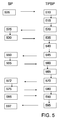
- FIG. 5 shows a schematic block diagram representation illustrating the control flow in an inventive method implemented in respective parts at the SP side (left) and the TPSP (right).
- This preferred embodiment comprises the advantageous, optional features of the "find available” function 470 described above and the subscribe 440 and unsubscribe 460 functionality, also described above. It should be understood, of course, that many variations of the underlying workflow between the SP and TPSP may exist, which may be recommended depending on the respective use of the inventional method.
- a SP whose actions are depicted at the left column of fig. 5 wishes to use a backup TPSP service offered by a TPSP (right column of fig. 5), in order to offer to any end-client not depicted in fig. 5 the additional backup service as an add-on to an email service he was basically offering already before to the end-clients.
- the SP has neither the own resources nor the own know-how required to offer the backup service he desires to purchase this backup service as a TPSP service added on his own email service.
- the TPSP is assumed to offer his TPSP services e.g. in an Internet portal, and the generic resource manager, which was described above, is assumed to be implemented at the respective web server at the TPSP.
- the offering and accepting of the TPSP service is implemented as a stateful web service.
- a first step 505 the SP requests the overall offer of services, offered by the TPSP. This is simply done by clicking on the respective button in the respective web site maintained by the TPSP.
- TPSP receives such request and responsive to that triggers its "create” and "find available services” functionality as described above in order to show the total of the services, TPSP offers to the requesting SP.
- each TPSP service or package of TPSP services is displayed to the SP, if this is useful to apply. This may be in a case, in which for example a strong price reduction can be obtained for a group of services compared to the sum of the respective plurality of single services. Thus, the services must be distinguishable by some service ID.
- a service ID as exemplarily and schematically depicted in fig. 6 is comprised exemplarily in a data set further comprising advantageously a description of the service or TPSP service, the price per time if used, all other information, which is required from the TPSP side to close a contract with the SP for the usage of the required service, and other descriptive information the requesting SP may be assumed to be interested in to know before he decides to subscribe to a particular TPSP service or not. Additional information, dependent of the individual use and application of the inventional method can be added.
- the dataset in fig. 6 is thus to be understood only in a symbolic sense defining the basic information required in this context.
- TPSP issues the TPSP service collection as an offer to the requesting SP.
- the above-mentioned data set describing the TPSP service offered to the SP may further contain data fields telling from which time until which second time the respective service is available and, optionally if there is any SP already registered who has filed any serious interest to use the service in a respective future time span, such as it is known from state of the art booking/reservation systems.
- SP will receive all information needed about the available TPSP services from the TPSP. Supplied with this information SP may take any required considerations regarding economical aspects, operational aspects, etc., which are useful to make up a decision if or if not to select one or more of the offered TPSP services.
- SP may be assumed to request in a step 530 a handle for a particular, selected TPSP service from the offering TPSP.
- this will be implemented as usual in state of the art, for example by highlighting and marking up a TPSP service for selection.
- This selection is transported as a request via the electronic network for a handle for said TPSP service in order to open up the possibility to continue the procedure and to make some kind of booking or reservation or actually immediate use of the service, the implementation of which will be described next below.
- TPSP will receive the request for said handle for said selected TPSP service and will create in a further following step 540 a so-called resource instance service, which is associated with said requested handle.
- Said resource instance service has an information structure, which identifies all relevant hardware and software to be used for fulfilling the request, e.g., by providing respective ID-tags to said resources.
- any hardware unit and software unit should have a respective ID, which can be addressed within such resource instance service. It should be noted, that it is useful to make up a standard for the format, in which those IDs are distributed in such resource instance service description.
- TPSP generates a handle for the requested service.
- This handle comprises all information necessary to identify all resources, expected to be used during the lifetime of the respective requested TPSP service.
- a handle may be comprised of a collection of an exemplary number of 15 IDs describing all necessary hardware devices, network connections within the TPSP service environment, software licenses required to perform the doing of the service, etc. It should be added, that it is required for the TPSP to manage all these IDs in order to be able to determine which of his resources are available in a respective selectable time span, and which are not.
- a next step 545 the generated handle for the requested TPSP service is issued to the SP.
- SP receives this handle e.g. the TCPIP address and the user- Id with password, in a response to his own request and stores the received handle within its own service environment.
- the SP is enabled to use this handle for identification of a particular resource instance service dedicated at the TPSP to fulfil the desired TPSP service, step 550.
- a step 555 the SP issues an allocation request via electronic network and the above-mentioned web server application for allocating the resources defined by said handle and thus by said above-mentioned resource instance service.
- the TPSP will, when receiving in a step 560 said allocation order for allocating the above-mentioned resources, store that order into a respective contract database, in order to process such data for accounting and billing purposes.
- TPSP will allocate the ordered resources if the resources are available for use, at the desired point in time, in which the allocation is ordered to take place.
- a subscription can take place a long time before the actual allocation of the resource. But the allocation call by the SP should be quite close to the usage of the TPSP service to use the resource efficiently.
- a respective allocation confirmation is issued in a step 570 to the SP, accompanied by all required additional information for enabling the actual use of the required resources.
- an URL may be added in this confirmation message in order to enable for a remote procedure call issued either from the SP or- if desired - from the end-client, directly.
- the accounting and billing procedures between client and SP are not immediate subject of this present application. It should be preferred, however, a solution, in which the client is billed through the SP alone and the SP is billed by the TPSP.
- SP uses the requested TPSP service via an access interface associated with the allocated resources.
- the access interface comprises sufficient information, to actually find, identify and use the required resources. For example, a TCPIP address, a hardware ID for a mail backup server, and the commands to perform the backup should be defined in said access interface.
- a step 580 the TPSP will collect data on the usage of the subscription by the SP. Based on the usage data the TPSP is going to bill the SP.
- the requested resources may be used during the time span defined during the subscription time agreed upon in the contract between SP and TPSP.
- the SP When finally, SP decides not to stop using the allocated resources, the SP issues a respective "unsubscribe" order for said used resources, see step 585.
- This unsubscribe order is received by TPSP, who deallocates the used resources corresponding to that unsubscription order, step 592.
- TPSP confirms to SP in a step 595 that the resources were deallocated, which is received by SP, step 597.
- fig. 7 a schematic block diagram representation is given for illustrating the control flow in a first preferred embodiment of an inventional method implemented at the service provider side for identifying the "best" one of all offered services, which were automatically included according to figs 3 to 6.
- this can be regarded as an Add-on functional component to that one described above with reference to figs 3 to 6, the location, where to fill-in the fig. 7 control flow, is marked in fig. 4 with a bold-printed arrow.
- GEM Generic Resource Manager
- getServiceProperties which is denoted similarly.
- a TPSP service is offered more than one time e.g. by a plurality of TPSPs. These TPSP services are processed as described in the fig. 5 control flow including step 550. The issue is now, how to decide, which is the best TPSP service out of them. Before definitely subscribing to anyone of said TPSP services, according to this inventional embodiment the best service will be identified by a Meta Service Selector (MSS), which is later also called “Meta Resource Manager”, in detail with reference to fig. 7 as follows:
- MSS Meta Service Selector
- API Application Programming Interface
- MRM Meta Resource Manager
- the file is written in a tagged based language e.g. XML.
- This file lists information, which is strongly required to determine the best service by the MRM.
- the file can be e.g. coded in XML.
- This information contains the attributes of the TPSP service, which the MRM has to request calling the Resource Managers of the TPSP services, and the algorithm, which uses the attributes as an input to determine, which TPSP service fits best to the needs of the SP.
- the attributes are advantageously divided into attributes, which are mandatory to be answered by the TPSP service and attributes, which are optionally to be answered.
- Mandatory attributes ask e.g. for the service identification key (ID), an availability for a reservation of the service and the price. Purely optionally returnable details include e.g. the reliability characteristics of the TPSP service.
- ID service identification key
- Purely optionally returnable details include e.g. the reliability characteristics of the TPSP service.
- the input file which the MRM receives with the "get Best Service” call, lists for each of said attribute a weight, which is adjustable by the SP. All properties with weights are considered during the determination of the best TPSP service by the MRM. Furthermore, the type and format of the XML file depends on the evaluation algorithms and is implementation-defined.
- the MRM defines and owns the XML scheme, the XML file has to comply to. This provides for maximum flexibility for the list of attributes to be handled during the determination of the best service.
- each RM of the TPSPs which is known by the MRM to offer a TPSP service close to the required one, receives and reads - step 740 - the request for information and the appended XML-file specifying the desired details on the TPSP service properties.
- the RM of the TPSP service has to be enhanced by a "getServiceProperties" API.
- the TPSP supports a shared service interface defining an agreed format on which and how to describe the offered on-demand service properties
- the TPSP RM is enabled to add the service properties into the received XML file in a step 750.
- TPSP resource manager sends back the filled-in XML-form to the requesting SP MRM.
- the MRM collects those answers from all responding TPSP's RMs in a step 765 and stores them in a database, step 770.
- the TPSP is enabled to read the answers including the properties of the offered services and to "understand” and rate the contents of the answers.
- an evaluation algorithm runs according to the evaluationg algorithm in the "getBestService" Call in a respective program, evaluating all delivered information according to a set of predefined criteria including those weighting values provided by the TPSP.
- the MRM sets up a ranking algorithm for generating a ranking list setting the "best" service on top of a services list, for example, step 780.
- the resulting top-level service is the best one according to the predetermined selection criteria, and no human intervention is needed for selecting the best service from the ranking list, step 785.
- the handle ie, a program-detectable identification for the best service, is returned to the program having called the MRM, step 790.
- control flow is performed continuing in fig. 5 with step 560 as described above.
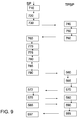
- Fig. 9 is a schematic block diagram representation illustrating the control flow for the above-mentioned second preferred embodiment of the inventional method implemented at the SP side for identifying the "best" one of all offered TPSP services due to the MRM and for integrating resources from a TPSP into the service environment of the SP by using the RM within the TPSP service.
- the execution of selecting the best service and relating the chosen TPSP service into the SP environment asks for a MRM and for an improved RM within the TPSP, which offers the "getServiceProperties" functionality as a separate Application Programming Interface (API).
- API Application Programming Interface
- the description of fig. 9 is given by referencing back to the description of fig.
- the present invention can be realized in hardware, software, or a combination of hardware and software.
- a tool according to the present invention can be realized in a centralized fashion in one computer system, or in a distributed fashion where different elements are spread across several interconnected computer systems. Any kind of computer system or other apparatus adapted for carrying out the methods described herein is suited.
- a typical combination of hardware and software could be a general-purpose computer system with a computer program that, when being loaded and executed, controls the computer system such that it carries out the methods described herein.
- the present invention can also be embedded in a computer program product, which comprises all the features enabling the implementation of the methods described herein, and which - when loaded in a computer system - is able to carry out these methods.
- Computer program means or computer program in the present context mean any expression, in any language, code or notation, of a set of instructions intended to cause a system having an information processing capability to perform a particular function either directly or after either or both of the following
Landscapes
- Engineering & Computer Science (AREA)
- Business, Economics & Management (AREA)
- Strategic Management (AREA)
- Accounting & Taxation (AREA)
- Development Economics (AREA)
- Theoretical Computer Science (AREA)
- Finance (AREA)
- Physics & Mathematics (AREA)
- General Physics & Mathematics (AREA)
- Economics (AREA)
- Marketing (AREA)
- Game Theory and Decision Science (AREA)
- General Business, Economics & Management (AREA)
- Entrepreneurship & Innovation (AREA)
- Computer Hardware Design (AREA)
- Software Systems (AREA)
- General Engineering & Computer Science (AREA)
- Management, Administration, Business Operations System, And Electronic Commerce (AREA)
- Information Transfer Between Computers (AREA)
- Computer And Data Communications (AREA)
Priority Applications (1)
| Application Number | Priority Date | Filing Date | Title |
|---|---|---|---|
| EP04106237A EP1544774A1 (de) | 2003-12-19 | 2004-12-02 | Dynamische späte Bindung von on-demand-Dienstleistungen Dritter in einer on-demand Infrastruktur |
Applications Claiming Priority (3)
| Application Number | Priority Date | Filing Date | Title |
|---|---|---|---|
| EP03104820 | 2003-12-19 | ||
| EP31048200 | 2003-12-19 | ||
| EP04106237A EP1544774A1 (de) | 2003-12-19 | 2004-12-02 | Dynamische späte Bindung von on-demand-Dienstleistungen Dritter in einer on-demand Infrastruktur |
Publications (1)
| Publication Number | Publication Date |
|---|---|
| EP1544774A1 true EP1544774A1 (de) | 2005-06-22 |
Family
ID=34673616
Family Applications (1)
| Application Number | Title | Priority Date | Filing Date |
|---|---|---|---|
| EP04106237A Withdrawn EP1544774A1 (de) | 2003-12-19 | 2004-12-02 | Dynamische späte Bindung von on-demand-Dienstleistungen Dritter in einer on-demand Infrastruktur |
Country Status (6)
| Country | Link |
|---|---|
| US (1) | US20050138187A1 (de) |
| EP (1) | EP1544774A1 (de) |
| JP (2) | JP4069114B2 (de) |
| KR (1) | KR100737301B1 (de) |
| CN (1) | CN100563234C (de) |
| TW (1) | TW200532480A (de) |
Families Citing this family (30)
| Publication number | Priority date | Publication date | Assignee | Title |
|---|---|---|---|---|
| US7962381B2 (en) * | 2004-10-15 | 2011-06-14 | Rearden Commerce, Inc. | Service designer solution |
| US7925540B1 (en) | 2004-10-15 | 2011-04-12 | Rearden Commerce, Inc. | Method and system for an automated trip planner |
| US7970666B1 (en) | 2004-12-30 | 2011-06-28 | Rearden Commerce, Inc. | Aggregate collection of travel data |
| US8180796B1 (en) | 2005-03-29 | 2012-05-15 | Rearden Commerce, Inc. | Supplier integration with services business language |
| US7706808B1 (en) | 2005-07-07 | 2010-04-27 | Rearden Commerce, Inc. | One-click service status tracking and updates |
| US7742954B1 (en) * | 2005-07-07 | 2010-06-22 | Rearden Commerce, Inc. | Method and system for an enhanced portal for services suppliers |
| US7707173B2 (en) * | 2005-07-15 | 2010-04-27 | International Business Machines Corporation | Selection of web services by service providers |
| US20070078969A1 (en) * | 2005-10-04 | 2007-04-05 | Ngo Chuong N | Composite communication service management |
| US9117223B1 (en) | 2005-12-28 | 2015-08-25 | Deem, Inc. | Method and system for resource planning for service provider |
| FI20060425A0 (fi) * | 2006-05-02 | 2006-05-02 | First Hop Oy | Toimintavalmiuksien välittäjä ja viestijärjestelmä |
| US8073719B2 (en) * | 2006-06-30 | 2011-12-06 | Rearden Commerce, Inc. | System and method for core identity with personas across multiple domains with permissions on profile data based on rights of domain |
| US20080004980A1 (en) * | 2006-06-30 | 2008-01-03 | Rearden Commerce, Inc. | System and method for regulating supplier acceptance of service requests |
| US7941374B2 (en) * | 2006-06-30 | 2011-05-10 | Rearden Commerce, Inc. | System and method for changing a personal profile or context during a transaction |
| US20080004919A1 (en) * | 2006-06-30 | 2008-01-03 | Rearden Commerce, Inc. | Triggered transactions based on criteria |
| US8095402B2 (en) * | 2006-07-10 | 2012-01-10 | Rearden Commerce, Inc. | System and method for transferring a service policy between domains |
| US7734486B2 (en) * | 2006-10-16 | 2010-06-08 | Rearden Commerce, Inc. | Methods and system for preferred vendor pre-transaction bidding |
| CN101166181A (zh) * | 2006-10-16 | 2008-04-23 | 琥珀技术有限公司 | 一种提供第三方服务的方法以及相应系统 |
| JP4396948B2 (ja) * | 2006-12-18 | 2010-01-13 | 富士通株式会社 | Webサービス制御プログラム、Webサービス制御装置、Webサービス制御方法 |
| JP2008152509A (ja) * | 2006-12-18 | 2008-07-03 | Fujitsu Ltd | Webサービス制御プログラム、Webサービス制御装置、Webサービス制御方法 |
| JP2008152508A (ja) * | 2006-12-18 | 2008-07-03 | Fujitsu Ltd | Webサービス制御プログラム、Webサービス制御装置、Webサービス制御方法、中継装置 |
| US20080201432A1 (en) * | 2007-02-16 | 2008-08-21 | Rearden Commerce, Inc. | System and Method for Facilitating Transfer of Experience Data in to Generate a New Member Profile for a Online Service Portal |
| WO2008126190A1 (ja) * | 2007-03-16 | 2008-10-23 | Fujitsu Limited | Webサービス制御プログラム、Webサービス制御装置、Webサービス制御方法、中継プログラム |
| US8336047B2 (en) * | 2008-08-25 | 2012-12-18 | International Business Machines Corporation | Provisioning virtual resources using name resolution |
| US10552849B2 (en) | 2009-04-30 | 2020-02-04 | Deem, Inc. | System and method for offering, tracking and promoting loyalty rewards |
| US8756323B2 (en) * | 2010-11-26 | 2014-06-17 | International Business Machines Corporation | Semantic- and preference-based planning of cloud service templates |
| US8560106B2 (en) * | 2010-11-30 | 2013-10-15 | Applied Materials, Inc. | Predictive maintenance for third party support equipment |
| CN102437958A (zh) * | 2011-12-16 | 2012-05-02 | 北京邮电大学 | 服务调度方法及系统 |
| US9705995B2 (en) * | 2014-03-18 | 2017-07-11 | Axis Ab | Capability monitoring in a service oriented architecture |
| US9871857B2 (en) * | 2015-04-29 | 2018-01-16 | Microsoft Technology Licensing, Llc | Optimal allocation of dynamic cloud computing platform resources |
| JP6922670B2 (ja) * | 2017-11-08 | 2021-08-18 | 日本電信電話株式会社 | リソース決定装置、リソース決定方法およびリソース決定処理プログラム |
Citations (2)
| Publication number | Priority date | Publication date | Assignee | Title |
|---|---|---|---|---|
| US20010051299A1 (en) * | 1997-01-30 | 2001-12-13 | Mutsumi Yano | Sealed alkaline storage battery |
| US6516350B1 (en) * | 1999-06-17 | 2003-02-04 | International Business Machines Corporation | Self-regulated resource management of distributed computer resources |
Family Cites Families (14)
| Publication number | Priority date | Publication date | Assignee | Title |
|---|---|---|---|---|
| JPH1049471A (ja) * | 1996-08-06 | 1998-02-20 | Fujitsu Ltd | サーバ連携制御方法 |
| JPH10232899A (ja) * | 1996-12-17 | 1998-09-02 | Fuji Xerox Co Ltd | サービス連携方法とサービス連携装置およびそれらの実施に利用できるパーツ生成管理方法 |
| JPH1115849A (ja) * | 1997-06-26 | 1999-01-22 | Fujitsu Ltd | サーバ連携制御方法 |
| US6519571B1 (en) * | 1999-05-27 | 2003-02-11 | Accenture Llp | Dynamic customer profile management |
| US6289382B1 (en) * | 1999-08-31 | 2001-09-11 | Andersen Consulting, Llp | System, method and article of manufacture for a globally addressable interface in a communication services patterns environment |
| US6606744B1 (en) * | 1999-11-22 | 2003-08-12 | Accenture, Llp | Providing collaborative installation management in a network-based supply chain environment |
| WO2002003296A1 (en) * | 2000-06-29 | 2002-01-10 | Dynamic Networks, Inc. | Method and system for producing an electronic business network |
| EP1675070A3 (de) * | 2000-07-14 | 2006-07-19 | Voice.Trust Ag | Verfahren und System zur Autorisierung einer kommerziellen Transaktion |
| US6681106B2 (en) * | 2000-09-07 | 2004-01-20 | Traq Wireless, Inc. | System and method for analyzing wireless communication records and for determining optimal wireless communication service plans |
| US20020120554A1 (en) * | 2001-02-28 | 2002-08-29 | Vega Lilly Mae | Auction, imagery and retaining engine systems for services and service providers |
| JP2002358290A (ja) * | 2001-03-19 | 2002-12-13 | Toshiba Corp | 情報処理サービス提供方法及びプログラム並びにシステム |
| JP2003122912A (ja) * | 2001-10-17 | 2003-04-25 | Hitachi Ltd | 業務支援システム |
| JP2003150572A (ja) * | 2001-11-19 | 2003-05-23 | Mitsubishi Electric Corp | 連携サービス保証システム |
| US20030217125A1 (en) * | 2002-05-15 | 2003-11-20 | Lucent Technologies, Inc. | Intelligent end user gateway device |
-
2004
- 2004-11-15 TW TW093134927A patent/TW200532480A/zh unknown
- 2004-11-26 CN CNB2004100958303A patent/CN100563234C/zh not_active Expired - Fee Related
- 2004-12-02 EP EP04106237A patent/EP1544774A1/de not_active Withdrawn
- 2004-12-03 US US11/004,028 patent/US20050138187A1/en not_active Abandoned
- 2004-12-07 KR KR1020040102325A patent/KR100737301B1/ko not_active Expired - Fee Related
- 2004-12-16 JP JP2004364205A patent/JP4069114B2/ja not_active Expired - Fee Related
-
2007
- 2007-07-20 JP JP2007190218A patent/JP2007299424A/ja active Pending
Patent Citations (2)
| Publication number | Priority date | Publication date | Assignee | Title |
|---|---|---|---|---|
| US20010051299A1 (en) * | 1997-01-30 | 2001-12-13 | Mutsumi Yano | Sealed alkaline storage battery |
| US6516350B1 (en) * | 1999-06-17 | 2003-02-04 | International Business Machines Corporation | Self-regulated resource management of distributed computer resources |
Non-Patent Citations (2)
| Title |
|---|
| SATO N ET AL: "Selecting network services based on joint assessment by customer and provider", GLOBAL TELECOMMUNICATIONS CONFERENCE, 1996. GLOBECOM '96. 'COMMUNICATIONS: THE KEY TO GLOBAL PROSPERITY LONDON, UK 18-22 NOV. 1996, NEW YORK, NY, USA,IEEE, US, vol. 1, 18 November 1996 (1996-11-18), pages 634 - 638, XP010220430, ISBN: 0-7803-3336-5 * |
| WONGRUJIRA K ET AL: "Provision resource bidding for special service provider in decoupling spaces network", COMMUNICATIONS, 2003. APCC 2003. THE 9TH ASIA-PACIFIC CONFERENCE ON 21-24 SEPT. 2003, PISCATAWAY, NJ, USA,IEEE, vol. 1, 21 September 2003 (2003-09-21), pages 363 - 367, XP010688206, ISBN: 0-7803-8114-9 * |
Also Published As
| Publication number | Publication date |
|---|---|
| TW200532480A (en) | 2005-10-01 |
| JP4069114B2 (ja) | 2008-04-02 |
| JP2005190478A (ja) | 2005-07-14 |
| JP2007299424A (ja) | 2007-11-15 |
| US20050138187A1 (en) | 2005-06-23 |
| KR100737301B1 (ko) | 2007-07-09 |
| CN100563234C (zh) | 2009-11-25 |
| CN1630288A (zh) | 2005-06-22 |
| KR20050062380A (ko) | 2005-06-23 |
Similar Documents
| Publication | Publication Date | Title |
|---|---|---|
| EP1544774A1 (de) | Dynamische späte Bindung von on-demand-Dienstleistungen Dritter in einer on-demand Infrastruktur | |
| US11157915B2 (en) | Automatic creation and configuration of license models and policies | |
| US20090182645A1 (en) | Provisioning Web Services | |
| US7024381B1 (en) | Approach for renting items to customers | |
| AU2002230536B2 (en) | System and method of reserving meeting facility resources | |
| Nelson et al. | Two dimensions of software acquisition | |
| CA2413837C (en) | System and method for scheduling events and associated products and services | |
| Quartel et al. | Methodological support for service-oriented design with ISDL | |
| US20040119752A1 (en) | Guided procedure framework | |
| US20070005536A1 (en) | Method, system and program product for managing a customer request | |
| US7155700B1 (en) | Computer program having an object module and a software project definition module which customize tasks in phases of a project represented by a linked object structure | |
| US7849102B2 (en) | Availability data service | |
| AU2002230536A1 (en) | System and method of reserving meeting facility resources | |
| US20080255918A1 (en) | Ontological representation of knowledge | |
| US7231416B1 (en) | System and method for the co-ordination and control of information supply using a distributed multi-agent platform | |
| US20050197855A1 (en) | Method and apparatus for renting items | |
| US20080162164A1 (en) | Method and system for centralized management of sources of supply | |
| US20050131773A1 (en) | Method and system for dynamically and automatically setting up offerings for it services | |
| US20020049627A1 (en) | Data driven entitlement | |
| EP2223273A1 (de) | Dynamische auftragserfüllung für kommunikations-, informations- und unterhaltungsdienste | |
| Piccinelli | Service provision and composition in virtual business communities | |
| JP7108246B1 (ja) | 商談を設定するための装置、方法及びそのためのプログラム | |
| Mooney et al. | Enabling Strategic Agility Through Agile Information Systems: The Roles of Loose Coupling and Web Services Oriented Architecture 1 | |
| Karastoyanova | A methodology for development of web service-based business processes | |
| Paurobally et al. | Developing agent Web service agreements |
Legal Events
| Date | Code | Title | Description |
|---|---|---|---|
| PUAI | Public reference made under article 153(3) epc to a published international application that has entered the european phase |
Free format text: ORIGINAL CODE: 0009012 |
|
| AK | Designated contracting states |
Kind code of ref document: A1 Designated state(s): AT BE BG CH CY CZ DE DK EE ES FI FR GB GR HU IE IS IT LI LT LU MC NL PL PT RO SE SI SK TR |
|
| AX | Request for extension of the european patent |
Extension state: AL BA HR LV MK YU |
|
| 17P | Request for examination filed |
Effective date: 20050930 |
|
| AKX | Designation fees paid |
Designated state(s): AT BE BG CH CY CZ DE DK EE ES FI FR GB GR HU IE IS IT LI LT LU MC NL PL PT RO SE SI SK TR |
|
| STAA | Information on the status of an ep patent application or granted ep patent |
Free format text: STATUS: THE APPLICATION HAS BEEN WITHDRAWN |
|
| 18W | Application withdrawn |
Effective date: 20091228 |