EP1544618A1 - Proteinanalyseverfahren - Google Patents
Proteinanalyseverfahren Download PDFInfo
- Publication number
- EP1544618A1 EP1544618A1 EP03771282A EP03771282A EP1544618A1 EP 1544618 A1 EP1544618 A1 EP 1544618A1 EP 03771282 A EP03771282 A EP 03771282A EP 03771282 A EP03771282 A EP 03771282A EP 1544618 A1 EP1544618 A1 EP 1544618A1
- Authority
- EP
- European Patent Office
- Prior art keywords
- protein
- membrane
- sample
- ppm
- staining
- Prior art date
- Legal status (The legal status is an assumption and is not a legal conclusion. Google has not performed a legal analysis and makes no representation as to the accuracy of the status listed.)
- Granted
Links
Images


Classifications
-
- G—PHYSICS
- G01—MEASURING; TESTING
- G01N—INVESTIGATING OR ANALYSING MATERIALS BY DETERMINING THEIR CHEMICAL OR PHYSICAL PROPERTIES
- G01N33/00—Investigating or analysing materials by specific methods not covered by groups G01N1/00 - G01N31/00
- G01N33/48—Biological material, e.g. blood, urine; Haemocytometers
- G01N33/50—Chemical analysis of biological material, e.g. blood, urine; Testing involving biospecific ligand binding methods; Immunological testing
- G01N33/68—Chemical analysis of biological material, e.g. blood, urine; Testing involving biospecific ligand binding methods; Immunological testing involving proteins, peptides or amino acids
- G01N33/6803—General methods of protein analysis not limited to specific proteins or families of proteins
- G01N33/6827—Total protein determination, e.g. albumin in urine
Definitions
- the present invention relates to a novel method of analyzing a protein contained in foods, drinks, food additives, medicaments, feeds, etc.
- the Ministry of Labor, Health and Welfare has shown a guideline that foods having a total protein content of at least (not less than) a few ⁇ g/g require expression of allergic substance therein (see "Interim Report of the Allergy Expression Investigation Society of the Food Expression Study Group” by the Planning Section of the Food Insurance Department of the Drug Bureau of the Ministry of Labor, Health and Welfare, dated October 29, 2001).
- enzyme linked immunosorbent assay is generally employed for detection of allergic substances contained in trace amounts in foods or food additives.
- Nippon Ham Co. sold ELISA kits for the main 5 items.
- Snow Brand Milk Products Co. announced a method of ELISA for soybean protein in the Agricultural Chemistry Society of Japan (Annual Meeting of the Agricultural Chemistry Society of Japan, 2002). The method comprises extracting a protein from a raw material with a physiological saline solution, immunizing rabbits with it, and establishing an ELISA system by the use of IgG roughly purified through a protein A column.
- the sensitivity of the method is on a level of 1 ng/ml for soybean and is high, but since the degree of purification of the material and the antibody is low, the selectivity to soybean protein in the method is low. In addition, there is no information relating to the antigen. In the ELISA method, therefore, the antibody to the allergen (antigen) must be first prepared, and a lot of time is taken for the establishment of the analytical method, and, in addition, there is no guarantee that all allergens could be detected. Further, there is still another problem in that the sensitivity and the specificity fluctuate depending on the properties of the antibody used.
- a method comprising a combination of a dot blot method and a staining method.
- a dot blotting in general, the protein concentrated and held on a membrane is visualized by staining with Coomassie brilliant blue or the like.
- a gold-colloid staining method which, however, has many drawbacks in that the background is high, staining unevenness may occur, and the operation is complicated.
- the problem to be solved by the present invention is to provide an analytical method for proteins such as allergic substances contained in trace amounts in foods, drinks, food additives, medicaments, feeds, etc, which is a simple, and has a high reproducibility and a high sensitivity.
- the present inventors have assiduously studied so as to solve the above-mentioned problem, and, as a result, have found that, when a dot blotting method and a fluorescent staining method heretofore employed in the field of biochemistry are combined, then proteins contained in trace amounts in objects to be examined (samples) can be analyzed in a simplified manner at high sensitivity, and, on the basis of this finding, we have completed the present invention.
- the present invention resides in a method of analyzing a protein in a sample, which comprises subjecting a sample to dot blotting and subsequently to fluorescent staining to stain a protein.
- the analytical method of the present invention enables quantitative analysis and limit analysis (limit test) of the protein contained in a sample.
- the method may include a step of subjecting the sample in a solution state to the dot blotting to thereby fix the protein on a membrane which is used for protein fixation in the sample, and a step of staining the protein fixed on the membrane by the fluorescent staining.
- sample employable is any of foods, drinks, food additives, medicaments, feeds and their intermediate products.
- One preferred example is an amino acid.
- the method has a sufficient sensitivity for detection of proteins contained in trace amounts in such products.
- At least 0.1 ppm of protein can be analyzed in a preferred case.
- Preferred examples of the membrane for protein fixation are a nitrocellulose membrane and a PVDF (polyvinylidene difluoride) membrane.
- the present invention includes products in which the protein has been analyzed according to the method of the present invention mentioned above, for example, foods, drinks, food additives, medicaments, feeds and their intermediate products, as well as amino acids, etc.
- the present invention encompasses the products thus analyzed in the manner as above, or those using them (products).
- the sample to be analyzed is applied onto a membrane for protein fixation to thereby fix the protein in the sample on the membrane, according to a dot blotting method.
- a solution of the sample is subjected to fixation.
- One typical example of the dot blotting method comprises putting, for example, a nitrocellulose membrane, a polyvinylidene difluoride membrane (PVDF membrane) or the like between acrylic plates having a large number of holes formed therein, then injecting a protein solution into a hole on the membrane, and subjecting it to suction filtration by aspirator to thereby fix the protein on the membrane.
- PVDF membrane polyvinylidene difluoride membrane
- the protein fixed on the above membrane is stained according to a fluorescent staining, and subsequently this is determined.
- a fluorescent staining reagent for protein gel separated through SDS electrophoresis.
- the advantage of this reagent is that it enables rapid and simple staining at high sensitivity for accurate quantification as compared with conventional methods, or the like. This may be used, for example, for detection or quantification of protein fixed on a PVDF membrane. In protein quantification at a higher sensitivity, the loss may be greater owing to adsorption to vessels or the like in ordinary operation, and detection may be difficult.
- the combination of dot blotting and fluorescent staining provides a method of analyzing protein contained in trace amounts within a relatively short period of time (approximately 4 or 5 hours from the sample preparation and the image analysis), at high sensitivity for accurate quantification.
- the former may be somewhat inferior to the latter in point of the sensitivity but is superior to the latter in that all the proteins held on the membrane can be detected and determined in the former.
- smaller proteins could be detected so far as they are highly hydrophobic, and when preferred membranes for protein fixation are selected or developed, then they could also be detected.
- their detection sensitivity per weight is higher when their solubility is higher.
- any of acid, neutral or alkaline solvent may be used. Therefore, samples may be dissolved in a solvent having a pH value that is the most suitable for the solubility of the samples, and, as a result, the detection sensitivity can be improved.
- the dot blotting-fluorescent staining method according to the present invention enables detection of all (total) proteins, and therefore enables evaluation of the proteins irrespective of the presence or absence of antigenicity in protein. Accordingly, it can be said that the method according to the present invention is a measurement method of higher reliability.
- a solution sample is used directly as it is.
- a solid sample is dissolved in a solution having a high solubility to give a possibly highest concentration thereof.
- Amino acids have a high solubility in acid solutions. Therefore, it is desirable that amino acids are dissolved in aqueous 3.5 % hydrochloric acid solution.
- samples with a standard protein e.g., bovine serum albumin, BSA
- BSA bovine serum albumin
- the protein in the sample is trapped on a nitrocellulose membrane or a PVDF membrane and, at the same time, measurement-disturbing substances are removed from the sample.
- a 96-well dot blotting apparatus can be purchased from a market, and when this is used, multiple samples can be processed at a time.
- the sample After the sample is injected, this is sucked with an aspirator, whereby the protein in the sample is adsorbed by the membrane for protein fixation.
- a PVDF membrane of high absorbability is preferable.
- water is injected a few times into it, and then aspirated, whereby the analysis-disturbing substances remaining on the membrane can be removed.
- amino acid samples amino acids reacting with the staining solution, as well as disturbing low-molecular substances and hydrochloric acid and the like can be removed.
- the washed membrane is taken out of the blotting apparatus (dot blotting apparatus, see Fig. 1), and dried enough.
- a fluorescent staining reagent SyproRuby (manufactured by Molecular Dynamics) developed for proteome analysis is a reagent of high sensitivity and good quantification, and this reagent is preferably used.
- the thus-obtained dry membrane is subjected to treatment with acetic acid-methanol solution, whereby the protein is fixed on it, and then the protein is stained with a fluorescent staining reagent. Next, the membrane is washed, and then analyzed preferably by the use of a fluorescent image analyzer.
- the each sample analyzed and the BSA-added sample thereof are observed as spots. It is recommendable to obtain the area intensity of each spot, and subsequently, plot the data on a graph with the amount of the standard protein on the horizontal axis and the fluorescent area intensity on the vertical axis.
- the test sample data are extrapolated to the line horizontally drawn from it and the section thereof indicates the protein concentration in the test sample.
- BSA was used as the standard protein, at least 0.1 ppm of BSA was able to detect.
- the detection sensitivity can directly apply as it is.
- the detection sensitivity to solid samples depends on the solubility of the samples. The sample to be analyzed is dissolved in a solvent in which the solubility of the sample is the highest, so that the highest detection sensitivity to the sample can be obtained.
- acids and alkalis may be removed after proteins have been adsorbed by membranes. Therefore, the method is also excellent in that it does not receive any limitation on the type of solvents.
- tyrosine and cystine and the like that are neutral and have a low solubility can have an increased solubility when they are acidified.
- the present invention is extremely useful, and is much expected.
- the experiment protocol including the analysis protocol and experiment operation is mentioned below.
- the following amino acids are dissolved each in 3.6 % hydrochloric acid to have a concentration of 120 mg/ml. (1.5-ml siliconized Eppendorf-tube is used.) L-Asp, (L-Cys)2, L-Glu, L-Tyr, L-Trp, L-Gln, L-Asp-Na, L-Glu-Na.
- L-Phe is dissolved in 3.6 % hydrochloric acid to have a concentration of 70 mg/ml.
- BSA is diluted with 3.6 % hydrochloric acid to have a concentration of 0, 0.1, 0.2, or 0.5 ⁇ g/ml. "0 ⁇ g/ml" is 3.6 % hydrochloric acid.
- Test samples are diluted each with an amino acid solution so that the BSA concentration in SA could be 0, 0.1, 0.2 or 0.5 ⁇ g/ml. "0 ⁇ g/ml" is amino acid solution.
- PVDF membrane is cut with scissors into a piece of approximately 12 cm ⁇ 9 cm, and its front and back faces are marked top right with a pencil so as to be differentiated from each other. Methanol is put into a vessel, and the membrane piece is dipped therein for 1 minute.
- Hydrochloric acid is put into a vessel, and the activated PVDF membrane is dipped in 3.6 % hydrochloric acid for 30 minutes.
- the membrane is set in a blotter, and 350 ⁇ l of 3.6 % hydrochloric acid is applied thereto. Under suction with an aspirator, this is washed.
- An outline of the blotting apparatus (dot blotting apparatus) used herein is shown in Fig. 1.
- 350 ⁇ l of 3.6 % hydrochloric acid is applied to the membrane, and the membrane is washed with it under suction with an aspirator.
- 350 ⁇ l of pure water is applied to the membrane thus washed, and the membrane is washed with it under suction with an aspirator.
- the membrane is released from the blotter (blotting apparatus), and dried in clean draft for 1 hour.
- the fixing solution is put into a vessel for its exclusive use, and the dry membrane is floated on the fixing solution with its transfer surface facing down. Using a shaker, this is fixed for 15 minutes. (The speed of the shaker is 50 rpm.)
- Pure water is put into a vessel.
- the membrane is floated on the pure water with its transfer surface facing down. This is washed for 5 minutes, using a shaker. (The speed of the shaker is 50 rpm.)
- the membrane is taken out, and pure water in the vessel is exchanged, and the membrane is again washed. The washing operation with pure water is repeated 4 times.
- a staining solution is put into a vessel.
- the membrane is floated on the staining solution with its transfer surface facing down. This is stained for 15 minutes, using a shaker. (The speed of the shaker is 50 rpm.)
- the membrane After 15 minutes, the membrane is taken out, and pure water is put into the vessel. The membrane is floated on the pure water with its transfer surface facing down. This is washed for 1 minute, using a shaker. (The speed of the shaker is 50 rpm.) The membrane is taken out, and pure water in the vessel is exchanged, and the membrane is again washed. The washing operation with pure water is repeated 2 times.
- Measurement condition and measurement protocol are described below.
- the image data are analyzed. As in Fig. 2, the spots are circled and the integral value of the fluorescent intensity in the circles is obtained.
- Fig. 2 One example of the image obtained according to the dot blotting method is shown in Fig. 2.
- the spot concentration of the BSA preparation increases with the increase in the amount thereof.
- a spot in added amount 0.1 ⁇ g/ml (0.1 ppm) of BSA is obviously observed. Therefore, this confirms that the present invention enables detection of at least 0.1 ppm protein.
- the same spot concentration change is also observed in the actual amino acid samples, and in addition, doughnut-like fluorescent circles concentric with sample spots are observed. This may be because the amino acid wetted around the wells while removed under reduced pressure would have reacted with the fluorescent reagent. Accordingly, in quantitative analysis, it has been decided that the product (volume) of the fluorescent intensity in the spot part is adopted.
- Protein concentration in the actual samples is calculated according to the following formula, using on the dilution ratio of each amino acid.
- Protein concentration in actual sample (protein concentration in solution obtained according to standard addition method) ⁇ (dilution ratio). Dilution ratio: 14.3 times for Asp, Cys, Glu, Phe, Tyr, Gln, Trp; and 8.3 times for the others than these.
- BSA bovine serum albumin
- Fig. 3 shows a method of calculating the protein concentration in amino acid according to a standard addition method, in which the arrow indicates the protein concentration in an amino acid solution.
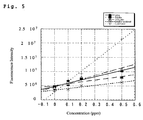
- Fig. 4 shows measurement results (standard addition method) of protein in amino acids for food additives, GluNaH 2 O (sodium L-glutamate monohydrate) and The (L-theanine), according to a dot blotting-fluorescent staining method.
- the amino acid concentration is kept constant.
- the detection sensitivity can be further increased.
- Protein having a large molecular weight becomes allergen easily, and such high-molecular-weight protein is readily detected in ELISA.
- protein having a lower molecular weight may be allergen, so that it is desirable that protein having a lower molecular weight and peptide could be detected at high sensitivity.
- proteins having a different molecular weight BSA (66 kDa), lysozyme (14 kDa), ubiquitin (8.6 kDa), insulin (5.7 kDa) and oxidized insulin B chain (3.5 kDa) were tested for the minimum limit of detection and the quantification ability thereof.
- each protein was suitably diluted and its calibration curve was formed according to the dot blotting-fluorescent staining method.
- all proteins had calibration curves of high linearity, and their minimum limit of detection was 0.1 ppm (but the minimum limit of detection of oxidized insulin B chain was only 0.2 ppm). This confirmed a detection of even proteins having a low molecular weight at high-sensitivity.
- the present invention provides a method of analyzing a protein.
- a protein such as allergic substance contained in trace amounts in foods, drinks, food additives, medicaments, cosmetics, feeds, etc. can be analyzed in a simplified manner at high sensitivity.
- the present invention can be carried out widely in various industrial fields especially in those of foods, medicaments, cosmetics, feeds, etc., and its usefulness is obvious.
Landscapes
- Life Sciences & Earth Sciences (AREA)
- Health & Medical Sciences (AREA)
- Molecular Biology (AREA)
- Engineering & Computer Science (AREA)
- Urology & Nephrology (AREA)
- Biomedical Technology (AREA)
- Physics & Mathematics (AREA)
- Chemical & Material Sciences (AREA)
- Immunology (AREA)
- Hematology (AREA)
- Cell Biology (AREA)
- Analytical Chemistry (AREA)
- Proteomics, Peptides & Aminoacids (AREA)
- Biophysics (AREA)
- Bioinformatics & Computational Biology (AREA)
- Microbiology (AREA)
- Bioinformatics & Cheminformatics (AREA)
- Food Science & Technology (AREA)
- Medicinal Chemistry (AREA)
- Biotechnology (AREA)
- Biochemistry (AREA)
- General Health & Medical Sciences (AREA)
- General Physics & Mathematics (AREA)
- Pathology (AREA)
- Investigating Or Analysing Biological Materials (AREA)
- Investigating Or Analysing Materials By The Use Of Chemical Reactions (AREA)
- Investigating, Analyzing Materials By Fluorescence Or Luminescence (AREA)
Applications Claiming Priority (3)
| Application Number | Priority Date | Filing Date | Title |
|---|---|---|---|
| JP2002217099 | 2002-07-25 | ||
| JP2002217099 | 2002-07-25 | ||
| PCT/JP2003/009305 WO2004011948A1 (ja) | 2002-07-25 | 2003-07-23 | タンパク質の分析方法 |
Publications (3)
| Publication Number | Publication Date |
|---|---|
| EP1544618A1 true EP1544618A1 (de) | 2005-06-22 |
| EP1544618A4 EP1544618A4 (de) | 2006-07-12 |
| EP1544618B1 EP1544618B1 (de) | 2009-03-18 |
Family
ID=31184595
Family Applications (1)
| Application Number | Title | Priority Date | Filing Date |
|---|---|---|---|
| EP03771282A Expired - Lifetime EP1544618B1 (de) | 2002-07-25 | 2003-07-23 | Proteinanalyseverfahren |
Country Status (7)
| Country | Link |
|---|---|
| US (1) | US20050147720A1 (de) |
| EP (1) | EP1544618B1 (de) |
| JP (1) | JPWO2004011948A1 (de) |
| AT (1) | ATE426173T1 (de) |
| AU (1) | AU2003252235A1 (de) |
| DE (1) | DE60326740D1 (de) |
| WO (1) | WO2004011948A1 (de) |
Families Citing this family (5)
| Publication number | Priority date | Publication date | Assignee | Title |
|---|---|---|---|---|
| JP4913391B2 (ja) * | 2004-12-24 | 2012-04-11 | 株式会社生体分子計測研究所 | 抗変性蛋白質抗体精製キット及び蛋白質の検出方法 |
| KR101075012B1 (ko) * | 2005-07-27 | 2011-10-19 | 아지노모토 가부시키가이샤 | 시료 용액중의 알부민의 분석방법 |
| CA2702561A1 (en) * | 2007-10-07 | 2009-04-16 | Jordan Scott | Portable device for detecting food allergens |
| JP7194128B2 (ja) * | 2017-06-29 | 2022-12-21 | イェンタイ クワンティシジョン ディアグノスティックス インク | 固形腫瘍の診断用のバイオマーカーの絶対定量の方法および装置 |
| WO2019093495A1 (ja) | 2017-11-10 | 2019-05-16 | 株式会社明治 | たんぱく質検出法 |
Family Cites Families (8)
| Publication number | Priority date | Publication date | Assignee | Title |
|---|---|---|---|---|
| US5705649A (en) * | 1992-07-20 | 1998-01-06 | Promega Corporation | Protein staining compositions and methods |
| DE19514089C2 (de) * | 1995-04-13 | 1997-07-10 | Deutsches Krebsforsch | Nachweisverfahren für HIV-TAT |
| US5616502A (en) * | 1995-05-19 | 1997-04-01 | Molecular Probes, Inc. | Non-specific protein staining using merocyanine dyes |
| JPH08338842A (ja) * | 1995-06-12 | 1996-12-24 | Tokuyama Corp | 梅毒抗原の製造方法 |
| JP2000515248A (ja) * | 1996-07-24 | 2000-11-14 | ヘレナ ラボラトリーズ コーポレイション | 血清タンパク質を蛍光分析するための試薬と方法 |
| JP3069298B2 (ja) * | 1996-11-07 | 2000-07-24 | 株式会社分子バイオホトニクス研究所 | ポリアミン分析方法 |
| ATE349700T1 (de) * | 1998-10-27 | 2007-01-15 | Molecular Probes Inc | Übergangsmetallkomplex-haltige lumineszente proteinfarben |
| US6329205B1 (en) * | 1999-08-31 | 2001-12-11 | Molecular Probes, Inc. | Detection method using luminescent europium-based protein stains |
-
2003
- 2003-07-23 WO PCT/JP2003/009305 patent/WO2004011948A1/ja not_active Ceased
- 2003-07-23 EP EP03771282A patent/EP1544618B1/de not_active Expired - Lifetime
- 2003-07-23 DE DE60326740T patent/DE60326740D1/de not_active Expired - Fee Related
- 2003-07-23 JP JP2004524123A patent/JPWO2004011948A1/ja active Pending
- 2003-07-23 AT AT03771282T patent/ATE426173T1/de not_active IP Right Cessation
- 2003-07-23 AU AU2003252235A patent/AU2003252235A1/en not_active Abandoned
-
2005
- 2005-01-24 US US11/039,791 patent/US20050147720A1/en not_active Abandoned
Also Published As
| Publication number | Publication date |
|---|---|
| WO2004011948A1 (ja) | 2004-02-05 |
| EP1544618B1 (de) | 2009-03-18 |
| EP1544618A4 (de) | 2006-07-12 |
| DE60326740D1 (de) | 2009-04-30 |
| JPWO2004011948A1 (ja) | 2005-11-24 |
| AU2003252235A1 (en) | 2004-02-16 |
| ATE426173T1 (de) | 2009-04-15 |
| US20050147720A1 (en) | 2005-07-07 |
Similar Documents
| Publication | Publication Date | Title |
|---|---|---|
| US7186799B2 (en) | Peptide and amine examination method using the same | |
| Anna et al. | Methods for 20S immunoproteasome and 20S constitutive proteasome determination based on SPRI biosensors | |
| EP1544618B1 (de) | Proteinanalyseverfahren | |
| CN107870170B (zh) | 一种酶化学发光法测定糖化血清白蛋白的试剂盒 | |
| CN114341154A (zh) | 类胰蛋白酶活性测定用底物 | |
| JP2006308321A (ja) | 表面プラズモン共鳴センサ用チップ | |
| Agnew et al. | A rapid solid‐phase fluorescence‐based protein assay for quantitation of protein electrophoresis samples containing detergents, chaotropes, dyes, and reducing agents | |
| JP6017724B1 (ja) | 十二指腸液試料の膵液由来成分検出用試料としての適性評価方法 | |
| US20240393245A1 (en) | Quantification method of polysorbate in aqueous formulations | |
| US20210317505A1 (en) | Improved detection of anticoagulants in body fluids | |
| CA2513317A1 (en) | Composition for the diagnosis of retinal vascular disease comprising aldolase and method for diagnosis using it | |
| JP5234453B2 (ja) | 皮膚カテプシンの分析方法、皮膚の光ストレスの判定方法およびそのためのキット | |
| US20220404350A1 (en) | Method for determination of aggregates | |
| Huang | Development and evaluation of an automated dye-binding assay for protein in cerebrospinal fluid. | |
| CN121499823A (zh) | 一种检测寄主昆虫寄生状态的试纸条 | |
| JPWO2011096440A1 (ja) | 天然変性タンパク質に結合する化合物およびそのスクリーニング方法 | |
| US20070037213A1 (en) | Method of analyzing protein and kit for analyzing protein | |
| JP2025075839A (ja) | 膜タンパク質アレイ | |
| US20170261504A1 (en) | Sensitive elisa for disease diagnosis on surface modified poly(methyl methacrylate) (pmma) microfluidic microplates | |
| JP2004317297A (ja) | 染色剤及び当該染色剤を用いた染色方法 | |
| RU2169925C1 (ru) | Способ определения активности лейцинаминопептидазы | |
| TWI322818B (en) | Peptide and method for dectecing amine using the same | |
| JP3481015B2 (ja) | 免疫比濁測定法 | |
| US20050272100A1 (en) | Separation and quantification of biotinylated macromolecules | |
| CN115925846A (zh) | 用于检测针对Ses iPR-10变应原的抗体的方法和试剂 |
Legal Events
| Date | Code | Title | Description |
|---|---|---|---|
| PUAI | Public reference made under article 153(3) epc to a published international application that has entered the european phase |
Free format text: ORIGINAL CODE: 0009012 |
|
| 17P | Request for examination filed |
Effective date: 20050214 |
|
| AK | Designated contracting states |
Kind code of ref document: A1 Designated state(s): AT BE BG CH CY CZ DE DK EE ES FI FR GB GR HU IE IT LI LU MC NL PT RO SE SI SK TR |
|
| AX | Request for extension of the european patent |
Extension state: AL LT LV MK |
|
| DAX | Request for extension of the european patent (deleted) | ||
| A4 | Supplementary search report drawn up and despatched |
Effective date: 20060612 |
|
| 17Q | First examination report despatched |
Effective date: 20070423 |
|
| GRAP | Despatch of communication of intention to grant a patent |
Free format text: ORIGINAL CODE: EPIDOSNIGR1 |
|
| GRAS | Grant fee paid |
Free format text: ORIGINAL CODE: EPIDOSNIGR3 |
|
| GRAA | (expected) grant |
Free format text: ORIGINAL CODE: 0009210 |
|
| AK | Designated contracting states |
Kind code of ref document: B1 Designated state(s): AT BE BG CH CY CZ DE DK EE ES FI FR GB GR HU IE IT LI LU MC NL PT RO SE SI SK TR |
|
| REG | Reference to a national code |
Ref country code: GB Ref legal event code: FG4D |
|
| REG | Reference to a national code |
Ref country code: CH Ref legal event code: EP |
|
| REG | Reference to a national code |
Ref country code: IE Ref legal event code: FG4D |
|
| REF | Corresponds to: |
Ref document number: 60326740 Country of ref document: DE Date of ref document: 20090430 Kind code of ref document: P |
|
| PG25 | Lapsed in a contracting state [announced via postgrant information from national office to epo] |
Ref country code: FI Free format text: LAPSE BECAUSE OF FAILURE TO SUBMIT A TRANSLATION OF THE DESCRIPTION OR TO PAY THE FEE WITHIN THE PRESCRIBED TIME-LIMIT Effective date: 20090318 Ref country code: NL Free format text: LAPSE BECAUSE OF FAILURE TO SUBMIT A TRANSLATION OF THE DESCRIPTION OR TO PAY THE FEE WITHIN THE PRESCRIBED TIME-LIMIT Effective date: 20090318 Ref country code: SI Free format text: LAPSE BECAUSE OF FAILURE TO SUBMIT A TRANSLATION OF THE DESCRIPTION OR TO PAY THE FEE WITHIN THE PRESCRIBED TIME-LIMIT Effective date: 20090318 |
|
| PG25 | Lapsed in a contracting state [announced via postgrant information from national office to epo] |
Ref country code: SE Free format text: LAPSE BECAUSE OF FAILURE TO SUBMIT A TRANSLATION OF THE DESCRIPTION OR TO PAY THE FEE WITHIN THE PRESCRIBED TIME-LIMIT Effective date: 20090618 Ref country code: AT Free format text: LAPSE BECAUSE OF FAILURE TO SUBMIT A TRANSLATION OF THE DESCRIPTION OR TO PAY THE FEE WITHIN THE PRESCRIBED TIME-LIMIT Effective date: 20090318 |
|
| NLV1 | Nl: lapsed or annulled due to failure to fulfill the requirements of art. 29p and 29m of the patents act | ||
| PG25 | Lapsed in a contracting state [announced via postgrant information from national office to epo] |
Ref country code: BE Free format text: LAPSE BECAUSE OF FAILURE TO SUBMIT A TRANSLATION OF THE DESCRIPTION OR TO PAY THE FEE WITHIN THE PRESCRIBED TIME-LIMIT Effective date: 20090318 |
|
| PG25 | Lapsed in a contracting state [announced via postgrant information from national office to epo] |
Ref country code: ES Free format text: LAPSE BECAUSE OF FAILURE TO SUBMIT A TRANSLATION OF THE DESCRIPTION OR TO PAY THE FEE WITHIN THE PRESCRIBED TIME-LIMIT Effective date: 20090629 Ref country code: CZ Free format text: LAPSE BECAUSE OF FAILURE TO SUBMIT A TRANSLATION OF THE DESCRIPTION OR TO PAY THE FEE WITHIN THE PRESCRIBED TIME-LIMIT Effective date: 20090318 Ref country code: PT Free format text: LAPSE BECAUSE OF FAILURE TO SUBMIT A TRANSLATION OF THE DESCRIPTION OR TO PAY THE FEE WITHIN THE PRESCRIBED TIME-LIMIT Effective date: 20090826 Ref country code: EE Free format text: LAPSE BECAUSE OF FAILURE TO SUBMIT A TRANSLATION OF THE DESCRIPTION OR TO PAY THE FEE WITHIN THE PRESCRIBED TIME-LIMIT Effective date: 20090318 |
|
| PG25 | Lapsed in a contracting state [announced via postgrant information from national office to epo] |
Ref country code: SK Free format text: LAPSE BECAUSE OF FAILURE TO SUBMIT A TRANSLATION OF THE DESCRIPTION OR TO PAY THE FEE WITHIN THE PRESCRIBED TIME-LIMIT Effective date: 20090318 Ref country code: RO Free format text: LAPSE BECAUSE OF FAILURE TO SUBMIT A TRANSLATION OF THE DESCRIPTION OR TO PAY THE FEE WITHIN THE PRESCRIBED TIME-LIMIT Effective date: 20090318 |
|
| PLBE | No opposition filed within time limit |
Free format text: ORIGINAL CODE: 0009261 |
|
| STAA | Information on the status of an ep patent application or granted ep patent |
Free format text: STATUS: NO OPPOSITION FILED WITHIN TIME LIMIT |
|
| PG25 | Lapsed in a contracting state [announced via postgrant information from national office to epo] |
Ref country code: BG Free format text: LAPSE BECAUSE OF FAILURE TO SUBMIT A TRANSLATION OF THE DESCRIPTION OR TO PAY THE FEE WITHIN THE PRESCRIBED TIME-LIMIT Effective date: 20090618 Ref country code: DK Free format text: LAPSE BECAUSE OF FAILURE TO SUBMIT A TRANSLATION OF THE DESCRIPTION OR TO PAY THE FEE WITHIN THE PRESCRIBED TIME-LIMIT Effective date: 20090318 |
|
| 26N | No opposition filed |
Effective date: 20091221 |
|
| PG25 | Lapsed in a contracting state [announced via postgrant information from national office to epo] |
Ref country code: MC Free format text: LAPSE BECAUSE OF NON-PAYMENT OF DUE FEES Effective date: 20090731 |
|
| REG | Reference to a national code |
Ref country code: CH Ref legal event code: PL |
|
| GBPC | Gb: european patent ceased through non-payment of renewal fee |
Effective date: 20090723 |
|
| PG25 | Lapsed in a contracting state [announced via postgrant information from national office to epo] |
Ref country code: LI Free format text: LAPSE BECAUSE OF NON-PAYMENT OF DUE FEES Effective date: 20090731 Ref country code: CH Free format text: LAPSE BECAUSE OF NON-PAYMENT OF DUE FEES Effective date: 20090731 |
|
| PG25 | Lapsed in a contracting state [announced via postgrant information from national office to epo] |
Ref country code: GB Free format text: LAPSE BECAUSE OF NON-PAYMENT OF DUE FEES Effective date: 20090723 |
|
| PG25 | Lapsed in a contracting state [announced via postgrant information from national office to epo] |
Ref country code: DE Free format text: LAPSE BECAUSE OF NON-PAYMENT OF DUE FEES Effective date: 20100202 |
|
| PG25 | Lapsed in a contracting state [announced via postgrant information from national office to epo] |
Ref country code: IE Free format text: LAPSE BECAUSE OF NON-PAYMENT OF DUE FEES Effective date: 20090723 |
|
| PG25 | Lapsed in a contracting state [announced via postgrant information from national office to epo] |
Ref country code: GR Free format text: LAPSE BECAUSE OF FAILURE TO SUBMIT A TRANSLATION OF THE DESCRIPTION OR TO PAY THE FEE WITHIN THE PRESCRIBED TIME-LIMIT Effective date: 20090619 |
|
| PGFP | Annual fee paid to national office [announced via postgrant information from national office to epo] |
Ref country code: FR Payment date: 20100805 Year of fee payment: 8 |
|
| PG25 | Lapsed in a contracting state [announced via postgrant information from national office to epo] |
Ref country code: IT Free format text: LAPSE BECAUSE OF FAILURE TO SUBMIT A TRANSLATION OF THE DESCRIPTION OR TO PAY THE FEE WITHIN THE PRESCRIBED TIME-LIMIT Effective date: 20090318 |
|
| PG25 | Lapsed in a contracting state [announced via postgrant information from national office to epo] |
Ref country code: LU Free format text: LAPSE BECAUSE OF NON-PAYMENT OF DUE FEES Effective date: 20090723 |
|
| PG25 | Lapsed in a contracting state [announced via postgrant information from national office to epo] |
Ref country code: HU Free format text: LAPSE BECAUSE OF FAILURE TO SUBMIT A TRANSLATION OF THE DESCRIPTION OR TO PAY THE FEE WITHIN THE PRESCRIBED TIME-LIMIT Effective date: 20090919 |
|
| PG25 | Lapsed in a contracting state [announced via postgrant information from national office to epo] |
Ref country code: TR Free format text: LAPSE BECAUSE OF FAILURE TO SUBMIT A TRANSLATION OF THE DESCRIPTION OR TO PAY THE FEE WITHIN THE PRESCRIBED TIME-LIMIT Effective date: 20090318 |
|
| PG25 | Lapsed in a contracting state [announced via postgrant information from national office to epo] |
Ref country code: CY Free format text: LAPSE BECAUSE OF FAILURE TO SUBMIT A TRANSLATION OF THE DESCRIPTION OR TO PAY THE FEE WITHIN THE PRESCRIBED TIME-LIMIT Effective date: 20090318 |
|
| REG | Reference to a national code |
Ref country code: FR Ref legal event code: ST Effective date: 20120330 |
|
| PG25 | Lapsed in a contracting state [announced via postgrant information from national office to epo] |
Ref country code: FR Free format text: LAPSE BECAUSE OF NON-PAYMENT OF DUE FEES Effective date: 20110801 |