EP1543304B1 - Verfahren mit wärmeflusssensoren zur bestimmung der ausgabe einer thermischen reaktion in einem gehäuse und einrichtung zur ausführung eines solchen verfahrens - Google Patents
Verfahren mit wärmeflusssensoren zur bestimmung der ausgabe einer thermischen reaktion in einem gehäuse und einrichtung zur ausführung eines solchen verfahrens Download PDFInfo
- Publication number
- EP1543304B1 EP1543304B1 EP03760014A EP03760014A EP1543304B1 EP 1543304 B1 EP1543304 B1 EP 1543304B1 EP 03760014 A EP03760014 A EP 03760014A EP 03760014 A EP03760014 A EP 03760014A EP 1543304 B1 EP1543304 B1 EP 1543304B1
- Authority
- EP
- European Patent Office
- Prior art keywords
- housing
- reagent
- wall
- heat flux
- heat
- Prior art date
- Legal status (The legal status is an assumption and is not a legal conclusion. Google has not performed a legal analysis and makes no representation as to the accuracy of the status listed.)
- Expired - Lifetime
Links
Images
Classifications
-
- G—PHYSICS
- G01—MEASURING; TESTING
- G01K—MEASURING TEMPERATURE; MEASURING QUANTITY OF HEAT; THERMALLY-SENSITIVE ELEMENTS NOT OTHERWISE PROVIDED FOR
- G01K17/00—Measuring quantity of heat
- G01K17/06—Measuring quantity of heat conveyed by flowing media, e.g. in heating systems e.g. the quantity of heat in a transporting medium, delivered to or consumed in an expenditure device
- G01K17/08—Measuring quantity of heat conveyed by flowing media, e.g. in heating systems e.g. the quantity of heat in a transporting medium, delivered to or consumed in an expenditure device based upon measurement of temperature difference or of a temperature
- G01K17/20—Measuring quantity of heat conveyed by flowing media, e.g. in heating systems e.g. the quantity of heat in a transporting medium, delivered to or consumed in an expenditure device based upon measurement of temperature difference or of a temperature across a radiating surface, combined with ascertainment of the heat-transmission coefficient
-
- G—PHYSICS
- G01—MEASURING; TESTING
- G01K—MEASURING TEMPERATURE; MEASURING QUANTITY OF HEAT; THERMALLY-SENSITIVE ELEMENTS NOT OTHERWISE PROVIDED FOR
- G01K17/00—Measuring quantity of heat
Definitions
- the invention is in the field of metrology and more particularly in the field of measurement of heat quantities. It relates to a method for evaluating the power of a thermal reaction inside an enclosure, such as that of a reactor of a calorimeter. It also relates to a device for implementing such a method.
- thermal reactions are for example produced by chemical reactions of a reagent, or by the heat released by biological reactions, such as those resulting from the activity of microorganisms, or by physical reactions, such as those resulting from crystallization or shape transition of polymorphic substances, or finally by voluntary energy productions, such as nuclear reactions.
- the chamber is placed in a thermally controlled medium, to maintain at a desired temperature a reagent contained within the enclosure.
- This reagent is maintained in agitation, by means of an agitator or by setting in motion the enclosure itself.
- the means for maintaining the desired temperature are for example obtained by means of a casing surrounding the enclosure for the circulation of a thermostated heat transfer fluid.
- the evolution and analysis of the thermal reaction inside the chamber is more particularly to determine its power and the heat exchange coefficient between the wall of the chamber and the reagent.
- a first known technique consists in measuring the internal and external temperatures of the enclosure by means of thermometers.
- the power of the thermal reaction takes into account the difference between the two measured temperatures, the exchange surface and the heat exchange coefficient between the reagent and the wall of the enclosure.
- the exchange surface is evaluated judged and the heat exchange coefficient is determined beforehand by calibration by dipping into the reagent a heating electric resistance.
- a first disadvantage of this technique lies in an arbitrary consideration of the exchange surface that is judged by judging the level of the reagent in the state of rest within the enclosure. This results in a detrimental approximation for the reliability and accuracy of the result obtained in determining the power of the thermal reaction.
- a second disadvantage lies in the improper use of a means for heating the reagent before it is agitated with either undesirable consequences on the physico-chemical characteristics of the reagent before the reaction studied, or the preliminary step of determining the coefficient by a specific calibration operation.
- a second known technique is to use a heating resistor placed in the heat transfer fluid flowing between the enclosure and its envelope.
- the heating resistor produces less heat to keep the temperature of the reagent constant.
- the power of the reaction is then evaluated from the corresponding power reduction of the heating resistor.
- US4130016 LYNN C. WALKER .
- a first major disadvantage of this technique is that it is inapplicable to endothermic reactions.
- a second disadvantage lies in the thermal inertia of the enclosure against a possible analysis of rapid thermal variations and / or large amplitudes.
- a third technique is to perform a thermal balance in the circulation zone of the heat transfer fluid.
- a condenser in which the heat transfer fluid condenses after heating.
- the measurement of the amount of condensed fluid makes it possible to determine the power of the thermal reaction.
- a disadvantage of this technique lies in the inaccuracy of the analysis of the thermal reaction inside the chamber, evaluated via the coolant, which implies measurement approximations related in particular to the heat losses accumulated between the enclosure and the means used to perform the heat balance.
- the patent US5174655 (WILFRIED LITZ & all) describes a method for measuring a thermal flow exiting a reactor in real time, using a cell outside the reactor to which the reagent is pumped.
- the cell is a calorimeter.
- the exchange surface and the heat exchange coefficient between the enclosure of the calorimeter and an envelope are taken into account using a single coefficient K ("diathermancy") which is calculated.
- the reagent is in contact with the entire surface of the enclosure, which is reflected by the coefficient K.
- the overall aim of the present invention is to propose a method for continuously and reliably evaluating in real time the power of a thermal reaction inside an enclosure and the coefficient of heat exchange between the reagent and this enclosure. It also aims to propose a device to implement this method.
- the inventive step of the present invention has been to propose a method and its implementation device for accurately and reliably determining, in real time and continuously, the exchange surface between the reagent and the enclosure, to finally allow to analyze under the same conditions the characteristics of the enclosure and the thermal reaction studied.
- This approach was more particularly to break the habits taken in the field, and to use heat flow sensors to determine accurately, reliably, continuously and in real time, the exchange surface between the reagent and the pregnant.
- thermopiles delivering logic voltage information
- One further advantageous result of the invention lies in the absence of prior calibration, such as according to the prior art, of the means implemented for the method of the invention, namely flow measurement sensors. heat.
- Another result achieved by the present invention is to propose a method and its implementation device for measuring, between two given times t 0 and t 1 , the variation of distance, following a thermal reaction, taken between any two points. a reagent contained in an enclosure, at time t 0 and t 1 .
- Particular applications of the implementation of the method of the invention consists in particular in measuring the spontaneous variation of the actual level h of a reagent contained in an enclosure, in particular a safety threshold, following natural or induced variations in the external environment of this chamber, such as a storage tank for a sensitive product, or the dilatometry of a material.
- a method for determining an exchange surface A between a reagent and the wall of an enclosure containing it in particular with a view to determining the power P r a thermal reaction inside the enclosure and the heat exchange coefficient U between the reagent and the wall of the enclosure.
- the proposed method consists in measuring a first heat flux F 1 per unit area taken in a zone of the wall in certain contact with the reagent to measure a second heat flux F 2 per unit. of surface taken in an area of the wall in the absence of any contact with the reagent, measuring a third heat flux F 3 per unit area taken in an area of the wall comprising continuously overlapping at one time any area of the wall in certain contact with the reagent close to any area of the wall in the absence of any contact with the reagent, then to calculate, by proportion between the measurements made of the first, second and third heat flux, the actual level h of the reagent inside the enclosure.
- the power P t transmitted by the enclosure can be determined by measuring the first heat flux F 1 per unit area and determining said exchange surface A between the reagent and the wall of the enclosure, preferably according to the method referred to above in a first aspect of the invention.
- the heat exchange coefficient U between the reagent and the wall of the enclosure is then calculated in the manner known to those skilled in the art, from the power transmitted P t by the enclosure, of the heat exchange surface A between the reagent and the wall of the enclosure and the temperature difference between the temperature of the reagent and the temperature of the wall of the enclosure.
- the power of the reaction P r is determined by measuring the evolution of the temperature of the reagent during the reaction time, by determining the transmitted power P t by the enclosure and evaluating the thermal losses of the enclosure. These heat losses, commonly known as “losses of the enclosure sky”, are known to those skilled in the art.
- the power P r of the reaction can be calculated in the manner known to those skilled in the art, from the mass and the physico-chemical characteristics of the reagent, the evolution of the temperature T r of the reaction. reactive over time, the power transmitted P t by the enclosure and thermal losses of the enclosure.
- the energy of the reaction is obtained, in the manner known to those skilled in the art, by integration over time of the power of the reaction measured continuously throughout the thermal reaction. .
- Such a device furthermore comprises, and advantageously, first electronic means for calculating the level h of the reagent from logical information of voltage supplied by the first, second and third flow sensors, and second electronic means for calculating the actual exchange surface A between the reagent and the wall of the enclosure, based on logical information provided by the first electronic means and from the first memory means of the geometric characteristics of the enclosure previously entered.
- the device of the invention further comprises a casing surrounding the enclosure for the circulation of a fluid around the latter, this fluid being thermostatically controlled by means of heat production, for maintaining the enclosure at a desired temperature.
- the device of the invention preferably comprises a first temperature sensor placed inside the chamber for measuring the temperature T r of the reagent, and a second temperature sensor placed inside the chamber.
- envelope for measuring the temperature T e of the wall of the enclosure in particular obtained from the measurement of the temperature of the heat transfer fluid inside the envelope, in the manner known to those skilled in the art.
- the device of the invention further comprises third electronic means for calculating the power P t transmitted by the enclosure and fourth electronic means for calculating the heat exchange coefficient U between the reagent and the wall of the enclosure, from the logic information from the second electronic means of calculation, and from the logic information from the first and second temperature sensors.
- the device of the invention comprises fifth electronic means for calculating the power P r of the thermal reaction from the logic information from the third electronic calculation means and the first temperature sensor.
- first, second and third heat flux sensors advantageously constitute general means for continuously determining the level h of a reagent inside the enclosure, in association with the first calculation means.
- first, second, third, fourth and fifth electronic calculation means are advantageously grouped together in general memory and electronic calculation means.
- the device of the invention notably comprises a computer comprising general means for memories and electronic calculations, means for displaying the various measured and calculated logical information, such as a screen, printer, or the like, and means for entering information and controlling general computing means, such as a keyboard or the like.
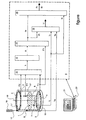
- the chamber 2 is equipped with a first temperature sensor 7 measuring the temperature T r of the reagent 1 and a second temperature sensor 8 measuring the temperature T f of the fluid contained in the envelope 3, to know the temperature T e of the wall of the enclosure.
- Each of these heat flux sensors 4,5,6 and temperature 7,8 is connected to the general electronic computing means 9.
- the chamber 2 is in particular equipped with means for stirring the reagent 1, according to known arrangements that are customary in the field, such as an agitator 10, and means for fixing 11, 11 ', 11 "of the flow sensors. 4,5,6 on its wall, for example implementing in association pins and elastic means.
- the energy of the reaction E r is then obtained by integration over time of the power of the reaction P r .
- the illustrated device further comprises a computer 20 comprising general means 9 of memories and electronic calculations, viewing means such as a screen 19, a printer and information and control input means 21.
- a computer 20 comprising general means 9 of memories and electronic calculations, viewing means such as a screen 19, a printer and information and control input means 21.
Landscapes
- Chemical & Material Sciences (AREA)
- Engineering & Computer Science (AREA)
- Combustion & Propulsion (AREA)
- Physics & Mathematics (AREA)
- General Physics & Mathematics (AREA)
- Investigating Or Analyzing Materials Using Thermal Means (AREA)
Claims (13)
- Verfahren zur Bestimmung einer Austauschfläche A zwischen einem Reagenz (1) und der Wand eines Hohlraums (2), der dieses enthält, um insbesondere die Leistung Pr einer thermischen Reaktion im Inneren des Hohlraums (2) und den Wärmeaustauschkoeffizienten U zwischen dem Reagenz (1) und der Wand des Hohlraums (2) zu bestimmen, dadurch gekennzeichnet:dass es darin besteht:- einen ersten Wärmefluss F1 pro Flächeneinheit zu messen, wobei dies in einem Bereich der Wand erfolgt, der sich in sicherem Kontakt mit dem Reagenz (1) befindet,- einen zweiten Wärmefluss F2 pro Flächeneinheit zu messen, wobei dies in einem Bereich der Wand erfolgt, der sich nicht in sicherem Kontakt mit dem Reagenz (1) befindet,- einen dritten Wärmefluss F3 pro Flächeneinheit zu messen, wobei dies in einem Bereich der Wand erfolgt, der in kontinuierlich überlappender Weise sowohl einen beliebigen Bereich der Wand, der sich in sicherem Kontakt mit dem Reagenz (1) befindet und einen benachbarten beliebigen Bereich, der sich nicht in sicherem Kontakt mit dem Reagenz (1) befindet, umfasst,- durch proportionale Berechnung aus den Messungen der ersten, zweiten und dritten Wärmefluss das tatsächliche Niveau h des Reagenzes (1) im Inneren des Hohlraums (2) zu bestimmen,sodass, ausgehend vom berechneten tatsächlichen Niveau h des Reagenz (1) und im Verhältnis zu einer beliebigen gegebenen Geometrie des Hohlraums (2), kontinuierlich und in Echtzeit die tatsächliche Austauschfläche A zwischen dem Reagenz (1) und der Wand des Hohlraums (2), der dieses enthält, bestimmt werden kann.
- Verfahren nach Anspruch 1, angewendet auf die Bestimmung der Leistung Pt, welche von dem Hohlraum (2) übertragen wird, dadurch gekennzeichnet:dass es darin besteht:- den ersten Wärmefluss F1 pro Flächeneinheit zu messen,- die Austauschfläche A zwischen dem Reagenz (1) und der Wand des Hohlraums (2) zu messen,sodass die Leistung Pt, die von dem Hohlraum (2) übertragen wird, kontinuierlich und in Echtzeit berechnet werden kann, mit einer Genauigkeit und einer Zuverlässigkeit, die ausgehend von denjenigen der Austauschfläche A erhalten werden.
- Verfahren nach Anspruch 2, angewendet auf die Bestimmung des Wärmeaustauschkoeffizienten U zwischen dem Reagenz (1) und der Wand des Hohlraums (2), dadurch gekennzeichnet:dass es darin besteht:- die Temperatur Tr des Reagenzes (1) und die Temperatur Te der Wand des Hohlraums (2) zu messen,- die tatsächliche Austauschfläche A zwischen dem Reagenz (1) und der Wand des Hohlraums (2) zu messen,- Die Leistung Pt, die von dem Hohlraum übertragen wird, zu berechnen,sodass der Wärmeaustauschkoeffizient U zwischen dem Reagenz (1) und der Wand (1) des Hohlraums (2), kontinuierlich und in Echtzeit berechnet werden kann, mit einer Genauigkeit und einer Zuverlässigkeit, die ausgehend von denjenigen der Austauschfläche A erhalten werden.
- Verfahren nach Anspruch 2, angewendet auf die Bestimmung der Leistung der Reaktion Pr, dadurch gekennzeichnet:dass es darin besteht:- die Entwicklung der Temperatur Tr des Reagenzes (1) im Laufe der Reaktionszeit zu messen,- die Leistung Pt, die von dem Hohlraum (2) übertragen wird, zu bestimmen,- die Wärmeverluste des Hohlraums (2) auszuwerten,sodass die Leistung der Reaktion Pr, kontinuierlich und in Echtzeit berechnet werden kann, mit einer Genauigkeit und einer Zuverlässigkeit, die ausgehend von denjenigen der Austauschfläche A erhalten werden.
- Verfahren nach Anspruch 1, angewendet auf die Messung der Veränderungen des Niveau h eines Reagenzes (1) im Inneren eines Hohlraums (2), bis zu einem Sicherheitsschwellenwert.
- Vorrichtung zur Messung der Austauschfläche A zwischen einem Reagenz (1) und der Wand eines Hohlraums (2), der dieses enthält, für die Durchführung eines Verfahrens nach Anspruch 1, dadurch gekennzeichnet:dass sie folgendes umfasst:- einen Hohlraum (2) zur Aufnahme des Reagenzes (1),- einen ersten Wärmefluss-Sensor (4) zur Messung des ersten Wärmeflusses F1 pro Flächeneinheit, wobei dieser Wärmefluss-Sensor (4) auf der Außenwand des Hohlraums (2) in einem Bereich des letzteren angeordnet ist, der mit einem Bereich der Innenseite der Wand des Hohlraums in Verbindung steht, welcher sich in sicherem Kontakt mit dem Reagenz (1) befindet,- einen zweiten Wärmefluss-Sensor (5) zur Messung des zweiten Wärmeflusses F2 pro Flächeneinheit, wobei dieser Wärmefluss-Sensor (5) auf der Außenwand des Hohlraums (2) in einem Bereich des letzteren angeordnet ist, der mit einem Bereich der Innenseite der Wand des Hohlraums in Verbindung steht, welcher sich nicht in sicherem Kontakt mit dem Reagenz (1) befindet,- einen dritten Wärmefluss-Sensor (6) zur Messung des dritten Wärmeflusses F3 pro Flächeneinheit, wobei dieser Wärmefluss-Sensor (6) auf der Außenwand des Hohlraums (2) in einem Bereich des letzteren angeordnet ist, der mit einem Bereich der Innenseite der Wand des Hohlraums in Verbindung steht, welcher sich sowohl in Kontakt als auch nicht in Kontakt mit dem Reagenz (1) befindet,- erste elektronische Mittel (12) zum Berechnen des Niveaus h des Reagenzes (1) ausgehend von logischen Spannungsinformationen, die von den ersten, zweiten und dritten Fluss-Sensoren (4, 5, 6) geliefert werden, und zweite elektronische Mittel (13) zum Berechnen der tatsächlichen Austauschfläche A zwischen dem Reagenz (1) und der Wand des Hohlraums (2).
- Vorrichtung nach Anspruch 6 zur Durchführung eines Verfahrens nach einem beliebigen der Ansprüche 1 bis 4, angewendet auf ein Kalorimeter, dadurch gekennzeichnet:dass sie einen Mantel (3) umfasst, der den Hohlraum (2) umgibt und dazu bestimmt ist, letzteren von einem Fluid (17) umströmen zu lassen, wobei dieses Fluid durch Mittel zur Wärmeerzeugung (18) thermostatisiert ist, um den Hohlraum (2) bei einer gewünschten Temperatur zu halten.
- Vorrichtung nach Anspruch 7 zur Durchführung eines Verfahrens nach einem beliebigen der Ansprüche 3 und 4,
dadurch gekennzeichnet:dass sie folgendes umfasst:- einen ersten Temperatursensor (7), der im Inneren des Hohlraums (2) angeordnet ist, um die Temperatur Tr des Reagenzes zu messen,- einen zweiten Temperatursensor (8), der im Inneren des Mantels (3) angeordnet ist, um die Temperatur Te der Wand des Hohlraums (2) ausgehend von der Temperatur Tf des thermostatisierten Wärmeträgerfluids im Inneren des Mantels (3) zu messen. - Vorrichtung nach Anspruch 8 zur Durchführung eines Verfahrens nach einem beliebigen der Ansprüche 2 und 3, dadurch gekennzeichnet:dass sie dritte elektronische Mittel (14) zur Berechnung der Leistung Pt, die von dem Hohlraum (2) übertragen wird, und vierte elektronische Mittel (15) zur Berechnung des Wärmeaustauschkoeffizienten U zwischen dem Reagenz (1) und der Wand des Hohlraums (2), ausgehend von den logischen Informationen, die von den zweiten elektronischen Berechnungsmitteln (13) stammen, und ausgehend von den logischen Informationen, die von den ersten (7) und zweiten (8) Temperatursensoren stammen, umfasst.
- Vorrichtung nach Anspruch 8 zur Durchführung eines Verfahrens nach Anspruch 4, dadurch gekennzeichnet:dass sie fünfte elektronische Mittel (16) zur Berechnung der Leistung Pr der thermischen Reaktion ausgehend von den logischen Informationen, die von den dritten elektronischen Berechnungsmitteln (14) und vom ersten Temperatursensor (7) stammen, umfasst.
- Vorrichtung nach Anspruch 6 zur Durchführung eines Verfahrens nach Anspruch 5, dadurch gekennzeichnet:dass die ersten (4), zweiten (5) und dritten (6) Wärmefluss-Sensoren allgemeine Mittel zur kontinuierlichen Bestimmung des Niveaus h eines Reagenzes im Inneren eines Hohlraums (2), in Verbindung mit den ersten Berechnungsmitteln (12) darstellen.
- Vorrichtung nach den Ansprüchen 6, 9 und 10, dadurch gekennzeichnet
dass die ersten (12), zweiten (13), dritten (14), vierten (15) und fünften (16) elektronischen Berechnungsmittel in allgemeinen elektronischen Speicher- und Berechnungsmitteln (9) zusammengefasst sind. - Vorrichtung nach Anspruch 12, dadurch gekennzeichnet:dass sie ein Steuergerät umfasst, das folgendes umfasst:- allgemeine elektronischen Speicher- und Berechnungsmittel (9),- Mittel zur Anzeige der verschiedenen gemessenen und berechneten logischen Informationen,- Mittel zur Informationseingabe und zur Steuerung der allgemeinen elektronischen Speicher- und Berechnungsmittel (9).
Applications Claiming Priority (3)
| Application Number | Priority Date | Filing Date | Title |
|---|---|---|---|
| FR0208069 | 2002-06-12 | ||
| FR0208069A FR2840986B1 (fr) | 2002-06-12 | 2002-06-12 | Methode mettant en oeuvre des capteurs de flux de chaleur pour evaluer la puissance d'une reaction thermique a l'interieur d'une enceinte, et dispositif pour la mise en oeuvre d'une telle methode |
| PCT/FR2003/001757 WO2003106950A1 (fr) | 2002-06-12 | 2003-06-11 | Methode mettant en oeuvre des capteurs de flux pour evaluer la puissance d’une reaction thermique à l’interieur d’une enceinte, et dispositif pour la mise en oeuvre d’une telle methode |
Publications (2)
| Publication Number | Publication Date |
|---|---|
| EP1543304A1 EP1543304A1 (de) | 2005-06-22 |
| EP1543304B1 true EP1543304B1 (de) | 2010-09-08 |
Family
ID=29595387
Family Applications (1)
| Application Number | Title | Priority Date | Filing Date |
|---|---|---|---|
| EP03760014A Expired - Lifetime EP1543304B1 (de) | 2002-06-12 | 2003-06-11 | Verfahren mit wärmeflusssensoren zur bestimmung der ausgabe einer thermischen reaktion in einem gehäuse und einrichtung zur ausführung eines solchen verfahrens |
Country Status (10)
| Country | Link |
|---|---|
| US (1) | US7220050B2 (de) |
| EP (1) | EP1543304B1 (de) |
| JP (1) | JP4446884B2 (de) |
| CN (1) | CN100360914C (de) |
| AT (1) | ATE480757T1 (de) |
| AU (1) | AU2003253066A1 (de) |
| CA (1) | CA2489006A1 (de) |
| DE (1) | DE60334120D1 (de) |
| FR (1) | FR2840986B1 (de) |
| WO (1) | WO2003106950A1 (de) |
Cited By (1)
| Publication number | Priority date | Publication date | Assignee | Title |
|---|---|---|---|---|
| EP3932531A1 (de) | 2020-07-02 | 2022-01-05 | Fluitec Invest AG | Kontinuierliches reaktionskalorimeter |
Families Citing this family (19)
| Publication number | Priority date | Publication date | Assignee | Title |
|---|---|---|---|---|
| EP1890138A1 (de) * | 2006-08-15 | 2008-02-20 | Eidgenössische Technische Hochschule Zürich | Bestimmung von spezifischer Wärmeleistung |
| FR2923010B1 (fr) * | 2007-10-26 | 2012-05-18 | Commissariat Energie Atomique | Dispositif et procede de mesure de la puissance residuelle d'une charge |
| EP2133676B1 (de) * | 2008-06-13 | 2013-03-13 | Mettler-Toledo AG | Kalorimetrisches Verfahren |
| JP5585131B2 (ja) * | 2010-03-12 | 2014-09-10 | いすゞ自動車株式会社 | 発熱量測定容器 |
| FR2975492A1 (fr) * | 2011-05-20 | 2012-11-23 | Univ Provence Aix Marseille 1 | Dispositif pour l'analyse thermique d'un fluide au contact d'une paroi soumise a une sollicitation thermique. |
| US9360377B2 (en) * | 2013-12-26 | 2016-06-07 | Rosemount Inc. | Non-intrusive temperature measurement assembly |
| FR3016037B1 (fr) * | 2013-12-30 | 2016-01-01 | Saint Gobain Isover | Procede et dispositif de determination du coefficient de deperdition thermique d'un local |
| CN105136851B (zh) * | 2015-09-22 | 2018-06-26 | 中国石油大学(华东) | 一种测量炭质大分子等温热反应过程中热效应的装置及方法 |
| US11226242B2 (en) | 2016-01-25 | 2022-01-18 | Rosemount Inc. | Process transmitter isolation compensation |
| CA3011963C (en) | 2016-01-25 | 2021-08-24 | Rosemount Inc. | Non-intrusive process fluid temperature calculation system |
| US11067520B2 (en) | 2016-06-29 | 2021-07-20 | Rosemount Inc. | Process fluid temperature measurement system with improved process intrusion |
| US11226255B2 (en) | 2016-09-29 | 2022-01-18 | Rosemount Inc. | Process transmitter isolation unit compensation |
| FR3071606B1 (fr) * | 2017-09-27 | 2019-09-20 | Institut National De Recherche Pour L'agriculture, L'alimentation Et L'environnement | Systeme et procede de calorimetrie a determination multiple de flux de chaleur |
| TWI670460B (zh) * | 2017-12-21 | 2019-09-01 | 日商日本製鐵股份有限公司 | 電爐之耐火材料損耗管理裝置、電爐之耐火材料損耗管理系統、電爐之耐火材料損耗管理方法、及電腦可讀取之記憶媒體 |
| EP3857189B1 (de) | 2018-09-28 | 2025-01-15 | Rosemount Inc. | Nichtinvasive prozessflüssigkeitstemperaturanzeige mit reduzierter fehleranfälligkeit |
| WO2021067502A1 (en) * | 2019-09-30 | 2021-04-08 | Saudi Arabian Oil Company | Systems and methods for high temperature, high pressure isothermal calorimetry |
| CN113340472B (zh) * | 2021-04-19 | 2022-09-27 | 国网上海市电力公司 | 超导电缆中间接头漏热测量及计算方法与装置 |
| CN114858852A (zh) * | 2022-04-07 | 2022-08-05 | 郑州大学 | 测试不同环境温度下注浆材料放热性能的试验装置及方法 |
| EP4671750A1 (de) | 2024-06-27 | 2025-12-31 | Algochem | Vorrichtung zur messung eines internen thermischen übertragungskoeffizienten eines flüssigen mediums, verfahren zur implementierung solch einer vorrichtung und modellierung des koeffizienten |
Family Cites Families (12)
| Publication number | Priority date | Publication date | Assignee | Title |
|---|---|---|---|---|
| US4130016A (en) * | 1977-08-08 | 1978-12-19 | The Dow Chemical Company | Adiabatic calorimeter apparatus and method for measuring the energy change in a chemical reaction |
| US4244216A (en) * | 1979-01-08 | 1981-01-13 | The Babcock & Wilcox Company | Heat flow meter |
| FR2570825B1 (fr) * | 1984-09-26 | 1987-02-06 | Commissariat Energie Atomique | Appareil de mesure thermique de la texture d'un corps poreux |
| US4741209A (en) * | 1985-11-19 | 1988-05-03 | Reg McCulloch | Apparatus for detecting the boundary between two substances |
| JPS63187145A (ja) * | 1987-01-08 | 1988-08-02 | ウエスチングハウス・エレクトリック・コーポレーション | 発熱反応によるエネルギ発生量の測定装置 |
| DE4034115C1 (de) * | 1990-10-26 | 1992-04-02 | Bayer Ag, 5090 Leverkusen, De | |
| FI96066C (fi) * | 1994-03-24 | 1996-04-25 | Polar Electro Oy | Menetelmä ja laite rakenteen sisälämpötilan ja sisäisen lämmönjohtavuuskertoimen määrittämiseksi |
| WO1997033161A1 (en) * | 1996-03-08 | 1997-09-12 | Holometrix, Inc. | Heat flow meter instruments |
| EP1036315A4 (de) * | 1997-12-02 | 2001-02-07 | Allan L Smith | Vorrichtung und verfahren zur gleichzeitgen messung von masse-und wärmeveränder-ungen |
| US6431747B1 (en) * | 2000-03-23 | 2002-08-13 | Ta Instruments, Inc. | Heat flux differential scanning calorimeter sensor |
| FR2847037B1 (fr) * | 2002-11-13 | 2005-03-04 | Thermoflux Sa | Dispositif de mesure d'un flux thermique |
| US7077563B2 (en) * | 2003-11-19 | 2006-07-18 | General Electric Company | Deposition sensor based on differential heat flux measurement |
-
2002
- 2002-06-12 FR FR0208069A patent/FR2840986B1/fr not_active Expired - Lifetime
-
2003
- 2003-06-11 JP JP2004513722A patent/JP4446884B2/ja not_active Expired - Lifetime
- 2003-06-11 EP EP03760014A patent/EP1543304B1/de not_active Expired - Lifetime
- 2003-06-11 DE DE60334120T patent/DE60334120D1/de not_active Expired - Lifetime
- 2003-06-11 US US10/517,528 patent/US7220050B2/en not_active Expired - Lifetime
- 2003-06-11 AT AT03760014T patent/ATE480757T1/de not_active IP Right Cessation
- 2003-06-11 WO PCT/FR2003/001757 patent/WO2003106950A1/fr not_active Ceased
- 2003-06-11 CA CA002489006A patent/CA2489006A1/fr not_active Abandoned
- 2003-06-11 AU AU2003253066A patent/AU2003253066A1/en not_active Abandoned
- 2003-06-11 CN CNB038189976A patent/CN100360914C/zh not_active Expired - Lifetime
Cited By (1)
| Publication number | Priority date | Publication date | Assignee | Title |
|---|---|---|---|---|
| EP3932531A1 (de) | 2020-07-02 | 2022-01-05 | Fluitec Invest AG | Kontinuierliches reaktionskalorimeter |
Also Published As
| Publication number | Publication date |
|---|---|
| DE60334120D1 (de) | 2010-10-21 |
| FR2840986B1 (fr) | 2004-09-10 |
| WO2003106950A1 (fr) | 2003-12-24 |
| CA2489006A1 (fr) | 2003-12-24 |
| US20060165151A1 (en) | 2006-07-27 |
| ATE480757T1 (de) | 2010-09-15 |
| CN1675526A (zh) | 2005-09-28 |
| JP4446884B2 (ja) | 2010-04-07 |
| AU2003253066A1 (en) | 2003-12-31 |
| CN100360914C (zh) | 2008-01-09 |
| JP2005529346A (ja) | 2005-09-29 |
| US7220050B2 (en) | 2007-05-22 |
| FR2840986A1 (fr) | 2003-12-19 |
| EP1543304A1 (de) | 2005-06-22 |
Similar Documents
| Publication | Publication Date | Title |
|---|---|---|
| EP1543304B1 (de) | Verfahren mit wärmeflusssensoren zur bestimmung der ausgabe einer thermischen reaktion in einem gehäuse und einrichtung zur ausführung eines solchen verfahrens | |
| US10175123B2 (en) | MEMS-based calorimeter, fabrication, and use thereof | |
| US5947370A (en) | Apparatus and method for real time boiling point detection and control | |
| US10295490B2 (en) | MEMS-based calorimeter, fabrication, and use thereof | |
| US5547282A (en) | Calorimetric measuring apparatus | |
| Holba et al. | Heat transfer and phase transition in DTA experiments | |
| CA1315567C (en) | Automated calorimeter and methods of operating the same | |
| Anthony et al. | Non-invasive, transient determination of the core temperature of a heat-generating solid body | |
| Sun et al. | Thermal hazard evaluation of complex reactive substance using calorimeters and Dewar vessel | |
| van Herwaarden | Calorimetry measurement | |
| Ding et al. | Accelerating rate calorimetry: History, state of the art and perspectives | |
| RU2362152C2 (ru) | Способ исследования процессов структуропреобразования в жидкостях | |
| JP2010276366A (ja) | 反応速度測定装置 | |
| EP0126658A1 (de) | Wärmeflussmessgerät zur Überwachung von wärmeproduzierenden, in einem Behälter aufgenommenen Stoffen | |
| JPS6165148A (ja) | 熱量計 | |
| Pastré et al. | Determination of reaction parameters using a small calorimeter with an integrated FT-IR probe and parameter fitting | |
| RU2782183C1 (ru) | Калориметрическая ячейка для определения теплоты реакции реакционной энергетической фольги с эффектом самораспространяющегося высокотемпературного синтеза | |
| CN118671617B (zh) | 电池的电解液化成反应分析方法及相关设备 | |
| Kant et al. | Characterization Techniques of Phase Change Materials: Methods and Equipment | |
| Auguet et al. | Conduction calorimetry: some remarks in improved devices | |
| EP4671750A1 (de) | Vorrichtung zur messung eines internen thermischen übertragungskoeffizienten eines flüssigen mediums, verfahren zur implementierung solch einer vorrichtung und modellierung des koeffizienten | |
| Bellin et al. | Optimizing Low-Cost Educational Calorimeters: A Quantitative Analysis of Experimental Uncertainty | |
| Jimenez | Thermal conductivity data acquisition using microfluidics and cheminformatics | |
| Davids et al. | Computer simulation for deconvolution of a heat conduction batch microcalorimeter by the DB finite element technique | |
| O'Reilly et al. | Precision specific-heat measurements on polymers by automated differential scanning calorimetry |
Legal Events
| Date | Code | Title | Description |
|---|---|---|---|
| PUAI | Public reference made under article 153(3) epc to a published international application that has entered the european phase |
Free format text: ORIGINAL CODE: 0009012 |
|
| 17P | Request for examination filed |
Effective date: 20050110 |
|
| AK | Designated contracting states |
Kind code of ref document: A1 Designated state(s): AT BE BG CH CY CZ DE DK EE ES FI FR GB GR HU IE IT LI LU MC NL PT RO SE SI SK TR |
|
| AX | Request for extension of the european patent |
Extension state: AL LT LV MK |
|
| DAX | Request for extension of the european patent (deleted) | ||
| RAP1 | Party data changed (applicant data changed or rights of an application transferred) |
Owner name: METTLER-TOLEDO AG |
|
| RIN1 | Information on inventor provided before grant (corrected) |
Inventor name: ESPRIMONT, ERIC ALAIN Inventor name: ESPOSITO, THOMAS ANTONIO |
|
| RIN1 | Information on inventor provided before grant (corrected) |
Inventor name: ESPRIMONT, ERIC ALAIN Inventor name: ESPOSITO, THOMAS ANTONIO |
|
| 17Q | First examination report despatched |
Effective date: 20071115 |
|
| RTI1 | Title (correction) |
Free format text: METHOD USING THERMAL FLUX SENSORS TO DETERMINE THE OUTPUT OF A THERMAL REACTION WITHIN A HOUSING AND DEVICE FOR CARRYING OUT SUCH A METHOD |
|
| GRAP | Despatch of communication of intention to grant a patent |
Free format text: ORIGINAL CODE: EPIDOSNIGR1 |
|
| GRAS | Grant fee paid |
Free format text: ORIGINAL CODE: EPIDOSNIGR3 |
|
| GRAA | (expected) grant |
Free format text: ORIGINAL CODE: 0009210 |
|
| AK | Designated contracting states |
Kind code of ref document: B1 Designated state(s): AT BE BG CH CY CZ DE DK EE ES FI FR GB GR HU IE IT LI LU MC NL PT RO SE SI SK TR |
|
| REG | Reference to a national code |
Ref country code: GB Ref legal event code: FG4D Free format text: NOT ENGLISH |
|
| REG | Reference to a national code |
Ref country code: CH Ref legal event code: EP |
|
| REG | Reference to a national code |
Ref country code: IE Ref legal event code: FG4D Free format text: LANGUAGE OF EP DOCUMENT: FRENCH |
|
| REF | Corresponds to: |
Ref document number: 60334120 Country of ref document: DE Date of ref document: 20101021 Kind code of ref document: P |
|
| REG | Reference to a national code |
Ref country code: NL Ref legal event code: T3 |
|
| REG | Reference to a national code |
Ref country code: SE Ref legal event code: TRGR |
|
| PG25 | Lapsed in a contracting state [announced via postgrant information from national office to epo] |
Ref country code: AT Free format text: LAPSE BECAUSE OF FAILURE TO SUBMIT A TRANSLATION OF THE DESCRIPTION OR TO PAY THE FEE WITHIN THE PRESCRIBED TIME-LIMIT Effective date: 20100908 Ref country code: FI Free format text: LAPSE BECAUSE OF FAILURE TO SUBMIT A TRANSLATION OF THE DESCRIPTION OR TO PAY THE FEE WITHIN THE PRESCRIBED TIME-LIMIT Effective date: 20100908 |
|
| PG25 | Lapsed in a contracting state [announced via postgrant information from national office to epo] |
Ref country code: SI Free format text: LAPSE BECAUSE OF FAILURE TO SUBMIT A TRANSLATION OF THE DESCRIPTION OR TO PAY THE FEE WITHIN THE PRESCRIBED TIME-LIMIT Effective date: 20100908 Ref country code: CY Free format text: LAPSE BECAUSE OF FAILURE TO SUBMIT A TRANSLATION OF THE DESCRIPTION OR TO PAY THE FEE WITHIN THE PRESCRIBED TIME-LIMIT Effective date: 20100908 |
|
| REG | Reference to a national code |
Ref country code: IE Ref legal event code: FD4D |
|
| PG25 | Lapsed in a contracting state [announced via postgrant information from national office to epo] |
Ref country code: GR Free format text: LAPSE BECAUSE OF FAILURE TO SUBMIT A TRANSLATION OF THE DESCRIPTION OR TO PAY THE FEE WITHIN THE PRESCRIBED TIME-LIMIT Effective date: 20101209 |
|
| PG25 | Lapsed in a contracting state [announced via postgrant information from national office to epo] |
Ref country code: IE Free format text: LAPSE BECAUSE OF FAILURE TO SUBMIT A TRANSLATION OF THE DESCRIPTION OR TO PAY THE FEE WITHIN THE PRESCRIBED TIME-LIMIT Effective date: 20100908 |
|
| PG25 | Lapsed in a contracting state [announced via postgrant information from national office to epo] |
Ref country code: IT Free format text: LAPSE BECAUSE OF FAILURE TO SUBMIT A TRANSLATION OF THE DESCRIPTION OR TO PAY THE FEE WITHIN THE PRESCRIBED TIME-LIMIT Effective date: 20100908 Ref country code: PT Free format text: LAPSE BECAUSE OF FAILURE TO SUBMIT A TRANSLATION OF THE DESCRIPTION OR TO PAY THE FEE WITHIN THE PRESCRIBED TIME-LIMIT Effective date: 20110110 Ref country code: RO Free format text: LAPSE BECAUSE OF FAILURE TO SUBMIT A TRANSLATION OF THE DESCRIPTION OR TO PAY THE FEE WITHIN THE PRESCRIBED TIME-LIMIT Effective date: 20100908 Ref country code: CZ Free format text: LAPSE BECAUSE OF FAILURE TO SUBMIT A TRANSLATION OF THE DESCRIPTION OR TO PAY THE FEE WITHIN THE PRESCRIBED TIME-LIMIT Effective date: 20100908 Ref country code: SK Free format text: LAPSE BECAUSE OF FAILURE TO SUBMIT A TRANSLATION OF THE DESCRIPTION OR TO PAY THE FEE WITHIN THE PRESCRIBED TIME-LIMIT Effective date: 20100908 Ref country code: EE Free format text: LAPSE BECAUSE OF FAILURE TO SUBMIT A TRANSLATION OF THE DESCRIPTION OR TO PAY THE FEE WITHIN THE PRESCRIBED TIME-LIMIT Effective date: 20100908 |
|
| PG25 | Lapsed in a contracting state [announced via postgrant information from national office to epo] |
Ref country code: ES Free format text: LAPSE BECAUSE OF FAILURE TO SUBMIT A TRANSLATION OF THE DESCRIPTION OR TO PAY THE FEE WITHIN THE PRESCRIBED TIME-LIMIT Effective date: 20101219 |
|
| PLBE | No opposition filed within time limit |
Free format text: ORIGINAL CODE: 0009261 |
|
| STAA | Information on the status of an ep patent application or granted ep patent |
Free format text: STATUS: NO OPPOSITION FILED WITHIN TIME LIMIT |
|
| 26N | No opposition filed |
Effective date: 20110609 |
|
| PG25 | Lapsed in a contracting state [announced via postgrant information from national office to epo] |
Ref country code: DK Free format text: LAPSE BECAUSE OF FAILURE TO SUBMIT A TRANSLATION OF THE DESCRIPTION OR TO PAY THE FEE WITHIN THE PRESCRIBED TIME-LIMIT Effective date: 20100908 |
|
| REG | Reference to a national code |
Ref country code: DE Ref legal event code: R097 Ref document number: 60334120 Country of ref document: DE Effective date: 20110609 |
|
| PG25 | Lapsed in a contracting state [announced via postgrant information from national office to epo] |
Ref country code: MC Free format text: LAPSE BECAUSE OF NON-PAYMENT OF DUE FEES Effective date: 20110630 |
|
| PG25 | Lapsed in a contracting state [announced via postgrant information from national office to epo] |
Ref country code: LU Free format text: LAPSE BECAUSE OF NON-PAYMENT OF DUE FEES Effective date: 20110611 |
|
| PG25 | Lapsed in a contracting state [announced via postgrant information from national office to epo] |
Ref country code: TR Free format text: LAPSE BECAUSE OF FAILURE TO SUBMIT A TRANSLATION OF THE DESCRIPTION OR TO PAY THE FEE WITHIN THE PRESCRIBED TIME-LIMIT Effective date: 20100908 Ref country code: BG Free format text: LAPSE BECAUSE OF FAILURE TO SUBMIT A TRANSLATION OF THE DESCRIPTION OR TO PAY THE FEE WITHIN THE PRESCRIBED TIME-LIMIT Effective date: 20101208 |
|
| PG25 | Lapsed in a contracting state [announced via postgrant information from national office to epo] |
Ref country code: HU Free format text: LAPSE BECAUSE OF FAILURE TO SUBMIT A TRANSLATION OF THE DESCRIPTION OR TO PAY THE FEE WITHIN THE PRESCRIBED TIME-LIMIT Effective date: 20100908 |
|
| REG | Reference to a national code |
Ref country code: CH Ref legal event code: PCOW Free format text: NEW ADDRESS: IM LANGACHER 44, 8606 GREIFENSEE (CH) |
|
| REG | Reference to a national code |
Ref country code: CH Ref legal event code: PFA Owner name: METTLER-TOLEDO GMBH, CH Free format text: FORMER OWNER: METTLER-TOLEDO AG, CH |
|
| REG | Reference to a national code |
Ref country code: FR Ref legal event code: PLFP Year of fee payment: 14 |
|
| REG | Reference to a national code |
Ref country code: FR Ref legal event code: PLFP Year of fee payment: 15 |
|
| REG | Reference to a national code |
Ref country code: DE Ref legal event code: R081 Ref document number: 60334120 Country of ref document: DE Owner name: METTLER-TOLEDO GMBH, CH Free format text: FORMER OWNER: METTLER-TOLEDO AG, GREIFENSEE, CH |
|
| PGFP | Annual fee paid to national office [announced via postgrant information from national office to epo] |
Ref country code: SE Payment date: 20170608 Year of fee payment: 15 Ref country code: NL Payment date: 20170613 Year of fee payment: 15 |
|
| REG | Reference to a national code |
Ref country code: BE Ref legal event code: PD Owner name: METTLER-TOLEDO GMBH; CH Free format text: DETAILS ASSIGNMENT: CHANGE OF OWNER(S), CHANGEMENT DE FORME JURIDIQUE; FORMER OWNER NAME: METTLER-TOLEDO AG Effective date: 20171214 |
|
| REG | Reference to a national code |
Ref country code: NL Ref legal event code: PD Owner name: METTLER-TOLEDO GMBH; CH Free format text: DETAILS ASSIGNMENT: CHANGE OF OWNER(S), CHANGE OF LEGAL ENTITY; FORMER OWNER NAME: METTLER-TOLEDO AG Effective date: 20180201 |
|
| REG | Reference to a national code |
Ref country code: FR Ref legal event code: CJ Effective date: 20180409 |
|
| REG | Reference to a national code |
Ref country code: FR Ref legal event code: PLFP Year of fee payment: 16 |
|
| REG | Reference to a national code |
Ref country code: SE Ref legal event code: EUG |
|
| PG25 | Lapsed in a contracting state [announced via postgrant information from national office to epo] |
Ref country code: SE Free format text: LAPSE BECAUSE OF NON-PAYMENT OF DUE FEES Effective date: 20180612 |
|
| REG | Reference to a national code |
Ref country code: NL Ref legal event code: MM Effective date: 20180701 |
|
| PG25 | Lapsed in a contracting state [announced via postgrant information from national office to epo] |
Ref country code: NL Free format text: LAPSE BECAUSE OF NON-PAYMENT OF DUE FEES Effective date: 20180701 |
|
| REG | Reference to a national code |
Ref country code: BE Ref legal event code: MM Effective date: 20190630 |
|
| PG25 | Lapsed in a contracting state [announced via postgrant information from national office to epo] |
Ref country code: BE Free format text: LAPSE BECAUSE OF NON-PAYMENT OF DUE FEES Effective date: 20190630 |
|
| PGFP | Annual fee paid to national office [announced via postgrant information from national office to epo] |
Ref country code: GB Payment date: 20220621 Year of fee payment: 20 |
|
| PGFP | Annual fee paid to national office [announced via postgrant information from national office to epo] |
Ref country code: FR Payment date: 20220624 Year of fee payment: 20 |
|
| PGFP | Annual fee paid to national office [announced via postgrant information from national office to epo] |
Ref country code: DE Payment date: 20220628 Year of fee payment: 20 |
|
| PGFP | Annual fee paid to national office [announced via postgrant information from national office to epo] |
Ref country code: CH Payment date: 20220628 Year of fee payment: 20 |
|
| REG | Reference to a national code |
Ref country code: DE Ref legal event code: R071 Ref document number: 60334120 Country of ref document: DE |
|
| REG | Reference to a national code |
Ref country code: CH Ref legal event code: PL |
|
| REG | Reference to a national code |
Ref country code: GB Ref legal event code: PE20 Expiry date: 20230610 |
|
| PG25 | Lapsed in a contracting state [announced via postgrant information from national office to epo] |
Ref country code: GB Free format text: LAPSE BECAUSE OF EXPIRATION OF PROTECTION Effective date: 20230610 |