EP1539300B1 - Oxygen generator - Google Patents
Oxygen generator Download PDFInfo
- Publication number
- EP1539300B1 EP1539300B1 EP03748292A EP03748292A EP1539300B1 EP 1539300 B1 EP1539300 B1 EP 1539300B1 EP 03748292 A EP03748292 A EP 03748292A EP 03748292 A EP03748292 A EP 03748292A EP 1539300 B1 EP1539300 B1 EP 1539300B1
- Authority
- EP
- European Patent Office
- Prior art keywords
- generator
- ignition
- oxygen
- candle
- generating
- Prior art date
- Legal status (The legal status is an assumption and is not a legal conclusion. Google has not performed a legal analysis and makes no representation as to the accuracy of the status listed.)
- Expired - Lifetime
Links
Images

Classifications
-
- A—HUMAN NECESSITIES
- A62—LIFE-SAVING; FIRE-FIGHTING
- A62B—DEVICES, APPARATUS OR METHODS FOR LIFE-SAVING
- A62B21/00—Devices for producing oxygen from chemical substances for respiratory apparatus
-
- C—CHEMISTRY; METALLURGY
- C01—INORGANIC CHEMISTRY
- C01B—NON-METALLIC ELEMENTS; COMPOUNDS THEREOF; METALLOIDS OR COMPOUNDS THEREOF NOT COVERED BY SUBCLASS C01C
- C01B13/00—Oxygen; Ozone; Oxides or hydroxides in general
- C01B13/02—Preparation of oxygen
- C01B13/0203—Preparation of oxygen from inorganic compounds
-
- C—CHEMISTRY; METALLURGY
- C01—INORGANIC CHEMISTRY
- C01B—NON-METALLIC ELEMENTS; COMPOUNDS THEREOF; METALLOIDS OR COMPOUNDS THEREOF NOT COVERED BY SUBCLASS C01C
- C01B13/00—Oxygen; Ozone; Oxides or hydroxides in general
- C01B13/02—Preparation of oxygen
- C01B13/0203—Preparation of oxygen from inorganic compounds
- C01B13/0218—Chlorate
-
- C—CHEMISTRY; METALLURGY
- C01—INORGANIC CHEMISTRY
- C01B—NON-METALLIC ELEMENTS; COMPOUNDS THEREOF; METALLOIDS OR COMPOUNDS THEREOF NOT COVERED BY SUBCLASS C01C
- C01B13/00—Oxygen; Ozone; Oxides or hydroxides in general
- C01B13/02—Preparation of oxygen
- C01B13/0296—Generators releasing in a self-sustaining way pure oxygen from a solid charge, without interaction of it with a fluid nor external heating, e.g. chlorate candles or canisters containing them
Definitions
- This invention relates to oxygen generators, and in particular to a generator for providing breathable oxygen.
- Oxygen is generated on an industrial scale by numerous different methods. These include isolation of molecular oxygen from air and decomposition of water by, for example, electrolytic means. On an industrial scale, however, these methods require substantial capital investment, and the resulting plant is large, heavy, and immobile.
- oxygen is generally supplied from an oxygen cylinder, i.e., the oxygen is stored in molecular form, or generated on demand by a chemical reaction, a term used herein to exclude electrolytic decomposition and other methods in which generation requires an external source of energy.
- a typical candle comprises an oxygen-containing chemical, for example an alkali metal chlorate or perchlorate, in admixture with a catalyst that facilitates lower temperature decomposition of the chemical to oxygen and residual solids and optionally a fuel, for example iron.
- a typical catalyst is manganese dioxide, which reduces the temperature at which potassium chlorate decomposes from about 400°C to below about 240°C.
- U.S. Patent No. 5 725 834 (Nishii et al , assigned to Daicel Chemical Industries, Ltd.).
- the patent describes a prior art device in which silica is used as thermal insulation, which has the dual function of maintaining the exterior of the housing at an acceptably low temperature and maintaining the interior of the candle at a high enough temperature to ensure decomposition of all contained materials, to maximize oxygen output.
- GB 1 341 869 describes lighters for gas burners which comprise a knurled wheel and a flint.
- WO 00/43071 describes a particular structure for an oxygen generating device.
- the present invention provides a chemical oxygen generator according to claim 1.
- the device is at least partly enclosed within thermal insulating means comprising a vacuum jacket.
- the generator is typically generally in the form of a cylinder, referred to hereinafter as a candle.
- the candle may be a cast body or a loose-filled or compacted powder, pelletized, or granular material.
- the candle advantageously comprises a metal chlorate or perchlorate, preferably an alkali metal, especially sodium or lithium, chlorate or perchlorate, in admixture with a catalyst, especially manganese dioxide, and a fuel, for example a metal, especially iron or magnesium.
- the candle is provided with ignition means.
- the ignition means may be at one end of the candle or generally centrally located to provide two burn fronts travelling in different directions, preferably opposite directions towards the ends of the candle.
- the invention accordingly also provides an oxygen generator in accordance with the invention, in which the generating device comprises:
- a burn front is the interface region bounded by unburnt and burnt regions of the generating means, and in operation travels towards the unburnt region.
- the provision of the ignition means at a central region of the candle has the advantage that the ignition site, which becomes the hottest part of the candle, is remote from reusable parts of the generator. Further, the use of two or more burn fronts dissipates the heat generated over a wider area and assists in the control of the burn process.
- the oxygen generating means may, for example, comprise at least one first element positioned and arranged for ignition by the igniting means, and a plurality of second elements each positioned and arranged for ignition by a first element, so that in operation a plurality of burn fronts is propagated through the at least one first element and through the plurality of second elements, the direction of propagation of one of the burn fronts differing from the direction of propagation of at least one other of the burn fronts.
- the ignition means may, for example, be located in the central region of an oxygen generator of a generally cylindrical shape, the length of the generator being greater than its diameter so that in operation two burn fronts are propagated from the central region toward opposite ends of the generator.
- at least one first element of the generating means arranged for ignition by the ignition means and a plurality of second elements for ignition by a first element.
- elements adjacent to and closer to the ignition means are advantageously more reactive, i.e., contain a greater proportion of fuel, e.g., iron, than elements more remote from it, to improve stability of the candle and render it less susceptible to accidental ignition.
- the most remote element may, if desired, contain no fuel, it having been found that this provides a lower maximum external temperature after reaction is complete. Step-wise gradation of the elements facilitates manufacture, as each element has a uniform composition, and the candle is then assembled from discrete components.
- the interfaces between elements may be of conical or frusto-conical form, assisting in control of burn front propagation between adjacent elements.
- the ignition means is mechanically operable and comprises a means for generating a friction-generated spark, by contact of a friction wheel or other friction member with a flint, e.g., a cerium-iron alloy.
- the composition of the element of the oxygen-generating means in which, in use, ignition takes place, e.g., by contact with the spark is extremely reactive. It may contain, for example, in addition to the main candle material, for example, the chlorate or perchlorate and fuel, a strong oxidizing agent, for example, manganese dioxide, or, especially, a permanganate, e.g., potassium permanganate.
- a strong oxidizing agent for example, manganese dioxide, or, especially, a permanganate, e.g., potassium permanganate.
- Advantageous ranges of proportions in the ignition region of the candle may be, for example, sodium chlorate up to 70%, fuel, e.g., iron, up to 50%, and oxidizing agent up to 50%, the percentages being by weight of the total composition.
- abrasion means for abrading the part of the surface of the element of the generating device to be ignited, preferably immediately before ignition.
- Such abrasion ensures that any surface changes that might take place during storage do not result in inhibition of ignition and, more importantly, that loosened material, for example in the form of small particles, e.g. dust, is available for ignition by the spark.
- the abrasion means may be, for example, the friction member itself or, advantageously, an associated member that is actuated when the friction member is actuated.
- the means for abrading the element surface to be ignited is not in contact with the surface and is moved into contact only when the friction member is actuated.
- the ignition region When the ignition region is firmly compacted, as in preferred embodiments of the invention, it tends to be resistant to ignition by sparking. This, especially when in combination with the abrasion means being, when in the storage position, out of contact with the candle, makes for additional safety in storage and transport.
- the candle is a cylinder of a section other than circular, and advantageously has a cross-section in the form of a major segment of a circle.
- the ignition means is then advantageously positioned close or adjacent to the flat surface (chord) of the cylinder, so that in operation the spark is directed at a flat surface of the candle.
- the portion of the cylinder having the cross-section of the corresponding minor segment of the circle advantageously contains means for actuating the ignition means, preferably extending to a location outside the vacuum jacket if present, and a conduit for transporting oxygen to a user, the conduit advantageously including filter means.
- the oxygen conduit, filter means, and actuating means advantageously form or are contained in a cylindrical unit having the cross-section of the corresponding minor segment of the circle.
- the unit advantageously is apertured in its flat surface (chord) to allow contact of the abrading means with and transmission of the spark to the candle, and transmission of oxygen to the conduit.
- the means for actuating the ignition means comprises a rotatable shaft on which the friction member and its associated abrasion member are mounted.
- the shaft also carries, advantageously remote from the ignition means, means for rotating the shaft, for example a gear means driven directly or indirectly by handle means.
- Operation of the handle means may actuate the ignition means directly but advantageously, to ensure uniformity of actuation, actuation is indirect, for example by the handle deforming spring means, disengagement of the handle causing or allowing the spring means to actuate the ignition means.
- Actuation may take place, for example, by gear means associated with the spring means rotating the shaft by way of the gear means carried on the shaft.
- the candle is advantageously provided with an apertured, for example perforated, casing, for example, of gauze, of a material, preferably a metal, of high thermal conductivity, for example copper or brass, in good thermal contact with the candle material.
- the casing transmits heat from the burn front and the burnt region to the unburnt region or regions, thereby pre-heating the unburnt region and help establish an even burn.
- the perforations provide channels for the oxygen to flow.
- an intermediate layer or layers of insulation may be provided between the candle or the casing if present and the vacuum jacket.
- This insulation may be rigid or flexible, for example, of ceramic, rockwool, or particulate material.
- the generator according to the invention may be provided with means to blend the oxygen produced with atmospheric air, to deliver oxygen-enriched air, rather than pure oxygen, to a user.
- the generator may also be provided with an absorbent to absorb any traces of impurities, for example carbon monoxide and chlorine, generated with the oxygen; the copper or brass used as a casing may perform this function also, or additional copper or brass for example, in particulate form, may be provided in the oxygen pathway.
- the candle is preferably at least partially contained within a vacuum-jacket vessel.
- the vessel is advantageously of complementary shape to the candle, to the casing if present, or to the candle and the cylindrical unit described above.
- Clearance may be provided between the internal wall of the vessel and the peripheral wall of the candle to allow oxygen to reach the outlet, a spacer or spacers being provided to secure the position of the candle within the vessel.
- the spacer or spacers may be shaped to provide a tortuous path for the oxygen to follow to allow some cooling before reaching the outlet of the generator.
- the oxygen may all be transmitted through the apertured flat face of the unit if present.
- the vacuum-jacket vessel may be of any material capable of withstanding the temperatures reached by the burning candle; a steel, preferably stainless steel, vessel is presently preferred. Alternatively, a robust glass vessel, for example, a borosilicate glass vessel may be used.
- a spacing between inner and outer walls of the vessel in the range of from 3 to 5 mm is presently preferred.
- the vessel is evacuated to provide a high vacuum, advantageously in the range of from 10 -7 to 10 -5 mbar (0.01 to 10 Pa), for example about 10 -6 mbar (0.1 Pa)
- an exterior jacket of thermal insulating material may be, for example, of a silicone material, especially a silicone rubber, or other material, e.g., a polymer, having relatively low thermal conductivity and, advantageously, good resistance to elevated temperature.
- the jacket material may be solid or foamed, and advantageously the surface of the jacket contacting the outer surface of the vacuum vessel is shaped to minimize contact, and hence thermal transmission, between them.
- the jacket surface may have a raised grid, annuli, or linear pattern.
- the surface has spaced protuberances or bosses, for example, of cylindrical or hemispherical configuration. It has been found that hemispherical bosses of about 1mm height and spaced at about 1mm intervals on a silicone layer of thickness about 2mm provide an outer surface that in operation reaches a maximum temperature of 45°C.
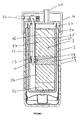
- an oxygen candle indicated generally by the reference numeral 1, enclosed other than at its top by a layer of rockwool insulation 25 within a vacuum jacket 2, which is in turn enclosed other than at its top by a further insulating jacket 3 of silicone rubber.
- the top of the vacuum jacket 2 is closed by a ceramic plug 23 over which are a cover plate 24 and an outer cap 4.
- the insulating jacket 3 contacts the vacuum jacket 2 only at the tips of bosses 27, thereby minimizing heat transmission outward from the candle 1 to the exterior surface of the silicone jacket 3.
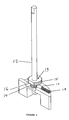
- the unit 5 has a planar face 6, a part-cylindrical face 7 and a circular base 8, the portion of which extending beyond the bottom (as shown in Figures 1 and 2 ) edges of faces 6 and 7 supports the candle 1.
- a mid-upper portion of the planar face 6 are perforations 9, and in the mid-portion of the face 6 is an aperture having an upper rectangular portion 10 and below it a part-circular portion 11.
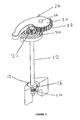
- a shaft 12 Within the upper portion of the unit 5, supported on bearings (not shown) is a shaft 12, the lower end of which (see more especially Figures 3 and 4 ) carries an abrasion wheel indicated generally by the reference numeral 13 and a friction wheel 14.
- the abrasion wheel 13 has teeth 15 extending around about 300° of its circumference, the remaining 60° segment being cut away to leave a flat surface 16.
- the teeth 15 are inclined, as in a ratchet wheel, for a purpose explained below.
- the friction wheel 14 which is of smaller diameter than the abrasion wheel 13 has a toothed circumference, a portion of which is in contact with a flint 17, pressed against the wheel 13 by a compression spring 18.
- FIG. 4 there are shown in more detail the actuating means.
- a gear wheel 22 mounted on the upper end of the shaft 12 .
- a spiral spring 34 mounted on a stop (not shown) on a cover plate 24 (see Figure 1 ).
- An operating handle, indicated generally by the reference numeral 26, is mounted on a pivot 28, and has a partially-toothed circular portion 30 coaxial with the pivot, teeth 32 of which circular portion engage the gear wheel 22.
- the candle 1 has a central element 50 positioned opposite aperture portions 10 and 11 in the unit 5.
- the element 50 has in its flat face adjacent to the apertures 10 and 11 a hemispherical primer 52 comprising, in addition to the oxygen-supplying material and fuel that are in the remainder of the element 50, an oxidizing agent.
- a hemispherical primer 52 comprising, in addition to the oxygen-supplying material and fuel that are in the remainder of the element 50, an oxidizing agent.
- elements 54 having a lower proportion of fuel. More remote from the element 50 than the elements 54 are elements 56 having no fuel.
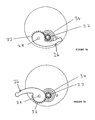
- the handle 26 is slowly rotated clockwise from the position seen in Figure 5a until the position shown in Figure 5b is reached.
- the abrasion wheel 13 has turned so that its teeth 15 are in contact with the material of primer 52.
- the slow movement of the friction wheel 14 against the flint 17 removes any oxide film from the flint during this operation.
- disengagement of the teeth 32 takes place, allowing the spring 34 to drive the gear wheel 22 and the shaft 12 rapidly clockwise, causing the forward-facing edges of inclined teeth 15 to abrade the surface of the primer 52.
- the friction wheel 13 and the flint 17 generate sparks which pass through the aperture 11 and ignite the primer 52 at its newly exposed surface, and/or the dust displaced therefrom, the burn front from the primer igniting the element 50.
- the burn fronts extend through element 50 and subsequently burn fronts travel through the remaining elements. Oxygen generated by the candle passes into the unit 5 through the perforations 9, and hence through a filter (not shown) to remove any impurities that maybe co-generated, and via outlet 60 to a user.
- a first oxygen generator constructed in accordance with the invention comprises a sodium chlorate-based candle encased in a copper gauze and delivering 90 litres of USP oxygen at a rate of 6 litres per minute.
- the encased candle had a length of 12 cm and a diameter of 3.5 cm, and was encapsulated in insulation material and then in a vacuum flask of length 17 cm, internal diameter 6 cm and external diameter 7 cm.
- the generator weighed 0.6 kg and had a total length of 17 cm. In operation, the highest temperature reached at the exterior of the flask was 50°C.
- a second oxygen generator constructed as described with reference to the drawings and containing a similar candle had outer dimensions, including the silicone jacket, of diameter 6cm and length 16cm. In operation, the highest temperature reached at the exterior of the silicone jacket was 45°C.
- a generator commercially available from Molecular Products Limited and containing an identical candle was tested.
- the candle was insulated by rockwool and ceramic material.
- the total weight of the generator was 0.5 kg, its length was 13 cm and its diameter 10 cm. In operation, the highest exterior temperature reached was 150°C.
Landscapes
- Chemical & Material Sciences (AREA)
- Organic Chemistry (AREA)
- Health & Medical Sciences (AREA)
- Inorganic Chemistry (AREA)
- Emergency Management (AREA)
- Pulmonology (AREA)
- General Health & Medical Sciences (AREA)
- Business, Economics & Management (AREA)
- Emergency Medicine (AREA)
- Oxygen, Ozone, And Oxides In General (AREA)
- Treating Waste Gases (AREA)
- Absorbent Articles And Supports Therefor (AREA)
- Paper (AREA)
- Feeding, Discharge, Calcimining, Fusing, And Gas-Generation Devices (AREA)
- Respiratory Apparatuses And Protective Means (AREA)
- Investigating Or Analyzing Materials Using Thermal Means (AREA)
- Signal Processing For Digital Recording And Reproducing (AREA)
- Physical Or Chemical Processes And Apparatus (AREA)
- Manufacture Of Motors, Generators (AREA)
Applications Claiming Priority (3)
| Application Number | Priority Date | Filing Date | Title |
|---|---|---|---|
| GB0221451 | 2002-09-16 | ||
| GBGB0221451.8A GB0221451D0 (en) | 2002-09-16 | 2002-09-16 | Gas generator |
| PCT/GB2003/004072 WO2004024239A1 (en) | 2002-09-16 | 2003-09-15 | Gas generator |
Publications (2)
| Publication Number | Publication Date |
|---|---|
| EP1539300A1 EP1539300A1 (en) | 2005-06-15 |
| EP1539300B1 true EP1539300B1 (en) | 2010-07-28 |
Family
ID=9944144
Family Applications (1)
| Application Number | Title | Priority Date | Filing Date |
|---|---|---|---|
| EP03748292A Expired - Lifetime EP1539300B1 (en) | 2002-09-16 | 2003-09-15 | Oxygen generator |
Country Status (8)
| Country | Link |
|---|---|
| US (1) | US7494624B2 (https=) |
| EP (1) | EP1539300B1 (https=) |
| JP (1) | JP4656940B2 (https=) |
| AT (1) | ATE475457T1 (https=) |
| AU (1) | AU2003267600A1 (https=) |
| DE (1) | DE60333569D1 (https=) |
| GB (3) | GB0221451D0 (https=) |
| WO (1) | WO2004024239A1 (https=) |
Cited By (1)
| Publication number | Priority date | Publication date | Assignee | Title |
|---|---|---|---|---|
| US12304810B2 (en) | 2021-05-21 | 2025-05-20 | Sensirion Ag | Gas generator |
Families Citing this family (12)
| Publication number | Priority date | Publication date | Assignee | Title |
|---|---|---|---|---|
| WO2008094490A1 (en) * | 2007-01-26 | 2008-08-07 | Avox Systems, Inc. | Oxygen generating composition |
| EP2838619B1 (en) * | 2012-04-19 | 2018-03-14 | AVOX Systems Inc. | Chemical oxygen generator |
| US9498656B2 (en) * | 2012-07-11 | 2016-11-22 | B/E Aerospace, Inc. | Aircraft crew member protective breathing apparatus |
| EP3019245B1 (en) * | 2013-07-10 | 2023-08-30 | B/E Aerospace, Inc. | Aircraft crew member protective breathing apparatus |
| GB201321995D0 (en) * | 2013-12-12 | 2014-01-29 | Molecular Oxygen Ltd | Oxygen generators |
| GB201321996D0 (en) * | 2013-12-12 | 2014-01-29 | Molecular Oxygen Ltd | Oxygen generators |
| EP2990378B1 (en) * | 2014-08-27 | 2019-08-07 | Diehl Aviation Gilching GmbH | Zeolite components for use in solid chemical oxygen generators |
| DE102015200062A1 (de) * | 2015-01-07 | 2016-07-07 | B/E Aerospace Systems Gmbh | Vorrichtung zum Erzeugen von Sauerstoff |
| DE102015201124B4 (de) | 2015-01-23 | 2016-08-11 | B/E Aerospace Systems Gmbh | Sauerstoffmaske |
| GB201511177D0 (en) * | 2015-06-25 | 2015-08-12 | Molecular Oxygen Ltd | Oxygen generators |
| DE102015013355A1 (de) * | 2015-10-15 | 2017-04-20 | Dräger Safety AG & Co. KGaA | Starter für einen Sauerstoffselbstretter und Sauerstoffselbstretter mit einem solchen |
| WO2017141263A1 (en) * | 2016-02-18 | 2017-08-24 | O2-Matic Products Private Limited | Modular portable oxygen generator |
Family Cites Families (18)
| Publication number | Priority date | Publication date | Assignee | Title |
|---|---|---|---|---|
| CH180448A (fr) * | 1935-02-19 | 1935-10-31 | Liais Lucien | Générateur d'oxygène pour l'alimentation d'un espace clos, tel qu'un abri, etc. |
| BE621916A (https=) * | 1961-08-30 | |||
| US3516797A (en) * | 1967-04-03 | 1970-06-23 | Automatic Sprinkler Corp | Chemical oxygen generator |
| FR2052425A5 (https=) * | 1969-06-02 | 1971-04-09 | Us Divers Cy | |
| FR2102653A5 (https=) * | 1970-08-05 | 1972-04-07 | Applic Gaz Sa | |
| US3785334A (en) * | 1971-01-11 | 1974-01-15 | T Waldeck | Gas generator fire alarm |
| JPS56113336A (en) * | 1980-02-15 | 1981-09-07 | Nippon Oil & Fats Co Ltd | Heater |
| US4517994A (en) * | 1982-11-18 | 1985-05-21 | Microtech Associates | Flat cigarette lighter |
| FR2558388B1 (fr) * | 1984-01-23 | 1986-05-16 | Ruggieri Ets | Generateur chimique d'oxygene avec un taux d'impuretes reduit |
| JPH0420480Y2 (https=) * | 1986-04-30 | 1992-05-11 | ||
| JPH0348176Y2 (https=) * | 1986-09-03 | 1991-10-15 | ||
| JPH02102102A (ja) | 1988-10-11 | 1990-04-13 | Midori Anzen Kk | 酸素発生缶及び同缶を利用した酸素発生装置 |
| US5198147A (en) * | 1991-04-10 | 1993-03-30 | Puritan-Bennett Corporation | Chemical oxygen generator |
| US5725834A (en) | 1995-04-07 | 1998-03-10 | Daicel Chemical Industries, Ltd. | Chemical oxygen generator |
| JPH08333101A (ja) * | 1995-04-07 | 1996-12-17 | Daicel Chem Ind Ltd | 酸素発生装置 |
| WO1996038376A1 (en) | 1995-06-01 | 1996-12-05 | Figgie International Inc. | Chemical gas generator |
| WO2000043071A1 (en) * | 1999-01-21 | 2000-07-27 | System 02, Inc. | Oxygen generating device |
| GB0113849D0 (en) | 2001-06-07 | 2001-08-01 | Molecular Products Ltd | Oxygen generator |
-
2002
- 2002-09-16 GB GBGB0221451.8A patent/GB0221451D0/en not_active Ceased
-
2003
- 2003-09-15 JP JP2004535704A patent/JP4656940B2/ja not_active Expired - Lifetime
- 2003-09-15 AU AU2003267600A patent/AU2003267600A1/en not_active Abandoned
- 2003-09-15 GB GB0603548A patent/GB2421023A/en not_active Withdrawn
- 2003-09-15 WO PCT/GB2003/004072 patent/WO2004024239A1/en not_active Ceased
- 2003-09-15 DE DE60333569T patent/DE60333569D1/de not_active Expired - Lifetime
- 2003-09-15 AT AT03748292T patent/ATE475457T1/de not_active IP Right Cessation
- 2003-09-15 US US10/528,085 patent/US7494624B2/en not_active Expired - Lifetime
- 2003-09-15 EP EP03748292A patent/EP1539300B1/en not_active Expired - Lifetime
- 2003-09-15 GB GB0507580A patent/GB2410024B/en not_active Expired - Lifetime
Cited By (1)
| Publication number | Priority date | Publication date | Assignee | Title |
|---|---|---|---|---|
| US12304810B2 (en) | 2021-05-21 | 2025-05-20 | Sensirion Ag | Gas generator |
Also Published As
| Publication number | Publication date |
|---|---|
| GB2410024A (en) | 2005-07-20 |
| GB2421023A (en) | 2006-06-14 |
| US20060051255A1 (en) | 2006-03-09 |
| ATE475457T1 (de) | 2010-08-15 |
| GB2410024B (en) | 2006-09-06 |
| GB0507580D0 (en) | 2005-05-18 |
| JP4656940B2 (ja) | 2011-03-23 |
| GB0603548D0 (en) | 2006-04-05 |
| DE60333569D1 (de) | 2010-09-09 |
| JP2005538920A (ja) | 2005-12-22 |
| US7494624B2 (en) | 2009-02-24 |
| EP1539300A1 (en) | 2005-06-15 |
| AU2003267600A1 (en) | 2004-04-30 |
| WO2004024239A1 (en) | 2004-03-25 |
| GB0221451D0 (en) | 2002-10-23 |
Similar Documents
| Publication | Publication Date | Title |
|---|---|---|
| EP1539300B1 (en) | Oxygen generator | |
| CA2107336C (en) | Chemical oxygen generator | |
| US3868225A (en) | Sodium chlorate oxygen producing apparatus | |
| JP6025754B2 (ja) | 化学的二酸化炭素ガス発生器 | |
| WO2009030921A2 (en) | Gas generator | |
| US3276846A (en) | Apparatus for the production of relatively pure oxygen | |
| WO2019128428A1 (zh) | 一种氧烛 | |
| NO145548B (no) | Boelgekraftverk. | |
| CA2531286A1 (en) | Firing furnace and method for firing | |
| EP0630350A1 (en) | CHEMICAL OXYGEN GENERATING COMPOSITIONS CONTAINING Li 2?O 2? | |
| EP0399804B1 (en) | Self-heating container | |
| JPS5643423A (en) | Device for making carbon fiber | |
| JP3585568B2 (ja) | 酸素発生装置 | |
| JP2017505276A (ja) | 酸素発生器 | |
| US3734476A (en) | Cutting torch | |
| JPH02107694A (ja) | ガス中のタールおよびアンモニアの分解装置 | |
| CN223082750U (zh) | 一种改进型制氧结构 | |
| AU646161C (en) | Chemical oxygen generator | |
| JP6203523B2 (ja) | 炭酸ガスの処理方法 | |
| GB2062673A (en) | Gas genmerator | |
| CN215001535U (zh) | 一种锅炉用防爆机构 | |
| JPH0510767Y2 (https=) | ||
| CN2363197Y (zh) | 一种带按钮式保险装置的点火枪 | |
| UA59637A (uk) | Джерело світла і нагрівач | |
| WO2023224498A3 (en) | Cooker opertated by electric heating and gas burner |
Legal Events
| Date | Code | Title | Description |
|---|---|---|---|
| PUAI | Public reference made under article 153(3) epc to a published international application that has entered the european phase |
Free format text: ORIGINAL CODE: 0009012 |
|
| 17P | Request for examination filed |
Effective date: 20050414 |
|
| AK | Designated contracting states |
Kind code of ref document: A1 Designated state(s): AT BE BG CH CY CZ DE DK EE ES FI FR GB GR HU IE IT LI LU MC NL PT RO SE SI SK TR |
|
| AX | Request for extension of the european patent |
Extension state: AL LT LV MK |
|
| DAX | Request for extension of the european patent (deleted) | ||
| 17Q | First examination report despatched |
Effective date: 20090702 |
|
| GRAP | Despatch of communication of intention to grant a patent |
Free format text: ORIGINAL CODE: EPIDOSNIGR1 |
|
| RTI1 | Title (correction) |
Free format text: OXYGEN GENERATOR |
|
| GRAS | Grant fee paid |
Free format text: ORIGINAL CODE: EPIDOSNIGR3 |
|
| GRAA | (expected) grant |
Free format text: ORIGINAL CODE: 0009210 |
|
| AK | Designated contracting states |
Kind code of ref document: B1 Designated state(s): AT BE BG CH CY CZ DE DK EE ES FI FR GB GR HU IE IT LI LU MC NL PT RO SE SI SK TR |
|
| REG | Reference to a national code |
Ref country code: GB Ref legal event code: FG4D |
|
| REG | Reference to a national code |
Ref country code: CH Ref legal event code: EP |
|
| REG | Reference to a national code |
Ref country code: IE Ref legal event code: FG4D |
|
| REF | Corresponds to: |
Ref document number: 60333569 Country of ref document: DE Date of ref document: 20100909 Kind code of ref document: P |
|
| REG | Reference to a national code |
Ref country code: NL Ref legal event code: VDEP Effective date: 20100728 |
|
| PG25 | Lapsed in a contracting state [announced via postgrant information from national office to epo] |
Ref country code: NL Free format text: LAPSE BECAUSE OF FAILURE TO SUBMIT A TRANSLATION OF THE DESCRIPTION OR TO PAY THE FEE WITHIN THE PRESCRIBED TIME-LIMIT Effective date: 20100728 Ref country code: AT Free format text: LAPSE BECAUSE OF FAILURE TO SUBMIT A TRANSLATION OF THE DESCRIPTION OR TO PAY THE FEE WITHIN THE PRESCRIBED TIME-LIMIT Effective date: 20100728 Ref country code: FI Free format text: LAPSE BECAUSE OF FAILURE TO SUBMIT A TRANSLATION OF THE DESCRIPTION OR TO PAY THE FEE WITHIN THE PRESCRIBED TIME-LIMIT Effective date: 20100728 |
|
| PG25 | Lapsed in a contracting state [announced via postgrant information from national office to epo] |
Ref country code: PT Free format text: LAPSE BECAUSE OF FAILURE TO SUBMIT A TRANSLATION OF THE DESCRIPTION OR TO PAY THE FEE WITHIN THE PRESCRIBED TIME-LIMIT Effective date: 20101129 Ref country code: BG Free format text: LAPSE BECAUSE OF FAILURE TO SUBMIT A TRANSLATION OF THE DESCRIPTION OR TO PAY THE FEE WITHIN THE PRESCRIBED TIME-LIMIT Effective date: 20101028 Ref country code: SI Free format text: LAPSE BECAUSE OF FAILURE TO SUBMIT A TRANSLATION OF THE DESCRIPTION OR TO PAY THE FEE WITHIN THE PRESCRIBED TIME-LIMIT Effective date: 20100728 Ref country code: CY Free format text: LAPSE BECAUSE OF FAILURE TO SUBMIT A TRANSLATION OF THE DESCRIPTION OR TO PAY THE FEE WITHIN THE PRESCRIBED TIME-LIMIT Effective date: 20100728 |
|
| PG25 | Lapsed in a contracting state [announced via postgrant information from national office to epo] |
Ref country code: SE Free format text: LAPSE BECAUSE OF FAILURE TO SUBMIT A TRANSLATION OF THE DESCRIPTION OR TO PAY THE FEE WITHIN THE PRESCRIBED TIME-LIMIT Effective date: 20100728 Ref country code: GR Free format text: LAPSE BECAUSE OF FAILURE TO SUBMIT A TRANSLATION OF THE DESCRIPTION OR TO PAY THE FEE WITHIN THE PRESCRIBED TIME-LIMIT Effective date: 20101029 Ref country code: BE Free format text: LAPSE BECAUSE OF FAILURE TO SUBMIT A TRANSLATION OF THE DESCRIPTION OR TO PAY THE FEE WITHIN THE PRESCRIBED TIME-LIMIT Effective date: 20100728 |
|
| PG25 | Lapsed in a contracting state [announced via postgrant information from national office to epo] |
Ref country code: MC Free format text: LAPSE BECAUSE OF NON-PAYMENT OF DUE FEES Effective date: 20100930 Ref country code: DK Free format text: LAPSE BECAUSE OF FAILURE TO SUBMIT A TRANSLATION OF THE DESCRIPTION OR TO PAY THE FEE WITHIN THE PRESCRIBED TIME-LIMIT Effective date: 20100728 |
|
| REG | Reference to a national code |
Ref country code: CH Ref legal event code: PL |
|
| PG25 | Lapsed in a contracting state [announced via postgrant information from national office to epo] |
Ref country code: CZ Free format text: LAPSE BECAUSE OF FAILURE TO SUBMIT A TRANSLATION OF THE DESCRIPTION OR TO PAY THE FEE WITHIN THE PRESCRIBED TIME-LIMIT Effective date: 20100728 Ref country code: SK Free format text: LAPSE BECAUSE OF FAILURE TO SUBMIT A TRANSLATION OF THE DESCRIPTION OR TO PAY THE FEE WITHIN THE PRESCRIBED TIME-LIMIT Effective date: 20100728 Ref country code: IT Free format text: LAPSE BECAUSE OF FAILURE TO SUBMIT A TRANSLATION OF THE DESCRIPTION OR TO PAY THE FEE WITHIN THE PRESCRIBED TIME-LIMIT Effective date: 20100728 Ref country code: EE Free format text: LAPSE BECAUSE OF FAILURE TO SUBMIT A TRANSLATION OF THE DESCRIPTION OR TO PAY THE FEE WITHIN THE PRESCRIBED TIME-LIMIT Effective date: 20100728 Ref country code: RO Free format text: LAPSE BECAUSE OF FAILURE TO SUBMIT A TRANSLATION OF THE DESCRIPTION OR TO PAY THE FEE WITHIN THE PRESCRIBED TIME-LIMIT Effective date: 20100728 |
|
| PLBE | No opposition filed within time limit |
Free format text: ORIGINAL CODE: 0009261 |
|
| STAA | Information on the status of an ep patent application or granted ep patent |
Free format text: STATUS: NO OPPOSITION FILED WITHIN TIME LIMIT |
|
| PG25 | Lapsed in a contracting state [announced via postgrant information from national office to epo] |
Ref country code: ES Free format text: LAPSE BECAUSE OF FAILURE TO SUBMIT A TRANSLATION OF THE DESCRIPTION OR TO PAY THE FEE WITHIN THE PRESCRIBED TIME-LIMIT Effective date: 20101108 |
|
| 26N | No opposition filed |
Effective date: 20110429 |
|
| PG25 | Lapsed in a contracting state [announced via postgrant information from national office to epo] |
Ref country code: LI Free format text: LAPSE BECAUSE OF NON-PAYMENT OF DUE FEES Effective date: 20100930 Ref country code: IE Free format text: LAPSE BECAUSE OF NON-PAYMENT OF DUE FEES Effective date: 20100915 Ref country code: CH Free format text: LAPSE BECAUSE OF NON-PAYMENT OF DUE FEES Effective date: 20100930 |
|
| REG | Reference to a national code |
Ref country code: DE Ref legal event code: R097 Ref document number: 60333569 Country of ref document: DE Effective date: 20110429 |
|
| PG25 | Lapsed in a contracting state [announced via postgrant information from national office to epo] |
Ref country code: HU Free format text: LAPSE BECAUSE OF FAILURE TO SUBMIT A TRANSLATION OF THE DESCRIPTION OR TO PAY THE FEE WITHIN THE PRESCRIBED TIME-LIMIT Effective date: 20110129 Ref country code: LU Free format text: LAPSE BECAUSE OF NON-PAYMENT OF DUE FEES Effective date: 20100915 |
|
| PG25 | Lapsed in a contracting state [announced via postgrant information from national office to epo] |
Ref country code: TR Free format text: LAPSE BECAUSE OF FAILURE TO SUBMIT A TRANSLATION OF THE DESCRIPTION OR TO PAY THE FEE WITHIN THE PRESCRIBED TIME-LIMIT Effective date: 20100728 |
|
| REG | Reference to a national code |
Ref country code: FR Ref legal event code: PLFP Year of fee payment: 14 |
|
| REG | Reference to a national code |
Ref country code: GB Ref legal event code: 732E Free format text: REGISTERED BETWEEN 20170504 AND 20170510 |
|
| REG | Reference to a national code |
Ref country code: FR Ref legal event code: PLFP Year of fee payment: 15 |
|
| REG | Reference to a national code |
Ref country code: FR Ref legal event code: PLFP Year of fee payment: 16 |
|
| PGFP | Annual fee paid to national office [announced via postgrant information from national office to epo] |
Ref country code: GB Payment date: 20220728 Year of fee payment: 20 Ref country code: DE Payment date: 20220609 Year of fee payment: 20 |
|
| PGFP | Annual fee paid to national office [announced via postgrant information from national office to epo] |
Ref country code: FR Payment date: 20220709 Year of fee payment: 20 |
|
| P01 | Opt-out of the competence of the unified patent court (upc) registered |
Effective date: 20230517 |
|
| REG | Reference to a national code |
Ref country code: DE Ref legal event code: R071 Ref document number: 60333569 Country of ref document: DE |
|
| REG | Reference to a national code |
Ref country code: GB Ref legal event code: PE20 Expiry date: 20230914 |
|
| PG25 | Lapsed in a contracting state [announced via postgrant information from national office to epo] |
Ref country code: GB Free format text: LAPSE BECAUSE OF EXPIRATION OF PROTECTION Effective date: 20230914 |