EP1538654A2 - Tube à décharge - Google Patents
Tube à décharge Download PDFInfo
- Publication number
- EP1538654A2 EP1538654A2 EP04256123A EP04256123A EP1538654A2 EP 1538654 A2 EP1538654 A2 EP 1538654A2 EP 04256123 A EP04256123 A EP 04256123A EP 04256123 A EP04256123 A EP 04256123A EP 1538654 A2 EP1538654 A2 EP 1538654A2
- Authority
- EP
- European Patent Office
- Prior art keywords
- discharge
- tube
- trigger lines
- trigger
- airtight
- Prior art date
- Legal status (The legal status is an assumption and is not a legal conclusion. Google has not performed a legal analysis and makes no representation as to the accuracy of the status listed.)
- Withdrawn
Links
- 239000012212 insulator Substances 0.000 claims description 5
- 238000012360 testing method Methods 0.000 description 39
- 230000001186 cumulative effect Effects 0.000 description 15
- 238000007599 discharging Methods 0.000 description 12
- 230000000694 effects Effects 0.000 description 11
- 238000005259 measurement Methods 0.000 description 6
- 239000003990 capacitor Substances 0.000 description 5
- OKTJSMMVPCPJKN-UHFFFAOYSA-N Carbon Chemical compound [C] OKTJSMMVPCPJKN-UHFFFAOYSA-N 0.000 description 3
- 229910052799 carbon Inorganic materials 0.000 description 3
- 239000004020 conductor Substances 0.000 description 3
- 239000007789 gas Substances 0.000 description 3
- 230000003111 delayed effect Effects 0.000 description 2
- 230000001788 irregular Effects 0.000 description 2
- 239000000203 mixture Substances 0.000 description 2
- 230000002035 prolonged effect Effects 0.000 description 2
- 229910001030 Iron–nickel alloy Inorganic materials 0.000 description 1
- 229910045601 alloy Inorganic materials 0.000 description 1
- 239000000956 alloy Substances 0.000 description 1
- 230000015572 biosynthetic process Effects 0.000 description 1
- 238000005219 brazing Methods 0.000 description 1
- 239000000919 ceramic Substances 0.000 description 1
- 238000010586 diagram Methods 0.000 description 1
- 230000006698 induction Effects 0.000 description 1
- 230000001939 inductive effect Effects 0.000 description 1
- 239000011261 inert gas Substances 0.000 description 1
- 238000000691 measurement method Methods 0.000 description 1
- 239000002184 metal Substances 0.000 description 1
- 229910052751 metal Inorganic materials 0.000 description 1
- 238000012986 modification Methods 0.000 description 1
- 230000004048 modification Effects 0.000 description 1
- 230000000630 rising effect Effects 0.000 description 1
- 238000012546 transfer Methods 0.000 description 1
Images







Classifications
-
- H—ELECTRICITY
- H01—ELECTRIC ELEMENTS
- H01T—SPARK GAPS; OVERVOLTAGE ARRESTERS USING SPARK GAPS; SPARKING PLUGS; CORONA DEVICES; GENERATING IONS TO BE INTRODUCED INTO NON-ENCLOSED GASES
- H01T4/00—Overvoltage arresters using spark gaps
- H01T4/10—Overvoltage arresters using spark gaps having a single gap or a plurality of gaps in parallel
- H01T4/12—Overvoltage arresters using spark gaps having a single gap or a plurality of gaps in parallel hermetically sealed
-
- H—ELECTRICITY
- H01—ELECTRIC ELEMENTS
- H01J—ELECTRIC DISCHARGE TUBES OR DISCHARGE LAMPS
- H01J17/00—Gas-filled discharge tubes with solid cathode
- H01J17/02—Details
- H01J17/30—Igniting arrangements
-
- H—ELECTRICITY
- H01—ELECTRIC ELEMENTS
- H01J—ELECTRIC DISCHARGE TUBES OR DISCHARGE LAMPS
- H01J17/00—Gas-filled discharge tubes with solid cathode
- H01J17/38—Cold-cathode tubes
- H01J17/40—Cold-cathode tubes with one cathode and one anode, e.g. glow tubes, tuning-indicator glow tubes, voltage-stabiliser tubes, voltage-indicator tubes
-
- H—ELECTRICITY
- H01—ELECTRIC ELEMENTS
- H01T—SPARK GAPS; OVERVOLTAGE ARRESTERS USING SPARK GAPS; SPARKING PLUGS; CORONA DEVICES; GENERATING IONS TO BE INTRODUCED INTO NON-ENCLOSED GASES
- H01T2/00—Spark gaps comprising auxiliary triggering means
Definitions
- the present invention relates generally to discharge tubes, and more particularly to a discharge tube that causes discharge to repeatedly occur between the discharge surface of an upper discharge electrode end and the discharge surface of a lower discharge electrode end, the discharge surfaces opposing each other at the center inside an airtight tube.
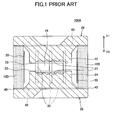
- FIGS. 1 through 3 show a first conventional discharge tube 100A.
- the discharge tube 100A includes an airtight tube 10D, an upper discharge electrode 22, and a lower discharge electrode 24.
- the airtight tube 10D has a cylindrical shape.
- the upper discharge electrode 22 and the lower discharge electrode 24 are joined to the upper-end opening and the lower-end opening, respectively, of the airtight tube 10D.
- Disk-like lid bodies 26 and 28 are formed integrally with the upper discharge electrode 22 and the lower discharge electrode 24, respectively.
- a metallized surface 40 is formed at each of the upper-end opening and the lower-end opening of the airtight tube 10D. Accordingly, the upper discharge electrode 22 and the lower discharge electrode 24 are joined to the airtight tube 10D by brazing the lid bodies 26 and 28 integrated with the upper and lower discharge electrodes 22 and 24, respectively, to the metallized surfaces 40 formed at the upper-end and lower-end openings of the airtight tube 10D.
- lead wires 12 and 14 are connected to the lid bodies 26 and 28, respectively, so that the lid bodies 26 and 28 are connected to external circuits through the lead wires 12 and 14.
- the upper discharge electrode 22 projects from the lid body 26 toward the center position of the airtight tube 10D.
- the end portion of the upper discharge electrode 22 is shaped like a cylinder of a small diameter.
- a discharge surface 23 is formed on the small-diameter cylindrical end portion of the upper discharge electrode 22 (hereinafter referred to as "upper discharge surface 23").
- the upper discharge surface 23 includes a recess 27 for causing discharge to occur in a stabilized manner.
- the lower discharge electrode 24 is structured in the same manner.
- the end portion of the lower discharge electrode 24 is shaped like a cylinder of a small diameter.
- a discharge surface 25 is formed on the small-diameter cylindrical end portion of the lower discharge electrode 24 (hereinafter referred to as "lower discharge surface 25").
- the lower discharge surface 25 also includes the recess 27 for causing discharge to occur in a stabilized manner.
- discharges occur in the space between the upper discharge surface 23 and the lower discharge surface 25. This space is hereinafter referred to as a "discharge gap 29."
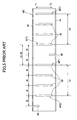
- each main discharge trigger wire 30 is formed along the axial directions of the airtight tube 10D (or the Y1 and Y2 directions of FIGS. 1 and 2) at equal intervals (with the same pitch W) on the inner sidewall of the airtight tube 10D.
- Each main discharge trigger wire 30 is spaced from the metallized surfaces 40 so as to be electrically isolated from the metallized surfaces 40.
- FIGS. 4 and 5 are diagrams showing a second conventional discharge tube 100B.
- the same elements as those of FIGS. 1 through 3 are referred to by the same numerals, and a description thereof is omitted.
- each sub discharge trigger wire 20 is formed at a center position of the eight main discharge trigger wires 30. That is, four of the main trigger wires 30 are provided in each of the two spaces between the paired sub discharge trigger wires 20.
- each sub discharge trigger wire 20 is formed along the axial directions of the airtight tube 10E (or the Y1 and Y2 directions of FIGS. 4 and 5).
- the upper or lower end of each sub discharge trigger wire 20 is electrically connected to the metallized surface 40 formed on the corresponding upper-end or lower-end surface of the airtight tube 10E.
- the sub discharge trigger wires 20 and the main discharge trigger wires 30 are also formed along the axial directions of the airtight tube 10E (or the Y1 and Y2 directions of FIGS. 4 and 5) at equal intervals (with the same pitch W) as shown in FIG. 5. That is, when the distance (interval) between each adjacent two of the main discharge trigger wires 30 is W, the distance (interval) between each sub discharge trigger wire 20 and each of its adjacent main discharge wires 30 is also W.
- FIG. 6 is a graph showing the results of a discharge (service) life test conducted to obtain changes over time in the discharge starting voltage of an initial discharge (hereinafter referred to as "initial discharge starting voltage FV s ”) and the mean discharge voltage of second and subsequent discharges (hereinafter referred to as “mean discharge voltage V s MEAN ”) in the first conventional discharge tube 100A of the above-described configuration.
- the horizontal axis indicates the cumulative number of discharges ( ⁇ 10,000), and the vertical axis indicates discharge operation voltage (V).
- the discharge life test is conducted based on the above-described conditions.
- This discharge life test which is conducted in a completely dark place in an environment of - 40 °C, is the severest one of the discharge life tests. This is because there is no effect of thermoelectrons in the environment of - 40 °C, nor is there any effect of photoelectrons in the completely dark place, thus making it difficult for discharging to occur.
- a brief description is given below of the effect of photoelectrons and the effect of thermoelectrons.
- photoelectrons refers to the effect that the discharge characteristic of a discharge tube is made faster by photoelectrons. That is, photoelectrons are constantly emitted from the light source of, for instance, an illuminator, so that sufficient photoelectrons have also penetrated into the discharge tube in a light environment. These photoelectrons have the effect of exciting gas sealed in the discharge tube into an easily dischargeable state. Accordingly, the discharge tube placed in a light environment is in a stabilized and easily dischargeable state, thus causing a decrease in the initial discharge start voltage FV s . On the other hand, in a dark place, these photoelectrons do not exist, so that the discharge tube is unstable and it is difficult for discharging to occur, thus causing an increase in the initial discharge start voltage FV s .
- thermoelectrons refers to the effect that the discharge characteristic of a discharge tube is made faster by thermoelectrons. That is, with an increase in temperature, an electron in the outermost shell of an atom becomes more likely to be emitted from the orbit of the outermost shell. Accordingly, the number of thermoelectrons generated also increases in the discharge tube as temperature increases. Therefore, the discharge tube is in a stabilized and easily dischargeable state in a high-temperature environment, thus causing a decrease in the initial discharge start voltage FV s . On the other hand, in a low-temperature environment, the number of thermoelectrons generated is reduced, so that the discharge tube is unstable and it is difficult for discharging to occur, thus causing an increase in the initial discharge start voltage FV s .
- the environment of - 40 °C and complete darkness (hereinafter referred to as "dark cold environment”) is a harsh environment where it is difficult for the discharge tube 100A to cause discharging to occur.
- dark cold environment a harsh environment where it is difficult for the discharge tube 100A to cause discharging to occur.
- a desired discharge characteristic can be obtained in this dark cold environment, a good FV s characteristic may be obtained in any environment.
- the initial discharge start voltage FV s increases as the cumulative number of discharges increases. This is because the discharge-inducing effects of thermoelectrons and photoelectrons on the discharge tube 100A completely disappear in the complete dark cold environment since the discharge tube 100A includes no sub discharge trigger wires contacting the metallized surfaces 40.
- the discharge tube 100A has a problem in that the occurrence of surface corona discharge is delayed so as to reduce the response speed of the initial discharge start voltage FV s . Further, the initial discharge start voltage FV s increases with an increase in the cumulative number of discharges. In particular, the initial discharge start voltage FV s exceeds 1000 V around when the cumulative number of discharges exceeds 800,000, thus causing a problem in that the discharge life of the discharge tube 100A is reduced.
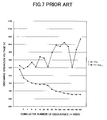
- FIG. 7 is a graph showing test results for the second conventional discharge tube 100B at the time of conducting the same discharge life test as described above. Test conditions and environment in this test are the same as those for the above-described discharge tube 100A.
- FIG. 7 shows that in the discharge tube 100B, the initial discharge start voltage FV s fluctuates greatly as the cumulative number of discharges increases.
- the discharge tube 100B includes the sub discharge trigger wires 20 electrically connected to the metallized surfaces 40. Accordingly, even in the completely dark cold environment, induction of surface corona discharge is likely to occur in the discharge tube 100B compared with the discharge tube 100A with no sub discharge trigger wires 20. However, since the main discharge trigger wires 30 in the center are disposed at an irregular interval (or too wide an interval), transfer to main discharge is likely to be delayed, thus causing the initial discharge start voltage FV s to fluctuate as in the test results.
- the sub discharge trigger wires 20 are disposed between a group of the main discharge trigger wires 30 indicated by arrow A1 and a group of the main discharge trigger wires 30 indicated by arrow A2. Accordingly, the interval between the main discharge trigger wire 30 indicated by arrow MT1 of one group and the main discharge trigger wire 30 indicated by arrow MT2 of the other group is 2 ⁇ W. Thus, the main discharge trigger wires 30 are disposed at an irregular interval in some parts, causing the initial discharge start voltage FV s to fluctuate.
- a more specific object of the present invention is to provide a discharge tube with a longer useful service life and a capability to generate stable discharging.
- a discharge tube including: an airtight tube formed of an insulator, the airtight tube having first and second end surfaces each having a metallized surface formed thereon; a first discharge electrode joined to the metallized surface formed on the first end surface of the airtight tube; a second discharge electrode joined to the metallized surface formed on the second end surface of the airtight tube; and a plurality of trigger lines formed on an inner wall surface of the airtight tube so as to extend in axial directions of the airtight tube, wherein: the first and second discharge electrodes are joined to the metallized surfaces so that a discharge gap is formed between the first and second discharge electrodes and the airtight tube is hermetically sealed; the trigger lines include one or more first trigger lines connected to the metallized surfaces and a plurality of second trigger lines isolated from the metallized surfaces; and the second trigger lines are formed at equal intervals on the inner wall surface of the airtight tube and each of the one or more first trigger lines is formed between a
- a discharge tube including: an airtight tube formed of an insulator, the airtight tube having first and second end surfaces each having a metallized surface formed thereon; a first discharge electrode joined to the metallized surface formed on the first end surface of the airtight tube; a second discharge electrode joined to the metallized surface formed on the second end surface of the airtight tube; and a plurality of trigger lines formed on an inner wall surface of the airtight tube so as to extend in axial directions of the airtight tube, wherein: the first and second discharge electrodes are joined to the metallized surfaces so that a discharge gap is formed between the first and second discharge electrodes and the airtight tube is hermetically sealed; the trigger lines include one or more first trigger lines connected to the metallized surfaces, a plurality of second trigger lines isolated from the metallized surfaces, and one or more third trigger lines isolated from the metallized surfaces; and the second trigger lines are formed at equal intervals on the inner wall surface of the airtight tube
- a discharge tube including: an airtight tube having first and second end surfaces each including a metallized surface; first and second discharge electrodes joined to the metallized surfaces of the first and second end surfaces, respectively, of the airtight tube so that a discharge gap is formed between the first and second discharge electrodes and the airtight tube is hermetically sealed; and a plurality of trigger lines arranged on an inner wall surface of the airtight tube so that each trigger line extends along an axis of the airtight tube, the trigger lines being spaced at first and second intervals in first and second parts, respectively, of the inner wall surface, the first and second intervals being different from each other.
- trigger lines arranged with a first part where the trigger lines are arranged at a first interval and a second part where the trigger lines are arranged at a second interval different from the first interval, are formed in the arrangement.
- This configuration enables the discharge tube to have a longer useful service life and to stabilize discharge potentials repeatedly generated in the discharge tube.
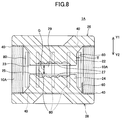
- FIG. 8 is a cross-sectional view of a discharge tube 1A according to a first embodiment of the present invention.
- FIG. 9 is a developed view (cylindrical surface straightened into a rectangle) of the inner sidewall of an airtight tube 10A of the discharge tube 1A.
- the same elements as those described above with reference to FIGS. 1 through 3 are referred to by the same numerals.
- the discharge tube 1A includes the airtight tube 10A (indicated by shading) and lid bodies 26 and 28.
- the outside dimensions of the discharge tube 1A are defined so that the discharge tube 1A is, for instance, 8.0 mm in outside diameter and 6.0 mm in length.
- the airtight tube 10A is shaped like a cylinder and formed of an insulator such as a ceramic.
- the outside dimensions of the airtight tube 10A are defined so that the airtight tube 10A is, for instance, 8.0 mm in outside diameter, 6.0 mm in inside diameter, and 4.7 mm in length.
- the metallized surfaces 40 are formed at the upper-end opening and the lower-end opening of the airtight tube 10A.
- Each of the lid bodies 26 and 28 is formed of metal such as 42 alloy (an iron-nickel alloy), and has a substantially disk shape.
- the upper discharge electrode 22 is integrated with the lid body 26, and the lower discharge electrode 24 is integrated with the lid body 28.
- the lid bodies 26 and 28 are joined to the upper-end opening and the lower-end opening, respectively, of the airtight tube 10A. Specifically, the lid bodies 26 and 28 are joined to the airtight tube 10A by being brazed to the corresponding metallized surfaces 40.
- This joining is performed so that the upper discharge electrode 22 and the lower discharge electrode 24 oppose each other in the airtight tube 10A. Further, at the time of this joining, the airtight tube 10A is filled with a gas mixture of inert gas. Accordingly, the gas mixture filling the airtight tube 10A is hermetically sealed in the airtight tube 10A by joining the lid bodies 26 and 28 to the airtight tube 10A.
- the upper discharge electrode 22 projects from the lid member 26 toward the center position of the airtight tube 10A. Further, the upper discharge surface 23 is formed on the end portion of the upper discharge electrode 22. The upper discharge surface 23 includes the recess 27 for causing discharge to occur in a stabilized manner.
- the lower discharge electrode 24 projects from the lid member 28 toward the center position of the airtight tube 10A. Further, the lower discharge surface 25 is formed on the end portion of the lower discharge electrode 24. The lower discharge surface 25 includes the recess 27 for causing discharge to occur in a stabilized manner.
- discharges occur in the discharge gap 29, which is the space between the upper discharge surface 23 and the lower discharge surface 25.
- the recess 27 formed on each of the upper discharge surface 23 and the lower discharge surface 25 includes irregularities in order to increase the area of each of the discharge surfaces 23 and 25 so that the discharge (service) life of the discharge tube 1A is prolonged. That is, since the discharge life of a discharge tube is proportional to the area of a discharge surface, the discharge life of the discharge tube 1A can be prolonged by increasing the area of each of the discharge surfaces 23 and 25 by providing irregularities thereto.
- two sub discharge trigger wires 60 (first trigger lines) and ten main discharge trigger wires 80 (second trigger lines) are formed on the inner sidewall (inner wall surface) of the airtight tube 10A.
- Both the main discharge trigger wires 80 and the sub discharge trigger wires 60 are formed (to extend) along the axial directions of the airtight tube 10A (or the Y1 and Y2 directions of FIGS. 8 and 9).
- Each main discharge trigger wire 80 is made of a conductive material such as carbon, and is defined to be approximately 0.5 mm in line width w (FIG. 9) and approximately 2.5-3.5 mm in length l (FIG. 9).
- the main discharge trigger wires 80 are spaced from the metallized surfaces 40 so as to be electrically isolated from the metallized surfaces 40.
- Each sub discharge trigger wire 60 is made of a conductive material such as carbon, and is set to be approximately 0.5 mm in line width but shorter in length than the main discharge trigger wires 80.
- One of the upper end and the lower end of each sub discharge trigger wire 60 is electrically connected to the metallized surface 40 formed on the upper-end or lower-end surface of the airtight tube 10A.
- the discharge tube 1A is configured so that the relationship between the interval T between each of the discharge electrodes 22 and 24 and each main discharge trigger wire 80 and the gap length G of the discharge gap 29 satisfies G ⁇ T. According to this configuration, a life characteristic can be improved, and the initial discharge starting voltage FV s and the mean discharge voltage V s MEAN can be stabilized.
- the ten main discharge trigger wires 80 are formed at equal intervals (with the same pitch W). That is, the interval between each pair of the adjacent main discharge trigger wires 80 is the regular interval W.
- the sub discharge trigger wires 60 are formed 180° apart from each other. Accordingly, five of the main discharge trigger wires 80 are provided in each of the two spaces between the pair of the sub discharge trigger wires 60.
- the second conventional discharge tube 100B is configured so that the interval between each sub discharge trigger wire 20 and each of its adjacent main discharge trigger wires 30 (indicated by MT1 and MT2) is also W. Accordingly, the interval between each pair of adjacent trigger wires is W irrespective of whether the adjacent trigger wires are the main discharge trigger wires 30 or a combination of the sub discharge trigger wire 20 and the main discharge trigger wire 30.
- the ten main discharge trigger wires 80 are spaced at the same interval W.
- Each sub discharge trigger wire 60 is disposed between a corresponding pair of the main discharge trigger wires 80 (indicated by arrows MT1 and MT2) spaced at this regular interval W.
- each sub discharge trigger wire 60 is positioned in the center between the paired main discharge trigger wires 80 (indicated by arrows MT1 and MT2). Accordingly, the interval between each sub discharge trigger wire 60 and the corresponding main discharge trigger wire 80 indicated by arrow MT1 is W/2 and the interval between each sub discharge trigger wire 60 and the corresponding main discharge trigger wire 80 indicated by arrow MT2 is also W/2.
- equal interval parts and unequal interval parts are formed in the overall trigger wire arrangement of the sub discharge trigger wires 60 and the main discharge trigger wires 80. That is, the equal interval parts where the main discharge trigger wires 80 are equally spaced side by side at the same interval (regular intervals) W (each region indicated by arrow A in FIG. 9) and the unequal interval parts where the sub discharge trigger wires 60 are formed so that each sub discharge trigger wire 60 and each of its adjacent main discharge trigger wires 80 are disposed side by side at an interval different from the interval W (W/2 in this embodiment) (each region indicated by arrow B in FIG. 9) are formed (on the inner sidewall of the airtight tube 10A).
- FIG. 10 is a graph showing the results of a discharge (service) life test conducted to obtain changes over time in the initial discharge starting voltage FV s (the discharge starting voltage of an initial discharge) and the mean discharge voltage V s MEAN (the mean discharge voltage of second and subsequent discharges) in the discharge tube 1A of the above-described configuration.
- the horizontal axis indicates the cumulative number of discharges ( ⁇ 10,000), and the vertical axis indicates discharge operation voltage (V).
- FIG. 10 shows that in the discharge tube 1A, an increase in the cumulative number of discharges is accompanied by neither a rise nor a great fluctuation in the initial discharge starting voltage FV s .
- Such a good characteristic can be obtained because the main discharge trigger wires 80 are equally spaced at the same interval W so that main discharge in the discharge gap 29 is likely to be induced and because formation of the sub discharge trigger wires 60 makes it easier for the main discharge to be transferred after the occurrence of surface corona discharge.
- the initial discharge starting voltage FV s is stable in the discharge tube 1A according to this embodiment. Accordingly, in the case of employing the discharge tube 1A in an HID lamp lighting circuit, a stable circuit operation can be realized. Further, there is no rise over time in the initial discharge starting voltage FV s , which enables the discharge tube 1A to have a longer useful service life.
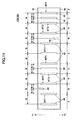
- FIG. 11 shows the developed state of an airtight tube 10B forming a discharge tube 1B according to the second embodiment of the present invention.
- the same elements as those shown in FIGS. 8 and 9 used for the description of the first embodiment are referred to by the same numerals, and a description thereof is omitted.
- the discharge tube 1B according to this embodiment is characterized by further including interposition discharge trigger wires 90 (third trigger lines) each formed between a corresponding pair of the main discharge trigger wires 80.
- the interposition discharge trigger wires 90 are made of a conductive material such as carbon, and are formed (to extend) along the axial directions of the airtight tube 10B (or the Y1 and Y2 directions of FIG. 11).
- the interposition discharge trigger wires 90 are equal in shape to the main discharge trigger wires 80.
- the interposition discharge trigger wires 90 may be different in shape from the main discharge trigger wires 80.
- the ten main discharge trigger wires 80 are also formed at regular intervals (with the same pitch W) in this embodiment.
- the sub discharge trigger wires 60 are formed 180° apart from each other. Accordingly, five of the main discharge trigger wires 80 are provided in each space between the pair of the sub discharge trigger wires 60. Further, each sub discharge trigger wire 60 is disposed between a corresponding pair of the main discharge trigger wires 80 (indicated by arrows MT1 and MT2 in FIG. 11) spaced at this regular interval W.
- the above-described configuration is equal to that of the discharge tube 1A according to the first embodiment.
- each interposition discharge trigger wire 90 is further disposed between a corresponding pair of the main discharge trigger wires 80 (indicated by arrows MT3 and MT4) spaced at this regular interval W.
- each interposition discharge trigger wire 90 is positioned in the center between the paired main discharge trigger wires 80 (indicated by arrows MT3 and MT4). Accordingly, the interval between each interposition discharge trigger wire 90 and the corresponding main discharge trigger wire 80 indicated by arrow MT3 is W/2 and the interval between each interposition discharge trigger wire 90 and the corresponding main discharge trigger wire 80 indicated by arrow MT4 is also W/2.
- equal interval parts and unequal interval parts are also formed in the arrangement of the sub discharge trigger wires 60, the main discharge trigger wires 80, and the interposition discharge trigger wires 90. That is, the equal interval parts where the main discharge trigger wires 80 are equally spaced side by side at the same interval (regular intervals) W (each region indicated by arrow A in FIG. 11), first unequal interval parts where the sub discharge trigger wires 60 are formed so that each sub discharge trigger wire 60 and each of its adjacent main discharge trigger wires 80 are disposed side by side at an interval (W/2) different from the interval W (each region indicated by arrow B in FIG.
- FIG. 12 is a graph showing the results of a discharge (service) life test conducted to obtain changes over time in the initial discharge starting voltage FV s and the mean discharge voltage V s MEAN in the discharge tube 1B of the above-described configuration.
- the horizontal axis indicates the cumulative number of discharges ( ⁇ 10,000), and the vertical axis indicates discharge operation voltage (V).
- FIG. 12 shows that like in the discharge tube 1A shown in FIG. 10, an increase in the cumulative number of discharges is accompanied by neither a rise nor a great fluctuation in the initial discharge starting voltage FV s in the discharge tube 1B. Accordingly, a stable discharge operation can also be realized by the discharge tube 1B according to this embodiment. Further, there is no rise over time in the initial discharge starting voltage FV s , either, which enables the discharge tube 1B to have a longer useful service life.
- FIG. 13 shows the developed state of an airtight tube 10C forming a discharge tube 1C according to the third embodiment of the present invention.
- the same elements as those shown in FIGS. 8, 9, and 11 used for the description of the first and second embodiments are referred to by the same numerals, and a description thereof is omitted.
- the discharge tube 1C according to this embodiment is characterized by including the interposition discharge trigger wires 90 each formed between a corresponding pair of the main discharge trigger wires 80.
- the configuration of each interposition discharge trigger wire 90 is equal to that described in the second embodiment.
- the main discharge trigger wires 80 are also formed at regular intervals (with the same pitch W).
- the sub discharge trigger wires 60 are formed 180° apart from each other. Accordingly, five of the main discharge trigger wires 80 are provided in each space between the pair of the sub discharge trigger wires 60. Further, each sub discharge trigger wire 60 is disposed between a corresponding pair of the main discharge trigger wires 80 (indicated by arrows MT1 and MT2 in FIG. 13) spaced at this regular interval W.
- the above-described configuration is equal to those of the discharge tubes 1A and 1B according to the first and second embodiments, respectively.
- each interposition discharge trigger wire 90 is further disposed between a corresponding pair of the main discharge trigger wires 80 positioned close to each sub discharge trigger wire 60.
- the interposition discharge trigger wires 90 are formed between each pair of the main discharge trigger wires 80 indicated by arrows MT1 and MT5 and each pair of the main discharge trigger wires 80 indicated by arrows MT2 and MT6.
- each interposition discharge trigger wire 90 is positioned at the center between a corresponding pair of the main discharge trigger wires 80 (MT1 and MT5 or MT2 and MT6). Accordingly, the interval between each interposition discharge trigger wire 90 and each of its adjacent main discharge trigger wires 80 (MT1 and MT5 or MT2 and MT6) is W/2.
- equal interval parts and unequal interval parts are also formed in the arrangement of the sub discharge trigger wires 60, the main discharge trigger wires 80, and the interposition discharge trigger wires 90. That is, the equal interval parts where the main discharge trigger wires 80 are equally spaced side by side at the same interval (regular intervals) W (each region indicated by arrow A in FIG. 13) and the unequal interval parts where the sub discharge trigger wires 60 and the interposition discharge trigger wires 90 are formed so that the trigger wires 60, 80, and 90 are disposed side by side at an interval (W/2) different from the interval W (each region indicated by arrow D in FIG. 13) are formed (on the inner sidewall of the airtight tube 10C).
- FIG. 14 is a graph showing the results of a discharge (service) life test conducted to obtain changes over time in the initial discharge starting voltage FV s and the mean discharge voltage V s MEAN in the discharge tube 1C of the above-described configuration.
- the horizontal axis indicates the cumulative number of discharges ( ⁇ 10,000), and the vertical axis indicates discharge operation voltage (V).
- FIG. 14 shows that like in the discharge tube 1A shown in FIG. 10, an increase in the cumulative number of discharges is accompanied by neither a rise nor a great fluctuation in the initial discharge starting voltage FV s in the discharge tube 1C. Accordingly, a stable discharge operation can also be realized by the discharge tube 1C according to this embodiment. Further, there is no rise over time in the initial discharge starting voltage FV s , either, which enables the discharge tube 1C to have a longer useful service life.
- FIG. 15 shows a variation of the discharge tubes 1A through 1C according to the first through third embodiments.
- Each of the discharge tubes 1A through 1C is configured so that the main discharge trigger wires 80 are disposed at regular intervals (W) and each of the sub discharge trigger wires 60 and/or the interposition discharge trigger wires 90 is formed at the center position between a corresponding pair of the main discharge trigger wires 80.
- each of the positions at which the sub discharge trigger wires 60 and the interposition discharge trigger wires 90 are formed, respectively, is not limited to the center position between the corresponding pair of the main discharge trigger wires 80.
- the sub discharge trigger wire 60 and the interposition discharge trigger wire 90 may be formed at positions, indicated by arrows X1 and X2, each offset from the center position.
- the number of the sub discharge trigger wires 60 and the number of the interposition discharge trigger wires 90 are not limited to one, but may be more than one.
- two sub discharge trigger wires 60 are formed between a corresponding pair of the main discharge trigger wires 80 as indicated by arrow X3 and two interposition discharge trigger wires 90 are formed between a corresponding pair of the main discharge trigger wires 80 as indicated by arrow X4.
- trigger wires arranged with a first part where the trigger wires are arranged at a first interval and a second part where the trigger wires are arranged at a second interval different from the first interval, are formed in the arrangement.
- This configuration enables the discharge tube to have a longer useful service life and to stabilize discharge potentials repeatedly generated in the discharge tube.
Landscapes
- Vessels And Coating Films For Discharge Lamps (AREA)
- Stroboscope Apparatuses (AREA)
- Investigating, Analyzing Materials By Fluorescence Or Luminescence (AREA)
- Gas-Filled Discharge Tubes (AREA)
Applications Claiming Priority (2)
| Application Number | Priority Date | Filing Date | Title |
|---|---|---|---|
| JP2003347031A JP4410527B2 (ja) | 2003-10-06 | 2003-10-06 | 放電管 |
| JP2003347031 | 2003-10-06 |
Publications (3)
| Publication Number | Publication Date |
|---|---|
| EP1538654A2 true EP1538654A2 (fr) | 2005-06-08 |
| EP1538654A8 EP1538654A8 (fr) | 2005-08-24 |
| EP1538654A3 EP1538654A3 (fr) | 2008-08-27 |
Family
ID=34386390
Family Applications (1)
| Application Number | Title | Priority Date | Filing Date |
|---|---|---|---|
| EP04256123A Withdrawn EP1538654A3 (fr) | 2003-10-06 | 2004-10-04 | Tube à décharge |
Country Status (3)
| Country | Link |
|---|---|
| US (1) | US7102289B2 (fr) |
| EP (1) | EP1538654A3 (fr) |
| JP (1) | JP4410527B2 (fr) |
Families Citing this family (1)
| Publication number | Priority date | Publication date | Assignee | Title |
|---|---|---|---|---|
| CN103681171A (zh) * | 2013-12-07 | 2014-03-26 | 四川天微电子有限责任公司 | 陶瓷气体放电管 |
Family Cites Families (4)
| Publication number | Priority date | Publication date | Assignee | Title |
|---|---|---|---|---|
| JPH10335042A (ja) * | 1997-03-31 | 1998-12-18 | Shinko Electric Ind Co Ltd | 放電管 |
| JP2001093644A (ja) * | 1999-07-16 | 2001-04-06 | Shinko Electric Ind Co Ltd | 放電管 |
| JP3835990B2 (ja) * | 2001-03-02 | 2006-10-18 | 新光電気工業株式会社 | ガス封入スイッチング放電管 |
| JP2002270329A (ja) * | 2001-03-09 | 2002-09-20 | Shinko Electric Ind Co Ltd | ガス封入スイッチング放電管 |
-
2003
- 2003-10-06 JP JP2003347031A patent/JP4410527B2/ja not_active Expired - Fee Related
-
2004
- 2004-10-01 US US10/957,035 patent/US7102289B2/en not_active Expired - Lifetime
- 2004-10-04 EP EP04256123A patent/EP1538654A3/fr not_active Withdrawn
Also Published As
| Publication number | Publication date |
|---|---|
| US7102289B2 (en) | 2006-09-05 |
| JP4410527B2 (ja) | 2010-02-03 |
| EP1538654A3 (fr) | 2008-08-27 |
| US20050073231A1 (en) | 2005-04-07 |
| EP1538654A8 (fr) | 2005-08-24 |
| JP2005116259A (ja) | 2005-04-28 |
Similar Documents
| Publication | Publication Date | Title |
|---|---|---|
| KR100474158B1 (ko) | 고압방전램프 | |
| NL1007951C2 (nl) | Metaalhalidelamp. | |
| EP0329143A1 (fr) | Lampe à décharge | |
| KR100868172B1 (ko) | 고압 가스 방전 램프, 그 제조 방법 및 조명 장치 | |
| EP0926703A2 (fr) | Lampe à décharge à vapeur métallique | |
| US5955846A (en) | Discharge lamp lighting device and a method for lighting a discharge lamp | |
| US7102289B2 (en) | Discharge tube | |
| EP1328007A1 (fr) | Lampe à décharge à barrière diélectrique avec aide à l'allumage | |
| EP0801812B1 (fr) | Lampe a decharge a haute pression | |
| GB1583281A (en) | Sodium vapour lamps | |
| HU193871B (en) | High-pressure discharge lamp with improved passage wires | |
| US4575656A (en) | Starting aid for non-linear discharge lamps and method of making same | |
| US6313581B1 (en) | Electrical discharge tube having trigger wires | |
| US20050104500A1 (en) | Discharge lamp | |
| US7218051B2 (en) | Discharge tube | |
| CN101416272A (zh) | 高压放电灯组件 | |
| US5977702A (en) | Electrode device for electric discharge tube | |
| JP2002196403A (ja) | ストロボ装置の発光装置 | |
| US4916351A (en) | Arc tube having crystalline press seal penetration suppression means and lamp employing same | |
| US4754198A (en) | Fluorescent lamp bimetal switch contact arrangement | |
| GB2089595A (en) | Discharge lamp having internal starting aid capacitively coupled to one of the electrodes | |
| JPH06163008A (ja) | 希ガス放電灯 | |
| CA1079342A (fr) | Lampe a vapeur de sodium a faible bruit pour utilisation avec impulsions soniques | |
| JPH0357972A (ja) | 放電管 | |
| EP0407837A2 (fr) | Tube à décharge rempli de gaz |
Legal Events
| Date | Code | Title | Description |
|---|---|---|---|
| PUAI | Public reference made under article 153(3) epc to a published international application that has entered the european phase |
Free format text: ORIGINAL CODE: 0009012 |
|
| AK | Designated contracting states |
Kind code of ref document: A2 Designated state(s): AT BE BG CH CY CZ DE DK EE ES FI FR GB GR HU IE IT LI LU MC NL PL PT RO SE SI SK TR |
|
| AX | Request for extension of the european patent |
Extension state: AL HR LT LV MK |
|
| RIN1 | Information on inventor provided before grant (corrected) |
Inventor name: MACHIDA , K.,SHINKO ELECTRIC INDUSTRIES CO. LTD. |
|
| RIN1 | Information on inventor provided before grant (corrected) |
Inventor name: KAZUHIKO, M.,SHINKO ELECTRIC INDUSTRIES CO. LTD. |
|
| RIN1 | Information on inventor provided before grant (corrected) |
Inventor name: MACHIDA, KAZUHIKO,SHINKO ELECTRIC IND. CO., LTD. |
|
| PUAL | Search report despatched |
Free format text: ORIGINAL CODE: 0009013 |
|
| AK | Designated contracting states |
Kind code of ref document: A3 Designated state(s): AT BE BG CH CY CZ DE DK EE ES FI FR GB GR HU IE IT LI LU MC NL PL PT RO SE SI SK TR |
|
| AX | Request for extension of the european patent |
Extension state: AL HR LT LV MK |
|
| RIC1 | Information provided on ipc code assigned before grant |
Ipc: H01T 4/12 20060101ALI20080721BHEP Ipc: H01T 1/22 20060101ALI20080721BHEP Ipc: H01T 1/20 20060101ALI20080721BHEP Ipc: H01J 17/46 20060101ALI20080721BHEP Ipc: H01J 17/30 20060101AFI20050413BHEP |
|
| AKX | Designation fees paid | ||
| REG | Reference to a national code |
Ref country code: DE Ref legal event code: 8566 |
|
| STAA | Information on the status of an ep patent application or granted ep patent |
Free format text: STATUS: THE APPLICATION IS DEEMED TO BE WITHDRAWN |
|
| 18D | Application deemed to be withdrawn |
Effective date: 20090303 |