EP1538155A2 - Amylase variants - Google Patents
Amylase variants Download PDFInfo
- Publication number
- EP1538155A2 EP1538155A2 EP05002888A EP05002888A EP1538155A2 EP 1538155 A2 EP1538155 A2 EP 1538155A2 EP 05002888 A EP05002888 A EP 05002888A EP 05002888 A EP05002888 A EP 05002888A EP 1538155 A2 EP1538155 A2 EP 1538155A2
- Authority
- EP
- European Patent Office
- Prior art keywords
- amylase
- seq
- amino acid
- parent
- variant
- Prior art date
- Legal status (The legal status is an assumption and is not a legal conclusion. Google has not performed a legal analysis and makes no representation as to the accuracy of the status listed.)
- Granted
Links
Images


Classifications
-
- C—CHEMISTRY; METALLURGY
- C11—ANIMAL OR VEGETABLE OILS, FATS, FATTY SUBSTANCES OR WAXES; FATTY ACIDS THEREFROM; DETERGENTS; CANDLES
- C11D—DETERGENT COMPOSITIONS; USE OF SINGLE SUBSTANCES AS DETERGENTS; SOAP OR SOAP-MAKING; RESIN SOAPS; RECOVERY OF GLYCEROL
- C11D3/00—Other compounding ingredients of detergent compositions covered in group C11D1/00
- C11D3/16—Organic compounds
- C11D3/38—Products with no well-defined composition, e.g. natural products
- C11D3/386—Preparations containing enzymes, e.g. protease or amylase
- C11D3/38618—Protease or amylase in liquid compositions only
-
- C—CHEMISTRY; METALLURGY
- C11—ANIMAL OR VEGETABLE OILS, FATS, FATTY SUBSTANCES OR WAXES; FATTY ACIDS THEREFROM; DETERGENTS; CANDLES
- C11D—DETERGENT COMPOSITIONS; USE OF SINGLE SUBSTANCES AS DETERGENTS; SOAP OR SOAP-MAKING; RESIN SOAPS; RECOVERY OF GLYCEROL
- C11D3/00—Other compounding ingredients of detergent compositions covered in group C11D1/00
- C11D3/16—Organic compounds
- C11D3/38—Products with no well-defined composition, e.g. natural products
- C11D3/386—Preparations containing enzymes, e.g. protease or amylase
-
- C—CHEMISTRY; METALLURGY
- C11—ANIMAL OR VEGETABLE OILS, FATS, FATTY SUBSTANCES OR WAXES; FATTY ACIDS THEREFROM; DETERGENTS; CANDLES
- C11D—DETERGENT COMPOSITIONS; USE OF SINGLE SUBSTANCES AS DETERGENTS; SOAP OR SOAP-MAKING; RESIN SOAPS; RECOVERY OF GLYCEROL
- C11D3/00—Other compounding ingredients of detergent compositions covered in group C11D1/00
- C11D3/16—Organic compounds
- C11D3/38—Products with no well-defined composition, e.g. natural products
- C11D3/386—Preparations containing enzymes, e.g. protease or amylase
- C11D3/38609—Protease or amylase in solid compositions only
-
- C—CHEMISTRY; METALLURGY
- C11—ANIMAL OR VEGETABLE OILS, FATS, FATTY SUBSTANCES OR WAXES; FATTY ACIDS THEREFROM; DETERGENTS; CANDLES
- C11D—DETERGENT COMPOSITIONS; USE OF SINGLE SUBSTANCES AS DETERGENTS; SOAP OR SOAP-MAKING; RESIN SOAPS; RECOVERY OF GLYCEROL
- C11D3/00—Other compounding ingredients of detergent compositions covered in group C11D1/00
- C11D3/16—Organic compounds
- C11D3/38—Products with no well-defined composition, e.g. natural products
- C11D3/386—Preparations containing enzymes, e.g. protease or amylase
- C11D3/38672—Granulated or coated enzymes
-
- C—CHEMISTRY; METALLURGY
- C11—ANIMAL OR VEGETABLE OILS, FATS, FATTY SUBSTANCES OR WAXES; FATTY ACIDS THEREFROM; DETERGENTS; CANDLES
- C11D—DETERGENT COMPOSITIONS; USE OF SINGLE SUBSTANCES AS DETERGENTS; SOAP OR SOAP-MAKING; RESIN SOAPS; RECOVERY OF GLYCEROL
- C11D3/00—Other compounding ingredients of detergent compositions covered in group C11D1/00
- C11D3/16—Organic compounds
- C11D3/38—Products with no well-defined composition, e.g. natural products
- C11D3/386—Preparations containing enzymes, e.g. protease or amylase
- C11D3/38681—Chemically modified or immobilised enzymes
-
- C—CHEMISTRY; METALLURGY
- C12—BIOCHEMISTRY; BEER; SPIRITS; WINE; VINEGAR; MICROBIOLOGY; ENZYMOLOGY; MUTATION OR GENETIC ENGINEERING
- C12C—BEER; PREPARATION OF BEER BY FERMENTATION; PREPARATION OF MALT FOR MAKING BEER; PREPARATION OF HOPS FOR MAKING BEER
- C12C5/00—Other raw materials for the preparation of beer
- C12C5/004—Enzymes
-
- C—CHEMISTRY; METALLURGY
- C12—BIOCHEMISTRY; BEER; SPIRITS; WINE; VINEGAR; MICROBIOLOGY; ENZYMOLOGY; MUTATION OR GENETIC ENGINEERING
- C12N—MICROORGANISMS OR ENZYMES; COMPOSITIONS THEREOF; PROPAGATING, PRESERVING, OR MAINTAINING MICROORGANISMS; MUTATION OR GENETIC ENGINEERING; CULTURE MEDIA
- C12N9/00—Enzymes; Proenzymes; Compositions thereof; Processes for preparing, activating, inhibiting, separating or purifying enzymes
- C12N9/14—Hydrolases (3)
- C12N9/24—Hydrolases (3) acting on glycosyl compounds (3.2)
- C12N9/2402—Hydrolases (3) acting on glycosyl compounds (3.2) hydrolysing O- and S- glycosyl compounds (3.2.1)
- C12N9/2405—Glucanases
- C12N9/2408—Glucanases acting on alpha -1,4-glucosidic bonds
- C12N9/2411—Amylases
- C12N9/2414—Alpha-amylase (3.2.1.1.)
- C12N9/2417—Alpha-amylase (3.2.1.1.) from microbiological source
-
- C—CHEMISTRY; METALLURGY
- C12—BIOCHEMISTRY; BEER; SPIRITS; WINE; VINEGAR; MICROBIOLOGY; ENZYMOLOGY; MUTATION OR GENETIC ENGINEERING
- C12Y—ENZYMES
- C12Y302/00—Hydrolases acting on glycosyl compounds, i.e. glycosylases (3.2)
- C12Y302/01—Glycosidases, i.e. enzymes hydrolysing O- and S-glycosyl compounds (3.2.1)
- C12Y302/01001—Alpha-amylase (3.2.1.1)
-
- D—TEXTILES; PAPER
- D06—TREATMENT OF TEXTILES OR THE LIKE; LAUNDERING; FLEXIBLE MATERIALS NOT OTHERWISE PROVIDED FOR
- D06L—DRY-CLEANING, WASHING OR BLEACHING FIBRES, FILAMENTS, THREADS, YARNS, FABRICS, FEATHERS OR MADE-UP FIBROUS GOODS; BLEACHING LEATHER OR FURS
- D06L1/00—Dry-cleaning or washing fibres, filaments, threads, yarns, fabrics, feathers or made-up fibrous goods
- D06L1/12—Dry-cleaning or washing fibres, filaments, threads, yarns, fabrics, feathers or made-up fibrous goods using aqueous solvents
- D06L1/14—De-sizing
-
- D—TEXTILES; PAPER
- D21—PAPER-MAKING; PRODUCTION OF CELLULOSE
- D21C—PRODUCTION OF CELLULOSE BY REMOVING NON-CELLULOSE SUBSTANCES FROM CELLULOSE-CONTAINING MATERIALS; REGENERATION OF PULPING LIQUORS; APPARATUS THEREFOR
- D21C5/00—Other processes for obtaining cellulose, e.g. cooking cotton linters ; Processes characterised by the choice of cellulose-containing starting materials
- D21C5/005—Treatment of cellulose-containing material with microorganisms or enzymes
-
- D—TEXTILES; PAPER
- D21—PAPER-MAKING; PRODUCTION OF CELLULOSE
- D21C—PRODUCTION OF CELLULOSE BY REMOVING NON-CELLULOSE SUBSTANCES FROM CELLULOSE-CONTAINING MATERIALS; REGENERATION OF PULPING LIQUORS; APPARATUS THEREFOR
- D21C5/00—Other processes for obtaining cellulose, e.g. cooking cotton linters ; Processes characterised by the choice of cellulose-containing starting materials
- D21C5/02—Working-up waste paper
- D21C5/022—Chemicals therefor
-
- D—TEXTILES; PAPER
- D21—PAPER-MAKING; PRODUCTION OF CELLULOSE
- D21H—PULP COMPOSITIONS; PREPARATION THEREOF NOT COVERED BY SUBCLASSES D21C OR D21D; IMPREGNATING OR COATING OF PAPER; TREATMENT OF FINISHED PAPER NOT COVERED BY CLASS B31 OR SUBCLASS D21G; PAPER NOT OTHERWISE PROVIDED FOR
- D21H17/00—Non-fibrous material added to the pulp, characterised by its constitution; Paper-impregnating material characterised by its constitution
- D21H17/005—Microorganisms or enzymes
-
- D—TEXTILES; PAPER
- D21—PAPER-MAKING; PRODUCTION OF CELLULOSE
- D21H—PULP COMPOSITIONS; PREPARATION THEREOF NOT COVERED BY SUBCLASSES D21C OR D21D; IMPREGNATING OR COATING OF PAPER; TREATMENT OF FINISHED PAPER NOT COVERED BY CLASS B31 OR SUBCLASS D21G; PAPER NOT OTHERWISE PROVIDED FOR
- D21H17/00—Non-fibrous material added to the pulp, characterised by its constitution; Paper-impregnating material characterised by its constitution
- D21H17/20—Macromolecular organic compounds
- D21H17/21—Macromolecular organic compounds of natural origin; Derivatives thereof
- D21H17/24—Polysaccharides
- D21H17/28—Starch
-
- D—TEXTILES; PAPER
- D21—PAPER-MAKING; PRODUCTION OF CELLULOSE
- D21C—PRODUCTION OF CELLULOSE BY REMOVING NON-CELLULOSE SUBSTANCES FROM CELLULOSE-CONTAINING MATERIALS; REGENERATION OF PULPING LIQUORS; APPARATUS THEREFOR
- D21C5/00—Other processes for obtaining cellulose, e.g. cooking cotton linters ; Processes characterised by the choice of cellulose-containing starting materials
- D21C5/02—Working-up waste paper
- D21C5/025—De-inking
- D21C5/027—Chemicals therefor
-
- Y—GENERAL TAGGING OF NEW TECHNOLOGICAL DEVELOPMENTS; GENERAL TAGGING OF CROSS-SECTIONAL TECHNOLOGIES SPANNING OVER SEVERAL SECTIONS OF THE IPC; TECHNICAL SUBJECTS COVERED BY FORMER USPC CROSS-REFERENCE ART COLLECTIONS [XRACs] AND DIGESTS
- Y02—TECHNOLOGIES OR APPLICATIONS FOR MITIGATION OR ADAPTATION AGAINST CLIMATE CHANGE
- Y02E—REDUCTION OF GREENHOUSE GAS [GHG] EMISSIONS, RELATED TO ENERGY GENERATION, TRANSMISSION OR DISTRIBUTION
- Y02E50/00—Technologies for the production of fuel of non-fossil origin
- Y02E50/10—Biofuels, e.g. bio-diesel
-
- Y—GENERAL TAGGING OF NEW TECHNOLOGICAL DEVELOPMENTS; GENERAL TAGGING OF CROSS-SECTIONAL TECHNOLOGIES SPANNING OVER SEVERAL SECTIONS OF THE IPC; TECHNICAL SUBJECTS COVERED BY FORMER USPC CROSS-REFERENCE ART COLLECTIONS [XRACs] AND DIGESTS
- Y02—TECHNOLOGIES OR APPLICATIONS FOR MITIGATION OR ADAPTATION AGAINST CLIMATE CHANGE
- Y02W—CLIMATE CHANGE MITIGATION TECHNOLOGIES RELATED TO WASTEWATER TREATMENT OR WASTE MANAGEMENT
- Y02W30/00—Technologies for solid waste management
- Y02W30/50—Reuse, recycling or recovery technologies
- Y02W30/64—Paper recycling
Definitions
- the present invention relates to ⁇ -amylase variants having improved properties relative to the parent enzyme (e.g. improved thermal and/or oxidation stability and/or reduced calcium ion dependency), and thereby improved washing and/or dishwashing (and/or textile desizing) performance.
- the invention also relates to DNA constructs encoding the variants, and to vectors and cells harbouring the DNA constructs.
- the invention further relates to methods of producing the amylase variants, and to detergent additives and detergent compositions comprising the amylase variants.
- the invention relates to the use of the amylase variants for textile desizing and for production of sweeteners and ethanol from starch.
- ⁇ -Amylase enzymes have been used industrially for a number of years and for a variety of different purposes, the most important of which are starch liquefaction, textile desizing, starch modification in the paper and pulp industry, and for brewing and baking.
- a further use of ⁇ -amylases which is becoming increasingly important is the removal of starchy stains during washing or dishwashing.
- US 5,093,257 discloses chimeric ⁇ -amylases comprising an N-terminal part of a B. stearothermophilus ⁇ -amylase and a C-terminal part of a B. licheniformis ⁇ -amylase.
- the chimeric ⁇ -amylases are stated to have unique properties, such as a different thermostability, as compared to their parent ⁇ -amylase.
- all of the specifically described chimeric ⁇ -amylases were shown to have a decreased enzymatic activity as compared to their parent ⁇ -amylases.
- EP 252 666 describes hybrid amylases of the general formula Q-R-L, in which Q is a N-terminal polypeptide residue of from 55 to 60 amino acid residues which is at least 75% homologous to
- R is a specified polypeptide
- L is a C-terminal polypeptide comprising from 390 to 400 amino acid residues which is at least 75% homologous to the 395 C-terminal amino acid residues of a specified B. licheniformis ⁇ -amylase.
- Suzuki et al. (1989) disclose chimeric ⁇ -amylases, in which specified regions of a B . amyloliquefaciens ⁇ -amylase have been substituted for the corresponding regions of a B. licheniformis ⁇ -amylase.
- the chimeric ⁇ -amylases were constructed with the purpose of identifying regions responsible for thermostability. Such regions were found to include amino acid residues 177-186 and amino acid residues 255-270 of the B . amyloliquefaciens ⁇ -amylase.
- the alterations of amino acid residues in the chimeric ⁇ -amylases did not seem to affect properties of the enzymes other than their thermostability.
- WO 91/00353 discloses ⁇ -amylase mutants which differ from their parent ⁇ -amylase in at least one amino acid residue.
- the ⁇ -amylase mutants disclosed in said patent application are stated to exhibit improved properties for application in the degradation of starch and/or textile desizing due to their amino acid substitutions. Some of the mutants exhibit improved stability, but no improvements in enzymatic activity were reported or indicated.
- the only mutants exemplified are prepared from a parent B. licheniformis ⁇ -amylase and carry one of the following mutations: H133Y or H133Y + T149I. Another suggested mutation is A111T.
- FR 2,676,456 discloses mutants of the B. licheniformis ⁇ -amylase, in which an amino acid residue in the proximity of His 133 and/or an amino acid residue in the proximity of Ala 209 have been replaced by a more hydrophobic amino acid residue.
- the resulting ⁇ -amylase mutants are stated to have an improved thermostability and to be useful in the textile, paper, brewing and starch liquefaction industry.
- EP 285 123 discloses a method of performing random mutagenesis of a nucleotide sequence.
- a nucleotide sequence encoding a B. stearothermophilus ⁇ -amylase is mentioned.
- an ⁇ -amylase variant having improved activity at low pH values is obtained.
- ⁇ -amylase mutants may be constructed which have improved properties with respect to the detergent industry.
- EP 525 610 relates to mutant enzymes having improved stability towards ionic tensides (surfactants).
- the mutant enzymes have been produced by replacing an amino acid residue in the surface part of the parent enzyme with another amino acid residue.
- the only mutant enzyme specifically described in EP 525 610 is a protease.
- Amylase is mentioned as an example of an enzyme which may obtain an improved stability towards ionic tensides, but the type of amylase, its origin or specific mutations are not specified.
- WO 94/02597 discloses ⁇ -amylase mutants which exhibit improved stability and activity in the presence of oxidizing agents.
- the mutant ⁇ -amylases one or more methionine residues have been replaced with amino acid residues different from Cys and Met.
- the ⁇ -amylase mutants are stated to be useful as detergent and/or dishwashing additives as well as for textile desizing.
- WO 94/18314 discloses oxidatively stable ⁇ -amylase mutants, including mutations in the M197 position of B. licheniformis ⁇ -amylase.
- EP 368 341 describes the use of pullulanase and other amylolytic enzymes optionally in combination with an ⁇ -amylase for washing and dishwashing.
- An object of the present invention is to provide ⁇ -amylase variants which - relative to their parent ⁇ -amylase - possess improved properties of importance, inter alia , in relation to the washing and/or dishwashing performance of the variants in question, e.g. increased thermal stability, increased stability towards oxidation, reduced dependency on Ca 2+ ion and/or improved stability or activity in the pH region of relevance in, e.g., laundry washing or dishwashing.
- Such variant ⁇ -amylases have the advantage, among others, that they may be employed in a lower dosage than their parent ⁇ -amylase.
- the ⁇ -amylase variants may be able to remove starchy stains which cannot, or can only with difficulty, be removed by ⁇ -amylase detergent enzymes known today.
- a goal of the work underlying the present invention was to improve, if possible, the stability of, inter alia, particular ⁇ -amylases which are obtainable from Bacillus strains and which themselves had been selected on the basis of their starch removal performance in alkaline media (such as in detergent solutions as typically employed in laundry washing or dishwashing) relative to many of the currently commercially available ⁇ -amylases.
- the present inventors have surprisingly found that it is in fact possible to improve properties of the types mentioned earlier ( vide supra ) of such a parent ⁇ -amylase by judicial modification of one or more amino acid residues in various regions of the amino acid sequence of the parent ⁇ -amylase.
- the present invention is based on this finding.
- the present invention relates to variants of a parent ⁇ -amylase, which parent ⁇ -amylase displays at least 80% identity with amino acid sequences SEQ ID No. 3, wherein the variant comprises a deletion of at least two amino acids equivalent to R179 and G180 of the amino acid sequence shown in SEQ ID No. 3, said variant having ⁇ -amylase activity and exhibiting at least one of the following properties relative to said parent ⁇ -amylase: increased thermostability; increased stability towards oxidation; and reduced Ca 2+ dependency.
- An ⁇ -amylase variant of the invention is subject to the proviso that it is a variant which does not have an amino acid sequence identical to the amino acid sequence shown in SEQ ID No. 1, in SEQ ID No. 2, in SEQ ID No. 3 or in SEQ ID No. 7.
- DNA sequences encoding the first three of the ⁇ -amylase amino acid sequences in question are shown in SEQ ID No. 4 (encoding the amino acid sequence shown in SEQ ID No. 1), SEQ ID No. 5 (encoding the amino acid sequence shown in SEQ ID No. 2) and SEQ ID No. 6 (encoding the amino acid sequence shown in SEQ ID No. 3).
- amino acid sequences of the SEQ ID No. 1 and SEQ ID No. 2 parent ⁇ -amylases are also disclosed in WO 95/26397 (under the same SEQ ID Nos. as in the present application).
- variants of the invention have themselves ⁇ -amylase activity and exhibit at least one of the following properties relative to the parent ⁇ -amylase:
- An amino acid sequence is considered to be X% homologous to the parent ⁇ -amylase if a comparison of the respective amino acid sequences, performed via known algorithms, such as the one described by Lipman and Pearson in Science 227 (1985) p. 1435, reveals an identity of X%.
- the GAP computer program from the GCG package, version 7.3 (June 1993) may suitably be used, employing default values for GAP penalties [Genetic Computer Group (1991) Programme Manual for the GCG Package, version 7, 575 Science Drive, Madison, Wisconsin, USA 53711].
- improved performance as used in connection with washing and dishwashing is, as already indicated above, intended to mean improved removal of starchy stains, i.e. stains containing starch, during washing or dishwashing, respectively.
- the performance may be determined in conventional washing and dishwashing experiments and the improvement evaluated as a comparison with the performance of the parent ⁇ -amylase in question.
- An example of a small-scale "mini dishwashing test" which can be used an indicator of dishwashing performance is described in the Experimental section, below.
- the invention relates to a DNA construct comprising a DNA sequence encoding an ⁇ -amylase variant of the invention, a recombinant expression vector carrying the DNA construct, a cell which is transformed with the DNA construct or the vector, as well as a method of producing an ⁇ -amylase variant by culturing such a cell under conditions conducive to the production of the ⁇ -amylase variant, after which the ⁇ -amylase variant is recovered from the culture.
- the invention relates to a method of preparing a variant of a parent ⁇ -amylase which by virtue of its improved properties as described above exhibits improved washing and/or dishwashing performance as compared to the parent ⁇ -amylase.
- This method comprises
- the invention also relates to a variant (which is a variant according the invention) prepared by the latter method.
- washing and/or dishwashing condition is intended to indicate a simulation of, e.g., the temperature or pH prevailing during washing or dishwashing, or of the chemical composition of a detergent composition to be used in the washing or dishwashing treatment.
- chemical composition is intended to include one, or a combination of two or more, constituents of the detergent composition in question. The constituents of a number of different detergent compositions are listed further below.
- the "population of cells” referred to in step a) may suitably be constructed by cloning a DNA sequence encoding a parent ⁇ -amylase and subjecting the DNA to site-directed or random mutagenesis as described herein.
- variant is used interchangeably with the term “mutant”.
- variant is intended to include hybrid ⁇ -amylases, i.e. ⁇ -amylases comprising parts of at least two different ⁇ -amylolytic enzymes.
- hybrid may be constructed, e.g., from: one or more parts each deriving from a variant as already defined above; or one or more parts each deriving from a variant as already defined above, and one or more parts each deriving from an unmodified parent ⁇ -amylase.
- the invention also relates to a method of producing such a hybrid ⁇ -amylase having improved washing and/or dishwashing performance as compared to any of its constituent enzymes (i.e. as compared to any of the enzymes which contribute a part to the hybrid), which method comprises:
- the invention relates to the use of an ⁇ -amylase variant of the invention [including any variant or hybrid prepared by one of the above mentioned methods] as a detergent enzyme, in particular for washing or dishwashing, to a detergent additive and a detergent composition comprising the ⁇ -amylase variant, and to the use of an ⁇ -amylase variant of the invention for textile desizing.
- Random mutagenesis may be used to generate variants according to the invention, and the invention further relates to a method of preparing a variant of a parent ⁇ -amylase, which method comprises
- alanine for asparagine in position 30 is shown as: Ala 30 Asn or A30N
- a deletion of alanine in the same position is shown as: Ala 30 * or A30*
- insertion of an additional amino acid residue, such as lysine is shown as: Ala 30 AlaLys or A30AK
- any other amino acid residue may be substituted for the amino acid residue present in that position (i.e. any amino acid residue - other than that normally present in the position in question - chosen among A, R, N, D, C, Q, E, G, H, I, L, K, M, F, P, S, T, W, Y and V).
- any of the other amino acids may be substituted for the methionine, i.e. any other amino acid chosen among A,R,N,D,C,Q,E,G,H,I,L,K,F,P,S,T,W,Y and V.
- an ⁇ -amylase variant of the invention is very suitably prepared on the basis of a parent ⁇ -amylase having one of the amino acid sequences shown in SEQ ID No. 1, SEQ ID No. 2, SEQ ID No. 3 and SEQ ID No. 7, respectively ( vide infra ).
- the parent ⁇ -amylases having the amino acid sequences shown in SEQ ID No. 1 and SEQ ID No. 2, respectively, are obtainable from alkaliphilic Bacillus strains (strain NCIB 12512 and strain NCIB 12513, respectively), both of which are described in detail in EP 0 277 216 B1.
- the preparation, purification and sequencing of these two parent ⁇ -amylases is described in WO 95/26397 [see the Experimental section herein ( vide infra )].
- the parent ⁇ -amylase having the amino acid sequence shown in SEQ ID No. 3 is obtainable from Bacillus stearothermophilus and is described in, inter alia, J. Bacteriol. 166 (1986) pp. 635-643.
- the parent ⁇ -amylase having the amino acid sequence shown in SEQ ID No. 7 (which is the same sequence as that numbered 4 in Fig. 1) is obtainable from a " Bacillus sp. #707" and is described by Tsukamoto et al. in Biochem. Biophys. Res. Commun. 151 (1988) pp. 25-31.
- variants of the above-mentioned parent ⁇ -amylases having the amino acid sequences shown in SEQ ID No. 1, SEQ ID No. 2, SEQ ID No. 3 and SEQ ID No. 7, respectively, other interesting variants according to the invention include variants of parent ⁇ -amylases which have amino acid sequences exhibiting a high degree of homology, such as at least 80% homology, desirably at least 85% homology, and more preferably at least 90% homology, e.g. ⁇ 95% homology, with at least one of the latter four amino acid sequences.
- further criteria for identifying a suitable parent ⁇ -amylase are a) that the ⁇ -amylase displays an immunological cross-reaction with an antibody raised against an ⁇ -amylase having one of the amino acid sequences shown in SEQ ID No. 1, SEQ ID No. 2, SEQ ID No. 3 and SEQ ID No. 7, respectively, and/or b) that the ⁇ -amylase is encoded by a DNA sequence which hybridizes with the same probe as a DNA sequence encoding an ⁇ -amylase having one of the amino acid sequences shown in SEQ ID No. 1, SEQ ID No. 2, SEQ ID No. 3 and SEQ ID No. 7, respectively.
- amino acid sequence comparisons can be performed using known algorithms, such as the one described by Lipman and Pearson (1985).
- Assays for immunological cross-reactivity may be carried out using an antibody raised against, or reactive with, at least one epitope of the ⁇ -amylase having the amino acid sequence shown in SEQ ID No. 1, or of the ⁇ -amylase having the amino acid sequence shown in SEQ ID No. 2, or of the ⁇ -amylase having the amino acid sequence shown in SEQ ID No. 3, or of the ⁇ -amylase having the amino acid sequence shown in SEQ ID No. 7.
- the antibody which may either be monoclonal or polyclonal, may be produced by methods known in the art, e.g. as described by Hudson et al. (1989).
- suitable assay techniques well known in the art include Western Blotting and Radial Immunodiffusion Assay, e.g. as described by Hudson et al. (1989).
- the oligonucleotide probe for use in the identification of suitable parent ⁇ -amylases on the basis of probe hybridization [criterion b) above] may, by way of example, suitably be prepared on the basis of the full or partial amino acid sequence of an ⁇ -amylase having one of the sequences shown in SEQ ID No. 1, SEQ ID No. 2, SEQ ID No. 3 and SEQ ID No. 7, respectively, or on the basis of the full or partial nucleotide sequence corresponding thereto.
- Suitable conditions for testing hybridization involve presoaking in 5xSSC and prehybridizing for 1 h at ⁇ 40°C in a solution of 20% formamide, 5xDenhardt's solution, 50mM sodium phosphate, pH 6.8, and 50 ⁇ g of denatured sonicated calf thymus DNA, followed by hybridization in the same solution supplemented with 100 ⁇ M ATP for 18h at ⁇ 40°C, or using other methods described by, e.g., Sambrook et al. (1989).
- Oxidation stability With respect to increasing the oxidation stability of an ⁇ -amylase variant relative to its parent ⁇ -amylase, it appears to be particularly desirable that at least one, and preferably multiple, oxidizable amino acid residue(s) of the parent has/have been deleted or replaced (i.e. substituted by) a different amino acid residue which is less susceptible to oxidation than the original oxidizable amino acid residue.
- oxidizable amino acid residues in this connection are cysteine, methionine, tryptophan and tyrosine.
- cysteine methionine
- tryptophan oxidizable amino acid residues
- tyrosine oxidizable amino acid residues
- deletion or substitution of methionine residues is particularly relevant with respect to achieving improved oxidation stability of the resulting variants.
- deletion or substitution [e.g. by threonine (T), or by one of the other amino acids listed above] of one or more of the methionine residues in positions M9, M10, M105, M202, M208, M261, M309, M382, M430 and M440 of the amino acid sequences shown in SEQ ID No.
- SEQ ID No. 2 and SEQ ID No. 7, and/or in position M323 of the amino acid sequence shown in SEQ ID No. 2 appear to be particularly effective with respect to increasing the oxidation stability.
- relevant amino acid residues which may be deleted or substituted with a view to improving the oxidation stability include the single cysteine residue (C363) and - by analogy with the sequences shown in SEQ ID No. 1 and SEQ ID No. 3 - the methionine residues located in positions M8, M9, M96, M200, M206, M284, M307, M311, M316 and M438.
- the term "equivalent position” denotes a position which, on the basis of an alignment of the amino acid sequence of the parent ⁇ -amylase in question with the "reference" ⁇ -amylase amino acid sequence in question (for example the sequence shown in SEQ ID No.1) so as to achieve juxtapositioning of amino acid residues/regions which are common to both, corresponds most closely to (e.g. is occupied by the same amino acid residue as) a particular position in the reference sequence in question.
- Thermal stability With respect to increasing the thermal stability of an ⁇ -amylase variant relative to its parent ⁇ -amylase, it appears to be particularly desirable to delete at least one, and preferably two or even three, of the following amino acid residues in the amino acid sequence shown in SEQ ID No. 1 (or their equivalents): F180, R181, G182, T183, G184 and K185.
- the corresponding, particularly relevant (and equivalent) amino acid residues in the amino acid sequences shown in SEQ ID No. 2, SEQ ID No. 3 and SEQ ID No. 7, respectively, are: F180, R181, G182, D183, G184 and K185 (SEQ ID No. 2); F178, R179, G180, 1181, G182 and K183 (SEQ ID No. 3); and F180, R181, G182, H183, G184 and K185 (SEQ ID No. 7).
- Examples of specific mutations which appear to be of importance in connection with the thermal stability of an ⁇ -amylase variant relative to the parent ⁇ -amylase in question are one or more of the following substitutions in the amino acid sequence shown in SEQ ID No. 1 (or equivalents thereof in another parent ⁇ -amylase in the context of the invention): K269R; P260E; R124P; M105F,I,L,V; M208F,W,Y; L217I; V206I,L,F.
- important further (equivalent) mutations are, correspondingly, one or more of the substitutions: M105F,I,L,V; M208F,W,Y; L217I; V206I,L,F; and K269R.
- important further (equivalent) mutations are, correspondingly, one or both of the substitutions: M206F,W,Y; and L215I.
- important further (equivalent) mutations are, correspondingly, one or more of the substitutions: M105F,I,L,V; M208F,W,Y; L217I; and K269R.
- mutations which appear to be of importance, inter alia, in achieving improved thermal stability of an ⁇ -amylase variant relative to the parent ⁇ -amylase in question are one or more of the following substitutions in the amino acid sequences shown in SEQ ID No. 1, SEQ ID No. 2 and SEQ ID No. 7 (or equivalents thereof in another parent ⁇ -amylase in the context of the invention): A354C + V479C; L351C + M430C; N457D,E + K385R; L355D,E + M430R,K; L355D,E + 1411R,K; and N457D,E.
- Ca 2+ dependency With respect to achieving decreased Ca 2+ dependency of an ⁇ -amylase variant relative to its parent ⁇ -amylase [i.e. with respect to obtaining a variant which exhibits satisfactory amylolytic activity in the presence of a lower concentration of calcium ion in the extraneous medium than is necessary for the parent enzyme, and which, for example, therefore is less sensitive than the parent to calcium ion-depleting conditions such as those obtaining in media containing calcium-complexing agents (such as certain detergent builders)], it appears to be particularly desirable to incorporate one or more of the following substitutions in the amino acid sequences shown in SEQ ID No. 1, SEQ ID No. 2 and SEQ ID No.
- substitutions appear, correspondingly (equivalently), to be one or more of the following: K107R, K177R, K237R, K240R, D162N, D186N, D190N, D197N, D203N, D205N, D207N, E188Q and E192Q.
- substitutions which appear to be of importance in the context of achieving reduced Ca 2+ dependency are pairwise substitutions of the amino acid residues present at: positions 113 and 151, and positions 351 and 430, in the amino acid sequences shown in SEQ ID No. 1, SEQ ID No. 2 and SEQ ID No. 7; and at: positions 112 and 150, and positions 349 and 428, in the amino acid sequence shown in SEQ ID No. 3 (or equivalent pairwise substitutions in another parent ⁇ -amylase in the context of the invention), i.e. pairwise substitutions of the following amino acid residues:
- substitutions of relevance for Ca 2+ dependency are one or more of the following substitutions in the amino acid sequences shown in SEQ ID No. 1, SEQ ID No. 2 and SEQ ID No. 7 (or an equivalent substitution in another parent ⁇ -amylase in the context of the invention): G304W,F,Y,R,I,L,V,Q,N; G305A,S,N,D,Q,E,R,K; and H408Q,E.
- substitutions in the amino acid sequence shown in SEQ ID No. 3 are: G302W,F,Y,R,I,L,V,Q,N; and G303A,S,N,D,Q,E,R,K.
- pairwise deletions of amino acids i.e. deletion of two amino acids
- amino acids i.e. deletion of two amino acids
- positions selected among R181, G182, T183 and G184 in the amino acid sequence shown in SEQ ID No.1 or equivalent positions in the amino acid sequence of another ⁇ -amylase meeting the requirements of a parent ⁇ -amylase in the context of the invention.
- Isoelectric point (pl) Preliminary results indicate that the washing performance, e.g. the laundry washing performance, of an ⁇ -amylase is optimal when the pH of the washing liquor (washing medium) is close to the pl value for the ⁇ -amylase in question. It will thus be desirable, where appropriate, to produce an ⁇ -amylase variant having an isoelectric point (pl value) which is better matched to the pH of a medium (such as a washing medium) in which the enzyme is to be employed than the isoelectric point of the parent ⁇ -amylase in question.
- a medium such as a washing medium
- preferred mutations in the amino acid sequence shown in SEQ ID No. 1 include one or more of the following substitutions: Q86E, R124P, S154D, T183D, V222E, P260E, R310A, Q346E, Q391E, N437E, K444Q and R452H.
- Appropriate combinations of these substitutions in the context of decreasing the isoelectric point include: Q391 E + K444Q; and Q391 E + K444Q + S154D.
- preferred mutations in the amino acid sequence shown in SEQ ID No. 3 with respect to decreasing the isoelectric point include one or more of the substitutions: L85E, S153D, 1181D, K220E, P258E, R308A, P344E, Q358E and S435E.
- preferred mutations in the amino acid sequence shown in SEQ ID No. 2 include one or more of the following substitutions: E86Q,L; D154S; D183T,I; E222V,K; E260P; A310R; E346Q,P; E437N,S; and H452R.
- ⁇ -Amylase variants of the invention will, apart from having one or more improved properties as discussed above, preferably be such that they have a higher starch hydrolysis velocity at low substrate concentrations than the parent ⁇ -amylase.
- an ⁇ -amylase variant of the invention will preferably be one which has a higher V max and/or a lower K m than the parent ⁇ -amylase when tested under the same conditions.
- the "parent ⁇ -amylase" to be used for the comparison should be the one of the constituent enzymes having the best performance.
- V max and K m may be determined by well-known procedures.
- the DNA sequence encoding a parent ⁇ -amylase may be isolated from any cell or microorganism producing the ⁇ -amylase in question, using various methods well known in the art.
- a genomic DNA and/or cDNA library should be constructed using chromosomal DNA or messenger RNA from the organism that produces the ⁇ -amylase to be studied.
- homologous, labelled oligonucleotide probes may be synthesized and used to identify ⁇ -amylase-encoding clones from a genomic library prepared from the organism in question.
- a labelled oligonucleotide probe containing sequences homologous to a known ⁇ -amylase gene could be used as a probe to identify ⁇ -amylase-encoding clones, using hybridization and washing conditions of lower stringency.
- Yet another method for identifying ⁇ -amylase-encoding clones would involve inserting fragments of genomic DNA into an expression vector, such as a plasmid, transforming ⁇ -amylase-negative bacteria with the resulting genomic DNA library, and then plating the transformed bacteria onto agar containing a substrate for ⁇ -amylase, thereby allowing clones expressing the ⁇ -amylase to be identified.
- an expression vector such as a plasmid
- transforming ⁇ -amylase-negative bacteria with the resulting genomic DNA library
- the DNA sequence encoding the enzyme may be prepared synthetically by established standard methods, e.g. the phosphoamidite method described by S.L. Beaucage and M.H. Caruthers (1981) or the method described by Matthes et al. (1984).
- phosphoamidite method oligonucleotides are synthesized, e.g. in an automatic DNA synthesizer, purified, annealed, ligated and cloned in appropriate vectors.
- the DNA sequence may be of mixed genomic and synthetic origin, mixed synthetic and cDNA origin or mixed genomic and cDNA origin, prepared by ligating fragments of synthetic, genomic or cDNA origin (as appropriate, the fragments corresponding to various parts of the entire DNA sequence), in accordance with standard techniques.
- the DNA sequence may also be prepared by polymerase chain reaction (PCR) using specific primers, for instance as described in US 4,683,202 or R.K. Saiki et al. (1988).
- mutations may be introduced using synthetic oligonucleotides. These oligonucleotides contain nucleotide sequences flanking the desired mutation sites; mutant nucleotides are inserted during oligonucleotide synthesis.
- a single-stranded gap of DNA, bridging the ⁇ -amylase-encoding sequence is created in a vector carrying the ⁇ -amylase gene.
- the synthetic nucleotide, bearing the desired mutation is annealed to a homologous portion of the single-stranded DNA.
- Random mutagenesis is suitably performed either as localized or region-specific random mutagenesis in at least three parts of the gene translating to the amino acid sequence shown in question, or within the whole gene.
- codon positions may appropriately be targetted (using one-letter amino acid abbreviations and the numbering of the amino acid residues in the sequence in question):
- codon positions in particular, may appropriately be targetted:
- the random mutagenesis of a DNA sequence encoding a parent ⁇ -amylase to be performed in accordance with step a) of the above-described method of the invention may conveniently be performed by use of any method known in the art.
- the random mutagenesis may be performed by use of a suitable physical or chemical mutagenizing agent, by use of a suitable oligonucleotide, or by subjecting the DNA sequence to PCR generated mutagenesis.
- the random mutagenesis may be performed by use of any combination of these mutagenizing agents.
- the mutagenizing agent may, e.g., be one which induces transitions, transversions, inversions, scrambling, deletions, and/or insertions.
- Examples of a physical or chemical mutagenizing agent suitable for the present purpose include ultraviolet (UV) irradiation, hydroxylamine, N-methyl-N'-nitro-N-nitrosoguanidine (MNNG), O-methyl hydroxylamine, nitrous acid, ethyl methane sulphonate (EMS), sodium bisulphite, formic acid, and nucleotide analogues.
- UV ultraviolet
- MNNG N-methyl-N'-nitro-N-nitrosoguanidine
- EMS ethyl methane sulphonate
- sodium bisulphite formic acid
- nucleotide analogues examples include ultraviolet (UV) irradiation, hydroxylamine, N-methyl-N'-nitro-N-nitrosoguanidine (MNNG), O-methyl hydroxylamine, nitrous acid, ethyl methane sulphonate (EMS), sodium bisulphite, formic acid, and nucleotide ana
- the mutagenesis is typically performed by incubating the DNA sequence encoding the parent enzyme to be mutagenized in the presence of the mutagenizing agent of choice under suitable conditions for the mutagenesis to take place, and selecting for mutated DNA having the desired properties.
- the oligonucleotide may be doped or spiked with the three non-parent nucleotides during the synthesis of the oligonucleotide at the positions which are to be changed.
- the doping or spiking may be done so that codons for unwanted amino acids are avoided.
- the doped or spiked oligonucleotide can be incorporated into the DNA encoding the amylolytic enzyme by any published technique, using e.g. PCR, LCR or any DNA polymerase and ligase.
- PCR-generated mutagenesis When PCR-generated mutagenesis is used, either a chemically treated or non-treated gene encoding a parent ⁇ -amylase enzyme is subjected to PCR under conditions that increase the misincorporation of nucleotides (Deshler 1992; Leung et al., Technique, Vol.1, 1989, pp. 11-15).
- a mutator strain of E. coli (Fowler et al., Molec. Gen. Genet., 133, 1974, pp. 179-191), S. cereviseae or any other microbial organism may be used for the random mutagenesis of the DNA encoding the amylolytic enzyme by e.g. transforming a plasmid containing the parent enzyme into the mutator strain, growing the mutator strain with the plasmid and isolating the mutated plasmid from the mutator strain. The mutated plasmid may subsequently be transformed into the expression organism.
- the DNA sequence to be mutagenized may conveniently be present in a genomic or cDNA library prepared from an organism expressing the parent amylolytic enzyme.
- the DNA sequence may be present on a suitable vector such as a plasmid or a bacteriophage, which as such may be incubated with or otherwise exposed to the mutagenizing agent.
- the DNA to be mutagenized may also be present in a host cell either by being integrated in the genome of said cell or by being present on a vector harboured in the cell.
- the DNA to be mutagenized may be in isolated form. It will be understood that the DNA sequence to be subjected to random mutagenesis is preferably a cDNA or a genomic DNA sequence.
- the mutated DNA is expressed by culturing a suitable host cell carrying the DNA sequence under conditions allowing expression to take place.
- the host cell used for this purpose may be one which has been transformed with the mutated DNA sequence, optionally present on a vector, or one which was carried the DNA sequence encoding the parent enzyme during the mutagenesis treatment.
- suitable host cells are the following: grampositive bacteria such as Bacillus subtilis, Bacillus licheniformis, Bacillus lentus, Bacillus brevis, Bacillus stearothermophilus, Bacillus alkalophilus, Bacillus amyloliquefaciens, Bacillus coagulans, Bacillus circulans, Bacillus lautus, Bacillus megaterium, Bacillus thuringiensis, Streptomyces lividans or Streptomyces murinus; and gramnegative bacteria such as E.coli.
- grampositive bacteria such as Bacillus subtilis, Bacillus licheniformis, Bacillus lentus, Bacillus brevis, Bacillus stearothermophilus, Bacillus alkalophilus, Bacillus amyloliquefaciens, Bacillus coagulans, Bacillus circulans, Bacillus lautus, Bacillus megaterium, Bacillus thuringiensis, Streptomyces lividans
- the mutated DNA sequence may further comprise a DNA sequence encoding functions permitting expression of the mutated DNA sequence.
- the random mutagenesis may advantageously be localized to a part of the parent ⁇ -amylase in question. This may, e.g., be advantageous when certain regions of the enzyme have been identified to be of particular importance for a given property of the enzyme, and when modified are expected to result in a variant having improved properties. Such regions may normally be identified when the tertiary structure of the parent enzyme has been elucidated and related to the function of the enzyme.
- the localized random mutagenesis is conveniently performed by use of PCR- generated mutagenesis techniques as described above or any other suitable technique known in the art.
- the DNA sequence encoding the part of the DNA sequence to be modified may be isolated, e.g. by being inserted into a suitable vector, and said part may subsequently be subjected to mutagenesis by use of any of the mutagenesis methods discussed above.
- a microorganism capable of expressing the mutated amylolytic enzyme of interest is incubated on a suitable medium and under suitable conditions for the enzyme to be secreted, the medium being provided with a double filter comprising a first protein-binding filter and on top of that a second filter exhibiting a low protein binding capability.
- the microorganism is located on the second filter.
- the first filter comprising enzymes secreted from the microorganisms is separated from the second filter comprising the microorganisms.
- the first filter is subjected to screening for the desired enzymatic activity and the corresponding microbial colonies present on the second filter are identified.
- the filter used for binding the enzymatic activity may be any protein binding filter e.g. nylon or nitrocellulose.
- the topfilter carrying the colonies of the expression organism may be any filter that has no or low affinity for binding proteins e.g. cellulose acetate or DuraporeTM .
- the filter may be pretreated with any of the conditions to be used for screening or may be treated during the detection of enzymatic activity.
- the enzymatic activity may be detected by a dye, flourescence, precipitation, pH indicator, IR-absorbance or any other known technique for detection of enzymatic activity.
- the detecting compound may be immobilized by any immobilizing agent e.g. agarose, agar, gelatine, polyacrylamide, starch, filter paper, cloth; or any combination of immobilizing agents.
- immobilizing agent e.g. agarose, agar, gelatine, polyacrylamide, starch, filter paper, cloth; or any combination of immobilizing agents.
- ⁇ -Amylase activity is detected by Cibacron Red labelled amylopectin, which is immobilized on agarose.
- Cibacron Red labelled amylopectin, which is immobilized on agarose.
- the filter with bound ⁇ -amylase variants is incubated in a buffer at pH 10.5 and 60° or 65°C for a specified time, rinsed briefly in deionized water and placed on the amylopectin-agarose matrix for activity detection. Residual activity is seen as lysis of Cibacron Red by amylopectin degradation.
- the conditions are chosen to be such that activity due to the ⁇ -amylase having the amino acid sequence shown in SEQ ID No.1 can barely be detected.
- Stabilized variants show, under the same conditions, increased colour intensity due to increased liberation of Cibacron Red.
- the filter with bound variants is placed directly on the amylopectin-Cibacron Red substrate plate and incubated at the desired temperature (e.g. 4°C, 10°C or 30°C) for a specified time. After this time activity due to the ⁇ -amylase having the amino acid sequence shown in SEQ ID No.1 can barely be detected, whereas variants with optimum activity at a lower temperature will show increase amylopectin lysis.
- desired media e.g. solutions containing Ca 2+ , detergents, EDTA or other relevant additives - can be carried out in order to screen for changed dependency or for reaction of the variants in question with such additives.
- ⁇ -amylase variants which are hybrids of at least two constituent ⁇ -amylases may be prepared by combining the relevant parts of the respective genes in question.
- Naturally occurring enzymes may be genetically modified by random or site directed mutagenesis as described above.
- part of one enzyme may be replaced by a part of another to obtain a chimeric enzyme.
- This replacement can be achieved either by conventional in vitro gene splicing techniques or by in vivo recombination or by combinations of both techniques.
- a desired portion of the ⁇ -amylase gene coding sequence may be deleted using appropriate site-specific restriction enzymes; the deleted portion of the coding sequence may then be replaced by the insertion of a desired portion of a different ⁇ -amylase coding sequence so that a chimeric nucleotide sequence encoding a new ⁇ -amylase is produced.
- ⁇ -amylase genes may be fused, e.g. by use of the PCR overlay extension method described by Higuchi et al. 1988.
- the in vivo recombination techniques depend on the fact that different DNA segments with highly homologous regions (identity of DNA sequence) may recombine, i.e. break and exchange DNA, and establish new bonds in the homologous regions. Accordingly, when the coding sequences for two different but homologous amylase enzymes are used to transform a host cell, recombination of homologous sequences in vivo will result in the production of chimeric gene sequences. Translation of these coding sequences by the host cell will result in production of a chimeric amylase gene product. Specific in vivo recombination techniques are described in US 5,093,257 and EP 252 666.
- hybrid enzyme may be synthesized by standard chemical methods known in the art. For example, see Hunkapiller et al. (1984). Accordingly, peptides having the appropriate amino acid sequences may be synthesized in whole or in part and joined to form hybrid enzymes (variants) of the invention.
- a mutated ⁇ -amylase-encoding DNA sequence produced by methods described above, or by any alternative methods known in the art can be expressed, in enzyme form, using an expression vector which typically includes control sequences encoding a promoter, operator, ribosome binding site, translation initiation signal, and, optionally, a repressor gene or various activator genes.
- the recombinant expression vector carrying the DNA sequence encoding an ⁇ -amylase variant of the invention may be any vector which may conveniently be subjected to recombinant DNA procedures, and the choice of vector will often depend on the host cell into which it is to be introduced.
- the vector may be an autonomously replicating vector, i.e. a vector which exists as an extrachromosomal entity, the replication of which is independent of chromosomal replication, e.g. a plasmid, a bacteriophage or an extrachromosomal element, minichromosome or an artificial chromosome.
- the vector may be one which, when introduced into a host cell, is integrated into the host cell genome and replicated together with the chromosome(s) into which it has been integrated.
- the DNA sequence should be operably connected to a suitable promoter sequence.
- the promoter may be any DNA sequence which shows transcriptional activity in the host cell of choice and may be derived from genes encoding proteins either homologous or heterologous to the host cell.
- suitable promoters for directing the transcription of the DNA sequence encoding an ⁇ -amylase variant of the invention, especially in a bacterial host are the promoter of the lac operon of E.coli, the Streptomyces coelicolor agarase gene dag A promoters, the promoters of the Bacillus licheniformis ⁇ -amylase gene ( amyL ), the promoters of the Bacillus stearothermophilus maltogenic amylase gene ( amy M), the promoters of the Bacillus Amyloliquefaciens ⁇ -amylase ( amy Q), the promoters of the Bacillus subtilis xylA and xylB genes etc.
- examples of useful promoters are those derived from the gene encoding A . oryzae TAKA amylase, Rhizomucor miehei aspartic proteinase, A. niger neutral ⁇ -amylase, A. niger acid stable ⁇ -amylase, A. niger glucoamylase, Rhizomucor miehei lipase, A. oryzae alkaline protease, A. oryzae those phosphate isomerase or A. nidulans acetamidase.
- the expression vector of the invention may also comprise a suitable transcription terminator and, in eukaryotes, polyadenylation sequences operably connected to the DNA sequence encoding the ⁇ -amylase variant of the invention. Termination and polyadenylation sequences may suitably be derived from the same sources as the promoter.
- the vector may further comprise a DNA sequence enabling the vector to replicate in the host cell in question.
- a DNA sequence enabling the vector to replicate in the host cell in question. Examples of such sequences are the origins of replication of plasmids pUC19, pACYC177, pUB110, pE194, pAMB1 and pIJ702.
- the vector may also comprise a selectable marker, e.g. a gene the product of which complements a defect in the host cell, such as the dal genes from B. subtilis or B. licheniformis, or one which confers antibiotic resistance such as ampicillin, kanamycin, chloramphenicol or tetracyclin resistance.
- a selectable marker e.g. a gene the product of which complements a defect in the host cell, such as the dal genes from B. subtilis or B. licheniformis, or one which confers antibiotic resistance such as ampicillin, kanamycin, chloramphenicol or tetracyclin resistance.
- the vector may comprise Aspergillus selection markers such as amdS, argB, niaD and sC, a marker giving rise to hygromycin resistance, or the selection may be accomplished by co-transformation, e.g. as described in WO 91/17243.
- intracellular expression may be advantageous in some respects, e.g. when using certain bacteria as host cells, it is generally preferred that the expression is extracellular.
- the cell of the invention is advantageously used as a host cell in the recombinant production of an ⁇ -amylase variant of the invention.
- the cell may be transformed with the DNA construct of the invention encoding the variant, conveniently by integrating the DNA construct (in one or more copies) in the host chromosome. This integration is generally considered to be an advantage as the DNA sequence is more likely to be stably maintained in the cell. Integration of the DNA constructs into the host chromosome may be performed according to conventional methods, e.g. by homologous or heterologous recombination. Alternatively, the cell may be transformed with an expression vector as described above in connection with the different types of host cells.
- the cell of the invention may be a cell of a higher organism such as a mammal or an insect, but is preferably a microbial cell, e.g. a bacterial or a fungal (including yeast) cell.
- a microbial cell e.g. a bacterial or a fungal (including yeast) cell.
- suitable bacteria are grampositive bacteria such as Bacillus subtilis, Bacillus licheniformis , Bacillus lentus, Bacillus brevis, Bacillus stearothermophilus , Bacillus alkalophilus, Bacillus amyloliquefaciens, Bacillus coagulans, Bacillus circulans, Bacillus lautus, Bacillus megaterium, Bacillus thuringiensis, or Streptomyces lividans or Streptomyces murinus, or gramnegative bacteria such as E.coli.
- the transformation of the bacteria may, for instance, be effected by protoplast transformation or by using competent cells in a manner known per se.
- the yeast organism may favourably be selected from a species of Saccharomyces or Schizosaccharomyces, e.g. Saccharomyces cerevisiae.
- the filamentous fungus may advantageously belong to a species of Aspergillus, e.g. Aspergillus oryzae or Aspergillus niger.
- Fungal cells may be transformed by a process involving protoplast formation and transformation of the protoplasts followed by regeneration of the cell wall in a manner known per se. A suitable procedure for transformation of Aspergillus host cells is described in EP 238 023.
- the present invention relates to a method of producing an ⁇ -amylase variant of the invention, which method comprises cultivating a host cell as described above under conditions conducive to the production of the variant and recovering the variant from the cells and/or culture medium.
- the medium used to cultivate the cells may be any conventional medium suitable for growing the host cell in question and obtaining expression of the ⁇ -amylase variant of the invention. Suitable media are available from commercial suppliers or may be prepared according to published recipes (e.g. as described in catalogues of the American Type Culture Collection).
- the ⁇ -amylase variant secreted from the host cells may conveniently be recovered from the culture medium by well-known procedures, including separating the cells from the medium by centrifugation or filtration, and precipitating proteinaceous components of the medium by means of a salt such as ammonium sulphate, followed by the use of chromatographic procedures such as ion exchange chromatography, affinity chromatography, or the like.
- ⁇ -amylase variants of the invention are well suited for use in a variety of industrial processes. In particular, they find potential applications as a component in washing, dishwashing and hard surface cleaning detergent compositions ( vide infra ), but may also be useful in the production of sweeteners and ethanol from starch. Conditions for conventional starch-converting processes and liquefaction and/or saccharification processes are described in, for instance, US 3,912,590, EP 252,730 and EP 63,909.
- ⁇ -amylase variants of the invention Some areas of application of ⁇ -amylase variants of the invention are outlined below.
- ⁇ -Amylase variants of the invention possess properties of value in the production of lignocellulosic materials, such as pulp, paper and cardboard, from starch-reinforced waste paper and waste cardboard, especially where repulping occurs at a pH above 7, and where amylases can facilitate the disintegration of the waste material through degradation of the reinforcing starch.
- ⁇ -Amylase variants of the invention are well suited for use in the deinking/recycling processes of making paper out of starch-coated or starch-containing waste printed paper. It is usually desirable to remove the printing ink in order to produce new paper of high brightness; examples of how the variants of the invention may be used in this way are described in PCT/DK94/00437.
- ⁇ -Amylase variants of the invention may also be very useful in modifying starch where enzymatically modified starch is used in papermaking together with alkaline fillers such as calcium carbonate, kaolin and clays. With alkaline ⁇ -amylase variants of the invention it is feasible to modify the starch in the presence of the filler, thus allowing for a simpler, integrated process.
- Textile desizing ⁇ -Amylase variants of the invention are also well suited for use in textile desizing.
- ⁇ -amylases are traditionally used as auxiliaries in the desizing process to facilitate the removal of starch-containing size which has served as a protective coating on weft yarns during weaving.
- non-enzymatic auxiliaries such as alkali or oxidation agents are typically used to break down the starch, because traditional ⁇ -amylases are not very compatible with high pH levels and bleaching agents.
- alkali or oxidation agents are typically used to break down the starch, because traditional ⁇ -amylases are not very compatible with high pH levels and bleaching agents.
- the non-enzymatic breakdown of the starch size does lead to some fibre damage because of the rather aggressive chemicals used.
- ⁇ -Amylase variants of the invention exhibiting improved starch-degrading performance at relatively high pH levels and in the presence of oxidizing (bleaching) agents are thus well suited for use in desizing processes as described above, in particular for replacement of non-enzymatic desizing agents currently used.
- the ⁇ -amylase variant may be used alone, or in combination with a cellulase when desizing cellulose-containing fabric or textile.
- Beer production ⁇ -Amylase variants of the invention are also believed to be very useful in beer-making processes; in such processes the variants will typically be added during the mashing process.
- ⁇ -amylase variants including hybrids
- the ⁇ -amylase variant may be added as a component of a detergent composition. As such, it may be included in the detergent composition in the form of a detergent additive.
- a further aspect of the invention relates to a detergent additive comprising an ⁇ -amylase variant according to the invention.
- the enzymes may be included in a detergent composition by adding separate additives containing one or more enzymes, or by adding a combined additive comprising all of these enzymes.
- a detergent additive of the invention i.e. a separated additive or a combined additive, can be formulated, e.g., as a granulate, liquid, slurry, etc.
- Preferred enzyme formulations for detergent additives are granulates (in particular non-dusting granulates), liquids (in particular stabilized liquids), slurries or protected enzymes ( vide infra ).
- the detergent composition as well as the detergent additive may additionally comprise one or more other enzymes conventionally used in detergents, such as proteases, lipases, amylolytic enzymes, oxidases (including peroxidases), or cellulases.
- enzymes conventionally used in detergents, such as proteases, lipases, amylolytic enzymes, oxidases (including peroxidases), or cellulases.
- ⁇ -amylase is combined with another amylolytic enzyme, such as a pullulanase, an iso-amylase, a beta-amylase, an amyloglucosidase or a CTGase.
- amylolytic enzymes suitable for the given purpose are AMGTM , NovamylTM and PromozymeTM, all of which available from Novo Nordisk A/S, Bagsvaerd, Denmark.
- a particular embodiment of the invention relates to a detergent additive comprising an ⁇ -amylase variant of the invention in combination with at least one other amylolytic enzyme (e.g. chosen amongst those mentioned above).
- Non-dusting granulates may be produced, e.g., as disclosed in US 4,106,991 and US 4,661,452, and may optionally be coated by methods known in the art; further details concerning coatings are given below.
- the enzymes may be mixed before or after granulation.
- Liquid enzyme preparations may, for instance, be stabilized by adding a polyol such as propylene glycol, a sugar or sugar alcohol, lactic acid or boric acid according to established methods. Other enzyme stabilizers are well known in the art. Protected enzymes may be prepared according to the method disclosed in EP 238 216.
- a polyol such as propylene glycol, a sugar or sugar alcohol, lactic acid or boric acid according to established methods.
- Other enzyme stabilizers are well known in the art.
- Protected enzymes may be prepared according to the method disclosed in EP 238 216.
- a still further aspect of the invention relates to a detergent composition, e.g. for laundry washing, for dishwashing or for hard-surface cleaning, comprising an ⁇ -amylase variant (including hybrid) of the invention, and a surfactant.
- the detergent composition of the invention may be in any convenient form, e.g. as powder, granules or liquid.
- a liquid detergent may be aqueous, typically containing up to 90% of water and 0-20% of organic solvent, or non-aqueous, e.g. as described in EP Patent 120,659.
- an ⁇ -amylase variant of the invention when employed as a component of a detergent composition (e.g. a laundry washing detergent composition, or a dishwashing detergent composition), it may, for example, be included in the detergent composition in the form of a non-dusting granulate, a stabilized liquid, or a protected enzyme.
- non-dusting granulates may be produced, e.g., as disclosed in US 4,106,991 and 4,661,452 (both to Novo Industri A/S) and may optionally be coated by methods known in the art.
- waxy coating materials are poly(ethylene oxide) products (polyethyleneglycol, PEG) with mean molecular weights of 1000 to 20000; ethoxylated nonylphenols having from 16 to 50 ethylene oxide units; ethoxylated fatty alcohols in which the alcohol contains from 12 to 20 carbon atoms and in which there are 15 to 80 ethylene oxide units; fatty alcohols; fatty acids; and mono- and di- and triglycerides of fatty acids.
- PEG poly(ethylene oxide) products
- PEG polyethyleneglycol
- Enzymes added in the form of liquid enzyme preparations may, as indicated above, be stabilized by, e.g., the addition of a polyol such as propylene glycol, a sugar or sugar alcohol, lactic acid or boric acid according to established methods.
- a polyol such as propylene glycol, a sugar or sugar alcohol, lactic acid or boric acid according to established methods.
- Other enzyme stabilizers are well known in the art.
- Protected enzymes for inclusion in a detergent composition of the invention may be prepared, as mentioned above, according to the method disclosed in EP 238,216.
- the detergent composition of the invention may be in any convenient form, e.g. as powder, granules, paste or liquid.
- a liquid detergent may be aqueous, typically containing up to 70% water and 0-30% organic solvent, or nonaqueous.
- the detergent composition comprises one or more surfactants, each of which may be anionic, nonionic, cationic, or amphoteric (zwitterionic).
- the detergent will usually contain 0-50% of anionic surfactant such as linear alkylbenzenesulfonate (LAS), alpha-olefinsulfonate (AOS), alkyl sulfate (fatty alcohol sulfate) (AS), alcohol ethoxysulfate (AEOS or AES), secondary alkanesulfonates (SAS), alpha-sulfo fatty acid methyl esters, alkyl- or alkenylsuccinic acid, or soap.
- anionic surfactant such as linear alkylbenzenesulfonate (LAS), alpha-olefinsulfonate (AOS), alkyl sulfate (fatty alcohol sulfate) (AS), alcohol ethoxysulfate (AEOS or AES), secondary alkanesulfonates (SAS
- nonionic surfactant such as alcohol ethoxylate (AEO or AE), alcohol propoxylate, carboxylated alcohol ethoxylates, nonylphenol ethoxylate, alkylpolyglycoside, alkyldimethylamine oxide, ethoxylated fatty acid monoethanolamide, fatty acid monoethanolamide, or polyhydroxy alkyl fatty acid amide (e.g. as described in WO 92/06154).
- the detergent composition may additionally comprise one or more other enzymes, such as pullulanase, esterase, lipase, cutinase, protease, cellulase, peroxidase, or oxidase, e.g., laccase.
- enzymes such as pullulanase, esterase, lipase, cutinase, protease, cellulase, peroxidase, or oxidase, e.g., laccase.
- the detergent contains 1-65% of a detergent builder (although some dishwashing detergents may contain even up to 90% of a detergent builder) or complexing agent such as zeolite, diphosphate, triphosphate, phosphonate, citrate, nitrilotriacetic acid (NTA), ethylenediaminetetraacetic acid (EDTA), diethylenetriaminepentaacetic acid (DTMPA), alkyl- or alkenylsuccinic acid, soluble silicates or layered silicates (e.g. SKS-6 from Hoechst).
- zeolite zeolite
- diphosphate triphosphate
- phosphonate citrate
- NTA nitrilotriacetic acid
- EDTA ethylenediaminetetraacetic acid
- DTMPA diethylenetriaminepentaacetic acid
- alkyl- or alkenylsuccinic acid soluble silicates or layered silicates (e.g. SKS-6 from Hoechst
- the detergent builders may be subdivided into phosphorus-containing and non-phosphorous-containing types.
- phosphorus-containing inorganic alkaline detergent builders include the water-soluble salts, especially alkali metal pyrophosphates, orthophosphates, polyphosphates and phosphonates.
- non-phosphorus-containing inorganic builders include water-soluble alkali metal carbonates, borates and silicates, as well as layered disilicates and the various types of water-insoluble crystalline or amorphous alumino silicates of which zeolites are the best known representatives.
- suitable organic builders include alkali metal, ammonium or substituted ammonium salts of succinates, malonates, fatty acid malonates, fatty acid sulphonates, carboxymethoxy succinates, polyacetates, carboxylates, polycarboxylates, aminopolycarboxylates and polyacetyl carboxylates.
- the detergent may also be unbuilt, i.e. essentially free of detergent builder.
- the detergent may comprise one or more polymers.
- examples are carboxymethylcellulose (CMC; typically in the form of the sodium salt), poly(vinylpyrrolidone) (PVP), polyethyleneglycol (PEG), poly(vinyl alcohol) (PVA), polycarboxylates such as polyacrylates, polymaleates, maleic/acrylic acid copolymers and lauryl methacrylate/acrylic acid copolymers.
- CMC carboxymethylcellulose
- PVP poly(vinylpyrrolidone)
- PEG polyethyleneglycol
- PVA poly(vinyl alcohol)
- polycarboxylates such as polyacrylates, polymaleates, maleic/acrylic acid copolymers and lauryl methacrylate/acrylic acid copolymers.
- the detergent composition may contain bleaching agents of the chlorine/bromine-type or the oxygen-type.
- the bleaching agents may be coated or encapsulated.
- examples of inorganic chlorine/bromine-type bleaches are lithium, sodium or calcium hypochlorite or hypobromite as well as chlorinated trisodium phosphate.
- the bleaching system may also comprise a H 2 O 2 source such as perborate or percarbonate which may be combined with a peracid-forming bleach activator such as tetraacetylethylenediamine (TAED) or nonanoyloxybenzenesulfonate (NOBS).
- TAED tetraacetylethylenediamine
- NOBS nonanoyloxybenzenesulfonate
- organic chlorine/bromine-type bleaches are heterocyclic N-bromo and N-chloro imides such as trichloroisocyanuric, tribromoisocyanuric, dibromoisocyanuric and dichloroisocyanuric acids, and salts thereof with water solubilizing cations such as potassium and sodium.
- Hydantoin compounds are also suitable.
- the bleaching system may also comprise peroxyacids of, e.g., the amide, imide, or sulfone type.
- oxygen bleaches are preferred, for example in the form of an inorganic persalt, preferably with a bleach precursor or as a peroxy acid compound.
- suitable peroxy bleach compounds are alkali metal perborates, both tetrahydrates and monohydrates, alkali metal percarbonates, persilicates and perphosphates.
- Preferred activator materials are TAED or NOBS.
- the enzymes of the detergent composition of the invention may be stabilized using conventional stabilizing agents, e.g. a polyol such as propylene glycol or glycerol, a sugar or sugar alcohol, lactic acid, boric acid, or a boric acid derivative such as, e.g., an aromatic borate ester, and the composition may be formulated as described in, e.g., WO 92/19709 and WO 92/19708.
- the enzymes of the invention may also be stabilized by adding reversible enzyme inhibitors, e.g., of the protein type (as described in EP 0 544 777 B1) or the boronic acid type.
- the detergent may also contain other conventional detergent ingredients such as, e.g., fabric conditioners including clays, deflocculant material, foam boosters/foam depressors (in dishwashing detergents foam depressors), suds suppressors, anti-corrosion agents, soil-suspending agents, anti-soil-redeposition agents, dyes, dehydrating agents, bactericides, optical brighteners, or perfume.
- fabric conditioners including clays, deflocculant material, foam boosters/foam depressors (in dishwashing detergents foam depressors), suds suppressors, anti-corrosion agents, soil-suspending agents, anti-soil-redeposition agents, dyes, dehydrating agents, bactericides, optical brighteners, or perfume.
- the pH (measured in aqueous solution at use concentration) will usually be neutral or alkaline, e.g. in the range of 7-11.
- laundry detergent compositions within the scope of the invention include:
- dishwashing detergent compositions within the scope of the invention include:
- An ⁇ -amylase variant of the invention may be incorporated in concentrations conventionally employed in detergents. It is at present contemplated that, in the detergent composition of the invention, the ⁇ -amylase variant may be added in an amount corresponding to 0.00001-1 mg (calculated as pure enzyme protein) of ⁇ -amylase per liter of wash/dishwash liquor.
- Phadebas tablets Phhadebas® Amylase Test, supplied by Pharmacia Diagnostic
- Phadebas tablets contain a cross-linked insoluble blue-coloured starch polymer which has been mixed with bovine serum albumin and a buffer substance and tabletted.
- Phadebas tablets Phadebas® Amylase Test, supplied by Pharmacia Diagnostic
- Phadebas tablets contain a cross-linked insoluble blue-coloured starch polymer which has been mixed with bovine serum albumin and a buffer substance and tabletted.
- For the determination of every single measurement one tablet is suspended in a tube containing 5 ml 50 mM Britton-Robinson buffer (50 mM acetic acid, 50 mM phosphoric acid, 50 mM boric acid, 0.1 mM CaCl 2 , pH adjusted to the value of interest with NaOH).
- the test is performed in a water bath at the temperature of interest.
- the ⁇ -amylase to be tested is diluted in x ml of 50 mM Britton-Robinson buffer. 1 ml of this ⁇ -amylase solution is added to the 5 ml 50 mM Britton-Robinson buffer.
- the starch is hydrolysed by the ⁇ -amylase giving soluble blue fragments.
- the absorbance of the resulting blue solution, measured spectrophotometrically at 620 nm, is a function of the ⁇ -amylase activity.
- the measured 620 nm absorbance after 15 minutes of incubation is in the range of 0.2 to 2.0 absorbance units at 620 nm. In this absorbance range there is linearity between activity and absorbance (Lambert-Beer law). The dilution of the enzyme must therefore be adjusted to fit this criterion.
- the specific activity of each of the ⁇ -amylases at a given temperature and at a given pH can be compared directly, and the ratio of the specific activity of each of the ⁇ -amylases of interest relative to the specific activity of the reference ⁇ -amylase can be determined.
- the following mini dishwashing assay was used: A suspension of starchy material was boiled and cooled to 20°C. The cooled starch suspension was applied on small, individually identified glass plates (approx. 2 x 2 cm) and dried at a temperature of ca. 140°C in a drying cabinet. The individual plates were then weighed.
- a solution of standard European-type automatic dishwashing detergent (5 g/l) having a temperature of 55°C was prepared. The detergent was allowed a dissolution time of 1 minute, after which the ⁇ -amylase in question was added to the detergent solution (contained in a beaker equipped with magnetic stirring) so as to give an enzyme concentration of 0.5 mg/l.
- the above-described mini dishwashing test was performed at pH 10.5 with the parent ⁇ -amylase having the amino acid sequence shown in SEQ ID No. 1 and the following variants thereof (the construction and purification of which is described below): T183* + G184*; Y243F; and K269R.
- the test gave the following results: Parent (SEQ ID No. 1) Index: 100 T183* + G184* Index: 120 Y243F index:120 K269R index:131
- DNA primers employed in the construction of variants as described below include the following [all DNA primers are written in the direction from 5' to 3' (left to right); P denotes a 5' phosphate]:
- plasmid pTVB106 The parent ⁇ -amylase having the amino acid sequence shown in SEQ ID No. 1 and variants thereof are expressed from a plasmid-borne gene, SF16, shown in Fig. 2.
- the plasmid, pTVB106 contains an origin of replication obtained from plasmid pUB110 (Gryczan et al., 1978) and the cat gene conferring resistance towards chloramphenicol.
- TermamylTM signal sequence that is fused precisely, i.e. codon No.1 of the mature protein, to the gene encoding the parent ⁇ -amylase having the nucleotide and amino acid sequence (mature protein) shown in SEQ ID No. 4 and SEQ ID No. 1, respectively.
- the Termamyl promoter initiates transcription of the gene.
- Plasmid pTVB106 is similar to pDN1528 (see laid-open Danish patent application No. 1155/94). Some unique restriction sites are indicated on the plasmid map in Fig. 2, including Bst BI, Bam HI, Bst EII, EcoN I, Drd I, Afl III, Dra III, Xmal, Sal l and Bgl II.
- variant M202T The PCR overlap extension mutagenesis method is used to construct this variant (Higuchi et al., 1988). An approximately 350 bp DNA fragment of pTVB106 is amplified in a PCR reaction A using primers #7113 and mutagenic primer #6778. In a similar PCR reaction B, an approximately 300 bp DNA fragment is amplified using primers Y296 and #6779. The complete DNA fragment spanning the mutation site (M202) from primer #7113 to primer Y296 is amplified in PCR C using these primers and purified DNA fragments from reactions A and B.
- PCR C DNA is digested with restriction endonucleases Bst EII and Afl III, and the 480 bp fragment is ligated with plasmid pTVB106 digested with the same enzymes and transformed into a low-protease and low-amylase Bacillus subtilis strain (e.g. strain SHA273 mentioned in WO 92/11357).
- M202 variants are constructed in a similar manner.
- variants T183* + G184* and R181* + G182* The PCR overlap extension mutagenesis method is used to construct these variants (Higuchi et al., 1988).
- the mutagenic oligoneucleotides are synthesized using a mixture (equal parts) of C and G in one position; two different mutations can therefore be constructed by this procedure.
- An approximately 300 bp DNA fragment of pTVB106 is amplified in a PCR reaction A using primers #7113 and mutagenic primer #7449.
- primers Y296 and #3811 an approximately 400 bp DNA fragment is amplified using primers Y296 and #3811.
- the complete DNA fragment spanning the mutation site (amino acids 181-184) from primer #7113 to primer Y296 is amplified in PCR C using these primers and purified DNA fragments from reactions A and B.
- PCR C DNA is digested with restriction endonucleases Bst EII and Afl III and the 480 bp fragment is ligated with plasmid pTVB106 digested with the same enzymes and transformed into a low-protease and low-amylase B. subtilis strain (e.g. strain SHA273 mentioned in WO 92/11357). Sequencing of plasmid DNA from these transformants identifies the two correct mutations: i.e. R181* + G182* and T183* + G184*.
- variant R124P The PCR overlap extension mutagenesis method is used to construct this variant in a manner similar to the construction of variant M202T ( vide supra ).
- PCR reaction A (with primers #3810 and B1) generates an approximately 500 bp fragment
- PCR reaction B (primers 7450 and Y296) generates an approximately 550 bp fragment.
- PCR reaction C based on the product of PCR reaction A and B and primers B1 and Y296 is digested with restriction endonucleases Bst EII and Afl III, and the resulting 480 bp fragment spanning amino acid position 124 is subcloned into pTVB106 digested with the same enzymes and transformed into B . subtilis as previously described.
- variant R124P + T183* + G184* For the construction of the variant combining the R124P and the T183* + G184* mutations, two EcoN I restriction sites (one located at position 1.774 kb, i.e. between the R124P mutation and the T183* + G184* mutation, and one located at position 0.146 kb) were utilized. The approximately 1630 bp EcoN I fragment of the pTVB106-like plasmid containing the T183* + G184* mutation was subcloned into the vector part (approximately 3810 bp DNA fragment containing the origin of replication) of another pTVB106-like plasmid containing the R124P mutation digested with the same enzyme. Transformation into Bacillus subtilis was carried out as previously described.
- the truncated gene containing the desired alteration is subcloned from the pPM103-like plasmid into pTVB106 as an approximately 1440 bp Bst BI- Sal I fragment and transformed into Bacillus subtilis for expression of the variant enzyme.
- variant L351C + M430C + T183* + G184* This variant was constructed by combining the L351C + M430C pairwise substitution mutation and the T183* + G184* pairwise deletion mutation by subcloning an approximately 1430 bp Hind III- Afl III fragment containing L351C + M430C into a pTVB106-like plasmid (with the T183* + G184* mutations) digested with the same enzymes.
- variant Y243F + T183* + G184* This variant was constructed by combining the Y243F mutation and the T183* + G184* mutation by subcloning an approximately 1148 bp Drd l fragment containing T183* + G184* into a pTVB106-like plasmid (with the Y243 mutation) digested with the same enzyme.
- Bacillus subtilis transformants were screened for ⁇ -amylase activity on starch-containing agar plates and the presence of the correct mutations was checked by DNA sequencing.
- a pPM103-like vector containing the mutations Y243F + T183* + G184* + L351C + M430C was constructed by substituting the truncated version of SF16 in pPM103 with the approximately 1440 bp Bst B1- Sal I fragment of the pTVB106-like vector containing the five mutations in question.
- the Q391 E and K444Q mutations were introduced simultaneously into the pPM103-like vector (containing Y243F + T183* + G184* + L351C + M430C) by the use of the following two mutagenesis primers in a manner similar to the previously described mutagenesis on pPM103:
- Plasmid pTVB112 A vector, denoted pTVB112, to be used for the expression in B. subtilis of the ⁇ -amylase having the amino acid sequence shown in SEQ ID No. 2 was constructed. This vector is very similar to pTVB106 except that the gene encoding the mature ⁇ -amylase of SEQ ID No. 2 is inserted between the Pst l and the Hin dIII sites in pTVB106. Thus, the expression of this ⁇ -amylase (SEQ ID No. 2) is also directed by the amyL promoter and signal sequence.
- the plasmid pTVB112 is shown in Fig. 4.
- variant D183* + G184* The construction of this variant was achieved using the PCR overlap extension mutagenesis method referred to earlier ( vide supra ).
- Primers #8573 and B1 were used in PCR reaction A, and primers #8569 and #8570 were used in PCR reaction B.
- the purified fragments from reaction A and reaction B and primers 1B and #8570 were used in PCR reaction C, resulting in an approximately 1020 bp DNA fragment. This fragment was digested with restriction endonucleases Pst l and Mlu l , and subcloned into the expression vector and transformed into B. subtilis.
- the presence of a mixture of two bases (T/C) at one position allows for the presence of two different deletion flanking amino acid based on one mutagenesis primer.
- DNA sequencing of the resulting plasmids verifies the presence of either the one or the the other mutation.
- the mutated gene of interest is subcloned as a Pst I -Dra III fragment into pTVB112 digested with the same enzymes and transformed into B. subtilis.
- mutated gene of interest is subcloned as a Pstl-Dralll fragment into pTVB112 digested with the same enzymes and transformed into B. subtilis.
- the solutions were then incubated at 40°C in a water bath.
- the residual ⁇ -amylase activity was measured using the Phadebas assay described above.
- the residual activity in the samples was measured using 50mM Britton-Robinson buffer, pH 7.3, at 37°C (see Novo analytical publication AF207-1/1, available on request from Novo Nordisk A/S).
- the decline in activity was measured relative to a corresponding reference solution of the same enzyme at 0 minutes which was not incubated with hydrogen peroxide (100% activity).
- substitution + pairwise deletion variants tested (which both comprise an M202 substitution) clearly exhibit significantly improved stability towards oxidation relative to the parent ⁇ -amylase (SEQ ID No. 2).
- thermostabilizing effect of multiple mutations is - at least qualitatively - cumulative.
- Unfolding of amylases by exposure to heat or to denaturants such as guanidine hydrochloride is accompanied by a decrease in fluorescence.
- Loss of calcium ions leads to unfolding, and the affinity of a series of ⁇ -amylases for calcium can be measured by fluorescence measurements before and after incubation of each ⁇ -amylase (e.g. at a concentration of 10 ⁇ g/ml) in a buffer (e.g. 50 mM HEPES, pH 7) with different concentrations of calcium (e.g. in the range of 1 ⁇ M-100 mM) or of EGTA (e.g.
- EGTA 1,2-di(2-aminoethoxy)ethane-N,N,N,N-tetraacetic acid] for a sufficiently long period of time (such as 22 hours at 55°C).
- the measured fluorescence F is composed of contributions form the folded and unfolded forms of the enzyme.
- the following equation can be derived to describe the dependence of F on calcium concentration ([Ca]):
- F [Ca]/( K diss + [Ca])( ⁇ N - ⁇ N log([Ca])) + K diss /( K diss + [Ca])( ⁇ U - ⁇ U log([Ca]))
- ⁇ N is the fluorescence of the native (folded) form of the enzyme
- ⁇ N is the linear dependence of ⁇ N on the logarithm of the the calcium concentration (as observed experimentally)
- ⁇ U is the fluorescence of the unfolded form
- ⁇ U is the linear dependence of ⁇ U on the logarithm of the calcium concentration.
- K diss is the apparent calcium-binding constant for an equilibrium process as follows:
- K diss (mol/l) D183* + G184* (SEQ ID No. 2) 1.2 ( ⁇ 0.5) x 10 -4 L351 C + M430C + T183* + G184* (SEQ ID No. 1) 1.7 ( ⁇ 0.5) x 10 -3 T183* + G184* (SEQ ID No. 1) 4.3 ( ⁇ 0.7) x 10 -3 SEQ ID No. 2 (parent) 4.2 ( ⁇ 1.2) x 10 -2 SEQ ID No. 1 (parent) 3.5 ( ⁇ 1.1) x 10 -1
Landscapes
- Chemical & Material Sciences (AREA)
- Life Sciences & Earth Sciences (AREA)
- Engineering & Computer Science (AREA)
- Organic Chemistry (AREA)
- Wood Science & Technology (AREA)
- Health & Medical Sciences (AREA)
- Zoology (AREA)
- Genetics & Genomics (AREA)
- Bioinformatics & Cheminformatics (AREA)
- Chemical Kinetics & Catalysis (AREA)
- Oil, Petroleum & Natural Gas (AREA)
- Biochemistry (AREA)
- General Health & Medical Sciences (AREA)
- General Engineering & Computer Science (AREA)
- Biomedical Technology (AREA)
- Biotechnology (AREA)
- Molecular Biology (AREA)
- Microbiology (AREA)
- Medicinal Chemistry (AREA)
- Textile Engineering (AREA)
- Food Science & Technology (AREA)
- General Chemical & Material Sciences (AREA)
- Toxicology (AREA)
- Enzymes And Modification Thereof (AREA)
- Detergent Compositions (AREA)
- Micro-Organisms Or Cultivation Processes Thereof (AREA)
- Preparation Of Compounds By Using Micro-Organisms (AREA)
Abstract
with the proviso that the amino acid sequence of the variant is not identical to any of the amino acid sequences shown in SEQ ID No. 1, SEQ ID No. 2, SEQ ID No. 3 and SEQ ID No. 7, respectively.
Description
Original amino acid(s):position(s):substituted amino acid(s)
J. Bacteriol. 166 (1986) pp. 635-643.
the amino acid sequence shown in SEQ ID No. 1, or of the α-amylase having the amino acid sequence shown in SEQ ID No. 2, or of the α-amylase having the amino acid sequence shown in SEQ ID No. 3, or of the α-amylase having the amino acid sequence shown in SEQ ID No. 7.
For instance, the random mutagenesis may be performed by use of a suitable physical or chemical mutagenizing agent, by use of a suitable oligonucleotide, or by subjecting the DNA sequence to PCR generated mutagenesis. Furthermore, the random mutagenesis may be performed by use of any combination of these mutagenizing agents.
α-Amylase variants of the invention are well suited for use in the deinking/recycling processes of making paper out of starch-coated or starch-containing waste printed paper. It is usually desirable to remove the printing ink in order to produce new paper of high brightness; examples of how the variants of the invention may be used in this way are described in PCT/DK94/00437.
| Linear alkylbenzenesulfonate (calculated as acid) | 7 - 12% |
| Alcohol ethoxysulfate (e.g. C12-18 alcohol, 1-2 EO) or alkyl sulfate (e.g. C16-18) | 1 - 4% |
| Alcohol ethoxylate (e.g. C14-15 alcohol, 7 EO) | 5 - 9% |
| Sodium carbonate (as Na2CO3) | 14 - 20% |
| Soluble silicate (as Na2O,2SiO2) | 2 - 6% |
| Zeolite (as NaAlSiO4) | 15 - 22% |
| Sodium sulfate (as Na2SO4) | 0 - 6% |
| Sodium citrate/citric acid (as C6H5Na3O7/C6H8O7) | 0 - 15% |
| Sodium perborate (as NaBO3.H2O) | 11 - 18% |
| TAED | 2 - 6% |
| Carboxymethylcellulose | 0 - 2% |
| Polymers (e.g. maleic/acrylic acid copolymer, PVP, PEG) | 0 - 3% |
| Enzymes (calculated as pure enzyme protein) | 0.0001 - 0.1 % |
| Minor ingredients (e.g. suds suppressors, perfume, optical brightener, photobleach) | 0 - 5% |
| Linear alkylbenzenesulfonate (calculated as acid) | |
| 6-11% | |
| Alcohol ethoxysulfate (e.g. C12-18 alcohol, 1-2 EO or alkyl sulfate (e.g. C16-18) | 1 - 3% |
| Alcohol ethoxylate (e.g. C14-15 alcohol, 7 EO) | 5 - 9% |
| Sodium carbonate (as Na2CO3) | 15 - 21 % |
| Soluble silicate (as Na2O,2SiO2) | 1 - 4% |
| Zeolite (as NaAlSiO4) | 24 - 34% |
| Sodium sulfate (as Na2SO4) | 4 - 10% |
| Sodium citrate/citric acid (as C6H5Na3O7/C6H8O7) | 0 - 15% |
| Carboxymethylcellulose | 0 - 2% |
| Polymers (e.g. maleic/acrylic acid copolymer, PVP, PEG) | 1 - 6% |
| Enzymes (calculated as pure enzyme protein) | 0.0001 - 0.1 % |
| Minor ingredients (e.g. suds suppressors, perfume) | 0 - 5% |
| Linear alkylbenzenesulfonate (calculated as acid) | 5 - 9% |
| Alcohol ethoxylate (e.g. C12-15 alcohol, 7 EO) | 7 - 14% |
| Soap as fatty acid (e.g. C16-22 fatty acid) | 1 - 3% |
| Sodium carbonate (as Na2CO3) | 10 - 17% |
| Soluble silicate (as Na2O,2SiO2) | 3 - 9% |
| Zeolite (as NaAiSiO4) | 23 - 33% |
| Sodium sulfate (as Na2SO4) | 0 - 4% |
| Sodium perborate (as NaBO3.H2O) | 8 - 16% |
| TAED | 2 - 8% |
| Phosphonate (e.g. EDTMPA) | 0 - 1% |
| Carboxymethylcellulose | 0 - 2% |
| Polymers (e.g. maleic/acrylic acid copolymer, PVP, PEG) | 0 - 3% |
| Enzymes (calculated as pure enzyme protein) | 0.0001 - 0.1 % |
| Minor ingredients (e.g. suds suppressors, perfume, optical brightener) | 0 - 5% |
| Linear alkylbenzenesulfonate (calculated as acid) | 8 - 12% |
| Alcohol ethoxylate (e.g. C12-15 alcohol, 7 EO) | 10 - 25% |
| Sodium carbonate (as Na2CO3) | 14 - 22% |
| Soluble silicate (as Na2O,2SiO2) | 1 - 5% |
| Zeolite (as NaAlSiO4) | 25 - 35% |
| Sodium sulfate (as Na2SO4) | 0 - 10% |
| Carboxymethylcellulose | 0 - 2% |
| Polymers (e.g. maleic/acrylic acid copolymer, PVP, PEG) | 1 - 3% |
| Enzymes (calculated as pure enzyme protein) | 0.0001 - 0.1 % |
| Minor ingredients (e.g. suds suppressors, perfume) | 0 - 5% |
| Linear alkylbenzenesulfonate (calculated as acid) | 15 - 21 % |
| Alcohol ethoxylate (e.g. C12-15 alcohol, 7 EO or C12-15 alcohol, 5 EO) | 12 -18% |
| Soap as fatty acid (e.g. oleic acid) | 3 - 13% |
| Alkenylsuccinic acid (C12-14) | 0 - 13% |
| Aminoethanol | 8 - 18% |
| Citric acid | 2 - 8% |
| Phosphonate | 0 - 3% |
| Polymers (e.g. PVP, PEG) | 0 - 3% |
| Borate (as B4O7 2-) | 0 - 2% |
| Ethanol | 0 - 3% |
| Propylene glycol | 8 - 14% |
| Enzymes (calculated as pure enzyme protein) | 0.0001 - 0.1 % |
| Minor ingredients (e.g. dispersants, suds suppressors, perfume, optical brightener) | 0 - 5% |
| Linear alkylbenzenesulfonate (calculated as acid) | 15 -21% |
| Alcohol ethoxylate (e.g. C12-15 alcohol, 7 EO, or C12-15 alcohol, 5 EO) | 3 - 9% |
| Soap as fatty acid (e.g. oleic acid) | 3 - 10% |
| Zeolite (as NaAlSiO4) | 14 - 22% |
| Potassium citrate | 9 -18% |
| Borate (as B4O7 2-) | 0 - 2% |
| Carboxymethylcellulose | 0 - 2% |
| Polymers (e.g. PEG, PVP) | 0 - 3% |
| Anchoring polymers such as, e.g., lauryl methacrylate/acrylic acid copolymer; molar ratio 25:1; MW 3800 | 0 - 3% |
| Glycerol | 0 - 5% |
| Enzymes (calculated as pure enzyme protein) | 0.0001 - 0.1 % |
| Minor ingredients (e.g. dispersants, suds suppressors, perfume, optical brighteners) | 0 - 5% |
| Fatty alcohol sulfate | 5 - 10% |
| Ethoxylated fatty acid monoethanolamide | 3 - 9% |
| Soap as fatty acid | 0 - 3% |
| Sodium carbonate (as Na2CO3) | 5 - 10% |
| Soluble silicate (as Na2O,2SiO2) | 1 - 4% |
| Zeolite (as NaAlSiO4) | 20 - 40% |
| Sodium sulfate (as Na2SO4) | 2 - 8% |
| Sodium perborate (as NaBO3.H2O) | 12 - 18% |
| TAED | 2 - 7% |
| Polymers (e.g. maleic/acrylic acid copolymer, PEG) | 1 - 5% |
| Enzymes (calculated as pure enzyme protein) | 0.0001 - 0.1 % |
| Minor ingredients (e.g. optical brightener, suds suppressors, perfume) | 0 - 5% |
| Linear alkylbenzenesulfonate (calculated as acid) | 8 - 14% |
| Ethoxylated fatty acid monoethanolamide | 5 - 11 % |
| Soap as fatty acid | 0 - 3% |
| Sodium carbonate (as Na2CO3) | 4 - 10% |
| Soluble silicate (as Na2O,2SiO2) | 1 - 4% |
| Zeolite (as NaAlSiO4) | 30 - 50% |
| Sodium sulfate (as Na2SO4) | 3 - 11 % |
| Sodium citrate (as C6H5Na3O7) | 5 - 12% |
| Polymers (e.g. PVP, maleic/acrylic acid copolymer, PEG) | 1 - 5% |
| Enzymes (calculated as pure enzyme protein) | 0.0001 - 0.1 % |
| Minor ingredients (e.g. suds suppressors, perfume) | 0 - 5% |
| Linear alkylbenzenesulfonate (calculated as acid) | 6 - 12% |
| Nonionic surfactant | 1 - 4% |
| Soap as fatty acid | 2 - 6% |
| Sodium carbonate (as Na2CO3) | 14 - 22% |
| Zeolite (as NaAlSiO4) | 18 - 32% |
| Sodium sulfate (as Na2SO4) | 5 - 20% |
| Sodium citrate (as C6H5Na3O7) | 3 - 8% |
| Sodium perborate (as NaBO3.H2O) | 4 - 9% |
| Bleach activator (e.g. NOBS or TAED) | 1 - 5% |
| Carboxymethylcellulose | 0 - 2% |
| Polymers (e.g. polycarboxylate or PEG) | 1 - 5% |
| Enzymes (calculated as pure enzyme protein) | 0.0001 - 0.1 % |
| Minor ingredients (e.g. optical brightener, perfume) | 0 - 5% |
| Linear alkylbenzenesulfonate (calculated as acid) | 15 - 23% |
| Alcohol ethoxysulfate (e.g. C12-15 alcohol, 2-3 EO) | 8 - 15% |
| Alcohol ethoxylate (e.g. C12-15 alcohol, 7 EO, or C12-15 alcohol, 5 EO) | 3 - 9% |
| Soap as fatty acid (e.g. lauric acid) | 0 - 3% |
| Aminoethanol | 1 - 5% |
| Sodium citrate | 5 - 10% |
| Hydrotrope (e.g. sodium toluensulfonate) | 2 - 6% |
| Borate (as B4O7 2-) | 0 - 2% |
| Carboxymethylcellulose | 0 - 1% |
| Ethanol | 1 - 3% |
| Propylene glycol | 2 - 5% |
| Enzymes (calculated as pure enzyme protein) | 0.0001 - 0.1 % |
| Minor ingredients (e.g. polymers, dispersants, perfume, optical brighteners) | 0 - 5% |
| Linear alkylbenzenesulfonate (calculated as acid) | 20 - 32% |
| Alcohol ethoxylate (e.g. C12-15 alcohol, 7 EO, | |
| or C12-15 alcohol, 5 EO) | 6 - 12% |
| Aminoethanol | 2 - 6% |
| Citric acid | 8 - 14% |
| Borate (as B4O7 2-) | 1 - 3% |
| Polymer (e.g. maleic/acrylic acid copolymer, anchoring polymer such as, e.g., lauryl methacrylate/acrylic acid copolymer) | 0 - 3% |
| Glycerol | 3 - 8% |
| Enzymes (calculated as pure enzyme protein) | 0.0001 - 0.1 % |
| Minor ingredients (e.g. hydrotropes, dispersants, perfume, optical brighteners) | 0 - 5% |
| Anionic surfactant (linear alkylbenzenesulfonate, alkyl sulfate, alpha-olefinsulfonate, alpha-sulfo fatty acid methyl esters, alkanesulfonates, soap) | 25 - 40% |
| Nonionic surfactant (e.g. alcohol ethoxylate) | 1 - 10% |
| Sodium carbonate (as Na2CO3) | 8 - 25% |
| Soluble silicates (as Na2O, 2SiO2) | 5 - 15% |
| Sodium sulfate (as Na2SO4) | 0 - 5% |
| Zeolite (as NaAlSiO4) | 15 - 28% |
| Sodium perborate (as NaBO3.4H2O) | 0 - 20% |
| Bleach activator (TAED or NOBS) | 0 - 5% |
| Enzymes (calculated as pure enzyme protein) | 0.0001 - 0.1% |
| Minor ingredients (e.g. perfume, optical brighteners) | 0 - 3% |
| (C12-C18) alkyl sulfate | 9 - 15% |
| Alcohol ethoxylate | 3 - 6% |
| Polyhydroxy alkyl fatty acid amide | 1 - 5% |
| Zeolite (as NaAlSiO4) | 10 - 20% |
| Layered disilicate (e.g. SK56 from Hoechst) | 10 - 20% |
| Sodium carbonate (as Na2CO3) | 3 - 12% |
| Soluble silicate (as Na2O,2SiO2) | 0 - 6% |
| Sodium citrate | 4 - 8% |
| Sodium percarbonate | 13 - 22% |
| TAED | 3 - 8% |
| Polymers (e.g. polycarboxylates and PVP) | 0 - 5% |
| Enzymes (calculated as pure enzyme protein) | 0.0001 - 0.1 % |
| Minor ingredients (e.g. optical brightener, photo bleach, perfume, suds suppressors) | 0 - 5% |
| (C12-C18) alkyl sulfate | 4 - 8% |
| Alcohol ethoxylate | 11 - 15% |
| Soap | 1 - 4% |
| Zeolite MAP or zeolite A | 35 - 45% |
| Sodium carbonate (as Na2CO3) | 2 - 8% |
| Soluble silicate (as Na2O,2SiO2) | 0 - 4% |
| Sodium percarbonate | 13 - 22% |
| TAED | 1 - 8% |
| Carboxymethyl cellulose | 0 - 3% |
| Polymers (e.g. polycarboxylates and PVP) | 0 - 3% |
| Enzymes (calculated as pure enzyme protein) | 0.0001 - 0.1% |
| Minor ingredients (e.g. optical brightener, phosphonate, perfume) | 0 - 3% |
| Nonionic surfactant | 0.4 - 2.5% |
| Sodium metasilicate | 0 - 20% |
| Sodium disilicate | 3 - 20% |
| Sodium triphosphate | 20 - 40% |
| Sodium carbonate | 0 - 20% |
| Sodium perborate | 2 - 9% |
| Tetraacetylethylenediamine (TAED) | 1 - 4% |
| Sodium sulphate | 5 - 33% |
| Enzymes | 0.0001 - 0.1% |
| Nonionic surfactant (e.g. alcohol ethoxylate) | 1 - 2% |
| Sodium disilicate | 2 - 30% |
| Sodium carbonate | 10 - 50% |
| Sodium phosphonate | 0 - 5% |
| Trisodium citrate dihydrate | 9 - 30% |
| Nitrilotrisodium acetate (NTA) | 0 - 20% |
| Sodium perborate monohydrate | 5 - 10% |
| Tetraacetylethylenediamine (TAED) | 1 - 2% |
| Polyacrylate polymer (e.g. maleic acid/acrylic acid copolymer) | 6 - 25% |
| Enzymes | 0.0001 - 0.1 % |
| Perfume | 0.1 - 0.5% |
| Water | 5 - 10 |
| Nonionic surfactant | 0.5 - 2.0% |
| Sodium disilicate | 25 - 40% |
| Sodium citrate | 30 - 55% |
| Sodium carbonate | 0 - 29% |
| Sodium bicarbonate | 0 - 20% |
| Sodium perborate monohydrate | 0 - 15% |
| Tetraacetylethylenediamine (TAED) | 0 - 6% |
| Maleic acid/acrylic acid copolymer | 0 - 5% |
| Clay | 1 - 3% |
| Poly(amino acids) | 0 - 20% |
| Sodium polyacrylate | 0 - 8% |
| Enzymes | 0.0001 - 0.1% |
| Nonionic surfactant | 1 - 2% |
| Zeolite MAP | 15 - 42% |
| Sodium disilicate | 30 - 34% |
| Sodium citrate | 0 - 12% |
| Sodium carbonate | 0 - 20% |
| Sodium perborate monohydrate | 7 - 15% |
| Tetraacetylethylenediamine (TAED) | 0 - 3% |
| Polymer | 0 - 4% |
| Maleic acid/acrylic acid copolymer | 0 - 5% |
| Organic phosphonate | 0 - 4% |
| Clay | 1 - 2% |
| Enzymes | 0.0001 - 0.1 % |
| Sodium sulphate | Balance |
| Nonionic surfactant | 1 - 7% |
| Sodium disilicate | 18 - 30% |
| Trisodium citrate | 10 - 24% |
| Sodium carbonate | 12 - 20% |
| Monopersulphate (2 KHSO5.KHSO4.K2SO4) | 15 -21% |
| Bleach stabilizer | 0.1 - 2% |
| Maleic acid/acrylic acid copolymer | 0 - 6% |
| Diethylenetriaminepentaacetate, pentasodium salt | 0 - 2.5% |
| Enzymes | 0.0001 - 0.1 % |
| Sodium sulphate, water | Balance |
| Nonionic surfactant | 0 - 1.5% |
| Octadecyl dimethylamine N-oxide dihydrate | 0 - 5% |
| 80:20 wt.C18/C16 blend of octadecyl dimethylamine N-oxide dihydrate and hexadecyldimethyl amine N-oxide dihydrate | 0 - 4% |
| 70:30 wt.C18/C16 blend of octadecyl bis (hydroxyethyl)amine N-oxide anhydrous and hexadecyl bis (hydroxyethyl)amine N-oxide anhydrous | 0 - 5% |
| C13-C15 alkyl ethoxysulfate with an average degree of ethoxylation of 3 | 0 - 10% |
| C12-C15 alkyl ethoxysulfate with an average degree of ethoxylation of 3 | 0 - 5% |
| C13-C15 ethoxylated alcohol with an average degree of ethoxylation of 12 | 0 - 5% |
| A blend of C12-C15 ethoxylated alcohols with an average degree of ethoxylation of 9 | 0 - 6.5% |
| A blend of C13-C15 ethoxylated alcohols with an average degree of ethoxylation of 30 | 0 - 4% |
| Sodium disilicate | 0 - 33% |
| Sodium tripolyphosphate | 0 - 46% |
| Sodium citrate | 0 - 28% |
| Citric acid | 0 - 29% |
| Sodium carbonate | 0 - 20% |
| Sodium perborate monohydrate | 0 - 11.5% |
| Tetraacetylethylenediamine (TAED) | 0 - 4% |
| Maleic acid/acrylic acid copolymer | 0 - 7.5% |
| Sodium sulphate | 0 - 12.5% |
| Enzymes | 0.0001 - 0.1% |
| Liquid nonionic surfactant (e.g. alcohol ethoxylates) | 2.0 - 10.0% |
| Alkali metal silicate | 3.0 - 15.0% |
| Alkali metal phosphate | 20.0 - 40.0% |
| Liquid carrier selected from higher glycols, polyglycols, polyoxides, glycolethers | 25.0 - 45.0% |
| Stabilizer (e.g. a partial ester of phosphoric acid and a C16-C18 alkanol) | 0.5 - 7.0% |
| Foam suppressor (e.g. silicone) | 0 - 1.5% |
| Enzymes | 0.0001 - 0.1% |
| Liquid nonionic surfactant (e.g. alcohol ethoxylates) | 2.0 - 10.0% |
| Sodium silicate | 3.0 - 15.0% |
| Alkali metal carbonate | 7.0 - 20.0% |
| Sodium citrate | 0.0 - 1.5% |
| Stabilizing system (e.g. mixtures of finely divided silicone and low molecular weight dialkyl polyglycol ethers) | 0.5 - 7.0% |
| Low molecule weight polyacrylate polymer | 5.0 - 15.0% |
| Clay gel thickener (e.g. bentonite) | 0.0 - 10.0% |
| Hydroxypropyl cellulose polymer | 0.0 - 0.6% |
| Enzymes | 0.0001 - 0.1% |
| Liquid carrier selected from higher lycols, polyglycols, polyoxides and glycol ethers | Balance |
| C12-C14 fatty acid | 0 - 0.5% |
| Block co-polymer surfactant | 1.5 - 15.0% |
| Sodium citrate | 0 - 12% |
| Sodium tripolyphosphate | 0 - 15% |
| Sodium carbonate | 0 - 8% |
| Aluminium tristearate | 0 - 0.1 % |
| Sodium cumene sulphonate | 0 - 1.7% |
| Polyacrylate thickener | 1.32 - 2.5% |
| Sodium polyacrylate | 2.4 - 6.0% |
| Boric acid | 0 - 4.0% |
| Sodium formate | 0 - 0.45% |
| Calcium formate | 0 - 0.2% |
| Sodium n-decydiphenyl oxide disulphonate | 0 - 4.0% |
| Monoethanol amine (MEA) | 0 - 1.86% |
| Sodium hydroxide (50%) | 1.9 - 9.3% |
| 1,2-Propanediol | 0 - 9.4% |
| Enzymes | 0.0001 - 0.1% |
| Suds suppressor, dye, perfumes, water | Balance |
| Alcohol ethoxylate | 0 - 20% |
| Fatty acid ester sulphonate | 0 - 30% |
| Sodium dodecyl sulphate | 0 - 20% |
| Alkyl polyglycoside | 0 - 21% |
| Oleic acid | 0 - 10% |
| Sodium disilicate monohydrate | 18 - 33% |
| Sodium citrate dihydrate | 18 - 33% |
| Sodium stearate | 0 - 2.5% |
| Sodium perborate monohydrate | 0 - 13% |
| Tetraacetylethylenediamine (TAED) | 0 - 8% |
| Maleic acid/acrylic acid copolymer | 4 - 8% |
| Enzymes | 0.0001 - 0.1% |
| Sodium silicate | 5 - 10% |
| Tetrapotassium pyrophosphate | 15 - 25% |
| Sodium triphosphate | 0 - 2% |
| Potassium carbonate | 4 - 8% |
| Protected bleach particles, e.g. chlorine | 5 - 10% |
| Polymeric thickener | 0.7 - 1.5% |
| Potassium hydroxide | 0 - 2% |
| Enzymes | 0.0001 - 0.1 % |
| Water | Balance |
For the determination of every single measurement one tablet is suspended in a tube containing 5
| Parent (SEQ ID No. 1) | Index: 100 |
| T183* + G184* | Index: 120 |
| Y243F | index:120 |
| K269R | index:131 |













and mutagenic primer #6778. In a similar PCR reaction B, an approximately 300 bp DNA fragment is amplified using primers Y296 and #6779. The complete DNA fragment spanning the mutation site (M202) from primer #7113 to primer Y296 is amplified in PCR C using these primers and purified DNA fragments from reactions A and B.
and mutagenic primer #7449. In a similar PCR reaction B, an approximately 400 bp DNA fragment is amplified using primers Y296 and #3811. The complete DNA fragment spanning the mutation site (amino acids 181-184) from primer #7113 to primer Y296 is amplified in PCR C using these primers and purified DNA fragments from reactions A and B.











| Variant % Activity after incubation for (minutes) | |||||
| 0 | 5 | 10 | 15 | 20 | |
| M202L | 100 | 90 | 72 | 58 | 27 |
| M202F | 100 | 100 | 87 | 71 | 43 |
| M202A | 100 | 99 | 82 | 64 | 30 |
| M202I | 100 | 91 | 75 | 59 | 28 |
| M2O2T | 100 | 87 | 65 | 49 | 20 |
| M202V | 100 | 100 | 87 | 74 | 43 |
| | 100 | 100 | 85 | 68 | 34 |
| | 100 | 51 | 26 | 13 | 2 |
| Variant % Activity after incubation for (minutes) | |||||
| 0 | 5 | 10 | 15 | 30 | |
| | 100 | 91 | 85 | 71 | 43 |
| I | 100 | 81 | 61 | 44 | 18 |
| | 100 | 56 | 26 | 14 | 4 |
| Variant % Activity after incubation for (minutes) | |||||||
| 0 | 5 | 10 | 15 | 30 | 45 | 60 | |
| 1 | 100 | 81 | 66 | 49 | 24 | 14 | 8 |
| 2 | 100 | 80 | 53 | 39 | 17 | 8 | 3 |
| 3 | 100 | 64 | 40 | 28 | 10 | 4 | 2 |
| 4 | 100 | 64 | 43 | 34 | 20 | 8 | 5 |
| 5 | 100 | 78 | 73 | 66 | 57 | 47 | 38 |
| | 100 | 13 | 2 | 0 | 0 | 0 | 0 |
| Variant % Activity after incubation for (minutes) | |||||
| 0 | 5 | 10 | 15 | 30 | |
| A | 100 | 87 | 71 | 63 | 30 |
| | 100 | 113 | 85 | 76 | 58 |
| | 100 | 99 | 76 | 62 | 34 |
| | 100 | 72 | 55 | 44 | 18 |
| Variant % Activity after incubation for (minutes) | |||||
| 0 | 5 | 10 | 15 | 30 | |
| 4 | 100 | 66 | 41 | 22 | 7 |
| 6 | 100 | 87 | 73 | 65 | 43 |
| 7 | 100 | 14 | 2 | 1 | 0 |
| 8 | 100 | 69 | 46 | 31 | 14 |
| 9 | 100 | 92 | 93 | 89 | 82 |
is the apparent calcium-binding constant for an equilibrium process as follows:

| Variant | Kdiss (mol/l) |
| D183* + G184* (SEQ ID No. 2) | 1.2 (±0.5) x 10-4 |
| L351 C + M430C + T183* + G184* (SEQ ID No. 1) | 1.7 (±0.5) x 10-3 |
| T183* + G184* (SEQ ID No. 1) | 4.3 (±0.7) x 10-3 |
| SEQ ID No. 2 (parent) | 4.2 (±1.2) x 10-2 |
| SEQ ID No. 1 (parent) | 3.5 (±1.1) x 10-1 |
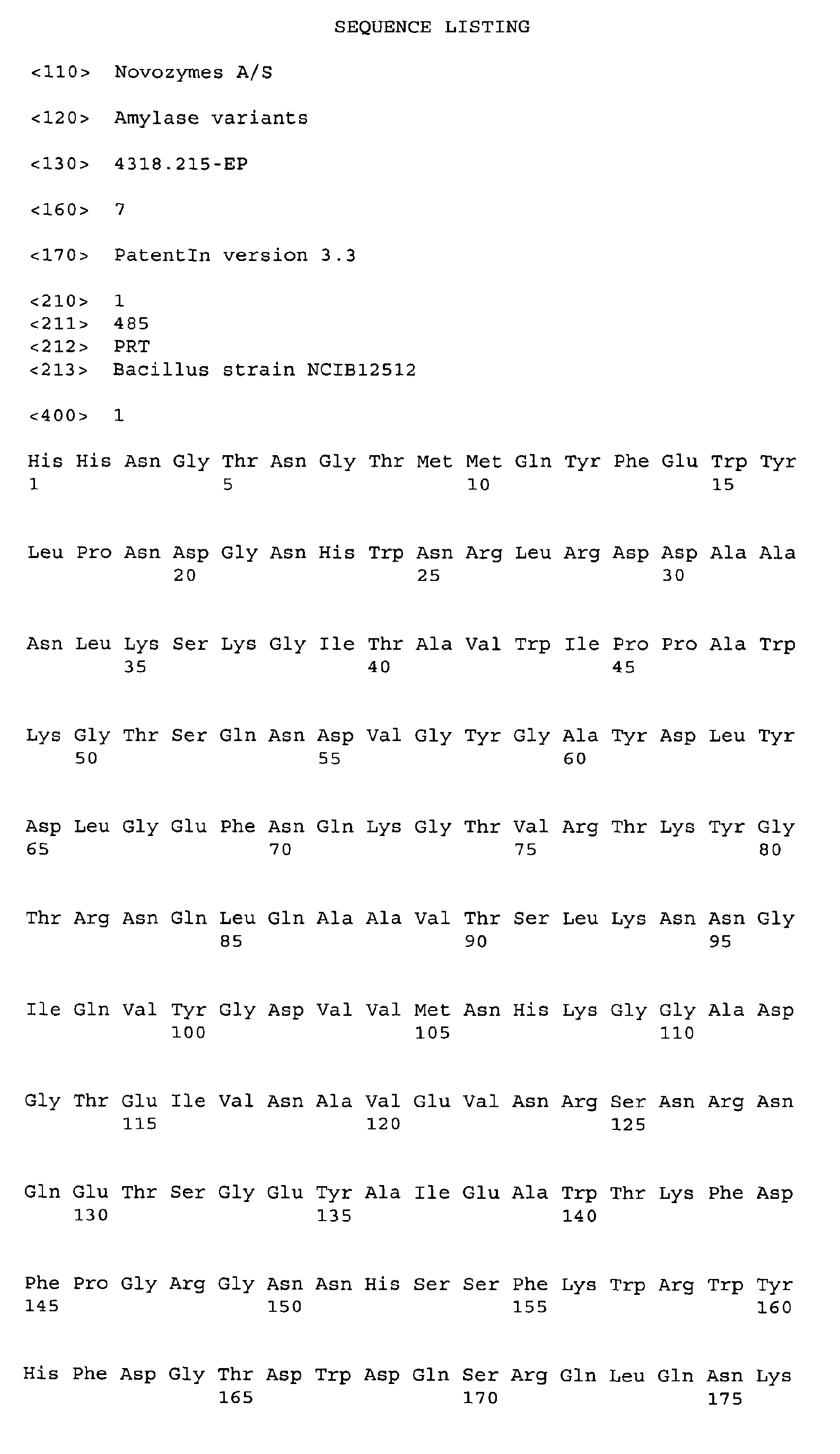
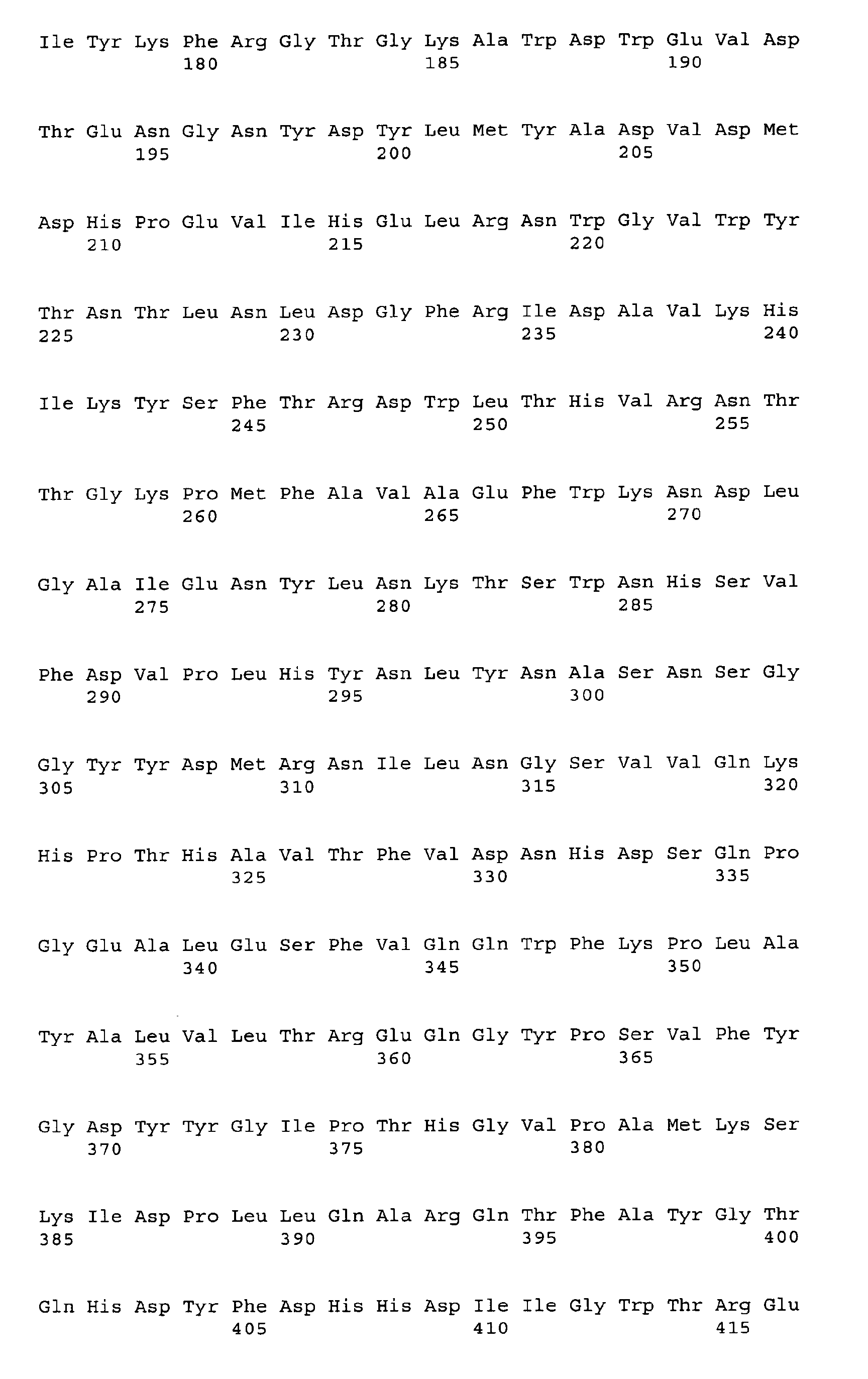

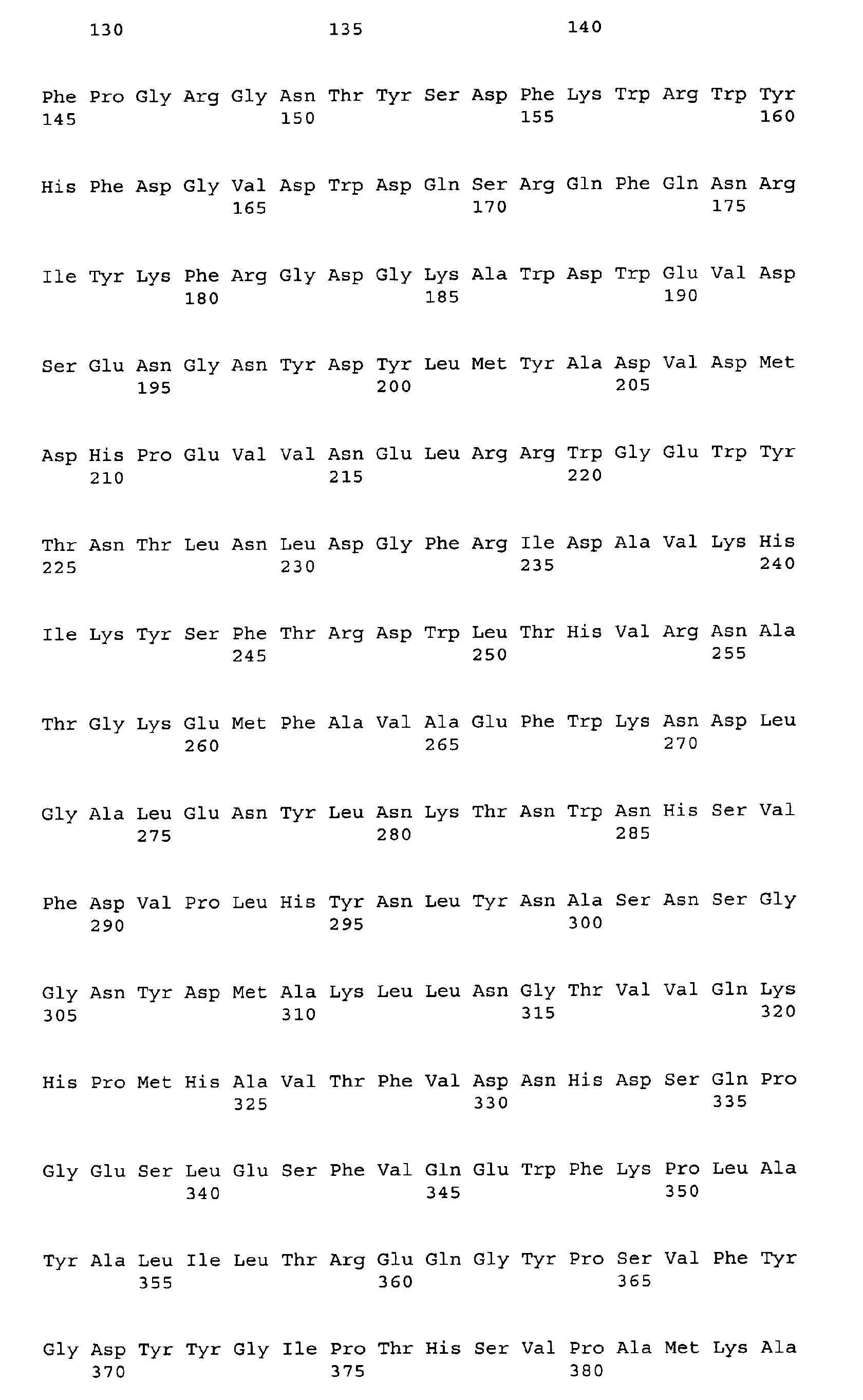
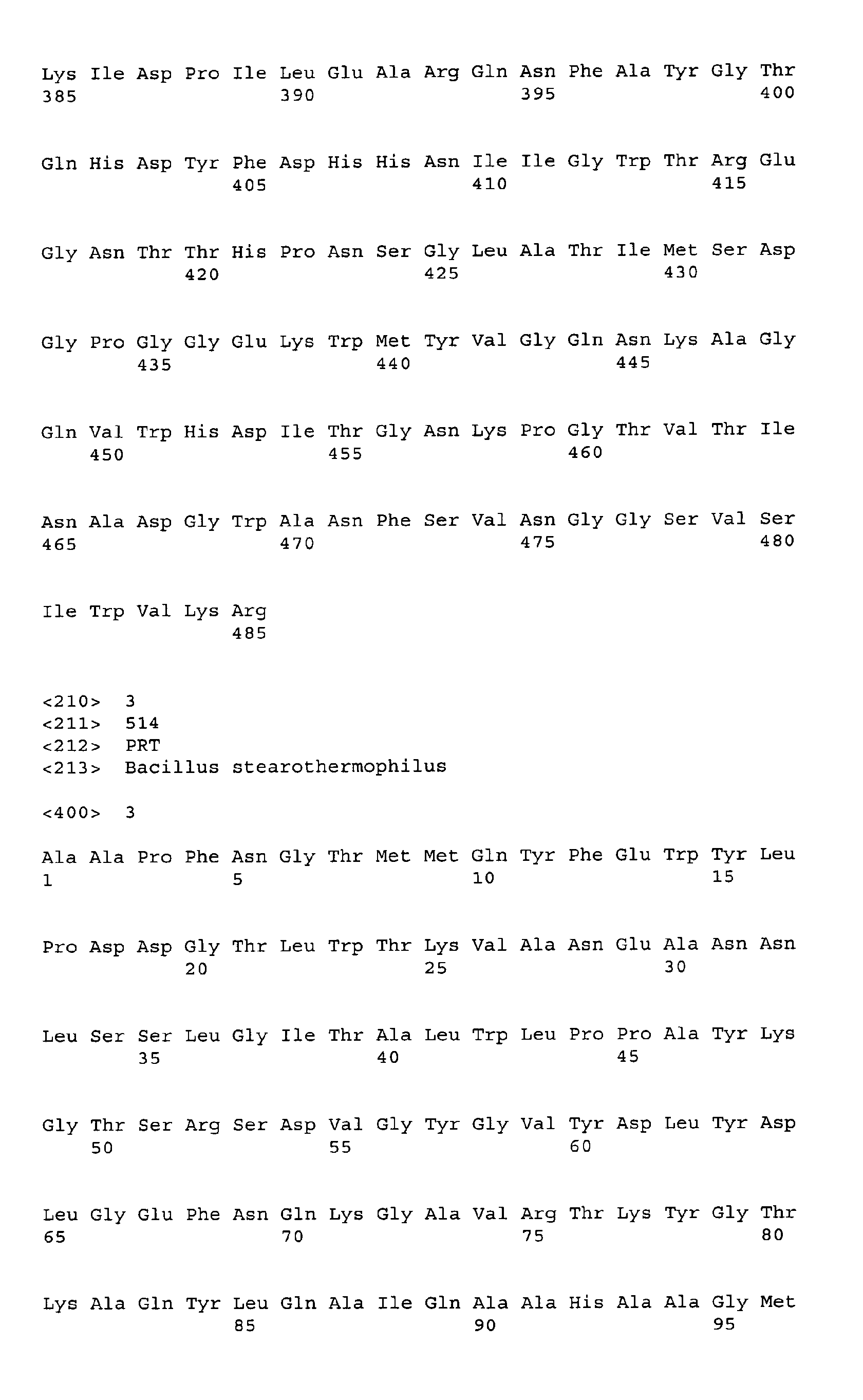

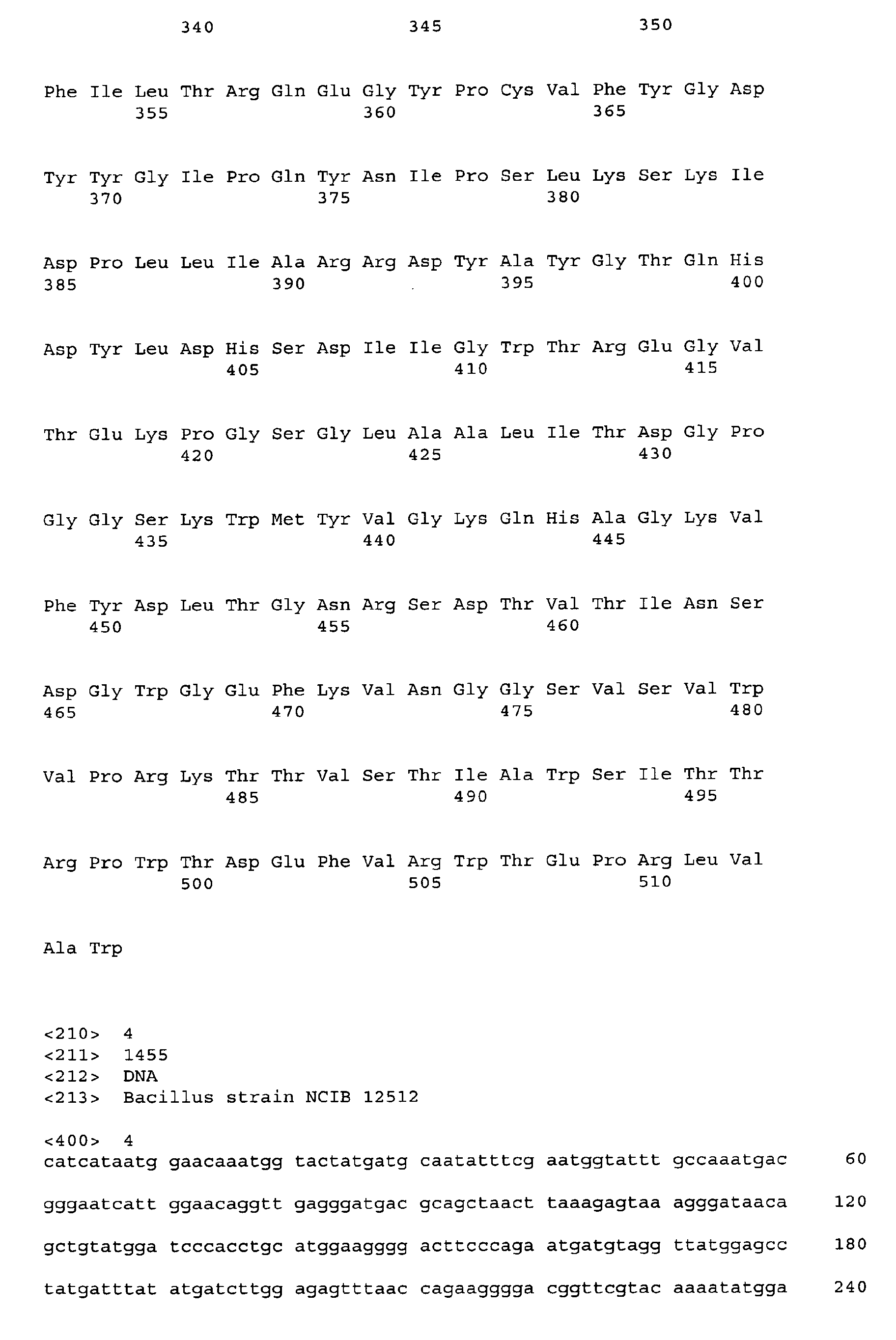
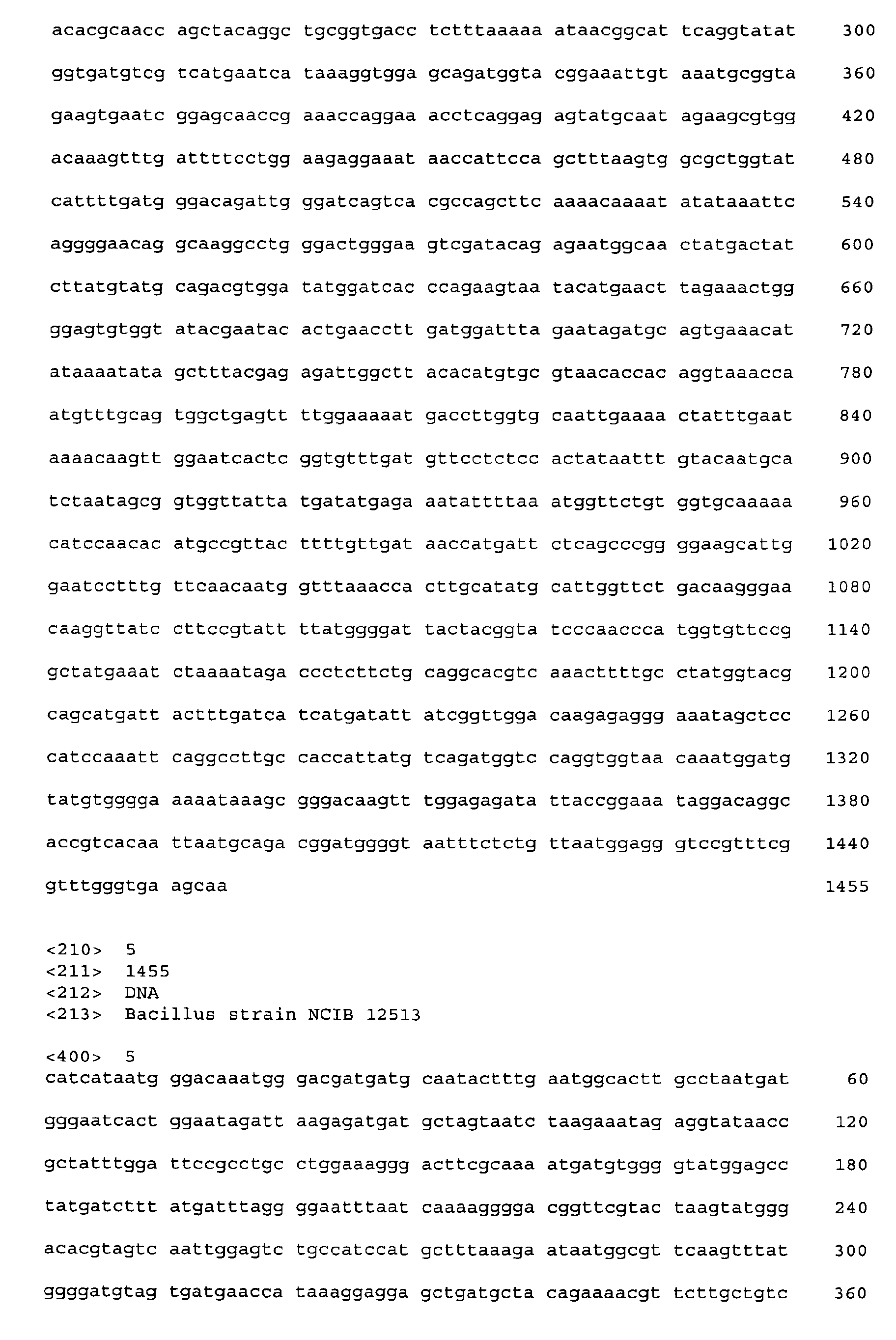
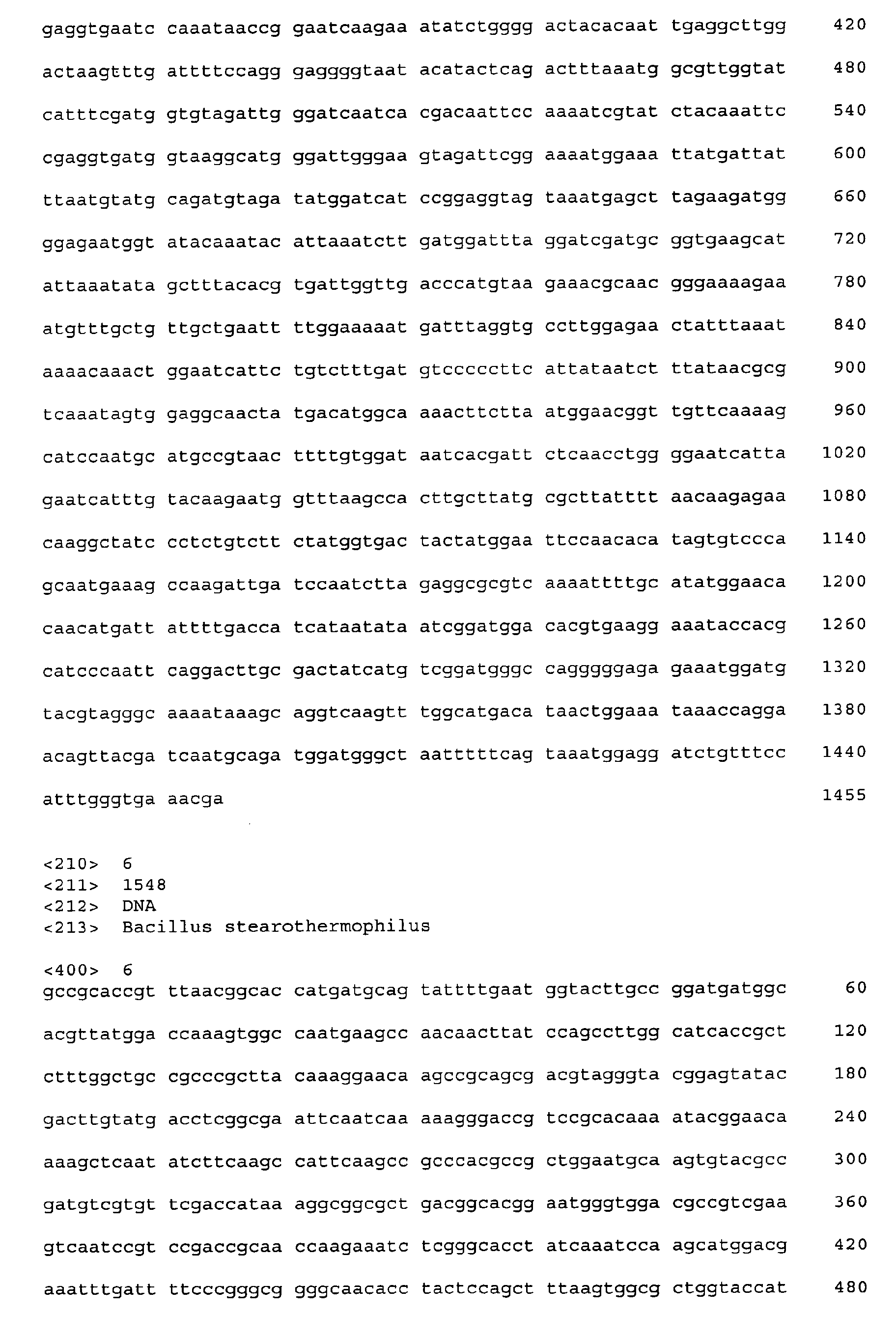

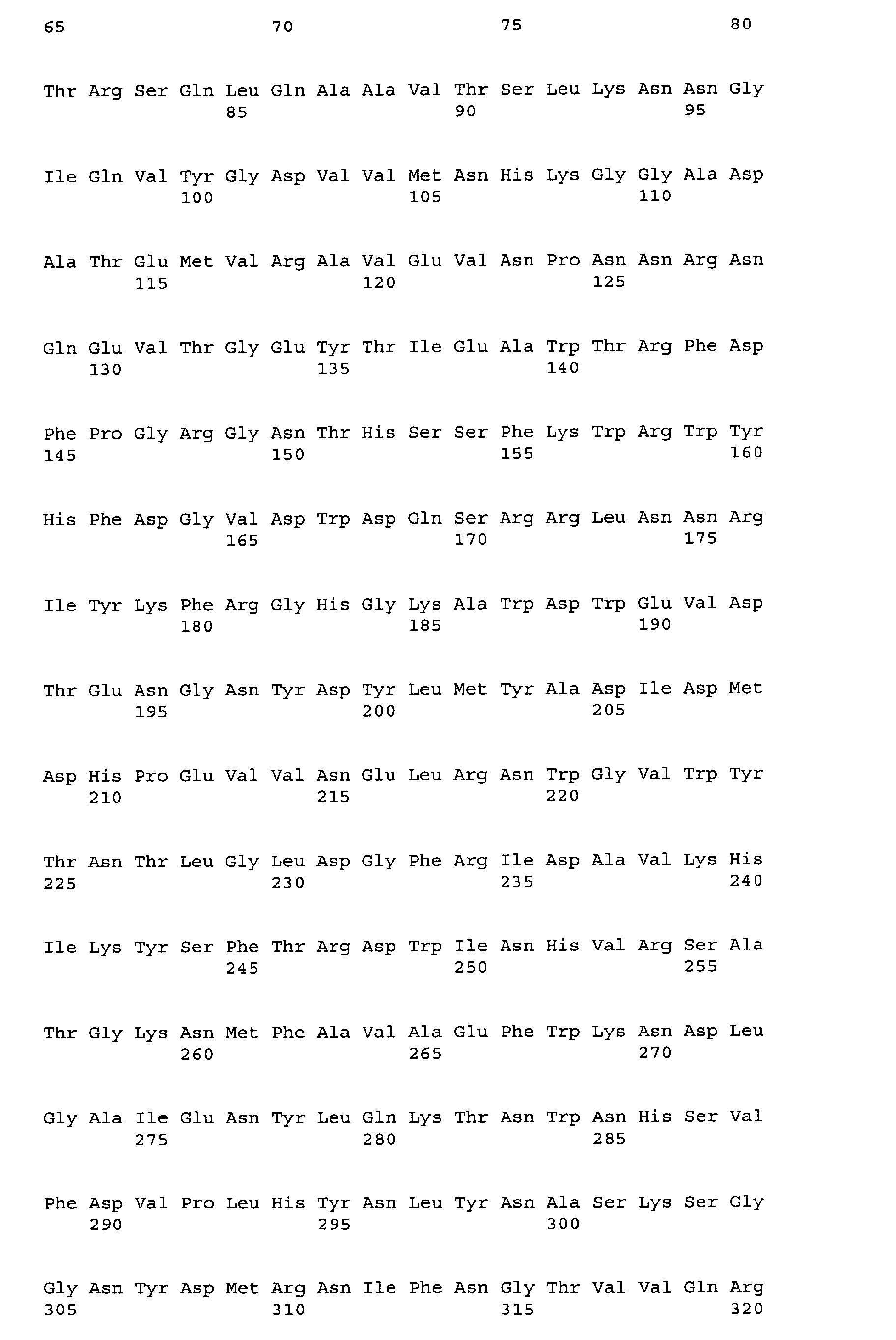

Claims (23)
- A variant of a parent α-amylase, which parent α-amylase displays at least 80% identity with amino acid sequence SEQ ID No. 3, wherein the variant comprises a deletion of amino acids equivalent to R179 and G180 of the amino acid sequence shown in SEQ ID No. 3, said variant having α-amylase activity and exhibiting at least one of the following properties relative to said parent α-amylase: increased thermostability; increased stability towards oxidation; and reduced Ca2+ dependency.
- A variant according to claim 1, wherein at least one oxidizable amino acid residue of said parent α-amylase has been deleted or has been replaced by a different amino acid residue which is less susceptible to oxidation than said oxidizable amino acid residue.
- A variant according to claim 2, wherein said oxidizable amino acid residue is selected from the group consisting of methionine, tryptophan, cysteine and tyrosine.
- A variant according to claim 3, wherein the methionine residue has been replaced by threonine.
- A DNA construct comprising a DNA sequence encoding an α-amylase variant according to any one of claims 1-4.
- A recombinant expression vector which carries a DNA construct according to claim 5.
- A host cell which is transformed with a DNA construct according to claim 5 or a vector according to claim 6.
- A cell according to claim 7, which is a microorganism.
- A cell according to claim 8, which is a bacterium or a fungus.
- A cell according to claim 8, which is a grampositive bacterium such as Bacillus subtilis, Bacillus licheniformis, Bacillus lentus, Bacillus brevis, Bacillus stearothermophilus, Bacillus alkalophilus, Bacillus amyloliquefaciens, Bacillus coagulans, Bacillus circulans, Bacillus lautus, Bacillus thuringiensis or Streptomyces lividans or Streptomyces murinus, or a gramnegative bacterium such as E.coli.
- A method of producing an α-amylase variant according to any one of claims 1-4, wherein a cell according to any one of claims 7-10 is cultured under conditions conducive to the production of the α-amylase variant, and the α-amylase variant is subsequently recovered from the culture.
- Use of an α-amylase variant according to any one of claims 1-4 for washing and/or dishwashing.
- A detergent additive comprising an α-amylase variant according to any one of claims 1-4, optionally in the form of a non-dusting granulate, stabilised liquid or protected enzyme.
- A detergent additive according to claim 13, comprising 0.02-200 mg of enzyme protein per gram of the additive.
- A detergent additive according to claim 13 or 14, which additionally comprises another enzyme such as a protease, a lipase, a peroxidase, another amylolytic enzyme and/or a cellulase.
- A detergent composition comprising an α-amylase variant according to any one of claims 1-4, and a surfactant.
- A detergent composition according to claim 16, which additionally comprises another enzyme such as a protease, a lipase, a peroxidase, another amylolytic enzyme and/or a cellulase.
- A manual or automatic dishwashing detergent composition comprising an α-amylase variant according to any one of claims 1-4, and a surfactant.
- A dishwashing detergent composition according to claim 18, which additionally comprises another enzyme such as a protease, a lipase, a peroxidase, another amylolytic enzyme and/or a cellulase.
- A manual or automatic laundry washing composition comprising an α-amylase variant according to any one of claims 1-4, and a surfactant.
- A laundry washing composition according to claim 20, which additionally comprises another enzyme such as a protease, a lipase, a peroxidase, an amylolytic enzyme and/or a cellulase.
- Use of an α-amylase variant according to any one of claims 1-4 for textile desizing.
- Use of an α-amylase variant according to any one of claims 1-4 for production of sweeteners and ethanol from starch.
Applications Claiming Priority (9)
| Application Number | Priority Date | Filing Date | Title |
|---|---|---|---|
| DK12695 | 1995-02-03 | ||
| DK12695 | 1995-02-03 | ||
| DK33695 | 1995-03-29 | ||
| DK33695 | 1995-03-29 | ||
| DK109795 | 1995-09-29 | ||
| DK109795 | 1995-09-29 | ||
| DK112195 | 1995-10-06 | ||
| DK112195 | 1995-10-06 | ||
| EP19960900894 EP0815208B1 (en) | 1995-02-03 | 1996-02-05 | Amylase variants |
Related Parent Applications (1)
| Application Number | Title | Priority Date | Filing Date |
|---|---|---|---|
| EP19960900894 Division EP0815208B1 (en) | 1995-02-03 | 1996-02-05 | Amylase variants |
Publications (3)
| Publication Number | Publication Date |
|---|---|
| EP1538155A2 true EP1538155A2 (en) | 2005-06-08 |
| EP1538155A3 EP1538155A3 (en) | 2005-06-15 |
| EP1538155B1 EP1538155B1 (en) | 2007-04-18 |
Family
ID=27439257
Family Applications (6)
| Application Number | Title | Priority Date | Filing Date |
|---|---|---|---|
| EP20100182145 Withdrawn EP2465930A3 (en) | 1995-02-03 | 1996-02-05 | Amylase variants |
| EP19960900894 Revoked EP0815208B1 (en) | 1995-02-03 | 1996-02-05 | Amylase variants |
| EP20100182134 Withdrawn EP2455468A3 (en) | 1995-02-03 | 1996-02-05 | Amylase variants |
| EP20060117580 Withdrawn EP1752525A1 (en) | 1995-02-03 | 1996-02-05 | Amylase variants |
| EP20100182122 Withdrawn EP2455465A3 (en) | 1995-02-03 | 1996-02-05 | Amylase Variants |
| EP20050002888 Revoked EP1538155B1 (en) | 1995-02-03 | 1996-02-05 | Amylase variants |
Family Applications Before (5)
| Application Number | Title | Priority Date | Filing Date |
|---|---|---|---|
| EP20100182145 Withdrawn EP2465930A3 (en) | 1995-02-03 | 1996-02-05 | Amylase variants |
| EP19960900894 Revoked EP0815208B1 (en) | 1995-02-03 | 1996-02-05 | Amylase variants |
| EP20100182134 Withdrawn EP2455468A3 (en) | 1995-02-03 | 1996-02-05 | Amylase variants |
| EP20060117580 Withdrawn EP1752525A1 (en) | 1995-02-03 | 1996-02-05 | Amylase variants |
| EP20100182122 Withdrawn EP2455465A3 (en) | 1995-02-03 | 1996-02-05 | Amylase Variants |
Country Status (15)
| Country | Link |
|---|---|
| US (2) | US20110177990A1 (en) |
| EP (6) | EP2465930A3 (en) |
| JP (2) | JP4116074B2 (en) |
| CN (2) | CN100535109C (en) |
| AR (3) | AR000862A1 (en) |
| AT (2) | ATE360026T1 (en) |
| AU (1) | AU4483396A (en) |
| BR (1) | BR9607735A (en) |
| CA (2) | CA2821537C (en) |
| DE (4) | DE05002888T1 (en) |
| DK (2) | DK1538155T3 (en) |
| ES (2) | ES2226609T3 (en) |
| MX (1) | MX9705727A (en) |
| PT (1) | PT1538155E (en) |
| WO (1) | WO1996023873A1 (en) |
Cited By (5)
| Publication number | Priority date | Publication date | Assignee | Title |
|---|---|---|---|---|
| EP2428572A2 (en) | 2007-03-09 | 2012-03-14 | Danisco US, Inc., Genencor Division | Alkaliphilic Bacillus species alpha-amylase variants, compositions comprising alpha-amylase variants, and methods of use |
| EP2468951A1 (en) * | 2010-12-21 | 2012-06-27 | Realco S.A. | Method for processing cellulosic materials |
| DE102011000889A1 (en) * | 2011-02-23 | 2012-08-23 | Witty Chemie Gmbh & Co. Kg | Detergent, useful for dishwashing, and for the machine cleaning of dishes comprises enzymes comprising e.g. amylases, borax, a phosphoric acid ester, a complexing agent, a solubilizer, nonionic surfactants, propylene glycol and water |
| US8507243B2 (en) | 2008-09-25 | 2013-08-13 | Danisco Us Inc. | Alpha-amylase blends and methods for using said blends |
| US8962283B2 (en) | 2008-02-04 | 2015-02-24 | Danisco Us Inc. | TS-23 alpha-amylase variants with altered properties |
Families Citing this family (885)
| Publication number | Priority date | Publication date | Assignee | Title |
|---|---|---|---|---|
| MX9705906A (en) | 1995-02-03 | 1997-10-31 | Novo Nordisk As | A method of designing alpha-amylase mutants with predetermined properties. |
| US6440716B1 (en) | 1995-02-03 | 2002-08-27 | Novozymes A/S | α-amylase mutants |
| EP0756001A1 (en) * | 1995-07-24 | 1997-01-29 | The Procter & Gamble Company | Detergent compositions comprising specific amylase and a specific surfactant system |
| JP2000505502A (en) * | 1996-03-07 | 2000-05-09 | ザ、プロクター、エンド、ギャンブル、カンパニー | Detergent compositions comprising improved amylase |
| US5763385A (en) * | 1996-05-14 | 1998-06-09 | Genencor International, Inc. | Modified α-amylases having altered calcium binding properties |
| US6197070B1 (en) | 1996-05-15 | 2001-03-06 | The Procter & Gamble Company | Detergent compositions comprising alpha combination of α-amylases for malodor stripping |
| JPH11511785A (en) * | 1996-05-15 | 1999-10-12 | ザ、プロクター、エンド、ギャンブル、カンパニー | Detergent composition comprising improved amylase, cellulase and cationic surfactant |
| WO1997043378A1 (en) * | 1996-05-15 | 1997-11-20 | The Procter & Gamble Company | DETERGENT COMPOSITIONS COMPRISING A COMBINATION OF α-AMYLASES FOR MALODOR STRIPPING |
| US6696251B1 (en) | 1996-05-31 | 2004-02-24 | Board Of Trustees Of The University Of Illinois | Yeast cell surface display of proteins and uses thereof |
| CN1229428A (en) * | 1996-08-01 | 1999-09-22 | 普罗格特-甘布尔公司 | Detergent composition comprising improved amylase for cleaning soiled fabrics |
| GB9701425D0 (en) | 1997-01-24 | 1997-03-12 | Bioinvent Int Ab | A method for in vitro molecular evolution of protein function |
| US6486113B1 (en) | 1997-03-31 | 2002-11-26 | Kao Corporation | Mutant α-amylases |
| EP0994936A1 (en) * | 1997-07-02 | 2000-04-26 | The Procter & Gamble Company | Dishwashing compositions comprising a phospholipase and an amylase |
| WO1999019467A1 (en) * | 1997-10-13 | 1999-04-22 | Novo Nordisk A/S | α-AMYLASE MUTANTS |
| US6361989B1 (en) | 1997-10-13 | 2002-03-26 | Novozymes A/S | α-amylase and α-amylase variants |
| AR016969A1 (en) * | 1997-10-23 | 2001-08-01 | Procter & Gamble | PROTEASE VARIANTE, ADN, EXPRESSION VECTOR, GUEST MICROORGANISM, CLEANING COMPOSITION, ANIMAL FOOD AND COMPOSITION TO TREAT A TEXTILE |
| KR100770721B1 (en) * | 1997-10-30 | 2007-10-29 | 노보자임스 에이/에스 | α-amylase mutants |
| EP2386568B1 (en) | 1997-10-30 | 2014-08-06 | Novozymes A/S | Alpha-amylase mutants |
| US7078213B1 (en) | 1998-02-18 | 2006-07-18 | Novozymes A/S | Alkaline Bacillus amylase |
| EP2284272B1 (en) | 1998-06-10 | 2014-08-13 | Novozymes A/S | Mannanases |
| US6197565B1 (en) * | 1998-11-16 | 2001-03-06 | Novo-Nordisk A/S | α-Amylase variants |
| US6887986B1 (en) | 1998-11-16 | 2005-05-03 | Novozymes A/S | α-amylase variants |
| CA2349003A1 (en) | 1998-11-20 | 2000-06-02 | The Procter & Gamble Company | Improved synthesis of bleach activators |
| DE69943346D1 (en) | 1998-12-18 | 2011-05-19 | Novozymes As | Subtilase enzymes of the I-S1 and I-S2 subgroups with an additional amino acid residue in an active loop region |
| WO2000041522A2 (en) * | 1999-01-11 | 2000-07-20 | The Procter & Gamble Company | Cleaning compositions containing a multi-function component and method for using |
| AU3419300A (en) | 1999-03-30 | 2000-10-23 | Novozymes A/S | Alpha-amylase variants |
| US6410295B1 (en) | 1999-03-30 | 2002-06-25 | Novozymes A/S | Alpha-amylase variants |
| EP2011864B1 (en) | 1999-03-31 | 2014-12-31 | Novozymes A/S | Polypeptides having alkaline alpha-amylase activity and nucleic acids encoding same |
| US6623948B1 (en) | 1999-03-31 | 2003-09-23 | Novozymes A/S | Nucleic acid sequences encoding alkaline alpha-amylases |
| DE60041536D1 (en) | 1999-03-31 | 2009-03-26 | Novozymes As | POLYPEPTIDES WITH ALKALINE ALPHA AMYLASE ACTIVITY AND NUCLEIC ACIDS CODED FOR THESE |
| US6309871B1 (en) * | 1999-03-31 | 2001-10-30 | Novozymes A/S | Polypeptides having alkaline α-amylase activity |
| DE60040282D1 (en) | 1999-05-20 | 2008-10-30 | Novozymes As | SUBTILASE ENZYMES OF I-S1 AND I-S2 SUB-GROUPS WITH AT LEAST ONE ADDITIONAL AMINO ACID BETWEEN POSITIONS 132 AND 133 |
| EP1183342B2 (en) | 1999-05-20 | 2012-06-13 | Novozymes A/S | Subtilase enzymes of the i-s1 and i-s2 sub-groups having at least one additional amino acid residue between positions 128 and 129 |
| ATE408678T1 (en) | 1999-05-20 | 2008-10-15 | Novozymes As | SUBTILASE ENZYMES OF THE I-S1 AND I-S2 SUBGROUPS WITH AT LEAST ONE ADDITIONAL AMINO ACID BETWEEN POSITIONS 129 AND 130 |
| DE60040149D1 (en) | 1999-05-20 | 2008-10-16 | Novozymes As | SUBTILASE ENZYMES OF I-S1 AND I-S2 SUB-GROUPS WITH AT LEAST ONE ADDITIONAL AMINO ACID RESISTANCE BETWEEN POSITIONS 126 AND 127 |
| AU4392900A (en) | 1999-05-20 | 2000-12-12 | Novozymes A/S | Subtilase enzymes of the i-s1 and i-s2 sub-groups having at least one additionalamino acid residue between positions 127 and 128 |
| AU4393100A (en) | 1999-05-20 | 2000-12-12 | Novozymes A/S | Subtilase enzymes of the i-s1 and i-s2 sub-groups having at least one additionalamino acid residue between positions 125 and 126 |
| EP2206786A1 (en) | 1999-08-31 | 2010-07-14 | Novozymes A/S | Novel proteases and variants thereof |
| US7005288B1 (en) | 1999-11-10 | 2006-02-28 | Novozymes A/S | Fungamyl-like alpha-amylase variants |
| WO2001034784A1 (en) | 1999-11-10 | 2001-05-17 | Novozymes A/S | Fungamyl-like alpha-amylase variants |
| WO2001064852A1 (en) * | 2000-03-03 | 2001-09-07 | Novozymes A/S | Polypeptides having alkaline alpha-amylase activity and nucleic acids encoding same |
| US7319112B2 (en) | 2000-07-14 | 2008-01-15 | The Procter & Gamble Co. | Non-halogenated antibacterial agents and processes for making same |
| IL154142A0 (en) | 2000-07-28 | 2003-07-31 | Henkel Kgaa | Novel amylolytic enzyme extracted from bacillus sp.a 7-7 (dsm 12368) and washing and cleaning agents containing this novel amylolytic |
| CA2702204C (en) * | 2000-08-01 | 2011-09-06 | Novozymes A/S | Alpha-amylase mutants with altered properties |
| WO2002016547A2 (en) | 2000-08-21 | 2002-02-28 | Novozymes A/S | Subtilase enzymes |
| GB2366797A (en) | 2000-09-13 | 2002-03-20 | Procter & Gamble | Process for making foam component by pressurising/depressurising |
| JP4426716B2 (en) | 2000-10-11 | 2010-03-03 | 花王株式会社 | High productivity α-amylase |
| US20040091994A1 (en) | 2000-10-13 | 2004-05-13 | Carsten Andersen | Alpha-amylase variant with altered properties |
| WO2002031124A2 (en) * | 2000-10-13 | 2002-04-18 | Novozymes A/S | Alpha-amylase variant with altered properties |
| EP2333055A1 (en) | 2000-10-13 | 2011-06-15 | Novozymes A/S | Subtilase variants |
| US6855680B2 (en) | 2000-10-27 | 2005-02-15 | The Procter & Gamble Company | Stabilized liquid compositions |
| GB2369094A (en) | 2000-11-17 | 2002-05-22 | Procter & Gamble | Packaging assembly for sheets of water-soluble sachets |
| US20020183226A1 (en) * | 2001-02-28 | 2002-12-05 | Chandrika Kasturi | Liquid detergent composition exhibiting enhanced alpha-amylase enzyme stability |
| EP1241112A3 (en) | 2001-03-15 | 2003-02-26 | The Procter & Gamble Company | Flexible multiple compartment pouch |
| EP3000881A3 (en) | 2001-05-15 | 2016-07-20 | Novozymes A/S | Alpha-amylase variant with altered properties |
| DK2295544T3 (en) | 2001-06-26 | 2016-09-26 | Novozymes As | Polypeptides with cellobiohydrolase I activity and the same coding polynucleotides |
| DK200101090A (en) | 2001-07-12 | 2001-08-16 | Novozymes As | Subtilase variants |
| US7153820B2 (en) | 2001-08-13 | 2006-12-26 | Ecolab Inc. | Solid detergent composition and method for solidifying a detergent composition |
| WO2003031981A2 (en) * | 2001-10-05 | 2003-04-17 | Novozymes A/S | Kit for predicting binding of a specific antibody to a potential immunogen and method of screening |
| AU2003214037A1 (en) | 2002-03-27 | 2003-10-08 | Novozymes A/S | Granules with filamentous coatings |
| EP1520012B1 (en) | 2002-07-01 | 2009-01-07 | Novozymes A/S | Monopropylene glycol added to fermentation |
| US7566448B2 (en) | 2002-07-30 | 2009-07-28 | Genencor International, Inc. | Reduced aerosol generating formulations |
| ATE540108T1 (en) | 2002-10-01 | 2012-01-15 | Novozymes As | FAMILY GH 61 POLYPEPTIDES |
| TWI319007B (en) | 2002-11-06 | 2010-01-01 | Novozymes As | Subtilase variants |
| DE60310264T2 (en) | 2002-12-17 | 2007-07-05 | Novozymes A/S | THERMOSTATIC ALPHA AMYLASE |
| WO2004056981A2 (en) | 2002-12-20 | 2004-07-08 | Novozymes A/S | Polypeptides having cellobiohydrolase ii activity and polynucleotides encoding same |
| JP2006517990A (en) | 2003-01-27 | 2006-08-03 | ノボザイムス アクティーゼルスカブ | Stabilization of granules |
| CN1751116A (en) | 2003-02-18 | 2006-03-22 | 诺和酶股份有限公司 | Detergent compositions |
| ATE471370T1 (en) | 2003-05-02 | 2010-07-15 | Novozymes Inc | VARIANTS OF BETA-GLUCOSIDASES |
| US7579177B2 (en) | 2003-05-30 | 2009-08-25 | Novozymes A/S | Alcohol product processes |
| AU2004252572B2 (en) | 2003-06-25 | 2011-09-08 | Novozymes A/S | Polypeptides having alpha-amylase activity and polypeptides encoding same |
| ES2538824T3 (en) | 2003-08-25 | 2015-06-24 | Novozymes, Inc. | Variants of glycoside hydrolases |
| BRPI0414959A (en) | 2003-10-10 | 2006-11-07 | Novozymes As | precursor protease variant, isolated nucleic acid sequence, recombinant nucleic acid construct, expression vector, and host cell, methods for producing the protease variant, for enhancing the nutritional value of an animal feed, and for treating proteins, a transgenic plant , or part of plant, transgenic, non-human animal, or products, or elements thereof, animal feed additive and composition, use of protease variant and / or composition, protease, and, 3d structure |
| WO2005040372A1 (en) | 2003-10-23 | 2005-05-06 | Novozymes A/S | Protease with improved stability in detergents |
| DK1682656T3 (en) | 2003-10-28 | 2013-11-18 | Novozymes Inc | Polypeptides with beta-glucosidase activity and polynucleotides encoding them |
| WO2005066339A2 (en) | 2004-01-06 | 2005-07-21 | Novozymes A/S | Polypeptides of alicyclobacillus sp. |
| DK1713825T3 (en) | 2004-01-30 | 2012-11-05 | Novozymes Inc | Polypeptides with cellulolytically increasing activity and polynucleotides encoding the same |
| EP2325318A1 (en) | 2004-02-13 | 2011-05-25 | Novozymes A/S | Protease variants |
| BRPI0509671A (en) * | 2004-04-08 | 2007-10-30 | Genencor Internation Inc | mutant alpha-amylases |
| DE102004048590A1 (en) * | 2004-04-27 | 2005-11-24 | Henkel Kgaa | Detergent with rinse aid sulfopolymer and a special α-amylase |
| US7148404B2 (en) | 2004-05-04 | 2006-12-12 | Novozymes A/S | Antimicrobial polypeptides |
| EP1751264B2 (en) | 2004-05-17 | 2013-08-28 | The Procter and Gamble Company | Bleaching composition comprising a carbohydrate oxidase |
| CN101014704A (en) | 2004-06-21 | 2007-08-08 | 诺维信公司 | protease |
| CA2571864C (en) | 2004-07-05 | 2014-09-23 | Novozymes A/S | Alpha-amylase variants with altered properties |
| DK1794296T3 (en) | 2004-09-21 | 2012-07-30 | Novozymes As | subtilases |
| WO2006032277A1 (en) | 2004-09-21 | 2006-03-30 | Novozymes A/S | Subtilases |
| DE602005026541D1 (en) | 2004-09-21 | 2011-04-07 | Novozymes As | SUBTILASES |
| US7666630B2 (en) | 2004-09-30 | 2010-02-23 | Novozymes, Inc. | Polypeptides having lipase activity and polynucleotides encoding same |
| DE102004047777B4 (en) | 2004-10-01 | 2018-05-09 | Basf Se | Alpha-amylase variants with increased solvent stability, process for their preparation and their use |
| DE102004047776B4 (en) | 2004-10-01 | 2018-05-09 | Basf Se | Stabilized against di- and / or multimerization alpha-amylase variants, processes for their preparation and their use |
| US7659101B2 (en) | 2004-12-15 | 2010-02-09 | Novozymes A/S | Alkaline Bacillus amylase |
| MX2007007107A (en) | 2004-12-22 | 2007-08-08 | Novozymes North America Inc | Polypeptides having glucoamylase activity and polynucleotides encoding same. |
| CA2606475C (en) | 2005-04-27 | 2015-06-16 | Novozymes, Inc. | Polypeptides having endoglucanase activity and polynucleotides encoding same |
| EP2385111B1 (en) | 2005-07-08 | 2016-09-07 | Novozymes A/S | Subtilase variants |
| CN101243182B (en) | 2005-08-16 | 2014-08-06 | 诺维信公司 | Subtilases |
| US8119387B2 (en) | 2005-08-16 | 2012-02-21 | Novozymes A/S | Polypeptides of strain Bacillus sp. P203 |
| WO2007028088A2 (en) | 2005-09-02 | 2007-03-08 | Novozymes North America, Inc. | Methods for enhancing the dewaterability of sludge with alpha-amylase treatment |
| CN101268195A (en) | 2005-09-20 | 2008-09-17 | 诺维信北美公司 | Methods of producing fermentation products |
| EP1941023B1 (en) | 2005-09-30 | 2017-04-05 | Novozymes Inc. | Methods for enhancing the degradation or conversion of cellulosic material |
| WO2007036235A1 (en) | 2005-09-30 | 2007-04-05 | Novozymes A/S | Immobilization of enzymes |
| WO2007076388A2 (en) | 2005-12-22 | 2007-07-05 | Novozymes North America, Inc. | Processes for producing a fermentation product |
| DE102006038448A1 (en) | 2005-12-28 | 2008-02-21 | Henkel Kgaa | Enzyme-containing cleaning agent |
| EP1994130A1 (en) | 2006-03-02 | 2008-11-26 | Novozymes A/S | High capacity encapsulation process |
| WO2007107573A1 (en) | 2006-03-22 | 2007-09-27 | Novozymes A/S | Use of polypeptides having antimicrobial activity |
| US8076112B2 (en) | 2006-03-22 | 2011-12-13 | Novozymes A/S | Fermentation processes |
| EP2004789B1 (en) | 2006-03-31 | 2012-08-29 | Novozymes A/S | A stabilized liquid enzyme composition |
| WO2007134366A1 (en) * | 2006-05-22 | 2007-11-29 | Protech Research Pty Ltd | Extracting and purifying α-amylase |
| WO2007134365A1 (en) * | 2006-05-22 | 2007-11-29 | Protech Research Pty Ltd | EXTRACTING AND PURIFYING β-AMYLASES |
| WO2008057637A2 (en) | 2006-07-21 | 2008-05-15 | Novozymes, Inc. | Methods of increasing secretion of polypeptides having biological activity |
| EP2066785B1 (en) | 2006-08-11 | 2023-02-01 | Novozymes Biologicals, Inc. | Bacteria cultures and compositions comprising bacteria cultures |
| WO2008040818A1 (en) | 2006-10-06 | 2008-04-10 | Novozymes A/S | Detergent compositions and the use of enzyme combinations therein |
| US8093200B2 (en) | 2007-02-15 | 2012-01-10 | Ecolab Usa Inc. | Fast dissolving solid detergent |
| MX2009009967A (en) | 2007-03-23 | 2009-10-07 | Danisco Us Inc Genencor Div | Enhanced amylase production by n-terminal addition to mature amylase protein. |
| WO2008118749A2 (en) | 2007-03-23 | 2008-10-02 | Novozymes Biologicals, Inc. | Preventing and reducing biofilm formation and planktonic proliferation |
| DE102007016139A1 (en) | 2007-03-30 | 2008-10-02 | Jenabios Gmbh | Method for regioselective oxygenation of N-heterocycles |
| EP3219804B1 (en) | 2007-04-24 | 2019-07-17 | Novozymes North America, Inc. | Detoxifying pre-treated lignocellulose-containing materials |
| RU2009149406A (en) | 2007-05-30 | 2011-07-10 | ДАНИСКО ЮЭс, ИНК., ДЖЕНЕНКОР ДИВИЖН (US) | VARIANTS OF ALFA AMILASE WITH HIGHER LEVELS OF PRODUCTION IN THE PROCESSES OF FERMENTATION |
| CN101796247B (en) | 2007-09-03 | 2014-01-22 | 诺维信公司 | Detoxification and recycling of washing solutions used in the pretreatment of lignocellulose-containing materials |
| AU2008325249B2 (en) | 2007-11-05 | 2013-10-10 | Danisco Us Inc. | Alpha-amylase variants with altered properties |
| WO2009061380A2 (en) * | 2007-11-05 | 2009-05-14 | Danisco Us Inc., Genencor Division | VARIANTS OF BACILLUS sp. TS-23 ALPHA-AMYLASE WITH ALTERED PROPERTIES |
| WO2009100138A2 (en) * | 2008-02-04 | 2009-08-13 | Danisco Us Inc., Genencor Division | Variants of bacillus stearothermophilus alpha-amylase and uses thereof |
| US8066818B2 (en) | 2008-02-08 | 2011-11-29 | The Procter & Gamble Company | Water-soluble pouch |
| US20090209447A1 (en) | 2008-02-15 | 2009-08-20 | Michelle Meek | Cleaning compositions |
| EP2100947A1 (en) | 2008-03-14 | 2009-09-16 | The Procter and Gamble Company | Automatic dishwashing detergent composition |
| MX2010013113A (en) | 2008-06-06 | 2010-12-21 | Danisco Inc | Geobacillus stearothermophilus alpha-amylase (amys) variants with improved properties. |
| EP2135931B1 (en) | 2008-06-16 | 2012-12-05 | The Procter & Gamble Company | Use of soil release polymer in fabric treatment compositions |
| CA2726688A1 (en) | 2008-06-23 | 2010-01-21 | Novozymes A/S | Processes for producing fermentation products |
| EP2149786A1 (en) | 2008-08-01 | 2010-02-03 | Unilever PLC | Improvements relating to detergent analysis |
| DE212009000119U1 (en) | 2008-09-12 | 2011-12-30 | Unilever N.V. | Dispenser and pretreatment agent for viscous liquids |
| EP2166092A1 (en) | 2008-09-18 | 2010-03-24 | The Procter and Gamble Company | Detergent composition |
| EP2166076A1 (en) | 2008-09-23 | 2010-03-24 | The Procter & Gamble Company | Cleaning composition |
| EP2166075A1 (en) | 2008-09-23 | 2010-03-24 | The Procter and Gamble Company | Cleaning composition |
| EP2166073A1 (en) | 2008-09-23 | 2010-03-24 | The Procter & Gamble Company | Cleaning composition |
| US20110165617A1 (en) | 2008-09-30 | 2011-07-07 | Novozymes North America, Inc. | Enzymatic Hydrolysis Of Pretreated Lignocellulose-Containing Material With Distillers Dried Grains |
| WO2010059413A2 (en) | 2008-11-20 | 2010-05-27 | Novozymes, Inc. | Polypeptides having amylolytic enhancing activity and polynucleotides encoding same |
| US7771983B2 (en) | 2008-12-04 | 2010-08-10 | Novozymos, Inc. | Polypeptides having cellulolytic enhancing activity and polynucleotides encoding same |
| US20110296557A1 (en) | 2008-12-12 | 2011-12-01 | Novozymes, Inc. | Polypeptides Having Lipase Activity And Polynucleotides Encoding Same |
| EP2202290A1 (en) | 2008-12-23 | 2010-06-30 | Unilever PLC | A flowable laundry composition and packaging therefor |
| EP2384365A2 (en) | 2008-12-30 | 2011-11-09 | Novozymes North America, Inc. | Improvement of enzymatic hydrolysis of pretreated lignocellulose-containing material with dissolved air flotation sludge |
| WO2010078392A2 (en) | 2008-12-31 | 2010-07-08 | Novozymes North America, Inc. | Processes of producing fermentation products |
| EP2213723A1 (en) | 2009-01-30 | 2010-08-04 | Novozymes A/S | Isomaltose for fungus fermentation |
| EP2216393B1 (en) | 2009-02-09 | 2024-04-24 | The Procter & Gamble Company | Detergent composition |
| WO2010097436A1 (en) | 2009-02-27 | 2010-09-02 | Novozymes A/S | Mutant cells having reduced expression of metallopeptidase, suitable for recombinant polypeptide production |
| US8293697B2 (en) | 2009-03-18 | 2012-10-23 | The Procter & Gamble Company | Structured fluid detergent compositions comprising dibenzylidene sorbitol acetal derivatives |
| US8153574B2 (en) | 2009-03-18 | 2012-04-10 | The Procter & Gamble Company | Structured fluid detergent compositions comprising dibenzylidene polyol acetal derivatives and detersive enzymes |
| RU2011144134A (en) * | 2009-04-01 | 2013-05-10 | ДАНИСКО ЮЭс ИНК. | COMPOSITIONS AND METHODS INCLUDING ALFA AMILASE OPTIONS WITH CHANGED PROPERTIES |
| WO2010138347A1 (en) | 2009-05-26 | 2010-12-02 | The Procter & Gamble Company | Aqueous liquid composition for pre-treating soiled dishware |
| WO2011000924A1 (en) | 2009-07-03 | 2011-01-06 | Abbott Products Gmbh | Spray-dried amylase, pharmaceutical preparations comprising the same and use |
| MX2012000480A (en) | 2009-07-09 | 2012-01-27 | Procter & Gamble | A catalytic laundry detergent composition comprising relatively low levels of water-soluble electrolyte. |
| JP2012532246A (en) | 2009-07-09 | 2012-12-13 | ザ プロクター アンド ギャンブル カンパニー | Catalytic laundry detergent composition comprising a relatively low concentration of a water-soluble electrolyte |
| WO2011005623A1 (en) | 2009-07-09 | 2011-01-13 | The Procter & Gamble Company | Laundry detergent composition comprising low level of bleach |
| US20110009307A1 (en) | 2009-07-09 | 2011-01-13 | Alan Thomas Brooker | Laundry Detergent Composition Comprising Low Level of Sulphate |
| CA2768315A1 (en) | 2009-07-17 | 2011-01-20 | Novozymes A/S | A method of analyzing cellulose decay in cellulosic material hydrolysis |
| PL2292725T5 (en) | 2009-08-13 | 2022-11-07 | The Procter And Gamble Company | Method of laundering fabrics at low temperature |
| DK3269804T3 (en) | 2009-09-17 | 2020-11-23 | Novozymes Inc | POLYPEPTIDES WITH CELLULOLYSIS IMPROVING ACTIVITY AND POLYNUCLEOTIDES ENCODING THEM |
| EP2480650B1 (en) | 2009-09-25 | 2017-03-22 | Novozymes A/S | Subtilase variants |
| CN102648277B (en) | 2009-09-25 | 2015-05-20 | 诺维信公司 | Use of protease variants |
| WO2011041397A1 (en) | 2009-09-29 | 2011-04-07 | Novozymes, Inc. | Polypeptides having cellulolytic enhancing activity and polynucleotides encoding same |
| BR112012007375A2 (en) | 2009-09-30 | 2016-11-22 | Novozymes As | isolated polypeptide, isolated polynucleotide, methods for making a polypeptide, for producing a precursor cell mutant, for inhibiting expression of a polypeptide, for producing a protein, for degrading or converting a cellulosic material, for producing a fermentation product, and for ferment a cellulosic material, transgenic plant, transformed plant part or plant cell, double stranded inhibitory rna molecule, and detergent composition |
| WO2011039319A1 (en) | 2009-09-30 | 2011-04-07 | Novozymes A/S | Polypeptides having cellulolytic enhancing activity and polynucleotides encoding same |
| CN102869770B (en) | 2009-11-30 | 2015-12-16 | 诺维信公司 | There are the polypeptide of glucoamylase activity and the polynucleotide of this polypeptide of coding |
| CA2782154C (en) | 2009-11-30 | 2018-10-16 | Novozymes A/S | Polypeptides having glucoamylase activity and polynucleotides encoding same |
| CA2782036C (en) | 2009-12-01 | 2019-01-15 | Novozymes A/S | Polypeptides having glucoamylase activity and polynucleotides encoding same |
| EP3434764B1 (en) | 2009-12-09 | 2026-04-08 | The Procter & Gamble Company | Fabric and home care products |
| EP2333041B1 (en) | 2009-12-10 | 2013-05-15 | The Procter & Gamble Company | Method and use of a dishwasher composition |
| EP2333042B1 (en) | 2009-12-10 | 2015-07-01 | The Procter and Gamble Company | Automatic dishwashing product and use thereof |
| ES2399311T5 (en) | 2009-12-10 | 2020-06-19 | Procter & Gamble | Detergent composition |
| ES2423580T5 (en) | 2009-12-10 | 2021-06-17 | Procter & Gamble | Method and use of a dishwashing composition |
| WO2011076897A1 (en) * | 2009-12-22 | 2011-06-30 | Novozymes A/S | Use of amylase variants at low temperature |
| CN102933227A (en) | 2009-12-22 | 2013-02-13 | 诺维信公司 | Compositions comprising boosting polypeptide and starch degrading enzyme and uses thereof |
| US20120220513A1 (en) | 2009-12-29 | 2012-08-30 | Novozymes A/S | Polypeptides Having Detergency Enhancing Effect |
| CN102884183B (en) | 2010-01-04 | 2015-09-16 | 诺维信公司 | Be tending towards the stabilization of the α-amylase of calcium depletion and acid pH |
| EP2529022A1 (en) | 2010-01-29 | 2012-12-05 | Novozymes A/S | Biogas production process with enzymatic pre-treatment |
| WO2011100161A1 (en) | 2010-02-09 | 2011-08-18 | Novozymes North America, Inc. | Addition of alpha - glucosidase and cobalt for producing fermentation products from starch |
| EP3892709A3 (en) * | 2010-02-10 | 2022-01-19 | Novozymes A/S | Variants and compositions comprising variants with high stability in presence of a chelating agent |
| EP2357220A1 (en) * | 2010-02-10 | 2011-08-17 | The Procter & Gamble Company | Cleaning composition comprising amylase variants with high stability in the presence of a chelating agent |
| WO2011100667A1 (en) | 2010-02-14 | 2011-08-18 | Ls9, Inc. | Surfactant and cleaning compositions comprising microbially produced branched fatty alcohols |
| PL2361964T3 (en) | 2010-02-25 | 2013-05-31 | Procter & Gamble | Detergent composition |
| JP5833576B2 (en) | 2010-02-25 | 2015-12-16 | ノボザイムス アクティーゼルスカブ | Variant of lysozyme and polynucleotide encoding the same |
| DK2552934T3 (en) | 2010-03-30 | 2015-09-28 | Novozymes As | Krystalmetabolit-extraction |
| CN102834521B (en) | 2010-03-30 | 2018-02-27 | 诺维信公司 | For strengthening the method from zymotechnique accessory substance |
| CA2795806C (en) | 2010-04-14 | 2019-01-08 | Novozymes A/S | Polypeptides having glucoamylase activity and polynucleotides encoding same |
| ES2533368T3 (en) | 2010-04-23 | 2015-04-09 | The Procter & Gamble Company | Dishwasher product |
| EP2380963B1 (en) | 2010-04-23 | 2015-12-23 | The Procter and Gamble Company | Method of perfuming |
| ES2682051T3 (en) | 2010-04-23 | 2018-09-18 | The Procter & Gamble Company | Detergent composition |
| EP2380962B1 (en) | 2010-04-23 | 2016-03-30 | The Procter and Gamble Company | Particle |
| EP2383329A1 (en) | 2010-04-23 | 2011-11-02 | The Procter & Gamble Company | Particle |
| RU2573907C2 (en) | 2010-04-26 | 2016-01-27 | Новозимс А/С | Granule for use in powder detergents and composition of granule detergent |
| EP2601301A1 (en) | 2010-08-02 | 2013-06-12 | Novozymes North America, Inc. | Process of producing a fermentation product |
| HUE036404T2 (en) | 2010-08-17 | 2018-08-28 | Procter & Gamble | Method for hand washing dishes having long lasting suds |
| PL2420558T3 (en) | 2010-08-17 | 2017-12-29 | The Procter And Gamble Company | Stable sustainable hand dish-washing detergents |
| MX2013002250A (en) | 2010-08-30 | 2013-05-30 | Novozymes As | A two-soak wash. |
| CN103189493A (en) | 2010-08-30 | 2013-07-03 | 诺维信公司 | A concentrated soak wash |
| EP2616483A1 (en) | 2010-09-16 | 2013-07-24 | Novozymes A/S | Lysozymes |
| GB201015672D0 (en) | 2010-09-20 | 2010-10-27 | Unilever Plc | Improvements relating to fabric treatment compositions comprising targeted benefit agents |
| EP2622068B1 (en) | 2010-09-30 | 2016-07-20 | Novozymes, Inc. | Variants of polypeptides having cellulolytic enhancing activity and polynucleotides encoding same |
| EP2622070B1 (en) | 2010-09-30 | 2016-08-03 | Novozymes, Inc. | Variants of polypeptides having cellulolytic enhancing activity and polynucleotides encoding same |
| DK177132B1 (en) | 2010-11-05 | 2012-01-30 | Respekt Danmark As | Automatic Dishwasher |
| EP2637515B1 (en) | 2010-11-08 | 2017-09-06 | Novozymes A/S | Polypeptides having glucoamylase activity and polynucleotides encoding same |
| DK2638154T3 (en) | 2010-11-08 | 2017-01-02 | Novozymes As | POLYPEPTIDES WITH GLUCOAMYLASE ACTIVITY AND POLYNUCLEOTIDES CODING THEM |
| WO2012068509A1 (en) | 2010-11-18 | 2012-05-24 | Novozymes, Inc. | Chimeric polypeptides having cellulolytic enhancing activity and polynucleotides encoding same |
| CA2817224A1 (en) | 2010-11-19 | 2012-05-24 | Novozymes North America, Inc. | Processes of producing a fermentation product |
| CN103339260A (en) | 2011-01-04 | 2013-10-02 | 诺维信公司 | Process for producing biogas from pectin and lignocellulose containing materials |
| CN103339251B (en) | 2011-01-31 | 2016-05-04 | 诺维信公司 | Brownization glucose is as the purposes of charging matrix |
| US9677094B2 (en) | 2011-02-07 | 2017-06-13 | Novozymes A/S | Process of producing a fermentation product |
| CA2827405C (en) | 2011-02-15 | 2023-01-10 | Novozymes Biologicals, Inc. | Mitigation of odor in cleaning machines and cleaning processes |
| JP2014506945A (en) | 2011-02-16 | 2014-03-20 | ノボザイムス アクティーゼルスカブ | Detergent composition containing metalloprotease |
| US20140024103A1 (en) | 2011-02-16 | 2014-01-23 | Astrid Benie | Detergent Compositions Comprising Metalloproteases |
| JP2014511409A (en) | 2011-02-16 | 2014-05-15 | ノボザイムス アクティーゼルスカブ | Detergent composition containing metalloprotease |
| EP2678352B1 (en) | 2011-02-23 | 2017-12-06 | Novozymes, Inc. | Polypeptides having cellulolytic enhancing activity and polynucleotides encoding same |
| US8153575B1 (en) | 2011-03-07 | 2012-04-10 | Empire Technology Development Llc | Immobilized enzyme compositions for densified carbon dioxide dry cleaning |
| WO2012135659A2 (en) | 2011-03-31 | 2012-10-04 | Novozymes A/S | Methods for enhancing the degradation or conversion of cellulosic material |
| DK2702162T3 (en) | 2011-04-29 | 2020-05-18 | Novozymes Inc | PROCEDURES FOR IMPROVING THE DEGRADATION OR CONVERSION OF CELLULOSE SUBSTANCES |
| CA3194062A1 (en) | 2011-05-05 | 2012-11-08 | Danisco Us Inc. | Compositions and methods comprising serine protease variants |
| CN106065381B (en) | 2011-05-05 | 2019-07-26 | 宝洁公司 | Composition and method comprising serine protease variants |
| US20140371435A9 (en) | 2011-06-03 | 2014-12-18 | Eduardo Torres | Laundry Care Compositions Containing Thiophene Azo Dyes |
| EP2537918A1 (en) | 2011-06-20 | 2012-12-26 | The Procter & Gamble Company | Consumer products with lipase comprising coated particles |
| CN107475235B (en) | 2011-06-20 | 2022-09-13 | 诺维信公司 | Particulate composition |
| CN103620029B (en) | 2011-06-24 | 2017-06-09 | 诺维信公司 | Polypeptide and their polynucleotides of coding with proteinase activity |
| WO2013000945A1 (en) | 2011-06-28 | 2013-01-03 | Novozymes A/S | Biogas from enzyme-treated bagasse |
| EP2726500B1 (en) | 2011-06-30 | 2019-03-20 | Novozymes A/S | Method for screening alpha-amylases |
| EP3421595B1 (en) * | 2011-06-30 | 2020-10-07 | Novozymes A/S | Alpha-amylase-variants |
| BR112013033816A2 (en) | 2011-07-01 | 2017-02-14 | Novozymes A / S | boron free liquid detergent composition |
| BR112013033811A2 (en) | 2011-07-01 | 2017-02-14 | Novozymes A / S | composition, method of preparing the composition, and |
| MX337984B (en) * | 2011-07-06 | 2016-03-30 | Novozymes As | Alpha amylase variants and polynucleotides encoding same. |
| US10711262B2 (en) | 2011-07-12 | 2020-07-14 | Novozymes A/S | Storage-stable enzyme granules |
| CN109022518A (en) | 2011-07-22 | 2018-12-18 | 诺维信北美公司 | For pre-treating cellulosic material and the method for improving its hydrolysis |
| EP2551335A1 (en) | 2011-07-25 | 2013-01-30 | The Procter & Gamble Company | Enzyme stabilized liquid detergent composition |
| EP2744898A1 (en) | 2011-08-15 | 2014-06-25 | Novozymes A/S | Polypeptides having cellulase activity and polynucleotides encoding same |
| US20140295027A1 (en) | 2011-08-19 | 2014-10-02 | Novozymes A/S | Polypeptides Having Protease Activity |
| CA2846690A1 (en) | 2011-08-26 | 2013-03-07 | Novozymes A/S | Polypeptides having glucoamylase activity and polynucleotides encoding same |
| CN103930543B (en) | 2011-09-06 | 2020-11-27 | 诺维信公司 | Glucoamylase variants and polynucleotides encoding them |
| ES2628190T3 (en) | 2011-09-22 | 2017-08-02 | Novozymes A/S | Polypeptides with protease activity and polynucleotides encoding them |
| US9353362B2 (en) | 2011-10-11 | 2016-05-31 | Novozymes A/S | Glucoamylase variants and polynucleotides encoding same |
| EP2766490B1 (en) | 2011-10-11 | 2017-04-12 | Novozymes North America, Inc. | Liquefaction process for producing fermentation products |
| PL2584028T3 (en) | 2011-10-19 | 2017-10-31 | Procter & Gamble | Particle |
| CN103958672A (en) | 2011-11-21 | 2014-07-30 | 诺维信股份有限公司 | GH61 polypeptide variants and polynucleotides encoding same |
| JP6105615B2 (en) | 2011-11-25 | 2017-03-29 | ノボザイムス アクティーゼルスカブ | Polypeptide having lysozyme activity and polynucleotide encoding the same |
| US20140342433A1 (en) | 2011-11-25 | 2014-11-20 | Novozymes A/S | Subtilase Variants and Polynucleotides Encoding Same |
| IN2014CN04905A (en) | 2011-12-02 | 2015-09-18 | Novozymes As | |
| WO2013083801A2 (en) | 2011-12-09 | 2013-06-13 | Novozymes A/S | Biogas from substrates comprising animal manure and enzymes |
| WO2013087027A1 (en) | 2011-12-16 | 2013-06-20 | Novozymes, Inc. | Polypeptides having laccase activity and polynucleotides encoding same |
| EP2607468A1 (en) | 2011-12-20 | 2013-06-26 | Henkel AG & Co. KGaA | Detergent compositions comprising subtilase variants |
| MX2014007446A (en) | 2011-12-20 | 2014-08-01 | Novozymes As | Subtilase variants and polynucleotides encoding same. |
| WO2013096652A1 (en) | 2011-12-21 | 2013-06-27 | Novozymes, Inc. | Methods for determining the degradation of a biomass material |
| ES2667318T3 (en) | 2011-12-28 | 2018-05-10 | Novozymes A/S | Polypeptides with protease activity |
| ES2887576T3 (en) | 2011-12-29 | 2021-12-23 | Novozymes As | Detergent compositions with lipase variants |
| US9801398B2 (en) | 2012-01-26 | 2017-10-31 | Novozymes A/S | Use of polypeptides having protease activity in animal feed and detergents |
| DK2623586T3 (en) | 2012-02-03 | 2017-11-13 | Procter & Gamble | COMPOSITIONS AND PROCEDURES FOR LIPASER SURFACE TREATMENT |
| EP2628785B1 (en) | 2012-02-17 | 2016-05-18 | Henkel AG & Co. KGaA | Detergent compositions comprising subtilase variants |
| MX350713B (en) | 2012-02-17 | 2017-09-14 | Novozymes As | Subtilisin variants and polynucleotides encoding same. |
| CN104704102A (en) | 2012-03-07 | 2015-06-10 | 诺维信公司 | Detergent composition and substitution of optical brighteners in detergent compositions |
| US10087401B2 (en) | 2012-03-16 | 2018-10-02 | Monosol, Llc | Water soluble compositions incorporating enzymes, and method of making same |
| CA2867361C (en) | 2012-03-19 | 2017-07-25 | Milliken & Company | Carboxylate dyes |
| WO2013148492A1 (en) | 2012-03-29 | 2013-10-03 | Novozymes A/S | Use of enzymes for preparing water soluble films |
| CA2869047C (en) | 2012-03-30 | 2022-11-01 | Novozymes North America, Inc. | Processes of producing fermentation products |
| EP2834353B1 (en) | 2012-04-02 | 2017-07-19 | Novozymes A/S | Lipase variants and polynucleotides encoding same |
| US9394092B2 (en) | 2012-04-16 | 2016-07-19 | Monosol, Llc | Powdered pouch and method of making same |
| CN104245926B (en) | 2012-04-27 | 2021-05-07 | 诺维信股份有限公司 | GH61 polypeptide variants and polynucleotides encoding same |
| CN113201519A (en) | 2012-05-07 | 2021-08-03 | 诺维信公司 | Polypeptides having xanthan degrading activity and nucleotides encoding same |
| PL2662436T3 (en) | 2012-05-11 | 2018-02-28 | The Procter And Gamble Company | Detergent composition |
| WO2013171241A1 (en) | 2012-05-16 | 2013-11-21 | Novozymes A/S | Compositions comprising lipase and methods of use thereof |
| EP2674475A1 (en) | 2012-06-11 | 2013-12-18 | The Procter & Gamble Company | Detergent composition |
| EP2861749A1 (en) | 2012-06-19 | 2015-04-22 | Novozymes Bioag A/S | Enzymatic reduction of hydroperoxides |
| MX364390B (en) | 2012-06-20 | 2019-04-25 | Novozymes As | Use of polypeptides having protease activity in animal feed and detergents. |
| WO2014006140A1 (en) | 2012-07-06 | 2014-01-09 | Novozymes A/S | Liquid enzyme composition and method for enzyme recovery |
| CN104471048B (en) | 2012-07-12 | 2018-11-16 | 诺维信公司 | Polypeptide with lipase active and the polynucleotides for encoding it |
| MX2015000924A (en) | 2012-07-26 | 2015-04-10 | Procter & Gamble | Low ph liquid cleaning compositions with enzymes. |
| CN104583394B (en) | 2012-08-16 | 2019-06-07 | 诺维信公司 | Textile treating method with endoglucanases |
| US9828595B2 (en) | 2012-08-17 | 2017-11-28 | Novozymes A/S | Thermostable asparaginase variants and polynucleotides encoding same |
| MX2015002211A (en) | 2012-08-22 | 2015-05-08 | Novozymes As | Metalloprotease from exiguobacterium. |
| WO2014029820A1 (en) | 2012-08-22 | 2014-02-27 | Novozymes A/S | Detergent compositions comprising metalloproteases |
| US9315791B2 (en) | 2012-08-22 | 2016-04-19 | Novozymes A/S | Metalloproteases from alicyclobacillus |
| EP2700703B1 (en) | 2012-08-24 | 2018-05-02 | The Procter and Gamble Company | Dishwashing method |
| ES2678543T3 (en) | 2012-08-24 | 2018-08-13 | The Procter & Gamble Company | Dishwashing method |
| CN113105950A (en) | 2012-10-04 | 2021-07-13 | 艺康美国股份有限公司 | Pre-soak process for laundry and other hard surface cleaning |
| TR201910918T4 (en) | 2012-12-07 | 2019-08-21 | Novozymes As | Prevention of bacterial adhesion. |
| WO2014090940A1 (en) | 2012-12-14 | 2014-06-19 | Novozymes A/S | Removal of skin-derived body soils |
| JP2016506442A (en) | 2012-12-20 | 2016-03-03 | ザ プロクター アンド ギャンブルカンパニー | Detergent composition comprising a silicate-coated bleach |
| US9551042B2 (en) | 2012-12-21 | 2017-01-24 | Novozymes A/S | Polypeptides having protease activity and polynucleotides encoding same |
| EP2746381A1 (en) | 2012-12-21 | 2014-06-25 | The Procter & Gamble Company | Cleaning pack |
| EP3321360A3 (en) | 2013-01-03 | 2018-06-06 | Novozymes A/S | Alpha-amylase variants and polynucleotides encoding same |
| CA2902279C (en) | 2013-03-05 | 2019-05-28 | The Procter & Gamble Company | Mixed sugar amine or sugar amide surfactant compositions |
| ES2676895T5 (en) | 2013-03-11 | 2022-04-27 | Danisco Us Inc | Combinatorial variants of alpha-amylase |
| US20160024440A1 (en) | 2013-03-14 | 2016-01-28 | Novozymes A/S | Enzyme and Inhibitor Containing Water-Soluble Films |
| US9631164B2 (en) | 2013-03-21 | 2017-04-25 | Novozymes A/S | Polypeptides with lipase activity and polynucleotides encoding same |
| BR112015021923A2 (en) | 2013-03-28 | 2017-07-18 | Procter & Gamble | cleaning compositions containing a polyetheramine, a dirt remover polymer and a carboxymethyl cellulose |
| WO2014173980A2 (en) | 2013-04-23 | 2014-10-30 | Novozymes A/S | Liquid automatic dish washing detergent compositions |
| EP3372680B1 (en) | 2013-04-30 | 2020-11-11 | Novozymes A/S | Glucoamylase variants and polynucleotides encoding same |
| WO2014177541A2 (en) | 2013-04-30 | 2014-11-06 | Novozymes A/S | Glucoamylase variants and polynucleotides encoding same |
| CN105164244B (en) | 2013-05-03 | 2019-08-20 | 诺维信公司 | Microencapsulation of detergent enzymes |
| MX392247B (en) | 2013-05-14 | 2025-03-24 | Novozymes As | DETERGENT COMPOSITIONS. |
| US20160083703A1 (en) * | 2013-05-17 | 2016-03-24 | Novozymes A/S | Polypeptides having alpha amylase activity |
| CN105209614A (en) * | 2013-05-17 | 2015-12-30 | 诺维信公司 | Polypeptides having alpha amylase activity |
| BR112015029686A2 (en) | 2013-05-28 | 2017-07-25 | Procter & Gamble | surface treatment compositions comprising photochromic dyes |
| EP3004314B1 (en) | 2013-05-29 | 2018-06-20 | Danisco US Inc. | Novel metalloproteases |
| JP2016526880A (en) | 2013-05-29 | 2016-09-08 | ダニスコ・ユーエス・インク | Novel metalloprotease |
| EP3260538B1 (en) | 2013-05-29 | 2021-04-14 | Danisco US Inc. | Novel metalloproteases |
| EP3004342B1 (en) | 2013-05-29 | 2023-01-11 | Danisco US Inc. | Novel metalloproteases |
| WO2014191170A1 (en) | 2013-05-30 | 2014-12-04 | Novozymes A/S | Particulate enzyme composition |
| CN114634921B (en) | 2013-06-06 | 2024-09-10 | 诺维信公司 | Alpha-amylase variants and polynucleotides encoding same |
| PE20160799A1 (en) | 2013-06-12 | 2016-09-03 | Earth Alive Clean Tech Inc | DUST SUPPRESSOR |
| EP3019025B1 (en) | 2013-06-26 | 2017-11-29 | Novozymes A/S | Process for manufacturing a feed composition |
| WO2014207227A1 (en) | 2013-06-27 | 2014-12-31 | Novozymes A/S | Subtilase variants and polynucleotides encoding same |
| WO2014207224A1 (en) | 2013-06-27 | 2014-12-31 | Novozymes A/S | Subtilase variants and polynucleotides encoding same |
| JP2016523098A (en) | 2013-07-04 | 2016-08-08 | ノボザイムス アクティーゼルスカブ | Polypeptide having anti-reattachment effect and polynucleotide encoding the same |
| DK3022300T3 (en) | 2013-07-17 | 2018-10-22 | Novozymes As | : Pullulan chimeras and polynucleotides encoding them |
| EP3027747B1 (en) | 2013-07-29 | 2018-02-07 | Novozymes A/S | Protease variants and polynucleotides encoding same |
| EP2832853A1 (en) | 2013-07-29 | 2015-02-04 | Henkel AG&Co. KGAA | Detergent composition comprising protease variants |
| CN105358686A (en) | 2013-07-29 | 2016-02-24 | 诺维信公司 | Protease variants and polynucleotides encoding same |
| US9951364B2 (en) | 2013-09-11 | 2018-04-24 | Novozymes A/S | Processes for producing fermentation products |
| CN105555935A (en) | 2013-09-18 | 2016-05-04 | 宝洁公司 | Laundry care composition comprising carboxylate dye |
| WO2015042086A1 (en) | 2013-09-18 | 2015-03-26 | The Procter & Gamble Company | Laundry care composition comprising carboxylate dye |
| US9834682B2 (en) | 2013-09-18 | 2017-12-05 | Milliken & Company | Laundry care composition comprising carboxylate dye |
| JP6185182B2 (en) | 2013-09-18 | 2017-08-23 | ザ プロクター アンド ギャンブル カンパニー | Laundry care composition containing a thiophene azocarboxylate dye |
| WO2015049370A1 (en) | 2013-10-03 | 2015-04-09 | Novozymes A/S | Detergent composition and use of detergent composition |
| EP2857486A1 (en) | 2013-10-07 | 2015-04-08 | WeylChem Switzerland AG | Multi-compartment pouch comprising cleaning compositions, washing process and use for washing and cleaning of textiles and dishes |
| EP2857487A1 (en) | 2013-10-07 | 2015-04-08 | WeylChem Switzerland AG | Multi-compartment pouch comprising cleaning compositions, washing process and use for washing and cleaning of textiles and dishes |
| EP2857485A1 (en) | 2013-10-07 | 2015-04-08 | WeylChem Switzerland AG | Multi-compartment pouch comprising alkanolamine-free cleaning compositions, washing process and use for washing and cleaning of textiles and dishes |
| EP3910057A1 (en) | 2013-12-13 | 2021-11-17 | Danisco US Inc. | Serine proteases of the bacillus gibsonii-clade |
| EP3514230B1 (en) | 2013-12-13 | 2021-09-22 | Danisco US Inc. | Serine proteases of bacillus species |
| EP4163305B1 (en) | 2013-12-16 | 2024-07-10 | Nutrition & Biosciences USA 4, Inc. | Use of poly alpha-1,3-glucan ethers as viscosity modifiers |
| KR102410391B1 (en) | 2013-12-18 | 2022-06-16 | 뉴트리션 앤드 바이오사이언시스 유에스에이 4, 인크. | Cationic poly alpha-1,3-glucan ethers |
| DE102013226835A1 (en) | 2013-12-20 | 2015-06-25 | Henkel Ag & Co. Kgaa | Detergents or cleaners with reduced surfactant content |
| EP3453757B1 (en) | 2013-12-20 | 2020-06-17 | Novozymes A/S | Polypeptides having protease activity and polynucleotides encoding same |
| EP3097173B1 (en) | 2014-01-22 | 2020-12-23 | The Procter and Gamble Company | Fabric treatment composition |
| EP3097172A1 (en) | 2014-01-22 | 2016-11-30 | The Procter & Gamble Company | Method of treating textile fabrics |
| EP3097192B1 (en) | 2014-01-22 | 2018-07-25 | Novozymes A/S | Pullulanase variants and polynucleotides encoding same |
| EP3097175B1 (en) | 2014-01-22 | 2018-10-17 | The Procter and Gamble Company | Fabric treatment composition |
| EP3097174A1 (en) | 2014-01-22 | 2016-11-30 | The Procter & Gamble Company | Method of treating textile fabrics |
| CA2841024C (en) | 2014-01-30 | 2017-03-07 | The Procter & Gamble Company | Unit dose article |
| EP3105256A1 (en) | 2014-02-14 | 2016-12-21 | E. I. du Pont de Nemours and Company | Poly-alpha-1,3-1,6-glucans for viscosity modification |
| US10752562B2 (en) | 2014-02-25 | 2020-08-25 | The Procter & Gamble Company | Process for making renewable surfactant intermediates and surfactants from fats and oils and products thereof |
| WO2015130669A1 (en) | 2014-02-25 | 2015-09-03 | The Procter & Gamble Company | A process for making renewable surfactant intermediates and surfactants from fats and oils and products thereof |
| CN106062271A (en) | 2014-03-05 | 2016-10-26 | 诺维信公司 | Compositions and methods for improving properties of cellulosic textile materials with xyloglucan endotransglycosylase |
| EP2915873A1 (en) | 2014-03-06 | 2015-09-09 | The Procter and Gamble Company | Dishwashing composition |
| EP2915872A1 (en) | 2014-03-06 | 2015-09-09 | The Procter and Gamble Company | Dishwashing composition |
| US9695253B2 (en) | 2014-03-11 | 2017-07-04 | E I Du Pont De Nemours And Company | Oxidized poly alpha-1,3-glucan |
| WO2015143144A1 (en) | 2014-03-19 | 2015-09-24 | Novozymes A/S | Method for enhancing activity of an x143 polypeptide |
| US20170096653A1 (en) | 2014-03-21 | 2017-04-06 | Danisco Us Inc. | Serine proteases of bacillus species |
| EP3122849B1 (en) | 2014-03-27 | 2021-07-21 | The Procter & Gamble Company | Cleaning compositions containing a polyetheramine |
| US20150275143A1 (en) | 2014-03-27 | 2015-10-01 | The Procter & Gamble Company | Cleaning compositions containing a polyetheramine |
| EP3122848A1 (en) | 2014-03-27 | 2017-02-01 | The Procter & Gamble Company | Cleaning compositions containing a polyetheramine |
| EP2924105A1 (en) | 2014-03-28 | 2015-09-30 | The Procter and Gamble Company | Water soluble unit dose article |
| EP2924106A1 (en) | 2014-03-28 | 2015-09-30 | The Procter and Gamble Company | Water soluble unit dose article |
| WO2015150457A1 (en) | 2014-04-01 | 2015-10-08 | Novozymes A/S | Polypeptides having alpha amylase activity |
| CN106164236B (en) | 2014-04-11 | 2021-02-02 | 诺维信公司 | Detergent composition |
| EP2940116B1 (en) | 2014-04-30 | 2018-10-17 | The Procter and Gamble Company | Detergent |
| WO2015171592A1 (en) | 2014-05-06 | 2015-11-12 | Milliken & Company | Laundry care compositions |
| EP3149178B1 (en) | 2014-05-27 | 2020-07-15 | Novozymes A/S | Lipase variants and polynucleotides encoding same |
| AR100605A1 (en) | 2014-05-27 | 2016-10-19 | Novozymes As | METHODS FOR LIPASE PRODUCTION |
| WO2015187757A1 (en) | 2014-06-06 | 2015-12-10 | The Procter & Gamble Company | Detergent composition comprising polyalkyleneimine polymers |
| EP3155083B1 (en) | 2014-06-12 | 2021-08-11 | Novozymes A/S | Alpha-amylase variants |
| US20170121695A1 (en) | 2014-06-12 | 2017-05-04 | Novozymes A/S | Alpha-amylase variants and polynucleotides encoding same |
| US20170121696A1 (en) * | 2014-06-12 | 2017-05-04 | Novozymes A/S | Oxidation stable alpha-amylase variants |
| US9714403B2 (en) | 2014-06-19 | 2017-07-25 | E I Du Pont De Nemours And Company | Compositions containing one or more poly alpha-1,3-glucan ether compounds |
| WO2015195777A1 (en) | 2014-06-19 | 2015-12-23 | E. I. Du Pont De Nemours And Company | Compositions containing one or more poly alpha-1,3-glucan ether compounds |
| WO2016001319A1 (en) | 2014-07-03 | 2016-01-07 | Novozymes A/S | Improved stabilization of non-protease enzyme |
| EP3739029A1 (en) | 2014-07-04 | 2020-11-18 | Novozymes A/S | Subtilase variants and polynucleotides encoding same |
| EP3327122B1 (en) | 2014-07-04 | 2021-02-17 | Novozymes A/S | Subtilase variants and polynucleotides encoding same |
| US11103118B2 (en) | 2014-08-01 | 2021-08-31 | Ecolab Usa Inc. | Method of manual surface cleaning using cleaning textiles and of washing said cleaning textiles |
| US9617502B2 (en) | 2014-09-15 | 2017-04-11 | The Procter & Gamble Company | Detergent compositions containing salts of polyetheramines and polymeric acid |
| BR112017005767A2 (en) | 2014-09-25 | 2017-12-12 | Procter & Gamble | cleaning compositions containing a polyetheramine |
| US20160090552A1 (en) | 2014-09-25 | 2016-03-31 | The Procter & Gamble Company | Detergent compositions containing a polyetheramine and an anionic soil release polymer |
| US9388368B2 (en) | 2014-09-26 | 2016-07-12 | The Procter & Gamble Company | Cleaning compositions containing a polyetheramine |
| KR102544927B1 (en) | 2014-10-03 | 2023-06-16 | 모노졸, 엘엘씨 | Degradable materials and packaging made from same |
| DK3207129T3 (en) | 2014-10-17 | 2020-02-24 | Danisco Us Inc | SERIN PROTEAS OF THE BACILLUS ART |
| WO2016062875A2 (en) | 2014-10-23 | 2016-04-28 | Novozymes A/S | Glucoamylase variants and polynucleotides encoding same |
| EP3212782B1 (en) | 2014-10-27 | 2019-04-17 | Danisco US Inc. | Serine proteases |
| WO2016069557A1 (en) | 2014-10-27 | 2016-05-06 | Danisco Us Inc. | Serine proteases of bacillus species |
| WO2016069552A1 (en) | 2014-10-27 | 2016-05-06 | Danisco Us Inc. | Serine proteases |
| EP4403631A3 (en) | 2014-10-27 | 2024-10-30 | Danisco US Inc. | Serine proteases |
| US20170335306A1 (en) | 2014-10-27 | 2017-11-23 | Danisco Us Inc. | Serine proteases |
| CA2967658A1 (en) | 2014-11-17 | 2016-05-26 | The Procter & Gamble Company | Benefit agent delivery compositions |
| WO2016079110A2 (en) | 2014-11-19 | 2016-05-26 | Novozymes A/S | Use of enzyme for cleaning |
| WO2016079305A1 (en) | 2014-11-20 | 2016-05-26 | Novozymes A/S | Alicyclobacillus variants and polynucleotides encoding same |
| EP3026100B1 (en) | 2014-11-26 | 2018-07-25 | The Procter and Gamble Company | Cleaning pouch |
| ES2690336T3 (en) | 2014-11-26 | 2018-11-20 | The Procter & Gamble Company | Cleaning bag |
| PL3026102T3 (en) | 2014-11-26 | 2019-06-28 | The Procter & Gamble Company | Cleaning pouch |
| ES2855023T3 (en) | 2014-11-26 | 2021-09-23 | Procter & Gamble | Cleaning bag |
| MX2017006695A (en) | 2014-12-04 | 2017-08-21 | Novozymes As | SUBTILASS AND POLYNUCLEOTID VARIANTS CODING THEM. |
| EP3227442B1 (en) | 2014-12-05 | 2022-02-16 | Novozymes A/S | Lipase variants and polynucleotides encoding same |
| DE102014225478A1 (en) * | 2014-12-10 | 2016-06-16 | Henkel Ag & Co. Kgaa | Washing or cleaning agent with special a-amylase and defined water activity aw |
| PL3608403T3 (en) | 2014-12-15 | 2025-06-23 | Henkel Ag & Co. Kgaa | Detergent composition comprising subtilase variants |
| US20180000076A1 (en) | 2014-12-16 | 2018-01-04 | Novozymes A/S | Polypeptides Having N-Acetyl Glucosamine Oxidase Activity |
| EP3034592A1 (en) | 2014-12-17 | 2016-06-22 | The Procter and Gamble Company | Method of automatic dishwashing |
| EP3034596B2 (en) | 2014-12-17 | 2021-11-10 | The Procter & Gamble Company | Detergent composition |
| EP3034597A1 (en) | 2014-12-17 | 2016-06-22 | The Procter and Gamble Company | Detergent composition |
| EP3034591A1 (en) | 2014-12-17 | 2016-06-22 | The Procter and Gamble Company | Method of automatic dishwashing |
| EP3034590A1 (en) | 2014-12-17 | 2016-06-22 | The Procter and Gamble Company | Method of automatic dishwashing |
| ES2733300T3 (en) | 2014-12-17 | 2019-11-28 | Procter & Gamble | Detergent composition |
| EP3034589A1 (en) | 2014-12-17 | 2016-06-22 | The Procter and Gamble Company | Detergent composition |
| WO2016097352A1 (en) | 2014-12-19 | 2016-06-23 | Novozymes A/S | Protease variants and polynucleotides encoding same |
| DE102014226681A1 (en) | 2014-12-19 | 2016-06-23 | Henkel Ag & Co. Kgaa | Liquid surfactant composition with special surfactant combination and enzyme |
| EP3741849A3 (en) | 2014-12-19 | 2021-03-17 | Novozymes A/S | Protease variants and polynucleotides encoding same |
| PL3037512T3 (en) | 2014-12-22 | 2018-08-31 | The Procter And Gamble Company | SACHET DETERGENT RECYCLING PROCESS |
| CN108064306B (en) | 2014-12-23 | 2022-11-01 | 营养与生物科学美国4公司 | Enzymatically produced cellulose |
| EP3050947A1 (en) | 2015-02-02 | 2016-08-03 | The Procter and Gamble Company | Detergent pack |
| EP3050948B1 (en) | 2015-02-02 | 2018-09-19 | The Procter and Gamble Company | New use of complexing agent |
| PL3050953T3 (en) | 2015-02-02 | 2019-07-31 | The Procter And Gamble Company | Detergent composition |
| EP3050952A1 (en) | 2015-02-02 | 2016-08-03 | The Procter and Gamble Company | Method of dishwashing |
| EP3050955B2 (en) | 2015-02-02 | 2023-11-08 | The Procter & Gamble Company | Detergent pack |
| EP3050954A1 (en) | 2015-02-02 | 2016-08-03 | The Procter and Gamble Company | New use of sulfonated polymers |
| EP3050951A1 (en) | 2015-02-02 | 2016-08-03 | The Procter and Gamble Company | Method of dishwashing |
| EP3050950B1 (en) | 2015-02-02 | 2018-09-19 | The Procter and Gamble Company | New use of sulfonated polymers |
| CN107636134A (en) | 2015-04-10 | 2018-01-26 | 诺维信公司 | Detergent composition |
| WO2016162556A1 (en) | 2015-04-10 | 2016-10-13 | Novozymes A/S | Laundry method, use of dnase and detergent composition |
| EP3088506B1 (en) | 2015-04-29 | 2018-05-23 | The Procter and Gamble Company | Detergent composition |
| US20160319225A1 (en) | 2015-04-29 | 2016-11-03 | The Procter & Gamble Company | Method of treating a fabric |
| CN117683589A (en) | 2015-04-29 | 2024-03-12 | 宝洁公司 | How to wash fabrics |
| HUE039080T2 (en) | 2015-04-29 | 2018-12-28 | Procter & Gamble | Method of treating a fabric |
| WO2016176282A1 (en) | 2015-04-29 | 2016-11-03 | The Procter & Gamble Company | Method of treating a fabric |
| EP3292173B1 (en) | 2015-05-04 | 2025-03-26 | Milliken & Company | Leuco triphenylmethane colorants as bluing agents in laundry care compositions |
| JP7175612B2 (en) | 2015-05-08 | 2022-11-21 | ノボザイムス アクティーゼルスカブ | Alpha-Amylase Variants and Polynucleotides Encoding the Variants |
| AR105416A1 (en) | 2015-05-08 | 2017-10-04 | Novozymes As | A-AMYLASE AND POLINUCLEOTIDE VARIANTS CODING THEM |
| EP3872174B1 (en) | 2015-05-13 | 2023-03-01 | Danisco US Inc. | Aprl-clade protease variants and uses thereof |
| WO2016184944A1 (en) | 2015-05-19 | 2016-11-24 | Novozymes A/S | Odor reduction |
| ES2665989T3 (en) | 2015-06-04 | 2018-04-30 | The Procter & Gamble Company | Liquid detergent composition for dishwashing by hand |
| EP3101109B1 (en) | 2015-06-04 | 2018-03-07 | The Procter and Gamble Company | Hand dishwashing liquid detergent composition |
| EP3101103B1 (en) | 2015-06-05 | 2019-04-24 | The Procter and Gamble Company | Compacted liquid laundry detergent composition |
| WO2016201040A1 (en) | 2015-06-09 | 2016-12-15 | Danisco Us Inc. | Water-triggered enzyme suspension |
| US20180134997A1 (en) | 2015-06-09 | 2018-05-17 | Danisco Us Inc. | Osmotic burst encapsulates |
| WO2016201069A1 (en) | 2015-06-09 | 2016-12-15 | Danisco Us Inc | Low-density enzyme-containing particles |
| EP3310908B1 (en) | 2015-06-16 | 2020-08-05 | Novozymes A/S | Polypeptides with lipase activity and polynucleotides encoding same |
| EP3310688A1 (en) | 2015-06-17 | 2018-04-25 | Novozymes A/S | Container |
| EP4234693A3 (en) | 2015-06-17 | 2023-11-01 | Danisco US Inc | Bacillus gibsonii-clade serine proteases |
| US10676727B2 (en) | 2015-06-18 | 2020-06-09 | Novozymes A/S | Polypeptides having trehalase activity and the use thereof in process of producing fermentation products |
| CN121406620A (en) | 2015-06-18 | 2026-01-27 | 诺维信公司 | Bacillus subtilis enzyme variants and the polynucleotides encoding them |
| EP3106508B1 (en) | 2015-06-18 | 2019-11-20 | Henkel AG & Co. KGaA | Detergent composition comprising subtilase variants |
| WO2016135351A1 (en) | 2015-06-30 | 2016-09-01 | Novozymes A/S | Laundry detergent composition, method for washing and use of composition |
| CA2987160C (en) | 2015-07-01 | 2022-12-13 | Novozymes A/S | Methods of reducing odor |
| CN114292829A (en) | 2015-07-06 | 2022-04-08 | 诺维信公司 | Lipase variants and polynucleotides encoding them |
| WO2017015329A1 (en) | 2015-07-23 | 2017-01-26 | Novozymes A/S | Alpha-amylase variants and polynucleotides encoding same |
| PL3124587T3 (en) | 2015-07-29 | 2019-08-30 | The Procter And Gamble Company | Multi-phase unit-dose cleaning product |
| EP3124586A1 (en) | 2015-07-29 | 2017-02-01 | The Procter and Gamble Company | Process for reducing malodour in a pack |
| DE102015215591A1 (en) | 2015-08-14 | 2017-02-16 | Henkel Ag & Co. Kgaa | Low-water, two-phase liquid detergent with acidic pH |
| CA2991114A1 (en) | 2015-09-17 | 2017-03-23 | Novozymes A/S | Polypeptides having xanthan degrading activity and polynucleotides encoding same |
| EP3350303B1 (en) | 2015-09-17 | 2020-04-08 | Henkel AG & Co. KGaA | Detergent compositions comprising polypeptides having xanthan degrading activity |
| WO2017060475A2 (en) | 2015-10-07 | 2017-04-13 | Novozymes A/S | Polypeptides |
| US10675589B2 (en) | 2015-10-14 | 2020-06-09 | Novozymes A/S | Cleaning of water filtration membranes |
| CN108291212A (en) | 2015-10-14 | 2018-07-17 | 诺维信公司 | Polypeptide variants |
| US20180171318A1 (en) | 2015-10-14 | 2018-06-21 | Novozymes A/S | Polypeptides Having Protease Activity and Polynucleotides Encoding Same |
| JP7364331B2 (en) | 2015-11-05 | 2023-10-18 | ダニスコ・ユーエス・インク | Paenibacillus sp. mannanase |
| EP4483721A3 (en) | 2015-11-05 | 2025-04-16 | Danisco US Inc. | Paenibacillus and bacillus spp. mannanases |
| WO2017083226A1 (en) | 2015-11-13 | 2017-05-18 | E. I. Du Pont De Nemours And Company | Glucan fiber compositions for use in laundry care and fabric care |
| WO2017083229A1 (en) | 2015-11-13 | 2017-05-18 | E. I. Du Pont De Nemours And Company | Glucan fiber compositions for use in laundry care and fabric care |
| WO2017083228A1 (en) | 2015-11-13 | 2017-05-18 | E. I. Du Pont De Nemours And Company | Glucan fiber compositions for use in laundry care and fabric care |
| US11001821B2 (en) | 2015-11-24 | 2021-05-11 | Novozymes A/S | Polypeptides having protease activity and polynucleotides encoding same |
| JP2019502779A (en) | 2015-11-26 | 2019-01-31 | ザ プロクター アンド ギャンブル カンパニー | Liquid detergent composition containing protease and encapsulated lipase |
| EP3384019B1 (en) | 2015-12-01 | 2020-06-24 | Novozymes A/S | Methods for producing lipases |
| ES2932192T3 (en) | 2015-12-07 | 2023-01-16 | Henkel Ag & Co Kgaa | Dishwashing compositions comprising polypeptides having beta-glucanase activity and their uses |
| EP3178917A1 (en) | 2015-12-08 | 2017-06-14 | The Procter and Gamble Company | Cleaning pouch |
| DK3387124T3 (en) | 2015-12-09 | 2021-08-23 | William Cuevas | COMBINATORY ALFA AMYLASE VARIANTS |
| WO2017097869A1 (en) | 2015-12-09 | 2017-06-15 | Basf Se | Method of purifying a protein from fermentation solids under desorbing conditions |
| CN108699543B (en) | 2015-12-18 | 2023-07-14 | 丹尼斯科美国公司 | Polypeptides having endoglucanase activity and uses thereof |
| CN108699572A (en) | 2015-12-22 | 2018-10-23 | 诺维信公司 | Increase the method for fermentation product yield using phospholipase C |
| US20190002819A1 (en) | 2015-12-28 | 2019-01-03 | Novozymes Bioag A/S | Heat priming of bacterial spores |
| CN108603185B (en) | 2015-12-30 | 2022-05-17 | 诺维信公司 | Enzyme variants and polynucleotides encoding them |
| US20210171927A1 (en) | 2016-01-29 | 2021-06-10 | Novozymes A/S | Beta-glucanase variants and polynucleotides encoding same |
| EP3421596A4 (en) * | 2016-02-26 | 2019-10-23 | Nanjing Bestzyme Bio-engineering Co. Ltd. | Alpha amylase variant and use thereof |
| EP3433347B1 (en) | 2016-03-23 | 2020-05-06 | Novozymes A/S | Use of polypeptide having dnase activity for treating fabrics |
| EP3228690B1 (en) | 2016-04-08 | 2020-05-13 | The Procter and Gamble Company | Automatic dishwashing cleaning composition |
| EP3228687B1 (en) | 2016-04-08 | 2019-05-22 | The Procter and Gamble Company | Dishwashing cleaning composition |
| CA3018930A1 (en) | 2016-04-08 | 2017-10-12 | The Procter & Gamble Company | Automatic dishwashing cleaning composition |
| DK179660B1 (en) | 2016-04-08 | 2019-03-13 | Novozymes A/S | Stabilized Alpha-Amylase Variants and use of the same |
| EP3440180B1 (en) | 2016-04-08 | 2020-11-11 | Novozymes A/S | Detergent compositions and uses of the same |
| EP3228686B1 (en) | 2016-04-08 | 2021-10-27 | The Procter & Gamble Company | Automatic dishwashing |
| US10626354B2 (en) | 2016-04-29 | 2020-04-21 | Novozymes A/S | Detergent compositions and uses thereof |
| EP3241889B1 (en) | 2016-05-03 | 2019-03-20 | The Procter and Gamble Company | Cleaning composition |
| US20170321157A1 (en) | 2016-05-03 | 2017-11-09 | The Procter & Gamble Company | Automatic dishwashing detergent composition |
| EP3241890B1 (en) | 2016-05-03 | 2019-06-26 | The Procter and Gamble Company | Automatic dishwashing detergent composition |
| US20190194636A1 (en) | 2016-05-03 | 2019-06-27 | Danisco Us Inc | Protease variants and uses thereof |
| US20240218340A1 (en) | 2016-05-03 | 2024-07-04 | Novozymes A/S | Enzyme Variants and Polynucleotides Encoding Same |
| EP3241891B1 (en) | 2016-05-03 | 2019-04-03 | The Procter and Gamble Company | Automatic dishwashing detergent composition |
| WO2017192300A1 (en) | 2016-05-05 | 2017-11-09 | Danisco Us Inc | Protease variants and uses thereof |
| JP6985295B2 (en) | 2016-05-09 | 2021-12-22 | ノボザイムス アクティーゼルスカブ | Mutant polypeptides with improved performance and their use |
| JP7609549B2 (en) | 2016-05-31 | 2025-01-07 | ダニスコ・ユーエス・インク | Protease variants and uses thereof |
| WO2017210188A1 (en) | 2016-05-31 | 2017-12-07 | Novozymes A/S | Stabilized liquid peroxide compositions |
| WO2017207762A1 (en) | 2016-06-03 | 2017-12-07 | Novozymes A/S | Subtilase variants and polynucleotides encoding same |
| CN109563497A (en) | 2016-06-17 | 2019-04-02 | 丹尼斯科美国公司 | Ease variants and application thereof |
| EP3257931A1 (en) | 2016-06-17 | 2017-12-20 | The Procter and Gamble Company | Detergent composition |
| CN109563449B (en) | 2016-06-23 | 2022-01-25 | 诺维信公司 | Use of enzymes, compositions and methods for removing soils |
| WO2018002261A1 (en) | 2016-07-01 | 2018-01-04 | Novozymes A/S | Detergent compositions |
| EP3266860B1 (en) | 2016-07-08 | 2020-04-08 | The Procter and Gamble Company | Process for making a particle |
| WO2018007573A1 (en) | 2016-07-08 | 2018-01-11 | Novozymes A/S | Detergent compositions with galactanase |
| CN109415708A (en) | 2016-07-13 | 2019-03-01 | 宝洁公司 | Food bacillus deoxyribonuclease variant and application thereof |
| EP3484996B1 (en) | 2016-07-14 | 2020-09-09 | Basf Se | Fermentation medium comprising chelating agent |
| CN109790525A (en) | 2016-07-18 | 2019-05-21 | 诺维信公司 | Lipase Variant, the polynucleotides for encoding it and application thereof |
| EP3275986B1 (en) | 2016-07-26 | 2020-07-08 | The Procter and Gamble Company | Automatic dishwashing detergent composition |
| EP3275989A1 (en) | 2016-07-26 | 2018-01-31 | The Procter and Gamble Company | Automatic dishwashing detergent composition |
| EP3275988B1 (en) | 2016-07-26 | 2020-07-08 | The Procter and Gamble Company | Automatic dishwashing detergent composition |
| EP3275985A1 (en) | 2016-07-26 | 2018-01-31 | The Procter and Gamble Company | Automatic dishwashing detergent composition |
| EP3275987A1 (en) | 2016-07-26 | 2018-01-31 | The Procter and Gamble Company | Automatic dishwashing detergent composition |
| ES2790148T3 (en) | 2016-08-17 | 2020-10-27 | Procter & Gamble | Cleaning composition comprising enzymes |
| EP3504330A1 (en) | 2016-08-24 | 2019-07-03 | Novozymes A/S | Gh9 endoglucanase variants and polynucleotides encoding same |
| AU2017317564B2 (en) | 2016-08-24 | 2021-09-30 | Henkel Ag & Co. Kgaa | Detergent composition comprising GH9 endoglucanase variants I |
| WO2018037064A1 (en) | 2016-08-24 | 2018-03-01 | Henkel Ag & Co. Kgaa | Detergent compositions comprising xanthan lyase variants i |
| US11512300B2 (en) | 2016-08-24 | 2022-11-29 | Novozymes A/S | Xanthan lyase variants and polynucleotides encoding same |
| EP3290503A3 (en) | 2016-09-01 | 2018-05-30 | The Procter & Gamble Company | Automatic dishwashing cleaning composition |
| CN110023474A (en) | 2016-09-29 | 2019-07-16 | 诺维信公司 | Purposes, washing methods and utensil washing composition of the enzyme for washing |
| US20190284647A1 (en) | 2016-09-29 | 2019-09-19 | Novozymes A/S | Spore Containing Granule |
| EP3526336A1 (en) | 2016-10-17 | 2019-08-21 | Novozymes A/S | Methods of reducing foam during ethanol fermentation |
| EP3312265A1 (en) | 2016-10-18 | 2018-04-25 | The Procter and Gamble Company | Detergent composition |
| US20210284933A1 (en) | 2016-10-25 | 2021-09-16 | Novozymes A/S | Detergent compositions |
| US11753605B2 (en) | 2016-11-01 | 2023-09-12 | Novozymes A/S | Multi-core granules |
| BR112019008706A2 (en) | 2016-11-01 | 2019-07-16 | Procter & Gamble | leucos dyes as bleaching agents in laundry care compositions |
| BR112019006576A2 (en) | 2016-11-01 | 2019-07-02 | Milliken & Co | leuco dyes as bleaching agents in laundry care compositions |
| JP6790257B2 (en) | 2016-11-01 | 2020-11-25 | ザ プロクター アンド ギャンブル カンパニーThe Procter & Gamble Company | Leuco colorants as bluish agents in laundry care compositions, their packaging, kits and methods |
| US20180119056A1 (en) | 2016-11-03 | 2018-05-03 | Milliken & Company | Leuco Triphenylmethane Colorants As Bluing Agents in Laundry Care Compositions |
| WO2018085524A2 (en) | 2016-11-07 | 2018-05-11 | Danisco Us Inc | Laundry detergent composition |
| US10577571B2 (en) | 2016-11-08 | 2020-03-03 | Ecolab Usa Inc. | Non-aqueous cleaner for vegetable oil soils |
| US10889836B2 (en) | 2016-11-23 | 2021-01-12 | Novozymes A/S | Yeast for ethanol production |
| JP6907318B2 (en) | 2016-12-02 | 2021-07-21 | ザ プロクター アンド ギャンブル カンパニーThe Procter & Gamble Company | Cleaning composition containing enzymes |
| JP6907317B2 (en) | 2016-12-02 | 2021-07-21 | ザ プロクター アンド ギャンブル カンパニーThe Procter & Gamble Company | Cleaning composition containing enzymes |
| WO2018108865A1 (en) | 2016-12-12 | 2018-06-21 | Novozymes A/S | Use of polypeptides |
| CN110312794B (en) | 2016-12-21 | 2024-04-12 | 丹尼斯科美国公司 | Bacillus gibsonii clade serine protease |
| US20200392477A1 (en) | 2016-12-21 | 2020-12-17 | Danisco Us Inc. | Protease variants and uses thereof |
| US10385291B2 (en) | 2016-12-22 | 2019-08-20 | Henkel Ag & Co. Kgaa | Liquid surfactant compositions and associated methods |
| EP3339423A1 (en) | 2016-12-22 | 2018-06-27 | The Procter & Gamble Company | Automatic dishwashing detergent composition |
| US10047321B2 (en) | 2016-12-22 | 2018-08-14 | Henkel Ag & Co. Kgaa | Liquid surfactant compositions having a modified oxo-alcohol derivative |
| EP3339410A1 (en) | 2016-12-22 | 2018-06-27 | The Procter & Gamble Company | Automatic dishwashing composition |
| RU2019123965A (en) | 2017-02-01 | 2021-02-01 | Дзе Проктер Энд Гэмбл Компани | CLEANING COMPOSITIONS CONTAINING AMYLASE VERSIONS |
| EP3577219B1 (en) | 2017-02-01 | 2023-08-23 | Novozymes A/S | Alpha-amylase variants |
| EP3583210B1 (en) | 2017-03-15 | 2021-07-07 | Danisco US Inc. | Trypsin-like serine proteases and uses thereof |
| CN110651040A (en) | 2017-03-31 | 2020-01-03 | 诺维信公司 | Polypeptides with DNase activity |
| CN110651041A (en) | 2017-03-31 | 2020-01-03 | 诺维信公司 | Polypeptides having DNase activity |
| WO2018184004A1 (en) | 2017-03-31 | 2018-10-04 | Danisco Us Inc | Alpha-amylase combinatorial variants |
| US11149233B2 (en) | 2017-03-31 | 2021-10-19 | Novozymes A/S | Polypeptides having RNase activity |
| EP3601549B1 (en) | 2017-03-31 | 2026-07-01 | Novozymes A/S | Polypeptides having dnase activity |
| EP3601515A1 (en) | 2017-03-31 | 2020-02-05 | Danisco US Inc. | Delayed release enzyme formulations for bleach-containing detergents |
| EP3606936B1 (en) | 2017-04-03 | 2021-10-20 | Novozymes A/S | Recovery process |
| EP3607039A1 (en) | 2017-04-04 | 2020-02-12 | Novozymes A/S | Polypeptides |
| CN110651029B (en) | 2017-04-04 | 2022-02-15 | 诺维信公司 | glycosyl hydrolase |
| WO2018185152A1 (en) | 2017-04-04 | 2018-10-11 | Novozymes A/S | Polypeptide compositions and uses thereof |
| EP3385362A1 (en) | 2017-04-05 | 2018-10-10 | Henkel AG & Co. KGaA | Detergent compositions comprising fungal mannanases |
| EP3385361B1 (en) | 2017-04-05 | 2019-03-27 | Henkel AG & Co. KGaA | Detergent compositions comprising bacterial mannanases |
| DK3478811T3 (en) | 2017-04-06 | 2020-01-27 | Novozymes As | Cleaning compositions and uses thereof |
| US11499121B2 (en) | 2017-04-06 | 2022-11-15 | Novozymes A/S | Detergent compositions and uses thereof |
| WO2018184817A1 (en) | 2017-04-06 | 2018-10-11 | Novozymes A/S | Cleaning compositions and uses thereof |
| US20200032170A1 (en) | 2017-04-06 | 2020-01-30 | Novozymes A/S | Cleaning compositions and uses thereof |
| WO2018184818A1 (en) | 2017-04-06 | 2018-10-11 | Novozymes A/S | Cleaning compositions and uses thereof |
| EP3607044B1 (en) | 2017-04-06 | 2024-11-13 | Novozymes A/S | Cleaning compositions and uses thereof |
| EP3607043A1 (en) | 2017-04-06 | 2020-02-12 | Novozymes A/S | Cleaning compositions and uses thereof |
| US10968416B2 (en) | 2017-04-06 | 2021-04-06 | Novozymes A/S | Cleaning compositions and uses thereof |
| WO2018202846A1 (en) | 2017-05-05 | 2018-11-08 | Novozymes A/S | Compositions comprising lipase and sulfite |
| CA3058095A1 (en) | 2017-05-08 | 2018-11-15 | Novozymes A/S | Mannanase variants and polynucleotides encoding same |
| WO2018206535A1 (en) | 2017-05-08 | 2018-11-15 | Novozymes A/S | Carbohydrate-binding domain and polynucleotides encoding the same |
| EP3401385A1 (en) | 2017-05-08 | 2018-11-14 | Henkel AG & Co. KGaA | Detergent composition comprising polypeptide comprising carbohydrate-binding domain |
| EP3622064B1 (en) | 2017-05-08 | 2025-05-14 | Novozymes A/S | Mannanase variants and polynucleotides encoding same |
| AU2018275794A1 (en) | 2017-06-02 | 2019-12-05 | Novozymes A/S | Improved yeast for ethanol production |
| WO2018224544A1 (en) | 2017-06-08 | 2018-12-13 | Novozymes A/S | Compositions comprising polypeptides having cellulase activity and amylase activity, and uses thereof in cleaning and detergent compositions |
| EP3415592A1 (en) | 2017-06-15 | 2018-12-19 | The Procter & Gamble Company | Water-soluble unit dose article comprising a solid laundry detergent composition |
| EP3418364A1 (en) | 2017-06-19 | 2018-12-26 | The Procter & Gamble Company | Automatic dishwashing cleaning composition |
| EP3418366A1 (en) | 2017-06-19 | 2018-12-26 | The Procter & Gamble Company | Automatic dishwashing cleaning composition |
| EP3418365A1 (en) | 2017-06-19 | 2018-12-26 | The Procter & Gamble Company | Automatic dishwashing cleaning composition |
| DK3645555T3 (en) | 2017-06-28 | 2022-03-07 | Novozymes As | Polypeptides with trehalase activity and polynucleotides encoding them |
| US20200181542A1 (en) | 2017-06-30 | 2020-06-11 | Novozymes A/S | Enzyme Slurry Composition |
| WO2019006077A1 (en) | 2017-06-30 | 2019-01-03 | Danisco Us Inc | Low-agglomeration, enzyme-containing particles |
| EP3665267A1 (en) | 2017-08-07 | 2020-06-17 | Novozymes A/S | Use of fca control based on ph |
| CA3070281A1 (en) | 2017-08-08 | 2019-02-14 | Novozymes A/S | Polypeptides having trehalase activity and the use thereof in process of producing fermentation products |
| EP3441450A1 (en) | 2017-08-11 | 2019-02-13 | The Procter & Gamble Company | Automatic dishwashing composition |
| EP3668973A2 (en) | 2017-08-18 | 2020-06-24 | Danisco US Inc. | Alpha-amylase variants |
| US20210130744A1 (en) | 2017-08-24 | 2021-05-06 | Henkel Ag & Co. Kgaa | Detergent composition comprising xanthan lyase variants ii |
| CN111344404A (en) | 2017-08-24 | 2020-06-26 | 诺维信公司 | Xanthan lyase variants and polynucleotides encoding the same |
| EP3673056A1 (en) | 2017-08-24 | 2020-07-01 | Henkel AG & Co. KGaA | Detergent compositions comprising gh9 endoglucanase variants ii |
| WO2019038058A1 (en) | 2017-08-24 | 2019-02-28 | Novozymes A/S | Gh9 endoglucanase variants and polynucleotides encoding same |
| EP3456808A1 (en) | 2017-09-13 | 2019-03-20 | The Procter & Gamble Company | Automatic dishwashing cleaning composition |
| CN111164214A (en) | 2017-09-15 | 2020-05-15 | 诺维信公司 | Enzyme blends and methods for improving the nutritional quality of animal feed |
| CN111247235A (en) | 2017-09-20 | 2020-06-05 | 诺维信公司 | Use of enzymes to improve water absorption and/or whiteness |
| US11414814B2 (en) | 2017-09-22 | 2022-08-16 | Novozymes A/S | Polypeptides |
| CN118910005A (en) | 2017-09-27 | 2024-11-08 | 诺维信公司 | Lipase variants and microcapsule compositions comprising such lipase variants |
| MX2020003779A (en) | 2017-09-27 | 2020-08-03 | Procter & Gamble | Detergent compositions comprising lipases. |
| CN111373036A (en) | 2017-10-02 | 2020-07-03 | 诺维信公司 | Polypeptides having mannanase activity and polynucleotides encoding same |
| US11746310B2 (en) | 2017-10-02 | 2023-09-05 | Novozymes A/S | Polypeptides having mannanase activity and polynucleotides encoding same |
| ES2874024T3 (en) | 2017-10-05 | 2021-11-04 | Procter & Gamble | Cleaning composition for dishwashing |
| EP3467085A1 (en) | 2017-10-05 | 2019-04-10 | The Procter & Gamble Company | Dishwashing cleaning composition |
| CA3074613A1 (en) | 2017-10-12 | 2019-04-18 | The Procter & Gamble Company | Leuco colorants in combination with a second whitening agent as bluing agents in laundry care compositions |
| MX2020003103A (en) | 2017-10-12 | 2020-07-28 | Procter & Gamble | Leuco colorants as bluing agents in laundry care composition. |
| CA3075090A1 (en) | 2017-10-12 | 2019-04-18 | The Procter & Gamble Company | Leuco colorants as bluing agents in laundry care compositions |
| TWI715878B (en) | 2017-10-12 | 2021-01-11 | 美商美力肯及公司 | Leuco colorants and compositions |
| WO2019076833A1 (en) | 2017-10-16 | 2019-04-25 | Novozymes A/S | Low dusting granules |
| WO2019076800A1 (en) | 2017-10-16 | 2019-04-25 | Novozymes A/S | Cleaning compositions and uses thereof |
| CN122465671A (en) | 2017-10-16 | 2026-07-28 | 诺维信公司 | Low dusting granules |
| US11326187B2 (en) | 2017-10-23 | 2022-05-10 | Novozymes A/S | Processes for producing a fermentation product |
| EP3701001B1 (en) | 2017-10-24 | 2026-06-10 | Novozymes A/S | Compositions comprising polypeptides having mannanase activity |
| PL3476936T3 (en) | 2017-10-27 | 2022-04-11 | The Procter & Gamble Company | Detergent compositions comprising polypeptide variants |
| WO2019081724A1 (en) | 2017-10-27 | 2019-05-02 | Novozymes A/S | Dnase variants |
| WO2019086530A1 (en) | 2017-11-01 | 2019-05-09 | Novozymes A/S | Polypeptides and compositions comprising such polypeptides |
| DE102017125560A1 (en) | 2017-11-01 | 2019-05-02 | Henkel Ag & Co. Kgaa | CLEANSING COMPOSITIONS CONTAINING DISPERSINE III |
| DE102017125558A1 (en) | 2017-11-01 | 2019-05-02 | Henkel Ag & Co. Kgaa | CLEANING COMPOSITIONS CONTAINING DISPERSINE I |
| US20200291330A1 (en) | 2017-11-01 | 2020-09-17 | Novozymes A/S | Polypeptides and Compositions Comprising Such Polypeptides |
| WO2019089228A1 (en) | 2017-11-01 | 2019-05-09 | Milliken & Company | Leuco compounds, colorant compounds, and compositions containing the same |
| WO2019086532A1 (en) | 2017-11-01 | 2019-05-09 | Novozymes A/S | Methods for cleaning medical devices |
| DE102017125559A1 (en) | 2017-11-01 | 2019-05-02 | Henkel Ag & Co. Kgaa | CLEANSING COMPOSITIONS CONTAINING DISPERSINE II |
| CN111315879A (en) | 2017-11-09 | 2020-06-19 | 巴斯夫欧洲公司 | Enzyme particle coating comprising organic white pigment |
| US20200354708A1 (en) | 2017-11-29 | 2020-11-12 | Danisco Us Inc. | Subtilisin variants having improved stability |
| US11725197B2 (en) | 2017-12-04 | 2023-08-15 | Novozymes A/S | Lipase variants and polynucleotides encoding same |
| ES2954431T3 (en) | 2017-12-08 | 2023-11-22 | Novozymes As | Alpha-amylase variants and polynucleotides that encode them |
| FI3720955T3 (en) | 2017-12-08 | 2023-09-05 | Novozymes As | ALPHA-AMYLASE VARIANTS AND POLYNUCLEOTIDES ENCODING THEM |
| DK3502246T3 (en) | 2017-12-19 | 2025-07-07 | Procter & Gamble | AUTOMATIC DISHWASHER DETERGENT COMPOSITION |
| ES3023210T3 (en) | 2017-12-19 | 2025-05-30 | Procter & Gamble | Automatic dishwashing detergent composition |
| EP3502245B1 (en) | 2017-12-19 | 2025-03-05 | The Procter & Gamble Company | Automatic dishwashing detergent composition |
| EP3502227B1 (en) | 2017-12-19 | 2024-09-04 | The Procter & Gamble Company | Automatic dishwashing detergent composition |
| CN111742041B (en) | 2017-12-21 | 2023-06-06 | 丹尼斯科美国公司 | Enzyme-containing hot-melt granules containing a heat-resistant desiccant |
| WO2019137289A1 (en) * | 2018-01-09 | 2019-07-18 | Novozymes A/S | Use of enzyme in removing airborne particulate matter from textile |
| MX2020007914A (en) | 2018-01-29 | 2020-10-28 | Novozymes As | Microorganisms with improved nitrogen utilization for ethanol production. |
| US20210071155A1 (en) | 2018-02-08 | 2021-03-11 | Novozymes A/S | Lipase Variants and Compositions Thereof |
| BR112020016068A2 (en) | 2018-02-08 | 2020-12-08 | Danisco Us Inc. | THERMALLY RESISTANT MATRIX WAX PARTICLES FOR ENZYME ENCAPSULATION |
| US20210123033A1 (en) | 2018-02-08 | 2021-04-29 | Novozymes A/S | Lipases, Lipase Variants and Compositions Thereof |
| MX2020008309A (en) | 2018-02-15 | 2020-10-14 | Novozymes As | Improved yeast for ethanol production. |
| EP3530723B1 (en) | 2018-02-21 | 2023-03-29 | The Procter & Gamble Company | Automatic dishwashing composition |
| KR20200124258A (en) | 2018-02-23 | 2020-11-02 | 헨켈 아게 운트 코. 카게아아 | Detergent composition comprising xanthan lyase and endoglucanase variant |
| JP2021513590A (en) | 2018-02-28 | 2021-05-27 | ザ プロクター アンド ギャンブル カンパニーThe Procter & Gamble Company | Cleaning composition |
| EP3765185B1 (en) | 2018-03-13 | 2023-07-19 | Novozymes A/S | Microencapsulation using amino sugar oligomers |
| US12188064B2 (en) | 2018-03-23 | 2025-01-07 | Novozymes A/S | Subtilase variants and compositions comprising same |
| WO2019185726A1 (en) | 2018-03-29 | 2019-10-03 | Novozymes A/S | Mannanase variants and polynucleotides encoding same |
| EP3781660A1 (en) | 2018-04-17 | 2021-02-24 | Novozymes A/S | Polypeptides comprising carbohydrate binding activity in detergent compositions and their use in reducing wrinkles in textile or fabric |
| US11566239B2 (en) | 2018-04-19 | 2023-01-31 | Novozymes A/S | Stabilized cellulase variants |
| CN112272701B (en) | 2018-04-19 | 2024-05-14 | 诺维信公司 | Stabilized cellulase variants |
| WO2019231944A2 (en) | 2018-05-31 | 2019-12-05 | Novozymes A/S | Processes for enhancing yeast growth and productivity |
| WO2019238423A1 (en) | 2018-06-12 | 2019-12-19 | Novozymes A/S | Less added sugar in baked products |
| EP3810767B1 (en) | 2018-06-19 | 2026-07-15 | Danisco US Inc. | Subtilisin variants |
| EP3799601A1 (en) | 2018-06-19 | 2021-04-07 | Danisco US Inc. | Subtilisin variants |
| EP3810769A1 (en) | 2018-06-19 | 2021-04-28 | The Procter & Gamble Company | Automatic dishwashing detergent composition |
| JP2021527413A (en) | 2018-06-19 | 2021-10-14 | ザ プロクター アンド ギャンブル カンパニーThe Procter & Gamble Company | Automatic dishwashing detergent composition |
| EP3814472A1 (en) | 2018-06-28 | 2021-05-05 | Novozymes A/S | Detergent compositions and uses thereof |
| US20210189297A1 (en) | 2018-06-29 | 2021-06-24 | Novozymes A/S | Subtilase variants and compositions comprising same |
| EP3814473A1 (en) | 2018-06-29 | 2021-05-05 | Novozymes A/S | Detergent compositions and uses thereof |
| WO2020007863A1 (en) | 2018-07-02 | 2020-01-09 | Novozymes A/S | Cleaning compositions and uses thereof |
| ES3027666T3 (en) | 2018-07-03 | 2025-06-16 | Henkel Ag & Co Kgaa | Cleaning compositions and uses thereof |
| US20210253981A1 (en) | 2018-07-06 | 2021-08-19 | Novozymes A/S | Cleaning compositions and uses thereof |
| WO2020008024A1 (en) | 2018-07-06 | 2020-01-09 | Novozymes A/S | Cleaning compositions and uses thereof |
| CA3104881A1 (en) | 2018-07-11 | 2020-01-16 | Novozymes A/S | Processes for producing fermentation products |
| CN112601818A (en) | 2018-07-25 | 2021-04-02 | 诺维信公司 | Enzyme-expressing yeast for producing ethanol |
| WO2020028443A1 (en) | 2018-07-31 | 2020-02-06 | Danisco Us Inc | Variant alpha-amylases having amino acid substitutions that lower the pka of the general acid |
| EP3844255A1 (en) | 2018-08-30 | 2021-07-07 | Danisco US Inc. | Enzyme-containing granules |
| EP3856882A1 (en) | 2018-09-27 | 2021-08-04 | Danisco US Inc. | Compositions for medical instrument cleaning |
| WO2020070063A2 (en) | 2018-10-01 | 2020-04-09 | Novozymes A/S | Detergent compositions and uses thereof |
| WO2020070011A1 (en) | 2018-10-02 | 2020-04-09 | Novozymes A/S | Cleaning composition |
| WO2020070014A1 (en) | 2018-10-02 | 2020-04-09 | Novozymes A/S | Cleaning composition comprising anionic surfactant and a polypeptide having rnase activity |
| WO2020070209A1 (en) | 2018-10-02 | 2020-04-09 | Novozymes A/S | Cleaning composition |
| CN112969788A (en) | 2018-10-02 | 2021-06-15 | 诺维信公司 | Endonuclease 1 ribonuclease for cleaning |
| WO2020070249A1 (en) | 2018-10-03 | 2020-04-09 | Novozymes A/S | Cleaning compositions |
| CN113056476A (en) | 2018-10-03 | 2021-06-29 | 诺维信公司 | Polypeptides having alpha-mannan degrading activity and polynucleotides encoding same |
| WO2020076697A1 (en) | 2018-10-08 | 2020-04-16 | Novozymes A/S | Enzyme-expressing yeast for ethanol production |
| DE102018217398A1 (en) | 2018-10-11 | 2020-04-16 | Henkel Ag & Co. Kgaa | Liquid detergent with dihydroxy terephthalic acid diamide compound |
| EP3864124A1 (en) | 2018-10-11 | 2021-08-18 | Novozymes A/S | Cleaning compositions and uses thereof |
| DE102018217392A1 (en) | 2018-10-11 | 2020-04-16 | Henkel Ag & Co. Kgaa | Multi-component detergent with catechol metal complex |
| DE102018217393A1 (en) | 2018-10-11 | 2020-04-16 | Henkel Ag & Co. Kgaa | Detergent composition with catechol metal complex compound |
| DE102018217399A1 (en) | 2018-10-11 | 2020-04-16 | Henkel Ag & Co. Kgaa | Liquid composition with dihydroxy terephthalic acid diamide compound and high amount of surfactant |
| DE102018217397A1 (en) | 2018-10-11 | 2020-04-16 | Henkel Ag & Co. Kgaa | Use of transition metal-free tinting dyes in combination with catechol derivatives |
| US20210355469A1 (en) | 2018-10-12 | 2021-11-18 | Danisco Us Inc | Alpha-amylases with mutations that improve stability in the presence of chelants |
| ES2981999T3 (en) | 2018-10-31 | 2024-10-14 | Henkel Ag & Co Kgaa | Cleaning compositions containing dispersins V |
| EP3647397A1 (en) | 2018-10-31 | 2020-05-06 | Henkel AG & Co. KGaA | Cleaning compositions containing dispersins iv |
| US12509672B2 (en) | 2018-11-28 | 2025-12-30 | Danisco Us Inc. | Subtilisin variants having improved stability |
| WO2020114965A1 (en) | 2018-12-03 | 2020-06-11 | Novozymes A/S | LOW pH POWDER DETERGENT COMPOSITION |
| EP3891277A1 (en) | 2018-12-03 | 2021-10-13 | Novozymes A/S | Powder detergent compositions |
| CN109722428B (en) * | 2018-12-11 | 2022-05-31 | 中国农业科学院北京畜牧兽医研究所 | Alkaline protease mutant PROK-M with improved specific activity and thermal stability as well as encoding gene and application thereof |
| EP3898919A1 (en) | 2018-12-21 | 2021-10-27 | Novozymes A/S | Detergent pouch comprising metalloproteases |
| EP3898962A2 (en) | 2018-12-21 | 2021-10-27 | Novozymes A/S | Polypeptides having peptidoglycan degrading activity and polynucleotides encoding same |
| WO2020160126A1 (en) | 2019-01-31 | 2020-08-06 | Novozymes A/S | Polypeptides having xylanase activity and use thereof for improving the nutritional quality of animal feed |
| EP3702452A1 (en) | 2019-03-01 | 2020-09-02 | Novozymes A/S | Detergent compositions comprising two proteases |
| WO2020186030A1 (en) | 2019-03-14 | 2020-09-17 | The Procter & Gamble Company | Cleaning compositions comprising enzymes |
| EP3938503A1 (en) | 2019-03-14 | 2022-01-19 | The Procter & Gamble Company | Method for treating cotton |
| CN113439116B (en) | 2019-03-14 | 2023-11-28 | 宝洁公司 | Cleaning compositions containing enzymes |
| BR112021018731A2 (en) | 2019-03-21 | 2021-12-21 | Novozymes As | Alpha-amylase variants and polynucleotides encoding them |
| WO2020206058A1 (en) | 2019-04-02 | 2020-10-08 | Novozymes A/S | Process for producing a fermentation product |
| CN113785039B (en) | 2019-04-03 | 2024-06-18 | 诺维信公司 | Polypeptides having beta-glucanase activity, polynucleotides encoding the same, and their use in cleaning and detergent compositions |
| DE102019204792A1 (en) | 2019-04-04 | 2020-10-08 | Henkel Ag & Co. Kgaa | Use of mannanase enzyme in combination with catechol derivatives |
| US12247237B2 (en) | 2019-04-10 | 2025-03-11 | Novozymes A/S | Polypeptide variants |
| MX2021012289A (en) | 2019-04-12 | 2021-11-12 | Novozymes As | Stabilized glycoside hydrolase variants. |
| EP3741283B1 (en) | 2019-05-22 | 2025-03-19 | The Procter & Gamble Company | Automatic dishwashing method |
| CN114174504B (en) | 2019-05-24 | 2026-04-17 | 丹尼斯科美国公司 | Subtilis protease variants and usage methods |
| EP3976775A1 (en) | 2019-05-24 | 2022-04-06 | The Procter & Gamble Company | Automatic dishwashing detergent composition |
| EP3980517A1 (en) | 2019-06-06 | 2022-04-13 | Danisco US Inc. | Methods and compositions for cleaning |
| CN113993878B (en) | 2019-06-13 | 2025-01-03 | 巴斯夫欧洲公司 | Method for recovering protein from fermentation broth using divalent cations |
| EP3986996A1 (en) * | 2019-06-24 | 2022-04-27 | The Procter & Gamble Company | Cleaning compositions comprising amylase variants |
| WO2021001244A1 (en) | 2019-07-01 | 2021-01-07 | Basf Se | Peptide acetals for stabilising enzymes |
| EP3994255A1 (en) | 2019-07-02 | 2022-05-11 | Novozymes A/S | Lipase variants and compositions thereof |
| EP3760699A1 (en) | 2019-07-02 | 2021-01-06 | The Procter & Gamble Company | Automatic dishwashing detergent composition |
| CN114364778B (en) | 2019-07-12 | 2024-08-13 | 诺维信公司 | Enzymatic emulsions for detergents |
| MX2021015821A (en) | 2019-07-26 | 2022-02-03 | Novozymes As | Microorganisms with improved nitrogen transport for ethanol production. |
| EP4009807A1 (en) | 2019-08-05 | 2022-06-15 | Novozymes A/S | Enzyme blends and processes for producing a high protein feed ingredient from a whole stillage byproduct |
| MX2021015818A (en) | 2019-08-06 | 2022-02-03 | Novozymes As | Fusion proteins for improved enzyme expression. |
| US11873465B2 (en) | 2019-08-14 | 2024-01-16 | Ecolab Usa Inc. | Methods of cleaning and soil release of highly oil absorbing substrates employing optimized extended chain nonionic surfactants |
| WO2021037895A1 (en) | 2019-08-27 | 2021-03-04 | Novozymes A/S | Detergent composition |
| CN114555769A (en) | 2019-08-27 | 2022-05-27 | 诺维信公司 | Composition containing lipase |
| EP4031661A1 (en) | 2019-09-16 | 2022-07-27 | Novozymes A/S | Polypeptides having beta-glucanase activity and polynucleotides encoding same |
| CN114616312A (en) | 2019-09-19 | 2022-06-10 | 诺维信公司 | Detergent composition |
| EP4038170A1 (en) | 2019-10-03 | 2022-08-10 | Novozymes A/S | Polypeptides comprising at least two carbohydrate binding domains |
| BR112022007697A2 (en) | 2019-10-24 | 2022-07-12 | Danisco Us Inc | VARIANT ALPHA-AMYLASE THAT FORMS MALTOPENTAOSE/MALTOHEXAOSE |
| US12410385B2 (en) * | 2019-10-24 | 2025-09-09 | The Procter & Gamble Company | Automatic dishwashing detergent composition comprising an amylase |
| US11492571B2 (en) | 2019-10-24 | 2022-11-08 | The Procter & Gamble Company | Automatic dishwashing detergent composition comprising a protease |
| EP3835396B1 (en) | 2019-12-09 | 2025-12-03 | The Procter & Gamble Company | A detergent composition comprising a polymer |
| CA3158982A1 (en) | 2019-12-10 | 2021-06-17 | Monica TASSONE | Microorganism for improved pentose fermentation |
| MX2022006438A (en) | 2019-12-16 | 2022-06-22 | Novozymes As | Processes for producing fermentation products. |
| WO2021123184A2 (en) | 2019-12-19 | 2021-06-24 | Novozymes A/S | Alpha-amylase variants |
| EP4077622A1 (en) | 2019-12-19 | 2022-10-26 | The Procter & Gamble Company | Cleaning compositions comprising polypeptides having alpha amylase activity |
| EP4752205A3 (en) | 2019-12-20 | 2026-08-19 | Novozymes A/S | Stabilized liquid boron-free enzyme compositions |
| CN114829564A (en) | 2019-12-20 | 2022-07-29 | 汉高股份有限及两合公司 | Cleaning compositions comprising dispersible protein and carbohydrase |
| US20230048546A1 (en) | 2019-12-20 | 2023-02-16 | Henkel Ag & Co. Kgaa | Cleaning compositions comprising dispersins vi |
| EP4077656A2 (en) | 2019-12-20 | 2022-10-26 | Novozymes A/S | Polypeptides having proteolytic activity and use thereof |
| WO2021122120A2 (en) | 2019-12-20 | 2021-06-24 | Henkel Ag & Co. Kgaa | Cleaning compositions comprising dispersins viii |
| US20230407208A1 (en) | 2020-01-29 | 2023-12-21 | Conopco, Inc., D/B/A Unilever | Laundry detergent product |
| EP4097226A1 (en) | 2020-01-31 | 2022-12-07 | Novozymes A/S | Mannanase variants and polynucleotides encoding same |
| WO2021152123A1 (en) | 2020-01-31 | 2021-08-05 | Novozymes A/S | Mannanase variants and polynucleotides encoding same |
| EP3862412A1 (en) | 2020-02-04 | 2021-08-11 | The Procter & Gamble Company | Detergent composition |
| WO2021163030A2 (en) | 2020-02-10 | 2021-08-19 | Novozymes A/S | Polypeptides having alpha-amylase activity and polynucleotides encoding same |
| EP3892708A1 (en) | 2020-04-06 | 2021-10-13 | Henkel AG & Co. KGaA | Cleaning compositions comprising dispersin variants |
| EP4133066A1 (en) | 2020-04-08 | 2023-02-15 | Novozymes A/S | Carbohydrate binding module variants |
| CN115516071A (en) | 2020-04-21 | 2022-12-23 | 诺维信公司 | Cleaning compositions comprising polypeptides having fructan degrading activity |
| DE102020205400A1 (en) | 2020-04-29 | 2021-11-04 | Henkel Ag & Co. Kgaa | Highly alkaline laundry detergent with protease |
| DE102020205381A1 (en) | 2020-04-29 | 2021-11-04 | Henkel Ag & Co. Kgaa | Highly alkaline laundry detergent with protease |
| EP3907271A1 (en) | 2020-05-07 | 2021-11-10 | Novozymes A/S | Cleaning composition, use and method of cleaning |
| WO2021239818A1 (en) | 2020-05-26 | 2021-12-02 | Novozymes A/S | Subtilase variants and compositions comprising same |
| MX2022013878A (en) | 2020-06-05 | 2022-11-30 | Procter & Gamble | Detergent compositions containing a branched surfactant. |
| WO2021259099A1 (en) | 2020-06-24 | 2021-12-30 | Novozymes A/S | Use of cellulases for removing dust mite from textile |
| WO2022010893A1 (en) | 2020-07-06 | 2022-01-13 | Ecolab Usa Inc. | Foaming mixed alcohol/water compositions comprising a combination of alkyl siloxane and a hydrotrope/solubilizer |
| JP2023534927A (en) | 2020-07-06 | 2023-08-15 | エコラボ ユーエスエー インコーポレイティド | Foaming alcohol/water blend composition containing structured alkoxylated siloxane |
| EP4176031A1 (en) | 2020-07-06 | 2023-05-10 | Ecolab USA Inc. | Peg-modified castor oil based compositions for microemulsifying and removing multiple oily soils |
| EP3936593A1 (en) | 2020-07-08 | 2022-01-12 | Henkel AG & Co. KGaA | Cleaning compositions and uses thereof |
| EP4189051B1 (en) | 2020-07-27 | 2024-02-28 | Unilever IP Holdings B.V. | Use of an enzyme and surfactant for inhibiting microorganisms |
| CA3187725A1 (en) | 2020-08-04 | 2022-02-10 | The Procter & Gamble Company | Automatic dishwashing method |
| WO2022031312A1 (en) | 2020-08-04 | 2022-02-10 | The Procter & Gamble Company | Automatic dishwashing method and pack |
| WO2022031310A1 (en) | 2020-08-04 | 2022-02-10 | The Procter & Gamble Company | Automatic dishwashing method |
| WO2022031309A1 (en) | 2020-08-04 | 2022-02-10 | The Procter & Gamble Company | Automatic dishwashing method |
| JP7885201B2 (en) | 2020-08-25 | 2026-07-06 | ノボザイムス アクティーゼルスカブ | Mutants of Family 44 xyloglucanases |
| CN116323935A (en) | 2020-08-27 | 2023-06-23 | 丹尼斯科美国公司 | Enzymes and enzyme compositions for cleaning |
| EP4204548A1 (en) | 2020-08-28 | 2023-07-05 | Novozymes A/S | Polyester degrading protease variants |
| CN116113329A (en) | 2020-09-15 | 2023-05-12 | 诺维信公司 | Animal feed containing insects or insect meal |
| EP3974504B1 (en) | 2020-09-29 | 2023-07-26 | The Procter & Gamble Company | Automatic dishwashing cleaning composition |
| CN116507725A (en) | 2020-10-07 | 2023-07-28 | 诺维信公司 | Alpha-amylase variant |
| EP4232539A2 (en) | 2020-10-20 | 2023-08-30 | Novozymes A/S | Use of polypeptides having dnase activity |
| US20230392018A1 (en) | 2020-10-27 | 2023-12-07 | Milliken & Company | Compositions comprising leuco compounds and colorants |
| EP4237527A1 (en) | 2020-10-29 | 2023-09-06 | The Procter & Gamble Company | Cleaning composition comprising alginate lyase enzymes |
| WO2022090361A2 (en) | 2020-10-29 | 2022-05-05 | Novozymes A/S | Lipase variants and compositions comprising such lipase variants |
| CN122439711A (en) | 2020-11-02 | 2026-07-24 | 诺维信公司 | Baked and partially baked products with heat-stable AMG variants from the Penicillium genus |
| AU2021370998A1 (en) | 2020-11-02 | 2023-05-25 | Novozymes A/S | Glucoamylase variants and polynucleotides encoding same |
| EP4244325A1 (en) | 2020-11-13 | 2023-09-20 | Novozymes A/S | Detergent composition comprising a lipase |
| US11840679B2 (en) | 2020-11-17 | 2023-12-12 | The Procter & Gamble Company | Automatic dishwashing composition |
| EP4001388A1 (en) | 2020-11-17 | 2022-05-25 | The Procter & Gamble Company | Automatic dishwashing method with amphiphilic graft polymer in the rinse |
| JP7667265B2 (en) | 2020-11-17 | 2025-04-22 | ザ プロクター アンド ギャンブル カンパニー | Automatic dishwashing method with alkaline rinse |
| WO2022108766A1 (en) | 2020-11-17 | 2022-05-27 | The Procter & Gamble Company | Automatic dishwashing composition comprising amphiphilic graft polymer |
| EP4006131A1 (en) | 2020-11-30 | 2022-06-01 | The Procter & Gamble Company | Method of laundering fabric |
| EP4012011A1 (en) | 2020-12-14 | 2022-06-15 | Henkel AG & Co. KGaA | Cleaning agent, particularly for a kitchen appliance |
| DE102021213462A1 (en) | 2021-11-30 | 2023-06-01 | Henkel Ag & Co. Kgaa | Method for cleaning a food processor operated by an electric motor |
| EP4011256A1 (en) | 2020-12-14 | 2022-06-15 | Henkel AG & Co. KGaA | Method for cleaning an electric motorised kitchen appliance |
| WO2022128620A1 (en) | 2020-12-14 | 2022-06-23 | Henkel Ag & Co. Kgaa | Method for cleaning a food processor that is driven by an electric motor |
| WO2023225459A2 (en) | 2022-05-14 | 2023-11-23 | Novozymes A/S | Compositions and methods for preventing, treating, supressing and/or eliminating phytopathogenic infestations and infections |
| CN116529285B (en) | 2020-12-23 | 2025-05-13 | 巴斯夫股份公司 | Amphiphilic alkoxylated polyamines and their uses |
| EP4032966A1 (en) | 2021-01-22 | 2022-07-27 | Novozymes A/S | Liquid enzyme composition with sulfite scavenger |
| EP4284906A1 (en) | 2021-01-29 | 2023-12-06 | Danisco US Inc. | Compositions for cleaning and methods related thereto |
| EP4039806A1 (en) | 2021-02-04 | 2022-08-10 | Henkel AG & Co. KGaA | Detergent composition comprising xanthan lyase and endoglucanase variants with im-proved stability |
| WO2022171780A2 (en) | 2021-02-12 | 2022-08-18 | Novozymes A/S | Alpha-amylase variants |
| US20250075152A1 (en) | 2021-02-12 | 2025-03-06 | Novozymes A/S | Stabilized biological detergents |
| EP4305146A1 (en) | 2021-03-12 | 2024-01-17 | Novozymes A/S | Polypeptide variants |
| MX2023005793A (en) | 2021-03-15 | 2023-05-29 | Procter & Gamble | CLEANING COMPOSITIONS CONTAINING POLYPEPTIDE VARIANTS. |
| US20240060061A1 (en) | 2021-03-15 | 2024-02-22 | Novozymes A/S | Dnase variants |
| EP4653527A3 (en) | 2021-03-15 | 2026-02-18 | Gen-Probe Incorporated | Use of a composition and method for biological sample processing |
| EP4060036A1 (en) | 2021-03-15 | 2022-09-21 | Novozymes A/S | Polypeptide variants |
| JP7688157B2 (en) | 2021-05-05 | 2025-06-03 | ザ プロクター アンド ギャンブル カンパニー | Methods for making cleaning compositions and detecting soils |
| EP4086330A1 (en) | 2021-05-06 | 2022-11-09 | The Procter & Gamble Company | Surface treatment |
| BR112023025624A2 (en) | 2021-06-07 | 2024-02-27 | Novozymes As | RECOMBINANT YEAST CELL, RECOMBINANT HOST CELL, COMPOSITION, COCULTURE, METHODS OF PRODUCING A DERIVATIVE OF A RECOMBINANT HOST CELL AND PRODUCING A FERMENTATION PRODUCT, AND, USE OF A RECOMBINANT HOST CELL |
| ES2999112T3 (en) | 2021-06-22 | 2025-02-24 | Procter & Gamble | A method of treating dishware in a domestic automatic dishwashing machine |
| EP4108767A1 (en) | 2021-06-22 | 2022-12-28 | The Procter & Gamble Company | Cleaning or treatment compositions containing nuclease enzymes |
| EP4359518A1 (en) | 2021-06-23 | 2024-05-01 | Novozymes A/S | Alpha-amylase polypeptides |
| WO2023278297A1 (en) | 2021-06-30 | 2023-01-05 | Danisco Us Inc | Variant lipases and uses thereof |
| EP4123006B1 (en) | 2021-07-19 | 2026-03-25 | The Procter & Gamble Company | Composition comprising spores and pro-perfume materials |
| ES3070841T3 (en) | 2021-07-19 | 2026-06-17 | The Procter & Gamble Co | Tissue treatment using bacterial spores |
| JP7739435B2 (en) | 2021-08-10 | 2025-09-16 | 株式会社日本触媒 | Polyalkylene oxide-containing compounds |
| CN117916354A (en) | 2021-09-03 | 2024-04-19 | 丹尼斯科美国公司 | Laundry detergent compositions for cleaning |
| WO2023039270A2 (en) | 2021-09-13 | 2023-03-16 | Danisco Us Inc. | Bioactive-containing granules |
| WO2023057367A1 (en) | 2021-10-08 | 2023-04-13 | Unilever Ip Holdings B.V. | Laundry composition |
| CN118119692A (en) | 2021-10-14 | 2024-05-31 | 宝洁公司 | Fabric and home care products comprising a cationic soil release polymer and a lipase |
| EP4194536A1 (en) | 2021-12-08 | 2023-06-14 | The Procter & Gamble Company | Laundry treatment cartridge |
| EP4194537A1 (en) | 2021-12-08 | 2023-06-14 | The Procter & Gamble Company | Laundry treatment cartridge |
| CN118647716A (en) | 2021-12-16 | 2024-09-13 | 丹尼斯科美国公司 | Maltopentaose/maltohexaose variant α-amylase |
| US20230365897A1 (en) | 2021-12-16 | 2023-11-16 | The Procter & Gamble Company | Fabric and home care composition including a protease |
| US20250051748A1 (en) | 2021-12-16 | 2025-02-13 | Danisco Us Inc. | Subtilisin variants and methods of use |
| WO2023114793A1 (en) | 2021-12-16 | 2023-06-22 | The Procter & Gamble Company | Home care composition |
| WO2023114792A1 (en) | 2021-12-16 | 2023-06-22 | The Procter & Gamble Company | Home care composition comprising an amylase |
| JP7842216B2 (en) | 2021-12-16 | 2026-04-07 | ザ プロクター アンド ギャンブル カンパニー | Automatic dishwashing composition containing protease |
| EP4448750A2 (en) | 2021-12-16 | 2024-10-23 | Danisco US Inc. | Subtilisin variants and uses thereof |
| CN118679252A (en) | 2021-12-16 | 2024-09-20 | 丹尼斯科美国公司 | Subtilisin variants and methods of use |
| CN118871559A (en) | 2021-12-21 | 2024-10-29 | 诺维信公司 | Composition comprising lipase and a enhancer |
| EP4206309A1 (en) | 2021-12-30 | 2023-07-05 | Novozymes A/S | Protein particles with improved whiteness |
| EP4234664A1 (en) | 2022-02-24 | 2023-08-30 | Evonik Operations GmbH | Composition comprising glucolipids and enzymes |
| EP4486858A1 (en) | 2022-03-01 | 2025-01-08 | Danisco US Inc. | Enzymes and enzyme compositions for cleaning |
| CN118660951A (en) | 2022-03-02 | 2024-09-17 | 诺维信公司 | Use of xyloglucanases to improve the sustainability of detergents |
| EP4486876A1 (en) | 2022-03-04 | 2025-01-08 | Novozymes A/S | Dnase variants and compositions |
| AU2023250091A1 (en) | 2022-04-08 | 2024-10-03 | Novozymes A/S | Hexosaminidase variants and compositions |
| EP4273209A1 (en) | 2022-05-04 | 2023-11-08 | The Procter & Gamble Company | Machine-cleaning compositions containing enzymes |
| JP2025515042A (en) | 2022-05-04 | 2025-05-13 | ノボザイムス アクティーゼルスカブ | Brewing with thermostable AMG variants |
| EP4273210A1 (en) | 2022-05-04 | 2023-11-08 | The Procter & Gamble Company | Detergent compositions containing enzymes |
| EP4279571A1 (en) | 2022-05-19 | 2023-11-22 | The Procter & Gamble Company | Laundry composition comprising spores |
| EP4286499A1 (en) | 2022-06-01 | 2023-12-06 | The Procter & Gamble Company | Dishwashing detergent composition comprising xylanase and sulphonated carboxylate polymer |
| EP4286501B1 (en) | 2022-06-01 | 2025-01-08 | The Procter & Gamble Company | Dishwashing detergent composition comprising xylanase and block co-polymer |
| EP4286500A1 (en) | 2022-06-01 | 2023-12-06 | The Procter & Gamble Company | Use of xylanase in a dishwashing process |
| DE102022205588A1 (en) | 2022-06-01 | 2023-12-07 | Henkel Ag & Co. Kgaa | DETERGENT AND CLEANING AGENTS WITH IMPROVED ENZYME STABILITY |
| DE102022205593A1 (en) | 2022-06-01 | 2023-12-07 | Henkel Ag & Co. Kgaa | DETERGENT AND CLEANING AGENTS WITH IMPROVED ENZYME STABILITY |
| DE102022205594A1 (en) | 2022-06-01 | 2023-12-07 | Henkel Ag & Co. Kgaa | PERFORMANCE-IMPROVED AND STORAGE-STABLE PROTEASE VARIANTS |
| DE102022205591A1 (en) | 2022-06-01 | 2023-12-07 | Henkel Ag & Co. Kgaa | DETERGENT AND CLEANING AGENTS WITH IMPROVED ENZYME STABILITY |
| EP4532672A1 (en) | 2022-06-03 | 2025-04-09 | Unilever IP Holdings B.V. | Liquid detergent product |
| EP4544016A1 (en) | 2022-06-21 | 2025-04-30 | Danisco US Inc. | Methods and compositions for cleaning comprising a polypeptide having thermolysin activity |
| EP4544036A1 (en) | 2022-06-21 | 2025-04-30 | Novozymes A/S | Mannanase variants and polynucleotides encoding same |
| WO2023247664A2 (en) | 2022-06-24 | 2023-12-28 | Novozymes A/S | Lipase variants and compositions comprising such lipase variants |
| US20240026248A1 (en) | 2022-07-20 | 2024-01-25 | Ecolab Usa Inc. | Novel nonionic extended surfactants, compositions and methods of use thereof |
| EP4321604A1 (en) | 2022-08-08 | 2024-02-14 | The Procter & Gamble Company | A fabric and home care composition comprising surfactant and a polyester |
| EP4324900A1 (en) | 2022-08-17 | 2024-02-21 | Henkel AG & Co. KGaA | Detergent composition comprising enzymes |
| US20260053150A1 (en) | 2022-09-01 | 2026-02-26 | Novozymes A/S | Baking with Thermostable AMG Glucosidase Variants (EC 3.2.1.3) and Low Added Sugar |
| CN120112635A (en) | 2022-09-02 | 2025-06-06 | 丹尼斯科美国公司 | Subtilisin variants and methods related thereto |
| EP4581137A1 (en) | 2022-09-02 | 2025-07-09 | Danisco Us Inc | Mannanase variants and methods of use |
| CN119855892A (en) | 2022-09-02 | 2025-04-18 | 丹尼斯科美国公司 | Detergent compositions and methods relating thereto |
| EP4339270B1 (en) | 2022-09-16 | 2025-09-03 | The Procter & Gamble Company | Cartridge for automatic dishwashing chemical distribution |
| AU2022483870A1 (en) | 2022-10-24 | 2025-04-10 | Novozymes A/S | Baking method for pulse protein fortified bread employing thermostable amyloglucosidase variante (ec 3.2.1.3) |
| EP4608147A1 (en) | 2022-10-24 | 2025-09-03 | Novozymes A/S | Baking method with thermostable amg variant and alpha-amylase |
| EP4361061A1 (en) | 2022-10-26 | 2024-05-01 | The Procter & Gamble Company | Detergent product |
| EP4612211A1 (en) | 2022-11-04 | 2025-09-10 | The Procter & Gamble Company | Fabric and home care composition |
| EP4612210A1 (en) | 2022-11-04 | 2025-09-10 | The Procter & Gamble Company | Fabric and home care composition |
| WO2024094790A1 (en) | 2022-11-04 | 2024-05-10 | Clariant International Ltd | Polyesters |
| CN120303400A (en) | 2022-11-09 | 2025-07-11 | 丹尼斯科美国公司 | Subtilisin variants and methods of use |
| CN120344150A (en) | 2022-11-30 | 2025-07-18 | 诺维信公司 | Baking at low pH with thermostable glucoamylase variants |
| DE102022131732A1 (en) | 2022-11-30 | 2024-06-06 | Henkel Ag & Co. Kgaa | Improved washing performance through the use of a protease fused with a special adhesion promoter peptide |
| US20260201280A1 (en) | 2022-12-05 | 2026-07-16 | Novozymes A/S | A Composition Comprising A Lipase and a Peptide |
| EP4630526A1 (en) | 2022-12-05 | 2025-10-15 | The Procter & Gamble Company | Fabric and home care composition comprising a polyalkylenecarbonate compound |
| CN120989059A (en) | 2022-12-05 | 2025-11-21 | 诺维信公司 | Protease variants and the polynucleotides encoding them |
| EP4634352A1 (en) | 2022-12-12 | 2025-10-22 | The Procter & Gamble Company | Fabric and home care composition |
| EP4386074B1 (en) | 2022-12-16 | 2025-12-03 | The Procter & Gamble Company | Fabric and home care composition |
| EP4388967A1 (en) | 2022-12-19 | 2024-06-26 | The Procter & Gamble Company | Dishwashing method |
| CN120380140A (en) | 2022-12-19 | 2025-07-25 | 诺维信公司 | Carbohydrate esterase family 1 (CE 1) polypeptides having feruloyl esterase and/or acetylxylan esterase activity and polynucleotides encoding same |
| EP4638725A1 (en) | 2022-12-19 | 2025-10-29 | Novozymes A/S | Carbohydrate esterase family 3 (ce3) polypeptides having acetyl xylan esterase activity and polynucleotides encoding same |
| WO2024137248A1 (en) | 2022-12-19 | 2024-06-27 | Novozymes A/S | Compositions comprising arabinofuranosidases and a xylanase, and use thereof for increasing hemicellulosic fiber solubilization |
| EP4638767A1 (en) | 2022-12-19 | 2025-10-29 | Novozymes A/S | Process for reducing syrup viscosity in the backend of a process for producing a fermentation product |
| CN120283060A (en) | 2022-12-19 | 2025-07-08 | 诺维信公司 | Process for producing fermentation products using fiber degrading enzymes and engineered yeasts |
| KR20250130619A (en) | 2022-12-23 | 2025-09-02 | 노보자임스 에이/에스 | Detergent composition comprising catalase and amylase |
| WO2024151574A1 (en) | 2023-01-09 | 2024-07-18 | The Procter & Gamble Company | Superposed multi-sectioned water-soluble unit dose automatic dishwashing detergent pouch |
| CN120435539A (en) | 2023-01-23 | 2025-08-05 | 诺维信公司 | Cleaning compositions and uses thereof |
| EP4658776A1 (en) | 2023-02-01 | 2025-12-10 | Danisco US Inc. | Subtilisin variants and methods of use |
| JP2026503673A (en) | 2023-02-01 | 2026-01-29 | ザ プロクター アンド ギャンブル カンパニー | Enzyme-containing detergent compositions |
| EP4410938A1 (en) | 2023-02-02 | 2024-08-07 | AMSilk GmbH | Automatic dishwashing composition comprising a structural polypeptide |
| WO2024186819A1 (en) | 2023-03-06 | 2024-09-12 | Danisco Us Inc. | Subtilisin variants and methods of use |
| CN120813242A (en) | 2023-03-16 | 2025-10-17 | 营养与生物科学美国第四公司 | Brevibacillus brevis ferment extract for cleaning and odor control and uses thereof |
| JP2026515834A (en) | 2023-04-26 | 2026-05-19 | ノボザイムス アクティーゼルスカブ | Cleaning composition and cleaning method |
| EP4458932A1 (en) | 2023-05-04 | 2024-11-06 | The Procter & Gamble Company | A fabric and home care composition |
| EP4458933A1 (en) | 2023-05-05 | 2024-11-06 | The Procter & Gamble Company | A fabric and home care composition comprising a propoxylated polyol |
| EP4461795A1 (en) | 2023-05-10 | 2024-11-13 | Novozymes A/S | Detergent composition comprising laccase |
| EP4461796A1 (en) | 2023-05-10 | 2024-11-13 | Novozymes A/S | Detergent composition comprising laccase |
| CN121057807A (en) | 2023-05-11 | 2025-12-02 | 诺维信公司 | Automatic dishwashing detergent composition containing lipase |
| AU2024303961A1 (en) | 2023-06-13 | 2025-12-11 | Novozymes A/S | Processes for producing fermentation products using engineered yeast expressing a beta-xylosidase |
| EP4481027A1 (en) | 2023-06-19 | 2024-12-25 | The Procter & Gamble Company | Cleaning compositions containing enzymes |
| EP4484536A1 (en) | 2023-06-26 | 2025-01-01 | The Procter & Gamble Company | Fabric and home care composition |
| EP4488351A1 (en) | 2023-07-03 | 2025-01-08 | The Procter & Gamble Company | Compositions containing a porphyrin binding protein |
| WO2025036643A1 (en) | 2023-08-15 | 2025-02-20 | Evonik Operations Gmbh | Biosurfactant for washing wool |
| WO2025071996A1 (en) | 2023-09-28 | 2025-04-03 | Danisco Us Inc. | Variant cutinase enzymes with improved solubility and uses thereof |
| WO2025085351A1 (en) | 2023-10-20 | 2025-04-24 | Danisco Us Inc. | Subtilisin variants and methods of use |
| CN122029266A (en) | 2023-10-24 | 2026-05-12 | 诺维信公司 | Use of xyloglucanases for replacing optical brighteners |
| EP4549541A1 (en) | 2023-11-02 | 2025-05-07 | The Procter & Gamble Company | Fabric and home care composition |
| EP4549540A1 (en) | 2023-11-02 | 2025-05-07 | The Procter & Gamble Company | Fabric and home care composition |
| EP4553137A1 (en) | 2023-11-08 | 2025-05-14 | The Procter & Gamble Company | A fabric and home care composition comprising a polyester |
| EP4559998A1 (en) | 2023-11-22 | 2025-05-28 | The Procter & Gamble Company | Composition comprising microcapsules comprising spores |
| WO2025128568A1 (en) | 2023-12-11 | 2025-06-19 | Novozymes A/S | Composition and use thereof for increasing hemicellulosic fiber solubilization |
| EP4570893A1 (en) | 2023-12-15 | 2025-06-18 | The Procter & Gamble Company | Fabric and home care composition |
| EP4570892A1 (en) | 2023-12-15 | 2025-06-18 | The Procter & Gamble Company | A laundry detergent composition |
| CN122555763A (en) | 2024-01-19 | 2026-08-11 | 诺维信公司 | Detergent composition and use thereof |
| EP4610340A1 (en) | 2024-03-01 | 2025-09-03 | The Procter & Gamble Company | A laundry detergent composition comprising a polyester |
| EP4624555A1 (en) | 2024-03-26 | 2025-10-01 | The Procter & Gamble Company | Fabric and home care compositions |
| EP4624554A1 (en) | 2024-03-26 | 2025-10-01 | The Procter & Gamble Company | Fabric care compositions |
| WO2025213357A1 (en) | 2024-04-09 | 2025-10-16 | The Procter & Gamble Company | Particulate fabric care composition |
| EP4636063A1 (en) | 2024-04-19 | 2025-10-22 | The Procter & Gamble Company | A unit dose laundry detergent product |
| WO2025217909A1 (en) | 2024-04-19 | 2025-10-23 | The Procter & Gamble Company | Particulate fabric care product |
| EP4644515A1 (en) | 2024-05-02 | 2025-11-05 | The Procter & Gamble Company | Composition comprising spores and cationic glucan |
| EP4660287A1 (en) | 2024-06-06 | 2025-12-10 | The Procter & Gamble Company | Use of a polysaccharide ester in a laundry detergent composition |
| EP4663732A1 (en) | 2024-06-10 | 2025-12-17 | The Procter & Gamble Company | Use of graft polymer in a laundry detergent composition |
| EP4663733A1 (en) | 2024-06-10 | 2025-12-17 | The Procter & Gamble Company | Use of a graft polymer in a laundering process |
| WO2025257254A1 (en) | 2024-06-12 | 2025-12-18 | Novozymes A/S | Lipases and lipase variants and the use thereof |
| WO2026008449A2 (en) | 2024-07-04 | 2026-01-08 | Novozymes A/S | A process for producing a fermentation product and a concentrated protein co-product |
| WO2026024922A1 (en) | 2024-07-25 | 2026-01-29 | Danisco Us Inc. | Subtilisin variants and methods of use |
| EP4692292A1 (en) | 2024-08-06 | 2026-02-11 | Evonik Operations GmbH | Improved method for germinating bacterial spores |
| WO2026032785A1 (en) | 2024-08-06 | 2026-02-12 | Evonik Operations Gmbh | Bacillus licheniformis strains in cleaning and animal feeding |
| WO2026050315A1 (en) | 2024-08-29 | 2026-03-05 | Danisco Us Inc. | Subtilisin variants and methods of use |
| WO2026068782A1 (en) | 2024-09-30 | 2026-04-02 | Novozymes A/S | Protease variants and polynucleotides encoding same |
| WO2026128769A1 (en) | 2024-12-13 | 2026-06-18 | Danisco Usa Inc. | Cleaning compositions comprising bacterial fermentate extracts and methods related thereof |
| WO2026128766A1 (en) | 2024-12-13 | 2026-06-18 | Danisco Usa Inc. | Malodor control compostions comprising bacterial fermentate extracts and methods related thereof |
| WO2026131444A1 (en) | 2024-12-20 | 2026-06-25 | Novozymes A/S | Alpha-amylases, baking compositions and methods |
| DE202025107340U1 (en) | 2025-08-13 | 2026-06-03 | Dalli-Werke Gmbh & Co. Kg | Aqueous liquid hand dishwashing composition |
Family Cites Families (43)
| Publication number | Priority date | Publication date | Assignee | Title |
|---|---|---|---|---|
| DE1276460B (en) | 1965-03-11 | 1968-08-29 | Rheinstahl Henschel Ag | Stick handbrake actuation device, especially for motor vehicles |
| US3912590A (en) | 1973-01-03 | 1975-10-14 | Novo Industri As | Procedure for liquefying starch |
| GB1483591A (en) | 1973-07-23 | 1977-08-24 | Novo Industri As | Process for coating water soluble or water dispersible particles by means of the fluid bed technique |
| GB1590432A (en) | 1976-07-07 | 1981-06-03 | Novo Industri As | Process for the production of an enzyme granulate and the enzyme granuate thus produced |
| US4284722A (en) * | 1978-08-16 | 1981-08-18 | Cpc International Inc. | Heat and acid-stable alpha-amylase enzymes and processes for producing the same |
| JPS57174089A (en) | 1981-04-20 | 1982-10-26 | Novo Industri As | Chain dividing enzyme product |
| GB8308508D0 (en) | 1983-03-28 | 1983-05-05 | Ici Plc | Detergent compositions |
| US4760025A (en) | 1984-05-29 | 1988-07-26 | Genencor, Inc. | Modified enzymes and methods for making same |
| US4600693A (en) * | 1984-02-13 | 1986-07-15 | Corning Glass Works | Thermostable alpha amylase having a low requirement for calcium ions, derived from a bacillus microorganism |
| DK263584D0 (en) | 1984-05-29 | 1984-05-29 | Novo Industri As | ENZYMOUS GRANULATES USED AS DETERGENT ADDITIVES |
| JPS61115491A (en) * | 1984-11-09 | 1986-06-03 | Hitachi Ltd | Heat-stable α-amylase and method for producing the same |
| JPS61115496A (en) * | 1984-11-09 | 1986-06-03 | Hitachi Ltd | Starch liquefaction method |
| US4683202A (en) | 1985-03-28 | 1987-07-28 | Cetus Corporation | Process for amplifying nucleic acid sequences |
| EP0229161B1 (en) * | 1985-06-24 | 1991-05-29 | THE NUTRASWEET COMPANY (a Delaware corporation) | Composite plasmids for amino acid synthesis |
| DE3688920D1 (en) | 1985-07-03 | 1993-09-30 | Genencor Int | Hybrid polypeptides and process for their preparation. |
| JPS62104580A (en) * | 1985-10-30 | 1987-05-15 | Kunio Yamane | Dna-expressing heat-resistant enzyme |
| EG18543A (en) | 1986-02-20 | 1993-07-30 | Albright & Wilson | Protected enzyme systems |
| DK122686D0 (en) | 1986-03-17 | 1986-03-17 | Novo Industri As | PREPARATION OF PROTEINS |
| DK311186D0 (en) | 1986-06-30 | 1986-06-30 | Novo Industri As | ENZYMES |
| FI89076C (en) | 1986-07-09 | 1993-08-10 | Novo Nordisk As | ALFA-AMYLASBLANDNINGAR FOER ATT OEVERFOERA STAERKELSE I VAETSKEFORM OCH FOERFARANDE FOER OEVERFOERING AV STAERKELSE I FLYTANDE FORM |
| DK386586D0 (en) | 1986-08-14 | 1986-08-14 | Novo Industri As | PROTEASE, PROCEDURE FOR PREPARING IT AND USING THEREOF |
| EP0285123A3 (en) * | 1987-04-03 | 1989-02-01 | Stabra AG | A method for complete mutagenesis of nucleic acids |
| US5030377A (en) | 1988-11-11 | 1991-07-09 | Kao Corporation | Detergent compositions containing starch debranching enzymes |
| ATE166922T1 (en) | 1989-06-29 | 1998-06-15 | Genencor Int | MUTATED MICROBIAL ALPHA-AMYLASES WITH INCREASED THERMAL, ACIDIC AND/OR ALKYLIC STABILITY |
| DK97190D0 (en) * | 1990-04-19 | 1990-04-19 | Novo Nordisk As | OXIDATION STABLE DETERGENT ENZYMER |
| ES2068586T5 (en) | 1990-05-09 | 2004-12-01 | Novozymes A/S | A CELLULASE PREPARATION THAT INCLUDES AN ENDOGLUCANASA ENZYME. |
| FR2665178A1 (en) * | 1990-07-30 | 1992-01-31 | Agronomique Inst Nat Rech | Heat-stable variants of the alpha-amylase of Bacillus licheniformis, process for their preparation and their use |
| DK204290D0 (en) | 1990-08-24 | 1990-08-24 | Novo Nordisk As | ENZYMATIC DETERGENT COMPOSITION AND PROCEDURE FOR ENZYME STABILIZATION |
| SK21093A3 (en) | 1990-09-28 | 1993-10-06 | Procter & Gamble | Polyhydroxy fatty acid amide surfactants to enhace enzyme performance |
| US5733473A (en) * | 1990-11-14 | 1998-03-31 | The Procter & Gamble Company | Liquid detergent composition containing lipase and protease |
| DE69128094T2 (en) | 1990-12-21 | 1998-03-19 | Novonordisk As | ENZYME MUTANTS WITH A LOW VARIATION OF MOLECULAR CHARGE OVER A PH RANGE |
| EP0511456A1 (en) | 1991-04-30 | 1992-11-04 | The Procter & Gamble Company | Liquid detergents with aromatic borate ester to inhibit proteolytic enzyme |
| CA2108908C (en) | 1991-04-30 | 1998-06-30 | Christiaan A. J. K. Thoen | Built liquid detergents with boric-polyol complex to inhibit proteolytic enzyme |
| FR2676456A1 (en) * | 1991-05-13 | 1992-11-20 | Agronomique Inst Nat Rech | THERMOSTABLE VARIANTS OF BACILLUS LICHENIFORMIS ALPHA-AMYLASE, PROCESS FOR PREPARING SAME AND USE THEREOF |
| EP0995801A1 (en) * | 1991-07-27 | 2000-04-26 | Genencor International GmbH | Process for increasing the stability of enzymes and stabilized enzymes |
| EP0651794B1 (en) * | 1992-07-23 | 2009-09-30 | Novozymes A/S | MUTANT $g(a)-AMYLASE, DETERGENT AND DISH WASHING AGENT |
| CA2155831C (en) * | 1993-02-11 | 2009-11-10 | Richard L. Antrim | Oxidatively stable alpha-amylase |
| JPH09503916A (en) * | 1993-10-08 | 1997-04-22 | ノボ ノルディスク アクティーゼルスカブ | Amylase variant |
| US5830837A (en) * | 1994-11-22 | 1998-11-03 | Novo Nordisk A/S | Amylase variants |
| MY111537A (en) * | 1994-02-02 | 2000-07-31 | Novo Nordisk As | A combined desizing and bleaching process. |
| ES2250969T3 (en) | 1994-03-29 | 2006-04-16 | Novozymes A/S | AMYLASA ALKALINE OF BACILO. |
| AU685638B2 (en) * | 1994-06-17 | 1998-01-22 | Genencor International, Inc. | Novel amylolytic enzymes derived from the b. licheniformis alpha-amylase, having improved characteristics |
| JP3025627B2 (en) * | 1995-06-14 | 2000-03-27 | 花王株式会社 | Liquefied alkaline α-amylase gene |
-
1996
- 1996-02-02 AR AR10126196A patent/AR000862A1/en unknown
- 1996-02-05 WO PCT/DK1996/000056 patent/WO1996023873A1/en not_active Ceased
- 1996-02-05 CA CA2821537A patent/CA2821537C/en not_active Expired - Lifetime
- 1996-02-05 EP EP20100182145 patent/EP2465930A3/en not_active Withdrawn
- 1996-02-05 BR BR9607735A patent/BR9607735A/en not_active Application Discontinuation
- 1996-02-05 EP EP19960900894 patent/EP0815208B1/en not_active Revoked
- 1996-02-05 EP EP20100182134 patent/EP2455468A3/en not_active Withdrawn
- 1996-02-05 DE DE05002888T patent/DE05002888T1/en active Pending
- 1996-02-05 CN CNB2004100880192A patent/CN100535109C/en not_active Ceased
- 1996-02-05 CN CN96191711A patent/CN1172500A/en active Pending
- 1996-02-05 EP EP20060117580 patent/EP1752525A1/en not_active Withdrawn
- 1996-02-05 DE DE1996637036 patent/DE69637036T2/en not_active Expired - Lifetime
- 1996-02-05 EP EP20100182122 patent/EP2455465A3/en not_active Withdrawn
- 1996-02-05 MX MX9705727A patent/MX9705727A/en unknown
- 1996-02-05 DK DK05002888T patent/DK1538155T3/en active
- 1996-02-05 PT PT05002888T patent/PT1538155E/en unknown
- 1996-02-05 ES ES96900894T patent/ES2226609T3/en not_active Expired - Lifetime
- 1996-02-05 DE DE1996636408 patent/DE69636408T2/en not_active Expired - Lifetime
- 1996-02-05 DE DE96900894T patent/DE96900894T1/en active Pending
- 1996-02-05 DK DK96900894T patent/DK0815208T3/en active
- 1996-02-05 ES ES05002888T patent/ES2269020T3/en not_active Expired - Lifetime
- 1996-02-05 AT AT05002888T patent/ATE360026T1/en active
- 1996-02-05 AU AU44833/96A patent/AU4483396A/en not_active Abandoned
- 1996-02-05 JP JP52318696A patent/JP4116074B2/en not_active Expired - Lifetime
- 1996-02-05 AT AT96900894T patent/ATE335077T1/en active
- 1996-02-05 EP EP20050002888 patent/EP1538155B1/en not_active Revoked
- 1996-02-05 CA CA 2211405 patent/CA2211405C/en not_active Expired - Lifetime
-
2000
- 2000-06-02 AR ARP000102772 patent/AR024280A2/en active IP Right Grant
-
2006
- 2006-07-03 AR ARP060102860 patent/AR053946A2/en active IP Right Grant
-
2008
- 2008-01-31 JP JP2008021437A patent/JP2008178412A/en active Pending
-
2011
- 2011-02-08 US US13/023,029 patent/US20110177990A1/en not_active Abandoned
-
2014
- 2014-11-25 US US14/553,767 patent/US20150080283A1/en not_active Abandoned
Cited By (6)
| Publication number | Priority date | Publication date | Assignee | Title |
|---|---|---|---|---|
| EP2428572A2 (en) | 2007-03-09 | 2012-03-14 | Danisco US, Inc., Genencor Division | Alkaliphilic Bacillus species alpha-amylase variants, compositions comprising alpha-amylase variants, and methods of use |
| US8962283B2 (en) | 2008-02-04 | 2015-02-24 | Danisco Us Inc. | TS-23 alpha-amylase variants with altered properties |
| US8507243B2 (en) | 2008-09-25 | 2013-08-13 | Danisco Us Inc. | Alpha-amylase blends and methods for using said blends |
| EP2468951A1 (en) * | 2010-12-21 | 2012-06-27 | Realco S.A. | Method for processing cellulosic materials |
| WO2012085088A1 (en) * | 2010-12-21 | 2012-06-28 | S.A. Realco | Process for treating cellulosic materials |
| DE102011000889A1 (en) * | 2011-02-23 | 2012-08-23 | Witty Chemie Gmbh & Co. Kg | Detergent, useful for dishwashing, and for the machine cleaning of dishes comprises enzymes comprising e.g. amylases, borax, a phosphoric acid ester, a complexing agent, a solubilizer, nonionic surfactants, propylene glycol and water |
Also Published As
Similar Documents
| Publication | Publication Date | Title |
|---|---|---|
| EP1538155B1 (en) | Amylase variants | |
| US6867031B2 (en) | Amylase variants | |
| EP0722490B1 (en) | Amylase variants | |
| US5830837A (en) | Amylase variants | |
| CN101117629B (en) | Amylase variants | |
| US20140242667A1 (en) | Amylase variants | |
| EP2199386A1 (en) | Amylase variants |
Legal Events
| Date | Code | Title | Description |
|---|---|---|---|
| PUAI | Public reference made under article 153(3) epc to a published international application that has entered the european phase |
Free format text: ORIGINAL CODE: 0009012 |
|
| PUAL | Search report despatched |
Free format text: ORIGINAL CODE: 0009013 |
|
| AC | Divisional application: reference to earlier application |
Ref document number: 0815208 Country of ref document: EP Kind code of ref document: P |
|
| AK | Designated contracting states |
Kind code of ref document: A2 Designated state(s): AT BE CH DE DK ES FR GB GR IE IT LI LU NL PT SE |
|
| AK | Designated contracting states |
Kind code of ref document: A3 Designated state(s): AT BE CH DE DK ES FR GB GR IE IT LI LU NL PT SE |
|
| 17P | Request for examination filed |
Effective date: 20050705 |
|
| AKX | Designation fees paid |
Designated state(s): AT BE CH DE DK ES FR GB GR IE IT LI LU NL PT SE |
|
| GRAP | Despatch of communication of intention to grant a patent |
Free format text: ORIGINAL CODE: EPIDOSNIGR1 |
|
| EL | Fr: translation of claims filed | ||
| GRAS | Grant fee paid |
Free format text: ORIGINAL CODE: EPIDOSNIGR3 |
|
| DET | De: translation of patent claims | ||
| GRAA | (expected) grant |
Free format text: ORIGINAL CODE: 0009210 |
|
| AC | Divisional application: reference to earlier application |
Ref document number: 0815208 Country of ref document: EP Kind code of ref document: P |
|
| AK | Designated contracting states |
Kind code of ref document: B1 Designated state(s): AT BE CH DE DK ES FR GB GR IE IT LI LU NL PT SE |
|
| PLBI | Opposition filed |
Free format text: ORIGINAL CODE: 0009260 |
|
| REG | Reference to a national code |
Ref country code: CH Ref legal event code: EP |
|
| REG | Reference to a national code |
Ref country code: IE Ref legal event code: FG4D |
|
| 26 | Opposition filed |
Opponent name: DANISCO US INC Effective date: 20070419 |
|
| REF | Corresponds to: |
Ref document number: 69637036 Country of ref document: DE Date of ref document: 20070531 Kind code of ref document: P |
|
| REG | Reference to a national code |
Ref country code: PT Ref legal event code: SC4A Free format text: AVAILABILITY OF NATIONAL TRANSLATION Effective date: 20070524 |
|
| REG | Reference to a national code |
Ref country code: SE Ref legal event code: TRGR |
|
| REG | Reference to a national code |
Ref country code: DK Ref legal event code: T3 |
|
| NLR1 | Nl: opposition has been filed with the epo |
Opponent name: DANISCO US INC |
|
| ET | Fr: translation filed | ||
| REG | Reference to a national code |
Ref country code: ES Ref legal event code: FG2A Ref document number: 2269020 Country of ref document: ES Kind code of ref document: T3 |
|
| PLAX | Notice of opposition and request to file observation + time limit sent |
Free format text: ORIGINAL CODE: EPIDOSNOBS2 |
|
| PG25 | Lapsed in a contracting state [announced via postgrant information from national office to epo] |
Ref country code: GR Free format text: LAPSE BECAUSE OF FAILURE TO SUBMIT A TRANSLATION OF THE DESCRIPTION OR TO PAY THE FEE WITHIN THE PRESCRIBED TIME-LIMIT Effective date: 20070719 |
|
| PLAF | Information modified related to communication of a notice of opposition and request to file observations + time limit |
Free format text: ORIGINAL CODE: EPIDOSCOBS2 |
|
| PLAF | Information modified related to communication of a notice of opposition and request to file observations + time limit |
Free format text: ORIGINAL CODE: EPIDOSCOBS2 |
|
| PLBB | Reply of patent proprietor to notice(s) of opposition received |
Free format text: ORIGINAL CODE: EPIDOSNOBS3 |
|
| PLBB | Reply of patent proprietor to notice(s) of opposition received |
Free format text: ORIGINAL CODE: EPIDOSNOBS3 |
|
| PG25 | Lapsed in a contracting state [announced via postgrant information from national office to epo] |
Ref country code: IE Free format text: LAPSE BECAUSE OF NON-PAYMENT OF DUE FEES Effective date: 20080205 |
|
| PG25 | Lapsed in a contracting state [announced via postgrant information from national office to epo] |
Ref country code: LU Free format text: LAPSE BECAUSE OF NON-PAYMENT OF DUE FEES Effective date: 20080205 |
|
| PG25 | Lapsed in a contracting state [announced via postgrant information from national office to epo] |
Ref country code: IT Free format text: LAPSE BECAUSE OF NON-PAYMENT OF DUE FEES Effective date: 20100205 |
|
| APBM | Appeal reference recorded |
Free format text: ORIGINAL CODE: EPIDOSNREFNO |
|
| APBP | Date of receipt of notice of appeal recorded |
Free format text: ORIGINAL CODE: EPIDOSNNOA2O |
|
| APAH | Appeal reference modified |
Free format text: ORIGINAL CODE: EPIDOSCREFNO |
|
| PGRI | Patent reinstated in contracting state [announced from national office to epo] |
Ref country code: IT Effective date: 20110616 |
|
| APBM | Appeal reference recorded |
Free format text: ORIGINAL CODE: EPIDOSNREFNO |
|
| APBP | Date of receipt of notice of appeal recorded |
Free format text: ORIGINAL CODE: EPIDOSNNOA2O |
|
| APBQ | Date of receipt of statement of grounds of appeal recorded |
Free format text: ORIGINAL CODE: EPIDOSNNOA3O |
|
| APAH | Appeal reference modified |
Free format text: ORIGINAL CODE: EPIDOSCREFNO |
|
| PLAB | Opposition data, opponent's data or that of the opponent's representative modified |
Free format text: ORIGINAL CODE: 0009299OPPO |
|
| R26 | Opposition filed (corrected) |
Opponent name: DANISCO US INC. Effective date: 20070419 |
|
| REG | Reference to a national code |
Ref country code: FR Ref legal event code: PLFP Year of fee payment: 20 |
|
| PGFP | Annual fee paid to national office [announced via postgrant information from national office to epo] |
Ref country code: NL Payment date: 20150210 Year of fee payment: 20 |
|
| PGFP | Annual fee paid to national office [announced via postgrant information from national office to epo] |
Ref country code: PT Payment date: 20150202 Year of fee payment: 20 Ref country code: DK Payment date: 20150216 Year of fee payment: 20 Ref country code: CH Payment date: 20150213 Year of fee payment: 20 Ref country code: IT Payment date: 20150210 Year of fee payment: 20 Ref country code: ES Payment date: 20150113 Year of fee payment: 20 Ref country code: DE Payment date: 20150127 Year of fee payment: 20 |
|
| PGFP | Annual fee paid to national office [announced via postgrant information from national office to epo] |
Ref country code: SE Payment date: 20150212 Year of fee payment: 20 Ref country code: FR Payment date: 20150210 Year of fee payment: 20 Ref country code: AT Payment date: 20150126 Year of fee payment: 20 Ref country code: GB Payment date: 20150204 Year of fee payment: 20 |
|
| PGFP | Annual fee paid to national office [announced via postgrant information from national office to epo] |
Ref country code: BE Payment date: 20150211 Year of fee payment: 20 |
|
| REG | Reference to a national code |
Ref country code: DE Ref legal event code: R071 Ref document number: 69637036 Country of ref document: DE |
|
| REG | Reference to a national code |
Ref country code: DK Ref legal event code: EUP Effective date: 20160205 |
|
| REG | Reference to a national code |
Ref country code: NL Ref legal event code: MK Effective date: 20160204 |
|
| REG | Reference to a national code |
Ref country code: CH Ref legal event code: PL |
|
| REG | Reference to a national code |
Ref country code: PT Ref legal event code: MM4A Free format text: MAXIMUM VALIDITY LIMIT REACHED Effective date: 20160205 |
|
| REG | Reference to a national code |
Ref country code: GB Ref legal event code: PE20 Expiry date: 20160204 |
|
| APBU | Appeal procedure closed |
Free format text: ORIGINAL CODE: EPIDOSNNOA9O |
|
| REG | Reference to a national code |
Ref country code: AT Ref legal event code: MK07 Ref document number: 360026 Country of ref document: AT Kind code of ref document: T Effective date: 20160205 |
|
| RDAF | Communication despatched that patent is revoked |
Free format text: ORIGINAL CODE: EPIDOSNREV1 |
|
| REG | Reference to a national code |
Ref country code: DE Ref legal event code: R103 Ref document number: 69637036 Country of ref document: DE Ref country code: DE Ref legal event code: R064 Ref document number: 69637036 Country of ref document: DE |
|
| RDAG | Patent revoked |
Free format text: ORIGINAL CODE: 0009271 |
|
| STAA | Information on the status of an ep patent application or granted ep patent |
Free format text: STATUS: PATENT REVOKED |
|
| REG | Reference to a national code |
Ref country code: SE Ref legal event code: EUG |
|
| 27W | Patent revoked |
Effective date: 20160318 |
|
| PG25 | Lapsed in a contracting state [announced via postgrant information from national office to epo] |
Ref country code: GB Free format text: LAPSE BECAUSE OF EXPIRATION OF PROTECTION Effective date: 20160204 |
|
| PG25 | Lapsed in a contracting state [announced via postgrant information from national office to epo] |
Ref country code: PT Free format text: LAPSE BECAUSE OF EXPIRATION OF PROTECTION Effective date: 20160216 |
|
| REG | Reference to a national code |
Ref country code: SE Ref legal event code: ECNC |