EP1537768B1 - Sämaschine ausgestattet mit einer Zähleinrichtung - Google Patents
Sämaschine ausgestattet mit einer Zähleinrichtung Download PDFInfo
- Publication number
- EP1537768B1 EP1537768B1 EP20040300829 EP04300829A EP1537768B1 EP 1537768 B1 EP1537768 B1 EP 1537768B1 EP 20040300829 EP20040300829 EP 20040300829 EP 04300829 A EP04300829 A EP 04300829A EP 1537768 B1 EP1537768 B1 EP 1537768B1
- Authority
- EP
- European Patent Office
- Prior art keywords
- seeds
- seeder according
- seed
- counted
- flow
- Prior art date
- Legal status (The legal status is an assumption and is not a legal conclusion. Google has not performed a legal analysis and makes no representation as to the accuracy of the status listed.)
- Ceased
Links
- 239000002689 soil Substances 0.000 claims description 15
- 238000011144 upstream manufacturing Methods 0.000 claims description 8
- 238000000926 separation method Methods 0.000 claims description 5
- 238000002347 injection Methods 0.000 claims description 3
- 239000007924 injection Substances 0.000 claims description 3
- 238000000151 deposition Methods 0.000 claims 2
- 238000002513 implantation Methods 0.000 description 32
- 230000001105 regulatory effect Effects 0.000 description 8
- 238000009331 sowing Methods 0.000 description 7
- 230000005484 gravity Effects 0.000 description 4
- 230000008901 benefit Effects 0.000 description 2
- 230000000694 effects Effects 0.000 description 2
- 239000007943 implant Substances 0.000 description 2
- 230000007246 mechanism Effects 0.000 description 2
- 210000000056 organ Anatomy 0.000 description 2
- 240000005979 Hordeum vulgare Species 0.000 description 1
- 235000007340 Hordeum vulgare Nutrition 0.000 description 1
- 241000209140 Triticum Species 0.000 description 1
- 235000021307 Triticum Nutrition 0.000 description 1
- 230000016571 aggressive behavior Effects 0.000 description 1
- 235000013339 cereals Nutrition 0.000 description 1
- 230000008859 change Effects 0.000 description 1
- 230000008878 coupling Effects 0.000 description 1
- 238000010168 coupling process Methods 0.000 description 1
- 238000005859 coupling reaction Methods 0.000 description 1
- 238000005516 engineering process Methods 0.000 description 1
- 238000000034 method Methods 0.000 description 1
- 230000004048 modification Effects 0.000 description 1
- 238000012986 modification Methods 0.000 description 1
- 238000010899 nucleation Methods 0.000 description 1
- 230000003287 optical effect Effects 0.000 description 1
- 238000002360 preparation method Methods 0.000 description 1
- 230000000717 retained effect Effects 0.000 description 1
- 238000005096 rolling process Methods 0.000 description 1
- 239000000243 solution Substances 0.000 description 1
- 238000006467 substitution reaction Methods 0.000 description 1
Images


Classifications
-
- A—HUMAN NECESSITIES
- A01—AGRICULTURE; FORESTRY; ANIMAL HUSBANDRY; HUNTING; TRAPPING; FISHING
- A01C—PLANTING; SOWING; FERTILISING
- A01C7/00—Sowing
- A01C7/08—Broadcast seeders; Seeders depositing seeds in rows
- A01C7/10—Devices for adjusting the seed-box ; Regulation of machines for depositing quantities at intervals
- A01C7/102—Regulating or controlling the seed rate
- A01C7/105—Seed sensors
Definitions
- the present invention relates to the general technical field of agricultural machinery and in particular to dispensing machines. It relates more particularly to a drill according to claim 1.
- Such a drill is known in Lemken's special edition entitled “ Körner pro Quadratmeter Statt Kilogram Pro Hektar ".
- This seed drill comprises in a manner known per se a hopper, a metering device, a dispensing head fed from the metering device by means of a pipe, a plurality of seed implantation members into the ground and connecting pipes. the dispensing head to the implantation members.
- This seed drill additionally comprises a seed counting device consisting of an alignment device and a seed counter.
- the seed counting device additionally comprises a device for separating the seeds from the air flow.
- This separation device is constituted by a cyclone. The cyclone has at its upper part an orifice through which the air escapes.
- the seed counter transmits the number of seeds to a terminal which compares this number with the number of seeds to be sown.
- the terminal also controls the dosing device. The counted seeds are then reinjected into the hopper.
- the alignment device consists of two rollers. These rollers are rotated to individualize the seeds to count. The seeds fall from the container on these two rollers driven in rotation and are thus aligned to be recorded by the photocell. The space between the two rolls is adaptable to the size of the seeds.
- the realization of this alignment device is complex, especially because there is a drive mechanism of the two rollers.
- the document DE 101 34 991 describes another device for counting seeds.
- the known drill includes in particular a device for aligning seeds to count and a seed counter.
- the alignment device is disposed in the lower part of a container that receives the seeds to count. It is a disk with holes at the periphery to receive the seeds. The seeds are sucked on the holes to be counted then ejected to the hopper.
- This seed counting device uses the known technology of the distribution on the precision seeding machines.
- this seed counting device For the operation of this seed counting device, it is necessary firstly to drive the disk with holes in rotation and secondly to install a suction under the disk with holes so that the seeds are sucked on the holes to be counted.
- the disc still has a seed selector and a seed ejector.
- the holes of the discs must be adapted to the different types of seeds to be counted.
- the realization of this seed counting device is also complicated.
- EP 1 341 122 The planter of the type described in the document is also known.
- EP 1 341 122 With such a precision seed drill, the seeds are already individualized one by one during the dosage and the initial spacing between the seeds is maintained by the pipe which brings the seeds one by one to the implant member. The seeds are counted one by one by a counting device implanted in the pipe.
- this precision has a relatively high cost.
- the document DE 35 35 871 also discloses a seed counting device for a seed drill.
- This device is implanted between the metering device and a seed implantation member in the soil. It counts the number of seeds transported by a flow of air with a suitable seed counter. This document is silent on the realization of this device for counting seeds.
- the number of seeds obtained is transmitted to a terminal which displays a result in number of grains per square meter.
- the terminal also compares the result obtained with the defined value of seeds to be sown. It controls if necessary a motor that adjusts the dosing device.
- the present invention aims to overcome the aforementioned drawbacks. It must in particular provide a simple, economical and easily used seed counting device for all kinds of seeds usually sown by farmers, while ensuring good accuracy.
- an important characteristic of the invention consists in that said device for aligning the seeds to be counted consists of a succession of guide elements inclined one towards its next and on which said seeds slide to count.
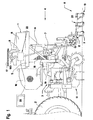
- the agricultural soil working machine shown in the figures comprises in particular a drill (1). It is more precisely a seeder of the line type as represented in FIG. figure 1 .
- This seed drill (1) is, in a non-limiting manner, connected to a device for preparing the seedbed, for example a rotary harrow (10) via a three-point coupling device (3) known from the skilled person. This combination will prepare the seedbed and sow in one pass.
- the rotary harrow (10) is then placed between the tractor (2) and the drill (1).
- the drill (1) is thus moved in a direction and a direction of advance indicated by the arrow (4) in a field to seed.
- This seed drill (1) can also be directly coupled to a tractor (2).
- This exemplary embodiment is not shown in the figures.
- the seeder (1) of the figure 1 comprises a frame (5) which is connected to the preparation apparatus of the seed bed.
- This frame (5) carries a hopper (6) containing seeds to be sown.
- This hopper (6) comprises at its base a dosing device (7) seeds.
- the metering device (7) makes it possible to precisely adjust the quantity of seeds to be deposited in the soil.
- the seeds contained in the hopper (6) are transported to implantation members (8) by means of pipes (9).
- Each implantation member (8) is formed by a hollow body in the form of a tube of rectangular section. Its front face and its base comprise a tapered part (11) so as to open a small trench in the ground.
- the upper part of each implantation member (8) has an inlet (12) which is connected to a pipe (9) and through which the seeds arrive.
- the lower part of each implantation member (8) has an outlet (13) through which said seeds are implanted in the soil.
- the implantation member (8) comprises in this embodiment, but in a nonlimiting manner, a regulating device (14) which ensures a substantially constant spacing between the seeds leaving the outlet orifice (13).
- This regulating device (14) is arranged in the body. It comprises drops (15) inclined one towards its next from the inlet (12) to the outlet (13). Said falls (15) are advantageously arranged in zigzag.
- the seeds which arrive by the pipe (9) slide, under the effect of their own weight, on said falls (15) in order to obtain a regularity of deposit of said seeds in the groove in the longitudinal direction, that is to say to say in the direction of advance (4), and in depth.
- the regulating device (14) is advantageously interchangeable, which makes it possible to adapt it to the families of seeds to be sown. Such a regulating device (14) is known to those skilled in the art and will therefore not be described in more detail.
- the seed drill (1) is of pneumatic type.
- the seed metering device (7) communicates with a feed column (16) which opens into a dispensing head (17) from which the pipes (9) leading to the implantation members (8) of the seeds which are arranged at the back across the width of the machine.
- These implantation members (8) are located, in a nonlimiting manner, in three rows and are spaced so that there are fairly regular intervals between the lines on which the seeds are deposited.
- the frame (5) of the drill (1) additionally carries a generator (18) which produces a flow of air intended to convey the seeds to be sown. This is brought by means of a conduit (19) to the base of the feed column (16). This flow of air then causes the seeds coming from the dosing device (7) to the dispensing head (17) in which it divides into several streams which engage with seeds in the pipes (9).
- Each implantation member (8) further comprises, after the inlet port (12) and the first chute (15), a separating device (20) of said seeds of the airflow carrying them.
- This separation device (20) is for example a grid (21) through which said air flow escapes.
- This grid (21) has meshes whose dimensions are smaller than those of the seeds so that the latter are retained inside the implant member (8).
- Said gate (21) is located substantially in the extension of said inlet port (12). Thus the air flow escapes and the seeds fall into the regulating device (14).
- the drill (1) comprises a seed counting device (22).
- the latter is shown schematically with a phantom frame on the figure 1 .
- This seed counting device (22) is here connected to one of the pipes (9) leading to a corresponding implantation member (8).
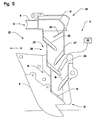
- the Figures 2 to 5 are schematic representations of various embodiments of a seed counting device (22) adapted to a specific seed drill and connected to different locations on the drill.
- This seed counting device (22) must allow, in a relatively simple manner, to obtain the number of seed sown.
- It comprises, for this purpose, a seed alignment device (23) and a seed counter (24).
- the alignment device (23) makes it possible to align the seeds one behind the other so that a standard seed counter (24) can locate and count them.
- the seed counter (24) is therefore disposed downstream of said alignment device (23).
- the alignment device (23) for the seeds to be counted consists of a series of guide elements (25) inclined one towards its next and on which the seeds slide from to align them.
- two consecutive guide elements (25) form between them an angle (alpha) of between 60 ° and 100 °. It varies according to the type of seeds to be sown.
- an angle (alpha) of between 60 ° and 100 °. It varies according to the type of seeds to be sown.
- At least three consecutive guide elements (25) are used.
- a grouping ramp (26) is arranged upstream the first guide element (25). Its function is to receive the seeds that arrive through the pipe (9) and to ensure that they fall at the top of the first guide element (25).
- This grouping ramp (26) has a flat cross section.
- the guide elements (25) have, for their part, advantageously a shape of gutters for guiding the seeds.
- the seeds thus slide from one guide element (25) towards the other to be aligned at the outlet of the last guide element (25).
- Said gutters have a V-shaped profile with an opening angle (beta) of between 50 ° and 70 °.
- An opening angle (beta) of 60 ° gives a very good result of guiding seeds.
- the guiding of the small seeds is improved when the guide elements (25) have a V-shaped cross section with a rounded bottom. It is important that at least the last guide member (25) has a gutter shape.
- the different guide elements (25) of the counting seed alignment device (23) are grouped into a single piece (27), for example in the form of a cassette (28).
- This single piece (27) could be advantageously provided removable and interchangeable, which allows to adapt the seed counting device (22) to families of seeds to count.
- the cassette (28) shown in figure 2 suitable for sowing large diameter seeds such as wheat or barley.
- the cassette (28) has three guide elements (25).
- the angle (alpha) between two consecutive guide elements is variable. Between the first and the second guide elements (25), the angle (alpha) is close to 70 ° while the angle (alpha) between the second and the last guide elements (25) is substantially equal to 90 ° .
- the bottom of the gutter of these guide elements (25) is rounded.
- the cassette (28) shown in figure 3 is rather suitable for small diameter seeds. Note that this cassette (28) has more guide elements (25) in the form of gutters. These elements (25) have a reduced length and occupy only part of the cassette (28). The rounded bottom of the V shape is suitable for small diameters of seeds in order to better channel the seeds. The ends of these guide elements (25) are arranged closer to each other to prevent the bouncing of the seeds during the passage from one to the other. The angle (alpha) between two consecutive guide elements (25) is here preferably identical for all the guide elements.
- the seed counting device (22) fits on one of the pipes (9).
- the seeds passing through said pipe (9) enter the cassette (28), slide on the guide elements (25) to be aligned and are then counted as output by the seed counter (24). These seeds then continue their way until they reach the ground.
- the seed counting device (22) is implanted on the pipe (9) upstream of said implantation member (8).
- the figure 2 schematically represents a first embodiment of the invention.
- the seed counting device (22) of the figure 2 is suitable for a pneumatic type seed drill (1) as shown in FIG. figure 1 .
- the combined agricultural machine according to figure 1 is attached to the tractor (2) which allows to move on a field and animate it.
- the implantation members (8) open small furrows in the soil in which the seeds are deposited. These pass from the hopper (6) into the feed column (16) through a respective metering device of the metering device (7). In said column (16), they are driven by the air flow produced by the generator (18). This air flow arrives in the head (17) which distributes to the pipes (9). In the latter the seeds are taken to the implantation organs (8).
- the seed counting device (22) is connected to one of these pipes (9).
- the seeds of this pipe (9) therefore first pass into the seed alignment device (23) to be counted by the seed counter (24) before continuing their progression in said pipe (9) towards the implantation member (8) corresponding and be deposited in the groove opened by this implantation member (8).
- the airflow separation device (29) is made by a cyclone (29 '). This cyclone (29 ') is located upstream of the alignment device (23).
- the pipe (9) with the seeds conveyed by the air flow opens tangentially into said cyclone (29 '). It comprises in its upper part an orifice (30) through which escapes the air flow.
- the cyclone (29 ') is extended downwardly by a pipe (31) through which the seeds fall by gravity into said alignment device (23). The seeds are counted at the exit via the seed counter (24).
- the seeds Downstream of the seed counting device (22), the seeds are recovered via a funnel (34) and a flow of air is injected into the counted seed stream by means of an air injection device. (32).
- the seeds are then transported to the corresponding implantation member (8) to be implanted in the soil.
- the seeds to be counted can be conveyed by a flow of air produced by a separate generator (180).
- the air injection device (32) is directly connected to said generator (180). But this generator (180) producing a flow of air for conveying the seeds to count or seeds already counted can advantageously be constituted directly by the generator (18) producing a flow of air for conveying the seeds to be sown.
- the seed alignment at the cassette outlet (28) is optimal for the seed counter (24).
- the latter transmits the number of seeds counted to a terminal (33). He compares the number of seeds that has been counted to a number of seeds to be sown per square meter for example.
- the terminal (33) can also automatically adjust, if necessary, the metering device (7) to change the number of seed sown.
- the terminal (33) is placed in the tractor cab (2).
- the seed counter (24) is made for example by a photocell. It is generally performed by a commercially available sensor.
- Another solution for reinjecting a flow of air into the pipe (9) bringing the seeds into the soil is to use the air flow separated by the separating device (29) to reinject it into the stream of seeds counted as downstream of the seed counter (24).
- a device for reinjecting the separated air flow is therefore provided downstream of the seed counter (24).
- the seed counter could very well be functional even if the flow of seeds to be counted is not separated from the air flow, because the airflow does not really disturb the alignment of the seeds, but rather the spacing between two successive seeds which does not really affect the count.
- the seed counting device (22) is provided on one of the pipes (9) of a mechanical seed drill.
- a mechanical seed drill For seed drills of the mechanical type, the transport of seeds from the hopper (6) to said seed implantation members (8) is carried out by gravity.
- Such a drill therefore does not include a generator generating a flow of air.
- the pipes (9) are directly connected to a metering member of the metering device (7).
- the seeds leaving a dosing member fall by gravity on the grouping ramp (26) and then slide on the various guide elements (25) to be aligned at the outlet of the cassette (28).
- the seeds are then counted by a suitable counter (24) and continue to slide to the corresponding implantation member (8).
- the seed counting device (22) is arranged in such a way that the pipe (9) opens vertically to the inlet of the cassette (28) so that the seeds fall directly onto the grouping ramp (26).
- the seeds at the outlet of the cassette (28) are recovered by a funnel (34).
- the cassette (28) shown on the figure 3 is suitable for aligning seeds of small sizes.
- the seed counting device (22) is implanted directly upstream of an implantation member (8).
- This third example shows a seed counting device (22) adapted for a pneumatic seed drill. It comprises a device for separating the air flow (20) from the flow of seeds to be counted. It is made in the form of a grid (21). The flow of seeds arrives transversely with respect to the cassette (28). The seeds abut against the grid (21) which allows the flow of air to pass but retains the seeds which fall under the effect of their own weight in the alignment device (23). They fall on the grouping ramp (26) and then slide from one guide element (25) in the next to the exit where they are counted.
- the counted seeds then fall directly on the falls (15) of the regulating device (14) implanted in the corresponding implantation member (8) to arrive in the ground. They arrive at intervals constant and at low speed. This prevents them from still rolling on the ground and makes it possible to obtain in a simple way a regular sowing.
- This third embodiment is simple because it does not require reinjection of air into a pipe (9).
- the seed counting device (22) is thus placed relatively close to the ground and therefore has a lesser influence on the sowing operation.
- the seed counting device (22) is advantageously placed at least partially in an implantation member (8).
- said guiding elements (25) of the seed alignment device (23) are here at least partially constituted by said drops (15) of at least one of said regulating devices (14).
- This fourth example therefore makes it possible to reduce in particular the added height of the seed counting device (22) and the regulating device (14). It is designed to be mounted on a pneumatic seeder.
- the flow of seeds also arrives transversely to evacuate the flow of air through the grid (21).
- at least one guide element (25) and one grouping ramp (26) are added to the drops (15). This makes it possible to arrange the seed counter (24) on the first chute (15), the seeds being already aligned at this stage.
- Another advantage of the implantation of the seed counter in the cassette (28) is to protect it from external aggression due mainly to the land that can be projected.
- At least one seed counting device (22) is implanted on one of the pipes (9). This advantageously makes it possible to continuously control and / or modify, during the sowing operation, the number of seeds to be sown, the dose modulation being able for example to be controlled from GPS or DGPS data.
- the drill (1) comprises a "2-way” valve mounted between the supply column (16) and a respective metering member of a dispensing head (17). Said "2-way” valve allowing in one position the conveyance of seeds leaving said metering member to said feed column (16) and in the other position, the conveying seeds from said dosing member to the seed counting device (22). This valve being controlled by the terminal (33).
- This exemplary embodiment therefore only makes it possible to count the seeds before starting the sowing operation and / or during maneuvers at the headland, since the seeds are either directed towards the distribution head (17) to be sown, or to the seed counter (24) to be counted. Continuous control of the number of seeds during the sowing operation is therefore not possible, but this procedure can often be sufficient to correctly adjust the metering device (7).
Landscapes
- Life Sciences & Earth Sciences (AREA)
- Soil Sciences (AREA)
- Environmental Sciences (AREA)
- Sowing (AREA)
Claims (24)
- Sämaschine (1) mit, unter anderem:- einem Trichter (6), der Saatgut enthält;- einer Dosiervorrichtung (7), die es ermöglicht, die Menge der in den Boden abzulegenden Körner einzustellen;- mindestens einem Element (8) zum Einsetzen der Körner in den Boden;- einem Rohr (9), das direkt oder indirekt die Dosiervorrichtung (7) mit dem jeweiligen Einsetzelement (8) verbindet; und- einer Körnerzähleinrichtung (22) mit insbesondere einer Vorrichtung (23) zum Ausrichten der zu zählenden Körner und einem Körnerzähler (24), der stromabwärts zur Vorrichtung (23) zum Ausrichten der zu zählenden Körner angeordnet ist,
dadurch gekennzeichnet, dass die Vorrichtung (23) zum Ausrichten der zu zählenden Körner von einer Reihe von in Folge zueinander geneigten Führungselementen (25) gebildet ist, auf die die zu zählenden Körner gleiten. - Sämaschine nach Anspruch 1, dadurch gekennzeichnet, dass zwei aufeinander folgende Führungselemente (25) zwischen sich einen Winkel (Alpha) zwischen 60° und 100° bilden.
- Sämaschine nach Anspruch 1 oder 2, dadurch gekennzeichnet, dass die Anzahl von Führungselementen (25) mindestens gleich 3 ist.
- Sämaschine nach irgend einem der Ansprüche 1 bis 3, dadurch gekennzeichnet, dass mindestens das letzte Führungselement (25) vor dem Körnerzähler (24) in Form einer Rinne ausgeführt ist.
- Sämaschine nach Anspruch 4, dadurch gekennzeichnet, dass alle Führungselemente (25) in Form einer Rinne ausgeführt sind.
- Sämaschine nach Anspruch 4 oder 5, dadurch gekennzeichnet, dass die Rinne ein V-Profil mit einem Winkel (Beta) zwischen 50° und 70° aufweist.
- Sämaschine nach Anspruch 6, dadurch gekennzeichnet, dass der Boden des V-Profils abgerundet ist.
- Sämaschine nach irgend einem der Ansprüche 1 bis 7, dadurch gekennzeichnet, dass die Führungselemente (25) zu einem einzigen Teil (27) zusammengefasst sind.
- Sämaschine nach Anspruch 8, dadurch gekennzeichnet, dass der einzige Teil (27), der die Führungselemente (25) vereint, ein Kasten (28) ist.
- Sämaschine nach Anspruch 8 oder 9, dadurch gekennzeichnet, dass der einzige Teil (27), der die Führungselemente (25) vereint, abnehmbar ist.
- Sämaschine nach irgend einem der Ansprüche 1 bis 5, dadurch gekennzeichnet, dass die Körnerzähleinrichtung (22) auf einem der Rohre (9) vorgesehen ist.
- Sämaschine nach Anspruch 6, dadurch gekennzeichnet, dass die Körnerzähleinrichtung (22) direkt stromaufwärts zum jeweiligen Einsetzelement (8) vorgesehen ist.
- Sämaschine nach irgend einem der Ansprüche 1 bis 5, dadurch gekennzeichnet, dass die Körnerzähleinrichtung (22) direkt in mindestens einem der Einsetzelemente (8) vorgesehen ist.
- Sämaschine nach Anspruch 13, dadurch gekennzeichnet, dass die Einsetzelemente (8) jeweils auf an sich bekannte Weise in Folge zueinander geneigte Gefälle (15) umfassen, auf denen die in den Boden einzusetzenden Körner gleiten, um ein regelmäßiges Ablegen der Körner in der Furche sowohl in Längsrichtung als auch in der Tiefe zu erzielen, und dass die Führungselemente (25) der Vorrichtung (23) zum Ausrichten der zu zählenden Körner stromaufwärts zu den Gefällen (15) mindestens eines der Einsetzelemente (8) angeordnet sind.
- Sämaschine nach Anspruch 13, dadurch gekennzeichnet, dass die Einsetzelemente (8) jeweils auf an sich bekannte Weise in Folge zueinander geneigte Gefälle (15) umfassen, auf denen die in den Boden einzusetzenden Körner gleiten, um ein regelmäßiges Ablegen der Körper in der Furche sowohl in Längsrichtung als auch in der Tiefe zu erzielen, und dass die Führungselemente (25) der Vorrichtung (23) zum Ausrichten der zu zählenden Körner zumindest teilweise von den Gefällen (15) mindestens eines der Einsetzelemente (8) gebildet sind.
- Sämaschine nach irgend einem der Ansprüche 1 bis 9, dadurch gekennzeichnet, dass der Körnerzähler (24) ein handelsüblicher Zähler ist.
- Sämaschine nach irgend einem der Ansprüche 1 bis 8, dadurch gekennzeichnet, dass zusätzlich ein Terminal (33) vorgesehen ist, der die gezählte Anzahl von Körnern mit einer zu säenden Anzahl von Körnern vergleicht und gegebenenfalls die Dosiervorrichtung (7) automatisch einstellt.
- Sämaschine nach irgend einem der Ansprüche 1 bis 17, dadurch gekennzeichnet, dass ein Generator (180) vorgesehen ist, der einen Luftstrom erzeugt, der dazu bestimmt ist, die zu zählenden Körner weiterzuleiten, und dass zusätzlich stromaufwärts zur Folge von Führungselementen (25) eine Vorrichtung zur Trennung des Luftstroms (20) vorgesehen ist, die den Luftstrom vom Strom der zu zählenden Körner trennt.
- Sämaschine nach Anspruch 18, dadurch gekennzeichnet, dass stromabwärts zum Körnerzähler (24) eine Vorrichtung zur Wiedereinleitung des abgetrennten Luftstroms vorgesehen ist, die dazu bestimmt ist, den abgetrennten Luftstrom wieder in den Strom von gezählten Körnern einzuleiten.
- Sämaschine nach Anspruch 18, dadurch gekennzeichnet, dass stromabwärts zum Körnerzähler (24) eine Vorrichtung zur Einleitung von Luft (32) vorgesehen ist, die dazu bestimmt ist, Luft in den Strom von gezählten Körnern einzuleiten.
- Sämaschine nach irgend einem der Ansprüche 18 bis 20, dadurch gekennzeichnet, dass die Sämaschine (1) eine pneumatische Sämaschine ist, die zusätzlich auf an sich bekannte Weise einen Generator (18), der einen Luftstrom erzeugt, der dazu bestimmt ist, die zu säenden Körner weiterzuleiten, und mindestens einen Verteilerkopf (17) umfasst, der von einem jeweiligen Dosierelement der Dosiervorrichtung (7) über eine entsprechende Versorgungssäule (16) versorgt wird.
- Sämaschine nach Anspruch 18, dadurch gekennzeichnet, dass der Generator (180), der einen Luftstrom erzeugt, der dazu bestimmt ist, die zu zählenden Körner weiterzuleiten, von dem Generator (18) gebildet ist, der einen Luftstrom erzeugt, der dazu bestimmt ist, die zu säenden Körner weiterzuleiten.
- Sämaschine nach Anspruch 21 oder 22, dadurch gekennzeichnet, dass zwischen der jeweiligen Versorgungssäule (16) und dem jeweiligen Dosierelement eines Verteilerkopfes (17) ein Zweiwegeventil vorgesehen ist, das es in einer Position gestattet, die aus dem Dosierelement austretenden Körner zu der Versorgungssäule (16) weiterzuleiten, und in der anderen Position, die Körner von dem Dosierelement zur Körnerzähleinrichtung (22) weiterzuleiten.
- Sämaschine nach Anspruch 23 und Anspruch 17, dadurch gekennzeichnet, dass die Steuerung des Zweiwegeventils von dem Terminal (33) geregelt wird.
Applications Claiming Priority (2)
| Application Number | Priority Date | Filing Date | Title |
|---|---|---|---|
| FR0314312 | 2003-12-05 | ||
| FR0314312A FR2863142B1 (fr) | 2003-12-05 | 2003-12-05 | Semoir equipe d'un systeme de comptage de graines |
Publications (2)
| Publication Number | Publication Date |
|---|---|
| EP1537768A1 EP1537768A1 (de) | 2005-06-08 |
| EP1537768B1 true EP1537768B1 (de) | 2013-03-13 |
Family
ID=34451731
Family Applications (1)
| Application Number | Title | Priority Date | Filing Date |
|---|---|---|---|
| EP20040300829 Ceased EP1537768B1 (de) | 2003-12-05 | 2004-12-01 | Sämaschine ausgestattet mit einer Zähleinrichtung |
Country Status (2)
| Country | Link |
|---|---|
| EP (1) | EP1537768B1 (de) |
| FR (1) | FR2863142B1 (de) |
Families Citing this family (8)
| Publication number | Priority date | Publication date | Assignee | Title |
|---|---|---|---|---|
| DE102006038865A1 (de) * | 2006-08-18 | 2008-02-21 | Alois Pöttinger Maschinenfabrik Gmbh | Sämaschine sowie Verfahren zur Regelung des Austrags einer Sämaschine |
| CN104349662B (zh) | 2012-03-22 | 2017-11-17 | 拜耳知识产权有限责任公司 | 播种机和播种方法 |
| CA3058716C (en) | 2014-11-04 | 2021-06-15 | Cnh Industrial Canada, Ltd. | Modular meter roller cartridge |
| CA2904781C (en) | 2014-11-04 | 2022-04-19 | Cnh Industrial Canada, Ltd. | Quick release bearing couplers |
| CA2904789C (en) | 2014-11-04 | 2020-03-31 | Cnh Industrial Canada, Ltd. | Split meter roller shaft |
| US9801330B2 (en) | 2015-11-04 | 2017-10-31 | Cnh Industrial Canada, Ltd. | Meter roller cartridge frame for an agricultural metering system |
| SE548084C2 (sv) * | 2021-07-06 | 2026-02-27 | Vaederstad Holding Ab | Lantbruksredskap och förfarande för fördelning av granulärt material |
| CN121336576B (zh) * | 2025-12-15 | 2026-03-31 | 湖南德人生物科技有限公司 | 一种高速精量播种设备及其在牧草种植中的应用 |
Family Cites Families (7)
| Publication number | Priority date | Publication date | Assignee | Title |
|---|---|---|---|---|
| DE62541C (de) * | J. BERTOLDI in Neubrandenburg i. M | Saatleitungsröhren für Drillmaschinen | ||
| GB2082006B (en) * | 1980-08-08 | 1984-07-25 | Dickey John Corp | Seed planter |
| DE3535871A1 (de) | 1985-10-08 | 1987-04-09 | Andreas Reichhardt | Dosiereinrichtung fuer gekoerntes schuettgut |
| DE19636787C1 (de) * | 1996-09-11 | 1998-04-02 | Univ Hohenheim | Vergleichmäßigungsvorrichtung für die Dosierung von Granulat, insbesondere zur Verwendung bei einer Drillmaschine (Sämaschine) |
| DE10037713A1 (de) | 2000-08-02 | 2002-02-21 | Lemken Gmbh & Co Kg | Pneumatische Drillmaschine mit Regeleinrichtung |
| DE10134991B4 (de) | 2001-07-18 | 2013-08-14 | Lemken Gmbh & Co. Kg | Drillmaschine mit automatischer Kalibrierung |
| FR2836737B1 (fr) * | 2002-03-01 | 2004-06-18 | Centre Nat Machinisme Agricole | Dispositif de comptage de particules telles que des graines distribuees par un semoir |
-
2003
- 2003-12-05 FR FR0314312A patent/FR2863142B1/fr not_active Expired - Fee Related
-
2004
- 2004-12-01 EP EP20040300829 patent/EP1537768B1/de not_active Ceased
Also Published As
| Publication number | Publication date |
|---|---|
| FR2863142B1 (fr) | 2006-03-17 |
| EP1537768A1 (de) | 2005-06-08 |
| FR2863142A1 (fr) | 2005-06-10 |
Similar Documents
| Publication | Publication Date | Title |
|---|---|---|
| US11849665B2 (en) | Seeding machine with seed delivery system | |
| EP2854499B1 (de) | Einzelkornsämaschine und kornvereinzelungsscheibe mit offenen rillen | |
| EP0598636B1 (de) | Einzelkornsämaschine | |
| US20170049040A1 (en) | Planter with seed delivery apparatus | |
| EP2696668B1 (de) | Fernspeisungsvorrichtung für eine einzelkornsämaschine und einzelkornsämaschine mit einer solchen vorrichtung | |
| EP2931019B1 (de) | Vorrichtung für eine selbstgeregelte pneumatische stromversorgung mit mittel zur regulierung eines luftdurchtrittsabschnitts | |
| EP2953443B1 (de) | Einzelkornsämaschine mit wenigstens einer verbesserten säelement | |
| EP1537768B1 (de) | Sämaschine ausgestattet mit einer Zähleinrichtung | |
| US20260068808A1 (en) | Seed Delivery System | |
| FR2531603A1 (fr) | Semoir en poquets | |
| EP3238519B1 (de) | Reguliervorrichtung der verteilung von samen für sämaschine, und entsprechende sämaschine | |
| CA2342125A1 (fr) | Dispositif d'implantation de graines dans le sol et semoir equipe de tels dispositifs | |
| EP3238518A1 (de) | Sämaschine, die mit einer vorrichtung zur regulierung der samenverteilung ausgestattet ist, und entsprechende reguliervorrichtung | |
| EP1430761B1 (de) | Dosiervorrichtung für eine Sämaschine, die mehrere Produkte gleichzeitig verteilen kann | |
| EP1488674B1 (de) | Pneumatischer Saatgutverteiler | |
| EP3476192B1 (de) | Dosiervorrichtung der verteilung von saatkörnern für eine sämaschine, und entsprechende sämaschine | |
| EP3031312A1 (de) | Verteilungsgehäuse mit druckbeaufschlagtem bereich für einzelkornsämaschine | |
| BE543355A (de) | ||
| BR132015013585E2 (pt) | A sowing machine for a ramp unit, and, a method for dispensing a seed of a seeder for a subsoil |
Legal Events
| Date | Code | Title | Description |
|---|---|---|---|
| PUAI | Public reference made under article 153(3) epc to a published international application that has entered the european phase |
Free format text: ORIGINAL CODE: 0009012 |
|
| AK | Designated contracting states |
Kind code of ref document: A1 Designated state(s): AT BE BG CH CY CZ DE DK EE ES FI FR GB GR HU IE IS IT LI LT LU MC NL PL PT RO SE SI SK TR |
|
| AX | Request for extension of the european patent |
Extension state: AL BA HR LV MK YU |
|
| 17P | Request for examination filed |
Effective date: 20051129 |
|
| AKX | Designation fees paid |
Designated state(s): DE DK FR IT |
|
| 17Q | First examination report despatched |
Effective date: 20060207 |
|
| GRAP | Despatch of communication of intention to grant a patent |
Free format text: ORIGINAL CODE: EPIDOSNIGR1 |
|
| GRAP | Despatch of communication of intention to grant a patent |
Free format text: ORIGINAL CODE: EPIDOSNIGR1 |
|
| GRAS | Grant fee paid |
Free format text: ORIGINAL CODE: EPIDOSNIGR3 |
|
| GRAA | (expected) grant |
Free format text: ORIGINAL CODE: 0009210 |
|
| AK | Designated contracting states |
Kind code of ref document: B1 Designated state(s): DE DK FR IT |
|
| REG | Reference to a national code |
Ref country code: DE Ref legal event code: R096 Ref document number: 602004041320 Country of ref document: DE Effective date: 20130508 |
|
| PLBE | No opposition filed within time limit |
Free format text: ORIGINAL CODE: 0009261 |
|
| STAA | Information on the status of an ep patent application or granted ep patent |
Free format text: STATUS: NO OPPOSITION FILED WITHIN TIME LIMIT |
|
| PG25 | Lapsed in a contracting state [announced via postgrant information from national office to epo] |
Ref country code: DK Free format text: LAPSE BECAUSE OF FAILURE TO SUBMIT A TRANSLATION OF THE DESCRIPTION OR TO PAY THE FEE WITHIN THE PRESCRIBED TIME-LIMIT Effective date: 20130313 |
|
| 26N | No opposition filed |
Effective date: 20131216 |
|
| PG25 | Lapsed in a contracting state [announced via postgrant information from national office to epo] |
Ref country code: IT Free format text: LAPSE BECAUSE OF FAILURE TO SUBMIT A TRANSLATION OF THE DESCRIPTION OR TO PAY THE FEE WITHIN THE PRESCRIBED TIME-LIMIT Effective date: 20130313 |
|
| REG | Reference to a national code |
Ref country code: DE Ref legal event code: R097 Ref document number: 602004041320 Country of ref document: DE Effective date: 20131216 |
|
| REG | Reference to a national code |
Ref country code: FR Ref legal event code: PLFP Year of fee payment: 12 |
|
| REG | Reference to a national code |
Ref country code: FR Ref legal event code: PLFP Year of fee payment: 13 |
|
| REG | Reference to a national code |
Ref country code: FR Ref legal event code: PLFP Year of fee payment: 14 |
|
| PGFP | Annual fee paid to national office [announced via postgrant information from national office to epo] |
Ref country code: FR Payment date: 20181226 Year of fee payment: 15 |
|
| PGFP | Annual fee paid to national office [announced via postgrant information from national office to epo] |
Ref country code: DE Payment date: 20181231 Year of fee payment: 15 |
|
| REG | Reference to a national code |
Ref country code: DE Ref legal event code: R119 Ref document number: 602004041320 Country of ref document: DE |
|
| PG25 | Lapsed in a contracting state [announced via postgrant information from national office to epo] |
Ref country code: FR Free format text: LAPSE BECAUSE OF NON-PAYMENT OF DUE FEES Effective date: 20191231 Ref country code: DE Free format text: LAPSE BECAUSE OF NON-PAYMENT OF DUE FEES Effective date: 20200701 |