EP1536458A1 - Belichtungssystem und belichtungsverfahren - Google Patents
Belichtungssystem und belichtungsverfahren Download PDFInfo
- Publication number
- EP1536458A1 EP1536458A1 EP03736157A EP03736157A EP1536458A1 EP 1536458 A1 EP1536458 A1 EP 1536458A1 EP 03736157 A EP03736157 A EP 03736157A EP 03736157 A EP03736157 A EP 03736157A EP 1536458 A1 EP1536458 A1 EP 1536458A1
- Authority
- EP
- European Patent Office
- Prior art keywords
- gas
- exposure
- exposure apparatus
- space
- mask
- Prior art date
- Legal status (The legal status is an assumption and is not a legal conclusion. Google has not performed a legal analysis and makes no representation as to the accuracy of the status listed.)
- Withdrawn
Links
Images




Classifications
-
- G—PHYSICS
- G03—PHOTOGRAPHY; CINEMATOGRAPHY; ANALOGOUS TECHNIQUES USING WAVES OTHER THAN OPTICAL WAVES; ELECTROGRAPHY; HOLOGRAPHY
- G03F—PHOTOMECHANICAL PRODUCTION OF TEXTURED OR PATTERNED SURFACES, e.g. FOR PRINTING, FOR PROCESSING OF SEMICONDUCTOR DEVICES; MATERIALS THEREFOR; ORIGINALS THEREFOR; APPARATUS SPECIALLY ADAPTED THEREFOR
- G03F7/00—Photomechanical, e.g. photolithographic, production of textured or patterned surfaces, e.g. printing surfaces; Materials therefor, e.g. comprising photoresists; Apparatus specially adapted therefor
- G03F7/70—Microphotolithographic exposure; Apparatus therefor
- G03F7/708—Construction of apparatus, e.g. environment aspects, hygiene aspects or materials
- G03F7/70908—Hygiene, e.g. preventing apparatus pollution, mitigating effect of pollution or removing pollutants from apparatus
- G03F7/70933—Purge, e.g. exchanging fluid or gas to remove pollutants
-
- G—PHYSICS
- G03—PHOTOGRAPHY; CINEMATOGRAPHY; ANALOGOUS TECHNIQUES USING WAVES OTHER THAN OPTICAL WAVES; ELECTROGRAPHY; HOLOGRAPHY
- G03F—PHOTOMECHANICAL PRODUCTION OF TEXTURED OR PATTERNED SURFACES, e.g. FOR PRINTING, FOR PROCESSING OF SEMICONDUCTOR DEVICES; MATERIALS THEREFOR; ORIGINALS THEREFOR; APPARATUS SPECIALLY ADAPTED THEREFOR
- G03F7/00—Photomechanical, e.g. photolithographic, production of textured or patterned surfaces, e.g. printing surfaces; Materials therefor, e.g. comprising photoresists; Apparatus specially adapted therefor
- G03F7/70—Microphotolithographic exposure; Apparatus therefor
- G03F7/70058—Mask illumination systems
-
- G—PHYSICS
- G03—PHOTOGRAPHY; CINEMATOGRAPHY; ANALOGOUS TECHNIQUES USING WAVES OTHER THAN OPTICAL WAVES; ELECTROGRAPHY; HOLOGRAPHY
- G03F—PHOTOMECHANICAL PRODUCTION OF TEXTURED OR PATTERNED SURFACES, e.g. FOR PRINTING, FOR PROCESSING OF SEMICONDUCTOR DEVICES; MATERIALS THEREFOR; ORIGINALS THEREFOR; APPARATUS SPECIALLY ADAPTED THEREFOR
- G03F7/00—Photomechanical, e.g. photolithographic, production of textured or patterned surfaces, e.g. printing surfaces; Materials therefor, e.g. comprising photoresists; Apparatus specially adapted therefor
- G03F7/70—Microphotolithographic exposure; Apparatus therefor
- G03F7/70216—Mask projection systems
- G03F7/70225—Optical aspects of catadioptric systems, i.e. comprising reflective and refractive elements
-
- G—PHYSICS
- G03—PHOTOGRAPHY; CINEMATOGRAPHY; ANALOGOUS TECHNIQUES USING WAVES OTHER THAN OPTICAL WAVES; ELECTROGRAPHY; HOLOGRAPHY
- G03F—PHOTOMECHANICAL PRODUCTION OF TEXTURED OR PATTERNED SURFACES, e.g. FOR PRINTING, FOR PROCESSING OF SEMICONDUCTOR DEVICES; MATERIALS THEREFOR; ORIGINALS THEREFOR; APPARATUS SPECIALLY ADAPTED THEREFOR
- G03F7/00—Photomechanical, e.g. photolithographic, production of textured or patterned surfaces, e.g. printing surfaces; Materials therefor, e.g. comprising photoresists; Apparatus specially adapted therefor
- G03F7/70—Microphotolithographic exposure; Apparatus therefor
- G03F7/708—Construction of apparatus, e.g. environment aspects, hygiene aspects or materials
- G03F7/70808—Construction details, e.g. housing, load-lock, seals or windows for passing light in or out of apparatus
-
- G—PHYSICS
- G03—PHOTOGRAPHY; CINEMATOGRAPHY; ANALOGOUS TECHNIQUES USING WAVES OTHER THAN OPTICAL WAVES; ELECTROGRAPHY; HOLOGRAPHY
- G03F—PHOTOMECHANICAL PRODUCTION OF TEXTURED OR PATTERNED SURFACES, e.g. FOR PRINTING, FOR PROCESSING OF SEMICONDUCTOR DEVICES; MATERIALS THEREFOR; ORIGINALS THEREFOR; APPARATUS SPECIALLY ADAPTED THEREFOR
- G03F7/00—Photomechanical, e.g. photolithographic, production of textured or patterned surfaces, e.g. printing surfaces; Materials therefor, e.g. comprising photoresists; Apparatus specially adapted therefor
- G03F7/70—Microphotolithographic exposure; Apparatus therefor
- G03F7/708—Construction of apparatus, e.g. environment aspects, hygiene aspects or materials
- G03F7/70808—Construction details, e.g. housing, load-lock, seals or windows for passing light in or out of apparatus
- G03F7/70825—Mounting of individual elements, e.g. mounts, holders or supports
-
- G—PHYSICS
- G03—PHOTOGRAPHY; CINEMATOGRAPHY; ANALOGOUS TECHNIQUES USING WAVES OTHER THAN OPTICAL WAVES; ELECTROGRAPHY; HOLOGRAPHY
- G03F—PHOTOMECHANICAL PRODUCTION OF TEXTURED OR PATTERNED SURFACES, e.g. FOR PRINTING, FOR PROCESSING OF SEMICONDUCTOR DEVICES; MATERIALS THEREFOR; ORIGINALS THEREFOR; APPARATUS SPECIALLY ADAPTED THEREFOR
- G03F7/00—Photomechanical, e.g. photolithographic, production of textured or patterned surfaces, e.g. printing surfaces; Materials therefor, e.g. comprising photoresists; Apparatus specially adapted therefor
- G03F7/70—Microphotolithographic exposure; Apparatus therefor
- G03F7/708—Construction of apparatus, e.g. environment aspects, hygiene aspects or materials
- G03F7/70858—Environment aspects, e.g. pressure of beam-path gas, temperature
- G03F7/70883—Environment aspects, e.g. pressure of beam-path gas, temperature of optical system
-
- G—PHYSICS
- G03—PHOTOGRAPHY; CINEMATOGRAPHY; ANALOGOUS TECHNIQUES USING WAVES OTHER THAN OPTICAL WAVES; ELECTROGRAPHY; HOLOGRAPHY
- G03F—PHOTOMECHANICAL PRODUCTION OF TEXTURED OR PATTERNED SURFACES, e.g. FOR PRINTING, FOR PROCESSING OF SEMICONDUCTOR DEVICES; MATERIALS THEREFOR; ORIGINALS THEREFOR; APPARATUS SPECIALLY ADAPTED THEREFOR
- G03F7/00—Photomechanical, e.g. photolithographic, production of textured or patterned surfaces, e.g. printing surfaces; Materials therefor, e.g. comprising photoresists; Apparatus specially adapted therefor
- G03F7/70—Microphotolithographic exposure; Apparatus therefor
- G03F7/708—Construction of apparatus, e.g. environment aspects, hygiene aspects or materials
- G03F7/70858—Environment aspects, e.g. pressure of beam-path gas, temperature
- G03F7/70883—Environment aspects, e.g. pressure of beam-path gas, temperature of optical system
- G03F7/70891—Temperature
-
- G—PHYSICS
- G03—PHOTOGRAPHY; CINEMATOGRAPHY; ANALOGOUS TECHNIQUES USING WAVES OTHER THAN OPTICAL WAVES; ELECTROGRAPHY; HOLOGRAPHY
- G03F—PHOTOMECHANICAL PRODUCTION OF TEXTURED OR PATTERNED SURFACES, e.g. FOR PRINTING, FOR PROCESSING OF SEMICONDUCTOR DEVICES; MATERIALS THEREFOR; ORIGINALS THEREFOR; APPARATUS SPECIALLY ADAPTED THEREFOR
- G03F7/00—Photomechanical, e.g. photolithographic, production of textured or patterned surfaces, e.g. printing surfaces; Materials therefor, e.g. comprising photoresists; Apparatus specially adapted therefor
- G03F7/70—Microphotolithographic exposure; Apparatus therefor
- G03F7/708—Construction of apparatus, e.g. environment aspects, hygiene aspects or materials
- G03F7/70908—Hygiene, e.g. preventing apparatus pollution, mitigating effect of pollution or removing pollutants from apparatus
-
- G—PHYSICS
- G03—PHOTOGRAPHY; CINEMATOGRAPHY; ANALOGOUS TECHNIQUES USING WAVES OTHER THAN OPTICAL WAVES; ELECTROGRAPHY; HOLOGRAPHY
- G03F—PHOTOMECHANICAL PRODUCTION OF TEXTURED OR PATTERNED SURFACES, e.g. FOR PRINTING, FOR PROCESSING OF SEMICONDUCTOR DEVICES; MATERIALS THEREFOR; ORIGINALS THEREFOR; APPARATUS SPECIALLY ADAPTED THEREFOR
- G03F7/00—Photomechanical, e.g. photolithographic, production of textured or patterned surfaces, e.g. printing surfaces; Materials therefor, e.g. comprising photoresists; Apparatus specially adapted therefor
- G03F7/70—Microphotolithographic exposure; Apparatus therefor
- G03F7/708—Construction of apparatus, e.g. environment aspects, hygiene aspects or materials
- G03F7/70908—Hygiene, e.g. preventing apparatus pollution, mitigating effect of pollution or removing pollutants from apparatus
- G03F7/70916—Pollution mitigation, i.e. mitigating effect of contamination or debris, e.g. foil traps
-
- G—PHYSICS
- G03—PHOTOGRAPHY; CINEMATOGRAPHY; ANALOGOUS TECHNIQUES USING WAVES OTHER THAN OPTICAL WAVES; ELECTROGRAPHY; HOLOGRAPHY
- G03F—PHOTOMECHANICAL PRODUCTION OF TEXTURED OR PATTERNED SURFACES, e.g. FOR PRINTING, FOR PROCESSING OF SEMICONDUCTOR DEVICES; MATERIALS THEREFOR; ORIGINALS THEREFOR; APPARATUS SPECIALLY ADAPTED THEREFOR
- G03F7/00—Photomechanical, e.g. photolithographic, production of textured or patterned surfaces, e.g. printing surfaces; Materials therefor, e.g. comprising photoresists; Apparatus specially adapted therefor
- G03F7/70—Microphotolithographic exposure; Apparatus therefor
- G03F7/708—Construction of apparatus, e.g. environment aspects, hygiene aspects or materials
- G03F7/70983—Optical system protection, e.g. pellicles or removable covers for protection of mask
Definitions
- the present invention relates to an exposure apparatus and exposure method used when producing a semiconductor integrated circuit, liquid crystal display, thin film magnetic head, or other microdevice or a photomask etc. using photolithography.
- the projection exposure apparatuses used for transfer have been shifting in exposure wavelength to the shorter exposure wavelength side so as to deal with the increasing fineness of semiconductor integrated circuits.
- the mainstream wavelength is the 248 nm of KrF excimer laser, but the shorter wavelength 193 nm of ArF excimer laser is entering the commercial stage as well.
- projection exposure apparatuses using shorter wavelength 157 nm of F 2 laser or wavelength 126 nm of Ar 2 laser or other light sources of the wavelength band called the "vacuum ultraviolet region" are also being developed.
- a light beam of a wavelength of this vacuum ultraviolet region has an extremely large absorption due to oxygen or water vapor, hydrocarbon gas, etc. (hereinafter referred to as an "absorption gas”), so it is necessary to purge the light path through which exposure light passes of the oxygen or other absorption gas with a low absorption nitrogen or rare gas or other gas (hereinafter referred to as a "low absorption gas").
- an absorption gas oxygen or water vapor, hydrocarbon gas, etc.
- the concentration of oxygen or water vapor it is necessary to keep the average concentration in the light path to not more than the ppm order. If the standard of the residual concentration of the absorption gas does not meet the above standard, the exposure energy on the wafer or other exposed substrate will become remarkably low.
- the glass material passing this vacuum ultraviolet light is limited to fluorite glass etc. Therefore, in a refraction optical system, correction of color aberration is difficult.
- a projection optical system an optical system comprised of reflection mirrors (concave mirrors) and lenses, that is, a catiodioptic optical system, is employed.
- flat mirrors are also necessary for separating light beams incident on the concave mirrors and light beams reflected from the concave mirrors.
- reflection mirrors or flat mirrors are required to have a high reflectance with respect to light beams in large ranges of incident angles, so employment of reflection mirrors or flat mirrors made by coatings including metal layers are considered promising.
- Oxidation is not a problem that occurs only for mirrors including aluminum layers and is a problem which similarly occurs even if using another metal. Further, not only reflection mirrors and flat mirrors, but also antireflection coatings formed on the lens surfaces oxidize by the photochemical reaction with residual oxygen or water vapor and fall in transmittance.
- Reduction of the residual oxygen and water vapor concentration in the purge gas is important in raising the transmittance of the exposure light passing through the light path.
- moisture adsorbed at the barrels or lens holding mechanisms forming the optical system continues to disassociate slowly over a long time, so it is difficult to suppress the concentration to not more than 1 ppm.
- the present invention was made in consideration of this point and has as its object the realization of an exposure apparatus and exposure method able to maintain the reflectance of the reflection mirrors or the transmittance of the lenses included in an optical system in a good state and to maintain the initial performance over a long period even when using vacuum ultraviolet light as the exposure light.
- an exposure apparatus using an exposure light beam to illuminate a mask and transferring an image of a pattern on the mask onto a substrate
- the exposure apparatus having a gas feed unit for supplying a light path space through which the exposure light beam passes with a gas mainly comprised of an inert gas or rare gas and introducing into the gas supplied to at least part of the light path space a predetermined concentration of hydrogen.
- the light path space is provided at one or both of the illumination optical system and the projection optical system.
- the space including the reflection optical element is particularly preferably supplied with the gas.
- the gas feed unit can introduce into the gas fed to the plurality of light path space a predetermined concentration of hydrogen.
- the inert gas or rare gas nitrogen gas helium gas, neon gas, etc. may be mentioned.
- the gas preferably does not contain oxygen or water vapor.
- concentration of the hydrogen a partial pressure ratio of not more than 10% or so is preferable.
- the reduction action of hydrogen suppresses the deterioration of the optical properties of the optical elements (mirrors or lenses etc.) in the light path (for example, the drop in reflectance or transmittance due to oxidation of mirror coatings including aluminum or another metal or anti-reflection coatings of the lens surfaces etc.), so good optical properties can be stably realized over a long period.
- an exposure apparatus using an exposure light beam to illuminate a mask and transferring an image of a pattern on the mask onto a substrate having a gas feed unit for supplying a light path space through which the exposure light beam passes with a gas mainly comprised of an inert gas or rare gas and a blowing unit for blowing the gas on a specific optical element among the plurality of optical elements arranged in the light path space.
- the blowing unit can form a flow for the optical element different from the flow of the gas due to the gas feed unit.
- the gas may include a predetermined concentration of hydrogen.
- a partial pressure ratio of not more than 10% or so is desirable.
- the inert gas or rare gas nitrogen gas, helium gas, neon gas, etc. may be mentioned.
- the gas preferably does not include oxygen or water vapor.
- the optical element (mirror, lens, etc.) is blown with a gas, so the vicinities of the optical element is constantly supplied with fresh gas and therefore the water vapor produced from the surfaces of other structural materials (barrels, lenses, etc.) can be prevented from diffusing and depositing near the surfaces of the optical element. Therefore, oxidation of the optical element can be prevented. Further, if blowing temperature-controlled gas to the optical element, the optical element can also be controlled in temperature and the optical element can be kept from picking up heat.
- the high heat conductivity of helium gas enables the optical element picking up heat due to absorption of the exposure light beam to be efficiently cooled and enables the heat deformation of the optical element and the aberration arising due to the same to be prevented. If mixing hydrogen into this gas, the reduction action of hydrogen enables the oxidation of the optical element to be more strongly prevented.
- the exposure apparatus may be further provided with a flow rectifying unit provided at a gas feed port of a blowing unit for slowing or making uniform the flow of gas blown from the gas feed port.
- a flow rectifying unit provided at a gas feed port of a blowing unit for slowing or making uniform the flow of gas blown from the gas feed port.
- the exposure apparatus may be further provided with an auxiliary blowing unit for feeding the gas so as to follow the flow of gas blown from a gas feed port of a blowing unit.
- an auxiliary blowing unit for feeding the gas so as to follow the flow of gas blown from a gas feed port of a blowing unit.
- auxiliary gas flow auxiliary blowing unit
- main gas flow a blowing mechanism
- the exposure apparatus according to the second aspect of the present invention may be provided with a flow rectifying unit having a plate member attached around the periphery of the gas feed opening and facing the outside. Further, the exposure apparatus according to the second aspect of the present invention may use a flow rectifying unit having a substantially funnel-shaped duct part attached so that its downstream side flares open at the gas feed port.
- the exposure apparatus may be provided with, when using the flow rectifying unit having the duct part, a shield plate so as to shield part of the opening of the duct part.
- the shape of the shield plate is selected in accordance with the shape of the optical element to which the gas is to be blown.
- the exposure apparatus may be provided with, when using the flow rectifying mechanism having the duct part, a plurality of diffusion plates (diffusers) for rectifying the flow of gas inside the duct part or may be provided at the opening of the duct part with a mesh plate or a porous plate having a plurality of through holes.
- the flow of gas supplied to an optical element is further slowed or made more uniform and entrainment of outside ambient air containing pollutants is further reduced. It is also possible to provide the opening of the duct part with a cleaning filter plate (particle filter etc.) and possible to feed a cleaner purge gas and reduce deposition of pollutants on the surface of the optical element.
- the exposure apparatus preferably uses as the gas a gas mainly comprised of an inert gas or rare gas (for example, nitrogen gas, helium gas, neon gas, etc.) Further, the gas may contain a predetermined concentration of hydrogen.
- concentration of the hydrogen gas in this case is preferably a partial pressure ratio of not more than 10% or so. Further, the gas preferably does not contain oxygen and water vapor.
- the exposure apparatus preferably feeds the gas to a reflection optical element provided to at least one of the illumination optical system using the exposure light to illuminate the mask and the projection optical system transferring the image of the pattern onto the substrate.
- a reflection optical element is oxidized at its reflection surface by moisture or other pollutants and becomes uneven in reflectance in some cases. This can be suppressed with a high efficiency.
- the exposure apparatus may be provided with a plurality of gas feed ports of the blowing unit facing the optical element.
- the flows of gas blown from the gas feed ports will collide with or affect each other at the substantial center of the optical element and head in a direction away from the optical element, so less pollutants will reach the optical element.
- the exposure apparatus may be provided with an exhaust unit having a gas exhaust port at a position substantially symmetric with the gas feed port of the blowing unit across the optical element.
- the gas blown from the feed port to the optical element is positively exhausted from the exhaust port, so the gas flows smoothly and causes less turbulence, so there is less entrainment of outside ambient air containing pollutants and less pollutants reaching the optical element.
- an exposure apparatus for using an exposure light beam to illuminate a mask and transferring an image of a pattern on the mask onto a substrate, the exposure apparatus having a partition member partitioning the light path space through which the exposure light beam passes into a first space including a reflection optical element and a second space not including the reflection optical element, a first gas feed unit which is connected to the first space and feeds to the first space a first gas mainly comprised of an inert gas or rare gas and a second gas feed unit which is connected to the second space and feeds to the second space a second gas different from the first gas.
- the feed amount of the first gas to the first space and the feed amount of the second gas to the second space may be made different.
- the main ingredients of the first gas and the second gas may be made different.
- the first gas may include a predetermined concentration of hydrogen.
- the hydrogen concentration in this case, a partial pressure ratio of not more than 10% or so is preferable.
- nitrogen gas, helium gas, neon gas, etc. may be mentioned. These gases preferably do not include oxygen and water vapor.
- the first space including the reflection optical element and the second space not including the reflection optical element are fed gases separately.
- the ability to feed gas to the first space can be strengthened. Residual water vapor is produced from the surfaces of the structures forming the light path space (barrels, lenses, etc.), so the residual water vapor concentration is proportional to the surface area and inversely proportional to the flow amount of the flowing gas. Therefore, by minimizing the space including the reflection optical element and sending a large amount of gas to that part, it is possible to further reduce the water vapor concentration of the space including the reflection optical element.
- an exposure method using an exposure light beam to illuminate a mask and transferring an image of a pattern on the mask onto a substrate comprising feeding a light path space through which the exposure light beam passes a gas mainly comprised of an inert gas or rare gas and including in the gas fed to at least part of the light path space a predetermined concentration of hydrogen. It is possible to achieve actions and effects similar to the exposure apparatus according to the first aspect.
- an exposure method using an exposure light beam to illuminate a mask and transferring a pattern on the mask onto a substrate comprising feeding a light path space through which the exposure light beam passes a gas mainly comprised of an inert gas or rare gas and blowing the gas to an optical element having a metal layer among a plurality of optical elements arranged in the light path space. It is possible to achieve actions and effects similar to the exposure apparatus according to the second aspect.
- an exposure method using an exposure light beam to illuminate a mask and transferring a pattern on the mask onto a substrate comprising partitioning a light path space through which the exposure light beam passes into a first space including a reflection optical element and a second space not including the reflection optical element, feeding the first space a first gas mainly comprised of an inert gas or rare gas, and feeding the second space a second gas different from the first gas. It is possible to achieve actions and effects similar to the exposure apparatus according to the third aspect.
- an exposure method using an exposure light beam to illuminate a mask and transferring a pattern on the mask onto a substrate comprising exposing the substrate while blowing gas in a region broader than the part of at least an optical element arranged on a path of the exposure light through which the exposure light beam passes.
- an eighth aspect of the present invention there is provided a method of production of an electronic device including a lithography step, the lithography step using an exposure apparatus according to any one of the first to third aspects of the present invention to transfer a pattern formed on a mask to a substrate.
- the exposure apparatus of the present invention has little contamination of the surfaces of the optical element, so it is possible to produce good quality electronic devices.
- the exposure apparatus or exposure method of the present invention is particularly preferable when using exposure light of a wavelength of the vacuum ultraviolet region in the range of wavelength of 120 nm to 195 nm.
- FIG. 1 is a view of the general configuration of an exposure apparatus according to a first embodiment of the present invention:
- This exposure apparatus is a step-and-scan type (scan type) projection exposure apparatus.
- a light beam emitted from a wavelength 157 nm fluorine laser (F 2 laser), wavelength 146 nm krypton dimer laser (Kr 2 excimer laser), wavelength 126 nm argon dimer laser (Ar 2 excimer laser), or other vacuum ultraviolet region light source 1 is irradiated through a beam matching unit (however, in the broad sense, part of an illumination optical system) BMU and an illumination optical system IL to a mask 27, whereby patterns on the mask 27 are projected by a projection optical system PL on a wafer 37.
- a beam matching unit here, in the broad sense, part of an illumination optical system
- the beam matching unit BMU is comprised of a bending mirror 3 and relay lenses 4, 5 housed in a BMU chamber 2.
- the illumination light beam is guided to a diffraction optical element 12 housed in an illumination system chamber 11.
- the light beam emitted from the diffraction optical element 12 passes through a relay lens 13, bending mirror 14, and relay lens 15 and becomes the light beam incident to an optical integrator (homogenizer) constituted by a fly-eye lens 16.
- an optical integrator homogenizer
- fly-eye lens 16 instead of using the fly-eye lens 16, it is also possible to use a rod integrator (inside surface reflection type integrator) or a diffraction optical element etc.
- two fly-eye lenses 16 may also be provided in series so as to further improve the uniformity of the illumination distribution.
- the emission side of the fly eye lens 16 is provided with an aperture stop system 17.
- the aperture stop system 17 is provided with a circular aperture stop for ordinary illumination, an aperture stop for modified illumination comprised of a plurality of off-axis apertures, an aperture stop for ring illumination, etc. freely switchable.
- a phase type diffraction grating having a shape enabling the illumination light beam to be efficiently converged for the modified illumination or other illumination conditions is used.
- the light beam passing through the aperture stop system 17 passes through the relay lens group 18, field stop 19, relay lens group 20, 21, and bending mirror 22 and illuminates the mask 27.
- the mask 27 is held on the mask stage 28 by a vacuum suction mechanism etc.
- the mask stage 28 is designed to be able to scan a mask table 29, provided on a not shown column through a dampening device 36, in the left-right directions of the paper sheet.
- the position of the mask 27 is found by measurement of the position of a moving mirror 31 provided on the mask stage 28 by a laser interferometer 32 provided facing the moving mirror 31.
- the mask table 29 is surrounded by a highly air-tight partition wall to form a mask stage chamber 30.
- the measurement light of the laser interferometer 32 passes through a glass window 33 to enter inside the mask stage chamber 30.
- the above beam matching unit BMU and illumination optical system IL are housed in the BMU chamber 2 and illumination system chamber 11 provided with the highly air-tight partition walls, so are isolated from the outside space.
- the BMU chamber 2 and illumination system chamber 11 are separated in inside space (light path space) by the relay lens 5 and its support member 6.
- the aperture of the mask 27 side end of the illumination system chamber 11 is sealed air-tightly by a transparent plate 80.
- the relay lens 5 and support member 6 are configured in the same way as a seal member 191 and support member 192 of the later explained second embodiment.
- the light beam passing through the mask 27 is imaged by the projection optical system PL housed in the barrel 50 and forms images of the patterns of the mask 27 on the wafer 37.
- the light beam emitted from the mask 27, in the projection optical system 50 passes through the lenses 51, 52 and is reflected at an upper reflection surface 53a of a V-block type mirror 53 with a reflection surface formed into a V-shape in cross-section (pent-roof type flat mirror).
- the light beam passing through lenses 54, 55 and reflected at a concave mirror 56 again passes through the lenses 54, 55 and is reflected at a lower reflection surface 53b of the V-block type mirror 53. Further, it passes through lenses 57 to 64 and reaches the wafer 37.
- the barrel 50 of the projection optical system PL is also structured air-tightly.
- the space (light path space) surrounded by the lens 51 closest to the mask 27, the lens 64 closest to the wafer 37, and the barrel 50 is sealed air-tightly from the outside.
- the V-block type mirror 53 it is also possible to combine two flat mirrors to form the mirror 53.
- the wafer 37 is held on a wafer stage 38.
- the wafer stage 38 can scan and move in the left-right direction and the depth direction of the paper sheet on a wafer table 39 provided on a not shown column or base plate through a dampening device 43.
- the position of the wafer 37 is found by measuring the position of a moving mirror 40 provided on the wafer stage 38 by a laser interferometer 42 provided facing the moving mirror 40.
- the wafer table 39 is surrounded by a highly air-tight partition wall to form a wafer stage chamber 44.
- the measurement light of the laser interferometer 42 passes through a glass window 41 and enters inside the wafer stage chamber 44.
- the space of the light path of the exposure light beam and its vicinity (light path space) of the BMU chamber 2, illumination system chamber 11 of the illumination optical system IL, mask stage chamber 30, barrel 50 of the projection optical system PL, and wafer stage chamber 44 are designed to be substantially air-tight with respect to the outside. Further, the joints of the parts 2, 11, 30, 50, and 44 are also designed to be air-tight.
- the joint of the BMU chamber 2 and illumination system chamber 11 is made air-tight by using an O-ring or other sealing member (not shown).
- the joint of the mask stage chamber 30 and illumination system chamber 11, the joint of the mask stage chamber 30 and barrel 50, and the joint of the wafer stage chamber 44 and barrel 50 preferably do not use an O-ring or other sealing member like this.
- the mask 27 and mask stage 28 and the wafer 37 and wafer stage 38 are simultaneously scanned for scan exposure, so the mask stage chamber 30 and wafer stage chamber 44 are liable to vibrate along with this scan operation. Therefore, if completely coupling the stage chambers 30, 44 and illumination system chamber 11 and barrel 50, the vibration would be transmitted to them and the imaging performance would be liable to be degraded.
- the air-tightness between the two stage chambers 30, 44 and the illumination system chamber 11 and barrel 50 is secured by film members 66, 67, 68.
- the film member 66 is connected to both a blade-shaped member 65 provided to project from the outer circumference of the barrel 50 and the wafer stage chamber 44 and seals the two air-tightly.
- the film member 67 is connected to both the top end of the barrel 50 and the mask stage chamber 30 and air-tightly seals the space between them.
- the film member 68 is connected to both the bottom end of the illumination optical system 11 and the top of the mask stage chamber 30 and makes the space between them air-tight.
- each film member a film material comprised of an ethylene vinyl alcohol resin (EVOH resin) covered on its outer surface through an adhesive with a protective film with a good elasticity comprised of polyethylene and having aluminum vapor deposited on its inner surface is preferably used. Note that this member is not limited so long as escape of gas from the film member is suppressed. Further, each film member may be formed in an accordion shape.
- EVOH resin ethylene vinyl alcohol resin
- gas purging mechanisms filled with a gas with a low absorption of the vacuum ultraviolet region such as nitrogen or helium, argon or neon or another rare gas (low absorption gas) are provided.
- the gas purging mechanisms are provided corresponding to the different units (BMU chamber 2, illumination system chamber 11, mask stage chamber 30, barrel 50, wafer stage chamber 44).
- the gas purging mechanisms are provided with gas feed pipes 7, 23, 34, 69, 45 connected at first ends to the units 2, 11, 30, 50, 44 so as to feed the corresponding units 2, 11, 30, 50, 44 with purge gas constituted by the low absorption gas and with exhaust pipes 9, 25, 35, 71, 46 connected at first ends to the units 2, 11, 30, 50, 44 so as to exhaust the gas in the units 2, 11, 30, 50, 44.
- the gas purging mechanisms are also provided with low absorption gas feeders 8, 24, 70 (partially not shown) connected to other ends of the gas feed pipes 7, 23, 34, 69, 45 and gas exhausters 10, 26, 72 (partially not shown) connected to the other ends of the exhaust pipes 9, 25, 35, 71, 46.
- the low absorption gas feeders 8, 24, 70 etc. and gas exhausters 10, 26, 72, etc. are suitably operated so that gas in the units 2, 11, 30, 50, 44 is exhausted and new low absorption gas is simultaneously fed, whereby the gas in the units 2, 11, 30, 50, 44 is purged by the low absorption gas.
- the insides of the units 2, 11, 50 are purged with low absorption gas having an oxygen and water vapor concentration of not more than 0.1 ppm, but as explained above, oxygen invades the light path space in the units 2, 11, 50 due to leaks caused by imperfect air-tightness. Further, water vapor invades the light path space due to leaks and disassociation (evaporation) of moisture adsorbed on the inside walls of the barrels or chambers defining the light path space or the surfaces of the lenses or mirrors. Therefore, the concentration of the absorption gas (oxygen or water vapor) in the light path space unavoidably becomes higher than the concentration contained in the low absorption gas.
- the light path space of the exposure apparatus using vacuum ultraviolet light as the light source include oxygen or water vapor, that oxygen or water vapor undergoes a photochemical reaction producing radical oxygen due to the energy of the vacuum ultraviolet light, whereby anti-reflection coatings including metal layers used for the surfaces of mirrors of the optical systems IL, PL or the anti-reflection coatings mainly comprised of a metal fluoride used for the surfaces of the lenses are oxidized and a drop in reflectance of the mirrors or transmittance of the lenses is caused.
- the low absorption gas fed to the inside of the BMU chamber 2 and illumination system chamber 11 and barrel 50 is made to include hydrogen gas of a partial pressure ratio of not more than 10% or so in order to prevent oxidation of the mirrors and anti-reflection coatings due to the reduction action of this hydrogen gas.
- the inside of the BMU chamber 2 is fed with nitrogen gas containing 8% of hydrogen through the gas feed pipe 7 from the low absorption gas feeder 8.
- the inside of the illumination system chamber 11 is fed with nitrogen gas containing 10% hydrogen through the gas feed pipe 23 from the low absorption gas feeder 24.
- the barrel 50 is fed with helium gas containing 8% of hydrogen through the gas feed pipe 69 from the low absorption gas feeder 70.
- Hydrogen is a gas with a small absorption of vacuum ultraviolet light, so in terms of optical performance, the content of hydrogen should be higher than 10%, but hydrogen is a gas requiring caution in handling, so for safety, it is preferable that its concentration not be made higher than 10%.
- the gas purging the inside of the barrel 50 is mainly made helium to prevent heat pickup of the mirrors 53, 56 due to absorption of exposure light and the accompanying heat deformation.
- the mirrors 53, 56 can also be cooled.
- the reflectances of the mirrors 53, 56 are sufficiently high, the absorption of exposure light is small, the picked up heat is also small, etc. and therefore positive cooling of the mirrors 53, 56 is not necessary, it is also possible to make the main ingredient of the gas purging the inside of the barrel 50 a rare gas or nitrogen.
- the low absorption gas feeder 70 it is necessary to use the low absorption gas feeder 70 to control the composition ratio of gas on the ppm order.
- the main ingredient of the gas purging the inside of the BMU chamber 2 and illumination system chamber 11 is made nitrogen because nitrogen is cheaper than a rare gas and the running costs of the apparatus are therefore better. If the optical components of the BMU chamber 2 and illumination system chamber 11 also have to be positively cooled, it is also possible to make the main ingredient of the gas purging its inside helium.
- the inside of the illumination system chamber 11 and the inside of the barrel 50 form a single light path space, but it is also possible to divide the inside of the illumination system chamber 11 and the inside of the barrel 50 into pluralities of light path space. When dividing them into pluralities of light path space, each light path space is provided with a low absorption gas feeder and gas exhauster.
- the contents of the hydrogen in the low absorption gas supplied to the space different.
- the inside of the mask stage chamber 30 or wafer stage chamber 44 has few lenses or mirrors passing and reflecting vacuum ultraviolet light, so pure nitrogen or a rare gas is used to purge the gas. This is done by feeding low absorption gas from the gas feed pipes 34, 45 and exhausting the inside gas from the exhaust pipes 35, 46.
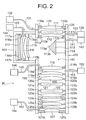
- FIG. 2 is a view of the configuration of a projection optical system employed in the second embodiment of the projection exposure apparatus according to the present invention.
- the basic configuration is similar to the projection optical system PL according to the first embodiment shown in FIG. 1.
- the projection optical system PL is housed in a first barrel 100 and a second barrel 101.
- the side part of the first barrel 100 is formed with an opening. Through this opening, the second barrel 101 is attached horizontally in a manner so that their inside space communicate with each other. The front end of the second barrel is closed.
- the opening at the mask side end of the first barrel 100 is closed air-tightly by a lens 110 and its holding mechanisms 110a, 110b.
- the opening at the wafer side end is closed air-tightly by a lens 127 and its holding mechanisms 127a, 127b.
- the part above the opening to the second barrel 101 is closed air-tightly by a lens 112 and its holding mechanisms 112a, 112b.
- the part below the opening is closed by a lens 118 and its holding mechanisms 118a, 118b. Due to this, the insides of the barrels 100, 101 define three space 130, 140, 150.
- the lenses 110, 127, 112, 118 and the structures of their support mechanisms 110a, 110b, 127a, 127b, 112a, 112b, 118a, 118b are structures such as illustrated in FIG. 5.
- a ring-shaped flat part 190e is formed at the peripheral end of each lens (190 in FIG. 5).
- One surface of this flat part 190e contacts the support member 192 extending from the barrel 100 through an O-ring or other seal member 191.
- a second holding member 193 is fixed by a bolt 194, nut 197 and washers 195, 196 to a support member 192.
- a projection 193a provided near the front end of the second holding member 193 presses against the other surface of the flat part 190e.
- the seal member 191 and support member 192 also surround the lens 190 in a ring shape. Due to this, the air-tightness above and below the lens 190 is secured.
- the space 130 in the barrels 100, 101 is provided with a lens 111 through the holding mechanisms 111a, 11b.
- the space 150 is provided with a plurality of lenses 119 to 126 through the corresponding holding mechanisms 118a to 126a, 118b to 126b.
- the first barrel 100 side of the space 140 is provided with a V-block type mirror 113 having an upper reflection surface 113a and a lower reflection surface 113b through a support member 114, while the second barrel 101 is provided with lenses 115, 116 and a concave mirror 117 through the holding mechanisms 115a to 117a, 115b to 117b.
- the space inside the barrels 100, 101 is divided into a space 140 including the mirror 113 and mirror 117 and other space 130 and 150. Further, the space 140 including the mirrors 113, 117 is fed helium from the low absorption gas feeder 142 and gas feed pipe 141 and the low absorption gas feeder 144 and gas feed pipe 143 and purged inside with helium. On the other hand, the other space 130, 150 are also fed helium from the gas feeders 132, 152 and gas feed pipes 131, 151 and purged inside by helium. The gas in the space 130, 140, 150 is exhausted by the exhaust pipes 145, 133, 153 and gas exhausters 146, 134, 154.
- the flow amount of feed of helium gas with respect to the surface areas of the space 130, 140, 150 is set high at the space 140 including the mirrors 113, 117 and set low in the other space 130, 150.
- the amount of feed of helium per 1 m 2 of the inside surface area is made 5 liter/min or so
- the amount of feed of helium per 1 m 2 of the inside surface area is made 1 liter/min or so.
- the purge gas is made nitrogen to further reduce the running costs.
- about 10% or less of hydrogen can be mixed into the helium or nitrogen purging the gas in the barrels 100, 101 to more strongly prevent oxidation of the mirrors (high reflectance coatings) or anti-reflection coatings.
- subdividing the inside space of the barrels 100, 101 of the projection optical system and making the flow amount or type of the low absorption gas fed to the space 140 to the space including the mirrors 113, 117 different from the gas fed to the space 130, 150 may also be applied to the space including the mirrors of the chamber 11 of the illumination optical system IL and the chamber 2 of the beam matching unit BMU and other space.
- FIG. 3 is a view of a projection optical system employed in the projection exposure apparatus according to the present invention. Its configuration is substantially the same as the projection optical system PL of the second embodiment shown in FIG. 2, so its explanation will be omitted. However, in the third embodiment, the inside of the projection optical system PL is not subdivided and forms a single air-tight space 160.
- a gas purging mechanism is provided for feeding the space 160 in the barrels 100, 101 with helium from the gas feeder 162 and gas feed pipe 161 and exhausting the gas in the space 160 from the exhaust pipe 171 and gas exhauster 172.
- the gas blowing mechanism for locally blowing a low absorption gas on the surface of the mirror 113 (reflection surfaces 113a, 113b) as a specific optical element
- the gas feeders 165, 168, gas feed pipes 163, 166 and gas injectors 164, 167 are provided, while as the gas blowing mechanism for locally blowing a low absorption gas on the surface of the mirror 117, the gas feeder 170 and gas feed pipe 169 are provided.
- FIG. 4 is a view of the flow of the low absorption gas near the V-block type mirror 113.
- the low absorption gas fed from the gas injector 164 forms a gas flow at the vicinity of the mask side reflection surface 113a of the V-block type mirror 113, while the low absorption gas fed from the gas injector 167 forms a gas flow at the vicinity of the mask side reflection surface 113b.
- Gas flows following along the reflection surfaces 113a, 113b from the base side of the mirror 113 toward the ridge line are formed. Therefore, the reflection surfaces 113a, 113b of the mirror 113 come into less contact with the surrounding relatively high residual oxygen or water vapor concentration gas, and oxidation of the mirror 113 can be prevented. The same applies to the mirror 117.
- a single type of gas is fed to the barrels 100, 101 of the projection optical system PL, so the gas feeders 162, 165, 168, 170 may also be combined into a single feeder.
- the low absorption gas was made helium, but when there is no need to positively cool the mirrors 113, 117, it may be nitrogen or another rare gas as well. Further, as in the first and second embodiments, it is possible to use a gas comprised of nitrogen or a rare gas in which a predetermined concentration of hydrogen is mixed so as to prevent oxidation of the mirrors 113, 117 better. Note that, the gas blowing mechanism in the third embodiment may also be applied to the first and second embodiments.
- the method of locally blowing on the mirrors 113, 117 a low absorption gas to prevent their oxidation may also be applied to the lenses of the projection optical system PL and the optical elements (lenses or mirrors etc.) of an illumination optical system IL or beam matching unit BMU.
- the gas feeder used in the above-mentioned first to third embodiments may include a gas tank from which it can be supplied with gas or may be supplied with gas from a gas pipe in a semiconductor plant. In either case, to raise the purity of the gas supplied to the light path, it is preferable to provide a filter for reducing the concentration of the oxygen or water vapor or other absorption gas or filter for removing dust and a temperature control mechanism for controlling the temperature to a predetermined temperature.
- FIG. 6 is a view showing key parts of another configuration for supplying the V-block type mirror used as the reflection optical element of the projection optical system employed in the projection exposure apparatus according to the present invention with a low absorption gas (purge gas).
- the overall configuration of the projection exposure apparatus, the configuration of the projection optical system, the gas feed mechanism, etc. are similar to those explained in the above-mentioned first to third embodiments, so their explanations will be omitted.
- the V-block type mirror 201 shown in FIG. 6 is an optical element corresponding to the V-block type mirror 113 in FIG. 3.
- the gas blowing mechanism locally blowing low absorption gas to the surface of the V-block type mirror 113 shown in FIG. 3 and FIG. 4, as illustrated, causes a flow of low absorption gas from above and below along the reflection surfaces 113a, 113b.
- the gas blowing mechanism in this embodiment blows low absorption gas from one of the directions perpendicular to the two side surfaces of the V-block type mirror 201, that is, the directions heading from the base to the ridge line of the mirror 201 through the gas feed pipe 202.
- the front end (feed port) of the gas feed pipe 202 arranged at the other of the two side faces of the V-block type mirror 201 is integrally provided with an attachment serving as a flow rectifying mechanism for slowing or making uniform the blown flow of gas.
- an example of attachment of a gas feed hood (substantially funnel-shaped duct) 204 as the attachment is shown.
- the cross-sectional area of the path of flow of the low absorption gas blown from the gas feed pipe 202 becomes larger, so along with this, the flow rate of the low absorption gas becomes lower. Therefore, the vicinity of the reflection surfaces 201a, 201b of the V-block type mirror 201 is filled statically with low absorption gas and entrainment of outside air with a relatively high residual oxygen or water vapor concentration can be reduced.
- gas feed pipe 203 and gas feed hood 205 configured the same as the gas feed pipe 202 and gas feed hood 204 at the other of the two side faces of the V-block type mirror 201.
- the gas feed hoods 204, 205 are preferably provided so that their opening parts (feed ports) face each other across the V-block type mirror 201.
- the flows of the low absorption gas GS1 from both of the gas feed hoods 204, 205 collide with each other at the substantial center of the V-block type mirror 201 and head outward from the reflection surfaces 201a, 201b. Due to this, entrainment of outside air GS2 with a relatively high residual oxygen or water vapor concentration can be reduced over the entire reflection surfaces 201 a, 201 b and a drop in the reflectance of the reflection surfaces 201a, 201b of the V-block type mirror 201 or unevenness of reflectance can be further suppressed.
- the optical element supplied with the low absorption gas is the V-block type mirror 201, so as explained above, one set of the gas feed pipes 202, 203 and gas feed hoods 204, 205 is preferably provided near each of the two side faces, that is, a total of two sets, but in the case of an optical element such as a concave mirror, a further plurality (for example, 4, 6, 8) may also be provided. In this case, they are preferably arranged so that the feed ports of the low absorption gas become symmetric around the optical element concerned, that is, are arranged radially.
- the low absorption gas emerging from the openings of the gas feed hoods 204, 205 flows slowly, so it is possible to reduce the entrainment of outside air.
- the flow rate at the centers of the gas feed hoods 204, 205 (on extensions of gas feed pipes 202, 203) is high.
- the flow rate becomes lower the further to the peripheries. That is, the uniformity of the flow rate is not necessarily high. Therefore, entrainment of outside air with a relatively high residual oxygen or water vapor concentration may occur.
- the openings of the gas feed hood 204, 205 are integrally provided with shield plates 206, 207 for partially shutting them.
- the shield plates 206, 207 are preferably provided so as to include the extension lines of the gas feed pipes 202, 203, that is, so as not to allow the relative fast flow rate part of the low absorption gas blown from the feed ports of the gas feed pipes 202, 203 to be directly blown from the openings of the gas feed hoods 204, 205. Due to this, the uniformity of the flow rate of the low absorption gas blown from the gas feed hoods 204, 205 becomes higher, and entrainment of outside air with a relatively high residual oxygen or water vapor concentration can be further reduced.
- these shield plates 206, 207 taking note of the fact that the side faces of the V-block type mirror 201 are triangular, these were made triangular similar to the same.
- the shapes of the shield plates 206, 207 the same or similar to the cross-sectional shapes of the optical elements covered in the direction of flow of the low absorption gas, it is possible to produce a smooth flow following the reflection surfaces and entrainment of outside air with a relatively high residual oxygen or water vapor concentration can be prevented more.
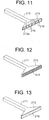
- attachments used as the flow rectifying mechanisms attached to the gas feed pipes 202, 203 for slowing or making uniform the flow of gas are not limited to those shown in FIG. 6 and FIG. 7. It is also possible to use the ones illustrated in FIG. 8 to FIG. 13.
- FIG. 8 shows an attachment serving as a flow rectifying mechanism for slowing or making uniform a gas flow using a substantially funnel-shaped duct (hood) 213 (funnel type).
- This duct 213 is attached so that its downstream side expands wider at the feed port of the gas feed pipe 211.
- the shape of the opening 213a of the duct 213 is not limited to the rectangular shape illustrated and may be a circular shape, semicircular shape, square shape, or any other shape, but the shape is preferably selected from the configuration and shape of the optical element to be fed the low absorption gas, the feed direction of the low absorption gas, the number or arrangement of the feed ports, or other viewpoints.
- FIG. 9 shows a rectangular shaped shield plate 214 integrally attached to the substantial center of the opening 213a of the duct 213 (shield plate type).
- FIG. 10 shows a pair of shield plates 215 bridging the longitudinal direction of the opening part 213a at the top and bottom of the opening 213a of the duct 213 (two side parts in the short direction of the opening 213a) (slit type).
- the shape of the shield plates 215 is not limited to that shown and may be other shapes as well.
- It is preferably selected from the shape of the opening 213a of the duct 213, the configuration and shape of the optical element fed the low absorption gas, the direction of feed of the low absorption gas, the number and arrangement of the feed ports, and other viewpoints. For example, it may be considered to reduce the slit interval at the center and increase the slit interval the further from the center.
- FIG. 11 shows the inside of the duct 213 integrally provided with a plurality of diffusion plates 216 in a radial manner in accordance with the wideness from the feed port of the gas feed pipe 211 to the opening 213a of the duct 213 (diffuser type).
- the low absorption gas blown from the feed port of the gas feed pipe 211 is guided by the diffusion plates 216 and blown out from the opening 213a.
- the flow of the low absorption gas is slowed by the widening of the duct 213, while the flow rate is made uniform by the diffusion plates 216.
- the number of the diffusion plates 216 is five in the figure, but is not limited to this. Further, the diffusion plates 216 may be arranged equally in a radial fashion.
- the nearer to the center of extension line of the feed port of the gas feed pipe 211 the faster the flow rate, while the further outside, the slower, so considering this, it is preferable to design the pitch of arrangement of size (length) etc. so that the low absorption gas blown from the opening 213a of the duct 213 becomes uniform in flow rate as a whole.
- FIG. 12 shows the opening part 213a of the duct 213 shown in FIG. 8 covered entirely by attachment of a mesh plate 217 (mesh type).
- a mesh plate 217 mesh type
- FIG. 13 shows the opening 213a of the duct 213 shown in FIG. 8 covered entirely by attachment of a cleaning filter plate (here, the particle film plate) 218 (particle filter type).
- a cleaning filter plate here, the particle film plate 218 (particle filter type).
- the mesh plate 217 and filter plate 218 are attached at the opening 213a of the duct 213 shown in FIG. 8, but they may also be provided at the opening 213a (parts other than shield plates 214, 215) of the duct 213 of FIG. 9 and FIG. 10 or at the opening 213a of the duct 213 of FIG. 11.
- the gas feed pipe 211 shown in FIG. 8 to FIG. 13 need not be rectangular in cross-sectional shape and may also be circular, elliptical, polygonal, etc. in shape so long as being a pipe shape.
- FIG. 14 a configuration providing the duct 213 was explained, but in this embodiment, as shown in FIG. 14, a main gas feed pipe 221 is provided near it with a plurality of auxiliary gas feed pipes 222 and low absorption gas is fed from the plurality of auxiliary intake pipes 222 so as to follow the low absorption gas blown from the main gas feed pipe 221.
- the V-block type mirror 201 is mainly supplied from the main gas feed pipe 221 with a low absorption gas, but substantially in parallel with this flow, low absorption gas flows from the auxiliary gas feed pipes 222, so what is entrained in the low absorption gas from the main gas feed pipe 221 is the low absorption gas fed from the auxiliary gas feed pipes 222 which is cleaner than the outside air with a relatively high residual oxygen or water vapor concentration.
- the low absorption gas from the auxiliary gas feed pipes 222 forms a barrier against the external outside air, so less outside air is entrained in the low absorption gas from the main gas feed pipe 221. Therefore, the vicinity of the reflection surfaces 201 a, 201b of the V-block type mirror 201 is filled with low absorption gas, so it is possible to reduce the entrainment of outside air with a relatively high residual oxygen or water vapor concentration.
- the low absorption gas blown from the auxiliary gas feed pipes 222 is made a gas the same as the low absorption gas blown from the main gas feed pipe 221. If making it the same gas in this way, it is possible to feed the auxiliary gas feed pipes 222 a low absorption gas branched off from the main gas feed pipe 221. This is convenient in design. However, it is also possible to feed a low absorption gas different from the low absorption gas blown from the main gas feed pipe 221 from the auxiliary gas feed pipes 222. In this case, the low absorption gas fed through the auxiliary gas feed pipes 222 may be one with a purity lower than the low absorption gas fed from the main gas feed pipe 221 (however, it must be of a purity sufficiently higher than the surrounding atmosphere).
- the flow rate or flow amount of the low absorption gas blown from the auxiliary gas feed pipes 222 may be the same as or higher or lower than the flow rate or flow amount of the low absorption gas blown from the main gas feed pipe 221, but the flow amount of the low absorption gas fed from the auxiliary gas feed pipes 222 may be lower than the flow amount of the low absorption gas fed from the main gas feed pipe 221.
- a main gas feed pipe 223 and auxiliary gas feed pipes 224 of configurations similar to the main gas feed pipe 221 and auxiliary gas feed pipes 222 at the other side of the two side surfaces of the V-block type mirror 201.
- the paired gas feed pipes 221, 222, 223, 224 are preferably provided with their opening (feed ports) straddling the V-block type mirror 201.
- the optical element supplied with the low absorption gas is the V-block type mirror 201, so as explained above, it is preferable to provide sets of the main gas feed pipes 221, 223 and auxiliary gas feed pipes 222, 224 at the two surfaces, that is, a total of two sets, but in the case of an optical element such as a concave mirror, it is also possible to provide a further plurality of sets (for example, 4 sets, 6 sets, 8 sets). In this case, it is preferable to arrange them so that the feed ports of the low absorption gas become symmetric about the optical element, that is radial.
- the low absorption gas is supplied from both of the two side surfaces of the V-block type mirror 201, but it is also possible to supply the low absorption gas as explained above from one of the surfaces and not supply the low absorption gas from the other surface, but exhaust it.
- the low absorption gas supplied from the one side surface of the V-block type mirror 201 flows along the reflection surfaces 201a, 201b and is exhausted from the other side, so the flow of the low absorption gas becomes smooth and entrainment of outside air with relatively a high residual oxygen or water vapor concentration can be reduced.
- the application of the present invention to a step-and-scan type reduction projection exposure apparatus was explained, but it is also possible apply the present invention to any other type of exposure apparatus such as a step-and-repeat type or step-and-stitch type reduction projection exposure apparatus or mirror projection aligner.
- the present invention can be applied not only to an exposure apparatus for producing a semiconductor device, but also an exposure apparatus used for the production of a liquid crystal display, plasma display, thin film magnetic head, image pickup device (CCD etc.), micromachine, DNA chip, etc., and an exposure apparatus for producing a reticle or mask by transferring circuit patterns to a glass substrate or silicon wafer. That is, the present invention can be applied without regard as to the exposure system or application etc. of the exposure apparatus.
- the exposure light source 1 in addition to the above, for example, it is possible to use a harmonic of a YAG laser or other solid laser having an oscillation spectrum at any of the wavelength of 193 nm, 157 nm, 146 nm, 126 nm. Further, it is also possible to use a harmonic obtained by amplifying a single wavelength laser of the infrared region or visible region emitted from a DFB semiconductor laser or fiber laser by for example an erbium (or both erbium and yttrium)-doped fiber amplifier and converting to in wavelength to ultraviolet light using a nonlinear optical crystal.
- the projection optical system is not limited to a reduction type. It may also be applied to an equal magnification type or enlargement type (for example, an exposure apparatus for making a liquid crystal display or plasma display). Further, the projection optical system may be any of a catoptric system, a catadioptric system, and a dioptric system.
- the exposure apparatus of the above-mentioned embodiments can be produced by assembling an illumination optical system and projection optical system comprised of a plurality of optical elements (lenses, mirrors, etc.) into an exposure apparatus body and optically adjusting them and by assembling a reticle stage or wafer stage comprised of a large number of mechanical parts in the exposure apparatus body and connecting the wiring or piping, assembling in a laser interferometer or AF apparatus and optically adjusting it, connecting to the chambers, barrels, and space partitioning walls of the illumination optical system and projection optical system the purge gas feed apparatus and recovery apparatus through pipes, assembling an environment chamber having a separate air-conditioning apparatus, placing the exposure apparatus body in the environment chamber, and making overall adjustments (electrical adjustment, confirmation of operation, etc.)
- the exposure apparatus is preferably produced in a clean room managed in temperature and cleanness.
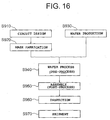
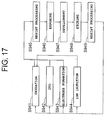
- FIG. 16 and FIG. 17 are flow charts of the process of production of for example an IC or LSI or other semiconductor chip, liquid crystal panel, CCD, thin film magnetic head, micromachine, or other electronic device.
- step S910 the circuit of the electronic device is designed or other functions and performance of the device are designed
- step S920 the patterns for realizing these functions are designed and a mask formed with the designed circuit patterns is fabricated
- step S930 a silicon or other material is used to produce a wafer (silicon substrate) (step S930).
- step S940 the mask fabricated at step S920 and the wafer produced at step S930 are used to form actual circuits etc. on the wafer by lithography (step S940). Specifically, as shown in FIG. 17, first oxidation (step S941), CVD (step S942), electrode formation (step S943), ion implantation (step S944), and other processing are performed to form on the wafer surface an insulation film, electrode interconnect film, semiconductor film, or other thin film. Next, this thin film is completely coated with a photoresist using a resist coater (step S945).
- this resist-coated substrate is loaded on a wafer holder of the exposure apparatus of the present invention and the mask produced at step S920 is loaded on a reticle holder and the patterns formed on the mask are reduced and transferred to the wafer (step S946).
- the shot areas of the wafer are successively positioned and the shot areas are successively transferred the patterns of the mask.
- the wafer is unloaded from the wafer holder and developed using a developer (step S947). Due to this, the wafer surface is formed with resist images of the mask patterns.
- step S948 the developed wafer is etched using an etching apparatus (step S948) and the resist remaining on the wafer surface is removed using for example a plasma ashing apparatus etc. (step S949).
- the shot areas of the wafer are formed with insulating layers or patterns of the electrode interconnects etc. Further, by successively repeating the processing while changing the mask, the wafer is formed with the actual circuits etc.
- step S950 the wafer is diced to individual chips and the chips are attached to lead frames or packages, electrodes are connected by bonding, and the assemblies are sealed by resin or otherwise packaged. Further, operational confirmation tests, endurance tests, and other inspections of the produced devices are carried out (step S960) and the results shipped out as finished devices (step S970).
- the present invention there is the effect that it is possible to provide a highly durable projection exposure apparatus able to suppress deterioration of the optical properties of optical elements (reflectance of reflection mirrors or transmittance of antireflection coating of lenses etc.) and possible to maintain the initial performance over a long period even when using vacuum ultraviolet light as a light source in the exposure apparatus.
Landscapes
- Health & Medical Sciences (AREA)
- Epidemiology (AREA)
- Public Health (AREA)
- Physics & Mathematics (AREA)
- General Physics & Mathematics (AREA)
- Engineering & Computer Science (AREA)
- Environmental & Geological Engineering (AREA)
- Life Sciences & Earth Sciences (AREA)
- Atmospheric Sciences (AREA)
- Toxicology (AREA)
- Exposure And Positioning Against Photoresist Photosensitive Materials (AREA)
Applications Claiming Priority (3)
| Application Number | Priority Date | Filing Date | Title |
|---|---|---|---|
| JP2002169496 | 2002-06-11 | ||
| JP2002169496 | 2002-06-11 | ||
| PCT/JP2003/007398 WO2003105203A1 (ja) | 2002-06-11 | 2003-06-11 | 露光装置及び露光方法 |
Publications (2)
| Publication Number | Publication Date |
|---|---|
| EP1536458A1 true EP1536458A1 (de) | 2005-06-01 |
| EP1536458A4 EP1536458A4 (de) | 2008-01-09 |
Family
ID=29727734
Family Applications (1)
| Application Number | Title | Priority Date | Filing Date |
|---|---|---|---|
| EP03736157A Withdrawn EP1536458A4 (de) | 2002-06-11 | 2003-06-11 | Belichtungssystem und belichtungsverfahren |
Country Status (5)
| Country | Link |
|---|---|
| EP (1) | EP1536458A4 (de) |
| JP (1) | JPWO2003105203A1 (de) |
| AU (1) | AU2003242268A1 (de) |
| TW (1) | TW200402606A (de) |
| WO (1) | WO2003105203A1 (de) |
Cited By (6)
| Publication number | Priority date | Publication date | Assignee | Title |
|---|---|---|---|---|
| DE102005043596A1 (de) * | 2005-09-12 | 2007-03-22 | 3D-Micromac Ag | Lasermikrobearbeitungsstation |
| EP1770444A1 (de) | 2005-09-29 | 2007-04-04 | ASML Netherlands BV | Lithographieapparat und Verfahren zum Aufbereiten eines Innenraums eines Gerätes zur Herstellung einer Halbleitervorrichtung |
| WO2007010011A3 (en) * | 2005-07-19 | 2007-04-19 | Zeiss Carl Smt Ag | Optical element module |
| WO2007083999A2 (en) | 2006-01-17 | 2007-07-26 | Asml Netherlands B.V. | Method for chemical reduction of an oxidized contamination material, or reducing oxidation of a contamination material and a conditioning system for doing the same |
| EP1777590A3 (de) * | 2005-10-21 | 2008-02-13 | ASML Netherlands B.V. | Gasdusche, lithographische Vorrichtung und Verwendung einer Gasdusche |
| WO2019228784A1 (en) * | 2018-05-31 | 2019-12-05 | Asml Netherlands B.V. | Lithographic apparatus |
Families Citing this family (6)
| Publication number | Priority date | Publication date | Assignee | Title |
|---|---|---|---|---|
| NL2007439A (en) | 2010-10-19 | 2012-04-23 | Asml Netherlands Bv | Gas manifold, module for a lithographic apparatus, lithographic apparatus and device manufacturing method. |
| JP6041541B2 (ja) * | 2012-06-04 | 2016-12-07 | キヤノン株式会社 | 露光装置及びデバイス製造方法 |
| JP6064466B2 (ja) * | 2012-09-11 | 2017-01-25 | 大日本印刷株式会社 | インプリント方法およびそれを実施するためのインプリント装置 |
| JP6328126B2 (ja) * | 2012-10-31 | 2018-05-23 | エーエスエムエル ホールディング エヌ.ブイ. | パターニングデバイス支持体、リソグラフィ装置及びパターニングデバイスの温度制御方法 |
| JP2014157892A (ja) * | 2013-02-15 | 2014-08-28 | Canon Inc | 露光装置、それを用いたデバイスの製造方法 |
| US12510692B2 (en) * | 2020-08-27 | 2025-12-30 | Kla Corporation | Protection of optical materials of optical components from radiation degradation |
Family Cites Families (9)
| Publication number | Priority date | Publication date | Assignee | Title |
|---|---|---|---|---|
| US5696623A (en) * | 1993-08-05 | 1997-12-09 | Fujitsu Limited | UV exposure with elongated service lifetime |
| JP3448670B2 (ja) * | 1993-09-02 | 2003-09-22 | 株式会社ニコン | 露光装置及び素子製造方法 |
| JPH0845827A (ja) * | 1994-07-28 | 1996-02-16 | Canon Inc | 投影露光装置及びそれを用いた半導体デバイスの製造方法 |
| KR20010031972A (ko) * | 1997-11-12 | 2001-04-16 | 오노 시게오 | 노광 장치, 디바이스 제조 장치 및 노광 장치의 제조 방법 |
| KR20010089431A (ko) * | 1998-11-19 | 2001-10-06 | 시마무라 테루오 | 광학장치와 노광장치 및 레이저광원, 가스 공급방법,노광방법, 디바이스의 제조방법 |
| WO2000048237A1 (en) * | 1999-02-12 | 2000-08-17 | Nikon Corporation | Exposure method and apparatus |
| JP2000306807A (ja) * | 1999-04-20 | 2000-11-02 | Nikon Corp | 露光装置、露光方法、及び半導体デバイスの製造方法 |
| CN1420982A (zh) * | 2000-03-31 | 2003-05-28 | 株式会社尼康 | 计测方法以及计测装置、曝光方法以及曝光装置 |
| TW548524B (en) * | 2000-09-04 | 2003-08-21 | Asm Lithography Bv | Lithographic projection apparatus, device manufacturing method and device manufactured thereby |
-
2003
- 2003-06-11 JP JP2004512177A patent/JPWO2003105203A1/ja not_active Withdrawn
- 2003-06-11 WO PCT/JP2003/007398 patent/WO2003105203A1/ja not_active Ceased
- 2003-06-11 TW TW92115815A patent/TW200402606A/zh unknown
- 2003-06-11 EP EP03736157A patent/EP1536458A4/de not_active Withdrawn
- 2003-06-11 AU AU2003242268A patent/AU2003242268A1/en not_active Abandoned
Cited By (17)
| Publication number | Priority date | Publication date | Assignee | Title |
|---|---|---|---|---|
| US7859641B2 (en) | 2005-07-19 | 2010-12-28 | Carl Zeiss Smt Ag | Optical element module |
| WO2007010011A3 (en) * | 2005-07-19 | 2007-04-19 | Zeiss Carl Smt Ag | Optical element module |
| DE102005043596A1 (de) * | 2005-09-12 | 2007-03-22 | 3D-Micromac Ag | Lasermikrobearbeitungsstation |
| DE102005043596B4 (de) * | 2005-09-12 | 2009-08-27 | 3D-Micromac Ag | Lasermikrobearbeitungsstation, Strahltransformationseinrichtung und Homogenisierer für eine Lasermikrobearbeitungsstation |
| EP1770444A1 (de) | 2005-09-29 | 2007-04-04 | ASML Netherlands BV | Lithographieapparat und Verfahren zum Aufbereiten eines Innenraums eines Gerätes zur Herstellung einer Halbleitervorrichtung |
| CN1940728B (zh) * | 2005-09-29 | 2012-07-04 | Asml荷兰有限公司 | 光刻装置和调节器件制造装置的内部空间的方法 |
| US7728951B2 (en) | 2005-09-29 | 2010-06-01 | Asml Netherlands B.V. | Lithographic apparatus and method for conditioning an interior space of a device manufacturing apparatus |
| EP1777590A3 (de) * | 2005-10-21 | 2008-02-13 | ASML Netherlands B.V. | Gasdusche, lithographische Vorrichtung und Verwendung einer Gasdusche |
| US7432513B2 (en) | 2005-10-21 | 2008-10-07 | Asml Netherlands B.V. | Gas shower, lithographic apparatus and use of a gas shower |
| CN1952786B (zh) * | 2005-10-21 | 2012-02-29 | Asml荷兰有限公司 | 气体喷头、光刻装置和气体喷头的应用 |
| WO2007083999A3 (en) * | 2006-01-17 | 2007-09-07 | Asml Netherlands Bv | Method for chemical reduction of an oxidized contamination material, or reducing oxidation of a contamination material and a conditioning system for doing the same |
| US7667820B2 (en) | 2006-01-17 | 2010-02-23 | Asml Netherlands B.V. | Method for chemical reduction of an oxidized contamination material, or reducing oxidation of a contamination material and a conditioning system for doing the same |
| WO2007083999A2 (en) | 2006-01-17 | 2007-07-26 | Asml Netherlands B.V. | Method for chemical reduction of an oxidized contamination material, or reducing oxidation of a contamination material and a conditioning system for doing the same |
| WO2019228784A1 (en) * | 2018-05-31 | 2019-12-05 | Asml Netherlands B.V. | Lithographic apparatus |
| NL2023105A (en) * | 2018-05-31 | 2019-12-09 | Asml Netherlands Bv | Lithographic apparatus |
| CN112166382A (zh) * | 2018-05-31 | 2021-01-01 | Asml荷兰有限公司 | 光刻设备 |
| CN112166382B (zh) * | 2018-05-31 | 2025-01-07 | Asml荷兰有限公司 | 光刻设备 |
Also Published As
| Publication number | Publication date |
|---|---|
| JPWO2003105203A1 (ja) | 2005-10-13 |
| AU2003242268A1 (en) | 2003-12-22 |
| WO2003105203A1 (ja) | 2003-12-18 |
| TW200402606A (en) | 2004-02-16 |
| EP1536458A4 (de) | 2008-01-09 |
Similar Documents
| Publication | Publication Date | Title |
|---|---|---|
| US7050149B2 (en) | Exposure apparatus and exposure method | |
| US7061573B2 (en) | Contamination prevention in optical system | |
| US6791766B2 (en) | Method and device for holding optical member, optical device, exposure apparatus, and device manufacturing method | |
| TWI230843B (en) | Exposure method and device | |
| TW490731B (en) | Optical device, exposure system, and laser beam source, and gas feed method, exposure method, and device manufacturing method | |
| JP2002373852A (ja) | 露光装置 | |
| US6829034B2 (en) | Exposure apparatus and device manufacturing method | |
| US7068352B2 (en) | Exposure apparatus | |
| US6961113B1 (en) | Exposure method and apparatus | |
| TW452851B (en) | Exposure method and apparatus | |
| JPH06260385A (ja) | 露光装置 | |
| JP2000091192A (ja) | 露光装置 | |
| JPWO2003105203A1 (ja) | 露光装置及び露光方法 | |
| JP3958049B2 (ja) | ペルクル付きレチクル、デバイス製造関連装置、露光装置及びデバイス製造方法 | |
| JP2001060548A (ja) | 露光方法及び装置 | |
| JP4174239B2 (ja) | ガス供給装置、露光システムおよびデバイス製造方法 | |
| KR20050019118A (ko) | 노광 장치 및 노광 방법 | |
| US20050117136A1 (en) | Exposure apparatus and device manufacturing method | |
| JP7659683B2 (ja) | 露光装置、および物品の製造方法 | |
| TW559892B (en) | Lens barrel, exposure device, and method of manufacturing device | |
| JP2003163159A (ja) | パージガスの供給方法及び露光装置並びにデバイスの製造方法 | |
| JPWO2002065183A1 (ja) | 鏡筒及び露光装置並びにデバイスの製造方法 | |
| JP2004080052A (ja) | 露光装置、デバイスの製造方法 | |
| JP2006173247A (ja) | 汚染物質除去装置及び露光装置並びにデバイスの製造方法 | |
| WO2002049084A1 (fr) | Procede et systeme d'exposition et procede de production d'un dispositif |
Legal Events
| Date | Code | Title | Description |
|---|---|---|---|
| PUAI | Public reference made under article 153(3) epc to a published international application that has entered the european phase |
Free format text: ORIGINAL CODE: 0009012 |
|
| 17P | Request for examination filed |
Effective date: 20050103 |
|
| AK | Designated contracting states |
Kind code of ref document: A1 Designated state(s): AT BE BG CH CY CZ DE DK EE ES FI FR GB GR HU IE IT LI LU MC NL PT RO SE SI SK TR |
|
| AX | Request for extension of the european patent |
Extension state: AL LT LV MK |
|
| DAX | Request for extension of the european patent (deleted) | ||
| A4 | Supplementary search report drawn up and despatched |
Effective date: 20071210 |
|
| RIC1 | Information provided on ipc code assigned before grant |
Ipc: G03F 7/20 20060101AFI20071204BHEP |
|
| 17Q | First examination report despatched |
Effective date: 20080401 |
|
| STAA | Information on the status of an ep patent application or granted ep patent |
Free format text: STATUS: THE APPLICATION IS DEEMED TO BE WITHDRAWN |
|
| 18D | Application deemed to be withdrawn |
Effective date: 20080812 |