EP1534356B1 - Medizinische vorrichtung mit verbesserter haftung zwischen einem polymeren berzug und einem substrat - Google Patents
Medizinische vorrichtung mit verbesserter haftung zwischen einem polymeren berzug und einem substrat Download PDFInfo
- Publication number
- EP1534356B1 EP1534356B1 EP03785284A EP03785284A EP1534356B1 EP 1534356 B1 EP1534356 B1 EP 1534356B1 EP 03785284 A EP03785284 A EP 03785284A EP 03785284 A EP03785284 A EP 03785284A EP 1534356 B1 EP1534356 B1 EP 1534356B1
- Authority
- EP
- European Patent Office
- Prior art keywords
- polymer
- undercoat
- undercoat layer
- substrate surface
- polymeric
- Prior art date
- Legal status (The legal status is an assumption and is not a legal conclusion. Google has not performed a legal analysis and makes no representation as to the accuracy of the status listed.)
- Expired - Lifetime
Links
Images

Classifications
-
- A—HUMAN NECESSITIES
- A61—MEDICAL OR VETERINARY SCIENCE; HYGIENE
- A61L—METHODS OR APPARATUS FOR STERILISING MATERIALS OR OBJECTS IN GENERAL; DISINFECTION, STERILISATION OR DEODORISATION OF AIR; CHEMICAL ASPECTS OF BANDAGES, DRESSINGS, ABSORBENT PADS OR SURGICAL ARTICLES; MATERIALS FOR BANDAGES, DRESSINGS, ABSORBENT PADS OR SURGICAL ARTICLES
- A61L31/00—Materials for other surgical articles, e.g. stents, stent-grafts, shunts, surgical drapes, guide wires, materials for adhesion prevention, occluding devices, surgical gloves, tissue fixation devices
- A61L31/14—Materials characterised by their function or physical properties, e.g. injectable or lubricating compositions, shape-memory materials, surface modified materials
- A61L31/16—Biologically active materials, e.g. therapeutic substances
-
- A—HUMAN NECESSITIES
- A61—MEDICAL OR VETERINARY SCIENCE; HYGIENE
- A61L—METHODS OR APPARATUS FOR STERILISING MATERIALS OR OBJECTS IN GENERAL; DISINFECTION, STERILISATION OR DEODORISATION OF AIR; CHEMICAL ASPECTS OF BANDAGES, DRESSINGS, ABSORBENT PADS OR SURGICAL ARTICLES; MATERIALS FOR BANDAGES, DRESSINGS, ABSORBENT PADS OR SURGICAL ARTICLES
- A61L27/00—Materials for grafts or prostheses or for coating grafts or prostheses
- A61L27/28—Materials for coating prostheses
- A61L27/34—Macromolecular materials
-
- A—HUMAN NECESSITIES
- A61—MEDICAL OR VETERINARY SCIENCE; HYGIENE
- A61L—METHODS OR APPARATUS FOR STERILISING MATERIALS OR OBJECTS IN GENERAL; DISINFECTION, STERILISATION OR DEODORISATION OF AIR; CHEMICAL ASPECTS OF BANDAGES, DRESSINGS, ABSORBENT PADS OR SURGICAL ARTICLES; MATERIALS FOR BANDAGES, DRESSINGS, ABSORBENT PADS OR SURGICAL ARTICLES
- A61L27/00—Materials for grafts or prostheses or for coating grafts or prostheses
- A61L27/50—Materials characterised by their function or physical properties, e.g. injectable or lubricating compositions, shape-memory materials, surface modified materials
- A61L27/54—Biologically active materials, e.g. therapeutic substances
-
- A—HUMAN NECESSITIES
- A61—MEDICAL OR VETERINARY SCIENCE; HYGIENE
- A61L—METHODS OR APPARATUS FOR STERILISING MATERIALS OR OBJECTS IN GENERAL; DISINFECTION, STERILISATION OR DEODORISATION OF AIR; CHEMICAL ASPECTS OF BANDAGES, DRESSINGS, ABSORBENT PADS OR SURGICAL ARTICLES; MATERIALS FOR BANDAGES, DRESSINGS, ABSORBENT PADS OR SURGICAL ARTICLES
- A61L29/00—Materials for catheters, medical tubing, cannulae, or endoscopes or for coating catheters
- A61L29/08—Materials for coatings
- A61L29/085—Macromolecular materials
-
- A—HUMAN NECESSITIES
- A61—MEDICAL OR VETERINARY SCIENCE; HYGIENE
- A61L—METHODS OR APPARATUS FOR STERILISING MATERIALS OR OBJECTS IN GENERAL; DISINFECTION, STERILISATION OR DEODORISATION OF AIR; CHEMICAL ASPECTS OF BANDAGES, DRESSINGS, ABSORBENT PADS OR SURGICAL ARTICLES; MATERIALS FOR BANDAGES, DRESSINGS, ABSORBENT PADS OR SURGICAL ARTICLES
- A61L29/00—Materials for catheters, medical tubing, cannulae, or endoscopes or for coating catheters
- A61L29/14—Materials characterised by their function or physical properties, e.g. lubricating compositions
- A61L29/16—Biologically active materials, e.g. therapeutic substances
-
- A—HUMAN NECESSITIES
- A61—MEDICAL OR VETERINARY SCIENCE; HYGIENE
- A61L—METHODS OR APPARATUS FOR STERILISING MATERIALS OR OBJECTS IN GENERAL; DISINFECTION, STERILISATION OR DEODORISATION OF AIR; CHEMICAL ASPECTS OF BANDAGES, DRESSINGS, ABSORBENT PADS OR SURGICAL ARTICLES; MATERIALS FOR BANDAGES, DRESSINGS, ABSORBENT PADS OR SURGICAL ARTICLES
- A61L31/00—Materials for other surgical articles, e.g. stents, stent-grafts, shunts, surgical drapes, guide wires, materials for adhesion prevention, occluding devices, surgical gloves, tissue fixation devices
- A61L31/08—Materials for coatings
- A61L31/10—Macromolecular materials
-
- A—HUMAN NECESSITIES
- A61—MEDICAL OR VETERINARY SCIENCE; HYGIENE
- A61L—METHODS OR APPARATUS FOR STERILISING MATERIALS OR OBJECTS IN GENERAL; DISINFECTION, STERILISATION OR DEODORISATION OF AIR; CHEMICAL ASPECTS OF BANDAGES, DRESSINGS, ABSORBENT PADS OR SURGICAL ARTICLES; MATERIALS FOR BANDAGES, DRESSINGS, ABSORBENT PADS OR SURGICAL ARTICLES
- A61L2300/00—Biologically active materials used in bandages, wound dressings, absorbent pads or medical devices
- A61L2300/60—Biologically active materials used in bandages, wound dressings, absorbent pads or medical devices characterised by a special physical form
- A61L2300/602—Type of release, e.g. controlled, sustained, slow
-
- A—HUMAN NECESSITIES
- A61—MEDICAL OR VETERINARY SCIENCE; HYGIENE
- A61L—METHODS OR APPARATUS FOR STERILISING MATERIALS OR OBJECTS IN GENERAL; DISINFECTION, STERILISATION OR DEODORISATION OF AIR; CHEMICAL ASPECTS OF BANDAGES, DRESSINGS, ABSORBENT PADS OR SURGICAL ARTICLES; MATERIALS FOR BANDAGES, DRESSINGS, ABSORBENT PADS OR SURGICAL ARTICLES
- A61L2300/00—Biologically active materials used in bandages, wound dressings, absorbent pads or medical devices
- A61L2300/60—Biologically active materials used in bandages, wound dressings, absorbent pads or medical devices characterised by a special physical form
- A61L2300/606—Coatings
- A61L2300/608—Coatings having two or more layers
-
- A—HUMAN NECESSITIES
- A61—MEDICAL OR VETERINARY SCIENCE; HYGIENE
- A61L—METHODS OR APPARATUS FOR STERILISING MATERIALS OR OBJECTS IN GENERAL; DISINFECTION, STERILISATION OR DEODORISATION OF AIR; CHEMICAL ASPECTS OF BANDAGES, DRESSINGS, ABSORBENT PADS OR SURGICAL ARTICLES; MATERIALS FOR BANDAGES, DRESSINGS, ABSORBENT PADS OR SURGICAL ARTICLES
- A61L2420/00—Materials or methods for coatings medical devices
- A61L2420/08—Coatings comprising two or more layers
Definitions
- the present invention relates to polymer-coated medical devices having improved structural integrity, and related methods.
- Polymeric coating of medical devices serves several functions.
- the surfaces of implantable devices such as catheters or guide wires must be smooth and uniform to assure introduction of such devices without causing trauma to tissue encountered during placement.
- a polymeric coating may serve as a repository for delivery of an active agent to a subject.
- polymeric coatings must be as thin as possible.
- WO 98/32474 discloses coating of a medical device with a thin coherent bond coat which may be coated with additional outer layers.
- the coatings are baked at elevated temperatures, typically 50°C to 100°C, to drive off the organic solvents used.
- WO 03/022323 comprises the state of the art pursuant to Art. 54(3) EPC.
- This document relates to a stent which includes a polymeric crystalline coating.
- a primer layer can be formed on the stent which is exposed to heat treatment at a temperature which is less than about the melting temperature (T m ) of the selected polymer material.
- Prior art coatings suffer from limitations that include structural failure due to cracking and delamination from the device surface.
- evaporation of the solvent can cause shrinkage with consequent cracking of the coating layer.
- Water may find its way to the interface between the coating and the device surface, causing further structural damage.
- This adhesive failure is exacerbated when the coating layers are thin.
- water or solvent molecules may also become trapped at the interface between the coating layer and the substrate, and may be responsible for the formation of cavities, micropores and channels within the coating layer that can lead to premature or uncontrolled release of an active agent from the device.
- a “skinning" effect is sometimes observed due to the difference in evaporation rates between the solvent near the coating surface and the solvent near the substrate surface. These regions shrink at different rates, causing imperfections in the contact surface between the coating and the substrate and producing stress at the coating/substrate interface, driving delamination.
- the invention provides a method for making a medical device comprising:
- the average thickness of the undercoat layer is preferably less than about 1 micron.
- the undercoat layer Prior to the application of the top coat layer, the undercoat layer is treated to reflow the undercoat polymer to cause formation of a conformable interface between the undercoat layer and the substrate surface.
- Reflow of the undercoat polymer is preferably accomplished by heating the undercoat layer to at least about the melt flow temperature of the undercoat polymer for a time sufficient to reflow the polymer.
- the top coat layer comprises an active agent that can be either elutable or non-elutable.
- the top coat layer includes an elutable active agent that elutes from the stent at a slower rate and for a longer duration than the active agent elutes from a comparable stent without the polymeric undercoat layer.
- the medical device can be an implantable device, such as a stent, or an extracorporeal device.
- the medical device is a stent having a polymeric undercoat layer conformably adherent to a substrate surface of the stent and a polymeric top coat layer adherent to the undercoat layer.
- the undercoat layer preferably includes a polyurethane, and the top coat layer preferably comprises an active agent.
- the invention further includes a medical device prepared by a method as herein described.
- the medical device herein described may be used in a method for delivering an active agent to a subject.
- the method involves contacting the delivery device with a bodily fluid, organ or tissue of a subject to deliver the active agent, wherein the delivery device includes a top coat layer which comprises an active agent.
- the method can be performed in vivo or ex vivo, depending upon whether the delivery device is an extracorporeal device or an implantable device.
- the active agent can be elutable or non-elutable. An elutable active agent can elute from the device at a slower rate and for a longer duration than the active agent elutes from a comparable device without the polymeric undercoat layer.
- the medical device of the invention is characterized by a substrate surface overlayed with a polymeric layer.
- This polymeric layer (termed an "undercoat” layer) strongly adheres to the substrate surface and can serve a number of different functions. For example, it can play a role in the electric isolation or thermal isolation of the device, can provide an anti-scratch or abrasion resistant surface and/or can serve as a vehicle for chemical, physical, optical, and/or biological modification of the device surface.
- This layer is overlayed with another polymeric layer, referred to herein as a top layer or top coat layer.
- the outermost layer i.e., the outermost top coat layer
- the outermost top coat layer is in contact with a bodily fluid, organ or tissue of a subject.
- the polymeric layers adhere to each other and to the substrate surface in a way that reduces or eliminates cracking and delamination of the polymeric layers.
- the devices thus exhibit improved structural integrity and safety compared to prior art devices.
- the novel construction also yields a reproducible elution profile.
- the term "medical device” refers generally to any device that has surfaces that can, in the ordinary course of their use and operation, contact bodily tissue, organs or fluids such as blood.
- medical devices include, without limitation, stents, stent grafts, anastomotic connectors leads, needles, guide wires, catheters, sensors, surgical instruments, angioplasty balloons, wound drains, shunts, tubing, urethral inserts, pellets, implants, pumps, vascular grafts, valves, pacemakers, and the like.
- a medical device can be an extracorporeal device, such as a device used during surgery, which includes, for example, a blood oxygenator, blood pump, blood sensor, or tubing used to carry blood, and the like, which contact blood which is then returned to the subject.
- a medical device can likewise be an implantable device such as a vascular graft, stent, electrical stimulation lead, heart valve, orthopedic device, catheter, shunt, sensor, replacement device for nucleus pulposus, cochlear or middle ear implant, intraocular lens, and the like.
- Implantable devices include transcutaneous devices such as drug injection ports and the like.
- the materials used to fabricate the medical device of the invention are biomaterials.
- a "biomaterial” is a material that is intended for implantation in the human body and/or contact with bodily fluids, tissues, organs and the like, and that has the physical properties such as strength, elasticity, permeability and flexibility required to function for the intended purpose.
- the materials used are preferably biocompatible materials, i.e., materials that are not overly toxic to cells or tissue and do not cause undue harm to the body.
- the substrate surface can be composed of ceramic, glass, metal, polymer, or any combination thereof.
- the metal is typically iron, nickel, gold, cobalt, copper, chrome, molybdenum, titanium, tantalum, aluminum, silver, platinum, carbon, and alloys thereof.
- a preferred metal is stainless steel, a nickel titanium alloy, such as NITINOL, or a cobalt chrome alloy, such as NP35N.
- the substrate surface is not activated or functionalized prior to application of the undercoat layer, although in some embodiments, pretreatment of the substrate surface may be desirable to promote adhesion.
- the substrate surface is cleaned with an appropriate solvent to remove surface contamination.
- the substrate surface can also be cleaned with other methods, such as plasma treatment and thermal treatment.
- the polymeric undercoat layer can adhere to the substrate surface by either covalent or non-covalent interactions.
- Non-covalent interactions include ionic interactions, hydrogen bonding, dipole interactions, hydrophobic interactions and van der Waals interactions, for example.
- the undercoat layer can be cross-linked or non-cross-linked.
- the polymer that is adherent to the substrate surface is preferably a polymer that contains polar groups, however polymers lacking such groups such as styrene or olefin polymers may also be used.
- Polar groups include hydroxyl, amine, carboxyl, ether, ester, sulfoxide, sulfone, urea, amide, urethane, thiol, carbonate, acetal, carboxylic acid, alkyl halide and combinations thereof.
- Preferred polymers include polyurethanes, polyesters; polycarbonates, polymethacrylates, polysulfones, polyimides, polyamides, epoxies, polyacetals, vinyl polymers, and blends or copolymers thereof. These polar functional groups facilitate non-covalent bonding with the substrate surface as well as with the optional top coat layer.
- the undercoat polymer is preferably not a hydrogel.
- a particularly preferred undercoat layer consists essentially of a polyurethane.
- Such a preferred undercoat layer includes a polymer blend that contains polymers other than polyurethane but only in amounts so small that they do not appreciably affect the durometer, durability, adhesive properties, structural integrity and elasticity of the undercoat layer compared to an undercoat layer that is exclusively polyurethane.
- a particularly preferred undercoat layer includes polyurethane having a Shore durometer hardness of between 50A to 90D, more preferably 55D to 85D, most preferably about 75D. The hardness numbers are derived from the Shore scale, with the A scale being used for softer and the D scale being used for harder materials.
- Particularly preferred polymers for use in forming the undercoat layer include polyurethanes available from Thermedics, Inc., Wobum, MA, including polymers marketed under the tradenames TECOPHILIC, TECOPLAST, TECOTHANE, CARBOTHANE, and TECOFLEX.
- PELLETHANE and ISOPLAST series available from Dow Chemical Co., Midland MI, especially PELLETHANE 75D; ELASTHANE, PURSIL, CARBOSIL, BIONATE and BIOSPAN, available from the Polymer Technology Group, Inc., Berkeley, CA; ESTANE, available from Noveon, Inc., Cleveland, OH; ELAST-EON, available from AorTech Biomaterials, Frenchs Forest, NSW, Australia; TEXIN, available from Bayer Corporation, Pittsburgh, PA, and other commercially available polymers such as those available from Huntsman Corporation, Salt Lake City, UT.
- the invention is not limited by the process used to apply the undercoat polymer to the substrate surface, except that polymerization of the undercoat polymer preferably takes place, in whole or in part, prior to application of the polymer to the substrate surface.
- curing or completion of cross-linking takes place after application of the polymer.
- the undercoat polymer is applied to the substrate surface using a solution process, powder coating, melt extrusion, a Langmuir-Blodgett process, gas plasma deposition, chemical vapor deposition or physical vapor deposition.
- solution processes include spray coating, dip coating and spin coating.
- Typical solvents for use in a solution process include tetrahydrofuran (THF), ethanol, methanol, ethylacetate, dimethylformamide (DMF), dimethyacetamide (DMA), dimethylsulfoxide (DMSO), dioxane, N-methyl pyrollidone, chloroform, hexane, heptane, cyclohexane, toluene, formic acid, acetic acid, and/or dichloromethane.
- THF tetrahydrofuran
- ethanol ethanol
- methanol ethylacetate
- DMF dimethyacetamide
- DMSO dimethylsulfoxide
- dioxane N-methyl pyrollidone
- chloroform chloroform
- hexane heptane
- cyclohexane toluene
- toluene formic acid, acetic acid, and/or dichloromethane
- the coatings or films applied to the substrate surface in accordance with the invention are preferably very thin.
- the average thickness of the undercoat layer is preferably less than about 2 microns, more preferably less than about 1 micron, even more preferably less than about 0.5 micron, and most preferably less than about 0.1 micron (100 nm).
- Spin coating can be used to form an undercoat layer having a thickness from 10 nm to 500nm, with an average thickness of less than about 100 nm readily attained; when a Langmuir-Blodgett process is used, the average thickness can be further reduced to less than about 10 nm.
- the invention is not limited by the nature of the polymeric top coat layer that is applied to the undercoat layer, or by the process used to apply the top coat polymer to the undercoat layer.
- the top coat polymer can be selected to render the top coat layer erodable or non-erodable (i.e., biostable), depending on the intended medical application. Single coats or multiple thin coats of the top coat polymer may be applied. Two or more different top coats may be applied. Exemplary polymers and application processes are as described for the undercoat layer, but are not intended to be limited thereby.
- the top coat polymer can be polymerized, in whole or in part, either before being applied to the device or after being applied to the device. Optionally, curing or completion of cross-linking takes place after application of the top coat layer to the device.
- the top coat layer has an active agent incorporated therein (e.g., dispersed or dissolved), preferably a therapeutic agent. If multiple top coat layers are used, the active agent may be incorporated into one or more of those layers. In other embodiments, an active agent may, additionally or alternatively, be incorporated into the undercoat layer.
- an active agent incorporated into the undercoat layer.
- an "active agent” is one that produces a local or systemic effect in a subject (e.g., an animal). Typically, it is a pharmacologically active substance.
- the term is used to encompass any substance intended for use in the diagnosis, cure, mitigation, treatment, or prevention of disease or in the enhancement of desirable physical or mental development and conditions in a subject.
- the term "subject” used herein is taken to include humans, sheep, worses, cattle, pigs, dogs, cats, rats, mice, birds, reptiles, fish, insects, arachnids, protists (e.g., protozoa), and prokaryotic bacteria.
- the subject is a human or other mammal.
- Active agents can be synthetic or naturally occurring and include, without limitation, organic and inorganic chemical agents, polypeptides (which is used herein to encompass a polymer of L- or D- amino acids of any length including peptides, oligopeptides, proteins, enzymes, hormones, etc.), polynucleotides (which is used herein to encompass a polymer of nucleic acids of any length including oligonucleotides, single-and double-stranded DNA, single- and double-stranded RNA, DNA/RNA chimeras, etc.), saccharides (e.g., mono-, di-, poly-saccharides, and mucopolysaccharides), vitamins, viral agents, and other living material, radionuclides, and the like.
- polypeptides which is used herein to encompass a polymer of L- or D- amino acids of any length including peptides, oligopeptides, proteins, enzymes, hormones, etc.
- polynucleotides
- antithrombogenic and anticoagulant agents such as heparin, coumadin, coumarin, protamine, and hirudin
- antimicrobial agents such as antibiotics
- antineoplastic agents and anti-proliferative agents such as etoposide and podophylotoxin
- antiplatelet agents including aspirin and dipyridamole
- antimitotics (cytotoxic agents) and antimetabolites such as methotrexate, colchicine, azathioprine, vincristine, vinblastine, fluorouracil, adriamycin, and mutamycinnucleic acids
- antidiabetic such as rosiglitazone maleate
- anti-inflammatory agents such as heparin, coumadin, coumarin, protamine, and hirudin
- antimicrobial agents such as antibiotics
- antineoplastic agents and anti-proliferative agents such as etoposide and podophylotoxin
- antiplatelet agents including aspir
- Anti-inflammatory agents for use in the present invention include glucocorticoids, their salts, and derivatives thereof, such as cortisol, cortisone, fludrocortisone, Prednisone, Prednisolone, 6 ⁇ -methylprednisolone, triamcinolone, betamethasone, dexamethasone, beclomethasone, aclomethasone, amcinonide, clebethasol and clocortolone.
- glucocorticoids such as cortisol, cortisone, fludrocortisone, Prednisone, Prednisolone, 6 ⁇ -methylprednisolone, triamcinolone, betamethasone, dexamethasone, beclomethasone, aclomethasone, amcinonide, clebethasol and clocortolone.
- the active agent is elutable from the top coat layer; in other embodiments, the active agent is affixed to or sequestered within the top coat layer. In a preferred embodiment, the active agent is present in a higher concentration in the top coat layer than the undercoat layer.
- the generalized elution rates contemplated are such that the active agent, such as a drug, may start to be released immediately after the prosthesis is secured to the lumen wall to lessen cell proliferation.
- the active agent may continue to elute for days, weeks or months, as desired.
- the coating layers are applied to the substrate surface using a novel process that yields a device having improved structural integrity, particularly when exposed to fluids.
- the undercoat layer Prior to application of a top coat layer, the undercoat layer is treated to reflow the undercoat polymer.
- the device fabrication process thus involves first applying an undercoat polymer to a substrate surface to form the polymeric undercoat layer, followed by treating the polymeric undercoat layer to reflow the undercoat polymer, followed by applying a top coat polymer to the reformed undercoat layer to form the polymeric top coat layer.
- Treating the polymeric undercoat layer to reflow the undercoat polymer causes the formation of a "conformable interface" between the undercoat layer and the substrate surface, and also provides a better contact surface for the top coat layer when subsequently applied.
- the undercoat polymer reflows to fill cavities and imperfections in the substrate surface, thereby effectively increasing the contact area and interactions between the undercoat polymer and the substrate surface. Reflow of the polymer also forces out solvent and/or water molecules that may have been trapped at the interface during application of the undercoat polymer.
- the interface between the undercoat layer and the substrate surface that results from the reflow process, which exhibits more robust adhesion properties, is referred to herein a "conformable interface.”
- the polymeric undercoat layer is referred to as “conformably adherent" to the substrate surface.
- the undercoat polymer matches the contours of the substrate surface to exclude water and solvent molecules and maximize interfacial contact.
- Reflow of the undercoat polymer can be accomplished in any convenient manner.
- reflow can be achieved by using thermal treatment, infrared treatment, microwave treatment, RF treatment, mechanical treatment such as compression or shearing, or solvent treatment.
- the undercoat layer is heated to reflow the undercoat polymer.
- the undercoat layer is heated to a temperature that is at least as high as the "melt flow temperature" of the undercoat polymer for the time selected to reflow the polymer.
- a polymer may exhibit either or both a Tg (the melt temperature for a glass) and a Tm (the melt temperature of a crystal). If a polymer is semi-crystalline, it has both a Tm and a Tg. Tm is greater than Tg. The melt flow temperature for a polymer is above the Tg and/or the Tm of the polymer. If a polymer is amorphous and has no crystallinity, it has only a Tg. The melt flow temperature of amorphous polymers is above the Tg. Tg's can be determined by measuring the mechanical properties, thermal properties, electric properties, etc. as a function of temperature.
- the polymer chains i.e., macromolecules
- the polymer becomes able to move on a scale of minutes.
- the polymer is said to be in a "liquid flow state.”
- the polymer molecules are now able to flow, i.e., deform permanently like a liquid, rather than reversibly deform as in a rubber state.
- the polymer molecules In a liquid flow state, the polymer molecules begin to translocate on the order of minutes, with a consequent movement of their center of mass.
- melt flow temperature the temperature at which the polymer will enter the liquid flow state and reflow during that time period. It should be clear from the above discussion that melt flow temperature and time are inversely related; the lower the temperature selected for thermal treatment, the longer the time period during which the polymer must be heated in order to cause polymer reflow.
- melt flow temperature is also a function of molecular weight; i.e., for the same type of polymer and same reflow time, the higher the molecular weight, the higher the melt flow temperature.
- a skilled artisan can readily determine the melt flow temperature and reflow time for any particular polymer by conducting a few simple melt experiments at different temperatures for the desired time interval.
- the medical device of the invention exhibits improved release characteristics.
- the active agent elutes from the device at a slower rate and for a longer duration than it elutes from a comparable device lacking the polymeric undercoat layer.
- the elution profile is more reproducible. Without being bound by theory, it is believed that the kinetics of elution are affected by the primer coat. Cracking and delamination are reduced, eliminating routes for premature release of the active agent.
- the agent elutes more uniformly from the surface of the top coat in contact with the body fluid, organ or tissue (i.e., the interface between the device and the tissue, organ or fluid) as intended, rather than from the undercoat/substrate interface due to delamination or through cracks in the coating surface.
- Poly(etherurethane) (PELLETHANE) 75D (Dow Chemical Co., Midland, MI) was cast from 1 wt% tetrahydrofuran (THF) solution to a bare stainless steel (316L) shim surface. Specifically, PELLETHANE 75D was dried overnight at 70°C under reducer pressure, then melted and pressed between two hot plates at 230°C for 5-10 minutes. After the films were cooled in air, a tetrahydrofuran (THF) solution with 1 wt-% of PELLETHANE 75D was made by dissolving the films in anhydrous THF at about 25°C by stirring with a magnetic bar overnight. The solution was coated onto a bare stainless steel (316L) shim surface that was cleaned by rinsing with THF. The coating was dried in a moisture free environment by purging with N 2 gas.
- THF tetrahydrofuran
- PBS phosphate buffered saline solution
- NF tested potassium phosphate monobasic
- USP tested sodium chloride
- USP tested sodium phosphate dibasic
- the PELLETHANE-coated 316L shim made in Example I was thermally pretreated by heating it at 215°C to 220 °C for 5 to 10 minutes in air or, preferably, inert gas (i.e., N 2 ). Then the treated shim was cooled to room temperature and was immersed in PBS for more than 1 month. The coating strongly adhered to the metal surface and did not delaminate during that time period.
- inert gas i.e., N 2
- PELLETHANE 75D coating is referred to in the following examples as "PELLETHANE primer,” and surfaces that have been coated with a primer (whether PELLETHANE or another primer) then thermally treated as in this example are referred to as “primed surfaces.” Primed surfaces that have not been thermally treated (such as in Example IV) will be specifically indicated.
- PCL Poly(caprolactone)
- PCL was coated from a 1 wt% THF solution to a bare stainless steel (316L) shim surface.
- the coating was dried in a moisture free environment by purging with N 2 gas.
- the coated shim was immersed in PBS solution and periodically shaken by hand.
- the PCL film delaminated from substrate within about 2 minutes.
- the adhesion between the 316L shim and PCL was poor.
- PELLETHANE (PL75D) was coated onto the surface of a 316L shim without thermal treatment. PCL was then coated from 1wt% of THF solution onto the primed metal surface. The coating was dried in a moisture free environment by purging with N 2 gas. The coated shim was immersed in PBS solution at room temperature and periodically shaken by hand. The PCL film delaminated from substrate within about 2 minutes. The non-thermally treated PL75D layer did not promote the adhesion between PCL and the 316L shim.
- PELLETHANE (PL75D) was coated onto the surface of a 316L shim and thermally treated as in Example II (e.g., 215 - 220 °C for 5 to 10 minutes). PCL was then coated from 1wt% of THF solution onto the primed metal surface. The coating was dried in a moisture free environment by purging with N 2 gas. The coated shim was immersed in PBS solution and periodically shaken by hand for about 5 minutes. The PCL film did not delaminate from substrate. Then the sample was left in PBS at room temperature for 12 days. No delamination was observed. The thermally treated primer thus promoted the adhesion between PCL and the 316L shim.
- PVAC poly(vinyl acetate)
- CAB cellulose acetate butyrate
- PVAC/CAB blends loaded with about 10 wt% of dexamethasone were coated onto PELLETHANE primer treated (Example II) and nontreated 316L shims and the samples were dried.
- no delamination was observed from the treated surfaces even after 1 month of immersion in PBS at the same temperature.
- PVAC/CAB blends applied to primed stent surface PELLETHANE primer
- PVAC/CAB (50/50) blend was coated onto PELLETHANE primer treated (as in Example II) and nontreated 316L stents (S7, Medtronic AVE, Santa Rosa, CA), and the samples were dried.
- a scratch test showed that the coating in the primer treated cases adhered to the treated stents much more strongly than the un-treated stents.
- the average thickness of the primers on the stents was about 0.4 to 1.0 microns.
- PCU/PC blends applied to a primed metal stent surface PELLETHANE primer
- PCU/PC blends 100/0, 95/5, and 50/50 were coated onto 316L stents with and without PELLETHANE primer (0.7 - 1.2 micron thick).
- a scratch test showed that the coatings in the primer-treated stents adhered more strongly than that in the untreated stents.
- PELLETHANE 75D PELLETHANE 75D
- PELLETHANE primer PELLETHANE primer
- PL75D/TECOPLAST blends loaded with a low molecular weight, hydrophobic active agent were coated onto PELLETHANE primer treated stents (Example II) from a THF solution.
- the coatings were durable and no delamination was observed during immersion in PBS at 37 °C for at least 14 days.
- PC Polycarbonate (PC) coating applied to a primed metal surface (poly(carbonate urethane) primer)
- An 316L metal shim was pretreated with poly(carbonate urethane) primer coating using the procedure described in Example II for PELLETHANE 75D primer. Polycarbonate was coated onto the primed surface, and also onto shims that were not pretreated. The coating adhered to the pretreated shim very well and no delamination was observed during immersion in PBS at room temperature for at least 4 weeks. If the shims were not pretreated with a PCU primer (or other primer), the PC film delaminated within 5 - 10 minutes of immersion in PBS.
- a 316L stent was pretreated with TECOPHILIC (polyethylene oxide urethane) (TCPL) primer using the same procedure as that for the PELLETHANE primer in Example II.
- PVP-VA was from Sigma-Aldrich Chemical Company, Milwaukee, WI.
- the stents were subjected to a durability test during which they were mounted on a balloon catheter (Medtronic AVE, Santa Rosa, CA) and passed down a PBS-filled 2 mm (i.d.) J-bended catheter (Medtronic AVE, Santa Rosa, CA), then radially expanded in PBS.
- the stents were viewed using optical microscopy and, in some instances, scanning electron microscopy (SEM). No delamination was observed.
- a 316L shim was pretreated with TECOPLAST (polyether urethane) (TCPT) primer using the same procedure as that for the PELLETHANE primer in Example II.
- TECOPLAST polyether urethane
- PC polycarbonate
- PVAC poly(vinyl acetate)
- CAB cellulose acetate butyrate
- PELLETHANE primer a primed metal surface
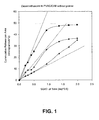
- the cumulative drug release per area of sample size was plotted as a function of square root of time. Theoretically, cumulative release per area should be a linear function of square root of time at the early stage of release. Then the release rate decreases exponentially, approaching zero at infinitely long time.
- the release curves are plotted in Figure 1 .
- the elution profile observed during the initial elution period differed from the expected linear trend (shown as dashed lines in Fig. 1 ). It is believed that this deviation is attributable to delamination of the coating from the shim. Delamination causes the drug to release from the device prematurely, and therefore increases the rate of drug delivery.
Landscapes
- Health & Medical Sciences (AREA)
- Life Sciences & Earth Sciences (AREA)
- General Health & Medical Sciences (AREA)
- Veterinary Medicine (AREA)
- Public Health (AREA)
- Epidemiology (AREA)
- Animal Behavior & Ethology (AREA)
- Chemical & Material Sciences (AREA)
- Medicinal Chemistry (AREA)
- Engineering & Computer Science (AREA)
- Biomedical Technology (AREA)
- Molecular Biology (AREA)
- Transplantation (AREA)
- Oral & Maxillofacial Surgery (AREA)
- Dermatology (AREA)
- Heart & Thoracic Surgery (AREA)
- Surgery (AREA)
- Vascular Medicine (AREA)
- Materials For Medical Uses (AREA)
Claims (25)
- Ein Verfahren zur Herstellung einer medizinischen Vorrichtung, das folgendes umfasst:Aufbringen eines Unterschichtpolymers auf eine Substratoberfläche zur Bildung einer polymeren Unterschicht;Behandeln der polymeren Unterschicht zur Wiederaufschmelzung des Unterschichtpolymers und Herbeiführung der Bildung einer konformen Schnittstelle zwischen der Unterschicht und der Substratoberfläche; undAufbringen eines Deckschichtpolymers auf die Unterschicht zur Bildung einer polymeren Deckschicht.
- Das Verfahren nach Anspruch 1, wobei das Unterschichtpolymer polare Gruppen umfasst, die aus der Gruppe ausgewählt sind, die aus Hydroxyl, Amin, Carboxyl, Ether, Ester, Sulfoxid, Sulfon, Carbamid, Amid, Urethan, Thiol, Carbonat, Acetal, Carbonsäure, Alkylhalogenid und Kombinationen davon besteht.
- Das Verfahren nach Anspruch 1 oder Anspruch 2, wobei die durchschnittliche Dicke der Unterschicht weniger als etwa 1 µm beträgt.
- Das Verfahren nach einem der Ansprüche 1 bis 3, wobei das Unterschichtpolymer auf die Substratoberfläche unter Verwendung eines Verfahrens aufgebracht wird, das aus der Gruppe ausgewählt ist, die aus einem Löseprozess, einer Pulverbeschichtung, einer Schmelzextrusion, einer Gasphasenabscheidung und einem Langmuir-Blodgett-Prozess besteht.
- Das Verfahren nach Anspruch 4, wobei der Löseprozess Sprühbeschichtung, Tauchbeschichtung oder Schleuderbeschichtung umfasst.
- Das Verfahren nach einem vorstehenden Anspruch, wobei die polymere Unterschicht mindestens ein Polymer umfasst, das aus der Gruppe ausgewählt ist, die aus einem Polyurethan, einem Polyester, einem Polycarbonat, einem Polymethacrylat, einem Polysulfon, einem Polyimid, einem Polyamid, einem linearen Epoxid, einem Polyacetal, einem Vinylpolymer und einem beliebigen Blend oder Copolymer davon besteht.
- Das Verfahren nach einem der Ansprüche 1 bis 5, wobei die polymere Unterschicht ein Polyurethan umfasst.
- Das Verfahren nach einem vorstehenden Anspruch, wobei die Unterschicht kein Hydrogel umfasst.
- Das Verfahren nach einem vorstehenden Anspruch, wobei die Unterschicht nicht vernetzt ist.
- Das Verfahren nach einem vorstehenden Anspruch, wobei das Unterschichtpolymer vor der Aufbringung auf die Substratoberfläche polymerisiert ist.
- Das Verfahren nach einem vorstehenden Anspruch, wobei die Unterschicht zur Wiederaufschmelzung des Unterschichtpolymers unter Verwendung eines Verfahrens behandelt wird, das aus der Gruppe ausgewählt ist, die aus Wärmebehandlung, Infrarotbehandlung Mikrowellenbehandlung, HF-Behandlung, mechanischer Behandlung und Lösungsmittelbehandlung besteht.
- Das Verfahren nach einem der Ansprüche 1 bis 10, wobei die Unterschicht auf mindestens etwa Schmelztemperatur des Unterschichtpolymers für eine zur Wiederaufschmelzung des Polymers ausreichende Zeit erwärmt wird.
- Das Verfahren nach einem der Ansprüche 1 bis 10, wobei die Behandlung der Unterschicht zur Wiederaufschmelzung des Unterschichtpolymers das Erwärmen der Unterschicht auf mindestens etwa 200 °C für eine zur Wiederaufschmelzung des Unterschichtpolymers ausreichende Zeitdauer umfasst.
- Das Verfahren nach einem vorstehenden Anspruch, wobei die Deckschicht einen Wirkstoff umfasst.
- Das Verfahren nach Anspruch 14, wobei der Wirkstoff in einer höheren Konzentration in der Deckschicht als in der Unterschicht vorhanden ist.
- Das Verfahren nach Anspruch 14 oder Anspruch 15, wobei der Wirkstoff aus der Gruppe ausgewählt ist, die aus einem anti-thrombogenen Mittel, einem gerinnungshemmenden Mittel, einem anti-mikrobiellen Mittel, einem anti-neoplastischen Mittel, einem anti-proliferativen Mittel, einem Antiplättchenmittel, einem Antimetaboliten und einem entzündungshemmenden Mittel besteht.
- Das Verfahren nach einem vorstehenden Anspruch, wobei die Substratoberfläche ein Material umfasst, das aus der Gruppe ausgewählt ist, die aus Keramik, Glas, Metall und einem Polymer besteht.
- Das Verfahren nach Anspruch 17, wobei das Metall aus der Gruppe ausgewählt ist, die aus Eisen, Nickel, Gold, Cobalt, Kupfer, Chrom, Molybdän, Titan, Tantal, Aluminium, Silber, Platin, Kohlenstoff und Legierungen davon besteht.
- Das Verfahren nach Anspruch 18, wobei die Legierung Edelstahl, eine Nickel-Tantal-Legierung oder eine Cobalt-Chrom-Legierung ist.
- Das Verfahren nach einem vorstehenden Anspruch, wobei die Substratoberfläche vor der Aufbringung auf die Unterschicht nicht aktiviert oder funktionalisiert ist.
- Eine medizinische Vorrichtung, die nach einem Verfahren wie in einem der Ansprüche 1 bis 20 beansprucht hergestellt ist.
- Die medizinische Vorrichtung nach Anspruch 21, die eine implantierbare Vorrichtung ist.
- Die medizinische Vorrichtung nach Anspruch 21, die eine extrakorporale Vorrichtung ist.
- Die medizinische Vorrichtung nach Anspruch 21, die aus der Gruppe ausgewählt ist, die aus einem Stent, einem Stenttransplantat, einer anastomotischen Verbindung, einer Führung, einer Nadel, einem Führungsdraht, einem Katheter, einem Sensor, einem chirurgischen Instrument, einem Angioplastie-Ballon, einem Abflussschlauch für Wunden, einem Shunt, einer Rohrleitung, einem Harnröhreneinsatz, einem Pellet, einem Implantat, einem Blutoxygenator, einer Pumpe, einem vaskulären Transplantat, einem Ventil, einem Pacemaker, einer orthopädischen Vorrichtung, einer Austauschvorrichtung für den Nucleus pulposus und einer intraokularen Linse besteht.
- Die medizinische Vorrichtung nach Anspruch 21, die ein Stent ist.
Applications Claiming Priority (3)
| Application Number | Priority Date | Filing Date | Title |
|---|---|---|---|
| US40347902P | 2002-08-13 | 2002-08-13 | |
| US403479P | 2002-08-13 | ||
| PCT/US2003/025463 WO2004014453A1 (en) | 2002-08-13 | 2003-08-13 | Medical device exhibiting improved adhesion between polymeric coating and substrate |
Publications (2)
| Publication Number | Publication Date |
|---|---|
| EP1534356A1 EP1534356A1 (de) | 2005-06-01 |
| EP1534356B1 true EP1534356B1 (de) | 2010-07-28 |
Family
ID=31715984
Family Applications (1)
| Application Number | Title | Priority Date | Filing Date |
|---|---|---|---|
| EP03785284A Expired - Lifetime EP1534356B1 (de) | 2002-08-13 | 2003-08-13 | Medizinische vorrichtung mit verbesserter haftung zwischen einem polymeren berzug und einem substrat |
Country Status (8)
| Country | Link |
|---|---|
| US (2) | US20040039437A1 (de) |
| EP (1) | EP1534356B1 (de) |
| JP (1) | JP2006500088A (de) |
| AT (1) | ATE475435T1 (de) |
| AU (1) | AU2003258230A1 (de) |
| CA (1) | CA2495176A1 (de) |
| DE (1) | DE60333566D1 (de) |
| WO (1) | WO2004014453A1 (de) |
Cited By (7)
| Publication number | Priority date | Publication date | Assignee | Title |
|---|---|---|---|---|
| US8597720B2 (en) | 2007-01-21 | 2013-12-03 | Hemoteq Ag | Medical product for treating stenosis of body passages and for preventing threatening restenosis |
| US8669360B2 (en) | 2011-08-05 | 2014-03-11 | Boston Scientific Scimed, Inc. | Methods of converting amorphous drug substance into crystalline form |
| US8889211B2 (en) | 2010-09-02 | 2014-11-18 | Boston Scientific Scimed, Inc. | Coating process for drug delivery balloons using heat-induced rewrap memory |
| US9056152B2 (en) | 2011-08-25 | 2015-06-16 | Boston Scientific Scimed, Inc. | Medical device with crystalline drug coating |
| US9192697B2 (en) | 2007-07-03 | 2015-11-24 | Hemoteq Ag | Balloon catheter for treating stenosis of body passages and for preventing threatening restenosis |
| US10080821B2 (en) | 2009-07-17 | 2018-09-25 | Boston Scientific Scimed, Inc. | Nucleation of drug delivery balloons to provide improved crystal size and density |
| US11278648B2 (en) | 2009-07-10 | 2022-03-22 | Boston Scientific Scimed, Inc. | Use of nanocrystals for drug delivery from a balloon |
Families Citing this family (66)
| Publication number | Priority date | Publication date | Assignee | Title |
|---|---|---|---|---|
| JPH02184274A (ja) * | 1988-08-11 | 1990-07-18 | Nec Corp | 超音波モータとその駆動方法 |
| PT1019111E (pt) * | 1998-04-27 | 2002-10-31 | Surmodics Inc | Revestimento que liberta um agente bioactivo |
| US20020188037A1 (en) * | 1999-04-15 | 2002-12-12 | Chudzik Stephen J. | Method and system for providing bioactive agent release coating |
| US7097850B2 (en) * | 2002-06-18 | 2006-08-29 | Surmodics, Inc. | Bioactive agent release coating and controlled humidity method |
| US20030232087A1 (en) * | 2002-06-18 | 2003-12-18 | Lawin Laurie R. | Bioactive agent release coating with aromatic poly(meth)acrylates |
| DE60331552D1 (de) * | 2002-08-13 | 2010-04-15 | Medtronic Inc | Darreichungssysteme von wirkstoffen mit poly(ethylene-co(meth)akrylate, medizinische vorrichtung und verfahren |
| US20040086569A1 (en) * | 2002-08-13 | 2004-05-06 | Medtronic, Inc. | Active agent delivery systems, medical devices, and methods |
| ATE374049T1 (de) * | 2002-08-13 | 2007-10-15 | Medtronic Inc | System zur abgabe von wirkstoffen mit einem hydrophoben cellulose-derivat |
| CA2495181A1 (en) * | 2002-08-13 | 2004-02-19 | Medtronic, Inc. | Active agent delivery system including a hydrophilic polymer, medical device, and method |
| US6923754B2 (en) * | 2002-11-06 | 2005-08-02 | Senorx, Inc. | Vacuum device and method for treating tissue adjacent a body cavity |
| US8328710B2 (en) * | 2002-11-06 | 2012-12-11 | Senorx, Inc. | Temporary catheter for biopsy site tissue fixation |
| US20040180131A1 (en) * | 2003-03-14 | 2004-09-16 | Medtronic Ave. | Stent coating method |
| US20050112273A1 (en) * | 2003-05-19 | 2005-05-26 | Stenzel Eric B. | Method of improving the quality and performance of a coating on a coated medical device using a solvent to reflow the coating |
| US7524527B2 (en) | 2003-05-19 | 2009-04-28 | Boston Scientific Scimed, Inc. | Electrostatic coating of a device |
| US6979348B2 (en) * | 2003-06-04 | 2005-12-27 | Medtronic Vascular, Inc. | Reflowed drug-polymer coated stent and method thereof |
| EP1660145A2 (de) * | 2003-08-13 | 2006-05-31 | Medtronic, Inc. | Wirkstoff-abgabesysteme mit einer einzelnen schicht aus einer polymermischung, medizinprodukte und verfahren |
| US20060083772A1 (en) * | 2004-04-06 | 2006-04-20 | Dewitt David M | Coating compositions for bioactive agents |
| CN1964749A (zh) * | 2004-04-06 | 2007-05-16 | 苏莫迪克斯公司 | 用于生物活性剂的涂料组合物 |
| US20050256510A1 (en) * | 2004-04-28 | 2005-11-17 | Medtronic, Inc. | Ventriculo-sinus shunting for disease treatment |
| US7662082B2 (en) | 2004-11-05 | 2010-02-16 | Theragenics Corporation | Expandable brachytherapy device |
| JP5749881B2 (ja) | 2005-04-22 | 2015-07-15 | ユニヴェルシテ デ ジュネーブ | ポリラクチド組成物およびその使用 |
| US7413539B2 (en) * | 2005-11-18 | 2008-08-19 | Senorx, Inc. | Treatment of a body cavity |
| US8273006B2 (en) * | 2005-11-18 | 2012-09-25 | Senorx, Inc. | Tissue irradiation |
| US7465268B2 (en) | 2005-11-18 | 2008-12-16 | Senorx, Inc. | Methods for asymmetrical irradiation of a body cavity |
| US20070299511A1 (en) * | 2006-06-27 | 2007-12-27 | Gale David C | Thin stent coating |
| US7875697B2 (en) * | 2006-06-29 | 2011-01-25 | Medtronic, Inc. | Poly(orthoester) polymers, and methods of making and using same |
| AU2007271554B2 (en) * | 2006-07-03 | 2011-02-10 | Hemoteq Ag | Manufacture, method, and use of active substance-releasing medical products for permanently keeping blood vessels open |
| US20080075753A1 (en) | 2006-09-25 | 2008-03-27 | Chappa Ralph A | Multi-layered coatings and methods for controlling elution of active agents |
| US20080119762A1 (en) * | 2006-11-16 | 2008-05-22 | Tateishi Tadasu | Guide wire |
| US8287442B2 (en) | 2007-03-12 | 2012-10-16 | Senorx, Inc. | Radiation catheter with multilayered balloon |
| US8740873B2 (en) * | 2007-03-15 | 2014-06-03 | Hologic, Inc. | Soft body catheter with low friction lumen |
| US7673379B1 (en) * | 2007-05-11 | 2010-03-09 | Abbott Cardiovascular Systems Inc. | Method of producing a stent-balloon assembly |
| DE102007036685A1 (de) * | 2007-08-03 | 2009-02-05 | Innora Gmbh | Verbesserte arzneimittelbeschichtete Medizinprodukte deren Herstellung und Verwendung |
| US8360950B2 (en) * | 2008-01-24 | 2013-01-29 | Senorx, Inc. | Multilumen brachytherapy balloon catheter |
| US8956642B2 (en) * | 2008-04-18 | 2015-02-17 | Medtronic, Inc. | Bupivacaine formulation in a polyorthoester carrier |
| US8475823B2 (en) * | 2008-04-18 | 2013-07-02 | Medtronic, Inc. | Baclofen formulation in a polyorthoester carrier |
| US20090326077A1 (en) | 2008-06-27 | 2009-12-31 | Cardiac Pacemakers, Inc. | Polyisobutylene urethane, urea and urethane/urea copolymers and medical devices containing the same |
| US20100010287A1 (en) * | 2008-07-09 | 2010-01-14 | Senorx, Inc. | Brachytherapy device with one or more toroidal balloons |
| CN102365308B (zh) | 2009-01-12 | 2014-03-12 | 马萨诸塞大学卢维尔分校 | 聚异丁烯基聚氨酯 |
| US9579524B2 (en) | 2009-02-11 | 2017-02-28 | Hologic, Inc. | Flexible multi-lumen brachytherapy device |
| US9248311B2 (en) | 2009-02-11 | 2016-02-02 | Hologic, Inc. | System and method for modifying a flexibility of a brachythereapy catheter |
| US9289540B2 (en) * | 2009-05-08 | 2016-03-22 | Greatbatch Ltd. | Surface modification for coating |
| US10207126B2 (en) | 2009-05-11 | 2019-02-19 | Cytyc Corporation | Lumen visualization and identification system for multi-lumen balloon catheter |
| CN102573940B (zh) | 2009-08-21 | 2015-04-01 | 心脏起搏器公司 | 可交联聚异丁烯类聚合物及包含其的医疗装置 |
| US8644952B2 (en) | 2009-09-02 | 2014-02-04 | Cardiac Pacemakers, Inc. | Medical devices including polyisobutylene based polymers and derivatives thereof |
| US8374704B2 (en) | 2009-09-02 | 2013-02-12 | Cardiac Pacemakers, Inc. | Polyisobutylene urethane, urea and urethane/urea copolymers and medical leads containing the same |
| WO2011040218A1 (ja) * | 2009-09-30 | 2011-04-07 | テルモ株式会社 | ステント |
| AU2015261573B2 (en) * | 2009-09-30 | 2017-06-08 | Terumo Kabushiki Kaisha | Stent |
| US9352172B2 (en) | 2010-09-30 | 2016-05-31 | Hologic, Inc. | Using a guide member to facilitate brachytherapy device swap |
| EP2637734B1 (de) * | 2010-11-09 | 2017-09-13 | Tepha, Inc. | Wirkstoffabgebende cochleaimplantate |
| EP2654877B1 (de) | 2010-12-20 | 2016-08-24 | Cardiac Pacemakers, Inc. | Elektrode mit leitfähigem polymerleiter |
| US10342992B2 (en) | 2011-01-06 | 2019-07-09 | Hologic, Inc. | Orienting a brachytherapy applicator |
| CN104520345B (zh) | 2012-11-21 | 2017-10-03 | 马萨诸塞州大学 | 高强度聚氨异丁烯聚氨甲酸酯 |
| JP6513643B2 (ja) * | 2013-06-07 | 2019-05-15 | バクスター・インターナショナル・インコーポレイテッドBaxter International Incorp0Rated | トリヒドロキシフェニル基を含む化合物を使用する基体上の活性剤の固定化 |
| WO2014200868A2 (en) | 2013-06-09 | 2014-12-18 | Apple Inc. | Laser-formed features |
| JP6756733B2 (ja) | 2015-03-30 | 2020-09-16 | シー・アール・バード・インコーポレーテッドC R Bard Incorporated | 医療用装置、カテーテルアセンブリ、医療用装置用のルアーコネクタ、及び医療用装置の製造方法 |
| CA2982591C (en) | 2015-04-16 | 2024-04-30 | Hollister Incorporated | Hydrophilic coatings and methods of forming the same |
| WO2018165273A1 (en) | 2017-03-07 | 2018-09-13 | Cardiac Pacemakers, Inc. | Hydroboration/oxidation of allyl-terminated polyisobutylene |
| CN110997746B (zh) | 2017-08-17 | 2021-12-28 | 心脏起搏器股份公司 | 用于增强的耐久性的光交联聚合物 |
| WO2019143629A1 (en) | 2018-01-17 | 2019-07-25 | Cardiac Pacemakers, Inc. | End-capped polyisobutylene polyurethane |
| US11730863B2 (en) | 2018-07-02 | 2023-08-22 | C. R. Bard, Inc. | Antimicrobial catheter assemblies and methods thereof |
| EP3629244B1 (de) * | 2018-09-27 | 2023-01-11 | Apple Inc. | Elektronische karte mit einer elektronischen schnittstelle |
| US11200386B2 (en) * | 2018-09-27 | 2021-12-14 | Apple Inc. | Electronic card having an electronic interface |
| US11571766B2 (en) | 2018-12-10 | 2023-02-07 | Apple Inc. | Laser marking of an electronic device through a cover |
| US11299421B2 (en) | 2019-05-13 | 2022-04-12 | Apple Inc. | Electronic device enclosure with a glass member having an internal encoded marking |
| CN120242155B (zh) * | 2025-03-19 | 2026-04-21 | 上海交通大学医学院附属瑞金医院 | 一种微生物原位合成一体化覆膜支架及其制备方法与应用 |
Family Cites Families (67)
| Publication number | Priority date | Publication date | Assignee | Title |
|---|---|---|---|---|
| US4100309A (en) * | 1977-08-08 | 1978-07-11 | Biosearch Medical Products, Inc. | Coated substrate having a low coefficient of friction hydrophilic coating and a method of making the same |
| US4504604A (en) * | 1983-11-25 | 1985-03-12 | The Goodyear Tire & Rubber Company | Energy absorbing rubber composition |
| US4904247A (en) * | 1984-08-31 | 1990-02-27 | Kendall Company | Pressure-sensitive hydrophilic laminate structures for use in wound dressing, transdermal and topical drug delivery |
| US5506300A (en) * | 1985-01-04 | 1996-04-09 | Thoratec Laboratories Corporation | Compositions that soften at predetermined temperatures and the method of making same |
| US4891409A (en) * | 1986-04-24 | 1990-01-02 | R.J.F. International | Single phase shape-transformable elastomeric compounds |
| US5001009A (en) * | 1987-09-02 | 1991-03-19 | Sterilization Technical Services, Inc. | Lubricious hydrophilic composite coated on substrates |
| US5474783A (en) * | 1988-03-04 | 1995-12-12 | Noven Pharmaceuticals, Inc. | Solubility parameter based drug delivery system and method for altering drug saturation concentration |
| US4873126A (en) * | 1988-08-15 | 1989-10-10 | Becton, Dickinson And Company | System and process for spotting reagents on porous supports |
| US4873308A (en) * | 1988-09-30 | 1989-10-10 | Medtronic, Inc. | Biostable, segmented aliphatic polyurethanes and process therefor |
| JP3051411B2 (ja) * | 1989-03-14 | 2000-06-12 | 持田製薬株式会社 | 新規dnaならびにそれを含有する発現プラスミド |
| US5225514A (en) * | 1989-03-17 | 1993-07-06 | Ono Pharmaceutical Co., Ltd. | Azo containing polyurethanes for drug delivery to the large intestines |
| US5496359A (en) * | 1989-07-25 | 1996-03-05 | Smith & Nephew Richards, Inc. | Zirconium oxide and zirconium nitride coated biocompatible leads |
| US5069899A (en) * | 1989-11-02 | 1991-12-03 | Sterilization Technical Services, Inc. | Anti-thrombogenic, anti-microbial compositions containing heparin |
| US5059166A (en) * | 1989-12-11 | 1991-10-22 | Medical Innovative Technologies R & D Limited Partnership | Intra-arterial stent with the capability to inhibit intimal hyperplasia |
| DE69232555T2 (de) * | 1991-02-01 | 2002-10-31 | Massachusetts Institute Of Technology, Cambridge | Biologisch abbaubare Polymermischungen zur Arzneistoffabgabe |
| US5326570A (en) * | 1991-07-23 | 1994-07-05 | Pharmavene, Inc. | Advanced drug delivery system and method of treating psychiatric, neurological and other disorders with carbamazepine |
| JP3466186B2 (ja) * | 1992-02-24 | 2003-11-10 | エドワーズ ライフサイエンシーズ コーポレイション | トルク伝達カテーテル用の重合体配合物 |
| US5383928A (en) * | 1992-06-10 | 1995-01-24 | Emory University | Stent sheath for local drug delivery |
| JPH08507715A (ja) * | 1993-03-18 | 1996-08-20 | シーダーズ サイナイ メディカル センター | 生体人工部材のための薬剤導入性および放出性重合性コーティング |
| US5919570A (en) * | 1995-02-01 | 1999-07-06 | Schneider Inc. | Slippery, tenaciously adhering hydrogel coatings containing a polyurethane-urea polymer hydrogel commingled with a poly(N-vinylpyrrolidone) polymer hydrogel, coated polymer and metal substrate materials, and coated medical devices |
| US5676972A (en) * | 1995-02-16 | 1997-10-14 | The University Of Akron | Time-release delivery matrix composition and corresponding controlled-release compositions |
| US6147168A (en) * | 1995-03-06 | 2000-11-14 | Ethicon, Inc. | Copolymers of absorbable polyoxaesters |
| US5733538A (en) * | 1995-06-07 | 1998-03-31 | Thoratec Laboratories, Inc. | Surface-modifying copolymers having cell adhesion properties |
| US5868704A (en) * | 1995-09-18 | 1999-02-09 | W. L. Gore & Associates, Inc. | Balloon catheter device |
| NL1001746C2 (nl) * | 1995-11-27 | 1997-05-30 | Belden Wire & Cable Bv | Geleidedraad voor medische toepassing. |
| US5722984A (en) * | 1996-01-16 | 1998-03-03 | Iso Stent, Inc. | Antithrombogenic radioactive coating for an intravascular stent |
| US5928279A (en) * | 1996-07-03 | 1999-07-27 | Baxter International Inc. | Stented, radially expandable, tubular PTFE grafts |
| US5871437A (en) * | 1996-12-10 | 1999-02-16 | Inflow Dynamics, Inc. | Radioactive stent for treating blood vessels to prevent restenosis |
| JPH10201841A (ja) * | 1997-01-23 | 1998-08-04 | Toyobo Co Ltd | 易滑性医療用具およびその製造方法 |
| US5997517A (en) * | 1997-01-27 | 1999-12-07 | Sts Biopolymers, Inc. | Bonding layers for medical device surface coatings |
| US6111052A (en) * | 1997-04-30 | 2000-08-29 | Medtronic, Inc. | Polyurethane and polyurea biomaterials for use in medical devices |
| US6915168B1 (en) * | 1997-05-08 | 2005-07-05 | Michael D. Benz | Medical devices containing segmented polyurethane biomaterials |
| US6077916A (en) * | 1997-06-04 | 2000-06-20 | The Penn State Research Foundation | Biodegradable mixtures of polyphoshazene and other polymers |
| US6110483A (en) * | 1997-06-23 | 2000-08-29 | Sts Biopolymers, Inc. | Adherent, flexible hydrogel and medicated coatings |
| EP1032435B1 (de) * | 1997-10-31 | 2003-09-03 | Children's Medical Center Corporation | Blasenrekonstruktion |
| US5839313A (en) * | 1998-02-18 | 1998-11-24 | Danieli United, A Division Of Danieli Corporation | Rolling mill with intermediate crossed rolls background |
| US6074660A (en) * | 1998-04-20 | 2000-06-13 | Ethicon, Inc. | Absorbable polyoxaesters containing amines and/ or amido groups |
| PT1019111E (pt) * | 1998-04-27 | 2002-10-31 | Surmodics Inc | Revestimento que liberta um agente bioactivo |
| WO1999056663A2 (en) * | 1998-05-05 | 1999-11-11 | Scimed Life Systems, Inc. | Stent with smooth ends |
| US6153252A (en) * | 1998-06-30 | 2000-11-28 | Ethicon, Inc. | Process for coating stents |
| US6335029B1 (en) * | 1998-08-28 | 2002-01-01 | Scimed Life Systems, Inc. | Polymeric coatings for controlled delivery of active agents |
| US6673102B1 (en) * | 1999-01-22 | 2004-01-06 | Gore Enterprises Holdings, Inc. | Covered endoprosthesis and delivery system |
| US20010000801A1 (en) * | 1999-03-22 | 2001-05-03 | Miller Paul J. | Hydrophilic sleeve |
| US6368658B1 (en) * | 1999-04-19 | 2002-04-09 | Scimed Life Systems, Inc. | Coating medical devices using air suspension |
| US6155989A (en) * | 1999-06-25 | 2000-12-05 | The United States Of America As Represented By The United States Department Of Energy | Vacuum enhanced cutaneous biopsy instrument |
| US6258121B1 (en) * | 1999-07-02 | 2001-07-10 | Scimed Life Systems, Inc. | Stent coating |
| US6790228B2 (en) * | 1999-12-23 | 2004-09-14 | Advanced Cardiovascular Systems, Inc. | Coating for implantable devices and a method of forming the same |
| HK1049443A1 (zh) * | 1999-11-12 | 2003-05-16 | Angiotech Pharmaceuticals, Inc. | 用放射活性疗法和细胞循环抑制剂联合治疗疾病的组合物和方法 |
| AU2001253479A1 (en) * | 2000-04-13 | 2001-10-30 | Sts Biopolymers, Inc. | Targeted therapeutic agent release devices and methods of making and using the same |
| DE60117251T2 (de) * | 2000-05-16 | 2006-11-16 | Ortho-Mcneil Pharmaceutical, Inc. | Verfahren zur beschichtung von medizinischen geräten unter verwendung von superkritischem kohlendioxid |
| WO2002026281A1 (en) * | 2000-09-29 | 2002-04-04 | Cordis Corporation | Coated medical devices |
| WO2002026139A1 (en) * | 2000-09-29 | 2002-04-04 | Cordis Corporation | Coated medical devices |
| US20020082679A1 (en) * | 2000-12-22 | 2002-06-27 | Avantec Vascular Corporation | Delivery or therapeutic capable agents |
| US6824559B2 (en) * | 2000-12-22 | 2004-11-30 | Advanced Cardiovascular Systems, Inc. | Ethylene-carboxyl copolymers as drug delivery matrices |
| US6471980B2 (en) * | 2000-12-22 | 2002-10-29 | Avantec Vascular Corporation | Intravascular delivery of mycophenolic acid |
| US20020127263A1 (en) * | 2001-02-27 | 2002-09-12 | Wenda Carlyle | Peroxisome proliferator-acitvated receptor gamma ligand eluting medical device |
| US7175873B1 (en) * | 2001-06-27 | 2007-02-13 | Advanced Cardiovascular Systems, Inc. | Rate limiting barriers for implantable devices and methods for fabrication thereof |
| US7056338B2 (en) * | 2003-03-28 | 2006-06-06 | Conor Medsystems, Inc. | Therapeutic agent delivery device with controlled therapeutic agent release rates |
| IN2014DN10834A (de) * | 2001-09-17 | 2015-09-04 | Psivida Inc | |
| US20030077310A1 (en) * | 2001-10-22 | 2003-04-24 | Chandrashekhar Pathak | Stent coatings containing HMG-CoA reductase inhibitors |
| US7473273B2 (en) * | 2002-01-22 | 2009-01-06 | Medtronic Vascular, Inc. | Stent assembly with therapeutic agent exterior banding |
| KR20040108651A (ko) * | 2002-02-07 | 2004-12-24 | 루트거스, 더 스테이트 유니버시티 오브 뉴 저지 | 치료용 폴리에스테르 및 폴리아미드 |
| CA2495181A1 (en) * | 2002-08-13 | 2004-02-19 | Medtronic, Inc. | Active agent delivery system including a hydrophilic polymer, medical device, and method |
| US20040086569A1 (en) * | 2002-08-13 | 2004-05-06 | Medtronic, Inc. | Active agent delivery systems, medical devices, and methods |
| WO2004014449A1 (en) * | 2002-08-13 | 2004-02-19 | Medtronic, Inc. | Active agent delivery system including a polyurethane, medical device, and method |
| ATE374049T1 (de) * | 2002-08-13 | 2007-10-15 | Medtronic Inc | System zur abgabe von wirkstoffen mit einem hydrophoben cellulose-derivat |
| DE60331552D1 (de) * | 2002-08-13 | 2010-04-15 | Medtronic Inc | Darreichungssysteme von wirkstoffen mit poly(ethylene-co(meth)akrylate, medizinische vorrichtung und verfahren |
-
2003
- 2003-08-13 AT AT03785284T patent/ATE475435T1/de not_active IP Right Cessation
- 2003-08-13 EP EP03785284A patent/EP1534356B1/de not_active Expired - Lifetime
- 2003-08-13 US US10/640,701 patent/US20040039437A1/en not_active Abandoned
- 2003-08-13 WO PCT/US2003/025463 patent/WO2004014453A1/en not_active Ceased
- 2003-08-13 AU AU2003258230A patent/AU2003258230A1/en not_active Abandoned
- 2003-08-13 CA CA002495176A patent/CA2495176A1/en not_active Abandoned
- 2003-08-13 JP JP2004528130A patent/JP2006500088A/ja active Pending
- 2003-08-13 DE DE60333566T patent/DE60333566D1/de not_active Expired - Lifetime
-
2007
- 2007-08-06 US US11/890,416 patent/US20070276504A1/en not_active Abandoned
Cited By (7)
| Publication number | Priority date | Publication date | Assignee | Title |
|---|---|---|---|---|
| US8597720B2 (en) | 2007-01-21 | 2013-12-03 | Hemoteq Ag | Medical product for treating stenosis of body passages and for preventing threatening restenosis |
| US9192697B2 (en) | 2007-07-03 | 2015-11-24 | Hemoteq Ag | Balloon catheter for treating stenosis of body passages and for preventing threatening restenosis |
| US11278648B2 (en) | 2009-07-10 | 2022-03-22 | Boston Scientific Scimed, Inc. | Use of nanocrystals for drug delivery from a balloon |
| US10080821B2 (en) | 2009-07-17 | 2018-09-25 | Boston Scientific Scimed, Inc. | Nucleation of drug delivery balloons to provide improved crystal size and density |
| US8889211B2 (en) | 2010-09-02 | 2014-11-18 | Boston Scientific Scimed, Inc. | Coating process for drug delivery balloons using heat-induced rewrap memory |
| US8669360B2 (en) | 2011-08-05 | 2014-03-11 | Boston Scientific Scimed, Inc. | Methods of converting amorphous drug substance into crystalline form |
| US9056152B2 (en) | 2011-08-25 | 2015-06-16 | Boston Scientific Scimed, Inc. | Medical device with crystalline drug coating |
Also Published As
| Publication number | Publication date |
|---|---|
| EP1534356A1 (de) | 2005-06-01 |
| WO2004014453A1 (en) | 2004-02-19 |
| AU2003258230A1 (en) | 2004-02-25 |
| US20070276504A1 (en) | 2007-11-29 |
| ATE475435T1 (de) | 2010-08-15 |
| DE60333566D1 (de) | 2010-09-09 |
| CA2495176A1 (en) | 2004-02-19 |
| US20040039437A1 (en) | 2004-02-26 |
| JP2006500088A (ja) | 2006-01-05 |
Similar Documents
| Publication | Publication Date | Title |
|---|---|---|
| US20040039437A1 (en) | Medical device exhibiting improved adhesion between polymeric coating and substrate | |
| US6663662B2 (en) | Diffusion barrier layer for implantable devices | |
| US6908624B2 (en) | Coating for implantable devices and a method of forming the same | |
| EP1233795B1 (de) | Elektropolymerisierbare monomere und polymerbeschichtungen auf implantierbaren geräten | |
| US20050064005A1 (en) | Active agent delivery systems including a miscible polymer blend, medical devices, and methods | |
| US6790228B2 (en) | Coating for implantable devices and a method of forming the same | |
| US20040127978A1 (en) | Active agent delivery system including a hydrophilic polymer, medical device, and method | |
| US20040033251A1 (en) | Active agent delivery system including a polyurethane, medical device, and method | |
| US9056156B2 (en) | Medical devices comprising polymeric drug delivery systems with drug solubility gradients | |
| US20050064038A1 (en) | Active agent delivery systems including a single layer of a miscible polymer blend, medical devices, and methods | |
| US20040047911A1 (en) | Active agent delivery system including a poly(ethylene-co-(meth)Acrylate), medical device, and method | |
| US20040086569A1 (en) | Active agent delivery systems, medical devices, and methods | |
| US20040115273A1 (en) | Active agent delivery system including a hydrophobic cellulose derivative, medical device, and method | |
| JP5816666B2 (ja) | 電気グラフト化されたプライマー被覆を付け、生物分解性放出層を備えた薬物溶離性ステント | |
| WO2006002112A1 (en) | Devices, articles, coatings, and methods for controlled active agent release | |
| HK1126695B (en) | Drug eluting stent with a biodegradable release layer attached with an electro-grafted primer coating |
Legal Events
| Date | Code | Title | Description |
|---|---|---|---|
| PUAI | Public reference made under article 153(3) epc to a published international application that has entered the european phase |
Free format text: ORIGINAL CODE: 0009012 |
|
| 17P | Request for examination filed |
Effective date: 20050314 |
|
| AK | Designated contracting states |
Kind code of ref document: A1 Designated state(s): AT BE BG CH CY CZ DE DK EE ES FI FR GB GR HU IE IT LI LU MC NL PT RO SE SI SK TR |
|
| AX | Request for extension of the european patent |
Extension state: AL LT LV MK |
|
| DAX | Request for extension of the european patent (deleted) | ||
| 17Q | First examination report despatched |
Effective date: 20061114 |
|
| GRAP | Despatch of communication of intention to grant a patent |
Free format text: ORIGINAL CODE: EPIDOSNIGR1 |
|
| GRAS | Grant fee paid |
Free format text: ORIGINAL CODE: EPIDOSNIGR3 |
|
| RAP1 | Party data changed (applicant data changed or rights of an application transferred) |
Owner name: MEDTRONIC, INC. |
|
| GRAA | (expected) grant |
Free format text: ORIGINAL CODE: 0009210 |
|
| AK | Designated contracting states |
Kind code of ref document: B1 Designated state(s): AT BE BG CH CY CZ DE DK EE ES FI FR GB GR HU IE IT LI LU MC NL PT RO SE SI SK TR |
|
| REG | Reference to a national code |
Ref country code: GB Ref legal event code: FG4D |
|
| REG | Reference to a national code |
Ref country code: CH Ref legal event code: EP |
|
| REG | Reference to a national code |
Ref country code: IE Ref legal event code: FG4D |
|
| REF | Corresponds to: |
Ref document number: 60333566 Country of ref document: DE Date of ref document: 20100909 Kind code of ref document: P |
|
| PGFP | Annual fee paid to national office [announced via postgrant information from national office to epo] |
Ref country code: IE Payment date: 20100825 Year of fee payment: 8 |
|
| REG | Reference to a national code |
Ref country code: NL Ref legal event code: VDEP Effective date: 20100728 |
|
| PGFP | Annual fee paid to national office [announced via postgrant information from national office to epo] |
Ref country code: DE Payment date: 20100831 Year of fee payment: 8 Ref country code: FR Payment date: 20100903 Year of fee payment: 8 |
|
| PG25 | Lapsed in a contracting state [announced via postgrant information from national office to epo] |
Ref country code: NL Free format text: LAPSE BECAUSE OF FAILURE TO SUBMIT A TRANSLATION OF THE DESCRIPTION OR TO PAY THE FEE WITHIN THE PRESCRIBED TIME-LIMIT Effective date: 20100728 Ref country code: FI Free format text: LAPSE BECAUSE OF FAILURE TO SUBMIT A TRANSLATION OF THE DESCRIPTION OR TO PAY THE FEE WITHIN THE PRESCRIBED TIME-LIMIT Effective date: 20100728 Ref country code: AT Free format text: LAPSE BECAUSE OF FAILURE TO SUBMIT A TRANSLATION OF THE DESCRIPTION OR TO PAY THE FEE WITHIN THE PRESCRIBED TIME-LIMIT Effective date: 20100728 |
|
| PG25 | Lapsed in a contracting state [announced via postgrant information from national office to epo] |
Ref country code: BG Free format text: LAPSE BECAUSE OF FAILURE TO SUBMIT A TRANSLATION OF THE DESCRIPTION OR TO PAY THE FEE WITHIN THE PRESCRIBED TIME-LIMIT Effective date: 20101028 Ref country code: CY Free format text: LAPSE BECAUSE OF FAILURE TO SUBMIT A TRANSLATION OF THE DESCRIPTION OR TO PAY THE FEE WITHIN THE PRESCRIBED TIME-LIMIT Effective date: 20100728 Ref country code: SI Free format text: LAPSE BECAUSE OF FAILURE TO SUBMIT A TRANSLATION OF THE DESCRIPTION OR TO PAY THE FEE WITHIN THE PRESCRIBED TIME-LIMIT Effective date: 20100728 Ref country code: PT Free format text: LAPSE BECAUSE OF FAILURE TO SUBMIT A TRANSLATION OF THE DESCRIPTION OR TO PAY THE FEE WITHIN THE PRESCRIBED TIME-LIMIT Effective date: 20101129 |
|
| PG25 | Lapsed in a contracting state [announced via postgrant information from national office to epo] |
Ref country code: SE Free format text: LAPSE BECAUSE OF FAILURE TO SUBMIT A TRANSLATION OF THE DESCRIPTION OR TO PAY THE FEE WITHIN THE PRESCRIBED TIME-LIMIT Effective date: 20100728 Ref country code: MC Free format text: LAPSE BECAUSE OF NON-PAYMENT OF DUE FEES Effective date: 20100831 Ref country code: GR Free format text: LAPSE BECAUSE OF FAILURE TO SUBMIT A TRANSLATION OF THE DESCRIPTION OR TO PAY THE FEE WITHIN THE PRESCRIBED TIME-LIMIT Effective date: 20101029 Ref country code: BE Free format text: LAPSE BECAUSE OF FAILURE TO SUBMIT A TRANSLATION OF THE DESCRIPTION OR TO PAY THE FEE WITHIN THE PRESCRIBED TIME-LIMIT Effective date: 20100728 |
|
| REG | Reference to a national code |
Ref country code: CH Ref legal event code: PL |
|
| PG25 | Lapsed in a contracting state [announced via postgrant information from national office to epo] |
Ref country code: CH Free format text: LAPSE BECAUSE OF NON-PAYMENT OF DUE FEES Effective date: 20100831 Ref country code: DK Free format text: LAPSE BECAUSE OF FAILURE TO SUBMIT A TRANSLATION OF THE DESCRIPTION OR TO PAY THE FEE WITHIN THE PRESCRIBED TIME-LIMIT Effective date: 20100728 Ref country code: LI Free format text: LAPSE BECAUSE OF NON-PAYMENT OF DUE FEES Effective date: 20100831 |
|
| PG25 | Lapsed in a contracting state [announced via postgrant information from national office to epo] |
Ref country code: RO Free format text: LAPSE BECAUSE OF FAILURE TO SUBMIT A TRANSLATION OF THE DESCRIPTION OR TO PAY THE FEE WITHIN THE PRESCRIBED TIME-LIMIT Effective date: 20100728 Ref country code: EE Free format text: LAPSE BECAUSE OF FAILURE TO SUBMIT A TRANSLATION OF THE DESCRIPTION OR TO PAY THE FEE WITHIN THE PRESCRIBED TIME-LIMIT Effective date: 20100728 Ref country code: CZ Free format text: LAPSE BECAUSE OF FAILURE TO SUBMIT A TRANSLATION OF THE DESCRIPTION OR TO PAY THE FEE WITHIN THE PRESCRIBED TIME-LIMIT Effective date: 20100728 Ref country code: SK Free format text: LAPSE BECAUSE OF FAILURE TO SUBMIT A TRANSLATION OF THE DESCRIPTION OR TO PAY THE FEE WITHIN THE PRESCRIBED TIME-LIMIT Effective date: 20100728 Ref country code: IT Free format text: LAPSE BECAUSE OF FAILURE TO SUBMIT A TRANSLATION OF THE DESCRIPTION OR TO PAY THE FEE WITHIN THE PRESCRIBED TIME-LIMIT Effective date: 20100728 |
|
| PLBE | No opposition filed within time limit |
Free format text: ORIGINAL CODE: 0009261 |
|
| GBPC | Gb: european patent ceased through non-payment of renewal fee |
Effective date: 20101028 |
|
| PG25 | Lapsed in a contracting state [announced via postgrant information from national office to epo] |
Ref country code: ES Free format text: LAPSE BECAUSE OF FAILURE TO SUBMIT A TRANSLATION OF THE DESCRIPTION OR TO PAY THE FEE WITHIN THE PRESCRIBED TIME-LIMIT Effective date: 20101108 |
|
| 26N | No opposition filed |
Effective date: 20110429 |
|
| REG | Reference to a national code |
Ref country code: DE Ref legal event code: R097 Ref document number: 60333566 Country of ref document: DE Effective date: 20110429 |
|
| PG25 | Lapsed in a contracting state [announced via postgrant information from national office to epo] |
Ref country code: GB Free format text: LAPSE BECAUSE OF NON-PAYMENT OF DUE FEES Effective date: 20101028 |
|
| REG | Reference to a national code |
Ref country code: FR Ref legal event code: ST Effective date: 20120430 |
|
| REG | Reference to a national code |
Ref country code: IE Ref legal event code: MM4A |
|
| REG | Reference to a national code |
Ref country code: DE Ref legal event code: R119 Ref document number: 60333566 Country of ref document: DE Effective date: 20120301 |
|
| PG25 | Lapsed in a contracting state [announced via postgrant information from national office to epo] |
Ref country code: IE Free format text: LAPSE BECAUSE OF NON-PAYMENT OF DUE FEES Effective date: 20110813 |
|
| PG25 | Lapsed in a contracting state [announced via postgrant information from national office to epo] |
Ref country code: FR Free format text: LAPSE BECAUSE OF NON-PAYMENT OF DUE FEES Effective date: 20110831 |
|
| PG25 | Lapsed in a contracting state [announced via postgrant information from national office to epo] |
Ref country code: LU Free format text: LAPSE BECAUSE OF NON-PAYMENT OF DUE FEES Effective date: 20100813 Ref country code: HU Free format text: LAPSE BECAUSE OF FAILURE TO SUBMIT A TRANSLATION OF THE DESCRIPTION OR TO PAY THE FEE WITHIN THE PRESCRIBED TIME-LIMIT Effective date: 20110129 |
|
| PG25 | Lapsed in a contracting state [announced via postgrant information from national office to epo] |
Ref country code: TR Free format text: LAPSE BECAUSE OF FAILURE TO SUBMIT A TRANSLATION OF THE DESCRIPTION OR TO PAY THE FEE WITHIN THE PRESCRIBED TIME-LIMIT Effective date: 20100728 |
|
| PG25 | Lapsed in a contracting state [announced via postgrant information from national office to epo] |
Ref country code: DE Free format text: LAPSE BECAUSE OF NON-PAYMENT OF DUE FEES Effective date: 20120301 |