EP1533586B1 - Zweifluidwärmetauscher mit offenporiger Struktur - Google Patents
Zweifluidwärmetauscher mit offenporiger Struktur Download PDFInfo
- Publication number
- EP1533586B1 EP1533586B1 EP03026915A EP03026915A EP1533586B1 EP 1533586 B1 EP1533586 B1 EP 1533586B1 EP 03026915 A EP03026915 A EP 03026915A EP 03026915 A EP03026915 A EP 03026915A EP 1533586 B1 EP1533586 B1 EP 1533586B1
- Authority
- EP
- European Patent Office
- Prior art keywords
- foam
- heat exchanger
- fluid heat
- exchanger according
- fluid
- Prior art date
- Legal status (The legal status is an assumption and is not a legal conclusion. Google has not performed a legal analysis and makes no representation as to the accuracy of the status listed.)
- Expired - Lifetime
Links
- 239000012530 fluid Substances 0.000 title claims abstract description 63
- 239000006260 foam Substances 0.000 claims abstract description 68
- 238000000034 method Methods 0.000 claims abstract description 21
- 238000004519 manufacturing process Methods 0.000 claims abstract description 15
- 239000011148 porous material Substances 0.000 claims description 28
- 210000003041 ligament Anatomy 0.000 claims description 27
- 239000000463 material Substances 0.000 claims description 18
- 238000009826 distribution Methods 0.000 claims description 7
- 239000003779 heat-resistant material Substances 0.000 claims description 7
- 239000007788 liquid Substances 0.000 claims description 7
- 238000005266 casting Methods 0.000 claims description 6
- 230000002349 favourable effect Effects 0.000 claims description 6
- 239000013528 metallic particle Substances 0.000 claims description 6
- 239000000919 ceramic Substances 0.000 claims description 5
- 238000005245 sintering Methods 0.000 claims description 5
- 230000005514 two-phase flow Effects 0.000 claims description 5
- 229920005830 Polyurethane Foam Polymers 0.000 claims description 4
- 238000010438 heat treatment Methods 0.000 claims description 4
- 229910001338 liquidmetal Inorganic materials 0.000 claims description 4
- 239000002984 plastic foam Substances 0.000 claims description 4
- 239000011496 polyurethane foam Substances 0.000 claims description 4
- 239000011248 coating agent Substances 0.000 claims description 3
- 238000000576 coating method Methods 0.000 claims description 3
- 239000002184 metal Substances 0.000 claims description 3
- 239000002904 solvent Substances 0.000 claims description 3
- OKTJSMMVPCPJKN-UHFFFAOYSA-N Carbon Chemical compound [C] OKTJSMMVPCPJKN-UHFFFAOYSA-N 0.000 claims description 2
- 239000011230 binding agent Substances 0.000 claims description 2
- 229910052799 carbon Inorganic materials 0.000 claims description 2
- 239000002131 composite material Substances 0.000 claims description 2
- 238000002156 mixing Methods 0.000 claims description 2
- 239000006262 metallic foam Substances 0.000 abstract description 10
- 230000008569 process Effects 0.000 description 9
- 238000012546 transfer Methods 0.000 description 9
- 230000008020 evaporation Effects 0.000 description 5
- 238000001704 evaporation Methods 0.000 description 5
- 238000009833 condensation Methods 0.000 description 4
- 230000005494 condensation Effects 0.000 description 4
- 238000013461 design Methods 0.000 description 3
- 238000011161 development Methods 0.000 description 3
- 230000018109 developmental process Effects 0.000 description 3
- 239000000203 mixture Substances 0.000 description 3
- 239000011505 plaster Substances 0.000 description 3
- 150000003839 salts Chemical class 0.000 description 3
- 210000004027 cell Anatomy 0.000 description 2
- 230000004048 modification Effects 0.000 description 2
- 238000012986 modification Methods 0.000 description 2
- 239000003507 refrigerant Substances 0.000 description 2
- 230000006978 adaptation Effects 0.000 description 1
- 230000008901 benefit Effects 0.000 description 1
- 230000006835 compression Effects 0.000 description 1
- 238000007906 compression Methods 0.000 description 1
- 238000004132 cross linking Methods 0.000 description 1
- 238000004090 dissolution Methods 0.000 description 1
- 230000005489 elastic deformation Effects 0.000 description 1
- 230000004907 flux Effects 0.000 description 1
- 210000000497 foam cell Anatomy 0.000 description 1
- 239000003292 glue Substances 0.000 description 1
- 230000002401 inhibitory effect Effects 0.000 description 1
- 239000002923 metal particle Substances 0.000 description 1
- 230000000149 penetrating effect Effects 0.000 description 1
- 230000035699 permeability Effects 0.000 description 1
- 238000012545 processing Methods 0.000 description 1
- 230000009467 reduction Effects 0.000 description 1
- 239000011347 resin Substances 0.000 description 1
- 229920005989 resin Polymers 0.000 description 1
- 238000005507 spraying Methods 0.000 description 1
- 230000000087 stabilizing effect Effects 0.000 description 1
- 238000013519 translation Methods 0.000 description 1
- 239000011800 void material Substances 0.000 description 1
Images


Classifications
-
- F—MECHANICAL ENGINEERING; LIGHTING; HEATING; WEAPONS; BLASTING
- F28—HEAT EXCHANGE IN GENERAL
- F28F—DETAILS OF HEAT-EXCHANGE AND HEAT-TRANSFER APPARATUS, OF GENERAL APPLICATION
- F28F13/00—Arrangements for modifying heat-transfer, e.g. increasing, decreasing
- F28F13/003—Arrangements for modifying heat-transfer, e.g. increasing, decreasing by using permeable mass, perforated or porous materials
-
- B—PERFORMING OPERATIONS; TRANSPORTING
- B22—CASTING; POWDER METALLURGY
- B22C—FOUNDRY MOULDING
- B22C9/00—Moulds or cores; Moulding processes
- B22C9/10—Cores; Manufacture or installation of cores
-
- B—PERFORMING OPERATIONS; TRANSPORTING
- B22—CASTING; POWDER METALLURGY
- B22C—FOUNDRY MOULDING
- B22C9/00—Moulds or cores; Moulding processes
- B22C9/10—Cores; Manufacture or installation of cores
- B22C9/105—Salt cores
-
- B—PERFORMING OPERATIONS; TRANSPORTING
- B22—CASTING; POWDER METALLURGY
- B22C—FOUNDRY MOULDING
- B22C9/00—Moulds or cores; Moulding processes
- B22C9/22—Moulds for peculiarly-shaped castings
- B22C9/24—Moulds for peculiarly-shaped castings for hollow articles
- B22C9/26—Moulds for peculiarly-shaped castings for hollow articles for ribbed tubes; for radiators
-
- B—PERFORMING OPERATIONS; TRANSPORTING
- B22—CASTING; POWDER METALLURGY
- B22D—CASTING OF METALS; CASTING OF OTHER SUBSTANCES BY THE SAME PROCESSES OR DEVICES
- B22D25/00—Special casting characterised by the nature of the product
- B22D25/005—Casting metal foams
Definitions
- the present invention relates to a two-fluid heat exchanger as defined in the preamble of claim 1 and to methods of manufacturing it.
- a heat exchanger is known for instance from JP-01252896.
- Heat exchangers including open-celled metallic foam structures through which a liquid or gas phase can flow are already known. Such structures show a significant potential regarding the heat transfer performance mainly because they provide a high surface area per unit volume for effectively exchanging heat.
- the basic structures of such a kind are isotropic foams with properties being independent from any direction.
- these structures with high heat transfer performance show a flow resistance that is too large.
- DE 101 23 456 A1 has disclosed a heat exchanger consisting of metallic open-celled gradient foam.
- the cells of the disclosed foam are connected in such a way that a fluid can flow through it.
- the volume of the foam cells can vary along the path of the heat flux to be dissipated.
- a gradient and consequently an anisotropy in the thermal conductivity and in the flow resistance are achieved. It is intended to vary the cell volume depending on the temperature difference or the velocity of the heat transport, according to this invention.
- Further heat exchanger components are connected to the foam, whereas the components and the open-celled metallic foam can be cast in one piece.
- DE 39 06 446 A1 has also disclosed a heat exchanger with a heat exchanger body containing channels the media can flow through.
- the inside of said channels are provided with a body made of foam through which the fluids can flow.
- the foam body has a variable pore size in radial direction relative to the channel axis. If the pore size increases in radial direction, then an increased flow of the medium will occur in the outside areas of the radius.
- WO 02/42707 A1 discloses a heat exchanger including gradient metallic foam.
- the heat exchanger comprises flow passages for a first fluid, the outer wall of these passages being in heat-transferring contact with a body made of metallic foam through which a second fluid flows.
- This metal foam has a gradient regarding the volume density of the metal, so that it is possible to achieve a favorable equilibrium between heat transfer and conduction, on the one hand, and flow resistance, on the other hand.
- the general objective of the invention is to improve the performance of open-celled foam structures and to manufacture the same cost-efficiently for various applications.
- the invention includes the technical teaching to specify a three-dimensional, anisotropic, open-celled structure,.
- This invention proposes an open-celled structure which is considered as anisotropic in its entirety and with regard to its spatial extension.
- Conventional anisotropic structures known under the state of the art are gradient foam structures as described above, wherein, for example, the size of the pores and/or the size of the ligaments varies continuously with regard to some of their cross sections.
- the open-celled structures according to this invention distinguish in that the three-dimensional network of ligaments and node points on which the open-celled structure is based is provided with a translation invariance, so that the macroscopic properties will remain constant in any individual direction in space. Macroscopic properties do not refer to single pores, but to volumes consisting of at least 3 pores in each direction in space.
- the arising difference in macroscopic properties with regard to the direction in space results from the anisotropy.
- the structure is considered anisotropic when the largest difference in the pore number, measured in two different linear direction in the same structure, does exceed 20%.
- the structure appears to be homogeneous in any direction in space, for example, homogeneous with regard to the shape, permeability or thermal conductivity.
- the structure has, for example, an appearance which is similar to an isotropic foam which is plastically deformed at least in one direction.
- the pores can take on a substantially lens-like or rod-like shape. In dependence upon the cut position, the open pores appear to be circular or ellipsoidal.
- Fluids are liquid and gaseous media or mixtures thereof.
- a preferred embodiment in this respect is the property of a constant flow resistance when a fluid flows through. Due to the anisotropic structure, the fluid flow may encounter a different flow resistance, however, in view of the respective direction, said flow resistance is constant.
- the open-celled structure can be made of metal, carbon or further ceramics, or composites. Different material combinations also guarantee a sufficient variability with regard to the respective constructive design.
- the porosity being defined as the the ratio of the empty volume over the total volume, ranges between 80 % and 99 %.
- the spatial limitation of the individual pores volume lacks in case of open-celled structures.
- the volume of the pores can be defined by the space limited by ligaments and node points.
- the extent of the pore volumes and their distribution is usually described in the literature by the pore number of the structure, measured in any linear direction of the structure. According to a preferred embodiment of the invention, the number of pores can range between 1 and 100 ppi (pores per inch), measured in any linear direction. It is particularly advantageous to select a pore number between 5 and 60 ppi.
- the geometry of the pores is predetermined by a three-dimensional cross-linking of ligaments and their shape.
- rounded ligaments are formed during manufacturing the structure, meeting each other at the node points.
- the ligaments are partially tapered, whereas the node points are thickened.
- a preferred embodiment of the invention proposes that it is possible to develop the ligaments cross section of said structure substantially in oval or polygonal shape.
- the boundary layer of the fluid flow can be developed either favorable or even inhibiting to the flow, in order to possibly regulate the heat transfer between the ligament materials and the fluid and in particular to promote it.
- the ligaments can either be hollow or full.
- hollow ligaments allow with relatively small material amount for a particular stability of the structure against mechanical stress, as well as for high surface area per unit volume.
- a particularly advantageous and thus preferred modification of the invention provides to arrange additional macroscopic flow channels, partially or entirely penetrating the open-celled structure.
- Additionnal channels are considered to be macroscopic if their volume differs from the pore volume of at least a factor of 5.
- fluids, especially liquid/gas mixtures can be drained off the structure favorably and easily during phase-change processes in heat exchangers. This is very important in case of condensation or evaporation processes.
- Straight flow channels represent the easiest constructive design.
- the flow channels can also extend in meander or zigzag shape, wherein the fluid flow in the open-celled structure will be optimized.
- a further aspect of the invention is a method for manufacturing the two-fluid heat exchanger with the anisotropic, open-celled, metallic foam with full ligaments, comprising the following steps:
- Heat resistant and dissolvable materials such as plaster, salt or ceramics can be used as cast material.
- the dissolution of these materials by appropriate solvents has to be free from any residues.
- Foams with full ligaments provide both a highly structural strength and a particularly high thermal conductivity.
- a further aspect of the invention proposes a method for manufacturing the two-fluid heat exchanger having an anisotropic, open-celled metallic foam, comprising the following steps:
- glue can for example be applied first to the surface.
- Foams with hollow ligaments provide a weight saving and are thus very advantageous.
- a foam compressed in at least one direction is being used as a mold for the method for manufacturing a three-dimensional, anisotropic, open-celled structure.
- Compressed foams can either be deformed permanently or - as an alternative - elastic deformations can also be suitable if an appropriate supporting device is provided during the deformation process to stabilize this deformation.
- Deformations in one direction usually lead to lens-shaped pore structures, whereas deformations in two directions preferably perpendicular to one another lead to rod-shaped and rounded structures.
- a preferred embodiment proposes the use of an anisotropic foam as a mold. This structure possesses already the constant properties in each direction in space according to the invention.
- a further aspect of the invention proposes a method for manufacturing a two-fluid heat exchanger having an anisotropic, open-celled metallic foam, comprising the following steps:
- the space holders can originally have the geometrical shape of the pores generated during the sintering process.
- dissolvable materials such as plaster, salts, ceramics or resins are particularly appropriate as space holder material.
- a further aspect of the invention proposes a method for manufacturing a two-fluid heat exchanger having an isotropic, open-celled, metallic foam, comprising the following steps:
- the space holders are made of a heat resistant material, withstanding the temperatures arising during the pressure cast process. Again, the geometrical shape of the space holders corresponds to the pores generated in the further course of the manufacture. And again, dissolvable materials, such as plaster, salts or ceramics are suitable.
- the foam used can serve different functions. On the one hand, the foam serves, for instance, for improving the heat transfer in the fluid flow. On the other hand, the foam can also be used for reducing the noise arising from the flow in the heat exchanger, e.g. at the air outlet of air/refrigerant heat exchangers. Furthermore, such foams can be used as supporting or stabilizing components in the constructive design.
- the heat exchanger has at least one distribution element suitable for two-phase flows and at least one distribution element is partially or fully filled with a three-dimensional, anisotropic, open-celled structure.
- the structure serves for homogeneously distributing the liquid/gas mixture into the respective channels of the heat exchanger.
- the structure is shaped to provide favorable flow features, in particular of two-phase flows.
- the foam insert is shaped in order to reduce the flow resistance. For condensation processes the forming liquid has to be drained effectively out of the foam insert, whereas for evaporation processes, the forming vapor has to be disengaged rapidly out of the foam insert.
- a further aspect of the invention proposes a heat exchanger, in particular a two-fluid heat exchanger, comprising on at least one fluid side a multi-layered structure of different three-dimensional, open-celled foams, wherein at least one layer is composed of a foam according to the invention.
- Each layer provides another function, for instance, regarding the heat transfer, noise reduction, or stability.
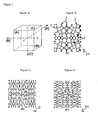
- FIG. 1c Another cross section (B) of the anisotropic foam structure is shown in Figure 1c .
- the anisotropy is clarified in this cross-section, since the structure appears to be compressed in direction [A].
- a compression in this direction affects the cross section (C), as shown in Figure 1d , so that it exhibits the same appearance than cross section (B).
- Figures 2a and b show schematically a cutout of two cross-sections extending perpendicular to one another of a two-fluid heat exchanger according to the invention; the cutout is taken at a location where the heat exchange takes place.
- the illustration shows foam inserts 5 made of anisotropic, open-celled foam structure according to the invention, disposed between separating walls 4.
- flat tubes are utilized as separating walls 4.
- a first fluid 6 and a second fluid 7 flow through the foam structure and the tubes, respectively, so that both fluids run in cross flow, separated one from another.
- the anisotropic, open-celled foam according to the invention is oriented to provide simultaneously a small flow resistance for the first fluid 6 and enough heat exchange surface.
- this type of structure provides enough material at the contact areas between foam structure 5 and separating walls 4, where the heat needs essentially to be dissipated.
- Figure 3a-c illustrates schematically a cutout of a two-fluid heat exchanger, similar to Figure 2 .
- a first fluid 6 and a second fluid 7 flow again through the foam structure and the tubes, respectively, yet so that both fluids run in counterflow, separated one from another.
- the anisotropic open-celled foam is also oriented to simultaneously provide a small flow resistance for the first fluid 6 and enough heat exchange surface.
- macroscopic flow channels 8 are placed in the foam structure. Said channels allow fluids during phase-change processes, such as condensation or evaporation, to drain off the foam structure particularly favorably and easily.
- the flow channels 8 can have different rounded, squared or also stretched cross-sections, as shown in Figure 4b.
- Figure 4c shows examples for the channel run, such as a straight, a meander and a zigzag shape.
- Figure 4a-c shows schematically a cutout of a two-fluid heat exchanger, similar to Figure 2 .
- the anisotropic open celled-foam is again oriented to provide simultaneously a small flow resistance for the first fluid 6 and enough heat exchange surface.
- the foam insert 5 is shaped for favorable flow, in particular for two-phase flows, such as condensation and evaporation.
- the wedge form void part at the exit of the flow channel assists the forming vapor to exit the foam structure quicker, and hence enhances the evaporation process.
Landscapes
- Engineering & Computer Science (AREA)
- Mechanical Engineering (AREA)
- Chemical & Material Sciences (AREA)
- Dispersion Chemistry (AREA)
- Physics & Mathematics (AREA)
- Thermal Sciences (AREA)
- General Engineering & Computer Science (AREA)
- Heat-Exchange Devices With Radiators And Conduit Assemblies (AREA)
- Treatment Of Water By Ion Exchange (AREA)
- Manufacture Of Porous Articles, And Recovery And Treatment Of Waste Products (AREA)
- Filtering Materials (AREA)
Claims (17)
- Wärmetauscher für zwei flüssige Medien mit zwischen Trennwänden angeordneten Strömungsdurchgängen für ein erstes Medium und Strömungsdurchgängen für ein zweites Medium, in denen wenigstens eine Medienseite mit einem dreidimensionalen offenzelligen Schaum versehen ist, dadurch gekennzeichnet, dass der Schaum anisotropisch ist und aus einem aus Stegen und Knotenpunkten gebildeten Netzwerk besteht, in welchem die Stege und Knotenpunkte linsen- oder stabähnlich ausgebildete Poren formen.
- Wärmetauscher für zwei flüssige Medien nach Anspruch 1, dadurch gekennzeichnet, dass der Wärmetauscher an wenigstens einer Mediumseite einen mehrschichtigen Aufbau aus mehreren dreidimensionalen offenzelligen Schäumen umfasst, bei dem wenigstens eine Schicht aus einem anisotropischen Schaum gebildet ist, der aus einem dreidimensionalen Netzwerk aus Stegen und Knotenpunkten besteht, die linsen- oder stabartig geformte Poren bilden.
- Wärmetauscher für zwei flüssige Medien nach Anspruch 1 oder 2, dadurch gekennzeichnet, dass der Schaum aus Metall, Karbon oder sonstigen Keramikwerkstoffen oder aus Verbundwerkstoffen besteht.
- Wärmetauscher für zwei flüssige Medien nach einem beliebigen der Ansprüche 1 bis 3, dadurch gekennzeichnet, dass der Hohlraumanteil des Schaums zwischen 80 und 99 % liegt.
- Wärmetauscher für zwei flüssige Medien nach einem beliebigen der Ansprüche 1 bis 4, dadurch gekennzeichnet, dass die Anzahl Poren des besagten Schaums (Porendichte1) in jeder beliebigen, geradlinig verlaufenden Richtung gemessen zwischen 1 und 100 ppi beträgt.
- Wärmetauscher für zwei flüssige Medien nach Anspruch 5, dadurch gekennzeichnet, dass die Anzahl Poren des besagten Schaums eine Porendichte zwischen 5 und 60 ppi aufweist.
- Wärmetauscher für zwei flüssige Medien nach einem beliebigen der Ansprüche 1 bis 6, dadurch gekennzeichnet, dass die Querschnitte der Verbindungsstege des Schaums im Wesentlichen eine ovale oder polygonale Form aufweisen.
- Wärmetauscher für zwei flüssige Medien nach einem beliebigen der Ansprüche 1 bis 7, dadurch gekennzeichnet, dass die Verbindungsstege des Schaums hohl oder gefüllt sind.
- Wärmetauscher für zwei flüssige Medien nach einem beliebigen der Ansprüche 1 bis 8, dadurch gekennzeichnet, dass besagter Schaum zusätzliche makroskopische Strömungskanäle umfasst.
- Wärmetauscher für zwei flüssige Medien nach Anspruch 9, dadurch gekennzeichnet, dass die Strömungskanäle mäander- oder zickzackförmig angeordnet sind.
- Wärmetauscher für zwei flüssige Medien nach einem beliebigen der Ansprüche 1 bis 10, dadurch gekennzeichnet, dass der Wärmetauscher mindestens ein Element zur Verteilung von Zweiphasenströmen umfasst, und dass mindestens ein Element zur Verteilung teilweise oder vollständig mit einem dreidimensionalen anisotropischen offenzelligem Schaum gefüllt ist.
- Wärmetauscher für zwei flüssige Medien nach einem beliebigen der Ansprüche 1 bis 11, dadurch gekennzeichnet, dass der Schaum so geformt ist, dass er günstige Strömungsleistungen, insbesondere für Zweiphasenströme ermöglicht.
- Verfahren zur Herstellung eines Wärmetauschers für zwei flüssige Medien nach einem beliebigen der Ansprüche 1 bis 12, mit gefüllten Verbindungsstegen, dadurch gekennzeichnet, dass 2 das Verfahren folgende Herstellungsschritte umfasst:- Benutzen eines anisotropischen offenzelligen Schaums, insbesondere eines Kunststoffschaums, vorzugsweise eines Polyurethanschaums als Gussform,- Gießen eines Werkstoffes, vorzugsweise eines hitzebeständigen Werkstoffes in flüssigem Zustand in die dreidimensionalen Hohlräume der Form und anschließendes Aushärten,- Entfernen des die Gussform bildenden Werkstoffes mittels geeigneter Behandlung, insbesondere durch Erhitzen oder Verbrennen, wobei der verbleibende Gusswerkstoff die Negativform3 mit Hohlräumen darstellt,- Druckgießen des Flüssigmetalls in die verbleibenden Hohlräume und Verfestigung des Metalls, und anschließend- Entfernen der Negativform.
- Verfahren zur Herstellung eines Wärmetauschers für zwei flüssige Medien nach einem beliebigen der Ansprüche 1 bis 12 mit hohlen Verbindungsstegen, dadurch gekennzeichnet, dass das Verfahren folgende Herstellungsschritte umfasst:- Benutzen eines anisotropischen offenzelligen Schaums, insbesondere eines Kunststoffschaums, vorzugsweise eines Polyurethanschaums als Gussform,- Aufbringen von Metallpartikeln auf die Form zur Herstellung einer vollständigen und gleichmäßigen Beschichtung der gesamten Formoberfläche,
2 Anm.d.Übers.: rot markierter Text = Zusatz d.Ü.
3 Anm.d.Übers.: bei Druckguss auch "das Werkzeugnegativ"- Sintern der Metallpartikel und Entfernen der Form mittels geeigneter Behandlung, insbesondere mittels Wärmebehandlung. - Verfahren zur Herstellung eines Wärmetauschers für zwei flüssige Medien nach einem der Ansprüche 13 oder 14, dadurch gekennzeichnet, dass der für die Form benutzte Schaum mindestens in eine Richtung verdichtet wird.
- Verfahren zur Herstellung eines Wärmetauschers für zwei flüssige Medien nach einem beliebigen der Ansprüche 1 bis 12 mit gefüllten Verbindungsstegen, dadurch gekennzeichnet, dass das Verfahren folgende Herstellungsschritte umfasst:- Mischen und Verdichten von linsen- oder stabartig geformten Abstandshaltern, insbesondere aus hitzebeständigem Werkstoff, mit Metallpartikeln, Lösungsmitteln und/oder Bindemitteln,- Entfernen der Abstandshalter und anschließendes- Sintern des verdichteten Metallgefüges.
- Verfahren zur Herstellung eines Wärmetauschers für zwei flüssige Medien nach einem beliebigen der Ansprüche 1 bis 12 mit gefüllten Verbindungsstegen, dadurch gekennzeichnet, dass das Verfahren folgende Herstellungsschritte umfasst:- Verdichten von linsen- oder stabartig geformten Abstandshaltern, insbesondere aus hitzebeständigem Werkstoff,- Druckgießen des Flüssigmetalls in die verbleibenden Hohlräume und Entfernen der Abstandshalter.
Priority Applications (4)
| Application Number | Priority Date | Filing Date | Title |
|---|---|---|---|
| ES03026915T ES2371240T3 (es) | 2003-11-24 | 2003-11-24 | Intercambiador de calor de dos fluidos con estructuras de celdas abiertas para el gobierno de flujo. |
| AT03026915T ATE520002T1 (de) | 2003-11-24 | 2003-11-24 | Zweifluidwärmetauscher mit offenporiger struktur |
| EP03026915A EP1533586B1 (de) | 2003-11-24 | 2003-11-24 | Zweifluidwärmetauscher mit offenporiger Struktur |
| PCT/EP2004/013298 WO2005054768A1 (en) | 2003-11-24 | 2004-11-24 | Two-fluid heat exchangers and methods for manufacturing a metallic foam for two-fluid heat exchangers |
Applications Claiming Priority (1)
| Application Number | Priority Date | Filing Date | Title |
|---|---|---|---|
| EP03026915A EP1533586B1 (de) | 2003-11-24 | 2003-11-24 | Zweifluidwärmetauscher mit offenporiger Struktur |
Publications (2)
| Publication Number | Publication Date |
|---|---|
| EP1533586A1 EP1533586A1 (de) | 2005-05-25 |
| EP1533586B1 true EP1533586B1 (de) | 2011-08-10 |
Family
ID=34429428
Family Applications (1)
| Application Number | Title | Priority Date | Filing Date |
|---|---|---|---|
| EP03026915A Expired - Lifetime EP1533586B1 (de) | 2003-11-24 | 2003-11-24 | Zweifluidwärmetauscher mit offenporiger Struktur |
Country Status (4)
| Country | Link |
|---|---|
| EP (1) | EP1533586B1 (de) |
| AT (1) | ATE520002T1 (de) |
| ES (1) | ES2371240T3 (de) |
| WO (1) | WO2005054768A1 (de) |
Cited By (1)
| Publication number | Priority date | Publication date | Assignee | Title |
|---|---|---|---|---|
| DE102020112004A1 (de) | 2020-05-04 | 2021-11-04 | Iav Gmbh Ingenieurgesellschaft Auto Und Verkehr | Abgaswärmetauscher und Verfahren zur Herstellung eines solchen Abgaswärmetauschers |
Families Citing this family (12)
| Publication number | Priority date | Publication date | Assignee | Title |
|---|---|---|---|---|
| FR2893329B1 (fr) * | 2005-11-14 | 2008-05-16 | Aluminium Pechiney Soc Par Act | Cuve d'electrolyse avec echangeur thermique. |
| EP1870657A1 (de) * | 2006-06-24 | 2007-12-26 | Colbond B.V. | Wärmetauscher |
| US20090288814A1 (en) * | 2008-05-20 | 2009-11-26 | The Boeing Company. | Mixed Carbon Foam/Metallic Heat Exchanger |
| WO2010112393A1 (en) * | 2009-04-03 | 2010-10-07 | Nv Bekaert Sa | Improved heat exchanger |
| WO2011051106A1 (en) * | 2009-10-29 | 2011-05-05 | Nv Bekaert Sa | Manufacturing heat exchanger from porous medium and conduits |
| WO2012111663A1 (ja) * | 2011-02-18 | 2012-08-23 | 住友電気工業株式会社 | 三次元網状アルミニウム多孔体、該アルミニウム多孔体を用いた集電体及び電極並びに該電極を用いた非水電解質電池、非水電解液を用いたキャパシタ及びリチウムイオンキャパシタ |
| FR2992716A1 (fr) | 2012-06-29 | 2014-01-03 | Filtrauto | Structure poreuse pour fluide incorporant un conduit |
| US20140044951A1 (en) * | 2012-08-09 | 2014-02-13 | United Technologies Corporation | High strength-to-density nanocellular foam |
| CN103206879A (zh) * | 2013-04-15 | 2013-07-17 | 江苏联合热交换系统有限公司 | 石墨泡沫材料换热器及其制备方法 |
| DE102016226233A1 (de) * | 2016-12-27 | 2018-06-28 | Robert Bosch Gmbh | Strömungsplatte |
| SG11202108738PA (en) * | 2019-02-13 | 2021-09-29 | Erg Aerospace Corp | Open cell foam metal heat exchanger |
| EP3711736A1 (de) * | 2019-03-18 | 2020-09-23 | Ontex BVBA | Absorbierende artikel mit einer anisotropen schaumerfassungsschicht |
Family Cites Families (8)
| Publication number | Priority date | Publication date | Assignee | Title |
|---|---|---|---|---|
| GB1283192A (en) * | 1968-11-22 | 1972-07-26 | Dunlop Holdings Ltd | Porous articles |
| FR2429988A1 (fr) * | 1978-06-28 | 1980-01-25 | Commissariat Energie Atomique | Echangeur de chaleur a structure poreuse anisotrope |
| JPS60294A (ja) * | 1983-06-16 | 1985-01-05 | Matsushita Seiko Co Ltd | 発泡金属を用いた熱交換器 |
| DE69126686T2 (de) * | 1990-08-14 | 1997-10-23 | Texas Instruments Inc | Wärmetransportmodul für Anwendungen ultrahoher Dichte und Silizium auf Siliziumpackungen |
| DE4424157C2 (de) * | 1993-07-29 | 1996-08-14 | Fraunhofer Ges Forschung | Verfahren zur Herstellung poröser metallischer Werkstoffe mit anisotropen thermischen und elektrischen Leitfähigkeiten |
| DE19650613B4 (de) * | 1996-12-06 | 2005-12-29 | Daimlerchrysler Ag | Bauteil mit einem Metallschaum-Kern |
| DE29814078U1 (de) * | 1998-08-08 | 1998-11-05 | Baxmann, Frank, 41462 Neuss | Gesinterter Kühlkörper |
| US6196307B1 (en) * | 1998-06-17 | 2001-03-06 | Intersil Americas Inc. | High performance heat exchanger and method |
-
2003
- 2003-11-24 AT AT03026915T patent/ATE520002T1/de not_active IP Right Cessation
- 2003-11-24 ES ES03026915T patent/ES2371240T3/es not_active Expired - Lifetime
- 2003-11-24 EP EP03026915A patent/EP1533586B1/de not_active Expired - Lifetime
-
2004
- 2004-11-24 WO PCT/EP2004/013298 patent/WO2005054768A1/en not_active Ceased
Cited By (1)
| Publication number | Priority date | Publication date | Assignee | Title |
|---|---|---|---|---|
| DE102020112004A1 (de) | 2020-05-04 | 2021-11-04 | Iav Gmbh Ingenieurgesellschaft Auto Und Verkehr | Abgaswärmetauscher und Verfahren zur Herstellung eines solchen Abgaswärmetauschers |
Also Published As
| Publication number | Publication date |
|---|---|
| EP1533586A1 (de) | 2005-05-25 |
| ATE520002T1 (de) | 2011-08-15 |
| ES2371240T3 (es) | 2011-12-28 |
| WO2005054768A1 (en) | 2005-06-16 |
Similar Documents
| Publication | Publication Date | Title |
|---|---|---|
| EP1533586A1 (de) | Struktur mit offenen Poren | |
| JP4314352B2 (ja) | 固体を利用せずに作製する金型の熱特性改善技術 | |
| US7360581B2 (en) | Structured thermal transfer article | |
| CA1318911C (en) | Device for heat transfer | |
| US5961930A (en) | Integrated micro-ceramic chemical plant with insertable reaction chambers and micro-filters | |
| CA2702997A1 (en) | Heat management device using inorganic foam | |
| KR20140033163A (ko) | 채널을 구비하는 메탈 폼의 제조 방법 및 이에 의해 제조된 메탈 폼 | |
| KR100549961B1 (ko) | 세라믹 필터 및 이것을 사용한 용융금속의 여과방법 | |
| AU2009333674A1 (en) | Sintered diamond heat exchanger apparatus | |
| CN103900412A (zh) | 具有渐变形貌特征的通孔金属泡沫热管换热装置 | |
| EP0930480A3 (de) | Wärmetauscher | |
| US6596168B2 (en) | Filter element and method for the manufacture | |
| AU2002226432A1 (en) | Filter element and method for the manufacture | |
| EP0994313B1 (de) | Verfahren zur Herstellung eines Wärmetauschers und Wärmetauscher, der durch Anwendung des Verfahrens erhalten wird | |
| US12480690B2 (en) | Regenerator for a magnetic heat exchanger and heat exchanger | |
| RU2219016C2 (ru) | Способ изготовления теплообменного аппарата | |
| BR112021004103A2 (pt) | filtro sinterizado a laser, método para produzir o filtro e método para garantir o fluxo de fluido | |
| DE102016209082A1 (de) | Verdampfer- und/oder Kondensatorelement mit oberflächlich eingebetteten porösen Partikeln | |
| Biffi et al. | Thermo-fluid dynamic modeling of Cu based metallic foams for heat exchanger applications | |
| Szafran | Macroscopic and microscopic aspects of designing porous ceramic materials | |
| JPS6335561B2 (de) | ||
| JPS63299847A (ja) | 熱交換器の製造方法 | |
| JP2019174011A (ja) | 熱交換器 | |
| KR20190078128A (ko) | 다공성 전열폼을 이용한 응축 열교환기 | |
| JPS6021021B2 (ja) | 熱交換器の製造方法 |
Legal Events
| Date | Code | Title | Description |
|---|---|---|---|
| PUAI | Public reference made under article 153(3) epc to a published international application that has entered the european phase |
Free format text: ORIGINAL CODE: 0009012 |
|
| 17P | Request for examination filed |
Effective date: 20040714 |
|
| AK | Designated contracting states |
Kind code of ref document: A1 Designated state(s): AT BE BG CH CY CZ DE DK EE ES FI FR GB GR HU IE IT LI LU MC NL PT RO SE SI SK TR |
|
| AX | Request for extension of the european patent |
Extension state: AL LT LV MK |
|
| AKX | Designation fees paid |
Designated state(s): AT BE BG CH CY CZ DE DK EE ES FI FR GB GR HU IE IT LI LU MC NL PT RO SE SI SK TR |
|
| 17Q | First examination report despatched |
Effective date: 20090320 |
|
| RTI1 | Title (correction) |
Free format text: TWO-FLUID HEAT EXCHANGER HAVING FLOW MANAGEMENT OPEN-CELLED STRUCTURES |
|
| GRAP | Despatch of communication of intention to grant a patent |
Free format text: ORIGINAL CODE: EPIDOSNIGR1 |
|
| GRAS | Grant fee paid |
Free format text: ORIGINAL CODE: EPIDOSNIGR3 |
|
| GRAA | (expected) grant |
Free format text: ORIGINAL CODE: 0009210 |
|
| AK | Designated contracting states |
Kind code of ref document: B1 Designated state(s): AT BE BG CH CY CZ DE DK EE ES FI FR GB GR HU IE IT LI LU MC NL PT RO SE SI SK TR |
|
| REG | Reference to a national code |
Ref country code: GB Ref legal event code: FG4D |
|
| REG | Reference to a national code |
Ref country code: CH Ref legal event code: EP |
|
| REG | Reference to a national code |
Ref country code: IE Ref legal event code: FG4D |
|
| REG | Reference to a national code |
Ref country code: DE Ref legal event code: R096 Ref document number: 60337952 Country of ref document: DE Effective date: 20111013 |
|
| REG | Reference to a national code |
Ref country code: NL Ref legal event code: VDEP Effective date: 20110810 |
|
| REG | Reference to a national code |
Ref country code: ES Ref legal event code: FG2A Ref document number: 2371240 Country of ref document: ES Kind code of ref document: T3 Effective date: 20111228 |
|
| PG25 | Lapsed in a contracting state [announced via postgrant information from national office to epo] |
Ref country code: SE Free format text: LAPSE BECAUSE OF FAILURE TO SUBMIT A TRANSLATION OF THE DESCRIPTION OR TO PAY THE FEE WITHIN THE PRESCRIBED TIME-LIMIT Effective date: 20110810 Ref country code: NL Free format text: LAPSE BECAUSE OF FAILURE TO SUBMIT A TRANSLATION OF THE DESCRIPTION OR TO PAY THE FEE WITHIN THE PRESCRIBED TIME-LIMIT Effective date: 20110810 Ref country code: PT Free format text: LAPSE BECAUSE OF FAILURE TO SUBMIT A TRANSLATION OF THE DESCRIPTION OR TO PAY THE FEE WITHIN THE PRESCRIBED TIME-LIMIT Effective date: 20111212 Ref country code: FI Free format text: LAPSE BECAUSE OF FAILURE TO SUBMIT A TRANSLATION OF THE DESCRIPTION OR TO PAY THE FEE WITHIN THE PRESCRIBED TIME-LIMIT Effective date: 20110810 |
|
| PGFP | Annual fee paid to national office [announced via postgrant information from national office to epo] |
Ref country code: FR Payment date: 20111109 Year of fee payment: 9 Ref country code: ES Payment date: 20111021 Year of fee payment: 9 |
|
| REG | Reference to a national code |
Ref country code: AT Ref legal event code: MK05 Ref document number: 520002 Country of ref document: AT Kind code of ref document: T Effective date: 20110810 |
|
| PG25 | Lapsed in a contracting state [announced via postgrant information from national office to epo] |
Ref country code: CY Free format text: LAPSE BECAUSE OF FAILURE TO SUBMIT A TRANSLATION OF THE DESCRIPTION OR TO PAY THE FEE WITHIN THE PRESCRIBED TIME-LIMIT Effective date: 20110810 Ref country code: SI Free format text: LAPSE BECAUSE OF FAILURE TO SUBMIT A TRANSLATION OF THE DESCRIPTION OR TO PAY THE FEE WITHIN THE PRESCRIBED TIME-LIMIT Effective date: 20110810 Ref country code: GR Free format text: LAPSE BECAUSE OF FAILURE TO SUBMIT A TRANSLATION OF THE DESCRIPTION OR TO PAY THE FEE WITHIN THE PRESCRIBED TIME-LIMIT Effective date: 20111111 Ref country code: AT Free format text: LAPSE BECAUSE OF FAILURE TO SUBMIT A TRANSLATION OF THE DESCRIPTION OR TO PAY THE FEE WITHIN THE PRESCRIBED TIME-LIMIT Effective date: 20110810 |
|
| PG25 | Lapsed in a contracting state [announced via postgrant information from national office to epo] |
Ref country code: BE Free format text: LAPSE BECAUSE OF FAILURE TO SUBMIT A TRANSLATION OF THE DESCRIPTION OR TO PAY THE FEE WITHIN THE PRESCRIBED TIME-LIMIT Effective date: 20110810 |
|
| PG25 | Lapsed in a contracting state [announced via postgrant information from national office to epo] |
Ref country code: SK Free format text: LAPSE BECAUSE OF FAILURE TO SUBMIT A TRANSLATION OF THE DESCRIPTION OR TO PAY THE FEE WITHIN THE PRESCRIBED TIME-LIMIT Effective date: 20110810 Ref country code: CZ Free format text: LAPSE BECAUSE OF FAILURE TO SUBMIT A TRANSLATION OF THE DESCRIPTION OR TO PAY THE FEE WITHIN THE PRESCRIBED TIME-LIMIT Effective date: 20110810 |
|
| PG25 | Lapsed in a contracting state [announced via postgrant information from national office to epo] |
Ref country code: EE Free format text: LAPSE BECAUSE OF FAILURE TO SUBMIT A TRANSLATION OF THE DESCRIPTION OR TO PAY THE FEE WITHIN THE PRESCRIBED TIME-LIMIT Effective date: 20110810 Ref country code: RO Free format text: LAPSE BECAUSE OF FAILURE TO SUBMIT A TRANSLATION OF THE DESCRIPTION OR TO PAY THE FEE WITHIN THE PRESCRIBED TIME-LIMIT Effective date: 20110810 |
|
| PGFP | Annual fee paid to national office [announced via postgrant information from national office to epo] |
Ref country code: DE Payment date: 20120111 Year of fee payment: 9 |
|
| PLBE | No opposition filed within time limit |
Free format text: ORIGINAL CODE: 0009261 |
|
| STAA | Information on the status of an ep patent application or granted ep patent |
Free format text: STATUS: NO OPPOSITION FILED WITHIN TIME LIMIT |
|
| PG25 | Lapsed in a contracting state [announced via postgrant information from national office to epo] |
Ref country code: DK Free format text: LAPSE BECAUSE OF FAILURE TO SUBMIT A TRANSLATION OF THE DESCRIPTION OR TO PAY THE FEE WITHIN THE PRESCRIBED TIME-LIMIT Effective date: 20110810 Ref country code: MC Free format text: LAPSE BECAUSE OF NON-PAYMENT OF DUE FEES Effective date: 20111130 |
|
| REG | Reference to a national code |
Ref country code: CH Ref legal event code: PL |
|
| 26N | No opposition filed |
Effective date: 20120511 |
|
| PG25 | Lapsed in a contracting state [announced via postgrant information from national office to epo] |
Ref country code: CH Free format text: LAPSE BECAUSE OF NON-PAYMENT OF DUE FEES Effective date: 20111130 Ref country code: LI Free format text: LAPSE BECAUSE OF NON-PAYMENT OF DUE FEES Effective date: 20111130 |
|
| REG | Reference to a national code |
Ref country code: IE Ref legal event code: MM4A |
|
| REG | Reference to a national code |
Ref country code: DE Ref legal event code: R097 Ref document number: 60337952 Country of ref document: DE Effective date: 20120511 |
|
| PG25 | Lapsed in a contracting state [announced via postgrant information from national office to epo] |
Ref country code: IE Free format text: LAPSE BECAUSE OF NON-PAYMENT OF DUE FEES Effective date: 20111124 |
|
| PG25 | Lapsed in a contracting state [announced via postgrant information from national office to epo] |
Ref country code: LU Free format text: LAPSE BECAUSE OF NON-PAYMENT OF DUE FEES Effective date: 20111124 |
|
| PG25 | Lapsed in a contracting state [announced via postgrant information from national office to epo] |
Ref country code: BG Free format text: LAPSE BECAUSE OF FAILURE TO SUBMIT A TRANSLATION OF THE DESCRIPTION OR TO PAY THE FEE WITHIN THE PRESCRIBED TIME-LIMIT Effective date: 20111110 |
|
| GBPC | Gb: european patent ceased through non-payment of renewal fee |
Effective date: 20121124 |
|
| REG | Reference to a national code |
Ref country code: FR Ref legal event code: ST Effective date: 20130731 |
|
| PG25 | Lapsed in a contracting state [announced via postgrant information from national office to epo] |
Ref country code: IT Free format text: LAPSE BECAUSE OF NON-PAYMENT OF DUE FEES Effective date: 20121124 |
|
| REG | Reference to a national code |
Ref country code: DE Ref legal event code: R119 Ref document number: 60337952 Country of ref document: DE Effective date: 20130601 |
|
| PG25 | Lapsed in a contracting state [announced via postgrant information from national office to epo] |
Ref country code: TR Free format text: LAPSE BECAUSE OF FAILURE TO SUBMIT A TRANSLATION OF THE DESCRIPTION OR TO PAY THE FEE WITHIN THE PRESCRIBED TIME-LIMIT Effective date: 20110810 |
|
| PG25 | Lapsed in a contracting state [announced via postgrant information from national office to epo] |
Ref country code: DE Free format text: LAPSE BECAUSE OF NON-PAYMENT OF DUE FEES Effective date: 20130601 Ref country code: HU Free format text: LAPSE BECAUSE OF FAILURE TO SUBMIT A TRANSLATION OF THE DESCRIPTION OR TO PAY THE FEE WITHIN THE PRESCRIBED TIME-LIMIT Effective date: 20110810 |
|
| PG25 | Lapsed in a contracting state [announced via postgrant information from national office to epo] |
Ref country code: FR Free format text: LAPSE BECAUSE OF NON-PAYMENT OF DUE FEES Effective date: 20121130 Ref country code: GB Free format text: LAPSE BECAUSE OF NON-PAYMENT OF DUE FEES Effective date: 20121124 |
|
| REG | Reference to a national code |
Ref country code: ES Ref legal event code: FD2A Effective date: 20140305 |
|
| PG25 | Lapsed in a contracting state [announced via postgrant information from national office to epo] |
Ref country code: ES Free format text: LAPSE BECAUSE OF NON-PAYMENT OF DUE FEES Effective date: 20121125 |