EP1533289A1 - Anthracene derivatives and organic electroluminescent devices made by using the same - Google Patents
Anthracene derivatives and organic electroluminescent devices made by using the same Download PDFInfo
- Publication number
- EP1533289A1 EP1533289A1 EP03766655A EP03766655A EP1533289A1 EP 1533289 A1 EP1533289 A1 EP 1533289A1 EP 03766655 A EP03766655 A EP 03766655A EP 03766655 A EP03766655 A EP 03766655A EP 1533289 A1 EP1533289 A1 EP 1533289A1
- Authority
- EP
- European Patent Office
- Prior art keywords
- group
- substituted
- unsubstituted
- carbon atoms
- general formula
- Prior art date
- Legal status (The legal status is an assumption and is not a legal conclusion. Google has not performed a legal analysis and makes no representation as to the accuracy of the status listed.)
- Withdrawn
Links
Classifications
-
- C—CHEMISTRY; METALLURGY
- C07—ORGANIC CHEMISTRY
- C07C—ACYCLIC OR CARBOCYCLIC COMPOUNDS
- C07C13/00—Cyclic hydrocarbons containing rings other than, or in addition to, six-membered aromatic rings
- C07C13/28—Polycyclic hydrocarbons or acyclic hydrocarbon derivatives thereof
- C07C13/32—Polycyclic hydrocarbons or acyclic hydrocarbon derivatives thereof with condensed rings
- C07C13/72—Spiro hydrocarbons
-
- C—CHEMISTRY; METALLURGY
- C07—ORGANIC CHEMISTRY
- C07C—ACYCLIC OR CARBOCYCLIC COMPOUNDS
- C07C13/00—Cyclic hydrocarbons containing rings other than, or in addition to, six-membered aromatic rings
- C07C13/28—Polycyclic hydrocarbons or acyclic hydrocarbon derivatives thereof
- C07C13/32—Polycyclic hydrocarbons or acyclic hydrocarbon derivatives thereof with condensed rings
- C07C13/54—Polycyclic hydrocarbons or acyclic hydrocarbon derivatives thereof with condensed rings with three condensed rings
- C07C13/547—Polycyclic hydrocarbons or acyclic hydrocarbon derivatives thereof with condensed rings with three condensed rings at least one ring not being six-membered, the other rings being at the most six-membered
- C07C13/567—Polycyclic hydrocarbons or acyclic hydrocarbon derivatives thereof with condensed rings with three condensed rings at least one ring not being six-membered, the other rings being at the most six-membered with a fluorene or hydrogenated fluorene ring system
-
- C—CHEMISTRY; METALLURGY
- C07—ORGANIC CHEMISTRY
- C07C—ACYCLIC OR CARBOCYCLIC COMPOUNDS
- C07C13/00—Cyclic hydrocarbons containing rings other than, or in addition to, six-membered aromatic rings
- C07C13/28—Polycyclic hydrocarbons or acyclic hydrocarbon derivatives thereof
- C07C13/32—Polycyclic hydrocarbons or acyclic hydrocarbon derivatives thereof with condensed rings
- C07C13/54—Polycyclic hydrocarbons or acyclic hydrocarbon derivatives thereof with condensed rings with three condensed rings
- C07C13/573—Polycyclic hydrocarbons or acyclic hydrocarbon derivatives thereof with condensed rings with three condensed rings with three six-membered rings
- C07C13/60—Completely or partially hydrogenated phenanthrenes
-
- C—CHEMISTRY; METALLURGY
- C07—ORGANIC CHEMISTRY
- C07C—ACYCLIC OR CARBOCYCLIC COMPOUNDS
- C07C13/00—Cyclic hydrocarbons containing rings other than, or in addition to, six-membered aromatic rings
- C07C13/28—Polycyclic hydrocarbons or acyclic hydrocarbon derivatives thereof
- C07C13/32—Polycyclic hydrocarbons or acyclic hydrocarbon derivatives thereof with condensed rings
- C07C13/62—Polycyclic hydrocarbons or acyclic hydrocarbon derivatives thereof with condensed rings with more than three condensed rings
-
- C—CHEMISTRY; METALLURGY
- C07—ORGANIC CHEMISTRY
- C07C—ACYCLIC OR CARBOCYCLIC COMPOUNDS
- C07C13/00—Cyclic hydrocarbons containing rings other than, or in addition to, six-membered aromatic rings
- C07C13/28—Polycyclic hydrocarbons or acyclic hydrocarbon derivatives thereof
- C07C13/32—Polycyclic hydrocarbons or acyclic hydrocarbon derivatives thereof with condensed rings
- C07C13/62—Polycyclic hydrocarbons or acyclic hydrocarbon derivatives thereof with condensed rings with more than three condensed rings
- C07C13/66—Polycyclic hydrocarbons or acyclic hydrocarbon derivatives thereof with condensed rings with more than three condensed rings the condensed ring system contains only four rings
-
- C—CHEMISTRY; METALLURGY
- C07—ORGANIC CHEMISTRY
- C07C—ACYCLIC OR CARBOCYCLIC COMPOUNDS
- C07C15/00—Cyclic hydrocarbons containing only six-membered aromatic rings as cyclic parts
- C07C15/20—Polycyclic condensed hydrocarbons
- C07C15/27—Polycyclic condensed hydrocarbons containing three rings
- C07C15/28—Anthracenes
-
- C—CHEMISTRY; METALLURGY
- C07—ORGANIC CHEMISTRY
- C07C—ACYCLIC OR CARBOCYCLIC COMPOUNDS
- C07C17/00—Preparation of halogenated hydrocarbons
- C07C17/093—Preparation of halogenated hydrocarbons by replacement by halogens
- C07C17/10—Preparation of halogenated hydrocarbons by replacement by halogens of hydrogen atoms
- C07C17/12—Preparation of halogenated hydrocarbons by replacement by halogens of hydrogen atoms in the ring of aromatic compounds
-
- C—CHEMISTRY; METALLURGY
- C07—ORGANIC CHEMISTRY
- C07C—ACYCLIC OR CARBOCYCLIC COMPOUNDS
- C07C46/00—Preparation of quinones
-
- C—CHEMISTRY; METALLURGY
- C07—ORGANIC CHEMISTRY
- C07C—ACYCLIC OR CARBOCYCLIC COMPOUNDS
- C07C49/00—Ketones; Ketenes; Dimeric ketenes; Ketonic chelates
- C07C49/587—Unsaturated compounds containing a keto groups being part of a ring
- C07C49/657—Unsaturated compounds containing a keto groups being part of a ring containing six-membered aromatic rings
- C07C49/665—Unsaturated compounds containing a keto groups being part of a ring containing six-membered aromatic rings a keto group being part of a condensed ring system
-
- C—CHEMISTRY; METALLURGY
- C07—ORGANIC CHEMISTRY
- C07F—ACYCLIC, CARBOCYCLIC OR HETEROCYCLIC COMPOUNDS CONTAINING ELEMENTS OTHER THAN CARBON, HYDROGEN, HALOGEN, OXYGEN, NITROGEN, SULFUR, SELENIUM OR TELLURIUM
- C07F7/00—Compounds containing elements of Groups 4 or 14 of the Periodic Table
- C07F7/02—Silicon compounds
- C07F7/08—Compounds having one or more C—Si linkages
- C07F7/0803—Compounds with Si-C or Si-Si linkages
- C07F7/0805—Compounds with Si-C or Si-Si linkages comprising only Si, C or H atoms
- C07F7/0807—Compounds with Si-C or Si-Si linkages comprising only Si, C or H atoms comprising Si as a ring atom
-
- C—CHEMISTRY; METALLURGY
- C09—DYES; PAINTS; POLISHES; NATURAL RESINS; ADHESIVES; COMPOSITIONS NOT OTHERWISE PROVIDED FOR; APPLICATIONS OF MATERIALS NOT OTHERWISE PROVIDED FOR
- C09K—MATERIALS FOR MISCELLANEOUS APPLICATIONS, NOT PROVIDED FOR ELSEWHERE
- C09K11/00—Luminescent materials, e.g. electroluminescent or chemiluminescent
- C09K11/06—Luminescent materials, e.g. electroluminescent or chemiluminescent containing organic luminescent materials
-
- H—ELECTRICITY
- H05—ELECTRIC TECHNIQUES NOT OTHERWISE PROVIDED FOR
- H05B—ELECTRIC HEATING; ELECTRIC LIGHT SOURCES NOT OTHERWISE PROVIDED FOR; CIRCUIT ARRANGEMENTS FOR ELECTRIC LIGHT SOURCES, IN GENERAL
- H05B33/00—Electroluminescent light sources
- H05B33/12—Light sources with substantially two-dimensional [2D] radiating surfaces
- H05B33/14—Light sources with substantially two-dimensional [2D] radiating surfaces characterised by the chemical or physical composition or the arrangement of the electroluminescent material, or by the simultaneous addition of the electroluminescent material in or onto the light source
-
- H—ELECTRICITY
- H10—SEMICONDUCTOR DEVICES; ELECTRIC SOLID-STATE DEVICES NOT OTHERWISE PROVIDED FOR
- H10K—ORGANIC ELECTRIC SOLID-STATE DEVICES
- H10K50/00—Organic light-emitting devices
- H10K50/10—OLEDs or polymer light-emitting diodes [PLED]
- H10K50/11—OLEDs or polymer light-emitting diodes [PLED] characterised by the electroluminescent [EL] layers
-
- H—ELECTRICITY
- H10—SEMICONDUCTOR DEVICES; ELECTRIC SOLID-STATE DEVICES NOT OTHERWISE PROVIDED FOR
- H10K—ORGANIC ELECTRIC SOLID-STATE DEVICES
- H10K85/00—Organic materials used in the body or electrodes of devices covered by this subclass
- H10K85/60—Organic compounds having low molecular weight
- H10K85/615—Polycyclic condensed aromatic hydrocarbons, e.g. anthracene
-
- H—ELECTRICITY
- H10—SEMICONDUCTOR DEVICES; ELECTRIC SOLID-STATE DEVICES NOT OTHERWISE PROVIDED FOR
- H10K—ORGANIC ELECTRIC SOLID-STATE DEVICES
- H10K85/00—Organic materials used in the body or electrodes of devices covered by this subclass
- H10K85/60—Organic compounds having low molecular weight
- H10K85/615—Polycyclic condensed aromatic hydrocarbons, e.g. anthracene
- H10K85/626—Polycyclic condensed aromatic hydrocarbons, e.g. anthracene containing more than one polycyclic condensed aromatic rings, e.g. bis-anthracene
-
- H—ELECTRICITY
- H10—SEMICONDUCTOR DEVICES; ELECTRIC SOLID-STATE DEVICES NOT OTHERWISE PROVIDED FOR
- H10K—ORGANIC ELECTRIC SOLID-STATE DEVICES
- H10K85/00—Organic materials used in the body or electrodes of devices covered by this subclass
- H10K85/60—Organic compounds having low molecular weight
- H10K85/631—Amine compounds having at least two aryl rest on at least one amine-nitrogen atom, e.g. triphenylamine
- H10K85/633—Amine compounds having at least two aryl rest on at least one amine-nitrogen atom, e.g. triphenylamine comprising polycyclic condensed aromatic hydrocarbons as substituents on the nitrogen atom
-
- C—CHEMISTRY; METALLURGY
- C07—ORGANIC CHEMISTRY
- C07C—ACYCLIC OR CARBOCYCLIC COMPOUNDS
- C07C2602/00—Systems containing two condensed rings
- C07C2602/02—Systems containing two condensed rings the rings having only two atoms in common
- C07C2602/04—One of the condensed rings being a six-membered aromatic ring
- C07C2602/10—One of the condensed rings being a six-membered aromatic ring the other ring being six-membered, e.g. tetraline
-
- C—CHEMISTRY; METALLURGY
- C07—ORGANIC CHEMISTRY
- C07C—ACYCLIC OR CARBOCYCLIC COMPOUNDS
- C07C2603/00—Systems containing at least three condensed rings
- C07C2603/02—Ortho- or ortho- and peri-condensed systems
- C07C2603/04—Ortho- or ortho- and peri-condensed systems containing three rings
- C07C2603/06—Ortho- or ortho- and peri-condensed systems containing three rings containing at least one ring with less than six ring members
- C07C2603/10—Ortho- or ortho- and peri-condensed systems containing three rings containing at least one ring with less than six ring members containing five-membered rings
- C07C2603/12—Ortho- or ortho- and peri-condensed systems containing three rings containing at least one ring with less than six ring members containing five-membered rings only one five-membered ring
- C07C2603/18—Fluorenes; Hydrogenated fluorenes
-
- C—CHEMISTRY; METALLURGY
- C07—ORGANIC CHEMISTRY
- C07C—ACYCLIC OR CARBOCYCLIC COMPOUNDS
- C07C2603/00—Systems containing at least three condensed rings
- C07C2603/02—Ortho- or ortho- and peri-condensed systems
- C07C2603/04—Ortho- or ortho- and peri-condensed systems containing three rings
- C07C2603/22—Ortho- or ortho- and peri-condensed systems containing three rings containing only six-membered rings
- C07C2603/24—Anthracenes; Hydrogenated anthracenes
-
- C—CHEMISTRY; METALLURGY
- C07—ORGANIC CHEMISTRY
- C07C—ACYCLIC OR CARBOCYCLIC COMPOUNDS
- C07C2603/00—Systems containing at least three condensed rings
- C07C2603/02—Ortho- or ortho- and peri-condensed systems
- C07C2603/04—Ortho- or ortho- and peri-condensed systems containing three rings
- C07C2603/22—Ortho- or ortho- and peri-condensed systems containing three rings containing only six-membered rings
- C07C2603/26—Phenanthrenes; Hydrogenated phenanthrenes
-
- C—CHEMISTRY; METALLURGY
- C07—ORGANIC CHEMISTRY
- C07C—ACYCLIC OR CARBOCYCLIC COMPOUNDS
- C07C2603/00—Systems containing at least three condensed rings
- C07C2603/02—Ortho- or ortho- and peri-condensed systems
- C07C2603/40—Ortho- or ortho- and peri-condensed systems containing four condensed rings
- C07C2603/42—Ortho- or ortho- and peri-condensed systems containing four condensed rings containing only six-membered rings
- C07C2603/50—Pyrenes; Hydrogenated pyrenes
-
- C—CHEMISTRY; METALLURGY
- C07—ORGANIC CHEMISTRY
- C07C—ACYCLIC OR CARBOCYCLIC COMPOUNDS
- C07C2603/00—Systems containing at least three condensed rings
- C07C2603/93—Spiro compounds
- C07C2603/94—Spiro compounds containing "free" spiro atoms
-
- C—CHEMISTRY; METALLURGY
- C07—ORGANIC CHEMISTRY
- C07C—ACYCLIC OR CARBOCYCLIC COMPOUNDS
- C07C2603/00—Systems containing at least three condensed rings
- C07C2603/93—Spiro compounds
- C07C2603/95—Spiro compounds containing "not free" spiro atoms
- C07C2603/96—Spiro compounds containing "not free" spiro atoms containing at least one ring with less than six members
- C07C2603/97—Spiro compounds containing "not free" spiro atoms containing at least one ring with less than six members containing five-membered rings
-
- C—CHEMISTRY; METALLURGY
- C09—DYES; PAINTS; POLISHES; NATURAL RESINS; ADHESIVES; COMPOSITIONS NOT OTHERWISE PROVIDED FOR; APPLICATIONS OF MATERIALS NOT OTHERWISE PROVIDED FOR
- C09K—MATERIALS FOR MISCELLANEOUS APPLICATIONS, NOT PROVIDED FOR ELSEWHERE
- C09K2211/00—Chemical nature of organic luminescent or tenebrescent compounds
- C09K2211/10—Non-macromolecular compounds
- C09K2211/1003—Carbocyclic compounds
- C09K2211/1011—Condensed systems
-
- H—ELECTRICITY
- H10—SEMICONDUCTOR DEVICES; ELECTRIC SOLID-STATE DEVICES NOT OTHERWISE PROVIDED FOR
- H10K—ORGANIC ELECTRIC SOLID-STATE DEVICES
- H10K2102/00—Constructional details relating to the organic devices covered by this subclass
- H10K2102/10—Transparent electrodes, e.g. using graphene
- H10K2102/101—Transparent electrodes, e.g. using graphene comprising transparent conductive oxides [TCO]
- H10K2102/103—Transparent electrodes, e.g. using graphene comprising transparent conductive oxides [TCO] comprising indium oxides, e.g. ITO
-
- H—ELECTRICITY
- H10—SEMICONDUCTOR DEVICES; ELECTRIC SOLID-STATE DEVICES NOT OTHERWISE PROVIDED FOR
- H10K—ORGANIC ELECTRIC SOLID-STATE DEVICES
- H10K85/00—Organic materials used in the body or electrodes of devices covered by this subclass
- H10K85/30—Coordination compounds
- H10K85/321—Metal complexes comprising a group IIIA element, e.g. Tris (8-hydroxyquinoline) gallium [Gaq3]
- H10K85/324—Metal complexes comprising a group IIIA element, e.g. Tris (8-hydroxyquinoline) gallium [Gaq3] comprising aluminium, e.g. Alq3
-
- H—ELECTRICITY
- H10—SEMICONDUCTOR DEVICES; ELECTRIC SOLID-STATE DEVICES NOT OTHERWISE PROVIDED FOR
- H10K—ORGANIC ELECTRIC SOLID-STATE DEVICES
- H10K85/00—Organic materials used in the body or electrodes of devices covered by this subclass
- H10K85/60—Organic compounds having low molecular weight
- H10K85/631—Amine compounds having at least two aryl rest on at least one amine-nitrogen atom, e.g. triphenylamine
Definitions
- the present invention relates to anthracene derivatives and organic electroluminescent devices made by using the same. More particularly, the present invention relates to anthracene derivatives which enable an organic electroluminescence device to exhibit a great efficiency of light emission and uniform light emission even at high temperatures and organic electroluminescent devices made by using the same.
- An organic electroluminescence (“electroluminescence” will be occasionally referred to as "EL”, hereinafter) device is a spontaneous light emitting device which utilizes the principle that a fluorescent substance emits light by energy of recombination of holes injected from an anode and electrons injected from a cathode when an electric field is applied. Since an organic EL device of the laminate type driven under a low electric voltage was reported by C. W. Tang of Eastman Kodak Company (C. W. Tang and S. A. Vanslyke, Applied Physics Letters, Volume 51, Pages 913, 1987), many studies have been conducted on organic EL devices using organic materials as the constituting materials. Tang et al.
- the laminate structure using tris(8-hydroxyquinolinol)aluminum for the light emitting layer and a triphenyldiamine derivative for the hole transporting layer.
- Advantages of the laminate structure are that the efficiency of hole injection into the light emitting layer can be increased, that the efficiency of forming excited particles which are formed by blocking and recombining electrons injected from the cathode can be increased, and that excited particles formed within the light emitting layer can be enclosed.
- a two-layered structure having a hole transporting (injecting) layer and an electron transporting and light emitting layer and a three-layered structure having a hole transporting (injecting) layer, a light emitting layer and an electron transporting (injecting) layer are well known.
- the structure of the device and the process for forming the device have been studied.
- chelate complexes such as tris(8-quinolinolato)aluminum, coumarine derivatives, tetraphenylbutadiene derivatives, bisstyrylarylene derivatives and oxadiazole derivatives are known. It is reported that light in the visible region ranging from blue light to red light can be obtained by using these light emitting materials, and development of a device exhibiting color images is expected (For example, Japanese Patent Application Laid-Open Nos. Heisei 8(1996)-239655, Heisei 7(1995)-138561 and Heisei 3(1991)-200289).
- a device using a phenylanthracene derivative as the light emitting material is disclosed in Japanese Patent Application Laid-Open No. Heisei 8(1996)-012600.
- the above anthracene derivative is used as the material for emitting bluish light, and improvement in the stability of the thin film has been required so that the life of the device can be increased.
- conventional monoanthracene derivatives frequently crystallize to cause destruction of the thin film, and the improvement has been desired.
- a light emitting device using a compound in which the anthracene ring and the fluorene ring are directly bonded to each other is disclosed in Japanese Patent Application Laid-Open No. 2002-154993. However, the improvement in the uniformity of light emission at high temperatures has not been achieved.
- a light emitting material which is a substituted anthracene having spirofluorene at the 9- and 10-positions is disclosed (Japanese Patent Application Laid-Open No. 2002-121547).
- This light emitting material has a drawback in that, although an improvement is shown with respect to the crystallization, a high temperature of 400°C or higher is necessary as the temperature of vaporization since the skeleton structures of spirofluorene having the great molecular weight are present at the two positions, and the blue light cannot be emitted since thermal decomposition takes place during the vapor deposition.
- the present invention has been made to overcome the above problems and has an object of providing an anthracene derivative which enables an organic EL device to exhibit a great efficiency of light emission and uniform light emission even at high temperatures and an organic EL device utilizing the derivative.
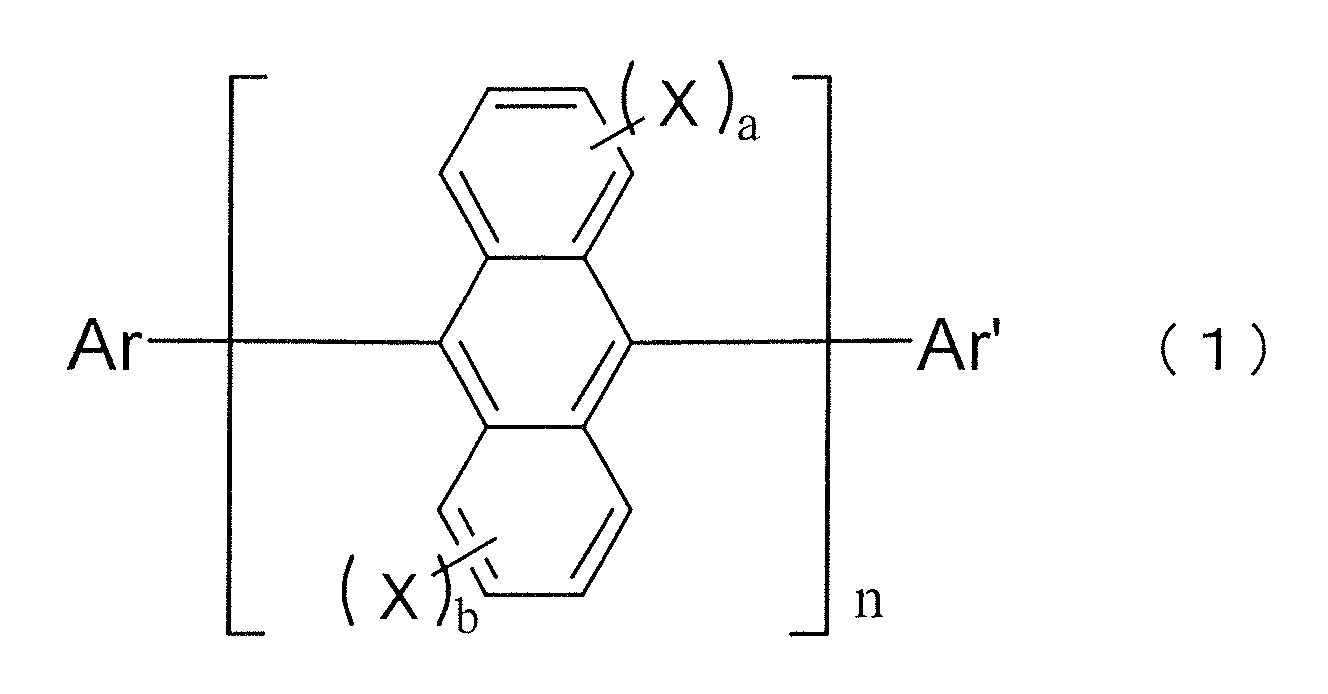
- the present invention provides an anthracene derivative represented by following general formula (1): wherein
- the present invention also provides an organic electroluminescence device which comprises a cathode, an anode and an organic thin film layer comprising at least one layer including a light emitting layer and sandwiched between the cathode and the anode, wherein at least one layer in the organic thin film layer comprises an anthracene derivative represented by general formula (1) described in Claim 1 singly or as a component of a mixture.
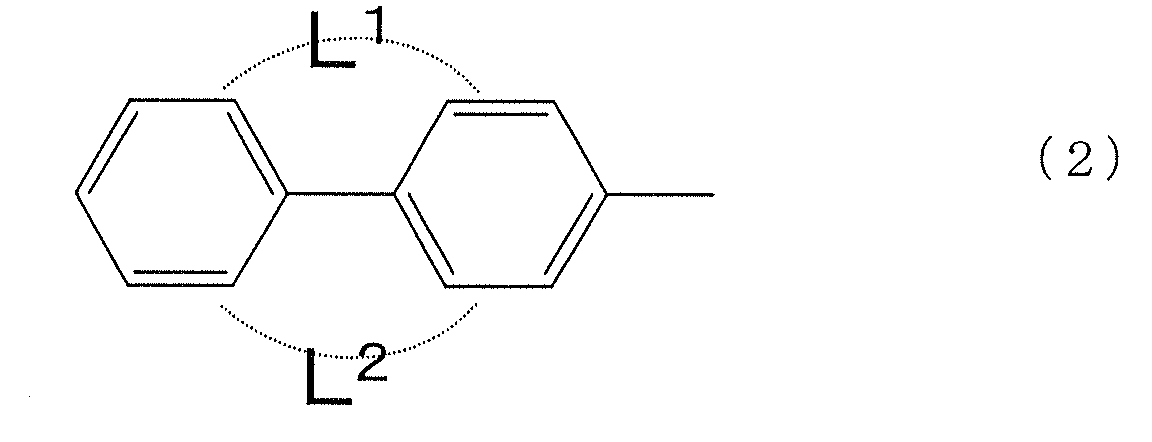
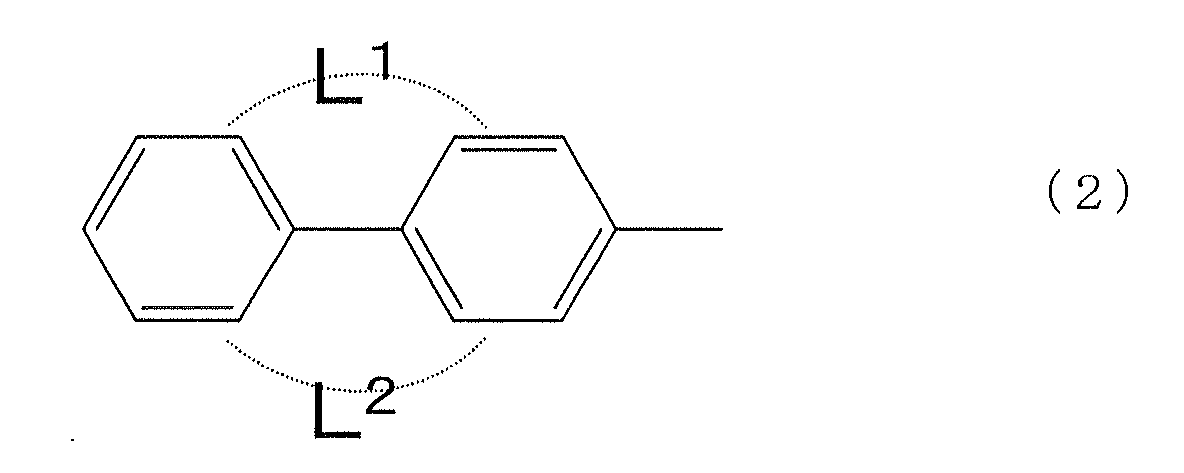
- the anthracene derivative of the present invention comprises a compound represented by following general formula (1): wherein Ar represents a substituted or unsubstituted group represented by following general formula (2): that may be substituted.
- L 1 and L 2 each represent a substituted or unsubstituted linking group which forms a cyclic structure and at least one of the groups represented by L 1 and L 2 is present.
- the linking group represented by L 1 and L 2 is not particularly limited as long as two phenyl groups are linked through one or more carbon atoms and the two phenyl groups are not conjugated.
- Examples of the linking group include groups having the structure of methylene group, ethylene group, dimethylmethylene group, diphenylmethylene group, lactone ring and peptide group.
- the linking groups having the structure of methylene group or ethylene group are preferable.
- R 1 and R 2 are as defined antecedently.
- Ar' represents a substituted or unsubstituted aryl group having 6 to 50 nuclear carbon atoms, examples of which include phenyl group, 1-naphthyl group, 2-naphthyl group, 1-anthryl group, 2-anthryl group, 9-anthryl group, 1-phenanthryl group, 2-phenanthryl group, 3-phenanthryl group, 4-phenanthryl group, 9-phenanthryl group, 1-naphthacenyl group, 2-naphthacenyl group, 9-naphthacenyl group, 1-pyrenyl group, 2-pyrenyl group, 4-pyrenyl group, 2-biphenylyl group, 3-biphenylyl group, 4-biphenylyl group, p-terphenyl-4-yl group, p-terphenyl-3-yl group, p-terphenyl-2-yl group, m-terphenyl-4-yl group, m-ter
- X represents a substituted or unsubstituted alkyl group having 1 to 50 carbon atoms, a substituted or unsubstituted alkoxyl group having 1 to 50 carbon atoms, a substituted or unsubstituted cycloalkyl group having 5 to 50 carbon atoms, a substituted or unsubstituted aralkyl group having 6 to 60 carbon atoms, a substituted or unsubstituted aryl group having 6 to 50 nuclear carbon atoms, a substituted or unsubstituted aromatic heterocyclic group having 5 to 50 nuclear atoms, a substituted or unsubstituted aryloxyl group having 5 to 50 nuclear atoms or a substituted or unsubstituted arylthio group having 5 to 50 nuclear atoms.
- Examples of the substituted or unsubstituted alkyl group represented by X include methyl group, ethyl group, propyl group, isopropyl group, n-butyl group, s-butyl group, isobutyl group, t-butyl group, n-pentyl group, n-hexyl group, n-heptyl group, n-octyl group, hydroxymethyl group, 1-hydroxyethyl group, 2-hydroxyethyl group, 2-hydroxyisobutyl group, 1,2-dihydroxyethyl group, 1,3-dihydroxyisopropyl group, 2,3-dihydroxy-t-butyl group, 1,2,3-trihydroxypropyl group, chloromethyl group, 1-chloroethyl group, 2-chloroethyl group, 2-chloroisobutyl group, 1,2-dichloroethyl group, 1,3-dichloroisopropyl group, 2,
- the substituted or unsubstituted alkoxyl group represented by X is a group represented by -OA.
- Examples of the group represented by A include methyl group, ethyl group, propyl group, isopropyl group, n-butyl group, s-butyl group, isobutyl group, t-butyl group, n-pentyl group, n-hexyl group, n-heptyl group, n-octyl group, hydroxymethyl group, 1-hydroxyethyl group, 2-hydroxyethyl group, 2-hydroxyisobutyl group, 1,2-dihydroxyethyl group, 1,3-dihydroxy- isopropyl group, 2,3-dihydroxy-t-butyl group, 1,2,3-trihydroxypropyl group, chloromethyl group, 1-chloroethyl group, 2-chloroethyl group, 2-chloroisobutyl group, 1,2-dichloroeth
- Examples of the substituted or unsubstituted cycloalkyl group represented by X include cyclopropyl group, cyclobutyl group, cyclopentyl group, cyclohexyl group, 4-methylcyclohexyl group, adamantyl group and norbornyl group.
- Examples of the substituted or unsubstituted aralkyl group represented by X include benzyl group, 1-phenylethyl group, 2-phenylethyl group, 1-phenyl- isopropyl group, 2-phenylisopropyl group, phenyl-t-butyl group, ⁇ -naphthylmethyl group, 1- ⁇ -naphthylethyl group, 2- ⁇ -naphthylethyl group, 1- ⁇ -naphthylisopropyl group, 2- ⁇ -naphthylisopropyl group, ⁇ -naphthylmethyl group, 1- ⁇ -naphthylethyl group, 2- ⁇ -naphthylethyl group, 1- ⁇ -naphthylisopropyl group, 2- ⁇ -naphthylisopropyl group, 1-pyrrolylmethyl group, 2-(1-pyrrolyl)e
- Examples of the substituted or unsubstituted aryl group represented by X include phenyl group, 1-naphthyl group, 2-naphthyl group, 1-anthryl group, 2-anthryl group, 9-anthryl group, 1-phenanthryl group, 2-phenanthryl group, 3-phenanthryl group, 4-phenanthryl group, 9-phenanthryl group, 1-naphthacenyl group, 2-naphthacenyl group, 9-naphthacenyl group, 1-pyrenyl group, 2-pyrenyl group, 4-pyrenyl group, 2-biphenylyl group, 3-biphenylyl group, 4-biphenylyl group, p-terphenyl-4-yl group, p-terphenyl-3-yl group, p-terphenyl-2-yl group, m-terphenyl-4-yl group, m-terphenyl-3-yl group, m
- Examples of the substituted or unsubstituted aromatic heterocyclic group represented by X include 1-pyrrolyl group, 2-pyrrolyl group, 3-pyrrolyl group, pyradinyl group, 2-pyridinyl group, 3-pyridinyl group, 4-pyridinyl group, 1-indolyl group, 2-indolyl group, 3-indolyl group, 4-indolyl group, 5-indolyl group, 6-indolyl group, 7-indolyl group, 1-isoindolyl group, 2-isoindolyl group, 3-isoindolyl group, 4-isoindolyl group, 5-isoindolyl group, 6-isoindolyl group, 7-isoindolyl group, 2-furyl group, 3-furyl group, 2-benzofuranyl group, 3-benzofuranyl group, 4-benzofuranyl group, 5-benzofuranyl group, 6-benzofuranyl group
- the substituted or unsubstituted aryloxyl group represented by X is a group represented by -OZ.
- Examples of the group represented by Z include phenyl group, 1-naphthyl group, 2-naphthyl group, 1-anthryl group, 2-anthryl group, 9-anthryl group, 1-phenanthryl group, 2-phenanthryl group, 3-phenanthryl group, 4-phenanthryl group, 9-phenanthryl group, 1-naphthacenyl group, 2-naphthacenyl group, 9-naphthacenyl group, 1-pyrenyl group, 2-pyrenyl group, 4-pyrenyl group, 2-biphenylyl group, 3-biphenylyl group, 4-biphenylyl group, p-terphenyl-4-yl group, p-terphenyl-3-yl group, p-terphenyl-2-yl group, m-terphenyl-4
- the substituted or unsubstituted arylthio group represented by X is a group represented by -SZ.
- Examples of the group represented by Z include the same groups described as the examples of the group represented by Z in the aryloxyl group.
- a and b each represent an integer of 0 to 4 and preferably 0 or 1.
- the plurality of groups may be the same with or different from each other.
- n represents an integer of 1 to 3.
- a plurality of groups represented by: may be the same with or different from each other.
- the anthracene derivative exhibits great crystallinity, and there is the anxiety that the uniformity of light emission and the yield of the device decrease when the anthracene derivative is used as the light emitting material of organic EL devices.
- Ar in general formula (1) represents a group represented by the following general formula (3):
- Ar represents a group represented by the following general formula (3'):
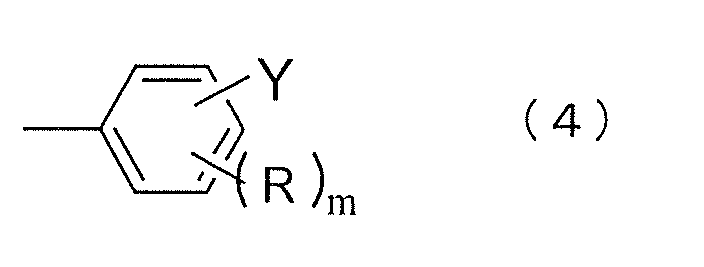
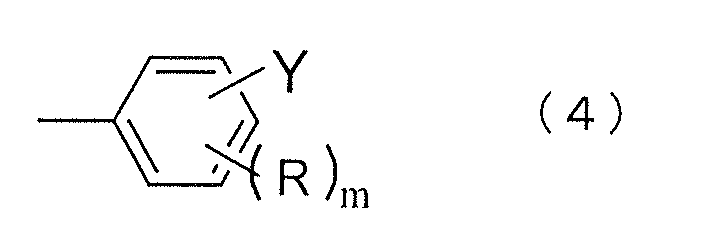
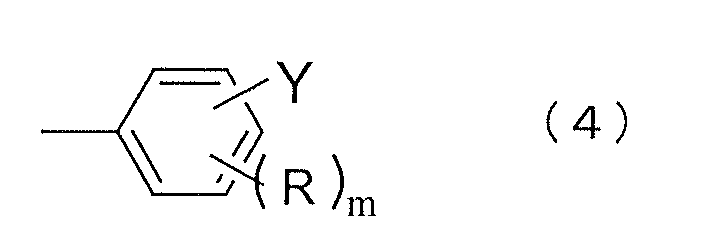
- Ar' represents an aryl group represented by the above general formula (4).
- R 1 and R 2 each represent hydrogen atom, a substituted or unsubstituted alkyl group having 1 to 6 carbon atoms, a substituted or unsubstituted alkoxyl group having 1 to 6 carbon atoms or a substituted or unsubstituted phenyl group.
- Y represents a substituted or unsubstituted aromatic condensed cyclic residue group having 10 or more nuclear atoms or a substituted or unsubstituted aromatic non-condensed cyclic residue group having 12 or more nuclear atoms.
- Examples of the aromatic condensed cyclic compound from which the group represented by Y derives include naphthalene, fluoranthene, perylene, pentacene, phenanthrene, chrysene, benzanthracene and pyrene.
- Examples of the aromatic non-condensed cyclic compound from which the group represented by Y derives include biphenyl, terphenyl, and quarterohenyl.
- R represents a substituted or unsubstituted alkyl group having 1 to 50 carbon atoms, a substituted or unsubstituted alkoxyl group having 1 to 50 carbon atoms, a substituted or unsubstituted aryl group having 6 to 50 nuclear carbon atoms, a substituted or unsubstituted aromatic heterocyclic group having 5 to 50 nuclear atoms, a substituted or unsubstituted aryloxyl group having 5 to 50 nuclear atoms or a substituted or unsubstituted arylthio group having 5 to 50 nuclear atoms.
- Examples of the above groups include the same groups as those described antecedently as the examples of the group represented by X.
- n an integer of 0 to 4.
- Examples of the substituent to the groups represented by X, Ar, Ar', R 1 , R 2 , Y and R include halogen atoms, hydroxyl group, nitro group, cyano group, alkyl groups, aryl groups, cycloalkyl groups, alkoxyl groups, aromatic heterocyclic groups, aralkyl groups, aryloxyl groups, arylthio groups, alkoxycarbonyl groups and carboxyl group.
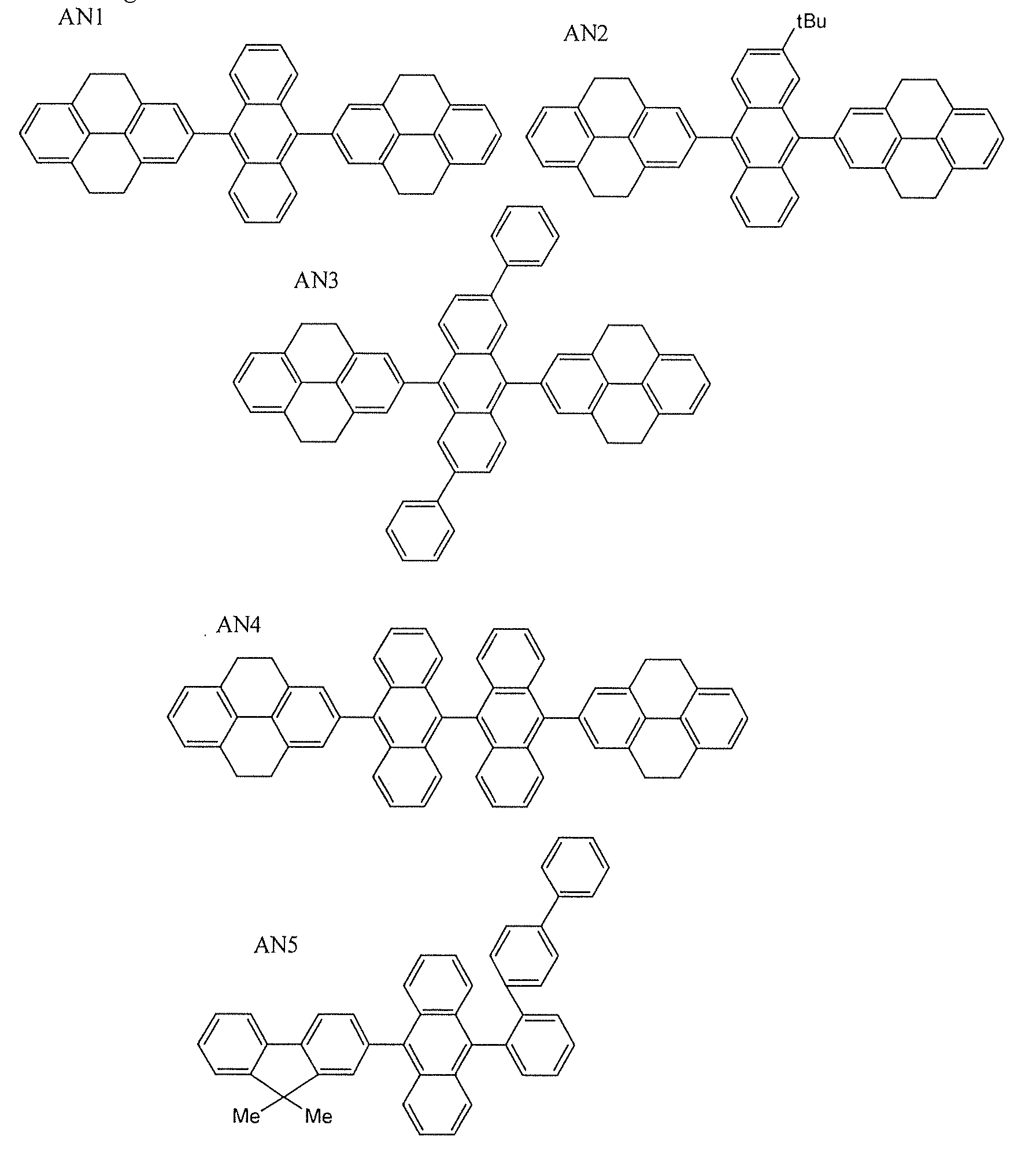
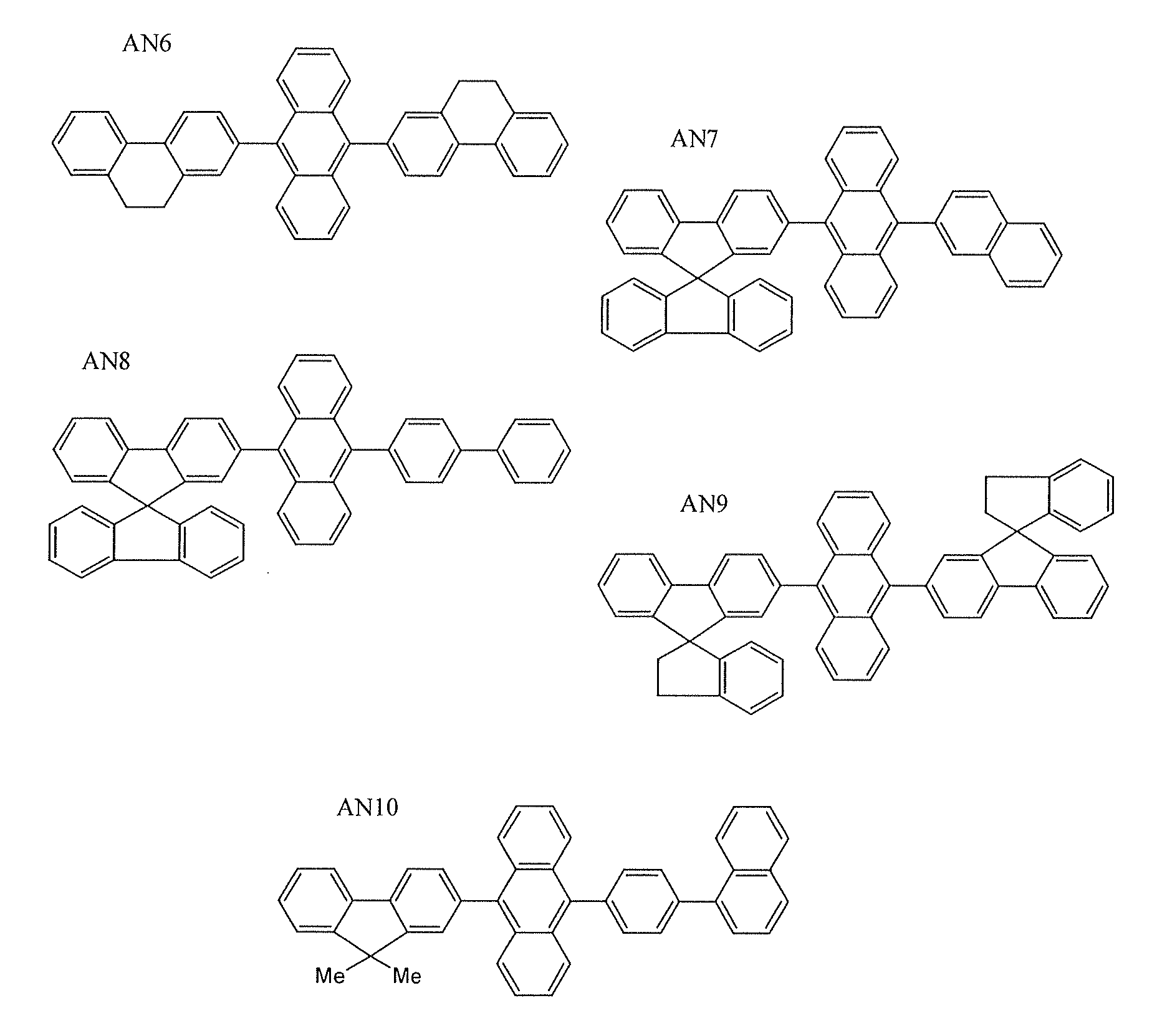
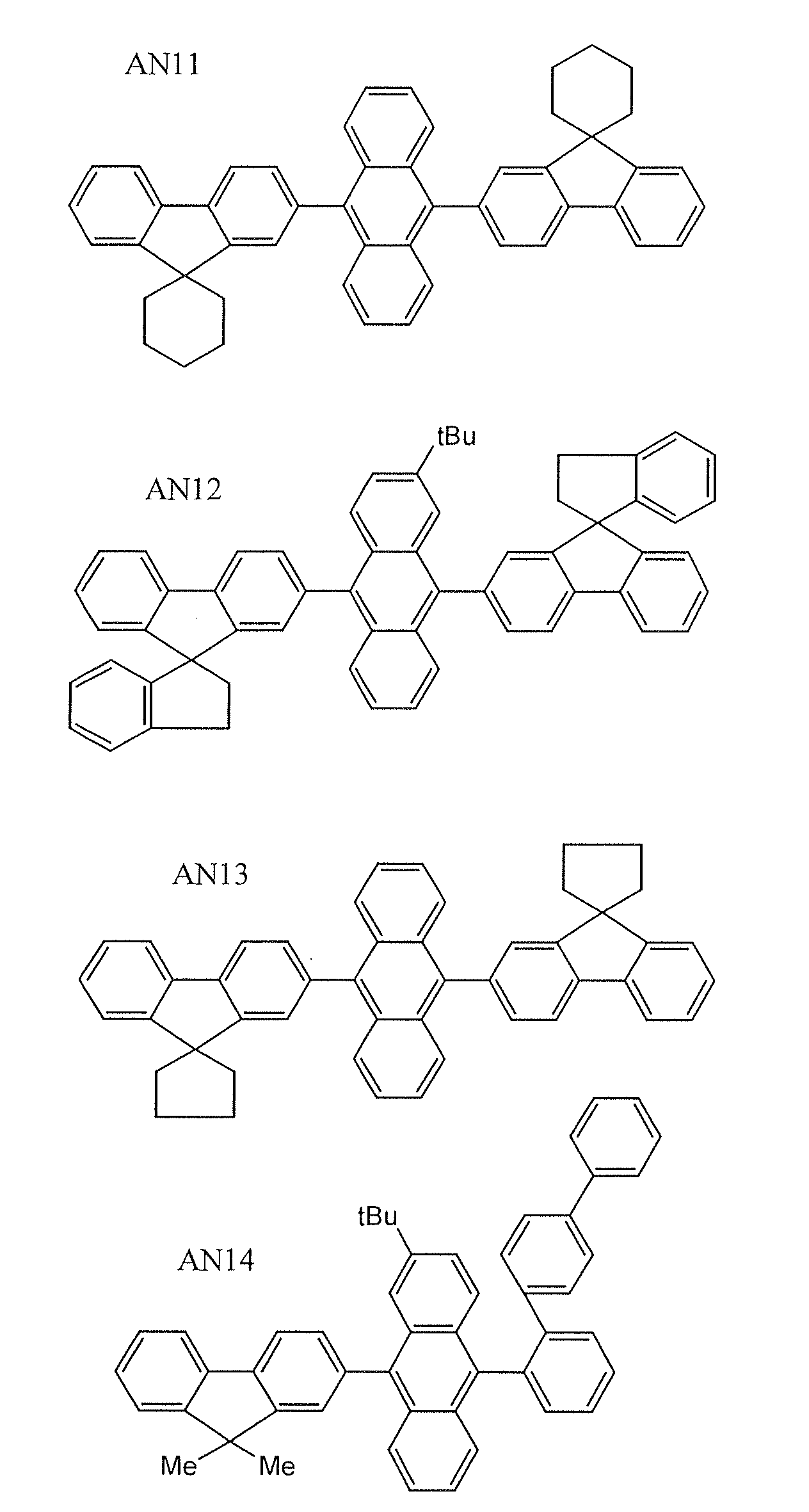
- anthracene derivative represented by general formula (1) examples are shown in, but not limited to, the compounds shown as the following:
- anthracene derivative of the present invention is used as the light emitting material or the hole transporting material of organic EL devices.
- the organic EL device of the present invention comprises a cathode, an anode and an organic thin film layer comprising at least one layer including a light emitting layer and sandwiched between the cathode and the anode, wherein at least one layer in the organic thin film layers comprises the anthracene derivative represented by general formula (1) described above singly or as a component of a mixture.
- the light emitting layer comprises the anthracene derivative represented by general formula (1). It is more preferable that the light emitting layer comprises the anthracene derivative represented by general formula (1) as the main component.
- the light emitting layer in the organic EL device of the present invention further comprises an arylamine compound and/or a styrylamine compound.
- styrylamine compound compounds represented by the following general formula (A): wherein Ar 2 represent a group selected from phenyl group, biphenyl group, terphenyl group, stilbene group and distyrylaryl groups, Ar 3 and Ar 4 each represent hydrogen atom or an aromatic group having 6 to 20 carbon atoms, the groups represented by Ar 2 , Ar 3 and Ar 4 may be substituted, m represents an integer of 1 to 4 and, preferably, at least one of the groups represented by Ar 3 and Ar 4 is substituted with styryl group, are preferable.
- Ar 2 represent a group selected from phenyl group, biphenyl group, terphenyl group, stilbene group and distyrylaryl groups
- Ar 3 and Ar 4 each represent hydrogen atom or an aromatic group having 6 to 20 carbon atoms
- the groups represented by Ar 2 , Ar 3 and Ar 4 may be substituted
- m represents an integer of 1 to 4 and, preferably, at least one of the groups represented by Ar 3 and Ar 4
- aromatic group having 6 to 20 carbon atoms examples include phenyl group, naphthyl group, anthranyl group, phenanthryl group and terphenyl group.
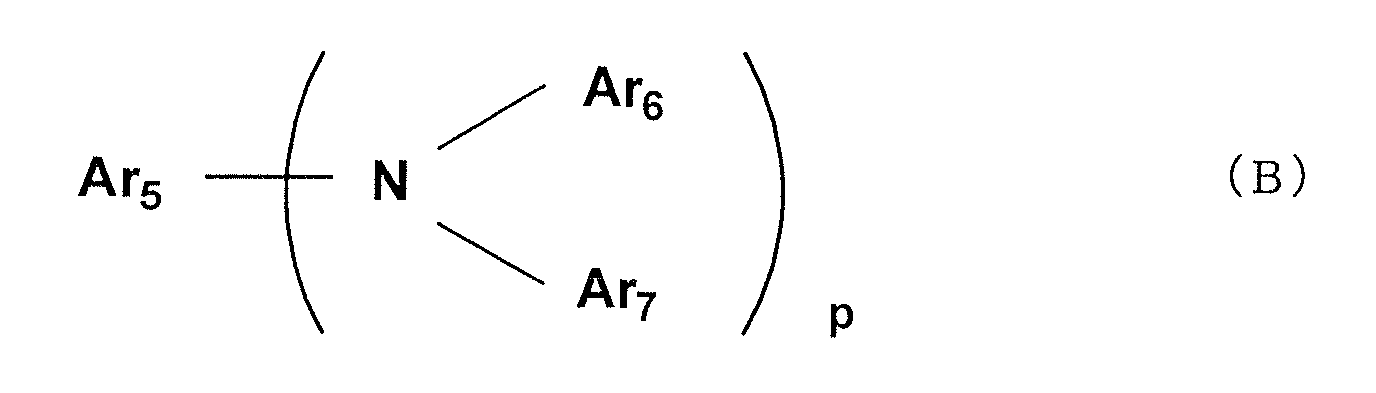
- arylamine compound compounds represented by the following general formula (B): wherein Ar 5 to Ar 7 each represent an aryl group having 5 to 40 nuclear carbon atoms, and p represents an integer of 1 to 4, are preferable.
- aryl group having 5 to 40 nuclear carbon atoms examples include phenyl group, naphthyl group, anthranyl group, phenanthryl group, pyrenyl group, coronyl group, biphenyl group, terphenyl group, pyrrolyl group, furanyl group, thiophenyl group, benzothiophenyl group, oxadiazolyl group, diphenylanthranyl group, indolyl group, carbazolyl group, pyridyl group, benzoquinolyl group, fluoranthenyl group, acenaphthofluoranthenyl group and stilbene.
- substituent to the aryl group include alkyl groups having 1 to 6 carbon atoms such as ethyl group, methyl group, 1-propyl group, n-propyl group, s-butyl group, t-butyl group, pentyl group, hexyl group, cyclopentyl group and cyclohexyl group; alkoxyl groups having 1 to 6 carbon atoms such as ethoxyl group, methoxyl group, i-propoxyl group, n-propoxyl group, s-butoxyl group, t-butoxyl group, pentoxyl group, hexyloxyl group, cyclopentoxyl group and cyclohexyloxyl group; aryl groups having 5 to 40 nuclear atoms; amino groups substituted with an aryl group having 5 to 40 nuclear atoms; ester groups having an aryl group having 5 to 40 nuclear atoms; ester groups having an alkyl group having 1
- the organic thin film layers may include a hole transporting layer, and the hole transporting layer may comprise the anthracene derivative represented by general formula (1) singly or as a component of a mixture. It is preferable that the hole transporting layer comprises the anthracene derivative as the main component.
- Typical examples of the construction of the organic EL device include:
- construction (8) is preferable.
- the construction of the organic EL device is not limited to those shown above as the examples.
- the organic EL device is produced on a substrate which transmits light.
- the substrate which transmits light is the substrate which supports the organic EL device. It is preferable that the substrate which transmits light has a transmittance of light of 50% or greater in the visible region of 400 to 700 nm. It is also preferable that a flat and smooth substrate is employed.
- glass sheet and synthetic resin sheet are advantageously employed.
- the glass sheet include soda ash glass, glass containing barium and strontium, lead glass, aluminosilicate glass, borosilicate glass, barium borosilicate glass and quartz.
- the synthetic resin sheet include sheet made of polycarbonate resins, acrylic resins, polyethylene terephthalate resins, polyether sulfide resins and polysulfone resins.
- an electrode made of a material such as a metal, an alloy, a conductive compound and a mixture of these materials which has a great work function (4 eV or more) is preferable.
- the material for the anode include metals such as Au and conductive materials such as CuI, ITO (indium tin oxide), SnO 2 ZnO and In-Zn-O.
- the anode can be prepared by forming a thin film of the electrode material described above in accordance with a process such as the vapor deposition process and the sputtering process. When the light emitted from the light emitting layer is obtained through the anode, it is preferable that the anode has a transmittance of the emitted light greater than 10%.
- the sheet resistivity of the anode is several hundred ⁇ / ⁇ or smaller.
- the thickness of the anode is, in general, selected in the range of from 10 nm to 1 ⁇ m and preferably in the range of from 10 to 200 nm although the preferable range may be different depending on the adopted material.
- an electrode made of a material such as a metal, an alloy, a conductive compound and a mixture of these materials which has a small work function (4 eV or smaller) is employed.
- the material for the cathode include sodium, sodium-potassium alloys, magnesium, lithium, magnesium-silver alloys, aluminum/aluminum oxide, Al/Li 2 O, Al/LiO 2 , Al/LiF, aluminum-lithium alloys, indium and rare earth metals.
- the cathode can be prepared by forming a thin film of the electrode material described above in accordance with a process such as the vapor deposition process and the sputtering process.
- the cathode When the light emitted from the light emitting layer is obtained through the cathode, it is preferable that the cathode has a transmittance of the emitted light greater than 10 %. It is also preferable that the sheet resistivity of the cathode is several hundred ⁇ / ⁇ or smaller.
- the thickness of the cathode is, in general, selected in the range of from 10 nm to 1 ⁇ m and preferably in the range of from 50 to 200 nm.
- a layer of a chalcogenide, a metal halide or a metal oxide is disposed on the surface of at least one of the pair of electrodes prepared as described above.
- a layer of a chalcogenide (including an oxide) of a metal such as silicon and aluminum is disposed on the surface of the anode at the side of the light emitting layer, and a layer of a metal halide or a metal oxide is disposed on the surface of the cathode at the side of the light emitting layer. Due to the above layers, stability in driving can be improved.
- Preferable examples of the chalcogenide include SiO x (1 ⁇ x ⁇ 2), AlO x (1 ⁇ x ⁇ 1.5), SiON and SiAlON.
- Preferable examples of the metal halide include LiF, MgF 2 , CaF 2 and fluorides of rare earth metals.
- Preferable examples of the metal oxide include Cs 2 O, Li 2 O, MgO, SrO, BaO and CaO.
- a mixed region of an electron transfer compound and a reducing dopant or a mixed region of a hole transfer compound and an oxidizing dopant is disposed on the surface of at least one of the pair of electrodes prepared as described above. Due to the mixed region disposed as described above, the electron transfer compound is reduced to form an anion, and injection and transportation of electrons from the mixed region into the light emitting medium can be facilitated. The hole transfer compound is oxidized to form a cation, and injection and transportation of holes from the mixed region into the light emitting medium is facilitated.
- the oxidizing dopant include various types of Lewis acid and acceptor compounds.
- the reducing dopant include alkali metals, compounds of alkali metals, alkaline earth metals, rare earth metals and compounds of these metals.
- the light emitting layer has the following functions:
- the process for forming the light emitting layer a well known process such as the vapor deposition process, the spin coating process and the LB process can be employed. It is particularly preferable that the light emitting layer is a molecular deposit film.
- the molecular deposit film is a thin film formed by deposition of a material compound in the gas phase or a thin film formed by solidification of a material compound in a solution or in the liquid phase.
- the molecular deposit film can be distinguished from the thin film formed in accordance with the LB process (the molecular accumulation film) based on the differences in the aggregation structure and higher order structures and functional differences caused by these structural differences.
- the light emitting layer can also be formed by dissolving a binder such as a resin and the material compounds into a solvent to prepare a solution, followed by forming a thin film from the prepared solution in accordance with the spin coating process or the like.
- the light emitting layer may comprise well known light emitting materials other than the light emitting material comprising the anthracene derivative of the present invention, or a light emitting layer comprising other well known light emitting material may be laminated to the light emitting layer comprising the light emitting material comprising the anthracene derivative of the present invention as long as the object of the present invention is not adversely affected.
- the hole injecting layer and the hole transporting layer are layers which help injection of holes into the light emitting layer and transport the holes to the light emitting region.
- the layers exhibit a great mobility of holes and, in general, have an ionization energy as small as 5.5 eV or smaller.
- a material which transports holes to the light emitting layer at a small strength of the electric field is preferable.
- a material which exhibits, for example, a mobility of holes of at least 10 -6 cm 2 /V ⁇ sec under application of an electric field of from 10 4 to 10 6 V/cm is preferable.
- the anthracene derivative of the present invention is useful as the hole transporting material.
- a material other than the anthracene derivative can be selected from materials which are conventionally employed as the charge transporting material of holes in photoconductive materials and well known materials which are employed for the hole injecting layer in organic EL devices.
- a thin film may be formed from the material for the hole injecting layer or the hole transporting layer, respectively, in accordance with a well known process such as the vacuum vapor deposition process, the spin coating process, the casting process and the LB process.
- a well known process such as the vacuum vapor deposition process, the spin coating process, the casting process and the LB process.
- the thickness of the hole injecting layer and the hole transporting layer is not particularly limited, the thickness is usually from 5 nm to 5 ⁇ m.
- the electron injection layer and the electron transporting are layers which help injection of electrons into the light emitting layer and transports electrons to the light emitting region and exhibit a great mobility of electrons.
- an adhesion improving layer is a layer made of a material exhibiting excellent adhesion with the cathode.
- metal complexes of 8-hydroxyquinoline and derivatives thereof are preferable.
- the metal complex of 8-hydroxyquinoline and derivatives thereof include metal chelates of oxinoid compounds including chelates of oxine (in general, 8-quinolinol or 8-hydroxyquinoline).
- tris(8-quinolinol)aluminum can be employed as the electron injecting material.
- an organic EL device tends to form defects in pixels due to leak and short circuit since an electric field is applied to ultra-thin films.
- a layer of an insulating thin film may be inserted between the pair of electrodes.
- Examples of the material employed for the insulating layer include aluminum oxide, lithium fluoride, lithium oxide, cesium fluoride, cesium oxide, magnesium oxide, magnesium fluoride, calcium oxide, calcium fluoride, aluminum nitride, titanium oxide, silicon oxide, germanium oxide, silicon nitride, boron nitride, molybdenum oxide, ruthenium oxide and vanadium oxide. Mixtures and laminates of the above compounds can also be employed.
- the anode, the light emitting layer and, where necessary, the hole injecting layer and the electron injecting layer are formed in accordance with the above process using the above materials, and the cathode is formed in the last step.
- the organic EL device may be produced by forming the above layers in the order reverse to that described above, i.e., the cathode being formed in the first step and the anode in the last step.
- An embodiment of the process for producing an organic EL device having a construction in which an anode, a hole injecting layer, a light emitting layer, an electron injecting layer and a cathode are disposed successively on a substrate transmitting light will be described in the following.
- a thin film made of a material for the anode is formed in accordance with the vapor deposition process or the sputtering process so that the thickness of the formed thin film is 1 ⁇ m or smaller and preferably in the range of 10 to 200 nm.
- the formed thin film is employed as the anode.
- a hole injecting layer is formed on the anode.
- the hole injecting layer can be formed in accordance with the vacuum vapor deposition process, the spin coating process, the casting process or the LB process, as described above.
- the vacuum vapor deposition process is preferable since a uniform film can be easily obtained and the possibility of formation of pin holes is small.
- the conditions are suitably selected in the following ranges: the temperature of the source of the deposition: 50 to 450°C; the vacuum: 10 -7 to 10 -3 Torr; the rate of deposition: 0.01 to 50 nm/second; the temperature of the substrate: -50 to 300°C and the thickness of the film: 5 nm to 5 ⁇ m; although the conditions of the vacuum vapor deposition are different depending on the employed compound (the material for the hole injecting layer) and the crystal structure and the recombination structure of the hole injecting layer to be formed.
- the light emitting layer is formed on the hole injecting layer formed above.
- a thin film of the light emitting material can be formed in accordance with the vacuum vapor deposition process, the sputtering process, the spin coating process or the casting process, and the formed thin film is employed as the light emitting layer.
- the vacuum vapor deposition process is preferable because a uniform film can be easily obtained and the possibility of formation of pin holes is small.
- the conditions of the vacuum vapor deposition process can be selected in the same ranges as those described for the vacuum vapor deposition of the hole injecting layer although the conditions are different depending on the used compound. It is preferable that the thickness is in the range of from 10 to 40 nm.
- An electron injecting layer is formed on the light emitting layer formed above. Similarly to the hole injecting layer and the light emitting layer, it is preferable that the electron injecting layer is formed in accordance with the vacuum vapor deposition process since a uniform film must be obtained.
- the conditions of the vacuum vapor deposition can be selected in the same ranges as those described for the vacuum vapor deposition of the hole injecting layer and the light emitting layer.
- a cathode is formed on the electron injecting layer formed above in the last step, and an organic EL device can be obtained.
- the cathode is made of a metal and can be formed in accordance with the vacuum vapor deposition process or the sputtering process. It is preferable that the vacuum vapor deposition process is employed in order to prevent appearance of damages on the lower organic layers during the formation of the film.
- the above layers from the anode to the cathode are formed successively while the production system is kept in a vacuum after being evacuated.
- the organic EL device which can be produced as described above emits light when a direct voltage of 3 to 40 V is applied in the condition that the anode is connected to a positive electrode (+) and the cathode is connected to a negative electrode (-). When the connection is reversed, no electric current is observed and no light is emitted at all.
- an alternating voltage is applied to the organic EL device, the uniform light emission is observed only in the condition that the polarity of the anode is positive and the polarity of the cathode is negative.
- any type of wave shape can be employed.
- the catalyst was separated by filtration and washed with 3 liters of chloroform. Then, chloroform was removed under a reduced pressured, and the remaining decaline solution was cooled with ice. The formed crystals were separated by filtration, washed with ethanol and dried, thereby obtaining 130 g of crystals.
- the obtained crystals in an amount of 126 g was suspended in 6.3 liters of purified water, and 2 g of ferric chloride monohydrate (available from HIROSHIMA WAKO Co., Ltd.) was added to the suspension. Then, an aqueous solution obtained from 30 milliliter of bromine and 3 liters of purified water was added dropwise at the room temperature over 4 hours. The reaction was then allowed to proceed at the room temperature for 12 hours.
- ferric chloride monohydrate available from HIROSHIMA WAKO Co., Ltd.
- the formed crystals were separated by filtration, washed with water and ethanol and dissolved into 3 liters of chloroform.
- the resultant solution was washed with an aqueous solution of sodium hydrogencarbonate and water and dried with anhydrous magnesium sulfate, and the solvent was then removed.
- the reaction mixture was deactivated with a saturated aqueous solution of ammonium chloride, and the formed solid substance was separated by filtration and washed with methanol.
- the obtained compound was purified in accordance with the column chromatography, and 1.6 g of a light yellow solid substance was obtained.
- the reaction mixture was deactivated with a saturated aqueous solution of ammonium chloride, and the formed solid substance was separated by filtration and washed with methanol.
- the obtained compound was purified in accordance with the column chromatography, and 1.8 g of a light yellow solid substance was obtained.
- the formed crystals were dissolved by adding water and heating.
- the catalyst was removed by filtration, and crystals were formed by adding concentrated hydrochloric acid.
- the formed crystals were separated by filtration and washed with water. After extraction with ethyl acetate, the extract was dried with anhydrous magnesium sulfate and concentrated to remove the entire volatile components, and 145 g of a solid substance was obtained.
- the obtained solid substance was placed into 500 milliliter of acetic anhydride (available from HIROSHIMA WAKO Co., Ltd.), and the reaction was allowed to proceed at 80°C for 3 hours. Acetic anhydride was removed under a reduced pressure until the entire volatile components were removed, and 135 g of an acid anhydride was obtained.
- acetic anhydride available from HIROSHIMA WAKO Co., Ltd.
- Polyphosphoric acid in an amount of 2 liters was heated at 150°C.
- the precipitates separated above were added to the heated polyphosphoric acid in small portions under stirring, and the resultant mixture was stirred at the same temperature for 3 hours.
- the reaction mixture was poured into ice water.
- the formed crystals were separated by filtration, washed with water, dissolved into chloroform, dried with anhydrous magnesium sulfate and purified by a column.
- the reaction mixture was deactivated with a saturated aqueous solution of ammonium chloride, and the formed solid substance was separated by filtration and washed with methanol.
- the obtained compound was purified in accordance with the column chromatography, and 2.0 g of a light yellow solid substance was obtained.
- the reaction mixture was deactivated with a saturated aqueous solution of ammonium chloride, and the formed solid substance was separated by filtration and washed with methanol.
- the obtained compound was purified in accordance with the column chromatography, and 2.2 g of a light yellow solid substance was obtained.
- the solid substance obtained above in an amount of 5 g was suspended into 300 milliliter of purified water, and 0.1 g of ferric chloride monohydrate (available from HIROSHIMA WAKO Co., Ltd.) was added to the resultant suspension. Then, an aqueous solution obtained from 1 milliliter of bromine and 100 milliliter of purified water was added dropwise at the room temperature over 1 hour, and the reaction was allowed to proceed at the room temperature for 12 hours.
- ferric chloride monohydrate available from HIROSHIMA WAKO Co., Ltd.
- the reaction mixture was deactivated with a saturated aqueous solution of ammonium chloride, and the formed solid substance was separated by filtration and washed with methanol.
- the reaction mixture was deactivated with a saturated aqueous solution of ammonium chloride, and a formed solid substance was separated by filtration and washed with methanol.
- the obtained compound was purified in accordance with the column chromatography, and 1.1 g of a light yellow solid substance was obtained.
- the reaction mixture was deactivated with a saturated aqueous solution of ammonium chloride, and the formed solid substance was separated by filtration and washed with methanol.
- the reaction mixture was deactivated with a saturated aqueous solution of ammonium chloride, and the formed solid substance was separated by filtration and washed with methanol.
- the obtained compound was purified in accordance with the column chromatography, and 1.1 g of a light yellow solid substance was obtained.
- the white powder obtained above in an amount of 10 g was suspended into 500 milliliter of purified water, and 0.1 g of ferric chloride monohydrate (available from HIROSHIMA WAKO Co., Ltd.) was added to the resultant suspension. Then, an aqueous solution obtained from 2.5 milliliter of bromine and 200 milliliter of purified water was added dropwise at the room temperature over 1 hour, and the reaction was allowed to proceed at the room temperature for 12 hours.
- ferric chloride monohydrate available from HIROSHIMA WAKO Co., Ltd.
- the reaction mixture was deactivated with a saturated aqueous solution of ammonium chloride, and the formed solid substance was separated by filtration and washed with methanol.
- the obtained compound was purified in accordance with the column chromatography, and 2.4 g of a light yellow solid substance was obtained.
- Example 8 (Production of an organic EL device)
- a glass substrate (available from GEOMATEC Company) of 25 mm ⁇ 75 mm ⁇ 1.1 mm thickness having an ITO transparent electrode was cleaned by application of ultrasonic wave in isopropyl alcohol for 5 minutes and then by exposure to ozone generated by ultraviolet light for 30 minutes.
- the glass substrate having the transparent electrode lines which had been cleaned was attached to a substrate holder of a vacuum vapor deposition apparatus.
- a film of N,N'-bis(N,N'-diphenyl-4-aminophenyl)-N,N-diphenyl-4,4'-diamino-1,1'-biphenyl shown below (referred to as a film of TPD232, hereinafter) having a thickness of 60 nm was formed in a manner such that the formed film covered the transparent electrode.
- the formed film of TPD232 worked as the hole injecting layer.
- a film of N,N,N',N'-tetra (4-biphenyl)diaminobiphenylene shown below (referred to as a film of TBDB, hereinafter) having a thickness of 20 nm was formed.
- the formed film of TBDB worked as the hole transporting layer.
- a film of AN1 as the light emitting material having a thickness of 40 nm was formed by vapor deposition.
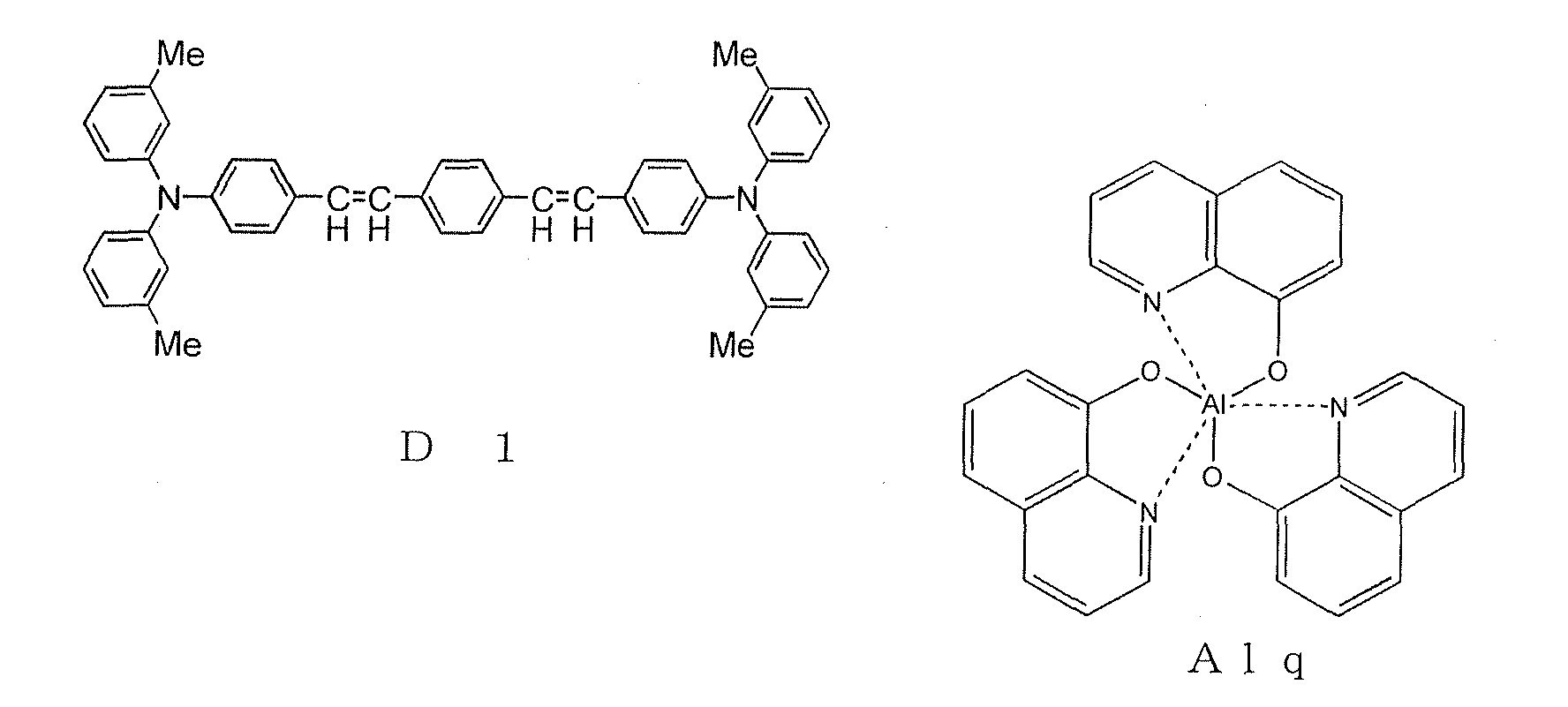
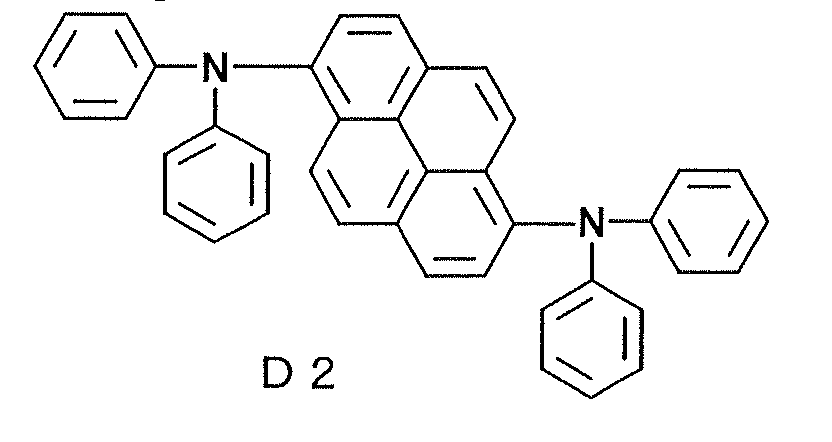
- an amine compound D1 having styryl group which is shown below was vapor deposited as the light emitting material in an amount such that the relative amounts by weight of AN1:D1 was 40:2.
- the formed film worked as the light emitting layer.
- a film of Alq shown below having a thickness of 10 nm was formed.
- the film of Alq worked as the electron injecting layer.
- Li the source of lithium: available from SAES GETTERS Company
- Alq binary vapor deposited
- an Alq:Li film the thickness: 10 nm
- metallic aluminum was vapor deposited to form a metal cathode, and an organic EL device was produced.
- Example 11 (Production of an organic EL device)
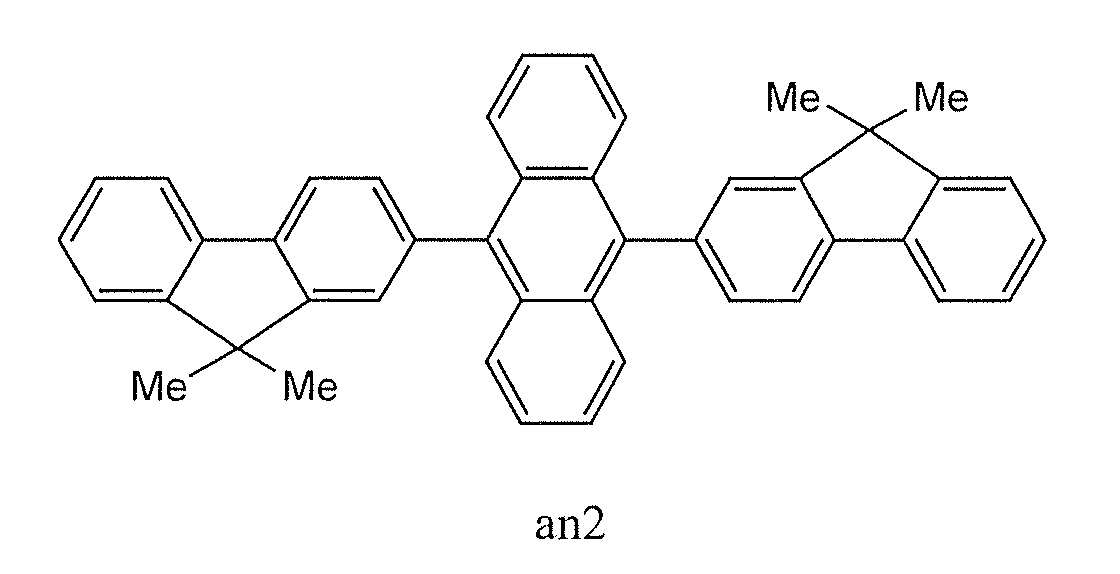
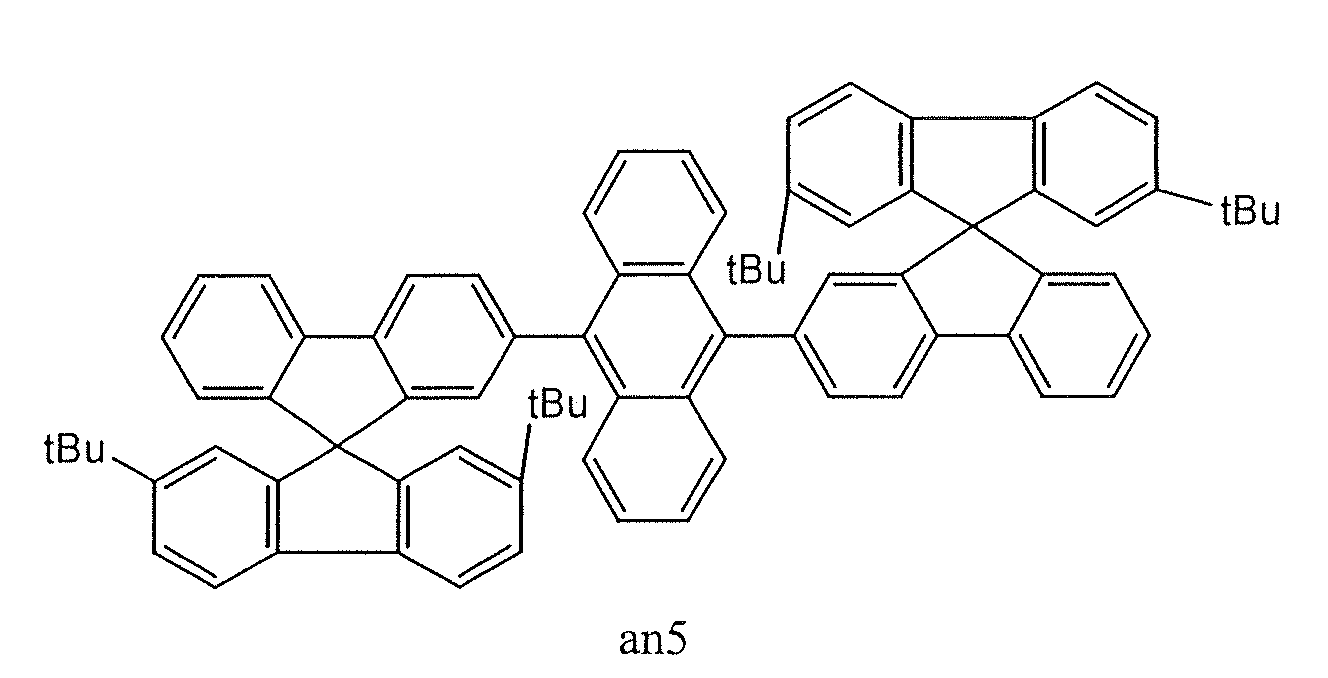
- the temperature of the vapor deposition boat was elevated to a temperature of 400°C or higher, and the vapor deposition of an5 proceeded while thermal decomposition took place. This phenomenon was estimated based on the peaks of low molecular weight substances observed in accordance with the mass analysis using an apparatus disposed at the inside of the vacuum chamber.
- the obtained organic EL device did not emit blue light but whitish blue light due to the effect of the contamination with impurities formed by the decomposition.
- Compounds of light emitting layer Efficiency of light emission (cd/A) Situation of light emitting surface after storage at 120°C for 500 hours Example 8 AN1/D1 9.7 blue uniform light emission Example 9 AN2/D1 11.0 blue uniform light emission Example 10 AN3/D1 10.1 blue uniform light emission Example 11 AN4/D1 10.5 blue uniform light emission Example 12 AN5/D1 9.6 blue uniform light emission Example 13 AN7/D1 10.2 blue uniform light emission Example 14 AN11/D1 10.7 blue uniform light emission Comparative Example 1 an1/D1 9.0 appearance of bright spots due to crystal defects Comparative Example 2 an2/D1 8.8 appearance of bright spots due to crystal defects Comparative Example 3 an3/D1 9.8 appearance of bright spots due to crystal defects Comparative Example 4 an4/D1 9.0 appearance of bright spots due to crystal defects Comparative Example 5 an5/D1 8.2 whitish
- the organic EL devices of Examples 8 to 14 exhibited more excellent efficiencies of light emission than those of the devices of Comparative Examples 1 to 5, and uniform blue light could emit even when the devices had been driven for a long time at high temperatures.
- Example 13 Although AN7 used in Example 13 had spirofluorenyl group having a great molecular weight, the spirofluorenyl group was introduced into a single position alone. No thermal decomposition took place unlike the case of Comparative Example 5, and the vapor deposition could be conducted at a temperature of 400°C or lower. Therefore, the uniform emission of blue light was achieved, and the efficiency of light emission was greater than that of Comparative Example 5.
- Example 14 Although AN11 used in Example 14 had the spiro skeleton structure, the structure had a molecular weight smaller than that of spirofluorenyl group.
- the thermal decomposition did not take place unlike the case of Comparative Example 5 even though the compound had the substituent having the spiro skeleton structure at two positions, and the vapor deposition could be conducted at a temperature of 400°C or lower. Therefore, the uniform emission of blue light was achieved, and the efficiency of light emission was greater than that of Comparative Example 5.
- the organic EL device utilizing the anthracene derivative of the present invention exhibits a great efficiency of light emission, enables uniform light emission even after the device is driven at a high temperature for a long time and is advantageously used as the device which can be used at high temperatures.
Landscapes
- Chemical & Material Sciences (AREA)
- Organic Chemistry (AREA)
- Engineering & Computer Science (AREA)
- Materials Engineering (AREA)
- Physics & Mathematics (AREA)
- Spectroscopy & Molecular Physics (AREA)
- Optics & Photonics (AREA)
- Electroluminescent Light Sources (AREA)
- Organic Low-Molecular-Weight Compounds And Preparation Thereof (AREA)
Abstract

Description


when Ar represents a group represented by a following general formula (3):

- (i) Ar' represents an aryl group represented by following
general formula (4):
wherein Y represents a substituted or unsubstituted aromatic condensed cyclic residue group having 10 or more nuclear atoms or a substituted or unsubstituted aromatic non-condensed cyclic residue group having 12 or more nuclear atoms, R represents a substituted or unsubstituted alkyl group having 1 to 50 carbon atoms, a substituted or unsubstituted alkoxyl group having 1 to 50 carbon atoms, a substituted or unsubstituted aryl group having 6 to 50 nuclear carbon atoms, a substituted or unsubstituted aromatic heterocyclic group having 5 to 50 nuclear atoms, a substituted or unsubstituted aryloxyl group having 5 to 50 nuclear atoms or a substituted or unsubstituted arylthio group having 5 to 50 nuclear atoms, and m represents an integer of 0 to 4, or
- (ii) at least one of a and b does not represent 0, and X
represents a substituted or unsubstituted alkyl group having 4 to 50
carbon atoms, a substituted or unsubstituted alkoxyl group having 4 to 50
carbon atoms, a substituted or unsubstituted cycloalkyl group having 5 to
50 carbon atoms, a substituted or unsubstituted aralkyl group having 6 to
60 carbon atoms, a substituted or unsubstituted aryl group having 10 to
50 nuclear carbon atoms, a substituted or unsubstituted aromatic
heterocyclic group having 10 to 50 nuclear atoms, a substituted or
unsubstituted aryloxyl group having 5 to 50 nuclear atoms or a
substituted or unsubstituted arylthio group having 5 to 50 nuclear atoms,
and
when Ar represents a group represented by a following general formula (3'):

n represents an integer of 1 to 3. When n represents 2 or 3, a plurality of groups represented by:









| Compounds of light emitting layer | Efficiency of light emission (cd/A) | Situation of light emitting surface after storage at 120°C for 500 hours | |
| Example 8 | AN1/D1 | 9.7 | blue uniform light emission |
| Example 9 | AN2/D1 | 11.0 | blue uniform light emission |
| Example 10 | AN3/D1 | 10.1 | blue uniform light emission |
| Example 11 | AN4/D1 | 10.5 | blue uniform light emission |
| Example 12 | AN5/D1 | 9.6 | blue uniform light emission |
| Example 13 | AN7/D1 | 10.2 | blue uniform light emission |
| Example 14 | AN11/D1 | 10.7 | blue uniform light emission |
| Comparative Example 1 | an1/D1 | 9.0 | appearance of bright spots due to crystal defects |
| Comparative Example 2 | an2/D1 | 8.8 | appearance of bright spots due to crystal defects |
| Comparative Example 3 | an3/D1 | 9.8 | appearance of bright spots due to crystal defects |
| Comparative Example 4 | an4/D1 | 9.0 | appearance of bright spots due to crystal defects |
| Comparative Example 5 | an5/D1 | 8.2 | whitish blue light emission |
Claims (10)
- An anthracene derivative represented by following general formula (1):wherein
 may be a same with or different from each other;Ar represents a substituted or unsubstituted group represented by following general formula (2):in general formula (2), L1 and L2 each representing a substituted or unsubstituted linking group which forms a cyclic structure, and at least one of the groups represented by L1 and L2 being present,
 Ar' represents a substituted or unsubstituted aryl group having 6 to 50 nuclear carbon atoms,X represents a substituted or unsubstituted alkyl group having 1 to 50 carbon atoms, a substituted or unsubstituted alkoxyl group having 1 to 50 carbon atoms, a substituted or unsubstituted cycloalkyl group having 5 to 50 carbon atoms, a substituted or unsubstituted aralkyl group having 6 to 60 carbon atoms, a substituted or unsubstituted aryl group having 6 to 50 nuclear carbon atoms, a substituted or unsubstituted aromatic heterocyclic group having 5 to 50 nuclear atoms, a substituted or unsubstituted aryloxyl group having 5 to 50 nuclear atoms or a substituted or unsubstituted arylthio group having 5 to 50 nuclear atoms,a and b each represent an integer of 0 to 4 and when a plurality of groups represented by X are present, they may be the same with or different from each other, andn represents an integer of 1 to 3 and, when n represents 2 or 3, a plurality of groups represented by: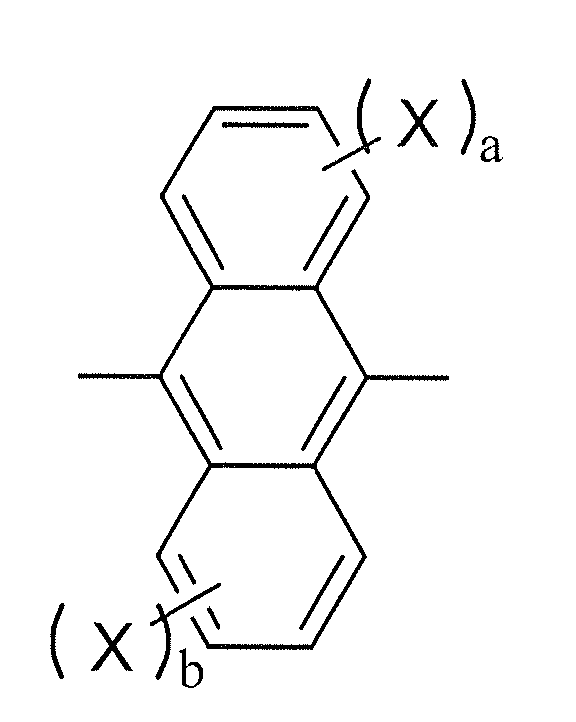
with proviso that
when Ar represents a group represented by a following general formula (3):wherein R1 and R2 each represent hydrogen atom, a substituted or unsubstituted alkyl group having 1 to 6 carbon atoms, a substituted or unsubstituted alkoxyl group having 1 to 6 carbon atoms or a substituted or unsubstituted phenyl group, wherein R1 and R2 are as defined above, Ar' represents an aryl group represented by the foregoing general formula (4).(i) Ar' represents an aryl group represented by following general formula (4):wherein Y represents a substituted or unsubstituted aromatic condensed cyclic residue group having 10 or more nuclear atoms or a substituted or unsubstituted aromatic non-condensed cyclic residue group having 12 or more nuclear atoms, R represents a substituted or unsubstituted alkyl group having 1 to 50 carbon atoms, a substituted or unsubstituted alkoxyl group having 1 to 50 carbon atoms, a substituted or unsubstituted aryl group having 6 to 50 nuclear carbon atoms, a substituted or unsubstituted aromatic heterocyclic group having 5 to 50 nuclear atoms, a substituted or unsubstituted aryloxyl group having 5 to 50 nuclear atoms or a substituted or unsubstituted arylthio group having 5 to 50 nuclear atoms, and m represents an integer of 0 to 4, or
 (ii) at least one of a and b does not represent 0, and X represents a substituted or unsubstituted alkyl group having 4 to 50 carbon atoms, a substituted or unsubstituted alkoxyl group having 4 to 50 carbon atoms, a substituted or unsubstituted cycloalkyl group having 5 to 50 carbon atoms, a substituted or unsubstituted aralkyl group having 6 to 60 carbon atoms, a substituted or unsubstituted aryl group having 10 to 50 nuclear carbon atoms, a substituted or unsubstituted aromatic heterocyclic group having 10 to 50 nuclear atoms, a substituted or unsubstituted aryloxyl group having 5 to 50 nuclear atoms or a substituted or unsubstituted arylthio group having 5 to 50 nuclear atoms, andwhen Ar represents a group represented by a following general formula (3'):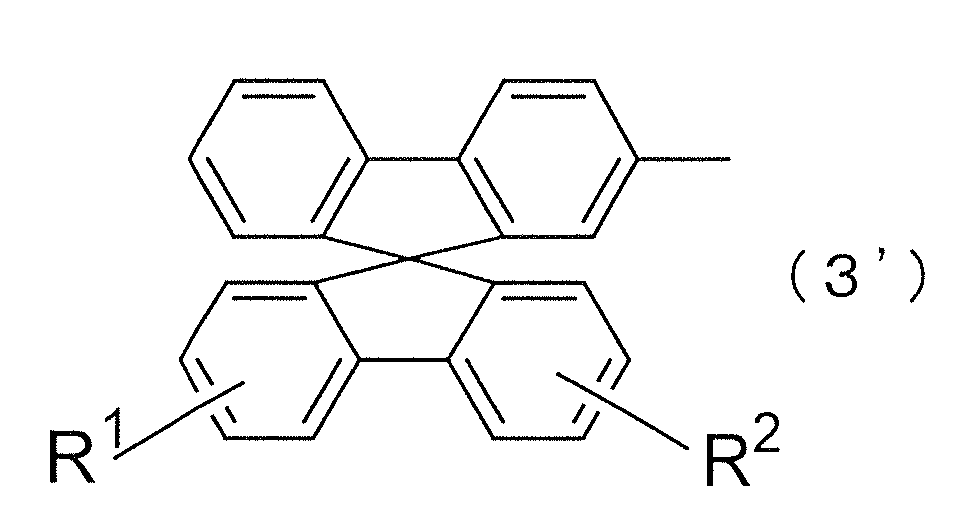
- An anthracene derivative according to Claim 1, which is a light emitting material for organic electroluminescence devices.
- An anthracene derivative according to Claim 1, which is a hole transporting material for organic electroluminescence devices.
- An organic electroluminescence device which comprises a cathode, an anode and one or more organic thin film layer comprising at least one layer including a light emitting layer and sandwiched between the cathode and the anode, wherein at least one layer in the organic thin film layers comprises an anthracene derivative represented by general formula (1) described in Claim 1 singly or as a component of a mixture.
- An organic electroluminescence device according to Claim 4, wherein said light emitting layer comprises the anthracene derivative represented by general formula (1).
- An organic electroluminescence device according to Claim 4, wherein said light emitting layer comprises the anthracene derivative represented by general formula (1) as a main component.
- An organic electroluminescence device according to Claim 4, wherein said light emitting layer further comprises an arylamine compound.
- An organic electroluminescence device according to Claim 4, wherein said light emitting layer further comprises a styrylamine compound.
- An organic electroluminescence device according to Claim 4, wherein said organic thin film layers comprise a hole transporting layer, and the hole transporting layer comprises the anthracene derivative represented by general formula (1) described in Claim 1 singly or as a component of a mixture.
- An organic electroluminescence device according to Claim 9, wherein the hole transporting layer comprises the anthracene derivative represented by general formula (1) as a main component.
Applications Claiming Priority (3)
| Application Number | Priority Date | Filing Date | Title |
|---|---|---|---|
| JP2002225636 | 2002-08-02 | ||
| JP2002225636A JP4025137B2 (en) | 2002-08-02 | 2002-08-02 | Anthracene derivative and organic electroluminescence device using the same |
| PCT/JP2003/009606 WO2004013073A1 (en) | 2002-08-02 | 2003-07-29 | Anthracene derivatives and organic electroluminescent devices made by using the same |
Publications (2)
| Publication Number | Publication Date |
|---|---|
| EP1533289A1 true EP1533289A1 (en) | 2005-05-25 |
| EP1533289A4 EP1533289A4 (en) | 2009-08-12 |
Family
ID=31492162
Family Applications (1)
| Application Number | Title | Priority Date | Filing Date |
|---|---|---|---|
| EP03766655A Withdrawn EP1533289A4 (en) | 2002-08-02 | 2003-07-29 | ANTHRACENE DERIVATIVES AND ORGANIC ELECTROLUMINESCENT DEVICES MADE USING THESE DERIVATIVES |
Country Status (7)
| Country | Link |
|---|---|
| US (2) | US20050233165A1 (en) |
| EP (1) | EP1533289A4 (en) |
| JP (1) | JP4025137B2 (en) |
| KR (1) | KR20050025195A (en) |
| CN (3) | CN101311149A (en) |
| TW (1) | TW200402405A (en) |
| WO (1) | WO2004013073A1 (en) |
Cited By (11)
| Publication number | Priority date | Publication date | Assignee | Title |
|---|---|---|---|---|
| WO2005101540A3 (en) * | 2004-04-12 | 2005-12-29 | Eastman Kodak Co | Oled device with short reduction |
| WO2007065550A1 (en) * | 2005-12-08 | 2007-06-14 | Merck Patent Gmbh | Novel materials for organic electroluminescent devices |
| WO2007065547A1 (en) * | 2005-12-08 | 2007-06-14 | Merck Patent Gmbh | Organic electroluminescent devices |
| EP1780191A4 (en) * | 2004-06-16 | 2008-07-02 | Idemitsu Kosan Co | FLUORENE DERIVATIVE AND ORGANIC ELECTROLUMINESCENT DEVICE USING THE DERIVATIVE |
| WO2009110965A1 (en) * | 2008-02-29 | 2009-09-11 | Eastman Kodak Company | Oled device with short reduction layer |
| EP2448374A3 (en) * | 2003-12-01 | 2012-06-13 | Idemitsu Kosan Co., Ltd. | Asymmetric monoanthracene derivative, material for organic electroluminescent device and organic electroluminescent device utilizing the same |
| US8503439B2 (en) | 2007-09-03 | 2013-08-06 | Airbus Operations Sas | Frame switching device |
| RU2572414C2 (en) * | 2013-08-29 | 2016-01-10 | Федеральное государственное бюджетное учреждение науки Институт проблем химической физики Российской академии наук (ИПХФ РАН) | Organic luminescent substance, based on pyrene derivatives, device, and thereof-containing electroluminescent device |
| WO2018009861A1 (en) * | 2016-07-08 | 2018-01-11 | Biolegend | Substituted polyfluorene compounds |
| US11584883B2 (en) | 2017-07-28 | 2023-02-21 | BioLegend, Inc. | Conjugated polymers and methods of use |
| WO2023078824A1 (en) * | 2021-11-04 | 2023-05-11 | Dottikon Es Holding Ag | Spiro-(indane-fluorene) type compounds and their use in organic electronics |
Families Citing this family (140)
| Publication number | Priority date | Publication date | Assignee | Title |
|---|---|---|---|---|
| WO2004018587A1 (en) | 2002-08-23 | 2004-03-04 | Idemitsu Kosan Co., Ltd. | Organic electroluminescence device and anthracene derivative |
| JP2004339136A (en) * | 2003-05-15 | 2004-12-02 | Idemitsu Kosan Co Ltd | Spiro bond-containing compound, luminescent coating material, and organic electroluminescent device using the same |
| EP1696015B1 (en) * | 2003-12-19 | 2015-05-13 | Idemitsu Kosan Co., Ltd. | Light-emitting material for organic electroluminescent device, organic electroluminescent device using same, and material for organic electroluminescent device |
| JP4393249B2 (en) * | 2004-03-31 | 2010-01-06 | 株式会社 日立ディスプレイズ | ORGANIC LIGHT EMITTING ELEMENT, IMAGE DISPLAY DEVICE, AND MANUFACTURING METHOD THEREOF |
| DE102004024075B4 (en) * | 2004-05-13 | 2010-12-23 | BLüCHER GMBH | Adsorption filter material, its use and protective materials |
| JP4705914B2 (en) * | 2004-05-27 | 2011-06-22 | 出光興産株式会社 | Asymmetric pyrene derivative and organic electroluminescence device using the same |
| DE102004031000A1 (en) * | 2004-06-26 | 2006-01-12 | Covion Organic Semiconductors Gmbh | Organic electroluminescent devices |
| CN1976883A (en) * | 2004-06-28 | 2007-06-06 | 出光兴产株式会社 | Polycyclic aromatic compound, light-emitting coating film-forming material and organic electroluminescent device using the same |
| KR100689017B1 (en) | 2004-09-09 | 2007-03-02 | 네오뷰코오롱 주식회사 | Blue light emitting organic compound and organic light emitting diode comprising the same |
| EP1645610A1 (en) | 2004-10-11 | 2006-04-12 | Covion Organic Semiconductors GmbH | Phenanthrene derivatives |
| JP2006131519A (en) * | 2004-11-04 | 2006-05-25 | Idemitsu Kosan Co Ltd | Fused ring-containing compound and organic electroluminescence device using the same |
| JP2006140235A (en) * | 2004-11-10 | 2006-06-01 | Idemitsu Kosan Co Ltd | Organic electroluminescence device |
| US7505122B2 (en) * | 2005-04-28 | 2009-03-17 | Semiconductor Energy Laboratory Co., Ltd. | Evaluation method and manufacturing method of light-emitting element material, manufacturing method of light-emitting element, light-emitting element, and light-emitting device and electric appliance having light-emitting element |
| JP2006332034A (en) * | 2005-04-28 | 2006-12-07 | Semiconductor Energy Lab Co Ltd | LIGHT EMITTING ELEMENT MATERIAL EVALUATION METHOD AND MANUFACTURING METHOD, LIGHT EMITTING ELEMENT MANUFACTURING METHOD, LIGHT EMITTING ELEMENT, LIGHT EMITTING DEVICE HAVING LIGHT EMITTING ELEMENT, ELECTRONIC DEVICE |
| US7479330B2 (en) * | 2005-05-26 | 2009-01-20 | Au Optronics Corporation | Anthracene derivatives for organic electroluminescent device |
| DE102005026651A1 (en) | 2005-06-09 | 2006-12-14 | Merck Patent Gmbh | New materials for organic electroluminescent devices |
| KR100788254B1 (en) * | 2005-08-16 | 2007-12-27 | (주)그라쎌 | Green electroluminescent compounds and organic electroluminescent device using the same |
| DE102005040411A1 (en) | 2005-08-26 | 2007-03-01 | Merck Patent Gmbh | New materials for organic electroluminescent devices |
| US8298683B2 (en) | 2005-09-15 | 2012-10-30 | Lg Chem, Ltd. | Organic compound and organic light emitting device using the same |
| WO2007032161A1 (en) * | 2005-09-15 | 2007-03-22 | Idemitsu Kosan Co., Ltd. | Asymmetric fluorene derivative and organic electroluminescent element containing the same |
| JP4029897B2 (en) | 2005-10-19 | 2008-01-09 | ソニー株式会社 | Dibenzoanthracene derivative, organic electroluminescent element, and display device |
| KR100851739B1 (en) * | 2006-01-13 | 2008-08-11 | 주식회사 엘지화학 | Light emitting material and organic light emitting device using same |
| DE102006013802A1 (en) | 2006-03-24 | 2007-09-27 | Merck Patent Gmbh | New materials for organic electroluminescent devices |
| US7851995B2 (en) | 2006-05-05 | 2010-12-14 | Global Oled Technology Llc | Electroluminescent device having improved light output |
| DE102006031990A1 (en) | 2006-07-11 | 2008-01-17 | Merck Patent Gmbh | New materials for organic electroluminescent devices |
| KR100841417B1 (en) * | 2006-10-31 | 2008-06-25 | 주식회사 대림화학 | 9,10-diphenylanthracene light emitting compound having a 2,6-substituent and a light emitting element employing the same as the light emitting material |
| WO2008063466A2 (en) * | 2006-11-13 | 2008-05-29 | E. I. Du Pont De Nemours And Company | Organic electronic device |
| KR100868303B1 (en) * | 2006-12-29 | 2008-11-11 | 주식회사 두산 | Diaryl triantracene derivative, organic electroluminescent layer and organic electroluminescent device comprising same |
| KR100807202B1 (en) | 2006-12-29 | 2008-02-28 | 주식회사 두산 | Trianthracene arylamine derivative, organic electroluminescent layer and organic electroluminescent device comprising same |
| KR100943535B1 (en) * | 2007-05-10 | 2010-02-22 | 대주전자재료 주식회사 | Spiro type organic material and organic electroluminescent device using same |
| KR100857023B1 (en) * | 2007-05-21 | 2008-09-05 | (주)그라쎌 | Organic light emitting compound and organic light emitting device comprising the same |
| DE102007024850A1 (en) | 2007-05-29 | 2008-12-04 | Merck Patent Gmbh | New materials for organic electroluminescent devices |
| EP2213693A4 (en) * | 2007-11-20 | 2011-11-09 | Idemitsu Kosan Co | POLYMERIC COMPOUND AND ORGANIC ELECTROLUMINESCENT ELEMENT COMPRISING SAME |
| DE102008008953B4 (en) * | 2008-02-13 | 2019-05-09 | Merck Patent Gmbh | New materials for organic electroluminescent devices |
| US7947974B2 (en) * | 2008-03-25 | 2011-05-24 | Global Oled Technology Llc | OLED device with hole-transport and electron-transport materials |
| KR100910150B1 (en) * | 2008-04-02 | 2009-08-03 | (주)그라쎌 | Novel organic light emitting compound and organic light emitting device employing the same as light emitting material |
| DE102008018670A1 (en) | 2008-04-14 | 2009-10-15 | Merck Patent Gmbh | New materials for organic electroluminescent devices |
| WO2010013675A1 (en) * | 2008-07-28 | 2010-02-04 | 出光興産株式会社 | Organic light-emitting medium and organic el element |
| DE102008054141A1 (en) | 2008-10-31 | 2010-05-06 | Merck Patent Gmbh | New materials for organic electroluminescent devices |
| DE102009005746A1 (en) | 2009-01-23 | 2010-07-29 | Merck Patent Gmbh | Materials for organic electroluminescent devices |
| DE102009033371A1 (en) | 2009-07-16 | 2011-05-12 | Merck Patent Gmbh | Materials for electronic devices |
| DE102009034625A1 (en) | 2009-07-27 | 2011-02-03 | Merck Patent Gmbh | New materials for organic electroluminescent devices |
| CN101967079B (en) * | 2009-07-28 | 2013-09-04 | 靳焕改 | Organic material and application thereof in organic electroluminescent devices |
| US8581262B2 (en) | 2009-08-04 | 2013-11-12 | Merck Patent Gmbh | Electronic devices comprising multi cyclic hydrocarbons |
| DE102009051172A1 (en) | 2009-10-29 | 2011-05-05 | Merck Patent Gmbh | Materials for electronic devices |
| DE102009053191A1 (en) | 2009-11-06 | 2011-05-12 | Merck Patent Gmbh | Materials for electronic devices |
| DE102009052428A1 (en) | 2009-11-10 | 2011-05-12 | Merck Patent Gmbh | Connection for electronic devices |
| WO2011076314A1 (en) | 2009-12-22 | 2011-06-30 | Merck Patent Gmbh | Electroluminescent formulations |
| JP5836970B2 (en) | 2009-12-22 | 2015-12-24 | メルク パテント ゲーエムベーハー | Formulations containing functional materials |
| EP2517537B1 (en) | 2009-12-22 | 2019-04-03 | Merck Patent GmbH | Electroluminescent functional surfactants |
| DE102010005697A1 (en) | 2010-01-25 | 2011-07-28 | Merck Patent GmbH, 64293 | Connections for electronic devices |
| DE102010009193B4 (en) | 2010-02-24 | 2022-05-19 | MERCK Patent Gesellschaft mit beschränkter Haftung | Composition containing fluorine-fluorine associates, processes for their production, their use and organic electronic devices containing them |
| JP2013522816A (en) | 2010-03-11 | 2013-06-13 | メルク パテント ゲーエムベーハー | Light emitting fiber |
| WO2011110277A1 (en) | 2010-03-11 | 2011-09-15 | Merck Patent Gmbh | Fibers in therapy and cosmetics |
| JP5944380B2 (en) | 2010-05-27 | 2016-07-05 | メルク パテント ゲーエムベーハー | Composition comprising quantum dots |
| JP2012020947A (en) * | 2010-07-13 | 2012-02-02 | Canon Inc | New spiro(anthracene-9,9'-fluoren)-10-one compound and organic light-emitting element having the same |
| CN103026525B (en) | 2010-07-26 | 2016-11-09 | 默克专利有限公司 | Nanocrystals in Devices |
| EP2599141B1 (en) | 2010-07-26 | 2019-12-11 | Merck Patent GmbH | Quantum dots and hosts |
| DE102010048074A1 (en) | 2010-10-09 | 2012-04-12 | Merck Patent Gmbh | Materials for electronic devices |
| DE102010048607A1 (en) | 2010-10-15 | 2012-04-19 | Merck Patent Gmbh | Connections for electronic devices |
| DE102010054316A1 (en) | 2010-12-13 | 2012-06-14 | Merck Patent Gmbh | Substituted tetraarylbenzenes |
| DE102011011104A1 (en) | 2011-02-12 | 2012-08-16 | Merck Patent Gmbh | Substituted dibenzonaphthacenes |
| JP6351974B2 (en) | 2011-02-14 | 2018-07-04 | メルク パテント ゲーエムベーハー | Devices and methods for treatment of cells and cellular tissues |
| WO2012126566A1 (en) | 2011-03-24 | 2012-09-27 | Merck Patent Gmbh | Organic ionic functional materials |
| EP2707911B1 (en) | 2011-05-12 | 2017-07-05 | Merck Patent GmbH | Compositions and electronic devices |
| EP2810315A1 (en) | 2012-01-30 | 2014-12-10 | Merck Patent GmbH | Nanocrystals on fibers |
| US8546617B1 (en) | 2012-03-23 | 2013-10-01 | Empire Technology Development Llc | Dioxaborinanes and uses thereof |
| US9290598B2 (en) | 2012-03-29 | 2016-03-22 | Empire Technology Development Llc | Dioxaborinane co-polymers and uses thereof |
| US9095141B2 (en) | 2012-07-31 | 2015-08-04 | Empire Technology Development Llc | Antifouling compositions including dioxaborinanes and uses thereof |
| US9312500B2 (en) | 2012-08-31 | 2016-04-12 | Idemitsu Kosan Co., Ltd. | Organic electroluminescence device |
| KR102202756B1 (en) | 2013-07-30 | 2021-01-13 | 메르크 파텐트 게엠베하 | Materials for electronic devices |
| KR102717935B1 (en) | 2013-07-30 | 2024-10-16 | 메르크 파텐트 게엠베하 | Materials for electronic devices |
| CN106255687B (en) | 2014-04-30 | 2020-06-05 | 默克专利有限公司 | Material for electronic devices |
| DE102014008722B4 (en) | 2014-06-18 | 2024-08-22 | Merck Patent Gmbh | Compositions for electronic devices, formulation containing them, use of the composition, use of the formulation and organic electronic device containing the composition |
| WO2016034262A1 (en) | 2014-09-05 | 2016-03-10 | Merck Patent Gmbh | Formulations and electronic devices |
| EP3241248A1 (en) | 2014-12-30 | 2017-11-08 | Merck Patent GmbH | Formulations and electronic devices |
| CN106033801B (en) * | 2015-03-09 | 2018-04-06 | 广东阿格蕾雅光电材料有限公司 | Organic electroluminescence device |
| CN106033798B (en) * | 2015-03-09 | 2017-11-14 | 广东阿格蕾雅光电材料有限公司 | Organic electroluminescence device |
| CN106033793B (en) * | 2015-03-09 | 2018-11-13 | 广东阿格蕾雅光电材料有限公司 | Organic electroluminescence device |
| US10651382B2 (en) | 2015-03-30 | 2020-05-12 | Merck Patent Gmbh | Formulation of an organic functional material comprising a siloxane solvent |
| CN111477766B (en) | 2015-06-12 | 2023-04-07 | 默克专利有限公司 | Esters containing non-aromatic rings as solvents for OLED formulations |
| US11046884B2 (en) | 2015-08-28 | 2021-06-29 | Merck Patent Gmbh | Formulation of an organic functional material comprising an epoxy group containing solvent |
| US11005042B2 (en) | 2015-12-10 | 2021-05-11 | Merck Patent Gmbh | Formulations containing ketones comprising non-aromatic cycles |
| US11171294B2 (en) | 2015-12-15 | 2021-11-09 | Merck Patent Gmbh | Esters containing aromatic groups as solvents for organic electronic formulations |
| KR102723604B1 (en) | 2015-12-16 | 2024-10-29 | 메르크 파텐트 게엠베하 | Formulations containing solid solvents |
| US11407916B2 (en) | 2015-12-16 | 2022-08-09 | Merck Patent Gmbh | Formulations containing a mixture of at least two different solvents |
| EP3417033B1 (en) | 2016-02-17 | 2021-02-24 | Merck Patent GmbH | Formulation of an organic functional material |
| DE102016003104A1 (en) | 2016-03-15 | 2017-09-21 | Merck Patent Gmbh | Container comprising a formulation containing at least one organic semiconductor |
| WO2017194435A1 (en) | 2016-05-11 | 2017-11-16 | Merck Patent Gmbh | Compositions for electrochemical cells |
| JP2019523997A (en) | 2016-06-16 | 2019-08-29 | メルク パテント ゲーエムベーハー | Formulation of organic functional materials |
| US11041083B2 (en) | 2016-06-17 | 2021-06-22 | Merck Patent Gmbh | Formulation of an organic functional material |
| TW201815998A (en) | 2016-06-28 | 2018-05-01 | 德商麥克專利有限公司 | Organic functional material formulation |
| WO2018024719A1 (en) | 2016-08-04 | 2018-02-08 | Merck Patent Gmbh | Formulation of an organic functional material |
| CN109863223B (en) | 2016-10-31 | 2023-06-20 | 默克专利有限公司 | Formulation of organic functional materials |
| CN109890939B (en) | 2016-10-31 | 2023-07-11 | 默克专利有限公司 | Formulation of organic functional materials |
| TWI756292B (en) | 2016-11-14 | 2022-03-01 | 德商麥克專利有限公司 | Compounds having an acceptor group and a donor group |
| WO2018095382A1 (en) | 2016-11-23 | 2018-05-31 | 广州华睿光电材料有限公司 | Aromatic amine derivative, preparation method therefor, and uses thereof |
| WO2018095385A1 (en) | 2016-11-23 | 2018-05-31 | 广州华睿光电材料有限公司 | Fused ring compound, high polymer, mixture, composition, and organic electronic component |
| WO2018104202A1 (en) | 2016-12-06 | 2018-06-14 | Merck Patent Gmbh | Preparation process for an electronic device |
| CN110168047B (en) | 2016-12-13 | 2023-08-08 | 默克专利有限公司 | Preparation of organic functional material |
| KR102504432B1 (en) | 2016-12-22 | 2023-02-27 | 메르크 파텐트 게엠베하 | A mixture comprising at least two organo-functional compounds |
| TWI791481B (en) | 2017-01-30 | 2023-02-11 | 德商麥克專利有限公司 | Method for forming an organic electroluminescence (el) element |
| TWI763772B (en) | 2017-01-30 | 2022-05-11 | 德商麥克專利有限公司 | Method for forming an organic element of an electronic device |
| KR20190131554A (en) | 2017-03-31 | 2019-11-26 | 메르크 파텐트 게엠베하 | Printing method for organic light emitting diodes (OLED) |
| CN110494514A (en) | 2017-04-10 | 2019-11-22 | 默克专利有限公司 | Formulation of organic functional materials |
| US11778907B2 (en) | 2017-04-13 | 2023-10-03 | Merck Patent Gmbh | Composition for organic electronic devices |
| KR102563713B1 (en) | 2017-04-26 | 2023-08-07 | 오티아이 루미오닉스 인크. | Methods of patterning the coating of a surface and apparatus comprising the patterned coating |
| WO2018202603A1 (en) | 2017-05-03 | 2018-11-08 | Merck Patent Gmbh | Formulation of an organic functional material |
| WO2019016184A1 (en) | 2017-07-18 | 2019-01-24 | Merck Patent Gmbh | Formulation of an organic functional material |
| KR101981294B1 (en) | 2017-10-31 | 2019-05-23 | 삼성디스플레이 주식회사 | Light absorber and organic electroluminescence device including the same |
| CN109721482B (en) * | 2017-10-31 | 2023-07-18 | 三星显示有限公司 | Light absorber and organic electroluminescent device comprising the light absorber |
| KR102666621B1 (en) | 2017-12-15 | 2024-05-16 | 메르크 파텐트 게엠베하 | Formulation of organic functional materials |
| US11751415B2 (en) | 2018-02-02 | 2023-09-05 | Oti Lumionics Inc. | Materials for forming a nucleation-inhibiting coating and devices incorporating same |
| CN111712551A (en) | 2018-02-26 | 2020-09-25 | 默克专利有限公司 | Formulation of organic functional materials |
| TWI835803B (en) | 2018-06-15 | 2024-03-21 | 德商麥克專利有限公司 | Formulation of an organic functional material |
| JP7325731B2 (en) | 2018-08-23 | 2023-08-15 | 国立大学法人九州大学 | organic electroluminescence element |
| EP3857621B1 (en) | 2018-09-24 | 2025-10-29 | Merck Patent GmbH | Method for the production of a granular material |
| JP2022506510A (en) | 2018-11-06 | 2022-01-17 | メルク パテント ゲーエムベーハー | How to Form Organic Devices for Electronic Devices |
| JP7555600B2 (en) | 2019-04-18 | 2024-09-25 | オーティーアイ ルミオニクス インコーポレーテッド | Materials for forming nucleation-inhibiting coatings and devices incorporating same - Patents.com |
| JP7576337B2 (en) | 2019-05-08 | 2024-11-01 | オーティーアイ ルミオニクス インコーポレーテッド | Materials for forming nucleation-inhibiting coatings and devices incorporating same - Patents.com |
| KR102929796B1 (en) * | 2020-02-25 | 2026-02-24 | 듀폰스페셜티머터리얼스코리아 유한회사 | Organic electroluminescent compound and organic electroluminescent device comprising the same |
| CN113493445B (en) * | 2020-04-01 | 2022-10-28 | 湖北大学 | Imidazolyl spiro derivative with aggregation-induced emission property and application thereof |
| WO2021213918A1 (en) | 2020-04-21 | 2021-10-28 | Merck Patent Gmbh | Formulation of an organic functional material |
| EP4139971A1 (en) | 2020-04-21 | 2023-03-01 | Merck Patent GmbH | Emulsions comprising organic functional materials |
| KR102914927B1 (en) | 2020-06-23 | 2026-01-19 | 메르크 파텐트 게엠베하 | Method for preparing the mixture |
| US12113279B2 (en) | 2020-09-22 | 2024-10-08 | Oti Lumionics Inc. | Device incorporating an IR signal transmissive region |
| US11985841B2 (en) | 2020-12-07 | 2024-05-14 | Oti Lumionics Inc. | Patterning a conductive deposited layer using a nucleation inhibiting coating and an underlying metallic coating |
| KR20230114756A (en) | 2020-12-08 | 2023-08-01 | 메르크 파텐트 게엠베하 | Ink Systems and Methods for Inkjet Printing |
| CN114716295B (en) * | 2021-01-04 | 2024-09-24 | 浙江光昊光电科技有限公司 | Fused ring compound and application thereof in organic electronic device |
| JP2024515366A (en) | 2021-04-23 | 2024-04-09 | メルク パテント ゲーエムベーハー | Organic functional materials formulations |
| WO2022243403A1 (en) | 2021-05-21 | 2022-11-24 | Merck Patent Gmbh | Method for the continuous purification of at least one functional material and device for the continuous purification of at least one functional material |
| KR20240045247A (en) | 2021-08-02 | 2024-04-05 | 메르크 파텐트 게엠베하 | Printing method by combining inks |
| TW202349760A (en) | 2021-10-05 | 2023-12-16 | 德商麥克專利有限公司 | Method for forming an organic element of an electronic device |
| TW202411366A (en) | 2022-06-07 | 2024-03-16 | 德商麥克專利有限公司 | Method of printing a functional layer of an electronic device by combining inks |
| TW202440819A (en) | 2022-12-16 | 2024-10-16 | 德商麥克專利有限公司 | Formulation of an organic functional material |
| WO2025032039A1 (en) | 2023-08-07 | 2025-02-13 | Merck Patent Gmbh | Process for the preparation of an electronic device |
| CN117486919A (en) * | 2023-10-31 | 2024-02-02 | 石家庄诚志永华显示材料有限公司 | An organic compound and a composition containing the same and an organic electroluminescent device |
| WO2026008710A1 (en) | 2024-07-05 | 2026-01-08 | Merck Patent Gmbh | Cyclic silicon compounds for organic electroluminescent devices |
| WO2026041632A1 (en) | 2024-08-21 | 2026-02-26 | Merck Patent Gmbh | Heterocyclic materials for organic light-emitting devices |
| WO2026073855A1 (en) | 2024-10-01 | 2026-04-09 | Merck Patent Gmbh | Silicon compounds for organic electroluminescent devices |
Family Cites Families (22)
| Publication number | Priority date | Publication date | Assignee | Title |
|---|---|---|---|---|
| US5759709A (en) * | 1994-03-10 | 1998-06-02 | Sumitomo Chemical Company, Limited | Polymeric fluorescent substance and organic electroluminescence device |
| WO1998008360A1 (en) * | 1996-08-19 | 1998-02-26 | Tdk Corporation | Organic electroluminescent device |
| US5869929A (en) * | 1997-02-04 | 1999-02-09 | Idemitsu Kosan Co., Ltd. | Multicolor luminescent device |
| US5935721A (en) * | 1998-03-20 | 1999-08-10 | Eastman Kodak Company | Organic electroluminescent elements for stable electroluminescent |
| WO2001021729A1 (en) * | 1999-09-21 | 2001-03-29 | Idemitsu Kosan Co., Ltd. | Organic electroluminescence and organic luminous medium |
| JP2001097897A (en) * | 1999-09-30 | 2001-04-10 | Idemitsu Kosan Co Ltd | Organic compound and organic electroluminescent device using the same |
| WO2001065411A1 (en) * | 2000-02-29 | 2001-09-07 | Thinairapps, Inc. | Flexible wireless advertisement integration in wireless software applications |
| JP4274667B2 (en) * | 2000-03-10 | 2009-06-10 | 三井化学株式会社 | Hydrocarbon compounds and organic electroluminescent devices |
| EP1182183B1 (en) * | 2000-03-29 | 2009-12-09 | Idemitsu Kosan Co., Ltd. | Anthracene derivatives and organic electroluminescent devices made by using the same |
| JP4094203B2 (en) * | 2000-03-30 | 2008-06-04 | 出光興産株式会社 | Organic electroluminescence device and organic light emitting medium |
| US7031931B1 (en) * | 2000-03-30 | 2006-04-18 | Nokia Corporation | Portable device attached to a media player for rating audio/video contents |
| WO2002014244A1 (en) * | 2000-08-10 | 2002-02-21 | Mitsui Chemicals, Inc. | Hydrocarbon compound, material for organic electroluminescent element and organic electroluminescent element |
| JP4996794B2 (en) * | 2000-08-10 | 2012-08-08 | 三井化学株式会社 | Hydrocarbon compound, material for organic electroluminescence device, and organic electroluminescence device |
| JP4562884B2 (en) * | 2000-08-25 | 2010-10-13 | 出光興産株式会社 | Organic electroluminescence device |
| KR100377575B1 (en) * | 2000-10-17 | 2003-03-26 | 삼성에스디아이 주식회사 | A blue luiminiscence compound for organic electroluminscene device and the organic electroluminscene device using the same |
| US20030017826A1 (en) * | 2001-07-17 | 2003-01-23 | Dan Fishman | Short-range wireless architecture |
| JP4220696B2 (en) * | 2001-10-16 | 2009-02-04 | 三井化学株式会社 | Hydrocarbon compound, material for organic electroluminescence device, and organic electroluminescence device |
| US20030215667A1 (en) * | 2001-11-02 | 2003-11-20 | Shuang Xie | Electroluminescent devices |
| JP4170655B2 (en) * | 2002-04-17 | 2008-10-22 | 出光興産株式会社 | Novel aromatic compound and organic electroluminescence device using the same |
| EP1541657B2 (en) * | 2002-07-19 | 2014-03-05 | Idemitsu Kosan Co., Ltd. | Organic electroluminescent devices and organic luminescent medium |
| JP4392251B2 (en) * | 2004-01-07 | 2009-12-24 | オークマ株式会社 | Feed drive system controller |
| TWI299355B (en) * | 2005-01-20 | 2008-08-01 | Au Optronics Corp | Organic light emitting diode and display including the same |
-
2002
- 2002-08-02 JP JP2002225636A patent/JP4025137B2/en not_active Expired - Lifetime
-
2003
- 2003-07-29 KR KR1020057001885A patent/KR20050025195A/en not_active Ceased
- 2003-07-29 CN CNA2008100998900A patent/CN101311149A/en active Pending
- 2003-07-29 US US10/519,934 patent/US20050233165A1/en not_active Abandoned
- 2003-07-29 CN CNA03818561XA patent/CN1675148A/en active Pending
- 2003-07-29 WO PCT/JP2003/009606 patent/WO2004013073A1/en not_active Ceased
- 2003-07-29 EP EP03766655A patent/EP1533289A4/en not_active Withdrawn
- 2003-07-29 CN CNA2006101635106A patent/CN1971971A/en active Pending
- 2003-07-31 TW TW092121040A patent/TW200402405A/en unknown
-
2009
- 2009-09-02 US US12/585,067 patent/US20090321729A1/en not_active Abandoned
Cited By (22)
| Publication number | Priority date | Publication date | Assignee | Title |
|---|---|---|---|---|
| EP2448374A3 (en) * | 2003-12-01 | 2012-06-13 | Idemitsu Kosan Co., Ltd. | Asymmetric monoanthracene derivative, material for organic electroluminescent device and organic electroluminescent device utilizing the same |
| US10079344B2 (en) | 2003-12-01 | 2018-09-18 | Idemitsu Kosan Co., Ltd. | Asymmetric monoanthracene derivative, material for organic electroluminescent device and organic electroluminescent device utilizing the same |
| US8568902B2 (en) | 2003-12-01 | 2013-10-29 | Idemitsu Kosan Co., Ltd. | Asymmetric monoanthracene derivative, material for organic electroluminescent device and organic electroluminescent device utilizing the same |
| WO2005101540A3 (en) * | 2004-04-12 | 2005-12-29 | Eastman Kodak Co | Oled device with short reduction |
| EP1780191A4 (en) * | 2004-06-16 | 2008-07-02 | Idemitsu Kosan Co | FLUORENE DERIVATIVE AND ORGANIC ELECTROLUMINESCENT DEVICE USING THE DERIVATIVE |
| US7683225B2 (en) | 2004-06-16 | 2010-03-23 | Idemitsu Kosan Co., Ltd. | Fluorene-based derivative and organic electroluminescence device employing the same |
| US7781628B2 (en) | 2004-06-16 | 2010-08-24 | Idemitsu Kosan Co., Ltd. | Fluorene-based derivative and organic electroluminescence device employing the same |
| US8013160B2 (en) | 2004-06-16 | 2011-09-06 | Idemitsu Kosan Co., Ltd. | Fluorene-based derivative and organic electroluminescence device employing the same |
| KR101307587B1 (en) | 2005-12-08 | 2013-09-12 | 메르크 파텐트 게엠베하 | Organic electroluminescent devices |
| WO2007065550A1 (en) * | 2005-12-08 | 2007-06-14 | Merck Patent Gmbh | Novel materials for organic electroluminescent devices |
| WO2007065547A1 (en) * | 2005-12-08 | 2007-06-14 | Merck Patent Gmbh | Organic electroluminescent devices |
| US8785001B2 (en) | 2005-12-08 | 2014-07-22 | Merck Patent Gmbh | Organic electroluminescent devices |
| US8795847B2 (en) | 2005-12-08 | 2014-08-05 | Merck Patent Gmbh | Materials for organic electroluminescent devices |
| US8503439B2 (en) | 2007-09-03 | 2013-08-06 | Airbus Operations Sas | Frame switching device |
| WO2009110965A1 (en) * | 2008-02-29 | 2009-09-11 | Eastman Kodak Company | Oled device with short reduction layer |
| RU2572414C2 (en) * | 2013-08-29 | 2016-01-10 | Федеральное государственное бюджетное учреждение науки Институт проблем химической физики Российской академии наук (ИПХФ РАН) | Organic luminescent substance, based on pyrene derivatives, device, and thereof-containing electroluminescent device |
| WO2018009861A1 (en) * | 2016-07-08 | 2018-01-11 | Biolegend | Substituted polyfluorene compounds |
| US11155714B2 (en) | 2016-07-08 | 2021-10-26 | BioLegend, Inc. | Substituted polyfluorene compounds |
| US12091554B2 (en) | 2016-07-08 | 2024-09-17 | BioLegend, Inc. | Substituted polyfluorene compounds |
| US11584883B2 (en) | 2017-07-28 | 2023-02-21 | BioLegend, Inc. | Conjugated polymers and methods of use |
| US12384964B2 (en) | 2017-07-28 | 2025-08-12 | BioLegend, Inc. | Conjugated polymers and methods of use |
| WO2023078824A1 (en) * | 2021-11-04 | 2023-05-11 | Dottikon Es Holding Ag | Spiro-(indane-fluorene) type compounds and their use in organic electronics |
Also Published As
| Publication number | Publication date |
|---|---|
| CN1675148A (en) | 2005-09-28 |
| KR20050025195A (en) | 2005-03-11 |
| CN1971971A (en) | 2007-05-30 |
| JP2004067528A (en) | 2004-03-04 |
| WO2004013073A1 (en) | 2004-02-12 |
| CN101311149A (en) | 2008-11-26 |
| TW200402405A (en) | 2004-02-16 |
| EP1533289A4 (en) | 2009-08-12 |
| JP4025137B2 (en) | 2007-12-19 |
| US20090321729A1 (en) | 2009-12-31 |
| US20050233165A1 (en) | 2005-10-20 |
Similar Documents
| Publication | Publication Date | Title |
|---|---|---|
| US10217943B2 (en) | Organic electroluminescence device and anthracene derivative | |
| JP4025137B2 (en) | Anthracene derivative and organic electroluminescence device using the same | |
| JP4025136B2 (en) | Anthracene derivative, light emitting material for organic electroluminescence device, and organic electroluminescence device | |
| US7829206B2 (en) | Benzanthracene derivative and electroluminescence device using the same | |
| US20080160344A1 (en) | Novel soluble compound and organic electroluminescent devices | |
| US7985491B2 (en) | Anthrylarylene derivative, material for organic electroluminescence device and organic electroluminescence device using same | |
| US20070285009A1 (en) | Bisanthracene derivative and organic electroluminescence device using the same | |
| EP1972613A1 (en) | Aromatic amine derivatives and organic electroluminescent devices made by using the same | |
| EP1584614A1 (en) | Aromatic amine derivative and organic electroluminescence element | |
| JP4065161B2 (en) | Anthracene derivative and organic electroluminescence device using the same | |
| US20060216633A1 (en) | Bisanthracene derivative and organic electroluminescence device using the same | |
| JP2004339136A (en) | Spiro bond-containing compound, luminescent coating material, and organic electroluminescent device using the same | |
| JP2002124385A (en) | Organic electroluminescence device |
Legal Events
| Date | Code | Title | Description |
|---|---|---|---|
| PUAI | Public reference made under article 153(3) epc to a published international application that has entered the european phase |
Free format text: ORIGINAL CODE: 0009012 |
|
| 17P | Request for examination filed |
Effective date: 20041231 |
|
| AK | Designated contracting states |
Kind code of ref document: A1 Designated state(s): AT BE BG CH CY CZ DE DK EE ES FI FR GB GR HU IE IT LI LU MC NL PT RO SE SI SK TR |
|
| RIC1 | Information provided on ipc code assigned before grant |
Ipc: C07C 13/60 20060101ALI20070302BHEP Ipc: C07C 46/00 20060101ALI20070302BHEP Ipc: C09K 11/06 20060101ALI20070302BHEP Ipc: H01L 51/00 20060101ALI20070302BHEP Ipc: C07C 13/567 20060101AFI20040226BHEP Ipc: C07C 13/66 20060101ALI20070302BHEP Ipc: C07C 17/12 20060101ALI20070302BHEP Ipc: C07C 15/28 20060101ALI20070302BHEP Ipc: H05B 33/14 20060101ALI20070302BHEP Ipc: C07C 13/72 20060101ALI20070302BHEP Ipc: C07F 7/08 20060101ALI20070302BHEP Ipc: C07C 49/665 20060101ALI20070302BHEP |
|
| A4 | Supplementary search report drawn up and despatched |
Effective date: 20090715 |
|
| STAA | Information on the status of an ep patent application or granted ep patent |
Free format text: STATUS: THE APPLICATION HAS BEEN WITHDRAWN |
|
| 18W | Application withdrawn |
Effective date: 20090919 |