EP1533151A1 - Einzelradaufhängung für ein Kraftfahrzeug - Google Patents
Einzelradaufhängung für ein Kraftfahrzeug Download PDFInfo
- Publication number
- EP1533151A1 EP1533151A1 EP03104310A EP03104310A EP1533151A1 EP 1533151 A1 EP1533151 A1 EP 1533151A1 EP 03104310 A EP03104310 A EP 03104310A EP 03104310 A EP03104310 A EP 03104310A EP 1533151 A1 EP1533151 A1 EP 1533151A1
- Authority
- EP
- European Patent Office
- Prior art keywords
- stabilizer
- subframe
- wheel suspension
- suspension according
- attachment
- Prior art date
- Legal status (The legal status is an assumption and is not a legal conclusion. Google has not performed a legal analysis and makes no representation as to the accuracy of the status listed.)
- Granted
Links
- 239000000725 suspension Substances 0.000 title claims abstract description 22
- 239000003381 stabilizer Substances 0.000 claims abstract description 44
- 238000013016 damping Methods 0.000 claims description 17
- 238000005452 bending Methods 0.000 description 3
- 230000002349 favourable effect Effects 0.000 description 3
- 230000003014 reinforcing effect Effects 0.000 description 3
- 230000007704 transition Effects 0.000 description 3
- 241001247986 Calotropis procera Species 0.000 description 2
- AZDRQVAHHNSJOQ-UHFFFAOYSA-N alumane Chemical group [AlH3] AZDRQVAHHNSJOQ-UHFFFAOYSA-N 0.000 description 1
- 229910052782 aluminium Inorganic materials 0.000 description 1
- XAGFODPZIPBFFR-UHFFFAOYSA-N aluminium Chemical compound [Al] XAGFODPZIPBFFR-UHFFFAOYSA-N 0.000 description 1
- 230000009286 beneficial effect Effects 0.000 description 1
- 239000011365 complex material Substances 0.000 description 1
- 150000001875 compounds Chemical class 0.000 description 1
- 230000001419 dependent effect Effects 0.000 description 1
- 238000005553 drilling Methods 0.000 description 1
- 230000000694 effects Effects 0.000 description 1
- ZZUFCTLCJUWOSV-UHFFFAOYSA-N furosemide Chemical compound C1=C(Cl)C(S(=O)(=O)N)=CC(C(O)=O)=C1NCC1=CC=CO1 ZZUFCTLCJUWOSV-UHFFFAOYSA-N 0.000 description 1
- 229910052751 metal Inorganic materials 0.000 description 1
- 239000002184 metal Substances 0.000 description 1
- 230000008092 positive effect Effects 0.000 description 1
- 230000002787 reinforcement Effects 0.000 description 1
Images




Classifications
-
- B—PERFORMING OPERATIONS; TRANSPORTING
- B60—VEHICLES IN GENERAL
- B60G—VEHICLE SUSPENSION ARRANGEMENTS
- B60G7/00—Pivoted suspension arms; Accessories thereof
- B60G7/02—Attaching arms to sprung part of vehicle
-
- B—PERFORMING OPERATIONS; TRANSPORTING
- B60—VEHICLES IN GENERAL
- B60G—VEHICLE SUSPENSION ARRANGEMENTS
- B60G21/00—Interconnection systems for two or more resiliently-suspended wheels, e.g. for stabilising a vehicle body with respect to acceleration, deceleration or centrifugal forces
- B60G21/02—Interconnection systems for two or more resiliently-suspended wheels, e.g. for stabilising a vehicle body with respect to acceleration, deceleration or centrifugal forces permanently interconnected
- B60G21/04—Interconnection systems for two or more resiliently-suspended wheels, e.g. for stabilising a vehicle body with respect to acceleration, deceleration or centrifugal forces permanently interconnected mechanically
- B60G21/05—Interconnection systems for two or more resiliently-suspended wheels, e.g. for stabilising a vehicle body with respect to acceleration, deceleration or centrifugal forces permanently interconnected mechanically between wheels on the same axle but on different sides of the vehicle, i.e. the left and right wheel suspensions being interconnected
- B60G21/055—Stabiliser bars
- B60G21/0551—Mounting means therefor
-
- B—PERFORMING OPERATIONS; TRANSPORTING
- B62—LAND VEHICLES FOR TRAVELLING OTHERWISE THAN ON RAILS
- B62D—MOTOR VEHICLES; TRAILERS
- B62D21/00—Understructures, i.e. chassis frame on which a vehicle body may be mounted
- B62D21/11—Understructures, i.e. chassis frame on which a vehicle body may be mounted with resilient means for suspension, e.g. of wheels or engine; sub-frames for mounting engine or suspensions
-
- B—PERFORMING OPERATIONS; TRANSPORTING
- B60—VEHICLES IN GENERAL
- B60G—VEHICLE SUSPENSION ARRANGEMENTS
- B60G2202/00—Indexing codes relating to the type of spring, damper or actuator
- B60G2202/30—Spring/Damper and/or actuator Units
- B60G2202/31—Spring/Damper and/or actuator Units with the spring arranged around the damper, e.g. MacPherson strut
- B60G2202/312—The spring being a wound spring
-
- B—PERFORMING OPERATIONS; TRANSPORTING
- B60—VEHICLES IN GENERAL
- B60G—VEHICLE SUSPENSION ARRANGEMENTS
- B60G2204/00—Indexing codes related to suspensions per se or to auxiliary parts
- B60G2204/10—Mounting of suspension elements
- B60G2204/12—Mounting of springs or dampers
- B60G2204/122—Mounting of torsion springs
- B60G2204/1222—Middle mounts of stabiliser on vehicle body or chassis
-
- B—PERFORMING OPERATIONS; TRANSPORTING
- B60—VEHICLES IN GENERAL
- B60G—VEHICLE SUSPENSION ARRANGEMENTS
- B60G2204/00—Indexing codes related to suspensions per se or to auxiliary parts
- B60G2204/10—Mounting of suspension elements
- B60G2204/12—Mounting of springs or dampers
- B60G2204/129—Damper mount on wheel suspension or knuckle
-
- B—PERFORMING OPERATIONS; TRANSPORTING
- B60—VEHICLES IN GENERAL
- B60G—VEHICLE SUSPENSION ARRANGEMENTS
- B60G2204/00—Indexing codes related to suspensions per se or to auxiliary parts
- B60G2204/10—Mounting of suspension elements
- B60G2204/14—Mounting of suspension arms
- B60G2204/143—Mounting of suspension arms on the vehicle body or chassis
-
- B—PERFORMING OPERATIONS; TRANSPORTING
- B60—VEHICLES IN GENERAL
- B60G—VEHICLE SUSPENSION ARRANGEMENTS
- B60G2204/00—Indexing codes related to suspensions per se or to auxiliary parts
- B60G2204/10—Mounting of suspension elements
- B60G2204/15—Mounting of subframes
-
- B—PERFORMING OPERATIONS; TRANSPORTING
- B60—VEHICLES IN GENERAL
- B60G—VEHICLE SUSPENSION ARRANGEMENTS
- B60G2204/00—Indexing codes related to suspensions per se or to auxiliary parts
- B60G2204/40—Auxiliary suspension parts; Adjustment of suspensions
- B60G2204/41—Elastic mounts, e.g. bushings
-
- B—PERFORMING OPERATIONS; TRANSPORTING
- B60—VEHICLES IN GENERAL
- B60G—VEHICLE SUSPENSION ARRANGEMENTS
- B60G2204/00—Indexing codes related to suspensions per se or to auxiliary parts
- B60G2204/40—Auxiliary suspension parts; Adjustment of suspensions
- B60G2204/43—Fittings, brackets or knuckles
- B60G2204/4302—Fittings, brackets or knuckles for fixing suspension arm on the vehicle body or chassis
-
- B—PERFORMING OPERATIONS; TRANSPORTING
- B60—VEHICLES IN GENERAL
- B60G—VEHICLE SUSPENSION ARRANGEMENTS
- B60G2204/00—Indexing codes related to suspensions per se or to auxiliary parts
- B60G2204/40—Auxiliary suspension parts; Adjustment of suspensions
- B60G2204/43—Fittings, brackets or knuckles
- B60G2204/4307—Bracket or knuckle for torsional springs
-
- B—PERFORMING OPERATIONS; TRANSPORTING
- B60—VEHICLES IN GENERAL
- B60G—VEHICLE SUSPENSION ARRANGEMENTS
- B60G2206/00—Indexing codes related to the manufacturing of suspensions: constructional features, the materials used, procedures or tools
- B60G2206/01—Constructional features of suspension elements, e.g. arms, dampers, springs
- B60G2206/60—Subframe construction
-
- B—PERFORMING OPERATIONS; TRANSPORTING
- B60—VEHICLES IN GENERAL
- B60G—VEHICLE SUSPENSION ARRANGEMENTS
- B60G2206/00—Indexing codes related to the manufacturing of suspensions: constructional features, the materials used, procedures or tools
- B60G2206/01—Constructional features of suspension elements, e.g. arms, dampers, springs
- B60G2206/60—Subframe construction
- B60G2206/604—Subframe construction with two parallel beams connected by cross members
Definitions
- the invention relates to a suspension of motor vehicles with a subframe and a stabilizer, wherein a lower wishbone at least in one Damping unit is included, which can be connected in one with the subframe Recording is stored.
- Such suspensions are for example as McPherson suspension known.
- the stabilizer is in each case by means of a clamp and two Bolt bolts on both sides of a vehicle longitudinal axis on the subframe attached.
- known arrangements has a Lever arm of the stabilizer a length of 281 mm. This results a bad response, since the lever arm of the stabilizer is relatively long.
- high loads are exerted on the subframe, the one Require reinforcement to withstand the stresses.
- this increases Bending moment the bending stress in the stabilizer back and the radii, which has negative effects on the durability of the stabilizer.
- the invention has the object of providing an improved suspension of the The aforementioned type to provide, which by simple means a dynamic performance development positively influenced and at the same time cheaper is to produce.
- the invention is based on the finding that the performance of the Stabilizer depends on the translation to a wheel. The bigger the translation is, there is an even lower tendency to roll of a vehicle body. With the Invention is advantageously achieved that an attachment point of the stabilizer as far outside, so far away from the vehicle's longitudinal axis is, whereby a larger translation is achieved. A small lever arm ensures a good response of the stabilizer.
- the Stabilizer over one for connecting the intake with the subframe provided mounting area is connected to the subframe.
- the Mounting area has the necessary openings through which a kraftformschlüssige connection of the stabilizer with the subframe is produced. This is conceivable, for example, in horizontally arranged lower wishbones in which the stabilizer is directly connectable to the subframe by the same openings are used, which provided for the mounting of the recording are.
- the stabilizer on the recording with the Subframe is connected.
- the recording in the designated Attachment area connected to the subframe.
- the stabilizer is at the same time with the same connection means as the subframe mount connected. This is for example in damping units that conventional Rubber bush or hydraulic bush designed and preferably horizontal arranged are conceivable.
- the Stabilizer is at least partially covered by a clamp.
- the clamp is U-shaped, with free ends of respective u-legs in each case a mounting flange is arranged.
- a bore for carrying the Connecting means preferably introduced by stud bolts.
- the holes to the connecting means for connecting the recording the damping means adapted to the subframe are advantageously arranged.
- the stabilizer has a smaller diameter than the clamp. So the Stabilizer is sufficiently secured, this is beneficial from a guide means that is slightly larger than a clear opening of the clamp. This will be the Stabilizer sufficiently kept in the attracted state of the connecting means.
- the guide means also vibration damping Have properties.
- the suspension according to the invention is the best possible Stabilizer translation achievable because a compound of the stabilizer with the Subframe is located far away from the vehicle's longitudinal axis, namely Preferably, at the attachment area at which the inclusion of the Damping element is provided.
- the attachment area is here so-called point 4.
- Point 4 is a geometrical point of the suspension design, a geometric point of a rear damping unit of a lower Wishbone represents McPherson suspensions. Due to the fact that the attachment the stabilizer is located very far out, the stabilizer rate increases (N / deg or N / rad) so that the stabilizer has a reduced diameter can be produced, thereby increasing both in weight and in Cost savings can be saved. This can advantageously be a desired Roll rate can be achieved.
- the roll rate is an angle of a vehicle body in the Relation to lateral force, in particular a centrifugal force, ie a value for Determination of the build-up inclination. Furthermore, a comparison voltage is reduced, which is dependent on torsional and bending moments. This has a positive effect on one Extension of the life of the stabilizer off.
- the comparison voltage can for example, calculated according to the shape change hypothesis in a conventional manner to estimate the expected lifetime.
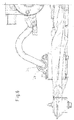
- FIG. 1 shows a wheel suspension 1, in particular a McPherson wheel suspension with a subframe 2 and a stabilizer 3.
- a lower wishbone 4 is in usually included in a damping unit 6.
- the damping unit 6 is mounted in a receptacle 7 connected to the subframe 2.
- Stabilizer 3 is seen in the transverse direction of the subframe 2 in outer End portions 10 of the subframe 2 connected thereto.
- the suspension 1 is symmetrical to a vehicle longitudinal axis X-X designed so that subsequently only one side of the suspension is described.
- the Damping unit 6 on a round outer circumference.
- the damping unit 6 is exemplified as a rubber bush and arranged horizontally.
- the receptacle 7 is made as a housing in one piece from a metal sheet and has an approximately circular receiving area 8, which in a connection area 9 passes ( Figure 2).
- the receiving area 8 has two vehicle longitudinal axes X-X spaced holding webs 11, between which a gap 12 is arranged.
- the Receiving area 8 comprises the damping unit 6 in its circumferential direction approximately three quarters, so that the connection region 9 is formed as a mouth 13.
- the retaining webs 11 In one Transition 14 to the mouth 13 are the retaining webs 11 each on their outer sides cone-shaped and widen in the direction of the connection area.
- the holding webs 11 each have on one side on outer sides 16 bends 17, which serve to reinforce the transition 14 to the connection area 9.
- connection region 9 has two in a vertical axis Z-Z spaced plane Attachment sections 18 and 19, wherein the reference numeral 18 is an upper and reference numeral 19 denotes a lower attachment portion (FIG 3).
- the attachment portions 18 and 19 are substantially rectangular designed and equally thick. The distance between the attachment sections 18 and 19, respectively in the mounted state preferably corresponds to a height of the subframe 2.
- the attachment portions 18 and 19 are made wider than the two Holding webs 11 with the interposed gap 12.
- Drilled holes introduced. When mounted, the holes are congruent arranged to openings in the subframe 2, so that an attachment of the Recording 7 on the subframe 2 is preferably done by means of bolts 20 bolts.
- a mounting portion is formed on the subframe 2, on which the Recording 7 is attached to the subframe 2.
- the receptacle 7 is preferably designed spring-like, so that the connection region 9 to different Heights is adaptable.
- the subframe 2 has an upper and a lower subframe shell 21 and 22, respectively on, so that to reinforce the attachment area reinforcing sleeves 23rd are arranged within the subframe 2 ( Figure 3).
- the upper one is Subframe shell 22 not shown in the attachment area to the arrangement represent the reinforcing sleeves 23.
- the stabilizer 3 is in particular via a terminal 24 on the receptacle 7 its upper attachment portion 18 is attached ( Figures 2 and 5).
- the clamp 24 is preferably U-shaped with U-legs 26 and a rounded base leg 27 configured ( Figure 5). At free ends of the U-legs 26 is one each Mounting flange 28 is arranged. In the mounting flange 28 is a respective for drilling in the mounting portions 18 corresponding bore brought in.
- the clamp 24 is arranged such that it the stabilizer. 3 includes.
- the mounting flanges 28 are preferably designed plan and with their holes congruent to the holes of the or the attachment sections 18 and the openings in the subframe 2.
- the mounting flanges 28 are preferably on the upper Attachment section 18.
- the stabilizer 3 is also provided with a guide means 29 comprises ( Figures 5 and 6).
- the guide means 29 causes in the mounted state a necessary stop of the stabilizer 3 and can also as Decoupling act.
- the guide means 29 is flexible, so that it on the one hand on an inner wall of the terminal 24 completely and on the plane Fixing section 12 rests flat.
- the stud bolts 20 are coming from the direction of the terminal 24 in Direction of a floor through the congruent holes or openings inserted, wherein the reinforcing sleeves 23 at the same time as a guide of the Bolt bolts 20 are used.
- the stud bolts 20 are with their head 31st each on the mounting flange 28 to protrude with its free threaded end 32nd over the lower mounting portion 19 in the direction of the ground.
- a mother 33 is used for frictional connection and secure attachment to the respective Threaded end 32 screwed. Of course, one can do that too opposite mounting direction of the bolts 20 may be provided.
- the damping unit 6 is different from FIGS. 1 to 3 designed as a hydro damper.
- the receptacle 7 has a circular Receiving area 8, and comprises the damping unit 6 in full.
- the Connection region 9 is thicker with its upper attachment portion 18 formed as the lower attachment portion 19. Accordingly, the respective transition 14 designed.
- the damping unit 6 after the Embodiment of Figures 4 to 9 is made of aluminum and is preferably designed as a one-piece extruded aluminum part.
- a length of a lever arm 34 of the stabilizer 3 advantageously only 190 mm. This is the lever arm 34 relatively short.
Landscapes
- Engineering & Computer Science (AREA)
- Mechanical Engineering (AREA)
- Chemical & Material Sciences (AREA)
- Combustion & Propulsion (AREA)
- Transportation (AREA)
- Vehicle Body Suspensions (AREA)
Abstract
Description
- Fig. 1
- eine perspektivische Gesamtansicht einer Radaufhängung,
- Fig. 2
- eine Vergrößerung des gekennzeichneten Bereiches aus Figur 1,
- Fig. 3
- einen Teilschnitt aus Figur 2,
- Fig. 4
- eine Explosionsdarstellung mit einer Ausführungsform einer Aufnahme,
- Fig. 5
- eine perspektivische Ansicht aus Figur 4,
- Fig. 6
- eine Seitenansicht aus Figur 4,
- Fig. 7
- eine perspektivische Seitenansicht aus Figur 4,
- Fig. 8
- eine Hinteransicht aus Figur 4,
- Fig. 9
- eine Draufsicht aus Figur 4.
Claims (6)
- Radaufhängung an Kraftfahrzeugen mit einem Hilfsrahmen (2) und einem Stabilisator (3), wobei ein unterer Querlenker (4) zumindest in einer Dämpfungseinheit (6) aufgenommen ist, die in einer mit dem Hilfsrahmen (2) verbindbaren Aufnahme (7) gelagert ist,
dadurch gekennzeichnet, daß
der Stabilisator (3) in Querrichtung des Hilfsrahmens (2) gesehen in äußeren Endbereichen (10) des Hilfsrahmens (2) mit diesem verbunden ist. - Radaufhängung nach Anspruch 1,
dadurch gekennzeichnet, daß
der Stabilisator (3) mit einem für die Verbindung der Aufnahme (7) mit dem Hilfsrahmen (2) vorgesehenen Befestigungsbereich mit dem Hilfsrahmen (2) verbunden ist. - Radaufhängung nach Anspruch 1 oder 2,
dadurch gekennzeichnet, daß
der Stabilisator (3) kraftformschlüssig über die Aufnahme (7) mit dem Hilfsrahmen (2) verbunden ist. - Radaufhängung nach einem der vorhergehenden Ansprüche,
dadurch gekennzeichnet, daß
der Stabilisator (3) zumindest teilweise von einer Klemme (24) umfaßt wird, die u-förmig mit U-Schenkeln (26) und einem verrundeten Basissteg (27) ausgestaltet ist. - Radaufhängung nach Anspruch 4,
dadurch gekennzeichnet, daß
die Klemme (24) an freien Enden ihrer U-Schenkel (26) Befestigungsflansche (28) aufweist, in denen Bohrungen eingebracht sind. - Radaufhängung nach einem der vorhergehenden Ansprüche,
dadurch gekennzeichnet, daß
der Stabilisator (3) in einem Klemmenbereich von einem Führungsmittel (29) umgeben ist.
Priority Applications (2)
| Application Number | Priority Date | Filing Date | Title |
|---|---|---|---|
| DE50305059T DE50305059D1 (de) | 2003-11-21 | 2003-11-21 | Einzelradaufhängung für ein Kraftfahrzeug |
| EP20030104310 EP1533151B1 (de) | 2003-11-21 | 2003-11-21 | Einzelradaufhängung für ein Kraftfahrzeug |
Applications Claiming Priority (1)
| Application Number | Priority Date | Filing Date | Title |
|---|---|---|---|
| EP20030104310 EP1533151B1 (de) | 2003-11-21 | 2003-11-21 | Einzelradaufhängung für ein Kraftfahrzeug |
Publications (2)
| Publication Number | Publication Date |
|---|---|
| EP1533151A1 true EP1533151A1 (de) | 2005-05-25 |
| EP1533151B1 EP1533151B1 (de) | 2006-09-13 |
Family
ID=34429513
Family Applications (1)
| Application Number | Title | Priority Date | Filing Date |
|---|---|---|---|
| EP20030104310 Expired - Lifetime EP1533151B1 (de) | 2003-11-21 | 2003-11-21 | Einzelradaufhängung für ein Kraftfahrzeug |
Country Status (2)
| Country | Link |
|---|---|
| EP (1) | EP1533151B1 (de) |
| DE (1) | DE50305059D1 (de) |
Cited By (10)
| Publication number | Priority date | Publication date | Assignee | Title |
|---|---|---|---|---|
| KR100610115B1 (ko) | 2004-10-29 | 2006-08-09 | 현대자동차주식회사 | 자동차의 스태빌라이저바 장착구조 |
| JP2007182116A (ja) * | 2006-01-05 | 2007-07-19 | Mitsubishi Automob Eng Co Ltd | 車両のスタビライザ取付構造 |
| EP2017163A2 (de) | 2007-06-18 | 2009-01-21 | Nissan Motor Co., Ltd. | Vorderwagenaufbau eines Fahrzeuges |
| JP2010089549A (ja) * | 2008-10-03 | 2010-04-22 | Honda Motor Co Ltd | スタビライザ取付構造 |
| CN101327811B (zh) * | 2007-06-18 | 2010-06-02 | 日产自动车株式会社 | 车体前部结构 |
| DE102015223280A1 (de) * | 2015-11-25 | 2017-06-01 | Bayerische Motoren Werke Aktiengesellschaft | Achse eines Kraftfahrzeugs mit einer im Achsträger aufgehängten elektromotorischen Antriebseinheit |
| CN108749501A (zh) * | 2018-04-24 | 2018-11-06 | 北京新能源汽车股份有限公司 | 用于车辆的悬架及车辆 |
| US10207562B2 (en) * | 2015-09-09 | 2019-02-19 | Toyota Jidosha Kabushiki Kaisha | Stabilizer support structure |
| US20190299736A1 (en) * | 2018-03-27 | 2019-10-03 | Kawasaki Jukogyo Kabushiki Kaisha | Attaching structure for stabilizer of utility vehicle |
| DE102019201731B3 (de) * | 2019-02-11 | 2020-03-12 | Audi Ag | Befestigungsanordnung für einen Stabilisator eines Kraftfahrzeugs |
Families Citing this family (1)
| Publication number | Priority date | Publication date | Assignee | Title |
|---|---|---|---|---|
| JP6269638B2 (ja) * | 2015-11-11 | 2018-01-31 | マツダ株式会社 | リヤサブフレーム構造 |
Citations (13)
| Publication number | Priority date | Publication date | Assignee | Title |
|---|---|---|---|---|
| EP0477654A2 (de) * | 1990-09-26 | 1992-04-01 | Mazda Motor Corporation | Vorderwagenaufbau für ein Kraftfahrzeug |
| US5707074A (en) * | 1994-11-04 | 1998-01-13 | Nissan Motor Co., Ltd. | Stabilizer support structure |
| JPH10258763A (ja) * | 1997-03-18 | 1998-09-29 | Nissan Motor Co Ltd | サスペンションサブフレーム構造 |
| JPH11334332A (ja) * | 1998-05-28 | 1999-12-07 | Daihatsu Motor Co Ltd | フロントサスペンション |
| JP2000071734A (ja) * | 1998-09-02 | 2000-03-07 | Mazda Motor Corp | 車両のサスペンション支持構造 |
| US6085856A (en) * | 1998-12-16 | 2000-07-11 | Daimlerchrysler Corporation | Attachment system for suspension cradle |
| FR2788822A1 (fr) * | 1999-01-25 | 2000-07-28 | Paulstra Gmbh | Support antivibratoire hydraulique, train de roulement equipe d'un tel support, et procede de fabrication d'un tel support |
| DE19920051A1 (de) * | 1999-05-03 | 2000-11-16 | Porsche Ag | Fahrschemel für eine Vorderachse eines Kraftfahrzeugs |
| WO2001040008A1 (en) * | 1999-11-29 | 2001-06-07 | Cosma International Inc. | Vehicle component mounting assembly |
| JP2001171326A (ja) * | 1999-12-17 | 2001-06-26 | Nissan Motor Co Ltd | サスペンション構造 |
| FR2810275A1 (fr) * | 2000-06-14 | 2001-12-21 | Peugeot Citroen Automobiles Sa | Dispositif de fixation d'un support de palier d'une barre anti-devers a un element de structure d'un vehicule automobile |
| JP2003205852A (ja) * | 2002-01-15 | 2003-07-22 | Nissan Motor Co Ltd | 車両用サブフレーム |
| EP1362767A2 (de) * | 2002-05-14 | 2003-11-19 | Dr.Ing. h.c.F. Porsche Aktiengesellschaft | Fahrschemel für eine Vorderachse eines Kraftfahrzeugs |
-
2003
- 2003-11-21 EP EP20030104310 patent/EP1533151B1/de not_active Expired - Lifetime
- 2003-11-21 DE DE50305059T patent/DE50305059D1/de not_active Expired - Lifetime
Patent Citations (13)
| Publication number | Priority date | Publication date | Assignee | Title |
|---|---|---|---|---|
| EP0477654A2 (de) * | 1990-09-26 | 1992-04-01 | Mazda Motor Corporation | Vorderwagenaufbau für ein Kraftfahrzeug |
| US5707074A (en) * | 1994-11-04 | 1998-01-13 | Nissan Motor Co., Ltd. | Stabilizer support structure |
| JPH10258763A (ja) * | 1997-03-18 | 1998-09-29 | Nissan Motor Co Ltd | サスペンションサブフレーム構造 |
| JPH11334332A (ja) * | 1998-05-28 | 1999-12-07 | Daihatsu Motor Co Ltd | フロントサスペンション |
| JP2000071734A (ja) * | 1998-09-02 | 2000-03-07 | Mazda Motor Corp | 車両のサスペンション支持構造 |
| US6085856A (en) * | 1998-12-16 | 2000-07-11 | Daimlerchrysler Corporation | Attachment system for suspension cradle |
| FR2788822A1 (fr) * | 1999-01-25 | 2000-07-28 | Paulstra Gmbh | Support antivibratoire hydraulique, train de roulement equipe d'un tel support, et procede de fabrication d'un tel support |
| DE19920051A1 (de) * | 1999-05-03 | 2000-11-16 | Porsche Ag | Fahrschemel für eine Vorderachse eines Kraftfahrzeugs |
| WO2001040008A1 (en) * | 1999-11-29 | 2001-06-07 | Cosma International Inc. | Vehicle component mounting assembly |
| JP2001171326A (ja) * | 1999-12-17 | 2001-06-26 | Nissan Motor Co Ltd | サスペンション構造 |
| FR2810275A1 (fr) * | 2000-06-14 | 2001-12-21 | Peugeot Citroen Automobiles Sa | Dispositif de fixation d'un support de palier d'une barre anti-devers a un element de structure d'un vehicule automobile |
| JP2003205852A (ja) * | 2002-01-15 | 2003-07-22 | Nissan Motor Co Ltd | 車両用サブフレーム |
| EP1362767A2 (de) * | 2002-05-14 | 2003-11-19 | Dr.Ing. h.c.F. Porsche Aktiengesellschaft | Fahrschemel für eine Vorderachse eines Kraftfahrzeugs |
Non-Patent Citations (6)
| Title |
|---|
| PATENT ABSTRACTS OF JAPAN vol. 013, no. 274 (M - 841) 23 June 1989 (1989-06-23) * |
| PATENT ABSTRACTS OF JAPAN vol. 1998, no. 14 31 December 1998 (1998-12-31) * |
| PATENT ABSTRACTS OF JAPAN vol. 2000, no. 03 30 March 2000 (2000-03-30) * |
| PATENT ABSTRACTS OF JAPAN vol. 2000, no. 06 22 September 2000 (2000-09-22) * |
| PATENT ABSTRACTS OF JAPAN vol. 2000, no. 23 10 February 2001 (2001-02-10) * |
| PATENT ABSTRACTS OF JAPAN vol. 2003, no. 11 5 November 2003 (2003-11-05) * |
Cited By (13)
| Publication number | Priority date | Publication date | Assignee | Title |
|---|---|---|---|---|
| KR100610115B1 (ko) | 2004-10-29 | 2006-08-09 | 현대자동차주식회사 | 자동차의 스태빌라이저바 장착구조 |
| JP2007182116A (ja) * | 2006-01-05 | 2007-07-19 | Mitsubishi Automob Eng Co Ltd | 車両のスタビライザ取付構造 |
| CN101327811B (zh) * | 2007-06-18 | 2010-06-02 | 日产自动车株式会社 | 车体前部结构 |
| EP2017163A3 (de) * | 2007-06-18 | 2009-05-06 | Nissan Motor Co., Ltd. | Vorderwagenaufbau eines Fahrzeuges |
| US7726672B2 (en) | 2007-06-18 | 2010-06-01 | Nissan Motor Co., Ltd. | Vehicle body front part structure |
| EP2017163A2 (de) | 2007-06-18 | 2009-01-21 | Nissan Motor Co., Ltd. | Vorderwagenaufbau eines Fahrzeuges |
| JP2010089549A (ja) * | 2008-10-03 | 2010-04-22 | Honda Motor Co Ltd | スタビライザ取付構造 |
| US10207562B2 (en) * | 2015-09-09 | 2019-02-19 | Toyota Jidosha Kabushiki Kaisha | Stabilizer support structure |
| DE102015223280A1 (de) * | 2015-11-25 | 2017-06-01 | Bayerische Motoren Werke Aktiengesellschaft | Achse eines Kraftfahrzeugs mit einer im Achsträger aufgehängten elektromotorischen Antriebseinheit |
| US20190299736A1 (en) * | 2018-03-27 | 2019-10-03 | Kawasaki Jukogyo Kabushiki Kaisha | Attaching structure for stabilizer of utility vehicle |
| US10661626B2 (en) * | 2018-03-27 | 2020-05-26 | Kawasaki Jukogyo Kabushiki Kaisha | Attaching structure for stabilizer of utility vehicle |
| CN108749501A (zh) * | 2018-04-24 | 2018-11-06 | 北京新能源汽车股份有限公司 | 用于车辆的悬架及车辆 |
| DE102019201731B3 (de) * | 2019-02-11 | 2020-03-12 | Audi Ag | Befestigungsanordnung für einen Stabilisator eines Kraftfahrzeugs |
Also Published As
| Publication number | Publication date |
|---|---|
| EP1533151B1 (de) | 2006-09-13 |
| DE50305059D1 (de) | 2006-10-26 |
Similar Documents
| Publication | Publication Date | Title |
|---|---|---|
| EP1912806B2 (de) | Radaufhängungslenker | |
| DE10053411B4 (de) | Fahrzeugachse | |
| DE10032961B4 (de) | Drehstabfeder | |
| DE10031454B4 (de) | Drehstabfeder | |
| EP2982529B1 (de) | Luftfederträger für eine luftgefederte achse eines nutzfahrzeugs | |
| DE3902407C1 (en) | Bearing | |
| WO2000051833A1 (de) | Achsaufhängung von starrachsen | |
| DE102010036731B4 (de) | Pendelstützenmontageeinheit für einen Stoßdämpfer | |
| EP3192680A1 (de) | Federlenker aus stahl | |
| DE10110332A1 (de) | Fahrzeug | |
| DE69817174T2 (de) | Vorrichtung für radaufhängung | |
| DE19920051A1 (de) | Fahrschemel für eine Vorderachse eines Kraftfahrzeugs | |
| EP1533151B1 (de) | Einzelradaufhängung für ein Kraftfahrzeug | |
| DE102017214190A1 (de) | Lageranordnung für einen Kraftwagen | |
| DE10042594B4 (de) | Konstruktion für Aufhängungssystem-Anbringungsabschnitte einer Fahrzeugkarosserie | |
| DE19923698B4 (de) | Querlenker | |
| DE69812083T2 (de) | Montagesystem | |
| DE102017211277B4 (de) | Radaufhängung für ein Kraftfahrzeug | |
| EP0940319A2 (de) | Fahrgestell eines schweren Nutzfahrzeuges | |
| DE29519965U1 (de) | Kfz-Radträger für Mehrlenkerachsen | |
| EP0940324B1 (de) | Fahrgestell eines schweren Nutzfahrzeuges | |
| DE202018004756U1 (de) | Verbindungseinrichtung einer Radaufhängung | |
| EP1925470A2 (de) | Radaufhängung | |
| DE10247503B4 (de) | Lagerung eines Fahrzeug-Schwingungsdämpfers | |
| DE4213101A1 (de) | Hinterachsaufhaengung fuer insbesondere autobusse |
Legal Events
| Date | Code | Title | Description |
|---|---|---|---|
| PUAI | Public reference made under article 153(3) epc to a published international application that has entered the european phase |
Free format text: ORIGINAL CODE: 0009012 |
|
| AK | Designated contracting states |
Kind code of ref document: A1 Designated state(s): AT BE BG CH CY CZ DE DK EE ES FI FR GB GR HU IE IT LI LU MC NL PT RO SE SI SK TR |
|
| AX | Request for extension of the european patent |
Extension state: AL LT LV MK |
|
| 17P | Request for examination filed |
Effective date: 20051125 |
|
| AKX | Designation fees paid |
Designated state(s): DE FR GB |
|
| GRAP | Despatch of communication of intention to grant a patent |
Free format text: ORIGINAL CODE: EPIDOSNIGR1 |
|
| GRAS | Grant fee paid |
Free format text: ORIGINAL CODE: EPIDOSNIGR3 |
|
| GRAA | (expected) grant |
Free format text: ORIGINAL CODE: 0009210 |
|
| AK | Designated contracting states |
Kind code of ref document: B1 Designated state(s): DE FR GB |
|
| REG | Reference to a national code |
Ref country code: GB Ref legal event code: FG4D Free format text: NOT ENGLISH |
|
| REF | Corresponds to: |
Ref document number: 50305059 Country of ref document: DE Date of ref document: 20061026 Kind code of ref document: P |
|
| GBT | Gb: translation of ep patent filed (gb section 77(6)(a)/1977) |
Effective date: 20070108 |
|
| ET | Fr: translation filed | ||
| PLBE | No opposition filed within time limit |
Free format text: ORIGINAL CODE: 0009261 |
|
| STAA | Information on the status of an ep patent application or granted ep patent |
Free format text: STATUS: NO OPPOSITION FILED WITHIN TIME LIMIT |
|
| 26N | No opposition filed |
Effective date: 20070614 |
|
| REG | Reference to a national code |
Ref country code: FR Ref legal event code: PLFP Year of fee payment: 13 |
|
| REG | Reference to a national code |
Ref country code: FR Ref legal event code: PLFP Year of fee payment: 14 |
|
| REG | Reference to a national code |
Ref country code: FR Ref legal event code: PLFP Year of fee payment: 15 |
|
| REG | Reference to a national code |
Ref country code: FR Ref legal event code: PLFP Year of fee payment: 16 |
|
| PGFP | Annual fee paid to national office [announced via postgrant information from national office to epo] |
Ref country code: DE Payment date: 20191017 Year of fee payment: 17 |
|
| PGFP | Annual fee paid to national office [announced via postgrant information from national office to epo] |
Ref country code: FR Payment date: 20191029 Year of fee payment: 17 |
|
| PGFP | Annual fee paid to national office [announced via postgrant information from national office to epo] |
Ref country code: GB Payment date: 20191029 Year of fee payment: 17 |
|
| REG | Reference to a national code |
Ref country code: DE Ref legal event code: R119 Ref document number: 50305059 Country of ref document: DE |
|
| GBPC | Gb: european patent ceased through non-payment of renewal fee |
Effective date: 20201121 |
|
| PG25 | Lapsed in a contracting state [announced via postgrant information from national office to epo] |
Ref country code: FR Free format text: LAPSE BECAUSE OF NON-PAYMENT OF DUE FEES Effective date: 20201130 |
|
| PG25 | Lapsed in a contracting state [announced via postgrant information from national office to epo] |
Ref country code: GB Free format text: LAPSE BECAUSE OF NON-PAYMENT OF DUE FEES Effective date: 20201121 Ref country code: DE Free format text: LAPSE BECAUSE OF NON-PAYMENT OF DUE FEES Effective date: 20210601 |