EP1532134B1 - Neue thiophenacylhydrazinoderivate, verfahren zu deren herstellung, deren verwendung als arzneimittel, pharmazeutische zusammensetzungen und neue anwendungen - Google Patents
Neue thiophenacylhydrazinoderivate, verfahren zu deren herstellung, deren verwendung als arzneimittel, pharmazeutische zusammensetzungen und neue anwendungen Download PDFInfo
- Publication number
- EP1532134B1 EP1532134B1 EP02807597A EP02807597A EP1532134B1 EP 1532134 B1 EP1532134 B1 EP 1532134B1 EP 02807597 A EP02807597 A EP 02807597A EP 02807597 A EP02807597 A EP 02807597A EP 1532134 B1 EP1532134 B1 EP 1532134B1
- Authority
- EP
- European Patent Office
- Prior art keywords
- formula
- radical
- products
- radicals
- optionally substituted
- Prior art date
- Legal status (The legal status is an assumption and is not a legal conclusion. Google has not performed a legal analysis and makes no representation as to the accuracy of the status listed.)
- Expired - Lifetime
Links
- 0 *C(N(*)N(*)C(c1c(*)c(*)c(*)[s]1)=O)=O Chemical compound *C(N(*)N(*)C(c1c(*)c(*)c(*)[s]1)=O)=O 0.000 description 9
Images

Classifications
-
- C—CHEMISTRY; METALLURGY
- C07—ORGANIC CHEMISTRY
- C07D—HETEROCYCLIC COMPOUNDS
- C07D333/00—Heterocyclic compounds containing five-membered rings having one sulfur atom as the only ring hetero atom
- C07D333/02—Heterocyclic compounds containing five-membered rings having one sulfur atom as the only ring hetero atom not condensed with other rings
- C07D333/04—Heterocyclic compounds containing five-membered rings having one sulfur atom as the only ring hetero atom not condensed with other rings not substituted on the ring sulphur atom
- C07D333/26—Heterocyclic compounds containing five-membered rings having one sulfur atom as the only ring hetero atom not condensed with other rings not substituted on the ring sulphur atom with hetero atoms or with carbon atoms having three bonds to hetero atoms with at the most one bond to halogen, e.g. ester or nitrile radicals, directly attached to ring carbon atoms
- C07D333/38—Carbon atoms having three bonds to hetero atoms with at the most one bond to halogen, e.g. ester or nitrile radicals
-
- A—HUMAN NECESSITIES
- A61—MEDICAL OR VETERINARY SCIENCE; HYGIENE
- A61P—SPECIFIC THERAPEUTIC ACTIVITY OF CHEMICAL COMPOUNDS OR MEDICINAL PREPARATIONS
- A61P1/00—Drugs for disorders of the alimentary tract or the digestive system
- A61P1/02—Stomatological preparations, e.g. drugs for caries, aphtae, periodontitis
-
- A—HUMAN NECESSITIES
- A61—MEDICAL OR VETERINARY SCIENCE; HYGIENE
- A61P—SPECIFIC THERAPEUTIC ACTIVITY OF CHEMICAL COMPOUNDS OR MEDICINAL PREPARATIONS
- A61P19/00—Drugs for skeletal disorders
-
- A—HUMAN NECESSITIES
- A61—MEDICAL OR VETERINARY SCIENCE; HYGIENE
- A61P—SPECIFIC THERAPEUTIC ACTIVITY OF CHEMICAL COMPOUNDS OR MEDICINAL PREPARATIONS
- A61P19/00—Drugs for skeletal disorders
- A61P19/02—Drugs for skeletal disorders for joint disorders, e.g. arthritis, arthrosis
-
- A—HUMAN NECESSITIES
- A61—MEDICAL OR VETERINARY SCIENCE; HYGIENE
- A61P—SPECIFIC THERAPEUTIC ACTIVITY OF CHEMICAL COMPOUNDS OR MEDICINAL PREPARATIONS
- A61P19/00—Drugs for skeletal disorders
- A61P19/08—Drugs for skeletal disorders for bone diseases, e.g. rachitism, Paget's disease
-
- A—HUMAN NECESSITIES
- A61—MEDICAL OR VETERINARY SCIENCE; HYGIENE
- A61P—SPECIFIC THERAPEUTIC ACTIVITY OF CHEMICAL COMPOUNDS OR MEDICINAL PREPARATIONS
- A61P19/00—Drugs for skeletal disorders
- A61P19/08—Drugs for skeletal disorders for bone diseases, e.g. rachitism, Paget's disease
- A61P19/10—Drugs for skeletal disorders for bone diseases, e.g. rachitism, Paget's disease for osteoporosis
-
- A—HUMAN NECESSITIES
- A61—MEDICAL OR VETERINARY SCIENCE; HYGIENE
- A61P—SPECIFIC THERAPEUTIC ACTIVITY OF CHEMICAL COMPOUNDS OR MEDICINAL PREPARATIONS
- A61P25/00—Drugs for disorders of the nervous system
-
- A—HUMAN NECESSITIES
- A61—MEDICAL OR VETERINARY SCIENCE; HYGIENE
- A61P—SPECIFIC THERAPEUTIC ACTIVITY OF CHEMICAL COMPOUNDS OR MEDICINAL PREPARATIONS
- A61P25/00—Drugs for disorders of the nervous system
- A61P25/28—Drugs for disorders of the nervous system for treating neurodegenerative disorders of the central nervous system, e.g. nootropic agents, cognition enhancers, drugs for treating Alzheimer's disease or other forms of dementia
-
- A—HUMAN NECESSITIES
- A61—MEDICAL OR VETERINARY SCIENCE; HYGIENE
- A61P—SPECIFIC THERAPEUTIC ACTIVITY OF CHEMICAL COMPOUNDS OR MEDICINAL PREPARATIONS
- A61P29/00—Non-central analgesic, antipyretic or antiinflammatory agents, e.g. antirheumatic agents; Non-steroidal antiinflammatory drugs [NSAID]
-
- A—HUMAN NECESSITIES
- A61—MEDICAL OR VETERINARY SCIENCE; HYGIENE
- A61P—SPECIFIC THERAPEUTIC ACTIVITY OF CHEMICAL COMPOUNDS OR MEDICINAL PREPARATIONS
- A61P31/00—Antiinfectives, i.e. antibiotics, antiseptics, chemotherapeutics
-
- A—HUMAN NECESSITIES
- A61—MEDICAL OR VETERINARY SCIENCE; HYGIENE
- A61P—SPECIFIC THERAPEUTIC ACTIVITY OF CHEMICAL COMPOUNDS OR MEDICINAL PREPARATIONS
- A61P35/00—Antineoplastic agents
-
- A—HUMAN NECESSITIES
- A61—MEDICAL OR VETERINARY SCIENCE; HYGIENE
- A61P—SPECIFIC THERAPEUTIC ACTIVITY OF CHEMICAL COMPOUNDS OR MEDICINAL PREPARATIONS
- A61P37/00—Drugs for immunological or allergic disorders
- A61P37/02—Immunomodulators
-
- A—HUMAN NECESSITIES
- A61—MEDICAL OR VETERINARY SCIENCE; HYGIENE
- A61P—SPECIFIC THERAPEUTIC ACTIVITY OF CHEMICAL COMPOUNDS OR MEDICINAL PREPARATIONS
- A61P37/00—Drugs for immunological or allergic disorders
- A61P37/08—Antiallergic agents
-
- A—HUMAN NECESSITIES
- A61—MEDICAL OR VETERINARY SCIENCE; HYGIENE
- A61P—SPECIFIC THERAPEUTIC ACTIVITY OF CHEMICAL COMPOUNDS OR MEDICINAL PREPARATIONS
- A61P43/00—Drugs for specific purposes, not provided for in groups A61P1/00-A61P41/00
-
- A—HUMAN NECESSITIES
- A61—MEDICAL OR VETERINARY SCIENCE; HYGIENE
- A61P—SPECIFIC THERAPEUTIC ACTIVITY OF CHEMICAL COMPOUNDS OR MEDICINAL PREPARATIONS
- A61P9/00—Drugs for disorders of the cardiovascular system
- A61P9/10—Drugs for disorders of the cardiovascular system for treating ischaemic or atherosclerotic diseases, e.g. antianginal drugs, coronary vasodilators, drugs for myocardial infarction, retinopathy, cerebrovascula insufficiency, renal arteriosclerosis
-
- C—CHEMISTRY; METALLURGY
- C07—ORGANIC CHEMISTRY
- C07D—HETEROCYCLIC COMPOUNDS
- C07D409/00—Heterocyclic compounds containing two or more hetero rings, at least one ring having sulfur atoms as the only ring hetero atoms
- C07D409/02—Heterocyclic compounds containing two or more hetero rings, at least one ring having sulfur atoms as the only ring hetero atoms containing two hetero rings
- C07D409/12—Heterocyclic compounds containing two or more hetero rings, at least one ring having sulfur atoms as the only ring hetero atoms containing two hetero rings linked by a chain containing hetero atoms as chain links
Definitions
- the present invention relates to novel acyl hydrazino derivatives of thiophene, their process of preparation, the new intermediates obtained, their application as medicaments, the pharmaceutical compositions containing them and the novel use of such acyl hydrazino derivatives of thiophene.
- the invention thus relates to novel acyl hydrazino derivatives of thiophene having inhibitory properties of metabolic enzymes.
- Such metabolic enzymes are especially kinases or proteases and especially cysteine proteases or serine proteases.
- cysteine proteases of crustaceans induce in vertebrates biological effects identical to those of a hormone calcitonin, which suggests a common evolution of these enzymes and this hormone: this observation is due to development of new treatments for cartilage and bone metabolism diseases, particularly osteoporosis and Paget's disease.
- Metabolic enzymes such as proteases or kinases are widely distributed enzymes in the animal kingdom.
- proteases 'Methods in Enzymology XLII (1975)' and 'Journal of Medicinal Chemistry' vol. 43 No. 3 ('D. Leung, G. Abbenante and DP Fairlie' ) and the following document for kinases: Methods in Enzymology, Vol 80 (1981) (Academic Press Inc.)
- proteases capable of selectively catalyzing the hydrolysis of polypeptide bonds, mention may be made of four main classes: aspartate proteases, serine proteases, metalloproteases and cysteine proteases.
- Cysteine proteases are a family of proteases that have a thiol group in the active site. Such proteases exist in bacteria, viruses, eukaryotic microorganisms, plants and animals. Such cysteine proteases are very numerous and are given hereinafter, but not exclusively, examples of cysteine proteases such as cysteine proteases of plants such as papain, ficine, aleuraine, orizaine, and actinidine ; mammalian cysteine proteases such as cathepsins B, H, J, L, N, S, T, C, V, W, K or O, O 2, interleukin converting enzyme (ICE), calpains I and II, bleomycin hydrolase; cysteine viral proteases such as picornian 2A and 3C, the endopeptidases aphthvirus, cardiovirus, comovirus, potyvirus I and II, adenovirus, togavirus or the cysteine proteases of polio or rhinovirus
- cysteine proteases mention may be made especially of cathepsins and in particular cathepsins K, B, L and S and papain.
- Such kinase enzymes or proteases are involved in processes of catabolization and inter and intracellular communication: they play an important role in a large number of diseases of different domains such as in particular the cardiovascular field, oncology, the central nervous system, inflammation, disorders bones, periodontal diseases and also infectious parasitic, fungal or viral diseases. This is why these proteins are targets of great interest for pharmaceutical research.
- Inhibitors of such proteases may therefore be useful in many and diverse therapeutic areas.
- the products of the present invention can thus notably be useful in the prevention or treatment of diseases in which such metabolic enzymes are involved, such as certain cardiovascular diseases, diseases of the central nervous system, inflammatory diseases, bone diseases such as, for example osteoporosis, osteoarthritis or gingivitis, infectious diseases requiring especially for their therapy anti-infectives or some cancers.
- diseases in which such metabolic enzymes are involved such as certain cardiovascular diseases, diseases of the central nervous system, inflammatory diseases, bone diseases such as, for example osteoporosis, osteoarthritis or gingivitis, infectious diseases requiring especially for their therapy anti-infectives or some cancers.
- Such products of the present invention can thus notably be used for the treatment of diseases in which such proteases are involved, and in particular diseases associated with a significant loss of bone or cartilage as defined below.
- Bone tissue is the site of continuous permanent remodeling, which ensures phosphocalcic homeostasis and maintains the mechanical properties of the bones.
- the duration of a remodeling cycle in normal adult man is about 3 months.
- proteolytic enzymes intervene in the degradation of the proteins of the matrix. This is particularly the case for cathepsins K, B, L and S as well as for certain metalloproteases.
- Cathepsins are defined as lysosomal proteins, the majority of which are "papain-like" enzymes.
- Several sequences of the human genome, encoding for cysteine cathepsins, have been identified to date (eg, B, H, L, S, C, K, O, F, V, X, W). All of these enzymes contain a cysteine-histidine-asparagine pair in their catalytic site, forming a thiolate-imidazolium pair required for enzymatic activity. They are capable of hydrolyzing various substrates such as peptides, amides, esters, thiol esters and thiono esters.
- the cathepsin family of cysteine includes various proteolytic enzymes involved in several physiological processes, and can thus play important roles in various pathologies.
- Cathepsin K (formerly known as O or O2) was identified from a rabbit cDNA library, then localized to human ovaries and osteoclasts (in adherent mature cells ( Tezuka K, Tezuka Y, Maejima S: J.Biol.Chem. (1994) 269: 1106-1109 )). It is expressed mainly in the latter ( Brömme D, Okamoto K, Wang B, Biroc S: J.Biol.Chem.
- Transgenic mice KO for the gene encoding cathepsin K, have an osteopetrotic phenotype, including increased bone mass and poor quality bones. In this model, bone resorption is almost absent. Only demineralization remains. This phenotype is comparable to that of patients with Pycnodysostosis (Toulouse-Lautrec disease), a genetic disease resulting in the production of inactive cathepsin K responsible for facial hypoplasia and the premature arrest of long bone growth with osteosclerosis. severe ( Saftig P, Hunziker E, Wehmeyer O, Jones S, Boyde A, Rommerskirch W, Moritz JD, Schu P, Von Figura K: Proc.Natl.Acad.Sci.
- cathepsin K The involvement of cathepsin K in the process of bone resorption makes this enzyme a preferred target for the treatment of pathologies, such as osteoporosis, due to an imbalance of the bone turnover in favor of resorption, target for new molecules that inhibit enzymatic activity.
- the present invention therefore relates to novel acyl hydrazino derivatives of thiophene cysteine protease inhibitors, more particularly of the family of cathepsins B, K and in particular of the cathepsin K family.
- the addition salts with the inorganic or organic acids of the products of formula (I) can be, for example, the salts formed with hydrochloric, hydrobromic, hydroiodic, nitric, sulfuric, phosphoric, propionic, acetic, trifluoroacetic, formic acids, benzoic, maleic, fumaric, succinic, tartaric, citric, oxalic, glyoxylic, aspartic, ascorbic, alkylmonosulphonic acids such as, for example, methanesulfonic acid, ethanesulphonic acid, propanesulphonic acid, alkylsulphonic acids such as, for example, methanedisulfonic acid, alpha, beta-ethanedisulfonic acid, arylmonosulfonic acids such as benzenesulphonic acid and aryldisulphonic acids.
- stereoisomerism can be defined in its broad sense as the isomerism of compounds having the same developed formulas, but the different groups of which are arranged differently in space, such as in particular in monosubstituted cyclohexanes, the substituent of which may be in axial or equatorial position, and the different possible rotational conformations of the ethane derivatives.
- stereoisomerism due to the different spatial arrangements of fixed substituents, either on double bonds or on rings, often called geometric isomerism or cis-trans isomerism.
- stereoisomers is used in the present application in its broadest sense and therefore relates to all of the compounds indicated above.
- R 1 represents alkyl substituted by amino itself which is optionally substituted
- R 1 represents in particular an optionally substituted decarboxylated amino acid residue and more specifically a residue of optionally substituted decarboxylated leu.
- the subject of the present invention is particularly the products of formulas (I), (Ia) and (Ib) as defined above, in which R3, R3a, R4, R4a, R5, R5a, R5b, R6, R6a and R6b represent a hydrogen atom, said products of formulas (I), (Ia) and (Ib) being in all possible isomeric racemic, enantiomeric and diastereoisomeric forms, as well as addition salts with mineral and organic acids or with the mineral and organic bases of said products of formulas (I), (Ia) and (Ib).
- FIG. 1 Hereinafter represents the synthesis scheme of the products of formula (I) according to the process defined above. Under preferred conditions of implementation of the invention, the process described above can be carried out as follows:
- the product of formula (II) in which W represents a hydrogen atom may be subjected to the action of the halogenated derivative of formula (III) to give a product of formula (IV) in a solvent such as THF in the presence of LDA.
- the product of formula (III) represents a halogenated derivative such as for example alkylhal or arylalkylHal in which Hal represents a halogen atom and aryl and alkyl respectively represent an aryl and alkyl radical as defined above:
- (III) represents for example phenyl-CH2-Br or an alkyl bromide such as isopropyl bromide.
- the product of formula (IV) obtained can again be subjected to the action of the same compound of formula (III) under the same conditions.
- the products of formulas (IV1) and (IV2) are subjected to an esterification reaction under the usual conditions such as, for example, in an alcohol such as ethanol or methanol catalyzed by H 2 SO 4 or by coupling with dicyclohexylcarbodiimide (DCC). or its derivatives or diazomethane in methylene chloride, to obtain the corresponding products of formulas (V), (V1) and (V2) as defined above.
- DCC dicyclohexylcarbodiimide
- the product of formula (II) in which W represents a hydrogen atom may be subjected to the action of an alcohol of formula (VI) such as, for example, methanol or ethanol in a solvent such as SOC12 or in the conditions indicated above to give a product of formula (VII) as defined above.
- the product of formula (VII) thus obtained is reacted with an aldehyde of formula (VIII) for example in THF to obtain a product of formula (IX) as defined above.
- Rd represents in particular a hydrogen atom, an alkyl or aryl radical optionally substituted, in particular with a hydroxyl, phenyl or hydroxyphenyl radical.
- reaction of the product of formula (IX) with the amine of formula (X) is carried out in pyridine or in dichloromethane in the presence of triethylamine to give a product of formula (XI) as defined above.
- the products of formulas (XI) and (XII) may be subjected to a reduction reaction in trifluoroacetic acid in the presence of Zn to give a product of formula (XIII) as defined above.
- the product of formula (XIII) is subjected to a saponification reaction under the usual conditions, for example in a THF / water / base mixture, the base possibly being lithium hydroxide (LiOH) or sodium hydroxide and the product of formula (XIV).
- the base possibly being lithium hydroxide (LiOH) or sodium hydroxide and the product of formula (XIV).
- the product of formula (II) in which W represents a halogen atom can be subjected to an esterification reaction with an alcohol of formula (VI) as defined above to obtain a product of formula (XVI) by operating for example under the same conditions as to obtain (VII) from (II) and (VI).
- the halogen atom is preferably the bromine atom.
- the product of formula (XVI) thus obtained can also be reacted with an amine of formula (XIX) as defined above in DMF, preferably under pressure at 165 ° C. to obtain a product of formula (XX) such that defined above.
- the product of formula (XXIV) R1'-COOH can in particular represent an amino acid residue such as for example Phe or Leu optionally substituted.
- the products of formula (Ix ') and (Iy') may constitute products of formula (I) in which the optionally reactive functions are protected and which therefore give, after the deprotection reaction of these functions, products of formula (I) such that defined above.
- the products of formula (Ix ') and (Iy') may also give products of formula (I), or may be converted into other products of formula (I) by being subjected to one or more of reactions a) to k ) indicated above and detailed below.
- the products of the present invention may thus be endowed with inhibitory properties of one or more metabolic enzymes as defined above, in particular of certain protein kinases or proteases.
- kinase inhibitors have been described as butyrolactone, flavopiridol and 2 (2-hydroxyethylamino) -6-benzylamino-9-methylpurine called olomoucine.
- protease inhibitors have also been described, in particular in Journal of Medicinal Chemistry, vol. 43 - No. 3 (D. Leung, G. Abbenante and DP Fairlie ). According to a non-exhaustive list, there may be mentioned, for example, as thrombin inhibitors: argatroloan, napsagatran, inogatran, efegatran, CVS-1123 and melagatran.
- elastase inhibitors mention may be made of ICI-200800, MR 889, L-658,758, MDL 101,146, ZD 8321 or else various heterocyclic derivatives such as penicillins, penemes, ⁇ -lactams, isocoumarins, benzisothiazolones, alkylazetidinones.
- APC-366 As inhibitors of tryptases, mention may be made of APC-366, as "complement convertase" inhibitors, mention may be made of sepimostat mesylate (FUT-187) or nafamostat mesylate (FUT 175).
- Cbz-Leu-Leu-Leu-CHO, 1,3-bis (acylamino) -2-propanone or derivatives of 1,5-diacylcarbohydrazide may also be mentioned as potent inhibitors of cathepsin K; as caspase inhibitors, there may be mentioned 5-aminopyrimidin-6-one derivatives, phenyl ketomethyl ether or amino methylene ketone derivatives; as calpain inhibitors include peptide aldehydes such as Cbz-Val-Phe-CHO and calpeptin.
- the products of the present invention as defined above possess inhibitory properties of kinases or proteases and in particular of cysteine proteases.
- the products of the present invention as defined above thus have, in particular, inhibiting properties of cathepsins B, H, J, L, N, S, T, C, V, W, K or O, O 2, and more particularly of cathepsin K.
- the products of the present invention or their pharmaceutically acceptable salts are therefore particularly useful for the prevention or the treatment of diseases requiring the use of inhibitors of kinases or proteases, in particular inhibitors of cysteine proteases, particularly of cathepsin inhibitors.
- the levels, regulation and activity of a number of protein kinases or proteases play a role in several human pathologies.
- the activity of a protein kinase may notably be associated with receptors possessing transmembrane domains or with proteins intracellular.
- Some kinases or proteases may play a role in the initiation, development, and completion of cell cycle events, and thus inhibitory molecules of such kinases or proteases may limit unwanted cell proliferations such as those observed in the cell cycle.
- Certain products of formula (I) of the present invention can thus be endowed with antimitotic properties.
- Certain products of formula (I) as defined above may, as kinase or protease inhibitors, have the particular property of inhibiting bone resorption mediated by osteoclasts. They may therefore be useful for the therapeutic or prophylactic treatment of diseases that are caused at least in part by an unwanted increase in bone resorption, for example osteoporosis.
- Certain products of formula (I) of the present invention can thus for example inhibit the adhesion of osteoclasts on the bone surface and thus bone resorption by osteoclasts.
- the diseases of the bone whose treatment or prevention require the use of the compounds of formula (I) or their prodrugs are in particular osteoporosis, hypercalcemia, osteopenia, for example caused by bone metastases, dental disorders such as periodontitis, hyperparathyroidism, periarticular erosions in rheumatoid arthritis, Paget's disease, osteopenia induced by immobilization.
- the compounds of formula (I) may be used for relieving, preventing or treat bone disorders that are caused by treatments, glucocorticoids, steroid or corticosteroid therapy, or deficiencies of male or female sex hormones.
- All these disorders are characterized by bone loss, which is based on a lack of balance between bone formation and bone destruction and which can be favorably influenced by the inhibition of bone resorption by osteoclasts.
- Certain products of formula (I) of the present invention may possess, in addition to their specific inhibitory properties of kinases or proteases, interesting cellular effects such as antiproliferative properties and in particular effects on apoptosis.
- the products of the present invention are especially useful for tumor therapy.
- the products of the invention can also increase the therapeutic effects of commonly used anti-tumor agents.
- the products of formula (I) of the present invention therefore very particularly have antimitotic and anti-neurodegenerative properties.
- Certain products of the present invention may be inhibitors of vasoconstrictor and hypertensive effects and thus produce an anti-ischemic effect, or may oppose stimulatory effects on certain cell types, in particular smooth muscle cells, fibroblasts, cells neuronal and bone cells.
- the products according to the present invention can thus be used in the treatment of diseases such as proliferative diseases, cancer, restenosis, inflammation; allergies, cardiovascular diseases or certain infectious diseases.
- the products of the present invention may also be used in the treatment of certain gastrointestinal, gynecological disorders and in particular for a relaxing effect at the level of the uterus.
- the subject of the invention is therefore particularly, as medicaments, the products of formula (I) as defined above, as well as the addition salts with inorganic and organic acids or with the pharmaceutically acceptable inorganic and organic bases of said products of formula (I).
- the subject of the invention is more particularly, as medicaments, the products of formula (Ia) or (Ib) as defined above, as well as the addition salts with mineral and organic acids or with mineral bases and pharmaceutically acceptable organic compounds of said products of formula (Ia) or (Ib).
- the products of formula (I) of the present invention can thus notably be used in the form of medicaments for inhibiting an undesired mechanism causing a pathology under the effect of one or more proteases (s) or kinase (s): the method can thus consist in the administration to the patient whose treatment requires the inhibition of the effect of such protease or kinase, an inhibitory amount of such a drug according to the present invention.
- the medicaments which are the subject of the invention can thus be used in the treatment and prevention of cardiovascular diseases associated with an alteration of vasomotility or volemia, myocardial infarction and its consequences, heart failure, the renal failure, angina pectoris, hyperaldosteronism, arterial hypertension and its consequences, treatment and prevention of complications especially cardiac and vascular hypertrophies as well as the development of fibrosis in the target organs, prevention and treatment of hypertension, metabolic, endocrinological and neurological disorders, endotoxic shocks, subarachnoid haemorrhage, arrhythmia, asthma, acute renal failure, preeclampsia and of diabetes.
- the drugs which are the subject of the invention can thus be used in the treatment of vascular spasms, in the treatment of cerebral hemorrhage, in the treatment of coronary spasm, peripheral vascular spasms.
- These drugs can be used especially in the treatment of congestive heart failure, in the prevention of post-angioplasty restenosis, the prevention of cardiac and vascular fibrosis, in the treatment of atherosclerosis and some forms of hypertension such as pulmonary hypertension as well as in the treatment of asthma.
- drugs object of the invention could also be used for the treatment of glaucoma and various types of visceral spasms, and as neuronal protective substances or in the prevention of post-angioplasty restenosis.
- the medicaments which are the subject of the invention may be used for their anti-hypertrophic and anti-fibrotic effects at the cardiac and vascular levels.
- they can be used for the treatment and prevention of cardiovascular disorders associated with diabetes.
- the medicaments which are the subject of the present invention may also find an application in the treatment of osteoporosis and as neuronal protectors.
- the drugs of the invention can also be used in the treatment of memory disorders and cognitive functions as well as anxiety.
- the drugs, object of the invention can also find, as antimitotics, their use in the chemotherapy of cancers, or in the treatment of psoriasis, parasitosis such as those due to protists or fungi or in the treatment of Alzheimer's disease or in the treatment of neuronal apoptosis.
- the invention extends to pharmaceutical compositions containing, as active ingredient, at least one of the medicaments as defined above.
- compositions of the present invention may also, if appropriate, contain active ingredients of other antimitotic drugs such as in particular those based on taxol, cis-platinum, intercalating agents of DNA and others.
- compositions may be administered orally, parenterally or locally by topical application to the skin and mucous membranes or by intravenous or intramuscular injection.
- compositions may be solid or liquid and may be in any of the pharmaceutical forms commonly used in human medicine, such as, for example, simple or coated tablets, pills, lozenges, capsules, drops, granules, injectable preparations, ointments, creams or gels; they are prepared according to the usual methods.
- the active ingredient can be incorporated into the excipients usually employed in these pharmaceutical compositions, such as talc, gum arabic, lactose, starch, magnesium stearate, cocoa butter, aqueous vehicles or not, the fatty substances of animal or vegetable origin, paraffinic derivatives, glycols, various wetting agents, dispersing or emulsifying agents, preservatives.
- the usual dosage, variable according to the product used, the subject treated and the condition in question, may be, for example, from 0.05 to 5 g per day in the adult, or preferably from 0.1 to 2 g. per day.
- the invention particularly relates to pharmaceutical compositions as defined above characterized in that they contain one or more product (s) of formula (I) as defined above: such pharmaceutical compositions are thus characterized in that they contain one or more inhibitors of kinases or proteases as defined above and that they are used as a medicament for the therapeutic applications indicated above.
- the subject of the invention is particularly the use of the products of formula (1) as defined above for the preparation of pharmaceutical compositions intended for the treatment or prevention of conditions requiring inhibition of one or more metabolic enzymes as defined above.
- the subject of the invention is therefore particularly the use of the products of formula (I) as defined above for the preparation of pharmaceutical compositions intended for the treatment of diseases resulting from abnormalities in the levels, regulation or activity of a number of metabolic enzymes.
- Such abnormalities play a role in certain human pathologies of particular interest to the present invention.
- the present invention therefore particularly relates to the use of the products of formula (I) of the present invention as inhibitors of proteases or kinases.
- the present invention thus relates to the inhibition of certain such protease or kinase enzymes and claims the use of products of the present invention as inhibitors in cases where inhibition of such protease or kinase is indicated.
- the subject of the invention is therefore particularly the use of the products of formula (I) as defined above or of pharmaceutically acceptable salts of said products of formula (I) for the preparation of medicaments intended for the prevention or treatment of medicaments for the prevention or treatment of diseases in which metabolic enzymes such as proteases or kinases are involved.
- the subject of the present invention is thus the use of products of formula (I) as defined above or of pharmaceutically acceptable salts of said products of formula (I) for the preparation of medicaments intended for the prevention or treatment of related diseases abnormal physiological behavior in the secretion and / or activity of cysteine proteases such as especially cathepsins B, H, J, L, N, S, T, C, V, W, K or O, O 2 or papain.
- cysteine proteases such as especially cathepsins B, H, J, L, N, S, T, C, V, W, K or O, O 2 or papain.
- the present invention more specifically relates to the use of products of formula (I) as defined above or pharmaceutically acceptable salts of said products of formula (I) for the preparation of medicaments for the prevention or treatment of diseases related to abnormal physiological behavior in the secretion and / or activity of cathepsin K.
- the subject of the present invention is in particular the use of products of formula (I) as defined above or of pharmaceutically acceptable salts of said products of formula (I) as cathepsin K cysteine protease inhibitors.
- the present invention thus particularly relates to the use of products the use of products of formula (I) as defined above or pharmaceutically acceptable salts of said products of formula (I) for the preparation of medicaments for the prevention or the treatment of diseases requiring the use of cysteine protease inhibitors cathepsin K.
- the subject of the present invention is particularly the use of products of formula (I) as defined above or of pharmaceutically acceptable salts of said products of formula (I) for the preparation of medicaments intended for the prevention or the treatment of diseases of the Cartilage and bone metabolism, proliferative diseases, cancers, cardiovascular diseases, restenosis, diseases of the central nervous system, diseases of the immune system, allergies, infectious, inflammatory and autoimmune diseases.
- the subject of the invention is therefore particularly the use of the products of formula (I) as defined above for the preparation of pharmaceutical compositions intended for the treatment of arterial hypertension, cardiac insufficiency, post-operative restenosis angioplasty ,. vascular spasms, cerebral hemorrhage and renal failure.
- the subject of the invention is therefore particularly the use of the products of formula (1) as defined above for the preparation of pharmaceutical compositions intended for the treatment of myocardial infarction, for the prevention of post-angioplasty restenosis, and prevention of cardiac and vascular fibrosis.
- the subject of the invention is therefore particularly the use of the products of formula (1) as defined above for the preparation of pharmaceutical compositions intended for the treatment of renal insufficiency.
- the subject of the invention is therefore particularly the use of the products of formula (1) as defined above for the preparation of pharmaceutical compositions intended for the treatment and prevention of cardiovascular disorders associated with diabetes.
- the subject of the invention is in particular the use of the products of formula (I) as defined above for the preparation of medicaments intended for the chemotherapy of cancers, the treatment of psoriasis, parasitoses such as those due to fungi or protists, the treatment of Alzheimer's disease or the treatment of neurodegenerative diseases including neuronal apoptosis.
- the subject of the present invention is more particularly the use as defined above, characterized in that the diseases to be prevented or treated are chosen from diseases of cartilage metabolism and bone metabolism. proliferative diseases, cancers and neurodegenerative diseases such as Alzheimer's disease.
- the subject of the present invention is particularly the use as defined above, characterized in that the diseases to be prevented or treated are chosen from diseases of cartilage and bone metabolism and bone cancers.
- the subject of the present invention is in particular the use as defined above, characterized in that the diseases to be prevented or treated include osteoporosis, gingival diseases including gingivitis and periodontosis, arthritis such as, in particular, osteoarthritis. and rheumatoid arthritis, Paget's disease, hypercalcemia and bone cancers.
- diseases to be prevented or treated include osteoporosis, gingival diseases including gingivitis and periodontosis, arthritis such as, in particular, osteoarthritis. and rheumatoid arthritis, Paget's disease, hypercalcemia and bone cancers.
- the present invention thus relates to the use as defined above characterized in that the disease to be prevented or treated is in particular osteoporosis.
- starting materials some are known and can be obtained commercially. Some starting materials can be prepared according to the usual methods known to those skilled in the art.
- the starting products of formula (XXIV) may be natural or non-natural amino acids that are commercial or prepared according to the usual methods known to those skilled in the art.
- Fmoc-Leu Fmoc-L-Glu (Alloc); Fmoc-Gly; Fmoc-Ala; Fmoc-Val; Fmoc-Phe or Fmoc-Tyr (OtBu).
- Example 1 2 - [(2S) -4-methyl-1-oxo-2 - [[(phenylmethoxy) -carbonyl] amino] pentyl] -hydrazide of 5 - [(2S) -1 - [[4 1-methyl-1-oxo -2 - [[(phenylmethoxy) carbonyl] amino] pentyl] amino] ethyl] -2-thiophenecarboxylic
- Step 1 5- [1- (Hydroxyimino) ethyl] -2-thiophene carboxylic acid
- Step 2 5- [1- (Hydroxyimino) ethyl] -2-thiophenecarboxylic acid [(2,2-dimethylethoxy) carbonyl] hydrazide
- the reaction medium is brought to room temperature and kept stirring for 30 minutes.
- Boc hydrazine dissolved in 1 ml of CH 2 Cl 2 is added at 0-5 ° C.
- the medium is stored for 3 hours at room temperature.
- the ethyl acetate solution is decanted and then washed with 201 of an aqueous solution.
- the organic phase is then separated, dried and evaporated under vacuum.
- the residue is purified by chromatography on silica eluting with a 90/10 dichloromethane / methanol solution. 0.460 g of the expected product is thus obtained.
- Step 3 5- (1-aminoethyl) -2-thiophenecarboxylic acid hydrazide di trifluoroacetate
- Oxime reduction and deprotection of the carbamate is carried out as follows.
- the ethyl acetate solution is decanted, dried over MgSO 4 , concentrated, purified by chromatography on silica eluting with a CH 2 Cl 2 / MeOH / CH 3 COOH solution: 98/2 / 0.5 to give 1.42 g of the expected product.
- Step 2 Ethyl 5- (4-methoxyphenyl) -2-thiophenecarboxylate To a solution of 2.0 g of brominated ester (8.5 mM 1 equivalent) obtained in Step 1 above in 48 ml of toluene and 74 ml of toluene. ml of EtOH was added 2.58 g (17.01 mM 2 equivalents) of boronic acid and 18 ml of 2M sodium carbonate and degassed. minutes with N 2 . Then 1.21 g of Pd (P ⁇ 3 ) 4 (1.05 mM-0.124 equivalents) are added. It is stirred for 3 hours at 80 ° C. (T.
- Step 3 5- (4-methoxyphenyl) -2-thiophenecarboxylic acid hydrazide
- Step 4 2- (4-Methoxyphenyl) -2-thiophenecarboxylic acid 4 - [(2S) -1-oxo-2 - [[phenylmethoxy) carbonyl] amino] pentyl] -hydrazide
- Step 4 of Example 3 The procedure is as in Step 4 of Example 3 starting from 188 mg (0.757 mM, 1 eq) of ketohydrazine obtained in Step 3 of Example 3, 218 mg (1.13 mM 1.5 equivalents) of EDC, 340 mg. (1.15 mM 1.5 equivalents) of ZPheOH and 154 mg (1.13 mM 1.5 eq) of HOBT. 934 mg of crude product are thus obtained which is purified on silica eluting with CH 2 Cl 2 : 9 / AcOEt: 1.
- Step 2 of Example 3 The same experimental conditions described in Step 2 of Example 3 are carried out starting from 1.0 g (4.23 mM equivalents) of boronic acid obtained in Stage 1 above, 500 mg (2.11 mM). equivalent) of bromo thiophene obtained in Step 1 of Example 3, 307 mg (0.266 mM 0.125 eq) of Pd (P ⁇ 2 ) 4 , 12 ml of toluene, 18 ml of EtOH and 4.6 ml of Na 2 CO 3 2M. 1.79 g of crude product are thus obtained which is purified on silica with eluent (cyclohexane: 99 / AcOEt: 1). We obtain thus 760 mg of expected product.
- Step 3 5- [2- (Phenylmethoxy) phenyl] -2-thiophenecarboxylic Acid Hydrazide
- Example 6 2 - [(2S) -2 - [[(1,1-dimethyl) ethoxy] carbonyl] amino] -4-methyl-1-oxo-pentyl] hydrazide 5- [2- (phenylmethoxy) phenyl] -2-thiophenecarboxylic acid
- Step 4 of Example 3 The same operating conditions as those already described in Step 4 of Example 3 are carried out starting from 336 mg (1.035 mM 1 equivalent) of ketohydrazide obtained in Step 3 of Example 5, 387 mg (1.55 mM 1, 5 eq) of Boc-Leu-OH, 298 mg (1.55mM 1.5 eq) of EDC and 210 mg (1.55mM 1.5 eq) of HOBT. 635 mg of crude product are obtained which is purified on a silica column with CH 2 Cl 2 : 9 / AcOEt: 1 as eluent. 439 mg of expected product is thus obtained.
- Example 10 The same operating conditions are used as those described in Example 10 from the product of Example 6 instead of the product of Example 9, and the expected product is thus obtained.
- Example 8 5- (1-Naphthalenyl) -2-thiophenecarboxylic acid - 2 - [(2S) -4-methyl-1-oxo-2 - [[(phenylmethoxy) -carbonyl] amino] pentyl] -hydrazide
- Stage 1 Ethyl 5- (1-naphthalenyl) -2-thiophenecarboxylate
- Step 2 of Example 3 The same operating conditions are carried out previously described in Step 2 of Example 3 from 1.83 g of ethyl 5-bromo-2-thiophenecarboxylate bromoester ester, obtained in Step 1 of Example 3 (7.78mM 1 equivalent), 2.67 g (15.56 mM 2 eq) of Naphthalene boronic acid N11, 1.124 g (0.97 mM 0.125 eq) of Pd (P ⁇ 3 ) 4 , 44 ml of toluene, 67 ml of EtOH and 17 ml of 2M Na 2 CO 3 . 4.88 g of crude product are thus obtained and which is purified on a silica column with cyclohexane: 98 / AcOEt: 2 as eluent. 486 mg (22%) of purified product are thus obtained.
- Example 9 2 - [(2S) -2 - [[[(1,1-Dimethyl) ethoxy] carbonyl] -amino] -4-methyl-1-oxo-pentyl] -hydrazide of the 5- (1 -naphthaléayl) -2-thiophenecarboxylic acid
- Example 11 2 - [(2S) -2 - [[[(1H-benzimidazol-2-yl) methyl] carbonyl] amino] -4-methyl-1-oxo-pentyl] -hydrazide 5- (1-naphthalenyl) -2-thiophenecarboxylic acid
- Example 12 5- (Phenylmethyl) -2-thiophenecarboxylic acid - 2 - [(2S) -4-methyl-1-oxo-2 - [[(phenylmethoxy) -carbonyl] amino] pentyl] -hydrazide
- Step 2 5- (phenylmethyl) -2-thiophenecarboxylic acid hydrazide
- Example 13 2 - [(2 S ) -4-Methyl-1-oxo-2 - [[(phenylmethoxy) -carbonyl] amino] pentyl] -hydrazide of 5 - [(dimethyl) amino] -2-acid -thiophessecarboxylique
- Stage 1 Ethyl 5- (dimethylamino) -2-thiophenecarboxylate
- the reaction mixture is stirred at 165 ° C. (T.ext) for 2.0 g of the brominated ester obtained in Step 1 of Example 3 (8.5 g).
- mM 1 equivalent in 60 ml of DMF and 60 ml of 33% dimethylamine in ethanol.
- the solvents are evaporated, taken up in CH 2 Cl 2 , washed with? ml of 10% NaHCO 3 , dried over MgSO 4 and evaporated to dryness.
- 1.668 g of crude product are thus obtained which is purified on silica eluting with cyclohexane: 8 / AcOEt: 2. 632 mg (37%) of the expected product are thus obtained.
- Step 2 5- (Dimethylamino) -2-thiophenecarboxylic acid hydrazide
- Step 3 2 - [(2S) -4-Methyl-1-oxo-2 - [[(phenylmethoxy) carbonyl] amino] pentyl] -hydrazide 5 - [(dimethyl) amino] -2-thiophenecarboxylic acid
- Step 4 of Example 3 The same operating conditions are used as those described above in Step 4 of Example 3, starting from 100 mg (0.540 mM equivalent) of ketohydrazide obtained in Step 2 above, 186 mg (0.701 mM 1.3 eq). of ZleuOH, 135 mg (0.701 mM 1.3 eq) EDC, 95 mg (0.701 mM 1.3 eq) and HOBT and 5 ml DMF. 671 mg of crude product are thus obtained which is purified on silica eluting with cyclohexane: 5 / AcOEt: 5. 141 mg (61%) of the expected product is thus obtained.
- Example 14 2 - [(2S) -1-Oxo-3-phenyl-2 - [[(phenylmethoxy) -carbonyl] amino] propyl] -hydrazide of 5 - ((dimethyl) amino] -2- thiophenecarboxylic
- Example 15 2 - [(2 S ) -4-Methyl-1-oxo-2 - [[(phenylmethoxy) -carbonyl] amino] pentyl] -hydrazide of 5 - [(phenylmethyl) amino] -2- thiophenecarboxylic
- Step 4 5 - [(phenylmethyl) amino] -2-thiophenecarboxylic acid hydrazide
- Step 1 5- [di (phenylmethyl) amino] -2-thiophenecarboxylic acid hydrazide
- Step 4 of Example 15 The procedure is as in Step 4 of Example 15 starting from 180 mg (0.512mM 1 equivalent) of thiophene ester product F obtained in Step 3 of Example 15, 3 ml (60Mm 120 equivalents) of NH 2 NH 2 , H 2 O and 16 ml of EtOH.
- the crude product is purified on silica with eluent (CH 2 Cl 2 : 5 / AcOEt: 5 then CH 2 Cl 2 : 9 / MeOH: 1 / NH 4 OH: 0.1). 96 mg (56%) of the expected product is thus obtained.
- Example 17 2 - [(2S) -4-Methyl-1-oxo-2 - [[(phenylmethoxy) -carbonyl] amino] pentyl] -hydrazide of 5 - [[[3- (4-methoxyphenoxy)) phenyl] methyl] (phenylmethyl) amino] -2-thiophenecarboxylic acid
- Step 1 Ethyl 5 - [[3 - [(4-methoxy) phenoxy] phenyl] (phenylmethyl) amino] -2-thiophenecarboxylate
- the benzyl amine is alkylated as follows.
- a solution of 110 mg (0.420 mM 1 equivalent) of thiophene ester product E obtained in Step 3 of Example 15, 160 mg (0.547 mM 1.3 eq) of 3 - ((4-methoxyphenoxy) phenyl bromide is stirred.
- 25 ml of Et 2 O are added, washed with 25 ml of water, dried over MgSO 4 and evaporated to dryness.
- 333 mg of crude product are obtained which is purified on silica eluting with Cyclohexane: 9 / AcOEt: 1. This gives 108 mg (54%) of the expected product.
- Step 2 5 - [[3 - [(4-methoxy) phenoxy] phenyl] (phenylmethyl) amino] -2-thiophenecarboxylic acid hydrazide
- Step 3 2 - [(2S) -4-Methyl-1-oxo-2 - [[(phenylmethoxy) carbonyl] amino] pentyl] -hydrazide, 5 - [[[3- (4-methoxyphenoxy) phenyl) ] methyl] (phenylmethyl) amino] -2-thiophenecarboxylic acid
- Example 18 2 - [(2 S ) -4-Methyl-1-oxo-2 - [[(Phenylmethoxy) -carbonyl] amino] pentyl] -hydrazide of 5 - [(1,2-diphenyl) ethyl acid ] -2-thiophenecarboxylic acid
- Step 1 5- (1,2-Diphenylethyl) -2-thiophenecarboxylic acid hydrazide
- Step 2 of Example 12 The procedure is as in Step 2 of Example 12 starting from 315 mg (0.936 mM 1 equivalent) of thiophene ester, 2.4 g (48 mM 52 equivalents) of hydrazine hydrate and 15 ml of EtOH. Purified on silica eluting with CH 2 Cl 2: 5 / AcOEt: 5 then CH 2 Cl 2 : 9 / MeOH: 1 / NH 4 OH: 0.1). 135 mg (50%) of the expected product is thus obtained.
- Step 2 2 - [(2S) -4-methyl-1-oxo-2 - [[(phenylmethoxy) carbonyl] amino] pentyl] -hydrazide, 5 - [(1,2-diphenyl) ethyl] - 2-thiophenecarboxylic acid
- Example 19 5- [1 - [(Phenylmethoxy) imino] ethyl 5- [1 - [(2S) -4-methyl-1-oxo-2 - [[(phenylmethoxy) carbonyl] amino] pentyl] hydrazide ] -2-thiophenecarboxylic acid
- Step 1 5- [1- (phenylmethoxyimino) ethyl] -2-thiophenecarboxylic acid
- Step 2 2 - [(2S) -4-methyl-1-oxo-2 - [[(phenylmethoxy) carbonyl] amino] pentyl] hydrazide 5- [1 - [(phenylmethoxy) imino] ethyl] -2-thiophenecarboxylic acid
- Example 20 5- [1 - [[(Phenylmethoxy) carbonyl] amino] ethyl] -2-thiophenecarboxylic acid - [[(9H-fluoren-9-yl) methoxy] carbonyl] hydrazide
- Example 21 2 - [( 2S ) -4-Methyl-1-oxo-2 - [[(phenylmethoxy) carbonyl] amino] 5- [1 - [[(Phenylmethoxy) carbonyl] amino] ethyl] -2-thiophenecarboxylic acid pentyl] -hydrazide
- Step 1 5- [1- [[(Phenylmethoxy) carbonyl] amino] ethyl] -2-thiophenecarboxylic acid hydrazide
- the fmoc carbonate is deprotected as follows. To a solution of 10 ml of acetonitrile at room temperature containing 0.35 g of the thiophene derivative obtained in Example 20, 2 ml of piperidine is added. The medium is kept stirring for 2 hours at room temperature and then concentrated under vacuum. The residue is purified by chromatography eluting with a CH 2 Cl 2 / MeOH solution (95/5). 0.150 g of the expected product is thus obtained.
- Step 2 2 - [(2 S ) -4-Methyl-1-oxo-2 - [[(phenylmethoxy) carbonyl] amino] pentyl] -hydrazide 5- [1 - [[(phenylmethoxy) carbonyl] amino] ethyl] -2-thiophenecarboxylic acid
- Example 22 5- [3-Methyl-1 - [- [(2 S ) -4-methyl-1-oxo-2 - [[(phenylmethoxy) -carbonyl] amino] pentyl] hydrazide phenylmethoxy) carbonyl] amino] butyl] -2-thiophenecarboxylic
- Step 2 Methyl 5- (3-methyl-1-oxo-butyl) -2-thiophenecarboxylate
- Step 3 Methyl 5- (3-methyl-1-hydroxyimino-butyl) -2-thiophene carboxylate
- Step 4 Methyl 5- (1-amino-3-methyl-butyl) -2-thiophenecarboxylate
- Step 6 5- [1 - [[(Phenylmethoxy) carbonyl] amino] -3-methyl-butyl] -2-thiophenecarboxylic acid
- Example 23 2 - [(2 S ) -4-Methyl-1-oxo-2 - [[(phenylmethoxy) -carbonyl] amino] pentyl] -hydrazide of 5- [3-methyl-1 - [[ (Phenylmethoxy) carbonyl] amino] butyl] -2-thiophenecarboxylic isomer A.
- Example 24 5- [3-Methyl-1 - [[(phenylmethoxy) [(2 S ) -4-methyl-1-oxo-2 - [[(phenylmethoxy) -carbonyl] amino] pentyl] -hydrazide ) carbonyl] amino] butyl] -2-thiophenecarboxylic Isomere B.
- Tablets having the following formula were prepared: Product of Example 1 0.2 g Excipient for a tablet finished at 1 g (details of the excipient: lactose, talc, starch, magnesium stearate).
Landscapes
- Health & Medical Sciences (AREA)
- Chemical & Material Sciences (AREA)
- Organic Chemistry (AREA)
- Medicinal Chemistry (AREA)
- Chemical Kinetics & Catalysis (AREA)
- General Chemical & Material Sciences (AREA)
- Public Health (AREA)
- Nuclear Medicine, Radiotherapy & Molecular Imaging (AREA)
- Veterinary Medicine (AREA)
- Pharmacology & Pharmacy (AREA)
- Life Sciences & Earth Sciences (AREA)
- Animal Behavior & Ethology (AREA)
- General Health & Medical Sciences (AREA)
- Engineering & Computer Science (AREA)
- Bioinformatics & Cheminformatics (AREA)
- Physical Education & Sports Medicine (AREA)
- Rheumatology (AREA)
- Orthopedic Medicine & Surgery (AREA)
- Immunology (AREA)
- Biomedical Technology (AREA)
- Neurosurgery (AREA)
- Neurology (AREA)
- Urology & Nephrology (AREA)
- Heart & Thoracic Surgery (AREA)
- Hospice & Palliative Care (AREA)
- Cardiology (AREA)
- Vascular Medicine (AREA)
- Psychiatry (AREA)
- Pain & Pain Management (AREA)
- Oncology (AREA)
- Communicable Diseases (AREA)
- Pulmonology (AREA)
- Pharmaceuticals Containing Other Organic And Inorganic Compounds (AREA)
- Heterocyclic Compounds Containing Sulfur Atoms (AREA)
- Plural Heterocyclic Compounds (AREA)
Claims (17)
- Produkte der Formel (I):

R1 einen geraden oder verzweigten Alkyl- oder Alkoxyrest darstellt, der höchstens 8 Kohlenstoffatome enthält und entweder mit einem monocyclischen oder einem aus kondensierten carbocyclischen oder heterocyclischen, gesättigten oder ungesättigten Ringen, die höchstens 14 Ringglieder umfassen und ein oder mehrere gleiche oder unterschiedliche Heteroatome O, N, NH oder S enthalten, bestehenden Rest, wobei ein derartiger monocyclischer oder aus kondensierten Ringen bestehender Rest selbst gegebenenfalls wie nachstehend angegeben substituiert ist,
oder mit einem Aminorest substituiert ist, der selbst gegebenenfalls mit einem Rest -C(O)-O-R7 oder -C(O)-R7 substituiert ist,
R2 Folgendes darstellt:a) einen geraden oder verzweigten Alkylrest, der höchstens 8 Kohlenstoffatome umfasst und gegebenenfalls mit einem oder mehreren Resten substituiert ist, die aus den Resten -NH-C(O)-O-R7, den Resten -NH-C(O)-alk-NH-C(O)-O-R7 und den monocyclischen oder aus kondensierten carbocyclischen oder heterocyclischen, gesättigten oder ungesättigten Ringen, die höchstens 14 Ringglieder umfassen und ein oder mehrere gleiche oder unterschiedliche Heteroatome O, N, NH oder S enthalten, bestehenden Resten ausgewählt sind, wobei derartige monocyclische oder aus kondensierten Ringen bestehende Reste selbst gegebenenfalls wie nachstehend angegeben substituiert sind,b) einen Phenylrest, der gegebenenfalls mit einem geraden oder verzweigten Alkoxyrest, der höchstens 6 Kohlenstoffatome enthält, oder einem Arylalkoxyrest substituiert ist, wobei diese Alkoxy- und Arylalkoxyreste selbst gegebenenfalls wie nachstehend angegeben substituiert sind,c) einen Naphthylrest, der gegebenenfalls wie nachstehend angegeben substituiert ist,d) einen Aminorest, der gegebenenfalls mit einem oder zwei gleichen oder unterschiedlichen Resten substituiert ist, die aus geraden oder verzweigten Alkylresten, die höchstens 6 Kohlenstoffatome enthalten, den Resten -C(O)-alk-NH-C(O)-O-R7 und Arylalkylresten ausgewählt sind, die selbst gegebenenfalls mit einem Alkoxyphenoxyrest substituiert sind, wobei der gerade oder verzweigte Alkoxyrest höchstens 6 Kohlenstoffatome umfasst, wobei diese Alkyl-, Arylalkyl-, Alkoxy- und Alkoxyphenoxyreste selbst gegebenenfalls wie nachstehend angegeben substituiert sind,e) -(CH3)C=N-O-R8,R3 und R4, die gleich oder unterschiedlich sind, ein Wasserstoffatom, einen Alkyl-, Arylalkyl- oder Arylrest darstellen, in denen die Alkylreste gerade oder verzweigt sind und höchstens 6 Kohlenstoffatome umfassen und die Arylreste höchstens 10 Kohlenstoffatome enthalten, wobei diese Alkyl-, Arylalkyl- und Arylreste gegebenenfalls mit einem Halogenatom, einem Hydroxyl- oder einem geraden oder verzweigten Alkyl- oder Alkoxyrest, der höchstens 4 Kohlenstoffatome enthält, substituiert sind,
R5 und R6, die gleich oder unterschiedlich sind, aus einem Wasserstoffatom, einem Hydroxylrest und geraden oder verzweigten Alkyl- und Alkoxyresten, die höchstens 6 Kohlenstoffatome enthalten, ausgewählt sind, wobei diese Alkyl- und Alkoxyreste selbst gegebenenfalls wie nachstehend angegeben substituiert sind,
R7 einen geraden oder verzweigten Alkylrest darstellt, der höchstens 6 Kohlenstoffatome enthält und gegebenenfalls mit einem gegebenenfalls substituierten Aryl- oder Heteroaryl- (Indazolyl-) rest substituiert ist,
R8 ein Wasserstoffatom oder einen geraden oder verzweigten Alkylrest darstellt, der höchstens 6 Kohlenstoffatome enthält und gegebenenfalls mit einem Arylrest (Phenylrest) substituiert ist, wobei es sich versteht, dass alle Alkyl-, Alkoxy-, monocyclischen oder aus kondensierten Ringen bestehen-den, Aryl-, Heteroaryl-, Arylalkyl-, Arylalkoxy- und Alkoxyphenoxyreste, von denen vorstehend angegeben ist, dass sie gegebenenfalls substituiert sind, gegebenenfalls mit einem oder mehreren Resten substituiert sind, die ausgewählt sind aus Halogenatomen; Hydroxyl-; Alkyl-, Alkenyl-, Alkylthio- oder Alkoxyresten, die höchstens 6 Kohlenstoffatome enthalten; höchstens 6 Ringglieder enthaltenden Cycloalkyl-; höchstens 7 Kohlenstoffatome enthaltenden Acylresten; Cyano-; Nitro-; freien, versalzten oder veresterten Carboxy-; Tetrazolyl-; Indazolylgruppen; -NH2, -NH(Alk), -N(Alk)(alk); -S02-NH-CO-NHR5, worin R5 für Alk oder Phenyl steht; -C(O)-NH2, -C(O)-NH(Alk), -C(O) -N (Alk) (alk), -NH-C(O)-(Alk), -N (Alk) -C (O) - (alk); und Phenyl, das selbst gegebenenfalls mit einem Alkyl- oder Alkoxyrest, die höchstens 4 Kohlenstoffatome enthalten, substituiert ist,
wobei es sich versteht, dass Alk einen geraden oder verzweigten Alkylrest, der höchstens 4 Kohlenstoffatome enthält, darstellt,
wobei die Produkte der Formel (I) in allen möglichen racemischen, enantiomeren und diastereoisomeren isomeren Formen vorliegen, sowie die Additions-salze der Produkte der Formel (I) mit anorganischen und organischen Säuren oder mit anorganischen und orga-nischen Basen. - Produkte der Formel (I) nach Anspruch 1, die der Formel (Ia) entsprechen:

R1a einen geraden oder verzweigten Alkyl- oder Alkoxyrest darstellt, der höchstens 8 Kohlenstoffatome enthält und mit einem Phenylrest, einem aus kondensierten, gesättigten oder ungesättigten carbocyclischen Ringen, die höchstens 14 Ringglieder umfassen, bestehenden Rest und einem Aminorest substituiert ist, der selbst gegebenenfalls mit einem Rest -C(O)-O-R7a oder -C(O)-R7a substituiert ist, wobei der Phenylrest und die aus kondensierten, gesättigten oder ungesättigten carbocyclischen Ringen bestehenden Reste gegebenenfalls wie nachstehend angegeben substituiert sind,
R2a Folgendes darstellt:a) einen geraden oder verzweigten Alkylrest, der höchstens 6 Kohlenstoffatome umfasst und gegebenenfalls mit einem oder mehreren Resten substituiert ist, die aus den Resten NH-C(O)-O-R7a und -NH-C(O)-alk-NH-C(O)-O-R7, einem Phenylrest und gesättigten oder ungesättigten heterocyclischen Resten mit höchstens 10 Ringgliedern ausgewählt sind,b) einen Phenylrest, der gegebenenfalls mit einem geraden oder verzweigten Alkoxyrest, der höchstens 6 Kohlenstoffatome enthält, oder einem Benzyloxyrest substituiert ist,c) einen Naphthylrest,d) einen Aminorest, der gegebenenfalls mit einem oder zwei gleichen oder unterschiedlichen Resten substituiert ist, die aus geraden oder verzweigten Alkylresten, die höchstens 4 Kohlenstoffatome enthalten, den Resten -C(O)-alk-NH-C(O)-O-R7a und dem Benzylrest ausgewählt sind, der selbst gegebenenfalls mit einem Alkoxyphenoxyrest substituiert ist, wobei der Alkoxyrest höchstens 4 Kohlenstoffatome umfasst,e) -(CH3)C=N-O-R8,R3a und R4a, die gleich oder unterschiedlich sind, ein Wasserstoffatom, einen geraden oder verzweigten Alkylrest, der höchstens 6 Kohlenstoffatome enthält, oder einen Phenylrest darstellen, der gegebenenfalls mit einem Hydroxyl- oder Alkoxyrest, der höchstens 4 Kohlenstoffatome enthält, substituiert ist,
R5a und R6a, die gleich oder unterschiedlich sind, aus einem Wasserstoffatom, einem Hydroxylrest und geraden oder verzweigten Alkyl- oder Alkoxyresten ausgewählt sind, die höchstens 6 Kohlenstoffatome enthalten und gegebenenfalls mit einem Phenyl- oder Indazolylrest substituiert sind,
R7a einen geraden oder verzweigten Alkylrest darstellt, der höchstens 4 Kohlenstoffatome enthält und gegebenenfalls mit einem Phenylrest oder einem Indazolylrest substituiert ist,
R8a ein Wasserstoffatom oder einen geraden oder verzweigten Alkylrest darstellt, der höchstens 4 Kohlenstoffatome enthält und gegebenenfalls mit einem Phenylrest substituiert ist,
wobei es sich versteht, dass Alk einen geraden oder verzweigten Alkylrest, der höchstens 4 Kohlenstoffatome enthält, darstellt,
wobei die Produkte der Formel (Ia) in allen möglichen racemischen, enantiomeren und diaste-reoisomeren isomeren Formen vorliegen, sowie die Additionssalze der Produkte der Formel (Ia) mit anorganischen und organischen Säuren oder mit anorganischen und organischen Basen. - Produkte der Formel (I) nach Anspruch 1 und 2, die der Formel (Ib) entsprechen:

R1b einen geraden oder verzweigten Alkyl- oder Alkoxyrest darstellt, der höchstens 6 Kohlenstoffatome enthält und mit einem Rest substituiert ist, der ausgewählt ist aus den Resten Phenyl, Fluoren (Bsp. 1 und 20) und Amino, der selbst gegebenenfalls mit einem Rest -C(O)-O-R7b oder -C(O)-R7b substituiert ist,
R2b Folgendes darstellt:a) einen geraden oder verzweigten Alkylrest, der höchstens 6 Kohlenstoffatome umfasst und gegebenenfalls mit einem oder mehreren Resten substituiert ist, die aus den Resten -NH-C(O)-O-R7b und -NH-C(O)-alk-NH-C(O)-O-R7b und den Resten Phenyl, Pyridyl, Pyridinyl, Piperidinyl, Benzofuranyl, Morpholinyl, Chinolinyl, Indolyl, Benzimidazolyl und Indazolyl ausgewählt sind,b) einen Phenylrest, der gegebenenfalls mit einem geraden oder verzweigten Alkoxyrest, der höchstens 4 Kohlenstoffatome enthält, oder einem Benzyloxyrest substituiert ist,c) einen Naphthylrest,d) einen Aminorest, der gegebenenfalls mit einem oder zwei gleichen oder unterschiedlichen Resten substituiert ist, die aus geraden oder verzweigten Alkylresten, die höchstens 4 Kohlenstoffatome enthalten, den Resten -C(O)-alk-NH-C(O)-O-Benzyl und dem Benzylrest ausgewählt sind, der selbst gegebenenfalls mit einem Alkoxyphenoxyrest substituiert ist, wobei der Alkoxyrest höchstens 4 Kohlenstoffatome umfasst,e) -(CH3)C=N-O-R8,R3b und R4b ein Wasserstoffatom darstellen,
R5b und R6b, die gleich oder unterschiedlich sind, ein Wasserstoffatom, einen Hydroxylrest, einen geraden oder verzweigten Alkyl- oder Alkoxyrest darstellen, der höchstens 4 Kohlenstoffatome enthält und gegebenenfalls mit einem Phenylrest substituiert ist,
R7b einen geraden oder verzweigten Alkylrest darstellt, der höchstens 4 Kohlenstoffatome enthält und gegebenenfalls mit einem Phenylrest oder einem Indazolylrest substituiert ist,
R8b ein Wasserstoffatom oder den Benzylrest darstellt,
wobei es sich versteht, dass Alk einen geraden oder verzweigten Alkylrest, der höchstens 4 Kohlenstoffatome enthält, darstellt,
wobei die Produkte der Formel (Ib) in allen möglichen racemischen, enantiomeren und diastereoisomeren isomeren Formen vorliegen, sowie die Additionssalze der Produkte der Formel (Ib) mit anorganischen und organischen Säuren oder mit anorganischen und organischen Basen. - Produkte der Formeln (I), (Ia) und (Ib) nach den Ansprüchen 1 bis 3, worin R3, R3a, R4, R4a, R5, R5a, R5b, R6, R6a, R6b ein Wasserstoffatom darstellen,
wobei die Produkte der Formeln (I), (Ia) und (Ib) in allen möglichen racemischen, enantiomeren und diastereoisomeren isomeren Formen vorliegen, sowie die Additionssalze der Produkte der Formeln (I), (Ia) und (Ib) mit anorganischen und organischen Säuren oder mit anorganischen und organischen Basen. - Produkte der Formel (I) wie folgt:- 5-[(2S)-1-[[4-Methyl-1-oxo-2-[[(phenylmethoxy)-carbonyl]amino]pentyl]amino]ethyl]-2-thiophencarbonsäure-2-[(2S)-4-methyl-1-oxo-2-[[(phenylmethoxy)carbonyl]amino]pentyl]hydrazid- 5-[1-(Hydroxyimino)ethyl]-2-thiophencarbonsäure-2-[[(9H-fluoren-9-yl)methoxy]carbonyl]hydrazid- 5-[2-(Phenylmethoxy)phenyl]-2-thiophencarbonsäure-2-[(2S)-4-methyl-1-oxo-2-[[(phenylmethoxy)-carbonyl]-amino]pentyl]hydrazid- 5-[[[3-(4-Methoxyphenoxy)phenyl]methyl](phenylmethyl)amino]-2-thiophencarbonsäure-2-[(2S)-4-methyl-1-oxo-2-[[(phenylmethoxy)carbonyl]amino]pentyl]-hydrazid- 5-[1-[(Phenylmethoxy)imino]ethyl]-2-thiophencarbonsäure-2-[(2S)-4-methyl-1-oxo-2-[[(phenylmethoxy)carbonyl]amino]pentyl]hydrazid- 5-[1-[[(Phenylmethoxy)carbonyl]amino]ethyl]-2-thiophencarbonsäure-2-[[(9H-fluoren-9-yl)methoxy]-carbonyl]hydrazid- 5-[1-[[(Phenylmethoxy)carbonyl]amino]ethyl]-2-thiophencarbonsäure-2-[(2S)-4-methyl-1-oxo-2-[[(phenylmethoxy)carbonyl]amino]pentyl]hydrazid- 5-[3-Methyl-1-[(phenylmethoxy)carbonyl]amino]-butyl]-2-thiophencarbonsäure-2-[(2S)-4-methyl-1-oxo-2-[[(phenylmethoxy)carbonyl]amino]pentyl]hydrazid- 5-[3-Methyl-1-[[(phenylmethoxy)carbonyl]amino]-butyl]-2-thiophencarbonsäure-2-[(2S)-4-methyl-1-oxo-2-[[(phenylmethoxy)carbonyl]amino]pentyl]hydrazid Isomer A und- 5-[3-Methyl-1-[[(phenylmethoxy)carbonyl]amino]-butyl]-2-thiophencarbonsäure-[(2S)-4-methyl-1-oxo-2-[[(phenylmethoxy)carbonyl]amino]pentyl]hydrazid Isomer Bsowie die Additionssalze der Produkte der Formel (I) mit anorganischen und organischen Säuren oder mit anorganischen und organischen Basen.
- Verfahren zur Herstellung der Produkte der Formel (I) nach Anspruch 1, dadurch gekennzeichnet, dass man von einer Verbindung der Formel (II):
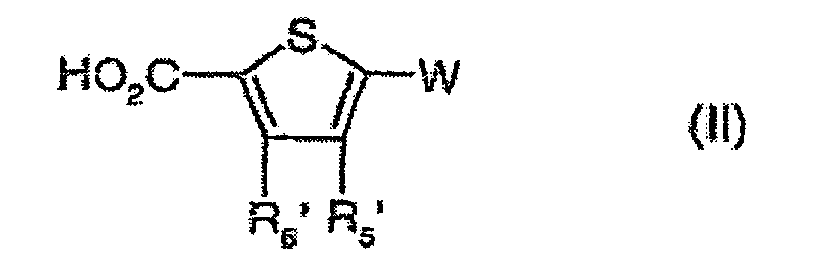
wobei man das Produkt der Formel (II) je nach dem Wert von W folgenden Reaktionen unterwerfen kann:a) wenn W ein Wasserstoffatom darstellt, kann man das Produkt der Formel (II) den Reaktionen der Wege i) oder ii) unterwerfen:
Weg i) man kann das Produkt der Formel (II), worin W ein Wasserstoffatom darstellt, der Wirkung eines Bromderivats der Formel (III) unterwerfen:
R2'-Br (III)
worin R2' die in Anspruch 1 für R2 angegebene Bedeutung hat, wobei die eventuellen reaktiven Funktionen gegebenenfalls mit Schutzgruppen geschützt werden,
um ein Produkt der Formel (IV) zu erhalten:
das man, wenn R2' einen Rest -CH2-Phenyl darstellt, so dass das Produkt der Formel (IV1):

wobei man die Produkt der Formeln (IV), (IV1) und (IV2) einer Veresterungsreaktion unterwerfen kann, um die entsprechenden Produkte der Formeln (V), (V1) und (V2) zu erhalten:


Weg ii) man kann die Verbindung der Formel (II), worin W ein Wasserstoffatom darstellt, einer Veresterungsreaktion mit einem Alkohol der Formel (VI) unterwerfen:
Rc-OH- (VI)
worin Rc einen geraden oder verzweigten Alkylrest darstellt, der höchstens 6 Kohlenstoffatome enthält,
um die Produkte der Formel (VII) zu erhalten: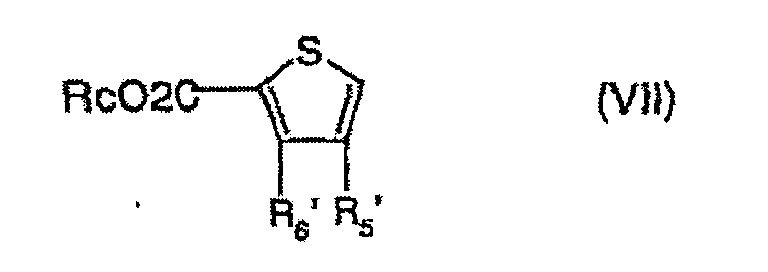
die man einem Aldehyd der Formel (VIII) unterwirft:
Rd-CHO (VIII)
worin Rd ein Wasserstoffatom, einen Alkylrest, wie vorstehend definiert, oder einen monocyclischen oder einen aus kondensierten, carbocyclischen oder heterocyclischen, gesättigten oder ungesättigten Ringen, die höchstens 14 Ringglieder umfassen und ein oder mehrere gleiche oder unterschiedliche Heteroatome O, N, NH oder S enthalten, bestehenden Rest darstellt, die selbst gegebenenfalls substituiert sind,
um Produkte der Formel (IX) zu erhalten:
wobei man die Produkte der Formel (IX) mit einem Amin der Formel (X) umsetzt:
H2N-CH2-ORe (X)
worin Re einen gegebenenfalls substituierten Arylalkylrest darstellt,
um Produkte der Formel (XI) zu erhalten:
wobei man das Produkt der Formel (XI) einer selektiven Reduktionsreaktion unterwerfen kann,
um Produkte der Formel (XII) zu erhalten:
und Rf eine Gruppe zur selektiven Reduktion von ORc darstellt,
wobei man die Produkte der Formeln (XI) und (XII) einer Reduktionsreaktion unterwerfen kann, um die entsprechenden Produkte der Formel (XIII) zu erhalten:
man die Produkte der Formel (XIII) einer Verseifungsreaktion unterwerfen kann, um die entsprechenden Produkte der Formel (XIV) zu erhalten:
man die Produkte der Formel (XIV) mit einem Produkt der Formel (XV) umsetzen kann:
um Produkte der Formel (I'x) zu erhalten: b) wenn W ein Halogenatom darstellt, kann man das Produkt der Formel (II) einer Veresterungsreaktion mit einem Alkohol der Formel (VI), wie vorstehend definiert, unterwerfen, um Produkte der Formel (XVI) zu erhalten:
wobei man das Produkt der Formel (XVI) Folgendem unterwerfen kann:
entweder der Einwirkung eines Borderivats der Formel (XVII):
R2'-B(OH)2 (XVII)
worin R2' die vorstehend angegebene Bedeutung hat, um ein Produkt der Formel (XVIII) zu erhalten:
oder der Einwirkung eines Produkts der Formel (XIX) :
NH-RaRb (XIX)
worin Ra und Rb gleich oder unterschiedlich sind und einen gegebenenfalls substituierten Alkyl- oder Arylrest, wie vorstehend definiert, darstellen
um ein Produkt der Formel (XX) zu erhalten: c) wenn W einen Nitrorest darstellt, kann man das Produkt der Formel (II) einer Veresterungsreaktion mit einem Alkohol der Formel (VI), wie vorstehend definiert, unterwerfen, um Produkte der Formel (XXI) zu erhalten:worin R1', R2w, R5' und R6' die vorstehend angegebenen Bedeutungen haben,
die man einer Umsetzung mit einem Halogenderivat der Formel (XXII) unterwerfen kann:
RaRbHal (XXII)
worin Ra und Rb die vorstehend angegebenen Bedeutungen haben und Hal für ein Halogenatom steht,
um ein Produkt der Formel (XX), wie oben definiert, zu erhalten,
wobei man die Produkte der Formeln (IV), (IV1), (IV2), (V), (V1), (V2), (Schema I) (XVIII), (XX), wie vorstehend definiert, mit einem Diamin NH2-NH2 umsetzen kann, um ein Produkt der Formel (XXIII) zu erhalten:
das man einer Reaktion mit einem Produkt der Formel (XXIV) unterwerfen kann:
R1'-COOH (XXIV)
worin R1 die vorstehend angegebene Bedeutung hat, um ein Produkt der Formel (Iy) zu erhalten:
wobei die Produkte der Formel (Ix') und (Iy') Produkte der Formel (I) sein können und man sie, um andere Produkte der Formel (I) zu erhalten, wenn gewünscht und wenn notwendig, einer oder mehreren der folgenden Umwandlungsreaktionen in beliebiger Reihenfolge unterwerfen kann:a) einer Veresterungsreaktion der Säurefunktion,b) einer Verseifungsreaktion der Esterfunktion in eine Säurefunktion,c) einer Oxidationsreaktion der Alkylthiogruppe in das entsprechende Sulfoxid oder Sulfon,d) einer Reaktion zur Umwandlung der Ketonfunktion in eine Oximfunktion,e) einer Reduktionsreaktion der freien oder veresterten Carboxyfunktion in eine Alkoholfunktion,f) einer Reaktion zur Umwandlung der Alkoxyfunktion in eine Hydroxylfunktion oder auch der Hydroxylfunktion in eine Alkoxyfunktion,g) einer Oxidationsreaktion der Alkoholfunktion in eine Aldehyd-, Säure- oder Ketonfunktion,h) einer Reaktion zur Umwandlung des Nitrilrests in ein Tetrazolyl,i) einer Reaktion zur Entfernung der Schutzgruppen, die die geschützten reaktiven Funktionen tragen können,j) einer Salzbildungsreaktion mit einer anorganischen oder organischen Säure oder einer Base, um das entsprechende Salz zu erhalten,k) einer Reaktion zur Aufspaltung der racemischen Formen in aufgespaltene Produkte,wobei die so erhaltenen Produkte der Formel (I) in allen möglichen isomeren racemischen, enantiomeren oder diastereoisomeren Formen vorliegen. - Produkte der Formel (I) nach Anspruch 1 sowie die pharmazeutisch annehmbaren Additionssalze der Produkte der Formel (I) mit anorganischen und organischen Säuren oder mit anorganischen und organischen Basen als Medikamente.
- Produkte der Formel (I) entsprechend den Formeln (Ia) oder (Ib) nach den Ansprüchen 2 bis 4 sowie die pharmazeutisch annehmbaren Additionssalze der Produkte der Formeln (Ia) und (Ib) mit anorganischen und organischen Säuren oder mit anorganischen und organischen Basen als Medikamente.
- Produkte der Formel (I) nach Anspruch 5 sowie die pharmazeutisch annehmbaren Additionssalze der Produkte der Formel (I) mit anorganischen und organischen Säuren oder mit anorganischen und organischen Basen als Medikamente.
- Pharmazeutische Zusammensetzungen, die als Wirkstoff mindestens eines der Arzneimittel nach einem der Ansprüche 7 bis 9 enthalten.
- Verwendung der Produkte der Formel (I) nach einem der Ansprüche 1 bis 5 oder der pharmazeutisch annehmbaren Salze der Produkte der Formel (I) zur Herstellung von Arzneimitteln zur Vorbeugung oder Behandlung von Erkrankungen, die mit einem physiologisch anomalen Verhalten auf der Ebene der Sekretion und/oder der Aktivität von Cysteinproteasen, wie insbesondere den Kathepsinen B, H, J, L, N, S, T, C, V, W, K oder O, 02, oder Papain einhergehen.
- Verwendung nach Anspruch 11 zur Herstellung von Arzneimitteln zur Vorbeugung oder Behandlung von Erkrankungen, die mit einem physiologisch anomalen Verhalten auf der Ebene der Sekretion und/oder der Aktivität von Kathepsin K einhergehen.
- Verwendung der Produkte der Formel (I) nach einem der Ansprüche 1 bis 5 oder der pharmazeutisch annehmbaren Salze der Produkte der Formel (I) zur Herstellung von Arzneimitteln zur Vorbeugung oder Behandlung von Stoffwechselerkrankungen des Knorpels oder Knochens, proliferativen Erkrankungen, Krebserkrankungen, Kardiovaskulärerkrankungen, Restenose, Erkrankungen des zentralen Nervensystems, Erkrankungen des Immunsystems, Allergien, Infektionskrankheiten, entzündlichen Erkrankungen und Autoimmunkrankheiten.
- Verwendung nach Anspruch 13, dadurch gekennzeichnet, dass die Erkrankungen, denen vorgebeugt wird oder die behandelt werden, aus Stoffwechselerkrankungen des Knorpels oder Knochens, proliferativen Erkrankungen, Krebserkrankungen und neurodegenerativen Erkrankungen, wie Alzheimer-Krankheit, ausgewählt sind.
- Verwendung nach Anspruch 13, dadurch gekennzeichnet, dass die Erkrankungen, denen vorgebeugt wird oder die behandelt werden, aus Stoffwechselerkrankungen des Knorpels oder Knochens und Knochenkrebserkrankungen ausgewählt sind.
- Verwendung nach Anspruch 13, dadurch gekennzeichnet, dass es sich bei den Erkrankungen, denen vorgebeugt wird oder die behandelt werden, insbesondere um Osteoporose, Zahnfleischerkrankungen, einschließlich Gingivitis und Periodontose, Arthritis, wie insbesondere Osteoarthritis und rheumatoide Arthritis, Paget-Krankheit, Hyperkalzämie und Knochenkrebserkrankungen handelt.
- Verwendung nach Anspruch 13, dadurch gekennzeichnet, dass es sich bei der Erkrankung, der vorgebeugt oder die behandelt wird, insbesondere um Osteoporose handelt.
Applications Claiming Priority (1)
| Application Number | Priority Date | Filing Date | Title |
|---|---|---|---|
| PCT/FR2002/002335 WO2004007477A1 (fr) | 2002-07-04 | 2002-07-04 | Nouveaux derives acyl hydrazino du thiophene, leur procede de preparation, leur application a titre de medicaments, compositions pharmaceutiques et nouvelle utilisation |
Publications (2)
| Publication Number | Publication Date |
|---|---|
| EP1532134A1 EP1532134A1 (de) | 2005-05-25 |
| EP1532134B1 true EP1532134B1 (de) | 2008-06-04 |
Family
ID=30011390
Family Applications (1)
| Application Number | Title | Priority Date | Filing Date |
|---|---|---|---|
| EP02807597A Expired - Lifetime EP1532134B1 (de) | 2002-07-04 | 2002-07-04 | Neue thiophenacylhydrazinoderivate, verfahren zu deren herstellung, deren verwendung als arzneimittel, pharmazeutische zusammensetzungen und neue anwendungen |
Country Status (11)
| Country | Link |
|---|---|
| US (1) | US20050154048A1 (de) |
| EP (1) | EP1532134B1 (de) |
| JP (1) | JP2006503810A (de) |
| AT (1) | ATE397597T1 (de) |
| AU (1) | AU2002333956A1 (de) |
| BR (1) | BR0215767A (de) |
| CA (1) | CA2490468A1 (de) |
| DE (1) | DE60227008D1 (de) |
| IL (1) | IL165996A0 (de) |
| MX (1) | MXPA04011363A (de) |
| WO (1) | WO2004007477A1 (de) |
Families Citing this family (4)
| Publication number | Priority date | Publication date | Assignee | Title |
|---|---|---|---|---|
| EP2072550A1 (de) * | 2007-12-21 | 2009-06-24 | Sika Technology AG | Härtbare Zusammensetzungen mit verminderter Ausgasung |
| TWI490214B (zh) | 2008-05-30 | 2015-07-01 | 艾德克 上野股份有限公司 | 苯或噻吩衍生物及該等作為vap-1抑制劑之用途 |
| US9943522B2 (en) * | 2011-05-16 | 2018-04-17 | Bayer Intellectual Property Gmbh | Use of cathepsin K inhibition for the treatment and/or prophylaxis of pulmonary hypertension and/or heart failure |
| WO2024177898A1 (en) * | 2023-02-22 | 2024-08-29 | The Board Of Regents Of The University Of Texas System | Cleavage products of angiopoietin-2 and methods of use thereof |
Family Cites Families (11)
| Publication number | Priority date | Publication date | Assignee | Title |
|---|---|---|---|---|
| CH1524572A4 (de) * | 1972-10-18 | 1975-12-31 | ||
| IE59962B1 (en) * | 1986-09-26 | 1994-05-04 | Rohm & Haas | Five-membered heterocyclic derivatives of n'-substituted-n, n'-diacylhydrazines |
| GB2195634B (en) * | 1986-10-01 | 1990-08-15 | Roussel Lab Ltd | Thiophene derivatives |
| JPS63284170A (ja) * | 1987-05-15 | 1988-11-21 | Nippon Redarii Kk | 新規グアニジノメチル−チオフエンカルボン酸誘導体 |
| DE3810848A1 (de) * | 1988-03-30 | 1989-10-19 | Boehringer Ingelheim Kg | Neue 2,3,4-substituierte imidazole und 3,4,5-substituierte 1,2,4-triazole, ihre herstellung und verwendung |
| US6005113A (en) * | 1996-05-15 | 1999-12-21 | Molecular Probes, Inc. | Long wavelength dyes for infrared tracing |
| TW414795B (en) * | 1996-07-01 | 2000-12-11 | Yamanouchi Pharma Co Ltd | A thiophene derivative and the pharmaceutical composition |
| MA26487A1 (fr) * | 1997-04-29 | 2004-12-20 | Smithkline Beecham Corp | Heterocyclecetohydrazides inhibiteurs de proteases, procede pour leur preparation et compositions pharmaceutiques les contenant . |
| EP1079821A4 (de) * | 1998-05-21 | 2001-08-29 | Smithkline Beecham Corp | Protease inhibitoren |
| US6239151B1 (en) * | 1998-06-26 | 2001-05-29 | Hoffmann-La Roche Inc. | Compounds as inhibitor of tumor necrosis factor alpha release |
| WO2003039549A2 (en) * | 2001-11-07 | 2003-05-15 | 4Sc Ag | Selective antibacterial agents |
-
2002
- 2002-07-04 WO PCT/FR2002/002335 patent/WO2004007477A1/fr not_active Ceased
- 2002-07-04 DE DE60227008T patent/DE60227008D1/de not_active Expired - Fee Related
- 2002-07-04 JP JP2004520706A patent/JP2006503810A/ja active Pending
- 2002-07-04 AU AU2002333956A patent/AU2002333956A1/en not_active Abandoned
- 2002-07-04 BR BR0215767-5A patent/BR0215767A/pt not_active IP Right Cessation
- 2002-07-04 CA CA002490468A patent/CA2490468A1/fr not_active Abandoned
- 2002-07-04 MX MXPA04011363A patent/MXPA04011363A/es unknown
- 2002-07-04 AT AT02807597T patent/ATE397597T1/de not_active IP Right Cessation
- 2002-07-04 EP EP02807597A patent/EP1532134B1/de not_active Expired - Lifetime
-
2004
- 2004-12-26 IL IL16599604A patent/IL165996A0/xx unknown
-
2005
- 2005-01-04 US US11/028,848 patent/US20050154048A1/en not_active Abandoned
Also Published As
| Publication number | Publication date |
|---|---|
| US20050154048A1 (en) | 2005-07-14 |
| ATE397597T1 (de) | 2008-06-15 |
| EP1532134A1 (de) | 2005-05-25 |
| IL165996A0 (en) | 2006-01-15 |
| BR0215767A (pt) | 2005-03-15 |
| DE60227008D1 (de) | 2008-07-17 |
| AU2002333956A1 (en) | 2004-02-02 |
| MXPA04011363A (es) | 2005-02-14 |
| JP2006503810A (ja) | 2006-02-02 |
| CA2490468A1 (fr) | 2004-01-22 |
| WO2004007477A1 (fr) | 2004-01-22 |
Similar Documents
| Publication | Publication Date | Title |
|---|---|---|
| JP2003535022A (ja) | セリンプロテアーゼ阻害剤としてのアルファー‐ケトオキサジアゾール含有ペプトイド及び非ペプトイド | |
| EP1525193B1 (de) | Acylaminothiazolderivate und ihre vewrendung als beta-amyloid inhibitoren | |
| EP0719775B1 (de) | Substituierte 4-Phenyl-Thiazole Derivate, Verfahren zu deren Herstellung und pharmazeutische Zusammenstellungen die sie enthalten | |
| CA2548448A1 (fr) | Nouveaux derives du 2-hydroxytetrahydrofuranne et leur application a titre de medicaments | |
| JPH06192199A (ja) | ケトン誘導体 | |
| US20040024000A1 (en) | Dihydropyrimidine derivatives as cysteine protease inhibitors | |
| EP1493739A1 (de) | Thiophenderivate von Aminosäuren, Verfahren zu ihrer Herstellung und diese enthaltende Zusammensetzungen | |
| CA2747957A1 (en) | Compounds and methods for the treatment of pain and other diseases | |
| EP1532134A1 (de) | Neue thiophenacylhydrazinoderivate, verfahren zu deren herstellung, deren verwendung als arzneimittel, pharmazeutische zusammensetzungen und neue anwendungen | |
| EP1590337B1 (de) | Acylaminothiazolderivate, verfahren zu deren herstellung und deren verwendung als inhibitoren der produktion von beta-amyloidpeptid | |
| JP2526084B2 (ja) | 新規なチアゾリジン誘導体 | |
| EP1098878B1 (de) | Bispiperidine mit antithrombotischer wirkung | |
| EP1246824B1 (de) | Diazepinecarboxamidderivate, verfahren zu ihrer herstellung ,ihre verwendung als arzneimittel, pharmazeutische zubereitungen und ihre verwendung | |
| EP1476434B1 (de) | Pyridazinderivate, deren verwendung als heilmittel, und deren verfahren zu ihrer verwendung | |
| EP2185525B1 (de) | Herstellung von pyrazol-3,5-carboxylat-derivaten und ihre therapeutische anwendung | |
| EP1515953A2 (de) | Neue hydrazid- oder hydrazonderivate von hexahydropyridazin-3-carbocyclische säure, kombinatorische bibliotheken, die diese enthalten, deren verwendung als arzneimittel, pharmazeutische zusammensetzungen, die diese enthalten, und verfahren zu deren herstellung | |
| JPH11171881A (ja) | 含酸素複素環誘導体 | |
| EP1503991A1 (de) | Hexahydropyridazin-3-carbonsäurederivate, diese enthaltende pharmazeutische zusammensetzungen und verfahren zu deren herstellung | |
| MC2418A1 (fr) | Procédé de préparation d'un acide (-) - (3R)-3-méthyl-4-[4-[4- (4-pyridyl) pipérazine-1-yl] phénoxy]butyrique et d'une composition pharmaceutique le contenant | |
| FR2734818A1 (fr) | Acide (-)-(3r)-3-methyl-4-{4-[4-(4-pyridyl)piperazine-1-yl- phenoxy}-butyrique, procede pour sa preparation et composition pharmaceutique le contenant | |
| FR2892415A1 (fr) | Derives d'amidine et leurs applications a titre de medicament | |
| FR2898357A1 (fr) | Derives d'amidine et leurs applications a titre de medicament | |
| FR2853648A1 (fr) | Nouveaux derives de benzenesulfonamides et leur utilisation en therapeutique |
Legal Events
| Date | Code | Title | Description |
|---|---|---|---|
| PUAI | Public reference made under article 153(3) epc to a published international application that has entered the european phase |
Free format text: ORIGINAL CODE: 0009012 |
|
| 17P | Request for examination filed |
Effective date: 20050204 |
|
| AK | Designated contracting states |
Kind code of ref document: A1 Designated state(s): AT BE BG CH CY CZ DE DK EE ES FI FR GB GR IE IT LI LU MC NL PT SE SK TR |
|
| AX | Request for extension of the european patent |
Extension state: AL LT LV MK RO SI |
|
| 17Q | First examination report despatched |
Effective date: 20050622 |
|
| DAX | Request for extension of the european patent (deleted) | ||
| 17Q | First examination report despatched |
Effective date: 20050622 |
|
| GRAP | Despatch of communication of intention to grant a patent |
Free format text: ORIGINAL CODE: EPIDOSNIGR1 |
|
| GRAS | Grant fee paid |
Free format text: ORIGINAL CODE: EPIDOSNIGR3 |
|
| GRAA | (expected) grant |
Free format text: ORIGINAL CODE: 0009210 |
|
| AK | Designated contracting states |
Kind code of ref document: B1 Designated state(s): AT BE BG CH CY CZ DE DK EE ES FI FR GB GR IE IT LI LU MC NL PT SE SK TR |
|
| REG | Reference to a national code |
Ref country code: GB Ref legal event code: FG4D Free format text: NOT ENGLISH |
|
| REG | Reference to a national code |
Ref country code: CH Ref legal event code: EP |
|
| REF | Corresponds to: |
Ref document number: 60227008 Country of ref document: DE Date of ref document: 20080717 Kind code of ref document: P |
|
| REG | Reference to a national code |
Ref country code: IE Ref legal event code: FG4D Free format text: LANGUAGE OF EP DOCUMENT: FRENCH |
|
| PG25 | Lapsed in a contracting state [announced via postgrant information from national office to epo] |
Ref country code: FI Free format text: LAPSE BECAUSE OF FAILURE TO SUBMIT A TRANSLATION OF THE DESCRIPTION OR TO PAY THE FEE WITHIN THE PRESCRIBED TIME-LIMIT Effective date: 20080604 Ref country code: ES Free format text: LAPSE BECAUSE OF FAILURE TO SUBMIT A TRANSLATION OF THE DESCRIPTION OR TO PAY THE FEE WITHIN THE PRESCRIBED TIME-LIMIT Effective date: 20080915 |
|
| PGFP | Annual fee paid to national office [announced via postgrant information from national office to epo] |
Ref country code: CH Payment date: 20080912 Year of fee payment: 7 Ref country code: DE Payment date: 20080711 Year of fee payment: 7 Ref country code: DK Payment date: 20080721 Year of fee payment: 7 |
|
| PG25 | Lapsed in a contracting state [announced via postgrant information from national office to epo] |
Ref country code: NL Free format text: LAPSE BECAUSE OF FAILURE TO SUBMIT A TRANSLATION OF THE DESCRIPTION OR TO PAY THE FEE WITHIN THE PRESCRIBED TIME-LIMIT Effective date: 20080604 Ref country code: AT Free format text: LAPSE BECAUSE OF FAILURE TO SUBMIT A TRANSLATION OF THE DESCRIPTION OR TO PAY THE FEE WITHIN THE PRESCRIBED TIME-LIMIT Effective date: 20080604 |
|
| PGFP | Annual fee paid to national office [announced via postgrant information from national office to epo] |
Ref country code: FR Payment date: 20080718 Year of fee payment: 7 Ref country code: IE Payment date: 20080714 Year of fee payment: 7 Ref country code: NL Payment date: 20080703 Year of fee payment: 7 |
|
| NLV1 | Nl: lapsed or annulled due to failure to fulfill the requirements of art. 29p and 29m of the patents act | ||
| PGFP | Annual fee paid to national office [announced via postgrant information from national office to epo] |
Ref country code: GB Payment date: 20080709 Year of fee payment: 7 |
|
| REG | Reference to a national code |
Ref country code: IE Ref legal event code: FD4D |
|
| PG25 | Lapsed in a contracting state [announced via postgrant information from national office to epo] |
Ref country code: CZ Free format text: LAPSE BECAUSE OF FAILURE TO SUBMIT A TRANSLATION OF THE DESCRIPTION OR TO PAY THE FEE WITHIN THE PRESCRIBED TIME-LIMIT Effective date: 20080604 Ref country code: SE Free format text: LAPSE BECAUSE OF FAILURE TO SUBMIT A TRANSLATION OF THE DESCRIPTION OR TO PAY THE FEE WITHIN THE PRESCRIBED TIME-LIMIT Effective date: 20080904 Ref country code: IE Free format text: LAPSE BECAUSE OF FAILURE TO SUBMIT A TRANSLATION OF THE DESCRIPTION OR TO PAY THE FEE WITHIN THE PRESCRIBED TIME-LIMIT Effective date: 20080604 Ref country code: PT Free format text: LAPSE BECAUSE OF FAILURE TO SUBMIT A TRANSLATION OF THE DESCRIPTION OR TO PAY THE FEE WITHIN THE PRESCRIBED TIME-LIMIT Effective date: 20081104 |
|
| PG25 | Lapsed in a contracting state [announced via postgrant information from national office to epo] |
Ref country code: SK Free format text: LAPSE BECAUSE OF FAILURE TO SUBMIT A TRANSLATION OF THE DESCRIPTION OR TO PAY THE FEE WITHIN THE PRESCRIBED TIME-LIMIT Effective date: 20080604 |
|
| PG25 | Lapsed in a contracting state [announced via postgrant information from national office to epo] |
Ref country code: MC Free format text: LAPSE BECAUSE OF NON-PAYMENT OF DUE FEES Effective date: 20080731 |
|
| PLBE | No opposition filed within time limit |
Free format text: ORIGINAL CODE: 0009261 |
|
| STAA | Information on the status of an ep patent application or granted ep patent |
Free format text: STATUS: NO OPPOSITION FILED WITHIN TIME LIMIT |
|
| PG25 | Lapsed in a contracting state [announced via postgrant information from national office to epo] |
Ref country code: EE Free format text: LAPSE BECAUSE OF FAILURE TO SUBMIT A TRANSLATION OF THE DESCRIPTION OR TO PAY THE FEE WITHIN THE PRESCRIBED TIME-LIMIT Effective date: 20080604 Ref country code: BG Free format text: LAPSE BECAUSE OF FAILURE TO SUBMIT A TRANSLATION OF THE DESCRIPTION OR TO PAY THE FEE WITHIN THE PRESCRIBED TIME-LIMIT Effective date: 20080904 Ref country code: DK Free format text: LAPSE BECAUSE OF FAILURE TO SUBMIT A TRANSLATION OF THE DESCRIPTION OR TO PAY THE FEE WITHIN THE PRESCRIBED TIME-LIMIT Effective date: 20080604 |
|
| 26N | No opposition filed |
Effective date: 20090305 |
|
| PGFP | Annual fee paid to national office [announced via postgrant information from national office to epo] |
Ref country code: BE Payment date: 20090126 Year of fee payment: 7 |
|
| PG25 | Lapsed in a contracting state [announced via postgrant information from national office to epo] |
Ref country code: IT Free format text: LAPSE BECAUSE OF FAILURE TO SUBMIT A TRANSLATION OF THE DESCRIPTION OR TO PAY THE FEE WITHIN THE PRESCRIBED TIME-LIMIT Effective date: 20080604 |
|
| BERE | Be: lapsed |
Owner name: AVENTIS PHARMA S.A. Effective date: 20090731 |
|
| REG | Reference to a national code |
Ref country code: CH Ref legal event code: PL |
|
| GBPC | Gb: european patent ceased through non-payment of renewal fee |
Effective date: 20090704 |
|
| REG | Reference to a national code |
Ref country code: FR Ref legal event code: ST Effective date: 20100331 |
|
| PG25 | Lapsed in a contracting state [announced via postgrant information from national office to epo] |
Ref country code: LI Free format text: LAPSE BECAUSE OF NON-PAYMENT OF DUE FEES Effective date: 20090731 Ref country code: FR Free format text: LAPSE BECAUSE OF NON-PAYMENT OF DUE FEES Effective date: 20090731 Ref country code: CH Free format text: LAPSE BECAUSE OF NON-PAYMENT OF DUE FEES Effective date: 20090731 |
|
| PG25 | Lapsed in a contracting state [announced via postgrant information from national office to epo] |
Ref country code: GB Free format text: LAPSE BECAUSE OF NON-PAYMENT OF DUE FEES Effective date: 20090704 |
|
| PG25 | Lapsed in a contracting state [announced via postgrant information from national office to epo] |
Ref country code: BE Free format text: LAPSE BECAUSE OF NON-PAYMENT OF DUE FEES Effective date: 20090731 Ref country code: DE Free format text: LAPSE BECAUSE OF NON-PAYMENT OF DUE FEES Effective date: 20100202 |
|
| PG25 | Lapsed in a contracting state [announced via postgrant information from national office to epo] |
Ref country code: LU Free format text: LAPSE BECAUSE OF NON-PAYMENT OF DUE FEES Effective date: 20080704 Ref country code: CY Free format text: LAPSE BECAUSE OF FAILURE TO SUBMIT A TRANSLATION OF THE DESCRIPTION OR TO PAY THE FEE WITHIN THE PRESCRIBED TIME-LIMIT Effective date: 20080604 |
|
| PG25 | Lapsed in a contracting state [announced via postgrant information from national office to epo] |
Ref country code: TR Free format text: LAPSE BECAUSE OF FAILURE TO SUBMIT A TRANSLATION OF THE DESCRIPTION OR TO PAY THE FEE WITHIN THE PRESCRIBED TIME-LIMIT Effective date: 20080604 |
|
| PG25 | Lapsed in a contracting state [announced via postgrant information from national office to epo] |
Ref country code: GR Free format text: LAPSE BECAUSE OF FAILURE TO SUBMIT A TRANSLATION OF THE DESCRIPTION OR TO PAY THE FEE WITHIN THE PRESCRIBED TIME-LIMIT Effective date: 20080905 |