EP1529518A1 - Composition comprenant un composé de type heptafulvène ou tropolone, dérivés et/ou mélanges, procédé de teinture des cheveux - Google Patents
Composition comprenant un composé de type heptafulvène ou tropolone, dérivés et/ou mélanges, procédé de teinture des cheveux Download PDFInfo
- Publication number
- EP1529518A1 EP1529518A1 EP04292617A EP04292617A EP1529518A1 EP 1529518 A1 EP1529518 A1 EP 1529518A1 EP 04292617 A EP04292617 A EP 04292617A EP 04292617 A EP04292617 A EP 04292617A EP 1529518 A1 EP1529518 A1 EP 1529518A1
- Authority
- EP
- European Patent Office
- Prior art keywords
- radical
- substituted
- composition according
- unsubstituted
- composition
- Prior art date
- Legal status (The legal status is an assumption and is not a legal conclusion. Google has not performed a legal analysis and makes no representation as to the accuracy of the status listed.)
- Granted
Links
Classifications
-
- A—HUMAN NECESSITIES
- A61—MEDICAL OR VETERINARY SCIENCE; HYGIENE
- A61K—PREPARATIONS FOR MEDICAL, DENTAL OR TOILETRY PURPOSES
- A61K8/00—Cosmetics or similar toiletry preparations
- A61K8/18—Cosmetics or similar toiletry preparations characterised by the composition
- A61K8/30—Cosmetics or similar toiletry preparations characterised by the composition containing organic compounds
- A61K8/40—Cosmetics or similar toiletry preparations characterised by the composition containing organic compounds containing nitrogen
- A61K8/41—Amines
- A61K8/411—Aromatic amines, i.e. where the amino group is directly linked to the aromatic nucleus
-
- A—HUMAN NECESSITIES
- A61—MEDICAL OR VETERINARY SCIENCE; HYGIENE
- A61K—PREPARATIONS FOR MEDICAL, DENTAL OR TOILETRY PURPOSES
- A61K8/00—Cosmetics or similar toiletry preparations
- A61K8/18—Cosmetics or similar toiletry preparations characterised by the composition
- A61K8/30—Cosmetics or similar toiletry preparations characterised by the composition containing organic compounds
- A61K8/40—Cosmetics or similar toiletry preparations characterised by the composition containing organic compounds containing nitrogen
-
- A—HUMAN NECESSITIES
- A61—MEDICAL OR VETERINARY SCIENCE; HYGIENE
- A61Q—SPECIFIC USE OF COSMETICS OR SIMILAR TOILETRY PREPARATIONS
- A61Q5/00—Preparations for care of the hair
- A61Q5/06—Preparations for styling the hair, e.g. by temporary shaping or colouring
- A61Q5/065—Preparations for temporary colouring the hair, e.g. direct dyes
Definitions
- the subject of the present invention is a composition intended for coloring fibers keratinic compounds, comprising in a suitable medium, at least one derivative compound of the type heptafulvene, tropolone, or their derivatives and mixtures thereof, and a process of coloring implementing it.
- the contents of the various compounds present in the composition are expressed by weight relative to the weight of the composition, unless it is specified that these levels are based on the weight of the composition ready for use. 'employment.
- the ready-to-use composition comprises the composition according to the invention and at least one oxidizing agent.
- the boundaries delimiting a range of values are included in this area.
- the keratin fibers treated according to the invention are more particularly human keratinous fibers and preferably hair.
- composition according to the invention therefore comprises at least one compound of formula (I) previously indicated.
- R 1 and R 6, which may be identical or different, represent a hydrogen atom; an alkyl radical, an aryl radical, an alkylaryl radical, an arylalkyl radical, for which the alkyl part is C 1 -C 6 , linear or branched, substituted or unsubstituted, the aryl part is C 6 -C 12 , preferably C 6 , substituted or unsubstituted; a halogen atom; a C 1 -C 6 alkoxy radical; an amino radical; an amino radical substituted with one or more radicals, which may be identical or different, chosen from linear or branched, substituted or unsubstituted C 1 -C 6 alkyl radicals; a hydroxyl radical; a -COOX radical, with X representing a hydrogen atom, an alkali metal or alkaline earth metal, a linear or branche
- R 2 , R 3 , R 4 and R 5 which may be identical or different, represent a hydrogen atom, a linear or branched C 1 -C 6 alkyl radical, substituted or no ; a hydroxyl radical; a C 1 -C 6 alkoxy radical; a thiol radical, a C 1 -C 6 alkylthio radical; an amino radical; an amino radical substituted with one or more identical or non-linear C 1 -C 6 alkyl radicals, linear or branched, substituted or unsubstituted; an aryl radical C 6 -C 12 , preferably C 6 , substituted or unsubstituted, an arylalkyl radical whose alkyl part is C 1 -C 6 , linear or branched, substituted or unsubstituted, and the aryl part is C 6 -C 12 , preferably C 6 ; cyclic or polycyclic radical, substituted or unsub
- alkyl parts of the groups mentioned above may, they too, be substituted by one or more of the groupings listed. However, according to a particular embodiment of the invention, the alkyl parts of said groups are not substituted.
- cyclic or polycyclic radicals comprising at least one heteroatom
- the latter comprise from 5 to 8 chains, preferably from 5 to 6 chains.
- the heteroatom (s) present, identical or not, are chosen from oxygen, nitrogen or sulfur.
- these cyclic or polycyclic radicals may be saturated or unsaturated, or aromatic.
- R 1, R 6, identical or different are selected from hydrogen, a hydroxyl radical, an alkyl radical C 1 -C 6 monohydroxyalkyl radical, a C 1 -C 6, a polyhydroxyalkyl radical in C 2 -C 6, alkoxy C 1 -C 6 alkylcarbonyl C 1 -C 6 radical, an amino radical, an amino radical mono- or disubstituted by an alkyl radical C 1 -C 6 and / or with a C 1 -C 6 hydroxyalkyl radical; a benzyl or phenyl radical optionally substituted in the sense indicated above; a nitro group; a cyano group.
- the radicals R 2 to R 5 which may be identical or different, are chosen from hydrogen; a hydroxyl radical; a thiol radical; a halogen atom and preferably chlorine or fluorine; a C 1 -C 6 alkyl radical; a C 1 -C 6 monohydroxyalkyl radical; a C 2 -C 6 polyhydroxyalkyl radical; a C 1 -C 6 alkoxy radical; a C 1 -C 6 alkylcarbonyl radical; an amino radical; an amino radical mono- or di-substituted with a C 1 -C 6 alkyl radical and / or with a C 1 -C 6 hydroxyalkyl radical; a benzyl or phenyl radical optionally substituted in the sense indicated above; a nitro group; a cyano group; a heterocyclic group.
- A represents, in formula (I), an oxygen atom.
- one of the radicals R 1 or R 6 represents more precisely a hydroxyl radical.
- the other radical represents a hydrogen atom.
- the radicals R 2 to R 5 do not simultaneously represent a hydrogen atom.
- the compound of formula (I) is advantageously different from 3,5,7 trimethyltropolone, 7- (2-propyl) tropolone or hinokitiol.
- one of the radicals R 3 or R 4 of the formula (I) represents a C 6 -C 12 aryl radical substituted or not by a hydroxyl radical; a halogen atom; a C 1 -C 4 alkoxy radical; an amino radical; an amino radical substituted with one or two identical or different C 1 -C 4 alkyl radicals; a thiol radical.
- the other radical represents a hydrogen atom.
- the compound of formula (I) is such that A denotes C (R 7 ) (R 8 ) in which R 7 and R 8 , which may be identical or different, denote a monovalent electro group. -attra Budapest.
- the monovalent electro-attractor group is chosen from cyano radicals; -COOX with X denoting a hydrogen atom, an alkali or alkaline earth metal, a linear or branched C 1 -C 6 alkyl radical; a halogen atom (as preferably chlorine or fluorine); -NO 2 ; -SO 3 X with X denoting a hydrogen atom, an alkali metal or alkaline earth metal such as for example sodium, potassium, magnesium, calcium.
- the compound of formula (I) is such that R 7 and R 8 represent a cyano radical.
- one of the radicals R 3 or R 4 represents more particularly a C 6 -C 12 aryl radical, substituted or not by a hydroxyl radical; a halogen atom; a C 1 -C 4 alkoxy radical; an amino radical; an amino radical substituted with one or more identical or different C 1 -C 4 alkyl radicals; a thiol radical.
- the other radical represents a hydrogen atom.
- At least one of the radicals R 1 , R 2 , R 5 and R 6 in the context of this embodiment, represent a hydrogen atom.
- the radicals R 1 , R 2 , R 5 and R 6 represent a hydrogen atom.
- Preferred compounds within this second embodiment include, among others, 8,8-dicyano-3- (4'-methoxy) -phenylheptafulvene; 8,8-dicyano-3- (4'-N, N-dimethylamino) -phenylheptafulvene; 8,8-dicyano-3-phenyl heptafulvene, or mixtures thereof.
- the compound of formula (I) is in the form of a dye.
- the compound is present in an amount such that it is in a form soluble in the medium of the composition. More particularly, the compound is soluble to at least 50% by weight in the medium, preferably the compound is at least 90% soluble in the medium.
- the content of compound (I) present in the composition according to the invention is more particularly between 0.1 and 20% by weight relative to the weight of the composition, preferably between 0.5 and 5% by weight relative to the weight of the composition.
- the composition may contain other conventional ingredients in the field of dye compositions intended for the dyeing of human keratinous fibers, especially the hair. Thus, it may comprise at least one direct dye, fluorescent or otherwise, different from that just described.
- the direct dyes may be chosen from nonionic or ionic species (cationic, anionic, amphoteric or zwitterionic), and preferably nonionic or cationic.
- nonionic or ionic species cationic, anionic, amphoteric or zwitterionic
- nitrobenzene direct dyes acridine dyes, acridones, anthranthrones, anthrapyrimidines, anthraquinones, azines, azos, azomethines, benzanthrones, benzimidazoles, benzimidazolones, benzindoles, benzoxazoles, benzopyrans, benzothiazoles and benzoquinones.
- bisazines bis isoindolines, carboxanilides, coumarins, cyanines (including azacarbocyanines, diazacarbocyanines, diazahemicyanines, hemicyanines, tetraazacarbocyanines), diazines, diketopyrrolopyrroles, dioxazines, diphenylamines, diphenylmethanes, dithiazines, flavanthrones, flavones, fluorindines, formazans, hydrazones, hydroxyketones, indamines , indanthrones, indigoides, indophenols, indoanilines, isoindolines, isoindolines, isoindolinones, isoviolanthrones, lactones, methines, naphthalimides, naphthhanilides, naphtholactams, naphthoquinones, nitro, oxadiazoles, o
- Fluorescent direct dyes chosen from cationic fluorescent compounds of the family of azo, azomethine, methine, naphthalimide and cationic or non-cationic coumarin compounds, xanthenodiquinolizines, azaxanthenes, naphtholactams, azlactones, (di) oxazines and thiazines, alone or in mixtures, are also suitable. . If the composition comprises this type of direct dye, then the content of direct dye (s), fluorescent (s) or not, advantageously represents from 0.0005 to 12% by weight relative to the weight of the composition, and even more preferably from 0.005 to 6% by weight relative to the weight of the composition.
- the composition according to the invention may also comprise at least one oxidation base possibly associated with one or more couplers.
- the oxidation base may be chosen from conventional compounds in the field of coloring. By way of examples, mention may be made, inter alia, of o-phenylenediamines, p-phenylenediamines, double bases, o-aminophenols, p-aminophenols, heterocyclic bases, their addition salts with an acid, as well as their mixtures. If the composition comprises one or more oxidation bases, the content of this type of compound is usually from 0.0005 to 12% by weight relative to the weight of the composition, and preferably from 0.005 to 8% by weight relative to the weight of the composition.
- couplers that can be used in combination with one or more oxidation bases, mention may be made, for example, of m-aminophenols, m-phenylenediamines, m-diphenols, naphthols, heterocyclic couplers, and their addition salts with an acid. , as well as their mixtures.
- their content generally represents from 0.0001 to 10% by weight relative to the weight of the composition, and preferably from 0.005 to 5% by weight relative to the weight of the composition.
- the acid addition salts of the oxidation bases and couplers are chosen in particular from hydrochlorides, hydrobromides, sulphates and tartrates, lactates and acetates.
- composition according to the invention may also comprise various adjuvants used conventionally, such as anionic, cationic, nonionic surfactants, amphoteric, zwitterionic or mixtures thereof; anionic polymers, cationic, non ionic, amphoteric, zwitterionic; mineral thickeners; agents antioxidants; penetrants; perfumes ; buffers; agents dispersants; conditioning agents such as, for example, cations, silicones volatile or non-volatile, modified or unmodified; amphiphilic polymers cationic; film-forming agents; ceramides; vitamins or provitamins; of the preservatives; stabilizing agents; opacifying or mattifying agents as titanium dioxide; mineral fillers, such as clays; silicas in particular pyrogenous with hydrophilic or hydrophobic character; binding polymers such as vinylpyrrolidone; solar filters; etc.
- adjuvants used conventionally, such as anionic, cationic, nonionic surfactants, amphoteric,
- the adjuvants mentioned above are generally present in an amount each of them between 0.01 and 20% by weight relative to the weight of the composition.
- the medium of the composition is a cosmetically acceptable medium. It is advantageously constituted by water or a mixture of water and one or more organic solvents.
- organic solvents there may be mentioned linear or branched monoalcohols, preferably saturated, comprising 2 to 10 carbon atoms, such as ethyl alcohol, isopropyl alcohol; aromatic alcohols such as benzyl alcohol, phenylethyl alcohol; polyols or polyol ethers such as, for example, ethylene glycol monomethyl, monoethyl and monobutyl ethers, propylene glycol or its ethers such as, for example, propylene glycol monomethyl ether, butylene glycol, dipropylene glycol, hexylene glycol (2 methyl 2,4-pentanediol), neopentyl glycol and 3-methyl-1,5-pentanediol; as well as the alkyl ethers of diethylene glycol, especially of C 1 -C
- the pH of the composition according to the invention is generally between 3 and 12 approximately, and preferably between 5 and 11 approximately. It can be adjusted to the desired value by means of acidifying or basifying agents.
- Acidifying agents include, for example, inorganic or organic acids such as hydrochloric acid, orthophosphoric acid, sulfuric acid, acetic acid.
- alkalinizing agents that may be mentioned, by way of examples, are ammonia, alkaline carbonates, alkanolamines such as mono-, di- and triethanolamines and their derivatives, sodium or potassium hydroxides and following formula (A): wherein W is a propylene residue optionally substituted with a hydroxyl group or a C 1 -C 6 alkyl radical; the radicals R, identical or different, represent a hydrogen atom, an alkyl radical C 1 -C 6 alkyl or hydroxy C 1 -C 6.
- composition may be in the form of a thickened lotion or not, cream, gel, mousse, spray, or any other form suitable for the subsequent application of this composition.
- Another object of the present invention is constituted by a ready-to-use composition
- a ready-to-use composition comprising the composition according to the invention which has just been detailed and at least one oxidizing agent.
- the oxidizing agent is selected from hydrogen peroxide, alkali or alkaline earth metal peroxides, such as sodium, potassium, magnesium; urea peroxide, alkali metal bromates or ferricyanides, persalts such as perborates and persulphates of alkali or alkaline earth metals, such as sodium, potassium, magnesium, alone or in mixtures.
- the oxidizing agent may also be chosen from enzymes such as peroxidases and two or four electron oxidoreductases.
- the content of oxidizing agent represents 0.001 and 20% by weight relative to the weight of the ready-to-use composition, preferably 0.1 to 12% by weight relative to the weight of the ready-to-use composition.
- the pH of the ready-to-use composition is generally between 4 and 12, preferably between 6 and 11. It can be adjusted to the desired value by means of acidifying or alkalizing agents such as those described above.
- the ready-to-use composition results more particularly from the mixture of the composition according to the invention with a composition comprising at least one oxidizing agent (called an oxidizing composition). In this case, the mixture is made before applying the ready-to-use composition to the fibers to be treated.
- the medium suitable for dyeing the oxidizing composition is advantageously water or a mixture of water and organic solvent.
- the oxidizing composition may comprise the usual additives in the field, such as surfactants, thickeners, antioxidants, perfumes, dispersing agents, conditioning agents, sequestering agents, preservatives, etc. .
- additives such as surfactants, thickeners, antioxidants, perfumes, dispersing agents, conditioning agents, sequestering agents, preservatives, etc.
- the process is carried out without rinsing the composition.
- the process is carried out without rinsing the composition.
- they are dried or allowed to dry.
- This possibility may especially be appropriate in the case where the composition does not comprise an oxidizing agent, an oxidation base or a coupler.
- the method is implemented with at least one rinsing step.
- the composition applied to the fibers does not comprise an oxidizing agent.
- This variant is particularly suitable when the composition comprises only the compound (s) of formula (I) and optionally at least one fluorescent direct dye or not.
- the composition applied to the fibers is a ready-to-use composition as described above.
- This variant of the process is suitable irrespective of the composition according to the invention used, whether or not it comprises, besides the compound of formula (I), a fluorescent or non-fluorescent direct dye, one or more oxidation bases. and optionally one or more couplers.
- a first possibility consists in applying the ready-to-use composition, obtained by extemporaneous mixing before application to the fibers, of the composition according to the invention and of an oxidizing composition.
- a second possibility is to apply successively, in one order or the other, the composition according to the invention and the oxidizing composition, or alternatively to apply these two compositions simultaneously.
- the time required for the development of the coloration is in general between 1 to 60 minutes, and more preferably between 5 and 45 minutes.
- step a) of the process is carried out at a temperature between 15 and 220 ° C, preferably at a temperature between 15 and 40 ° C.
- the fibers may optionally be rinsed (step b), possibly washed with a shampoo and then rinsed, and finally dried or allowed to dry, for example between 20 and 120 ° C.
Landscapes
- Life Sciences & Earth Sciences (AREA)
- Health & Medical Sciences (AREA)
- Animal Behavior & Ethology (AREA)
- General Health & Medical Sciences (AREA)
- Public Health (AREA)
- Veterinary Medicine (AREA)
- Birds (AREA)
- Epidemiology (AREA)
- Cosmetics (AREA)
- Organic Low-Molecular-Weight Compounds And Preparation Thereof (AREA)
- Agricultural Chemicals And Associated Chemicals (AREA)
- Coloring (AREA)
Abstract
Description
Les colorants directs sont des substances colorées et colorantes qui ont une certaine affinité avec les fibres kératiniques humaines. Parmi les colorants directs utilisables, on peut citer la classe des colorants benzéniques nitrés, les colorants directs hétérocycliques, notamment, qui sont utilisés pour obtenir non seulement des couleurs naturelles, mais aussi des couleurs chromatiques.
Même si ces colorants ont été utilisés de manière importante dans le domaine de la coloration capillaire, ils peuvent malgré tout poser des problèmes de montée de couleur dans la fibre, et notamment au niveau de la puissance et de la sélectivité obtenues. Par ailleurs, la ténacité de ces colorants peut encore être améliorée.
Ainsi, la présente invention a pour objet de proposer des compositions comprenant au moins un colorant direct permettant d'obtenir de meilleurs résultats de coloration que les colorants directs benzéniques et hétérocycliques.
Ces buts et d'autres sont atteints par la présente invention qui a donc pour premier objet une composition comprenant, dans un milieu approprié pour la teinture des fibres kératiniques, notamment humaines, au moins un composé de formule (I) suivante :

- R1 et R6 identiques ou non, représentent un atome d'hydrogène ; un radical alkyle, un radical aryle, un radical alkylaryle, un radical arylalkyle, pour lesquels la partie alkyle est en C1-C6, linéaire ou ramifiée, substituée ou non, la partie aryle est en C6-C12, substituée ou non ; un atome d'halogène ; un radical alcoxy en C1-C6 ; un radical amino ; un radical amino substitué par un ou plusieurs radicaux, identiques ou non, choisis parmi les radicaux alkyles en C1-C6, linéaires ou ramifiés, substitués ou non ; un radical hydroxyle ; un radical -COOX, avec X représentant un atome d'hydrogène, un métal alcalin ou alcalino-terreux, un radical alkyle en C1-C6, linéaire ou ramifié, substitué ou non ; un radical alkylcarbonyle dans lequel la partie alkyle est en C1-C6, linéaire ou ramifié, substitué ou non ; un radical -SO3X' dans lequel X' désigne un atome d'hydrogène, un métal alcalin ou alcalino-terreux ;
- R2, R3, R4 et R5, identiques ou non, représentent un atome d'hydrogène, un radical alkyle en C1-C6, linéaire ou ramifié, substitué ou non ; un radical hydroxyle ; un radical alcoxy en C1-C6 ; un radical thiol, un radical alkylthio en C1-C6 ; un radical amino ; un radical amino substitué par un ou plusieurs radicaux alkyles, identiques ou non, en C1-C6, linéaires ou ramifiés, substitués ou non ; un radical aryle en C6-C12, substitué ou non, un radical arylalkyle dont la partie alkyle est en C1-C6, linéaire ou ramifiée, substituée ou non, et la partie aryle est en C6-C12 ; un radical cyclique ou polycyclique, substitué ou non, comprenant au moins un hétéroatome ;
- A désigne un atome d'oxygène, de soufre ou un groupement C(R7)(R8) dans lequel R7 et R8, identiques ou non, désignent un groupe monovalent électro-attracteur ;
Elle a de même pour objet un procédé de coloration des fibres kératiniques humaines utilisant les compositions qui viennent d'être décrites, ainsi qu'un dispositif pour la mise en oeuvre dudit procédé.
Elle a enfin pour objet l'utilisation de composés de formule (I) comme colorant direct pour la coloration de fibres kératiniques, notamment humaines afin d'obtenir des nuances naturelles et chromatiques.
Il a en effet été trouvé de manière totalement inattendue que la présence de composés de formule (I) permettait d'obtenir des nuances naturelles et chromatiques, qui soient notamment puissantes et peu sélectives.
Par ailleurs, sauf indication différente, les bornes délimitant un domaine de valeurs sont comprises dans ce domaine.
Enfin, les fibres kératiniques traitées conformément à l'invention, sont plus particulièrement des fibres kératiniques humaines et de préférence des cheveux.
Plus particulièrement, dans cette formule (I), R1 et R6 identiques ou non, représentent un atome d'hydrogène ; un radical alkyle, un radical aryle, un radical alkylaryle, un radical arylalkyle, pour lesquels la partie alkyle est en C1-C6, linéaire ou ramifiée, substituée ou non, la partie aryle est en C6-C12, de préférence en C6, substituée ou non ; un atome d'halogène ; un radical alcoxy en C1-C6 ; un radical amino ; un radical amino substitué par un ou plusieurs radicaux, identiques ou non, choisis parmi les radicaux alkyles en C1-C6, linéaires ou ramifiés, substitués ou non ; un radical hydroxyle ; un radical -COOX, avec X représentant un atome d'hydrogène, un métal alcalin ou alcalino-terreux, un radical alkyle en C1-C6, linéaire ou ramifié, substitué ou non ; un radical alkylcarbonyle dans lequel la partie alkyle est en C1-C6, linéaire ou ramifié, substitué ou non ; un radical -SO3X' dans lequel X' désigne un atome d'hydrogène, un métal alcalin ou alcalino-terreux, comme par exemple le sodium, le potassium, le magnésium, le calcium.
Comme indiqué auparavant, dans la formule (I), R2, R3, R4 et R5, identiques ou non, représentent un atome d'hydrogène, un radical alkyle en C1-C6, linéaire ou ramifié, substitué ou non ; un radical hydroxyle ; un radical alcoxy en C1-C6 ; un radical thiol, un radical alkylthio en C1-C6 ; un radical amino ; un radical amino substitué par un ou plusieurs radicaux alkyle, identiques ou non, en C1-C6, linéaires ou ramifiés, substitués ou non ; un radical aryle en C6-C12, de préférence en C6, substitué ou non, un radical arylalkyle dont la partie alkyle est en C1-C6, linéaire ou ramifiée, substituée ou non, et la partie aryle est en C6-C12, de préférence en C6 ; radical cyclique ou polycyclique, substitué ou non, comprenant au moins un hétéroatome.
- un groupement hydroxyle ;
- un atome d'halogène, et de préférence le chlore, le fluor ;
- un groupement alcoxy en C1-C6 ;
- un groupement monohydroxy alcoxy dont la partie alkyle en C1-C6, linéaire ou ramifiée, substituée ou non ;
- un groupement polyhydroxy alcoxy, dans lequel la partie alkyle est en C2-C6, linéaire ou ramifiée, substituée ou non ;
- un groupement amino substitué ou non par un ou plusieurs radicaux alkyles en C1-C6, identiques ou non, linéaires ou ramifiés, substitué ou non ;
- un groupement thiol ;
- un groupement alkylthio dans lequel la partie alkyle est en C1-C6, linéaire ou ramifiée, substituée ou non ;
- un groupement carboxylique sous forme acide ou salifiée (par exemple avec un métal alcalin ou un ammonium substitué ou non) ;
- un groupement alkylcarbonyle dont la partie alkyle est en C1-C6, linéaire ou ramifiée, substituée ou non ;
- un groupement alcoxycarbonyle dont la partie alkyle est en C1-C6, linéaire ou ramifiée, substituée ou non ;
- un groupement alkylamide dont la partie alkyle est en C1-C6, linéaire ou ramifiée, substitué ou non ;
- un groupement alkylcarbamyle dont la partie alkyle est en C1-C6, linéaire ou ramifiée, substituée ou non ;
- un groupement cyano ;
- un groupement nitro ;
- un groupement sulfonyle ;
- un groupement alkylsulfonyle dont la partie alkyle est en C1-C6, linéaire ou ramifiée, substituée ou non ;
- un groupement alkylsulfonylamido dont la partie alkyle est en C1-C6, linéaire ou ramifiée, substituée ou non ;
- un radical alkyle si le radical substitué est lui-même différent d'un radical alkyle.
Par ailleurs, le ou les hétéroatomes présents, identiques ou non, sont choisis parmi l'oxygène, l'azote ou le soufre.
De plus, ces radicaux cycliques ou polycycliques peuvent être saturés ou non, ou aromatiques.
A titre d'exemples, on peut citer les cycles pyrrolidinique, pipéridinique, pipérazinique, pyrazolique, imidazolique, triazolique, oxazolique, thiazolique, pyridinique, pyrimidinique, pyrazinique, pyridazinique.
Selon ce mode de réalisation, l'un des radicaux R1 ou R6 représente plus précisément un radical hydroxyle. Avantageusement, l'autre radical représente un atome d'hydrogène.
Conformément à une variante plus particulière, les radicaux R2 à R5 ne représentent pas simultanément un atome d'hydrogène. De plus, le composé de formule (I) est avantageusement différent de la 3,5,7 triméthyltropolone, de la 7-(2-propyl) tropolone ou de l'hinokitiol.
Toujours selon ce mode de réalisation, l'un des radicaux R3 ou R4 de la formule (I) représente un radical aryle en C6-C12 substitué ou non par un radical hydroxyle ; un atome d'halogène ; un radical alcoxy en C1-C4 ; un radical amino ; un radical amino substitué par un ou deux radicaux alkyles en C1-C4, identiques ou non ; un radical thiol. Avantageusement, l'autre radical représente un atome d'hydrogène.
Parmi les composés préférés correspondants à ce premier mode de réalisation, on peut citer la 5-(4'-N,N-diméthylamino)phényltropolone.
Conformément à un deuxième mode de réalisation de l'invention, le composé de formule (I) est tel que A désigne C(R7)(R8) dans lequel R7 et R8, identiques ou non, désignent un groupe monovalent électro-attracteur.
De préférence, le groupe monovalent électro-attracteur est choisi parmi les radicaux cyano ; -COOX avec X désignant un atome hydrogène, un métal alcalin ou alcalino-terreux, un radical alkyle en C1-C6, linéaire ou ramifié ; un atome d'halogène (comme de préférence le chlore ou le fluor) ; -NO2 ; -SO3X avec X désignant un atome hydrogène, un métal alcalin ou alcalino-terreux comme par exemple le sodium, le potassium, le magnésium, le calcium.
Selon une variante préférée de ce mode de réalisation, le composé de formule (I) est tel que R7 et R8 représentent un radical cyano.
Dans le cas de ce deuxième mode de réalisation, l'un des radicaux R3 ou R4 représente plus particulièrement un radical aryle en C6-C12, substitué ou non par un radical hydroxyle ; un atome d'halogène ; un radical alcoxy en C1-C4 ; un radical amino ; un radical amino substitué par un ou plusieurs radicaux alkyles, identiques ou non, en C1-C4 ; un radical thiol. De manière avantageuse, l'autre radical représente un atome d'hydrogène.
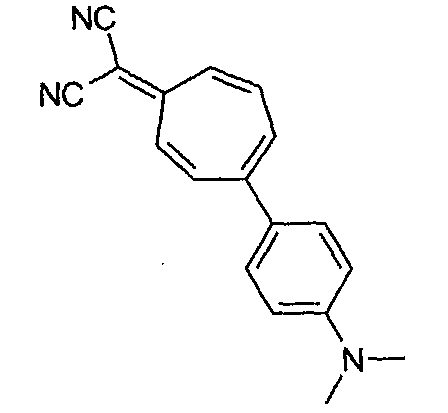
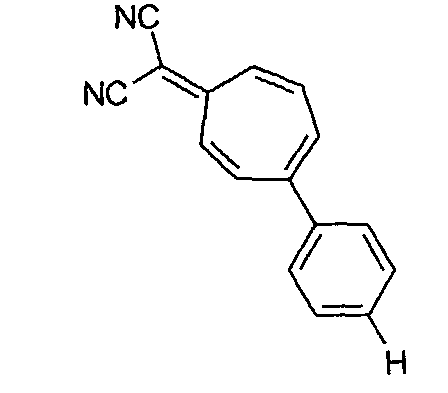
Parmi les composés préférés entrant dans le cadre de ce deuxième mode de réalisation, on peut citer entre autres, le 8,8-dicyano-3-(4'-méthoxy)-phénylheptafulvène ; le 8,8-dicyano-3-(4'-N,N-diméthylamino)-phénylheptafulvène ; le 8,8-dicyano-3-phényl heptafulvène, ou leurs mélanges.
De préférence, le composé de formule (I) se trouve sous la forme d'un colorant. Ainsi, le composé est présent en quantité telle qu'il se trouve sous une forme soluble dans le milieu de la composition. Plus particulièrement, le composé est soluble à au moins 50 % en poids dans le milieu, de préférence, le composé est soluble à au moins 90 % en poids dans le milieu.
La teneur en composé (I) présent dans la composition selon l'invention est plus particulièrement comprise entre 0,1 et 20 % en poids par rapport au poids de la composition, de préférence entre 0,5 et 5 % en poids par rapport au poids de la composition.
La composition peut renfermer d'autres ingrédients classiques dans le domaine des compositions tinctoriales destinées à la coloration des fibres kératiniques humaines, notamment des cheveux.
Ainsi, elle peut comprendre au moins un colorant direct, fluorescent ou non, différent de celui qui vient d'être décrit.
Notons que les colorants directs peuvent être choisis parmi les espèces non ioniques ou ioniques (cationiques, anioniques, amphotères ou zwitterioniques), et de préférence non ioniques ou cationiques.
A titre d'exemples non limitatifs, on peut citer les colorants directs benzéniques nitrés, les colorants acridines, acridones, anthranthrones, anthrapyrimidines, anthraquinones, azines, azos, azométhines, benzanthrones, benzimidazoles, benzimidazolones, benzindoles, benzoxazoles, benzopyranes, benzothiazoles, benzoquinones, bisazines, bis isoindolines, carboxanilides, coumarines, cyanines (notamment les azacarbocyanines, diazacarbocyanines, diazahémicyanines, hémicyanines, tétraazacarbocyanines), diazines, dicétopyrrolopyrroles, dioxazines, diphénylamines, diphénylméthanes, dithiazines, flavanthrones, flavones, fluorindines, formazans, hydrazones, hydroxycétones, indamines, indanthrones, indigoides, indophénols, indoanilines, isoindolines, isoindolines, isoindolinones, isoviolanthrones, lactones, méthines, naphthalimides, naphthanilides, naphtholactames, naphthoquinones, nitro, oxadiazoles, oxazines, périlones, périnones, pérylènes, phénazines, phénothiazines, phthalocyanine, polyènes/caroténoides, porphyrines, pyranthrones, pyrazolanthrones, pyrazolones, pyrimidinoanthrones, pyronines, quinacridones, quinolines, quinophthalones, squaranes, stilbènes, tétrazoliums, thiazines, thioindigo, thiopyronines, triarylméthanes, xanthènes.
Conviennent aussi les colorants directs fluorescents choisis parmi les composés fluorescents cationiques de la famille des composés azoïques, azométhiniques, méthiniques, naphtalimides, coumarines cationiques ou non, xanthénodiquinolizines, les azaxanthènes, naphtolactames, azlactones, (di)oxazines, thiazines, seuls ou en mélanges.
Si la composition comprend ce type de colorant direct, alors la teneur en colorant(s) direct(s), fluorescent(s) ou non, représente avantageusement de 0,0005 à 12 % en poids par rapport au poids de la composition, et encore plus préférentiellement de 0,005 à 6 % en poids par rapport au poids de la composition.
La composition selon l'invention peut aussi comprendre au moins une base d'oxydation éventuellement associée à un ou plusieurs coupleurs.
La base d'oxydation peut être choisie parmi les composés classiques dans le domaine de la coloration.
A titre d'exemples, on peut citer entre autres les o-phénylènediamines, les p-phénylènediamines, les bases doubles, les o-aminophénols, les p-aminophénols, les bases hétérocycliques, leurs sels d'addition avec un acide, ainsi que leurs mélanges.
Si la composition comprend une ou plusieurs bases d'oxydation, la teneur en ce type de composé représente habituellement de 0,0005 à 12% en poids par rapport au poids de la composition, et de préférence de 0,005 à 8% en poids par rapport au poids de la composition.
Parmi les coupleurs utilisables en association avec une ou plusieurs bases d'oxydation, on peut mentionner par exemple les m-aminophénols, les m-phénylènediamines, les m-diphénols, les naphtols, les coupleurs hétérocycliques, leurs sels d'addition avec un acide, ainsi que leurs mélanges.
Au cas où ils sont présents dans la composition, leur teneur représente en général de 0,0001 à 10% en poids par rapport au poids de la composition, et de préférence de 0,005 à 5% en poids par rapport au poids de la composition.
D'une manière générale, les sels d'addition avec un acide des bases d'oxydation et coupleurs sont notamment choisis parmi les chlorhydrates, les bromhydrates, les sulfates et les tartrates, les lactates et les acétates.
Il est constitué, de manière avantageuse, par de l'eau ou par un mélange d'eau et d'un ou plusieurs solvants organiques.
Parmi les solvants organiques usuels, on peut citer notamment les monoalcools, linéaires ou ramifiés, de préférence saturés, comprenant 2 à 10 atomes de carbone, tels que l'alcool éthylique, l'alcool isopropylique ; les alcools aromatiques tels que l'alcool benzylique, l'alcool phényléthylique ; les polyols ou éthers de polyols tels que, par exemple, les éthers monométhylique, monoéthylique et monobutylique d'éthylèneglycol, le propylèneglycol ou ses éthers tels que, par exemple, le monométhyléther de propylèneglycol, le butylèneglycol, le dipropylèneglycol, l'hexylèneglycol (2-méthyl 2,4-pentanediol), le néopentylglycol et le 3-méthyl-1,5-pentanediol ; ainsi que les alkyléthers de diéthylèneglycol, notamment en C1-C4, comme par exemple, le monoéthyléther ou le monobutyléther du diéthylèneglycol, seuls ou en mélange.
Les solvants organiques décrits ci-dessus, s'ils sont présents, représentent habituellement de 1 à 40 % en poids, plus préférentiellement de 5 à 30 % en poids, par rapport au poids total de la composition.
Il peut être ajusté à la valeur désirée au moyen d'agents acidifiants ou alcalinisants.
Parmi les agents acidifiants, on peut citer, à titre d'exemples, les acides minéraux ou organiques comme l'acide chlorhydrique, l'acide orthophosphorique, l'acide sulfurique, l'acide acétique.
Parmi les agents alcalinisants on peut citer, à titre d'exemples, l'ammoniaque, les carbonates alcalins, les alcanolamines telles que les mono-, di- et triéthanolamines ainsi que leurs dérivés, les hydroxydes de sodium ou de potassium et les composés de formule (A) suivante :

Habituellement, l'agent oxydant est choisi parmi le peroxyde d'hydrogène, les peroxydes de métaux alcalins ou alcalino-terreux, comme le sodium, le potassium, le magnésium ; le peroxyde d'urée, les bromates ou ferricyanures de métaux alcalins, les persels tels que les perborates et les persulfates de métaux alcalins ou alcalino-terreux, comme le sodium, le potassium, le magnésium, seuls ou en mélanges. L'agent oxydant peut aussi être choisi parmi les enzymes telles que les peroxydases et les oxydo-réductases à deux ou à quatre électrons.
La teneur en agent oxydant représente 0,001 et 20% en poids par rapport au poids de la composition prête à l'emploi, de préférence 0,1 à 12 % en poids par rapport au poids de la composition prête à l'emploi.
Le pH de la composition prête à l'emploi est généralement compris entre les 4 et 12, de préférence entre 6 et 11.
Il peut être ajusté à la valeur désirée au moyen d'agents acidifiants ou alcalinisants tels que ceux décrits auparavant.
La composition prête à l'emploi résulte plus particulièrement du mélange de la composition selon l'invention avec une composition comprenant au moins un agent oxydant (appelé composition oxydante). Dans ce cas, le mélange est réalisé avant l'application de la composition prête à l'emploi sur les fibres à traiter.
Le milieu approprié pour la teinture de la composition oxydante est avantageusement de l'eau ou un mélange d'eau et de solvant organique.
Enfin, la composition oxydante peut comprendre les additifs usuels dans le domaine, comme des agents tensioactifs, des agents épaississants, des agents anti-oxydants, des parfums, des agents dispersants, des agents de conditionnement, des agents séquestrants, des agents conservateurs, etc.
Précisons que les listes de solvants et d'additifs, de même que leurs teneurs, indiquées dans le cadre de la description de la composition selon l'invention restent valables et l'on peut s'y reporter.
Plus particulièrement, l'invention est constitué par un procédé de coloration des fibres kératiniques humaines et notamment des cheveux, dans lequel on met en oeuvre les étapes suivantes :
Conformément à une deuxième possibilité, le procédé est mis en oeuvre avec au moins une étape de rinçage.
Cette variante est particulièrement appropriée lorsque la composition ne comprend que le ou les composés de formule (I) et éventuellement a moins un colorant direct fluorescent ou non.
Selon une deuxième variante du procédé, la composition appliquée sur les fibres est une composition prête à l'emploi telle que décrite ci-dessus.
Cette variante du procédé est appropriée quelle que soit la composition selon l'invention mise en oeuvre, que celle-ci comprenne ou non, outre le composé de formule (I), un colorant direct fluorescent ou non, une ou plusieurs bases d'oxydation et éventuellement un ou plusieurs coupleurs.
Conformément à cette variante, une première possibilité consiste à appliquer la composition prête à l'emploi, obtenue par mélange extemporané avant l'application sur les fibres, de la composition selon l'invention et d'une composition oxydante.
Selon cette possibilité, il peut être avantageux de stocker sous forme séparée, d'une part, la composition selon l'invention, et d'autre part, une composition oxydante.
Une seconde possibilité consiste à appliquer successivement, dans un ordre ou dans l'autre, la composition selon l'invention et la composition oxydante, ou bien encore consiste à appliquer ces deux compositions simultanément.
La durée nécessaire au développement de la coloration est en général comprise entre 1 à 60 minutes, et plus préférentiellement entre 5 et 45 minutes.
Par ailleurs, de manière classique l'étape a) du procédé est effectuée à une température comprise entre 15 et 220°C, de préférence à une température comprise entre 15 et 40°C.
Une fois l'étape a) terminée, on peut éventuellement rincer les fibres (étape b), éventuellement les laver avec un shampooing puis les rincer, et enfin les sécher ou les laisser sécher, par exemple entre 20 et 120°C.
| Matière première | Gramme % |
| Colorant de formule (I) | 0,25 |
| Ethanol | Quantité nécessaire à la solubilisation du composé de formule (I) |
| Eau désionisée | Qsp 50 |


Après le temps de pose, les mèches ont été rincées à l'eau et séchées.
On obtient les colorations ci-dessous :
| Exemples | Couleur du cheveu après coloration |
| Exemple 1 | Orangé rouge |
| Exemple 2 | Noir violet |
| Exemple 3 | Orangé rouge |
| Exemple 4 | Jaune |
Claims (30)
- Composition comprenant, dans un milieu approprié pour la teinture des fibres kératiniques, notamment humaines, au moins un composé de formule (I) suivante :Formule dans laquelle :
 R1 et R6 identiques ou non, représentent un atome d'hydrogène ; un radical alkyle, un radical aryle, un radical alkylaryle, un radical arylalkyle, pour lesquels la partie alkyle est en C1-C6, linéaire ou ramifiée, substituée ou non, la partie aryle est en C6-C12, substituée ou non ; un atome d'halogène ; un radical alcoxy en C1-C6 ; un radical amino ; un radical amino substitué par un ou plusieurs radicaux, identiques ou non, choisis parmi les radicaux alkyles en C1-C6, linéaires ou ramifiés, substitués ou non ; un radical hydroxyle ; un radical -COOX, avec X représentant un atome d'hydrogène, un métal alcalin ou alcalino-terreux, un radical alkyle en C1-C6, linéaire ou ramifié, substitué ou non ; un radical alkylcarbonyle dans lequel la partie alkyle est en C1-C6, linéaire ou ramifié, substitué ou non ; un radical -SO3X' dans lequel X' désigne un atome d'hydrogène, un métal alcalin ou alcalino-terreux ;R2, R3, R4 et R5, identiques ou non, représentent un atome d'hydrogène, un radical alkyle en C1-C6, linéaire ou ramifié, substitué ou non ; un radical hydroxyle ; un radical alcoxy en C1-C6 ; un radical thiol, un radical alkylthio en C1-C6 ; un radical amino ; un radical amino substitué par un ou plusieurs radicaux, identiques ou non, en C1-C6, linéaires ou ramifiés, substitués ou non ; un radical aryle en C6-C12, substitué ou non, un radical arylalkyle dont la partie alkyle est en C1-C6, linéaire ou ramifiée, substituée ou non, et la partie aryle est en C6-C12 ; un radical cyclique ou polycyclique, substitué ou non, comprenant au moins un hétéroatome ;A désigne un atome d'oxygène ou de soufre ou un groupement C(R7)(R8) dans lequel R7 et R8, identiques ou non, désignent un groupe monovalent électro-attracteur.
 - Composition selon la revendication précédente, caractérisé en ce que R1 à R6 sont tels que les radicaux substitués portent un ou plusieurs groupements choisis parmi :un groupement hydroxyle ;un atome d'halogène, et de préférence le chlore, le fluor ;un groupement alcoxy en C1-C6 ;un groupement monohydroxy alcoxy dont la partie alkyle en C1-C6, linéaire ou ramifiée, substituée ou non ;un groupement polyhydroxy alcoxy, dans lequel la partie alkyle est en C2-C6, linéaire ou ramifiée, substituée ou non ;un groupement amino substitué ou non par un ou plusieurs radicaux alkyles en C1-C6, identiques ou non, linéaires ou ramifiés, substitué ou non ;un groupement thiol ;un groupement alkylthio dans lequel la partie alkyle est en C1-C6, linéaire ou ramifiée, substituée ou non ;un groupement carboxylique sous forme acide ou salifiée (par exemple avec un métal alcalin ou un ammonium substitué ou non) ;un groupement alkylcarbonyle dont la partie alkyle est en C1-C6, linéaire ou ramifiée, substituée ou non ;un groupement alcoxycarbonyle dont la partie alkyle est en C1-C6, linéaire ou ramifiée, substituée ou non ;un groupement alkylamide dont la partie alkyle est en C1-C6, linéaire ou ramifiée, substitué ou non ;un groupement alkylcarbamyle dont la partie alkyle est en C1-C6, linéaire ou ramifiée, substituée ou non ;un groupement cyano ;un groupement nitro ;un groupement sulfonyle ;un groupement alkylsulfonyle dont la partie alkyle est en C1-C6, linéaire ou ramifiée, substituée ou non ;un groupement alkylsulfonylamido dont la partie alkyle est en C1-C6, linéaire ou ramifiée, substituée ou non;un groupement alkyle si le substituant lui-même n'est pas un radical alkyle.
- Composition selon l'une quelconque des revendications précédentes, caractérisée en ce que le composé de formule (I) est tel que A désigne C(R7)(R8) dans lequel R7 et R8, identiques ou non, désignent un groupe monovalent électro-attracteur choisi parmi les radicaux cyano ; -COOX avec X désignant un atome hydrogène, un métal alcalin ou alcalino-terreux, un radical alkyle en C1-C6, linéaire ou ramifié ; un atome d'halogène ; -NO2 ; -SO3X avec X désignant un atome hydrogène, un métal alcalin ou alcalino-terreux.
- Composition selon l'une des revendications précédentes, caractérisé en ce que les radicaux R2 à R5 sont des radicaux cycliques ou polycycliques comprenant au moins un hétéroatome, choisi parmi l'oxygène, l'azote et le soufre, comprenant de 5 à 8 chaínons, de préférence de 5 à 6 chaínons, saturés ou non, ou aromatiques, éventuellement substitués.
- Composition selon l'une des revendications précédentes, caractérisé en ce que les radicaux R1 à R6, identiques ou non, sont choisis parmi l'hydrogène, un radical hydroxyle, un radical alkyle en C1-C6, un radical monohydroxyalkyle en C1-C6, un radical polyhydroxyalkyle en C2-C6, un radical alcoxy en C1-C6, un radical alkylcarbonyle en C1-C6, un radical amino, un radical amino mono- ou di-substitué par un radical alkyle en C1-C6 et/ou par un radical hydroxyalkyle en C1-C6 ; un radical benzyle ou phényle éventuellement substitué au sens indiqué auparavant ; un groupement nitro ; un groupement cyano.
- Composition selon l'une des revendications précédentes, caractérisé en ce que les radicaux R2 à R5, identiques ou non, sont choisis parmi l'hydrogène ; un radical hydroxyle ; un radical thiol ; un atome d'halogène et de préférence le chlore ou le fluor ; un radical alkyle en C1-C6 ; un radical monohydroxyalkyle en C1-C6 ; un radical polyhydroxyalkyle en C2-C6 ; un radical alcoxy en C1-C6 ; un radical alkylcarbonyle en C1-C6 ; un radical amino ; un radical amino mono- ou di-substitué par un radical alkyle en C1-C6 et/ou par un radical hydroxyalkyle en C1-C6 ; un radical benzyle ou phényle éventuellement substitué au sens indiqué auparavant ; un groupement nitro ; un groupement cyano ; un groupement hétérocyclique.
- Composition selon l'une des revendications précédentes, caractérisée en ce que A représente un atome d'oxygène et en ce que l'un des radicaux R1 ou R6 représente un radical hydroxyle.
- Composition selon la revendication précédente, caractérisée en ce que l'un des radicaux R3 ou R4 représente un radical aryle en C6-C12, substitué ou non par un radical hydroxyle ; un atome d'halogène ; un radical alcoxy en C1-C4 ; un radical amino ; un radical amino substitué par un ou deux radicaux alkyles en C1-C4, identiques ou non ; un radical thiol ; l'autre radical représentant un atome d'hydrogène.
- Composition selon l'une des revendications 7 à 8, caractérisée en ce que le composé de formule (I) est la 5-(4'-N,N-diméthylamino)phényltropolone.
- Composition selon l'une des revendications 1 à 6, caractérisée en ce que le composé de formule (I) est tel que A désigne C(R7)(R8) dans lequel R7 et R8 représentent un radical cyano.
- Composition selon la revendication précédente, caractérisée en ce que l'un des radicaux R3 ou R4 représente un radical aryle en C6-C12, substitué ou non par un radical hydroxyle ; un atome d'halogène ; un radical alcoxy en C1-C4 ; un radical amino ; un radical amino substitué par un ou plusieurs radicaux alkyles, identiques ou non, en C1-C4 ; un radical thiol.
- Composition selon l'une quelconque des revendications 10 ou 11, caractérisée en ce que R1, R2, R5 ou R6 représentent un atome d'hydrogène.
- Composition selon l'une quelconque des revendications 10 à 12, caractérisée en ce que le composé de formule (I) est choisi parmi le 8,8-dicyano-3-(4'-méthoxy)-phénylheptafulvène ; le 8,8-dicyano-3-(4'-N,N-diméthylamino)phénylheptafulvène ; le 8,8-dicyano-3-phényl heptafulvène, ou leurs mélanges.
- Composition selon l'une quelconque des revendications précédentes, caractérisée en ce que la teneur en composé (I) est comprise entre 0,1 et 20 % en poids par rapport au poids de la composition, de préférence entre 0,5 et 5 % en poids par rapport au poids de la composition.
- Composition selon l'une quelconque des revendications précédentes, caractérisée en ce qu'elle comprend au moins un colorant direct, fluorescent ou non.
- Composition selon la revendication précédente, caractérisée en ce que le colorant direct est choisi les colorants benzéniques nitrés, les colorants acridines, acridones, anthranthrones, anthrapyrimidines, anthraquinones, azines, azos, azométhines, benzanthrones, benzimidazoles, benzimidazolones, benzindoles, benzoxazoles, benzopyranes, benzothiazoles, benzoquinones, bisazines, bis isoindolines, carboxanilides, coumarines, cyanines, diazines, dicétopyrrolopyrroles, dioxazines, diphénylamines, diphénylméthanes, dithiazines, flavanthrones, flavones, fluorindines, formazans, hydrazones, hydroxycétones, indamines, indanthrones, indigoides, indophénols, indoanilines, isoindolines, isoindolines, isoindolinones, isoviolanthrones, lactones, méthines, naphthalimides, naphthanilides, naphtholactames, naphthoquinones, nitro, oxadiazoles, oxazines, périlones, périnones, pérylènes, phénazines, phénothiazines, phthalocyanine, polyènes/caroténoides, porphyrines, pyranthrones, pyrazolanthrones, pyrazolones, pyrimidinoanthrones, pyronines, quinacridones, quinolines, quinophthalones, squaranes, stilbènes, tétrazoliums, thiazines, thioindigo, thiopyronines, triarylméthanes, xanthènes.
- Composition selon la revendication 15, caractérisée en ce que le colorant direct fluorescent est choisi parmi les composés fluorescents cationiques de la famille des composés azoïques, azométhiniques, méthiniques, naphtalimides, coumarines cationiques ou non, xanthénodiquinolizines, les azaxanthènes, naphtolactames, azlactones, (di)oxazines, thiazines, seuls ou en mélanges.
- Composition selon l'une quelconque des revendications 15 à 17, caractérisée en ce que la teneur en colorant(s) direct(s), fluorescent(s) ou non, représente de 0,0005 à 12 % en poids par rapport au poids de la composition, et encore plus préférentiellement de 0,005 à 6 % en poids par rapport au poids de la composition.
- Composition selon l'une quelconque des revendications précédentes, caractérisée en ce que la composition comprend au moins une base d'oxydation éventuellement associée à un ou plusieurs coupleurs.
- Composition selon la revendication 19, caractérisée en ce que la base d'oxydation est choisie parmi les o-phénylènediamines, les p-phénylènediamines, les bases doubles, les o-aminophénols, les p-aminophénols, les bases hétérocycliques, leurs sels d'addition avec un acide, ainsi que leurs mélanges.
- Composition selon la revendication précédente, caractérisée en ce que la teneur en bases d'oxydation représente de 0,0005 à 12% en poids par rapport au poids de la composition, et de préférence de 0,005 à 8% en poids par rapport au poids de la composition.
- Composition selon la revendication 19, caractérisée en ce que le coupleur est choisi parmi les m-aminophénols, les m-phénylènediamines, les m-diphénols, les naphtols, les coupleurs hétérocycliques, leurs sels d'addition avec un acide, ainsi que leurs mélanges.
- Composition selon la revendication précédente, caractérisée en ce que la teneur en coupleurs représente de 0,0001 à 10% en poids par rapport au poids de la composition, et de préférence de 0,005 à 5% en poids par rapport au poids de la composition.
- Composition prête à l'emploi, caractérisée en ce qu'elle comprend la composition selon l'une quelconque des revendications précédentes, et au moins un agent oxydant.
- Composition prête à l'emploi selon la revendication précédente, caractérisée en ce que l'agent oxydant est choisi parmi le peroxyde d'hydrogène, le peroxyde d'urée, les bromates ou ferricyanures de métaux alcalins, les persels tels que les perborates et les persulfates, les enzymes, seuls ou en mélanges.
- Procédé de teinture des fibres kératiniques, notamment humaines dans lequel on applique la composition selon l'une quelconque des revendications sur lesdites fibres, sèches ou humides.
- Procédé selon la revendication précédente, caractérisé en ce qu'après l'application de la composition sur les fibres, celles-ci sont séchées ou laissées à sécher.
- Procédé selon la revendication 26, caractérisé en ce que l'on met en oeuvre les étapes suivantes :a) on met en contact lesdites fibres, sèches ou humides, avec la composition selon l'une des revendications précédentes pendant une durée suffisante pour le développement de la coloration,b) on rince éventuellement les fibres,c) éventuellement on lave les fibres et on les rince,d) on sèche les fibres ou on les laisse sécher.
- Dispositif pour la mise en oeuvre du procédé selon la revendication précédente, présentant au moins un compartiment comprenant la composition selon l'une quelconque des revendications 1 à 23, et au moins un compartiment comprenant au moins un agent oxydant.
- Utilisation de composés de formule (I) tels que définis selon l'une quelconque des revendications 1 à 14, comme colorants directs pour la coloration de fibres kératiniques, notamment humaines afin d'obtenir des nuances naturelles et chromatiques.
Applications Claiming Priority (2)
| Application Number | Priority Date | Filing Date | Title |
|---|---|---|---|
| FR0350788A FR2861592B1 (fr) | 2003-11-05 | 2003-11-05 | Composition comprenant un compose de type heptafulvene ou tropolone, derives et/ou melanges, procede de teinture la mettant en oeuvre |
| FR0350788 | 2003-11-05 |
Publications (2)
| Publication Number | Publication Date |
|---|---|
| EP1529518A1 true EP1529518A1 (fr) | 2005-05-11 |
| EP1529518B1 EP1529518B1 (fr) | 2008-08-13 |
Family
ID=34430083
Family Applications (1)
| Application Number | Title | Priority Date | Filing Date |
|---|---|---|---|
| EP04292617A Expired - Lifetime EP1529518B1 (fr) | 2003-11-05 | 2004-11-04 | Composition comprenant un derivé de type heptafulvène ou tropolone et procédé de teinture des cheveux |
Country Status (5)
| Country | Link |
|---|---|
| EP (1) | EP1529518B1 (fr) |
| JP (1) | JP2005139184A (fr) |
| AT (1) | ATE404249T1 (fr) |
| DE (1) | DE602004015701D1 (fr) |
| FR (1) | FR2861592B1 (fr) |
Families Citing this family (1)
| Publication number | Priority date | Publication date | Assignee | Title |
|---|---|---|---|---|
| CN109890949B (zh) * | 2016-11-01 | 2021-10-01 | 宝洁公司 | 衣物洗涤护理组合物中作为上蓝剂的隐色着色剂、其包装、试剂盒和方法 |
Citations (3)
| Publication number | Priority date | Publication date | Assignee | Title |
|---|---|---|---|---|
| DE3508896A1 (de) * | 1985-03-13 | 1986-09-18 | Wella Ag, 6100 Darmstadt | Haarfaerbemittel mit nitrotropolonen sowie ein neues nitrotropolon |
| JPH10245498A (ja) * | 1997-03-04 | 1998-09-14 | Mitsubishi Chem Corp | 新規七員環色素材料 |
| DE19717225A1 (de) * | 1997-04-24 | 1998-10-29 | Henkel Kgaa | Mittel zum Färben von keratinhaltigen Fasern |
Family Cites Families (1)
| Publication number | Priority date | Publication date | Assignee | Title |
|---|---|---|---|---|
| JPH02138114A (ja) * | 1988-11-18 | 1990-05-28 | Kashiwa Kagaku Kogyo:Kk | 染毛剤 |
-
2003
- 2003-11-05 FR FR0350788A patent/FR2861592B1/fr not_active Expired - Fee Related
-
2004
- 2004-11-04 EP EP04292617A patent/EP1529518B1/fr not_active Expired - Lifetime
- 2004-11-04 AT AT04292617T patent/ATE404249T1/de not_active IP Right Cessation
- 2004-11-04 DE DE602004015701T patent/DE602004015701D1/de not_active Expired - Lifetime
- 2004-11-05 JP JP2004321589A patent/JP2005139184A/ja active Pending
Patent Citations (3)
| Publication number | Priority date | Publication date | Assignee | Title |
|---|---|---|---|---|
| DE3508896A1 (de) * | 1985-03-13 | 1986-09-18 | Wella Ag, 6100 Darmstadt | Haarfaerbemittel mit nitrotropolonen sowie ein neues nitrotropolon |
| JPH10245498A (ja) * | 1997-03-04 | 1998-09-14 | Mitsubishi Chem Corp | 新規七員環色素材料 |
| DE19717225A1 (de) * | 1997-04-24 | 1998-10-29 | Henkel Kgaa | Mittel zum Färben von keratinhaltigen Fasern |
Non-Patent Citations (1)
| Title |
|---|
| PATENT ABSTRACTS OF JAPAN vol. 1998, no. 14 31 December 1998 (1998-12-31) * |
Also Published As
| Publication number | Publication date |
|---|---|
| FR2861592B1 (fr) | 2006-01-06 |
| FR2861592A1 (fr) | 2005-05-06 |
| EP1529518B1 (fr) | 2008-08-13 |
| ATE404249T1 (de) | 2008-08-15 |
| DE602004015701D1 (de) | 2008-09-25 |
| JP2005139184A (ja) | 2005-06-02 |
Similar Documents
| Publication | Publication Date | Title |
|---|---|---|
| EP0994692B1 (fr) | Composition de teinture d'oxydation des fibres keratiniques contenant un derive azo de 3-aminopyridine et procede de teinture mettant en oeuvre cette composition | |
| EP1047388B2 (fr) | Composition de teinture pour fibres keratiniques avec un colorant direct cationique et un agent tensio-actif anionique | |
| EP1439812A2 (fr) | Composition contenant un derive de pyrazine et utilisation pour la teinture directe ou d'oxydation et/ou l'eclaircissement optique des fibres keratiniques | |
| WO2001066068A1 (fr) | Composition de teinture d'oxydation des fibres keratiniques avec un derive particulier de la paraphenylenediamine et un colorant direct particulier | |
| CA2301251A1 (fr) | Composition de teinture d'oxydation des fibres keratiniques et procede de teinture mettant en oeuvre cette composition | |
| EP1413286A1 (fr) | Composition tinctoriale comprenant au moins une base d'oxydation hétérocyclique et au moins un coupleur 2,3-diaminopyridine substitué | |
| FR2921383A1 (fr) | Colorant dichromophorique carbonyle ou heterocyclique, composition tinctoriale comprenant ce colorant, procede de coloration des matieres keratiniques a partir de ce colorant | |
| EP1663400A2 (fr) | Composition tinctoriale comprenant au moins un colorant direct a chromophores mixtes | |
| EP1405628A1 (fr) | Composition tinctoriale comprenant au moins une base d'oxydation pyrazolopyrimidine et au moins un coupleur 6-alcoxy 2,3-diaminopyridimine | |
| WO1998055083A1 (fr) | Composition de teinture d'oxydation des fibres keratiniques et procede de teinture mettant en oeuvre cette composition | |
| EP0962220A2 (fr) | Composition de teinture pour fibres kérantiniques avec un colorant direct cationique et un polyol ou ether de polyol | |
| EP1574205A2 (fr) | Composition comprenant un colorant mixte à base d'au moins un chromophore de type azo ou tri-(hetero)aryle methane | |
| EP1706090B1 (fr) | Colorants directs triazoiques cationiques, composition tinctoriale les comprenant et procede de coloration de fibres keratiniques la mettant en oeuvre | |
| EP1529518B1 (fr) | Composition comprenant un derivé de type heptafulvène ou tropolone et procédé de teinture des cheveux | |
| EP0659399B1 (fr) | Procédé de coloration directe des fibres kératiniques humaines à l'aide de vapeur d'eau | |
| FR3024356A1 (fr) | Utilisation de colorant aminoheterocyclique cationique pour colorer les fibres keratiniques, composition colorante comprenant les colorants | |
| EP1532970A2 (fr) | Utilisation de dérivés de triarylméthane pour la coloration de fibres kératiniques | |
| EP1593369A1 (fr) | Composition comprenant au moins un colorant mixte à base d'au moins un chromophore de type méthine et/ou carbonyle, procédé de coloration et colorants mixtes | |
| EP1093793A2 (fr) | Composition de teinture d'oxydation des fibres kératiniques et procédé de teinture mettant en oeuvre cette composition | |
| US20050278871A1 (en) | Compositions comprising at least one compound chosen from heptafulvene and tropolone derivatives, and dyeing process thereof | |
| WO1999040894A1 (fr) | Utilisation d'un colorant direct derive d'alizarine pour la teinture des fibres keratiniques, compositions tinctoriales le contenant et procedes de teinture | |
| FR3111553A1 (fr) | Procédé de coloration des fibres kératiniques mettant en œuvre un colorant direct et un sel de saccharinate et composition les comprenant | |
| FR2858220A1 (fr) | Composition de teinture de fibres keratiniques comprenant un colorant direct azodiazine particulier et procedes de coloration la mettant en oeuvre | |
| EP1607084A1 (fr) | Composition pour le traitement de matières kératiniques comprenant un composé polycarboxylique particuier et un tensioactif mono- ou poly- glycérole et procédés la mettant en oeuvre | |
| EP1504751A1 (fr) | Composition de teinture de fibres keratiniques comprenant un colorant direct azodiazine particulier amine en position 7 et procedes de coloration la mettant en oeuvre |
Legal Events
| Date | Code | Title | Description |
|---|---|---|---|
| PUAI | Public reference made under article 153(3) epc to a published international application that has entered the european phase |
Free format text: ORIGINAL CODE: 0009012 |
|
| AK | Designated contracting states |
Kind code of ref document: A1 Designated state(s): AT BE BG CH CY CZ DE DK EE ES FI FR GB GR HU IE IS IT LI LU MC NL PL PT RO SE SI SK TR |
|
| AX | Request for extension of the european patent |
Extension state: AL HR LT LV MK YU |
|
| 17P | Request for examination filed |
Effective date: 20051111 |
|
| AKX | Designation fees paid |
Designated state(s): AT BE BG CH CY CZ DE DK EE ES FI FR GB GR HU IE IS IT LI LU MC NL PL PT RO SE SI SK TR |
|
| 17Q | First examination report despatched |
Effective date: 20060202 |
|
| RIC1 | Information provided on ipc code assigned before grant |
Ipc: A61K 8/40 20060101ALI20080128BHEP Ipc: A61K 8/37 20060101ALI20080128BHEP Ipc: A61Q 5/06 20060101AFI20080128BHEP Ipc: A61Q 5/10 20060101ALI20080128BHEP |
|
| GRAP | Despatch of communication of intention to grant a patent |
Free format text: ORIGINAL CODE: EPIDOSNIGR1 |
|
| RTI1 | Title (correction) |
Free format text: COMPOSITION CONTAINING A DERIVATIVE OF THE TYPE HEPTAFULVENE OR TROPOLONE AND PROCESS FOR HAIR DYEING |
|
| GRAS | Grant fee paid |
Free format text: ORIGINAL CODE: EPIDOSNIGR3 |
|
| GRAA | (expected) grant |
Free format text: ORIGINAL CODE: 0009210 |
|
| AK | Designated contracting states |
Kind code of ref document: B1 Designated state(s): AT BE BG CH CY CZ DE DK EE ES FI FR GB GR HU IE IS IT LI LU MC NL PL PT RO SE SI SK TR |
|
| REG | Reference to a national code |
Ref country code: GB Ref legal event code: FG4D Free format text: NOT ENGLISH |
|
| REG | Reference to a national code |
Ref country code: CH Ref legal event code: EP |
|
| REG | Reference to a national code |
Ref country code: IE Ref legal event code: FG4D Free format text: LANGUAGE OF EP DOCUMENT: FRENCH |
|
| REF | Corresponds to: |
Ref document number: 602004015701 Country of ref document: DE Date of ref document: 20080925 Kind code of ref document: P |
|
| PG25 | Lapsed in a contracting state [announced via postgrant information from national office to epo] |
Ref country code: IS Free format text: LAPSE BECAUSE OF FAILURE TO SUBMIT A TRANSLATION OF THE DESCRIPTION OR TO PAY THE FEE WITHIN THE PRESCRIBED TIME-LIMIT Effective date: 20081213 Ref country code: NL Free format text: LAPSE BECAUSE OF FAILURE TO SUBMIT A TRANSLATION OF THE DESCRIPTION OR TO PAY THE FEE WITHIN THE PRESCRIBED TIME-LIMIT Effective date: 20080813 Ref country code: ES Free format text: LAPSE BECAUSE OF FAILURE TO SUBMIT A TRANSLATION OF THE DESCRIPTION OR TO PAY THE FEE WITHIN THE PRESCRIBED TIME-LIMIT Effective date: 20081124 |
|
| PG25 | Lapsed in a contracting state [announced via postgrant information from national office to epo] |
Ref country code: SI Free format text: LAPSE BECAUSE OF FAILURE TO SUBMIT A TRANSLATION OF THE DESCRIPTION OR TO PAY THE FEE WITHIN THE PRESCRIBED TIME-LIMIT Effective date: 20080813 Ref country code: FI Free format text: LAPSE BECAUSE OF FAILURE TO SUBMIT A TRANSLATION OF THE DESCRIPTION OR TO PAY THE FEE WITHIN THE PRESCRIBED TIME-LIMIT Effective date: 20080813 Ref country code: AT Free format text: LAPSE BECAUSE OF FAILURE TO SUBMIT A TRANSLATION OF THE DESCRIPTION OR TO PAY THE FEE WITHIN THE PRESCRIBED TIME-LIMIT Effective date: 20080813 |
|
| REG | Reference to a national code |
Ref country code: IE Ref legal event code: FD4D |
|
| PG25 | Lapsed in a contracting state [announced via postgrant information from national office to epo] |
Ref country code: DK Free format text: LAPSE BECAUSE OF FAILURE TO SUBMIT A TRANSLATION OF THE DESCRIPTION OR TO PAY THE FEE WITHIN THE PRESCRIBED TIME-LIMIT Effective date: 20080813 Ref country code: IE Free format text: LAPSE BECAUSE OF FAILURE TO SUBMIT A TRANSLATION OF THE DESCRIPTION OR TO PAY THE FEE WITHIN THE PRESCRIBED TIME-LIMIT Effective date: 20080813 Ref country code: BG Free format text: LAPSE BECAUSE OF FAILURE TO SUBMIT A TRANSLATION OF THE DESCRIPTION OR TO PAY THE FEE WITHIN THE PRESCRIBED TIME-LIMIT Effective date: 20081113 |
|
| PG25 | Lapsed in a contracting state [announced via postgrant information from national office to epo] |
Ref country code: SK Free format text: LAPSE BECAUSE OF FAILURE TO SUBMIT A TRANSLATION OF THE DESCRIPTION OR TO PAY THE FEE WITHIN THE PRESCRIBED TIME-LIMIT Effective date: 20080813 Ref country code: PT Free format text: LAPSE BECAUSE OF FAILURE TO SUBMIT A TRANSLATION OF THE DESCRIPTION OR TO PAY THE FEE WITHIN THE PRESCRIBED TIME-LIMIT Effective date: 20090113 Ref country code: CZ Free format text: LAPSE BECAUSE OF FAILURE TO SUBMIT A TRANSLATION OF THE DESCRIPTION OR TO PAY THE FEE WITHIN THE PRESCRIBED TIME-LIMIT Effective date: 20080813 Ref country code: RO Free format text: LAPSE BECAUSE OF FAILURE TO SUBMIT A TRANSLATION OF THE DESCRIPTION OR TO PAY THE FEE WITHIN THE PRESCRIBED TIME-LIMIT Effective date: 20080813 |
|
| BERE | Be: lapsed |
Owner name: L'OREAL Effective date: 20081130 |
|
| PLBE | No opposition filed within time limit |
Free format text: ORIGINAL CODE: 0009261 |
|
| STAA | Information on the status of an ep patent application or granted ep patent |
Free format text: STATUS: NO OPPOSITION FILED WITHIN TIME LIMIT |
|
| PG25 | Lapsed in a contracting state [announced via postgrant information from national office to epo] |
Ref country code: MC Free format text: LAPSE BECAUSE OF NON-PAYMENT OF DUE FEES Effective date: 20081130 |
|
| REG | Reference to a national code |
Ref country code: CH Ref legal event code: PL |
|
| 26N | No opposition filed |
Effective date: 20090514 |
|
| PG25 | Lapsed in a contracting state [announced via postgrant information from national office to epo] |
Ref country code: EE Free format text: LAPSE BECAUSE OF FAILURE TO SUBMIT A TRANSLATION OF THE DESCRIPTION OR TO PAY THE FEE WITHIN THE PRESCRIBED TIME-LIMIT Effective date: 20080813 |
|
| PG25 | Lapsed in a contracting state [announced via postgrant information from national office to epo] |
Ref country code: IT Free format text: LAPSE BECAUSE OF FAILURE TO SUBMIT A TRANSLATION OF THE DESCRIPTION OR TO PAY THE FEE WITHIN THE PRESCRIBED TIME-LIMIT Effective date: 20080813 |
|
| PG25 | Lapsed in a contracting state [announced via postgrant information from national office to epo] |
Ref country code: BE Free format text: LAPSE BECAUSE OF NON-PAYMENT OF DUE FEES Effective date: 20081130 |
|
| PG25 | Lapsed in a contracting state [announced via postgrant information from national office to epo] |
Ref country code: CH Free format text: LAPSE BECAUSE OF NON-PAYMENT OF DUE FEES Effective date: 20081130 Ref country code: LI Free format text: LAPSE BECAUSE OF NON-PAYMENT OF DUE FEES Effective date: 20081130 |
|
| PG25 | Lapsed in a contracting state [announced via postgrant information from national office to epo] |
Ref country code: SE Free format text: LAPSE BECAUSE OF FAILURE TO SUBMIT A TRANSLATION OF THE DESCRIPTION OR TO PAY THE FEE WITHIN THE PRESCRIBED TIME-LIMIT Effective date: 20081113 |
|
| PG25 | Lapsed in a contracting state [announced via postgrant information from national office to epo] |
Ref country code: PL Free format text: LAPSE BECAUSE OF FAILURE TO SUBMIT A TRANSLATION OF THE DESCRIPTION OR TO PAY THE FEE WITHIN THE PRESCRIBED TIME-LIMIT Effective date: 20080813 |
|
| PG25 | Lapsed in a contracting state [announced via postgrant information from national office to epo] |
Ref country code: LU Free format text: LAPSE BECAUSE OF NON-PAYMENT OF DUE FEES Effective date: 20081104 Ref country code: CY Free format text: LAPSE BECAUSE OF FAILURE TO SUBMIT A TRANSLATION OF THE DESCRIPTION OR TO PAY THE FEE WITHIN THE PRESCRIBED TIME-LIMIT Effective date: 20080813 Ref country code: HU Free format text: LAPSE BECAUSE OF FAILURE TO SUBMIT A TRANSLATION OF THE DESCRIPTION OR TO PAY THE FEE WITHIN THE PRESCRIBED TIME-LIMIT Effective date: 20090214 |
|
| PG25 | Lapsed in a contracting state [announced via postgrant information from national office to epo] |
Ref country code: TR Free format text: LAPSE BECAUSE OF FAILURE TO SUBMIT A TRANSLATION OF THE DESCRIPTION OR TO PAY THE FEE WITHIN THE PRESCRIBED TIME-LIMIT Effective date: 20080813 |
|
| PG25 | Lapsed in a contracting state [announced via postgrant information from national office to epo] |
Ref country code: GR Free format text: LAPSE BECAUSE OF FAILURE TO SUBMIT A TRANSLATION OF THE DESCRIPTION OR TO PAY THE FEE WITHIN THE PRESCRIBED TIME-LIMIT Effective date: 20081114 |
|
| PGFP | Annual fee paid to national office [announced via postgrant information from national office to epo] |
Ref country code: FR Payment date: 20101123 Year of fee payment: 7 |
|
| PGFP | Annual fee paid to national office [announced via postgrant information from national office to epo] |
Ref country code: DE Payment date: 20101027 Year of fee payment: 7 |
|
| PGFP | Annual fee paid to national office [announced via postgrant information from national office to epo] |
Ref country code: GB Payment date: 20101103 Year of fee payment: 7 |
|
| GBPC | Gb: european patent ceased through non-payment of renewal fee |
Effective date: 20111104 |
|
| REG | Reference to a national code |
Ref country code: FR Ref legal event code: ST Effective date: 20120731 |
|
| REG | Reference to a national code |
Ref country code: DE Ref legal event code: R119 Ref document number: 602004015701 Country of ref document: DE Effective date: 20120601 |
|
| PG25 | Lapsed in a contracting state [announced via postgrant information from national office to epo] |
Ref country code: GB Free format text: LAPSE BECAUSE OF NON-PAYMENT OF DUE FEES Effective date: 20111104 |
|
| PG25 | Lapsed in a contracting state [announced via postgrant information from national office to epo] |
Ref country code: FR Free format text: LAPSE BECAUSE OF NON-PAYMENT OF DUE FEES Effective date: 20111130 |
|
| PG25 | Lapsed in a contracting state [announced via postgrant information from national office to epo] |
Ref country code: DE Free format text: LAPSE BECAUSE OF NON-PAYMENT OF DUE FEES Effective date: 20120601 |