EP1529294B1 - Procede de fabrication de cables plats a conducteurs plats exempts de colle - Google Patents
Procede de fabrication de cables plats a conducteurs plats exempts de colle Download PDFInfo
- Publication number
- EP1529294B1 EP1529294B1 EP03792137A EP03792137A EP1529294B1 EP 1529294 B1 EP1529294 B1 EP 1529294B1 EP 03792137 A EP03792137 A EP 03792137A EP 03792137 A EP03792137 A EP 03792137A EP 1529294 B1 EP1529294 B1 EP 1529294B1
- Authority
- EP
- European Patent Office
- Prior art keywords
- flat
- polymer
- conductor ribbon
- ribbon cables
- volume flow
- Prior art date
- Legal status (The legal status is an assumption and is not a legal conclusion. Google has not performed a legal analysis and makes no representation as to the accuracy of the status listed.)
- Expired - Lifetime
Links
- 239000004020 conductor Substances 0.000 title claims abstract description 149
- 238000000034 method Methods 0.000 title claims description 30
- 238000004519 manufacturing process Methods 0.000 title description 7
- 229920000642 polymer Polymers 0.000 claims abstract description 112
- -1 polyethylene naphthalate Polymers 0.000 claims abstract description 13
- XLYOFNOQVPJJNP-UHFFFAOYSA-N water Substances O XLYOFNOQVPJJNP-UHFFFAOYSA-N 0.000 claims abstract description 13
- 239000004743 Polypropylene Substances 0.000 claims abstract description 10
- 229920003207 poly(ethylene-2,6-naphthalate) Polymers 0.000 claims abstract description 10
- 239000011112 polyethylene naphthalate Substances 0.000 claims abstract description 10
- 229920001155 polypropylene Polymers 0.000 claims abstract description 10
- 238000001035 drying Methods 0.000 claims abstract description 7
- 239000004697 Polyetherimide Substances 0.000 claims abstract description 4
- 239000000203 mixture Substances 0.000 claims abstract description 4
- 229920001601 polyetherimide Polymers 0.000 claims abstract description 4
- 239000000155 melt Substances 0.000 claims description 23
- 238000001816 cooling Methods 0.000 claims description 5
- 239000002826 coolant Substances 0.000 claims description 3
- 239000004721 Polyphenylene oxide Substances 0.000 claims 2
- 229920000570 polyether Polymers 0.000 claims 2
- 230000001105 regulatory effect Effects 0.000 claims 2
- 125000001174 sulfone group Chemical group 0.000 claims 2
- 239000004695 Polyether sulfone Substances 0.000 abstract description 17
- 229920006393 polyether sulfone Polymers 0.000 abstract description 17
- 238000001125 extrusion Methods 0.000 abstract description 3
- 239000011248 coating agent Substances 0.000 abstract 1
- 238000000576 coating method Methods 0.000 abstract 1
- 238000007765 extrusion coating Methods 0.000 abstract 1
- 238000012360 testing method Methods 0.000 description 18
- 238000009413 insulation Methods 0.000 description 13
- 239000000463 material Substances 0.000 description 9
- 229920006254 polymer film Polymers 0.000 description 8
- 238000012545 processing Methods 0.000 description 8
- FAPWRFPIFSIZLT-UHFFFAOYSA-M Sodium chloride Chemical compound [Na+].[Cl-] FAPWRFPIFSIZLT-UHFFFAOYSA-M 0.000 description 6
- 239000000853 adhesive Substances 0.000 description 6
- 230000001070 adhesive effect Effects 0.000 description 6
- 238000005452 bending Methods 0.000 description 6
- 239000010949 copper Substances 0.000 description 6
- RYGMFSIKBFXOCR-UHFFFAOYSA-N Copper Chemical compound [Cu] RYGMFSIKBFXOCR-UHFFFAOYSA-N 0.000 description 5
- 229910052802 copper Inorganic materials 0.000 description 5
- 239000008187 granular material Substances 0.000 description 5
- 230000006378 damage Effects 0.000 description 3
- 238000001000 micrograph Methods 0.000 description 3
- 239000011780 sodium chloride Substances 0.000 description 3
- LFQSCWFLJHTTHZ-UHFFFAOYSA-N Ethanol Chemical compound CCO LFQSCWFLJHTTHZ-UHFFFAOYSA-N 0.000 description 2
- 230000015556 catabolic process Effects 0.000 description 2
- 238000010924 continuous production Methods 0.000 description 2
- 238000007731 hot pressing Methods 0.000 description 2
- 239000011810 insulating material Substances 0.000 description 2
- 230000003287 optical effect Effects 0.000 description 2
- 229920005992 thermoplastic resin Polymers 0.000 description 2
- 239000004696 Poly ether ether ketone Substances 0.000 description 1
- 230000032683 aging Effects 0.000 description 1
- 125000003118 aryl group Chemical group 0.000 description 1
- TZCXTZWJZNENPQ-UHFFFAOYSA-L barium sulfate Chemical compound [Ba+2].[O-]S([O-])(=O)=O TZCXTZWJZNENPQ-UHFFFAOYSA-L 0.000 description 1
- 230000005540 biological transmission Effects 0.000 description 1
- 230000015572 biosynthetic process Effects 0.000 description 1
- 238000009530 blood pressure measurement Methods 0.000 description 1
- 238000005266 casting Methods 0.000 description 1
- 230000000694 effects Effects 0.000 description 1
- 238000011156 evaluation Methods 0.000 description 1
- 230000005484 gravity Effects 0.000 description 1
- 238000010438 heat treatment Methods 0.000 description 1
- 125000001072 heteroaryl group Chemical group 0.000 description 1
- 230000007062 hydrolysis Effects 0.000 description 1
- 238000006460 hydrolysis reaction Methods 0.000 description 1
- 238000007654 immersion Methods 0.000 description 1
- 239000012535 impurity Substances 0.000 description 1
- 238000002955 isolation Methods 0.000 description 1
- 239000000178 monomer Substances 0.000 description 1
- 230000000704 physical effect Effects 0.000 description 1
- 229920002492 poly(sulfone) Polymers 0.000 description 1
- 229920006122 polyamide resin Polymers 0.000 description 1
- 229920002530 polyetherether ketone Polymers 0.000 description 1
- 229920000139 polyethylene terephthalate Polymers 0.000 description 1
- 239000005020 polyethylene terephthalate Substances 0.000 description 1
- 229920005672 polyolefin resin Polymers 0.000 description 1
- 230000003716 rejuvenation Effects 0.000 description 1
- 238000007789 sealing Methods 0.000 description 1
- 238000003860 storage Methods 0.000 description 1
- 230000035882 stress Effects 0.000 description 1
- 229920001169 thermoplastic Polymers 0.000 description 1
- 239000004416 thermosoftening plastic Substances 0.000 description 1
Images



Classifications
-
- H—ELECTRICITY
- H01—ELECTRIC ELEMENTS
- H01B—CABLES; CONDUCTORS; INSULATORS; SELECTION OF MATERIALS FOR THEIR CONDUCTIVE, INSULATING OR DIELECTRIC PROPERTIES
- H01B13/00—Apparatus or processes specially adapted for manufacturing conductors or cables
- H01B13/06—Insulating conductors or cables
- H01B13/14—Insulating conductors or cables by extrusion
- H01B13/143—Insulating conductors or cables by extrusion with a special opening of the extrusion head
- H01B13/144—Heads for simultaneous extrusion on two or more conductors
-
- H—ELECTRICITY
- H01—ELECTRIC ELEMENTS
- H01B—CABLES; CONDUCTORS; INSULATORS; SELECTION OF MATERIALS FOR THEIR CONDUCTIVE, INSULATING OR DIELECTRIC PROPERTIES
- H01B3/00—Insulators or insulating bodies characterised by the insulating materials; Selection of materials for their insulating or dielectric properties
- H01B3/18—Insulators or insulating bodies characterised by the insulating materials; Selection of materials for their insulating or dielectric properties mainly consisting of organic substances
- H01B3/30—Insulators or insulating bodies characterised by the insulating materials; Selection of materials for their insulating or dielectric properties mainly consisting of organic substances plastics; resins; waxes
- H01B3/301—Macromolecular compounds obtained by reactions forming a linkage containing sulfur with or without nitrogen, oxygen or carbon in the main chain of the macromolecule, not provided for in group H01B3/302
-
- H—ELECTRICITY
- H01—ELECTRIC ELEMENTS
- H01B—CABLES; CONDUCTORS; INSULATORS; SELECTION OF MATERIALS FOR THEIR CONDUCTIVE, INSULATING OR DIELECTRIC PROPERTIES
- H01B3/00—Insulators or insulating bodies characterised by the insulating materials; Selection of materials for their insulating or dielectric properties
- H01B3/18—Insulators or insulating bodies characterised by the insulating materials; Selection of materials for their insulating or dielectric properties mainly consisting of organic substances
- H01B3/30—Insulators or insulating bodies characterised by the insulating materials; Selection of materials for their insulating or dielectric properties mainly consisting of organic substances plastics; resins; waxes
- H01B3/303—Macromolecular compounds obtained by reactions forming a linkage containing nitrogen with or without oxygen or carbon in the main chain of the macromolecule, not provided for in groups H01B3/38 or H01B3/302
- H01B3/306—Polyimides or polyesterimides
-
- H—ELECTRICITY
- H01—ELECTRIC ELEMENTS
- H01B—CABLES; CONDUCTORS; INSULATORS; SELECTION OF MATERIALS FOR THEIR CONDUCTIVE, INSULATING OR DIELECTRIC PROPERTIES
- H01B3/00—Insulators or insulating bodies characterised by the insulating materials; Selection of materials for their insulating or dielectric properties
- H01B3/18—Insulators or insulating bodies characterised by the insulating materials; Selection of materials for their insulating or dielectric properties mainly consisting of organic substances
- H01B3/30—Insulators or insulating bodies characterised by the insulating materials; Selection of materials for their insulating or dielectric properties mainly consisting of organic substances plastics; resins; waxes
- H01B3/42—Insulators or insulating bodies characterised by the insulating materials; Selection of materials for their insulating or dielectric properties mainly consisting of organic substances plastics; resins; waxes polyesters; polyethers; polyacetals
- H01B3/421—Polyesters
- H01B3/422—Linear saturated polyesters derived from dicarboxylic acids and dihydroxy compounds
- H01B3/423—Linear aromatic polyesters
-
- H—ELECTRICITY
- H01—ELECTRIC ELEMENTS
- H01B—CABLES; CONDUCTORS; INSULATORS; SELECTION OF MATERIALS FOR THEIR CONDUCTIVE, INSULATING OR DIELECTRIC PROPERTIES
- H01B3/00—Insulators or insulating bodies characterised by the insulating materials; Selection of materials for their insulating or dielectric properties
- H01B3/18—Insulators or insulating bodies characterised by the insulating materials; Selection of materials for their insulating or dielectric properties mainly consisting of organic substances
- H01B3/30—Insulators or insulating bodies characterised by the insulating materials; Selection of materials for their insulating or dielectric properties mainly consisting of organic substances plastics; resins; waxes
- H01B3/44—Insulators or insulating bodies characterised by the insulating materials; Selection of materials for their insulating or dielectric properties mainly consisting of organic substances plastics; resins; waxes vinyl resins; acrylic resins
- H01B3/441—Insulators or insulating bodies characterised by the insulating materials; Selection of materials for their insulating or dielectric properties mainly consisting of organic substances plastics; resins; waxes vinyl resins; acrylic resins from alkenes
-
- H—ELECTRICITY
- H01—ELECTRIC ELEMENTS
- H01B—CABLES; CONDUCTORS; INSULATORS; SELECTION OF MATERIALS FOR THEIR CONDUCTIVE, INSULATING OR DIELECTRIC PROPERTIES
- H01B7/00—Insulated conductors or cables characterised by their form
- H01B7/08—Flat or ribbon cables
- H01B7/0823—Parallel wires, incorporated in a flat insulating profile
Definitions
- the invention relates to a method for producing adhesive-free flat-conductor ribbon cable as well as flat conductor ribbon cable produced in this way.
- Flat conductor ribbon cables are widely used in the electrical and electronics industry. They can be used for example for connecting electrical components, as control signal or energy transport lines or as flexible heating elements.
- Flat conductor ribbon cables have a plurality of conductor tracks, which are spaced apart from each other and arranged parallel to each other in a plane.
- the tracks are embedded in a polymer that isolates the tracks from each other and against the environment while protecting against damage.
- Flat conductor ribbon cables are mainly used for the transmission of electrical energy and / or data in the form of electrical signals.
- the uses of a ribbon cable are largely determined by the properties of the polymer used for the isolation and by the method by which the tracks are embedded in the polymer.
- the properties of the polymer in particular its temperature resistance, dynamic bending fatigue strength, its buckling behavior, its tear and tear propagation resistance, its burning behavior, its resistance to media and hydrolysis, and its dielectric strength are therefore subject to special requirements, depending on the particular application of the cable.
- the process used to make the ribbon cable has a significant influence on its characteristics.
- the dielectric strength of the flat conductor ribbon cable is determined not only by the electrical breakdown strength of the polymer, but also by the method used.
- Flat conductor ribbon cables are usually produced by sealing the parallel conductor tracks in the polymer, for example polyethylene terephthalate, with the aid of an adhesive.
- FFC Flexible Flat Cabels
- the parallel conductor tracks are laminated with polymer films in such a way that the conductor tracks are located between the polymer films.
- FPC Flexible Printed Circuit
- the printed conductors are vapor-deposited on a polymer film or applied by means of a galvanic process. A second polymer film is coated on the first polymer film thus obtained, wherein both polymer films are bonded together with an adhesive previously introduced between the two polymer films.
- thermoplastics consist of monomers containing aromatic or heteroaromatic groups.
- Flat conductor ribbon cables were made according to the examples only with insulation of polyethersulfone, polysulfone and polyetheretherketone. These polymers were used in the form of films. For this purpose, for example, a granulate is melted in an extruder, the melt is extruded through a die and then cooled the melt in a water bath or on a casting roll. Two of the films thus obtained are then pressed to produce flat conductor ribbon cables with the conductor tracks. However, in this way no complete and uniform covering of the interconnects can be ensured since the formation of cavities can not be completely ruled out.
- a serious problem of this method is that required for hot pressing heat in the conductor tracks is removed from these, so that in the immediate vicinity of the interconnects no optimal bonding of the films to the conductors can be achieved.
- capillary forces thus media can penetrate into the cable and the tracks to damage. Consequently, the flat conductor ribbon cables produced by this method do not exist the so-called capillary test.
- EP 0 938 099 discloses a method for producing flat cables.
- parallel conductors are guided with a rectangular cross-section to a crosshead of an extruder and there extrusion-coated with a thermoplastic resin having a flexural modulus of 800 to 2400 MPa.
- Suitable thermoplastic resins include polyamide resins, polyolefin resins, and sea-island structure polymers.
- this method is not suitable for producing flat conductor ribbon cables, the polymeric insulation of which meets high demands on the dielectric strength and dimensional stability.
- the adhesive-free flat conductor ribbon cable according to the prior art thus do not meet the high demands that are made especially in recent years on flat conductor ribbon cables in the industry, for example in the automotive industry.
- the object of the invention is to eliminate the disadvantages of the prior art.
- a method for producing adhesive-free flat-conductor ribbon cable with high dimensional stability and thus high electrical withstand voltage is to be specified.
- a device for producing such a flat conductor ribbon cable and a flat conductor ribbon cable with high dimensional stability and thus high electrical voltage resistance should be specified.
- step (d) the plasticized polymer and the parallel flat conductors are passed together through a die of the tool, whereby the parallel flat conductors are completely embedded in the plasticized polymer to form an insulating layer which sheathes the leads.
- the method is a method for the continuous production of flat conductor ribbon cables.
- the invention is thus based on the finding that the production of a constant volume flow, with which the plasticized polymer is supplied to the tool, leads to a polymeric insulation of the leads, which is much smaller in size compared to the prior art.
- the higher dimensional stability which in itself is a significant advantage of the method according to the invention, moreover leads to better properties of the flat conductor ribbon cable, in particular to a better electric voltage resistance.
- the flat conductor ribbon cables produced in this way thus meet the requirements that have been considerably tightened in the last two years, for example the automotive industry to the flat-conductor ribbon cable she uses.
- the flat conductors used should have a rectangular cross-section.
- the flat conductors may be metallic conductor tracks, which are formed for example from copper.
- trace and “flat conductor” are used interchangeably.
- providing the extrudable polymer comprises drying the polymer.
- the drying time may be between 30 minutes and 4 hours and the drying temperature between 50 and 160 ° C.
- any polymer which is extrudable can be used in the process according to the invention.
- the polymers polyethersulfone, polyetherimide, polyethylene naphthalate, polypropylene and derivatives of these polymers or blends containing these polymers and / or derivatives of these polymers are preferred. It is particularly preferable to use polyethersulfone as the polymer.
- the constant volume flow of the plasticized polymer can be adjusted with a melt pump. With the aid of this melt pump, the discontinuous ("pulsating") volume flow is converted into a constant volume flow.
- the constancy of the volume flow can be checked by means of pressure measurements. At a pressure of the volume flow of the plasticized polymer leaving the extruder of 50 MPa the pulsating pressure differences are ⁇ 5 MPa. If this volume flow were used directly to coat the conductor tracks, insulation with a small dimensional stability would be obtained, and in the case of polymers such as polyethersulfone even an insulation surface with a flaky character (so-called melt fracture) would be obtained. The electrical withstand voltage of this flat conductor ribbon cable is accordingly low.
- the volume flow is constant, with the exact parameters depending on the melt pump used. "Constant" in this context means that the volume of the continuous volume flow, which is supplied to the tool, varies by a maximum of ⁇ 2.5% per unit time.
- the performance of the extruder can be controlled by a suitable pressure control, which has a sensor between the outlet of the extruder and the melt pump.
- Merging the constant volume flow of the plasticized polymer with the parallel flat conductors in step (d) should involve adjusting the location of the tracks in the polymer.
- the conductor tracks are guided vertically in the tool.
- the flat-conductor ribbon cables obtained in step (d) should be cooled after leaving the tool in which the plasticized polymer and the conductor tracks are brought together. This can be done for example by the flat-ribbon cable is passed through a temperature-controlled water bath and / or a cooling medium.
- This device is particularly suitable for carrying out the method according to the invention.
- the means for providing an extrudable polymer comprises a dryer for drying the extrudable polymer.
- the wire guide preferably leads the parallel flat conductors vertically through the tool.
- the vertical guide of the flat conductor has the particular advantage that the effects of gravity on the insulating material are avoided, the horizontal guide, as described in the cited prior art, to different thickness of the insulation on the top and bottom of the flat-ribbon cable leads.
- the device expediently comprises means for cooling the flat conductor ribbon cable obtained in the tool.
- This device may be a tempered water bath and / or a cooling medium.
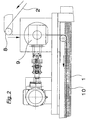
- the apparatus for the continuous production of flat conductor ribbon cables with high dimensional accuracy comprises an extruder 5, in which the extrudable polymer is plasticized.
- the plasticized obtained in this way Polymer is fed with a volume flow through a screen changer 7 to a melt pump 8.
- screen changer 7 impurities are removed from the plasticized polymer.
- melt pump 8 With the melt pump 8, a constant volume flow is produced from the pulsating volume flow of the plasticized polymer leaving the extruder 5.
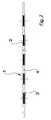
- This constant volume flow of the plasticized polymer impinges in the tool 9 on the conductor tracks 2 which are guided parallel to one another and pass vertically through the tool 9 (FIG. 2).
- the vertical direction of the flat conductor is achieved by means of deflection roller 8, which is arranged above the tool 9.
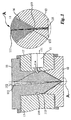
- the conductor tracks 2 in wire guide 11 are continuously guided (Fig. 3).
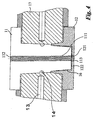
- the plasticized polymer enters the tool 9 via the material inlet 15 (FIG. 4). From there, the plasticized polymer is conducted via a material deflection 14 (so-called deflection device) into the polymer guide 16, where it meets the conductor tracks, as shown in detail A of FIG. 3. Subsequently, the conductor tracks encased in the polymer leave the tool 9 via the outlet nozzle 12 (FIG. 2, FIG. 4) and are passed through a water bath 10.
- the wire guide 11 is arranged in a carrier element 17 (FIGS. 3 and 4).
- the wire guide 11 has a separate, vertical guide channel 111 with an inlet opening 112 and an outlet opening 113 for each flat conductor on.
- the cross section of the guide channel 111 narrows from the inlet opening 112 in the direction of the outlet opening 113.
- the arrangement of the outlet openings 113, in particular their distance from one another, is determined by the intended arrangement of the flat conductor 2 in the flat-ribbon cable 1 to be produced.
- the tool 9 and consequently the wire guide 11 are continuously passed through by the flat conductors 2.
- the entire wire guide circumferential recess 114 is provided in the outer surface of the wire guide 11 in the outer surface of the wire guide 11 preferably a horizontal.
- This recess 114 together with the carrier element 17, the material deflection 14.
- the recess 114 completely surrounds the wire feed 11.
- the recess 114 is closed at the top, while at the bottom a gap 115 is formed between the carrier 17 and the wire guide 11. Gap 115, like the recess 114, can completely circumnavigate the wire feed 11, but this is not necessary.
- the carrier element 17 has a channel-like feed 171 for the plasticized polymer which forms the material inlet 15.
- the material inlet 15 is arranged at the level of the recess 114 of the carrier element 17, so that the plasticized polymer passes through the material inlet 15 into the material deflection 14. From there, the plasticized polymer is forced into the gap 115.
- the outlet nozzle 12 is arranged at the lower end of the wire guide 11.
- the outlet nozzle 12 has a nozzle gap 121 which is opposite to the outlet opening 113 of the wire guide 11 is arranged.
- a gap 122 is provided between the outlet nozzle 12 and the lower end of the wire guide 11. The continuously guided through the tool flat conductor 2 pass after leaving the exit opening 113 of the wire guide 11 gap 122 and the nozzle gap 121 and then exit from the tool 9.
- Slit 122 is connected via the polymer guide 16 in conjunction with gap 115.
- the plasticized polymer thus passes through gap 115 and the polymer guide 16 in the gap 122.
- the polymer guide 16 is below the recess 114 between the outer surface of the wire guide 11 on the one hand and the support member 17 and the outlet nozzle 12 on the other hand formed and completely surrounds the wire guide 11.
- the outer surface of the lower part of the wire guide 11 is designed so that it tapers in the direction of the outlet openings 113.
- the lower part of the wire guide 11 is preferably formed as a truncated cone with a rectangular base, wherein the outlet openings 113 are arranged in the rectangular pyramid frustum surface with the smaller surface area.
- the spaced-apart exit openings 114 are arranged in a line which runs parallel to the longer parallel side edges of the rectangular truncated pyramid surface with the smaller surface area.
- the plasticized polymer can be transported to the nozzle gap 121 of the outlet nozzle 12 in a directional manner.
- the plasticized polymer strikes the flat conductor 2, which emerge from the outlet opening 113 of the wire guide 11. At the same time, the plasticized polymer is squeezed out of the nozzle gap 121, wherein it surrounds the flat conductor 2 and forms insulating layer 3.
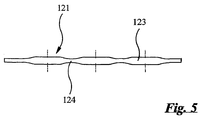
- the cross section of the nozzle gap 121 is shown in Fig. 5 for the case that three individual flat conductors 2 are continuously guided by the tool 9.
- the nozzle gap 121 has a cross-sectional enlargement 123 for each flat conductor 2.
- the respective flat conductor 2 is guided centrally. Due to the central guidance of the flat conductors 2 through the cross-sectional enlargements 123, a complete encasing of the flat conductors 2 with the polymer in the nozzle gap 121 is achieved.
- the cross-sectional constrictions 124 formed between each two adjacent cross-sectional enlargements 123 form the later tapers 4 of the insulating layer 3 (shown in FIG. 7 for a flat-ribbon cable with five parallel flat conductors).
- the wire guide 11 may be formed in two parts. In Fig. 6, a first sub-element 116 of the wire guide 11 is shown. The second sub-element (not shown) is mirror-symmetrical to the first sub-element.
- the two halves are assembled such that the notches 117 formed in an outer surface of the sub-element 116 form the guide channels 111.
- a flat conductor ribbon cable 1 obtained with the aid of the method according to the invention is shown schematically and greatly enlarged in cross section in FIG.
- the ribbon cable 1 has conductor tracks 2 which are embedded in an insulating layer 3. Between the conductor tracks 2, the height of the cable 1 tapers (reference numeral 4). The width and height of the tracks 2, the distance from each other, the thickness of the polymeric insulation layer 3 on the tracks 2 and between the tracks 2 can be changed depending on the intended use of the flat-ribbon cable.
- micrographs of the cross section of the flat conductor ribbon cable were made.
- the micrographs were measured by means of an optical measuring device (DE MEET 220, NL).
- the dimensional stability of the polymeric sheath was rated very good if the measured dimensions were within the ranges shown in FIG.
- test piece of 700 mm in length was prepared. At both ends of the test specimen, 10 mm were stripped.
- the specimen was immersed in a 5% NaCl solution so that the stripped ends of the specimen protruded from the NaCl solution.
- the test was carried out for every three specimens.
- test piece of 700 mm in length was prepared. At both ends of the test specimen, 10 mm were stripped.
- test medium (70% water, 30% ethanol and dye). The immersion depth was 10 mm. After a residence time of 5 minutes, the specimen was removed and the rise height of the medium was measured by means of an optical measuring device. The test piece was rated "passed” if no test medium had penetrated into the test piece.
- Example 1 describes a method according to the invention for producing an extruded three-wire flat conductor ribbon cable.
- Granulated polyethersulfone (BASF, DE) was dried in a drier (Bierther, DE) at 150 ° C. for 2 h.
- the dried granules were introduced into an extruder (Esde, DE) and heated to a processing temperature of 360 ° C during plasticizing.
- a constant volume flow of the plasticized PES of 21.32 cm 3 / min ⁇ 0.05 cm 3 / min was produced by means of a melt pump (Esde, DE, 2.2 rpm).
- the pressure between the extruder and the melt pump was set to 50 MPa. With the constant volume flow, the plasticized PES was fed to a tool at the processing temperature.
- Example 2 describes a method according to the invention for producing an extruded three-wire flat conductor ribbon cable.
- Granulated polyethersulfone (BASF, DE) was dried in a drier (Bierther, DE) at 150 ° C. for 2 h.
- the dried granules were introduced into an extruder (Esde, DE) and heated to a processing temperature of 360 ° C during plasticizing.
- a constant volume flow of the plasticized PES of 21.32 cm 3 / min ⁇ 0.05 cm 3 / min was produced by means of a melt pump (Esde, DE, 2.2 rpm).
- the pressure between the extruder and the melt pump was set to 50 MPa. With the constant volume flow, the plasticized PES was fed to a tool at the processing temperature.
- Example 3 describes a method according to the invention for producing an extruded three-wire ribbon conductor cable.
- Granulated polyethylene naphthalate (DuPont, US) was dried in a drier (Bierther, DE) at 130 ° C for 2 h.
- the dried granules were introduced into an extruder (Esde, DE) and heated to a processing temperature of 290 ° C during plasticization.
- a constant volume flow of the plasticized PEN of 21.32 cm 3 / min ⁇ 0.05 cm 3 / min was produced by means of a melt pump (Esde, DE, 2.2 rpm).
- the pressure between the extruder and the melt pump was set at 50 MPa. With the constant volume flow, the plasticized PEN was fed to a tool at the processing temperature.
- Example 4 describes a method according to the invention for producing an extruded three-wire ribbon conductor cable.
- Granulated polypropylene (Resinex, DE) was dried in a drier (Bierther, DE) at 80 ° C. for 2 h.
- the dried granules were introduced into an extruder (Esde, DE) and heated to a processing temperature of 260 ° C during plasticization.
- a constant volume flow of the plasticized PP of 21.32 cm 3 / min ⁇ 0.05 cm 3 / min was produced by means of a melt pump (Esde, DE, 2.2 rpm).
- the pressure between the extruder and the melt pump was set to 50 MPa. With the constant volume flow, the plasticized PP was fed to a tool at the processing temperature.
Landscapes
- Physics & Mathematics (AREA)
- Spectroscopy & Molecular Physics (AREA)
- Chemical & Material Sciences (AREA)
- Chemical Kinetics & Catalysis (AREA)
- Engineering & Computer Science (AREA)
- Manufacturing & Machinery (AREA)
- Insulated Conductors (AREA)
- Extrusion Moulding Of Plastics Or The Like (AREA)
- Adhesives Or Adhesive Processes (AREA)
Claims (19)
- Procédé de fabrication de câbles plats à conducteurs plats, constitués de plusieurs conducteurs plats parallèles qui sont noyés dans un polymère, caractérisé en ce qu'il comprend les étapes suivantes :(a) fourniture d'un polymère extrudable ;(b) plastification du polymère extrudable fourni à l'étape (a) ;(c) ajustement d'un courant volumique constant du polymère plastifié obtenu à l'étape (b) au moyen d'une pompe pour produit fondu, le volume du courant volumique par unité de temps variant au maximum de ± 2,5% ;(d) union du courant volumique constant du polymère plastifié avec les conducteurs plats parallèles dans un outil en formant des câbles plats à conducteurs plats.
- Procédé de fabrication de câbles plats à conducteurs plats selon la revendication 1, caractérisé en ce que dans l'étape (d), le polymère plastifié et les conducteurs plats parallèles sont guidés conjointement à travers une buse (12) de l'outil (9), de sorte que les conducteurs plats parallèles (2) soient noyés dans le polymère plastifié en formant la couche isolante (3).
- Procédé de fabrication de câbles plats à conducteurs plats selon la revendication 1 ou la revendication 2, caractérisé en ce que la fourniture du polymère extrudable inclut le séchage du polymère extrudable.
- Procédé de fabrication de câbles plats à conducteurs plats selon l'une quelconque des revendications 1 à 3, caractérisé en ce que l'on utilise comme polymère extrudable de la polyéthersulfone, du polyétherimide, du polyéthylènenaphtalate, du polypropylène, des dérivés de ces polymères ou des mélanges qui contiennent ces polymères et/ou des dérivés de ces polymères.
- Procédé de fabrication de câbles plats à conducteurs plats selon l'une quelconque des revendications 1 à 4, caractérisé en ce que l'union du courant volumique constant du polymère plastifié avec les conducteurs plats parallèles dans l'étape (d) inclut l'ajustement de la position des pistes conductrices dans le polymère.
- Procédé de fabrication de câbles plats à conducteurs plats selon l'une quelconque des revendications 1 à 5, caractérisé en ce que l'union du courant volumique constant du polymère plastifié avec les conducteurs plats parallèles dans l'étape (d) inclut l'apport du courant volumique constant du polymère plastifié aux pistes conductrices parallèles acheminées verticalement à l'outil.
- Procédé de fabrication de câbles plats à conducteurs plats selon l'une quelconque des revendications 1 à 6, caractérisé en ce que l'on refroidit le câble plat à conducteurs plats obtenu dans l'étape (d).
- Procédé de fabrication de câbles plats à conducteurs plats selon la revendication 7, caractérisé en ce que le refroidissement est effectué dans un bain d'eau et/ou dans des fluides de refroidissement régulés en température.
- Dispositif de fabrication de câbles plats à conducteurs plats qui se composent de plusieurs conducteurs plats parallèles, qui sont noyés dans un polymère, caractérisé en ce qu'il comprend :(a) un dispositif pour fournir un polymère extrudable ;(b) une extrudeuse pour plastifier le polymère extrudable fourni ;(c) une pompe pour produit fondu pour ajuster un courant volumique constant du polymère plastifié et(d) un outil pour unir le courant volumique constant du polymère plastifié avec les conducteurs plats parallèles en formant des câbles plats à conducteurs plats.
- Dispositif de fabrication de câbles plats à conducteurs plats selon la revendication 9, caractérisé en ce que l'outil comprend une buse de sortie à travers laquelle le polymère plastifié et les conducteurs plats parallèles sortent ensemble de l'outil, les conducteurs plats parallèles étant noyés dans le polymère.
- Dispositif de fabrication de câbles plats à conducteurs plats selon la revendication 9 ou la revendication 10, caractérisé en ce que le dispositif pour fournir un polymère extrudable comprend un sécheur pour sécher le polymère extrudable.
- Dispositif de fabrication de câbles plats à conducteurs plats selon l'une quelconque des revendications 9 à 11, caractérisé en ce qu'il présente en outre une régulation de pression qui ajuste la quantité du polymère plastifié qui est acheminé à la pompe pour produit fondu.
- Dispositif de fabrication de câbles plats à conducteurs plats selon l'une quelconque des revendications 9 à 12, caractérisé en ce que l'outil pour unir le courant volumique constant de polymère plastifié avec les conducteurs plats parallèles se compose :(a) d'un guidage de fils pour les conducteurs plats parallèles ;(b) d'un dispositif de déviation pour le courant volumique constant du polymère plastifié ;(c) d'un guidage de polymère et(d) d'une buse de sortie pour le câble plat à conducteurs plats.
- Dispositif de fabrication de câbles plats à conducteurs plats selon la revendication 13, caractérisé en ce que le guidage de fils guide les conducteurs plats parallèles verticalement à travers l'outil.
- Dispositif de fabrication de câbles plats à conducteurs plats selon l'une quelconque des revendications 9 à 14, caractérisé en ce qu'il comprend en outre un dispositif pour refroidir le câble plat à conducteurs plats obtenu dans l'outil.
- Dispositif de fabrication de câbles plats à conducteurs plats selon la revendication 15, caractérisé en ce que le dispositif pour refroidir le câble plat à conducteurs plats obtenu dans l'outil est un bain d'eau et/ou un fluide de refroidissement régulé en température.
- Câble plat à conducteurs plats extrudé, constitué de plusieurs conducteurs plats parallèles, qui sont noyés dans un polymère, caractérisé en ce qu'il a été obtenu par le procédé selon l'une quelconque des revendications 1 à 8.
- Câble plat à conducteurs plats selon la revendication 17, constitué de plusieurs conducteurs plats parallèles qui sont noyés dans un polymère, caractérisé en ce que le polymère est choisi parmi la polyéthersulfone, le polyétherimide, le polyéthylènenaphtalate, le polypropylène, des dérivés de ces polymères ou des mélanges qui contiennent ces polymères et/ou des dérivés de ces polymères.
- Câble plat à conducteurs plats selon la revendication 18, caractérisé en ce qu'il a été obtenu par le procédé selon l'une quelconque des revendications 1 à 8.
Applications Claiming Priority (3)
| Application Number | Priority Date | Filing Date | Title |
|---|---|---|---|
| DE10238188 | 2002-08-15 | ||
| DE10238188A DE10238188A1 (de) | 2002-08-15 | 2002-08-15 | Verfahren zur Herstellung klebstofffreier Flachleiter-Bandkabel |
| PCT/DE2003/002715 WO2004019349A1 (fr) | 2002-08-15 | 2003-08-12 | Procede de fabrication de cables plats a conducteurs plats exempts de colle |
Publications (2)
| Publication Number | Publication Date |
|---|---|
| EP1529294A1 EP1529294A1 (fr) | 2005-05-11 |
| EP1529294B1 true EP1529294B1 (fr) | 2007-05-09 |
Family
ID=30469798
Family Applications (2)
| Application Number | Title | Priority Date | Filing Date |
|---|---|---|---|
| EP03000977A Withdrawn EP1389784A1 (fr) | 2002-08-15 | 2003-01-17 | Procédé de préparation d'un câble-ruban plat conductif sans adhésif |
| EP03792137A Expired - Lifetime EP1529294B1 (fr) | 2002-08-15 | 2003-08-12 | Procede de fabrication de cables plats a conducteurs plats exempts de colle |
Family Applications Before (1)
| Application Number | Title | Priority Date | Filing Date |
|---|---|---|---|
| EP03000977A Withdrawn EP1389784A1 (fr) | 2002-08-15 | 2003-01-17 | Procédé de préparation d'un câble-ruban plat conductif sans adhésif |
Country Status (5)
| Country | Link |
|---|---|
| EP (2) | EP1389784A1 (fr) |
| AT (1) | ATE362184T1 (fr) |
| AU (1) | AU2003260265A1 (fr) |
| DE (3) | DE10238188A1 (fr) |
| WO (1) | WO2004019349A1 (fr) |
Families Citing this family (2)
| Publication number | Priority date | Publication date | Assignee | Title |
|---|---|---|---|---|
| JP2013030327A (ja) * | 2011-07-27 | 2013-02-07 | Yazaki Corp | フラットケーブル、及び、その製造方法 |
| CN112349451A (zh) * | 2020-11-19 | 2021-02-09 | 盛珊瑜 | 一种漆包线及其制造加工方法 |
Family Cites Families (7)
| Publication number | Priority date | Publication date | Assignee | Title |
|---|---|---|---|---|
| US4295812A (en) * | 1980-06-18 | 1981-10-20 | Crompton & Knowles Corporation | Ribbon cable extrusion crosshead |
| US4783579A (en) * | 1986-04-29 | 1988-11-08 | Amp Incorporated | Flat multi-conductor power cable with two insulating layers |
| DE4200311A1 (de) * | 1992-01-09 | 1993-07-15 | Danubia Petrochem Deutschland | Kleberfreie flachbandleiter |
| US5955569A (en) * | 1996-11-27 | 1999-09-21 | E.I. Du Pont De Nemours And Company | Method for solid phase polymerization |
| EP0938099A1 (fr) * | 1997-05-16 | 1999-08-25 | The Furukawa Electric Co., Ltd. | Cable plat et procede de fabrication |
| DE19836800A1 (de) * | 1998-08-14 | 2000-02-17 | Roehm Gmbh | Optisch isotrope Polycarbonat-Folien sowie Verfahren zu deren Herstellung |
| DE10103367C2 (de) * | 2000-11-20 | 2002-10-24 | Reifenhaeuser Masch | Verfahren zum Herstellen von Flachbandkabeln |
-
2002
- 2002-08-15 DE DE10238188A patent/DE10238188A1/de not_active Ceased
-
2003
- 2003-01-17 EP EP03000977A patent/EP1389784A1/fr not_active Withdrawn
- 2003-08-12 WO PCT/DE2003/002715 patent/WO2004019349A1/fr not_active Ceased
- 2003-08-12 EP EP03792137A patent/EP1529294B1/fr not_active Expired - Lifetime
- 2003-08-12 DE DE10393623T patent/DE10393623D2/de not_active Expired - Lifetime
- 2003-08-12 AT AT03792137T patent/ATE362184T1/de not_active IP Right Cessation
- 2003-08-12 DE DE50307252T patent/DE50307252D1/de not_active Expired - Fee Related
- 2003-08-12 AU AU2003260265A patent/AU2003260265A1/en not_active Abandoned
Also Published As
| Publication number | Publication date |
|---|---|
| EP1529294A1 (fr) | 2005-05-11 |
| EP1389784A1 (fr) | 2004-02-18 |
| WO2004019349A1 (fr) | 2004-03-04 |
| DE10238188A1 (de) | 2004-03-04 |
| ATE362184T1 (de) | 2007-06-15 |
| DE10393623D2 (de) | 2005-07-07 |
| DE50307252D1 (de) | 2007-06-21 |
| AU2003260265A1 (en) | 2004-03-11 |
Similar Documents
| Publication | Publication Date | Title |
|---|---|---|
| DE60010294T2 (de) | Verfahren und vorrichtung zur herstellung von kunststofffolie | |
| DE69409827T2 (de) | Elektrische anschlüsse | |
| DE68909614T2 (de) | Elektrisches kabel. | |
| DE69605397T2 (de) | Verfahren zum extrudieren von thermoplastischen isolation auf statorstangen | |
| DE2418000A1 (de) | Leicht abisolierbares bandkabel | |
| DE69207775T2 (de) | Ein massenanschliessbares kabel | |
| DE3786429T2 (de) | Isolierte Leitung mit hochtemperaturbeständiger Multischichtisolierung. | |
| DE2652683B2 (de) | Anisotroper elektrisch leitender platten-oder folienförmiger Körper und Verfahren zu seiner Herstellung | |
| DE19823304B4 (de) | Vorrichtung zum Extrudieren von Kunststoff-Mehrschichtfolien, -platten oder -schläuchen | |
| DE3230900C3 (de) | Verfahren zum Herstellen einer Polyethylenterephthalatfolie als basismaterial für gedruckte Schaltungen | |
| DE19524526A1 (de) | Koaxialkabel | |
| EP1047084B1 (fr) | Câble coaxial à haute fréquence | |
| EP2367177A1 (fr) | Câble électrique et buse d'extrusion destinée à sa fabrication | |
| EP3136402A1 (fr) | Cable, en particulier cable de transmission de donnees, fil et procede de fabrication d'un tel fil | |
| DE69003684T2 (de) | Elektrisches kabel. | |
| DE69902459T2 (de) | Verfahren und gerät zur herstellung einer kunststofffolie, und kunststofffolie | |
| DE3028993A1 (de) | Gefuellte extrudierte endlose thermoplastische flaechige materialien und ihre herstellung | |
| DE112015004343T5 (de) | Sammelschiene und Verfahren zur Herstellung derselbigen | |
| EP1529294B1 (fr) | Procede de fabrication de cables plats a conducteurs plats exempts de colle | |
| EP1336182B1 (fr) | Procede pour fabriquer des cables plats | |
| DE19517554C2 (de) | Verfahren und Vorrichtung zur Herstellung von Pellets aus metallisiertem Kunststoff für die Formverarbeitung zum Abschirmen von elektromagnetischer Beeinflussung | |
| DE3884330T2 (de) | Verfahren zur Herstellung eines aus thermoplastischem Harz gegossenen Artikels. | |
| DE102016123899A1 (de) | Isolierter elektrischer Draht und Kabel und Formkörper | |
| DE2357984C2 (de) | Verfahren zur Herstellung von elektrischen Kabeln oder Leitungen | |
| EP1388867B1 (fr) | Câble électrique |
Legal Events
| Date | Code | Title | Description |
|---|---|---|---|
| PUAI | Public reference made under article 153(3) epc to a published international application that has entered the european phase |
Free format text: ORIGINAL CODE: 0009012 |
|
| 17P | Request for examination filed |
Effective date: 20050115 |
|
| AK | Designated contracting states |
Kind code of ref document: A1 Designated state(s): AT BE BG CH CY CZ DE DK EE ES FI FR GB GR HU IE IT LI LU MC NL PT RO SE SI SK TR |
|
| GRAP | Despatch of communication of intention to grant a patent |
Free format text: ORIGINAL CODE: EPIDOSNIGR1 |
|
| GRAS | Grant fee paid |
Free format text: ORIGINAL CODE: EPIDOSNIGR3 |
|
| GRAA | (expected) grant |
Free format text: ORIGINAL CODE: 0009210 |
|
| AK | Designated contracting states |
Kind code of ref document: B1 Designated state(s): AT BE BG CH CY CZ DE DK EE ES FI FR GB GR HU IE IT LI LU MC NL PT RO SE SI SK TR |
|
| PG25 | Lapsed in a contracting state [announced via postgrant information from national office to epo] |
Ref country code: FI Free format text: LAPSE BECAUSE OF FAILURE TO SUBMIT A TRANSLATION OF THE DESCRIPTION OR TO PAY THE FEE WITHIN THE PRESCRIBED TIME-LIMIT Effective date: 20070509 |
|
| REG | Reference to a national code |
Ref country code: GB Ref legal event code: FG4D Free format text: NOT ENGLISH |
|
| REG | Reference to a national code |
Ref country code: CH Ref legal event code: EP |
|
| REG | Reference to a national code |
Ref country code: IE Ref legal event code: FG4D Free format text: LANGUAGE OF EP DOCUMENT: GERMAN |
|
| REF | Corresponds to: |
Ref document number: 50307252 Country of ref document: DE Date of ref document: 20070621 Kind code of ref document: P |
|
| PG25 | Lapsed in a contracting state [announced via postgrant information from national office to epo] |
Ref country code: SE Free format text: LAPSE BECAUSE OF FAILURE TO SUBMIT A TRANSLATION OF THE DESCRIPTION OR TO PAY THE FEE WITHIN THE PRESCRIBED TIME-LIMIT Effective date: 20070809 |
|
| PG25 | Lapsed in a contracting state [announced via postgrant information from national office to epo] |
Ref country code: ES Free format text: LAPSE BECAUSE OF FAILURE TO SUBMIT A TRANSLATION OF THE DESCRIPTION OR TO PAY THE FEE WITHIN THE PRESCRIBED TIME-LIMIT Effective date: 20070820 |
|
| GBT | Gb: translation of ep patent filed (gb section 77(6)(a)/1977) |
Effective date: 20070822 |
|
| NLV1 | Nl: lapsed or annulled due to failure to fulfill the requirements of art. 29p and 29m of the patents act | ||
| ET | Fr: translation filed | ||
| REG | Reference to a national code |
Ref country code: IE Ref legal event code: FD4D |
|
| PG25 | Lapsed in a contracting state [announced via postgrant information from national office to epo] |
Ref country code: SI Free format text: LAPSE BECAUSE OF FAILURE TO SUBMIT A TRANSLATION OF THE DESCRIPTION OR TO PAY THE FEE WITHIN THE PRESCRIBED TIME-LIMIT Effective date: 20070509 Ref country code: NL Free format text: LAPSE BECAUSE OF FAILURE TO SUBMIT A TRANSLATION OF THE DESCRIPTION OR TO PAY THE FEE WITHIN THE PRESCRIBED TIME-LIMIT Effective date: 20070509 Ref country code: BG Free format text: LAPSE BECAUSE OF FAILURE TO SUBMIT A TRANSLATION OF THE DESCRIPTION OR TO PAY THE FEE WITHIN THE PRESCRIBED TIME-LIMIT Effective date: 20070809 Ref country code: IE Free format text: LAPSE BECAUSE OF FAILURE TO SUBMIT A TRANSLATION OF THE DESCRIPTION OR TO PAY THE FEE WITHIN THE PRESCRIBED TIME-LIMIT Effective date: 20070509 Ref country code: PT Free format text: LAPSE BECAUSE OF FAILURE TO SUBMIT A TRANSLATION OF THE DESCRIPTION OR TO PAY THE FEE WITHIN THE PRESCRIBED TIME-LIMIT Effective date: 20071009 Ref country code: CZ Free format text: LAPSE BECAUSE OF FAILURE TO SUBMIT A TRANSLATION OF THE DESCRIPTION OR TO PAY THE FEE WITHIN THE PRESCRIBED TIME-LIMIT Effective date: 20070509 Ref country code: DK Free format text: LAPSE BECAUSE OF FAILURE TO SUBMIT A TRANSLATION OF THE DESCRIPTION OR TO PAY THE FEE WITHIN THE PRESCRIBED TIME-LIMIT Effective date: 20070509 |
|
| BERE | Be: lapsed |
Owner name: PANTA G.M.B.H. Effective date: 20070831 |
|
| PG25 | Lapsed in a contracting state [announced via postgrant information from national office to epo] |
Ref country code: SK Free format text: LAPSE BECAUSE OF FAILURE TO SUBMIT A TRANSLATION OF THE DESCRIPTION OR TO PAY THE FEE WITHIN THE PRESCRIBED TIME-LIMIT Effective date: 20070509 |
|
| PLBE | No opposition filed within time limit |
Free format text: ORIGINAL CODE: 0009261 |
|
| STAA | Information on the status of an ep patent application or granted ep patent |
Free format text: STATUS: NO OPPOSITION FILED WITHIN TIME LIMIT |
|
| 26N | No opposition filed |
Effective date: 20080212 |
|
| PG25 | Lapsed in a contracting state [announced via postgrant information from national office to epo] |
Ref country code: IT Free format text: LAPSE BECAUSE OF FAILURE TO SUBMIT A TRANSLATION OF THE DESCRIPTION OR TO PAY THE FEE WITHIN THE PRESCRIBED TIME-LIMIT Effective date: 20070509 Ref country code: GR Free format text: LAPSE BECAUSE OF FAILURE TO SUBMIT A TRANSLATION OF THE DESCRIPTION OR TO PAY THE FEE WITHIN THE PRESCRIBED TIME-LIMIT Effective date: 20070810 Ref country code: MC Free format text: LAPSE BECAUSE OF NON-PAYMENT OF DUE FEES Effective date: 20070831 |
|
| PG25 | Lapsed in a contracting state [announced via postgrant information from national office to epo] |
Ref country code: RO Free format text: LAPSE BECAUSE OF FAILURE TO SUBMIT A TRANSLATION OF THE DESCRIPTION OR TO PAY THE FEE WITHIN THE PRESCRIBED TIME-LIMIT Effective date: 20070509 |
|
| PG25 | Lapsed in a contracting state [announced via postgrant information from national office to epo] |
Ref country code: BE Free format text: LAPSE BECAUSE OF NON-PAYMENT OF DUE FEES Effective date: 20070831 |
|
| PGFP | Annual fee paid to national office [announced via postgrant information from national office to epo] |
Ref country code: CH Payment date: 20080825 Year of fee payment: 6 Ref country code: DE Payment date: 20080731 Year of fee payment: 6 |
|
| PGFP | Annual fee paid to national office [announced via postgrant information from national office to epo] |
Ref country code: AT Payment date: 20080821 Year of fee payment: 6 Ref country code: FR Payment date: 20080818 Year of fee payment: 6 |
|
| PGFP | Annual fee paid to national office [announced via postgrant information from national office to epo] |
Ref country code: GB Payment date: 20080822 Year of fee payment: 6 |
|
| PG25 | Lapsed in a contracting state [announced via postgrant information from national office to epo] |
Ref country code: EE Free format text: LAPSE BECAUSE OF FAILURE TO SUBMIT A TRANSLATION OF THE DESCRIPTION OR TO PAY THE FEE WITHIN THE PRESCRIBED TIME-LIMIT Effective date: 20070509 |
|
| PG25 | Lapsed in a contracting state [announced via postgrant information from national office to epo] |
Ref country code: CY Free format text: LAPSE BECAUSE OF FAILURE TO SUBMIT A TRANSLATION OF THE DESCRIPTION OR TO PAY THE FEE WITHIN THE PRESCRIBED TIME-LIMIT Effective date: 20070509 |
|
| PG25 | Lapsed in a contracting state [announced via postgrant information from national office to epo] |
Ref country code: LU Free format text: LAPSE BECAUSE OF NON-PAYMENT OF DUE FEES Effective date: 20070812 |
|
| PG25 | Lapsed in a contracting state [announced via postgrant information from national office to epo] |
Ref country code: TR Free format text: LAPSE BECAUSE OF FAILURE TO SUBMIT A TRANSLATION OF THE DESCRIPTION OR TO PAY THE FEE WITHIN THE PRESCRIBED TIME-LIMIT Effective date: 20070509 Ref country code: HU Free format text: LAPSE BECAUSE OF FAILURE TO SUBMIT A TRANSLATION OF THE DESCRIPTION OR TO PAY THE FEE WITHIN THE PRESCRIBED TIME-LIMIT Effective date: 20071110 |
|
| REG | Reference to a national code |
Ref country code: CH Ref legal event code: PL |
|
| GBPC | Gb: european patent ceased through non-payment of renewal fee |
Effective date: 20090812 |
|
| PG25 | Lapsed in a contracting state [announced via postgrant information from national office to epo] |
Ref country code: LI Free format text: LAPSE BECAUSE OF NON-PAYMENT OF DUE FEES Effective date: 20090831 Ref country code: CH Free format text: LAPSE BECAUSE OF NON-PAYMENT OF DUE FEES Effective date: 20090831 |
|
| REG | Reference to a national code |
Ref country code: FR Ref legal event code: ST Effective date: 20100430 |
|
| PG25 | Lapsed in a contracting state [announced via postgrant information from national office to epo] |
Ref country code: AT Free format text: LAPSE BECAUSE OF NON-PAYMENT OF DUE FEES Effective date: 20090812 |
|
| PG25 | Lapsed in a contracting state [announced via postgrant information from national office to epo] |
Ref country code: FR Free format text: LAPSE BECAUSE OF NON-PAYMENT OF DUE FEES Effective date: 20090831 Ref country code: DE Free format text: LAPSE BECAUSE OF NON-PAYMENT OF DUE FEES Effective date: 20100302 |
|
| PG25 | Lapsed in a contracting state [announced via postgrant information from national office to epo] |
Ref country code: GB Free format text: LAPSE BECAUSE OF NON-PAYMENT OF DUE FEES Effective date: 20090812 |