EP1528604A2 - Elektrolumineszente Halbleitervorrichtung mit verbesserter Leuchtwirkungsgrad - Google Patents
Elektrolumineszente Halbleitervorrichtung mit verbesserter Leuchtwirkungsgrad Download PDFInfo
- Publication number
- EP1528604A2 EP1528604A2 EP04105190A EP04105190A EP1528604A2 EP 1528604 A2 EP1528604 A2 EP 1528604A2 EP 04105190 A EP04105190 A EP 04105190A EP 04105190 A EP04105190 A EP 04105190A EP 1528604 A2 EP1528604 A2 EP 1528604A2
- Authority
- EP
- European Patent Office
- Prior art keywords
- light
- wavelength
- wavelength converting
- peak
- converting layer
- Prior art date
- Legal status (The legal status is an assumption and is not a legal conclusion. Google has not performed a legal analysis and makes no representation as to the accuracy of the status listed.)
- Withdrawn
Links
Images

Classifications
-
- H—ELECTRICITY
- H10—SEMICONDUCTOR DEVICES; ELECTRIC SOLID-STATE DEVICES NOT OTHERWISE PROVIDED FOR
- H10H—INORGANIC LIGHT-EMITTING SEMICONDUCTOR DEVICES HAVING POTENTIAL BARRIERS
- H10H20/00—Individual inorganic light-emitting semiconductor devices having potential barriers, e.g. light-emitting diodes [LED]
- H10H20/80—Constructional details
- H10H20/85—Packages
- H10H20/851—Wavelength conversion means
- H10H20/8514—Wavelength conversion means characterised by their shape, e.g. plate or foil
-
- H—ELECTRICITY
- H10—SEMICONDUCTOR DEVICES; ELECTRIC SOLID-STATE DEVICES NOT OTHERWISE PROVIDED FOR
- H10W—GENERIC PACKAGES, INTERCONNECTIONS, CONNECTORS OR OTHER CONSTRUCTIONAL DETAILS OF DEVICES COVERED BY CLASS H10
- H10W72/00—Interconnections or connectors in packages
- H10W72/071—Connecting or disconnecting
- H10W72/072—Connecting or disconnecting of bump connectors
- H10W72/07251—Connecting or disconnecting of bump connectors characterised by changes in properties of the bump connectors during connecting
-
- H—ELECTRICITY
- H10—SEMICONDUCTOR DEVICES; ELECTRIC SOLID-STATE DEVICES NOT OTHERWISE PROVIDED FOR
- H10W—GENERIC PACKAGES, INTERCONNECTIONS, CONNECTORS OR OTHER CONSTRUCTIONAL DETAILS OF DEVICES COVERED BY CLASS H10
- H10W72/00—Interconnections or connectors in packages
- H10W72/20—Bump connectors, e.g. solder bumps or copper pillars; Dummy bumps; Thermal bumps
Definitions
- This invention relates to semiconductor light emitting devices wherein a small portion of light emitted from the device is converted by a wavelength-converted material.
- the luminous efficiency of a light source is expressed in lumens per watt and is a measure of how efficiently the light source converts electrical power to luminous flux or brightness. For a given brightness, a device with high luminous efficiency requires less electrical power than a device with lower luminous efficiency. Thus, a device with high luminous efficiency may be less expensive to operate at a given brightness than a device with lower luminous efficiency.
- a light emitting structure includes a semiconductor light emitting device and a wavelength-converting layer.
- the wavelength converting layer converts a portion of the light emitted from the device.
- the dominant wavelength of the combined light from the device and the wavelength-converting layer is essentially the same as the wavelength of light emitted from the device.
- the wavelength-converting layer may emit light having a spectral luminous efficacy greater than the spectral luminous efficacy of the light emitted from the device.
- the structure has a higher luminous efficiency than a device without a wavelength-converting layer.
- the luminous efficiency of a semiconductor light-emitting device such as a light emitting diode is enhanced by converting the wavelength of a small portion of the light emitted from the light-emitting device.
- the wavelength of the portion of light emitted by the light-emitting device is converted by a wavelength converting material such as a fluorescent material, quantum dots, or phosphor to a wavelength having a higher spectral luminous efficacy.
- the combined light emitted from the light emitting device and the wavelength converting material is essentially the same color (i.e., same dominant wavelength) as the light from the light-emitting device, but with a higher spectral luminous efficacy.
- Spectral luminous efficacy is the sensitivity of the average human retina to light of various colors and is expressed in lumens per optical watt.
- Fig. 2 illustrates the spectral luminous efficacy of light as a function of wavelength for the visible spectrum. Greenish yellow light having a wavelength of about 555 nm has the highest spectral luminous efficacy. Blue light and red light have relatively low spectral luminous efficacy.
- the peak wavelength of light from the light emitting device may be in wavelength range a, from about 400 to about 480 nm and usually between about 420-430 nm and about 460 nm.
- the peak wavelength of light emitted by the wavelength converting material may be in wavelength range b, from about 500 to about 620 nm.
- the color of light produced by the wavelength converting material generally does not matter, as the amount of light emitted by the wavelength converting material is small enough that it does not significantly impact the color of the combined light.
- the light emitting device and the wavelength converting material are selected such that the light emitted from the wavelength converting material has a spectral luminous efficacy greater or equal to twice the spectral luminous efficacy of the light emitted from the light-emitting device.
- the wavelength converting material is selected such that the conversion of light from the light-emitting device to light from the wavelength converting material is a downward conversion in energy.
- Fig. 3 is a chromaticity diagram. Colors along the edge of the chromaticity graph are pure colors, meaning they have a spectral purity of 100%. In the case of red, green, and blue light combined to make white light, the higher the spectral purity of the red, green, and blue sources, the larger the fraction of colors that can be generated by the combination of the high-purity sources.
- Semiconductor light emitting devices generally produce light of high spectral purity.
- the wavelength converting material is selected and incorporated into the device such that the combined light is close to the edge of the chromaticity graph.
- the combined light may have a spectral purity greater than or equal to about 50%, and generally has a spectral purity greater than or equal to about 90%.
- a flip chip III-nitride light emitting device with a praseodymium and cerium doped yttrium aluminum garnet (YAG) phosphor used as the wavelength-converting layer is considered below.
- any suitable light emitting device capable of emitting light in wavelength range a of Fig. 2 may be used.
- III-phosphide devices, devices of other materials systems, devices in an epitaxy-up orientation, and devices with contacts formed on opposite sides may be used.
- the light emitting device itself may be a wavelength-converted light emitting device; for example, a device that emits ultraviolet light combined with a phosphor layer that absorbs the ultraviolet light and emits light in wavelength range a of Fig. 2.
- the two wavelength converting materials i.e. the first wavelength converting material that absorbs light from the device and emits light in range a and the second wavelength converting material that emits light in range b, either by absorbing light from the device or by absorbing light from the first wavelength converting material, may be mixed in a single layer or may be formed in multiple discrete layers in the path of light emitted from the device.
- Any suitable wavelength converting material capable of emitting light with a peak wavelength in wavelength range b of Fig. 2 when pumped with light from wavelength range a, or when pumped with light from a shorter wavelength source in the case where the light in range a is produced by an additional wavelength converting material, may be used to produce the light with a peak wavelength in range b.
- YAG: Ce, SrGaS:Eu, (Ca,Sr)S:Eu, CaS:Ce+Mn, (Sr,Li)SiO:Eu, (Ba,Sr)SiO:Eu, and SrSiN:Eu phosphors may be used, or dyes such as Coumarin 6, Fluorol 7GA, Rhodamine 110, and Lumogen dyes available from BASF. Examples of suitable dyes are described in more detail in U.S. Patent 5,847,507, which is incorporated herein by reference.
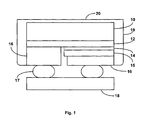
- Fig. 1 illustrates a light emitting diode according to an embodiment of the invention.
- the diode shown in Fig. 1 is formed by depositing an n-type region 12 over a substrate 10.
- a light emitting or active region 14 is formed over n-type region 12 and a p-type region 15 is formed over active region 14.
- Each of n-type region 12, active region 14, and p-type region 15 may be a single layer or multiple layers of the same or different composition, thickness, and dopant concentration.
- a portion of p-type region 15 and active region 14 is removed and contacts 16 are formed on the remaining portion of p-type region 15 and the exposed portion of n-type region 12.
- the chip is then flipped over and mounted on a submount 18 by interconnects 17.
- a phosphor layer 19 of YAG:Ce+Pr or YAG:Ce is deposited on the chip.
- phosphor layer 19 Since phosphor layer 19 is not intended to convert so much light that it substantially alters the color of light emitted from the active region, phosphor layer 19 must have less phosphor than, for example, a phosphor layer in a device intended to emit white light. There are several ways to control the amount of phosphor in phosphor layer 19 such that the correct amount of light is converted by the phosphor layer. In the embodiment illustrated in Fig. 1, a conformal coating of phosphor is deposited, on the top and sides of the light emitting device die, then most of the phosphor is scraped off the top of the light emitting device die, leaving a thin layer of phosphor 20 on the top of the die and thick layers 19 on the sides of the die. The thickness of side layers 19 may be, for example, 25 microns, while the thickness of top layer 20 may be, for example about 5 microns.
- a uniform thin layer of phosphor having a thickness ranging between about 1 and about 10 microns may be deposited by any suitable technique including, for example, screen printing, stenciling, or electrophoretic deposition.
- a uniform thick layer of phosphor mixed with silicate or a suitable mix of other metal oxides and/or metal nitrides may be deposited by any suitable technique.
- the uniform thick layer of phosphor may have a thickness ranging between about 5 and about 50 microns.
- the silicate may be selected such that its index of refraction matches the index of an encapsulant overlying the die within the package, in order to minimize losses due to scattering.
- the ratio of phosphor to silicate is controlled such that the appropriate portion of light emitting from the die is converted by the phosphor.
- the light emitting device die is only partially covered with a phosphor layer. The entire die may be coated, then portions of the phosphor coating may be removed in a lithography step to create small features, or to provide a ring of phosphor around the die.
- phosphor is dispersed in an encapsulating material such as epoxy or silicone used to fill the space between the die and a reflector cup or lens. In some embodiments the phosphor is adjacent to the die, while in other embodiments the phosphor is separated from the die by other materials.
- the wavelength converting material is a dye rather than a phosphor
- the dye may be incorporated in a gel that is deposited on the light emitting device die.
- the dye may be incorporated on the inner or outer surface of a lens overlying the light emitting device die, or within the material forming the lens.
- the device illustrated in Fig. 1 emits blue light having a wavelength of about 451.5.
- the coordinates (0.16, 0.02) of the light emitted by the die are illustrated on the chromaticity diagram in Fig. 3.
- the blue light pumps a YAG:Ce+Pr phosphor emitting yellow light having coordinates (0.44, 0.53).
- devices with coordinates along the tie line between the blue and yellow points can be created.
- the device was created by removing most of a thick phosphor layer deposited on the top of the die, resulting in a device emitting light having coordinates (0.17, 0.03).
- the spectral luminous efficacy of the blue light is about 25 lm/W, but the small amount of yellow light has a spectral luminous efficacy of about 500 lm/W, resulting in a 60% increase in luminous efficiency, from 3.9 lm/W in a blue device without any phosphor conversion, to 6.1 lm/W in the present example.
- the spectral purity was reduced from 100% for a blue device without any phosphor conversion to 95% in the present example.
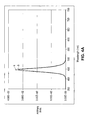
- Fig. 4A illustrates emission spectra of the device incorporating a phosphor layer according to an embodiment of the present invention compared to a blue device without phosphor conversion.
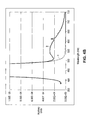
- Fig. 4B illustrates the lower portion of the spectra in Fig. 4A.
- Device b includes the phosphor layer, while device a does not.
- the two devices have almost identical emission spectra.
- the presence of the phosphor layer does not impact the dominant wavelength of the device.
- the small peak caused by emission from the phosphor layer in device b is evident in Fig. 4B.
- the peak from the phosphor emission has a height of about 2.8x10 -4 .
- the peak from emission from the die has a height of about 3.3x10 -2 .
- the height of the phosphor peak is therefore less than 1% of the height of the die emission peak. In other embodiments, the height of the phosphor peak is less than 10% of the height of the die emission peak.
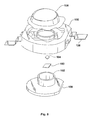
- Fig. 5 is an exploded view of a packaged light-emitting device.
- a heat-sinking slug 100 is placed into an insert-molded leadframe 105.
- the insert-molded leadframe 105 is, for example, a filled plastic material molded around metal leads 106 that provide an electrical path.
- Slug 100 may include an optional reflector cup 102.
- the light emitting device die 104 which may be any of the devices described above, is mounted directly or indirectly via a thermally conducting submount 103 to slug 100.
- An optical lens 108 may be added.
Landscapes
- Led Device Packages (AREA)
- Led Devices (AREA)
Applications Claiming Priority (2)
| Application Number | Priority Date | Filing Date | Title |
|---|---|---|---|
| US699433 | 2003-10-31 | ||
| US10/699,433 US6933535B2 (en) | 2003-10-31 | 2003-10-31 | Light emitting devices with enhanced luminous efficiency |
Publications (2)
| Publication Number | Publication Date |
|---|---|
| EP1528604A2 true EP1528604A2 (de) | 2005-05-04 |
| EP1528604A3 EP1528604A3 (de) | 2011-05-18 |
Family
ID=34423452
Family Applications (1)
| Application Number | Title | Priority Date | Filing Date |
|---|---|---|---|
| EP04105190A Withdrawn EP1528604A3 (de) | 2003-10-31 | 2004-10-20 | Elektrolumineszente Halbleitervorrichtung mit verbesserter Leuchtwirkungsgrad |
Country Status (4)
| Country | Link |
|---|---|
| US (1) | US6933535B2 (de) |
| EP (1) | EP1528604A3 (de) |
| JP (1) | JP2005136420A (de) |
| TW (1) | TWI355095B (de) |
Cited By (1)
| Publication number | Priority date | Publication date | Assignee | Title |
|---|---|---|---|---|
| DE102005037455A1 (de) * | 2005-08-09 | 2007-03-01 | Wei-Jen Hsu | Weißlicht-Leuchtdiode |
Families Citing this family (26)
| Publication number | Priority date | Publication date | Assignee | Title |
|---|---|---|---|---|
| US7645397B2 (en) * | 2004-01-15 | 2010-01-12 | Nanosys, Inc. | Nanocrystal doped matrixes |
| JP4789809B2 (ja) | 2004-01-15 | 2011-10-12 | サムスン エレクトロニクス カンパニー リミテッド | ナノ結晶をドーピングしたマトリックス |
| US7419839B2 (en) | 2004-11-12 | 2008-09-02 | Philips Lumileds Lighting Company, Llc | Bonding an optical element to a light emitting device |
| EP1861876A1 (de) * | 2005-03-24 | 2007-12-05 | Tir Systems Ltd. | Halbleiter-beleuchtungseinrichtungs-gehäuse |
| WO2006105638A1 (en) * | 2005-04-05 | 2006-10-12 | Tir Systems Ltd. | Electronic device package with an integrated evaporator |
| US20070236956A1 (en) * | 2006-03-31 | 2007-10-11 | Gelcore, Llc | Super bright LED power package |
| US7906794B2 (en) | 2006-07-05 | 2011-03-15 | Koninklijke Philips Electronics N.V. | Light emitting device package with frame and optically transmissive element |
| US7631986B2 (en) * | 2006-10-31 | 2009-12-15 | Koninklijke Philips Electronics, N.V. | Lighting device package |
| US7781779B2 (en) * | 2007-05-08 | 2010-08-24 | Luminus Devices, Inc. | Light emitting devices including wavelength converting material |
| US20090008662A1 (en) * | 2007-07-05 | 2009-01-08 | Ian Ashdown | Lighting device package |
| KR100998233B1 (ko) * | 2007-12-03 | 2010-12-07 | 서울반도체 주식회사 | 슬림형 led 패키지 |
| WO2010126606A2 (en) | 2009-05-01 | 2010-11-04 | Nanosys, Inc. | Functionalized matrixes for dispersion of nanostructures |
| TWI462340B (zh) | 2010-09-08 | 2014-11-21 | 晶元光電股份有限公司 | 一種發光結構及其製造方法 |
| TWI646705B (zh) * | 2010-09-08 | 2019-01-01 | 晶元光電股份有限公司 | 一種發光結構及其製造方法 |
| JP5611122B2 (ja) * | 2011-05-27 | 2014-10-22 | シチズンホールディングス株式会社 | 半導体発光素子の製造方法 |
| WO2013137356A1 (ja) * | 2012-03-13 | 2013-09-19 | シチズンホールディングス株式会社 | 半導体発光装置及びその製造方法 |
| US9139770B2 (en) | 2012-06-22 | 2015-09-22 | Nanosys, Inc. | Silicone ligands for stabilizing quantum dot films |
| TWI596188B (zh) | 2012-07-02 | 2017-08-21 | 奈米系統股份有限公司 | 高度發光奈米結構及其製造方法 |
| US20140167601A1 (en) * | 2012-12-19 | 2014-06-19 | Cree, Inc. | Enhanced Luminous Flux Semiconductor Light Emitting Devices Including Red Phosphors that Exhibit Good Color Rendering Properties and Related Red Phosphors |
| WO2014159927A2 (en) | 2013-03-14 | 2014-10-02 | Nanosys, Inc. | Method for solventless quantum dot exchange |
| US9219202B2 (en) | 2013-04-19 | 2015-12-22 | Cree, Inc. | Semiconductor light emitting devices including red phosphors that exhibit good color rendering properties and related red phosphors |
| CN105264042A (zh) * | 2013-06-05 | 2016-01-20 | 柯尼卡美能达株式会社 | 光学材料、光学膜及发光器件 |
| US10074781B2 (en) | 2013-08-29 | 2018-09-11 | Cree, Inc. | Semiconductor light emitting devices including multiple red phosphors that exhibit good color rendering properties with increased brightness |
| JP6484982B2 (ja) * | 2014-09-30 | 2019-03-20 | 日亜化学工業株式会社 | 発光装置の製造方法 |
| US10332949B2 (en) | 2016-07-06 | 2019-06-25 | Seoul Semiconductor Co., Ltd. | Display apparatus |
| JP6717421B1 (ja) | 2018-12-28 | 2020-07-01 | 日亜化学工業株式会社 | 発光モジュール |
Family Cites Families (14)
| Publication number | Priority date | Publication date | Assignee | Title |
|---|---|---|---|---|
| JPH05152609A (ja) * | 1991-11-25 | 1993-06-18 | Nichia Chem Ind Ltd | 発光ダイオード |
| EP2282354B1 (de) | 1996-06-26 | 2013-09-11 | OSRAM Opto Semiconductors GmbH | Licht abstrahlendes Halbleiterbauelement mit Lumineszenzkonversionselement |
| US5813752A (en) * | 1997-05-27 | 1998-09-29 | Philips Electronics North America Corporation | UV/blue LED-phosphor device with short wave pass, long wave pass band pass and peroit filters |
| US5847507A (en) | 1997-07-14 | 1998-12-08 | Hewlett-Packard Company | Fluorescent dye added to epoxy of light emitting diode lens |
| US5959316A (en) * | 1998-09-01 | 1999-09-28 | Hewlett-Packard Company | Multiple encapsulation of phosphor-LED devices |
| US6274924B1 (en) | 1998-11-05 | 2001-08-14 | Lumileds Lighting, U.S. Llc | Surface mountable LED package |
| US6429583B1 (en) * | 1998-11-30 | 2002-08-06 | General Electric Company | Light emitting device with ba2mgsi2o7:eu2+, ba2sio4:eu2+, or (srxcay ba1-x-y)(a1zga1-z)2sr:eu2+phosphors |
| US6351069B1 (en) | 1999-02-18 | 2002-02-26 | Lumileds Lighting, U.S., Llc | Red-deficiency-compensating phosphor LED |
| US6155699A (en) * | 1999-03-15 | 2000-12-05 | Agilent Technologies, Inc. | Efficient phosphor-conversion led structure |
| WO2001024284A1 (en) | 1999-09-27 | 2001-04-05 | Lumileds Lighting, U.S., Llc | A light emitting diode device that produces white light by performing complete phosphor conversion |
| DE10026435A1 (de) * | 2000-05-29 | 2002-04-18 | Osram Opto Semiconductors Gmbh | Kalzium-Magnesium-Chlorosilikat-Leuchtstoff und seine Anwendung bei Lumineszenz-Konversions-LED |
| US6577073B2 (en) * | 2000-05-31 | 2003-06-10 | Matsushita Electric Industrial Co., Ltd. | Led lamp |
| US6417019B1 (en) | 2001-04-04 | 2002-07-09 | Lumileds Lighting, U.S., Llc | Phosphor converted light emitting diode |
| US6806658B2 (en) * | 2003-03-07 | 2004-10-19 | Agilent Technologies, Inc. | Method for making an LED |
-
2003
- 2003-10-31 US US10/699,433 patent/US6933535B2/en not_active Expired - Fee Related
-
2004
- 2004-10-20 EP EP04105190A patent/EP1528604A3/de not_active Withdrawn
- 2004-10-28 TW TW093132834A patent/TWI355095B/zh not_active IP Right Cessation
- 2004-10-28 JP JP2004314113A patent/JP2005136420A/ja active Pending
Cited By (1)
| Publication number | Priority date | Publication date | Assignee | Title |
|---|---|---|---|---|
| DE102005037455A1 (de) * | 2005-08-09 | 2007-03-01 | Wei-Jen Hsu | Weißlicht-Leuchtdiode |
Also Published As
| Publication number | Publication date |
|---|---|
| EP1528604A3 (de) | 2011-05-18 |
| TW200522396A (en) | 2005-07-01 |
| TWI355095B (en) | 2011-12-21 |
| JP2005136420A (ja) | 2005-05-26 |
| US20050093007A1 (en) | 2005-05-05 |
| US6933535B2 (en) | 2005-08-23 |
Similar Documents
| Publication | Publication Date | Title |
|---|---|---|
| US6933535B2 (en) | Light emitting devices with enhanced luminous efficiency | |
| US10978614B2 (en) | Light-emitting device | |
| JP5951180B2 (ja) | 飽和変換材料を有するエミッタパッケージ | |
| US7667239B2 (en) | Phosphor-converted LED devices having improved light distribution uniformity | |
| US9214608B2 (en) | Luminescence diode arrangement, backlighting device and display device | |
| US20160377262A1 (en) | System and method for providing color light sources in proximity to predetermined wavelength conversion structures | |
| US7753553B2 (en) | Illumination system comprising color deficiency compensating luminescent material | |
| US8178888B2 (en) | Semiconductor light emitting devices with high color rendering | |
| US20110012141A1 (en) | Single-color wavelength-converted light emitting devices | |
| US20070012931A1 (en) | White semiconductor light emitting device | |
| US20060097245A1 (en) | Light emitting diode component | |
| US20040061124A1 (en) | Selective filtering of wavelength-converted semiconductor light emitting devices | |
| US20170358716A1 (en) | Light emitting device package and method of manufacturing the same | |
| US12369438B2 (en) | System and method for providing color light sources in proximity to predetermined wavelength conversion structures | |
| TW201930774A (zh) | 具有改良暖白色點之發光裝置 | |
| KR20130017031A (ko) | 백색 발광 다이오드 및 그 제조 방법 | |
| JP2009111273A (ja) | 発光装置 | |
| US7999274B2 (en) | White light emitting device | |
| JP2005167138A (ja) | 白色発光素子 | |
| KR100707871B1 (ko) | 조명용 백색 발광장치 | |
| KR100647823B1 (ko) | 조명용 백색 발광장치 | |
| KR20050019741A (ko) | 포화 인광체 고체 에미터 | |
| KR20210120964A (ko) | 백색 발광 장치 |
Legal Events
| Date | Code | Title | Description |
|---|---|---|---|
| PUAI | Public reference made under article 153(3) epc to a published international application that has entered the european phase |
Free format text: ORIGINAL CODE: 0009012 |
|
| AK | Designated contracting states |
Kind code of ref document: A2 Designated state(s): AT BE BG CH CY CZ DE DK EE ES FI FR GB GR HU IE IT LI LU MC NL PL PT RO SE SI SK TR |
|
| AX | Request for extension of the european patent |
Extension state: AL HR LT LV MK |
|
| RAP1 | Party data changed (applicant data changed or rights of an application transferred) |
Owner name: PHILIPS LUMILEDS LIGHTING COMPANY LLC |
|
| PUAL | Search report despatched |
Free format text: ORIGINAL CODE: 0009013 |
|
| AK | Designated contracting states |
Kind code of ref document: A3 Designated state(s): AT BE BG CH CY CZ DE DK EE ES FI FR GB GR HU IE IT LI LU MC NL PL PT RO SE SI SK TR |
|
| AX | Request for extension of the european patent |
Extension state: AL HR LT LV MK |
|
| 17P | Request for examination filed |
Effective date: 20111118 |
|
| AKX | Designation fees paid |
Designated state(s): DE |
|
| RBV | Designated contracting states (corrected) |
Designated state(s): AT BE BG CH CY CZ DE DK EE ES FI FR GB GR HU IE IT LI LU MC NL PL PT RO SE SI SK TR |
|
| STAA | Information on the status of an ep patent application or granted ep patent |
Free format text: STATUS: THE APPLICATION HAS BEEN WITHDRAWN |
|
| 18W | Application withdrawn |
Effective date: 20120918 |