EP1528356B1 - Vorrichtung zur Überwachung von Grosswälzlagern - Google Patents
Vorrichtung zur Überwachung von Grosswälzlagern Download PDFInfo
- Publication number
- EP1528356B1 EP1528356B1 EP04025540.8A EP04025540A EP1528356B1 EP 1528356 B1 EP1528356 B1 EP 1528356B1 EP 04025540 A EP04025540 A EP 04025540A EP 1528356 B1 EP1528356 B1 EP 1528356B1
- Authority
- EP
- European Patent Office
- Prior art keywords
- bearing
- movements
- path measurement
- accordance
- sensors
- Prior art date
- Legal status (The legal status is an assumption and is not a legal conclusion. Google has not performed a legal analysis and makes no representation as to the accuracy of the status listed.)
- Expired - Lifetime
Links
Images


Classifications
-
- F—MECHANICAL ENGINEERING; LIGHTING; HEATING; WEAPONS; BLASTING
- F16—ENGINEERING ELEMENTS AND UNITS; GENERAL MEASURES FOR PRODUCING AND MAINTAINING EFFECTIVE FUNCTIONING OF MACHINES OR INSTALLATIONS; THERMAL INSULATION IN GENERAL
- F16C—SHAFTS; FLEXIBLE SHAFTS; ELEMENTS OR CRANKSHAFT MECHANISMS; ROTARY BODIES OTHER THAN GEARING ELEMENTS; BEARINGS
- F16C19/00—Bearings with rolling contact, for exclusively rotary movement
- F16C19/02—Bearings with rolling contact, for exclusively rotary movement with bearing balls essentially of the same size in one or more circular rows
- F16C19/14—Bearings with rolling contact, for exclusively rotary movement with bearing balls essentially of the same size in one or more circular rows for both radial and axial load
- F16C19/18—Bearings with rolling contact, for exclusively rotary movement with bearing balls essentially of the same size in one or more circular rows for both radial and axial load with two or more rows of balls
- F16C19/181—Bearings with rolling contact, for exclusively rotary movement with bearing balls essentially of the same size in one or more circular rows for both radial and axial load with two or more rows of balls with angular contact
-
- F—MECHANICAL ENGINEERING; LIGHTING; HEATING; WEAPONS; BLASTING
- F16—ENGINEERING ELEMENTS AND UNITS; GENERAL MEASURES FOR PRODUCING AND MAINTAINING EFFECTIVE FUNCTIONING OF MACHINES OR INSTALLATIONS; THERMAL INSULATION IN GENERAL
- F16C—SHAFTS; FLEXIBLE SHAFTS; ELEMENTS OR CRANKSHAFT MECHANISMS; ROTARY BODIES OTHER THAN GEARING ELEMENTS; BEARINGS
- F16C19/00—Bearings with rolling contact, for exclusively rotary movement
- F16C19/02—Bearings with rolling contact, for exclusively rotary movement with bearing balls essentially of the same size in one or more circular rows
- F16C19/14—Bearings with rolling contact, for exclusively rotary movement with bearing balls essentially of the same size in one or more circular rows for both radial and axial load
- F16C19/16—Bearings with rolling contact, for exclusively rotary movement with bearing balls essentially of the same size in one or more circular rows for both radial and axial load with a single row of balls
- F16C19/163—Bearings with rolling contact, for exclusively rotary movement with bearing balls essentially of the same size in one or more circular rows for both radial and axial load with a single row of balls with angular contact
- F16C19/166—Four-point-contact ball bearings
-
- F—MECHANICAL ENGINEERING; LIGHTING; HEATING; WEAPONS; BLASTING
- F16—ENGINEERING ELEMENTS AND UNITS; GENERAL MEASURES FOR PRODUCING AND MAINTAINING EFFECTIVE FUNCTIONING OF MACHINES OR INSTALLATIONS; THERMAL INSULATION IN GENERAL
- F16C—SHAFTS; FLEXIBLE SHAFTS; ELEMENTS OR CRANKSHAFT MECHANISMS; ROTARY BODIES OTHER THAN GEARING ELEMENTS; BEARINGS
- F16C19/00—Bearings with rolling contact, for exclusively rotary movement
- F16C19/22—Bearings with rolling contact, for exclusively rotary movement with bearing rollers essentially of the same size in one or more circular rows, e.g. needle bearings
- F16C19/34—Bearings with rolling contact, for exclusively rotary movement with bearing rollers essentially of the same size in one or more circular rows, e.g. needle bearings for both radial and axial load
- F16C19/38—Bearings with rolling contact, for exclusively rotary movement with bearing rollers essentially of the same size in one or more circular rows, e.g. needle bearings for both radial and axial load with two or more rows of rollers
- F16C19/381—Bearings with rolling contact, for exclusively rotary movement with bearing rollers essentially of the same size in one or more circular rows, e.g. needle bearings for both radial and axial load with two or more rows of rollers with at least one row for radial load in combination with at least one row for axial load
-
- F—MECHANICAL ENGINEERING; LIGHTING; HEATING; WEAPONS; BLASTING
- F16—ENGINEERING ELEMENTS AND UNITS; GENERAL MEASURES FOR PRODUCING AND MAINTAINING EFFECTIVE FUNCTIONING OF MACHINES OR INSTALLATIONS; THERMAL INSULATION IN GENERAL
- F16C—SHAFTS; FLEXIBLE SHAFTS; ELEMENTS OR CRANKSHAFT MECHANISMS; ROTARY BODIES OTHER THAN GEARING ELEMENTS; BEARINGS
- F16C19/00—Bearings with rolling contact, for exclusively rotary movement
- F16C19/52—Bearings with rolling contact, for exclusively rotary movement with devices affected by abnormal or undesired conditions
-
- G—PHYSICS
- G01—MEASURING; TESTING
- G01M—TESTING STATIC OR DYNAMIC BALANCE OF MACHINES OR STRUCTURES; TESTING OF STRUCTURES OR APPARATUS, NOT OTHERWISE PROVIDED FOR
- G01M13/00—Testing of machine parts
- G01M13/04—Bearings
-
- F—MECHANICAL ENGINEERING; LIGHTING; HEATING; WEAPONS; BLASTING
- F16—ENGINEERING ELEMENTS AND UNITS; GENERAL MEASURES FOR PRODUCING AND MAINTAINING EFFECTIVE FUNCTIONING OF MACHINES OR INSTALLATIONS; THERMAL INSULATION IN GENERAL
- F16C—SHAFTS; FLEXIBLE SHAFTS; ELEMENTS OR CRANKSHAFT MECHANISMS; ROTARY BODIES OTHER THAN GEARING ELEMENTS; BEARINGS
- F16C2233/00—Monitoring condition, e.g. temperature, load, vibration
-
- F—MECHANICAL ENGINEERING; LIGHTING; HEATING; WEAPONS; BLASTING
- F16—ENGINEERING ELEMENTS AND UNITS; GENERAL MEASURES FOR PRODUCING AND MAINTAINING EFFECTIVE FUNCTIONING OF MACHINES OR INSTALLATIONS; THERMAL INSULATION IN GENERAL
- F16C—SHAFTS; FLEXIBLE SHAFTS; ELEMENTS OR CRANKSHAFT MECHANISMS; ROTARY BODIES OTHER THAN GEARING ELEMENTS; BEARINGS
- F16C2300/00—Application independent of particular apparatuses
- F16C2300/10—Application independent of particular apparatuses related to size
- F16C2300/14—Large applications, e.g. bearings having an inner diameter exceeding 500 mm
Definitions
- the present invention relates to a device comprising a slewing bearing and a monitoring device for monitoring the slewing bearing, which has two bearing rings and between them rolling elements, wherein the monitoring device comprises a sensor for detecting relative movements of the bearing rings to each other.
- Slewing bearings are usually characterized by the fact that the central bore of the inner race normally remains substantially free and does not sit on a substantially massive shaft. At least one of the bearing rings is connected via parallel to the axis of rotation of the bearing arranged screw connections with a flange of the bearing ring bearing member.
- Such slewing bearings are single or multi-row running with different rolling elements such as balls, Wälzzylindern, Wälzkegeln, etc. and are used in particular in cranes, excavators, opencast mining equipment or wind turbines use.
- Such slewing bearings must be inspected in a regular cycle during which, for safety reasons, the raceways are examined for wear and outbreaks, and the transition radii are checked for possible cracks.
- these inspections are performed with the slewing bearing open, which in turn requires disassembly of the bearing from the crane. It is understood that this dismantling of the bearing for the purpose of inspection is very expensive and also puts the crane for a long time out of service.
- a wear measuring device for large rolling bearing which has a recorded in a bearing ring probe which projects with its end in a bearing cavity and protrudes to the opposite bearing ring.
- a groove is provided, in which the head of the probe in non-wearing state of the bearing runs without contact.
- the probe head touches the surface of the opposite bearing ring, whereby a contact is closed and a corresponding signal is generated.
- the present invention is therefore an object of the invention to provide an improved monitoring device of the type mentioned above, which avoids the disadvantages of the prior art and the latter further develops in an advantageous manner.
- a more precise and differentiated statement about the state of storage should be able to be made.
- the monitoring device has at least two non-contact position measuring sensors, one of which is provided for determining radial movements and one for determining axial movements of the two bearing rings relative to each other, as well as an evaluatable unit which can be connected to the distance measuring sensors and which compares the determined radial and axial movements with predetermined limit values and based on the comparison determines the storage condition.
- the tilting clearance of the two bearing rings is monitored or determined on the basis of the specific radial and axial movements and compared with a predetermined limit value, wherein the bearing state is determined and displayed on the basis of this comparison.
- the tilting clearance of the bearing rings corresponds to the local axial movement of the rotating parts in the torque plane and is a sure measure of wear, deformation or errors such as cracks and the like of the bearing rings. Also changes in the mounting bolts of the bearing rings can be detected by the tilting play, as an increased screw expansion in the axial direction increases the tilting clearance.
- the two Wegmesssensoren can be arranged spaced from each other and scan different portions of the respective bearing ring without contact, so that a reliable statement on the tilting clearance of the bearing can be derived.
- the two path measuring sensors of the monitoring device and the associated evaluation unit form, as it were, a tilting play detection device with the aid of which the tilting clearance of the bearing rings can be detected or determined.
- the non-contact displacement sensors suffer no wear.
- the distance measuring sensors not only allow the display of a critical bearing wear, but rather a qualified differentiation of the wear state to the extent that the wear of the critical wear is still gone or to what extent wear to a significant extent at all already occurred.
- both distance measuring sensors can measure movements in the same direction, so that both distance measuring sensors can be aligned parallel to one another.
- a distance measuring sensor can scan a measuring surface which is perpendicular to the aforementioned movement direction, while the other displacement measuring sensor scans an inclined surface inclined in a wedge-shaped manner to the direction of movement.
- the evaluation unit determines the movements perpendicular to the said one movement direction from the difference between the two sensor signals. In this embodiment, therefore, movements in one direction are detected directly, while movements in the direction perpendicular thereto are detected indirectly.
- the two displacement sensors are preferably arranged in a common plane, which may preferably contain the axis of rotation of the bearing.
- the arrangement in a common plane excludes in the path detection over the circumference possible irregularities in the movement and causes an increased measurement accuracy.
- the subtraction of the sensor signal generated at the inclined surface and the sensor signal generated at the vertical measuring surface can be carried out free from interference.
- a particularly protected and compact arrangement can be achieved in that the two displacement sensors are radially aligned and scan circumferential surfaces of the bearing rings, wherein the two sensors are preferably arranged in the interior of a bearing ring.
- the displacement measuring sensors axially and to scan radial surfaces of the bearing rings.
- the radial arrangement with scanning peripheral surfaces has the advantage that more space is available and the displacement sensors do not collide with the rolling elements. Large roller bearings regularly form thrust bearings, so that corresponding running on radial bearing surfaces rolling elements are provided.
- the two sensors can be arranged in the inner bearing ring and scan an inner peripheral surface of the outer bearing ring, wherein the head of the sensors is preferably arranged in the sealed bearing gap of the large rolling bearing.
- the outer bearing ring is regularly provided with external teeth with which a drive pinion of the slewing gear of the crane meshes.
- the arrangement of the sensors in the inner bearing ring has the advantage that the measuring sensors do not collide with the toothing.
- the sensor arrangement can also be used in the opposite case when the large roller bearing has an internal toothing.
- the two sensors are, so to speak, a mirror image, advantageously in the outer bearing ring, arranged and scan an outer peripheral surface of the inner bearing ring.
- one of the two displacement sensors advantageously scans a conical ring circumferential surface while the other scans a cylindrical circumferential surface of the ring.
- the inclination of the inclined surface with respect to the vertical surface, to which the other sensor is directed may be chosen differently and, according to an embodiment of the invention, be 20 ° or less.
- the monitoring device not only determines the clearance of the two bearing rings relative to one another in the bearing gap, but also monitors movements of the bearing rings, in particular their tilt play, outside the bearing gap.
- at least one further non-contact position measuring sensor can be provided for this purpose, with the aid of which axial movements of the bearing ring in the region of its fastening section, in particular on the connection flange to which the bearing ring is attached, can be determined.
- the evaluation unit compares the movements of the bearing ring determined with the aid of the displacement measuring sensor with predetermined limit values and can determine and display the state of the fastening, in particular the screw fastening of the bearing ring on the connecting flange, as a function of the comparison.
- the said further displacement sensor can directly measure the axial movements of the bearing ring outside the bearing gap.
- the displacement sensor is aligned in the axial direction and directed to a radial surface of the bearing ring or an associated ring member.
- a distance-measuring sensor aligned in the radial direction can be provided which measures movements of the bearing ring in the radial direction on an oblique surface inclined at an acute angle to the radial direction. About the acute-angled inclined surface can be determined from the detected radial movements, the corresponding axial movement of the bearing ring relative to the flange of the evaluation.
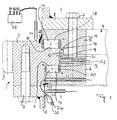
- large rolling bearing 1 is typically used in a crane whose superstructure rotatably supports it to the undercarriage. It comprises an outer bearing ring 2, which has an external toothing 3, and an inner bearing ring 4, which is formed in two parts and comprises an upper ring 5 and a lower ring 6.
- the outer bearing ring 2 is fastened to the connecting flange 8 by means of a plurality of screws 7 which are distributed over the circumference of the bearing ring.
- the inner bearing ring 4 is fastened in a corresponding manner by means of a plurality of screws 7 on the connecting flange 8 of the bearing member bearing the inner bearing ring 4, wherein the screws 7 can simultaneously serve the connection of the upper ring 5 and lower ring 6, but need not.
- the screws 7 extend parallel to the axis of rotation of the large rolling bearing. 1
- the outer bearing ring 2 has a radially inwardly projecting shoulder 9, on whose upper and lower sides in each case a radial tread 10, 11 and on the inner peripheral surface of a peripheral tread 12 is formed.
- the paragraph 9 protrudes into an overall groove-shaped, circumferentially circumferential recess 13, which is formed in the inner bearing ring 4, more precisely in its outer peripheral surface.
- the recess 13 has on its upper and lower flanks radial treads 14 and 15 and at its bottom a circumferential tread 16, each of the tread 10 and 11 and 12 opposite the shoulder 9.
- FIG. 1 shows, run between the treads 10 and 14 and 11 and 15 cylindrical rolling elements 17 and 18, which form a thrust bearing, and between the circumferential surfaces 12 and 16 also cylindrical rolling elements 19, which cause a radial support and form a radial bearing.
- the rolling elements can be held in a conventional manner by a cage 20 in position.
- the bearing gap 21 between the two bearing rings 2 and 4 may be sealed by seals 22 to the outside, so that the storage space is protected against external influences.
- the monitoring device assigned to the large rolling bearing 1 comprises four non-contact distance measuring sensors S1, S2, S3 and S4.
- the two displacement sensors S1 and S2 are arranged in the interior of the inner bearing ring 4 and each extending in the radial direction.
- the head of the sensors S1 and S2 projects in the bearing gap 21 before or ends at this.
- the sensors S1 and S2 scan circumferential surfaces of the outer bearing ring 2, which limit the bearing gap 21 partially.
- the Wegmesssensor S1 thereby scans a cylindrical peripheral surface 23 between the two rows of rolling elements 17 and 18.
- the second displacement sensor S2, however, scans an inclined peripheral surface of the outer bearing ring 2, which is slightly conical, such as FIG. 1 shows.
- the cone angle of the conical peripheral surface 24 is preferably less than 25 °.
- the axial movement occurring can be determined from the difference between the signals of the two distance measuring sensors S1 and S2 in addition to the radial movements between the two bearing rings 2 and 4, specifically over the conical peripheral surface 24, whose inclination is known.
- the two sensors S1 and S2 are connected to the evaluation unit 25, which subtracts the signals from each other on the one hand, in addition to the radial movements to determine the axial movements, and on the other hand with predetermined limits compared to determine wear and display can. From the determined via the sensors S1 and S2 radial and axial movements of the tilting clearance of the two bearing rings 2 and 4 can be determined to each other.
- this tilting game is a measure of the condition of the camp.
- both wear and deformation of the bearing rings show up as Kippspielveriere.
- Wegmesssensoren S3 and S4 may be provided outside the bearing gap 21 Wegmesssensoren S3 and S4.
- one of the distance measuring sensors detects movements of a surface perpendicular to the sensor direction, while the other sensor detects movements of an inclined surface.
- the Sensor S4 is axially, that is arranged parallel to the axis of rotation of large roller bearing 1 and detected immediately axial movements of the outer bearing ring 2 in the screwed therein screws 7.
- the Wegmesssensor S3 is arranged radially and detects radial movements of the tapered inner peripheral surface 26 of the outer bearing ring 2 holding bearing flange. Again, in the manner described by subtraction between the two sensor signals in addition to the immediately detected axial play and the radial clearance can be detected.
- the tilt play can be determined.
- the evaluation unit 25 compares this tilting clearance with limit values which can be predefined in order to determine the bearing state on the basis of this comparison.
- the determination of the tilting play is also particularly advantageous here, since an increased elongation of the screws in the axial direction increases the tilt play.
- FIG. 1 shown arrangement of the sensors can also be changed.
- FIG. 2 shows, for example, the two sensors S1 and S2, the inner peripheral surface of the radially inwardly projecting paragraph 9 scan.
- the sensor S1 scans a cylindrical peripheral surface
- the sensor S2 scans a conical peripheral surface. This allows in the described manner in addition to the determination of radial clearance and the determination of axial play, from which in turn the tilting play can be determined and is comparable with corresponding limit values.
- the slewing bearing can be designed differently.
- the axial support and the radial support can be effected by the same rolling elements, especially when the large rolling bearing 1 is designed as a ball bearing.
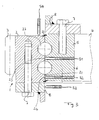
- the large roller bearing 1 may be formed as a double-row ball bearing.
- the outer bearing ring 2 and on the other hand in the inner bearing ring 4 are formed in each case two approximately semicircular treads in cross-section (see. FIG. 3 ), which together form the running surfaces for the rolling elements 27 designed as balls.
- the arrangement of the sensors S1 to S4 substantially corresponds to that described above.
- the slewing bearing 1 can also be formed single row.
- the large roller bearing is designed as a single-row ball bearing.
- the arrangement of the sensors S1 to S4 substantially corresponds to that described above.
Landscapes
- Engineering & Computer Science (AREA)
- General Engineering & Computer Science (AREA)
- Mechanical Engineering (AREA)
- Physics & Mathematics (AREA)
- General Physics & Mathematics (AREA)
- Rolling Contact Bearings (AREA)
Description
- Die vorliegende Erfindung betrifft eine Vorrichtung umfassend ein Großwälzlager und eine Überwachungsvorrichtung zur Überwachung des Großwälzlagers, das zwei Lagerringe und zwischen diesen laufende Wälzkörper aufweist, wobei die Überwachungsvorrichtung einen Sensor zur Erfassung von Relativbewegungen der Lagerringe zueinander umfasst.
- Großwälzlager zeichnen sich in der Regel dadurch aus, dass die Mittenbohrung des inneren Lagerrings normalerweise im wesentlichen frei bleibt und nicht auf einer im wesentlichen massiven Welle sitzt. Wenigstens einer der Lagerringe wird über parallel zur Drehachse des Lagers angeordnete Schraubverbindungen mit einem Anschlussflansch des den Lagerring tragenden Bauteils verbunden. Solche Großwälzlager werden ein- oder mehrreihig mit verschiedenen Wälzkörpern wie Kugeln, Wälzzylindern, Wälzkegeln etc. ausgeführt und finden insbesondere bei Kranen, Baggern, Tagebauabraumgeräten oder Windenergieanlagen Verwendung.
- Solche Großwälzlager müssen in einem regelmäßigen Zyklus einer Inspektion unterzogen werden, bei der aus sicherheitstechnischen Gründen die Laufbahnen auf Verschleiß und Ausbrüche untersucht werden sowie die Übergangsradien auf mögliche Risse überprüft werden. Herkömmlicherweise werden diese Inspektionen bei geöffnetem Großwälzlager durchgeführt, was wiederum die Demontage des Lagers aus dem Kran erforderlich macht. Es versteht sich, dass diese Demontage des Lagers zum Zwecke der Inspektion sehr aufwendig ist und zudem den Kran für eine geraume Zeit außer Betrieb setzt.
- Es wurde daher in jüngerer Zeit vorgeschlagen, in das Großwälzlager sogenannte Wirbelstromsensoren einzubauen, von denen ein hochfrequentes Magnetfeld ausgeht, welches in den Laufbahnen und Radien des Großwälzlagers Wirbelstrom induziert. Die entstehenden Magnetfelder werden durch Laufbahnverschleiß, Risse und dergleichen beeinflusst, so dass durch Messung des Magnetfeldes eine Aussage über den Verschleißzustand der Lagerflächen gemacht werden kann (vgl. Technische Mitteilungen Krupp, Ausgabe April 1993).
- Weiterhin ist aus der
DE 197 55 000 C1 eine Verschleißmessvorrichtung für Großwälzlager bekannt, die eine in einem Lagerring aufgenommene Sonde besitzt, die mit ihrem Ende in einen Lagerhohlraum ragt und zum gegenüberliegenden Lagerring vorspringt. In diesem ist eine Nut vorgesehen, in der der Kopf der Sonde bei verschleißfreiem Zustand des Lagers berührungslos läuft. Erleidet das Lager hingegen einen vorgegebenen Verschleiß, berührt der Sondenkopf die Oberfläche des gegenüberliegenden Lagerrings, wodurch ein Kontakt geschlossen wird und ein entsprechendes Signal erzeugt wird. Obwohl diese bekannte Verschleißmessvorrichtung übermäßigen Verschleiß auch ohne Öffnen des Großwälzlagers erkennen kann, wäre es wünschenswert, den Lagerzustand präziser angeben zu können. - Ferner beschreiben die Schriften
US 5,955,880 ,US 5,336,996 undDE 101 07 067 A1 jeweils Lagerüberwachungssysteme, die über berührungslose Sensoren einerseits axiale Lagerbewegungen und andererseits radiale Lagerbewegungen erfassen und diese jeweils mit Grenzwerten vergleichen, um übermäßigen Lagerverschleiß zu erfassen. - Der vorliegenden Erfindung liegt daher die Aufgabe zugrunde, eine verbesserte Überwachungsvorrichtung der eingangs genannten Art zu schaffen, die Nachteile des Standes der Technik vermeidet und letzteren in vorteilhafter Weise weiterbildet. Vorzugsweise soll eine präzisere und differenziertere Aussage über den Lagerzustand getroffen werden können.
- Erfindungsgemäß wird diese Aufgabe durch eine Vorrichtung gemäß Anspruch 1 gelöst. Bevorzugte Ausgestaltungen der Erfindung sind Gegenstand der abhängigen Ansprüche.
- Erfindungsgemäß besitzt die Überwachungsvorrichtung also zumindest zwei berührungslose Wegmesssensoren, von denen einer zur Bestimmung von Radialbewegungen und einer zur Bestimmung von Axialbewegungen der beiden Lagerringe relativ zueinander vorgesehen ist, sowie eine mit den Wegmesssensoren verbindbare Auswerteeinheit, die die bestimmten Radial- und Axialbewegungen mit vorgegebenen Grenzwerten vergleicht und anhand des Vergleichs den Lagerzustand bestimmt. Dabei wird anhand der bestimmten Radial- und Axialbewegungen das Kippspiel der beiden Lagerringe überwacht bzw. bestimmt und mit einem vorgegebenen Grenzwert verglichen, wobei anhand dieses Vergleichs der Lagerzustand bestimmt und angezeigt wird. Das Kippspiel der Lagerringe entspricht dabei der örtlichen axialen Bewegung der sich drehenden Teile in der Momentenebene und ist ein sicheres Maß für Verschleiß, Verformung oder Fehler wie Risse und dergleichen der Lagerringe. Auch Veränderungen in den Befestigungsschrauben der Lagerringe können über das Kippspiel erfasst werden, da eine vergrößerte Schraubendehnung in axialer Richtung das Kippspiel erhöht. Vorteilhafterweise können die beiden Wegmesssensoren voneinander beabstandet angeordnet sein und unterschiedliche Abschnitte des jeweiligen Lagerrings berührungslos abtasten, so dass eine sichere Aussage über das Kippspiel des Lagers abgeleitet werden kann. Die beiden Wegmesssensoren der Überwachungsvorrichtung sowie die zugehörige Auswerteeinheit bilden sozusagen eine Kippspiel-Erfassungsvorrichtung, mit Hilfe derer das Kippspiel der Lagerringe erfasst bzw. bestimmt werden kann. Die berührungslos arbeitenden Wegmesssensoren erleiden dabei keinerlei Verschleiß. Gegenüber Ein-/Aus-Tastern erlauben die Wegmesssensoren nicht nur die Anzeige eines kritischen Lagerverschleißes, sondern vielmehr eine qualifizierte Differenzierung des Verschleißzustands dahingehend, dass angezeigt werden kann, wie weit der Verschleiß vom kritischen Verschleiß noch weg ist bzw. inwieweit Verschleiß in nennenswertem Umfang überhaupt bereits aufgetreten ist.
- Um eine kompakte Anordnung der Wegmesssensoren zu erreichen, können in Weiterbildung der Erfindung beide Wegmesssensoren Bewegungen in derselben Richtung messen, so dass beide Wegmesssensoren parallel zueinander ausgerichtet werden können. Um dennoch sowohl Axial- als auch Radialbewegungen der Lagerringe bestimmen zu können, kann hierbei ein Wegmesssensor eine zu der genannten Bewegungsrichtung senkrechte Messfläche abtasten, während der andere Wegmesssensor eine zu der Bewegungsrichtung keilförmig geneigte Schrägfläche abtastet. Die Auswerteeinheit bestimmt die Bewegungen senkrecht zu der genannten einen Bewegungsrichtung aus der Differenz der beiden Sensorsignale. Bei dieser Ausführung werden also Bewegungen in einer Richtung direkt erfasst, während Bewegungen in der Richtung senkrecht hierzu indirekt erfasst werden.
- Die beiden Wegmesssensoren sind vorzugsweise in einer gemeinsamen Ebene angeordnet, die vorzugsweise die Drehachse des Lagers enthalten kann. Die Anordnung in einer gemeinsamen Ebene schließt bei der Wegerfassung über den Umfang mögliche Ungleichmäßigkeiten in der Bewegung aus und bewirkt eine erhöhte Messgenauigkeit. Die Differenzbildung des an der Schrägfläche erzeugten Sensorsignals und des an der senkrechten Messfläche erzeugten Sensorsignals kann frei von Störeinflüssen erfolgen.
- Eine besonders geschützte und kompakte Anordnung kann dadurch erreicht werden, dass die beiden Wegmesssensoren radial ausgerichtet sind und Umfangsflächen der Lagerringe abtasten, wobei die beiden Sensoren vorzugsweise im Inneren eines Lagerrings angeordnet sind. Grundsätzlich wäre es auch denkbar, die Wegmesssensoren axial anzuordnen und Radialflächen der Lagerringe abzutasten. Die radiale Anordnung mit Abtastung von Umfangsflächen besitzt jedoch den Vorteil, dass mehr Platz zur Verfügung steht und die Wegmesssensoren nicht mit den Wälzkörpern kollidieren. Großwälzlager bilden regelmäßig Axiallager, so dass entsprechende auf radialen Lagerflächen laufende Wälzkörper vorgesehen sind.
- Insbesondere können die beiden Sensoren im inneren Lagerring angeordnet sein und eine Innenumfangsfläche des äußeren Lagerrings abtasten, wobei der Kopf der Sensoren vorzugsweise im abgedichteten Lagerspalt des Großwälzlagers angeordnet ist. Bei Großwälzlagern für Krane ist regelmäßig der äußere Lagerring mit einer Außenverzahnung versehen, mit der ein Antriebsritzel des Drehwerks des Krans kämmt. Die Anordnung der Sensoren im inneren Lagerring besitzt dabei den Vorteil, dass die Messsensoren nicht mit der Verzahnung kollidieren.
- Es versteht sich jedoch, dass die Sensoranordnung auch im umgekehrten Fall Verwendung finden kann, wenn das Großwälzlager eine Innenverzahnung aufweist. In diesem Fall sind die beiden Sensoren sozusagen spiegelbildlich, vorteilhafterweise im äußeren Lagerring, angeordnet und tasten eine Außenumfangsfläche des inneren Lagerringes ab.
- Sind beide Sensoren radial angeordnet, tastet vorteilhafterweise einer der beiden Wegsensoren eine konische Ringumfangsfläche ab, während der andere eine zylindrische Ringumfangsfläche abtastet. Die Neigung der Schrägfläche gegenüber der senkrechten Fläche, auf die der andere Sensor gerichtet ist, kann unterschiedlich gewählt werden und nach einer Ausführung der Erfindung 20° oder weniger betragen.
- In Weiterbildung der Erfindung bestimmt die Überwachungsvorrichtung nicht nur im Lagerspalt das Spiel der beiden Lagerringe relativ zueinander, sondern überwacht auch Bewegungen der Lagerringe, insbesondere deren Kippspiel, außerhalb des Lagerspalts. In Weiterbildung der Erfindung kann hierzu zumindest ein weiterer berührungsloser Wegmesssensor vorgesehen sein, mit Hilfe dessen axiale Bewegungen des Lagerrings im Bereich seines Befestigungsabschnitts, insbesondere am Anschlussflansch, an dem der Lagerring befestigt ist, bestimmt werden kann. Die Auswerteeinheit vergleicht die mit Hilfe des Wegmesssensors bestimmten Bewegungen des Lagerrings mit vorgegebenen Grenzwerten und kann in Abhängigkeit des Vergleichs den Zustand der Befestigung, insbesondere der Schraubenbefestigung des Lagerrings am Anschlussflansch, bestimmen und anzeigen.
- Der genannte weitere Wegmesssensor kann dabei die axialen Bewegungen des Lagerrings außerhalb des Lagerspalts direkt messen. In diesem Fall ist der Wegmesssensor in axialer Richtung ausgerichtet und auf eine radiale Fläche des Lagerrings bzw. eines damit verbundenen Ringteils gerichtet.
- Alternativ oder zusätzlich kann ein in radialer Richtung ausgerichteter Wegmesssensor vorgesehen sein, der auf eine zur radialen Richtung spitzwinklig geneigten Schrägfläche Bewegungen des Lagerrings in radialer Richtung misst. Über die spitzwinklig geneigte Schrägfläche kann aus den erfassten Radialbewegungen die entsprechenden Axialbewegungen des Lagerrings relativ zum Anschlussflansch von der Auswerteeinheit bestimmt werden.
- Die Erfindung wird nachfolgend anhand bevorzugter Ausführungsbeispiele und zugehöriger Zeichnungen näher erläutert. In den Zeichnungen zeigen:
- Fig. 1:
- einen ausschnittsweisen Axialschnitt durch ein Großwälzlager mit einer diesem zugeordneten Überwachungsvorrichtung nach einer bevorzugten Ausführung der Erfindung,
- Fig. 2:
- eine vergrößerte, ausschnittsweise Axialschnittansicht eines Großwälzlagers ähnlich
Fig. 1 mit einer alternativen Anordnung der Wegmesssensoren S1 und S2, - Fig. 3:
- einen Axialschnitt durch ein Großwälzlager mit einer zugeordneten Überwachungsvorrichtung nach einer weiteren Ausführung der Erfindung, und
- Fig. 4:
- einen ausschnittsweisen Axialschnitt durch ein Großwälzlager mit einer diesem zugeordneten Überwachungsvorrichtung nach einer weiteren bevorzugten Ausführung der Erfindung.
- Das in
Figur 1 gezeigte Großwälzlager 1 findet typischerweise in einem Kran Verwendung, dessen Oberwagen es drehbar zu dessen Unterwagen lagert. Es umfasst einen äußeren Lagerring 2, der eine Außenverzahnung 3 aufweist, sowie einen inneren Lagerring 4, der zweiteilig ausgebildet ist und einen Oberring 5 und einen Unterring 6 umfasst. - Der äußere Lagerring 2 ist mittels einer Vielzahl von Schrauben 7, die über den Umfang des Lagerrings verteilt sind, am Anschlussflansch 8 befestigt. Der innere Lagerring 4 ist in entsprechender Weise mittels einer Vielzahl von Schrauben 7 am Anschlussflansch 8 des den inneren Lagerring 4 tragenden Bauteils befestigt, wobei die Schrauben 7 gleichzeitig der Verbindung von Oberring 5 und Unterring 6 dienen können, jedoch nicht müssen. Die Schrauben 7 erstrecken sich parallel zur Drehachse des Großwälzlagers 1.
- Wie
Figur 1 zeigt, besitzt der äußere Lagerring 2 einen radial nach innen vorspringenden Absatz 9, an dessen Ober- und Unterseiten jeweils eine radiale Lauffläche 10, 11 und an dessen Innenumfangsfläche eine Umfangslauffläche 12 ausgebildet ist. Der Absatz 9 springt dabei in eine insgesamt nutförmige, in Umfangsrichtung umlaufende Ausnehmung 13 vor, die in dem inneren Lagerring 4, genauer gesagt in dessen äußeren Umfangsfläche, ausgebildet ist. Die Ausnehmung 13 besitzt an ihren oberen und unteren Flanken radiale Laufflächen 14 und 15 sowie an ihrem Grund eine Umfangslauffläche 16, die jeweils den Lauffläche 10 und 11 bzw. 12 am Absatz 9 gegenüberliegen. WieFigur 1 zeigt, laufen zwischen den Laufflächen 10 und 14 bzw. 11 und 15 zylindrische Wälzkörper 17 und 18, die ein Axiallager bilden, sowie zwischen den Umfangslaufflächen 12 und 16 ebenfalls zylindrische Wälzkörper 19, die eine radiale Abstützung bewirken und ein Radiallager bilden. Die Wälzkörper können in an sich bekannter Weise durch einen Käfig 20 in Position gehalten werden. Der Lagerspalt 21 zwischen den beiden Lagerringen 2 und 4 kann durch Dichtungen 22 nach außen hin abgedichtet sein, so dass der Lagerraum gegen äußere Einflüsse geschützt ist. - Die dem Großwälzlager 1 zugeordnete Überwachungsvorrichtung umfasst in der gezeichneten Ausführungsform vier jeweils berührungslos arbeitende Wegmesssensoren S1, S2, S3 und S4. Die beiden Wegmesssensoren S1 und S2 sind dabei im Inneren des inneren Lagerrings 4 angeordnet und erstrecken sich jeweils in radialer Richtung. Der Kopf der Sensoren S1 und S2 springt dabei in den Lagerspalt 21 vor bzw. endet an diesem. Die Sensoren S1 und S2 tasten Umfangsflächen des äußeren Lagerrings 2 ab, die den Lagerspalt 21 partiell begrenzen. Wie
Figur 1 zeigt, tastet der Wegmesssensor S1 dabei eine zylindrische Umfangsfläche 23 zwischen den beiden Wälzkörperreihen 17 und 18 ab. Der zweite Wegmesssensor S2 tastet hingegen eine schräge Umfangsfläche des äußeren Lagerrings 2 ab, die leicht konisch ausgebildet ist, wieFigur 1 zeigt. Der Kegelwinkel der konischen Umfangsfläche 24 beträgt vorzugsweise weniger als 25°. - Obwohl die beiden Wegmesssensoren S1 und S2 radialen Versatz zwischen den beiden Lagerringen 2 und 4 messen, kann aus der Differenz der Signale der beiden Wegmesssensoren S1 und S2 zusätzlich zu den Radialbewegungen zwischen den beiden Lagerringen 2 und 4 auch die auftretende Axialbewegung bestimmt werden, und zwar über die kegelige Umfangsfläche 24, deren Neigung bekannt ist. Die beiden Sensoren S1 und S2 sind mit der Auswerteeinheit 25 verbunden, die die Signale einerseits voneinander subtrahiert, um neben den Radialbewegungen auch die Axialbewegungen zu bestimmen, und andererseits mit vorgegebenen Grenzwerten vergleicht, um Verschleiß zu bestimmen und anzeigen zu können. Aus den über die Sensoren S1 und S2 bestimmten Radial- und Axialbewegungen kann das Kippspiel der beiden Lagerringe 2 und 4 zueinander bestimmt werden. Insbesondere dieses Kippspiel ist ein Maß für den Zustand des Lagers. Einerseits zeigen sich sowohl Verschleiß wie auch Verformung der Lagerringe als Kippspielvergrößerungen. Zum anderen erhöhen Fehler im Bauteil, wie z. B. Risse, das Kippspiel.
- Wie
Figur 1 zeigt, können weiterhin auch außerhalb des Lagerspalts 21 angeordnete Wegmesssensoren S3 und S4 vorgesehen sein. Auch hier erfasst einer der Wegmesssensoren Bewegungen einer zur Sensorrichtung senkrecht stehenden Fläche, während der andere Sensor Bewegungen einer Schrägfläche erfasst. Der Sensor S4 ist axial, d.h. parallel zur Drehachse des Großwälzlagers 1 angeordnet und erfasst unmittelbar Axialbewegungen des äußeren Lagerrings 2 im Bereich der darin eingeschraubten Schrauben 7. Der Wegmesssensor S3 hingegen ist radial angeordnet und erfasst radiale Bewegungen der kegeligen Innenumfangsfläche 26 des den äußeren Lagerring 2 haltenden Lagerflansches. Auch hier kann in der beschriebenen Weise durch Differenzbildung zwischen den beiden Sensorsignalen zusätzlich zu dem unmittelbar erfassten Axialspiel auch das Radialspiel erfasst werden. Hieraus kann in Verbindung mit der bekannten Geometrie der Sensoranordnung das Kippspiel bestimmt werden. Die Auswerteeinheit 25 vergleicht dieses Kippspiel mit Grenzwerten, die vorgebbar sind, um anhand dieses Vergleichs den Lagerzustand zu bestimmen. Die Bestimmung des Kippspiels ist auch hier besonders vorteilhaft, da eine vergrößerte Dehnung der Schrauben in axialer Richtung das Kippspiel vergrößert. - Es versteht sich, dass die in
Figur 1 gezeigte Anordnung der Sensoren auch abgeändert werden kann. WieFigur 2 zeigt, können beispielsweise die beiden Sensoren S1 und S2 die Innenumfangsfläche des radial nach innen vorspringenden Absatzes 9 abtasten. Auch hier tastet der Sensor S1 eine zylindrische Umfangsfläche ab, während der Sensor S2 eine kegelige Umfangsfläche abtastet. Dies ermöglicht in der beschriebenen Weise neben der Bestimmung von Radialspiel auch die Bestimmung von Axialspiel, woraus wiederum das Kippspiel bestimmbar ist und mit entsprechenden Grenzwerten vergleichbar ist. - Weiterhin versteht es sich, dass das Großwälzlager verschieden ausgebildet sein kann. Wie
Figur 3 zeigt, kann die axiale Abstützung und die radiale Abstützung durch dieselben Wälzkörper bewirkt werden, insbesondere dann, wenn das Großwälzlager 1 als Kugellager ausgebildet ist. WieFigur 3 zeigt, kann das Großwälzlager 1 als zweireihiges Kugellager ausgebildet sein. Hierzu sind einerseits im äußeren Lagerring 2 und andererseits im inneren Lagerring 4 jeweils zwei im Querschnitt etwa halbkreisförmige Laufflächen ausgebildet (vgl.Figur 3 ), die zusammen die Laufflächen für die als Kugeln ausgebildete Wälzkörper 27 bilden. Die Anordnung der Sensoren S1 bis S4 entspricht im wesentlichen der zuvor beschriebenen. - Wie
Figur 4 zeigt, kann das Großwälzlager 1 auch einreihig ausgebildet sein. In der inFigur 4 gezeichneten Ausführung ist das Großwälzlager als einreihiges Kugellager ausgebildet. Die Anordnung der Sensoren S1 bis S4 entspricht im wesentlichen der zuvor beschriebenen.
Claims (11)
- Vorrichtung umfassend ein Großwälzlager (1) und eine Überwachungsvorrichtung zur Überwachung des Großwälzlagers (1), wobei das Großwälzlager (1) zwei Lagerringe (2, 4) und zwischen diesen laufende Wälzkörper (17, 18, 19; 27) aufweist, und wobei die Überwachungsvorrichtung einen Sensor (S1, S2, S3, S4) zur Erfassung von Relativbewegungen der Lagerringe (2, 4) zueinander aufweist, gekennzeichnet dadurch, dass die Überwachungsvorrichtung eine Kippspiel-Erfassungsvorrichtung zur Erfassung eines Kippspiels der beiden Lagerringe (2, 4) aufweist, die zumindest zwei berührungslose Wegmesssensoren (S1, S2), von denen einer zur Bestimmung von Radialbewegungen und einer zur Bestimmung von Axialbewegungen der Lagerringe (2, 4) relativ zueinander vorgesehen ist, sowie eine mit den Wegmesssensoren (S1, S2) verbindbare Auswerteeinheit (25) aufweist, wobei die Auswerteeinheit (25) dazu eingerichtet ist, aus den Sensorsignalen Kippspielbewegungen der beiden Lagerringe (2, 4) relativ zueinander zu bestimmen und die Kippspielbewegungen mit vorgegebenen Grenzwerten zu vergleichen und anhand des Vergleichs den Lagerzustand zu bestimmen.
- Vorrichtung nach dem vorhergehenden Anspruch, wobei beide Wegmesssensoren (S1, S2) dazu eingerichtet sind, Bewegungen in derselben Richtung zu messen, wobei ein Wegmesssensor (S1) dazu eingerichtet ist, eine zu der Bewegungsrichtung senkrechte Messfläche (23) abzutasten und der andere Wegmesssensor (S2) dazu eingerichtet ist, eine zu der Bewegungsrichtung keilförmig geneigte Schrägfläche (24) abzutasten, und die Auswerteeinheit (25) dazu eingerichtet ist, die Bewegungen senkrecht zu der genannten einen Bewegungsrichtung aus der Differenz der beiden Sensorsignale zu bestimmen.
- Vorrichtung nach einem der vorhergehenden Ansprüche, wobei die beiden Wegmesssensoren (S1, S2) in einer gemeinsamen Ebene enthaltend die Drehachse des Lagers angeordnet sind.
- Vorrichtung nach einem der vorhergehenden Ansprüche, wobei die beiden Wegmesssensoren (S1, S2) radial ausgerichtet sind und dazu eingerichtet sind, Umfangsflächen der Lagerringe (2, 4) abzutasten.
- Vorrichtung nach einem der vorhergehenden Ansprüche, wobei die beiden Wegmesssensoren (S1, S2) im Inneren eines Lagerrings (4) aufgenommen sind.
- Vorrichtung nach einem der vorhergehenden Ansprüche, wobei die beiden Wegmesssensoren (S1, S2) im inneren Lagerring (4) angeordnet sind und dazu eingerichtet sind, eine Innenumfangsfläche des äußeren Lagerrings (2) abzutasten.
- Vorrichtung nach einem der Ansprüche 1 bis 5, wobei die beiden Wegmesssensoren (S1, S2) im äußeren Lagerring (2) angeordnet sind und dazu eingerichtet sind, eine Außenumfangsfläche des inneren Lagerrings (4) abzutasten.
- Vorrichtung nach einem der vorhergehenden Ansprüche, wobei einer der beiden Wegmesssensoren (S2) dazu eingerichtet ist, eine konische Ringumfangsfläche abzutasten und der andere Wegmesssensor (S1) dazu eingerichtet ist, eine zylindrische Ringumfangsfläche abzutasten.
- Vorrichtung nach Anspruch 3 oder einem der darauf zurückbezogenen Ansprüche, wobei die Schrägfläche (24) gegenüber der senkrechten Fläche (23) um 25° oder weniger geneigt ist.
- Vorrichtung nach einem der vorhergehenden Ansprüche, wobei zumindest ein Wegmesssensor (S3, S4) außerhalb eines Lagerspalts (21) zwischen den beiden Lagerringen (2, 4) angeordnet ist.
- Vorrichtung nach einem der vorhergehenden Ansprüche, wobei zumindest ein Wegmesssensor (S3) in axialer Richtung parallel zur Drehachse des Großwälzlagers angeordnet ist und dazu eingerichtet ist, Axialbewegungen eines Lagerrings zu erfassen.
Applications Claiming Priority (2)
| Application Number | Priority Date | Filing Date | Title |
|---|---|---|---|
| DE20316544U | 2003-10-28 | ||
| DE20316544U DE20316544U1 (de) | 2003-10-28 | 2003-10-28 | Überwachungsvorrichtung zur Überwachung von Großwälzlagern |
Publications (3)
| Publication Number | Publication Date |
|---|---|
| EP1528356A2 EP1528356A2 (de) | 2005-05-04 |
| EP1528356A3 EP1528356A3 (de) | 2006-03-01 |
| EP1528356B1 true EP1528356B1 (de) | 2015-01-28 |
Family
ID=34306478
Family Applications (1)
| Application Number | Title | Priority Date | Filing Date |
|---|---|---|---|
| EP04025540.8A Expired - Lifetime EP1528356B1 (de) | 2003-10-28 | 2004-10-27 | Vorrichtung zur Überwachung von Grosswälzlagern |
Country Status (2)
| Country | Link |
|---|---|
| EP (1) | EP1528356B1 (de) |
| DE (1) | DE20316544U1 (de) |
Cited By (8)
| Publication number | Priority date | Publication date | Assignee | Title |
|---|---|---|---|---|
| DE102020103421A1 (de) | 2020-02-11 | 2021-08-12 | Liebherr-Components Biberach Gmbh | Wälzlager mit Überwachungsvorrichtung |
| US11204067B2 (en) * | 2019-11-19 | 2021-12-21 | Aktiebolaget Skf | Bearing with distance sensors and tapered grooves |
| US11300160B2 (en) * | 2019-11-25 | 2022-04-12 | Aktiebolaget Skf | Bearing with gliding target and associated sensor |
| US11306783B2 (en) * | 2019-11-19 | 2022-04-19 | Aktiebolaget Skf | Bearing with distance sensors and tapered groove |
| US11371562B2 (en) | 2019-11-25 | 2022-06-28 | SKF Aerospace France S.A.S | Bearing with distance measuring system and associated groove |
| WO2024023119A1 (en) | 2022-07-26 | 2024-02-01 | Itrec B.V. | Slew bearing with load monitoring |
| WO2025012314A1 (de) | 2023-07-11 | 2025-01-16 | Liebherr-Components Biberach Gmbh | GROßWÄLZLAGER SOWIE VERFAHREN UND VORRICHTUNG ZUR ÜBERWACHUNG EINES SOLCHEN GROßWÄLZLAGERS |
| WO2026041202A1 (en) * | 2024-08-23 | 2026-02-26 | Vestas Wind Systems A/S | A wind turbine |
Families Citing this family (34)
| Publication number | Priority date | Publication date | Assignee | Title |
|---|---|---|---|---|
| DE102004052598A1 (de) * | 2004-10-29 | 2006-05-04 | Aktiebolaget Skf | Windenergieanlage |
| KR101022104B1 (ko) * | 2005-05-31 | 2011-03-17 | 미츠비시 쥬고교 가부시키가이샤 | 풍력 터빈용 선회 베어링 구조체 및 풍력 발전 장치 |
| CN101410616A (zh) * | 2006-04-02 | 2009-04-15 | 维斯塔斯风力系统有限公司 | 用于风轮机的俯仰轴承,风轮机以及维护轴承的方法 |
| DE202007002609U1 (de) * | 2007-02-19 | 2008-04-03 | Landwehr, Markus | Drehverbindung |
| DE102007013160B4 (de) | 2007-03-20 | 2008-12-04 | ThyssenKrupp Fördertechnik GmbH | Verfahren und Einrichtung zur Kontrolle der Laufbahnen von Großwälzlagern |
| DE102007032972B4 (de) * | 2007-07-16 | 2015-08-06 | Knorr-Bremse Systeme für Nutzfahrzeuge GmbH | Messvorrichtung und Verfahren zur Erfassung einer axialen Verschiebung einer Welle |
| DE102008008727A1 (de) | 2008-02-12 | 2009-08-13 | Schaeffler Kg | Lager mit Positionsgeber |
| DE102008026081A1 (de) | 2008-05-30 | 2009-12-31 | Schaeffler Kg | Lagervorrichtung mit Positionsgeber |
| US8002472B2 (en) * | 2008-06-30 | 2011-08-23 | Nucor Corporation | Slew bearing system |
| DE102008046357A1 (de) | 2008-09-09 | 2010-03-11 | Schaeffler Kg | Sensoranordnung zur Bestimmung einer Kenngröße für den Verschleiß eines Wälzlagers und Windkraftanlage |
| DE102009039030A1 (de) * | 2009-08-28 | 2011-03-03 | Prüftechnik Dieter Busch AG | Vorrichtung und Verfahren zur Erfassung der Belastung drehbar gelagerter Rotorblätter |
| CN102072259A (zh) * | 2011-01-24 | 2011-05-25 | 南京工大数控科技有限公司 | 一种内植传感器的智能回转支承 |
| DE102012211566A1 (de) * | 2012-07-03 | 2014-01-09 | Wobben Properties Gmbh | Überwachte Bauteilverbindung, Windenergieanlage, Verfahren zur Überwachung einer Bauteilverbindung auf ein ungewolltes Lösen der Bauteilverbindung im verbundenen Zustand |
| DE102012024269A1 (de) * | 2012-12-12 | 2014-06-12 | Imo Holding Gmbh | Momentenlager mit Abstandssensorik |
| EP2743522A1 (de) * | 2012-12-12 | 2014-06-18 | IMO Holding GmbH | Momenten- oder (Groß-)Wälzlager oder Drehverbindung mit Abstandssensor (en) |
| DE102013010500B4 (de) | 2013-06-25 | 2018-12-27 | Imo Holding Gmbh | Mit Federdrucksystem ausgestattete Lageranordnung |
| WO2014206383A1 (de) | 2013-06-25 | 2014-12-31 | Imo Holding Gmbh | Federdrucksystem für lageranordnung und damit ausgestattete lageranordnung |
| DE102016116113A1 (de) * | 2016-08-30 | 2018-03-01 | Thyssenkrupp Ag | Lager und Verfahren zur Verschleißüberwachung und/oder Lastmessung |
| CN106979755A (zh) * | 2017-03-31 | 2017-07-25 | 武汉理工大学 | 汽车水泵轴承轴向游隙自动测量仪 |
| PL3483581T3 (pl) | 2017-11-08 | 2020-07-13 | Schaeffler Monitoring Services Gmbh | Sposób i urządzenie do kontrolowania luzu łożyskowego łożysk tocznych |
| DE102018200573A1 (de) * | 2018-01-15 | 2019-07-18 | Zf Friedrichshafen Ag | Schwenkantrieb mit Zustandsüberwachung |
| CN109470192A (zh) * | 2018-12-18 | 2019-03-15 | 南京磁谷科技有限公司 | 一种电磁轴承轴向传感器的安装结构 |
| CN109915492A (zh) * | 2019-04-23 | 2019-06-21 | 中铁工程服务有限公司 | 一种盾构机主轴承监测装置 |
| DE102019216422A1 (de) * | 2019-10-24 | 2021-04-29 | Aktiebolaget Skf | Wälzlager mit einem Ultraschallabstandssensor |
| US10975908B1 (en) | 2019-10-29 | 2021-04-13 | Schaeffler Monitoring Services Gmbh | Method and device for monitoring a bearing clearance of roller bearings |
| DE102020200032A1 (de) * | 2020-01-03 | 2021-07-08 | Thyssenkrupp Ag | Wälzlager mit Positionsbestimmungseinrichtung |
| DE102020206360A1 (de) * | 2020-05-20 | 2021-11-25 | Aktiebolaget Skf | Wirbelstromsonde, insbesondere für ein Wälzlager |
| DE102020206785B4 (de) | 2020-05-29 | 2024-02-15 | Thyssenkrupp Ag | Wälzlager mit einem Sensor und Montagewerkzeug |
| DE102020128097A1 (de) * | 2020-10-26 | 2022-04-28 | Aktiebolaget Skf | Wälzlageranordnung |
| DE102021100222A1 (de) | 2021-01-08 | 2022-07-14 | Schaeffler Technologies AG & Co. KG | Verfahren zur Herstellung von verschiedenen Varianten einer Baureihe von Rundachslagern |
| CN114033794B (zh) * | 2021-11-16 | 2022-11-15 | 武汉理工大学 | 一种回转支承运行状态在线监测装置 |
| DE102022200165A1 (de) * | 2022-01-10 | 2023-07-13 | Aktiebolaget Skf | Wälzlageranordnung |
| CN115681347A (zh) * | 2022-03-24 | 2023-02-03 | 于丽云 | 一种回转轴承磨损监测装置 |
| WO2026041203A1 (en) * | 2024-08-23 | 2026-02-26 | Vestas Wind Systems A/S | A method of inspecting a wind turbine |
Family Cites Families (8)
| Publication number | Priority date | Publication date | Assignee | Title |
|---|---|---|---|---|
| NL8503517A (nl) * | 1985-12-19 | 1987-07-16 | Skf Ind Trading & Dev | Zwenkring. |
| FR2680874B1 (fr) * | 1991-08-26 | 1995-03-24 | Roulements Soc Nouvelle | Circuits magnetiques. |
| DE4128807A1 (de) * | 1991-08-30 | 1993-03-04 | Hoesch Ag | Vorrichtung zum ueberwachen von waelzlagern |
| US5336996A (en) | 1992-08-21 | 1994-08-09 | The Duriron Company, Inc. | Hall effect monitoring of wear of bearing supporting a rotor within a stationary housing |
| US5955880A (en) | 1996-12-05 | 1999-09-21 | Beam; Palmer H. | Sealless pump rotor position and bearing monitor |
| DE19755000C1 (de) * | 1997-12-11 | 1999-03-04 | Krupp Ag Hoesch Krupp | Verschleißmessvorrichtung für Großwälzlager |
| DE19919007B4 (de) * | 1999-04-27 | 2005-03-24 | Fag Kugelfischer Ag | Einrichtung zum Messen von Lagerdaten |
| JP2001231217A (ja) | 2000-02-14 | 2001-08-24 | Teikoku Electric Mfg Co Ltd | キャンドモータの軸方向軸受摩耗検出装置 |
-
2003
- 2003-10-28 DE DE20316544U patent/DE20316544U1/de not_active Expired - Lifetime
-
2004
- 2004-10-27 EP EP04025540.8A patent/EP1528356B1/de not_active Expired - Lifetime
Cited By (14)
| Publication number | Priority date | Publication date | Assignee | Title |
|---|---|---|---|---|
| US11306783B2 (en) * | 2019-11-19 | 2022-04-19 | Aktiebolaget Skf | Bearing with distance sensors and tapered groove |
| US11204067B2 (en) * | 2019-11-19 | 2021-12-21 | Aktiebolaget Skf | Bearing with distance sensors and tapered grooves |
| US11371562B2 (en) | 2019-11-25 | 2022-06-28 | SKF Aerospace France S.A.S | Bearing with distance measuring system and associated groove |
| US11300160B2 (en) * | 2019-11-25 | 2022-04-12 | Aktiebolaget Skf | Bearing with gliding target and associated sensor |
| US12071984B2 (en) | 2020-02-11 | 2024-08-27 | Liebherr-Components Biberach Gmbh | Rolling bearing with monitoring device |
| WO2021160500A1 (de) | 2020-02-11 | 2021-08-19 | Liebherr-Components Biberach Gmbh | Wälzlager mit überwachungsvorrichtung |
| EP4365537A2 (de) | 2020-02-11 | 2024-05-08 | Liebherr-Components Biberach GmbH | Wälzlager mit überwachungsvorrichtung |
| DE102020103421A1 (de) | 2020-02-11 | 2021-08-12 | Liebherr-Components Biberach Gmbh | Wälzlager mit Überwachungsvorrichtung |
| WO2024023119A1 (en) | 2022-07-26 | 2024-02-01 | Itrec B.V. | Slew bearing with load monitoring |
| NL2032602B1 (en) | 2022-07-26 | 2024-02-05 | Itrec Bv | Slew bearing with load monitoring |
| EP4737845A2 (de) | 2022-07-26 | 2026-05-06 | Itrec B.V. | Drehlager mit lastüberwachung |
| WO2025012314A1 (de) | 2023-07-11 | 2025-01-16 | Liebherr-Components Biberach Gmbh | GROßWÄLZLAGER SOWIE VERFAHREN UND VORRICHTUNG ZUR ÜBERWACHUNG EINES SOLCHEN GROßWÄLZLAGERS |
| DE102023118260A1 (de) | 2023-07-11 | 2025-01-16 | Liebherr-Components Biberach Gmbh | Großwälzlager sowie Verfahren und Vorrichtung zur Überwachung eines solchen Großwälzlagers |
| WO2026041202A1 (en) * | 2024-08-23 | 2026-02-26 | Vestas Wind Systems A/S | A wind turbine |
Also Published As
| Publication number | Publication date |
|---|---|
| DE20316544U1 (de) | 2005-03-10 |
| EP1528356A2 (de) | 2005-05-04 |
| EP1528356A3 (de) | 2006-03-01 |
Similar Documents
| Publication | Publication Date | Title |
|---|---|---|
| EP1528356A2 (de) | Vorrichtung zur Überwachung von Grosswälzlagern | |
| EP3507513B1 (de) | Lager und verfahren zur verschleissüberwachung und/oder lastmessung | |
| EP0413119B1 (de) | Mittenfreies Grosswälzlager | |
| EP4081719B1 (de) | Wälzlager mit überwachungsvorrichtung | |
| DE102019218884B4 (de) | Großwälzlager und Verfahren zur Verschleißmessung | |
| DE102008016592A1 (de) | Messlager | |
| DE19640895B4 (de) | Wälzlager mit einer integrierten Drehzahlmeßeinrichtung | |
| DE102019217789A1 (de) | Lager mit Abstandssensoren und konischen Nuten | |
| WO2014090347A1 (de) | Momenten- oder wälzlageranordnung mit sensorik | |
| DE102017207814A1 (de) | Schwenklager mit Dichtungsanordnung | |
| DE102019216610A1 (de) | Lager mit optischem Sensor und zugehöriger Nut | |
| EP2743522A1 (de) | Momenten- oder (Groß-)Wälzlager oder Drehverbindung mit Abstandssensor (en) | |
| DE102007013160A1 (de) | Verfahren und Einrichtung zur Kontrolle der Laufbahnen von Großwälzlagern | |
| DE102006028294A1 (de) | Radiallageranordnung mit einer diese zentrierenden Spannringanordnung | |
| AT524361B1 (de) | Wälzlageranordnung | |
| EP1924834B1 (de) | Sensoranordnung | |
| EP4500040A1 (de) | Wälzlager mit einer ultraschallsensoranordnung zur überwachung von laufbahnschäden | |
| DE102022206188A1 (de) | System zum Bestimmen des Verschleißes eines Lagers und zugehöriges Verfahren | |
| DE102010005476B4 (de) | Verfahren und Vorrichtung zur Erfassung der Last in einem Wälzlager | |
| AT526890B1 (de) | Wälzlageranordnung | |
| DE10206679C1 (de) | Vorrichtung zum Messen einer Axialkraft an einer Achse oder Welle | |
| DE102021211491A1 (de) | System zum Bestimmen zumindest eines Defekts eines Lagers und zugehöriges Verfahren | |
| DE102004054410A1 (de) | Sensoranordnung in einem Pendellager | |
| DE2642044B1 (de) | Einrichtung zur bestimmung des statischen und/oder dynamischen axialschubes eines festlagers | |
| DE102016213589B3 (de) | Maschinenelementanordnung und Lageranordnung mit Messanordnung zum Messen einer Kraft oder eines Momentes |
Legal Events
| Date | Code | Title | Description |
|---|---|---|---|
| PUAI | Public reference made under article 153(3) epc to a published international application that has entered the european phase |
Free format text: ORIGINAL CODE: 0009012 |
|
| AK | Designated contracting states |
Kind code of ref document: A2 Designated state(s): AT BE BG CH CY CZ DE DK EE ES FI FR GB GR HU IE IT LI LU MC NL PL PT RO SE SI SK TR |
|
| AX | Request for extension of the european patent |
Extension state: AL HR LT LV MK |
|
| PUAL | Search report despatched |
Free format text: ORIGINAL CODE: 0009013 |
|
| AK | Designated contracting states |
Kind code of ref document: A3 Designated state(s): AT BE BG CH CY CZ DE DK EE ES FI FR GB GR HU IE IT LI LU MC NL PL PT RO SE SI SK TR |
|
| AX | Request for extension of the european patent |
Extension state: AL HR LT LV MK |
|
| RIC1 | Information provided on ipc code assigned before grant |
Ipc: F16C 19/52 20060101ALI20060111BHEP Ipc: G01B 21/16 20060101AFI20050120BHEP Ipc: G01B 11/14 20060101ALI20060111BHEP Ipc: G01M 13/04 20060101ALI20060111BHEP Ipc: G01B 7/14 20060101ALI20060111BHEP |
|
| 17P | Request for examination filed |
Effective date: 20060725 |
|
| AKX | Designation fees paid |
Designated state(s): AT BE BG CH CY CZ DE DK EE ES FI FR GB GR HU IE IT LI LU MC NL PL PT RO SE SI SK TR |
|
| RAP1 | Party data changed (applicant data changed or rights of an application transferred) |
Owner name: LIEBHERR-COMPONENTS BIBERACH GMBH |
|
| 17Q | First examination report despatched |
Effective date: 20120928 |
|
| GRAP | Despatch of communication of intention to grant a patent |
Free format text: ORIGINAL CODE: EPIDOSNIGR1 |
|
| INTG | Intention to grant announced |
Effective date: 20140916 |
|
| GRAS | Grant fee paid |
Free format text: ORIGINAL CODE: EPIDOSNIGR3 |
|
| GRAA | (expected) grant |
Free format text: ORIGINAL CODE: 0009210 |
|
| AK | Designated contracting states |
Kind code of ref document: B1 Designated state(s): AT BE BG CH CY CZ DE DK EE ES FI FR GB GR HU IE IT LI LU MC NL PL PT RO SE SI SK TR |
|
| REG | Reference to a national code |
Ref country code: GB Ref legal event code: FG4D Free format text: NOT ENGLISH |
|
| REG | Reference to a national code |
Ref country code: CH Ref legal event code: EP |
|
| REG | Reference to a national code |
Ref country code: IE Ref legal event code: FG4D Free format text: LANGUAGE OF EP DOCUMENT: GERMAN |
|
| REG | Reference to a national code |
Ref country code: DE Ref legal event code: R096 Ref document number: 502004014818 Country of ref document: DE Effective date: 20150305 |
|
| REG | Reference to a national code |
Ref country code: AT Ref legal event code: REF Ref document number: 708419 Country of ref document: AT Kind code of ref document: T Effective date: 20150315 |
|
| REG | Reference to a national code |
Ref country code: NL Ref legal event code: T3 |
|
| PG25 | Lapsed in a contracting state [announced via postgrant information from national office to epo] |
Ref country code: FI Free format text: LAPSE BECAUSE OF FAILURE TO SUBMIT A TRANSLATION OF THE DESCRIPTION OR TO PAY THE FEE WITHIN THE PRESCRIBED TIME-LIMIT Effective date: 20150128 Ref country code: BG Free format text: LAPSE BECAUSE OF FAILURE TO SUBMIT A TRANSLATION OF THE DESCRIPTION OR TO PAY THE FEE WITHIN THE PRESCRIBED TIME-LIMIT Effective date: 20150428 Ref country code: SE Free format text: LAPSE BECAUSE OF FAILURE TO SUBMIT A TRANSLATION OF THE DESCRIPTION OR TO PAY THE FEE WITHIN THE PRESCRIBED TIME-LIMIT Effective date: 20150128 Ref country code: ES Free format text: LAPSE BECAUSE OF FAILURE TO SUBMIT A TRANSLATION OF THE DESCRIPTION OR TO PAY THE FEE WITHIN THE PRESCRIBED TIME-LIMIT Effective date: 20150128 |
|
| PG25 | Lapsed in a contracting state [announced via postgrant information from national office to epo] |
Ref country code: PL Free format text: LAPSE BECAUSE OF FAILURE TO SUBMIT A TRANSLATION OF THE DESCRIPTION OR TO PAY THE FEE WITHIN THE PRESCRIBED TIME-LIMIT Effective date: 20150128 Ref country code: GR Free format text: LAPSE BECAUSE OF FAILURE TO SUBMIT A TRANSLATION OF THE DESCRIPTION OR TO PAY THE FEE WITHIN THE PRESCRIBED TIME-LIMIT Effective date: 20150429 |
|
| REG | Reference to a national code |
Ref country code: FR Ref legal event code: PLFP Year of fee payment: 12 |
|
| REG | Reference to a national code |
Ref country code: DE Ref legal event code: R097 Ref document number: 502004014818 Country of ref document: DE |
|
| PG25 | Lapsed in a contracting state [announced via postgrant information from national office to epo] |
Ref country code: RO Free format text: LAPSE BECAUSE OF FAILURE TO SUBMIT A TRANSLATION OF THE DESCRIPTION OR TO PAY THE FEE WITHIN THE PRESCRIBED TIME-LIMIT Effective date: 20150128 Ref country code: CZ Free format text: LAPSE BECAUSE OF FAILURE TO SUBMIT A TRANSLATION OF THE DESCRIPTION OR TO PAY THE FEE WITHIN THE PRESCRIBED TIME-LIMIT Effective date: 20150128 Ref country code: EE Free format text: LAPSE BECAUSE OF FAILURE TO SUBMIT A TRANSLATION OF THE DESCRIPTION OR TO PAY THE FEE WITHIN THE PRESCRIBED TIME-LIMIT Effective date: 20150128 Ref country code: SK Free format text: LAPSE BECAUSE OF FAILURE TO SUBMIT A TRANSLATION OF THE DESCRIPTION OR TO PAY THE FEE WITHIN THE PRESCRIBED TIME-LIMIT Effective date: 20150128 Ref country code: DK Free format text: LAPSE BECAUSE OF FAILURE TO SUBMIT A TRANSLATION OF THE DESCRIPTION OR TO PAY THE FEE WITHIN THE PRESCRIBED TIME-LIMIT Effective date: 20150128 |
|
| PLBE | No opposition filed within time limit |
Free format text: ORIGINAL CODE: 0009261 |
|
| STAA | Information on the status of an ep patent application or granted ep patent |
Free format text: STATUS: NO OPPOSITION FILED WITHIN TIME LIMIT |
|
| PG25 | Lapsed in a contracting state [announced via postgrant information from national office to epo] |
Ref country code: IT Free format text: LAPSE BECAUSE OF FAILURE TO SUBMIT A TRANSLATION OF THE DESCRIPTION OR TO PAY THE FEE WITHIN THE PRESCRIBED TIME-LIMIT Effective date: 20150128 |
|
| 26N | No opposition filed |
Effective date: 20151029 |
|
| PG25 | Lapsed in a contracting state [announced via postgrant information from national office to epo] |
Ref country code: SI Free format text: LAPSE BECAUSE OF FAILURE TO SUBMIT A TRANSLATION OF THE DESCRIPTION OR TO PAY THE FEE WITHIN THE PRESCRIBED TIME-LIMIT Effective date: 20150128 |
|
| PG25 | Lapsed in a contracting state [announced via postgrant information from national office to epo] |
Ref country code: LU Free format text: LAPSE BECAUSE OF FAILURE TO SUBMIT A TRANSLATION OF THE DESCRIPTION OR TO PAY THE FEE WITHIN THE PRESCRIBED TIME-LIMIT Effective date: 20151027 |
|
| REG | Reference to a national code |
Ref country code: CH Ref legal event code: PL |
|
| PG25 | Lapsed in a contracting state [announced via postgrant information from national office to epo] |
Ref country code: MC Free format text: LAPSE BECAUSE OF FAILURE TO SUBMIT A TRANSLATION OF THE DESCRIPTION OR TO PAY THE FEE WITHIN THE PRESCRIBED TIME-LIMIT Effective date: 20150128 |
|
| REG | Reference to a national code |
Ref country code: IE Ref legal event code: MM4A |
|
| PG25 | Lapsed in a contracting state [announced via postgrant information from national office to epo] |
Ref country code: CH Free format text: LAPSE BECAUSE OF NON-PAYMENT OF DUE FEES Effective date: 20151031 Ref country code: LI Free format text: LAPSE BECAUSE OF NON-PAYMENT OF DUE FEES Effective date: 20151031 |
|
| REG | Reference to a national code |
Ref country code: FR Ref legal event code: PLFP Year of fee payment: 13 |
|
| PG25 | Lapsed in a contracting state [announced via postgrant information from national office to epo] |
Ref country code: IE Free format text: LAPSE BECAUSE OF NON-PAYMENT OF DUE FEES Effective date: 20151027 |
|
| REG | Reference to a national code |
Ref country code: AT Ref legal event code: MM01 Ref document number: 708419 Country of ref document: AT Kind code of ref document: T Effective date: 20151027 |
|
| PG25 | Lapsed in a contracting state [announced via postgrant information from national office to epo] |
Ref country code: AT Free format text: LAPSE BECAUSE OF NON-PAYMENT OF DUE FEES Effective date: 20151027 |
|
| PG25 | Lapsed in a contracting state [announced via postgrant information from national office to epo] |
Ref country code: HU Free format text: LAPSE BECAUSE OF FAILURE TO SUBMIT A TRANSLATION OF THE DESCRIPTION OR TO PAY THE FEE WITHIN THE PRESCRIBED TIME-LIMIT; INVALID AB INITIO Effective date: 20041027 |
|
| PG25 | Lapsed in a contracting state [announced via postgrant information from national office to epo] |
Ref country code: CY Free format text: LAPSE BECAUSE OF FAILURE TO SUBMIT A TRANSLATION OF THE DESCRIPTION OR TO PAY THE FEE WITHIN THE PRESCRIBED TIME-LIMIT Effective date: 20150128 |
|
| PG25 | Lapsed in a contracting state [announced via postgrant information from national office to epo] |
Ref country code: TR Free format text: LAPSE BECAUSE OF FAILURE TO SUBMIT A TRANSLATION OF THE DESCRIPTION OR TO PAY THE FEE WITHIN THE PRESCRIBED TIME-LIMIT Effective date: 20150128 |
|
| REG | Reference to a national code |
Ref country code: FR Ref legal event code: PLFP Year of fee payment: 14 |
|
| PG25 | Lapsed in a contracting state [announced via postgrant information from national office to epo] |
Ref country code: PT Free format text: LAPSE BECAUSE OF FAILURE TO SUBMIT A TRANSLATION OF THE DESCRIPTION OR TO PAY THE FEE WITHIN THE PRESCRIBED TIME-LIMIT Effective date: 20150128 |
|
| REG | Reference to a national code |
Ref country code: FR Ref legal event code: PLFP Year of fee payment: 15 |
|
| PGFP | Annual fee paid to national office [announced via postgrant information from national office to epo] |
Ref country code: NL Payment date: 20231023 Year of fee payment: 20 |
|
| PGFP | Annual fee paid to national office [announced via postgrant information from national office to epo] |
Ref country code: GB Payment date: 20231023 Year of fee payment: 20 |
|
| PGFP | Annual fee paid to national office [announced via postgrant information from national office to epo] |
Ref country code: FR Payment date: 20231024 Year of fee payment: 20 Ref country code: DE Payment date: 20231030 Year of fee payment: 20 |
|
| PGFP | Annual fee paid to national office [announced via postgrant information from national office to epo] |
Ref country code: BE Payment date: 20231023 Year of fee payment: 20 |
|
| REG | Reference to a national code |
Ref country code: DE Ref legal event code: R071 Ref document number: 502004014818 Country of ref document: DE |
|
| REG | Reference to a national code |
Ref country code: NL Ref legal event code: MK Effective date: 20241026 |
|
| REG | Reference to a national code |
Ref country code: GB Ref legal event code: PE20 Expiry date: 20241026 |
|
| REG | Reference to a national code |
Ref country code: BE Ref legal event code: MK Effective date: 20241027 |
|
| PG25 | Lapsed in a contracting state [announced via postgrant information from national office to epo] |
Ref country code: GB Free format text: LAPSE BECAUSE OF EXPIRATION OF PROTECTION Effective date: 20241026 |
|
| PG25 | Lapsed in a contracting state [announced via postgrant information from national office to epo] |
Ref country code: GB Free format text: LAPSE BECAUSE OF EXPIRATION OF PROTECTION Effective date: 20241026 |