EP1525989B1 - Anordnungen und Verfahren zum Drucken auf einem Substrat unter Verwendung von reaktiven Tinten - Google Patents
Anordnungen und Verfahren zum Drucken auf einem Substrat unter Verwendung von reaktiven Tinten Download PDFInfo
- Publication number
- EP1525989B1 EP1525989B1 EP04256308A EP04256308A EP1525989B1 EP 1525989 B1 EP1525989 B1 EP 1525989B1 EP 04256308 A EP04256308 A EP 04256308A EP 04256308 A EP04256308 A EP 04256308A EP 1525989 B1 EP1525989 B1 EP 1525989B1
- Authority
- EP
- European Patent Office
- Prior art keywords
- fixer
- reactive ink
- ink
- precipitate
- Prior art date
- Legal status (The legal status is an assumption and is not a legal conclusion. Google has not performed a legal analysis and makes no representation as to the accuracy of the status listed.)
- Expired - Lifetime
Links
Images

Classifications
-
- B—PERFORMING OPERATIONS; TRANSPORTING
- B41—PRINTING; LINING MACHINES; TYPEWRITERS; STAMPS
- B41J—TYPEWRITERS; SELECTIVE PRINTING MECHANISMS, i.e. MECHANISMS PRINTING OTHERWISE THAN FROM A FORME; CORRECTION OF TYPOGRAPHICAL ERRORS
- B41J2/00—Typewriters or selective printing mechanisms characterised by the printing or marking process for which they are designed
- B41J2/005—Typewriters or selective printing mechanisms characterised by the printing or marking process for which they are designed characterised by bringing liquid or particles selectively into contact with a printing material
- B41J2/01—Ink jet
- B41J2/21—Ink jet for multi-colour printing
- B41J2/2107—Ink jet for multi-colour printing characterised by the ink properties
- B41J2/2114—Ejecting specialized liquids, e.g. transparent or processing liquids
-
- B—PERFORMING OPERATIONS; TRANSPORTING
- B41—PRINTING; LINING MACHINES; TYPEWRITERS; STAMPS
- B41J—TYPEWRITERS; SELECTIVE PRINTING MECHANISMS, i.e. MECHANISMS PRINTING OTHERWISE THAN FROM A FORME; CORRECTION OF TYPOGRAPHICAL ERRORS
- B41J2/00—Typewriters or selective printing mechanisms characterised by the printing or marking process for which they are designed
- B41J2/005—Typewriters or selective printing mechanisms characterised by the printing or marking process for which they are designed characterised by bringing liquid or particles selectively into contact with a printing material
- B41J2/01—Ink jet
- B41J2/135—Nozzles
- B41J2/165—Prevention or detection of nozzle clogging, e.g. cleaning, capping or moistening for nozzles
- B41J2/16502—Printhead constructions to prevent nozzle clogging or facilitate nozzle cleaning
Definitions
- inkjet printers have a print cartridge which comprises an orifice plate having orifices through which droplets of fluid (e.g ., ink) are expelled onto a medium (e.g ., paper) to create a mark.
- Ink fluids generally contain colorant(s) which mark the paper by soaking into it. Because the paper absorbs this ink it may be subject to low optical density, low edge acuity, bleeding, and low durability (smudge fastness, light fastness, and water fastness).
- Resultant prints may also have higher optical density, higher edge acuity, higher durability, less color-to-color bleed, and may be less susceptible to smudging than non-reactive ink systems. Additionally, writing systems using reactive inks may provide print attributes that are less dependant on the properties of the media used.
- One way to limit the mixing of the reactants on the printheads may be to limit the physical proximity of the nozzles or orifices through which the reactants print. This may be done by printing the reactants from separate printheads having separate orifice plates or from separate orifice plates sharing a common substrate. See for example EP 0 798 120 and EP 0 861 732 . Printing from separate orifice plates, while possibly alleviating the reaction of the reactants on the printheads, may still be susceptible to deposition of material onto and clogging of the printhead because of the aerosol action of the reactants.
- Separate printheads and/or orifice plates may also be undesirable because the printheads and orifice plates generally comprise a substantial portion of the cost of printer cartridges, because printer cartridge size is increased, and because two printheads may require more inefficient over-travel (additional distance on each side of the print swath that the carriage must travel in order for the end printhead to complete the printing of a full swath across the media).
- the first ink and the fixer or second ink react to form a precipitate which is soluble in at least one of the first ink or the fixer or second ink.
- the present invention provides a cartridge body (72) comprising a first reactive ink and one of a fixer or a second reactive ink, the cartridge body having a print head (70) attached thereto, said print head (70) comprising: an orifice plate (12) comprising at least two orifices (34A and 35A); wherein at least one orifice (34A)is configured to print a first reactive ink; wherein at least one other orifice (35A)is configured to print a fixer or a second reactive ink; wherein the first reactive ink and the fixer or second reactive ink react to form a solid precipitate; and wherein the solid precipitate is redispersible in at least one of the fixer or the first reactive ink, or the second reactive ink.
- the present invention further provides a method for marking a medium, the method comprising: printing at least one of a fixer or first reactive ink onto the medium; and printing a second reactive ink onto the medium; wherein the at least one of the fixer or first reactive ink and the second reactive ink react to deposit a precipitate onto the medium; wherein the precipitate is redispersible in at least one of the at least one of the fixer or first reactive ink or the second reactive ink; and wherein the second reactive ink and the at least one of the fixer and the first reactive ink are printed from the same orifice plate (12).
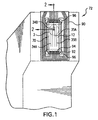
- Figure 1 is a schematic drawing of a print cartridge in accordance with embodiments of the present invention.
- Figure 2 is a schematic drawing of a portion of the print cartridge in accordance with embodiments of the present invention.
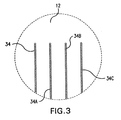
- Figure 3 is a schematic drawing of an expanded view of a portion of the orifice plate of the print cartridge of Figure 1 .
- FIGs 1 and 2 there is shown a printer cartridge such as that which may be installed into a printer (not shown), which in turn may be controlled by a computer or other electronic device (e.g ., digital camera, video camera, cellular phone, PDA).
- a computer or other electronic device e.g ., digital camera, video camera, cellular phone, PDA.
- PDA personal area network
- the orifice plate 12 may be applied over a barrier layer 82.
- the barrier layer 82 defines firing chambers that each substantially align with and correspond to the orifices 36 in the plate.
- Under the barrier layer 82 may be an integrated circuit 65 with arrays of resistors/heating elements corresponding to the firing chambers.
- the integrated circuit 65, together with the barrier layer and the orifice plate are part of a printhead (or fluid ejection device) 70.
- an inkjet cartridge body (or fluid ejection cartridge) 72 may have a recessed area for receipt of the printhead 70.
- the printhead 70 is bonded to the cartridge body 72 with structural adhesive.
- Fluid conduit(s) may be located at a bottom of the recessed area. The conduit conveys fluid (e.g., reactive ink or fixer) from a fluid chamber within the cartridge into a slot in the printhead 70. The slot is in fluid communication with the firing chambers.
- the barrier layer 82 may act as a gasket to prevent fluid flow between adjacent orifices. The fluid may be heated in the firing chambers by the resistors and expelled from the corresponding nozzle orifice 36.
- a circuit element 90 may include conductive tabs 92 that extend to contact with the bond pads 94.
- the circuit element 90 may electrically couple the printhead with a printer.
- the printer may, in turn, be coupled with an electronic device.
- an insulating layer 96 may be applied at each end of the printhead.
- the insulating layer may be a bead of encapsulant.
- the layer 96 may be room temperature vulcanizing silicon rubber or a low temperature curing epoxy-based material and may protect the covered elements from corrosion.
- the encapsulant may cover the entire length of each end edge as well as extending onto the surface of the plate.
- FIG. 3 there is shown an expanded view of the area enclosed by circle 2 of Figure 1 .
- Each array i.e., 34 & 35, each comprising 2 nozzle columns
- contains a reactant i.e., ink or fixer.
- at least one array of orifices e.g ., array 34
- may print a reactive ink e.g ., Acid Blue 9 (Formula 1) or Direct Blue 199 (Formula 2)
- at least one other array e.g., array 35
- a fixer e.g.
- poly(ethyleneimine) H[-NHCH 2 CH 2 -] n NH 2 ) ("PEI"), poly(diallyldimethylammonium chloride) (Formula 3), poly(dimethylamine-co-epichlorohydrin) ([N(CH 3 ) 2 (Cl)CH 2 CH(OH)CH 2 -] n ), poly(dimethylamine-co-epichlorohydrin-co-ethylenediamine), imidized poly(styrene-co-maleic anhydride) (Formula 4), polyguanidine (Formula 5), poly(biguanidine) (Formula 6), a polybiguanide such as that of Formula 7 where X and Y are divalent organic linking groups (as described in WO 00/37258 ), a second reactive ink, or any salts of the foregoing.
- the precipitate may be deposited and mark the substrate.
- the vehicle solvents may be absorbed into the substrate, effectively anchoring the precipitate to the substrate.
- forces such as fluid shear forces, high temperatures of the firing event, and/or the forces associated with servicing (e.g., wiping, spitting, capping) may agitate the precipitate within the nozzles and cause it to redisperse into the vehicles sufficiently enough that any remaining solids are blown out through the nozzle during subsequent firing events
- Fixer Formulations Component Fixer 1 (wt%) Fixer 2 (wt%) Fixer 3 (wt%) Fixer 4 (wt%) Poly(ethyleneimine) (PEI) 5 1.25 1.25 Poly(biguanidine) 1 .5 1.25 Alkyl Diol 10 10 Heterocyclic Ketone 5 10 15 15 Secondary Alcohol Ethoxylate 0.5 Octane Sulfonate 0.2 Ethoxylated Alkyne Surfactants 0.8 0.8 Fluoro Surfactant 0.1 0.1 Calcium Nitrate Hexahydrate 3 Deionized Water 79.3 79 82.35 78.6 pH 4.5 4 3.4 3.5
- a cyan ink was prepared using 3 wt% Color Index (C.I.) Acid Blue 9 in the vehicle of Table 1.
- C.I. Color Index
- a series of 1 ⁇ 4" horizontal bars spaced about 1 ⁇ 2" apart was printed at full density, some with and some without 1 drop/600th inch of under-printed Fixer 1 for every 4 drops/600th inch of cyan ink, on Union Camp Great White paper using an inkjet pen.
- 0.25 ml of water was dripped across the series of bars while holding the print sample at a 45-degree angle.
- the average optical density (OD) of the un-dripped portion of the bar and the average OD transferred to the white space between bars was measured using a densitometer.
- a cyan ink was prepared using 3 wt% C.I. Direct Blue 199 in the vehicle of Table 1. Print samples were prepared on Union Camp Great White paper as in Example 1 using Fixer 1. After 24 hours, the durability was measured as in Example 1. For marks printed without Fixer 1, the measured OD was 0.98 and the drip transfer was 0.130 OD units, respectively. For marks printed using Fixer 1, the OD was 0.92 and the drip transfer was 0.020 OD units. Thus, Fixer 1 showed substantial increase in the print durability with Direct Blue 199 ink.
- a magenta ink was prepared using 3 wt% C.I. Acid Red 52 (Formula 8) in the vehicle of Table 1.
- Print samples were prepared on Union Camp Great White paper as in Example 1 using Fixer 3. After 24 hours, the durability was measured as in Example 1. With respect to the marks made without Fixer 3, the measured OD was 1.08 and the drip-transfer was 0.200 OD units, respectively. With respect to the marks made using Fixer 3, the OD was 1.01 and the drip-transfer was 0.060 OD units, respectively.
- Fixer 3 + Acid Red 52 ink showed a substantial increase in the print durability.
- Magenta ink was prepared using 3% Ilford M-377 magenta dye (a sulfonated azo-dye available from ILFORD Imaging USA Inc., West 70 Century Road Paramus, NJ 07652) in the vehicle of Table 1. Print samples were prepared on Union Camp Great White paper as in Example 1 using Fixer 3. After 24 hours, the durability was measured as in Example 1. For marks made without Fixer 3, the measured OD was 0.89 and the drip-transfer was 0.200 OD units, respectively. For marks made using Fixer 3, the OD was 0.81 and the drip-transfer was 0.010 OD units. Thus, Fixer 3 + Ilford M-377 azo-dye ink showed a substantial increase in print durability.
- magenta dye that reacts similarly to Ilford M-377 magenta dye, but forms somewhat less precipitate, is the magenta dye of Formula 9 (where Q is a cation) (as described in US patent 6,540,821 , incorporated herein by reference).
- Magenta ink was prepared using 3% C.I. Acid Red 289 magenta dye (available from H.W. Sands Corp., 1080 E. Indiantown Rd, Suite 206, Jupiter, FL 33477) in the vehicle of Table 1. Print samples were prepared on Union Camp Great White paper as in Example 1 using Fixer 3. After 24 hours, the durability was measured as in Example 1. In marks prepared without Fixer 3, the measured OD was 1.00 and the drip-transfer was 0.240 OD units. In marks prepared using Fixer 3, the OD was 0.98 and the drip-transfer was 0.010 OD units. Fixer 3 + Acid Red 289 dye ink showed a substantial increase in the print durability.
- Yellow ink was prepared using 3% C.I. Acid Yellow 23 dye (Formula 10) in the vehicle of Table 1. Print samples were prepared on Union Camp Great White paper as in Example 1 using Fixer 2. After 24 hours, the durability was measured as in Example 1. Without Fixer 2, the measured OD was 0.74 and the drip-transfer was 0.120 OD units. Using Fixer 2, the OD was 0.75 and the drip-transfer was 0.060 OD units.
- Yellow ink was prepared using 3 wt% C.I. Acid Yellow 17 dye (Formula 11) in the vehicle of Table 1. Print samples were prepared on Union Camp Great White paper as in Example 1 using Fixer 2. After 24 hours, the durability was measured as in Example 1. Without Fixer 2, the measured OD was 0.53 and the drip-transfer was 0.070 OD units. Using Fixer 2, the OD was 0.51 and the drip-transfer was 0.020 OD units.
- Yellow ink was prepared using 3% Ilford Y-104 yellow dye (a sulfonated azo-dye available from ILFORD Imaging USA Inc., West 70 Century Road Paramus, NJ 07652) in the vehicle of Table 1. Print samples were prepared on Union Camp Great White paper as in Example 1 using Fixer 2. After 24 hours, the durability was measured as in Example 1. Without Fixer 2, the measured OD was 0.68 and the drip-transfer was 0.070 OD units. Using Fixer 2, the OD was 0.68 and the drip-transfer was 0.030 OD units. Fixer 2 + Ilford Y-104 yellow dye ink showed an increase in the print durability.
- Yellow ink was prepared using 3% C.I. Direct Yellow 132 dye (available from H.W. Sands Corp., 1080 E. Indiantown Rd., Suite 206, Jupiter, FL 33477) in the vehicle of Table 1. Print samples were prepared on Union Camp Great White paper as in Example 1 using Fixer 2. After 24 hours, the durability was measured as in Example 1. Without Fixer 2, the measured OD was 0.67 and the drip-transfer was 0.070 OD units. Using Fixer 2, the OD was 0.65 and the drip-transfer was 0.00 OD units. Fixer 2 + Direct Yellow 132 dye ink showed an increase in the print durability.
- Direct Yellow 132 ink Four drops of C.I. Direct Yellow 132 ink were dropped into a test tube containing approximately 4g of Fixer 2. Direct Yellow 132 dye and the poly(biguanidine) reacted to form a chunky precipitate. Upon agitation (e.g., shaking or stirring) of the mixture, most of the dye/fixer complex precipitate did not resolublize into the solution, leaving behind a large amount of precipitate.
- Direct Yellow 86 Another yellow dye that may behave similarly to Direct Yellow 132 is Direct Yellow 86 (available from H.W. Sands Corp., 1080 E. Indiantown Rd., Suite 206, Jupiter, FL 33477).
- Blending dyes that work well (i.e., have high durability and high redispersibility) with those that do not work as well by themselves may also be advantageous and are considered to fall within the scope of embodiments of the present invention.
- a series of four Yellow inks were prepared using (Y1) 3.50 % Acid Yellow 23; (Y2) 2.62 % Acid Yellow 23 plus 0.88 % Ilford Y-104; (Y3) 1.75 % Acid Yellow 23 plus 1.75 % Ilford Y-104; and (Y4) 0.88 % Acid Yellow 23 plus 2.62 % Ilford Y-104 in the vehicle of Table 1.
- Print samples were prepared on Union Camp Great White paper as in Example 1 with and without Fixer 4. After 24 hours, the durability was measured as in Example 1.
- inks and fixers which form precipitates with a higher charge density and/or lower molecular weight may tend to more easily redisperse.
- precipitates with strong crystalline structures and those with the most durable print attributes may be more difficult to resolubilize or redisperse.
- fixing agent generally, precipitates formed with cationic amine polymers (e.g ., PEI) may tend to form more easily redispersible precipitates than those formed with quaternary or permanently charged polymers (e.g. , polybiguanidine).
- Factors such as pH of the mixture may also play a role.
- the fixing agent may not be a polymer, but a cationic surfactant, such as cetylpyridinium chloride.
Landscapes
- Ink Jet Recording Methods And Recording Media Thereof (AREA)
- Inks, Pencil-Leads, Or Crayons (AREA)
- Ink Jet (AREA)
Claims (10)
- Ein Kassettenkörper (72), der eine erste reaktive Tinte und entweder einen Fixierer oder eine zweite reaktive Tinte aufweist, wobei an dem Kassettenkörper ein Druckkopf (70) befestigt ist, wobei der Druckkopf (70) folgende Merkmale aufweist:eine Öffnungsplatte (12), die zumindest zwei Öffnungen (34A und 35A) aufweist;wobei zumindest eine Öffnung (34A) dahin gehend konfiguriert ist, die erste reaktive Tinte zu drucken;
wobei zumindest eine andere Öffnung (35A) dahin gehend konfiguriert ist, den Fixierer oder die zweite reaktive Tinte zu drucken;
wobei die erste reaktive Tinte und der Fixierer oder die zweite reaktive Tinte dahin gehend reagieren, einen festen Niederschlag zu bilden; und
wobei der feste Niederschlag in zumindest entweder dem Fixierer und/oder der ersten reaktiven Tinte, oder in der zweiten reaktiven Tinte redispergierbar ist. - Die Kassette (72) gemäß Anspruch 1, bei der die Öffnungsplatte zumindest zwei Arrays von Öffnungen (34 und 35) aufweist und bei der ein Array (34) dahin gehend konfiguriert ist, die reaktive Tinte zu drucken, und bei der ein anderes Array (35) dahin gehend konfiguriert ist, den Fixierer oder die zweite reaktive Tinte zu drucken.
- Die Kassette (72) gemäß einem der vorhergehenden Ansprüche, bei der die zumindest eine andere Öffnung dahin gehend konfiguriert ist, einen Fixierer zu drucken, und der Fixierer eine positiv geladene Spezies umfasst.
- Die Kassette (72) gemäß Anspruch 3, bei der der Fixierer aus der Gruppe ausgewählt ist, die aus Poly(ethylenimin), Polyguanidinen, Poly(diallyldimethylammoniumchlorid), Poly(dimethylamin-co-ethylendiamin), imidisiertem Poly(styren-co-maleinsäureanhydrid), Polyguaniden und Salzen derselben besteht.
- Die Kassette (72) gemäß einem der vorhergehenden Ansprüche, bei der das Drucken durch eine elektronische Vorrichtung gesteuert wird.
- Ein Verfahren zum Markieren eines Mediums, wobei das Verfahren folgende Schritte umfasst:Drucken zumindest entweder eines Fixierers und/oder einer ersten reaktiven Tinte auf das Medium; undDrucken einer zweiten reaktiven Tinte auf das Medium;wobei zumindest entweder der Fixierer und/oder die erste reaktive Tinte und die zweite reaktive Tinte dahin gehend reagieren, einen Niederschlag auf das Medium abzuscheiden;
wobei der Niederschlag in zumindest entweder dem zumindest entweder dem Fixierer und/oder der ersten reaktiven Tinte oder in der zweiten reaktiven Tinte redispergierbar ist; und
wobei die zweite reaktive Tinte und zumindest der Fixierer und/oder die erste reaktive Tinte aus derselben Öffnungsplatte (12) gedruckt werden. - Das Verfahren gemäß Anspruch 6, bei dem die Öffnungsplatte (12) zumindest zwei Arrays von Öffnungen (34 und 35) aufweist und bei dem ein Array (34) die zweite reaktive Tinte druckt und bei dem ein anderes Array (35) den Fixierer oder die erste reaktive Tinte druckt.
- Das Verfahren gemäß einem der Ansprüche 6 oder 7, bei dem der Fixierer eine positiv geladene Spezies umfasst.
- Das Verfahren gemäß Anspruch 8, bei dem der Fixierer Poly(ethylenimin), Polyguanidine, Poly(diallyldimethylammoniumchlorid), Poly(dimethylamin-coethylendiamin), imidisiertes Poly(styren-co-maleinsäureanhydrid), Polyguanide und Salze derselben umfasst.
- Das Verfahren gemäß einem der Ansprüche 6 bis 9, bei dem das Drucken durch eine elektronische Vorrichtung gesteuert wird.
Applications Claiming Priority (2)
| Application Number | Priority Date | Filing Date | Title |
|---|---|---|---|
| US691714 | 2003-10-22 | ||
| US10/691,714 US7500742B2 (en) | 2003-10-22 | 2003-10-22 | Systems and methods for printing onto a substrate using reactive ink |
Publications (3)
| Publication Number | Publication Date |
|---|---|
| EP1525989A2 EP1525989A2 (de) | 2005-04-27 |
| EP1525989A3 EP1525989A3 (de) | 2007-06-20 |
| EP1525989B1 true EP1525989B1 (de) | 2010-04-07 |
Family
ID=34394549
Family Applications (1)
| Application Number | Title | Priority Date | Filing Date |
|---|---|---|---|
| EP04256308A Expired - Lifetime EP1525989B1 (de) | 2003-10-22 | 2004-10-13 | Anordnungen und Verfahren zum Drucken auf einem Substrat unter Verwendung von reaktiven Tinten |
Country Status (4)
| Country | Link |
|---|---|
| US (1) | US7500742B2 (de) |
| EP (1) | EP1525989B1 (de) |
| JP (1) | JP2005161842A (de) |
| DE (1) | DE602004026393D1 (de) |
Families Citing this family (4)
| Publication number | Priority date | Publication date | Assignee | Title |
|---|---|---|---|---|
| DE10358461B4 (de) * | 2003-12-13 | 2008-09-11 | Man Roland Druckmaschinen Ag | Gummierungsmedium |
| US8840231B2 (en) * | 2005-10-04 | 2014-09-23 | Hewlett-Packard Development Company, L.P. | Ink-jet printing methods compositions providing improved image durability |
| US7479178B2 (en) * | 2006-02-06 | 2009-01-20 | Hewlett-Packard Development Company, L.P. | Dye sets for inkjet imaging and ink sets using the same |
| EP1925646B1 (de) * | 2006-03-09 | 2018-11-21 | Canon Kabushiki Kaisha | Tintenstrahlaufzeichnungsgerät und verfahren |
Family Cites Families (18)
| Publication number | Priority date | Publication date | Assignee | Title |
|---|---|---|---|---|
| US5149817A (en) | 1990-03-05 | 1992-09-22 | Shionogi & Co., Ltd. | Teirahydropyridine derivatives |
| JP3604800B2 (ja) | 1996-03-26 | 2004-12-22 | キヤノン株式会社 | インクジェットプリント方法およびインクジェットプリント装置 |
| JP3768633B2 (ja) * | 1997-02-14 | 2006-04-19 | キヤノン株式会社 | インクジェットカートリッジおよびプリント装置 |
| JPH10272827A (ja) | 1997-03-28 | 1998-10-13 | Canon Inc | 画像形成方法、インクジェット記録方法及び機器 |
| JPH11222568A (ja) | 1998-02-09 | 1999-08-17 | Canon Inc | インクセット、これを用いたインクジェット記録方法、インクジェット記録装置及び機器類 |
| ATE260181T1 (de) | 1998-12-18 | 2004-03-15 | Avecia Ltd | Tintenstrahldruckverfahren, das polymerbiguaniden verwendet |
| JP2001048934A (ja) | 1999-05-25 | 2001-02-20 | Seiko Epson Corp | 耐水性付与剤、インク組成物および反応液並びに二液を用いたインクジェット記録方法 |
| WO2000071592A1 (en) | 1999-05-25 | 2000-11-30 | Seiko Epson Corporation | Water resistance imparter, ink composition, reactive fluid, and method of ink-jet recording with two fluids |
| US6557989B1 (en) * | 1999-08-24 | 2003-05-06 | Canon Kabushiki Kaisha | Print head and ink jet printing apparatus |
| US6679585B2 (en) * | 2000-09-04 | 2004-01-20 | Canon Kabushiki Kaisha | Ink jet recording head and ink jet recording apparatus |
| JP2002103783A (ja) | 2000-09-28 | 2002-04-09 | Ricoh Co Ltd | インクジェット記録用インクセット及び記録方法 |
| US6540821B2 (en) * | 2001-05-04 | 2003-04-01 | Hewlett-Packard Company | Inkjet color ink set |
| US6533394B1 (en) * | 2001-08-29 | 2003-03-18 | Hewlett-Packard Company | Orifice plate with break tabs and method of manufacturing |
| JP3918564B2 (ja) | 2002-01-21 | 2007-05-23 | セイコーエプソン株式会社 | プレコート印刷用紙 |
| ATE349501T1 (de) | 2002-08-27 | 2007-01-15 | Kiwa Chemical Ind Co Ltd | Tintenstrahlaufzeichnungstinte für sublimationstransfer sowie färbeverfahren |
| JP3515779B1 (ja) | 2002-08-27 | 2004-04-05 | 紀和化学工業株式会社 | 昇華転写用インクジェット記録用インク及び染色方法 |
| JP2005014223A (ja) | 2003-06-23 | 2005-01-20 | Konica Minolta Holdings Inc | インクジェット記録方法及びプリント |
| JP4370823B2 (ja) | 2003-06-23 | 2009-11-25 | コニカミノルタホールディングス株式会社 | インクジェット記録インク、インクジェット記録方法及びインクジェットプリント |
-
2003
- 2003-10-22 US US10/691,714 patent/US7500742B2/en not_active Expired - Fee Related
-
2004
- 2004-10-13 DE DE602004026393T patent/DE602004026393D1/de not_active Expired - Lifetime
- 2004-10-13 EP EP04256308A patent/EP1525989B1/de not_active Expired - Lifetime
- 2004-10-22 JP JP2004308096A patent/JP2005161842A/ja active Pending
Also Published As
| Publication number | Publication date |
|---|---|
| EP1525989A2 (de) | 2005-04-27 |
| US20050088498A1 (en) | 2005-04-28 |
| DE602004026393D1 (de) | 2010-05-20 |
| JP2005161842A (ja) | 2005-06-23 |
| EP1525989A3 (de) | 2007-06-20 |
| US7500742B2 (en) | 2009-03-10 |
Similar Documents
| Publication | Publication Date | Title |
|---|---|---|
| CN102673206B (zh) | 一种高速可变印刷方法及其装置 | |
| EP1008633B1 (de) | Tinte | |
| DE60122428T2 (de) | Tintenstrahltinte, Tintenstrahldruckverfahren, Tintenstrahl-Druckvorrichtung,Tintenstrahldruckeinheit und Tintenpatrone | |
| JP4951462B2 (ja) | 改善された画像耐久性をもたらすインクジェット印刷方法及びシステム | |
| EP1155870B1 (de) | Fixierzusammensetzung für Tinten und Verfahren zum Befestigen von Tinten | |
| EP0953614B1 (de) | Sortiment von reaktiven Tinten für den Tintenstrahldruck | |
| EP0956961B1 (de) | Mehrkammertintenzuführvorrichtung | |
| CN1972809A (zh) | 记录方法、墨盒及图像形成方法 | |
| EP0863189B1 (de) | Tintenstrahltinten für eine verbesserte Bildqualität | |
| EP1931739B1 (de) | Tintenstrahldruckverfahren und zusammensetzungen mit verbesserter bildpermanenz | |
| US7837291B2 (en) | Dissolving complexes of anionic dye/cationic polymeric fixer | |
| US6648446B1 (en) | Smudge-resistant ink jet printing | |
| JPS6322681A (ja) | インクジェット印刷方法 | |
| JP2001010200A5 (de) | ||
| JP2002030235A (ja) | インクジェット用水性顔料インクセットおよびインクジェット記録方法 | |
| EP1525989B1 (de) | Anordnungen und Verfahren zum Drucken auf einem Substrat unter Verwendung von reaktiven Tinten | |
| US6309062B1 (en) | Multi-chamber fluid supply | |
| JP2014173069A (ja) | インクセット及びインクジェット記録方法 | |
| JP3801380B2 (ja) | 多室流体供給源 | |
| EP1297082A1 (de) | Harz-in-wasser-emulsionen enthaltende tintenstrahlaufzeichungsflüssigkeit | |
| TW200412365A (en) | Pen-compatible black and color inkjet inks having improved bleed control | |
| EP2137273B1 (de) | Tintenstrahltintensätze | |
| KR20040081593A (ko) | 잉크젯 프린터용 잉크조성물 |
Legal Events
| Date | Code | Title | Description |
|---|---|---|---|
| PUAI | Public reference made under article 153(3) epc to a published international application that has entered the european phase |
Free format text: ORIGINAL CODE: 0009012 |
|
| AK | Designated contracting states |
Kind code of ref document: A2 Designated state(s): AT BE BG CH CY CZ DE DK EE ES FI FR GB GR HU IE IT LI LU MC NL PL PT RO SE SI SK TR |
|
| AX | Request for extension of the european patent |
Extension state: AL HR LT LV MK |
|
| PUAL | Search report despatched |
Free format text: ORIGINAL CODE: 0009013 |
|
| AK | Designated contracting states |
Kind code of ref document: A3 Designated state(s): AT BE BG CH CY CZ DE DK EE ES FI FR GB GR HU IE IT LI LU MC NL PL PT RO SE SI SK TR |
|
| AX | Request for extension of the european patent |
Extension state: AL HR LT LV MK |
|
| 17P | Request for examination filed |
Effective date: 20071126 |
|
| AKX | Designation fees paid |
Designated state(s): DE FR GB NL |
|
| 17Q | First examination report despatched |
Effective date: 20080214 |
|
| GRAP | Despatch of communication of intention to grant a patent |
Free format text: ORIGINAL CODE: EPIDOSNIGR1 |
|
| GRAS | Grant fee paid |
Free format text: ORIGINAL CODE: EPIDOSNIGR3 |
|
| GRAA | (expected) grant |
Free format text: ORIGINAL CODE: 0009210 |
|
| AK | Designated contracting states |
Kind code of ref document: B1 Designated state(s): DE FR GB NL |
|
| REG | Reference to a national code |
Ref country code: GB Ref legal event code: FG4D |
|
| REF | Corresponds to: |
Ref document number: 602004026393 Country of ref document: DE Date of ref document: 20100520 Kind code of ref document: P |
|
| REG | Reference to a national code |
Ref country code: NL Ref legal event code: VDEP Effective date: 20100407 |
|
| PLBE | No opposition filed within time limit |
Free format text: ORIGINAL CODE: 0009261 |
|
| STAA | Information on the status of an ep patent application or granted ep patent |
Free format text: STATUS: NO OPPOSITION FILED WITHIN TIME LIMIT |
|
| 26N | No opposition filed |
Effective date: 20110110 |
|
| REG | Reference to a national code |
Ref country code: NL Ref legal event code: T3 Ref country code: NL Ref legal event code: BK Free format text: ONTERECHT VERVALLEN OP 07.04.2010 PUBLICATIE VERVAL I.E. 2010/23 UITGEGEVEN 28.07.2010 |
|
| REG | Reference to a national code |
Ref country code: FR Ref legal event code: PLFP Year of fee payment: 13 |
|
| REG | Reference to a national code |
Ref country code: FR Ref legal event code: PLFP Year of fee payment: 14 |
|
| REG | Reference to a national code |
Ref country code: FR Ref legal event code: PLFP Year of fee payment: 15 |
|
| PGFP | Annual fee paid to national office [announced via postgrant information from national office to epo] |
Ref country code: FR Payment date: 20180920 Year of fee payment: 15 |
|
| PGFP | Annual fee paid to national office [announced via postgrant information from national office to epo] |
Ref country code: GB Payment date: 20180925 Year of fee payment: 15 Ref country code: NL Payment date: 20180924 Year of fee payment: 15 |
|
| PGFP | Annual fee paid to national office [announced via postgrant information from national office to epo] |
Ref country code: DE Payment date: 20180819 Year of fee payment: 15 |
|
| REG | Reference to a national code |
Ref country code: DE Ref legal event code: R119 Ref document number: 602004026393 Country of ref document: DE |
|
| REG | Reference to a national code |
Ref country code: NL Ref legal event code: MM Effective date: 20191101 |
|
| PG25 | Lapsed in a contracting state [announced via postgrant information from national office to epo] |
Ref country code: DE Free format text: LAPSE BECAUSE OF NON-PAYMENT OF DUE FEES Effective date: 20200501 |
|
| PG25 | Lapsed in a contracting state [announced via postgrant information from national office to epo] |
Ref country code: NL Free format text: LAPSE BECAUSE OF NON-PAYMENT OF DUE FEES Effective date: 20191101 |
|
| GBPC | Gb: european patent ceased through non-payment of renewal fee |
Effective date: 20191013 |
|
| PG25 | Lapsed in a contracting state [announced via postgrant information from national office to epo] |
Ref country code: FR Free format text: LAPSE BECAUSE OF NON-PAYMENT OF DUE FEES Effective date: 20191031 Ref country code: GB Free format text: LAPSE BECAUSE OF NON-PAYMENT OF DUE FEES Effective date: 20191013 |