EP1525877A1 - Compositon cosmètique capillaire à base de polymères fixants et de composés susceptible de gonfler sous l'action de la chaleur. - Google Patents
Compositon cosmètique capillaire à base de polymères fixants et de composés susceptible de gonfler sous l'action de la chaleur. Download PDFInfo
- Publication number
- EP1525877A1 EP1525877A1 EP04292390A EP04292390A EP1525877A1 EP 1525877 A1 EP1525877 A1 EP 1525877A1 EP 04292390 A EP04292390 A EP 04292390A EP 04292390 A EP04292390 A EP 04292390A EP 1525877 A1 EP1525877 A1 EP 1525877A1
- Authority
- EP
- European Patent Office
- Prior art keywords
- process according
- polymers
- copolymers
- les
- chosen
- Prior art date
- Legal status (The legal status is an assumption and is not a legal conclusion. Google has not performed a legal analysis and makes no representation as to the accuracy of the status listed.)
- Withdrawn
Links
Classifications
-
- A—HUMAN NECESSITIES
- A61—MEDICAL OR VETERINARY SCIENCE; HYGIENE
- A61Q—SPECIFIC USE OF COSMETICS OR SIMILAR TOILETRY PREPARATIONS
- A61Q5/00—Preparations for care of the hair
- A61Q5/06—Preparations for styling the hair, e.g. by temporary shaping or colouring
-
- A—HUMAN NECESSITIES
- A61—MEDICAL OR VETERINARY SCIENCE; HYGIENE
- A61K—PREPARATIONS FOR MEDICAL, DENTAL OR TOILETRY PURPOSES
- A61K8/00—Cosmetics or similar toiletry preparations
- A61K8/02—Cosmetics or similar toiletry preparations characterised by special physical form
- A61K8/0241—Containing particulates characterized by their shape and/or structure
- A61K8/025—Explicitly spheroidal or spherical shape
-
- A—HUMAN NECESSITIES
- A61—MEDICAL OR VETERINARY SCIENCE; HYGIENE
- A61K—PREPARATIONS FOR MEDICAL, DENTAL OR TOILETRY PURPOSES
- A61K8/00—Cosmetics or similar toiletry preparations
- A61K8/18—Cosmetics or similar toiletry preparations characterised by the composition
- A61K8/72—Cosmetics or similar toiletry preparations characterised by the composition containing organic macromolecular compounds
- A61K8/81—Cosmetics or similar toiletry preparations characterised by the composition containing organic macromolecular compounds obtained by reactions involving only carbon-to-carbon unsaturated bonds
- A61K8/8164—Compositions of homopolymers or copolymers of compounds having one or more unsaturated aliphatic radicals, each having only one carbon-to-carbon double bond, and at least one being terminated by a carboxyl radical, and containing at least one other carboxyl radical in the molecule, or of salts, anhydrides, esters, amides, imides or nitriles thereof; Compositions of derivatives of such polymers, e.g. poly (methyl vinyl ether-co-maleic anhydride)
-
- A—HUMAN NECESSITIES
- A61—MEDICAL OR VETERINARY SCIENCE; HYGIENE
- A61K—PREPARATIONS FOR MEDICAL, DENTAL OR TOILETRY PURPOSES
- A61K2800/00—Properties of cosmetic compositions or active ingredients thereof or formulation aids used therein and process related aspects
- A61K2800/40—Chemical, physico-chemical or functional or structural properties of particular ingredients
- A61K2800/41—Particular ingredients further characterized by their size
- A61K2800/412—Microsized, i.e. having sizes between 0.1 and 100 microns
-
- A—HUMAN NECESSITIES
- A61—MEDICAL OR VETERINARY SCIENCE; HYGIENE
- A61K—PREPARATIONS FOR MEDICAL, DENTAL OR TOILETRY PURPOSES
- A61K2800/00—Properties of cosmetic compositions or active ingredients thereof or formulation aids used therein and process related aspects
- A61K2800/40—Chemical, physico-chemical or functional or structural properties of particular ingredients
- A61K2800/54—Polymers characterized by specific structures/properties
- A61K2800/546—Swellable particulate polymers
-
- A—HUMAN NECESSITIES
- A61—MEDICAL OR VETERINARY SCIENCE; HYGIENE
- A61K—PREPARATIONS FOR MEDICAL, DENTAL OR TOILETRY PURPOSES
- A61K2800/00—Properties of cosmetic compositions or active ingredients thereof or formulation aids used therein and process related aspects
- A61K2800/40—Chemical, physico-chemical or functional or structural properties of particular ingredients
- A61K2800/60—Particulates further characterized by their structure or composition
- A61K2800/65—Characterized by the composition of the particulate/core
- A61K2800/654—The particulate/core comprising macromolecular material
Definitions
- the present invention relates to new compositions hair cosmetics based on fixing polymers and compounds likely to swell under the action of heat, and particularly microspheres with thermoplastic envelope. It also concerns a cosmetic process, in particular a method of fixing and / or maintenance of the hairstyle, as well as the use in cosmetics of these compositions.
- Hair products intended for shaping and maintaining the hairstyle usually include one or more fixing polymers in alcoholic or aqueous solution.
- Polymers Fixants ensure the formation of welds between the hair.
- the fixing polymers generally used are polymers film-forming agents which are soluble or dispersible in water and in alcohols copolymers of vinyl acetate and crotonic acid, anionic or amphoteric acrylic resins, polyurethanes.
- the welds between the hair must be sufficiently resistant to ensure the maintenance of the hair. They must also be sufficiently fragile so that the user can, in painting or brushing hair, breaking seams without hitting the scalp or damage the hair, which is not necessarily the case of compositions for holding and / or fixing the hair known.
- the present invention proposes to provide a solution to this waiting.
- a cosmetic hair composition comprising in a cosmetically acceptable medium, at least one polymer fixing and at least one compound capable of swelling under the action of the heat, gave the hair a satisfactory and durable fixation and that, under the effect of heat, the hair was then easy to disentangle.
- the present invention therefore relates to a composition hair cosmetic, characterized in that it comprises, in a cosmetically acceptable medium, at least one fixing and minus a compound liable to swell under the action of heat.
- Another subject of the invention relates to a cosmetic process capillary action, in particular a method of fixing and / or maintaining the hairstyle using the compositions according to the invention.
- the subject of the invention is also the cosmetic use of the compositions according to the invention.
- fixing polymer any polymer that makes it possible to shape the hair or to maintain this form.
- the fixing polymers which are suitable in the invention are in particular chosen from cationic fixing polymers, anionic, amphoteric, nonionic and mixtures thereof.
- the cationic fixing polymers that can be used according to the present invention are preferably selected from polymers comprising primary, secondary, tertiary amine groups and / or quaternary part of the polymer chain or directly connected to thereof, and having a number average molecular weight between 500 and about 5,000,000, and preferably between 1,000 and 3,000 000.
- the anionic fixing polymers generally used are polymers containing groups derived from acid carboxylic, sulphonic or phosphoric acid and have a number average molecular weight between about 500 and 5,000,000.
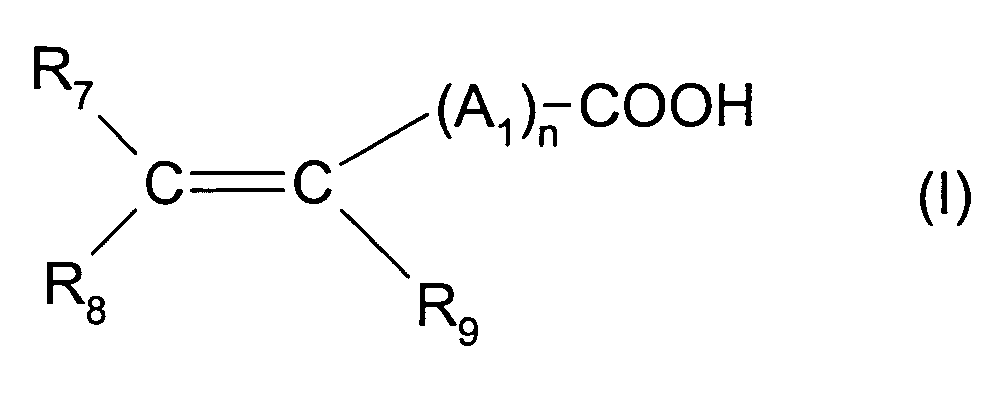
- the carboxylic groups are provided by unsaturated mono- or di-carboxylic acid monomers such as those corresponding to the formula: in which n is an integer from 0 to 10, A 1 denotes a methylene group, optionally connected to the carbon atom of the unsaturated group or to the neighboring methylene group when n is greater than 1, via a heteroatom such as oxygen or sulfur, R 7 denotes a hydrogen atom, a phenyl or benzyl group, R 8 denotes a hydrogen atom, a lower alkyl or carboxyl group, R 9 denotes a hydrogen atom, a lower alkyl group, a -CH 2 -COOH group, phenyl or benzyl group.
- unsaturated mono- or di-carboxylic acid monomers such as those corresponding to the formula: in which n is an integer from 0 to 10, A 1 denotes a methylene group, optionally connected to the carbon atom of the unsaturated group or to the neighbor
- a lower alkyl group preferably denotes a group having 1 to 4 carbon atoms and in particular, the methyl and ethyl groups.
- Homopolymers and copolymers comprising sulfonic groups are polymers with vinylsulfonic, styrene-sulfonic, naphthalenesulphonic or acrylamidoalkylsulphonic.
- anionic fixing polymer which can be used according to the invention can be cited the sequenced anionic polymer connected sold under the name FIXATE G100 by the company NOVEON.
- the anionic fixing polymers are preferably selected from acrylic acid copolymers such as terpolymers acrylic acid / ethyl acrylate / N-tert-butylacrylamide sold in particular under the name ULTRAHOLD® STRONG by BASF, copolymers derived from crotonic acid such as vinyl acetate terpolymers / vinyl tert-butylbenzoate / acid Crotonic acid and Crotonic acid / Acetate terpolymers vinyl / vinyl neododecanoate sold in particular under the name Resin 28-29-30 by the company NATIONAL STARCH, polymers derivatives of maleic, fumaric or itaconic acids or anhydrides with vinyl esters, vinyl ethers, halides vinyls, phenylvinyl derivatives, acrylic acid and its esters such as methylvinylether / maleic anhydride copolymers monoesterified sold, for example, under the name GANTREZ® by
- anionic fixing polymers sold under the name GANTREZ® ES 425 by the ISP company, terpolymers acrylic acid / ethyl acrylate / N-tert-butylacrylamide sold under the name ULTRAHOLD® STRONG by BASF, copolymers of methacrylic acid and methyl methacrylate sold under the name EUDRAGIT® L by ROHM PHARMA, terpolymers vinyl acetate / tert-butylbenzoate / crotonic acid and the crotonic acid / vinyl acetate / neododecanoate terpolymers vinyl sold under the name Resin 28-29-30 by the company NATIONAL STARCH, copolymers of methacrylic acid and of ethyl acrylate sold under the name LUVIMER® MAEX OR
- amphoteric fixing polymers which can be used according to the invention may be chosen from polymers comprising patterns B and C statistically distributed in the polymer chain where B means a unit derived from a monomer having at least one basic nitrogen atom and C denotes a unit derived from a monomer acid having one or more carboxylic groups or sulphonic, or B and C may designate groups derived from zwitterionic monomers of carboxybetaines or sulfobetaines;
- B and C may also designate a polymer chain cationic composition comprising primary, secondary amine groups, tertiary or quaternary, in which at least one of the groupings amine carries a carboxylic or sulfonic group connected by through a hydrocarbon group, or B and C are part of of a chain of a polymer with an ethylene- ⁇ , ⁇ -dicarboxylic one of the carboxylic groups was reacted with a polyamine having one or more primary amine groups or secondary.
- the more particularly preferred according to the invention are those of the family (3) such as copolymers whose CTFA name is Octylacrylamide / acrylates / butylamino-ethylmethacrylate copolymer, such as the products sold under the names AMPHOMER®, AMPHOMER® LV 71 or LOVOCRYL® 47 by NATIONAL STARCH and those of the family (4) such as copolymers methyl methacrylate / dimethylcarboxymethylammonioethyl methacrylate of methyl sold for example under the name DIAFORMER® Z301 by the company SANDOZ.
- the family (3) such as copolymers whose CTFA name is Octylacrylamide / acrylates / butylamino-ethylmethacrylate copolymer, such as the products sold under the names AMPHOMER®, AMPHOMER® LV 71 or LOVOCRYL® 47 by NATIONAL STARCH
- those of the family (4) such as cop
- the alkyl groups of the nonionic polymers mentioned above preferably have 1 to 6 carbon atoms.
- polymers silicone-type fixing agents grafted comprising a polysiloxane part and a part consisting of a non-silicone organic chain, one of the two parts constituting the main chain of the polymer and the other being grafted onto said main chain.
- These polymers may be amphoteric, anionic or non-anionic ionic, and they are preferably anionic or nonionic.
- grafted silicone polymers are polydimethylsiloxanes (PDMS) on which are grafted, through a connection chain type thiopropylene, mixed polymer units of the poly (acidic) type (meth) acrylic) and of the poly ((meth) acrylate type), and polydimethylsiloxanes (PDMS) on which are grafted, by via a thiopropylene type connection chain, polymeric units of the isobutyl poly (meth) acrylate type.
- PDMS polydimethylsiloxanes
- silicone fixing polymers As another type of silicone fixing polymers, mention may be made of the product Luviflex® Silk sold by the company BASF.
- fixing polymers polyurethanes functionalized or not, silicone or non-silicone, cationic, nonionic, anionic or amphoteric, or mixtures thereof.
- Polyurethanes particularly targeted by this invention are those described in applications EP 0 751 162, EP 0 637 600, EP 0 648 485 and FR 2 743 297 which the applicant holds, as well as in EP 0 656 021 and WO 94/03510 BASF company, and EP 0 619 111 from the company National Starch.
- polyurethanes particularly suitable in the present invention mention may be made of the products marketed under the names LUVISET PUR® and LUVISET® Si PUR by the company BASF.
- the content of polymer (s) fixing agent (s) is generally between 0.1 and 20%, and preferably between 0.2 and 15%, and even more preferentially between 0.5 and 10% by weight of the total weight of the composition.
- compositions according to the invention comprise at least one compound capable of swelling under the action of heat.
- It may be in particular a compound that reacts, under the action of heat, to release a gas that is trapped in the deposit matrix.
- the heat-swellable compound may also be be in the form of thermoexpansible particles.
- thermo-deformable particles more particularly particles liable to deform and to expand to the heat.
- Particles within the meaning of the present invention may still be unexpanded thermo-deformable particles. They are distinguished in this respect from the expanded particles which are not precisely more prone to deformation under the action of the heat, like for example particles of polyvinylidene / acrylonitrile marketed under the name “Expancel®” by the company AKZO NOBEL under the special references “Expancel® WE” or "DE”.
- the particles used in the compositions of the invention are able to expand under the action of a temperature generally greater than or equal to 45 ° C, especially higher or equal to 50 ° C, in particular greater than or equal to 60 ° C, plus especially greater than or equal to 70 ° C.
- a temperature generally greater than or equal to 45 ° C, especially higher or equal to 50 ° C, in particular greater than or equal to 60 ° C, plus especially greater than or equal to 70 ° C.
- he can be a temperature greater than or equal to 80 ° C, in particular greater than or equal to 85 ° C, more particularly greater than or equal to 90 ° C and up to 190-200 ° C.
- these particles are not sensitive to presence of water.
- the particles used in the present invention can be thermoplastics.
- thermoplastic one means particles that are likely to deform under the action of heat and retain their new shape, including after cooling, especially at room temperature.
- the particles used in the present invention are generally hollow particles having an envelope continuous and at least one cavity.
- the envelope of the particles is preferably flexible to lend to a mechanical deformation. It usually includes at least one polymer, homo- or copolymer, formed from monomers with ethylenic unsaturations. Examples of such particles are in particular described in documents EP-A-56219, EP-A-348,372, EP-A-486,080, EP-A-320,473, EP-A-112,807 and US-A-3 615 972.
- the monomers used can in particular be esters methacrylic or acrylic acid, such as acrylate and methyl methacrylate, vinylidene chloride, acrylonitrile, styrene and its derivatives, butadiene and its derivatives, and mixtures thereof.
- polymers that are susceptible to compose the envelope of particles used in this invention there may be mentioned polymers comprising at least units derived from acrylate or methyl methacrylate, polymers containing at least units derived from acrylonitrile, polymers containing at least units derived from acrylonitrile and methyl methacrylate, polymers comprising at least derived from styrene and acrylonitrile, polymers comprising at least units derived from vinylidene chloride and acrylonitrile and polymers having at least one derivatives of vinylidene chloride chloride and vinyl chloride.
- said polymer may be chosen from polymers of vinylidene chloride / acrylonitrile / methyl methacrylate, the polymers of acrylonitrile / methyl methacrylate and homopolymers of acrylonitrile.
- Particles usually contain within one or cavity (s) at least one compound capable of manifesting, in response to heating at a temperature in a range from 45 ° C to 200 ° C and at substantially constant pressure, a significant increase in its volume at room temperature.
- the compound contained inside the cavity may be at room temperature a gaseous compound or a liquid compound having a vaporization temperature in the range of 45 ° C to 200 ° C, especially in the range of 80 ° C at 200 ° C, and more particularly greater than or equal to 100 ° C.
- this compound is in the gaseous state in the particle and expands under the effect of heat.
- gases in the gaseous state mention may be made of air, nitrogen, hydrocarbons comprising 1, 2, 3 or 4 carbon atoms as in particular the butane, isobutane and mixtures thereof.
- the compound contained in the cavity is a liquid compound as defined above.
- hydrocarbons in particular having from 5 to 15, in particular from 5 to 12 and more particularly from 5 to 10 carbon atoms carbon. It may be in particular of a compound chosen from n-pentane, iso-pentane and neo-pentane.
- the expansion temperature of the particle depends both on the nature of the compound present in its cavity, and that of the polymer forming its envelope, and may in particular range from 45 to 200 ° C, and especially be greater than or equal to 80 ° C and in particular higher or equal to 100 ° C.
- the particles used in the compositions according to the invention can be dry or hydrated.
- These particles can be of different shapes. They can be globular, even spherical, or can also be elongated.
- the particles foams of the invention are spherical and have a grain size, expressed in average effective "diameter" by weight D [0.5], ranging from 0.5 ⁇ m to 200 ⁇ m, in particular from 1 ⁇ m to 100 ⁇ m, in particularly from 4 ⁇ m to 50 ⁇ m and more particularly from 5 ⁇ m to 40 ⁇ m.
- the particles used in the compositions according to the invention have a fiber form.
- Fiber means an object of length L and diameter D such that L is much greater than D, D being the diameter of the circle in which is the section of the fiber.
- the L / D ratio (or form factor) is chosen in the range from 3.5 to 2500, in from 5 to 500, and more particularly from 5 to 150.
- the fibers have in particular a length ranging from 0.05 mm to 6 mm.
- the unexpanded particles used in the present invention generally have a density ranging from 500 kg / m 3 to 5000 kg / m 3 , in particular from 900 kg / m 3 to 3000 kg / m 3 , and more particularly from 900 kg / m 3. m 3 at 2000 kg / m 3 .
- the particles used in the present invention can be colored or colorless.
- particles usable in the compositions of the invention includes, for example, unexpanded microspheres of vinylidene chloride / acrylonitrile / methacrylate copolymer such as those marketed under the name of "Expancel®” by the company AKZO NOBEL under the references 820DU 40 (10-16 ⁇ m) or 820 SL 40 (2-30 ⁇ m), and acrylonitrile / methyl methacrylate, such as those marketed under the name "Expancel®” under the references 642 WU 40 (10-16 ⁇ m) or 051 DU 40 (9-15 ⁇ m).
- particles which can also be used in the compositions according to the invention may also be mentioned unexpanded microspheres homopolymers of acrylonitrile such as those marketed under the name “Expancel 007W®” (5-25 ⁇ m), “Micropearl F-series®” by the MATSUMOTO Company or “Ucelite®” by the UCB company.
- the particles marketed under the name "Expancel®” under the references cited above include generally in their cavity a compound in the gaseous state.
- the content of compounds likely to swell under the action of heat is usually between 0.1 and 20%, and preferably between 0.2 and 15%, and more preferably between 0.5 and 10% by weight of the total weight of the composition.
- the cosmetically acceptable medium is preferably consisting of water or one or more solvents cosmetically acceptable such as alcohols or by water-solvent mixtures (s). These solvents are preferably C1-C4 alcohols.
- ethanol isopropanol
- ethanol being particularly preferred.
- composition according to the invention may furthermore contain at less an additive chosen from nonionic surfactants, anionic, cationic, amphoteric or zwitterionic, perfumes, filters, preservatives, proteins, vitamins, nonionic, anionic, cationic, amphoteric or zwitterions other than the fixing polymers described above, the mineral, vegetable or synthetic oils, agents and any other additive conventionally used in cosmetic compositions, such as anti-dandruff agents, anti-hair loss agents, dyes, pigments, moisturizers such as glycerin and other polyols, reducing agents.
- an additive chosen from nonionic surfactants, anionic, cationic, amphoteric or zwitterionic, perfumes, filters, preservatives, proteins, vitamins, nonionic, anionic, cationic, amphoteric or zwitterions other than the fixing polymers described above, the mineral, vegetable or synthetic oils, agents and any other additive conventionally used in cosmetic compositions, such as anti-dandruff agents,
- additives are present in the composition at levels advantageously between 0.001 and 20% by weight of the total weight of the composition.
- the precise amount of each additive is function of its nature and is easily determined by those skilled in the art, and will depend on the capillary application chosen.
- compositions of the invention can be used for the manufacture of many hair products, such as products for fixing and / or maintaining hair, products conditioning, or hair care products.
- compositions can be packaged under various forms, in particular in pump bottles or in containers aerosols, in order to ensure a composition application in form vaporized or in the form of foam. Such forms of conditioning are indicated, for example, when one wishes obtain a spray, a lacquer, or a foam for fixing or hair treatment.
- the compositions according to the invention may also be in the form of creams, gels, emulsions, lotions, or waxes.
- composition according to the invention when packaged under aerosol form to obtain a lacquer or foam, it comprises at least one propellant which can be chosen from volatile hydrocarbons such as n-butane, propane, isobutane, pentane, a halogenated hydrocarbon and mixtures thereof.
- propellant the carbon dioxide, nitrous oxide, dimethyl ether (DME), nitrogen, compressed air. It is also possible to use propellant mixtures. Preferably, uses dimethyl ether.
- the propellant is present at a concentration between 5 and 90% by weight relative to the weight total to the total weight of the composition in the aerosol device, and more particularly at a concentration of between 10 and 60%.
- the subject of the invention is also a cosmetic process of fixing and / or maintaining the hairstyle, characterized in that includes the application on the hair of a composition according to invention and the application of heat to the hair, at a temperature preferably between 55 and 220 ° C, and further preferably between 65 and 220 ° C, for a duration that can be understood between 2 seconds and 30 minutes.
- the invention finally relates to the use in cosmetics of compositions described above. It has for particular object the use of compounds liable to swell under the action of heat for the preparation of holding compositions and / or fixing the hairstyle.
- Example 1 Capillary use of the composition according to the invention
- composition A is applied to a lock of natural hair Eurochâtain 5 grams.
- Composition A A:
- Composition A is applied using a pump bottle on natural hair. Composition A makes it possible to obtain shape and hold of the hairstyle. The hair is then subjected to the action of heat using a hair dryer at 105 ° C for 20 seconds. The heat causes the non-reversible expansion of microspheres, which weakens the welds between the hair. The styling and disentangling of the hair is then easy.
Landscapes
- Life Sciences & Earth Sciences (AREA)
- Health & Medical Sciences (AREA)
- Animal Behavior & Ethology (AREA)
- General Health & Medical Sciences (AREA)
- Public Health (AREA)
- Veterinary Medicine (AREA)
- Birds (AREA)
- Epidemiology (AREA)
- Cosmetics (AREA)
- Compositions Of Macromolecular Compounds (AREA)
Abstract
Description

- les copolymères d'acrylamide et de méthacrylate de diméthylaminoéthyle quaternisés au sulfate de diméthyle ou avec un halogénure de diméthyle, tels que celui vendu sous la dénomination HERCOFLOC® par la société HERCULES,
- les copolymères d'acrylamide et de chlorure de méthacryloyloxyéthyltriméthylammomium décrits, par exemple, dans la demande de brevet EP-A-080976 et vendus sous la dénomination BINA QUAT P 100 par la société CIBA GEIGY,
- les copolymères d'acrylamide et de méthosulfate de méthacryloyloxyéthyltriméthylammonium, tels que celui vendu sous la dénomination RETEN par la société HERCULES,
- les copolymères vinylpyrrolidone/acrylate ou méthacrylate de dialkylaminoalkyle quaternisés ou non, tels que les produits vendus sous la dénomination "GAFQUAT®" par la société ISP comme, par exemple, "GAFQUAT® 734" ou "GAFQUAT® 755", ou bien les produits dénommés "COPOLYMER® 845, 958 et 937". Ces polymères sont décrits en détail dans les brevets français Nos 2 077 143 et 2 393 573,
- les polymères à chaíne grasse et à motif vinylpyrrolidone, tels que les produit vendus sous la dénomination Stylèze W20 et Stylèze W10 par la société ISP,
- les terpolymères méthacrylate de diméthylaminoéthyle/vinylcaprolactame/vinylpyrrolidone tels que le produit commercialisé sous la dénomination GAFFIX® VC 713 par la société ISP, et
- les copolymères vinylpyrrolidone/méthacrylamide de diméthylaminopropyle quaternisé tels que notamment le produit commercialisé sous la dénomination "GAFQUAT® HS 100" par la société ISP ;
- les copolymères comprenant (i) un ou plusieurs acides ou anhydrides maléique, fumarique, itaconique et (ii) au moins un monomère choisi parmi les esters vinyliques, les éthers vinyliques, les halogénures vinyliques, les dérivés phénylvinyliques, l'acide acrylique et ses esters, les fonctions anhydrides de ces copolymères étant éventuellement monoestérifiées ou monoamidifiées. De tels polymères sont décrits en particulier dans les brevets US nos 2 047 398, 2 723 248, 2 102 113, le brevet GB n° 839 805. Des produits commerciaux sont notamment ceux vendus sous les dénominations GANTREZ® AN ou ES par la société ISP.
- les copolymères comprenant (i) un ou plusieurs motifs anhydrides maléique, citraconique, itaconique et (ii) un ou plusieurs monomères choisis parmi les esters allyliques ou méthallyliques comportant éventuellement un ou plusieurs groupements acrylamide, méthacrylamide, α-oléfine, esters acryliques ou méthacryliques, acides acrylique ou méthacrylique ou vinylpyrrolidone dans leur chaíne, les fonctions anhydrides de ces copolymères étant éventuellement monoestérifiées ou monoamidifiées.
- les sels de l'acide polyvinylsulfonique ayant une masse moléculaire comprise entre environ 1 000 et 100 000, ainsi que les copolymères avec un comonomère insaturé tel que les acides acrylique ou méthacrylique et leurs esters, ainsi que l'acrylamide ou ses dérivés, les éthers vinyliques et la vinylpyrrolidone.
- les sels de l'acide polystyrène-sulfonique tels que les sels de sodium vendus par exemple sous les dénominations Flexan® 500 et Flexan® 130 par National Starch. Ces composés sont décrits dans le brevet FR 2 198 719.
- les sels d'acides polyacrylamide-sulfoniques tels que ceux mentionnés dans le brevet US 4 128 631, et plus particulièrement l'acide polyacrylamidoéthylpropane-sulfonique vendu sous la dénomination COSMEDIA POLYMER HSP 1180 par Henkel.


ce groupe dérivant de la diéthylène-triamine, de la triéthylène-tétraamine ou de la dipropylène-triamine;
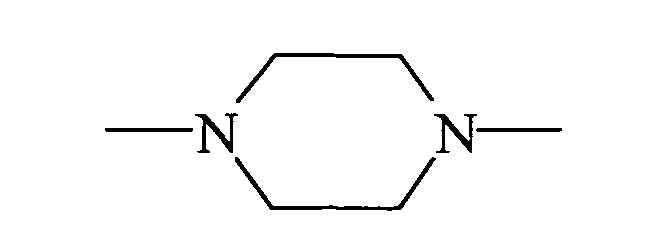
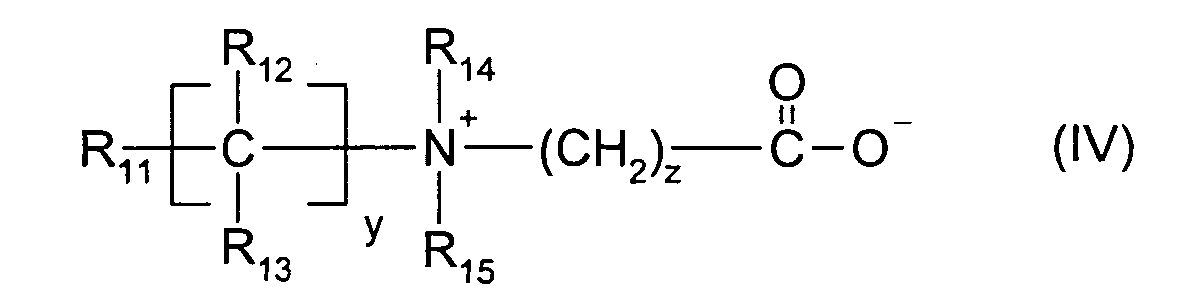
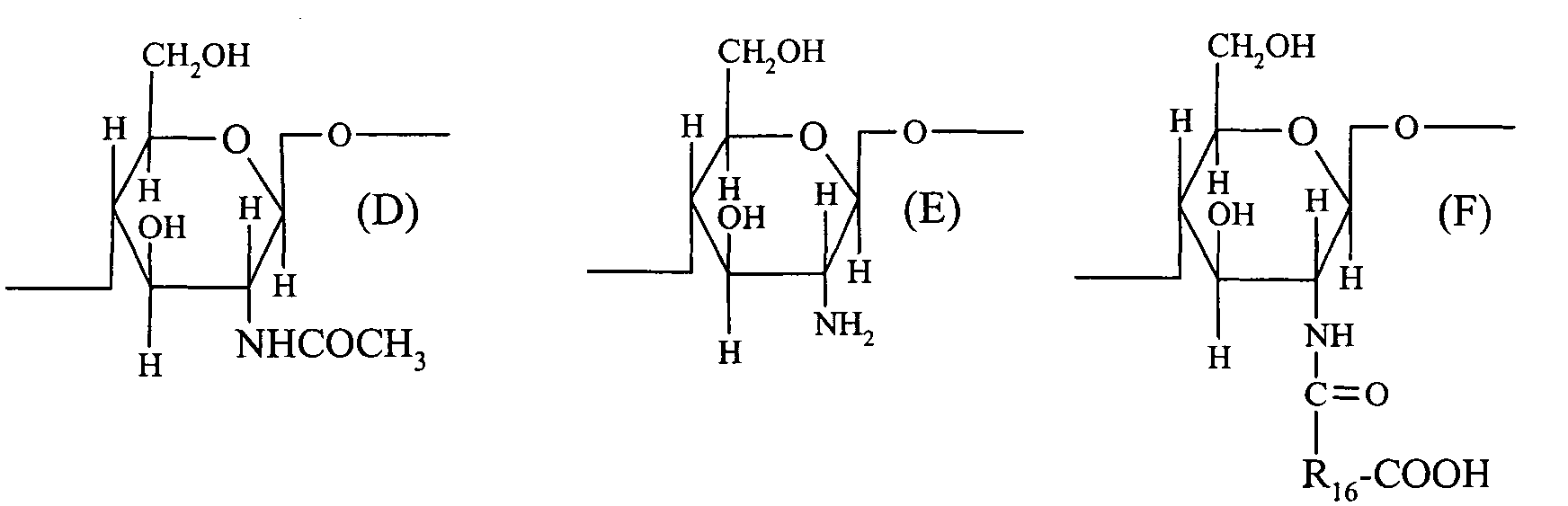

ou si q=1, R17, R18 et R19 représentent chacun un atome d'hydrogène, ainsi que les sels formés par ces composés avec des bases ou des acides.
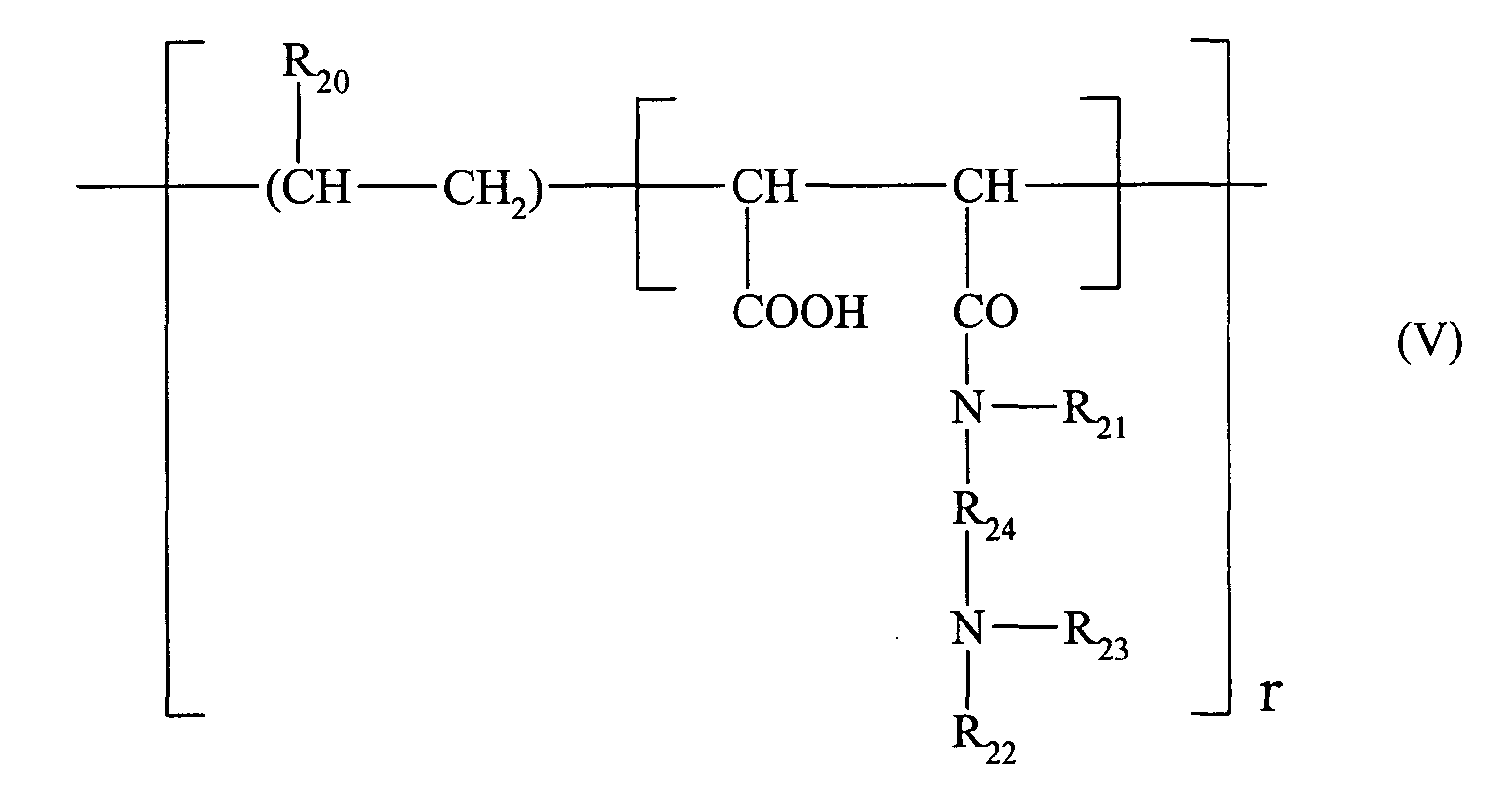


- les polyalkyloxazolines ;
- les homopolymères d'acétate de vinyle ;
- les copolymères d'acétate de vinyle tels que, par exemple, les copolymères d'acétate de vinyle et d'ester acrylique, les copolymères d'acétate de vinyle et d'éthylène, ou les copolymères d'acétate de vinyle et d'ester maléïque, par exemple, de maléate de dibutyle ;
- les homopolymères et copolymères d'esters acryliques tels que, par exemple, les copolymères d'acrylates d'alkyle et de méthacrylates d'alkyle tels que les produits proposés par la société ROHM & HAAS sous les dénominations PRIMAL® AC-261 K et EUDRAGIT® NE 30 D, par la société BASF sous la dénomination 8845, par la société HOECHST sous la dénomination APPRETAN® N9212 ;
- les copolymères d'acrylonitrile et d'un monomère non ionique choisis, par exemple, parmi le butadiène et les (méth)acrylates d'alkyle ; on peut citer les produits proposés sous la dénomination CJ 0601 B par la société ROHM & HAAS ;
- les homopolymères de styrène ;
- les copolymères de styrène comme, par exemple, les copolymères de styrène et de (méth)acrylate d'alkyle tels que les produits MOWILITH® LDM 6911, MOWILITH® DM 611 et MOWILITH® LDM 6070 proposés par la société HOECHST, les produits RHODOPAS® SD 215 et RHODOPAS® DS 910 proposés par la société RHONE POULENC ; les copolymères de styrène, de méthacrylate d'alkyle et d'acrylate d'alkyle ; les copolymères de styrène et de butadiène ; ou les copolymères de styrène, de butadiène et de vinylpyridine ;
- les polyamides ;
- les homopolymères de vinyllactame différents des homopolymères de vinylpyrrolidone, tels que le polyvinylcaprolactame commercialisé sous la dénomination Luviskol® PLUS par la société BASF ; et
- les copolymères de vinyllactame tels qu'un copolymère poly(vinylpyrrolidone/vinyllactame) vendu sous le nom commercial Luvitec® VPC 55K65W par la société BASF, les copolymères poly(vinylpyrrolidone/acétate de vinyle) comme ceux commercialisés sous la dénomination PVPVA® S630L par la société ISP, Luviskol® VA 73, VA 64, VA 55, VA 37 et VA 28 par la société BASF ; et les terpolymères poly(vinylpyrrolidone/acétate de vinyle/propionate de vinyle) comme, par exemple, celui commercialisé sous la dénomination Luviskol® VAP 343 par la société BASF.

| Mexomère PW (1) | 6% MA |
| EXPANCEL 820 SLURRY (2) | 1% MA |
| Eau | 85g |
| Ethanol | 8g |
| MA : matières actives |
Claims (30)
- Procédé cosmétique de fixation et/ou de maintien de la coiffure, caractérisé en ce qu'on applique sur les cheveux une composition comprenant, dans un milieu cosmétiquement acceptable, au moins un polymère fixant et au moins un composé susceptible de gonfler sous l'action de la chaleur, puis en ce qu'on soumet les cheveux à l'action de la chaleur, à une température comprise entre 65 et 220°C.
- Procédé selon la revendication 1, caractérisé en ce que le polymère fixant est choisi parmi les polymères fixants cationiques, anioniques, amphotères, non ioniques et leurs mélanges.
- Procédé selon la revendication 2, caractérisé en ce que le polymère fixant cationique est choisi parmi les homopolymères ou copolymères d'esters ou d'amides acryliques ou méthacryliques à fonctions aminées, les polysaccharides cationiques, les copolymères quaternaires de vinylpyrrolidone et de vinylimidazole, et les chitosanes.
- Procédé selon la revendication 2, caractérisé en ce que le polymère fixant anionique est choisi parmi les homopolymères ou copolymères d'acide acrylique et méthacrylique ou leurs sels, les copolymères d'acide crotonique, les copolymères d'acides ou d'anhydrides carboxyliques monoinsaturés en C4-C8, les polyacrylamides à groupements carboxylates, les homopolymères ou copolymères à groupes sulfoniques, les polyuréthanes anioniques, et les polymères siliconés greffés anioniques.
- Procédé selon la revendication 2, caractérisé en ce que le polymère fixant amphotère est choisi parmi les copolymères à motifs vinyliques acides et à motifs vinyliques basiques, les polyaminoamides réticulés et acylés, les polymères à motifs zwittérioniques, les polymères dérivés du chitosane, les copolymères alkyl(C1-C5)vinyléther/anhydride maléique modifiés, les polyuréthanes amphotères et les polymères siliconés greffés amphotères.
- Procédé selon la revendication 2, caractérisé en ce que le polymère fixant non ionique est choisi parmi les polyalkyloxazolines, les homopolymères et copolymères d'acétate de vinyle, les homopolymères et copolymères d'esters acryliques, les copolymères d'acrylonitrile, les homopolymères et copolymères de styrène, les polyamides, les homopolymères de vinyllactame différents des homopolymères de vinylpyrrolidone, les copolymères de vinyllactame, les polyuréthanes non ioniques, et les polymères siliconés greffés non ioniques.
- Procédé selon l'une quelconque des revendications précédentes, caractérisé en ce que le polymère fixant est présent dans la composition à des teneurs comprises entre 0,1 et 20%, de préférence entre 0,2 et 15%, et encore de préférence entre 0,5 et 10% en poids du poids total de la composition.
- Procédé selon l'une quelconque des revendications précédentes, caractérisé en ce que le composé susceptible de gonfler sous l'action de la chaleur est sous la forme de particules thermoexpansibles.
- Procédé selon la revendication 8, caractérisé en ce que lesdites particules sont capables de s'expanser sous l'action d'une température supérieure ou égale à 45°C, notamment à 50°C, en particulier à 60°C, plus particulièrement à 70°C.
- Procédé selon la revendication 9, caractérisé en ce que ladite température est supérieure ou égale à 80°C, en particulier à 90°C et plus particulièrement à 100°C.
- Procédé selon l'une quelconque des revendications 8 à 10, caractérisé en ce que les particules thermoexpansibles sont thermoplastiques.
- Procédé selon l'une quelconque des revendications 8 à 11, caractérisé en ce que lesdites particules sont des particules creuses comportant une enveloppe continue et au moins une cavité.
- Procédé selon la revendication 12, caractérisé en ce que ladite enveloppe comprend au moins un polymère résultant de la polymérisation de monomères choisis parmi les esters d'acides méthacrylique et acrylique, le chlorure de vinylidène, l'acrylonitrile, le styrène et ses dérivés, le butadiène et ses dérivés et leurs mélanges.
- Procédé selon la revendication 13, caractérisé en ce que ledit polymère est choisi parmi les polymères comportant au moins des motifs dérivés d'acrylate ou de méthacrylate de méthyle, les polymères comportant au moins des motifs dérivés d'acrylonitrile, les polymères comportant au moins des motifs dérivés d'acrylonitrile et de méthacrylate de méthyle, les polymères comportant au moins des motifs dérivés de styrène et d'acrylonitrile, les polymères comportant au moins des motifs dérivés de chlorure de vinylidène et d'acrylonitrile, les polymères comportant au moins des motifs dérivés de chlorure de chlorure de vinylidène et de chlorure de vinyle.
- Procédé selon la revendication 13 ou 14, caractérisé en ce que ledit polymère est choisi parmi les polymères de chlorure de vinylidène/acrylonitrile/méthacrylate de méthyle, les polymères d'acrylonitrile/méthacrylate de méthyle et les homopolymères d'acrylonitrile.
- Procédé selon l'une quelconque des revendications 12 à 15, caractérisé en ce que ladite cavité contient au moins un composé capable de manifester, en réponse à un chauffage à une température située dans une gamme allant de 45°C à 200°C et à pression sensiblement constante, une augmentation d'au moins un facteur 30 de son volume par rapport à son volume à température ambiante.
- Procédé selon la revendication 16, caractérisé en ce que ledit composé gazeux est choisi parmi l'air, l'azote, les hydrocarbures comprenant 1, 2, 3 ou 4 atomes de carbone et leurs mélanges.
- Procédé selon la revendication 16 ou 17, caractérisé en ce que ledit composé est un composé liquide présentant une température de vaporisation située dans la gamme de 45°C à 200°C, en particulier dans la gamme de 80°C à 200°C.
- Procédé selon la revendication 18, caractérisé en ce que ledit composé liquide est choisi parmi les hydrocarbures ayant de 5 à 15 atomes de carbone.
- Procédé selon l'une quelconque des revendications 8 à 19, caractérisé en ce que les particules thermoexpansibles sont de forme globulaire ou allongées.
- Procédé selon la revendication 20, caractérisé en ce que les particules thermoexpansibles sont sphériques et présentent une granulométrie, exprimée en diamètre « effectif » moyen en poids, allant de 0,5 µm à 200 µm, notamment de 1 µm à 100 µm, en particulier de 4 µm à 50 µm et plus particulièrement de 5 µm à 40 µm.
- Procédé selon l'une quelconque des revendications 8 à 20, caractérisé en ce que les particules thermoexpansibles sont des fibres.
- Procédé selon la revendication 22, caractérisé en ce que les fibres ont une longueur allant de 0,05 mm à 6 mm.
- Procédé selon l'une quelconque des revendications 8 à 23, caractérisé en ce que les particules thermoexpansibles présentent une masse volumique allant de 500 kg/m3 à 5000 kg/m3, en particulier de 900 kg/m3 à 3000 kg/m3, et plus particulièrement de 900 kg/m3 à 2000 kg/m3.
- Procédé selon l'une quelconque des revendications précédentes, caractérisé en ce que la teneur en composés susceptibles de gonfler sous l'action de la chaleur est comprise entre 0,1 et 20%, de préférence entre 0,2 et 15%, et encore de préférence entre 0,5 et 10% en poids du poids total de la composition.
- Procédé selon l'une quelconque des revendications précédentes, caractérisée en ce que la composition comprend en outre au moins un additif choisi parmi les tensioactifs non ioniques, anioniques, cationiques, amphotères ou zwitterioniques, les parfums, les filtres, les conservateurs, les protéines, les vitamines, les polymères non ioniques, anioniques, cationiques ou zwitterioniques autres que les polymères fixants figurant dans les revendications précédentes, les huiles minérales, végétales ou synthétiques, les agents et tout autre additif classiquement utilisé dans les compositions cosmétiques, les agents anti-pelliculaires, les agents anti-chute, les colorants, les pigments, les agents hydratants, les réducteurs.
- Composition cosmétique capillaire, caractérisée en ce qu'elle comprend, dans un milieu cosmétiquement acceptable, au moins un polymère fixant et au moins un composé susceptible de gonfler sous l'action de la chaleur ayant une forme de fibres.
- Composition selon la revendication 27, caractérisée en ce que les fibres ont une longueur allant de 0,05 mm à 6 mm.
- Utilisation en cosmétique d'une composition selon la revendication 27 ou 28.
- Utilisation de fibres susceptibles de gonfler sous l'action de la chaleur pour la préparation de compositions de maintien et/ou de fixation de la coiffure.
Applications Claiming Priority (2)
| Application Number | Priority Date | Filing Date | Title |
|---|---|---|---|
| FR0312486A FR2861291A1 (fr) | 2003-10-24 | 2003-10-24 | Composition cosmetique capillaire a base de polymeres fixants et de composes susceptibles de gonfler sous l'action de la chaleur. |
| FR0312486 | 2003-10-24 |
Publications (1)
| Publication Number | Publication Date |
|---|---|
| EP1525877A1 true EP1525877A1 (fr) | 2005-04-27 |
Family
ID=34385389
Family Applications (1)
| Application Number | Title | Priority Date | Filing Date |
|---|---|---|---|
| EP04292390A Withdrawn EP1525877A1 (fr) | 2003-10-24 | 2004-10-08 | Compositon cosmètique capillaire à base de polymères fixants et de composés susceptible de gonfler sous l'action de la chaleur. |
Country Status (3)
| Country | Link |
|---|---|
| US (1) | US20050118126A1 (fr) |
| EP (1) | EP1525877A1 (fr) |
| FR (1) | FR2861291A1 (fr) |
Cited By (1)
| Publication number | Priority date | Publication date | Assignee | Title |
|---|---|---|---|---|
| FR2996760A1 (fr) * | 2012-10-15 | 2014-04-18 | Oreal | Procede de traitement cosmetique des cheveux au moyen d'une composition comprenant une dispersion de particules comprenant un materiau apte a changer d'etat sous l'effet d'un stimulus |
Families Citing this family (7)
| Publication number | Priority date | Publication date | Assignee | Title |
|---|---|---|---|---|
| JP6762944B2 (ja) | 2015-01-09 | 2020-09-30 | リビング プルーフ インコーポレイテッド | 毛髪用組成物及びその使用の方法 |
| AU2017229125B2 (en) | 2016-03-08 | 2021-07-29 | Living Proof, Inc. | Long lasting cosmetic compositions |
| EP3681921A2 (fr) | 2017-09-13 | 2020-07-22 | Living Proof, Inc. | Compositions de protection de couleur |
| AU2018333932B2 (en) | 2017-09-13 | 2024-05-02 | Living Proof, Inc. | Long lasting cosmetic compositions |
| CN111356501A (zh) | 2017-11-20 | 2020-06-30 | 生活实验公司 | 实现持久化妆品性能的属性 |
| BR112020021902B1 (pt) | 2018-04-27 | 2024-02-20 | Living Proof, Inc | Composições cosméticas de poliuretano-ureia para tratamento capilar, método de preservação da ondulação no cabelo humano e os usos de poliuretano-ureia |
| WO2022020332A1 (fr) | 2020-07-21 | 2022-01-27 | Chembeau LLC | Formulations cosmétiques à base de diester et leurs utilisations |
Citations (4)
| Publication number | Priority date | Publication date | Assignee | Title |
|---|---|---|---|---|
| US3615972A (en) * | 1967-04-28 | 1971-10-26 | Dow Chemical Co | Expansible thermoplastic polymer particles containing volatile fluid foaming agent and method of foaming the same |
| EP0770373A1 (fr) * | 1995-10-25 | 1997-05-02 | L'oreal | Composition cosmétique contenant un monoester d'acide en C4-C10 et d'alcool en C16-C18 et des particules creuses |
| US5853010A (en) * | 1996-12-18 | 1998-12-29 | Suh; Jeong Joo | Eyelash curler |
| WO2003028679A1 (fr) * | 2001-10-03 | 2003-04-10 | The Procter & Gamble Company | Composition de coiffage contenant des particules |
Family Cites Families (28)
| Publication number | Priority date | Publication date | Assignee | Title |
|---|---|---|---|---|
| BE380814A (fr) * | 1930-06-26 | |||
| US2723248A (en) * | 1954-10-01 | 1955-11-08 | Gen Aniline & Film Corp | Film-forming compositions |
| US4129711A (en) * | 1965-03-03 | 1978-12-12 | L'oreal | Polymers comprising vinyl esters-crotonic acid |
| US3925542A (en) * | 1965-03-03 | 1975-12-09 | Oreal | Hair lacquer and wave setting compositions containing vinyl acetate-crotonic acid-containing polymers |
| US3836537A (en) * | 1970-10-07 | 1974-09-17 | Minnesota Mining & Mfg | Zwitterionic polymer hairsetting compositions and method of using same |
| LU65552A1 (fr) * | 1972-06-20 | 1973-12-27 | ||
| LU69760A1 (fr) * | 1974-04-01 | 1976-03-17 | ||
| LU69759A1 (fr) * | 1974-04-01 | 1976-03-17 | ||
| US4070533A (en) * | 1974-04-01 | 1978-01-24 | L'oreal | Terpolymer of (a) crotonic acid (b) vinyl acetate and (c) allyl or methallyl esters |
| US4076912A (en) * | 1974-04-01 | 1978-02-28 | L'oreal | Tetrapolymers comprising (a) unsaturated acids (b) vinyl esters (c) branched allyl or methallyl esters and (d) vinyl ether or vinyl fatty ester or linear allyl or methallyl esters |
| JPS52123480A (en) * | 1976-04-06 | 1977-10-17 | Oreal | Novel copolymers and process for producing same and cosmetic composition containing this copolymers |
| US4031307A (en) * | 1976-05-03 | 1977-06-21 | Celanese Corporation | Cationic polygalactomannan compositions |
| GB1572837A (en) * | 1976-05-06 | 1980-08-06 | Berger Jenson & Nicholson Ltd | Coating composition |
| US4128631A (en) * | 1977-02-16 | 1978-12-05 | General Mills Chemicals, Inc. | Method of imparting lubricity to keratinous substrates and mucous membranes |
| US4223009A (en) * | 1977-06-10 | 1980-09-16 | Gaf Corporation | Hair preparation containing vinyl pyrrolidone copolymer |
| US4165367A (en) * | 1977-06-10 | 1979-08-21 | Gaf Corporation | Hair preparations containing vinyl pyrrolidone copolymer |
| US4131576A (en) * | 1977-12-15 | 1978-12-26 | National Starch And Chemical Corporation | Process for the preparation of graft copolymers of a water soluble monomer and polysaccharide employing a two-phase reaction system |
| FR2439798A1 (fr) * | 1978-10-27 | 1980-05-23 | Oreal | Nouveaux copolymeres utilisables en cosmetique, notamment dans des laques et lotions de mises en plis |
| US4728571A (en) * | 1985-07-19 | 1988-03-01 | Minnesota Mining And Manufacturing Company | Polysiloxane-grafted copolymer release coating sheets and adhesive tapes |
| US4693935A (en) * | 1986-05-19 | 1987-09-15 | Minnesota Mining And Manufacturing Company | Polysiloxane-grafted copolymer pressure sensitive adhesive composition and sheet materials coated therewith |
| US4972037A (en) * | 1989-08-07 | 1990-11-20 | Minnesota Mining And Manufacturing Company | Polysiloxane-grafted copolymer topical binder composition with novel fluorochemical comonomer and method of coating therewith |
| DE4225045A1 (de) * | 1992-07-29 | 1994-02-03 | Basf Ag | Verwendung von wasserlöslichen oder in Wasser dispergierbaren Polyurethanen als Hilfsmittel in kosmetischen und pharmazeutischen Zubereitungen und Polyurethane, die Polymilchsäurepolyole einpolymerisiert enthalten |
| US6106813A (en) * | 1993-08-04 | 2000-08-22 | L'oreal | Polyester polyurethanes, process for preparing them, produced from the said polyester polyurethanes and their use in cosmetic compositions |
| FR2711059B1 (fr) * | 1993-10-15 | 1996-02-02 | Oreal | Composition cosmétique sous forme de vernis à ongles aqueux, coloré ou incolore, contenant en tant que substance filmogène des particules de polyester-polyuréthanne anionique à l'état dispersé. |
| FR2736057B1 (fr) * | 1995-06-27 | 1997-08-01 | Oreal | Polycondensats sequences polyurethanes et/ou polyurees a greffons silicones, compositions cosmetiques les contenant et utilisations |
| FR2743297B1 (fr) * | 1996-01-05 | 1998-03-13 | Oreal | Composition cosmetiques a base de polycondensats ionisables multisequences polysiloxane/polyurethane et/ou polyuree en solution et utilisation |
| FR2805990B1 (fr) * | 2000-03-07 | 2003-04-11 | Oreal | Composition capillaire epaissie comprenant un polymere fixant et un compose pulverulent |
| US6800302B2 (en) * | 2001-03-30 | 2004-10-05 | L'oreal S.A. | Heat activated durable styling compositions comprising C1 to C22 Substituted C3-C5 monosaccharides and methods for same |
-
2003
- 2003-10-24 FR FR0312486A patent/FR2861291A1/fr active Pending
-
2004
- 2004-10-08 EP EP04292390A patent/EP1525877A1/fr not_active Withdrawn
- 2004-10-22 US US10/969,924 patent/US20050118126A1/en not_active Abandoned
Patent Citations (4)
| Publication number | Priority date | Publication date | Assignee | Title |
|---|---|---|---|---|
| US3615972A (en) * | 1967-04-28 | 1971-10-26 | Dow Chemical Co | Expansible thermoplastic polymer particles containing volatile fluid foaming agent and method of foaming the same |
| EP0770373A1 (fr) * | 1995-10-25 | 1997-05-02 | L'oreal | Composition cosmétique contenant un monoester d'acide en C4-C10 et d'alcool en C16-C18 et des particules creuses |
| US5853010A (en) * | 1996-12-18 | 1998-12-29 | Suh; Jeong Joo | Eyelash curler |
| WO2003028679A1 (fr) * | 2001-10-03 | 2003-04-10 | The Procter & Gamble Company | Composition de coiffage contenant des particules |
Cited By (2)
| Publication number | Priority date | Publication date | Assignee | Title |
|---|---|---|---|---|
| FR2996760A1 (fr) * | 2012-10-15 | 2014-04-18 | Oreal | Procede de traitement cosmetique des cheveux au moyen d'une composition comprenant une dispersion de particules comprenant un materiau apte a changer d'etat sous l'effet d'un stimulus |
| WO2014060400A3 (fr) * | 2012-10-15 | 2014-06-12 | L'oreal | Procédé de traitement cosmétique des cheveux faisant appel à une composition comprenant une dispersion de particules contenant une substance capable de changer d'état sous l'effet d'un stimulus |
Also Published As
| Publication number | Publication date |
|---|---|
| US20050118126A1 (en) | 2005-06-02 |
| FR2861291A1 (fr) | 2005-04-29 |
Similar Documents
| Publication | Publication Date | Title |
|---|---|---|
| CA2248184C (fr) | Composition cosmetique de fixation et de brillance en aerosol et procedes | |
| EP1051146A1 (fr) | Composition de coiffage comprenant un polymere aux caracteristiques particulieres et un polymere filmogene ionique | |
| CA2316398C (fr) | Dispositif flacon pompe contenant un polycondensat comprenant au moins un motif polyurethanne et/ou polyuree | |
| FR2990131A1 (fr) | Dispositif aerosol a base de sel de calcium et de polymere fixant | |
| CA2361602C (fr) | Mousse coiffante longue tenue | |
| EP0774248B2 (fr) | Composition pour le traitement des fibres kératiniques comprenant au moins un polymère fixant et au moins un composé de type céramide et procédés | |
| EP1525877A1 (fr) | Compositon cosmètique capillaire à base de polymères fixants et de composés susceptible de gonfler sous l'action de la chaleur. | |
| FR2840213A1 (fr) | Dispositif aerosol a deux compartiments comprenant une composition aqueuse de coiffage et procede de coiffage | |
| EP1629829B1 (fr) | Procédé de coiffage mettant en oeuvre une composition cosmétique comprenant dans un milieu non gras un polyester sulfonique linéaire et polymère épaississant non-ionique | |
| EP1532965B1 (fr) | Composition cosmétique à base d'un composé cosmétiquement actif et d'un gel comprenant au moins un réseau réticulé de particules de polymère réticulé | |
| EP1240888A1 (fr) | Composition capillaire comprenant un polysaccharide greffé par un polysiloxane et un polymére fixant | |
| EP1532966B1 (fr) | Composition cosmétique comprenant de la gomme de gellane ou un de ses dérivés, un polymère fixant, un sel monovalent et un alcool, procédés mettant en oeuvre cette composition et utilisations | |
| EP1435226B1 (fr) | Dispositif aérosol comprenant une composition capillaire de coiffage dans un milieu aqueux, à base d' un copolymère de N-vinyl pyrrolidone et N-vinyl imidazole | |
| WO1999059532A1 (fr) | Composition cosmetique comprenant au moins un ester de cellulose du type phtalate, acetophtalate ou acetotrimellitate de cellulose | |
| EP1537850B1 (fr) | Composition cosmétique capillaire à base de trimellitate de tridécycle et d'isoeicosane | |
| EP1488779B1 (fr) | Composition cosmétique capillaire à base de trimellitate de tridécycle et de polymère fixant | |
| EP1629827B1 (fr) | Composition cosmétique comprenant un polyester sulfonique linéaire et une gomme de guar modifiée | |
| EP1488777A1 (fr) | Composition cosmétique capillaire à base d'isoeicosane et de polymère fixant non siliconé | |
| EP1488778B1 (fr) | Composition cosmétique capillaire à base d'isoeicosane et de polyuréthane fixant siliconé. | |
| EP2651372B1 (fr) | Dispositif aerosol a deux compartiments comprenant une composition de coiffage, alcoolique ou hydroalcoolique, et procede de coiffage | |
| WO2006056692A1 (fr) | Composition cosmetique comprenant au moins un polymere fixant et au moins un hydroxyalkyl uree | |
| EP1652511B1 (fr) | Dispositif aérosol contenant au moins un polyuréthane de haut poids moléculaire | |
| EP1115367A1 (fr) | Composition cosmetique comprenant au moins un polymere susceptible d'etre obtenu a partir d'hydroxystyrene | |
| FR2878436A1 (fr) | Composition cosmetique comprenant au moins un polymere fixant et au moins un hydroxyalkyl uree | |
| FR2968543A1 (fr) | Dispositif aerosol a deux compartiments comprenant une composition de coiffage, alcoolique ou hydroalcoolique, et procede de coiffage |
Legal Events
| Date | Code | Title | Description |
|---|---|---|---|
| PUAI | Public reference made under article 153(3) epc to a published international application that has entered the european phase |
Free format text: ORIGINAL CODE: 0009012 |
|
| 17P | Request for examination filed |
Effective date: 20041013 |
|
| AK | Designated contracting states |
Kind code of ref document: A1 Designated state(s): AT BE BG CH CY CZ DE DK EE ES FI FR GB GR HU IE IT LI LU MC NL PL PT RO SE SI SK TR |
|
| AX | Request for extension of the european patent |
Extension state: AL HR LT LV MK |
|
| AKX | Designation fees paid |
Designated state(s): AT BE BG CH CY CZ DE DK EE ES FI FR GB GR HU IE IT LI LU MC NL PL PT RO SE SI SK TR |
|
| GRAP | Despatch of communication of intention to grant a patent |
Free format text: ORIGINAL CODE: EPIDOSNIGR1 |
|
| RIC1 | Information provided on ipc code assigned before grant |
Ipc: A61Q 5/12 20060101ALI20080911BHEP Ipc: A61Q 5/06 20060101ALI20080911BHEP Ipc: A61K 8/81 20060101ALI20080911BHEP Ipc: A61K 8/11 20060101AFI20080911BHEP |
|
| RTI1 | Title (correction) |
Free format text: COSMETIC HAIR COMPOSITION CONTAINING A FIXATIVE POLYMER AND THERMOPLASTIC-THERMOEXPANDABLE PARTICLES |
|
| STAA | Information on the status of an ep patent application or granted ep patent |
Free format text: STATUS: THE APPLICATION IS DEEMED TO BE WITHDRAWN |
|
| 18D | Application deemed to be withdrawn |
Effective date: 20090219 |