EP1524716A2 - Verfahren zur Herstellung eines Laminationsschicht-integrierten Brennstoffzellensystem und Brennstoffzellensystem - Google Patents
Verfahren zur Herstellung eines Laminationsschicht-integrierten Brennstoffzellensystem und Brennstoffzellensystem Download PDFInfo
- Publication number
- EP1524716A2 EP1524716A2 EP04024111A EP04024111A EP1524716A2 EP 1524716 A2 EP1524716 A2 EP 1524716A2 EP 04024111 A EP04024111 A EP 04024111A EP 04024111 A EP04024111 A EP 04024111A EP 1524716 A2 EP1524716 A2 EP 1524716A2
- Authority
- EP
- European Patent Office
- Prior art keywords
- layer
- power
- signal transmission
- current collection
- fuel cell
- Prior art date
- Legal status (The legal status is an assumption and is not a legal conclusion. Google has not performed a legal analysis and makes no representation as to the accuracy of the status listed.)
- Granted
Links
Images




Classifications
-
- H—ELECTRICITY
- H01—ELECTRIC ELEMENTS
- H01M—PROCESSES OR MEANS, e.g. BATTERIES, FOR THE DIRECT CONVERSION OF CHEMICAL ENERGY INTO ELECTRICAL ENERGY
- H01M8/00—Fuel cells; Manufacture thereof
- H01M8/02—Details
- H01M8/0202—Collectors; Separators, e.g. bipolar separators; Interconnectors
- H01M8/0269—Separators, collectors or interconnectors including a printed circuit board
-
- H—ELECTRICITY
- H01—ELECTRIC ELEMENTS
- H01M—PROCESSES OR MEANS, e.g. BATTERIES, FOR THE DIRECT CONVERSION OF CHEMICAL ENERGY INTO ELECTRICAL ENERGY
- H01M8/00—Fuel cells; Manufacture thereof
- H01M8/04—Auxiliary arrangements, e.g. for control of pressure or for circulation of fluids
- H01M8/04082—Arrangements for control of reactant parameters, e.g. pressure or concentration
- H01M8/04089—Arrangements for control of reactant parameters, e.g. pressure or concentration of gaseous reactants
- H01M8/04119—Arrangements for control of reactant parameters, e.g. pressure or concentration of gaseous reactants with simultaneous supply or evacuation of electrolyte; Humidifying or dehumidifying
- H01M8/04156—Arrangements for control of reactant parameters, e.g. pressure or concentration of gaseous reactants with simultaneous supply or evacuation of electrolyte; Humidifying or dehumidifying with product water removal
- H01M8/04171—Arrangements for control of reactant parameters, e.g. pressure or concentration of gaseous reactants with simultaneous supply or evacuation of electrolyte; Humidifying or dehumidifying with product water removal using adsorbents, wicks or hydrophilic material
-
- H—ELECTRICITY
- H01—ELECTRIC ELEMENTS
- H01M—PROCESSES OR MEANS, e.g. BATTERIES, FOR THE DIRECT CONVERSION OF CHEMICAL ENERGY INTO ELECTRICAL ENERGY
- H01M8/00—Fuel cells; Manufacture thereof
- H01M8/10—Fuel cells with solid electrolytes
- H01M8/1004—Fuel cells with solid electrolytes characterised by membrane-electrode assemblies [MEA]
-
- H—ELECTRICITY
- H01—ELECTRIC ELEMENTS
- H01M—PROCESSES OR MEANS, e.g. BATTERIES, FOR THE DIRECT CONVERSION OF CHEMICAL ENERGY INTO ELECTRICAL ENERGY
- H01M8/00—Fuel cells; Manufacture thereof
- H01M8/10—Fuel cells with solid electrolytes
- H01M8/1009—Fuel cells with solid electrolytes with one of the reactants being liquid, solid or liquid-charged
- H01M8/1011—Direct alcohol fuel cells [DAFC], e.g. direct methanol fuel cells [DMFC]
-
- H—ELECTRICITY
- H01—ELECTRIC ELEMENTS
- H01M—PROCESSES OR MEANS, e.g. BATTERIES, FOR THE DIRECT CONVERSION OF CHEMICAL ENERGY INTO ELECTRICAL ENERGY
- H01M8/00—Fuel cells; Manufacture thereof
- H01M8/24—Grouping of fuel cells, e.g. stacking of fuel cells
- H01M8/2465—Details of groupings of fuel cells
- H01M8/247—Arrangements for tightening a stack, for accommodation of a stack in a tank or for assembling different tanks
- H01M8/248—Means for compression of the fuel cell stacks
-
- H—ELECTRICITY
- H01—ELECTRIC ELEMENTS
- H01M—PROCESSES OR MEANS, e.g. BATTERIES, FOR THE DIRECT CONVERSION OF CHEMICAL ENERGY INTO ELECTRICAL ENERGY
- H01M8/00—Fuel cells; Manufacture thereof
- H01M8/04—Auxiliary arrangements, e.g. for control of pressure or for circulation of fluids
- H01M8/04298—Processes for controlling fuel cells or fuel cell systems
- H01M8/04313—Processes for controlling fuel cells or fuel cell systems characterised by the detection or assessment of variables; characterised by the detection or assessment of failure or abnormal function
- H01M8/0432—Temperature; Ambient temperature
- H01M8/04365—Temperature; Ambient temperature of other components of a fuel cell or fuel cell stacks
-
- H—ELECTRICITY
- H01—ELECTRIC ELEMENTS
- H01M—PROCESSES OR MEANS, e.g. BATTERIES, FOR THE DIRECT CONVERSION OF CHEMICAL ENERGY INTO ELECTRICAL ENERGY
- H01M8/00—Fuel cells; Manufacture thereof
- H01M8/04—Auxiliary arrangements, e.g. for control of pressure or for circulation of fluids
- H01M8/04298—Processes for controlling fuel cells or fuel cell systems
- H01M8/04313—Processes for controlling fuel cells or fuel cell systems characterised by the detection or assessment of variables; characterised by the detection or assessment of failure or abnormal function
- H01M8/0444—Concentration; Density
- H01M8/04447—Concentration; Density of anode reactants at the inlet or inside the fuel cell
-
- Y—GENERAL TAGGING OF NEW TECHNOLOGICAL DEVELOPMENTS; GENERAL TAGGING OF CROSS-SECTIONAL TECHNOLOGIES SPANNING OVER SEVERAL SECTIONS OF THE IPC; TECHNICAL SUBJECTS COVERED BY FORMER USPC CROSS-REFERENCE ART COLLECTIONS [XRACs] AND DIGESTS
- Y02—TECHNOLOGIES OR APPLICATIONS FOR MITIGATION OR ADAPTATION AGAINST CLIMATE CHANGE
- Y02E—REDUCTION OF GREENHOUSE GAS [GHG] EMISSIONS, RELATED TO ENERGY GENERATION, TRANSMISSION OR DISTRIBUTION
- Y02E60/00—Enabling technologies; Technologies with a potential or indirect contribution to GHG emissions mitigation
- Y02E60/30—Hydrogen technology
- Y02E60/50—Fuel cells
-
- Y—GENERAL TAGGING OF NEW TECHNOLOGICAL DEVELOPMENTS; GENERAL TAGGING OF CROSS-SECTIONAL TECHNOLOGIES SPANNING OVER SEVERAL SECTIONS OF THE IPC; TECHNICAL SUBJECTS COVERED BY FORMER USPC CROSS-REFERENCE ART COLLECTIONS [XRACs] AND DIGESTS
- Y02—TECHNOLOGIES OR APPLICATIONS FOR MITIGATION OR ADAPTATION AGAINST CLIMATE CHANGE
- Y02P—CLIMATE CHANGE MITIGATION TECHNOLOGIES IN THE PRODUCTION OR PROCESSING OF GOODS
- Y02P70/00—Climate change mitigation technologies in the production process for final industrial or consumer products
- Y02P70/50—Manufacturing or production processes characterised by the final manufactured product
Definitions
- the present invention is related to a manufacturing process of fuel cell system and to fuel cell systems manufactured using this process. Particularly, the present invention is related to the manufacturing process of "layer lamination integrated fuel cell system" and the fuel-cell system produced using this manufacturing process.
- stack design The traditional design for fuel cell system is the stack design.
- Stack design was previously disclosed in USP5,200,278, USP5,252,410, USP5,360,679 and USP6,030,718.
- fuel cell systems produced using the traditional stack design typically have higher power efficiency, stack design is structurally complex, making it more costly and difficult to produce. Its complex components also require precise coordination with system peripheral components.
- Planar design Another common design of fuel cell is the planar design.
- Planar design was previously disclosed in USP5,631,099, USP5,759,712, USP6,127,058, USP6,387,559, USP6,497,975 and USP6,465,119.
- Planar design allows fuel cell system to fit into tiny, thin spaces, making it suitable for small electronic appliance such as mobile phone, PDA, and notebook computer.
- Planar design is easier to produce than stack design, and does not require as much precision in coordination with the system's peripheral components. However, planar design has lower power efficiency.
- U.S. Patent USP5,631,099 entitled “Surface Replica Fuel Cell”, disclosed both stack and planar design. USP5,631,099 combines elements of both stack and planar design to offer advantages such as increased power efficiency, light-weight, and space-saving. However, USP5,631,099 still has several drawbacks such as complex structure, difficult to produce, difficult to discharge reactive products (such as water), and difficult to supply air or oxygen.
- the crux of the present invention is to provide an improved manufacturing method of fuel cell system as well as an improved fuel system made utilizing the manufacturing method disclosed here.
- the present invention offers advantages of both the stack design and the planar design, such as increased power efficiency.
- the present invention also allows electric circuits to be implanted into the fuel cell system.
- the fuel cell system of the present invention further has the advantages such as easy-to-produce, cost effective, lightweight, convenient to use, less restriction on space, etc
- a primary object of the present invention is to provide manufacturing process of layer lamination integrated fuel cell system such that system on cell can be implemented easily in the fuel cell system.
- Another object of the present invention is to provide a layer lamination integrated fuel cell system formed as system on cell.
- the present invention provides a manufacturing process for layer lamination integrated fuel cell system, including the following steps: providing a membrane-electrode assembly layer, an anode current collection layer and a cathode current collection layer. Each of these layers may integrate with a first power/signal transmission layer within each own respective layer; providing one or more electromechanical control layer; coupling the membrane-electrode assembly layer, the anode current collection layer, the cathode current collection layer, and the first power/signal transmission layer together by the means of stacking lamination layers.
- the present invention provides a layer lamination integrated fuel cell system, which contains a membrane-electrode assembly layer, an anode current collection layer, a cathode current collection layer and an electromechanical control layer. Its characteristics include: one or more first power/signal transmission layer, and each one of the membrane-electrode assembly layer, anode current collection layer, and cathode current collection layer may integrate with a said first power/signal transmission layer within each respective layer; and the membrane-electrode assembly layer, the anode current collection layer, the cathode current collection layer, the first power/signal transmission layer and the electromechanical control layer coupled together by means of stacking lamination layers.
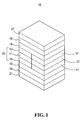
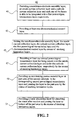
- the manufacturing process 40 of layer lamination integrated fuel cell system 10 primarily includes the following steps.
- Step 41 provides a membrane-electrode assembly layer 11, an anode current collection layer 13 and a cathode current collection layer 15.
- a first power/signal transmission layer 17 can be integrated with each of the membrane-electrode assembly layer 11, the anode current collection layer 13 and the cathode current collection layer 15.
- Fig. 3A a first power/signal transmission layer 17 integrated to the membrane-electrode assembly layer 11.
- Fig. 3B a first power/signal transmission layer 17 integrated to the anode current collection layer 13
- Fig. 3C a first power/signal transmission layer integrated to the cathode current collection layer 15.
- Step 43 is to provide an electromechanical control layer 21.
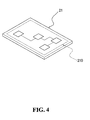
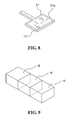
- the electromechanical control layer 21 can be mounted with electromechanical circuits 210 such as micro controller, protect circuit, DC-DC converter, and/or other active and passive component and peripheral circuit. Please refer to Fig. 4 for a perspective diagram depicting the electromechanical control layer 21 of the present invention.
- Step 45 is to couple the membrane-electrode assembly layer 11, the anode current collection layer 13, the cathode current collection layer 15, the first power/signal transmission layer 17 in step 41 and the electromechanical control layer 21 in step 43 by the means of stacking lamination layers.
- the method of the present invention uses the means of stacking lamination layers to couple the preceding layers 11, 13, 15, 17, 21 layer by layer, similar to making a sandwich by stacking layers of toast and ham on top of one another.
- the way of coupling may be by pressing, accumulating, adhesion, screw thread fastening, clamping, or other means of coupling.
- the method 40 of the present invention further includes step 47, which provides one or more second power/signal transmission layer 19, each separately coupled to the top of the anode current collection layer 13 and/or under the cathode current collection layer 15 by the means of stacking lamination layers, such that it forms a storage space to contain the reaction substance of anode and cathode.
- the method 40 further includes step 49, which provides an anti-leaking porous material layer 23, coupled to the top of some area 191 A of the second substrate 191 in the corresponding second power/signal transmission layer 19 by the means of stacking lamination layers.
- the layer 23 is used to separate the methanol solution and carbon oxide after the reaction.
- the method 40 of the present invention further includes step 51, which provides a water absorption layer 25 for absorbing water after the reaction.
- the water absorption layer 25 is coupled to the bottom of some area 191 A at the second substrate 191 of the corresponding second power/signal transmission layer 19 by the means of stacking lamination layers.
- the core component of fuel cell 30 produced with the method 40 can easily be coupled to a first power/signal transmission layer 17, second power/signal transmission layer 19, and electromechanical control layer 21. Further, substance produced during and after the core component of fuel cell 30 generates electricity can be further treated. For example, the anti-leaking porous material layer 23 and the water absorption layer 25 can be coupled together and controlled by the circuit components on the first power/signal transmission layer 17, the second power/signal transmission layer 19, and the electromechanical control layer 21.
- the preceding layers 17, 19, 21 may be electrically connected with each other by way such as via holes.
- the method 40 of the present invention allows system on cell to be easily implemented on fuel cell system.
- the fuel cartridge 27 may be placed at the top of the fuel cell system 10.
- the fuel cartridge 27 may be used to separately store methanol and water, or to store a methanol solution of a predetermined concentration ratio, so that it refills the fuel the fuel cell system expended while generating electricity.
- the fuel cell system 10 of the present invention is a hydrogen based fuel cell system
- the fuel cartridge 27 may be used to store hydrogen, so that it refills the hydrogen the fuel cell system expended while generating electricity.
- the electromechanical control layer 21 shown in Fig. 5 is disposed at the bottommost end only for the purpose of this explanation. It should be noted that the location of electromechanical control layer 21 is not limited to the location described in Fig. 5. Any person familiar with this field can easily change the design to place the electromechanical control layer 21 at other locations, such as between any two layers in the fuel cell system 10. Such a modified design nevertheless still falls within the scope of the present invention.
- the electromechanical circuits 210 on the electromechanical control layer 21 may consists of micro controller, protective circuit, DC-DC converter, and any other active and passive components and peripheral circuits.
- the active and passive components used in the electromechanical circuits 210 can be formed as, for instance, a protective circuit, a DC-DC converter and etc., to constitute a primary layer for electromechanical control.
- the positive and negative power of the fuel cell of the present invention can be led out via the electromechanical control layer 21 for the external loads.
- the electromechanical control later 21 is one of the key elements to implementing the system on cell for the fuel cell system.
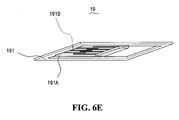
- One or more second power/signal transmission layers 19 are provided in the present invention and each of the second power/signal transmission layer 19 includes a second substrate 191 and a second circuit 191B on the second substrate 191.
- the second circuit 191B can, depending on the design needs, be designed to control the electric power generation of the core component of fuel cell 30.
- the second circuit 191B in a layer lamination integrated direct methanol fuel cell system 10 of the present invention can control the inflow of the methanol solution through the electromechanical gate component 1911, as shown in Fig. 5.
- the possible components used may include micro components such as pump, nozzle, electronic switch, and gate.
- the second circuit 191B can be used for controlling micro component 1913, such as a submerged motor, to actuate the circulation of the methyl alcohol solution in the anode action.
- the in-flowed methanol and water can be mixed into an evenly mixed methanol solution, so that the methanol solution's stability during anode action is improved.
- the possible components of the second circuit 191B being embodied are micro components 1913, such as pumps and submerged motors, and these components 1913 are placed between the second power/signal transmission layer 19 and the anode current collection layer 13.
- some area 191A of the second substrate 191 in the second power/signal transmission layer 19 can be used directly as the space to mix the methanol and the water.
- the second circuit 191B of the second the power/signal transmission layer 19 can be embodied with one or more sensor 1915.
- a concentration sensor can be used as the sensor 1915 to detect the concentration of the methanol solution
- a temperature sensor can be used as the sensor 1915 to detect the temperature of the reaction.
- two or more concentration sensors can be used for detecting concentration ratio before and after the reaction, so as to more precisely manage the timing and the volume of the inflow of the methanol solution.
- some area 191A of the second substrate 191 in the second power/signal transmission layer 19 associated with the cathode action can be used to provide the flow space for the cathode reaction substance-such as air or oxygen-during cathode action.
- the number of the second power/signal transmission layer 19 used can increase or decrease depending size of air or oxygen flow space needed or depending on the size of the micro components used.
- the second circuit 191B is used to actuate the circulation of air or oxygen for the cathode action, so that the cathode reacts more efficiently. At the same time, water can be discarded by way of vaporization so that it does not impede the cathode reaction.
- the possible components for embodying the second circuit 191B may be micro components 1917 such as pump, motor, fan and blower.
- the second power/signal transmission layer 19 associate with the cathode action has on its sidewall a plurality of air apertures 191C to allow the air to circulate and allow the evaporated moisture to exit via the air apertures 191C.
- the second power/signal transmission layer 19 associate with the anode action in the layer lamination integrated fuel cell provides some area 191A to form a flow field 191D.
- 191D is used to provide a flow path for the anode fuel's circulation, thereby enhances the chance of reaction for the anode fuel.
- the preceding embodiment of the second power/signal transmission layer 19 illustrated in Figs. 6A to 6E discloses possible examples of the second power/signal transmission layer 19. It should be noted that the present invention is not limited to the embodiments shown in Figs. 6A to 6E.
- the core component of fuel cell 30 consists an anode current collection layer 13, a membrane-electrode assembly layer 11, and a cathode current collection layer 15.
- the membrane-electrode assembly layer 11 mainly consists five sub-layers, as shown in Fig. 7.
- the middle layer is a proton exchange membrane that causes the proton-exchange effect
- on the top and bottom of the proton exchange membrane are two catalytic layers, where the electrochemical reactions of the anode and the cathode take place.
- Attached to the catalytic layers at the outer sides are diffusion layers.
- the anode reaction substance enters the catalytic layer via the diffusion layer.
- the produced substance from the chemical reaction, carbon oxide, from the chemical reaction is discarded via the diffusion layer on the anode side.
- the hydrogen proton can perform proton transition via the electrode layer.
- the electrons flows through and collects current from the anode current collection layer, then travels through the load and returns to the cathode, where it joins with the hydrogen proton and then reacts with the oxygen that had entered through the diffusion layer at the cathode end.
- the produced substance, water further is disposed via the diffusion layer at the cathode end, thereby completes the electricity generation reaction.
- the first power/signal transmission layers 17 that are separately placed at the membrane-electrode assembly layer 11, the anode current collection layer 13, and the cathode current collection layer 15, due to its structural characteristics, can use first circuit 171A on the first substrate 171 to link each membrane-electrode assembly layer in series or in parallel to increase the voltage or the current. Further, the first circuit 171 A can be changed to other circuits depending on the actual application.
- the anode current collection layer 13 and the cathode current collection layer 15 can be made of current-collection material such as metal net, graphite or other conductive material, for collecting electricity after the fuel's reaction.
- the present invention further provides an anti-leaking porous material layer 23 at the top of the some area 191A of the second substrate 191 in the second power/signal transmission layer 19, as shown in Fig. 5.
- the layer 23 is mainly used to separate the methanol solution and the carbon oxide after the reaction.
- the porous material layer 23 can be made of porous and liquid-impermeable-and-gas-permeable material, so that carbon oxide may permeate via the layer 23 and the methanol solution is retained in the action area without reacting with the material.
- the present invention further includes a water absorption layer 25 for absorbing water after reaction.
- the water absorption layer 25 can be made of water absorption material.
- the water absorption layer 25 is coupled to some area 191A of the second substrate in the second power/signal transmission layer 19 by the means of stacking lamination layers as shown in Fig. 5.
- the second circuit 191B of the second power/signal transmission layer 19 can be embodied with an electrically connected interface circuit component, such as connector, and each fuel cell system can be stacked together by connecting the interface circuit components.
- the way for stacking the fuel cell system may be horizontal stacking, vertical stacking or stacking along other directions.
- the preceding first substrate 171 and the second substrate 191 can also be made of high molecular material, ceramics, complex material, metal, metal or metal oxide with nonconductive surface, acrylic, wood, stone, etc.
- the fuel cell system 10 utilizes the means of stacking lamination layers to couple the preceding layers together.
- a plurality of independent core component of fuel cell 30 can be arranged on the same layer.
- the positive and negative output terminals of the electromechanical control layer 21, the first circuit 171A of the first power/signal transmission layer 17 or the first circuit 191B of the second power/signal transmission layer 19, may be serial or parallel connected to each core component of fuel cell 30 according to the voltage and current requirements.
- the electromechanical control layer 21 or the second circuit 191B of the second power/signal transmission layer 19 may be used to manage the quality of the electric power generated by core component of fuel cell 30.
- the electromechanical control layer 21 can integrate all or some internal control related circuits of core component of fuel cell 30, and used them as an interface circuit or control circuit to the external circuits.
- both the method 40 and the fuel cell system 10 according to the present invention can easily implement the concept of the system on cell that previously had been difficult for fuel cell systems to achieve.
- the present invention utilizes the means of stacking lamination layers for manufacturing and coupling different layers, the present invention can easily satisfy the different size and shape requirements of different fuel cell systems.
Landscapes
- Life Sciences & Earth Sciences (AREA)
- Engineering & Computer Science (AREA)
- Manufacturing & Machinery (AREA)
- Sustainable Development (AREA)
- Sustainable Energy (AREA)
- Chemical & Material Sciences (AREA)
- Chemical Kinetics & Catalysis (AREA)
- Electrochemistry (AREA)
- General Chemical & Material Sciences (AREA)
- Fuel Cell (AREA)
Applications Claiming Priority (2)
| Application Number | Priority Date | Filing Date | Title |
|---|---|---|---|
| CN200310100336 | 2003-10-14 | ||
| CNB2003101003367A CN1323458C (zh) | 2003-10-14 | 2003-10-14 | 积层整合式燃料电池系统的制造方法及其燃料电池系统 |
Publications (3)
| Publication Number | Publication Date |
|---|---|
| EP1524716A2 true EP1524716A2 (de) | 2005-04-20 |
| EP1524716A3 EP1524716A3 (de) | 2006-11-08 |
| EP1524716B1 EP1524716B1 (de) | 2009-01-21 |
Family
ID=34333032
Family Applications (1)
| Application Number | Title | Priority Date | Filing Date |
|---|---|---|---|
| EP04024111A Expired - Lifetime EP1524716B1 (de) | 2003-10-14 | 2004-10-08 | Verfahren zur Herstellung eines Laminationsschicht-integrierten Brennstoffzellensystem und Brennstoffzellensystem |
Country Status (4)
| Country | Link |
|---|---|
| EP (1) | EP1524716B1 (de) |
| CN (1) | CN1323458C (de) |
| CA (1) | CA2484124A1 (de) |
| DE (1) | DE602004019174D1 (de) |
Cited By (2)
| Publication number | Priority date | Publication date | Assignee | Title |
|---|---|---|---|---|
| DE102005040864B4 (de) * | 2004-08-31 | 2008-01-24 | Antig Technology Co., Ltd. | Halbaktive Brennstoffzellenvorrichtung |
| US20120013185A1 (en) * | 2009-06-03 | 2012-01-19 | Toyota Jidosha Kabushiki Kaisha | Fuel cell system |
Families Citing this family (1)
| Publication number | Priority date | Publication date | Assignee | Title |
|---|---|---|---|---|
| GB2506925A (en) | 2012-10-15 | 2014-04-16 | Intelligent Energy Ltd | A current collector for a fuel cell |
Family Cites Families (5)
| Publication number | Priority date | Publication date | Assignee | Title |
|---|---|---|---|---|
| US6127058A (en) * | 1998-10-30 | 2000-10-03 | Motorola, Inc. | Planar fuel cell |
| US6638654B2 (en) * | 1999-02-01 | 2003-10-28 | The Regents Of The University Of California | MEMS-based thin-film fuel cells |
| EP1296395B1 (de) * | 2000-06-27 | 2012-08-08 | Nok Corporation | Dichtungsanordnung für brennstoffzelle |
| US6797422B2 (en) * | 2001-01-25 | 2004-09-28 | Gas Technology Institute | Air-breathing direct methanol fuel cell with metal foam current collectors |
| TWI225320B (en) * | 2003-09-29 | 2004-12-11 | Antig Tech Co Ltd | Manufacturing method of laminated integration-type fuel cell system and its fuel cell system |
-
2003
- 2003-10-14 CN CNB2003101003367A patent/CN1323458C/zh not_active Expired - Fee Related
-
2004
- 2004-10-06 CA CA002484124A patent/CA2484124A1/en not_active Abandoned
- 2004-10-08 EP EP04024111A patent/EP1524716B1/de not_active Expired - Lifetime
- 2004-10-08 DE DE602004019174T patent/DE602004019174D1/de not_active Expired - Fee Related
Cited By (4)
| Publication number | Priority date | Publication date | Assignee | Title |
|---|---|---|---|---|
| DE102005040864B4 (de) * | 2004-08-31 | 2008-01-24 | Antig Technology Co., Ltd. | Halbaktive Brennstoffzellenvorrichtung |
| US20120013185A1 (en) * | 2009-06-03 | 2012-01-19 | Toyota Jidosha Kabushiki Kaisha | Fuel cell system |
| US20150249254A1 (en) * | 2009-06-03 | 2015-09-03 | Toyota Jidosha Kabushiki Kaisha | Fuel cell system |
| US20150255815A1 (en) * | 2009-06-03 | 2015-09-10 | Toyota Jidosha Kabushiki Kaisha | Fuel cell system |
Also Published As
| Publication number | Publication date |
|---|---|
| CA2484124A1 (en) | 2005-04-14 |
| EP1524716B1 (de) | 2009-01-21 |
| DE602004019174D1 (de) | 2009-03-12 |
| CN1323458C (zh) | 2007-06-27 |
| CN1607689A (zh) | 2005-04-20 |
| EP1524716A3 (de) | 2006-11-08 |
Similar Documents
| Publication | Publication Date | Title |
|---|---|---|
| JP5290402B2 (ja) | 燃料電池スタックおよびこれを備える電子機器 | |
| JP4284068B2 (ja) | 内蔵型流場を備える直接メタノール燃料電池システム | |
| US6680139B2 (en) | Reduced size fuel cell for portable applications | |
| Dillon et al. | International activities in DMFC R&D: status of technologies and potential applications | |
| US6743541B2 (en) | Monopolar cell pack of proton exchange membrane fuel cell and direct methanol fuel cell | |
| US6824900B2 (en) | Method and apparatus for water management of a fuel cell system | |
| RU2258277C2 (ru) | Система топливных элементов с прямой подачей метанола | |
| US20050066520A1 (en) | Manufacturing process of layer lamination integrated fuel cell system and the fuel cell system itself | |
| CN1347575A (zh) | 带有基于直接注入液态水的冷却系统的燃料电池 | |
| RU2004124066A (ru) | Pen для sofc | |
| JP2007087955A (ja) | 膜電極接合体及び燃料電池 | |
| US20090023046A1 (en) | Porous Transport Structures for Direct-Oxidation Fuel Cell System Operating with Concentrated Fuel | |
| US20070231668A1 (en) | Fuel cell device | |
| JP2002540585A (ja) | 加熱要素を備えコールドスタート性能を改善した燃料電池および燃料電池のコールドスタート方法 | |
| JP2000294257A (ja) | 固体高分子電解質型燃料電池 | |
| EP1524716B1 (de) | Verfahren zur Herstellung eines Laminationsschicht-integrierten Brennstoffzellensystem und Brennstoffzellensystem | |
| US20050048346A1 (en) | Modular connections in a DMFC array | |
| JP2012099348A (ja) | 燃料電池スタック | |
| JP4701585B2 (ja) | 直接形燃料電池 | |
| WO2001097314A1 (en) | Reduced size fuel cell for portable applications | |
| KR100644370B1 (ko) | 적층통합식 연료전지 및 그 제조방법 | |
| US20060078779A1 (en) | Draining device for use with fuel cell system | |
| JP2006351501A (ja) | 着脱式燃料電池及び電源供給システム | |
| JP2006107819A (ja) | 電源装置 | |
| JP3118182U (ja) | 燃料電池及び電源供給システム |
Legal Events
| Date | Code | Title | Description |
|---|---|---|---|
| PUAI | Public reference made under article 153(3) epc to a published international application that has entered the european phase |
Free format text: ORIGINAL CODE: 0009012 |
|
| AK | Designated contracting states |
Kind code of ref document: A2 Designated state(s): AT BE BG CH CY CZ DE DK EE ES FI FR GB GR HU IE IT LI LU MC NL PL PT RO SE SI SK TR |
|
| AX | Request for extension of the european patent |
Extension state: AL HR LT LV MK |
|
| PUAL | Search report despatched |
Free format text: ORIGINAL CODE: 0009013 |
|
| AK | Designated contracting states |
Kind code of ref document: A3 Designated state(s): AT BE BG CH CY CZ DE DK EE ES FI FR GB GR HU IE IT LI LU MC NL PL PT RO SE SI SK TR |
|
| AX | Request for extension of the european patent |
Extension state: AL HR LT LV MK |
|
| RIC1 | Information provided on ipc code assigned before grant |
Ipc: H01M 8/10 20060101AFI20050207BHEP Ipc: H01M 8/04 20060101ALI20060929BHEP |
|
| 17P | Request for examination filed |
Effective date: 20061130 |
|
| 17Q | First examination report despatched |
Effective date: 20070605 |
|
| AKX | Designation fees paid |
Designated state(s): DE FR GB |
|
| GRAP | Despatch of communication of intention to grant a patent |
Free format text: ORIGINAL CODE: EPIDOSNIGR1 |
|
| GRAS | Grant fee paid |
Free format text: ORIGINAL CODE: EPIDOSNIGR3 |
|
| GRAA | (expected) grant |
Free format text: ORIGINAL CODE: 0009210 |
|
| AK | Designated contracting states |
Kind code of ref document: B1 Designated state(s): DE FR GB |
|
| REG | Reference to a national code |
Ref country code: GB Ref legal event code: FG4D |
|
| REF | Corresponds to: |
Ref document number: 602004019174 Country of ref document: DE Date of ref document: 20090312 Kind code of ref document: P |
|
| PLBE | No opposition filed within time limit |
Free format text: ORIGINAL CODE: 0009261 |
|
| STAA | Information on the status of an ep patent application or granted ep patent |
Free format text: STATUS: NO OPPOSITION FILED WITHIN TIME LIMIT |
|
| 26N | No opposition filed |
Effective date: 20091022 |
|
| REG | Reference to a national code |
Ref country code: FR Ref legal event code: ST Effective date: 20100630 |
|
| PG25 | Lapsed in a contracting state [announced via postgrant information from national office to epo] |
Ref country code: FR Free format text: LAPSE BECAUSE OF NON-PAYMENT OF DUE FEES Effective date: 20091102 Ref country code: DE Free format text: LAPSE BECAUSE OF NON-PAYMENT OF DUE FEES Effective date: 20100501 |
|
| PG25 | Lapsed in a contracting state [announced via postgrant information from national office to epo] |
Ref country code: GB Free format text: LAPSE BECAUSE OF NON-PAYMENT OF DUE FEES Effective date: 20091008 |