EP1522924A2 - Méthode de planification - Google Patents
Méthode de planification Download PDFInfo
- Publication number
- EP1522924A2 EP1522924A2 EP03021619A EP03021619A EP1522924A2 EP 1522924 A2 EP1522924 A2 EP 1522924A2 EP 03021619 A EP03021619 A EP 03021619A EP 03021619 A EP03021619 A EP 03021619A EP 1522924 A2 EP1522924 A2 EP 1522924A2
- Authority
- EP
- European Patent Office
- Prior art keywords
- tasks
- deadline
- task
- priority
- time
- Prior art date
- Legal status (The legal status is an assumption and is not a legal conclusion. Google has not performed a legal analysis and makes no representation as to the accuracy of the status listed.)
- Withdrawn
Links
Images


Classifications
-
- G—PHYSICS
- G06—COMPUTING OR CALCULATING; COUNTING
- G06F—ELECTRIC DIGITAL DATA PROCESSING
- G06F9/00—Arrangements for program control, e.g. control units
- G06F9/06—Arrangements for program control, e.g. control units using stored programs, i.e. using an internal store of processing equipment to receive or retain programs
- G06F9/46—Multiprogramming arrangements
-
- G—PHYSICS
- G06—COMPUTING OR CALCULATING; COUNTING
- G06F—ELECTRIC DIGITAL DATA PROCESSING
- G06F9/00—Arrangements for program control, e.g. control units
- G06F9/06—Arrangements for program control, e.g. control units using stored programs, i.e. using an internal store of processing equipment to receive or retain programs
- G06F9/46—Multiprogramming arrangements
- G06F9/48—Program initiating; Program switching, e.g. by interrupt
- G06F9/4806—Task transfer initiation or dispatching
- G06F9/4843—Task transfer initiation or dispatching by program, e.g. task dispatcher, supervisor, operating system
- G06F9/4881—Scheduling strategies for dispatcher, e.g. round robin, multi-level priority queues
- G06F9/4887—Scheduling strategies for dispatcher, e.g. round robin, multi-level priority queues involving deadlines, e.g. rate based, periodic
Definitions
- the present invention relates to a real time scheduling, and more particularly, to an EDF scheduling method for performing a priority allocation in a constant time complexity.
- RM rate monotonic
- EDF earliest deadline first
- the EDF algorithm is regarded as an optimum scheduling algorithm in that a system utilization degree is 100%.
- a fixed priority algorithm such as the RM is being utilized much more.
- Figures 1 and 2 are exemplary views for respectively explaining an RM scheduling and an EDF scheduling in accordance with the conventional art, in which three tasks (T1, T2, and T3) respectively having different period and runtime are scheduled according to an RM algorithm and an EDF algorithm.
- the task T1 having a period of 5 is allocated with the highest priority H
- the task T2 having a period of 7 is allocated with a middle priority M
- the task T3 having a period of 15 is allocated with the lowest priority L.
- the priorities are not changed even if time elapses.
- priorities of the tasks are determined by deadlines of the tasks. That is, a task having the shortest deadline in current time is allocated with the highest priority.
- a task having the shortest deadline in current time is allocated with the highest priority.
- the task T1 having time of 5 up to a deadline is allocated with the highest priority H
- the task T2 having time of 7 up to a deadline is allocated with a middle priority M
- the task T3 having time of 15 up to a deadline is allocated with the lowest priority L.
- remaining time up to the deadline of the tasks T1 and T3 are respectively 6 and remaining time up to the deadline of the task T2 is 5, so that priorities of the tasks are changed.
- Operating systems which support said EDF scheduling generally use a list structure or a data structure of a heap form.
- N the number of tasks or messages of a system
- O(N) a linear time O(N) is required when a scheduler selects a task or a message to be scheduled next.
- an object of the present invention is to provide an EDF scheduling method capable of minimizing a runtime overhead.
- Another object of the present invention is to provide an EDF scheduling method capable of minimizing a runtime overhead by making a priority allocated to one task not be changed as time elapses and thereby removing a runtime overhead generated by a priority re-allocation.
- an EDF scheduling method comprising the steps of: checking the number of tasks to be scheduled; allocating priorities to the tasks; updating current time as the lowest priority; and processing the tasks in a shortest-deadline-first order from the updated lowest priority on a temporal axis.
- the number of tasks to be scheduled is less than the number 2 k of a priority level. If the number of the tasks is less than that of the priority level, a priority of each task is determined as a value obtained by dividing a value obtained by dividing a deadline d i of a corresponding task by a maximum deadline T max by a specific time unit q.
- the maximum deadline is a relative deadline of a task having the longest period among the tasks, and the specific time unit is a value obtained by dividing the maximum deadline by the number of a priority level.
- the current time is indicated by a current time indicator obtained by dividing a value obtained by dividing current time by the maximum deadline by the specific time unit.
- the tasks are grouped into several sets and one current time indicator is set to each task set.
- a priority level (P i ) of a task having a deadline which is in a range of 2 m-1 T min ⁇ 2 m T min is obtained by a formula of wherein the q(m) denotes a time unit relevant to the m th time indicator, the x denotes the number of a priority level relevant to each current time indicator, and the d i denotes a deadline of a corresponding task.
- the number of the current time indicator is
- a value of the m th time indicator, C(m) is updated by a formula of
- the EDF scheduling method of the present invention includes a priority allocation method in case of an abundant priority level or a limited priority level and a schedulability test method at the time of applying the EDF scheduling method.
- a temporal axis is divided into a quantum unit, then a priority and a time indicator for indicating current time of each task are calculated thus to be mapped in a bitmap, and the time indicator is periodically updated, thereby scheduling the tasks by a relative priority for the time indicator without a priority re-allocation process of the tasks.
- the T max denotes a maximum deadline
- the k denotes the number of bits allocated for a priority level.
- a priority level of each task (P i ) is calculated by a following formula 2.
- d i denotes a deadline of a corresponding task.
- time indicator C is updated by a following formula 3 whenever current time of a system is updated.
- the current_time denotes current time of a system.
- Figure 3 is a conceptual view showing a bitmap structure applied to the EDF scheduling method of the present invention. Once priorities of tasks to be scheduled are determined by using the formulas 1 and 2, a corresponding priority bit is set to the bitmap and the time indicator is periodically updated by the formula 3.
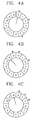
- Figures 4A to 4C are exemplary views for explaining that a priority of each task is determined as time elapses.
- the scheduler determines priorities of the tasks by using the formulas 1 and 2.
- the maximum deadline T max of said three tasks is 13 which is equal to the period of the T3, 13 priority levels exist, and by the formula 2, deadlines d 1 , d 2 , and d 3 of the T1, T2, and T3 are respectively 2, 5, and 0 and by the formula 3, the time indicator indicates '0'.
- a priority level of time that the time indicator indicates is the lowest, and priority levels become lower towards a clockwise direction.
- time '11' as shown in Figure 4B, the time indicator indicates time 11, and relative deadlines of the T1, T2, and T3 become 1, 4, and 2, respectively by the formula 2. According to this, in time '11', the tasks are processed in an order of T1, T3, and T2.
- time '12' as shown in Figure 4C, the time indicator indicates time 12, and relative deadlines of the T1, T2, and T3 become 2, 3, and 1, respectively by the formula 2. According to this, in time '12', the tasks are processed in an order of T3, T1, and T2.
- the EDF scheduling method according to the present invention is based on a priority setting method in the EDF scheduling.
- a time indicator for indicating the lowest priority level is set in current time and corresponding tasks are searched towards a clockwise direction thus to process the firstly searched task firstly, thereby minimizing a runtime overhead by a priority re-allocation.
- the number of the tasks can be more than the number of allocable priorities.
- an efficient EDF scheduling is possible by applying a plurality of time indicators.
- the x denotes the number of a priority level relevant to each time indicator and is obtained by a following formula 5.
- the k denotes the number of a priority level bit.
- a priority (P i ) of a task having a deadline which is in a range of 2 m-1 T min ⁇ 2 m T min is obtained by a following formula 6.
- the time indicator is maintained as and when current time is updated, the m th time indicator C(m) is updated by a following formula 7.
- a system using rate for a case that the priority level is enough and a case that the priority level is not enough is yielded thus to test a schedulability of each case.
- the system using rate denotes a total sum of values obtained by dividing processing time of tasks or messages by their deadlines.
- the number of a priority bit is k
- a scheduling is possible. Also, in case that k is not enough, if a system using rate is or less than that, a scheduling is possible.
- a time indicator indicating the lowest priority level is set in current time, and corresponding tasks are searched towards a clockwise direction thus to process the first searched task firstly, thereby enabling a scheduling in a constant time complexity without changing priorities allocated to each task.
- a plurality of time indicators are set thus to expand a deadline range, thereby maximizing a system using rate.
- allocated priorities are not changed thus to minimize a runtime overhead generated by re-allocating priorities.
Landscapes
- Engineering & Computer Science (AREA)
- Software Systems (AREA)
- Theoretical Computer Science (AREA)
- Physics & Mathematics (AREA)
- General Engineering & Computer Science (AREA)
- General Physics & Mathematics (AREA)
- Management, Administration, Business Operations System, And Electronic Commerce (AREA)
- Debugging And Monitoring (AREA)
Applications Claiming Priority (2)
| Application Number | Priority Date | Filing Date | Title |
|---|---|---|---|
| KR2003050708 | 2003-07-23 | ||
| KR10-2003-0050708A KR100524763B1 (ko) | 2003-07-23 | 2003-07-23 | 개선된 edf 스케쥴링 방법 |
Publications (2)
| Publication Number | Publication Date |
|---|---|
| EP1522924A2 true EP1522924A2 (fr) | 2005-04-13 |
| EP1522924A3 EP1522924A3 (fr) | 2007-05-09 |
Family
ID=34074951
Family Applications (1)
| Application Number | Title | Priority Date | Filing Date |
|---|---|---|---|
| EP03021619A Withdrawn EP1522924A3 (fr) | 2003-07-23 | 2003-09-25 | Méthode de planification |
Country Status (5)
| Country | Link |
|---|---|
| US (1) | US20050022187A1 (fr) |
| EP (1) | EP1522924A3 (fr) |
| JP (1) | JP3890045B2 (fr) |
| KR (1) | KR100524763B1 (fr) |
| CN (1) | CN1307531C (fr) |
Cited By (2)
| Publication number | Priority date | Publication date | Assignee | Title |
|---|---|---|---|---|
| DE102007042999A1 (de) | 2007-09-10 | 2009-03-12 | Continental Automotive Gmbh | EDF-Implementierung für Realzeitsysteme mit statischen Prioritäten |
| CN101499019B (zh) * | 2009-03-24 | 2011-01-12 | 武汉烽火网络有限责任公司 | 电信级以太网系统及用于该系统的实时任务调度方法 |
Families Citing this family (25)
| Publication number | Priority date | Publication date | Assignee | Title |
|---|---|---|---|---|
| US8473563B2 (en) * | 2005-04-22 | 2013-06-25 | GM Global Technology Operations LLC | Extensible scheduling of messages on time-triggered busses |
| US7844968B1 (en) * | 2005-05-13 | 2010-11-30 | Oracle America, Inc. | System for predicting earliest completion time and using static priority having initial priority and static urgency for job scheduling |
| US7743378B1 (en) * | 2005-05-13 | 2010-06-22 | Oracle America, Inc. | Method and apparatus for multi-dimensional priority determination for job scheduling |
| US8214836B1 (en) | 2005-05-13 | 2012-07-03 | Oracle America, Inc. | Method and apparatus for job assignment and scheduling using advance reservation, backfilling, and preemption |
| US7984447B1 (en) * | 2005-05-13 | 2011-07-19 | Oracle America, Inc. | Method and apparatus for balancing project shares within job assignment and scheduling |
| US7752622B1 (en) | 2005-05-13 | 2010-07-06 | Oracle America, Inc. | Method and apparatus for flexible job pre-emption |
| US8001430B2 (en) * | 2005-06-30 | 2011-08-16 | Freescale Semiconductor, Inc. | Device and method for controlling an execution of a DMA task |
| EP1899828B1 (fr) * | 2005-06-30 | 2009-11-25 | Freescale Semiconductor, Inc. | Dispositif et procede d'arbitrage entre des requetes de tache d'acces direct a la memoire |
| DE602005023542D1 (de) * | 2005-06-30 | 2010-10-21 | Freescale Semiconductor Inc | Einrichtung und verfahren zum ausführen einer dma-task |
| JP4815195B2 (ja) * | 2005-11-16 | 2011-11-16 | みずほ情報総研株式会社 | ジョブ実行管理方法、ジョブ実行管理システム及びジョブ実行管理プログラム |
| US7877752B2 (en) * | 2005-12-14 | 2011-01-25 | Broadcom Corp. | Method and system for efficient audio scheduling for dual-decode digital signal processor (DSP) |
| KR20070089460A (ko) * | 2006-02-28 | 2007-08-31 | 삼성전자주식회사 | 우선 순위에 따른 비휘발성 메모리의 연산 처리 장치 및방법 |
| US8028293B2 (en) * | 2007-06-28 | 2011-09-27 | Microsoft Corporation | Optimal policies for load balancing for distributed and strategic agents (more technically, optimal coordination mechanisms for machine scheduling) |
| KR100927190B1 (ko) * | 2007-10-12 | 2009-11-18 | 한국전자통신연구원 | 디스크 스케줄링 방법 및 장치 |
| US8856018B2 (en) * | 2008-09-15 | 2014-10-07 | The Boeing Company | Methods and systems for optimizing production forecasts using statistically prioritized discrete modeling methodology |
| KR101073428B1 (ko) * | 2008-11-27 | 2011-10-17 | 학교법인 동의학원 | 자동차용 임베디드 운영체제의 태스크 스케줄링 방법 |
| US8473704B2 (en) | 2010-04-28 | 2013-06-25 | Hitachi, Ltd. | Storage device and method of controlling storage system |
| CN101887383B (zh) * | 2010-06-30 | 2013-08-21 | 中山大学 | 一种进程实时调度方法 |
| JP5099188B2 (ja) * | 2010-08-18 | 2012-12-12 | コニカミノルタビジネステクノロジーズ株式会社 | 処理順決定装置、処理順決定方法および処理順決定プログラム |
| US20120066683A1 (en) * | 2010-09-09 | 2012-03-15 | Srinath Nadig S | Balanced thread creation and task allocation |
| CN102508698B (zh) * | 2011-09-23 | 2013-07-31 | 浙江大学 | 一种使嵌入式系统最高温度最小化的调度方法 |
| CN103365708B (zh) * | 2012-04-06 | 2017-03-22 | 阿里巴巴集团控股有限公司 | 任务调度方法和装置 |
| US10289448B2 (en) | 2016-09-06 | 2019-05-14 | At&T Intellectual Property I, L.P. | Background traffic management |
| KR102012182B1 (ko) * | 2018-02-01 | 2019-10-21 | 충남대학교산학협력단 | 가상 데드라인 위반 없이 프로세서의 반응성을 개선하기 위한 태스크 스케줄링 방법 |
| WO2022109351A1 (fr) | 2020-11-20 | 2022-05-27 | Okta, Inc. | Gestion de flux de travaux sur serveur utilisant des priorités |
Family Cites Families (9)
| Publication number | Priority date | Publication date | Assignee | Title |
|---|---|---|---|---|
| US5640563A (en) * | 1992-01-31 | 1997-06-17 | International Business Machines Corporation | Multi-media computer operating system and method |
| DE19530483A1 (de) * | 1995-08-18 | 1997-02-20 | Siemens Ag | Einrichtung und Verfahren zur Echtzeit-Verarbeitung einer Mehrzahl von Tasks |
| US6028843A (en) * | 1997-03-25 | 2000-02-22 | International Business Machines Corporation | Earliest deadline first communications cell scheduler and scheduling method for transmitting earliest deadline cells first |
| US6687257B1 (en) * | 1999-08-12 | 2004-02-03 | Rockwell Automation Technologies, Inc. | Distributed real-time operating system providing dynamic guaranteed mixed priority scheduling for communications and processing |
| US6738972B1 (en) * | 1999-12-30 | 2004-05-18 | Opentv, Inc. | Method for flow scheduling |
| US20030061260A1 (en) * | 2001-09-25 | 2003-03-27 | Timesys Corporation | Resource reservation and priority management |
| US6788687B2 (en) * | 2001-10-30 | 2004-09-07 | Qualcomm Incorporated | Method and apparatus for scheduling packet data transmissions in a wireless communication system |
| US20030128686A1 (en) * | 2001-12-06 | 2003-07-10 | Hur Nam Chun | Variable delay buffer |
| US7383548B2 (en) * | 2003-11-28 | 2008-06-03 | Nortel Networks Limited | CPU usage regulation |
-
2003
- 2003-07-23 KR KR10-2003-0050708A patent/KR100524763B1/ko not_active Expired - Fee Related
- 2003-09-24 US US10/668,320 patent/US20050022187A1/en not_active Abandoned
- 2003-09-25 EP EP03021619A patent/EP1522924A3/fr not_active Withdrawn
- 2003-09-25 JP JP2003334442A patent/JP3890045B2/ja not_active Expired - Fee Related
- 2003-09-26 CN CNB031601480A patent/CN1307531C/zh not_active Expired - Fee Related
Cited By (2)
| Publication number | Priority date | Publication date | Assignee | Title |
|---|---|---|---|---|
| DE102007042999A1 (de) | 2007-09-10 | 2009-03-12 | Continental Automotive Gmbh | EDF-Implementierung für Realzeitsysteme mit statischen Prioritäten |
| CN101499019B (zh) * | 2009-03-24 | 2011-01-12 | 武汉烽火网络有限责任公司 | 电信级以太网系统及用于该系统的实时任务调度方法 |
Also Published As
| Publication number | Publication date |
|---|---|
| KR20050011559A (ko) | 2005-01-29 |
| US20050022187A1 (en) | 2005-01-27 |
| CN1577253A (zh) | 2005-02-09 |
| CN1307531C (zh) | 2007-03-28 |
| JP3890045B2 (ja) | 2007-03-07 |
| JP2005044326A (ja) | 2005-02-17 |
| EP1522924A3 (fr) | 2007-05-09 |
| KR100524763B1 (ko) | 2005-10-31 |
Similar Documents
| Publication | Publication Date | Title |
|---|---|---|
| EP1522924A2 (fr) | Méthode de planification | |
| Bao et al. | Online job scheduling in distributed machine learning clusters | |
| CN113448743B (zh) | 用于任务处理的方法、电子设备以及计算机程序产品 | |
| JP3578780B2 (ja) | 確率的優先順位に基づいてタスクを選択する方法 | |
| CN117608840A (zh) | 一种智能监控系统资源综合管理的任务处理方法及系统 | |
| Sprunt et al. | Aperiodic task scheduling for hard-real-time systems | |
| CN111400022A (zh) | 一种资源调度方法、装置及电子设备 | |
| CN108268317B (zh) | 一种资源分配方法及装置 | |
| CN103916269A (zh) | 用于加权公平队列的方法与系统 | |
| CN113067778B (zh) | 一种流量管理方法及流量管理芯片 | |
| KR20110003467A (ko) | 통신 네트워크에 있어서 예약 요청 스케줄링을 위한 시스템 및 방법 | |
| CN114035924B (zh) | 一种分布式限速队列实现方法及装置 | |
| CN115421905A (zh) | 一种任务调度方法、装置、电子设备及存储介质 | |
| CN114845400B (zh) | 一种基于FlexE的资源分配方法及系统 | |
| US20060221823A1 (en) | Assigning resources to items such as processing contexts for processing packets | |
| EP1638273B1 (fr) | Organisation dans le temps par référence à des quantums et des valeurs de déficit | |
| US7843940B2 (en) | Filling token buckets of schedule entries | |
| CN116360922A (zh) | 集群资源调度方法、装置、计算机设备和存储介质 | |
| Nasri et al. | Non-work-conserving scheduling of non-preemptive hard real-time tasks based on fixed priorities | |
| US7565496B2 (en) | Sharing memory among multiple information channels | |
| CN111294290B (zh) | 一种基于大数据的资源调度方法 | |
| US10782887B2 (en) | Window-based prority tagging of IOPs in a distributed storage system | |
| CN117979452A (zh) | 基于卫星链路质量的动态资源分配方法及系统 | |
| US7583678B1 (en) | Methods and apparatus for scheduling entities using a primary scheduling mechanism such as calendar scheduling filled in with entities from a secondary scheduling mechanism | |
| CN113590326A (zh) | 服务资源调度方法和装置 |
Legal Events
| Date | Code | Title | Description |
|---|---|---|---|
| PUAI | Public reference made under article 153(3) epc to a published international application that has entered the european phase |
Free format text: ORIGINAL CODE: 0009012 |
|
| 17P | Request for examination filed |
Effective date: 20030925 |
|
| AK | Designated contracting states |
Kind code of ref document: A2 Designated state(s): AT BE BG CH CY CZ DE DK EE ES FI FR GB GR HU IE IT LI LU MC NL PT RO SE SI SK TR |
|
| AX | Request for extension of the european patent |
Extension state: AL LT LV MK |
|
| PUAL | Search report despatched |
Free format text: ORIGINAL CODE: 0009013 |
|
| AK | Designated contracting states |
Kind code of ref document: A3 Designated state(s): AT BE BG CH CY CZ DE DK EE ES FI FR GB GR HU IE IT LI LU MC NL PT RO SE SI SK TR |
|
| AX | Request for extension of the european patent |
Extension state: AL LT LV MK |
|
| AKX | Designation fees paid | ||
| STAA | Information on the status of an ep patent application or granted ep patent |
Free format text: STATUS: THE APPLICATION IS DEEMED TO BE WITHDRAWN |
|
| 18D | Application deemed to be withdrawn |
Effective date: 20071110 |
|
| REG | Reference to a national code |
Ref country code: DE Ref legal event code: 8566 |