EP1521228B1 - Selbstklebeetikett für einen Prospekt - Google Patents
Selbstklebeetikett für einen Prospekt Download PDFInfo
- Publication number
- EP1521228B1 EP1521228B1 EP04405610A EP04405610A EP1521228B1 EP 1521228 B1 EP1521228 B1 EP 1521228B1 EP 04405610 A EP04405610 A EP 04405610A EP 04405610 A EP04405610 A EP 04405610A EP 1521228 B1 EP1521228 B1 EP 1521228B1
- Authority
- EP
- European Patent Office
- Prior art keywords
- pamphlet
- label
- adhesive
- sheet
- topmost
- Prior art date
- Legal status (The legal status is an assumption and is not a legal conclusion. Google has not performed a legal analysis and makes no representation as to the accuracy of the status listed.)
- Expired - Lifetime
Links
Images
Classifications
-
- G—PHYSICS
- G09—EDUCATION; CRYPTOGRAPHY; DISPLAY; ADVERTISING; SEALS
- G09F—DISPLAYING; ADVERTISING; SIGNS; LABELS OR NAME-PLATES; SEALS
- G09F3/00—Labels, tag tickets, or similar identification or indication means; Seals; Postage or like stamps
- G09F3/08—Fastening or securing by means not forming part of the material of the label itself
- G09F3/10—Fastening or securing by means not forming part of the material of the label itself by an adhesive layer
-
- G—PHYSICS
- G09—EDUCATION; CRYPTOGRAPHY; DISPLAY; ADVERTISING; SEALS
- G09F—DISPLAYING; ADVERTISING; SIGNS; LABELS OR NAME-PLATES; SEALS
- G09F3/00—Labels, tag tickets, or similar identification or indication means; Seals; Postage or like stamps
- G09F3/02—Forms or constructions
- G09F3/0288—Labels or tickets consisting of more than one part, e.g. with address of sender or other reference on separate section to main label; Multi-copy labels
- G09F3/02883—Folded
-
- G—PHYSICS
- G09—EDUCATION; CRYPTOGRAPHY; DISPLAY; ADVERTISING; SEALS
- G09F—DISPLAYING; ADVERTISING; SIGNS; LABELS OR NAME-PLATES; SEALS
- G09F3/00—Labels, tag tickets, or similar identification or indication means; Seals; Postage or like stamps
- G09F3/02—Forms or constructions
- G09F3/0288—Labels or tickets consisting of more than one part, e.g. with address of sender or other reference on separate section to main label; Multi-copy labels
- G09F3/0289—Pull- or fold-out labels
-
- G—PHYSICS
- G09—EDUCATION; CRYPTOGRAPHY; DISPLAY; ADVERTISING; SEALS
- G09F—DISPLAYING; ADVERTISING; SIGNS; LABELS OR NAME-PLATES; SEALS
- G09F3/00—Labels, tag tickets, or similar identification or indication means; Seals; Postage or like stamps
- G09F3/02—Forms or constructions
- G09F2003/0272—Labels for containers
- G09F2003/0273—Labels for bottles, flasks
Definitions
- the invention relates to a self-adhesive label for an inserted brochure with a base label coated on the underside with a first adhesive, with a leaflet arranged on the base label and with a closure film coated on the underside with a second adhesive which completely covers said leaflet and two surmounted by the prospectus on opposite sides, wherein the sealing film adheres on one side on the base label.
- Brochure labels are becoming more and more popular, particularly in the pharmaceutical sector, to provide essential information to the patient on the package itself.
- the traditional leaflet often remains in the box, which is laid or even disposed of.
- a brochure label with the above features is for example from the EP 1 129 444 known.
- the US 5,972,455 shows in Figs. 6 to 8 a label in which a cover sheet of the leaflet is provided with a punched cutout, which then makes this area easier to lift, while the label can be closed by the over-adhesive cover sheet again.
- the prior art labels have the disadvantage of exhibiting distortions in a partial lamination in use which are inconvenient for the use of the labels on cylindrical objects such as bottles, as such overhanging leaflets are troublesome in industrial packaging and later in use.
- the present invention seeks to improve a label of the type mentioned so that it comes in the manufacture of the label and its use on objects, in particular cylindrical objects, no faults or lugs or the like survive, and that the label is easily opened and closed by the user in use, without the problems mentioned in the first use then set.
- the closure film can be produced by a simple stamping step can be obtained, which is necessary anyway for the preparation of the sealing film anyway. This saves the manufacturer from, for example, the solution after the US 5,399,403 the step of disabling the adhesive in the one tab corner. Opposite the US 5,972,455 a punching step is less necessary, since there is to be provided on the one hand, the cover sheet of the prospectus with the punched cutout mentioned there, after which the sealing film is reviewed separately.
- the above-mentioned essential advantage in the production is further enhanced when using the label on the target objects that the closure film adheres to the object next to the base label, thereby the resealing of the label by the user of this closure film with underlying leaflet simply on the (mostly cylindrical Object).
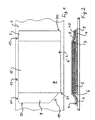
- the Fig. 1 shows a plan view of a label according to an embodiment of the invention.
- the label is a self-adhesive brochure label and applied to a carrier sheet 1, which is shown here as a detail.
- the carrier sheet 1 is a long polypropylene or polyethylene tape on which one or more rows of self-adhesive labels 2 are applied and printed.
- the labels are delivered in one lane before they are glued to the containers for which they are intended.
- the self-adhesive label 2 consists of a base label 3, which is provided with a strong permanent adhesive 4, with which it adheres to said carrier film 1 before detachment.
- the permanence of the adhesive 4 refers to the later attachment to a destination object, for example a cylindrical bottle in the adhesive area of the label 2. But it can also be a flat and even gluing area.
- the leaflet 5 is arranged in the Fig. 2 is shown as a successive sequence of individual sheets.
- the single sheets of the leaflet 5 on one side 6 are open and unconnected, while they can be connected to each other on the other side 7, in particular glued or stapled.
- the leaflets may also consist of a single folded sheet or be loose leaves. In any case, an advantage of the invention results from the fact that, despite a considerable thickness of the entire leaflet label 2, it can be used wrinkle-free.
- the brochure 5 as part of the base label 3; in any case, it is directly connected to it.
- a sealing film 8 placed over base label 3 and leaflet 5 and ends in a tab 9, which adheres directly to the carrier film 1.
- the layer 10 denotes a removable adhesive with which the closure film 8 adheres to the respective substrate.
- top leaflet 15 are the respective areas, from left to right, additionally designated by the reference numeral 9 for the tab, 15 for the top leaflet sheet and 3 for the base label, since the sealing film 8 is a transparent laminate film.
- the top leaflet 15 need not be integrally connected to the leaflet 5. It may also be a cover sheet, which is arranged to receive the adhesive effect of the sealing film 8 on and above the prospectus.
- prospectus 5 is any information carrier (eg also a CD or the like) understood and the term top leaflet 15 is any cover sheet understood.
- the leaflet 5 may consist of many sheets; it is essential that in area 6 the top sheet 15 is flush with the underlying sheets (as in Fig. 2 shown) or over this. It is essential that in the region 6, the sealing film 8 does not always protrude far beyond the leaflet 5, but as in the Fig. 2 to recognize a region 19, in which the closure film 8 is shortened, so that the leaflet 5 extends to or just to the edge of the sealing film 8. This region 19 is preferably punched out of the sealing film. This results in a region 21, the side of the area 11 is not or only slightly covered by the sealing film 8, so that although the prospectus 15 through the large area tab 9 is securely held on a container, or even before applying to this still on the carrier sheet 1, but can still be easily detached by the user.
- the base label 3 is larger and also extends below the tab 9 and the area 19 or ends with this.
- the possibility of applying the base label 3 to the carrier film 1 is advantageous in that the entire unit can be punched out to the carrier film 1 with a single punching step in a single punching step after inserting the leaflet 5 and laminating the sealing film 8.
- the punching knife is designed so that it works along the outer circumference curve 20. It cuts in the illustrated embodiment in the right side region 13 base label 3 and sealing film 8, in the central region 12 base label 3, the leaflet 5 and the sealing film 8, and in the left lateral region of the tab 9 in a predetermined shape. It is irrelevant for this punching step, where the base label ends or in other words, whether the sealing film 8 in the tab 9 alone over leaflet 5 and base label 3 survives or whether the base label is still under the tab.
- the tab 9 can be trapezoidal, in particular tapering on both sides, so that a corner region 21 forms at the top and bottom, on which the closure film 8 can be lifted off.
Landscapes
- Physics & Mathematics (AREA)
- General Physics & Mathematics (AREA)
- Engineering & Computer Science (AREA)
- Theoretical Computer Science (AREA)
- Making Paper Articles (AREA)
- Cartons (AREA)
- Details Of Rigid Or Semi-Rigid Containers (AREA)
- Adhesives Or Adhesive Processes (AREA)
- Packages (AREA)
Description
- Die Erfindung betrifft ein Selbstklebeetikett für einen eingelegten Prospekt mit einem auf der Unterseite mit einem ersten Klebstoff beschichteten Basisetikett, mit einem auf dem Basisetikett angeordneten Prospekt und mit einer auf der Unterseite mit einem zweiten Klebstoff beschichteten Verschlussfolie, die den besagten Prospekt vollständig überdeckt und auf zwei gegenüberliegenden Seiten den Prospekt überragt, wobei die Verschlussfolie auf der einen Seite auf dem Basisetikett anhaftet.
- Prospektetiketten werden insbesondere im Arzneimittelsektor mehr und mehr verwendet, um für den Patienten wesentliche Informationen auf der Verpackung selbst verfügbar zu machen. Der traditionelle Beipackzettel verbleibt häufig im Karton, welcher verlegt oder gar entsorgt wird. Ein Prospektetikett mit den oben genannten Merkmalen ist beispielsweise aus der
EP 1 129 444 bekannt. Dort liegt ein teillaminiertes Etikett vor, bei dem der Prospekt durch die selbstklebende Deckfolie abgedeckt ist. - Die
EP 1 090 383 beschreibt ein voll laminiertes Etikett, bei dem zwei Prospekte vorhanden sind, einer der am Produkt (=Etikett) verbleiben soll und einer, der für den Benutzer abnehmbar sein soll. - Die
US 5,972,455 zeigt in den Fig. 6 bis 8 ein Etikett, bei dem ein Deckblatt des Prospektes mit einem gestanzten Ausschnitt versehen ist, der diesen Bereich dann leichter abhebbar macht, während das Etikett durch die überklebende Deckfolie wieder verschlossen werden kann. - Aus der
US 5,399,403 ist ein Etikett bekannt, bei dem eine Ecke der Deckfolie durch weitere Bearbeitung nicht klebend gemacht wird, so dass das Etikett an dieser nicht klebenden Ecke angefasst und abgezogen werden kann. - Die Etiketten nach dem Stand der Technik weisen den Nachteil auf, dass sie bei einer Teillaminierung im Einsatz Verwerfungen zeigen, die für den Einsatz der Etiketten auf zylindrischen Objekten wie Flaschen ungeeignet sind, da beim industriellen Verpacken und später beim Gebrauch solche überstehende Prospektteile störend sind.
- Voll laminierte Etiketten weisen den Nachteil auf, dass sie schlecht zu öffnen sind, um an den innenliegenden Prospekt zu gelangen. Die Lösung des Standes der Technik mit einer von Klebstoff unbedruckten Ecke führt wieder zu einer im Extremfall abstehenden Lasche und den oben genannten Verpackungsproblemen.
- Ausgehend von diesem Stand der Technik liegt der Erfindung die Aufgabe zugrunde, ein Etikett der eingangs genannten Art so zu verbessern, dass es bei der Herstellung des Etiketts und dessen Einsatz auf Objekten, insbesondere zylindrischen Objekten, zu keinen Verwerfungen kommt oder Laschen oder ähnliches überstehen, und dass das Etikett durch den Benutzer im Gebrauch einfach geöffnet und wieder verschliessbar ist, ohne dass sich die beim ersten Einsatz genannten Probleme dann einstellen.
- Diese Aufgabe wird für ein Etikett der eingangs genannten Art erfindungsgemäss mit den Merkmalen des Anspruchs 1 gelöst.
- Dadurch dass die Verschlussfolie in der genannten Form ausgebildet ist, kann die Verschlussfolie durch einen einfachen Stanzschritt erhalten werden, der an sich für das Konfektionieren der Verschlussfolie sowieso notwendig ist. Damit spart sich der Hersteller gegenüber beispielsweise der Lösung nach der
US 5,399,403 den Schritt des Unwirksammachens des Klebstoffs in der einen Laschenecke. Gegenüber derUS 5,972,455 ist ein Stanzschritt weniger notwendig, da dort zum einen das Deckblatt des Prospektes mit dem dort genannten gestanzten Ausschnitt zu versehen ist, wonach die Verschlussfolie getrennt auszustanzen ist. Der genannte wesentliche Vorteil bei der Herstellung wird beim Einsatz des Etiketts auf den Zielobjekten noch dadurch verstärkt, dass die Verschlussfolie neben dem Basisetikett auf dem Objekt anhaftet, wobei dadurch beim Wiederverschliessen des Etiketts durch den Benutzer dieser Verschlussfolie mit darunterliegendem Prospekt einfach auf dem (zumeist zylindrischen Objekt) glattstreichen kann. - Weitere vorteilhafte Ausführungsformen sind in den Unteransprüchen gekennzeichnet.
- Die Erfindung wird nun beispielhaft an einem Ausführungsbeispiel im Zusammenhang mit der Beschreibung zu den beigefügten Zeichnung näher erläutert. Es zeigen:
- Fig. 1
- eine Draufsicht auf ein Etikett gemäss einem Ausführungsbeispiel der Erfindung, und
- Fig. 2
- eine geschnittene Querschnittsansicht des Etikettes nach
Fig. 1 . - Die
Fig. 1 zeigt eine Draufsicht auf ein Etikett gemäss einem Ausführungsbeispiel der Erfindung. Das Etikett ist ein selbstklebendes Prospektetikett und auf einer Trägerfolie 1 aufgebracht, welche hier als Ausschnitt dargestellt ist. Üblicherweise ist die Trägerfolie 1 ein langes Polypropylen- oder Polyäthylen-Band, auf dem eine oder mehrere Reihen von Selbstklebeetiketten 2 aufgebracht und bedruckt werden. Üblicherweise werden die Etiketten einbahnig ausgeliefert, bevor diese auf die Behältnisse geklebt werden, für die sie vorgesehen sind. - Das Selbstklebeetikett 2 besteht aus einem Basisetikett 3, welches mit einem starken permanenten Kleber 4 versehen ist, mit dem es vor einem Ablösen auf der besagten Trägerfolie 1 anhaftet. Die Permanenz des Klebers 4 bezieht sich auf die spätere Befestigung auf einem Bestimmungsobjekt, zum Beispiel einer im Klebebereich des Etikettes 2 zylindrischen Flasche. Es kann sich aber auch um einen flachen und ebenen Klebebereich handeln.
- Einzelne Elemente des Selbstklebeetikettes sind einfacher in der
Fig. 2 zu erkennen, die eine geschnittene Querschnittsansicht des Etikettes nachFig. 1 zeigt. Gleiche Merkmale sind in allen Zeichnungen mit den gleichen Bezugszeichen gekennzeichnet. Die Darstellung derFig. 2 ist insbesondere im Hinblick auf die Klebeschichten nicht massstabsgerecht. - Auf dem Basisetikett 3 ist der Prospekt 5 angeordnet, der in der
Fig. 2 als aufeinanderliegende Abfolge von Einzelblättern dargestellt ist. Insbesondere sind die Einzelblätter des Prospektes 5 an der einen Seite 6 offen und unverbunden, während sie auf der anderen Seite 7 miteinander verbunden, insbesondere verklebt oder verheftet sein können. Die Prospektblätter können aber auch aus einem einzelnen gefalteten Blatt bestehen oder lose Blätter sein. Ein Vorteil der Erfindung ergibt sich jedenfalls aus der Tatsache, dass trotz einer erheblichen Dicke des gesamten Prospektetikettes 2 es faltenfrei verwendbar ist. - Man könnte in anderen Ausführungsformen den Prospekt 5 auch als Teil des Basisetikettes 3 ansehen, er ist jedenfalls mit diesem direkt verbunden. Von der hier rechten Seitenkante 7 ausgehend ist eine Verschlussfolie 8 über Basisetikett 3 und Prospekt 5 gelegt und endet in einer Lasche 9, die direkt auf der Trägerfolie 1 anhaftet. Mit der Schicht 10 ist ein ablösbarer Kleber bezeichnet, mit dem die Verschlussfolie 8 an der jeweiligen Unterlage haftet. Dies ist zum einen, auf Grund der Papierstruktur in "unlösbarer" Weise auf dem Basisetikett 3 im rechten seitlichen Bereich 13 und auf dem obersten Blatt 15 des Prospektes 6 im mittleren Bereich 12 und schliesslich auf dem Trägermaterial 1 im linken seitlichen Bereich 11. In der
Fig. 1 sind die jeweiligen Bereiche, von links nach rechts, zusätzlich mit den Bezugszeichen 9 für die Lasche, 15 für das oberste Prospektblatt und 3 für das Basisetikett bezeichnet, da die Verschlussfolie 8 eine transparente Laminatfolie ist. Das oberste Prospektblatt 15 muss nicht einstückig mit dem Prospekt 5 verbunden sein. Es kann sich auch um ein Deckblatt handeln, welches zur Aufnahme der Haftwirkung der Verschlussfolie 8 auf und oberhalb des Prospektes angeordnet ist. Mit anderen Worten, unter dem Begriff Prospekt 5 wird ein beliebiger Informationsträger (z.B. auch eine CD oder ähnliches) verstanden und unter dem Begriff oberstes Prospektblatt 15 wird ein beliebiges Abdeckblatt verstanden. - Der Prospekt 5 kann aus vielen Blättern bestehen; wesentlich ist, dass im Bereich 6 das oberste Blatt 15 bündig mit den darunterliegenden Blättern ist (wie in
Fig. 2 dargestellt) oder über diese übersteht. Es ist wesentlich, dass im Bereich 6 die Verschlussfolie 8 nicht immer weit über den Prospekt 5 übersteht, sondern wie in derFig. 2 zu erkennen, ein Bereich 19 besteht, in welchem die Verschlussfolie 8 verkürzt ist, so dass der Prospekt 5 bis an oder knapp an den Rand der Verschlussfolie 8 reicht. Dieser Bereich 19 ist vorzugsweise aus der Verschlussfolie ausgestanzt. Dadurch ergibt sich ein Bereich 21, der seitlich im Bereich 11 gar nicht oder nur wenig von der Verschlussfolie 8 überdeckt wird, so dass zwar der Prospekt 15 durch die grossflächige Lasche 9 sicher auf einem Behältnis, bzw. vor dem Aufbringen auf dieses noch auf der Trägerfolie 1 gehalten wird, aber durch den Benutzer dennoch in einfacher Weise abgelöst werden kann. - In einem anderen in den Zeichnungen nicht dargestellten Ausführungsbeispiel ist das Basisetikett 3 grösser und reicht auch unter die Lasche 9 und den Bereich 19 oder endet mit diesem. Vorteilhaft in beiden Ausführungsbeispielen ist die Möglichkeit nach Aufbringen des Basisetikettes 3 auf die Trägerfolie 1, dass in einem einzigen Stanzschritt nach Einbringen des Prospektes 5 und Überlaminieren der Verschlussfolie 8 die gesamte Einheit mit einem einzigen Stanzschritt bis auf die Trägerfolie 1 ausgestanzt werden kann. Dabei ist das Stanzmesser so ausgestaltet, dass es entlang der äusseren Umkreiskurve 20 arbeitet. Dabei schneidet es in dem dargestellten Ausführungsbeispiel im rechten seitlichen Bereich 13 Basisetikett 3 und Verschlussfolie 8, im mittleren Bereich 12 Basisetikett 3, den Prospekt 5 und die Verschlussfolie 8, und im linken seitlichen Bereich die Lasche 9 in einer vorgegebenen Form aus. Dabei ist es für diesen Stanzschritt unerheblich, wo das Basisetikett endet oder mit anderen Worten, ob die Verschlussfolie 8 in der Lasche 9 alleine über Prospekt 5 und Basisetikett 3 übersteht oder ob sich unter der Lasche auch noch das Basisetikett befindet.
- Die Lasche 9 kann trapezförmig sein, insbesondere auf beiden Seiten verjüngend, so dass sich oben und unten jeweils ein Eckenbereich 21 bildet, an dem die Verschlussfolie 8 abgehoben werden kann.
Claims (6)
- Selbstklebeetikett (2) für einen eingelegten Prospekt mit einem auf der Unterseite mit einem ersten Klebstoff (4) beschichteten Basisetikett (3), mit einem auf dem Basisetikett (3) angeordneten Prospekt (5; 15) und mit einer auf der Unterseite mit einem zweiten Klebstoff (10) beschichteten Verschlussfolie (8), die den besagten Prospekt (5; 15) vollständig überdeckt und auf zwei gegenüberliegenden Seiten (11, 13) den Prospekt (5) überragt, wobei die Verschlussfolie (8) auf der einen Seite (13) auf dem Basisetikett (3) anhaftet, dadurch gekennzeichnet, dass auf der anderen Seite (11) die Verschlussfolie (8) den Prospekt (5; 15) in Gestalt einer einen Ausschnitt (19) aufweisende Lasche (9) überragt, so dass mindestens ein Eckbereich (21) des obersten Prospektblattes (15) in einfacher Weise abgehoben werden kann, um die Lasche (9) abzuheben und das Selbstklebeetikett (2) zu öffnen.
- Selbstklebeetikett nach Anspruch 1, dadurch gekennzeichnet, dass der das Basisetikett (3) beschichtende Klebstoff (4) ein permanenter Klebstoff ist und dass der die Verschlussfolie (8) beschichtende Klebstoff (4) ein ablösbarer Klebstoff ist.
- Selbstklebeetikett nach Anspruch 1 oder 2, dadurch gekennzeichnet, dass das oberste Prospektblatt (15) über den Prospekt (5) hinausragt.
- Selbstklebeetikett nach einem der Ansprüche 1 bis 3, dadurch gekennzeichnet, dass das oberste Prospektblatt (15) über das Basisetikett (3) hinausragt.
- Selbstklebeetikett nach einem der Ansprüche 1 bis 4, dadurch gekennzeichnet, dass sich die Lasche (9) auf einer oder beiden Seiten vom obersten Prospektblatt (15) weglaufend verjüngt, so dass sich ein oder zwei der besagten Eckbereiche (21) ausbilden.
- Verfahren zur Herstellung eines Selbstklebeetikettes (2) nach einem der Ansprüche 1 bis 5, wobei das Basisetikett (3) mit Klebstoff (4) beschichtet und auf einer Trägerfolie (1) aufgebracht ist, gekennzeichnet durch die Schritte,- dass ein Prospekt (5) auf dem Basisetikett (3) angeordnet wird, so dass das Basisetikett (3) auf der einen Seite (13) übersteht,- dass der Prospekt (5) und/oder das oberste Prospektblatt (15) vollständig beidseitig mit einer mit Klebstoff (10) beschichteten Verschlussfolie (8) abgedeckt wird, so dass die Verschlussfolie (8) auf beiden Seiten über das oberste Prospektblatt (15) übersteht, und- dass das Etikett bis auf die Trägerfolie (1) ausgestanzt wird, so dass an zwei gegenüberliegenden Seiten des Etiketts die Verschlussfolie (8) und das oberste Prospektblatt (15) bündig abgeschnitten sind und der Prospekt (5) nicht über die Verschlussfolie (8) und das oberste Prospektblatt (15) hinausragt und dass an den beiden anderen gegenüberliegenden Seiten (11, 13) die Verschlussfolie (8) auf der Trägerfolie (1) selber haftet oder bündig mit dem Basisetikett (2) abschliesst, wobei durch das Stanzen die Verschlussfolie (8) den Prospekt (5; 15) in Gestalt einer einen Ausschnitt (19) aufweisende Lasche (9) überragt, so dass mindestens ein Eckbereich (21) des obersten Prospektblattes (15) in einfacher Weise abgehoben werden kann, um die Lasche (9) abzuheben und das Selbstklebeetikett (2) zu öffnen.
Applications Claiming Priority (2)
| Application Number | Priority Date | Filing Date | Title |
|---|---|---|---|
| CH16802003 | 2003-10-03 | ||
| CH16802003 | 2003-10-03 |
Publications (3)
| Publication Number | Publication Date |
|---|---|
| EP1521228A2 EP1521228A2 (de) | 2005-04-06 |
| EP1521228A3 EP1521228A3 (de) | 2006-04-12 |
| EP1521228B1 true EP1521228B1 (de) | 2010-10-20 |
Family
ID=34280721
Family Applications (1)
| Application Number | Title | Priority Date | Filing Date |
|---|---|---|---|
| EP04405610A Expired - Lifetime EP1521228B1 (de) | 2003-10-03 | 2004-09-27 | Selbstklebeetikett für einen Prospekt |
Country Status (3)
| Country | Link |
|---|---|
| EP (1) | EP1521228B1 (de) |
| AT (1) | ATE485577T1 (de) |
| DE (1) | DE502004011792D1 (de) |
Families Citing this family (3)
| Publication number | Priority date | Publication date | Assignee | Title |
|---|---|---|---|---|
| EP1850306A1 (de) * | 2006-04-26 | 2007-10-31 | Lange AG Urdorf | Stapeletikett für einen Behälter |
| EP2511895A4 (de) * | 2009-12-11 | 2013-09-25 | Pons David Capdevila | Getränkehalter |
| ES2335736B1 (es) * | 2009-12-11 | 2010-10-28 | David Capdevila Pons | Envase de bebida. |
Family Cites Families (4)
| Publication number | Priority date | Publication date | Assignee | Title |
|---|---|---|---|---|
| GB2247662B (en) * | 1990-08-31 | 1994-11-02 | Instance Ltd David J | Labels and manufacture thereof |
| US5766716A (en) * | 1996-08-08 | 1998-06-16 | Inprint Systems, Inc. | Self-adhesive labels |
| US6057019A (en) * | 1998-06-22 | 2000-05-02 | Inprint Systems Inc. | Labels |
| US6306476B1 (en) * | 1998-10-20 | 2001-10-23 | Inprint Systems, Inc. | Part-overlaminated label |
-
2004
- 2004-09-27 DE DE502004011792T patent/DE502004011792D1/de not_active Expired - Lifetime
- 2004-09-27 AT AT04405610T patent/ATE485577T1/de active
- 2004-09-27 EP EP04405610A patent/EP1521228B1/de not_active Expired - Lifetime
Also Published As
| Publication number | Publication date |
|---|---|
| EP1521228A2 (de) | 2005-04-06 |
| DE502004011792D1 (de) | 2010-12-02 |
| EP1521228A3 (de) | 2006-04-12 |
| ATE485577T1 (de) | 2010-11-15 |
Similar Documents
| Publication | Publication Date | Title |
|---|---|---|
| DE69535021T2 (de) | Verpackung und etikettensatz für disketten | |
| DE69708069T2 (de) | Laminiertes verpackungsetikett | |
| DE69708105T2 (de) | Selbstklebeetiketten | |
| EP1737750A1 (de) | Blisterpackungsanordnung | |
| EP1002753A1 (de) | Verfahren zur Entfernung von Einheiten aus Laminatbahnen, die eine Vielzahl von Einheiten aufweisen | |
| DE602004002220T2 (de) | Verschlussanordnung | |
| DE29613123U1 (de) | Etikettenmaterial zum Etikettieren von CDs | |
| DE3924790A1 (de) | Etikett zum aufbringen auf gegenstaende und anwendung desselben | |
| DE60116139T2 (de) | Mehrschichtiges etikett sowie verfahren und vorrichtung zu dessen herstellung | |
| EP2035221B1 (de) | Sicherheitsaufkleber | |
| DE69928295T2 (de) | Klebeschilder und produktionsmethode dafür | |
| DE10239510A1 (de) | Mehrlagiges Etikett, Behältnis mit einem mehrlagigen Etikett und Verfahren zur Herstellung des mehrlagigen Etiketts | |
| EP1521228A2 (de) | Selbstklebeetikett für einen Prospekt | |
| WO1998026938A1 (de) | Formular mit integrierter karte | |
| EP0346567A2 (de) | Etikettkonstruktion | |
| DE102016113965A1 (de) | Verfahren zur Herstellung von Etiketten und Schichtverbund | |
| DE102008020831B4 (de) | Booklet-Etikett und Verfahren zur Herstellung eines Booklet-Etiketts | |
| EP0619233A1 (de) | Tiefkühl-Schalenverpackung | |
| EP1594106B1 (de) | Etikett und Verfahren zur Herstellung eines solchen Etiketts | |
| DE202015103046U1 (de) | Funktionsetikett für einen Flüssigkeitsbehälter | |
| EP0731434B1 (de) | Selbstklebeetikett | |
| DE10134867A1 (de) | Verfahren und Vorrichtung zur Herstellung von Etiketten und aus diesem Verfahren erhältliches Etikett | |
| EP1384674B1 (de) | Selbstklebeetikett und Verfahren zu dessen Herstellung | |
| DE102013107410A1 (de) | Mehrlagiges Etikett | |
| DE4437127C1 (de) | Informationsträger |
Legal Events
| Date | Code | Title | Description |
|---|---|---|---|
| PUAI | Public reference made under article 153(3) epc to a published international application that has entered the european phase |
Free format text: ORIGINAL CODE: 0009012 |
|
| AK | Designated contracting states |
Kind code of ref document: A2 Designated state(s): AT BE BG CH CY CZ DE DK EE ES FI FR GB GR HU IE IT LI LU MC NL PL PT RO SE SI SK TR |
|
| AX | Request for extension of the european patent |
Extension state: AL HR LT LV MK |
|
| PUAL | Search report despatched |
Free format text: ORIGINAL CODE: 0009013 |
|
| AK | Designated contracting states |
Kind code of ref document: A3 Designated state(s): AT BE BG CH CY CZ DE DK EE ES FI FR GB GR HU IE IT LI LU MC NL PL PT RO SE SI SK TR |
|
| AX | Request for extension of the european patent |
Extension state: AL HR LT LV MK |
|
| 17P | Request for examination filed |
Effective date: 20060816 |
|
| AKX | Designation fees paid |
Designated state(s): AT BE BG CH CY CZ DE DK EE ES FI FR GB GR HU IE IT LI LU MC NL PL PT RO SE SI SK TR |
|
| GRAP | Despatch of communication of intention to grant a patent |
Free format text: ORIGINAL CODE: EPIDOSNIGR1 |
|
| GRAS | Grant fee paid |
Free format text: ORIGINAL CODE: EPIDOSNIGR3 |
|
| GRAA | (expected) grant |
Free format text: ORIGINAL CODE: 0009210 |
|
| AK | Designated contracting states |
Kind code of ref document: B1 Designated state(s): AT BE BG CH CY CZ DE DK EE ES FI FR GB GR HU IE IT LI LU MC NL PL PT RO SE SI SK TR |
|
| REG | Reference to a national code |
Ref country code: GB Ref legal event code: FG4D Free format text: NOT ENGLISH |
|
| REG | Reference to a national code |
Ref country code: CH Ref legal event code: EP |
|
| REG | Reference to a national code |
Ref country code: IE Ref legal event code: FG4D Free format text: LANGUAGE OF EP DOCUMENT: GERMAN |
|
| REF | Corresponds to: |
Ref document number: 502004011792 Country of ref document: DE Date of ref document: 20101202 Kind code of ref document: P |
|
| REG | Reference to a national code |
Ref country code: CH Ref legal event code: NV Representative=s name: ISLER & PEDRAZZINI AG |
|
| REG | Reference to a national code |
Ref country code: NL Ref legal event code: VDEP Effective date: 20101020 |
|
| REG | Reference to a national code |
Ref country code: IE Ref legal event code: FD4D |
|
| PG25 | Lapsed in a contracting state [announced via postgrant information from national office to epo] |
Ref country code: BG Free format text: LAPSE BECAUSE OF FAILURE TO SUBMIT A TRANSLATION OF THE DESCRIPTION OR TO PAY THE FEE WITHIN THE PRESCRIBED TIME-LIMIT Effective date: 20110120 Ref country code: PT Free format text: LAPSE BECAUSE OF FAILURE TO SUBMIT A TRANSLATION OF THE DESCRIPTION OR TO PAY THE FEE WITHIN THE PRESCRIBED TIME-LIMIT Effective date: 20110221 Ref country code: SI Free format text: LAPSE BECAUSE OF FAILURE TO SUBMIT A TRANSLATION OF THE DESCRIPTION OR TO PAY THE FEE WITHIN THE PRESCRIBED TIME-LIMIT Effective date: 20101020 Ref country code: SE Free format text: LAPSE BECAUSE OF FAILURE TO SUBMIT A TRANSLATION OF THE DESCRIPTION OR TO PAY THE FEE WITHIN THE PRESCRIBED TIME-LIMIT Effective date: 20101020 Ref country code: FI Free format text: LAPSE BECAUSE OF FAILURE TO SUBMIT A TRANSLATION OF THE DESCRIPTION OR TO PAY THE FEE WITHIN THE PRESCRIBED TIME-LIMIT Effective date: 20101020 Ref country code: NL Free format text: LAPSE BECAUSE OF FAILURE TO SUBMIT A TRANSLATION OF THE DESCRIPTION OR TO PAY THE FEE WITHIN THE PRESCRIBED TIME-LIMIT Effective date: 20101020 |
|
| PG25 | Lapsed in a contracting state [announced via postgrant information from national office to epo] |
Ref country code: GR Free format text: LAPSE BECAUSE OF FAILURE TO SUBMIT A TRANSLATION OF THE DESCRIPTION OR TO PAY THE FEE WITHIN THE PRESCRIBED TIME-LIMIT Effective date: 20110121 |
|
| PG25 | Lapsed in a contracting state [announced via postgrant information from national office to epo] |
Ref country code: ES Free format text: LAPSE BECAUSE OF FAILURE TO SUBMIT A TRANSLATION OF THE DESCRIPTION OR TO PAY THE FEE WITHIN THE PRESCRIBED TIME-LIMIT Effective date: 20110131 Ref country code: CZ Free format text: LAPSE BECAUSE OF FAILURE TO SUBMIT A TRANSLATION OF THE DESCRIPTION OR TO PAY THE FEE WITHIN THE PRESCRIBED TIME-LIMIT Effective date: 20101020 Ref country code: EE Free format text: LAPSE BECAUSE OF FAILURE TO SUBMIT A TRANSLATION OF THE DESCRIPTION OR TO PAY THE FEE WITHIN THE PRESCRIBED TIME-LIMIT Effective date: 20101020 Ref country code: IE Free format text: LAPSE BECAUSE OF FAILURE TO SUBMIT A TRANSLATION OF THE DESCRIPTION OR TO PAY THE FEE WITHIN THE PRESCRIBED TIME-LIMIT Effective date: 20101020 |
|
| PLBE | No opposition filed within time limit |
Free format text: ORIGINAL CODE: 0009261 |
|
| STAA | Information on the status of an ep patent application or granted ep patent |
Free format text: STATUS: NO OPPOSITION FILED WITHIN TIME LIMIT |
|
| PG25 | Lapsed in a contracting state [announced via postgrant information from national office to epo] |
Ref country code: RO Free format text: LAPSE BECAUSE OF FAILURE TO SUBMIT A TRANSLATION OF THE DESCRIPTION OR TO PAY THE FEE WITHIN THE PRESCRIBED TIME-LIMIT Effective date: 20101020 Ref country code: SK Free format text: LAPSE BECAUSE OF FAILURE TO SUBMIT A TRANSLATION OF THE DESCRIPTION OR TO PAY THE FEE WITHIN THE PRESCRIBED TIME-LIMIT Effective date: 20101020 Ref country code: PL Free format text: LAPSE BECAUSE OF FAILURE TO SUBMIT A TRANSLATION OF THE DESCRIPTION OR TO PAY THE FEE WITHIN THE PRESCRIBED TIME-LIMIT Effective date: 20101020 Ref country code: DK Free format text: LAPSE BECAUSE OF FAILURE TO SUBMIT A TRANSLATION OF THE DESCRIPTION OR TO PAY THE FEE WITHIN THE PRESCRIBED TIME-LIMIT Effective date: 20101020 |
|
| 26N | No opposition filed |
Effective date: 20110721 |
|
| REG | Reference to a national code |
Ref country code: DE Ref legal event code: R097 Ref document number: 502004011792 Country of ref document: DE Effective date: 20110721 |
|
| PGFP | Annual fee paid to national office [announced via postgrant information from national office to epo] |
Ref country code: AT Payment date: 20110914 Year of fee payment: 8 |
|
| BERE | Be: lapsed |
Owner name: LANGE A.G. URDORF Effective date: 20110930 |
|
| PG25 | Lapsed in a contracting state [announced via postgrant information from national office to epo] |
Ref country code: MC Free format text: LAPSE BECAUSE OF NON-PAYMENT OF DUE FEES Effective date: 20110930 |
|
| GBPC | Gb: european patent ceased through non-payment of renewal fee |
Effective date: 20110927 |
|
| PG25 | Lapsed in a contracting state [announced via postgrant information from national office to epo] |
Ref country code: BE Free format text: LAPSE BECAUSE OF NON-PAYMENT OF DUE FEES Effective date: 20110930 |
|
| PG25 | Lapsed in a contracting state [announced via postgrant information from national office to epo] |
Ref country code: GB Free format text: LAPSE BECAUSE OF NON-PAYMENT OF DUE FEES Effective date: 20110927 |
|
| PGFP | Annual fee paid to national office [announced via postgrant information from national office to epo] |
Ref country code: DE Payment date: 20120921 Year of fee payment: 9 |
|
| PGFP | Annual fee paid to national office [announced via postgrant information from national office to epo] |
Ref country code: FR Payment date: 20121010 Year of fee payment: 9 |
|
| PGFP | Annual fee paid to national office [announced via postgrant information from national office to epo] |
Ref country code: IT Payment date: 20120927 Year of fee payment: 9 |
|
| REG | Reference to a national code |
Ref country code: AT Ref legal event code: MM01 Ref document number: 485577 Country of ref document: AT Kind code of ref document: T Effective date: 20120927 |
|
| PG25 | Lapsed in a contracting state [announced via postgrant information from national office to epo] |
Ref country code: LU Free format text: LAPSE BECAUSE OF NON-PAYMENT OF DUE FEES Effective date: 20110927 Ref country code: CY Free format text: LAPSE BECAUSE OF EXPIRATION OF PROTECTION Effective date: 20101020 |
|
| PG25 | Lapsed in a contracting state [announced via postgrant information from national office to epo] |
Ref country code: AT Free format text: LAPSE BECAUSE OF NON-PAYMENT OF DUE FEES Effective date: 20120927 |
|
| PG25 | Lapsed in a contracting state [announced via postgrant information from national office to epo] |
Ref country code: TR Free format text: LAPSE BECAUSE OF FAILURE TO SUBMIT A TRANSLATION OF THE DESCRIPTION OR TO PAY THE FEE WITHIN THE PRESCRIBED TIME-LIMIT Effective date: 20101020 |
|
| PG25 | Lapsed in a contracting state [announced via postgrant information from national office to epo] |
Ref country code: HU Free format text: LAPSE BECAUSE OF FAILURE TO SUBMIT A TRANSLATION OF THE DESCRIPTION OR TO PAY THE FEE WITHIN THE PRESCRIBED TIME-LIMIT Effective date: 20101020 |
|
| PGFP | Annual fee paid to national office [announced via postgrant information from national office to epo] |
Ref country code: CH Payment date: 20130917 Year of fee payment: 10 |
|
| REG | Reference to a national code |
Ref country code: DE Ref legal event code: R119 Ref document number: 502004011792 Country of ref document: DE Effective date: 20140401 |
|
| REG | Reference to a national code |
Ref country code: FR Ref legal event code: ST Effective date: 20140530 |
|
| PG25 | Lapsed in a contracting state [announced via postgrant information from national office to epo] |
Ref country code: IT Free format text: LAPSE BECAUSE OF NON-PAYMENT OF DUE FEES Effective date: 20130927 Ref country code: FR Free format text: LAPSE BECAUSE OF NON-PAYMENT OF DUE FEES Effective date: 20130930 Ref country code: DE Free format text: LAPSE BECAUSE OF NON-PAYMENT OF DUE FEES Effective date: 20140401 |
|
| REG | Reference to a national code |
Ref country code: CH Ref legal event code: PL |
|
| PG25 | Lapsed in a contracting state [announced via postgrant information from national office to epo] |
Ref country code: CH Free format text: LAPSE BECAUSE OF NON-PAYMENT OF DUE FEES Effective date: 20140930 Ref country code: LI Free format text: LAPSE BECAUSE OF NON-PAYMENT OF DUE FEES Effective date: 20140930 |