EP1520903A1 - Utilisation des polyolefines (pao) derivées de 1-dodecene ou 1-tetradecene pour améliorer la stabilité thermique des huiles de moteur dans les moteur à combustion interne - Google Patents
Utilisation des polyolefines (pao) derivées de 1-dodecene ou 1-tetradecene pour améliorer la stabilité thermique des huiles de moteur dans les moteur à combustion interne Download PDFInfo
- Publication number
- EP1520903A1 EP1520903A1 EP04027778A EP04027778A EP1520903A1 EP 1520903 A1 EP1520903 A1 EP 1520903A1 EP 04027778 A EP04027778 A EP 04027778A EP 04027778 A EP04027778 A EP 04027778A EP 1520903 A1 EP1520903 A1 EP 1520903A1
- Authority
- EP
- European Patent Office
- Prior art keywords
- pao
- oil
- engine
- viscosity
- derived
- Prior art date
- Legal status (The legal status is an assumption and is not a legal conclusion. Google has not performed a legal analysis and makes no representation as to the accuracy of the status listed.)
- Withdrawn
Links
- 239000010705 motor oil Substances 0.000 title claims abstract description 52
- CRSBERNSMYQZNG-UHFFFAOYSA-N 1-dodecene Chemical compound CCCCCCCCCCC=C CRSBERNSMYQZNG-UHFFFAOYSA-N 0.000 title claims abstract description 48
- 229940069096 dodecene Drugs 0.000 title claims abstract description 24
- HFDVRLIODXPAHB-UHFFFAOYSA-N 1-tetradecene Chemical compound CCCCCCCCCCCCC=C HFDVRLIODXPAHB-UHFFFAOYSA-N 0.000 title claims description 44
- 238000002485 combustion reaction Methods 0.000 title description 2
- AFFLGGQVNFXPEV-UHFFFAOYSA-N 1-decene Chemical compound CCCCCCCCC=C AFFLGGQVNFXPEV-UHFFFAOYSA-N 0.000 claims abstract description 16
- 239000003921 oil Substances 0.000 claims description 71
- 239000000654 additive Substances 0.000 claims description 33
- 239000002199 base oil Substances 0.000 claims description 32
- 230000003647 oxidation Effects 0.000 claims description 24
- 238000007254 oxidation reaction Methods 0.000 claims description 24
- 230000000996 additive effect Effects 0.000 claims description 19
- 239000003599 detergent Substances 0.000 claims description 19
- 239000002270 dispersing agent Substances 0.000 claims description 19
- 239000003112 inhibitor Substances 0.000 claims description 19
- 239000003795 chemical substances by application Substances 0.000 claims description 8
- 239000006260 foam Substances 0.000 claims description 8
- 239000002480 mineral oil Substances 0.000 claims description 6
- 235000010446 mineral oil Nutrition 0.000 claims description 4
- 229920013639 polyalphaolefin Polymers 0.000 abstract description 119
- 239000000203 mixture Substances 0.000 abstract description 15
- 150000001336 alkenes Chemical class 0.000 abstract description 2
- -1 alkenyl aromatic sulfonates Chemical class 0.000 description 21
- 229910052500 inorganic mineral Inorganic materials 0.000 description 12
- 239000011707 mineral Substances 0.000 description 12
- 229910052751 metal Inorganic materials 0.000 description 8
- 239000002184 metal Substances 0.000 description 8
- 125000000217 alkyl group Chemical group 0.000 description 7
- 238000002411 thermogravimetry Methods 0.000 description 7
- WMYJOZQKDZZHAC-UHFFFAOYSA-H trizinc;dioxido-sulfanylidene-sulfido-$l^{5}-phosphane Chemical class [Zn+2].[Zn+2].[Zn+2].[O-]P([O-])([S-])=S.[O-]P([O-])([S-])=S WMYJOZQKDZZHAC-UHFFFAOYSA-H 0.000 description 7
- 229920003171 Poly (ethylene oxide) Polymers 0.000 description 6
- 150000002148 esters Chemical class 0.000 description 6
- 150000001875 compounds Chemical class 0.000 description 5
- 239000012141 concentrate Substances 0.000 description 5
- 229920001577 copolymer Polymers 0.000 description 5
- 150000003839 salts Chemical class 0.000 description 5
- 230000000052 comparative effect Effects 0.000 description 4
- 239000003085 diluting agent Substances 0.000 description 4
- 239000010687 lubricating oil Substances 0.000 description 4
- 238000005461 lubrication Methods 0.000 description 4
- 239000002253 acid Substances 0.000 description 3
- 125000003342 alkenyl group Chemical group 0.000 description 3
- 235000014113 dietary fatty acids Nutrition 0.000 description 3
- DMBHHRLKUKUOEG-UHFFFAOYSA-N diphenylamine Chemical compound C=1C=CC=CC=1NC1=CC=CC=C1 DMBHHRLKUKUOEG-UHFFFAOYSA-N 0.000 description 3
- 238000002474 experimental method Methods 0.000 description 3
- 239000000194 fatty acid Substances 0.000 description 3
- 229930195729 fatty acid Natural products 0.000 description 3
- 229920000642 polymer Polymers 0.000 description 3
- 239000004711 α-olefin Substances 0.000 description 3
- BVUXDWXKPROUDO-UHFFFAOYSA-N 2,6-di-tert-butyl-4-ethylphenol Chemical compound CCC1=CC(C(C)(C)C)=C(O)C(C(C)(C)C)=C1 BVUXDWXKPROUDO-UHFFFAOYSA-N 0.000 description 2
- SZAQZZKNQILGPU-UHFFFAOYSA-N 2-[1-(2-hydroxy-3,5-dimethylphenyl)-2-methylpropyl]-4,6-dimethylphenol Chemical compound C=1C(C)=CC(C)=C(O)C=1C(C(C)C)C1=CC(C)=CC(C)=C1O SZAQZZKNQILGPU-UHFFFAOYSA-N 0.000 description 2
- IJGRMHOSHXDMSA-UHFFFAOYSA-N Atomic nitrogen Chemical compound N#N IJGRMHOSHXDMSA-UHFFFAOYSA-N 0.000 description 2
- RTZKZFJDLAIYFH-UHFFFAOYSA-N Diethyl ether Chemical compound CCOCC RTZKZFJDLAIYFH-UHFFFAOYSA-N 0.000 description 2
- XQVWYOYUZDUNRW-UHFFFAOYSA-N N-Phenyl-1-naphthylamine Chemical compound C=1C=CC2=CC=CC=C2C=1NC1=CC=CC=C1 XQVWYOYUZDUNRW-UHFFFAOYSA-N 0.000 description 2
- 229920002319 Poly(methyl acrylate) Polymers 0.000 description 2
- 150000007513 acids Chemical class 0.000 description 2
- 239000003963 antioxidant agent Substances 0.000 description 2
- 235000006708 antioxidants Nutrition 0.000 description 2
- DKVNPHBNOWQYFE-UHFFFAOYSA-N carbamodithioic acid Chemical compound NC(S)=S DKVNPHBNOWQYFE-UHFFFAOYSA-N 0.000 description 2
- 239000002826 coolant Substances 0.000 description 2
- 230000001351 cycling effect Effects 0.000 description 2
- 239000012990 dithiocarbamate Substances 0.000 description 2
- 150000004665 fatty acids Chemical class 0.000 description 2
- 238000011010 flushing procedure Methods 0.000 description 2
- 239000000446 fuel Substances 0.000 description 2
- 230000001050 lubricating effect Effects 0.000 description 2
- 238000000034 method Methods 0.000 description 2
- 230000003278 mimic effect Effects 0.000 description 2
- 229910052750 molybdenum Inorganic materials 0.000 description 2
- 239000011733 molybdenum Substances 0.000 description 2
- 229910052757 nitrogen Inorganic materials 0.000 description 2
- 230000001590 oxidative effect Effects 0.000 description 2
- 239000010802 sludge Substances 0.000 description 2
- 230000004580 weight loss Effects 0.000 description 2
- 239000011701 zinc Substances 0.000 description 2
- 229910052725 zinc Inorganic materials 0.000 description 2
- MBBWTVUFIXOUBE-UHFFFAOYSA-L zinc;dicarbamodithioate Chemical compound [Zn+2].NC([S-])=S.NC([S-])=S MBBWTVUFIXOUBE-UHFFFAOYSA-L 0.000 description 2
- FFJCNSLCJOQHKM-CLFAGFIQSA-N (z)-1-[(z)-octadec-9-enoxy]octadec-9-ene Chemical compound CCCCCCCC\C=C/CCCCCCCCOCCCCCCCC\C=C/CCCCCCCC FFJCNSLCJOQHKM-CLFAGFIQSA-N 0.000 description 1
- LDVVTQMJQSCDMK-UHFFFAOYSA-N 1,3-dihydroxypropan-2-yl formate Chemical compound OCC(CO)OC=O LDVVTQMJQSCDMK-UHFFFAOYSA-N 0.000 description 1
- 150000005003 1-naphthylamines Chemical class 0.000 description 1
- OPLCSTZDXXUYDU-UHFFFAOYSA-N 2,4-dimethyl-6-tert-butylphenol Chemical compound CC1=CC(C)=C(O)C(C(C)(C)C)=C1 OPLCSTZDXXUYDU-UHFFFAOYSA-N 0.000 description 1
- GSOYMOAPJZYXTB-UHFFFAOYSA-N 2,6-ditert-butyl-4-(3,5-ditert-butyl-4-hydroxyphenyl)phenol Chemical compound CC(C)(C)C1=C(O)C(C(C)(C)C)=CC(C=2C=C(C(O)=C(C=2)C(C)(C)C)C(C)(C)C)=C1 GSOYMOAPJZYXTB-UHFFFAOYSA-N 0.000 description 1
- QHPKIUDQDCWRKO-UHFFFAOYSA-N 2,6-ditert-butyl-4-[2-(3,5-ditert-butyl-4-hydroxyphenyl)propan-2-yl]phenol Chemical compound CC(C)(C)C1=C(O)C(C(C)(C)C)=CC(C(C)(C)C=2C=C(C(O)=C(C=2)C(C)(C)C)C(C)(C)C)=C1 QHPKIUDQDCWRKO-UHFFFAOYSA-N 0.000 description 1
- FUIQBJHUESBZNU-UHFFFAOYSA-N 2-[(dimethylazaniumyl)methyl]phenolate Chemical compound CN(C)CC1=CC=CC=C1O FUIQBJHUESBZNU-UHFFFAOYSA-N 0.000 description 1
- MUHFRORXWCGZGE-KTKRTIGZSA-N 2-hydroxyethyl (z)-octadec-9-enoate Chemical compound CCCCCCCC\C=C/CCCCCCCC(=O)OCCO MUHFRORXWCGZGE-KTKRTIGZSA-N 0.000 description 1
- YFHKLSPMRRWLKI-UHFFFAOYSA-N 2-tert-butyl-4-(3-tert-butyl-4-hydroxy-5-methylphenyl)sulfanyl-6-methylphenol Chemical compound CC(C)(C)C1=C(O)C(C)=CC(SC=2C=C(C(O)=C(C)C=2)C(C)(C)C)=C1 YFHKLSPMRRWLKI-UHFFFAOYSA-N 0.000 description 1
- BGWNOSDEHSHFFI-UHFFFAOYSA-N 2-tert-butyl-4-[(3-tert-butyl-4-hydroxy-5-methylphenyl)methylsulfanylmethyl]-6-methylphenol Chemical compound CC(C)(C)C1=C(O)C(C)=CC(CSCC=2C=C(C(O)=C(C)C=2)C(C)(C)C)=C1 BGWNOSDEHSHFFI-UHFFFAOYSA-N 0.000 description 1
- PFANXOISJYKQRP-UHFFFAOYSA-N 2-tert-butyl-4-[1-(5-tert-butyl-4-hydroxy-2-methylphenyl)butyl]-5-methylphenol Chemical compound C=1C(C(C)(C)C)=C(O)C=C(C)C=1C(CCC)C1=CC(C(C)(C)C)=C(O)C=C1C PFANXOISJYKQRP-UHFFFAOYSA-N 0.000 description 1
- MQWCQFCZUNBTCM-UHFFFAOYSA-N 2-tert-butyl-6-(3-tert-butyl-2-hydroxy-5-methylphenyl)sulfanyl-4-methylphenol Chemical compound CC(C)(C)C1=CC(C)=CC(SC=2C(=C(C=C(C)C=2)C(C)(C)C)O)=C1O MQWCQFCZUNBTCM-UHFFFAOYSA-N 0.000 description 1
- BKZXZGWHTRCFPX-UHFFFAOYSA-N 2-tert-butyl-6-methylphenol Chemical compound CC1=CC=CC(C(C)(C)C)=C1O BKZXZGWHTRCFPX-UHFFFAOYSA-N 0.000 description 1
- MDWVSAYEQPLWMX-UHFFFAOYSA-N 4,4'-Methylenebis(2,6-di-tert-butylphenol) Chemical compound CC(C)(C)C1=C(O)C(C(C)(C)C)=CC(CC=2C=C(C(O)=C(C=2)C(C)(C)C)C(C)(C)C)=C1 MDWVSAYEQPLWMX-UHFFFAOYSA-N 0.000 description 1
- OILMLWAZYNVPMG-UHFFFAOYSA-N 4-methyl-2-nonylphenol Chemical compound CCCCCCCCCC1=CC(C)=CC=C1O OILMLWAZYNVPMG-UHFFFAOYSA-N 0.000 description 1
- LSNNMFCWUKXFEE-UHFFFAOYSA-M Bisulfite Chemical compound OS([O-])=O LSNNMFCWUKXFEE-UHFFFAOYSA-M 0.000 description 1
- NLZUEZXRPGMBCV-UHFFFAOYSA-N Butylhydroxytoluene Chemical compound CC1=CC(C(C)(C)C)=C(O)C(C(C)(C)C)=C1 NLZUEZXRPGMBCV-UHFFFAOYSA-N 0.000 description 1
- 239000004215 Carbon black (E152) Substances 0.000 description 1
- HBEMHMNHYDTVRE-UHFFFAOYSA-N ClC(CCCCCCCCCCCCCCCCC(=O)OC)(Cl)Cl Chemical compound ClC(CCCCCCCCCCCCCCCCC(=O)OC)(Cl)Cl HBEMHMNHYDTVRE-UHFFFAOYSA-N 0.000 description 1
- FBPFZTCFMRRESA-FSIIMWSLSA-N D-Glucitol Natural products OC[C@H](O)[C@H](O)[C@@H](O)[C@H](O)CO FBPFZTCFMRRESA-FSIIMWSLSA-N 0.000 description 1
- LFQSCWFLJHTTHZ-UHFFFAOYSA-N Ethanol Chemical compound CCO LFQSCWFLJHTTHZ-UHFFFAOYSA-N 0.000 description 1
- IAYPIBMASNFSPL-UHFFFAOYSA-N Ethylene oxide Chemical compound C1CO1 IAYPIBMASNFSPL-UHFFFAOYSA-N 0.000 description 1
- ZOKXTWBITQBERF-UHFFFAOYSA-N Molybdenum Chemical compound [Mo] ZOKXTWBITQBERF-UHFFFAOYSA-N 0.000 description 1
- ISWSIDIOOBJBQZ-UHFFFAOYSA-N Phenol Chemical compound OC1=CC=CC=C1 ISWSIDIOOBJBQZ-UHFFFAOYSA-N 0.000 description 1
- 239000002202 Polyethylene glycol Substances 0.000 description 1
- 229920002367 Polyisobutene Polymers 0.000 description 1
- YGSDEFSMJLZEOE-UHFFFAOYSA-N Salicylic acid Natural products OC(=O)C1=CC=CC=C1O YGSDEFSMJLZEOE-UHFFFAOYSA-N 0.000 description 1
- 235000021355 Stearic acid Nutrition 0.000 description 1
- NINIDFKCEFEMDL-UHFFFAOYSA-N Sulfur Chemical compound [S] NINIDFKCEFEMDL-UHFFFAOYSA-N 0.000 description 1
- HCHKCACWOHOZIP-UHFFFAOYSA-N Zinc Chemical compound [Zn] HCHKCACWOHOZIP-UHFFFAOYSA-N 0.000 description 1
- WERKSKAQRVDLDW-ANOHMWSOSA-N [(2s,3r,4r,5r)-2,3,4,5,6-pentahydroxyhexyl] (z)-octadec-9-enoate Chemical compound CCCCCCCC\C=C/CCCCCCCC(=O)OC[C@H](O)[C@@H](O)[C@H](O)[C@H](O)CO WERKSKAQRVDLDW-ANOHMWSOSA-N 0.000 description 1
- 150000005215 alkyl ethers Chemical class 0.000 description 1
- 150000001408 amides Chemical class 0.000 description 1
- 150000001412 amines Chemical class 0.000 description 1
- 238000004458 analytical method Methods 0.000 description 1
- 239000013556 antirust agent Substances 0.000 description 1
- FQUNFJULCYSSOP-UHFFFAOYSA-N bisoctrizole Chemical compound N1=C2C=CC=CC2=NN1C1=CC(C(C)(C)CC(C)(C)C)=CC(CC=2C(=C(C=C(C=2)C(C)(C)CC(C)(C)C)N2N=C3C=CC=CC3=N2)O)=C1O FQUNFJULCYSSOP-UHFFFAOYSA-N 0.000 description 1
- 239000004327 boric acid Substances 0.000 description 1
- 125000005619 boric acid group Chemical group 0.000 description 1
- 235000010354 butylated hydroxytoluene Nutrition 0.000 description 1
- 150000007942 carboxylates Chemical class 0.000 description 1
- 150000001733 carboxylic acid esters Chemical class 0.000 description 1
- 239000003054 catalyst Substances 0.000 description 1
- 230000003749 cleanliness Effects 0.000 description 1
- LMODBLQHQHXPEI-UHFFFAOYSA-N dibutylcarbamothioylsulfanylmethyl n,n-dibutylcarbamodithioate Chemical compound CCCCN(CCCC)C(=S)SCSC(=S)N(CCCC)CCCC LMODBLQHQHXPEI-UHFFFAOYSA-N 0.000 description 1
- 125000000118 dimethyl group Chemical group [H]C([H])([H])* 0.000 description 1
- LTYMSROWYAPPGB-UHFFFAOYSA-N diphenyl sulfide Chemical compound C=1C=CC=CC=1SC1=CC=CC=C1 LTYMSROWYAPPGB-UHFFFAOYSA-N 0.000 description 1
- 229940117927 ethylene oxide Drugs 0.000 description 1
- 238000001704 evaporation Methods 0.000 description 1
- 230000008020 evaporation Effects 0.000 description 1
- 150000002191 fatty alcohols Chemical class 0.000 description 1
- 238000005194 fractionation Methods 0.000 description 1
- 239000007789 gas Substances 0.000 description 1
- 229930195733 hydrocarbon Natural products 0.000 description 1
- 150000002430 hydrocarbons Chemical class 0.000 description 1
- 238000005984 hydrogenation reaction Methods 0.000 description 1
- 238000002347 injection Methods 0.000 description 1
- 239000007924 injection Substances 0.000 description 1
- JEIPFZHSYJVQDO-UHFFFAOYSA-N iron(III) oxide Inorganic materials O=[Fe]O[Fe]=O JEIPFZHSYJVQDO-UHFFFAOYSA-N 0.000 description 1
- GIWKOZXJDKMGQC-UHFFFAOYSA-L lead(2+);naphthalene-2-carboxylate Chemical compound [Pb+2].C1=CC=CC2=CC(C(=O)[O-])=CC=C21.C1=CC=CC2=CC(C(=O)[O-])=CC=C21 GIWKOZXJDKMGQC-UHFFFAOYSA-L 0.000 description 1
- 238000004519 manufacturing process Methods 0.000 description 1
- 238000002156 mixing Methods 0.000 description 1
- 239000003607 modifier Substances 0.000 description 1
- 150000002790 naphthalenes Chemical class 0.000 description 1
- QIQXTHQIDYTFRH-UHFFFAOYSA-N octadecanoic acid Chemical compound CCCCCCCCCCCCCCCCCC(O)=O QIQXTHQIDYTFRH-UHFFFAOYSA-N 0.000 description 1
- OQCDKBAXFALNLD-UHFFFAOYSA-N octadecanoic acid Natural products CCCCCCCC(C)CCCCCCCCC(O)=O OQCDKBAXFALNLD-UHFFFAOYSA-N 0.000 description 1
- 229920002114 octoxynol-9 Polymers 0.000 description 1
- 238000006384 oligomerization reaction Methods 0.000 description 1
- 150000002894 organic compounds Chemical class 0.000 description 1
- FJKROLUGYXJWQN-UHFFFAOYSA-N papa-hydroxy-benzoic acid Natural products OC(=O)C1=CC=C(O)C=C1 FJKROLUGYXJWQN-UHFFFAOYSA-N 0.000 description 1
- 239000006069 physical mixture Substances 0.000 description 1
- 229920003229 poly(methyl methacrylate) Polymers 0.000 description 1
- 229920001223 polyethylene glycol Polymers 0.000 description 1
- 229920000193 polymethacrylate Polymers 0.000 description 1
- 239000004926 polymethyl methacrylate Substances 0.000 description 1
- 229920000259 polyoxyethylene lauryl ether Polymers 0.000 description 1
- 229920000136 polysorbate Polymers 0.000 description 1
- 229960004889 salicylic acid Drugs 0.000 description 1
- 229920005573 silicon-containing polymer Polymers 0.000 description 1
- 239000010454 slate Substances 0.000 description 1
- 239000000344 soap Substances 0.000 description 1
- 239000002904 solvent Substances 0.000 description 1
- 239000000600 sorbitol Substances 0.000 description 1
- 239000008117 stearic acid Substances 0.000 description 1
- 238000003860 storage Methods 0.000 description 1
- 239000000126 substance Substances 0.000 description 1
- 238000006467 substitution reaction Methods 0.000 description 1
- 150000005846 sugar alcohols Polymers 0.000 description 1
- 229910052717 sulfur Inorganic materials 0.000 description 1
- 239000011593 sulfur Substances 0.000 description 1
- 239000004094 surface-active agent Substances 0.000 description 1
- 230000002459 sustained effect Effects 0.000 description 1
- 238000010998 test method Methods 0.000 description 1
Images
Classifications
-
- C—CHEMISTRY; METALLURGY
- C10—PETROLEUM, GAS OR COKE INDUSTRIES; TECHNICAL GASES CONTAINING CARBON MONOXIDE; FUELS; LUBRICANTS; PEAT
- C10M—LUBRICATING COMPOSITIONS; USE OF CHEMICAL SUBSTANCES EITHER ALONE OR AS LUBRICATING INGREDIENTS IN A LUBRICATING COMPOSITION
- C10M107/00—Lubricating compositions characterised by the base-material being a macromolecular compound
- C10M107/02—Hydrocarbon polymers; Hydrocarbon polymers modified by oxidation
- C10M107/10—Hydrocarbon polymers; Hydrocarbon polymers modified by oxidation containing aliphatic monomer having more than 4 carbon atoms
-
- C—CHEMISTRY; METALLURGY
- C10—PETROLEUM, GAS OR COKE INDUSTRIES; TECHNICAL GASES CONTAINING CARBON MONOXIDE; FUELS; LUBRICANTS; PEAT
- C10M—LUBRICATING COMPOSITIONS; USE OF CHEMICAL SUBSTANCES EITHER ALONE OR AS LUBRICATING INGREDIENTS IN A LUBRICATING COMPOSITION
- C10M111/00—Lubrication compositions characterised by the base-material being a mixture of two or more compounds covered by more than one of the main groups C10M101/00 - C10M109/00, each of these compounds being essential
- C10M111/04—Lubrication compositions characterised by the base-material being a mixture of two or more compounds covered by more than one of the main groups C10M101/00 - C10M109/00, each of these compounds being essential at least one of them being a macromolecular organic compound
-
- C—CHEMISTRY; METALLURGY
- C10—PETROLEUM, GAS OR COKE INDUSTRIES; TECHNICAL GASES CONTAINING CARBON MONOXIDE; FUELS; LUBRICANTS; PEAT
- C10N—INDEXING SCHEME ASSOCIATED WITH SUBCLASS C10M RELATING TO LUBRICATING COMPOSITIONS
- C10N2020/00—Specified physical or chemical properties or characteristics, i.e. function, of component of lubricating compositions
- C10N2020/01—Physico-chemical properties
- C10N2020/02—Viscosity; Viscosity index
-
- C—CHEMISTRY; METALLURGY
- C10—PETROLEUM, GAS OR COKE INDUSTRIES; TECHNICAL GASES CONTAINING CARBON MONOXIDE; FUELS; LUBRICANTS; PEAT
- C10N—INDEXING SCHEME ASSOCIATED WITH SUBCLASS C10M RELATING TO LUBRICATING COMPOSITIONS
- C10N2030/00—Specified physical or chemical properties which is improved by the additive characterising the lubricating composition, e.g. multifunctional additives
- C10N2030/08—Resistance to extreme temperature
-
- C—CHEMISTRY; METALLURGY
- C10—PETROLEUM, GAS OR COKE INDUSTRIES; TECHNICAL GASES CONTAINING CARBON MONOXIDE; FUELS; LUBRICANTS; PEAT
- C10N—INDEXING SCHEME ASSOCIATED WITH SUBCLASS C10M RELATING TO LUBRICATING COMPOSITIONS
- C10N2040/00—Specified use or application for which the lubricating composition is intended
- C10N2040/25—Internal-combustion engines
- C10N2040/252—Diesel engines
- C10N2040/253—Small diesel engines
Definitions
- the present invention relates to compositions of automotive engine oils using synthetic poly alpha olefins derived from olefins other than 1-decene, especially 1-dodecene and 1-tetradecene, to improve engine oil performance, as demonstrated by the severe Volkswagen T-4, Volkswagen TDI, and Sequence IIIE tests.
- PAO poly alpha olefins
- PAO is manufactured by oligomerization of linear alpha olefin followed by hydrogenation to remove unsaturated moleties and fractionation to obtain the desired product slate.
- 1-decene is the most commonly used alpha olefin in the manufacture of PAO, but 1-dodecene and 1-tetradecene can also be used.
- PAO's are commonly categorized by the numbers denoting the approximate viscosity in centistokes of the PAO at 100°C. It is known that PAO 2, PAO 2.5, PAO 4, PAO 5, PAO 6, PAO 7, PAO 8, PAO 9 and PAO 10 and combinations thereof can be used in engine oils. The most common of these are PAO 4, PAO 6 and PAO 8.
- base oils of lubricating viscosity used in motor oil compositions may be mineral oil or synthetic oils of viscosity suitable for use in the crankcase of an internal combustion engine.
- Crankcase base oils ordinarily have a viscosity of about 1300 cSt at 0°F (-18°C) to 24 cSt at 210°F (99°C).
- the base oils may be derived from synthetic or natural sources.
- Mineral oil for use as the base oil in this invention includes paraffinic, naphthenic and other oils that are ordinarily used in lubricating oil compositions.
- Synthetic oils include both hydrocarbon synthetic oils and synthetic esters.
- the PV 1449 and Sequence IIIE tests evaluate fully formulated engine oils with respect to high temperature oxidative stability and piston deposits.
- the CEC L-78-T-96 test evaluates fully formulated engine oils with respect to piston cleanliness and piston ring sticking.
- the PV 1449 and CEC L-78-T-96 tests will be referred to hereinafter as the Volkswagen T-4 and TDI engine tests, respectively.
- the Volkswagen T-4 and TDI tests have recently become an important measure of engine lubrication oil quality under very severe conditions.
- the Sequence IIIE test is analogous to a T-4 test but is specifically developed for U.S. built engines.
- the T-4 and Sequence IIIE tests are for gasoline engines and the TDI test is for diesel engines. They replicate the severe engine conditions put on motor lubrication oil by sustained, very high speed driving, as on the German Autobahn. What is needed is a PAO based oil which is able to successfully complete severe engine tests such as the Volkswagen T-4 and TDI tests and the Sequence IIIE test without having to use large quantities of anti-oxidants or a fully synthetic oil.
- the present invention relates to the use of PAO derived from 1-dodecene or 1-tetradecene as the base oil, or a component of the base oil, of an engine oil for the purpose of improving the high temperature stability of the engine oil when compared with the use of a 1-decene derived PAO.
- the present invention relates to the use of PAO derived from 1-dodecene or 1-tetradecene as the base oil, or a component of the base oil, of an engine oil comprised of base oil, dispersants, detergents, oxidation inhibitors, foam inhibitors, anti-wear agents and at least one viscosity index improver, for the purpose of improving the high temperature stability of the engine oil to least the point at which the engine oil is able to pass the VW T-4, VW TDI, or Sequence IIIE tests.
- the base oil is from 15 to 85% of the engine oil and at least 15% of the base oil is derived from 1-dodecene or 1-tetradecene.
- the present invention relates to an engine oil having a SAE viscosity grade of 0W-xx where xx denotes 20-40 comprised of from 15 to 85% base oil having from 50 to 85% PAO at least 15% of which is derived from 1-dodecene or 1-tetradecene, from 0 to 20% of at least one ashless dispersant: from 0 to 30% of detergent; from 0 to 5% of at least one anti-wear agent; from 0 to 10% of at least one oxidation inhibitor; from 0 to 1% of at least one foam inhibitor, and from 0 to 20% of at least one viscosity index improver.
- xx denotes 20-40 comprised of from 15 to 85% base oil having from 50 to 85% PAO at least 15% of which is derived from 1-dodecene or 1-tetradecene, from 0 to 20% of at least one ashless dispersant: from 0 to 30% of detergent; from 0 to 5% of at least one anti-wear agent; from 0
- the present invention relates to an engine oil having a SAE viscosity grade of 5W-xx where xx denotes 20-40 comprised of from 15 to 85% base oil having from 15 to 50% PAO at least 15% of which is derived from 1-dodecene or 1-tetradecene, from 0 to 20% of at least one ashless dispersant; from 0 to 30% of detergent; from 0 to 5% of at least one anti-wear agent; from 0 to 10% of at least one oxidation inhibitor; from 0 to 1% of at least one foam inhibitor, and from 0 to 20% of at least one viscosity index improver.
- xx denotes 20-40 comprised of from 15 to 85% base oil having from 15 to 50% PAO at least 15% of which is derived from 1-dodecene or 1-tetradecene, from 0 to 20% of at least one ashless dispersant; from 0 to 30% of detergent; from 0 to 5% of at least one anti-wear agent; from 0 to 10% of
- the present invention relates to an engine oil having a SAE viscosity grade of 10W-xx where xx denotes 20-50 comprised of from 15 to 85% base oil having from 5 to 35% PAO at least 15% of which is derived from 1-dodecene or 1-tetradecene, from 0 to 20% of at least one ashless dispersant; from 0 to 30% of detergent; from 0 to 5% of at least one anti-wear agent; from 0 to 10% of at least one oxidation inhibitor; from 0 to 1% of at least one foam inhibitor, and from 0 to 20% of at least one viscosity index improver.
- xx denotes 20-50 comprised of from 15 to 85% base oil having from 5 to 35% PAO at least 15% of which is derived from 1-dodecene or 1-tetradecene, from 0 to 20% of at least one ashless dispersant; from 0 to 30% of detergent; from 0 to 5% of at least one anti-wear agent; from 0 to
- the PAO derived from 1-dodecene or 1-tetradecene has an approximate viscosity at 100°C of from 3.5 to 9.5 centistokes.
- the PAO derived from 1-dodecene or 1-tetradecene has an approximate viscosity at 100°C of approximately 5 centistokes or approximately 7 centistokes.
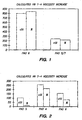
- Figure 1 is a graph comparing the absolute and relative T-4 viscosity increases in PAO 6 and PAO 5/7 based motor oil in an experiment the conditions of which are described in Example 5.
- Figure 2 is a graph comparing the absolute and relative T-4 viscosity increases in PAO 4, PAO 5 and PAO 6 based motor oil in an experiment the conditions of which are described in Example 6.
- the present invention involves improving thermal oxidative stability of engine oil by using PAO derived from a 1-dodecene or 1-tetradecene as a base oil.
- PAO 5/7 offers superior oxidation stability during use in comparison to PAO 4/6.
- improved oxidation stability is found in both gasoline (T-4) and diesel (TDI) engines (especially direct injection diesels).
- T-4 gasoline
- TDI diesel
- the superior oxidation stability qualities are shown in both fully synthetic as well as semi-synthetic engine oils, which are a mixture of PAO's and mineral oils.
- PAO 5/7 has also been shown to be superior over PAO 4/6/8 in PSA TU3M high temperature gasoline tests and Sequence IIIE high temperature oxidation tests.
- additive components are examples of some components that can be favorably employed in the present invention. These examples of additives are provided to illustrate the present invention, but they are not intended to limit it:
- an engine lubricating oil composition would contain:
- an engine lubricating oil composition is produced by blending a mixture of the above components.
- the lubricating oil composition produced by that method might have a slightly different composition than the initial mixture, because the components may interact.
- the components can be blended in any order and can be blended as combinations of components.
- Additive concentrates are also included within the scope of this invention.
- the concentrates of this invention comprise the compounds or compound mixtures of the present invention, with at least one of the additives disclosed above.
- the concentrates typically contain sufficient organic diluent to make them easy to handle during shipping and storage.
- organic diluent From 20% to 80% of the concentrate is organic diluent.
- Suitable organic diluents which can be used include for example, solvent refined 100N, i.e., Cit-Con 100N, and hydrotreated 100N, i.e., RLOP 100N, and the like.
- the organic diluent preferably has a viscosity of from about 1 to about 20 cSt at 100°C.
- Examples 1 through 4 cover bench test data obtained in the proprietary MAO 92 oxidation bench test.
- air is bubbled through an oil sample at elevated temperature.
- the oil sample contains an oxidation catalyst.
- the viscosity of the oil at 40°C is measured at regular intervals until 1000 cSt is reached. The time to reach this value is a measure of the stability. The longer the time, the better the oxidation stability.
- the MAO 92 oxidation test has a repeatability of 7 hours.
- a fully formulated engine oil was prepared, containing an additive package comprised of 6% dispersant, 71.5 mmol detergent, 15.5 mmol zinc dithiophosphate, 0.55% supplementary additives, 2.0% VII, 34.8% Esso 145N, 20.55% Esso 600N and 15% PAO 5 and 15% PAO 7. This oil was subjected to the MAO 92 oxidation test, the result being 125 hours.
- Example 2 As a comparison, a similar engine oil as described in Example 1 was prepared. However, the 15% PAO 5 and 15% PAO 7 were replaced by 30% PAO 6. The result of the oxidation test was only 100 hours.
- Example 1 The experiment of Example 1 was repeated using an additive package comprised of 6% dispersant, 71.5 mmol detergent, 15.5 mmol zinc dithiophosphate, 0.55% supplementary additives, 2.0% VII, 52% PAO 5 and 33.3% PAO 7.
- the result in the oxidation test is 162 hours.
- Example 3 As a comparison to Example 3, the PAO 5 and 7 were replaced by 11.1% PAO 4 and 74.2% PAO 6. The result in the oxidation test, 152 hours, was poor in comparison to the oil of Example 3.
- Example 1 and Comparative Example 2 were subjected to the bench tests used to mimic the viscosity increase of the VW T-4 engine test. The lower the absolute and relative viscosity increase, the better the test result. As can be seen in Figure 1, the oil based on PAO 5/7 is far superior to the oil based on PAO 6. Oil code OIL 10 OIL 11 Additive package AP7 AP7 PAO 5 15 PAO 6 30 PAO 7 15 Calculated T-4 viscosity (cSt) 756.6 201.8 Calculated T-4 viscosity increase (%) 819.0 189.7
- a fully formulated engine oil was prepared containing an additive package comprised of 6% dispersant, 87 mmol detergent, 19 mmol zinc dithiophosphate and 0.35% supplementary additives, 10.3% VII and 30% PAO 5, the balance made up by mineral base stock.
- Two similar engine oils were prepared but the 30% PAO 5 was replaced by 30% PAO 4 and 30% PAO 6, respectively. These three oils were subjected to the bench tests used to mimic the viscosity increase of the VWT-4 engine test. The lower the absolute and relative viscosity increase, the better the test result. As can be seen in Figure 2, the oil based on PAO 5 is far superior to the oils based on PAO 4 and PAO 6.
- a fully formulated engine oil was prepared containing an additive package comprised of 6.5% dispersant, 98 mmol detergent, 5.5 mmol zinc dithiophosphate and 1.8% supplementary additives, 4.0% VI improver and the balance a 57.6/42.4 mixture of PAO 4 and PAO 6.
- This oil was run in the VW TDI engine. The test was aborted after 52 hours, i.e., 8 hours before reaching the end-of-test, as result of iow oil pressure due to a lack of engine oil remaining in the sump.
- a VW TDI test was conducted on a 1.9 liter turbo charged, intercooled DI diesel type engine.
- the engine tested has power of 81 kW at 4150 rpm's.
- EGR is not activated in the engine and the oil charge is 4.5 liters.
- the test procedure had a 5 hour run-in step, a 3 hour power curve step, and a 2 hour flushing step.
- T-4 bench tests and engine tests were performed on oil compositions containing various additives, including viscosity index improvers and various proportions of PAO 4, PAO 5, PAO 6, PAO 7, PAO 8 and mineral stock.
- Tables 4A through 4D show the T-4 bench test and engine test results as well as the MAO 92 results for the compositions. These results show the correlation between the engine test results and the bench test model for both the absolute viscosity at end-of test (EOT) and also for the relative viscosity increase. Both are requirements for the T-4 test.
- EOT absolute viscosity at end-of test
- the Engine Test Conditions for conducting the VW T-4 test are given below in Table 4.
- the test oil charge was 5 liters with no oil top-up allowed.
- the limits on viscosity increase are the most difficult to achieve. Both rotative viscosity increase as well as absolute viscosity increase at EOT are limited. The limits are as follows: EOT Viscosity at 40°C ⁇ 200 cSt.
- PMA polymethylacrylate type polymers
- OCP ethylene propylene copolymers
- TGA DPeak i.e. the temperature at which the weight loss, due to both evaporation and oxidation, of the oil is the most important, which correlates with oil consumption. This test measures the weight variation of a sample as a function of temperature, under a nitrogen flow. At a certain temperature; defined as the DPeak, the weight loss is the most important. The exact DPeak value is determined as the maximum of the derivative curve. The repeatability of the TGA test is equal to 8°C. Table 7 shows the results.
- a fully formulated engine oil was prepared, containing 13.6% of an additive package, 6.9% VI Improver, 10% ester and 35% PAO 5 and 34.5% PAO 7.
- a Seq. IIIE test was run on this oil with a 1986 3.8 liter Buick V6 engine using leaded gasoline. The Initial oil fill is 5.3 liters. Total test duration is 64 hours. The engine speed is 3000 rpm with a load of 50.6 kW. The oil temperature is 149°C. The results of the test were as follows:
Landscapes
- Chemical & Material Sciences (AREA)
- Chemical Kinetics & Catalysis (AREA)
- General Chemical & Material Sciences (AREA)
- Oil, Petroleum & Natural Gas (AREA)
- Organic Chemistry (AREA)
- Lubricants (AREA)
Priority Applications (1)
| Application Number | Priority Date | Filing Date | Title |
|---|---|---|---|
| EP04027778A EP1520903A1 (fr) | 1998-01-30 | 1999-01-27 | Utilisation des polyolefines (pao) derivées de 1-dodecene ou 1-tetradecene pour améliorer la stabilité thermique des huiles de moteur dans les moteur à combustion interne |
Applications Claiming Priority (4)
| Application Number | Priority Date | Filing Date | Title |
|---|---|---|---|
| EP98400204 | 1998-01-30 | ||
| EP98400204A EP0933416A1 (fr) | 1998-01-30 | 1998-01-30 | Utilisation de poly alpha oléfines (PAO) de 1-docecène ou 1-tetradecène pour améliorer la stabilité thermique d'huile de moteur dans un moteur à combustion interne |
| EP99900590A EP1051466B1 (fr) | 1998-01-30 | 1999-01-27 | Utilisation de polyalfaolefines (pao) derivees de 1-dodecene ou 1-tetradecene pour ameliorer la stabilite thermique de l'huile d'un moteur a combustion interne |
| EP04027778A EP1520903A1 (fr) | 1998-01-30 | 1999-01-27 | Utilisation des polyolefines (pao) derivées de 1-dodecene ou 1-tetradecene pour améliorer la stabilité thermique des huiles de moteur dans les moteur à combustion interne |
Related Parent Applications (1)
| Application Number | Title | Priority Date | Filing Date |
|---|---|---|---|
| EP99900590A Division EP1051466B1 (fr) | 1998-01-30 | 1999-01-27 | Utilisation de polyalfaolefines (pao) derivees de 1-dodecene ou 1-tetradecene pour ameliorer la stabilite thermique de l'huile d'un moteur a combustion interne |
Publications (1)
| Publication Number | Publication Date |
|---|---|
| EP1520903A1 true EP1520903A1 (fr) | 2005-04-06 |
Family
ID=34315363
Family Applications (1)
| Application Number | Title | Priority Date | Filing Date |
|---|---|---|---|
| EP04027778A Withdrawn EP1520903A1 (fr) | 1998-01-30 | 1999-01-27 | Utilisation des polyolefines (pao) derivées de 1-dodecene ou 1-tetradecene pour améliorer la stabilité thermique des huiles de moteur dans les moteur à combustion interne |
Country Status (1)
| Country | Link |
|---|---|
| EP (1) | EP1520903A1 (fr) |
Citations (6)
| Publication number | Priority date | Publication date | Assignee | Title |
|---|---|---|---|---|
| GB1264981A (fr) * | 1968-03-15 | 1972-02-23 | ||
| US3763244A (en) * | 1971-11-03 | 1973-10-02 | Ethyl Corp | Process for producing a c6-c16 normal alpha-olefin oligomer having a pour point below about- f. |
| US4218330A (en) * | 1978-06-26 | 1980-08-19 | Ethyl Corporation | Lubricant |
| GB2078776A (en) * | 1980-06-03 | 1982-01-13 | Nippon Petrochemicals Co Ltd | Method for producing fluid for use as lubricating oil |
| JPH05331483A (ja) * | 1992-06-01 | 1993-12-14 | Tonen Corp | 内燃機関用潤滑油組成物 |
| GB2307243A (en) * | 1995-11-14 | 1997-05-21 | Albemarle S A | Biodegradable polyalphaolefin fluids |
-
1999
- 1999-01-27 EP EP04027778A patent/EP1520903A1/fr not_active Withdrawn
Patent Citations (6)
| Publication number | Priority date | Publication date | Assignee | Title |
|---|---|---|---|---|
| GB1264981A (fr) * | 1968-03-15 | 1972-02-23 | ||
| US3763244A (en) * | 1971-11-03 | 1973-10-02 | Ethyl Corp | Process for producing a c6-c16 normal alpha-olefin oligomer having a pour point below about- f. |
| US4218330A (en) * | 1978-06-26 | 1980-08-19 | Ethyl Corporation | Lubricant |
| GB2078776A (en) * | 1980-06-03 | 1982-01-13 | Nippon Petrochemicals Co Ltd | Method for producing fluid for use as lubricating oil |
| JPH05331483A (ja) * | 1992-06-01 | 1993-12-14 | Tonen Corp | 内燃機関用潤滑油組成物 |
| GB2307243A (en) * | 1995-11-14 | 1997-05-21 | Albemarle S A | Biodegradable polyalphaolefin fluids |
Non-Patent Citations (1)
| Title |
|---|
| DATABASE WPI Section Ch Week 9403, Derwent World Patents Index; Class A17, AN 94-023131, XP002068813 * |
Similar Documents
| Publication | Publication Date | Title |
|---|---|---|
| EP1051466B1 (fr) | Utilisation de polyalfaolefines (pao) derivees de 1-dodecene ou 1-tetradecene pour ameliorer la stabilite thermique de l'huile d'un moteur a combustion interne | |
| JP3615267B2 (ja) | エンジン油組成物 | |
| KR102649415B1 (ko) | 윤활유 조성물 | |
| CA2390743C (fr) | Composes d'huile lubrifiante | |
| JPH09111275A (ja) | ディーゼルエンジン油組成物 | |
| KR102691225B1 (ko) | 윤활유 조성물 | |
| US10227546B2 (en) | Multifunctional molybdenum containing compounds, method of making and using, and lubricating oil compositions containing same | |
| KR20200071741A (ko) | 항산화 중합체성 디페닐아민 조성물 | |
| JPH05163497A (ja) | エンジン油組成物 | |
| JP5330716B2 (ja) | 潤滑油組成物 | |
| CA2335032C (fr) | Polyalphaolefines resistant mieux a l'oxydation, procede de production associe | |
| JPH10183154A (ja) | 潤滑油組成物 | |
| JPH08209178A (ja) | 潤滑油組成物 | |
| JP2006182986A (ja) | 潤滑油組成物 | |
| JPH1135962A (ja) | 潤滑油組成物 | |
| AU2002346577A1 (en) | Sulfur containing lubricating oil additive system particularly useful for natural gas fueled engines | |
| JP7672409B2 (ja) | ポリアルファオレフィンを含む潤滑油組成物 | |
| JP4038388B2 (ja) | エンジン油組成物 | |
| CA2316997A1 (fr) | Utilisation de polyalfaolefines (pao) derivees de 1-dodecene ou 1-tetradecene pour ameliorer la stabilite thermique de l'huile d'un moteur a combustion interne | |
| JP4559550B2 (ja) | 内燃機関用潤滑油組成物 | |
| JP2019502851A (ja) | 電動車両用の駆動システムの分離潤滑方法 | |
| CN112280609A (zh) | 润滑油组合物 | |
| CA3163425C (fr) | Compositions d'huile lubrifiante comprenant une polyalphaolefine | |
| JP4632465B2 (ja) | 潤滑油組成物 | |
| KR20160074557A (ko) | 중속 디젤 엔진내의 은 베어링의 보호를 위한 윤활유 조성물 |
Legal Events
| Date | Code | Title | Description |
|---|---|---|---|
| PUAI | Public reference made under article 153(3) epc to a published international application that has entered the european phase |
Free format text: ORIGINAL CODE: 0009012 |
|
| AC | Divisional application: reference to earlier application |
Ref document number: 1051466 Country of ref document: EP Kind code of ref document: P |
|
| AK | Designated contracting states |
Kind code of ref document: A1 Designated state(s): AT BE DE FI FR GB NL |
|
| 17P | Request for examination filed |
Effective date: 20051004 |
|
| AKX | Designation fees paid |
Designated state(s): AT BE DE FR GB |
|
| STAA | Information on the status of an ep patent application or granted ep patent |
Free format text: STATUS: THE APPLICATION IS DEEMED TO BE WITHDRAWN |
|
| 18D | Application deemed to be withdrawn |
Effective date: 20110802 |