EP1519505A2 - Taktsynchonisierung von Systemen mit mehreren Baugruppen - Google Patents
Taktsynchonisierung von Systemen mit mehreren Baugruppen Download PDFInfo
- Publication number
- EP1519505A2 EP1519505A2 EP04300609A EP04300609A EP1519505A2 EP 1519505 A2 EP1519505 A2 EP 1519505A2 EP 04300609 A EP04300609 A EP 04300609A EP 04300609 A EP04300609 A EP 04300609A EP 1519505 A2 EP1519505 A2 EP 1519505A2
- Authority
- EP
- European Patent Office
- Prior art keywords
- shelf
- phase difference
- difference information
- signal
- esync
- Prior art date
- Legal status (The legal status is an assumption and is not a legal conclusion. Google has not performed a legal analysis and makes no representation as to the accuracy of the status listed.)
- Withdrawn
Links
- 230000002093 peripheral effect Effects 0.000 claims abstract description 71
- 238000000034 method Methods 0.000 claims abstract description 21
- 238000004891 communication Methods 0.000 claims description 29
- 230000005540 biological transmission Effects 0.000 claims description 10
- 239000003550 marker Substances 0.000 claims description 6
- 230000000694 effects Effects 0.000 claims description 4
- 238000013461 design Methods 0.000 description 10
- 238000010586 diagram Methods 0.000 description 5
- 229910052792 caesium Inorganic materials 0.000 description 4
- TVFDJXOCXUVLDH-UHFFFAOYSA-N caesium atom Chemical compound [Cs] TVFDJXOCXUVLDH-UHFFFAOYSA-N 0.000 description 4
- 239000004744 fabric Substances 0.000 description 4
- 230000001934 delay Effects 0.000 description 2
- 238000012545 processing Methods 0.000 description 2
- 230000001360 synchronised effect Effects 0.000 description 2
- 206010017577 Gait disturbance Diseases 0.000 description 1
- 230000015572 biosynthetic process Effects 0.000 description 1
- 230000015556 catabolic process Effects 0.000 description 1
- 238000006731 degradation reaction Methods 0.000 description 1
- 230000001419 dependent effect Effects 0.000 description 1
- 238000001514 detection method Methods 0.000 description 1
- 230000001627 detrimental effect Effects 0.000 description 1
- 238000011161 development Methods 0.000 description 1
- 230000018109 developmental process Effects 0.000 description 1
- 230000003292 diminished effect Effects 0.000 description 1
- 238000012423 maintenance Methods 0.000 description 1
- 230000003287 optical effect Effects 0.000 description 1
- 239000013307 optical fiber Substances 0.000 description 1
- 238000005457 optimization Methods 0.000 description 1
- 230000001172 regenerating effect Effects 0.000 description 1
- 230000008929 regeneration Effects 0.000 description 1
- 238000011069 regeneration method Methods 0.000 description 1
- 238000012827 research and development Methods 0.000 description 1
- 230000008054 signal transmission Effects 0.000 description 1
- 238000003786 synthesis reaction Methods 0.000 description 1
Images

Classifications
-
- H—ELECTRICITY
- H04—ELECTRIC COMMUNICATION TECHNIQUE
- H04J—MULTIPLEX COMMUNICATION
- H04J3/00—Time-division multiplex systems
- H04J3/02—Details
- H04J3/06—Synchronising arrangements
- H04J3/0635—Clock or time synchronisation in a network
- H04J3/0685—Clock or time synchronisation in a node; Intranode synchronisation
- H04J3/0688—Change of the master or reference, e.g. take-over or failure of the master
-
- H—ELECTRICITY
- H04—ELECTRIC COMMUNICATION TECHNIQUE
- H04J—MULTIPLEX COMMUNICATION
- H04J3/00—Time-division multiplex systems
- H04J3/02—Details
- H04J3/06—Synchronising arrangements
- H04J3/0635—Clock or time synchronisation in a network
- H04J3/0685—Clock or time synchronisation in a node; Intranode synchronisation
- H04J3/0691—Synchronisation in a TDM node
Definitions
- the invention relates to synchronizing content transport in communications networks, and in particular to methods and apparatus for employing any master clock signal received at a multi-shelf system to synchronize content transport via the multi-shelf system.
- a signal transport delay is incurred when content is conveyed over communications links between communications network nodes.
- content is being conveyed at high bit rates
- the ability of communications network nodes to synchronize content transport is diminished: on one hand, due to very short bit transmission time periods at high transport rates, and on the other hand, due to master clock signal source instabilities.
- GPS Global Positioning System
- Cesium clocks are typically employed to provide master clock signals.
- Cesium clock generated master clock signals are distributed to individual network nodes in communications networks via designated interconnecting links. While redundancy is a requirement, Cesium clock sources are expensive and if too many are used in a communications network, the synchronization of the multiple Cesium clocks becomes the stumbling block.
- network nodes are designed to be multiply and redundantly interconnected in communications networks, it would be impossible to ensure that the content transport paths follow master clock signal distribution paths. Nor can it be ensured that master clock signal distribution paths follow content transport paths. Therefore, inevitably, active synchronization must be performed at each network node in a communications network.
- active signal synchronization at each network node must include selecting which master clock signal received to be used to phase align content conveyance thereto. Being able to select between multiple sources is desired as master clock signal sources may fail, become unreliable, or at times need servicing; and/ or as the clock signal distribution infrastructure may experience failure.
- at least two master clock signals must be provided to each network node in a communications network: one being designated as the primary master clock signal to which content transport is actively synchronized to, and the other designated as the secondary standby master clock signal to which content transport is to be synchronized to should the primary master clock signal be unavailable or experience degradation.
- the single-shelf network node typically has a backplane design which includes a switching fabric with interface card connectors for interfacing with line cards having physical ports thereon. Communications links connect directly to the physical ports.
- An exemplary Bellcore Stratum-3 compliant 8kHz System SYNChronization signal (SSYNC), is generated by a System Synchronization Unit (SSU) at each network node.
- SSU System Synchronization Unit
- the generated Bellcore Stratum-3 compliant 8kHz SSYNC signal is frequency locked and phase locked to a selected, externally generated, master clock signal (External SYNChronization signal (ESYNC)) received via one of the physical ports of the single shelf network node.
- EYNC External SYNChronization signal
- the frequency-locked phase-locked SSYNC signal is subsequently distributed to each line card associated with the single shelf network node for use in conveying content.
- the backplane design includes special interface card special traces thereon and connector pins, to collect and distribute analog clock signals within the single shelf network node.
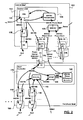
- a multi-shelf network node system 100 includes a control shelf 102, a switching shelf 104, and multiple peripheral shelves 106.
- the peripheral shelves 106 primarily exchange content with the communication network(s) in which the multi-shelf network node 100 participates.
- the control shelf 102 can be employed exclusively for content transport control and may also participate in content transport.
- the switching shelf 104 includes a master switching fabric which switches all traffic between the peripheral shelves 106 (including the control shelf 102 if the control shelf 102 has line cards 118 installed therein).
- Each peripheral shelf 106 has a Fabric Card (FC) 108 to which all inter-shelf traffic is multiplexed and from which all inter-shelf traffic is demultiplexed.
- FC Fabric Card
- a high bandwidth data link 110 typically an optical fiber trunk, conveys content between at least one fabric card 108 at a peripheral shelf 106(/ 102) and at least one Switch Access Card (SAC) 114 at the switching shelf 104.
- SAC Switch Access Card
- the shelves of the multi-shelf system 100 have a star interconnection architecture with the control shelf 102 as the root node.
- the control shelf 102 includes a backplane and control cards 112 providing control layer services to the entire multi-shelf network node system 100.
- Control Services Links (CSL) 116 convey control information between the control card 112 at the control shelf 102, and a corresponding shelf controller card 115 at each peripheral shelf 106.
- control services links 116 typically have low bandwidths when compared with the data links 110.
- the data links 110 typically include plain optical links
- the control services links 116 may provide more functionality particularly in a multi-protocol multi-shelf network node deployment.
- each control services link 116 may include an E1/ T1 trunk.
- E1/ T1 trunks are typically used for Time Division Multiplexed (TDM) transmission of digitized voice samples and voice communications control information in telephone networks.
- E1/ T1-based transmissions adhere to a TDM frame format having frame markers recurring at an 8kHz rate such that voice sample data corresponding to a particular service-level connection is found in the same bit position with respect to the frame marker.
- the standardized intended use of the Bellcore Stratum-3 compliant 8kHz SSYNC signal relates directly to E1/ T1 frame marker generation and detection - the analog characteristics of the frame marker being used in clock synchronization.
- a comparator is provided on a shelf controller of a peripheral shelf of a multi-shelf network node for determining a phase difference information between a selected ESYNC signal received via a physical port associated with the peripheral shelf by a selector and an SSYNC signal distributed from a control shelf.
- Transmission means are employed to convey the phase difference information to the control shelf.
- Employing the selector and the comparator provides flexibility in conveying any ESYNC signal from any interface card associated with the any peripheral shelf to the control shelf of the multi-shelf network node over a reduced infrastructure.
- an ESYNC phase difference information encoder associated with the peripheral shelf controller digitally encodes the phase difference information into digitally encoded phase error words for transmission to the control shelf via a control layer infrastructure.
- a controller employed in a control shelf of a multi-shelf communications network node includes reception means receiving a plurality of phase difference information streams, and a selector for selecting a phase difference information stream from the plurality of phase difference information streams.
- the controller further includes an ESYNC signal regenerator for regenerating an ESYNC signal from a SSYNC signal and digitally encoded phase difference information.
- the selector and the ESYNC signal regenerator providing flexibility in receiving at the control shelf any ESYNC signal from any peripheral shelf associated with the multi-shelf network node. Employing the selector further reduces the complexity of the control shelf.
- a method of conveying an ESYNC signal received via a peripheral shelf of a multi-shelf network node to a control shelf thereof is provided.
- a plurality of ESYNC signals are received from a corresponding plurality of interface cards associated with a peripheral shelf.
- An ESYNC signal is selected from the plurality of ESYNC signals received.
- Phase difference information is derived from a comparison between the selected ESYNC signal and a System SYNC (SSYNC) signal provided from the control shelf.
- SSYNC System SYNC
- the method further includes digitally encoding the phase difference information and digitally conveying the phase difference information between the peripheral shelf and the control shelf.
- the method further includes selecting a digitally encoded phase difference information stream from a plurality of digitally encoded phase difference information streams received at the control shelf, and deriving a corresponding ESYNC signal based on the SSYNC signal and the selected phase difference information stream.
- Advantages are derived from a scalable synchronization signal infrastructure providing any selected ESYNC signal received via any interface card associated with any peripheral shelf of a multi-shelf network node to the control shelf for synchronizing an SSYNC signal thereto.
- a multi-shelf network node design and operation enable the selection of a master clock signal received via any interface card (line card 118) of either the control shelf 102 or any of the peripheral shelves 106 of a multi-shelf network node 100.
- an SSYNC signal generated by an SSU 122 associated with a corresponding control card 112 is frequency locked and phase locked to an External SYNC (ESYNC) signal provided thereto as will be described herein below, and the SSYNC signal is distributed to line cards 118 of the control shelf 102, if any, directly via existing clock signal traces on the control shelf backplane, then via existing clock pins of interface card connectors; and also distributed to all peripheral shelves 106 via the down-link frame markers of the E1/ T1 trunk of each control services link 116.
- ESYNC External SYNC
- the SSYNC signal is extracted at each peripheral shelf 106 from down-link frame marker of the E1/ T1 trunk of the corresponding control services link 116, and distributed to each line card 118 of the peripheral shelf 106 via dedicated peripheral shelf backplane clock signal traces and interface card connector pins.
- control shelf 102 While there is a single control shelf 102 in the multi-shelf network node 100, it is understood that the entire control infrastructure described herein above is redundant: there two SSUs 122 (one on each control card 112) and paired control services links 116 from the pair of control cards 112 at the control shelf 102 connect to paired shelf controller cards 115 at each peripheral shelf 106 (and the switching shelf 104).
- Externally generated master clock signals may be received via line cards 118 associated with the control shelf 102, if any, and are provided directly as ESYNC signals to the SSU 122 for selection in frequency locking and phase locking the SSYNC signal thereto.
- externally generated master clock signals may also be received via any (interface) line card 118 associated with any of the multiple peripheral shelves 106 of the multi-shelf network node 100.
- received master clock signals are provided as ESYNC signals to a ESYNC signal selector 119 associated with a shelf controller card 115 via dedicated clock interface card pins and dedicated peripheral shelf backplane clock signal traces.
- two best ESYNC clock signals are selected at each peripheral shelf 106 to be provided to the control shelf 102 for potential frequency lock and phase lock of the SSYNC signal thereto.
- a selected ESYNC signal is provided to a comparator 120 employed in determining a corresponding phase difference between the selected ESYNC signal and the SSYNC clock signal distributed by the control shelf 102.
- derived phase difference information corresponding to a selected ESYNC signal is provided to an ESYNC phase difference encoder 124 which digitally encodes the phase difference information.
- the digitally encoded phase difference information corresponding to each ESYNC signal selected at each peripheral shelf 106 is conveyed to the control shelf 102 digitally over the corresponding control services links 116.
- the phase difference information is encoded in streams of phase error words. If the control services link 116 has multiple physical links conveying traffic in accordance with multiple transport protocols, the digital conveyance of the phase difference information may employ any physical link in the control services link 116.
- a control services link 116 includes, but is not limited to: an E1/ T1 trunk, an Ethernet link, an RS-485 differential serial link, etc.
- phase difference information for each ESYNC signal selected at each peripheral shelf 106 is provided to an ESYNC re-generator 126 associated with the control card 112.
- Each ESYNC re-generator 126 is directed by a selector 125 to select a particular stream of digital phase difference information (phase error word stream) associated with a corresponding selected ESYNC signal received at one of the peripheral shelves 106, and derive a corresponding ESYNC signal from the SSYNC signal.
- the derived ESYNC signals are provided to the SSU 122 as if received at the control shelf 102.
- Each SSU 122 treats all ESYNC signals provided thereto equally and frequency locks and phase locks the SSYNC signal to a selected primary ESYNC signal as directed.
- any master clock signal from any interface card in the entire multi-shelf network node 100 can be selected as the primary and secondary master clock signals.
- the use of comparators 120 and ESYNC phase difference information encoders 124 at the peripheral shelf 106, and the use of ESYNC regenerators 126 at each control card 112 of the control shelf 102 distributes clock signal processing in the multi-shelf network node system and results in a reduction in the number of clock signals to be provided to the control shelf 102 while still providing flexibility and redundancy.
- the digital transmission of phase difference information from each peripheral shelf 106 to the control shelf 102 by exploiting existing control services links 116, eliminates the otherwise necessary additional wiring thereby reducing deployment and ongoing maintenance costs.
- the regeneration of ESYNC signals at the control shelf 102 which are treated equivalent to ESYNC signals derived from master clock signals received directly at the control shelf 102, provides an SSU independent solution which allows a standard or commercial SSU 112 to be employed and/ or upgraded independently.
Landscapes
- Engineering & Computer Science (AREA)
- Computer Networks & Wireless Communication (AREA)
- Signal Processing (AREA)
- Synchronisation In Digital Transmission Systems (AREA)
Applications Claiming Priority (2)
| Application Number | Priority Date | Filing Date | Title |
|---|---|---|---|
| US670304 | 1996-06-27 | ||
| US10/670,304 US7209530B2 (en) | 2003-09-26 | 2003-09-26 | Multi-shelf system clock synchronization |
Publications (2)
| Publication Number | Publication Date |
|---|---|
| EP1519505A2 true EP1519505A2 (de) | 2005-03-30 |
| EP1519505A3 EP1519505A3 (de) | 2006-06-07 |
Family
ID=34194821
Family Applications (1)
| Application Number | Title | Priority Date | Filing Date |
|---|---|---|---|
| EP04300609A Withdrawn EP1519505A3 (de) | 2003-09-26 | 2004-09-17 | Taktsynchonisierung von Systemen mit mehreren Baugruppen |
Country Status (2)
| Country | Link |
|---|---|
| US (1) | US7209530B2 (de) |
| EP (1) | EP1519505A3 (de) |
Cited By (1)
| Publication number | Priority date | Publication date | Assignee | Title |
|---|---|---|---|---|
| WO2007124995A1 (de) * | 2006-04-26 | 2007-11-08 | Nokia Siemens Networks Gmbh & Co. Kg | Verfahren zur synchronisation von baugruppen einer basisstation |
Families Citing this family (3)
| Publication number | Priority date | Publication date | Assignee | Title |
|---|---|---|---|---|
| FI20060769L (fi) * | 2006-08-28 | 2008-02-29 | Tellabs Oy | Yleiskäyttöinen fyysinen tiedonsiirtoportti |
| JP5620876B2 (ja) * | 2011-04-26 | 2014-11-05 | 株式会社日立製作所 | 網同期装置のシェルフ、網同期装置 |
| JP6080705B2 (ja) * | 2013-06-20 | 2017-02-15 | 三菱電機株式会社 | 通信装置 |
Family Cites Families (7)
| Publication number | Priority date | Publication date | Assignee | Title |
|---|---|---|---|---|
| US5638410A (en) * | 1993-10-14 | 1997-06-10 | Alcatel Network Systems, Inc. | Method and system for aligning the phase of high speed clocks in telecommunications systems |
| GB9408574D0 (en) | 1994-04-29 | 1994-06-22 | Newbridge Networks Corp | Atm switching system |
| US5910753A (en) * | 1997-09-19 | 1999-06-08 | Northern Telecom Limited | Direct digital phase synthesis |
| JP3464924B2 (ja) * | 1998-03-13 | 2003-11-10 | 株式会社東芝 | 同期制御回路 |
| JP4228518B2 (ja) * | 2000-06-09 | 2009-02-25 | パナソニック株式会社 | デジタルpll装置 |
| US6664827B2 (en) * | 2001-03-02 | 2003-12-16 | Adc Telecommunications, Inc. | Direct digital synthesizer phase locked loop |
| ATE334536T1 (de) | 2001-09-27 | 2006-08-15 | Alcatel Canada Inc | SYSTEM UND VERFAHREN FÜR EINE DIENSTSTEUERUNGSVERBINDUNG EINES ßMULTI-SHELFß KNOTENS IN EINER VERMITTLUNGSSTELLE |
-
2003
- 2003-09-26 US US10/670,304 patent/US7209530B2/en not_active Expired - Fee Related
-
2004
- 2004-09-17 EP EP04300609A patent/EP1519505A3/de not_active Withdrawn
Non-Patent Citations (1)
| Title |
|---|
| None * |
Cited By (3)
| Publication number | Priority date | Publication date | Assignee | Title |
|---|---|---|---|---|
| WO2007124995A1 (de) * | 2006-04-26 | 2007-11-08 | Nokia Siemens Networks Gmbh & Co. Kg | Verfahren zur synchronisation von baugruppen einer basisstation |
| RU2438247C2 (ru) * | 2006-04-26 | 2011-12-27 | Нокиа Сименс Нетворкс Гмбх Унд Ко. Кг | Способ синхронизации узлов базовой станции |
| US8244304B2 (en) | 2006-04-26 | 2012-08-14 | Nokia Siemens Networks Gmbh & Co. Kg | Method for synchronization of assemblies in a base station |
Also Published As
| Publication number | Publication date |
|---|---|
| US7209530B2 (en) | 2007-04-24 |
| US20050071704A1 (en) | 2005-03-31 |
| EP1519505A3 (de) | 2006-06-07 |
Similar Documents
| Publication | Publication Date | Title |
|---|---|---|
| US7483450B1 (en) | Method and system for link-based clock synchronization in asynchronous networks | |
| US6839858B1 (en) | System for clock synchronization | |
| US6707828B1 (en) | Synchronization of a network element in a synchronous digital communications network | |
| JPH0267033A (ja) | 網同期システム | |
| US20020110157A1 (en) | Method and apparatus for providing a gigabit ethernet circuit pack | |
| US20020126789A1 (en) | Interconnection process and interface using parallelized high-speed serial links | |
| US6567422B1 (en) | Network synchronization controller and timing loop prevention method | |
| EP2564530A1 (de) | Datenübertragung mit multiplexing und demultiplexing von eingebetteten tacksignalen | |
| US7209530B2 (en) | Multi-shelf system clock synchronization | |
| US7551640B1 (en) | Method and apparatus for errorless frame timing adjustment | |
| JP3485250B2 (ja) | 従属同期装置及び該従属同期装置を有するsdh装置 | |
| US7181545B2 (en) | Network synchronization architecture for a Broadband Loop Carrier (BLC) system | |
| Pan | Synchronizing and multiplexing in a digital communications network | |
| US6560245B1 (en) | Telecommunications system | |
| JP4236394B2 (ja) | 冗長切替装置 | |
| JP3052922B2 (ja) | 通信端局装置及びその動作クロック選定方法並びにその制御プログラムを記録した記録媒体 | |
| EP0899905B1 (de) | Synchronisation einer zentralen Einheit mit einer externen Verbindung mittels eines Vermittlungsnetzwerkes | |
| CA2243450C (en) | Providing timing to an external system | |
| CN1822526B (zh) | 用于同步传送网络设备的使用冗余时钟信号的同步系统 | |
| EP1585242B1 (de) | Verfahren und Vorrichtung zum Verteilen des Taktgebers und der Synchronisierung in einem Telekommunikationsnetzelement | |
| US6714610B1 (en) | Method of transmitting clock signals, method of synchronizing clock generators or network elements, as well as a network element and a clock generator | |
| US6826199B1 (en) | Arrangement, system and method relating to switching | |
| JP2558240B2 (ja) | 従属同期装置の基準クロック切換回路 | |
| US6816018B1 (en) | System and method for partitioning a system timing reference among multiple circuit boards | |
| CN121283554A (zh) | 一种为基站提供时钟基准源的方法、装置、设备及系统 |
Legal Events
| Date | Code | Title | Description |
|---|---|---|---|
| PUAI | Public reference made under article 153(3) epc to a published international application that has entered the european phase |
Free format text: ORIGINAL CODE: 0009012 |
|
| AK | Designated contracting states |
Kind code of ref document: A2 Designated state(s): AT BE BG CH CY CZ DE DK EE ES FI FR GB GR HU IE IT LI LU MC NL PL PT RO SE SI SK TR |
|
| AX | Request for extension of the european patent |
Extension state: AL HR LT LV MK |
|
| PUAL | Search report despatched |
Free format text: ORIGINAL CODE: 0009013 |
|
| AK | Designated contracting states |
Kind code of ref document: A3 Designated state(s): AT BE BG CH CY CZ DE DK EE ES FI FR GB GR HU IE IT LI LU MC NL PL PT RO SE SI SK TR |
|
| AX | Request for extension of the european patent |
Extension state: AL HR LT LV MK |
|
| 17P | Request for examination filed |
Effective date: 20061207 |
|
| AKX | Designation fees paid |
Designated state(s): AT BE BG CH CY CZ DE DK EE ES FI FR GB GR HU IE IT LI LU MC NL PL PT RO SE SI SK TR |
|
| 17Q | First examination report despatched |
Effective date: 20070123 |
|
| RAP1 | Party data changed (applicant data changed or rights of an application transferred) |
Owner name: ALCATEL LUCENT |
|
| STAA | Information on the status of an ep patent application or granted ep patent |
Free format text: STATUS: THE APPLICATION IS DEEMED TO BE WITHDRAWN |
|
| 18D | Application deemed to be withdrawn |
Effective date: 20070803 |