EP1517489A2 - Anwendungssteuerung in peer-to-peer ad hoc Kommunikationsnetzen - Google Patents
Anwendungssteuerung in peer-to-peer ad hoc Kommunikationsnetzen Download PDFInfo
- Publication number
- EP1517489A2 EP1517489A2 EP04104441A EP04104441A EP1517489A2 EP 1517489 A2 EP1517489 A2 EP 1517489A2 EP 04104441 A EP04104441 A EP 04104441A EP 04104441 A EP04104441 A EP 04104441A EP 1517489 A2 EP1517489 A2 EP 1517489A2
- Authority
- EP
- European Patent Office
- Prior art keywords
- application
- application program
- wireless device
- program
- control parameter
- Prior art date
- Legal status (The legal status is an assumption and is not a legal conclusion. Google has not performed a legal analysis and makes no representation as to the accuracy of the status listed.)
- Withdrawn
Links
Images


Classifications
-
- H—ELECTRICITY
- H04—ELECTRIC COMMUNICATION TECHNIQUE
- H04W—WIRELESS COMMUNICATION NETWORKS
- H04W48/00—Access restriction; Network selection; Access point selection
- H04W48/08—Access restriction or access information delivery, e.g. discovery data delivery
- H04W48/14—Access restriction or access information delivery, e.g. discovery data delivery using user query or user detection
-
- H—ELECTRICITY
- H04—ELECTRIC COMMUNICATION TECHNIQUE
- H04L—TRANSMISSION OF DIGITAL INFORMATION, e.g. TELEGRAPHIC COMMUNICATION
- H04L67/00—Network arrangements or protocols for supporting network services or applications
- H04L67/50—Network services
- H04L67/51—Discovery or management thereof, e.g. service location protocol [SLP] or web services
-
- H—ELECTRICITY
- H04—ELECTRIC COMMUNICATION TECHNIQUE
- H04L—TRANSMISSION OF DIGITAL INFORMATION, e.g. TELEGRAPHIC COMMUNICATION
- H04L67/00—Network arrangements or protocols for supporting network services or applications
- H04L67/34—Network arrangements or protocols for supporting network services or applications involving the movement of software or configuration parameters
-
- H—ELECTRICITY
- H04—ELECTRIC COMMUNICATION TECHNIQUE
- H04M—TELEPHONIC COMMUNICATION
- H04M1/00—Substation equipment, e.g. for use by subscribers
- H04M1/72—Mobile telephones; Cordless telephones, i.e. devices for establishing wireless links to base stations without route selection
- H04M1/724—User interfaces specially adapted for cordless or mobile telephones
- H04M1/72403—User interfaces specially adapted for cordless or mobile telephones with means for local support of applications that increase the functionality
- H04M1/72409—User interfaces specially adapted for cordless or mobile telephones with means for local support of applications that increase the functionality by interfacing with external accessories
- H04M1/72412—User interfaces specially adapted for cordless or mobile telephones with means for local support of applications that increase the functionality by interfacing with external accessories using two-way short-range wireless interfaces
-
- H—ELECTRICITY
- H04—ELECTRIC COMMUNICATION TECHNIQUE
- H04M—TELEPHONIC COMMUNICATION
- H04M2250/00—Details of telephonic subscriber devices
- H04M2250/02—Details of telephonic subscriber devices including a Bluetooth® interface
-
- H—ELECTRICITY
- H04—ELECTRIC COMMUNICATION TECHNIQUE
- H04W—WIRELESS COMMUNICATION NETWORKS
- H04W84/00—Network topologies
- H04W84/18—Self-organising networks, e.g. ad-hoc networks or sensor networks
Definitions
- the present invention relates, in general, to communication between devices connected to a wireless communication network.
- the present invention is a system and method for controlling access to an application program in a wireless device connected to a spontaneous and instant (ad-hoc) communications network.
- Short-range wireless systems have a range of less than one hundred meters, but may connect to the Internet to provide communication over longer distances.
- Short-range wireless systems include, but are not limited to, a wireless personal area network (PAN) and a wireless local area network (LAN).
- PAN personal area network
- LAN wireless local area network
- a wireless PAN uses low-cost, low-power wireless devices that have a typical range of ten meters.
- An example of a wireless PAN technology is the Bluetooth Standard.
- the Bluetooth Standard operates in the 2.4 GHz Industrial, Scientific, and Medical (ISM) band and provides a peak air-link speed of one Mbps and a power consumption low enough for use in personal, portable electronics such as a personal digital assistance or mobile phone.
- ISM Industrial, Scientific, and Medical
- a description of the Bluetooth communication protocol and device operation principles is in Bluetooth Special Interest Group.
- IrDA Infrared Data Association
- a wireless LAN is more costly than a wireless PAN, but has a longer range.
- An example of a wireless LAN technology is the IEEE 802.11 Wireless LAN Standard and the HIPERLAN Standard. The HIPERLAN Standard operates in the 5 GHz Unlicensed-National Information Infrastructure (U-NII) band and provides a peak air-link speed between ten and one hundred Mbps.
- U-NII Unlicensed-National Information Infrastructure
- An ad-hoc network is a short-range wireless system comprising an arbitrary collection of wireless devices that are physically close enough to exchange information.
- An ad-hoc network is constructed quickly with wireless devices joining and leaving the network as they enter and leave the proximity of the remaining wireless devices.
- An ad-hoc network also may include one or more access points, that is, stationary wireless devices operating as a stand-alone server or as gateway connections to other networks.
- the Bluetooth Standard will likely support the interconnection of multiple piconets to form a multi-hop ad-hoc network, or scattemet.
- a connecting device forwards traffic between different piconets.
- the connecting device may serve as a master device in one piconet, but as a slave device or a master device in another piconet.
- the connecting devices join the piconets that comprise a scatternet by adapting the timing and hop sequence to the respective piconet and possibly changing the roles that they serve from a master device to a slave device.
- a Bluetooth device includes, but is not limited to, a mobile telephone, personal or laptop computer, radio-frequency identification tag, and personal electronic device such as a personal digital assistant (PDA), pager, or portable-computing device.
- PDA personal digital assistant
- Each Bluetooth device includes application and operating system programs designed to find other Bluetooth devices as they enter and leave the communication range of the network.
- the requesting Bluetooth device in a client role and the responding Bluetooth device in a server role establish a proximity link between the two devices.
- the requesting and responding Bluetooth device use the proximity link and a service discovery protocol to discover the services offered by the other Bluetooth device and how to connect to those services.
- an application program that is running in a computer is resident in the memory of the computer and is constrained by factors such as the memory size, processor speed, and resources. Typically, these factors do not impose limits on the application.
- the user controls the application (i.e., when an application is started, closed, and its relationship to other applications) using a shell program or a graphical desktop environment.
- the ability to auto-start or pre-configure the application exists, but only in the context of Plug-n-Play drivers and interfaces.
- the computing environment necessitates strict application control in terminal devices.
- the number of bytes of memory that the user interface requires in a mobile device restricts the ability to run applications in parallel.
- a user typically cannot control the establishment of a proximity connection between two peer devices. The user may know that there is a high probability of establishing the proximity connection, but cannot reliably predict the time or place of the establishment.
- a browsing application will run first to view a movie file, then a banking application will run to purchase a ticket, followed by a ticketing application to accept the purchased ticket, and finally, a convenience application will run to change the telephone ring to silent mode.
- an application can be dynamically loaded and run on a terminal device (e.g., applets). In addition to security issues, this ability of the terminal device raises issues regarding the user's control of the terminal device.
- the system and method will allow a user or service provider to create a rule set that describes the desired behavior of the application programs.
- the rule set will define the automatic launching of the application programs and the allowed behavior of the application programs following the establishment of a proximity connection.
- a computer system, method, and computer program product for controlling access to an application program in a wireless device connected to an ad-hoc communications network comprises sending an inquiry message to the ad-hoc communications network, receiving a response to the inquiry message from a nearby wireless device, choosing a selected application from a list of application programs, and examining control parameters associated with the selected application.
- the control parameters dictate a behavior of the selected application such as allowing communication with the selected application, refusing communication with the selected application, downloading the selected application, or distributing the selected application.
- the method further comprises sending a connection request to the nearby wireless device, receiving an accept connections message from the nearby wireless device, launching the selected application, and sending a service request to connect the selected application and the matching application.
- the method further comprises erasing the selected application.
- the method further comprises retrieving an entry from an application directory stored in a middleware layer. Alternatively, the choice of the selected application is based on a priority assigned to the entry.
- the method comprises receiving an inquiry message, sending a response to the inquiry message, receiving a connection request, sending an accept connections message, receiving a service request to connect to an application, and examining control parameters associated with a matching application program for the application.
- the control parameters dictate a behavior of the selected application such as allowing communication with the selected application, refusing communication with the selected application, downloading the selected application, or distributing the selected application.
- the method further comprises launching the matching application, and receiving a service request to connect the selected application and the matching application. When a user closes the selected application that was launched, the method further comprises erasing the selected application.
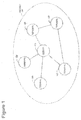
- Figure 1 is a network diagram that illustrates the interaction of the devices that comprise a mobile ad-hoc communications network, in accordance with one embodiment of the present invention.
- FIG 2A is a block diagram that illustrates the hardware and software components comprising server 110 shown in Figure 1 , in accordance with one embodiment of the present invention.
- FIG. 2B is a block diagram that illustrates the hardware and software components comprising terminal 120 shown in Figure 1 , in accordance with one embodiment of the present invention.
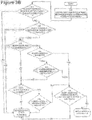
- Figures 3A-3B are flow diagrams of an embodiment of a process that accesses the control parameters stored in the distributed application directory.
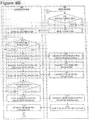
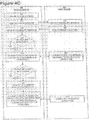
- Figures 4A-4D are flow diagrams of various embodiments of a process for application program control in a mobile ad-hoc communications network.
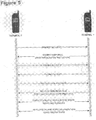
- Figure 5 is a flow diagram of an embodiment of a process that illustrates the message flow during establishment of a communication session between terminal X and terminal Y in a mobile ad-hoc communications network.
- FIG. 1 is a network diagram that illustrates the interaction of the devices that comprise a mobile ad-hoc communications network, in accordance with one embodiment of the present invention.
- the mobile ad-hoc communications network is a Bluetooth piconet that includes one master device and up to seven active slave devices.
- piconet 100 includes server 110 and five instances of terminal 120 .
- Server 110 maintains the network clock and is the communication manager for each instance of terminal 120 .
- Server 110 typically initiates an exchange of data with an instance of terminal 120 .
- Two instances of terminal 120 typically communicate through the server 110 however, if two instances of terminal 120 communicate directly, one instance will assume the role of server, or master, and the other instance will assume the role of client, or slave.
- Each device in the mobile ad-hoc communications network will either assume the role of a terminal device or a server device.
- a terminal device is a consumer of services that a single user operates.
- a terminal device includes devices such as a mobile phone or PDA.
- a server is typically a stationary device and only produces services.
- a server device creates a hotspot around them for using their services. "Hotspot" refers to the radio coverage area provided by the server device for detecting devices and discovering services offered by the applications hosted in the server. If the server device is not stationary, one of the terminal devices in the network will assume the role of application directory server and perform device detection and service discovery functions for the remaining terminal devices in the network.
- the disclosed invention introduces two roles among such terminal devices, application directory servers and terminals, where application directory servers serve terminals in device detection and service discovery. If stationary servers with hotspots exist, servers typically act as application directory servers however, device detection and service discovery is possible without such a stationary server because one of the terminals will assume the application directory server duties.
- the disclosed invention assigns an identifier to each application placed under control.
- the identifier is a non-unique identifier that abstractly identifies the application.
- the identifier specifies a function that the application performs.
- the identifier specifies a communication protocol that the application uses to communicate.
- the identifier may indicate that several occurrences of an application each occurrence authored in a different computer language, or targeted to run on a different hardware platform or fulfill a different application role may be considered to be the same because they can interoperate and fulfill the same function.
- the identifier is a unique identifier that identifies the application.
- FIG. 2A is a block diagram that illustrates the hardware and software components comprising server 110 shown in Figure 1 , in accordance with one embodiment of the present invention.
- Server 110 is a general-purpose wireless device.
- Bus 200 is a communication medium that connects keypad 201 , display 202 , central processing unit (CPU) 203 , and radio frequency (RF) adapter 204 to memory 210 .
- RF adapter 204 connects via a wireless link to terminal 120 and is the mechanism that facilitates network traffic between server 110 and terminal 120 .
- CPU 203 performs the methods of the disclosed invention by executing the sequences of operational instructions that comprise each computer program resident in, or operative on, memory 210 .
- Memory 210 includes operating system software 211 , application programs 212 , and middleware software 220 .
- Operating system software 211 controls keypad 201 , display 202 , RF adapter 204 , and the management of memory 210 .
- Application programs 212 control the interactions between a user and server 110 .
- Middleware software 220 includes an application program interface (API) 221 that help an application program running on server 110 find and communicate with a counterpart application running on terminal 120 .
- API application program interface
- middleware software 220 also includes application directory 230 to track, for each application that is resident in each device in piconet 100 , a reference to the device storing the application, an identifier for the application, the role that the application performs, and the control parameters that define the user or service provider rules for controlling the application.
- the reference to the device storing the application is the MAC address of the device.
- FIG. 2B is a block diagram that illustrates the hardware and software components comprising terminal 120 shown in Figure 1 , in accordance with one embodiment of the present invention.
- Terminal 120 is a general-purpose wireless device.
- Bus 250 is a communication medium that connects keypad 251 , display 252 , CPU 253 , and RF adapter 254 to memory 260 .
- RF adapter 254 connects via a wireless link to server 110 or another terminal 120 and is the mechanism that facilitates network traffic between server 110 and terminal 120 .
- CPU 253 performs the methods of the disclosed invention by executing the sequences of operational instructions that comprise each computer program resident in, or operative on, memory 260 .
- Memory 260 includes operating system software 261 , application programs 262 , and middleware software 270 .
- Operating system software 261 controls keypad 251 , display 252 , RF adapter 254 , and the management of memory 260 .
- Application programs 262 control the interactions between a user and terminal 120 .
- Middleware software 270 includes an API 271 that help an application program running on terminal 120 find and communicate with a counterpart application running on server 110 or another terminal 120 .
- middleware software 270 also includes application directory 280 to track, for each application that is resident in each device in piconet 100 , a reference to the device storing the application, an identifier for the application, the role that the application performs, and the control parameters that define the user or service provider rules for controlling the application.
- the reference to the device storing the application is the MAC address of the device.
- the configuration of memory 210 and memory 260 is identical. In another embodiment, the configuration of memory 210 and memory 260 only includes the software necessary to perform the essential tasks of server 110 and terminal 120 , respectively. For example, if terminal 120 needs to receive a general inquiry access code, but does not need to send a general inquiry access code message, only the software that receives this message will reside in memory 260 .
- the distributed application directory stored in the middleware software is a database that makes it possible for a device to know something of the requirements and wishes of peer devices to which it connects.
- the database also contains information of local applications and their requirements.
- the information includes control parameters, or combinations of control parameters, as well as priority information, indicating importance of the application set by the user.
- control parameters are stored in the distributed application directory, or database, and are enforced by the middleware software.
- “Installed” An application program state indicating that the application program is resident and installed in the local memory of a wireless device.
- the local memory includes a binary, or digital, image of the application program.
- In-Machine An application program state indicating that the application program is available to the middleware software, but a binary, or digital, image of the application program is not installed into the local memory.
- the In-Machine state is the result of an auto-launchable, non-persistent distribution of an application program.
- Auto-Launch - A user may configure an application program to automatically start in a wireless device when a possible communication opportunity is available.
- the Auto-Launch setting is available for an application program regardless of the application state, Installed, In-Machine, or Running.
- Auto-Launch Priority A numerical value in a given range (e.g., the range 0-127) that defines the willingness for a user to automatically launch an application program when several applications need to be automatically launched using a connection between pairs of wireless devices.
- the first application program to be launched is the application program having the highest sum of the two Auto-Launch Priority values, the local application priority and the application priority to the peer device.
- An application program already running in either device takes absolute priority over an application program that has not yet been launched. The example that follows illustrates this user-defined application setting.
- a wireless device that is receiving connection requests may mark an application program as being banned from running on the wireless device. If this value is set, the associated application program will never be launched, moved, or proposed for download to the wireless device.
- Wanted An application program that is not installed in a wireless device, but that a user wants to run is a Wanted application program. This setting is an authorization by the user to download and install a binary image of the application program from another wireless device.
- a peer device typically in a server role, can configure an application program to be Distributable and non-persistent.
- the application program can be given to a peer device in order to establish communication, but the application program will never be installed on the peer device because it is automatically erased from the peer device after the use.
- Typical examples of this type of application program includes banking clients or multi-player game clients.
- the middleware software database information indicates that an application program is marked as Distributable in the peer, and is locally not an Auto-Launch application or a Wanted application, and is neither Installed nor Refused, then the application program is available to be downloaded and installed.
- a common case satisfying the above requirement is that there is no mention about the application in the local device, and it is marked as Distributable in the peer device.
- Auto-Launch-Everything - This macro has certain limits, but is accomplished by having an Auto-Launch application program in a client wireless device that takes information of Distributable application programs in a server wireless device, and configures the middleware software to Auto-Launch those application programs.
- the user may define and introduce some restrictions.
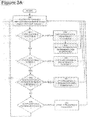
- Figure 3A and Figure 3B are flow diagrams of an embodiment of a process that accesses the control parameters stored in the distributed application directory.
- Figure 3A illustrates a portion of the process that accesses the control parameters to launch an application and enable two devices to communicate via the application.
- Figure 3A corresponds to the example rule set macro that follows as "Example 1 - Macro”.
- Figure 3B illustrates another portion of the process that accesses the control parameters to determine whether an application is runnable.
- Figure 3B corresponds to the example rule set macro that follows as "Example 2 - Macro Ordering".
- the portion of the process shown in Figure 3A illustrates the logic for starting application A when it is runnable in device D and peer P (step 300 ).
- the process first determines whether application A is in device D (step 301 ). If application A is not in device D, the process copies application A from peer P to device D (step 302 ) and installs application A either permanently or temporarily (step 303 ). If application A is in device D, the process then determines whether application A is in peer P (step 304 ). If application A is not in peer P, the process copies application A from device D to peer P (step 305 ). If application A is in peer P, the process then determines whether application A is running in peer P and device D (step 306 ).
- step 307 If application A is running in peer P and device D, the process establishes a link connection between device D and peer P and allows application A to communication until termination (step 307 ). If application A is not running in peer P and device D, the process then determines whether application A is running in device D (step 308 ). If application A is not running in device D, the process starts application A in device D (step 309 ). If application A is running in device D, the process then returns to the beginning of the logic for starting application A (step 300 ).
- the portion of the process shown in Figure 3B illustrates the logic for determining whether application A is runnable in device D which is connected to peer P (step 310 ).
- the process first determines whether application A has been run before during the link connection between device D and peer P (step 311 ). If application A has been run before during the link connection between device D and peer P, application is not runnable. If application A has not been run before during the link connection between device D and peer P, the process then determines whether the control parameters for application A in device D or peer P indicate that application A is refused (step 312 ). If application A is refused, application A is not runnable. If application A is not refused, the process then determines whether application A is in device D (step 313 ).
- step 314 the process then determines whether application A is in peer P (step 314 ). If application A is in peer P, the process then determines whether application A is running or auto-launchable in device D and peer P (step 315 ). If application A is running or auto-launchable in device D and peer P, application A is runnable. If application A is not running or auto-launchable in device D and peer P, application A is not runnable. If application A is not in peer P, the process then determines whether application A is distributable in device D (step 316 ). If application A is distributable in device D, the process then determines whether application A is running or auto-launchable in device D and peer P (step 315 ).
- application A is running or auto-launchable in device D and peer P; application A is runnable. If application A is not running or auto-launchable in device D and peer P, application A is not runnable. If application A is not distributable in device D or if application A is not in device D, the process then determines whether application A is in peer P (step 317 ). If application A is in peer P, the process then determines whether application A is distributable in peer P (step 318 ). If application A is distributable in peer P, the process then determines whether application A is running or auto-launchable in device D and peer P (step 315 ). If application A is running or auto-launchable in device D and peer P, application A is runnable. If application A is not running or auto-launchable in device D and peer P, application A is not runnable. If application A is not in peer P, application A is not runnable.
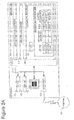
- Example 1 that follows is an example of a rule set macro for installing and starting application programs.
- L indicates a local wireless device
- P indicates a peer device
- COMM indicates that communication is possible
- PULL or PUSH indicates the transfer of the installation package
- LAUNCH indicates the launching of the application program
- INSTALL indicates the installing of an application program. This example omits all references to version and role control.
- a state machine evaluates the macro shown in Example 1.
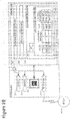
- the macro is evaluated for each application program separately with the additional dimensions of version control and roles. If ordering is necessary because many operations cannot be performed in parallel, the macro defines the ordering as well. The first priority is assigned to communicate, and the last priority is assigned to start the download of the application program.
- Example 2 illustrates one embodiment of the macro defining the ordering.
- the launching order for applications can also be set by selective database distribution in a strictly client-server architecture.
- an ordering can also be achieved by not setting applications to be Auto-Launch application programs and by dynamically altering the running flag.
- the Auto-Launch priority is a useful tool, but device-dependent. It works in a peer-to-peer or local setting when a client is talking to a server, but in a network there are possible dead-lock situations. This is primarily because the server device probably serves all customers and applications simultaneously, and only uses the priority to try to affect the launching order in client devices. Thus, the application programs should be prepared to close themselves if a peer device is not located.
- the Auto-Launch Priority order is best described by the following example.
- Two peer devices, Device A and Device B establish a connection.
- Device A and Device B have the following applications Installed and marked as Auto-Launch application programs.
- Device A CRASH-GAME (priority 100)
- SHARE-A-JOKE priority 52
- COPY-HOMEWORK priority 36
- Device B SHARE-A-JOKE (priority 43) COPY-HOMEWORK (priority 71)
- Device A and Device B have two Auto-Launch application programs in common, COPY-HOMEWORK and SHARE-A-JOKE.
- COPY-HOMEWORK will start first because its Auto-Launch Priority of 107 is greater than the Auto-Launch Priority of 95 for SHARE-A-JOKE.
- Figures 4A-4D are flow diagrams of various embodiments of a process for application program control in a mobile ad-hoc communications network.
- the ad-hoc communications network connects a number of devices.
- Figures 4A-4D illustrate two of these devices, source device 400 , and peer device 450 .
- Source device 400 initiates the process shown in Figure 4A by sending an inquiry request to the ad-hoc communications network (step 401 ).
- Peer device 450 one of the devices in the ad-hoc communications network that is in inquiry scan mode, receives the inquiry request (step 451 ) and responds by sending an inquiry response message (step 452 ).
- the inquiry response message is a Bluetooth inquiry result command modified to indicate that peer device 450 includes a middleware layer.
- Source device 400 receives the inquiry response message (step 402 ).
- Source device 400 accesses the local combined application directory (step 403 ) stored in the middleware software portion of the memory for source device 400 .
- Source device 400 chooses a selected application from the local combined application directory (step 404 ) and examines the control parameters associated with the selected application (step 405 ).
- the control parameters provide several user-defined alternatives for each application, as well as, the ability to combine alternatives into a macro.
- the process first determines whether the control parameters allow a connection between the selected application running on source device 400 and a matching application running on peer device 450 (step 406 ). If the control parameters refuse a connection for this application on source device 400 , the process exits. If the control parameters allow a connection for this application on source device 400 , the process then determines whether the application program is resident in source device 400 (step 407 ).
- source device 400 sends a paging request message (step 408 ).
- Peer device 450 receives the paging request message (step 453 ) and sends a paging accept message in response (step 454 ).
- Source device 400 receives the paging accept message (step 409 ) and launches the selected application (step 410 ).
- source device 400 sends a service discovery request (step 411 ).
- Peer device 450 receives the service discovery request (step 455 ) and decides whether to refuse the connection (step 456 ) based on the control parameters for the matching application for the selected application. If the control parameters specify to refuse the connection to the matching application, peer device 450 exits.
- peer device 450 sends a response to the service discovery request (step 457 ).
- Source device 400 receives the response (step 412 ) and communication begins between the selected application and the matching application.
- source device 400 and peer device 450 may erase the selected application and the matching application, respectively, if the control parameters specify to erase after use.
- source device 400 determines whether the application program is distributable (step 413 ). If the application program is not distributable, the process exits. If the application program is distributable, source device 400 sends an offer for the selected application (step 414 ). Peer device 450 receives the offer for the selected application (step 458 ) and sends a request for the selected application in response (step 459 ). Source device receives the request for the selected application (step 415 ) and sends the selected application in response (step 416 ). Peer device 450 receives the selected application (step 460 ). Source device 400 then determines whether the application program is downloadable (step 417 ). If the application program is not downloadable, the process exits.
- source device 400 sends a request for the selected application (step 418 ).
- Peer device 450 receives the request for the selected application (step 461 ) and sends the selected application in response (step 463 ).
- Source device receives the download of the selected application (step 419 ). To start the newly downloaded application program, the process repeats by determining whether the control parameters allow a connection for the newly downloaded application on source device 400 (step 406 ).
- Figure 4C illustrates a process for determining a preferred application from the applications found in peer device 450 after connection establishment between source device 400 and peer device 450 .
- the process shown in Figure 4C begins by prioritizing the applications in source device 400 (step 420 ).
- the user of source device 400 accesses the graphical user interface to prioritize the applications.
- the prioritization includes specifying a preferred application from the applications that source device 400 can access.
- the prioritization includes ordering from most important to least important every application that source device 400 can access.
- the prioritization includes ordering from most important to least important a portion of the applications that source device 400 can access.
- source device 400 sends an inquiry request to the ad-hoc communications network (step 421 ).
- Peer device 450 one of the devices in the ad-hoc communications network that is in inquiry scan mode, receives the inquiry request (step 463 ) and responds by sending an inquiry response message (step 464 ).
- the inquiry response message is a Bluetooth inquiry result command modified to indicate that peer device 450 includes a middleware layer.
- Source device 400 receives the inquiry response message (step 422 ).
- Source device 400 examines the inquiry response message to determine whether the inquiry response message includes an indication that peer device 450 may include the middleware layer (step 423 ). If the inquiry response message does not include the indication, the process exits.
- source device 400 conducts paging and service discovery with peer device 450 to establish a link connection (step 424 and step 465 ). Following establishment of the link connection, source device 400 confirms whether peer device 450 includes the middleware layer (step 425 ). In one embodiment, a recognition request message and subsequent response message will confirm whether peer device 450 includes the middleware layer. If peer device 450 does not include the middleware layer, the process exits. If peer device 450 includes the middleware layer, source device 400 accesses the combined directory (step 426 ) and examines the control parameters associated with the prioritized applications and selects the preferred application for launching (step 427 ). Subsequently, peer device 450 launches the requested application (step 466 ).
- the distributed directory information includes the control parameters associated with the prioritized applications (i.e., preference information).
- preference information is included in the distribution of the application directory for the peer device and determining whether to launch an application is a decision made by the source device locally using locally stored control parameters.
- Figure 4D illustrates a process for selecting peer device 450 , before connection establishment, from a number of nearby devices because peer device 450 includes at least one preferred application.
- the process shown in Figure 4D begins by prioritizing the applications in source device 400 (step 428 ).
- the user of source device 400 accesses the graphical user interface to prioritize the applications.
- the prioritization includes specifying a preferred application from the applications that source device 400 can access.
- the prioritization includes ordering from most important to least important every application that source device 400 can access.
- the prioritization includes ordering from most important to least important a portion of the applications that source device 400 can access.
- source device 400 sends an inquiry request to the ad-hoc communications network (step 429 ).
- Peer device 450 one of the devices in the ad-hoc communications network that is in inquiry scan mode, receives the inquiry request (step 467 ) and responds by sending an inquiry response message (step 468 ).
- the inquiry response message is a Bluetooth inquiry result command modified to indicate that peer device 450 includes a middleware layer.
- Source device 400 receives the inquiry response message (step 430 ).
- Source device 400 examines the inquiry response message to determine whether the inquiry response message includes an indication that peer device 450 may include the middleware layer (step 431 ). If the inquiry response message does not include the indication, the process exits.
- source device 400 accesses the combined application directory (step 432 ) and examines the control parameters associated with the prioritized applications (step 433 ).
- the control parameters provide several user-defined alternatives for each application, as well as, the ability to combine alternatives into a macro.
- the control parameter alternatives include allowing a connection between the selected application running on source device 400 and a matching application running on peer device 450 (step 434 ). If the connection is not allowed, the process exits. If the connection is allowed, source device 400 conducts paging and service discovery with peer device 450 to establish a link connection (step 435 and step 469 ). Following establishment of the link connection, source device 400 and peer device 450 launch the preferred application and begin communication (step 436 and step 470 ).
- Figure 5 is a flow diagram of an embodiment of a process that illustrates the message flow during establishment of a communication session between terminal X and terminal Y in a mobile ad-hoc communications network.
- terminal X and terminal Y are mobile devices such as terminal 120 shown in Figure 1 and Figure 2B .
- terminal X is a mobile device such as terminal 120 shown in Figure 1 and Figure 2B and terminal Y is a mobile device such as server 110 shown in Figure 1 and Figure 2A .
- terminal X initiates the communication by sending an inquiry request message to the mobile ad-hoc communications network. Since terminal Y is a nearby device, terminal Y receives the inquiry request message and sends an inquiry response message to terminal X.
- the inquiry request message is a Bluetooth inquiry command and the inquiry response message is a Bluetooth inquiry result command.
- the inquiry request message is a Bluetooth inquiry command and the inquiry response message is a Bluetooth inquiry result command modified to indicate that the terminal sending the Bluetooth inquiry result command includes a middleware layer.
- the middleware layer includes dedicated middleware software providing advanced application and service discovery and execution.
- the modification to the Bluetooth inquiry result command is to the Class of Device (CoD) parameters.
- the terminal sending the Bluetooth inquiry result command includes the middleware layer
- the terminal will set at least the "ad-hoc networking aware” bit (bit 16) to on (1).
- the terminal will set the "ad-hoc networking aware” bit (bit 16) to on (1), and the "location info” bit (bit 17) to off (0).
- the terminal sending the Bluetooth inquiry result command includes the middleware layer
- the terminal will set the "ad-hoc networking aware” bit (bit 16) to on (1), and the "telephony capable” bit (bit 22) to on (1).
- the terminal sending the Bluetooth inquiry result command includes the middleware layer
- the terminal will set the "ad-hoc networking aware" bit (bit 16) to on (1), the “location info” bit (bit 17) to off (0), and the “telephony capable” bit (bit 22) to on (1).
- the modification to the Bluetooth inquiry result command is not necessary, if a dedicated indication parameter to indicate the presence of the middleware software is introduced to the Bluetooth inquiry result command specifications.
- terminal X may create a connection to each nearby device indicating possible possession of the middleware layer by the inquiry response message, such as terminal Y, by sending a paging request message. If terminal Y does not indicate possible possession of the middleware layer (e.g., by setting the "ad-hoc networking aware" bit (bit 16) to off (0)), no paging request message is transmitted and the communication session is disconnected.
- terminal X sends the paging message request, as discussed above.
- Terminal Y receives the paging request message and optionally sends a paging accept message to accept the connection request.
- the paging request message is a Bluetooth create connection command and the paging accept message is a Bluetooth accept connection request command.
- terminal X sends a recognition request message to confirm whether a nearby device such as terminal Y definitely includes the middleware layer.
- Terminal Y receives the recognition request message and sends a recognition response message to terminal X.
- the receipt of the recognition response message is confirmation that terminal Y includes the middleware layer.
- the content of the recognition response message will indicate whether terminal Y includes the middleware layer.
- the recognition request message and the recognition response message utilize the Bluetooth Service Discovery Protocol (SDP). If terminal Y does not include the middleware layer, the communication session may be disconnected.
- SDP Bluetooth Service Discovery Protocol
- terminal X and terminal Y use the middleware layer to discover and launch applications and services.
- terminal X and terminal Y use the methods disclosed in the flow diagrams shown in Figures 3A-3B and Figures 4A-4D to discover and launch applications and services.
Landscapes
- Engineering & Computer Science (AREA)
- Computer Networks & Wireless Communication (AREA)
- Signal Processing (AREA)
- Computer Security & Cryptography (AREA)
- Mobile Radio Communication Systems (AREA)
Applications Claiming Priority (2)
| Application Number | Priority Date | Filing Date | Title |
|---|---|---|---|
| US10/662,469 US7313120B2 (en) | 2003-09-16 | 2003-09-16 | Application control in peer-to-peer ad-hoc communication networks |
| US662469 | 2003-09-16 |
Publications (2)
| Publication Number | Publication Date |
|---|---|
| EP1517489A2 true EP1517489A2 (de) | 2005-03-23 |
| EP1517489A3 EP1517489A3 (de) | 2009-07-15 |
Family
ID=34194712
Family Applications (1)
| Application Number | Title | Priority Date | Filing Date |
|---|---|---|---|
| EP04104441A Withdrawn EP1517489A3 (de) | 2003-09-16 | 2004-09-14 | Anwendungssteuerung in peer-to-peer ad hoc Kommunikationsnetzen |
Country Status (2)
| Country | Link |
|---|---|
| US (1) | US7313120B2 (de) |
| EP (1) | EP1517489A3 (de) |
Cited By (9)
| Publication number | Priority date | Publication date | Assignee | Title |
|---|---|---|---|---|
| WO2006018696A1 (en) * | 2004-08-11 | 2006-02-23 | Nokia Corporation | System and method for application distribution |
| WO2006129154A1 (en) | 2005-05-31 | 2006-12-07 | Nokia Corporation | System and method for services functionality |
| KR100779901B1 (ko) | 2006-05-30 | 2007-11-28 | (주)트루모바일 | 지그비 통신 기능이 탑재된 휴대 단말기 및 상기 휴대단말기를 이용한 데이터 서비스 방법 |
| EP1940184A4 (de) * | 2006-10-10 | 2009-09-02 | Obshchestvo S Ogranichennoj Ot | Verfahren zur verwaltung zusätzlicher dienste in mobiltelekommunikationsnetzen |
| WO2013153260A1 (en) * | 2012-04-11 | 2013-10-17 | Nokia Corporation | Method and apparatus for activity management across multiple devices |
| WO2014038902A1 (en) * | 2012-09-10 | 2014-03-13 | Samsung Electronics Co., Ltd. | Method and device for executing application |
| EP2498882A4 (de) * | 2009-11-10 | 2014-12-31 | Sony Ericsson Mobile Comm Ab | Gemeinsame spielnutzung |
| CN105446853A (zh) * | 2015-11-03 | 2016-03-30 | 深圳市金立通信设备有限公司 | 一种应用程序管理方法及终端 |
| EP1937025A3 (de) * | 2006-12-22 | 2016-04-20 | MAGIX GmbH & Co. KGaA | Verfahren für lokale Textkommunikation zwischen einer Vielzahl mobiler Kommunikationsgeräte |
Families Citing this family (59)
| Publication number | Priority date | Publication date | Assignee | Title |
|---|---|---|---|---|
| US6909721B2 (en) | 2002-10-31 | 2005-06-21 | Nokia Corporation | Device detection and service discovery system and method for a mobile ad hoc communications network |
| US7545941B2 (en) | 2003-09-16 | 2009-06-09 | Nokia Corporation | Method of initializing and using a security association for middleware based on physical proximity |
| US20050135286A1 (en) * | 2003-12-23 | 2005-06-23 | Nurminen Jukka K. | Wireless extended proximity networks: systems, methods and program products |
| US8555411B2 (en) * | 2003-12-23 | 2013-10-08 | Intel Corporation | Locking mobile devices in a personal area network (PAN) |
| US8457552B1 (en) * | 2004-01-20 | 2013-06-04 | Qualcomm Incorporated | Method and apparatus for reduced complexity short range wireless communication system |
| US20050193106A1 (en) * | 2004-03-01 | 2005-09-01 | University Of Florida | Service discovery and delivery for ad-hoc networks |
| US7263345B2 (en) | 2004-03-17 | 2007-08-28 | Nokia Corporation | System and method for remote service information |
| US7761863B2 (en) | 2004-06-08 | 2010-07-20 | Covia Labs, Inc. | Method system and data structure for content renditioning adaptation and interoperability segmentation model |
| US8898256B2 (en) * | 2004-07-13 | 2014-11-25 | International Business Machines Corporation | Prioritization of application component distribution |
| US7603466B2 (en) * | 2004-07-19 | 2009-10-13 | Sap (Ag) | Mobile collaborative peer-to-peer business applications |
| US20060052057A1 (en) * | 2004-09-03 | 2006-03-09 | Per Persson | Group codes for use by radio proximity applications |
| DE102005038244A1 (de) * | 2005-01-25 | 2006-07-27 | Fraunhofer-Gesellschaft zur Förderung der angewandten Forschung e.V. | System und Verfahren zur Überwachung von gruppierten Objekten |
| US8396001B2 (en) * | 2005-02-03 | 2013-03-12 | The Invention Science Fund I, Llc | Interactive queued mapping method and system |
| US7697894B2 (en) | 2005-03-01 | 2010-04-13 | Nokia Corporation | Method and system for tactile confirmation of service bookmarks |
| EP1872564B1 (de) * | 2005-04-19 | 2010-05-05 | Nokia Corporation | Verfahren, einrichtung und system zur steuerung des anwendungsstartens in einem mobilendgerät |
| US7359674B2 (en) | 2005-05-10 | 2008-04-15 | Nokia Corporation | Content distribution & communication system for enhancing service distribution in short range radio environment |
| WO2007005131A2 (en) * | 2005-05-19 | 2007-01-11 | Matsushita Electric Industrial Co., Ltd. | System and method for multiprotocol service discovery in a computer network |
| KR100737616B1 (ko) * | 2005-07-20 | 2007-07-10 | 엘지전자 주식회사 | 근거리통신 단말기의 어플리케이션 정보 취득장치 및 방법 |
| KR100703375B1 (ko) * | 2005-12-12 | 2007-04-03 | 삼성전자주식회사 | 휴대 단말기의 블루투스 통신 시 로그 관리 방법 |
| US20070143446A1 (en) * | 2005-12-21 | 2007-06-21 | Morris Robert P | Methods, systems, and computer program products for installing an application from one peer to another including application configuration settings and data |
| US7739396B2 (en) * | 2006-08-08 | 2010-06-15 | International Business Machines Corporation | System, method and program for field service of computers |
| US9066348B2 (en) * | 2006-10-17 | 2015-06-23 | Intel Coporation | Device, system, and method for fast network entry for wireless devices in idle mode |
| US9569587B2 (en) | 2006-12-29 | 2017-02-14 | Kip Prod Pi Lp | Multi-services application gateway and system employing the same |
| US9209995B2 (en) | 2006-12-29 | 2015-12-08 | Prodea Systems, Inc. | Presence status notification from digital endpoint devices through a multi-services gateway device at the user premises |
| US9602880B2 (en) | 2006-12-29 | 2017-03-21 | Kip Prod P1 Lp | Display inserts, overlays, and graphical user interfaces for multimedia systems |
| US11783925B2 (en) | 2006-12-29 | 2023-10-10 | Kip Prod P1 Lp | Multi-services application gateway and system employing the same |
| US20170344703A1 (en) | 2006-12-29 | 2017-11-30 | Kip Prod P1 Lp | Multi-services application gateway and system employing the same |
| US11316688B2 (en) | 2006-12-29 | 2022-04-26 | Kip Prod P1 Lp | Multi-services application gateway and system employing the same |
| US8595186B1 (en) * | 2007-06-06 | 2013-11-26 | Plusmo LLC | System and method for building and delivering mobile widgets |
| KR20080112914A (ko) * | 2007-06-22 | 2008-12-26 | 삼성전자주식회사 | 이벤트 메시지 수신 방법, 이벤트 메시지 전송 방법,피제어 장치 및 제어 포인트 |
| US7898983B2 (en) * | 2007-07-05 | 2011-03-01 | Qualcomm Incorporated | Methods and apparatus supporting traffic signaling in peer to peer communications |
| US8601156B2 (en) * | 2007-07-06 | 2013-12-03 | Qualcomm Incorporated | Methods and apparatus related to peer discovery and/or paging in peer to peer wireless communications |
| US8385316B2 (en) * | 2007-07-06 | 2013-02-26 | Qualcomm Incorporated | Methods and apparatus related to peer to peer communications timing structure |
| US8599823B2 (en) * | 2007-07-06 | 2013-12-03 | Qualcomm Incorporated | Communications methods and apparatus related to synchronization with respect to a peer to peer timing structure |
| US8385317B2 (en) * | 2007-07-06 | 2013-02-26 | Qualcomm Incorporated | Methods and apparatus supporting multiple timing synchronizations corresponding to different communications peers |
| US8422397B2 (en) * | 2007-12-28 | 2013-04-16 | Prodea Systems, Inc. | Method and apparatus for rapid session routing |
| US8174503B2 (en) | 2008-05-17 | 2012-05-08 | David H. Cain | Touch-based authentication of a mobile device through user generated pattern creation |
| US8078111B2 (en) * | 2008-07-29 | 2011-12-13 | Qualcomm Incorporated | Methods and apparatus for using multiple frequency bands for communication |
| US8090359B2 (en) | 2008-09-08 | 2012-01-03 | Proctor Jr James Arthur | Exchanging identifiers between wireless communication to determine further information to be exchanged or further services to be provided |
| US9154942B2 (en) * | 2008-11-26 | 2015-10-06 | Free Stream Media Corp. | Zero configuration communication between a browser and a networked media device |
| US10419722B2 (en) * | 2009-04-28 | 2019-09-17 | Whp Workflow Solutions, Inc. | Correlated media source management and response control |
| US10565065B2 (en) | 2009-04-28 | 2020-02-18 | Getac Technology Corporation | Data backup and transfer across multiple cloud computing providers |
| CN103403680B (zh) | 2010-11-18 | 2016-10-26 | 谷歌公司 | 计算对象的上下文历史 |
| GB201021875D0 (en) * | 2010-12-23 | 2011-02-02 | Antix Labs Ltd | Methods of distributing software |
| US9286050B2 (en) * | 2011-09-02 | 2016-03-15 | Verizon Patent And Licensing Inc. | Method and system for context-based application management |
| US8774147B2 (en) | 2012-02-23 | 2014-07-08 | Dahrwin Llc | Asynchronous wireless dynamic ad-hoc network |
| US9940118B2 (en) | 2012-02-23 | 2018-04-10 | Dahrwin Llc | Systems and methods utilizing highly dynamic wireless ad-hoc networks |
| JP6079121B2 (ja) * | 2012-10-11 | 2017-02-15 | 富士通株式会社 | 通信システム、管理装置、基地局、通信機器、及び通信路制御方法 |
| GB2507997A (en) * | 2012-11-16 | 2014-05-21 | Promethean Ltd | Collaborative interactive devices with display content dependent on relative position |
| GB2507996A (en) * | 2012-11-16 | 2014-05-21 | Promethean Ltd | Network based collaborative interactive activity between devices and users |
| WO2014127104A2 (en) * | 2013-02-13 | 2014-08-21 | Dahrwin Llc | Systems and methods utilizing highly dynamic wireless ad-hoc networks |
| WO2014128755A1 (ja) * | 2013-02-19 | 2014-08-28 | ソフトバンクモバイル株式会社 | 通信システム |
| TWI497311B (zh) * | 2013-03-28 | 2015-08-21 | Quanta Comp Inc | 跨裝置通訊傳輸系統及其方法 |
| US9277573B2 (en) | 2013-11-21 | 2016-03-01 | At&T Intellectual Property I, L.P. | Method and apparatus for establishing an ad hoc communication with an unknown contact |
| US20170064612A1 (en) * | 2014-05-06 | 2017-03-02 | Mediatek Singapore Pte. Ltd. | Method for discovering services |
| WO2016036206A2 (ko) * | 2014-09-04 | 2016-03-10 | 엘지전자(주) | 블루투스 le(low energy) 기술을 이용하여 디바이스를 제어하기 위한 방법 및 장치 |
| US10003659B2 (en) * | 2014-10-31 | 2018-06-19 | Qualcomm Incorporated | Efficient group communications leveraging LTE-D discovery for application layer contextual communication |
| US10894209B2 (en) * | 2016-06-02 | 2021-01-19 | BQ Media Lab Pty Ltd | System and method of providing a game |
| CN119697647B (zh) * | 2025-02-26 | 2025-05-13 | 杭州方千科技有限公司 | 用于终端设备管理系统的自适应多级无线组网方法与通信方法 |
Family Cites Families (95)
| Publication number | Priority date | Publication date | Assignee | Title |
|---|---|---|---|---|
| US2200500A (en) * | 1939-02-25 | 1940-05-14 | Tri Clover Machine Company | Pipe joint |
| EP0123540A3 (de) | 1983-04-20 | 1985-01-02 | RAYCHEM CORPORATION (a California corporation) | Leitfähige Polymere und diese enthaltende Einrichtungen |
| US5251251A (en) * | 1991-09-06 | 1993-10-05 | Greetings By Phoneworks | Telecommunications network-based greeting card method and system |
| US5736940A (en) * | 1993-04-06 | 1998-04-07 | Burgener; E. C. | Portable transit data information system and apparatus |
| FR2718553B1 (fr) * | 1994-04-12 | 1996-06-14 | Metalogic | Système et procédé de dialogue interactif entre un utilisateur et un serveur télématique. |
| US5694546A (en) * | 1994-05-31 | 1997-12-02 | Reisman; Richard R. | System for automatic unattended electronic information transport between a server and a client by a vendor provided transport software with a manifest list |
| US6069896A (en) * | 1996-10-15 | 2000-05-30 | Motorola, Inc. | Capability addressable network and method therefor |
| US6112103A (en) * | 1996-12-03 | 2000-08-29 | Puthuff; Steven H. | Personal communication device |
| US6901241B2 (en) | 1998-02-11 | 2005-05-31 | Telefonaktiebolaget L M Ericsson (Publ) | System, method and apparatus for secure transmission of confidential information |
| CA2275673A1 (en) * | 1998-06-23 | 1999-12-23 | Andre Dion | Plant containerizing and watering device |
| US6198941B1 (en) * | 1998-08-07 | 2001-03-06 | Lucent Technologies Inc. | Method of operating a portable communication device |
| AU754644B2 (en) * | 1998-08-21 | 2002-11-21 | Union Biometrica, Inc. | Instrument for selecting and depositing multicellular organisms and other large objects |
| US6757715B1 (en) * | 1998-09-11 | 2004-06-29 | L.V. Partners, L.P. | Bar code scanner and software interface interlock for performing encrypted handshaking and for disabling the scanner in case of handshaking operation failure |
| US6757713B1 (en) * | 1998-09-23 | 2004-06-29 | John W. L. Ogilvie | Method for including a self-removing indicator in a self-removing message |
| EP1022876B1 (de) * | 1999-01-25 | 2006-04-19 | International Business Machines Corporation | Dienstankündigungen in drahtlosen lokalen Netzen |
| ES2316177T3 (es) * | 1999-01-29 | 2009-04-01 | Wistron Corporation | Descubrimiento de servicios segun un criterio de proximidad. |
| US6577849B1 (en) * | 1999-02-03 | 2003-06-10 | Motorola, Inc. | Method and apparatus for providing additional information about a broadcast |
| CA2371329C (en) | 1999-05-21 | 2005-12-06 | International Business Machines Corporation | Method and apparatus for initializing secure communications among, and for exclusively pairing wireless devices |
| US6892230B1 (en) * | 1999-06-11 | 2005-05-10 | Microsoft Corporation | Dynamic self-configuration for ad hoc peer networking using mark-up language formated description messages |
| JP2003533071A (ja) * | 1999-09-03 | 2003-11-05 | ノキア コーポレイション | ショートメッセージをscpで交換するための移動アプリケーションパート(map)インターフェイス |
| US7028032B1 (en) * | 1999-09-28 | 2006-04-11 | International Business Machines Corporation | Method of updating network information addresses |
| US6751463B1 (en) * | 1999-10-04 | 2004-06-15 | Telecommunication Systems, Inc. | Intelligent queue for information teleservice messages with superceding updates |
| GB2355889A (en) | 1999-10-26 | 2001-05-02 | Endeavour Consulting Ltd | Controlling operation of a device within a restricted area by detecting the presence of the device and instructing it to restrict its operation |
| US6601093B1 (en) * | 1999-12-01 | 2003-07-29 | Ibm Corporation | Address resolution in ad-hoc networking |
| EP1242986B1 (de) | 1999-12-17 | 2004-03-17 | Gateway, Inc. | Verfahren und vorrichtung zum steuern des betriebs von elektronischen anordnungen in einem flugzeug |
| SE9904683L (sv) | 1999-12-17 | 2001-06-18 | Ericsson Telefon Ab L M | Metod och system för att etablera en radioförbindelse med kort räckvidd |
| US6738766B2 (en) * | 2000-02-02 | 2004-05-18 | Doongo Technologies, Inc. | Apparatus and methods for providing personalized application search results for wireless devices based on user profiles |
| US6721787B1 (en) * | 2000-02-10 | 2004-04-13 | 3Com Corporation | System and method for wireless hot-synchronization of a personal digital assistant |
| GB0007940D0 (en) * | 2000-04-01 | 2000-05-17 | Hewlett Packard Co | Gathering information from short-range portals |
| US6714797B1 (en) * | 2000-05-17 | 2004-03-30 | Nokia Corporation | System and method for the transfer of digital data to a mobile device |
| US20020012329A1 (en) * | 2000-06-02 | 2002-01-31 | Timothy Atkinson | Communications apparatus interface and method for discovery of remote devices |
| WO2001095592A1 (en) | 2000-06-08 | 2001-12-13 | Motorola, Inc. | Mobile ip push service |
| US20020044549A1 (en) * | 2000-06-12 | 2002-04-18 | Per Johansson | Efficient scatternet forming |
| WO2002005517A2 (en) * | 2000-07-10 | 2002-01-17 | Viven Ltd. | Broadcast content over cellular telephones |
| US6591266B1 (en) * | 2000-07-14 | 2003-07-08 | Nec Corporation | System and method for intelligent caching and refresh of dynamically generated and static web content |
| FI113319B (fi) * | 2000-09-29 | 2004-03-31 | Nokia Corp | Palveluita tarjoavan verkkoelementin valitseminen tietoliikenejärjestelmässä |
| ATE405110T1 (de) | 2000-11-17 | 2008-08-15 | Sony Deutschland Gmbh | Informationsübertragung via einem ad hoc netz |
| US20020073204A1 (en) * | 2000-12-07 | 2002-06-13 | Rabindranath Dutta | Method and system for exchange of node characteristics for DATA sharing in peer-to-peer DATA networks |
| US20040015403A1 (en) * | 2000-12-21 | 2004-01-22 | International Business Machines Corporation | Method, system, and business method for wireless fast business |
| EP1419137A2 (de) * | 2001-01-18 | 2004-05-19 | Cognis Deutschland GmbH & Co. KG | Verfahren zur herstellung von acylaminosäuren |
| US7197565B2 (en) * | 2001-01-22 | 2007-03-27 | Sun Microsystems, Inc. | System and method of using a pipe advertisement for a peer-to-peer network entity in peer-to-peer presence detection |
| AU2002234258A1 (en) * | 2001-01-22 | 2002-07-30 | Sun Microsystems, Inc. | Peer-to-peer network computing platform |
| US7668958B2 (en) * | 2001-10-18 | 2010-02-23 | Intel Corporation | Method for discovery and routing using a priori knowledge in the form of application programme within mobile AD-HOC networks |
| US7190961B2 (en) * | 2001-10-18 | 2007-03-13 | Intel Corporation | Method for discovery and routing within mobile ad-hoc networks |
| US8126982B2 (en) * | 2001-02-16 | 2012-02-28 | International Business Machines Corporation | Method, network device and computer program product for performing service discovery in a pervasive network |
| US6981210B2 (en) * | 2001-02-16 | 2005-12-27 | International Business Machines Corporation | Self-maintaining web browser bookmarks |
| US20020124046A1 (en) * | 2001-02-20 | 2002-09-05 | Fischer William A. | Peripheral devices which manage application upload to computing devices |
| GB0105075D0 (en) | 2001-03-01 | 2001-04-18 | Red M Communications Ltd | An interactive display system |
| US7584269B2 (en) * | 2001-03-09 | 2009-09-01 | International Business Machines Corporation | Method for providing kiosk service offerings in a personal area network |
| GB2373966B (en) | 2001-03-30 | 2003-07-09 | Toshiba Res Europ Ltd | Mode monitoring & identification through distributed radio |
| US6950646B2 (en) * | 2001-04-27 | 2005-09-27 | Hewlett-Packard Development Company, L.P. | Information acquisition decision making by devices in a wireless network |
| US7715533B2 (en) * | 2001-04-27 | 2010-05-11 | Hewlett-Packard Development Company, L.P. | Brokering of information acquisition by devices in a wireless network |
| US7099951B2 (en) * | 2001-05-24 | 2006-08-29 | Vixs, Inc. | Method and apparatus for multimedia system |
| US6842460B1 (en) * | 2001-06-27 | 2005-01-11 | Nokia Corporation | Ad hoc network discovery menu |
| JP2003016347A (ja) | 2001-07-02 | 2003-01-17 | Nec Corp | 地域広告情報配信方法、地域広告情報配信システム及びそのシステムを実装した携帯端末 |
| US20030013483A1 (en) * | 2001-07-06 | 2003-01-16 | Ausems Michiel R. | User interface for handheld communication device |
| US20030054806A1 (en) * | 2001-08-15 | 2003-03-20 | Raymond Ho | System and method for defining, creating and deploying wireless applications |
| US7089298B2 (en) * | 2001-08-20 | 2006-08-08 | Nokia Corporation | Naming distribution method for ad hoc networks |
| US20030061364A1 (en) * | 2001-09-26 | 2003-03-27 | International Business Machines Corporation | Method and system in electronic commerce for providing a secure wireless connection service for mobile personal area networks |
| US7020464B2 (en) * | 2001-10-09 | 2006-03-28 | Microsoft Corporation | System and method for providing agent-free and no-packet overhead mobility support with transparent session continuity for mobile devices |
| US20030110218A1 (en) * | 2001-12-12 | 2003-06-12 | Stanley Randy P. | Local caching of images for on-line conferencing programs |
| US20030115415A1 (en) * | 2001-12-18 | 2003-06-19 | Roy Want | Portable memory device |
| US7133663B2 (en) | 2001-12-20 | 2006-11-07 | Accenture Global Services, Gmbh | Determining the context of surroundings |
| US6985696B2 (en) | 2001-12-20 | 2006-01-10 | Motorola, Inc. | Method and apparatus for facilitating wireless communications with a nonautomotive roaming object |
| US20030131059A1 (en) * | 2002-01-08 | 2003-07-10 | International Business Machines Corporation | Method, system, and program for providing information on scheduled events to wireless devices |
| US7158176B2 (en) * | 2002-03-01 | 2007-01-02 | Nokia Corporation | Prioritization of files in a memory |
| US7184423B2 (en) * | 2002-04-23 | 2007-02-27 | Machine Talker Inc. | Self coordinated machine network |
| US7551930B2 (en) * | 2002-05-06 | 2009-06-23 | Nokia Corporation | Location-based services for mobile stations using short range wireless technology |
| US6631269B1 (en) * | 2002-05-23 | 2003-10-07 | Interdigital Technology Corporation | Signaling connection admission control in a wireless network |
| US7103313B2 (en) * | 2002-06-05 | 2006-09-05 | Nokia Corporation | Automatic determination of access point content and services for short-range wireless terminals |
| US7254406B2 (en) * | 2002-06-10 | 2007-08-07 | Suman Beros | Method and apparatus for effecting a detection of mobile devices that are proximate and exhibit commonalities between specific data sets, or profiles, associated with the persons transporting the mobile devices |
| US7047041B2 (en) * | 2002-06-17 | 2006-05-16 | Nokia Corporation | Method and device for storing and accessing personal information |
| US7455591B2 (en) * | 2002-06-28 | 2008-11-25 | Igt | Redundant gaming network mediation |
| WO2004010306A1 (en) * | 2002-07-23 | 2004-01-29 | Research In Motion Limited | Data store management system and method for wireless devices |
| US7484225B2 (en) * | 2002-08-08 | 2009-01-27 | Sun Microsystems, Inc. | System and method for describing and identifying abstract software modules in peer-to-peer network environments |
| US20040038645A1 (en) | 2002-08-20 | 2004-02-26 | Jukka Rcunamaki | Carrier sensing multiple access with collision avoidance (CSMA/CA) scheme optimized for a priori known carrier usage for low duty cycle systems |
| US8204992B2 (en) * | 2002-09-26 | 2012-06-19 | Oracle America, Inc. | Presence detection using distributed indexes in peer-to-peer networks |
| US20040063498A1 (en) * | 2002-09-30 | 2004-04-01 | Sony Corporation | System and method for flexibly implementing a wireless gaming network |
| US20040075675A1 (en) * | 2002-10-17 | 2004-04-22 | Tommi Raivisto | Apparatus and method for accessing services via a mobile terminal |
| US20040082383A1 (en) | 2002-10-24 | 2004-04-29 | Motorola, Inc | Methodology and wireless device for interactive gaming |
| US6909721B2 (en) | 2002-10-31 | 2005-06-21 | Nokia Corporation | Device detection and service discovery system and method for a mobile ad hoc communications network |
| US7421276B2 (en) | 2003-04-09 | 2008-09-02 | Nortel Networks Limited | Method, apparatus and system of configuring a wireless device based on location |
| US7209827B2 (en) * | 2003-03-07 | 2007-04-24 | Ntt Docomo, Inc. | Server apparatus, terminal device, and information providing system |
| JP4470415B2 (ja) | 2003-08-05 | 2010-06-02 | 日本電気株式会社 | 携帯情報端末装置 |
| US7545941B2 (en) | 2003-09-16 | 2009-06-09 | Nokia Corporation | Method of initializing and using a security association for middleware based on physical proximity |
| US20050058109A1 (en) * | 2003-09-16 | 2005-03-17 | Jan-Erik Ekberg | Mechanism for improving connection control in peer-to-peer ad-hoc networks |
| US7190943B2 (en) | 2003-09-16 | 2007-03-13 | Microtune (Texas), L.P. | System and method for frequency translation with harmonic suppression using mixer stages |
| US7145437B2 (en) | 2003-10-16 | 2006-12-05 | Nokia Corporation | Method, terminal and computer program product for adjusting power consumption of a RFID reader associated with a mobile terminal |
| US20050114756A1 (en) * | 2003-11-26 | 2005-05-26 | Nokia Corporation | Dynamic Internet linking system and method |
| GB2410153B (en) | 2004-01-19 | 2006-02-01 | Toshiba Res Europ Ltd | Network service information discovery method and communication device |
| US20050193106A1 (en) * | 2004-03-01 | 2005-09-01 | University Of Florida | Service discovery and delivery for ad-hoc networks |
| US7263345B2 (en) | 2004-03-17 | 2007-08-28 | Nokia Corporation | System and method for remote service information |
| US7697894B2 (en) | 2005-03-01 | 2010-04-13 | Nokia Corporation | Method and system for tactile confirmation of service bookmarks |
| US7359674B2 (en) | 2005-05-10 | 2008-04-15 | Nokia Corporation | Content distribution & communication system for enhancing service distribution in short range radio environment |
| US20060268896A1 (en) | 2005-05-31 | 2006-11-30 | Sakari Kotola | System and method for services functionality |
-
2003
- 2003-09-16 US US10/662,469 patent/US7313120B2/en not_active Expired - Fee Related
-
2004
- 2004-09-14 EP EP04104441A patent/EP1517489A3/de not_active Withdrawn
Cited By (17)
| Publication number | Priority date | Publication date | Assignee | Title |
|---|---|---|---|---|
| WO2006018696A1 (en) * | 2004-08-11 | 2006-02-23 | Nokia Corporation | System and method for application distribution |
| WO2006129154A1 (en) | 2005-05-31 | 2006-12-07 | Nokia Corporation | System and method for services functionality |
| KR100779901B1 (ko) | 2006-05-30 | 2007-11-28 | (주)트루모바일 | 지그비 통신 기능이 탑재된 휴대 단말기 및 상기 휴대단말기를 이용한 데이터 서비스 방법 |
| EP1940184A4 (de) * | 2006-10-10 | 2009-09-02 | Obshchestvo S Ogranichennoj Ot | Verfahren zur verwaltung zusätzlicher dienste in mobiltelekommunikationsnetzen |
| EP1937025A3 (de) * | 2006-12-22 | 2016-04-20 | MAGIX GmbH & Co. KGaA | Verfahren für lokale Textkommunikation zwischen einer Vielzahl mobiler Kommunikationsgeräte |
| EP2498882A4 (de) * | 2009-11-10 | 2014-12-31 | Sony Ericsson Mobile Comm Ab | Gemeinsame spielnutzung |
| US9098357B2 (en) | 2012-04-11 | 2015-08-04 | Nokia Technologies Oy | Method and apparatus for activity management across multiple devices |
| WO2013153260A1 (en) * | 2012-04-11 | 2013-10-17 | Nokia Corporation | Method and apparatus for activity management across multiple devices |
| CN104620514A (zh) * | 2012-09-10 | 2015-05-13 | 三星电子株式会社 | 运行应用的方法和设备 |
| WO2014038902A1 (en) * | 2012-09-10 | 2014-03-13 | Samsung Electronics Co., Ltd. | Method and device for executing application |
| US9277576B2 (en) | 2012-09-10 | 2016-03-01 | Samsung Electronics Co., Ltd. | Method and device for executing application |
| US9635499B2 (en) | 2012-09-10 | 2017-04-25 | Samsung Electronics Co., Ltd. | Method and device for executing application |
| US10244570B2 (en) | 2012-09-10 | 2019-03-26 | Samsung Electronics Co., Ltd. | Method and device for executing application |
| US10485041B1 (en) | 2012-09-10 | 2019-11-19 | Samsung Electronics Co., Ltd. | Method and device for executing application |
| US10813151B2 (en) | 2012-09-10 | 2020-10-20 | Samsung Electronics Co., Ltd. | Method and device for executing application |
| US12035386B2 (en) | 2012-09-10 | 2024-07-09 | Samsung Electronics Co., Ltd. | Method and device for executing application |
| CN105446853A (zh) * | 2015-11-03 | 2016-03-30 | 深圳市金立通信设备有限公司 | 一种应用程序管理方法及终端 |
Also Published As
| Publication number | Publication date |
|---|---|
| US20050058108A1 (en) | 2005-03-17 |
| EP1517489A3 (de) | 2009-07-15 |
| US7313120B2 (en) | 2007-12-25 |
Similar Documents
| Publication | Publication Date | Title |
|---|---|---|
| US7313120B2 (en) | Application control in peer-to-peer ad-hoc communication networks | |
| CN100550795C (zh) | 用于移动自组织通信网的设备检测和业务发现系统与方法 | |
| CN100479453C (zh) | 无线权标发现和协议协商的方法及包含该协议的无线装置 | |
| US7545941B2 (en) | Method of initializing and using a security association for middleware based on physical proximity | |
| US7656847B2 (en) | Method and apparatus for utilizing bluetooth for WLAN service authentication and discovery | |
| CN100394734C (zh) | 建立短程服务会话的方法和系统 | |
| US8005952B2 (en) | Method for intelligently selecting wireless access point | |
| JP4727730B2 (ja) | 無線ネットワークにおける近傍サービスの発見 | |
| EP1517488A2 (de) | Mechanismus zur Verbesserung der Verbindungskontrolle in peer-to-peer ad hoc Netzen | |
| CN1969569B (zh) | 接口协商设备及方法 | |
| US7020486B2 (en) | Portable communication terminal | |
| JP6110507B2 (ja) | ワイファイダイレクトサービスシステムにおいて通信設定方法及びそのための装置 | |
| JP4563425B2 (ja) | 移動アドホック通信ネットワークのための装置検出及びサービス発見システム及び方法 | |
| CN102067560A (zh) | 用于在替换传输上提供服务发现的装置和方法 | |
| US9438718B2 (en) | Method for selecting and configuring wireless connections in an electronic device | |
| US20140321320A1 (en) | Ad Hoc Wireless Networking | |
| CN103069743B (zh) | 用于注册个人网络的装置和方法 | |
| US20080133723A1 (en) | Extended home service apparatus and method for providing extended home service on p2p networks | |
| EP1947818B1 (de) | Kommunikationssystem und kommunikationsverfahren | |
| KR100636319B1 (ko) | Ap와 접속된 단말의 소프트웨어 자동 업그레이드 시스템및 방법 | |
| JP2003198672A (ja) | 携帯通信端末およびその制御方法 | |
| JP7568035B2 (ja) | 通信機器 |
Legal Events
| Date | Code | Title | Description |
|---|---|---|---|
| PUAI | Public reference made under article 153(3) epc to a published international application that has entered the european phase |
Free format text: ORIGINAL CODE: 0009012 |
|
| AK | Designated contracting states |
Kind code of ref document: A2 Designated state(s): AT BE BG CH CY CZ DE DK EE ES FI FR GB GR HU IE IT LI LU MC NL PL PT RO SE SI SK TR |
|
| AX | Request for extension of the european patent |
Extension state: AL HR LT LV MK |
|
| PUAL | Search report despatched |
Free format text: ORIGINAL CODE: 0009013 |
|
| AK | Designated contracting states |
Kind code of ref document: A3 Designated state(s): AT BE BG CH CY CZ DE DK EE ES FI FR GB GR HU IE IT LI LU MC NL PL PT RO SE SI SK TR |
|
| AX | Request for extension of the european patent |
Extension state: AL HR LT LV MK |
|
| AKX | Designation fees paid | ||
| REG | Reference to a national code |
Ref country code: DE Ref legal event code: 8566 |
|
| STAA | Information on the status of an ep patent application or granted ep patent |
Free format text: STATUS: THE APPLICATION IS DEEMED TO BE WITHDRAWN |
|
| 18D | Application deemed to be withdrawn |
Effective date: 20100116 |