EP1517170B1 - An einem Brillenbügel befestigbares Hörhilfegerät - Google Patents
An einem Brillenbügel befestigbares Hörhilfegerät Download PDFInfo
- Publication number
- EP1517170B1 EP1517170B1 EP04019231A EP04019231A EP1517170B1 EP 1517170 B1 EP1517170 B1 EP 1517170B1 EP 04019231 A EP04019231 A EP 04019231A EP 04019231 A EP04019231 A EP 04019231A EP 1517170 B1 EP1517170 B1 EP 1517170B1
- Authority
- EP
- European Patent Office
- Prior art keywords
- hearing aid
- housing
- glasses
- channel
- bendable
- Prior art date
- Legal status (The legal status is an assumption and is not a legal conclusion. Google has not performed a legal analysis and makes no representation as to the accuracy of the status listed.)
- Expired - Lifetime
Links
- 239000002184 metal Substances 0.000 claims description 5
- 229920001169 thermoplastic Polymers 0.000 claims description 2
- 239000004416 thermosoftening plastic Substances 0.000 claims 1
- 239000011521 glass Substances 0.000 description 32
- 239000004033 plastic Substances 0.000 description 7
- 229920003023 plastic Polymers 0.000 description 7
- 230000006978 adaptation Effects 0.000 description 4
- 238000005452 bending Methods 0.000 description 4
- 230000006870 function Effects 0.000 description 4
- 238000004519 manufacturing process Methods 0.000 description 4
- 230000003321 amplification Effects 0.000 description 2
- 238000006243 chemical reaction Methods 0.000 description 2
- 230000001419 dependent effect Effects 0.000 description 2
- 210000000613 ear canal Anatomy 0.000 description 2
- 229910001092 metal group alloy Inorganic materials 0.000 description 2
- 238000003199 nucleic acid amplification method Methods 0.000 description 2
- 229920002379 silicone rubber Polymers 0.000 description 2
- 239000004945 silicone rubber Substances 0.000 description 2
- 239000000853 adhesive Substances 0.000 description 1
- 230000001070 adhesive effect Effects 0.000 description 1
- 150000001875 compounds Chemical class 0.000 description 1
- 238000010276 construction Methods 0.000 description 1
- 239000002537 cosmetic Substances 0.000 description 1
- 238000003780 insertion Methods 0.000 description 1
- 230000037431 insertion Effects 0.000 description 1
- 238000009434 installation Methods 0.000 description 1
- 239000000463 material Substances 0.000 description 1
- 238000007493 shaping process Methods 0.000 description 1
- 238000004904 shortening Methods 0.000 description 1
Images

Classifications
-
- G—PHYSICS
- G02—OPTICS
- G02C—SPECTACLES; SUNGLASSES OR GOGGLES INSOFAR AS THEY HAVE THE SAME FEATURES AS SPECTACLES; CONTACT LENSES
- G02C5/00—Constructions of non-optical parts
- G02C5/14—Side-members
- G02C5/143—Side-members having special ear pieces
-
- G—PHYSICS
- G02—OPTICS
- G02C—SPECTACLES; SUNGLASSES OR GOGGLES INSOFAR AS THEY HAVE THE SAME FEATURES AS SPECTACLES; CONTACT LENSES
- G02C11/00—Non-optical adjuncts; Attachment thereof
- G02C11/06—Hearing aids
Definitions
- the invention relates to an attachable to a temples hearing aid.
- the temple is designed as a metal rod, which includes a flexible strap end piece for adaptation to the wearer.
- the needle-shaped eyeglass end piece is usually made of a metal or a metal alloy.
- a sleeve is pushed in the ordinary glasses over the eyeglass temple end piece, for example made of silicone rubber, which sheathed the temples tail soft.
- U1 From the DE 87 06 344 U1 is a pair of glasses with built-in hearing aid known, wherein the hearing aid is divided into at least two units. One of the units is arranged in a connecting element, which connects a part of a bracket pivotally attached to the socket with an end piece of this bracket engaging behind the ear, and the other unit is arranged in the end piece.
- a disadvantage of the known hearing goggles is that the temple must be shortened for connection to the hearing aid, whereby the glasses can only be used in conjunction with the hearing aid.
- WO 02/067627 A1 From the WO 02/067627 A1 is a hearing aid for installation in a side bracket of a pair of glasses known.
- the hearing aid is provided with an elastically deformable, elongated, thin pin 5, which is inserted as a core in an ear-side end portion of the glasses, where it causes stiffening and at the same time allows the individual wearer-related adjustment.
- the object of the present invention is to provide a hearing aid device which can be fastened to a temple piece and in which the spectacles can still be carried by the temple piece even after the hearing aid has been released.
- a hearing aid device which can be fastened to a spectacle frame of a pair of spectacles that can be worn by a wearer with a channel for receiving a bendable end piece of a hearing aid by a housing bendable at least in a partial area, the housing and the channel being formed in this way in that the housing, together with the temples end piece inserted into the channel, is bendable for individual adaptation of the shape of the hearing aid to the wearer.
- temples consist of a metal or a metal alloy.
- the so-called eyeglass temple end piece To adapt to the respective wearer of glasses located in the ear area part of the eyeglass temple, the so-called eyeglass temple end piece, by bending plastically deformable. The bend to adjust the eyeglass temple is usually under the action of heat.
- a plastic carrying body is pushed onto the temples tail. This is elastic and therefore adapts to the bending of the eyeglass end piece.
- a hearing aid according to the invention it is possible to produce from almost any standard glasses with the described construction a hearing glasses. It just has to the plastic carrying body is removed from the temples tail and the hearing aid be postponed according to the invention.
- a cavity is formed for receiving the eyeglass temple end piece.
- the temples tail can be inserted without shortening the eyeglass temple and thus damage the glasses.
- the eyeglass temple end piece is then bent into shape together with the hearing aid.
- the thus introduced into the housing of the hearing aid temples tail thus serves in addition to the attachment of the hearing aid to the glasses also for shaping and stiffening of the hearing aid device housing.
- the housing of the hearing aid may be constructed of the same plastics, which are also commonly used for the production of plastic carrying body. Both cold plastically deformable and under heat plastically deformable (thermoplastic) plastics are possible.
- the invention has the advantage that it can be used for the production of a hearing glasses on conventional glasses.
- a hearing aid wearer therefore, there is a large selection of possible eyewear available in a wide variety of designs. Since only the carrying body has to be removed from the glasses for connection to a hearing aid, the glasses are not damaged and can therefore be put back into their original state at any time. It is therefore open to the hearing-wearer, as in the ordinary purchase of glasses to try out different models, and this even when connected to the glasses hearing aid.
- the hearing aid according to the invention Due to the far advanced miniaturization of hearing aid components, it is possible to make the hearing aid according to the invention so that it differs only slightly in its outer shape from a common plastic carrying body. In particular, it has a slim, bendable and traversed by the bendable temples tail middle portion. Similar to the opening of a plastic carrying body is also in the hearing aid in the front area an opening into which the eyeglass temple end piece is insertable. Preferably, the entire temples tail is tightly fitting within a channel in the hearing aid. However, the temples tail can also be guided and secured by a plurality of non-contiguous, relatively short channel pieces in the hearing aid. In this case, the attachment can also be improved by screw, clamp, adhesive or other compounds of the temples tail with the hearing aid.
- the hearing aid according to the invention comprises all components of a conventional, behind the ear portable hearing aid. These are at least one microphone for receiving an acoustic input signal and conversion into an electrical signal, a signal processing unit for processing and frequency-dependent amplification of the electrical signal, and a receiver for converting the processed electrical signal into an acoustic signal which is emitted into the auditory canal of the hearing-aid wearer , Furthermore, the hearing aid according to the invention comprises a trained as a battery or battery voltage source.
- a sound tube is provided, which is fastened by means of an earmold in the ear.
- the hearing aid according to the invention may deviate in some areas from this preferred embodiment.
- at least one microphone of the hearing aid may also be arranged outside the housing, for example on the spectacle frame.
- the handset is arranged outside the housing of the hearing aid.
- the handset can be arranged in the earmold and be connected only via signal lines to the hearing aid.
- the housing is enlarged relative to the slender central region.
- the front region of the housing with the channel opening for insertion of the eyeglass temple end piece can likewise be made very slim, in particular if no further hearing aid device components are accommodated in this partial region.
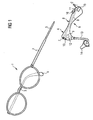
- FIG. 1 shows a commercial glasses 1 with a left temple 2 and a right temple 3.
- a support body 4 of plastic is pushed in a conventional manner.
- the support body 4 is bent relative to the front part of the eyeglass temple 3, so that the right eyeglass temple 3 engages with worn eyeglasses behind the ear and holds the eyeglasses.
- the carrying body is removed on the left eyeglass temple 2, as a result of which the metal bendable eyeglass temple end piece 5 becomes visible.
- FIG. 1 further shows a hearing aid 6 according to the invention.
- the housing of the hearing aid 6 has a relatively slender middle region B and a relative to this enlarged front area A with a channel opening 7, in which the eyeglass temple end piece 5 can be pushed for fixing the hearing aid 6 with the glasses 1.
- the hearing aid device 6 is traversed by a correspondingly dimensioned channel 8.
- the channel 8 could also be made from a cavity inside the hearing aid and a short, closely fitting on the temple piece end piece channel piece, which serves for guiding and fixing the eyeglass end piece. Due to the elongated and slim, inside hollow housing of the hearing aid 6, a kind of "channel" is already formed inside anyway.
- the hearing aid device 6 further comprises a microphone 9 with a sound inlet opening 10 for receiving an acoustic input signal and conversion into an electrical signal.
- a signal processing unit 11 the processing and frequency-dependent amplification of the electrical signal takes place.
- a handset 12 converts the processed electrical signal back into an acoustic signal, which is passed through a sound tube 13 and an ear device 14 in the ear canal of a hearing aid wearer.
- a battery that is located in a battery compartment 15 is used.
- the volume can be adjusted via a volume control 16 or the hearing aid 6 can be switched off.
- At least the middle region B of the hearing aid device 6 is made of a plastically deformable material, e.g. Made of silicone rubber, so that the housing in this area can be bent according to the individual requirements of the hearing aid wearer.
- FIG. 1 It can be seen that the essential for the function of the hearing aid 6 components (microphone 9, handset 12, signal processing unit 11, battery compartment 15) in the front portion A and in the rear portion C of the hearing aid 6. In the middle region B are therefore located next to the channel. 8 only connecting lines between the individual hearing aid components, whereby the housing in this area opposite the enlarged front area A or the enlarged rear portion C can be made correspondingly slim.
- FIG. 2 shows the glasses 1 according to FIG. 1 with the attached hearing aid 6.
- Name and function of the individual components correspond to the name and function according to FIG. 1
- the housing of the hearing aid 6 now no longer shows the elongated shape as in FIG. 1 but the housing is bent in particular in the middle region B, so that the hearing aid device 6 on the left eyeglass temple 2 performs the same function (holding the eyeglasses) as the carrying body 4 on the right eyeglass temple 3.
- the arrangement of the components of the hearing aid 6, as shown in the FIGS. 1 and 2 is illustrated, has the advantage that the central region B for bending the eyeglass end piece can even be heated.
- the eyeglass temple end located inside the housing also contributes to the fact that the hearing aid device 6 permanently retains its shape (or, if necessary, until a further adaptation) after the deformation.
- the invention has the advantage that for the production of a pair of hearing glasses a commercial glasses 1 can be used, which is not damaged by the production of the hearing glasses.
- the hearing aid wearer therefore has the opportunity to try different glasses and the glasses 1 after loosening the hearing aid 6 back to their original state (with wearers on both eyeglass tails back).
- the hearing glasses are not limited to the design shown. Both the glasses and the hearing aid many variations are conceivable. Of course, the hearing glasses can be equipped with two hearing aids according to the invention (one on the left and on the right temple) for binaural supply.
Landscapes
- Physics & Mathematics (AREA)
- Health & Medical Sciences (AREA)
- General Physics & Mathematics (AREA)
- Ophthalmology & Optometry (AREA)
- Optics & Photonics (AREA)
- Acoustics & Sound (AREA)
- General Health & Medical Sciences (AREA)
- Otolaryngology (AREA)
- Eyeglasses (AREA)
- Details Of Audible-Bandwidth Transducers (AREA)
- Adornments (AREA)
Description
- Die Erfindung betrifft ein an einem Brillenbügel befestigbares Hörhilfegerät.
- Aus der
DE 83 36 526 U1 ist eine Brille mit einem Brillenbügel bekannt. Üblicherweise ist der Brillenbügel als Metallstab ausgebildet, der zur Anpassung an den Brillenträger ein biegbares Brillenbügel-Endstück umfasst. Auch das nadelförmige Brillenbügel-Endstück besteht in der Regel aus einem Metall oder einer Metalllegierung. Um den Tragekomfort zu erhöhen, wird bei einer gewöhnlichen Brille über das Brillenbügel-Endstück eine Hülse geschoben, beispielsweise aus Silikonkautschuk, die das Brillenbügel-Endstück weich ummantelt. - Aus der
DE 87 06 344 U1 ist eine Brille mit darin eingebautem Hörgerät bekannt, wobei das Hörgerät in wenigstens zwei Einheiten unterteilt ist. Eine der Einheiten ist in einem Verbindungselement angeordnet, das einen an der Fassung schwenkbar angebrachten Teil eines Bügels mit einem hinter das Ohr greifenden Endstück dieses Bügels verbindet, und die andere Einheit ist in dem Endstück angeordnet. Nachteilig bei der bekannten Hörbrille ist, dass der Brillenbügel zur Verbindung mit dem Hörgerät gekürzt werden muss, wodurch die Brille nur noch in Verbindung mit dem Hörgerät benützt werden kann. - Aus der
WO 02/067627 A1 - Aus der
US 2,999,136 ist eine Hörbrille bekannt, bei deren Zusammenbau zunächst der hinter das Ohr greifende Teil des Brillenbügels abgetrennt wird. Auf das so gebildete Ende des Brillenbügels wird dann ein Hörgerät mit gebogener Gehäuseform aufgeschoben, das hierfür in seinem vorderen GehäuseBereich von einem Kanal durchzogen ist. - Aufgabe der vorliegenden Erfindung ist es, ein an einem Brillenbügel befestigbares Hörhilfegerät zu schaffen, bei dem die Brille auch nach dem Lösen des Hörhilfegerätes von dem Brillenbügel noch getragen werden kann.
- Diese Aufgabe wird bei einem an einem Brillenbügel einer von einem Träger tragbaren Brille befestigbaren Hörhilfegerät mit einen das Hörhilfegerät zumindest teilweise durchziehenden Kanal zur Aufnahme eines biegbaren Brillenbügel-Endstücks gelöst durch ein zumindest in einem Teilbereich biegbares Gehäuse, wobei das Gehäuse und der Kanal so ausgebildet sind, dass das Gehäuse zusammen mit dem in den Kanal eingeführten Brillenbügel-Endstück biegbar ist zur individuellen Anpassung der Form des Hörhilfegerätes an den Träger.
- Üblicherweise bestehen Brillenbügel aus einem Metall oder einer Metalllegierung. Zur Anpassung an den jeweiligen Brillenträger ist der im Ohrbereich befindliche Teil des Brillenbügels, das sogenannte Brillenbügel-Endstück, durch Biegen plastisch verformbar. Die Biegung zur Anpassung des Brillenbügels erfolgt in der Regel unter Wärmeeinwirkung.
- Um den Tragekomfort zu erhöhen sowie aus kosmetischen Gründen ist auf das Brillenbügel-Endstück ein Kunststoff-Tragekörper aufgeschoben. Dieser ist elastisch und passt sich daher der Biegung des Brillenbügel-Endstücks an.
- Mit einem Hörhilfegerät gemäß der Erfindung ist es möglich, aus nahezu jeder handelsüblichen Brille mit dem beschriebenen Aufbau eine Hörbrille herzustellen. Es muss hierfür lediglich der Kunststoff-Tragekörper von dem Brillenbügel-Endstück abgezogen und das Hörhilfegerät gemäß der Erfindung aufgeschoben werden. Innerhalb des Gehäuses des Hörhilfegerätes gemäß der Erfindung ist ein Hohlraum (Kanal) zur Aufnahme des Brillenbügel-Endstücks ausgebildet. In diesen Kanal kann das Brillenbügel-Endstück eingeführt werden, ohne hierzu den Brillenbügel kürzen und damit die Brille beschädigen zu müssen. Zur individuellen Anpassung an den Träger der so gebildeten Hörbrille wird dann das Brillenbügel-Endstück zusammen mit dem Hörhilfegerät in Form gebogen. Das somit in das Gehäuse des Hörhilfegerätes eingeführte Brillenbügel-Endstück dient somit neben der Befestigung des Hörhilfegerätes an der Brille auch zur Formgebung und Versteifung des Hörhilfegeräte-Gehäuses. Das Gehäuse des Hörhilfegerätes kann aus den gleichen Kunststoffen aufgebaut sein, die üblicherweise auch zur Herstellung der Kunststoff-Tragekörper verwendet werden. Sowohl kalt plastisch verformbare als auch unter Wärmeeinwirkung plastisch verformbare (thermoplastische) Kunststoffe sind möglich.
- Allein die Biegung des Brillenbügel-Endstücks in dem Hörhilfegerät reicht in der Regel aus, um die Brille und das Hörhilfegerät dauerhaft miteinander zu verbinden. Hörhilfegerät und Brille lassen sich dann auch besonders einfach wieder voneinander lösen, indem das Brillenbügel-Endstück und das Hörhilfegerät wieder gerade gebogen werden.
- Die Erfindung bietet den Vorteil, dass zur Herstellung einer Hörbrille auf übliche Brillen zurückgegriffen werden kann. Für den Hörbrillenträger steht daher eine große Auswahl möglicher Brillen in den unterschiedlichsten Designs zur Verfügung. Da zur Verbindung mit einem Hörhilfegerät von der Brille lediglich der Tragekörper abgezogen werden muss, wird die Brille nicht beschädigt und kann daher jederzeit wieder in ihren ursprünglichen Zustand zurück versetzt werden. Es steht dem Hörbrillenträger daher offen, wie beim gewöhnlichen Brillenkauf verschiedene Modelle auszuprobieren, und dies auch bereits bei mit der Brille verbundenem Hörhilfegerät.
- Durch die weit fortgeschrittene Miniaturisierung von Hörgeräte-Komponenten ist es möglich, das Hörhilfegerät gemäß der Erfindung so zu gestalten, dass es sich in seiner äußeren Form von einem gewöhnlichen Kunststoff-Tragekörper nur unwesentlich unterscheidet. Insbesondere weist es einen schlanken, biegbaren und von dem biegbaren Brillenbügel-Endstück durchzogenen Mittelbereich auf. Ähnlich der Öffnung eines Kunststoff-Tragekörpers befindet sich auch bei dem Hörhilfegerät im vorderen Bereich eine Öffnung, in die das Brillenbügel-Endstück einführbar ist. Vorzugsweise befindet sich das gesamte Brillenbügel-Endstück eng anliegend innerhalb eines Kanals in dem Hörhilfegerät. Das Brillenbügel-Endstück kann jedoch auch durch mehrere, nicht zusammenhängende, verhältnismäßig kurze Kanalstücke in dem Hörhilfegerät geführt und befestigt sein. Dabei kann die Befestigung auch durch Schraub-, Klemm-, Klebe- oder sonstige Verbindungen des Brillenbügel-Endstücks mit dem Hörhilfegerät verbessert sein.
- Eine bevorzugte Ausführungsform der Erfindung sieht vor, dass das Hörhilfegerät gemäß der Erfindung alle Komponenten eines üblichen, hinter dem Ohr tragbaren Hörhilfegerätes umfasst. Es sind dies wenigstens ein Mikrofon zur Aufnahme eines akustischen Eingangssignals und Wandlung in ein elektrisches Signal, eine Signalverarbeitungseinheit zur Verarbeitung und frequenzabhängigen Verstärkung des elektrischen Signals und ein Hörer zur Wandlung des verarbeiteten elektrischen Signals in ein akustisches Signal, das in den Gehörgang des Hörbrillenträgers abgegeben wird. Weiterhin umfasst das Hörhilfegerät gemäß der Erfindung eine als Batterie oder Akku ausgebildete Spannungsquelle.
- Zur Schallleitung zwischen dem Hörhilfegerät und dem Ohrkanal ist ein Schallschlauch vorgesehen, der mittels einer Otoplastik im Ohr befestigt ist.
- Das Hörhilfegerät gemäß der Erfindung kann jedoch in Teilbereichen auch von dieser bevorzugten Ausführungsform abweichen. Z.B. kann wenigstens ein Mikrofon des Hörhilfegerätes auch außerhalb des Gehäuses, z.B. an dem Brillengestell, angeordnet sein. Ferner ist es beispielsweise möglich, dass der Hörer außerhalb des Gehäuses des Hörhilfegerätes angeordnet ist. So kann der Hörer in der Otoplastik angeordnet und lediglich über Signalleitungen mit dem Hörhilfegerät verbunden sein.
- Bei einer weiteren Ausführungsform ist vorgesehen, dass lediglich ein Gehäuseende gegenüber dem schlanken Mittelbereich vergrößert ist. Z.B. kann der vordere Bereich des Gehäuses mit der Kanalöffnung zum Einführen des Brillenbügel-Endstücks ebenfalls sehr schlank ausgeführt sein, insbesondere wenn in diesem Teilbereich keine weiteren Hörhilfegeräte-Komponenten untergebracht sind.
- Die Erfindung wird nachfolgend anhand eines Ausführungsbeispiels näher erläutert. Es zeigen:
-
Figur 1 ein Brillengestell sowie ein Hörhilfegerät gemäß der Erfindung und -
Figur 2 die Brille gemäßFigur 1 mit aufgestecktem und gebogenem Hörhilfegerät. -
Figur 1 zeigt eine handelsübliche Brille 1 mit einem linken Brillenbügel 2 und einem rechten Brillenbügel 3. Am hinteren Ende des rechten Brillenbügels 3 ist in üblicher Weise ein Tragekörper 4 aus Kunststoff aufgeschoben. Der Tragekörper 4 ist gegenüber dem vorderen Teil des Brillenbügels 3 gebogen, so dass der rechte Brillenbügel 3 bei getragener Brille hinter das Ohr greift und die Brille hält. Im Unterschied zum rechten Brillenbügel 3 ist an dem linken Brillenbügel 2 der Tragekörper entfernt, wodurch das metallene biegbare Brillenbügel-Endstück 5 sichtbar wird. -
Figur 1 zeigt ferner ein Hörhilfegerät 6 gemäß der Erfindung. Das Gehäuse des Hörhilfegerätes 6 weist einen verhältnismäßig schlanken Mittelbereich B und einen im Verhältnis zu diesem vergrößerten vorderen Bereich A mit einer Kanalöffnung 7 auf, in die zur Befestigung des Hörhilfegerätes 6 mit der Brille 1 das Brillenbügel-Endstück 5 geschoben werden kann. Zur Aufnahme des Brillenbügel-Endstücks 5 ist das Hörhilfegerät 6 von einem entsprechend dimensionierten Kanal 8 durchzogen. Alternativ könnte der Kanal 8 auch aus einem Hohlraum innerhalb des Hörhilfegerätes und einem kurzen, an dem Brillenbügel-Endstück eng anliegenden Kanalstück bestehen, das zur Führung und Befestigung des Brillenbügel-Endstücks dient. Durch das langgestreckte und schlanke, innen hohle Gehäuse des Hörhilfegerätes 6 ist im Inneren ohnehin eine Art "Kanal" ausbildet. - Das Hörhilfegerät 6 gemäß dem Ausführungsbeispiel umfasst weiterhin ein Mikrofon 9 mit einer Schalleinlassöffnung 10 zur Aufnahme eines akustischen Eingangssignals und Wandlung in ein elektrisches Signal. In einer Signalverarbeitungseinheit 11 erfolgt die Verarbeitung und frequenzabhängige Verstärkung des elektrischen Signals. Ein Hörer 12 wandelt das verarbeitete elektrische Signal zurück in ein akustisches Signal, welches über einen Schallschlauch 13 und eine Otoplastik 14 in den Gehörgang eines Hörhilfegeräteträgers geleitet wird. Zur Spannungsversorgung des Hörhilfegerätes 6 dient eine Batterie, die sich in einem Batteriefach 15 befindet. Weiterhin kann über einen Lautstärkesteller 16 die Lautstärke eingestellt oder das Hörhilfegerät 6 ausgeschaltet werden.
- Zumindest der Mittelbereich B des Hörhilfegerätes 6 ist aus einem plastisch verformbaren Material gefertigt, z.B. aus Silikonkautschuk, so dass das Gehäuse in diesem Bereich gemäß den individuellen Anforderungen des Hörbrillenträgers gebogen werden kann.
- Wie aus
Figur 1 ersichtlich ist, befinden sich die zur Funktion des Hörhilfegerätes 6 wesentlichen Komponenten (Mikrofon 9, Hörer 12, Signalverarbeitungseinheit 11, Batteriefach 15) im vorderen Teilbereich A bzw. im hinteren Teilbereich C des Hörhilfegerätes 6. Im Mittelbereich B befinden sich daher neben dem Kanal 8 lediglich Verbindungsleitungen zwischen den einzelnen Hörhilfegeräte-Komponenten, wodurch das Gehäuse in diesem Bereich gegenüber dem vergrößerten vorderen Bereich A bzw. dem vergrößerten hinteren Bereich C entsprechend schlank ausgeführt werden kann. -
Figur 2 zeigt die Brille 1 gemäßFigur 1 mit dem daran befestigten Hörhilfegerät 6. Bezeichnung und Funktion der einzelnen Komponenten entsprechen der Bezeichnung und Funktion gemäßFigur 1 . Im Unterschied zuFigur 1 zeigt das Gehäuse des Hörhilfegerätes 6 nun jedoch nicht mehr die langgestreckte Form wie inFigur 1 , sondern das Gehäuse ist insbesondere im Mittelbereich B gebogen, so dass das Hörhilfegerät 6 an dem linken Brillenbügel 2 die gleiche Funktion (halten der Brille) wie der Tragekörper 4 an dem rechten Brillenbügel 3 übernimmt. Die Anordnung der Komponenten des Hörhilfegerätes 6, wie sie in denFiguren 1 und2 veranschaulicht ist, hat den Vorteil, dass der Mittelbereich B zum Biegen des Brillenbügel-Endstücks sogar erwärmt werden kann. Auch das innerhalb des Gehäuses befindliche Brillenbügel-Endstück trägt dazu bei, dass das Hörhilfegerät 6 nach der Verformung seine Form dauerhaft (oder ggf. bis zu einer erneuten Anpassung) beibehält. - Die Erfindung bietet den Vorteil, dass zur Herstellung einer Hörbrille eine handelsübliche Brille 1 verwendet werden kann, die durch die Herstellung der Hörbrille nicht beschädigt wird. Der Hörbrillenträger hat daher die Möglichkeit, verschiedene Brillen auszuprobieren und die Brille 1 nach dem Lösen des Hörhilfegerätes 6 wieder in ihren ursprünglichen Zustand (mit Tragekörpern an beiden Brillenbügel-Endstücken) zurückzuversetzen.
- Die Hörbrille ist nicht auf das dargestellte Design beschränkt. Sowohl bei der Brille als auch bei dem Hörhilfegerät sind viele Variationsmöglichkeiten denkbar. Selbstverständlich kann die Hörbrille auch mit zwei Hörhilfegeräten gemäß der Erfindung (je eine am linken und am rechten Brillenbügel) zur binauralen Versorgung ausgestattet sein.
Claims (6)
- An einem Brillenbügel (2) einer von einem Träger tragbaren Brille befestigbares Hörhilfegerät (6) mit einem das Hörhilfegerät (6) zumindest teilweise durchziehenden Kanal (8) zur Aufnahme eines biegbaren Brillenbügel-Endstücks (5), gekennzeichnet durch ein zumindest in einem Teilbereich (B) biegbares Gehäuse, wobei das Gehäuse und der Kanal (8) so ausgebildet sind, dass ein metallenes Brillenbügel-Endstück (5) einer handelsüblichen Brille, bei der ein das Brillenbügel-Endstück (5) ummantelnder Tragekörper entfernt wurde, in den Kanal (8) einführbar und zusammen mit dem Gehäuse biegbar ist zur individuellen Anpassung der Form des Hörhilfegerätes (6) an den Träger.
- Hörhilfegerät (6) nach Anspruch 1, gekennzeichnet durch einen schlanken, biegbaren Mittelbereich (B) und einen im Vergleich zu diesem vergrößerten vorderen Bereich (A) mit einer Kanalöffnung (7), in die das Brillenbügel-Endstück (5) einführbar ist.
- Hörhilfegerät (6) nach Anspruch 1 oder 2, dadurch gekennzeichnet, dass in dem vergrößerten vorderen Bereich (A) wenigstens ein Mikrofon (9) zur Aufnahme eines akustischen Eingangssignals angeordnet ist.
- Hörhilfegerät (6) nach einem der Ansprüche 1 bis 3, dadurch gekennzeichnet, dass in dem vergrößerten vorderen Bereich (A) wenigstens ein Hörer (12) zur Abgabe eines akustischen Ausgangssignals angeordnet ist.
- Hörhilfegerät (6) nach einem der Ansprüche 1 bis 4, gekennzeichnet durch einen im Vergleich zu dem schlanken, biegbaren Mittelbereich (B) vergrößerten hinteren Bereich (C), in dem eine Spannungsquelle angeordnet ist.
- Hörhilfegerät (6) nach einem der Ansprüche 1 bis 5, gekennzeichnet durch ein zumindest in dem Mittelbereich (B) aus einem thermoplastischen Kunststoff gebildetes Gehäuse.
Applications Claiming Priority (2)
| Application Number | Priority Date | Filing Date | Title |
|---|---|---|---|
| DE10343010 | 2003-09-17 | ||
| DE10343010A DE10343010B3 (de) | 2003-09-17 | 2003-09-17 | An einem Brillenbügel befestigbares Hörhilfegerät |
Publications (2)
| Publication Number | Publication Date |
|---|---|
| EP1517170A1 EP1517170A1 (de) | 2005-03-23 |
| EP1517170B1 true EP1517170B1 (de) | 2010-11-03 |
Family
ID=34177795
Family Applications (1)
| Application Number | Title | Priority Date | Filing Date |
|---|---|---|---|
| EP04019231A Expired - Lifetime EP1517170B1 (de) | 2003-09-17 | 2004-08-12 | An einem Brillenbügel befestigbares Hörhilfegerät |
Country Status (5)
| Country | Link |
|---|---|
| US (1) | US7103192B2 (de) |
| EP (1) | EP1517170B1 (de) |
| AT (1) | ATE487157T1 (de) |
| DE (2) | DE10343010B3 (de) |
| DK (1) | DK1517170T3 (de) |
Families Citing this family (21)
| Publication number | Priority date | Publication date | Assignee | Title |
|---|---|---|---|---|
| US7735996B2 (en) | 2005-05-24 | 2010-06-15 | Varibel B.V. | Connector assembly for connecting an earpiece of a hearing aid to glasses temple |
| EP1727393A1 (de) * | 2005-05-24 | 2006-11-29 | Varibel B.V. | Verbindungseinrichtung zum Verbinden eines Ohrpassstückes eines Hörgerätes mit einer Brillenfassung |
| EP2036395A1 (de) * | 2006-06-20 | 2009-03-18 | Widex A/S | Gehäuse für ein hörgerät, hörgerät und verfahren zum herstellen eines hörgeräts |
| FR2910135B1 (fr) * | 2006-12-14 | 2009-02-20 | Xavier Arthur Carriou | Procede d'extrusion de branche de lunette pour y loger un appareil auditif |
| DE102007028652A1 (de) * | 2007-06-21 | 2009-01-02 | Bruckhoff Apparatebau Gmbh | Hörbrille |
| DE102009014114B4 (de) * | 2009-03-24 | 2015-07-23 | Bruckhoff Apparatebau Gmbh | Hörgerätmodul und Hörbrille |
| EP2681610B1 (de) * | 2011-03-04 | 2016-06-08 | Silvietta S.R.L. | Zusammenschiebbare brille |
| US8918197B2 (en) | 2012-06-13 | 2014-12-23 | Avraham Suhami | Audio communication networks |
| US8543061B2 (en) | 2011-05-03 | 2013-09-24 | Suhami Associates Ltd | Cellphone managed hearing eyeglasses |
| JP5945426B2 (ja) * | 2012-02-06 | 2016-07-05 | オリンパス株式会社 | ウェアラブル機器取り付け用眼鏡モダン |
| EP3143460B1 (de) | 2014-05-12 | 2018-10-24 | Beausoleil | Gehäuse für die aufnahme eines hörgerät |
| CN107113486A (zh) * | 2014-10-30 | 2017-08-29 | 索尼公司 | 声音输出设备 |
| US20170102560A1 (en) * | 2015-10-13 | 2017-04-13 | James V. Murphy | Hearing aid holder for use with eyewear |
| US20190132683A1 (en) | 2017-10-31 | 2019-05-02 | Starkey Laboratories, Inc. | Hearing device including a sensor and a method of forming same |
| CN114127846B (zh) | 2019-07-21 | 2025-09-12 | 纽安思听力有限公司 | 语音跟踪收听设备 |
| US10986452B1 (en) * | 2019-10-15 | 2021-04-20 | Richard Hilvers | Hearing aid mounting assembly |
| WO2021074818A1 (en) | 2019-10-16 | 2021-04-22 | Nuance Hearing Ltd. | Beamforming devices for hearing assistance |
| US12513446B1 (en) * | 2022-02-25 | 2025-12-30 | E-filliate, Inc. | Earbuds with turn wheel control |
| US12464296B2 (en) | 2023-09-28 | 2025-11-04 | Nuance Hearing Ltd. | Hearing aid with own-voice mitigation |
| US12452611B2 (en) | 2023-10-23 | 2025-10-21 | Nuance Hearing Ltd. | Feedback cancellation in a hearing aid device using tap coherence values |
| US12658870B2 (en) | 2024-04-24 | 2026-06-16 | Nuance Hearing Ltd. | Howl detection in an audio system |
Family Cites Families (13)
| Publication number | Priority date | Publication date | Assignee | Title |
|---|---|---|---|---|
| US3000462A (en) * | 1954-01-18 | 1961-09-19 | Alonzo L Smith | Air-conduction hearing aid clamps |
| US2999136A (en) * | 1956-01-06 | 1961-09-05 | Telex Inc | Spectacle hearing aid |
| DE1724439U (de) * | 1956-01-25 | 1956-06-21 | Siemens Reiniger Werke Ag | Elektrische hoerhilfe. |
| GB1051687A (de) * | 1963-05-06 | |||
| US3382327A (en) * | 1965-05-07 | 1968-05-07 | Non Slip Temple Company Inc | Hearing aid eyeglass frame |
| US3825700A (en) * | 1973-03-02 | 1974-07-23 | Sonotone Corp | Articulated hearing aid temple and behind-the-ear hearing aid element |
| DE8336526U1 (de) * | 1983-12-20 | 1985-10-03 | Optische Werke G. Rodenstock, 8000 München | Weichummantelter Brillenbügel-Ohrbereich |
| DE8706344U1 (de) * | 1987-05-04 | 1987-06-19 | Bruckhoff, Henning, 3000 Hannover | Hörbrille |
| DE8808620U1 (de) | 1988-07-05 | 1988-09-08 | Siemens AG, 1000 Berlin und 8000 München | Brillenadapter für ein Hinter-dem-Ohr-Hörgerät |
| WO1996013136A1 (en) * | 1992-02-14 | 1996-05-02 | Da Silva Jean Pierre M | Audio-adapted eyeglass retainer |
| DE4333559A1 (de) * | 1993-10-01 | 1995-04-06 | Werner Weber | Brille mit Hörgerät |
| US6176576B1 (en) * | 1997-06-06 | 2001-01-23 | Radians, Inc. | Eyewear supported by a wearer's concha of an ear |
| DE50202909D1 (de) * | 2001-02-16 | 2005-06-02 | Audifon Ag Zuerich | Hörgerät für den einbau in einem seitenbügel einer optischen brille |
-
2003
- 2003-09-17 DE DE10343010A patent/DE10343010B3/de not_active Expired - Fee Related
-
2004
- 2004-08-12 AT AT04019231T patent/ATE487157T1/de active
- 2004-08-12 EP EP04019231A patent/EP1517170B1/de not_active Expired - Lifetime
- 2004-08-12 DK DK04019231.2T patent/DK1517170T3/da active
- 2004-08-12 DE DE502004011843T patent/DE502004011843D1/de not_active Expired - Lifetime
- 2004-09-17 US US10/943,451 patent/US7103192B2/en not_active Expired - Fee Related
Also Published As
| Publication number | Publication date |
|---|---|
| ATE487157T1 (de) | 2010-11-15 |
| DE10343010B3 (de) | 2005-04-21 |
| US20050074137A1 (en) | 2005-04-07 |
| DK1517170T3 (da) | 2011-02-21 |
| US7103192B2 (en) | 2006-09-05 |
| DE502004011843D1 (de) | 2010-12-16 |
| EP1517170A1 (de) | 2005-03-23 |
Similar Documents
| Publication | Publication Date | Title |
|---|---|---|
| DE10343010B3 (de) | An einem Brillenbügel befestigbares Hörhilfegerät | |
| DE102004048214B3 (de) | Universelles Ohrstück und akustisches Gerät mit einem derartigen Ohrstück | |
| EP1046943B1 (de) | Hörhilfe | |
| EP1345471B1 (de) | Otoplastik für Hinter-dem-Ohr(HdO)-Hörgeräte | |
| EP0842590B1 (de) | Hörgerät | |
| EP3750329B1 (de) | Universal-adapter für hörgeräte und ohrhörer | |
| EP1874093A2 (de) | Hörgerät mit einer Befestigung für einen Hörerschlauch | |
| EP1967893B1 (de) | Knochenleitungsmodul zum Aufsetzen auf eine Brille, Knochenleitungshörgerät-Brille mit einem derartigen Modul und Verfahren zu ihrer Herstellung | |
| AT523938A4 (de) | Aufsteckbarer Ohrhörer-Adapter_CFC | |
| EP2003930B1 (de) | Hörgerät mit am Gehäuserahmen befestigtem Anschlussstück | |
| EP2007172B1 (de) | Schallausgangsröhrchen mit 2-Komponenten-Aufbau | |
| EP2302953B1 (de) | Knochenleitungshörgerät | |
| EP1847868B1 (de) | Hinter-dem-Ohr-Hörgerät einschließlich Brillenadapter mit dünnem Schallschlauch | |
| DE10050766A1 (de) | Otoplastik für Hinter-dem-Ohr (HdO)-Hörgeräte | |
| DE10048337C1 (de) | Hinter dem Ohr tragbares Hörhilfegerät | |
| EP2056625A2 (de) | Hörhilfsgerät, insbesondere HdO-Hörgerät | |
| EP1909533A2 (de) | Schallleiter und Hörvorrichtung | |
| DE102018132445A1 (de) | Otoplastik und Verwendung einer Otoplastik | |
| DE102009014114B4 (de) | Hörgerätmodul und Hörbrille | |
| DE102007028652A1 (de) | Hörbrille | |
| DE102005008319B3 (de) | Hörvorrichtung zum Tragen am Ohr | |
| DE102007053834B4 (de) | Hörhilfsgerät, insbesondere HdO-Hörgerät | |
| DE102024103745A1 (de) | Modulare Hörvorrichtung mit Haltehaken | |
| DE102005019994A1 (de) | Hörgerät | |
| EP3188511A1 (de) | Hörgerät |
Legal Events
| Date | Code | Title | Description |
|---|---|---|---|
| PUAI | Public reference made under article 153(3) epc to a published international application that has entered the european phase |
Free format text: ORIGINAL CODE: 0009012 |
|
| AK | Designated contracting states |
Kind code of ref document: A1 Designated state(s): AT BE BG CH CY CZ DE DK EE ES FI FR GB GR HU IE IT LI LU MC NL PL PT RO SE SI SK TR |
|
| AX | Request for extension of the european patent |
Extension state: AL HR LT LV MK |
|
| 17P | Request for examination filed |
Effective date: 20050422 |
|
| AKX | Designation fees paid |
Designated state(s): AT BE BG CH CY CZ DE DK EE ES FI FR GB GR HU IE IT LI LU MC NL PL PT RO SE SI SK TR |
|
| 17Q | First examination report despatched |
Effective date: 20051118 |
|
| GRAP | Despatch of communication of intention to grant a patent |
Free format text: ORIGINAL CODE: EPIDOSNIGR1 |
|
| GRAS | Grant fee paid |
Free format text: ORIGINAL CODE: EPIDOSNIGR3 |
|
| GRAA | (expected) grant |
Free format text: ORIGINAL CODE: 0009210 |
|
| AK | Designated contracting states |
Kind code of ref document: B1 Designated state(s): AT BE BG CH CY CZ DE DK EE ES FI FR GB GR HU IE IT LI LU MC NL PL PT RO SE SI SK TR |
|
| REG | Reference to a national code |
Ref country code: GB Ref legal event code: FG4D Free format text: NOT ENGLISH |
|
| REG | Reference to a national code |
Ref country code: CH Ref legal event code: NV Representative=s name: SIEMENS SCHWEIZ AG Ref country code: CH Ref legal event code: EP |
|
| REG | Reference to a national code |
Ref country code: IE Ref legal event code: FG4D Free format text: LANGUAGE OF EP DOCUMENT: GERMAN |
|
| REF | Corresponds to: |
Ref document number: 502004011843 Country of ref document: DE Date of ref document: 20101216 Kind code of ref document: P |
|
| REG | Reference to a national code |
Ref country code: DK Ref legal event code: T3 |
|
| REG | Reference to a national code |
Ref country code: NL Ref legal event code: VDEP Effective date: 20101103 |
|
| REG | Reference to a national code |
Ref country code: IE Ref legal event code: FD4D |
|
| PG25 | Lapsed in a contracting state [announced via postgrant information from national office to epo] |
Ref country code: NL Free format text: LAPSE BECAUSE OF FAILURE TO SUBMIT A TRANSLATION OF THE DESCRIPTION OR TO PAY THE FEE WITHIN THE PRESCRIBED TIME-LIMIT Effective date: 20101103 Ref country code: SI Free format text: LAPSE BECAUSE OF FAILURE TO SUBMIT A TRANSLATION OF THE DESCRIPTION OR TO PAY THE FEE WITHIN THE PRESCRIBED TIME-LIMIT Effective date: 20101103 Ref country code: FI Free format text: LAPSE BECAUSE OF FAILURE TO SUBMIT A TRANSLATION OF THE DESCRIPTION OR TO PAY THE FEE WITHIN THE PRESCRIBED TIME-LIMIT Effective date: 20101103 Ref country code: SE Free format text: LAPSE BECAUSE OF FAILURE TO SUBMIT A TRANSLATION OF THE DESCRIPTION OR TO PAY THE FEE WITHIN THE PRESCRIBED TIME-LIMIT Effective date: 20101103 Ref country code: PT Free format text: LAPSE BECAUSE OF FAILURE TO SUBMIT A TRANSLATION OF THE DESCRIPTION OR TO PAY THE FEE WITHIN THE PRESCRIBED TIME-LIMIT Effective date: 20110303 Ref country code: BG Free format text: LAPSE BECAUSE OF FAILURE TO SUBMIT A TRANSLATION OF THE DESCRIPTION OR TO PAY THE FEE WITHIN THE PRESCRIBED TIME-LIMIT Effective date: 20110203 |
|
| PG25 | Lapsed in a contracting state [announced via postgrant information from national office to epo] |
Ref country code: GR Free format text: LAPSE BECAUSE OF FAILURE TO SUBMIT A TRANSLATION OF THE DESCRIPTION OR TO PAY THE FEE WITHIN THE PRESCRIBED TIME-LIMIT Effective date: 20110204 |
|
| PG25 | Lapsed in a contracting state [announced via postgrant information from national office to epo] |
Ref country code: EE Free format text: LAPSE BECAUSE OF FAILURE TO SUBMIT A TRANSLATION OF THE DESCRIPTION OR TO PAY THE FEE WITHIN THE PRESCRIBED TIME-LIMIT Effective date: 20101103 Ref country code: ES Free format text: LAPSE BECAUSE OF FAILURE TO SUBMIT A TRANSLATION OF THE DESCRIPTION OR TO PAY THE FEE WITHIN THE PRESCRIBED TIME-LIMIT Effective date: 20110214 Ref country code: CZ Free format text: LAPSE BECAUSE OF FAILURE TO SUBMIT A TRANSLATION OF THE DESCRIPTION OR TO PAY THE FEE WITHIN THE PRESCRIBED TIME-LIMIT Effective date: 20101103 Ref country code: IE Free format text: LAPSE BECAUSE OF FAILURE TO SUBMIT A TRANSLATION OF THE DESCRIPTION OR TO PAY THE FEE WITHIN THE PRESCRIBED TIME-LIMIT Effective date: 20101103 |
|
| PG25 | Lapsed in a contracting state [announced via postgrant information from national office to epo] |
Ref country code: RO Free format text: LAPSE BECAUSE OF FAILURE TO SUBMIT A TRANSLATION OF THE DESCRIPTION OR TO PAY THE FEE WITHIN THE PRESCRIBED TIME-LIMIT Effective date: 20101103 Ref country code: PL Free format text: LAPSE BECAUSE OF FAILURE TO SUBMIT A TRANSLATION OF THE DESCRIPTION OR TO PAY THE FEE WITHIN THE PRESCRIBED TIME-LIMIT Effective date: 20101103 Ref country code: SK Free format text: LAPSE BECAUSE OF FAILURE TO SUBMIT A TRANSLATION OF THE DESCRIPTION OR TO PAY THE FEE WITHIN THE PRESCRIBED TIME-LIMIT Effective date: 20101103 |
|
| PLBE | No opposition filed within time limit |
Free format text: ORIGINAL CODE: 0009261 |
|
| STAA | Information on the status of an ep patent application or granted ep patent |
Free format text: STATUS: NO OPPOSITION FILED WITHIN TIME LIMIT |
|
| 26N | No opposition filed |
Effective date: 20110804 |
|
| PGFP | Annual fee paid to national office [announced via postgrant information from national office to epo] |
Ref country code: DK Payment date: 20110822 Year of fee payment: 8 |
|
| REG | Reference to a national code |
Ref country code: DE Ref legal event code: R097 Ref document number: 502004011843 Country of ref document: DE Effective date: 20110804 |
|
| PG25 | Lapsed in a contracting state [announced via postgrant information from national office to epo] |
Ref country code: IT Free format text: LAPSE BECAUSE OF FAILURE TO SUBMIT A TRANSLATION OF THE DESCRIPTION OR TO PAY THE FEE WITHIN THE PRESCRIBED TIME-LIMIT Effective date: 20101103 |
|
| BERE | Be: lapsed |
Owner name: SIEMENS AUDIOLOGISCHE TECHNIK G.M.B.H. Effective date: 20110831 |
|
| PG25 | Lapsed in a contracting state [announced via postgrant information from national office to epo] |
Ref country code: MC Free format text: LAPSE BECAUSE OF NON-PAYMENT OF DUE FEES Effective date: 20110831 |
|
| PG25 | Lapsed in a contracting state [announced via postgrant information from national office to epo] |
Ref country code: BE Free format text: LAPSE BECAUSE OF NON-PAYMENT OF DUE FEES Effective date: 20110831 |
|
| PGFP | Annual fee paid to national office [announced via postgrant information from national office to epo] |
Ref country code: GB Payment date: 20120809 Year of fee payment: 9 |
|
| REG | Reference to a national code |
Ref country code: AT Ref legal event code: MM01 Ref document number: 487157 Country of ref document: AT Kind code of ref document: T Effective date: 20110812 |
|
| PGFP | Annual fee paid to national office [announced via postgrant information from national office to epo] |
Ref country code: FR Payment date: 20120823 Year of fee payment: 9 |
|
| PG25 | Lapsed in a contracting state [announced via postgrant information from national office to epo] |
Ref country code: AT Free format text: LAPSE BECAUSE OF NON-PAYMENT OF DUE FEES Effective date: 20110812 |
|
| PGFP | Annual fee paid to national office [announced via postgrant information from national office to epo] |
Ref country code: DE Payment date: 20121019 Year of fee payment: 9 Ref country code: CH Payment date: 20121113 Year of fee payment: 9 |
|
| PG25 | Lapsed in a contracting state [announced via postgrant information from national office to epo] |
Ref country code: LU Free format text: LAPSE BECAUSE OF NON-PAYMENT OF DUE FEES Effective date: 20110812 Ref country code: CY Free format text: LAPSE BECAUSE OF EXPIRATION OF PROTECTION Effective date: 20101103 |
|
| PG25 | Lapsed in a contracting state [announced via postgrant information from national office to epo] |
Ref country code: TR Free format text: LAPSE BECAUSE OF FAILURE TO SUBMIT A TRANSLATION OF THE DESCRIPTION OR TO PAY THE FEE WITHIN THE PRESCRIBED TIME-LIMIT Effective date: 20101103 |
|
| PG25 | Lapsed in a contracting state [announced via postgrant information from national office to epo] |
Ref country code: HU Free format text: LAPSE BECAUSE OF FAILURE TO SUBMIT A TRANSLATION OF THE DESCRIPTION OR TO PAY THE FEE WITHIN THE PRESCRIBED TIME-LIMIT Effective date: 20101103 |
|
| REG | Reference to a national code |
Ref country code: DK Ref legal event code: EBP Effective date: 20130831 Ref country code: CH Ref legal event code: PL |
|
| GBPC | Gb: european patent ceased through non-payment of renewal fee |
Effective date: 20130812 |
|
| PG25 | Lapsed in a contracting state [announced via postgrant information from national office to epo] |
Ref country code: LI Free format text: LAPSE BECAUSE OF NON-PAYMENT OF DUE FEES Effective date: 20130831 Ref country code: CH Free format text: LAPSE BECAUSE OF NON-PAYMENT OF DUE FEES Effective date: 20130831 Ref country code: DE Free format text: LAPSE BECAUSE OF NON-PAYMENT OF DUE FEES Effective date: 20140301 |
|
| REG | Reference to a national code |
Ref country code: DE Ref legal event code: R119 Ref document number: 502004011843 Country of ref document: DE Effective date: 20140301 |
|
| REG | Reference to a national code |
Ref country code: FR Ref legal event code: ST Effective date: 20140430 |
|
| PG25 | Lapsed in a contracting state [announced via postgrant information from national office to epo] |
Ref country code: GB Free format text: LAPSE BECAUSE OF NON-PAYMENT OF DUE FEES Effective date: 20130812 |
|
| PG25 | Lapsed in a contracting state [announced via postgrant information from national office to epo] |
Ref country code: FR Free format text: LAPSE BECAUSE OF NON-PAYMENT OF DUE FEES Effective date: 20130902 |
|
| PG25 | Lapsed in a contracting state [announced via postgrant information from national office to epo] |
Ref country code: DK Free format text: LAPSE BECAUSE OF NON-PAYMENT OF DUE FEES Effective date: 20130831 |