EP1515995B1 - Fester katalysatorbestandteil zur polymerisation und copolymerisation von ethylen, verfahren zu dessen herstellung - Google Patents
Fester katalysatorbestandteil zur polymerisation und copolymerisation von ethylen, verfahren zu dessen herstellung Download PDFInfo
- Publication number
- EP1515995B1 EP1515995B1 EP02740154A EP02740154A EP1515995B1 EP 1515995 B1 EP1515995 B1 EP 1515995B1 EP 02740154 A EP02740154 A EP 02740154A EP 02740154 A EP02740154 A EP 02740154A EP 1515995 B1 EP1515995 B1 EP 1515995B1
- Authority
- EP
- European Patent Office
- Prior art keywords
- catalyst component
- solid catalyst
- obtaining
- component according
- titanium
- Prior art date
- Legal status (The legal status is an assumption and is not a legal conclusion. Google has not performed a legal analysis and makes no representation as to the accuracy of the status listed.)
- Expired - Lifetime
Links
- 238000000034 method Methods 0.000 title claims abstract description 60
- 239000011949 solid catalyst Substances 0.000 title claims abstract description 59
- 230000008569 process Effects 0.000 title claims abstract description 55
- VGGSQFUCUMXWEO-UHFFFAOYSA-N Ethene Chemical compound C=C VGGSQFUCUMXWEO-UHFFFAOYSA-N 0.000 title claims abstract description 41
- 239000005977 Ethylene Substances 0.000 title claims abstract description 41
- 238000006116 polymerization reaction Methods 0.000 title claims abstract description 32
- 238000007334 copolymerization reaction Methods 0.000 title claims abstract description 11
- VYPSYNLAJGMNEJ-UHFFFAOYSA-N Silicium dioxide Chemical compound O=[Si]=O VYPSYNLAJGMNEJ-UHFFFAOYSA-N 0.000 claims abstract description 184
- 239000000377 silicon dioxide Substances 0.000 claims abstract description 90
- 239000010936 titanium Substances 0.000 claims abstract description 69
- 229910052719 titanium Inorganic materials 0.000 claims abstract description 55
- 239000003054 catalyst Substances 0.000 claims abstract description 51
- 239000011777 magnesium Substances 0.000 claims abstract description 48
- RTAQQCXQSZGOHL-UHFFFAOYSA-N Titanium Chemical compound [Ti] RTAQQCXQSZGOHL-UHFFFAOYSA-N 0.000 claims abstract description 45
- 150000002902 organometallic compounds Chemical class 0.000 claims abstract description 35
- 229910052749 magnesium Inorganic materials 0.000 claims abstract description 33
- FYYHWMGAXLPEAU-UHFFFAOYSA-N Magnesium Chemical compound [Mg] FYYHWMGAXLPEAU-UHFFFAOYSA-N 0.000 claims abstract description 23
- 230000000737 periodic effect Effects 0.000 claims abstract description 22
- 239000000460 chlorine Substances 0.000 claims abstract description 20
- 229910052801 chlorine Inorganic materials 0.000 claims abstract description 11
- 125000003545 alkoxy group Chemical group 0.000 claims abstract description 10
- ZAMOUSCENKQFHK-UHFFFAOYSA-N Chlorine atom Chemical compound [Cl] ZAMOUSCENKQFHK-UHFFFAOYSA-N 0.000 claims abstract description 9
- VLKZOEOYAKHREP-UHFFFAOYSA-N n-Hexane Chemical compound CCCCCC VLKZOEOYAKHREP-UHFFFAOYSA-N 0.000 claims description 198
- 239000007787 solid Substances 0.000 claims description 76
- 239000007788 liquid Substances 0.000 claims description 35
- TWRXJAOTZQYOKJ-UHFFFAOYSA-L Magnesium chloride Chemical compound [Mg+2].[Cl-].[Cl-] TWRXJAOTZQYOKJ-UHFFFAOYSA-L 0.000 claims description 34
- -1 magnesium halides Chemical class 0.000 claims description 27
- 239000003960 organic solvent Substances 0.000 claims description 26
- VOITXYVAKOUIBA-UHFFFAOYSA-N triethylaluminium Chemical compound CC[Al](CC)CC VOITXYVAKOUIBA-UHFFFAOYSA-N 0.000 claims description 22
- YNLAOSYQHBDIKW-UHFFFAOYSA-M diethylaluminium chloride Chemical compound CC[Al](Cl)CC YNLAOSYQHBDIKW-UHFFFAOYSA-M 0.000 claims description 21
- 239000006228 supernatant Substances 0.000 claims description 20
- 239000000725 suspension Substances 0.000 claims description 18
- 229910003910 SiCl4 Inorganic materials 0.000 claims description 17
- 239000002245 particle Substances 0.000 claims description 17
- FDNAPBUWERUEDA-UHFFFAOYSA-N silicon tetrachloride Chemical compound Cl[Si](Cl)(Cl)Cl FDNAPBUWERUEDA-UHFFFAOYSA-N 0.000 claims description 17
- 239000003795 chemical substances by application Substances 0.000 claims description 16
- 150000001875 compounds Chemical class 0.000 claims description 16
- 230000002140 halogenating effect Effects 0.000 claims description 16
- 239000011148 porous material Substances 0.000 claims description 16
- YMWUJEATGCHHMB-UHFFFAOYSA-N Dichloromethane Chemical compound ClCCl YMWUJEATGCHHMB-UHFFFAOYSA-N 0.000 claims description 15
- CMAOLVNGLTWICC-UHFFFAOYSA-N 2-fluoro-5-methylbenzonitrile Chemical compound CC1=CC=C(F)C(C#N)=C1 CMAOLVNGLTWICC-UHFFFAOYSA-N 0.000 claims description 14
- UAIZDWNSWGTKFZ-UHFFFAOYSA-L ethylaluminum(2+);dichloride Chemical compound CC[Al](Cl)Cl UAIZDWNSWGTKFZ-UHFFFAOYSA-L 0.000 claims description 14
- HEDRZPFGACZZDS-UHFFFAOYSA-N Chloroform Chemical compound ClC(Cl)Cl HEDRZPFGACZZDS-UHFFFAOYSA-N 0.000 claims description 13
- 239000003638 chemical reducing agent Substances 0.000 claims description 13
- IMNFDUFMRHMDMM-UHFFFAOYSA-N N-Heptane Chemical compound CCCCCCC IMNFDUFMRHMDMM-UHFFFAOYSA-N 0.000 claims description 12
- 150000002681 magnesium compounds Chemical class 0.000 claims description 11
- UBOXGVDOUJQMTN-UHFFFAOYSA-N 1,1,2-trichloroethane Chemical compound ClCC(Cl)Cl UBOXGVDOUJQMTN-UHFFFAOYSA-N 0.000 claims description 10
- 125000000217 alkyl group Chemical group 0.000 claims description 9
- 150000003609 titanium compounds Chemical class 0.000 claims description 9
- ORYGRKHDLWYTKX-UHFFFAOYSA-N trihexylalumane Chemical compound CCCCCC[Al](CCCCCC)CCCCCC ORYGRKHDLWYTKX-UHFFFAOYSA-N 0.000 claims description 9
- LFXVBWRMVZPLFK-UHFFFAOYSA-N trioctylalumane Chemical compound CCCCCCCC[Al](CCCCCCCC)CCCCCCCC LFXVBWRMVZPLFK-UHFFFAOYSA-N 0.000 claims description 8
- LQIIEHBULBHJKX-UHFFFAOYSA-N 2-methylpropylalumane Chemical compound CC(C)C[AlH2] LQIIEHBULBHJKX-UHFFFAOYSA-N 0.000 claims description 7
- NMVXHZSPDTXJSJ-UHFFFAOYSA-L 2-methylpropylaluminum(2+);dichloride Chemical compound CC(C)C[Al](Cl)Cl NMVXHZSPDTXJSJ-UHFFFAOYSA-L 0.000 claims description 7
- VSCWAEJMTAWNJL-UHFFFAOYSA-K aluminium trichloride Chemical compound Cl[Al](Cl)Cl VSCWAEJMTAWNJL-UHFFFAOYSA-K 0.000 claims description 7
- HYZXMVILOKSUKA-UHFFFAOYSA-K chloro(dimethyl)alumane;dichloro(methyl)alumane Chemical compound C[Al](C)Cl.C[Al](Cl)Cl HYZXMVILOKSUKA-UHFFFAOYSA-K 0.000 claims description 7
- 235000011147 magnesium chloride Nutrition 0.000 claims description 7
- YSTQWZZQKCCBAY-UHFFFAOYSA-L methylaluminum(2+);dichloride Chemical compound C[Al](Cl)Cl YSTQWZZQKCCBAY-UHFFFAOYSA-L 0.000 claims description 7
- 238000005406 washing Methods 0.000 claims description 7
- 229910052736 halogen Inorganic materials 0.000 claims description 6
- 229910052751 metal Inorganic materials 0.000 claims description 6
- 239000002184 metal Substances 0.000 claims description 6
- XHXFXVLFKHQFAL-UHFFFAOYSA-N phosphoryl trichloride Chemical compound ClP(Cl)(Cl)=O XHXFXVLFKHQFAL-UHFFFAOYSA-N 0.000 claims description 6
- VZGDMQKNWNREIO-UHFFFAOYSA-N tetrachloromethane Chemical compound ClC(Cl)(Cl)Cl VZGDMQKNWNREIO-UHFFFAOYSA-N 0.000 claims description 6
- FYSNRJHAOHDILO-UHFFFAOYSA-N thionyl chloride Chemical compound ClS(Cl)=O FYSNRJHAOHDILO-UHFFFAOYSA-N 0.000 claims description 6
- UOCLXMDMGBRAIB-UHFFFAOYSA-N 1,1,1-trichloroethane Chemical compound CC(Cl)(Cl)Cl UOCLXMDMGBRAIB-UHFFFAOYSA-N 0.000 claims description 5
- WSLDOOZREJYCGB-UHFFFAOYSA-N 1,2-Dichloroethane Chemical compound ClCCCl WSLDOOZREJYCGB-UHFFFAOYSA-N 0.000 claims description 5
- VFWCMGCRMGJXDK-UHFFFAOYSA-N 1-chlorobutane Chemical compound CCCCCl VFWCMGCRMGJXDK-UHFFFAOYSA-N 0.000 claims description 5
- KZBUYRJDOAKODT-UHFFFAOYSA-N Chlorine Chemical compound ClCl KZBUYRJDOAKODT-UHFFFAOYSA-N 0.000 claims description 5
- 229910004721 HSiCl3 Inorganic materials 0.000 claims description 5
- VEXZGXHMUGYJMC-UHFFFAOYSA-N Hydrochloric acid Chemical compound Cl VEXZGXHMUGYJMC-UHFFFAOYSA-N 0.000 claims description 5
- 229910021627 Tin(IV) chloride Inorganic materials 0.000 claims description 5
- LIKFHECYJZWXFJ-UHFFFAOYSA-N dimethyldichlorosilane Chemical compound C[Si](C)(Cl)Cl LIKFHECYJZWXFJ-UHFFFAOYSA-N 0.000 claims description 5
- 229910000041 hydrogen chloride Inorganic materials 0.000 claims description 5
- 125000002496 methyl group Chemical group [H]C([H])([H])* 0.000 claims description 5
- 239000005055 methyl trichlorosilane Substances 0.000 claims description 5
- JLUFWMXJHAVVNN-UHFFFAOYSA-N methyltrichlorosilane Chemical compound C[Si](Cl)(Cl)Cl JLUFWMXJHAVVNN-UHFFFAOYSA-N 0.000 claims description 5
- 125000002524 organometallic group Chemical group 0.000 claims description 5
- NBRKLOOSMBRFMH-UHFFFAOYSA-N tert-butyl chloride Chemical compound CC(C)(C)Cl NBRKLOOSMBRFMH-UHFFFAOYSA-N 0.000 claims description 5
- HPGGPRDJHPYFRM-UHFFFAOYSA-J tin(iv) chloride Chemical compound Cl[Sn](Cl)(Cl)Cl HPGGPRDJHPYFRM-UHFFFAOYSA-J 0.000 claims description 5
- ZDHXKXAHOVTTAH-UHFFFAOYSA-N trichlorosilane Chemical compound Cl[SiH](Cl)Cl ZDHXKXAHOVTTAH-UHFFFAOYSA-N 0.000 claims description 5
- 238000005119 centrifugation Methods 0.000 claims description 4
- 238000001914 filtration Methods 0.000 claims description 4
- 125000005843 halogen group Chemical group 0.000 claims description 4
- 150000003377 silicon compounds Chemical class 0.000 claims description 4
- XJDNKRIXUMDJCW-UHFFFAOYSA-J titanium tetrachloride Chemical compound Cl[Ti](Cl)(Cl)Cl XJDNKRIXUMDJCW-UHFFFAOYSA-J 0.000 claims description 4
- 229910019213 POCl3 Inorganic materials 0.000 claims description 3
- 229910003074 TiCl4 Inorganic materials 0.000 claims description 3
- 229910021552 Vanadium(IV) chloride Inorganic materials 0.000 claims description 3
- WETWJCDKMRHUPV-UHFFFAOYSA-N acetyl chloride Chemical class CC(Cl)=O WETWJCDKMRHUPV-UHFFFAOYSA-N 0.000 claims description 3
- PRJQLUNGZQZONS-UHFFFAOYSA-N chloro(diethyl)borane Chemical compound CCB(Cl)CC PRJQLUNGZQZONS-UHFFFAOYSA-N 0.000 claims description 3
- XNNRZLAWHHLCGP-UHFFFAOYSA-N dichloro(ethyl)borane Chemical compound CCB(Cl)Cl XNNRZLAWHHLCGP-UHFFFAOYSA-N 0.000 claims description 3
- PXJJSXABGXMUSU-UHFFFAOYSA-N disulfur dichloride Chemical compound ClSSCl PXJJSXABGXMUSU-UHFFFAOYSA-N 0.000 claims description 3
- TVMXDCGIABBOFY-UHFFFAOYSA-N octane Chemical compound CCCCCCCC TVMXDCGIABBOFY-UHFFFAOYSA-N 0.000 claims description 3
- FAIAAWCVCHQXDN-UHFFFAOYSA-N phosphorus trichloride Chemical compound ClP(Cl)Cl FAIAAWCVCHQXDN-UHFFFAOYSA-N 0.000 claims description 3
- 238000007669 thermal treatment Methods 0.000 claims description 3
- FAQYAMRNWDIXMY-UHFFFAOYSA-N trichloroborane Chemical compound ClB(Cl)Cl FAQYAMRNWDIXMY-UHFFFAOYSA-N 0.000 claims description 3
- JLTRXTDYQLMHGR-UHFFFAOYSA-N trimethylaluminium Chemical compound C[Al](C)C JLTRXTDYQLMHGR-UHFFFAOYSA-N 0.000 claims description 3
- JTJFQBNJBPPZRI-UHFFFAOYSA-J vanadium tetrachloride Chemical compound Cl[V](Cl)(Cl)Cl JTJFQBNJBPPZRI-UHFFFAOYSA-J 0.000 claims description 3
- 229910007161 Si(CH3)3 Inorganic materials 0.000 claims description 2
- 125000004435 hydrogen atom Chemical group [H]* 0.000 claims description 2
- XQKMTQDVCPIKBV-UHFFFAOYSA-N magnesium;2-methylpropan-1-olate Chemical compound [Mg+2].CC(C)C[O-].CC(C)C[O-] XQKMTQDVCPIKBV-UHFFFAOYSA-N 0.000 claims description 2
- HKJYVRJHDIPMQB-UHFFFAOYSA-N propan-1-olate;titanium(4+) Chemical compound CCCO[Ti](OCCC)(OCCC)OCCC HKJYVRJHDIPMQB-UHFFFAOYSA-N 0.000 claims description 2
- 238000009826 distribution Methods 0.000 abstract description 13
- 229920001903 high density polyethylene Polymers 0.000 abstract description 10
- 238000004519 manufacturing process Methods 0.000 abstract description 10
- 239000004700 high-density polyethylene Substances 0.000 abstract description 9
- 229920001577 copolymer Polymers 0.000 abstract description 7
- 229920010126 Linear Low Density Polyethylene (LLDPE) Polymers 0.000 abstract description 3
- 238000003756 stirring Methods 0.000 description 67
- 239000000203 mixture Substances 0.000 description 62
- IJGRMHOSHXDMSA-UHFFFAOYSA-N Atomic nitrogen Chemical compound N#N IJGRMHOSHXDMSA-UHFFFAOYSA-N 0.000 description 47
- 239000000243 solution Substances 0.000 description 45
- 229920000642 polymer Polymers 0.000 description 31
- 238000007792 addition Methods 0.000 description 25
- 229910052757 nitrogen Inorganic materials 0.000 description 24
- 239000000843 powder Substances 0.000 description 22
- 238000006243 chemical reaction Methods 0.000 description 15
- 239000007789 gas Substances 0.000 description 15
- 229910001629 magnesium chloride Inorganic materials 0.000 description 15
- ATUOYWHBWRKTHZ-UHFFFAOYSA-N Propane Chemical compound CCC ATUOYWHBWRKTHZ-UHFFFAOYSA-N 0.000 description 14
- 150000001338 aliphatic hydrocarbons Chemical class 0.000 description 14
- 229910052681 coesite Inorganic materials 0.000 description 12
- 229910052906 cristobalite Inorganic materials 0.000 description 12
- 229910052682 stishovite Inorganic materials 0.000 description 12
- 229910052905 tridymite Inorganic materials 0.000 description 12
- 239000012263 liquid product Substances 0.000 description 11
- 238000001816 cooling Methods 0.000 description 10
- 229920000092 linear low density polyethylene Polymers 0.000 description 10
- 239000000047 product Substances 0.000 description 10
- 239000000126 substance Substances 0.000 description 10
- CTQNGGLPUBDAKN-UHFFFAOYSA-N O-Xylene Chemical compound CC1=CC=CC=C1C CTQNGGLPUBDAKN-UHFFFAOYSA-N 0.000 description 9
- 239000004707 linear low-density polyethylene Substances 0.000 description 9
- 239000002904 solvent Substances 0.000 description 9
- 239000008096 xylene Substances 0.000 description 9
- 230000000903 blocking effect Effects 0.000 description 8
- 125000004432 carbon atom Chemical group C* 0.000 description 8
- 239000012071 phase Substances 0.000 description 8
- 229920000573 polyethylene Polymers 0.000 description 8
- 229920001843 polymethylhydrosiloxane Polymers 0.000 description 8
- 238000002360 preparation method Methods 0.000 description 8
- VXNZUUAINFGPBY-UHFFFAOYSA-N 1-Butene Chemical compound CCC=C VXNZUUAINFGPBY-UHFFFAOYSA-N 0.000 description 7
- 238000009835 boiling Methods 0.000 description 7
- 239000001294 propane Substances 0.000 description 7
- 239000004698 Polyethylene Substances 0.000 description 6
- 230000015572 biosynthetic process Effects 0.000 description 6
- 230000003287 optical effect Effects 0.000 description 6
- UFHFLCQGNIYNRP-UHFFFAOYSA-N Hydrogen Chemical compound [H][H] UFHFLCQGNIYNRP-UHFFFAOYSA-N 0.000 description 4
- 230000000694 effects Effects 0.000 description 4
- 239000001257 hydrogen Substances 0.000 description 4
- 229910052739 hydrogen Inorganic materials 0.000 description 4
- 238000005470 impregnation Methods 0.000 description 4
- 239000007791 liquid phase Substances 0.000 description 4
- 239000004711 α-olefin Substances 0.000 description 4
- 125000001931 aliphatic group Chemical group 0.000 description 3
- 125000003118 aryl group Chemical group 0.000 description 3
- 230000003197 catalytic effect Effects 0.000 description 3
- 229920001519 homopolymer Polymers 0.000 description 3
- 238000003780 insertion Methods 0.000 description 3
- 230000037431 insertion Effects 0.000 description 3
- QQONPFPTGQHPMA-UHFFFAOYSA-N propylene Natural products CC=C QQONPFPTGQHPMA-UHFFFAOYSA-N 0.000 description 3
- 125000004805 propylene group Chemical group [H]C([H])([H])C([H])([*:1])C([H])([H])[*:2] 0.000 description 3
- 239000002002 slurry Substances 0.000 description 3
- 229910001220 stainless steel Inorganic materials 0.000 description 3
- 239000010935 stainless steel Substances 0.000 description 3
- 238000012360 testing method Methods 0.000 description 3
- LFQSCWFLJHTTHZ-UHFFFAOYSA-N Ethanol Chemical compound CCO LFQSCWFLJHTTHZ-UHFFFAOYSA-N 0.000 description 2
- WHXSMMKQMYFTQS-UHFFFAOYSA-N Lithium Chemical compound [Li] WHXSMMKQMYFTQS-UHFFFAOYSA-N 0.000 description 2
- 150000004703 alkoxides Chemical class 0.000 description 2
- 125000005234 alkyl aluminium group Chemical group 0.000 description 2
- 229910052782 aluminium Inorganic materials 0.000 description 2
- XAGFODPZIPBFFR-UHFFFAOYSA-N aluminium Chemical compound [Al] XAGFODPZIPBFFR-UHFFFAOYSA-N 0.000 description 2
- 125000001309 chloro group Chemical group Cl* 0.000 description 2
- 239000003426 co-catalyst Substances 0.000 description 2
- 150000002148 esters Chemical class 0.000 description 2
- 238000002347 injection Methods 0.000 description 2
- 239000007924 injection Substances 0.000 description 2
- 229910052744 lithium Inorganic materials 0.000 description 2
- YHNWUQFTJNJVNU-UHFFFAOYSA-N magnesium;butane;ethane Chemical compound [Mg+2].[CH2-]C.CCC[CH2-] YHNWUQFTJNJVNU-UHFFFAOYSA-N 0.000 description 2
- KXDANLFHGCWFRQ-UHFFFAOYSA-N magnesium;butane;octane Chemical compound [Mg+2].CCC[CH2-].CCCCCCC[CH2-] KXDANLFHGCWFRQ-UHFFFAOYSA-N 0.000 description 2
- 239000000178 monomer Substances 0.000 description 2
- 239000001301 oxygen Substances 0.000 description 2
- 229910052760 oxygen Inorganic materials 0.000 description 2
- 238000003786 synthesis reaction Methods 0.000 description 2
- 238000003856 thermoforming Methods 0.000 description 2
- 229910052720 vanadium Inorganic materials 0.000 description 2
- GPPXJZIENCGNKB-UHFFFAOYSA-N vanadium Chemical compound [V]#[V] GPPXJZIENCGNKB-UHFFFAOYSA-N 0.000 description 2
- 238000013022 venting Methods 0.000 description 2
- 150000003752 zinc compounds Chemical class 0.000 description 2
- 239000004215 Carbon black (E152) Substances 0.000 description 1
- 239000004708 Very-low-density polyethylene Substances 0.000 description 1
- QCWXUUIWCKQGHC-UHFFFAOYSA-N Zirconium Chemical compound [Zr] QCWXUUIWCKQGHC-UHFFFAOYSA-N 0.000 description 1
- 239000002253 acid Substances 0.000 description 1
- 230000004913 activation Effects 0.000 description 1
- 239000000654 additive Substances 0.000 description 1
- 230000000996 additive effect Effects 0.000 description 1
- 150000001343 alkyl silanes Chemical class 0.000 description 1
- 150000005840 aryl radicals Chemical class 0.000 description 1
- 125000004104 aryloxy group Chemical group 0.000 description 1
- QVGXLLKOCUKJST-UHFFFAOYSA-N atomic oxygen Chemical compound [O] QVGXLLKOCUKJST-UHFFFAOYSA-N 0.000 description 1
- 230000002902 bimodal effect Effects 0.000 description 1
- IAQRGUVFOMOMEM-UHFFFAOYSA-N butene Natural products CC=CC IAQRGUVFOMOMEM-UHFFFAOYSA-N 0.000 description 1
- 125000003178 carboxy group Chemical group [H]OC(*)=O 0.000 description 1
- 239000007795 chemical reaction product Substances 0.000 description 1
- 239000012320 chlorinating reagent Substances 0.000 description 1
- 238000007906 compression Methods 0.000 description 1
- 230000006835 compression Effects 0.000 description 1
- 238000010586 diagram Methods 0.000 description 1
- 150000001993 dienes Chemical class 0.000 description 1
- 238000010790 dilution Methods 0.000 description 1
- 239000012895 dilution Substances 0.000 description 1
- 230000008034 disappearance Effects 0.000 description 1
- 229920001198 elastomeric copolymer Polymers 0.000 description 1
- 229920013728 elastomeric terpolymer Polymers 0.000 description 1
- 238000002474 experimental method Methods 0.000 description 1
- 239000012467 final product Substances 0.000 description 1
- 230000026030 halogenation Effects 0.000 description 1
- 238000005658 halogenation reaction Methods 0.000 description 1
- 150000002367 halogens Chemical class 0.000 description 1
- 238000010438 heat treatment Methods 0.000 description 1
- 229930195733 hydrocarbon Natural products 0.000 description 1
- 150000002430 hydrocarbons Chemical class 0.000 description 1
- 230000003993 interaction Effects 0.000 description 1
- CCERQOYLJJULMD-UHFFFAOYSA-M magnesium;carbanide;chloride Chemical compound [CH3-].[Mg+2].[Cl-] CCERQOYLJJULMD-UHFFFAOYSA-M 0.000 description 1
- YCCXQARVHOPWFJ-UHFFFAOYSA-M magnesium;ethane;chloride Chemical compound [Mg+2].[Cl-].[CH2-]C YCCXQARVHOPWFJ-UHFFFAOYSA-M 0.000 description 1
- 239000000463 material Substances 0.000 description 1
- 238000005259 measurement Methods 0.000 description 1
- 229920001179 medium density polyethylene Polymers 0.000 description 1
- 239000000155 melt Substances 0.000 description 1
- 150000002739 metals Chemical class 0.000 description 1
- 239000002808 molecular sieve Substances 0.000 description 1
- QJGQUHMNIGDVPM-UHFFFAOYSA-N nitrogen(.) Chemical compound [N] QJGQUHMNIGDVPM-UHFFFAOYSA-N 0.000 description 1
- 239000012053 oil suspension Substances 0.000 description 1
- 238000000399 optical microscopy Methods 0.000 description 1
- 125000001979 organolithium group Chemical group 0.000 description 1
- 125000002734 organomagnesium group Chemical group 0.000 description 1
- 239000003208 petroleum Substances 0.000 description 1
- 239000002798 polar solvent Substances 0.000 description 1
- 239000002685 polymerization catalyst Substances 0.000 description 1
- 229920001155 polypropylene Polymers 0.000 description 1
- 229920001296 polysiloxane Polymers 0.000 description 1
- 238000001556 precipitation Methods 0.000 description 1
- 238000011112 process operation Methods 0.000 description 1
- 239000002994 raw material Substances 0.000 description 1
- 238000011084 recovery Methods 0.000 description 1
- 238000004064 recycling Methods 0.000 description 1
- 230000009467 reduction Effects 0.000 description 1
- 238000001175 rotational moulding Methods 0.000 description 1
- 238000005070 sampling Methods 0.000 description 1
- 150000004756 silanes Chemical class 0.000 description 1
- URGAHOPLAPQHLN-UHFFFAOYSA-N sodium aluminosilicate Chemical compound [Na+].[Al+3].[O-][Si]([O-])=O.[O-][Si]([O-])=O URGAHOPLAPQHLN-UHFFFAOYSA-N 0.000 description 1
- 238000001179 sorption measurement Methods 0.000 description 1
- 238000001228 spectrum Methods 0.000 description 1
- 229910052723 transition metal Inorganic materials 0.000 description 1
- 150000003624 transition metals Chemical class 0.000 description 1
- 229920001862 ultra low molecular weight polyethylene Polymers 0.000 description 1
- 229920001866 very low density polyethylene Polymers 0.000 description 1
- XLYOFNOQVPJJNP-UHFFFAOYSA-N water Substances O XLYOFNOQVPJJNP-UHFFFAOYSA-N 0.000 description 1
- 229910052726 zirconium Inorganic materials 0.000 description 1
- 150000003755 zirconium compounds Chemical class 0.000 description 1
Images
Classifications
-
- B—PERFORMING OPERATIONS; TRANSPORTING
- B01—PHYSICAL OR CHEMICAL PROCESSES OR APPARATUS IN GENERAL
- B01J—CHEMICAL OR PHYSICAL PROCESSES, e.g. CATALYSIS OR COLLOID CHEMISTRY; THEIR RELEVANT APPARATUS
- B01J31/00—Catalysts comprising hydrides, coordination complexes or organic compounds
- B01J31/02—Catalysts comprising hydrides, coordination complexes or organic compounds containing organic compounds or metal hydrides
- B01J31/0201—Oxygen-containing compounds
- B01J31/0211—Oxygen-containing compounds with a metal-oxygen link
- B01J31/0212—Alkoxylates
-
- B—PERFORMING OPERATIONS; TRANSPORTING
- B01—PHYSICAL OR CHEMICAL PROCESSES OR APPARATUS IN GENERAL
- B01J—CHEMICAL OR PHYSICAL PROCESSES, e.g. CATALYSIS OR COLLOID CHEMISTRY; THEIR RELEVANT APPARATUS
- B01J31/00—Catalysts comprising hydrides, coordination complexes or organic compounds
- B01J31/02—Catalysts comprising hydrides, coordination complexes or organic compounds containing organic compounds or metal hydrides
- B01J31/0231—Halogen-containing compounds
-
- B—PERFORMING OPERATIONS; TRANSPORTING
- B01—PHYSICAL OR CHEMICAL PROCESSES OR APPARATUS IN GENERAL
- B01J—CHEMICAL OR PHYSICAL PROCESSES, e.g. CATALYSIS OR COLLOID CHEMISTRY; THEIR RELEVANT APPARATUS
- B01J31/00—Catalysts comprising hydrides, coordination complexes or organic compounds
- B01J31/02—Catalysts comprising hydrides, coordination complexes or organic compounds containing organic compounds or metal hydrides
- B01J31/12—Catalysts comprising hydrides, coordination complexes or organic compounds containing organic compounds or metal hydrides containing organo-metallic compounds or metal hydrides
- B01J31/123—Organometallic polymers, e.g. comprising C-Si bonds in the main chain or in subunits grafted to the main chain
- B01J31/124—Silicones or siloxanes or comprising such units
-
- B—PERFORMING OPERATIONS; TRANSPORTING
- B01—PHYSICAL OR CHEMICAL PROCESSES OR APPARATUS IN GENERAL
- B01J—CHEMICAL OR PHYSICAL PROCESSES, e.g. CATALYSIS OR COLLOID CHEMISTRY; THEIR RELEVANT APPARATUS
- B01J31/00—Catalysts comprising hydrides, coordination complexes or organic compounds
- B01J31/02—Catalysts comprising hydrides, coordination complexes or organic compounds containing organic compounds or metal hydrides
- B01J31/12—Catalysts comprising hydrides, coordination complexes or organic compounds containing organic compounds or metal hydrides containing organo-metallic compounds or metal hydrides
- B01J31/14—Catalysts comprising hydrides, coordination complexes or organic compounds containing organic compounds or metal hydrides containing organo-metallic compounds or metal hydrides of aluminium or boron
- B01J31/143—Catalysts comprising hydrides, coordination complexes or organic compounds containing organic compounds or metal hydrides containing organo-metallic compounds or metal hydrides of aluminium or boron of aluminium
-
- B—PERFORMING OPERATIONS; TRANSPORTING
- B01—PHYSICAL OR CHEMICAL PROCESSES OR APPARATUS IN GENERAL
- B01J—CHEMICAL OR PHYSICAL PROCESSES, e.g. CATALYSIS OR COLLOID CHEMISTRY; THEIR RELEVANT APPARATUS
- B01J31/00—Catalysts comprising hydrides, coordination complexes or organic compounds
- B01J31/26—Catalysts comprising hydrides, coordination complexes or organic compounds containing in addition, inorganic metal compounds not provided for in groups B01J31/02 - B01J31/24
- B01J31/32—Catalysts comprising hydrides, coordination complexes or organic compounds containing in addition, inorganic metal compounds not provided for in groups B01J31/02 - B01J31/24 of manganese, technetium or rhenium
-
- C—CHEMISTRY; METALLURGY
- C08—ORGANIC MACROMOLECULAR COMPOUNDS; THEIR PREPARATION OR CHEMICAL WORKING-UP; COMPOSITIONS BASED THEREON
- C08F—MACROMOLECULAR COMPOUNDS OBTAINED BY REACTIONS ONLY INVOLVING CARBON-TO-CARBON UNSATURATED BONDS
- C08F10/00—Homopolymers and copolymers of unsaturated aliphatic hydrocarbons having only one carbon-to-carbon double bond
- C08F10/02—Ethene
-
- C—CHEMISTRY; METALLURGY
- C08—ORGANIC MACROMOLECULAR COMPOUNDS; THEIR PREPARATION OR CHEMICAL WORKING-UP; COMPOSITIONS BASED THEREON
- C08F—MACROMOLECULAR COMPOUNDS OBTAINED BY REACTIONS ONLY INVOLVING CARBON-TO-CARBON UNSATURATED BONDS
- C08F110/00—Homopolymers of unsaturated aliphatic hydrocarbons having only one carbon-to-carbon double bond
- C08F110/02—Ethene
-
- C—CHEMISTRY; METALLURGY
- C08—ORGANIC MACROMOLECULAR COMPOUNDS; THEIR PREPARATION OR CHEMICAL WORKING-UP; COMPOSITIONS BASED THEREON
- C08F—MACROMOLECULAR COMPOUNDS OBTAINED BY REACTIONS ONLY INVOLVING CARBON-TO-CARBON UNSATURATED BONDS
- C08F210/00—Copolymers of unsaturated aliphatic hydrocarbons having only one carbon-to-carbon double bond
- C08F210/16—Copolymers of ethene with alpha-alkenes, e.g. EP rubbers
-
- C—CHEMISTRY; METALLURGY
- C08—ORGANIC MACROMOLECULAR COMPOUNDS; THEIR PREPARATION OR CHEMICAL WORKING-UP; COMPOSITIONS BASED THEREON
- C08F—MACROMOLECULAR COMPOUNDS OBTAINED BY REACTIONS ONLY INVOLVING CARBON-TO-CARBON UNSATURATED BONDS
- C08F2410/00—Features related to the catalyst preparation, the catalyst use or to the deactivation of the catalyst
- C08F2410/06—Catalyst characterized by its size
Definitions
- the present invention relates to a process for obtaining a solid catalyst component for ethylene polymerization and copolymerization, and a solid catalyst component obtainable by said process.
- the catalyst component obtained is especially suitable for the production of homo- and copolymers of ethylene as narrow molecular weight distribution high density polyethylene and linear low density polyethylene with controlled morphology and improved properties.
- the slurry or gas phase processes for the production of HDPE or LLDPE operating with low bulk density polymer need reactors with large volumes in order to obtain the necessary residence time.
- the presence of fines with low bulk density causes troubles.
- due to the friction of the polymer particles present into the reactor the fines are especially prone to the formation of electrostatic charges and tend to deposit and adhere to the metallic walls.
- These stagnant deposits does not allow the exchange of the reaction heat and become hot spots, which can form layer of agglomerates containing eventually melt polymer. After some time chunks of agglomerates can fall down and plug the product discharge system.
- the described effects are enhanced when the reaction is carried out with a highly active catalyst.
- the catalyst used enables a total control of the polymer morphology resulting in product grains without fines, with high bulk density and good flowing properties.
- the catalyst must have a slow decaying time to permit the use of reactors in series. This arrangement makes possible the obtainment of bimodal products in addition the reduction of the total volume of reaction for the same production basis. Moreover, process operation with a different condition of reaction in at least two reactors in series, turns possible the use of catalysts with higher particle size thereby minimizing the formation of electrostatic charges.
- the catalyst properties are fundamental to the polymer structure, mainly in respect of the molecular weight distribution, comonomer insertion in the polymeric chain and soluble content.
- HDPE high density polyethylene
- LLDPE linear low density polyethylene
- a polymer having narrow molecular weight distribution (MFR ⁇ 27), is required.
- the catalyst production cost is a fundamental component. Therefore it is mandatory that the catalyst for producing polyethylene be manufactured by a simple route, from low cost raw material, without generating gaseous, liquid or solid effluents hard to treat.
- the patent US 5.585.317 describes the synthesis of a catalyst supported on a magnesium chloride based carrier.
- the reported examples relates to the production of polymers having good morphology, characterized by the absence of fines and by the high bulk density which is for LLDPE produced between 0.32 and 0.40 g/ml and for HDPE between 0.33 and 0.438 g/ml.
- the polymer obtained presents an undesired comonomer distribution in its chain, evidenced by the high xylene soluble content at different polymer densities.
- a polyethylene with 0.919 g/ml of polymer density has a xylene soluble content of 12.5% by weight.
- EP-A-0522651 describes a supported catalyst for the (co)polymerization of ethylene, composed of a silica support and a catalytically active part containing titanium, magnesium, chlorine and alkoxy groups, and a process for obtaining the same.
- a supported catalyst for the (co)polymerization of ethylene is also known from EP-A-0480435 .
- This catalyst comprises a silica carrier and a catalytically active portion including titanium, magnesium, chlorine and alkoxy groups, obtainable by suspending activated silica in a solution of magnesium chloride and titanium tetraalcoholate in a liquid aliphatic acid ester, eliminating the aliphatic add ester from the resulting suspension to recover a solid, and reacting the resulting solid with an alkyl aluminium chloride.
- EP-A-0045885 discloses catalyst components suitable for obtaining ethylene polymers having a broad distribution of molecular weights, obtainable by reacting (A) a magnesium compound, such as magnesium chloride, magnesium alcoholate or a Grignard compound, with (B) a titanium, vanadium or zirconium compound having at least two metal-oxygen bonds, such as a tetraalcoholate, and with (C) a halogenated compound of a transition metal preferably selected from titanium, vanadium or zirconium, such as titanium tetrachloride.
- a magnesium compound such as magnesium chloride, magnesium alcoholate or a Grignard compound
- B a titanium, vanadium or zirconium compound having at least two metal-oxygen bonds, such as a tetraalcoholate
- C a halogenated compound of a transition metal preferably selected from titanium, vanadium or zirconium, such as titanium tetrachloride.
- the present invention relates to a process for obtaining a solid catalyst component for ethylene polymerization and copolymerization, wherein a carrier of particulate silica (65 to 85% by weight) is impregnated with a catalytically active portion (15 to 35% by weight) including titanium, magnesium, chlorine, alkoxy groups and at least one organometallic compound of group 13 of the periodic table, the process comprising the steps of:
- the present invention relates to solid catalyst component for ethylene polymerization and copolymerization obtainable by a process as defined herein, wherein the solid catalyst component comprises a carrier of particulate silica and a catalytically active portion including 0.005 to 0.02 g of titanium per g of solid catalyst, 0.003 to 0.03 g of magnesium per g of solid catalyst, chlorine, alkoxy groups and at least one organometallic compound of group 13 of the periodic table in an amount ranging from 0.003 to 0.03 g of metal per g of solid catalyst.
- the catalyst described herein is especially suitable for the production of ethylene homo- and copolymers as narrow molecular weight distribution high density polyethylene (NMWHDPE) and linear low density polyethylene (LLDPE) with controlled morphology and improved structure.
- NMWHDPE narrow molecular weight distribution high density polyethylene
- LLDPE linear low density polyethylene
- the catalyst described herein produces a NMWHDPE with a melt flow ratio (MFR) lower than 27 that are particularly suitable for thermoforming and injection applications.
- MFR melt flow ratio
- the catalyst described herein produces a LLDPE with a low xylene soluble content due to the very good comonomer insertion allowing the production of films with superior optical properties and very low blocking.
- the catalyst described herein provides, when submitted to polymerization conditions, particles of ethylene homo and copolymers having high bulk density and containing a very small quantity of fines.
- the catalyst described herein is useful in liquid phase or in gas phase, ethylene polymerization process.
- the catalyst described herein is useful in polymerization process due to its high activity and low decay kinetics.
- Catalyst Decay means the half-life time of the active sites of a solid catalyst component which is measured as the time required for reaching 50% of the initial catalyst activity during polymerization run.
- a catalyst with low decay kinetics has a half-life time preferably higher than 3 hours.
- the present invention discloses a solid component obtained from the interaction of a reaction product between at least one magnesium compound, chosen from magnesium halides and magnesium alkoxides and at least one titanium compound chosen from titanium alkoxides and titanium halogen alkoxides, an activated silica impregnated with organometallic compounds of group 13 of the periodic table and a halogenating agent, capable of interacting with the organometallic compounds of group 13 of the periodic table, to give a solid catalyst component, which is highly active in the polymerization and copolymerization of ethylene.
- a reducing agent can be used during the process of preparation of the present catalyst component.
- the present invention concerns a process for the preparation of a solid component of catalyst for the polymerization of ethylene and the copolymerization of ethylene with alpha-olefins, composed of a carrier of silica in particles (65 to 85 % by weight) and a catalytically active portion (15 to 35 % by weight) including titanium, magnesium, chlorine, alkoxy groups and at least one organometallic compound of group 13 of the periodic table.
- this process comprises the following steps:
- the referable silica for this purpose is a microspheroidal, porous silica having an average particle size (diameter) ranging from 10 to 120 ⁇ m, preferably between 15 and 100 ⁇ m, a SiO 2 contents of > 90% by weight, a surface area ranging from 250 to 500 m 2 /g, preferably between 300 and 400 m 2 /g, a pore volume ranging from 1.0 to 2.0 ml/g, preferably between 1.5 and 1.8 ml/g, and an average pore diameter ranging from 10 to 40 nm, preferably between 20 and 30 nm.
- This silica is submitted to an activation treatment before being impregnated, which can be carried out by heating the silica in an inert atmosphere, at a temperature ranging from 100 to 750°C, over a period from 1 to 20 hours.
- the amount of remained OH on silica surface after this treatment ranges from 0.1 to 2 mmoles OH per g of silica, preferably between 0.5 and 1.5 moles OH per g of silica.
- the impregnation is preferably carried out by suspending 10 to 20 parts by weight of silica for each 100 parts by volume of solution of organometallic compound of group 13 in aliphatic hydrocarbons, and maintained under stirring at a temperature which ranges from room temperature to the boiling point of the solution of organometallic compound of group 13 in aliphatic hydrocarbons, preferably at room temperature, over a period from 30 to 120 minutes, preferably between 50 and 60 minutes.
- the organometallic compounds of group 13 of the periodic table suitable for use in the step (a) are alkyl compounds and alkyl halide compounds of metals belonging to these groups, and preferably aluminum, magnesium, lithium and zinc compounds.
- Specific examples of these compounds are trimethylaluminum, triethylaluminum (TEAL), methylaluminum dichloride, methylaluminum sesquichloride, isobutylaluminum dichloride, isobutylaluminum sesquichloride, ethylaluminum dichloride (EADC), diethylaluminum chloride (DEAC), ethylaluminum sesquichloride (EASC), tri-n-hexylaluminum (Tn-HAL), tri-n-octylaluminum (TnOAL), butyl ethylmagnesium (BEM), butyl octylmagnesium (BOMAG), methylmagnesium chloride and eth
- Specific aliphatic hydrocarbons used as solvents for the above mentioned solution can have between 4 and 50 carbons, preferably between 6 and 20 carbons.
- Specific examples of these aliphatic hydrocarbons used as solvents are hexane, heptane, octane, isoparaffin, and the most preferably are hexane and heptane.
- step (a) of the process the impregnation step using the solution of organometallic compound of group 13 in aliphatic hydrocarbons, is carried out by using an amount of organometallic compound, ranging from 0.1 to 1 mmole of the organometallic solution per mmole of OH on the silica surface, preferably 0.3 to 0.7 mmoles of the organometallic solution per mmole of OH on the silica surface.
- the silica can be removed (b) from the suspension by usual methods such as settling and siphoning, filtration or centrifugation.
- the operating temperature of this step can vary from room temperature to the boiling point of the aliphatic hydrocarbon used as solvent, preferably at room temperature.
- the wet silica is directly used in the next step.
- a liquid component from the reaction between at least one magnesium compound, chosen from magnesium halides and magnesium alkoxides and at least one titanium compound, chosen from titanium alkoxides and titanium halogen alkoxides is prepared.
- it is necessary to heat the mixture of these compounds at a temperature in the range of about 100°C to about 200°C, preferably between 140°C and 160°C, over a period of time from 1 to 100 hours, preferably between 10 and 30 hours.
- the mixture comprising said compounds has to be prepared under turbulent stirring and under inert conditions.
- the temperature of the obtained liquid product can be reduced to ambient temperature without precipitation of any solid.
- This liquid component is diluted in an inert organic solvent to form a clear solution.
- organic solvents used for the above mentioned solution can be aliphatic hydrocarbons having between 4 and 50 carbons, preferably between 6 and 20 carbons.
- Specific examples of these aliphatic hydrocarbons used as organic solvents are: hexane, heptane, octane, isoparaffin, most preferably hexane and heptane.
- the magnesium compounds suitable for the purpose of the invention are those having the formulae MgX 2 or Mg (OR) 2 , wherein R represents a linear or branched alkyl group, containing from 1 to 10 carbons and X represents a halogen atom and preferably a chlorine atom.
- Specific examples of magnesium compounds are magnesium dichloride, magnesium diethylate, magnesium di-n-butylate, magnesium diisopropylate and magnesium diisobutylate.
- the amount of magnesium compound used in the above preparation corresponds to the amount ranging from 0.0024 to 0.24 g of magnesium per g of silica, preferably between 0.0042 and 0.042 g of magnesium per g of silica.
- the titanium compounds most suited for the purpose are alkoxides and chloroalkoxides, containing from 1 to 4 carbons in the alkoxide portion. Specific examples of these compounds are: titanium tetra-n-propylate, titanium tetra-n-butylate, titanium tetra-i-propylate, titanium tetra-i-butylate and the corresponding titanium mono- or di-chloroalkoxides.
- the amount of titanium compound used in the above preparation corresponds to an amount ranging from 0.01 to 1 g of titanium per g of silica, preferably between 0.0175 and 0.175 g of titanium per g of silica.
- titanium is used in such an amount that the molar ratio Ti/Mg varies within the range of 0.3 to 4, and preferably within the range of 0.5 to 2.
- step (d) the silica obtained on step (b) is suspended in an inert organic solvent, such as a hydrocarbon solvent of the aliphatic type, preferably the same used in the previous steps and the dissolved product prepared on step (c) is added to the suspension.
- the impregnation is carried out by suspending 100 parts by weight of silica, obtained on step (b), for each 5 to 200 parts by volume of the component prepared on step (c) and after dilution in the inert organic solvent.
- the suspension is maintained under stirring at a temperature that ranges from room temperature to the boiling point of the mixture, preferably at 60°C, over a period of time from 30 to 180 minutes, preferably between 50 and 60 minutes. In this way a solid component suspended in an inert organic solvent is obtained.
- the solid component obtained in step (d) can be submitted to reducing conditions in a step (e).
- Said result is obtained, for example, by using reducing agents, such as Na-alkyls, Li-alkyls, Zn-alkyls, Mg-alkyls and corresponding aryl-derivatives, Grignard compounds of the type RMgX, wherein R represents a linear or branched alkyl group, containing from 1 to 10 carbons or aryl-derivatives and X represents a halogen atom and preferably a chlorine atom, Al-alkyl halide compounds or by using reducing agents such as silicon compounds.
- reducing agents such as Na-alkyls, Li-alkyls, Zn-alkyls, Mg-alkyls and corresponding aryl-derivatives, Grignard compounds of the type RMgX, wherein R represents a linear or branched alkyl group, containing from 1 to 10 carbons or
- Particularly effective silicone compounds are the polymethylhydrosiloxanes in which the monomer unit has the general formula [-HSiR-O-] n wherein R is H, halogen, alkyl with 1 to 10 carbon atoms, aryl with 6 to 10 carbon atoms, alkoxyl with 1 to 10 carbon atoms, aryloxyl with 6 to 10 carbon atoms or carboxyl with 1 to 10 carbon atoms, and n is a degree of polymerization that ranges between 5 and 100.
- PMHS polymethylhydrosiloxanes
- examples of such polymethylhydrosiloxanes include the compounds: (CH 3 ) 3 SiO-[(CH 3 )HsiO-] n Si(CH 3 ) 3 , wherein n varies from 1 to 35, (CH 3 HSiO) 4 , (CH 3 HSiO) 3 , H 3 Si-O-SiH 2 -OSiH 3 , phenylhydropolysiloxanes in which the hydrogen atoms can be partially replaced by methyl groups.
- silicon compounds useful as reducing agents in the practice of this invention are: silanes (Si m H 2m+2 , in which m is a number equal to or higher than 1), alkyl-silanes or aryl-silanes (R x SiH 4-x , in which R is alkyl or aryl and x is a number varying from 1 to 3) and alkoxy-silanes or aryloxy-silanes (RO x SiH 4-x , in which R is alkyl or aryl and x is a number varying from 1 to 3).
- the reducing agent chosen from the above examples preferably polymethylhydrosiloxanes (PMHS), is added to the solid obtained in the step (d), dissolved preferably in the same inert organic solvent used for the reaction suspension. This addition is carried out slowly over a period of time from 30 to 180 minutes, preferably between 50 and 80 minutes and the solid suspension is maintained under stirring at a temperature ranging from room temperature to the boiling point of the aliphatic hydrocarbon used as solvent, preferably at 60°C.
- PMHS polymethylhydrosiloxanes
- the amount of reducing agent that can be used in step (e) corresponds to the amount ranging from 0 to 2 moles per mole of titanium, preferably between 0 and 0.1 mole per mole of titanium. It has been observed, in the experiments, that the quantity used of this reducing agent can control the amount of titanium fixed on silica at the final catalyst.
- Halogenating agents useful in the practice of the present invention can be either liquid or gaseous materials, pure or preferably dissolved in an inert organic solvent.
- the halogenating agents used in the present invention are selected from the group consisting of methylaluminum dichloride, methylaluminum sesquichloride, isobutylaluminum dichloride, isobutylaluminum sesquichloride, ethylaluminum dichloride (EADC), diethylaluminum chloride (DEAC), ethylaluminum sesquichloride (EASC), SiCl 4 , SnCl 4 , HCl, Cl 2 , HSiCl 3 , aluminum chloride, ethylboron dichloride, boron chloride, diethylboron chloride, HCCl 3 , PCl 3 , POCl 3 , acetyl chlorides, thionyl chloride, sulfur chloride, methyl trichloro
- the preferred halogenating agents are chlorinating agents and of these SiCl 4 , SnCl 4 , HCl, Cl 2 , HSiCl 3 , methyl trichlorosilane, dimethyl dichlorosilane, t-butyl chloride, n-butyl chloride, chloroform, 1,1,1-trichloroethane, 1,1,2-trichloroethane, 1,2-dichloroethane and dichloromethane are preferred, most preferably SiCl 4 .
- the amount of halogenating agent used in the step (f) of the process corresponds to the amount ranging from 0.5 to 3 moles of halogenating agent per mole of titanium, preferably between 1 and 1.8 moles of halogenating agent per mole of titanium.
- the time necessary for halogenating Ti-alkoxide and optionally Mg-alkoxide varies from 0.5 hour to 5 hours, preferably from 1.5 hours to 2.5 hours.
- the temperature of the solid suspension halogenation ranges from room temperature to the boiling point of the aliphatic hydrocarbon used as solvent, preferably at 60°C.
- step (g) of the process the solid obtained in (f) is kept under higher temperature that depends on the inert organic solvent used.
- the time necessary for this thermal treatment of the solid obtained in step (f) ranges from 0.5 hour to 5 hours, preferably from 3 to 5 hours, and the temperature for this purpose depends on the organic solvent used and is from 60°C to 120°C, preferably from 60°C to 75°C, when hexane is used as the organic solvent.
- the solid can be separated from the suspension, for example by settling and siphoning, filtration or centrifugation, washed with an inert organic solvent, preferably hexane, and then dried.
- the washing temperature can vary from room temperature to the boiling point of the aliphatic hydrocarbon used as solvent, preferably at room temperature.
- the solid obtained in (h) is washed with a solution of organometallic compounds of group 13 of the periodic table. More specifically, in the optional step (i) the solid obtained in step (h) is suspended in an inert organic solvent such as hexane or heptane, and it is put in contact with one or more organometallic compounds of group 13 of the periodic table, preferably metal-alkyl compounds or metal-alkyl halide compounds belonging to this group, in special aluminum, magnesium, lithium and zinc compounds.
- an inert organic solvent such as hexane or heptane
- methylaluminum dichloride methylaluminum sesquichloride, isobutylaluminum dichloride, isobutylaluminum sesquichloride, ethylaluminum dichloride (EADC), diethylaluminum chloride (DEAC), ethylaluminum sesquichloride (EASC), tri-n-hexylaluminum (Tn-HAL), tri-n-octylaluminum (TnOAL).
- They can be used concentrated or preferably dissolved in the above organic solvent or in a different organic solvent chosen from aliphatic hydrocarbons. The process is carried out at a temperature ranging from room temperature to the boiling point of the organic solvent used as solvent, preferably at room temperature, for a period of time that can vary from 10 minutes to 24 hours, preferably from 40 minutes to 5 hours.
- the different compounds can be fed in the same solution or in individual solutions, at the same time or in subsequent additions.
- the amount of the metal-alkyl halide compound of group 13 or metal-alkyl compound of group 13 of the periodic table, used in the step (i) of the process, is from 0 to 3 g of the corresponding metal-alkyl halide compound of group 13 or metal-alkyl compound of group 13, per g of dry catalyst component obtained, preferably between 0.05 and 1 g of the corresponding metal-alkyl halide compound of group 13 or metal-alkyl compound of group 13, per g of dry catalyst component obtained.
- inert organic solvents most specifically aliphatic hydrocarbons
- the solid catalyst component obtained is completely free of residual polar solvents, such as ethanol, and their derivatives in its final composition.
- the titanium amount that remains fixed on the solid catalyst component may reach up to 10% by weight, expressed as the Ti metal content, and it is preferably comprised between 0.5 and 2% by weight.
- the magnesium amount that remains fixed on the solid catalyst component may reach up to 6% by weight, expressed as the Mg metal content, and it is preferably comprised between 0.3 and 3.0% by weight.
- the chlorine amount that remains fixed on the solid catalyst component may reach up to 20% by weight, expressed as the Cl contents, and it is preferably between 5 and 12% by weight.
- the alkoxy amount that remains fixed on the solid catalyst component may reach up to 20% by weight and it is preferably between 3 and 8% by weight.
- the amount of organometallic compound of group 13 of the periodic table that remains fixed on the solid catalyst component may reach up to 5% by weight, expressed as the metal contents, and it is preferably between 0.3 and 3% by weight.
- This organometallic compound of group 13 are metal-alkyl compounds or metal-alkyl halide compounds belonging to these groups, in special organoaluminum, organomagnesium, organolithium and organozinc compounds, pure or in mixtures.
- the particle size distribution of the solid catalyst component of the present invention is very close to the silica used as carrier and, as consequence, its average particle size ranges also from 10 to 120 ⁇ m.
- the solid catalyst component surface area ranges from 80 to 300 m 2 /g and its pore volume ranges from 0.1 to 1.0 ml/g.
- the catalyst component of the present invention is suitable for using in liquid phase or gas phase, ethylene polymerization process.
- the co-catalyst used in the polymerization process is an alkyl-aluminum, preferably trimethyl aluminum or triethyl aluminum.
- the mass ratio co-catalyst:catalyst in the polymerization process is between 0.5:1 and 6.0:1.
- An important feature is its ability to produce, when submitted to polymerization conditions, particles of homo and copolymers of ethylene with controlled morphology having high bulk density and containing a very small quantity of fines.
- This feature allows the use of this catalyst in a process where the catalyst can be fed directly into the polymerization reactor.
- Particular forms to feed the catalyst are in dry bulk powder, in paste, in oil suspension or in solvent suspension.
- the catalyst can be prepolymerized with ethylene or propylene and optionally with a comonomer before being fed into the reactor.
- Another important feature of the present invention is its tolerance to the high electrostatic charges occurring in gas phase reactors. This feature helps to prevent the formation of polymer sheets or agglomerates on the reactor walls.
- the good catalytic yield and the low decay kinetics observed for the present invention allows its use in most polymerization processes, including processes operating in more than one reactor in series.
- a further feature characteristic of the catalyst of the present invention is when using a microspheroidal silica as support the catalyst obtained has also a spheroidal morphology and in consequence a polymer product with good morphology and flowability is obtained.
- R is an alkyl or cicloalkyl or aryl radical with 1-12 carbon atoms because it has a high activity and low decay kinetics.
- R is an alkyl or cicloalkyl or aryl radical with 1-12 carbon atoms because it has a high activity and low decay kinetics.
- it is used in the preparation of:
- an activated microspheroidal silica carrier having an average particle size of 40 ⁇ m, a SiO 2 contents superior to 99% by weight, a surface area of 290 m 2 /g and a pore volume of 1.62 ml/g.
- the triethylaluminum (TEAL) and the diethylaluminum chloride (DEAC) are available from Akzo Nobel Co.
- the titanium tetra-n-butylate is available from Merck.
- the magnesium chloride is supplied by from Maruyasu Co.
- the hexane available from Phillips Petroleum was purified with molecular sieves and nitrogen to remove oxygen and water. All solid component preparations were carried out in an inert atmosphere.
- This silica was previously dehydrated and treated with 19 ml (0.139 moles) of triethylaluminum diluted in anhydrous hexane, for 50 minutes and at room temperature. Once the addition of the silica is completed, the mixture was heated to 60°C and kept at this temperature for 1 hour. Into this mixture, kept at 60°C and under gently stirring, a solution consisting of 100 ml of anhydrous hexane and 192 ml of PMHS (0.085 moles) was dropped into it over a period of time of 1.5 hours. At the end of the addition, stirring was continued for 2 hours at a temperature of 60°C.
- This silica was previously dehydrated and treated with 23 ml (0.167 moles) of triethylaluminum diluted in anhydrous hexane, for 50 minutes and at room temperature. Once the addition of the silica is completed, the mixture was heated to 60°C and kept at this temperature for 1 hour. Into this mixture, kept at 60°C and under gently stirring, a solution consisting of 100 ml of anhydrous hexane and 23 ml of PMHS (0.010 moles) was dropped into it over a period of time of 1.5 hours. At the end of the addition, stirring was continued for 2 hours at a temperature of 60°C.
- This silica was previously dehydrated and treated with 23 ml (0.167 moles) of triethylaluminum diluted in anhydrous hexane, for 50 minutes and at room temperature. Once the addition of the silica is completed, the mixture was heated to 60°C and kept at this temperature for 1 hour. Into this mixture, kept at 60°C and under gently stirring, a solution consisting of 100 ml of anhydrous hexane and 23 ml of PMHS (0.010 moles) was dropped into it over a period of time of 1.5 hours. At the end of the addition, stirring was continued for 2 hours at a temperature of 60°C.
- This silica was previously dehydrated and treated with 23 ml (0.167 moles) of triethylaluminum diluted in anhydrous hexane, for 50 minutes and at room temperature. Once the addition of the silica is completed, the mixture was heated to 60°C and kept at this temperature for 1 hour. To this mixture a solution of 100 ml of anhydrous hexane and 22 ml of SiCl 4 (0.192 moles) was dropped over a period of time of 1 hour. At the end of the addition, stirring was continued for 3.5 hours at a temperature of 60°C. The temperature of the mixture was then brought to 65°C and kept for additional 2 hours. After cooling the mixture to room temperature, the stirring was stopped to have the solid settled. The supernatant liquid was removed, the solid was repeatedly washed with anhydrous hexane and then dried at 60°C under nitrogen flow, thus giving 390 g of a light reddish powder.
- This silica was previously dehydrated and treated with 23 ml (0.167 moles) of triethylaluminum diluted in anhydrous hexane, for 50 minutes and at room temperature. Once the addition of the silica is completed, the mixture was heated to 60°C and kept at this temperature for 1 hour. To this mixture a solution of 200 ml of anhydrous hexane and 221 ml of SiCl 4 (1.929 moles) was dropped over a period of time of 1 hour. At the end of the addition, stirring was continued for 3.5 hours at a temperature of 60°C. The temperature of the mixture was then brought to 65°C and kept for additional 2 hours. After cooling the mixture to room temperature, the stirring was stopped to have the solid settled. The supernatant liquid was removed, the solid was repeatedly washed with anhydrous hexane and then dried at 60°C under nitrogen flow thus giving 300 g of a light reddish powder.
- This silica- was previously dehydrated and treated with 23 ml (0.167 moles) of triethylaluminum diluted in anhydrous hexane, for 50 minutes and at room temperature. Once the addition of the silica is completed, the mixture was heated to 60°C and kept at this temperature for 1 hour. To this mixture a solution of 200 ml of anhydrous hexane and 221 ml of SiCl 4 (1.929 moles) was dropped over a period of time of 1 hour. At the end of the addition, stirring was continued for 3.5 hours at a temperature of 60°C. The temperature of the mixture was then brought to 65°C and kept for additional 2 hours. After cooling the mixture to room temperature, the stirring was stopped to have the solid settled.
- This silica was previously dehydrated and treated with 23 ml (0.167 moles) of triethylaluminum diluted in anhydrous hexane, for 50 minutes and at room temperature. Once the addition of the silica is completed, the mixture was heated to 60°C and kept at this temperature for 1 hour. To this mixture a solution of 100 ml of anhydrous hexane and 100 ml of SiCl 4 (0.873 moles) was dropped over a period of time of 1 hour. At the end of the addition, stirring was continued for 3.5 hours at a temperature of 60°C. The temperature of the mixture was then brought to 65°C and kept for additional 2 hours. After cooling the mixture to room temperature, the stirring was stopped to have the solid settled. The supernatant liquid was removed, the solid was repeatedly washed with anhydrous hexane and then dried at 60°C under nitrogen flow thus giving 360 g of a reddish powder.
- This silica was previously dehydrated and treated with 23 ml (0.167 moles) of triethylaluminum diluted in anhydrous hexane, for 50 minutes and at room temperature. Once the addition of the silica is completed, the mixture was heated to 60°C and kept at this temperature for 1 hour. To this mixture a solution of 100 ml of anhydrous hexane and 100 ml of SiCl 4 (0.873 moles) was dropped over a period of time of 1 hour. At the end of the addition, stirring was continued for 3.5 hours at a temperature of 60°C. The temperature of the mixture was then brought to 65°C and kept for additional 2 hours. After cooling the mixture to room temperature, the stirring was stopped to have the solid settled.
- This silica was previously dehydrated and treated with 23 ml (0.167 moles) of triethylaluminum diluted in anhydrous hexane, for 50 minutes and at room temperature. Once the addition of the silica is completed, the mixture was heated to 60°C and kept at this temperature for 1 hour. To this mixture a solution of 200 ml of anhydrous hexane and 221 ml of SiCl 4 (1.929 moles) was dropped over a period of time of 1 hour. At the end of the addition, stirring was continued for 3.5 hours at a temperature of 60°C. The temperature of the mixture was then brought to 65°C and kept for additional 2 hours. After cooling the mixture to room temperature, the stirring was stopped to have the solid settled.
- the supernatant liquid was removed, and the solid was repeatedly washed with anhydrous hexane.
- the solid thus obtained was again suspended in 2200 ml of anhydrous hexane and then 30 g of DEAC (0.249 moles) in 200 ml of anhydrous hexane were added to the resulting suspension under gently stirring. Contact was maintained for 50 min at room temperature.
- the supernatant liquid was removed and the solid was once again suspended in 2200 ml of anhydrous hexane and then 30 g of Tn-HAL (0.106 moles) in 200 ml of anhydrous hexane were added to the resulting suspension under gently stirring. Contact was maintained for 50 min at room temperature. Finally, the supernatant liquid was removed and the solid was dried at 60°C under nitrogen flow thus giving 340 g of a brown-reddish powder.
- This silica was previously dehydrated and treated with 23 ml (0.167 moles) of triethylaluminum diluted in anhydrous hexane, for 50 minutes and at room temperature. Once the addition of the silica is completed, the mixture was heated to 60°C and kept at this temperature for 1 hour. To this mixture a solution of 100 ml of anhydrous hexane and 100 ml of SiCl 4 (0.873 moles) was dropped over a period of time of 1 hour. At the end of the addition, stirring was continued for 3.5 hours at a temperature of 60°C. The temperature of the mixture was then brought to 65°C and kept for additional 2 hours. After cooling the mixture to room temperature, the stirring was stopped to have the solid settled.
- the supernatant liquid was removed, and the solid was repeatedly washed with anhydrous hexane.
- the solid thus obtained was again suspended in 2200 ml of anhydrous hexane and then 60 g of DEAC (0.498 moles) in 200 ml of anhydrous hexane were added to the resulting suspension under gently stirring. Contact was maintained for 50 min at room temperature. Finally, the supernatant liquid was removed and the solid was dried at 60°C under nitrogen flow thus giving 300 g of a brown-reddish powder.
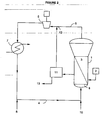
- a pilot plant continuously operated was used to prepare LLDPE as shown in FIGURE 2 .
- a fluidized bed gas phase reactor 1 with 45 cm of internal diameter and 120 cm of reaction zone height is fed by a dry-solid catalyst feeder 2.
- the bed of polymer particles in reaction zone 3 is kept in fluidized state by a recycle stream 4 that works as a fluidizing medium as well as a dissipating heat agent for absorbing the exothermal heat generated within reaction zone 3.
- the superficial velocity of the gas, resulting from the flow rate of recycle stream 4 within reactor 1 is 0.7 m/s.
- Stream 5 which contains the gas discharged from reactor 1 , said gas having low monomer contents, is fed to the suction of compressor 6.
- the combined reaction and compression heats are then removed from recycle stream 5 in an external heat exchange system 7 in order to control the reactor temperature.
- the composition of stream 5 is kept constant to yield a polymer with the required specifications.
- make-up components are fed to the system at spot 8 so as to make up the composition of recycle stream 5.
- make-up stream 8 will include the triethyl aluminum (TEAL) that directly reacts in a ratio of 2 moles of TEAL per mole of catalyst.
- propane is fed as the selected non-reactive compound required to maintain the total pressure of the system.
- the polymerization catalyst is introduced as a dry powder by a catalyst feeder into reactor 1 in a site within the reaction zone 3, close to the distributing plate 9 in a rate to control the residence time of the catalyst.
- the reactive gases, including ethylene and comonomers are introduced at the spot 10.
- the produced polymer is discharged from the reaction zone through a discharge system 11 that provides the recovery of the reactive and non-reactive gases, recycling said gases back to the recycle stream 5 at spot 12 and lowers the pressure of the discharged mixture of polymer and gases at certain pressure for later conveying the produced polymer particles 13 for downward sampling.
- the examples 13 to 23 were conducted in the gas phase pilot reactor at 88° C, using in each EXAMPLE respectively the catalysts produced in the EXAMPLES 1 to 10.
- the catalyst produced in the EXAMPLE 10 was also used in the pilot polymerization at 75° C as shown in the EXAMPLE 23.
Landscapes
- Chemical & Material Sciences (AREA)
- Organic Chemistry (AREA)
- Chemical Kinetics & Catalysis (AREA)
- Engineering & Computer Science (AREA)
- Materials Engineering (AREA)
- Inorganic Chemistry (AREA)
- Health & Medical Sciences (AREA)
- Medicinal Chemistry (AREA)
- Polymers & Plastics (AREA)
- Transition And Organic Metals Composition Catalysts For Addition Polymerization (AREA)
Claims (28)
- Verfahren zum Erhalt einer festen Katalysator-Komponente für die Ethylen-Polymerisation und -Copolymerisation, bei dem ein Träger aus teilchenförmigem Siliciumdioxid (65 bis 85 Gew.-%) mit einem katalytisch aktiven Teil (15 bis 35 Gew.-%) imprägniert wird, welcher Titan, Magnesium, Chlor, Alkoxygruppen und mindestens eine organometallische Verbindung der Gruppe 13 des Periodensystems einschließt, wobei das Verfahren die Schritte umfasst:(a) Imprägnieren eines aktivierten teilchenförmigen Siliciumdioxids in Teilchen unter Verwendung einer Lösung einer organometallischen Verbindung der Gruppe 13 des Periodensystems in einer Menge, die im Bereich von 0,1 bis 1 mMol der organometallischen Lösung pro mMol OH an der Siliciumdioxid-Oberfläche liegt, in einem inerten organischen Lösungsmittel;(b) Entfernen der überstehenden Flüssigkeit aus dem Schritt (a);(c) Herstellen einer Lösung, die erhalten wird durch Umsetzen mindestens einer Magnesium-Verbindung, die aus Magnesiumhalogeniden und Magnesiumalkoholaten ausgewählt ist, in einer Menge, die im Bereich von 0,0024 bis 0,24 g Magnesium pro g Siliciumdioxid liegt, und mindestens einer Titan-Verbindung, die aus Titanalkoholaten und Titanhalogenalkoholaten ausgewählt ist, in einer Menge im Bereich von 0,01 bis 1 g Titan pro g Siliciumdioxid;(d) Imprägnieren des in (b) erhaltenen Siliciumdioxids unter Verwendung der in (c) hergestellten Lösung;(e) gegebenenfalls Umsetzen des in (d) erhaltenen Festkörpers mit einem Reduktionsmittel, das ausgewählt ist aus der Gruppe bestehend aus Na-Alkylen, Li-Alkylen, Zn-Alkylen, Mg-Alkylen und entsprechenden Aryl-Derivaten, Grignard-Verbindungen des Typs RMgX und Polyhydrosiloxanen, wobei R eine lineare oder verzweigte Alkylgruppe, die 1 bis 10 Kohlenstoffe enthält, oder Aryl-Derivate darstellt, und X ein Halogenatom darstellt, und Al-Alkylhalogenid- oder Siliciumverbindungen;(f) Umsetzen des in (d) oder (e) erhaltenen Festkörpers mit einem Halogenierungsmittel, das ausgewählt ist aus der Gruppe bestehend aus Methylaluminiumdichlorid, Methylaluminiumsesquichlorid, Isobutylaluminiumdichlorid, Isobutylaluminiumsesquichlorid, Ethylaluminiumdichlorid (EADC), Diethylaluminiumchlorid (DEAC), Ethylaluminiumsesquichlorid (EASC), SiCl4, SnCl4, HCl, Cl2, HSiCl3, Aluminiumchlorid, Ethylbordichlorid, Borchlorid, Diethylborchlorid, HCCl3, PCl3, POCl3, Acetylchloriden, Thionylchlorid, Schwefelchlorid, Methyltrichlorsilan, Dimethyldichlorsilan, TiCl4, VCl4, CCl4, t-Butylchlorid, n-Butylchlorid, Chloroform, 1,1,1-Trichlorethan, 1,1,2-Trichlorethan, 1,2-Dichlorethan und Dichlormethan;(g) Halten des in (f) erhaltenen Festkörpers bei einer Temperatur von 60 °C bis 120 °C für 0,5 Stunden bis 5 Stunden;(h) Waschen des in (g) erhaltenen Festkörpers mit einem inerten organischen Lösungsmittel;(i) gegebenenfalls Waschen des in (h) erhaltenen Festkörpers mit einer Lösung einer oder mehrerer organometallischer Verbindungen der Gruppe 13 des Periodensystems in einer Menge, die im Bereich von 0 bis 3 g der organometallischen Verbindung pro g der erhaltenen trockenen Katalysator-Komponente liegt.
- Verfahren zum Erhalt einer festen Katalysator-Komponente nach Anspruch 1, bei dem das im Schritt (a) verwendete aktivierte teilchenförmige Siliciumdioxid ein mikrosphäroidisches poröses Siliciumdioxid ist.
- Verfahren zum Erhalt einer festen Katalysator-Komponente nach Anspruch 1 oder 2, bei dem das im Schritt (a) verwendete aktivierte teilchenförmige Siliciumdioxid eine Oberfläche (B.E.T.) im Bereich von 250 bis 500 m2/g aufweist.
- Verfahren zum Erhalt einer festen Katalysator-Komponente nach irgendeinem der Ansprüche 1 bis 3, bei dem das im Schritt (a) verwendete aktivierte teilchenförmige Siliciumdioxid ein Porenvolumen (B.E.T.) im Bereich von 1,0 bis 2,0 ml/g aufweist.
- Verfahren zum Erhalt einer festen Katalysator-Komponente nach Anspruch 1, bei dem die im Schritt (a) verwendeten organometallischen Verbindungen der Gruppe 13 des Periodensystems Trimethylaluminium, Triethylaluminium (TEAL), Methylaluminiumdichlorid, Methylaluminiumsesquichlorid, Isobutylaluminiumdichlorid, Isobutylaluminiumsesquichlorid, Ethylaluminiumdichlorid (EADC), Diethylaluminiumchlorid (DEAC), Ethylaluminiumsesquichlorid (EASC), Tri-n-hexylaluminium (Tn-HAL) oder Tri-n-octylaluminium (TnOAL) sind.
- Verfahren zum Erhalt einer festen Katalysator-Komponente nach Anspruch 1, bei dem die Menge der Lösung der organometallischen Verbindung der Gruppe 13 des Periodensystems im Schritt (a) im Bereich von 0,3 bis 0,7 mMol der organometallischen Lösung pro mMol OH auf der Siliciumdioxid-Oberfläche liegt.
- Verfahren zum Erhalt einer festen Katalysator-Komponente nach Anspruch 1, bei dem die überstehende Flüssigkeit aus Schritt (a) mittels Absetzen und Abhebern, Filtration oder Zentrifugation entfernt wird.
- Verfahren zum Erhalt einer festen Katalysator-Komponente nach Anspruch 1, bei dem die Magnesium-Verbindung, die zur Herstellung der Lösung des Schritts (c) verwendet wird, Magnesiumdichlorid, Magnesiumdiethylat, Magnesiumdi-n-butylat, Magnesiumdiisopropylat oder Magnesiumdiisobutylat ist.
- Verfahren zum Erhalt einer festen Katalysator-Komponente nach Anspruch 1 oder 8, bei dem die Magnesium-Verbindung, die zur Herstellung der Lösung des Schritts (c) verwendet wird, in einer Menge im Bereich von 0,0042 bis 0,042 g Magnesium pro g Siliciumdioxid vorliegt.
- Verfahren zum Erhalt einer festen Katalysator-Komponente nach Anspruch 1, bei dem die Titan-Verbindung, die zur Herstellung der Lösung des Schritts (c) verwendet wird, Titantetra-n-propylat, Titantetra-n-butylat, Titantetra-i-propylat, Titantetra-i-butylat oder die entsprechenden Titanmono- oder -dichloralkoholate ist.
- Verfahren zum Erhalt einer festen Katalysator-Komponente nach Anspruch 1 oder 10, bei dem die Titan-Verbindung, die zur Herstellung der Lösung des Schritts (c) verwendet wird, in einer Menge im Bereich von 0,0175 bis 0,175 g Titan pro g Siliciumdioxid vorliegt.
- Verfahren zum Erhalt einer festen Katalysator-Komponente nach irgendeinem der Ansprüche 1, 9 und 11, bei dem das Molverhältnis Ti/Mg, das zur Herstellung der Lösung des Schritts (c) verwendet wird, zwischen 0,3 und 0,4 eingeschlossen ist.
- Verfahren zum Erhalt einer festen Katalysator-Komponente nach Anspruch 1, bei dem das im Schritt (e) verwendete Reduktionsmittel (CH3)3SiO-[(CH3HSiO-]nSi(CH3)3, worin n im Bereich zwischen 5 und 100 liegt, (CH3HSiO)4, (CH3HSiO)3, H3Si-O-SiH2-OSiH3 oder Phenylhydropolysiloxane ist, worin die Wasserstoffatome teilweise durch Methylgruppen ersetzt sein können.
- Verfahren zum Erhalt einer festen Katalysator-Komponente nach Anspruch 1 oder 13, bei dem das im Schritt (e) verwendete Reduktionsmittel in einer Menge im Bereich von 0 bis 2 Mol pro Mol Titan vorliegt.
- Verfahren zum Erhalt einer festen Katalysator-Komponente nach Anspruch 14, bei dem das Reduktionsmittel in einer Menge im Bereich von 0 bis 0,1 Mol pro Mol Titan vorliegt.
- Verfahren zum Erhalt einer festen Katalysator-Komponente nach Anspruch 1, bei dem das Halogenierungsmittel SiCl4, SnCl4, HCl, Cl2, HSiCl3, Methyltrichlorsilan, Dimethyldichlorsilan, t-Butylchlorid, n-Butylchlorid, Chloroform, 1,1,1-Trichlorethan, 1,1,2-Trichlorethan, 1,2-Dichlorethan oder Dichlormethan ist.
- Verfahren zum Erhalt einer festen Katalysator-Komponente nach Anspruch 16, bei dem das Halogenierungsmittel SiCl4 ist.
- Verfahren zum Erhalt einer festen Katalysator-Komponente nach irgendeinem der Ansprüche 1, 16 und 17, bei dem das im Schritt (f) verwendete Halogenierungsmittel in einer Menge im Bereich von 0,5 bis 3 Mol Halogenierungsmittel pro Mol Titan vorliegt.
- Verfahren zum Erhalt einer festen Katalysator-Komponente nach Anspruch 1, bei dem die Wärmebehandlung des Schritts (g) 3 Stunden bis 5 Stunden und bei einer Temperatur von 60 °C bis 75 °C durchgeführt wird.
- Verfahren zum Erhalt einer festen Katalysator-Komponente nach Anspruch 1, bei dem der Festkörper im Schritt (h) mittels Absetzen und Abhebern, Filtration oder Zentrifugation aus der Suspension abgetrennt wird.
- Verfahren zum Erhalt einer festen Katalysator-Komponente nach Anspruch 1, bei dem die Menge der im Schritt (i) verwendeten Lösung einer oder mehrerer organometallischer Verbindungen der Gruppe 13 des Periodensystems im Bereich von 0,05 bis 1 g der organometallischen Verbindung pro g der erhaltenen trockenen Katalysator-Komponente liegt.
- Verfahren zum Erhalt einer festen Katalysator-Komponente nach Anspruch 1, bei dem im Schritt (i) zwei verschiedene organometallische Verbindungen verwendet werden, um den im Schritt (h) erhaltenen Festkörper zu waschen.
- Verfahren zum Erhalt einer festen Katalysator-Komponente nach Anspruch 1 oder 15, bei dem die zwei verschiedenen organometallischen Verbindungen im Schritt (i) zusammen in derselben Lösung gemischt zugeführt werden.
- Verfahren zum Erhalt einer festen Katalysator-Komponente nach Anspruch 1 oder 15, bei dem die zwei verschiedenen organometallischen Verbindungen im Schritt (i) gleichzeitig in individuellen Lösungen zugeführt werden.
- Verfahren zum Erhalt einer festen Katalysator-Komponente nach Anspruch 1 oder 15, bei dem die zwei verschiedenen organometallischen Verbindungen im Schritt (i) nacheinander in individuellen Lösung zugeführt werden.
- Verfahren zum Erhalt einer festen Katalysator-Komponente nach Anspruch 1 oder irgendeinem der Ansprüche 21 bis 25, bei dem die im Schritt (i) verwendete organometallische Verbindung Methylaluminiumdichlorid, Methylaluminiumsesquichlorid, Isobutylaluminiumdichlorid, lsobutylaluminiumsesquichlorid, Ethylaluminiumdichlorid (EADC), Diethylaluminiumchlorid (DEAC), Ethylaluminiumsesquichlorid (EASC), Tri-n-hexylaluminium (Tn-HAL) oder Tri-n-octylaluminium (TnOAL) ist.
- Verfahren zum Erhalt einer festen Katalysator-Komponente nach Anspruch 1, bei dem das verwendete inerte organische Lösungsmittel Hexan, Heptan, Octan oder Isoparaffin ist.
- Feste Katalysator-Komponente für die Ethylen-Polymerisation und -Copolymerisation, erhältlich durch das Verfahren wie in irgendeinem der Ansprüche 1 bis 27 definiert, wobei die feste Katalysator-Komponente einen Träger aus teilchenförmigem Siliciumdioxid und einen katalytisch aktiven Teil umfasst, der 0,005 bis 0,02 g Titan pro g festen Katalysator, 0,003 bis 0,03 Magnesium pro g festen Katalysator, Chlor, Alkoxygruppen und mindestens eine organometallische Verbindung der Gruppe 13 des Periodensystems in einer Menge im Bereich von 0,003 bis 0,03 g Metall pro g festen Katalysator einschließt.
Applications Claiming Priority (1)
| Application Number | Priority Date | Filing Date | Title |
|---|---|---|---|
| PCT/BR2002/000086 WO2004000893A1 (en) | 2002-06-19 | 2002-06-19 | Solid catalyst component for polymerization and copolymerization of ethylene, and, process for obtaining the same |
Publications (2)
| Publication Number | Publication Date |
|---|---|
| EP1515995A1 EP1515995A1 (de) | 2005-03-23 |
| EP1515995B1 true EP1515995B1 (de) | 2010-05-05 |
Family
ID=29783747
Family Applications (1)
| Application Number | Title | Priority Date | Filing Date |
|---|---|---|---|
| EP02740154A Expired - Lifetime EP1515995B1 (de) | 2002-06-19 | 2002-06-19 | Fester katalysatorbestandteil zur polymerisation und copolymerisation von ethylen, verfahren zu dessen herstellung |
Country Status (8)
| Country | Link |
|---|---|
| US (1) | US20060166812A1 (de) |
| EP (1) | EP1515995B1 (de) |
| AT (1) | ATE466892T1 (de) |
| AU (1) | AU2002315589A1 (de) |
| BR (1) | BR0215779B1 (de) |
| DE (1) | DE60236326D1 (de) |
| ES (1) | ES2342261T3 (de) |
| WO (1) | WO2004000893A1 (de) |
Cited By (1)
| Publication number | Priority date | Publication date | Assignee | Title |
|---|---|---|---|---|
| US11780942B2 (en) | 2019-10-25 | 2023-10-10 | Braskem S.A. | Ziegler-Natta produced polyethylene and methods thereof |
Families Citing this family (10)
| Publication number | Priority date | Publication date | Assignee | Title |
|---|---|---|---|---|
| US20060281879A1 (en) * | 2005-06-13 | 2006-12-14 | Univation Technologies, Llc | Catalyst compositions comprising small silica support materials and methods of use in polymerization reactions |
| BRPI0705994A2 (pt) * | 2007-10-19 | 2009-10-06 | Braskem Sa | processo de preparação de suporte catalìtico e catalisadores bimetálicos suportados para a produção de homopolìmeros e copolìmeros de etileno com alfa-olefinas de alto e ultra alto peso molecular e com ampla distribuição de peso molecular em processos em lama, massa e fase gás e os produtos assim obtidos |
| ES2605277T3 (es) * | 2008-08-06 | 2017-03-13 | Union Carbide Chemicals & Plastics Technology Llc | Métodos de obtención de composiciones de catalizador de ziegler-natta para producir polietilenos con una cola de alto peso molecular |
| WO2018044275A1 (en) * | 2016-08-30 | 2018-03-08 | Dow Global Technologies Llc | Ethylene/c3-c6 alpha-olefin interpolymers with improved pellet flowability |
| CN108976330B (zh) * | 2017-05-31 | 2021-04-13 | 中国石油化工股份有限公司 | 茂金属乙烯聚合物的制备方法 |
| CN108976326B (zh) * | 2017-05-31 | 2021-04-13 | 中国石油化工股份有限公司 | 茂金属聚乙烯催化剂及其制备方法 |
| CN111072797B (zh) * | 2018-10-19 | 2021-07-02 | 中国石油化工股份有限公司 | 烯烃聚合催化剂球形载体及其制备方法和催化剂组分与催化剂及应用 |
| CN111072808B (zh) * | 2018-10-19 | 2022-09-20 | 中国石油化工股份有限公司 | 催化剂组分和催化剂及其应用与烯烃聚合方法 |
| US11214633B2 (en) * | 2019-09-10 | 2022-01-04 | Braskem America, Inc. | Ziegler-Natta catalyst systems and methods of controlling particle size |
| CN111234055B (zh) * | 2020-01-19 | 2022-11-08 | 上海化工研究院有限公司 | 一种负载型钛系催化剂及其制备方法和应用 |
Family Cites Families (7)
| Publication number | Priority date | Publication date | Assignee | Title |
|---|---|---|---|---|
| IT1150031B (it) * | 1980-07-24 | 1986-12-10 | Montedison Spa | Componenti di catalizzatori per la polimerizzazione dell'etilene |
| EP0240254A3 (de) * | 1986-03-31 | 1989-07-26 | Exxon Chemical Patents Inc. | Polymerisationskatalysator, Herstellung und Anwendung |
| EP0494084B1 (de) * | 1988-05-13 | 1997-07-23 | Mitsui Petrochemical Industries, Ltd. | Titaniumkatalysatorbestandteil, Verfahren zur Herstellung desselben, dieses enthaltenden Katalysator für Herstellung von Ethylenpolymere und Verfahren zur Herstellung dieser Ethylenpolymere |
| FI91968C (fi) * | 1989-11-28 | 1994-09-12 | Borealis Polymers Oy | -olefiinien polymerointiin tarkoitettu prokatalyyttikompositio, sen valmistus ja käyttö |
| IT1252041B (it) * | 1990-10-11 | 1995-05-29 | Enimont Anic Srl | Componente solido di catalizzatore per la (co)polimerizzazione dell'etilene |
| IT1251465B (it) * | 1991-07-12 | 1995-05-15 | Enichem Polimeri | Catalizzatore supportato per la (co)polimerizzazione dell'etilene. |
| IT1262934B (it) * | 1992-01-31 | 1996-07-22 | Montecatini Tecnologie Srl | Componenti e catalizzatori per la polimerizzazione di olefine |
-
2002
- 2002-06-19 ES ES02740154T patent/ES2342261T3/es not_active Expired - Lifetime
- 2002-06-19 EP EP02740154A patent/EP1515995B1/de not_active Expired - Lifetime
- 2002-06-19 WO PCT/BR2002/000086 patent/WO2004000893A1/en not_active Ceased
- 2002-06-19 AT AT02740154T patent/ATE466892T1/de active
- 2002-06-19 US US10/518,443 patent/US20060166812A1/en not_active Abandoned
- 2002-06-19 DE DE60236326T patent/DE60236326D1/de not_active Expired - Lifetime
- 2002-06-19 AU AU2002315589A patent/AU2002315589A1/en not_active Abandoned
- 2002-06-19 BR BRPI0215779-9A patent/BR0215779B1/pt not_active IP Right Cessation
Cited By (1)
| Publication number | Priority date | Publication date | Assignee | Title |
|---|---|---|---|---|
| US11780942B2 (en) | 2019-10-25 | 2023-10-10 | Braskem S.A. | Ziegler-Natta produced polyethylene and methods thereof |
Also Published As
| Publication number | Publication date |
|---|---|
| WO2004000893A1 (en) | 2003-12-31 |
| DE60236326D1 (de) | 2010-06-17 |
| EP1515995A1 (de) | 2005-03-23 |
| ES2342261T3 (es) | 2010-07-05 |
| AU2002315589A1 (en) | 2004-01-06 |
| US20060166812A1 (en) | 2006-07-27 |
| BR0215779A (pt) | 2005-03-01 |
| BR0215779B1 (pt) | 2011-10-04 |
| ATE466892T1 (de) | 2010-05-15 |
Similar Documents
| Publication | Publication Date | Title |
|---|---|---|
| JP3910219B2 (ja) | オレフィン類の気相重合法 | |
| US6303716B1 (en) | High-activity catalyst for producing low-, medium- and high density polyethylenes by gas phase polymerization, process for preparing the same and use of the same in ethylene polymerization | |
| US9352308B2 (en) | Solid catalyst component for polymerization and copolymerization of ethylene and process for obtaining the same | |
| CA2109136C (en) | Process for the preparation of a ziegler-natta type catalyst | |
| EP2032612A1 (de) | Katalysatorvorläufer auf magnesiumchloroalkolat-basis | |
| KR100334165B1 (ko) | 에틸렌 중합 및 에틸렌/α-올레핀 공중합용 담지촉매의 제조방법 | |
| CA2369208A1 (en) | Methods of making magnesium/transition metal alkoxide complexes and polymerization catalysts made therefrom | |
| EP0160413A2 (de) | Katalysator, Verfahren zur Herstellung desselben und seine Anwendung bei Olefinpolymerisierung | |
| US20060166812A1 (en) | Solid catalyst component for polymerization and copolymerization of ethylene, and, process for obtaining the same | |
| US4981826A (en) | Polymerization catalyst prepared with a halogenated silane compound | |
| EP3555150A1 (de) | Katalysatorkomponenten zur olefinpolymerisierung und daraus gewonnenen katalysatoren | |
| CA2379053A1 (en) | Pre-polymerized catalyst components for the polymerization of olefins | |
| US7985814B2 (en) | Main catalyst component for olefin polymerization, a process for preparing the same and a catalyst comprising the same | |
| EP1196454A1 (de) | Magnesium/titan-alkoxidkomplexe und daraus hergestellte polymerisationskatalysatoren | |
| FI91968C (fi) | -olefiinien polymerointiin tarkoitettu prokatalyyttikompositio, sen valmistus ja käyttö | |
| EP0480434A2 (de) | Feste Komponente eines Katalysators zur Homo- und Co-Polymerisation von Ethyl | |
| WO2010043355A1 (en) | A catalyst for the production of linear low density polyethylene | |
| US7651969B2 (en) | Catalyst system for producing ethylene (co) polymer with improved branch distribution | |
| EP0081940B1 (de) | Herstellung eines Katalysators und Verfahren zur Herstellung eines linearen Polyäthylens niederer Dichte | |
| WO2004072122A2 (en) | The preparation of a magnesium halide support for olefin polymerization and a catalyst composition using the same | |
| KR100436494B1 (ko) | 에틸렌 중합 및 에틸렌/알파-올레핀 공중합용 담지촉매의제조방법 | |
| JPH08134124A (ja) | チーグラー・ナッタ触媒によるオレフィンの重合方法 | |
| EP1749574A1 (de) | Verfahren zur herstellung eines katalysators und verfahren zur polymerisation von ethylen und copolymerisation von ethylen mit alpha-olefinen | |
| KR100334160B1 (ko) | 에틸렌 중합 및 에틸렌/α-올레핀 공중합용 담지촉매의 제조방법 | |
| JPH0118927B2 (de) |
Legal Events
| Date | Code | Title | Description |
|---|---|---|---|
| PUAI | Public reference made under article 153(3) epc to a published international application that has entered the european phase |
Free format text: ORIGINAL CODE: 0009012 |
|
| 17P | Request for examination filed |
Effective date: 20050113 |
|
| AK | Designated contracting states |
Kind code of ref document: A1 Designated state(s): AT BE CH CY DE DK ES FI FR GB GR IE IT LI LU MC NL PT SE TR |
|
| AX | Request for extension of the european patent |
Extension state: AL LT LV MK RO SI |
|
| DAX | Request for extension of the european patent (deleted) | ||
| APBK | Appeal reference recorded |
Free format text: ORIGINAL CODE: EPIDOSNREFNE |
|
| APBN | Date of receipt of notice of appeal recorded |
Free format text: ORIGINAL CODE: EPIDOSNNOA2E |
|
| APBR | Date of receipt of statement of grounds of appeal recorded |
Free format text: ORIGINAL CODE: EPIDOSNNOA3E |
|
| APBV | Interlocutory revision of appeal recorded |
Free format text: ORIGINAL CODE: EPIDOSNIRAPE |
|
| GRAP | Despatch of communication of intention to grant a patent |
Free format text: ORIGINAL CODE: EPIDOSNIGR1 |
|
| GRAS | Grant fee paid |
Free format text: ORIGINAL CODE: EPIDOSNIGR3 |
|
| RIN1 | Information on inventor provided before grant (corrected) |
Inventor name: DOS SANTOS SILVEIRA, LEANDRO Inventor name: MIRANDA, MARCIA, SILVA, LACERDA Inventor name: AMORIM, RICHARD FARACO Inventor name: BRAGANCA, ANTONIO, LUIZ, DUARTE |
|
| GRAA | (expected) grant |
Free format text: ORIGINAL CODE: 0009210 |
|
| AK | Designated contracting states |
Kind code of ref document: B1 Designated state(s): AT BE CH CY DE DK ES FI FR GB GR IE IT LI LU MC NL PT SE TR |
|
| REG | Reference to a national code |
Ref country code: GB Ref legal event code: FG4D |
|
| REG | Reference to a national code |
Ref country code: CH Ref legal event code: EP |
|
| REG | Reference to a national code |
Ref country code: IE Ref legal event code: FG4D |
|
| REF | Corresponds to: |
Ref document number: 60236326 Country of ref document: DE Date of ref document: 20100617 Kind code of ref document: P |
|
| REG | Reference to a national code |
Ref country code: ES Ref legal event code: FG2A Ref document number: 2342261 Country of ref document: ES Kind code of ref document: T3 |
|
| REG | Reference to a national code |
Ref country code: NL Ref legal event code: T3 |
|
| PG25 | Lapsed in a contracting state [announced via postgrant information from national office to epo] |
Ref country code: SE Free format text: LAPSE BECAUSE OF FAILURE TO SUBMIT A TRANSLATION OF THE DESCRIPTION OR TO PAY THE FEE WITHIN THE PRESCRIBED TIME-LIMIT Effective date: 20100505 |
|
| PG25 | Lapsed in a contracting state [announced via postgrant information from national office to epo] |
Ref country code: CY Free format text: LAPSE BECAUSE OF FAILURE TO SUBMIT A TRANSLATION OF THE DESCRIPTION OR TO PAY THE FEE WITHIN THE PRESCRIBED TIME-LIMIT Effective date: 20100505 Ref country code: GR Free format text: LAPSE BECAUSE OF FAILURE TO SUBMIT A TRANSLATION OF THE DESCRIPTION OR TO PAY THE FEE WITHIN THE PRESCRIBED TIME-LIMIT Effective date: 20100806 |
|
| PG25 | Lapsed in a contracting state [announced via postgrant information from national office to epo] |
Ref country code: PT Free format text: LAPSE BECAUSE OF FAILURE TO SUBMIT A TRANSLATION OF THE DESCRIPTION OR TO PAY THE FEE WITHIN THE PRESCRIBED TIME-LIMIT Effective date: 20100906 Ref country code: MC Free format text: LAPSE BECAUSE OF NON-PAYMENT OF DUE FEES Effective date: 20100630 Ref country code: DK Free format text: LAPSE BECAUSE OF FAILURE TO SUBMIT A TRANSLATION OF THE DESCRIPTION OR TO PAY THE FEE WITHIN THE PRESCRIBED TIME-LIMIT Effective date: 20100505 |
|
| REG | Reference to a national code |
Ref country code: CH Ref legal event code: PL |
|
| PLBE | No opposition filed within time limit |
Free format text: ORIGINAL CODE: 0009261 |
|
| STAA | Information on the status of an ep patent application or granted ep patent |
Free format text: STATUS: NO OPPOSITION FILED WITHIN TIME LIMIT |
|
| 26N | No opposition filed |
Effective date: 20110208 |
|
| PG25 | Lapsed in a contracting state [announced via postgrant information from national office to epo] |
Ref country code: LI Free format text: LAPSE BECAUSE OF NON-PAYMENT OF DUE FEES Effective date: 20100630 Ref country code: CH Free format text: LAPSE BECAUSE OF NON-PAYMENT OF DUE FEES Effective date: 20100630 Ref country code: IE Free format text: LAPSE BECAUSE OF NON-PAYMENT OF DUE FEES Effective date: 20100619 |
|
| REG | Reference to a national code |
Ref country code: DE Ref legal event code: R097 Ref document number: 60236326 Country of ref document: DE Effective date: 20110207 |
|
| PG25 | Lapsed in a contracting state [announced via postgrant information from national office to epo] |
Ref country code: LU Free format text: LAPSE BECAUSE OF NON-PAYMENT OF DUE FEES Effective date: 20100619 |
|
| PG25 | Lapsed in a contracting state [announced via postgrant information from national office to epo] |
Ref country code: TR Free format text: LAPSE BECAUSE OF FAILURE TO SUBMIT A TRANSLATION OF THE DESCRIPTION OR TO PAY THE FEE WITHIN THE PRESCRIBED TIME-LIMIT Effective date: 20100505 |
|
| REG | Reference to a national code |
Ref country code: FR Ref legal event code: PLFP Year of fee payment: 15 |
|
| REG | Reference to a national code |
Ref country code: FR Ref legal event code: PLFP Year of fee payment: 16 |
|
| REG | Reference to a national code |
Ref country code: FR Ref legal event code: PLFP Year of fee payment: 17 |
|
| PGFP | Annual fee paid to national office [announced via postgrant information from national office to epo] |
Ref country code: DE Payment date: 20180605 Year of fee payment: 17 Ref country code: FI Payment date: 20180612 Year of fee payment: 17 Ref country code: NL Payment date: 20180613 Year of fee payment: 17 |
|
| PGFP | Annual fee paid to national office [announced via postgrant information from national office to epo] |
Ref country code: AT Payment date: 20180525 Year of fee payment: 17 Ref country code: BE Payment date: 20180515 Year of fee payment: 17 Ref country code: FR Payment date: 20180529 Year of fee payment: 17 |
|
| PGFP | Annual fee paid to national office [announced via postgrant information from national office to epo] |
Ref country code: ES Payment date: 20180702 Year of fee payment: 17 Ref country code: GB Payment date: 20180613 Year of fee payment: 17 Ref country code: IT Payment date: 20180625 Year of fee payment: 17 |
|
| REG | Reference to a national code |
Ref country code: DE Ref legal event code: R119 Ref document number: 60236326 Country of ref document: DE |
|
| REG | Reference to a national code |
Ref country code: FI Ref legal event code: MAE |
|
| PG25 | Lapsed in a contracting state [announced via postgrant information from national office to epo] |
Ref country code: FI Free format text: LAPSE BECAUSE OF NON-PAYMENT OF DUE FEES Effective date: 20190619 |
|
| REG | Reference to a national code |
Ref country code: NL Ref legal event code: MM Effective date: 20190701 |
|
| REG | Reference to a national code |
Ref country code: AT Ref legal event code: MM01 Ref document number: 466892 Country of ref document: AT Kind code of ref document: T Effective date: 20190619 |
|
| GBPC | Gb: european patent ceased through non-payment of renewal fee |
Effective date: 20190619 |
|
| REG | Reference to a national code |
Ref country code: BE Ref legal event code: MM Effective date: 20190630 |
|
| PG25 | Lapsed in a contracting state [announced via postgrant information from national office to epo] |
Ref country code: GB Free format text: LAPSE BECAUSE OF NON-PAYMENT OF DUE FEES Effective date: 20190619 Ref country code: NL Free format text: LAPSE BECAUSE OF NON-PAYMENT OF DUE FEES Effective date: 20190701 Ref country code: AT Free format text: LAPSE BECAUSE OF NON-PAYMENT OF DUE FEES Effective date: 20190619 Ref country code: IT Free format text: LAPSE BECAUSE OF NON-PAYMENT OF DUE FEES Effective date: 20190619 Ref country code: DE Free format text: LAPSE BECAUSE OF NON-PAYMENT OF DUE FEES Effective date: 20200101 |
|
| PG25 | Lapsed in a contracting state [announced via postgrant information from national office to epo] |
Ref country code: BE Free format text: LAPSE BECAUSE OF NON-PAYMENT OF DUE FEES Effective date: 20190630 |
|
| PG25 | Lapsed in a contracting state [announced via postgrant information from national office to epo] |
Ref country code: FR Free format text: LAPSE BECAUSE OF NON-PAYMENT OF DUE FEES Effective date: 20190630 |
|
| REG | Reference to a national code |
Ref country code: ES Ref legal event code: FD2A Effective date: 20201028 |
|
| PG25 | Lapsed in a contracting state [announced via postgrant information from national office to epo] |
Ref country code: ES Free format text: LAPSE BECAUSE OF NON-PAYMENT OF DUE FEES Effective date: 20190620 |