EP1514916A1 - Antiferroelektrischer flüssigkristall und sein herstellverfahren - Google Patents
Antiferroelektrischer flüssigkristall und sein herstellverfahren Download PDFInfo
- Publication number
- EP1514916A1 EP1514916A1 EP03730614A EP03730614A EP1514916A1 EP 1514916 A1 EP1514916 A1 EP 1514916A1 EP 03730614 A EP03730614 A EP 03730614A EP 03730614 A EP03730614 A EP 03730614A EP 1514916 A1 EP1514916 A1 EP 1514916A1
- Authority
- EP
- European Patent Office
- Prior art keywords
- liquid crystal
- smectic
- phase
- molecules
- rod
- Prior art date
- Legal status (The legal status is an assumption and is not a legal conclusion. Google has not performed a legal analysis and makes no representation as to the accuracy of the status listed.)
- Withdrawn
Links
Images



Classifications
-
- C—CHEMISTRY; METALLURGY
- C09—DYES; PAINTS; POLISHES; NATURAL RESINS; ADHESIVES; COMPOSITIONS NOT OTHERWISE PROVIDED FOR; APPLICATIONS OF MATERIALS NOT OTHERWISE PROVIDED FOR
- C09K—MATERIALS FOR MISCELLANEOUS APPLICATIONS, NOT PROVIDED FOR ELSEWHERE
- C09K19/00—Liquid crystal materials
- C09K19/04—Liquid crystal materials characterised by the chemical structure of the liquid crystal components, e.g. by a specific unit
- C09K19/06—Non-steroidal liquid crystal compounds
- C09K19/08—Non-steroidal liquid crystal compounds containing at least two non-condensed rings
- C09K19/10—Non-steroidal liquid crystal compounds containing at least two non-condensed rings containing at least two benzene rings
- C09K19/20—Non-steroidal liquid crystal compounds containing at least two non-condensed rings containing at least two benzene rings linked by a chain containing carbon and oxygen atoms as chain links, e.g. esters or ethers
- C09K19/2007—Non-steroidal liquid crystal compounds containing at least two non-condensed rings containing at least two benzene rings linked by a chain containing carbon and oxygen atoms as chain links, e.g. esters or ethers the chain containing -COO- or -OCO- groups
- C09K19/2021—Compounds containing at least one asymmetric carbon atom
-
- C—CHEMISTRY; METALLURGY
- C09—DYES; PAINTS; POLISHES; NATURAL RESINS; ADHESIVES; COMPOSITIONS NOT OTHERWISE PROVIDED FOR; APPLICATIONS OF MATERIALS NOT OTHERWISE PROVIDED FOR
- C09K—MATERIALS FOR MISCELLANEOUS APPLICATIONS, NOT PROVIDED FOR ELSEWHERE
- C09K19/00—Liquid crystal materials
- C09K19/04—Liquid crystal materials characterised by the chemical structure of the liquid crystal components, e.g. by a specific unit
- C09K19/06—Non-steroidal liquid crystal compounds
- C09K19/08—Non-steroidal liquid crystal compounds containing at least two non-condensed rings
- C09K19/10—Non-steroidal liquid crystal compounds containing at least two non-condensed rings containing at least two benzene rings
- C09K19/20—Non-steroidal liquid crystal compounds containing at least two non-condensed rings containing at least two benzene rings linked by a chain containing carbon and oxygen atoms as chain links, e.g. esters or ethers
-
- C—CHEMISTRY; METALLURGY
- C09—DYES; PAINTS; POLISHES; NATURAL RESINS; ADHESIVES; COMPOSITIONS NOT OTHERWISE PROVIDED FOR; APPLICATIONS OF MATERIALS NOT OTHERWISE PROVIDED FOR
- C09K—MATERIALS FOR MISCELLANEOUS APPLICATIONS, NOT PROVIDED FOR ELSEWHERE
- C09K19/00—Liquid crystal materials
- C09K19/02—Liquid crystal materials characterised by optical, electrical or physical properties of the components, in general
- C09K19/0266—Antiferroelectrics
-
- C—CHEMISTRY; METALLURGY
- C09—DYES; PAINTS; POLISHES; NATURAL RESINS; ADHESIVES; COMPOSITIONS NOT OTHERWISE PROVIDED FOR; APPLICATIONS OF MATERIALS NOT OTHERWISE PROVIDED FOR
- C09K—MATERIALS FOR MISCELLANEOUS APPLICATIONS, NOT PROVIDED FOR ELSEWHERE
- C09K19/00—Liquid crystal materials
- C09K19/04—Liquid crystal materials characterised by the chemical structure of the liquid crystal components, e.g. by a specific unit
- C09K19/06—Non-steroidal liquid crystal compounds
- C09K19/08—Non-steroidal liquid crystal compounds containing at least two non-condensed rings
- C09K19/10—Non-steroidal liquid crystal compounds containing at least two non-condensed rings containing at least two benzene rings
- C09K19/20—Non-steroidal liquid crystal compounds containing at least two non-condensed rings containing at least two benzene rings linked by a chain containing carbon and oxygen atoms as chain links, e.g. esters or ethers
- C09K19/2007—Non-steroidal liquid crystal compounds containing at least two non-condensed rings containing at least two benzene rings linked by a chain containing carbon and oxygen atoms as chain links, e.g. esters or ethers the chain containing -COO- or -OCO- groups
-
- C—CHEMISTRY; METALLURGY
- C09—DYES; PAINTS; POLISHES; NATURAL RESINS; ADHESIVES; COMPOSITIONS NOT OTHERWISE PROVIDED FOR; APPLICATIONS OF MATERIALS NOT OTHERWISE PROVIDED FOR
- C09K—MATERIALS FOR MISCELLANEOUS APPLICATIONS, NOT PROVIDED FOR ELSEWHERE
- C09K19/00—Liquid crystal materials
- C09K19/04—Liquid crystal materials characterised by the chemical structure of the liquid crystal components, e.g. by a specific unit
- C09K19/06—Non-steroidal liquid crystal compounds
- C09K19/08—Non-steroidal liquid crystal compounds containing at least two non-condensed rings
- C09K19/10—Non-steroidal liquid crystal compounds containing at least two non-condensed rings containing at least two benzene rings
- C09K19/20—Non-steroidal liquid crystal compounds containing at least two non-condensed rings containing at least two benzene rings linked by a chain containing carbon and oxygen atoms as chain links, e.g. esters or ethers
- C09K19/2007—Non-steroidal liquid crystal compounds containing at least two non-condensed rings containing at least two benzene rings linked by a chain containing carbon and oxygen atoms as chain links, e.g. esters or ethers the chain containing -COO- or -OCO- groups
- C09K19/2014—Non-steroidal liquid crystal compounds containing at least two non-condensed rings containing at least two benzene rings linked by a chain containing carbon and oxygen atoms as chain links, e.g. esters or ethers the chain containing -COO- or -OCO- groups containing additionally a linking group other than -COO- or -OCO-, e.g. -CH2-CH2-, -CH=CH-, -C=C-; containing at least one additional carbon atom in the chain containing -COO- or -OCO- groups, e.g. -(CH2)m-COO-(CH2)n-
-
- C—CHEMISTRY; METALLURGY
- C09—DYES; PAINTS; POLISHES; NATURAL RESINS; ADHESIVES; COMPOSITIONS NOT OTHERWISE PROVIDED FOR; APPLICATIONS OF MATERIALS NOT OTHERWISE PROVIDED FOR
- C09K—MATERIALS FOR MISCELLANEOUS APPLICATIONS, NOT PROVIDED FOR ELSEWHERE
- C09K19/00—Liquid crystal materials
- C09K19/04—Liquid crystal materials characterised by the chemical structure of the liquid crystal components, e.g. by a specific unit
- C09K19/42—Mixtures of liquid crystal compounds covered by two or more of the preceding groups C09K19/06 - C09K19/40
- C09K19/46—Mixtures of liquid crystal compounds covered by two or more of the preceding groups C09K19/06 - C09K19/40 containing esters
-
- C—CHEMISTRY; METALLURGY
- C09—DYES; PAINTS; POLISHES; NATURAL RESINS; ADHESIVES; COMPOSITIONS NOT OTHERWISE PROVIDED FOR; APPLICATIONS OF MATERIALS NOT OTHERWISE PROVIDED FOR
- C09K—MATERIALS FOR MISCELLANEOUS APPLICATIONS, NOT PROVIDED FOR ELSEWHERE
- C09K19/00—Liquid crystal materials
- C09K19/04—Liquid crystal materials characterised by the chemical structure of the liquid crystal components, e.g. by a specific unit
- C09K2019/0444—Liquid crystal materials characterised by the chemical structure of the liquid crystal components, e.g. by a specific unit characterized by a linking chain between rings or ring systems, a bridging chain between extensive mesogenic moieties or an end chain group
-
- G—PHYSICS
- G02—OPTICS
- G02F—OPTICAL DEVICES OR ARRANGEMENTS FOR THE CONTROL OF LIGHT BY MODIFICATION OF THE OPTICAL PROPERTIES OF THE MEDIA OF THE ELEMENTS INVOLVED THEREIN; NON-LINEAR OPTICS; FREQUENCY-CHANGING OF LIGHT; OPTICAL LOGIC ELEMENTS; OPTICAL ANALOGUE/DIGITAL CONVERTERS
- G02F1/00—Devices or arrangements for the control of the intensity, colour, phase, polarisation or direction of light arriving from an independent light source, e.g. switching, gating or modulating; Non-linear optics
- G02F1/01—Devices or arrangements for the control of the intensity, colour, phase, polarisation or direction of light arriving from an independent light source, e.g. switching, gating or modulating; Non-linear optics for the control of the intensity, phase, polarisation or colour
- G02F1/13—Devices or arrangements for the control of the intensity, colour, phase, polarisation or direction of light arriving from an independent light source, e.g. switching, gating or modulating; Non-linear optics for the control of the intensity, phase, polarisation or colour based on liquid crystals, e.g. single liquid crystal display cells
- G02F1/133—Constructional arrangements; Operation of liquid crystal cells; Circuit arrangements
- G02F1/1333—Constructional arrangements; Manufacturing methods
- G02F1/1335—Structural association of cells with optical devices, e.g. polarisers or reflectors
- G02F1/133509—Filters, e.g. light shielding masks
- G02F1/133514—Colour filters
-
- G—PHYSICS
- G02—OPTICS
- G02F—OPTICAL DEVICES OR ARRANGEMENTS FOR THE CONTROL OF LIGHT BY MODIFICATION OF THE OPTICAL PROPERTIES OF THE MEDIA OF THE ELEMENTS INVOLVED THEREIN; NON-LINEAR OPTICS; FREQUENCY-CHANGING OF LIGHT; OPTICAL LOGIC ELEMENTS; OPTICAL ANALOGUE/DIGITAL CONVERTERS
- G02F1/00—Devices or arrangements for the control of the intensity, colour, phase, polarisation or direction of light arriving from an independent light source, e.g. switching, gating or modulating; Non-linear optics
- G02F1/01—Devices or arrangements for the control of the intensity, colour, phase, polarisation or direction of light arriving from an independent light source, e.g. switching, gating or modulating; Non-linear optics for the control of the intensity, phase, polarisation or colour
- G02F1/13—Devices or arrangements for the control of the intensity, colour, phase, polarisation or direction of light arriving from an independent light source, e.g. switching, gating or modulating; Non-linear optics for the control of the intensity, phase, polarisation or colour based on liquid crystals, e.g. single liquid crystal display cells
- G02F1/133—Constructional arrangements; Operation of liquid crystal cells; Circuit arrangements
- G02F1/1333—Constructional arrangements; Manufacturing methods
- G02F1/1335—Structural association of cells with optical devices, e.g. polarisers or reflectors
- G02F1/133509—Filters, e.g. light shielding masks
- G02F1/133514—Colour filters
- G02F1/133519—Overcoatings
-
- G—PHYSICS
- G02—OPTICS
- G02F—OPTICAL DEVICES OR ARRANGEMENTS FOR THE CONTROL OF LIGHT BY MODIFICATION OF THE OPTICAL PROPERTIES OF THE MEDIA OF THE ELEMENTS INVOLVED THEREIN; NON-LINEAR OPTICS; FREQUENCY-CHANGING OF LIGHT; OPTICAL LOGIC ELEMENTS; OPTICAL ANALOGUE/DIGITAL CONVERTERS
- G02F1/00—Devices or arrangements for the control of the intensity, colour, phase, polarisation or direction of light arriving from an independent light source, e.g. switching, gating or modulating; Non-linear optics
- G02F1/01—Devices or arrangements for the control of the intensity, colour, phase, polarisation or direction of light arriving from an independent light source, e.g. switching, gating or modulating; Non-linear optics for the control of the intensity, phase, polarisation or colour
- G02F1/13—Devices or arrangements for the control of the intensity, colour, phase, polarisation or direction of light arriving from an independent light source, e.g. switching, gating or modulating; Non-linear optics for the control of the intensity, phase, polarisation or colour based on liquid crystals, e.g. single liquid crystal display cells
- G02F1/133—Constructional arrangements; Operation of liquid crystal cells; Circuit arrangements
- G02F1/1333—Constructional arrangements; Manufacturing methods
- G02F1/1339—Gaskets; Spacers; Sealing of cells
- G02F1/13394—Gaskets; Spacers; Sealing of cells spacers regularly patterned on the cell subtrate, e.g. walls, pillars
-
- G—PHYSICS
- G02—OPTICS
- G02F—OPTICAL DEVICES OR ARRANGEMENTS FOR THE CONTROL OF LIGHT BY MODIFICATION OF THE OPTICAL PROPERTIES OF THE MEDIA OF THE ELEMENTS INVOLVED THEREIN; NON-LINEAR OPTICS; FREQUENCY-CHANGING OF LIGHT; OPTICAL LOGIC ELEMENTS; OPTICAL ANALOGUE/DIGITAL CONVERTERS
- G02F1/00—Devices or arrangements for the control of the intensity, colour, phase, polarisation or direction of light arriving from an independent light source, e.g. switching, gating or modulating; Non-linear optics
- G02F1/01—Devices or arrangements for the control of the intensity, colour, phase, polarisation or direction of light arriving from an independent light source, e.g. switching, gating or modulating; Non-linear optics for the control of the intensity, phase, polarisation or colour
- G02F1/13—Devices or arrangements for the control of the intensity, colour, phase, polarisation or direction of light arriving from an independent light source, e.g. switching, gating or modulating; Non-linear optics for the control of the intensity, phase, polarisation or colour based on liquid crystals, e.g. single liquid crystal display cells
- G02F1/137—Devices or arrangements for the control of the intensity, colour, phase, polarisation or direction of light arriving from an independent light source, e.g. switching, gating or modulating; Non-linear optics for the control of the intensity, phase, polarisation or colour based on liquid crystals, e.g. single liquid crystal display cells characterised by the electro-optical or magneto-optical effect, e.g. field-induced phase transition, orientation effect, guest-host interaction or dynamic scattering
- G02F1/139—Devices or arrangements for the control of the intensity, colour, phase, polarisation or direction of light arriving from an independent light source, e.g. switching, gating or modulating; Non-linear optics for the control of the intensity, phase, polarisation or colour based on liquid crystals, e.g. single liquid crystal display cells characterised by the electro-optical or magneto-optical effect, e.g. field-induced phase transition, orientation effect, guest-host interaction or dynamic scattering based on orientation effects in which the liquid crystal remains transparent
- G02F1/141—Devices or arrangements for the control of the intensity, colour, phase, polarisation or direction of light arriving from an independent light source, e.g. switching, gating or modulating; Non-linear optics for the control of the intensity, phase, polarisation or colour based on liquid crystals, e.g. single liquid crystal display cells characterised by the electro-optical or magneto-optical effect, e.g. field-induced phase transition, orientation effect, guest-host interaction or dynamic scattering based on orientation effects in which the liquid crystal remains transparent using ferroelectric liquid crystals
- G02F1/1412—Antiferroelectric liquid crystals
Definitions
- the present invention relates to an antiferroelectric liquid crystal that develops antiferroelectricity on the basis of novel principles of operation, and a method of its manufacture.
- liquid crystals As they are represented by TV screens and computer displays know no limits. Most of currently used liquid crystals are of nematic liquid crystal phase and account for 99 % of their total. The rest 1 % of them are those of chiral smectic C-type liquid crystal phase which are called ferroelectric liquid crystals and used in components such as finders for video cameras that require high speed responsiveness.
- a ferroelectric liquid crystal is about 1000 times as high in switching speed as a nematic liquid crystal, wider in the angular field of view and more power-saving. Having also a memory function, it is expected as a next-generation liquid crystal.
- an antiferroelectric liquid crystal in addition to having properties of a ferroelectric crystal has a capability of gray display and is much expected as a next-generation liquid crystal.
- An antiferroelectric liquid crystal has the problem, however, that it is hard to synthesize.
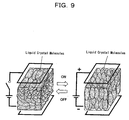
- Fig. 9 is a diagram illustrating the principles of operation of a nematic type liquid crystal display device currently in use.
- the liquid crystal display devices most widely used at present make use of a liquid crystal phase, called the nematic phase, as shown in Fig. 9 in which liquid crystal molecules are arrayed in low order.
- Applying an electric field to the liquid crystal phase in a display device between a pair of electrodes causes elongate rod-like liquid crystal molecules to move changing their state from one in which they are oriented parallel to the electrodes to one in which they are oriented perpendicular to the electrodes. Light switching in the device can thus be effected utilizing such movement of the molecules and their reversed movement.
- liquid crystal phase in this case in which liquid crystal molecules are simply rod-like is easy in molecular design and also easy to synthesize and hence can be applied to a variety of liquid crystal molecular species.
- reorienting these molecules requires large energy, namely a large voltage, which in turn also reduces the switching speed of the device to as low as several to several tens milliseconds.
- a ferroelectric liquid crystal device Mention is next made of a ferroelectric liquid crystal device.
- a liquid crystal phase called the smectic C-phase
- liquid crystal molecules are arranged in layers and molecules in each layer have their major axes each inclined at a fixed angle to a normal to the layer.
- a liquid crystal phase called the chiral smectic C phase
- a chiral group is introduced to a terminal group of the smectic C-type liquid phase molecule and the chiral group has a permanent dipole added thereto. It is the chiral smectic C phase which a ferroelectric liquid crystal display device uses.
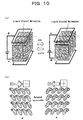
- Fig. 10 is a diagram illustrating the principles of operation of a ferroelectric liquid crystal display device.
- a ferroelectric liquid crystal display device uses the chiral smectic C phase. Applying an electric filed to this liquid crystal phase allows light to be switched.
- Fig. 10(b) in the chiral smectic C phase, liquid crystal molecules are formed in layers and molecules in each layer have their major axes each inclined at a fixed angle to a normal to the layer. Each of these liquid crystal molecules has a permanent dipole at a chiral group thereof, and the orientation of its spontaneous polarization is rotated according to the direction in which an electric filed is applied.
- Fig. 10(a) a ferroelectric liquid crystal display device uses the chiral smectic C phase. Applying an electric filed to this liquid crystal phase allows light to be switched.
- Fig. 10(b) in the chiral smectic C phase, liquid crystal molecules are formed in layers and molecules in each layer have their major axes each inclined
- FIG. 10(b) shows at A' that an electric field is applied directed from the back side of the sheet of paper towards its front side (as indicated by the large arrow in the Figure). Then, liquid crystal molecules in each layer are rotated about their respective axes normal to the layer with their spontaneous polarization oriented towards the back side of the sheet of paper (as indicated by the small arrows in the Figure). It is shown also at A that an electric field is applied directed from the front side of the sheet of paper towards its back side (as indicated by the large arrow in the Figure). Then, liquid crystal molecules in each layer are rotated about their respective axes normal to the layer with their spontaneous polarizations oriented towards the front side of the sheet of paper (as indicated by the small arrows in the Figure).
- the orientation of a spontaneous polarization can thus be inverted by inverting the direction in which an electric field is applied, and this can be used to switch or selectively transmit and block a ray of light. Also, with this inversion effected by the rotation of liquid crystal molecules about axes normal to their layer as mentioned above, the device can be driven rapidly and at low voltage, giving rise to a switching speed about 1000 times higher than can be achieved with the nematic phase. Further, since the spontaneous polarization once oriented in a given sign remains so oriented even if the electric field is removed, the device is provided with a memory function.
- a liquid crystal phase called the smectic C A -phase
- liquid crystal molecules are arranged in layers, molecules in each layer have their major axes each inclined at a fixed angle to a normal to the layer and they are so inclined in an opposite direction every other layer.
- a liquid crystal phase called the chiral smectic C A phase
- a chiral group is introduced to a terminal group of a smectic C A -type liquid phase molecule and the chiral group has a permanent dipole added thereto. It is the chiral smectic C A phase which an antiferroelectric liquid crystal display device uses.
- Fig. 11 is a diagram illustrating the principles of operation of an antiferroelectric liquid crystal display device.
- An antiferroelectric liquid crystal display device uses the chiral smectic C A phase, and applying an electric filed to the liquid crystal phase allows light to be switched.
- the chiral smectic C A phase while it is the same as in the chiral smectic C phase shown in Fig. 10 that liquid crystal molecules are formed in layers, molecules in each layer have their major axes each inclined at a fixed angle to a normal to the layer and the orientation of their spontaneous polarizations are rotated according to the direction is which an electric filed is applied, there is a difference in the state they take when the electric field is removed.
- an antiferroelectric liquid crystal display device in addition to having a high switching speed and a memory function as does a ferroelectric liquid crystal display device, an antiferroelectric liquid crystal display device has three stable states, permitting not only black and white displays but also a halftone display (gray display) to be produced. And, there have also been discovered antiferroelectric liquid crystal materials which allow a gray display to be continuously varied in gray level.
- antiferroelectric liquid crystals are thus expected to be the most promising for next-generation liquid crystal device materials, there exists the problem that they are hard to manufacture.
- an antiferroelectric liquid crystal characterized in that it comprises a mixture or compound of a liquid crystal of chiral smectic C-phase molecules with rod-like molecules wherein a said chiral smectic C-phase liquid crystal molecule is formed from a smectic C-phase liquid crystal molecule by substituting a terminal group thereof with an optically active group; and a said rod-like molecule has in a region of its center a permanent dipole moment oriented in a direction of its molecular minor axis, has its molecular major axis that is longer in length than that of the chiral smectic C-phase liquid crystal molecule and is bent in such a central region thereof in the form of character " ⁇ " in the Japanese syllabary.
- rod-like molecules are exploited that have their molecular major axes longer in length than those of chiral smectic C-phase liquid crystal molecules and that are each bent in the form of character " ⁇ " are thus disposed each to stay across two layers of chiral smectic C-phase molecules of the liquid crystal.
- the " ⁇ " bent region of the rod-like, elongate molecule in the form of character " ⁇ " is not held within any molecular layer of the smectic C phase but in a boundary layer between two adjacent molecular layers in the smectic C phase. Since the " ⁇ " bent rod region is thus held in a boundary layer between two adjacent molecular layers, the permanent dipoles which the rod-like molecules have in their central regions and which are co-oriented with their molecular minor axes are so arrayed as to be disposed in such boundary layers, respectively.
- the permanent dipole of each rod-like molecule is aligned so its moment is oriented in a boundary direction and permanent dipoles in adjacent boundary layers are aligned so their moments are oriented in directions opposite to each other.
- the " ⁇ " bent rod regions of the rod-like molecules cause the molecular major axes of liquid crystal to be inclined in the opposite direction every other layer with the result that a chiral smectic C A phase inclined in the opposite direction every other layer is realized.
- the chiral smectic C A phase is of an antiferroelectric liquid crystal, which can be used to form an antiferroelectric liquid crystal display.
- An antiferroelectric liquid crystal of the present invention which is based on the least-energy principle for electrostatic energy according to the structure of rod-like molecules, makes a variety of smectic C liquid crystal molecular species usable which can be determined by selecting a rod-like molecule that is suitable in configuration. Also, with the advantage that it is easy to introduce an optically active group to a smectic C phase, it is higher in performance and less costly to manufacture than a conventional antiferroelectric liquid crystal which requires introducing a chiral group to a terminal group and a permanent dipole to the chiral group of a smectic C A -phase liquid crystal molecule.
- the rod-like molecules may specifically be of a molecular species or compound that is selected from the class which consists of: 2,2-bis-[4-(4-alkoxyphenylcarbonyloxy)phenyl]-1,1,1,3,3,3-hexafluororopane; 2,2-bis[4-(4'-alkoxyphenylcarbonyloxy)phenyl]-1,1,1,3,3,3-hexafluoropropane, 2,2-bis[4-(4-(4-alkoxyphenylcarbonyloxy)carbonyloxy)phenyl]-1,1,1,3,3,3-hexafluoropropane; and 2,2-bis[4-(4-(4'-alkoxyphenylcarbonyloxy)carbonyloxy)phenyl]-1,1,1,3,3,3-hexafluoropropane.
- the smectic C-phase liquid crystal molecules may specifically be a molecular species or compound that is selected from the class which consists of: bis(4-hexyloxyphenyl)telephthalete; telephthalylidene-bis-4-propoxyaniline; 4-octyloxyphenyl-4'-octyloxybiphenyl-4-carboxylate; 4-octyloxybenzoicacid; and 4-hexyloxyphenyl 4-octyloxyphenyl-4-4-carboxylate.
- the present invention also provides a method of making an antiferroelectric liquid crystal characterized in that it comprises admixing or compounding a liquid crystal of chiral smectic C-phase molecules with rod-like molecules wherein a said chiral smectic C-phase liquid crystal molecule is formed from a smectic C-phase liquid crystal molecule by substituting a terminal group thereof with an optically active group; and a said rod-like molecule has in a region of its center a permanent dipole moment oriented in a direction of its molecular minor axis, has its molecular major axis that is longer in length than that of the chiral smectic C-phase liquid crystal molecule and is bent in such a central region thereof in the form of character " ⁇ " in the Japanese syllabary.
- the rod-like molecules may specifically be of a molecular species or compound that is selected from the class which consists of: 2,2-bis[4-(4-alkoxyphenylcarbonyloxy)phenyl]-1,1,1,3,3,3-hexafluoropropane, 2,2-bis[4- (4'-alkoxyphenylcarbonyloxy)phenyl]-1, 1,1,3,3,3-hexafluoropropane, 2,2-bis[4-(4-(4-alkoxyphenylcarbonyloxy) carbonyloxy)phenyl]-1,1,1,3,3,3-hexafluoropropane; and 2,2-bis[4-(4-(4'-alkoxyphenylcarbonyloxy)carbonyloxy)phenyl]-1,1,1,3,3,3-hexafluoropropane.
- the smectic C-phase liquid crystal molecules may specifically be a molecular species or compound that is selected from the class which consists of: bis(4-hexyloxyphenyl)telephthalete; telephthal ylidene-bis-4-propoxyaniline; 4-octyloxyphenyl 4'-octyloxybiphenyl-4- carboxylate, 4-octyloxybenzoicacid; and 4-hexyloxyphenyl 4-octyloxyphenyl-4-4-carboxylate.
- an antiferroelectric liquid crystal is produced on the basis of smectic C-phase liquid crystal molecules as described above and is provided that is higher in performance and less costly to manufacture than a conventional antiferroelectric liquid crystal which requires introducing a chiral group to a terminal group and a permanent dipole to the chiral group of a smectic C A -phase liquid crystal molecule.
- the antiferroelectricity of an antiferroelectric liquid crystal of the present invention is based on the interaction of a smectic C-phase liquid crystal molecules with elongate or rod-like molecules each of which has a permanent dipole moment in a region of its center, whose molecular major axis is longer in length than that of the smectic C-phase liquid crystal molecule and which is bent in such a central region in the form of character " ⁇ " in the Japanese syllabary, mention is first made of this interaction.
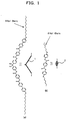
- Fig. 1 diagrammatically shows a molecular structure of the elongate or rod-like molecule 1 and a molecular structure of the smectic C-phase liquid crystal molecule 2 at (a) and (b), respectively, for use in the preparation of the smectic C A phase.
- the elongate or rod-like molecule 1 has alkyl groups, benzene rings, carbon atoms and oxygen atoms connected together and running in the form of a bar at a center of which it has two F 3 C (fluorocarbon) groups large in permanent dipole moment, the molecule having a large spontaneous polarization in a direction of its molecular minor axis.
- the rod-like molecule 1 also has a structure in which it is bent about a center of these groups in the form of character " ⁇ " in the Japanese syllabary.
- the molecular major axis of the rod-like molecule 1 is longer in length than the molecular major axis of the smectic C liquid crystal molecule 2 shown in Fig. 1(b).
- FIG. 1(a) Shown at the right hand of the structural diagram of the rod-like molecule 1 in Fig. 1(a) is a diagram that symbolically represents the same.
- the arrow in this symbolic diagram indicates a permanent dipole while the solid lines therein indicate a molecular structure bent in the form of character " ⁇ " and each of zigzag lines extending from its opposite ends indicates an alkyl chain.
- Shown likewise at the right hand of the structural diagram of the smectic C liquid crystal molecule 2 in Fig. 1(b) is a diagram that symbolically represents the same.
- the ellipse in this symbolic diagram indicates a rigid portion of the molecule 2. including benzene rings and each of zigzag lines extending outwards from the ellipse indicates an alkyl chain.
- these symbolic diagrams are used to facilitate understanding operations of the present invention.
- the rod-like molecule 1 that can structurally be used need only to have its molecular major axis longer in length than the molecular major axis of the smectic C-phase liquid crystal molecule, to have in a region of its center a permanent dipole moment oriented in a direction of its molecular minor axis and to be in the form of character " ⁇ ". It need not necessarily be the molecule shown in Fig. 1. however.
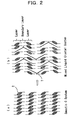
- Fig. 2 diagrammatically illustrates the interaction between the rod-like molecule 1 and the smectic C-phase liquid crystal molecule 2 wherein Fig. 2(a) shows the smectic C liquid crystal phase and Fig. 2(b) shows a state that the smectic C liquid crystal phase is compounded with rod-like molecules 1.
- the smectic C liquid crystal phase is configured in layers so that the major axis of a molecule thereof is inclined at a fixed angle to a normal to the layer to which the molecule belongs. If rod-like molecules are mixed or compounded into the smectic C liquid phase where the rod-like molecule has its molecular major axis longer in length than the molecular major axis of the smectic C-phase liquid crystal molecule and is bent in the form of character " ⁇ ", then each rod-like molecule is held across two molecular layers in the smectic C phase.
- the least-energy principle for electrostatic energy requires that the permanent dipole of each rod-like molecule be aligned so its moment is oriented in a boundary direction as shown and that permanent dipoles in adjacent boundary layers be aligned so their moments are oriented in directions opposite to each other as shown. Then, the " ⁇ " bent rod regions of the rod-like molecules cause the molecular major axes of liquid crystal to be inclined in the opposite direction every other layer with the result that a smectic C A phase inclined in the opposite direction every other layer is realized.
- An antiferroelectric liquid crystal according to the present invention does not use a chiral smectic C A liquid crystal itself which is hard to manufacture. It rather substitutes it with a chiral smectic C liquid crystal.
- a chiral smectic C liquid crystal can be manufactured by substituting a terminal group of a smectic C liquid crystal with an optically active group. This method of manufacture is a method that has so far been applied to obtain a ferroelectric liquid crystal (see Furukawa: "(LCD Manufacturing Techniques and Development of High Capacity LCD)", Triceps WS51, compiled by Kobayashi, pp 27 (1987)), and allows a chiral smectic C liquid crystal favorable in properties to be obtained at low cost.
- the conventional method of making a ferroelectric liquid crystal requires that a chiral group be introduced to a smectic C A liquid crystal molecule and then a permanent dipole to be introduced to the chiral group. According to this method, however, as mentioned above it is extremely hard to so introduce a permanent dipole and if it could successfully be introduced, there would be lost the properties as the smectic C A liquid crystal. In contrast, using the method of making an antiferroelectric liquid crystal in accordance with the present invention allows it to be manufactured very easily.
- Fig. 3 diagrammatically demonstrates that a smectic C phase liquid crystal 2 is converted with rod-like molecules into a smectic C A phase.
- Fig. 3(a) shows molecular structures of a rod-like molecule and a smectic C liquid crystal and
- Fig. 3(b) is a phase diagram showing the formation of the smectic C A phase liquid crystal as determined by polarizing microscopy.
- the rod-like molecule 1 is constituted by 2,2-bis[4-(4-(4'-alkoxyphenylcarbonyloxy)carbonyl oxy)phenyl]-1,1,1,3,3,3-hexafluoropropane comprising a pair of bar portions which have at their center a pair of CF 3 groups each having a large dipole oriented in a direction of its molecular minor axis, which extend from the CF 3 groups rightward and leftward, respectively, and each of which has four (4) benzene rings and five (5) oxygen atoms bonded together in the form of a bar and has an alkyl group (C 12 H 25 ) bonded at its end.
- the smectic C liquid crystal 2 is constituted by bis (4 - hexyloxyphenyl) telephthalete.
- Rod-like molecules 1 were admixed into the smectic C liquid crystal 2 to form a mixture thereof which was then heated and thereby molten. There resulted a liquid crystal structure of perpendicular orientation and its polarizing microscopy revealed that a smectic C A phase was formed shibano
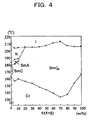
- the mixing proportion (in % by weight) of the rod-like molecules is plotted along the abscissa axis and the mixture temperature is plotted along the ordinate axis; and I, N, SmA, SmC, SmC A and Cr indicate isotropic liquid phase, nematic phase, smectic A phase, smectic C phase, smectic C A phase and crystal, respectively.
- the solid lines drawn in the diagram plot temperatures and mixing proportions where these phases are bounded by one another.
- adding rod-like molecules in excess of 1 % by weight converts the smectic C liquid crystal 2 to the smectic C A phase liquid crystal.
- Fig. 4 is a phase diagram of the system where the mixing proportion of rod-like molecules is extended in range to 100 %. There were used the same kinds of rod-like molecules 1 and smectic C liquid crystal 2 as in Fig. 3. From Fig. 4 it is seen that the smectic C A phase appears in an extremely wide range of the mixing proportion.
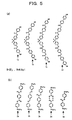
- Fig. 5 diagrammatically shows those kinds of rod-like molecule 1 and smectic C liquid crystal 2 which can be used to make a smectic C A phase wherein (a) and (b) show the molecular structures of such rod-like and smectic C phase molecular species 1 and 2, respectively.
- Smectic C-phase liquid crystal molecules of bis-(4-hexyloxy phenyl) telephthalate as shown in Fig. 3 were used.
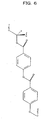
- the two identical alkyl groups C 6 H 13 at the ends of such a smectic C-phase liquid crystal molecule were substituted with two different optically active groups CH 3 (CH 2 ) 11 and CH(CH 3 )(CH 2 ) 5 CH 3 , respectively, to yield a substance called (R)-1-methylheptyl 4-(4-dodecyloxyphenylcarbonyl oxy)benzoate which is a chiral smectic C crystal (ferroelectric liquid crystal) having chiral permanent dipoles at its terminals (for the sake of simplicity, this substance will hereinafter be referred to as "chemical compound A").
- Fig. 6 is a diagram showing the molecular structure of this chemical compound A having the optically active groups substituted for the terminal groups of the smectic C liquid crystal molecule.
- the compound A when raised in temperature changes its phase from crystal to isotropic liquid and when lowered in temperature exhibits smectic A phase at 41°C and chiral smectic C phase at 24°C and is crystallized at 11°C.
- the chemical compound A was held between a pair of transparent electrode glass substrates of 10 mm x 10 mm wide and had a triangular voltage ( ⁇ 100 V) applied across the glass substrates at a frequency of 0.26 Hz when its temperature was lowered to 20°C to measure its voltage and current characteristics. Then, the glass substrates had had a treatment of horizontal orientation applied thereto and had a spacing of 5 ⁇ m between them.
- Fig. 7 is a diagram illustrating voltage and current characteristics of the chemical compound A.
- time is plotted along the abscissa axis, and voltage and current are plotted along the right and left hand side ordinates, respectively.
- a current peak P A appears periodically at the frequency of the applied voltage.
- This characteristic is representative of a ferroelectric liquid crystal.
- Each peak P A is a displacement current component that appears as the spontaneous polarization in the chemical compound A as a ferroelectric liquid crystal is rotated as can be seen from Fig. 10(b). From the area of a region surrounded with a portion of the current curve containing each peak P A and its intersecting broken line in the diagram, the magnitude of the spontaneous polarization can be found and is found to be 82 nC/cm 2 .
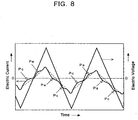
- the chemical compound A had added thereto 2 % by weight of rod-like molecules shown in Fig. 3(a), namely, 2, 2-bis-[4-(4-(4'-alkoxyphenylcarbonyloxy)carbonyloxy)phenyl]-1,1,1,3,-3,-3-hexafluoropropane (referred to hereinafter as "rod-like molecules" for the sake of simplicity), and measurements as in Fig. 7 were performed.
- the triangular voltage had a peak-to-valley value of ⁇ 55 volts and a frequency of 0.12 Hz.
- Fig. 8 is a diagram illustrating voltage and current characteristics of the chemical compound A having such rod-like molecules 1 added thereto.
- time is plotted along the abscissa axis
- voltage and current are plotted along the right and left hand side ordinates, respectively.
- two current peaks P B and P C occur successively in a region where the applied voltage becomes zero, and appear periodically at the frequency of the applied voltage.
- the sum of the magnitude of spontaneous polarizations found from the area of a region surrounded with a portion of the current curve containing each first peak P B and its intersecting broken line and the area of a region surrounded with a portion of the current curve containing each second peak P C and its intersecting broken line in the diagram is found to be 87 nC/cm 2 , which substantially agrees with the magnitude: 82 nC/cm 2 of spontaneous magnetizations in a ferroelectric liquid crystal found in Fig. 7.
- the present invention makes it possible to obtain a chiral smectic C A liquid crystal simply by mixing or compounding rod-like molecules into a chiral smectic C liquid crystal that is easy to manufacture and hence to provide at low cost an antiferroelectric liquid crystal that has so far been hard to manufacture.
Landscapes
- Chemical & Material Sciences (AREA)
- Crystallography & Structural Chemistry (AREA)
- Engineering & Computer Science (AREA)
- Materials Engineering (AREA)
- Organic Chemistry (AREA)
- Liquid Crystal (AREA)
- Liquid Crystal Substances (AREA)
Applications Claiming Priority (3)
| Application Number | Priority Date | Filing Date | Title |
|---|---|---|---|
| JP2002156506 | 2002-05-29 | ||
| JP2002156506 | 2002-05-29 | ||
| PCT/JP2003/006478 WO2003099960A1 (en) | 2002-05-29 | 2003-05-23 | Antiferroelectric liquid crystal and its manufacturing method |
Publications (2)
| Publication Number | Publication Date |
|---|---|
| EP1514916A1 true EP1514916A1 (de) | 2005-03-16 |
| EP1514916A4 EP1514916A4 (de) | 2008-03-05 |
Family
ID=29561486
Family Applications (1)
| Application Number | Title | Priority Date | Filing Date |
|---|---|---|---|
| EP03730614A Withdrawn EP1514916A4 (de) | 2002-05-29 | 2003-05-23 | Antiferroelektrischer flüssigkristall und sein herstellverfahren |
Country Status (7)
| Country | Link |
|---|---|
| US (1) | US7211201B2 (de) |
| EP (1) | EP1514916A4 (de) |
| JP (1) | JPWO2003099960A1 (de) |
| KR (1) | KR100662716B1 (de) |
| CN (1) | CN1656198A (de) |
| TW (1) | TW593639B (de) |
| WO (1) | WO2003099960A1 (de) |
Families Citing this family (3)
| Publication number | Priority date | Publication date | Assignee | Title |
|---|---|---|---|---|
| US11502104B2 (en) | 2019-08-15 | 2022-11-15 | Sandisk Technologies Llc | Antiferroelectric memory devices and methods of making the same |
| US11430813B2 (en) | 2019-08-15 | 2022-08-30 | Sandisk Technologies Llc | Antiferroelectric memory devices and methods of making the same |
| CN117316337B (zh) * | 2023-09-04 | 2024-03-29 | 中国人民解放军国防科技大学 | 应用于液晶系统中缺陷结构的数值模拟方法及装置 |
Family Cites Families (6)
| Publication number | Priority date | Publication date | Assignee | Title |
|---|---|---|---|---|
| JPH05271658A (ja) * | 1992-03-27 | 1993-10-19 | Chisso Corp | 反強誘電性液晶組成物 |
| JPH0882778A (ja) | 1994-09-12 | 1996-03-26 | Showa Shell Sekiyu Kk | 反強誘電性液晶組成物 |
| JPH08217728A (ja) | 1994-12-16 | 1996-08-27 | Showa Shell Sekiyu Kk | 二量体型光学活性化合物 |
| JPH08333575A (ja) | 1995-06-05 | 1996-12-17 | Showa Shell Sekiyu Kk | 反強誘電性液晶組成物 |
| EP1215195A1 (de) * | 2000-12-12 | 2002-06-19 | MERCK PATENT GmbH | Bananenförmige, polymerisierbare mesogene Verbindungen |
| US6924009B2 (en) * | 2001-10-26 | 2005-08-02 | Kent State University | Electro-optical devices from banana-shaped liquid crystals |
-
2003
- 2003-05-23 KR KR1020047019261A patent/KR100662716B1/ko not_active Expired - Fee Related
- 2003-05-23 CN CNA038122553A patent/CN1656198A/zh active Pending
- 2003-05-23 EP EP03730614A patent/EP1514916A4/de not_active Withdrawn
- 2003-05-23 WO PCT/JP2003/006478 patent/WO2003099960A1/ja not_active Ceased
- 2003-05-23 JP JP2004508205A patent/JPWO2003099960A1/ja active Pending
- 2003-05-23 US US10/515,813 patent/US7211201B2/en not_active Expired - Fee Related
- 2003-05-28 TW TW092114341A patent/TW593639B/zh not_active IP Right Cessation
Non-Patent Citations (3)
| Title |
|---|
| See also references of WO03099960A1 * |
| SHEN D ET AL: "DESIGNING BANANA-SHAPED LIQUID CRYSTALS WITHOUT SCHIFF'S BASE UNITS: M-TERPHENYLS, 2,6-DIPHENYLPYRIDINES AND V-SHAPED TOLANE DERIVATIVES" JOURNAL OF MATERIALS CHEMISTRY, THE ROYAL SOCIETY OF CHEMISTRY, CAMBRIDGE, GB, vol. 9, no. 3, March 1999 (1999-03), pages 661-672, XP000853242 ISSN: 0959-9428 * |
| SUZUKI Y ET AL: "STABILITY OF THE ANTIFERROELECTRIC PHASE IN DIMERIC LIQUID CRYSTALSHAVING TWO CHIRAL CENTRES WITH CF3 OR CH3 GROUPS; EVALUATION OF CONFORMATIONAL AND ELECTRIC INTERACTIONS" JOURNAL OF MATERIALS CHEMISTRY, THE ROYAL SOCIETY OF CHEMISTRY, CAMBRIDGE, GB, vol. 6, no. 5, May 1996 (1996-05), pages 753-760, XP000626873 ISSN: 0959-9428 * |
Also Published As
| Publication number | Publication date |
|---|---|
| KR100662716B1 (ko) | 2006-12-28 |
| US20050156142A1 (en) | 2005-07-21 |
| WO2003099960A1 (en) | 2003-12-04 |
| CN1656198A (zh) | 2005-08-17 |
| KR20050005503A (ko) | 2005-01-13 |
| EP1514916A4 (de) | 2008-03-05 |
| TW593639B (en) | 2004-06-21 |
| JPWO2003099960A1 (ja) | 2005-09-22 |
| TW200401023A (en) | 2004-01-16 |
| US7211201B2 (en) | 2007-05-01 |
Similar Documents
| Publication | Publication Date | Title |
|---|---|---|
| EP0582468B1 (de) | Antiferroelektrische Flüssigkristallzusammensetzung sowie Flüssigkristallanzeigevorrichtung | |
| Wei et al. | Liquid-crystalline polymers: Molecular engineering, hierarchical structures, and applications | |
| EP0157519B1 (de) | Flüssigkristall-Zusammensetzung | |
| US7211201B2 (en) | Antiferroelectric liquid crystal and its manufacturing method | |
| KR102069478B1 (ko) | 액정 조성물 및 이를 포함하는 쌍안정 액정 패널 | |
| EP0571278B1 (de) | Antiferroelektrische Flüssigkristallverbindung sowie Verfahren zur deren Herstellung | |
| JPH0882778A (ja) | 反強誘電性液晶組成物 | |
| JP2025523503A (ja) | 強誘電スメクチックa相材料、材料を含むデバイス、およびそれを形成し使用する方法 | |
| EP0409194B1 (de) | Ferroelektrisches Flüssigkristallelement | |
| JP2788667B2 (ja) | 高分子液晶組成物、それを用いた液晶光学素子及び液晶光学素子の駆動方法 | |
| EP0678566B1 (de) | Antiferroelektrische Flüssigkristallzusammentsetzung | |
| JP3052817B2 (ja) | 反強誘電性液晶組成物 | |
| JPH11510829A (ja) | ポリシロキサン類 | |
| JPS63278993A (ja) | 液晶組成物 | |
| JP3184446B2 (ja) | 反強誘電性液晶組成物 | |
| JPH08333575A (ja) | 反強誘電性液晶組成物 | |
| JPH08333574A (ja) | 反強誘電性液晶組成物 | |
| JPH08333576A (ja) | 反強誘電性液晶組成物 | |
| JPH08311452A (ja) | 反強誘電性液晶組成物 | |
| JP3567481B2 (ja) | 強誘電性液晶組成物 | |
| JP3133678B2 (ja) | 配向復帰力の優れた反強誘電性液晶組成物 | |
| JPH08311450A (ja) | 反強誘電性液晶組成物 | |
| JPH08311449A (ja) | 反強誘電性液晶組成物 | |
| JPH08234243A (ja) | 液晶電気光学装置 | |
| JPH08311451A (ja) | 反強誘電性液晶組成物 |
Legal Events
| Date | Code | Title | Description |
|---|---|---|---|
| PUAI | Public reference made under article 153(3) epc to a published international application that has entered the european phase |
Free format text: ORIGINAL CODE: 0009012 |
|
| 17P | Request for examination filed |
Effective date: 20041222 |
|
| AK | Designated contracting states |
Kind code of ref document: A1 Designated state(s): AT BE BG CH CY CZ DE DK EE ES FI FR GB GR HU IE IT LI LU MC NL PT RO SE SI SK TR |
|
| RBV | Designated contracting states (corrected) |
Designated state(s): DE GB NL |
|
| A4 | Supplementary search report drawn up and despatched |
Effective date: 20080205 |
|
| STAA | Information on the status of an ep patent application or granted ep patent |
Free format text: STATUS: THE APPLICATION IS DEEMED TO BE WITHDRAWN |
|
| 18D | Application deemed to be withdrawn |
Effective date: 20080423 |