EP1514720A1 - Verfahren zur Erkennung und Steuerung von Fahrzeugfunktionen - Google Patents
Verfahren zur Erkennung und Steuerung von Fahrzeugfunktionen Download PDFInfo
- Publication number
- EP1514720A1 EP1514720A1 EP04292172A EP04292172A EP1514720A1 EP 1514720 A1 EP1514720 A1 EP 1514720A1 EP 04292172 A EP04292172 A EP 04292172A EP 04292172 A EP04292172 A EP 04292172A EP 1514720 A1 EP1514720 A1 EP 1514720A1
- Authority
- EP
- European Patent Office
- Prior art keywords
- control
- user
- function
- contact
- identification
- Prior art date
- Legal status (The legal status is an assumption and is not a legal conclusion. Google has not performed a legal analysis and makes no representation as to the accuracy of the status listed.)
- Granted
Links
- 230000006870 function Effects 0.000 title claims abstract description 53
- 238000000034 method Methods 0.000 title claims abstract description 49
- 230000004913 activation Effects 0.000 claims abstract description 28
- 230000009849 deactivation Effects 0.000 claims abstract description 9
- 230000003213 activating effect Effects 0.000 claims abstract description 6
- 230000007246 mechanism Effects 0.000 claims description 20
- 210000000056 organ Anatomy 0.000 claims description 18
- 230000000007 visual effect Effects 0.000 description 7
- 230000007423 decrease Effects 0.000 description 4
- 238000001514 detection method Methods 0.000 description 4
- 238000006073 displacement reaction Methods 0.000 description 3
- 238000009423 ventilation Methods 0.000 description 3
- 238000004378 air conditioning Methods 0.000 description 2
- 230000008901 benefit Effects 0.000 description 2
- 230000008859 change Effects 0.000 description 2
- 230000004069 differentiation Effects 0.000 description 2
- 230000009471 action Effects 0.000 description 1
- 230000001010 compromised effect Effects 0.000 description 1
- 239000000470 constituent Substances 0.000 description 1
- 230000008569 process Effects 0.000 description 1
- 238000009877 rendering Methods 0.000 description 1
Images

Classifications
-
- B—PERFORMING OPERATIONS; TRANSPORTING
- B60—VEHICLES IN GENERAL
- B60K—ARRANGEMENT OR MOUNTING OF PROPULSION UNITS OR OF TRANSMISSIONS IN VEHICLES; ARRANGEMENT OR MOUNTING OF PLURAL DIVERSE PRIME-MOVERS IN VEHICLES; AUXILIARY DRIVES FOR VEHICLES; INSTRUMENTATION OR DASHBOARDS FOR VEHICLES; ARRANGEMENTS IN CONNECTION WITH COOLING, AIR INTAKE, GAS EXHAUST OR FUEL SUPPLY OF PROPULSION UNITS IN VEHICLES
- B60K35/00—Instruments specially adapted for vehicles; Arrangement of instruments in or on vehicles
- B60K35/10—Input arrangements, i.e. from user to vehicle, associated with vehicle functions or specially adapted therefor
Definitions
- the present invention relates to the general technical field of the automobile or any motorized vehicle.
- the invention relates to the control of various functions of the vehicle that can be activated or deactivated from the driving the vehicle. These functions may consist for example of control an on-board computer, electric windows, select radio stations or various menus of a board computer, etc. These functions are usually controlled via switches known as such or switching levers.
- the organs of known control however have the disadvantage of not all be arranged in the visual sense of the driver when the latter is move with the vehicle. Indeed, the driver's visual field particularly encompasses the road, the surroundings of the road, for the purpose of of security. It is therefore very difficult to have all the organs controls (switches or levers) in its visual field of in such a way that the driver does not have to look away from the route while manipulating said organs or switches. When the driver turns his eyes away from his visual safety field, his safety or that of other road users is largely compromised.
- the purpose of the present invention is to increase the safety of use of the vehicle by allowing the driver not to look away from his safety field of view when handling different control devices.
- the aim is therefore to maintain the driver's vigilance intact while manipulating the control member whose arrangement is not optimal on the security plan.
- control method consists in identifying to the touch the control device or bodies by a particular profile to each organ of protruding control on the control mechanism or by locating on the control mechanism of the control device or bodies in contact with the user.
- the user can thus select functions without visual control of the manipulation and without consulting a specific screen.
- the method consists in assigning a means of identification specific to each function accessible by the control organs.
- the method consists in detecting the capacitive contact.
- the method consists in transmitting a identification signal of the vibratory or impulse type.
- the method consists in actuating a switch to control the activation and / or deactivation of the functions identified by the user.
- the method consists of comparing the duration of contact with a threshold duration corresponding to the time required the activation of the means of identification and the recognition on the part of the user of said identification means for activating or deactivating the functions.
- the method consists in rendering accessible one or more control devices determined by a specific displacement of a control mechanism under (d).
- the method consists of moving the corresponding control devices, driving them from a position inactive retracted, to an active position protruding from the mechanism of ordered.
- the method consists in identifying the or the control devices by location and their projecting position on the control mechanism.
- the control mechanism can thus have contact zones specific for the user's fingers, each of which can be assigned the role of operating corresponding functions.
- the method consists in identifying the or the control members by a particular profile to each organ of control projecting on the control mechanism and identifiable to the touch.
- the method consists in generating the vibratory signal by piezoelectric path.
- the method consists in attributing to at least one of the functions, an identification signal that can be modulated according to the state or the degree of activation of said function, making this degree or activation state identifiable by the user.
- control method according to the invention consists in recognizing the degree or the level actuating or operating, by a variable profile, protruding on to least one control member.
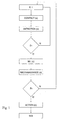
- the control method according to the invention makes it possible to select to activate / deactivate functions of a motor vehicle according to a step (a).
- the method consists for the user to come into contact with at least one control device controlling one or more functions or actuating said control member.
- an initial state (Ei) in which the different functions are disabled or in standby state, it implements step (a).
- the method then consists in detecting according to step (b) using appropriate means associated with the controller, a contact or a actuation.
- step (c) activates a means of identification of the control member whose activation is perceptible by the user. Activation of this means of identification (Mi) informs the driver that he is handling a command and to recognize the latter without visual contact.
- the method consists of the user then according to step (d) to be recognized the manipulated control device and consequently the function (s) it pilot.
- this recognition step (R1) when the organ of command that must be activated to control the chosen function is not recognized by the user is returned to the initial state (Ei).
- the user can example interrupt the contact of the control member or the manipulation of the control mechanism to return to the initial state (Ei).
- step (e) controlling the activation or deactivation of the function (s) selected and associated with the manipulated controller.
- an operating parameter of which the magnitude is determined by the duration of contact between the user's finger and the control organ. It is thus possible to control an air conditioning, a ventilation, temperature, sound volume or other function of a vehicle.
- the method according to the invention thus constitutes a selection aid of one or more features of a vehicle.
- An advantage linked to the invention is obtained by an easy implementation of the functions not requiring no visual contact with the control devices or with specific screens.
- a learning phase is enough for the user recognize the different means of identification.
- the method consists in assigning a means of identification specific to each function accessible by the control organ (s).
- a controller allows to activate or deactivate one or more different function (s) depending on different parameters of operation of the vehicle. It is envisaged according to an example of implementation process, to collect functions controlling, for example, the ventilation, air conditioning, temperature, and circulation of airflow under a same control organ. We can proceed in the same way to pilot an electric window, the position of mirrors, and seats.
- the method consists in detecting (step b) the contact or the actuation of a member of at least one control member by way of capacitive.
- the method consists in transmitting a identification signal under step (c) of the vibratory or pulse type.
- a vibration signal is obtained for example by piezoelectric means.
- activation identification means (Mi) thus consists in vibrating a support in contact with the hand or the finger of the driver of the vehicle.
- the identification signal can be realized at fixed frequency, variable frequency or by emission of wave trains. Any signal configuration is possible insofar as it can be perceived by the user in a tactile and differentiated from other signals of the same type.
- a control member for example longiline, whose vibratory signal constitutes the means of identification, has a different frequency depending on the location of the established contact by the user.
- a vibratory signal whose frequency varies according to the position thus makes it possible to realize a capacitive control slider having no mechanical part moving relative to each other.
- the control cursor thus makes it possible to inform the user, thanks to the signal touch recognized by the latter, on the state or degree of activation of a function.
- a high frequency vibratory signal may correspond to a high setpoint temperature and a low vibration frequency can correspond to a low setpoint temperature. Different levels of temperature can be recognized by the user.
- the method consists in actuating a switch to control the activation and / or deactivation of the function (s) identified by the user.
- a switch to control the activation and / or deactivation of the function (s) identified by the user.
- Figure 1 relates to the example of implementation in which the user, after recognizing the control member, take action mechanically on a switch button according to step (e).
- This step can for example be implemented using the piezoelectric element used for means of identification or with the aid of a piezoelectric element additional.
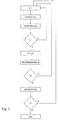
- the duration of contact of the user with the control device with a threshold duration corresponding to the time required to activate the means of identification and recognition by the user of said identification means for activate or deactivate the function (s). This is done after the recognition R1, with additional detection under step (f) during of which, according to a comparison C1, the contact time is compared with a prerecorded threshold duration. In case of exceeding this duration, activate or deactivate the function (s) corresponding to the step of on / off, shown schematically in Figure 2.
- the second detection under step (f) is carried out for example also capacitively.
- the latter consists in making accessible one or more organ (s) of command determined by a specific displacement of a mechanism of command under step (d).
- the method consists in moving the corresponding control devices by driving them from an inactive position retracted to an active position protruding from the control mechanism.
- the latter is for example in the form of a mouse (10) movable by translation and / or rotation, each position determines and drives protruding the control member (s) (11, 12) likely to be actuated (s).
- the user can thus identify by simple contact the organ (s) of controlled by their location and their projecting position on the mouse (10).
- the user can for example identify the control organ (s) by a particular profile to each control member protruding from the mechanism identifiable to the touch.
- the contact areas on the mouse 10, allowing the positioning of the fingers of the user, are for example materialized by slight recesses or concave parts adapted to the shape of the fingers.
- the differentiation of the control member (s) may for example through a selection of elements (13, 14, 15) projecting from a control member (12), which allows a shape or a identifiable configuration to the touch.
- the selection of other constituent elements of the control member protruding from the control mechanism in another position makes it possible to constitute a different configuration whose form is identifiable by the user, who is then in a position to differentiate from the previous form corresponding to the first selection.
- control member (12) can relate to the ventilation and a change in the orientation of the mouse (10) causes the coming protruding elements (13) and the retraction of the element (15).
- a selection, identifiable to the touch allows to privilege a flow of air directed towards the high.
- the latter consists of following a recognition (R1) of the control member coming protruding from the control mechanism, to compare the contact time of the user with said control member with a threshold duration corresponding to the time required to activate means of identification and recognition by the user of said identification means for activate or deactivate the function (s).
- the control organs are detected and recognized in a tactile way by the user and, once identification or recognition performed, the user maintains or not a contact with said controller, corresponding respectively to its decision to activate or deactivate the function.
- This last option consists of return to the initial state (Ei), in which the selected function (s) are either deactivated (s) or already activated (s). Whether or not a contact of the the user can also correspond to the decision to increase or decrease the degree of activation of a function of the type change of siege position or other.
- step (e) Activation, deactivation, decrease or increase of degree activation of the function is thus done capacitively way to implement step (e).
- step (e) consists in manipulating a switch-type member constituted for example by a symbol defined by means of projecting elements (13, 14, 15), a button specific, or to manipulate the mouse (10).
- the latter is for example movable in a first direction corresponding to an activation or an increase in the degree of activation of the function, and in a second direction corresponding to a deactivation or a decrease of the degree activating said function.
Landscapes
- Engineering & Computer Science (AREA)
- Chemical & Material Sciences (AREA)
- Combustion & Propulsion (AREA)
- Transportation (AREA)
- Mechanical Engineering (AREA)
- Mechanical Control Devices (AREA)
- User Interface Of Digital Computer (AREA)
- Position Input By Displaying (AREA)
Applications Claiming Priority (2)
| Application Number | Priority Date | Filing Date | Title |
|---|---|---|---|
| FR0310624A FR2859546B1 (fr) | 2003-09-09 | 2003-09-09 | Procede de reconnaissance et de commande de fonctions d'un vehicule |
| FR0310624 | 2003-09-09 |
Publications (2)
| Publication Number | Publication Date |
|---|---|
| EP1514720A1 true EP1514720A1 (de) | 2005-03-16 |
| EP1514720B1 EP1514720B1 (de) | 2009-01-14 |
Family
ID=34130777
Family Applications (1)
| Application Number | Title | Priority Date | Filing Date |
|---|---|---|---|
| EP04292172A Expired - Lifetime EP1514720B1 (de) | 2003-09-09 | 2004-09-09 | Verfahren zur Erkennung und Steuerung von Fahrzeugfunktionen |
Country Status (3)
| Country | Link |
|---|---|
| EP (1) | EP1514720B1 (de) |
| DE (1) | DE602004019027D1 (de) |
| FR (1) | FR2859546B1 (de) |
Citations (3)
| Publication number | Priority date | Publication date | Assignee | Title |
|---|---|---|---|---|
| EP0893297A2 (de) * | 1997-07-21 | 1999-01-27 | Bayerische Motoren Werke Aktiengesellschaft, Patentabteilung AJ-3 | Bedienelement |
| EP1139365A1 (de) * | 2000-03-30 | 2001-10-04 | Alps Electric Co., Ltd. | Fahrzeugmontierte Eingabevorrichtung |
| FR2833387A1 (fr) * | 2001-12-10 | 2003-06-13 | Peugeot Citroen Automobiles Sa | Procede de gestion et d'exploitation d'un ensemble d'organes de consigne d'un vehicule automobile, incluant l'emission d'un signal sonore |
-
2003
- 2003-09-09 FR FR0310624A patent/FR2859546B1/fr not_active Expired - Fee Related
-
2004
- 2004-09-09 DE DE602004019027T patent/DE602004019027D1/de not_active Expired - Lifetime
- 2004-09-09 EP EP04292172A patent/EP1514720B1/de not_active Expired - Lifetime
Patent Citations (3)
| Publication number | Priority date | Publication date | Assignee | Title |
|---|---|---|---|---|
| EP0893297A2 (de) * | 1997-07-21 | 1999-01-27 | Bayerische Motoren Werke Aktiengesellschaft, Patentabteilung AJ-3 | Bedienelement |
| EP1139365A1 (de) * | 2000-03-30 | 2001-10-04 | Alps Electric Co., Ltd. | Fahrzeugmontierte Eingabevorrichtung |
| FR2833387A1 (fr) * | 2001-12-10 | 2003-06-13 | Peugeot Citroen Automobiles Sa | Procede de gestion et d'exploitation d'un ensemble d'organes de consigne d'un vehicule automobile, incluant l'emission d'un signal sonore |
Also Published As
| Publication number | Publication date |
|---|---|
| FR2859546A1 (fr) | 2005-03-11 |
| DE602004019027D1 (de) | 2009-03-05 |
| EP1514720B1 (de) | 2009-01-14 |
| FR2859546B1 (fr) | 2006-06-16 |
Similar Documents
| Publication | Publication Date | Title |
|---|---|---|
| WO2009047437A2 (fr) | Panneaux de controle d'instruments de bord | |
| US11030888B2 (en) | Trainable transceiver and method of operation utilizing existing vehicle user interfaces | |
| EP3300953B1 (de) | Innenbeleuchtungssystem für autonomes kraftfahrzeug | |
| EP2372915B1 (de) | Mensch-Maschine-Schnittstelle, insbesondere für ein Fahrzeug | |
| EP1515211B1 (de) | Kapazitiver Berührungsschalter für elektrische Fensterheber oder Schiebedach | |
| FR2808109A1 (fr) | Dispositif de commande de fonction comprenant au moins un selecteur | |
| FR2857304A1 (fr) | Dispositif de commande | |
| WO2016051115A1 (fr) | Dispositif et procédé de commande pour véhicule automobile | |
| EP1514720B1 (de) | Verfahren zur Erkennung und Steuerung von Fahrzeugfunktionen | |
| EP3112260A1 (de) | Verfahren zur steuerung von aerodynamischen mitteln eines luftfahrzeugs, entsprechendes steuerverfahren und mit einem solchen steuerverfahren ausgerüstetes luftfahrzeug | |
| EP3084569B1 (de) | Steuerungsvorrichtung für ein kraftfahrzeug und steuerungsverfahren | |
| FR2775116A1 (fr) | Dispositif commutateur pour activer et desactiver une fonction principale et au moins une fonction annexe | |
| EP1424710B1 (de) | Steuervorrichtung für wenigstens zwei Funktionen eines Elementes und/oder wenigstens zwei verschiedener Elementteile | |
| FR2732284A1 (fr) | Dispositif pour la commande de differentes fonctions dans un vehicule automobile, comportant un organe de commande fixe par rapport au volant | |
| US20060145518A1 (en) | Control system for a vehicle roof | |
| FR3094290A1 (fr) | Véhicule comportant un accoudoir muni d’un dispositif de commande d’au moins une fonction du véhicule | |
| FR3059945B1 (fr) | Dispositif de commande en particulier pour vehicule | |
| EP1429055B1 (de) | Integriertes Anlass- und Getriebeschaltmodul in einem Fahrzeug | |
| EP1422103B1 (de) | Vorrichtung zum Steuern der Verstellungsmitteln von mindestens drei Sitzteilen eines Kraftfahrzeugsitzes. | |
| CA3141741A1 (fr) | Dispositif de pilotage d'un aeronef et procede associe | |
| EP0702385A1 (de) | Manuelles Mehrfunktionssteuergerät | |
| FR3059946B1 (fr) | Ensemble electrique de commande de vehicule, element d'habillage interieur de vehicule et procede pour commander l'ensemble electrique | |
| KR102206743B1 (ko) | 레이져 스캐닝을 이용한 운전자 조작 신호 입력 장치 | |
| CN107608501A (zh) | 用户接口设备及包括其的车辆以及控制车辆的方法 | |
| FR2884778A3 (fr) | Retroviseur electrique auto-ajustable |
Legal Events
| Date | Code | Title | Description |
|---|---|---|---|
| PUAI | Public reference made under article 153(3) epc to a published international application that has entered the european phase |
Free format text: ORIGINAL CODE: 0009012 |
|
| AK | Designated contracting states |
Kind code of ref document: A1 Designated state(s): AT BE BG CH CY CZ DE DK EE ES FI FR GB GR HU IE IT LI LU MC NL PL PT RO SE SI SK TR |
|
| AX | Request for extension of the european patent |
Extension state: AL HR LT LV MK |
|
| 17P | Request for examination filed |
Effective date: 20050303 |
|
| AKX | Designation fees paid |
Designated state(s): DE FR |
|
| 17Q | First examination report despatched |
Effective date: 20070702 |
|
| GRAP | Despatch of communication of intention to grant a patent |
Free format text: ORIGINAL CODE: EPIDOSNIGR1 |
|
| GRAS | Grant fee paid |
Free format text: ORIGINAL CODE: EPIDOSNIGR3 |
|
| GRAA | (expected) grant |
Free format text: ORIGINAL CODE: 0009210 |
|
| AK | Designated contracting states |
Kind code of ref document: B1 Designated state(s): DE FR |
|
| REF | Corresponds to: |
Ref document number: 602004019027 Country of ref document: DE Date of ref document: 20090305 Kind code of ref document: P |
|
| PLBE | No opposition filed within time limit |
Free format text: ORIGINAL CODE: 0009261 |
|
| STAA | Information on the status of an ep patent application or granted ep patent |
Free format text: STATUS: NO OPPOSITION FILED WITHIN TIME LIMIT |
|
| 26N | No opposition filed |
Effective date: 20091015 |
|
| REG | Reference to a national code |
Ref country code: FR Ref legal event code: PLFP Year of fee payment: 12 |
|
| REG | Reference to a national code |
Ref country code: FR Ref legal event code: PLFP Year of fee payment: 13 |
|
| PGFP | Annual fee paid to national office [announced via postgrant information from national office to epo] |
Ref country code: FR Payment date: 20160926 Year of fee payment: 13 |
|
| PGFP | Annual fee paid to national office [announced via postgrant information from national office to epo] |
Ref country code: DE Payment date: 20160928 Year of fee payment: 13 |
|
| REG | Reference to a national code |
Ref country code: DE Ref legal event code: R119 Ref document number: 602004019027 Country of ref document: DE |
|
| REG | Reference to a national code |
Ref country code: FR Ref legal event code: ST Effective date: 20180531 |
|
| PG25 | Lapsed in a contracting state [announced via postgrant information from national office to epo] |
Ref country code: DE Free format text: LAPSE BECAUSE OF NON-PAYMENT OF DUE FEES Effective date: 20180404 |
|
| PG25 | Lapsed in a contracting state [announced via postgrant information from national office to epo] |
Ref country code: FR Free format text: LAPSE BECAUSE OF NON-PAYMENT OF DUE FEES Effective date: 20171002 |