EP1513611B1 - Procede pour surveiller et securiser des reactions exothermiques - Google Patents
Procede pour surveiller et securiser des reactions exothermiques Download PDFInfo
- Publication number
- EP1513611B1 EP1513611B1 EP03740197.3A EP03740197A EP1513611B1 EP 1513611 B1 EP1513611 B1 EP 1513611B1 EP 03740197 A EP03740197 A EP 03740197A EP 1513611 B1 EP1513611 B1 EP 1513611B1
- Authority
- EP
- European Patent Office
- Prior art keywords
- pressure
- reactor
- calculation
- amount
- reaction
- Prior art date
- Legal status (The legal status is an assumption and is not a legal conclusion. Google has not performed a legal analysis and makes no representation as to the accuracy of the status listed.)
- Expired - Lifetime
Links
- 238000006243 chemical reaction Methods 0.000 title claims description 72
- 238000000034 method Methods 0.000 title claims description 54
- 238000012544 monitoring process Methods 0.000 title claims description 19
- 239000007858 starting material Substances 0.000 claims description 20
- 230000008859 change Effects 0.000 claims description 10
- 238000007720 emulsion polymerization reaction Methods 0.000 claims description 6
- 238000001816 cooling Methods 0.000 claims description 5
- 230000003993 interaction Effects 0.000 claims description 4
- 238000005259 measurement Methods 0.000 claims description 4
- 238000003541 multi-stage reaction Methods 0.000 claims description 2
- 239000000047 product Substances 0.000 description 20
- 239000012071 phase Substances 0.000 description 16
- 230000008569 process Effects 0.000 description 15
- 239000000126 substance Substances 0.000 description 13
- 239000007789 gas Substances 0.000 description 10
- 239000000376 reactant Substances 0.000 description 10
- 239000007791 liquid phase Substances 0.000 description 6
- 238000009472 formulation Methods 0.000 description 5
- 239000000203 mixture Substances 0.000 description 5
- 239000000178 monomer Substances 0.000 description 5
- 230000000694 effects Effects 0.000 description 4
- 230000007306 turnover Effects 0.000 description 4
- 239000000463 material Substances 0.000 description 3
- 238000005457 optimization Methods 0.000 description 3
- TZCXTZWJZNENPQ-UHFFFAOYSA-L barium sulfate Chemical compound [Ba+2].[O-]S([O-])(=O)=O TZCXTZWJZNENPQ-UHFFFAOYSA-L 0.000 description 2
- 238000010923 batch production Methods 0.000 description 2
- 230000008901 benefit Effects 0.000 description 2
- 238000010586 diagram Methods 0.000 description 2
- 239000000446 fuel Substances 0.000 description 2
- 230000004044 response Effects 0.000 description 2
- 238000012546 transfer Methods 0.000 description 2
- 241001136792 Alle Species 0.000 description 1
- 206010019133 Hangover Diseases 0.000 description 1
- 238000009825 accumulation Methods 0.000 description 1
- 238000013459 approach Methods 0.000 description 1
- 230000015572 biosynthetic process Effects 0.000 description 1
- 239000007795 chemical reaction product Substances 0.000 description 1
- 239000003795 chemical substances by application Substances 0.000 description 1
- 239000002826 coolant Substances 0.000 description 1
- 230000007423 decrease Effects 0.000 description 1
- 238000013461 design Methods 0.000 description 1
- 239000003995 emulsifying agent Substances 0.000 description 1
- 230000007613 environmental effect Effects 0.000 description 1
- 230000006870 function Effects 0.000 description 1
- 230000017525 heat dissipation Effects 0.000 description 1
- 239000011261 inert gas Substances 0.000 description 1
- 239000003999 initiator Substances 0.000 description 1
- 230000000977 initiatory effect Effects 0.000 description 1
- 239000007788 liquid Substances 0.000 description 1
- 230000007257 malfunction Effects 0.000 description 1
- 229920000642 polymer Polymers 0.000 description 1
- 238000002360 preparation method Methods 0.000 description 1
- 230000001681 protective effect Effects 0.000 description 1
- 230000009467 reduction Effects 0.000 description 1
- 238000005204 segregation Methods 0.000 description 1
- 230000002269 spontaneous effect Effects 0.000 description 1
- 239000003381 stabilizer Substances 0.000 description 1
- 230000001960 triggered effect Effects 0.000 description 1
- 230000008016 vaporization Effects 0.000 description 1
- XLYOFNOQVPJJNP-UHFFFAOYSA-N water Substances O XLYOFNOQVPJJNP-UHFFFAOYSA-N 0.000 description 1
Images


Classifications
-
- G—PHYSICS
- G05—CONTROLLING; REGULATING
- G05B—CONTROL OR REGULATING SYSTEMS IN GENERAL; FUNCTIONAL ELEMENTS OF SUCH SYSTEMS; MONITORING OR TESTING ARRANGEMENTS FOR SUCH SYSTEMS OR ELEMENTS
- G05B23/00—Testing or monitoring of control systems or parts thereof
- G05B23/02—Electric testing or monitoring
- G05B23/0205—Electric testing or monitoring by means of a monitoring system capable of detecting and responding to faults
- G05B23/0218—Electric testing or monitoring by means of a monitoring system capable of detecting and responding to faults characterised by the fault detection method dealing with either existing or incipient faults
- G05B23/0224—Process history based detection method, e.g. whereby history implies the availability of large amounts of data
- G05B23/0227—Qualitative history assessment, whereby the type of data acted upon, e.g. waveforms, images or patterns, is not relevant, e.g. rule based assessment; if-then decisions
- G05B23/0235—Qualitative history assessment, whereby the type of data acted upon, e.g. waveforms, images or patterns, is not relevant, e.g. rule based assessment; if-then decisions based on a comparison with predetermined threshold or range, e.g. "classical methods", carried out during normal operation; threshold adaptation or choice; when or how to compare with the threshold
-
- B—PERFORMING OPERATIONS; TRANSPORTING
- B01—PHYSICAL OR CHEMICAL PROCESSES OR APPARATUS IN GENERAL
- B01J—CHEMICAL OR PHYSICAL PROCESSES, e.g. CATALYSIS OR COLLOID CHEMISTRY; THEIR RELEVANT APPARATUS
- B01J19/00—Chemical, physical or physico-chemical processes in general; Their relevant apparatus
-
- B—PERFORMING OPERATIONS; TRANSPORTING
- B01—PHYSICAL OR CHEMICAL PROCESSES OR APPARATUS IN GENERAL
- B01J—CHEMICAL OR PHYSICAL PROCESSES, e.g. CATALYSIS OR COLLOID CHEMISTRY; THEIR RELEVANT APPARATUS
- B01J19/00—Chemical, physical or physico-chemical processes in general; Their relevant apparatus
- B01J19/0006—Controlling or regulating processes
-
- B—PERFORMING OPERATIONS; TRANSPORTING
- B01—PHYSICAL OR CHEMICAL PROCESSES OR APPARATUS IN GENERAL
- B01J—CHEMICAL OR PHYSICAL PROCESSES, e.g. CATALYSIS OR COLLOID CHEMISTRY; THEIR RELEVANT APPARATUS
- B01J19/00—Chemical, physical or physico-chemical processes in general; Their relevant apparatus
- B01J19/0006—Controlling or regulating processes
- B01J19/002—Avoiding undesirable reactions or side-effects, e.g. avoiding explosions, or improving the yield by suppressing side-reactions
-
- B—PERFORMING OPERATIONS; TRANSPORTING
- B01—PHYSICAL OR CHEMICAL PROCESSES OR APPARATUS IN GENERAL
- B01J—CHEMICAL OR PHYSICAL PROCESSES, e.g. CATALYSIS OR COLLOID CHEMISTRY; THEIR RELEVANT APPARATUS
- B01J19/00—Chemical, physical or physico-chemical processes in general; Their relevant apparatus
- B01J19/18—Stationary reactors having moving elements inside
-
- B—PERFORMING OPERATIONS; TRANSPORTING
- B01—PHYSICAL OR CHEMICAL PROCESSES OR APPARATUS IN GENERAL
- B01J—CHEMICAL OR PHYSICAL PROCESSES, e.g. CATALYSIS OR COLLOID CHEMISTRY; THEIR RELEVANT APPARATUS
- B01J19/00—Chemical, physical or physico-chemical processes in general; Their relevant apparatus
- B01J19/30—Loose or shaped packing elements, e.g. Raschig rings or Berl saddles, for pouring into the apparatus for mass or heat transfer
-
- C—CHEMISTRY; METALLURGY
- C08—ORGANIC MACROMOLECULAR COMPOUNDS; THEIR PREPARATION OR CHEMICAL WORKING-UP; COMPOSITIONS BASED THEREON
- C08F—MACROMOLECULAR COMPOUNDS OBTAINED BY REACTIONS ONLY INVOLVING CARBON-TO-CARBON UNSATURATED BONDS
- C08F2/00—Processes of polymerisation
- C08F2/12—Polymerisation in non-solvents
- C08F2/16—Aqueous medium
- C08F2/22—Emulsion polymerisation
-
- B—PERFORMING OPERATIONS; TRANSPORTING
- B01—PHYSICAL OR CHEMICAL PROCESSES OR APPARATUS IN GENERAL
- B01J—CHEMICAL OR PHYSICAL PROCESSES, e.g. CATALYSIS OR COLLOID CHEMISTRY; THEIR RELEVANT APPARATUS
- B01J2219/00—Chemical, physical or physico-chemical processes in general; Their relevant apparatus
- B01J2219/00049—Controlling or regulating processes
- B01J2219/00051—Controlling the temperature
- B01J2219/00074—Controlling the temperature by indirect heating or cooling employing heat exchange fluids
- B01J2219/00087—Controlling the temperature by indirect heating or cooling employing heat exchange fluids with heat exchange elements outside the reactor
- B01J2219/00094—Jackets
-
- B—PERFORMING OPERATIONS; TRANSPORTING
- B01—PHYSICAL OR CHEMICAL PROCESSES OR APPARATUS IN GENERAL
- B01J—CHEMICAL OR PHYSICAL PROCESSES, e.g. CATALYSIS OR COLLOID CHEMISTRY; THEIR RELEVANT APPARATUS
- B01J2219/00—Chemical, physical or physico-chemical processes in general; Their relevant apparatus
- B01J2219/00049—Controlling or regulating processes
- B01J2219/00051—Controlling the temperature
- B01J2219/00074—Controlling the temperature by indirect heating or cooling employing heat exchange fluids
- B01J2219/00087—Controlling the temperature by indirect heating or cooling employing heat exchange fluids with heat exchange elements outside the reactor
- B01J2219/00103—Controlling the temperature by indirect heating or cooling employing heat exchange fluids with heat exchange elements outside the reactor in a heat exchanger separate from the reactor
-
- B—PERFORMING OPERATIONS; TRANSPORTING
- B01—PHYSICAL OR CHEMICAL PROCESSES OR APPARATUS IN GENERAL
- B01J—CHEMICAL OR PHYSICAL PROCESSES, e.g. CATALYSIS OR COLLOID CHEMISTRY; THEIR RELEVANT APPARATUS
- B01J2219/00—Chemical, physical or physico-chemical processes in general; Their relevant apparatus
- B01J2219/00049—Controlling or regulating processes
- B01J2219/00162—Controlling or regulating processes controlling the pressure
-
- B—PERFORMING OPERATIONS; TRANSPORTING
- B01—PHYSICAL OR CHEMICAL PROCESSES OR APPARATUS IN GENERAL
- B01J—CHEMICAL OR PHYSICAL PROCESSES, e.g. CATALYSIS OR COLLOID CHEMISTRY; THEIR RELEVANT APPARATUS
- B01J2219/00—Chemical, physical or physico-chemical processes in general; Their relevant apparatus
- B01J2219/00049—Controlling or regulating processes
- B01J2219/00191—Control algorithm
- B01J2219/00193—Sensing a parameter
- B01J2219/00195—Sensing a parameter of the reaction system
- B01J2219/002—Sensing a parameter of the reaction system inside the reactor
-
- B—PERFORMING OPERATIONS; TRANSPORTING
- B01—PHYSICAL OR CHEMICAL PROCESSES OR APPARATUS IN GENERAL
- B01J—CHEMICAL OR PHYSICAL PROCESSES, e.g. CATALYSIS OR COLLOID CHEMISTRY; THEIR RELEVANT APPARATUS
- B01J2219/00—Chemical, physical or physico-chemical processes in general; Their relevant apparatus
- B01J2219/00049—Controlling or regulating processes
- B01J2219/00191—Control algorithm
- B01J2219/00211—Control algorithm comparing a sensed parameter with a pre-set value
- B01J2219/00216—Parameter value calculated by equations
-
- B—PERFORMING OPERATIONS; TRANSPORTING
- B01—PHYSICAL OR CHEMICAL PROCESSES OR APPARATUS IN GENERAL
- B01J—CHEMICAL OR PHYSICAL PROCESSES, e.g. CATALYSIS OR COLLOID CHEMISTRY; THEIR RELEVANT APPARATUS
- B01J2219/00—Chemical, physical or physico-chemical processes in general; Their relevant apparatus
- B01J2219/00049—Controlling or regulating processes
- B01J2219/00191—Control algorithm
- B01J2219/00222—Control algorithm taking actions
- B01J2219/00225—Control algorithm taking actions stopping the system or generating an alarm
-
- B—PERFORMING OPERATIONS; TRANSPORTING
- B01—PHYSICAL OR CHEMICAL PROCESSES OR APPARATUS IN GENERAL
- B01J—CHEMICAL OR PHYSICAL PROCESSES, e.g. CATALYSIS OR COLLOID CHEMISTRY; THEIR RELEVANT APPARATUS
- B01J2219/00—Chemical, physical or physico-chemical processes in general; Their relevant apparatus
- B01J2219/00049—Controlling or regulating processes
- B01J2219/00191—Control algorithm
- B01J2219/00222—Control algorithm taking actions
- B01J2219/00227—Control algorithm taking actions modifying the operating conditions
- B01J2219/00229—Control algorithm taking actions modifying the operating conditions of the reaction system
- B01J2219/00231—Control algorithm taking actions modifying the operating conditions of the reaction system at the reactor inlet
-
- B—PERFORMING OPERATIONS; TRANSPORTING
- B01—PHYSICAL OR CHEMICAL PROCESSES OR APPARATUS IN GENERAL
- B01J—CHEMICAL OR PHYSICAL PROCESSES, e.g. CATALYSIS OR COLLOID CHEMISTRY; THEIR RELEVANT APPARATUS
- B01J2219/00—Chemical, physical or physico-chemical processes in general; Their relevant apparatus
- B01J2219/00049—Controlling or regulating processes
- B01J2219/00191—Control algorithm
- B01J2219/00222—Control algorithm taking actions
- B01J2219/00227—Control algorithm taking actions modifying the operating conditions
- B01J2219/00238—Control algorithm taking actions modifying the operating conditions of the heat exchange system
-
- B—PERFORMING OPERATIONS; TRANSPORTING
- B01—PHYSICAL OR CHEMICAL PROCESSES OR APPARATUS IN GENERAL
- B01J—CHEMICAL OR PHYSICAL PROCESSES, e.g. CATALYSIS OR COLLOID CHEMISTRY; THEIR RELEVANT APPARATUS
- B01J2219/00—Chemical, physical or physico-chemical processes in general; Their relevant apparatus
- B01J2219/00049—Controlling or regulating processes
- B01J2219/00243—Mathematical modelling
-
- B—PERFORMING OPERATIONS; TRANSPORTING
- B01—PHYSICAL OR CHEMICAL PROCESSES OR APPARATUS IN GENERAL
- B01J—CHEMICAL OR PHYSICAL PROCESSES, e.g. CATALYSIS OR COLLOID CHEMISTRY; THEIR RELEVANT APPARATUS
- B01J2219/00—Chemical, physical or physico-chemical processes in general; Their relevant apparatus
- B01J2219/00049—Controlling or regulating processes
- B01J2219/00245—Avoiding undesirable reactions or side-effects
- B01J2219/00259—Preventing runaway of the chemical reaction
- B01J2219/00261—Predicting runaway of the chemical reaction
-
- B—PERFORMING OPERATIONS; TRANSPORTING
- B01—PHYSICAL OR CHEMICAL PROCESSES OR APPARATUS IN GENERAL
- B01J—CHEMICAL OR PHYSICAL PROCESSES, e.g. CATALYSIS OR COLLOID CHEMISTRY; THEIR RELEVANT APPARATUS
- B01J2219/00—Chemical, physical or physico-chemical processes in general; Their relevant apparatus
- B01J2219/00049—Controlling or regulating processes
- B01J2219/00245—Avoiding undesirable reactions or side-effects
- B01J2219/0027—Pressure relief
-
- B—PERFORMING OPERATIONS; TRANSPORTING
- B01—PHYSICAL OR CHEMICAL PROCESSES OR APPARATUS IN GENERAL
- B01J—CHEMICAL OR PHYSICAL PROCESSES, e.g. CATALYSIS OR COLLOID CHEMISTRY; THEIR RELEVANT APPARATUS
- B01J2219/00—Chemical, physical or physico-chemical processes in general; Their relevant apparatus
- B01J2219/00049—Controlling or regulating processes
- B01J2219/00245—Avoiding undesirable reactions or side-effects
- B01J2219/00272—Addition of reaction inhibitor
Definitions
- the present invention relates to a method for monitoring and securing exothermic reactions in a reactor, in particular for the protection of exothermic reactors on an industrial scale.
- Exothermic reactions occur in many chemical and petrochemical processes.
- the energy release in such reaction systems must be suitably limited for safety reasons.
- such reaction systems often lead to a self-boosting of the energy release (English: “runaway"), which can lead to an impermissible increase in pressure. This is called a "go through" of the reaction.
- This increase in pressure in turn leads to the response of safety valves and product leakage or to exceeding the allowable operating pressures of the reactor equipment.
- the WO 00/47632 refers to a process for the online monitoring and control of the monomer conversion in the emulsion polymerization, in which from an initialization time, the amount of heat supplied to a reactor continuously, the reaction enthalpy supplied via monomer feed and the amount of heat removed from the reactor are calculated and a non-dissipated amount of heat is calculated.
- a spontaneous adiabatic reaction would lead to an increase in the internal temperature and the internal pressure of the reactor. It is checked whether the potentially occurring adiabatic temperatures and pressures are always within specified upper limits. When the upper limits are exceeded, the monomer feed into the reactor is throttled or interrupted. That in the WO 00/47632 described method is kept very simple in the field of pressure calculation.
- the printing model described in the patent is inappropriate in the sense that, even under normal operation, it produces through pressures which would lead to a shutdown of the reactor.
- the throughput pressure of a reaction system is reliably estimated, so that possible conditions that could lead to an exceeding of the permissible operating pressure are detected in good time before a hazard can occur.
- the maximum pressure stroke in the reactor by simulating a stepwise reaction of the starting materials present in the reactor and to calculate the through pressure by adding this maximum pressure stroke and the measured initial pressure in the reactor.
- the comparison of the calculated through pressures with the design limits of the reactor provides information about the remaining safety reserves. These safety reserves can be used to optimize operation, e.g. to increase the feed rate or increase the reaction temperature.
- the throughput pressure is calculated continuously during the entire reaction so that measures can be taken in good time, in particular before an actual runaway can be measured, to conclude the reaction safely.
- the process according to the invention can be applied to exothermic reactions in which at least one gas is present either during normal operation or when passing through.
- Proper operation includes the operation for which the system is designed, designed and suitable for its technical purpose, as well as operating conditions that occur in the event of malfunction of components or in the event of incorrect operation, without any safety-related reasons preventing the operation from continuing or exceeding admissible limit values become (allowable missing area).
- the at least one gas causes pressure build-up in the reactor. It is present in the reactor in the form of air, an inert gas or any other gas, it is fed to the reactor as starting material or it is formed during the exothermic reaction. The gas is formed during the exothermic reaction either due to the formation of gaseous reaction products or by at least partially vaporizing the contents of the reactor or by both processes.
- the simulated reaction of the amount of starting materials present in the reactor in steps of conversion makes it possible to accurately determine the highest pressure stroke occurring in the adiabatic passage of the reactor, which can already be achieved before the end of the adiabatic reaction.
- the end of the adiabatic reaction is reached when the entire amount of starting material present has reacted and thus the maximum temperature is reached.
- the through-pressure which would occur in the case of an adiabatic passage through the reactor under the given conditions is determined. Since the pressure model for the calculation of initial pressure and maximum pressure stroke is formulated conservatively in order to calculate a high (ie safe) through-pressure in all situations, the calculated initial pressure is higher than the measured initial pressure. By using the measured initial pressure in step D) of the method according to the invention, the error in the calculated initial pressure is not included in the value of the through-put pressure. The model is therefore more accurate and allows for economical operation of the reactor.
- the intermediate pressure p j in the system is calculated from the intermediate temperature, the remaining molar amounts and the volume of the reactor with a phase equilibrium calculation.
- thermodynamic model of phase equilibrium used makes the process independent of a specific recipe and leads to a general formulation.
- the model is valid for systems with and without segregation in the liquid phase (occurrence of two immiscible liquid phases). Special measures simplify the calculation in order to keep the computing time requirement low (summarizing components, estimating the vapor pressures of water-soluble components).
- the intermediate pressure is stored as the starting pressure p 1 .
- the value stored as the maximum pressure stroke at the end of a pressure stroke calculation corresponds to the greatest pressure increase which results within the k-conversion steps.
- the pressure calculation is started with these residual quantities of starting material and the amount of product likewise determined from the calculated conversion.
- the subject matter of the present invention is also a method for online monitoring and online backup of exothermic reactions in a reactor.
- a simplified model is set up on the basis of throughput pressures calculated by the method according to the invention for monitoring exothermic reactions (as described above).
- This simplified model is used online to monitor and protect the reactor.
- the reason for this is that the "rigorous" model described above is usually too complicated to implement in the real-time environment. Therefore, the simplified model is used, resulting in significantly reduced computation time and significantly lower memory requirements.
- the rigorous model can also be real-time capable.
- the simplified model is tested point-by-point against the rigorous model to ensure that the simplified model is conservative Estimation of the rigorous model is.
- it is iterative-free and provides a conservative estimate (pj (simple) ⁇ pj ( rigoros ) ) from the intermediate pressure in the "rigorous" model against which it has been validated pointwise.
- a significant advantage of this method according to the invention is therefore its real-time capability and thus its successful industrial use in online operation.
- the calculation of the maximum pressure stroke and the associated through-pressure is repeated at close intervals during the entire duration of the exothermic reaction.
- the simplified model may be mathematical equations, a stored data table, or a combination of both.
- a safety calculator which uses the simplified model to calculate whether the through-pressure exceeds reactor-specific limits, is used to monitor and control exothermic reactions in a reactor.
- the safety computer triggers reactor safety measures if necessary.
- reactor safety measures are triggered.
- the reactor-specific limit is a fixed upper limit, which u.a. depends on the pressure resistance of the reactor.
- the reactor safety measures include one or more of the following: throttling the reactant feed, increasing reactor cooling, initiating a stoppage system, and depressurizing the reactor.
- the processes of the invention can be applied to exothermic reactions which are carried out in continuous, semi-continuous or discontinuous reaction systems. They are suitable for all reactor types.
- the present invention furthermore relates to the use of the method according to the invention for monitoring and securing an emulsion polymerization.
- the educts mainly monomers, emulsifiers, water, initiators and stabilizers
- the processes according to the invention are also applicable to systems having high vapor pressures, as occur, for example, in emulsion polymerization.
- Another object of the present invention is the use of the inventive method for monitoring and securing a blowdown boiler, in which the product of the exothermic reactions is stored.
- the blowdown boiler is thus monitored and secured online by a separate pressure calculation according to the inventive method.
- FIG. 1 shows a schematic overview of the online monitoring and securing of exothermic reactions.
- a reactor 20 usually has a stirrer 22 operated with a motor 21 and various reactor inlets 23 and reactor outlets 24.
- One of the outlets 24 leads, for example, to a heat exchanger 25 and back again to one of the inlets 23.
- the heat exchanger in turn has a heat exchanger inlet 26 and a heat exchanger outlet 27 on.
- At numerous measuring points 28 in the reactor and heat exchanger feeds 23, 26 and processes 24, 27 there is a measurement of the energy supplied and discharged to the reactor 29.
- This is followed by the preparation of an energy balance and a sales calculation from the energy balance 30.
- On the basis of the sales calculation 30 are the currently present in the reactor 20 amounts of products and educts known.
- the next step is the calculation of the through-pressure 31 for the reactor 20 according to the inventive method.
- measures to be taken 33 are taken to protect the reactor.
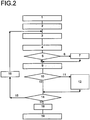
- FIG. 2 a flow chart for pressure calculation according to the inventive method for monitoring exothermic reactions is shown.
- a transfer of the input variables 1 educt and product quantities from the energy balance, measured initial temperature T 0 , measured initial pressure p 0
- the educt quantities transferred as input quantities are subdivided into k subsets ⁇ n and for carrying out the now following pressure calculation in k sales steps, the counter j of the steps is set to 1.
- the calculation 3 follows the intermediate temperature T j .
- the temperature change .DELTA.T is first determined in the exothermic reaction of a subset .DELTA.n of the reactants in the reactor.
- the associated intermediate temperature T be stored so that at the time of the maximum pressure stroke ⁇ p max prevailing temperature T ⁇ pmax can be retrieved at the end of the process.
- the through-pressure p d from the sum of the calculated maximum pressure stroke .DELTA.p max and the measured initial pressure p 0 is determined 19 If the through-pressure p d exceeds reactor-specific limit values, reactor safety measures are initiated to prevent the reactor from passing through.
- FIG. 3 shows a representation for calculating the through pressure from the pressure increase and the calculated initial pressure.
- the reactor pressure p R are plotted on the y-axis and the educt fuel quantity n i on the x-axis.
- the starting material amount n i initially has the value n i, 0 and decreases in steps ⁇ n i along the x-axis to zero, so that the diagram represents a reacting of the educts in steps of ⁇ n i .
- Two reactor pressure profiles as a function of the educt fuel quantity n i are shown, on the one hand the (normally unknown) actual pressure progression during passage 34 and on the other hand the throughput pressure 35 determined from the calculated pressure increase and the calculated initial pressure.
- the measured (real) initial pressure 36 lies here by the amount Ap 0 lower than the value calculated according to the inventive methods initial pressure 37.
- the process according to the invention underlying model also provides (due to its conservative interpretation) a calculated adiabatic increase in pressure .DELTA.p ad, Mod, the magnitude is greater than the real increase in pressure .DELTA.p ad, real is. Consequently, the maximum through-pressure 38 determined from the sum of the calculated initial pressure 37 and the calculated pressure increase ⁇ p ad, Mod is substantially higher than the real maximum through-pressure 39, which is the sum of the measured real initial pressure 36 and the real pressure increase ⁇ p ad, real results.
Landscapes
- Chemical & Material Sciences (AREA)
- Organic Chemistry (AREA)
- Chemical Kinetics & Catalysis (AREA)
- Physics & Mathematics (AREA)
- Engineering & Computer Science (AREA)
- General Physics & Mathematics (AREA)
- Automation & Control Theory (AREA)
- Polymers & Plastics (AREA)
- Medicinal Chemistry (AREA)
- Thermal Sciences (AREA)
- Health & Medical Sciences (AREA)
- Physical Or Chemical Processes And Apparatus (AREA)
- Organic Low-Molecular-Weight Compounds And Preparation Thereof (AREA)
- Polymerisation Methods In General (AREA)
Claims (8)
- Procédé pour la surveillance de réactions exothermiques dans un réacteur, un ou plusieurs produits de départ réagissant de manière exothermique en au moins un produit et au moins un gaz se trouvant dans le réacteur lors du fonctionnement normal ou lors du passage, contenant les étapes de procédé suivantes :A) mesure et enregistrement d'une température initiale et d'une pression initiale dans le réacteur,B) calcul de la quantité de produits et de produits de départ se trouvant dans le réacteur à partir d'un bilan énergétique,C) calcul d'une élévation maximale de pression qui se produit lors d'une réaction graduelle de la quantité présente de produits de départ par rapport à une pression de départ calculée, qui est supérieure à la pression initiale mesurée, la quantité présente de produits de départ étant divisée en k quantités partielles Δn pour le calcul de l'élévation maximale de pression qui se produit et les étapes suivantes étant répétées k fois :a) calcul d'une modification de température ΔT qui se règle dans le réacteur et d'une quantité résiduelle de produits de départ et de produits dans le réacteur lors de la transformation d'une quantité partielle Δn de produits de départ dans la réaction exothermique,b) calcul d'une température intermédiaire découlant de la modification de température ΔT,c) calcul d'une pression intermédiaire dans le réacteur par un calcul d'équilibre des phases, dans lequel la température intermédiaire, la quantité résiduelle de produits de départ et de produits et le volume du réacteur entrent comme données,d) enregistrement de la pression intermédiaire comme pression de départ p1 dans le premier passage des étapes a) à d),e) calcul d'une augmentation adiabatique de la pression comme différence entre la pression intermédiaire et la pression de départ etf) enregistrement de l'augmentation adiabatique de la pression comme élévation maximale de la pression si celle-ci est supérieure à une valeur enregistrée auparavant comme élévation maximale de la pression,
etD) calcul d'une pression de passage comme somme de l'élévation maximale de pression se produisant, calculée dans l'étape C) et de la pression initiale mesurée enregistrée dans l'étape A). - Procédé selon la revendication 1, caractérisé en ce que, dans le bilan énergétique (étape B), la chaleur introduite dans le réacteur, l'enthalpie de réaction introduite dans le réacteur par les produits de départ introduits et la quantité de chaleur évacuée du réacteur via un refroidissement du réacteur sont prises en considération.
- Procédé selon la revendication 1 ou 2, caractérisé en ce que lors du calcul de l'élévation maximale de la pression (étape C), les interactions entre les produits et les produits de départ dans le réacteur sont prises en considération.
- Procédé selon l'une quelconque des revendications 1 à 3, caractérisé en ce que les réactions exothermiques sont réalisées en continu ou de manière semi-continue ou discontinue.
- Procédé selon l'une quelconque des revendications 1 à 4, caractérisé en ce que le procédé est utilisé pour la surveillance en ligne et la sécurité en ligne de réactions exothermiques dans un réacteur.
- Procédé selon la revendication 5, caractérisé en ce que le calcul de l'élévation maximale de la température qui se produit et de la pression de passage associée est répété à des intervalles de temps courts pendant toute la durée de la réaction exothermique.
- Utilisation d'un procédé selon l'une quelconque des revendications 1 à 4 pour la surveillance et la sécurité d'une réaction de polymérisation en émulsion.
- Utilisation d'un procédé selon l'une quelconque des revendications 1 à 4 pour la surveillance et la sécurité d'une cuve de purge dans laquelle le produit des réactions exothermiques est entreposé de manière intermédiaire.
Applications Claiming Priority (3)
| Application Number | Priority Date | Filing Date | Title |
|---|---|---|---|
| DE10225383 | 2002-06-07 | ||
| DE10225383A DE10225383A1 (de) | 2002-06-07 | 2002-06-07 | Verfahren zur Überwachung und Sicherung von exothermen Reaktionen |
| PCT/EP2003/005946 WO2003103826A1 (fr) | 2002-06-07 | 2003-06-06 | Procede pour surveiller et securiser des reactions exothermiques |
Publications (2)
| Publication Number | Publication Date |
|---|---|
| EP1513611A1 EP1513611A1 (fr) | 2005-03-16 |
| EP1513611B1 true EP1513611B1 (fr) | 2019-08-14 |
Family
ID=29557655
Family Applications (1)
| Application Number | Title | Priority Date | Filing Date |
|---|---|---|---|
| EP03740197.3A Expired - Lifetime EP1513611B1 (fr) | 2002-06-07 | 2003-06-06 | Procede pour surveiller et securiser des reactions exothermiques |
Country Status (12)
| Country | Link |
|---|---|
| US (1) | US7575932B2 (fr) |
| EP (1) | EP1513611B1 (fr) |
| JP (1) | JP4405383B2 (fr) |
| KR (1) | KR100972239B1 (fr) |
| CN (1) | CN100404120C (fr) |
| AR (1) | AR040158A1 (fr) |
| AU (1) | AU2003274682B2 (fr) |
| BR (1) | BR0311430A (fr) |
| CA (1) | CA2487892A1 (fr) |
| DE (1) | DE10225383A1 (fr) |
| MX (1) | MXPA04011745A (fr) |
| WO (1) | WO2003103826A1 (fr) |
Families Citing this family (19)
| Publication number | Priority date | Publication date | Assignee | Title |
|---|---|---|---|---|
| US8290626B2 (en) * | 2007-09-10 | 2012-10-16 | SD Lizenzverwertungsgesellschadt mbH & Co KG | Chemical process optimization method that considers chemical process plant safety |
| GB2515411B (en) * | 2009-10-09 | 2015-06-10 | Senergy Holdings Ltd | Well simulation |
| WO2018077411A1 (fr) | 2016-10-27 | 2018-05-03 | Kordsa Teknik Tekstil Anonim Sirketi | Mélanges d'agents d'arrêt d'exothermie |
| EP3621726B1 (fr) * | 2017-05-12 | 2022-01-26 | Mitec S.r.l. Società Di Ingegneria | Procédé et système de surveillance des conditions de fonctionnement d'un réacteur semi-discontinu |
| EP3417935B1 (fr) * | 2017-06-20 | 2021-11-17 | Fluitec Invest AG | Procédé de contrôle d'une réaction chimique |
| CN111781098B (zh) * | 2019-04-04 | 2023-04-07 | 应急管理部化学品登记中心 | 测试化学反应失控安全泄放物料流动状态的装置及其用途 |
| CN111307862B (zh) * | 2020-04-03 | 2022-10-28 | 杭州格致检测科技有限公司 | 一种气体热安全性测试方法 |
| CN113724794B (zh) * | 2020-05-25 | 2024-10-29 | 中国石油化工股份有限公司 | 化学反应失控监测预警的方法及系统 |
| EP3922348A1 (fr) | 2020-06-09 | 2021-12-15 | Basf Se | Procédé de surveillance d'un réacteur pour une réaction à phases multiples |
| CN114839315A (zh) * | 2021-02-01 | 2022-08-02 | 中国石油化工股份有限公司 | 一种反应失控抑制效果评估测试方法 |
| CN113280259A (zh) * | 2021-05-08 | 2021-08-20 | 中盐安徽红四方股份有限公司 | 用于乙二醇液相加氢装置的防爆泄压装置和方法 |
| CN114814180B (zh) * | 2021-12-10 | 2023-04-25 | 成都理工大学 | 一种抗滑桩水泥浆凝结检测方法 |
| CN113899889B (zh) * | 2021-12-10 | 2022-04-15 | 成都理工大学 | 一种挡土墙可视化水泥浆胶凝强度监测装置及方法 |
| CN116779047B (zh) * | 2022-03-11 | 2025-08-19 | 中国石油化工股份有限公司 | 苯硝化反应失控识别方法、识别系统及失控抑制方法 |
| CN115232972B (zh) * | 2022-06-15 | 2023-10-03 | 广东至道先进土木工程材料技术研究有限公司 | 铝灰渣湿法处理的控制方法 |
| CN117282368A (zh) * | 2022-06-20 | 2023-12-26 | 万华化学集团股份有限公司 | 聚醚原料进料控制策略、系统和存储介质 |
| DE102022209657A1 (de) * | 2022-09-14 | 2024-03-14 | Siemens Aktiengesellschaft | Überwachung exothermer Reaktionen in einem Reaktor |
| US11998884B1 (en) | 2023-03-02 | 2024-06-04 | Erlan H. Feria | Method for controlling lingerature of chemical reaction |
| CN119306864B (zh) * | 2024-12-19 | 2025-03-28 | 安徽省众望科希盟科技有限公司 | 聚四氟乙烯及其制备方法、膨化聚四氟乙烯及其应用 |
Family Cites Families (7)
| Publication number | Priority date | Publication date | Assignee | Title |
|---|---|---|---|---|
| US3614682A (en) | 1970-06-22 | 1971-10-19 | Firestone Tire & Rubber Co | Digital computer control of polymerization process |
| US3914682A (en) * | 1974-11-13 | 1975-10-21 | Int Standard Electric Corp | Selective printer power supply arrangement |
| US3998995A (en) * | 1974-12-02 | 1976-12-21 | Phillips Petroleum Company | Polymerization method and apparatus |
| IN160886B (fr) * | 1983-04-25 | 1987-08-15 | Babcock & Wilcox Co | |
| DE29723396U1 (de) | 1997-02-12 | 1998-09-03 | Th. Goldschmidt Ag, 45127 Essen | Notstopp für chemische Reaktionen |
| DE19905712A1 (de) * | 1999-02-11 | 2000-08-17 | Basf Ag | Verfahren zur kontinuierlichen Überwachung und Steuerung des Monomerenumsatzes bei der Emulsionspolymerisation |
| DE19959834C1 (de) | 1999-12-10 | 2001-08-23 | Ulrich Hauptmanns | Verfahren und Einrichtung zur Notkühlung und Druckentlastung einer Anlage für exotherme Prozesse |
-
2002
- 2002-06-07 DE DE10225383A patent/DE10225383A1/de not_active Withdrawn
-
2003
- 2003-06-06 KR KR1020047019810A patent/KR100972239B1/ko not_active Expired - Fee Related
- 2003-06-06 AR ARP030102013A patent/AR040158A1/es not_active Application Discontinuation
- 2003-06-06 AU AU2003274682A patent/AU2003274682B2/en not_active Ceased
- 2003-06-06 JP JP2004510941A patent/JP4405383B2/ja not_active Expired - Fee Related
- 2003-06-06 US US10/515,295 patent/US7575932B2/en not_active Expired - Lifetime
- 2003-06-06 MX MXPA04011745A patent/MXPA04011745A/es active IP Right Grant
- 2003-06-06 CN CNB038131803A patent/CN100404120C/zh not_active Expired - Lifetime
- 2003-06-06 WO PCT/EP2003/005946 patent/WO2003103826A1/fr not_active Ceased
- 2003-06-06 BR BR0311430-9A patent/BR0311430A/pt not_active Application Discontinuation
- 2003-06-06 CA CA002487892A patent/CA2487892A1/fr not_active Abandoned
- 2003-06-06 EP EP03740197.3A patent/EP1513611B1/fr not_active Expired - Lifetime
Non-Patent Citations (1)
| Title |
|---|
| None * |
Also Published As
| Publication number | Publication date |
|---|---|
| MXPA04011745A (es) | 2005-03-07 |
| EP1513611A1 (fr) | 2005-03-16 |
| WO2003103826A1 (fr) | 2003-12-18 |
| DE10225383A1 (de) | 2003-12-18 |
| JP4405383B2 (ja) | 2010-01-27 |
| BR0311430A (pt) | 2005-03-22 |
| US7575932B2 (en) | 2009-08-18 |
| AR040158A1 (es) | 2005-03-16 |
| KR20050005540A (ko) | 2005-01-13 |
| CN1658966A (zh) | 2005-08-24 |
| CN100404120C (zh) | 2008-07-23 |
| CA2487892A1 (fr) | 2003-12-18 |
| AU2003274682B2 (en) | 2008-10-02 |
| US20050246067A1 (en) | 2005-11-03 |
| JP2005531396A (ja) | 2005-10-20 |
| KR100972239B1 (ko) | 2010-07-23 |
| AU2003274682A1 (en) | 2003-12-22 |
Similar Documents
| Publication | Publication Date | Title |
|---|---|---|
| DE10225383A1 (de) | Verfahren zur Überwachung und Sicherung von exothermen Reaktionen | |
| DE69423895T2 (de) | Virtuelles kontinuierliches emissionsüberwachungssystem mit gültigkeitsbestätigung des messfühlers | |
| DE69637428T2 (de) | Verfahren zum Messen von Bandprofil und Verfahren zum Steuern von kontinuierlichen Walzen | |
| EP2133676B1 (fr) | Procédé calorimétrique | |
| Kilkson | Effect of reaction path and initial distribution on molecular weight distribution of irreversible condensation polymers | |
| EP3374077B1 (fr) | Dispositif de mise en oeuvre d'une réaction chimique dans un procédé continu | |
| Zhu et al. | Quantifying human error probability in independent protection layers for a batch reactor system using dynamic simulations | |
| Copelli et al. | On the divergence criterion for runaway detection: Application to complex controlled systems | |
| WO2011032918A1 (fr) | Régulation à deux degrés de liberté avec commutation explicite pour la régulation de processus techniques | |
| DE1245599B (de) | Verfahren zur automatischen Einstellung einer gleichmaessigen Polymerisationsgeschwindigkeit | |
| EP1743133B1 (fr) | Procede et dispositif servant a determiner le rendement d'un echangeur de chaleur | |
| Zaldı́var et al. | Early warning detection of runaway initiation using non-linear approaches | |
| Bosch et al. | A comparative analysis between temperature and pressure measurements for early detection of runaway initiation | |
| EP1153042B1 (fr) | Procede de controle et de commande continus de conversion de monomeres lors de la polymerisation en emulsion | |
| Häfele et al. | Dynamic simulation of a tubular reactor for the production of low-density polyethylene using adaptive method of lines | |
| DE2221081A1 (de) | System zur Temperatursteuerung durch Druckmessung in einem Fluessigkeit-Dampf-Prozess | |
| DE102021206632A1 (de) | Genauigkeitsdiagnosevorrichtung und Genauigkeitsdiagnoseverfahren für eine Werkzeugmaschine | |
| AT526857B1 (de) | Verfahren für eine Erkennung von Gasblasen | |
| Suh et al. | New strategy for automated hazard analysis of chemical plants. Part 2: Reasoning algorithm and case study | |
| WO2013156115A1 (fr) | Procédé de régulation de la température dans un circuit à circulation de fluide | |
| DE102023203871B4 (de) | Verfahren und system zur zünderkennung in einer brennstoffzelle | |
| EP4075223A1 (fr) | Analyse des causes en cas d'anomalies du fonctionnement d'une installation technique | |
| Prinz | Model-based control of the thickness profile in hot strip rolling | |
| EP2837924B1 (fr) | Installation à huile caloporteuse équipée d'une détection de fuites, ainsi que procédé de détection de fuites sur une installation à huile caloporteuse | |
| DE102022126773A1 (de) | Vorrichtung und Verfahren zur Überwachung einer Inertisierung |
Legal Events
| Date | Code | Title | Description |
|---|---|---|---|
| PUAI | Public reference made under article 153(3) epc to a published international application that has entered the european phase |
Free format text: ORIGINAL CODE: 0009012 |
|
| 17P | Request for examination filed |
Effective date: 20050107 |
|
| AK | Designated contracting states |
Kind code of ref document: A1 Designated state(s): AT BE BG CH CY CZ DE DK EE ES FI FR GB GR HU IE IT LI LU MC NL PT RO SE SI SK TR |
|
| AX | Request for extension of the european patent |
Extension state: AL LT LV MK |
|
| DAX | Request for extension of the european patent (deleted) | ||
| 17Q | First examination report despatched |
Effective date: 20071127 |
|
| RAP1 | Party data changed (applicant data changed or rights of an application transferred) |
Owner name: BASF SE |
|
| GRAP | Despatch of communication of intention to grant a patent |
Free format text: ORIGINAL CODE: EPIDOSNIGR1 |
|
| STAA | Information on the status of an ep patent application or granted ep patent |
Free format text: STATUS: GRANT OF PATENT IS INTENDED |
|
| INTG | Intention to grant announced |
Effective date: 20181221 |
|
| RIC1 | Information provided on ipc code assigned before grant |
Ipc: C08F 2/22 20060101ALI20031230BHEP Ipc: B01J 19/00 20060101AFI20031230BHEP |
|
| GRAS | Grant fee paid |
Free format text: ORIGINAL CODE: EPIDOSNIGR3 |
|
| GRAA | (expected) grant |
Free format text: ORIGINAL CODE: 0009210 |
|
| STAA | Information on the status of an ep patent application or granted ep patent |
Free format text: STATUS: THE PATENT HAS BEEN GRANTED |
|
| AK | Designated contracting states |
Kind code of ref document: B1 Designated state(s): AT BE BG CH CY CZ DE DK EE ES FI FR GB GR HU IE IT LI LU MC NL PT RO SE SI SK TR |
|
| REG | Reference to a national code |
Ref country code: GB Ref legal event code: FG4D Free format text: NOT ENGLISH |
|
| REG | Reference to a national code |
Ref country code: CH Ref legal event code: EP Ref country code: AT Ref legal event code: REF Ref document number: 1166363 Country of ref document: AT Kind code of ref document: T Effective date: 20190815 |
|
| REG | Reference to a national code |
Ref country code: IE Ref legal event code: FG4D Free format text: LANGUAGE OF EP DOCUMENT: GERMAN |
|
| REG | Reference to a national code |
Ref country code: DE Ref legal event code: R096 Ref document number: 50315862 Country of ref document: DE |
|
| REG | Reference to a national code |
Ref country code: NL Ref legal event code: MP Effective date: 20190814 |
|
| PG25 | Lapsed in a contracting state [announced via postgrant information from national office to epo] |
Ref country code: PT Free format text: LAPSE BECAUSE OF FAILURE TO SUBMIT A TRANSLATION OF THE DESCRIPTION OR TO PAY THE FEE WITHIN THE PRESCRIBED TIME-LIMIT Effective date: 20191216 Ref country code: BG Free format text: LAPSE BECAUSE OF FAILURE TO SUBMIT A TRANSLATION OF THE DESCRIPTION OR TO PAY THE FEE WITHIN THE PRESCRIBED TIME-LIMIT Effective date: 20191114 Ref country code: NL Free format text: LAPSE BECAUSE OF FAILURE TO SUBMIT A TRANSLATION OF THE DESCRIPTION OR TO PAY THE FEE WITHIN THE PRESCRIBED TIME-LIMIT Effective date: 20190814 Ref country code: SE Free format text: LAPSE BECAUSE OF FAILURE TO SUBMIT A TRANSLATION OF THE DESCRIPTION OR TO PAY THE FEE WITHIN THE PRESCRIBED TIME-LIMIT Effective date: 20190814 Ref country code: FI Free format text: LAPSE BECAUSE OF FAILURE TO SUBMIT A TRANSLATION OF THE DESCRIPTION OR TO PAY THE FEE WITHIN THE PRESCRIBED TIME-LIMIT Effective date: 20190814 |
|
| PG25 | Lapsed in a contracting state [announced via postgrant information from national office to epo] |
Ref country code: ES Free format text: LAPSE BECAUSE OF FAILURE TO SUBMIT A TRANSLATION OF THE DESCRIPTION OR TO PAY THE FEE WITHIN THE PRESCRIBED TIME-LIMIT Effective date: 20190814 Ref country code: GR Free format text: LAPSE BECAUSE OF FAILURE TO SUBMIT A TRANSLATION OF THE DESCRIPTION OR TO PAY THE FEE WITHIN THE PRESCRIBED TIME-LIMIT Effective date: 20191115 |
|
| PG25 | Lapsed in a contracting state [announced via postgrant information from national office to epo] |
Ref country code: TR Free format text: LAPSE BECAUSE OF FAILURE TO SUBMIT A TRANSLATION OF THE DESCRIPTION OR TO PAY THE FEE WITHIN THE PRESCRIBED TIME-LIMIT Effective date: 20190814 |
|
| PG25 | Lapsed in a contracting state [announced via postgrant information from national office to epo] |
Ref country code: RO Free format text: LAPSE BECAUSE OF FAILURE TO SUBMIT A TRANSLATION OF THE DESCRIPTION OR TO PAY THE FEE WITHIN THE PRESCRIBED TIME-LIMIT Effective date: 20190814 Ref country code: EE Free format text: LAPSE BECAUSE OF FAILURE TO SUBMIT A TRANSLATION OF THE DESCRIPTION OR TO PAY THE FEE WITHIN THE PRESCRIBED TIME-LIMIT Effective date: 20190814 Ref country code: IT Free format text: LAPSE BECAUSE OF FAILURE TO SUBMIT A TRANSLATION OF THE DESCRIPTION OR TO PAY THE FEE WITHIN THE PRESCRIBED TIME-LIMIT Effective date: 20190814 Ref country code: DK Free format text: LAPSE BECAUSE OF FAILURE TO SUBMIT A TRANSLATION OF THE DESCRIPTION OR TO PAY THE FEE WITHIN THE PRESCRIBED TIME-LIMIT Effective date: 20190814 |
|
| PG25 | Lapsed in a contracting state [announced via postgrant information from national office to epo] |
Ref country code: CZ Free format text: LAPSE BECAUSE OF FAILURE TO SUBMIT A TRANSLATION OF THE DESCRIPTION OR TO PAY THE FEE WITHIN THE PRESCRIBED TIME-LIMIT Effective date: 20190814 Ref country code: SK Free format text: LAPSE BECAUSE OF FAILURE TO SUBMIT A TRANSLATION OF THE DESCRIPTION OR TO PAY THE FEE WITHIN THE PRESCRIBED TIME-LIMIT Effective date: 20190814 |
|
| REG | Reference to a national code |
Ref country code: DE Ref legal event code: R097 Ref document number: 50315862 Country of ref document: DE |
|
| PLBE | No opposition filed within time limit |
Free format text: ORIGINAL CODE: 0009261 |
|
| STAA | Information on the status of an ep patent application or granted ep patent |
Free format text: STATUS: NO OPPOSITION FILED WITHIN TIME LIMIT |
|
| 26N | No opposition filed |
Effective date: 20200603 |
|
| PG25 | Lapsed in a contracting state [announced via postgrant information from national office to epo] |
Ref country code: SI Free format text: LAPSE BECAUSE OF FAILURE TO SUBMIT A TRANSLATION OF THE DESCRIPTION OR TO PAY THE FEE WITHIN THE PRESCRIBED TIME-LIMIT Effective date: 20190814 |
|
| PG25 | Lapsed in a contracting state [announced via postgrant information from national office to epo] |
Ref country code: MC Free format text: LAPSE BECAUSE OF FAILURE TO SUBMIT A TRANSLATION OF THE DESCRIPTION OR TO PAY THE FEE WITHIN THE PRESCRIBED TIME-LIMIT Effective date: 20190814 |
|
| REG | Reference to a national code |
Ref country code: CH Ref legal event code: PL |
|
| GBPC | Gb: european patent ceased through non-payment of renewal fee |
Effective date: 20200606 |
|
| PG25 | Lapsed in a contracting state [announced via postgrant information from national office to epo] |
Ref country code: LU Free format text: LAPSE BECAUSE OF NON-PAYMENT OF DUE FEES Effective date: 20200606 |
|
| REG | Reference to a national code |
Ref country code: BE Ref legal event code: MM Effective date: 20200630 |
|
| PG25 | Lapsed in a contracting state [announced via postgrant information from national office to epo] |
Ref country code: FR Free format text: LAPSE BECAUSE OF NON-PAYMENT OF DUE FEES Effective date: 20200630 Ref country code: GB Free format text: LAPSE BECAUSE OF NON-PAYMENT OF DUE FEES Effective date: 20200606 Ref country code: LI Free format text: LAPSE BECAUSE OF NON-PAYMENT OF DUE FEES Effective date: 20200630 Ref country code: IE Free format text: LAPSE BECAUSE OF NON-PAYMENT OF DUE FEES Effective date: 20200606 Ref country code: CH Free format text: LAPSE BECAUSE OF NON-PAYMENT OF DUE FEES Effective date: 20200630 |
|
| PG25 | Lapsed in a contracting state [announced via postgrant information from national office to epo] |
Ref country code: BE Free format text: LAPSE BECAUSE OF NON-PAYMENT OF DUE FEES Effective date: 20200630 |
|
| REG | Reference to a national code |
Ref country code: AT Ref legal event code: MM01 Ref document number: 1166363 Country of ref document: AT Kind code of ref document: T Effective date: 20200606 |
|
| PG25 | Lapsed in a contracting state [announced via postgrant information from national office to epo] |
Ref country code: AT Free format text: LAPSE BECAUSE OF NON-PAYMENT OF DUE FEES Effective date: 20200606 |
|
| PG25 | Lapsed in a contracting state [announced via postgrant information from national office to epo] |
Ref country code: CY Free format text: LAPSE BECAUSE OF FAILURE TO SUBMIT A TRANSLATION OF THE DESCRIPTION OR TO PAY THE FEE WITHIN THE PRESCRIBED TIME-LIMIT Effective date: 20190814 |
|
| PGFP | Annual fee paid to national office [announced via postgrant information from national office to epo] |
Ref country code: DE Payment date: 20220628 Year of fee payment: 20 |
|
| REG | Reference to a national code |
Ref country code: DE Ref legal event code: R071 Ref document number: 50315862 Country of ref document: DE |