EP1512123B1 - System und verfahren zur elektronischen korrektur von optischen anomalien - Google Patents
System und verfahren zur elektronischen korrektur von optischen anomalien Download PDFInfo
- Publication number
- EP1512123B1 EP1512123B1 EP03759800A EP03759800A EP1512123B1 EP 1512123 B1 EP1512123 B1 EP 1512123B1 EP 03759800 A EP03759800 A EP 03759800A EP 03759800 A EP03759800 A EP 03759800A EP 1512123 B1 EP1512123 B1 EP 1512123B1
- Authority
- EP
- European Patent Office
- Prior art keywords
- optical
- anomaly
- correcting
- image
- transformation
- Prior art date
- Legal status (The legal status is an assumption and is not a legal conclusion. Google has not performed a legal analysis and makes no representation as to the accuracy of the status listed.)
- Expired - Lifetime
Links
Images


Classifications
-
- G—PHYSICS
- G06—COMPUTING OR CALCULATING; COUNTING
- G06T—IMAGE DATA PROCESSING OR GENERATION, IN GENERAL
- G06T3/00—Geometric image transformations in the plane of the image
- G06T3/04—Context-preserving transformations, e.g. by using an importance map
- G06T3/047—Fisheye or wide-angle transformations
-
- G—PHYSICS
- G06—COMPUTING OR CALCULATING; COUNTING
- G06T—IMAGE DATA PROCESSING OR GENERATION, IN GENERAL
- G06T3/00—Geometric image transformations in the plane of the image
-
- G—PHYSICS
- G06—COMPUTING OR CALCULATING; COUNTING
- G06T—IMAGE DATA PROCESSING OR GENERATION, IN GENERAL
- G06T5/00—Image enhancement or restoration
- G06T5/80—Geometric correction
Definitions
- This invention relates to electronic correction of optical anomalies and more particularly to electronic correction of distortion, lateral chromatic aberration, luminance non-uniformity,and chrominance non-uniformity, which can be combined with a general image transform (e.g. scaling and geometric transform).
- a general image transform e.g. scaling and geometric transform
- optical anomalies are inherent to the non-ideal behavior of the various optical elements and to accuracy and tolerance of assembly.
- Various components sensors, displays, lens, prisms, mirrors, light source
- optical or otherwise and their orientation may introduce their own specific optical anomalies, such as distortion, tilt, lateral chromatic aberration, luminance or chrominance non-uniformity.
- optical aberration is generally used to refer to any effect that leads to an non-ideal image formation..
- Optical aberrations include diffraction effects (due to the wave nature of light), chromatic aberrations (caused by optical dispersion, or the differences in refraction in different wavelengths of light), and monochromatic aberrations (of which spherical aberration, coma, and astigmatism are concerned with failures of a point object to form a point image, and field curvature and distortion are concerned with the failure of finite objects perpendicular to the principal axis to form a well-focused plane image).
- spherical aberration, coma, and astigmatism are concerned with failures of a point object to form a point image
- field curvature and distortion are concerned with the failure of finite objects perpendicular to the principal axis to form a well-focused plane image.
- the former types degrade the sharpness of an image, that is, the image appears blurred, and/or out of focus, and/or has color fringes.
- Aberrations in this category include spherical aberrations, astigmatism, coma, field of curvature and axial chromatic aberration.
- the latter types of aberrations affect the shape of the image that in part may be induced by the former aberration or by the correction and optimization of the former aberration. In this case, points in the object plane are shifted or distorted in comparison with an ideal mapping in the image plane. In an ideal mapping an object in the image plane will appear as it does in the object plane, with possibly a uniform scale change. For example, an image may appear curved near the edges or appear rotated.
- Aberrations in this second category include distortions (e.g. pincushion/barrel effects) and lateral chromatic aberrations.
- chromatic aberrations With the exception of chromatic aberrations, all other optical aberrations are present in monochromatic (i.e. single color) light. Chromatic aberration appears when dealing with polychromatic light (many colors). In short, the index of refraction is wavelength dependent, which means that the red, green and blue components bend differently at an optical interface. This leads to axial (longitudinal) and/or lateral chromatic aberration effects. In axial chromatic aberration, the three components are brought to focus on different planes in the image space, which gives a color blurring effect. In other words, axial chromatic aberration arises due to the focal length varying with wavelength (color).
- lateral chromatic aberration color components from a single point are brought to focus to different points on the same image plane. This has the effect of magnifying the three colors differently and can be visually seen as 'color fringing'. Thus lateral chromatic aberration can be seen as an effect due to magnification varying with wavelength.
- the three colors can also mismatch due to non-optical effects.
- color non-convergence is used to refer to color mismatch effects, whether optical (as in chromatic aberrations) or not. Further discussion on optical aberrations can be found in conventional optics textbooks, such as Robert Guenther's Modern Optics, published by John Wiley & Sons, 1990 .
- Luminance non-uniformity leads to varying brightness across an image.
- Common causes include a varying (in brightness) light source, varying optical path across the image plane, non-uniform sensor response and irregularities in panels (e.g. LCD, LCOS, etc.). Both large-scale and small-scale non-uniformities can be present.
- brightness variation can be different for each color, leading to chrominance non-uniformity.
- lateral chromatic aberration is commonly corrected (or minimized) using special optical elements, often consisting of prism/lens combinations and/or special material coatings such as that disclosed in U.S. Patent Nos. 4,943,155 to Cross , 5,086,338 to Usui , 5,499,139 to Chen et al. , 6,023,375 to Kreitzer , 6,111,701 to Brown , 6,144, 498 to Bryars et al. , and 6,172,815 to Hashizume et al .
- the physical implementation of the solutions disclosed in these references are expensive and bulky.
- the specialized nature of these designs necessarily restrict them to specific types of applications. Typically, these methods are aimed at display/projection systems or head up/mounted display systems.
- the warping data (i.e. data which describes how the image is to be transformed) may be used to adjust the digital image (e.g. as in U.S. Patent Nos. 5,369,450 to Haseltine et al. and 5,889,625 to Chen et al. ) or to adjust the operation of the electronics that display/project the image (e.g. as in U.S. Patent No. 5,200,815 ).
- These electronic solutions concentrate on specific anomalies, such as luminance correction (e.g. U.S. Patent Nos. 5,838,396 to Shiota et al. , 5,870,505 to Woeber et al , 6,288,756 to Shiota et al.
- distortion and chromatic aberration e.g. 5,200,815 to Tsujihara et al. , 5,369,450 to Haseltine et al , 5,889,625 to Chen et al. , and 6,323,934 to Enomoto et al .
- Those solutions that do correct for all three anomalies are not real-time in nature.
- Other limitations of prior art electronic solutions are that they do not allow for application specific "correction" (i.e. correction which does not correspond to an optical anomaly correction) and/or they do not provide for dynamic anomaly correction.
- the invention provides in one aspect, an electronic correction method for correcting a plurality of optical anomalies associated with the image capture and image display of an optical image processed through optical capture and display components having physical and geometrical characteristics, by compensation of the digital image pixel data associated with the optical image, said method comprising:
- the invention provides in another aspect, an electronic correction system for correcting a plurality of optical anomalies associated with the capture and display of an optical image processed through optical capture and display components having a particular geometry, by compensation of the digital image pixel data associated with the optical image, said system comprising an image processor (51) for:
- the invention provides in another aspect a computer-readable medium having computer-readable instructions embodied therein for correcting a plurality of optical anomalies associated with the capture and display of an optical image processed through optical capture and display components having a particular geometry, by compensation of the digital image pixel data associated with the optical image, by:
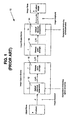
- FIG. 1 illustrates the main elements of a conventional image capture/display device 10 and the optical anomalies present within the corresponding image processing chain that is represented as image (i.e. pixel level) transformations.
- image i.e. pixel level
- Capture/display device 10 contains various elements, including optical elements e.g. lenses, prisms, mirrors, etc.) and non-optical elements (e.g. electronic sensors and display panels) 12 and 14 some or all of which may introduce an optical anomaly into the image processing chain as shown.
- Capture/display device 10 also includes memory (i.e. storage) 16 and 18 as shown.
- Each optical anomaly acts in the spatial space (affecting the shape of the imaged object) and/or in the color space (affecting the brightness/color of the imaged object).
- These effects can be represented as transformations or mappings of (a) pixel positions and (b) pixel colors, that are applied somewhere between the memory plane (space) 16 and 18 and the corresponding object/image plane. Accordingly, these transformations define the optical anomalies. It should be understood that the current representation does not consider differential focus anomalies as differential focus problems cannot be corrected electronically.
- FIG. 1 shows the processing chain where the maps representing the collective effect of all the anomalies on the capture side (defined by subscript c ) by f c and on the display side (defined by subscript d ) by f d .
- the optical anomalies present within capture/display device 10 are represented by these maps.
- the map I associated with storage at the memory plane represents the identity map, which indicates that is there is no change in the image as the memory planes 16 and 18 do not introduce any anomalies.
- optical anomaly is used to refer to any effect that leads to an non-ideal image formation, in particular this includes aberrations and luminance non-uniformity.
- FIG. 2 illustrates how the map f c can be further split into f c s and f c c , where f c s describes spatial anomalies (superscript s ) and f c c describes color anomalies (superscript c ). Since each color component may transform differently, f c s and f c c should be replaced by f cr s , f cg s , f cb s and f cr c , f cg c , f cb c , for the red, green and blue components (second subscripts r , g , b ).
- f c s and f c c will be used when referring to all three component functions together.
- the spatial/color maps representing the anomalies on the display side are denoted by f d s and f d c with their color components f dr s , f dg s , f db s , f dr c , f dg c and f db c .
- the specifics (size, type, etc.) of the memory planes are system dependent and that the memory planes shown represent conceptual domains for the various maps rather than actual hardware implementations of storage.
- the memory plane on the display side is shown in dotted outline to indicate that it need not be present in a specific device, Instead, a captured image may be directly displayed without being stored. If additional processing is conducted in the display part of capture/display device 10 (e.g. frame rate conversion) then some form of physical memory will be required. Furthermore, the memory plane on the capture side does need not be full frame.
- An object O in the object plane is defined by its 2D position vector x (for a point) and its RGB value ( O r ,O g ,O b ).
- the point object is approximated by a pixel. Due to chromatic aberration, the color components of this object will be mapped to different points in the image plane. In general, the single point will be mapped to three points as the three colors are brought to focus to different points (on the same plane).
- the image of the object in the image plane will be described by three position vectors ( x ' r , x ' g , x ' b ) and the corresponding color values ( O ' r , O ' g , O ' b ).
- mappings all spatial maps are represented as vector functions, although to simplify notation the vector arrow has been omitted.
- the corresponding image processing chain is shown in FIG. 2 .
- the notation q (z), for a mapping q and variable z means that q acts to modify z only, changing it to a new value of the same type (i.e. a new position value or a new color value).
- the mapping q can also depend on other variables, however in order to simplify the notation, these are not shown.
- all spatial mappings depend only on spatial variables, whereas the color mappings can depend on both spatial and color variables, as will be further described.
- FIG. 3 illustrates the ideal behaviour of capture/display device 10.
- the correcting maps will try to restore this ideal behavior.
- x ⁇ ⁇ ⁇ k ⁇ x ⁇ , where capture/display device 10 only linearly scales objects in the object plane.
- FIG. 4 illustrates the main elements associated with the electronic correction system 50, made accordance with the present invention.
- Electronic correction system 50 uses image processor 51 to eliminate optical anomalies common to image capture/display devices by introducing an additional 'inverse' transformation in the processing chain discussed above.
- electronic correction system 50 includes optical elements (e.g. lenses, prisms, mirrors, etc.) and non-optical elements (e.g. electronic sensors and panels) 52 and 54 some or all of which may introduce an optical anomaly into the image processing chain as shown, as well as memory plane (i.e. storage plane) 56 and 58 which is assumed not to introduce any anomalies. While both a capture and a display device are shown, it should be understood that the present invention could be easily adapted for use with a capture or display device alone.
- optical elements e.g. lenses, prisms, mirrors, etc.
- non-optical elements e.g. electronic sensors and panels
- memory plane i.e. storage plane
- equations (2) to (7) describe the optical anomalies as transformations in the spatial and color domains.
- Image processor 51 applies arbitrary geometric (spatial) and color transformations to digital images. Spatial transformations are well known and it should be understood that similar transformations can be used to achieve color transformation. Implementation of these spatial transformations can be implemented by image processor 51 using various commercially available image warp circuits (e.g. the sxW1 integrated circuit manufactured by Silicon Optix of San Jose, California) where certain circuits work in the spatial domain and others can also apply color transformations.
- image warp circuits e.g. the sxW1 integrated circuit manufactured by Silicon Optix of San Jose, California
- Image processor 51 processes each color from an image independently, allowing the transformations to be different for the three channels.
- Image processor 51 is placed within the processing chain at the capture-display interface as shown.
- the transformations due to image processor 51 will be denoted by f wr s , f wg s and f wb s (first subscript w ) for the three spatial mappings, and f wr c , f wg c and f wb c for the three-color mappings.
- the processing chain as shown in FIG.
- image processor 51 applies the transformations in equations (26) to (31), the optical anomalies of distortion, color non-convergence (excluding axial chromatic aberration) and luminance (chrominance) non-uniformity will be eliminated.
- Implicit in transformations (26) to (31) is the filtering that accompanies any image warping. After the geometric transformations f wr s , f wg s and f wb s are applied; re-sampling (of all three channels) is needed to generate the new image or pixel data. In image processor 51, these filtering operations often take place before the color transformations f wr c , f wg c and f wb c are applied. The color mappings are then applied to the new filtered pixel data, implying that the anomaly correcting transformations (29) to (31) need to be based on the new image data.
- FIG. 5 illustrates the specific processing sequence that occurs within image processor 51, where a spatial filter 47 performs the filtering operation denoted by F .
- the geometric data received for each output pixel is used by spatial filter 47 to acquire a number of input pixels for transform by FIR filter to an output pixel value.
- a gain and offset stage 49 is utilized to ensure that uniform luminance/chrominance results as previously discussed.
- spatial filter 47 is used to combine F with f cr c - 1 to eliminate the capture side luminosity anomaly.
- the filtering F is implicit in all processing chains or equations that include an image warping circuit. Also implicit is the fact that the color transformations are indirectly linked to the spatial transformations via the filtering.
- the spatial mappings can also directly interact with the color maps. It is contemplated that image processor 51 could be configured to allow for the dynamic modulation of the color map parameters according to the spatial data (e.g. positional/derivative information) being generated. This option is shown in FIG. 5 by the dotted arrow running between the space mapping element and the color-mapping element.
- the generation of the spatial mappings can be performed by an attached processing block or offline (i.e. not within image processor 51), and stored as depicted by geometric transform dataset 57 and luminance transform dataset 59 in FIG. 5 .
- FIG. 6 illustrates another example electronic correction system 100 which uses image processor 101 to implement a further generalization of the transformations (26) to (31) to include an application specific "correction" or warping component (i.e. a component that is independent of the components that correct for the optical defects).
- electronic correction system 100 includes optical elements (e.g. lenses, prisms, mirrors, etc.) and non-optical elements (e.g. electronic sensors and display panels) 102 and 104 some or all of which may introduce an optical anomaly into the image processing chain as shown, as well as memory plane (i.e. storage plane) 106 and 108 which is assumed not to introduce any anomalies.
- optical elements e.g. lenses, prisms, mirrors, etc.
- non-optical elements e.g. electronic sensors and display panels
- memory plane i.e. storage plane
- F an "effective filtering” denotes the filtering accompanying f a s in the absence of any anomalies.
- F plays a role in both eliminating the anomalies and applying the application specific filtering due to f a s .
- mappings f a s and f a c can be different for the three colors, however, for most practical purposes these mappings are the same for all colors. It should be understood that having f a s be different for the three colors is equivalently to 'artificially' introducing lateral chromatic aberration. It should be noted that f a s and f a c do not serve to correct the optical anomalies, and their inputs/outputs are assumed to be anomaly free. Accordingly, the effective processing chain, with the anomalies removed, is shown in FIG. 6 . Once image processor 101 has eliminated the optical anomalies, image processor 101 effectively acts as an application specific image warping circuit. FIG. 7 shows an effective processing chain that resides inside the image processor 101.
- An example of electronic correction system 100 i.e. capture/display device
- capture/display device is one that applies transformations (34) to (39) and that films (captures) a scene and projects (displays) it onto a curved screen.
- f a s and f a c will correct for the distortion (in position and/or color) that arises when projecting onto a curved screen.
- the remaining mapping components will correct for the optical anomalies due to the capture/display optical/electronic components.
- These remaining mapping components are device dependent mappings so that if the screen shape changes, only f a s and f a c change, whereas the device dependent mappings would be unchanged.
- mappings f ci s - 1 , f di s - 1 , f ci c - 1 , f di c - 1 , h c s , h d s , h c c and h d c need only be computed once for a given device configuration.
- One application that might require different f a c mappings for each color is that of color matching.
- the three colors (in each image) in the overlap region need to be adjusted individually to present a seamless transition.
- mappings are an application/device dependent.
- the most general description of a mapping is in terms of a grid dataset.
- a grid dataset gives a representative set of pixels' input/output positions and colors values.
- Various methods can be used to generate a grid dataset.
- a ray-tracing program can be used to determine input and output pixel positions.
- Test patterns can also be run through the system to determine color shifts.
- Data on input and output brightness levels can determine the grid dataset (in color space) that describes the luminance correcting map.
- the grid datasets for the inverse functions in transformations (34) to (39) can be computed by inverting the grid datasets from the 'forward' maps in transformations (2) to (7).
- the conventional understanding relating to spatial transformations can be applied to determine ((42) to ((44).
- the coefficients of the color map ((42) are being fitted in ((43) to ((44).
- the surfaces ((43) to ((44) are determined in exactly the same manner as surface (41); only the meaning of the range is different.
- the color map is taken to be linear; higher order functions may be used though the physical significance of higher order surfaces is not clear.
- Image processor 51 ( FIG. 5 ) and 101 takes ((42) to be linear in O i and ((43) to ((44) to be linear in x and y .
- FIG. 8 illustrates another example electronic correction system 150 which uses image processor 151 to achieve dynamic optical correction and image warping.
- the different transformations which define the dynamic sequence can be computed using a map generator 162 and stored in an external memory 160.
- electronic correction system 150 includes optical elements (e.g. lenses, prisms, etc.) and non-optical elements (e.g. electronic sensors and panels) 152 and 154 some or all of which may introduce an optical anomaly into the image processing chain as shown, as well as memory (i.e. storage plane) 156 and 158 which is assumed not to introduce any anomalies.
- optical elements e.g. lenses, prisms, etc.
- non-optical elements e.g. electronic sensors and panels
- Electronic correction system 150 uses image processor 151 to store different mappings (i.e. more than one set of functions (41) to ((44)). Using this approach, situations where the optical anomalies (and/or application specific warping) change with time (at a reasonable rate) can be addressed. This corresponds to adaptive anomaly correction, where the mappings adapt to the changing anomalies.
- the functions can be pre-computed according to the dynamic changes and then loaded as needed. Dynamic application specific effects can also be included, for example a keystone correction that changes with time.
- the mappings are computed offline, this need not be the case. Given enough computational power, the mappings could be calculated online (i.e. inside an integrated circuit) which will eliminate the memory block required to store the various maps.
- the above electronic solution to optical anomaly correction greatly reduces the cost of a system.
- expensive optical elements can be eliminated or replaced by cheaper components.
- the current circuit can correct distortion, lateral chromatic aberration and luminance/chrominance non-uniformity, as well as apply any application specific image warping.
- a prime market for electronic correction system 150 is in the area of high-resolution pixelated display systems which are used in HDTV's, PC monitors, projection TV's etc.
- FIG. 9 is a flowchart that illustrates the main process steps associated with the electronic correction method 200 of the present invention made accordance with the present invention. As discussed in detail above, electronic correction method 200 eliminates optical anomalies common to image capture/display devices.
- an offline circuit, or possibly image processor 51, 101 and 151 identifies various optical anomalies and collectively represents them as transformations of pixel data.
- the transformations can be in spatial (positional) space and/or color space. As discussed above, the most general way of specifying a transformation is through grid datasets, which give a representative set of pixels' input/output positions and color values.
- the ideal behavior of the processing chain is also identified and represented as grid datasets.
- the anomaly correcting transformations i.e. in the form of grid datasets
- these can be computed by inverting the grid datasets from the previous steps.
- any application specific transformations grid datasets
- the anomaly correcting and application specific transformations, or grid datasets are concatenated into a single dataset. This gives one dataset, for each independent pixel variable, which specifies the complete 'warp' map that is to be applied electronically. There are six independent pixel variables, namely RGB positional values and RGB color values.
- the concatenated grid datasets are converted to a device specific functional format used by commercially available image warp circuits (e.g. the sxW1 integrated circuit manufactured by Silicon Optix of San Jose, California).
- This functional description is capable of representing very general transformations in a manner that is appropriate for real-time, sub-pixel accurate, image processing.
- the pixel data is digitally transformed, according to the pre-computed functional description, via the sxW1 integrated circuit.
- Electronic correction system 50, 100 and 150 and electronic correction method 200 provide efficient and cost-effective real-time electronic correction of aberrations that do not affect image sharpness, namely distortions and color non-convergence (excluding axial chromatic aberration) and luminance (or chrominance) non-uniformity.
- Each of these effects are modelled as transformations in either spatial (positional) space or color space. That is, once an aberration is expressed as a pixel transformation (affecting either pixel positions or pixel color content), it can be eliminated by applying the inverse transformation.
- the same approach also provides for application specific image processing and dynamic anomaly correction.
- Electronic correction method 200 is not restricted to display/projection devices or capture devices, but may be used in conjunction with any image processing chain containing a display and/or capture component. All corrections are represented as grid datasets or functions acting in spatial or color space, which allows different corrections to be concatenated through functional compositions.
Landscapes
- Physics & Mathematics (AREA)
- General Physics & Mathematics (AREA)
- Engineering & Computer Science (AREA)
- Theoretical Computer Science (AREA)
- Image Processing (AREA)
- Pharmaceuticals Containing Other Organic And Inorganic Compounds (AREA)
- Optical Communication System (AREA)
- Transforming Electric Information Into Light Information (AREA)
- Gyroscopes (AREA)
- Controls And Circuits For Display Device (AREA)
- Semiconductor Lasers (AREA)
Claims (27)
- Elektronisches Korrekturverfahren zum Korrigieren einer Anzahl optischer Anomalien, die der Bildaufnahme und Bildanzeige eines durch optische Aufnahme- und Anzeigekomponenten mit physikalischen und geometrischen Charakteristiken verarbeiteten Bildes zugeordnet sind, durch Kompensation der dem optischen Bild zugeordneten Digitalbildpixel, wobei das Verfahren beinhaltet:(a) Identifizieren und Darstellen einer jeden der optischen Anomalien, die den physikalischen und geometrischen Charakteristiken der optischen Aufnahme- und Anzeigekomponenten zugeordnet sind, als optischer Anomaliegitter-Datensatz bzw. Anomalie-Gitterdatensatz;(b) Identifizieren und Darstellen des idealen Verhaltens der optischen Aufnahme- und Anzeigekomponenten als Idealgitter-Datensatz;(c) für jeden optischen Anomaliegitter-Datensatz:(i) Vergleichen des optischen Anomaliegitter-Datensatzes mit dem Idealgitter-Datensatz und Bestimmen eines Anomaliekorrekturgitter-Datensatzes;(ii) Anpassen einer zweidimensionalen Oberflächenfunktion zum Darstellen des Anomaliekorrekturgitter-Datensatzes;(d) Verketten der zweidimensionalen Oberflächenfunktionen aus (c) zum Bilden einer allgemeinen zweidimensionalen Oberflächenfunktion, die eine Anomaliekorrekturtransformation für die optischen Anomalien repräsentiert; und(e) Anwenden der Anomaliekorrekturtransformation auf die Digitalbild-Pixeldaten zum Erzeugen von korrigierten Bild-Pixeldaten, die bzw. das frei von den optischen Anomalien sind bzw. ist, wenn sie bzw. es betrachtet werden bzw. wird.
- Verfahren nach Anspruch 1, bei dem die optischen Anomalien aus der Gruppe ausgewählt sind, die aus Verzerrungen, Farb-Nichtkonvergenz, Luminanz-Nichtuniformität und Chrominanz-Nichtuniformität besteht.
- Verfahren nach Anspruch 1, das ferner das Berechnen einer anwendungsspezifischen Transformation beinhaltet, die eine Bildskalierung und geometrische Transformationen repräsentiert, die aus der Gruppe ausgewählt sind, die aus sphärischen, zylindrischen und Trapez-Transformationen besteht, und Verketten der anwendungsspezifischen Transformation mit der Anomaliekorrekturtransformation aus (d), und wobei (e) aus dem Anwenden der Verkettung der anwendungsspezifischen Transformation mit der Anomaliekorrekturtransformation auf die Digitalpixel-Bilddaten besteht.
- Verfahren nach Anspruch 1, bei dem die Anomaliekorrekturtransformation in eine vorrichtungsspezifische funktionelle Darstellung konvertiert wird.
- Verfahren nach Anspruch 1, das ferner das Speichern einer Sequenz von Transformationen zum Erzielen einer dynamischen Anomaliekorrektur beinhaltet.
- Verfahren nach Anspruch 1, bei dem die Anomaliekorrekturtransformation im Positionsraum und/oder im Farbraum definiert ist.
- Verfahren nach Anspruch 1, bei dem die Anomaliekorrekturtransformation einen Satz korrigierender geometrischer Transformationen und einen Satz korrigierender Farbtransformationen definiert.
- Verfahren nach Anspruch 7, bei dem (e) beinhaltet(i) Anwenden des Satzes von korrigierenden Geometrietransformationen;(ii) Anwenden eines Satzes von Filteroperationen; und(iii) Anwenden des Satzes von korrigierenden Farbtransformationen.
- Verfahren nach Anspruch 1, bei dem die Digitalpixel-Bilddaten einer Aufnahmevorrichtung und/oder einer Anzeigevorrichtung zugeordnet sind.
- Elektronisches Korrektursystem zum Korrigieren einer Anzahl optischer Anomalien, die der Aufnahme und Anzeige eines durch optische Aufnahme- und Anzeigekomponenten mit einer speziellen Geometrie verarbeiteten Bildes zugeordnet sind, durch Kompensieren der Digitalbild-Pixeldaten, die dem optischen Bild zugeordnet sind, wobei das System einen Bildprozessor aufweist zum:(a) Identifizieren und Darstellen einer jeden der den physikalischen und geometrischen Charakteristiken der optischen Aufnahme- und Anzeigekomponenten zugeordneten optischen Anomalien als optischen Anomaliegitter-Datensatz bzw. Anomalie-Gitterdatensatz;(b) Identifizieren und Darstellen des idealen Verhaltens der optischen Aufnahme- und Anzeigekomponenten als Idealgitter-Datensatz;(c) für jeden optischen Anomaliegitter-Datensatz:(i) Vergleichen des optischen Anomaliegitter-Datensatzes mit dem Idealgitter-Datensatz und Bestimmen eines Anomaliekorrekturgitter-Datensatzes;(ii) Anpassen einer zweidimensionalen Oberflächenfunktion zum Darstellen des Anomaliekorrekturgitter-Datensatzes;(d) Verketten der zweidimensionalen Oberflächenfunktionen von (c) zum Bilden einer allgemeinen zweidimensionalen Oberflächenfunktion, die eine Anomaliekorrekturtransformation für die optischen Anomalien repräsentiert; und(e) Anwenden der Anomaliekorrekturtransformation auf die Digitalbild-Pixeldaten zum Bilden korrigierter Bild-Pixeldaten, die bzw. das frei von den optischen Anomalien sind bzw. ist, wenn sie bzw. es betrachtet werden bzw. wird.
- System nach Anspruch 10, bei dem die optischen Anomalien aus der Gruppe ausgewählt sind, die aus Verzerrungen, Farb-Nichtkonvergenz, Luminanz-Nichtuniformität und Chrominanz-Nichtuniformität besteht.
- System nach Anspruch 10, das ferner ein Anwendungsmodul zum Berechnen einer anwendungsspezifischen Transformation aufweist, die Bildskalierung und geometrische Transformationen beinhaltet, die aus der Gruppe ausgewählt sind, die aus sphärischen, zylindrischen und Trapez-Transformationen besteht, und Verketten der anwendungsspezifischen Transformation mit der Anomaliekorrekturtransformation aus (d), und wobei (e) aus dem Anwenden der Verkettung der anwendungsspezifischen Transformation mit der Anomaliekorrekturtransformation auf die Digitalpixel-Bilddaten besteht.
- System nach Anspruch 10, bei dem der Bildprozessor ferner dafür eingerichtet ist, die Anomaliekorrekturtransformation in eine vorrichtungsspezifische funktionelle Darstellung zu konvertieren.
- System nach Anspruch 10, bei dem der Bildprozessor ferner dafür eingerichtet ist, eine Sequenz von Transformationen zu speichern, um eine dynamische Anomaliekorrektur zu erzielen.
- System nach Anspruch 10, bei dem das optische Anomaliegitter im Positionsraum und/oder im Farbraum definiert ist.
- System nach Anspruch 10, bei dem die Anomaliekorrekturtransformation einen Satz korrigierender geometrischer Transformationen und einen Satz korrigierender Farbtransformationen definiert.
- System nach Anspruch 16, bei dem der Bildprozessor ferner dafür eingerichtet ist:(i) den Satz von korrigierenden geometrischen Transformationen anzuwenden;(ii) einen Satz von Filteroperationen anzuwenden; und(iii) den Satz von korrigierenden Farbtransformationen anzuwenden.
- System nach Anspruch 10, das ferner eine Bildanzeigevorrichtung aufweist, die mit dem Bildprozessor zum Anzeigen der korrigierten Bildpixeldaten verbunden ist.
- System nach Anspruch 10, das ferner eine Bildaufnahmevorrichtung, die mit dem Bildprozessor zum Aufnehmen der Digitalbild-Pixeldaten verbunden ist, aufweist.
- Computerlesbares Medium mit darin enthaltenen computerlesbaren Anweisungen zum Korrigieren einer Anzahl optischer Anomalien, die der Aufnahme und Anzeige eines durch optische Aufnahme- und Anzeigekomponenten mit einer speziellen Geometrie verarbeiteten optischen Bildes zugeordnet sind, durch Kompensation der dem optischen Bild zugeordneten Digitalbild-Pixeldaten, mittels:(a) Identifizieren und Darstellen einer jeden der optischen Anomalien, die den physikalischen und geometrischen Charakteristiken der optischen Aufnahme- und Anzeigekomponenten zugeordnet sind, als optischer Anomaliegitter-Datensatz bzw. Anomalie-Gitterdatensatz;(b) Identifizieren und Darstellen des idealen Verhaltens der optischen Aufnahme- und Anzeigekomponenten als Idealgitter-Datensatz;(c) für jeden optischen Anomaliegitter-Datensatz:(i) Vergleichen des optischen Anomaliegitter-Datensatzes mit dem Idealgitter-Datensatz und Bestimmen eines Anomaliekorrekturgitter-Datensatzes;(ii) Anpassen einer zweidimensionalen Oberflächenfunktion zum Darstellen des Anomaliekorrekturgitter-Datensatzes;(d) Verketten der zweidimensionalen Oberflächenfunktionen von (c) zum Bilden einer allgemeinen zweidimensionalen Oberflächenfunktion, die eine Anomaliekorrekturtransformation für die optischen Anomalien repräsentiert; und(e) Anwenden der Anomaliekorrekturtransformation auf die Digitalbild-Pixeldaten zum Bilden korrigierter Bild-Pixeldaten, die bzw. das frei von den optischen Anomalien sind bzw. ist, wenn sie bzw. es betrachtet werden bzw. wird.
- Computerlesbares Medium nach Anspruch 20, bei dem die optischen Anomalien aus der Gruppe ausgewählt sind, die aus Verzerrungen, Farb-Nichtkonvergenz, Luminanz-Nichtkonvergenz und Chrominanz-Nichtkonvergenz besteht.
- Computerlesbares Medium nach Anspruch 20, bei dem eine anwendungsspezifische Transformation berechnet wird, die Bildskalierung und geometrische Transformationen repräsentiert, die aus der Gruppe ausgewählt sind, die aus sphärischen, zylindrischen und Trapez-Transformationen besteht und Verketten der anwendungsspezifischen Transformation mit der Anomaliekorrekturtransformation aus (d) und wobei (e) aus dem Anwenden der Verkettung der anwendungsspezifischen Transformation mit der Anomaliekorrekturtransformation auf die Digitalbild-Pixeldaten besteht.
- Computerlesbares Medium nach Anspruch 20, bei dem die Anomaliekorrekturtransformation in eine vorrichtungsspezifische funktionelle Darstellung konvertiert wird.
- Computerlesbares Medium nach Anspruch 20, bei dem eine Sequenz von Transformationen gespeichert wird, um eine dynamische Anomaliekorrektur zu erzielen.
- Computerlesbares Medium nach Anspruch 20, bei dem die Anomaliekorrekturtransformation im Positionsraum und/oder Farbraum definiert wird.
- Computerlesbares Medium nach Anspruch 20, bei dem die Anomaliekorrekturtransformation einen Satz korrigierender geometrischer Transformationen und einen Satz korrigierender Farbtransformationen definiert.
- Computerlesbares Medium nach Anspruch 26, bei dem (e) umfasst(i) Anwenden des Satzes korrigierender geometrischer Transformationen;(ii) Anwenden eines Satzes von Filteroperationen; und(iii) Anwenden des Satzes korrigierender Farbtransformationen.
Applications Claiming Priority (3)
| Application Number | Priority Date | Filing Date | Title |
|---|---|---|---|
| US38759602P | 2002-06-12 | 2002-06-12 | |
| US387596P | 2002-06-12 | ||
| PCT/CA2003/000888 WO2003107274A2 (en) | 2002-06-12 | 2003-06-12 | System and method for electronic correction of optical anomalies |
Publications (2)
| Publication Number | Publication Date |
|---|---|
| EP1512123A2 EP1512123A2 (de) | 2005-03-09 |
| EP1512123B1 true EP1512123B1 (de) | 2009-10-07 |
Family
ID=29736337
Family Applications (1)
| Application Number | Title | Priority Date | Filing Date |
|---|---|---|---|
| EP03759800A Expired - Lifetime EP1512123B1 (de) | 2002-06-12 | 2003-06-12 | System und verfahren zur elektronischen korrektur von optischen anomalien |
Country Status (9)
| Country | Link |
|---|---|
| US (1) | US7474799B2 (de) |
| EP (1) | EP1512123B1 (de) |
| JP (1) | JP2005535010A (de) |
| KR (1) | KR100973855B1 (de) |
| CN (1) | CN100365658C (de) |
| AT (1) | ATE445203T1 (de) |
| AU (1) | AU2003232561A1 (de) |
| DE (1) | DE60329593D1 (de) |
| WO (1) | WO2003107274A2 (de) |
Families Citing this family (37)
| Publication number | Priority date | Publication date | Assignee | Title |
|---|---|---|---|---|
| US6751362B2 (en) * | 2001-01-11 | 2004-06-15 | Micron Technology, Inc. | Pixel resampling system and method for text |
| US6963348B2 (en) * | 2002-05-31 | 2005-11-08 | Nvidia Corporation | Method and apparatus for display image adjustment |
| US7221793B2 (en) | 2003-05-27 | 2007-05-22 | Hewlett-Packard Development Company, L.P. | Systems and methods for providing spatially-varied demosaicing |
| CN1985266B (zh) * | 2004-07-26 | 2010-05-05 | 奥普提克斯晶硅有限公司 | 全景视觉系统和方法 |
| US20060045383A1 (en) * | 2004-08-31 | 2006-03-02 | Picciotto Carl E | Displacement estimation system and method |
| JP2008512767A (ja) * | 2004-09-09 | 2008-04-24 | シリコン オプティックス インコーポレイテッド | 一般的な2次元空間変換の表現システム及び方法 |
| US8880205B2 (en) | 2004-12-30 | 2014-11-04 | Mondo Systems, Inc. | Integrated multimedia signal processing system using centralized processing of signals |
| US7653447B2 (en) | 2004-12-30 | 2010-01-26 | Mondo Systems, Inc. | Integrated audio video signal processing system using centralized processing of signals |
| US8015590B2 (en) * | 2004-12-30 | 2011-09-06 | Mondo Systems, Inc. | Integrated multimedia signal processing system using centralized processing of signals |
| US7825986B2 (en) | 2004-12-30 | 2010-11-02 | Mondo Systems, Inc. | Integrated multimedia signal processing system using centralized processing of signals and other peripheral device |
| US7570810B2 (en) * | 2005-02-24 | 2009-08-04 | Seiko Epson Corporation | Method and apparatus applying digital image filtering to color filter array data |
| US9101279B2 (en) | 2006-02-15 | 2015-08-11 | Virtual Video Reality By Ritchey, Llc | Mobile user borne brain activity data and surrounding environment data correlation system |
| JP5074777B2 (ja) * | 2006-05-22 | 2012-11-14 | キヤノン株式会社 | 撮像機能付表示装置、画像処理装置、画像処理方法、および、画像表示システム |
| US20080088527A1 (en) * | 2006-10-17 | 2008-04-17 | Keitaro Fujimori | Heads Up Display System |
| US8094965B2 (en) | 2006-12-19 | 2012-01-10 | California Institute Of Technology | Image processor |
| US8094169B2 (en) | 2006-12-19 | 2012-01-10 | California Institute Of Technology | Imaging model and apparatus |
| US8055070B2 (en) * | 2007-01-05 | 2011-11-08 | Geo Semiconductor Inc. | Color and geometry distortion correction system and method |
| US8442316B2 (en) * | 2007-01-05 | 2013-05-14 | Geo Semiconductor Inc. | System and method for improving color and brightness uniformity of backlit LCD displays |
| JP4827193B2 (ja) * | 2007-03-23 | 2011-11-30 | オリンパスイメージング株式会社 | 電子撮像装置 |
| US8325282B2 (en) * | 2008-04-08 | 2012-12-04 | Mitsubishi Electric Visual Solutions America, Inc. | Television automatic geometry adjustment system |
| US8328365B2 (en) | 2009-04-30 | 2012-12-11 | Hewlett-Packard Development Company, L.P. | Mesh for mapping domains based on regularized fiducial marks |
| DE102010028894B4 (de) | 2009-05-13 | 2018-05-24 | Koh Young Technology Inc. | Verfahren zur Messung eines Messobjekts |
| DE102010064640B3 (de) * | 2009-05-13 | 2018-05-09 | Koh Young Technology Inc. | Verfahren zur Messung eines Messungsziels |
| WO2011045904A1 (ja) * | 2009-10-15 | 2011-04-21 | パナソニック株式会社 | 表示パネル装置、表示装置および表示パネル装置の製造方法 |
| TWI423659B (zh) * | 2010-11-09 | 2014-01-11 | Avisonic Technology Corp | 影像校正方法與相關影像校正系統 |
| US8854401B2 (en) | 2010-12-28 | 2014-10-07 | Apple Inc. | System and method to improve image edge discoloration |
| US8867831B2 (en) * | 2012-05-09 | 2014-10-21 | University Of Southern California | Image enhancement using modulation strength map and modulation kernel |
| US9251572B2 (en) * | 2013-07-26 | 2016-02-02 | Qualcomm Incorporated | System and method of correcting image artifacts |
| US10438331B2 (en) * | 2014-06-26 | 2019-10-08 | Intel Corporation | Distortion meshes against chromatic aberrations |
| TW201822709A (zh) * | 2016-12-30 | 2018-07-01 | 曦威科技股份有限公司 | 即時心跳偵測方法及即時心跳偵測系統 |
| US11275920B1 (en) | 2017-09-27 | 2022-03-15 | Apple Inc. | Elongated fingerprint sensor |
| US11227558B1 (en) | 2018-09-07 | 2022-01-18 | Apple Inc. | Subpixel layout compensation to correct color fringing on an electronic display |
| US11189248B1 (en) | 2020-05-06 | 2021-11-30 | Apple Inc. | Systems and methods for switching vision correction graphical outputs on a display of an electronic device |
| US12093359B2 (en) | 2020-09-25 | 2024-09-17 | Apple Inc. | Electronic device having a sealed biometric input system |
| US11783629B2 (en) | 2021-03-02 | 2023-10-10 | Apple Inc. | Handheld electronic device |
| CN113515512B (zh) * | 2021-06-22 | 2024-06-14 | 国网辽宁省电力有限公司鞍山供电公司 | 一种工业互联网平台数据的质量治理及提升方法 |
| ES2957904A1 (es) * | 2022-06-27 | 2024-01-29 | Airbus Operations Slu | Sistema de detección de anomalías en la colocación automática de composites durante la fabricación de elementos estructurales |
Family Cites Families (32)
| Publication number | Priority date | Publication date | Assignee | Title |
|---|---|---|---|---|
| US4943155A (en) * | 1987-12-22 | 1990-07-24 | Hughes Aircraft Company | Color projection system with a color correction wedge |
| US5086338A (en) * | 1988-11-21 | 1992-02-04 | Canon Kabushiki Kaisha | Color television camera optical system adjusting for chromatic aberration |
| US5055922A (en) * | 1990-03-07 | 1991-10-08 | U.S. Precision Lens Incorporated | Color tv projection lens system |
| FR2660090B1 (fr) * | 1990-03-23 | 1994-07-29 | Thomson Csf | Dispositif de visualisation par projection a boucle de contre-reaction pour la correction de l'ensemble des defauts de l'image projetee. |
| JP2653899B2 (ja) * | 1990-06-07 | 1997-09-17 | 松下電器産業株式会社 | 画像補正装置 |
| US5369450A (en) * | 1993-06-01 | 1994-11-29 | The Walt Disney Company | Electronic and computational correction of chromatic aberration associated with an optical system used to view a color video display |
| US6012375A (en) * | 1993-07-06 | 2000-01-11 | Eckstein; Donald B. | Aircraft infrared guided defense missile system |
| US5499139A (en) * | 1993-10-01 | 1996-03-12 | Hughes Aircraft Company | Ultra-wide field of view, broad spectral band helmet visor display optical system |
| JPH0888860A (ja) * | 1994-09-19 | 1996-04-02 | Mitsubishi Electric Corp | 自動画像歪補正装置 |
| CN1070013C (zh) * | 1994-12-14 | 2001-08-22 | 松下电器产业株式会社 | 具有校正亮度不均匀性的电路的投影型图像显示装置 |
| US5870505A (en) * | 1996-03-14 | 1999-02-09 | Polaroid Corporation | Method and apparatus for pixel level luminance adjustment |
| JP3309738B2 (ja) * | 1996-11-01 | 2002-07-29 | 松下電器産業株式会社 | 画像表示装置 |
| US6249315B1 (en) * | 1997-03-24 | 2001-06-19 | Jack M. Holm | Strategy for pictorial digital image processing |
| US5889625A (en) * | 1997-05-21 | 1999-03-30 | Raytheon Company | Chromatic aberration correction for display systems |
| JP3575234B2 (ja) * | 1997-07-15 | 2004-10-13 | セイコーエプソン株式会社 | ダイクロイックプリズムおよび投写型表示装置 |
| DE19855885A1 (de) * | 1997-12-04 | 1999-08-05 | Fuji Photo Film Co Ltd | Bildverarbeitungsverfahren und -vorrichtung |
| US6069982A (en) * | 1997-12-23 | 2000-05-30 | Polaroid Corporation | Estimation of frequency dependence and grey-level dependence of noise in an image |
| US6144498A (en) * | 1998-06-11 | 2000-11-07 | Optical Coating Laboratory, Inc. | Color separation prism assembly and method for making same |
| US6456339B1 (en) | 1998-07-31 | 2002-09-24 | Massachusetts Institute Of Technology | Super-resolution display |
| JP3395832B2 (ja) * | 1998-08-28 | 2003-04-14 | ソニー株式会社 | 画像表示補正システム、画像表示補正装置および方法並びに画像表示装置および方法 |
| US6418242B1 (en) * | 1998-11-18 | 2002-07-09 | Tektronix, Inc. | Efficient detection of error blocks in a DCT-based compressed video sequence |
| KR100366643B1 (ko) * | 1998-11-25 | 2003-02-19 | 삼성전자 주식회사 | 구획현상제거방법및장치 |
| US6349146B2 (en) * | 1998-12-22 | 2002-02-19 | Xerox Corporation | Device-biased color converting apparatus and method |
| US6459818B1 (en) * | 1999-03-01 | 2002-10-01 | University Of Rochester | System for recovery of degraded images |
| US6111701A (en) * | 1999-07-14 | 2000-08-29 | Rockwell Collins, Inc. | Chromatic aberration corrected multi-color head-up display system |
| KR100414083B1 (ko) * | 1999-12-18 | 2004-01-07 | 엘지전자 주식회사 | 영상왜곡 보정방법 및 이를 이용한 영상표시기기 |
| US6816625B2 (en) * | 2000-08-16 | 2004-11-09 | Lewis Jr Clarence A | Distortion free image capture system and method |
| JP3497805B2 (ja) * | 2000-08-29 | 2004-02-16 | オリンパス株式会社 | 画像投影表示装置 |
| US6963348B2 (en) * | 2002-05-31 | 2005-11-08 | Nvidia Corporation | Method and apparatus for display image adjustment |
| KR100571219B1 (ko) * | 2003-01-08 | 2006-04-13 | 엘지전자 주식회사 | 3차원 가상 스크린 기반 영상왜곡 보정장치 |
| KR100525425B1 (ko) * | 2003-02-04 | 2005-11-02 | 엘지전자 주식회사 | 영상 워핑 방법 및 장치 |
| JP4600209B2 (ja) * | 2005-08-18 | 2010-12-15 | ソニー株式会社 | 画像処理方法、画像処理装置、プログラムおよび記録媒体 |
-
2003
- 2003-06-12 AT AT03759800T patent/ATE445203T1/de not_active IP Right Cessation
- 2003-06-12 CN CNB038136007A patent/CN100365658C/zh not_active Expired - Lifetime
- 2003-06-12 JP JP2004514012A patent/JP2005535010A/ja active Pending
- 2003-06-12 AU AU2003232561A patent/AU2003232561A1/en not_active Abandoned
- 2003-06-12 KR KR1020047020010A patent/KR100973855B1/ko not_active Expired - Lifetime
- 2003-06-12 WO PCT/CA2003/000888 patent/WO2003107274A2/en not_active Ceased
- 2003-06-12 US US10/461,320 patent/US7474799B2/en not_active Expired - Lifetime
- 2003-06-12 DE DE60329593T patent/DE60329593D1/de not_active Expired - Lifetime
- 2003-06-12 EP EP03759800A patent/EP1512123B1/de not_active Expired - Lifetime
Also Published As
| Publication number | Publication date |
|---|---|
| CN1659592A (zh) | 2005-08-24 |
| US7474799B2 (en) | 2009-01-06 |
| US20040076336A1 (en) | 2004-04-22 |
| AU2003232561A8 (en) | 2003-12-31 |
| WO2003107274A2 (en) | 2003-12-24 |
| CN100365658C (zh) | 2008-01-30 |
| KR20060041142A (ko) | 2006-05-11 |
| JP2005535010A (ja) | 2005-11-17 |
| DE60329593D1 (de) | 2009-11-19 |
| AU2003232561A1 (en) | 2003-12-31 |
| WO2003107274A3 (en) | 2004-07-29 |
| KR100973855B1 (ko) | 2010-08-03 |
| EP1512123A2 (de) | 2005-03-09 |
| ATE445203T1 (de) | 2009-10-15 |
Similar Documents
| Publication | Publication Date | Title |
|---|---|---|
| EP1512123B1 (de) | System und verfahren zur elektronischen korrektur von optischen anomalien | |
| JP4159986B2 (ja) | デジタル画像から変換された画像を計算するための方法およびシステム | |
| TWI459820B (zh) | 色彩及幾何失真校正系統及方法 | |
| US8768094B2 (en) | System and method for automated calibration and correction of display geometry and color | |
| CN102165761B (zh) | 图像处理方法、图像处理装置和图像拾取装置 | |
| US20090002835A1 (en) | Method for lens performance optimization using electronic aberration correction | |
| JP7414745B2 (ja) | 学習データの製造方法、学習方法、学習データ製造装置、学習装置、およびプログラム | |
| WO2002101443A2 (en) | System and method for correcting keystone distortion | |
| CN102844788A (zh) | 图像处理装置及使用该图像处理装置的图像拾取装置 | |
| CN102970459A (zh) | 图像处理设备、摄像设备和图像处理方法 | |
| JPH10322711A (ja) | カラーセンサの空間的不均一性の補正システム | |
| JP5479187B2 (ja) | 画像処理装置及びそれを用いた撮像装置 | |
| JP2004274133A (ja) | 色収差補正装置および色収差補正方法、並びに色収差補正プログラム | |
| Petrov et al. | Color correction with 3D lookup tables in diffractive optical imaging systems | |
| JP5055588B2 (ja) | 画像処理装置および画像処理方法 | |
| EP4690120A1 (de) | Kalibrierung eines bildgebungssystems mithilfe von strukturiertem licht | |
| JP2020201694A (ja) | 画像処理装置、撮像装置、画像処理方法、プログラム、および、記憶媒体 | |
| JPH0737079A (ja) | 画像歪み補正方法及び装置 | |
| JP5047700B2 (ja) | 画像表示装置、画像処理方法、及びプログラム | |
| JPS59109970A (ja) | 歪補正装置 | |
| CN118396905B (zh) | 一种针对旋转双棱镜仿人眼系统成像畸变及色散的协同校正方法 | |
| Wang et al. | P‐108: A Novel Chromatic Aberration Correction Method for VR Display | |
| CN118368534A (zh) | 一种图像的优化方法、装置、电子设备及存储介质 | |
| JP2024063846A (ja) | 画像処理装置、画像処理方法、及びコンピュータプログラム | |
| CN118338139A (zh) | 用于校正图像中包括的伪影的装置 |
Legal Events
| Date | Code | Title | Description |
|---|---|---|---|
| PUAI | Public reference made under article 153(3) epc to a published international application that has entered the european phase |
Free format text: ORIGINAL CODE: 0009012 |
|
| 17P | Request for examination filed |
Effective date: 20041213 |
|
| AK | Designated contracting states |
Kind code of ref document: A2 Designated state(s): AT BE BG CH CY CZ DE DK EE ES FI FR GB GR HU IE IT LI LU MC NL PT RO SE SI SK TR |
|
| AX | Request for extension of the european patent |
Extension state: AL LT LV MK |
|
| DAX | Request for extension of the european patent (deleted) | ||
| GRAP | Despatch of communication of intention to grant a patent |
Free format text: ORIGINAL CODE: EPIDOSNIGR1 |
|
| GRAS | Grant fee paid |
Free format text: ORIGINAL CODE: EPIDOSNIGR3 |
|
| GRAA | (expected) grant |
Free format text: ORIGINAL CODE: 0009210 |
|
| AK | Designated contracting states |
Kind code of ref document: B1 Designated state(s): AT BE BG CH CY CZ DE DK EE ES FI FR GB GR HU IE IT LI LU MC NL PT RO SE SI SK TR |
|
| REG | Reference to a national code |
Ref country code: GB Ref legal event code: FG4D |
|
| REG | Reference to a national code |
Ref country code: CH Ref legal event code: EP |
|
| REG | Reference to a national code |
Ref country code: IE Ref legal event code: FG4D |
|
| REF | Corresponds to: |
Ref document number: 60329593 Country of ref document: DE Date of ref document: 20091119 Kind code of ref document: P |
|
| PG25 | Lapsed in a contracting state [announced via postgrant information from national office to epo] |
Ref country code: SI Free format text: LAPSE BECAUSE OF FAILURE TO SUBMIT A TRANSLATION OF THE DESCRIPTION OR TO PAY THE FEE WITHIN THE PRESCRIBED TIME-LIMIT Effective date: 20091007 |
|
| NLV1 | Nl: lapsed or annulled due to failure to fulfill the requirements of art. 29p and 29m of the patents act | ||
| PG25 | Lapsed in a contracting state [announced via postgrant information from national office to epo] |
Ref country code: SE Free format text: LAPSE BECAUSE OF FAILURE TO SUBMIT A TRANSLATION OF THE DESCRIPTION OR TO PAY THE FEE WITHIN THE PRESCRIBED TIME-LIMIT Effective date: 20091007 Ref country code: ES Free format text: LAPSE BECAUSE OF FAILURE TO SUBMIT A TRANSLATION OF THE DESCRIPTION OR TO PAY THE FEE WITHIN THE PRESCRIBED TIME-LIMIT Effective date: 20100118 Ref country code: FI Free format text: LAPSE BECAUSE OF FAILURE TO SUBMIT A TRANSLATION OF THE DESCRIPTION OR TO PAY THE FEE WITHIN THE PRESCRIBED TIME-LIMIT Effective date: 20091007 Ref country code: PT Free format text: LAPSE BECAUSE OF FAILURE TO SUBMIT A TRANSLATION OF THE DESCRIPTION OR TO PAY THE FEE WITHIN THE PRESCRIBED TIME-LIMIT Effective date: 20100208 |
|
| PG25 | Lapsed in a contracting state [announced via postgrant information from national office to epo] |
Ref country code: BE Free format text: LAPSE BECAUSE OF FAILURE TO SUBMIT A TRANSLATION OF THE DESCRIPTION OR TO PAY THE FEE WITHIN THE PRESCRIBED TIME-LIMIT Effective date: 20091007 Ref country code: AT Free format text: LAPSE BECAUSE OF FAILURE TO SUBMIT A TRANSLATION OF THE DESCRIPTION OR TO PAY THE FEE WITHIN THE PRESCRIBED TIME-LIMIT Effective date: 20091007 |
|
| PG25 | Lapsed in a contracting state [announced via postgrant information from national office to epo] |
Ref country code: NL Free format text: LAPSE BECAUSE OF FAILURE TO SUBMIT A TRANSLATION OF THE DESCRIPTION OR TO PAY THE FEE WITHIN THE PRESCRIBED TIME-LIMIT Effective date: 20091007 Ref country code: DK Free format text: LAPSE BECAUSE OF FAILURE TO SUBMIT A TRANSLATION OF THE DESCRIPTION OR TO PAY THE FEE WITHIN THE PRESCRIBED TIME-LIMIT Effective date: 20091007 Ref country code: RO Free format text: LAPSE BECAUSE OF FAILURE TO SUBMIT A TRANSLATION OF THE DESCRIPTION OR TO PAY THE FEE WITHIN THE PRESCRIBED TIME-LIMIT Effective date: 20091007 Ref country code: BG Free format text: LAPSE BECAUSE OF FAILURE TO SUBMIT A TRANSLATION OF THE DESCRIPTION OR TO PAY THE FEE WITHIN THE PRESCRIBED TIME-LIMIT Effective date: 20100107 Ref country code: EE Free format text: LAPSE BECAUSE OF FAILURE TO SUBMIT A TRANSLATION OF THE DESCRIPTION OR TO PAY THE FEE WITHIN THE PRESCRIBED TIME-LIMIT Effective date: 20091007 |
|
| PLBE | No opposition filed within time limit |
Free format text: ORIGINAL CODE: 0009261 |
|
| STAA | Information on the status of an ep patent application or granted ep patent |
Free format text: STATUS: NO OPPOSITION FILED WITHIN TIME LIMIT |
|
| PG25 | Lapsed in a contracting state [announced via postgrant information from national office to epo] |
Ref country code: SK Free format text: LAPSE BECAUSE OF FAILURE TO SUBMIT A TRANSLATION OF THE DESCRIPTION OR TO PAY THE FEE WITHIN THE PRESCRIBED TIME-LIMIT Effective date: 20091007 Ref country code: CZ Free format text: LAPSE BECAUSE OF FAILURE TO SUBMIT A TRANSLATION OF THE DESCRIPTION OR TO PAY THE FEE WITHIN THE PRESCRIBED TIME-LIMIT Effective date: 20091007 |
|
| 26N | No opposition filed |
Effective date: 20100708 |
|
| PG25 | Lapsed in a contracting state [announced via postgrant information from national office to epo] |
Ref country code: GR Free format text: LAPSE BECAUSE OF FAILURE TO SUBMIT A TRANSLATION OF THE DESCRIPTION OR TO PAY THE FEE WITHIN THE PRESCRIBED TIME-LIMIT Effective date: 20100108 |
|
| PG25 | Lapsed in a contracting state [announced via postgrant information from national office to epo] |
Ref country code: MC Free format text: LAPSE BECAUSE OF NON-PAYMENT OF DUE FEES Effective date: 20100630 |
|
| REG | Reference to a national code |
Ref country code: CH Ref legal event code: PL |
|
| REG | Reference to a national code |
Ref country code: FR Ref legal event code: ST Effective date: 20110228 |
|
| PG25 | Lapsed in a contracting state [announced via postgrant information from national office to epo] |
Ref country code: IT Free format text: LAPSE BECAUSE OF FAILURE TO SUBMIT A TRANSLATION OF THE DESCRIPTION OR TO PAY THE FEE WITHIN THE PRESCRIBED TIME-LIMIT Effective date: 20091007 |
|
| PG25 | Lapsed in a contracting state [announced via postgrant information from national office to epo] |
Ref country code: CH Free format text: LAPSE BECAUSE OF NON-PAYMENT OF DUE FEES Effective date: 20100630 Ref country code: LI Free format text: LAPSE BECAUSE OF NON-PAYMENT OF DUE FEES Effective date: 20100630 Ref country code: IE Free format text: LAPSE BECAUSE OF NON-PAYMENT OF DUE FEES Effective date: 20100612 |
|
| PG25 | Lapsed in a contracting state [announced via postgrant information from national office to epo] |
Ref country code: FR Free format text: LAPSE BECAUSE OF NON-PAYMENT OF DUE FEES Effective date: 20100630 |
|
| PG25 | Lapsed in a contracting state [announced via postgrant information from national office to epo] |
Ref country code: CY Free format text: LAPSE BECAUSE OF FAILURE TO SUBMIT A TRANSLATION OF THE DESCRIPTION OR TO PAY THE FEE WITHIN THE PRESCRIBED TIME-LIMIT Effective date: 20091007 |
|
| PG25 | Lapsed in a contracting state [announced via postgrant information from national office to epo] |
Ref country code: HU Free format text: LAPSE BECAUSE OF FAILURE TO SUBMIT A TRANSLATION OF THE DESCRIPTION OR TO PAY THE FEE WITHIN THE PRESCRIBED TIME-LIMIT Effective date: 20100408 Ref country code: LU Free format text: LAPSE BECAUSE OF NON-PAYMENT OF DUE FEES Effective date: 20100612 |
|
| PG25 | Lapsed in a contracting state [announced via postgrant information from national office to epo] |
Ref country code: TR Free format text: LAPSE BECAUSE OF FAILURE TO SUBMIT A TRANSLATION OF THE DESCRIPTION OR TO PAY THE FEE WITHIN THE PRESCRIBED TIME-LIMIT Effective date: 20091007 |
|
| REG | Reference to a national code |
Ref country code: GB Ref legal event code: 732E Free format text: REGISTERED BETWEEN 20130411 AND 20130417 |
|
| PGFP | Annual fee paid to national office [announced via postgrant information from national office to epo] |
Ref country code: GB Payment date: 20220425 Year of fee payment: 20 Ref country code: DE Payment date: 20220420 Year of fee payment: 20 |
|
| REG | Reference to a national code |
Ref country code: DE Ref legal event code: R071 Ref document number: 60329593 Country of ref document: DE |
|
| REG | Reference to a national code |
Ref country code: GB Ref legal event code: PE20 Expiry date: 20230611 |
|
| PG25 | Lapsed in a contracting state [announced via postgrant information from national office to epo] |
Ref country code: GB Free format text: LAPSE BECAUSE OF EXPIRATION OF PROTECTION Effective date: 20230611 |