EP1511308A1 - Videoaufzeichnungsgerät - Google Patents
Videoaufzeichnungsgerät Download PDFInfo
- Publication number
- EP1511308A1 EP1511308A1 EP03292146A EP03292146A EP1511308A1 EP 1511308 A1 EP1511308 A1 EP 1511308A1 EP 03292146 A EP03292146 A EP 03292146A EP 03292146 A EP03292146 A EP 03292146A EP 1511308 A1 EP1511308 A1 EP 1511308A1
- Authority
- EP
- European Patent Office
- Prior art keywords
- time
- timer
- predetermined duration
- start time
- end time
- Prior art date
- Legal status (The legal status is an assumption and is not a legal conclusion. Google has not performed a legal analysis and makes no representation as to the accuracy of the status listed.)
- Withdrawn
Links
- 101000711846 Homo sapiens Transcription factor SOX-9 Proteins 0.000 claims abstract description 5
- 102100034204 Transcription factor SOX-9 Human genes 0.000 claims abstract description 5
- 230000001419 dependent effect Effects 0.000 claims description 13
- 238000000034 method Methods 0.000 claims description 13
- 101100232371 Hordeum vulgare IAT3 gene Proteins 0.000 abstract description 2
- 238000012790 confirmation Methods 0.000 description 3
- 230000006870 function Effects 0.000 description 2
- 238000012986 modification Methods 0.000 description 1
- 230000004048 modification Effects 0.000 description 1
- 230000003287 optical effect Effects 0.000 description 1
- 239000000344 soap Substances 0.000 description 1
- 230000003442 weekly effect Effects 0.000 description 1
Images



Classifications
-
- H—ELECTRICITY
- H04—ELECTRIC COMMUNICATION TECHNIQUE
- H04N—PICTORIAL COMMUNICATION, e.g. TELEVISION
- H04N21/00—Selective content distribution, e.g. interactive television or video on demand [VOD]
- H04N21/40—Client devices specifically adapted for the reception of or interaction with content, e.g. set-top-box [STB]; Operations thereof
- H04N21/43—Processing of content or additional data, e.g. demultiplexing additional data from a digital video stream; Elementary client operations, e.g. monitoring of home network or synchronising decoder's clock; Client middleware
- H04N21/434—Disassembling of a multiplex stream, e.g. demultiplexing audio and video streams, extraction of additional data from a video stream; Remultiplexing of multiplex streams; Extraction or processing of SI; Disassembling of packetised elementary stream
- H04N21/4348—Demultiplexing of additional data and video streams
-
- G—PHYSICS
- G04—HOROLOGY
- G04G—ELECTRONIC TIME-PIECES
- G04G15/00—Time-pieces comprising means to be operated at preselected times or after preselected time intervals
- G04G15/003—Time-pieces comprising means to be operated at preselected times or after preselected time intervals acting only at one preselected time or during one adjustable time interval
-
- H—ELECTRICITY
- H04—ELECTRIC COMMUNICATION TECHNIQUE
- H04N—PICTORIAL COMMUNICATION, e.g. TELEVISION
- H04N21/00—Selective content distribution, e.g. interactive television or video on demand [VOD]
- H04N21/40—Client devices specifically adapted for the reception of or interaction with content, e.g. set-top-box [STB]; Operations thereof
- H04N21/43—Processing of content or additional data, e.g. demultiplexing additional data from a digital video stream; Elementary client operations, e.g. monitoring of home network or synchronising decoder's clock; Client middleware
- H04N21/434—Disassembling of a multiplex stream, e.g. demultiplexing audio and video streams, extraction of additional data from a video stream; Remultiplexing of multiplex streams; Extraction or processing of SI; Disassembling of packetised elementary stream
- H04N21/4345—Extraction or processing of SI, e.g. extracting service information from an MPEG stream
-
- H—ELECTRICITY
- H04—ELECTRIC COMMUNICATION TECHNIQUE
- H04N—PICTORIAL COMMUNICATION, e.g. TELEVISION
- H04N5/00—Details of television systems
- H04N5/76—Television signal recording
- H04N5/78—Television signal recording using magnetic recording
- H04N5/782—Television signal recording using magnetic recording on tape
-
- H—ELECTRICITY
- H04—ELECTRIC COMMUNICATION TECHNIQUE
- H04N—PICTORIAL COMMUNICATION, e.g. TELEVISION
- H04N21/00—Selective content distribution, e.g. interactive television or video on demand [VOD]
- H04N21/40—Client devices specifically adapted for the reception of or interaction with content, e.g. set-top-box [STB]; Operations thereof
- H04N21/47—End-user applications
- H04N21/472—End-user interface for requesting content, additional data or services; End-user interface for interacting with content, e.g. for content reservation or setting reminders, for requesting event notification, for manipulating displayed content
- H04N21/47214—End-user interface for requesting content, additional data or services; End-user interface for interacting with content, e.g. for content reservation or setting reminders, for requesting event notification, for manipulating displayed content for content reservation or setting reminders; for requesting event notification, e.g. of sport results or stock market
Definitions
- the invention refers to a video recording device, especially to a disk recording device like hard disk recorder or optical disk recorder.
- An inventive method for programming a timer comprises the steps of receiving an input start time and calculating an end time from said input start time and a predetermined duration as starting values. Depending on further input command, times or other timer parameters are changed or confirmed. This has the advantage that the user does not need to enter an end time but a most likely suitable end time is proposed by the timer.
- the predetermined duration is selected such that it usually covers the program to be recorded.
- the further input command may be a confirmation of the proposal or a navigation command for entering other parameters or changing time parameters. If no command is received after a certain predetermined time is elapsed, this is taken as a confirmation of the timer programming.
- a further input command is detected to belong to a second or a third type of commands.
- a second type command is a command that indicates that the user wants to set the end time manually or at least does not wish the current end time to be changed automatically. In case such second type command is received, no more calculation of the end time is performed.
- a third type command is a command that indicates that a new calculation of the end time is to be performed. For example, if the input time was changed, a new calculation of end time is performed.
- the predetermined duration is changed dependent on whether the user selects a "single event” timer or a “repeated event” timer.
- the invention provides for setting the predetermined duration, e.g. during a set-up run, to a value most suitable for the user.
- a country dependent setting requires the user to enter the country where the device is used in and selects the predetermined duration according to a table of countries. This has the advantage that the predetermined duration is set to 60 minutes for countries where sitcoms usually take up to 60 minutes, and to other durations in countries having a different time scheme.
- a channel dependent setting is also be dependent, in addition, to the day time or to the day of the week.
- Some channels have an hourly time scheme in the morning and the afternoon while a different time scheme is used in late afternoon and evening. For example a 45 minutes block followed by a 60 minutes block followed by two 30 minutes blocks followed by a 90 minute block may occur.
- other channels change the time scheme between working days and weekend days.
- a user selected predetermined duration is provided for.
- the end time calculation is performed only if there is no other end time indication available.
- Such end time indication may be derived from an electronic program guide or a video programming system like VPS.
- the user can set his preference regarding program guide derived end time or calculated end time.
- the time of an electronic device preferably comprises input means for receiving a start time and further inputs, and means for computing an end time based on the start time, a predetermined duration and start time entering conditions.
- Start time entering conditions may be the selection of predetermined durations made in a set-up as described above or single event/multiple event timing conditions and the like.
- a video recorder equipped with such timer provides the user a very comfortable timer programming with a very low number of figures to key in.
- Fig. 1 shows a schematic view of an inventive video recording device 1.
- a recording and playback section REC outputs a playback signal to a display 2.
- the display 2 is also provided for displaying a timer menu as provided by a microprocessor uP.
- the microprocessor uP receives commands from a user interface UI and transfers start time ST and end time ET to a memory M1. In dependency on the times ST ET set in memory M1 the recording and playback section REC starts and ends recording if timer mode is selected.
- the microprocessor is also connected to a predetermined duration memory PDM for receiving a predetermined duration PD and for calculating an end time ETC therefrom and from an input start time STI.
- a disk as recording medium 8 is shown inserted into recording and playback section REC. It may be a removable disk as DVD or a hard disk.
- the device 1 is also provided with a further memory 9.
- the device 1 has also a link 3 through which an external removable media device 4 for removable media 5 is connect
- Fig. 2 shows an example of an inventive timer programming method.
- a standard predetermined duration PD is set in a predetermined duration memory PDM in step S1.
- an input start time STI is received.
- step S4 it is checked whether an end type command CMD1 is received. In this case the calculated end time ETC is taken as end time ET in step S41 and the timer programming is ended. Otherwise, it is checked in step S5 whether a second type command CMD2 is received. If such command is received, in step S51 the timer programming is continued without further calculating an end time ETC.
- step S5 When the timer program is finished after step S51, the end time ET is taken as an input end time ETI or, if such is not present, the last calculated end time ETC is taken. If the condition of step S5 is not fulfilled, it is checked in step S6 whether a third type command CMD3 is received. If this is the case, the predetermined time PD is updated in step S61 in accordance with the command CMD3 and entered in step S62 in the predetermined duration memory PDM. If the result of step 56 is negative, i.e. if no command or a command irrelevant for the selection is received, it is returned to step S4. Preferably, a function to leave the routine after a certain time without command is implemented but not shown here.
- Fig. 3 shows a detail of the timer programming method regarding the updating step S61.
- step S611 it is checked whether the third type command indicates a single event recording. If this is the case, the predetermined duration memory PDM is updated with a first predetermined duration value PD1 in step S612. If in step S611 a repeated event recording is detected, the predetermined duration memory PDM is updated in step S613 with a different duration, the second predetermined duration PD2.
- Fig. 4 shows a set-up procedure regarding timer programming.
- step S91 the user's request is detected.
- step S92 it is checked whether standard conditions are requested.
- the first predetermined duration PD1 is set to 120 minutes and the second predetermined duration PD2 is set to 60 minutes in step S921.
- step S93 it is detected that country dependent determination is selected, the country information is determined in step S931. This might be by direct user input or by checking an already existing country information.
- step S932 first and second predetermined duration PD1, PD2 are set to country dependent values PD1CC, PD2CC.
- a table indicating appropriate values for each country CC is available.
- step S94 it is checked whether channel dependent determination is selected.
- predetermined durations PD1 and PD2 are set to channel dependent values PD1CH, PD2CH in step S941.
- the latter are preferably taken from a respective table.
- step S95 it is checked whether the user wants to determine the durations himself and the predetermined durations PD1, PD2 are received in step S951 from the user.
- step S96 the predetermined durations PD1, PD2 are stored to the predetermined duration memory PDM.
- Figures 5a to 5e show different displays during timer programming.
- the selected channel is indicated by CH
- start time and end time are displayed as STD and ETD
- the day of the timer programming is indicated by D0 to D7, wherein D0 is today, D1 is the following day, D2 the second following day and so on.
- a weekly repeat is indicated by WR.
- a confirmation command is indicated by an ok button OK. For countries where the am/pm time standard is used, such indications are given.
- a timer recording that shall be repeated from the next day until the 4 th next day, the day indicators D1, D2, D3 D4 are to be selected by the user.
- stop time ETD is set to one hour later than the start time STD with the input start time STI being the start time. If no start time STI is input, the current time is taken as start time STI.
- the duration is pre-set in the system, of course it will be set to values other than the one hour if it is more desirable, e.g. based on some program duration statistics.
- the regular programs as drama or variety show are commonly one hour or half an hour long at least in US and Singapore.
- the Timer Setup Screen is perforated with default values.
- the current channel here channel 01 is used
- the Current System Time e.g. 13:56
- the Device provides some additional functions, which bring some convenience while setting up new timers. It is about to set the End Time ETC a pre-fixed amount of time the predetermined duration PD later than the actual Start Time STD automatically after the user completes the four digits entry of Start Time STI, so that the user needs not set the End Time ET if the automatically set End Time ETC suits his needs.
- the pre-fixed amount of time PD is 120 minutes for ONCE timers, as this event is most likely to be a movie, and 60 minutes for timers with other frequencies, as this duration is suitable for sitcoms, variety shows and the like. In order not to be too smart, this is only applicable to the new timers, not to the modified timers. Further, normally the End Time is set automatically only once.
- Start Time Button STD that means as long as the user does not navigate from STD to other buttons, but only highlights on Start Time Button STD and enters complete Start Time STI repeatedly or toggles the am/pm repeatedly, if available, the End Time ETD would update automatically according to the Start Time STD and the Frequency.
- Fig. 5c-e show a first example:
- the Frequency is ONCE, i.e. single event recording.
- the channel is channel 01. Now the user moves down to the Day Button, and changes the Frequency from D0 (single day) to D0-D5 i.e. Mon-Fri if the current day is Monday, see Fig. 5d. No change on Start time STD or Stop time ETD is done at this stage.
- the end time ETD is not updated automatically again as the described navigation commands belong to a second type of commands that indicates that no further automatic update is desired. But user can enter their preferred ones.
- Fig. 5c-f show a second example:
- the Frequency is ONCE, i.e. single event recording.
- the channel is channel 01. Now the user moves down to the Day Button, and changes the Frequency from D0 (single day) to D0-D5 i.e. Mon-Fri, see Fig. 5d. No change on Start time STD or Stop time ETD is done at this stage.
- Fig. 6 shows in diagrammatic form the content of a removable medium 5.
- a first memory area contains the volume identification VID, a second memory area contains the file structure 6 and a third memory area is the data area 7 where several files 71 are stored.
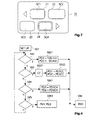
- Fig. 7 shows a menu 10 for a recording medium 8 which menu is displayed on display 2.
- Certain menu areas 21, 22, 23, 24 are provided to show an indication of different scenes SC1, SC2, SC3, SC4.
- one scene SC4 has been highlighted by double rim to indicate that this is the scene the user has navigated to.
Landscapes
- Engineering & Computer Science (AREA)
- Multimedia (AREA)
- Signal Processing (AREA)
- Physics & Mathematics (AREA)
- General Physics & Mathematics (AREA)
- Electric Clocks (AREA)
Priority Applications (7)
| Application Number | Priority Date | Filing Date | Title |
|---|---|---|---|
| EP03292146A EP1511308A1 (de) | 2003-09-01 | 2003-09-01 | Videoaufzeichnungsgerät |
| EP04300316A EP1492339A3 (de) | 2003-06-13 | 2004-06-08 | Videoaufzeichnungsgerät |
| JP2004172454A JP2005003683A (ja) | 2003-06-13 | 2004-06-10 | 映像記録装置 |
| TW093116785A TW200513124A (en) | 2003-06-13 | 2004-06-11 | Video recording device |
| KR1020040042926A KR20040107405A (ko) | 2003-06-13 | 2004-06-11 | 비디오 레코딩 디바이스 |
| CN2004100119638A CN1592379B (zh) | 2003-06-13 | 2004-06-14 | 视频记录设备 |
| US10/867,462 US20040252972A1 (en) | 2003-06-13 | 2004-06-14 | Video recording device |
Applications Claiming Priority (1)
| Application Number | Priority Date | Filing Date | Title |
|---|---|---|---|
| EP03292146A EP1511308A1 (de) | 2003-09-01 | 2003-09-01 | Videoaufzeichnungsgerät |
Publications (1)
| Publication Number | Publication Date |
|---|---|
| EP1511308A1 true EP1511308A1 (de) | 2005-03-02 |
Family
ID=34089768
Family Applications (1)
| Application Number | Title | Priority Date | Filing Date |
|---|---|---|---|
| EP03292146A Withdrawn EP1511308A1 (de) | 2003-06-13 | 2003-09-01 | Videoaufzeichnungsgerät |
Country Status (1)
| Country | Link |
|---|---|
| EP (1) | EP1511308A1 (de) |
Citations (1)
| Publication number | Priority date | Publication date | Assignee | Title |
|---|---|---|---|---|
| US6118926A (en) * | 1992-11-09 | 2000-09-12 | Daewoo Electronics Co., Ltd. | Method for preprogramming a video cassette recorder |
-
2003
- 2003-09-01 EP EP03292146A patent/EP1511308A1/de not_active Withdrawn
Patent Citations (1)
| Publication number | Priority date | Publication date | Assignee | Title |
|---|---|---|---|---|
| US6118926A (en) * | 1992-11-09 | 2000-09-12 | Daewoo Electronics Co., Ltd. | Method for preprogramming a video cassette recorder |
Similar Documents
| Publication | Publication Date | Title |
|---|---|---|
| US7099239B2 (en) | Information record and playback apparatus and computer program having a resume function based on recorded playback stop position information | |
| US20070245382A1 (en) | Digital Broadcast Receiving Apparatus and Method and Program Therefor | |
| US6118926A (en) | Method for preprogramming a video cassette recorder | |
| US7529462B2 (en) | Memory control method for a personal video recording system | |
| US8509602B2 (en) | Recording control apparatus and method, and program | |
| KR100641853B1 (ko) | 기록장치 | |
| US7426332B2 (en) | Video recording apparatus | |
| JP2000333085A (ja) | 番組情報処理装置 | |
| EP1492339A2 (de) | Videoaufzeichnungsgerät | |
| US20060171670A1 (en) | Recording and playback device with simple programmed recording method | |
| CN1592379B (zh) | 视频记录设备 | |
| US20080098182A1 (en) | Apparatus for information processing | |
| JP3791515B2 (ja) | 映像記録再生装置及び可搬性記録媒体 | |
| CN100380947C (zh) | 记录设备和记录方法 | |
| JP2004207935A (ja) | コンテンツ再生装置、コンテンツ再生方法、コンテンツ記録再生装置及びコンテンツ記録再生方法 | |
| JP2007323704A (ja) | 映像音声再生装置、映像音声再生方法及び制御プログラム | |
| EP1639802A1 (de) | Auswechselbare medienspeichervorrichtung für eine aufzeichnungs- oder wiedergabevorrichtung | |
| JP3091832U (ja) | 録画装置 | |
| US20080320008A1 (en) | Video Recording Device | |
| JP2003179851A (ja) | 番組信号記録方法 | |
| US20060140582A1 (en) | Recording and playback device and programmed recording program | |
| JP3253594B2 (ja) | 情報記録方法 | |
| JP2007194729A (ja) | 記録再生装置 | |
| JP2005341032A (ja) | 映像表示装置 | |
| JP2001101766A (ja) | 放送番組記録装置及び記録方法 |
Legal Events
| Date | Code | Title | Description |
|---|---|---|---|
| PUAI | Public reference made under article 153(3) epc to a published international application that has entered the european phase |
Free format text: ORIGINAL CODE: 0009012 |
|
| AK | Designated contracting states |
Kind code of ref document: A1 Designated state(s): AT BE BG CH CY CZ DE DK EE ES FI FR GB GR HU IE IT LI LU MC NL PT RO SE SI SK TR |
|
| AX | Request for extension of the european patent |
Extension state: AL LT LV MK |
|
| RAP1 | Party data changed (applicant data changed or rights of an application transferred) |
Owner name: THOMSON LICENSING |
|
| AKX | Designation fees paid | ||
| REG | Reference to a national code |
Ref country code: DE Ref legal event code: 8566 |
|
| STAA | Information on the status of an ep patent application or granted ep patent |
Free format text: STATUS: THE APPLICATION IS DEEMED TO BE WITHDRAWN |
|
| 18D | Application deemed to be withdrawn |
Effective date: 20050903 |