EP1510608A2 - Method for storing operating conditions of warp-sizing apparatus and method for setting operating conditions of warp-sizing apparatus - Google Patents

Method for storing operating conditions of warp-sizing apparatus and method for setting operating conditions of warp-sizing apparatus Download PDF

Info

Publication number
EP1510608A2
EP1510608A2 EP04017659A EP04017659A EP1510608A2 EP 1510608 A2 EP1510608 A2 EP 1510608A2 EP 04017659 A EP04017659 A EP 04017659A EP 04017659 A EP04017659 A EP 04017659A EP 1510608 A2 EP1510608 A2 EP 1510608A2
Authority
EP
European Patent Office
Prior art keywords
warp
parameters
values
standard values
thickness
Prior art date
Legal status (The legal status is an assumption and is not a legal conclusion. Google has not performed a legal analysis and makes no representation as to the accuracy of the status listed.)
Withdrawn
Application number
EP04017659A
Other languages
German (de)
French (fr)
Other versions
EP1510608A3 (en
Inventor
Isao Nishimura
Akira Takata
Current Assignee (The listed assignees may be inaccurate. Google has not performed a legal analysis and makes no representation or warranty as to the accuracy of the list.)
Tsudakoma Corp
Original Assignee
Tsudakoma Industrial Co Ltd
Priority date (The priority date is an assumption and is not a legal conclusion. Google has not performed a legal analysis and makes no representation as to the accuracy of the date listed.)
Filing date
Publication date
Application filed by Tsudakoma Industrial Co Ltd filed Critical Tsudakoma Industrial Co Ltd
Publication of EP1510608A2 publication Critical patent/EP1510608A2/en
Publication of EP1510608A3 publication Critical patent/EP1510608A3/en
Withdrawn legal-status Critical Current

Links

Images

Classifications

    • DTEXTILES; PAPER
    • D06TREATMENT OF TEXTILES OR THE LIKE; LAUNDERING; FLEXIBLE MATERIALS NOT OTHERWISE PROVIDED FOR
    • D06BTREATING TEXTILE MATERIALS USING LIQUIDS, GASES OR VAPOURS
    • D06B23/00Component parts, details, or accessories of apparatus or machines, specially adapted for the treating of textile materials, not restricted to a particular kind of apparatus, provided for in groups D06B1/00 - D06B21/00
    • D06B23/24Means for regulating the amount of treating material picked up by the textile material during its treatment
    • DTEXTILES; PAPER
    • D02YARNS; MECHANICAL FINISHING OF YARNS OR ROPES; WARPING OR BEAMING
    • D02HWARPING, BEAMING OR LEASING
    • D02H5/00Beaming machines
    • D02H5/02Beaming machines combined with apparatus for sizing or other treatment of warps

Definitions

  • the present invention relates to a method for storing operating conditions of a warp-sizing apparatus and a method for setting operating conditions of a warp-sizing apparatus.
  • an operator determines the operating conditions corresponding to warp-specifications by inputting values for the operating-condition parameters of the apparatus. According to this method, however, the operator must rely on, for example, his/her practical knowledge and experience for inputting the values for the operating-condition parameters.
  • a first aspect of the present invention is a method for storing operating conditions of a warp-sizing apparatus (1), in which, for every type and thickness of warp (2), a memory unit (42) stores standard values for at least four parameters which include stretch rate, temperature of size, temperatures of drying devices, and squeezing pressure and equations for calculating warp tensions.
  • the method is characterized in that, when starting an operation of the apparatus (1), the type and thickness of warp (2) to be sized and the number of yarns of the warp (2) are input to the apparatus (1).
  • the standard values for the four parameters are read from the memory unit (42) based on the type and thickness of the warp (2), and standard values for the warp tensions are calculated based on the equations corresponding to the type and thickness of the warp (2) and based on the input number of yarns of the warp (2).
  • the calculated standard values define a fifth parameter.
  • the standard values of the five parameters are then displayed in a display unit (43), and each of the standard values of the five parameters is adjustable.
  • a new set of the values of the five parameters different from the original set of the standard values and the corresponding warp specifications including the type, the thickness, and the number of yarns of the warp (2) are additionally stored in the memory unit (42) by sending a memory command thereto.
  • the standard values and past numeral values are accumulated one after the other in the memory unit (42).
  • the setting of operating conditions becomes easier from the next operation onward.
  • a second aspect of the present invention is a method for setting operating conditions of the warp-sizing apparatus (1), in which, for every type and thickness of warp (2), the memory unit (42) stores standard values for at least four parameters which include the stretch rate, the temperature of the size, the temperatures of drying devices, and the squeezing pressure and the equations for calculating warp tensions.
  • the method is characterized in that, when starting an operation of the apparatus (1), the type and thickness of warp (2) to be sized and the number of yarns of the warp (2) are input to the apparatus (1).
  • the standard values for the four parameters are read from the memory unit (42) based on the type and thickness of the warp (2), and standard values for the warp tensions are calculated based on the equations corresponding to the type and thickness of the warp (2) and based on the input number of yarns of the warp (2).
  • the calculated standard values define a fifth parameter.
  • the standard values of the five parameters are then displayed in the display unit (43), and each of the standard values of the five parameters is adjustable. Thus, a new set of the values of the five parameters is sent to the controller (40) by sending a setting command thereto.
  • the apparatus (1) can be controlled based on the operation-condition set values of the five parameters.
  • a third aspect of the present invention is a method for setting operating conditions of the warp-sizing apparatus (1), in which, for every type and thickness of warp (2), the memory unit (42) stores standard values for at least four parameters which include the stretch rate, the temperature of the size, the temperatures of drying devices, and the squeezing pressure and the equations for calculating warp tensions.
  • the method is characterized in that, when starting an operation of the apparatus (1), the type and thickness of warp (2) to be sized and the number of yarns of the warp (2) are input to the apparatus (1).
  • the standard values for the four parameters are read from the memory unit (42) based on the type and thickness of the warp (2), and standard values for the warp tensions are calculated based on the equations corresponding to the type and thickness of the warp (2) and based on the input number of yarns of the warp (2).
  • the calculated standard values define a fifth parameter.
  • the standard values of the five parameters are then displayed in the display unit (43), and each of the standard values of the five parameters is adjustable.
  • a new set of the values of the five parameters different from the original set of the standard values and the corresponding warp specifications including the type, the thickness, and the number of yarns of the warp (2) are additionally stored in the memory unit (42) to sending a memory command thereto.
  • the new set of the values of the five parameters and the corresponding warp specifications are then read from the memory unit (42) and are displayed in the display unit (43). Each of the read-out values is readjustable if necessary.
  • the values of the five parameters are sent to the controller (40) by sending a setting command thereto.
  • the stored values of the five parameters are adjusted where necessary and are then sent to the controller (40), meaning that new values may be input and set for the five parameters while referring to the past values.
  • a fourth aspect of the present invention is a method for setting operating conditions of the warp-sizing apparatus (1), in which, for every type and thickness of warp (2), the memory unit (42) stores standard values for at least four parameters which include the stretch rate, the temperature of the size, the temperatures of drying devices, and the squeezing pressure and the equations for calculating warp tensions.
  • the method is characterized in that, when starting an operation of the apparatus (1), the type and thickness of warp (2) to be sized and the number of yarns of the warp (2) are input to the apparatus (1).
  • the standard values for the four parameters are read from the memory unit (42) based on the type and thickness of the warp (2), and standard values for the warp tensions are calculated based on the equations corresponding to the type and thickness of the warp (2) and based on the input number of yarns of the warp (2).
  • the calculated standard values define a fifth parameter.
  • the standard values of the five parameters are then displayed in the display unit (43), and each of the standard values of the five parameters is adjustable.
  • a new set of the values of the five parameters different from the original set of the standard values and the corresponding warp specifications including the type, the thickness, and the number of yarns of the warp (2) are additionally stored in the memory unit (42) by sending a memory command thereto.
  • the new set of the values of the five parameters and the corresponding warp specifications are then read from the memory unit (42) and are displayed in the display unit (43).
  • the read-out values of the five parameters are sent to the controller (40) as final set values.
  • the read-out values are sent directly to the controller (40). Accordingly, the past values of the five parameters can be used effectively from the next operation onward.
  • warp-yarn types types of warp
  • warp yarn count warp thickness
  • warp-yarn types Types of warp (warp-yarn types):
  • Warp yarn count (yarn thickness)
  • Yarn count selected within a range from 5 to 160 (a higher yarn-count value implies finer yarn)
  • the stretch rate of the warp relies on the ratio of circumferential speeds between two rollers which are actively driven, and is represented by the equation: [(circumferential speed of a downstream roller / circumferential speed of an upstream roller) - 1] ⁇ 100 (%). Taking into consideration the fact that the warp-yarn sheet stretches while being transferred and the warp yarns shrink by being dried, this equation has been derived from prior experience and tests. Rather than performing the tension control by detecting the warp tensions, the tension control according to the stretch rate values derived from this equation is more stable and suitable.
  • the stretch rate between a sizing device and one of drying devices is increased such that a greater warp tension is applied, the quality of the warp may be lowered since the elongation of the warp may be lost.
  • the stretch rate between one of the drying devices and a winding device is preferably increased so as to apply greater warp tension. This achieves easier division of the dried warp-yarn sheet by a dividing rod disposed between the drying device and the winding device.
  • the temperatures of the drying devices refer to temperatures of drying cylinders.
  • the temperatures of the drying cylinders are controlled by on/off operations of electromagnetic on/off valves. By repeating these operations, the supply of high-pressure steam is regulated such that the temperatures are adjusted to the desired values.
  • a hot-air drying device having a heat exchanger disposed in the hot-air circulation path and a drying cylinder are provided.
  • the heat exchanger functions by using high-temperature steam or electric heat.
  • the temperature is adjusted to the desired value.
  • the temperature of size is controlled by on/off operations of an electromagnetic on/off valve. By repeating these operations, the supply of high-temperature steam to the size in a sizing tank is regulated such that the temperature of the size is adjusted to the desired value.
  • the squeezing pressure allows a slave-driven roller to urge against an active-driven roller via a hydraulic cylinder.
  • an effective force produced in a nip between the two rollers allows the size to penetrate into each yarn effectively and also to squeeze out excess size from each yarn. This force depends on the amount of size adhered to each yarn (amount of moisture).
  • a slave-driven roller is generally coated with high-friction elastic material, such as rubber. Accordingly, for some warp-yarn types or yarn thicknesses, the adhered amount of size is not lowered even if the squeezing pressure is set higher than a predetermined value, meaning that the squeezing pressure does not necessarily need to be set at a high value.
  • the squeezing pressure is set only for a second squeezing roller, the squeezing pressure may also be set for a first squeezing roller.
  • stored values of five parameters corresponding to warp specifications of each type of warp can be read and displayed, and moreover, may be changed to new values. Via a setting command, the stored values may be sent directly to the controller or may be sent to the controller after being changed to new values. Alternatively, the stored values of the five parameters may be sent to the controller simultaneously with the read-out and display of the values.
  • Fig. 1 illustrates the relevant components of a spun-warp sizing apparatus 1.
  • a plurality of warp yarns 2 are fed from a feeding beam 3 in a sheet-like shape and are guided to a sizing device 5 via, for example, four guide rollers 4.
  • the feeding beam 3 has a shaft 3a to which a braking force is applied by a braking pad 6 and a tension cylinder 7 provided for the braking pad 6. Accordingly, the warp yarns 2 at the feeding side of the apparatus 1 are pulled out such that a predetermined warp tension is applied to each yarn 2.
  • This warp tension can be detected by a tension detector 8, such as a load cell, disposed adjacent to the third guide roller 4.
  • the warp yarns 2 are immersed in a sizing tank 10 filled with size 11 via an immersion roller 9.
  • the warp yarns 2 pass through a nip between a first sizing roller 12 and a first squeezing roller 13, and then between a second sizing roller 14 and a second squeezing roller 15.
  • the warp yarns 2 are separated into two groups and are sent to a first drying device 18.
  • the first sizing roller 12 and the second sizing roller 14 are driven by a sizing motor 16.
  • a chain which is not shown in the drawings, is looped around the sizing rollers 12 and 14 and the sizing motor 16 to rotate the rollers 12 and 14.
  • a hydraulic cylinder which is not shown in the drawings, maintains the squeezing pressure of the first squeezing roller 13 at the initial setting such that the pressure cannot be changed.
  • a preset squeezing pressure of the second squeezing roller 15 can be readjusted by a squeezing cylinder 17.
  • the first drying device 18 includes two sets of a drying cylinder 20, a drying cylinder 21, and a guide roller 22. Each set corresponds to one of the two groups of warp yarns 2. Each group of warp yarns 2 comes into contact with the peripheries of the drying cylinders 20 and 21 of the corresponding set and is heated to dry. The two groups merge after passing through the respective guide rollers 22 and are then sent to a second drying device 19. The merged warp yarns 2 come into contact with the peripheries of drying cylinders 23 and 24 provided in the second drying device 19, whereby a final drying process is completed.
  • the drying cylinders 20 and 21 are driven by a drying motor 25.
  • a chain which is not shown in the drawings, is looped around the drying cylinders 20 and 21 and the drying motor 25 such that the cylinders 20 and 21 rotate with the same circumferential speed.
  • the drying cylinders 23 and 24 of the second drying device 19 are also driven by the motor 25, and similarly, another chain, which is not shown in the drawings, is looped around the drying cylinders 23 and 24 and the motor 25 such that the cylinders 23 and 24 rotate with the same circumferential speed as those of the cylinders 20 and 21.
  • the warp yarns 2 are guided to a winding device 30 via a guide roller 26 and a dividing rod 27.
  • the warp yarns 2 pass through a nip between a take-up roller 28 and a press roller 29, and then through a tension roller 31 and a guide roller 46 to reach a winding beam 32 around which the warp yarns 2 are wound.
  • the take-up roller 28 and the winding beam 32 are respectively driven by a take-up motor 33 and a winding motor 34.
  • the rotational speed of the take-up roller 28 is substantially constant, whereas the rotational speed of the winding beam 32 becomes lower as the diameter of the wound warp yarns 2 increases.
  • the winding beam 32 is displaced from the winding device 30 after the winding process is completed and may be disposed in a loom to function as a loom beam for feeding the warp yarns 2.
  • a warp tension applied to the warp yarns 2 at the winding side of the warp-sizing apparatus 1, that is, a winding tension applied to the warp yarns 2 can be detected by a tension detector 35, such as a load cell, disposed adjacent to the tension roller 31.
  • Fig. 2 illustrates a controller 40 for the warp-sizing apparatus 1.
  • the controller 40 controls the stretch rate, the temperature of the size 11, the temperatures of the drying devices 18 and 19, the squeezing pressure, and the warp tensions.
  • the controller 40 receives operating-condition data from an operating-condition setting unit 41.
  • the data includes, for example, standard values for the operating conditions or new values that have been readjusted and changed from the original standard values.
  • the controller 40 Based on the received operating-condition data, the controller 40 performs on/off operations of electromagnetic on/off valves 36, 37, and 38 to regulate the supply of high-pressure steam 45.
  • the controller 40 controls the rotational speeds of the motors 16, 25, 33, and 34, and adjusts the supply of fluid 44 to the tension cylinder 7 and to the squeezing cylinder 17.
  • a memory unit 42 includes a model-number memory portion and a standard-value/equation memory portion.
  • Model numbers are registered in the model-number memory portion and are categorized according to warp specifications which include types of warp yarns 2 (warp-yarn types), yarn count, and the number of warp yarns 2. Furthermore, the model-number memory portion stores the model numbers and corresponding operating-condition values for the operating-condition parameters of each model number.
  • the standard-value/equation memory portion stores standard values for the operating conditions according to warp-yarn types and yarn count, and equations for calculating standard warp tensions based on warp-yarn types, yarn count, and the number of warp yarns 2.
  • the operating-condition setting unit 41 is capable of reading corresponding data from the model-number memory portion and the standard-value/equation memory portion.
  • An operator may input warp specifications, i.e. the warp-yarn type, the yarn count, and the number of warp yarns 2, to an input unit 39.
  • the operating-condition setting unit 41 receives the data including the warp specifications from the input unit 39, the setting unit 41 reads corresponding standard values and corresponding equations for the standard warp tensions from the standard-value/equation memory portion so as to derive operating-condition values.
  • the operator may input the corresponding model number to the input unit 39.
  • the setting unit 41 receives the data including the model number from the input unit 39, the setting unit 41 reads the operating-condition values corresponding to the input model number from the model-number memory portion.
  • the operating-condition values are then displayed in a display unit 43.
  • An operator then operates the input unit 39 and determines whether to select the current operating-condition values or to make adjustments if necessary. Moreover, if necessary, an operator may operate the input unit 39 to register a model number through a memory command of the input unit 39. Thus, the registered model number and its operating-condition values for the parameters of the model number are stored in the model-number memory portion. In response to a setting command sent from the input unit 39 operated by an operator, the setting unit 41 sends the selected operating-condition values to the controller 40, and the values are displayed in the display unit 43.
  • the controller 40 compares the warp tension of the warp yarns 2 detected by the tension detector 8 at the feeding side of the apparatus 1, i.e. the feeding tension, with a target warp-tension value. If there is a difference between the two tension values, the controller 40 regulates the supply of fluid 44 to the tension cylinder 7 so as to control the pressure in the cylinder 7. Accordingly, the frictional force between the shaft 3a of the feeding beam 3 and the braking pad 6 is adjusted by the cylinder 7 such that the feeding tension approximates the target warp tension.
  • the controller 40 compares the winding tension of the warp yarns 2 detected by the tension detector 35 at the winding side of the apparatus 1 with a target warp-tension value. Similarly, if there is a difference between the two tension values, the controller 40 controls the rotational speed of the winding motor 34 so that the winding tension approximates the target warp tension. On the other hand, since the take-up motor 33 rotates at a constant speed, the controller 40 only needs to perform on/off operations for the motor 33.
  • the rotational speed of the motor 16 is adjusted based on the stretch rate of the warp yarns 2 between the sizing device 5 and the second drying device 19, namely, between the rollers 14,15 and the drying cylinder 24.
  • the rotational speed of the motor 25 is adjusted based on the stretch rate of the warp yarns 2 between the sizing device 5 and the first drying device 18, namely, between the rollers 14,15 and the drying cylinders 20, and also between the first drying device 18 and the winding device 30, namely, between the drying cylinders 20 and the rollers 28,29.
  • the controller 40 when the controller 40 receives the operating-condition data from the setting unit 41, the controller 40 controls the rotational speeds of the motors 16 and 25 based on the respective target stretch rate values included in the operating-condition values of the data, whereby the stretch rate of the warp yarns 2 is correspondingly adjusted.
  • the on/off operations of the electromagnetic on-off valve 36 regulate the supply of high-pressure steam 45. By repeating these operations, the temperature of the size 11 is controlled. Furthermore, the temperature of the first drying device 18, i.e. the drying cylinders 20 and 21, and the temperature of the second drying device 19, i.e. the drying cylinders 23 and 24, are controlled by the respective electromagnetic on-off valves 37 and 38. In detail, the on-off operations of the on/off valves 37 and 38 regulate the supply of high-pressure steam 45 to the respective first and second drying devices 18 and 19. By repeating these operations, the temperatures of the two drying devices 18 and 19 are controlled.
  • the controller 40 detects the temperature of the size 11, the temperature of the drying cylinders 20 and 21, and the temperature of the drying cylinders 23 and 24 via respective temperature sensors 47, 48, and 49. Moreover, if there are differences between the detected temperatures and target temperature values included in the operating-condition values received from the setting unit 41, the controller 40 correspondingly performs on/off operations of the on-off valves 36, 37, and 38.
  • the memory unit 42 stores equations for the warp tensions and standard values for at least four parameters which include the stretch rate, the temperature of the size 11, the temperatures of the drying devices 18 and 19, and the squeezing pressure.
  • the standard values and the equations are stored according to types and thicknesses of the warp yarns 2.
  • the setting unit 41 when starting an operation of the warp-sizing apparatus 1, an operator inputs the type and thickness of the warp yarns 2 and the number of warp yarns 2 included in a single yarn sheet to the input unit 39 so that a setting command is sent to the operating-condition setting unit 41.
  • the setting unit 41 then reads standard values of four parameters, which correspond to the type and thickness of the warp yarns 2, from the memory unit 42.
  • the setting unit 41 calculates standard values for the warp tensions, i.e. warp feeding tension and warp winding tension, based on the corresponding equations and the input number of warp yarns 2. Consequently, the standard values of five operating-condition parameters are displayed in the display unit 43.
  • the standard values of these five parameters can be changed partially or completely by inputting new values.
  • an operator looks at a display screen of the display unit 43 and checks the standard values of the five parameters, he/she may partially adjust the values if necessary or may completely change the values to new ones. Then, the operator may operate the input unit 39 to send a memory command to the setting unit 41. Via the setting unit 41, a corresponding model number and its warp specifications including the warp-yarn type, the yarn count, and the number of warp yarns 2 are registered in the memory unit 42, and a new set of the values of the five parameters different from the original set of the standard values are additionally stored in the memory unit 42 as the operating conditions of the model number.
  • the operator may select the model number so that the values of the five parameters that correspond to the warp specifications of the model number are read from the memory unit 42. These values are then displayed in the display unit 43 and can be readjusted if necessary.
  • the operator may send a setting command to the setting unit 41.
  • the controller 40 receives the operating-condition values of the five parameters from the setting unit 41 and sets the values as the final target values for the operation. Consequently, the controller 40 is in a stand-by state for controlling the operation using the operating-condition values of the five parameters, i.e. the stretch rate, the temperature of the size 11, the temperatures of the drying devices 18 and 19, the squeezing pressure, and the warp tensions at the feeding and winding sides, as the target values for the operation.
  • operating-condition values corresponding to the warp specifications of each model number are stored in the memory unit 42 one after the other such that the values are accumulated in the memory unit 42 as usable past data. These accumulated data can be used directly without being changed or may be adjusted if necessary.
  • an operator can select the warp specifications of the warp yarns 2 to be sized, i.e. the corresponding model number of the warp yarns 2 to be sized, such that the values of the five parameters corresponding to the model number are read from the memory unit 42 and are displayed in the display unit 43. Then, the values may either be sent to the controller 40 directly or may be readjusted if necessary. In the latter case, the readjusted values are stored in the memory unit 42 and are simultaneously sent to the controller 40.
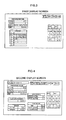
  • Figs. 3, 4, and 5 illustrate a first display screen, a second display screen, and a third display screen, respectively, of the display unit 43.
  • the display unit 43 is, for example, a touch-panel, and some of the functions of the input unit 39 are included in the display screens.
  • a numeric pad and other function keys of the input unit 39 appear on the first display screen so that numbers, for example, can be inputted.
  • the function keys include " ⁇ " and " ⁇ " keys for moving the input position on the warp-specification table.
  • an operator may manually input the yarn count, the warp yarn code, or the number of warp yarns 2 by using the numeric pad.
  • the first display screen also displays a yarn code list from which the operator can choose the desired yarn code. The operator may then input the number in the warp-specification table. When the yarn code is inputted, the corresponding warp-yarn type is automatically displayed in the warp-specification table.
  • the operator may touch an "ENTER” key of the function keys and then an "EXEC” (execute) key provided at the top of the first display screen. This switches the first display screen to the second display screen shown in Fig. 4.
  • the second display screen displays multiple tables for the squeezing pressure, the warp tensions, the stretch rate, and the temperatures for the size 11 and the drying devices 18 and 19.
  • Each table includes at least one standard value for the corresponding parameter.
  • the standard values can be changed by using the input unit 39 on the second display screen. If the operator desires to change the standard values, he/she may touch the "INPUT" key so that the numeric pad and the function keys appear on the second display screen. By touching the " ⁇ " and " ⁇ ” keys, the input position moves on the tables. According to the input position, the operator may input desired numerical values by using the numeric pad. When all of the standard values are set at desired values, the operator may touch the "ENTER" key.
  • the operator can input a corresponding model number in a model number section by using the numeric pad.
  • the model number and its warp specifications are stored in the model-number memory portion of the memory unit 42 such that the final displayed values are set as the operating-condition values.
  • the second display screen if an operator desires to use the already-displayed values as the operating-condition values, he/she may touch the "SET" key. On the other hand, if he/she desires to change the displayed values partially, he/she may touch the "INPUT” key, which causes the numeric pad to appear. By using the numeric pad, the operator can change the values. When all of the displayed values are set at the desired values, the operator may touch the "ENTER” key and then the "SET” key.
  • a "MODEL NO. LIST" key in the second display screen is for switching the second display screen to the third display screen, which is shown in Fig. 5.
  • the third display screen displays a model-number list which includes stored model numbers and their corresponding warp yarns, i.e. warp-yarn types and yarn count.
  • a model-number list which includes stored model numbers and their corresponding warp yarns, i.e. warp-yarn types and yarn count.
  • moisture-percentage values may be stored in the memory unit 42, displayed in the display unit 43, and sent to the controller 40.
  • a moisture-measuring unit may be provided adjacent to the winding device 30 such that the moisture percentage of the warp yarns 2 is measured in that position.
  • the controller 40 controls the traveling speed of the warp yarns 2, the temperatures of the drying devices 18 and 19, or the squeezing pressure within a predetermined range of the corresponding operating-condition value.
  • an operating-condition parameter which represents low-speed operation may alternatively be included. Similar to the above, low-speed-operation values may be stored in the memory unit 42, displayed in the display unit 43, and sent to the controller 40. In a low-speed operation, the warp yarns 2 travel at about 10% of the speed of the warp yarns 2 in the normal operation. The low-speed operation prevents the warp-sizing apparatus 1 from stopping due to yarn breakages.
  • two sets of operating-condition values may be provided for the stretch rate and the squeezing pressure, one set being used for the normal operation and the other being used for the low-speed operation. In the low-speed operation, the squeezing pressure is reduced since the size 11 is sufficiently squeezed out from the warp yarns 2, and the stretch rate is also reduced since the warp yarns 2 dry well and shrink at a low rate.
  • each model number and its warp specifications including the warp-yarn type, the yarn count, and the number of warp yarns 2 are registered in the memory unit 42, and each model number and the operating-condition values for the parameters of the model number are stored in the memory unit 42.
  • only the warp specifications and the corresponding operating-condition values for each type of yarn sheet may be stored in the memory unit 42, meaning that the warp specifications do not necessarily need to be registered with the model numbers in the memory unit 42.
  • operating-condition values are read from the memory unit 42 by inputting a model number and are adjusted according to need before being sent to the controller 40
  • the operating-condition values may alternatively be sent to the controller 40 simultaneously with the read-out of the values from the memory unit 42. This reduces the workload of the operator, thus achieving simple operation of the input unit 39.
  • the display section for the standard values of the operating conditions and the adjusting section for the standard values i.e. the input unit for the operating-condition values
  • the display section and the adjusting section may be shifted to other positions on the screen, or may be provided in separate screens in a manner such that the operator can easily refer to the standard values when inputting numerical values via the adjusting section. This may prevent input errors in the operating-condition values.
  • the operating-condition data for the apparatus may be used as feedback for a process prior to the operation of the apparatus 1 or may be used for the weaving process that follows.

Landscapes

  • Engineering & Computer Science (AREA)
  • Textile Engineering (AREA)
  • Treatment Of Fiber Materials (AREA)
  • Warping, Beaming, Or Leasing (AREA)

Abstract

For every type and thickness of warp (2), a memory unit (42) stores standard values for at least four parameters which include stretch rate, temperature of size, temperatures of drying devices, and squeezing pressure and equations for calculating warp tensions. When starting an operation of a warp-sizing apparatus (1), the type and thickness of warp (2) to be sized and the number of yarns of the warp (2) are input to the apparatus (1). The standard values for the four parameters are read from the memory unit (42) based on the type and thickness of the warp (2), and standard values for the warp tensions are calculated based on the equations corresponding to the type and thickness of the warp (2) and based on the input number of yarns of the warp (2). The calculated standard values define a fifth parameter. The standard values of the five parameters are then displayed in a display unit (43), and each of the standard values of the five parameters is adjustable. Consequently, a new set of the values of the five parameters different from the original set of the standard values and the corresponding warp specifications including the type, the thickness, and the number of yarns of the warp (2) are additionally stored in the memory unit (42) by sending a memory command thereto.

Description

BACKGROUND OF THE INVENTION 1. Field of the Invention
The present invention relates to a method for storing operating conditions of a warp-sizing apparatus and a method for setting operating conditions of a warp-sizing apparatus.
2. Description of the Related Art
According to Japanese Unexamined Patent Application Publication No. 2002-309477, in order to set operating conditions for the operation of a warp-sizing apparatus, an operator determines the operating conditions corresponding to warp-specifications by inputting values for the operating-condition parameters of the apparatus. According to this method, however, the operator must rely on, for example, his/her practical knowledge and experience for inputting the values for the operating-condition parameters.
Accordingly, it is difficult to determine the operating conditions by fully reflecting upon the warp specifications which include the types of warp, the yarn count, i.e. the thickness of each yarn, and the number of warp yarns.
SUMMARY OF THE INVENTION
Accordingly, it is an object of the present invention to provide a method for storing operating conditions of a warp-sizing apparatus and a method for setting operating conditions of a warp-sizing apparatus, in which the operating conditions can be easily selected from accumulated data.
A first aspect of the present invention is a method for storing operating conditions of a warp-sizing apparatus (1), in which, for every type and thickness of warp (2), a memory unit (42) stores standard values for at least four parameters which include stretch rate, temperature of size, temperatures of drying devices, and squeezing pressure and equations for calculating warp tensions. The method is characterized in that, when starting an operation of the apparatus (1), the type and thickness of warp (2) to be sized and the number of yarns of the warp (2) are input to the apparatus (1). The standard values for the four parameters are read from the memory unit (42) based on the type and thickness of the warp (2), and standard values for the warp tensions are calculated based on the equations corresponding to the type and thickness of the warp (2) and based on the input number of yarns of the warp (2). The calculated standard values define a fifth parameter. The standard values of the five parameters are then displayed in a display unit (43), and each of the standard values of the five parameters is adjustable. Thus, a new set of the values of the five parameters different from the original set of the standard values and the corresponding warp specifications including the type, the thickness, and the number of yarns of the warp (2) are additionally stored in the memory unit (42) by sending a memory command thereto.
According to the method of the first aspect, the standard values and past numeral values are accumulated one after the other in the memory unit (42). By using such accumulated data, the setting of operating conditions becomes easier from the next operation onward.
A second aspect of the present invention is a method for setting operating conditions of the warp-sizing apparatus (1), in which, for every type and thickness of warp (2), the memory unit (42) stores standard values for at least four parameters which include the stretch rate, the temperature of the size, the temperatures of drying devices, and the squeezing pressure and the equations for calculating warp tensions. The method is characterized in that, when starting an operation of the apparatus (1), the type and thickness of warp (2) to be sized and the number of yarns of the warp (2) are input to the apparatus (1). The standard values for the four parameters are read from the memory unit (42) based on the type and thickness of the warp (2), and standard values for the warp tensions are calculated based on the equations corresponding to the type and thickness of the warp (2) and based on the input number of yarns of the warp (2). The calculated standard values define a fifth parameter. The standard values of the five parameters are then displayed in the display unit (43), and each of the standard values of the five parameters is adjustable. Thus, a new set of the values of the five parameters is sent to the controller (40) by sending a setting command thereto.
In addition to the advantages of the first aspect, according to the method of the second aspect, as the new set of the values of the five parameters is sent to the controller (40), the apparatus (1) can be controlled based on the operation-condition set values of the five parameters.
A third aspect of the present invention is a method for setting operating conditions of the warp-sizing apparatus (1), in which, for every type and thickness of warp (2), the memory unit (42) stores standard values for at least four parameters which include the stretch rate, the temperature of the size, the temperatures of drying devices, and the squeezing pressure and the equations for calculating warp tensions. The method is characterized in that, when starting an operation of the apparatus (1), the type and thickness of warp (2) to be sized and the number of yarns of the warp (2) are input to the apparatus (1). The standard values for the four parameters are read from the memory unit (42) based on the type and thickness of the warp (2), and standard values for the warp tensions are calculated based on the equations corresponding to the type and thickness of the warp (2) and based on the input number of yarns of the warp (2). The calculated standard values define a fifth parameter. The standard values of the five parameters are then displayed in the display unit (43), and each of the standard values of the five parameters is adjustable. Thus, a new set of the values of the five parameters different from the original set of the standard values and the corresponding warp specifications including the type, the thickness, and the number of yarns of the warp (2) are additionally stored in the memory unit (42) to sending a memory command thereto. The new set of the values of the five parameters and the corresponding warp specifications are then read from the memory unit (42) and are displayed in the display unit (43). Each of the read-out values is readjustable if necessary. The values of the five parameters are sent to the controller (40) by sending a setting command thereto.
In addition to the advantages of the second aspect, according to the method of the third aspect, the stored values of the five parameters are adjusted where necessary and are then sent to the controller (40), meaning that new values may be input and set for the five parameters while referring to the past values.
A fourth aspect of the present invention is a method for setting operating conditions of the warp-sizing apparatus (1), in which, for every type and thickness of warp (2), the memory unit (42) stores standard values for at least four parameters which include the stretch rate, the temperature of the size, the temperatures of drying devices, and the squeezing pressure and the equations for calculating warp tensions. The method is characterized in that, when starting an operation of the apparatus (1), the type and thickness of warp (2) to be sized and the number of yarns of the warp (2) are input to the apparatus (1). The standard values for the four parameters are read from the memory unit (42) based on the type and thickness of the warp (2), and standard values for the warp tensions are calculated based on the equations corresponding to the type and thickness of the warp (2) and based on the input number of yarns of the warp (2). The calculated standard values define a fifth parameter. The standard values of the five parameters are then displayed in the display unit (43), and each of the standard values of the five parameters is adjustable. Thus, a new set of the values of the five parameters different from the original set of the standard values and the corresponding warp specifications including the type, the thickness, and the number of yarns of the warp (2) are additionally stored in the memory unit (42) by sending a memory command thereto. The new set of the values of the five parameters and the corresponding warp specifications are then read from the memory unit (42) and are displayed in the display unit (43). The read-out values of the five parameters are sent to the controller (40) as final set values.
According to the method of the fourth aspect, as the values of the five parameters are read from the memory unit (42) and are displayed, the read-out values are sent directly to the controller (40). Accordingly, the past values of the five parameters can be used effectively from the next operation onward.
The following is a list of examples of the types of warp (warp-yarn types) and the warp yarn count (yarn thickness) used in a spun-warp sizing apparatus for short fiber.
Types of warp (warp-yarn types):
C Cotton
P/C (65/35) Blend of polyester (65%) and cotton (35%)
P/C (50/50) Blend of polyester (50%) and cotton (50%)
P/R Blend of polyester and rayon
P Polyester
R Rayon
W Wool
Warp yarn count (yarn thickness)
Yarn count selected within a range from 5 to 160 (a higher yarn-count value implies finer yarn)
The stretch rate of the warp relies on the ratio of circumferential speeds between two rollers which are actively driven, and is represented by the equation: [(circumferential speed of a downstream roller / circumferential speed of an upstream roller) - 1] × 100 (%). Taking into consideration the fact that the warp-yarn sheet stretches while being transferred and the warp yarns shrink by being dried, this equation has been derived from prior experience and tests. Rather than performing the tension control by detecting the warp tensions, the tension control according to the stretch rate values derived from this equation is more stable and suitable. In detail, if the stretch rate between a sizing device and one of drying devices is increased such that a greater warp tension is applied, the quality of the warp may be lowered since the elongation of the warp may be lost. In contrast, the stretch rate between one of the drying devices and a winding device is preferably increased so as to apply greater warp tension. This achieves easier division of the dried warp-yarn sheet by a dividing rod disposed between the drying device and the winding device.
In a spun-warp sizing apparatus, the temperatures of the drying devices refer to temperatures of drying cylinders. The temperatures of the drying cylinders are controlled by on/off operations of electromagnetic on/off valves. By repeating these operations, the supply of high-pressure steam is regulated such that the temperatures are adjusted to the desired values.
On the other hand, in a filament-yarn sizing apparatus, a hot-air drying device having a heat exchanger disposed in the hot-air circulation path and a drying cylinder are provided. The heat exchanger functions by using high-temperature steam or electric heat. By controlling both of or at least one of the hot-air drying device and the drying cylinder, the temperature is adjusted to the desired value.
Similar to the temperatures of drying devices, the temperature of size is controlled by on/off operations of an electromagnetic on/off valve. By repeating these operations, the supply of high-temperature steam to the size in a sizing tank is regulated such that the temperature of the size is adjusted to the desired value.
The squeezing pressure allows a slave-driven roller to urge against an active-driven roller via a hydraulic cylinder. Thus, an effective force produced in a nip between the two rollers allows the size to penetrate into each yarn effectively and also to squeeze out excess size from each yarn. This force depends on the amount of size adhered to each yarn (amount of moisture). A slave-driven roller is generally coated with high-friction elastic material, such as rubber. Accordingly, for some warp-yarn types or yarn thicknesses, the adhered amount of size is not lowered even if the squeezing pressure is set higher than a predetermined value, meaning that the squeezing pressure does not necessarily need to be set at a high value. By setting an appropriate squeezing pressure for each type of warp and the corresponding yarn thickness, a proper amount of size can be adhered to each yarn. Moreover, this prevents adverse effects and waste of energy which may be caused by setting the squeezing pressure higher than what is necessary. In the present invention, although the squeezing pressure is set only for a second squeezing roller, the squeezing pressure may also be set for a first squeezing roller.
As described above, stored values of five parameters corresponding to warp specifications of each type of warp can be read and displayed, and moreover, may be changed to new values. Via a setting command, the stored values may be sent directly to the controller or may be sent to the controller after being changed to new values. Alternatively, the stored values of the five parameters may be sent to the controller simultaneously with the read-out and display of the values.
The standard values and the equations used for the operation are derived from tests using the actual apparatus and from experience. Although numerical values for the stretch rate, the temperature of size, the temperatures of drying devices, and the squeezing pressure are given for each type of warp, the values will be substituted below by symbolic codes.
  • (1) Stretch rate For the stretch rate, both lists (a) and (b) below are applied, or only one of the lists (a) or (b) is applied.
  • (a) The stretch rate between a sizing device and a first drying device [(circumferential speed of drying cylinder) / (circumferential speed of second sizing roller)]
    C S1 (%)
    P/C (65/35) S2 (%)
    P/C (50/50) S3 (%)
    P/R S4 (%)
    P S5 (%)
    R S6 (%)
    W S7 (%)
  • (b) The stretch rate between a second drying device and a winding device
    C S8 (%)
    P/C (65/35) S9 (%)
    P/C (50/50) S10 (%)
    P/R S11 (%)
    P S12 (%)
    R S13 (%)
    W S14 (%)
  • (2) Temperature of size
    C T1
    P/C (65/35) T2
    P/C (50/50) T3
    P/R T4
    P T5
    R T6
    W T7
  • (3) Temperatures of drying devices For the temperatures of the drying devices, both lists (a) and (b) below are applied, or only one of the lists (a) or (b) is applied.
  • (a) First drying device
    C
       > 20 yarn count (warp yarns finer than 20 yarn
    count) T8
       ≤ 20 yarn count (warp yarns thicker than 20 yarn count) T9
    P/C (65/35) T10
    P/C (50/50) T11
    P/R T12
    P T13
    R T14
    W T15
  • (b) Second drying device
    C
       > 20 yarn count (warp yarns finer than 20 yarn count) T16
       ≤ 20 yarn count (warp yarns thicker than 20 yarn count) T17
    P/C (65/35) T18
    P/C (50/50) T19
    P/R T20
    P T21
    R T22
    W T23
  • (4) Squeezing pressure
    C P1 (kg)
    P/C (65/35) P2 (kg)
    P/C (50/50) P3 (kg)
    P/R P4 (kg)
    P P5 (kg)
    R P6 (kg)
    W P7 (kg)
  • (5) Equations for warp tensions For the equations for warp tensions, both lists (a) and (b) below are applied, or only one of the lists (a) or (b) is applied.
  • (a) Warp tension at the feeding side
    C
    > 20 yarn count (warp yarns finer than 20 yarn count) k1 × [(the number of yarns) / (yarn count)]
       ≤ 20 yarn count (warp yarns thicker than 20 yarn count) k2 × [(the number of yarns) / (yarn count)] P/C (65/35)
       > 20 yarn count (warp yarns finer than 20 yarn count) k3 × [(the number of yarns) / (yarn count)]
       ≤ 20 yarn count (warp yarns thicker than 20 yarn count) k4 × [(the number of yarns) / (yarn count)] P/C (50/50)
       > 20 yarn count (warp yarns finer than 20 yarn count) k5 × [(the number of yarns) / (yarn count)]
       ≤ 20 yarn count (warp yarns thicker than 20 yarn
    count) k6 × [(the number of yarns) / (yarn count)]
       P/R k7 × [(the number of yarns) / (yarn count)]
       P k8 × [(the number of yarns) / (yarn count)]
       R k9 × [(the number of yarns) / (yarn count)]
       W k10 × [(the number of yarns) / (yarn count)]
  • (b) Warp tension at the winding side
    C
       > 20 yarn count (warp yarns finer than 20 yarn count) k11 × [(the number of yarns) / (yarn count)]
       ≤ 20 yarn count (warp yarns thicker than 20 yarn count) k12 × [(the number of yarns) / (yarn count)] P/C (65/35)
       > 20 yarn count (warp yarns finer than 20 yarn count) k13 × [(the number of yarns) / (yarn count)]
       ≤ 20 yarn count (warp yarns thicker than 20 yarn count) k14 × [(the number of yarns) / (yarn count)] P/C (50/50)
       > 20 yarn count (warp yarns finer than 20 yarn count) k15 × [(the number of yarns) / (yarn count)]
       ≤ 20 yarn count (warp yarns thicker than 20 yarn count) k16 × [(the number of yarns) / (yarn count)]
       P/R k17 × [(the number of yarns) / (yarn count)]
       P k18 × [(the number of yarns) / (yarn count)]
       R k19 × [(the number of yarns) / (yarn count)]
       W k20 × [(the number of yarns) / (yarn count)]
  • BRIEF DESCRIPTION OF THE DRAWINGS
  • Fig. 1 is a sectional view of a warp-sizing apparatus 1;
  • Fig. 2 is a block diagram of a control system of the warp-sizing apparatus 1;
  • Fig. 3 is a schematic diagram of a first display screen;
  • Fig. 4 is a schematic diagram of a second display screen; and
  • Fig. 5 is a schematic diagram of a third display screen.
  • DESCRIPTION OF THE PREFERRED EMBODIMENTS
    Embodiments of the present invention will now be described with reference to the drawings. Fig. 1 illustrates the relevant components of a spun-warp sizing apparatus 1. Referring to Fig. 1, a plurality of warp yarns 2 are fed from a feeding beam 3 in a sheet-like shape and are guided to a sizing device 5 via, for example, four guide rollers 4. The feeding beam 3 has a shaft 3a to which a braking force is applied by a braking pad 6 and a tension cylinder 7 provided for the braking pad 6. Accordingly, the warp yarns 2 at the feeding side of the apparatus 1 are pulled out such that a predetermined warp tension is applied to each yarn 2. This warp tension can be detected by a tension detector 8, such as a load cell, disposed adjacent to the third guide roller 4.
    In the sizing device 5, the warp yarns 2 are immersed in a sizing tank 10 filled with size 11 via an immersion roller 9. The warp yarns 2 pass through a nip between a first sizing roller 12 and a first squeezing roller 13, and then between a second sizing roller 14 and a second squeezing roller 15. After the sizing process, the warp yarns 2 are separated into two groups and are sent to a first drying device 18. The first sizing roller 12 and the second sizing roller 14 are driven by a sizing motor 16. A chain, which is not shown in the drawings, is looped around the sizing rollers 12 and 14 and the sizing motor 16 to rotate the rollers 12 and 14. A hydraulic cylinder, which is not shown in the drawings, maintains the squeezing pressure of the first squeezing roller 13 at the initial setting such that the pressure cannot be changed. On the other hand, a preset squeezing pressure of the second squeezing roller 15 can be readjusted by a squeezing cylinder 17.
    The first drying device 18 includes two sets of a drying cylinder 20, a drying cylinder 21, and a guide roller 22. Each set corresponds to one of the two groups of warp yarns 2. Each group of warp yarns 2 comes into contact with the peripheries of the drying cylinders 20 and 21 of the corresponding set and is heated to dry. The two groups merge after passing through the respective guide rollers 22 and are then sent to a second drying device 19. The merged warp yarns 2 come into contact with the peripheries of drying cylinders 23 and 24 provided in the second drying device 19, whereby a final drying process is completed.
    In the first drying device 18, the drying cylinders 20 and 21 are driven by a drying motor 25. A chain, which is not shown in the drawings, is looped around the drying cylinders 20 and 21 and the drying motor 25 such that the cylinders 20 and 21 rotate with the same circumferential speed. The drying cylinders 23 and 24 of the second drying device 19 are also driven by the motor 25, and similarly, another chain, which is not shown in the drawings, is looped around the drying cylinders 23 and 24 and the motor 25 such that the cylinders 23 and 24 rotate with the same circumferential speed as those of the cylinders 20 and 21.
    Following the sizing and the drying processes, the warp yarns 2 are guided to a winding device 30 via a guide roller 26 and a dividing rod 27. The warp yarns 2 pass through a nip between a take-up roller 28 and a press roller 29, and then through a tension roller 31 and a guide roller 46 to reach a winding beam 32 around which the warp yarns 2 are wound. The take-up roller 28 and the winding beam 32 are respectively driven by a take-up motor 33 and a winding motor 34. The rotational speed of the take-up roller 28 is substantially constant, whereas the rotational speed of the winding beam 32 becomes lower as the diameter of the wound warp yarns 2 increases.
    The winding beam 32 is displaced from the winding device 30 after the winding process is completed and may be disposed in a loom to function as a loom beam for feeding the warp yarns 2. In the winding process, a warp tension applied to the warp yarns 2 at the winding side of the warp-sizing apparatus 1, that is, a winding tension applied to the warp yarns 2, can be detected by a tension detector 35, such as a load cell, disposed adjacent to the tension roller 31.
    Fig. 2 illustrates a controller 40 for the warp-sizing apparatus 1. The controller 40 controls the stretch rate, the temperature of the size 11, the temperatures of the drying devices 18 and 19, the squeezing pressure, and the warp tensions. The controller 40 receives operating-condition data from an operating-condition setting unit 41. The data includes, for example, standard values for the operating conditions or new values that have been readjusted and changed from the original standard values. Based on the received operating-condition data, the controller 40 performs on/off operations of electromagnetic on/off valves 36, 37, and 38 to regulate the supply of high-pressure steam 45. Moreover, based on the data, the controller 40 controls the rotational speeds of the motors 16, 25, 33, and 34, and adjusts the supply of fluid 44 to the tension cylinder 7 and to the squeezing cylinder 17.
    A memory unit 42 includes a model-number memory portion and a standard-value/equation memory portion. Model numbers are registered in the model-number memory portion and are categorized according to warp specifications which include types of warp yarns 2 (warp-yarn types), yarn count, and the number of warp yarns 2. Furthermore, the model-number memory portion stores the model numbers and corresponding operating-condition values for the operating-condition parameters of each model number.
    On the other hand, the standard-value/equation memory portion stores standard values for the operating conditions according to warp-yarn types and yarn count, and equations for calculating standard warp tensions based on warp-yarn types, yarn count, and the number of warp yarns 2.
    The operating-condition setting unit 41 is capable of reading corresponding data from the model-number memory portion and the standard-value/equation memory portion.
    An operator may input warp specifications, i.e. the warp-yarn type, the yarn count, and the number of warp yarns 2, to an input unit 39. When the operating-condition setting unit 41 receives the data including the warp specifications from the input unit 39, the setting unit 41 reads corresponding standard values and corresponding equations for the standard warp tensions from the standard-value/equation memory portion so as to derive operating-condition values.
    Alternatively, if an operator knows the model number that corresponds to the warp specifications or can determine a model number that has warp specifications similar to the above specifications from, for example, a model-number/warp-specification reference list, the operator may input the corresponding model number to the input unit 39. When the setting unit 41 receives the data including the model number from the input unit 39, the setting unit 41 reads the operating-condition values corresponding to the input model number from the model-number memory portion.
    In either case, the operating-condition values are then displayed in a display unit 43.
    An operator then operates the input unit 39 and determines whether to select the current operating-condition values or to make adjustments if necessary. Moreover, if necessary, an operator may operate the input unit 39 to register a model number through a memory command of the input unit 39. Thus, the registered model number and its operating-condition values for the parameters of the model number are stored in the model-number memory portion. In response to a setting command sent from the input unit 39 operated by an operator, the setting unit 41 sends the selected operating-condition values to the controller 40, and the values are displayed in the display unit 43.
    The controller 40 compares the warp tension of the warp yarns 2 detected by the tension detector 8 at the feeding side of the apparatus 1, i.e. the feeding tension, with a target warp-tension value. If there is a difference between the two tension values, the controller 40 regulates the supply of fluid 44 to the tension cylinder 7 so as to control the pressure in the cylinder 7. Accordingly, the frictional force between the shaft 3a of the feeding beam 3 and the braking pad 6 is adjusted by the cylinder 7 such that the feeding tension approximates the target warp tension.
    Furthermore, the controller 40 compares the winding tension of the warp yarns 2 detected by the tension detector 35 at the winding side of the apparatus 1 with a target warp-tension value. Similarly, if there is a difference between the two tension values, the controller 40 controls the rotational speed of the winding motor 34 so that the winding tension approximates the target warp tension. On the other hand, since the take-up motor 33 rotates at a constant speed, the controller 40 only needs to perform on/off operations for the motor 33.
    The sizing motor 16 and the drying motor 25 for the sizing process and the drying processes, respectively, allow the the warp yarns 2 of a sheet-like shape to travel at a predetermined rate. The rotational speed of the motor 16 is adjusted based on the stretch rate of the warp yarns 2 between the sizing device 5 and the second drying device 19, namely, between the rollers 14,15 and the drying cylinder 24. On the other hand, the rotational speed of the motor 25 is adjusted based on the stretch rate of the warp yarns 2 between the sizing device 5 and the first drying device 18, namely, between the rollers 14,15 and the drying cylinders 20, and also between the first drying device 18 and the winding device 30, namely, between the drying cylinders 20 and the rollers 28,29. Accordingly, when the controller 40 receives the operating-condition data from the setting unit 41, the controller 40 controls the rotational speeds of the motors 16 and 25 based on the respective target stretch rate values included in the operating-condition values of the data, whereby the stretch rate of the warp yarns 2 is correspondingly adjusted.
    The on/off operations of the electromagnetic on-off valve 36 regulate the supply of high-pressure steam 45. By repeating these operations, the temperature of the size 11 is controlled. Furthermore, the temperature of the first drying device 18, i.e. the drying cylinders 20 and 21, and the temperature of the second drying device 19, i.e. the drying cylinders 23 and 24, are controlled by the respective electromagnetic on-off valves 37 and 38. In detail, the on-off operations of the on/off valves 37 and 38 regulate the supply of high-pressure steam 45 to the respective first and second drying devices 18 and 19. By repeating these operations, the temperatures of the two drying devices 18 and 19 are controlled. For the temperature control, the controller 40 detects the temperature of the size 11, the temperature of the drying cylinders 20 and 21, and the temperature of the drying cylinders 23 and 24 via respective temperature sensors 47, 48, and 49. Moreover, if there are differences between the detected temperatures and target temperature values included in the operating-condition values received from the setting unit 41, the controller 40 correspondingly performs on/off operations of the on-off valves 36, 37, and 38.
    In the warp-sizing apparatus 1, the memory unit 42 stores equations for the warp tensions and standard values for at least four parameters which include the stretch rate, the temperature of the size 11, the temperatures of the drying devices 18 and 19, and the squeezing pressure. The standard values and the equations are stored according to types and thicknesses of the warp yarns 2.
    As described above, when starting an operation of the warp-sizing apparatus 1, an operator inputs the type and thickness of the warp yarns 2 and the number of warp yarns 2 included in a single yarn sheet to the input unit 39 so that a setting command is sent to the operating-condition setting unit 41. The setting unit 41 then reads standard values of four parameters, which correspond to the type and thickness of the warp yarns 2, from the memory unit 42. At the same time, the setting unit 41 calculates standard values for the warp tensions, i.e. warp feeding tension and warp winding tension, based on the corresponding equations and the input number of warp yarns 2. Consequently, the standard values of five operating-condition parameters are displayed in the display unit 43.
    The standard values of these five parameters can be changed partially or completely by inputting new values. When an operator looks at a display screen of the display unit 43 and checks the standard values of the five parameters, he/she may partially adjust the values if necessary or may completely change the values to new ones. Then, the operator may operate the input unit 39 to send a memory command to the setting unit 41. Via the setting unit 41, a corresponding model number and its warp specifications including the warp-yarn type, the yarn count, and the number of warp yarns 2 are registered in the memory unit 42, and a new set of the values of the five parameters different from the original set of the standard values are additionally stored in the memory unit 42 as the operating conditions of the model number.
    Subsequently, when starting an operation of the apparatus 1, the operator may select the model number so that the values of the five parameters that correspond to the warp specifications of the model number are read from the memory unit 42. These values are then displayed in the display unit 43 and can be readjusted if necessary. By operating the input unit 39, the operator may send a setting command to the setting unit 41. The controller 40 then receives the operating-condition values of the five parameters from the setting unit 41 and sets the values as the final target values for the operation. Consequently, the controller 40 is in a stand-by state for controlling the operation using the operating-condition values of the five parameters, i.e. the stretch rate, the temperature of the size 11, the temperatures of the drying devices 18 and 19, the squeezing pressure, and the warp tensions at the feeding and winding sides, as the target values for the operation.
    Accordingly, for every operation of the apparatus 1, operating-condition values corresponding to the warp specifications of each model number are stored in the memory unit 42 one after the other such that the values are accumulated in the memory unit 42 as usable past data. These accumulated data can be used directly without being changed or may be adjusted if necessary. Accordingly, from the next operation of the apparatus 1 onward, an operator can select the warp specifications of the warp yarns 2 to be sized, i.e. the corresponding model number of the warp yarns 2 to be sized, such that the values of the five parameters corresponding to the model number are read from the memory unit 42 and are displayed in the display unit 43. Then, the values may either be sent to the controller 40 directly or may be readjusted if necessary. In the latter case, the readjusted values are stored in the memory unit 42 and are simultaneously sent to the controller 40.
    Figs. 3, 4, and 5 illustrate a first display screen, a second display screen, and a third display screen, respectively, of the display unit 43. The display unit 43 is, for example, a touch-panel, and some of the functions of the input unit 39 are included in the display screens.
    Referring to Fig. 3, by touching an "INPUT" key provided on the first display screen, a numeric pad and other function keys of the input unit 39 appear on the first display screen so that numbers, for example, can be inputted. The function keys include "↑" and "↓" keys for moving the input position on the warp-specification table. Then, according to the input position, an operator may manually input the yarn count, the warp yarn code, or the number of warp yarns 2 by using the numeric pad. The first display screen also displays a yarn code list from which the operator can choose the desired yarn code. The operator may then input the number in the warp-specification table. When the yarn code is inputted, the corresponding warp-yarn type is automatically displayed in the warp-specification table. When the input for all of the parameters of the warp-specification table is completed, the operator may touch an "ENTER" key of the function keys and then an "EXEC" (execute) key provided at the top of the first display screen. This switches the first display screen to the second display screen shown in Fig. 4.
    Referring to Fig. 4, the second display screen displays multiple tables for the squeezing pressure, the warp tensions, the stretch rate, and the temperatures for the size 11 and the drying devices 18 and 19. Each table includes at least one standard value for the corresponding parameter. The standard values can be changed by using the input unit 39 on the second display screen. If the operator desires to change the standard values, he/she may touch the "INPUT" key so that the numeric pad and the function keys appear on the second display screen. By touching the "↑" and "↓" keys, the input position moves on the tables. According to the input position, the operator may input desired numerical values by using the numeric pad. When all of the standard values are set at desired values, the operator may touch the "ENTER" key. Subsequently, by touching a "MODEL NO. REGISTER" key, the operator can input a corresponding model number in a model number section by using the numeric pad. By touching the "ENTER" key, the model number and its warp specifications are stored in the model-number memory portion of the memory unit 42 such that the final displayed values are set as the operating-condition values.
    In the second display screen, if an operator desires to use the already-displayed values as the operating-condition values, he/she may touch the "SET" key. On the other hand, if he/she desires to change the displayed values partially, he/she may touch the "INPUT" key, which causes the numeric pad to appear. By using the numeric pad, the operator can change the values. When all of the displayed values are set at the desired values, the operator may touch the "ENTER" key and then the "SET" key. A "MODEL NO. LIST" key in the second display screen is for switching the second display screen to the third display screen, which is shown in Fig. 5.
    Referring to Fig. 5, the third display screen displays a model-number list which includes stored model numbers and their corresponding warp yarns, i.e. warp-yarn types and yarn count. By touching one of the numbers that corresponds to the desired model number under the "No." column and then touching a "DETAILS" key, the third display screen switches back to the second display screen.
    In addition to the above-mentioned parameters, another parameter which represents moisture percentage may alternatively be included. Similar to the other parameters, the moisture-percentage values may be stored in the memory unit 42, displayed in the display unit 43, and sent to the controller 40. The moisture-percentage values indicate the dryness of the warp yarns 2 after the sizing and drying processes and are derived from the following equation: moisture percentage (%) = [100 × (weight of moisture)] / [(weight of warp) + (weight of size) + (weight of moisture)]. A moisture-measuring unit may be provided adjacent to the winding device 30 such that the moisture percentage of the warp yarns 2 is measured in that position. If there is a difference between the measured moisture percentage and the target moisture percentage included in the operating-condition values, the controller 40 controls the traveling speed of the warp yarns 2, the temperatures of the drying devices 18 and 19, or the squeezing pressure within a predetermined range of the corresponding operating-condition value.
    Furthermore, another operating-condition parameter which represents low-speed operation may alternatively be included. Similar to the above, low-speed-operation values may be stored in the memory unit 42, displayed in the display unit 43, and sent to the controller 40. In a low-speed operation, the warp yarns 2 travel at about 10% of the speed of the warp yarns 2 in the normal operation. The low-speed operation prevents the warp-sizing apparatus 1 from stopping due to yarn breakages. For example, two sets of operating-condition values may be provided for the stretch rate and the squeezing pressure, one set being used for the normal operation and the other being used for the low-speed operation. In the low-speed operation, the squeezing pressure is reduced since the size 11 is sufficiently squeezed out from the warp yarns 2, and the stretch rate is also reduced since the warp yarns 2 dry well and shrink at a low rate.
    As described above, according to the above embodiment, each model number and its warp specifications including the warp-yarn type, the yarn count, and the number of warp yarns 2 are registered in the memory unit 42, and each model number and the operating-condition values for the parameters of the model number are stored in the memory unit 42. This means that, by just inputting a model number, the operating-condition values corresponding to the warp specifications of the model number can be easily read from the memory unit 42. Alternatively, only the warp specifications and the corresponding operating-condition values for each type of yarn sheet may be stored in the memory unit 42, meaning that the warp specifications do not necessarily need to be registered with the model numbers in the memory unit 42.
    Furthermore, although operating-condition values are read from the memory unit 42 by inputting a model number and are adjusted according to need before being sent to the controller 40, the operating-condition values may alternatively be sent to the controller 40 simultaneously with the read-out of the values from the memory unit 42. This reduces the workload of the operator, thus achieving simple operation of the input unit 39.
    Furthermore, referring to Fig. 4, in the second display screen of the above embodiment, the display section for the standard values of the operating conditions and the adjusting section for the standard values, i.e. the input unit for the operating-condition values, are provided on the same screen, such that the operating-condition values are input by changing the standard values. Alternatively, the display section and the adjusting section may be shifted to other positions on the screen, or may be provided in separate screens in a manner such that the operator can easily refer to the standard values when inputting numerical values via the adjusting section. This may prevent input errors in the operating-condition values.
    Although these methods according to the present invention are used for controlling the warp-sizing apparatus 1, the operating-condition data for the apparatus 1, for example, may be used as feedback for a process prior to the operation of the apparatus 1 or may be used for the weaving process that follows.

    Claims (4)

    1. A method for storing operating conditions of a warp-sizing apparatus (1), wherein, for every type and thickness of warp (2), a memory unit (42) stores standard values for at least four parameters which include stretch rate, temperature of size, temperatures of drying devices, and squeezing pressure and equations for calculating warp tensions,
         the method characterized in that:
      when starting an operation of the apparatus (1), the type and thickness of warp (2) to be sized and the number of yarns of the warp (2) are input to the apparatus (1);
      the standard values for the four parameters are read from the memory unit (42) based on the type and thickness of the warp (2), and standard values for the warp tensions are calculated based on the equations corresponding to the type and thickness of the warp (2) and based on the input number of yarns of the warp (2), the calculated standard values defining a fifth parameter;
      the standard values of the five parameters are then displayed in a display unit (43), each of the standard values of the five parameters being adjustable; and
      a new set of the values of the five parameters different from the original set of the standard values and the corresponding warp specifications including the type, the thickness, and the number of yarns of the warp (2) are additionally stored in the memory unit (42) by sending a memory command thereto.
    2. A method for setting operating conditions of a warp-sizing apparatus (1), wherein, for every type and thickness of warp (2), a memory unit (42) stores standard values for at least four parameters which include stretch rate, temperature of size, temperatures of drying devices, and squeezing pressure and equations for calculating warp tensions,
         the method characterized in that:
      when starting an operation of the apparatus (1), the type and thickness of warp (2) to be sized and the number of yarns of the warp (2) are input to the apparatus (1);
      the standard values for the four parameters are read from the memory unit (42) based on the type and thickness of the warp (2), and standard values for the warp tensions are calculated based on the equations corresponding to the type and thickness of the warp (2) and based on the input number of yarns of the warp (2), the calculated standard values defining a fifth parameter;
      the standard values of the five parameters are then displayed in a display unit (43), each of the standard values of the five parameters being adjustable; and
      a new set of the values of the five parameters is sent to a controller (40) by sending a setting command thereto.
    3. A method for setting operating conditions of a warp-sizing apparatus (1), wherein, for every type and thickness of warp (2), a memory unit (42) stores standard values for at least four parameters which include stretch rate, temperature of size, temperatures of drying devices, and squeezing pressure and equations for calculating warp tensions,
         the method characterized in that:
      when starting an operation of the apparatus (1), the type and thickness of warp (2) to be sized and the number of yarns of the warp (2) are input to the apparatus (1);
      the standard values for the four parameters are read from the memory unit (42) based on the type and thickness of the warp (2), and standard values for the warp tensions are calculated based on the equations corresponding to the type and thickness of the warp (2) and based on the input number of yarns of the warp (2), the calculated standard values defining a fifth parameter;
      the standard values of the five parameters are displayed in a display unit (43), each of the standard values of the five parameters being adjustable;
      a new set of the values of the five parameters different from the original set of the standard values and the corresponding warp specifications including the type, the thickness, and the number of yarns of the warp (2) are additionally stored in the memory unit (42) by sending a memory command thereto; and
      the new set of the values of the five parameters and the corresponding warp specifications are then read from the memory unit (42) and are displayed in the display unit (43), each of the read-out values being readjustable if necessary, the values of the five parameters being sent to a controller (40) by sending a setting command thereto.
    4. A method for setting operating conditions of a warp-sizing apparatus (1), wherein, for every type and thickness of warp (2), a memory unit (42) stores standard values for at least four parameters which include stretch rate, temperature of size, temperatures of drying devices, and squeezing pressure and equations for calculating warp tensions,
         the method characterized in that:
      when starting an operation of the apparatus (1), the type and thickness of warp (2) to be sized and the number of yarns of the warp (2) are input to the apparatus (1);
      the standard values for the four parameters are read from the memory unit (42) based on the type and thickness of the warp (2), and standard values for the warp tensions are calculated based on the equations corresponding to the type and thickness of the warp (2) and based on the input number of yarns of the warp (2), the calculated standard values defining a fifth parameter;
      the standard values of the five parameters are displayed in a display unit (43), each of the standard values of the five parameters being adjustable;
      a new set of the values of the five parameters different from the original set of the standard values and the corresponding warp specifications including the type, the thickness, and the number of yarns of the warp (2) are additionally stored in the memory unit (42) by sending a memory command thereto; and
      the new set of the values of the five parameters and the corresponding warp specifications are then read from the memory unit (42) and are displayed in the display unit (43), the read-out values of the five parameters being sent to a controller (40) as final set values.
    EP04017659A 2003-08-11 2004-07-26 Method for storing operating conditions of warp-sizing apparatus and method for setting operating conditions of warp-sizing apparatus Withdrawn EP1510608A3 (en)

    Applications Claiming Priority (2)

    Application Number Priority Date Filing Date Title
    JP2003291197 2003-08-11
    JP2003291197A JP2005060870A (en) 2003-08-11 2003-08-11 Method for storing and setting operating conditions of warp gluing machine

    Publications (2)

    Publication Number Publication Date
    EP1510608A2 true EP1510608A2 (en) 2005-03-02
    EP1510608A3 EP1510608A3 (en) 2005-10-05

    Family

    ID=34101133

    Family Applications (1)

    Application Number Title Priority Date Filing Date
    EP04017659A Withdrawn EP1510608A3 (en) 2003-08-11 2004-07-26 Method for storing operating conditions of warp-sizing apparatus and method for setting operating conditions of warp-sizing apparatus

    Country Status (4)

    Country Link
    EP (1) EP1510608A3 (en)
    JP (1) JP2005060870A (en)
    KR (1) KR20050018582A (en)
    CN (1) CN100340711C (en)

    Cited By (1)

    * Cited by examiner, † Cited by third party
    Publication number Priority date Publication date Assignee Title
    CN115015244A (en) * 2022-04-22 2022-09-06 江苏欧罗曼家纺有限公司 Sizing quality analysis method based on multi-mode sensing equipment

    Families Citing this family (4)

    * Cited by examiner, † Cited by third party
    Publication number Priority date Publication date Assignee Title
    CN102134792B (en) * 2011-01-19 2013-02-27 广州纺织服装研究院 Textile equipment for yarn finishing and yarn finishing method
    CN103541174B (en) * 2011-11-26 2015-07-01 南通大学 High-performance coated fabric coating thickness online detection and self-adaptation control device
    CN115726088B (en) * 2022-12-16 2025-09-19 苏州汇川控制技术有限公司 Loom warp tension control method, loom warp tension control device, loom, and readable storage medium
    CN117385575B (en) * 2023-07-27 2024-04-19 青岛天一红旗纺机集团有限公司 Automatic sizing device

    Family Cites Families (3)

    * Cited by examiner, † Cited by third party
    Publication number Priority date Publication date Assignee Title
    JPH07122193B2 (en) * 1991-09-21 1995-12-25 新雄 垣中 Sizer
    JP2975779B2 (en) * 1992-09-21 1999-11-10 津田駒工業株式会社 Stretch control method for warp sizing machine
    JP2002309477A (en) * 2001-04-17 2002-10-23 Kawamoto Seiki Kk Size liquid control method and apparatus in size machine

    Cited By (1)

    * Cited by examiner, † Cited by third party
    Publication number Priority date Publication date Assignee Title
    CN115015244A (en) * 2022-04-22 2022-09-06 江苏欧罗曼家纺有限公司 Sizing quality analysis method based on multi-mode sensing equipment

    Also Published As

    Publication number Publication date
    JP2005060870A (en) 2005-03-10
    EP1510608A3 (en) 2005-10-05
    CN100340711C (en) 2007-10-03
    CN1580351A (en) 2005-02-16
    KR20050018582A (en) 2005-02-23

    Similar Documents

    Publication Publication Date Title
    RU2150537C1 (en) Low-inertia positive elastomeric thread feeding apparatus and elastomeric thread feeding method
    EP2188422B1 (en) Texturing-interlacing machine with double oven
    EP1510608A2 (en) Method for storing operating conditions of warp-sizing apparatus and method for setting operating conditions of warp-sizing apparatus
    US4920621A (en) Apparatus and method for finishing a traveling textile fabric web
    CN100587140C (en) Method of assuring yarn quality and yarn processing machine
    US6578479B2 (en) Method of operating a web-fed rotary printing machine
    JPS5934808B2 (en) Method and device for warping warp threads for looms and knitting machines
    DE102013108507B4 (en) Winding machine for winding wadding bands to cotton wraps
    US7213310B2 (en) Device for finishing denim woven fabric
    JP5965115B2 (en) Draft system for textile machine and operation method thereof
    NL1024868C1 (en) Method and device for bringing parallel fibers to desired, mutually equal tension.
    EP0129063A2 (en) Method and apparatus for heat treating a heat-shrinkable tape-like object
    EP1715091B1 (en) Method and apparatus for circular knitting with elastomeric yarn that compensate for yarn package relaxation
    US20050061166A1 (en) Calender
    US7997055B2 (en) Method for the thermal treatment of a running yarn and twisting machine for carrying out the method
    US6119732A (en) Warp thread consumption optimization apparatus for a weaving machine
    CN212051975U (en) Raising machine capable of controlling tension in weft direction
    KR102115261B1 (en) Yarn feeding method and device
    JP2663822B2 (en) Control device of false twist device in draw false twist machine
    CN112840068A (en) Pressure adjustment method on drafting mechanism
    JPH0149822B2 (en)
    KR102900742B1 (en) Tenter processing management system
    US6826931B2 (en) Machine for processing a pair of wetted knit fabric tubes from a common control simultaneously but independently
    JPH08284030A (en) Apparatus for drafting
    JPS612648A (en) Automatic cloth web tension control device

    Legal Events

    Date Code Title Description
    PUAI Public reference made under article 153(3) epc to a published international application that has entered the european phase

    Free format text: ORIGINAL CODE: 0009012

    AK Designated contracting states

    Kind code of ref document: A2

    Designated state(s): AT BE BG CH CY CZ DE DK EE ES FI FR GB GR HU IE IT LI LU MC NL PL PT RO SE SI SK TR

    AX Request for extension of the european patent

    Extension state: AL HR LT LV MK

    PUAL Search report despatched

    Free format text: ORIGINAL CODE: 0009013

    AK Designated contracting states

    Kind code of ref document: A3

    Designated state(s): AT BE BG CH CY CZ DE DK EE ES FI FR GB GR HU IE IT LI LU MC NL PL PT RO SE SI SK TR

    AX Request for extension of the european patent

    Extension state: AL HR LT LV MK

    AKX Designation fees paid
    STAA Information on the status of an ep patent application or granted ep patent

    Free format text: STATUS: THE APPLICATION IS DEEMED TO BE WITHDRAWN

    18D Application deemed to be withdrawn

    Effective date: 20060406

    REG Reference to a national code

    Ref country code: DE

    Ref legal event code: 8566