EP1510347B1 - Cartouche d'encre - Google Patents
Cartouche d'encre Download PDFInfo
- Publication number
- EP1510347B1 EP1510347B1 EP04020068A EP04020068A EP1510347B1 EP 1510347 B1 EP1510347 B1 EP 1510347B1 EP 04020068 A EP04020068 A EP 04020068A EP 04020068 A EP04020068 A EP 04020068A EP 1510347 B1 EP1510347 B1 EP 1510347B1
- Authority
- EP
- European Patent Office
- Prior art keywords
- ink
- ink cartridge
- cover member
- storage space
- casing
- Prior art date
- Legal status (The legal status is an assumption and is not a legal conclusion. Google has not performed a legal analysis and makes no representation as to the accuracy of the status listed.)
- Expired - Lifetime
Links
- 125000006850 spacer group Chemical group 0.000 claims abstract description 54
- 239000011148 porous material Substances 0.000 claims abstract description 39
- 238000003860 storage Methods 0.000 claims abstract description 39
- 238000004891 communication Methods 0.000 claims description 43
- 238000005192 partition Methods 0.000 claims description 41
- 238000012856 packing Methods 0.000 claims description 15
- 239000003566 sealing material Substances 0.000 description 8
- 239000011347 resin Substances 0.000 description 4
- 229920005989 resin Polymers 0.000 description 4
- 238000003466 welding Methods 0.000 description 4
- 210000000078 claw Anatomy 0.000 description 3
- 230000006866 deterioration Effects 0.000 description 3
- 230000000694 effects Effects 0.000 description 3
- 238000003825 pressing Methods 0.000 description 3
- 239000000470 constituent Substances 0.000 description 2
- 230000006837 decompression Effects 0.000 description 2
- 230000002542 deteriorative effect Effects 0.000 description 2
- 239000000945 filler Substances 0.000 description 2
- 238000007667 floating Methods 0.000 description 2
- 238000004519 manufacturing process Methods 0.000 description 2
- 239000000463 material Substances 0.000 description 2
- 238000000034 method Methods 0.000 description 2
- 230000000630 rising effect Effects 0.000 description 2
- 229920005830 Polyurethane Foam Polymers 0.000 description 1
- 239000011888 foil Substances 0.000 description 1
- 239000002648 laminated material Substances 0.000 description 1
- 239000002184 metal Substances 0.000 description 1
- 230000003287 optical effect Effects 0.000 description 1
- 239000011496 polyurethane foam Substances 0.000 description 1
- 238000007639 printing Methods 0.000 description 1
- 230000000717 retained effect Effects 0.000 description 1
- 238000007789 sealing Methods 0.000 description 1
- 238000000638 solvent extraction Methods 0.000 description 1
Images


Classifications
-
- B—PERFORMING OPERATIONS; TRANSPORTING
- B41—PRINTING; LINING MACHINES; TYPEWRITERS; STAMPS
- B41J—TYPEWRITERS; SELECTIVE PRINTING MECHANISMS, i.e. MECHANISMS PRINTING OTHERWISE THAN FROM A FORME; CORRECTION OF TYPOGRAPHICAL ERRORS
- B41J2/00—Typewriters or selective printing mechanisms characterised by the printing or marking process for which they are designed
- B41J2/005—Typewriters or selective printing mechanisms characterised by the printing or marking process for which they are designed characterised by bringing liquid or particles selectively into contact with a printing material
- B41J2/01—Ink jet
- B41J2/17—Ink jet characterised by ink handling
- B41J2/175—Ink supply systems ; Circuit parts therefor
- B41J2/17503—Ink cartridges
- B41J2/17513—Inner structure
Definitions
- the present invention relates to an ink cartridge, and particularly relates to an ink cartridge capable of reducing the ink capacity without changing the shape of its casing and capable of suppressing deterioration in degree of deaeration of ink.
- JP-A-9-262988 proposes an ink cartridge in which filler is charged into a bottom portion of a container forming a normal volume of the ink cartridge so as to reduce the ink volume.
- the ink filling amount can be reduced by charging the filler without changing the shape of the container.
- the shape of a porous material near an ink supply port is deformed.
- the ink supply port has the strongest influence on the ink outflow property with which ink flows into the recording head. Thus, there is a problem that there may occur a fluctuation in the print properties.
- JP-A-2001-121715 proposes an ink cartridge including a container body communicating with an ink chamber through a supply port, a porous material to be impregnated with ink being received in the ink chamber, and a cover for sealing an opening portion of the container body, wherein a spacer is attached between the cover and the porous material. According to this ink cartridge, the ink filling amount can be reduced without changing the shape of the container while keeping the ink outflow property.
- the aforementioned spacer is formed out of a plurality of plate-like ribs arranged in parallel so as to project from the cover toward the porous material. Therefore, there is a problem that the air existing in spaces among the ribs is dissolved into ink absorbed in the porous material so as to degrade the degree of deaeration of the ink.
- the invention was developed to solve the foregoing problem. It is an object of the invention to provide an ink cartridge capable of reducing the ink capacity without changing the shape of a casing, and capable of suppressing deterioration in degree of deaeration of ink.
- an ink cartridge comprising a casing can be taken.
- the casing has an open face and receives ink in a porous material.
- the casing has a pair of sidewalls.
- a first cover member closes the open face of the casing.
- a spacer member projects from the first cover member into the storage space. The space surrounded by the spacer member is made open to the outside through an opening portion. The openings penetrate the first cover member.
- an ink cartridge according to claim 1 is provided.
- the spacer member is formed to project from the first cover member toward the porous material, the porous material can be prevented from floating.
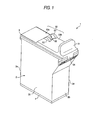
- Fig. 1 is a perspective view showing an external appearance of an ink cartridge 1 according to an embodiment of the invention.
- the ink cartridge 1 is removably attached to an inkjet recording apparatus having a recording head that drives actuators constituted by piezoelectric elements so as to eject ink.
- the ink cartridge 1 serves to receive ink to be supplied to the recording head.
- the ink cartridge 1 has a casing 2, an upper cover member 3, a lower cover member 4 and a fixing plate 50.
- the casing 2 is made from a transparent or translucent resin material and formed into a rectangular shape.
- the casing 2 has a pair of first side walls 2a and 2b opposed to each other, and a pair of second side walls 2c and 2d for connecting the pair of first side walls 2a and 2b with each other.
- the casing 2 has a rectangular cylindrical shape open in its opposite, upper and lower end faces.
- the upper and lower covermembers 3 and 4 are formed into plate-like shapes, and heat-welded to the upper and lower end portions of the first side walls 2a and 2b and the second side walls 2c and 2d so as to cover the opposite, upper and lower open faces of the casing 2 respectively.
- the fixing plate 50 is formed into a plate-like shape having a thin portion 50a on the first side wall 2a side and a thick portion 50b on the first side wall 2b side, and fixed to the upper surface of the upper cover member 3.
- the thick portion 50b is provided with a grip portion 51, a first fitting recess portion 52, and a pair of side plates 53 and 53 provided erectly on the opposite sides of the first fitting recess portion 52 so as to put it therebetween.
- the grip portion 51 is a portion to be gripped by an operator intending to attach the ink cartridge 1 to a head unit 70.
- the grip portion 51 is formed to project upward so as to be gripped easily.
- the grip portion 51 is gripped to hold the ink cartridge 1, the ink cartridge 1 can be attached into a narrow space together with other ink cartridges 1 and in parallel therewith. Also when one of the plural ink cartridges 1 mounted in parallel is removed, the ink cartridge 1 can be removed without being disturbed by the other ink cartridges 1 adjacent thereto.
- the first fitting recess portion 52 is a portion sinking in the thick portion 50b of the fixing plate 50.
- the first fitting recess portion 52 is a portion to be fitted to a first fitting protrusion portion 79 formed on the lower side of a fixing arm 71 of the head unit 70.
- the ink cartridge 1 can be prevented from slipping laterally while the ink cartridge 1 can be also prevented from floating from the head unit 70.
- the pair of side plates 53 and 53 are also provided for preventing the ink cartridge 1 from sliding laterally.
- the side plates 53 and 53 are formed so that the distance between their opposed surfaces is substantially equal to the width of the first fitting protrusion portion 79. Accordingly, when the first fitting protrusion portion 79 and the first fitting recess portion 52 are fitted to each other, the first fitting protrusion portion 79 is put between the side plates 53 and 53 so that the ink cartridge 1 can be more surely prevented from sliding laterally.
- Fig. 2 is an exploded sectional view of the ink cartridge 1.
- Fig. 3A is a plan view of the upper cover member 3 observed from the arrow IIIA direction in Fig. 2.
- Fig. 3B is a plan view of the casing 2 observed from the arrow IIIB direction in Fig. 2.
- Fig. 3C is a plan view of the lower cover member 4 observed from the arrow IIIC direction in Fig. 2.
- Fig. 4 is a sectional view of an atmospheric air communication path 10, taken along line IV-IV in Fig. 2.
- Fig. 5 is a perspective view of a spacer member 30 welded on the upper cover member 3.
- the inside of the casing 2 is divided by partition walls 5 and 6 extending substantially in parallel to the first side walls 2a and 2b, a bottom partition wall 7 connected to the lower ends of the two partition walls 5 and 6 and extending substantially in parallel to the lower cover member 4, and partition walls 7a, 7b and 7c extending substantially vertically from the bottom partition wall 7 toward the lower cover member 4 (see Fig. 3B about the partition wall 7c).
- the partition walls 5 and 6, the bottom partition wall 7 and the partition walls 7a and 7b extend in a direction bridging the second side walls 2c and 2d, while the partition wall 7c extends in a direction bridging the partition walls 7a and 7b.
- the upper ends of the partition walls 5 and 6 are fixedly attached to the lower surface of the upper cover member 3 by heat welding, while the lower ends of the partition walls 7a, 7b and 7c are fixedly attached to the upper surface of the lower cover member 4 by heat welding.
- a first chamber 9 is formed in a portion surrounded by the upper cover member 3, the partition walls 5 and 6, the bottom partition wall 7 and the second side walls 2c and 2d.
- a porous material 8 made from polyurethane foam and absorbing ink is received in the first chamber 9.
- the atmospheric air communication path 10 is formed in a portion surrounded by the upper and lower cover members 3 and 4, the first side wall 2a, the partition wall 5 and the second side walls 2c and 2d.
- the atmospheric air communication path 10 is formed substantially into an L-shape out of a vertical portion 10a extending along the first side wall 2a and a horizontal portion 10b located under the first chamber 9.
- a second chamber 11 is formed in a portion surrounded by the upper and lower cover members 3 and 4, the first side wall 2b, the partition wall 6 and the second side walls 2c and 2d.
- the second chamber 11 is also formed substantially into an L-shape out of a vertical portion 11a extending along the first side wall 2b and a horizontal portion 11b located under the first chamber 9 in the same manner as the atmospheric air communication path 10.
- a space 20 (see Fig. 3B) is formed in a portion surrounded by the bottom partition wall 7, the partition walls 7a, 7b and 7c and the lower cover member 4.
- the first chamber 9 and the second chamber 11 are chambers for receiving ink.
- the first chamber 9 is formed to be much larger than the second chamber 11, and the first chamber 9 is formed as amain ink chamber.
- the second chamber 11 serves as a passageway at the time of charging ink as will be described later, and serves as a relay chamber at the time of supplying ink from the first chamber 9 to the recording head 72.
- An ink charge port 13 is provided in the upper cover member 3 correspondingly to the upper end open face of the second chamber 11, while a communication hole 15 for connecting the first chamber 9 with the horizontal portion 11b of the second chamber 11 is formed in the bottom partition wall 7.
- a communication hole 15 for connecting the first chamber 9 with the horizontal portion 11b of the second chamber 11 is formed in the bottom partition wall 7.
- ink to be charged is charged from the ink charge port 13 to the first chamber 9 through the second chamber 11 and the communication hole 15, and absorbed into the porous material 8 in the first chamber 9.
- an ink supply port 17 for supplying the ink in the second chamber 11 to the recording head 72 is provided in the lower cover member 4.
- the ink absorbed in the porous material 8 flows out from the first chamber 9 to the ink supply port 17 through the communication hole 15 and the horizontal portion 11b of the second chamber 11, and then ejected from the ink supply port 17.
- the atmospheric air communication path 10 is a passageway for supplying the atmospheric air to the first chamber 9 when the ink in the first chamber 9 is consumed.
- the vertical portion 10a communicates with the horizontal portion 10b through a communication hole 19 (see Fig. 3B) provided in the partition wall 7b.
- the atmospheric air communication path 10 and the second chamber 11 are isolated from each other by the partition wall 7a so that the atmospheric air communication path 10 and the second chamber 11 are formed independently of each other.
- a first through hole 14 communicating with a location of the first chamber 9 where the porous material 8 is disposed, and a second through hole 16a corresponding to the upper end open face of the atmospheric air communication path 10 are provided in the upper cover member 3. Further, a passageway 16 for connecting the first through hole 14 with the second through hole 16a is formed like a recess in the upper surface of the upper cover member 3. On the other hand, an atmospheric air communication hole 18 for supplying the atmospheric air to the atmospheric air communication path 10 is formed in the lower cover member 4. Thus, the outside air supplied from the atmospheric air communication hole 18 is supplied to the location of the first chamber 9 where the porous material 8 is disposed, through the atmospheric air communication path 10, the second through hole 16a, the passageway 16 and the first through hole 14.
- a partition wall 29 for partitioning the vertical portion 10a of the atmospheric air communication path 10 into an upper part and a lower part is formed halfway in the vertical portion 10a of the atmospheric air communication path 10 as shown in Fig. 4.
- the partition wall 29 extends with a difference in elevation in the up/down direction of the atmospheric air communication path 10.
- a through hole 28 is formed in a high portion of the partition wall 29, and a recess portion serving as an ink reservoir 29a is formed in a lower site than the upper end face of the through hole 28.
- a circumferential wall of the atmospheric air communication hole 18 formed in the lower cover member 4 is provided to project upward like a cylindrical shape so as to form an ink reservoir around the atmospheric air communication hole 18.
- the partition wall 29 can be molded at a parting portion of upper and lower split molds when the casing 2 is molded out of resin. Thus, special processing is not required.
- the ink charge port 13, the first through hole 14 and the second through hole 16a provided in the upper cover member 3 are closed by first sealing materials 21 and 22 pasted to the outer surface of the upper cover member 3 by heat welding or the like after ink is charged.
- the sealingmaterial 22 covers the upper surface of the passageway 16 while securing the passageway 16.
- the ink supply port 17 and the atmospheric air communication hole 18 provided in the lower cover member are closed by a second sealing material 23 pasted releasably by heat welding or the like.
- the space 20 is a space for forming a decompressed space inside the casing 2.
- the space 20 is formed as an independent space having no communication with the first chamber 9, the atmospheric air communication path 10 and the second chamber 11.
- Two openings 24 and 24 are formed in the lower cover member 4 covering the space 20.
- the space 20 communicates with the outside of the casing through the openings 24 and 24.
- the ink cartridge 1 is placed in a packing bag 64 and the packing bag 64 is decompressed as will be described later, the air in the space 20 is sucked through the openings 24 and 24 so that the space 20 is decompressed.
- the openings 24 and 24 provided in the lower cover member 4 are not covered with the sealing material 23, but allow the space 20 to communicate with the outside.
- a spacer member 30 is formed integrally with the upper cover member 3 so as to project into the first chamber 9 and occupy a predetermined space of the first chamber 9.
- the spacer member 30 occupies a predetermined space between the porous material 8 and the upper cover member 3 in the first chamber 9.
- the spacer member 30 has outer circumferential walls 30a, 30b, 30c and 30d and a bottom wall 30e.
- the outer circumferential walls 30a to 30d extend almost along the inner surfaces of the second side walls 2c and 2d and the partition walls 5 and 6 forming the first chamber 9 in sectional view substantially perpendicular to the projecting direction of the spacer member 30.
- the bottom wall 30e covers the porous material 8 side end portion of the spacer member 30 surrounded by the outer circumferential walls 30a to 30d.
- the spacer member 30 is formed into a hollow box-like shape open in its top.
- a first opening portion 38 is formed in the upper cover member 3 so as to have substantially the same shape as the open face of the spacer member 30.
- the upper ends of the outer circumferential walls 30a to 30d are connected integrally with the circumferential edge of the first opening portion 38.
- the spacer member 30 has a volume extending from the upper end of the first chamber 9 to the substantially central portion thereof.
- the air existing in the space surrounded by the spacer member 30 is sucked through the first opening portion 38 of the upper cover portion 3 (the open face of the spacer member 30) so that the space is decompressed.
- the decompressed condition in the packing bag 64 is kept for a long time, with the result that the deaerated condition of ink is also kept.
- rib-like protrusion portions 34 abutting against the inner surfaces of the pair of second side walls 2c and 2d opposed to the outer circumferential walls 30c and 30d are formed on the outer surfaces of the outer circumferential walls 30c and 30d respectively.
- the protrusion portions 34 are formed all over the up/down-direction lengths of the outer circumferential walls 30c and 30d, so as to fill the gaps between the outer circumferential walls 30c and 30d and the second side walls 2c and 2d respectively.
- First support walls 31 extending in the opposition direction of the pair of outer circumferential walls 30a and 30b of the spacer member 30 opposed to each other are connected to the inner surfaces of the outer circumferential walls 30a and 30b respectively.
- Second support walls 32 extending in the opposition direction of the pair of the second side walls 2c and 2d opposed to the pair of outer circumferential walls 30c and 30d opposed to each other are connected to the inner surfaces of the outer circumferential walls 30c and 30d respectively. That is, the space inside the spacer member 30 is divided and formed into a grid by the first and second support walls 31 and 32. Even when the space surround by the spacer member 30 is decompressed, the first and second support walls 31 and 32 can prevent the second side walls 2c and 2d from being crushed inward.
- third support walls 33 extending in the same direction as the second support walls 32 but being shorter in height than the second support walls 32 are connected to the lower inner surfaces of the outer circumferential walls 30c and 30d, that is, closely to the center of the first chamber 9, respectively.
- the third support walls 33 together with the second support walls 32 are connected to the inner surfaces of the outer circumferential walls 30c and 30d, the second side walls 2c and 2d can be more surely prevented from being crushed by the aforementioned decompression.
- the outer surface of the outer circumferential wall 30a is formed into a concave groove extending all over its up/down direction length so as to secure a passageway 39 for making communication between the first through hole 14 provided in the upper cover member 3 and the first chamber 9 where the porous material 8 is placed.
- the passageway 39 is formed tobe surrounded by the first chamber 9 side surface of the partition wall 5 and the outer surface of the outer circumferential wall 30a. Thus, a passageway is secured between the first chamber 9 where the porous material 8 is placed and the first through hole 14.
- the passageway 39 is formed to be surrounded by the outer circumferential wall 30a formed into a concave groove, the predetermined space between the upper cover member 3 and the porous material 8 in the first chamber 9 excluding the passageway can be occupied by the spacer member 30.
- the passageway 39 is secured while the ratio of the air layer communicating with the first chamber 9 where the porous material 8 is placed is suppressed so that the degree of deaeration of ink in the first chamber 9 can be prevented from deteriorating.
- the outer circumferential walls 30c and 30d extend all over the width of the first chamber 9 in spite of the existence of the passageway 39, the second side walls 2c and 2d can be prevented from being crushed, as described previously.
- members for detecting the existence of ink are disposed inside the casing 2.
- An inclined portion 60 inclined with respect to the vertical direction connecting the upper cover member 3 and the lower cover member 4 is formed in the upper portion of the first side wall 2b.
- a prism 61 is disposed on the inner surface of the inclined portion 60.
- the prism 61 is a member serving to detect the existence of ink reserved in the ink cartridge 1.
- the prism 61 is molded out of a transparent and light-transmissive material. In a position at a predetermined distance from the prism 61, a reflectormember 35 formed integrally with the upper cover member 3 is hung substantially vertically above the second chamber 11.
- the reflector member 35 is a member for changing the optical path of infrared light radiated from a not-shown ink sensor.
- the reflector member 35 is disposed obliquely with respect to the prism 61, and formed into a bag-like shape having an air layer.
- the inside of the reflector member 35 communicates with the outside through a second opening portion 36 (see Fig. 3A) which is open in the upper cover member 3.
- infrared light radiated from the not-shown ink sensor is transmitted through the prism 61 and the ink in the second chamber 11 and reaches the reflector member 35 because the refractive index of the prism 61 is very close to the refractive index of the ink.
- the infrared light reaching the reflector member 35 is reflected on the interface between the inner surface of the reflector member 35 and the air inside the reflector member 35 because there is a difference in refractive index between the reflector member 35 and the air.
- the prism 61 is disposed obliquely with respect to the reflector member 35.
- the light quantity of the infrared light returning to the ink sensor is smaller than the light quantity of the infrared light radiated by the ink sensor.
- infrared light radiated from the ink sensor is reflected on the interface between the inner surface of the prism 61 and the air because there is a difference in refractive index between the prism 61 and the air. Most of the infrared light returns to the ink sensor. Thus, the light quantity of the reflected light is larger than that in the aforementioned case. In such a manner, the light quantity of reflected light changes in accordance with the existence of ink. Thus, the existence of ink reserved in the second chamber 11 can be detected by detecting such a difference in light quantity.
- a pair of ribs 62 and 62 opposed to each other at a predetermined distance from each other are not the internal constituent parts of the casing 2, the pair of ribs 62 and 62 are provided to project on the upper portion of the first side wall 2a, while a second fitting recess portion 55 is provided to sink in the lower cover member 4.
- the ribs 62 and 62 and the second fitting recess portion 55 serve to position the ink cartridge 1 when the ink cartridge 1 is attached to the head unit 70, and to prevent the ink cartridge 1 from slipping laterally on the head unit 70.
- engagement grooves 37 and 37 are formed in the opposite endportions of the upper cover member 3.
- the grooves 37 and 37 are grooves for fitting to engagement claws 54 formed in the opposite end portions of the aforementioned fixing plate 50.
- the fixing plate 50 is fixed onto the upper cover member 3 so as to cover the first opening portion 38 of the upper cover member 3 in such a manner, the first opening portion 38 (the open face of the spacer member 30) open in the substantially central portion of the upper cover member 3 is not perfectly closed by the fixing plate 50.
- the space formed by the spacer member 30 still remains communicating with the outside through the first opening portion 38 (the open face of the spacer member 30) .
- the casing 2 is molded out of resin.
- the porous material 8 is inserted into the first chamber 9 from the upper open face of the casing 2.
- the upper open face of the casing 2 is closed by the upper cover member 3.
- the upper cover member 3 is heat-welded with the upper ends of the first and second side walls 2a to 2d of the casing 2 and the upper ends of the partition walls 5 and 6. In this event, a predetermined space between the upper cover member 3 and the porous material 8 is occupied by the spacer member 30 so that the porous material 8 is elastically pressed by the spacer member 30.
- the lower open face of the casing 2 is closed by the lower cover member 4.
- the lower cover member 4 is heat-welded with the lower ends of the first and second side walls 2a to 2d of the casing 2 and the lower ends of the partition walls 7a, 7b and 7c.
- the upper and lower faces of the casing 2 are formed to be substantially open, and the cover members 3 and 4 are heat-welded with the casing 2 from above and from below.
- the sealing material 23 is releasably pasted to cover the ink supply port 17 and the atmospheric air communication hole 18 provided in the lower cover member 14.
- the work of charging ink is performed as follows. That is, a not-shown ink charger is brought into tight contact with the ink charge port 13 in the state where the ink supply port 17 and the atmospheric air communication hole 18 of the lower cover member 4 are sealed. Then, a not-shown decompressor is brought into tight contact with the first through hole 14 so as to suck the air in the first chamber 9 through the first through hole 14, while ink is supplied from the ink charge port 13. Thus, the ink is absorbed into the porous material 8 in the first chamber 9 through the second chamber 11 and the communication hole 15.
- deaerated ink in which bubbles or the air dissolved in the ink has been eliminated to the utmost is used as the ink to be charged in this process. This is to prevent the bubbles or the air from invading the recording head 72 to thereby prevent a failure in ink ejection from being caused.
- the sealing materials 21 and 22 are pasted onto the ink charge port 13, the first through hole 14 and the second through hole. Then, the fixing plate 50 is fixed to the upper surface of the upper cover member 3.
- the section of the ink cartridge 1 shown in Fig. 6 corresponds to the section taken along line VI-VI in Figs. 3B and 3C.
- the ink cartridge 1 filled with the ink is received and sealed in the packing bag 64 in the decompressed condition at the time of shipment.
- the packing bag 64 has a cylindrical member, in which the ink cartridge 1 is received. The inside of the cylindrical member is sucked by negative pressure, and the opposite open ends of the cylindrical member are welded.
- the packing bag 64 is formed out of air-impermeable resin or metal foil, or a laminated material of those.
- the air existing in the space formed by the spacer member 30 is sucked through the first opening portion 38 of the upper cover member 3 (the open face of the spacer member 30) and the gap between the fixing plate 50 and the upper cover member 3.
- the space formed by the spacer member 30 is decompressed to the same pressure as that in the packing bag 64.
- the ink cartridge 1 is attached to the head unit 70 of the inkjet recording apparatus.
- the ink cartridge 1 is attached to the head unit 70 in the state where the sealing material 23 closing the ink supply port 17 and the atmospheric air communication hole 18 has been released by an operator.
- the head unit 70 is a member for supplying ink to the recording head 72 from the ink cartridge 1 removably attached to the head unit 70.
- the head unit 70 is chiefly provided with a mounting portion 70a and fixing arms 71.
- the mounting portion 70a is a portion where ink cartridges 1 should be mounted.
- the mounting portion 70a is formed into a substantially flat surface.
- the mounting portion 70a is partitioned into four spaces by three partition plates 70c. Four ink cartridges 1 can be mounted in the spaces respectively.
- Ink supply passageways 75 communicating with the recording head 72 are formed in the mounting portion 70a so as to penetrate the mounting portion 70a.
- the ink supply passageways 75 are connected to the ink supply ports 17 of the ink cartridges 1 while being sealed with O-rings 73, respectively.
- the fixing arms 71 are members for pressing and fixing the ink cartridges 1 so as to bring the ink cartridges 1 into communication with the ink supply passageways 75 respectively.
- One end side of each fixing arm 71 is supported so that the fixing arm 71 can move vertically and swing desirably around a swinging shaft 71b.
- the fixing arm 71 In the state where a rising portion 71a in the rear end upper portion of the fixing arm 71 is brought into contact with the head unit 70, the fixing arm 71 is prevented from swinging around the shaft 71b.
- the aforementioned first fitting protrusion portion 79 is fitted into the fitting recess portion 52 of the ink cartridge 1 so as to downward press the cartridge as a whole.
- a plurality of protrusions for positioning each ink cartridge 1 or preventing it from slipping laterally are provided in the head unit 70.
- a second fitting protrusion portion 74 for fitting into the second fitting recess portion 55 provided in the lower cover member 4 is provided on the mounting portion 70a, while a third fitting protrusion portion 70h for fitting between the pair of ribs 62 and 62 provided to project on the second side wall 2a of the casing 2 is provided in the surface of the head unit 70 opposed to the second side wall 2a of the casing 2.
- the atmospheric pressure does not act on the second chamber 11 in the state where ink has been fully charged into the second chamber 11.
- the ink in the second chamber 11 will be used after the ink in the first chamber 9 has been nearly used up. That is, when the ink in the first chamber 9 is used up, the air invades the second chamber 11 from the first chamber 9. Thus, an air gap appears from the upper portion of the vertical portion 11a of the second chamber 11 so that the ink level comes down. When the ink in the second chamber 11 is detected, it can be detected that the remaining amount has been small.
- Fig. 8 shows an example of use in which the upper cover member 3 of the ink cartridge 1 is replaced by another upper cover member 3A so that a large amount of ink is received in the first chamber 9.
- the upper cover member 3A has no part corresponding to the aforementioned spacer member 30.
- a porous material 8A is received in the first chamber 9 so as to occupy almost all the first chamber 9, and an amount of ink corresponding thereto is absorbed and retained in the porous material 8A.
- All the parts other than the upper cover member 3A are the same as those in the aforementioned ink cartridge 1.
- the ink cartridge in Fig. 8 receiving a large amount of ink can be provided to a user frequently using the inkjet recording apparatus while the ink cartridge in the aforementioned embodiment can be provided to a user less frequently using the inkjet recording apparatus.
- rib-like protrusion portions 34 are formed in outer surfaces of two sides 30c and 30d of the outer circumferential wall so as to abut against inner surfaces of the pair of side walls 2c and 2d respectively.
- a passageway 39 in the form of concave groove through which the storage space allowing the porous material 8 to be located therein is connected to the outside is formed in an outer surface of a side 30a of the outer circumferential wall other than the two sides 30c and 30d.
- the casing 2 has a second open face opposite to the open face; a second cover portion 4 is provided to cover the second open face; a space 20 isolated from the storage space by a partition wall 7a, 7b and 7c is defined on an inner side of the second cover member on the side of the casing; and the space 20 is made open to the outside through an opening portion 24 formed to penetrate the second cover member 4.
- a fixing plate 50 having a fixing member formed for fixing the casing 2 to inkjet recording apparatus is provided in an opposite surface of the first cover member 3 to the storage space, and the fixing plate 50 covers the opening portion of the first cover member 3 while securing communication of the opening portion to the outside.
- the ink cartridge 1 further includes an ink chamber 11 lying adjacent to the storage space via a second partition wall 7, wherein the ink chamber 11 communicates with the storage space through a communication hole 15 formed in the secondpartitionwall 7, and includes a supply port 17 for supplying ink to a print head; and the spacer member 30 is provided for the storage space.
- the ink in the storage space is supplied into the ink chamber 11 adjacent to the storage space, through the communication hole 15 formed in the second partition wall 7.
- the ink supplied to the ink chamber 11 flows out from the supply port 17.
- the spacer member 30 is provided in the storage space though the storage space and the ink chamber 11 can receive ink.
- the spacer member 30 has an outer circumferential wall 30a, 30b, 30c and 30d extending substantially along the inner surface of the storage space in section perpendicular to the projecting direction of the spacer member 30, and a bottom wall 30e covering the porous-material-side end portion of the spacer member 30 surrounded by the outer circumferential wall.
- the space surrounded by the outer circumferential wall and the bottom wall 30e is made open to the outside through the opening portion formed to penetrate the first cover member. Accordingly, when the ink cartridge 1 is placed in the packing member 64 in a decompressed condition, the air existing in the space is sucked so that the space is decompressed.
- a support wall 32 extending in the opposition direction of the pair of side walls of the casing opposed to each other with the storage space being put between the pair of side walls is connected to the inner surfaces of two sides of the outer circumferential wall. Accordingly, the support wall 32 prevents the outer circumferential wall of the spacer member from being crushed inward due to the decompression of the space.
- the ink cartridge exerts the following effect in addition to the above-described effect. That is, rib-like protrusion portions 34 are formed in outer surfaces of two sides 30c and 30d of the outer circumferential wall so as to abut against inner surfaces of the pair of side walls 2c and 2d respectively. Accordingly, the rib-like protrusion portions 34 can support the pair of side walls so as to prevent the side walls from being crushed inward due to the pressing force generated when the ink cartridge is put under the decompressed condition.
- the outer surface of the outer circumferential wall is formed to abut against the inner surfaces of the side walls in order to withstand the pressing force. In such a case, however, it is difficult to insert the spacer member 30 into the casing 2.
- the rib-like protrusion portions 34 abut against the inner surfaces of the side walls. Accordingly, in comparison with the aforementioned case, there is an effect that the spacer member 30 can be inserted into the casing 2 easily.
- a passageway 39 through which the storage space allowing the porous material to be located therein is connected to the outside is formed in the outer surface of the outer circumferential wall so as to have a concave groove-like shape in which substantially end portions of the outer circumferential wall 30c and 30d opposed to the side walls are left as they are. Accordingly, communication between the storage space where the porous material is located and the outside can be secured while suppressing the ratio of an air layer occupying the storage space.
- a space 20 isolated from the storage space by a partition wall 7a, 7b and 7c is defined on an inner side of the second cover member on the side of the casing.
- the space 20 is made open to the outside through an opening portion formed to penetrate the second cover member, and the space 20 is decompressed under the decompressed condition. Accordingly, a decompressed space is formed on the opposite side to the decompressed space formed by the spacer member so that the deterioration in degree of deaeration of ink can be further suppressed.
- the ink cartridge 1 can be fixed to inkjet recording apparatus by a fixing member provided in an opposite surface of the first cover member to the storage space.
- a fixing member provided in an opposite surface of the first cover member to the storage space.
- the spacer member 30 is provided not for the ink chamber 11 having a supply port for supplying ink but for the storage space adjacent to the ink chamber through the second partition wall. Accordingly, good ink supply from the ink chamber to the print head can be kept regardless of the size of the storage space.
- the size of the spacer member 30 is not limited thereto, but can be adjusted desirably in accordance with an intended amount of ink to be received.
- the ink capacity can be adjusted desirably without changing the shape of the casing 2.
Landscapes
- Ink Jet (AREA)
- Pens And Brushes (AREA)
Claims (10)
- Cartouche d'encre (1) comprenant :un boîtier (2) ayant au moins une face ouverte et recevant de l'encre, le boîtier (2) comportant un espace de stockage (9) qui reçoit un matériau poreux (8) destiné à absorber de l'encre et ayant une paire de parois latérales (2c, 2d), opposées l'une à l'autre tout en plaçant l'espace de stockage (9) entre elles ;un premier élément formant couvercle (3) qui ferme la face ouverte du boîtier (2) tout en faisant face à l'espace de stockage (9) ; etun élément formant entretoise (30) faisant saillie depuis le premier élément formant couvercle (3) dans l'espace de stockage (9) afin d'occuper un espace prédéterminé entre le matériau poreux (8) et le premier élément formant couvercle (3) dans l'espace de stockage (9), l'élément formant entretoise (30) ayant une paroi circonférentielle externe (30a, 30b, 30c, 30d), une paroi inférieure (30e) couvrant une partie d'extrémité du côté du matériau poreux de la paroi circonférentielle externe (30a, 30b, 30c, 30d), et une paroi de support (32, 33), la paroi circonférentielle externe s'étendant sensiblement le long d'une surface interne du boîtier (2) enfermant l'espace de stockage (9) en une section perpendiculaire à une direction de saillie de l'élément formant entretoise (30), la paroi de support (32, 33) s'étendant dans une direction croisant la paire de parois latérales (2c, 2d) du boîtier (2) devant être raccordées à des surfaces internes de deux côtés (30c, 30d) de la paroi circonférentielle externe opposée à la paire de parois latérales (2c, 2d) ;dans laquelle un premier espace entouré par la paroi circonférentielle externe (30a, 30b, 30c, 30d) est ouvert sur l'extérieur au travers d'une partie d'ouvertures (38) formées afin de pénétrer le premier élément formant couvercle (3).
- Cartouche d'encre selon la revendication 1, dans laquelle des parties formant protubérance (34) sous la forme de nervures sont formées dans des surfaces externes de deux côtés (30c, 30d) de la paroi circonférentielle externe afin de s'appuyer contre des surfaces internes de la paire de parois latérales (2c, 2d), respectivement.
- Cartouche d'encre selon la revendication 1 ou 2, dans laquelle une voie de passage (39), sous la forme d'une rainure concave, au travers de laquelle l'espace de stockage (9) permettant d'installer le matériau poreux (8) est raccordé à l'extérieur, est formé dans une surface externe d'un côté (30a) de la paroi circonférentielle externe, autre que les deux côtés.
- Cartouche d'encre selon l'une des revendications 1 à 3, dans laquelle le boîtier (2) a une seconde face ouverte opposée à la face ouverte ;
une seconde partie formant couvercle (4) est prévue afin de couvrir la seconde face ouverte ;
un second espace (20) isolé de l'espace de stockage (9) par une première paroi de séparation (7) est défini sur un côté interne du second élément formant couvercle (4) sur le côté du boîtier (2) ; et
le second espace (20) est ouvert sur l'extérieur au travers d'une partie d'ouverture (24) formée afin de pénétrer le second élément formant couvercle (4). - Cartouche d'encre selon l'une des revendications 1 à 4, dans laquelle une plaque de fixation (50) ayant un élément de fixation formé pour fixer le boîtier (2) sur un appareil d'enregistrement à jet d'encre est prévu dans une surface opposée au premier élément formant couvercle (3) à l'espace de stockage (9), et la plaque de fixation (50) couvre la partie d'ouverture du premier élément formant couvercle (3) tout en garantissant une communication de la partie d'ouverture avec l'extérieur.
- Cartouche d'encre selon l'une des revendications 1 à 5, comprenant en outre :une chambre d'encre (11) se trouvant adjacente à l'espace de stockage (9) par le biais d'une seconde paroi de séparation (6) ;dans laquelle la chambre d'encre (11) communique avec l'espace de stockage (9) au travers d'un trou de communication (15) formé dans la première paroi de séparation (7), et comporte un orifice d'alimentation (17) destiné à délivrer de l'encre à une tête d'impression (72) ; etl'élément formant entretoise (30) est prévu pour l'espace de stockage (9).
- Cartouche d'encre selon l'une des revendications 1 à 6, dans laquelle la cartouche d'encre (1) est placée dans un élément d'emballage (64) dans un état de décompression et le premier espace entouré par la paroi circonférentielle externe (30a, 30b, 30c, 30d) est décomprimé dans l'état de décompression.
- Cartouche d'encre selon l'une des revendications 1 à 7, dans laquelle la cartouche d'encre (1) est placée dans un élément d'emballage (64) dans un état de décompression et le second espace (20) est décomprimé dans l'état de décompression.
- Cartouche d'encre selon l'une des revendications 1 à 8, dans laquelle la paroi de support (32, 33) s'étend dans une direction perpendiculaire à la paire de parois latérales (2c, 2d) du boîtier (2).
- Cartouche d'encre selon l'une des revendications 1 à 9, dans laquelle l'élément formant entretoise (30) est formé d'une seule pièce avec le premier élément formant couvercle (3).
Applications Claiming Priority (2)
| Application Number | Priority Date | Filing Date | Title |
|---|---|---|---|
| JP2003301354 | 2003-08-26 | ||
| JP2003301354A JP4389522B2 (ja) | 2003-08-26 | 2003-08-26 | インクカートリッジ |
Publications (2)
| Publication Number | Publication Date |
|---|---|
| EP1510347A1 EP1510347A1 (fr) | 2005-03-02 |
| EP1510347B1 true EP1510347B1 (fr) | 2007-03-14 |
Family
ID=34101168
Family Applications (1)
| Application Number | Title | Priority Date | Filing Date |
|---|---|---|---|
| EP04020068A Expired - Lifetime EP1510347B1 (fr) | 2003-08-26 | 2004-08-24 | Cartouche d'encre |
Country Status (6)
| Country | Link |
|---|---|
| US (1) | US7121656B2 (fr) |
| EP (1) | EP1510347B1 (fr) |
| JP (1) | JP4389522B2 (fr) |
| CN (1) | CN1330497C (fr) |
| AT (1) | ATE356719T1 (fr) |
| DE (1) | DE602004005278T2 (fr) |
Families Citing this family (14)
| Publication number | Priority date | Publication date | Assignee | Title |
|---|---|---|---|---|
| US20050078997A1 (en) * | 2003-10-09 | 2005-04-14 | Hewlett-Packard Development Company, L.P. | Print cartridge support system |
| US7300143B2 (en) * | 2005-04-05 | 2007-11-27 | Xerox Corporation | Ink jet apparatus |
| US20070035596A1 (en) * | 2005-08-10 | 2007-02-15 | Lexmark International, Inc. | Ink jet cartridge |
| US7722173B2 (en) | 2005-09-29 | 2010-05-25 | Hewlett-Packard Development Company, L.P. | Fluid container having a fluid absorbing material |
| JP4321565B2 (ja) | 2006-08-12 | 2009-08-26 | セイコーエプソン株式会社 | 液体収容容器 |
| JP5167847B2 (ja) * | 2007-11-09 | 2013-03-21 | セイコーエプソン株式会社 | 液体収容容器及びその製造方法 |
| USD587307S1 (en) * | 2007-11-28 | 2009-02-24 | Seiko Epson Corporation | Ink cartridge |
| US8042927B2 (en) * | 2008-09-30 | 2011-10-25 | Xerox Corporation | Melt reservoir housing |
| JP5617731B2 (ja) * | 2011-03-29 | 2014-11-05 | ブラザー工業株式会社 | 流体カートリッジ |
| JP5633453B2 (ja) * | 2011-03-29 | 2014-12-03 | ブラザー工業株式会社 | 流体カートリッジ |
| JP6409508B2 (ja) * | 2014-10-31 | 2018-10-24 | ブラザー工業株式会社 | 液体消費装置 |
| JP7673273B2 (ja) * | 2023-04-14 | 2025-05-08 | キヤノン株式会社 | カートリッジ、カートリッジの製造方法および再利用方法 |
| US20240343044A1 (en) * | 2023-04-14 | 2024-10-17 | Canon Kabushiki Kaisha | Cartridge and cartridge reuse method |
| JP7721713B2 (ja) * | 2023-04-14 | 2025-08-12 | キヤノン株式会社 | カートリッジおよびカートリッジの再利用方法 |
Family Cites Families (10)
| Publication number | Priority date | Publication date | Assignee | Title |
|---|---|---|---|---|
| US5329306A (en) * | 1992-11-12 | 1994-07-12 | Xerox Corporation | Waste ink separator for ink jet printer maintenance system |
| ES2186956T5 (es) * | 1994-08-24 | 2009-07-24 | Canon Kabushiki Kaisha | Contenedor de tinta para impresora por chorros de tinta, soporte para el contenedor, carro para el soporte y para la impresora por chorros de tinta. |
| JP3419196B2 (ja) | 1996-03-28 | 2003-06-23 | セイコーエプソン株式会社 | プリンタ類におけるインクカートリッヂ |
| JPH1191132A (ja) * | 1997-09-25 | 1999-04-06 | Canon Inc | インクタンク及びインクジェットカートリッジ |
| JPH11105305A (ja) * | 1997-10-08 | 1999-04-20 | Pilot Corp | インクタンク |
| JP3656725B2 (ja) | 1999-10-29 | 2005-06-08 | セイコーエプソン株式会社 | インクジェット記録装置用インクカートリッジ |
| ATE409590T1 (de) | 1999-10-29 | 2008-10-15 | Seiko Epson Corp | Tintenpatrone zur benutzung in einem tintenstrahlaufzeichnungsgerät |
| EP1524120B1 (fr) * | 2000-01-05 | 2008-09-10 | Hewlett-Packard Company | Dispositif d'écriture à jet d'encre avec couvercle en deux parties |
| AU2002213042A1 (en) * | 2000-10-06 | 2002-04-15 | Nu-Kote International, Inc. | Multiple-chamber cartridge with varying porous member compression |
| JP3667295B2 (ja) * | 2001-05-10 | 2005-07-06 | キヤノン株式会社 | インクタンク |
-
2003
- 2003-08-26 JP JP2003301354A patent/JP4389522B2/ja not_active Expired - Fee Related
-
2004
- 2004-08-24 AT AT04020068T patent/ATE356719T1/de not_active IP Right Cessation
- 2004-08-24 EP EP04020068A patent/EP1510347B1/fr not_active Expired - Lifetime
- 2004-08-24 DE DE602004005278T patent/DE602004005278T2/de not_active Expired - Lifetime
- 2004-08-25 US US10/924,855 patent/US7121656B2/en not_active Expired - Lifetime
- 2004-08-26 CN CNB2004100644537A patent/CN1330497C/zh not_active Expired - Fee Related
Also Published As
| Publication number | Publication date |
|---|---|
| JP4389522B2 (ja) | 2009-12-24 |
| CN1590106A (zh) | 2005-03-09 |
| ATE356719T1 (de) | 2007-04-15 |
| DE602004005278T2 (de) | 2007-11-22 |
| US7121656B2 (en) | 2006-10-17 |
| DE602004005278D1 (de) | 2007-04-26 |
| CN1330497C (zh) | 2007-08-08 |
| JP2005067076A (ja) | 2005-03-17 |
| US20050093944A1 (en) | 2005-05-05 |
| EP1510347A1 (fr) | 2005-03-02 |
Similar Documents
| Publication | Publication Date | Title |
|---|---|---|
| EP1510347B1 (fr) | Cartouche d'encre | |
| US8182063B2 (en) | Liquid container | |
| CN100411873C (zh) | 墨盒 | |
| EP1095777B1 (fr) | Cartouche d'encre pour utiliser dans un appareil d'enregistrement à jet d'encre | |
| JP2003118144A (ja) | インク収容装置及びそれを備えたインクジェット記録装置 | |
| US5667063A (en) | Container for recording head | |
| JPH05270002A (ja) | インクジェットカートリッジの保管方法およびその収納容器 | |
| JP2005067075A (ja) | インクカートリッジ | |
| JPH08318630A (ja) | インクジェットプリンタにおけるケース構造 | |
| JP2005289071A (ja) | インクカートリッジの包装体 | |
| JP4155303B2 (ja) | インクカートリッジおよびインクジェットプリンタ | |
| JP4359900B2 (ja) | インクカートリッジ | |
| EP2095957B1 (fr) | Cartouche d'encre | |
| JP3671957B2 (ja) | インクカートリッジ | |
| JP3791524B2 (ja) | インクカートリッジおよびインクジェットプリンタ | |
| JP3671964B2 (ja) | インクカートリッジ | |
| CA2274392C (fr) | Cartouche d'encre, tete d'imprimante a jet d'encre et imprimante a jet d'encre | |
| JP3671960B2 (ja) | インク残量検出機構 | |
| AU732398B2 (en) | Ink jet cartridge, ink jet head and printer | |
| JP3700701B2 (ja) | インクカートリッジ | |
| JP3671961B2 (ja) | インクカートリッジ及び画像形成装置 | |
| EP2095956B1 (fr) | Procédé de fabrication de cartouche d'encre | |
| JP3671958B2 (ja) | インクカートリッジ | |
| JP3671959B2 (ja) | インクカートリッジ及びインク残量検出機構 | |
| HK1035167B (en) | Ink cartridge for use in an ink jet recording apparatus |
Legal Events
| Date | Code | Title | Description |
|---|---|---|---|
| PUAI | Public reference made under article 153(3) epc to a published international application that has entered the european phase |
Free format text: ORIGINAL CODE: 0009012 |
|
| AK | Designated contracting states |
Kind code of ref document: A1 Designated state(s): AT BE BG CH CY CZ DE DK EE ES FI FR GB GR HU IE IT LI LU MC NL PL PT RO SE SI SK TR |
|
| AX | Request for extension of the european patent |
Extension state: AL HR LT LV MK |
|
| 17P | Request for examination filed |
Effective date: 20050630 |
|
| AKX | Designation fees paid |
Designated state(s): AT BE BG CH CY CZ DE DK EE ES FI FR GB GR HU IE IT LI LU MC NL PL PT RO SE SI SK TR |
|
| GRAP | Despatch of communication of intention to grant a patent |
Free format text: ORIGINAL CODE: EPIDOSNIGR1 |
|
| GRAS | Grant fee paid |
Free format text: ORIGINAL CODE: EPIDOSNIGR3 |
|
| GRAA | (expected) grant |
Free format text: ORIGINAL CODE: 0009210 |
|
| AK | Designated contracting states |
Kind code of ref document: B1 Designated state(s): AT BE BG CH CY CZ DE DK EE ES FI FR GB GR HU IE IT LI LU MC NL PL PT RO SE SI SK TR |
|
| PG25 | Lapsed in a contracting state [announced via postgrant information from national office to epo] |
Ref country code: SI Free format text: LAPSE BECAUSE OF FAILURE TO SUBMIT A TRANSLATION OF THE DESCRIPTION OR TO PAY THE FEE WITHIN THE PRESCRIBED TIME-LIMIT Effective date: 20070314 Ref country code: CH Free format text: LAPSE BECAUSE OF FAILURE TO SUBMIT A TRANSLATION OF THE DESCRIPTION OR TO PAY THE FEE WITHIN THE PRESCRIBED TIME-LIMIT Effective date: 20070314 Ref country code: FI Free format text: LAPSE BECAUSE OF FAILURE TO SUBMIT A TRANSLATION OF THE DESCRIPTION OR TO PAY THE FEE WITHIN THE PRESCRIBED TIME-LIMIT Effective date: 20070314 Ref country code: BE Free format text: LAPSE BECAUSE OF FAILURE TO SUBMIT A TRANSLATION OF THE DESCRIPTION OR TO PAY THE FEE WITHIN THE PRESCRIBED TIME-LIMIT Effective date: 20070314 Ref country code: NL Free format text: LAPSE BECAUSE OF FAILURE TO SUBMIT A TRANSLATION OF THE DESCRIPTION OR TO PAY THE FEE WITHIN THE PRESCRIBED TIME-LIMIT Effective date: 20070314 Ref country code: PL Free format text: LAPSE BECAUSE OF FAILURE TO SUBMIT A TRANSLATION OF THE DESCRIPTION OR TO PAY THE FEE WITHIN THE PRESCRIBED TIME-LIMIT Effective date: 20070314 Ref country code: AT Free format text: LAPSE BECAUSE OF FAILURE TO SUBMIT A TRANSLATION OF THE DESCRIPTION OR TO PAY THE FEE WITHIN THE PRESCRIBED TIME-LIMIT Effective date: 20070314 Ref country code: LI Free format text: LAPSE BECAUSE OF FAILURE TO SUBMIT A TRANSLATION OF THE DESCRIPTION OR TO PAY THE FEE WITHIN THE PRESCRIBED TIME-LIMIT Effective date: 20070314 |
|
| REG | Reference to a national code |
Ref country code: GB Ref legal event code: FG4D |
|
| REG | Reference to a national code |
Ref country code: CH Ref legal event code: EP |
|
| REF | Corresponds to: |
Ref document number: 602004005278 Country of ref document: DE Date of ref document: 20070426 Kind code of ref document: P |
|
| REG | Reference to a national code |
Ref country code: IE Ref legal event code: FG4D |
|
| PG25 | Lapsed in a contracting state [announced via postgrant information from national office to epo] |
Ref country code: SE Free format text: LAPSE BECAUSE OF FAILURE TO SUBMIT A TRANSLATION OF THE DESCRIPTION OR TO PAY THE FEE WITHIN THE PRESCRIBED TIME-LIMIT Effective date: 20070614 |
|
| PG25 | Lapsed in a contracting state [announced via postgrant information from national office to epo] |
Ref country code: ES Free format text: LAPSE BECAUSE OF FAILURE TO SUBMIT A TRANSLATION OF THE DESCRIPTION OR TO PAY THE FEE WITHIN THE PRESCRIBED TIME-LIMIT Effective date: 20070625 |
|
| ET | Fr: translation filed | ||
| PG25 | Lapsed in a contracting state [announced via postgrant information from national office to epo] |
Ref country code: PT Free format text: LAPSE BECAUSE OF FAILURE TO SUBMIT A TRANSLATION OF THE DESCRIPTION OR TO PAY THE FEE WITHIN THE PRESCRIBED TIME-LIMIT Effective date: 20070814 |
|
| NLV1 | Nl: lapsed or annulled due to failure to fulfill the requirements of art. 29p and 29m of the patents act | ||
| REG | Reference to a national code |
Ref country code: CH Ref legal event code: PL |
|
| PG25 | Lapsed in a contracting state [announced via postgrant information from national office to epo] |
Ref country code: SK Free format text: LAPSE BECAUSE OF FAILURE TO SUBMIT A TRANSLATION OF THE DESCRIPTION OR TO PAY THE FEE WITHIN THE PRESCRIBED TIME-LIMIT Effective date: 20070314 |
|
| PG25 | Lapsed in a contracting state [announced via postgrant information from national office to epo] |
Ref country code: CZ Free format text: LAPSE BECAUSE OF FAILURE TO SUBMIT A TRANSLATION OF THE DESCRIPTION OR TO PAY THE FEE WITHIN THE PRESCRIBED TIME-LIMIT Effective date: 20070314 Ref country code: RO Free format text: LAPSE BECAUSE OF FAILURE TO SUBMIT A TRANSLATION OF THE DESCRIPTION OR TO PAY THE FEE WITHIN THE PRESCRIBED TIME-LIMIT Effective date: 20070314 |
|
| PLBE | No opposition filed within time limit |
Free format text: ORIGINAL CODE: 0009261 |
|
| STAA | Information on the status of an ep patent application or granted ep patent |
Free format text: STATUS: NO OPPOSITION FILED WITHIN TIME LIMIT |
|
| PG25 | Lapsed in a contracting state [announced via postgrant information from national office to epo] |
Ref country code: DK Free format text: LAPSE BECAUSE OF FAILURE TO SUBMIT A TRANSLATION OF THE DESCRIPTION OR TO PAY THE FEE WITHIN THE PRESCRIBED TIME-LIMIT Effective date: 20070314 |
|
| 26N | No opposition filed |
Effective date: 20071217 |
|
| PG25 | Lapsed in a contracting state [announced via postgrant information from national office to epo] |
Ref country code: MC Free format text: LAPSE BECAUSE OF NON-PAYMENT OF DUE FEES Effective date: 20070831 Ref country code: GR Free format text: LAPSE BECAUSE OF FAILURE TO SUBMIT A TRANSLATION OF THE DESCRIPTION OR TO PAY THE FEE WITHIN THE PRESCRIBED TIME-LIMIT Effective date: 20070615 Ref country code: IT Free format text: LAPSE BECAUSE OF FAILURE TO SUBMIT A TRANSLATION OF THE DESCRIPTION OR TO PAY THE FEE WITHIN THE PRESCRIBED TIME-LIMIT Effective date: 20070314 |
|
| PG25 | Lapsed in a contracting state [announced via postgrant information from national office to epo] |
Ref country code: IE Free format text: LAPSE BECAUSE OF NON-PAYMENT OF DUE FEES Effective date: 20070824 |
|
| PG25 | Lapsed in a contracting state [announced via postgrant information from national office to epo] |
Ref country code: EE Free format text: LAPSE BECAUSE OF FAILURE TO SUBMIT A TRANSLATION OF THE DESCRIPTION OR TO PAY THE FEE WITHIN THE PRESCRIBED TIME-LIMIT Effective date: 20070314 |
|
| PG25 | Lapsed in a contracting state [announced via postgrant information from national office to epo] |
Ref country code: CY Free format text: LAPSE BECAUSE OF FAILURE TO SUBMIT A TRANSLATION OF THE DESCRIPTION OR TO PAY THE FEE WITHIN THE PRESCRIBED TIME-LIMIT Effective date: 20070314 |
|
| PG25 | Lapsed in a contracting state [announced via postgrant information from national office to epo] |
Ref country code: BG Free format text: LAPSE BECAUSE OF FAILURE TO SUBMIT A TRANSLATION OF THE DESCRIPTION OR TO PAY THE FEE WITHIN THE PRESCRIBED TIME-LIMIT Effective date: 20070614 Ref country code: LU Free format text: LAPSE BECAUSE OF NON-PAYMENT OF DUE FEES Effective date: 20070824 |
|
| PG25 | Lapsed in a contracting state [announced via postgrant information from national office to epo] |
Ref country code: HU Free format text: LAPSE BECAUSE OF FAILURE TO SUBMIT A TRANSLATION OF THE DESCRIPTION OR TO PAY THE FEE WITHIN THE PRESCRIBED TIME-LIMIT Effective date: 20070915 Ref country code: TR Free format text: LAPSE BECAUSE OF FAILURE TO SUBMIT A TRANSLATION OF THE DESCRIPTION OR TO PAY THE FEE WITHIN THE PRESCRIBED TIME-LIMIT Effective date: 20070314 |
|
| REG | Reference to a national code |
Ref country code: FR Ref legal event code: PLFP Year of fee payment: 13 |
|
| REG | Reference to a national code |
Ref country code: FR Ref legal event code: PLFP Year of fee payment: 14 |
|
| REG | Reference to a national code |
Ref country code: FR Ref legal event code: PLFP Year of fee payment: 15 |
|
| PGFP | Annual fee paid to national office [announced via postgrant information from national office to epo] |
Ref country code: IT Payment date: 20180919 Year of fee payment: 19 |
|
| PGFP | Annual fee paid to national office [announced via postgrant information from national office to epo] |
Ref country code: GB Payment date: 20180822 Year of fee payment: 15 |
|
| PGFP | Annual fee paid to national office [announced via postgrant information from national office to epo] |
Ref country code: DE Payment date: 20190813 Year of fee payment: 16 |
|
| GBPC | Gb: european patent ceased through non-payment of renewal fee |
Effective date: 20190824 |
|
| PG25 | Lapsed in a contracting state [announced via postgrant information from national office to epo] |
Ref country code: FR Free format text: LAPSE BECAUSE OF NON-PAYMENT OF DUE FEES Effective date: 20190831 |
|
| PG25 | Lapsed in a contracting state [announced via postgrant information from national office to epo] |
Ref country code: GB Free format text: LAPSE BECAUSE OF NON-PAYMENT OF DUE FEES Effective date: 20190824 |
|
| REG | Reference to a national code |
Ref country code: DE Ref legal event code: R119 Ref document number: 602004005278 Country of ref document: DE |
|
| PG25 | Lapsed in a contracting state [announced via postgrant information from national office to epo] |
Ref country code: DE Free format text: LAPSE BECAUSE OF NON-PAYMENT OF DUE FEES Effective date: 20210302 |