EP1508934B1 - Electrolyte for rechargeable lithium battery and rechargeable lithium battery comprising the same - Google Patents
Electrolyte for rechargeable lithium battery and rechargeable lithium battery comprising the same Download PDFInfo
- Publication number
- EP1508934B1 EP1508934B1 EP04090320A EP04090320A EP1508934B1 EP 1508934 B1 EP1508934 B1 EP 1508934B1 EP 04090320 A EP04090320 A EP 04090320A EP 04090320 A EP04090320 A EP 04090320A EP 1508934 B1 EP1508934 B1 EP 1508934B1
- Authority
- EP
- European Patent Office
- Prior art keywords
- group
- electrolyte
- carbonate
- volume
- rechargeable lithium
- Prior art date
- Legal status (The legal status is an assumption and is not a legal conclusion. Google has not performed a legal analysis and makes no representation as to the accuracy of the status listed.)
- Expired - Lifetime
Links
Images

Classifications
-
- H—ELECTRICITY
- H01—ELECTRIC ELEMENTS
- H01M—PROCESSES OR MEANS, e.g. BATTERIES, FOR THE DIRECT CONVERSION OF CHEMICAL ENERGY INTO ELECTRICAL ENERGY
- H01M10/00—Secondary cells; Manufacture thereof
- H01M10/05—Accumulators with non-aqueous electrolyte
- H01M10/056—Accumulators with non-aqueous electrolyte characterised by the materials used as electrolytes, e.g. mixed inorganic/organic electrolytes
- H01M10/0564—Accumulators with non-aqueous electrolyte characterised by the materials used as electrolytes, e.g. mixed inorganic/organic electrolytes the electrolyte being constituted of organic materials only
- H01M10/0566—Liquid materials
- H01M10/0567—Liquid materials characterised by the additives
-
- H—ELECTRICITY
- H01—ELECTRIC ELEMENTS
- H01M—PROCESSES OR MEANS, e.g. BATTERIES, FOR THE DIRECT CONVERSION OF CHEMICAL ENERGY INTO ELECTRICAL ENERGY
- H01M10/00—Secondary cells; Manufacture thereof
- H01M10/05—Accumulators with non-aqueous electrolyte
- H01M10/052—Li-accumulators
- H01M10/0525—Rocking-chair batteries, i.e. batteries with lithium insertion or intercalation in both electrodes; Lithium-ion batteries
-
- H—ELECTRICITY
- H01—ELECTRIC ELEMENTS
- H01M—PROCESSES OR MEANS, e.g. BATTERIES, FOR THE DIRECT CONVERSION OF CHEMICAL ENERGY INTO ELECTRICAL ENERGY
- H01M10/00—Secondary cells; Manufacture thereof
- H01M10/05—Accumulators with non-aqueous electrolyte
- H01M10/056—Accumulators with non-aqueous electrolyte characterised by the materials used as electrolytes, e.g. mixed inorganic/organic electrolytes
- H01M10/0564—Accumulators with non-aqueous electrolyte characterised by the materials used as electrolytes, e.g. mixed inorganic/organic electrolytes the electrolyte being constituted of organic materials only
- H01M10/0565—Polymeric materials, e.g. gel-type or solid-type
-
- H—ELECTRICITY
- H01—ELECTRIC ELEMENTS
- H01M—PROCESSES OR MEANS, e.g. BATTERIES, FOR THE DIRECT CONVERSION OF CHEMICAL ENERGY INTO ELECTRICAL ENERGY
- H01M10/00—Secondary cells; Manufacture thereof
- H01M10/05—Accumulators with non-aqueous electrolyte
- H01M10/056—Accumulators with non-aqueous electrolyte characterised by the materials used as electrolytes, e.g. mixed inorganic/organic electrolytes
- H01M10/0564—Accumulators with non-aqueous electrolyte characterised by the materials used as electrolytes, e.g. mixed inorganic/organic electrolytes the electrolyte being constituted of organic materials only
- H01M10/0566—Liquid materials
- H01M10/0569—Liquid materials characterised by the solvents
-
- H—ELECTRICITY
- H01—ELECTRIC ELEMENTS
- H01M—PROCESSES OR MEANS, e.g. BATTERIES, FOR THE DIRECT CONVERSION OF CHEMICAL ENERGY INTO ELECTRICAL ENERGY
- H01M4/00—Electrodes
- H01M4/02—Electrodes composed of, or comprising, active material
- H01M4/36—Selection of substances as active materials, active masses, active liquids
- H01M4/362—Composites
- H01M4/366—Composites as layered products
-
- H—ELECTRICITY
- H01—ELECTRIC ELEMENTS
- H01M—PROCESSES OR MEANS, e.g. BATTERIES, FOR THE DIRECT CONVERSION OF CHEMICAL ENERGY INTO ELECTRICAL ENERGY
- H01M4/00—Electrodes
- H01M4/02—Electrodes composed of, or comprising, active material
- H01M4/36—Selection of substances as active materials, active masses, active liquids
- H01M4/48—Selection of substances as active materials, active masses, active liquids of inorganic oxides or hydroxides
- H01M4/52—Selection of substances as active materials, active masses, active liquids of inorganic oxides or hydroxides of nickel, cobalt or iron
- H01M4/525—Selection of substances as active materials, active masses, active liquids of inorganic oxides or hydroxides of nickel, cobalt or iron of mixed oxides or hydroxides containing iron, cobalt or nickel for inserting or intercalating light metals, e.g. LiNiO2, LiCoO2 or LiCoOxFy
-
- H—ELECTRICITY
- H01—ELECTRIC ELEMENTS
- H01M—PROCESSES OR MEANS, e.g. BATTERIES, FOR THE DIRECT CONVERSION OF CHEMICAL ENERGY INTO ELECTRICAL ENERGY
- H01M10/00—Secondary cells; Manufacture thereof
- H01M10/05—Accumulators with non-aqueous electrolyte
- H01M10/058—Construction or manufacture
- H01M10/0587—Construction or manufacture of accumulators having only wound construction elements, i.e. wound positive electrodes, wound negative electrodes and wound separators
-
- H—ELECTRICITY
- H01—ELECTRIC ELEMENTS
- H01M—PROCESSES OR MEANS, e.g. BATTERIES, FOR THE DIRECT CONVERSION OF CHEMICAL ENERGY INTO ELECTRICAL ENERGY
- H01M2300/00—Electrolytes
- H01M2300/0017—Non-aqueous electrolytes
- H01M2300/0025—Organic electrolyte
- H01M2300/0028—Organic electrolyte characterised by the solvent
- H01M2300/0037—Mixture of solvents
- H01M2300/004—Three solvents
-
- H—ELECTRICITY
- H01—ELECTRIC ELEMENTS
- H01M—PROCESSES OR MEANS, e.g. BATTERIES, FOR THE DIRECT CONVERSION OF CHEMICAL ENERGY INTO ELECTRICAL ENERGY
- H01M2300/00—Electrolytes
- H01M2300/0017—Non-aqueous electrolytes
- H01M2300/0065—Solid electrolytes
- H01M2300/0082—Organic polymers
-
- H—ELECTRICITY
- H01—ELECTRIC ELEMENTS
- H01M—PROCESSES OR MEANS, e.g. BATTERIES, FOR THE DIRECT CONVERSION OF CHEMICAL ENERGY INTO ELECTRICAL ENERGY
- H01M4/00—Electrodes
- H01M4/02—Electrodes composed of, or comprising, active material
- H01M4/13—Electrodes for accumulators with non-aqueous electrolyte, e.g. for lithium-accumulators; Processes of manufacture thereof
- H01M4/131—Electrodes based on mixed oxides or hydroxides, or on mixtures of oxides or hydroxides, e.g. LiCoOx
-
- H—ELECTRICITY
- H01—ELECTRIC ELEMENTS
- H01M—PROCESSES OR MEANS, e.g. BATTERIES, FOR THE DIRECT CONVERSION OF CHEMICAL ENERGY INTO ELECTRICAL ENERGY
- H01M4/00—Electrodes
- H01M4/02—Electrodes composed of, or comprising, active material
- H01M4/36—Selection of substances as active materials, active masses, active liquids
- H01M4/48—Selection of substances as active materials, active masses, active liquids of inorganic oxides or hydroxides
- H01M4/485—Selection of substances as active materials, active masses, active liquids of inorganic oxides or hydroxides of mixed oxides or hydroxides for inserting or intercalating light metals, e.g. LiTi2O4 or LiTi2OxFy
-
- H—ELECTRICITY
- H01—ELECTRIC ELEMENTS
- H01M—PROCESSES OR MEANS, e.g. BATTERIES, FOR THE DIRECT CONVERSION OF CHEMICAL ENERGY INTO ELECTRICAL ENERGY
- H01M4/00—Electrodes
- H01M4/02—Electrodes composed of, or comprising, active material
- H01M4/36—Selection of substances as active materials, active masses, active liquids
- H01M4/48—Selection of substances as active materials, active masses, active liquids of inorganic oxides or hydroxides
- H01M4/50—Selection of substances as active materials, active masses, active liquids of inorganic oxides or hydroxides of manganese
- H01M4/505—Selection of substances as active materials, active masses, active liquids of inorganic oxides or hydroxides of manganese of mixed oxides or hydroxides containing manganese for inserting or intercalating light metals, e.g. LiMn2O4 or LiMn2OxFy
-
- Y—GENERAL TAGGING OF NEW TECHNOLOGICAL DEVELOPMENTS; GENERAL TAGGING OF CROSS-SECTIONAL TECHNOLOGIES SPANNING OVER SEVERAL SECTIONS OF THE IPC; TECHNICAL SUBJECTS COVERED BY FORMER USPC CROSS-REFERENCE ART COLLECTIONS [XRACs] AND DIGESTS
- Y02—TECHNOLOGIES OR APPLICATIONS FOR MITIGATION OR ADAPTATION AGAINST CLIMATE CHANGE
- Y02E—REDUCTION OF GREENHOUSE GAS [GHG] EMISSIONS, RELATED TO ENERGY GENERATION, TRANSMISSION OR DISTRIBUTION
- Y02E60/00—Enabling technologies; Technologies with a potential or indirect contribution to GHG emissions mitigation
- Y02E60/10—Energy storage using batteries
-
- Y—GENERAL TAGGING OF NEW TECHNOLOGICAL DEVELOPMENTS; GENERAL TAGGING OF CROSS-SECTIONAL TECHNOLOGIES SPANNING OVER SEVERAL SECTIONS OF THE IPC; TECHNICAL SUBJECTS COVERED BY FORMER USPC CROSS-REFERENCE ART COLLECTIONS [XRACs] AND DIGESTS
- Y02—TECHNOLOGIES OR APPLICATIONS FOR MITIGATION OR ADAPTATION AGAINST CLIMATE CHANGE
- Y02P—CLIMATE CHANGE MITIGATION TECHNOLOGIES IN THE PRODUCTION OR PROCESSING OF GOODS
- Y02P70/00—Climate change mitigation technologies in the production process for final industrial or consumer products
- Y02P70/50—Manufacturing or production processes characterised by the final manufactured product
Definitions
- the present invention relates to an electrolyte for a rechargeable lithium battery and a rechargeable lithium battery comprising the same, and more particularly, to an electrolyte for a rechargeable lithium battery exhibiting improved storage characteristics and suppression of swelling at high temperatures, and a rechargeable lithium battery comprising the same.
- Positive active materials for rechargeable lithium batteries generally use lithium-transition metal oxides
- negative active materials generally use crystalline or amorphous carbonaceous materials or carbon composites.
- the active materials are coated on a current collector with a predetermined thickness and length, or they are formed as a film to produce electrodes.
- the electrodes together with a separator are wound to produce an electrode element, and the electrode element is inserted into a battery case such as a can followed by insertion of an electrolyte to fabricate a battery.
- the electrolyte includes lithium salts and organic solvents.
- the organic solvents may be mixed solvents of between two and five components of cyclic carbonates such as ethylene carbonate or propylene carbonate, or linear carbonates such as dimethyl carbonate, ethylmethyl carbonate, or diethyl carbonate.
- cyclic carbonates such as ethylene carbonate or propylene carbonate
- linear carbonates such as dimethyl carbonate, ethylmethyl carbonate, or diethyl carbonate.
- these solvents are known to severely expand at high temperatures, causing a swelling phenomenon.
- the swelling phenomenon is partly manifested in a battery by gas generated due to decomposition of the electrolyte at high temperatures in the battery.
- Such a swelling phenomenon can be reduced in lithium polymer batteries compared to lithium ion batteries.
- a polymer electrolyte with a nickel-based positive active material e.g. LiNiMO 2 , where M is selected from Co, Mn, Al, P, Fe or Mg
- LiNiMO 2 nickel-based positive active material
- Japanese patent JP 5 144470 A discloses a non-aqueous electrolyte for lithium battery, comprising a lithium perfluoro-alkanesulphonate salt dissolved in a hybrid solvent consisting of propylene carbonate, 1,2-dimethoxy ethane, and an aliphatic nitrile, each component being present in a proportion of 15-50%vol.
- United States Patent US 4,737,424 discloses an electrolyte for use on a secondary lithium battery comprising amorphous V 2 O 5 base cathode active material, a metallic lithium base active material, and an electrolytic solution lithium salt dissolved in a mixed organic solvent.
- the organic solvent is ethylene carbonate mixed with one organic solvent of 2-methyltetrahydrofuran, 2,5-dimethyltetrahydrofuran, 1,3-dioxalan, 4-methyl-1,3-dioxalan, 1,2-dimethoxyethane, etc.
- the mixed ratio of ethylene carbonate ranges within 10 to 50%, and water content of the electrolytic solution ranges within 400 to 5 ppm, and the content of impurities other than water ranges within 1000 to 10 ppm.
- Japanese patent application JP 2003 086247 A a non-aqueous electrolytic solution is disclosed, in which a lithium salt is dissolved in a non-aqueous solvent consisting of a nitrile compound having carbon-carbon unsaturated bond(s).
- the international patent application WO 02/071528 A2 relates to electrolytes, containing lithium-bis(oxalato)borate, a cyclic carbonate, one or more compounds selected from acyclic carbonates, aliphatic esters, alicyclic ethers and aliphatic, difunctional ethers, one or more compounds selected from lactones, dinitriles, compounds that contain at least one carboxylic acid ester group and an ether group, compounds that contain at least one carbonic acid group and an ether group, compounds that contain at least one nitrile group and an ether group, trialkyl phosphoric acid esters and trialkyl boric acids.
- these attempts still have often problems associated with high swelling (Japanese Patent Laid-Open No.
- U.S. Patent No. 4,830,939 disclosing a liquid electrolyte containing a polyethylenicially unsaturated monomeric material or a prepolymeric material
- U.S. Patent No. 4,866,716 disclosing a cross-linked polyether which is a product of a vinyl-ether.
- U.S. Patent No. 4,970,012 discloses that a polymeric solid electrolyte includes crosslinked molecules of a radiation-cured substance of a cinnamate ester and polyethene oxide
- U.S. Patent No. 4,908,283 discloses that a polymeric electrolyte includes a cured product of an acryloyl-denaturated polyalkylene oxide.
- an electrolyte is provided for a rechargeable lithium battery which is capable of inhibiting high-temperature swelling.
- a rechargeable lithium battery which includes the electrolyte.
- an electrolyte for a rechargeable lithium battery including a monomer, a polymerization initiator, a non-aqueous organic solvent and a lithium salt.
- the non-aqueous organic solvent includes an ester-based solvent of 70 to 90 volume %, the ester-based solvent including a cyclic ester and a nitrile-based solvent represented by formula 1 of 5 to 30 volume %: R-C ⁇ N (1) where R is a C 1 to C 10 aliphatic hydrocarbon or halogenated aliphatic hydrocarbon, or a C 6 to C 10 aromatic hydrocarbon or halogenated aromatic hydrocarbon.
- a rechargeable lithium battery including the electrolyte, a positive electrode and a negative electrode.
- the positive electrode and the negative electrode include active material in which lithium intercalation reversibly occurs.
- the positive active material is a nickel-included compound.
- the present invention relates to an electrolyte including a nitrile-based solvent for improving swelling and battery performance.
- the electrolyte of the present invention includes non-aqueous organic solvents and a lithium salt.
- the non-aqueous organic solvents include an ester-based solvent including a cyclic ester and a nitrile-based solvent.
- the nitrile-based solvent is represented by formula 1: R-C ⁇ N (1) where R is a C 1 to C 10 and or a C 6 to C 10 aromatic hydrocarbon or halogenated aromatic hydrocarbon, preferably a C 3 to C 8 aliphatic hydrocarbon or halogenated aliphatic hydrocarbon, and more preferably a C 6 to C 8 aliphatic hydrocarbon or halogenated aliphatic hydrocarbon.
- R is an unsaturated hydrocarbon, e.g. methacrylate, it can be used as a solvent for an electrolyte.
- nitrile-based solvent examples include acetonitrile, propionitrile, butyronitrile, t-butyl cyanide, valeronitrile, caprylonitrile, heptyl cyanide, heptanenitrile, cyclopentane carbonitrile, cyclohexane carbonitrile, 2-fluorobenzonitrile, 4-fluorobenzonitrile, difluorobenzonitrile, trifluorobenzonitrile, 2-chlorobenzonitrile, 4-chlorobenzonitrile, dichlorobenzonitrile, trichlorobenzonitrile, 2-chloro-4-fluorobenzonitrile, 4-chloro-2-fluorobenzonitrile, phenylacetonitrile, 2-fluorophenylacetonitrile, and 4-fluoroacetonitrile.
- a low viscosity and high dielectric constant of the nitrile-based compound can repress the swelling phenomenon.
- the nitrile-based solvent is preferably presented in the amount of 5 to 30 volume %, and more preferably 15 to 25 volume %.
- An amount of less than 5 volume % of the nitrile-based cannot achieve the desired swelling inhibition.
- An amount of more than 30 volume % deteriorates the battery performance. That is, the effect of the present invention cannot be obtained from an amount of more than 30 volume %, and it is predicted that Japanese Patent Laid-Open No. 2000-124077 using 60 volume % or more of acetonitrile causes the deterioration of the battery performances and problems associated with safety.
- Such problems are predicted in U.S. Patent No. 6,190,804 in which nitrile is only used as a solvent for preparing a solid electrolyte, and the amount of the nitrile used is not disclosed.
- the electrolyte of the present invention includes an ester-based ester of a cyclic ester in an amount of 70 to 95 volume %.
- the cyclic ester preferably includes 10 to 40 volume % of ethylene carbonate, and more preferably 10 to 15 volume % with respect to the electrolyte.
- An amount of more than 40 volume % of the ethylene carbonate cannot achieve the desired swelling inhibition.
- An amount of less than 10 volume % deteriorates the battery performance.
- Japanese Patent Laid-Open No. Hei. 7-320748 disclosing ethylene carbonate at 25 to 95 volume %.
- the remaining amount, 30 to 85 volume %, and preferably 55 to 85 volume % with respect to the electrolyte, may be propylene carbonate, butylene carbonate, ⁇ -butyrolactone, ⁇ -valerolactone , ⁇ -caprolactone, ⁇ -valerolactone, ⁇ -valerolactone, or a mixture thereof.
- the electrolyte of the present invention may further include a linear ester.
- the amount of the linear ester is preferably between 0 parts by volume and 70 parts by volume based on 100 parts by volume of the total cyclic ester and the nitrile-based solvents. If the amount of the linear ester is more than 70 parts by volume, swelling occurs.
- the linear ester preferably includes at least one compound selected from dimethyl carbonate, ethyl methyl carbonate, diethyl carbonate, dipropyl carbonate, dibutyl carbonate, methyl acetate, ethyl acetate, methyl hexanoate, methyl formate, and mixtures thereof.
- the electrolyte of the present invention may further include carbonate-based additives with a substitution group selected from halogens, a cyano (CN), or a nitro (NO 2 ), and additives such as vinylene carbonate, divinylsulfone, or ethylene sulfite.
- the additives help to improve the battery performance such as through inhibition of high-temperature swelling, and by increasing capacity, cycle life, and low-temperature characteristics.
- the carbonate-based additive is preferably an ethylene carbonate derivative represented by the following formula 5, and is more preferably fluoroethylene carbonate. where X is selected from the group consisting of halogens, a cyano (CN) or a nitro (NO 2 ).
- the amount of the carbonate-based additive is 0.01 to 10 parts by weight based on 100 parts by weight of the total weight of the electrolyte, and preferably 0.01 to 5 parts by weight.
- a carbonate-based additive of less than 0.01 parts by weight cannot effectively suppress gas generation, and that of more than 10 parts by weight deteriorates high-temperature cycle life characteristics and causes swelling to occur.
- the lithium salt acts as a source for supplying lithium ions in the battery, and helps the working of the battery.
- the lithium salts are LiPF 6 , LiBF 4 , LiSbF 6 , LiAsF 6 , LiClO 4 , LiCF 3 SO 3 , LiN(CF 3 SO 2 ) 2 , LiN(C 2 F 5 SO 2 ) 2 , LiAlO 4 , LiAlCl 4 , LiN(C x F 2x+1 SO 2 )(Cy F2+1 SO 2 ) where x and y are natural numbers, LiSO 3 CF 3, and mixtures thereof.
- the concentration of the lithium salt is 0.6 to 2.0M, and preferably 0.7 to 1.6M. If the concentration of the lithium salt is less than 0.6M, the viscosity of the electrolyte decreases, thereby deteriorating electrolyte performance. If that of the lithium salt if more than 2.0M, the viscosity increases, thereby reducing transfer of lithium ions.
- the electrolyte of the present invention is present in a form of liquid electrolyte, or as a solid polymeric electrolyte.
- the solid polymeric electrolyte is obtained from a composition for preparing a polymer electrolyte by addition of monomer and a polymeric initiator to the liquid electrolyte, i.e. electrolytic solution.
- the monomer preferably includes a mixture of a first monomer having at least two functional groups with an unsaturated bond represented by formulas 2, 3, or 4 at a terminal end and having a molecular weight of 50 to 100,000, or a mixture of the first monomer and a second monomer having at least one functional group represented by formulas 2, 3, or 4 and having a molecular weight of 50 to 100,000.
- R 1 , R 2 and R 3 are the same or are independently selected from H, a C 2 to C 10 aliphatic or aromatic hydrocarbon, -C ⁇ N, or -OR 5 , where R 5 is H, CH 3 , C 2 H 5 , -F, -Cl or -Br.
- the monomer is preferably presented in an amount of 0.01 to 20 wt% in the composition, and more preferably 0.1 to 10 wt%. An amount of less than 0.01 wt% of the monomer occurs an extreme swelling phenomenon, and an amount of more than 20 wt% deteriorates battery performance.
- the example of the monomer may be poly(ethylene glycol)di (meth) acrylate, poly(propylene glycol)di(meth) acrylate, polyesterpolyol di(methacrylate), polycarbonatepolyol diacrylate, polycaprolactonediol di(meth)acrylate, trimethylolpropane ethoxylated tri(meth)acrylate, trimethylolpropane propooxylated tri(meth)acrylate, trimethylolpropane caprolactonated tri(meth)acrylate, tetramethylolpropane ethoxylated tri(meth)acrylate, tetramethylolpropane propooxylated tri(meth)acrylate, tetramethylolpropane caprolactonated tri(meth)acrylate, ditrimethylolpropane ethoxylated tri(meth)acrylate, ditrimethylolpropane propoxylated tri(meth)acrylate
- the polymerization initiator may be one that can initiate polymerization of the monomer and does not cause deterioration of the battery performance.
- the exemplary are one or at least two selected from organic peroxides and azo-based compounds.
- the organic peroxides may be peroxydicarbonates such as di(4-t-butylcyclohexyl) peroxydicarbonate, di-2-ethylhexyl peroxy dicarbonate, di-isopropyl peroxydicarbonate, di-3-methoxy butyl peroxy dicarbonate, t-butyl peroxy isopropyl carbonate, t-butyl peroxy 2-ethylhexyl carbonate, 1,6-bis(t-butyl peroxycarbonyloxy)hexane, or diethylene glycol-bis(t-butyl peroxy carbonate); diacyl peroxides such as diacetyl peroxide, dibenzoyl peroxide, dilauroyl per
- the polymerization initiator is presented in an amount sufficient to initiate polymerization of the monomer, and is suitably presented in the amount of 0.01 to 5 wt%.
- a polymer electrolyte may be produced by using the polymer electrolyte composition as in the following various procedures.
- One method is that the polymer electrolyte composition is injected into a battery case such as a metal can or a pouch in which a positive electrode, a separator, and a negative electrode are placed, which is then heated at 40 to 100°C for 30 minutes to 8 hours, thereby hardening (polymerizing) the polymer electrolyte composition to produce the polymer electrolyte.
- Another method is that the polymer electrolyte composition is coated on a positive or a negative electrode, and heat, ultraviolet rays, or electron beams are irradiated into the electrode to coat the polymer electrolyte on the surface of the positive or the negative electrode.
- the produced electrode is inserted into a battery case and sealed to fabricate a battery.
- a separator may be additionally used, or alternatively the polymer electrolyte also acts as the separator, so the separator may be not used.
- a rechargeable lithium battery including the electrolyte of the present invention includes a positive electrode and a negative electrode.
- the positive electrode includes a positive active material in which lithium intercalation reversibly occurs.
- the exemplary of the positive active material are lithiated intercalation compounds and preferably a nickel-based lithiated intercalation compound because of its higher capacity. More preferably, in order to achieve high capacity and other battery performance improvements, a mixture of the nickel-based lithiated intercalation compound and a cobalt-based compound or manganese-based compound are used.
- the nickel-based compound may be one selected from the group consisting of compounds represented by formulas 6 and 7. Li x Ni y M 1-y A 2 (6) Li x Ni y M 1-y O 2-z X z (7) where 0.90 ⁇ x ⁇ 1.1, 0.1 ⁇ y ⁇ 0.9, and 0 ⁇ z ⁇ 0.5; M is at least one selected from Al, Ni, Co, Mn, Cr, Fe, Mg, Sr, V, and a rare earth element; A is selected from O, F, S, and P; and X is F, S, or P.
- the cobalt-based or the manganese-based compound is any one used as an active material, and the exemplary may be one selected from the group consisting of compounds represented by formulas 8 to 12.
- Li x Mn 1-y M y A 2 (8) Li x Mn 1-y M y O 2-z X z (9) Li x Mn 2 O 4-z X z (10) Li x CO 1-y M y A 2 (11) Li x Co 1-y M y O 2-z X z (12) where 0.90 ⁇ X ⁇ 1.1, 0 ⁇ y ⁇ 0.5, 0 ⁇ z ⁇ 0.5, and 0 ⁇ ⁇ ⁇ 2;
- M is at least one selected from the group consisting of Al, Ni, Co, Mn, Cr, Fe, Mg, Sr, V, and a rare earth elements;
- A is selected from O, F, S, and P, X is F, S, or P.
- the negative electrode includes a negative active material in which lithium intercalation reversibly occurs and the exemplary are crystalline or amorphous carbon, or a carbon composite.
- the positive and the negative electrode are respectively produced by mixing the active material, a conductive agent, and a binder in a solvent to prepare an active material composition, and coating the composition on a current collector.
- the electrode preparation is well known in the related art, and is easily understood by one of ordinary skill in the art.
- the conductive agent includes any conventional conductive agent used for an active material composition as long as it is chemically inert and has electrical conductivity. Examples thereof are one or a mixture selected from natural graphite, artificial graphite, carbon black, acetylene black, ketjen black; carbon fiber, and a metal fiber such as copper, nickel, aluminum, and silver.
- the binder includes any conventional binder used for an active material composition as long as it firmly adheres to the active material and the conductive agent on the current collector, and the binder may be styrene-butadiene rubber, polyvinyl alcohol, carboxymethylcellulose, hydroxylpropylenecellulose, diacetylenecellulose, polyvinylchloride, polyvinylpyrrolidone, polytetrafluoroethylene, polyvinylidene fluoride, polyethylene, or polypropylene. Most preferred are styrene-butadiene rubber.
- the solvent includes any conventional solvent used for an active material composition as long as it well distributes the active material, the conductive agent, and the binder.
- the example of the solvent may be N-methyl pyrrolidone.
- the rechargeable lithium battery 1 includes a positive electrode 3; a negative electrode 2; a separator 4 interposed between the positive electrode 3 and the negative electrode 2; an electrolyte in which the positive electrode 2, the negative electrode 3, and the separator 4 are immersed; a cylindrical battery case 5; and a sealing portion 6.
- the configuration of the rechargeable lithium battery is not limited to the structure shown in FIG. 1, as it can be readily modified into a prismatic or pouch type battery as is well understood in the related art.
- the positive electrode includes a positive active material in which lithium intercalation reversibly occurs.
- positive active materials are lithium transition metal oxides such as LiCoO 2 , LiNiO 2 , LiMnO 2 , LiMn 2 O 4 , or LiNi 1-x-y Co x M y O 2 where 0 ⁇ x ⁇ 1,0 ⁇ y ⁇ 1,0 ⁇ x + y ⁇ 1, and M is metal such as Al, Sr, Mg, or La.
- the negative electrode includes a negative active material in which lithium intercalation reversibly occurs.
- negative active materials are crystalline or amorphous carbonaceous material, or carbon composites.
- the positive active material and the negative active material are respectively coated on a current collector to produce electrodes, and the electrodes are wound together with or laminated on a separator to produce an electrode element.
- the electrode element is inserted into a battery case such as a can, and an electrolyte is injected into the case to fabricate a rechargeable lithium battery.
- the separator may be resin such as polyethylene or polypropylene.
- LiBF 4 1.5M LiBF 4 was dissolved in a mixed solvent of ethylene carbonate, ⁇ -butyrolactone, and valeronitrile in the volume ratio of 3 : 6 : 1 to prepare an electrolyte.
- a LiCoO 2 positive electrode, and a graphite negative electrode Using the electrolyte, a LiCoO 2 positive electrode, and a graphite negative electrode, a rechargeable lithium cell was fabricated.
- the amount of the electrolyte was 2.2g.
- LiBF 4 1.5M LiBF 4 was dissolved in a mixed solvent of ethylene carbonate, ⁇ -butyrolactone, and heptanenitrile in the volume ratio of 3 : 6 : 1 to prepare an electrolyte.
- a LiCoO 2 positive electrode, and a graphite negative electrode Using the electrolyte, a LiCoO 2 positive electrode, and a graphite negative electrode, a rechargeable lithium cell was fabricated.
- the amount of the electrolyte was 2.2g.
- LiBF 4 1.5M LiBF 4 was dissolved in a mixed solvent of ethylene carbonate, ⁇ -butyrolactone, and capronitrile in the volume ratio of 3 : 6 : 1 to prepare an electrolyte.
- a LiCoO 2 positive electrode, and a graphite negative electrode Using the electrolyte, a LiCoO 2 positive electrode, and a graphite negative electrode, a rechargeable lithium cell was fabricated.
- the amount of the electrolyte was 2.2g.
- LiPF 6 LiPF 6 was dissolved in a mixed solvent of ethylene carbonate, ⁇ -butyrolactone, and valeronitrile in the volume ratio of 3 : 6 : 1 to prepare an electrolyte.
- a LiCoO 2 positive electrode, and a graphite negative electrode Using the electrolyte, a LiCoO 2 positive electrode, and a graphite negative electrode, a rechargeable lithium cell was fabricated.
- the amount of the electrolyte was 2.2g.
- LiPF 6 LiPF 6 was dissolved in a mixed solvent of ethylene carbonate, ⁇ -butyrolactone, and valeronitrile in the volume ratio of 3 : 5 : 2 to prepare an electrolyte.
- a LiCoO 2 positive electrode, and a graphite negative electrode Using the electrolyte, a LiCoO 2 positive electrode, and a graphite negative electrode, a rechargeable lithium cell was fabricated.
- the amount of the electrolyte was 2.2g.
- LiPF 6 LiPF 6 was dissolved in a mixed solvent of ethylene carbonate, ⁇ -butyrolactone, and valeronitrile in the volume ratio of 3 : 5 : 2 to prepare an electrolyte.
- a LiCoO 2 positive electrode, and a graphite negative electrode Using the electrolyte, a LiCoO 2 positive electrode, and a graphite negative electrode, a rechargeable lithium cell was fabricated.
- the amount of the electrolyte was 2.2g.
- LiPF 6 LiPF 6 was dissolved in a mixed solvent of ethylene carbonate, ⁇ -butyrolactone, and valeronitrile in the volume ratio of 3 : 5 : 2 to prepare an electrolyte.
- a LiCoO 2 positive electrode, and a graphite negative electrode Using the electrolyte, a LiCoO 2 positive electrode, and a graphite negative electrode, a rechargeable lithium cell was fabricated.
- the amount of the electrolyte was 2.2g.
- LiPF 6 LiPF 6 was dissolved in a mixed solvent of ethylene carbonate, ethylmethyl carbonate, and valeronitrile in the volume ratio of 3 : 6 : 1 to prepare an electrolyte.
- a LiCoO 2 positive electrode, and a graphite negative electrode Using the electrolyte, a LiCoO 2 positive electrode, and a graphite negative electrode, a rechargeable lithium cell was fabricated.
- the amount of the electrolyte was 2.2g.
- LiPF 6 1.15M LiPF 6 was dissolved in a mixed solvent of ethylene carbonate, dimethyl carbonate, and valeronitrile in the volume ratio of 3 : 5 : 2 to prepare an electrolyte.
- a LiCoO 2 positive electrode, and a graphite negative electrode Using the electrolyte, a LiCoO 2 positive electrode, and a graphite negative electrode, a rechargeable lithium cell was fabricated.
- the amount of the electrolyte was 2.2g.
- LiPF 6 1.15M LiPF 6 was dissolved in a mixed solvent of ethylene carbonate, diethyl carbonate, and valeronitrile in the volume ratio of 3 : 6 : 1 to prepare an electrolyte.
- a LiCoO 2 positive electrode, and a graphite negative electrode Using the electrolyte, a LiCoO 2 positive electrode, and a graphite negative electrode, a rechargeable lithium cell was fabricated.
- the amount of the electrolyte was 2.2g.
- a rechargeable lithium cell was fabricated by the same procedure as in Example 1, except that a positive active material was produced by mixing LiNi 0.8 Co 0.1 Mn 0.1 O 2 with LiCoO 2 at a weight ratio of 8 : 2, and the amount of the electrolyte was 2.1 g.
- a rechargeable lithium cell was fabricated by the same procedure as in Example 2, except that a positive active material was produced by mixing LiNi 0.8 Co 0.1 Mn 0.1 O 2 with LiCoO 2 at a weight ratio of 8 : 2, and the amount of the electrolyte was 2.1 g.
- a rechargeable lithium cell was fabricated by the same procedure as in Example 3, except that a positive active material was produced by mixing LiNi 0.8 CO 0.1 Mn 0.1 O 2 with LiCoO 2 at a weight ratio of 8: 2, and the amount of the electrolyte was 2.1g.
- a rechargeable lithium cell was fabricated by the same procedure as in Example 4, except that a positive active material was produced by mixing LiNi 0.8 Co 0.1 Mn 0.1 O 2 with LiCoO 2 at a weight ratio of 8 : 2, and the amount of the electrolyte was 2.1g.
- a rechargeable lithium cell was fabricated by the same procedure as in Example 5, except that a positive active material was produced by mixing LiNi 0.8 Co 0.1 Mn 0.1 O 2 with LiCoO 2 at a weight ratio of 8: 2, and the amount of the electrolyte was 2.1 g.
- a rechargeable lithium cell was fabricated by the same procedure as in Example 6 except that a positive active material was produced by mixing LiNi 0.8 Co 0.1 Mn 0.1 O 2 with LiCoO 2 at a weight ratio of 8 : 2, and the amount of the electrolyte was 2.1g.
- a rechargeable lithium cell was fabricated by the same procedure as in Example 11, except that an electrolyte was prepared by dissolving 1.15M LiPF 6 in a mixed solvent of ethylene carbonate, diethyl carbonate, and valeronitrile at a volume ratio of 3 : 5 : 2.
- a rechargeable lithium cell was fabricated by the same procedure as in Example 11, except that an electrolyte was prepared by dissolving 1.15M LiPF 6 in a mixed solvent of ethylene carbonate, diethyl carbonate and valeronitrile at a volume ratio of 30 : 55 : 15.
- a rechargeable lithium cell was fabricated by the same procedure as in Example 1, except that a mixed lithium salt of LiPF 6 and LiBF 4 at a weight ratio of 99.9 : 0.1 was used.
- a rechargeable lithium cell was fabricated by the same procedure as in Example 7, except that a mixed lithium salt of LiPF 6 and LiBF 4 at a weight ratio of 99.9 : 0.1 was used.
- a rechargeable lithium cell was fabricated by the same procedure as in Example 1, except that an electrolyte was prepared by dissolving 1.15M LiPF 6 in a mixed solvent of ethylene carbonate, ethylmethyl carbonate, propylene carbonate, and fluorobenzene at a volume ratio of 30 : 55 : 15.
- a rechargeable lithium cell was fabricated by the same procedure as in Example 1, except that an electrolyte was prepared by dissolving 1.15M LiPF 6 in a mixed solvent of ethylene carbonate, ethylmethyl carbonate, and fluorobenzene at a volume ratio of 30 : 55 : 15.
- a rechargeable lithium cell was fabricated by the same procedure as in Example 11, except that an electrolyte was prepared by dissolving 1.5M LiBF 4 in a mixed solvent of ethylene carbonate, ⁇ -butyrolactone, and diethyl carbonate at a volume ratio of 4 : 4 : 2.
- a rechargeable lithium cell was fabricated by the same procedure as in Example 11, except that an electrolyte was prepared by dissolving 1.5M LiBF 4 in a mixed solvent of ethylene carbonate, ⁇ -butyrolactone, and fluorobenzene at a volume ratio of 30 : 55 : 15.
- a rechargeable lithium cell was fabricated by the same procedure as in Example 11, except that an electrolyte was prepared by dissolving 1.15M LiPF 6 in a mixed solvent of ethylene carbonate, ethylmethyl carbonate, propylene carbonate, and fluorobenzene at a volume ratio of 30 : 55 : 5 : 10.
- a rechargeable lithium cell was fabricated by the same procedure as in Example 11, except that an electrolyte was prepared by dissolving 1.15M LiPF 6 in a mixed solvent of ethylene carbonate, ethylmethyl carbonate, and fluorobenzene at a volume ratio of 3 : 6 : 1.
- a rechargeable lithium cell was fabricated by the same procedure as in Example 11, except that an electrolyte was prepared by dissolving 1.5M LiBF 4 in a mixed solvent of ethylene carbonate, ⁇ -butyrolactone, and diethyl carbonate at a volume ratio of 4 : 4 : 2.
- a rechargeable lithium cell was fabricated by the same procedure as in Example 11, except that an electrolyte was prepared by dissolving 1.5M LiBF 4 in a mixed solvent of ethylene carbonate, ⁇ -butyrolactone, fluorobenzene, and diethyl carbonate at a volume ratio of 3 : 5 : 1 : 1.
- a rechargeable lithium cell was fabricated by the same procedure as in Example 11, except that an electrolyte was prepared by dissolving 1.3M LiPF 6 in a mixed solvent of ethylene carbonate, ethylmethyl carbonate, propylene carbonate, and fluorobenzene at a volume ratio of 30 : 55 : 5: 15.
- a rechargeable lithium cell was fabricated by the same procedure as in Example 11, except that an electrolyte was prepared by dissolving 1.3M LiPF 6 in a mixed solvent of ethylene carbonate, and ethylmethyl carbonate at a volume ratio of 3: 7.
- the lithium cells according to Examples 1 to 12 and Comparative Examples 1 to 8 were constant-current and constant-voltage charged at a 0.5C rate and a cut-off voltage of 4.2V and 20mAh, and the charged cells were allowed to stand in an oven of 85°C for 4 hours. Thereafter, the thicknesses of the cells were measured. The increases in the thickness in comparison to the initial charged cells are shown in Table 1.
- Example 1 Increase in thickness (%) Example 1 1.1 Example 2 1.6 Example 3 1.1 Comparative Example 7 7.2 Comparative Example 8 6.2 Example 4 7 Example 5 6 Example 6 6 Example 7 7 Example 8 9 Example 9 1.5 Example 10 2.3 Comparative Example 5 95.1 Comparative Example 6 120 Example 11 4.9 Example 12 5.6 Example 13 5.5 Comparative Example 3 3.5 Comparative Example 4 3.8 Example 14 12.7 Example 15 10.4 Example 16 10.0 Example 19 1.1 Example 20 3.5 Example 17 20 Example 18 30 Comparative Example 9 120 Comparative Example 10 86 Comparative Example 1 30 Comparative Example 2 33
- the cells according to Examples 7 to 10 and Comparative Example 1 were charged under constant current and constant voltage at a 1C rate and a cut-off voltage of 4.2V and 0.1C (82 mAh), and discharged at constant current to a cut-off voltage of 3V.
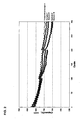
- the cycle life characteristics were measured and the results are shown in FIG. 2.
- the cells according to Examples 7 to 10 exhibited cycle life characteristics corresponding to that of Comparative Example 1.
- the electrolyte of the present invention can effectively improve storage characteristics and suppress swell at high temperatures without deterioration of battery performance in areas such as in capacity, high-rate, low-temperature, and cycle life characteristics.
- a Dipentaerythritol caprolactonated hexaacrylate monomer (Nippon Kayaku) and di(4-t-butylcyalohexyl peroxydicarbonate) ("Perkadox 16", AKZO NOBEL) were added to 98.5 wt% of an electrolytic solution of 1.3M LiPF 6 in ethylene carbonate, diethyl carbonate, and valeronitrile (3 : 5 : 2 volume ratio) and then mixed for 10 minutes to prepare a composition for preparing a polymer electrolyte. At this time, the amount of the initiator was 5 wt% based on the amount of the monomer.
- the positive electrode included a mixed positive active material of LiNi 0.8 Co 0.1 Mn 0.1 O 2 and LiCoO 2 at a weight ratio of 6 : 4, a carbon black conductive agent, and a polyvinylidene fluoride binder and the negative electrode included a natural graphite negative active material and a styrene-butadiene rubber binder.
- the positive electrode, the negative electrode and a separator were wounded to produce a jelly-roll, and the jelly-roll was inserted in to an Al pouch case followed by partially sealing.
- the composition was injected into the case and it was completely sealed. The amount of the composition was 2.62g.
- the sealed case was allowed to stand at 70°C for 4 hours to fabricate a rechargeable lithium cell with a gel polymer electrolyte.
- a rechargeable lithium cell was fabricated by the same procedure as in Example 21, except that heptane nitrile was used instead of valeronitrile.
- a rechargeable lithium cell was fabricated by the same procedure as in Example 21, except that caprilonitrile was used instead of valeronitrile.
- a rechargeable lithium cell was fabricated by the same procedure as in Example 21, except that cyclohexane carbonitrile was used instead of valeronitrile.
- a rechargeable lithium cell was fabricated by the same procedure as in Example 21, except that 2-fluorobenzonitrilee was used instead of valeronitrile.
- a rechargeable lithium cell was fabricated by the same procedure as in Example 21 except that a mixed solution of 1.3M LiPF 6 in ethylene carbonate, diethyl carbonate, and valeronitrile at a volume ratio of 30 : 65 : 5 was used as an electrolytic solution.
- a rechargeable lithium cell was fabricated by the same procedure as in Example 21, except that a mixed solution of 1.3M LiPF 6 in ethylene carbonate, diethyl carbonate, and valeronitrile at a volume ratio of 30 : 40 : 30 was used as an electrolytic solution.
- a rechargeable lithium cell was fabricated by the same procedure as in Example 21, except that a mixed solution of 1.3M LiPF 6 in ethylene carbonate, diethyl carbonate, and valeronitrile at a volume ratio of 30 : 55 : 15 was used as an electrolytic solution.
- a rechargeable lithium cell was fabricated by the same procedure as in Example 21, except that a mixed solution of 1.3M LiPF 6 in ethylene carbonate, diethyl carbonate, and valeronitrile at a volume ratio of 30 : 45 : 25 was used as an electrolytic solution.
- a rechargeable lithium cell was fabricated by the same procedure as in Example 21, except that a mixed solution of 1.3M LiPF 6 in ethylene carbonate, diethyl carbonate, and valeronitrile at a volume ratio of 15 : 65 : 20 was used as an electrolytic solution.
- a rechargeable lithium cell was fabricated by the same procedure as in Example 21, except that a mixed solution of 1.3M LiPF 6 in ethylene carbonate, ⁇ -butyrolactone, and valeronitrile at a volume ratio of 30 : 50 : 20 was used as an electrolytic solution.
- a rechargeable lithium cell was fabricated by the same procedure as in Example 21, except that a mixed solution of 1.3M LiPF 6 in ethylene carbonate, ⁇ -butyrolactone, and valeronitrile at a volume ratio of 15 : 65 : 20 was used as an electrolytic solution.
- a rechargeable lithium cell was fabricated by the same procedure as in Example 21, except that fluoroethylene carbonate was added to the electrolytic solution in an amount of 3% based on the electrolytic solution.
- a rechargeable lithium cell was fabricated by the same procedure as in Example 21, except that a mixed solution of 1.3M LiPF 6 in ethylene carbonate, ⁇ -butyrolactone, diethyl carbonate, and valeronitrile at a volume ratio of 15 : 40 : 30 : 15 was used as an electrolytic solution.
- a rechargeable lithium cell was fabricated by the same procedure as in Example 21, except that a mixed solution of 1.3M LiPF 6 in ethylene carbonate, ethylmethyl carbonate, propylene carbonate, and fluorobenzene at a volume ratio of 30 : 55 : 5:10 was used as an electrolytic solution.
- a rechargeable lithium cell was fabricated by the same procedure as in Example 21, except that poly(ethylene glycol) dimethacrylate was used as a compound for forming a polymer.
- a rechargeable lithium cell was fabricated by the same procedure as in Example 21, except that a mixed solution of 1.3M LiPF 6 in acetonitrile and ethylene carbonate at a volume ratio of 7 : 3 was used as an electrolytic solution.
- a rechargeable lithium cell was fabricated by the same procedure as in Example 21, except that a mixed solution of 1.3M LiPF 6 in acetonitrile and ethylene carbonate at a volume ratio of 1 : 1 was used as an electrolytic solution.
- a rechargeable lithium cell was fabricated by the same procedure as in Example 21, except that a mixed solution of 1.3 LiPF 6 in acetonitrile, ethylene carbonate, and diethyl carbonate at a volume ratio of 40 : 30 : 30 was used as an electrolytic solution.
- a rechargeable lithium cell was fabricated by the same procedure as in Example 21, except that a mixed positive active material of LiNi 0.8 Co 0.15 Mn 0.05 O 2 and LiCoO 2 was used as a positive active material.
- a rechargeable lithium cell was fabricated by the same procedure as in Example 21 except that a mixed positive active material of LiNi 0.75 Co 0.2 Mn 0.05 O 2 and LiCoO 2 was used as a positive active material. * Capacity test
- the cells according to Examples 21 to 36 and Comparative Examples 10 to 14 were constant-current and constant-voltage charged at 0.5C to 4.2V and a cut-off time of 3 hours, and constant-current discharged at 0.2C and a cut-off voltage of 2.75V.
- the capacity was measured and the results are presented in Table 2. * Swelling characteristics
- the cells according to Examples 21 to 36 and Comparative Examples 10 to 16 were constant-current charge and constant-voltage charged at 0.5C to 4.2V and a cut-off condition of 0.1C.
- the charged cells were allowed to stand at 85°C in a hot-wind oven for 4 hours, and thickness thereof were measured. The increases in thickness in comparison to the initial charged cell were measured and the results are presented in Table 2. *Cycle life characteristics
- the cells according to Examples 21 to 36 exhibited corresponding capacities to those according to Comparative Examples 10 to 14, but exhibited good cycle life characteristics, and excellent swelling inhibition. Hence, the cells according to Examples 21 to 35 exhibit improved safety while the capacity and the cycle life characteristics are maintained.
- LiPF 6 1.15M LiPF 6 was dissolved in a mixed solution of ethylene carbonate, diethyl carbonate and valeronitrile at a volume ratio of 30 : 50 : 20 to prepare an electrolyte.
- the positive electrode included a mixed positive active material of LiNi 0.8 Co 0.1 Mn 0.1 O 2 and LiCoO 2 at a weight ratio of 6 : 4, a carbon black conductive agent, and a polyvinylidene fluoride binder, and the negative electrode included a natural graphite negative active material and a styrene-butadiene rubber binder.
- a lithium cell was fabricated by the same procedure as in Example 37, except that heptane nitrile was used instead of valeronitrile.
- a lithium cell was fabricated by the same procedure as in Example 37, except that caprilonitrile was used instead of valeronitrile.
- a lithium cell was fabricated by the same procedure as in Example 37, except that cyclohexane carbonitrile was used instead of valeronitrile.
- a lithium cell was fabricated by the same procedure as in Example 37, except that 2-fluorobenzonitirlee was used instead of valeronitrile.
- a lithium cell was fabricated by the same procedure as in Example 37, except that 1.15M LiPF 6 was dissolved in a mixed solution of ethylene carbonate, diethyl carbonate, and valeronitrile at a volume ratio of 30 : 40 : 30 to prepare an electrolyte.
- a lithium cell was fabricated by the same procedure as in Example 37, except that 1.15M LiPF 6 was dissolved in a mixed solution of ethylene carbonate, diethyl carbonate, and valeronitrile at a volume ratio of 30 : 55 : 15 to prepare an electrolyte.
- a lithium cell was fabricated by the same procedure as in Example 37, except that 1.15M LiPF 6 was dissolved in a mixed solution of ethylene carbonate, diethyl carbonate, and valeronitrile at a volume ratio of 30 : 45 : 25 to prepare an electrolyte.
- a lithium cell was fabricated by the same procedure as in Example 37, except that 1.15M LiPF 6 was dissolved in a mixed solution of ethylene carbonate, ethylmethyl carbonate, propylene carbonate, and fluorobenzene at a volume ratio of 30 : 55 : 10 to prepare an electrolyte.
- a lithium cell was fabricated by the same procedure as in Example 37, except that 1.15M LiPF 6 was dissolved in a mixed solution of acetonitrile and ethylene carbonate at a volume ratio of 7 : 3 to prepare an electrolyte.
- a lithium cell was fabricated by the same procedure as in Example 37, except that 1.15M LiPF 6 was dissolved in a mixed solution of acetonitrile and ethylene carbonate at a volume ratio of 1 : 1 to prepare an electrolyte.
- a lithium cell was fabricated by the same procedure as in Example 37, except that 1.15M LiPF 6 was dissolved in a mixed solution of acetonitrile, ethylene carbonate, and diethyl carbonate at a volume ratio of 40 : 30 : 30 to prepare an electrolyte.
- the positive electrode included a LiCoO 2 positive active material, a carbon black conductive agent, and a polyvinylidene fluoride binder
- the negative electrode included a natural graphite negative active material and a styrene-butadiene rubber binder.
- the positive electrode, the negative electrode, and a separator were wounded to produce a jelly-roll, and the jelly-roll was inserted in to an Al pouch case followed by partially sealing.
- the composition was injected into the case and it was completely sealed. The amount of the composition was 2.62g.
- the sealed case was allowed to stand at 70°C for 4 hours to fabricate a rechargeable lithium cell with a gel polymer electrolyte. * Overdischarge test
- the capacity recovery step was performed on the cell according to Example 45.
- the capacity recovery step included a first step including charging at 500mA to 4.2V under a cut-off condition of 50mA, a first discharging at 300mA and a cut-off voltage of 3.00V, a second discharging at 2mA and a cut-off voltage of 2.75V, and a third discharging at 1mA, and a cut-off voltage of 0.00V, and allowing to stand for 60 minutes; and then a second step including a first charging at 500mA and a cut-off voltage of 3V, a second charging at 500mA and 4.2V under a cut-off condition of 50mA, and then discharging at 300mA to a cut-off voltage of 3V.
- the capacity recovery step was referred to as 1 cycle, it was repeated three times.
- the initial capacity and the discharge capacity for each cycle were measured and then the recovery capacity percentage was obtained from the capacity after each cycle with respect to the initial capacity.
- the initial capacity was a capacity after the cell was charged at 500mA and 4.2V under a cut-off condition of 50mA, and first discharged at 300mA under a cut-off voltage of 3.0V.
- the measured initial capacity was 895mAh. When the initial capacity of 895mAh was 100%, a capacity at 1 cycle was 834mAh, that is, 97%, at 2 cycles, 832mAh, 97%, and at 3 cycles, 839mAh, 98%.
Landscapes
- Chemical & Material Sciences (AREA)
- General Chemical & Material Sciences (AREA)
- Electrochemistry (AREA)
- Chemical Kinetics & Catalysis (AREA)
- Engineering & Computer Science (AREA)
- Inorganic Chemistry (AREA)
- Manufacturing & Machinery (AREA)
- Physics & Mathematics (AREA)
- General Physics & Mathematics (AREA)
- Condensed Matter Physics & Semiconductors (AREA)
- Composite Materials (AREA)
- Materials Engineering (AREA)
- Dispersion Chemistry (AREA)
- Secondary Cells (AREA)
- Polymerisation Methods In General (AREA)
- Conductive Materials (AREA)
- Battery Electrode And Active Subsutance (AREA)
- Primary Cells (AREA)
Abstract
Description
- The present invention relates to an electrolyte for a rechargeable lithium battery and a rechargeable lithium battery comprising the same, and more particularly, to an electrolyte for a rechargeable lithium battery exhibiting improved storage characteristics and suppression of swelling at high temperatures, and a rechargeable lithium battery comprising the same.
- Recently, the rapid development of smaller, lighter, and higher performance electronic and communication equipment has required the development of high performance and large capacity batteries to power such equipment. The demands for large capacity batteries have led to investigations into rechargeable lithium batteries. Positive active materials for rechargeable lithium batteries generally use lithium-transition metal oxides, and negative active materials generally use crystalline or amorphous carbonaceous materials or carbon composites. The active materials are coated on a current collector with a predetermined thickness and length, or they are formed as a film to produce electrodes. The electrodes together with a separator are wound to produce an electrode element, and the electrode element is inserted into a battery case such as a can followed by insertion of an electrolyte to fabricate a battery.
- The electrolyte includes lithium salts and organic solvents. The organic solvents may be mixed solvents of between two and five components of cyclic carbonates such as ethylene carbonate or propylene carbonate, or linear carbonates such as dimethyl carbonate, ethylmethyl carbonate, or diethyl carbonate. However, these solvents are known to severely expand at high temperatures, causing a swelling phenomenon. The swelling phenomenon is partly manifested in a battery by gas generated due to decomposition of the electrolyte at high temperatures in the battery.
- Such a swelling phenomenon can be reduced in lithium polymer batteries compared to lithium ion batteries. However, the use of a polymer electrolyte with a nickel-based positive active material (e.g. LiNiMO2, where M is selected from Co, Mn, Al, P, Fe or Mg) has generally been ineffective.
- Several attempts to use solvents with a high boiling point and a high dielectric constant, such as γ-butyrolactone, have been promising. Conventionally, the high dielectric constant solvent is generally used together with ethylene carbonate, which results in an extremely high viscosity with poor wettability of the separator. In another attempt, solvents with low boiling points and low dielectric constants have been used. For example, Japanese patent application JP 2003 007336 A proposes an electrolytic solution composed of a non-aqueous solvent in which lithium salt is dissolved and further containing fluorinated nitryl compounds for the use in a non-aqueous electrolytic solution secondary battery. Japanese patent JP 5 144470 A discloses a non-aqueous electrolyte for lithium battery, comprising a lithium perfluoro-alkanesulphonate salt dissolved in a hybrid solvent consisting of propylene carbonate, 1,2-dimethoxy ethane, and an aliphatic nitrile, each component being present in a proportion of 15-50%vol. United States Patent US 4,737,424 discloses an electrolyte for use on a secondary lithium battery comprising amorphous V2O5 base cathode active material, a metallic lithium base active material, and an electrolytic solution lithium salt dissolved in a mixed organic solvent. The organic solvent is ethylene carbonate mixed with one organic solvent of 2-methyltetrahydrofuran, 2,5-dimethyltetrahydrofuran, 1,3-dioxalan, 4-methyl-1,3-dioxalan, 1,2-dimethoxyethane, etc. The mixed ratio of ethylene carbonate ranges within 10 to 50%, and water content of the electrolytic solution ranges within 400 to 5 ppm, and the content of impurities other than water ranges within 1000 to 10 ppm. In Japanese patent application JP 2003 086247 A a non-aqueous electrolytic solution is disclosed, in which a lithium salt is dissolved in a non-aqueous solvent consisting of a nitrile compound having carbon-carbon unsaturated bond(s). The international patent application WO 02/071528 A2 relates to electrolytes, containing lithium-bis(oxalato)borate, a cyclic carbonate, one or more compounds selected from acyclic carbonates, aliphatic esters, alicyclic ethers and aliphatic, difunctional ethers, one or more compounds selected from lactones, dinitriles, compounds that contain at least one carboxylic acid ester group and an ether group, compounds that contain at least one carbonic acid group and an ether group, compounds that contain at least one nitrile group and an ether group, trialkyl phosphoric acid esters and trialkyl boric acids. However, these attempts still have often problems associated with high swelling (Japanese Patent Laid-Open No. 2000-235868, U.S. Patent Nos. 5,079,109, 5,272,022, 5,552,243, 5,521,027, 6,117,596, and 5,851,693, and "New thin lithium-ion batteries using a liquid electrolyte with thermal stability" Journal of power sources, 97-98, 677-680(2001), Notio Takami et al.)
- Other attempts to inhibit the swelling phenomenon are in U.S. Patent No. 4,830,939 disclosing a liquid electrolyte containing a polyethylenicially unsaturated monomeric material or a prepolymeric material, and U.S. Patent No. 4,866,716 disclosing a cross-linked polyether which is a product of a vinyl-ether. In addition, U.S. Patent No. 4,970,012 discloses that a polymeric solid electrolyte includes crosslinked molecules of a radiation-cured substance of a cinnamate ester and polyethene oxide, and U.S. Patent No. 4,908,283 discloses that a polymeric electrolyte includes a cured product of an acryloyl-denaturated polyalkylene oxide.
- Especially, such a swelling phenomenon severely occurs in batteries with a mixture of a lithium cobalt-based compound and a lithium nickel-based compound which exhibits higher capacity than other compounds.
- In one embodiment of the invention an electrolyte is provided for a rechargeable lithium battery which is capable of inhibiting high-temperature swelling.
- In another embodiment of the invention, a rechargeable lithium battery is provided which includes the electrolyte.
- These and other aspects may be achieved by an electrolyte for a rechargeable lithium battery including a monomer, a polymerization initiator, a non-aqueous organic solvent and a lithium salt.
The non-aqueous organic solvent includes an ester-based solvent of 70 to 90 volume %, the ester-based solvent including a cyclic ester and a nitrile-based solvent represented byformula 1 of 5 to 30 volume %:
R-C ≡ N (1)
where R is a C1 to C10 aliphatic hydrocarbon or halogenated aliphatic hydrocarbon, or a C6 to C10 aromatic hydrocarbon or halogenated aromatic hydrocarbon. - In yet another embodiment of the invention, a rechargeable lithium battery is provided including the electrolyte, a positive electrode and a negative electrode. The positive electrode and the negative electrode include active material in which lithium intercalation reversibly occurs. Preferably, the positive active material is a nickel-included compound.
- A more complete appreciation of the invention, and many of the attendant advantages thereof, will be readily apparent as the same becomes better understood by reference to the following detailed description when considered in conjunction with the accompanying drawings, wherein:
- FIG. 1 is a schematic view showing a rechargeable lithium battery according to the present invention; and
- FIG. 2 is a graph illustrating cycle life characteristics of the cells according to Examples 7 to 10 of the present invention and Comparative Example 1.
- The present invention relates to an electrolyte including a nitrile-based solvent for improving swelling and battery performance. The electrolyte of the present invention includes non-aqueous organic solvents and a lithium salt. The non-aqueous organic solvents include an ester-based solvent including a cyclic ester and a nitrile-based solvent.
- The nitrile-based solvent is represented by formula 1:
R-C ≡ N (1)
where R is a C1 to C10 and or a C6 to C10 aromatic hydrocarbon or halogenated aromatic hydrocarbon, preferably a C3 to C8 aliphatic hydrocarbon or halogenated aliphatic hydrocarbon, and more preferably a C6 to C8 aliphatic hydrocarbon or halogenated aliphatic hydrocarbon. Higher alkyl groups with a higher number of carbons are preferable because they have increases boiling points, so that stability is improved, and the decomposition on the aliphatic hydrocarbons rarely occurs compared to the aromatic hydrocarbons. If the R is an unsaturated hydrocarbon, e.g. methacrylate, it can be used as a solvent for an electrolyte. - Examples of the nitrile-based solvent include acetonitrile, propionitrile, butyronitrile, t-butyl cyanide, valeronitrile, caprylonitrile, heptyl cyanide, heptanenitrile, cyclopentane carbonitrile, cyclohexane carbonitrile, 2-fluorobenzonitrile, 4-fluorobenzonitrile, difluorobenzonitrile, trifluorobenzonitrile, 2-chlorobenzonitrile, 4-chlorobenzonitrile, dichlorobenzonitrile, trichlorobenzonitrile, 2-chloro-4-fluorobenzonitrile, 4-chloro-2-fluorobenzonitrile, phenylacetonitrile, 2-fluorophenylacetonitrile, and 4-fluoroacetonitrile.
- A low viscosity and high dielectric constant of the nitrile-based compound can repress the swelling phenomenon.
- The nitrile-based solvent is preferably presented in the amount of 5 to 30 volume %, and more preferably 15 to 25 volume %. An amount of less than 5 volume % of the nitrile-based cannot achieve the desired swelling inhibition. An amount of more than 30 volume % deteriorates the battery performance. That is, the effect of the present invention cannot be obtained from an amount of more than 30 volume %, and it is predicted that Japanese Patent Laid-Open No. 2000-124077 using 60 volume % or more of acetonitrile causes the deterioration of the battery performances and problems associated with safety. Such problems are predicted in U.S. Patent No. 6,190,804 in which nitrile is only used as a solvent for preparing a solid electrolyte, and the amount of the nitrile used is not disclosed.
- The electrolyte of the present invention includes an ester-based ester of a cyclic ester in an amount of 70 to 95 volume %. The cyclic ester preferably includes 10 to 40 volume % of ethylene carbonate, and more preferably 10 to 15 volume % with respect to the electrolyte. An amount of more than 40 volume % of the ethylene carbonate cannot achieve the desired swelling inhibition. An amount of less than 10 volume % deteriorates the battery performance. Thus, it is predicted that the effect of the use of the ethylene carbonate of the present invention cannot be obtained from Japanese Patent Laid-Open No. Hei. 7-320748 disclosing ethylene carbonate at 25 to 95 volume %.
- The remaining amount, 30 to 85 volume %, and preferably 55 to 85 volume % with respect to the electrolyte, may be propylene carbonate, butylene carbonate, γ-butyrolactone, γ-valerolactone , γ-caprolactone, δ-valerolactone, ε-valerolactone, or a mixture thereof.
- The electrolyte of the present invention may further include a linear ester. The amount of the linear ester is preferably between 0 parts by volume and 70 parts by volume based on 100 parts by volume of the total cyclic ester and the nitrile-based solvents. If the amount of the linear ester is more than 70 parts by volume, swelling occurs.
- The linear ester preferably includes at least one compound selected from dimethyl carbonate, ethyl methyl carbonate, diethyl carbonate, dipropyl carbonate, dibutyl carbonate, methyl acetate, ethyl acetate, methyl hexanoate, methyl formate, and mixtures thereof.
- The electrolyte of the present invention may further include carbonate-based additives with a substitution group selected from halogens, a cyano (CN), or a nitro (NO2), and additives such as vinylene carbonate, divinylsulfone, or ethylene sulfite. The additives help to improve the battery performance such as through inhibition of high-temperature swelling, and by increasing capacity, cycle life, and low-temperature characteristics. The carbonate-based additive is preferably an ethylene carbonate derivative represented by the following
formula 5, and is more preferably fluoroethylene carbonate.
- The amount of the carbonate-based additive is 0.01 to 10 parts by weight based on 100 parts by weight of the total weight of the electrolyte, and preferably 0.01 to 5 parts by weight. A carbonate-based additive of less than 0.01 parts by weight cannot effectively suppress gas generation, and that of more than 10 parts by weight deteriorates high-temperature cycle life characteristics and causes swelling to occur.
- The lithium salt acts as a source for supplying lithium ions in the battery, and helps the working of the battery. Examples of the lithium salts are LiPF6, LiBF4, LiSbF6, LiAsF6, LiClO4, LiCF3SO3, LiN(CF3SO2)2, LiN(C2F5SO2)2, LiAlO4, LiAlCl4, LiN(CxF2x+1SO2)(CyF2+1SO2) where x and y are natural numbers, LiSO3CF3, and mixtures thereof.
- The concentration of the lithium salt is 0.6 to 2.0M, and preferably 0.7 to 1.6M. If the concentration of the lithium salt is less than 0.6M, the viscosity of the electrolyte decreases, thereby deteriorating electrolyte performance. If that of the lithium salt if more than 2.0M, the viscosity increases, thereby reducing transfer of lithium ions.
- The electrolyte of the present invention is present in a form of liquid electrolyte, or as a solid polymeric electrolyte. The solid polymeric electrolyte is obtained from a composition for preparing a polymer electrolyte by addition of monomer and a polymeric initiator to the liquid electrolyte, i.e. electrolytic solution.
- The monomer preferably includes a mixture of a first monomer having at least two functional groups with an unsaturated bond represented by
formulas formulas
(R1)(R2)C=C(R3)-C(=O)- (2)
(R1)(R2)C=C(R3)- (3)
(R1)(R2)C=C(R3)-CH2- (4)
(where, R1, R2 and R3 are the same or are independently selected from H, a C2 to C10 aliphatic or aromatic hydrocarbon, -C≡ N, or -OR5, where R5 is H, CH3, C2H5, -F, -Cl or -Br.) - The monomer is preferably presented in an amount of 0.01 to 20 wt% in the composition, and more preferably 0.1 to 10 wt%. An amount of less than 0.01 wt% of the monomer occurs an extreme swelling phenomenon, and an amount of more than 20 wt% deteriorates battery performance.
- The example of the monomer may be poly(ethylene glycol)di (meth) acrylate, poly(propylene glycol)di(meth) acrylate, polyesterpolyol di(methacrylate), polycarbonatepolyol diacrylate, polycaprolactonediol di(meth)acrylate, trimethylolpropane ethoxylated tri(meth)acrylate, trimethylolpropane propooxylated tri(meth)acrylate, trimethylolpropane caprolactonated tri(meth)acrylate, tetramethylolpropane ethoxylated tri(meth)acrylate, tetramethylolpropane propooxylated tri(meth)acrylate, tetramethylolpropane caprolactonated tri(meth)acrylate, ditrimethylolpropane ethoxylated tri(meth)acrylate, ditrimethylolpropane propoxylated tri(meth)acrylate, ditrimethylolpropane caprolactonated tri(meth)acrylate, dipentaerythritol ethoxylated di(meth)acrylate, dipentaerythritol propoxylated di(meth)acrylate, dipentaerythritol caprolactonated di(meth)acrylate, glycerol ethoxylated di(meth)acrylate, glycerol propoxylated di(meth)acrylate, or dipentaerythritol caprolactonated hexacrylate. Alternatively, the example of the monomer may be a monomer with vinyl group, allyl group or vinylsulfone group at a terminal site thereof, or urethane (meth)acrylate monomer.
- The polymerization initiator may be one that can initiate polymerization of the monomer and does not cause deterioration of the battery performance. The exemplary are one or at least two selected from organic peroxides and azo-based compounds. The organic peroxides may be peroxydicarbonates such as di(4-t-butylcyclohexyl) peroxydicarbonate, di-2-ethylhexyl peroxy dicarbonate, di-isopropyl peroxydicarbonate, di-3-methoxy butyl peroxy dicarbonate, t-butyl peroxy isopropyl carbonate, t-butyl peroxy 2-ethylhexyl carbonate, 1,6-bis(t-butyl peroxycarbonyloxy)hexane, or diethylene glycol-bis(t-butyl peroxy carbonate); diacyl peroxides such as diacetyl peroxide, dibenzoyl peroxide, dilauroyl peroxide, bis-3,5,5-trimethyl hexanoyl peroxide; or peroxy esters such as t-butyl peroxy pivalate, t-amyl peroxy pivalate, t-butyl peroxy-2-ethyl hexanoate, t-hexylperoxy pivalate, t-butyl peroxy neodecanoate, t-butyl peroxy neoheptanoate, t-hexylperoxy pivalate, 1,1,3,3-tetramethylbutyl peroxy neodecarbonate, 1,1,3,3-tetramethyl butyl 2-ethylhexanoate, t-amyl peroxy 2-ethyl hexanoate, t-butyl peroxy isobutyrate, t-
amylperoxy butyl peroxy - The polymerization initiator is presented in an amount sufficient to initiate polymerization of the monomer, and is suitably presented in the amount of 0.01 to 5 wt%.
- A polymer electrolyte may be produced by using the polymer electrolyte composition as in the following various procedures. One method is that the polymer electrolyte composition is injected into a battery case such as a metal can or a pouch in which a positive electrode, a separator, and a negative electrode are placed, which is then heated at 40 to 100°C for 30 minutes to 8 hours, thereby hardening (polymerizing) the polymer electrolyte composition to produce the polymer electrolyte. Another method is that the polymer electrolyte composition is coated on a positive or a negative electrode, and heat, ultraviolet rays, or electron beams are irradiated into the electrode to coat the polymer electrolyte on the surface of the positive or the negative electrode. The produced electrode is inserted into a battery case and sealed to fabricate a battery. A separator may be additionally used, or alternatively the polymer electrolyte also acts as the separator, so the separator may be not used.
- A rechargeable lithium battery including the electrolyte of the present invention includes a positive electrode and a negative electrode.
- The positive electrode includes a positive active material in which lithium intercalation reversibly occurs. The exemplary of the positive active material are lithiated intercalation compounds and preferably a nickel-based lithiated intercalation compound because of its higher capacity. More preferably, in order to achieve high capacity and other battery performance improvements, a mixture of the nickel-based lithiated intercalation compound and a cobalt-based compound or manganese-based compound are used.
- Especially, the swelling phenomenon severely occurs because of the nickel-based compound, so the effect of using the electrolyte of the present invention can be maximized when the nickel-based compound is used. The nickel-based compound may be one selected from the group consisting of compounds represented by
formulas
LixNiyM1-yA2 (6)
LixNiyM1-yO2-zXz (7)
where 0.90 ≤ x ≤ 1.1, 0.1 ≤y ≤0.9, and 0 ≤z ≤ 0.5; M is at least one selected from Al, Ni, Co, Mn, Cr, Fe, Mg, Sr, V, and a rare earth element; A is selected from O, F, S, and P; and X is F, S, or P. - The cobalt-based or the manganese-based compound is any one used as an active material, and the exemplary may be one selected from the group consisting of compounds represented by formulas 8 to 12.
LixMn1-yMyA2 (8)
LixMn1-yMyO2-zXz (9)
LixMn2O4-zXz (10)
LixCO1-yMyA2 (11)
LixCo1-yMyO2-zXz (12)
where 0.90 ≤ X ≤ 1.1, 0 ≤ y ≤ 0.5, 0 ≤ z ≤ 0.5, and 0 ≤ α ≤ 2; M is at least one selected from the group consisting of Al, Ni, Co, Mn, Cr, Fe, Mg, Sr, V, and a rare earth elements; A is selected from O, F, S, and P, X is F, S, or P. - The negative electrode includes a negative active material in which lithium intercalation reversibly occurs and the exemplary are crystalline or amorphous carbon, or a carbon composite.
- The positive and the negative electrode are respectively produced by mixing the active material, a conductive agent, and a binder in a solvent to prepare an active material composition, and coating the composition on a current collector. The electrode preparation is well known in the related art, and is easily understood by one of ordinary skill in the art.
- The conductive agent includes any conventional conductive agent used for an active material composition as long as it is chemically inert and has electrical conductivity. Examples thereof are one or a mixture selected from natural graphite, artificial graphite, carbon black, acetylene black, ketjen black; carbon fiber, and a metal fiber such as copper, nickel, aluminum, and silver.
- The binder includes any conventional binder used for an active material composition as long as it firmly adheres to the active material and the conductive agent on the current collector, and the binder may be styrene-butadiene rubber, polyvinyl alcohol, carboxymethylcellulose, hydroxylpropylenecellulose, diacetylenecellulose, polyvinylchloride, polyvinylpyrrolidone, polytetrafluoroethylene, polyvinylidene fluoride, polyethylene, or polypropylene. Most preferred are styrene-butadiene rubber.
- The solvent includes any conventional solvent used for an active material composition as long as it well distributes the active material, the conductive agent, and the binder. The example of the solvent may be N-methyl pyrrolidone.
- One embodiment of the lithium rechargeable battery according to the present invention is shown in FIG. 1. The
rechargeable lithium battery 1 includes apositive electrode 3; anegative electrode 2; a separator 4 interposed between thepositive electrode 3 and thenegative electrode 2; an electrolyte in which thepositive electrode 2, thenegative electrode 3, and the separator 4 are immersed; acylindrical battery case 5; and a sealingportion 6. The configuration of the rechargeable lithium battery is not limited to the structure shown in FIG. 1, as it can be readily modified into a prismatic or pouch type battery as is well understood in the related art. - The positive electrode includes a positive active material in which lithium intercalation reversibly occurs. Examples of positive active materials are lithium transition metal oxides such as LiCoO2, LiNiO2, LiMnO2, LiMn2O4, or LiNi1-x-yCoxMyO2 where 0 ≤ x ≤ 1,0 ≤ y ≤ 1,0 ≤ x + y ≤ 1, and M is metal such as Al, Sr, Mg, or La.
- The negative electrode includes a negative active material in which lithium intercalation reversibly occurs. Examples of negative active materials are crystalline or amorphous carbonaceous material, or carbon composites.
- The positive active material and the negative active material are respectively coated on a current collector to produce electrodes, and the electrodes are wound together with or laminated on a separator to produce an electrode element. The electrode element is inserted into a battery case such as a can, and an electrolyte is injected into the case to fabricate a rechargeable lithium battery. The separator may be resin such as polyethylene or polypropylene.
- The following Examples further illustrate the present invention in detail, but are not to be construed to limit the scope thereof.
- 1.5M LiBF4 was dissolved in a mixed solvent of ethylene carbonate, γ-butyrolactone, and valeronitrile in the volume ratio of 3 : 6 : 1 to prepare an electrolyte.
- Using the electrolyte, a LiCoO2 positive electrode, and a graphite negative electrode, a rechargeable lithium cell was fabricated. The amount of the electrolyte was 2.2g.
- 1.5M LiBF4 was dissolved in a mixed solvent of ethylene carbonate, γ-butyrolactone, and heptanenitrile in the volume ratio of 3 : 6 : 1 to prepare an electrolyte.
- Using the electrolyte, a LiCoO2 positive electrode, and a graphite negative electrode, a rechargeable lithium cell was fabricated. The amount of the electrolyte was 2.2g.
- 1.5M LiBF4 was dissolved in a mixed solvent of ethylene carbonate, γ-butyrolactone, and capronitrile in the volume ratio of 3 : 6 : 1 to prepare an electrolyte.
- Using the electrolyte, a LiCoO2 positive electrode, and a graphite negative electrode, a rechargeable lithium cell was fabricated. The amount of the electrolyte was 2.2g.
- 1.15M LiPF6 was dissolved in a mixed solvent of ethylene carbonate, γ-butyrolactone, and valeronitrile in the volume ratio of 3 : 6 : 1 to prepare an electrolyte.
- Using the electrolyte, a LiCoO2 positive electrode, and a graphite negative electrode, a rechargeable lithium cell was fabricated. The amount of the electrolyte was 2.2g.
- 1.15M LiPF6 was dissolved in a mixed solvent of ethylene carbonate, γ-butyrolactone, and valeronitrile in the volume ratio of 3 : 5 : 2 to prepare an electrolyte.
- Using the electrolyte, a LiCoO2 positive electrode, and a graphite negative electrode, a rechargeable lithium cell was fabricated. The amount of the electrolyte was 2.2g.
- 1.15M LiPF6 was dissolved in a mixed solvent of ethylene carbonate, γ-butyrolactone, and valeronitrile in the volume ratio of 3 : 5 : 2 to prepare an electrolyte.
- Using the electrolyte, a LiCoO2 positive electrode, and a graphite negative electrode, a rechargeable lithium cell was fabricated. The amount of the electrolyte was 2.2g.
- 1.15M LiPF6 was dissolved in a mixed solvent of ethylene carbonate, γ-butyrolactone, and valeronitrile in the volume ratio of 3 : 5 : 2 to prepare an electrolyte.
- Using the electrolyte, a LiCoO2 positive electrode, and a graphite negative electrode, a rechargeable lithium cell was fabricated. The amount of the electrolyte was 2.2g.
- 1.15M LiPF6 was dissolved in a mixed solvent of ethylene carbonate, ethylmethyl carbonate, and valeronitrile in the volume ratio of 3 : 6 : 1 to prepare an electrolyte.
- Using the electrolyte, a LiCoO2 positive electrode, and a graphite negative electrode, a rechargeable lithium cell was fabricated. The amount of the electrolyte was 2.2g.
- 1.15M LiPF6 was dissolved in a mixed solvent of ethylene carbonate, dimethyl carbonate, and valeronitrile in the volume ratio of 3 : 5 : 2 to prepare an electrolyte.
- Using the electrolyte, a LiCoO2 positive electrode, and a graphite negative electrode, a rechargeable lithium cell was fabricated. The amount of the electrolyte was 2.2g.
- 1.15M LiPF6 was dissolved in a mixed solvent of ethylene carbonate, diethyl carbonate, and valeronitrile in the volume ratio of 3 : 6 : 1 to prepare an electrolyte.
- Using the electrolyte, a LiCoO2 positive electrode, and a graphite negative electrode, a rechargeable lithium cell was fabricated. The amount of the electrolyte was 2.2g.
- A rechargeable lithium cell was fabricated by the same procedure as in Example 1, except that a positive active material was produced by mixing LiNi0.8Co0.1Mn0.1O2 with LiCoO2 at a weight ratio of 8 : 2, and the amount of the electrolyte was 2.1 g.
- A rechargeable lithium cell was fabricated by the same procedure as in Example 2, except that a positive active material was produced by mixing LiNi0.8Co0.1Mn0.1O2 with LiCoO2 at a weight ratio of 8 : 2, and the amount of the electrolyte was 2.1 g.
- A rechargeable lithium cell was fabricated by the same procedure as in Example 3, except that a positive active material was produced by mixing LiNi0.8CO0.1Mn0.1O2 with LiCoO2 at a weight ratio of 8: 2, and the amount of the electrolyte was 2.1g.
- A rechargeable lithium cell was fabricated by the same procedure as in Example 4, except that a positive active material was produced by mixing LiNi0.8Co0.1Mn0.1O2 with LiCoO2 at a weight ratio of 8 : 2, and the amount of the electrolyte was 2.1g.
- A rechargeable lithium cell was fabricated by the same procedure as in Example 5, except that a positive active material was produced by mixing LiNi0.8Co0.1Mn0.1O2 with LiCoO2 at a weight ratio of 8: 2, and the amount of the electrolyte was 2.1 g.
- A rechargeable lithium cell was fabricated by the same procedure as in Example 6 except that a positive active material was produced by mixing LiNi0.8Co0.1Mn0.1O2 with LiCoO2 at a weight ratio of 8 : 2, and the amount of the electrolyte was 2.1g.
- A rechargeable lithium cell was fabricated by the same procedure as in Example 11, except that an electrolyte was prepared by dissolving 1.15M LiPF6 in a mixed solvent of ethylene carbonate, diethyl carbonate, and valeronitrile at a volume ratio of 3 : 5 : 2.
- A rechargeable lithium cell was fabricated by the same procedure as in Example 11, except that an electrolyte was prepared by dissolving 1.15M LiPF6 in a mixed solvent of ethylene carbonate, diethyl carbonate and valeronitrile at a volume ratio of 30 : 55 : 15.
- A rechargeable lithium cell was fabricated by the same procedure as in Example 1, except that a mixed lithium salt of LiPF6 and LiBF4 at a weight ratio of 99.9 : 0.1 was used.
- A rechargeable lithium cell was fabricated by the same procedure as in Example 7, except that a mixed lithium salt of LiPF6 and LiBF4 at a weight ratio of 99.9 : 0.1 was used.
- A rechargeable lithium cell was fabricated by the same procedure as in Example 1, except that an electrolyte was prepared by dissolving 1.15M LiPF6 in a mixed solvent of ethylene carbonate, ethylmethyl carbonate, propylene carbonate, and fluorobenzene at a volume ratio of 30 : 55 : 15.
- A rechargeable lithium cell was fabricated by the same procedure as in Example 1, except that an electrolyte was prepared by dissolving 1.15M LiPF6 in a mixed solvent of ethylene carbonate, ethylmethyl carbonate, and fluorobenzene at a volume ratio of 30 : 55 : 15.
- A rechargeable lithium cell was fabricated by the same procedure as in Example 11, except that an electrolyte was prepared by dissolving 1.5M LiBF4 in a mixed solvent of ethylene carbonate, γ-butyrolactone, and diethyl carbonate at a volume ratio of 4 : 4 : 2.
- A rechargeable lithium cell was fabricated by the same procedure as in Example 11, except that an electrolyte was prepared by dissolving 1.5M LiBF4 in a mixed solvent of ethylene carbonate, γ-butyrolactone, and fluorobenzene at a volume ratio of 30 : 55 : 15.
- A rechargeable lithium cell was fabricated by the same procedure as in Example 11, except that an electrolyte was prepared by dissolving 1.15M LiPF6 in a mixed solvent of ethylene carbonate, ethylmethyl carbonate, propylene carbonate, and fluorobenzene at a volume ratio of 30 : 55 : 5 : 10.
- A rechargeable lithium cell was fabricated by the same procedure as in Example 11, except that an electrolyte was prepared by dissolving 1.15M LiPF6 in a mixed solvent of ethylene carbonate, ethylmethyl carbonate, and fluorobenzene at a volume ratio of 3 : 6 : 1.
- A rechargeable lithium cell was fabricated by the same procedure as in Example 11, except that an electrolyte was prepared by dissolving 1.5M LiBF4 in a mixed solvent of ethylene carbonate, γ-butyrolactone, and diethyl carbonate at a volume ratio of 4 : 4 : 2.
- A rechargeable lithium cell was fabricated by the same procedure as in Example 11, except that an electrolyte was prepared by dissolving 1.5M LiBF4 in a mixed solvent of ethylene carbonate, γ-butyrolactone, fluorobenzene, and diethyl carbonate at a volume ratio of 3 : 5 : 1 : 1.
- A rechargeable lithium cell was fabricated by the same procedure as in Example 11, except that an electrolyte was prepared by dissolving 1.3M LiPF6 in a mixed solvent of ethylene carbonate, ethylmethyl carbonate, propylene carbonate, and fluorobenzene at a volume ratio of 30 : 55 : 5: 15.
- A rechargeable lithium cell was fabricated by the same procedure as in Example 11, except that an electrolyte was prepared by dissolving 1.3M LiPF6 in a mixed solvent of ethylene carbonate, and ethylmethyl carbonate at a volume ratio of 3: 7.
- The lithium cells according to Examples 1 to 12 and Comparative Examples 1 to 8 were constant-current and constant-voltage charged at a 0.5C rate and a cut-off voltage of 4.2V and 20mAh, and the charged cells were allowed to stand in an oven of 85°C for 4 hours. Thereafter, the thicknesses of the cells were measured. The increases in the thickness in comparison to the initial charged cells are shown in Table 1.
Table 1 Increase in thickness (%) Example 1 1.1 Example 2 1.6 Example 3 1.1 Comparative Example 7 7.2 Comparative Example 8 6.2 Example 4 7 Example 5 6 Example 6 6 Example 7 7 Example 8 9 Example 9 1.5 Example 10 2.3 Comparative Example 5 95.1 Comparative Example 6 120 Example 11 4.9 Example 12 5.6 Example 13 5.5 Comparative Example 3 3.5 Comparative Example 4 3.8 Example 14 12.7 Example 15 10.4 Example 16 10.0 Example 19 1.1 Example 20 3.5 Example 17 20 Example 18 30 Comparative Example 9 120 Comparative Example 10 86 Comparative Example 1 30 Comparative Example 2 33 - It is evident from Table 1 that the increase in thickness of the cells according to Examples 1 to 20 was reduced compared to those of the cells according to Comparative Example 1 to 10. These results indicate that swelling was suppressed in the cells according to Examples 1 to 20 compared with Comparative Examples 1 to 10. In particular, the increases in thickness of the cells according to Examples 4 and 5 were substantially reduced in comparison to Comparative Example 1 and 2, even though the cells according to Examples 4 and 5 and Comparative Examples 1 and 2 included ethylene carbonate and ethylmethyl carbonate.
- The cells according to Examples 7 to 10 and Comparative Example 1 were charged under constant current and constant voltage at a 1C rate and a cut-off voltage of 4.2V and 0.1C (82 mAh), and discharged at constant current to a cut-off voltage of 3V. The cycle life characteristics were measured and the results are shown in FIG. 2. As shown in FIG. 2, the cells according to Examples 7 to 10 exhibited cycle life characteristics corresponding to that of Comparative Example 1. Thus, the electrolyte of the present invention can effectively improve storage characteristics and suppress swell at high temperatures without deterioration of battery performance in areas such as in capacity, high-rate, low-temperature, and cycle life characteristics.
- 1.5 wt% of a Dipentaerythritol caprolactonated hexaacrylate monomer (Nippon Kayaku) and di(4-t-butylcyalohexyl peroxydicarbonate) ("Perkadox 16", AKZO NOBEL) were added to 98.5 wt% of an electrolytic solution of 1.3M LiPF6 in ethylene carbonate, diethyl carbonate, and valeronitrile (3 : 5 : 2 volume ratio) and then mixed for 10 minutes to prepare a composition for preparing a polymer electrolyte. At this time, the amount of the initiator was 5 wt% based on the amount of the monomer.
- The positive electrode included a mixed positive active material of LiNi0.8Co0.1Mn0.1O2 and LiCoO2 at a weight ratio of 6 : 4, a carbon black conductive agent, and a polyvinylidene fluoride binder and the negative electrode included a natural graphite negative active material and a styrene-butadiene rubber binder. The positive electrode, the negative electrode and a separator were wounded to produce a jelly-roll, and the jelly-roll was inserted in to an Al pouch case followed by partially sealing. The composition was injected into the case and it was completely sealed. The amount of the composition was 2.62g. The sealed case was allowed to stand at 70°C for 4 hours to fabricate a rechargeable lithium cell with a gel polymer electrolyte.
- A rechargeable lithium cell was fabricated by the same procedure as in Example 21, except that heptane nitrile was used instead of valeronitrile.
- A rechargeable lithium cell was fabricated by the same procedure as in Example 21, except that caprilonitrile was used instead of valeronitrile.
- A rechargeable lithium cell was fabricated by the same procedure as in Example 21, except that cyclohexane carbonitrile was used instead of valeronitrile.
- A rechargeable lithium cell was fabricated by the same procedure as in Example 21, except that 2-fluorobenzonitrilee was used instead of valeronitrile.
- A rechargeable lithium cell was fabricated by the same procedure as in Example 21 except that a mixed solution of 1.3M LiPF6 in ethylene carbonate, diethyl carbonate, and valeronitrile at a volume ratio of 30 : 65 : 5 was used as an electrolytic solution.
- A rechargeable lithium cell was fabricated by the same procedure as in Example 21, except that a mixed solution of 1.3M LiPF6 in ethylene carbonate, diethyl carbonate, and valeronitrile at a volume ratio of 30 : 40 : 30 was used as an electrolytic solution.
- A rechargeable lithium cell was fabricated by the same procedure as in Example 21, except that a mixed solution of 1.3M LiPF6 in ethylene carbonate, diethyl carbonate, and valeronitrile at a volume ratio of 30 : 55 : 15 was used as an electrolytic solution.
- A rechargeable lithium cell was fabricated by the same procedure as in Example 21, except that a mixed solution of 1.3M LiPF6 in ethylene carbonate, diethyl carbonate, and valeronitrile at a volume ratio of 30 : 45 : 25 was used as an electrolytic solution.
- A rechargeable lithium cell was fabricated by the same procedure as in Example 21, except that a mixed solution of 1.3M LiPF6 in ethylene carbonate, diethyl carbonate, and valeronitrile at a volume ratio of 15 : 65 : 20 was used as an electrolytic solution.
- A rechargeable lithium cell was fabricated by the same procedure as in Example 21, except that a mixed solution of 1.3M LiPF6 in ethylene carbonate, γ-butyrolactone, and valeronitrile at a volume ratio of 30 : 50 : 20 was used as an electrolytic solution.
- A rechargeable lithium cell was fabricated by the same procedure as in Example 21, except that a mixed solution of 1.3M LiPF6 in ethylene carbonate, γ-butyrolactone, and valeronitrile at a volume ratio of 15 : 65 : 20 was used as an electrolytic solution.
- A rechargeable lithium cell was fabricated by the same procedure as in Example 21, except that fluoroethylene carbonate was added to the electrolytic solution in an amount of 3% based on the electrolytic solution.
- A rechargeable lithium cell was fabricated by the same procedure as in Example 21, except that a mixed solution of 1.3M LiPF6 in ethylene carbonate, γ-butyrolactone, diethyl carbonate, and valeronitrile at a volume ratio of 15 : 40 : 30 : 15 was used as an electrolytic solution.
- A rechargeable lithium cell was fabricated by the same procedure as in Example 21, except that a mixed solution of 1.3M LiPF6 in ethylene carbonate, ethylmethyl carbonate, propylene carbonate, and fluorobenzene at a volume ratio of 30 : 55 : 5:10 was used as an electrolytic solution.
- A rechargeable lithium cell was fabricated by the same procedure as in Example 21, except that poly(ethylene glycol) dimethacrylate was used as a compound for forming a polymer.
- A rechargeable lithium cell was fabricated by the same procedure as in Example 21, except that a mixed solution of 1.3M LiPF6 in acetonitrile and ethylene carbonate at a volume ratio of 7 : 3 was used as an electrolytic solution.
- A rechargeable lithium cell was fabricated by the same procedure as in Example 21, except that a mixed solution of 1.3M LiPF6 in acetonitrile and ethylene carbonate at a volume ratio of 1 : 1 was used as an electrolytic solution.
- A rechargeable lithium cell was fabricated by the same procedure as in Example 21, except that a mixed solution of 1.3 LiPF6 in acetonitrile, ethylene carbonate, and diethyl carbonate at a volume ratio of 40 : 30 : 30 was used as an electrolytic solution.
- A rechargeable lithium cell was fabricated by the same procedure as in Example 21, except that a mixed positive active material of LiNi0.8Co0.15Mn0.05O2 and LiCoO2 was used as a positive active material.
- A rechargeable lithium cell was fabricated by the same procedure as in Example 21 except that a mixed positive active material of LiNi0.75Co0.2Mn0.05O2 and LiCoO2 was used as a positive active material.
* Capacity test - The cells according to Examples 21 to 36 and Comparative Examples 10 to 14 were constant-current and constant-voltage charged at 0.5C to 4.2V and a cut-off time of 3 hours, and constant-current discharged at 0.2C and a cut-off voltage of 2.75V. The capacity was measured and the results are presented in Table 2.
* Swelling characteristics - The cells according to Examples 21 to 36 and Comparative Examples 10 to 16 were constant-current charge and constant-voltage charged at 0.5C to 4.2V and a cut-off condition of 0.1C. The charged cells were allowed to stand at 85°C in a hot-wind oven for 4 hours, and thickness thereof were measured. The increases in thickness in comparison to the initial charged cell were measured and the results are presented in Table 2.
*Cycle life characteristics - The cells according to Examples 21 to 36 and Comparative Examples 10 to 14 were charged 500 times at 1C, and the cycle life characteristics (retention capacity %) were measured. The results are shown in Table 2.
Table 2 Capacity (mAh) Cycle life (retention capacity % for 500 times) Increase in thickness (%) Example 21 920 90 1.5 Example 22 918 88 2.0 Example 23 921 88 1.8 Example 24 920 89 2.1 Example 25 920 87 2.3 Example 26 921 92 3.5 Example 27 918 80 1.0 Example 28 919 89 1.5 Example 29 917 85 1.0 Example 30 921 88 2.3 Example 31 918 88 1.9 Example 32 920 85 2.0 Example 33 919 92 3.5 Example 34 919 87 1.8 Example 35 920 89 1.7 Example 36 916 90 3.4 Comparative Example 10 922 92 44.9 Comparative Example 11 890 60 12 Comparative Example 12 900 80 23 Comparative Example 13 911 74 32 Comparative Example 14 917 82 19 - As shown in Table 2, the cells according to Examples 21 to 36 exhibited corresponding capacities to those according to Comparative Examples 10 to 14, but exhibited good cycle life characteristics, and excellent swelling inhibition. Hence, the cells according to Examples 21 to 35 exhibit improved safety while the capacity and the cycle life characteristics are maintained.
- 1.15M LiPF6 was dissolved in a mixed solution of ethylene carbonate, diethyl carbonate and valeronitrile at a volume ratio of 30 : 50 : 20 to prepare an electrolyte.
- The positive electrode included a mixed positive active material of LiNi0.8Co0.1Mn0.1O2 and LiCoO2 at a weight ratio of 6 : 4, a carbon black conductive agent, and a polyvinylidene fluoride binder, and the negative electrode included a natural graphite negative active material and a styrene-butadiene rubber binder. Using the positive electrode, the negative electrode, and the electrolyte, a lithium cell was fabricated.
- A lithium cell was fabricated by the same procedure as in Example 37, except that heptane nitrile was used instead of valeronitrile.
- A lithium cell was fabricated by the same procedure as in Example 37, except that caprilonitrile was used instead of valeronitrile.
- A lithium cell was fabricated by the same procedure as in Example 37, except that cyclohexane carbonitrile was used instead of valeronitrile.
- A lithium cell was fabricated by the same procedure as in Example 37, except that 2-fluorobenzonitirlee was used instead of valeronitrile.
- A lithium cell was fabricated by the same procedure as in Example 37, except that 1.15M LiPF6 was dissolved in a mixed solution of ethylene carbonate, diethyl carbonate, and valeronitrile at a volume ratio of 30 : 40 : 30 to prepare an electrolyte.
- A lithium cell was fabricated by the same procedure as in Example 37, except that 1.15M LiPF6 was dissolved in a mixed solution of ethylene carbonate, diethyl carbonate, and valeronitrile at a volume ratio of 30 : 55 : 15 to prepare an electrolyte.
- A lithium cell was fabricated by the same procedure as in Example 37, except that 1.15M LiPF6 was dissolved in a mixed solution of ethylene carbonate, diethyl carbonate, and valeronitrile at a volume ratio of 30 : 45 : 25 to prepare an electrolyte.
- A lithium cell was fabricated by the same procedure as in Example 37, except that 1.15M LiPF6 was dissolved in a mixed solution of ethylene carbonate, ethylmethyl carbonate, propylene carbonate, and fluorobenzene at a volume ratio of 30 : 55 : 10 to prepare an electrolyte.
- A lithium cell was fabricated by the same procedure as in Example 37, except that 1.15M LiPF6 was dissolved in a mixed solution of acetonitrile and ethylene carbonate at a volume ratio of 7 : 3 to prepare an electrolyte.
- A lithium cell was fabricated by the same procedure as in Example 37, except that 1.15M LiPF6 was dissolved in a mixed solution of acetonitrile and ethylene carbonate at a volume ratio of 1 : 1 to prepare an electrolyte.
- A lithium cell was fabricated by the same procedure as in Example 37, except that 1.15M LiPF6 was dissolved in a mixed solution of acetonitrile, ethylene carbonate, and diethyl carbonate at a volume ratio of 40 : 30 : 30 to prepare an electrolyte.
- Capacity, cycle life characteristics and swelling characteristics tests were performed on the cells according to Examples 37 to 44 and Comparative Examples 16 to 19. The results are presented in Table 3.
Table 3 Capacity (mAh) Cycle life (retention capacity % for 500 times) Increases in thickness (%) Example 37 923 89 15.4 Example 38 921 88 16.2 Example 39 922 88 14.9 Example 40 921 87 14.5 Example 41 923 90 17.6 Example 42 919 83 12.1 Example 43 924 89 15.0 Example 44 920 85 12.2 Comparative Example 16 925 92 105 Comparative Example 17 900 80 26 Comparative Example 18 910 83 30.1 Comparative Example 19 920 88 27.5 - 1 wt% of a Dipentaerythritol caprolactonated hexacrylate derivative monomer (Nippon Kayaku) and a di(4-t-butylcyalohexyl peroxydicarbonate ("Perkadox 16", AKZO NOBEL) were added to 98.5 wt% of an electrolytic solution of 1.3M LiPF6 in ethylene carbonate, γ-butyrolactone, diethyl carbonate, and valeronitrile (15 : 55 : 20 :10 volume ratio) and then mixed for 10 minutes to prepare a composition for preparing a polymer electrolyte. At this time, the amount of the initiator was 3 wt% based on the amount of the monomer.
- The positive electrode included a LiCoO2 positive active material, a carbon black conductive agent, and a polyvinylidene fluoride binder, and the negative electrode included a natural graphite negative active material and a styrene-butadiene rubber binder. The positive electrode, the negative electrode, and a separator were wounded to produce a jelly-roll, and the jelly-roll was inserted in to an Al pouch case followed by partially sealing. The composition was injected into the case and it was completely sealed. The amount of the composition was 2.62g. The sealed case was allowed to stand at 70°C for 4 hours to fabricate a rechargeable lithium cell with a gel polymer electrolyte.
* Overdischarge test - The capacity recovery step was performed on the cell according to Example 45. The capacity recovery step included a first step including charging at 500mA to 4.2V under a cut-off condition of 50mA, a first discharging at 300mA and a cut-off voltage of 3.00V, a second discharging at 2mA and a cut-off voltage of 2.75V, and a third discharging at 1mA, and a cut-off voltage of 0.00V, and allowing to stand for 60 minutes; and then a second step including a first charging at 500mA and a cut-off voltage of 3V, a second charging at 500mA and 4.2V under a cut-off condition of 50mA, and then discharging at 300mA to a cut-off voltage of 3V.
- The capacity recovery step was referred to as 1 cycle, it was repeated three times. The initial capacity and the discharge capacity for each cycle were measured and then the recovery capacity percentage was obtained from the capacity after each cycle with respect to the initial capacity. The initial capacity was a capacity after the cell was charged at 500mA and 4.2V under a cut-off condition of 50mA, and first discharged at 300mA under a cut-off voltage of 3.0V. The measured initial capacity was 895mAh. When the initial capacity of 895mAh was 100%, a capacity at 1 cycle was 834mAh, that is, 97%, at 2 cycles, 832mAh, 97%, and at 3 cycles, 839mAh, 98%. These results indicate good capacity recovery.
Claims (37)
- An electrolyte for a rechargeable lithium battery comprising:a monomer;a polymerization initiator;a lithium salt; anda non-aqueous organic solvent comprising 70 to 95 volume % of an ester-based solvent comprising a cyclic ester; and 5 to 30 volume % of a nitrile-based solvent represented by the formula:
R - C ≡ N
where R is selected from the group consisting of C1 to C10 aliphatic hydrocarbons, C1 to C10 halogenated aliphatic hydrocarbons, C6 to C10 aromatic hydrocarbons, and C6 to C10 halogenated aromatic hydrocarbons. - The electrolyte of claim 1, wherein the non-aqueous organic solvent includes 75 to 90 volume % of the ester-based solvent comprising the cyclic ester and 10 to 25 volume % of the nitrile-based solvent.
- The electrolyte of claim 1, wherein the cyclic ester includes 10 to 40 volume % of ethylene carbonate.
- The electrolyte of claim 3, wherein the cyclic ester further includes 30 to 85 volume % of at least one selected from the group consisting of propylene carbonate, butylene carbonate, γ-butyrolactone, γ-valerolactone, γ-caprolactone, δ-valerolactone, and ε-caprolactone, and wherein the cyclic ester is presented in an total amount of 70 to 95 volume %.
- The electrolyte of claim 1, wherein the cyclic ester includes 10 to 15 volume % of ethylene carbonate, and 55 to 85 volume % of at least one selected from the group consisting of propylene carbonate, butylene carbonate, γ-butyrolactone, γ-valerolactone, γ-caprolactone, δ-valerolactone, and ε-caprolactone, and wherein the cyclic ester is presented in an total amount of 70 to 95 volume %.
- The electrolyte of claim 1, wherein R is selected from the group consisting of C3 to C8 aliphatic hydrocarbons and C3 to C8 halogenated aliphatic hydrocarbons.
- The electrolyte of claim 1, wherein the nitrile-based solvent is selected from the group consisting of acetonitrile, propionitrile, butyronitrile, t-butyl cyanide, valeronitrile, caprylonitrile, heptyl cyanide, heptanenitrile, cyclopentane carbonitrile, cyclohexane carbonitrile, 2-fluorobenzonitrile, 4-fluorobenzonitrile, difluorobenzonitrile, trifluorobenzonitrile, 2-chlorobenzonitrile, 4-chlorobenzonitrile, dichlorobenzonitrile, trichlorobenzonitrile, 2-chloro-4-fluorobenzonitrile, 4-chloro-2-fluorobenzonitrile, phenylacetonitrile, 2-fluorophenylacetonitrile, and 4-fluorophenylacetonitrile,
- The electrolyte of claim 1, wherein the organic solvent further comprises a linear ester in an amount between 0 and 70 parts by volume based on 100 parts by volume of the total cyclic ester and the nitrile-based solvent.
- The electrolyte of claim 8, wherein the linear ester is selected from the group consisting of dimethyl carbonate, ethylmethyl carbonate, diethyl carbonate, dipropyl carbonate, dibutyl carbonate, methyl acetate, ethyl acetate, methyl hexanoate, methyl formate, and mixtures thereof.
- The electrolyte of claim 1, wherein the monomer is a first monomer or a mixture of the first monomer and a second monomer, the first monomer having at least two functional groups at a terminal end thereof, a functional group being selected from the group consisting of unsaturated groups represented by formulas 2 to 4, and the first monomer having a molecular weight of 50 to 100,000; and
the second monomer having one functional group being selected from the group consisting of an unsaturated bond represented by formulas 2 to 4, and the second monomer having a molecular weight of 50 to 100,000.
(R1)(R2)C=C(R3)-C(=O)- (2)
(R1)(R2)C=C(R3)- (3)
(R1)(R2)C=C(R3)-CH2- (4)
(where R1, R2 and R3 are the same or are independently selected from H, a C2 to C10 aliphatic or aromatic hydrocarbon, -C.N, or -OR5, where R5 is H, CH3, C2H5, -F, -Cl, or -Br.) - The electrolyte of claim 1, wherein the polymer electrolyte includes the monomer of 0.01 to 20 wt%.
- The electrolyte of claim 1, wherein the polymerization initiator is an organic peroxide or an azo-based compound.
- The electrolyte of claim 12, wherein the organic peroxide is selected from the group consisting of peroxy dicarbonates selected from the group consisting of di(4-t-butylcyclohexyl) peroxydicarbonate, di-2-ethylhexyl peroxy dicarbonate, di-isopropyl peroxydicarbonate, di-3-methoxy butyl peroxy dicarbonate, t-butyl peroxy isopropyl carbonate, t-butyl peroxy 2-ethylhexyl carbonate, 1,6-bis(t-butyl peroxycarbonyloxy)hexane, and diethylene glycol-bis(t-butyl peroxy carbonate); diacyl peroxides selected from the group consisting of diacetyl peroxide, dibenzoyl peroxide, dilauroyl peroxide, and bis-3,5,5-trimethyl hexanoyl peroxide; and peroxy esters selected from the group consisting of t-butyl peroxypivalate, t-amyl peroxy pivalate, t-butyl peroxy-2-ethyl hexanoate, t-hexylperoxy pivalate, t-butyl peroxy neodecanoate, t-butyl peroxy neoheptanoate, t-hexylperoxy pivalate, 1,1,3,3-tetramethylbutyl peroxy neodecanoate, 1,1,3,3-tetramethyl butyl 2-ethylhexanoate, t-amylperoxy 2-ethyl hexanoate, t-butyl peroxy isobutyrate, t-amylperoxy 3,5,5-trimethyl hexanoyl, t-butyl peroxy isobutyrate, t-amylperoxy 3,5,5-trimethyl hexanoyl, t-butyl peroxy 3,5,5-trimetyl hexanoate, t-butyl peroxy acetate, t-butyl peroxy benzoate, and di-butylperoxy trimethyl adipate; and the azo-based compound is selected from the group consisting of 2,2'-azo-bis(2,4-dimethylvaleronitrile) and 1,1'-azo-bis(cyanocyclo-hexane).
- The electrolyte of claim 1, wherein the lithium salt is selected from the group consisting of LiPF6, LiBF4, LiSbF6, LiAsF6, LiClO4, LiCF3SO3, LiN(CF3SO2)2, LiN(C2F5SO2)2, LiAlO4, LiAlCl4, LiN(CxF2x+1SO2)(CyF2y+1SO2) where x and y are natural numbers, LiSO3CF3, and mixtures thereof.
- The electrolyte of claim 1, wherein the electrolyte further comprises an additive selected from the group consisting of a substituted carbonate with a substitution group, vinylene carbonate, divinyl sulfone, ethylene sulfite, and mixtures thereof, wherein the substitution group is selected from the group consisting of halogens, a cyano (CN) and a nitro (NO2).
- The electrolyte of claim 15, wherein the additive is a substituted carbonate with a substitution group selected from the group consisting of halogens, a cyano (CN) and a nitro (NO2).
- The electrolyte of claim 16, wherein the substituted carbonate is represented by the formula:

- The electrolyte of claim 17, wherein the substituted carbonate is fluoroethylene carbonate.
- The electrolyte of claim 16, wherein the additive is present in an amount between 0.01 and 10 parts by weight based on 100 parts by weight of the total electrolyte.
- A rechargeable lithium battery comprising:a positive electrode comprising a positive active material in which lithium intercalation reversibly occurs or comprising a Nickel-based positive active material;a negative electrode comprising a negative active material in which lithium intercalation reversibly occurs.an electrolyte comprising a monomer, a polymerization initiator, an organic solvent and a lithium salt, the organic solvent comprising 70 to 95 volume % of an ester-based solvent comprising a cyclic ester and 5 to 30 volume % of a nitrile-based solvent represented by the formula:
R-C ≡ N
where R is selected from the group consisting of C1 to C10 aliphatic hydrocarbons, C1 to C10 halogenated aliphatic hydrocarbons, C6 to C10 aromatic hydrocarbons, and C6 to C10 halogenated aliphatic hydrocarbons. - The rechargeable lithium battery of claim 20, wherein the non-aqueous organic solvent includes 75 to 90 volume % of the ester-based solvent comprising the cyclic ester and 10 to 25 volume % of the nitrile-based solvent.
- The rechargeable lithium battery of claim 20, wherein the cyclic ester includes 10 to 40 volume % of ethylene carbonate, and 30 to 85 volume % of at least one selected from the group consisting of propylene carbonate, butylene carbonate, γ-butyrolactone, γ-valerolactone, γ-caprolactone, δ-valerolactone, and ε-caprolactone, and wherein the cyclic ester is presented in a total amount of 70 to 95 volume %.
- The rechargeable lithium battery of claim 20, wherein the cyclic ester includes 10 to 15 volume % of ethylene carbonate, and 55 to 85 volume % of at least one selected from the group consisting of propylene carbonate, butylene carbonate, γ-butyrolactone, γ-valerolactone, γ-caprolactone, δ-valerolactone, and ε-caprolactone, and wherein the cyclic ester is presented in a total amount of 70 to 95 volume %.
- The rechargeable lithium battery of claim 20, wherein R is selected from the group consisting of C3 to C8 aliphatic hydrocarbons and C3 to C8 halogenated aliphatic hydrocarbons.
- The rechargeable lithium battery of claim 20, wherein the nitrile-based solvent is selected from the group consisting of acetonitrile, propionitrile, butyronitrile, t-butyl cyanide, valeronitrile, caprylonitrile, heptyl cyanide, heptanenitrile, cyclopentane carbonitrile, cyclohexane carbonitrile, 2-fluorobenzonitrile, 4-fluorobenzonitrile, difluorobenzonitrile, trifluorobenzonitrile, 2-chlorobenzonitrile, 4-chlorobenzonitrile, dichlorobenzonitrile, trichlorobenzonitrile, 2-chloro-4-fluorobenzonitrile, 4-chloro-2-fluorobenzonitrile, phenylacetonitrile, 2-fluorophenylacetonitrile, 4-fluorophenylacetonitrile and mixtures thereof.
- The rechargeable lithium battery of claim 20, wherein the organic solvent further comprises a linear ester in an amount between 0 and 70 parts by volume based on 100 parts by volume of the total cyclic ester and the nitrile-based solvent.
- The rechargeable lithium battery of claim 20, wherein the monomer is a first monomer or a mixture of the first monomer and a second monomer, the first monomer having at least two functional groups at a terminal end thereof, a functional group being selected from the group consisting of unsaturated groups represented by formulas 2 to 4, and the first monomer having a molecular weight of 100 to 10,000; and
the second monomer having one functional group being selected from the group consisting of unsaturated bond represented by formulas 2 to 4, and the second monomer having a molecular weight of 100 to 10,000:
(R1)(R2)C=C(R3)-C(=O)- (2)
(R1)(R2)C=C(R3)- (3)
(R1)(R2)C=C(R3)-CH2- (4)
(where, R1, R2 and R3 are the same or are independently selected from H, a C2 to C10 aliphatic or aromatic hydrocarbon, -C.N, or -OR5, where R5 is H, CH3, C2H5, -F, -Cl or - Br.) - The rechargeable lithium battery of claim 20, wherein the polymerization initiator is an organic peroxide or an azo-based compound.
- The rechargeable lithium battery of claim 28, wherein the organic peroxide is selected from the group consisting of peroxy dicarbonates selected from the group consisting of di(4-t-butylcyclohexyl) peroxydicarbonate, di-2-ethylhexyl peroxy dicarbonate, di-isopropyl peroxydicarbonate, di-3-methoxy butyl peroxy dicarbonate, t-butyl peroxy isopropyl carbonate, t-butyl peroxy 2-ethylhexyl carbonate, 1,6-bis(t-butyl peroxycarbonyloxy)hexane, and diethylene glycol-bis(t-butyl peroxy carbonate); diacyl peroxides selected from the group consisting of diacetyl peroxide, dibenzoyl peroxide, dilauroyl peroxide, and bis-3,5,5-trimethyl hexanoyl peroxide; and peroxyesters selected from the group consisting of t-butyl peroxy pivalate, t-amyl peroxypivalate, t-butyl peroxy-2-ethyl hexanoate, t-hexylperoxy pivalate, t-butyl peroxy neodecanoate, t-butyl peroxy neoheptanoate, t-hexylperoxy pivalate, 1,1,3,3-tetramethylbutyl peroxy neodecanoate, 1,1,3,3-tetramethyl butyl 2-ethylhexanoate, t-amylperoxy 2-ethyl hexanoate, t-butyl peroxy isobutyrate, t-amylperoxy 3,5,5-trimethyl hexanoyl, t-butyl peroxy isobutyrate, t-amylperoxy 3,5,5-trimethyl hexanoyl, t-butyl peroxy 3,5,5-trimetyl hexanoate, t-butyl peroxy acetate, t-butyl peroxy benzoate, and di-butylperoxy trimethyl adipate; and the azo-based compound is selected from the group consisting of 2,2'-azo-bis (2,4-dimethylvaleronitrile) and 1,1'-azo-bis(cyanocyclo-hexane).
- The rechargeable lithium battery of claim 20, wherein the lithium salt is selected from the group consisting of LiPF6, LiBF4, LiSbF6, LiAsF6, LiClO4, LiCF3SO3, LiN(CF3SO2)2, LiN(C2F5SO2)2, LiAlO4, LiAlCl4, LiN(CxF2x+1SO2)(CyF2y+1SO2) where, x and y are natural numbers, LiSO3CF3, and mixtures thereof.
- The rechargeable lithium battery of claim 20, wherein the electrolyte further comprises an additive selected from the group consisting of a substituted carbonate with a substitution group, vinylene carbonate, divinyl sulfone, ethylene sulfite, and combinations thereof, wherein the substitution group is selected from the group consisting of halogens, a cyano (CN) and a nitro (NO2).
- The rechargeable lithium battery of claim 31, wherein the additive is a substituted carbonate with a substitution group selected from the group consisting of halogens, a cyano (CN) and a nitro (NO2).
- The rechargeable lithium battery of claim 32, wherein the substituted carbonate is represented by the formula:
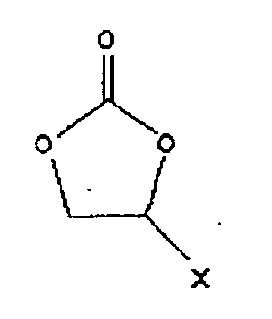
- The rechargeable lithium battery of claim 33, wherein the substituted carbonate is fluoroethylene carbonate.
- The rechargeable lithium battery of claim 20, wherein the positive active material is a nickel-included compound.
- The rechargeable lithium battery of claim 35, wherein the positive active material is a nickel-based compound represented by formulas 6 or 7:
LixNiyM1-yA2 (6)
LixNiyM1-yO2-zXz (7)
where, 0.90 ≤ x ≤ 1.1, 0.1 ≤ y ≤ 0.9, and 0 ≤ z ≤ 0.5; M is at least one selected from Al, Ni, Co, Mn, Cr, Fe, Mg, Sr, V, and a rare earth element; A is selected from O, F, S or P; and X is F, S or P. - The rechargeable lithium battery of claim 35, wherein the positive active material is a nickel-based compound, or a mixture of the nickel-based compound and, a cobalt-based compound or a manganese-based compound.
Applications Claiming Priority (4)
| Application Number | Priority Date | Filing Date | Title |
|---|---|---|---|
| KR1020030057716A KR20050020067A (en) | 2003-08-20 | 2003-08-20 | Electrolyte for lithium secondary battery and lithium secondary battery comprising same |
| KR2003057716 | 2003-08-20 | ||
| KR2004005874 | 2004-01-29 | ||
| KR1020040005874A KR100578873B1 (en) | 2004-01-29 | 2004-01-29 | Electrolyte for lithium secondary battery and lithium secondary battery comprising same |
Publications (2)
| Publication Number | Publication Date |
|---|---|
| EP1508934A1 EP1508934A1 (en) | 2005-02-23 |
| EP1508934B1 true EP1508934B1 (en) | 2007-02-28 |
Family
ID=34067488
Family Applications (1)
| Application Number | Title | Priority Date | Filing Date |
|---|---|---|---|
| EP04090320A Expired - Lifetime EP1508934B1 (en) | 2003-08-20 | 2004-08-19 | Electrolyte for rechargeable lithium battery and rechargeable lithium battery comprising the same |
Country Status (6)
| Country | Link |
|---|---|
| US (1) | US7718322B2 (en) |
| EP (1) | EP1508934B1 (en) |
| JP (2) | JP4485289B2 (en) |
| CN (1) | CN1311585C (en) |
| AT (1) | ATE355629T1 (en) |
| DE (1) | DE602004004956T2 (en) |
Cited By (1)
| Publication number | Priority date | Publication date | Assignee | Title |
|---|---|---|---|---|
| CN102646846A (en) * | 2011-02-16 | 2012-08-22 | 三星Sdi株式会社 | Electrolyte solvent and electrolyte for rechargeable lithium battery, and rechargeable lithium battery including the same |
Families Citing this family (76)
| Publication number | Priority date | Publication date | Assignee | Title |
|---|---|---|---|---|
| TWI302760B (en) | 2004-01-15 | 2008-11-01 | Lg Chemical Ltd | Electrochemical device comprising aliphatic nitrile compound |
| JP2006019274A (en) * | 2004-06-30 | 2006-01-19 | Samsung Sdi Co Ltd | Lithium secondary battery |
| US7811707B2 (en) * | 2004-12-28 | 2010-10-12 | Boston-Power, Inc. | Lithium-ion secondary battery |
| US20080008933A1 (en) * | 2005-12-23 | 2008-01-10 | Boston-Power, Inc. | Lithium-ion secondary battery |
| US9666862B2 (en) | 2005-02-23 | 2017-05-30 | Lg Chem, Ltd. | Secondary battery of improved lithium ion mobility and cell capacity |
| KR100759377B1 (en) | 2005-04-21 | 2007-09-19 | 삼성에스디아이 주식회사 | Lithium secondary battery |
| JP2007042387A (en) * | 2005-08-02 | 2007-02-15 | Sony Corp | Electrolyte, electrode and battery |
| DE102005048802A1 (en) * | 2005-10-10 | 2007-04-12 | Solvay Fluor Gmbh | Fluorinated additives for lithium-ion batteries |
| CN101305484A (en) * | 2005-12-20 | 2008-11-12 | 松下电器产业株式会社 | Non-aqueous electrolyte secondary battery |
| TWI371124B (en) * | 2006-01-12 | 2012-08-21 | Lg Chemical Ltd | Non-aqueous electrolyte and electrochemical device with an improved safety |
| TWI341603B (en) * | 2006-02-15 | 2011-05-01 | Lg Chemical Ltd | Non-aqueous electrolyte and electrochemical device with an improved safety |
| TWI341605B (en) * | 2006-02-15 | 2011-05-01 | Lg Chemical Ltd | Non-aqueous electrolyte and electrochemical device with an improved safety |
| KR101508788B1 (en) * | 2006-06-02 | 2015-04-06 | 미쓰비시 가가꾸 가부시키가이샤 | Nonaqueous electrolyte solution and nonaqueous electrolyte battery |
| KR100941299B1 (en) | 2006-07-07 | 2010-02-11 | 주식회사 엘지화학 | Non-aqueous electrolyte additive with cyano group and electrochemical device using same |
| US20110207000A1 (en) * | 2006-09-07 | 2011-08-25 | Jow T Richard | Nitrile additive for non-aqueous electrolyte rechargeable electrochemical cells |
| KR101264332B1 (en) * | 2006-09-20 | 2013-05-14 | 삼성에스디아이 주식회사 | Cathode active material and lithium battery using the same |
| KR100814885B1 (en) | 2006-11-17 | 2008-03-20 | 삼성에스디아이 주식회사 | Lithium secondary battery |
| KR100810634B1 (en) * | 2006-11-30 | 2008-03-06 | 삼성에스디아이 주식회사 | Electrolyte for lithium secondary battery and lithium secondary battery comprising same |
| KR100793010B1 (en) * | 2007-02-16 | 2008-01-08 | 에스케이에너지 주식회사 | Manufacturing Method of Lithium Secondary Battery |
| KR100793011B1 (en) * | 2007-02-16 | 2008-01-08 | 에스케이에너지 주식회사 | Manufacturing Method of Lithium Secondary Battery |
| US7722994B2 (en) * | 2007-03-28 | 2010-05-25 | Gm Global Technology Operations, Inc. | Lithium-ion battery non-aqueous electrolytes |
| CN105633345B (en) | 2007-04-05 | 2020-01-17 | 三菱化学株式会社 | Nonaqueous electrolyte solution for secondary battery and nonaqueous electrolyte secondary battery using the same |
| JP5418955B2 (en) * | 2007-04-26 | 2014-02-19 | 三菱化学株式会社 | Non-aqueous electrolyte for secondary battery and non-aqueous electrolyte secondary battery using the same |
| US8313866B2 (en) * | 2007-05-22 | 2012-11-20 | Tiax Llc | Non-aqueous electrolytes and electrochemical devices including the same |
| US9825327B2 (en) | 2007-08-16 | 2017-11-21 | Lg Chem, Ltd. | Non-aqueous electrolyte lithium secondary battery |
| KR20090063441A (en) | 2007-12-14 | 2009-06-18 | 삼성에스디아이 주식회사 | Lithium secondary battery |
| JP2009231261A (en) * | 2008-02-26 | 2009-10-08 | Sanyo Electric Co Ltd | Nonaqueous electrolyte secondary battery |
| US9166206B2 (en) * | 2008-04-24 | 2015-10-20 | Boston-Power, Inc. | Prismatic storage battery or cell with flexible recessed portion |
| WO2010056020A2 (en) * | 2008-11-11 | 2010-05-20 | 주식회사 엘지화학 | Lithium secondary battery containing a non-aqueous electrolytic solution |
| CN101740823B (en) * | 2008-11-27 | 2012-05-30 | 比亚迪股份有限公司 | A kind of electrolyte of lithium ion battery and battery |
| JP2010225522A (en) | 2009-03-25 | 2010-10-07 | Sony Corp | Electrolyte and secondary battery |
| JP2010287431A (en) * | 2009-06-11 | 2010-12-24 | Sony Corp | battery |
| DE102009034597A1 (en) * | 2009-07-07 | 2011-01-20 | Continental Automotive Gmbh | Electrolyte mixture and its use |
| KR101178554B1 (en) | 2009-07-09 | 2012-08-30 | 주식회사 엘지화학 | Non-aqueous electrolyte solution for lithium secondary battery and lithium secondary battery comprising the same |
| US9093702B2 (en) | 2009-09-03 | 2015-07-28 | Samsung Sdi Co., Ltd. | Electrolytic solution for lithium battery, lithium battery employing the same and method for operating the lithium battery |
| KR101640937B1 (en) | 2009-11-13 | 2016-07-20 | 삼성에스디아이 주식회사 | Rechargeable lithium battery |
| JP2011119097A (en) * | 2009-12-02 | 2011-06-16 | Sony Corp | Nonaqueous electrolyte battery |
| KR101212203B1 (en) * | 2010-03-16 | 2012-12-13 | 삼성에스디아이 주식회사 | Electrolyte for rechargeable lithium battery, and rechargeable lithium battery including the same |
| JP5515996B2 (en) | 2010-04-09 | 2014-06-11 | ソニー株式会社 | battery |
| CN101841062A (en) * | 2010-05-25 | 2010-09-22 | 张家港市国泰华荣化工新材料有限公司 | Electrolyte solution capable of improving over-charge safety performance of lithium battery |
| JP5867397B2 (en) * | 2010-09-02 | 2016-02-24 | 日本電気株式会社 | Secondary battery |
| JP5867395B2 (en) * | 2010-09-02 | 2016-02-24 | 日本電気株式会社 | Secondary battery |
| KR20130108286A (en) * | 2010-09-16 | 2013-10-02 | 미쓰비시 가가꾸 가부시키가이샤 | Nonaqueous electrolyte and nonaqueous electrolyte secondary battery |
| JP5664056B2 (en) * | 2010-09-16 | 2015-02-04 | 三菱化学株式会社 | Non-aqueous electrolyte and non-aqueous electrolyte battery |
| JP2013030357A (en) * | 2011-07-28 | 2013-02-07 | Toyota Motor Corp | Method for manufacturing battery |
| KR101551135B1 (en) * | 2011-10-28 | 2015-09-07 | 아사히 가세이 가부시키가이샤 | Non-aqueous secondary battery |
| DE102012101457A1 (en) * | 2012-02-23 | 2013-08-29 | Westfälische Wilhelms-Universität Münster | Electrode material for lithium-based electrochemical energy storage |
| JP5810014B2 (en) * | 2012-03-15 | 2015-11-11 | 富士フイルム株式会社 | Non-aqueous secondary battery electrolyte and secondary battery |
| KR101520157B1 (en) * | 2012-09-21 | 2015-05-13 | 주식회사 엘지화학 | Electrolyte solution for lithium secondary battery and lithium secondary battery comprising the same |
| KR101520158B1 (en) | 2012-09-21 | 2015-05-13 | 주식회사 엘지화학 | Electrolyte solution for lithium secondary battery and lithium secondary battery comprising the same |
| CN103050293A (en) * | 2012-12-20 | 2013-04-17 | 上海奥威科技开发有限公司 | Hard-carbon-based chemical power supply with long service life |
| US9653757B2 (en) * | 2013-01-09 | 2017-05-16 | Panasonic Intellectual Property Management Co., Ltd. | Nonaqueous electrolyte solution for secondary battery, and lithium secondary battery |
| US10361459B2 (en) | 2013-05-14 | 2019-07-23 | Samsung Sdi Co., Ltd. | Positive active material for rechargeable lithium battery, method of preparing the same, and rechargeable lithium battery including the same |
| CN103280599A (en) * | 2013-06-04 | 2013-09-04 | 成都银鑫新能源有限公司 | Lithium-ion battery electrolyte as well as preparation method and application thereof |
| CN105359238B (en) * | 2013-07-12 | 2019-02-22 | Ioxus公司 | Stability-enhancing additives for electrochemical devices |
| GB2526312B (en) | 2014-05-20 | 2018-10-17 | Dyson Technology Ltd | Method of manufacturing an electrochemical cell |
| CN104051786B (en) * | 2014-06-24 | 2016-06-15 | 东莞市凯欣电池材料有限公司 | A kind of electrolyte and preparation method thereof and a kind of high-voltage lithium ion batteries |
| CN105633457B (en) * | 2014-10-27 | 2018-05-29 | 宁德时代新能源科技股份有限公司 | Lithium ion battery and electrolyte thereof |
| CN106207263B (en) * | 2015-05-25 | 2021-01-15 | 松下知识产权经营株式会社 | Electrolyte solution and battery |
| KR102520457B1 (en) | 2015-06-22 | 2023-04-12 | 솔브레인 주식회사 | Electrolyte for lithium secondary battery and lithium secondary battery comprising the same |
| KR102019838B1 (en) * | 2015-09-30 | 2019-09-10 | 주식회사 엘지화학 | Lithium secondary battery comprising non-aqueous liquid electrolyte |
| CN107417569B (en) * | 2016-05-23 | 2020-04-14 | 微宏动力系统(湖州)有限公司 | Tertiary nitrile compound for non-aqueous electrolyte, non-aqueous electrolyte containing same, and secondary battery |
| JP2018060693A (en) * | 2016-10-05 | 2018-04-12 | 旭化成株式会社 | Non-aqueous secondary battery |
| JP2018060692A (en) * | 2016-10-05 | 2018-04-12 | 旭化成株式会社 | Nonaqueous secondary battery |
| CN107919498B (en) * | 2016-10-10 | 2021-02-12 | 深圳新宙邦科技股份有限公司 | Non-aqueous electrolyte for lithium ion battery and lithium ion battery using same |
| DE102016125323A1 (en) | 2016-12-22 | 2018-06-28 | Forschungszentrum Jülich GmbH | Electrolyte for lithium-ion batteries |
| WO2018114990A1 (en) | 2016-12-22 | 2018-06-28 | Westfälische Wilhelms-Universität Münster | Electrolyte for lithium ion batteries |
| DE102017107253A1 (en) | 2017-04-04 | 2018-10-04 | Forschungszentrum Jülich GmbH | Electrolyte for lithium-ion batteries |
| WO2018169029A1 (en) | 2017-03-17 | 2018-09-20 | 旭化成株式会社 | Nonaqueous electrolyte, nonaqueous secondary battery, cell pack, and hybrid system |
| EP3598558A4 (en) | 2017-03-17 | 2021-09-01 | Asahi Kasei Kabushiki Kaisha | Nonaqueous electrolyte, nonaqueous secondary battery, cell pack, and hybrid system |
| CN110858664A (en) * | 2018-08-24 | 2020-03-03 | 比亚迪股份有限公司 | Electrolyte, battery and electric vehicle containing the same |
| KR102782233B1 (en) * | 2019-10-02 | 2025-03-17 | 주식회사 엘지에너지솔루션 | Non-aqueous electrolyte and lithium secondary battery comprising the same |
| CN111925471B (en) * | 2020-08-14 | 2022-06-07 | 湖北大学 | Silane modified fluoroethyl ester polymer used as lithium battery binder and preparation method thereof |
| WO2022056731A1 (en) * | 2020-09-16 | 2022-03-24 | 宁德新能源科技有限公司 | Electrolyte and electrochemical device containing same |
| CN114221021A (en) * | 2021-12-10 | 2022-03-22 | 惠州亿纬锂能股份有限公司 | In-situ cured polymer electrolyte, preparation method thereof and lithium ion battery |
| US20250349891A1 (en) * | 2022-04-25 | 2025-11-13 | Lg Energy Solution, Ltd. | Non-Aqueous Electrolyte Solution, Lithium Secondary Battery Including the Same, and Method of Preparing the Lithium Secondary Battery |
Family Cites Families (63)
| Publication number | Priority date | Publication date | Assignee | Title |
|---|---|---|---|---|
| JPS5271630A (en) * | 1975-12-10 | 1977-06-15 | Hitachi Maxell | Nonnaqueous electrolyte battery |
| DE3484403D1 (en) * | 1983-05-04 | 1991-05-16 | Showa Denko Kk | BATTERY WITH ELECTRODE MADE OF POLYMER MATERIAL WITH CONJUGATED DOUBLE BINDINGS. |
| DE3637146A1 (en) * | 1985-11-01 | 1987-05-07 | Nippon Telegraph & Telephone | LITHIUM SECONDARY BATTERY |
| CA2016777C (en) | 1989-05-16 | 1993-10-12 | Norio Takami | Nonaqueous electrolyte secondary battery |
| JP3239267B2 (en) * | 1990-05-21 | 2001-12-17 | 日本電池株式会社 | Organic electrolyte battery |
| CA2052317C (en) * | 1990-09-28 | 1995-09-26 | Norio Takami | Nonaqueous electrolyte secondary battery |
| US5521027A (en) | 1990-10-25 | 1996-05-28 | Matsushita Electric Industrial Co., Ltd. | Non-aqueous secondary electrochemical battery |
| JP3154719B2 (en) | 1990-11-28 | 2001-04-09 | 東芝電池株式会社 | Non-aqueous electrolyte secondary battery |
| JPH05144470A (en) * | 1991-09-13 | 1993-06-11 | Mitsubishi Petrochem Co Ltd | Electrolyte for lithium battery |
| JPH0620721A (en) | 1992-07-03 | 1994-01-28 | Asahi Chem Ind Co Ltd | Nonaqueous secondary battery |
| US5393617A (en) | 1993-10-08 | 1995-02-28 | Electro Energy, Inc. | Bipolar electrochmeical battery of stacked wafer cells |
| JP3512846B2 (en) * | 1994-03-09 | 2004-03-31 | 株式会社東芝 | Non-aqueous electrolyte battery |
| JPH07320748A (en) | 1994-05-20 | 1995-12-08 | Sanyo Electric Co Ltd | Gel state electrolyte battery |
| JPH08130036A (en) * | 1994-09-08 | 1996-05-21 | Fuji Photo Film Co Ltd | Non-aqueous secondary battery |
| CN1107090C (en) | 1994-10-19 | 2003-04-30 | 大金工业株式会社 | Binder for battery, composition for electrode using same, and battery |
| AU4253796A (en) | 1994-12-09 | 1996-06-26 | Danionics A/S | A non-aqueous electrolyte system for use in batteries, capacitors or electrochromic devices and a method for the preparation thereof |
| US5656392A (en) | 1995-03-20 | 1997-08-12 | Matsushita Electric Industrial Co., Ltd. | Organic electrolyte batteries |
| TW360987B (en) | 1995-07-25 | 1999-06-11 | Sumitomo Chemical Co | Non-aqueous electrolyte and lithium secondary battery |
| JPH0973919A (en) | 1995-09-04 | 1997-03-18 | Fuji Elelctrochem Co Ltd | Battery electrolyte |
| JPH0997626A (en) | 1995-09-29 | 1997-04-08 | Sony Corp | Non-aqueous electrolyte battery |
| JPH10189043A (en) | 1996-12-26 | 1998-07-21 | Hitachi Ltd | Lithium secondary battery |
| US5750284A (en) * | 1997-01-08 | 1998-05-12 | Motorola, Inc. | Electrolyte composition for rechargeable electrochemical cells |
| JPH10312825A (en) | 1997-05-09 | 1998-11-24 | Toshiba Battery Co Ltd | Nonaqueous solvent secondary battery |
| JPH1140199A (en) | 1997-07-18 | 1999-02-12 | Hitachi Ltd | Lithium secondary battery |
| US6117596A (en) | 1997-09-04 | 2000-09-12 | Samsung Electronics Co., Ltd. | Organic electrolyte and lithium secondary cell employing the same |
| JP4149543B2 (en) * | 1997-11-19 | 2008-09-10 | 株式会社東芝 | Non-aqueous electrolyte battery |
| KR100400216B1 (en) | 1997-12-23 | 2003-11-14 | 삼성전자주식회사 | Organic electrolyte solution for lithium secondary battery and lithium secondary battery employing the solution |
| JP2000124077A (en) * | 1998-10-19 | 2000-04-28 | Matsushita Electric Ind Co Ltd | Electric double layer capacitor |
| JP3920510B2 (en) | 1998-10-29 | 2007-05-30 | 株式会社東芝 | Non-aqueous electrolyte secondary battery |
| KR100318375B1 (en) | 1999-02-10 | 2001-12-22 | 김순택 | Lithium ion secondary battery |
| IL135078A0 (en) | 1999-03-17 | 2001-05-20 | Noboru Oyama | Polymer electrolyte |
| JP4206167B2 (en) | 1999-04-16 | 2009-01-07 | ホシザキ電機株式会社 | Auger ice machine |
| US7608365B1 (en) * | 1999-05-25 | 2009-10-27 | Samsung Sdi Co., Ltd. | Positive active material composition for rechargeable lithium battery and method of preparing positive electrode using same |
| KR100300334B1 (en) * | 1999-06-17 | 2001-11-01 | 김순택 | Positive active material for lithium secondary battery and method of preparing the same |
| JP4211159B2 (en) | 1999-10-27 | 2009-01-21 | 三菱化学株式会社 | Non-aqueous electrolyte secondary battery |
| JP2001006732A (en) * | 1999-06-25 | 2001-01-12 | Sumitomo Seika Chem Co Ltd | Nonaqueous electrolyte for secondary battery |
| US20020039688A1 (en) | 1999-09-29 | 2002-04-04 | Jeremy Barker | Lactone solvents for electrochemical cells |
| JP4601752B2 (en) | 1999-09-30 | 2010-12-22 | ソニー株式会社 | Gel electrolyte and gel electrolyte battery |
| JP4597294B2 (en) * | 1999-12-20 | 2010-12-15 | サンスター技研株式会社 | Polymer solid electrolyte lithium ion secondary battery |
| CN1167165C (en) | 2000-04-11 | 2004-09-15 | 松下电器产业株式会社 | Non-aqueous electrolyte secondary battery and manufacturing method thereof |
| JP4900994B2 (en) | 2000-09-06 | 2012-03-21 | 株式会社東芝 | Nonaqueous electrolyte secondary battery |
| JP4843842B2 (en) | 2000-10-20 | 2011-12-21 | パナソニック株式会社 | Method for manufacturing positive electrode plate for lithium secondary battery |
| JP4412443B2 (en) | 2000-12-27 | 2010-02-10 | 日本ゼオン株式会社 | Thickener for lithium ion secondary battery negative electrode and lithium ion secondary battery |
| DE10111410C1 (en) * | 2001-03-08 | 2002-07-25 | Chemetall Gmbh | Lithium bis(oxalato)borate electrolyte, used in electrochemical storage system or electrochromic formulation, e.g. window, contains ternary solvent system |
| JP2002343430A (en) | 2001-05-22 | 2002-11-29 | Mitsubishi Chemicals Corp | Non-aqueous electrolyte secondary battery |
| JP5239106B2 (en) * | 2001-05-23 | 2013-07-17 | 三菱化学株式会社 | Non-aqueous electrolyte secondary battery |
| JP4934917B2 (en) * | 2001-06-22 | 2012-05-23 | 三菱化学株式会社 | Non-aqueous electrolyte secondary battery and non-aqueous electrolyte used therefor |
| JP5109213B2 (en) | 2001-06-26 | 2012-12-26 | 三菱化学株式会社 | Non-aqueous electrolyte and non-aqueous electrolyte secondary battery using the same |
| JP2003068137A (en) | 2001-08-23 | 2003-03-07 | Nippon Kayaku Co Ltd | Resin composition for polymer solid electrolyte, polymer solid electrolyte and polymer battery |
| JP5282346B2 (en) * | 2001-09-13 | 2013-09-04 | 三菱化学株式会社 | Non-aqueous electrolyte secondary battery |
| JP2003100278A (en) * | 2001-09-26 | 2003-04-04 | Toshiba Corp | Non-aqueous electrolyte secondary battery |
| JP3960193B2 (en) | 2001-12-20 | 2007-08-15 | 株式会社デンソー | ELECTRODE FOR LITHIUM SECONDARY BATTERY, LITHIUM SECONDARY BATTERY AND METHOD FOR PRODUCING THE SAME |
| JP4476530B2 (en) * | 2001-12-21 | 2010-06-09 | 三星エスディアイ株式会社 | Electrolyte, lithium secondary battery, and method for manufacturing lithium secondary battery |
| AUPS119502A0 (en) * | 2002-03-19 | 2002-04-18 | Energy Storage Systems Pty Ltd | An electrolyte for an energy storage device |
| KR100458568B1 (en) | 2002-04-03 | 2004-12-03 | 삼성에스디아이 주식회사 | An electrolyte for a lithium battery and a lithium battery comprising the same |
| US20040013946A1 (en) * | 2002-07-15 | 2004-01-22 | Ube Industries, Ltd. | Non-aqueous electrolytic solution and lithium battery |
| JP4609751B2 (en) * | 2002-07-15 | 2011-01-12 | 宇部興産株式会社 | Lithium secondary battery |
| US7229718B2 (en) * | 2002-08-22 | 2007-06-12 | Samsung Sdi Co., Ltd. | Electrolyte for rechargeable lithium battery and rechargeable lithium battery comprising same |
| US6787268B2 (en) * | 2002-09-03 | 2004-09-07 | Quallion Llc | Electrolyte |
| EP1406336A1 (en) * | 2002-10-01 | 2004-04-07 | Xoliox SA | Electrolyte composition having improved aluminium anticorrosive properties |
| US7709157B2 (en) | 2002-10-23 | 2010-05-04 | Panasonic Corporation | Non-aqueous electrolyte secondary battery and electrolyte for the same |
| KR100594474B1 (en) | 2002-10-28 | 2006-06-30 | 미쓰이 가가쿠 가부시키가이샤 | Non-aqueous electrolytic solutions and secondary battery containing the same |
| KR100515298B1 (en) | 2003-03-24 | 2005-09-15 | 삼성에스디아이 주식회사 | A non-aqueous electrolyte and a lithium secondary battery comprising the same |
-
2004
- 2004-08-19 DE DE602004004956T patent/DE602004004956T2/en not_active Expired - Lifetime
- 2004-08-19 AT AT04090320T patent/ATE355629T1/en not_active IP Right Cessation
- 2004-08-19 EP EP04090320A patent/EP1508934B1/en not_active Expired - Lifetime
- 2004-08-20 US US10/924,248 patent/US7718322B2/en active Active
- 2004-08-20 CN CNB2004100981117A patent/CN1311585C/en not_active Expired - Lifetime
- 2004-08-20 JP JP2004241017A patent/JP4485289B2/en not_active Expired - Lifetime
-
2010
- 2010-01-26 JP JP2010014168A patent/JP5182714B2/en not_active Expired - Lifetime
Cited By (1)
| Publication number | Priority date | Publication date | Assignee | Title |
|---|---|---|---|---|
| CN102646846A (en) * | 2011-02-16 | 2012-08-22 | 三星Sdi株式会社 | Electrolyte solvent and electrolyte for rechargeable lithium battery, and rechargeable lithium battery including the same |
Also Published As
| Publication number | Publication date |
|---|---|
| CN1612405A (en) | 2005-05-04 |
| DE602004004956T2 (en) | 2007-11-08 |
| US7718322B2 (en) | 2010-05-18 |
| EP1508934A1 (en) | 2005-02-23 |
| CN1311585C (en) | 2007-04-18 |
| DE602004004956D1 (en) | 2007-04-12 |
| JP4485289B2 (en) | 2010-06-16 |
| ATE355629T1 (en) | 2006-03-15 |
| JP5182714B2 (en) | 2013-04-17 |
| JP2005072003A (en) | 2005-03-17 |
| JP2010118355A (en) | 2010-05-27 |
| US20050084765A1 (en) | 2005-04-21 |
Similar Documents
| Publication | Publication Date | Title |
|---|---|---|
| EP1508934B1 (en) | Electrolyte for rechargeable lithium battery and rechargeable lithium battery comprising the same | |
| KR102643744B1 (en) | Nonaqueous electrolyte for lithium secondary battery and lithium secondary battery comprising the same | |
| KR100605060B1 (en) | Non-aqueous electrolyte battery | |
| EP2206189B1 (en) | Non-aqueous electrolyte lithium secondary battery | |
| EP1715542B1 (en) | Polymer electrolyte for a lithium secondary battery | |
| KR101020346B1 (en) | Non-aqueous electrolyte lithium secondary battery | |
| EP2160787B1 (en) | Non-aqueous electrolyte solution for lithium-ion secondary battery and lithium-ion secondary battery including the same | |
| EP2266159B1 (en) | Non-aqueous electrolyte solution for lithium secondary battery and lithium secondary battery comprising the same | |
| EP2355213B1 (en) | Lithium secondary battery containing a non-aqueous electrolytic solution | |
| US20130344398A1 (en) | Lithium secondary battery and method of controlling short resistance thereof | |
| JP5723778B2 (en) | Non-aqueous electrolyte for lithium secondary battery and lithium secondary battery provided with the same | |
| KR100573109B1 (en) | Organic electrolyte and lithium battery employing the same | |
| KR100578873B1 (en) | Electrolyte for lithium secondary battery and lithium secondary battery comprising same | |
| EP4080638A1 (en) | Lithium secondary battery | |
| KR100810634B1 (en) | Electrolyte for lithium secondary battery and lithium secondary battery comprising same | |
| US7452634B2 (en) | Polymer electrolyte composition for rechargeable lithium battery and rechargeable lithium battery fabricated using same | |
| KR20230031801A (en) | Non-aqueous electrolyte for lithium secondary battery and lithium secondary battery comprising same | |
| KR100669314B1 (en) | Manufacturing Method of Lithium Secondary Battery and Lithium Secondary Battery | |
| KR20230021371A (en) | Non-aqueous electrolyte for lithium secondary battery and lithium secondary battery comprising same | |
| EP4404321B1 (en) | Lithium secondary battery | |
| KR20050020067A (en) | Electrolyte for lithium secondary battery and lithium secondary battery comprising same | |
| JP2023512820A (en) | Method for producing gel polymer electrolyte secondary battery, and gel polymer electrolyte secondary battery produced thereby | |
| KR20220129492A (en) | Non-aqueous electrolyte for lithium secondary battery and lithium secondary battery comprising same | |
| KR20050031435A (en) | Nonaqueous electrolyte cell | |
| KR20240008797A (en) | Non-aqueous electrolyte for lithium secondary battery and lithium secondary battery comprising same |
Legal Events
| Date | Code | Title | Description |
|---|---|---|---|
| PUAI | Public reference made under article 153(3) epc to a published international application that has entered the european phase |
Free format text: ORIGINAL CODE: 0009012 |
|
| AK | Designated contracting states |
Kind code of ref document: A1 Designated state(s): AT BE BG CH CY CZ DE DK EE ES FI FR GB GR HU IE IT LI LU MC NL PL PT RO SE SI SK TR |
|
| AX | Request for extension of the european patent |
Extension state: AL HR LT LV MK |
|
| RIN1 | Information on inventor provided before grant (corrected) |
Inventor name: KIM, KWANG-SUPLEGAL & IP, SAMSUNG SDI CO., LTD Inventor name: LEE, YONG-BEOMLEGAL & IP, SAMSUNG SDI CO., LTD Inventor name: SONG, EUI-HWANLEGAL & IP, SAMSUNG SDI CO., LTD Inventor name: EARMME, TAE-SHIKLEGAL & IP, SAMSUNG SDI CO., L Inventor name: KIM, YOO-MEELEGAL & IP, SAMSUNG SDI CO., LTD. |
|
| 17P | Request for examination filed |
Effective date: 20050727 |
|
| AKX | Designation fees paid |
Designated state(s): AT BE BG CH CY CZ DE DK EE ES FI FR GB GR HU IE IT LI LU MC NL PL PT RO SE SI SK TR |
|
| GRAP | Despatch of communication of intention to grant a patent |
Free format text: ORIGINAL CODE: EPIDOSNIGR1 |
|
| GRAS | Grant fee paid |
Free format text: ORIGINAL CODE: EPIDOSNIGR3 |
|
| GRAA | (expected) grant |
Free format text: ORIGINAL CODE: 0009210 |
|
| RIN1 | Information on inventor provided before grant (corrected) |
Inventor name: KIM, YOO-MEELEGAL & IP TEAM,SAMSUNG SDI CO,LTD. Inventor name: LEE, YONG-BEOMLEGAL & IP TEAM, SAMSUNG SDI CO,LTD Inventor name: SONG, EUI-HWANLEGAL & IP TEAM, SAMSUNG SDI CO,LTD Inventor name: KIM, KWANG-SUPLEGAL & IP TEAM, SAMSUNG SDI CO,LTD Inventor name: EARMME, TAE-SHIKLEGAL &IP TEAM,SAMSUNG SDI CO.LTD |
|
| AK | Designated contracting states |
Kind code of ref document: B1 Designated state(s): AT BE BG CH CY CZ DE DK EE ES FI FR GB GR HU IE IT LI LU MC NL PL PT RO SE SI SK TR |
|
| PG25 | Lapsed in a contracting state [announced via postgrant information from national office to epo] |
Ref country code: CH Free format text: LAPSE BECAUSE OF FAILURE TO SUBMIT A TRANSLATION OF THE DESCRIPTION OR TO PAY THE FEE WITHIN THE PRESCRIBED TIME-LIMIT Effective date: 20070228 Ref country code: AT Free format text: LAPSE BECAUSE OF FAILURE TO SUBMIT A TRANSLATION OF THE DESCRIPTION OR TO PAY THE FEE WITHIN THE PRESCRIBED TIME-LIMIT Effective date: 20070228 Ref country code: DK Free format text: LAPSE BECAUSE OF FAILURE TO SUBMIT A TRANSLATION OF THE DESCRIPTION OR TO PAY THE FEE WITHIN THE PRESCRIBED TIME-LIMIT Effective date: 20070228 Ref country code: PL Free format text: LAPSE BECAUSE OF FAILURE TO SUBMIT A TRANSLATION OF THE DESCRIPTION OR TO PAY THE FEE WITHIN THE PRESCRIBED TIME-LIMIT Effective date: 20070228 Ref country code: SI Free format text: LAPSE BECAUSE OF FAILURE TO SUBMIT A TRANSLATION OF THE DESCRIPTION OR TO PAY THE FEE WITHIN THE PRESCRIBED TIME-LIMIT Effective date: 20070228 Ref country code: LI Free format text: LAPSE BECAUSE OF FAILURE TO SUBMIT A TRANSLATION OF THE DESCRIPTION OR TO PAY THE FEE WITHIN THE PRESCRIBED TIME-LIMIT Effective date: 20070228 Ref country code: NL Free format text: LAPSE BECAUSE OF FAILURE TO SUBMIT A TRANSLATION OF THE DESCRIPTION OR TO PAY THE FEE WITHIN THE PRESCRIBED TIME-LIMIT Effective date: 20070228 Ref country code: FI Free format text: LAPSE BECAUSE OF FAILURE TO SUBMIT A TRANSLATION OF THE DESCRIPTION OR TO PAY THE FEE WITHIN THE PRESCRIBED TIME-LIMIT Effective date: 20070228 Ref country code: BE Free format text: LAPSE BECAUSE OF FAILURE TO SUBMIT A TRANSLATION OF THE DESCRIPTION OR TO PAY THE FEE WITHIN THE PRESCRIBED TIME-LIMIT Effective date: 20070228 |
|
| REG | Reference to a national code |
Ref country code: GB Ref legal event code: FG4D |
|
| REG | Reference to a national code |
Ref country code: CH Ref legal event code: EP |
|
| REF | Corresponds to: |
Ref document number: 602004004956 Country of ref document: DE Date of ref document: 20070412 Kind code of ref document: P |
|
| REG | Reference to a national code |
Ref country code: IE Ref legal event code: FG4D |
|
| PG25 | Lapsed in a contracting state [announced via postgrant information from national office to epo] |
Ref country code: BG Free format text: LAPSE BECAUSE OF FAILURE TO SUBMIT A TRANSLATION OF THE DESCRIPTION OR TO PAY THE FEE WITHIN THE PRESCRIBED TIME-LIMIT Effective date: 20070529 |
|
| PG25 | Lapsed in a contracting state [announced via postgrant information from national office to epo] |
Ref country code: SE Free format text: LAPSE BECAUSE OF FAILURE TO SUBMIT A TRANSLATION OF THE DESCRIPTION OR TO PAY THE FEE WITHIN THE PRESCRIBED TIME-LIMIT Effective date: 20070531 |
|
| PG25 | Lapsed in a contracting state [announced via postgrant information from national office to epo] |
Ref country code: ES Free format text: LAPSE BECAUSE OF FAILURE TO SUBMIT A TRANSLATION OF THE DESCRIPTION OR TO PAY THE FEE WITHIN THE PRESCRIBED TIME-LIMIT Effective date: 20070608 |
|
| PG25 | Lapsed in a contracting state [announced via postgrant information from national office to epo] |
Ref country code: PT Free format text: LAPSE BECAUSE OF FAILURE TO SUBMIT A TRANSLATION OF THE DESCRIPTION OR TO PAY THE FEE WITHIN THE PRESCRIBED TIME-LIMIT Effective date: 20070730 |
|
| NLV1 | Nl: lapsed or annulled due to failure to fulfill the requirements of art. 29p and 29m of the patents act | ||
| REG | Reference to a national code |
Ref country code: CH Ref legal event code: PL |
|
| PG25 | Lapsed in a contracting state [announced via postgrant information from national office to epo] |
Ref country code: SK Free format text: LAPSE BECAUSE OF FAILURE TO SUBMIT A TRANSLATION OF THE DESCRIPTION OR TO PAY THE FEE WITHIN THE PRESCRIBED TIME-LIMIT Effective date: 20070228 |
|
| PG25 | Lapsed in a contracting state [announced via postgrant information from national office to epo] |
Ref country code: CZ Free format text: LAPSE BECAUSE OF FAILURE TO SUBMIT A TRANSLATION OF THE DESCRIPTION OR TO PAY THE FEE WITHIN THE PRESCRIBED TIME-LIMIT Effective date: 20070228 Ref country code: RO Free format text: LAPSE BECAUSE OF FAILURE TO SUBMIT A TRANSLATION OF THE DESCRIPTION OR TO PAY THE FEE WITHIN THE PRESCRIBED TIME-LIMIT Effective date: 20070228 |
|
| PLBE | No opposition filed within time limit |
Free format text: ORIGINAL CODE: 0009261 |
|
| STAA | Information on the status of an ep patent application or granted ep patent |
Free format text: STATUS: NO OPPOSITION FILED WITHIN TIME LIMIT |
|
| 26N | No opposition filed |
Effective date: 20071129 |
|
| PG25 | Lapsed in a contracting state [announced via postgrant information from national office to epo] |
Ref country code: MC Free format text: LAPSE BECAUSE OF NON-PAYMENT OF DUE FEES Effective date: 20070831 Ref country code: IT Free format text: LAPSE BECAUSE OF FAILURE TO SUBMIT A TRANSLATION OF THE DESCRIPTION OR TO PAY THE FEE WITHIN THE PRESCRIBED TIME-LIMIT Effective date: 20070228 Ref country code: GR Free format text: LAPSE BECAUSE OF FAILURE TO SUBMIT A TRANSLATION OF THE DESCRIPTION OR TO PAY THE FEE WITHIN THE PRESCRIBED TIME-LIMIT Effective date: 20070529 |
|
| PG25 | Lapsed in a contracting state [announced via postgrant information from national office to epo] |
Ref country code: IE Free format text: LAPSE BECAUSE OF NON-PAYMENT OF DUE FEES Effective date: 20070820 |
|
| PG25 | Lapsed in a contracting state [announced via postgrant information from national office to epo] |
Ref country code: EE Free format text: LAPSE BECAUSE OF FAILURE TO SUBMIT A TRANSLATION OF THE DESCRIPTION OR TO PAY THE FEE WITHIN THE PRESCRIBED TIME-LIMIT Effective date: 20070228 |
|
| PG25 | Lapsed in a contracting state [announced via postgrant information from national office to epo] |
Ref country code: CY Free format text: LAPSE BECAUSE OF FAILURE TO SUBMIT A TRANSLATION OF THE DESCRIPTION OR TO PAY THE FEE WITHIN THE PRESCRIBED TIME-LIMIT Effective date: 20070228 |
|
| PG25 | Lapsed in a contracting state [announced via postgrant information from national office to epo] |
Ref country code: LU Free format text: LAPSE BECAUSE OF NON-PAYMENT OF DUE FEES Effective date: 20070819 |
|
| PG25 | Lapsed in a contracting state [announced via postgrant information from national office to epo] |
Ref country code: HU Free format text: LAPSE BECAUSE OF FAILURE TO SUBMIT A TRANSLATION OF THE DESCRIPTION OR TO PAY THE FEE WITHIN THE PRESCRIBED TIME-LIMIT Effective date: 20070901 Ref country code: TR Free format text: LAPSE BECAUSE OF FAILURE TO SUBMIT A TRANSLATION OF THE DESCRIPTION OR TO PAY THE FEE WITHIN THE PRESCRIBED TIME-LIMIT Effective date: 20070228 |
|
| REG | Reference to a national code |
Ref country code: FR Ref legal event code: PLFP Year of fee payment: 13 |
|
| REG | Reference to a national code |
Ref country code: FR Ref legal event code: PLFP Year of fee payment: 14 |
|
| REG | Reference to a national code |
Ref country code: FR Ref legal event code: PLFP Year of fee payment: 15 |
|
| P01 | Opt-out of the competence of the unified patent court (upc) registered |
Effective date: 20230528 |
|
| PGFP | Annual fee paid to national office [announced via postgrant information from national office to epo] |
Ref country code: GB Payment date: 20230727 Year of fee payment: 20 |
|
| PGFP | Annual fee paid to national office [announced via postgrant information from national office to epo] |
Ref country code: FR Payment date: 20230808 Year of fee payment: 20 Ref country code: DE Payment date: 20230726 Year of fee payment: 20 |
|
| REG | Reference to a national code |
Ref country code: DE Ref legal event code: R071 Ref document number: 602004004956 Country of ref document: DE |
|
| REG | Reference to a national code |
Ref country code: GB Ref legal event code: PE20 Expiry date: 20240818 |
|
| PG25 | Lapsed in a contracting state [announced via postgrant information from national office to epo] |
Ref country code: GB Free format text: LAPSE BECAUSE OF EXPIRATION OF PROTECTION Effective date: 20240818 |
|
| PG25 | Lapsed in a contracting state [announced via postgrant information from national office to epo] |
Ref country code: GB Free format text: LAPSE BECAUSE OF EXPIRATION OF PROTECTION Effective date: 20240818 |