EP1495440B1 - Touch sensor with improved electrode pattern - Google Patents
Touch sensor with improved electrode pattern Download PDFInfo
- Publication number
- EP1495440B1 EP1495440B1 EP03726288A EP03726288A EP1495440B1 EP 1495440 B1 EP1495440 B1 EP 1495440B1 EP 03726288 A EP03726288 A EP 03726288A EP 03726288 A EP03726288 A EP 03726288A EP 1495440 B1 EP1495440 B1 EP 1495440B1
- Authority
- EP
- European Patent Office
- Prior art keywords
- touch sensor
- gaps
- touch
- junction
- gap
- Prior art date
- Legal status (The legal status is an assumption and is not a legal conclusion. Google has not performed a legal analysis and makes no representation as to the accuracy of the status listed.)
- Expired - Lifetime
Links
Images


Classifications
-
- G—PHYSICS
- G06—COMPUTING OR CALCULATING; COUNTING
- G06F—ELECTRIC DIGITAL DATA PROCESSING
- G06F3/00—Input arrangements for transferring data to be processed into a form capable of being handled by the computer; Output arrangements for transferring data from processing unit to output unit, e.g. interface arrangements
- G06F3/01—Input arrangements or combined input and output arrangements for interaction between user and computer
- G06F3/03—Arrangements for converting the position or the displacement of a member into a coded form
- G06F3/041—Digitisers, e.g. for touch screens or touch pads, characterised by the transducing means
- G06F3/045—Digitisers, e.g. for touch screens or touch pads, characterised by the transducing means using resistive elements, e.g. a single continuous surface or two parallel surfaces put in contact
-
- G—PHYSICS
- G06—COMPUTING OR CALCULATING; COUNTING
- G06F—ELECTRIC DIGITAL DATA PROCESSING
- G06F2203/00—Indexing scheme relating to G06F3/00 - G06F3/048
- G06F2203/041—Indexing scheme relating to G06F3/041 - G06F3/045
- G06F2203/04113—Peripheral electrode pattern in resistive digitisers, i.e. electrodes at the periphery of the resistive sheet are shaped in patterns enhancing linearity of induced field
Definitions
- the field of the present invention relates to touch sensor technology, and more particularly to resistive and capacitive touch sensor technology.
- Touch sensors are transparent or opaque input devices for computers and other electronic systems. As the name suggests, touch sensors are activated by touch, either from a user's finger, or a stylus or some other device. Transparent touch sensors, and specifically touchscreens, are generally placed over display devices, such as cathode ray tube (CRT) monitors and liquid crystal displays, to create touch display systems. These systems are increasingly used in commercial applications such as restaurant order entry systems, industrial process control applications, interactive museum exhibits, public information kiosks, pagers, cellular phones, personal digital assistants, and video games.
- CTR cathode ray tube
- touch technology The dominant touch technologies presently in use are resistive, capacitive, infrared, and acoustic technologies. Touchscreens incorporating these technologies have delivered high standards of performance at competitive prices. All are transparent devices that respond to a touch by transmitting the touch position coordinates to a host computer. An important aspect of touchscreen performance is a close correspondence between true and measured touch positions at all locations within a touch sensitive area located on the touch sensor (i.e., the touch region).
- resistive touchscreen e.g., the AccuTouchTM product line of Elo TouchSystems, Inc. of Fremont, California
- a 5-wire resistive touchscreen e.g., the AccuTouchTM product line of Elo TouchSystems, Inc. of Fremont, California
- the glass substrate is coated with a resistive layer upon which voltage gradients are excited via electrode patterns that are disposed along the periphery of the substrate.
- associated electronics can sequentially excite gradients in both the X and Y directions, as described in U.S. Patent No. 3,591,718 .
- the underside of the coversheet has a conductive coating that provides electrical continuity between the touch location and voltage sensing electronics. Further details regarding 5-wire resistive touchscreens are found in U.S. Patent Nos. 4,220,815 , 4,661,655 , 4,731,508 , 4,822,957 , 5,045,644 , and 5,220,136 ..
- FIGs. 1 and 2 illustrate a touch screen substrate 2 in which respective X and Y excitations are produced on a touch region 4 by applying different corner voltages (in this case, 5 volts) to an electrode pattern 6 extending along the periphery 8 of the substrate 2.
- the arrows represent the direction of current flow across the touch region 4, and the dotted lines represent equipotential lines, i.e., lines along which the voltage is constant.
- the equipotential lines are perfectly straight lines, as suggested in Figs. 1 and 2 . Current flows perpendicular to these equipotential lines, so lines of current flow are straight when the equipotential lines are straight.
- an X excitation is generated by passing current through the touch region 4 injected at the right side of the border electrode pattern 6 and collected at the left side. That is, the left and right sides are in "sourcing” (or sinking) mode for the X excitation. Ideally, for X excitation, no current enters or exits the touch region 4 from the top and bottom sides. That is the top and bottom sides are "non-sourcing" for the X excitation.
- a Y excitation is generated by passing current through the touch region 4 injected at the top side of the border electrode pattern 6 and collected at the bottom side. That is, the top and bottom sides are in "sourcing” (or sinking) mode for the Y excitation.
- Y excitation no current enters or exits the touch region 4 from the left and right sides. That is, the left and right sides are "non-sourcing" for the Y excitation.
- Electronics can obtain touch information from a 5-wire resistive touchscreen via the voltage excitation described above, as well as current injection and capacitive architectures.
- a 9-wire connection scheme which provides drive and a sense line connections between the electronics and each of the four corner connection points, is also available.
- One 5-wire connection touch sensor utilizes peripheral electrode patterns with discrete overlap resistors, such as those found in Elo TouchSystems' AccuTouch TM products and disclosed in U.S. Patent No. 5,045,644 .
- peripheral electrode patterns with discrete overlap resistors such as those found in Elo TouchSystems' AccuTouch TM products and disclosed in U.S. Patent No. 5,045,644 .
- parallel resistive current paths are provided through gaps within isolation lines between peripheral electrode patterns on opposite sides of the touch region.
- the current paths produce an undesirable ripple non-linearity in the touch region near the peripheral electrode pattern.
- a finger moving across a straight line in this region will experience variations in the excitation voltage and hence variations in the measured coordinate (unless otherwise corrected for).
- the considerable ripple adjacent to the top and bottom resistor chains limits the accuracy of measurements in this area, and thus, the size of the effective touch region is therefore reduced.
- a higher density of electrical connections on the non-sourcing side tends to make matters worse.
- great linearity improvement on the sourcing sides is provided with a modest decrease in linearity on the non-sourcing sides. While this may appear to be quite a reasonable engineering trade-off, the marketplace is wary of anything that degrades any aspect of touchscreen performance.
- FIG. 3 shows a resistor chain 48 having Z-electrodes 50 with overlapping outer and inner portions 51, 52, the inner portions 52 of adjacent electrodes being closest at junctions 54.
- An array of insulating regions 55 having two gaps 56 for each overlap resistor electrode 50 runs parallel to the inner portions 52. Some of the gaps 56 are over the junctions 54.
- the V N and V N+1 equipotential lines tend to terminate on the electrodes 50, and all the equipotential lines in between V N and V N+1 bunch up at the junction 54, as illustrated in Fig. 5 .
- the resistor chain 48 of Fig. 3 will, in practice, have the equivalent circuit illustrated in Fig. 6 .
- US patent 6163313 on which the preamble of claim 1 is based, discloses a position touch sensor having a substrate and a resistive layer disposed on the substrate. At least one pair of electrodes is positioned on the resistive layer. A portion of one electrode is spaced from a portion of another electrode to produce an overlapped resistive region between the spaced portions of the electrodes. An insulating region extends into and terminates in the overlapped resistive region from a resistive region of the resistive layer outside the overlapped resistive region. There remains a need to improve the non-sourcing side linearity of touchscreens with discrete resistor structures.
- the present invention is directed to a touch sensor that utilizes electrically conductive islands in junction gaps in order to provide a true voltage divider within the gaps, thereby providing a linearly varying voltage sequence along the resistor chain.
- the touch sensor can be operated as a resistive touch sensor, e. g. , 5-or 9-wire, a capacitive touch sensor, or any touch sensor that requires series resistive chains.
- a touch sensor as claimed in any of the accompanying claims.
- a conductive island is located within a plurality of the junction gaps to provide maximum benefit.
- the non-junction gaps can be variously designed.
- a non-junction gap may be empty, i. e. , it contains no electrically conductive material.
- the non-junction gap may contain an extension from the inner portion of the electrode.
- the non-junction gap may contain a conductive island.
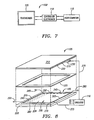
- the touchscreen system 100 generally comprises a touchscreen 105 (i.e., a touch sensor having a transparent substrate), controller electronics 110, and a display 120.
- the touchscreen system 100 is typically coupled to a host computer 115.
- the controller electronics 110 receives from the touchscreen 105 analog signals carrying touch information.
- the controller electronics 110 also sends to the touchscreen 105 excitation signals.
- the controller electronics 110 establishes a voltage gradient across the touchscreen 105. The voltages at the point of contact are representative of the position touched.
- the controller electronics 110 digitizes these voltages and transmits these digitized signals, or touch information in digital form based on these digitized signals, to the host computer 115 for processing.
- the touchscreen 105 comprises a gradient sheet 195 including a substrate 200 having a uniform resistive layer 205 permanently applied to one surface thereof.
- the resistive layer 205 further includes a touch region 206.
- the geometry of the substrate 200 may be, for example, planar (as shown in Fig. 8 ), or may be contoured to match the face of a curved object, such as a Cathode Ray Tube (CRT) face or other conventional video display screens.
- the substrate 200 can also have any perimeter configuration, e.g., rectangular (as shown), substantially rectangular, or circular.
- the substrate 200 and resistive layer 205 are preferably made of a substantially transparent material.
- the substrate 200 may be composed of an opaque material.
- a cover sheet 210 Spaced a small distance above the resistive layer 205 is a cover sheet 210, which is typically a flexible film 215 having a conductive coating 220 on the underside of the flexible film 215.
- the cover sheet 210 is joined to the remainder of the touchscreen 105 with an adhesive along its associated edges, or optionally, with an insulative adhesive frame 225 or the like.
- an electrode 230 connects the conductive coating 220 of the cover sheet 210 via lead 235 to appropriate external circuitry, such as the controller circuit 110.
- the conductive coating 220 attached to the cover sheet 210 is separated from the resistive layer 205 by a plurality of small transparent insulator islands or dots 240, which prevent accidental contact between the conductive coating 220 and the resistive layer 205.
- any conducting element such as a conducting stylus (not shown), can be used as an alternative.
- This conducting stylus may be used when the resistive layer 205 is sufficiently durable as to withstand damage from such contact.
- a capacitive or resistive pickup system can be used along with a user's finger or with an appropriate probe.
- a resistor chain 245 is spaced along each edge of the resistive layer 205 and is used for applying potentials to the resistive layer 205, so as to create orthogonal voltage gradients therein.
- the resistor chain 245 (composed of conductive regions, insulating regions, and resistive regions) includes discrete resistance units connected in series.
- the resistance values of the resistor chain 245 depend partly upon the resistive value of the resistive layer 205 that forms part of the resistor chain 245.
- the resistance values of the resistor chain 245 may vary in accordance with design requirements.
- There are four resistor chains 245 in the embodiment of Fig. 8 which are more specifically labeled 250, 255, 260, and 265.
- each resistor chain 250, 255, 260 or 265 are joined at or near the corners 270 of the resistive layer 205.
- Each of the corners 270 is provided with a respective one of the electrical leads 275, 280, 285, 290.
- the touchscreen 105 is connected to the controller electronics 110, which provides the voltage to the resistor chain 245 and processes information from the touchscreen 105.
- the conductive coating 220 of the cover sheet 210 makes direct electrical contact with the resistive layer 205 on the substrate 200.
- the cover sheet 210 can function as either a voltage sensing probe for sensing the voltage at the contacted area, or as a current injection source.
- the coversheet 210 may be replaced with a thin dielectric coating applied directly to resistive layer 205, in which case, the controller electronics 110 may support AC operation.
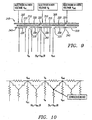
- the resistor chain 245 has Z-shaped electrodes 305, each having an outer portion 310 and an inner portion 315.
- the inner portion 315 of a first electrode 305 overlaps the outer portion 310 of a second, adjacent electrode 305.
- the resistive layer 205 (shown in Fig. 8 ) between these inner and outer portions forms a resistive connection 320.
- the inner portions 315 of adjacent electrodes 305 are separated from each other by junctions 325.
- a plurality of insulating regions 330 are formed in the gradient sheet 195 (shown in Fig. 8 ), for example, by removing the resistive layer 205 at selected places.
- gaps 335 are positioned between the inner portions 315 of the electrodes 305 and the touch region 206 (referred to as “non-junction gaps”) and some of the gaps 335 are positioned between the junctions 325 and the touch region 206 (referred to as “junction gaps").
- the insulating regions 330 and gaps 335 may also be formed by removing a line of the resistive layer 205 (an insulation line) and thereafter placing resistive material, such as ITO, on the sheet at selected places along the insulation line.
- the insulating regions 330 and gaps 335 are formed in a line parallel to the inner portions 315 of the electrodes 305.
- the insulating regions 330 may be readily formed by laser ablation of the resistive layer 205. Insulating subsections extending between the electrodes 305 may also be formed. Laser adjustment of these subsections effectively trims the resistors between the electrodes 305.
- a conductive region or "island" 340 is positioned within the junction gaps 335.
- the conductive material may be, e.g., a conductive frit.
- Fig. 9 illustrates equipotential lines of the touch region 206 as they approach the electrode border. Because a conducting region is at a constant voltage, at most one equipotential line can terminate on a conductive electrode 305 or conducting island 340. In contrast, many equipotential lines may terminate on a insulating region 330.
- gap widths minimizes the amount of non-sourcing ripple non-linearity. It should be noted, however, that wider gaps are preferred for minimizing sourcing ripple non-linearity. As a result, it is best to avoid too much variation in gap widths. This desire to avoid unnecessary variation in gap widths, however, competes with another design requirement. As is well known in the prior art, a linear touchscreen design requires a parabolic variation in resistance of the connections between the touch region and the resistor chain series. As such, it is preferred that the gap widths, at least in the prior art, vary.
- the resistor chain 245 preferably employs a variety of gap designs.
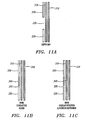
- the resistor chain 245 comprises three different types of gap designs: an empty gap; a gap with a conductive island 340; and a gap with an electrode extension of an overlap-resistor electrode 305 (e.g., a "T"). These three types are illustrated in Figs . 11a -c. Even if the gaps are all the same width, as illustrated in Figs. 11a -c, the three different gap designs provide different resistances between the resistor chain 245 and the touch region 206.
- the empty gap illustrated in Fig. 11a has the higher resistance, and a "T" shaped electrode extension 345 illustrated in Fig. 11c provides the lowest resistance.
- the empty gap will be wider and the "T" shaped electrode extension 345 will be narrower.
- This design degree of freedom to provide, in part, the desired parabolic resistance variations, has the beneficial result of reducing the needed variation in gap widths to some extent, thereby improving linearity. This flexibility also helps avoid tolerance issues involving the screen-printing of extremely small conductive islands 340 and gaps 335.
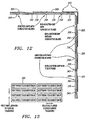
- the resistor chain 24 in addition to using conductive islands 340 within the junction gaps 335, also uses the different types of gap designs illustrated in Figs. 11a -c within the non-junction gaps 335 to provide the necessary parabolic resistance variation. Although it is generally desirable to use conductive islands 340 within the junction gaps 335 in order to improve ripple linearity along the non-sourcing side as previously discussed, it is sometimes desirable to use empty gap designs ( Fig. 11a ) for the junction gaps 335.
- the empty gap design in combination with a relatively narrow gap through which there is less of a problem of the touch region 206 "seeing" the unmixed voltages of the pair of electrodes 305 through the junction gap 335.
- Fig, 13 which illustrates an exemplary display of software touch buttons 355 that one may see when viewing the display of the touchscreen system 100.
- the touch buttons 355 are much wider than they are tall.
- the touchscreen system 100 must correctly determine the Y-coordinate with small errors, but only roughly determine the X-coordinate.
- the left and right sides of the electrode border are non-sourcing and the top and bottom sides are sourcing.
- Such a design leads to increased ripple non-linearity along the top and bottom for the X-coordinate measurement, but this is of secondary importance for applications, such as that illustrated in Fig. 13 .
- resistive touchscreen system 100 Although the above discussion has been set forth in the context of a resistive touchscreen system 100, it applies to the more general setting of a touch-sensitive system. This includes other types of touch sensors (e.g., opaque touch pads or touch sensitive robot shells). A variety of sensors with sensitive surfaces can be imagined. Indeed, the resistive touchscreen system 100 is really just a specific type of a touch sensitive system, where the gradient sheet 195 and cover sheet 210 are specifically designed to operate in the touchscreen 105. Thus, the present discussion, in its broadest aspects, should be thought of as applying in that more general setting.
- touch sensors e.g., opaque touch pads or touch sensitive robot shells.
- the resistive touchscreen system 100 is really just a specific type of a touch sensitive system, where the gradient sheet 195 and cover sheet 210 are specifically designed to operate in the touchscreen 105.
- the present discussion in its broadest aspects, should be thought of as applying in that more general setting.
Landscapes
- Engineering & Computer Science (AREA)
- General Engineering & Computer Science (AREA)
- Theoretical Computer Science (AREA)
- Human Computer Interaction (AREA)
- Physics & Mathematics (AREA)
- General Physics & Mathematics (AREA)
- Position Input By Displaying (AREA)
- Switches That Are Operated By Magnetic Or Electric Fields (AREA)
- Pressure Sensors (AREA)
- Measurement Of Length, Angles, Or The Like Using Electric Or Magnetic Means (AREA)
Applications Claiming Priority (5)
| Application Number | Priority Date | Filing Date | Title |
|---|---|---|---|
| US37302202P | 2002-04-16 | 2002-04-16 | |
| US373022P | 2002-04-16 | ||
| US413825 | 2003-04-15 | ||
| PCT/US2003/011543 WO2003090156A2 (en) | 2002-04-16 | 2003-04-15 | Touch sensor with improved electrode pattern |
| US10/413,825 US20030231169A1 (en) | 2002-04-16 | 2003-04-15 | Touch sensor with improved electrode pattern |
Publications (2)
| Publication Number | Publication Date |
|---|---|
| EP1495440A2 EP1495440A2 (en) | 2005-01-12 |
| EP1495440B1 true EP1495440B1 (en) | 2010-01-20 |
Family
ID=29254506
Family Applications (1)
| Application Number | Title | Priority Date | Filing Date |
|---|---|---|---|
| EP03726288A Expired - Lifetime EP1495440B1 (en) | 2002-04-16 | 2003-04-15 | Touch sensor with improved electrode pattern |
Country Status (12)
| Country | Link |
|---|---|
| US (2) | US20030231169A1 (enExample) |
| EP (1) | EP1495440B1 (enExample) |
| JP (1) | JP4284196B2 (enExample) |
| KR (1) | KR100937288B1 (enExample) |
| CN (1) | CN100422919C (enExample) |
| AT (1) | ATE456107T1 (enExample) |
| AU (1) | AU2003228533A1 (enExample) |
| BR (1) | BR0309290A (enExample) |
| CA (1) | CA2482533A1 (enExample) |
| DE (1) | DE60331054D1 (enExample) |
| MX (1) | MXPA04010246A (enExample) |
| WO (1) | WO2003090156A2 (enExample) |
Families Citing this family (27)
| Publication number | Priority date | Publication date | Assignee | Title |
|---|---|---|---|---|
| US7307624B2 (en) * | 2003-12-30 | 2007-12-11 | 3M Innovative Properties Company | Touch sensor with linearized response |
| US7227538B2 (en) * | 2004-02-25 | 2007-06-05 | 3M Innovative Properties Company | Touch sensor with linearized response |
| DE102006059032B4 (de) * | 2006-12-14 | 2009-08-27 | Volkswagen Ag | Bedienvorrichtung eines Kraftfahrzeugs und Verfahren zum Erfassen von Nutzereingaben |
| WO2008093975A1 (en) * | 2007-02-02 | 2008-08-07 | Ampnt Inc. | Touch panel having closed loop electrode for equipotential build-up and manufacturing method thereof |
| JP5161594B2 (ja) * | 2007-05-24 | 2013-03-13 | グンゼ株式会社 | タッチパネル |
| GB2458464A (en) * | 2008-03-18 | 2009-09-23 | Young Fast Optoelectronics Co | Touch panel signal transfer assembly |
| FR2929022B1 (fr) * | 2008-03-20 | 2011-08-26 | Young Fast Optoelectronics Co | Ensemble de transfert de signaux pour un panneau tactile. |
| WO2009125531A1 (ja) * | 2008-04-10 | 2009-10-15 | シャープ株式会社 | タッチパネル及びそれを備えた表示装置 |
| US7936111B2 (en) * | 2008-08-07 | 2011-05-03 | Samsung Electronics Co., Ltd. | Apparatus for generating electrical energy and method for manufacturing the same |
| TWI401588B (zh) * | 2008-12-26 | 2013-07-11 | Higgstec Inc | 具有平行電極結構之觸控面板 |
| TWI372351B (en) * | 2009-02-20 | 2012-09-11 | Higgstec Inc | Touch panel with non-continuous resistor chain |
| TWI497356B (zh) * | 2009-02-20 | 2015-08-21 | Higgstec Inc | 具有均化電極圖案之觸控面板 |
| KR101602372B1 (ko) * | 2009-04-22 | 2016-03-11 | 삼성디스플레이 주식회사 | 터치 패널 및 터치 패널의 노이즈 제거 방법 |
| TWI390281B (zh) * | 2009-06-05 | 2013-03-21 | Higgstec Inc | 微電極矩陣與具有微電極矩陣之觸控面板 |
| WO2011152560A1 (en) * | 2010-06-04 | 2011-12-08 | Gunze Limited | Touch panel |
| JP5970776B2 (ja) * | 2010-11-01 | 2016-08-17 | ぺんてる株式会社 | 座標入力パネル |
| KR101680256B1 (ko) * | 2010-11-08 | 2016-12-13 | 삼성디스플레이 주식회사 | 저항막 방식의 터치 스크린 패널 |
| JP5757800B2 (ja) * | 2011-06-24 | 2015-08-05 | 富士通コンポーネント株式会社 | タッチパネル |
| KR101885641B1 (ko) * | 2011-09-22 | 2018-08-07 | 엘지디스플레이 주식회사 | 터치감지장치 및 그를 이용한 디스플레이장치 |
| EP2812779A4 (en) | 2012-02-10 | 2015-09-23 | 3M Innovative Properties Co | MESH PATTERN FOR TOUCH SENSOR ELECTRODES |
| CN103384451A (zh) * | 2012-05-04 | 2013-11-06 | 群康科技(深圳)有限公司 | 触控面板边缘走线的制作方法、触控面板及触控显示装置 |
| TWI571912B (zh) * | 2012-05-04 | 2017-02-21 | 群康科技(深圳)有限公司 | 觸控面板邊緣走線的製作方法、具有該邊緣走線的觸控面板及觸控顯示裝置 |
| CN103793089B (zh) * | 2012-10-30 | 2017-05-17 | 宸鸿科技(厦门)有限公司 | 触控面板 |
| US9280240B2 (en) * | 2012-11-14 | 2016-03-08 | Synaptics Incorporated | System and method for finite element imaging sensor devices |
| CN104063110B (zh) | 2013-03-21 | 2017-12-15 | 奇畿科技股份有限公司 | 触控面板的电极回路结构 |
| TWI710947B (zh) * | 2015-11-02 | 2020-11-21 | 奇畿科技股份有限公司 | 電阻式觸控面板線性調整補償方法及其結構 |
| US11237687B2 (en) | 2019-01-25 | 2022-02-01 | Samsung Electronics Co., Ltd. | Systems and methods for touch detection using electric field tomography through resistive sheet |
Family Cites Families (11)
| Publication number | Priority date | Publication date | Assignee | Title |
|---|---|---|---|---|
| US4371746A (en) * | 1978-01-05 | 1983-02-01 | Peptek, Incorporated | Edge terminations for impedance planes |
| US4220815B1 (en) * | 1978-12-04 | 1996-09-03 | Elographics Inc | Nonplanar transparent electrographic sensor |
| US4622437A (en) * | 1984-11-29 | 1986-11-11 | Interaction Systems, Inc. | Method and apparatus for improved electronic touch mapping |
| US4822957B1 (en) * | 1984-12-24 | 1996-11-19 | Elographics Inc | Electrographic touch sensor having reduced bow of equipotential field lines therein |
| US4661655B1 (en) * | 1984-12-24 | 1997-01-21 | Elographics Inc | Electrographic touch sensor and method of reducing bowed equipotential fields therein |
| EP0253806A1 (en) * | 1986-01-17 | 1988-01-27 | Interaction Systems, Inc. | Method and apparatus for improved electronic touch mapping |
| US5045644A (en) * | 1990-04-16 | 1991-09-03 | Elographics, Inc. | Touch sensitive screen with improved corner response |
| US5220136A (en) * | 1991-11-26 | 1993-06-15 | Elographics, Inc. | Contact touchscreen with an improved insulated spacer arrangement |
| US6163313A (en) * | 1997-12-12 | 2000-12-19 | Aroyan; James L. | Touch sensitive screen and method |
| US6549193B1 (en) | 1998-10-09 | 2003-04-15 | 3M Innovative Properties Company | Touch panel with improved linear response and minimal border width electrode pattern |
| US6593916B1 (en) | 2000-11-03 | 2003-07-15 | James L. Aroyan | Touchscreen having multiple parallel connections to each electrode in a series resistor chain on the periphery of the touch area |
-
2003
- 2003-04-15 WO PCT/US2003/011543 patent/WO2003090156A2/en not_active Ceased
- 2003-04-15 US US10/413,825 patent/US20030231169A1/en not_active Abandoned
- 2003-04-15 MX MXPA04010246A patent/MXPA04010246A/es unknown
- 2003-04-15 CN CNB038134640A patent/CN100422919C/zh not_active Expired - Fee Related
- 2003-04-15 EP EP03726288A patent/EP1495440B1/en not_active Expired - Lifetime
- 2003-04-15 CA CA002482533A patent/CA2482533A1/en not_active Abandoned
- 2003-04-15 AT AT03726288T patent/ATE456107T1/de not_active IP Right Cessation
- 2003-04-15 BR BR0309290-9A patent/BR0309290A/pt not_active IP Right Cessation
- 2003-04-15 DE DE60331054T patent/DE60331054D1/de not_active Expired - Lifetime
- 2003-04-15 AU AU2003228533A patent/AU2003228533A1/en not_active Abandoned
- 2003-04-15 KR KR1020047016605A patent/KR100937288B1/ko not_active Expired - Fee Related
- 2003-04-15 JP JP2003586826A patent/JP4284196B2/ja not_active Expired - Lifetime
-
2005
- 2005-11-03 US US11/267,759 patent/US7952567B2/en not_active Expired - Lifetime
Also Published As
| Publication number | Publication date |
|---|---|
| CN100422919C (zh) | 2008-10-01 |
| KR100937288B1 (ko) | 2010-01-18 |
| CN1659582A (zh) | 2005-08-24 |
| WO2003090156A2 (en) | 2003-10-30 |
| US20030231169A1 (en) | 2003-12-18 |
| MXPA04010246A (es) | 2005-07-05 |
| KR20040101511A (ko) | 2004-12-02 |
| DE60331054D1 (de) | 2010-03-11 |
| ATE456107T1 (de) | 2010-02-15 |
| BR0309290A (pt) | 2005-02-01 |
| US20060119587A1 (en) | 2006-06-08 |
| AU2003228533A1 (en) | 2003-11-03 |
| JP2005523531A (ja) | 2005-08-04 |
| WO2003090156A3 (en) | 2004-02-12 |
| CA2482533A1 (en) | 2003-10-30 |
| JP4284196B2 (ja) | 2009-06-24 |
| EP1495440A2 (en) | 2005-01-12 |
| WO2003090156A9 (en) | 2004-03-25 |
| US7952567B2 (en) | 2011-05-31 |
Similar Documents
| Publication | Publication Date | Title |
|---|---|---|
| US7952567B2 (en) | Touch sensor with improved electrode pattern | |
| US6163313A (en) | Touch sensitive screen and method | |
| CA2396763C (en) | Touchscreen having multiple parallel connections to each electrode in a series resistor chain on the periphery of the touch area | |
| US8054738B2 (en) | Touch panel, method for driving same, and display device using the same | |
| TWI424337B (zh) | 二維定位感應器 | |
| EP0186464B1 (en) | Electrographic touch sensor | |
| US8698769B2 (en) | Dual mode capacitive touch panel | |
| US6690361B1 (en) | Touch panel | |
| AU2004260408A1 (en) | Touch sensor with non-uniform resistive band | |
| US20090079708A1 (en) | Three-wire resistive touch panel and display device using same | |
| US7180505B2 (en) | Touch panel for display device | |
| KR100369903B1 (ko) | 터치 패널 입력 장치 | |
| TWI302668B (en) | Touch sensor with improved electrode pattern | |
| AU785406B2 (en) | Touchscreen having multiple parallel connections to each electrode in a series resistor chain on the periphery of the touch area | |
| JP2001273084A (ja) | 座標入力装置 |
Legal Events
| Date | Code | Title | Description |
|---|---|---|---|
| PUAI | Public reference made under article 153(3) epc to a published international application that has entered the european phase |
Free format text: ORIGINAL CODE: 0009012 |
|
| 17P | Request for examination filed |
Effective date: 20041102 |
|
| AK | Designated contracting states |
Kind code of ref document: A2 Designated state(s): AT BE BG CH CY CZ DE DK EE ES FI FR GB GR HU IE IT LI LU MC NL PT RO SE SI SK TR |
|
| AX | Request for extension of the european patent |
Extension state: AL LT LV MK |
|
| 17Q | First examination report despatched |
Effective date: 20071218 |
|
| 18D | Application deemed to be withdrawn |
Effective date: 20080701 |
|
| 18RA | Request filed for re-establishment of rights before grant |
Effective date: 20090402 |
|
| 18RR | Decision to grant the request for re-establishment of rights before grant |
Free format text: ANGENOMMEN Effective date: 20090701 |
|
| GRAP | Despatch of communication of intention to grant a patent |
Free format text: ORIGINAL CODE: EPIDOSNIGR1 |
|
| RIC1 | Information provided on ipc code assigned before grant |
Ipc: G06F 3/045 20060101ALI20090811BHEP Ipc: G06K 11/06 20060101AFI20090811BHEP |
|
| D18D | Application deemed to be withdrawn (deleted) | ||
| GRAS | Grant fee paid |
Free format text: ORIGINAL CODE: EPIDOSNIGR3 |
|
| GRAA | (expected) grant |
Free format text: ORIGINAL CODE: 0009210 |
|
| AK | Designated contracting states |
Kind code of ref document: B1 Designated state(s): AT BE BG CH CY CZ DE DK EE ES FI FR GB GR HU IE IT LI LU MC NL PT RO SE SI SK TR |
|
| REG | Reference to a national code |
Ref country code: CH Ref legal event code: EP |
|
| REG | Reference to a national code |
Ref country code: IE Ref legal event code: FG4D |
|
| REF | Corresponds to: |
Ref document number: 60331054 Country of ref document: DE Date of ref document: 20100311 Kind code of ref document: P |
|
| REG | Reference to a national code |
Ref country code: NL Ref legal event code: VDEP Effective date: 20100120 |
|
| PG25 | Lapsed in a contracting state [announced via postgrant information from national office to epo] |
Ref country code: AT Free format text: LAPSE BECAUSE OF FAILURE TO SUBMIT A TRANSLATION OF THE DESCRIPTION OR TO PAY THE FEE WITHIN THE PRESCRIBED TIME-LIMIT Effective date: 20100120 |
|
| PG25 | Lapsed in a contracting state [announced via postgrant information from national office to epo] |
Ref country code: ES Free format text: LAPSE BECAUSE OF FAILURE TO SUBMIT A TRANSLATION OF THE DESCRIPTION OR TO PAY THE FEE WITHIN THE PRESCRIBED TIME-LIMIT Effective date: 20100501 Ref country code: PT Free format text: LAPSE BECAUSE OF FAILURE TO SUBMIT A TRANSLATION OF THE DESCRIPTION OR TO PAY THE FEE WITHIN THE PRESCRIBED TIME-LIMIT Effective date: 20100520 Ref country code: NL Free format text: LAPSE BECAUSE OF FAILURE TO SUBMIT A TRANSLATION OF THE DESCRIPTION OR TO PAY THE FEE WITHIN THE PRESCRIBED TIME-LIMIT Effective date: 20100120 |
|
| PG25 | Lapsed in a contracting state [announced via postgrant information from national office to epo] |
Ref country code: SI Free format text: LAPSE BECAUSE OF FAILURE TO SUBMIT A TRANSLATION OF THE DESCRIPTION OR TO PAY THE FEE WITHIN THE PRESCRIBED TIME-LIMIT Effective date: 20100120 Ref country code: FI Free format text: LAPSE BECAUSE OF FAILURE TO SUBMIT A TRANSLATION OF THE DESCRIPTION OR TO PAY THE FEE WITHIN THE PRESCRIBED TIME-LIMIT Effective date: 20100120 |
|
| PG25 | Lapsed in a contracting state [announced via postgrant information from national office to epo] |
Ref country code: SE Free format text: LAPSE BECAUSE OF FAILURE TO SUBMIT A TRANSLATION OF THE DESCRIPTION OR TO PAY THE FEE WITHIN THE PRESCRIBED TIME-LIMIT Effective date: 20100120 Ref country code: EE Free format text: LAPSE BECAUSE OF FAILURE TO SUBMIT A TRANSLATION OF THE DESCRIPTION OR TO PAY THE FEE WITHIN THE PRESCRIBED TIME-LIMIT Effective date: 20100120 Ref country code: RO Free format text: LAPSE BECAUSE OF FAILURE TO SUBMIT A TRANSLATION OF THE DESCRIPTION OR TO PAY THE FEE WITHIN THE PRESCRIBED TIME-LIMIT Effective date: 20100120 Ref country code: BE Free format text: LAPSE BECAUSE OF FAILURE TO SUBMIT A TRANSLATION OF THE DESCRIPTION OR TO PAY THE FEE WITHIN THE PRESCRIBED TIME-LIMIT Effective date: 20100120 Ref country code: GR Free format text: LAPSE BECAUSE OF FAILURE TO SUBMIT A TRANSLATION OF THE DESCRIPTION OR TO PAY THE FEE WITHIN THE PRESCRIBED TIME-LIMIT Effective date: 20100421 Ref country code: CY Free format text: LAPSE BECAUSE OF FAILURE TO SUBMIT A TRANSLATION OF THE DESCRIPTION OR TO PAY THE FEE WITHIN THE PRESCRIBED TIME-LIMIT Effective date: 20100120 |
|
| PLBE | No opposition filed within time limit |
Free format text: ORIGINAL CODE: 0009261 |
|
| STAA | Information on the status of an ep patent application or granted ep patent |
Free format text: STATUS: NO OPPOSITION FILED WITHIN TIME LIMIT |
|
| PG25 | Lapsed in a contracting state [announced via postgrant information from national office to epo] |
Ref country code: SK Free format text: LAPSE BECAUSE OF FAILURE TO SUBMIT A TRANSLATION OF THE DESCRIPTION OR TO PAY THE FEE WITHIN THE PRESCRIBED TIME-LIMIT Effective date: 20100120 Ref country code: MC Free format text: LAPSE BECAUSE OF NON-PAYMENT OF DUE FEES Effective date: 20100430 Ref country code: CZ Free format text: LAPSE BECAUSE OF FAILURE TO SUBMIT A TRANSLATION OF THE DESCRIPTION OR TO PAY THE FEE WITHIN THE PRESCRIBED TIME-LIMIT Effective date: 20100120 Ref country code: BG Free format text: LAPSE BECAUSE OF FAILURE TO SUBMIT A TRANSLATION OF THE DESCRIPTION OR TO PAY THE FEE WITHIN THE PRESCRIBED TIME-LIMIT Effective date: 20100420 |
|
| REG | Reference to a national code |
Ref country code: CH Ref legal event code: PL |
|
| 26N | No opposition filed |
Effective date: 20101021 |
|
| PG25 | Lapsed in a contracting state [announced via postgrant information from national office to epo] |
Ref country code: DK Free format text: LAPSE BECAUSE OF FAILURE TO SUBMIT A TRANSLATION OF THE DESCRIPTION OR TO PAY THE FEE WITHIN THE PRESCRIBED TIME-LIMIT Effective date: 20100120 Ref country code: IE Free format text: LAPSE BECAUSE OF NON-PAYMENT OF DUE FEES Effective date: 20100415 |
|
| PG25 | Lapsed in a contracting state [announced via postgrant information from national office to epo] |
Ref country code: CH Free format text: LAPSE BECAUSE OF NON-PAYMENT OF DUE FEES Effective date: 20100430 Ref country code: LI Free format text: LAPSE BECAUSE OF NON-PAYMENT OF DUE FEES Effective date: 20100430 |
|
| PG25 | Lapsed in a contracting state [announced via postgrant information from national office to epo] |
Ref country code: IT Free format text: LAPSE BECAUSE OF FAILURE TO SUBMIT A TRANSLATION OF THE DESCRIPTION OR TO PAY THE FEE WITHIN THE PRESCRIBED TIME-LIMIT Effective date: 20100120 |
|
| PG25 | Lapsed in a contracting state [announced via postgrant information from national office to epo] |
Ref country code: HU Free format text: LAPSE BECAUSE OF FAILURE TO SUBMIT A TRANSLATION OF THE DESCRIPTION OR TO PAY THE FEE WITHIN THE PRESCRIBED TIME-LIMIT Effective date: 20100721 Ref country code: LU Free format text: LAPSE BECAUSE OF NON-PAYMENT OF DUE FEES Effective date: 20100415 |
|
| REG | Reference to a national code |
Ref country code: GB Ref legal event code: 732E Free format text: REGISTERED BETWEEN 20120906 AND 20120912 |
|
| REG | Reference to a national code |
Ref country code: DE Ref legal event code: R082 Ref document number: 60331054 Country of ref document: DE Representative=s name: MARKS & CLERK (LUXEMBOURG) LLP, LU |
|
| PG25 | Lapsed in a contracting state [announced via postgrant information from national office to epo] |
Ref country code: TR Free format text: LAPSE BECAUSE OF FAILURE TO SUBMIT A TRANSLATION OF THE DESCRIPTION OR TO PAY THE FEE WITHIN THE PRESCRIBED TIME-LIMIT Effective date: 20100120 |
|
| REG | Reference to a national code |
Ref country code: DE Ref legal event code: R082 Ref document number: 60331054 Country of ref document: DE Representative=s name: MARKS & CLERK (LUXEMBOURG) LLP, LU Effective date: 20121024 Ref country code: DE Ref legal event code: R081 Ref document number: 60331054 Country of ref document: DE Owner name: ELO TOUCH SOLUTIONS, INC., US Free format text: FORMER OWNER: TYCO ELECTRONICS CORP., BERWYN, US Effective date: 20121024 Ref country code: DE Ref legal event code: R081 Ref document number: 60331054 Country of ref document: DE Owner name: ELO TOUCH SOLUTIONS, INC., MENLO PARK, US Free format text: FORMER OWNER: TYCO ELECTRONICS CORP., BERWYN, PA., US Effective date: 20121024 |
|
| REG | Reference to a national code |
Ref country code: FR Ref legal event code: TP Owner name: ELO TOUCH SOLUTIONS, INC., US Effective date: 20130321 |
|
| REG | Reference to a national code |
Ref country code: FR Ref legal event code: PLFP Year of fee payment: 13 |
|
| PGFP | Annual fee paid to national office [announced via postgrant information from national office to epo] |
Ref country code: FR Payment date: 20150408 Year of fee payment: 13 |
|
| REG | Reference to a national code |
Ref country code: FR Ref legal event code: ST Effective date: 20161230 |
|
| PG25 | Lapsed in a contracting state [announced via postgrant information from national office to epo] |
Ref country code: FR Free format text: LAPSE BECAUSE OF NON-PAYMENT OF DUE FEES Effective date: 20160502 |
|
| PGFP | Annual fee paid to national office [announced via postgrant information from national office to epo] |
Ref country code: DE Payment date: 20200422 Year of fee payment: 18 |
|
| PGFP | Annual fee paid to national office [announced via postgrant information from national office to epo] |
Ref country code: GB Payment date: 20200422 Year of fee payment: 18 |
|
| REG | Reference to a national code |
Ref country code: DE Ref legal event code: R119 Ref document number: 60331054 Country of ref document: DE |
|
| GBPC | Gb: european patent ceased through non-payment of renewal fee |
Effective date: 20210415 |
|
| PG25 | Lapsed in a contracting state [announced via postgrant information from national office to epo] |
Ref country code: DE Free format text: LAPSE BECAUSE OF NON-PAYMENT OF DUE FEES Effective date: 20211103 Ref country code: GB Free format text: LAPSE BECAUSE OF NON-PAYMENT OF DUE FEES Effective date: 20210415 |