EP1492255B1 - Optical wavelength monitoring system - Google Patents
Optical wavelength monitoring system Download PDFInfo
- Publication number
- EP1492255B1 EP1492255B1 EP04253780A EP04253780A EP1492255B1 EP 1492255 B1 EP1492255 B1 EP 1492255B1 EP 04253780 A EP04253780 A EP 04253780A EP 04253780 A EP04253780 A EP 04253780A EP 1492255 B1 EP1492255 B1 EP 1492255B1
- Authority
- EP
- European Patent Office
- Prior art keywords
- signal
- local oscillator
- wavelength
- optical
- path
- Prior art date
- Legal status (The legal status is an assumption and is not a legal conclusion. Google has not performed a legal analysis and makes no representation as to the accuracy of the status listed.)
- Expired - Lifetime
Links
Images

Classifications
-
- G—PHYSICS
- G01—MEASURING; TESTING
- G01J—MEASUREMENT OF INTENSITY, VELOCITY, SPECTRAL CONTENT, POLARISATION, PHASE OR PULSE CHARACTERISTICS OF INFRARED, VISIBLE OR ULTRAVIOLET LIGHT; COLORIMETRY; RADIATION PYROMETRY
- G01J9/00—Measuring optical phase difference; Determining degree of coherence; Measuring optical wavelength
- G01J9/04—Measuring optical phase difference; Determining degree of coherence; Measuring optical wavelength by beating two waves of a same source but of different frequency and measuring the phase shift of the lower frequency obtained
-
- H—ELECTRICITY
- H04—ELECTRIC COMMUNICATION TECHNIQUE
- H04B—TRANSMISSION
- H04B10/00—Transmission systems employing electromagnetic waves other than radio-waves, e.g. infrared, visible or ultraviolet light, or employing corpuscular radiation, e.g. quantum communication
- H04B10/07—Arrangements for monitoring or testing transmission systems; Arrangements for fault measurement of transmission systems
- H04B10/075—Arrangements for monitoring or testing transmission systems; Arrangements for fault measurement of transmission systems using an in-service signal
- H04B10/079—Arrangements for monitoring or testing transmission systems; Arrangements for fault measurement of transmission systems using an in-service signal using measurements of the data signal
- H04B10/0795—Performance monitoring; Measurement of transmission parameters
- H04B10/07957—Monitoring or measuring wavelength
Definitions
- aspects of the present invention relates to optical telecommunication systems and particularly to a wavelength monitoring and control system and method for achieving performance optimization of an optical transmission system.
- the frequency control grid might be an absolute grid, i.e. , based on International Telecommunication Union (ITU) standards, or a relative grid determined, for example, by one or more interleaving filters or single channel filters.
- ITU International Telecommunication Union
- Performance-based frequency adjustment algorithms are generally not satisfactory for positioning narrowly spaced channels.
- CW DFB continuous wave distributed feedback
- the line transmitter of this known system has been designed such that several codes cover the C-band, each code being tunable over 200 GHz.
- Each transponder is selectable to a given 50 GHz ITU channel or utilizes a provisioning offset value, to any location within the specific 200 GHz tuning range.
- each transmitter laser is calibrated over its individual tuning range and operating temperature range, allowing the laser to be provisioned within +/- 20 pm of any desired operating point.
- an adjustment algorithm based on far end channel Q performance is at times implemented to slowly and periodically fine-tune the operating DFB laser frequency.
- This adjustment algorithm approach based on actual channel performance with slow frequency dithering, substantially obviated the design need for a wavelength locker.
- rejection filters may be required as channel spacing is decreased below about 50 GHz. Indeed, for current systems, especially those expected to reach full capacity at about 33 GHz channel spacing, a precision wavelength measure and control system is desired.
- Such system should preferably measure and locate WDM signals with high relative or absolute accuracy. It would be desirable to have a system that employs a precision wavelength monitor and may require either a precision reference or special terminal architecture to establish an operating grid for the channel frequencies.
- Optical channel monitor technology for WDM or dense WDM (DWDM) signals and networks are commercially available and may be classified into several groups. These include: 1) high-end optical spectrum analyzers (OSAs) based on scanning filters, e.g. , tunable diffraction grating filters or tunable Fabry-Perot filters; 2) optical channel performance monitors based on optical wavelength splitters with diode array; and 3) precision wavelength meters based on the Michelson interferometer. It is desirable to have a precision aggregate-channel wavelength monitor.
- OSAs optical spectrum analyzers
- scanning filters e.g. , tunable diffraction grating filters or tunable Fabry-Perot filters
- optical channel performance monitors based on optical wavelength splitters with diode array
- precision wavelength meters based on the Michelson interferometer. It is desirable to have a precision aggregate-channel wavelength monitor.
- US 4856899 discloses an optical frequency analyser utilising a local oscillator comprising an optical frequency synthesiser or a tunable laser.
- both differential accuracy and the absolute accuracy should be less than +/- 3 pm to have less than 0.1 dB penalty when implementing 25 GHz channel spacing.
- the specified wavelength accuracy should be insensitive to the ambient temperature between 10 °C and 65 °C, the atmospheric pressure and the humidity.
- OSA techniques and optical channel performance monitors do not have sufficient differential and absolute accuracy.
- Ando's latest OSA model AQ6319 has about 10 pm wavelength accuracy
- BaySpec's IntelliGuard TM optical channel monitor has 15 pm wavelength accuracy.
- a first aspect of the present invention provides a system for detecting a wavelength of an input optical signal, said system comprising: a local oscillator for providing optical local oscillator signal on first and second paths, a wavelength calibration device coupled to said first path for producing real-time clock pulses corresponding to a wavelength of said local oscillator signal, an optical signal coupler for combining said local oscillator signal on said second path with the input optical signal to provide a combined signal; and a detection circuit for receiving at least a portion of said combined signal and detecting the input optical signal using said clock pulses for data acquisition.
- the local oscillator comprises a real-time externally calibrated tunable laser.
- the tunable laser sweeps over substantially the entire wavelength range (C- band) and the beating signal is detected by a narrow bandwidth electrical receiver.
- the detection of the beating signal indicates that an input signal lies within a small region around the tunable laser.
- the second portion combines a periodic wavelength reference with a hydrogen cyanide (HCN) gas reference cell.
- HCN hydrogen cyanide
- the periodic wavelength reference produces a sequence of wavelength calibrated timing pulses. Most preferably, each pulse corresponds to between about 0.4 pm and 50 pm wavelength increments.
- a method for detecting a wavelength of an input optical signal in an optical communication system comprising: providing a local oscillator signal, on first and second optical paths; coupling the local oscillator signal from the first path into a wavelength calibration device coupled for producing real-time clock pulses corresponding to a wavelength of said local oscillator signal; coupling the local oscillator signal from the second path into an optical signal coupler for combining said local oscillator signal on said second path with the input optical signal to provide a combined optical signal; and detecting the input optical signal from said combined optical signal using said clock pulses for data acquisition.
- the clock edges correspond to equally spaced optical frequency intervals used to trigger data acquisition in a detection circuit.
- the local oscillator is mixed in a 3 dB optical coupler with an aggregate channel signal to be measured. More preferably, if the local oscillator is tuned to a frequency such that the heterodyne beat tones between the local oscillator and the input signal is within the detector bandwidth, the optical spectrum of the input signal is translated to an IF frequency determined by the heterodyne beat tones. Yet more preferably, there is provided a balanced detector coupled to the 3 dB optical coupler to cancel the intensity modulation of the input signal.
- a low pass filter coupled between the 3 dB coupler and the balanced detector.
- the polarization scrambler reduces DOP below about 10% for a 200 KHz bandwidth.
- an A/D converter coupled to the output of the periodic wavelength reference and the balanced detector.
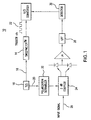
- Fig.1 is a system architecture diagram of a wavelength monitor device based on polarization-diverse heterodyne detection with a tunable laser in accordance with one embodiment of the present invention
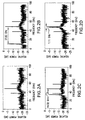
- Figs. 2A-2D are graphical representation of optical spectrum of RZ signals without interfering tone at different spacing in accordance with one embodiment of the present invention
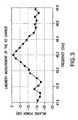
- Fig. 3 is a plot diagram of a line-width measurement of the RZ signal with 125 MHz electrical bandwidth
- Fig. 4 is a graph of differential accuracy of RZ signals without interfering tone at different spacing.
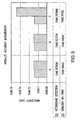
- Fig. 5 is a graph of absolute accuracy of RZ signals without interfering tone at different spacing.
- a system architecture 10 as shown in Fig. 1. It is preferably composed of two subsystems: the optical heterodyne setup using an external cavity tunable laser source (TLS) 16 as a local oscillator (LO) and the Sweepmeter TM 14 for wavelength calibration of the LO; and a detection subsystem.
- TLS external cavity tunable laser source
- LO local oscillator
- TM 14 the Sweepmeter
- tunable lasers scan linearly with absolute wavelength accuracy of only about 10 to 50 pm. More preferably, to achieve relatively higher accuracy, a Sweepmeter TM developed by Precision Photonics Corp. for real-time wavelength calibration is used.
- the Sweepmeter TM works by combining a periodic wavelength reference with a hydrogen cyanide (HCN) gas reference cell.
- the periodic wavelength reference produces a sequence of a digital clock, and one clock tick corresponds to about 0.4 pm wavelength increments.
- the clock tick can range from about 0.4 pm to about 50 pm.
- the HCN absorption spectrum which is insensitive to ambient temperature (only about 0.01 pm/°C temperature dependence), humidity and air pressure (not detectable), has about 0.5 pm absolute accuracy.
- tunable laser source (TLS) 16 entering the Sweepmeter TM 14 via path 18 is divided into two paths (not shown).
- a first optical path couples light into a periodic wavelength reference;
- a second optical path couples light into an NIST-traceable HCN gas reference cell, both contained within the Sweepmeter TM .
- the periodic wavelength reference produces a real-time clock pulse 22.
- the clock pulse 22 edges correspond to equally space optical frequency intervals that are used to trigger data acquisition in the detection circuit.
- two calibration numbers are provided from the Sweepmeter TM 14: 1) the optical frequency corresponding to the first output clock trigger, and 2) the optical frequency step size between clock outputs.
- the optical frequency axis of the measurement can thus be constructed with an accuracy of ⁇ 1 pm rms, a resolution up to 0.4 pm (50 MHz), and a scan-to-scan repeatability of ⁇ 0.2 pm rms.
- a tunable LO with 0.4 pm optical frequency steps is produced. As discussed above, these steps can be as much as between 0.4 pm and 50 pm.
- the TLS is mixed via path 20 in a typical 3 dB optical coupler 24 with an aggregate channel signal to be measured. If the TLS (LO) is tuned to a frequency such that the heterodyne beat tones between the TLS (LO) and the input signal 26 is within the detector bandwidth (determined by the LPF 28), the optical spectrum of the input signal 26 is translated to an IF frequency determined by the heterodyne beating tone.
- the intensity modulation of the input signal 26 and the shot noise also fall into the IF bandwidth, and is treated as intensity noise.
- an optimum performance is achieved by using a balanced detector 30 to cancel the intensity modulation of the input signal 26.
- the dominant noise is the shot noise from the local oscillator (LO).
- the SNR can also be improved.
- the smallest electrical bandwidth may be limited by half of the optical frequency step so that the beating signal is present in at least one data acquisition clock.
- a scheme for depolarizing TLS (LO) 16 using a polarization scrambler 32 is preferably used.
- This scrambler 32 is able to reduce DOP below 10% for a 200 KHz bandwidth, which is quite adequate for removing the unwanted effects associated with the polarization mismatch between the TLS 16 and the randomly polarized aggregate channel test signal.
- FIGs. 2A-2D where the measured optical spectrum of a RZ modulated signal using the heterodyne detection device and method of Fig. 1 is shown.
- Each optical spectrum represents a different condition.
- Fig. 2A represents an RZ signal that is modulated with 2 ⁇ 31 PRBS at an 11 Gb/s rate, and has a carrier-to-sideband ratio of about 7 dB.
- the remaining optical spectrums represent three additional conditions for testing wavelength accuracy by having neighboring CW tones at three different distances from the RZ signal.
- Fig. 2B shows a CW tone located at approximately 37.83 GHz
- Fig. 2C shows a CW tone located at approximately 14.02 GHz
- 2D shows a CW tone located at approximately 1.11 GHz, all from the center frequency of the RZ signal, respectively. In all three conditions, it is clear from the measured optical spectrums that the RZ signal is recoverable, despite the CW tones and their known effects of neighboring the RZ signal.
- An appropriate low-pass filter 28 (25-50 MHz) may be used.
- a New Focus O/E converter with a DC-125 MHz electrical bandwidth. While this non-optimal LPF reduces the wavelength measurement resolution, the interference tone is still spectrally resolved, appearing 1.11 GHz distance from the RZ carrier in Fig. 2(D).
- Fig. 3 shows an enlargement of the region around the RZ signal carrier. It illustrates the line-width broadening effect due to the insufficient resolution bandwidth.
- the measured line-width could be narrower if one uses a 50 MHz detector bandwidth. However, the center frequency of the RZ signal could still be estimated from the symmetric line shape of the measured data.
- the differential accuracy is defined as the error in measuring the optical frequency difference between two signals. Because the optical frequency difference between the carrier and the RF sidebands of an RZ signal equals the RF clock frequency, a convenient approach to measuring the differential accuracy involves measuring the carrier to side band frequency difference.
- Fig. 4 presents the measured differential accuracy obtained by evaluating the same RZ signal as in Fig. 3 in the presence of a CW interfering channel.
- Fig. 4 shows the measured differential accuracy obtained by comparing the measured optical frequency difference between the RF sidebands and carrier with the RF clock frequency.
- the clock frequency is about 11 GHz.
- the differential accuracy is about 0.1 GHz when the interfering CW tone is not present or is far away from the RZ signal (case A and B in Fig. 4).
- the measured wavelength of a test tone is compared to that obtained from a Burleigh WA-7600 wavelength meter.
- the Burleigh WA-7600 wavelength meter has a specified 0.3 pm absolute and differential accuracy, and a +/- 0.2 ppm repeatability and is assumed to be well calibrated.
- the Burleigh WA-7600 has similar specifications to other commercially available wavelength meters. In each case, corresponding to the experimental conditions of Fig. 2 (A) to Fig. 2(C), one would repeatedly measure 20 times the center wavelength of the RZ signal using either technique.
- Fig. 5 shows a comparison of the average values of 20 measurements for each case (corresponding to Fig. 2 (A) to Fig. 2(C)).
- the heterodyne detection method is substantially insensitive to the neighboring interfering channel while the Burleigh wavelength meter is extremely sensitive. This result may be explained by the fact that the Burleigh interferometric technique is not capable of resolving tones that are spaced closer than about 30 pm.
- the Burleigh absolute accuracy is compromised by the presence of nearby interfering tones.
- An accurate estimate of the absolute accuracy of the Burleigh may be obtained only by comparing the average values for case A and case B (corresponding to Fig. 2(A) to Fig. 2(B)) when tones are no closer than approximately 37 GHz. In these two cases, the Burleigh wavelength meter meets its design specification of 0.3 pm absolute accuracy.
- the difference between the average value obtained with the heterodyne detection method and the Burleigh wavelength meter (when comparing only cases A and B) is about 0.7 pm.
- the absolute accuracy of the heterodyne detection is about 1 pm on average.
- a wavelength monitor scheme based on heterodyne detection with a real-time externally calibrated tunable laser provides for more accurate monitoring of optical signals, especially where channel spacing is less than about 35 GHz.
- the method and apparatus combine the high wavelength resolution characteristics provided by heterodyne detection with the high wavelength accuracy provided by a real-time calibrated tunable laser (using a HCN gas reference cell).
- aspects of the present invention provide a wavelength resolution (assuming a LPF of about 50 MHz) that is substantially advantageous to most commercially available wavelength meters (3 GHz) while attaining 1 pm absolute accuracy. Another important advantage results from the technique's insensitivity to environmental factors, test channel polarization and spectral content. This technique may be useful for deployment in frequency control apparatus required for future upgrades in long haul undersea telecommunications network.
Landscapes
- Physics & Mathematics (AREA)
- Spectroscopy & Molecular Physics (AREA)
- Electromagnetism (AREA)
- Engineering & Computer Science (AREA)
- Computer Networks & Wireless Communication (AREA)
- Signal Processing (AREA)
- General Physics & Mathematics (AREA)
- Optical Communication System (AREA)
- Spectrometry And Color Measurement (AREA)
Applications Claiming Priority (2)
| Application Number | Priority Date | Filing Date | Title |
|---|---|---|---|
| US48257203P | 2003-06-25 | 2003-06-25 | |
| US482572 | 2003-06-25 |
Publications (3)
| Publication Number | Publication Date |
|---|---|
| EP1492255A2 EP1492255A2 (en) | 2004-12-29 |
| EP1492255A3 EP1492255A3 (en) | 2005-08-31 |
| EP1492255B1 true EP1492255B1 (en) | 2007-05-16 |
Family
ID=33539351
Family Applications (1)
| Application Number | Title | Priority Date | Filing Date |
|---|---|---|---|
| EP04253780A Expired - Lifetime EP1492255B1 (en) | 2003-06-25 | 2004-06-24 | Optical wavelength monitoring system |
Country Status (5)
| Country | Link |
|---|---|
| US (1) | US20040264981A1 (https=) |
| EP (1) | EP1492255B1 (https=) |
| JP (1) | JP2005017299A (https=) |
| CA (1) | CA2472408A1 (https=) |
| DE (1) | DE602004006468T2 (https=) |
Families Citing this family (7)
| Publication number | Priority date | Publication date | Assignee | Title |
|---|---|---|---|---|
| JP4608528B2 (ja) * | 2007-08-24 | 2011-01-12 | アンリツ株式会社 | 光スペクトルモニタ |
| US20110135301A1 (en) * | 2009-12-08 | 2011-06-09 | Vello Systems, Inc. | Wavelocker for Improving Laser Wavelength Accuracy in WDM Networks |
| US8805206B2 (en) * | 2010-09-29 | 2014-08-12 | Ciena Corporation | Single pin coherent receiver |
| JP5699769B2 (ja) * | 2011-04-13 | 2015-04-15 | 富士通株式会社 | 光チャンネルモニタおよび光伝送装置 |
| US9291505B2 (en) * | 2012-12-07 | 2016-03-22 | Baker Hughes Incorporated | Polarization scrambling in interferometer systems |
| CN105890779B (zh) * | 2016-06-07 | 2019-02-26 | 哈尔滨工业大学 | 一种用于波长扫描系统的实时波长标定装置及标定方法 |
| EP3879643A1 (en) | 2020-03-09 | 2021-09-15 | Thorlabs Quantum Electronics, Inc. | Tunable laser assembly and method of control |
Family Cites Families (9)
| Publication number | Priority date | Publication date | Assignee | Title |
|---|---|---|---|---|
| US4856899A (en) * | 1985-12-20 | 1989-08-15 | Yokogawa Electric Corporation | Optical frequency analyzer using a local oscillator heterodyne detection of incident light |
| US5838437A (en) * | 1997-04-09 | 1998-11-17 | Micron Optics, Inc. | Reference system for optical devices including optical scanners and spectrum analyzers |
| KR100295810B1 (ko) * | 1998-06-02 | 2001-10-26 | 서평원 | 파장분할다중방식광전송망채널감시시스템 |
| US6256103B1 (en) * | 2000-02-17 | 2001-07-03 | Agilent Technologies, Inc. | System and method for optical heterodyne detection of an optical signal |
| JP4270718B2 (ja) * | 2000-04-27 | 2009-06-03 | 株式会社アドバンテスト | 基準波長光発生装置 |
| US6614955B1 (en) * | 2000-08-22 | 2003-09-02 | Agilent Technologies, Inc. | Method and apparatus for an extended wavelength range coherent optical spectrum analyzer |
| US6671056B2 (en) * | 2001-01-11 | 2003-12-30 | Agilent Technologies, Inc | Method and system for optical spectrum analysis with a depolarized local oscillator signal |
| US6985234B2 (en) * | 2001-01-30 | 2006-01-10 | Thorlabs, Inc. | Swept wavelength meter |
| US6870629B1 (en) * | 2001-10-29 | 2005-03-22 | Precision Photonics Corporation | Optical frequency sweep control and readout by using a phase lock |
-
2004
- 2004-06-22 US US10/873,324 patent/US20040264981A1/en not_active Abandoned
- 2004-06-23 CA CA002472408A patent/CA2472408A1/en not_active Abandoned
- 2004-06-24 DE DE602004006468T patent/DE602004006468T2/de not_active Expired - Lifetime
- 2004-06-24 EP EP04253780A patent/EP1492255B1/en not_active Expired - Lifetime
- 2004-06-25 JP JP2004187532A patent/JP2005017299A/ja not_active Abandoned
Also Published As
| Publication number | Publication date |
|---|---|
| CA2472408A1 (en) | 2004-12-25 |
| JP2005017299A (ja) | 2005-01-20 |
| DE602004006468T2 (de) | 2008-01-17 |
| DE602004006468D1 (de) | 2007-06-28 |
| EP1492255A3 (en) | 2005-08-31 |
| EP1492255A2 (en) | 2004-12-29 |
| US20040264981A1 (en) | 2004-12-30 |
Similar Documents
| Publication | Publication Date | Title |
|---|---|---|
| Baney et al. | Coherent optical spectrum analyzer | |
| KR100342431B1 (ko) | 파장분할다중방식 광통신시스템을 위한 다파장 안정화방법및 장치 | |
| US20020154372A1 (en) | Power and optical frequency monitoring system and transmission system of frequency-modulated optical signal | |
| US20040208428A1 (en) | Wavelength-multiplexed narrow-bandwidth optical transmitter and wavelength-multiplexed vestigial-side-band optical transmitter | |
| US20150215043A1 (en) | Lasers Based On Optical Ring-Resonators | |
| US20030174743A1 (en) | Absolutely calibrated periodic filters and sources | |
| US10979167B2 (en) | Systems and method of multi-laser wavelength control | |
| EP1492255B1 (en) | Optical wavelength monitoring system | |
| US6853456B2 (en) | Method and apparatus for measuring a frequency of an optical signal | |
| US20020118459A1 (en) | Tunable filter system with backreflection reference | |
| US8761597B2 (en) | Monitoring node and reflector node of an optical communication network, optical communication network, and method for operating an optical communication network | |
| Lee et al. | Multichannel wavelength locking using transmission peaks of an AWG for multichannel optical transmission systems | |
| US7391970B2 (en) | Apparatus and method for monitoring optical signal-to-noise ratio | |
| US9935708B2 (en) | Coherent optical spectrum analyser for monitoring a spectrum of a fibre link | |
| US7595888B2 (en) | Full-band optical spectrum analyzer and method | |
| JP2010145387A (ja) | 光信号の消光比(er)モニター装置 | |
| Morozov et al. | Two-frequency reflectometric initialization of the upstream central wavelength in transport WDM-PON domain for 5G mobile radio access networks | |
| GB2412230A (en) | Laser calibration, monitoring and control | |
| CN116436515B (zh) | 一种多路光频域反射仪的检测方法及系统 | |
| KR100325685B1 (ko) | 광신호파장및광전력감시장치,감시방법및그기록매체 | |
| US7286757B1 (en) | Optical performance monitoring device | |
| Yang et al. | OSNR monitoring using double-pass filtering and dithered tunable reflector | |
| Wood et al. | Measurements of the effect of optical beat interference on the bit error rate of a subcarrier-based passive optical network | |
| Silva et al. | Fast channel hopping, zero frequency error source for high spectral efficiency, dynamic wavelength-routed optical networks | |
| Katagiri et al. | Optical-carrier-frequency detection using a synchroscan disk-shaped optical filter embedded in bidirectional fiber delay line for superdense WDM network systems |
Legal Events
| Date | Code | Title | Description |
|---|---|---|---|
| PUAI | Public reference made under article 153(3) epc to a published international application that has entered the european phase |
Free format text: ORIGINAL CODE: 0009012 |
|
| AK | Designated contracting states |
Kind code of ref document: A2 Designated state(s): AT BE BG CH CY CZ DE DK EE ES FI FR GB GR HU IE IT LI LU MC NL PL PT RO SE SI SK TR |
|
| AX | Request for extension of the european patent |
Extension state: AL HR LT LV MK |
|
| PUAL | Search report despatched |
Free format text: ORIGINAL CODE: 0009013 |
|
| AK | Designated contracting states |
Kind code of ref document: A3 Designated state(s): AT BE BG CH CY CZ DE DK EE ES FI FR GB GR HU IE IT LI LU MC NL PL PT RO SE SI SK TR |
|
| AX | Request for extension of the european patent |
Extension state: AL HR LT LV MK |
|
| 17P | Request for examination filed |
Effective date: 20060222 |
|
| AKX | Designation fees paid |
Designated state(s): DE FR GB IT |
|
| GRAP | Despatch of communication of intention to grant a patent |
Free format text: ORIGINAL CODE: EPIDOSNIGR1 |
|
| RTI1 | Title (correction) |
Free format text: OPTICAL WAVELENGTH MONITORING SYSTEM |
|
| GRAS | Grant fee paid |
Free format text: ORIGINAL CODE: EPIDOSNIGR3 |
|
| GRAA | (expected) grant |
Free format text: ORIGINAL CODE: 0009210 |
|
| AK | Designated contracting states |
Kind code of ref document: B1 Designated state(s): DE FR GB IT |
|
| REG | Reference to a national code |
Ref country code: GB Ref legal event code: FG4D |
|
| REF | Corresponds to: |
Ref document number: 602004006468 Country of ref document: DE Date of ref document: 20070628 Kind code of ref document: P |
|
| ET | Fr: translation filed | ||
| PLBE | No opposition filed within time limit |
Free format text: ORIGINAL CODE: 0009261 |
|
| STAA | Information on the status of an ep patent application or granted ep patent |
Free format text: STATUS: NO OPPOSITION FILED WITHIN TIME LIMIT |
|
| 26N | No opposition filed |
Effective date: 20080219 |
|
| REG | Reference to a national code |
Ref country code: FR Ref legal event code: CD |
|
| REG | Reference to a national code |
Ref country code: DE Ref legal event code: R082 Ref document number: 602004006468 Country of ref document: DE |
|
| REG | Reference to a national code |
Ref country code: DE Ref legal event code: R081 Ref document number: 602004006468 Country of ref document: DE Owner name: TYCO ELECTRONICS SUBSEA COMMUNICATIONS LLC, US Free format text: FORMER OWNER: TYCO TELECOMMUNICATIONS (US) INC., MORRISTOWN, US Effective date: 20110728 Ref country code: DE Ref legal event code: R081 Ref document number: 602004006468 Country of ref document: DE Owner name: TYCO ELECTRONICS SUBSEA COMMUNICATIONS LLC, MO, US Free format text: FORMER OWNER: TYCO TELECOMMUNICATIONS (US) INC., MORRISTOWN, N.J., US Effective date: 20110728 |
|
| PGFP | Annual fee paid to national office [announced via postgrant information from national office to epo] |
Ref country code: DE Payment date: 20120627 Year of fee payment: 9 |
|
| PGFP | Annual fee paid to national office [announced via postgrant information from national office to epo] |
Ref country code: FR Payment date: 20120705 Year of fee payment: 9 Ref country code: GB Payment date: 20120625 Year of fee payment: 9 |
|
| PGFP | Annual fee paid to national office [announced via postgrant information from national office to epo] |
Ref country code: IT Payment date: 20120621 Year of fee payment: 9 |
|
| REG | Reference to a national code |
Ref country code: DE Ref legal event code: R119 Ref document number: 602004006468 Country of ref document: DE |
|
| GBPC | Gb: european patent ceased through non-payment of renewal fee |
Effective date: 20130624 |
|
| REG | Reference to a national code |
Ref country code: FR Ref legal event code: ST Effective date: 20140228 |
|
| PG25 | Lapsed in a contracting state [announced via postgrant information from national office to epo] |
Ref country code: GB Free format text: LAPSE BECAUSE OF NON-PAYMENT OF DUE FEES Effective date: 20130624 Ref country code: DE Free format text: LAPSE BECAUSE OF NON-PAYMENT OF DUE FEES Effective date: 20140101 |
|
| PG25 | Lapsed in a contracting state [announced via postgrant information from national office to epo] |
Ref country code: FR Free format text: LAPSE BECAUSE OF NON-PAYMENT OF DUE FEES Effective date: 20130701 Ref country code: IT Free format text: LAPSE BECAUSE OF NON-PAYMENT OF DUE FEES Effective date: 20130624 |
|
| REG | Reference to a national code |
Ref country code: DE Ref legal event code: R079 Ref document number: 602004006468 Country of ref document: DE Free format text: PREVIOUS MAIN CLASS: H04B0010080000 Ipc: H04B0010070000 |
|
| REG | Reference to a national code |
Ref country code: DE Ref legal event code: R119 Ref document number: 602004006468 Country of ref document: DE Effective date: 20140101 Ref country code: DE Ref legal event code: R079 Ref document number: 602004006468 Country of ref document: DE Free format text: PREVIOUS MAIN CLASS: H04B0010080000 Ipc: H04B0010070000 Effective date: 20140610 |