EP1482079B1 - Textiler Faden, Flächengebilde und Körpergebilde hieraus - Google Patents
Textiler Faden, Flächengebilde und Körpergebilde hieraus Download PDFInfo
- Publication number
- EP1482079B1 EP1482079B1 EP04011864A EP04011864A EP1482079B1 EP 1482079 B1 EP1482079 B1 EP 1482079B1 EP 04011864 A EP04011864 A EP 04011864A EP 04011864 A EP04011864 A EP 04011864A EP 1482079 B1 EP1482079 B1 EP 1482079B1
- Authority
- EP
- European Patent Office
- Prior art keywords
- textile
- yarn
- yarns
- multifilament
- core
- Prior art date
- Legal status (The legal status is an assumption and is not a legal conclusion. Google has not performed a legal analysis and makes no representation as to the accuracy of the status listed.)
- Expired - Lifetime
Links
- 239000004753 textile Substances 0.000 title claims description 106
- 239000004744 fabric Substances 0.000 title description 55
- 229920001971 elastomer Polymers 0.000 claims description 34
- 239000000806 elastomer Substances 0.000 claims description 19
- 229920002994 synthetic fiber Polymers 0.000 claims description 19
- 239000005060 rubber Substances 0.000 claims description 15
- 229920002725 thermoplastic elastomer Polymers 0.000 claims description 15
- 229920000728 polyester Polymers 0.000 claims description 13
- 239000004952 Polyamide Substances 0.000 claims description 7
- 229920002647 polyamide Polymers 0.000 claims description 7
- 238000009940 knitting Methods 0.000 claims description 6
- 238000004073 vulcanization Methods 0.000 claims description 6
- 229920003235 aromatic polyamide Polymers 0.000 claims description 5
- 125000003118 aryl group Chemical group 0.000 claims description 5
- 239000004831 Hot glue Substances 0.000 claims description 4
- KKEYFWRCBNTPAC-UHFFFAOYSA-N Terephthalic acid Chemical compound OC(=O)C1=CC=C(C(O)=O)C=C1 KKEYFWRCBNTPAC-UHFFFAOYSA-N 0.000 claims description 4
- 229920001577 copolymer Polymers 0.000 claims description 4
- 229920001634 Copolyester Polymers 0.000 claims description 3
- 239000004642 Polyimide Substances 0.000 claims description 3
- 239000004760 aramid Substances 0.000 claims description 3
- 229920002313 fluoropolymer Polymers 0.000 claims description 3
- 239000004811 fluoropolymer Substances 0.000 claims description 3
- 239000012528 membrane Substances 0.000 claims description 3
- 229920001721 polyimide Polymers 0.000 claims description 3
- RNFJDJUURJAICM-UHFFFAOYSA-N 2,2,4,4,6,6-hexaphenoxy-1,3,5-triaza-2$l^{5},4$l^{5},6$l^{5}-triphosphacyclohexa-1,3,5-triene Chemical compound N=1P(OC=2C=CC=CC=2)(OC=2C=CC=CC=2)=NP(OC=2C=CC=CC=2)(OC=2C=CC=CC=2)=NP=1(OC=1C=CC=CC=1)OC1=CC=CC=C1 RNFJDJUURJAICM-UHFFFAOYSA-N 0.000 claims description 2
- JOYRKODLDBILNP-UHFFFAOYSA-N Ethyl urethane Chemical compound CCOC(N)=O JOYRKODLDBILNP-UHFFFAOYSA-N 0.000 claims description 2
- 239000003063 flame retardant Substances 0.000 claims description 2
- 229920001230 polyarylate Polymers 0.000 claims description 2
- 229920006260 polyaryletherketone Polymers 0.000 claims description 2
- 229920001021 polysulfide Polymers 0.000 claims description 2
- 238000009941 weaving Methods 0.000 claims description 2
- 239000000758 substrate Substances 0.000 claims 15
- 229920005989 resin Polymers 0.000 claims 3
- 239000011347 resin Substances 0.000 claims 3
- 230000001747 exhibiting effect Effects 0.000 claims 1
- 239000012757 flame retardant agent Substances 0.000 claims 1
- 125000001174 sulfone group Chemical group 0.000 claims 1
- 229920003002 synthetic resin Polymers 0.000 claims 1
- 239000000057 synthetic resin Substances 0.000 claims 1
- 239000012209 synthetic fiber Substances 0.000 description 17
- -1 ether diols Chemical class 0.000 description 6
- 239000002131 composite material Substances 0.000 description 5
- 238000004804 winding Methods 0.000 description 5
- 239000004721 Polyphenylene oxide Substances 0.000 description 4
- 239000011248 coating agent Substances 0.000 description 4
- 238000000576 coating method Methods 0.000 description 4
- 239000000463 material Substances 0.000 description 4
- 229920000570 polyether Polymers 0.000 description 4
- 229920002334 Spandex Polymers 0.000 description 3
- 229920001400 block copolymer Polymers 0.000 description 3
- 238000004519 manufacturing process Methods 0.000 description 3
- WRDNCFQZLUCIRH-UHFFFAOYSA-N 4-(7-azabicyclo[2.2.1]hepta-1,3,5-triene-7-carbonyl)benzamide Chemical compound C1=CC(C(=O)N)=CC=C1C(=O)N1C2=CC=C1C=C2 WRDNCFQZLUCIRH-UHFFFAOYSA-N 0.000 description 2
- 239000004677 Nylon Substances 0.000 description 2
- 239000004433 Thermoplastic polyurethane Substances 0.000 description 2
- 230000004913 activation Effects 0.000 description 2
- 230000000844 anti-bacterial effect Effects 0.000 description 2
- 150000002148 esters Chemical class 0.000 description 2
- 239000000155 melt Substances 0.000 description 2
- 229920001778 nylon Polymers 0.000 description 2
- 229920001084 poly(chloroprene) Polymers 0.000 description 2
- 238000007493 shaping process Methods 0.000 description 2
- 239000004759 spandex Substances 0.000 description 2
- 230000035882 stress Effects 0.000 description 2
- YCGKJPVUGMBDDS-UHFFFAOYSA-N 3-(6-azabicyclo[3.1.1]hepta-1(7),2,4-triene-6-carbonyl)benzamide Chemical compound NC(=O)C1=CC=CC(C(=O)N2C=3C=C2C=CC=3)=C1 YCGKJPVUGMBDDS-UHFFFAOYSA-N 0.000 description 1
- 229920002284 Cellulose triacetate Polymers 0.000 description 1
- 229920000459 Nitrile rubber Polymers 0.000 description 1
- 229920002292 Nylon 6 Polymers 0.000 description 1
- 229920000305 Nylon 6,10 Polymers 0.000 description 1
- 229920002302 Nylon 6,6 Polymers 0.000 description 1
- 239000004962 Polyamide-imide Substances 0.000 description 1
- 239000004693 Polybenzimidazole Substances 0.000 description 1
- 239000004697 Polyetherimide Substances 0.000 description 1
- 239000004734 Polyphenylene sulfide Substances 0.000 description 1
- 229920006121 Polyxylylene adipamide Polymers 0.000 description 1
- 229920006311 Urethane elastomer Polymers 0.000 description 1
- NNLVGZFZQQXQNW-ADJNRHBOSA-N [(2r,3r,4s,5r,6s)-4,5-diacetyloxy-3-[(2s,3r,4s,5r,6r)-3,4,5-triacetyloxy-6-(acetyloxymethyl)oxan-2-yl]oxy-6-[(2r,3r,4s,5r,6s)-4,5,6-triacetyloxy-2-(acetyloxymethyl)oxan-3-yl]oxyoxan-2-yl]methyl acetate Chemical compound O([C@@H]1O[C@@H]([C@H]([C@H](OC(C)=O)[C@H]1OC(C)=O)O[C@H]1[C@@H]([C@@H](OC(C)=O)[C@H](OC(C)=O)[C@@H](COC(C)=O)O1)OC(C)=O)COC(=O)C)[C@@H]1[C@@H](COC(C)=O)O[C@@H](OC(C)=O)[C@H](OC(C)=O)[C@H]1OC(C)=O NNLVGZFZQQXQNW-ADJNRHBOSA-N 0.000 description 1
- 239000000853 adhesive Substances 0.000 description 1
- 230000015572 biosynthetic process Effects 0.000 description 1
- 230000037237 body shape Effects 0.000 description 1
- 239000000470 constituent Substances 0.000 description 1
- 229920006147 copolyamide elastomer Polymers 0.000 description 1
- 229920006236 copolyester elastomer Polymers 0.000 description 1
- 238000004132 cross linking Methods 0.000 description 1
- 230000007423 decrease Effects 0.000 description 1
- 230000003247 decreasing effect Effects 0.000 description 1
- 230000001419 dependent effect Effects 0.000 description 1
- 238000011161 development Methods 0.000 description 1
- 230000018109 developmental process Effects 0.000 description 1
- 150000002009 diols Chemical class 0.000 description 1
- 238000006073 displacement reaction Methods 0.000 description 1
- RTZKZFJDLAIYFH-UHFFFAOYSA-N ether Substances CCOCC RTZKZFJDLAIYFH-UHFFFAOYSA-N 0.000 description 1
- 229920000840 ethylene tetrafluoroethylene copolymer Polymers 0.000 description 1
- 229920001973 fluoroelastomer Polymers 0.000 description 1
- 229920001519 homopolymer Polymers 0.000 description 1
- 230000002427 irreversible effect Effects 0.000 description 1
- 230000007774 longterm Effects 0.000 description 1
- 230000008018 melting Effects 0.000 description 1
- 238000002844 melting Methods 0.000 description 1
- 229920003052 natural elastomer Polymers 0.000 description 1
- 229920001194 natural rubber Polymers 0.000 description 1
- 238000004806 packaging method and process Methods 0.000 description 1
- 229920003023 plastic Polymers 0.000 description 1
- 239000004033 plastic Substances 0.000 description 1
- 229920002493 poly(chlorotrifluoroethylene) Polymers 0.000 description 1
- 229920003055 poly(ester-imide) Polymers 0.000 description 1
- 229920001281 polyalkylene Polymers 0.000 description 1
- 229920002312 polyamide-imide Polymers 0.000 description 1
- 229920002480 polybenzimidazole Polymers 0.000 description 1
- 239000005023 polychlorotrifluoroethylene (PCTFE) polymer Substances 0.000 description 1
- 229920001601 polyetherimide Polymers 0.000 description 1
- 229920000069 polyphenylene sulfide Polymers 0.000 description 1
- 239000005077 polysulfide Substances 0.000 description 1
- 150000008117 polysulfides Polymers 0.000 description 1
- 229920001343 polytetrafluoroethylene Polymers 0.000 description 1
- 239000004810 polytetrafluoroethylene Substances 0.000 description 1
- 229920002635 polyurethane Polymers 0.000 description 1
- 239000004814 polyurethane Substances 0.000 description 1
- 229920003225 polyurethane elastomer Polymers 0.000 description 1
- 239000000047 product Substances 0.000 description 1
- 229920002379 silicone rubber Polymers 0.000 description 1
- 239000004945 silicone rubber Substances 0.000 description 1
- 239000012265 solid product Substances 0.000 description 1
- 239000000126 substance Substances 0.000 description 1
- 150000003457 sulfones Chemical class 0.000 description 1
- 229920003051 synthetic elastomer Polymers 0.000 description 1
- 239000005061 synthetic rubber Substances 0.000 description 1
- 230000008646 thermal stress Effects 0.000 description 1
- 229920001169 thermoplastic Polymers 0.000 description 1
- 229920001187 thermosetting polymer Polymers 0.000 description 1
- 239000004416 thermosoftening plastic Substances 0.000 description 1
Images
Classifications
-
- B—PERFORMING OPERATIONS; TRANSPORTING
- B32—LAYERED PRODUCTS
- B32B—LAYERED PRODUCTS, i.e. PRODUCTS BUILT-UP OF STRATA OF FLAT OR NON-FLAT, e.g. CELLULAR OR HONEYCOMB, FORM
- B32B27/00—Layered products comprising a layer of synthetic resin
- B32B27/12—Layered products comprising a layer of synthetic resin next to a fibrous or filamentary layer
-
- D—TEXTILES; PAPER
- D03—WEAVING
- D03D—WOVEN FABRICS; METHODS OF WEAVING; LOOMS
- D03D15/00—Woven fabrics characterised by the material, structure or properties of the fibres, filaments, yarns, threads or other warp or weft elements used
- D03D15/20—Woven fabrics characterised by the material, structure or properties of the fibres, filaments, yarns, threads or other warp or weft elements used characterised by the material of the fibres or filaments constituting the yarns or threads
- D03D15/283—Woven fabrics characterised by the material, structure or properties of the fibres, filaments, yarns, threads or other warp or weft elements used characterised by the material of the fibres or filaments constituting the yarns or threads synthetic polymer-based, e.g. polyamide or polyester fibres
-
- B—PERFORMING OPERATIONS; TRANSPORTING
- B61—RAILWAYS
- B61D—BODY DETAILS OR KINDS OF RAILWAY VEHICLES
- B61D17/00—Construction details of vehicle bodies
- B61D17/04—Construction details of vehicle bodies with bodies of metal; with composite, e.g. metal and wood body structures
- B61D17/20—Communication passages between coaches; Adaptation of coach ends therefor
- B61D17/22—Communication passages between coaches; Adaptation of coach ends therefor flexible, e.g. bellows
-
- D—TEXTILES; PAPER
- D02—YARNS; MECHANICAL FINISHING OF YARNS OR ROPES; WARPING OR BEAMING
- D02G—CRIMPING OR CURLING FIBRES, FILAMENTS, THREADS, OR YARNS; YARNS OR THREADS
- D02G3/00—Yarns or threads, e.g. fancy yarns; Processes or apparatus for the production thereof, not otherwise provided for
- D02G3/22—Yarns or threads characterised by constructional features, e.g. blending, filament/fibre
- D02G3/32—Elastic yarns or threads ; Production of plied or cored yarns, one of which is elastic
- D02G3/328—Elastic yarns or threads ; Production of plied or cored yarns, one of which is elastic containing elastane
-
- D—TEXTILES; PAPER
- D03—WEAVING
- D03D—WOVEN FABRICS; METHODS OF WEAVING; LOOMS
- D03D15/00—Woven fabrics characterised by the material, structure or properties of the fibres, filaments, yarns, threads or other warp or weft elements used
- D03D15/40—Woven fabrics characterised by the material, structure or properties of the fibres, filaments, yarns, threads or other warp or weft elements used characterised by the structure of the yarns or threads
- D03D15/47—Woven fabrics characterised by the material, structure or properties of the fibres, filaments, yarns, threads or other warp or weft elements used characterised by the structure of the yarns or threads multicomponent, e.g. blended yarns or threads
-
- D—TEXTILES; PAPER
- D03—WEAVING
- D03D—WOVEN FABRICS; METHODS OF WEAVING; LOOMS
- D03D15/00—Woven fabrics characterised by the material, structure or properties of the fibres, filaments, yarns, threads or other warp or weft elements used
- D03D15/50—Woven fabrics characterised by the material, structure or properties of the fibres, filaments, yarns, threads or other warp or weft elements used characterised by the properties of the yarns or threads
- D03D15/513—Woven fabrics characterised by the material, structure or properties of the fibres, filaments, yarns, threads or other warp or weft elements used characterised by the properties of the yarns or threads heat-resistant or fireproof
-
- D—TEXTILES; PAPER
- D03—WEAVING
- D03D—WOVEN FABRICS; METHODS OF WEAVING; LOOMS
- D03D15/00—Woven fabrics characterised by the material, structure or properties of the fibres, filaments, yarns, threads or other warp or weft elements used
- D03D15/50—Woven fabrics characterised by the material, structure or properties of the fibres, filaments, yarns, threads or other warp or weft elements used characterised by the properties of the yarns or threads
- D03D15/56—Woven fabrics characterised by the material, structure or properties of the fibres, filaments, yarns, threads or other warp or weft elements used characterised by the properties of the yarns or threads elastic
-
- D—TEXTILES; PAPER
- D03—WEAVING
- D03D—WOVEN FABRICS; METHODS OF WEAVING; LOOMS
- D03D15/00—Woven fabrics characterised by the material, structure or properties of the fibres, filaments, yarns, threads or other warp or weft elements used
- D03D15/50—Woven fabrics characterised by the material, structure or properties of the fibres, filaments, yarns, threads or other warp or weft elements used characterised by the properties of the yarns or threads
- D03D15/573—Tensile strength
-
- D—TEXTILES; PAPER
- D04—BRAIDING; LACE-MAKING; KNITTING; TRIMMINGS; NON-WOVEN FABRICS
- D04B—KNITTING
- D04B1/00—Weft knitting processes for the production of fabrics or articles not dependent on the use of particular machines; Fabrics or articles defined by such processes
- D04B1/14—Other fabrics or articles characterised primarily by the use of particular thread materials
- D04B1/18—Other fabrics or articles characterised primarily by the use of particular thread materials elastic threads
-
- D—TEXTILES; PAPER
- D04—BRAIDING; LACE-MAKING; KNITTING; TRIMMINGS; NON-WOVEN FABRICS
- D04B—KNITTING
- D04B21/00—Warp knitting processes for the production of fabrics or articles not dependent on the use of particular machines; Fabrics or articles defined by such processes
- D04B21/14—Fabrics characterised by the incorporation by knitting, in one or more thread, fleece, or fabric layers, of reinforcing, binding, or decorative threads; Fabrics incorporating small auxiliary elements, e.g. for decorative purposes
- D04B21/18—Fabrics characterised by the incorporation by knitting, in one or more thread, fleece, or fabric layers, of reinforcing, binding, or decorative threads; Fabrics incorporating small auxiliary elements, e.g. for decorative purposes incorporating elastic threads
-
- D—TEXTILES; PAPER
- D06—TREATMENT OF TEXTILES OR THE LIKE; LAUNDERING; FLEXIBLE MATERIALS NOT OTHERWISE PROVIDED FOR
- D06N—WALL, FLOOR, OR LIKE COVERING MATERIALS, e.g. LINOLEUM, OILCLOTH, ARTIFICIAL LEATHER, ROOFING FELT, CONSISTING OF A FIBROUS WEB COATED WITH A LAYER OF MACROMOLECULAR MATERIAL; FLEXIBLE SHEET MATERIAL NOT OTHERWISE PROVIDED FOR
- D06N3/00—Artificial leather, oilcloth or other material obtained by covering fibrous webs with macromolecular material, e.g. resins, rubber or derivatives thereof
- D06N3/0002—Artificial leather, oilcloth or other material obtained by covering fibrous webs with macromolecular material, e.g. resins, rubber or derivatives thereof characterised by the substrate
- D06N3/0015—Artificial leather, oilcloth or other material obtained by covering fibrous webs with macromolecular material, e.g. resins, rubber or derivatives thereof characterised by the substrate using fibres of specified chemical or physical nature, e.g. natural silk
- D06N3/0025—Rubber threads; Elastomeric fibres; Stretchable, bulked or crimped fibres; Retractable, crimpable fibres; Shrinking or stretching of fibres during manufacture; Obliquely threaded fabrics
- D06N3/0027—Rubber or elastomeric fibres
-
- D—TEXTILES; PAPER
- D06—TREATMENT OF TEXTILES OR THE LIKE; LAUNDERING; FLEXIBLE MATERIALS NOT OTHERWISE PROVIDED FOR
- D06N—WALL, FLOOR, OR LIKE COVERING MATERIALS, e.g. LINOLEUM, OILCLOTH, ARTIFICIAL LEATHER, ROOFING FELT, CONSISTING OF A FIBROUS WEB COATED WITH A LAYER OF MACROMOLECULAR MATERIAL; FLEXIBLE SHEET MATERIAL NOT OTHERWISE PROVIDED FOR
- D06N3/00—Artificial leather, oilcloth or other material obtained by covering fibrous webs with macromolecular material, e.g. resins, rubber or derivatives thereof
- D06N3/04—Artificial leather, oilcloth or other material obtained by covering fibrous webs with macromolecular material, e.g. resins, rubber or derivatives thereof with macromolecular compounds obtained by reactions only involving carbon-to-carbon unsaturated bonds
- D06N3/10—Artificial leather, oilcloth or other material obtained by covering fibrous webs with macromolecular material, e.g. resins, rubber or derivatives thereof with macromolecular compounds obtained by reactions only involving carbon-to-carbon unsaturated bonds with styrene-butadiene copolymerisation products or other synthetic rubbers or elastomers except polyurethanes
-
- D—TEXTILES; PAPER
- D06—TREATMENT OF TEXTILES OR THE LIKE; LAUNDERING; FLEXIBLE MATERIALS NOT OTHERWISE PROVIDED FOR
- D06N—WALL, FLOOR, OR LIKE COVERING MATERIALS, e.g. LINOLEUM, OILCLOTH, ARTIFICIAL LEATHER, ROOFING FELT, CONSISTING OF A FIBROUS WEB COATED WITH A LAYER OF MACROMOLECULAR MATERIAL; FLEXIBLE SHEET MATERIAL NOT OTHERWISE PROVIDED FOR
- D06N2201/00—Chemical constitution of the fibres, threads or yarns
- D06N2201/10—Conjugate fibres, e.g. core-sheath, side-by-side
-
- D—TEXTILES; PAPER
- D06—TREATMENT OF TEXTILES OR THE LIKE; LAUNDERING; FLEXIBLE MATERIALS NOT OTHERWISE PROVIDED FOR
- D06N—WALL, FLOOR, OR LIKE COVERING MATERIALS, e.g. LINOLEUM, OILCLOTH, ARTIFICIAL LEATHER, ROOFING FELT, CONSISTING OF A FIBROUS WEB COATED WITH A LAYER OF MACROMOLECULAR MATERIAL; FLEXIBLE SHEET MATERIAL NOT OTHERWISE PROVIDED FOR
- D06N2205/00—Condition, form or state of the materials
- D06N2205/20—Cured materials, e.g. vulcanised, cross-linked
-
- D—TEXTILES; PAPER
- D06—TREATMENT OF TEXTILES OR THE LIKE; LAUNDERING; FLEXIBLE MATERIALS NOT OTHERWISE PROVIDED FOR
- D06N—WALL, FLOOR, OR LIKE COVERING MATERIALS, e.g. LINOLEUM, OILCLOTH, ARTIFICIAL LEATHER, ROOFING FELT, CONSISTING OF A FIBROUS WEB COATED WITH A LAYER OF MACROMOLECULAR MATERIAL; FLEXIBLE SHEET MATERIAL NOT OTHERWISE PROVIDED FOR
- D06N2209/00—Properties of the materials
- D06N2209/10—Properties of the materials having mechanical properties
- D06N2209/103—Resistant to mechanical forces, e.g. shock, impact, puncture, flexion, shear, compression, tear
-
- D—TEXTILES; PAPER
- D10—INDEXING SCHEME ASSOCIATED WITH SUBLASSES OF SECTION D, RELATING TO TEXTILES
- D10B—INDEXING SCHEME ASSOCIATED WITH SUBLASSES OF SECTION D, RELATING TO TEXTILES
- D10B2331/00—Fibres made from polymers obtained otherwise than by reactions only involving carbon-to-carbon unsaturated bonds, e.g. polycondensation products
- D10B2331/02—Fibres made from polymers obtained otherwise than by reactions only involving carbon-to-carbon unsaturated bonds, e.g. polycondensation products polyamides
-
- D—TEXTILES; PAPER
- D10—INDEXING SCHEME ASSOCIATED WITH SUBLASSES OF SECTION D, RELATING TO TEXTILES
- D10B—INDEXING SCHEME ASSOCIATED WITH SUBLASSES OF SECTION D, RELATING TO TEXTILES
- D10B2331/00—Fibres made from polymers obtained otherwise than by reactions only involving carbon-to-carbon unsaturated bonds, e.g. polycondensation products
- D10B2331/04—Fibres made from polymers obtained otherwise than by reactions only involving carbon-to-carbon unsaturated bonds, e.g. polycondensation products polyesters, e.g. polyethylene terephthalate [PET]
-
- D—TEXTILES; PAPER
- D10—INDEXING SCHEME ASSOCIATED WITH SUBLASSES OF SECTION D, RELATING TO TEXTILES
- D10B—INDEXING SCHEME ASSOCIATED WITH SUBLASSES OF SECTION D, RELATING TO TEXTILES
- D10B2401/00—Physical properties
- D10B2401/04—Heat-responsive characteristics
- D10B2401/041—Heat-responsive characteristics thermoplastic; thermosetting
-
- D—TEXTILES; PAPER
- D10—INDEXING SCHEME ASSOCIATED WITH SUBLASSES OF SECTION D, RELATING TO TEXTILES
- D10B—INDEXING SCHEME ASSOCIATED WITH SUBLASSES OF SECTION D, RELATING TO TEXTILES
- D10B2401/00—Physical properties
- D10B2401/06—Load-responsive characteristics
- D10B2401/061—Load-responsive characteristics elastic
-
- D—TEXTILES; PAPER
- D10—INDEXING SCHEME ASSOCIATED WITH SUBLASSES OF SECTION D, RELATING TO TEXTILES
- D10B—INDEXING SCHEME ASSOCIATED WITH SUBLASSES OF SECTION D, RELATING TO TEXTILES
- D10B2401/00—Physical properties
- D10B2401/06—Load-responsive characteristics
- D10B2401/063—Load-responsive characteristics high strength
-
- D—TEXTILES; PAPER
- D10—INDEXING SCHEME ASSOCIATED WITH SUBLASSES OF SECTION D, RELATING TO TEXTILES
- D10B—INDEXING SCHEME ASSOCIATED WITH SUBLASSES OF SECTION D, RELATING TO TEXTILES
- D10B2505/00—Industrial
Definitions
- the invention relates to a textile thread with a soul and surrounding the soul multifilament yarns, textile fabrics thereof and their application, for example, for a bellows.
- core yarns or stretch-core yarns are described with one of two yarns of a different material cross-wrapped and stretched elastic core, such as elastane core or Lycra soul, which are mainly highly elastic and for knits, as fine hosiery are suitable.
- an antibacterial knitting yarn is known with a core thread surrounded by one or more antibacterial threads to which cover threads are applied.
- a yarn is known in which a Lycra or nylon thread is wound around at least one cellulose triacetate thread.
- An elastic heat-adhesive thread which comprises an elastic core, which is wound with at least one further thread, which at least partially carries a heat sealable substance, and is suitable for use in diapers.
- an elastic twine in which a core of elastic unstretched polyamide crimped crepe yarns is wrapped by normal stretch yarns or yarns.
- JP 2003-079411 AA is a soft pliable and elastic cord described with a soul of elastic yarns and a sheath of elastic yarns.
- JP 2001-214340 AA For example, there is described a twisted yarn for use in a car seat upholstery fabric in which a polyester resilient core of low melting point yarns, such as nylon, is wound.
- the invention proposes a textile thread with a core and multifilament yarns surrounding the core, which has high-strength multifilament yarns of organic synthetic fibers with a tenacity of at least 3 cN / dtex and an elongation at break of less than 22% to form a textile thread with a tensile strength corresponding to the tear strength of the multifilament yarn, in which to increase the extensibility of the textile thread while maintaining the strength thereof, a rubber elastic core of a monofilament of a thermoplastic elastomer is provided with an elongation at break of at least 35%, which of at least one of Multifilamentgarne in S-direction and / or Z-direction is twisted.
- the wrapping length of the multifilament yarn is longer than the length of the core, so that the soul can be stretched, with reduced diameter of the soul give the wound multifilament yarns and an additional elongation of the textile thread is possible and thus lying above the elongation at break of the multifilament yarns stretching of the textile Thread is made possible, and the stress of the textile thread in terms of elongation at break is only at increased elongation.
- the extensibility of the textile thread becomes greater, the greater the diameter of the rubber-elastic core, ie the monofilament, and the length of the multifilament yarn wound around the core is also increased accordingly.
- the larger the diameter of the core the greater the winding length of the multifilament yarn and the higher the extensibility of the textile thread is the consequence and thus also an increased extensibility of a fabric made of such textile threads fabric.
- a rubber-elastic soul is preferably a monofilament having a diameter of at least 0.15 mm, which may be up to 1.0 mm or more.
- a preferred range is 0.2 - 0.5 mm.
- a rubber-elastic core is preferably a monofilament of a thermoplastic elastomer having an elongation at break of at least 50%.
- thermoplastic elastomers are those based on polyamide (TPA) or copolyester (TPC) or urethane (TPU).
- the polyamide elastomers are block copolymers with rigid polyamide blocks and soft polyether and / or polyester blocks.
- the copolyester-based thermoplastic elastomers are block copolymers of soft segments of polyalkylene ether diols and / or long-chain aliphatic dicarboxylic acid esters with partially crystalline PBT segments. These include, for example, polyether esters.
- the polyurethane elastomers are block copolymers and are formed by polyaddition of long-chain diols with aliphatic diisocyanates.
- thermoplastic elastomers are preferred for the rubber-elastic soul whose short-term service temperature is at least about 145 ° C.
- Inventive textile threads which have such a rubber-elastic core, can be used for the production of textile fabrics, which are exposed in a subsequent assembly and processing briefly higher temperatures, such as in the vulcanization or shaping.
- thermoplastic elastomers known as hot-melt adhesives, which are solvent-free solid products which are in the form of extruded monofilaments for the application of the invention and which have an activation temperature of at least about 70 ° C have.
- Suitable hotmelt adhesives for the invention for forming the rubber-elastic core are the TPC as polyester elastomer with a heat resistance of 55-115 ° C., the TPA as copolyamide elastomer with a heat resistance of 100-120 ° C. and the TPU as polyurethane. Elastomer with a heat resistance of 65 - 110 ° C.
- the multifilament yarns characterizing the textile thread are preferably used with a tenacity of at least 4.5 cN / dtex.
- the Umzwirnung is preferably made with 100 - 400 tours / m.
- multifilament yarns having an elongation at break of less than or equal to 20% are preferably used.
- the multifilament yarns are preferably provided with high thermal stability and heat resistance at a short-term service temperature of at least about 160 ° C, preferably 170 ° C or more, especially if the fabric to be produced from the textile threads in the subsequent processing and packaging higher temperatures, such as shaping temperatures or vulcanization temperatures during hot vulcanization are briefly exposed.
- the diameter of the elastomeric core, the Umzwirnung it with multifilament yarn in terms of the number of turns and the thickness of the multifilament yarn are preferably matched to each other, it being advantageous to use multifilament yarns of 250 - 1100 dtex.
- the multifilament yarns are composed of filaments having a fineness of less than 10 ⁇ , wherein, for example, a multifilament yarn of 550 dtex comprises about 85-90 filaments of a fineness of 6 ⁇ .
- multifilament yarns of high-strength and very temperature-resistant synthetic fibers with a high fineness of tenacity and elongation at break below 22%, in particular polyesters of terephthalic acid (polyterephthalates) with an elongation at break preferably of about 8-20% and a tenacity of about 4 - 9.5 cN / dtex, with the high-strength filaments a short-term service temperature up to 180 ° C is allowed.
- preferred high strength synthetic fibers are selectable from the polyamides, especially polyamide 6, polyamide 66, polyamide 610 and polyamide MXD6 having an elongation at break of about 15-20%, a tenacity of about 4-9 cN / dtex and a short term service temperature of up to 180 ° C or more.
- Another group of high-strength synthetic fibers are those of wholly aromatic polyamides - aramids - such as poly-m-phenylene isophthalamide and poly-p-phenylene terephthalamide with elongations at break of about 2 - 22%, preferably about 2 - 6%, tenacity of about 4 - 20 cN / dtex and a short-term service temperature of up to 300 ° C.
- aromatic polysulfides and sulfones such as polyarylsulfones, polyphenylene sulfide, polyaryletherketones, aromatic polyimides such as polyimide, polybenzimidazole, polyamideimide, polyetherimide, polyesterimide , Polyarylimide can be used.
- those based on fluoropolymers can also be used, such as, for example, the fluoro-homopolymers polytetrafluoroethylene and polychlorotrifluoroethylene and of the fluoro-copolymers ethylene-tetrafluoroethylene copolymer, polyfluoroethylene-propylene.
- fluoropolymers polytetrafluoroethylene and polychlorotrifluoroethylene and of the fluoro-copolymers ethylene-tetrafluoroethylene copolymer, polyfluoroethylene-propylene.
- their flame retardancy such as wholly aromatic polyamides or fluoropolymers, is crucial for the selection of high-strength synthetic fibers.
- the enumeration of the synthetic fibers is not exhaustive, but exemplary.
- a preferred embodiment of a textile thread according to the invention is characterized in that it comprises a rubber-elastic core of a monofilament with a diameter of 0.22-0.4 mm made of a thermoplastic Elastomer with an elongation at break of at least 50% and a high-strength multifilament yarn of 250-1,100 dtex surrounding the core with 200-400 turns / m in the Z-direction and / or S-direction with an elongation at break of not more than 20% and a tenacity of has at least about 5 cN / dtex and a short-term service temperature of at least 160 ° C and the elongation at break of the textile thread against the elongation at break of the multifilament yarn used and thus the extensibility increased by at least 20%, preferably at least 50%.
- the inventively matched parameters of both the elastomeric core and the high strength supplying multifilament yarns and their combination with the textile yarn allow to obtain the high strength of the multifilament yarn and at the same time substantially increase the low extensibility thereof by the rubber elastic core.
- To increase the extensibility is essential that the rubber-elastic soul can stretch, thereby reducing their diameter and yield through the wound around the soul multifilament yarns due to their winding length and thus allow the increased extensibility of the yarn while maintaining the tear strength.
- Such a sheet according to the invention also has a substantially increased elongation compared to fabrics consisting only of the analogous multifilament yarns.
- the combination of the materials for the multifilament yarn and the rubber-elastic core also depend on the textile fabrics to be produced therefrom and their further use. Price factors also play a role here. In many cases, textile fabrics based on polyester filaments are desired and in use. These have a high tensile strength at relatively low elongation.
- Polyestergewirke, Polyestergelege - the embodiment of a textile thread according to the invention is proposed, which is a rubber elastic soul of a monofilament with a diameter of 0.22 - 0.4 mm of a copolymeric polyether with an elongation at break of about 50-60% and a high-strength multifilament yarn of 250-1,100 dtex of high-tenacity polyester filaments having an elongation at break of 14-19% and surrounding the core with 200-400 turns / m in the Z-direction and / or S-direction a tenacity of at least 6.0 cN / dtex and a short-term service temperature of at least 170 ° C and the achievable elongation at break of the textile thread of multifilament yarn and rubber-elastic core is about 35 - 40%.
- a textile fabric produced from textile threads according to the invention by weaving, knitting, knitting or as a scrim is characterized in that the fabric has a tear strength corresponding to the tear strength of the used multifilament yarns of the textile threads and increased elongation at break and extensibility compared to the elongation at break of the multifilament yarn used has those of the textile threads, wherein the fabric consisting of the textile threads with a rubber elastic soul and the surrounding multifilament yarns compared to a fabric consisting of the same multifilament yarns as the textile threads but without rubber elastic soul with the same tensile strength increased extensibility and increased deformability.
- the extensibility is substantially increased.
- the tensile stress strain of fabrics made of, for example, high-strength polyester multifilament yarns from 20 to 22 °% elongation at break can be increased be 38 to 42% when using inventive textile threads with high-strength polyester multifilament yarns and, for example, a rubber-elastic core of a copolyester elastomer (copolymeric polyether ester).
- high-strength multifilament yarns of aramids preferably poly-p-phenylene terephthalamide having an elongation at break of 2-5% and a tenacity of about 14-20 cN / dtex for the textile filaments.
- the rubber-elastic core with a significantly higher elongation at break, preferably more than 50%, not only increases the extensibility of the textile thread according to the invention, but also the extensibility and thus greater deformability - degree of deformation - of textile fabrics made therefrom.
- textile fabrics made of textile threads according to the invention are coated with an elastomer, such as a vulcanizable rubber or a hardenable plastic.
- the textile fabrics coated in this way can be subjected, as a composite material in a still uncrosslinked and uncured state, to a deformation to a desired body structure, this deformation under Application of pressure and heat can take place and at the same time a bonding of the layers and at the appropriate temperature also vulcanization and curing of the elastomeric coating can take place during the deformation.
- the high elongation fabrics of the present invention enable a great deformation in conjunction with the elastomeric coating.
- the mechanical strength, tensile strength and tear resistance are predetermined by the multifilament yarns of the textile fabrics contained in the composite material, and high-quality products which also have to withstand high dynamic and thermal stresses can be produced, such as bellows, membranes, conveyor belts and the like
- Advantageous embodiments of the textile fabric are the characterizing features of claims 16 to 20 can be removed. According to a proposal of the invention this is particularly advantageous for the production of three-dimensional body structures according to claims 21 and 22 and in the form of bellows, membranes and parts thereof according to claim 23 can be used. Bellows or parts thereof, in which a fabric insert between two elastomer layers is embedded, are for example in the DE 197 57 429 A1 described.
- the textile fabric according to the invention Through the use of the textile fabric according to the invention, it is possible, as body structures with very strongly deformed areas, which require an elongation of 30-40% or more of the fabric to produce bellows with straight surfaces and strongly deformed corner areas in one piece, since by the increased extensibility of textile fabric according to the invention and thus the fabric produced therefrom a corresponding deformation while maintaining the strength and durability, in particular the dynamic load capacity of the bellows is guaranteed.
- a bellows according to the invention is characterized in that the textile fabric of the textile threads according to the invention is embedded between two elastomer layers selected from the vulcanizable rubbers and deformed three-dimensionally to the desired part by application of pressure and heat and connected to the elastomeric layers, wherein the elastomer layers crosslink. It is possible, if appropriate, to provide the textile fabric with a thin pre-coating of an elastomer and to place correspondingly thick outer layers of elastomer on both sides of the fabric and to provide a corresponding composite material for producing a one-piece bellows.
- elastomers for example, u.a. in question: chloroprene rubber, fluoro rubber, silicone rubber, urethane rubber, nitrile-butadiene rubber, nitrile-chloroprene rubber.
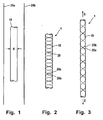
- the textile thread 1 is composed according to FIG. 1 of a rubber-elastic core 10 made of a thermoplastic elastomer and two multifilament yarns 20a, 20b, which consist of high-strength, preferably high-temperature-resistant synthetic fibers.
- the filament yarns 20a and 20b are successively twisted about the core 10 in the S direction and / or Z direction, for example S and Z directions, preferably with the same number of turns (tours / m), so that the thread shown schematically in FIG 1 is created.
- the high-strength multifilament yarns 20a and 20b are combined so as to be non-slidably connected with the core 10 to the textile thread 1 by S and Z rotation.
- the multifilament yarns 20a, 20b have a desired high tear strength, with a correspondingly low elongation at break, which is usually below 22% for the high-strength synthetic fibers used for the multifilament yarns.
- the tensile strength of the textile thread according to FIG. 2 is determined by the tensile strength of the multifilament yarns 20a, 20b.
- the elongation at break of the combined yarn according to FIG. 2 made of rubber-elastic core 10 and high-tenacity multifilament yarns increases and lies at a value between the elongation at break of the rubber-elastic core 10 and the elongation at break of the multifilament yarns 20a, 20b.
- FIG. 3 shows the textile thread 1 according to FIG. 2 in a stretched-in-arrow direction, wherein the diameter of the core 10 has decreased and correspondingly give the twisted multifilament yarns 20a, 20b due to their winding length and the smaller diameter Adjust soul 10, so that the total thread 1 can experience a much higher elongation than the multifilament yarns 20a, 20b taken alone.
- a preferred range of diameter d for the core is a thermoplastic elastomer monofilament 0.2-0.5 mm, with 250-1,100 dtex multifilament yarns with an elongation at break below 22% and a twist preferably in the range of 100-400 turns / m for the multifilament yarns.
- the same number of tours is provided for S and Z direction.
Landscapes
- Engineering & Computer Science (AREA)
- Textile Engineering (AREA)
- Mechanical Engineering (AREA)
- Chemical & Material Sciences (AREA)
- Chemical Kinetics & Catalysis (AREA)
- Life Sciences & Earth Sciences (AREA)
- Wood Science & Technology (AREA)
- Yarns And Mechanical Finishing Of Yarns Or Ropes (AREA)
- Woven Fabrics (AREA)
Description
- Die Erfindung bezieht sich auf einen textilen Faden mit einer Seele und die Seele umgebenden Multifilamentgarnen, textile Flächengebilde hieraus sowie deren Anwendung, beispielsweise für einen Faltenbalg.
- Es sind bereits zahlreiche Varianten textiler Fäden mit einer elastischen Seele, die von Garnen aus anderen Materialien umwunden sind, bekannt, wie aus den nachfolgenden Druckschriften hervorgeht.
- Beispielsweise werden in (1) Umwindungsgarne, Core-Garne oder Stretch-Core-Garne mit einer von zwei Garnen aus andersartigem Material kreuzweise umwickelten und gedehnten elastischen Seele, wie Elastan-Kern oder Lycra-Seele beschrieben, welche vorwiegend hochdehnbar sind und für Maschenwaren, wie Feinstrumpfwaren geeignet sind.
- Aus
DE 197 22 932 A1 ist ein antibakterielles Strickgarn mit einem Kernfaden bekannt, der von einem oder mehreren antibakteriellen Fäden umgeben ist, auf welche wiederum Deckfäden aufgebracht sind. - Aus der
DE 195 06 227 A1 ist ein Garn bekannt, bei dem ein Lycra- oder Nylonfaden von mindestens einem Cellulosetriacetatfaden umwunden ist. - Aus
DE 31 40 900 A1 ist ein elastischer heißklebender Faden bekannt, welcher einen elastischen Kern umfaßt, der mit mindestens einem weiteren Faden, welcher mindestens bereichsweise eine heißklebefähige Substanz trägt, umwunden ist und sich für die Anwendung bei Höschenwindeln eignet. - In der
DE 1 862 736 U wird ein elastischer Zwirn beschrieben, bei dem eine Seele aus elastischen ungedehnten Polyamid-Kräuselkrepp-Garnen von Fäden oder Garnen normaler Dehnung umwunden ist. - In der
JP 2003-079411 AA - In der
JP 2001-214340 AA - Bei vielen Anwendungsgebieten von technischen Geweben, insbesondere auch in Verbund mit elastischen und/oder thermoplastischen oder duroplastischen Kunststoffen bestehen hohe Anforderungen an die mechanischen Eigenschaften der Gewebe und somit an die textilen Fäden und Garne, aus denen die Gewebe erzeugt werden. Insbesondere werden oftmals hohe Anforderungen an die Reißfestigkeit gestellt, ebenso an eine hohe Thermostabilität, d. h. hohe Temperaturbeständigkeit. Nun ist aber bei Synthesefasern eine hohe Reißfestigkeit stets mit einer sehr geringen Reißdehnung verbunden, wobei die Reißdehnung umso geringer ist, je höher die Reißfestigkeit eines Fadens ist. Bei hochfesten Fäden aus Synthesefasern mit einer Feinheitsreißfestigkeit von 2 cN/dtex und mehr sinkt die Reißdehnung auf Werte bis herab auf 2 % und weniger. Auch Fäden aus Synthesefasern mit hoher Temperaturbeständigkeit und zumindest einer hohen kurzzeitigen Gebrauchstemperatur gehören überwiegend zur Gruppe der hochfesten Synthesefasern mit geringer Reißdehnung.
- Es gibt nun Anwendungsgebiete für technische Gewebe und technische Verbundgewebe, bei denen es wünschenswert ist, bei Beibehaltung der hohen Reißfestigkeit und der Temperaturbeständigkeit des Gewebes, d. h. der das Gewebe bildenden Fäden, die Reißdehnung zu erhöhen, um nicht nur die Fäden elastischer und dehnbarer zu gestalten, sondern auch die damit hergestellten Gewebe.
- Bei der Weiterverarbeitung von Geweben durch Verformung zu dreidimensionalen Körpergebilden sind einer starken Verformung zur Ausbildung dreidimensionaler Körpergebilde Grenzen bei Einsatz von den bisher bekannten Geweben aus hochfesten Synthesefasern gesetzt, da ihrer Verformung Grenzen durch die niedrige Reißdehnung der hochfesten Synthesefasern gesetzt sind.
- Die Erfindung schlägt zur Lösung des aufgezeigten Problems einen textilen Faden mit einer Seele und die Seele umgebenden Multifilamentgarnen vor, der hochfeste Multifilamentgarne aus organischen Synthesefasern mit einer Feinheitsreißfestigkeit von mindestens 3 cN/dtex und mit einer Reißdehnung kleiner 22 % aufweist, zur Ausbildung eines textilen Fadens mit einer der Reißfestigkeit des Multifilamentgarnes entsprechenden Reißfestigkeit vor, bei dem zur Erhöhung der Dehnbarkeit des textilen Fadens bei Erhalt der Festigkeit desselben eine gummielastische Seele aus einem Monofil aus einem Thermoplastischen Elastomer mit einer Reißdehnung von mindestens 35 % vorgesehen ist, welche von mindestens je einem der Multifilamentgarne in S-Richtung und/oder Z-Richtung umzwirnt ist. Durch die S- und/oder Z-Wicklung des Multifilamentgarnes ist dieses verschiebefest auf der gummielastischen Seele aufgebracht. Die Wickellänge des Multifilamentgarnes ist länger als die Länge der Seele, so daß die Seele gedehnt werden kann, wobei bei Durchmesserverringerung der Seele die gewickelten Multifilamentgarne nachgeben und eine zusätzliche Dehnung des textilen Fadens ermöglicht wird und damit eine über der Reißdehnung der Multifilamentgarne liegende Dehnung des textilen Fadens ermöglicht wird, und die Beanspruchung des textilen Fadens in Bezug auf die Reißdehnung erst bei erhöhter Dehnung erfolgt. Erfindungsgemäß wird die Dehnbarkeit des textilen Fadens umso größer, je größer der Durchmesser der gummielastischen Seele, d. h. des Monofils gewählt ist und die Länge des um die Seele gewickelten Multifilamentgarnes entsprechend ebenfalls vergrößert ist. Je größer der Durchmesser der Seele ist, desto größer wird die Wickellänge des Multifilamentgarnes und eine umso höhere Dehnbarkeit des textilen Fadens ist die Folge und damit ebenfalls eine erhöhte Dehnbarkeit eines aus solchen textilen Fäden gefertigten Flächengebildes.
- Vorteilhafte Weiterbildungen des erfindungsgemäßen textilen Fadens sind den kennzeichnenden Merkmalen der Unteransprüche 2 bis 15 entnehmbar.
- Als gummielastische Seele wird bevorzugt ein Monofil mit einem Durchmesser von mindestens 0,15 mm, der bis 1,0 mm oder mehr betragen kann. Ein Vorzugsbereich liegt bei 0,2 - 0,5 mm.
- Als gummielastische Seele wird bevorzugt ein Monofil aus einem Thermoplastischen Elastomer mit einer Reißdehnung von mindestens 50 %.
- Bevorzugte Thermoplastische Elastomere (TPE) sind solche auf Polyamidbasis (TPA) oder Copolyesterbasis (TPC) oder Urethanbasis (TPU). Die Polyamidelastomere sind Block-Copolymere mit harten Polyamid-Blöcken und weichen Polyether- und/oder Polyester-Blöcken. Die Thermoplastischen Elastomere auf Copolyesterbasis sind Block-Copolymere von Weichsegmenten aus Polyalkylenetherdiolen und/oder langkettigen aliphatischen Dicarbonsäureestern mit teilkristallinen PBT-Segmenten. Hierzu zählen beispielsweise Polyetherester. Die Polyurethan-Elastomere sind Block-Copolymere und entstehen durch Polyaddition langkettiger Diole mit aliphatischen Diisocyanaten. Zur Ausbildung textiler Fäden, die bei der späteren Weiterverarbeitung zu Flächengebilden und Körpergebilden höheren Verformungstemperaturen kurzzeitig ausgesetzt werden, werden für die gummielastische Seele Thermoplastische Elastomere bevorzugt, deren kurzzeitige Gebrauchstemperatur mindestens etwa 145°C beträgt. Erfindungsgemäße textile Fäden, die eine solche gummielastische Seele aufweisen, können für die Herstellung von textilen Flächengebilden verwendet werden, die bei einer nachfolgenden Konfektionierung und Verarbeitung kurzzeitig auch höheren Temperaturen, wie beispielsweise bei der Vulkanisation oder Formgebung ausgesetzt werden.
- Es ist aber auch möglich, als gummielastische Seele mit Vorteil solche Thermoplastischen Elastomere einzusetzen, die als Schmelzklebstoffe bekannt sind, wobei es sich um lösungsmittelfreie feste Produkte handelt, die für die Anwendung der Erfindung in Form extrudierter Monofile vorliegen und welche eine Aktivierungstemperatur von mindestens etwa 70°C aufweisen.
- Als Schmelzklebstoffe kommen für die Erfindung zur Ausbildung der gummielastischen Seele in Frage die TPC als Polyester-Elastomer mit einer Wärmestandfestigkeit von 55 - 115°C, die TPA als Copolyamid-Elastomer mit einer Wärmestandfestigkeit von 100 - 120°C und die TPU als Polyurethan-Elastomer mit einer Wärmestandfestigkeit von 65 - 110°C.
- Die den textilen Faden charakterisierenden Multifilamentgarne werden bevorzugt mit einer Feinheitsreißfestigkeit von mindestens 4,5 cN/dtex eingesetzt. Um die gewünschte Erhöhung der Reißdehnung des textilen Faden durch die Umzwirnung der gummielastischen Seele mit dem Multifilamentgarn zu erreichen, wird die Umzwirnung bevorzugt mit 100 - 400 Touren/m vorgenommen. Für hochfeste textile Fäden gemäß der Erfindung werden bevorzugt Multifilamentgarne mit einer Reißdehnung kleiner gleich 20 % eingesetzt. Die Multifilamentgarne werden bevorzugt mit hoher Thermostabilität und Wärmestandfestigkeit bei einer kurzzeitigen Gebrauchstemperatur von mindestens etwa 160°C, vorzugsweise 170°C oder mehr vorgesehen, insbesondere dann, wenn die aus den textilen Fäden herzustellenden Flächengebilde bei der nachfolgenden Verarbeitung und Konfektionierung höheren Temperaturen, wie Formgebungstemperaturen oder Vulkanisationstemperaturen bei der Heißvulkanisation kurzzeitig ausgesetzt sind.
- Der Durchmesser der gummielastischen Seele, die Umzwirnung desselben mit Multifilamentgarn in Bezug auf die Anzahl der Windungen sowie die Dicke des Multifilamentgarnes sind bevorzugt aufeinander abzustimmen, wobei es von Vorteil ist, Multifilamentgarne von 250 - 1.100 dtex einzusetzen. Die Multifilamentgarne sind aus Filamenten mit einer Feinheit kleiner 10 µ zusammengesetzt, wobei beispielsweise ein Multifilamentgarn von 550 dtex etwa 85 - 90 Filamente einer Feinheit von 6 µ umfaßt.
- Für die Umwicklung der gummielastischen Seele werden bevorzugt Multifilamentgarne aus hochfesten und sehr temperaturbeständigen Synthesefasern mit einer hohen Feinheitsreißfestigkeit und einer Reißdehnung unter 22 % eingesetzt, insbesondere Polyester der Terephthalsäure (Polyterephthalate) mit einer Reißdehnung bevorzugt von etwa 8 - 20 % und einer Feinheitsreißfestigkeit von etwa 4 - 9,5 cN/dtex, wobei bei den hochfesten Filamenten eine kurzzeitige Gebrauchstemperatur bis 180°C zulässig ist. Des weiteren sind bevorzugte hochfeste Synthesefasern auswählbar aus den Polyamiden, insbesondere Polyamid 6, Polyamid 66, Polyamid 610 und Polyamid MXD6 mit einer Reißdehnung von etwa 15 - 20 %, einer Feinheitsreißfestigkeit von etwa 4 - 9 cN/dtex und einer kurzzeitigen Gebrauchstemperatur von bis zu 180°C oder mehr. Eine weitere Gruppe hochfester Synthesefasern bilden solche aus vollaromatischen Polyamiden - Aramide - wie Poly-m-Phenylenisophthalamid und Poly-p-Phenylenterephthalamid mit Reißdehnungen von etwa 2 - 22 %, vorzugsweise etwa 2 - 6 %, Feinheitsreißfestigkeit von etwa 4 - 20 cN/dtex und einer kurzzeitigen Gebrauchstemperatur von bis zu 300°C. Für spezielle technische Fäden und Gewebe sind auch hochfeste und hochtemperaturbeständige Synthesefasern auf Basis von vollaromatischen Polyestern wie Polyarylaten, des weiteren hochfeste Synthesefasern aus aromatischen Polysulfiden und -sulfonen, wie Polyarylsulfone, Polyphenylensulfid, Polyaryletherketone, aromatische Polyimide wie Polyimid, Polybenzimidazol, Polyamidimid, Polyetherimid, Polyesterimid, Polyarylimid einsetzbar. Neben diesen hochfesten und hochtemperaturbeständigen Synthesefasern sind auch solche auf Basis von Fluorpolymeren einsetzbar, wie beispielsweise von den Fluorhomopolymeren Polytetrafluorethylen und Polychlortrifluorethylen und von den Fluor-Copolymerisaten Ethylen-Tetrafluorethylen-Copolymer, Polyfluorethylenpropylen. Für viele Anwendungen ist auch für die Auswahl der hochfesten Synthesefasern ausschlaggebend ihre Schwerentflammbarkeit, wie beispielsweise vollaromatische Polyamide oder Fluorpolymere. Die Aufzählung der Synthesefasern ist nicht abschließend, sondern beispielhaft.
- Eine bevorzugte Ausbildung eines textilen Fadens gemäß der Erfindung zeichnet sich dadurch aus, daß er eine gummielastische Seele aus einem Monofil mit einem Durchmesser von 0,22 - 0,4 mm aus einem Thermoplastischen Elastomer mit einer Reißdehnung von mindestens 50 % und je eine die Seele mit 200 - 400 Touren/m in Z-Richtung und/oder in S-Richtung umgebendes hochfestes Multifilamentgarn von 250 - 1.100 dtex mit einer Reißdehnung von höchstens 20 % und einer Feinheitsreißfestigkeit von mindestens etwa 5 cN/dtex und einer kurzzeitigen Gebrauchstemperatur von mindestens 160°C aufweist und die Reißdehnung des textilen Fadens gegenüber der Reißdehnung des eingesetzten Multifilamentgarnes und damit die Dehnbarkeit um mindestens 20 %, vorzugsweise mindestens 50 % erhöht ist.
- Die erfindungsgemäß aufeinander abgestimmten Parameter sowohl der gummielastischen Seele als auch der die hohe Festigkeit liefernden Multifilamentgarne und ihre Kombination zu dem textilen Faden ermöglichen, die hohe Festigkeit des Multifilamentgarnes zu erhalten und gleichzeitig die geringe Dehnbarkeit desselben durch die gummielastische Seele wesentlich zu erhöhen. Für die Erhöhung der Dehnbarkeit ist wesentlich, daß die gummielastische Seele sich dehnen kann, hierbei ihren Durchmesser verringern und durch die um die Seele gewickelten Multifilamentgarne aufgrund ihrer Wickellänge nachgeben und damit die erhöhte Dehnbarkeit des Fadens bei Erhalt der Reißfestigkeit ermöglichen.
- Bei Einsatz von Schmelzklebstoffen für das die gummielastische Seele bildende Monofil ergibt sich eine wesentlich erhöhte Dehnbarkeit eines aus solchen erfindungsgemäßen textilen Fäden hergestellten Flächengebildes gegenüber einem Flächengebilde, das nur aus den entsprechenden Multifilamentgarnen gefertigt wurde dadurch, daß bei Anwendung von Druck und Temperatur mindestens in Höhe der Aktivierungstemperatur der Schmelzstoffe zwecks Verformung des Flächengebildes die gummielastische Seele schmilzt, wodurch die Dehnung durch Auseinanderziehen der in S- und/oder Z-Richtung gewickelten Multifilamentgarne der textilen Fäden ermöglicht wird.
- Auch ein solches erfindungsgemäßes Flächengebilde weist eine wesentlich erhöhte Dehnung gegenüber Flächengebilden bestehend nur aus den analogen Multifilamentgarnen auf.
- Die Kombination der Materialien für das Multifilamentgarn und die gummielastische Seele richten sich auch nach den hieraus herzustellenden textilen Flächengebilden und deren weitere Verwendung. Hierbei spielen auch Preisfaktoren eine Rolle. Vielfach sind textile Flächengebilde auf Basis von Polyesterfilamenten erwünscht und im Einsatz. Diese weisen eine hohe Reißfestigkeit bei relativ geringer Dehnung auf. Zur Erhöhung der Dehnbarkeit solcher aus Polyesterfilamenten hergestellten Flächengebilde - Polyestergewebe, Polyestergewirke, Polyestergelege - wird die Ausgestaltung eines textilen Fadens gemäß der Erfindung vorgeschlagen, der eine gummielastische Seele aus einem Monofil mit einem Durchmesser von 0,22 - 0,4 mm aus einem copolymeren Polyetherester mit einer Reißdehnung von etwa 50 - 60 % und einem die Seele mit 200 - 400 Touren/m in Z-Richtung und/oder S-Richtung umgebenden hochfesten Multifilamentgarn von 250 - 1.100 dtex aus hochfesten Polyesterfilamenten mit einer Reißdehnung von 14 - 19 % und einer Feinheitsreißfestigkeit von mindestens 6,0 cN/dtex und einer kurzzeitigen Gebrauchstemperatur von mindestens 170°C aufweist und die erzielbare Reißdehnung des textilen Fadens aus Multifilamentgarn und gummielastischer Seele etwa 35 - 40 % beträgt.
- Ein textiles Flächengebilde, hergestellt aus erfindungsgemäßen textilen Fäden durch Weben, Wirken, Stricken oder als Gelege zeichnet sich dadurch aus, daß das Flächengebilde eine Reißfestigkeit entsprechend der Reißfestigkeit der eingesetzten Multifilamentgarne der textilen Fäden und eine gegenüber der Reißdehnung des eingesetzten Multifilamentgarnes erhöhte Reißdehnung und Dehnbarkeit entsprechend derjenigen der textilen Fäden aufweist, wobei das Flächengebilde bestehend aus den textilen Fäden mit einer gummielastischen Seele und den diesen umgebenden Multifilamentgarnen gegenüber einem Flächengebilde bestehend aus den gleichen Multifilamentgarnen wie die textilen Fäden jedoch ohne gummielastische Seele bei gleicher Reißfestigkeit eine erhöhte Dehnbarkeit und erhöhte Verformbarkeit aufweist. Insbesondere wird bei einem textilen Flächengebilde, das unter Einsatz erfindungsgemäßer textiler Fäden hergestellt ist, die Dehnbarkeit wesentlich erhöht. Damit kann die Zug-Dehnungsbelastung von Flächengebilden aus beispielsweise hochfesten Polyester-Multifilamentgarnen von bisher 20 - 22°% Reißdehnung gesteigert werden auf 38 - 42 % bei Einsatz erfindungsgemäßer textiler Fäden mit hochfesten Polyester-Multifilamentgarnen und beispielsweise einer gummielastischen Seele aus einem Copolyester-Elastomer (copolymerer Polyetherester).
- Bei der Dehnbarkeit von textilen Flächengebilden ist zu beachten, daß zusätzlich zu dem Beitrag der Dehnung der eingesetzten textilen Fäden noch eine Konstruktionsdehnung aufgrund der Verbindungsart des textilen Flächengebildes, beispielsweise Webart, Wirkart hinzukommt. Eine solche Erhöhung der Dehnbarkeit eines textilen Flächengebildes liegt maximal im Bereich von 5 - 6 %. Durch Einsatz der erfindungsgemäßen textilen Fäden läßt sich jedoch die Dehnbarkeit des textilen Flächengebildes bei Erhalt der Reißfestigkeit um wenigstens 20 %, vorzugsweise jedoch um 50 % und mehr problemlos erhöhen. Damit ist es möglich, erfindungsgemäße textile Flächengebilde wesentlich stärker zu verformen, beispielsweise Ecken auszubilden, die die gleiche Reißfestigkeit aufweisen, wie sich anschließende ebene nicht verformte Flächen aus dem gleichen Material.
- Für hochfeste und schwer entflammbare textile Flächengebilde und hieraus zu formende dreidimensionale Körpergebilde werden für die textilen Fäden bevorzugt hochfeste Multifilamentgarne aus Aramiden, bevorzugt Poly-pphenylenterephthalamid mit einer Reißdehnung von 2 - 5 % und einer Feinheitsreißfestigkeit von etwa 14 - 20 cN/dtex eingesetzt. Die gummielastische Seele mit einer wesentlich höheren Reißdehnung, vorzugsweise mehr als 50 %, erhöht nicht nur die Dehnbarkeit des erfindungsgemäßen textilen Fadens, sondern auch die Dehnbarkeit und damit größere Verformbarkeit - Verformungsgrad - von hieraus gefertigten textilen Flächengebilden.
- Gemäß einem weiteren Vorschlag der Erfindung werden textile Flächengebilde hergestellt aus erfindungsgemäßen textilen Fäden mit einem Elastomer, wie einem vulkanisierbaren Kautschuk oder einem härtbaren Kunststoff beschichtet. Die so beschichteten textilen Flächengebilde können als Verbundwerkstoff in noch unvernetztem und unausgehärtetem Zustand einer Verformung zu einem gewünschten Körpergebilde unterworfen werden, wobei diese Verformung unter Anwendung von Druck und Wärme erfolgen kann und bei der Verformung gleichzeitig ein Verbinden der Schichten und bei entsprechender Temperatur auch ein Vulkanisieren und Aushärten der elastomeren Beschichtung erfolgen kann. Hierbei ermöglichen die erfindungsgemäßen textilen Flächengebilde mit hoher Dehnung eine starke Verformung in Verbindung mit der elastomeren Beschichtung. Die mechanische Festigkeit, Zug- und Reißfestigkeit wird durch die in dem Verbundwerkstoff enthaltenen Multifilamentgarne der Fäden des textilen Flächengebildes vorgegeben, und es können hochwertige Produkte, die auch hohen dynamischen und thermischen Belastungen standhalten müssen, gefertigt werden, wie beispielsweise Faltenbälge, Membranen, Förderbänder u.a.
- Vorteilhafte Ausgestaltungen des textilen Flächengebildes sind den kennzeichnenden Merkmalen der Ansprüche 16 bis 20 entnehmbar. Gemäß einem Vorschlag der Erfindung ist diese besonders vorteilhaft für die Herstellung von dreidimensionalen Körpergebilden gemäß den Ansprüchen 21 und 22 und in Gestalt von Faltenbälgen, Membranen und Teilen hiervon gemäß Anspruch 23 einsetzbar. Faltenbälge oder Teile hiervon, bei denen eine Gewebeeinlage zwischen zwei Elastomerschichten eingebettet ist, sind beispielsweise in der
DE 197 57 429 A1 beschrieben. Durch den Einsatz des erfindungsgemäßen textilen Flächengebildes ist es möglich, wie Körpergebilde mit sehr stark verformten Bereichen, welche eine Dehnung von 30 - 40 % oder mehr des Flächengebildes erfordern, Faltenbälge mit geraden Flächen und stark verformten Eckbereichen einteilig herzustellen, da durch die erhöhte Dehnbarkeit des erfindungsgemäßen textilen Fadens und damit des daraus hergestellten textilen Flächengebildes eine entsprechende Verformung bei Erhalt der Festigkeit und Dauerbelastbarkeit insbesondere der dynamischen Dauerbelastbarkeit der Faltenbälge gewährleistet ist. - Ein erfindungsgemäßer Faltenbalg zeichnet sich dadurch aus, daß das textile Flächengebilde aus den erfindungsgemäßen textilen Fäden zwischen zwei Elastomerschichten ausgewählt aus den vulkanisierbaren Kautschuken eingebettet und unter Anwendung von Druck und Wärme dreidimensional zu dem gewünschten Teil verformt und mit den elastomeren Schichten verbunden ist, wobei die Elastomerschichten vernetzen. Hierbei ist es möglich, das textile Flächengebilde gegebenenfalls mit einer dünnen Vorbeschichtung aus einem Elastomer zu versehen und entsprechend dicke Außenschichten aus Elastomer beidseitig auf das Flächengebilde aufzulegen und einen entsprechenden Verbundwerkstoff zum Herstellen eines einteiligen Faltenbalges vorzusehen.
- Es ist auch möglich, je nach Anforderung an den Faltenbalg, zwei textile Flächengebilde mit einer Zwischenschicht aus Elastomer und entsprechenden Außenschichten aus Elastomer unter Anwendung von Druck und Wärme dreidimensional zu dem gewünschten Teil zu verformen, wobei die Schichten miteinander verbunden und die Elastomerschichten vernetzt werden.
- Für die Beschichtung eines textilen Flächengebildes aus den erfindungsgemäßen textilen Fäden zum Herstellen eines elastischen dehnbaren und verformbaren Verbundwerkstoffes kommen insbesondere Elastomere aus natürlichen und synthetischen Kautschuken infrage, so daß die erhöhte Dehnbarkeit der textilen Fäden voll ausgenutzt werden kann. Nach einer Verformung zu gewünschten dreidimensionalen Körpergebilden kann dann durch irreversible Vernetzung das gewünschte Körpergebilde fixiert werden, wobei dieses aufgrund der erfindungsgemäßen eingesetzten textilen Fäden eine hohe Dehnbarkeit, Elastizität und dynamische Dauerbeanspruchbarkeit aufweist. Als Elastomere kommen beispielsweise u.a. in Frage: ChloroprenKautschuk, Fluor-Kautschuk, Silicon-Kautschuk, Urethan-Kautschuk, Nitril-Butadien-Kautschuk, Nitril-Chloropren-Kautschuk.
- Die Erfindung ist in der Zeichnung schematisch dargestellt und wird anhand dessen näher erläutert. Es zeigen:
- Figur 1
- die Bestandteile des textilen Fadens 1 gemäß der Erfindung,
- Figur 2
- den textilen Faden unbelastet auszugsweise,
- Figur 3
- den textilen Faden gemäß Figur 2 in gedehnter Position.
- Der textile Faden 1 setzt sich gemäß Figur 1 aus einer gummielastischen Seele 10 aus einem Thermoplastischen Elastomer und zwei Multifilamentgarnen 20a, 20b zusammen, welche aus hochfesten, vorzugsweise hochtemperaturbeständigen Synthesefasern bestehen. Die Filamentgarne 20a und 20b werden nacheinander in S-Richtung und/oder Z-Richtung, beispielsweise S- und Z-Richtung mit vorzugsweise gleicher Tourenzahl (Touren/m) um die Seele 10 gezwirnt, so daß der in der Figur 2 schematisch dargestellte Faden 1 entsteht. Die hochfesten Multifilamentgarne 20a und 20b sind durch S- und Z-Drehung verschiebefest mit der Seele 10 zu dem textilen Faden 1 vereinigt. Die Multifilamentgarne 20a, 20b weisen eine gewünschte hohe Reißfestigkeit auf, bei einer entsprechend niedrigen Reißdehnung, die üblicherweise unter 22 % bei den eingesetzten hochfesten Synthesefasern für die Multifilamentgarne liegt. Die Reißfestigkeit des textilen Fadens gemäß Figur 2 wird durch die Reißfestigkeit der Multifilamentgarne 20a, 20b bestimmt. Die Reißdehnung des kombinierten Fadens gemäß Figur 2 aus gummielastischer Seele 10 und hochfesten Multifilamentgarnen hingegen erhöht sich und liegt bei einem Wert zwischen der Reißdehnung der gummielastischen Seele 10 und der Reißdehnung der Multifilamentgarne 20a, 20b. In der Figur 3 ist der textile Faden 1 gemäß Figur 2 in einer in Pfeilrichtung gestreckten - gedehnten - Stellung dargestellt, wobei der Durchmesser der Seele 10 sich verringert hat und entsprechend die gezwirnten Multifilamentgarne 20a, 20b aufgrund ihrer Wickellänge nachgeben und sich dem geringeren Durchmesser der Seele 10 anpassen, so daß insgesamt der Faden 1 eine wesentlich höhere Dehnung erfahren kann, als die Multifilamentgarne 20a, 20b für sich genommen allein. Je größer der Durchmesser d der Seele 10, desto größer wird die Wickellänge der diese umgebenden Multifilamentgarne 20a, 20b, desto höher wird die Dehnbarkeit des Fadens 1 und damit die eines hieraus gefertigten Gewebes.
- Für die Herstellung technischer Gewebe ist ein bevorzugter Bereich des Durchmessers d für die Seele aus einem Monofil aus einem Thermoplastischen Elastomer 0,2 - 0,5 mm, bei Einsatz von Multifilamentgarnen von 250 -1.100 dtex mit einer Reißdehnung unter 22 % und bei einer Zwirnung von vorzugsweise im Bereich von 100 - 400 Touren/m für die Multifilamentgarne. Hierbei wird für S- und Z-Richtung jeweils gleiche Tourenzahl vorgesehen.
Claims (23)
- Textiler Faden (1) mit einer Seele (10) und die Seele (10) umgebenden Multifilamentgarnen (20a, 20b), dadurch gekennzeichnet, daß hochfeste Multifilamentgarne aus organischen Synthesefasern mit einer Feinheitsreißfestigkeit von mindestens 3 cN/dtex und einer Reißdehnung kleiner 22 % zur Ausbildung eines textilen Fadens mit einer der Reißfestigkeit der Multifilamentgarne (20a, 20b) entsprechenden Reißfestigkeit eingesetzt sind und zur Erhöhung der Dehnbarkeit des textilen Fadens bei Erhalt der Reißfestigkeit desselben eine gummielastische Seele (10) aus einem Monofil aus einem Thermoplastischen Elastomer mit einer Reißdehnung von mindestens 35 % vorgesehen ist, welche von mindestens je einem der Multifilamentgarne in S-Richtung und/oder Z-Richtung umzwirnt ist.
- Textiler Faden (1) nach Anspruch 1, dadurch gekennzeichnet, daß als gummielastische Seele (10) ein Monofil mit einem Durchmesser von mindestens 0,15 mm - 1,0 mm oder mehr vorgesehen ist.
- Textiler Faden (1) nach Anspruch 1 oder 2, dadurch gekennzeichnet, daß als gummielastische Seele (10) ein Monofil mit einer Reißdehnung von mindestens 50 % vorgesehen ist.
- Textiler Faden (1) nach einem der Ansprüche 1 bis 3, dadurch gekennzeichnet, daß als gummielastische Seele (10) ein Monofil aus einem Thermoplastischen Elastomer auf Polyamidbasis (TPA) oder Copolyesterbasis (TPC) oder Urethanbasis (TPU) vorgesehen ist.
- Textiler Faden (1) nach einem der Ansprüche 1 bis 4, dadurch gekennzeichnet, daß ein Thermoplastisches Elastomer für die Seele (10) vorgesehen ist, das eine kurzzeitige Gebrauchstemperatur von mindestens etwa 145°C aushält.
- Textiler Faden (1) nach einem der Ansprüche 1 bis 5, dadurch gekennzeichnet, daß Multifilamentgarne (20a, 20b) mit einer Feinheitsreißfestigkeit von mindestens 4,5 cN/dtex eingesetzt sind.
- Textiler Faden (1) nach einem der Ansprüche 1 bis 6, dadurch gekennzeichnet, daß die Seele (10) mit den Multifilamentgarnen (20a, 20b) mit 100-400 Touren/m umzwirnt ist.
- Textiler Faden (1) nach einem der Ansprüche 1 bis 7, dadurch gekennzeichnet, daß Multifilamentgarne (20a, 20b) mit einer Reißdehnung kleiner gleich 20 % eingesetzt sind.
- Textiler Faden (1) nach einem der Ansprüche 1 bis 8, dadurch gekennzeichnet, daß Multifilamentgarne (20a, 20b) mit hoher Thermostabilität mit einer kurzzeitigen Gebrauchstemperatur von mindestens etwa 160°C eingesetzt sind.
- Textiler Faden (1) nach einem der Ansprüche 1 bis 9, dadurch gekennzeichnet, daß Multifilamentgarne (20a, 20b) von 250-1.100 dtex verwendet sind.
- Textiler Faden (1) nach einem der Ansprüche 1 bis 10, dadurch gekennzeichnet, daß Multifilamentgarne (20a, 20b) aus hochfesten Synthesefasern aus Polyester der Terephthalsäure, Polyamiden, vollaromatischen Polyamiden, Polyarylaten, Fluorpolymeren, aromatischen Polysulfiden und -sulfonen, Polyaryletherketonen, aromatischen Polyimiden eingesetzt sind.
- Textiler Faden (1) nach einem der Ansprüche 1 bis 11, dadurch gekennzeichnet, daß er eine gummielastische Seele (10) aus einem Monofil mit einem Durchmesser von 0,22 - 0,4 mm aus einem Thermoplastischen Elastomer mit einer Reißdehnung von mindestens 50 % und je eine die Seele (10) mit 200 - 400 Touren/m in Z-Richtung und/oder in S-Richtung umgebendes hochfestes Multifilamentgarn von (20a, 20b) 250 - 1.100 dtex mit einer Reißdehnung von höchstens 20 % und einer Feinheitsreißfestigkeit von mindestens etwa 5 cN/dtex und einer kurzzeitigen Gebrauchstemperatur von mindestens 160°C aufweist und die Reißdehnung des textilen Fadens gegenüber der Reißdehnung des eingesetzten Multifilamentgarnes (20a, 20b) um mindestens 50 % erhöht ist.
- Textiler Faden (1) nach einem der Ansprüche 1 bis 12, dadurch gekennzeichnet, daß er eine gummielastische Seele (10) aus einem Monofil mit einem Durchmesser von 0,22 - 0,4 mm aus einem copolymeren Polyetherester mit einer Reißdehnung von 50 - 60 % und einem die Seele mit 200 - 400 Touren/m in Z-Richtung und/oder S-Richtung umgebenden hochfesten Multifilamentgarn (20a, 20b) von 250 - 1.100 dtex aus hochfesten Polyesterfilamenten mit einer Reißdehnung von 14 - 19 % und einer Feinheitsreißfestigkeit von mindestens 6,0 cN/dtex und einer kurzzeitigen Gebrauchstemperatur von mindestens 170°C aufweist und die erzielbare Reißdehnung des textilen Fadens 35 - 40 % beträgt.
- Textiler Faden (1) nach einem der Ansprüche 1 bis 13, dadurch gekennzeichnet, daß die Multifilamentgarne schwerentflammbar sind oder schwer entflammbar ausgerüstet sind.
- Textiler Faden (1) nach Anspruch 4, dadurch gekennzeichnet, daß als gummielastische Seele (10) ein Schmelzklebstoff auf Basis eines Thermoplastischen Elastomers vorgesehen ist.
- Textiles Flächengebilde hergestellt aus textilen Fäden (1) durch Weben, Wirken, Stricken gemäß einem oder mehreren der Ansprüche 1 bis 15, dadurch gekennzeichnet, daß das Flächengebilde eine Reißfestigkeit entsprechend der Reißfestigkeit der eingesetzten Multifilamentgarne (20a, 20b) der textilen Fäden und eine gegenüber der Reißdehnung des eingesetzten Multifilamentgarnes erhöhte Reißdehnung entsprechend derjenigen der textilen Fäden (1) aufweist, wobei das Flächengebilde bestehend aus den textilen Fäden (1) mit einer gummielastischen Seele (10) und den diesen umgebenden Multifilamentgarnen (20a-20b) gegenüber einem Flächengebilde bestehend aus den gleichen Multifilamentgarnen wie die textilen Fäden (1) jedoch ohne gummielastische Seele (10) bei gleicher Reißfestigkeit eine erhöhte Dehnbarkeit und erhöhte Verformbarkeit aufweist.
- Textiles Flächengebilde nach Anspruch 16, dadurch gekennzeichnet, daß die Reißdehnung des Flächengebildes aus textilen Fäden (1) gegenüber einem Flächengebilde bestehend nur aus dem für die textilen Fäden (1) eingesetzten Multifilamentgarn (20a, 20b) um mindestens 50 % erhöht ist.
- Textiles Flächengebilde nach Anspruch 16 oder 17, dadurch gekennzeichnet, daß es mit einem Elastomer, wie einem vulkanisierbaren Kautschuk oder einem härtbaren Kunststoffharz beschichtet ist.
- Textiles Flächengebilde nach Anspruch 18, dadurch gekennzeichnet, daß das mit einem vulkanisierbaren Kautschuk oder einem härtbaren Kunststoff beschichtete Flächengebilde zu einem Körpergebilde verformt ist.
- Textiles Flächengebilde nach Anspruch 19, dadurch gekennzeichnet, daß das zu einem Körpergebilde verformte, mit einem Kautschuk oder härtbaren Kunststoff beschichtete Flächengebilde durch Vulkanisation des Kautschuks oder Aushärtung des härtbaren Kunststoffharzes irreversibel vernetzt ist.
- Körpergebilde, gebildet aus einem textilen Flächengebilde gemäß einem der Ansprüche 16 bis 20 aus textilen Fäden gemäß einem der Ansprüche 1 bis 15, wobei das textile Flächengebilde zwischen zwei Elastomerschichten ausgewählt aus vulkanisierbaren Kautschuken eingebettet und unter Anwendung von Druck und Wärme dreidimensional zu dem gewünschten Teil verformt und mit den Elastomerschichten verbunden ist, wobei die Elastomerschichten durch Vulkanisation vernetzt sind.
- Körpergebilde nach Anspruch 21, dadurch gekennzeichnet, daß zwei textile Flächengebilde mit einer Zwischenschicht aus Elastomer ausgewählt aus den vulkanisierbaren Kautschuken vorgesehen sind.
- Körpergebilde nach einem der Ansprüche 21 oder 22, dadurch gekennzeichnet, daß es als Faltenbalg, Membran oder Teil hiervon ausgebildet ist.
Applications Claiming Priority (2)
| Application Number | Priority Date | Filing Date | Title |
|---|---|---|---|
| DE10324524A DE10324524B3 (de) | 2003-05-28 | 2003-05-28 | Textiler Faden, Flächengebilde und Körpergebilde hieraus |
| DE10324524 | 2003-05-28 |
Publications (3)
| Publication Number | Publication Date |
|---|---|
| EP1482079A2 EP1482079A2 (de) | 2004-12-01 |
| EP1482079A3 EP1482079A3 (de) | 2005-11-09 |
| EP1482079B1 true EP1482079B1 (de) | 2007-07-11 |
Family
ID=32520214
Family Applications (1)
| Application Number | Title | Priority Date | Filing Date |
|---|---|---|---|
| EP04011864A Expired - Lifetime EP1482079B1 (de) | 2003-05-28 | 2004-05-19 | Textiler Faden, Flächengebilde und Körpergebilde hieraus |
Country Status (2)
| Country | Link |
|---|---|
| EP (1) | EP1482079B1 (de) |
| DE (2) | DE10324524B3 (de) |
Cited By (1)
| Publication number | Priority date | Publication date | Assignee | Title |
|---|---|---|---|---|
| WO2020210648A1 (en) * | 2019-04-10 | 2020-10-15 | Propel, LLC | Machine-knittable conductive hybrid yarns |
Families Citing this family (13)
| Publication number | Priority date | Publication date | Assignee | Title |
|---|---|---|---|---|
| DE102005005621B4 (de) | 2005-02-08 | 2009-01-08 | Hübner GmbH | Balg eines Übergangs zwischen zwei gelenkig miteinander verbundenen Fahrzeugen oder Balg einer Fluggastbrücke |
| DE102006023357A1 (de) * | 2006-05-17 | 2007-11-22 | Müller Textil GmbH | Abstandsgewirke mit umwickelten oder ummaschten Abstandsfäden |
| FR2919630A1 (fr) * | 2007-07-30 | 2009-02-06 | Pennel Et Flipo | Support textile revetu et utilisations |
| EP2050848B1 (de) * | 2007-09-17 | 2017-06-07 | Orfit Industries | Hybridstoff, damit hergestellte Artikel und Verfahren zu seiner Herstellung |
| DE102008060226B4 (de) * | 2008-12-04 | 2012-07-12 | Klaus Bloch | Verfahren zur Herstellung eines Trägergewebes und derartiges Trägergewebe |
| EP2345755B1 (de) | 2010-01-16 | 2015-03-25 | Klaus Bloch | Verfahren zur Herstellung eines Trägergewebes |
| DE102011003025A1 (de) * | 2011-01-24 | 2012-07-26 | Siemens Aktiengesellschaft | Schienenfahrzeug mit einer Verkleidung für einen Wagenübergangsbereich |
| DE102011107370A1 (de) | 2011-07-14 | 2013-01-17 | Hübner GmbH | Flächenförmiges oder im Querschnitt kasten- oder U-förmig umlaufendes Verbindungselement zwischen zwei gelenkig miteinander verbundenen Fahrzeugen oder Vordach einer Fluggastbrücke oder -treppe |
| EP2740618B1 (de) | 2012-12-05 | 2017-11-22 | Hübner GmbH & Co. KG | Fahrzeug umfassend mindestens zwei gelenkig miteinander verbundene Fahrzeugteile |
| DE202013005226U1 (de) * | 2013-06-07 | 2013-08-23 | Hübner GmbH | Abdeckelement für bewegliche Anlagen- oder Maschinenteile |
| TWI744108B (zh) * | 2020-11-24 | 2021-10-21 | 勤倫有限公司 | 由膜材切割製成並細化以提昇物性之絲及其製法 |
| DE102021003721A1 (de) | 2021-07-20 | 2023-01-26 | Bundesrepublik Deutschland, vertreten durch das Bundesministerium der Verteidigung, dieses vertreten durch das Bundesamt für Ausrüstung, Informationstechnik und Nutzung der Bundeswehr | Verfahren zur Herstellung eines elastischen Garns und Gewebes sowie Gewebe |
| CN118727184A (zh) * | 2023-03-31 | 2024-10-01 | 福建成东新材料科技有限公司 | 一种热塑性聚酰胺弹性单丝及其制作方法 |
Family Cites Families (10)
| Publication number | Priority date | Publication date | Assignee | Title |
|---|---|---|---|---|
| DE1862736U (de) * | 1962-09-06 | 1962-11-22 | Plueschweberei Rogler & Co | Elastischer zwirn. |
| FR2492418A1 (fr) * | 1980-10-20 | 1982-04-23 | Lastex Files | Fil elastique thermocollant |
| US4499716A (en) * | 1983-06-13 | 1985-02-19 | E. I. Du Pont De Nemours And Company | Reinforcement structure |
| DE3844458A1 (de) * | 1988-12-31 | 1990-07-05 | Hoechst Ag | Tiefziehfaehiges textilmaterial und daraus hergestellte formkoerper |
| DE19506227A1 (de) * | 1994-02-22 | 1996-03-07 | Repp Marilyn Carla | Garn, Gewebe, Gestrick, Gewirk, mit mindestens einem Cellulosetriacetatfaden mit hohen Acetylierungsgrad |
| US6240716B1 (en) * | 1997-01-29 | 2001-06-05 | Dupont Toray Company, Ltd. | Stable double covered elastic yarn, process for making same, and fabric comprising same |
| DE19722932C2 (de) * | 1997-05-27 | 1999-08-19 | Weihermueller & Voigtmann | Antibakterielles Garn, insbesondere Strickgarn |
| DE19757429A1 (de) * | 1997-12-13 | 1999-06-24 | Huebner Gummi & Kunststoff | Falte oder Welle oder Eckelement eines Falten- oder Wellenbelages eines Übergangs zwischen zwei miteinander verbundenen Fahrzeugen, bzw. Balg eines derartigen Übergangs, sowie Verfahren zur Herstellung eines derartigen Bauteiles |
| JP3436719B2 (ja) * | 2000-02-04 | 2003-08-18 | 泉株式会社 | カーシート用撚糸及びこれを使用したカーシート用生地 |
| JP2003079411A (ja) * | 2001-09-10 | 2003-03-18 | Du Pont Toray Co Ltd | アクセサリーコード |
-
2003
- 2003-05-28 DE DE10324524A patent/DE10324524B3/de not_active Expired - Fee Related
-
2004
- 2004-05-19 EP EP04011864A patent/EP1482079B1/de not_active Expired - Lifetime
- 2004-05-19 DE DE502004004272T patent/DE502004004272D1/de not_active Expired - Fee Related
Cited By (4)
| Publication number | Priority date | Publication date | Assignee | Title |
|---|---|---|---|---|
| WO2020210648A1 (en) * | 2019-04-10 | 2020-10-15 | Propel, LLC | Machine-knittable conductive hybrid yarns |
| US11891729B2 (en) | 2019-04-10 | 2024-02-06 | Propel, LLC | Machine-knittable conductive hybrid yarns |
| US11905627B2 (en) | 2019-04-10 | 2024-02-20 | Propel, LLC | Systems for maintaining moisture in a textile electrode |
| US12264421B2 (en) | 2019-04-10 | 2025-04-01 | Propel, LLC | Machine-knittable conductive hybrid yarns |
Also Published As
| Publication number | Publication date |
|---|---|
| EP1482079A2 (de) | 2004-12-01 |
| EP1482079A3 (de) | 2005-11-09 |
| DE502004004272D1 (de) | 2007-08-23 |
| DE10324524B3 (de) | 2004-07-15 |
Similar Documents
| Publication | Publication Date | Title |
|---|---|---|
| DE10324524B3 (de) | Textiler Faden, Flächengebilde und Körpergebilde hieraus | |
| DE69101598T2 (de) | Zahnriemen. | |
| DE69714296T2 (de) | Elastomere verbundfäden | |
| EP3071423B1 (de) | Hybridfestigkeitsträger | |
| EP1878591B1 (de) | Lage mit in eine Kautschukmischung eingebetteten Festigkeitsträgern und Fahrzeugluftreifen mit einer Gürtelbandage daraus | |
| EP1964706A1 (de) | Ladeluftschlauch | |
| DE4113360B4 (de) | Treibriemen | |
| EP2710279B1 (de) | Antriebsriemen mit einem verstärkungsband oder einem verstärkungsgeflecht oder mit zonenweise angeordneten verstärkungselementen innerhalb des unterbaus | |
| EP2152946A2 (de) | Verfahren zum herstellen eines gewebes und hierbei hergestelltes gewebe | |
| EP3441237A1 (de) | Hybridkord zur verwendung als festigkeitsträger in einer gürtelbandage eines fahrzeugluftreifens | |
| EP0551832B1 (de) | Bondiertes Fadenbündel, Verfahren zu dessen Herstellung und daraus erhältliche textile Flächengebilde | |
| EP0209167B1 (de) | Verfahren zur Herstellung eines imprägnierten, dimensionsstabilen Polyesterkordes sowie einen Polyesterkord nach dem Verfahren | |
| EP1743964B1 (de) | Cord | |
| DE202004014284U1 (de) | Flexibler Schlauch, insbesondere Ladeluftschlauch | |
| EP1778905B1 (de) | Kabliertes kohlenstofffasergarn | |
| EP2824153B1 (de) | Kabelwickelband | |
| EP1402199A2 (de) | Zahnriemen | |
| DE102016214276A1 (de) | Verstärkungslage für Gegenstände aus elastomerem Material, vorzugsweise für Fahrzeugluftreifen, und Fahrzeugluftreifen | |
| EP2198080B1 (de) | Festigkeitsträgerlage aus hybridcorden für elastomere erzeugnisse | |
| EP2845932A1 (de) | Polymerschlauch mit einem textilen Festigkeitsträger | |
| DE3902039C1 (de) | ||
| DE102013107157A1 (de) | "Kabelwickelband" | |
| DE69907149T2 (de) | Komposit elastomer faden und tuch | |
| DE102008060226A1 (de) | Verfahren zur Herstellung eines Trägergewebes und derartiges Trägergewebe | |
| DE102015215564A1 (de) | Balg für eine Luftfeder oder einen Kompensator |
Legal Events
| Date | Code | Title | Description |
|---|---|---|---|
| PUAI | Public reference made under article 153(3) epc to a published international application that has entered the european phase |
Free format text: ORIGINAL CODE: 0009012 |
|
| AK | Designated contracting states |
Kind code of ref document: A2 Designated state(s): AT BE BG CH CY CZ DE DK EE ES FI FR GB GR HU IE IT LI LU MC NL PL PT RO SE SI SK TR |
|
| AX | Request for extension of the european patent |
Extension state: AL HR LT LV MK |
|
| PUAL | Search report despatched |
Free format text: ORIGINAL CODE: 0009013 |
|
| AK | Designated contracting states |
Kind code of ref document: A3 Designated state(s): AT BE BG CH CY CZ DE DK EE ES FI FR GB GR HU IE IT LI LU MC NL PL PT RO SE SI SK TR |
|
| AX | Request for extension of the european patent |
Extension state: AL HR LT LV MK |
|
| 17P | Request for examination filed |
Effective date: 20051215 |
|
| AKX | Designation fees paid |
Designated state(s): AT |
|
| GRAP | Despatch of communication of intention to grant a patent |
Free format text: ORIGINAL CODE: EPIDOSNIGR1 |
|
| RBV | Designated contracting states (corrected) |
Designated state(s): DE |
|
| REG | Reference to a national code |
Ref country code: DE Ref legal event code: 8566 |
|
| GRAS | Grant fee paid |
Free format text: ORIGINAL CODE: EPIDOSNIGR3 |
|
| GRAA | (expected) grant |
Free format text: ORIGINAL CODE: 0009210 |
|
| AK | Designated contracting states |
Kind code of ref document: B1 Designated state(s): DE |
|
| REF | Corresponds to: |
Ref document number: 502004004272 Country of ref document: DE Date of ref document: 20070823 Kind code of ref document: P |
|
| PLBE | No opposition filed within time limit |
Free format text: ORIGINAL CODE: 0009261 |
|
| STAA | Information on the status of an ep patent application or granted ep patent |
Free format text: STATUS: NO OPPOSITION FILED WITHIN TIME LIMIT |
|
| 26N | No opposition filed |
Effective date: 20080414 |
|
| PGFP | Annual fee paid to national office [announced via postgrant information from national office to epo] |
Ref country code: DE Payment date: 20090729 Year of fee payment: 6 |
|
| PG25 | Lapsed in a contracting state [announced via postgrant information from national office to epo] |
Ref country code: DE Free format text: LAPSE BECAUSE OF NON-PAYMENT OF DUE FEES Effective date: 20101201 |