EP1479702A1 - Polymères à base de chlorotrifluoroéthylène/carbonate de vinylène/hexafluoropropène ou tétrafluoroéthylène/carbonate de vinylène/hexafluoropropène - Google Patents
Polymères à base de chlorotrifluoroéthylène/carbonate de vinylène/hexafluoropropène ou tétrafluoroéthylène/carbonate de vinylène/hexafluoropropène Download PDFInfo
- Publication number
- EP1479702A1 EP1479702A1 EP04291182A EP04291182A EP1479702A1 EP 1479702 A1 EP1479702 A1 EP 1479702A1 EP 04291182 A EP04291182 A EP 04291182A EP 04291182 A EP04291182 A EP 04291182A EP 1479702 A1 EP1479702 A1 EP 1479702A1
- Authority
- EP
- European Patent Office
- Prior art keywords
- group
- copolymer
- monomers
- mole
- units
- Prior art date
- Legal status (The legal status is an assumption and is not a legal conclusion. Google has not performed a legal analysis and makes no representation as to the accuracy of the status listed.)
- Withdrawn
Links
Images


Classifications
-
- B—PERFORMING OPERATIONS; TRANSPORTING
- B42—BOOKBINDING; ALBUMS; FILES; SPECIAL PRINTED MATTER
- B42D—BOOKS; BOOK COVERS; LOOSE LEAVES; PRINTED MATTER CHARACTERISED BY IDENTIFICATION OR SECURITY FEATURES; PRINTED MATTER OF SPECIAL FORMAT OR STYLE NOT OTHERWISE PROVIDED FOR; DEVICES FOR USE THEREWITH AND NOT OTHERWISE PROVIDED FOR; MOVABLE-STRIP WRITING OR READING APPARATUS
- B42D15/00—Printed matter of special format or style not otherwise provided for
-
- C—CHEMISTRY; METALLURGY
- C08—ORGANIC MACROMOLECULAR COMPOUNDS; THEIR PREPARATION OR CHEMICAL WORKING-UP; COMPOSITIONS BASED THEREON
- C08F—MACROMOLECULAR COMPOUNDS OBTAINED BY REACTIONS ONLY INVOLVING CARBON-TO-CARBON UNSATURATED BONDS
- C08F234/00—Copolymers of cyclic compounds having no unsaturated aliphatic radicals in a side chain and having one or more carbon-to-carbon double bonds in a heterocyclic ring
- C08F234/02—Copolymers of cyclic compounds having no unsaturated aliphatic radicals in a side chain and having one or more carbon-to-carbon double bonds in a heterocyclic ring in a ring containing oxygen
-
- B—PERFORMING OPERATIONS; TRANSPORTING
- B42—BOOKBINDING; ALBUMS; FILES; SPECIAL PRINTED MATTER
- B42D—BOOKS; BOOK COVERS; LOOSE LEAVES; PRINTED MATTER CHARACTERISED BY IDENTIFICATION OR SECURITY FEATURES; PRINTED MATTER OF SPECIAL FORMAT OR STYLE NOT OTHERWISE PROVIDED FOR; DEVICES FOR USE THEREWITH AND NOT OTHERWISE PROVIDED FOR; MOVABLE-STRIP WRITING OR READING APPARATUS
- B42D1/00—Books or other bound products
-
- C—CHEMISTRY; METALLURGY
- C08—ORGANIC MACROMOLECULAR COMPOUNDS; THEIR PREPARATION OR CHEMICAL WORKING-UP; COMPOSITIONS BASED THEREON
- C08F—MACROMOLECULAR COMPOUNDS OBTAINED BY REACTIONS ONLY INVOLVING CARBON-TO-CARBON UNSATURATED BONDS
- C08F214/00—Copolymers of compounds having one or more unsaturated aliphatic radicals, each having only one carbon-to-carbon double bond, and at least one being terminated by a halogen
-
- G—PHYSICS
- G09—EDUCATION; CRYPTOGRAPHY; DISPLAY; ADVERTISING; SEALS
- G09B—EDUCATIONAL OR DEMONSTRATION APPLIANCES; APPLIANCES FOR TEACHING, OR COMMUNICATING WITH, THE BLIND, DEAF OR MUTE; MODELS; PLANETARIA; GLOBES; MAPS; DIAGRAMS
- G09B19/00—Teaching not covered by other main groups of this subclass
Definitions
- the subject of the present invention is an oligomer which is a copolymer allowing the production of formulations usable for the manufacture of objects transparencies with a glass transition temperature above 60 ° C, these objects can in particular serve as a guide or conductor of the light of wavelengths of visible or near infrared type.
- the invention relates to also the methods of synthesis of the oligomer cited above.
- polymers are already known amorphous, perfluorinated, derivatives of perfluorinated cyclic monomers, having glass transition temperatures above 100 ° C.
- the synthesis of these perfluorinated cyclic monomers is delicate and long (several stages of synthesis). It requires the use of dangerous fluorinating agents limiting their accessibility and leading to very high polymer cost prices. (see “TEFLON® AF Amorphous Fluoropolymers" Paul R. RESNICK, Warren H. BUCK “Modern Fluoropolymers, pages 397-398, Ed. John Scheires 1997 John Wiley & Sounds Ltd).
- CTFE chlorotrifluoroethylene
- VCA vinylene carbonate
- the fluorinated derivative materials have insufficient thermomechanical resistance. It can therefore be seen that no fluorinated or partially fluorinated polymer developed so far is fully satisfactory.
- Said diluent which can be used for the spinning process is a compound comprising at least one photoreactive functional group chosen from the group formed by alkyl (meth) acrylates and vinyl compounds.
- said content of units P1 and P3 is such that it comprises from 99 to 30 mol% of units P1 with R 1 an atom of F or Cl for 1 to 70 mol% of units P3 with R 2 a group CF 3 .
- said content of units P1 and P3 is such that it comprises from 95 to 50 mol% of units P1 with R 1 an atom of F or Cl for 5 to 50% molar of units P3 with R 2 a group CF 3 .
- the copolymer is characterized in that Y 1 and Y 2 are atoms of H and Y 3 is a carbonyl group.
- the copolymer is characterized in that the weight-average molar mass (Mw) of said copolymer is between 2.10 3 and 5.10 4 g / mole.
- the invention also relates to an object comprising a copolymer such as described previously.
- the invention also relates to the use of copolymers as described previously for the manufacture of light-conducting objects, of coating, of movies or photo mask.
- the method is characterized in that the temperature of the synthesis reaction is between 40 and 120 ° C.
- the method is characterized in that the synthesis reaction takes place at a pressure between 5 and 20 bars.
- the method is characterized in that the polymerization initiator is tert-butyl perpivalate.
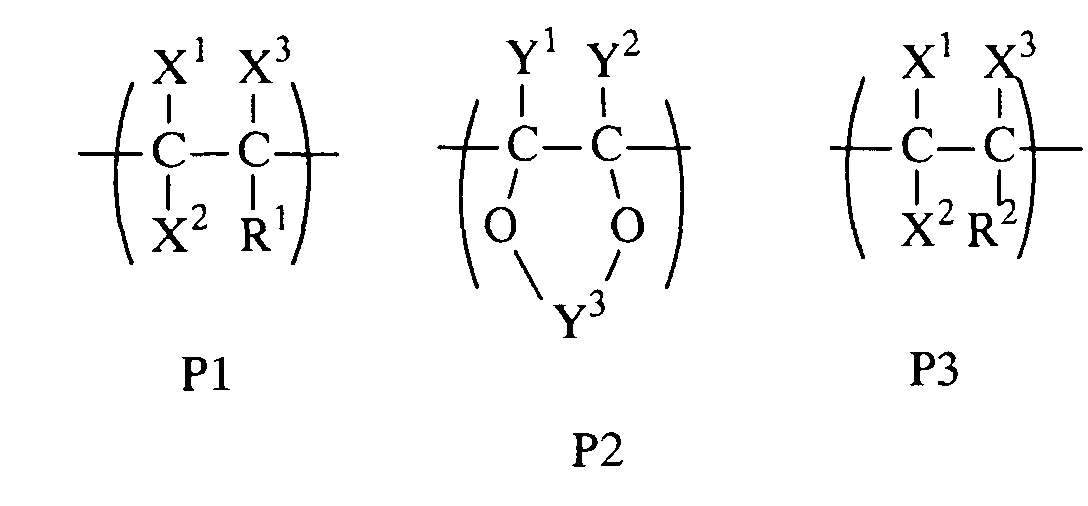
- the copolymer according to the invention comprises the units P1, P2 and P3, shown below.
- the copolymer according to the invention comprises one or more units P1, a or more patterns P2 and one or more patterns P3.
- the monomer M1 giving rise to the units P1, is a monomer taken from the group of monomers of general formula represented below, totally or partially fluorinated or then chlorofluorinated: with X 1 , X 2 and X 3 , identical or different atoms, taken from the group comprising H, F, Cl and Br, preferably F and with R 1 an atom taken from the group comprising H, F, Cl and Br , preferably F.
- TFE tetrafluoroethylene
- CTFE chlorotrifluoroethylene
- the monomer M3, giving rise to the units P3, is a monomer taken from the group of monomers of general formula represented below, totally or partially fluorinated or then chlorofluorinated: with X 1 , X 2 and X 3 , identical or different atoms, taken from the group comprising H, F, Cl and Br, preferably F and with R 2 a carbon group comprising from 1 to 10 carbon atoms partially or completely fluorinated, preferably CF 3 .
- HFP hexafluoropropylene
- the monomer M2, giving rise to the units P2 is a monomer with a cyclic structure of the following general formula: with Y 1 and Y 2 , identical or different, taken either from the group of atoms comprising H, F, Cl and Br, or from the family of carbon groups comprising from 1 to 10 carbon atoms.
- the monomer M2 is vinylene carbonate (abbreviated VCA) in which Y 3 is a carbonyl group and Y 1 and Y 2 are hydrogen atoms.
- VCA vinylene carbonate
- a solvent medium organic, or a dispersion in an aqueous phase for example in suspension or emulsion.
- chlorofluorinated solvents such as F141b® (CFCl 2 -CH 3 ) or F113® (CF 2 Cl-CFCl 2 ).
- free radicals such as peroxide, hydroperoxide, percarbonate or still azo compounds such as azoisobutyronitrile (AIBN).
- AIBN azoisobutyronitrile
- the polymerization temperature is generally dictated by the rate of decomposition of the chosen initiating system and is, in general, between 0 and 200 ° C preferably between 40 and 120 ° C.
- the pressure is, in general, between atmospheric pressure and a pressure of 100 bars, more particularly between 2 bars and 20 bars.
- the polymer according to the invention has a transition temperature vitreous (Tg) located between 60 and 160 ° C, preferably between 80 and 140 ° C.
- Tg transition temperature vitreous
- This glass transition temperature is mainly related to the content of P2 units present in the copolymer.
- the transparency of the polymer obtained also depends the content of P2 units.
- the content of units P2 can vary in the copolymer depending on the nature of R 1 from P1 and R 2 from P3.
- the content of P2 units in the copolymer is between substantially 30 and 70 mol%.
- the content of units P1 and P3 is therefore between substantially 70 and 30 mol% in the copolymer.
- the HFP content is between 1 and 70 mol% (of preferably between 5 and 50 mol%) relative to the total of the monomers M1 and M3 and the content of TFE or CTFE is between 99 and 30 mol% of monomers M1 relative to the total of monomers M1 and M3.
- the solubility of the copolymer in reactive diluents is conditioned by its composition, thus the copolymerization of monomers M1, M2 and M3 is advantageous compared to the polymerization of a monomer M1 with a M2 monomer (in the absence of M3 monomers) or of an M3 monomer with a M2 monomer (in the absence of M1 monomers).
- the solubility of the polymer in the reactive diluents also depends on its weight-average molar mass (Mw) which must be between 10 3 and 10 6 g / mole and preferably between 2 .10 3 and 5.10 4 g / mole.
- Mw weight-average molar mass
- the invention also relates to a plastic optical fiber with an index gradient or an index jump comprising a copolymer according to the invention, as well as a method of manufacturing such a fiber chosen from a method of UV type, a method preform type and a co-extrusion type process.
- the Mw weight average molar mass
- CES analysis stereo exclusion chromatography
- An apparatus from the company Spectra Physic "Winner Station” is used. Detection is carried out by refractive index.
- the column is a 5 micron mixed C PL gel column from the company Polymer Laboratory and the solvent used is THF at a flow rate of 0.8 ml / min.
- the weight average molar masses (Mw) are expressed in g.moles- 1 relative to a polystyrene standard.
- the Tg glass transition temperature
- DSC differential scanning calorimetry
- the operation is carried out in a 1.2 liter stainless steel autoclave.
- We introduce in the reactor 355g of solution containing 115 g (i.e. 1.33 moles) of VCA and 240 g (or 2.73 moles) of AE.
- the reactor is then closed and purged three times with 20 bars of nitrogen.
- 105 g are introduced into the reactor under vacuum (i.e. 0.9 mole) of CTFE.
- a solution is then introduced using a pump containing 3.88 g (i.e. 22.3 mmol) of TBPP initiator in 25g (i.e. 0.284 mole ) of AE.
- the reaction medium is heated at 85 ° C for 3 hours with stirring with an initial pressure of approximately 8 bars.
- a polymer solution is obtained in the EA having a 45% dry extract. 220 g of methanol are added to this solution. The mixture polymer-methanol solution is then precipitated in 4 liters of ice water. The precipitated polymer is filtered and then dried for 48 h in an oven at 50 ° C to weight constant.
- Example 2 Initial composition: CTFE / VCA / HFP - 38.1 / 56.9 / 5 molar
- the process is carried out in a 1.2 liter stainless steel autoclave.
- 311g of solution containing 105.5 g (i.e. 1.22 moles) are introduced into the reactor VCA and 206 g (or 2.34 moles) of AE.
- the reactor is then closed and purged three times with 20 bars of nitrogen. Is introduced by suction into the reactor under vacuum 95 g (or 0.82 moles) of CTFE, then 16.2g (or 0.11 moles) of HFP.
- the middle reaction is heated at 85 ° C for 3 hours with stirring with pressure initial about 8 bars.
- a polymer solution is obtained in the EA having a dry extract close to 45%. 207 g of methanol are added to this solution. The polymer-methanol solution mixture is then precipitated in 4 liters of water Ice. The precipitated polymer is filtered and then dried for 48 h in an oven at 50 ° C until constant weight.
- Example 3 Initial composition: CTFE / VCA / HFP - 37.3 / 55.7 / 7 molar
- the initial proportions of reagents are modified to increase the proportion of HFP in the final polymer while maintaining a molar ratio VCA / CTFE close to 2/3.
- the molar proportion of initiator relative to the sum of the monomers is kept constant and the amount of EA is adjusted so as to keep a constant extract in the vicinity of 45%.
- Example 4 Initial composition: CTFE / VCA / HFP - 35.7 / 53.3 / 11 molar
- the initial proportions of reagents are modified to increase the proportion of HFP in the final polymer while maintaining a molar ratio CTFE / VCA close to 2/3.
- the molar proportion of initiator relative to the sum of the monomers is kept constant and the amount of EA is adjusted so as to keep a constant extract in the vicinity of 45%.
- Example 5 Initial composition: CTFE / VCA / HFP - 32.1 / 47.9 / 20 molar
- the initial proportions of reagents are modified to increase the proportion of HFP in the final polymer while maintaining a molar ratio VCA / CTFE close to 2/3.
- the molar proportion of initiator relative to the sum of the monomers is kept constant and the amount of EA is adjusted so as to keep a constant extract in the vicinity of 45%.
- oligomers obtained in the above examples were used. solution in different mixtures of reactive diluent, at the rate of 1 equivalent in weight of oligomer for 1 equivalent by weight of diluent mixture.
- UV process a first type of process, called UV process and described in detail in the document EP-1 067 222, making it possible to obtain a gradient optical fiber index, that is to say whose index varies continuously from the axis to the periphery of the fiber, once the copolymer C obtained for example according to one of the examples described above, two compositions C1 and C2 are prepared.
- the two compositions C1 and C2 are different, and each has a commercial photoinitiator, the copolymer of one of examples 2 to 5 above, and a reactive diluent composed of two monomers in different proportions according to the composition, the two monomers being D1 and D2.
- the photoinitiator can for example be an ⁇ -hydroxyketone (IRGACURE 184, DAROCUR 1173), a mono acyl phosphine (DAROCUR TPO) or a bis acyl phosphine (IRGACURE 819).
- D1 and D2 can be monomers having at least one function acrylic, methacrylic, ⁇ -fluoroacrylic, ⁇ , ⁇ -difluoroacrylic or vinyl comprising halogenated groups (fluorinated and chlorinated).
- compositions C1 and C2 prepared from the copolymer mixture of Example 5, the reactive diluent D1 being trifluoroethyl acrylate (whose refractive index is equal at 1.342 at 20 ° C), and the reactive diluent D2 being trifluoroethyl methacrylate (whose refractive index is equal to 1.457 at 20 ° C).
- the photoinitiator is from the class of bis acyl phosphines (BAPO - IRGACURE 819). The quantities are calculated for 700 grams of composition.
- Composition Amount of D1 (in g) Amount of D2 (in g) Amount of C (in g) C1 105 98 240 C2 189 0 251
- the ratio, in% by weight, of the copolymer C to the sum of the constituents of each composition is constant, while within the diluent reactive the relative proportion, in% mass of D1 compared to the sum of D1 and D2, varies from one composition to another. This allows the viscosity of the two compositions while varying the refractive index of each of these compositions.
- diluent D3 is for example and in a nonlimiting manner a reactive hydrogenated diluent, composed of 40% by weight of trimethylol propane triacrylate (TMPTA) and 60% by weight of propylene glycol (200) diacrylate (PEG-200 DA).
- TMPTA trimethylol propane triacrylate
- PEG-200 DA propylene glycol (200) diacrylate
- Figure 1 shows a very schematic sectional view, in a plane comprising a central axis X, of a device for manufacturing an optical fiber according to the method of the invention.
- the device 10 comprises a static mixer 1.
- the compositions C1 and C2 of the table above are mixed there.
- the thread obtained which is a plastic optical fiber with index gradient 6, is stretched by a capstan 10.
- the plastic optical fiber 6 is cured by photo-crosslinking using a source 7 of ultraviolet (UV) rays in a polymerized plastic optical fiber 9.
- UV ultraviolet
- the plastic optical fiber 9 is wound on a reel 11.
- the diameter of the fiber 9 is given by the die 15, but it can be refined depending on the strength of the spinning made by the capstan 10. You can use either one of plastic optical fibers 6 or 9 as a finished product according to the invention.
- the fiber thus obtained is therefore a gradient index fiber, but the above process can also make it possible to obtain a fiber with index jump, i.e. the refractive index of which varies discontinuously between the axis of the fiber and the periphery.
- C1 and C2 are then introduced into a distributor pot extended by a die, where the final diameter of the fiber and the proportion of core and sheath are governed by the pressure and the temperature of the compositions C1 and C2 as well as by the diameter of the die.
- copolymers according to the invention also make it possible to obtain plastic optical fibers by other types of processes.
- 100 g of copolymer C of the CTFE / VCA / HFP copolymer type with an average molar mass greater than 10 5 g / mol are melted at a temperature between 200 and 250 °. C in a cylindrical glass tube, without filling it completely so that a vacant space is made in the tube containing the copolymer C before sealing it under vacuum. The glass tube is then placed in a horizontal position in an oven.
- the tubular body thus obtained has an outside diameter of 17 mm and an inside diameter of 5 mm, and its refractive index is 1.45.
- the assembly is again rotated in an oven.
- D dopant thermally diffuses through the copolymer C melted for 6 hours.
- the oven is finally gradually cooled at a rate of 15 ° C / hour until ambient temperature.
- a tubular body of 17 mm outside diameter and 4.5 mm inside diameter is obtained with a gradient index profile of refraction.
- This tubular body constituting the preform of the plastic optical fiber to index gradient, is placed in a drawing oven at a temperature between 200 and 250 ° C. Its upper part is connected to a vacuum pump for the spinning stage. In this way, the preform shrinks and an optical fiber to refractive index gradient is recovered. Its dimensions depend on the spinning speed, preferably between 5 and 10 m / min and temperature from the oven.
- copolymers C according to the invention having a glass transition temperature higher than that of PMMA or CYTOP, materials conventionally used in the known “preform” process, leads to fibers having a transparency equivalent or superior to those obtained with conventional materials.
- Figure 2 where is represented as a function of the wavelength in nm, the attenuation (in dB / km) of a plastic optical fiber with index gradient obtained according to the process which comes to be described, from CYTOP polymer of the prior art (curve 21), PMMA polymer of the prior art (curve 22) and of CTFE / VCA / HFP polymer (51/34/10) according to the invention (curve 23).
- plastic optical fibers with index jump it is possible proceed for example by spinning a copolymer C according to the invention, for example obtained according to one of the examples above, in the molten state, and simultaneous deposition of a photocrosslinkable resin with a refractive index lower than that of copolymer C, this resin then being light-cured.
- the thickness of the resin layer thus deposited is for example of the order of 100 ⁇ m.
- copolymer C proceed by coextrusion of copolymer C with a polymer with a lower refractive index than that of copolymer C, such as, for example, PVDF, Teflon ® AF from du Pont de Nemours or Hyflon AD ® from AUSIMONT company.
- a polymer with a lower refractive index than that of copolymer C such as, for example, PVDF, Teflon ® AF from du Pont de Nemours or Hyflon AD ® from AUSIMONT company.
- compositions and examples given are only for information, and they can be modified without departing from the scope of the invention as long as the copolymer C retains the general characteristics mentioned above.
Landscapes
- Chemical & Material Sciences (AREA)
- Polymers & Plastics (AREA)
- Health & Medical Sciences (AREA)
- Organic Chemistry (AREA)
- Chemical Kinetics & Catalysis (AREA)
- Medicinal Chemistry (AREA)
- Business, Economics & Management (AREA)
- Engineering & Computer Science (AREA)
- Educational Technology (AREA)
- Educational Administration (AREA)
- General Physics & Mathematics (AREA)
- Physics & Mathematics (AREA)
- Theoretical Computer Science (AREA)
- Entrepreneurship & Innovation (AREA)
- Addition Polymer Or Copolymer, Post-Treatments, Or Chemical Modifications (AREA)
- Optical Fibers, Optical Fiber Cores, And Optical Fiber Bundles (AREA)
Abstract
Description
- du carbonate de vinylène (VCA),
- d'hexafluoropropène (HFP), et
- de chlorotrifluoroéthylène (CTFE) ou de tétrafluoroéthylène (TFE).
Il est également connu dans la littérature (M.Krebs et C. Schneider, Adv. Chem. Ser vol 142, pages 92 -98, 1975) un copolymère statistique issu de la copolymérisation du chlorotrifluoroéthylène (CTFE) et du carbonate de vinylène (VCA) de masse moléculaire (Mn) = 2000 se présentant sous forme d'un solide blanc incompatible avec une application optique.
On voit donc qu'aucun polymère fluoré ou partiellement fluoré développé jusqu'à présent n'est pleinement satisfaisant. De plus, il est particulièrement important dans le domaine des fibres optiques de disposer d'un polymère présentant une très bonne miscibilité dans un diluant ou mélange de diluant permettant d'obtenir un matériau transparent à l'issue du procédé de filage défini dans le document EP 0990 509 ou EP-1 067 222. Ledit diluant utilisable pour le procédé de filage est un composé comprenant au moins un groupement fonctionnel photoréactif choisi dans le groupe formé par les (méth)acrylates d'alkyle et les composés vinyliques.
- De façon large les (méth)acrylates fluorés et plus particulièrement les α-fluoroacrylates, les α, β-difluoroacrylates et les dérivés acryliques des alcools et diols fluorés. On peut citer préférentiellement l'acrylate de trifluoroéthyle (abrégé ATRIFE) et le perfluorohexanedioldiacrylate.
- Les (méth)acrylates hydrogénés tels que l'hexanediol diacrylate (HDDA),le cyclohexanediméthanol diacrylate, le tricyclodécanediméthanol diacrylate (TCDDMDA), le triméthylolpropane triacrylate (TMPTA), ainsi que son dérivé ethoxylé (EtOTMPTA), le pentaérythrytol tétraacrylate (PETA), le ditriméthylolpropane tétraacrylate (di-TMPTA), les dérivés diacrylées de l'éthylene glycol (PEGDA), du néopentylglycol (NPGDA), du propylène glycol (DPGDA et TPGDA) et les dérivés triacrylés du glycérol (GPTA).
- la fabrication d'articles conduisant la lumière, par exemple les fibres optiques ;
- la fabrication de revêtement ou films, par exemple antireflet ou encore ;
- la fabrication de photo masque.
L'invention a pour objet un copolymère comprenant au moins 3 motifs P1, P2 et P3 de formules générales suivantes :

avec R1 pris dans le groupe d'atomes comprenant H, F, Cl et Br ;
avec R2 un groupement carboné comprenant de 1 à 10 atomes de carbone partiellement ou totalement fluorés ;
avec Y1 et Y2 ,identiques ou différents, pris soit dans le groupe d'atomes comprenant H, F, Cl et Br, soit dans la famille des groupements carbonés comprenant de 1 à 10 atomes de carbone ;
avec Y3 un groupement carbonyle ou un groupement carboné divalent ;
la teneur en motif P2 dans le copolymère étant comprise entre 30 et 70% molaire pour respectivement une teneur en motifs P1 et P3 dans le copolymère comprise entre 70 et 30% et la masse molaire moyenne en poids (Mw) dudit copolymère étant comprise entre 103 et 106 g/mole.
- (a) du monomère M2 de formule ci-dessous avec Y1 et Y2, identiques ou différents, pris soit dans le groupe d'atomes comprenant H, F, Cl et Br, soit dans la famille des groupements carbonés comprenant de 1 à 10 atomes de carbone et avec Y3 un groupement carbonyle ou un groupement carboné divalent, le taux de monomères M2 mis à réagir étant compris entre 30 et 70% molaire par rapport au total des monomères mis à réagir ; avec
- (b) un mélange de monomères M1 et M3 de formules ci-dessous,
avec X1, X2 et X3 identiques ou différents, pris dans le groupe d'atomes comprenant H, F, Cl et Br,
avec R1 pris dans le groupe comprenant H, F, Cl et Br,
avec R2 un groupe carboné comprenant de 1 à 10 atomes de carbone partiellement ou totalement fluorés,
ledit mélange comprenant 99 à 30% molaire de monomères M1 par rapport au total des monomères M1 et M3 et de 1 à 70% molaire de monomères M3 par rapport au total des monomères M1 et M3; en présence
- (c) d'un initiateur de polymérisation.


dans lequel Y3 est un groupement carbonyle et Y1 et Y2 sont des atomes d'hydrogène.
L'invention concerne également une fibre optique plastique à gradient d'indice ou à saut d'indice comprenant un copolymère selon l'invention, ainsi qu'un procédé de fabrication d'une telle fibre choisi parmi un procédé de type UV, un procédé de type préforme et un procédé de type co-extrusion.
- La figure 1 représente schématiquement un dispositif permettant de fabriquer une fibre optique plastique à partir des copolymères selon la présente invention,
- La figure 2 montre les spectres d'atténuation d'une fibre optique plastique à gradient d'indice obtenue à partir de procédés de l'art antérieur et d'un procédé selon l'un des modes de réalisation de fibre optique plastique à partir des copolymères selon l'invention.
- CTFE : chlorotrifluoroéthylène CF2=CFCl
- TFE : tétrafluoroéthylène CF2=CF2
- HFP : hexafluoropropylène
- VCA : carbonate de vinylène
- TBPP : perpivalate de tertiobutyle, à 75 % en masse dans l'isododécane
- AE : acétate d'éthyle
- ATRIFE: acrylate de trifluoroéthyle
- HDDA : hexanediol diacrylate
- PEPC : 4-(1-propenyloxymethyl)-1,3-dioxolan-2-one
- NVP : N-vinyl pyrolidone

- VCA = 105.5g (1.22 mole)
- CTFE = 95 g (0.82 mole)
- HFP = 23 g (0.16 mole)
- AE total = 269.4 g ( 227 g pour dissoudre le VCA et 42.4 g pour dissoudre l'amorceur)
- TBPP = 3.8 g (21.81 mmole)
- VCA = 94.35g (1.09 mole)
- CTFE = 85 g (0.73 mole)
- HFP = 33.8 g (0.23 mole)
- AE total = 256.5 g ( 217 g pour dissoudre le VCA et 39.5 g pour dissoudre l'amorceur)
- TBPP = 3.55 g (20.37 mmole)
- VCA = 83.25g (0.96 mole)
- CTFE = 75 g (0.64 mole)
- HFP = 60.3 g (0.41 mole)
- AE total = 264 g ( 224 g pour dissoudre le VCA et 40 g pour dissoudre l'amorceur)
- TBPP = 3.5 g (20.09 mmole)
Le TABLEAU 1 indique le % molaire d'HFP par rapport au CTFE dans l'oligomère obtenu selon le mode opératoire utilisé dans les exemples 2, 3, 4, 5 (abrégés Ex2-5) et le comparatif 1 (Cp1) décrits ci-dessus ainsi que le rendement de polymérisation, la Tg (température de transition vitreuse), la Tf (température de fusion) et la masse molaire moyenne en poids.

Les lettres dans le TABLEAU 2 signifiant:

| Composition | Quantité de D1 (en g) | Quantité de D2 (en g) | Quantité de C (en g) |
| C1 | 105 | 98 | 240 |
| C2 | 189 | 0 | 251 |
| Dopant D | n | d (cal/cm3)1/2 |
| Benzyl phtalate-n-butyl | 1.575 | 9.64 |
| 1-methoxyphenyl-1-phényléthane | 1.571 | 9.74 |
| Benzylbenzoate | 1.568 | 10.7 |
| Bromobenzene | 1.557 | 9.9 |
| o-dichlorobenzene | 1.551 | 10.0 |
| m-dichlorobenzene | 1.543 | 9.9 |
| 1,2-dibromoethane | 1.538 | 10.4 |
Claims (15)
- Copolymère comprenant au moins 3 motifs P1, P2 et P3 de formules générales suivantes :avec X1 , X2 et X3 identiques ou différents, pris dans le groupe d'atomes comprenant H, F, CI et Br ;

avec R1 pris dans le groupe d'atomes comprenant H, F, CI et Br ;
avec R2 un groupement carboné comprenant de 1 à 10 atomes de carbone partiellement ou totalement fluorés ;
avec Y1 et Y2, identiques ou différents, pris soit dans le groupe d'atomes comprenant H, F, CI et Br, soit dans la famille des groupements carbonés comprenant de 1 à 10 atomes de carbone ;
avec Y3 un groupement carbonyle ou un groupement carboné divalent ;
la teneur en motif P2 dans le copolymère étant comprise entre 30 et 70% molaire pour respectivement une teneur en motifs P1 et P3 dans le copolymère comprise entre 70 et 30% molaire et la masse molaire moyenne en poids (Mw) dudit copolymère étant comprise entre 103 et 106 g/mole. - Copolymère selon la revendication 1, caractérisé en ce que ladite teneur en motifs P1 et P3 est telle qu'elle comprend de 99 à 30% molaire de motifs P1 avec R1 un atome de F ou CI pour 1 à 70% molaire de motifs P3 avec R2 un groupe CF3.
- Copolymère selon la revendication 2, caractérisé en ce que ladite teneur en motifs P1 et P3 est telle qu'elle comprend de 95 à 50% molaire de motifs P1 avec R1 un atome de F ou CI pour 5 à 50% molaire de motifs P3 avec R2 un groupe CF3.
- Copolymère selon l'une des revendications 1 à 3, caractérisé en ce que X1=X2=X3=F.
- Copolymère selon l'une des revendications 1 à 4, caractérisé en ce que Y1 et Y2 sont des atomes d'H et Y3 est un groupement carbonyle.
- Copolymère selon l'une des revendications 1 à 5, caractérisé en ce que la masse molaire moyenne en poids (Mw) dudit copolymère est comprise entre 2.103 et 5.104 g/mole.
- Objet comprenant un copolymère selon l'une des revendications 1 à 6.
- Utilisation de copolymère selon l'une des revendications 1 à 6 pour la fabrication d'objets conduisant la lumière, de revêtement, de films ou de photo masque.
- Procédé de synthèse du copolymère selon l'une des revendications 1 à 6 caractérisé en ce que l'on met à réagir sous atmosphère inerte(a) du monomère M2 de formule ci-dessous avec Y1 et Y2, identiques ou différents, pris soit dans le groupe d'atomes comprenant H, F, Cl et Br, soit dans la famille des groupements carbonés comprenant de 1 à 10 atomes de carbone et avec Y3 un groupement carbonyle ou un groupement carboné divalent, le taux de monomères M2 mis à réagir étant compris entre 30 et 70% molaire par rapport au total des monomères mis à réagir; avec(b) un mélange de monomères M1 et M3 de formules ci-dessous,
avec X1, X2 et X3 identiques ou différents, pris dans le groupe d'atomes comprenant H, F, CI et Br,
avec R1 pris dans le groupe comprenant H, F, Cl et Br, et
avec R2 un groupe carboné comprenant de 1 à 10 atomes de carbone partiellement ou totalement fluorés,
ledit mélange comprenant 99 à 30% molaire de monomères M1 par rapport au total des monomères M1 et M3 et de 1 à 70% molaire de monomères M3 par rapport au total des monomères M1 et M3; en présence (c) d'un initiateur de polymérisation.
 - Procédé selon la revendication 9, caractérisé en ce que la température de la réaction de synthèse est située entre 40 et 120°C.
- Procédé selon l'une des revendications 9 ou 10, caractérisé en ce que la réaction de synthèse a lieu à une pression située entre 5 et 20 bars.
- Procédé selon l'une des revendications 9 à 11, caractérisé en ce que l'initiateur de polymérisation est le perpivalate de tertiobutyle.
- Fibre optique plastique à gradient d'indice caractérisée en ce qu'elle comprend un copolymère selon l'une des revendications 1 à 6.
- Fibre optique plastique à saut d'indice caractérisée en ce qu'elle comprend un copolymère selon l'une des revendications 1 à 6.
- Procédé de fabrication d'une fibre optique plastique selon l'une des revendications 13 ou 14 caractérisé en ce qu'il est choisi parmi un procédé de type UV, un procédé de type préforme et un procédé de type coextrusion.
Applications Claiming Priority (2)
| Application Number | Priority Date | Filing Date | Title |
|---|---|---|---|
| FR0305947 | 2003-05-19 | ||
| FR0305947 | 2003-05-19 |
Publications (1)
| Publication Number | Publication Date |
|---|---|
| EP1479702A1 true EP1479702A1 (fr) | 2004-11-24 |
Family
ID=33041991
Family Applications (1)
| Application Number | Title | Priority Date | Filing Date |
|---|---|---|---|
| EP04291182A Withdrawn EP1479702A1 (fr) | 2003-05-19 | 2004-05-07 | Polymères à base de chlorotrifluoroéthylène/carbonate de vinylène/hexafluoropropène ou tétrafluoroéthylène/carbonate de vinylène/hexafluoropropène |
Country Status (6)
| Country | Link |
|---|---|
| US (1) | US20050084230A1 (fr) |
| EP (1) | EP1479702A1 (fr) |
| JP (1) | JP2004346322A (fr) |
| KR (1) | KR20040100929A (fr) |
| CN (1) | CN1609127A (fr) |
| CA (1) | CA2469831A1 (fr) |
Families Citing this family (1)
| Publication number | Priority date | Publication date | Assignee | Title |
|---|---|---|---|---|
| FR2832515B1 (fr) * | 2001-11-19 | 2004-01-30 | Nexans | Procede de fabrication d'une fibre optique plastique a gradient d'indice et fibre optique a gradient d'indice obtenue par ce procede |
Citations (3)
| Publication number | Priority date | Publication date | Assignee | Title |
|---|---|---|---|---|
| WO2001032726A1 (fr) * | 1999-11-03 | 2001-05-10 | Atofina Chemicals, Inc. | Copolymeres de hexafluoropropylene de fluorure de vinylidene a faible cristallinite |
| WO2001037043A1 (fr) * | 1999-11-17 | 2001-05-25 | E.I. Du Pont De Nemours And Company | Compositions polymeres transparentes aux ultraviolets et aux ultraviolets extremes et leurs utilisations |
| US6486280B1 (en) * | 1995-02-06 | 2002-11-26 | E. I. Du Pont De Nemours And Company | Amorphous tetrafluoroethylene-hexafluoropropylene copolymers |
Family Cites Families (3)
| Publication number | Priority date | Publication date | Assignee | Title |
|---|---|---|---|---|
| FR2784196B1 (fr) * | 1998-10-01 | 2000-12-15 | Cit Alcatel | Fibre optique plastique a gradient d'indice et procede de fabrication en continu d'une fibre optique plastique a gradient d'indice |
| US6612932B2 (en) * | 1999-05-21 | 2003-09-02 | Gregory N. Stern | Method and apparatus for obtaining marketing information through the playing of a maze based game |
| FR2795997B1 (fr) * | 1999-07-05 | 2001-10-19 | Cit Alcatel | Procede de fabrication d'une fibre optique plastique a gradient d'indice |
-
2004
- 2004-05-07 EP EP04291182A patent/EP1479702A1/fr not_active Withdrawn
- 2004-05-15 KR KR1020040034529A patent/KR20040100929A/ko not_active Ceased
- 2004-05-18 CA CA002469831A patent/CA2469831A1/fr not_active Abandoned
- 2004-05-18 US US10/847,963 patent/US20050084230A1/en not_active Abandoned
- 2004-05-19 CN CNA2004100639098A patent/CN1609127A/zh active Pending
- 2004-05-19 JP JP2004149605A patent/JP2004346322A/ja not_active Abandoned
Patent Citations (3)
| Publication number | Priority date | Publication date | Assignee | Title |
|---|---|---|---|---|
| US6486280B1 (en) * | 1995-02-06 | 2002-11-26 | E. I. Du Pont De Nemours And Company | Amorphous tetrafluoroethylene-hexafluoropropylene copolymers |
| WO2001032726A1 (fr) * | 1999-11-03 | 2001-05-10 | Atofina Chemicals, Inc. | Copolymeres de hexafluoropropylene de fluorure de vinylidene a faible cristallinite |
| WO2001037043A1 (fr) * | 1999-11-17 | 2001-05-25 | E.I. Du Pont De Nemours And Company | Compositions polymeres transparentes aux ultraviolets et aux ultraviolets extremes et leurs utilisations |
Also Published As
| Publication number | Publication date |
|---|---|
| JP2004346322A (ja) | 2004-12-09 |
| US20050084230A1 (en) | 2005-04-21 |
| KR20040100929A (ko) | 2004-12-02 |
| CN1609127A (zh) | 2005-04-27 |
| CA2469831A1 (fr) | 2004-11-19 |
Similar Documents
| Publication | Publication Date | Title |
|---|---|---|
| FR2577565A1 (fr) | Composition de resine formee d'un melange d'un polymere d'un ester acrylique avec un copolymere de fluorure de vinylidene et d'hexafluoroacetone pour un usage optique | |
| EP3368581B1 (fr) | Copolymeres fluores fonctionnalises | |
| FR2989972A1 (fr) | Copolymerisation radicalaire controlee a partir de trifluoroethylene | |
| FR2569703A1 (fr) | Nouveau copolymere chlorotrifluoroethylene/ester d'acide gras/allylether contenant un hydroxyle, composition liquide de revetement le contenant | |
| JPH07500856A (ja) | 光ファイバークラッドのための低屈折率プラスティック | |
| FR2608615A1 (fr) | Composition d'un melange de polymeres, appropriee comme materiau optique | |
| FR2567653A1 (fr) | Fibre optique ayant une ame en polymethacrylate et un revetement en un copolymere fluore | |
| WO2017068276A1 (fr) | Copolymeres fluores fonctionnalises | |
| EP1067222A1 (fr) | Procédé de fabrication d'une fibre optique plastique à gradient d'indice | |
| JP2008291138A (ja) | メチルメタクリレート系共重合体の製造方法、及びプラスチック光ファイバの製造方法 | |
| FR2585477A1 (fr) | Fibre optique en resine et procede pour sa fabrication | |
| CA2469831A1 (fr) | Polymeres a base de ctfe/vca/hfp ou tfe/vca/hfp | |
| US7459512B2 (en) | Process for preparing perfluoroalkyl vinyl ether copolymer and copolymer | |
| WO2008065301A1 (fr) | Memoire optique 3d comprenant un copolymere a blocs contenant un monomere photoactif porteur d'un groupement photoisomerisable | |
| JP5618291B2 (ja) | 新規な含フッ素化合物、該含フッ素化合物の重合体の製造方法並びに該含フッ素化合物の重合体からなる光学素子、機能性薄膜及びレジスト膜 | |
| EP1451005A2 (fr) | Procede de fabrication d'une fibre optique plastique, et fibre optique plastique obtenue par ce procede | |
| FR2832515A1 (fr) | Procede de fabrication d'une fibre optique plastique a gradient d'indice et fibre optique a gradient d'indice obtenue par ce procede | |
| JP2009227787A (ja) | メチルメタクリレート系共重合体の製造方法、及びプラスチック光ファイバの製造方法 | |
| FR2811674A1 (fr) | Resines et articles photochromiques; preparation; compositions precurseurs | |
| FR2569710A1 (fr) | Materiau plastique a propriete optique a base de melange de polymeres a indice de refraction differents | |
| FR2832412A1 (fr) | Polymere fonctionnel reticulable permettant la fabrication de materiaux conducteurs de la lumiere | |
| FR2832411A1 (fr) | Copolymere amorphe partiellement fluore permettant la fabrication de materiaux conducteurs de la lumiere | |
| FR2761694A1 (fr) | Polymere photochromique, intrinsequement stable a la lumiere sa preparation et les articles en renfermant | |
| US20250084191A1 (en) | Fluorine resin refining method, method for producing refined fluorine resin, fluorine resin, optical material, electronic material and plastic optical fiber | |
| JP2000159818A (ja) | メタクリル系重合体の製造方法及びプラスチック光ファイバの製造方法 |
Legal Events
| Date | Code | Title | Description |
|---|---|---|---|
| PUAI | Public reference made under article 153(3) epc to a published international application that has entered the european phase |
Free format text: ORIGINAL CODE: 0009012 |
|
| AK | Designated contracting states |
Kind code of ref document: A1 Designated state(s): AT BE BG CH CY CZ DE DK EE ES FI FR GB GR HU IE IT LI LU MC NL PL PT RO SE SI SK TR |
|
| AX | Request for extension of the european patent |
Extension state: AL HR LT LV MK |
|
| RIN1 | Information on inventor provided before grant (corrected) |
Inventor name: FOURNIER, JEROEME Inventor name: ALRIC, JEROEME Inventor name: ROUSSEAU, ALAIN Inventor name: KOSTOV, GEORGES Inventor name: BOUTEVIN, BERNARD Inventor name: PASCAL, THIERRY |
|
| RAP1 | Party data changed (applicant data changed or rights of an application transferred) |
Owner name: ARKEMA |
|
| 17P | Request for examination filed |
Effective date: 20050524 |
|
| AKX | Designation fees paid |
Designated state(s): AT BE BG CH CY CZ DE DK EE ES FI FR GB GR HU IE IT LI LU MC NL PL PT RO SE SI SK TR |
|
| RAP1 | Party data changed (applicant data changed or rights of an application transferred) |
Owner name: ARKEMA FRANCE |
|
| STAA | Information on the status of an ep patent application or granted ep patent |
Free format text: STATUS: THE APPLICATION HAS BEEN WITHDRAWN |
|
| 18W | Application withdrawn |
Effective date: 20060824 |