EP1477532A2 - Spherical silica-titania-based fine particles surface-treated with silane, production process therefor, and external additive for electrostatically charged image developing toner using same - Google Patents
Spherical silica-titania-based fine particles surface-treated with silane, production process therefor, and external additive for electrostatically charged image developing toner using same Download PDFInfo
- Publication number
- EP1477532A2 EP1477532A2 EP04009810A EP04009810A EP1477532A2 EP 1477532 A2 EP1477532 A2 EP 1477532A2 EP 04009810 A EP04009810 A EP 04009810A EP 04009810 A EP04009810 A EP 04009810A EP 1477532 A2 EP1477532 A2 EP 1477532A2
- Authority
- EP
- European Patent Office
- Prior art keywords
- fine particles
- spherical silica
- general formula
- titania
- production process
- Prior art date
- Legal status (The legal status is an assumption and is not a legal conclusion. Google has not performed a legal analysis and makes no representation as to the accuracy of the status listed.)
- Granted
Links
- 239000010419 fine particle Substances 0.000 title claims abstract description 144
- GWEVSGVZZGPLCZ-UHFFFAOYSA-N titanium dioxide Inorganic materials O=[Ti]=O GWEVSGVZZGPLCZ-UHFFFAOYSA-N 0.000 title claims abstract description 115
- 229910000077 silane Inorganic materials 0.000 title claims abstract description 64
- BLRPTPMANUNPDV-UHFFFAOYSA-N Silane Chemical compound [SiH4] BLRPTPMANUNPDV-UHFFFAOYSA-N 0.000 title claims abstract description 40
- 239000000654 additive Substances 0.000 title claims abstract description 21
- 230000000996 additive effect Effects 0.000 title claims abstract description 21
- 238000004519 manufacturing process Methods 0.000 title claims description 22
- 239000002245 particle Substances 0.000 claims abstract description 39
- 229910052719 titanium Inorganic materials 0.000 claims abstract description 18
- RTAQQCXQSZGOHL-UHFFFAOYSA-N Titanium Chemical group [Ti] RTAQQCXQSZGOHL-UHFFFAOYSA-N 0.000 claims abstract description 16
- 239000000463 material Substances 0.000 claims abstract description 11
- XEEYBQQBJWHFJM-UHFFFAOYSA-N Iron Chemical compound [Fe] XEEYBQQBJWHFJM-UHFFFAOYSA-N 0.000 claims abstract description 5
- 239000006185 dispersion Substances 0.000 claims description 37
- 125000004432 carbon atom Chemical group C* 0.000 claims description 32
- 125000001183 hydrocarbyl group Chemical group 0.000 claims description 32
- -1 silane compound Chemical class 0.000 claims description 32
- 239000000203 mixture Substances 0.000 claims description 31
- XLYOFNOQVPJJNP-UHFFFAOYSA-N water Substances O XLYOFNOQVPJJNP-UHFFFAOYSA-N 0.000 claims description 28
- 230000002209 hydrophobic effect Effects 0.000 claims description 24
- VXUYXOFXAQZZMF-UHFFFAOYSA-N titanium(IV) isopropoxide Chemical compound CC(C)O[Ti](OC(C)C)(OC(C)C)OC(C)C VXUYXOFXAQZZMF-UHFFFAOYSA-N 0.000 claims description 22
- 239000003960 organic solvent Substances 0.000 claims description 15
- VYPSYNLAJGMNEJ-UHFFFAOYSA-N Silicium dioxide Chemical group O=[Si]=O VYPSYNLAJGMNEJ-UHFFFAOYSA-N 0.000 claims description 14
- 238000000034 method Methods 0.000 claims description 14
- 150000001875 compounds Chemical class 0.000 claims description 13
- 239000010936 titanium Substances 0.000 claims description 13
- 239000007859 condensation product Substances 0.000 claims description 12
- 239000005453 ketone based solvent Substances 0.000 claims description 12
- QGZKDVFQNNGYKY-UHFFFAOYSA-N Ammonia Chemical compound N QGZKDVFQNNGYKY-UHFFFAOYSA-N 0.000 claims description 11
- FFUAGWLWBBFQJT-UHFFFAOYSA-N hexamethyldisilazane Chemical compound C[Si](C)(C)N[Si](C)(C)C FFUAGWLWBBFQJT-UHFFFAOYSA-N 0.000 claims description 10
- 125000003545 alkoxy group Chemical group 0.000 claims description 8
- 239000012046 mixed solvent Substances 0.000 claims description 8
- 230000008569 process Effects 0.000 claims description 7
- LFQCEHFDDXELDD-UHFFFAOYSA-N tetramethyl orthosilicate Chemical compound CO[Si](OC)(OC)OC LFQCEHFDDXELDD-UHFFFAOYSA-N 0.000 claims description 7
- 150000003609 titanium compounds Chemical class 0.000 claims description 7
- NTIZESTWPVYFNL-UHFFFAOYSA-N Methyl isobutyl ketone Chemical group CC(C)CC(C)=O NTIZESTWPVYFNL-UHFFFAOYSA-N 0.000 claims description 6
- UIHCLUNTQKBZGK-UHFFFAOYSA-N Methyl isobutyl ketone Natural products CCC(C)C(C)=O UIHCLUNTQKBZGK-UHFFFAOYSA-N 0.000 claims description 6
- 239000002612 dispersion medium Substances 0.000 claims description 5
- BOTDANWDWHJENH-UHFFFAOYSA-N Tetraethyl orthosilicate Chemical compound CCO[Si](OCC)(OCC)OCC BOTDANWDWHJENH-UHFFFAOYSA-N 0.000 claims description 4
- 229910021529 ammonia Inorganic materials 0.000 claims description 4
- DCFKHNIGBAHNSS-UHFFFAOYSA-N chloro(triethyl)silane Chemical compound CC[Si](Cl)(CC)CC DCFKHNIGBAHNSS-UHFFFAOYSA-N 0.000 claims description 4
- IJOOHPMOJXWVHK-UHFFFAOYSA-N chlorotrimethylsilane Chemical compound C[Si](C)(C)Cl IJOOHPMOJXWVHK-UHFFFAOYSA-N 0.000 claims description 4
- POPACFLNWGUDSR-UHFFFAOYSA-N methoxy(trimethyl)silane Chemical compound CO[Si](C)(C)C POPACFLNWGUDSR-UHFFFAOYSA-N 0.000 claims description 4
- BFXIKLCIZHOAAZ-UHFFFAOYSA-N methyltrimethoxysilane Chemical compound CO[Si](C)(OC)OC BFXIKLCIZHOAAZ-UHFFFAOYSA-N 0.000 claims description 4
- 239000002904 solvent Substances 0.000 claims description 4
- AAPLIUHOKVUFCC-UHFFFAOYSA-N trimethylsilanol Chemical compound C[Si](C)(C)O AAPLIUHOKVUFCC-UHFFFAOYSA-N 0.000 claims description 4
- NOGBEXBVDOCGDB-NRFIWDAESA-L (z)-4-ethoxy-4-oxobut-2-en-2-olate;propan-2-olate;titanium(4+) Chemical compound [Ti+4].CC(C)[O-].CC(C)[O-].CCOC(=O)\C=C(\C)[O-].CCOC(=O)\C=C(\C)[O-] NOGBEXBVDOCGDB-NRFIWDAESA-L 0.000 claims description 3
- OVSGBKZKXUMMHS-VGKOASNMSA-L (z)-4-oxopent-2-en-2-olate;propan-2-olate;titanium(4+) Chemical compound [Ti+4].CC(C)[O-].CC(C)[O-].C\C([O-])=C\C(C)=O.C\C([O-])=C\C(C)=O OVSGBKZKXUMMHS-VGKOASNMSA-L 0.000 claims description 3
- JOOMLFKONHCLCJ-UHFFFAOYSA-N N-(trimethylsilyl)diethylamine Chemical compound CCN(CC)[Si](C)(C)C JOOMLFKONHCLCJ-UHFFFAOYSA-N 0.000 claims description 3
- 229910020388 SiO1/2 Inorganic materials 0.000 claims description 3
- 229910020487 SiO3/2 Inorganic materials 0.000 claims description 3
- MTKOCRSQUPLVTD-UHFFFAOYSA-N butan-1-olate;titanium(2+) Chemical compound CCCCO[Ti]OCCCC MTKOCRSQUPLVTD-UHFFFAOYSA-N 0.000 claims description 3
- YHWCPXVTRSHPNY-UHFFFAOYSA-N butan-1-olate;titanium(4+) Chemical compound [Ti+4].CCCC[O-].CCCC[O-].CCCC[O-].CCCC[O-] YHWCPXVTRSHPNY-UHFFFAOYSA-N 0.000 claims description 3
- KVIKMJYUMZPZFU-UHFFFAOYSA-N propan-2-ol;titanium Chemical compound [Ti].CC(C)O.CC(C)O KVIKMJYUMZPZFU-UHFFFAOYSA-N 0.000 claims description 3
- UQMOLLPKNHFRAC-UHFFFAOYSA-N tetrabutyl silicate Chemical compound CCCCO[Si](OCCCC)(OCCCC)OCCCC UQMOLLPKNHFRAC-UHFFFAOYSA-N 0.000 claims description 3
- ZUEKXCXHTXJYAR-UHFFFAOYSA-N tetrapropan-2-yl silicate Chemical compound CC(C)O[Si](OC(C)C)(OC(C)C)OC(C)C ZUEKXCXHTXJYAR-UHFFFAOYSA-N 0.000 claims description 3
- KKYDYRWEUFJLER-UHFFFAOYSA-N 1,1,2,2,3,3,4,4,5,5,6,6,7,7,10,10,10-heptadecafluorodecyl(trimethoxy)silane Chemical compound CO[Si](OC)(OC)C(F)(F)C(F)(F)C(F)(F)C(F)(F)C(F)(F)C(F)(F)C(F)(F)CCC(F)(F)F KKYDYRWEUFJLER-UHFFFAOYSA-N 0.000 claims description 2
- DMLWITSKISPJIJ-UHFFFAOYSA-N 2-ethylhexan-1-olate Chemical compound CCCCC(CC)C[O-] DMLWITSKISPJIJ-UHFFFAOYSA-N 0.000 claims description 2
- APDDLLVYBXGBRF-UHFFFAOYSA-N [diethyl-(triethylsilylamino)silyl]ethane Chemical compound CC[Si](CC)(CC)N[Si](CC)(CC)CC APDDLLVYBXGBRF-UHFFFAOYSA-N 0.000 claims description 2
- XGZGKDQVCBHSGI-UHFFFAOYSA-N butyl(triethoxy)silane Chemical compound CCCC[Si](OCC)(OCC)OCC XGZGKDQVCBHSGI-UHFFFAOYSA-N 0.000 claims description 2
- SXPLZNMUBFBFIA-UHFFFAOYSA-N butyl(trimethoxy)silane Chemical compound CCCC[Si](OC)(OC)OC SXPLZNMUBFBFIA-UHFFFAOYSA-N 0.000 claims description 2
- RSIHJDGMBDPTIM-UHFFFAOYSA-N ethoxy(trimethyl)silane Chemical compound CCO[Si](C)(C)C RSIHJDGMBDPTIM-UHFFFAOYSA-N 0.000 claims description 2
- SBRXLTRZCJVAPH-UHFFFAOYSA-N ethyl(trimethoxy)silane Chemical compound CC[Si](OC)(OC)OC SBRXLTRZCJVAPH-UHFFFAOYSA-N 0.000 claims description 2
- CZWLNMOIEMTDJY-UHFFFAOYSA-N hexyl(trimethoxy)silane Chemical compound CCCCCC[Si](OC)(OC)OC CZWLNMOIEMTDJY-UHFFFAOYSA-N 0.000 claims description 2
- 230000003301 hydrolyzing effect Effects 0.000 claims description 2
- 125000002887 hydroxy group Chemical group [H]O* 0.000 claims description 2
- 239000007788 liquid Substances 0.000 claims description 2
- KAHVZNKZQFSBFW-UHFFFAOYSA-N n-methyl-n-trimethylsilylmethanamine Chemical compound CN(C)[Si](C)(C)C KAHVZNKZQFSBFW-UHFFFAOYSA-N 0.000 claims description 2
- NFHFRUOZVGFOOS-UHFFFAOYSA-N palladium;triphenylphosphane Chemical compound [Pd].C1=CC=CC=C1P(C=1C=CC=CC=1)C1=CC=CC=C1.C1=CC=CC=C1P(C=1C=CC=CC=1)C1=CC=CC=C1.C1=CC=CC=C1P(C=1C=CC=CC=1)C1=CC=CC=C1.C1=CC=CC=C1P(C=1C=CC=CC=1)C1=CC=CC=C1 NFHFRUOZVGFOOS-UHFFFAOYSA-N 0.000 claims description 2
- ADLSSRLDGACTEX-UHFFFAOYSA-N tetraphenyl silicate Chemical compound C=1C=CC=CC=1O[Si](OC=1C=CC=CC=1)(OC=1C=CC=CC=1)OC1=CC=CC=C1 ADLSSRLDGACTEX-UHFFFAOYSA-N 0.000 claims description 2
- DENFJSAFJTVPJR-UHFFFAOYSA-N triethoxy(ethyl)silane Chemical compound CCO[Si](CC)(OCC)OCC DENFJSAFJTVPJR-UHFFFAOYSA-N 0.000 claims description 2
- CPUDPFPXCZDNGI-UHFFFAOYSA-N triethoxy(methyl)silane Chemical compound CCO[Si](C)(OCC)OCC CPUDPFPXCZDNGI-UHFFFAOYSA-N 0.000 claims description 2
- BJDLPDPRMYAOCM-UHFFFAOYSA-N triethoxy(propan-2-yl)silane Chemical compound CCO[Si](OCC)(OCC)C(C)C BJDLPDPRMYAOCM-UHFFFAOYSA-N 0.000 claims description 2
- NBXZNTLFQLUFES-UHFFFAOYSA-N triethoxy(propyl)silane Chemical compound CCC[Si](OCC)(OCC)OCC NBXZNTLFQLUFES-UHFFFAOYSA-N 0.000 claims description 2
- WVMSIBFANXCZKT-UHFFFAOYSA-N triethyl(hydroxy)silane Chemical compound CC[Si](O)(CC)CC WVMSIBFANXCZKT-UHFFFAOYSA-N 0.000 claims description 2
- JLGNHOJUQFHYEZ-UHFFFAOYSA-N trimethoxy(3,3,3-trifluoropropyl)silane Chemical compound CO[Si](OC)(OC)CCC(F)(F)F JLGNHOJUQFHYEZ-UHFFFAOYSA-N 0.000 claims description 2
- LGROXJWYRXANBB-UHFFFAOYSA-N trimethoxy(propan-2-yl)silane Chemical compound CO[Si](OC)(OC)C(C)C LGROXJWYRXANBB-UHFFFAOYSA-N 0.000 claims description 2
- HQYALQRYBUJWDH-UHFFFAOYSA-N trimethoxy(propyl)silane Chemical compound CCC[Si](OC)(OC)OC HQYALQRYBUJWDH-UHFFFAOYSA-N 0.000 claims description 2
- 239000005051 trimethylchlorosilane Substances 0.000 claims description 2
- QHUNJMXHQHHWQP-UHFFFAOYSA-N trimethylsilyl acetate Chemical compound CC(=O)O[Si](C)(C)C QHUNJMXHQHHWQP-UHFFFAOYSA-N 0.000 claims description 2
- 125000002587 enol group Chemical group 0.000 claims 2
- 125000003158 alcohol group Chemical group 0.000 claims 1
- 108091008695 photoreceptors Proteins 0.000 abstract description 27
- 230000007850 degeneration Effects 0.000 abstract description 9
- 238000006748 scratching Methods 0.000 abstract description 9
- 230000002393 scratching effect Effects 0.000 abstract description 9
- 230000002349 favourable effect Effects 0.000 abstract description 3
- OKKJLVBELUTLKV-UHFFFAOYSA-N Methanol Chemical compound OC OKKJLVBELUTLKV-UHFFFAOYSA-N 0.000 description 39
- 230000000052 comparative effect Effects 0.000 description 16
- 125000001495 ethyl group Chemical group [H]C([H])([H])C([H])([H])* 0.000 description 14
- 238000005259 measurement Methods 0.000 description 14
- 125000002496 methyl group Chemical group [H]C([H])([H])* 0.000 description 14
- 238000004220 aggregation Methods 0.000 description 12
- 230000002776 aggregation Effects 0.000 description 12
- 239000000843 powder Substances 0.000 description 12
- LFQSCWFLJHTTHZ-UHFFFAOYSA-N Ethanol Chemical compound CCO LFQSCWFLJHTTHZ-UHFFFAOYSA-N 0.000 description 9
- 125000000484 butyl group Chemical group [H]C([*])([H])C([H])([H])C([H])([H])C([H])([H])[H] 0.000 description 9
- 238000006243 chemical reaction Methods 0.000 description 9
- 125000001449 isopropyl group Chemical group [H]C([H])([H])C([H])(*)C([H])([H])[H] 0.000 description 9
- 238000000691 measurement method Methods 0.000 description 9
- 239000007900 aqueous suspension Substances 0.000 description 7
- 125000001436 propyl group Chemical group [H]C([*])([H])C([H])([H])C([H])([H])[H] 0.000 description 7
- ZWEHNKRNPOVVGH-UHFFFAOYSA-N 2-Butanone Chemical compound CCC(C)=O ZWEHNKRNPOVVGH-UHFFFAOYSA-N 0.000 description 6
- 150000001298 alcohols Chemical class 0.000 description 5
- 239000000725 suspension Substances 0.000 description 5
- IJGRMHOSHXDMSA-UHFFFAOYSA-N Atomic nitrogen Chemical compound N#N IJGRMHOSHXDMSA-UHFFFAOYSA-N 0.000 description 4
- 238000007792 addition Methods 0.000 description 4
- 230000015572 biosynthetic process Effects 0.000 description 4
- 238000004821 distillation Methods 0.000 description 4
- 150000002085 enols Chemical group 0.000 description 4
- 125000001153 fluoro group Chemical group F* 0.000 description 4
- 230000007062 hydrolysis Effects 0.000 description 4
- 238000006460 hydrolysis reaction Methods 0.000 description 4
- 239000000047 product Substances 0.000 description 4
- 239000000377 silicon dioxide Substances 0.000 description 4
- 238000003786 synthesis reaction Methods 0.000 description 4
- ZNQVEEAIQZEUHB-UHFFFAOYSA-N 2-ethoxyethanol Chemical compound CCOCCO ZNQVEEAIQZEUHB-UHFFFAOYSA-N 0.000 description 3
- VHUUQVKOLVNVRT-UHFFFAOYSA-N Ammonium hydroxide Chemical compound [NH4+].[OH-] VHUUQVKOLVNVRT-UHFFFAOYSA-N 0.000 description 3
- 125000001309 chloro group Chemical group Cl* 0.000 description 3
- 239000003086 colorant Substances 0.000 description 3
- 125000004123 n-propyl group Chemical group [H]C([H])([H])C([H])([H])C([H])([H])* 0.000 description 3
- 239000011347 resin Substances 0.000 description 3
- 229920005989 resin Polymers 0.000 description 3
- 239000007787 solid Substances 0.000 description 3
- 239000007858 starting material Substances 0.000 description 3
- 238000003756 stirring Methods 0.000 description 3
- 229910000859 α-Fe Inorganic materials 0.000 description 3
- CSCPPACGZOOCGX-UHFFFAOYSA-N Acetone Chemical compound CC(C)=O CSCPPACGZOOCGX-UHFFFAOYSA-N 0.000 description 2
- 239000004925 Acrylic resin Substances 0.000 description 2
- ROSDSFDQCJNGOL-UHFFFAOYSA-N Dimethylamine Chemical compound CNC ROSDSFDQCJNGOL-UHFFFAOYSA-N 0.000 description 2
- KFZMGEQAYNKOFK-UHFFFAOYSA-N Isopropanol Chemical compound CC(C)O KFZMGEQAYNKOFK-UHFFFAOYSA-N 0.000 description 2
- LRHPLDYGYMQRHN-UHFFFAOYSA-N N-Butanol Chemical compound CCCCO LRHPLDYGYMQRHN-UHFFFAOYSA-N 0.000 description 2
- WYURNTSHIVDZCO-UHFFFAOYSA-N Tetrahydrofuran Chemical compound C1CCOC1 WYURNTSHIVDZCO-UHFFFAOYSA-N 0.000 description 2
- YRKCREAYFQTBPV-UHFFFAOYSA-N acetylacetone Chemical compound CC(=O)CC(C)=O YRKCREAYFQTBPV-UHFFFAOYSA-N 0.000 description 2
- 125000003277 amino group Chemical group 0.000 description 2
- 239000011230 binding agent Substances 0.000 description 2
- 125000001246 bromo group Chemical group Br* 0.000 description 2
- 230000006866 deterioration Effects 0.000 description 2
- 238000011161 development Methods 0.000 description 2
- HPNMFZURTQLUMO-UHFFFAOYSA-N diethylamine Chemical compound CCNCC HPNMFZURTQLUMO-UHFFFAOYSA-N 0.000 description 2
- 238000009826 distribution Methods 0.000 description 2
- 230000000694 effects Effects 0.000 description 2
- 238000007786 electrostatic charging Methods 0.000 description 2
- 230000007613 environmental effect Effects 0.000 description 2
- 239000011521 glass Substances 0.000 description 2
- 125000005843 halogen group Chemical group 0.000 description 2
- 238000010438 heat treatment Methods 0.000 description 2
- 125000004051 hexyl group Chemical group [H]C([H])([H])C([H])([H])C([H])([H])C([H])([H])C([H])([H])C([H])([H])* 0.000 description 2
- 125000004435 hydrogen atom Chemical group [H]* 0.000 description 2
- 239000010954 inorganic particle Substances 0.000 description 2
- 230000003993 interaction Effects 0.000 description 2
- 229910052757 nitrogen Inorganic materials 0.000 description 2
- 238000002360 preparation method Methods 0.000 description 2
- 238000004381 surface treatment Methods 0.000 description 2
- 238000006227 trimethylsilylation reaction Methods 0.000 description 2
- RYHBNJHYFVUHQT-UHFFFAOYSA-N 1,4-Dioxane Chemical compound C1COCCO1 RYHBNJHYFVUHQT-UHFFFAOYSA-N 0.000 description 1
- XNWFRZJHXBZDAG-UHFFFAOYSA-N 2-METHOXYETHANOL Chemical compound COCCO XNWFRZJHXBZDAG-UHFFFAOYSA-N 0.000 description 1
- POAOYUHQDCAZBD-UHFFFAOYSA-N 2-butoxyethanol Chemical compound CCCCOCCO POAOYUHQDCAZBD-UHFFFAOYSA-N 0.000 description 1
- SVONRAPFKPVNKG-UHFFFAOYSA-N 2-ethoxyethyl acetate Chemical compound CCOCCOC(C)=O SVONRAPFKPVNKG-UHFFFAOYSA-N 0.000 description 1
- 229920000178 Acrylic resin Polymers 0.000 description 1
- CJTAQYVSJFPUSG-UHFFFAOYSA-N CC1(C)[O]=C(C)C=C(C)O1 Chemical compound CC1(C)[O]=C(C)C=C(C)O1 CJTAQYVSJFPUSG-UHFFFAOYSA-N 0.000 description 1
- 206010027146 Melanoderma Diseases 0.000 description 1
- 238000002441 X-ray diffraction Methods 0.000 description 1
- 125000004423 acyloxy group Chemical group 0.000 description 1
- 150000004703 alkoxides Chemical class 0.000 description 1
- 239000007864 aqueous solution Substances 0.000 description 1
- 239000000969 carrier Substances 0.000 description 1
- 239000003795 chemical substances by application Substances 0.000 description 1
- 229910052801 chlorine Inorganic materials 0.000 description 1
- KOPOQZFJUQMUML-UHFFFAOYSA-N chlorosilane Chemical class Cl[SiH3] KOPOQZFJUQMUML-UHFFFAOYSA-N 0.000 description 1
- 239000011248 coating agent Substances 0.000 description 1
- 238000000576 coating method Methods 0.000 description 1
- 230000000536 complexating effect Effects 0.000 description 1
- 239000002131 composite material Substances 0.000 description 1
- 238000009833 condensation Methods 0.000 description 1
- 230000005494 condensation Effects 0.000 description 1
- 230000007423 decrease Effects 0.000 description 1
- 230000007547 defect Effects 0.000 description 1
- 230000002939 deleterious effect Effects 0.000 description 1
- 150000002148 esters Chemical class 0.000 description 1
- 150000002170 ethers Chemical class 0.000 description 1
- 238000011156 evaluation Methods 0.000 description 1
- 230000009477 glass transition Effects 0.000 description 1
- 230000005660 hydrophilic surface Effects 0.000 description 1
- 229910052809 inorganic oxide Inorganic materials 0.000 description 1
- 238000007689 inspection Methods 0.000 description 1
- 125000000555 isopropenyl group Chemical group [H]\C([H])=C(\*)C([H])([H])[H] 0.000 description 1
- 150000002576 ketones Chemical class 0.000 description 1
- 229910052751 metal Inorganic materials 0.000 description 1
- 239000002184 metal Substances 0.000 description 1
- 238000002156 mixing Methods 0.000 description 1
- 125000001400 nonyl group Chemical group [H]C([*])([H])C([H])([H])C([H])([H])C([H])([H])C([H])([H])C([H])([H])C([H])([H])C([H])([H])C([H])([H])[H] 0.000 description 1
- 150000002894 organic compounds Chemical class 0.000 description 1
- 125000005010 perfluoroalkyl group Chemical group 0.000 description 1
- 125000001997 phenyl group Chemical group [H]C1=C([H])C([H])=C(*)C([H])=C1[H] 0.000 description 1
- 229920001225 polyester resin Polymers 0.000 description 1
- 239000004645 polyester resin Substances 0.000 description 1
- 229920000642 polymer Polymers 0.000 description 1
- 230000002265 prevention Effects 0.000 description 1
- 230000009257 reactivity Effects 0.000 description 1
- FZHAPNGMFPVSLP-UHFFFAOYSA-N silanamine Chemical class [SiH3]N FZHAPNGMFPVSLP-UHFFFAOYSA-N 0.000 description 1
- SCPYDCQAZCOKTP-UHFFFAOYSA-N silanol Chemical class [SiH3]O SCPYDCQAZCOKTP-UHFFFAOYSA-N 0.000 description 1
- 239000002356 single layer Substances 0.000 description 1
- 239000000243 solution Substances 0.000 description 1
- 125000004079 stearyl group Chemical group [H]C([*])([H])C([H])([H])C([H])([H])C([H])([H])C([H])([H])C([H])([H])C([H])([H])C([H])([H])C([H])([H])C([H])([H])C([H])([H])C([H])([H])C([H])([H])C([H])([H])C([H])([H])C([H])([H])C([H])([H])C([H])([H])[H] 0.000 description 1
- 230000002194 synthesizing effect Effects 0.000 description 1
- 238000012360 testing method Methods 0.000 description 1
- YLQBMQCUIZJEEH-UHFFFAOYSA-N tetrahydrofuran Natural products C=1C=COC=1 YLQBMQCUIZJEEH-UHFFFAOYSA-N 0.000 description 1
- 150000003608 titanium Chemical class 0.000 description 1
- 238000002604 ultrasonography Methods 0.000 description 1
Classifications
-
- C—CHEMISTRY; METALLURGY
- C09—DYES; PAINTS; POLISHES; NATURAL RESINS; ADHESIVES; COMPOSITIONS NOT OTHERWISE PROVIDED FOR; APPLICATIONS OF MATERIALS NOT OTHERWISE PROVIDED FOR
- C09C—TREATMENT OF INORGANIC MATERIALS, OTHER THAN FIBROUS FILLERS, TO ENHANCE THEIR PIGMENTING OR FILLING PROPERTIES ; PREPARATION OF CARBON BLACK ; PREPARATION OF INORGANIC MATERIALS WHICH ARE NO SINGLE CHEMICAL COMPOUNDS AND WHICH ARE MAINLY USED AS PIGMENTS OR FILLERS
- C09C1/00—Treatment of specific inorganic materials other than fibrous fillers; Preparation of carbon black
- C09C1/28—Compounds of silicon
- C09C1/30—Silicic acid
- C09C1/309—Combinations of treatments provided for in groups C09C1/3009 - C09C1/3081
-
- C—CHEMISTRY; METALLURGY
- C09—DYES; PAINTS; POLISHES; NATURAL RESINS; ADHESIVES; COMPOSITIONS NOT OTHERWISE PROVIDED FOR; APPLICATIONS OF MATERIALS NOT OTHERWISE PROVIDED FOR
- C09C—TREATMENT OF INORGANIC MATERIALS, OTHER THAN FIBROUS FILLERS, TO ENHANCE THEIR PIGMENTING OR FILLING PROPERTIES ; PREPARATION OF CARBON BLACK ; PREPARATION OF INORGANIC MATERIALS WHICH ARE NO SINGLE CHEMICAL COMPOUNDS AND WHICH ARE MAINLY USED AS PIGMENTS OR FILLERS
- C09C1/00—Treatment of specific inorganic materials other than fibrous fillers; Preparation of carbon black
- C09C1/28—Compounds of silicon
- C09C1/30—Silicic acid
- C09C1/3081—Treatment with organo-silicon compounds
-
- G—PHYSICS
- G03—PHOTOGRAPHY; CINEMATOGRAPHY; ANALOGOUS TECHNIQUES USING WAVES OTHER THAN OPTICAL WAVES; ELECTROGRAPHY; HOLOGRAPHY
- G03G—ELECTROGRAPHY; ELECTROPHOTOGRAPHY; MAGNETOGRAPHY
- G03G9/00—Developers
- G03G9/08—Developers with toner particles
- G03G9/097—Plasticisers; Charge controlling agents
-
- G—PHYSICS
- G03—PHOTOGRAPHY; CINEMATOGRAPHY; ANALOGOUS TECHNIQUES USING WAVES OTHER THAN OPTICAL WAVES; ELECTROGRAPHY; HOLOGRAPHY
- G03G—ELECTROGRAPHY; ELECTROPHOTOGRAPHY; MAGNETOGRAPHY
- G03G9/00—Developers
- G03G9/08—Developers with toner particles
- G03G9/097—Plasticisers; Charge controlling agents
- G03G9/09708—Inorganic compounds
-
- G—PHYSICS
- G03—PHOTOGRAPHY; CINEMATOGRAPHY; ANALOGOUS TECHNIQUES USING WAVES OTHER THAN OPTICAL WAVES; ELECTROGRAPHY; HOLOGRAPHY
- G03G—ELECTROGRAPHY; ELECTROPHOTOGRAPHY; MAGNETOGRAPHY
- G03G9/00—Developers
- G03G9/08—Developers with toner particles
- G03G9/097—Plasticisers; Charge controlling agents
- G03G9/09708—Inorganic compounds
- G03G9/09716—Inorganic compounds treated with organic compounds
-
- C—CHEMISTRY; METALLURGY
- C01—INORGANIC CHEMISTRY
- C01P—INDEXING SCHEME RELATING TO STRUCTURAL AND PHYSICAL ASPECTS OF SOLID INORGANIC COMPOUNDS
- C01P2004/00—Particle morphology
- C01P2004/60—Particles characterised by their size
- C01P2004/61—Micrometer sized, i.e. from 1-100 micrometer
-
- C—CHEMISTRY; METALLURGY
- C01—INORGANIC CHEMISTRY
- C01P—INDEXING SCHEME RELATING TO STRUCTURAL AND PHYSICAL ASPECTS OF SOLID INORGANIC COMPOUNDS
- C01P2004/00—Particle morphology
- C01P2004/60—Particles characterised by their size
- C01P2004/62—Submicrometer sized, i.e. from 0.1-1 micrometer
-
- C—CHEMISTRY; METALLURGY
- C01—INORGANIC CHEMISTRY
- C01P—INDEXING SCHEME RELATING TO STRUCTURAL AND PHYSICAL ASPECTS OF SOLID INORGANIC COMPOUNDS
- C01P2004/00—Particle morphology
- C01P2004/80—Particles consisting of a mixture of two or more inorganic phases
-
- C—CHEMISTRY; METALLURGY
- C01—INORGANIC CHEMISTRY
- C01P—INDEXING SCHEME RELATING TO STRUCTURAL AND PHYSICAL ASPECTS OF SOLID INORGANIC COMPOUNDS
- C01P2004/00—Particle morphology
- C01P2004/80—Particles consisting of a mixture of two or more inorganic phases
- C01P2004/82—Particles consisting of a mixture of two or more inorganic phases two phases having the same anion, e.g. both oxidic phases
- C01P2004/84—Particles consisting of a mixture of two or more inorganic phases two phases having the same anion, e.g. both oxidic phases one phase coated with the other
-
- C—CHEMISTRY; METALLURGY
- C01—INORGANIC CHEMISTRY
- C01P—INDEXING SCHEME RELATING TO STRUCTURAL AND PHYSICAL ASPECTS OF SOLID INORGANIC COMPOUNDS
- C01P2006/00—Physical properties of inorganic compounds
- C01P2006/10—Solid density
-
- C—CHEMISTRY; METALLURGY
- C01—INORGANIC CHEMISTRY
- C01P—INDEXING SCHEME RELATING TO STRUCTURAL AND PHYSICAL ASPECTS OF SOLID INORGANIC COMPOUNDS
- C01P2006/00—Physical properties of inorganic compounds
- C01P2006/90—Other properties not specified above
-
- Y—GENERAL TAGGING OF NEW TECHNOLOGICAL DEVELOPMENTS; GENERAL TAGGING OF CROSS-SECTIONAL TECHNOLOGIES SPANNING OVER SEVERAL SECTIONS OF THE IPC; TECHNICAL SUBJECTS COVERED BY FORMER USPC CROSS-REFERENCE ART COLLECTIONS [XRACs] AND DIGESTS
- Y10—TECHNICAL SUBJECTS COVERED BY FORMER USPC
- Y10T—TECHNICAL SUBJECTS COVERED BY FORMER US CLASSIFICATION
- Y10T428/00—Stock material or miscellaneous articles
- Y10T428/29—Coated or structually defined flake, particle, cell, strand, strand portion, rod, filament, macroscopic fiber or mass thereof
- Y10T428/2982—Particulate matter [e.g., sphere, flake, etc.]
- Y10T428/2991—Coated
- Y10T428/2993—Silicic or refractory material containing [e.g., tungsten oxide, glass, cement, etc.]
- Y10T428/2995—Silane, siloxane or silicone coating
Definitions
- the present invention relates to spherical silica-titania-based fine particles that have been surface-treated with silane, and more particularly to spherical silica-titania-based fine particles surface-treated with silane which display superior dispersibility and low levels of aggregation.
- the present invention also relates to an external additive for a fine particle toner used for improving image quality.
- Dry developers used in electrophotographic techniques and the like can be broadly classified into one-component developers that use solely a toner comprising a colorant dispersed within a binder resin, and two-component developers comprising a carrier mixed with the toner.
- the developer in order to achieve the required level of process compatibility the developer must display excellent levels of flowability, caking resistance, fixation, electrostatic chargeability, and cleanability.
- Inorganic fine particles are frequently added to the toner to improve the levels of flowability, caking resistance, fixation, and cleanability.
- the dispersibility of the inorganic particles has a large effect on the characteristics of the toner, and if the dispersibility is non-uniform, then the desired levels of flowability, caking resistance and fixation may not be achievable, and the level of cleanability may also deteriorate, causing toner adhesion to the photoreceptor and the appearance of black spot image defects.
- a variety of products have been proposed in which the surface of the inorganic fine particles has been subjected to hydrophobic treatment (see patent reference 1, patent reference 2, patent reference 3).
- organic photoreceptors or finer particle toners are used to further improve image quality
- the types of inorganic fine particles described above do not produce satisfactory levels of performance.
- the surface of organic photoreceptors is softer than that of inorganic photoreceptors and the reactivity is also higher, meaning organic photoreceptors are prone to reduced lifespans. Accordingly, when this type of organic photoreceptor is used, the inorganic fine particles added to the toner can cause degeneration or scratching of the photoreceptor.
- spherical silica-titania fine particles produced by the hydrolysis of metal alkoxides have been reported as composite inorganic oxides (see patent reference 5).
- these spherical silica-titania fine particles have a hydrophilic surface and consequently display inadequate dispersibility, and also display a large variation in the level of electrostatic charging depending on the environment.
- An object of the present invention is to provide a toner external additive comprising spherical silica-titania-based fine particles surface-treated with silane, which undergoes no reaction or interaction with organic photoreceptors and is consequently unlikely to cause degeneration or scratching of such photoreceptors, displays excellent dispersibility and favorable flowability and consequently does not cause toner adhesion to the photoreceptor, is capable of imparting the required level of electrostatic charge to the toner, and displays an electrostatic chargeability that is independent of the environment.
- Another object of the present invention is to provide the aforementioned spherical silica-titania-based fine particles surface-treated with silane, which are useful in the production of the aforementioned toner external additive, and a production process for those particles.
- the present invention provides spherical silica-titania-based fine particles surface-treated with silane, wherein the titanium atom content of the particles is within a range from 0.001 to 5% by weight, the frictional electrification with iron powder is within a range from -100 to -300 ⁇ C/g, the bulk density is within a range from 0.2 to 0.4 g/ml, and the particle diameter is within a range from 0.01 to 5 ⁇ m.
- the present invention also provides a production process for the spherical silica-titania-based fine particles surface-treated with silane, comprising the steps of
- the present invention also provides an external additive for an electrostatically charged image developing toner comprising the aforementioned spherical silica-titania-based fine particles surface-treated with silane.
- a toner external additive comprising these spherical silica-titania-based fine particles surface-treated with silane can be produced, which undergoes no reaction or interaction with organic photoreceptors and is consequently unlikely to cause degeneration or scratching of such photoreceptors, displays excellent dispersibility and favorable flowability and consequently does not cause toner adhesion to the photoreceptor, is capable of imparting the required level of electrostatic charge to the toner, and displays an electrostatic chargeability that is independent of the environment.
- spherical silica-titania-based fine particles that have been surface-treated with silane according to the present invention.
- These spherical silica-titania-based fine particles surface-treated with silane are produced using hydrophilic spherical silica-titania fine particles as the starting material, by a process that comprises a step for conducting a hydrophobization treatment of the surface of these hydrophilic spherical silica-titania fine particles (step (A)), and a step for conducting a triorganosilylation treatment of the surface of the thus obtained hydrophobic spherical silica-titania fine particles (step (B)).
- hydrophilic spherical silica-titania fine particles used as the starting material for the step (A), and these particles can be produced, for example, by hydrolyzing and condensing a mixture of:
- R 1 is preferably a monovalent hydrocarbon group of 1 to 4 carbon atoms, and even more preferably of 1 to 2 carbon atoms.
- Examples of the monovalent hydrocarbon groups represented by R 1 include methyl groups, ethyl groups, propyl groups, butyl groups and phenyl groups, although methyl groups, ethyl groups, propyl groups and butyl groups are preferred, and methyl groups and ethyl groups are particularly desirable.
- tetrafunctional silane compound represented by the general formula (1) examples include tetraalkoxysilanes such as tetramethoxysilane, tetraethoxysilane, tetraisopropoxysilane and tetrabutoxysilane, as well as tetraphenoxysilane, and of these, tetramethoxysilane, tetraethoxysilane, tetraisopropoxysilane and tetrabutoxysilane are preferred, and tetramethoxysilane and tetraethoxysilane are particularly desirable.
- examples of partial hydrolysis-condensation products of the tetrafunctional silane compound represented by the general formula (1) include methyl silicates and ethyl silicates.
- R 2 is preferably a monovalent hydrocarbon group of 3 to 4 carbon atoms, and even more preferably of 3 carbon atoms.
- Examples of the monovalent hydrocarbon groups represented by R 2 include methyl groups, ethyl groups, propyl groups, isopropyl groups, butyl groups, 2-ethylhexyl groups, nonyl groups, octadecyl groups and isopropenyl groups, although isopropyl groups and butyl groups are preferred, and isopropyl groups are particularly desirable.
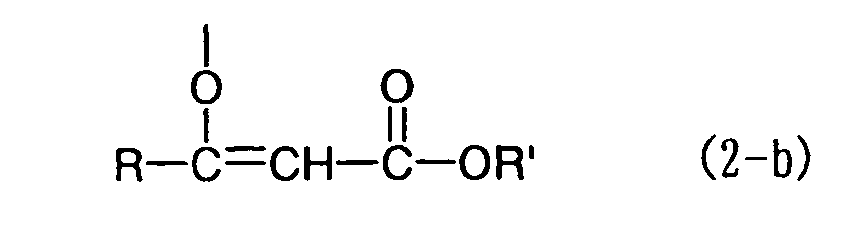
- Examples of the monovalent hydrocarbon groups of 1 to 6 carbon atoms represented by R and R' in the general formulas (2-a) and (2-b), which in turn represent the group R 3 in the general formula (2), include methyl groups, ethyl groups, n-propyl groups, isopropyl groups, butyl groups and hexyl groups.
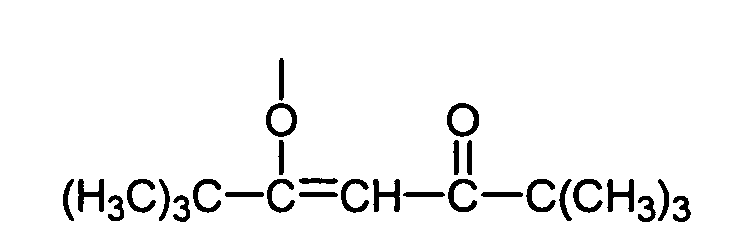
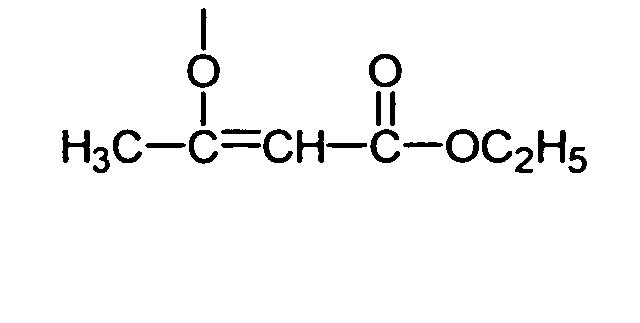
- Examples of the enol residue of a ⁇ -diketone represented by R 3 include residues represented by the formulas shown below. Examples of the enol residue of a ⁇ -ketoester include the residue represented by the formula shown below.
- p is an integer from 0 to 2, and is preferably either 0 or 2.
- titanium alkoxides such as titanium tetraisopropoxide, titanium tetrabutoxide, titanium tetrakis(2-ethylhexyloxide), titanium tetranonyloxide, titanium tetrastearyloxide, titanium tetraisopropenoxide, titanium diisopropoxide bis(2,4-pentanedionate), titanium dibutoxide bis(2,4-pentanedionate), titanium diisopropoxide bis(2,2,6,6-tetramethyl-3,5-heptanedionate), and titanium diisopropoxide bis(ethylacetoacetate), and of these, titanium tetraisopropoxide and titanium tetrabutoxide are preferred, and titanium tetraisopropoxide is particularly desirable.
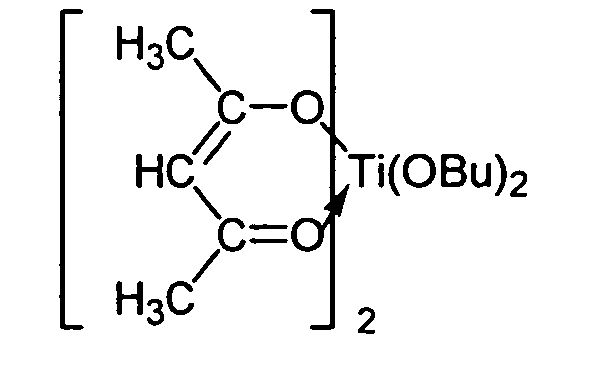
- Titanium diisopropoxide bis(2,4-pentanedionate) has a structure represented by the following formula: titanium dibutoxide bis(2,4-pentanedionate) has a structure represented by the following formula: titanium diisopropoxide bis(2,2,6,6-tetramethyl-3,5-heptanedionate) has a structure represented by the following formula: and titanium diisopropoxide bis(ethylacetoacetate) has a structure represented by the formula below.
- hydrophilic organic solvent there are no particular restrictions on the aforementioned hydrophilic organic solvent, provided it is capable of dissolving the compound of the general formula (1) or a partial hydrolysis-condensation product thereof, a compound of the general formula (2) and water, and suitable examples include alcohols, cellosolve solvents such as methyl cellosolve, ethyl cellosolve, butyl cellosolve and cellosolve acetate, ketones such as acetone and methyl ethyl ketone, and ethers such as dioxane and tetrahydrofuran, and of these, alcohols and cellosolve solvents are preferred, and alcohols are particularly desirable.
- suitable alcohols include those alcohols represented by a general formula (3): R 4 OH [wherein, R 4 is a monovalent hydrocarbon group of 1 to 6 carbon atoms].
- R 4 is preferably a monovalent hydrocarbon group of 1 to 4 carbon atoms, and even more preferably of 1 to 2 carbon atoms.
- Specific examples of the alcohol represented by the general formula (3) include methanol, ethanol, isopropanol and butanol.
- the particle size of the product spherical silica-titania fine particles increases. Accordingly, the actual alcohol used is best selected in accordance with the target particle size for the spherical silica-titania fine particles.
- examples of the aforementioned basic material include ammonia, dimethylamine and diethylamine, and of these, ammonia and diethylamine are preferred, and ammonia is particularly desirable.
- the required quantity of the basic material is dissolved in water, and the resulting (basic) aqueous solution is then mixed with the hydrophilic organic solvent.
- the quantity of water used at this time is preferably within a range from 0.5 to 5 mols, and more preferably from 0.5 to 2 mols, and even more preferably from 0.6 to 1 mol, per 1 mol of alkoxy groups within the tetrafunctional silane compound of the general formula (1) or the partial hydrolysis-condensation product thereof and the tetrafunctional titanium compound of the general formula (2).
- the ratio between the water and the hydrophilic organic solvent is preferably a weight ratio within a range from 0.5 to 10, and more preferably from 0.5 to 5, and even more preferably from 1 to 2.
- the quantity of the basic material is preferably within a range from 0.01 to 5 mols, and more preferably from 0.1 to 3 mols, and even more preferably from 0.5 to 1.5 mols, per 1 mol of alkoxy groups within the silane compound of the general formula (1) or the partial hydrolysis-condensation product thereof and the compound of the general formula (2).
- the hydrolysis and condensation of the tetrafunctional silane compound of the general formula (1) and the tetrafunctional titanium compound of the general formula (2) can be conducted using known methods, namely by adding a mixture of the tetrafunctional silane compound of the general formula (1) and the tetrafunctional titanium compound of the general formula (2) to a mixture of the water and hydrophilic organic solvent, said mixture containing the basic material.
- the optional step of replacing the dispersion medium of the mixed solvent dispersion of the spherical silica-titania fine particles with water can be conducted by adding water to the dispersion and then distilling the hydrophilic organic solvent off (and then repeating this operation if necessary).
- the quantity of water added during this operation reported as a weight ratio relative to the combined weight of the hydrophilic organic solvent used and the alcohol generated, is preferably within a range from 0.5 to 2, and more preferably from 0.5 to 1.5, and even more preferably from 0.6 to 1.2.
- the hydrophilic spherical silica-titania fine particles produced in this manner are used as the starting material for the step (A).
- These fine particles may exist as a mixed solvent dispersion comprising hydrophilic spherical silica-titania fine particles, although by adding water to the mixed solvent dispersion of hydrophilic spherical silica-titania fine particles and subsequently distilling the hydrophilic organic solvent off to form an aqueous dispersion, any residual alkoxy groups are completely hydrolyzed, and consequently an aqueous dispersion comprising the hydrophilic spherical silica-titania fine particles is preferred.
- Step (A) Surface Hydrophobization of Hydrophilic Spherical Silica-Titania Fine particles
- the step (A) is used for producing hydrophobic spherical silica-titania fine particles by introducing R 5 SiO 3/2 units [wherein, R 5 represents a substituted or unsubstituted monovalent hydrocarbon group of 1 to 20 carbon atoms] onto the surface of the hydrophilic spherical silica-titania fine particles described above.
- R 5 is preferably a monovalent hydrocarbon group of 1 to 10 carbon atoms, and even more preferably of 1 to 6 carbon atoms.
- Examples of the monovalent hydrocarbon group represented by R 5 include a methyl group, ethyl group, n-propyl group, isopropyl group, butyl group and hexyl group, and of these, a methyl group, ethyl group, n-propyl group or isopropyl group is preferred, and a methyl group or an ethyl group is particularly desirable.
- either a portion of, or all of, the hydrogen atoms of this monovalent hydrocarbon group may be substituted with halogen atoms such as fluorine atoms, chlorine atoms or bromine atoms, although preferably with fluorine atoms.
- R 6 is preferably a monovalent hydrocarbon group of 1 to 4 carbon atoms, and even more preferably of 1 to 2 carbon atoms.
- Examples of the monovalent hydrocarbon groups represented by R 6 include methyl groups, ethyl groups, propyl groups and butyl groups, although methyl groups, ethyl groups and propyl groups are preferred, and methyl groups and ethyl groups are particularly desirable.
- trifunctional silane compound represented by the general formula (4) include trialkoxysilanes such as methyltrimethoxysilane, methyltriethoxysilane, ethyltrimethoxysilane, ethyltriethoxysilane, n-propyltrimethoxysilane, n-propyltriethoxysilane, isopropyltrimethoxysilane, isopropyltriethoxysilane, butyltrimethoxysilane, butyltriethoxysilane, hexyltrimethoxysilane, trifluoropropyltrimethoxysilane and heptadecafluorodecyltrimethoxysilane, or partial hydrolysis-condensation products of these compounds.
- trialkoxysilanes such as methyltrimethoxysilane, methyltriethoxysilane, ethyltrimethoxysilane, eth
- the quantity of the added trifunctional silane compound represented by the general formula (4) is typically within a range from 0.001 to 1 mol, and preferably from 0.01 to 0.1 mols, and even more preferably from 0.01 to 0.05 mols, per 1 mol of combined SiO 2 units and TiO 2 units within the hydrophilic spherical silica-titania fine particles.
- Step (B) Surface Triorganosilylation of Hydrophobic Spherical Silica-Titania Fine particles
- the step (B) is used for introducing R 7 3 SiO 1/2 units [wherein, the R 7 groups are either identical or different, and each represent a substituted or unsubstituted monovalent hydrocarbon group of 1 to 6 carbon atoms] onto the surface of the hydrophobic spherical silica-titania fine particles obtained in the step (A) described above.
- the dispersion medium of the aforementioned aqueous dispersion comprising hydrophobic spherical silica-titania fine particles is converted from a mixture of water and a hydrophilic organic solvent such as an alcohol mixture to a ketone-based solvent, thereby generating a ketone-based solvent dispersion of the hydrophobic spherical silica-titania fine particles, and either a silazane compound represented by a general formula (5): R 7 3 SiNHSiR 7 3 [wherein, the R 7 groups are either identical or different and are as defined above], a monofunctional silane compound represented by a general formula (6): R 7 3 SiX [wherein, the R 7 groups are either identical or different and are as defined above, and X represents either an OH group or a hydrolysable group], or a mixture of the two is added to the ketone-based solvent dispersion of the hydrophobic spherical silica-
- R 7 is preferably a monovalent hydrocarbon group of 1 to 3 carbon atoms, and even more preferably of 1 to 2 carbon atoms.
- Examples of the monovalent hydrocarbon groups represented by R 7 include methyl groups, ethyl groups, propyl groups, isopropyl groups and butyl groups, although methyl groups, ethyl groups and propyl groups are preferred, and methyl groups and ethyl groups are particularly desirable.
- either a portion of, or all of, the hydrogen atoms of these monovalent hydrocarbon groups may be substituted with halogen atoms such as fluorine atoms, chlorine atoms or bromine atoms, although preferably with fluorine atoms.
- Examples of the hydrolysable group represented by X include a chlorine atom, an alkoxy group, an amino group or an acyloxy group, and an alkoxy group or an amino group are preferred, and an alkoxy group is particularly desirable.
- Converting the dispersion medium of the aqueous dispersion or mixed solvent dispersion comprising the spherical silica-titania fine particles from a mixture of water and a hydrophilic organic solvent such as an alcohol mixture to a ketone-based solvent can be achieved by adding the ketone-based solvent to the dispersion and then distilling the mixture off (and then repeating this operation if necessary).
- the quantity of the ketone-based solvent added is typically within a range from 0.5 to 5, and preferably from 2 to 5, and even more preferably from 3 to 4.
- Suitable examples of this ketone-based solvent include methyl ethyl ketone, methyl isobutyl ketone and acetylacetone, although methyl isobutyl ketone is preferred.
- silazane compound represented by the general formula (5) examples include hexamethyldisilazane and hexaethyldisilazane, and hexamethyldisilazane is preferred.
- specific examples of the monofunctional silane compound represented by the general formula (6) include monosilanols such as trimethylsilanol and triethylsilanol, monochlorosilanes such as trimethylchlorosilane and triethylchlorosilane, monoalkoxysilanes such as trimethylmethoxysilane and trimethylethoxysilane, monoaminosilanes such as trimethylsilyldimethylamine and trimethylsilyldiethylamine, and monoacyloxysilanes such as trimethylacetoxysilane, although of these, trimethylsilanol, trimethylmethoxysilane and trimethylsilyldiethylamine are preferred, and trimethylsilano
- the quantity of the silazane compound, the monofunctional silane compound, or a mixture of the two used is typically within a range from 0.1 to 0.5 mols, and preferably from 0.2 to 0.4 mols, and even more preferably from 0.2 to 0.3 mols, per 1 mol of combined SiO 2 units and TiO 2 units within the hydrophilic spherical silica-titania fine particles used.
- These spherical silica-titania-based fine particles surface-treated with silane may be either produced as a powder using normal methods, or produced as a dispersion by adding an organic compound following the reaction with the silazane compound.
- the titanium atom content within fine particles of the present invention is typically within a range from 0.001 to 5% by weight, and preferably from 0.05 to 1% by weight, and even more preferably from 0.06 to 0.8% by weight. If this titanium content is less than 0.001% by weight, then the titanium complexing effect is not adequately realized, whereas if the content exceeds 5% by weight, then the particles tend to aggregate and lose their spherical shape.
- the frictional electrification between the above fine particles and iron powder is typically within a range from -100 to -300 ⁇ C/g, and preferably from -120 to -200 ⁇ C/g, and even more preferably from -140 to -180 ⁇ C/g. If this frictional electrification is less than -100 ⁇ C/g, then negative electrostatic chargeability is poor, and imparting a satisfactory level of electrostatic charge to the toner can become impossible, whereas if the frictional electrification exceeds -300 ⁇ C/g, then the level of electrostatic charge for a negatively charged toner can become excessive.
- the bulk density of the above fine particles is typically within a range from 0.2 to 0.4 g/ml, and preferably from 0.25 to 0.35 g/ml, and even more preferably from 0.28 to 0.29 g/ml. If this bulk density is less than 0.2 g/ml, then the fine particles are increasingly likely to undergo scattering or adhesion, causing a deterioration in the cleanability, whereas if the bulk density exceeds 0.4 g/ml, then the flowability deteriorates.
- the particle diameter of the above particles is typically within a range from 0.01 to 5 ⁇ m, and preferably from 0.05 to 0.5 ⁇ m, and even more preferably from 0.1 to 0.2 ⁇ m. If the particle diameter is smaller than 0.01 ⁇ m, then the particles tend to aggregate, resulting in unsatisfactory levels of flowability, caking resistance and fixation for the developer, whereas if the particle diameter exceeds 5 ⁇ m, then other problems arise including degeneration or scratching of the photoreceptor, and a deterioration in the adhesion of the fine particles to the toner.
- Spherical silica-titania-based fine particles that have been surface-treated with silane according to the present invention can be used as a toner external additive.
- the quantity of this toner external additive comprising the above fine particles (hereafter, may also be referred to as simply "the fine particles") added to a toner is typically within a range from 0.01 to 30 parts by weight, and preferably from 0.1 to 20 parts by weight, and even more preferably from 1 to 3 parts by weight, per 100 parts by weight of the toner.
- the above fine particles may merely mechanically or weakly adhere to the surface of the toner particles. Furthermore, the bonded fine particles may cover the entire surface of the toner particles, or may cover only a portion of the toner particles. In addition, a portion of the above fine particles may form an aggregate, which then covers the surface of the toner particles, although the toner particles are preferably covered with a single layer of fine particles.
- a toner added with a toner external additive comprising fine particles of the present invention is used, for example, in electrostatically charged image development in electrophotographic techniques or electrostatic recording techniques.
- This toner can either be used as a one-component developer, or can be mixed with a carrier and used as a two-component developer.
- the toner external additive need not necessarily be added in advance to the toner particles, any may be added during the mixing of the toner and the carrier in order to cover the surface of the toner.
- suitable carriers include conventional materials such as ferrite and iron powder, or products produced by forming a resin coating on the surface of these materials.
- a 5 liter glass reaction vessel equipped with a stirrer, a dropping funnel and a thermometer was charged with 997.9 g of methanol, 66.2 g of water and 79.7 g of 28% aqueous ammonia, and the resulting mixture was stirred.
- the temperature of the solution was adjusted to 35°C, and with constant stirring, addition of both a mixture of 1861.9 g of tetramethoxysilane and 3.7 g of titanium tetraisopropoxide, and 668.9 g of 5.4% aqueous ammonia were commenced simultaneously.
- the mixture of tetramethoxysilane and titanium tetraisopropoxide was added dropwise over a period of 6 hours, and the aqueous ammonia was added dropwise over a period of 4 hours. Following completion of these additions, stirring was continued for a further 0.5 hours to allow the hydrolysis to proceed, yielding a suspension of hydrophilic spherical silica-titania fine particles. Subsequently, an ester adapter and a condenser were attached to the glass reaction vessel, the suspension was heated to 60 to 70°C while 1932 g of methanol were distilled off, and 1920 g of water was then added.
- the suspension was heated once again to 70 to 90°C while a further 823 g of methanol were distilled off, thereby yielding an aqueous suspension of the hydrophilic spherical silica-titania fine particles.
- the resulting dispersion was heated at 80 to 110°C, and 2083 g of a methanol and water mixture were distilled off over a period of 7 hours.
- the resulting dispersion was cooled to room temperature, 240 g of hexamethyldisilazane was added, and the silica-titania fine particles within the dispersion were subjected to trimethylsilylation by heating the dispersion to 120°C and allowing the reaction to proceed for 3 hours.
- the solvent was distilled off from the dispersion under reduced pressure, yielding 763 g of spherical silica-titania-based fine particles surface-treated with silane.
- the silica-titania fine particles were added to a ferrite carrier (brand name: FL 100, manufactured by Powdertech Corporation) in sufficient quantity to generate a concentration of 1% by weight, and the resulting mixture was mixed for 10 minutes in a shaker to effect frictional electrification. Using a 0.2 g sample of this mixture, the electrostatic charge was measured using a blow-off powder charge measuring device (brand name: TB-200, manufactured by Toshiba Chemical Co., Ltd., nitrogen blow pressure: 4.9 N/m 2 , nitrogen blow time: 60 seconds)
- This property was measured using a powder tester (brand name: PT-R, manufactured by Hosokawa Micron Corporation, 60 mesh, 25 cc cup).
- the silica-titania fine particles were added to methanol in sufficient quantity to generate a concentration of 0.5% by weight, and the particles were then dispersed by irradiation with ultrasound for 10 minutes.
- the particle size distribution of the thus treated fine particles was measured using a laser diffraction scattering type particle size distribution measuring device (brand name: LA910, manufactured by Horiba Ltd.), and the median was recorded as the particle diameter.
- the particle shape was ascertained by inspection under an electron microscope (brand name: S-4700, manufactured by Hitachi Ltd., magnification 100,000x).
- the degree of aggregation is a value that indicates the flowability of a powder, and is measured using a powder tester (manufactured by Hosokawa Micron Corporation) and a three stage sieve comprising 200, 100 and 60 mesh sieves superimposed in this order. In this measurement method, 5 g of the toner powder was placed on top of the 60 mesh sieve belonging to the top stage of the three stage sieve, and a voltage of 2.5 V was then applied to the powder tester, and the three stage sieve was oscillated for 15 seconds.
- the developer described above was stored for 1 day under either high temperature, high humidity conditions (30°C, 90% RH) or low temperature, low humidity conditions (10°C, 15% RH), and was then mixed for 30 seconds in a shaker, before the frictional electrification was measured.
- the electrostatic charge of each sample was measured under identical conditions, using a blow-off powder charge measuring device (brand name: TB-200, manufactured by Toshiba Chemical Co., Ltd.).
- the developer described above was placed in a two-component improved developing device equipped with an organic photoreceptor, and a print test of 30,000 pages was conducted. Toner adhesion to the photoreceptor was detected as unprinted white sections within solid print images. The number of these unprinted white sections was counted, and 10 or more sections/cm 2 was reported as "numerous", from 1 to 9 sections/cm 2 was reported as "few", and 0 sections/cm 2 was reported as "none".
- the developer described above was placed in a two-component improved developing device equipped with an organic photoreceptor, and square solid print images measuring 5 mm x 5 mm were printed out on standard copying papers (75g/m 2 ) under either high temperature, high humidity conditions (30°C, 90% RH) or low temperature, low humidity conditions (10°C, 15% RH).
- the relative image densities of the solid print images were measured using Macbeth Reflective Densitometer RD 918 (manufactured by Macbeth AG), based on the image density of 0.00 of white sections. The results are shown in Table 1. The values of the relative image densities were classified as follows:
- the developer described above was placed in a two-component improved developing device equipped with an organic photoreceptor, and images with an image density of 0.3 to 0.6 measured using the Macbeth Reflective Densitometer were printed out under either high temperature, high humidity conditions (30°C, 90% RH) or low temperature, low humidity conditions (10°C, 15% RH).
- the uniformity of the image density was measured by eye observation and evaluated as the image quality of highlight parts. The results are shown in Table 1.
- the degree of the uniformity was classified as follows:
- reaction was conducted in the same manner as Example 1, and yielded 778 g of spherical silica-titania-based fine particles surface-treated with silane.
- the properties of these spherical silica-titania-based fine particles that had undergone surface treatment with silane were measured in the same manner as Example 1. The results are shown in Table 1.
- reaction was conducted in the same manner as Example 1, and yielded 720 g of spherical silica-based fine particles surface-treated with silane.
- the properties of these spherical silica-titania-based fine particles surface-treated with silane were measured in the same manner as Example 1. The results are shown in Table 1.
- step (I) and step (II) were conducted in the same manner as Example 1.
- the aqueous dispersion produced in step (II) was then supplied to step (III), 2310 g of methyl isobutyl ketone was added, and the resulting dispersion was heated at 80 to 110°C, but following distillation of 204 g of a methanol and water mixture over a period of 1 hour, the dispersion of hydrophobic spherical silica-titania fine particles aggregated.
- Table 1 The results are shown in Table 1.
- Table 1 The results are shown in Table 1.
- aqueous suspension of hydrophilic spherical silica-titania fine particles produced in step (I) of Example 1 240 g of hexamethyldisilazane was added at room temperature, and the silica-titania fine particles within the suspension were subjected to trimethylsilylation by heating at 120°C and allowing the reaction to proceed for 3 hours. Subsequently, a methanol and water mixture was distilled off under reduced pressure at 80°C, yielding 754 g of spherical silica-titania-based fine particles surface-treated with silane. The properties of these spherical silica-titania-based fine particles that had been surface-treated with silane were then evaluated in the same manner as Example 1.
- Example 1 Example 2 Comparative Example 1 Comparative Example 2 Comparative Example 3 Comparative Example 4 Comparative Example 5 Titanium content (% by weight) 0.07 0.7 0 5.8 - 0.07 0.07 Frictional electrification ( ⁇ C/g) - 140 -180 -60 - - -350 -40 Bulk density (g/ml) 0.29 0.28 0.41 - - 0.18 0.47 Particle diameter ( ⁇ m) 0.12 0.12 0.11 (aggregate) (aggregate) 11 (aggregate) 0.12 Shape spherical spherical spherical - - spherical spherical Degree of aggregation 3 3 3 - - 72 6 Electrostatic charge for toner under high temperature, high humidity ( ⁇ C/g) - 27 -35 -20 - - -23 -18 Electrostatic charge for toner under low temperature, low humidity ( ⁇ C/g) - 30 -39 -26 - - -49 -29 Toner adhesion
- step (I) If titanium tetraisopropoxide is not used in step (I), as in Comparative Example 1, then the thus produced spherical silica-titania-based fine particles surface-treated with silane do not satisfy the conditions of the present invention in terms of titanium atom content, frictional electrification and bulk density.
- the results reveal a toner that is resistant to aggregation, but which displays a toner electrostatic charge that is easily affected by the environmental conditions, and which also shows some toner adhesion, and degeneration and scratching of the photoreceptor, meaning the toner is not particularly desirable.
- step (I) If the quantity of titanium tetraisopropoxide is increased markedly in step (I), as in Comparative Example 2, then during distillation of the methanol and water mixture, the dispersion of the hydrophobic spherical silica-titania fine particles aggregates, which is undesirable.
- step (II) for conducting a hydrophobization of the surface of the hydrophilic spherical silica-titania fine particles is omitted, as in Comparative Example 3, then during distillation of the methanol and water mixture, the dispersion of the hydrophilic spherical silica-titania fine particles aggregates, which is undesirable.
- hydrophilic spherical silica-titania fine particles produced by distilling a methanol and water mixture off from the aqueous suspension of hydrophilic spherical silica-titania fine particles produced in the step (I) are used, as in Comparative Example 4, then the particles do not satisfy the conditions of the present invention in terms of frictional electrification, bulk density and particle diameter, and some aggregation of the fine particles is also observed.
- the measurements described above are conducted using these fine particles, then not only does the toner aggregate, but the toner electrostatic charge is poor under conditions of high temperature and high humidity, and some toner adhesion, and degeneration and scratching of the photoreceptor is also observed, meaning the toner is not particularly desirable.
- step (I) If the aqueous suspension of hydrophilic spherical silica-titania fine particles produced in step (I) is supplied directly to step (III), as in Comparative Example 5, then the thus produced spherical silica-titania-based fine particles surface-treated with silane do not satisfy the conditions of the present invention in terms of frictional electrification and bulk density.
- the toner electrostatic charge is poor under conditions of high temperature and high humidity, and some toner adhesion together with some degeneration and scratching of the photoreceptor is also observed, meaning the toner is not particularly desirable.
Landscapes
- Chemical & Material Sciences (AREA)
- Physics & Mathematics (AREA)
- General Physics & Mathematics (AREA)
- Inorganic Chemistry (AREA)
- Organic Chemistry (AREA)
- Developing Agents For Electrophotography (AREA)
- Silicon Compounds (AREA)
Abstract
Description
Accordingly, when this type of organic photoreceptor is used, the inorganic fine particles added to the toner can cause degeneration or scratching of the photoreceptor. Furthermore when fine particle toners are used, because the powder flowability is poorer than that displayed by toners of a more conventional particle size, larger quantities of inorganic fine particles must be added, and these inorganic particles increase the likelihood of toner adhesion to the photoreceptor.





Following completion of these additions, stirring was continued for a further 0.5 hours to allow the hydrolysis to proceed, yielding a suspension of hydrophilic spherical silica-titania fine particles. Subsequently, an ester adapter and a condenser were attached to the glass reaction vessel, the suspension was heated to 60 to 70°C while 1932 g of methanol were distilled off, and 1920 g of water was then added. Subsequently, the suspension was heated once again to 70 to 90°C while a further 823 g of methanol were distilled off, thereby yielding an aqueous suspension of the hydrophilic spherical silica-titania fine particles.
| Example 1 | Example 2 | Comparative Example 1 | Comparative Example 2 | Comparative Example 3 | Comparative Example 4 | Comparative Example 5 | |
| Titanium content (% by weight) | 0.07 | 0.7 | 0 | 5.8 | - | 0.07 | 0.07 |
| Frictional electrification (µC/g) | - 140 | -180 | -60 | - | - | -350 | -40 |
| Bulk density (g/ml) | 0.29 | 0.28 | 0.41 | - | - | 0.18 | 0.47 |
| Particle diameter (µm) | 0.12 | 0.12 | 0.11 | (aggregate) | (aggregate) | 11 (aggregate) | 0.12 |
| Shape | spherical | spherical | spherical | - | - | spherical | spherical |
| Degree of aggregation | 3 | 3 | 3 | - | - | 72 | 6 |
| Electrostatic charge for toner under high temperature, high humidity (µC/g) | - 27 | -35 | -20 | - | - | -23 | -18 |
| Electrostatic charge for toner under low temperature, low humidity (µC/g) | - 30 | -39 | -26 | - | - | -49 | -29 |
| Toner adhesion | none | none | few | - | - | numerous | few |
| Relative image density under high temperature, high humidity | A | A | C | - | - | D | D |
| Relative image density under low temperature, low humidity | A | A | B | - | - | D | B |
| Image quality of highlight parts printed out under high temperature, high humidity | o ○ | o ○ | ○ | - | - | Δ | Δ |
| Image quality of highlight parts printed out under low temperature, low humidity | o ○ | o ○ | Δ | - | - | × | Δ |
Claims (20)
- Spherical silica-titania-based fine particles surface-treated with silane, wherein a titanium atom content is within a range from 0.001 to 5% by weight, frictional electrification with iron powder is within a range from -100 to -300 µC/g, bulk density is within a range from 0.2 to 0.4 g/ml, and particle diameter is within a range from 0.01 to 5 µm.
- A production process for the spherical silica-titania-based fine particles surface-treated with silane according to claim 1, comprising the steps of(A) producing hydrophobic spherical silica-titania fine particles by introducing R5SiO3/2 units [wherein, R5 represents a substituted or unsubstituted monovalent hydrocarbon group of 1 to 20 carbon atoms] onto a surface of hydrophilic spherical silica-titania fine particles comprising SiO2 units and TiO2 units, and(B) introducing R7 3SiO1/2 units [wherein, said R7 groups are either identical or different, and each represent a substituted or unsubstituted monovalent hydrocarbon group of 1 to 6 carbon atoms] onto a surface of said hydrophobic spherical silica-titania fine particles.
- The production process according to claim 2, wherein said hydrophilic spherical silica-titania fine particles used in said step (A) are produced by a process that comprises a step for hydrolyzing and condensing a mixture of:a tetrafunctional silane compound represented by a general formula (1):a tetrafunctional titanium compound represented by a general formula (2):(wherein, R and R' are either identical or different, and each represent a monovalent hydrocarbon group of 1 to 6 carbon atoms), or an enol residue of a β-ketoester represented by a general formula (2-b):
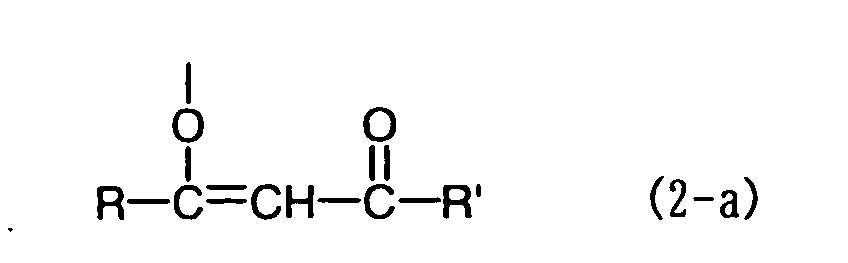 (wherein, R and R' are either identical or different, and are each as defined above), and p is an integer of 0 to 2] in a mixed liquid of water and a hydrophilic organic solvent in the presence of a basic material, thereby generating said hydrophilic spherical silica-titania fine particles.
- The production process according to claim 3, wherein said tetrafunctional silane compound represented by the general formula (1) is selected from the group consisting of tetramethoxysilane, tetraethoxysilane, tetraisopropoxysilane, tetrabutoxysilane, and tetraphenoxysilane.
- The production process according to claim 3, wherein said tetrafunctional silane compound represented by the general formula (2) is selected from the group consisting of titanium tetraisopropoxide, titanium tetrabutoxide, titanium tetrakis(2-ethylhexyloxide), titanium tetranonyloxide, titanium tetrastearyloxide, titanium tetraisopropenoxide, titanium diisopropoxide bis(2,4-pentanedionate), titanium dibutoxide bis(2,4-pentanedionate), titanium diisopropoxide bis(2,2,6,6-tetramethyl-3,5-heptanedionate), and titanium diisopropoxide bis(ethylacetoacetate).
- The production process according to claim 3, wherein said hydrophilic organic solvent is an alcohol solvent represented by a general formula (3):
- The production process according to any one of claims 3 to 6, wherein said basic material is ammonia.
- The production process according to any one of claims 3 to 6, wherein the quantity of water used is within a range from 0.5 to 5 mols per 1 mol of alkoxy groups within the tetrafunctional silane compound of the general formula (1) or the partial hydrolysis-condensation product thereof and the tetrafunctional titanium compound of the general formula (2), and the ratio between the water and the hydrophilic organic solvent is a weight ratio within a range from 0.5 to 10.
- The production process according to any one of claims 3 to 6, wherein the quantity of the basic material is within a range from 0.01 to 5 mols per 1 mol of alkoxy groups within the silane compound of the general formula (1) or the partial hydrolysis-condensation product thereof and the compound of the general formula (2).
- The production process according to any one of claims 2 through 9, wherein in said step (A), a trifunctional silane compound represented by a general formula (4):
- The production process according to claim 10, wherein the trifunctional silane compound represented by the general formula (4) is selected from the group consisting of methyltrimethoxysilane, methyltriethoxysilane, ethyltrimethoxysilane, ethyltriethoxysilane, n-propyltrimethoxysilane, n-propyltriethoxysilane, isopropyltrimethoxysilane, isopropyltriethoxysilane, butyltrimethoxysilane, butyltriethoxysilane, hexyltrimethoxysilane, trifluoropropyltrimethoxysilane and heptadecafluorodecyltrimethoxysilane, and a partial hydrolysis-condensation product of these compounds.
- The production process according to claim 10, wherein the quantity of the trifunctional silane compound represented by the general formula (4) is within a range from 0.001 to 1 mol per 1 mol of combined SiO2 units and TiO2 units within the hydrophilic spherical silica-titania fine particles
- The production process according to claim 10, wherein in said step (B), a dispersion medium of said aqueous dispersion comprising hydrophobic spherical silica-titania fine particles is replaced with a ketone-based solvent, thereby generating a ketone-based solvent dispersion comprising said hydrophobic spherical silica-titania fine particles, and either a silazane compound represented by a general formula (5):
- The production process according to claim 13, wherein the quantity of the ketone-based solvent, reported as a weight ratio relative to the quantity of hydrophilic spherical silica-titania fine particles used, is within a range from 0.5 to 5.
- The production process according to claim 13, wherein said ketone-based solvent is methyl isobutyl ketone.
- The production process according to claim 13, wherein the silazane compound represented by the general formula (5) is hexamethyldisilazane or hexaethyldisilazane.
- The production process according to claim 13, wherein the monofunctional silane compound represented by the general formula (6) is selected from the group consisting of trimethylsilanol, triethylsilanol, trimethylchlorosilane, triethylchlorosilane, trimethylmethoxysilane, trimethylethoxysilane, trimethylsilyldimethylamine, trimethylsilyldiethylamine, and trimethylacetoxysilane.
- The production process according to claim 13, wherein the quantity of the silazane compound, the monofunctional silane compound, or a mixture of the two is within a range from 0. 1 to 0.5 mols per 1 mol of combined SiO2 units and TiO2 units within the hydrophilic spherical silica-titania fine particles.
- An external additive for an electrostatically charged image developing toner comprising the spherical silica-titania-based fine particles surface-treated with silane according to claim 1.
- The external additive for an electrostatically charged image developing toner according to claim 19, wherein the quantity of the external additive added to the toner is within a range from 0.01 to 30 parts by weight per 100 parts by weight of the toner.
Applications Claiming Priority (2)
| Application Number | Priority Date | Filing Date | Title |
|---|---|---|---|
| JP2003134393A JP3988936B2 (en) | 2003-05-13 | 2003-05-13 | Silane surface-treated spherical silica titania fine particles, process for producing the same, and toner external additive for developing electrostatic images using the same |
| JP2003134393 | 2003-05-13 |
Publications (3)
| Publication Number | Publication Date |
|---|---|
| EP1477532A2 true EP1477532A2 (en) | 2004-11-17 |
| EP1477532A3 EP1477532A3 (en) | 2006-01-18 |
| EP1477532B1 EP1477532B1 (en) | 2011-05-25 |
Family
ID=33028338
Family Applications (1)
| Application Number | Title | Priority Date | Filing Date |
|---|---|---|---|
| EP04009810A Expired - Lifetime EP1477532B1 (en) | 2003-05-13 | 2004-04-26 | Spherical silica-titania-based fine particles surface-treated with silane, production process therefor, and external additive for electrostatically charged image developing toner using same |
Country Status (4)
| Country | Link |
|---|---|
| US (1) | US7144628B2 (en) |
| EP (1) | EP1477532B1 (en) |
| JP (1) | JP3988936B2 (en) |
| CN (1) | CN100419580C (en) |
Cited By (2)
| Publication number | Priority date | Publication date | Assignee | Title |
|---|---|---|---|---|
| EP1988129A3 (en) * | 2007-04-25 | 2010-03-17 | Shin-Etsu Chemical Co., Ltd. | Hydrophobic spherical silica microparticles having a high degree of flowability, method of producing same, electrostatic image developing toner external additive using same, and organic resin compositon containing same |
| US20100196815A1 (en) * | 2007-03-27 | 2010-08-05 | Evonik Degussa Gmbh | Electrostatic charge image developing toner |
Families Citing this family (29)
| Publication number | Priority date | Publication date | Assignee | Title |
|---|---|---|---|---|
| JP4819322B2 (en) * | 2003-05-21 | 2011-11-24 | 扶桑化学工業株式会社 | Metal oxide fine particle dispersion and method for producing the same |
| US20050196206A1 (en) * | 2004-03-08 | 2005-09-08 | Canon Kabushiki Kaisha | Image forming apparatus |
| US8062820B2 (en) * | 2006-05-12 | 2011-11-22 | Cabot Corporation | Toner composition and method of preparing same |
| JP2009122175A (en) * | 2007-11-12 | 2009-06-04 | Canon Inc | toner |
| JP5512542B2 (en) * | 2008-01-08 | 2014-06-04 | トレッドストーン テクノロジーズ インク. | Highly conductive surface for electrochemical applications |
| JP2009258681A (en) * | 2008-03-21 | 2009-11-05 | Konica Minolta Business Technologies Inc | Toner |
| US8236203B2 (en) | 2009-04-15 | 2012-08-07 | Hihara Lloyd H | Corrosion protection coatings and methods of making the same |
| KR101183831B1 (en) * | 2009-05-25 | 2012-09-18 | (주)석경에이티 | Preparation method of composite silica microparticles with monodispersity |
| EP2495291A1 (en) * | 2009-10-29 | 2012-09-05 | Sakai Chemical Industry Co., Ltd. | Method for producing organic solvent dispersion of inorganic oxide microparticles |
| AU2010340120B2 (en) * | 2010-01-07 | 2015-03-05 | University Of Hawaii | Corrosion protection coatings and methods of making the same |
| JP5477193B2 (en) | 2010-06-24 | 2014-04-23 | 富士ゼロックス株式会社 | Silica particles and method for producing the same |
| JP5488255B2 (en) | 2010-06-25 | 2014-05-14 | 富士ゼロックス株式会社 | Silica particles and method for producing the same |
| JP5741005B2 (en) | 2011-01-20 | 2015-07-01 | 富士ゼロックス株式会社 | Resin particles and method for producing the same |
| JP5831378B2 (en) | 2011-12-01 | 2015-12-09 | 富士ゼロックス株式会社 | Silica composite particles and method for producing the same |
| JP2013190615A (en) * | 2012-03-14 | 2013-09-26 | Fuji Xerox Co Ltd | Toner for electrostatic charge image development, electrostatic charge image developer, toner cartridge, developer cartridge, process cartridge, image forming method, and image forming apparatus |
| JP5990968B2 (en) * | 2012-03-23 | 2016-09-14 | 富士ゼロックス株式会社 | Electrostatic image developing toner, electrostatic image developer, toner cartridge, developer cartridge, process cartridge, image forming apparatus, and image forming method |
| JP5884590B2 (en) * | 2012-03-23 | 2016-03-15 | 富士ゼロックス株式会社 | Electrostatic image developing toner, electrostatic image developer, toner cartridge, developer cartridge, process cartridge, image forming apparatus, and image forming method |
| WO2014005272A1 (en) * | 2012-07-03 | 2014-01-09 | 蚌埠鑫源石英材料有限公司 | Silicon dioxide powder material and preparation process therefor |
| JP6011093B2 (en) * | 2012-07-13 | 2016-10-19 | 富士ゼロックス株式会社 | Electrostatic image developing toner, electrostatic image developer, toner cartridge, process cartridge, image forming apparatus, and image forming method |
| JP2014102344A (en) * | 2012-11-19 | 2014-06-05 | Fuji Xerox Co Ltd | Toner for electrostatic charge image development, electrostatic charge image developer, toner cartridge, process cartridge, image forming method, and image forming apparatus |
| JP5915555B2 (en) | 2013-01-28 | 2016-05-11 | 富士ゼロックス株式会社 | Silica composite particles and method for producing the same |
| JP5910559B2 (en) | 2013-03-26 | 2016-04-27 | 富士ゼロックス株式会社 | Electrostatic image developing toner, electrostatic image developer, toner cartridge, process cartridge, image forming apparatus, and image forming method |
| CN103570026A (en) * | 2013-11-07 | 2014-02-12 | 山西大学 | Silicon dioxide material with super-hydrophobic-hydrophilic reversible switch function |
| CN112575282B (en) | 2015-04-15 | 2023-12-19 | 踏石科技有限公司 | Method for treating metal component surface to achieve lower contact resistance |
| CN105400239B (en) * | 2015-12-18 | 2017-08-11 | 北京航天赛德科技发展有限公司 | A kind of preparation method of modifying super hydrophobicity silica |
| CN106177968A (en) * | 2016-07-15 | 2016-12-07 | 河南中帅医药科技股份有限公司 | The preparation of the medicinal microsphere of a kind of silicon dioxide and in the application of pharmaceutical field |
| JP6915598B2 (en) * | 2018-08-29 | 2021-08-04 | 信越化学工業株式会社 | Positively charged hydrophobic spherical silica particles, a method for producing the same, and a positively charged toner composition using the same. |
| WO2020250813A1 (en) * | 2019-06-12 | 2020-12-17 | 株式会社トクヤマ | Amorphous silica-titania composite oxide powder, resin composition, liquid dispersion, and method for producing silica-coated silica-titania composite oxide powder |
| CN112758940B (en) * | 2020-12-31 | 2022-10-28 | 浙江三时纪新材科技有限公司 | Spherical powder filler and preparation method and application thereof |
Family Cites Families (21)
| Publication number | Priority date | Publication date | Assignee | Title |
|---|---|---|---|---|
| US3720617A (en) * | 1970-05-20 | 1973-03-13 | Xerox Corp | An electrostatic developer containing modified silicon dioxide particles |
| BE789987A (en) | 1971-10-12 | 1973-04-12 | Xerox Corp | COMPOSITION OF DEVELOPER AND METHOD FOR ITS USE |
| BE789988A (en) | 1971-10-12 | 1973-04-12 | Xerox Corp | COMPOSITION OF DEVELOPER AND METHOD FOR ITS USE |
| BR7302594D0 (en) | 1972-04-12 | 1974-06-27 | Union Carbide Corp | MIXED MATERIAL FOR USE IN CONTACT WITH SYNTHETIC FABRICS MIXED MATERIAL FOR USE IN CONTACT WITH SYNTHETIC FABRICS AND PROCESS TO PRODUCE RESISTANT SURFACE MATERIAL AND PROCESS TO PRODUCE ABRASION RESISTANT SURFACE SURFACE MATERIAL |
| JPS58110414A (en) * | 1981-12-23 | 1983-07-01 | Tokuyama Soda Co Ltd | Inorganic oxide and its manufacture |
| JPS604561A (en) * | 1983-06-23 | 1985-01-11 | Tokuyama Soda Co Ltd | Surface-treated oxide |
| JPS63159214A (en) * | 1986-12-22 | 1988-07-02 | Tokuyama Soda Co Ltd | Production of silica compound oxide powder |
| JPS6438043A (en) | 1987-04-09 | 1989-02-08 | Asahi Chemical Ind | Novel process for production of ethers |
| US6184312B1 (en) * | 1997-11-19 | 2001-02-06 | Shin-Etsu Chemical Co., Ltd. | Flame retardant resin compositions |
| CN100474136C (en) * | 1998-06-25 | 2009-04-01 | 松下电器产业株式会社 | Toner and method for producing the same |
| US6432599B1 (en) * | 1998-06-25 | 2002-08-13 | Matsushita Electric Industrial Co., Ltd. | Toner and method for producing the same |
| JP3927741B2 (en) * | 1999-03-12 | 2007-06-13 | 信越化学工業株式会社 | Toner external additive for electrostatic image development |
| EP1128225B1 (en) * | 2000-02-21 | 2005-12-14 | Canon Kabushiki Kaisha | Magnetic toner and image-forming method making use of the same |
| JP2001343780A (en) * | 2000-03-27 | 2001-12-14 | Canon Inc | Dry toner and image-forming method |
| JP4674936B2 (en) * | 2000-07-17 | 2011-04-20 | チタン工業株式会社 | Hydrophobic fine particles and their applications |
| JP3796565B2 (en) * | 2000-08-15 | 2006-07-12 | 信越化学工業株式会社 | Method for producing spherical silica fine particles |
| US20030044706A1 (en) * | 2001-03-30 | 2003-03-06 | Yoshiharu Konya | Electrostatic image developer |
| US6777152B2 (en) * | 2001-03-30 | 2004-08-17 | Shin-Etsu Chemical Co., Ltd. | Electrostatic image developer |
| JP3901588B2 (en) * | 2001-06-18 | 2007-04-04 | 信越化学工業株式会社 | Electrostatic image developer and method for producing the same |
| TWI276604B (en) * | 2001-12-27 | 2007-03-21 | Tokuyama Corp | Silica composite oxide particles and method of producing the same |
| JP4446342B2 (en) * | 2004-07-16 | 2010-04-07 | 株式会社リコー | Image forming apparatus and toner |
-
2003
- 2003-05-13 JP JP2003134393A patent/JP3988936B2/en not_active Expired - Fee Related
-
2004
- 2004-04-22 US US10/829,198 patent/US7144628B2/en not_active Expired - Fee Related
- 2004-04-26 EP EP04009810A patent/EP1477532B1/en not_active Expired - Lifetime
- 2004-05-13 CN CNB2004100595189A patent/CN100419580C/en not_active Expired - Fee Related
Non-Patent Citations (1)
| Title |
|---|
| None |
Cited By (2)
| Publication number | Priority date | Publication date | Assignee | Title |
|---|---|---|---|---|
| US20100196815A1 (en) * | 2007-03-27 | 2010-08-05 | Evonik Degussa Gmbh | Electrostatic charge image developing toner |
| EP1988129A3 (en) * | 2007-04-25 | 2010-03-17 | Shin-Etsu Chemical Co., Ltd. | Hydrophobic spherical silica microparticles having a high degree of flowability, method of producing same, electrostatic image developing toner external additive using same, and organic resin compositon containing same |
Also Published As
| Publication number | Publication date |
|---|---|
| JP3988936B2 (en) | 2007-10-10 |
| CN1573583A (en) | 2005-02-02 |
| US20040229040A1 (en) | 2004-11-18 |
| US7144628B2 (en) | 2006-12-05 |
| EP1477532A3 (en) | 2006-01-18 |
| EP1477532B1 (en) | 2011-05-25 |
| JP2004338969A (en) | 2004-12-02 |
| CN100419580C (en) | 2008-09-17 |
Similar Documents
| Publication | Publication Date | Title |
|---|---|---|
| US7144628B2 (en) | Spherical silica-titania-based fine particles surface-treated with silane, production process therefor, and external additive for electrostatically charged image developing toner using same | |
| US6316155B1 (en) | External additive for electrostatically charged latent image developing toner | |
| EP0992857B1 (en) | Fine powder of hydrophobic metal oxide, method for producing it, and toner composition for electrophotography | |
| JP4781769B2 (en) | Highly hydrophobic spherical sol-gel silica fine particles, process for producing the same, toner external additive for developing electrostatic images comprising the fine particles, and developer using the toner external additive | |
| US20080268362A1 (en) | Hydrophobic spherical silica microparticles having a high degree of flowability, method of producing same, electrostatic image developing toner external additive using same, and organic resin composition containing same | |
| TWI804672B (en) | Positively charged hydrophobic spherical silica particles, method for producing same, and positively charged toner composition using the positively charged hydrophobic spherical silica particles | |
| JP4060241B2 (en) | Hydrophobic spherical silica-based fine particles, process for producing the same, and toner external additive for developing electrostatic images using the same | |
| JP7548845B2 (en) | Method for producing surface-treated sol-gel silica particles, surface-treated sol-gel silica particles, and toner additive for developing electrostatic images | |
| JP2023163799A (en) | toner | |
| JP3930236B2 (en) | Toner external additive for electrostatic image development | |
| JP4347201B2 (en) | Toner external additive and toner for developing electrostatic image | |
| JP3767788B2 (en) | Toner external additive for electrostatic image development | |
| JP4310146B2 (en) | toner | |
| JP2014136670A (en) | Strongly negative charge granted, hydrophobic, and spherical silica fine particle, method for producing the particle, and charge control agent obtained by using the particle for developing electrostatic charge image | |
| US7083888B2 (en) | External additive for electrostatically charged image developing toner | |
| JP3856744B2 (en) | Toner external additive for electrostatic image development | |
| JP4628760B2 (en) | Spherical hydrophobic polydiorganosiloxane-containing silica fine particles, toner additive for developing electrostatic image and toner | |
| JP4122566B2 (en) | Hydrophobic metal oxide fine powder, production method thereof, and toner composition for electrophotography | |
| JP5483994B2 (en) | Image forming method | |
| JP2006151764A (en) | Spherical silica fine particles, toner external additive for developing electrostatic image and toner | |
| JP2025010768A (en) | Surface-treated sol-gel silica particles, method for producing surface-treated sol-gel silica particles, and toner additive for developing electrostatic images | |
| JP2017156393A (en) | External additive for toner, method for producing the same, and toner | |
| HK1166774B (en) | Surface-modified metal oxide powder and process for producing same |
Legal Events
| Date | Code | Title | Description |
|---|---|---|---|
| PUAI | Public reference made under article 153(3) epc to a published international application that has entered the european phase |
Free format text: ORIGINAL CODE: 0009012 |
|
| AK | Designated contracting states |
Kind code of ref document: A2 Designated state(s): AT BE BG CH CY CZ DE DK EE ES FI FR GB GR HU IE IT LI LU MC NL PL PT RO SE SI SK TR |
|
| AX | Request for extension of the european patent |
Extension state: AL HR LT LV MK |
|
| PUAL | Search report despatched |
Free format text: ORIGINAL CODE: 0009013 |
|
| AK | Designated contracting states |
Kind code of ref document: A3 Designated state(s): AT BE BG CH CY CZ DE DK EE ES FI FR GB GR HU IE IT LI LU MC NL PL PT RO SE SI SK TR |
|
| AX | Request for extension of the european patent |
Extension state: AL HR LT LV MK |
|
| 17P | Request for examination filed |
Effective date: 20060531 |
|
| AKX | Designation fees paid |
Designated state(s): DE FR GB |
|
| 17Q | First examination report despatched |
Effective date: 20061030 |
|
| GRAP | Despatch of communication of intention to grant a patent |
Free format text: ORIGINAL CODE: EPIDOSNIGR1 |
|
| GRAS | Grant fee paid |
Free format text: ORIGINAL CODE: EPIDOSNIGR3 |
|
| GRAA | (expected) grant |
Free format text: ORIGINAL CODE: 0009210 |
|
| AK | Designated contracting states |
Kind code of ref document: B1 Designated state(s): DE FR GB |
|
| REG | Reference to a national code |
Ref country code: GB Ref legal event code: FG4D |
|
| REG | Reference to a national code |
Ref country code: DE Ref legal event code: R096 Ref document number: 602004032795 Country of ref document: DE Effective date: 20110707 |
|
| PLBE | No opposition filed within time limit |
Free format text: ORIGINAL CODE: 0009261 |
|
| STAA | Information on the status of an ep patent application or granted ep patent |
Free format text: STATUS: NO OPPOSITION FILED WITHIN TIME LIMIT |
|
| 26N | No opposition filed |
Effective date: 20120228 |
|
| REG | Reference to a national code |
Ref country code: DE Ref legal event code: R097 Ref document number: 602004032795 Country of ref document: DE Effective date: 20120228 |
|
| REG | Reference to a national code |
Ref country code: FR Ref legal event code: PLFP Year of fee payment: 13 |
|
| REG | Reference to a national code |
Ref country code: FR Ref legal event code: PLFP Year of fee payment: 14 |
|
| REG | Reference to a national code |
Ref country code: FR Ref legal event code: PLFP Year of fee payment: 15 |
|
| PGFP | Annual fee paid to national office [announced via postgrant information from national office to epo] |
Ref country code: GB Payment date: 20180329 Year of fee payment: 15 |
|
| PGFP | Annual fee paid to national office [announced via postgrant information from national office to epo] |
Ref country code: FR Payment date: 20180315 Year of fee payment: 15 |
|
| PGFP | Annual fee paid to national office [announced via postgrant information from national office to epo] |
Ref country code: DE Payment date: 20180410 Year of fee payment: 15 |
|
| REG | Reference to a national code |
Ref country code: DE Ref legal event code: R119 Ref document number: 602004032795 Country of ref document: DE |
|
| GBPC | Gb: european patent ceased through non-payment of renewal fee |
Effective date: 20190426 |
|
| PG25 | Lapsed in a contracting state [announced via postgrant information from national office to epo] |
Ref country code: DE Free format text: LAPSE BECAUSE OF NON-PAYMENT OF DUE FEES Effective date: 20191101 Ref country code: GB Free format text: LAPSE BECAUSE OF NON-PAYMENT OF DUE FEES Effective date: 20190426 |
|
| PG25 | Lapsed in a contracting state [announced via postgrant information from national office to epo] |
Ref country code: FR Free format text: LAPSE BECAUSE OF NON-PAYMENT OF DUE FEES Effective date: 20190430 |