EP1474704B1 - Radiation detector arrangement comprising multiple line detector units - Google Patents
Radiation detector arrangement comprising multiple line detector units Download PDFInfo
- Publication number
- EP1474704B1 EP1474704B1 EP03705597A EP03705597A EP1474704B1 EP 1474704 B1 EP1474704 B1 EP 1474704B1 EP 03705597 A EP03705597 A EP 03705597A EP 03705597 A EP03705597 A EP 03705597A EP 1474704 B1 EP1474704 B1 EP 1474704B1
- Authority
- EP
- European Patent Office
- Prior art keywords
- detector units
- arrangement
- dimensional
- dimensional detector
- units
- Prior art date
- Legal status (The legal status is an assumption and is not a legal conclusion. Google has not performed a legal analysis and makes no representation as to the accuracy of the status listed.)
- Expired - Lifetime
Links
Images



Classifications
-
- G—PHYSICS
- G01—MEASURING; TESTING
- G01T—MEASUREMENT OF NUCLEAR OR X-RADIATION
- G01T1/00—Measuring X-radiation, gamma radiation, corpuscular radiation, or cosmic radiation
- G01T1/29—Measurement performed on radiation beams, e.g. position or section of the beam; Measurement of spatial distribution of radiation
- G01T1/2914—Measurement of spatial distribution of radiation
- G01T1/2921—Static instruments for imaging the distribution of radioactivity in one or two dimensions; Radio-isotope cameras
- G01T1/2935—Static instruments for imaging the distribution of radioactivity in one or two dimensions; Radio-isotope cameras using ionisation detectors
-
- G—PHYSICS
- G01—MEASURING; TESTING
- G01T—MEASUREMENT OF NUCLEAR OR X-RADIATION
- G01T1/00—Measuring X-radiation, gamma radiation, corpuscular radiation, or cosmic radiation
- G01T1/16—Measuring radiation intensity
Definitions
- the invention relates to scanning-based ionizing radiation detector arrangements for two-dimensional detection of an object.
- Gaseous-based ionizing radiation detectors in general, are very attractive since they are cheap to manufacture, can employ gas multiplication to strongly amplify the signal amplitudes, and provide for detection with high spatial resolution.
- a particular kind of gaseous-based ionizing radiation detector is the one, in which electrons released by interactions between photons and gas atoms can be extracted in a direction essentially perpendicular to the incident radiation.
- a strongly improved spatial resolution is achievable.
- Such a detector comprises typically planar cathode and anode arrangements, respectively, and an ionizable gas arranged in the space formed between the cathode and anode arrangements.
- the detector is arranged such that a planar radiation beam from a radiation source can enter the detector sideways between, and essentially parallel with, the cathode and anode arrangements for ionizing the ionizable gas.
- a voltage is applied between the electrodes for drifting, and optionally multiplying, electrons created during ionization of the ionizable gas.
- a readout arrangement is arranged in connection to the anode for detecting the charge induced by the drifted electrons.
- the detector obviously provides for instantaneous one-dimensional imaging, but to perform two-dimensional imaging the detector, and optionally the radiation source, have to be moved in a direction traverse to the one-dimensional detector array relative to an object being examined while several readouts are recorded.
- Such scanning-based two-dimensional detection is however time consuming and is impractical if large areas should be imaged. Further, if the object being examined is a human or an animal there is a risk that the human or animal moves during scanning, which could make the image useless or at least severely reduce the image quality obtained.
- the arrangement includes an X-ray source, which together with a number of collimator windows produce a stack of planar fan-shaped X-ray beams for irradiation of the object to be imaged.
- the beams transmitted through the object enter the stacked detectors, optionally through a number of second collimator windows, which are aligned with the X-ray beams.
- the arrangement is moved as a unit to scan an object, which is to be examined.
- WO 0055645 relates to an arrangement (100, 504) for detecting x-ray radiations comprising a carrying member (110) on one face (111) arranged with detectors (103, 103a, 103b) consisting of a plurality of sensors (132) arranged on a substrate (131).
- the detectors (130, 130a, 130b, 630) are arranged substantially edge to edge at least in one row on at least one side of said carrying member.
- Such arrangements are used and arranged in parallel on a carrier in an x-ray imaging apparatus, preferably but not exclusively for mammography.
- the area to be imaged may be as large as 50 cm x 50 cm, and the present inventors have noticed that a stacked detector arrangement as the one described in US 6,118,125 for large area applications is very impractical to manufacture and use. Manufacturing tolerances are difficult to hold and to manufacture high-resolution detector units in volumes calls for a high level of efficiency, uniformity and quality.
- a main object of the invention is therefore to provide a scanning-based ionizing radiation detector arrangement for two-dimensional detection of a large object with high spatial resolution.
- a further object of the invention is to provide such a detector arrangement, which comprises a plurality of line detector units in a dense matrix to shorten scanning time and distance.
- a yet further object of the invention is to provide such a detector arrangement, which is reliable, accurate, inexpensive, and which has a long lifetime.
- a still further object of the invention is to provide such a detector arrangement, which is capable of mitigating the problems caused from unusable dead channels (i.e. individual readout elements of the readout arrangement) by means of using more than one line detector unit to scan the same area of the object, also referred to as oversampling.
- a yet further object of the invention is to provide such a detector arrangement, wherein movement blurredness can be minimize by means of recording short snapshots of each portion of the object by individual line detector units, where a possible movement of the object during a limited period of time, e.g. a heartbeat by a patient under investigation, only will affect a limited number of line images and not the complete two-dimensional image as is obtained by prior art two-dimensional detectors.
- a still further object of the invention is to provide such a detector arrangement, wherein the effect of any movement blurredness can be further reduced by means of oversampling, i.e. recording a plurality of images at each location such that each portion of the two-dimensional image of the object is built up by contributions from several line images recorded at different times, where the object is most probably not moving during all of the several line image recordings.
- a yet further object of the invention is to provide such a detector arrangement, wherein a plurality of line detector units are arranged in a matrix to provide for an overlap between channels (i.e. readout elements of the line detectors) located at the far edges to reduce the effect of possible edge phenomena, e.g. lower sensitivity at the far edges of the line detectors.
- channels i.e. readout elements of the line detectors
- the inventors have found that by arranging smaller ionizing radiation detector units, well suited to be volume produced with high precision, in a two-dimensional array, a scanning-based detector arrangement for highly resolved two-dimensional imaging of large objects, such as breasts in mammography examinations, is provided.
- the detector units are arranged in rows and stacks, where the detector units of each row are staggered with an overlap between adjacent detector units in the direction of the row.
- the two-dimensional array is arranged in a plane essentially orthogonal to the radiation direction of the incident ionizing radiation.
- FIGs. 1-3 are a cross-sectional side view, a front view with collimator portions removed, and a cross-sectional top view, respectively, of a detector unit for use in a scanning-based detector arrangement of the present invention, this detector unit will briefly be overviewed.
- the detector unit is oriented such that a planar X-ray beam 1 can enter sideways between a cathode arrangement 3 and an anode arrangement 5.
- a slit-shaped collimator 7 and a radiation transparent window 9 are provided at the front of the detector unit to form an entrance for the X-ray beam 1 to the detector unit.
- the slit-shaped collimator 7 may be a thin metallic foil of e.g. tungsten glued to the entrance side of the detector unit, in which a thin slit is etched; and the radiation transparent window 9 may be a thin plastic or carbon fiber foil.
- Each of the electrode arrangements 3, 5 includes an electrically conducting electrode layer 11, 13 supported by a respective dielectric substrate 12, 14, wherein the arrangements are oriented such that the cathode 11 and anode 13 layers are facing each other.
- the electrode arrangements 3 and 5 are planar, rectangular and parallel to each other.
- the anode and cathode arrangements 3, 5 may be a metallized glass plate.
- the cathode layer 11 may alternatively be of doped silicon and glued to a dielectric substrate made of glass.
- the electrode arrangements 3 and 5 and the window 9 define together with sidewalls 15, 16, 17 a gas-tight confinement 19 capable of being filled with a gas or gas mixture.
- the electrode arrangements 3 and 5 are arranged within an external gas-tight casing (not illustrated).
- the ionizable gas or gas mixture may e.g. comprise krypton and carbon dioxide or xenon and carbon dioxide.
- the gas may be under pressure, preferably in a range 1-20 atm.
- the sidewalls 15, 16, 17 may have recesses as may be seen at 21 in Fig. 1 , such that the sidewalls can operate as spacers or supports along at least portions of the peripheries of the electrode arrangements 3 and 5 to keep the cathode 11 and the anode 13 apart at a well-defined distance. Alternatively, separate spacers are provided between the cathode 3 and anode 5 arrangements.
- a high voltage DC supply unit (not illustrated in Figs. 1-3 ) is provided for the purpose of holding the cathode 11 and the anode 13 at suitable electric potentials to create an electric field within the inter-electrode confinement 19 for drift, and optionally amplification, of electrons and ions therein.
- the cathode 11 is held, during use, at a negative voltage -V 1 , whereas the anode 13 is grounded.
- the- detector unit comprises a readout arrangement for detection of electrons drifted towards the anode 13 and/or ions drifted towards the cathode 11.
- the readout arrangement is comprised of the anode arrangement 5 itself as illustrated in Figs. 1-3 .
- a separate readout arrangement may be arranged adjacent anode 13 or adjacent cathode 11, or elsewhere.
- the anode/readout layer 13 is comprised of an array of conductive or semiconducting elements or strips 23 arranged side by side and electrically insulated from each other on the dielectric substrate 14.
- the anode/readout strips extend essentially in directions parallel to the direction of incident photons of the X-ray beam at each location.
- the anode/readout strips 23 are arranged in a fan-like configuration.
- the strips are further divided into segments in the direction of the incident X-rays, the segments being electrically insulated from each other and individually connected to the processing electronics.
- Such read-out arrangement can be used for energy-resolved detection of radiation.
- specific reference is made to our co-pending Swedish patent application Swedish patent application No. 0001167-6 entitled Spectrally resolved detection of ionizing radiation and filed on March 31, 2000.
- Each of the anode/readout strips is preferably connected to a readout and signal-processing device (not illustrated in Figs. 1-3 ), whereupon the signals from each strip can be processed separately.
- a readout and signal-processing device not illustrated in Figs. 1-3
- the strips also constitute the anode suitable couplings for separation are needed.
- the anode layer 13 can obviously be formed as a unitary electrode without strips.
- the distance between the electrode layers 11 and 13 is strongly exaggerated in Figs. 1 and 2 for illustrative purposes.
- the detector unit may be 40 mm wide, 2 mm thick and 35 mm deep, whereas the inter-electrode distance may be between 0.05 and 2 mm.
- the width w of the collimator slit which governs the thickness of the sheet of radiation that enters the detector unit, may be as small as 10 ⁇ m or as wide as 2 mm or more.
- Each readout strip 23 may be 10 ⁇ m - 2 mm wide, which implies that several hundred or thousand strips may be arranged side by side in a single detector unit, i.e. much more than illustrated.
- X-rays enter the detector unit through the collimator slit, parallel and close to the cathode arrangement 3.
- the X-rays will interact with the gas in the detector unit according to an exponential probability distribution where the majority of the X-rays convert early in the gas volume.
- the average interaction length may typically be 10-100 mm.
- an X-ray photon 25 transmits its energy to an electron in a gas atom, which is released from the atom through processes known as photo effect, Compton scattering and/or Auger effect. This electron travels through the gas and collides with new gas atoms, thereby liberating more electrons until it eventually has lost all its energy and stops. In this process a cloud 27 typically of about thousand electrons is created.
- the electronic signal is detected by the readout electronics connected to the strip.
- the signal is amplified and compared with a threshold voltage. If the signal exceeds the threshold voltage, a counter specific for this strip is activated and adds one to a previous value stored. In this way, the number of X-rays impinging above each anode strip is counted.
- the method is called photon counting.
- the signals from many X-rays may be integrated into a single number related to the total energy deposited by all that X-rays together.
- FIG. 4 illustrates schematically, in a front view, an X-ray scanning-based detector arrangement including a plurality of the detector unit of Figs. 1-3 a first embodiment of the present invention will be described.
- the arrangement includes a plurality of line detector units 41 arranged on a common support structure 42 in a two-dimensional array with their respective entrance slits 43 facing the front of the arrangement.
- Fig. 4 only includes a matrix of 4x10 detector units, i.e. each row 44 includes four detector units and each stack 45 includes ten detector units, even though it shall be appreciated that the arrangement may include many more units.
- S 1 5 mm (from entrance slit 43 to entrance slit) and an area of typically 20x20 to 50x50 cm 2 shall be covered each stack may include 40-100 detector units.
- the width of each line detector unit may for instance be 40-60 mm, and thus topically 5-12 detector units are arranged in each row.
- the most dense array of detector units possible is obtained if the one-dimensional detector units of each of the stacks 45 are positioned edge to edge with the detector units of an adjacent one of the stacks (not illustrated in Fig. 4 ). In such instance the distance S 1 between the detector units in a stack (from entrance slit to entrance slit) is equal to the thickness of the detector units.
- detector arrangement of Fig. 4 may include side and front covers (not explicitly illustrated).
- the object to be examined is placed in front of the detector.
- the detector arrangement is scanned across the object in a pivoting or translative movement essentially in the direction of arrow 47 while the detector units are repeatedly read out, hence creating a two-dimensional image.
- the X-ray beam has obviously to be wide enough to irradiate all the detector units simultaneously.
- an inventive feature of the Fig. 4 embodiment is the staggering of the detector units 41 in each row 44. Since the detector unit of Figs. 1-3 is not capable of detecting at its extreme side portions due to the presence of the sidewalls and spacers as can be seen in Figs. 2 and 3 , the units are staggered to cover the complete distance of 20-50 cm, avoiding any "dead" zones. Where the entrance slit of one detector unit ends, the entrance slit of a further detector unit begins in each row 44. This feature can be seen distinctly along dashed line 48 in Fig. 4 and calls for an overlap x 1 between the detector units, where x 1 may typically be at least 0.05 mm or 0.1 mm. The overlap may be even larger, see discussion below with reference to Fig. 6 .
- the two-dimensional array of one-dimensional detector units 41 is arranged in a plane essentially orthogonal to the radiation direction of the incident X-ray beam. This feature is important to obtain a staggered detector arrangement, which provides for high spatial resolution and high sensitivity.
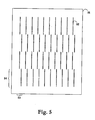
- a collimator as the one illustrated in Fig. 5 is typically arranged between the radiation source and the patient.
- the collimator 51 is of a radiation-absorbing material, e.g. tungsten, and includes a plurality of radiation transparent slits 52 arranged in rows 53 and stacks 54.
- the radiation transparent slits 52 are aligned with the entrance slits of the detector units of the Fig. 4 arrangement, such that each planar radiation beam as produced by the collimator 51 is transmitted through a respective portion of the patient and is entered into a respective one of the detector units in the Fig. 4 arrangement.
- the collimator 51 is then moved together with the detector arrangement during scanning to keep the alignment.
- the line detector units are not necessarily arranged parallel with each other on a plane substrate, but are arranged to point towards the radiation source used such that radiation from the radiation source can enter the respective detector unit.
- the collimator 51 has slits that are less spaced apart than the detector units and narrower that the detector unit entrance slits.
- the alignment between the radiation source (point source, line source or 2D source), the collimator 51 and the detector arrangement provides for multiple planar radiation beams from the radiation source passing through the collimator 51 and into the individual detector units 41 of the detector arrangement.
- a detector arrangement having a common gas-tight enclosing for all individual detector units may be provided (not illustrated).
- a detector box would include the support 42, sidewalls, and a front cover including a common collimator provided with the entrance slits 43, e.g. a collimator similar to the collimator as shown in Fig. 5 , and a common radiation transparent entrance window in front thereof.
- the rectangle of the individual detector units 41 in Fig. 4 would thus represent the electrodes of each detector unit separated by two spacers, and the sidewalls 15, 16 and 17, the slit-shaped collimator 7 and the radiation transparent window 9 of each detector unit may be dispensed with.
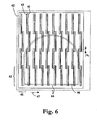
- FIG. 6 illustrates schematically, in a front view, an X-ray scanning-based detector arrangement a second embodiment of the present invention will be overviewed.
- Still another feature of the Fig. 6 embodiment relates to the collimation or screening of incident radiation.
- a further collimator or shielding device with a controllable variable aperture, large amounts of radiation, which are not needed for the examination, may be stopped before reaching the examination object.
- the collimator is arranged upstream of the examination object, preferably immediately before or after the collimator 51 if being used, and is schematically indicated by dashed lines 64 in Fig. 6 .
- the design of the detector arrangement of the present invention is excellent for a fast determination of the outer shape of the examination object at the beginning of the scan or before the scan has started, e.g. during a fast exposure control measurement.
- the approximate shape of the object is determined, e.g. by a decision algorithm based on thresholding.
- the variable aperture of the collimator or shielding device is controlled to shield radiation not passing through the object, and to let through only radiation passing through the object.
- Fig. 6 is illustrated a collimator with semicircular aperture.
- collimators of other shapes e.g. circular or rectangular, may be equally suitable for the purpose.
- the object of the collimator 64 is to shield radiation, which is not needed and which can be scattered and interfere with the measurements in an unwanted way, e.g. reduce the signal-to-noise ratio, or be redirected towards the object under investigation with an increased radiation dose to the object as a result.
- an increased detection quality and a decreased radiation dose are achieved by the use of collimator 64.
- the detector units are arranged with an overlap between the detector units of adjacent rows of e.g. 2-10 mm, or 5-10 mm, i.e. an overlap which is larger than the overlap of the Fig. 4 arrangement, to assure an overlap x 2 also between the entrance slits of the detector units of adjacent rows, i.e. between the active detection areas, such that double measurement values are obtained from "stripes" across the examination object.
- This is valuable if the individual detector units suffer from edge effects, e.g. lower sensitivity at the far edges of the line detectors, or similar such that the measurement values of the outer detection elements are unreliable. Further, any damages on individual ones of these detection elements or the readouts thereof would not cause lacking or "dead" pixel values in the images obtained.
- the embodiments of the inventive scanning-based detector arrangement described above with reference to Figs. 4 and 6 may, instead of including a plurality of the detector unit as illustrated in Figs. 1-3 , be provided with a plurality of line detector units of virtually any kind, e.g. PIN-diodes of semiconductors such as silicon where the X-rays interact with the semiconductor within the PIN diode and releases charges, photosensitive detectors coated with scintillating materials, selenium or other semiconductor covered electronic devices to detect the deposited charge such as thin-film transistor (TFT) circuits, CCD's, CMOS circuits etc.
- TFT thin-film transistor
- a preferred line detector unit is the gaseous-based ionization detector, optionally provided with an electron avalanche amplifier, and particularly such gaseous-based ionization detector wherein the freed electrons are drifted in a direction essentially perpendicular to the direction of the incident ionization.
- gaseous-based detector units for use in the scanning-based detector arrangement of the present invention, reference is made to the following US patent applications by Tom Francke et al. and assigned to XCounter AB : Nos. 08/969554 (issued as US patent No.
- FIG. 7 illustrates schematically, in a side view, a device for mammography examinations a further embodiment of the present invention will be described.
- the device From top to bottom the device comprises an X-ray source 81, filters 82, an upstream collimator 83, an upper 84 and a lower compression plate 85 and a detector arrangement 86.
- the X-ray source 81 is a conventional X-ray tube. Just beneath the X-ray tube are placed thin metallic foils acting as the filters 82 to absorb the lowest (and sometimes also the highest) energy photons, which do not contribute significantly to the image quality but do increase the radiation dose to the patient. This is described in regulatory requirements.
- the upstream collimator 83 is a thin foil of e.g. tungsten with multiple narrow slits etched away, e.g. the collimator of Fig. 5 .
- the slits are aligned such that X-rays passing through each slit will reach a corresponding slit in the detector arrangement.
- the purpose of this collimator is to reduce the radiation dose to the patient. Only X-ray photons that are capable of entering the detector arrangement entrance slits are allowed to pass through the patient's breast.
- the detector arrangement may be any of the scanning-based detector arrangements as described above with reference to Figs. 4 or 6 .
- the X-ray tube 81, the upstream collimator 83 and the detector arrangement 86 are attached to a common E-arm 87, which in turn is rotatably attached to a vertical stand 88 by means of a spindle 89 approximately at the height of the X-ray tube 81.
- the X-ray tube 81, the upstream collimator 83 and the detector arrangement 86 can be moved in a common pivoting movement relative to the breast to scan the breast and produce a two-dimensional image thereof.
- a scan corresponds typically to a rotation of about 0.5°, which typically may be performed in the order of a second depending on the poser of the X-ray source and the desired number of detected X-rays per image element.
- an upstream shielding device with a controllable variable aperture for shielding of radiation not passing through the object as described above with reference to Fig. 6 is to be used, it is also attached to the E-arm 87 to keep alignment during scanning.
- the two compression plates 84 and 85 are firmly attached to the vertical stand 88 by means of a support 90 in a recess or similar in the E-arm 87. During the examination the breast is compressed between the two compression plates 84 and 85, which for the purpose thereof are movable in the vertical direction and lockable.
- the device comprises a microprocessor or computer 92 provided with suitable software for controlling the device and readout and post-processing of the charges induced in the readout strips of the individual line detector units and a power supply 91 for applying the electrical fields in the detector units, for powering the microprocessor or computer 92 and for driving a step motor or similar housed in the vertical stand 88 for driving the spindle 89 and thus the E-arm 87.
- a microprocessor or computer 92 provided with suitable software for controlling the device and readout and post-processing of the charges induced in the readout strips of the individual line detector units and a power supply 91 for applying the electrical fields in the detector units, for powering the microprocessor or computer 92 and for driving a step motor or similar housed in the vertical stand 88 for driving the spindle 89 and thus the E-arm 87.
- the radiation source/detector arrangement assembly including the collimator, and possibly the shielding device, it may be moved linearly during the scanning, e.g. by moving the E-arm linearly by means of a linear motor (not illustrated).
- each component or each of some of the components of the device for mammography examinations, which is to be moved during scanning may be connected to a respective individual translation unit, where each individual translation unit is capable of moving the respective component, to which it is attached, individually (neither illustrated).
- the translation units are controlled by a common control circuit, which may be the microprocessor or computer 92.
- X-rays are emitted from the X-ray tube 81 and pass through the filter foils 82.
- the upstream collimator 83 absorbs most of the X-rays. Only those passing through the slits in this collimator 83 traverse the breast between the two compression plates 84 and 85. In the breast, the X-ray photons can be transmitted, absorbed or scattered. The X-rays that are transmitted leave the breast and enter into the detector arrangement entrance slits and are detected.
- Alignment of the device is performed by moving the X-ray source 81 in the horizontal plane until a maximum X-ray flux is detected in the line detector units while the upstream collimator 83 is removed.
- This is a process that can be performed to calibrate external alignment sensors.
- Such external alignment sensors may be one- or two-dimensional optical position sensitive sensors placed at the detector arrangement. They are illuminated by laser diodes attached to the X-ray tube. When the correct position of the x-ray tube is found, the position of the light spot on each optical sensor is stored and after this used to continuously maintain the X-ray source in the right position.
- the upstream collimator 83 When the X-ray source is positioned correctly with respect to the line detectors, the upstream collimator 83 is inserted into place and aligned. The upstream collimator 83 is moved in the horizontal plane until a maximum X-ray flux is detected by the line detector units. The upstream collimator 83 can be kept aligned by use of external alignment sensors as described above.
- the procedure for scanning a patient's breast and to thereby produce a two-dimensional X-ray image is as follows.
- the breast is compressed between the compression plates 84 and 85.
- the X-ray source 81 is activated and the E-arm 87, holding the X-ray source 81, the upstream collimator 83 and the detector arrangement 86, is moved in a pivoting movement such that the detector arrangement scans across the breast in a direction, which is essentially parallel with the compression plates 84 and 85 and parallel with the chest wall.
- Each readout strip in each line detector is continuously counting the number of X-rays that produces a signal in that individual readout strip. At regular movement intervals, typically every 10-500 micrometer, the content of each counter is read out and stored in a memory of the microprocessor 92 and all counters are reset to zero. In this way, each line detector gives a number of line images of the breast. When the X-ray source and the scanning are stopped, all these image segments are grouped together by the microprocessor 92 to form a two-dimensional image.
- each counter can be read out and stored every scanned distance, which is equal to the width w of the detector unit entrance slits and thus the thickness of the planar radiation beams entering the detector units.
- each counter can be read out and stored more often to provide an image having more pixels and which thus have an increased spatial resolution.
- the scanning can be performed a total distance, which is equal to the distance s 1 between each two adjacent detector units in each stack of the detector arrangement.
- the scanning can be performed a total distance, which is longer than the distance s 1 between each two adjacent detector units in each stack of the detector arrangement to obtain an overlap in the scan to be capable of avoiding any measurement problems at the beginning and/or at the final of the scan.
- the scanning can be performed a total distance, which is at least twice the distance s 1 between each two adjacent detector units in each stack of the detector arrangement to obtain a double scan.
- the effect of this movement blurredness can be further reduced by means of oversampling, i.e. recording several (at least two) images at each location such that each portion of the two-dimensional image of the object is built up by contributions from several line images recorded at different times, where the object is most probably not moving during all of the several line image recordings.
Landscapes
- Physics & Mathematics (AREA)
- Health & Medical Sciences (AREA)
- Life Sciences & Earth Sciences (AREA)
- General Physics & Mathematics (AREA)
- High Energy & Nuclear Physics (AREA)
- Molecular Biology (AREA)
- Spectroscopy & Molecular Physics (AREA)
- Apparatus For Radiation Diagnosis (AREA)
- Measurement Of Radiation (AREA)
- Analysing Materials By The Use Of Radiation (AREA)
Applications Claiming Priority (3)
| Application Number | Priority Date | Filing Date | Title |
|---|---|---|---|
| SE0200447 | 2002-02-15 | ||
| SE0200447A SE0200447L (sv) | 2002-02-15 | 2002-02-15 | Radiation detector arrangement |
| PCT/SE2003/000249 WO2003069371A1 (en) | 2002-02-15 | 2003-02-14 | Radiation detector arrangement comprising multiple line detector units |
Publications (2)
| Publication Number | Publication Date |
|---|---|
| EP1474704A1 EP1474704A1 (en) | 2004-11-10 |
| EP1474704B1 true EP1474704B1 (en) | 2012-03-28 |
Family
ID=20286974
Family Applications (1)
| Application Number | Title | Priority Date | Filing Date |
|---|---|---|---|
| EP03705597A Expired - Lifetime EP1474704B1 (en) | 2002-02-15 | 2003-02-14 | Radiation detector arrangement comprising multiple line detector units |
Country Status (10)
| Country | Link |
|---|---|
| US (1) | US6784436B2 (enExample) |
| EP (1) | EP1474704B1 (enExample) |
| JP (1) | JP2005521035A (enExample) |
| KR (1) | KR20040088495A (enExample) |
| CN (1) | CN100406911C (enExample) |
| AT (1) | ATE551621T1 (enExample) |
| AU (1) | AU2003206551B2 (enExample) |
| CA (1) | CA2476600C (enExample) |
| SE (1) | SE0200447L (enExample) |
| WO (1) | WO2003069371A1 (enExample) |
Families Citing this family (32)
| Publication number | Priority date | Publication date | Assignee | Title |
|---|---|---|---|---|
| US7432518B2 (en) * | 2003-09-10 | 2008-10-07 | Canberra Industries, Inc. | Entrance window for gas filled radiation detectors |
| SE0302900L (sv) * | 2003-11-03 | 2005-05-04 | Xcounter Ab | Koherent spridningsavbildning |
| US7807951B1 (en) * | 2004-03-01 | 2010-10-05 | Raytheon Company | Imaging sensor system with staggered arrangement of imaging detector subelements, and method for locating a position of a feature in a scene |
| SE528234C2 (sv) * | 2004-03-30 | 2006-09-26 | Xcounter Ab | Anordning och metod för att erhålla tomosyntesdata |
| SE528236C2 (sv) * | 2004-10-05 | 2006-10-03 | Xcounter Ab | Detektor för joniserande strålning som registrerar elektroner och ljus alstrat av strålningen |
| DE602006011805D1 (de) * | 2005-04-15 | 2010-03-11 | Toshiba Kk | Kollimator für eine Röntgen CT Vorrichtung und Röntgen CT Vorrichtung |
| JP4417898B2 (ja) * | 2005-09-26 | 2010-02-17 | 株式会社東芝 | X線ct装置の製造方法 |
| US7501631B2 (en) * | 2005-10-07 | 2009-03-10 | Schick Technologies, Inc. | Shielding an imaging array from X-ray noise |
| US7180977B2 (en) * | 2005-10-24 | 2007-02-20 | Xcounter Ab | Scanning-based detection of ionizing radiaion for tomosynthesis |
| SE529961C2 (sv) * | 2006-03-21 | 2008-01-15 | Xcounter Ab | Avbildningsanordning och metod för att erhålla tidsupplöst avbildningsdata av ett objekt |
| SE529702C8 (sv) * | 2006-03-21 | 2007-11-27 | Scanningsbaserad detektering av joniserande strålning medelst dubbla källor | |
| SE0601068L (sv) * | 2006-05-12 | 2007-11-13 | Xcounter Ab | Multimodalitets röntgenavbildning |
| US20080023636A1 (en) * | 2006-07-25 | 2008-01-31 | Samir Chowdhury | Tungsten polymer collimator for medical imaging |
| WO2008024611A2 (en) * | 2006-08-21 | 2008-02-28 | Ev Products, Inc. | Staggered array imaging system using pixilated radiation detectors |
| US7638776B2 (en) | 2006-08-21 | 2009-12-29 | Endicott Interconnect Technologies, Inc. | Staggered array imaging system using pixilated radiation detectors |
| SE530549C2 (sv) * | 2006-10-31 | 2008-07-08 | Xcounter Ab | System för avbildning av ett bröst genom datortomografi |
| US20080175882A1 (en) * | 2007-01-23 | 2008-07-24 | Trollsas Mikael O | Polymers of aliphatic thioester |
| SE0702258L (sv) * | 2007-10-09 | 2009-03-31 | Xcounter Ab | Anordning och metod för att upptaga strålningsbilddata av ett objekt |
| FR2951580B1 (fr) * | 2009-10-15 | 2014-04-25 | Biospace Med | Dispositif d'imagerie radiographique et detecteur pour un dispositif d'imagerie radiographique |
| CN102183779B (zh) * | 2010-12-29 | 2012-11-21 | 中国科学院空间科学与应用研究中心 | 一种多方向高能粒子探测器 |
| FR2974186A1 (fr) * | 2011-04-14 | 2012-10-19 | Centre Nat Rech Scient | Dispositif de mesure des caracteristiques d'un faisceau de rayons x |
| FR2986397B1 (fr) * | 2012-01-30 | 2014-02-14 | Getinge La Calhene | Dispositif de determination de l'energie et du debit de dose d'un accelerateur d'electrons |
| CN102599926A (zh) * | 2012-04-13 | 2012-07-25 | 杭州美诺瓦医疗科技有限公司 | 使用多个传感器组成的扫描型探测器 |
| FR3007847B1 (fr) * | 2013-06-28 | 2017-03-31 | Commissariat Energie Atomique | Capteur de rayonnement electromagnetique et/ou de particules. |
| RU2665125C2 (ru) | 2013-10-22 | 2018-08-28 | Конинклейке Филипс Н.В. | Рентгеновская система, в частности система томосинтеза, и способ получения изображения объекта |
| JP2017529542A (ja) * | 2014-07-03 | 2017-10-05 | コーニンクレッカ フィリップス エヌ ヴェKoninklijke Philips N.V. | 放射線検出器及び放射線検出器を作製する方法 |
| CN105005069B (zh) * | 2015-07-08 | 2018-08-28 | 清华大学 | 多气隙阻性板室探测器 |
| CN106501837B (zh) * | 2016-12-07 | 2019-04-23 | 中国工程物理研究院材料研究所 | 可拆卸流气式正比计数器 |
| US10794758B2 (en) * | 2017-09-29 | 2020-10-06 | General Electric Company | System and method for verifying the integrity of a radiation detector |
| SE542767C2 (en) * | 2018-05-15 | 2020-07-07 | Xcounter Ab | Sensor unit and radiation detector |
| CN110664422A (zh) * | 2019-09-09 | 2020-01-10 | 东软医疗系统股份有限公司 | 探测器模块、探测器及医疗成像设备 |
| DE102021117152A1 (de) * | 2021-07-02 | 2023-01-05 | Volkswagen Aktiengesellschaft | Verfahren zur Bestimmung einer Ablagegenauigkeit einer Mehrzahl von Elektrodenblättern in einem Stapel |
Family Cites Families (18)
| Publication number | Priority date | Publication date | Assignee | Title |
|---|---|---|---|---|
| US4217498A (en) * | 1976-09-13 | 1980-08-12 | General Electric Company | Tomographic scanning apparatus with ionization detector means |
| US4096391A (en) * | 1976-10-15 | 1978-06-20 | The Board Of Trustees Of The University Of Alabama | Method and apparatus for reduction of scatter in diagnostic radiology |
| US4426721A (en) * | 1980-10-07 | 1984-01-17 | Diagnostic Information, Inc. | X-ray intensifier detector system for x-ray electronic radiography |
| USRE32779E (en) * | 1980-12-01 | 1988-11-08 | University Of Utah | Radiographic systems employing multi-linear arrays of electronic radiation detectors |
| US4873708A (en) * | 1987-05-11 | 1989-10-10 | General Electric Company | Digital radiographic imaging system and method therefor |
| US4973846A (en) * | 1989-03-10 | 1990-11-27 | Expert Image Systems, Inc. | Linear radiation detector |
| CN1027021C (zh) * | 1993-03-18 | 1994-12-14 | 清华大学 | 气体电离型高能x.γ辐射成象阵列探测装置 |
| SE513161C2 (sv) * | 1997-11-03 | 2000-07-17 | Digiray Ab | En metod och en anordning för radiografi med plant strålknippe och en strålningsdetektor |
| FI106346B (fi) | 1998-12-14 | 2001-01-15 | Planmed Oy | Digitaalinen kuvantamismenetelmä ja laitteita digitaalisessa kuvantamisessa |
| WO2000055645A1 (en) | 1999-03-15 | 2000-09-21 | Mamea Imaging Ab | Device and method relating to x-ray imaging |
| SE514472C2 (sv) * | 1999-04-14 | 2001-02-26 | Xcounter Ab | Strålningsdetektor och en anordning för användning vid radiografi |
| SE514460C2 (sv) | 1999-04-14 | 2001-02-26 | Xcounter Ab | Förfarande för detektering av joniserande strålning, strålningsdetektor och anordning för användning vid radiografi med plant strålknippe |
| SE514443C2 (sv) * | 1999-04-14 | 2001-02-26 | Xcounter Ab | Strålningsdetektor och en anordning för användning vid radiografi med plant strålknippe |
| SE514475C2 (sv) * | 1999-04-14 | 2001-02-26 | Xcounter Ab | Strålningsdetektor, en anordning för användning vid radiografi med plant strålknippe och ett förfarande för detektering av joniserande strålning |
| US6600804B2 (en) * | 1999-11-19 | 2003-07-29 | Xcounter Ab | Gaseous-based radiation detector and apparatus for radiography |
| FI111759B (fi) | 2000-03-14 | 2003-09-15 | Planmed Oy | Anturijärjestelmä ja menetelmä digitaalisessa röntgenkuvantamisessa |
| SE530172C2 (sv) * | 2000-03-31 | 2008-03-18 | Xcounter Ab | Spektralt upplöst detektering av joniserande strålning |
| US6583420B1 (en) * | 2000-06-07 | 2003-06-24 | Robert S. Nelson | Device and system for improved imaging in nuclear medicine and mammography |
-
2002
- 2002-02-15 SE SE0200447A patent/SE0200447L/ not_active Application Discontinuation
- 2002-04-18 US US10/124,305 patent/US6784436B2/en not_active Expired - Lifetime
-
2003
- 2003-02-14 CN CN038038404A patent/CN100406911C/zh not_active Expired - Fee Related
- 2003-02-14 JP JP2003568439A patent/JP2005521035A/ja active Pending
- 2003-02-14 WO PCT/SE2003/000249 patent/WO2003069371A1/en not_active Ceased
- 2003-02-14 AU AU2003206551A patent/AU2003206551B2/en not_active Ceased
- 2003-02-14 AT AT03705597T patent/ATE551621T1/de active
- 2003-02-14 KR KR10-2004-7012498A patent/KR20040088495A/ko not_active Ceased
- 2003-02-14 CA CA2476600A patent/CA2476600C/en not_active Expired - Lifetime
- 2003-02-14 EP EP03705597A patent/EP1474704B1/en not_active Expired - Lifetime
Also Published As
| Publication number | Publication date |
|---|---|
| US6784436B2 (en) | 2004-08-31 |
| SE0200447D0 (sv) | 2002-02-15 |
| KR20040088495A (ko) | 2004-10-16 |
| AU2003206551A1 (en) | 2003-09-04 |
| US20030155518A1 (en) | 2003-08-21 |
| SE0200447L (sv) | 2003-08-16 |
| AU2003206551B2 (en) | 2008-08-28 |
| CA2476600A1 (en) | 2003-08-21 |
| CA2476600C (en) | 2012-10-30 |
| WO2003069371A1 (en) | 2003-08-21 |
| ATE551621T1 (de) | 2012-04-15 |
| CN100406911C (zh) | 2008-07-30 |
| JP2005521035A (ja) | 2005-07-14 |
| EP1474704A1 (en) | 2004-11-10 |
| CN1633607A (zh) | 2005-06-29 |
Similar Documents
| Publication | Publication Date | Title |
|---|---|---|
| CA2476600C (en) | Radiation detector arrangement comprising multiple line detector units | |
| KR100690921B1 (ko) | 방사선 검출기와, 평면빔 방사선투과사진법에 이용하기위한 장치 및 이온화 방사선을 검출하기 위한 방법 | |
| US6546070B1 (en) | Adaptable energy-resolved detection of ionizing radiation | |
| US7027561B2 (en) | Dual-energy scanning-based detection of ionizing radiation | |
| AU2001290484B2 (en) | Apparatus for planar beam radiography and method of aligning an ionizing radiation detector with respect to a radiation source | |
| US6794656B2 (en) | Radiation detector arrangement | |
| AU2001288198A1 (en) | Adaptable energy-resolved detection of ionizing radiation | |
| AU2001290484A1 (en) | Apparatus for planar beam radiography and method of aligning an ionizing radiation detector with respect to a radiation source | |
| KR20020011382A (ko) | 방사선 검출기 및 방사선 사진법에서 이용하기 위한 장치 | |
| US6389103B2 (en) | Method and an apparatus for radiography and a radiation detector | |
| KR100682080B1 (ko) | 방사사진술을 위한 방법 및 장치와 방사검출기 | |
| WO2002019381A1 (en) | Multi-density and multi-atomic number detector media with gas electron multiplier for imaging applications | |
| EP1599723B1 (en) | Scanning-based detection of ionizing radiation | |
| US20050078784A1 (en) | Scanning-based detection of ionizing radiation | |
| KR100849342B1 (ko) | 가스이온 챔버형 디지털 x선 검출기 |
Legal Events
| Date | Code | Title | Description |
|---|---|---|---|
| PUAI | Public reference made under article 153(3) epc to a published international application that has entered the european phase |
Free format text: ORIGINAL CODE: 0009012 |
|
| 17P | Request for examination filed |
Effective date: 20040622 |
|
| AK | Designated contracting states |
Kind code of ref document: A1 Designated state(s): AT BE BG CH CY CZ DE DK EE ES FI FR GB GR HU IE IT LI LU MC NL PT SE SI SK TR |
|
| AX | Request for extension of the european patent |
Extension state: AL LT LV MK RO |
|
| RIN1 | Information on inventor provided before grant (corrected) |
Inventor name: ULLBERG, CHRISTER Inventor name: RANTANEN, JUHA Inventor name: FRANCKE, TOM |
|
| 17Q | First examination report despatched |
Effective date: 20100528 |
|
| GRAP | Despatch of communication of intention to grant a patent |
Free format text: ORIGINAL CODE: EPIDOSNIGR1 |
|
| RIC1 | Information provided on ipc code assigned before grant |
Ipc: G01T 1/29 20060101ALI20110921BHEP Ipc: G01T 1/16 20060101AFI20110921BHEP |
|
| RIN1 | Information on inventor provided before grant (corrected) |
Inventor name: RANTANEN, JUHA Inventor name: FRANCKE, TOM Inventor name: ULLBERG, CHRISTER |
|
| GRAS | Grant fee paid |
Free format text: ORIGINAL CODE: EPIDOSNIGR3 |
|
| GRAA | (expected) grant |
Free format text: ORIGINAL CODE: 0009210 |
|
| AK | Designated contracting states |
Kind code of ref document: B1 Designated state(s): AT BE BG CH CY CZ DE DK EE ES FI FR GB GR HU IE IT LI LU MC NL PT SE SI SK TR |
|
| REG | Reference to a national code |
Ref country code: GB Ref legal event code: FG4D |
|
| REG | Reference to a national code |
Ref country code: CH Ref legal event code: EP |
|
| REG | Reference to a national code |
Ref country code: AT Ref legal event code: REF Ref document number: 551621 Country of ref document: AT Kind code of ref document: T Effective date: 20120415 |
|
| REG | Reference to a national code |
Ref country code: IE Ref legal event code: FG4D |
|
| REG | Reference to a national code |
Ref country code: DE Ref legal event code: R096 Ref document number: 60340401 Country of ref document: DE Effective date: 20120524 |
|
| REG | Reference to a national code |
Ref country code: NL Ref legal event code: VDEP Effective date: 20120328 |
|
| PG25 | Lapsed in a contracting state [announced via postgrant information from national office to epo] |
Ref country code: FI Free format text: LAPSE BECAUSE OF FAILURE TO SUBMIT A TRANSLATION OF THE DESCRIPTION OR TO PAY THE FEE WITHIN THE PRESCRIBED TIME-LIMIT Effective date: 20120328 Ref country code: GR Free format text: LAPSE BECAUSE OF FAILURE TO SUBMIT A TRANSLATION OF THE DESCRIPTION OR TO PAY THE FEE WITHIN THE PRESCRIBED TIME-LIMIT Effective date: 20120629 |
|
| REG | Reference to a national code |
Ref country code: AT Ref legal event code: MK05 Ref document number: 551621 Country of ref document: AT Kind code of ref document: T Effective date: 20120328 |
|
| PG25 | Lapsed in a contracting state [announced via postgrant information from national office to epo] |
Ref country code: CY Free format text: LAPSE BECAUSE OF FAILURE TO SUBMIT A TRANSLATION OF THE DESCRIPTION OR TO PAY THE FEE WITHIN THE PRESCRIBED TIME-LIMIT Effective date: 20120328 |
|
| PG25 | Lapsed in a contracting state [announced via postgrant information from national office to epo] |
Ref country code: SE Free format text: LAPSE BECAUSE OF FAILURE TO SUBMIT A TRANSLATION OF THE DESCRIPTION OR TO PAY THE FEE WITHIN THE PRESCRIBED TIME-LIMIT Effective date: 20120328 Ref country code: SI Free format text: LAPSE BECAUSE OF FAILURE TO SUBMIT A TRANSLATION OF THE DESCRIPTION OR TO PAY THE FEE WITHIN THE PRESCRIBED TIME-LIMIT Effective date: 20120328 Ref country code: CZ Free format text: LAPSE BECAUSE OF FAILURE TO SUBMIT A TRANSLATION OF THE DESCRIPTION OR TO PAY THE FEE WITHIN THE PRESCRIBED TIME-LIMIT Effective date: 20120328 Ref country code: BE Free format text: LAPSE BECAUSE OF FAILURE TO SUBMIT A TRANSLATION OF THE DESCRIPTION OR TO PAY THE FEE WITHIN THE PRESCRIBED TIME-LIMIT Effective date: 20120328 Ref country code: EE Free format text: LAPSE BECAUSE OF FAILURE TO SUBMIT A TRANSLATION OF THE DESCRIPTION OR TO PAY THE FEE WITHIN THE PRESCRIBED TIME-LIMIT Effective date: 20120328 |
|
| PG25 | Lapsed in a contracting state [announced via postgrant information from national office to epo] |
Ref country code: PT Free format text: LAPSE BECAUSE OF FAILURE TO SUBMIT A TRANSLATION OF THE DESCRIPTION OR TO PAY THE FEE WITHIN THE PRESCRIBED TIME-LIMIT Effective date: 20120730 Ref country code: SK Free format text: LAPSE BECAUSE OF FAILURE TO SUBMIT A TRANSLATION OF THE DESCRIPTION OR TO PAY THE FEE WITHIN THE PRESCRIBED TIME-LIMIT Effective date: 20120328 |
|
| PG25 | Lapsed in a contracting state [announced via postgrant information from national office to epo] |
Ref country code: AT Free format text: LAPSE BECAUSE OF FAILURE TO SUBMIT A TRANSLATION OF THE DESCRIPTION OR TO PAY THE FEE WITHIN THE PRESCRIBED TIME-LIMIT Effective date: 20120328 Ref country code: NL Free format text: LAPSE BECAUSE OF FAILURE TO SUBMIT A TRANSLATION OF THE DESCRIPTION OR TO PAY THE FEE WITHIN THE PRESCRIBED TIME-LIMIT Effective date: 20120328 Ref country code: DK Free format text: LAPSE BECAUSE OF FAILURE TO SUBMIT A TRANSLATION OF THE DESCRIPTION OR TO PAY THE FEE WITHIN THE PRESCRIBED TIME-LIMIT Effective date: 20120328 |
|
| PLBE | No opposition filed within time limit |
Free format text: ORIGINAL CODE: 0009261 |
|
| STAA | Information on the status of an ep patent application or granted ep patent |
Free format text: STATUS: NO OPPOSITION FILED WITHIN TIME LIMIT |
|
| PG25 | Lapsed in a contracting state [announced via postgrant information from national office to epo] |
Ref country code: IT Free format text: LAPSE BECAUSE OF FAILURE TO SUBMIT A TRANSLATION OF THE DESCRIPTION OR TO PAY THE FEE WITHIN THE PRESCRIBED TIME-LIMIT Effective date: 20120328 |
|
| 26N | No opposition filed |
Effective date: 20130103 |
|
| REG | Reference to a national code |
Ref country code: DE Ref legal event code: R097 Ref document number: 60340401 Country of ref document: DE Effective date: 20130103 |
|
| PG25 | Lapsed in a contracting state [announced via postgrant information from national office to epo] |
Ref country code: ES Free format text: LAPSE BECAUSE OF FAILURE TO SUBMIT A TRANSLATION OF THE DESCRIPTION OR TO PAY THE FEE WITHIN THE PRESCRIBED TIME-LIMIT Effective date: 20120709 |
|
| PG25 | Lapsed in a contracting state [announced via postgrant information from national office to epo] |
Ref country code: BG Free format text: LAPSE BECAUSE OF FAILURE TO SUBMIT A TRANSLATION OF THE DESCRIPTION OR TO PAY THE FEE WITHIN THE PRESCRIBED TIME-LIMIT Effective date: 20120628 |
|
| PG25 | Lapsed in a contracting state [announced via postgrant information from national office to epo] |
Ref country code: MC Free format text: LAPSE BECAUSE OF NON-PAYMENT OF DUE FEES Effective date: 20130228 |
|
| REG | Reference to a national code |
Ref country code: CH Ref legal event code: PL |
|
| PG25 | Lapsed in a contracting state [announced via postgrant information from national office to epo] |
Ref country code: LI Free format text: LAPSE BECAUSE OF NON-PAYMENT OF DUE FEES Effective date: 20130228 Ref country code: CH Free format text: LAPSE BECAUSE OF NON-PAYMENT OF DUE FEES Effective date: 20130228 |
|
| REG | Reference to a national code |
Ref country code: IE Ref legal event code: MM4A |
|
| PG25 | Lapsed in a contracting state [announced via postgrant information from national office to epo] |
Ref country code: IE Free format text: LAPSE BECAUSE OF NON-PAYMENT OF DUE FEES Effective date: 20130214 |
|
| PG25 | Lapsed in a contracting state [announced via postgrant information from national office to epo] |
Ref country code: TR Free format text: LAPSE BECAUSE OF FAILURE TO SUBMIT A TRANSLATION OF THE DESCRIPTION OR TO PAY THE FEE WITHIN THE PRESCRIBED TIME-LIMIT Effective date: 20120328 |
|
| PG25 | Lapsed in a contracting state [announced via postgrant information from national office to epo] |
Ref country code: LU Free format text: LAPSE BECAUSE OF NON-PAYMENT OF DUE FEES Effective date: 20130214 Ref country code: HU Free format text: LAPSE BECAUSE OF FAILURE TO SUBMIT A TRANSLATION OF THE DESCRIPTION OR TO PAY THE FEE WITHIN THE PRESCRIBED TIME-LIMIT; INVALID AB INITIO Effective date: 20030214 |
|
| REG | Reference to a national code |
Ref country code: DE Ref legal event code: R082 Ref document number: 60340401 Country of ref document: DE Representative=s name: GRAMM, LINS & PARTNER PATENT- UND RECHTSANWAEL, DE |
|
| REG | Reference to a national code |
Ref country code: FR Ref legal event code: PLFP Year of fee payment: 14 |
|
| REG | Reference to a national code |
Ref country code: FR Ref legal event code: PLFP Year of fee payment: 15 |
|
| REG | Reference to a national code |
Ref country code: FR Ref legal event code: PLFP Year of fee payment: 16 |
|
| PGFP | Annual fee paid to national office [announced via postgrant information from national office to epo] |
Ref country code: GB Payment date: 20220119 Year of fee payment: 20 Ref country code: DE Payment date: 20220119 Year of fee payment: 20 |
|
| PGFP | Annual fee paid to national office [announced via postgrant information from national office to epo] |
Ref country code: FR Payment date: 20220120 Year of fee payment: 20 |
|
| REG | Reference to a national code |
Ref country code: DE Ref legal event code: R071 Ref document number: 60340401 Country of ref document: DE |
|
| REG | Reference to a national code |
Ref country code: GB Ref legal event code: PE20 Expiry date: 20230213 |
|
| PG25 | Lapsed in a contracting state [announced via postgrant information from national office to epo] |
Ref country code: GB Free format text: LAPSE BECAUSE OF EXPIRATION OF PROTECTION Effective date: 20230213 |