EP1473567B1 - Immunotestverfahren für Herz-Troponin I - Google Patents
Immunotestverfahren für Herz-Troponin I Download PDFInfo
- Publication number
- EP1473567B1 EP1473567B1 EP04076042A EP04076042A EP1473567B1 EP 1473567 B1 EP1473567 B1 EP 1473567B1 EP 04076042 A EP04076042 A EP 04076042A EP 04076042 A EP04076042 A EP 04076042A EP 1473567 B1 EP1473567 B1 EP 1473567B1
- Authority
- EP
- European Patent Office
- Prior art keywords
- ctni
- directed
- antibody
- assay
- capture antibody
- Prior art date
- Legal status (The legal status is an assumption and is not a legal conclusion. Google has not performed a legal analysis and makes no representation as to the accuracy of the status listed.)
- Expired - Lifetime
Links
Images



Classifications
-
- G—PHYSICS
- G01—MEASURING; TESTING
- G01N—INVESTIGATING OR ANALYSING MATERIALS BY DETERMINING THEIR CHEMICAL OR PHYSICAL PROPERTIES
- G01N33/00—Investigating or analysing materials by specific methods not covered by groups G01N1/00 - G01N31/00
- G01N33/48—Biological material, e.g. blood, urine; Haemocytometers
- G01N33/50—Chemical analysis of biological material, e.g. blood, urine; Testing involving biospecific ligand binding methods; Immunological testing
- G01N33/68—Chemical analysis of biological material, e.g. blood, urine; Testing involving biospecific ligand binding methods; Immunological testing involving proteins, peptides or amino acids
- G01N33/6887—Chemical analysis of biological material, e.g. blood, urine; Testing involving biospecific ligand binding methods; Immunological testing involving proteins, peptides or amino acids from muscle, cartilage or connective tissue
-
- G—PHYSICS
- G01—MEASURING; TESTING
- G01N—INVESTIGATING OR ANALYSING MATERIALS BY DETERMINING THEIR CHEMICAL OR PHYSICAL PROPERTIES
- G01N2333/00—Assays involving biological materials from specific organisms or of a specific nature
- G01N2333/435—Assays involving biological materials from specific organisms or of a specific nature from animals; from humans
- G01N2333/46—Assays involving biological materials from specific organisms or of a specific nature from animals; from humans from vertebrates
- G01N2333/47—Assays involving proteins of known structure or function as defined in the subgroups
- G01N2333/4701—Details
- G01N2333/4712—Muscle proteins, e.g. myosin, actin, protein
-
- Y—GENERAL TAGGING OF NEW TECHNOLOGICAL DEVELOPMENTS; GENERAL TAGGING OF CROSS-SECTIONAL TECHNOLOGIES SPANNING OVER SEVERAL SECTIONS OF THE IPC; TECHNICAL SUBJECTS COVERED BY FORMER USPC CROSS-REFERENCE ART COLLECTIONS [XRACs] AND DIGESTS
- Y10—TECHNICAL SUBJECTS COVERED BY FORMER USPC
- Y10S—TECHNICAL SUBJECTS COVERED BY FORMER USPC CROSS-REFERENCE ART COLLECTIONS [XRACs] AND DIGESTS
- Y10S435/00—Chemistry: molecular biology and microbiology
- Y10S435/962—Prevention or removal of interfering materials or reactants or other treatment to enhance results, e.g. determining or preventing nonspecific binding
-
- Y—GENERAL TAGGING OF NEW TECHNOLOGICAL DEVELOPMENTS; GENERAL TAGGING OF CROSS-SECTIONAL TECHNOLOGIES SPANNING OVER SEVERAL SECTIONS OF THE IPC; TECHNICAL SUBJECTS COVERED BY FORMER USPC CROSS-REFERENCE ART COLLECTIONS [XRACs] AND DIGESTS
- Y10—TECHNICAL SUBJECTS COVERED BY FORMER USPC
- Y10S—TECHNICAL SUBJECTS COVERED BY FORMER USPC CROSS-REFERENCE ART COLLECTIONS [XRACs] AND DIGESTS
- Y10S435/00—Chemistry: molecular biology and microbiology
- Y10S435/967—Standards, controls, materials, e.g. validation studies, buffer systems
-
- Y—GENERAL TAGGING OF NEW TECHNOLOGICAL DEVELOPMENTS; GENERAL TAGGING OF CROSS-SECTIONAL TECHNOLOGIES SPANNING OVER SEVERAL SECTIONS OF THE IPC; TECHNICAL SUBJECTS COVERED BY FORMER USPC CROSS-REFERENCE ART COLLECTIONS [XRACs] AND DIGESTS
- Y10—TECHNICAL SUBJECTS COVERED BY FORMER USPC
- Y10S—TECHNICAL SUBJECTS COVERED BY FORMER USPC CROSS-REFERENCE ART COLLECTIONS [XRACs] AND DIGESTS
- Y10S435/00—Chemistry: molecular biology and microbiology
- Y10S435/973—Simultaneous determination of more than one analyte
-
- Y—GENERAL TAGGING OF NEW TECHNOLOGICAL DEVELOPMENTS; GENERAL TAGGING OF CROSS-SECTIONAL TECHNOLOGIES SPANNING OVER SEVERAL SECTIONS OF THE IPC; TECHNICAL SUBJECTS COVERED BY FORMER USPC CROSS-REFERENCE ART COLLECTIONS [XRACs] AND DIGESTS
- Y10—TECHNICAL SUBJECTS COVERED BY FORMER USPC
- Y10T—TECHNICAL SUBJECTS COVERED BY FORMER US CLASSIFICATION
- Y10T436/00—Chemistry: analytical and immunological testing
- Y10T436/25—Chemistry: analytical and immunological testing including sample preparation
- Y10T436/25125—Digestion or removing interfering materials
Definitions
- This invention relates to a novel immunoassay of cardiac troponin I (cTnI) in a sample derived from an individual's blood.
- cTnI cardiac troponin I
- cTnI and cTnT Cardiac troponins I and T (cTnI and cTnT are sensitive and reliable markers of myocardial damage and their use has been recommended by scientific committees for the diagnosis of acute coronary syndromes (ACS)(1, 2).
- ACS acute coronary syndromes
- the complex molecular nature of cTnI complicates the measurements by immunoassays giving rise to large discrepancies in cTnI concentrations as measured with differently configured commercial and research assays (3, 4). This is conceivably a compound effect of the lack of an international standard and the divergent recognition of the numerous cTnI forms by the antibodies employed in the assays (5, 6).
- cTnI is a component of the troponin complex responsible for the regulation of muscle contraction, it interacts with other components of the complex, cTnT and troponin C (TnC) with a strong interaction with TnC in the presence of intracellular calcium (7). It has been shown that the main part (about 90 %) of cTnI in the blood of patients with acute myocardial infarction (AMI) is in the form of the binary cTnI-TnC complex and only a small part is in the free form (8, 9).
- the antibodies used in immunoassays should ideally recognise both free and complexed cTnI in an equimolar manner (10) but more specifically the unrestricted recognition of the complex is of vital importance.
- cTnI antibodies against epitopes in the central part of cTnI has been generally recommended since the N- and C-terminal ends are susceptible to proteolytic degradation both in vivo and after sampling (10-12).
- the cTnI molecule contains two serine residues in positions 23 and 24 that can be phosphorylated in tissue, and it has been reported that around 50% of the cTnI in the blood of AMI patients is in the phosphorylated form (13). The structure and conformation changes following phosphorylation can significantly affect the binding of some antibodies to cTnI (10, 14).
- the two cysteine residues in positions 80 and 97 can form a disulfide bond allowing cTnI to be found in oxidized and reduced forms (15) again affecting the antigen recognition of different commercially available assays (6). Since the cTnI molecule has a high positive charge (pI 9.87) it will attract negatively charged molecules such as heparin, which in turn can interfere with the antibody-antigen interaction (10). Heparinised plasma samples are widely used in clinical laboratories and thus discrepant results compared to serum will occur if the antibodies are affected by heparin (16).
- EDTA used as anticoagulant can cause discrepancy, especially in assays utilising antibodies with different recognition of free and complexed cTnI (17), since EDTA will partly unfold the calcium-dependent troponin complex. All of the characteristics of cTnI mentioned above should be thoroughly considered in the design and development of cTnI immunoassays.
- Analytical interference due to a number of more non-specific causes is a common problem that affects almost all immunoassays to some extent, resulting in false-positive or false-negative results (18).
- the most frequently described interfering mechanisms are those caused by heterophilic antibodies, human-anti-mouse antibodies, rheumatoid factors and complement [reviewed in (19, 20)].
- Introduction of blocking agents e.g. mouse serum or IgG
- IgG is often useful in eliminating this type of interference (21, 22).
- Especially false-positive results for cTnI have been frequently reported, while the number of false-negative results reported is much lower.
- the object of the present invention is to provide an improved immunoassay for the determination of cTnI, where an interfering factor (IF) causing falsely low or even negative results is circumvented.
- the aim is to provide an assay, which accurately detects cTnI in the early phase in blood samples from patients with myocardial infarction.
- the present invention relates to a method for detection and/or quantification of cardiac troponin I in a sample derived from an individual's blood, said method being based on a sandwich immunoassay employing at least one capture antibody and at least one tracer antibody.
- Figure 2 shows the analytical recovery of standard cTnI using different tracer antibodies together with Mab 1 as capture antibody.
- the white or light shaded bars represent EDTA plasma sample 10 (low recovery) and the black or dark shaded bars represent EDTA plasma sample 8 ("normal" recovery).
- the bars with no shading represent samples spiked to 0.3 ⁇ g/L cTnI, the bars with sparse diagonal lines samples spiked to 3.0 ⁇ g/L cTnI and the bars with dense diagonal lines samples spiked to 30.0 ⁇ g/L.
- Mab 2 and 5 have the same epitope in the central part of the cTnI molecule, Mab 3 has an N-terminal epitope and Mab 4 has a C-terminal epitope.
- Figure 3 shows samples from 16 AMI patients measured with two research cTnI assays (Mab 1/Mab 2 and Mabs 1+3/Mabs 2+4 assays) and two commercial cTnI assays (AxSym and ACS: 180).
- the cTnI concentration is plotted against the percentage that the Mabs 1+3/Mabs 2+4 assay gives of cTnI result with the corresponding assay.
- Samples from patients 1 and 5 (open squares), samples from the other 14 AMI patients (filled squares).
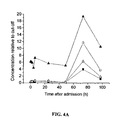
- Figure 4 shows individual cTnI release profiles for patients 1 (A) and 5 (B) relative to the cut-off of the respective cTnI assay.
- the samples were measured with four immunoassays: Mab 1/Mab 2 ( ⁇ ), Mabs 1+3/Mabs 2+4 ( ⁇ ), AxSym (o) or ACS:180 ( ⁇ ).
- the inset in (B) shows the release profile in full scale.
- Figure 5 shows individual cTnI release profiles for four patients presenting with chest pain measured with assays according to this invention, Assay A (diamond) and Assay B (triangle), which are both designed to be minimally affected by IF, and previously known assays, namely Assay Mab 1/Mab 2 (square), which is seriously affected by IF, and a commercial cTnI assay, Immuno1 (circle).
- Assay A diamond
- Assay B triangle
- Figure 6 shows cTnI release profiles for two patients (a and b) in samples taken at admission (1) and 6 hours later (2), measured with assays according to this invention, Assay A and B, and previously known assays.
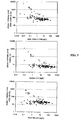
- Figure 7 shows the relative concentration cTnI for assays according to this invention, Assay A and B, compared to a commercial assay, for recovery below 40% and for recovery above 40%.
- cardiac troponin I which is a 209 aa protein, exists as complexed with troponin C.
- all the antibodies are directed to epitopes on the cTnI part of the complex.
- the complex containing both cardiac troponin I and troponin C could be considered as the antigen to be determined. In this case the antibodies could be directed both to epitopes on troponin C and on cardiac troponin I.
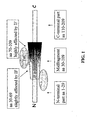
- the 209 aa cardiac troponin I protein comprises an "N-terminal part” comprising the amino acids 1-29, a stable part, "midfragment” comprising the amino acids 30-109, and a "C-terminal part” comprising the amino acids 110-209.
- the midfragment is stable and most of the known cTnI assays employ antibodies directed to epitopes in this region.
- the inventors of the present invention have, however, found that the midfragment is affected by an interfering factor (IF), and this factor is found to disturb the activity of the antibody directed to this region.
- IF interfering factor
- the strength of the interfering factor increases from aa 30 to aa 109.
- the region 70-109 aa is here defined as the part of the cTnI midfragment which is highly influenced by the interfering factor.
- the remaining part, namely 30-69 aa is here defined as the part of the cTnI midfragment which is slightly affected by the interfering factor. See Figure 1.
- the N-terminal part is susceptible to cleavage, giving rise to a 1-29 aa fragment.
- the C-terminal part is more stable then the N-terminal part, but can be cleaved in a region between 148 and 190 aa.
- the remaining part of the C-terminal is more stable, but cleaving can occur in the region 110-137 aa.
- a first capture antibody is directed to the N-terminal part of cTnI, to the C-terminal part of cTnI or to the part of the cTnI midfragment, which is slightly affected by the interfering factor, and a second capture antibody is directed to another of the aforementioned parts, and a tracer antibody is directed to the N-terminal part of cTnI, to the C-terminal part of cTnI or to TnC, which is complexed with cTnI.
- the wording stating that the antibody is directed to a certain part of the cTnI protein shall be interpreted so that more than 50 % of the amino acids, preferably more than 60 %, especially 100 %, constituting the epitope to which the antibody binds are located within said part of the cTnI protein.
- a first capture antibody is directed to the part of the cTnI midfragment, which is slightly affected by the interfering factor and a second capture antibody is directed to the N-terminal or to the C-terminal part of cTnI, and a tracer antibody is directed to the C-terminal part of cTnI.
- the first capture antibody is directed to the epitope region 30-70 aa, preferably 41-49aa
- the second capture antibody is directed to the epitope region 148-209 aa, preferably 190-196 aa
- the tracer antibody is directed to the epitope 110-148 aa, preferably 137-148.
- three capture antibodies are used.
- the first capture antibody is directed to the part of the cTnI midfragment, which is slightly affected by the interfering factor and a second capture antibody is directed to the C-terminal part of cTnI, and a third capture antibody is directed to the N-terminal part of cTnI, and the tracer antibody is directed to TnC.
- the first capture antibody is directed to the epitope region 30-70 aa, preferably 41-49 aa
- the second capture antibody is directed to the epitope region 148-209 aa, preferably 190-196 aa
- the third capture antibody is directed to the epitope region 1-29 aa, preferably 23-29 aa.
- the assay can be carried out as a heterogeneous assay, where the capture antibody is biotinylated in order to be able to bind to a streptavidin coated solid phase.
- the captured antibody together with the bound cTnI can be separated from the incubation mixture before it is subjected to the tracer antibody in a separate step.
- the tracer antibody can be labelled with any detectable label, preferably a luminescent label.
- the tracer antibody can be added simultaneously, e.g. according to the all-in-one dry chemistry concept (reference 34). After incubation a washing step follows.
- the heterogeneous assay can be carried out in immunochromatographic format according to well known technology.
- the assay can be carried out as a homogeneous assay, where no separation is necessary before the addition of the tracer antibody, which can be added simultaneously with the capture antibody.
- the capture antibody is preferably attached to a dye in the form of a small particle, especially a nanoparticle, or to a luminescent molecule.
- An especially preferable homogeneous assay is a homogeneous energy transfer assay, where the capture antibody is attached to a luminescent lanthanide chelate, which is excited by radiation and capable of transferring energy to the label of the tracer antibody.
- Such assays are described in the art, for example in WO 98/15830 and EP 965043.
- the homogeneous assay can be carried out in a serum, a plasma sample or a whole blood sample.
- the assay can be carried out using a homogeneous detection system ("Fluorescence Energy Transfer Dye System”) but in combination with a built-in wash system based on capillary forces such as used in the Triage® Cardiac System (Biosite Diagnostics).
- a homogeneous detection system (“Fluorescence Energy Transfer Dye System”)
- a built-in wash system based on capillary forces such as used in the Triage® Cardiac System (Biosite Diagnostics).
- Human cardiac troponin complex (native, tissue derived complex of cTnI-cTnT-TnC) and monoclonal antibodies (Mabs) specific for cTnI were obtained from HyTest Ltd.
- Five Mabs were used, of which three have epitopes in the stable part of cTnI (Mab 1 epitope in the region of amino acid residues 35-55, Mab 2 and Mab 5 epitopes in the region of amino acid residues 80-95), one has a N-terminal epitope in the region of 20-35 (Mab 3) and one have a C-terminal epitope in the region of 185-200 (Mab 4).
- the intrinsically fluorescent europium chelate used for labelling of the detection antibodies was kindly provided by M.Sc. Jaana Rosenberg (Department of Bio-Organic Chemistry, University of Turku, Finland).
- the chelate was a europium (III) chelate of 2,2', 2",2"'-[[4-[(4-isothiocyanatophenyl)ethynyl]pyridine-2,6-diyl]bis(methylenenitrilo)]tetrakis(acetic acid)(32).
- the labelling of antibodies was performed in 50 mmol/L sodium carbonate buffer, pH 9.8, with a 100-fold molar excess of chelate at room temperature over night (16-20 h).
- the labelled antibody was separated from excess free label on a Superdex 200 HR 10/30 gel filtration column equilibrated and run with 50 mmol/L Tris-HCl pH 7.75, 15 mmol/L NaCl, 0.5 g/L NaN 3 at 25 mL/h and 0.5-mL fractions were collected. The fractions containing labelled protein were pooled, the protein concentration was determined with the Bio-Rad Protein Assay (Bio-Rad) and the degree of labelling was determined using a europium calibration solution. Bovine serum albumin was added to a final concentration of 1 g/L and the solution was filtered through a 0.22 ⁇ m pore size filter and stored at +4°C. The labelling degrees of the antibodies were 6-12 Eu-chelates per molecule of IgG.
- Biotin-isothiocyanate J. Rosenberg was used for the biotinylation of antibodies.
- the antibody was biotinylated with a 30-fold molar excess of biotin-isothiocyanate in 50 mmol/L sodium carbonate buffer, pH 9.8, at room temperature for 4 h.
- the biotinylated antibody was separated from free biotinylation reagent by passing the reaction twice through disposable NAP-5 or NAP-10 columns (Amersham Biosciences AB) with 50 mmol/L Tris-HCl pH 7.75, 15 mmol/L NaCl, 0.5 g/L NaN 3 as eluent.
- Bovine serum albumin was added to a final concentration of 1 g/L and the solution was filtered through a 0.22 ⁇ m pore size filter and stored at +4°C.
- the time-resolved europium fluorescence was measured directly from the dry surface in a VictorTM 1420 Multilabel Counter (Perkin-Elmer Life Sciences, Wallac Oy).
- the assay with four antibodies using Mabs1 and 3 as capture antibodies and Mabs 2 and 4 as detection antibodies (Mabs 1 and 3/Mabs 2 and 4) was performed in the same way except that 200 ng of each biotinylated capture antibody was used.
- the lower detection limits (+2SD of blank) were approximately 0.03 ⁇ g/L and 0.02 ⁇ g/L for the Mab1/Mab 2 assay and the Mabs1 and 3/Mabs 2 and 4 assay, respectively.
- the analytical recovery of standard cTnI was measured after adding ternary troponin complex corresponding to 30 ⁇ g/L of cTnI (final concentration) to the samples.
- the signal from the spiked sample was compared to the signal of a buffer (7.5% bovine serum albumin, 50 mmol/L Tris-HCl pH 7.75, 15 mmol/L NaCl and 0.5 g/L NaN 3 ) spiked in the same way and the recovery was calculated based on the assumption that the recovery in buffer was 100%.
- the recovery of endogenous cTnI was tested after adding a small volume of a patient sample with high cTnI concentration to the samples.
- the cTnI concentration in the patient sample was determined with the Mab 1/Mab 2 assay against standards prepared from the ternary troponin complex stock solution.
- the recovery of cTnI in individual serum and EDTA plasma samples is shown in Table 1.
- the mean recovery in serum samples spiked to 30 ⁇ g/L was 43.8% (range 7.0-71.2%), and 27.1% (range 5.5-38.6%) in EDTA plasma samples.
- the four combinations tested were Mabs 1 + 3 (capture) with Mabs 2 + 4 (tracer), Mabs 1 + 4 (capture) with Mabs 2 + 3 (tracer), Mabs 2 + 3 (capture) with Mabs 1 + 4 (tracer), and Mabs 2 + 4 (capture) with Mabs 1 + 3 (tracer).
- the final combination was selected based on a compromise between high specific signals, background signal levels in samples from healthy individuals and increased recovery of standard cTnI in samples showing low recovery with the Mab1/Mab 2 combination.
- the final assay format with two capture and two tracer antibodies was Mabs 1+3/Mabs 2+4.
- patient 1 was diagnosed with unstable angina with ST-segment depression and patient 5 was classified as having a ST-segment elevation infarction.
- interfering factor binds very rapidly to cTnI causing low recovery even if cTnI is added immediately prior to the assay indicating that it has a high affinity towards cTnI.
- the interfering factor appeared to be present in small and limited amounts, since spiking of samples with more cTnI resulted in significantly higher recovery apparently by saturating the interfering factor. Moreover, in the samples from patients 1 and 5 the increasing effect provided by the assay with four antibodies was greatest in the first samples when only little cTnI was released. As more cTnI was subsequently released, the inhibiting effect of the interfering factor was gradually diminished.
- Assay A uses two biotinylated monoclonal antibodies for capture of cTnI to the solid phase of streptavidin coated single microtiter wells.
- One capture antibody is directed to aa 41-49 and the other to aa 190-196.
- the detection antibody which is labelled with a stable inherently fluorescent europium chelate, is directed to aa 137-148 of cTnI.
- the assay is based on the all-in-one dry chemistry concept (reference 34). Briefly, all components are built into the well in a dry stable form. The Innotrac Aio Immunoanalyzer is used for performing the assay.
- Assay B uses three biotinylated monoclonal antibodies for capture of cTnI; one directed to aa 23-29, one to aa 41-49 and one to aa 190-196.
- the detection antibody is directed to TnC, i.e. the assay measures the cTnI-TnC complex. The result is reported as the amount (ng/mL) of cTnI in order to facilitate comparison between assays.
- Assay B is also based on the all-in-one dry chemistry concept and performed in the same way as Assay A.
- Assay Immune is a commercial cTnI assay manufactured by Bayer Diagnostics.
- Assay Access AccuTnI is a commercial cTnI assay manufactured by Beckman Coulter.
- the Mab 1/Mab 2 assay which uses a monoclonal cTnI antibody directed to aa 41-49 for capture and a monoclonal cTnI monoclonal cTnI antibody directed to aa 87-91 for detection, was performed as an all-in-one assay (same assay protocol as for Assay A and B), and not as described in the Materials and Methods section. It can be seen that the new assays Assay A and Assay B in all patients give clearly higher cTnI results at onset than the previously known assays, which give false negative results at this point.
- FIG. 6 shows cTnI release profiles for two patients presenting with chest pain.
- CTnI was measured with assays according to this invention, Assay A and B, and previously known assays, namely a commercial assay, Access AccuTnI and Assay Mab 1/Mab 2.
- Sample 1 was taken at admission to emergency care and sample 2 was taken 6 hours later.
- the analytical recovery of 3 ⁇ g/L cTnI was 34.2% in sample 1 from patient a, and 13.1 % in sample 1 from patient b when measured with Assay Mab 1/Mab 2.
- the mean ratio of Assay B to Access AccuTnI was 2.858 in samples with recovery ⁇ 40% and 0.614 in samples with recovery >40%.
- the figures show that the new assays are more sensitive than the Access AccuTnI assay for samples that have a low analytical recovery of cTnI when measured with the Mab 1/Mab 2 assay, i.e. a relatively high concentration of IF.
Landscapes
- Life Sciences & Earth Sciences (AREA)
- Health & Medical Sciences (AREA)
- Engineering & Computer Science (AREA)
- Biomedical Technology (AREA)
- Molecular Biology (AREA)
- Chemical & Material Sciences (AREA)
- Urology & Nephrology (AREA)
- Hematology (AREA)
- Immunology (AREA)
- Biotechnology (AREA)
- Analytical Chemistry (AREA)
- Cell Biology (AREA)
- Proteomics, Peptides & Aminoacids (AREA)
- Food Science & Technology (AREA)
- Medicinal Chemistry (AREA)
- Physics & Mathematics (AREA)
- Microbiology (AREA)
- Biochemistry (AREA)
- General Health & Medical Sciences (AREA)
- General Physics & Mathematics (AREA)
- Pathology (AREA)
- Investigating Or Analysing Biological Materials (AREA)
- Steroid Compounds (AREA)
Claims (9)
- Verfahren zur Detektion und/oder Quantifizierung von kardialem Troponin I (cTnI) in einer Probe, stammend aus Blut eines Individuums, wobei das Verfahren auf einem Sandwich-Immunoassay basiert, wobei mindestens zwei Fang-Antikörper und mindestens ein Markierungsantikörper eingesetzt werden, wobei- ein erster Fang-Antikörper auf den N-terminalen Teil von cTnI, auf den C-terminalen Teil von cTnI oder auf den Teil des cTnI-Mittelfragments gerichtet ist, der geringfügig durch den interferierenden Faktor beeinflusst wird, und ein zweiter Fang-Antikörper auf einen anderen der zuvor genannten Teile gerichtet ist, und- ein Markierungsantikörper auf den N-terminalen Teil von cTnI, auf den C-terminalen Teil von cTnI oder auf TnC gerichtet ist, das mit cTnI komplexiert ist.
- Verfahren nach Anspruch 1, wobei ein erster Fang-Antikörper auf den Teil des cTnI-Mittelfragments gerichtet ist, der geringfügig durch den interferierenden Faktor beeinflusst wird, und ein zweiter Fang-Antikörper auf den N-terminalen Teil oder den C-terminalen Teil von cTnI gerichtet ist und ein Markierungsantikörper auf den C-terminalen Teil von cTnI gerichtet ist.
- Verfahren nach Anspruch 2, wobei der erste Fang-Antikörper auf den Epitopbereich As 30-70, vorzugsweise As 41-49, gerichtet ist, der zweite Fang-Antikörper auf den Epitopbereich As 148-209, vorzugsweise As 190-196, gerichtet ist und der Markierungsantikörper auf das Epitop As 110-148, vorzugsweise 137-148, gerichtet ist.
- Verfahren nach Anspruch 1, wobei der erste Fang-Antikörper auf den Teil des cTnI-Mittelfragments gerichtet ist, der geringfügig durch den interferierenden Faktor beeinflusst wird, und ein zweiter Fang-Antikörper auf den C-terminalen Teil von cTnI gerichtet ist und ein dritter Fang-Antikörper auf den N-terminalen Teil von cTnI gerichtet ist und der Markierungsantikörper auf TnC gerichtet ist.
- Verfahren nach Anspruch 4, wobei der erste Fang-Antikörper auf den Epitopbereich As 30-70, vorzugsweise As 41-49, gerichtet ist, der zweite Fang-Antikörper auf den Epitopbereich As 148-209, vorzugsweise As 190-196, gerichtet ist und der dritte Fang-Antikörper auf den Epitopbereich As 1-29, vorzugsweise As 23-29, gerichtet ist.
- Verfahren nach einem der Ansprüche 1-5, wobei der Fang-Antikörper oder die Fang-Antikörper an einer festen Oberfläche befestigt ist/sind und das Verfahren als ein heterogener Assay, entweder in einem Schritt oder in mehreren Schritten, durchgeführt wird.
- Verfahren nach einem der Ansprüche 1-5, wobei der Fang-Antikörper oder die Fang-Antikörper an einem kleinen Teilchen befestigt ist/sind oder an ein Molekül gebunden ist/sind und das Verfahren als ein homogener Assay durchgeführt wird.
- Verfahren nach Anspruch 7, wobei der Fang-Antikörper oder die Fang-Antikörper an ein Molekül, vorzugsweise einen lumineszenten Lanthanidenchelatkomplex, gebunden ist/sind, und das Verfahren als ein homogener Energietransfer-Assay durchgeführt wird.
- Verfahren nach einem der vorhergehenden Ansprüche, wobei die Probe Serum, Plasma oder Vollblut ist.
Applications Claiming Priority (2)
| Application Number | Priority Date | Filing Date | Title |
|---|---|---|---|
| FI20030652A FI20030652A0 (fi) | 2003-04-30 | 2003-04-30 | Parannettu immunomääritys |
| FI20030652 | 2003-04-30 |
Publications (2)
| Publication Number | Publication Date |
|---|---|
| EP1473567A1 EP1473567A1 (de) | 2004-11-03 |
| EP1473567B1 true EP1473567B1 (de) | 2006-07-19 |
Family
ID=8566047
Family Applications (1)
| Application Number | Title | Priority Date | Filing Date |
|---|---|---|---|
| EP04076042A Expired - Lifetime EP1473567B1 (de) | 2003-04-30 | 2004-04-01 | Immunotestverfahren für Herz-Troponin I |
Country Status (6)
| Country | Link |
|---|---|
| US (2) | US7348157B2 (de) |
| EP (1) | EP1473567B1 (de) |
| AT (1) | ATE333649T1 (de) |
| DE (1) | DE602004001533T2 (de) |
| ES (1) | ES2264079T3 (de) |
| FI (1) | FI20030652A0 (de) |
Cited By (4)
| Publication number | Priority date | Publication date | Assignee | Title |
|---|---|---|---|---|
| US7776605B2 (en) | 2006-10-26 | 2010-08-17 | Abbott Laboratories | Assay for cardiac troponin autoantibodies |
| CN102597774A (zh) * | 2009-09-23 | 2012-07-18 | 皇家飞利浦电子股份有限公司 | 利用多种磁性标记示踪结合试剂的结合测定 |
| US8357495B2 (en) | 2006-10-26 | 2013-01-22 | Abbott Laboratories | Immunoassay of analytes in samples containing endogenous anti-analyte antibodies |
| EP2478367B1 (de) | 2009-09-14 | 2015-05-13 | Koninklijke Philips N.V. | Hochsensitiver Immunoassay mit grossen Partikelmarkern |
Families Citing this family (33)
| Publication number | Priority date | Publication date | Assignee | Title |
|---|---|---|---|---|
| US20040018577A1 (en) | 2002-07-29 | 2004-01-29 | Emerson Campbell John Lewis | Multiple hybrid immunoassay |
| JP5308328B2 (ja) * | 2006-04-04 | 2013-10-09 | シングレックス,インコーポレイテッド | トロポニンの分析のための高感度のシステムおよび方法 |
| AU2014200749B2 (en) * | 2006-04-04 | 2016-04-14 | Singulex, Inc. | Highly sensitive system and methods for analysis of troponin |
| CN103353531B (zh) * | 2006-04-04 | 2019-03-08 | 神谷来克斯公司 | 用于肌钙蛋白分析的高灵敏系统和方法 |
| US7838250B1 (en) * | 2006-04-04 | 2010-11-23 | Singulex, Inc. | Highly sensitive system and methods for analysis of troponin |
| CA2667119C (en) * | 2006-10-18 | 2016-04-12 | Axela Inc. | Measuring multiple analytes over a broad range of concentrations using optical diffraction |
| US20080305512A1 (en) * | 2006-10-26 | 2008-12-11 | Mattingly Phillip G | Assay for cardiac troponin autoantibodies |
| WO2009111033A2 (en) | 2008-03-05 | 2009-09-11 | Axela Inc. | Detection of biomarkers and biomarker complexes |
| WO2010144358A1 (en) | 2009-06-08 | 2010-12-16 | Singulex, Inc. | Highly sensitive biomarker panels |
| US20110136141A1 (en) * | 2009-12-03 | 2011-06-09 | Abbott Laboratories | Peptide reagents and method for inhibiting autoantibody antigen binding |
| AU2011249908A1 (en) | 2010-05-06 | 2012-11-22 | Singulex, Inc. | Methods for diagnosing, staging, predicting risk for developing and identifying treatment responders for rheumatoid arthritis |
| US20110306148A1 (en) | 2010-06-14 | 2011-12-15 | Siemens Healthcare Diagnostics Inc. | Composition for use as an assay reagent |
| SG10201708959WA (en) | 2012-07-03 | 2017-11-29 | Univ Washington | Antibodies to tau |
| CN103940986B (zh) * | 2014-03-24 | 2015-10-21 | 安徽省煦棠医疗科技有限公司 | 肌钙蛋白i特定位点抗体制备及其检测试剂盒 |
| TWI734975B (zh) | 2014-06-27 | 2021-08-01 | 美商C2N醫療診斷有限責任公司 | 人類化抗-tau抗體 |
| WO2016048388A1 (en) | 2014-09-26 | 2016-03-31 | Somalogic, Inc. | Cardiovascular risk event prediction and uses thereof |
| JP6651794B2 (ja) * | 2015-11-05 | 2020-02-19 | 富士レビオ株式会社 | 心筋トロポニンi測定試薬及び方法 |
| CN111018975B (zh) * | 2018-10-10 | 2022-04-01 | 东莞市朋志生物科技有限公司 | 一种抗人心肌肌钙蛋白i的重组抗体 |
| CN111018973B (zh) * | 2018-10-10 | 2022-04-01 | 东莞市朋志生物科技有限公司 | 一种抗人心肌肌钙蛋白i的重组抗体 |
| CN111018977B (zh) * | 2018-10-10 | 2022-04-01 | 东莞市朋志生物科技有限公司 | 一种抗人心肌肌钙蛋白i的重组抗体 |
| CN111018974B (zh) * | 2018-10-10 | 2022-04-01 | 东莞市朋志生物科技有限公司 | 一种抗人心肌肌钙蛋白i的重组抗体 |
| CN111018982B (zh) * | 2018-10-10 | 2021-12-03 | 东莞市朋志生物科技有限公司 | 一种抗人心肌肌钙蛋白i的抗体及其应用 |
| CN111018978B (zh) * | 2018-10-10 | 2022-11-04 | 东莞市朋志生物科技有限公司 | 一种抗人心肌肌钙蛋白i的抗体及其应用 |
| CN111018981B (zh) * | 2018-10-10 | 2021-12-03 | 东莞市朋志生物科技有限公司 | 一种抗人心肌肌钙蛋白i的抗体及其应用 |
| CN111018980B (zh) * | 2018-10-10 | 2021-12-03 | 东莞市朋志生物科技有限公司 | 一种抗人心肌肌钙蛋白i的抗体及其应用 |
| CN111018979B (zh) * | 2018-10-10 | 2021-12-03 | 东莞市朋志生物科技有限公司 | 一种抗人心肌肌钙蛋白i的抗体及其应用 |
| CN110836973A (zh) * | 2019-09-09 | 2020-02-25 | 浙江博实生物科技有限公司 | 检测肌钙蛋白及复合物的双标记试剂盒及制备与检测方法 |
| CN111308085B (zh) * | 2019-12-30 | 2021-02-23 | 菲鹏生物股份有限公司 | 一种超敏心肌肌钙蛋白i检测方法和试剂盒 |
| CN114034869A (zh) * | 2020-10-16 | 2022-02-11 | 广东菲鹏生物有限公司 | 一种心肌肌钙蛋白i检测方法和试剂盒 |
| CN114384249A (zh) * | 2020-10-16 | 2022-04-22 | 广东菲鹏生物有限公司 | 一种心肌肌钙蛋白i检测方法和试剂盒 |
| US20220145363A1 (en) * | 2020-11-09 | 2022-05-12 | Meso Scale Technologies, Llc. | Methods and kits for detecting tau |
| WO2025035370A1 (zh) * | 2023-08-14 | 2025-02-20 | 深圳迈瑞生物医疗电子股份有限公司 | 检测总cTnITC的组合物、试剂盒和方法、及其应用 |
| WO2025229075A1 (en) * | 2024-05-03 | 2025-11-06 | Sphingotec Gmbh | A method for the specific determination of proenkephalin fragment 119-159 |
Family Cites Families (6)
| Publication number | Priority date | Publication date | Assignee | Title |
|---|---|---|---|---|
| AU689777B2 (en) * | 1993-05-17 | 1998-04-09 | Fortron Bioscience, Inc. | Assay for cardiac troponin I |
| DE19524572A1 (de) | 1995-07-06 | 1997-01-09 | Bayer Ag | Verfahren zur Herstellung eines synthetischen Kalibrators für den Einsatz in Immunoassays, bestehend aus den Analyten oder Teilsequenzen davon, die an inerten Trägermoleküle konjugiert sind |
| WO1997049994A1 (en) | 1996-06-25 | 1997-12-31 | Oy Aboatech Ab | Method and kit for the diagnosis of troponin i |
| WO1998029726A2 (en) * | 1996-12-27 | 1998-07-09 | Coulter International Corp. | Method of detecting and determining the concentration of total troponin i in a biological sample |
| FR2779526A1 (fr) | 1998-06-09 | 1999-12-10 | Pasteur Sanofi Diagnostics | Nouveau procede de dosage de la troponine i cardiaque |
| US20040018577A1 (en) * | 2002-07-29 | 2004-01-29 | Emerson Campbell John Lewis | Multiple hybrid immunoassay |
-
2003
- 2003-04-30 FI FI20030652A patent/FI20030652A0/fi not_active Application Discontinuation
-
2004
- 2004-04-01 ES ES04076042T patent/ES2264079T3/es not_active Expired - Lifetime
- 2004-04-01 AT AT04076042T patent/ATE333649T1/de not_active IP Right Cessation
- 2004-04-01 DE DE602004001533T patent/DE602004001533T2/de not_active Expired - Lifetime
- 2004-04-01 EP EP04076042A patent/EP1473567B1/de not_active Expired - Lifetime
- 2004-04-07 US US10/819,213 patent/US7348157B2/en not_active Expired - Lifetime
-
2007
- 2007-11-13 US US11/979,977 patent/US7638292B2/en not_active Expired - Lifetime
Cited By (6)
| Publication number | Priority date | Publication date | Assignee | Title |
|---|---|---|---|---|
| US7776605B2 (en) | 2006-10-26 | 2010-08-17 | Abbott Laboratories | Assay for cardiac troponin autoantibodies |
| US8173382B2 (en) | 2006-10-26 | 2012-05-08 | Abbott Laboratories | Assay for cardiac troponin autoantibodies |
| US8357495B2 (en) | 2006-10-26 | 2013-01-22 | Abbott Laboratories | Immunoassay of analytes in samples containing endogenous anti-analyte antibodies |
| EP2478367B1 (de) | 2009-09-14 | 2015-05-13 | Koninklijke Philips N.V. | Hochsensitiver Immunoassay mit grossen Partikelmarkern |
| CN102597774A (zh) * | 2009-09-23 | 2012-07-18 | 皇家飞利浦电子股份有限公司 | 利用多种磁性标记示踪结合试剂的结合测定 |
| CN102597774B (zh) * | 2009-09-23 | 2015-05-13 | 皇家飞利浦电子股份有限公司 | 利用多种磁性标记示踪结合试剂的结合测定 |
Also Published As
| Publication number | Publication date |
|---|---|
| EP1473567A1 (de) | 2004-11-03 |
| US7638292B2 (en) | 2009-12-29 |
| ATE333649T1 (de) | 2006-08-15 |
| FI20030652A0 (fi) | 2003-04-30 |
| DE602004001533T2 (de) | 2007-02-15 |
| US20080153109A1 (en) | 2008-06-26 |
| US20040219604A1 (en) | 2004-11-04 |
| DE602004001533D1 (de) | 2006-08-31 |
| ES2264079T3 (es) | 2006-12-16 |
| US7348157B2 (en) | 2008-03-25 |
Similar Documents
| Publication | Publication Date | Title |
|---|---|---|
| EP1473567B1 (de) | Immunotestverfahren für Herz-Troponin I | |
| Eriksson et al. | Negative interference in cardiac troponin I immunoassays from a frequently occurring serum and plasma component | |
| US9541549B2 (en) | Determination of a midregional proadrenomedullin partial peptide in biological fluids for diagnostic purposes, and immunoassays for carrying out such a determination | |
| EP0892927B1 (de) | Ein-schritt trockenreagenz-immunoasssay | |
| US20200333352A1 (en) | Highly Sensitive System and Method for Analysis of Troponin | |
| US7977072B2 (en) | Sandwich immunoassay for identifying partial proANP peptides | |
| US11719697B2 (en) | Immunoassay and antibodies for the detection of chromogranin A | |
| Labugger et al. | Strategy for analysis of cardiac troponins in biological samples with a combination of affinity chromatography and mass spectrometry | |
| US7998690B2 (en) | Methods for the detection and monitoring of congestive heart failure | |
| Eriksson et al. | An interfering component in cardiac troponin I immunoassays—its nature and inhibiting effect on the binding of antibodies against different epitopes | |
| JP7517311B2 (ja) | APP669-xのN末端を特異的に認識する抗体、及び免疫測定法 | |
| WO2010042126A1 (en) | Methods and assays to assess cardiac risk and ischemia | |
| Ruseva | MYOCARDIAL INFARCTION | |
| Overgaard et al. | Total and isoform‐specific quantitative assessment of circulating fibulin‐1 using selected reaction monitoring MS and time‐resolved immunofluorometry | |
| Pettersson et al. | Multi-assay point-of-care platform: highly sensitive time-resolved fluorometric detection in combination with a universal “all-in-one” assay format | |
| CN119757762A (zh) | 一种基于均相光激化学发光免疫分析技术的gdf15检测方法及试剂盒 | |
| US20110014638A1 (en) | Soluble fas in acute coronary syndromes diagnosis | |
| Yeo et al. | Interferences in immunoassays for cardiac troponin | |
| Green | CK-MB Measurements by Immunoassay | |
| Wu | Biochemical and analytical laboratory issues for cardiac troponin | |
| Duffy et al. | Cardiac troponin I: a review | |
| Savukoski | CARDIAC TROPONIN SPECIFIC AUTOANTIBODIES | |
| Simpson | Differential Detection of Skeletal Troponin I Isoforms in Serum of a Patient with Rhabdomyolysis: Markers of | |
| HK1229425A1 (en) | Immunoassay for the detection of chromogranin a | |
| HK1229425B (en) | Immunoassay for the detection of chromogranin a |
Legal Events
| Date | Code | Title | Description |
|---|---|---|---|
| PUAI | Public reference made under article 153(3) epc to a published international application that has entered the european phase |
Free format text: ORIGINAL CODE: 0009012 |
|
| AK | Designated contracting states |
Kind code of ref document: A1 Designated state(s): AT BE BG CH CY CZ DE DK EE ES FI FR GB GR HU IE IT LI LU MC NL PL PT RO SE SI SK TR |
|
| AX | Request for extension of the european patent |
Extension state: AL HR LT LV MK |
|
| RAP1 | Party data changed (applicant data changed or rights of an application transferred) |
Owner name: TURUN YLIOPISTO |
|
| RIN1 | Information on inventor provided before grant (corrected) |
Inventor name: PETTERSSON, KIM Inventor name: ERIKSSON, SUSANN |
|
| 17P | Request for examination filed |
Effective date: 20050228 |
|
| AKX | Designation fees paid |
Designated state(s): AT BE BG CH CY CZ DE DK EE ES FI FR GB GR HU IE IT LI LU MC NL PL PT RO SE SI SK TR |
|
| GRAP | Despatch of communication of intention to grant a patent |
Free format text: ORIGINAL CODE: EPIDOSNIGR1 |
|
| GRAS | Grant fee paid |
Free format text: ORIGINAL CODE: EPIDOSNIGR3 |
|
| GRAA | (expected) grant |
Free format text: ORIGINAL CODE: 0009210 |
|
| AK | Designated contracting states |
Kind code of ref document: B1 Designated state(s): AT BE BG CH CY CZ DE DK EE ES FI FR GB GR HU IE IT LI LU MC NL PL PT RO SE SI SK TR |
|
| PG25 | Lapsed in a contracting state [announced via postgrant information from national office to epo] |
Ref country code: BE Free format text: LAPSE BECAUSE OF FAILURE TO SUBMIT A TRANSLATION OF THE DESCRIPTION OR TO PAY THE FEE WITHIN THE PRESCRIBED TIME-LIMIT Effective date: 20060719 Ref country code: AT Free format text: LAPSE BECAUSE OF FAILURE TO SUBMIT A TRANSLATION OF THE DESCRIPTION OR TO PAY THE FEE WITHIN THE PRESCRIBED TIME-LIMIT Effective date: 20060719 Ref country code: IT Free format text: LAPSE BECAUSE OF FAILURE TO SUBMIT A TRANSLATION OF THE DESCRIPTION OR TO PAY THE FEE WITHIN THE PRESCRIBED TIME-LIMIT;WARNING: LAPSES OF ITALIAN PATENTS WITH EFFECTIVE DATE BEFORE 2007 MAY HAVE OCCURRED AT ANY TIME BEFORE 2007. THE CORRECT EFFECTIVE DATE MAY BE DIFFERENT FROM THE ONE RECORDED. Effective date: 20060719 Ref country code: LI Free format text: LAPSE BECAUSE OF FAILURE TO SUBMIT A TRANSLATION OF THE DESCRIPTION OR TO PAY THE FEE WITHIN THE PRESCRIBED TIME-LIMIT Effective date: 20060719 Ref country code: SK Free format text: LAPSE BECAUSE OF FAILURE TO SUBMIT A TRANSLATION OF THE DESCRIPTION OR TO PAY THE FEE WITHIN THE PRESCRIBED TIME-LIMIT Effective date: 20060719 Ref country code: RO Free format text: LAPSE BECAUSE OF FAILURE TO SUBMIT A TRANSLATION OF THE DESCRIPTION OR TO PAY THE FEE WITHIN THE PRESCRIBED TIME-LIMIT Effective date: 20060719 Ref country code: SI Free format text: LAPSE BECAUSE OF FAILURE TO SUBMIT A TRANSLATION OF THE DESCRIPTION OR TO PAY THE FEE WITHIN THE PRESCRIBED TIME-LIMIT Effective date: 20060719 Ref country code: CZ Free format text: LAPSE BECAUSE OF FAILURE TO SUBMIT A TRANSLATION OF THE DESCRIPTION OR TO PAY THE FEE WITHIN THE PRESCRIBED TIME-LIMIT Effective date: 20060719 Ref country code: PL Free format text: LAPSE BECAUSE OF FAILURE TO SUBMIT A TRANSLATION OF THE DESCRIPTION OR TO PAY THE FEE WITHIN THE PRESCRIBED TIME-LIMIT Effective date: 20060719 Ref country code: NL Free format text: LAPSE BECAUSE OF FAILURE TO SUBMIT A TRANSLATION OF THE DESCRIPTION OR TO PAY THE FEE WITHIN THE PRESCRIBED TIME-LIMIT Effective date: 20060719 Ref country code: CH Free format text: LAPSE BECAUSE OF FAILURE TO SUBMIT A TRANSLATION OF THE DESCRIPTION OR TO PAY THE FEE WITHIN THE PRESCRIBED TIME-LIMIT Effective date: 20060719 |
|
| REG | Reference to a national code |
Ref country code: GB Ref legal event code: FG4D |
|
| RIN1 | Information on inventor provided before grant (corrected) |
Inventor name: PETTERSSON, KIM Inventor name: ERIKSSON, SUSANN |
|
| REG | Reference to a national code |
Ref country code: CH Ref legal event code: EP |
|
| REG | Reference to a national code |
Ref country code: IE Ref legal event code: FG4D |
|
| REF | Corresponds to: |
Ref document number: 602004001533 Country of ref document: DE Date of ref document: 20060831 Kind code of ref document: P |
|
| PG25 | Lapsed in a contracting state [announced via postgrant information from national office to epo] |
Ref country code: DK Free format text: LAPSE BECAUSE OF FAILURE TO SUBMIT A TRANSLATION OF THE DESCRIPTION OR TO PAY THE FEE WITHIN THE PRESCRIBED TIME-LIMIT Effective date: 20061019 Ref country code: BG Free format text: LAPSE BECAUSE OF FAILURE TO SUBMIT A TRANSLATION OF THE DESCRIPTION OR TO PAY THE FEE WITHIN THE PRESCRIBED TIME-LIMIT Effective date: 20061019 Ref country code: SE Free format text: LAPSE BECAUSE OF FAILURE TO SUBMIT A TRANSLATION OF THE DESCRIPTION OR TO PAY THE FEE WITHIN THE PRESCRIBED TIME-LIMIT Effective date: 20061019 |
|
| REG | Reference to a national code |
Ref country code: ES Ref legal event code: FG2A Ref document number: 2264079 Country of ref document: ES Kind code of ref document: T3 |
|
| PG25 | Lapsed in a contracting state [announced via postgrant information from national office to epo] |
Ref country code: PT Free format text: LAPSE BECAUSE OF FAILURE TO SUBMIT A TRANSLATION OF THE DESCRIPTION OR TO PAY THE FEE WITHIN THE PRESCRIBED TIME-LIMIT Effective date: 20061219 |
|
| NLV1 | Nl: lapsed or annulled due to failure to fulfill the requirements of art. 29p and 29m of the patents act | ||
| ET | Fr: translation filed | ||
| PLBE | No opposition filed within time limit |
Free format text: ORIGINAL CODE: 0009261 |
|
| STAA | Information on the status of an ep patent application or granted ep patent |
Free format text: STATUS: NO OPPOSITION FILED WITHIN TIME LIMIT |
|
| 26N | No opposition filed |
Effective date: 20070420 |
|
| PG25 | Lapsed in a contracting state [announced via postgrant information from national office to epo] |
Ref country code: GR Free format text: LAPSE BECAUSE OF FAILURE TO SUBMIT A TRANSLATION OF THE DESCRIPTION OR TO PAY THE FEE WITHIN THE PRESCRIBED TIME-LIMIT Effective date: 20061020 |
|
| PG25 | Lapsed in a contracting state [announced via postgrant information from national office to epo] |
Ref country code: IE Free format text: LAPSE BECAUSE OF NON-PAYMENT OF DUE FEES Effective date: 20070402 |
|
| PG25 | Lapsed in a contracting state [announced via postgrant information from national office to epo] |
Ref country code: EE Free format text: LAPSE BECAUSE OF FAILURE TO SUBMIT A TRANSLATION OF THE DESCRIPTION OR TO PAY THE FEE WITHIN THE PRESCRIBED TIME-LIMIT Effective date: 20060719 |
|
| PGRI | Patent reinstated in contracting state [announced from national office to epo] |
Ref country code: IT Effective date: 20080601 |
|
| REG | Reference to a national code |
Ref country code: FR Ref legal event code: ST Effective date: 20081231 |
|
| PG25 | Lapsed in a contracting state [announced via postgrant information from national office to epo] |
Ref country code: MC Free format text: LAPSE BECAUSE OF NON-PAYMENT OF DUE FEES Effective date: 20070430 |
|
| PG25 | Lapsed in a contracting state [announced via postgrant information from national office to epo] |
Ref country code: FR Free format text: LAPSE BECAUSE OF NON-PAYMENT OF DUE FEES Effective date: 20080430 |
|
| REG | Reference to a national code |
Ref country code: FR Ref legal event code: D3 |
|
| PG25 | Lapsed in a contracting state [announced via postgrant information from national office to epo] |
Ref country code: LU Free format text: LAPSE BECAUSE OF NON-PAYMENT OF DUE FEES Effective date: 20070401 Ref country code: CY Free format text: LAPSE BECAUSE OF FAILURE TO SUBMIT A TRANSLATION OF THE DESCRIPTION OR TO PAY THE FEE WITHIN THE PRESCRIBED TIME-LIMIT Effective date: 20060719 |
|
| PG25 | Lapsed in a contracting state [announced via postgrant information from national office to epo] |
Ref country code: HU Free format text: LAPSE BECAUSE OF FAILURE TO SUBMIT A TRANSLATION OF THE DESCRIPTION OR TO PAY THE FEE WITHIN THE PRESCRIBED TIME-LIMIT Effective date: 20070120 Ref country code: TR Free format text: LAPSE BECAUSE OF FAILURE TO SUBMIT A TRANSLATION OF THE DESCRIPTION OR TO PAY THE FEE WITHIN THE PRESCRIBED TIME-LIMIT Effective date: 20060719 |
|
| PG25 | Lapsed in a contracting state [announced via postgrant information from national office to epo] |
Ref country code: FR Free format text: LAPSE BECAUSE OF NON-PAYMENT OF DUE FEES Effective date: 20081231 |
|
| REG | Reference to a national code |
Ref country code: FR Ref legal event code: PLFP Year of fee payment: 12 |
|
| REG | Reference to a national code |
Ref country code: FR Ref legal event code: PLFP Year of fee payment: 13 |
|
| REG | Reference to a national code |
Ref country code: FR Ref legal event code: PLFP Year of fee payment: 14 |
|
| REG | Reference to a national code |
Ref country code: FR Ref legal event code: PLFP Year of fee payment: 15 |
|
| PG25 | Lapsed in a contracting state [announced via postgrant information from national office to epo] |
Ref country code: FR Free format text: LAPSE BECAUSE OF NON-PAYMENT OF DUE FEES Effective date: 20081231 |
|
| PGRI | Patent reinstated in contracting state [announced from national office to epo] |
Ref country code: FR Effective date: 20090204 |
|
| REG | Reference to a national code |
Ref country code: FR Ref legal event code: PLFP Year of fee payment: 20 |
|
| PGFP | Annual fee paid to national office [announced via postgrant information from national office to epo] |
Ref country code: IT Payment date: 20230418 Year of fee payment: 20 Ref country code: FR Payment date: 20230412 Year of fee payment: 20 Ref country code: ES Payment date: 20230531 Year of fee payment: 20 Ref country code: DE Payment date: 20230419 Year of fee payment: 20 |
|
| PGFP | Annual fee paid to national office [announced via postgrant information from national office to epo] |
Ref country code: FI Payment date: 20230418 Year of fee payment: 20 |
|
| PGFP | Annual fee paid to national office [announced via postgrant information from national office to epo] |
Ref country code: GB Payment date: 20230417 Year of fee payment: 20 |
|
| REG | Reference to a national code |
Ref country code: DE Ref legal event code: R071 Ref document number: 602004001533 Country of ref document: DE |
|
| REG | Reference to a national code |
Ref country code: GB Ref legal event code: PE20 Expiry date: 20240331 |
|
| PG25 | Lapsed in a contracting state [announced via postgrant information from national office to epo] |
Ref country code: ES Free format text: LAPSE BECAUSE OF EXPIRATION OF PROTECTION Effective date: 20240402 |
|
| REG | Reference to a national code |
Ref country code: ES Ref legal event code: FD2A Effective date: 20240426 |
|
| PG25 | Lapsed in a contracting state [announced via postgrant information from national office to epo] |
Ref country code: ES Free format text: LAPSE BECAUSE OF EXPIRATION OF PROTECTION Effective date: 20240402 Ref country code: GB Free format text: LAPSE BECAUSE OF EXPIRATION OF PROTECTION Effective date: 20240331 |