EP1468725A1 - Hochtrennende Molekularsiebmembran für Gase und Dämpfe und Verfahren zu ihrer Herstellung - Google Patents
Hochtrennende Molekularsiebmembran für Gase und Dämpfe und Verfahren zu ihrer Herstellung Download PDFInfo
- Publication number
- EP1468725A1 EP1468725A1 EP04090130A EP04090130A EP1468725A1 EP 1468725 A1 EP1468725 A1 EP 1468725A1 EP 04090130 A EP04090130 A EP 04090130A EP 04090130 A EP04090130 A EP 04090130A EP 1468725 A1 EP1468725 A1 EP 1468725A1
- Authority
- EP
- European Patent Office
- Prior art keywords
- membrane
- growth
- gases
- synthesis
- molecular sieve
- Prior art date
- Legal status (The legal status is an assumption and is not a legal conclusion. Google has not performed a legal analysis and makes no representation as to the accuracy of the status listed.)
- Granted
Links
- 239000012528 membrane Substances 0.000 title claims abstract description 47
- 239000007789 gas Substances 0.000 title claims abstract description 42
- URGAHOPLAPQHLN-UHFFFAOYSA-N sodium aluminosilicate Chemical compound [Na+].[Al+3].[O-][Si]([O-])=O.[O-][Si]([O-])=O URGAHOPLAPQHLN-UHFFFAOYSA-N 0.000 title claims abstract description 11
- 239000002808 molecular sieve Substances 0.000 title claims abstract description 10
- 238000004519 manufacturing process Methods 0.000 title claims abstract description 5
- 238000000034 method Methods 0.000 title claims description 12
- 239000011148 porous material Substances 0.000 claims abstract description 26
- 238000000926 separation method Methods 0.000 claims abstract description 22
- 239000000203 mixture Substances 0.000 claims abstract description 18
- 239000010457 zeolite Substances 0.000 claims abstract description 18
- 229910021536 Zeolite Inorganic materials 0.000 claims abstract description 17
- HNPSIPDUKPIQMN-UHFFFAOYSA-N dioxosilane;oxo(oxoalumanyloxy)alumane Chemical compound O=[Si]=O.O=[Al]O[Al]=O HNPSIPDUKPIQMN-UHFFFAOYSA-N 0.000 claims abstract description 17
- 230000000694 effects Effects 0.000 claims abstract description 9
- BPQQTUXANYXVAA-UHFFFAOYSA-N Orthosilicate Chemical compound [O-][Si]([O-])([O-])[O-] BPQQTUXANYXVAA-UHFFFAOYSA-N 0.000 claims abstract description 6
- 125000001931 aliphatic group Chemical group 0.000 claims abstract description 6
- 230000003993 interaction Effects 0.000 claims abstract description 6
- 150000003839 salts Chemical class 0.000 claims abstract description 6
- 230000003197 catalytic effect Effects 0.000 claims abstract description 5
- 238000005336 cracking Methods 0.000 claims abstract description 5
- 238000006317 isomerization reaction Methods 0.000 claims abstract description 5
- 238000007254 oxidation reaction Methods 0.000 claims abstract description 5
- 238000007363 ring formation reaction Methods 0.000 claims abstract description 5
- 239000002344 surface layer Substances 0.000 claims abstract description 5
- QGZKDVFQNNGYKY-UHFFFAOYSA-O ammonium group Chemical group [NH4+] QGZKDVFQNNGYKY-UHFFFAOYSA-O 0.000 claims abstract description 4
- 125000003118 aryl group Chemical group 0.000 claims abstract description 4
- 230000003647 oxidation Effects 0.000 claims abstract description 4
- 230000015572 biosynthetic process Effects 0.000 claims description 33
- 238000003786 synthesis reaction Methods 0.000 claims description 33
- 239000010410 layer Substances 0.000 claims description 25
- 125000005842 heteroatom Chemical group 0.000 claims description 15
- XEEYBQQBJWHFJM-UHFFFAOYSA-N Iron Chemical compound [Fe] XEEYBQQBJWHFJM-UHFFFAOYSA-N 0.000 claims description 10
- 238000002425 crystallisation Methods 0.000 claims description 10
- 230000008025 crystallization Effects 0.000 claims description 10
- 150000001875 compounds Chemical class 0.000 claims description 9
- 229910004298 SiO 2 Inorganic materials 0.000 claims description 7
- 229910052739 hydrogen Inorganic materials 0.000 claims description 7
- 239000001257 hydrogen Substances 0.000 claims description 6
- 239000000126 substance Substances 0.000 claims description 6
- NLXLAEXVIDQMFP-UHFFFAOYSA-N Ammonium chloride Substances [NH4+].[Cl-] NLXLAEXVIDQMFP-UHFFFAOYSA-N 0.000 claims description 5
- 229910052796 boron Inorganic materials 0.000 claims description 5
- 229910052742 iron Inorganic materials 0.000 claims description 5
- ZOXJGFHDIHLPTG-UHFFFAOYSA-N Boron Chemical compound [B] ZOXJGFHDIHLPTG-UHFFFAOYSA-N 0.000 claims description 4
- UFHFLCQGNIYNRP-UHFFFAOYSA-N Hydrogen Chemical compound [H][H] UFHFLCQGNIYNRP-UHFFFAOYSA-N 0.000 claims description 4
- LCKIEQZJEYYRIY-UHFFFAOYSA-N Titanium ion Chemical compound [Ti+4] LCKIEQZJEYYRIY-UHFFFAOYSA-N 0.000 claims description 4
- FJBFPHVGVWTDIP-UHFFFAOYSA-N dibromomethane Chemical compound BrCBr FJBFPHVGVWTDIP-UHFFFAOYSA-N 0.000 claims description 4
- CULSIAXQVSZNSV-UHFFFAOYSA-N germanium(4+) Chemical compound [Ge+4] CULSIAXQVSZNSV-UHFFFAOYSA-N 0.000 claims description 4
- 238000010438 heat treatment Methods 0.000 claims description 4
- LEONUFNNVUYDNQ-UHFFFAOYSA-N vanadium atom Chemical compound [V] LEONUFNNVUYDNQ-UHFFFAOYSA-N 0.000 claims description 4
- 238000000354 decomposition reaction Methods 0.000 claims description 3
- 238000003795 desorption Methods 0.000 claims description 3
- QTULVYHYEGMYLW-UHFFFAOYSA-L trimethyl-[2-(trimethylazaniumyl)ethyl]azanium;diiodide Chemical compound [I-].[I-].C[N+](C)(C)CC[N+](C)(C)C QTULVYHYEGMYLW-UHFFFAOYSA-L 0.000 claims description 3
- CPELXLSAUQHCOX-UHFFFAOYSA-M Bromide Chemical compound [Br-] CPELXLSAUQHCOX-UHFFFAOYSA-M 0.000 claims description 2
- VEXZGXHMUGYJMC-UHFFFAOYSA-M Chloride anion Chemical compound [Cl-] VEXZGXHMUGYJMC-UHFFFAOYSA-M 0.000 claims description 2
- 150000001450 anions Chemical class 0.000 claims description 2
- XMBWDFGMSWQBCA-UHFFFAOYSA-N hydrogen iodide Chemical compound I XMBWDFGMSWQBCA-UHFFFAOYSA-N 0.000 claims description 2
- XLYOFNOQVPJJNP-UHFFFAOYSA-M hydroxide Chemical compound [OH-] XLYOFNOQVPJJNP-UHFFFAOYSA-M 0.000 claims description 2
- 150000002500 ions Chemical class 0.000 claims description 2
- 150000002894 organic compounds Chemical class 0.000 claims description 2
- 229910052710 silicon Inorganic materials 0.000 claims description 2
- 239000010703 silicon Substances 0.000 claims description 2
- 238000002791 soaking Methods 0.000 claims description 2
- REDXJYDRNCIFBQ-UHFFFAOYSA-N aluminium(3+) Chemical compound [Al+3] REDXJYDRNCIFBQ-UHFFFAOYSA-N 0.000 claims 2
- 238000004321 preservation Methods 0.000 claims 1
- FBWLLSLLDKPFDK-UHFFFAOYSA-L trimethyl-[2-(trimethylazaniumyl)ethyl]azanium;dihydroxide Chemical compound [OH-].[OH-].C[N+](C)(C)CC[N+](C)(C)C FBWLLSLLDKPFDK-UHFFFAOYSA-L 0.000 claims 1
- 239000003054 catalyst Substances 0.000 abstract description 2
- 239000013078 crystal Substances 0.000 description 20
- VLKZOEOYAKHREP-UHFFFAOYSA-N n-Hexane Chemical compound CCCCCC VLKZOEOYAKHREP-UHFFFAOYSA-N 0.000 description 8
- 229910018072 Al 2 O 3 Inorganic materials 0.000 description 5
- 239000000919 ceramic Substances 0.000 description 5
- ROSDSFDQCJNGOL-UHFFFAOYSA-N Dimethylamine Chemical compound CNC ROSDSFDQCJNGOL-UHFFFAOYSA-N 0.000 description 4
- 239000000047 product Substances 0.000 description 4
- KWYHDKDOAIKMQN-UHFFFAOYSA-N N,N,N',N'-tetramethylethylenediamine Chemical compound CN(C)CCN(C)C KWYHDKDOAIKMQN-UHFFFAOYSA-N 0.000 description 3
- 239000007795 chemical reaction product Substances 0.000 description 3
- -1 hexamethylene ethylene Chemical compound 0.000 description 3
- 238000005259 measurement Methods 0.000 description 3
- 238000001179 sorption measurement Methods 0.000 description 3
- 239000010936 titanium Substances 0.000 description 3
- XLYOFNOQVPJJNP-UHFFFAOYSA-N water Substances O XLYOFNOQVPJJNP-UHFFFAOYSA-N 0.000 description 3
- BRLQWZUYTZBJKN-UHFFFAOYSA-N Epichlorohydrin Chemical compound ClCC1CO1 BRLQWZUYTZBJKN-UHFFFAOYSA-N 0.000 description 2
- 229910052782 aluminium Inorganic materials 0.000 description 2
- 125000000129 anionic group Chemical group 0.000 description 2
- 239000012013 faujasite Substances 0.000 description 2
- 125000002887 hydroxy group Chemical group [H]O* 0.000 description 2
- 239000011261 inert gas Substances 0.000 description 2
- BDERNNFJNOPAEC-UHFFFAOYSA-N propan-1-ol Chemical compound CCCO BDERNNFJNOPAEC-UHFFFAOYSA-N 0.000 description 2
- 229910052720 vanadium Inorganic materials 0.000 description 2
- QLAJNZSPVITUCQ-UHFFFAOYSA-N 1,3,2-dioxathietane 2,2-dioxide Chemical compound O=S1(=O)OCO1 QLAJNZSPVITUCQ-UHFFFAOYSA-N 0.000 description 1
- MWRWFPQBGSZWNV-UHFFFAOYSA-N Dinitrosopentamethylenetetramine Chemical compound C1N2CN(N=O)CN1CN(N=O)C2 MWRWFPQBGSZWNV-UHFFFAOYSA-N 0.000 description 1
- 206010013710 Drug interaction Diseases 0.000 description 1
- 239000005977 Ethylene Substances 0.000 description 1
- VTLYFUHAOXGGBS-UHFFFAOYSA-N Fe3+ Chemical compound [Fe+3] VTLYFUHAOXGGBS-UHFFFAOYSA-N 0.000 description 1
- XUIMIQQOPSSXEZ-UHFFFAOYSA-N Silicon Chemical compound [Si] XUIMIQQOPSSXEZ-UHFFFAOYSA-N 0.000 description 1
- OKJPEAGHQZHRQV-UHFFFAOYSA-N Triiodomethane Natural products IC(I)I OKJPEAGHQZHRQV-UHFFFAOYSA-N 0.000 description 1
- NJSSICCENMLTKO-HRCBOCMUSA-N [(1r,2s,4r,5r)-3-hydroxy-4-(4-methylphenyl)sulfonyloxy-6,8-dioxabicyclo[3.2.1]octan-2-yl] 4-methylbenzenesulfonate Chemical compound C1=CC(C)=CC=C1S(=O)(=O)O[C@H]1C(O)[C@@H](OS(=O)(=O)C=2C=CC(C)=CC=2)[C@@H]2OC[C@H]1O2 NJSSICCENMLTKO-HRCBOCMUSA-N 0.000 description 1
- 230000002378 acidificating effect Effects 0.000 description 1
- 230000001476 alcoholic effect Effects 0.000 description 1
- XAGFODPZIPBFFR-UHFFFAOYSA-N aluminium Chemical compound [Al] XAGFODPZIPBFFR-UHFFFAOYSA-N 0.000 description 1
- 235000019270 ammonium chloride Nutrition 0.000 description 1
- 125000004429 atom Chemical group 0.000 description 1
- GDTBXPJZTBHREO-UHFFFAOYSA-N bromine Substances BrBr GDTBXPJZTBHREO-UHFFFAOYSA-N 0.000 description 1
- 229910052794 bromium Inorganic materials 0.000 description 1
- UNYSKUBLZGJSLV-UHFFFAOYSA-L calcium;1,3,5,2,4,6$l^{2}-trioxadisilaluminane 2,4-dioxide;dihydroxide;hexahydrate Chemical compound O.O.O.O.O.O.[OH-].[OH-].[Ca+2].O=[Si]1O[Al]O[Si](=O)O1.O=[Si]1O[Al]O[Si](=O)O1 UNYSKUBLZGJSLV-UHFFFAOYSA-L 0.000 description 1
- 125000004432 carbon atom Chemical group C* 0.000 description 1
- 230000015556 catabolic process Effects 0.000 description 1
- 125000002091 cationic group Chemical group 0.000 description 1
- 229910052676 chabazite Inorganic materials 0.000 description 1
- 238000006243 chemical reaction Methods 0.000 description 1
- 230000007423 decrease Effects 0.000 description 1
- 230000003247 decreasing effect Effects 0.000 description 1
- 238000009792 diffusion process Methods 0.000 description 1
- GQOKIYDTHHZSCJ-UHFFFAOYSA-M dimethyl-bis(prop-2-enyl)azanium;chloride Chemical compound [Cl-].C=CC[N+](C)(C)CC=C GQOKIYDTHHZSCJ-UHFFFAOYSA-M 0.000 description 1
- 239000008151 electrolyte solution Substances 0.000 description 1
- 229940021013 electrolyte solution Drugs 0.000 description 1
- 229910052675 erionite Inorganic materials 0.000 description 1
- 229910001657 ferrierite group Inorganic materials 0.000 description 1
- INQOMBQAUSQDDS-UHFFFAOYSA-N iodomethane Chemical compound IC INQOMBQAUSQDDS-UHFFFAOYSA-N 0.000 description 1
- 239000000463 material Substances 0.000 description 1
- 229910052680 mordenite Inorganic materials 0.000 description 1
- 239000002245 particle Substances 0.000 description 1
- 239000012466 permeate Substances 0.000 description 1
- 238000005373 pervaporation Methods 0.000 description 1
- 230000009834 selective interaction Effects 0.000 description 1
- 239000000243 solution Substances 0.000 description 1
- 238000006467 substitution reaction Methods 0.000 description 1
- 238000005496 tempering Methods 0.000 description 1
- 229910052719 titanium Inorganic materials 0.000 description 1
- 238000000733 zeta-potential measurement Methods 0.000 description 1
Classifications
-
- B—PERFORMING OPERATIONS; TRANSPORTING
- B01—PHYSICAL OR CHEMICAL PROCESSES OR APPARATUS IN GENERAL
- B01D—SEPARATION
- B01D67/00—Processes specially adapted for manufacturing semi-permeable membranes for separation processes or apparatus
- B01D67/0039—Inorganic membrane manufacture
- B01D67/0051—Inorganic membrane manufacture by controlled crystallisation, e,.g. hydrothermal growth
-
- B—PERFORMING OPERATIONS; TRANSPORTING
- B01—PHYSICAL OR CHEMICAL PROCESSES OR APPARATUS IN GENERAL
- B01D—SEPARATION
- B01D53/00—Separation of gases or vapours; Recovering vapours of volatile solvents from gases; Chemical or biological purification of waste gases, e.g. engine exhaust gases, smoke, fumes, flue gases, aerosols
- B01D53/22—Separation of gases or vapours; Recovering vapours of volatile solvents from gases; Chemical or biological purification of waste gases, e.g. engine exhaust gases, smoke, fumes, flue gases, aerosols by diffusion
- B01D53/228—Separation of gases or vapours; Recovering vapours of volatile solvents from gases; Chemical or biological purification of waste gases, e.g. engine exhaust gases, smoke, fumes, flue gases, aerosols by diffusion characterised by specific membranes
-
- B—PERFORMING OPERATIONS; TRANSPORTING
- B01—PHYSICAL OR CHEMICAL PROCESSES OR APPARATUS IN GENERAL
- B01D—SEPARATION
- B01D71/00—Semi-permeable membranes for separation processes or apparatus characterised by the material; Manufacturing processes specially adapted therefor
- B01D71/02—Inorganic material
- B01D71/028—Molecular sieves
- B01D71/0281—Zeolites
-
- B—PERFORMING OPERATIONS; TRANSPORTING
- B01—PHYSICAL OR CHEMICAL PROCESSES OR APPARATUS IN GENERAL
- B01J—CHEMICAL OR PHYSICAL PROCESSES, e.g. CATALYSIS OR COLLOID CHEMISTRY; THEIR RELEVANT APPARATUS
- B01J29/00—Catalysts comprising molecular sieves
- B01J29/04—Catalysts comprising molecular sieves having base-exchange properties, e.g. crystalline zeolites
- B01J29/06—Crystalline aluminosilicate zeolites; Isomorphous compounds thereof
- B01J29/08—Crystalline aluminosilicate zeolites; Isomorphous compounds thereof of the faujasite type, e.g. type X or Y
- B01J29/084—Y-type faujasite
-
- B—PERFORMING OPERATIONS; TRANSPORTING
- B01—PHYSICAL OR CHEMICAL PROCESSES OR APPARATUS IN GENERAL
- B01J—CHEMICAL OR PHYSICAL PROCESSES, e.g. CATALYSIS OR COLLOID CHEMISTRY; THEIR RELEVANT APPARATUS
- B01J29/00—Catalysts comprising molecular sieves
- B01J29/04—Catalysts comprising molecular sieves having base-exchange properties, e.g. crystalline zeolites
- B01J29/06—Crystalline aluminosilicate zeolites; Isomorphous compounds thereof
- B01J29/40—Crystalline aluminosilicate zeolites; Isomorphous compounds thereof of the pentasil type, e.g. types ZSM-5, ZSM-8 or ZSM-11, as exemplified by patent documents US3702886, GB1334243 and US3709979, respectively
-
- B—PERFORMING OPERATIONS; TRANSPORTING
- B01—PHYSICAL OR CHEMICAL PROCESSES OR APPARATUS IN GENERAL
- B01J—CHEMICAL OR PHYSICAL PROCESSES, e.g. CATALYSIS OR COLLOID CHEMISTRY; THEIR RELEVANT APPARATUS
- B01J29/00—Catalysts comprising molecular sieves
- B01J29/04—Catalysts comprising molecular sieves having base-exchange properties, e.g. crystalline zeolites
- B01J29/06—Crystalline aluminosilicate zeolites; Isomorphous compounds thereof
- B01J29/60—Crystalline aluminosilicate zeolites; Isomorphous compounds thereof of the type L, as exemplified by patent document US3216789
-
- B—PERFORMING OPERATIONS; TRANSPORTING
- B01—PHYSICAL OR CHEMICAL PROCESSES OR APPARATUS IN GENERAL
- B01J—CHEMICAL OR PHYSICAL PROCESSES, e.g. CATALYSIS OR COLLOID CHEMISTRY; THEIR RELEVANT APPARATUS
- B01J35/00—Catalysts, in general, characterised by their form or physical properties
- B01J35/50—Catalysts, in general, characterised by their form or physical properties characterised by their shape or configuration
- B01J35/58—Fabrics or filaments
- B01J35/59—Membranes
-
- B—PERFORMING OPERATIONS; TRANSPORTING
- B01—PHYSICAL OR CHEMICAL PROCESSES OR APPARATUS IN GENERAL
- B01D—SEPARATION
- B01D2323/00—Details relating to membrane preparation
- B01D2323/24—Use of template or surface directing agents [SDA]
-
- B—PERFORMING OPERATIONS; TRANSPORTING
- B01—PHYSICAL OR CHEMICAL PROCESSES OR APPARATUS IN GENERAL
- B01J—CHEMICAL OR PHYSICAL PROCESSES, e.g. CATALYSIS OR COLLOID CHEMISTRY; THEIR RELEVANT APPARATUS
- B01J2229/00—Aspects of molecular sieve catalysts not covered by B01J29/00
- B01J2229/60—Synthesis on support
- B01J2229/64—Synthesis on support in or on refractory materials
Definitions
- the invention relates to highly separating molecular sieve membranes for gases and vapors which are used for size selective separation of Gas mixtures, for the interaction separation of gas mixtures and for catalytic isomerization, cyclization, Partial oxidation and cracking of gases and vapors or Gas mixtures can be used without an external catalyst can.
- A., Transpor. Alreiche Mol sieve membranes are therefore generally not for the Gas / gas, gas / steam or steam / steam separation is suitable because due to the occurrence of mesopores, the corresponding ones Do not reach separation factors.
- the invention has for its object new separation membranes to provide based on known zeolite types Allow gas / gas, gas / steam or steam-steam separations and a manufacturing process for these membranes.
- the highly separating molecular sieve membrane for gases and vapors characterized in that the membrane, consisting of a silicate zeolite with a Si: Al ratio of 1-300, in the surface layer of the Functional side made of zeolite pores in the range from 0.36 to 074 nm pore diameter and is essentially free of mesopores is measured by permporosimetry and single gas permeation and the membrane has a separation effect of at least 100% above of the Knudsen factor.
- a preferred Si / Al ratio is in the range from 1 to 100, especially 1-15.
- the separating effect is preferably 200% above the Knudsen factor, especially 500% above the Knudsen factor. However, it can also be up to 800% above this Factor.
- a special embodiment of the invention consists in that the membrane is free of mesopores and contains heteroatoms.
- the heteroatoms are selected from boron (III), iron (III), titanium (IV), Vanadium (V) and Germanium (IV). Ge is exchanged for Si.
- the degree of exchange of the heteroatoms is determined by their size and Charge and the type of zeolite determined.
- B (III), AI (III), Fe (III) and Ge (IV) cause acidic centers with graded acidity for Reactions such as isomerizations, cyclizations or cracking.
- Ti (III) and V (III or V) exchange creates redox centers for Oxidation reactions.
- the membrane according to the invention is essentially free of mesopores, i.e. the proportion of mesopores is so small that the Permselectivity at least 100% above the Knudsen factor lies.
- Mesopores are understood as pores and their diameters is in the range from> 2 to 50 nm.
- VFS reloading poly DADMAC (Poly-diallyldimethylammonium chloride) with one Molecular weight of about 100,000 for attaching the seeds of synthesis. It also differs from that Organizing effect of the template molecules for training the crystal structure of the single crystals.
- DADMAC Poly-diallyldimethylammonium chloride
- VFS cause a charge reversal of the crystal surfaces of negative to positive, and this will improve transport anionic synthesis building blocks achieved.
- the separation factor ⁇ means the concentration ratio c 1 / c 2 in the permeate to the concentration ratio c 1 / c 2 in the feed.
- the quality of the membranes is assessed using single gas measurements of molecules with different kinetic Diameter and interaction energy and comparison of the the permselectivity calculated using the individual gas flows Knudsen factor of the components, or it is done by measurement selected binary mixtures in dependence on temperature composition for size-selective interaction separation.
- Permporosimetry directly determines the mesopore fraction.
- An inert gas He or H 2
- a foreign gas for example n-hexane with increasing partial pressure
- the increase in the partial pressure of the foreign gas leads to a gradual blockage of the narrow pores and the gas flow that only occurs through the larger pores (the mesopores) is measured. If there are no mesopores, the gas flow of inert gas and extraneous gas, for example n-hexane, is limited only to the n-hexane flow even at a low partial pressure of, for example, n-hexane.
- the invention further relates to a method of manufacture of molecular sieve membranes consisting of a silicatic Zeolite with a Si: Al ratio of 1-300, the in the surface layer of the functional side made of zeolite pores in the range of 0.36 to 0.74 nm pore diameter and is essentially free of mesopores, measured by Permporosimetry and single gas permeation, and the membrane a separation effect of at least 100% above the Knudsen factor has, the method by template or template-free crystallization of the synthetic gel as a layer the functional side of an open-pore carrier with asymmetrical layer structure in open or closed System at 50-250 ° C and subsequent temperature treatment at 100 to 550 ° C while opening the transport routes through hydrogen desorption and / or decomposition is not stable organic compounds and characterized is that before or during synthesis, growth-promoting, water-soluble, chemically and thermally resistant up to 200 ° C, aliphatic or aromatic polyammonium salts with each at least two ammonium functions
- the preferred temperature range for crystallization is 80-200 ° C.
- That surface is called the "functional side” or understood the surfaces of an open-pore shaped body, which is the filter function of the carrier in its application as a separation membrane for gases and / or vapors. It is the surface that feeds a gaseous to be separated or facing vaporous material system. It is at the same time the most fine-pored layer of a molded body with an asymmetrical one Layer structure.
- asymmetrical layer structure a Structure understood, starting from the large-pored body has a decreasing pore size towards one side, so that the Pores on the surface of the outermost layer of one side have the smallest diameter.
- This outermost layer also represents the functional side of the body Pore size in the outermost layer is approximately in the range of 5 to 1000 nm, preferably 5-200 nm.
- the molecular sieve membrane is deposited on the layer.
- short-chain ions or quaternary polyammonium salts are preferably added as growth-promoting substances.
- These include, for example, compounds such as N, N, N ', N'-tetramethylpiperazonium diiodide, hexamethylethylene diammonium diiodide, hexamethylene ethylene diammonium di-methosulfate, hexamethylethylene diammonium dihydroxide, poly- [N, N-dimethyl-2-hydroxy-propylene- ( 1,3) -ammonium chloride), addition products of aliphatic C 2 -C 6 tert-diamines with dibromomethane or p-xylidene dichloride or ⁇ , ⁇ -dihaloalkanes with up to 6 carbon atoms, and mixtures thereof.
- the molecular weights given relate to the cationic part of the molecule.
- the preferred anions are chloride, bromide, iodide, Methosulfate or hydroxide in question.
- Al (III), boron (III), iron (III), titanium (IV), vanadium (III or V) or germanium (IV) can be added to the synthesis gel.
- the maximum percentage substitution of the SiO 2 lattice units by the oxides of the heteroatoms depends on their size and charge and the zeolite lattice type.
- the growth-promoting compounds can be soaked of the seeded carrier before synthesis, at the beginning of the synthesis time or added towards the end of the synthesis time.
- the addition can preferably in concentrations of 0.01 to 1 N, preferably 0.01 to 0.1 N.
- the invention further relates to the use of membranes according to the invention for size-selective separation of Gas or steam mixtures, for the interaction separation of Gas or steam mixtures and for catalytic Isomerization, cyclization, partial oxidation and at Cracking gases, vapors or gas / vapor mixtures.
- membranes according to the invention for size-selective separation of Gas or steam mixtures, for the interaction separation of Gas or steam mixtures and for catalytic Isomerization, cyclization, partial oxidation and at Cracking gases, vapors or gas / vapor mixtures.
- At the Catalytic use of the membranes is preferred Heteroatoms of the type described above in the membranes against Silicon lattice atoms exchanged.
- An MFI membrane with an Si / Al ratio of 96 is prepared on a porous ceramic ⁇ -Al 2 O 3 support with 60 nm pores in the top layer by two-stage crystallization using seed crystals.
- hexamethylethylene diammonium diiodide is added as a growth-promoting substance at the beginning of the synthesis.
- the following permeation data are determined at 105 ° C and a transmembrane pressure of 1 bar. without VFS with VFS H 2 flow [l / m 2 h bar] 957 450 permselectivity Water / n-propanol 7.3 35.6
- the separation effect is around a Knudsen factor of around 5.5 the membrane of the invention approximately 6-7 times Knudsen factor.
- An MFI membrane with an Si / Al ratio of 15 is prepared on a porous ceramic ⁇ -Al 2 O 3 support with 60 nm pores in the top layer by two-stage crystallization using seed crystals.
- the resulting NH 4 -ZSM-5 can easily be converted into the HZSM-5 form by tempering.
- a polar reaction product of epichlorohydrin and dimethylamine poly- [N, N-dimethyl-2-hydroxy-propylene- (1,3) -ammonium chloride]
- VFS poly- [N, N-dimethyl-2-hydroxy-propylene- (1,3) -ammonium chloride]
- the alcoholic OH group obtained strengthens the surface adsorption via hydrogen bonding to OH groups of the ZSM-5 crystal.
- the template as well as the VFS and the NH4 + are decomposed.
- the growth of the aluminum-rich ZSM crystals is clear slower.
- the adhesion to the layer is caused by the selected VFS initially disturbed. Only an addition after about 90 h results in well-grown crystal layers.
- a FAU membrane with an Si / Al ratio of 2.5 is prepared on a porous ceramic ⁇ -Al 2 O 3 support with 60 nm pores in the top layer by two-stage crystallization using seed crystals.
- N, N, N ', N'-tetramethylpiperazonium compounds are used as VFS (OH - or Br - )
- concentration can be varied in the range from 0.01N to 0.1N.
- the VFS is added by soaking the seeded carrier or by adding before synthesis.
- An LTA membrane with an Si / Al ratio of 1 is prepared on a porous ceramic ⁇ -Al 2 O 3 support with 60 nm pores in the top layer by two-stage crystallization using seed crystals.
- the VFS is an addition product from tetramethylethylenediamine and dibromomethane with a molecular weight between 500-800 g / mol.
- the polyammonium bromine compound must be converted to the hydroxide form for LTA membrane synthesis so that the overall alkalinity of the synthesis gel remains constant.
- the permselectivity for H 2 / SF 6 does not improve until the synthesis time is extended (doubled).
- An LTA membrane with an Si / Al ratio of 1 is prepared on a porous ceramic ⁇ -Al 2 O 3 support with 60 nm pores in the top layer by two-stage crystallization using seed crystals.
- the VFS is added after 12 hours with conventional heating or after 90 minutes in the microwave.
- the VFS must be used in the hydroxide form.
- An VFS addition compound of tetramethylethylenediamine and p-xylidene dichloride with a molecular weight between 400-600 g / mol is used.
- the hydrogen flow decreases after the use of VFS by a factor of 4, the permselectivity for H 2 / SF 6 increases to 3 times the Knudsen factor, i.e. approx. 25.
Landscapes
- Chemical & Material Sciences (AREA)
- Chemical Kinetics & Catalysis (AREA)
- Engineering & Computer Science (AREA)
- Organic Chemistry (AREA)
- Materials Engineering (AREA)
- Crystallography & Structural Chemistry (AREA)
- Inorganic Chemistry (AREA)
- Life Sciences & Earth Sciences (AREA)
- Geology (AREA)
- Manufacturing & Machinery (AREA)
- Analytical Chemistry (AREA)
- General Chemical & Material Sciences (AREA)
- Oil, Petroleum & Natural Gas (AREA)
- Separation Using Semi-Permeable Membranes (AREA)
Abstract
Description
- mehrfach positiv geladen,
- geringes Molekulargewicht, damit kleines Molvolumen, weshalb beim thermischen Abbau keine Mesoporen entstehen,
- wasserlöslich und chemisch beständig in der Syntheselösung,
- unterschiedliches Adsorptionsverhalten von der Molekulargröße her, die etwa der dispersiven Wechselwirkung entspricht und von der Molekülgestalt her (linear, faltbar, planar), die stark den entropischen Sorptionsterm beeinflußt, damit die makroskopische Kristalloberfläche stark und die mikroskopische Bausteinoberfläche schwach beeinflußt wird.

Additionsprodukte von Ethylendimethyldiamin mit p-Xylidendichlorid

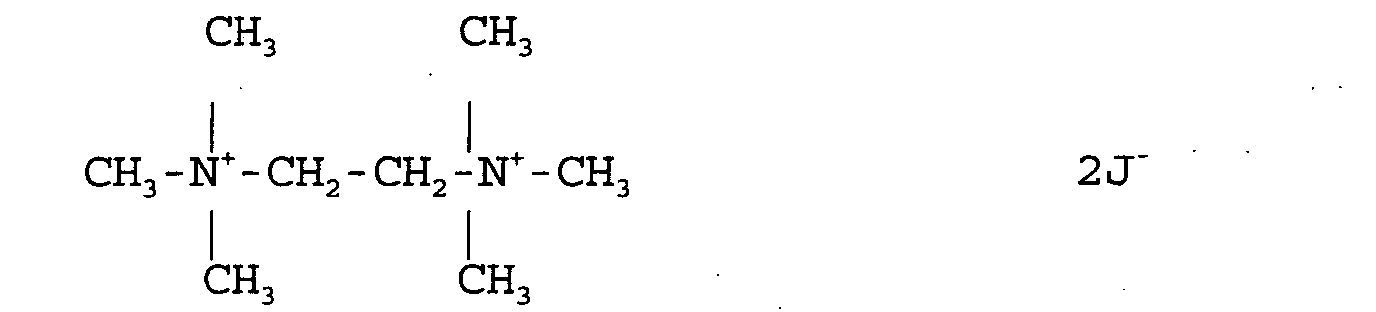
das Reaktionsprodukt von Tetramethylethylendiamin mit Jodmethan (Hexamethylethylendiammonium-dijodid)
das Reaktionsprodukt von Dimethylamin mit Epichlorhydrin zu Poly-[N,N-dimethyl-2-hydroxy-propylen-(1,3)-ammoniumchlorid]

Si/AI = 96, H2O/SiO2 = 20, Si/TPA+=15, OH-/Si = 0,077. Die Synthesebedingungen sind T = 180°C, t = 48 h.
| ohne VFS | mit VFS | |
| H2-Fluss [l/m2 h bar] | 957 | 450 |
| Permselektivität | ||
| Wasser/n-Propanol | 7,3 | 35,6 |
Si/Al = 15, H2O/SiO2 = 77, Si/TPA+ = 3,6, OH-/Si = 5,7.
Die Synthesebedingungen sind T = 180°C, t = 96 h.
[U. Müller, K. K. Unger, Zeolites 8, 1988, 154).
Si/Al = 5, H2O/SiO2 = 84, OH-/Si = 2,8.
Die Synthesebedingungen sind: T = 90°C, t = 12 h bei konventionellem Heizen und 120°C für 2 h in der Mikrowelle mit 2,45 GHz.
[Lassinantti et al., Microp.Mesop.Mater. 38, 2000, 25-34; Weh, Noack, Sieber, Caro, Micropor.Mesopor. Mater. 54, 2002, 27-36]
Si/Al = 2,5, H2O/SiO2 = 80, Si/TMA+ = 0,3, OH-/Si = 3,3. Die Synthesebedingungen sind T=98 °C, t = 30 h.
[J. Hedlund, B. Schoeman, J. Sterte, Chem.Commun.1997, 1194] Es entstehen ca. 1 µm Kristalle, die schlecht verwachsen sind. Ein Zusatz von VFS gegen Ende der Synthesezeit führt zu einer verbesserten Verwachsung. Die VFS ist ein Additionsprodukt aus Tetramethylethylendiamin und Dibrommethan mit einem Molekulargewicht zwischen 500-800 g/mol. Die Polyammoniumbromverbindung muß für die LTA-Membransynthese in die Hydroxidform überführt werden, damit die Gesamtalkalität des Synthesegels konstant bleibt. Erst bei weiterer Verlängerung (Verdoppelung) der Synthesezeit ergibt sich eine Verbesserung der Permselektivität für H2/SF6.
Si/Al = 1, H2O/SiO2 = 72, OH-/Si = 3. Die Synthesebedingungen sind T = 98 °C, t = 16 h bei konventionellem Heizen und können auf 2 h verkürzt worden bei der Anwendung eines Labormikrowellenofens.
[H. Kita, K.I. Okamoto, US-Patent 5.554.286].
Claims (13)
- Hochtrennende Molekularsiebmembran für Gase und Dämpfe, dadurch gekennzeichnet, daß die Membran, bestehend aus einem silikatischen Zeolith mit einem Verhältnis Si:Al von 1-300, in der Oberflächenschicht der Funktionsseite aus Zeolithporen im Bereich von 0,36 bis 0,74 nm Porendurchmesser besteht und im wesentlichen mesoporenfrei ist, gemessen durch Permporosimetrie und Einzelgaspermeation, und die Membran eine Trennwirkung von wenigstens 100 % oberhalb des Knudsen-Faktors hat.
- Hochtrennende Molekularsiebmembran für Gase und Dämpfe, dadurch gekennzeichnet, daß die Membran, bestehend aus einem silikatischen Zeolith mit einem Verhältnis Si:Al von 1-300, in der Oberflächenschicht der Funktionsseite aus Zeolithporen im Bereich von 0,36 bis 0,74 nm Porendurchmesser besteht und im wesentlichen mesoporenfrei ist, gemessen durch Permporosimetrie und Einzelgaspermeation, und die Membran eine Trennwirkung von wenigstens 100 % oberhalb des Knudsen-Faktors hat
und herstellbar ist durch templatgesteuerte oder templatfreie Kristallisation des Synthesegels als Schicht auf der Funktionsseite eines offenporigen Trägers mit asymmetrischen Schichtaufbau im offenen oder geschlossenen System bei 50-250 °C in Anwesenheit von verwachsungsfördernden, wasserlöslichen, chemisch und thermisch bis 200 °C beständigen, aliphatischen oder aromatischen Polyammoniumsalzen mit jeweils wenigstens zwei Ammoniumfunktionen im Molekül und einem Molekulargewicht im Bereich von 100 bis 1000 g/mol, und nachfolgender Temperaturbehandlung bei 100 bis 550 °C unter Öffnen der Transportporen durch Wasserstoffdesorption und/oder unter Zersetzung des Templats und der verwachsungsfördernden Verbindungen bis zum Erhalt der vollständigen Molekularsiebstruktur. - Membran nach Anspruch 1, dadurch gekennzeichnet, daß das Gitter-SiO2 durch ein oder mehrere weitere Heteroatome ausgetauscht ist, wobei die Heteroatome ausgewählt sind unter Aluminium(III), Bor(III), Eisen(III), Titan(IV), Vanadium(V) und Germanium(IV).
- Membran nach Anspruch 1, dadurch gekennzeichnet, daß das Si/Al-Verhältnis im Bereich von 1 bis 300, vorzugsweise 1-100 liegt.
- Membran nach Anspruch 1, dadurch gekennzeichnet, daß sie dem Typ LTA, FAU, ERI, MOR, OFF, CHA, ANA, FER oder ZSM-5 entspricht, vorzugsweise LTA, FAU oder MFI.
- Verfahren zur Herstellung von Molekularsiebmembranen nach Anspruch 1 durch templatgesteuerte oder templatfreie Kristallisation des Synthesegels als Schicht auf der Funktionsseite eines offenporigen Trägers mit asymmetrischen Schichtaufbau im offenen oder geschlossenen System bei 50-250 °C und nachfolgender Temperaturbehandlung bei 100 bis 550 °C unter Öffnen der Transportwege durch Wasserstoffdesorption und/oder unter Zersetzung nicht beständiger organischer Verbindungen, dadurch gekennzeichnet, daß vor oder während der Synthese verwachsungsfördernde, wasserlösliche, chemisch und thermisch bis 200 °C beständige, aliphatische oder aromatische Polyammoniumsalze mit jeweils wenigstens zwei Ammoniumfunktionen im Molekül und einem Molekulargewicht im Bereich von 100 bis 1000 g/mol zugesetzt werden.
- Verfahren nach Anspruch 6, dadurch gekennzeichnet, daß als verwachsungsfördernde Substanzen kurzkettige Ionene oder quaternäre Polyammoniumsalze zugesetzt werden.
- Verfahren nach Anspruch 7, dadurch gekennzeichnet, daß die verwachsungsfördernden Substanzen ausgewählt werden aus der Gruppe, bestehend aus N,N,N',N'-Tetramethylpiperazoniumdijodid, Hexamethylethylendiammonium-dijodid, Hexamethylethylendiammonium-dihydroxid, (Poly-[N,N-dimethyl-2-hydroxypropylen-(1,3)-ammoniumchlorid] , Additionsprodukten von aliphatischen C2-C6-Dimethyldiaminen mit Dibrommethan oder p-Xylidendichlorid, und Gemischen davon.
- Verfahren nach Anspruch 6, dadurch gekennzeichnet, daß als Anionen der verwachsungsfördernden Substanzen Chlorid, Bromid, Jodid oder Hydroxid eingesetzt werden.
- Verfahren nach Anspruch 6, dadurch gekennzeichnet, daß das Silicium im Synthesegel teilweise durch Aluminium (III), Bor, Eisen (III), Titan(IV), Vanadium (V) oder Germanium (IV) ersetzt wird.
- Verfahren nach Anspruch 6, dadurch gekennzeichnet, daß die verwachsungsfördernden Verbindungen durch Tränken des geseedeten Trägers vor der Synthese, zu Beginn der Synthesezeit oder gegen Ende der Synthesezeit zugegeben werden.
- Verfahren nach Anspruch 7, dadurch gekennzeichnet, daß die verwachsungsfördernden Verbindungen in Konzentrationen von 0,001-1N, vorzugsweise 0,01 bis 0,1 N zugegeben werden.
- Verwendung der Membranen nach einem der Ansprüche 1 bis 5 zur größenselektiven Trennung von Gas- oder Dampfgemischen, zur Wechselwirkungstrennung von Gas- oder Dampfgemischen und zur katalytischen Isomerisierung, Zyklisierung, Partialoxidation und beim Cracken von Gasen, Dämpfen oder Gas/Dampfgemischen.
Applications Claiming Priority (2)
| Application Number | Priority Date | Filing Date | Title |
|---|---|---|---|
| DE10318372A DE10318372B4 (de) | 2003-04-14 | 2003-04-14 | Hochtrennende Molekularsiebmembran für Gase und Dämpfe und Verfahren zu ihrer Herstellung |
| DE10318372 | 2003-04-14 |
Publications (2)
| Publication Number | Publication Date |
|---|---|
| EP1468725A1 true EP1468725A1 (de) | 2004-10-20 |
| EP1468725B1 EP1468725B1 (de) | 2008-11-12 |
Family
ID=32892449
Family Applications (1)
| Application Number | Title | Priority Date | Filing Date |
|---|---|---|---|
| EP04090130A Expired - Lifetime EP1468725B1 (de) | 2003-04-14 | 2004-04-02 | Hochtrennende Molekularsiebmembran für Gase und Dämpfe und Verfahren zu ihrer Herstellung |
Country Status (3)
| Country | Link |
|---|---|
| EP (1) | EP1468725B1 (de) |
| AT (1) | ATE413915T1 (de) |
| DE (2) | DE10318372B4 (de) |
Citations (2)
| Publication number | Priority date | Publication date | Assignee | Title |
|---|---|---|---|---|
| EP0515936A1 (de) * | 1991-05-27 | 1992-12-02 | Studiengesellschaft Kohle mbH | Verfahren für die Herstellung von mikroporösen keramischen Membranen für die Trennung von Mischungen aus Gas und Flüssigkeit |
| US5935646A (en) * | 1996-08-23 | 1999-08-10 | Gas Research Institute | Molecular sieving silica membrane fabrication process |
-
2003
- 2003-04-14 DE DE10318372A patent/DE10318372B4/de not_active Expired - Fee Related
-
2004
- 2004-04-02 DE DE502004008437T patent/DE502004008437D1/de not_active Expired - Lifetime
- 2004-04-02 EP EP04090130A patent/EP1468725B1/de not_active Expired - Lifetime
- 2004-04-02 AT AT04090130T patent/ATE413915T1/de not_active IP Right Cessation
Patent Citations (2)
| Publication number | Priority date | Publication date | Assignee | Title |
|---|---|---|---|---|
| EP0515936A1 (de) * | 1991-05-27 | 1992-12-02 | Studiengesellschaft Kohle mbH | Verfahren für die Herstellung von mikroporösen keramischen Membranen für die Trennung von Mischungen aus Gas und Flüssigkeit |
| US5935646A (en) * | 1996-08-23 | 1999-08-10 | Gas Research Institute | Molecular sieving silica membrane fabrication process |
Also Published As
| Publication number | Publication date |
|---|---|
| EP1468725B1 (de) | 2008-11-12 |
| DE10318372B4 (de) | 2006-12-28 |
| ATE413915T1 (de) | 2008-11-15 |
| DE10318372A1 (de) | 2004-11-18 |
| DE502004008437D1 (de) | 2008-12-24 |
Similar Documents
| Publication | Publication Date | Title |
|---|---|---|
| DE60006765T2 (de) | Verfahren zur Herstellung von Zeolith des MTT-Typs mittels spezifischen Vorläufern des Strukturbildners | |
| DE2705436C2 (de) | ||
| DE69207719T2 (de) | Katalytische Zersetzung von N2O | |
| DE602004003843T2 (de) | Anorganische, poröse und Kohlenstoff enthaltende Membran, Verfahren zu deren Herstellung und Verwendung derselben | |
| DE3883236T2 (de) | Chemische Umwandlungsverfahren. | |
| DE69320195T3 (de) | Synthese von zeolithfilmen, die an substraten gebunden sind, strukturen sowie ihre verwendungen | |
| DE60036508T2 (de) | Formling aus binderfreien Zeolith , Verfahren zu seiner Herstellung und seine Verwendung | |
| DE69528989T2 (de) | Verbesserte membran | |
| WO2017114853A1 (de) | Zeolithische partikel mit nanometerdimensionen und verfahren zu deren herstellung | |
| WO2010037690A1 (de) | Templatfreie clathrasile und clathrasil-membranen | |
| EP0761598B1 (de) | Verfahren zur Herstellung von Zeolith Y | |
| DE69805013T2 (de) | Verfahren zur Synthese von Silikatmolekularsiebe mit hohem Siliziumdioxydgehalte | |
| DE102010055728A1 (de) | Verfahren zur Umsetzung stickstoffhaltiger Verbindungen | |
| WO2006105771A1 (de) | Membran für gasphasenseparation sowie dafür geeignetes herstellungsverfahren | |
| DE69826768T2 (de) | Adsorbens für Kohlenwasserstoff und Katalysator zur Abgasreinigung | |
| EP2361154A1 (de) | Metallhaltige kristalline silikate | |
| DE3723072A1 (de) | Verfahren zur entfernung von stickoxiden aus abgasen | |
| DE4415403C2 (de) | Verfahren zum Herstellen eines sauren Metallsilikat-Katalysators | |
| EP2054358A1 (de) | Verwendung eines katalysators auf basis von zeolithen bei der umsetzung von oxygenaten zu niederen olefinen sowie verfahren hierzu | |
| DE19607437A1 (de) | Eierschalenförmiger Katalysator und Verfahren zu dessen Herstellung | |
| DE4424815A1 (de) | Kristalline Festkörper mit RUB-13 Struktur | |
| DE10318372B4 (de) | Hochtrennende Molekularsiebmembran für Gase und Dämpfe und Verfahren zu ihrer Herstellung | |
| EP0464249A1 (de) | Verfahren zur Herstellung eines weitporigen kristallinen Molekularsiebes | |
| DE10304322B4 (de) | Herstellung von gestützten Zeolithschichten | |
| DE69908893T2 (de) | Verbesserung von boroaluminosilikatverwandten Zeolitstrukturen |
Legal Events
| Date | Code | Title | Description |
|---|---|---|---|
| PUAI | Public reference made under article 153(3) epc to a published international application that has entered the european phase |
Free format text: ORIGINAL CODE: 0009012 |
|
| AK | Designated contracting states |
Kind code of ref document: A1 Designated state(s): AT BE BG CH CY CZ DE DK EE ES FI FR GB GR HU IE IT LI LU MC NL PL PT RO SE SI SK TR |
|
| AX | Request for extension of the european patent |
Extension state: AL HR LT LV MK |
|
| 17P | Request for examination filed |
Effective date: 20050318 |
|
| AKX | Designation fees paid |
Designated state(s): AT BE BG CH CY CZ DE DK EE ES FI FR GB GR HU IE IT LI LU MC NL PL PT RO SE SI SK TR |
|
| RAP1 | Party data changed (applicant data changed or rights of an application transferred) |
Owner name: BASF AKTIENGESELLSCHAFT |
|
| 17Q | First examination report despatched |
Effective date: 20070503 |
|
| RAP1 | Party data changed (applicant data changed or rights of an application transferred) |
Owner name: BASF SE |
|
| GRAP | Despatch of communication of intention to grant a patent |
Free format text: ORIGINAL CODE: EPIDOSNIGR1 |
|
| GRAS | Grant fee paid |
Free format text: ORIGINAL CODE: EPIDOSNIGR3 |
|
| GRAA | (expected) grant |
Free format text: ORIGINAL CODE: 0009210 |
|
| AK | Designated contracting states |
Kind code of ref document: B1 Designated state(s): AT BE BG CH CY CZ DE DK EE ES FI FR GB GR HU IE IT LI LU MC NL PL PT RO SE SI SK TR |
|
| REG | Reference to a national code |
Ref country code: GB Ref legal event code: FG4D Free format text: NOT ENGLISH |
|
| REG | Reference to a national code |
Ref country code: CH Ref legal event code: EP |
|
| REG | Reference to a national code |
Ref country code: IE Ref legal event code: FG4D Free format text: LANGUAGE OF EP DOCUMENT: GERMAN |
|
| REF | Corresponds to: |
Ref document number: 502004008437 Country of ref document: DE Date of ref document: 20081224 Kind code of ref document: P |
|
| PG25 | Lapsed in a contracting state [announced via postgrant information from national office to epo] |
Ref country code: ES Free format text: LAPSE BECAUSE OF FAILURE TO SUBMIT A TRANSLATION OF THE DESCRIPTION OR TO PAY THE FEE WITHIN THE PRESCRIBED TIME-LIMIT Effective date: 20090223 |
|
| NLV1 | Nl: lapsed or annulled due to failure to fulfill the requirements of art. 29p and 29m of the patents act | ||
| PG25 | Lapsed in a contracting state [announced via postgrant information from national office to epo] |
Ref country code: FI Free format text: LAPSE BECAUSE OF FAILURE TO SUBMIT A TRANSLATION OF THE DESCRIPTION OR TO PAY THE FEE WITHIN THE PRESCRIBED TIME-LIMIT Effective date: 20081112 Ref country code: PL Free format text: LAPSE BECAUSE OF FAILURE TO SUBMIT A TRANSLATION OF THE DESCRIPTION OR TO PAY THE FEE WITHIN THE PRESCRIBED TIME-LIMIT Effective date: 20081112 Ref country code: SI Free format text: LAPSE BECAUSE OF FAILURE TO SUBMIT A TRANSLATION OF THE DESCRIPTION OR TO PAY THE FEE WITHIN THE PRESCRIBED TIME-LIMIT Effective date: 20081112 Ref country code: NL Free format text: LAPSE BECAUSE OF FAILURE TO SUBMIT A TRANSLATION OF THE DESCRIPTION OR TO PAY THE FEE WITHIN THE PRESCRIBED TIME-LIMIT Effective date: 20081112 |
|
| REG | Reference to a national code |
Ref country code: IE Ref legal event code: FD4D |
|
| PG25 | Lapsed in a contracting state [announced via postgrant information from national office to epo] |
Ref country code: DK Free format text: LAPSE BECAUSE OF FAILURE TO SUBMIT A TRANSLATION OF THE DESCRIPTION OR TO PAY THE FEE WITHIN THE PRESCRIBED TIME-LIMIT Effective date: 20081112 Ref country code: IE Free format text: LAPSE BECAUSE OF FAILURE TO SUBMIT A TRANSLATION OF THE DESCRIPTION OR TO PAY THE FEE WITHIN THE PRESCRIBED TIME-LIMIT Effective date: 20081112 Ref country code: EE Free format text: LAPSE BECAUSE OF FAILURE TO SUBMIT A TRANSLATION OF THE DESCRIPTION OR TO PAY THE FEE WITHIN THE PRESCRIBED TIME-LIMIT Effective date: 20081112 Ref country code: BG Free format text: LAPSE BECAUSE OF FAILURE TO SUBMIT A TRANSLATION OF THE DESCRIPTION OR TO PAY THE FEE WITHIN THE PRESCRIBED TIME-LIMIT Effective date: 20090212 Ref country code: RO Free format text: LAPSE BECAUSE OF FAILURE TO SUBMIT A TRANSLATION OF THE DESCRIPTION OR TO PAY THE FEE WITHIN THE PRESCRIBED TIME-LIMIT Effective date: 20081112 |
|
| PG25 | Lapsed in a contracting state [announced via postgrant information from national office to epo] |
Ref country code: SE Free format text: LAPSE BECAUSE OF FAILURE TO SUBMIT A TRANSLATION OF THE DESCRIPTION OR TO PAY THE FEE WITHIN THE PRESCRIBED TIME-LIMIT Effective date: 20090212 Ref country code: PT Free format text: LAPSE BECAUSE OF FAILURE TO SUBMIT A TRANSLATION OF THE DESCRIPTION OR TO PAY THE FEE WITHIN THE PRESCRIBED TIME-LIMIT Effective date: 20090413 Ref country code: CZ Free format text: LAPSE BECAUSE OF FAILURE TO SUBMIT A TRANSLATION OF THE DESCRIPTION OR TO PAY THE FEE WITHIN THE PRESCRIBED TIME-LIMIT Effective date: 20081112 |
|
| PLBE | No opposition filed within time limit |
Free format text: ORIGINAL CODE: 0009261 |
|
| STAA | Information on the status of an ep patent application or granted ep patent |
Free format text: STATUS: NO OPPOSITION FILED WITHIN TIME LIMIT |
|
| PG25 | Lapsed in a contracting state [announced via postgrant information from national office to epo] |
Ref country code: SK Free format text: LAPSE BECAUSE OF FAILURE TO SUBMIT A TRANSLATION OF THE DESCRIPTION OR TO PAY THE FEE WITHIN THE PRESCRIBED TIME-LIMIT Effective date: 20081112 |
|
| 26N | No opposition filed |
Effective date: 20090813 |
|
| REG | Reference to a national code |
Ref country code: CH Ref legal event code: PL |
|
| PG25 | Lapsed in a contracting state [announced via postgrant information from national office to epo] |
Ref country code: CH Free format text: LAPSE BECAUSE OF NON-PAYMENT OF DUE FEES Effective date: 20090430 Ref country code: LI Free format text: LAPSE BECAUSE OF NON-PAYMENT OF DUE FEES Effective date: 20090430 |
|
| PG25 | Lapsed in a contracting state [announced via postgrant information from national office to epo] |
Ref country code: MC Free format text: LAPSE BECAUSE OF NON-PAYMENT OF DUE FEES Effective date: 20090430 |
|
| PG25 | Lapsed in a contracting state [announced via postgrant information from national office to epo] |
Ref country code: AT Free format text: LAPSE BECAUSE OF NON-PAYMENT OF DUE FEES Effective date: 20090402 |
|
| PG25 | Lapsed in a contracting state [announced via postgrant information from national office to epo] |
Ref country code: GR Free format text: LAPSE BECAUSE OF FAILURE TO SUBMIT A TRANSLATION OF THE DESCRIPTION OR TO PAY THE FEE WITHIN THE PRESCRIBED TIME-LIMIT Effective date: 20090213 |
|
| PG25 | Lapsed in a contracting state [announced via postgrant information from national office to epo] |
Ref country code: LU Free format text: LAPSE BECAUSE OF NON-PAYMENT OF DUE FEES Effective date: 20090402 |
|
| PG25 | Lapsed in a contracting state [announced via postgrant information from national office to epo] |
Ref country code: HU Free format text: LAPSE BECAUSE OF FAILURE TO SUBMIT A TRANSLATION OF THE DESCRIPTION OR TO PAY THE FEE WITHIN THE PRESCRIBED TIME-LIMIT Effective date: 20090513 |
|
| PG25 | Lapsed in a contracting state [announced via postgrant information from national office to epo] |
Ref country code: TR Free format text: LAPSE BECAUSE OF FAILURE TO SUBMIT A TRANSLATION OF THE DESCRIPTION OR TO PAY THE FEE WITHIN THE PRESCRIBED TIME-LIMIT Effective date: 20081112 |
|
| PG25 | Lapsed in a contracting state [announced via postgrant information from national office to epo] |
Ref country code: CY Free format text: LAPSE BECAUSE OF FAILURE TO SUBMIT A TRANSLATION OF THE DESCRIPTION OR TO PAY THE FEE WITHIN THE PRESCRIBED TIME-LIMIT Effective date: 20081112 |
|
| PGFP | Annual fee paid to national office [announced via postgrant information from national office to epo] |
Ref country code: GB Payment date: 20140430 Year of fee payment: 11 |
|
| PGFP | Annual fee paid to national office [announced via postgrant information from national office to epo] |
Ref country code: FR Payment date: 20140430 Year of fee payment: 11 Ref country code: IT Payment date: 20140423 Year of fee payment: 11 Ref country code: DE Payment date: 20140627 Year of fee payment: 11 |
|
| PGFP | Annual fee paid to national office [announced via postgrant information from national office to epo] |
Ref country code: BE Payment date: 20140527 Year of fee payment: 11 |
|
| REG | Reference to a national code |
Ref country code: DE Ref legal event code: R119 Ref document number: 502004008437 Country of ref document: DE |
|
| GBPC | Gb: european patent ceased through non-payment of renewal fee |
Effective date: 20150402 |
|
| PG25 | Lapsed in a contracting state [announced via postgrant information from national office to epo] |
Ref country code: IT Free format text: LAPSE BECAUSE OF NON-PAYMENT OF DUE FEES Effective date: 20150402 Ref country code: GB Free format text: LAPSE BECAUSE OF NON-PAYMENT OF DUE FEES Effective date: 20150402 Ref country code: DE Free format text: LAPSE BECAUSE OF NON-PAYMENT OF DUE FEES Effective date: 20151103 |
|
| REG | Reference to a national code |
Ref country code: FR Ref legal event code: ST Effective date: 20151231 |
|
| PG25 | Lapsed in a contracting state [announced via postgrant information from national office to epo] |
Ref country code: FR Free format text: LAPSE BECAUSE OF NON-PAYMENT OF DUE FEES Effective date: 20150430 |
|
| PG25 | Lapsed in a contracting state [announced via postgrant information from national office to epo] |
Ref country code: BE Free format text: LAPSE BECAUSE OF NON-PAYMENT OF DUE FEES Effective date: 20150430 |