EP1460809A2 - Schichtmodul zum Mediumzugangssteuerprotokoll für eine Mobilstation in einem mobilen ad-hoc Netwerk und entsprechendes Verfahren - Google Patents
Schichtmodul zum Mediumzugangssteuerprotokoll für eine Mobilstation in einem mobilen ad-hoc Netwerk und entsprechendes Verfahren Download PDFInfo
- Publication number
- EP1460809A2 EP1460809A2 EP20040006725 EP04006725A EP1460809A2 EP 1460809 A2 EP1460809 A2 EP 1460809A2 EP 20040006725 EP20040006725 EP 20040006725 EP 04006725 A EP04006725 A EP 04006725A EP 1460809 A2 EP1460809 A2 EP 1460809A2
- Authority
- EP
- European Patent Office
- Prior art keywords
- frames
- control
- layer module
- manet
- protocol layer
- Prior art date
- Legal status (The legal status is an assumption and is not a legal conclusion. Google has not performed a legal analysis and makes no representation as to the accuracy of the status listed.)
- Withdrawn
Links
Images




Classifications
-
- H—ELECTRICITY
- H04—ELECTRIC COMMUNICATION TECHNIQUE
- H04W—WIRELESS COMMUNICATION NETWORKS
- H04W80/00—Wireless network protocols or protocol adaptations to wireless operation
- H04W80/02—Data link layer protocols
-
- H—ELECTRICITY
- H04—ELECTRIC COMMUNICATION TECHNIQUE
- H04W—WIRELESS COMMUNICATION NETWORKS
- H04W28/00—Network traffic management; Network resource management
- H04W28/02—Traffic management, e.g. flow control or congestion control
- H04W28/10—Flow control between communication endpoints
-
- H—ELECTRICITY
- H04—ELECTRIC COMMUNICATION TECHNIQUE
- H04L—TRANSMISSION OF DIGITAL INFORMATION, e.g. TELEGRAPHIC COMMUNICATION
- H04L47/00—Traffic control in data switching networks
- H04L47/10—Flow control; Congestion control
- H04L47/24—Traffic characterised by specific attributes, e.g. priority or QoS
- H04L47/2425—Traffic characterised by specific attributes, e.g. priority or QoS for supporting services specification, e.g. SLA
- H04L47/2433—Allocation of priorities to traffic types
-
- H—ELECTRICITY
- H04—ELECTRIC COMMUNICATION TECHNIQUE
- H04L—TRANSMISSION OF DIGITAL INFORMATION, e.g. TELEGRAPHIC COMMUNICATION
- H04L47/00—Traffic control in data switching networks
- H04L47/10—Flow control; Congestion control
- H04L47/24—Traffic characterised by specific attributes, e.g. priority or QoS
- H04L47/2466—Traffic characterised by specific attributes, e.g. priority or QoS using signalling traffic
-
- H—ELECTRICITY
- H04—ELECTRIC COMMUNICATION TECHNIQUE
- H04L—TRANSMISSION OF DIGITAL INFORMATION, e.g. TELEGRAPHIC COMMUNICATION
- H04L47/00—Traffic control in data switching networks
- H04L47/50—Queue scheduling
-
- H—ELECTRICITY
- H04—ELECTRIC COMMUNICATION TECHNIQUE
- H04L—TRANSMISSION OF DIGITAL INFORMATION, e.g. TELEGRAPHIC COMMUNICATION
- H04L47/00—Traffic control in data switching networks
- H04L47/50—Queue scheduling
- H04L47/56—Queue scheduling implementing delay-aware scheduling
- H04L47/564—Attaching a deadline to packets, e.g. earliest due date first
- H04L47/566—Deadline varies as a function of time spent in the queue
-
- H—ELECTRICITY
- H04—ELECTRIC COMMUNICATION TECHNIQUE
- H04W—WIRELESS COMMUNICATION NETWORKS
- H04W28/00—Network traffic management; Network resource management
- H04W28/02—Traffic management, e.g. flow control or congestion control
-
- H—ELECTRICITY
- H04—ELECTRIC COMMUNICATION TECHNIQUE
- H04W—WIRELESS COMMUNICATION NETWORKS
- H04W74/00—Wireless channel access
- H04W74/08—Non-scheduled access, e.g. ALOHA
- H04W74/0808—Non-scheduled access, e.g. ALOHA using carrier sensing, e.g. carrier sense multiple access [CSMA]
-
- H—ELECTRICITY
- H04—ELECTRIC COMMUNICATION TECHNIQUE
- H04W—WIRELESS COMMUNICATION NETWORKS
- H04W8/00—Network data management
- H04W8/02—Processing of mobility data, e.g. registration information at HLR [Home Location Register] or VLR [Visitor Location Register]; Transfer of mobility data, e.g. between HLR, VLR or external networks
- H04W8/04—Registration at HLR or HSS [Home Subscriber Server]
-
- H—ELECTRICITY
- H04—ELECTRIC COMMUNICATION TECHNIQUE
- H04W—WIRELESS COMMUNICATION NETWORKS
- H04W84/00—Network topologies
- H04W84/18—Self-organising networks, e.g. ad-hoc networks or sensor networks
Definitions
- the present invention relates to a mobile ad hoc network (MANET) which forms a network with a plurality of mobile stations (hereinafter, referred to as "stations"), and more particularly to a medium access control (MAC) protocol layer module of a station in the MANET and a method for transmitting/receiving frames of the MAC protocol layer module.
- MANET mobile ad hoc network
- stations stations
- MAC medium access control
- a MANET is an infrastructureless network without a fixed router, a host, and a wireless base station.
- mobile nodes are connected by utilizing multi-hopping technology of a peer-to-peer level.
- the topology of the MANET may change dynamically and the network has self-forming and self healing functions. Since it is not a network in which only fixed base stations can provide mobile services, each node itself may form a network routing infrastructure in an ad hoc form and each node comprised in the MANET has no restriction from moving freely. Therefore, the MANET uses a protocol that can be adapted to structural changes according to rapid movement of nodes.
- Such a MANET protocol uses a path discovery process, a route table management process, a path maintenance process, etc.
- the MANET protocol transmits actual data after routers are established through the processes described above.
- the processes used for forming routers utilize control packets, such as a route request message, a route response message, a route maintenance message, etc.
- the control packets are essential packets to form routers. When the routers are formed most quickly in transmitting and receiving such control packets first of all and in accomplishing an agreement among nodes, which desire to establish a routing path, the transmission of actual data packets is executed.
- the basic access in the IEEE (Institute of Electrical and Electronics Engineers) 802.11 MAC protocol follows the DCF (Distributed Coordination Function).
- the DCF is based on CSMA/CA (Carrier Sense Multiple Access with Collision Avoidance), by which preoccupying each medium is equally executed at all stations.
- the MAC protocol using the DCF waits for the interframe space, which is called DIFS (Distributed Inter Frame Space), and attempts to most equally distribute a medium to several stations by using a Random Backoff algorithm.
- DIFS Distributed Inter Frame Space
- PCF Point Coordination Function
- the PCF includes a polling operation performed by a PC (point coordinator) positioned at the center so as to add priority to stations located in the range of the PC, thus supporting time-bounded information.
- PC point coordinator
- the PCF is an access method to be used only in an infrastructure mode, and not to be used in an ad hoc network.
- the MANET protocol distinguishes transmitted packets into control packets and data packets, but the 802.11 MAC protocol processes them as the same data frames. That is, because the 802.11 MAC is operated on the CSMA/CA method, data frames other than the control frame used for the internal processing in the 802.11 MAC have a same level, so that it is possible to access equally to data of all stations.
- FIG. 1 illustrates a basic access method in a conventional MAC layer.
- stations contend with each other in order to preempt a medium. If a station attempts a transmission to a medium while the medium is busy t0 ⁇ t1, the station having attempted the transmission recognizes the medium to be busy and then waits until the present transmission in process is over. After the prior transmission is over, the station waits for an interframe space, for example, SIFS (Short Inter Frame Space) or DIFS (Distributed Inter Frame Space), then a backoff window t3 ⁇ t5 is set by the value of contention window (CW) 13 generated when the station does not preempt a medium.
- SIFS Short Inter Frame Space
- DIFS Distributed Inter Frame Space
- the backoff window is set by multiplying a slot time t3 ⁇ t5 by a pseudo random number generated from a station itself. After the backoff window is set, the station waits for data transmission of the MAC protocol while performing a backoff process of removing backoff slots by steps with the passage of time to lessen the backoff window.
- FIG. 2 illustrates a method for preempting a medium in the conventional 801.11 MAC. That is, FIG. 2 illustrates a conventional method for a plurality of stations A, B, C, and D with random backoff windows to preempt a medium through the backoff process in access contention.
- each station preempts a medium and then transmits MAC protocol data frames.
- a station sets a waiting time according to the value of contention window (CW) generated in pseudo random, starts medium preemption after waiting for the CW, and then removes as many backoff slots as the number of slots that the medium is idle after a backoff window is set. Therefore, the longer a station waits, the shorter a waiting time of the station remains, thus having higher transmission opportunity.
- CW contention window
- Such a method provides the most equity to stations in access contention so as to use a medium.
- the backoff window is set by generating a pseudo random number without distinction of station in a condition that the station has a MAC protocol data frame for transmission. If an average value is computed, it will show that each station has the same CW.
- the remaining backoff window of station C is passed.
- the remaining backoff window is the backoff window left from a backoff window removal process carried out during the frame transmission of the station A.
- a frame transmission of station C is stated after the remaining backoff window of station C is passed.
- backoff slots 15 generated at the time of its medium access in the station D are removed one by one.
- the time for DIFS (Distributed Inter Frame Space) and remaining backoff slots 16 in the station D is sequentially passed, and then station D preempts the medium and transmits frames thereof.
- Station B shows a case that backoff window thereof has been set to have the longest time.
- station B While station C and station D sequentially preempt the medium and transmit frames, station B is on standby and is removing backoff slots one by one. Subsequently, when the frame transmission of station D is completed, the station B preempts the medium and transmits frames thereof.
- frame transmission sequence of stations does not have any relation to when medium access is achieved and whether each transmission frame is a control frame or a data frame.
- each medium access proceeds without distinction of two kinds of packets. This may generate a case that a data packet is firstly transmitted before control packets to form a route are transmitted. Since such operation causes data to be transmitted without an exact construction for their destination, a data loss may be generated in transmitting data, and the data throughput of transmitting the whole data is decreased.
- the present invention has been designed to solve the above and other problems occurring in the prior art.
- the object of the present invention is to provide a MAC (Medium Access Control) protocol layer module which transmits control frames before transmitting data frames so as to form a routing path as soon as possible and thus deceases data loss, and a method for transmitting/receiving frames of the same module.
- MAC Medium Access Control
- An aspect of the present invention is to provide a MAC protocol for transmitting control frames and data frames to provide each packet with priority to distinguish the control frames and the data frames transmitted from the MANET protocol.
- MAC Medium Access Control
- MANET Mobile Ad Hoc Network
- a MAC (Medium Access Control) protocol layer module for processing data frames and control frames transferred from a MANET (Mobile Ad Hoc Network) protocol layer module in a station, the station receiving frames transmitted through a MANET including a plurality of stations
- the MAC protocol layer module comprising: a frame generation section for generating frames in distinguishing whether frames input from the MANET protocol layer module are control frames or data frames; a priority setting section for providing the control frames with higher priority as compared to the data frames in the frames generated from the frame generation section; and a frame transmission/receipt process section for transmitting and receiving the control frames and the data frames according to priority set by the priority setting section.
- MAC Medium Access Control
- a method for transmitting/receiving frames of the module will be described with reference to the accompanying drawings. It is to be noted that the same elements are indicated with the same reference numerals throughout the drawings. Also, in the following description of the present invention, a detailed description of known functions and configurations incorporated herein will be omitted when it may make the subject matter of the present invention rather unclear.
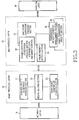
- FIG. 3 is a schematic diagram of a MANET protocol layer module and a MAC protocol layer module according to the present invention.
- a MANET protocol layer module 20 includes a control packet generation/process section 21 for distinctively generating and processing control packets and data packets, a data packet generation/process section 23, and a route-setting section 22 for forming and maintaining a route by the control packets.
- the MANET protocol layer module 20 transmits and receives data in link with a network layer 10.
- a MAC protocol layer module 30 transmits and receives data in link with a physical layer 40.
- the MAC protocol layer module 30 includes a MAC frame generation/process section 31, a frame priority setting section 33, and a frame transmission/receipt section 34.
- the MAC frame generation/process section 31 processes MAC frames by a frame distinction/generation/process section 32 which processes packets distinctively inputted from the MANET protocol layer module 20 to the MAC frame generation/process section 31 and generates MANET control frames and MANET data frames.
- the frame priority setting section 33 provides MANET control frames with a higher priority and provides MANET data frames with lower priority when generating the MANET control frames and the MANET data frames.
- the frame transmission/receipt section 34 has a transmission/receipt schedule management section 35, which processes transmission and receipt of frames according to the priority of each frame provided by the present invention, and controls to transmit and to receive frames.
- the transmission/receipt schedule management section 35 manages a schedule transmitting and receiving MAC frames in accordance with the priority provided according to each MAC frame.
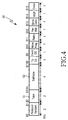
- FIG. 4 is a format diagram of a frame control field in the 802.11 MAC. That is, FIG. 4 schematizes a frame control field 50 in an 802.11 MAC frame format. In the present invention, particular values are set in areas of the frame control field 50 to distinguish the MANET control frames and the MANET data frames. Also, in order to preserve compatibility with the conventional 802.11 MAC, the values in the frame control field 50 according to the present invention are changed within a range, which does not influence or alter values used in the frame control field 50. Therefore, changing 'Subtype' area 52 is proposed in the present invention. Both the MANET control frame and the MANET data frame are data frames from the viewpoint of the 802.11 MAC protocol, so that both of them have a format of data type.
- a value set in the 'Type' area 51 of the frame control field 50 represents that the frame is a frame of the MANET protocol layer. Therefore, in this embodiment of the present invention, unused values, which are described clearly as redundant part, in set values of the 'Subtype' area 52 are used to make changes without influencing the conventional MAC frame.
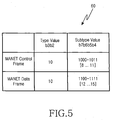
- the 'Subtype' values set for the MANET control frames and the MANET data frames are illustrated in FIG. 5.
- FIG. 5 is a table of type values and subtype values according to a MANET frame.
- the 'Type' value is set with the binary number '10', which represents a frame related to the MANET.
- a range of values that can be used as a 'Subtype' value is '1000 2 ⁇ 1111 2 ' in binary numbers. That is, a range of the 'Subtype' value is 8-15 in decimal numbers, a frame having a value in this range represents that the frame relates to the MANET.
- the MANET control frames are represented as '1000 2 ⁇ 1011 2 ' and the MANET data frames are represented as '1100 2 ⁇ 1111 2 '.
- Each binary value assigned as above becomes a priority value for preempting a medium.
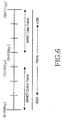
- FIG. 6 is a diagram illustrating priority according to each MANET frame. The higher value the 'Subtype' area has, the lower priority its frame has. also in addition, the lower value the 'Subtype' area has, the higher priority its frame has.
- a process for generating priority of each fame is as follows.
- the 802.11 MAC protocol layer 30 When receiving data packets from the MANET protocol layer module 20, the 802.11 MAC protocol layer 30 generates frames, which are called 'MANET data frame' in the present invention.
- the value of 'Type' area is a binary number '10' (b3,b2) and the value of 'Subtype' area may be one of binary numbers '1100 ⁇ 1111' (b7b6b5b4).
- the 802.11 MAC protocol layer 30 when receiving control packets from the MANET protocol layer module 20, the 802.11 MAC protocol layer 30 generates frames called 'MANET control frames' in the present invention.
- the value of 'Type' area is a binary number '10' (b3,b2) and the value of 'Subtype' area may be one of binary numbers '1000 ⁇ 1011' (b7b6b5b4).
- FIG. 7 illustrates an access method of the improved 802.11 MAC in the MANET according to the present invention.
- DIFS Distributed Inter Frame Space
- t1 ⁇ t4 represents a waiting time of data frames
- MCIFS MANET Control Inter Frame Space
- t1 ⁇ t3 represents a waiting time of the control frames
- SIFS Short Inter Frame Space
- t1 ⁇ t2 represents a waiting time to exchange control data for control between the MANET control protocol and the MAC control protocol.
- FIG. 7 when transmitting data frames, not all stations preempt a medium equally.
- a frame having a priority for the MANET control frames uses the MCIFS t1 ⁇ t3 as a waiting time, and a frame having a priority for the data frames uses the DIFC t1 ⁇ t4 as a wait time. Therefore, a station having the MCIFS as a waiting time has higher priority, in preempting a medium, than another station having the DIFS as a wait time.
- the MAC protocol layer can quickly process the control packets, which need to form and maintain a route in the MANET.
- MANET control packets are processed more quickly than data packets, thereby preventing loss of the data packets caused by transmission of the data packets before formation of a route in the MANET, and improving throughput of data.
- FIG. 8 illustrates a medium preemption process in the 802.11 MAC according to the present invention.
- each station A, B, C, and D has different priority according to whether having the MANET control frame or the MANET data frame, and has different IFS (Inter Frame Space) from each other according to the priority, and thus transmits each frame in preempting a medium at intervals of different IFSs (Inter Frame Spaces).
- IFS Inter Frame Space
- a station having a relatively higher priority has a shorter IFS generated in considering the priority, so that the station has higher probability in preempting a medium and also has a shorter interval between opportunities capable of preempting a medium.
- the initial point of Defer indicates the access point of each station.
- Station B has a quicker access point as compared to station C, but accesses to transmit a MANET data frame, and thus the station B has a lower priority than station C to transmit a MANET control frame. Therefore, after passing the time of DIFS, the station B is on standby until transmission of the MANET control frame 84 of station C is completed, passes the time of remaining backoff slots 81 from a backoff window removal process proceeded for the frame transmission time of the station C, and then starts to transmit its MANET data frame 82.
- Station D shows a case that a station accesses to transmit a MANET data frame like the station B but is set with a longer backoff time as compared to station B. After the transmission of the MANET data frame of station B is completed, station D passes the time for the DIFS and the backoff slots 85 left in the removing process till then, and then starts to transmit its MANET data frame 86.
- FIG. 9 is a flowchart illustrating a generation process of the MANET control frames and MANET data frames in distinction of MANET packets. That is, the flowchart shows a process in which the MAC protocol layer module 30 generates MAC frames in distinguishing between MANET control frames and MANET data frames when receiving control packets and data frames output from the MANET protocol layer module 20.
- the packets which are in the MANET protocol layer module 20
- the MAC protocol layer module 30 when the packets, which are in the MANET protocol layer module 20, are transferred to the MAC protocol layer module 30, they are called 'frames'.
- the frame distinction/generation/process section 32 distinguishes MANET packets.
- the frame priority setting section 33 sets the 'Subtype' value as the highest priority value '1011' (b7b6b5b4) of priority values for control packets in which the 'Subtype' value is in the frame control field 50 illustrated in FIG. 4 in step 101, and the frame distinction/generation/process section 32 generates MAC frame in step 102.
- the frame priority setting section 33 sets the 'Subtype' value of the frame control field 50 as the highest priority value '1111' (b7b6b5b4) of priority values for data packets in step 103, and then the frame distinction/generation/process section 32 generates MAC frame in step 102.
- FIG. 10 is a flowchart illustrating a medium access control process according to MANET control frames and MANET data frames.
- the frame priority setting section 33 sets priority to preempt a medium according to frame. That is, FIG. 10 is a flowchart in which the MANET control frame firstly preempts a medium by a relatively higher priority value provided from the frame priority setting section 33, and thus may be first transmitted.
- step 200 the frame distinction/generation/process section 32 in the MAC protocol layer module 30 distinguishes a MANET packet transferred from the MANET protocol layer module 20, if the MANET packet is a MANET control frame, step 201 proceeds in which the transmission/receipt schedule management section 35 delays transmission of the MANET control frame for the time of MCIFS (MANET Control IFS).
- step 202 if it is confirmed that the frame transmission of the station has failed, the frame priority setting section 33 decreases the priority value by '1' within a range of '8 ⁇ N ⁇ 11' in step 203.
- step 204 the transmission/receipt schedule management section 35 delays the frame transmission for the time of the MCIFS (MANET Control IFS) according to the decreased priority value.
- step 205 a backoff procedure is performed.
- the transmission/receipt schedule management section 35 transmits the MANET data frame after delaying transmission of the MANET data frame for the time of DIFS (Distributed IFS) in step 206.
- DIFS Distributed IFS
- the transmission/receipt schedule management section 35 confirms whether the priority value of the MANET data frame is smaller than '12' in step 208. If the priority value is smaller than '12', the process returns to the step 201 in which the transmission/receipt schedule management section 35 delays transmission for the time of MCIFS for the MANET control frame.
- the frame priority setting section 33 decreases the priority value by '1' within a range of '8 ⁇ N ⁇ 11' in step 209.
- the transmission/receipt schedule management section 35 delays the frame transmission for the time of the DIFS (Distributed IFS). Subsequently, in step 211 a backoff procedure proceeds, and then the process returns to the step 206.
- the MANET protocol layer module transmits packets to the MAC protocol layer module in distinguishing between control packets and data packets, and the MAC protocol layer module sets the priority value of MANET control frames to have a higher value as compared to MANET data frames when generating the MANET control frames and the MANET data frames in distinguishing the received packets, so that the MANET control frames can firstly preempt a medium on transmitting/receiving the MANET control frames and the MANET data frames.
Landscapes
- Engineering & Computer Science (AREA)
- Computer Networks & Wireless Communication (AREA)
- Signal Processing (AREA)
- Databases & Information Systems (AREA)
- Mobile Radio Communication Systems (AREA)
- Small-Scale Networks (AREA)
Applications Claiming Priority (2)
| Application Number | Priority Date | Filing Date | Title |
|---|---|---|---|
| KR2003017180 | 2003-03-19 | ||
| KR20030017180A KR100630192B1 (ko) | 2003-03-19 | 2003-03-19 | 모바일 애드 혹 네트워크에서 이동 단말기의 매체 액세스제어 프로토콜 계층 모듈 및 매체 액세스 제어 프로토콜계층 모듈의 프레임 송수신 방법 |
Publications (2)
| Publication Number | Publication Date |
|---|---|
| EP1460809A2 true EP1460809A2 (de) | 2004-09-22 |
| EP1460809A3 EP1460809A3 (de) | 2008-04-30 |
Family
ID=32822744
Family Applications (1)
| Application Number | Title | Priority Date | Filing Date |
|---|---|---|---|
| EP20040006725 Withdrawn EP1460809A3 (de) | 2003-03-19 | 2004-03-19 | Schichtmodul zum Mediumzugangssteuerprotokoll für eine Mobilstation in einem mobilen ad-hoc Netwerk und entsprechendes Verfahren |
Country Status (5)
| Country | Link |
|---|---|
| US (1) | US20040184481A1 (de) |
| EP (1) | EP1460809A3 (de) |
| JP (1) | JP4021862B2 (de) |
| KR (1) | KR100630192B1 (de) |
| CN (1) | CN1333563C (de) |
Cited By (5)
| Publication number | Priority date | Publication date | Assignee | Title |
|---|---|---|---|---|
| EP1755284A1 (de) * | 2005-08-19 | 2007-02-21 | Siemens Aktiengesellschaft | Verfahren, Vorrichtung und Netzwerk für drahtlose paketorientierte Übertragung von Daten |
| CN101931605B (zh) * | 2009-06-18 | 2014-03-19 | 中兴通讯股份有限公司 | 板间通信控制装置及板间通信的消息发送、接收方法 |
| CN109922502A (zh) * | 2019-03-06 | 2019-06-21 | 清华大学 | 自组网通信的数据传输方法及装置 |
| US10560963B2 (en) | 2014-11-07 | 2020-02-11 | Telefonaktiebolaget Lm Ericsson (Publ) | First radio node and method therein for performing a listen-before-talk (LBT) with a selected LBT method |
| WO2020074077A1 (en) * | 2018-10-10 | 2020-04-16 | Telefonaktiebolaget Lm Ericsson (Publ) | Prioritization for random access |
Families Citing this family (25)
| Publication number | Priority date | Publication date | Assignee | Title |
|---|---|---|---|---|
| US7469297B1 (en) | 2000-08-04 | 2008-12-23 | Intellon Corporation | Mechanism for using a quasi-addressed response to bind to a message requesting the response |
| US8064474B2 (en) * | 2003-03-20 | 2011-11-22 | Qualcomm Atheros, Inc. | Method and apparatus for selecting a responder to enable reliable multicast |
| US7281187B2 (en) * | 2003-11-20 | 2007-10-09 | Intellon Corporation | Using error checking bits to communicated an address or other bits |
| US8090857B2 (en) | 2003-11-24 | 2012-01-03 | Qualcomm Atheros, Inc. | Medium access control layer that encapsulates data from a plurality of received data units into a plurality of independently transmittable blocks |
| US7660327B2 (en) | 2004-02-03 | 2010-02-09 | Atheros Communications, Inc. | Temporary priority promotion for network communications in which access to a shared medium depends on a priority level |
| US7636370B2 (en) | 2005-03-03 | 2009-12-22 | Intellon Corporation | Reserving time periods for communication on power line networks |
| JP4640786B2 (ja) * | 2005-03-31 | 2011-03-02 | 株式会社エヌ・ティ・ティ・ドコモ | 基地局、および送信方法 |
| DE602006000688T2 (de) | 2005-07-19 | 2009-03-19 | Samsung Electronics Co., Ltd., Suwon | Vorrichtung und Verfahren zur Planung der Datenübertragung in einem Kommunikationssystem |
| US8175190B2 (en) | 2005-07-27 | 2012-05-08 | Qualcomm Atheros, Inc. | Managing spectra of modulated signals in a communication network |
| TWI273795B (en) * | 2005-09-15 | 2007-02-11 | Via Tech Inc | Method and related apparatus for realizing network medium access control |
| US8483616B1 (en) * | 2005-11-01 | 2013-07-09 | At&T Intellectual Property Ii, L.P. | Non-interference technique for spatially aware mobile ad hoc networking |
| CN101421981B (zh) * | 2006-03-15 | 2013-11-27 | 松下电器产业株式会社 | 用于自组织网络的分布式无线媒体访问控制协议 |
| CN100438444C (zh) * | 2006-05-17 | 2008-11-26 | 威盛电子股份有限公司 | 实现网络媒体存取控制的方法与相关装置 |
| IL176330A0 (en) * | 2006-06-15 | 2007-07-04 | Eci Telecom Ltd | Technique of traffic protection loop-free interconnection for ethernet and/or vpls networks |
| US8045505B2 (en) | 2007-01-18 | 2011-10-25 | Science Applications International Corporation | Mechanism for automatic network formation and medium access coordination |
| US9118428B2 (en) | 2009-11-04 | 2015-08-25 | At&T Intellectual Property I, L.P. | Geographic advertising using a scalable wireless geocast protocol |
| US9319842B2 (en) | 2011-06-27 | 2016-04-19 | At&T Intellectual Property I, L.P. | Mobile device configured point and shoot type weapon |
| US9161158B2 (en) | 2011-06-27 | 2015-10-13 | At&T Intellectual Property I, L.P. | Information acquisition using a scalable wireless geocast protocol |
| US9166917B2 (en) * | 2011-07-17 | 2015-10-20 | Broadcom Corporation | Link layer preemption |
| JP5957736B2 (ja) * | 2012-07-20 | 2016-07-27 | 株式会社日立製作所 | 無線通信装置 |
| US9071451B2 (en) | 2012-07-31 | 2015-06-30 | At&T Intellectual Property I, L.P. | Geocast-based situation awareness |
| JP5950201B2 (ja) * | 2012-09-25 | 2016-07-13 | パナソニックIpマネジメント株式会社 | 通信システム |
| US9660745B2 (en) | 2012-12-12 | 2017-05-23 | At&T Intellectual Property I, L.P. | Geocast-based file transfer |
| US10484287B2 (en) * | 2013-05-15 | 2019-11-19 | Avago Technologies International Sales Pte. Limited | Support for distinguished minimum latency traffic guard band |
| WO2022041282A1 (zh) * | 2020-08-31 | 2022-03-03 | 华为技术有限公司 | 一种视频数据的传输方法、装置 |
Family Cites Families (9)
| Publication number | Priority date | Publication date | Assignee | Title |
|---|---|---|---|---|
| US5121383A (en) * | 1990-11-16 | 1992-06-09 | Bell Communications Research, Inc. | Duration limited statistical multiplexing in packet networks |
| JPH1065691A (ja) * | 1996-08-22 | 1998-03-06 | Oki Electric Ind Co Ltd | セル化方法及びセル化装置 |
| US20030195983A1 (en) * | 1999-05-24 | 2003-10-16 | Krause Michael R. | Network congestion management using aggressive timers |
| JP3343103B2 (ja) * | 2000-05-31 | 2002-11-11 | 日本電信電話株式会社 | 無線パケット伝送方法 |
| JP3511988B2 (ja) * | 2000-08-10 | 2004-03-29 | 日本電気株式会社 | フレーム転送装置、フレーム転送方法、フレーム転送システム |
| US20040025018A1 (en) * | 2002-01-23 | 2004-02-05 | Haas Zygmunt J. | Secure end-to-end communication in mobile ad hoc networks |
| US6986161B2 (en) * | 2002-08-12 | 2006-01-10 | Harris Corporation | Mobile ad-hoc network with intrusion detection features and related methods |
| KR100519165B1 (ko) * | 2002-10-17 | 2005-10-05 | 엘지전자 주식회사 | 이동 통신 시스템에서 트래픽 처리 방법 |
| KR20040063249A (ko) * | 2003-01-06 | 2004-07-14 | 엘지전자 주식회사 | 무선 랜에서 매체 접근 제어 방법 및 장치 |
-
2003
- 2003-03-19 KR KR20030017180A patent/KR100630192B1/ko not_active Expired - Fee Related
-
2004
- 2004-03-10 US US10/797,549 patent/US20040184481A1/en not_active Abandoned
- 2004-03-18 CN CNB2004100300407A patent/CN1333563C/zh not_active Expired - Fee Related
- 2004-03-19 EP EP20040006725 patent/EP1460809A3/de not_active Withdrawn
- 2004-03-19 JP JP2004081699A patent/JP4021862B2/ja not_active Expired - Fee Related
Non-Patent Citations (2)
| Title |
|---|
| BYUNG-GON CHUN, MARY BAKER: "Evaluation of Packet Scheduling Algorithms in Mobile Ad Hoc Networks" MOBILE COMPUTING AND COMMUNICATIONS REVIEW ACM SIGMOBILE, vol. 6, no. 3, July 2002 (2002-07), pages 36-49, XP002472934 New York, NY, USA * |
| DENG D-J ET AL: "A PRIORITY SCHEME FOR IEEE 802.11 DCF ACCESS METHOD" IEICE TRANSACTIONS ON COMMUNICATIONS, COMMUNICATIONS SOCIETY, TOKYO, JP, vol. E82-B, no. 1, January 1999 (1999-01), pages 96-102, XP000927880 ISSN: 0916-8516 * |
Cited By (7)
| Publication number | Priority date | Publication date | Assignee | Title |
|---|---|---|---|---|
| EP1755284A1 (de) * | 2005-08-19 | 2007-02-21 | Siemens Aktiengesellschaft | Verfahren, Vorrichtung und Netzwerk für drahtlose paketorientierte Übertragung von Daten |
| CN101931605B (zh) * | 2009-06-18 | 2014-03-19 | 中兴通讯股份有限公司 | 板间通信控制装置及板间通信的消息发送、接收方法 |
| US10560963B2 (en) | 2014-11-07 | 2020-02-11 | Telefonaktiebolaget Lm Ericsson (Publ) | First radio node and method therein for performing a listen-before-talk (LBT) with a selected LBT method |
| EP3216301B1 (de) * | 2014-11-07 | 2020-04-22 | Telefonaktiebolaget LM Ericsson (publ) | Erster funkknoten und verfahren darin zur durchführung von listen-before-talk (lbt) mit einem ausgewählten lbt-verfahren |
| WO2020074077A1 (en) * | 2018-10-10 | 2020-04-16 | Telefonaktiebolaget Lm Ericsson (Publ) | Prioritization for random access |
| US11963236B2 (en) | 2018-10-10 | 2024-04-16 | Telefonaktiebolaget Lm Ericsson (Publ) | Prioritization for random access |
| CN109922502A (zh) * | 2019-03-06 | 2019-06-21 | 清华大学 | 自组网通信的数据传输方法及装置 |
Also Published As
| Publication number | Publication date |
|---|---|
| US20040184481A1 (en) | 2004-09-23 |
| CN1592271A (zh) | 2005-03-09 |
| EP1460809A3 (de) | 2008-04-30 |
| JP2004289836A (ja) | 2004-10-14 |
| JP4021862B2 (ja) | 2007-12-12 |
| KR100630192B1 (ko) | 2006-09-29 |
| KR20040082588A (ko) | 2004-09-30 |
| CN1333563C (zh) | 2007-08-22 |
Similar Documents
| Publication | Publication Date | Title |
|---|---|---|
| EP1460809A2 (de) | Schichtmodul zum Mediumzugangssteuerprotokoll für eine Mobilstation in einem mobilen ad-hoc Netwerk und entsprechendes Verfahren | |
| CN103326913B (zh) | 用于对等通信的确定性退避方法和装置 | |
| US7046639B2 (en) | System and method for ad hoc network access employing the distributed election of a shared transmission schedule | |
| US7391789B2 (en) | Ad-hoc network wireless communication system and method thereof | |
| US7058074B2 (en) | Unified channel access for supporting quality of service (QoS) in a local area network | |
| DK1687941T3 (en) | Method of establishing access to a media via a multi-channel device | |
| US7535919B2 (en) | Wireless communication method adapting priority for transmitting packets in WPAN | |
| US20050025131A1 (en) | Medium access control in wireless local area network | |
| JP5880540B2 (ja) | 無線lan通信装置、無線lan通信装置の通信方法及びプログラム | |
| CN108834182B (zh) | 基于令牌环的无线自组网mac层信道接入和资源预留方法 | |
| Muir et al. | Supporting real-time multimedia traffic in a wireless LAN | |
| EP2282599B1 (de) | Verfahren zum Zugriff auf einen gemeinsamen Kommunikationskanal für drahtlose Kommunikationsnetzwerke | |
| CN106912110B (zh) | 一种单发多收空口资源分配方法 | |
| Garcés et al. | Collision avoidance and resolution multiple access with transmission groups | |
| Ouni et al. | Enhanced EDCA with deterministic transmission collision resolution for real-time communication in vehicular ad hoc networks | |
| Muir et al. | Group allocation multiple access in single-channel wireless LANs | |
| Rahman et al. | Extended sliding frame R-Aloha: Medium access control (MAC) protocol for mobile networks | |
| Garcia-Luna-Aceves et al. | Queue-sharing multiple access | |
| JP2004180131A (ja) | 無線端末およびその無線アクセス制御方法 | |
| Matsuno et al. | Effect of propagation delay and RTS packet recognition time on MACA | |
| Garcia-Luna-Aceves et al. | Making CSMA Collision-Free and Stable Using Collaborative Indexing | |
| Du et al. | A history-based scheduling protocol for ad hoc networks | |
| Yuan et al. | An urgency-based prioritized mac layer protocol for real-time traffic in ad-hoc wireless networks | |
| Suh et al. | Efficient wireless LAN MAC protocols for ad-hoc networks | |
| CN115314122A (zh) | 一种路由驱动下相邻两跳水声链路的管道传输方法 |
Legal Events
| Date | Code | Title | Description |
|---|---|---|---|
| PUAI | Public reference made under article 153(3) epc to a published international application that has entered the european phase |
Free format text: ORIGINAL CODE: 0009012 |
|
| 17P | Request for examination filed |
Effective date: 20040319 |
|
| AK | Designated contracting states |
Kind code of ref document: A2 Designated state(s): AT BE BG CH CY CZ DE DK EE ES FI FR GB GR HU IE IT LI LU MC NL PL PT RO SE SI SK TR |
|
| AX | Request for extension of the european patent |
Extension state: AL LT LV MK |
|
| PUAL | Search report despatched |
Free format text: ORIGINAL CODE: 0009013 |
|
| AK | Designated contracting states |
Kind code of ref document: A3 Designated state(s): AT BE BG CH CY CZ DE DK EE ES FI FR GB GR HU IE IT LI LU MC NL PL PT RO SE SI SK TR |
|
| AX | Request for extension of the european patent |
Extension state: AL LT LV MK |
|
| AKX | Designation fees paid |
Designated state(s): AT BE BG CH CY CZ DE DK EE ES FI FR GB GR HU IE IT LI LU MC NL PL PT RO SE SI SK TR |
|
| 17Q | First examination report despatched |
Effective date: 20090629 |
|
| STAA | Information on the status of an ep patent application or granted ep patent |
Free format text: STATUS: THE APPLICATION IS DEEMED TO BE WITHDRAWN |
|
| 18D | Application deemed to be withdrawn |
Effective date: 20091110 |