EP1457451A1 - Verfahren für den Betrieb einer Aufzugsanlage - Google Patents
Verfahren für den Betrieb einer Aufzugsanlage Download PDFInfo
- Publication number
- EP1457451A1 EP1457451A1 EP04004283A EP04004283A EP1457451A1 EP 1457451 A1 EP1457451 A1 EP 1457451A1 EP 04004283 A EP04004283 A EP 04004283A EP 04004283 A EP04004283 A EP 04004283A EP 1457451 A1 EP1457451 A1 EP 1457451A1
- Authority
- EP
- European Patent Office
- Prior art keywords
- elevator
- operating parameter
- elevator system
- protocol
- target
- Prior art date
- Legal status (The legal status is an assumption and is not a legal conclusion. Google has not performed a legal analysis and makes no representation as to the accuracy of the status listed.)
- Withdrawn
Links
- 238000000034 method Methods 0.000 title claims abstract description 26
- 238000004088 simulation Methods 0.000 claims abstract description 25
- 238000004364 calculation method Methods 0.000 claims abstract description 19
- 238000004590 computer program Methods 0.000 claims description 9
- 238000009434 installation Methods 0.000 claims description 7
- 230000001133 acceleration Effects 0.000 claims description 3
- 238000005457 optimization Methods 0.000 claims description 3
- 230000036461 convulsion Effects 0.000 claims description 2
- 238000005259 measurement Methods 0.000 description 8
- 238000010276 construction Methods 0.000 description 3
- 230000006399 behavior Effects 0.000 description 2
- 230000000694 effects Effects 0.000 description 2
- 238000004422 calculation algorithm Methods 0.000 description 1
- 230000001419 dependent effect Effects 0.000 description 1
- 238000013461 design Methods 0.000 description 1
- 230000006870 function Effects 0.000 description 1
- 238000012552 review Methods 0.000 description 1
- 238000012795 verification Methods 0.000 description 1
- 230000003313 weakening effect Effects 0.000 description 1
Images
Classifications
-
- B—PERFORMING OPERATIONS; TRANSPORTING
- B66—HOISTING; LIFTING; HAULING
- B66B—ELEVATORS; ESCALATORS OR MOVING WALKWAYS
- B66B1/00—Control systems of elevators in general
- B66B1/34—Details, e.g. call counting devices, data transmission from car to control system, devices giving information to the control system
Definitions
- the invention relates to a method for operating an elevator system with the Features of the preamble of claim 1.
- Such specifications define operating parameters of the elevator system, including physical conditions and relationships are understood that affect the operation and the Influence and determine the performance of an elevator system.
- a set of such performance characteristics forms the target performance of the Elevator system, which typically takes several months before the system is built with a Customers agreed and negotiated in a technical and commercial sense becomes.
- the disadvantage is that the customer is often promised a target service, the Compliance in the built elevator system is difficult to check.
- the object of the invention is to provide a method for operating an elevator installation to improve that the predetermined and specified before the construction of the elevator system Target performance in a clearly defined form after the elevator system has been built becomes verifiable.
- the operation is simulated Elevator system or by another calculation method the corresponding Performance characteristics determined, for example, technically for the Dimensioning of the system and marketing side in the consulting or Sales argument can be used.
- Several commercially available software programs for the simulation or otherwise calculated images of the operation of Elevator systems are known.
- At least one operating parameter to achieve a target performance Simulation of the operation of the elevator system and / or determined by a calculation and recorded with this target performance is optionally done in a protocol.
- the protocol is in the form of an electronic file and / or a document generated output of the simulation or calculation of the operation of the elevator systems, the the defined, calculated and / or simulated operating parameters and the summarizes predetermined target power of the elevator systems.
- the elevator system After its construction, the elevator system is equipped with the previously simulated operating parameters or passenger traffic operated and the Actual power generated by the elevator system is measured and with the predetermined Target performance compared. This makes it possible to clearly identify and check whether The target output and the actual output really match whether the elevator system has the Requirements of the construction project effectively met, whether the simulations and / or Calculations can correctly predict the operation of the elevator system.
- the target performance consists of performance characteristics, here also guaranteed Called value, which is collected and preferably in an electronic file and / or in a document, e.g. B. in a guarantee certificate.
- the simulation or calculation of the Operating on a computer system performed with a computer program that is loaded into a memory of the computer system, with a processor of the computer system, who executes the computer program, the target power over a Simulation and / or calculation rule with the operating parameters and the Passenger traffic is linked.
- the simulation and / or Delivered results faster and with greater accuracy and calculation Reproducibility provided.
- the protocol comprises one Counterfeit protection, to prevent the operating parameters, the specifications, the Passenger traffic and / or the target performance can be changed unnoticed.
- the log contains an expiry date, which ensures that claims derived from the protocol can only be used during a limited period of time.
- parts of the operating parameters such as the passenger traffic or the protocol is not or only partially disclosed; in this way it becomes e.g. allows details of the control of the elevator system to remain secret or for unimportant information to customers does not have to be presented in full.
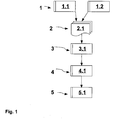
- process step 1 the necessary specifications of the elevator installation initially recorded and a passenger traffic determined.
- This can be simulation or another calculation method can be used.
- the operating parameters 1.2 to Achieve a target performance 1.1 by simulating the operation of the Elevator system can be determined. The determination is preferably made by iterative Steps. Start operating parameters and specifications of the elevator system fixed and the corresponding performance of the elevator system is simulated calculated. If this power corresponds to the target power of the elevator system, the operating parameters 1.2 for achieving a target output 1.1 have already been found Service. Otherwise, other startup operating parameters and specifications of the Elevator system is fixed and the corresponding performance of the elevator system again calculated by simulations. This trial and error procedure continues until the requirements of the target performance are met.
- a computer program which is loaded into a memory of the computer system, with a Processor of the computer system that executes the computer program, the simulated or calculated performance characteristics via a simulation and / or Calculation rule with the operating parameters, the specifications and the Passenger traffic can be linked.
- An optimization is preferably carried out in which a variety of options only one or a few preferred ones, e.g. according to predetermined target criteria, the best possible changed operating parameters become. This optimization is repeated until the operating parameters meet the
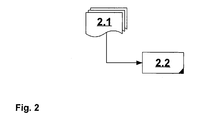
- the protocol 2.1 can consist of several sets of operating parameters 2.2, i.e. Specifications, passenger traffic, derived performance characteristics as well guaranteed values exist, as explained in FIG. 2.
- the guarantee certificate is given to the customer.
- An expiry date can be found on the Allow warranty certificate derived claims only for a limited time.
- the Customers can be verified with the guarantee certificate.
- protocol 2.1 becomes a set of operating parameters 3.1 selected, which is characterized by a predetermined passenger traffic.
- the elevator installation is then in step 3 with the operating parameters 3.1 in operated a reference company.
- Passenger traffic is an operating parameter previously known. All passenger calls recorded in the corresponding passenger traffic are not from the keyboard in the cabin or on the floor, but from the Protocol entered directly into the controller.
- step 4 the actual power 4.1 of the elevator installation is measured.
- the passenger calls and movements of cabins and doors are all in one Measurement log recorded.
- the movements of cabins and doors can at the same time observed by the customer and logged independently.
- the measurement protocol is then evaluated, preferably using a protocol analyzer.
- the protocol analyzer is one of the most in the form of a computer program circumscribed fixed procedure, the measurement protocol and the Guarantee certificate reads, checks, compares and finally provides the information, whether the actual performance matches the target performance.
- the protocol analyzer reads those contained in the measurement protocol Data and operating parameters in the form of a list in a text file or in a Excel table is available and that during the reference operation of the elevator system have been measured effectively.
- the protocol analyzer first checks the Consistency of this data and controls whether the operational and physical Conditions for the operation of the elevator system have been effectively observed. He then calculates the performance characteristics of the Elevator system (waiting times, target times, etc.).
- the log analyzer also reads the Data and operating parameters contained in the guarantee certificate, which correspond to the target performance correspond to the elevator system and compare these values with those from the Measurement protocol derived values. Finally, it provides a summary of the results and confirms whether the actual performance of the elevator system meets the target performance specified conditions met.
- the actual power 4.1 of the elevator system is in step 5 with the target power 1.1 compared or the measured performance characteristics and the Measured values are included in the guarantee declarations contained in the guarantee certificate compared.
- the passenger traffic is preferably set so that high performance of the Elevator system can be shown, but not too high, so deviations between simulation and implemented system not too strong effects on the Have values of performance characteristics. This could be done through an appropriate Simulation and / or calculation methods are supported, which are based on the Specifications generates a corresponding meaningful passenger traffic.
- the degree of attenuation and the breadth of the security range of the values of the The best estimate depends on the size under consideration and is based on Empirical values or statistical considerations and / or methods determined, which the possible differences between target and actual performance or their Consider causes in simulations or other calculation methods. For example, possible disturbances, e.g. slower cabin or Door movements as provided in the operating parameters, simulated or their Effects on performance characteristics are calculated. Performance characteristics, which vary more statistically are weakened more. This can also be very different depending on the operating parameters, e.g. depending on the elevator control.
- the guarantee certificate comes in a preferred version with a counterfeit protection which ensures that it cannot be changed unnoticed.
- the protocol is therefore clearly open using a publicly accessible procedure its authenticity can be checked.
- This counterfeit protection is, for example, one of one or several electronic documents calculated string, which in one written document is recorded.
- the procedure for calculating the String preferably the property that it is well known and that it is very difficult or impossible to use the same string with different ones Achieve source documents.
- a known such method is, for example the MD5 algorithm (RFC 1321).
- the guarantee certificate is at least partially encrypted so that the customer does not knows or needs to know all information about the behavior of the elevator system. This is interesting for the elevator company because details of the Operating parameters can affect trade secrets.
- the disclosed Information is chosen so that the verifiability of the guaranteed performance is sufficiently guaranteed.
- the guarantee certificate consists of an electronic file and one written document, both of which have counterfeit protection, which also confirmed their togetherness.
- the electronic file includes the specifications, the guarantee declarations as well the passenger traffic as a list of elevator calls per time and type, for example "Destination call at start stop x with destination stop y at time T" in a destination call controller.
- the Allocations of calls to cabins and the cabin / door movements are in the File not saved.
- the written document is the same as the electronic file, but only one Part of the passenger traffic, for example randomly selected 15% of all elevator calls.
- the passenger traffic i.e. the elevator calls
- the behavior of the System is recorded in a measurement protocol, which also includes the allocation of Calling to cabins and describing the movements of cabins and doors.
- the written documents are e.g. as part of the purchase contract in duplicate signed and exchanged between the elevator company and the customer.
- the design of counterfeit protection and / or encryption will Guarantee certificate with a computer program for its authenticity or Checked for integrity. Under certain circumstances, such Verification program or parts thereof can be left to the customer so that this itself can determine the authenticity or integrity at any time without the customer it can reveal the encrypted parts.
- the measurement protocol may not be fully accessible to the customer. This receives the list of all cabin and door movements as well as the Cabin assignments of those calls that correspond to the part of the document published in the document Correspond to passenger traffic. The customer himself has the option of Observe movements of cabins and doors.
- the elevator company uses the measurement protocol to determine the warranty statements described performance characteristics for all passenger traffic as well as for the part of it published in the document.
- the latter can Customer himself verify what, for example, by the elevator company with appropriate Tools, for example an Excel program, can be supported.
- the review agreement can, for example, provide that both the Performance characteristics with regard to total traffic such as partial traffic within the guarantee declarations must lie.
- the guarantee declarations will be like this chosen that a corresponding partial traffic has the highest probability, to fulfill these.
Landscapes
- Engineering & Computer Science (AREA)
- Automation & Control Theory (AREA)
- Computer Networks & Wireless Communication (AREA)
- Maintenance And Inspection Apparatuses For Elevators (AREA)
- Indicating And Signalling Devices For Elevators (AREA)
Abstract
Description
- die Anzahl bedienter Halte,
- die Distanz von einem Halt zum nächsten,
- die Anzahl zu bedienender Personen auf einem Halt,
- die Anzahl Aufzüge in der betrachteten Aufzugsanlage,
- die Art der Aufzugssteuerung und der Passagierschnittstellen,
- einen Passagier-Verkehr, zum Beispiel mit einer in Abhängigkeit der Anzahl zu bedienender Personen auf einem Halt gewählten Anzahl von Rufen pro Stockwerk und zufälligen Zielstockwerken,
- und pro Aufzug:
- die durch den Aufzug bedienten Halte,
- die Art des Antriebs (zum Beispiel die maximale Geschwindigkeit, Angaben über Fahrkurve zum Beispiel mittels Beschleunigung und Ruck oder Fahrtzeiten zwischen Halten oder bestimmten Strecken),
- die Art der Kabine (zum Beispiel Anzahl Decks, Grösse, maximales Zuladungsgewicht, maximale Personenanzahl),
- die Art der Kabinentüren (zum Beispiel Breite, Öffnungs-, Offenhaltungs- und Schliesszeiten),
- die Anzahl der in einem bestimmten Zeitabschnitt bedienten Passagiere,
- pro Passagier:
- die Zeit welche der Passagier braucht, um mittels der Aufzugsanlage von seinem Starthalt an seinen Zielhalt zu gelangen (Zielzeit),
- die Zeit zwischen dem von ihm getätigten Ruf bzw. seinem Eintreffen bei der Anlage bis zum Eintreffen der ihn bedienenden Aufzugskabine (Wartezeit),
- die Anzahl der Halte (Stops) während der Fahrt von Start- zu Zielhalt,
- Statistisch abgeleitete Werte (zum Beispiel Mittelwerte) oben genannter Grössen.
- Fig. 1
- eine schematische Darstellung des Verfahrens für den Betrieb der Aufzugsanlage.
- Fig. 2
- eine schematische Darstellung eines Set von Betriebsparametern in einem Protokoll.
- garantierte Werte für die Leistungs-Charakteristika einer entsprechend den Spezifikationen erstellten Anlage bestimmt werden, z.B. indem die Spezifikationen oder die simulierten bzw. berechneten Werte der Leistungs-Charakteristika um einen bestimmten relativen und/oder absoluten Anteil (Faktor) abgeschwächt werden
- eine oder mehrere Dateien in Form eines Protokolls 2.1 erstellt werden, welche die Spezifikationen, den Passagier-Verkehr, die abgeleiteten Leistungs-Charakteristika sowie die garantierten Werte umfassen.
- minimaler Anzahl bedienter Personen pro 5 Minuten,
- maximaler durchschnittlicher Zielzeit,
- maximaler durchschnittlicher Wartezeit
Claims (10)
- Verfahren für den Betrieb einer Aufzugsanlage,
dadurch gekennzeichnet, dass mindestens ein Betriebsparameter (1.2) zum Erzielen einer Soll-Leistung (1.1) durch Simulation des Betriebs der Aufzugsanlage und/oder Berechnung ermittelt wird,
dass die Aufzugsanlage mit dem Betriebsparameter betrieben wird,
dass mindestens eine von der Aufzugsanlage erzeugte Ist-Leistung (4.1) gemessen wird, und
dass die Ist-Leistung mit der Soll-Leistung verglichen wird. - Verfahren gemäss Anspruch 1, dadurch gekennzeichnet, dass als Betriebsparameter eine Anzahl der von Aufzügen bedienter Halte und/oder die Distanz zwischen Halten und/oder eine Anzahl zu bedienender Personen auf einem Halt und/oder eine Anzahl der Aufzüge in der betrachteten Aufzugsanlage und/oder die durch einen Aufzug bediente Halte und/oder die Art des Antriebs eines Aufzugs (maximale Geschwindigkeit, Angaben über Fahrkurve mittels Beschleunigung und Ruck oder Fahrtzeiten zwischen Halten oder bestimmten Strecken) und/oder die Art der Kabine eines Aufzugs (Anzahl Decks, Grösse, maximales Zuladungsgewicht, maximale Personenanzahl) und/oder die Art der Kabinentüren eines Aufzugs (Breite, Öffnungs-, Offenhaltungs- und Schliesszeiten) und/oder die Art der Aufzugssteuerung und der Passagierschnittstellen und/oder ein Passagier-Verkehr verwendet wird.
- Verfahren gemäss Anspruch 1, dadurch gekennzeichnet, dass als Soll-Leistung bzw. Ist-Leistung eine Zielzeit der Benutzer und/oder eine Wartezeit der Benutzer und/oder eine Beschleunigung und/oder eine Geschwindigkeit und/oder eine Anzahl der bedienten Passagiere und/oder eine Anzahl Stops pro Passagier ermittelt wird.
- Verfahren gemäss Anspruch 1, dadurch gekennzeichnet, dass die Berechnung und/oder Simulation des Betriebs auf einer Computer-Anlage durchgeführt wird, mit einem Computer-Programm, das in einen Speicher der Computer-Anlage geladen ist, mit einem Prozessor der Computer-Anlage, der das Computer-Programm ausführt, wobei die Soll-Leistung über eine Simulationsregel mit dem Betriebsparameter verknüpft wird.
- Verfahren gemäss Anspruch 4, dadurch gekennzeichnet, dass Berechnungen und/oder Simulationen des Betriebs der Aufzugsanlage mit zumindest einem veränderten Betriebsparameter optimiert werden, dass diese Optimierung wiederholt wird, bis der Betriebsparameter die Anforderung der Soll-Leistung erfüllt.
- Verfahren nach einem der Ansprüche 1 bis 5, dadurch gekennzeichnet, dass Betriebsparameter und Soll-Leistung in einem Protokoll (2.1) erfasst wird,
dass das Protokoll in Form einer elektronischen Datei und/oder eines schriftlichen Dokumentes erzeugt wird, und
dass ein garantierter Wert für die Soll-Leistung einer Aufzugsanlage bestimmt wird. - Verfahren nach Anspruch 6 , dadurch gekennzeichnet, dass die Soll-Leistung und die Ist-Leistung mittels eines Protokoll-Analysators verglichen werden.
- Protokoll für den Betrieb einer Aufzugsanlage,
dadurch gekennzeichnet, dass das Protokoll mindestens einen Betriebsparameter (1.2) zum Erzielen einer Soll-Leistung (1.1) aufweist, welcher Betriebsparameter durch Simulation des Betriebs der Aufzugsanlage und/oder Berechnung ermittelt ist,
dass das Protokoll auch die dem Betriebsparameter entsprechende Soll-Leistung aufweist,
dass die Aufzugsanlage mit dem Betriebsparameter betreibbar ist, und
dass das Protokoll einen garantierten Wert für die Soll-Leistung einer Aufzugsanlage aufweist. - Protokoll nach Anspruch 8, dadurch gekennzeichnet, dass das Protokoll einen Fälschungsschutz aufweist, um zu verhindern, dass der Betriebsparameter und/oder die Soll-Leistung unbemerkt geändert wird,
und/oder
dass das Protokoll ein Verfalldatum enthält, welches sicher stellt, dass aus dem Protokoll abgeleitete Ansprüche nur während eines beschränkten Zeitraums geltend gemacht werden,
und/oder
dass ein Vergleich einer Ist-Leistung der mit dem Betriebsparameter betriebenen Aufzugsanlage mit der Soll-Leistung so ausgestaltet ist, dass der Betriebsparameter bzw. das Protokoll nicht oder nur teilweise offen gelegt ist,
und/oder
dass das Protokoll mittels eines öffentlich zugänglichen Verfahrens eindeutig auf seine Echtheit überprüfbar ist. - Garantierter Wert für die Soll-Leistung des Betriebs einer Aufzugsanlage,
gekennzeichnet durch:die Ermittlung mindestens eines Betriebsparameters (1.2) zum Erzielen einer Soll-Leistung (1.1) durch Simulation des Betriebs der Aufzugsanlage und/oder Berechnung, welchem Betriebsparameter eine Soll-Leistung der Aufzugsanlage entspricht,der garantierte Wert ist gegenüber der Soll-Leistung um einen vorbestimmten Faktor abgeschwächt, undeine gemessene Ist-Leistung der mit dem Betriebsparameter betriebenen Aufzugsanlage ist mit dem garantierten Wert vergleichbar.
Priority Applications (1)
| Application Number | Priority Date | Filing Date | Title |
|---|---|---|---|
| EP04004283A EP1457451A1 (de) | 2003-03-10 | 2004-02-26 | Verfahren für den Betrieb einer Aufzugsanlage |
Applications Claiming Priority (3)
| Application Number | Priority Date | Filing Date | Title |
|---|---|---|---|
| EP03405163 | 2003-03-10 | ||
| EP03405163 | 2003-03-10 | ||
| EP04004283A EP1457451A1 (de) | 2003-03-10 | 2004-02-26 | Verfahren für den Betrieb einer Aufzugsanlage |
Publications (1)
| Publication Number | Publication Date |
|---|---|
| EP1457451A1 true EP1457451A1 (de) | 2004-09-15 |
Family
ID=32773674
Family Applications (1)
| Application Number | Title | Priority Date | Filing Date |
|---|---|---|---|
| EP04004283A Withdrawn EP1457451A1 (de) | 2003-03-10 | 2004-02-26 | Verfahren für den Betrieb einer Aufzugsanlage |
Country Status (1)
| Country | Link |
|---|---|
| EP (1) | EP1457451A1 (de) |
Cited By (1)
| Publication number | Priority date | Publication date | Assignee | Title |
|---|---|---|---|---|
| CN111406033A (zh) * | 2017-11-30 | 2020-07-10 | 三菱电机大楼技术服务株式会社 | 电梯的控制装置 |
Citations (2)
| Publication number | Priority date | Publication date | Assignee | Title |
|---|---|---|---|---|
| US4330838A (en) * | 1978-07-07 | 1982-05-18 | Hitachi, Ltd. | Elevator test operation apparatus |
| US4458788A (en) * | 1982-05-24 | 1984-07-10 | Delta Elevator Equipment Corporation | Analyzer apparatus |
-
2004
- 2004-02-26 EP EP04004283A patent/EP1457451A1/de not_active Withdrawn
Patent Citations (2)
| Publication number | Priority date | Publication date | Assignee | Title |
|---|---|---|---|---|
| US4330838A (en) * | 1978-07-07 | 1982-05-18 | Hitachi, Ltd. | Elevator test operation apparatus |
| US4458788A (en) * | 1982-05-24 | 1984-07-10 | Delta Elevator Equipment Corporation | Analyzer apparatus |
Non-Patent Citations (1)
| Title |
|---|
| R.S. PHILLIPS: "Electric lifts", 1951, SIR ISAAC PITMMAN& SONS LTD, LONDON, XP002250559 * |
Cited By (2)
| Publication number | Priority date | Publication date | Assignee | Title |
|---|---|---|---|---|
| CN111406033A (zh) * | 2017-11-30 | 2020-07-10 | 三菱电机大楼技术服务株式会社 | 电梯的控制装置 |
| CN111406033B (zh) * | 2017-11-30 | 2022-12-06 | 三菱电机楼宇解决方案株式会社 | 电梯的控制装置 |
Similar Documents
| Publication | Publication Date | Title |
|---|---|---|
| EP2186003B1 (de) | Verfahren und vorrichtung zur ermittlung einer eintrittswahrscheinlichkeit | |
| DE112018001724T5 (de) | Informationsverarbeitungseinrichtung, informationsverarbeitungssystem, informationsverarbeitungsverfahren und programm | |
| WO2014090631A2 (de) | Verfahren zur beurteilung der beherrschbarkeit eines fahrzeuges | |
| DE112015006614B4 (de) | Gruppensteuerungsaufzugsvorrichtung und Verfahren zum Zuweisen von Einstiegskabinennummern unter Verwendung von Gruppensteuerung | |
| DE69323923T2 (de) | Verfahren zur Steuerung einer Aufzugsgruppe | |
| DE102012215984B4 (de) | Verfahren und Vorrichtung zur kostenoptimierten modellbasierten Verlängerung der Systemlebensdauer | |
| US20080017453A1 (en) | Method for achieving desired performance of an elevator installation | |
| WO2018219887A1 (de) | Wartung eines nutzfahrzeugs | |
| DE112018007804T5 (de) | Aufzugsgruppenverwaltungsvorrichtung und Aufzugssystem | |
| EP1470459B1 (de) | Frühzeitige prognose der zuverlässigkeit einer technischen anordnung | |
| DE112012005942B4 (de) | Aufzugsgruppen-Verwaltungsvorrichtung | |
| DE102021208279A1 (de) | Integration einer Risikobeurteilung einer Kollision zwischen einem robotischen Gerät und einer menschlichen Bedienperson | |
| WO1997009217A2 (de) | Verfahren zur regelung spurgebundener fahrzeuge | |
| DE102019214640A1 (de) | Steuervorrichtung und steuerverfahren | |
| EP1966008B1 (de) | Verfahren zur verteilung von softwaremodulen | |
| EP4200734A1 (de) | Verfahren zum betreiben eines netzwerks und computerprogrammprodukt | |
| WO2021089499A1 (de) | Verfahren und system zum prüfen einer automatisierten fahrfunktion durch reinforcement-learning | |
| EP4508621B1 (de) | Verfahren zur prädiktion eines einflusses eines verkehrsteilnehmers auf zumindest einen anderen verkehrsteilnehmer und verfahren zum betrieb eines fahrzeugs | |
| WO2004040483A2 (de) | Vorhersage des termintreuegrads in der serienfertigung | |
| EP1464605B1 (de) | Verfahren zum Management von Aufzugs- bzw.Fahrtreppenanlage | |
| DE102020004554A1 (de) | Verfahren zur Verkehrszustandsüberwachung und Verkehrszustandsteuerung | |
| EP2136322A1 (de) | Kollaboratives Bearbeitungsverfahren und -system | |
| EP3953908A1 (de) | Verfahren zur bestimmung einer belastungsvorhersage für ein bauteil eines kraftfahrzeugs | |
| DE102023130774B4 (de) | Verfahren zur Bestimmung von Fahrerpersönlichkeiten | |
| DE102006017412B4 (de) | Verfahren zum Steuern mehrerer die Fahrdynamik eines Fahrzeuges beeinflussender Fahrzeugkomponenten |
Legal Events
| Date | Code | Title | Description |
|---|---|---|---|
| PUAI | Public reference made under article 153(3) epc to a published international application that has entered the european phase |
Free format text: ORIGINAL CODE: 0009012 |
|
| AK | Designated contracting states |
Kind code of ref document: A1 Designated state(s): AT BE BG CH CY CZ DE DK EE ES FI FR GB GR HU IE IT LI LU MC NL PT RO SE SI SK TR |
|
| AX | Request for extension of the european patent |
Extension state: AL LT LV MK |
|
| 17P | Request for examination filed |
Effective date: 20050311 |
|
| REG | Reference to a national code |
Ref country code: HK Ref legal event code: DE Ref document number: 1069375 Country of ref document: HK |
|
| AKX | Designation fees paid |
Designated state(s): AT BE BG CH CY CZ DE DK EE ES FI FR GB GR HU IE IT LI LU MC NL PT RO SE SI SK TR |
|
| 17Q | First examination report despatched |
Effective date: 20070221 |
|
| STAA | Information on the status of an ep patent application or granted ep patent |
Free format text: STATUS: THE APPLICATION IS DEEMED TO BE WITHDRAWN |
|
| 18D | Application deemed to be withdrawn |
Effective date: 20151126 |
|
| REG | Reference to a national code |
Ref country code: HK Ref legal event code: WD Ref document number: 1069375 Country of ref document: HK |