EP1456337B1 - Verwendung von träger fixierten bleichkatalysatorkomplexverbindungen als katalysatoren für persauerstoffverbindungen - Google Patents
Verwendung von träger fixierten bleichkatalysatorkomplexverbindungen als katalysatoren für persauerstoffverbindungen Download PDFInfo
- Publication number
- EP1456337B1 EP1456337B1 EP02795195A EP02795195A EP1456337B1 EP 1456337 B1 EP1456337 B1 EP 1456337B1 EP 02795195 A EP02795195 A EP 02795195A EP 02795195 A EP02795195 A EP 02795195A EP 1456337 B1 EP1456337 B1 EP 1456337B1
- Authority
- EP
- European Patent Office
- Prior art keywords
- methyl
- amine
- bis
- group
- pyridyl
- Prior art date
- Legal status (The legal status is an assumption and is not a legal conclusion. Google has not performed a legal analysis and makes no representation as to the accuracy of the status listed.)
- Expired - Lifetime
Links
- -1 peroxide compounds Chemical class 0.000 title claims abstract description 316
- 239000003054 catalyst Substances 0.000 title claims abstract description 113
- 238000004061 bleaching Methods 0.000 title claims abstract description 60
- 150000001875 compounds Chemical class 0.000 title claims description 66
- 239000003446 ligand Substances 0.000 claims abstract description 156
- 239000000203 mixture Substances 0.000 claims abstract description 109
- 150000003624 transition metals Chemical class 0.000 claims abstract description 68
- XLYOFNOQVPJJNP-UHFFFAOYSA-N water Substances O XLYOFNOQVPJJNP-UHFFFAOYSA-N 0.000 claims abstract description 66
- 229910052723 transition metal Inorganic materials 0.000 claims abstract description 62
- 239000013110 organic ligand Substances 0.000 claims abstract description 14
- 238000006555 catalytic reaction Methods 0.000 claims abstract description 6
- 229910052757 nitrogen Inorganic materials 0.000 claims description 133
- 239000007844 bleaching agent Substances 0.000 claims description 88
- 239000003795 chemical substances by application Substances 0.000 claims description 73
- 239000007983 Tris buffer Substances 0.000 claims description 58
- 239000011572 manganese Substances 0.000 claims description 54
- 150000001412 amines Chemical class 0.000 claims description 52
- 125000002496 methyl group Chemical group [H]C([H])([H])* 0.000 claims description 52
- XEEYBQQBJWHFJM-UHFFFAOYSA-N Iron Chemical compound [Fe] XEEYBQQBJWHFJM-UHFFFAOYSA-N 0.000 claims description 50
- 239000000126 substance Substances 0.000 claims description 50
- 239000000835 fiber Substances 0.000 claims description 40
- 229920000642 polymer Polymers 0.000 claims description 35
- 238000005406 washing Methods 0.000 claims description 35
- 239000000047 product Substances 0.000 claims description 34
- 102000004190 Enzymes Human genes 0.000 claims description 33
- 108090000790 Enzymes Proteins 0.000 claims description 33
- 239000004753 textile Substances 0.000 claims description 32
- MLCJWRIUYXIWNU-OWOJBTEDSA-N (e)-ethene-1,2-diamine Chemical compound N\C=C\N MLCJWRIUYXIWNU-OWOJBTEDSA-N 0.000 claims description 28
- 125000000022 2-aminoethyl group Chemical group [H]C([*])([H])C([H])([H])N([H])[H] 0.000 claims description 26
- 125000004105 2-pyridyl group Chemical group N1=C([*])C([H])=C([H])C([H])=C1[H] 0.000 claims description 26
- 239000010949 copper Substances 0.000 claims description 24
- 230000003647 oxidation Effects 0.000 claims description 24
- 238000007254 oxidation reaction Methods 0.000 claims description 24
- 229910052748 manganese Inorganic materials 0.000 claims description 21
- 229920002223 polystyrene Polymers 0.000 claims description 20
- 239000004793 Polystyrene Substances 0.000 claims description 19
- 125000003178 carboxy group Chemical group [H]OC(*)=O 0.000 claims description 19
- 239000003112 inhibitor Substances 0.000 claims description 18
- 229910052742 iron Inorganic materials 0.000 claims description 18
- 239000007787 solid Substances 0.000 claims description 18
- 239000003945 anionic surfactant Substances 0.000 claims description 16
- 238000004140 cleaning Methods 0.000 claims description 16
- 229910052720 vanadium Inorganic materials 0.000 claims description 16
- 239000004744 fabric Substances 0.000 claims description 15
- 239000003205 fragrance Substances 0.000 claims description 15
- 125000004433 nitrogen atom Chemical group N* 0.000 claims description 14
- 239000002245 particle Substances 0.000 claims description 14
- 229910052736 halogen Inorganic materials 0.000 claims description 13
- 239000002979 fabric softener Substances 0.000 claims description 12
- KXZQYLBVMZGIKC-UHFFFAOYSA-N 1-pyridin-2-yl-n-(pyridin-2-ylmethyl)methanamine Chemical compound C=1C=CC=NC=1CNCC1=CC=CC=N1 KXZQYLBVMZGIKC-UHFFFAOYSA-N 0.000 claims description 11
- 239000012190 activator Substances 0.000 claims description 11
- 238000002845 discoloration Methods 0.000 claims description 11
- 239000006260 foam Substances 0.000 claims description 11
- 239000010936 titanium Substances 0.000 claims description 11
- 229910052802 copper Inorganic materials 0.000 claims description 10
- 239000000645 desinfectant Substances 0.000 claims description 10
- 125000006290 2-hydroxybenzyl group Chemical group [H]OC1=C(C([H])=C([H])C([H])=C1[H])C([H])([H])* 0.000 claims description 9
- 125000000524 functional group Chemical group 0.000 claims description 9
- 239000007788 liquid Substances 0.000 claims description 9
- 125000006479 2-pyridyl methyl group Chemical group [H]C1=C([H])C([H])=C([H])C(=N1)C([H])([H])* 0.000 claims description 8
- 229920002678 cellulose Polymers 0.000 claims description 8
- 239000000843 powder Substances 0.000 claims description 8
- PWHULOQIROXLJO-UHFFFAOYSA-N Manganese Chemical compound [Mn] PWHULOQIROXLJO-UHFFFAOYSA-N 0.000 claims description 7
- BQCADISMDOOEFD-UHFFFAOYSA-N Silver Chemical compound [Ag] BQCADISMDOOEFD-UHFFFAOYSA-N 0.000 claims description 7
- 239000003093 cationic surfactant Substances 0.000 claims description 7
- 239000001913 cellulose Substances 0.000 claims description 7
- 229910017052 cobalt Inorganic materials 0.000 claims description 7
- 239000010941 cobalt Substances 0.000 claims description 7
- GUTLYIVDDKVIGB-UHFFFAOYSA-N cobalt atom Chemical compound [Co] GUTLYIVDDKVIGB-UHFFFAOYSA-N 0.000 claims description 7
- 210000004209 hair Anatomy 0.000 claims description 7
- 230000003287 optical effect Effects 0.000 claims description 7
- 229920001296 polysiloxane Polymers 0.000 claims description 7
- 229910052709 silver Inorganic materials 0.000 claims description 7
- 239000004332 silver Substances 0.000 claims description 7
- 229910052719 titanium Inorganic materials 0.000 claims description 7
- MHAJPDPJQMAIIY-UHFFFAOYSA-N Hydrogen peroxide Chemical compound OO MHAJPDPJQMAIIY-UHFFFAOYSA-N 0.000 claims description 6
- 239000004952 Polyamide Substances 0.000 claims description 6
- 239000005062 Polybutadiene Substances 0.000 claims description 6
- 239000002280 amphoteric surfactant Substances 0.000 claims description 6
- 229920002647 polyamide Polymers 0.000 claims description 6
- 229920000573 polyethylene Polymers 0.000 claims description 6
- 229920001155 polypropylene Polymers 0.000 claims description 6
- 125000001424 substituent group Chemical group 0.000 claims description 6
- 125000004174 2-benzimidazolyl group Chemical group [H]N1C(*)=NC2=C([H])C([H])=C([H])C([H])=C12 0.000 claims description 5
- 239000004698 Polyethylene Substances 0.000 claims description 5
- 239000004743 Polypropylene Substances 0.000 claims description 5
- 239000002535 acidifier Substances 0.000 claims description 5
- 230000000844 anti-bacterial effect Effects 0.000 claims description 5
- 239000003086 colorant Substances 0.000 claims description 5
- 229920002239 polyacrylonitrile Polymers 0.000 claims description 5
- 229920006324 polyoxymethylene Polymers 0.000 claims description 5
- 229910052707 ruthenium Inorganic materials 0.000 claims description 5
- RYGMFSIKBFXOCR-UHFFFAOYSA-N Copper Chemical compound [Cu] RYGMFSIKBFXOCR-UHFFFAOYSA-N 0.000 claims description 4
- 229910052750 molybdenum Inorganic materials 0.000 claims description 4
- 229920002451 polyvinyl alcohol Polymers 0.000 claims description 4
- 235000019422 polyvinyl alcohol Nutrition 0.000 claims description 4
- 229920000915 polyvinyl chloride Polymers 0.000 claims description 4
- 239000003381 stabilizer Substances 0.000 claims description 4
- WCMHDQONAKSRKK-UHFFFAOYSA-N 1,3-bis[bis(1h-benzimidazol-2-ylmethyl)amino]propan-2-ol Chemical compound C1=CC=C2NC(CN(CC=3NC4=CC=CC=C4N=3)CC(CN(CC=3NC4=CC=CC=C4N=3)CC=3NC4=CC=CC=C4N=3)O)=NC2=C1 WCMHDQONAKSRKK-UHFFFAOYSA-N 0.000 claims description 3
- ZOKXTWBITQBERF-UHFFFAOYSA-N Molybdenum Chemical compound [Mo] ZOKXTWBITQBERF-UHFFFAOYSA-N 0.000 claims description 3
- 229920002873 Polyethylenimine Polymers 0.000 claims description 3
- 229920001328 Polyvinylidene chloride Polymers 0.000 claims description 3
- KJTLSVCANCCWHF-UHFFFAOYSA-N Ruthenium Chemical compound [Ru] KJTLSVCANCCWHF-UHFFFAOYSA-N 0.000 claims description 3
- RTAQQCXQSZGOHL-UHFFFAOYSA-N Titanium Chemical compound [Ti] RTAQQCXQSZGOHL-UHFFFAOYSA-N 0.000 claims description 3
- 230000003113 alkalizing effect Effects 0.000 claims description 3
- 239000004088 foaming agent Substances 0.000 claims description 3
- WPBNNNQJVZRUHP-UHFFFAOYSA-L manganese(2+);methyl n-[[2-(methoxycarbonylcarbamothioylamino)phenyl]carbamothioyl]carbamate;n-[2-(sulfidocarbothioylamino)ethyl]carbamodithioate Chemical compound [Mn+2].[S-]C(=S)NCCNC([S-])=S.COC(=O)NC(=S)NC1=CC=CC=C1NC(=S)NC(=O)OC WPBNNNQJVZRUHP-UHFFFAOYSA-L 0.000 claims description 3
- 239000011733 molybdenum Substances 0.000 claims description 3
- 229910052615 phyllosilicate Inorganic materials 0.000 claims description 3
- 229920000768 polyamine Polymers 0.000 claims description 3
- 239000004800 polyvinyl chloride Substances 0.000 claims description 3
- 239000005033 polyvinylidene chloride Substances 0.000 claims description 3
- 239000003755 preservative agent Substances 0.000 claims description 3
- 239000005871 repellent Substances 0.000 claims description 3
- 230000002940 repellent Effects 0.000 claims description 3
- 239000002689 soil Substances 0.000 claims description 3
- GPPXJZIENCGNKB-UHFFFAOYSA-N vanadium Chemical compound [V]#[V] GPPXJZIENCGNKB-UHFFFAOYSA-N 0.000 claims description 3
- 229930003231 vitamin Natural products 0.000 claims description 3
- 235000013343 vitamin Nutrition 0.000 claims description 3
- 239000011782 vitamin Substances 0.000 claims description 3
- 229940088594 vitamin Drugs 0.000 claims description 3
- DZQBRITWZLUZIH-UHFFFAOYSA-N 1,3-bis[bis[[2-(2-hydroxyethyl)-1h-benzimidazol-4-yl]methyl]amino]propan-2-ol Chemical compound C=12NC(CCO)=NC2=CC=CC=1CN(CC(O)CN(CC=1C=2NC(CCO)=NC=2C=CC=1)CC=1C=2NC(CCO)=NC=2C=CC=1)CC1=CC=CC2=C1NC(CCO)=N2 DZQBRITWZLUZIH-UHFFFAOYSA-N 0.000 claims description 2
- DDNZKESRAINYTI-UHFFFAOYSA-N 2-[(2-hydroxyethylamino)methyl]phenol Chemical compound OCCNCC1=CC=CC=C1O DDNZKESRAINYTI-UHFFFAOYSA-N 0.000 claims description 2
- QKSKEROUBXANPB-UHFFFAOYSA-N 2-[(pyridin-2-ylmethylamino)methyl]phenol Chemical compound OC1=CC=CC=C1CNCC1=CC=CC=N1 QKSKEROUBXANPB-UHFFFAOYSA-N 0.000 claims description 2
- 229920001661 Chitosan Polymers 0.000 claims description 2
- 229920002367 Polyisobutene Polymers 0.000 claims description 2
- 239000000853 adhesive Substances 0.000 claims description 2
- 230000001070 adhesive effect Effects 0.000 claims description 2
- 239000004566 building material Substances 0.000 claims description 2
- 239000002537 cosmetic Substances 0.000 claims description 2
- 230000037308 hair color Effects 0.000 claims description 2
- 238000004900 laundering Methods 0.000 claims description 2
- 229920002857 polybutadiene Polymers 0.000 claims description 2
- 229920001228 polyisocyanate Polymers 0.000 claims description 2
- 239000005056 polyisocyanate Substances 0.000 claims description 2
- 229920000193 polymethacrylate Polymers 0.000 claims description 2
- 229920001343 polytetrafluoroethylene Polymers 0.000 claims description 2
- 239000004810 polytetrafluoroethylene Substances 0.000 claims description 2
- 229920002635 polyurethane Polymers 0.000 claims description 2
- 239000004814 polyurethane Substances 0.000 claims description 2
- KWYHDKDOAIKMQN-UHFFFAOYSA-N N,N,N',N'-tetramethylethylenediamine Chemical compound CN(C)CCN(C)C KWYHDKDOAIKMQN-UHFFFAOYSA-N 0.000 claims 2
- UUIBFVHQGDVISE-UHFFFAOYSA-N 1-(6-methylpyridin-2-yl)-n,n-bis[(6-methylpyridin-2-yl)methyl]methanamine Chemical compound CC1=CC=CC(CN(CC=2N=C(C)C=CC=2)CC=2N=C(C)C=CC=2)=N1 UUIBFVHQGDVISE-UHFFFAOYSA-N 0.000 claims 1
- YLCOWZAMJIPMSO-UHFFFAOYSA-N 1-(6-methylpyridin-2-yl)-n-[(6-methylpyridin-2-yl)-quinolin-2-ylmethyl]-1-quinolin-2-ylmethanamine Chemical compound CC1=CC=CC(C(NC(C=2N=C(C)C=CC=2)C=2N=C3C=CC=CC3=CC=2)C=2N=C3C=CC=CC3=CC=2)=N1 YLCOWZAMJIPMSO-UHFFFAOYSA-N 0.000 claims 1
- JGFFGEWFUWVQEE-UHFFFAOYSA-N 2-[(2-pyridin-2-ylethylamino)methyl]phenol Chemical compound OC1=CC=CC=C1CNCCC1=CC=CC=N1 JGFFGEWFUWVQEE-UHFFFAOYSA-N 0.000 claims 1
- NSQMASCDUDDLNX-UHFFFAOYSA-N 2-[(3-hydroxypropylamino)methyl]phenol Chemical compound OCCCNCC1=CC=CC=C1O NSQMASCDUDDLNX-UHFFFAOYSA-N 0.000 claims 1
- MULAZUQKYDJFFW-UHFFFAOYSA-N 2-[[3-(dimethylamino)propylamino]methyl]phenol Chemical compound CN(C)CCCNCC1=CC=CC=C1O MULAZUQKYDJFFW-UHFFFAOYSA-N 0.000 claims 1
- GNAHOLRYNAIPHY-UHFFFAOYSA-N 2-pyridin-2-yl-n-(pyridin-2-ylmethyl)ethanamine Chemical compound C=1C=CC=NC=1CNCCC1=CC=CC=N1 GNAHOLRYNAIPHY-UHFFFAOYSA-N 0.000 claims 1
- 239000012963 UV stabilizer Substances 0.000 claims 1
- 150000002118 epoxides Chemical class 0.000 claims 1
- DBEIHURZAFSRSR-UHFFFAOYSA-N n',n'-dimethyl-n-(pyridin-2-ylmethyl)ethane-1,2-diamine Chemical compound CN(C)CCNCC1=CC=CC=N1 DBEIHURZAFSRSR-UHFFFAOYSA-N 0.000 claims 1
- PHNGOQUFEMIIAA-UHFFFAOYSA-N n',n'-dimethyl-n-(pyridin-2-ylmethyl)propane-1,3-diamine Chemical compound CN(C)CCCNCC1=CC=CC=N1 PHNGOQUFEMIIAA-UHFFFAOYSA-N 0.000 claims 1
- YKAVSRCPSRSQRR-UHFFFAOYSA-N n,n-bis[(6-methylpyridin-2-yl)methyl]-1-pyridin-2-ylmethanamine Chemical compound CC1=CC=CC(CN(CC=2N=CC=CC=2)CC=2N=C(C)C=CC=2)=N1 YKAVSRCPSRSQRR-UHFFFAOYSA-N 0.000 claims 1
- 150000004967 organic peroxy acids Chemical class 0.000 claims 1
- MWNQXXOSWHCCOZ-UHFFFAOYSA-L sodium;oxido carbonate Chemical compound [Na+].[O-]OC([O-])=O MWNQXXOSWHCCOZ-UHFFFAOYSA-L 0.000 claims 1
- 125000000217 alkyl group Chemical group 0.000 description 59
- OKKJLVBELUTLKV-UHFFFAOYSA-N Methanol Chemical compound OC OKKJLVBELUTLKV-UHFFFAOYSA-N 0.000 description 57
- 125000004432 carbon atom Chemical group C* 0.000 description 57
- 125000003118 aryl group Chemical group 0.000 description 51
- 239000002253 acid Substances 0.000 description 49
- IAYPIBMASNFSPL-UHFFFAOYSA-N Ethylene oxide Chemical compound C1CO1 IAYPIBMASNFSPL-UHFFFAOYSA-N 0.000 description 48
- 125000001072 heteroaryl group Chemical group 0.000 description 44
- 239000002736 nonionic surfactant Substances 0.000 description 44
- 150000003839 salts Chemical class 0.000 description 43
- 239000000243 solution Substances 0.000 description 37
- 235000014113 dietary fatty acids Nutrition 0.000 description 35
- 239000000194 fatty acid Substances 0.000 description 35
- 229930195729 fatty acid Natural products 0.000 description 35
- 229910052739 hydrogen Inorganic materials 0.000 description 34
- 150000007513 acids Chemical class 0.000 description 33
- 125000004169 (C1-C6) alkyl group Chemical group 0.000 description 32
- 229940088598 enzyme Drugs 0.000 description 32
- LFQSCWFLJHTTHZ-UHFFFAOYSA-N Ethanol Chemical compound CCO LFQSCWFLJHTTHZ-UHFFFAOYSA-N 0.000 description 31
- 239000003599 detergent Substances 0.000 description 30
- 239000000178 monomer Substances 0.000 description 30
- 239000011734 sodium Substances 0.000 description 30
- 125000003342 alkenyl group Chemical group 0.000 description 28
- 150000004665 fatty acids Chemical class 0.000 description 28
- 239000001257 hydrogen Substances 0.000 description 28
- WEVYAHXRMPXWCK-UHFFFAOYSA-N Acetonitrile Chemical group CC#N WEVYAHXRMPXWCK-UHFFFAOYSA-N 0.000 description 27
- 229920001577 copolymer Polymers 0.000 description 27
- 239000000460 chlorine Substances 0.000 description 26
- 125000000592 heterocycloalkyl group Chemical group 0.000 description 25
- 125000004429 atom Chemical group 0.000 description 24
- 125000000753 cycloalkyl group Chemical group 0.000 description 24
- UFHFLCQGNIYNRP-UHFFFAOYSA-N Hydrogen Chemical compound [H][H] UFHFLCQGNIYNRP-UHFFFAOYSA-N 0.000 description 21
- 229910019142 PO4 Inorganic materials 0.000 description 21
- 125000005842 heteroatom Chemical group 0.000 description 21
- 230000000694 effects Effects 0.000 description 20
- 150000002191 fatty alcohols Chemical class 0.000 description 20
- 229910052751 metal Inorganic materials 0.000 description 20
- 239000002184 metal Substances 0.000 description 20
- 238000000034 method Methods 0.000 description 20
- 229910052760 oxygen Inorganic materials 0.000 description 20
- 235000019832 sodium triphosphate Nutrition 0.000 description 20
- 125000002947 alkylene group Chemical class 0.000 description 19
- 230000009021 linear effect Effects 0.000 description 19
- 125000004435 hydrogen atom Chemical group [H]* 0.000 description 18
- 125000001997 phenyl group Chemical group [H]C1=C([H])C([H])=C(*)C([H])=C1[H] 0.000 description 18
- 238000002360 preparation method Methods 0.000 description 18
- 125000006850 spacer group Chemical group 0.000 description 18
- WNLRTRBMVRJNCN-UHFFFAOYSA-N adipic acid Chemical compound OC(=O)CCCCC(O)=O WNLRTRBMVRJNCN-UHFFFAOYSA-N 0.000 description 16
- 125000002915 carbonyl group Chemical group [*:2]C([*:1])=O 0.000 description 16
- 125000002887 hydroxy group Chemical group [H]O* 0.000 description 16
- HBAHZZVIEFRTEY-UHFFFAOYSA-N 2-heptylcyclohex-2-en-1-one Chemical compound CCCCCCCC1=CCCCC1=O HBAHZZVIEFRTEY-UHFFFAOYSA-N 0.000 description 15
- 229910020366 ClO 4 Inorganic materials 0.000 description 15
- 229920001367 Merrifield resin Polymers 0.000 description 15
- HEMHJVSKTPXQMS-UHFFFAOYSA-M Sodium hydroxide Chemical compound [OH-].[Na+] HEMHJVSKTPXQMS-UHFFFAOYSA-M 0.000 description 15
- 239000011575 calcium Substances 0.000 description 15
- 238000002844 melting Methods 0.000 description 15
- 230000008018 melting Effects 0.000 description 15
- 239000004094 surface-active agent Substances 0.000 description 15
- NIXOWILDQLNWCW-UHFFFAOYSA-N 2-Propenoic acid Natural products OC(=O)C=C NIXOWILDQLNWCW-UHFFFAOYSA-N 0.000 description 14
- OFOBLEOULBTSOW-UHFFFAOYSA-N Malonic acid Chemical compound OC(=O)CC(O)=O OFOBLEOULBTSOW-UHFFFAOYSA-N 0.000 description 14
- 239000012459 cleaning agent Substances 0.000 description 14
- RTZKZFJDLAIYFH-UHFFFAOYSA-N ether Substances CCOCC RTZKZFJDLAIYFH-UHFFFAOYSA-N 0.000 description 14
- 229930195733 hydrocarbon Natural products 0.000 description 14
- 229910052708 sodium Inorganic materials 0.000 description 14
- CDBYLPFSWZWCQE-UHFFFAOYSA-L sodium carbonate Substances [Na+].[Na+].[O-]C([O-])=O CDBYLPFSWZWCQE-UHFFFAOYSA-L 0.000 description 14
- AKEJUJNQAAGONA-UHFFFAOYSA-N sulfur trioxide Chemical compound O=S(=O)=O AKEJUJNQAAGONA-UHFFFAOYSA-N 0.000 description 14
- 125000001797 benzyl group Chemical group [H]C1=C([H])C([H])=C(C([H])=C1[H])C([H])([H])* 0.000 description 13
- 125000005549 heteroarylene group Chemical group 0.000 description 13
- 239000000463 material Substances 0.000 description 13
- 239000003921 oil Substances 0.000 description 13
- 235000019198 oils Nutrition 0.000 description 13
- 230000008569 process Effects 0.000 description 13
- 239000010457 zeolite Substances 0.000 description 13
- SMZOUWXMTYCWNB-UHFFFAOYSA-N 2-(2-methoxy-5-methylphenyl)ethanamine Chemical compound COC1=CC=C(C)C=C1CCN SMZOUWXMTYCWNB-UHFFFAOYSA-N 0.000 description 12
- 239000004215 Carbon black (E152) Substances 0.000 description 12
- DGAQECJNVWCQMB-PUAWFVPOSA-M Ilexoside XXIX Chemical compound C[C@@H]1CC[C@@]2(CC[C@@]3(C(=CC[C@H]4[C@]3(CC[C@@H]5[C@@]4(CC[C@@H](C5(C)C)OS(=O)(=O)[O-])C)C)[C@@H]2[C@]1(C)O)C)C(=O)O[C@H]6[C@@H]([C@H]([C@@H]([C@H](O6)CO)O)O)O.[Na+] DGAQECJNVWCQMB-PUAWFVPOSA-M 0.000 description 12
- 125000001931 aliphatic group Chemical group 0.000 description 12
- 239000000969 carrier Substances 0.000 description 12
- KRKNYBCHXYNGOX-UHFFFAOYSA-N citric acid Chemical compound OC(=O)CC(O)(C(O)=O)CC(O)=O KRKNYBCHXYNGOX-UHFFFAOYSA-N 0.000 description 12
- 239000004615 ingredient Substances 0.000 description 12
- 229920006395 saturated elastomer Polymers 0.000 description 12
- 125000000542 sulfonic acid group Chemical group 0.000 description 12
- IJGRMHOSHXDMSA-UHFFFAOYSA-N Atomic nitrogen Chemical compound N#N IJGRMHOSHXDMSA-UHFFFAOYSA-N 0.000 description 11
- 229910002651 NO3 Inorganic materials 0.000 description 11
- NHNBFGGVMKEFGY-UHFFFAOYSA-N Nitrate Chemical compound [O-][N+]([O-])=O NHNBFGGVMKEFGY-UHFFFAOYSA-N 0.000 description 11
- 229910021536 Zeolite Inorganic materials 0.000 description 11
- HNPSIPDUKPIQMN-UHFFFAOYSA-N dioxosilane;oxo(oxoalumanyloxy)alumane Chemical compound O=[Si]=O.O=[Al]O[Al]=O HNPSIPDUKPIQMN-UHFFFAOYSA-N 0.000 description 11
- 150000002367 halogens Chemical class 0.000 description 11
- 235000021317 phosphate Nutrition 0.000 description 11
- VZCYOOQTPOCHFL-UHFFFAOYSA-N trans-butenedioic acid Natural products OC(=O)C=CC(O)=O VZCYOOQTPOCHFL-UHFFFAOYSA-N 0.000 description 11
- UNXRWKVEANCORM-UHFFFAOYSA-I triphosphate(5-) Chemical compound [O-]P([O-])(=O)OP([O-])(=O)OP([O-])([O-])=O UNXRWKVEANCORM-UHFFFAOYSA-I 0.000 description 11
- LWIHDJKSTIGBAC-UHFFFAOYSA-K tripotassium phosphate Chemical compound [K+].[K+].[K+].[O-]P([O-])([O-])=O LWIHDJKSTIGBAC-UHFFFAOYSA-K 0.000 description 11
- BAVYZALUXZFZLV-UHFFFAOYSA-N Methylamine Chemical compound NC BAVYZALUXZFZLV-UHFFFAOYSA-N 0.000 description 10
- WYURNTSHIVDZCO-UHFFFAOYSA-N Tetrahydrofuran Chemical compound C1CCOC1 WYURNTSHIVDZCO-UHFFFAOYSA-N 0.000 description 10
- 125000003545 alkoxy group Chemical group 0.000 description 10
- 229910001914 chlorine tetroxide Inorganic materials 0.000 description 10
- 238000004851 dishwashing Methods 0.000 description 10
- 125000001495 ethyl group Chemical group [H]C([H])([H])C([H])([H])* 0.000 description 10
- 239000001301 oxygen Substances 0.000 description 10
- BWHMMNNQKKPAPP-UHFFFAOYSA-L potassium carbonate Chemical compound [K+].[K+].[O-]C([O-])=O BWHMMNNQKKPAPP-UHFFFAOYSA-L 0.000 description 10
- CERQOIWHTDAKMF-UHFFFAOYSA-N Methacrylic acid Chemical compound CC(=C)C(O)=O CERQOIWHTDAKMF-UHFFFAOYSA-N 0.000 description 9
- 108091005804 Peptidases Proteins 0.000 description 9
- 239000004365 Protease Substances 0.000 description 9
- 150000001298 alcohols Chemical class 0.000 description 9
- 150000001450 anions Chemical class 0.000 description 9
- 125000003710 aryl alkyl group Chemical group 0.000 description 9
- QVGXLLKOCUKJST-UHFFFAOYSA-N atomic oxygen Chemical compound [O] QVGXLLKOCUKJST-UHFFFAOYSA-N 0.000 description 9
- 229910052799 carbon Inorganic materials 0.000 description 9
- VZCYOOQTPOCHFL-UPHRSURJSA-N maleic acid Chemical compound OC(=O)\C=C/C(O)=O VZCYOOQTPOCHFL-UPHRSURJSA-N 0.000 description 9
- 239000011976 maleic acid Substances 0.000 description 9
- 239000002304 perfume Substances 0.000 description 9
- 229920000058 polyacrylate Polymers 0.000 description 9
- 238000012360 testing method Methods 0.000 description 9
- NBIIXXVUZAFLBC-UHFFFAOYSA-N Phosphoric acid Chemical compound OP(O)(O)=O NBIIXXVUZAFLBC-UHFFFAOYSA-N 0.000 description 8
- 239000001361 adipic acid Substances 0.000 description 8
- 235000011037 adipic acid Nutrition 0.000 description 8
- 150000001735 carboxylic acids Chemical class 0.000 description 8
- 150000001991 dicarboxylic acids Chemical class 0.000 description 8
- 239000000975 dye Substances 0.000 description 8
- 125000006575 electron-withdrawing group Chemical group 0.000 description 8
- 125000000623 heterocyclic group Chemical group 0.000 description 8
- 125000000896 monocarboxylic acid group Chemical group 0.000 description 8
- QJGQUHMNIGDVPM-UHFFFAOYSA-N nitrogen group Chemical group [N] QJGQUHMNIGDVPM-UHFFFAOYSA-N 0.000 description 8
- 229910052698 phosphorus Inorganic materials 0.000 description 8
- 229920005646 polycarboxylate Polymers 0.000 description 8
- 229910052700 potassium Inorganic materials 0.000 description 8
- 150000003254 radicals Chemical class 0.000 description 8
- 150000004760 silicates Chemical class 0.000 description 8
- 229910001415 sodium ion Inorganic materials 0.000 description 8
- 239000002904 solvent Substances 0.000 description 8
- 229910052717 sulfur Inorganic materials 0.000 description 8
- 229920002245 Dextrose equivalent Polymers 0.000 description 7
- KCXVZYZYPLLWCC-UHFFFAOYSA-N EDTA Chemical compound OC(=O)CN(CC(O)=O)CCN(CC(O)=O)CC(O)=O KCXVZYZYPLLWCC-UHFFFAOYSA-N 0.000 description 7
- DBVJJBKOTRCVKF-UHFFFAOYSA-N Etidronic acid Chemical compound OP(=O)(O)C(O)(C)P(O)(O)=O DBVJJBKOTRCVKF-UHFFFAOYSA-N 0.000 description 7
- YXOLAZRVSSWPPT-UHFFFAOYSA-N Morin Chemical compound OC1=CC(O)=CC=C1C1=C(O)C(=O)C2=C(O)C=C(O)C=C2O1 YXOLAZRVSSWPPT-UHFFFAOYSA-N 0.000 description 7
- ABLZXFCXXLZCGV-UHFFFAOYSA-N Phosphorous acid Chemical class OP(O)=O ABLZXFCXXLZCGV-UHFFFAOYSA-N 0.000 description 7
- KDYFGRWQOYBRFD-UHFFFAOYSA-N Succinic acid Natural products OC(=O)CCC(O)=O KDYFGRWQOYBRFD-UHFFFAOYSA-N 0.000 description 7
- 230000009471 action Effects 0.000 description 7
- 229910052783 alkali metal Inorganic materials 0.000 description 7
- 239000002216 antistatic agent Substances 0.000 description 7
- 230000008901 benefit Effects 0.000 description 7
- 238000006243 chemical reaction Methods 0.000 description 7
- 239000007795 chemical reaction product Substances 0.000 description 7
- 230000006378 damage Effects 0.000 description 7
- 230000002366 lipolytic effect Effects 0.000 description 7
- UXOUKMQIEVGVLY-UHFFFAOYSA-N morin Natural products OC1=CC(O)=CC(C2=C(C(=O)C3=C(O)C=C(O)C=C3O2)O)=C1 UXOUKMQIEVGVLY-UHFFFAOYSA-N 0.000 description 7
- 235000007708 morin Nutrition 0.000 description 7
- 150000003013 phosphoric acid derivatives Chemical class 0.000 description 7
- 239000000725 suspension Substances 0.000 description 7
- 125000004200 2-methoxyethyl group Chemical group [H]C([H])([H])OC([H])([H])C([H])([H])* 0.000 description 6
- YKCVYVYCIXFHMD-UHFFFAOYSA-N 2-phenyl-1,1-dipyridin-2-yl-n,n-bis(pyridin-2-ylmethyl)ethanamine Chemical compound C=1C=CC=NC=1CN(C(CC=1C=CC=CC=1)(C=1N=CC=CC=1)C=1N=CC=CC=1)CC1=CC=CC=N1 YKCVYVYCIXFHMD-UHFFFAOYSA-N 0.000 description 6
- 0 CC1C*(C)CC1 Chemical compound CC1C*(C)CC1 0.000 description 6
- 108010084185 Cellulases Proteins 0.000 description 6
- 102000005575 Cellulases Human genes 0.000 description 6
- HEDRZPFGACZZDS-UHFFFAOYSA-N Chloroform Chemical compound ClC(Cl)Cl HEDRZPFGACZZDS-UHFFFAOYSA-N 0.000 description 6
- RGHNJXZEOKUKBD-SQOUGZDYSA-N D-gluconic acid Chemical compound OC[C@@H](O)[C@@H](O)[C@H](O)[C@@H](O)C(O)=O RGHNJXZEOKUKBD-SQOUGZDYSA-N 0.000 description 6
- PEDCQBHIVMGVHV-UHFFFAOYSA-N Glycerine Chemical compound OCC(O)CO PEDCQBHIVMGVHV-UHFFFAOYSA-N 0.000 description 6
- 108090001060 Lipase Proteins 0.000 description 6
- 102000004882 Lipase Human genes 0.000 description 6
- 239000004367 Lipase Substances 0.000 description 6
- MUBZPKHOEPUJKR-UHFFFAOYSA-N Oxalic acid Chemical compound OC(=O)C(O)=O MUBZPKHOEPUJKR-UHFFFAOYSA-N 0.000 description 6
- ZLMJMSJWJFRBEC-UHFFFAOYSA-N Potassium Chemical compound [K] ZLMJMSJWJFRBEC-UHFFFAOYSA-N 0.000 description 6
- GOOHAUXETOMSMM-UHFFFAOYSA-N Propylene oxide Chemical compound CC1CO1 GOOHAUXETOMSMM-UHFFFAOYSA-N 0.000 description 6
- 102100037486 Reverse transcriptase/ribonuclease H Human genes 0.000 description 6
- 229910006069 SO3H Inorganic materials 0.000 description 6
- 229920002125 Sokalan® Polymers 0.000 description 6
- 229920002472 Starch Polymers 0.000 description 6
- ULUAUXLGCMPNKK-UHFFFAOYSA-N Sulfobutanedioic acid Chemical class OC(=O)CC(C(O)=O)S(O)(=O)=O ULUAUXLGCMPNKK-UHFFFAOYSA-N 0.000 description 6
- 125000000129 anionic group Chemical group 0.000 description 6
- 125000000732 arylene group Chemical class 0.000 description 6
- JXLHNMVSKXFWAO-UHFFFAOYSA-N azane;7-fluoro-2,1,3-benzoxadiazole-4-sulfonic acid Chemical compound N.OS(=O)(=O)C1=CC=C(F)C2=NON=C12 JXLHNMVSKXFWAO-UHFFFAOYSA-N 0.000 description 6
- 229910002091 carbon monoxide Inorganic materials 0.000 description 6
- POULHZVOKOAJMA-UHFFFAOYSA-N dodecanoic acid Chemical compound CCCCCCCCCCCC(O)=O POULHZVOKOAJMA-UHFFFAOYSA-N 0.000 description 6
- 150000002148 esters Chemical class 0.000 description 6
- 125000002883 imidazolyl group Chemical group 0.000 description 6
- 230000002401 inhibitory effect Effects 0.000 description 6
- 150000002500 ions Chemical class 0.000 description 6
- 235000019421 lipase Nutrition 0.000 description 6
- 125000001570 methylene group Chemical group [H]C([H])([*:1])[*:2] 0.000 description 6
- 230000001590 oxidative effect Effects 0.000 description 6
- VLTRZXGMWDSKGL-UHFFFAOYSA-M perchlorate Inorganic materials [O-]Cl(=O)(=O)=O VLTRZXGMWDSKGL-UHFFFAOYSA-M 0.000 description 6
- 150000002989 phenols Chemical class 0.000 description 6
- 229920001451 polypropylene glycol Polymers 0.000 description 6
- 239000011591 potassium Substances 0.000 description 6
- 235000019419 proteases Nutrition 0.000 description 6
- 125000003226 pyrazolyl group Chemical group 0.000 description 6
- 125000004076 pyridyl group Chemical group 0.000 description 6
- 125000000714 pyrimidinyl group Chemical group 0.000 description 6
- 125000006413 ring segment Chemical group 0.000 description 6
- 239000000344 soap Substances 0.000 description 6
- 229910000029 sodium carbonate Inorganic materials 0.000 description 6
- 235000017550 sodium carbonate Nutrition 0.000 description 6
- 239000001488 sodium phosphate Substances 0.000 description 6
- 159000000000 sodium salts Chemical class 0.000 description 6
- 235000019698 starch Nutrition 0.000 description 6
- 235000000346 sugar Nutrition 0.000 description 6
- 125000001425 triazolyl group Chemical group 0.000 description 6
- IZWKOTBNIORNES-UHFFFAOYSA-N 1,1-dipyridin-2-yl-n,n-bis(pyridin-2-ylmethyl)ethanamine Chemical compound C=1C=CC=NC=1C(C=1N=CC=CC=1)(C)N(CC=1N=CC=CC=1)CC1=CC=CC=N1 IZWKOTBNIORNES-UHFFFAOYSA-N 0.000 description 5
- RTBFRGCFXZNCOE-UHFFFAOYSA-N 1-methylsulfonylpiperidin-4-one Chemical compound CS(=O)(=O)N1CCC(=O)CC1 RTBFRGCFXZNCOE-UHFFFAOYSA-N 0.000 description 5
- 125000000954 2-hydroxyethyl group Chemical group [H]C([*])([H])C([H])([H])O[H] 0.000 description 5
- 108010059892 Cellulase Proteins 0.000 description 5
- 229920000858 Cyclodextrin Polymers 0.000 description 5
- 239000004375 Dextrin Substances 0.000 description 5
- 229920001353 Dextrin Polymers 0.000 description 5
- 241000196324 Embryophyta Species 0.000 description 5
- 241001465754 Metazoa Species 0.000 description 5
- 229920000297 Rayon Polymers 0.000 description 5
- KKEYFWRCBNTPAC-UHFFFAOYSA-N Terephthalic acid Chemical compound OC(=O)C1=CC=C(C(O)=O)C=C1 KKEYFWRCBNTPAC-UHFFFAOYSA-N 0.000 description 5
- 230000002378 acidificating effect Effects 0.000 description 5
- 239000013543 active substance Substances 0.000 description 5
- 125000003158 alcohol group Chemical group 0.000 description 5
- 125000004103 aminoalkyl group Chemical group 0.000 description 5
- JFCQEDHGNNZCLN-UHFFFAOYSA-N anhydrous glutaric acid Natural products OC(=O)CCCC(O)=O JFCQEDHGNNZCLN-UHFFFAOYSA-N 0.000 description 5
- 239000007864 aqueous solution Substances 0.000 description 5
- 125000003785 benzimidazolyl group Chemical group N1=C(NC2=C1C=CC=C2)* 0.000 description 5
- 230000015572 biosynthetic process Effects 0.000 description 5
- KDYFGRWQOYBRFD-NUQCWPJISA-N butanedioic acid Chemical compound O[14C](=O)CC[14C](O)=O KDYFGRWQOYBRFD-NUQCWPJISA-N 0.000 description 5
- 125000002091 cationic group Chemical group 0.000 description 5
- 150000004696 coordination complex Chemical class 0.000 description 5
- 235000019425 dextrin Nutrition 0.000 description 5
- BNIILDVGGAEEIG-UHFFFAOYSA-L disodium hydrogen phosphate Chemical compound [Na+].[Na+].OP([O-])([O-])=O BNIILDVGGAEEIG-UHFFFAOYSA-L 0.000 description 5
- 238000009826 distribution Methods 0.000 description 5
- UKMSUNONTOPOIO-UHFFFAOYSA-N docosanoic acid Chemical compound CCCCCCCCCCCCCCCCCCCCCC(O)=O UKMSUNONTOPOIO-UHFFFAOYSA-N 0.000 description 5
- 238000005187 foaming Methods 0.000 description 5
- 238000009472 formulation Methods 0.000 description 5
- IPCSVZSSVZVIGE-UHFFFAOYSA-N hexadecanoic acid Chemical compound CCCCCCCCCCCCCCCC(O)=O IPCSVZSSVZVIGE-UHFFFAOYSA-N 0.000 description 5
- 230000007062 hydrolysis Effects 0.000 description 5
- 238000006460 hydrolysis reaction Methods 0.000 description 5
- 125000002768 hydroxyalkyl group Chemical group 0.000 description 5
- 230000001965 increasing effect Effects 0.000 description 5
- 125000001624 naphthyl group Chemical group 0.000 description 5
- 230000007935 neutral effect Effects 0.000 description 5
- MGFYIUFZLHCRTH-UHFFFAOYSA-N nitrilotriacetic acid Chemical compound OC(=O)CN(CC(O)=O)CC(O)=O MGFYIUFZLHCRTH-UHFFFAOYSA-N 0.000 description 5
- NBIIXXVUZAFLBC-UHFFFAOYSA-K phosphate Chemical compound [O-]P([O-])([O-])=O NBIIXXVUZAFLBC-UHFFFAOYSA-K 0.000 description 5
- 235000011007 phosphoric acid Nutrition 0.000 description 5
- 125000003386 piperidinyl group Chemical group 0.000 description 5
- 229910000027 potassium carbonate Inorganic materials 0.000 description 5
- 125000003373 pyrazinyl group Chemical group 0.000 description 5
- 125000000168 pyrrolyl group Chemical group 0.000 description 5
- 239000011541 reaction mixture Substances 0.000 description 5
- 239000008107 starch Substances 0.000 description 5
- 239000003760 tallow Substances 0.000 description 5
- 125000000335 thiazolyl group Chemical group 0.000 description 5
- 150000003852 triazoles Chemical class 0.000 description 5
- 125000001814 trioxo-lambda(7)-chloranyloxy group Chemical group *OCl(=O)(=O)=O 0.000 description 5
- 239000001226 triphosphate Substances 0.000 description 5
- PRICLFAUAJHZLI-UHFFFAOYSA-N 1,1-dipyridin-2-yl-n,n-bis(pyridin-2-ylmethyl)methanamine Chemical compound C=1C=CC=NC=1CN(C(C=1N=CC=CC=1)C=1N=CC=CC=1)CC1=CC=CC=N1 PRICLFAUAJHZLI-UHFFFAOYSA-N 0.000 description 4
- RAXXELZNTBOGNW-UHFFFAOYSA-N 1H-imidazole Chemical compound C1=CNC=N1 RAXXELZNTBOGNW-UHFFFAOYSA-N 0.000 description 4
- QTBSBXVTEAMEQO-UHFFFAOYSA-M Acetate Chemical compound CC([O-])=O QTBSBXVTEAMEQO-UHFFFAOYSA-M 0.000 description 4
- HGINCPLSRVDWNT-UHFFFAOYSA-N Acrolein Chemical compound C=CC=O HGINCPLSRVDWNT-UHFFFAOYSA-N 0.000 description 4
- 108010065511 Amylases Proteins 0.000 description 4
- 102000013142 Amylases Human genes 0.000 description 4
- DPUOLQHDNGRHBS-UHFFFAOYSA-N Brassidinsaeure Natural products CCCCCCCCC=CCCCCCCCCCCCC(O)=O DPUOLQHDNGRHBS-UHFFFAOYSA-N 0.000 description 4
- 235000008733 Citrus aurantifolia Nutrition 0.000 description 4
- 235000013162 Cocos nucifera Nutrition 0.000 description 4
- 244000060011 Cocos nucifera Species 0.000 description 4
- VZCYOOQTPOCHFL-OWOJBTEDSA-N Fumaric acid Chemical compound OC(=O)\C=C\C(O)=O VZCYOOQTPOCHFL-OWOJBTEDSA-N 0.000 description 4
- WQZGKKKJIJFFOK-GASJEMHNSA-N Glucose Natural products OC[C@H]1OC(O)[C@H](O)[C@@H](O)[C@@H]1O WQZGKKKJIJFFOK-GASJEMHNSA-N 0.000 description 4
- 102000004157 Hydrolases Human genes 0.000 description 4
- 108090000604 Hydrolases Proteins 0.000 description 4
- ISWSIDIOOBJBQZ-UHFFFAOYSA-N Phenol Chemical compound OC1=CC=CC=C1 ISWSIDIOOBJBQZ-UHFFFAOYSA-N 0.000 description 4
- XYFCBTPGUUZFHI-UHFFFAOYSA-N Phosphine Chemical compound P XYFCBTPGUUZFHI-UHFFFAOYSA-N 0.000 description 4
- 229920003171 Poly (ethylene oxide) Polymers 0.000 description 4
- UIIMBOGNXHQVGW-UHFFFAOYSA-M Sodium bicarbonate Chemical compound [Na+].OC([O-])=O UIIMBOGNXHQVGW-UHFFFAOYSA-M 0.000 description 4
- DHXVGJBLRPWPCS-UHFFFAOYSA-N Tetrahydropyran Chemical compound C1CCOCC1 DHXVGJBLRPWPCS-UHFFFAOYSA-N 0.000 description 4
- 235000011941 Tilia x europaea Nutrition 0.000 description 4
- GSEJCLTVZPLZKY-UHFFFAOYSA-N Triethanolamine Chemical compound OCCN(CCO)CCO GSEJCLTVZPLZKY-UHFFFAOYSA-N 0.000 description 4
- 102100025342 Voltage-dependent N-type calcium channel subunit alpha-1B Human genes 0.000 description 4
- 101710088658 Voltage-dependent N-type calcium channel subunit alpha-1B Proteins 0.000 description 4
- 229940022663 acetate Drugs 0.000 description 4
- 239000000654 additive Substances 0.000 description 4
- 239000003513 alkali Substances 0.000 description 4
- 150000001340 alkali metals Chemical class 0.000 description 4
- 229910000147 aluminium phosphate Inorganic materials 0.000 description 4
- 235000019418 amylase Nutrition 0.000 description 4
- WQZGKKKJIJFFOK-VFUOTHLCSA-N beta-D-glucose Chemical compound OC[C@H]1O[C@@H](O)[C@H](O)[C@@H](O)[C@@H]1O WQZGKKKJIJFFOK-VFUOTHLCSA-N 0.000 description 4
- 229920001400 block copolymer Polymers 0.000 description 4
- 150000007942 carboxylates Chemical class 0.000 description 4
- 239000012876 carrier material Substances 0.000 description 4
- 229940106157 cellulase Drugs 0.000 description 4
- 239000002738 chelating agent Substances 0.000 description 4
- 230000000536 complexating effect Effects 0.000 description 4
- 239000008139 complexing agent Substances 0.000 description 4
- 238000005260 corrosion Methods 0.000 description 4
- 230000007797 corrosion Effects 0.000 description 4
- 230000000249 desinfective effect Effects 0.000 description 4
- 239000001177 diphosphate Substances 0.000 description 4
- 238000004090 dissolution Methods 0.000 description 4
- 239000003792 electrolyte Substances 0.000 description 4
- 150000002170 ethers Chemical class 0.000 description 4
- 238000010438 heat treatment Methods 0.000 description 4
- CKDDRHZIAZRDBW-UHFFFAOYSA-N henicosanoic acid Chemical compound CCCCCCCCCCCCCCCCCCCCC(O)=O CKDDRHZIAZRDBW-UHFFFAOYSA-N 0.000 description 4
- 239000000543 intermediate Substances 0.000 description 4
- 239000004571 lime Substances 0.000 description 4
- 238000011068 loading method Methods 0.000 description 4
- 239000011777 magnesium Substances 0.000 description 4
- HCHJZFCNKMINLV-UHFFFAOYSA-N n,n-bis(pyridin-2-ylmethyl)-1,1-bis(1,2,4-triazol-1-yl)ethanamine Chemical compound C1=NC=NN1C(N1N=CN=C1)(C)N(CC=1N=CC=CC=1)CC1=CC=CC=N1 HCHJZFCNKMINLV-UHFFFAOYSA-N 0.000 description 4
- WQEPLUUGTLDZJY-UHFFFAOYSA-N n-Pentadecanoic acid Natural products CCCCCCCCCCCCCCC(O)=O WQEPLUUGTLDZJY-UHFFFAOYSA-N 0.000 description 4
- 239000007800 oxidant agent Substances 0.000 description 4
- 239000003973 paint Substances 0.000 description 4
- HWGNBUXHKFFFIH-UHFFFAOYSA-I pentasodium;[oxido(phosphonatooxy)phosphoryl] phosphate Chemical compound [Na+].[Na+].[Na+].[Na+].[Na+].[O-]P([O-])(=O)OP([O-])(=O)OP([O-])([O-])=O HWGNBUXHKFFFIH-UHFFFAOYSA-I 0.000 description 4
- 150000002978 peroxides Chemical class 0.000 description 4
- 239000010452 phosphate Substances 0.000 description 4
- XNGIFLGASWRNHJ-UHFFFAOYSA-N phthalic acid Chemical compound OC(=O)C1=CC=CC=C1C(O)=O XNGIFLGASWRNHJ-UHFFFAOYSA-N 0.000 description 4
- BITYAPCSNKJESK-UHFFFAOYSA-N potassiosodium Chemical compound [Na].[K] BITYAPCSNKJESK-UHFFFAOYSA-N 0.000 description 4
- 235000011009 potassium phosphates Nutrition 0.000 description 4
- 239000002964 rayon Substances 0.000 description 4
- 238000006798 ring closing metathesis reaction Methods 0.000 description 4
- 239000002195 soluble material Substances 0.000 description 4
- 125000000547 substituted alkyl group Chemical group 0.000 description 4
- YLQBMQCUIZJEEH-UHFFFAOYSA-N tetrahydrofuran Natural products C=1C=COC=1 YLQBMQCUIZJEEH-UHFFFAOYSA-N 0.000 description 4
- 238000012546 transfer Methods 0.000 description 4
- 125000004178 (C1-C4) alkyl group Chemical group 0.000 description 3
- 125000001989 1,3-phenylene group Chemical group [H]C1=C([H])C([*:1])=C([H])C([*:2])=C1[H] 0.000 description 3
- HYZJCKYKOHLVJF-UHFFFAOYSA-N 1H-benzimidazole Chemical compound C1=CC=C2NC=NC2=C1 HYZJCKYKOHLVJF-UHFFFAOYSA-N 0.000 description 3
- QTBSBXVTEAMEQO-UHFFFAOYSA-N Acetic acid Chemical compound CC(O)=O QTBSBXVTEAMEQO-UHFFFAOYSA-N 0.000 description 3
- LSNNMFCWUKXFEE-UHFFFAOYSA-M Bisulfite Chemical compound OS([O-])=O LSNNMFCWUKXFEE-UHFFFAOYSA-M 0.000 description 3
- KXDHJXZQYSOELW-UHFFFAOYSA-N Carbamic acid Chemical compound NC(O)=O KXDHJXZQYSOELW-UHFFFAOYSA-N 0.000 description 3
- JPVYNHNXODAKFH-UHFFFAOYSA-N Cu2+ Chemical compound [Cu+2] JPVYNHNXODAKFH-UHFFFAOYSA-N 0.000 description 3
- RGHNJXZEOKUKBD-UHFFFAOYSA-N D-gluconic acid Natural products OCC(O)C(O)C(O)C(O)C(O)=O RGHNJXZEOKUKBD-UHFFFAOYSA-N 0.000 description 3
- FEWJPZIEWOKRBE-JCYAYHJZSA-N Dextrotartaric acid Chemical compound OC(=O)[C@H](O)[C@@H](O)C(O)=O FEWJPZIEWOKRBE-JCYAYHJZSA-N 0.000 description 3
- ROSDSFDQCJNGOL-UHFFFAOYSA-N Dimethylamine Chemical compound CNC ROSDSFDQCJNGOL-UHFFFAOYSA-N 0.000 description 3
- SIKJAQJRHWYJAI-UHFFFAOYSA-N Indole Chemical compound C1=CC=C2NC=CC2=C1 SIKJAQJRHWYJAI-UHFFFAOYSA-N 0.000 description 3
- 102000035195 Peptidases Human genes 0.000 description 3
- 108010081873 Persil Proteins 0.000 description 3
- KYQCOXFCLRTKLS-UHFFFAOYSA-N Pyrazine Chemical compound C1=CN=CC=N1 KYQCOXFCLRTKLS-UHFFFAOYSA-N 0.000 description 3
- JUJWROOIHBZHMG-UHFFFAOYSA-N Pyridine Chemical compound C1=CC=NC=C1 JUJWROOIHBZHMG-UHFFFAOYSA-N 0.000 description 3
- RWRDLPDLKQPQOW-UHFFFAOYSA-N Pyrrolidine Chemical compound C1CCNC1 RWRDLPDLKQPQOW-UHFFFAOYSA-N 0.000 description 3
- SMWDFEZZVXVKRB-UHFFFAOYSA-N Quinoline Chemical compound N1=CC=CC2=CC=CC=C21 SMWDFEZZVXVKRB-UHFFFAOYSA-N 0.000 description 3
- 239000004115 Sodium Silicate Substances 0.000 description 3
- FAPWRFPIFSIZLT-UHFFFAOYSA-M Sodium chloride Chemical class [Na+].[Cl-] FAPWRFPIFSIZLT-UHFFFAOYSA-M 0.000 description 3
- QAOWNCQODCNURD-UHFFFAOYSA-L Sulfate Chemical compound [O-]S([O-])(=O)=O QAOWNCQODCNURD-UHFFFAOYSA-L 0.000 description 3
- FEWJPZIEWOKRBE-UHFFFAOYSA-N Tartaric acid Natural products [H+].[H+].[O-]C(=O)C(O)C(O)C([O-])=O FEWJPZIEWOKRBE-UHFFFAOYSA-N 0.000 description 3
- BGRWYDHXPHLNKA-UHFFFAOYSA-N Tetraacetylethylenediamine Chemical compound CC(=O)N(C(C)=O)CCN(C(C)=O)C(C)=O BGRWYDHXPHLNKA-UHFFFAOYSA-N 0.000 description 3
- 150000001252 acrylic acid derivatives Chemical class 0.000 description 3
- 238000007792 addition Methods 0.000 description 3
- 150000001299 aldehydes Chemical class 0.000 description 3
- 150000001338 aliphatic hydrocarbons Chemical class 0.000 description 3
- 229910052784 alkaline earth metal Inorganic materials 0.000 description 3
- 239000004599 antimicrobial Substances 0.000 description 3
- 150000001720 carbohydrates Chemical class 0.000 description 3
- 229920003086 cellulose ether Polymers 0.000 description 3
- 125000004122 cyclic group Chemical group 0.000 description 3
- 229940097362 cyclodextrins Drugs 0.000 description 3
- 150000004691 decahydrates Chemical class 0.000 description 3
- XPPKVPWEQAFLFU-UHFFFAOYSA-J diphosphate(4-) Chemical compound [O-]P([O-])(=O)OP([O-])([O-])=O XPPKVPWEQAFLFU-UHFFFAOYSA-J 0.000 description 3
- 235000011180 diphosphates Nutrition 0.000 description 3
- ZPWVASYFFYYZEW-UHFFFAOYSA-L dipotassium hydrogen phosphate Chemical compound [K+].[K+].OP([O-])([O-])=O ZPWVASYFFYYZEW-UHFFFAOYSA-L 0.000 description 3
- 230000007613 environmental effect Effects 0.000 description 3
- LYCAIKOWRPUZTN-UHFFFAOYSA-N ethylene glycol Natural products OCCO LYCAIKOWRPUZTN-UHFFFAOYSA-N 0.000 description 3
- 239000010408 film Substances 0.000 description 3
- 239000000499 gel Substances 0.000 description 3
- 239000000174 gluconic acid Substances 0.000 description 3
- 235000012208 gluconic acid Nutrition 0.000 description 3
- 239000008103 glucose Substances 0.000 description 3
- 125000006588 heterocycloalkylene group Chemical group 0.000 description 3
- 238000010409 ironing Methods 0.000 description 3
- 125000001449 isopropyl group Chemical group [H]C([H])([H])C([H])(*)C([H])([H])[H] 0.000 description 3
- AWJUIBRHMBBTKR-UHFFFAOYSA-N isoquinoline Chemical compound C1=NC=CC2=CC=CC=C21 AWJUIBRHMBBTKR-UHFFFAOYSA-N 0.000 description 3
- 150000002576 ketones Chemical class 0.000 description 3
- NUJOXMJBOLGQSY-UHFFFAOYSA-N manganese dioxide Chemical compound O=[Mn]=O NUJOXMJBOLGQSY-UHFFFAOYSA-N 0.000 description 3
- 238000004519 manufacturing process Methods 0.000 description 3
- 150000004682 monohydrates Chemical class 0.000 description 3
- 235000019796 monopotassium phosphate Nutrition 0.000 description 3
- 125000004123 n-propyl group Chemical group [H]C([H])([H])C([H])([H])C([H])([H])* 0.000 description 3
- WWZKQHOCKIZLMA-UHFFFAOYSA-N octanoic acid Chemical compound CCCCCCCC(O)=O WWZKQHOCKIZLMA-UHFFFAOYSA-N 0.000 description 3
- 239000012074 organic phase Substances 0.000 description 3
- 125000000160 oxazolidinyl group Chemical group 0.000 description 3
- AUONHKJOIZSQGR-UHFFFAOYSA-N oxophosphane Chemical compound P=O AUONHKJOIZSQGR-UHFFFAOYSA-N 0.000 description 3
- UEZVMMHDMIWARA-UHFFFAOYSA-M phosphonate Chemical compound [O-]P(=O)=O UEZVMMHDMIWARA-UHFFFAOYSA-M 0.000 description 3
- 239000004584 polyacrylic acid Substances 0.000 description 3
- 235000019828 potassium polyphosphate Nutrition 0.000 description 3
- 125000002924 primary amino group Chemical group [H]N([H])* 0.000 description 3
- 125000000719 pyrrolidinyl group Chemical group 0.000 description 3
- XSCHRSMBECNVNS-UHFFFAOYSA-N quinoxaline Chemical compound N1=CC=NC2=CC=CC=C21 XSCHRSMBECNVNS-UHFFFAOYSA-N 0.000 description 3
- 230000002829 reductive effect Effects 0.000 description 3
- 238000010992 reflux Methods 0.000 description 3
- 229910052711 selenium Inorganic materials 0.000 description 3
- 229910052710 silicon Inorganic materials 0.000 description 3
- FQENQNTWSFEDLI-UHFFFAOYSA-J sodium diphosphate Chemical compound [Na+].[Na+].[Na+].[Na+].[O-]P([O-])(=O)OP([O-])([O-])=O FQENQNTWSFEDLI-UHFFFAOYSA-J 0.000 description 3
- FVAUCKIRQBBSSJ-UHFFFAOYSA-M sodium iodide Chemical compound [Na+].[I-] FVAUCKIRQBBSSJ-UHFFFAOYSA-M 0.000 description 3
- 235000019351 sodium silicates Nutrition 0.000 description 3
- 125000003107 substituted aryl group Chemical group 0.000 description 3
- 238000006277 sulfonation reaction Methods 0.000 description 3
- 229910021653 sulphate ion Inorganic materials 0.000 description 3
- 229920002994 synthetic fiber Polymers 0.000 description 3
- 239000012209 synthetic fiber Substances 0.000 description 3
- 239000011975 tartaric acid Substances 0.000 description 3
- 235000002906 tartaric acid Nutrition 0.000 description 3
- 125000003718 tetrahydrofuranyl group Chemical group 0.000 description 3
- RAOIDOHSFRTOEL-UHFFFAOYSA-N tetrahydrothiophene Chemical class C1CCSC1 RAOIDOHSFRTOEL-UHFFFAOYSA-N 0.000 description 3
- RYFMWSXOAZQYPI-UHFFFAOYSA-K trisodium phosphate Chemical compound [Na+].[Na+].[Na+].[O-]P([O-])([O-])=O RYFMWSXOAZQYPI-UHFFFAOYSA-K 0.000 description 3
- GPCTYPSWRBUGFH-UHFFFAOYSA-N (1-amino-1-phosphonoethyl)phosphonic acid Chemical compound OP(=O)(O)C(N)(C)P(O)(O)=O GPCTYPSWRBUGFH-UHFFFAOYSA-N 0.000 description 2
- 125000004209 (C1-C8) alkyl group Chemical group 0.000 description 2
- 125000006552 (C3-C8) cycloalkyl group Chemical group 0.000 description 2
- WVRBPVPERNYKSX-UHFFFAOYSA-N 1,1,2-tripyridin-2-yl-n,n-bis(pyridin-2-ylmethyl)ethanamine Chemical compound C=1C=CC=NC=1CN(C(CC=1N=CC=CC=1)(C=1N=CC=CC=1)C=1N=CC=CC=1)CC1=CC=CC=N1 WVRBPVPERNYKSX-UHFFFAOYSA-N 0.000 description 2
- VRTACUMQOMOMBO-UHFFFAOYSA-N 1,1-bis(1h-imidazol-2-yl)-n,n-bis(pyridin-2-ylmethyl)methanamine Chemical compound C=1C=CC=NC=1CN(C(C=1NC=CN=1)C=1NC=CN=1)CC1=CC=CC=N1 VRTACUMQOMOMBO-UHFFFAOYSA-N 0.000 description 2
- SARPYJGHWWGWOZ-UHFFFAOYSA-N 1,1-di(pyrazol-1-yl)-n,n-bis(pyridin-2-ylmethyl)ethanamine Chemical compound C1=CC=NN1C(N1N=CC=C1)(C)N(CC=1N=CC=CC=1)CC1=CC=CC=N1 SARPYJGHWWGWOZ-UHFFFAOYSA-N 0.000 description 2
- PIPHFYHJUXKKFT-UHFFFAOYSA-N 1,1-di(pyrazol-1-yl)-n,n-bis(pyridin-2-ylmethyl)methanamine Chemical compound C=1C=CC=NC=1CN(C(N1N=CC=C1)N1N=CC=C1)CC1=CC=CC=N1 PIPHFYHJUXKKFT-UHFFFAOYSA-N 0.000 description 2
- HQEQROQMQITXSF-UHFFFAOYSA-N 1,1-dipyridin-2-yl-2-pyridin-3-yl-n,n-bis(pyridin-2-ylmethyl)ethanamine Chemical compound C=1C=CC=NC=1CN(C(CC=1C=NC=CC=1)(C=1N=CC=CC=1)C=1N=CC=CC=1)CC1=CC=CC=N1 HQEQROQMQITXSF-UHFFFAOYSA-N 0.000 description 2
- HDIJRCOTESKGHI-UHFFFAOYSA-N 1,1-dipyridin-2-yl-2-pyridin-4-yl-n,n-bis(pyridin-2-ylmethyl)ethanamine Chemical compound C=1C=CC=NC=1CN(C(CC=1C=CN=CC=1)(C=1N=CC=CC=1)C=1N=CC=CC=1)CC1=CC=CC=N1 HDIJRCOTESKGHI-UHFFFAOYSA-N 0.000 description 2
- VIKJQBDFFRURGM-UHFFFAOYSA-N 1,1-dipyridin-2-yl-n,n-bis(1,2,4-triazol-1-ylmethyl)ethanamine Chemical compound C=1C=CC=NC=1C(C=1N=CC=CC=1)(C)N(CN1N=CN=C1)CN1C=NC=N1 VIKJQBDFFRURGM-UHFFFAOYSA-N 0.000 description 2
- CYZASIAPVOFPRR-UHFFFAOYSA-N 1,1-dipyridin-2-yl-n,n-bis(pyridin-2-ylmethyl)hexan-1-amine Chemical compound C=1C=CC=NC=1C(C=1N=CC=CC=1)(CCCCC)N(CC=1N=CC=CC=1)CC1=CC=CC=N1 CYZASIAPVOFPRR-UHFFFAOYSA-N 0.000 description 2
- 125000002030 1,2-phenylene group Chemical group [H]C1=C([H])C([*:1])=C([*:2])C([H])=C1[H] 0.000 description 2
- 125000001140 1,4-phenylene group Chemical group [H]C1=C([H])C([*:2])=C([H])C([H])=C1[*:1] 0.000 description 2
- XIJOHNGHENLFBA-UHFFFAOYSA-N 1-[6-(chloromethyl)pyridin-2-yl]-n,n-bis(pyridin-2-ylmethyl)methanamine Chemical compound ClCC1=CC=CC(CN(CC=2N=CC=CC=2)CC=2N=CC=CC=2)=N1 XIJOHNGHENLFBA-UHFFFAOYSA-N 0.000 description 2
- VGUWFGWZSVLROP-UHFFFAOYSA-N 1-pyridin-2-yl-n,n-bis(pyridin-2-ylmethyl)methanamine Chemical compound C=1C=CC=NC=1CN(CC=1N=CC=CC=1)CC1=CC=CC=N1 VGUWFGWZSVLROP-UHFFFAOYSA-N 0.000 description 2
- SAJIFZPINIDYBV-UHFFFAOYSA-N 2,6-bis[[bis(pyridin-2-ylmethyl)amino]methyl]-4-methylphenol Chemical compound OC=1C(CN(CC=2N=CC=CC=2)CC=2N=CC=CC=2)=CC(C)=CC=1CN(CC=1N=CC=CC=1)CC1=CC=CC=N1 SAJIFZPINIDYBV-UHFFFAOYSA-N 0.000 description 2
- XNWFRZJHXBZDAG-UHFFFAOYSA-N 2-METHOXYETHANOL Chemical compound COCCO XNWFRZJHXBZDAG-UHFFFAOYSA-N 0.000 description 2
- 125000004398 2-methyl-2-butyl group Chemical group CC(C)(CC)* 0.000 description 2
- SVTBMSDMJJWYQN-UHFFFAOYSA-N 2-methylpentane-2,4-diol Chemical compound CC(O)CC(C)(C)O SVTBMSDMJJWYQN-UHFFFAOYSA-N 0.000 description 2
- PQHQXVUFBXVIFM-UHFFFAOYSA-N 2-phenyl-1,1-di(pyrazol-1-yl)-n,n-bis(pyridin-2-ylmethyl)ethanamine Chemical compound C=1C=CC=NC=1CN(C(CC=1C=CC=CC=1)(N1N=CC=C1)N1N=CC=C1)CC1=CC=CC=N1 PQHQXVUFBXVIFM-UHFFFAOYSA-N 0.000 description 2
- HZVXEIYJXGDDKH-UHFFFAOYSA-N 2-phenyl-1,1-dipyridin-2-yl-n,n-bis(1,2,4-triazol-1-ylmethyl)ethanamine Chemical compound C1=NC=NN1CN(C(CC=1C=CC=CC=1)(C=1N=CC=CC=1)C=1N=CC=CC=1)CN1C=NC=N1 HZVXEIYJXGDDKH-UHFFFAOYSA-N 0.000 description 2
- BAUHCACWVSEXHW-UHFFFAOYSA-N 2-phenyl-n,n-bis(pyrazol-1-ylmethyl)-1,1-dipyridin-2-ylethanamine Chemical compound C1=CC=NN1CN(C(CC=1C=CC=CC=1)(C=1N=CC=CC=1)C=1N=CC=CC=1)CN1C=CC=N1 BAUHCACWVSEXHW-UHFFFAOYSA-N 0.000 description 2
- WRMNZCZEMHIOCP-UHFFFAOYSA-N 2-phenylethanol Chemical compound OCCC1=CC=CC=C1 WRMNZCZEMHIOCP-UHFFFAOYSA-N 0.000 description 2
- VHMICKWLTGFITH-UHFFFAOYSA-N 2H-isoindole Chemical compound C1=CC=CC2=CNC=C21 VHMICKWLTGFITH-UHFFFAOYSA-N 0.000 description 2
- YNJSNEKCXVFDKW-UHFFFAOYSA-N 3-(5-amino-1h-indol-3-yl)-2-azaniumylpropanoate Chemical compound C1=C(N)C=C2C(CC(N)C(O)=O)=CNC2=C1 YNJSNEKCXVFDKW-UHFFFAOYSA-N 0.000 description 2
- YZTUPBKPYCUBRV-UHFFFAOYSA-N 3-n,3-n-bis(1h-imidazol-2-ylmethyl)pentane-1,3,5-triamine Chemical compound N=1C=CNC=1CN(C(CCN)CCN)CC1=NC=CN1 YZTUPBKPYCUBRV-UHFFFAOYSA-N 0.000 description 2
- JVUDXGTZCAZITG-UHFFFAOYSA-N 3-n,3-n-bis(pyrazol-1-ylmethyl)pentane-1,3,5-triamine Chemical compound C1=CC=NN1CN(C(CCN)CCN)CN1C=CC=N1 JVUDXGTZCAZITG-UHFFFAOYSA-N 0.000 description 2
- CKTWNHHYWNBGDF-UHFFFAOYSA-N 3-n,3-n-bis(pyridin-2-ylmethyl)pentane-1,3,5-triamine Chemical compound C=1C=CC=NC=1CN(C(CCN)CCN)CC1=CC=CC=N1 CKTWNHHYWNBGDF-UHFFFAOYSA-N 0.000 description 2
- UJOBWOGCFQCDNV-UHFFFAOYSA-N 9H-carbazole Chemical compound C1=CC=C2C3=CC=CC=C3NC2=C1 UJOBWOGCFQCDNV-UHFFFAOYSA-N 0.000 description 2
- 241001599832 Agave fourcroydes Species 0.000 description 2
- 244000198134 Agave sisalana Species 0.000 description 2
- QGZKDVFQNNGYKY-UHFFFAOYSA-N Ammonia Chemical compound N QGZKDVFQNNGYKY-UHFFFAOYSA-N 0.000 description 2
- QGZKDVFQNNGYKY-UHFFFAOYSA-O Ammonium Chemical compound [NH4+] QGZKDVFQNNGYKY-UHFFFAOYSA-O 0.000 description 2
- 239000004382 Amylase Substances 0.000 description 2
- 235000021357 Behenic acid Nutrition 0.000 description 2
- ZCTQGTTXIYCGGC-UHFFFAOYSA-N Benzyl salicylate Chemical compound OC1=CC=CC=C1C(=O)OCC1=CC=CC=C1 ZCTQGTTXIYCGGC-UHFFFAOYSA-N 0.000 description 2
- UYWQUFXKFGHYNT-UHFFFAOYSA-N Benzylformate Chemical compound O=COCC1=CC=CC=C1 UYWQUFXKFGHYNT-UHFFFAOYSA-N 0.000 description 2
- 240000008564 Boehmeria nivea Species 0.000 description 2
- 125000000882 C2-C6 alkenyl group Chemical group 0.000 description 2
- 244000025254 Cannabis sativa Species 0.000 description 2
- OKTJSMMVPCPJKN-UHFFFAOYSA-N Carbon Chemical compound [C] OKTJSMMVPCPJKN-UHFFFAOYSA-N 0.000 description 2
- 235000003301 Ceiba pentandra Nutrition 0.000 description 2
- 244000146553 Ceiba pentandra Species 0.000 description 2
- KRKNYBCHXYNGOX-UHFFFAOYSA-K Citrate Chemical compound [O-]C(=O)CC(O)(CC([O-])=O)C([O-])=O KRKNYBCHXYNGOX-UHFFFAOYSA-K 0.000 description 2
- 235000011777 Corchorus aestuans Nutrition 0.000 description 2
- 235000010862 Corchorus capsularis Nutrition 0.000 description 2
- 229920000742 Cotton Polymers 0.000 description 2
- WQZGKKKJIJFFOK-QTVWNMPRSA-N D-mannopyranose Chemical compound OC[C@H]1OC(O)[C@@H](O)[C@@H](O)[C@@H]1O WQZGKKKJIJFFOK-QTVWNMPRSA-N 0.000 description 2
- SRBFZHDQGSBBOR-IOVATXLUSA-N D-xylopyranose Chemical compound O[C@@H]1COC(O)[C@H](O)[C@H]1O SRBFZHDQGSBBOR-IOVATXLUSA-N 0.000 description 2
- URXZXNYJPAJJOQ-UHFFFAOYSA-N Erucic acid Natural products CCCCCCC=CCCCCCCCCCCCC(O)=O URXZXNYJPAJJOQ-UHFFFAOYSA-N 0.000 description 2
- VGGSQFUCUMXWEO-UHFFFAOYSA-N Ethene Chemical compound C=C VGGSQFUCUMXWEO-UHFFFAOYSA-N 0.000 description 2
- IMROMDMJAWUWLK-UHFFFAOYSA-N Ethenol Chemical class OC=C IMROMDMJAWUWLK-UHFFFAOYSA-N 0.000 description 2
- 239000005977 Ethylene Substances 0.000 description 2
- 229920000825 Fique Polymers 0.000 description 2
- ZHNUHDYFZUAESO-UHFFFAOYSA-N Formamide Chemical compound NC=O ZHNUHDYFZUAESO-UHFFFAOYSA-N 0.000 description 2
- GLZPCOQZEFWAFX-UHFFFAOYSA-N Geraniol Chemical compound CC(C)=CCCC(C)=CCO GLZPCOQZEFWAFX-UHFFFAOYSA-N 0.000 description 2
- DHMQDGOQFOQNFH-UHFFFAOYSA-N Glycine Chemical compound NCC(O)=O DHMQDGOQFOQNFH-UHFFFAOYSA-N 0.000 description 2
- ZRALSGWEFCBTJO-UHFFFAOYSA-N Guanidine Chemical compound NC(N)=N ZRALSGWEFCBTJO-UHFFFAOYSA-N 0.000 description 2
- 240000000797 Hibiscus cannabinus Species 0.000 description 2
- VEXZGXHMUGYJMC-UHFFFAOYSA-N Hydrochloric acid Chemical compound Cl VEXZGXHMUGYJMC-UHFFFAOYSA-N 0.000 description 2
- QIGBRXMKCJKVMJ-UHFFFAOYSA-N Hydroquinone Chemical compound OC1=CC=C(O)C=C1 QIGBRXMKCJKVMJ-UHFFFAOYSA-N 0.000 description 2
- CKLJMWTZIZZHCS-REOHCLBHSA-N L-aspartic acid Chemical compound OC(=O)[C@@H](N)CC(O)=O CKLJMWTZIZZHCS-REOHCLBHSA-N 0.000 description 2
- 239000005639 Lauric acid Substances 0.000 description 2
- BTJXBZZBBNNTOV-UHFFFAOYSA-N Linalyl benzoate Chemical compound CC(C)=CCCC(C)(C=C)OC(=O)C1=CC=CC=C1 BTJXBZZBBNNTOV-UHFFFAOYSA-N 0.000 description 2
- 241000604152 Macrochloa tenacissima Species 0.000 description 2
- TUNFSRHWOTWDNC-UHFFFAOYSA-N Myristic acid Natural products CCCCCCCCCCCCCC(O)=O TUNFSRHWOTWDNC-UHFFFAOYSA-N 0.000 description 2
- FSVCELGFZIQNCK-UHFFFAOYSA-N N,N-bis(2-hydroxyethyl)glycine Chemical compound OCCN(CCO)CC(O)=O FSVCELGFZIQNCK-UHFFFAOYSA-N 0.000 description 2
- JYXGIOKAKDAARW-UHFFFAOYSA-N N-(2-hydroxyethyl)iminodiacetic acid Chemical compound OCCN(CC(O)=O)CC(O)=O JYXGIOKAKDAARW-UHFFFAOYSA-N 0.000 description 2
- MZRVEZGGRBJDDB-UHFFFAOYSA-N N-Butyllithium Chemical compound [Li]CCCC MZRVEZGGRBJDDB-UHFFFAOYSA-N 0.000 description 2
- IMNFDUFMRHMDMM-UHFFFAOYSA-N N-Heptane Chemical compound CCCCCCC IMNFDUFMRHMDMM-UHFFFAOYSA-N 0.000 description 2
- 239000004677 Nylon Substances 0.000 description 2
- BPQQTUXANYXVAA-UHFFFAOYSA-N Orthosilicate Chemical compound [O-][Si]([O-])([O-])[O-] BPQQTUXANYXVAA-UHFFFAOYSA-N 0.000 description 2
- ZCQWOFVYLHDMMC-UHFFFAOYSA-N Oxazole Chemical compound C1=COC=N1 ZCQWOFVYLHDMMC-UHFFFAOYSA-N 0.000 description 2
- 235000021314 Palmitic acid Nutrition 0.000 description 2
- KFSLWBXXFJQRDL-UHFFFAOYSA-N Peracetic acid Chemical compound CC(=O)OO KFSLWBXXFJQRDL-UHFFFAOYSA-N 0.000 description 2
- 241000499877 Phormium Species 0.000 description 2
- LGRFSURHDFAFJT-UHFFFAOYSA-N Phthalic anhydride Natural products C1=CC=C2C(=O)OC(=O)C2=C1 LGRFSURHDFAFJT-UHFFFAOYSA-N 0.000 description 2
- ATUOYWHBWRKTHZ-UHFFFAOYSA-N Propane Chemical compound CCC ATUOYWHBWRKTHZ-UHFFFAOYSA-N 0.000 description 2
- WTKZEGDFNFYCGP-UHFFFAOYSA-N Pyrazole Chemical compound C=1C=NNC=1 WTKZEGDFNFYCGP-UHFFFAOYSA-N 0.000 description 2
- CZPWVGJYEJSRLH-UHFFFAOYSA-N Pyrimidine Chemical compound C1=CN=CN=C1 CZPWVGJYEJSRLH-UHFFFAOYSA-N 0.000 description 2
- 229910004298 SiO 2 Inorganic materials 0.000 description 2
- 229920002334 Spandex Polymers 0.000 description 2
- 235000021355 Stearic acid Nutrition 0.000 description 2
- FZWLAAWBMGSTSO-UHFFFAOYSA-N Thiazole Chemical compound C1=CSC=N1 FZWLAAWBMGSTSO-UHFFFAOYSA-N 0.000 description 2
- ZJCCRDAZUWHFQH-UHFFFAOYSA-N Trimethylolpropane Chemical compound CCC(CO)(CO)CO ZJCCRDAZUWHFQH-UHFFFAOYSA-N 0.000 description 2
- 239000006096 absorbing agent Substances 0.000 description 2
- 229940095602 acidifiers Drugs 0.000 description 2
- 230000003213 activating effect Effects 0.000 description 2
- 230000004913 activation Effects 0.000 description 2
- 235000010443 alginic acid Nutrition 0.000 description 2
- 229920000615 alginic acid Polymers 0.000 description 2
- 229910000288 alkali metal carbonate Inorganic materials 0.000 description 2
- 150000008041 alkali metal carbonates Chemical class 0.000 description 2
- 229910000318 alkali metal phosphate Inorganic materials 0.000 description 2
- 229910052910 alkali metal silicate Inorganic materials 0.000 description 2
- 150000001342 alkaline earth metals Chemical class 0.000 description 2
- 125000004450 alkenylene group Chemical group 0.000 description 2
- 150000003973 alkyl amines Chemical class 0.000 description 2
- 125000002877 alkyl aryl group Chemical group 0.000 description 2
- 150000008051 alkyl sulfates Chemical class 0.000 description 2
- 125000005263 alkylenediamine group Polymers 0.000 description 2
- 108090000637 alpha-Amylases Proteins 0.000 description 2
- 125000003368 amide group Chemical group 0.000 description 2
- 125000006294 amino alkylene group Chemical group 0.000 description 2
- 125000005021 aminoalkenyl group Chemical group 0.000 description 2
- 229940025131 amylases Drugs 0.000 description 2
- 210000000077 angora Anatomy 0.000 description 2
- 239000003242 anti bacterial agent Substances 0.000 description 2
- 230000000845 anti-microbial effect Effects 0.000 description 2
- 239000003963 antioxidant agent Substances 0.000 description 2
- 235000006708 antioxidants Nutrition 0.000 description 2
- 239000003125 aqueous solvent Substances 0.000 description 2
- 239000004760 aramid Substances 0.000 description 2
- 229920003235 aromatic polyamide Polymers 0.000 description 2
- 125000005018 aryl alkenyl group Chemical group 0.000 description 2
- 150000005840 aryl radicals Chemical class 0.000 description 2
- 235000003704 aspartic acid Nutrition 0.000 description 2
- 229940116226 behenic acid Drugs 0.000 description 2
- GGNQRNBDZQJCCN-UHFFFAOYSA-N benzene-1,2,4-triol Chemical compound OC1=CC=C(O)C(O)=C1 GGNQRNBDZQJCCN-UHFFFAOYSA-N 0.000 description 2
- 150000001556 benzimidazoles Chemical class 0.000 description 2
- 150000001565 benzotriazoles Chemical class 0.000 description 2
- QUKGYYKBILRGFE-UHFFFAOYSA-N benzyl acetate Chemical compound CC(=O)OCC1=CC=CC=C1 QUKGYYKBILRGFE-UHFFFAOYSA-N 0.000 description 2
- CADWTSSKOVRVJC-UHFFFAOYSA-N benzyl(dimethyl)azanium;chloride Chemical class [Cl-].C[NH+](C)CC1=CC=CC=C1 CADWTSSKOVRVJC-UHFFFAOYSA-N 0.000 description 2
- OQFSQFPPLPISGP-UHFFFAOYSA-N beta-carboxyaspartic acid Natural products OC(=O)C(N)C(C(O)=O)C(O)=O OQFSQFPPLPISGP-UHFFFAOYSA-N 0.000 description 2
- 230000008033 biological extinction Effects 0.000 description 2
- 229910052796 boron Inorganic materials 0.000 description 2
- JHIWVOJDXOSYLW-UHFFFAOYSA-N butyl 2,2-difluorocyclopropane-1-carboxylate Chemical compound CCCCOC(=O)C1CC1(F)F JHIWVOJDXOSYLW-UHFFFAOYSA-N 0.000 description 2
- 229910052791 calcium Inorganic materials 0.000 description 2
- 150000004649 carbonic acid derivatives Chemical class 0.000 description 2
- 150000001244 carboxylic acid anhydrides Chemical class 0.000 description 2
- 230000015556 catabolic process Effects 0.000 description 2
- 230000003197 catalytic effect Effects 0.000 description 2
- YCIMNLLNPGFGHC-UHFFFAOYSA-N catechol Chemical compound OC1=CC=CC=C1O YCIMNLLNPGFGHC-UHFFFAOYSA-N 0.000 description 2
- 150000001767 cationic compounds Chemical class 0.000 description 2
- 150000001768 cations Chemical class 0.000 description 2
- 210000004027 cell Anatomy 0.000 description 2
- 230000008859 change Effects 0.000 description 2
- 239000013522 chelant Substances 0.000 description 2
- 229910052801 chlorine Inorganic materials 0.000 description 2
- NEHNMFOYXAPHSD-UHFFFAOYSA-N citronellal Chemical compound O=CCC(C)CCC=C(C)C NEHNMFOYXAPHSD-UHFFFAOYSA-N 0.000 description 2
- QMVPMAAFGQKVCJ-UHFFFAOYSA-N citronellol Chemical compound OCCC(C)CCC=C(C)C QMVPMAAFGQKVCJ-UHFFFAOYSA-N 0.000 description 2
- 239000011248 coating agent Substances 0.000 description 2
- 238000000576 coating method Methods 0.000 description 2
- 239000012141 concentrate Substances 0.000 description 2
- 235000008504 concentrate Nutrition 0.000 description 2
- 238000006482 condensation reaction Methods 0.000 description 2
- 239000000470 constituent Substances 0.000 description 2
- 239000013078 crystal Substances 0.000 description 2
- 125000004093 cyano group Chemical group *C#N 0.000 description 2
- GHVNFZFCNZKVNT-UHFFFAOYSA-N decanoic acid Chemical compound CCCCCCCCCC(O)=O GHVNFZFCNZKVNT-UHFFFAOYSA-N 0.000 description 2
- 238000000354 decomposition reaction Methods 0.000 description 2
- 238000006731 degradation reaction Methods 0.000 description 2
- 230000001419 dependent effect Effects 0.000 description 2
- 238000001514 detection method Methods 0.000 description 2
- 150000005690 diesters Chemical class 0.000 description 2
- ZUOUZKKEUPVFJK-UHFFFAOYSA-N diphenyl Chemical compound C1=CC=CC=C1C1=CC=CC=C1 ZUOUZKKEUPVFJK-UHFFFAOYSA-N 0.000 description 2
- 229910000397 disodium phosphate Inorganic materials 0.000 description 2
- 235000019800 disodium phosphate Nutrition 0.000 description 2
- 239000012990 dithiocarbamate Substances 0.000 description 2
- 229920001971 elastomer Polymers 0.000 description 2
- DPUOLQHDNGRHBS-KTKRTIGZSA-N erucic acid Chemical compound CCCCCCCC\C=C/CCCCCCCCCCCC(O)=O DPUOLQHDNGRHBS-KTKRTIGZSA-N 0.000 description 2
- 125000000816 ethylene group Chemical group [H]C([H])([*:1])C([H])([H])[*:2] 0.000 description 2
- RRAFCDWBNXTKKO-UHFFFAOYSA-N eugenol Chemical compound COC1=CC(CC=C)=CC=C1O RRAFCDWBNXTKKO-UHFFFAOYSA-N 0.000 description 2
- 238000002474 experimental method Methods 0.000 description 2
- 235000019387 fatty acid methyl ester Nutrition 0.000 description 2
- 239000001530 fumaric acid Substances 0.000 description 2
- 239000000417 fungicide Substances 0.000 description 2
- LNTHITQWFMADLM-UHFFFAOYSA-N gallic acid Chemical compound OC(=O)C1=CC(O)=C(O)C(O)=C1 LNTHITQWFMADLM-UHFFFAOYSA-N 0.000 description 2
- 238000005227 gel permeation chromatography Methods 0.000 description 2
- 150000004676 glycans Chemical class 0.000 description 2
- 125000001046 glycoluril group Chemical group [H]C12N(*)C(=O)N(*)C1([H])N(*)C(=O)N2* 0.000 description 2
- 125000003147 glycosyl group Chemical group 0.000 description 2
- LEQAOMBKQFMDFZ-UHFFFAOYSA-N glyoxal Chemical compound O=CC=O LEQAOMBKQFMDFZ-UHFFFAOYSA-N 0.000 description 2
- 239000008187 granular material Substances 0.000 description 2
- 150000004820 halides Chemical class 0.000 description 2
- 229910001385 heavy metal Inorganic materials 0.000 description 2
- VXZBFBRLRNDJCS-UHFFFAOYSA-N heptacosanoic acid Chemical compound CCCCCCCCCCCCCCCCCCCCCCCCCCC(O)=O VXZBFBRLRNDJCS-UHFFFAOYSA-N 0.000 description 2
- KEMQGTRYUADPNZ-UHFFFAOYSA-N heptadecanoic acid Chemical compound CCCCCCCCCCCCCCCCC(O)=O KEMQGTRYUADPNZ-UHFFFAOYSA-N 0.000 description 2
- 238000007210 heterogeneous catalysis Methods 0.000 description 2
- FUZZWVXGSFPDMH-UHFFFAOYSA-N hexanoic acid Chemical compound CCCCCC(O)=O FUZZWVXGSFPDMH-UHFFFAOYSA-N 0.000 description 2
- 150000004678 hydrides Chemical class 0.000 description 2
- 150000002430 hydrocarbons Chemical class 0.000 description 2
- LELOWRISYMNNSU-UHFFFAOYSA-N hydrogen cyanide Chemical compound N#C LELOWRISYMNNSU-UHFFFAOYSA-N 0.000 description 2
- WGCNASOHLSPBMP-UHFFFAOYSA-N hydroxyacetaldehyde Natural products OCC=O WGCNASOHLSPBMP-UHFFFAOYSA-N 0.000 description 2
- 125000004464 hydroxyphenyl group Chemical group 0.000 description 2
- CBFCDTFDPHXCNY-UHFFFAOYSA-N icosane Chemical compound CCCCCCCCCCCCCCCCCCCC CBFCDTFDPHXCNY-UHFFFAOYSA-N 0.000 description 2
- 150000002460 imidazoles Chemical class 0.000 description 2
- 229910052500 inorganic mineral Inorganic materials 0.000 description 2
- 238000011835 investigation Methods 0.000 description 2
- YAQXGBBDJYBXKL-UHFFFAOYSA-N iron(2+);1,10-phenanthroline;dicyanide Chemical compound [Fe+2].N#[C-].N#[C-].C1=CN=C2C3=NC=CC=C3C=CC2=C1.C1=CN=C2C3=NC=CC=C3C=CC2=C1 YAQXGBBDJYBXKL-UHFFFAOYSA-N 0.000 description 2
- 125000002183 isoquinolinyl group Chemical group C1(=NC=CC2=CC=CC=C12)* 0.000 description 2
- XMGQYMWWDOXHJM-UHFFFAOYSA-N limonene Chemical compound CC(=C)C1CCC(C)=CC1 XMGQYMWWDOXHJM-UHFFFAOYSA-N 0.000 description 2
- CDOSHBSSFJOMGT-UHFFFAOYSA-N linalool Chemical compound CC(C)=CCCC(C)(O)C=C CDOSHBSSFJOMGT-UHFFFAOYSA-N 0.000 description 2
- UWKAYLJWKGQEPM-LBPRGKRZSA-N linalyl acetate Chemical compound CC(C)=CCC[C@](C)(C=C)OC(C)=O UWKAYLJWKGQEPM-LBPRGKRZSA-N 0.000 description 2
- 229910052749 magnesium Inorganic materials 0.000 description 2
- 229910021645 metal ion Inorganic materials 0.000 description 2
- 150000002739 metals Chemical class 0.000 description 2
- 125000000956 methoxy group Chemical group [H]C([H])([H])O* 0.000 description 2
- 229920000609 methyl cellulose Polymers 0.000 description 2
- 239000001923 methylcellulose Substances 0.000 description 2
- 235000010755 mineral Nutrition 0.000 description 2
- 239000011707 mineral Substances 0.000 description 2
- 230000004048 modification Effects 0.000 description 2
- 238000012986 modification Methods 0.000 description 2
- 210000000050 mohair Anatomy 0.000 description 2
- DNIAPMSPPWPWGF-UHFFFAOYSA-N monopropylene glycol Natural products CC(O)CO DNIAPMSPPWPWGF-UHFFFAOYSA-N 0.000 description 2
- 125000002757 morpholinyl group Chemical group 0.000 description 2
- 238000000465 moulding Methods 0.000 description 2
- YRIMJGKNHJOEFO-UHFFFAOYSA-N n,n-bis(1h-imidazol-2-ylmethyl)-1,1-dipyridin-2-ylethanamine Chemical compound C=1C=CC=NC=1C(C=1N=CC=CC=1)(C)N(CC=1NC=CN=1)CC1=NC=CN1 YRIMJGKNHJOEFO-UHFFFAOYSA-N 0.000 description 2
- GYTHUITWHUOYRG-UHFFFAOYSA-N n,n-bis(1h-imidazol-2-ylmethyl)-1,1-dipyridin-2-ylmethanamine Chemical compound N=1C=CNC=1CN(C(C=1N=CC=CC=1)C=1N=CC=CC=1)CC1=NC=CN1 GYTHUITWHUOYRG-UHFFFAOYSA-N 0.000 description 2
- SOCWPCWSEIVSKB-UHFFFAOYSA-N n,n-bis(1h-imidazol-2-ylmethyl)-2-phenyl-1,1-dipyridin-2-ylethanamine Chemical compound N=1C=CNC=1CN(C(CC=1C=CC=CC=1)(C=1N=CC=CC=1)C=1N=CC=CC=1)CC1=NC=CN1 SOCWPCWSEIVSKB-UHFFFAOYSA-N 0.000 description 2
- PJQKKTCJVOUVLQ-UHFFFAOYSA-N n,n-bis(pyrazol-1-ylmethyl)-1,1-dipyridin-2-ylethanamine Chemical compound C=1C=CC=NC=1C(C=1N=CC=CC=1)(C)N(CN1N=CC=C1)CN1C=CC=N1 PJQKKTCJVOUVLQ-UHFFFAOYSA-N 0.000 description 2
- QGZYRQOEBLMWLO-UHFFFAOYSA-N n,n-bis(pyridin-2-ylmethyl)-1,1-bis(1,2,4-triazol-1-yl)methanamine Chemical compound C=1C=CC=NC=1CN(C(N1N=CN=C1)N1N=CN=C1)CC1=CC=CC=N1 QGZYRQOEBLMWLO-UHFFFAOYSA-N 0.000 description 2
- MNUUNRFYXLYAEW-UHFFFAOYSA-N n-methyl-1,2,4-triazol-1-amine Chemical compound CNN1C=NC=N1 MNUUNRFYXLYAEW-UHFFFAOYSA-N 0.000 description 2
- RBYNIJBMUVLUHY-UHFFFAOYSA-N n-methylpyrazol-1-amine Chemical compound CNN1C=CC=N1 RBYNIJBMUVLUHY-UHFFFAOYSA-N 0.000 description 2
- 229920005615 natural polymer Polymers 0.000 description 2
- 238000006386 neutralization reaction Methods 0.000 description 2
- ISYWECDDZWTKFF-UHFFFAOYSA-N nonadecanoic acid Chemical compound CCCCCCCCCCCCCCCCCCC(O)=O ISYWECDDZWTKFF-UHFFFAOYSA-N 0.000 description 2
- 229920001778 nylon Polymers 0.000 description 2
- GLDOVTGHNKAZLK-UHFFFAOYSA-N octadecan-1-ol Chemical compound CCCCCCCCCCCCCCCCCCO GLDOVTGHNKAZLK-UHFFFAOYSA-N 0.000 description 2
- QIQXTHQIDYTFRH-UHFFFAOYSA-N octadecanoic acid Chemical compound CCCCCCCCCCCCCCCCCC(O)=O QIQXTHQIDYTFRH-UHFFFAOYSA-N 0.000 description 2
- OQCDKBAXFALNLD-UHFFFAOYSA-N octadecanoic acid Natural products CCCCCCCC(C)CCCCCCCCC(O)=O OQCDKBAXFALNLD-UHFFFAOYSA-N 0.000 description 2
- 239000003960 organic solvent Substances 0.000 description 2
- 235000006408 oxalic acid Nutrition 0.000 description 2
- 125000005702 oxyalkylene group Chemical group 0.000 description 2
- 230000036961 partial effect Effects 0.000 description 2
- MWMPEAHGUXCSMY-UHFFFAOYSA-N pentacosanoic acid Chemical compound CCCCCCCCCCCCCCCCCCCCCCCCC(O)=O MWMPEAHGUXCSMY-UHFFFAOYSA-N 0.000 description 2
- MDHYEMXUFSJLGV-UHFFFAOYSA-N phenethyl acetate Chemical compound CC(=O)OCCC1=CC=CC=C1 MDHYEMXUFSJLGV-UHFFFAOYSA-N 0.000 description 2
- KJFMBFZCATUALV-UHFFFAOYSA-N phenolphthalein Chemical compound C1=CC(O)=CC=C1C1(C=2C=CC(O)=CC=2)C2=CC=CC=C2C(=O)O1 KJFMBFZCATUALV-UHFFFAOYSA-N 0.000 description 2
- PATMLLNMTPIUSY-UHFFFAOYSA-N phenoxysulfonyl 7-methyloctanoate Chemical compound CC(C)CCCCCC(=O)OS(=O)(=O)OC1=CC=CC=C1 PATMLLNMTPIUSY-UHFFFAOYSA-N 0.000 description 2
- QIIPQYDSKRYMFG-UHFFFAOYSA-N phenyl hydrogen carbonate Chemical compound OC(=O)OC1=CC=CC=C1 QIIPQYDSKRYMFG-UHFFFAOYSA-N 0.000 description 2
- PTMHPRAIXMAOOB-UHFFFAOYSA-N phosphoramidic acid Chemical class NP(O)(O)=O PTMHPRAIXMAOOB-UHFFFAOYSA-N 0.000 description 2
- 150000003014 phosphoric acid esters Chemical class 0.000 description 2
- 229910000073 phosphorus hydride Inorganic materials 0.000 description 2
- WLJVNTCWHIRURA-UHFFFAOYSA-N pimelic acid Chemical compound OC(=O)CCCCCC(O)=O WLJVNTCWHIRURA-UHFFFAOYSA-N 0.000 description 2
- 125000004193 piperazinyl group Chemical group 0.000 description 2
- 229920000172 poly(styrenesulfonic acid) Polymers 0.000 description 2
- 229920000728 polyester Polymers 0.000 description 2
- 229920001282 polysaccharide Polymers 0.000 description 2
- 239000005017 polysaccharide Substances 0.000 description 2
- 150000003216 pyrazines Chemical class 0.000 description 2
- 150000003217 pyrazoles Chemical class 0.000 description 2
- 150000003222 pyridines Chemical class 0.000 description 2
- 150000003230 pyrimidines Chemical class 0.000 description 2
- WQGWDDDVZFFDIG-UHFFFAOYSA-N pyrogallol Chemical compound OC1=CC=CC(O)=C1O WQGWDDDVZFFDIG-UHFFFAOYSA-N 0.000 description 2
- 150000003233 pyrroles Chemical class 0.000 description 2
- 238000005956 quaternization reaction Methods 0.000 description 2
- 125000002943 quinolinyl group Chemical group N1=C(C=CC2=CC=CC=C12)* 0.000 description 2
- 239000002994 raw material Substances 0.000 description 2
- 230000001603 reducing effect Effects 0.000 description 2
- 238000006268 reductive amination reaction Methods 0.000 description 2
- 239000004627 regenerated cellulose Substances 0.000 description 2
- 150000004671 saturated fatty acids Chemical class 0.000 description 2
- HFHDHCJBZVLPGP-UHFFFAOYSA-N schardinger α-dextrin Chemical compound O1C(C(C2O)O)C(CO)OC2OC(C(C2O)O)C(CO)OC2OC(C(C2O)O)C(CO)OC2OC(C(O)C2O)C(CO)OC2OC(C(C2O)O)C(CO)OC2OC2C(O)C(O)C1OC2CO HFHDHCJBZVLPGP-UHFFFAOYSA-N 0.000 description 2
- CXMXRPHRNRROMY-UHFFFAOYSA-N sebacic acid Chemical compound OC(=O)CCCCCCCCC(O)=O CXMXRPHRNRROMY-UHFFFAOYSA-N 0.000 description 2
- 125000002914 sec-butyl group Chemical group [H]C([H])([H])C([H])([H])C([H])(*)C([H])([H])[H] 0.000 description 2
- 229920002545 silicone oil Polymers 0.000 description 2
- 235000017557 sodium bicarbonate Nutrition 0.000 description 2
- 229910000030 sodium bicarbonate Inorganic materials 0.000 description 2
- GCLGEJMYGQKIIW-UHFFFAOYSA-H sodium hexametaphosphate Chemical compound [Na]OP1(=O)OP(=O)(O[Na])OP(=O)(O[Na])OP(=O)(O[Na])OP(=O)(O[Na])OP(=O)(O[Na])O1 GCLGEJMYGQKIIW-UHFFFAOYSA-H 0.000 description 2
- 235000019982 sodium hexametaphosphate Nutrition 0.000 description 2
- 235000019983 sodium metaphosphate Nutrition 0.000 description 2
- AQMNWCRSESPIJM-UHFFFAOYSA-M sodium metaphosphate Chemical compound [Na+].[O-]P(=O)=O AQMNWCRSESPIJM-UHFFFAOYSA-M 0.000 description 2
- 235000011008 sodium phosphates Nutrition 0.000 description 2
- UGTZMIPZNRIWHX-UHFFFAOYSA-K sodium trimetaphosphate Chemical compound [Na+].[Na+].[Na+].[O-]P1(=O)OP([O-])(=O)OP([O-])(=O)O1 UGTZMIPZNRIWHX-UHFFFAOYSA-K 0.000 description 2
- 241000894007 species Species 0.000 description 2
- 238000005507 spraying Methods 0.000 description 2
- 239000008117 stearic acid Substances 0.000 description 2
- 229910052712 strontium Inorganic materials 0.000 description 2
- TYFQFVWCELRYAO-UHFFFAOYSA-N suberic acid Chemical compound OC(=O)CCCCCCC(O)=O TYFQFVWCELRYAO-UHFFFAOYSA-N 0.000 description 2
- 150000005846 sugar alcohols Polymers 0.000 description 2
- BDHFUVZGWQCTTF-UHFFFAOYSA-M sulfonate Chemical compound [O-]S(=O)=O BDHFUVZGWQCTTF-UHFFFAOYSA-M 0.000 description 2
- 150000003467 sulfuric acid derivatives Chemical class 0.000 description 2
- TUNFSRHWOTWDNC-HKGQFRNVSA-N tetradecanoic acid Chemical compound CCCCCCCCCCCCC[14C](O)=O TUNFSRHWOTWDNC-HKGQFRNVSA-N 0.000 description 2
- RYCLIXPGLDDLTM-UHFFFAOYSA-J tetrapotassium;phosphonato phosphate Chemical compound [K+].[K+].[K+].[K+].[O-]P([O-])(=O)OP([O-])([O-])=O RYCLIXPGLDDLTM-UHFFFAOYSA-J 0.000 description 2
- 235000019818 tetrasodium diphosphate Nutrition 0.000 description 2
- 150000003557 thiazoles Chemical class 0.000 description 2
- 150000003568 thioethers Chemical class 0.000 description 2
- UMGDCJDMYOKAJW-UHFFFAOYSA-N thiourea Chemical compound NC(N)=S UMGDCJDMYOKAJW-UHFFFAOYSA-N 0.000 description 2
- 210000001519 tissue Anatomy 0.000 description 2
- RUVINXPYWBROJD-ONEGZZNKSA-N trans-anethole Chemical compound COC1=CC=C(\C=C\C)C=C1 RUVINXPYWBROJD-ONEGZZNKSA-N 0.000 description 2
- URAYPUMNDPQOKB-UHFFFAOYSA-N triacetin Chemical compound CC(=O)OCC(OC(C)=O)COC(C)=O URAYPUMNDPQOKB-UHFFFAOYSA-N 0.000 description 2
- XEZVDURJDFGERA-UHFFFAOYSA-N tricosanoic acid Chemical compound CCCCCCCCCCCCCCCCCCCCCCC(O)=O XEZVDURJDFGERA-UHFFFAOYSA-N 0.000 description 2
- SZHOJFHSIKHZHA-UHFFFAOYSA-N tridecanoic acid Chemical compound CCCCCCCCCCCCC(O)=O SZHOJFHSIKHZHA-UHFFFAOYSA-N 0.000 description 2
- 229910000406 trisodium phosphate Inorganic materials 0.000 description 2
- 235000019801 trisodium phosphate Nutrition 0.000 description 2
- RSJKGSCJYJTIGS-UHFFFAOYSA-N undecane Chemical compound CCCCCCCCCCC RSJKGSCJYJTIGS-UHFFFAOYSA-N 0.000 description 2
- ZDPHROOEEOARMN-UHFFFAOYSA-N undecanoic acid Chemical compound CCCCCCCCCCC(O)=O ZDPHROOEEOARMN-UHFFFAOYSA-N 0.000 description 2
- 235000013311 vegetables Nutrition 0.000 description 2
- 229910052725 zinc Inorganic materials 0.000 description 2
- 239000011701 zinc Substances 0.000 description 2
- 239000001490 (3R)-3,7-dimethylocta-1,6-dien-3-ol Substances 0.000 description 1
- FFLHFURRPPIZTQ-UHFFFAOYSA-N (5-acetyloxy-2,5-dihydrofuran-2-yl) acetate Chemical compound CC(=O)OC1OC(OC(C)=O)C=C1 FFLHFURRPPIZTQ-UHFFFAOYSA-N 0.000 description 1
- ALSTYHKOOCGGFT-KTKRTIGZSA-N (9Z)-octadecen-1-ol Chemical compound CCCCCCCC\C=C/CCCCCCCCO ALSTYHKOOCGGFT-KTKRTIGZSA-N 0.000 description 1
- OYHQOLUKZRVURQ-NTGFUMLPSA-N (9Z,12Z)-9,10,12,13-tetratritiooctadeca-9,12-dienoic acid Chemical compound C(CCCCCCC\C(=C(/C\C(=C(/CCCCC)\[3H])\[3H])\[3H])\[3H])(=O)O OYHQOLUKZRVURQ-NTGFUMLPSA-N 0.000 description 1
- 125000004191 (C1-C6) alkoxy group Chemical group 0.000 description 1
- 125000003161 (C1-C6) alkylene group Chemical group 0.000 description 1
- QMVPMAAFGQKVCJ-SNVBAGLBSA-N (R)-(+)-citronellol Natural products OCC[C@H](C)CCC=C(C)C QMVPMAAFGQKVCJ-SNVBAGLBSA-N 0.000 description 1
- CDOSHBSSFJOMGT-JTQLQIEISA-N (R)-linalool Natural products CC(C)=CCC[C@@](C)(O)C=C CDOSHBSSFJOMGT-JTQLQIEISA-N 0.000 description 1
- BJEPYKJPYRNKOW-REOHCLBHSA-N (S)-malic acid Chemical compound OC(=O)[C@@H](O)CC(O)=O BJEPYKJPYRNKOW-REOHCLBHSA-N 0.000 description 1
- YYMCVDNIIFNDJK-XFQWXJFMSA-N (z)-1-(3-fluorophenyl)-n-[(z)-(3-fluorophenyl)methylideneamino]methanimine Chemical compound FC1=CC=CC(\C=N/N=C\C=2C=C(F)C=CC=2)=C1 YYMCVDNIIFNDJK-XFQWXJFMSA-N 0.000 description 1
- VHHYJKFPNWTVAL-UHFFFAOYSA-N 1,1-dipyridin-2-yl-n,n-bis(1,2,4-triazol-1-ylmethyl)methanamine Chemical compound C1=NC=NN1CN(C(C=1N=CC=CC=1)C=1N=CC=CC=1)CN1C=NC=N1 VHHYJKFPNWTVAL-UHFFFAOYSA-N 0.000 description 1
- KTZQTRPPVKQPFO-UHFFFAOYSA-N 1,2-benzoxazole Chemical compound C1=CC=C2C=NOC2=C1 KTZQTRPPVKQPFO-UHFFFAOYSA-N 0.000 description 1
- 150000005206 1,2-dihydroxybenzenes Chemical class 0.000 description 1
- 125000003363 1,3,5-triazinyl group Chemical group N1=C(N=CN=C1)* 0.000 description 1
- BCMCBBGGLRIHSE-UHFFFAOYSA-N 1,3-benzoxazole Chemical compound C1=CC=C2OC=NC2=C1 BCMCBBGGLRIHSE-UHFFFAOYSA-N 0.000 description 1
- KDCBVVQAMMXRFB-UHFFFAOYSA-N 1,4,7,10,13-pentazacyclopentadecane Chemical compound C1CNCCNCCNCCNCCN1 KDCBVVQAMMXRFB-UHFFFAOYSA-N 0.000 description 1
- QBPPRVHXOZRESW-UHFFFAOYSA-N 1,4,7,10-tetraazacyclododecane Chemical compound C1CNCCNCCNCCN1 QBPPRVHXOZRESW-UHFFFAOYSA-N 0.000 description 1
- OZFOKTZBDJXZTE-UHFFFAOYSA-N 1,4,7-oxadiazonane Chemical compound C1CNCCOCCN1 OZFOKTZBDJXZTE-UHFFFAOYSA-N 0.000 description 1
- CIBAIKDMTBNPNQ-UHFFFAOYSA-N 1,4,7-thiadiazonane Chemical compound C1CNCCSCCN1 CIBAIKDMTBNPNQ-UHFFFAOYSA-N 0.000 description 1
- ITWBWJFEJCHKSN-UHFFFAOYSA-N 1,4,7-triazonane Chemical compound C1CNCCNCCN1 ITWBWJFEJCHKSN-UHFFFAOYSA-N 0.000 description 1
- WLDGDTPNAKWAIR-UHFFFAOYSA-N 1,4,7-trimethyl-1,4,7-triazonane Chemical compound CN1CCN(C)CCN(C)CC1 WLDGDTPNAKWAIR-UHFFFAOYSA-N 0.000 description 1
- PQNPKQVPJAHPSB-UHFFFAOYSA-N 1,4,7-trithionane Chemical compound C1CSCCSCCS1 PQNPKQVPJAHPSB-UHFFFAOYSA-N 0.000 description 1
- MDAXKAUIABOHTD-UHFFFAOYSA-N 1,4,8,11-tetraazacyclotetradecane Chemical compound C1CNCCNCCCNCCNC1 MDAXKAUIABOHTD-UHFFFAOYSA-N 0.000 description 1
- RYHBNJHYFVUHQT-UHFFFAOYSA-N 1,4-Dioxane Chemical compound C1COCCO1 RYHBNJHYFVUHQT-UHFFFAOYSA-N 0.000 description 1
- 150000005208 1,4-dihydroxybenzenes Chemical class 0.000 description 1
- 125000005940 1,4-dioxanyl group Chemical group 0.000 description 1
- LYPVKWMHGFMDPD-UHFFFAOYSA-N 1,5-diacetyl-1,3,5-triazinane-2,4-dione Chemical compound CC(=O)N1CN(C(C)=O)C(=O)NC1=O LYPVKWMHGFMDPD-UHFFFAOYSA-N 0.000 description 1
- XROHNLJUBDMHDO-UHFFFAOYSA-N 1-(1h-imidazol-2-yl)-2-phenylethanamine Chemical compound N=1C=CNC=1C(N)CC1=CC=CC=C1 XROHNLJUBDMHDO-UHFFFAOYSA-N 0.000 description 1
- NPMRPDRLIHYOBW-UHFFFAOYSA-N 1-(2-butoxyethoxy)propan-2-ol Chemical compound CCCCOCCOCC(C)O NPMRPDRLIHYOBW-UHFFFAOYSA-N 0.000 description 1
- IAUGBVWVWDTCJV-UHFFFAOYSA-N 1-(prop-2-enoylamino)propane-1-sulfonic acid Chemical compound CCC(S(O)(=O)=O)NC(=O)C=C IAUGBVWVWDTCJV-UHFFFAOYSA-N 0.000 description 1
- WCIQNYOXLZQQMU-UHFFFAOYSA-N 1-Phenylethyl propanoate Chemical compound CCC(=O)OC(C)C1=CC=CC=C1 WCIQNYOXLZQQMU-UHFFFAOYSA-N 0.000 description 1
- HLZKNKRTKFSKGZ-UHFFFAOYSA-N 1-Tetradecanol Natural products CCCCCCCCCCCCCCO HLZKNKRTKFSKGZ-UHFFFAOYSA-N 0.000 description 1
- ZGZHWIAQICBGKN-UHFFFAOYSA-N 1-nonanoylpyrrolidine-2,5-dione Chemical compound CCCCCCCCC(=O)N1C(=O)CCC1=O ZGZHWIAQICBGKN-UHFFFAOYSA-N 0.000 description 1
- IIZPXYDJLKNOIY-JXPKJXOSSA-N 1-palmitoyl-2-arachidonoyl-sn-glycero-3-phosphocholine Chemical compound CCCCCCCCCCCCCCCC(=O)OC[C@H](COP([O-])(=O)OCC[N+](C)(C)C)OC(=O)CCC\C=C/C\C=C/C\C=C/C\C=C/CCCCC IIZPXYDJLKNOIY-JXPKJXOSSA-N 0.000 description 1
- GQCZPFJGIXHZMB-UHFFFAOYSA-N 1-tert-Butoxy-2-propanol Chemical compound CC(O)COC(C)(C)C GQCZPFJGIXHZMB-UHFFFAOYSA-N 0.000 description 1
- OWEGMIWEEQEYGQ-UHFFFAOYSA-N 100676-05-9 Natural products OC1C(O)C(O)C(CO)OC1OCC1C(O)C(O)C(O)C(OC2C(OC(O)C(O)C2O)CO)O1 OWEGMIWEEQEYGQ-UHFFFAOYSA-N 0.000 description 1
- XUJLWPFSUCHPQL-UHFFFAOYSA-N 11-methyldodecan-1-ol Chemical class CC(C)CCCCCCCCCCO XUJLWPFSUCHPQL-UHFFFAOYSA-N 0.000 description 1
- QWENRTYMTSOGBR-UHFFFAOYSA-N 1H-1,2,3-Triazole Chemical compound C=1C=NNN=1 QWENRTYMTSOGBR-UHFFFAOYSA-N 0.000 description 1
- IWQNFYRJSVJWQA-UHFFFAOYSA-N 2,6-bis(chloromethyl)pyridine Chemical compound ClCC1=CC=CC(CCl)=N1 IWQNFYRJSVJWQA-UHFFFAOYSA-N 0.000 description 1
- UHPOPCGQRZHLAI-UHFFFAOYSA-N 2,6-bis[[bis(1h-benzimidazol-2-ylmethyl)amino]methyl]-4-methylphenol Chemical compound C1=CC=C2NC(CN(CC=3NC4=CC=CC=C4N=3)CC=3C(O)=C(CN(CC=4NC5=CC=CC=C5N=4)CC=4NC5=CC=CC=C5N=4)C=C(C=3)C)=NC2=C1 UHPOPCGQRZHLAI-UHFFFAOYSA-N 0.000 description 1
- MPJQXAIKMSKXBI-UHFFFAOYSA-N 2,7,9,14-tetraoxa-1,8-diazabicyclo[6.6.2]hexadecane-3,6,10,13-tetrone Chemical compound C1CN2OC(=O)CCC(=O)ON1OC(=O)CCC(=O)O2 MPJQXAIKMSKXBI-UHFFFAOYSA-N 0.000 description 1
- CFPOJWPDQWJEMO-UHFFFAOYSA-N 2-(1,2-dicarboxyethoxy)butanedioic acid Chemical class OC(=O)CC(C(O)=O)OC(C(O)=O)CC(O)=O CFPOJWPDQWJEMO-UHFFFAOYSA-N 0.000 description 1
- OAYXUHPQHDHDDZ-UHFFFAOYSA-N 2-(2-butoxyethoxy)ethanol Chemical compound CCCCOCCOCCO OAYXUHPQHDHDDZ-UHFFFAOYSA-N 0.000 description 1
- SBASXUCJHJRPEV-UHFFFAOYSA-N 2-(2-methoxyethoxy)ethanol Chemical compound COCCOCCO SBASXUCJHJRPEV-UHFFFAOYSA-N 0.000 description 1
- KRFZLAARZVVULD-UHFFFAOYSA-N 2-(carboxymethylamino)-3-hydroxybutanedioic acid Chemical compound OC(=O)C(O)C(C(O)=O)NCC(O)=O KRFZLAARZVVULD-UHFFFAOYSA-N 0.000 description 1
- FALRKNHUBBKYCC-UHFFFAOYSA-N 2-(chloromethyl)pyridine-3-carbonitrile Chemical compound ClCC1=NC=CC=C1C#N FALRKNHUBBKYCC-UHFFFAOYSA-N 0.000 description 1
- AIIITCMZOKMJIM-UHFFFAOYSA-N 2-(prop-2-enoylamino)propane-2-sulfonic acid Chemical compound OS(=O)(=O)C(C)(C)NC(=O)C=C AIIITCMZOKMJIM-UHFFFAOYSA-N 0.000 description 1
- HZAXFHJVJLSVMW-UHFFFAOYSA-N 2-Aminoethan-1-ol Chemical compound NCCO HZAXFHJVJLSVMW-UHFFFAOYSA-N 0.000 description 1
- FLUWAIIVLCVEKF-UHFFFAOYSA-N 2-Methyl-1-phenyl-2-propanyl acetate Chemical compound CC(=O)OC(C)(C)CC1=CC=CC=C1 FLUWAIIVLCVEKF-UHFFFAOYSA-N 0.000 description 1
- XHZPRMZZQOIPDS-UHFFFAOYSA-N 2-Methyl-2-[(1-oxo-2-propenyl)amino]-1-propanesulfonic acid Chemical compound OS(=O)(=O)CC(C)(C)NC(=O)C=C XHZPRMZZQOIPDS-UHFFFAOYSA-N 0.000 description 1
- MJTPMXWJHPOWGH-UHFFFAOYSA-N 2-Phenoxyethyl isobutyrate Chemical compound CC(C)C(=O)OCCOC1=CC=CC=C1 MJTPMXWJHPOWGH-UHFFFAOYSA-N 0.000 description 1
- COBPKKZHLDDMTB-UHFFFAOYSA-N 2-[2-(2-butoxyethoxy)ethoxy]ethanol Chemical compound CCCCOCCOCCOCCO COBPKKZHLDDMTB-UHFFFAOYSA-N 0.000 description 1
- URDCARMUOSMFFI-UHFFFAOYSA-N 2-[2-[bis(carboxymethyl)amino]ethyl-(2-hydroxyethyl)amino]acetic acid Chemical compound OCCN(CC(O)=O)CCN(CC(O)=O)CC(O)=O URDCARMUOSMFFI-UHFFFAOYSA-N 0.000 description 1
- ZJVJPPNOQCMEPI-UHFFFAOYSA-N 2-[ethyl(methyl)amino]-2-phenylacetic acid Chemical compound CCN(C)C(C(O)=O)C1=CC=CC=C1 ZJVJPPNOQCMEPI-UHFFFAOYSA-N 0.000 description 1
- JTXMVXSTHSMVQF-UHFFFAOYSA-N 2-acetyloxyethyl acetate Chemical compound CC(=O)OCCOC(C)=O JTXMVXSTHSMVQF-UHFFFAOYSA-N 0.000 description 1
- POAOYUHQDCAZBD-UHFFFAOYSA-N 2-butoxyethanol Chemical compound CCCCOCCO POAOYUHQDCAZBD-UHFFFAOYSA-N 0.000 description 1
- ZNQVEEAIQZEUHB-UHFFFAOYSA-N 2-ethoxyethanol Chemical compound CCOCCO ZNQVEEAIQZEUHB-UHFFFAOYSA-N 0.000 description 1
- CSDSSGBPEUDDEE-UHFFFAOYSA-N 2-formylpyridine Chemical compound O=CC1=CC=CC=N1 CSDSSGBPEUDDEE-UHFFFAOYSA-N 0.000 description 1
- NEAQRZUHTPSBBM-UHFFFAOYSA-N 2-hydroxy-3,3-dimethyl-7-nitro-4h-isoquinolin-1-one Chemical compound C1=C([N+]([O-])=O)C=C2C(=O)N(O)C(C)(C)CC2=C1 NEAQRZUHTPSBBM-UHFFFAOYSA-N 0.000 description 1
- XMWLVXXYIYBETQ-UHFFFAOYSA-N 2-hydroxy-3-(2-methylprop-2-enoylamino)propane-1-sulfonic acid Chemical compound CC(=C)C(=O)NCC(O)CS(O)(=O)=O XMWLVXXYIYBETQ-UHFFFAOYSA-N 0.000 description 1
- KOQQKLZTINXBAS-UHFFFAOYSA-N 2-hydroxy-3-prop-2-enoxypropane-1-sulfonic acid Chemical compound OS(=O)(=O)CC(O)COCC=C KOQQKLZTINXBAS-UHFFFAOYSA-N 0.000 description 1
- VSSGDAWBDKMCMI-UHFFFAOYSA-N 2-methyl-2-(2-methylprop-2-enoylamino)propane-1-sulfonic acid Chemical compound CC(=C)C(=O)NC(C)(C)CS(O)(=O)=O VSSGDAWBDKMCMI-UHFFFAOYSA-N 0.000 description 1
- XEEYSDHEOQHCDA-UHFFFAOYSA-N 2-methylprop-2-ene-1-sulfonic acid Chemical compound CC(=C)CS(O)(=O)=O XEEYSDHEOQHCDA-UHFFFAOYSA-N 0.000 description 1
- ZSFPJJJRNUZCEV-UHFFFAOYSA-N 2-methylpyridin-3-amine Chemical compound CC1=NC=CC=C1N ZSFPJJJRNUZCEV-UHFFFAOYSA-N 0.000 description 1
- AGBXYHCHUYARJY-UHFFFAOYSA-N 2-phenylethenesulfonic acid Chemical compound OS(=O)(=O)C=CC1=CC=CC=C1 AGBXYHCHUYARJY-UHFFFAOYSA-N 0.000 description 1
- SZHQPBJEOCHCKM-UHFFFAOYSA-N 2-phosphonobutane-1,2,4-tricarboxylic acid Chemical compound OC(=O)CCC(P(O)(O)=O)(C(O)=O)CC(O)=O SZHQPBJEOCHCKM-UHFFFAOYSA-N 0.000 description 1
- YEYKMVJDLWJFOA-UHFFFAOYSA-N 2-propoxyethanol Chemical compound CCCOCCO YEYKMVJDLWJFOA-UHFFFAOYSA-N 0.000 description 1
- LQJBNNIYVWPHFW-UHFFFAOYSA-N 20:1omega9c fatty acid Natural products CCCCCCCCCCC=CCCCCCCCC(O)=O LQJBNNIYVWPHFW-UHFFFAOYSA-N 0.000 description 1
- JSIAIROWMJGMQZ-UHFFFAOYSA-N 2h-triazol-4-amine Chemical class NC1=CNN=N1 JSIAIROWMJGMQZ-UHFFFAOYSA-N 0.000 description 1
- MMINFSMURORWKH-UHFFFAOYSA-N 3,6-dioxabicyclo[6.2.2]dodeca-1(10),8,11-triene-2,7-dione Chemical class O=C1OCCOC(=O)C2=CC=C1C=C2 MMINFSMURORWKH-UHFFFAOYSA-N 0.000 description 1
- KFNGWPXYNSJXOP-UHFFFAOYSA-N 3-(2-methylprop-2-enoyloxy)propane-1-sulfonic acid Chemical compound CC(=C)C(=O)OCCCS(O)(=O)=O KFNGWPXYNSJXOP-UHFFFAOYSA-N 0.000 description 1
- QCAHUFWKIQLBNB-UHFFFAOYSA-N 3-(3-methoxypropoxy)propan-1-ol Chemical group COCCCOCCCO QCAHUFWKIQLBNB-UHFFFAOYSA-N 0.000 description 1
- JRJBVWJSTHECJK-PKNBQFBNSA-N 3-Methyl-4-(2,6,6-trimethyl-2-cyclohexen-1-yl)-3-buten-2-one Chemical compound CC(=O)C(\C)=C\C1C(C)=CCCC1(C)C JRJBVWJSTHECJK-PKNBQFBNSA-N 0.000 description 1
- ZRKSKKQONQUFMR-UHFFFAOYSA-N 3-amino-2-methyl-3-oxoprop-1-ene-1-sulfonic acid Chemical compound NC(=O)C(C)=CS(O)(=O)=O ZRKSKKQONQUFMR-UHFFFAOYSA-N 0.000 description 1
- MFKRHJVUCZRDTF-UHFFFAOYSA-N 3-methoxy-3-methylbutan-1-ol Chemical compound COC(C)(C)CCO MFKRHJVUCZRDTF-UHFFFAOYSA-N 0.000 description 1
- FIIPZDAIRGXBNP-UHFFFAOYSA-N 3-n,3-n-bis(1,2,4-triazol-1-ylmethyl)pentane-1,3,5-triamine Chemical compound C1=NC=NN1CN(C(CCN)CCN)CN1C=NC=N1 FIIPZDAIRGXBNP-UHFFFAOYSA-N 0.000 description 1
- NYUTUWAFOUJLKI-UHFFFAOYSA-N 3-prop-2-enoyloxypropane-1-sulfonic acid Chemical compound OS(=O)(=O)CCCOC(=O)C=C NYUTUWAFOUJLKI-UHFFFAOYSA-N 0.000 description 1
- UNDXPKDBFOOQFC-UHFFFAOYSA-N 4-[2-nitro-4-(trifluoromethyl)phenyl]morpholine Chemical compound [O-][N+](=O)C1=CC(C(F)(F)F)=CC=C1N1CCOCC1 UNDXPKDBFOOQFC-UHFFFAOYSA-N 0.000 description 1
- BLFGQHDZMHMURV-UHFFFAOYSA-N 4-oxo-2-phenylchromene-3-carboxylic acid Chemical class O1C2=CC=CC=C2C(=O)C(C(=O)O)=C1C1=CC=CC=C1 BLFGQHDZMHMURV-UHFFFAOYSA-N 0.000 description 1
- MBZRJSQZCBXRGK-UHFFFAOYSA-N 4-tert-Butylcyclohexyl acetate Chemical compound CC(=O)OC1CCC(C(C)(C)C)CC1 MBZRJSQZCBXRGK-UHFFFAOYSA-N 0.000 description 1
- REJHVSOVQBJEBF-UHFFFAOYSA-N 5-azaniumyl-2-[2-(4-azaniumyl-2-sulfonatophenyl)ethenyl]benzenesulfonate Chemical class OS(=O)(=O)C1=CC(N)=CC=C1C=CC1=CC=C(N)C=C1S(O)(=O)=O REJHVSOVQBJEBF-UHFFFAOYSA-N 0.000 description 1
- XSVSPKKXQGNHMD-UHFFFAOYSA-N 5-bromo-3-methyl-1,2-thiazole Chemical compound CC=1C=C(Br)SN=1 XSVSPKKXQGNHMD-UHFFFAOYSA-N 0.000 description 1
- FHVDTGUDJYJELY-UHFFFAOYSA-N 6-{[2-carboxy-4,5-dihydroxy-6-(phosphanyloxy)oxan-3-yl]oxy}-4,5-dihydroxy-3-phosphanyloxane-2-carboxylic acid Chemical compound O1C(C(O)=O)C(P)C(O)C(O)C1OC1C(C(O)=O)OC(OP)C(O)C1O FHVDTGUDJYJELY-UHFFFAOYSA-N 0.000 description 1
- CJIJXIFQYOPWTF-UHFFFAOYSA-N 7-hydroxycoumarin Natural products O1C(=O)C=CC2=CC(O)=CC=C21 CJIJXIFQYOPWTF-UHFFFAOYSA-N 0.000 description 1
- GZSUIHUAFPHZSU-UHFFFAOYSA-N 9-ethyl-2,3-dihydro-1h-carbazol-4-one Chemical compound C12=CC=CC=C2N(CC)C2=C1C(=O)CCC2 GZSUIHUAFPHZSU-UHFFFAOYSA-N 0.000 description 1
- 208000032484 Accidental exposure to product Diseases 0.000 description 1
- 229910018072 Al 2 O 3 Inorganic materials 0.000 description 1
- 241001136792 Alle Species 0.000 description 1
- GUBGYTABKSRVRQ-XLOQQCSPSA-N Alpha-Lactose Chemical compound O[C@@H]1[C@@H](O)[C@@H](O)[C@@H](CO)O[C@H]1O[C@@H]1[C@@H](CO)O[C@H](O)[C@H](O)[C@H]1O GUBGYTABKSRVRQ-XLOQQCSPSA-N 0.000 description 1
- 244000303258 Annona diversifolia Species 0.000 description 1
- 235000002198 Annona diversifolia Nutrition 0.000 description 1
- 241000612703 Augusta Species 0.000 description 1
- 241000193422 Bacillus lentus Species 0.000 description 1
- 241000194108 Bacillus licheniformis Species 0.000 description 1
- 244000063299 Bacillus subtilis Species 0.000 description 1
- 235000014469 Bacillus subtilis Nutrition 0.000 description 1
- BVKZGUZCCUSVTD-UHFFFAOYSA-M Bicarbonate Chemical compound OC([O-])=O BVKZGUZCCUSVTD-UHFFFAOYSA-M 0.000 description 1
- 241000283690 Bos taurus Species 0.000 description 1
- 241000717739 Boswellia sacra Species 0.000 description 1
- CPELXLSAUQHCOX-UHFFFAOYSA-M Bromide Chemical compound [Br-] CPELXLSAUQHCOX-UHFFFAOYSA-M 0.000 description 1
- WJSLZXMQHNTOBA-UHFFFAOYSA-N C(CCC(=O)O)(=O)O.C(CCC(=O)O)(=O)O.C(CCC(=O)O)(=O)O.OCC(O)CO Chemical class C(CCC(=O)O)(=O)O.C(CCC(=O)O)(=O)O.C(CCC(=O)O)(=O)O.OCC(O)CO WJSLZXMQHNTOBA-UHFFFAOYSA-N 0.000 description 1
- HUKUJULFMRZCMJ-UHFFFAOYSA-N CN1C(CN(CC2NCCCC2)CC2=NCCCC2)CCCC1 Chemical compound CN1C(CN(CC2NCCCC2)CC2=NCCCC2)CCCC1 HUKUJULFMRZCMJ-UHFFFAOYSA-N 0.000 description 1
- 241000282836 Camelus dromedarius Species 0.000 description 1
- 240000007436 Cananga odorata Species 0.000 description 1
- 235000012766 Cannabis sativa ssp. sativa var. sativa Nutrition 0.000 description 1
- 235000012765 Cannabis sativa ssp. sativa var. spontanea Nutrition 0.000 description 1
- 241000283707 Capra Species 0.000 description 1
- 239000005632 Capric acid (CAS 334-48-5) Substances 0.000 description 1
- 239000005635 Caprylic acid (CAS 124-07-2) Substances 0.000 description 1
- 229920002134 Carboxymethyl cellulose Polymers 0.000 description 1
- 108010008885 Cellulose 1,4-beta-Cellobiosidase Proteins 0.000 description 1
- 229920003043 Cellulose fiber Polymers 0.000 description 1
- 229910052684 Cerium Inorganic materials 0.000 description 1
- NPBVQXIMTZKSBA-UHFFFAOYSA-N Chavibetol Natural products COC1=CC=C(CC=C)C=C1O NPBVQXIMTZKSBA-UHFFFAOYSA-N 0.000 description 1
- 229920002101 Chitin Polymers 0.000 description 1
- VEXZGXHMUGYJMC-UHFFFAOYSA-M Chloride anion Chemical compound [Cl-] VEXZGXHMUGYJMC-UHFFFAOYSA-M 0.000 description 1
- ZAMOUSCENKQFHK-UHFFFAOYSA-N Chlorine atom Chemical compound [Cl] ZAMOUSCENKQFHK-UHFFFAOYSA-N 0.000 description 1
- 244000223760 Cinnamomum zeylanicum Species 0.000 description 1
- WTEVQBCEXWBHNA-UHFFFAOYSA-N Citral Natural products CC(C)=CCCC(C)=CC=O WTEVQBCEXWBHNA-UHFFFAOYSA-N 0.000 description 1
- 241000207199 Citrus Species 0.000 description 1
- 241000640882 Condea Species 0.000 description 1
- OCUCCJIRFHNWBP-IYEMJOQQSA-L Copper gluconate Chemical class [Cu+2].OC[C@@H](O)[C@@H](O)[C@H](O)[C@@H](O)C([O-])=O.OC[C@@H](O)[C@@H](O)[C@H](O)[C@@H](O)C([O-])=O OCUCCJIRFHNWBP-IYEMJOQQSA-L 0.000 description 1
- 229910021591 Copper(I) chloride Inorganic materials 0.000 description 1
- 240000000491 Corchorus aestuans Species 0.000 description 1
- 240000004792 Corchorus capsularis Species 0.000 description 1
- 244000044849 Crotalaria juncea Species 0.000 description 1
- 235000017274 Diospyros sandwicensis Nutrition 0.000 description 1
- MYMOFIZGZYHOMD-UHFFFAOYSA-N Dioxygen Chemical compound O=O MYMOFIZGZYHOMD-UHFFFAOYSA-N 0.000 description 1
- QXNVGIXVLWOKEQ-UHFFFAOYSA-N Disodium Chemical class [Na][Na] QXNVGIXVLWOKEQ-UHFFFAOYSA-N 0.000 description 1
- 108090000371 Esterases Proteins 0.000 description 1
- 239000005770 Eugenol Substances 0.000 description 1
- KRHYYFGTRYWZRS-UHFFFAOYSA-M Fluoride anion Chemical compound [F-] KRHYYFGTRYWZRS-UHFFFAOYSA-M 0.000 description 1
- BDAGIHXWWSANSR-UHFFFAOYSA-M Formate Chemical compound [O-]C=O BDAGIHXWWSANSR-UHFFFAOYSA-M 0.000 description 1
- 239000004863 Frankincense Substances 0.000 description 1
- 229930091371 Fructose Natural products 0.000 description 1
- RFSUNEUAIZKAJO-ARQDHWQXSA-N Fructose Chemical compound OC[C@H]1O[C@](O)(CO)[C@@H](O)[C@@H]1O RFSUNEUAIZKAJO-ARQDHWQXSA-N 0.000 description 1
- 239000005715 Fructose Substances 0.000 description 1
- 241000233866 Fungi Species 0.000 description 1
- 239000001828 Gelatine Substances 0.000 description 1
- 239000005792 Geraniol Substances 0.000 description 1
- GLZPCOQZEFWAFX-YFHOEESVSA-N Geraniol Natural products CC(C)=CCC\C(C)=C/CO GLZPCOQZEFWAFX-YFHOEESVSA-N 0.000 description 1
- SXRSQZLOMIGNAQ-UHFFFAOYSA-N Glutaraldehyde Chemical compound O=CCCCC=O SXRSQZLOMIGNAQ-UHFFFAOYSA-N 0.000 description 1
- 239000004471 Glycine Substances 0.000 description 1
- 240000004153 Hibiscus sabdariffa Species 0.000 description 1
- 241001480714 Humicola insolens Species 0.000 description 1
- 229920001479 Hydroxyethyl methyl cellulose Polymers 0.000 description 1
- 108010028688 Isoamylase Proteins 0.000 description 1
- KFZMGEQAYNKOFK-UHFFFAOYSA-N Isopropanol Chemical compound CC(C)O KFZMGEQAYNKOFK-UHFFFAOYSA-N 0.000 description 1
- 235000010254 Jasminum officinale Nutrition 0.000 description 1
- 240000005385 Jasminum sambac Species 0.000 description 1
- GUBGYTABKSRVRQ-QKKXKWKRSA-N Lactose Natural products OC[C@H]1O[C@@H](O[C@H]2[C@H](O)[C@@H](O)C(O)O[C@@H]2CO)[C@H](O)[C@@H](O)[C@H]1O GUBGYTABKSRVRQ-QKKXKWKRSA-N 0.000 description 1
- 241000282838 Lama Species 0.000 description 1
- 241000282852 Lama guanicoe Species 0.000 description 1
- 240000006240 Linum usitatissimum Species 0.000 description 1
- 235000004431 Linum usitatissimum Nutrition 0.000 description 1
- 241001148717 Lygeum spartum Species 0.000 description 1
- 229920002774 Maltodextrin Polymers 0.000 description 1
- GUBGYTABKSRVRQ-PICCSMPSSA-N Maltose Natural products O[C@@H]1[C@@H](O)[C@H](O)[C@@H](CO)O[C@@H]1O[C@@H]1[C@@H](CO)OC(O)[C@H](O)[C@H]1O GUBGYTABKSRVRQ-PICCSMPSSA-N 0.000 description 1
- 235000010654 Melissa officinalis Nutrition 0.000 description 1
- 244000062730 Melissa officinalis Species 0.000 description 1
- 235000006679 Mentha X verticillata Nutrition 0.000 description 1
- 235000002899 Mentha suaveolens Nutrition 0.000 description 1
- 235000001636 Mentha x rotundifolia Nutrition 0.000 description 1
- 229920001410 Microfiber Polymers 0.000 description 1
- 229920002821 Modacrylic Polymers 0.000 description 1
- 235000008708 Morus alba Nutrition 0.000 description 1
- 240000000249 Morus alba Species 0.000 description 1
- QPCDCPDFJACHGM-UHFFFAOYSA-N N,N-bis{2-[bis(carboxymethyl)amino]ethyl}glycine Chemical compound OC(=O)CN(CC(O)=O)CCN(CC(=O)O)CCN(CC(O)=O)CC(O)=O QPCDCPDFJACHGM-UHFFFAOYSA-N 0.000 description 1
- ZSXGLVDWWRXATF-UHFFFAOYSA-N N,N-dimethylformamide dimethyl acetal Chemical compound COC(OC)N(C)C ZSXGLVDWWRXATF-UHFFFAOYSA-N 0.000 description 1
- LRHPLDYGYMQRHN-UHFFFAOYSA-N N-Butanol Chemical class CCCCO LRHPLDYGYMQRHN-UHFFFAOYSA-N 0.000 description 1
- CHJJGSNFBQVOTG-UHFFFAOYSA-N N-methyl-guanidine Natural products CNC(N)=N CHJJGSNFBQVOTG-UHFFFAOYSA-N 0.000 description 1
- UDPYEFRYPGXIAL-UHFFFAOYSA-N NC(=O)C(C)=CCS(O)(=O)=O Chemical compound NC(=O)C(C)=CCS(O)(=O)=O UDPYEFRYPGXIAL-UHFFFAOYSA-N 0.000 description 1
- BVMWIXWOIGJRGE-UHFFFAOYSA-N NP(O)=O Chemical compound NP(O)=O BVMWIXWOIGJRGE-UHFFFAOYSA-N 0.000 description 1
- 101150020251 NR13 gene Proteins 0.000 description 1
- 241001460678 Napo <wasp> Species 0.000 description 1
- JZTPOMIFAFKKSK-UHFFFAOYSA-N O-phosphonohydroxylamine Chemical compound NOP(O)(O)=O JZTPOMIFAFKKSK-UHFFFAOYSA-N 0.000 description 1
- DFFHBWABNRBNTI-UHFFFAOYSA-N OCC[n]1c2ccccc2nc1CN(CC(CN(Cc1nc2ccccc2[n]1CCO)Cc1nc(cccc2)c2[n]1CCO)O)Cc1nc2ccccc2[n]1CCO Chemical compound OCC[n]1c2ccccc2nc1CN(CC(CN(Cc1nc2ccccc2[n]1CCO)Cc1nc(cccc2)c2[n]1CCO)O)Cc1nc2ccccc2[n]1CCO DFFHBWABNRBNTI-UHFFFAOYSA-N 0.000 description 1
- SNDQDHKXXLMWLG-UHFFFAOYSA-N Oc1ccccc1CNCCN1CCOCC1 Chemical compound Oc1ccccc1CNCCN1CCOCC1 SNDQDHKXXLMWLG-UHFFFAOYSA-N 0.000 description 1
- 241000283973 Oryctolagus cuniculus Species 0.000 description 1
- 102000004316 Oxidoreductases Human genes 0.000 description 1
- 108090000854 Oxidoreductases Proteins 0.000 description 1
- 239000004435 Oxo alcohol Substances 0.000 description 1
- WFRXSOIFNFJAFL-UHFFFAOYSA-N P1(OCCCCO1)=O.C(CN)N Chemical class P1(OCCCCO1)=O.C(CN)N WFRXSOIFNFJAFL-UHFFFAOYSA-N 0.000 description 1
- 241001494479 Pecora Species 0.000 description 1
- 108700020962 Peroxidase Proteins 0.000 description 1
- 102000003992 Peroxidases Human genes 0.000 description 1
- PCNDJXKNXGMECE-UHFFFAOYSA-N Phenazine Natural products C1=CC=CC2=NC3=CC=CC=C3N=C21 PCNDJXKNXGMECE-UHFFFAOYSA-N 0.000 description 1
- JPYHHZQJCSQRJY-UHFFFAOYSA-N Phloroglucinol Natural products CCC=CCC=CCC=CCC=CCCCCC(=O)C1=C(O)C=C(O)C=C1O JPYHHZQJCSQRJY-UHFFFAOYSA-N 0.000 description 1
- OAICVXFJPJFONN-UHFFFAOYSA-N Phosphorus Chemical compound [P] OAICVXFJPJFONN-UHFFFAOYSA-N 0.000 description 1
- 235000008331 Pinus X rigitaeda Nutrition 0.000 description 1
- 241000018646 Pinus brutia Species 0.000 description 1
- 235000011613 Pinus brutia Nutrition 0.000 description 1
- 235000011751 Pogostemon cablin Nutrition 0.000 description 1
- 240000002505 Pogostemon cablin Species 0.000 description 1
- 229920002845 Poly(methacrylic acid) Polymers 0.000 description 1
- 229920000805 Polyaspartic acid Polymers 0.000 description 1
- 239000002202 Polyethylene glycol Substances 0.000 description 1
- 108010059820 Polygalacturonase Proteins 0.000 description 1
- 229920000388 Polyphosphate Polymers 0.000 description 1
- 239000004372 Polyvinyl alcohol Substances 0.000 description 1
- XBDQKXXYIPTUBI-UHFFFAOYSA-N Propionic acid Substances CCC(O)=O XBDQKXXYIPTUBI-UHFFFAOYSA-N 0.000 description 1
- UVMRYBDEERADNV-UHFFFAOYSA-N Pseudoeugenol Natural products COC1=CC(C(C)=C)=CC=C1O UVMRYBDEERADNV-UHFFFAOYSA-N 0.000 description 1
- 241000220317 Rosa Species 0.000 description 1
- 229910008051 Si-OH Inorganic materials 0.000 description 1
- 229910006358 Si—OH Inorganic materials 0.000 description 1
- 101000983338 Solanum commersonii Osmotin-like protein OSML15 Proteins 0.000 description 1
- NINIDFKCEFEMDL-UHFFFAOYSA-N Sulfur Chemical compound [S] NINIDFKCEFEMDL-UHFFFAOYSA-N 0.000 description 1
- QAOWNCQODCNURD-UHFFFAOYSA-N Sulfuric acid Chemical class OS(O)(=O)=O QAOWNCQODCNURD-UHFFFAOYSA-N 0.000 description 1
- YSMRWXYRXBRSND-UHFFFAOYSA-N TOTP Chemical compound CC1=CC=CC=C1OP(=O)(OC=1C(=CC=CC=1)C)OC1=CC=CC=C1C YSMRWXYRXBRSND-UHFFFAOYSA-N 0.000 description 1
- QKDLQFSLLCQTOH-UHFFFAOYSA-N Trichodonin Natural products C1C(O)C2C3(COC(=O)C)C(C=O)C(C)(C)CCC3OC(=O)C22C(=O)C(=C)C1C2 QKDLQFSLLCQTOH-UHFFFAOYSA-N 0.000 description 1
- XSQUKJJJFZCRTK-UHFFFAOYSA-N Urea Natural products NC(N)=O XSQUKJJJFZCRTK-UHFFFAOYSA-N 0.000 description 1
- 241000063673 Urena Species 0.000 description 1
- 241001416177 Vicugna pacos Species 0.000 description 1
- 241000282840 Vicugna vicugna Species 0.000 description 1
- XTXRWKRVRITETP-UHFFFAOYSA-N Vinyl acetate Chemical compound CC(=O)OC=C XTXRWKRVRITETP-UHFFFAOYSA-N 0.000 description 1
- 238000002441 X-ray diffraction Methods 0.000 description 1
- UAOKXEHOENRFMP-ZJIFWQFVSA-N [(2r,3r,4s,5r)-2,3,4,5-tetraacetyloxy-6-oxohexyl] acetate Chemical compound CC(=O)OC[C@@H](OC(C)=O)[C@@H](OC(C)=O)[C@H](OC(C)=O)[C@@H](OC(C)=O)C=O UAOKXEHOENRFMP-ZJIFWQFVSA-N 0.000 description 1
- LMETVDMCIJNNKH-UHFFFAOYSA-N [(3,7-Dimethyl-6-octenyl)oxy]acetaldehyde Chemical compound CC(C)=CCCC(C)CCOCC=O LMETVDMCIJNNKH-UHFFFAOYSA-N 0.000 description 1
- 238000009825 accumulation Methods 0.000 description 1
- 238000005903 acid hydrolysis reaction Methods 0.000 description 1
- 239000004480 active ingredient Substances 0.000 description 1
- 125000002252 acyl group Chemical group 0.000 description 1
- 230000010933 acylation Effects 0.000 description 1
- 238000005917 acylation reaction Methods 0.000 description 1
- 230000000996 additive effect Effects 0.000 description 1
- 238000004220 aggregation Methods 0.000 description 1
- 230000002776 aggregation Effects 0.000 description 1
- 229940072056 alginate Drugs 0.000 description 1
- 150000001335 aliphatic alkanes Chemical class 0.000 description 1
- 150000008044 alkali metal hydroxides Chemical class 0.000 description 1
- 229910001413 alkali metal ion Inorganic materials 0.000 description 1
- 238000005904 alkaline hydrolysis reaction Methods 0.000 description 1
- 239000012670 alkaline solution Substances 0.000 description 1
- 150000001336 alkenes Chemical class 0.000 description 1
- 150000004703 alkoxides Chemical class 0.000 description 1
- 125000005210 alkyl ammonium group Chemical group 0.000 description 1
- 150000008055 alkyl aryl sulfonates Chemical class 0.000 description 1
- 229940045714 alkyl sulfonate alkylating agent Drugs 0.000 description 1
- 150000008052 alkyl sulfonates Chemical class 0.000 description 1
- 102000004139 alpha-Amylases Human genes 0.000 description 1
- WQZGKKKJIJFFOK-PHYPRBDBSA-N alpha-D-galactose Chemical compound OC[C@H]1O[C@H](O)[C@H](O)[C@@H](O)[C@H]1O WQZGKKKJIJFFOK-PHYPRBDBSA-N 0.000 description 1
- BJEPYKJPYRNKOW-UHFFFAOYSA-N alpha-hydroxysuccinic acid Natural products OC(=O)C(O)CC(O)=O BJEPYKJPYRNKOW-UHFFFAOYSA-N 0.000 description 1
- QUMXDOLUJCHOAY-UHFFFAOYSA-N alpha-methylbenzyl acetate Natural products CC(=O)OC(C)C1=CC=CC=C1 QUMXDOLUJCHOAY-UHFFFAOYSA-N 0.000 description 1
- WUOACPNHFRMFPN-UHFFFAOYSA-N alpha-terpineol Chemical compound CC1=CCC(C(C)(C)O)CC1 WUOACPNHFRMFPN-UHFFFAOYSA-N 0.000 description 1
- 229910052782 aluminium Inorganic materials 0.000 description 1
- 150000001408 amides Chemical class 0.000 description 1
- 125000003277 amino group Chemical group 0.000 description 1
- 229910021529 ammonia Inorganic materials 0.000 description 1
- 150000003863 ammonium salts Chemical class 0.000 description 1
- 229940011037 anethole Drugs 0.000 description 1
- 150000008064 anhydrides Chemical class 0.000 description 1
- 239000010775 animal oil Substances 0.000 description 1
- 238000000137 annealing Methods 0.000 description 1
- 125000002178 anthracenyl group Chemical group C1(=CC=CC2=CC3=CC=CC=C3C=C12)* 0.000 description 1
- 239000012753 anti-shrinkage agent Substances 0.000 description 1
- 229940111121 antirheumatic drug quinolines Drugs 0.000 description 1
- 229940027983 antiseptic and disinfectant quaternary ammonium compound Drugs 0.000 description 1
- 239000008346 aqueous phase Substances 0.000 description 1
- 239000007900 aqueous suspension Substances 0.000 description 1
- PYMYPHUHKUWMLA-UHFFFAOYSA-N arabinose Natural products OCC(O)C(O)C(O)C=O PYMYPHUHKUWMLA-UHFFFAOYSA-N 0.000 description 1
- 150000004982 aromatic amines Chemical class 0.000 description 1
- 238000001479 atomic absorption spectroscopy Methods 0.000 description 1
- 239000012752 auxiliary agent Substances 0.000 description 1
- ZSIQJIWKELUFRJ-UHFFFAOYSA-N azepane Chemical class C1CCCNCC1 ZSIQJIWKELUFRJ-UHFFFAOYSA-N 0.000 description 1
- 230000001580 bacterial effect Effects 0.000 description 1
- 244000052616 bacterial pathogen Species 0.000 description 1
- 239000003899 bactericide agent Substances 0.000 description 1
- 239000000022 bacteriostatic agent Substances 0.000 description 1
- 239000002585 base Substances 0.000 description 1
- 229920005601 base polymer Polymers 0.000 description 1
- 238000005452 bending Methods 0.000 description 1
- ZYGHJZDHTFUPRJ-UHFFFAOYSA-N benzo-alpha-pyrone Natural products C1=CC=C2OC(=O)C=CC2=C1 ZYGHJZDHTFUPRJ-UHFFFAOYSA-N 0.000 description 1
- XJHABGPPCLHLLV-UHFFFAOYSA-N benzo[de]isoquinoline-1,3-dione Chemical class C1=CC(C(=O)NC2=O)=C3C2=CC=CC3=C1 XJHABGPPCLHLLV-UHFFFAOYSA-N 0.000 description 1
- 150000008366 benzophenones Chemical class 0.000 description 1
- QRUDEWIWKLJBPS-UHFFFAOYSA-N benzotriazole Chemical compound C1=CC=C2N[N][N]C2=C1 QRUDEWIWKLJBPS-UHFFFAOYSA-N 0.000 description 1
- 239000012964 benzotriazole Substances 0.000 description 1
- 125000003236 benzoyl group Chemical group [H]C1=C([H])C([H])=C(C([H])=C1[H])C(*)=O 0.000 description 1
- 229940007550 benzyl acetate Drugs 0.000 description 1
- SRBFZHDQGSBBOR-UHFFFAOYSA-N beta-D-Pyranose-Lyxose Natural products OC1COC(O)C(O)C1O SRBFZHDQGSBBOR-UHFFFAOYSA-N 0.000 description 1
- 108010047754 beta-Glucosidase Proteins 0.000 description 1
- 102000006995 beta-Glucosidase Human genes 0.000 description 1
- JGQFVRIQXUFPAH-UHFFFAOYSA-N beta-citronellol Natural products OCCC(C)CCCC(C)=C JGQFVRIQXUFPAH-UHFFFAOYSA-N 0.000 description 1
- GUBGYTABKSRVRQ-QUYVBRFLSA-N beta-maltose Chemical compound OC[C@H]1O[C@H](O[C@H]2[C@H](O)[C@@H](O)[C@H](O)O[C@@H]2CO)[C@H](O)[C@@H](O)[C@@H]1O GUBGYTABKSRVRQ-QUYVBRFLSA-N 0.000 description 1
- 229920002988 biodegradable polymer Polymers 0.000 description 1
- 239000004621 biodegradable polymer Substances 0.000 description 1
- 239000004305 biphenyl Substances 0.000 description 1
- 235000010290 biphenyl Nutrition 0.000 description 1
- FZJUFJKVIYFBSY-UHFFFAOYSA-N bourgeonal Chemical compound CC(C)(C)C1=CC=C(CCC=O)C=C1 FZJUFJKVIYFBSY-UHFFFAOYSA-N 0.000 description 1
- 239000000872 buffer Substances 0.000 description 1
- CDQSJQSWAWPGKG-UHFFFAOYSA-N butane-1,1-diol Chemical compound CCCC(O)O CDQSJQSWAWPGKG-UHFFFAOYSA-N 0.000 description 1
- WQZQEUCNSUNRRW-UHFFFAOYSA-N butanedioic acid propane-1,2,3-triol Chemical class OCC(O)CO.OC(=O)CCC(O)=O.OC(=O)CCC(O)=O WQZQEUCNSUNRRW-UHFFFAOYSA-N 0.000 description 1
- 235000009120 camo Nutrition 0.000 description 1
- DKVNPHBNOWQYFE-UHFFFAOYSA-N carbamodithioic acid Chemical compound NC(S)=S DKVNPHBNOWQYFE-UHFFFAOYSA-N 0.000 description 1
- 150000001716 carbazoles Chemical class 0.000 description 1
- 125000000609 carbazolyl group Chemical group C1(=CC=CC=2C3=CC=CC=C3NC12)* 0.000 description 1
- 235000014633 carbohydrates Nutrition 0.000 description 1
- BVKZGUZCCUSVTD-UHFFFAOYSA-N carbonic acid Chemical class OC(O)=O BVKZGUZCCUSVTD-UHFFFAOYSA-N 0.000 description 1
- 150000003857 carboxamides Chemical class 0.000 description 1
- 239000001768 carboxy methyl cellulose Substances 0.000 description 1
- 235000010948 carboxy methyl cellulose Nutrition 0.000 description 1
- 150000001732 carboxylic acid derivatives Chemical group 0.000 description 1
- 150000001733 carboxylic acid esters Chemical class 0.000 description 1
- 239000008112 carboxymethyl-cellulose Substances 0.000 description 1
- 108010085318 carboxymethylcellulase Proteins 0.000 description 1
- 210000000085 cashmere Anatomy 0.000 description 1
- 229920002301 cellulose acetate Polymers 0.000 description 1
- 229960000541 cetyl alcohol Drugs 0.000 description 1
- 239000010628 chamomile oil Substances 0.000 description 1
- 235000019480 chamomile oil Nutrition 0.000 description 1
- 235000005607 chanvre indien Nutrition 0.000 description 1
- SFZULDYEOVSIKM-UHFFFAOYSA-N chembl321317 Chemical compound C1=CC(C(=N)NO)=CC=C1C1=CC=C(C=2C=CC(=CC=2)C(=N)NO)O1 SFZULDYEOVSIKM-UHFFFAOYSA-N 0.000 description 1
- 150000003841 chloride salts Chemical class 0.000 description 1
- 150000001805 chlorine compounds Chemical class 0.000 description 1
- GQSGZTBDVNUIQS-DGCLKSJQSA-N ciclonicate Chemical compound C1C(C)(C)C[C@H](C)C[C@H]1OC(=O)C1=CC=CN=C1 GQSGZTBDVNUIQS-DGCLKSJQSA-N 0.000 description 1
- 150000001851 cinnamic acid derivatives Chemical class 0.000 description 1
- 235000017803 cinnamon Nutrition 0.000 description 1
- 239000001507 cistus ladaniferus l. oil Substances 0.000 description 1
- 229940043350 citral Drugs 0.000 description 1
- 150000001860 citric acid derivatives Chemical class 0.000 description 1
- 229930003633 citronellal Natural products 0.000 description 1
- 235000000983 citronellal Nutrition 0.000 description 1
- 235000000484 citronellol Nutrition 0.000 description 1
- 235000020971 citrus fruits Nutrition 0.000 description 1
- 238000003776 cleavage reaction Methods 0.000 description 1
- 239000010634 clove oil Substances 0.000 description 1
- 239000003245 coal Substances 0.000 description 1
- 150000001868 cobalt Chemical class 0.000 description 1
- QAHREYKOYSIQPH-UHFFFAOYSA-L cobalt(II) acetate Chemical class [Co+2].CC([O-])=O.CC([O-])=O QAHREYKOYSIQPH-UHFFFAOYSA-L 0.000 description 1
- 239000000084 colloidal system Substances 0.000 description 1
- 238000004040 coloring Methods 0.000 description 1
- 238000004440 column chromatography Methods 0.000 description 1
- 239000013065 commercial product Substances 0.000 description 1
- 238000005056 compaction Methods 0.000 description 1
- 230000009918 complex formation Effects 0.000 description 1
- 238000013329 compounding Methods 0.000 description 1
- 238000009833 condensation Methods 0.000 description 1
- 230000005494 condensation Effects 0.000 description 1
- 238000011109 contamination Methods 0.000 description 1
- 238000007334 copolymerization reaction Methods 0.000 description 1
- OXBLHERUFWYNTN-UHFFFAOYSA-M copper(I) chloride Chemical compound [Cu]Cl OXBLHERUFWYNTN-UHFFFAOYSA-M 0.000 description 1
- 235000001671 coumarin Nutrition 0.000 description 1
- 150000004775 coumarins Chemical class 0.000 description 1
- 150000003983 crown ethers Chemical group 0.000 description 1
- 238000002425 crystallisation Methods 0.000 description 1
- 230000008025 crystallization Effects 0.000 description 1
- 108010005400 cutinase Proteins 0.000 description 1
- 150000007973 cyanuric acids Chemical class 0.000 description 1
- 229940019836 cyclamen aldehyde Drugs 0.000 description 1
- 150000001923 cyclic compounds Chemical class 0.000 description 1
- 238000004042 decolorization Methods 0.000 description 1
- 230000003111 delayed effect Effects 0.000 description 1
- SQIFACVGCPWBQZ-UHFFFAOYSA-N delta-terpineol Natural products CC(C)(O)C1CCC(=C)CC1 SQIFACVGCPWBQZ-UHFFFAOYSA-N 0.000 description 1
- 238000000280 densification Methods 0.000 description 1
- 238000013461 design Methods 0.000 description 1
- 239000008121 dextrose Substances 0.000 description 1
- 229940111685 dibasic potassium phosphate Drugs 0.000 description 1
- MTHSVFCYNBDYFN-UHFFFAOYSA-N diethylene glycol Chemical compound OCCOCCO MTHSVFCYNBDYFN-UHFFFAOYSA-N 0.000 description 1
- XXJWXESWEXIICW-UHFFFAOYSA-N diethylene glycol monoethyl ether Chemical compound CCOCCOCCO XXJWXESWEXIICW-UHFFFAOYSA-N 0.000 description 1
- 229940079919 digestives enzyme preparation Drugs 0.000 description 1
- 150000004683 dihydrates Chemical class 0.000 description 1
- 239000000539 dimer Substances 0.000 description 1
- 229940095104 dimethyl benzyl carbinyl acetate Drugs 0.000 description 1
- 235000013870 dimethyl polysiloxane Nutrition 0.000 description 1
- SWSQBOPZIKWTGO-UHFFFAOYSA-N dimethylaminoamidine Natural products CN(C)C(N)=N SWSQBOPZIKWTGO-UHFFFAOYSA-N 0.000 description 1
- POLCUAVZOMRGSN-UHFFFAOYSA-N dipropyl ether Chemical compound CCCOCCC POLCUAVZOMRGSN-UHFFFAOYSA-N 0.000 description 1
- GYQBBRRVRKFJRG-UHFFFAOYSA-L disodium pyrophosphate Chemical compound [Na+].[Na+].OP([O-])(=O)OP(O)([O-])=O GYQBBRRVRKFJRG-UHFFFAOYSA-L 0.000 description 1
- VTIIJXUACCWYHX-UHFFFAOYSA-L disodium;carboxylatooxy carbonate Chemical compound [Na+].[Na+].[O-]C(=O)OOC([O-])=O VTIIJXUACCWYHX-UHFFFAOYSA-L 0.000 description 1
- 239000006185 dispersion Substances 0.000 description 1
- 150000004659 dithiocarbamates Chemical class 0.000 description 1
- DGXRZJSPDXZJFG-UHFFFAOYSA-N docosanedioic acid Chemical compound OC(=O)CCCCCCCCCCCCCCCCCCCCC(O)=O DGXRZJSPDXZJFG-UHFFFAOYSA-N 0.000 description 1
- 125000003438 dodecyl group Chemical group [H]C([H])([H])C([H])([H])C([H])([H])C([H])([H])C([H])([H])C([H])([H])C([H])([H])C([H])([H])C([H])([H])C([H])([H])C([H])([H])C([H])([H])* 0.000 description 1
- 238000000578 dry spinning Methods 0.000 description 1
- NFDRPXJGHKJRLJ-UHFFFAOYSA-N edtmp Chemical compound OP(O)(=O)CN(CP(O)(O)=O)CCN(CP(O)(O)=O)CP(O)(O)=O NFDRPXJGHKJRLJ-UHFFFAOYSA-N 0.000 description 1
- 239000000806 elastomer Substances 0.000 description 1
- 238000002003 electron diffraction Methods 0.000 description 1
- 230000008030 elimination Effects 0.000 description 1
- 238000003379 elimination reaction Methods 0.000 description 1
- 239000008393 encapsulating agent Substances 0.000 description 1
- 238000005516 engineering process Methods 0.000 description 1
- 230000002708 enhancing effect Effects 0.000 description 1
- 230000002255 enzymatic effect Effects 0.000 description 1
- 230000032050 esterification Effects 0.000 description 1
- 238000005886 esterification reaction Methods 0.000 description 1
- 238000007046 ethoxylation reaction Methods 0.000 description 1
- NHWGPUVJQFTOQX-UHFFFAOYSA-N ethyl-[2-[2-[ethyl(dimethyl)azaniumyl]ethyl-methylamino]ethyl]-dimethylazanium Chemical compound CC[N+](C)(C)CCN(C)CC[N+](C)(C)CC NHWGPUVJQFTOQX-UHFFFAOYSA-N 0.000 description 1
- 229940071087 ethylenediamine disuccinate Drugs 0.000 description 1
- 229960002217 eugenol Drugs 0.000 description 1
- 238000001704 evaporation Methods 0.000 description 1
- 230000008020 evaporation Effects 0.000 description 1
- 108010093305 exopolygalacturonase Proteins 0.000 description 1
- 239000003925 fat Substances 0.000 description 1
- 206010016256 fatigue Diseases 0.000 description 1
- 235000019197 fats Nutrition 0.000 description 1
- 239000001148 ferula galbaniflua oil terpeneless Substances 0.000 description 1
- 239000000706 filtrate Substances 0.000 description 1
- 239000012530 fluid Substances 0.000 description 1
- 150000002240 furans Chemical class 0.000 description 1
- LQJBNNIYVWPHFW-QXMHVHEDSA-N gadoleic acid Chemical compound CCCCCCCCCC\C=C/CCCCCCCC(O)=O LQJBNNIYVWPHFW-QXMHVHEDSA-N 0.000 description 1
- 229930182830 galactose Natural products 0.000 description 1
- 229940074391 gallic acid Drugs 0.000 description 1
- 235000004515 gallic acid Nutrition 0.000 description 1
- 229940083124 ganglion-blocking antiadrenergic secondary and tertiary amines Drugs 0.000 description 1
- 239000007789 gas Substances 0.000 description 1
- 229920000159 gelatin Polymers 0.000 description 1
- 235000019322 gelatine Nutrition 0.000 description 1
- WTEVQBCEXWBHNA-JXMROGBWSA-N geranial Chemical compound CC(C)=CCC\C(C)=C\C=O WTEVQBCEXWBHNA-JXMROGBWSA-N 0.000 description 1
- 229940113087 geraniol Drugs 0.000 description 1
- 230000002070 germicidal effect Effects 0.000 description 1
- 239000011521 glass Substances 0.000 description 1
- 239000003292 glue Substances 0.000 description 1
- 239000001087 glyceryl triacetate Substances 0.000 description 1
- 235000013773 glyceryl triacetate Nutrition 0.000 description 1
- 229930182470 glycoside Natural products 0.000 description 1
- 229940015043 glyoxal Drugs 0.000 description 1
- 229910052735 hafnium Inorganic materials 0.000 description 1
- KGZJRXKGJRJKCB-UHFFFAOYSA-N hanf Chemical compound C=1C=CC=CC=1CC(C(=O)NC(CCCNC(N)=N)C(=O)NC(CC=1C=CC(O)=CC=1)C(O)=O)NC(=O)C(CO)NC(=O)C(CC(N)=O)NC(=O)C(CS)NC(=O)CNC(=O)C(CC(C)C)NC(=O)CNC(=O)C(CO)NC(=O)C(CCC(N)=O)NC(=O)C(C)NC(=O)CNC(=O)C(C(C)CC)NC(=O)C(CCCNC(N)=N)NC(=O)C(CC(O)=O)NC(=O)C(CCSC)NC(=O)C(CCCNC(N)=N)NC(=O)CNC(=O)CNC(=O)C(NC(=O)C(CS)NC(=O)C(CO)NC(=O)C(CO)NC(=O)C(CCCNC(N)=N)NC(=O)C(CCCNC(N)=N)NC(=O)C(CC(C)C)NC(=O)C(N)CO)CC1=CC=CC=C1 KGZJRXKGJRJKCB-UHFFFAOYSA-N 0.000 description 1
- 239000008233 hard water Substances 0.000 description 1
- 231100001261 hazardous Toxicity 0.000 description 1
- 239000011487 hemp Substances 0.000 description 1
- 239000002638 heterogeneous catalyst Substances 0.000 description 1
- PMYUVOOOQDGQNW-UHFFFAOYSA-N hexasodium;trioxido(trioxidosilyloxy)silane Chemical compound [Na+].[Na+].[Na+].[Na+].[Na+].[Na+].[O-][Si]([O-])([O-])O[Si]([O-])([O-])[O-] PMYUVOOOQDGQNW-UHFFFAOYSA-N 0.000 description 1
- 229940051250 hexylene glycol Drugs 0.000 description 1
- 239000002815 homogeneous catalyst Substances 0.000 description 1
- 150000001469 hydantoins Chemical class 0.000 description 1
- 229940042795 hydrazides for tuberculosis treatment Drugs 0.000 description 1
- XMBWDFGMSWQBCA-UHFFFAOYSA-N hydrogen iodide Chemical compound I XMBWDFGMSWQBCA-UHFFFAOYSA-N 0.000 description 1
- 150000002433 hydrophilic molecules Chemical class 0.000 description 1
- 229920013821 hydroxy alkyl cellulose Polymers 0.000 description 1
- WPFVBOQKRVRMJB-UHFFFAOYSA-N hydroxycitronellal Chemical compound O=CCC(C)CCCC(C)(C)O WPFVBOQKRVRMJB-UHFFFAOYSA-N 0.000 description 1
- 125000003037 imidazol-2-yl group Chemical group [H]N1C([*])=NC([H])=C1[H] 0.000 description 1
- 125000002140 imidazol-4-yl group Chemical group [H]N1C([H])=NC([*])=C1[H] 0.000 description 1
- 125000001841 imino group Chemical group [H]N=* 0.000 description 1
- NBZBKCUXIYYUSX-UHFFFAOYSA-N iminodiacetic acid Chemical compound OC(=O)CNCC(O)=O NBZBKCUXIYYUSX-UHFFFAOYSA-N 0.000 description 1
- 238000011065 in-situ storage Methods 0.000 description 1
- 238000010348 incorporation Methods 0.000 description 1
- PZOUSPYUWWUPPK-UHFFFAOYSA-N indole Natural products CC1=CC=CC2=C1C=CN2 PZOUSPYUWWUPPK-UHFFFAOYSA-N 0.000 description 1
- RKJUIXBNRJVNHR-UHFFFAOYSA-N indolenine Natural products C1=CC=C2CC=NC2=C1 RKJUIXBNRJVNHR-UHFFFAOYSA-N 0.000 description 1
- 150000002475 indoles Chemical class 0.000 description 1
- 125000001041 indolyl group Chemical group 0.000 description 1
- 150000002484 inorganic compounds Chemical class 0.000 description 1
- 239000012784 inorganic fiber Substances 0.000 description 1
- 229910010272 inorganic material Inorganic materials 0.000 description 1
- 229920003303 ion-exchange polymer Polymers 0.000 description 1
- 229930002839 ionone Natural products 0.000 description 1
- 150000002499 ionone derivatives Chemical class 0.000 description 1
- 150000002518 isoindoles Chemical class 0.000 description 1
- 125000000904 isoindolyl group Chemical group C=1(NC=C2C=CC=CC12)* 0.000 description 1
- 150000002537 isoquinolines Chemical class 0.000 description 1
- 239000001851 juniperus communis l. berry oil Substances 0.000 description 1
- 150000002596 lactones Chemical group 0.000 description 1
- 239000008101 lactose Substances 0.000 description 1
- 239000000787 lecithin Substances 0.000 description 1
- 235000010445 lecithin Nutrition 0.000 description 1
- 229940067606 lecithin Drugs 0.000 description 1
- 235000021190 leftovers Nutrition 0.000 description 1
- 235000001510 limonene Nutrition 0.000 description 1
- 229940087305 limonene Drugs 0.000 description 1
- 229930007744 linalool Natural products 0.000 description 1
- UWKAYLJWKGQEPM-UHFFFAOYSA-N linalool acetate Natural products CC(C)=CCCC(C)(C=C)OC(C)=O UWKAYLJWKGQEPM-UHFFFAOYSA-N 0.000 description 1
- 230000005923 long-lasting effect Effects 0.000 description 1
- 229920002521 macromolecule Polymers 0.000 description 1
- 159000000003 magnesium salts Chemical class 0.000 description 1
- 230000014759 maintenance of location Effects 0.000 description 1
- FPYJFEHAWHCUMM-UHFFFAOYSA-N maleic anhydride Chemical compound O=C1OC(=O)C=C1 FPYJFEHAWHCUMM-UHFFFAOYSA-N 0.000 description 1
- 239000001630 malic acid Substances 0.000 description 1
- 235000011090 malic acid Nutrition 0.000 description 1
- 229940099596 manganese sulfate Drugs 0.000 description 1
- 239000011702 manganese sulphate Substances 0.000 description 1
- 235000007079 manganese sulphate Nutrition 0.000 description 1
- SQQMAOCOWKFBNP-UHFFFAOYSA-L manganese(II) sulfate Chemical compound [Mn+2].[O-]S([O-])(=O)=O SQQMAOCOWKFBNP-UHFFFAOYSA-L 0.000 description 1
- 238000005259 measurement Methods 0.000 description 1
- 230000010534 mechanism of action Effects 0.000 description 1
- 239000000155 melt Substances 0.000 description 1
- 238000002074 melt spinning Methods 0.000 description 1
- 150000002736 metal compounds Chemical class 0.000 description 1
- 150000004702 methyl esters Chemical class 0.000 description 1
- 125000000250 methylamino group Chemical group [H]N(*)C([H])([H])[H] 0.000 description 1
- 244000005700 microbiome Species 0.000 description 1
- 239000003658 microfiber Substances 0.000 description 1
- 210000001724 microfibril Anatomy 0.000 description 1
- 150000007522 mineralic acids Chemical class 0.000 description 1
- 229940111688 monobasic potassium phosphate Drugs 0.000 description 1
- 150000002763 monocarboxylic acids Chemical class 0.000 description 1
- 125000002950 monocyclic group Chemical group 0.000 description 1
- 229910000402 monopotassium phosphate Inorganic materials 0.000 description 1
- 229910000403 monosodium phosphate Inorganic materials 0.000 description 1
- 235000019799 monosodium phosphate Nutrition 0.000 description 1
- 239000001627 myristica fragrans houtt. fruit oil Substances 0.000 description 1
- 229940043348 myristyl alcohol Drugs 0.000 description 1
- 125000001421 myristyl group Chemical group [H]C([*])([H])C([H])([H])C([H])([H])C([H])([H])C([H])([H])C([H])([H])C([H])([H])C([H])([H])C([H])([H])C([H])([H])C([H])([H])C([H])([H])C([H])([H])C([H])([H])[H] 0.000 description 1
- KVMCMJZPRBHUNJ-UHFFFAOYSA-N n'-[bis(1-methylimidazol-2-yl)methyl]ethane-1,2-diamine Chemical compound CN1C=CN=C1C(NCCN)C1=NC=CN1C KVMCMJZPRBHUNJ-UHFFFAOYSA-N 0.000 description 1
- LNOPIUAQISRISI-UHFFFAOYSA-N n'-hydroxy-2-propan-2-ylsulfonylethanimidamide Chemical compound CC(C)S(=O)(=O)CC(N)=NO LNOPIUAQISRISI-UHFFFAOYSA-N 0.000 description 1
- NGAUUKBVJVBNGX-UHFFFAOYSA-N n,n-bis(1h-benzimidazol-2-ylmethyl)-1-[3-[[bis(1h-benzimidazol-2-ylmethyl)amino]methyl]phenyl]methanamine Chemical compound C1=CC=C2NC(CN(CC=3NC4=CC=CC=C4N=3)CC=3C=C(CN(CC=4NC5=CC=CC=C5N=4)CC=4NC5=CC=CC=C5N=4)C=CC=3)=NC2=C1 NGAUUKBVJVBNGX-UHFFFAOYSA-N 0.000 description 1
- PXVNJYVVCKFFGF-UHFFFAOYSA-N n,n-bis(pyrazol-1-ylmethyl)-1,1-dipyridin-2-ylmethanamine Chemical compound C1=CC=NN1CN(C(C=1N=CC=CC=1)C=1N=CC=CC=1)CN1C=CC=N1 PXVNJYVVCKFFGF-UHFFFAOYSA-N 0.000 description 1
- 125000004108 n-butyl group Chemical group [H]C([H])([H])C([H])([H])C([H])([H])C([H])([H])* 0.000 description 1
- GOQYKNQRPGWPLP-UHFFFAOYSA-N n-heptadecyl alcohol Natural products CCCCCCCCCCCCCCCCCO GOQYKNQRPGWPLP-UHFFFAOYSA-N 0.000 description 1
- BXWNKGSJHAJOGX-UHFFFAOYSA-N n-hexadecyl alcohol Natural products CCCCCCCCCCCCCCCCO BXWNKGSJHAJOGX-UHFFFAOYSA-N 0.000 description 1
- 239000002121 nanofiber Substances 0.000 description 1
- 239000002105 nanoparticle Substances 0.000 description 1
- 239000005445 natural material Substances 0.000 description 1
- 229930014626 natural product Natural products 0.000 description 1
- 230000006855 networking Effects 0.000 description 1
- 229910000069 nitrogen hydride Inorganic materials 0.000 description 1
- 125000000018 nitroso group Chemical group N(=O)* 0.000 description 1
- SXLLDUPXUVRMEE-UHFFFAOYSA-N nonanediperoxoic acid Chemical compound OOC(=O)CCCCCCCC(=O)OO SXLLDUPXUVRMEE-UHFFFAOYSA-N 0.000 description 1
- 239000004745 nonwoven fabric Substances 0.000 description 1
- UVPGECJLXBGLDW-UHFFFAOYSA-N octadecan-7-ol Chemical compound CCCCCCCCCCCC(O)CCCCCC UVPGECJLXBGLDW-UHFFFAOYSA-N 0.000 description 1
- 229960002446 octanoic acid Drugs 0.000 description 1
- 235000014593 oils and fats Nutrition 0.000 description 1
- ZQPPMHVWECSIRJ-KTKRTIGZSA-N oleic acid group Chemical group C(CCCCCCC\C=C/CCCCCCCC)(=O)O ZQPPMHVWECSIRJ-KTKRTIGZSA-N 0.000 description 1
- XMLQWXUVTXCDDL-UHFFFAOYSA-N oleyl alcohol Natural products CCCCCCC=CCCCCCCCCCCO XMLQWXUVTXCDDL-UHFFFAOYSA-N 0.000 description 1
- 229940055577 oleyl alcohol Drugs 0.000 description 1
- 238000006384 oligomerization reaction Methods 0.000 description 1
- 239000004006 olive oil Substances 0.000 description 1
- 235000008390 olive oil Nutrition 0.000 description 1
- 150000007524 organic acids Chemical class 0.000 description 1
- 235000005985 organic acids Nutrition 0.000 description 1
- 150000007530 organic bases Chemical class 0.000 description 1
- 150000002916 oxazoles Chemical class 0.000 description 1
- 239000012476 oxidizable substance Substances 0.000 description 1
- 150000002924 oxiranes Chemical class 0.000 description 1
- 238000004806 packaging method and process Methods 0.000 description 1
- WXHIJDCHNDBCNY-UHFFFAOYSA-N palladium dihydride Chemical compound [PdH2] WXHIJDCHNDBCNY-UHFFFAOYSA-N 0.000 description 1
- 125000000913 palmityl group Chemical group [H]C([*])([H])C([H])([H])C([H])([H])C([H])([H])C([H])([H])C([H])([H])C([H])([H])C([H])([H])C([H])([H])C([H])([H])C([H])([H])C([H])([H])C([H])([H])C([H])([H])C([H])([H])C([H])([H])[H] 0.000 description 1
- RUVINXPYWBROJD-UHFFFAOYSA-N para-methoxyphenyl Natural products COC1=CC=C(C=CC)C=C1 RUVINXPYWBROJD-UHFFFAOYSA-N 0.000 description 1
- 235000011837 pasties Nutrition 0.000 description 1
- 235000019831 pentapotassium triphosphate Nutrition 0.000 description 1
- ATGAWOHQWWULNK-UHFFFAOYSA-I pentapotassium;[oxido(phosphonatooxy)phosphoryl] phosphate Chemical compound [K+].[K+].[K+].[K+].[K+].[O-]P([O-])(=O)OP([O-])(=O)OP([O-])([O-])=O ATGAWOHQWWULNK-UHFFFAOYSA-I 0.000 description 1
- 229960003330 pentetic acid Drugs 0.000 description 1
- VLTRZXGMWDSKGL-UHFFFAOYSA-N perchloric acid Chemical compound OCl(=O)(=O)=O VLTRZXGMWDSKGL-UHFFFAOYSA-N 0.000 description 1
- 150000004965 peroxy acids Chemical class 0.000 description 1
- 125000000864 peroxy group Chemical group O(O*)* 0.000 description 1
- 239000012071 phase Substances 0.000 description 1
- 125000001792 phenanthrenyl group Chemical group C1(=CC=CC=2C3=CC=CC=C3C=CC12)* 0.000 description 1
- 125000000951 phenoxy group Chemical group [H]C1=C([H])C([H])=C(O*)C([H])=C1[H] 0.000 description 1
- 125000000843 phenylene group Chemical class C1(=C(C=CC=C1)*)* 0.000 description 1
- 229940067107 phenylethyl alcohol Drugs 0.000 description 1
- QCDYQQDYXPDABM-UHFFFAOYSA-N phloroglucinol Chemical compound OC1=CC(O)=CC(O)=C1 QCDYQQDYXPDABM-UHFFFAOYSA-N 0.000 description 1
- 229960001553 phloroglucinol Drugs 0.000 description 1
- 150000003003 phosphines Chemical class 0.000 description 1
- AQSJGOWTSHOLKH-UHFFFAOYSA-N phosphite(3-) Chemical class [O-]P([O-])[O-] AQSJGOWTSHOLKH-UHFFFAOYSA-N 0.000 description 1
- PJNZPQUBCPKICU-UHFFFAOYSA-N phosphoric acid;potassium Chemical compound [K].OP(O)(O)=O PJNZPQUBCPKICU-UHFFFAOYSA-N 0.000 description 1
- 150000003016 phosphoric acids Chemical class 0.000 description 1
- 125000004437 phosphorous atom Chemical group 0.000 description 1
- 239000011574 phosphorus Substances 0.000 description 1
- 150000003053 piperidines Chemical class 0.000 description 1
- 239000004014 plasticizer Substances 0.000 description 1
- 229920000435 poly(dimethylsiloxane) Polymers 0.000 description 1
- 238000006068 polycondensation reaction Methods 0.000 description 1
- 125000003367 polycyclic group Chemical group 0.000 description 1
- 229920001223 polyethylene glycol Polymers 0.000 description 1
- 229920001195 polyisoprene Polymers 0.000 description 1
- 229920002959 polymer blend Polymers 0.000 description 1
- 238000006116 polymerization reaction Methods 0.000 description 1
- 229920005862 polyol Polymers 0.000 description 1
- 229920000098 polyolefin Polymers 0.000 description 1
- 229920002503 polyoxyethylene-polyoxypropylene Polymers 0.000 description 1
- 239000001205 polyphosphate Substances 0.000 description 1
- 229920001021 polysulfide Polymers 0.000 description 1
- 239000005077 polysulfide Substances 0.000 description 1
- 150000008117 polysulfides Polymers 0.000 description 1
- 229920002717 polyvinylpyridine Polymers 0.000 description 1
- 239000001267 polyvinylpyrrolidone Substances 0.000 description 1
- 229920000036 polyvinylpyrrolidone Polymers 0.000 description 1
- 235000013855 polyvinylpyrrolidone Nutrition 0.000 description 1
- 239000011148 porous material Substances 0.000 description 1
- 150000003109 potassium Chemical class 0.000 description 1
- GNSKLFRGEWLPPA-UHFFFAOYSA-M potassium dihydrogen phosphate Chemical compound [K+].OP(O)([O-])=O GNSKLFRGEWLPPA-UHFFFAOYSA-M 0.000 description 1
- OQZCJRJRGMMSGK-UHFFFAOYSA-M potassium metaphosphate Chemical compound [K+].[O-]P(=O)=O OQZCJRJRGMMSGK-UHFFFAOYSA-M 0.000 description 1
- 229910000160 potassium phosphate Inorganic materials 0.000 description 1
- 229940093916 potassium phosphate Drugs 0.000 description 1
- 159000000001 potassium salts Chemical class 0.000 description 1
- 235000019353 potassium silicate Nutrition 0.000 description 1
- OTYBMLCTZGSZBG-UHFFFAOYSA-L potassium sulfate Chemical compound [K+].[K+].[O-]S([O-])(=O)=O OTYBMLCTZGSZBG-UHFFFAOYSA-L 0.000 description 1
- 229910052939 potassium sulfate Inorganic materials 0.000 description 1
- 235000011151 potassium sulphates Nutrition 0.000 description 1
- WSHYKIAQCMIPTB-UHFFFAOYSA-M potassium;2-oxo-3-(3-oxo-1-phenylbutyl)chromen-4-olate Chemical compound [K+].[O-]C=1C2=CC=CC=C2OC(=O)C=1C(CC(=O)C)C1=CC=CC=C1 WSHYKIAQCMIPTB-UHFFFAOYSA-M 0.000 description 1
- 238000001556 precipitation Methods 0.000 description 1
- 239000002243 precursor Substances 0.000 description 1
- 230000002028 premature Effects 0.000 description 1
- 238000003825 pressing Methods 0.000 description 1
- 150000003138 primary alcohols Chemical class 0.000 description 1
- 108090000765 processed proteins & peptides Proteins 0.000 description 1
- UIIIBRHUICCMAI-UHFFFAOYSA-N prop-2-ene-1-sulfonic acid Chemical compound OS(=O)(=O)CC=C UIIIBRHUICCMAI-UHFFFAOYSA-N 0.000 description 1
- BDERNNFJNOPAEC-UHFFFAOYSA-N propan-1-ol Chemical compound CCCO BDERNNFJNOPAEC-UHFFFAOYSA-N 0.000 description 1
- 239000001294 propane Substances 0.000 description 1
- 125000001436 propyl group Chemical group [H]C([*])([H])C([H])([H])C([H])([H])[H] 0.000 description 1
- 230000001681 protective effect Effects 0.000 description 1
- 125000004353 pyrazol-1-yl group Chemical group [H]C1=NN(*)C([H])=C1[H] 0.000 description 1
- 150000003220 pyrenes Chemical class 0.000 description 1
- 125000002098 pyridazinyl group Chemical group 0.000 description 1
- 125000006514 pyridin-2-ylmethyl group Chemical group [H]C1=C([H])C([H])=C([H])C(=N1)C([H])([H])* 0.000 description 1
- UMJSCPRVCHMLSP-UHFFFAOYSA-N pyridine Natural products COC1=CC=CN=C1 UMJSCPRVCHMLSP-UHFFFAOYSA-N 0.000 description 1
- 229940079877 pyrogallol Drugs 0.000 description 1
- 125000001422 pyrrolinyl group Chemical group 0.000 description 1
- 150000003856 quaternary ammonium compounds Chemical class 0.000 description 1
- 125000004159 quinolin-2-yl group Chemical group [H]C1=C([H])C([H])=C2C([H])=C([H])C(*)=NC2=C1[H] 0.000 description 1
- MCJGNVYPOGVAJF-UHFFFAOYSA-N quinolin-8-ol Chemical compound C1=CN=C2C(O)=CC=CC2=C1 MCJGNVYPOGVAJF-UHFFFAOYSA-N 0.000 description 1
- 150000003248 quinolines Chemical class 0.000 description 1
- 125000001567 quinoxalinyl group Chemical group N1=C(C=NC2=CC=CC=C12)* 0.000 description 1
- 230000005855 radiation Effects 0.000 description 1
- 239000000376 reactant Substances 0.000 description 1
- 239000012429 reaction media Substances 0.000 description 1
- 230000009257 reactivity Effects 0.000 description 1
- 238000011084 recovery Methods 0.000 description 1
- 230000001172 regenerating effect Effects 0.000 description 1
- 230000008929 regeneration Effects 0.000 description 1
- 238000011069 regeneration method Methods 0.000 description 1
- 229920005989 resin Polymers 0.000 description 1
- 239000011347 resin Substances 0.000 description 1
- 230000002441 reversible effect Effects 0.000 description 1
- 238000012552 review Methods 0.000 description 1
- WBHHMMIMDMUBKC-XLNAKTSKSA-N ricinelaidic acid Chemical compound CCCCCC[C@@H](O)C\C=C\CCCCCCCC(O)=O WBHHMMIMDMUBKC-XLNAKTSKSA-N 0.000 description 1
- FEUQNCSVHBHROZ-UHFFFAOYSA-N ricinoleic acid Natural products CCCCCCC(O[Si](C)(C)C)CC=CCCCCCCCC(=O)OC FEUQNCSVHBHROZ-UHFFFAOYSA-N 0.000 description 1
- 229960003656 ricinoleic acid Drugs 0.000 description 1
- 239000005060 rubber Substances 0.000 description 1
- 239000010670 sage oil Substances 0.000 description 1
- 150000003902 salicylic acid esters Chemical class 0.000 description 1
- 239000010671 sandalwood oil Substances 0.000 description 1
- 235000003441 saturated fatty acids Nutrition 0.000 description 1
- 230000007017 scission Effects 0.000 description 1
- 150000003333 secondary alcohols Chemical class 0.000 description 1
- 150000003335 secondary amines Chemical class 0.000 description 1
- 230000001953 sensory effect Effects 0.000 description 1
- 239000003352 sequestering agent Substances 0.000 description 1
- 239000012748 slip agent Substances 0.000 description 1
- 229910000033 sodium borohydride Inorganic materials 0.000 description 1
- 239000012279 sodium borohydride Substances 0.000 description 1
- 239000011780 sodium chloride Substances 0.000 description 1
- 239000001509 sodium citrate Substances 0.000 description 1
- 150000003388 sodium compounds Chemical class 0.000 description 1
- BEOOHQFXGBMRKU-UHFFFAOYSA-N sodium cyanoborohydride Chemical compound [Na+].[B-]C#N BEOOHQFXGBMRKU-UHFFFAOYSA-N 0.000 description 1
- AJPJDKMHJJGVTQ-UHFFFAOYSA-M sodium dihydrogen phosphate Chemical compound [Na+].OP(O)([O-])=O AJPJDKMHJJGVTQ-UHFFFAOYSA-M 0.000 description 1
- 235000012207 sodium gluconate Nutrition 0.000 description 1
- 235000009518 sodium iodide Nutrition 0.000 description 1
- QSKQNALVHFTOQX-UHFFFAOYSA-M sodium nonanoyloxybenzenesulfonate Chemical compound [Na+].CCCCCCCCC(=O)OC1=CC=CC=C1S([O-])(=O)=O QSKQNALVHFTOQX-UHFFFAOYSA-M 0.000 description 1
- 229960001922 sodium perborate Drugs 0.000 description 1
- 239000012418 sodium perborate tetrahydrate Substances 0.000 description 1
- 229940045872 sodium percarbonate Drugs 0.000 description 1
- 235000019830 sodium polyphosphate Nutrition 0.000 description 1
- 229940048086 sodium pyrophosphate Drugs 0.000 description 1
- 229910000031 sodium sesquicarbonate Inorganic materials 0.000 description 1
- 235000018341 sodium sesquicarbonate Nutrition 0.000 description 1
- RPACBEVZENYWOL-XFULWGLBSA-M sodium;(2r)-2-[6-(4-chlorophenoxy)hexyl]oxirane-2-carboxylate Chemical compound [Na+].C=1C=C(Cl)C=CC=1OCCCCCC[C@]1(C(=O)[O-])CO1 RPACBEVZENYWOL-XFULWGLBSA-M 0.000 description 1
- IBDSNZLUHYKHQP-UHFFFAOYSA-N sodium;3-oxidodioxaborirane;tetrahydrate Chemical compound O.O.O.O.[Na+].[O-]B1OO1 IBDSNZLUHYKHQP-UHFFFAOYSA-N 0.000 description 1
- YKLJGMBLPUQQOI-UHFFFAOYSA-M sodium;oxidooxy(oxo)borane Chemical compound [Na+].[O-]OB=O YKLJGMBLPUQQOI-UHFFFAOYSA-M 0.000 description 1
- 238000001228 spectrum Methods 0.000 description 1
- 229940012831 stearyl alcohol Drugs 0.000 description 1
- 125000004079 stearyl group Chemical group [H]C([*])([H])C([H])([H])C([H])([H])C([H])([H])C([H])([H])C([H])([H])C([H])([H])C([H])([H])C([H])([H])C([H])([H])C([H])([H])C([H])([H])C([H])([H])C([H])([H])C([H])([H])C([H])([H])C([H])([H])C([H])([H])[H] 0.000 description 1
- 238000004659 sterilization and disinfection Methods 0.000 description 1
- 238000003756 stirring Methods 0.000 description 1
- 238000003860 storage Methods 0.000 description 1
- 238000006467 substitution reaction Methods 0.000 description 1
- 239000000758 substrate Substances 0.000 description 1
- 239000001384 succinic acid Substances 0.000 description 1
- 229940014800 succinic anhydride Drugs 0.000 description 1
- FDDDEECHVMSUSB-UHFFFAOYSA-N sulfanilamide Chemical compound NC1=CC=C(S(N)(=O)=O)C=C1 FDDDEECHVMSUSB-UHFFFAOYSA-N 0.000 description 1
- PXQLVRUNWNTZOS-UHFFFAOYSA-N sulfanyl Chemical class [SH] PXQLVRUNWNTZOS-UHFFFAOYSA-N 0.000 description 1
- 229940124530 sulfonamide Drugs 0.000 description 1
- 125000001273 sulfonato group Chemical group [O-]S(*)(=O)=O 0.000 description 1
- 125000001174 sulfone group Chemical group 0.000 description 1
- 150000003460 sulfonic acids Chemical class 0.000 description 1
- 239000011593 sulfur Substances 0.000 description 1
- 125000004434 sulfur atom Chemical group 0.000 description 1
- 150000003470 sulfuric acid monoesters Chemical class 0.000 description 1
- 239000013589 supplement Substances 0.000 description 1
- 238000004381 surface treatment Methods 0.000 description 1
- 230000008961 swelling Effects 0.000 description 1
- 229920001059 synthetic polymer Polymers 0.000 description 1
- 235000020357 syrup Nutrition 0.000 description 1
- 239000006188 syrup Substances 0.000 description 1
- 239000008399 tap water Substances 0.000 description 1
- 235000020679 tap water Nutrition 0.000 description 1
- KUCOHFSKRZZVRO-UHFFFAOYSA-N terephthalaldehyde Chemical compound O=CC1=CC=C(C=O)C=C1 KUCOHFSKRZZVRO-UHFFFAOYSA-N 0.000 description 1
- 150000003505 terpenes Chemical class 0.000 description 1
- 235000007586 terpenes Nutrition 0.000 description 1
- 229940116411 terpineol Drugs 0.000 description 1
- 229920001897 terpolymer Polymers 0.000 description 1
- 125000001412 tetrahydropyranyl group Chemical group 0.000 description 1
- 125000003507 tetrahydrothiofenyl group Chemical group 0.000 description 1
- 239000001577 tetrasodium phosphonato phosphate Substances 0.000 description 1
- 229920001169 thermoplastic Polymers 0.000 description 1
- 239000004416 thermosoftening plastic Substances 0.000 description 1
- 150000003573 thiols Chemical class 0.000 description 1
- 229930192474 thiophene Natural products 0.000 description 1
- 150000003577 thiophenes Chemical class 0.000 description 1
- DPUOLQHDNGRHBS-MDZDMXLPSA-N trans-Brassidic acid Chemical compound CCCCCCCC\C=C\CCCCCCCCCCCC(O)=O DPUOLQHDNGRHBS-MDZDMXLPSA-N 0.000 description 1
- LOIYMIARKYCTBW-OWOJBTEDSA-N trans-urocanic acid Chemical compound OC(=O)\C=C\C1=CNC=N1 LOIYMIARKYCTBW-OWOJBTEDSA-N 0.000 description 1
- LOIYMIARKYCTBW-UHFFFAOYSA-N trans-urocanic acid Natural products OC(=O)C=CC1=CNC=N1 LOIYMIARKYCTBW-UHFFFAOYSA-N 0.000 description 1
- 238000005809 transesterification reaction Methods 0.000 description 1
- 230000009466 transformation Effects 0.000 description 1
- 238000000844 transformation Methods 0.000 description 1
- ILJSQTXMGCGYMG-UHFFFAOYSA-N triacetic acid Chemical compound CC(=O)CC(=O)CC(O)=O ILJSQTXMGCGYMG-UHFFFAOYSA-N 0.000 description 1
- 229960002622 triacetin Drugs 0.000 description 1
- 150000003626 triacylglycerols Chemical class 0.000 description 1
- 150000003918 triazines Chemical class 0.000 description 1
- 229940062627 tribasic potassium phosphate Drugs 0.000 description 1
- DXNCZXXFRKPEPY-UHFFFAOYSA-N tridecanedioic acid Chemical compound OC(=O)CCCCCCCCCCCC(O)=O DXNCZXXFRKPEPY-UHFFFAOYSA-N 0.000 description 1
- 150000005691 triesters Chemical class 0.000 description 1
- 150000004684 trihydrates Chemical class 0.000 description 1
- 229910000404 tripotassium phosphate Inorganic materials 0.000 description 1
- 235000019798 tripotassium phosphate Nutrition 0.000 description 1
- LENZDBCJOHFCAS-UHFFFAOYSA-N tris Chemical compound OCC(N)(CO)CO LENZDBCJOHFCAS-UHFFFAOYSA-N 0.000 description 1
- HRXKRNGNAMMEHJ-UHFFFAOYSA-K trisodium citrate Chemical compound [Na+].[Na+].[Na+].[O-]C(=O)CC(O)(CC([O-])=O)C([O-])=O HRXKRNGNAMMEHJ-UHFFFAOYSA-K 0.000 description 1
- 229940038773 trisodium citrate Drugs 0.000 description 1
- WCTAGTRAWPDFQO-UHFFFAOYSA-K trisodium;hydrogen carbonate;carbonate Chemical compound [Na+].[Na+].[Na+].OC([O-])=O.[O-]C([O-])=O WCTAGTRAWPDFQO-UHFFFAOYSA-K 0.000 description 1
- ORHBXUUXSCNDEV-UHFFFAOYSA-N umbelliferone Chemical compound C1=CC(=O)OC2=CC(O)=CC=C21 ORHBXUUXSCNDEV-UHFFFAOYSA-N 0.000 description 1
- HFTAFOQKODTIJY-UHFFFAOYSA-N umbelliferone Natural products Cc1cc2C=CC(=O)Oc2cc1OCC=CC(C)(C)O HFTAFOQKODTIJY-UHFFFAOYSA-N 0.000 description 1
- 235000021122 unsaturated fatty acids Nutrition 0.000 description 1
- 150000004670 unsaturated fatty acids Chemical class 0.000 description 1
- 239000008158 vegetable oil Substances 0.000 description 1
- 239000010679 vetiver oil Substances 0.000 description 1
- NLVXSWCKKBEXTG-UHFFFAOYSA-N vinylsulfonic acid Chemical compound OS(=O)(=O)C=C NLVXSWCKKBEXTG-UHFFFAOYSA-N 0.000 description 1
- 238000002166 wet spinning Methods 0.000 description 1
- 239000000080 wetting agent Substances 0.000 description 1
- 210000002268 wool Anatomy 0.000 description 1
- ZFNVDHOSLNRHNN-UHFFFAOYSA-N xi-3-(4-Isopropylphenyl)-2-methylpropanal Chemical compound O=CC(C)CC1=CC=C(C(C)C)C=C1 ZFNVDHOSLNRHNN-UHFFFAOYSA-N 0.000 description 1
- 238000004383 yellowing Methods 0.000 description 1
- 150000003752 zinc compounds Chemical class 0.000 description 1
- 229910052726 zirconium Inorganic materials 0.000 description 1
Classifications
-
- C—CHEMISTRY; METALLURGY
- C11—ANIMAL OR VEGETABLE OILS, FATS, FATTY SUBSTANCES OR WAXES; FATTY ACIDS THEREFROM; DETERGENTS; CANDLES
- C11D—DETERGENT COMPOSITIONS; USE OF SINGLE SUBSTANCES AS DETERGENTS; SOAP OR SOAP-MAKING; RESIN SOAPS; RECOVERY OF GLYCEROL
- C11D3/00—Other compounding ingredients of detergent compositions covered in group C11D1/00
- C11D3/39—Organic or inorganic per-compounds
- C11D3/3902—Organic or inorganic per-compounds combined with specific additives
- C11D3/3905—Bleach activators or bleach catalysts
- C11D3/3935—Bleach activators or bleach catalysts granulated, coated or protected
-
- A—HUMAN NECESSITIES
- A61—MEDICAL OR VETERINARY SCIENCE; HYGIENE
- A61K—PREPARATIONS FOR MEDICAL, DENTAL OR TOILETRY PURPOSES
- A61K8/00—Cosmetics or similar toiletry preparations
- A61K8/18—Cosmetics or similar toiletry preparations characterised by the composition
- A61K8/19—Cosmetics or similar toiletry preparations characterised by the composition containing inorganic ingredients
-
- A—HUMAN NECESSITIES
- A61—MEDICAL OR VETERINARY SCIENCE; HYGIENE
- A61K—PREPARATIONS FOR MEDICAL, DENTAL OR TOILETRY PURPOSES
- A61K8/00—Cosmetics or similar toiletry preparations
- A61K8/18—Cosmetics or similar toiletry preparations characterised by the composition
- A61K8/19—Cosmetics or similar toiletry preparations characterised by the composition containing inorganic ingredients
- A61K8/22—Peroxides; Oxygen; Ozone
-
- A—HUMAN NECESSITIES
- A61—MEDICAL OR VETERINARY SCIENCE; HYGIENE
- A61K—PREPARATIONS FOR MEDICAL, DENTAL OR TOILETRY PURPOSES
- A61K8/00—Cosmetics or similar toiletry preparations
- A61K8/18—Cosmetics or similar toiletry preparations characterised by the composition
- A61K8/30—Cosmetics or similar toiletry preparations characterised by the composition containing organic compounds
- A61K8/49—Cosmetics or similar toiletry preparations characterised by the composition containing organic compounds containing heterocyclic compounds
- A61K8/4906—Cosmetics or similar toiletry preparations characterised by the composition containing organic compounds containing heterocyclic compounds with one nitrogen as the only hetero atom
- A61K8/4926—Cosmetics or similar toiletry preparations characterised by the composition containing organic compounds containing heterocyclic compounds with one nitrogen as the only hetero atom having six membered rings
-
- A—HUMAN NECESSITIES
- A61—MEDICAL OR VETERINARY SCIENCE; HYGIENE
- A61Q—SPECIFIC USE OF COSMETICS OR SIMILAR TOILETRY PREPARATIONS
- A61Q5/00—Preparations for care of the hair
-
- A—HUMAN NECESSITIES
- A61—MEDICAL OR VETERINARY SCIENCE; HYGIENE
- A61Q—SPECIFIC USE OF COSMETICS OR SIMILAR TOILETRY PREPARATIONS
- A61Q5/00—Preparations for care of the hair
- A61Q5/08—Preparations for bleaching the hair
-
- C—CHEMISTRY; METALLURGY
- C08—ORGANIC MACROMOLECULAR COMPOUNDS; THEIR PREPARATION OR CHEMICAL WORKING-UP; COMPOSITIONS BASED THEREON
- C08F—MACROMOLECULAR COMPOUNDS OBTAINED BY REACTIONS ONLY INVOLVING CARBON-TO-CARBON UNSATURATED BONDS
- C08F8/00—Chemical modification by after-treatment
- C08F8/42—Introducing metal atoms or metal-containing groups
-
- C—CHEMISTRY; METALLURGY
- C11—ANIMAL OR VEGETABLE OILS, FATS, FATTY SUBSTANCES OR WAXES; FATTY ACIDS THEREFROM; DETERGENTS; CANDLES
- C11D—DETERGENT COMPOSITIONS; USE OF SINGLE SUBSTANCES AS DETERGENTS; SOAP OR SOAP-MAKING; RESIN SOAPS; RECOVERY OF GLYCEROL
- C11D3/00—Other compounding ingredients of detergent compositions covered in group C11D1/00
- C11D3/16—Organic compounds
- C11D3/37—Polymers
-
- C—CHEMISTRY; METALLURGY
- C11—ANIMAL OR VEGETABLE OILS, FATS, FATTY SUBSTANCES OR WAXES; FATTY ACIDS THEREFROM; DETERGENTS; CANDLES
- C11D—DETERGENT COMPOSITIONS; USE OF SINGLE SUBSTANCES AS DETERGENTS; SOAP OR SOAP-MAKING; RESIN SOAPS; RECOVERY OF GLYCEROL
- C11D3/00—Other compounding ingredients of detergent compositions covered in group C11D1/00
- C11D3/39—Organic or inorganic per-compounds
- C11D3/3902—Organic or inorganic per-compounds combined with specific additives
- C11D3/3905—Bleach activators or bleach catalysts
- C11D3/3932—Inorganic compounds or complexes
-
- A—HUMAN NECESSITIES
- A61—MEDICAL OR VETERINARY SCIENCE; HYGIENE
- A61K—PREPARATIONS FOR MEDICAL, DENTAL OR TOILETRY PURPOSES
- A61K2800/00—Properties of cosmetic compositions or active ingredients thereof or formulation aids used therein and process related aspects
- A61K2800/40—Chemical, physico-chemical or functional or structural properties of particular ingredients
- A61K2800/58—Metal complex; Coordination compounds
Definitions
- the present invention relates to the use of supported complex compounds as bleach catalysts.
- it relates to the use of supported bleach catalyst complex compounds of transition metals with nitrogen-containing polydentate ligands as catalysts for peroxygen compounds, suitable for bleaching paint stains during fabric laundering and hard surface cleaning of, for example, crockery, and detergents, cleaners and disinfectants containing these catalysts.
- Inorganic peroxygen compounds particularly hydrogen peroxide and solid peroxygen compounds which dissolve in water to release hydrogen peroxide, such as sodium perborate and sodium carbonate perhydrate, have long been used as oxidizing agents for disinfecting and bleaching purposes.
- the oxidation effect of these substances in dilute solutions depends strongly on the temperature; Thus, for example, with H 2 O 2 or perborate in alkaline bleaching liquors only at temperatures above about 80 ° C, a sufficiently fast bleaching of soiled textiles.
- the oxidation effect of the inorganic peroxygen compounds can be improved by adding so-called bleach activators, for the numerous proposals, especially from the classes of N- or O-acyl compounds, for example, polyacylated alkylenediamines, especially tetraacetylethylenediamine, acylated glycolurils, in particular tetraacetylglycoluril, N- acylated hydantoins, hydrazides, triazoles, hydrotriazines, urazoles, diketopiperazines, sulfururamides and cyanurates, as well as carboxylic anhydrides, especially phthalic anhydride, carboxylic acid esters; in particular sodium nonanoyloxy-benzenesulfonate, sodium isononanoyloxy-benzenesulfonate and acylated sugar derivatives such as pentaacetyl-glucose have become known in the literature.
- bleach activators for the numerous proposals, especially
- transition metal salts and complexes such as so-called bleach catalysts, as described, for example, in European patent applications EP 392 592, EP 443 651, EP 458 397, EP 544 490, EP 549 271 and WO 01/48138 ,
- Braunstein is a non-hazardous, very strong oxidizing agent, especially against easily oxidizable substances such as organic dye compounds. Presumably due to the high reactivity of the oxidizing intermediates resulting from them and the peroxygen compounds, the washed-out transition metal salts are in danger of fiber damage and / or color change of dyed textiles and in extreme cases the risk of oxidative textile damage.
- transition metal salt free complex compounds and / or transition metal salt-containing complex compounds, suitable as bleach catalysts to provide the risk of unwanted color changes and / or fiber damage significantly reduced or even prevented by the prior art.
- a further object of the present invention is to provide transition metal salt-free complex compounds and / or transition metal salt-containing complex compounds, suitable as bleach catalysts, which provide the oxidation and bleaching action of inorganic peroxygen compounds at low temperatures below 80 ° C., in particular in the temperature range of about 15 ° C to 45 ° C, catalyze.
- the object of the present invention is to overcome the disadvantages of the prior art, as well as to improve the bleach catalyst properties and to reduce the required amount of peroxide while maintaining the same bleaching performance.
- the bleach catalyst complexes covalently bonded or fixed to at least one support via at least one organic ligand overcome the aforementioned disadvantages of the prior art.
- the amount of peroxide used can be reduced to produce the same bleaching effect as compared to the same unsupported bleach catalyst complexes.
- Covalently bonded or fixed transition metal-containing bleach catalyst complexes, in particular with nitrogen-containing polydentate ligands, covalently bonded or fixed to at least one support via at least one organic ligand also have an improved bleach-catalyzing effect.
- the polymeric carrier advantageously results in preventing accumulation of the catalyst in the tissue.
- the supports are selected such that the catalyst can be in a solid form or a heterogeneous catalysis can take place.
- Known disadvantages of heterogeneous catalysis such as the phase change of substrate and catalyst, do not apply here, since the catalysis of activated bleaching-active peroxygen compounds does not have to take place directly at the site of the soiling.
- the half-life of common peroxygen compounds eg, peracetic acid
- Another advantage of the supported catalysts is the reusability of the catalysts or easy separability of the catalyst material.
- Particularly preferred are those carriers (preferably made of flexible, polymeric materials), which are suitable for use z. B. are suitable in the washing machine.
- the object of the invention is achieved by a supported bleach catalyst (s) suitable for catalysis of peroxide compounds, wherein the or each supported bleach catalyst is covalently bound to a support via at least one organic ligand of the bleach catalyst and the bleach catalyst (s) complex with at least one transition metal form.
- covalent bonding is meant herein preferably such chemical bonds which are not cleaved in aqueous solutions, and especially in acid or base containing solutions.
- the covalent bond between bleach catalyst and carrier under typical washing conditions basic, pH>9,> 60 min, aqueous surfactant solution, temperature> 30 ° C
- acidic conditions eg pH 3
- Particularly suitable acid- as well as base-stable compound are, for. B.
- free ligands which are covalent to a carrier can also be used which have the transition metal first on site with a transition metal derived from another source, for example from the bleaching composition and / or the water used Complex trains.
- a supported bleach catalyst (s) for the catalysis of peroxide compounds in which a ligand covalently bound to a support is a transition metal of free ligands which chelates with a transition metal derived from another source, preferably from Bleaching composition and / or added water, and thus forms the transition metal complex having.
- the supported bleach catalyst is capable of activating peroxygen compounds and / or oxygen.
- peroxygen-free agents can also be used if sufficient oxygen is available at the site.
- one or more transition metal-containing complex may be bonded to at least one support via one or more ligands. It goes without saying that both the ligands which can be used according to the invention and the complexes can be identical or different.
- Alkylene methylene; 1,1-ethylene; 1,2-ethylene; 1,1-propylidene; 1,2-propylene; 1,3-propylene; 2,2-propylidene; Butan-2-ol-1,4-diyl; Propan-2-ol-1,3-diyl; 1,4-butylene; Cyclohexane-1,1-diyl; Cyclohexane-1,2-diyl; Cyclohexane-1,3-diyl; Cyclohexane-1,4-diyl; Cyclopentane-1,1-diyl; Cyclopentane-1,2-diyl; and / or cyclopentane-1,3-diyl.
- Arylene 1,2-phenylene; 1,3-phenylene; 1,4-phenylene; 1,2-naphtalenylene; 1,3-naphtalenylene; 1,4-naphtalenylene; 2,3-naphtalenylene; 1-hydroxy-2,3-phenylene; 1-hydroxy-2,4-phenylene; 1-hydroxy-2,5-phenylene; and / or 1-hydroxy-2,6-phenylene.
- Heteroaryl pyridinyl; pyrimidinyl; pyrazinyl; triazolyl; pyridazinyl; 1,3,5-triazinyl; Quinolinyl. isoquinolinyl; quinoxalinyl; imidazolyl; pyrazolyl; benzimidazolyl; thiazolyl; oxazolidinyl; pyrrolyl; carbazolyl; indolyl; and / or isoindolyl, wherein the heteroaryl is connected to the compound via a ring atom of the respective heteroaryl radical.
- Heteroarylene pyridinediyl; Quinolindiyl; Pyrazodiyl; pyrazoldiyl; Triazolediyl; pyrazinediyl; and / or imidazolediyl wherein the heteroarylene bridges the compound via an atom of the selected heteroarylene; particularly preferred are pyridine-2,3-diyl; Pyridine-2,4-diyl; Pyridine-2,5-diyl; Pyridine-2,6-diyl; Pyridine-3,4-diyl; Pyridine-3,5-diyl; Quinoline-2,3-diyl; Quinoline-2,4-diyl; Quinoline-2,8-diyl; Isoquinoline-1,3-diyl; Isoquinoline-1,4-diyl; Pyrazol-1,3-diyl; Pyrazol-3,5-diyl; Triazole
- C1-C6 heterocycloalkyl piperidinyl; piperidines; 1,4-piperazines, tetrahydrothiophenes; tetrahydrofuran; 1,4,7-triazacyclononane; 1,4,8,11-tetraazacyclotetradecane; 1,4,7,10,13-pentaazacyclopentadecane; 1,4-diaza-7-thiacyclononan; 1,4-diaza-7-oxa-cyclononane; 1,4,7,10-tetraazacyclododecane; 1,4-dioxane; 1,4,7-trithiacyclononane; pyrrolidine; and / or tetrahydropyran, wherein the heterocycloalkyl may be connected to the -C1-C6-alkyl via a ring atom of the selected heterocycloalkyl.
- Heterocycloalkylene piperidin-1,2-ylene; Piperidin-2,6-ylene; Piperidin-4,4-ylidene; ylene 1,4-piperazin-1,4-; ylene 1,4-piperazin-2,3-; ylene 1,4-piperazin-2,5-; 1,4-piperazin-2,6-ylene; ylene 1,4-piperazin-1,2-; 1,4-piperazin-1,3-ylene; ylene 1,4-piperazin-1,4-; Tetrahydrothiophene-2,5-ylene; Tetrahydrothiophene 3,4-ylene; Tetrahydrothiophene-2,3-ylene; Tetrahydrofuran-2,5-ylene; Tetrahydrofuran-3,4-ylene; Tetrahydrofuran-2,3-ylene; Pyrrolidin-2,5-ylene; Pyrrolidin-3,4-ylene; Pyrrolidin-2,3-ylene; Py
- Heterocycloalkyl pyrrolinyl; pyrrolidinyl; morpholinyl; piperidinyl; piperazinyl; hexamethyleneimines; 1,4-piperazinyl; tetrahydrothiophenyl; tetrahydrofuranyl; 1,4,7-triazacyclononanyl; 1,4,8,11-tetraazacyclotetradecanyl; 1,4,7,10,13-pentaazacyclopentadecanyl; 1,4-diaza-7-thiacyclononanyl; 1,4-diaza-7-oxa-cyclononanyl; 1,4,7,10-tetraazacyclododecanyl; 1,4-dioxanyl; 1,4,7-Trithiacyclononanyl; tetrahydropyranyl; and / or oxazolidinyl, wherein the heterocycloalkyl is connected to the compound via a ring atom of the respective
- Amines -N (R) 2 wherein each R is independently selected from the group comprising: H; C1-C6 alkyl; C1-C6-alkyl-C6H5; and / or phenyl, wherein both R can form a -NC3 to -NC5 heterocyclic ring closure.
- Halogen F; Cl; Br and / or I.
- Carboxylate derivatives -C (O) OR, wherein R is selected from the group comprising: H; C1-C6 alkyl; phenyl; C1-C6-alkyl-C6H5; Li; N / A; K; Cs; mg; and / or Ca.
- Phosphonate -P (O) (OR) 2, wherein each R is independently selected from the group comprising: H; C1-C6 alkyl; phenyl; C1-C6-alkyl-C6H5; Li; N / A; K; Cs; mg; and / or Ca.
- Phosphate -OP (O) (OR) 2, wherein each R is independently selected from the group comprising: H; C1-C6 alkyl; phenyl; C1-C6-alkyl-C6H5; Li; N / A; K; Cs; mg; and / or Ca.
- Phosphine -P (R) 2, wherein each R is independently selected from the group comprising: H; C1-C6 alkyl; phenyl; C1-C6-alkyl-C6H5.
- Alkylene is selected from the group comprising: methylene; 1,2-ethylene; 1,3-propylene; Butan-2-ol-1,4-diyl; 1,4-butylene; Cyclohexane-1,1-diyl; Cyclohexane-1,2-diyl; Cyclohexane-1,4-diyl; Cyclopentane-1,1-diyl; and / or cyclopentane-1,2-diyl;
- Aryl is selected from the group comprising: phenyl; biphenyl; naphthalenyl; anthracenyl; and / or phenanthrenyl;
- Arylene is selected from the group comprising: 1,2-phenylene; 1,3-phenylene; 1,4-phenylene; 1,2-naphtalenylene; 1,4-naphtalenylene; 2,3-naphthalenylene and / or 1-hydroxy-2,6-phenylene;
- Heteroaryl is selected from the group comprising: pyridinyl; pyrimidinyl; quinolinyl; pyrazolyl; triazolyl; isoquinolinyl; imidazolyl; and / or oxazolidinyl, wherein the heteroaryl is linked to the compound via a ring atom of the selected heteroaryl;
- Heteroarylene is selected from the group comprising: pyridine-2,3-diyl; Pyridine-2,4-diyl; Pyridine-2,6-diyl; Pyridine-3,5-diyl; Quinoline-2,3-diyl; Quinoline-2,4-diyl; Isoquinoline-1,3-diyl; Isoquinoline-1,4-diyl; Pyrazol-3,5-diyl; and / or imidazole-2,4-diyl;
- Heterocycloalkyl is selected from the group comprising: pyrrolidinyl; morpholinyl; piperidinyl; piperidinyl; 1,4-piperazinyl; tetrahydrofuranyl; 1,4,7-triazacyclononanyl; 1,4,8,11-tetraazacyclotetradecanyl; 1,4,7,10,13-pentaazacyclopentadecanyl; 1,4,7,10-tetraazacyclododecanyl; and / or piperazinyl; wherein the heterocycloalkyl is linked to the compound via a ring atom of the selected heterocycloalkyl;
- Heterocycloalkylene is selected from the group comprising: piperidine-2,6-ylene; Piperidin-4,4-ylidene; ylene 1,4-piperazin-1,4-; ylene 1,4-piperazin-2,3-; 1,4-piperazin-2,6-ylene; Tetrahydrothiophene-2,5-ylene; Tetrahydrothiophene 3,4-ylene; Tetrahydrofuran-2,5-ylene; Tetrahydrofuran-3,4-ylene; Pyrrolidin-2,5-ylene; Pyrrolidin-2,2-ylidene; 1,4,7-triazacyclonon-1,4-ylene; 1,4,7-triazacyclonon-2,3-ylene; 1,4,7-triazacyclonon-2,2-ylidene; 1,4,8,11-tetraazacyclotetradec-1,4-ylene; 1,4,8,11-tetraazacyclotetradec-1,8-ylene; 1,4,
- heterocycloalkyl of -C 1 -C 6 -heterocycloalkyl is selected from the group comprising: piperidinyl; 1,4-piperazinyl; tetrahydrofuranyl; 1,4,7-triazacyclononanyl; 1,4,8,11-tetraazacyclotetradecanyl; 1,4,7,10,13-pentaazacyclopentadecanyl; 1,4,7,10-tetraazacyclododecanyl; and / or pyrrolidinyl, wherein the heterocycloalkyl is linked to the -C1-C6-alkyl via a ring atom of the respective heterocycloalkyl;
- Amine -N (R) 2, wherein each R is independently selected from the group comprising: H; C1-C6 alkyl; and / or benzyl;
- Halogen selected from the group comprising: F and / or Cl;
- Sulphonate -S (O) 2OR, wherein R is selected from the group comprising: H; C1-C6 alkyl; N / A; K; mg; and / or Ca;
- Sulphate -OS (O) 2OR, wherein R is selected from the group comprising: H; C1-C6 alkyl; N / A; K; mg; and / or Ca;
- R is selected from the group comprising: H; C1-C6 alkyl; Benzyl and / or amines are selected from the group comprising: - NR'2, wherein each R 'is independently selected from the group comprising: hydrogen; C1-C6 alkyl; and / or benzyl;
- Carboxylate derivative -C (O) OR; wherein R is selected from the group comprising: H; N / A; K; mg; Ca; C1-C6 alkyl; and / or benzyl.
- Carbonyl derivative -C (O) R; wherein R is selected from the group comprising: H; C1-C6 alkyl; Benzyl and / or amines are selected from the group comprising: - NR'2, wherein each R 'is independently selected from the group comprising: hydrogen; C1-C6 alkyl; and / or benzyl;
- Phosphine oxide -P (O) R2; wherein each R is independently selected from the group comprising: H; C1-C6 alkyl; Benzyl and / or amines is selected from the group comprising: -NR'2, wherein each R 'is independently selected from the group comprising: hydrogen; C1-C6 alkyl; and / or benzyl.
- shaped bodies such as powders, particles, films, gels, textile fibers are suitable as carrier material.
- Carriers in the context of this invention to which at least one ligand of at least one bleach catalyst can be covalently bonded include polymers, preferably selected from the group comprising polyvinyl chloride, Polybutadiene, polychlorobutadiene, polyvinylidene chloride, polyacrylonitrile, polydichloromethyloxaisobutane, polyurethane, polystyrenes, polymethacrylates, polyvinyl alcohols, polyethyleneimines, cellulose, chitosan, polysiloxanes, polyamides, polyamines, polyformaldehydes, polyethylene, polypropylene, polytetrafluoroethylene, polyisobutylene, polydimethylpheylene oxide, chloromethylated polystyrene and / or polyisocyanates, wherein Chloromethylated polystyrene is most preferred.
- thermoplastics such as polypropylene (PP), polyethylene (PE), polyamides (PA) and / or polyesters are suitable as carrier material.
- the carriers which can be used according to the invention have a molecular weight of ⁇ 100, ⁇ 500, ⁇ 1000, preferably ⁇ 10 000, more preferably ⁇ 50 000, even more preferably ⁇ 100 000.
- supports with molecular weights of ⁇ 1,000,000 and ⁇ 10,000,000 can also be used.
- More than one bleach catalyst covalently bound to the support via at least one ligand may be linked to a support. Preferably, it is greater than 2, more preferably greater than 10, and even more preferably greater than 20, ligands covalently bonded to the support. Depending on the carrier, however, it may also be more than 50, in particular more than 100 or even more than 500 covalently fixed ligands. Also possible are more than 1000 or even more than 10,000, if the carrier material has a sufficiently high molecular weight.
- the ligands bound to the support may also be free ligands, i. these ligands have no transition metal. In such cases, the transition metal comes from other sources, such as the wash liquor, rinse liquor or the like.
- Textile fibers are understood as meaning all fibers which can be processed textile.
- woven and nonwoven materials such as nonwovens, woven or knitted fabrics of the abovementioned materials, or other suitable materials or mixtures thereof.
- materials such as u.a. Foams, in particular open-cell foams, microfibers, nanofibers, particles, agglomerates and / or films can be used as materials or as supports, in which case the particles, nanoparticles, agglomerates, powders and / or gels can be formed from the same material as the fibers.
- the carriers can consist of a specific material or of material mixtures.
- the particles suitable as carriers preferably have a particle diameter of 20 ⁇ m and 1 mm and preferably between 200 ⁇ m and 0.6 mm.
- the organic covalently bonded ligand (s) of the present invention are useful for forming a bleach catalyst complex by complexing a metal, the complex formed being suitable for catalysing bleaches, particularly peroxy compounds.
- the bleach catalyst complex covalently bonded to a support with at least one ligand has a transition metal.
- the ligand covalently bonded to a support with at least one ligand is a free ligand which is only at the site of use with a transition metal which is from another source, for example, from the bleaching composition and / or the water used, the transition metal-containing complex is formed.
- this transition metal-containing complex is formed in situ in the application medium.
- the transition metal (s) are preferably selected from the group comprising: Mn in the oxidation states II-V, FeI-IV, CuI-III, CoI-III, NiI-III, CrII-VII, AgI II, TiII-IV, WIV-VI, PdII, RuII-V, VII-V and / or MoII-VI.
- the supported bleach catalyst can be regenerated at a pH of between 7-14, preferably 8-10 and preferably ⁇ 9.5.
- carrier-fixed complexes with transition metals are preferred, such as manganese, iron, cobalt, ruthenium, molybdenum, titanium, vanadium and / or copper.
- Ligands which can form a covalent bond with a carrier have the general formula I below, in which R is a direct bond or an optionally amino group-substituted alkylene group having 1 to 4 C atoms, A is a fused or unfused ring system containing at least one nitrogen atom, and B is hydrogen, an OH group or A.
- Such carrier-fixed (e) complexes over such ligand (s) can be used as catalysts, in particular for inorganic peroxygen compounds in oxidation, washing, cleaning or disinfecting solutions.
- ligand (s) can be used as catalysts, in particular for inorganic peroxygen compounds in oxidation, washing, cleaning or disinfecting solutions.
- alkylene groups R one or more non-adjacent CH 2 units, which are not bound directly to the central N-atom, optionally replaced by NH units.
- Covalent fixations of compounds of the general formula I on polymeric supports represent a special synthetic challenge because, in contrast to other ligand systems (eg macrocyclic systems), it is first necessary to introduce corresponding anchor groups.
- Compounds of the general formula I can be converted into ligands of the general formula II by formal linking modification of their B units wherein A and R are as defined above and X is an optionally hydroxy- and / or C 1-4 alkyl-substituted phenylene ring or an optionally hydroxy-substituted C 1-4 alkylene group, and which may be capable of complexing each two transition metal atoms to bind.
- Another object of the invention is therefore the use of optionally polynuclear or polynuclear complexes which are covalently supported by at least one ligand, the transition metals manganese, iron, cobalt, ruthenium, molybdenum, titanium, vanadium and / or copper, the one or more having the ligands of the general formula II.
- Such carrier-fixed complexes according to the invention can be used as catalysts for, in particular, inorganic peroxygen compounds in oxidation, washing, cleaning or disinfecting solutions.
- R is preferably a direct bond when B is hydrogen, and preferably no direct bond when B is a hydroxyl group. Not all groups R in a ligand molecule must be identical.
- Preferred nitrogen-containing ring systems include the 2-pyridyl group, the 2-imidazolyl group, the 1-methyl-2-imidazolyl group and the 2-benzimidazolyl group. Not all residues A in a ligand molecule must be identical.
- R in the compounds of the formulas I or II is preferably a methylene group.
- X in the compounds according to formula II is preferably chosen from the 1,3-phenylene group, the 2-hydroxy-1,3-phenylene group, the 2-hydroxy-5-methyl-1,3-phenylene group and the hydroxymethylene group.
- Ligands according to the general formulas I or II can be prepared by methods known in principle, for example in the review article by K. Wieghardt in Angew. Chem. 101 (1995), p. 1179-1198 and the original works cited therein. Usually commercially available raw materials via condensation reactions, for example, with elimination of hydrogen halides, converted to the desired ligands. These can then be reacted, usually in common solvents, with salts of appropriate transition metals.
- the complexes to be used according to the invention as bleach catalysts usually form already at room temperature and are normally obtained from common solvents in crystalline form.
- transition metals mentioned in the bleach catalysts to be used according to the invention are preferably present in the oxidation states +2, +3 or +4. Preference is given to using complexes with transition metal central atoms in the oxidation states +3 or +4. Systems with mixed oxidation numbers are possible. In the case of polynuclear complexes, not all metal atoms in the complex must be the same. Preferred complexes include those with iron and / or manganese as central atoms.
- the transition metal complexes to be used according to the invention may carry further, generally simpler ligands, in particular mono- or polyvalent anion ligands.
- ligands for example, nitrate, acetate, formate, citrate, perchlorate and the halides such as chloride, bromide and iodide and complex anions such as hexafluorophosphate.
- the anion ligands provide for the Charge balance between transition metal central atom and the ligand system.
- the presence of oxo ligands, peroxo ligands and imino ligands is also possible.
- These additional ligands can also act bridging so that polynuclear complexes are formed with at least one ligand according to the general formulas I or II.
- the ligand (s) can be supported by reactive groups such as OH, N, H, halogen, multiple bonds, in particular double bonds or the like, with at least one reactive group of the support to form a covalent bond.
- Covalent single bonds between support and ligand can be achieved, for example, via the N atom of the ligand by quaternization.
- the formation of multiple and / or single bonds between ligand (s) and carrier involves substitution and / or condensation reactions. Between the support and the ligand, an ester bond or also an ether bond can be formed. In principle, all single and multiple bonds between support and ligand are possible, as long as the ligand remains capable of coordination.
- the carrier polymer contains at least one substituent and / or functional group suitable for forming a covalent bond
- Preferred ligands covalently bondable to a support to form bleach catalysts according to the invention include those having: Tris (2-pyridylmethyl) amine ligand, with the (bis ((1-methylimidazol-2-yl) methyl)) - (2-pyridylmethyl) amine ligand, with the N-bis (2-benzimodazolylmethyl) aminoethanol ligand, and with the N, N '- (bis (1-methylimidazol-2-yl) methyl) ethylenediamine ligand,
- Preferred ligands according to general formula II include 2,6-bis (bis (2-benzimidazolylmethyl) aminomethyl) -4-methylphenol, N, N, N ', N'-tetrakis (2-benzimidazolylmethyl) -2-hydroxy-1,3-diaminopropane, 1,3-bis (bis (2-benzimidazolylmethyl) aminomethyl) benzene, and 2,6-bis (bis (2-pyridylmethyl) aminomethyl) -4-methylphenol,
- a carrier-fixed transition metal bleach catalyst with the covalently bonded to a support ligands according to formula I or formula II, is used for bleaching of colored stains, such as color stains during the washing of textiles, especially in aqueous, surfactant-containing liquor.
- colored stains such as color stains during the washing of textiles, especially in aqueous, surfactant-containing liquor.
- bleaching of paint stains is to be understood in its broadest sense and includes both bleaching of debris on the fabric, bleaching of debris found in the wash liquor, and textile debris, as well as oxidative destruction of itself in the wash liquor Textile dyes that detach under the washing conditions of textiles before they can be applied to different colored textiles.
- Another use according to the invention is the inventive use of the carrier-fixed transition metal bleach catalysts, with the covalently bondable to a support ligands according to formula I or formula II, in cleaning solutions for hard surfaces, especially for dishes, for bleaching dyed stains.
- bleaching is understood as meaning both the bleaching of dirt located on the hard surface and the bleaching of debris located in the dishwashing liquor and detached from the hard surface.
- dipodal ligands in which the covalent bond with the carrier, for example a Merrifield resin, on the central secondary amine of the ligand is formed are shown below: amine, bis (2-pyridylmethyl) (2-pyridylmethyl) (2- (2-pyridyl) ethyl) amine (2-pyridylmethyl) (3- (N, N-dimethylamino) propyl) amine (2-pyridylmethyl) (2- (N, N-dimethylamino) -ethyl) amine amine (2-pyridylmethyl) (2-hydroxyethyl) amine (2-pyridylmethyl) (3-hydroxypropyl) amine (2-pyridylmethyl) (2-N-morpholinoethyl) (2-pyridylmethyl) (2-N-piperidinoethyl) amine (2-pyridylmethyl) (2-N-pyrrolidinoe
- tripodal ligands wherein the covalent bond between the support, for example a Merrifield resin, and the following tripodal ligands, preferably via the methyl group in the 6-position of the tripodal ligand, can be formed listed: ((6-methyl-2-pyridyl) methyl) amine bis (2-pyridylmethyl) Bis ((6-methyl-2-pyridyl) methyl) (2-pyridylmethyl) amine Tris ((6-methyl-2-pyridyl) methyl) amine [(Benzimidazol-2-yl) methyl] [(6-methyl-2-pyridyl) methyl) (2-pyridyl) methyl] amine Bis [(benzimidazol-2-yl) methyl] [(6-methyl-2-pyridyl) methyl)] amine [(5,6-dimethylbenzimidazole-2-yl) methyl] [(6-methyl-2-pyridy
- Heptadentates preferably usable according to the invention ligands in which the covalent bond with the carrier, for example a Merrifield resin, can be formed via the central OH group of the ligand are shown below: N, N, N ', N'-tetrakis [2-benzimidazolylmethyl] -1,3-diamino-2-propanol N, N, N ', N'-tetrakis [2- (5,6-dimethyl) -benzimidazolylmethyl] -1,3-diamino-2-propanol N, N, N ', N'-tetrakis [2- (2-hydroxyethyl) -benzimidazolylmethyl] - 1,3-diamino-2-propanol N, N, N ', N'-tetrakis [2- (1-methyl) -imidazolylmethyl] -1,3-diamino-2-propanol N, N, N '
- the groups Z1 and / or Z2 represent a heteroatom such as N, P, O, S, B and / or Si, preferably a substituted heterocyclic ring or optionally a substituted heteroaromatic ring selected from the group comprising pyridines, pyrimidines, pyrazines , Pyrazidines, pyrazoles, pyrroles, imidazoles, benzimidazoles, quinolines, isoquinolines, carbazoles, triazoles, indoles, isoindoles, furans, thiophenes, oxazoles and / or thiazoles.
- the group R 1 -R 9 is preferably -H, hydroxy-C 0 -C 20 -alkyl, halo-C 0 -C 20 -alkyl, nitroso, formyl-C 0 -C 20 -alkyl, carboxyl-C 0 -C 20 - alkyl and / or esters and / or salts thereof, carbamoyl-C 0 -C 20 -alkyl, sulpho-C 0 -C 20 -alkyl and / or esters and / or salts thereof, sulphamoyl-C 0 -C 20 -alkyl, Amino-C 0 -C 20 -alkyl, aryl-C 0 -C 20 -alkyl, heteroaryl-C 0 -C 20 -alkyl, C 0 -C 20 -alkyl, alkoxy-C 0 -C 8 -alkyl, carbony
- At least one R1-R9 may be a bridging group linking one ligand molecule to a molecule of another ligand, preferably a ligand of the same formula.
- R1-R9 bridging groups may be atoms, preferably heteroatoms, wherein the bridging group alkylene, hydroxyalkylene or heteroaryl.
- R1, R2, R3 and / or R4 are independently selected from the group comprising -H, alkyl, aryl, heteroaryl, and / or at least one of R1-R4 is a bridging group attached to a molecule of the same Formula and / or at least two of the R1-R4 together form a bridging group connected to N atoms of the same compound, preferably the bridging group is alkylene or hydroxy-alkylene or a heteroaryl-containing bridge, preferably heteroarylene.
- R 1, R 2, R 3 and / or R 4 are independently selected from the group comprising -H, methyl, ethyl, isopropyl, nitrogen-containing heteroaryl, or a group bridging the molecule of the same general formula, or a molecule thereof general formula over N atoms bridging group, which is preferably alkylene or hydroxy-alkylene.
- N 1 is an aliphatic nitrogen
- N 2 is a heteroarylene group
- R 1, R 2, R 3, R 4 are each independently of one another - H, alkyl, aryl or heteroaryl, and / or A1, A2, A3, A4 is each - CH2.
- R1-R4 may be a group bridging the molecule of the same general formula and / or at least two of the R1-R4 may be an N-atom bridging group of the same general formula, preferably the bridging group is alkylene or Hydroxyalkylene or a heteroaryl-containing bridge, preferably heteroarylene.
- R 1, R 2, R 3 and / or R 4 are independently selected from the group comprising -H, methyl, ethyl, isopropyl, nitrogen-containing heteroaryl, or a group bridging the molecule of the same general formula or one of the molecules of the same general formula over N atoms bridging alkylene or hydroxy-alkylene group.
- the ligand has the general formula: wherein each R 1, R 2 independently represents -H, alkyl, aryl or heteroaryl.
- T1 and / or T2 independently of one another represent the groups R4, R5, as defined for R1-R9, according to the general formula (BIII):
- a preferred ligand which can be used according to the invention and which can be covalently linked to a support has the following formula:
- the ligand which can be used according to the invention preferably has the general formula:
- this ligand has the general formula:
- the ligand L has the general formula (B) as stated above and is a pentadentate ligand.
- the term 'pentadentate' in the sense of this invention means that five heteroatoms can coordinate the metal M-ion in the metal complex.
- a coordinating heteroatom is the nitrogen contained in the methylamine chain (peptide chain), and / or a coordinating heteroatom is preferably contained in each of the four R 1 and / or R 2 side groups .
- all coordinating heteroatoms are nitrogen atoms.
- the ligand L of formula (B) preferably comprises at least two substituted or unsubstituted heteroaryl groups in the four side groups.
- the heteroaryl group is preferably a pyridin-2-yl group and / or, when substituted, preferably a methyl- or ethyl-substituted pyridin-2-yl group. More preferably, the heteroaryl group is an unsubstituted pyridin-2-yl group.
- the heteroaryl group is linked to methylamine, preferably via the N atom thereof, by means of a methylene group.
- the ligand L of formula (B) contains at least one substituted amino-alkyl side group, more preferably two aminoethyl side groups, more preferably 2- (N-alkyl) aminoethyl or 2- (N, N-dialkyl) aminoethyl.
- R 1 is preferably pyridin-2-yl or R 2 is pyridin-2-yl-methyl. preferably R 2 or R 1 is 2-aminoethyl, 2- (N- (m) ethyl) aminoethyl or 2- (N, N-di (m) ethyl) aminoethyl.
- R 5 is preferably 3-methylpyridin-2-yl.
- R 3 is preferably hydrogen, benzyl or methyl.
- Another ligand complex useful in the present invention is based on the general complex formula (A) and ligand (B) as stated above, except that R 3 is hydrogen.
- the term 'pentadentate' in the sense of this invention means that five heteroatoms can coordinate the metal M ion in the metal complex.
- the term 'hexadentate' in the sense of this invention means in principle six heteroatoms of the metal M-ion in the metal complex can coordinate. For hexadentate ligands, however, usually only a maximum of five of the six ligands coordinate.
- two heteroatoms are connected by a bridging group W and / or at least one coordinating heteroatom is contained in each of the three R 1 groups.
- the coordinating heteroatom is a nitrogen atom.
- the ligand L of the formula (C) comprises at least one optionally substituted heteroaryl group in each of the three R 1 groups.
- the heteroaryl group is a pyridin-2-yl group, especially a methyl- or ethyl-substituted pyridin-2-yl group.
- the heteroaryl group is connected via an N atom in formula (C), preferably via an alkylene group and more preferably via a methylene group.
- the heteroaryl group is a 3-methylpyridin-2-yl group which is linked to an N atom via methylene.
- the group R 2 in formula (C) is a substituted or unsubstituted alkyl, aryl or arylalkyl group, or a group R 1 .
- R 2 is different from each of the R 1 groups in the formula given above.
- R 2 is methyl, ethyl, benzyl, 2-hydroxyethyl or 2-methoxyethyl. More preferably, R 2 is methyl or ethyl.
- the bridging group W may be a substituted or unsubstituted alkylene group selected from the group comprising -CH 2 CH 2 -, -CH 2 CH 2 CH 2 -, -CH 2 CH 2 CH 2 CH 2 -, -CH 2 -C 6 H 4 -CH 2 -, -CH 2 -C 6 H 10 -CH 2 -, and / or - CH2-C10H6-CH2- (wherein -C6H4-, -C6H10-, -C10H6- may be ortho-, para- or meta-C6H4-, -C6H10-, -C10H6-).
- the bridging group W is an ethylene or 1,4-butylene group, more preferably an ethylene group.
- V is substituted pyridin-2-yl, especially methyl-substituted or ethyl-substituted pyridin-2-yl, and / or more preferably V is 3-methylpyridin-2-yl.
- Preferred electron donor groups include alkyl (e.g., methyl), alkoxy (e.g., methoxy), phenoxy, and / or unsubstituted, monosubstituted, and / or disubstituted amine groups.
- Preferred electron withdrawing groups include nitro, carboxy, sulphonyl and / or halogen.
- the ligand of formula (E) may be present as a ligand complex with a transition metal atom or without a transition metal atom.
- the transition metal may be prepared from the ready-to-use composition, i. the agent, or, for example, from a fluid medium, such as water, used together with the agent at the place of use. Tap water usually has sufficient traces of transition metals.
- M is preferably an Fe atom in the oxidation state II or III or an Mn atom in the oxidation state II, III, IV, or V.
- the oxidation state of M III.
- the complex of formula (H) is preferably in the form of an Mn salt (in the oxidized state), such as N, N'-dimethyl-2,11-diazo [3.3] (2,6) pyridinophane, especially in the form of a monohexafluorophosphate salt.
- Mn salt in the oxidized state
- N, N'-dimethyl-2,11-diazo [3.3] (2,6) pyridinophane especially in the form of a monohexafluorophosphate salt.
- X is selected from the group comprising H 2 O, OH -, O 2 -, SH -, S 2-, SO 4 2-, NR 9 R 10 -, RCOO -, NR 9 R 10 R 11, Cl - , Br - , F - , N 3 - and / or combinations thereof, wherein R 9 , R 10 and / or R 11 are independently selected from the group comprising -H, C 1-4 alkyl and / or aryl, optionally with at least one electron withdrawing and / or electron donor group. More preferably, X is a halogen, especially a fluoride ion.
- the anionic counterion Y is preferably selected from the group comprising Cl - , Br - , I - , NO 3 - , ClO 4 - , SCN - , PF 6 - , RSO 3 - , RSO 4 - , CF 3 SO 3 - , BPh 4 - , and / or OAc - .
- a cationic counterion is preferably absent.
- ligands as indicated above, with Z1, Z2 and / or Z independently of one another represent a coordinating group selected from the group comprising optionally substituted pyridin-2-yl, optionally substituted imidazol-2-yl, optionally substituted Imidazol-4-yl, optionally substituted pyrazol-1-yl, and / or optionally substituted quinolin-2-yl. Even more preferred are ligands, as indicated above, with Z1, Z1 and / or Z3 containing optionally substituted pyridin-2-yl groups.
- ligands L comprising tris (pyridin-2-ylmethyl) amine, tris (3-methylpyridin-2-ylmethyl) amine, tris (5-methylpyridin-2-ylmethyl) amine, and / or tris (6-methyl-pyridin-2-ylmethyl) amine.
- the bleach complex covalently bonded to a support via at least one ligand is bleach complex, selected from the group comprising Dimangan-tris- ⁇ -oxo-bis (1,4,7-trimethyl-1,4,7-triazacyclononane) bis (hexafluorophosphate), Dimangan-bis- ⁇ -oxo- ⁇ -acetato-1 , 2-bis (4,7-dimethyl-1,4,7-triaza-1-cyclononyl) ethane-bis (hexafluorophosphate), iron-N, N'-bis (pyridin-2-ylmethylene) -1,1, bis (pyridin-2-yl) aminoethane bis chloride, cobalt pentamine ⁇ -acetate dichloride, iron (N-methyl-N, N ', N'-tris (3-methyl-pyridin-2-ylmethyl) ethylenediamine ) Chloride hexafluorophosphate and / or mixtures thereof.
- Suitable bleach complexes of macrocyclic structure covalently bondable to a support via at least one ligand are also described in EP-A-408,131, EP-A-384,503, EP-A-458,398, U.S. Pat. Pat. No. 5,194,416, WO 96/06157 and / or WO 98/39405
- Further suitably usable bleach complexes having a linear structure which can be covalently bonded to a support via at least one ligand are described in EP-A-392592, WO97 / 48710, U.S. Pat. Pat. 5,580,485 and / or EP-909 809. Pat. 5.705.
- transition-metal bleach catalysts having a prescribed ligand in agents, in particular washing-cleaning and disinfecting agents and a method for activating peroxygen compounds using such a support fixed via such a ligand bleach catalyst.
- the agents can also be portioned, i. already pre-portioned separately for the usual application amount.
- the supported bleach catalyst can be used in the sense of a catalyst, where it depends on a material-gentle bleaching effect, for example in the bleaching of textiles or hair, in the oxidation of organic or inorganic intermediates and in the Disinfection.
- the use of the present invention is to provide conditions under which the peroxygen compound and the supported bleach catalyst can react with each other with the aim of obtaining more strongly oxidizing secondary products. Such conditions are especially present when both reactants meet in aqueous solution.
- This can be done by separately adding the peroxygen compound and the carrier-fixed bleach catalyst to an optionally washing or cleaning agent-containing solution.
- the process according to the invention is particularly advantageously carried out using a washing, cleaning or disinfecting agent according to the invention which contains the supported bleach catalyst and optionally a peroxidic oxidizing agent.
- the peroxygen compound may also be added to the solution separately, in bulk or as a preferably aqueous solution or suspension, when an oxygen-free agent is used.
- the conditions can be varied widely.
- the amounts of peroxygen compounds are generally chosen so that in the solutions between 10 ppm and 10% active oxygen, preferably between 50 and 5000 ppm of active oxygen are present.
- the amount of supported bleach catalyst used, based on the bleach catalyst without carrier, also depends on the intended use. Depending on the desired degree of activation, 0.00001 mol to 0.025 mol, preferably 0.0001 mol to 0.002 mol of catalyst per mole of peroxygen compound are used, but in special cases these limits can also be exceeded or fallen below.
- a washing, cleaning or disinfecting agent contains, wherein the wt .-% information is based on the bleach catalyst without carrier, preferably 0.0025 wt .-% to 0.25 wt .-%, in particular 0.01 wt .-% to 0.1 wt .-% of the bleach catalyst.
- wt .-% information is based on the bleach catalyst without carrier, preferably 0.0025 wt .-% to 0.25 wt .-%, in particular 0.01 wt .-% to 0.1 wt .-% of the bleach catalyst.
- such detergents, cleaners or disinfectants Bleach catalyst (s) with ligand (s) according to formula I or formula II in addition to customary, compatible with the bleach catalyst ingredients.
- the carrier-fixed bleach catalyst can be adsorbed to carriers in a manner known in principle and / or embedded in enveloping substances.
- the detergents, cleaners and disinfectants which may be in the form of homogeneous solutions or suspensions, especially in powdered solids, in densified particle form, may contain, in principle, all known ingredients customary in such compositions, in addition to the supported bleach catalyst used in accordance with the invention.
- compositions of the invention may include anionic surfactants, cationic surfactants, amphoteric surfactants, builders, bleaches, bleach activators, bleach stabilizers, other bleach catalysts, enzymes, polymers, cobuilders, alkalizing agents, acidifiers, anti-redeposition agents, silver protectants, colorants, optical brighteners, UV protectants, fabric softeners, perfumes , stain-resistant fabrics, anti-wrinkling fabrics, antibacterial agents, colorants, discoloration inhibitors, vitamins, phyllosilicates, odor-complexing substances, rinse aids, foam inhibitors, foaming agents, preservatives and / or auxiliary agents.
- the agents preferably comprise in particular builder substances, surface-active surfactants, organic and / or inorganic peroxygen compounds, water-miscible organic solvents, enzymes, sequestering agents, electrolytes, pH regulators and other auxiliaries, such as optical brighteners, grayness inhibitors, dye transfer inhibitors, foam regulators, additional peroxygen activators, dyes and fragrances.
- a disinfectant may contain conventional antimicrobial agents in addition to the previously mentioned ingredients to enhance the disinfecting effect against specific germs.
- antimicrobial additives are preferred in the disinfectants of the invention not more than 10% by weight, more preferably from 0.1% by weight to 5% by weight.
- transition metal bleach catalysts with the above-described ligands in particular in combination with inorganic peroxygen compounds, conventional bleach activators, that is to say compounds, the perbenzoic acid optionally substituted under perhydrolysis conditions and / or aliphatic peroxycarboxylic acids having 1 to 10 C atoms, in particular 2 to 4 C atoms, are used.
- Surfactant (s) useful in the agent (s) include anionic, nonionic, cationic and / or amphoteric surfactants. From an application point of view, preference is given to mixtures of anionic and nonionic surfactants in the case of textile detergents, where the proportion of anionic surfactants should be greater than the proportion of nonionic surfactants.
- the total surfactant content of the composition for example in the case of washing, care or cleaning composition, is preferably below 30% by weight, based on the total agent.
- the nonionic surfactants used are preferably alkoxylated, advantageously ethoxylated, in particular primary, alcohols having preferably 8 to 18 carbon atoms and on average 1 to 12 moles of ethylene oxide (EO) per mole of alcohol, in which the alcohol radical can be linear or preferably methyl-branched in the 2-position or linear and methyl-branched radicals in the mixture can contain, as they are usually present in Oxoalkoholresten.
- alcohol ethoxylates with linear radicals of alcohols of natural origin having 12 to 18 carbon atoms, for example of coconut, palm, tallow or oleyl alcohol, and on average 2 to 8 EO per mole of alcohol are preferred.
- Preferred ethoxylated alcohols include, for example, C 12-14 alcohols containing 3 EO, 7 EO or 4 EO, C 9-11 alcohol with 7 EO, C 13-15 alcohols containing 3 EO, 5 EO, 7 EO or 8 EO, C 12-18 -alcohols with 3 EO, 5 EO or 7 EO and mixtures of these, such as mixtures of C 12-14 -alcohol with 3 EO and C 12-18 -alcohol with 7 EO.
- the stated degrees of ethoxylation represent statistical averages that are suitable for a particular Product can be a whole or a fractional number.
- Preferred alcohol ethoxylates have a narrow homolog distribution (narrow range ethoxylates, NRE).
- fatty alcohols with more than 12 EO can also be used. Examples include tallow fatty alcohol with 14 EO, 25 EO, 30 EO or 40 EO.
- Nonionic surfactants containing EO and PO groups together in the molecule can also be used according to the invention.
- block copolymers with EO-PO block units or PO-EO block units can be used, but also EO-PO-EO copolymers or PO-EO-PO copolymers.
- nonionic surfactants and alkyl glycosides of the general formula RO (G) x can be used in which R is a primary straight-chain or methyl-branched, especially in the 2-position methyl-branched aliphatic radical having 8 to 22, preferably 12 to 18 carbon atoms and G is the symbol which represents a glycose unit having 5 or 6 C atoms, preferably glucose.
- the degree of oligomerization x which indicates the distribution of monoglycosides and oligoglycosides, is any number between 1 and 10; preferably x is 1.2 to 1.4.
- nonionic surfactants used either as the sole nonionic surfactant or in combination with other nonionic surfactants are alkoxylated, preferably ethoxylated or ethoxylated and propoxylated fatty acid alkyl esters, preferably having from 1 to 4 carbon atoms in the alkyl chain, especially fatty acid methyl esters.
- Nonionic surfactants of the amine oxide type for example N-cocoalkyl-N, N-dimethylamine oxide and N-tallowalkyl-N, N-dihydroxyethylamine oxide, and the fatty acid alkanolamides may also be suitable.
- the amount of this nonionic Surfactants is preferably not more than that of the ethoxylated fatty alcohols, in particular not more than half thereof.
- polyhydroxy fatty acid amides of the formula (TI), wherein RCO is an aliphatic acyl group having 6 to 22 carbon atoms, R 1 is hydrogen, an alkyl or hydroxyalkyl group having 1 to 4 carbon atoms and [Z] is a linear or branched polyhydroxyalkyl group having 3 to 10 carbon atoms and 3 to 10 hydroxyl groups.
- the polyhydroxy fatty acid amides are known substances which can usually be obtained by reductive amination of a reducing sugar with ammonia, an alkylamine or an alkanolamine and subsequent acylation with a fatty acid, a fatty acid alkyl ester or a fatty acid chloride.
- the group of polyhydroxy fatty acid amides also includes compounds of the formula (II) in the R is a linear or branched alkyl or alkenyl radical having 7 to 12 carbon atoms
- R 1 is a linear, branched or cyclic alkyl radical or an aryl radical having 2 to 8 carbon atoms
- R 2 is a linear, branched or cyclic alkyl radical or an aryl radical or an oxy-alkyl radical having 1 to 8 carbon atoms, wherein C 1-4 alkyl or phenyl radicals are preferred and [Z] is a linear polyhydroxyalkyl radical whose alkyl chain with substituted at least two hydroxyl groups, or alkoxylated, preferably ethoxylated or propoxylated derivatives of this radical.
- [Z] is preferably obtained by reductive amination of a sugar, for example glucose, fructose, maltose, lactose, galactose, mannose or xylose.
- a sugar for example glucose, fructose, maltose, lactose, galactose, mannose or xylose.
- the N-alkoxy- or N-aryloxy-substituted compounds can then be converted into the desired polyhydroxy fatty acid amides by reaction with fatty acid methyl esters in the presence of an alkoxide as catalyst.
- the content of preferred washing, care or cleaning compositions of nonionic surfactants suitable for textile washing is from 5 to 20% by weight, preferably from 7 to 15% by weight and in particular from 9 to 14% by weight, in each case based on the total Medium.
- nonionic surfactants are preferably used.
- machine dishwashing detergents according to the invention contain a nonionic surfactant which has a melting point above room temperature.
- preferred agents are characterized by containing nonionic surfactant (s) having a melting point above 20 ° C, preferably above 25 ° C, more preferably between 25 and 60 ° C, and most preferably between 26.6 and 43, 3 ° C, included.
- Suitable nonionic surfactants which have melting or softening points in the temperature range mentioned are, for example, low-foaming nonionic surfactants which may be solid or highly viscous at room temperature. If high-viscosity nonionic surfactants are used at room temperature, it is preferred that they have a viscosity above 20 Pas, preferably above 35 Pas and in particular above 40 Pas. Nonionic surfactants which have waxy consistency at room temperature are also preferred.
- Preferred nonionic surfactants to be used at room temperature are selected from the groups of the alkoxylated nonionic surfactants, in particular the ethoxylated ones primary alcohols and mixtures of these surfactants with structurally complicated surfactants such as polyoxypropylene / polyoxyethylene / polyoxypropylene (PO / EO / PO) surfactants.
- Such (PO / EO / PO) nonionic surfactants are also characterized by good foam control.
- the nonionic surfactant having a melting point above room temperature is an ethoxylated nonionic surfactant consisting of the reaction of a monohydroxyalkanol or alkylphenol having 6 to 20 carbon atoms, preferably at least 12 mol, more preferably at least 15 mol, especially at least 20 moles of ethylene oxide per mole of alcohol or alkylphenol emerged.
- a particularly preferred solid at ambient temperature, non-ionic surfactant is derived from a straight chain fatty alcohol having 16 to 20 carbon atoms (C 16-20 alcohol), preferably a C 18 alcohol and at least 12 mole, preferably at least 15 mol and in particular at least 20 moles of ethylene oxide , Of these, the so-called “narrow range ethoxylates" (see above) are particularly preferred.
- particularly preferred agents according to the invention contain ethoxylated nonionic surfactant (s) consisting of C 6-20 monohydroxyalkanols or C 6-20 alkylphenols or C 16-20 fatty alcohols and more than 12 mol, preferably more than 15 mol and in particular more than 20 moles of ethylene oxide per mole of alcohol was recovered (n).
- ethoxylated nonionic surfactant consisting of C 6-20 monohydroxyalkanols or C 6-20 alkylphenols or C 16-20 fatty alcohols and more than 12 mol, preferably more than 15 mol and in particular more than 20 moles of ethylene oxide per mole of alcohol was recovered (n).
- the nonionic surfactant preferably additionally has propylene oxide units in the molecule.
- such PO units make up to 25 wt .-%, more preferably up to 20 wt .-% and in particular up to 15 wt .-% of the total molecular weight of the nonionic surfactant from.
- Particularly preferred nonionic surfactants are ethoxylated monohydroxyalkanols or alkylphenols which additionally have polyoxyethylene-polyoxypropylene block copolymer units.
- the alcohol or alkylphenol part of such nonionic surfactant molecules preferably makes up more than 30% by weight, more preferably more than 50% by weight and in particular more than 70% by weight of the total molar mass of such nonionic surfactants.
- Preferred rinse aids are characterized in that they contain ethoxylated and propoxylated nonionic surfactants, in which the propylene oxide units in the molecule up to 25 wt .-%, preferably up to 20 wt .-% and in particular up to 15 wt .-% of the total molecular weight of the nonionic Surfactants are included.
- More particularly preferred nonionic surfactants having melting points above room temperature contain from 40 to 70% of a polyoxypropylene / polyoxyethylene / polyoxypropylene block polymer blend containing 75% by weight of a reverse block copolymer of polyoxyethylene and polyoxypropylene with 17 moles of ethylene oxide and 44 moles of propylene oxide and 25% by weight. % of a block copolymer of polyoxyethylene and polyoxypropylene initiated with trimethylolpropane and containing 24 moles of ethylene oxide and 99 moles of propylene oxide per mole of trimethylolpropane.
- Nonionic surfactants that may be used with particular preference are available, for example under the name Poly Tergent ® SLF-18 from Olin Chemicals.
- a further preferred washing, care or cleaning agent contains nonionic surfactants of the formula R 1 O [CH 2 CH (CH 3 ) O] x [CH 2 CH 2 O] y [CH 2 CH (OH) R 2 ], in which R 1 is a linear or branched aliphatic hydrocarbon radical having 4 to 18 carbon atoms or mixtures thereof, R 2 denotes a linear or branched hydrocarbon radical having 2 to 26 carbon atoms or mixtures thereof and x for values between 0.5 and 1.5 and y is a value of at least 15.
- nonionic surfactants are the end-capped poly (oxyalkylated) nonionic surfactants of the formula R 1 O [CH 2 CH (R 3 ) O] x [CH 2 ] k CH (OH) [CH 2 ] j OR 2
- R 1 and R 2 are linear or branched, saturated or unsaturated, aliphatic or aromatic hydrocarbon radicals having 1 to 30 carbon atoms
- R 3 is H or a methyl, ethyl, n-propyl, isoPropyl, n-butyl , 2-butyl or 2-methyl-2-butyl radical
- x are values between 1 and 30, k and j are values between 1 and 12, preferably between 1 and 5. If the value x ⁇ 2, each R 3 in the above formula may be different.
- R 1 and R 2 are preferably linear or branched, saturated or unsaturated, aliphatic or aromatic hydrocarbon radicals having 6 to 22 carbon atoms, with radicals having 8 to 18 carbon atoms being particularly preferred.
- R 3 H, -CH 3 or -CH 2 CH 3 are particularly preferred.
- Particularly preferred values for x are in the range from 1 to 20, in particular from 6 to 15.
- each R 3 in the above formula may be different if x ⁇ 2.
- the alkylene oxide unit in the square bracket can be varied.
- the value 3 for x has been selected here by way of example and may well be greater, with the variation width increasing with increasing x values and including, for example, a large number (EO) groups combined with a small number (PO) groups, or vice versa ,
- R 1 , R 2 and R 3 are as defined above and x is from 1 to 30, preferably from 1 to 20 and in particular from 6 to 18.
- Particularly preferred are surfactants in which the radicals R 1 and R 2 has 9 to 14 C atoms, R 3 is H and x assumes values of 6 to 15.
- Anionic, cationic and / or amphoteric surfactants may also be used in conjunction with the surfactants mentioned, these having only minor importance because of their foaming behavior in dishwasher detergents and usually only in amounts below 10% by weight, in most cases even below 5% by weight .-%, for example, from 0.01 to 2.5 wt .-%, each based on the agent used.
- the agents may thus contain as surfactant component also anionic, cationic and / or amphoteric surfactants.
- anionic surfactants for example, those of the sulfonate type and sulfates are used.
- the surfactants of the sulfonate type are preferably C 9-13 -alkylbenzenesulfonates, olefinsulfonates, ie mixtures of alkene and hydroxyalkanesulfonates and disulfonates, as are obtained, for example, from C 12-18 -monoolefins having terminal or internal double bonds by sulfonation with gaseous sulfur trioxide and subsequent alkaline or acid hydrolysis of the sulfonation products into consideration.
- alkanesulfonates which are obtained from C 12-18 alkanes, for example by sulfochlorination or sulfoxidation with subsequent hydrolysis or neutralization.
- esters of ⁇ -sulfo fatty acids for example the ⁇ -sulfonated methyl esters of hydrogenated coconut, palm kernel or tallow fatty acids are suitable.
- sulfated fatty acid glycerol esters are to be understood as meaning the mono-, di- and triesters and mixtures thereof, as obtained in the preparation by esterification of a monoglycerol with 1 to 3 moles of fatty acid or in the transesterification of triglycerides with 0.3 to 2 moles of glycerol.
- Preferred sulfated fatty acid glycerol esters are the sulfonation products of saturated fatty acids having 6 to 22 carbon atoms, for example caproic acid, caprylic acid, capric acid, myristic acid, lauric acid, palmitic acid, stearic acid or behenic acid.
- Alk (en) ylsulfates are the alkali metal salts and in particular the sodium salts of the sulfuric monoesters of C 12 -C 18 fatty alcohols, for example coconut fatty alcohol, tallow fatty alcohol, lauryl, myristyl, cetyl or stearyl alcohol or the C 10 -C 20 oxo alcohols and those half-esters of secondary alcohols of these chain lengths are preferred. Also preferred are alk (en) ylsulfates of said chain length, which contain a synthetic, produced on a petrochemical basis straight-chain alkyl radical, which have an analogous degradation behavior as the adequate compounds based on oleochemical raw materials.
- C 12 -C 16 alkyl sulfates and C 12 -C 15 alkyl sulfates and C 14 -C 15 alkyl sulfates are preferred.
- 2,3-alkyl sulfates which are prepared for example according to US Patents 3,234,258 or 5,075,041 and can be obtained as commercial products from Shell Oil Company under the name DAN ®, are suitable anionic surfactants.
- EO ethylene oxide
- Fatty alcohols with 1 to 4 EO are suitable. Due to their high foaming behavior, they are only used in detergents in relatively small amounts, for example in amounts of from 1 to 5% by weight.
- Suitable anionic surfactants are also the salts of alkylsulfosuccinic acid, which are also referred to as sulfosuccinates or as sulfosuccinic acid esters and the monoesters and / or diesters of sulfosuccinic acid with alcohols, preferably fatty alcohols and in particular ethoxylated fatty alcohols.
- alcohols preferably fatty alcohols and in particular ethoxylated fatty alcohols.
- Preferred sulfosuccinates contain C 8-18 fatty alcohol residues or mixtures of these.
- Particularly preferred sulfosuccinates contain a fatty alcohol residue derived from ethoxylated fatty alcohols, which in themselves constitute nonionic surfactants (see description below).
- Sulfosuccinates whose fatty alcohol residues are derived from ethoxylated fatty alcohols with a narrow homolog distribution, are again particularly preferred.
- alk (en) ylsuccinic acid having preferably 8 to 18 carbon atoms in the alk (en) yl chain or salts thereof.
- anionic surfactants are particularly soaps into consideration.
- Suitable are saturated and unsaturated fatty acid soaps, such as the salts of lauric acid, myristic acid, palmitic acid, stearic acid, (hydrogenated) erucic acid and behenic acid and in particular from natural fatty acids, e.g. Coconut, palm kernel, olive oil or tallow fatty acids, derived soap mixtures.
- the anionic surfactants including the soaps may be in the form of their sodium, potassium or ammonium salts and as soluble salts of organic bases such as mono-, di- or triethanolamine.
- the anionic Surfactants in the form of their sodium or potassium salts, in particular in the form of the sodium salts.
- the content of preferred textile detergents according to the invention on anionic surfactants is 5 to 25% by weight, preferably 7 to 22% by weight and in particular 10 to 20% by weight, in each case based on the total agent.
- preferred agents additionally contain one or more substances from the group of builders, bleaches, bleach activators, enzymes, electrolytes, nonaqueous solvents, pH adjusters, fragrances, perfume carriers, fluorescers, dyes, hydrotopes, foam inhibitors, silicone oils, antiredeposition agents , optical brighteners, grayness inhibitors, anti-shrinkage agents, anti-wrinkling agents, color transfer inhibitors, antimicrobial agents, germicides, fungicides, antioxidants, corrosion inhibitors, antistatic agents, ironing aids, repellents and impregnating agents, swelling and anti-slip agents and UV absorbers.
- Builders which may be present in the compositions include in particular phosphates, silicates, aluminum silicates (in particular zeolites), carbonates, salts of organic di- and polycarboxylic acids and mixtures of these substances.
- the use of the well-known phosphates as builders is possible, unless such use should not be avoided for environmental reasons.
- the alkali metal phosphates with a particular preference for pentasodium or pentapotassium triphosphate (sodium or potassium tripolyphosphate), have the greatest importance in the washing and cleaning agent industry.
- Alkali metal phosphates is the summary term for the alkali metal (especially sodium and potassium) salts of various phosphoric acids, in which one can distinguish metaphosphoric acids (HPO 3 ) n and orthophosphoric H 3 PO 4 in addition to higher molecular weight representatives.
- the phosphates combine There are several advantages in this: they act as alkali carriers, prevent lime deposits on machine parts or lime incrustations in fabrics and also contribute to the cleaning performance.
- Sodium dihydrogen phosphate, NaH 2 PO 4 exists as a dihydrate (density 1.91 gcm -3 , melting point 60 °) and as a monohydrate (density 2.04 gcm -3 ). Both salts are white powders which are very soluble in water and which lose their water of crystallization when heated and at 200 ° C into the weak acid diphosphate (disodium hydrogen diphosphate, Na 2 H 2 P 2 O 7 ), at higher temperature in sodium trimetaphosphate (Na 3 P 3 O 9) and Maddrell's salt (see below), pass.
- NaH 2 PO 4 is acidic; It arises when phosphoric acid is adjusted to a pH of 4.5 with sodium hydroxide solution and the mash is sprayed.
- Potassium dihydrogen phosphate potassium phosphate primary or monobasic potassium phosphate, KDP
- KH 2 PO 4 is a white salt of 2.33 gcm -3 density, has a melting point of 253 ° [decomposition to form potassium polyphosphate (KPO 3 ) x ] and is light soluble in water.
- Disodium hydrogen phosphate (secondary sodium phosphate), Na 2 HPO 4 , is a colorless, very slightly water-soluble crystalline salt. It exists anhydrous and with 2 moles (density 2.066 gcm -3 , loss of water at 95 °), 7 moles (density 1.68 gcm -3 , melting point 48 ° with loss of 5 H 2 O) and 12 moles water ( Density 1.52 gcm- 3 , melting point 35 ° with loss of 5 H 2 O), becomes anhydrous at 100 ° C and, on vigorous heating, passes into the diphosphate Na 4 P 2 O 7 .
- Disodium hydrogen phosphate is prepared by neutralization of phosphoric acid with soda solution using phenolphthalein as an indicator.
- Dipotassium hydrogen phosphate (secondary or dibasic potassium phosphate), K 2 HPO 4 , is an amorphous, white salt that is readily soluble in water.
- Trisodium phosphate, tertiary sodium phosphate, Na 3 PO 4 are colorless crystals which have a density of 1.62 gcm -3 as dodecahydrate and a melting point of 73-76 ° C (decomposition), as decahydrate (corresponding to 19-20% P 2 O 5 ) have a melting point of 100 ° C and in anhydrous form (corresponding to 39-40% P 2 O 5 ) have a density of 2.536 gcm -3 .
- Trisodium phosphate is submerged in water alkaline reaction readily soluble and is prepared by evaporation of a solution of exactly 1 mole of disodium phosphate and 1 mole of NaOH.
- Tripotassium phosphate (tertiary or tribasic potassium phosphate), K 3 PO 4 , is a white, deliquescent, granular powder of density 2.56 gcm -3 , has a melting point of 1340 ° and is readily soluble in water with an alkaline reaction. It arises, for example, when heating Thomasschlacke with coal and potassium sulfate. Despite the higher price, the more soluble, therefore highly effective, potassium phosphates are often preferred over the corresponding sodium compounds in the detergent industry.
- Tetrasodium diphosphate (sodium pyrophosphate), Na 4 P 2 O 7 , exists in anhydrous form (density 2.534 gcm- 3 , melting point 988 °, also indicated 880 °) and as decahydrate (density 1.815-1.836 gcm -3 , melting point 94 ° with loss of water) , For substances are colorless, in water with alkaline reaction soluble crystals.
- Na 4 P 2 O 7 is formed on heating of disodium phosphate to> 200 ° or by reacting phosphoric acid with soda in a stoichiometric ratio and dewatering the solution by spraying.
- the decahydrate complexes heavy metal salts and hardness agents and therefore reduces the hardness of the water.
- Potassium diphosphate (potassium pyrophosphate), K 4 P 2 O 7 , exists in the form of the trihydrate and is a colorless, hygroscopic powder with a density of 2.33 gcm -3 , which is soluble in water, the pH being 1% Solution at 25 ° 10.4. Condensation of NaH 2 PO 4 or KH 2 PO 4 results in higher mol.
- Sodium and potassium phosphates in which one can distinguish cyclic representatives, the sodium or Kaliummetaphosphate and chain types, the sodium or potassium polyphosphates.
- pentasodium triphosphate Na 5 P 3 O 10 (sodium tripolyphosphate)
- sodium tripolyphosphate sodium tripolyphosphate
- n 3
- 100 g of water dissolve at room temperature about 17 g, at 60 ° about 20 g, at 100 ° around 32 g of the salt water-free salt; after two hours of heating the solution to 100 ° caused by hydrolysis about 8% orthophosphate and 15% diphosphate.
- pentasodium triphosphate In the preparation of pentasodium triphosphate, phosphoric acid is reacted with sodium carbonate solution or sodium hydroxide solution in a stoichiometric ratio and the solution is dehydrated by spraying. Similar to Graham's salt and sodium diphosphate, pentasodium triphosphate dissolves many insoluble metal compounds (including lime soaps, etc.). Pentakaliumtriphosphat, K 5 P 3 O 10 (potassium tripolyphosphate), for example, in the form of a 50 wt .-% solution (> 23% P 2 O 5 , 25% K 2 O) in the trade. The potassium polyphosphates are widely used in the washing and cleaning industry. There are also sodium potassium tripolyphosphates which can also be used in the context of the present invention. These arise, for example, when hydrolyzed sodium trimetaphosphate with KOH: (NaPO 3 ) 3 + 2 KOH ⁇ Na 3 K 2 P 3 O 10 + H 2 O
- sodium tripolyphosphate, potassium tripolyphosphate or mixtures of these two applicable are just like sodium tripolyphosphate, potassium tripolyphosphate or mixtures of these two applicable; It is also possible to use mixtures of sodium tripolyphosphate and sodium potassium tripolyphosphate or mixtures of potassium tripolyphosphate and sodium potassium tripolyphosphate or mixtures of sodium tripolyphosphate and potassium tripolyphosphate and sodium potassium tripolyphosphate.
- Suitable crystalline layered sodium silicates have the general formula NaMSi x O 2x + 1 H 2 O, where M is sodium or hydrogen, x is a number from 1.9 to 4 and y is a number from 0 to 20 and preferred values for x 2 , 3 or 4 are.
- Preferred crystalline layered silicates of the formula given are those in which M is sodium and x assumes the values 2 or 3. In particular, both ⁇ - and ⁇ -sodium disilicates Na 2 Si 2 O 5 .yH 2 O are preferred.
- amorphous sodium silicates with a Na 2 O: SiO 2 modulus of from 1: 2 to 1: 3.3, preferably from 1: 2 to 1: 2.8 and in particular from 1: 2 to 1: 2.6, which Delayed and have secondary washing properties.
- the dissolution delay compared with conventional amorphous sodium silicates may have been caused in various ways, for example by surface treatment, compounding, compaction / densification or by overdrying.
- the term "amorphous” is also understood to mean "X-ray amorphous”.
- the silicates do not yield sharp X-ray reflections typical of crystalline substances in X-ray diffraction experiments, but at most one or more maxima of the scattered X-rays having a width of several degrees of diffraction angle. However, it may well even lead to particularly good builder properties if the silicate particles provide blurred or even sharp diffraction maxima in electron diffraction experiments. This is to be interpreted as meaning that the products have microcrystalline regions of size 10 to a few hundred nm, values of up to max. 50 nm and in particular up to max. 20 nm are preferred. Such so-called X-ray amorphous silicates also have a dissolution delay compared with the conventional water glasses. Particularly preferred are compacted / compacted amorphous silicates, compounded amorphous silicates and overdried X-ray amorphous silicates.
- the finely crystalline, synthetic and bound water-containing zeolite used is preferably zeolite A and / or P.
- zeolite P zeolite MAP® (commercial product from Crosfield) is particularly preferred.
- zeolite X and mixtures of A, X and / or P are particularly preferred.
- zeolite X and zeolite A are cocrystal of zeolite X and zeolite A (about 80% by weight of zeolite X) ), which is sold by the company CONDEA Augusta SpA under the brand name VEGOBOND AX ® and by the formula nNa 2 O • (1-n) K 2 O • Al 2 O 3 • (2 - 2.5) SiO 2 • (3.5-5.5) H 2 O can be described.
- the zeolite can be used as a spray-dried powder or else as undried, still moist, stabilized suspension of its preparation.
- the zeolite may contain minor additions of nonionic surfactants as stabilizers, for example 1 to 3 wt .-%, based on zeolite, of ethoxylated C 12 -C 18 fatty alcohols having 2 to 5 ethylene oxide groups , C 12 -C 14 fatty alcohols having 4 to 5 ethylene oxide groups or ethoxylated isotridecanols.
- Suitable zeolites have an average particle size of less than 10 ⁇ m (volume distribution, measuring method: Coulter Counter) and preferably contain 18 to 22% by weight, in particular 20 to 22% by weight, of bound water.
- alkali carriers may be present.
- Suitable alkali carriers are alkali metal hydroxides, alkali metal carbonates, alkali metal hydrogencarbonates, alkali metal sesquicarbonates, alkali metal silicates, alkali metal silicates, and mixtures of the abovementioned substances, preference being given for the purposes of this invention to using the alkali metal carbonates, in particular sodium carbonate, sodium bicarbonate or sodium sesquicarbonate.
- a builder system comprising a mixture of tripolyphosphate and sodium carbonate.
- a builder system comprising a mixture of tripolyphosphate and sodium carbonate and sodium disilicate.
- washing, care or cleaning agents are preferred, which additionally contain one or more substances from the group of Acidaimssstoff, chelating agents or the coating-inhibiting polymers.
- Acidifying agents are both inorganic acids and organic acids, provided that they are compatible with the other ingredients.
- the solid mono-, oligo- and polycarboxylic acids are used. Again preferred from this group are citric acid, tartaric acid, succinic acid, malonic acid, adipic acid, maleic acid, fumaric acid, oxalic acid and also polyacrylic acid.
- the anhydrides of these acids can be used as Acidisersstoff, in particular maleic anhydride and succinic anhydride are commercially available.
- Organic sulfonic acids such as sulfamic acid are also usable.
- a commercially available as an acidifier in the context of the present invention is also preferably usable Sokalan ® DCS (trademark of BASF), a mixture of succinic acid (max. 31 wt .-%), glutaric acid (max. 50 wt .-%) (and adipic acid at most 33% by weight).
- Chelating agents are substances which form cyclic compounds with metal ions, with a single ligand occupying more than one coordination site on a central atom, i. H. at least "bidentate". In this case, normally stretched compounds are closed by complex formation over an ion to rings. The number of bound ligands depends on the coordination number of the central ion.
- Common and preferred chelating agents in the context of the present invention are, for example, polyoxycarboxylic acids, polyamines, ethylenediaminetetraacetic acid (EDTA) and nitrilotriacetic acid (NTA).
- Complex-forming polymers ie polymers which carry functional groups either in the main chain itself or in a pendent position, which can act as ligands and generally react with suitable metal atoms to form chelate complexes, can also be used.
- the polymer-bound ligands of the resulting metal complexes can come from only one macromolecule or belong to different polymer chains. The latter leads to the networking of the material, provided that complex-forming polymers were not previously crosslinked via covalent bonds.
- Complexing groups (ligands) of conventional complexing polymers are iminodiacetic acid, hydroxyquinoline, thiourea, guanidine, dithiocarbamate, hydroxamic acid, amidoxime, aminophosphoric acid, (cyclic) polyamino, mercapto, 1,3-dicarbonyl - And crown ether residues with z. T. very specific. Activities towards ions of different metals.
- Base polymers of many also commercially important complex-forming polymers are polystyrene, polyacrylates, polyacrylonitriles, polyvinyl alcohols, polyvinylpyridines and polyethyleneimines. Natural polymers such as cellulose, starch or chitin are also complex-forming polymers. In addition, these can be provided by polymer-analogous transformations with other ligand functionalities.
- polycarboxylic acids a) are understood as meaning carboxylic acids, including monocarboxylic acids, in which the sum of carboxyl and the hydroxyl groups contained in the molecule is at least 5.
- Complexing agents from the group of nitrogen-containing polycarboxylic acids, in particular EDTA are preferred.
- these complexing agents are at least partially present as anions. It is irrelevant whether they are introduced in the form of acids or in the form of salts.
- alkali metal, ammonium or alkylammonium salts, in particular sodium salts are preferred.
- Scale-inhibiting polymers can likewise be present in the agents according to the invention. These substances, which could be constructed chemically different, for example, from the groups of low molecular weight polyacrylates having molecular weights between 1000 and 20,000 daltons, with polymers having molecular weights below 15,000 daltons are preferred.
- Scale-inhibiting polymers may also have co-builder properties.
- organic cobuilders it is possible in particular to use polycarboxylates / polycarboxylic acids, polymeric polycarboxylates, aspartic acid, polyacetals, dextrins, further organic cobuilders (see below) and phosphonates in the dishwasher detergents according to the invention. These classes of substances are described below.
- Useful organic builder substances are, for example, the polycarboxylic acids which can be used in the form of their sodium salts, polycarboxylic acids meaning those carboxylic acids which carry more than one acid function. These are, for example, citric acid, adipic acid, succinic acid, glutaric acid, malic acid, tartaric acid, maleic acid, fumaric acid, sugar acids, aminocarboxylic acids, nitrilotriacetic acid (NTA), if such use is not objectionable for ecological reasons, and mixtures of these.
- Preferred salts are the salts of polycarboxylic acids such as citric acid, adipic acid, succinic acid, glutaric acid, tartaric acid, sugar acids and mixtures thereof.
- the acids themselves can also be used.
- the acids typically also have the property of an acidifying component and thus also serve to set a lower and milder pH of the agent, such as washing or cleaning agents.
- citric acid, succinic acid, glutaric acid, adipic acid, gluconic acid and any desired mixtures of these can be mentioned here.
- polymeric polycarboxylates are suitable, these are, for example, the alkali metal salts of polyacrylic acid or Polymethacrylic acid, for example, those having a molecular weight of 500 to 70,000 g / mol.
- the molecular weights stated for polymeric polycarboxylates are weight-average molar masses M w of the particular acid form, which were determined in principle by means of gel permeation chromatography (GPC), a UV detector being used. The measurement was carried out against an external polyacrylic acid standard, which provides realistic molecular weight values due to its structural relationship with the polymers investigated. These data differ significantly from the molecular weight data, in which polystyrene sulfonic acids are used as standard. The molar masses measured against polystyrenesulfonic acids are generally significantly higher than the molecular weights specified in this document.
- Suitable polymers are in particular polyacrylates, which preferably have a molecular weight of 500 to 20,000 g / mol. Because of their superior solubility, the short-chain polyacrylates, which have molar masses of from 1000 to 10 000 g / mol, and particularly preferably from 1000 to 4000 g / mol, may again be preferred from this group.
- Both polyacrylates and copolymers of unsaturated carboxylic acids, monomers containing sulfonic acid groups and optionally further ionic or nonionogenic monomers are particularly preferably used in the compositions.
- the sulfonic acid group-containing copolymers are described in detail below.
- copolymeric polycarboxylates in particular those of acrylic acid with methacrylic acid and of acrylic acid or methacrylic acid with maleic acid.
- Copolymers of acrylic acid with maleic acid which contain 50 to 90% by weight of acrylic acid and 50 to 10% by weight of maleic acid have proven to be particularly suitable.
- Their relative molecular weight, based on free acids is generally from 2000 to 70000 g / mol, preferably from 20,000 to 50,000 g / mol and in particular from 30,000 to 40,000 g / mol.
- the (co) polymeric polycarboxylates can be used either as a powder or as an aqueous solution.
- the content of (co) polymeric polycarboxylates in the compositions is preferably 0.5 to 20% by weight, in particular 3 to 10% by weight.
- biodegradable polymers of more than two different monomer units for example those which contain as monomers salts of acrylic acid and maleic acid and vinyl alcohol or vinyl alcohol derivatives or as monomers salts of acrylic acid and 2-alkylallylsulfonic acid and sugar derivatives .
- Further preferred copolymers are those which preferably have as monomers acrolein and acrylic acid / acrylic acid salts or acrolein and vinyl acetate.
- polymeric aminodicarboxylic acids their salts or their precursors.
- polyaspartic acids or their salts and derivatives which, in addition to cobuilder properties, also have a bleach-stabilizing action.
- polyacetals which can be obtained by reacting dialdehydes with polyolcarboxylic acids which have 5 to 7 C atoms and at least 3 hydroxyl groups.
- Preferred polyacetals are obtained from dialdehydes such as glyoxal, glutaraldehyde, terephthalaldehyde and mixtures thereof and from polyol carboxylic acids such as gluconic acid and / or glucoheptonic acid.
- dextrins for example oligomers or polymers of carbohydrates, which can be obtained by partial hydrolysis of starches.
- the hydrolysis can be carried out by customary, for example acid or enzyme catalyzed processes.
- it is hydrolysis products having average molecular weights in the range of 400 to 500,000 g / mol.
- It is a polysaccharide with a Dextrose equivalent (DE) in the range of 0.5 to 40, more preferably 2 to 30, where DE is a common measure of the reducing effect of a polysaccharide compared to dextrose which has a DE of 100.
- DE Dextrose equivalent
- the oxidized derivatives of such dextrins are their reaction products with oxidizing agents which are capable of oxidizing at least one alcohol function of the saccharide ring to the carboxylic acid function.
- a product oxidized to C 6 of the saccharide ring may be particularly advantageous.
- Oxydisuccinates and other derivatives of disuccinates are other suitable co-builders.
- ethylenediamine-N, N'-disuccinate (EDDS) is preferably used in the form of its sodium or magnesium salts.
- glycerol disuccinates and glycerol trisuccinates are also preferred in this context. Suitable amounts are in zeolithissen and / or silicate-containing formulations at 3 to 15 wt.%.
- organic cobuilders are, for example, acetylated hydroxycarboxylic acids or their salts, which may optionally also be present in lactone form and which contain at least 4 carbon atoms and at least one hydroxyl group and a maximum of two acid groups.
- phosphonates are, in particular, hydroxyalkane or aminoalkanephosphonates.
- hydroxyalkane phosphonates 1-hydroxyethane-1,1-diphosphonate (HEDP) is of particular importance as a co-builder. It is preferably used as the sodium salt, the disodium salt neutral and the tetrasodium salt alkaline (pH 9).
- Ethylenediamine tetramethylene phosphonates are preferably used as aminoalkane phosphonates (EDTMP), Diethylentriaminpentamethylenphosphonat (DTPMP) and their higher homologues in question.
- the builder used here is preferably HEDP from the class of phosphonates.
- the aminoalkanephosphonates also have a pronounced heavy metal binding capacity. Accordingly, in particular if the agents also contain bleach, it may be preferable to use aminoalkanephosphonates, in particular DTPMP, or to use mixtures of the phosphonates mentioned.
- the agents may contain other conventional ingredients of detergents, care or cleaning agents, in particular bleaching agents, bleach activators, enzymes, silver protectants, dyes and fragrances of importance. These substances will be described below.
- sodium perborate tetrahydrate and sodium perborate monohydrate are of particular importance.
- Other useful bleaching agents are, for example, sodium percarbonate, peroxypyrophosphates, citrate perhydrates and H 2 O 2 -producing peracidic salts or peracids, such as perbenzoates, peroxophthalates, diperazelaic acid, phthaloiminoperacid or diperdodecanedioic acid.
- bleach activators can be incorporated into the detergent tablets.
- bleach activators it is possible to use compounds which, under perhydrolysis conditions, give aliphatic peroxycarboxylic acids having preferably 1 to 10 C atoms, in particular 2 to 4 C atoms, and / or optionally substituted perbenzoic acid.
- Suitable substances are those which carry O- and / or N-acyl groups of the stated C atom number and / or optionally substituted benzoyl groups.
- polyacylated alkylenediamines in particular Tetraacetylethylenediamine (TAED), acylated triazine derivatives, in particular 1,5-diacetyl-2,4-dioxohexahydro-1,3,5-triazine (DADHT), acylated glycolurils, in particular tetraacetylglycoluril (TAGU), N-acylimides, especially N-nonanoylsuccinimide ( NOSI), acylated phenolsulfonates, in particular n-nonanoyl or isononanoyloxybenzenesulfonate (n- or iso-NOBS), carboxylic anhydrides, in particular phthalic anhydride, acylated polyhydric alcohols, in particular triacetin, ethylene glycol diacetate and 2,5-diacetoxy-2,5-dihydrofuran.
- TAED Tetraacetylethylenediamine
- bleach catalysts can also be used.
- These substances are bleach-enhancing transition metal salts or transition metal complexes such as, for example, Mn, Fe, Co, Ru or Mo saline complexes or carbonyl complexes.
- Mn, Fe, Co, Ru, Mo, Ti, V and Cu complexes with nitrogen-containing tripod ligands and Co, Fe, Cu and Ru ammine complexes can also be used as bleach catalysts.
- Particularly suitable enzymes are those from the classes of hydrolases such as the proteases, esterases, lipases or lipolytic enzymes, amylases, cellulases or other glycosyl hydrolases and mixtures of the enzymes mentioned. All of these hydrolases in the wash contribute to the removal of stains such as proteinaceous, greasy or starchy stains and graying. In addition, cellulases and other glycosyl hydrolases may contribute to color retention and to enhancing the softness of the fabric by removing pilling and microfibrils. Oxireductases can also be used for bleaching or inhibiting color transfer.
- hydrolases such as the proteases, esterases, lipases or lipolytic enzymes, amylases, cellulases or other glycosyl hydrolases and mixtures of the enzymes mentioned. All of these hydrolases in the wash contribute to the removal of stains such as proteinaceous, greasy or starchy stains and graying.
- Bacillus subtilis Bacillus licheniformis, Streptomyceus griseus and Humicola insolens derived enzymatic agents.
- Bacillus subtilis Bacillus subtilis
- Bacillus licheniformis Bacillus licheniformis
- Streptomyceus griseus and Humicola insolens derived enzymatic agents.
- subtilisin-type proteases and in particular proteases derived from Bacillus lentus are used.
- enzyme mixtures for example from protease and amylase or protease and lipase or lipolytic enzymes or protease and cellulase or from cellulase and lipase or lipolytic enzymes or from protease, amylase and lipase or lipolytic enzymes or Protease, lipase or lipolytic enzymes and cellulase, but in particular protease and / or lipase-containing mixtures or mixtures with lipolytic enzymes of particular interest.
- lipolytic enzymes are the known cutinases. Peroxidases or oxidases have also proved suitable in some cases.
- Suitable amylases include in particular ⁇ -amylases, iso-amylases, pullulanases and pectinases.
- As cellulases are preferably cellobiohydrolases, endoglucanases and ⁇ -glucosidases, which are also called cellobiases, or mixtures thereof used. Since different cellulase types differ by their CMCase and avicelase activities, the desired activities can be set by targeted mixtures of the cellulases.
- the enzymes may be adsorbed to carriers or embedded in encapsulants to protect against premature degradation.
- the proportion of enzymes, enzyme mixtures or enzyme granules may be, for example, about 0.1 to 5 wt .-%, preferably 0.12 to about 2 wt .-%.
- Enzymes are added to the prior art primarily a detergent composition, in particular added to a dish care product intended for the main rinse. Disadvantage was that the optimal effect of enzymes used limited the choice of temperature and also encountered problems in the stability of the enzymes in a strongly alkaline environment. With the washing or cleaning agent portions according to the invention, it is possible to introduce enzymes into a separate compartment and then to use them in the pre-wash and thus to use the pre-rinse cycle in addition to the main rinse for an enzyme action on contamination of the dishes.
- enzymes to the washing-active preparation or partial portion of a detergent and / or care product portion provided for the prewash cycle, and then to further prepare such a preparation with an already at low temperature water-soluble material of a flexible, preferably elastic, hollow body to include, for example, to protect the enzyme-containing preparation from loss of effect due to environmental conditions.
- the enzymes are further preferably optimized for use under the conditions of the preschool, that is, for example, in cold water.
- the cleaning agents can then be when the enzyme preparations are liquid, as they are sometimes available commercially, because then a rapid effect can be expected, which already occurs in (relatively short and carried out in cold water) pre-wash.
- the enzymes are used in solid form and they are provided with a hollow body enclosure made of a water-soluble material that is already soluble in cold water, the enzymes can unfold their effect even before the main wash or main cleaning.
- Advantage of the use of an enclosure of water-soluble material, in particular from cold water-soluble material is that the enzyme / enzymes in cold water after dissolution of the enclosure comes to effect quickly / come. Thus, their duration of action can be extended, which benefits the washing or rinsing results.
- the automatic dishwashing detergents may contain corrosion inhibitors for the protection of the items to be washed or the machine, with silver protectants in particular being of particular importance in the field of automatic dishwashing. It is possible to use the known substances of the prior art. In general, silver protectants selected from the group of triazoles, benzotriazoles, bisbenzotriazoles, aminotriazoles, alkylaminotriazoles and transition metal salts or complexes can be used in particular. Particularly preferred to use are benzotriazole and / or alkylaminotriazole. In addition, cleaner formulations often contain active chlorine-containing agents which can markedly reduce the corrosion of the silver surface.
- chlorine-free cleaners are particularly oxygen and nitrogen-containing organic redox-active compounds, such as di- and trihydric phenols, eg. Hydroquinone, Pyrocatechol, hydroxyhydroquinone, gallic acid, phloroglucinol, pyrogallol or derivatives of these classes of compounds.
- organic redox-active compounds such as di- and trihydric phenols, eg. Hydroquinone, Pyrocatechol, hydroxyhydroquinone, gallic acid, phloroglucinol, pyrogallol or derivatives of these classes of compounds.
- salt and complex inorganic compounds such as salts of the metals Mn, Ti, Zr, Hf, V, Co and Ce are often used.
- transition metal salts which are selected from the group of manganese and / or cobalt salts and / or complexes, more preferably the cobalt (amine) complexes, the cobalt (acetate) complexes, the cobalt (carbonyl) complexes , the chlorides of cobalt or manganese and manganese sulfate.
- zinc compounds can be used to prevent corrosion on the items to be washed.
- electrolytes from the group of inorganic salts a wide number of different salts can be used.
- Preferred cations are the alkali and alkaline earth metals, preferred anions are the halides and sulfates. From a production point of view, the use of NaCl or MgCl 2 in the agents according to the invention is preferred.
- the proportion of electrolytes in the inventive compositions is usually 0.5 to 5 wt .-%.
- Non-aqueous solvents that can be used in the agents, for example, from the group of monohydric or polyhydric alcohols, alkanolamines or glycol ethers, provided they are miscible in the specified concentration range with water.
- the solvents are selected from ethanol, n- or i-propanol, butanols, glycol, propane or butanediol, glycerol, diglycol, propyl or butyldiglycol, hexylene glycol, ethylene glycol methyl ether, ethylene glycol ethyl ether, ethylene glycol propyl ether, ethylene glycol mono-n-butyl ether, diethylene glycol methyl ether, diethylene glycol ethyl ether , Propylene glycol methyl, ethyl or propyl ether, dipropylene glycol monomethyl or ethyl ether, diisopropylene glycol monomethyl, or ethyl ether
- pH adjusters In order to bring the pH of the agent in the desired range, the use of pH adjusters may be displayed.
- all known acids or alkalis if their use is not for technical application or environmental reasons or for reasons of consumer protection prohibits.
- the amount of these adjusting agents does not exceed 5% by weight of the total formulation.
- dyes In order to improve the aesthetic impression of the agents, they can be dyed with suitable dyes.
- Preferred dyes the selection of which presents no difficulty to the skilled person, have a high storage stability and insensitivity to the other ingredients of the agents and to light and no pronounced substantivity to textile fibers so as not to stain them.
- Suitable foam inhibitors which can be used in the compositions are, for example, soaps, paraffins or silicone oils, which may optionally be applied to support materials.
- Suitable anti-redeposition agents which are also referred to as soil repellents, are, for example, nonionic cellulose ethers such as methylcellulose and methylhydroxypropylcellulose with a proportion of methoxy groups of 15 to 30% by weight and of hydroxypropyl groups of 1 to 15% by weight, based in each case on the nonionic cellulose ether as well as the known from the prior art polymers of phthalic acid and / or terephthalic acid or derivatives thereof, in particular polymers of ethylene terephthalates and / or polyethylene glycol terephthalates or anionic and / or nonionic modified derivatives thereof.
- Especially preferred of these are the sulfonated derivatives of the phthalic and terephthalic acid polymers.
- Optical brighteners may be added to the compositions to eliminate graying and yellowing of the treated fabrics. These substances attract to the fiber and cause lightening and fake bleaching by making them invisible Convert ultraviolet radiation into visible longer wavelength light, wherein the ultraviolet light absorbed from the sunlight is emitted as a faint bluish fluorescence and with the yellow tone of the brewed or yellowed laundry results in pure white.
- Suitable compounds are derived, for example, from the substance classes of 4,4'-diamino-2,2'-stilbenedisulfonic acids (flavonic acids), 4,4'-distyrylbiphenyls, methylumbelliferones, coumarins, dihydroquinolinones, 1,3-diarylpyrazolines, naphthalimides, benzoxazole , Benzisoxazole and benzimidazole systems as well as heterocyclic substituted pyrene derivatives.
- the optical brighteners are usually used in amounts between 0.05 and 0.3 wt .-%, based on the finished composition.
- Grayness inhibitors have the task of keeping the dirt detached from the fiber suspended in the liquor and thus preventing the dirt from being rebuilt.
- Water-soluble colloids of mostly organic nature are suitable for this purpose, for example glue, gelatine, salts of ether sulfonic acids or cellulose or salts of acidic sulfuric acid esters of cellulose or starch.
- water-soluble polyamides containing acidic groups are suitable for this purpose.
- soluble starch preparations and other than the above-mentioned starch products can be used, e.g. degraded starch, aldehyde levels, etc. Also polyvinylpyrrolidone is useful.
- cellulose ethers such as carboxymethylcellulose (Na salt), methylcellulose, hydroxyalkylcellulose and mixed ethers such as methylhydroxyethylcellulose, methylhydroxypropylcellulose, methylcarboxymethylcellulose and mixtures thereof in amounts of from 0.1 to 5% by weight, based on the compositions
- the agents are formulated as a means for automatic dishwashing, then further ingredients can be used.
- Machine-washed dishes are often subject to more stringent requirements today than manually-washed dishes. Thus, even a completely cleaned of leftovers dishes is then rated as not perfect, if it still has whitish, based on water hardness or other mineral salts stains after machine dishwashing, the lack of wetting agents come from dried water drops.
- rinse aid at the end of the washing program ensures that the water runs as completely as possible from the items to be washed, so that the different surfaces at the end of the washing program are residue-free and flawless gloss.
- the automatic cleaning of dishes in household dishwashers usually includes a pre-wash, a main wash, and a rinse cycle interrupted by intermediate rinses.
- the pre-rinse for heavily soiled dishes is switchable, but is selected only in exceptional cases by the consumer, so that in most machines a main rinse, an intermediate rinse with pure water and a rinse cycle are performed.
- the temperature of the main wash cycle varies between 40 and 65 ° C, depending on the machine type and program level selection.
- rinse aids are added from a dosing tank in the machine, which usually contain nonionic surfactants as the main constituent. Such rinse aids are in liquid form and are widely described in the art. Your task is primarily to prevent limescale and deposits on the dishes.
- the agents can be formulated as "normal" cleaners which are used in conjunction with commercial supplements (rinse aid, regenerating salt). With particular advantage but can be dispensed with the products of the invention to the additional dosage of rinse aid. These so-called “2in1” products lead to a simplification of handling and relieve the consumer of the burden of additional dosage of two different products (cleaner and rinse aid).
- R 1 (R 2 ) C C (R 3 ) COOH (TVI)
- R 1 (R 2 ) C C (R 3 ) COOH (TVI)
- R 1 to R 3 independently of one another are -H-CH 3 , a straight-chain or branched saturated alkyl radical having 2 to 12 carbon atoms, a straight-chain or branched, mono- or polyunsaturated alkenyl radical having 2 to 12 carbon atoms, with -NH 2 , -OH or -COOH substituted alkyl or alkenyl radicals as defined above or is -COOH or -COOR 4 , wherein R 4 is a saturated or unsaturated, straight-chain or branched hydrocarbon radical having 1 to 12 carbon atoms.
- unsaturated carboxylic acids which can be described by the formula (TVI)
- R 5 (R 6 ) C C (R 7 ) -X-SO 3 H (TVII)
- Suitable further ionic or nonionic monomers are, in particular, ethylenically unsaturated compounds.
- the content of the polymers used according to the invention to monomers of group iii) is preferably less than 20% by weight, based on the polymer.
- Particularly preferred polymers to be used consist only of monomers of groups i) and ii).
- copolymers used according to the invention in the compositions may contain the monomers from groups i) and ii) and, if appropriate, iii) in varying amounts Quantities, whereby all representatives from group i) can be combined with all representatives from group ii) and all representatives from group iii).
- Particularly preferred polymers have certain structural units, which are described below.
- agents according to the invention which are characterized in that they contain one or more copolymers which contain structural units of the formula (TVIII) are preferred.
- - [CH 2 -CHCOOH] m - [CH 2 -CHC (O) -Y-SO 3 H] p - (TVIII), in which m and p are in each case an integer from 1 to 2000 and Y is a spacer group selected from substituted or unsubstituted aliphatic, aromatic or araliphatic hydrocarbon radicals having from 1 to 24 carbon atoms, wherein spacer groups in which Y represents -O- (CH 2 ) n - with n 0 to 4, for -O- (C 6 H 4 ) -, for -NH-C (CH 3 ) 2 - or -NH-CH (CH 2 CH 3 ) - stands, are preferred.
- Acrylic acid and / or methacrylic acid can also be copolymerized completely analogously with methacrylic acid derivatives containing sulfonic acid groups, as a result of which the structural units in the molecule are changed.
- maleic acid may also be used as a particularly preferred monomer from the group i) be used.
- automatic dishwashing detergents which contain as ingredient b) one or more copolymers which contain structural units of the formulas (TVII) and / or (TVIII) and / or (TIX) and / or (TX) and / or (TXI) and / or or (TXII) - [CH 2 -CHCOOH] m - [CH 2 -CHC (O) -Y-SO 3 H] p - (TVII), - [CH 2 -C (CH 3 ) COOH] m - [CH 2 -CHC (O) -Y-SO 3 H] p - (TVIII), - [CH 2 -CHCOOH] m - [CH 2 -C (CH 3 ) C (O) -Y-SO 3 H] p - (TIX), - [CH 2 -C (CH 3 ) COOH] m - [CH 2 -C (CH 3 ) C (O) -Y-SO 3 H]
- the sulfonic acid groups may be wholly or partially in neutralized form, i. in that the acidic hydrogen atom of the sulfonic acid group in some or all sulfonic acid groups can be exchanged for metal ions, preferably alkali metal ions and in particular for sodium ions.
- metal ions preferably alkali metal ions and in particular for sodium ions.
- Corresponding agents which are characterized in that the sulfonic acid groups are partially or fully neutralized in the copolymer, are preferred according to the invention.
- the monomer distribution of the copolymers used in the agents according to the invention in the case of copolymers which contain only monomers from groups i) and ii) is preferably in each case from 5 to 95% by weight i) or ii), particularly preferably from 50 to 90% by weight. % Of monomer from group i) and from 10 to 50% by weight of monomer from group ii), in each case based on the polymer.
- terpolymers particular preference is given to those containing from 20 to 85% by weight of monomer from group i), from 10 to 60% by weight of monomer from group ii) and from 5 to 30% by weight of monomer from group iii) ,
- the molecular weight of the polymers used in the agents according to the invention can be varied in order to adapt the properties of the polymers to the desired use.
- Preferred automatic dishwashing agents are characterized in that the copolymers have molar masses of from 2000 to 200,000 gmol -1 , preferably from 4000 to 25,000 gmol -1 and in particular from 5000 to 15,000 gmol -1 .
- the content of one or more copolymers in the compositions may vary depending on the application and desired product performance, with preferred automatic dishwashing compositions according to the invention being characterized in that they contain the copolymer (s) in amounts of from 0.25 to 50% by weight. , preferably from 0.5 to 35 wt .-%, particularly preferably from 0.75 to 20 wt .-% and in particular from 1 to 15 wt .-%.
- both polyacrylates and the above-described copolymers of unsaturated carboxylic acids, monomers containing sulfonic acid groups and optionally further ionic or nonionogenic monomers are used in the compositions.
- the polyacrylates were described in detail above. Particularly preferred are combinations of the above-described sulfonic acid-containing copolymers with low molecular weight polyacrylates, for example in the range between 1000 and 4000 daltons.
- Such polyacrylates are commercially available under the trade name Sokalan ® PA15 and Sokalan ® PA25 (BASF).
- the agents can also be formulated as fabric softeners or washing additives. Depending on the intended use further ingredients can be used.
- Fabric softener compositions for Spülbadavivage are in the state of Technique broadly described. Typically, these compositions contain as active ingredient a cationic quaternary ammonium compound which is dispersed in water. Depending on the content of active substance in the finished plasticizer composition, this is referred to as dilute, ready-to-use products (active substance contents below 7% by weight) or so-called concentrates (active substance content above 7% by weight). Because of the lower volume and the concomitantly reduced packaging and transport costs, the textile softener concentrates have advantages from an ecological point of view and have become more and more prevalent in the market.
- fabric softeners preferably contain cationic surfactants, which have already been described in detail above (formulas TXII, TXIII and TXIV). These agents according to the invention particularly preferably contain so-called esterquats. While there are a large number of possible compounds from this class of substances, esterquats according to the invention are used with particular preference, which can be prepared in a conventional manner by reacting trialkanolamines with a mixture of fatty acids and dicarboxylic acids, optionally subsequent alkoxylation of the reaction product and quaternization, as is described in DE 195 39 846.
- esterquats prepared in this way are outstandingly suitable for the production of portions according to the invention which can be used as fabric softeners. Since, depending on the choice of trialkanolamine, the fatty acids and the dicarboxylic acids and the quaternizing agent, a large number of suitable products can be prepared and used in the agents according to the invention, a description of the invention is preferably to be used Esterquats on their production more precise than the specification of a general formula.
- fabric softeners are preferred in which a reaction product of trialkanolamines with a mixture of fatty acids and dicarboxylic acids in a molar ratio of 1:10 to 10: 1, preferably 1: 5 to 5: 1, optionally alkoxylated and then in itself is quaternized in known manner, in amounts of 2 to 60, preferably 3 to 35 and especially 5 to 30 wt .-% is included.
- triethanolamine a reaction product of triethanolamine with a mixture of fatty acids and dicarboxylic acids in a molar ratio of 1:10 to 10: 1, preferably 1: 5 to 5: 1, optionally alkoxylated and then quaternized in a conventional manner, in amounts of 2 to 60, preferably 3 to 35 and in particular 5 to 30 wt .-%.
- fatty acids all acids obtained from vegetable or animal oils and fats can be used in the reaction mixture for the preparation of the esterquats. It is also possible in the reaction mixture as fatty acid to have a non-solid at room temperature, i. pasty to liquid, fatty acid can be used.
- the fatty acids may be saturated or mono- to polyunsaturated regardless of their state of aggregation.
- pure the technical fatty acid mixtures obtained from the fats and oils cleavage, these mixtures again being clearly preferred from an economic point of view.
- individual can be used in the reaction mixtures for the preparation of the esterquats for the clear aqueous fabric softeners
- the fatty acids having an odd number of carbon atoms are also usable, for example undecanoic acid, tridecanoic acid, pentadecanoic acid, heptadecanoic acid, nonadecanoic acid, heneicosanoic acid, tricosanoic acid, pentacosanoic acid, heptacosanoic acid.
- fatty acids of the formula XIII in the reaction mixture for the preparation of the esterquats is preferred, so that preferred fabric softeners are a reaction product of trialkanolamines with a mixture of fatty acids of the formula TXIII, R 1 -CO-OH (TXIII)
- R 1-CO- is an aliphatic, linear or branched acyl radical having 6 to 22 carbon atoms and 0 and / or 1, 2 or 3 double bonds and dicarboxylic acids in a molar ratio of 1:10 to 10: 1, preferably 1: 5 to 5 : 1, which is optionally alkoxylated and then quaternized in a conventional manner, in amounts of 2 to 60, preferably 3 to 35 and especially 5 to 30 wt .-% in the compositions.
- Suitable dicarboxylic acids which are suitable for the preparation of the esterquats to be used are, in particular, saturated or mono- or polyunsaturated ⁇ , ⁇ -dicarboxylic acids.
- agents according to the invention are preferred which are a reaction product of trialkanolamines with a mixture of fatty acids and dicarboxylic acids of the formula TXIV, HO-OC- [X] -CO-OH (TXIV) in which X is an optionally hydroxy-substituted alkylene group having 1 to 10 carbon atoms, in a molar ratio of 1:10 to 10: 1, preferably 1: 5 to 5: 1, which is optionally alkoxylated and then quaternized in a conventional manner, in quantities from 2 to 60, preferably 3 to 35 and in particular 5 to 30 wt .-% in the compositions.
- TXIV HO-OC- [X] -CO-OH
- agents are particularly preferred which comprise a reaction product of triethanolamine with a mixture of fatty acids and adipic acid in a molar ratio of 1: 5 to 5: 1, preferably 1: 3 to 3: 1, which is subsequently in a manner known per se in amounts of 2 to 60, preferably 3 to 35 and in particular 5 to 30 wt .-% in the compositions
- compositions can also be provided with additional benefits.
- color transfer inhibiting compositions for example, color transfer inhibiting compositions, anti-gray formula agents, ironing facilitators, fragrance release agents, soil repellency improvers, antibacterial agents, UV protectants, color refreshing agents, etc. can be formulated.
- compositions of the invention may contain synthetic crease inhibitors. These include, for example, synthetic products based on fatty acids, fatty acid esters. Fatty acid amides, alkylol esters, alkylolamides or fatty alcohols, which are usually reacted with ethylene oxide, or products based on lecithin or modified phosphoric acid ester.
- compositions of the invention may contain antimicrobial agents.
- antimicrobial agents Depending on the antimicrobial spectrum and mechanism of action, a distinction is made between bacteriostatic agents and bactericides, fungistats and fungicides, etc.
- Important substances from these groups are, for example, benzalkonium chlorides, alkylarylsulfonates, halophenols and phenolmercuric acetate, and the compounds according to the invention can be completely dispensed with.
- the agents may contain antioxidants.
- This class of compounds includes, for example, substituted phenols, hydroquinones, catechols and aromatic amines, as well as organic sulfides, polysulfides, dithiocarbamates, phosphites and phosphonates.
- Antistatic agents increase the surface conductivity and thus allow an improved drainage of formed charges.
- External antistatic agents are generally substances with at least one hydrophilic molecule ligand and give a more or less hygroscopic film on the surfaces. These mostly surface-active antistatic agents can be subdivided into nitrogen-containing (amines, amides, quaternary ammonium compounds), phosphorus-containing (phosphoric acid esters) and sulfur-containing (alkyl sulfonates, alkyl sulfates) antistatic agents. Lauryl- (or
- Stearyl dimethylbenzylammonium chlorides are suitable as antistatic agents for textiles or as an additive to detergents, wherein additionally a softening effect is achieved.
- silicone derivatives can be used in the compositions. These additionally improve the rinsing out of the compositions according to the invention by their foam-inhibiting properties.
- Preferred silicone derivatives are, for example, polydialkyl or alkylaryl siloxanes in which the alkyl groups have one to five carbon atoms and are completely or partially fluorinated.
- Preferred silicones are polydimethylsiloxanes, which may optionally be derivatized and are then amino-functional or quaternized or have Si-OH, Si-H and / or Si-Cl bonds.
- the viscosities of the preferred silicones are in the range between 100 and 100,000 centistokes at 25 ° C, wherein the silicones in amounts between 0.2 and 5 wt.%, Based on the total agent can be used.
- the agents may also contain UV absorbers which are applied to the treated fabrics and improve the lightfastness of the fibers.
- Compounds having these desired properties include, for example, the non-radiative deactivating compounds and derivatives of benzophenone having substituents in the 2- and / or 4-position. Also suitable are substituted benzotriazoles, phenyl-substituted acrylates (cinnamic acid derivatives) in the 3-position, optionally with cyano groups in the 2-position, salicylates, organic Ni complexes and natural substances such as umbelliferone and the body's own urocanic acid.
- additives which are preferred in specific embodiments are surfactants which, in particular, can influence the solubility of the water-soluble wall of the flexible, preferably elastic, hollow body or compartmentalizing device, but can also control their wettability and foaming on dissolution, as well as foam inhibitors, but Also bitter substances that can prevent accidental ingestion of such hollow body or parts of such hollow body by children.
- Fragrances are added to detergents, cleansers and / or care products in order to improve the aesthetic overall impression of the products and to provide the consumer with a technical and performance-related product (fabric softening result) as well as a sensory typical and unmistakable product.
- perfume oils or perfumes individual perfume compounds can be used, for example the synthetic products of the ester type, ethers, aldehydes, ketones, alcohols and hydrocarbons.
- Fragrance compounds of the ester type are, for example, benzyl acetate, phenoxyethyl isobutyrate, p-t-butylcyclohexyl acetate, linalyl acetate, dimethylbenzylcarbinylacetate, phenylethylacetate, linalylbenzoate, benzylformate, ethylmethylphenylglycinate, allylcyclohexylpropionate, styrallylpropionate and benzylsalicylate.
- Ethers include, for example, benzyl ethyl ether.
- the aldehydes include, for. B. linear alkanals having 8 to 18 carbon atoms, citral, citronellal, citronellyloxyacetaldehyde, cyclamen aldehyde, hydroxycitronellal, purple and bourgeonal.
- the ketones include the ionone, ⁇ -isomethylionone, and methyl cedryl ketone.
- the alcohols include anethole, citronellol, eugenol, geraniol, linalool, phenylethyl alcohol and terpineol.
- the hydrocarbons mainly include terpenes such as limonene and pinene. Preference is given to using mixtures of different fragrances which are coordinated with one another in such a way that together they produce an attractive fragrance note.
- perfume oils may also contain natural fragrance mixtures as are available from plant sources. Examples are pine, citrus, jasmine, patchouli, rose or ylang-ylang oil.
- the content of perfumes in the range up to 2 wt .-% of the total detergent, cleaning agent or care portion.
- the fragrances can be incorporated directly into the detergent-active, cleaning-active or care-active preparation (s); but it can also be advantageous to apply the fragrances to carriers, which enhance the adhesion of the perfume to the laundry and provide a slower fragrance release for long-lasting fragrance of textiles.
- carrier materials for example, cyclodextrins have been proven.
- the cyclodextrin-perfume complexes can additionally be coated with other auxiliaries.
- the supported bleach catalysts are used to bleach paints, particularly hair colors and / or paint stains on hard and / or soft surfaces, preferably for bleaching colored stains when washing fabrics.
- the carrier-fixed bleach catalysts can be used in liquid, solid and / or gel-like compositions, in particular detergents, preferably for bleaching hard surfaces, such as dishes and / or for bleaching colored stains on or in surfaces.
- the carrier-fixed, bleach catalyst used according to the invention in particular the agents containing the carrier-fixed bleach catalyst, can be introduced into a metering chamber, preferably final-rinse or washer-rinse.
- the supported bleach catalyst (s) containing agents can be in liquid, solid, and / or gel form, which also portioned, i. already pre-portioned separately for the usual application amount.
- Tissue and / or particles on which the bleach catalysts are fixed are suitable.
- the particles can also be used in moldings or fabrics.
- Such devices e.g. Small bags contain the particulate-fixed bleach catalysts, e.g. contained as granules can be added to the washing or rinsing liquor, easily removed after the washing or rinsing process and so be added again in the next process.
- the prerequisite is that the device be in a suitable form for the respective uses and that the contact with liquids, in particular water (for example the rinsing or washing liquor) and other solvents, have their effect, ie. to enable the activation of peroxygen compounds.
- the agents can be used as detergents, cleaners, conditioners and / or hair-treatment agents (in particular for coloring, preferably hair bleach), building materials, cosmetics (for example for bleaching of spots and / or discolorations, especially on teeth or the skin), adhesives, antibacterial Means and / or disinfectants are used.
- the agents may include anionic surfactants, cationic surfactants, amphoteric surfactants, builders, bleaches, bleach activators, bleach stabilizers, other bleach catalysts, enzymes, polymers, cobuilders, alkalizing agents, acidifiers, antiredeposition agents, silver protectants, colorants, optical brighteners, UV protectants, fabric softeners, depending on the application , Fragrances, stain-resistant substances, anti-wrinkling substances, antibacterial substances, color protective substances, discoloration inhibitors, vitamins, phyllosilicates, odor-complexing substances, rinse aid, foam inhibitors, foaming agents, preservatives and / or auxiliaries.
- the ingredients already described above can be used for this purpose.
- Examples 1 to 2 indicate processes for the preparation of ligands which can be used according to the invention.
- Examples 3 to 4 indicate processes for the preparation of the support for ligand (s) bound bleach catalyst (s) used in the invention.
- the methanol was separated on a rotary evaporator, the residue taken up with water and made alkaline with NaOH, which separates a brown oil, which was extracted five times with 20 ml of chloroform.
- the combined organic phases were dried over MgSO 4 and the solvent was removed on a rotary evaporator.
- the product was allowed to crystallize in ligroin (b.p .: 80-110 ° C).
- the Merrifield resin chloromethylated polystyrene
- acetonitrile 25 ml
- an aqueous 1: 1 mixture of methanol and water 25 ml
- the resulting solid was dried in vacuo.
- the Merrifield resin chloromethylated polystyrene
- acetonitrile 25 ml
- an aqueous 1: 1 mixture of methanol and water 25 ml
- the resulting solid was dried in vacuo.
- the Merrifield resin chloromethylated polystyrene
- acetonitrile 25 ml
- an aqueous 1: 1 mixture of methanol and water 25 ml
- the resulting solid was dried in vacuo.
- the Merrifield resin (chloromethylated polystyrene) is filtered off and washed with 25 ml of acetonitrile, 25 ml of a 10% aqueous 1: 1 mixture of methanol and potassium carbonate, an aqueous 1: 1 mixture of methanol and water and 25 ml of methanol and ethanol.
- the resulting solid is dried in vacuo.
- the resin is mixed with 25 equivalents of NaOH in ethanol and stirred for 24 h under reflux.
- the Merrifield resin chloromethylated polystyrene
- acetonitrile 25 ml
- an aqueous 1: 1 mixture of methanol and water 25 ml of methanol and ethanol
- the resulting solid is dried in vacuo.
- Ligands fixed on Merrifield resin (chloromethylated polystyrene) are suspended in 5 ml of acetonitrile and treated with an equimolar solution of Mn (ClO 4 ) 2 .6H 2 O or Fe (ClO 4 ) 3 or Mn (OAc) 3 (Fluka). in 5 ml of water and stirred for 10 minutes.
- the loaded Merrifield resin (chloromethylated polystyrene) is then dried in vacuo.
- aqueous morin solution [5 mg Morin / l, Fluka Co.] was placed in a flow cell and the morin solution in the reaction vessel was kept at a constant pH of 9.5 (with the aid of a pH-stat device) or buffer) 980 mg / L perborate monohydrate (Fluka), equivalent to 4.9 g / L in a standard detergent formulation.
- the catalysts to be tested were insoluble.
- the "balls" are added with the substances to be tested, so that in the reaction vessel, the complexed transition metal is then present at a concentration of 0.25 mg / l.
- the passage of the products in the flow cell could be prevented.
- Table 1 maximum discoloration Loading with ligand Transition metal Max. discoloration Merrifield 1.5 mmol / bpa Fe 3+ 5% Merrifield 2.5 mmol / bpa Mn 2+ 30% Merrifield 2.5 mmol / bpa Mn 3/4 + 40% Merrifield 1 mmol / bpa Mn 2+ 30% Merrifield 5.5 mmol / bpa Mn 2+ 38% Merrifield 2.5 mmol / bpa Mn 3/4 + 25% Merrifield 5.5 mmol / bpa Mn 3/4 + 17% perborate 14%
- Table 2 Discoloration by Mn-tacn in [%] Time [min] (Fixed) (solved) 0 0 0 5 60 60 10 83 88 15 89 94 20 90 84 25 91 84 30 92 99 Fixed or heterogeneous catalyst systems show - even in comparison with homogeneous catalysts or perborate - z. T. very high activities in the catalytic decolorization or catalytic bleaching of morin (Table 2).
- the manganese content delivered to the wash liquor was measured.
- a wash with 980mg / L perborate monohydrate, equivalent to 4.9g / L detergent formulation or Commercially available detergents without transition-metal bleach catalysts (Persil color and Persil megaperls, Henkel KGaA) with the prescribed dosage were added to 500 mg / L of polymer-fixed catalysts.
- the manganese content (mg Mn / L) was determined by atomic absorption spectroscopy from samples after 90 minutes wash cycle at 60 ° C without washing in a Laborlaunderometer (triple determination, in Table 4, the maximum values are given).
Landscapes
- Chemical & Material Sciences (AREA)
- Life Sciences & Earth Sciences (AREA)
- Health & Medical Sciences (AREA)
- Veterinary Medicine (AREA)
- Animal Behavior & Ethology (AREA)
- General Health & Medical Sciences (AREA)
- Public Health (AREA)
- Organic Chemistry (AREA)
- Inorganic Chemistry (AREA)
- Chemical Kinetics & Catalysis (AREA)
- Epidemiology (AREA)
- Engineering & Computer Science (AREA)
- Birds (AREA)
- Oil, Petroleum & Natural Gas (AREA)
- Wood Science & Technology (AREA)
- Medicinal Chemistry (AREA)
- General Chemical & Material Sciences (AREA)
- Emergency Medicine (AREA)
- Polymers & Plastics (AREA)
- Catalysts (AREA)
- Plural Heterocyclic Compounds (AREA)
- Detergent Compositions (AREA)
- Pharmaceuticals Containing Other Organic And Inorganic Compounds (AREA)
- Pyridine Compounds (AREA)
Description
- Die vorliegende Erfindung betrifft die Verwendung von trägerfixierten Komplexverbindungen als Bleichkatalysatoren. Insbesondere betrifft es die Verwendung trägerfixierte Bleichkatalysatorkomplexverbindungen von Übergangsmetallen mit stickstoffhaltigen polydentaten Liganden als Katalysatoren für Persauerstoffverbindungen, geeignet zum Bleichen von Farbanschmutzungen beim Waschen von Textilien und Reinigen harter Oberflächen, beispielsweise von Geschirr, sowie Wasch-, Reinigungs- und Desinfektionsmittel, die diese Katalysatoren enthalten.
- Anorganische Persauerstoffverbindungen, insbesondere Wasserstoffperoxid und feste Persauerstoffverbindungen, die sich in Wasser unter Freisetzung von Wasserstoffperoxid lösen, wie Natriumperborat und Natriumcarbonat-Perhydrat, werden seit langem als Oxidationsmittel zu Desinfektions- und Bleichzwecken verwendet. Die Oxidationswirkung dieser Substanzen hängt in verdünnten Lösungen stark von der Temperatur ab; so erzielt man beispielsweise mit H2O2 oder Perborat in alkalischen Bleichflotten erst bei Temperaturen oberhalb von etwa 80 °C eine ausreichend schnelle Bleiche verschmutzter Textilien. Bei niedrigeren Temperaturen kann die Oxidationswirkung der anorganischen Persauerstoffverbindungen durch Zusatz sogenannter Bleichaktivatoren verbessert werden, für die zahlreiche Vorschläge, vor allem aus den Stoffklassen der N- oder O-Acylverbindungen, beispielsweise mehrfach acylierte Alkylendiamine, insbesondere Tetraacetylethylendiamin, acylierte Glykolurile, insbesondere Tetraacetylglykoluril, N-acylierte Hydantoine, Hydrazide, Triazole, Hydrotriazine, Urazole, Diketopiperazine, Sulfurylamide und Cyanurate, außerdem Carbonsäureanhydride, insbesondere Phthalsäureanhydrid, Carbonsäureester; insbesondere Natriumnonanoyloxy-benzolsulfonat, Natrium-isononanoyloxy-benzolsulfonat und acylierte Zuckerderivate, wie Pentaacetylglukose, in der Literatur bekannt geworden sind. Durch Zusatz dieser Substanzen kann die Bleichwirkung wässriger Peroxidflotten so weit gesteigert werden, dass bereits bei Temperaturen um 60 °C im wesentlichen die gleichen Wirkungen wie mit der Peroxidflotte allein bei 95 °C eintreten.
- Im Bemühen um energiesparende Wasch- und Bleichverfahren gewinnen in den letzten Jahren Anwendungstemperaturen deutlich unterhalb 60 °C, insbesondere unterhalb 45 °C bis herunter zur Kaltwassertemperatur unterhalb 20 °C an Bedeutung.
- Im Stand der Technik ist die Verwendung von Übergangsmetallsalzen und - komplexen, wie zum Beispiel in den europäischen Patentanmeldungen EP 392 592, EP 443 651, EP 458 397, EP 544 490, EP 549 271 und WO 01/48138 vorgeschlagen, sogenannten Bleichkatalysatoren, bekannt.
- Es wurde nun beobachtet, dass Textilien, insbesondere Buntwäsche nach mehreren Waschungen ausbleichen. Ohne auf eine bestimmte Theorie festgelegt zu sein, wird vermutet, dass die im Stand der Technik verwendeten Katalysatoren nicht nur die Persauerstoffverbindungen katalysieren, sondern auch direkt die zu bleichenden Oberflächen, wie Textiloberflächen, kontaktieren und zumindest teilweise an deren Oberflächen noch nach Beendigung des Reinigungsvorganges verbleiben. Die in den Komplexverbindungen enthaltenden Übergangsmetallsalze werden in nachweisbaren Mengen während des Waschvorganges ausgewaschen, wobei diese Übergangsmetallsalze dann oxidiert werden können und so eine Farbschädigung verursachen, da sie den zu bleichenden Gegenstand, beispielsweise Textilien, direkt kontaktieren. Beispielsweise wird Mn(II) nachweislich zu Braunstein MnO2 oxidiert. Braunstein ist ein nicht ungefährliches, sehr kräftiges Oxidationsmittel, insbesondere gegenüber leicht oxidierbaren Stoffen, wie organischen Farbstoffverbindungen. Bei den ausgewaschenen Übergangsmetallsalzen besteht, vermutlich wegen der hohen Reaktivität der aus ihnen und den Persauerstoffverbindungen entstehenden oxidierenden Intermediaten, die Gefahr der Faserschädigung und/oder Farbveränderung gefärbter Textilien und im Extremfall die Gefahr einer oxidativen Textilschädigung.
- Sämtliche im Stand der Technik bekannten Bleichkatalysatoren haben den Nachteil, dass diese im erhöhten Umfang die Oberflächen der zu bleichenden Artikel kontaktieren, daran anhaften und sogar in die Oberflächen der zu bleichenden Artikel, beispielsweise in die Tiefe des Textils, eindringen können, so dass eine erhöhte Gefahr von ungewünschten Farbveränderungen besteht und bei Textilien in seltenen Fällen sogar Löcher, infolge von Faserschädigungen, auftreten können.
- Aufgabe der vorliegende Erfindung ist es Bleichkatalysatoren zur Verfügung zu stellen, die die vorstehenden Nachteile im Stand der Technik überwindet. Insbesondere ist es Aufgabe der vorliegenden Erfindung Übergangsmetallsalz freie Komplexverbindungen und/oder Übergangsmetallsalz enthaltende Komplexverbindungen, geeignet als Bleichkatalysatoren, zur Verfügung zu stellen die die Gefahr von ungewünschten Farbveränderungen und/oder Faserschädigungen deutlich gegenüber dem Stand der Technik verringert oder sogar verhindert. Noch eine Aufgabe der vorliegenden Erfindung ist es Übergangsmetallsalz freie Komplexverbindungen und/oder Übergangsmetallsalz enthaltende Komplexverbindungen, geeignet als Bleichkatalysatoren, zur Verfügung zu stellen die die Oxidations- und Bleichwirkung anorganischer Persauerstoffverbindungen bei niedrigen Temperaturen unterhalb von 80 °C, insbesondere im Temperaturbereich von ca. 15 °C bis 45 °C, katalysieren.
- Aufgabe der vorliegenden Erfindung ist es, die Nachteile im Stand der Technik zu überwinden, sowie die Bleichkatalysatoreigenschaften zu verbessern als auch die benötigte Menge an Peroxid, unter Erhalt der gleichen Bleichleistung, zu senken.
- Es wurde nun überraschend gefunden, dass die gemäß Anspruch 1 verwendeten an wenigstens einen Träger über wenigstens einen organischen Liganden kovalent gebundene bzw. fixiertere Bleichkatalysatorkomplexe die vorgenannten Nachteile des Standes der Technik überwinden. Insbesondere hat sich gezeigt, dass die Menge an eingesetztem Peroxid reduziert werden kann, um die gleiche Bleichwirkung hervorzurufen, wie im Vergleich zu den gleichen, nicht an einen Träger gebundenen Bleichkatalysatorkomplexen. Es hat sich überraschend gezeigt, dass erfindungsgemäß verwendeten an wenigstens einen Träger über wenigstens einen organischen Liganden kovalent gebundene bzw. fixierte, Übergangsmetall aufweisende, Bleichkatalysatorkomplexe, insbesondere mit stickstoffhaltigen polydentaten Liganden, auch eine verbesserte bleichkatalysierende Wirkung besitzen.
- Der polymere Träger führt vorteilhafterweise dazu, eine Akkumulation des Katalysators im Gewebe zu verhindern. Insbesondere sind die Träger so ausgewählt, dass der Katalysator in einer festen Form vorliegt bzw. eine heterogene Katalyse stattfinden kann. Bekannte Nachteile der heterogenen Katalyse, wie der Phasenwechsel von Substrat und Katalysator, treffen hier nicht zu, da die Katalyse von aktivierten bleichaktiven Persauerstoffverbindungen nicht direkt am Ort der Anschmutzung stattfinden muß. Die Halbwertszeit von üblichen Persauerstoffverbindungen (z. B. Peressigsäure) ist in der Regel so hoch, daß die Persauerstoffverbindungen über Diffusion bis zum Ort der Anschmutzung (dem Wirkort) gelangen können. Ein weiterer Vorteil der trägerfixierten Katalysatoren ist die Wiederverwendbarkeit der Katalysatoren bzw. eine leichte Abtrennbarkeit des Katalysatormaterials. Bevorzugt sind insbesondere solche Träger (bevorzugt aus flexiblen, polymeren Materialien), die für den Einsatz z. B. in der Waschmaschine geeignet sind.
- Die Aufgabe der Erfindung wird durch einen trägerfixierten Bleichkatalysator(en), geeignet zur Katalyse von Peroxidverbindungen gelöst, wobei der oder die trägerfixierten Bleichkatalysatoren über wenigstens einen organischen Liganden des Bleichkatalysators kovalent an einen Träger gebunden ist und der oder die Bleichkatalysatoren einen Komplex mit wenigstens einem Übergangsmetall ausbilden. Mit kovalenter Bindung sind hier bevorzugt solche chemischen Bindungen gemeint, die in wäßrigen Lösungen, und insbesondere in säure- oder basenhaltigen Lösungen nicht gespalten werden. Insbesondere wird die kovalente Bindung zwischen Bleichkatalysator und Träger unter typischen Waschbedingungen (basisch, pH > 9, > 60 min, wäßrige Tensidlösung, Temperatur >30°C) oder auch sauren Bedingungen (z.B. pH 3) nicht geöffnet. Besonders geeignete säure- als auch basenstabile Verbindung sind z. B. sekundäre und tertiäre Amine, C-C-Verknüpfungen oder Etherbindungen. (R-H2C-N(tert.)-R2, (R-H2C-NH(sek.)-R, R-H2C-CH2-R-Bindungen oder R-H2C-O-CH2-R-(Etherbindungen).
- Es hat sich gezeigt, dass auch freie Liganden, die an einen Träger kovalent sind, verwendbar sind, die erst am Einsatzort mit einem Übergangsmetall, das von einer anderen Quelle, beispielsweise aus der Bleichmittelzusammensetzung und/oder dem verwendeten Wasser, abstammt, den Übergangsmetall aufweisenden Komplex ausbildet.
- Die Aufgabe der Erfindung wird somit auch durch einen trägerfixierten Bleichkatalysator(en) zur Katalyse von Peroxidverbindungen gelöst, bei dem ein an einen Träger kovalent gebundener Ligand ein Übergangsmetall freier Liganden ist, der mit einem Übergangsmetall chelatisiert, das von einer anderen Quelle, vorzugsweise aus der Bleichmittelzusammensetzung und/oder zugesetztem Wasser, abstammt, und damit den Übergangsmetall aufweisenden Komplex ausbildet.
- Es wurde außerdem festgestellt, dass der trägerfixierte Bleichkatalysator geeignet ist Persauerstoffverbindungen und/oder Sauerstoff zu aktivieren. Somit können auch Persauerstoff freie Mittel verwendet werden, wenn ausreichende Mengen Sauerstoff am Einsatzort zur Verfügung stehen.
- Im Sinne dieser Erfindung können ein oder mehrere Übergangsmetall aufweisende Komplex über einen oder mehrere Liganden an wenigstens einen Träger gebunden sein. Es versteht sich von selbst, dass sowohl die erfindungsgemäß verwendbaren Liganden als auch die Komplexe gleich oder unterschiedlich sein können.
- Der Begriff "optional", wie in der Beschreibung gebraucht, umfaßt sämtliche denkbaren Variationen. Verbindungen bzw. Gruppen die "optional" substituiert sind, umfassen somit im Sinne dieser Erfindung unsubstituierte und substituierte Verbindungen bzw. Gruppen.
- Im Sinne dieser Erfindung stehen die Begriffe "Alkyl, Alkoxy, Aryl, Alkenyl, Alkylen, Arylen, Amine, Halogen, Carboxylatderivate, Cycloalkyl, Carbonylderivate, C1-C6-Heterocycloalkyl, Heterocycloalkyl, Heteroaryl, Heteroarylen, Sulphonat, Sulphat, Phosphonat, Phosphat, Phosphin, Phosphinoxid ", wenn nicht anders angegeben, für:
- Alkyl = lineares oder verzweigtes C1-C8-Alkyl.
- Alkenyl = C2-C6-Alkenyl.
- Cycloalkyl = C3-C8-Cycloalkyl.
- Alkoxy = C1-C6-Alkoxy.
- Aryl = Homoaromaten mit einem Molekulargewicht von ≤300.
- Alkylen = Methylen; 1,1-Ethylen; 1,2-Ethylen; 1,1-Propyliden; 1,2-Propylen; 1,3-Propylen; 2,2-Propyliden; Butan-2-ol-1,4-diyl; Propan-2-ol-1,3-diyl; 1,4-Butylen; Cyclohexan-1,1-diyl; Cyclohexan-1,2-diyl; Cyclohexan-1,3-diyl; Cyclohexan-1,4-diyl; Cyclopentan-1,1-diyl; Cyclopentan-1,2-diyl; und/oder Cyclopentan-1,3-diyl.
- Arylen = 1,2-Phenylen; 1,3-Phenylen; 1,4-Phenylen; 1,2-Naphtalenylen; 1,3-Naphtalenylen; 1,4-Naphtalenylen; 2,3-Naphtalenylen; 1-Hydroxy-2,3-phenylen; 1-Hydroxy-2,4-phenylen; 1-Hydroxy-2,5-phenylen; und/oder/oder 1-Hydroxy-2,6-phenylen.
- Heteroaryl = Pyridinyl; Pyrimidinyl; Pyrazinyl; Triazolyl; Pyridazinyl; 1,3,5-Triazinyl; Quinolinyl. Isoquinolinyl; Quinoxalinyl; Imidazolyl; Pyrazolyl; Benzimidazolyl; Thiazolyl; Oxazolidinyl; Pyrrolyl; Carbazolyl; Indolyl; und/oder Isoindolyl, worin das Heteroaryl mit der Verbindung über ein Ring-Atom des jeweiligen Heteroaryl-Restes verbunden ist.
- Heteroarylen = Pyridindiyl; Quinolindiyl; Pyrazodiyl; Pyrazoldiyl; Triazolediyl; Pyrazindiyl; und/oder Imidazolediyl, worin das Heteroarylen die Verbindung über ein Atom des gewählten Heteroarylen verbrückt; besonders bevorzugt sind Pyridin-2,3-diyl; Pyridin-2,4-diyl; Pyridin-2,5-diyl; Pyridin-2,6-diyl; Pyridin-3,4-diyl; Pyridin-3,5-diyl; Quinolin-2,3-diyl; Quinolin-2,4-diyl; Quinolin-2,8-diyl; Isoquinolin-1,3-diyl; Isoquinolin-1,4-diyl; Pyrazol-1,3-diyl; Pyrazol-3,5-diyl; Triazole-3,5-diyl; Triazole-1,3-diyl; Pyrazin-2,5-diyl; und/oder Imidazole-2,4-diyl.
- C1-C6-Heterocycloalkyl = Piperidinyl; Piperidine; 1,4-Piperazine, Tetrahydrothiophene; Tetrahydrofuran; 1,4,7-Triazacyclononan; 1,4,8,11-Tetraazacyclotetradecan; 1,4,7,10,13-Pentaazacyclopentadecan; 1,4-Diaza-7-thiacyclononan; 1,4-Diaza-7-oxa-cyclononan; 1,4,7,10-Tetraazacyclododecan; 1,4-Dioxane; 1,4,7-Trithiacyclononan; Pyrrolidin; und/oder Tetrahydropyran, worin das Heterocycloalkyl mit dem -C1-C6-Alkyl über ein Ringatom des gewählten Heterocycloalkyl verbunden sein kann.
- Heterocycloalkylen = Piperidin-1,2-ylen; Piperidin-2,6-ylen; Piperidin-4,4-yliden; 1,4-Piperazin-1,4-ylen; 1,4-Piperazin-2,3-ylen; 1,4-Piperazin-2,5-ylen; 1,4-Piperazin-2,6-ylen; 1,4-Piperazin-1,2-ylen; 1,4-Piperazin-1,3-ylen; 1,4-Piperazin-1,4-ylen; Tetrahydrothiophen-2,5-ylen; Tetrahydrothiophen-3,4-ylen; Tetrahydrothiophen-2,3-ylen; Tetrahydrofuran-2,5-ylen; Tetrahydrofuran-3,4-ylen; Tetrahydrofuran-2,3-ylen; Pyrrolidin-2,5-ylen; Pyrrolidin-3,4-ylen; Pyrrolidin-2,3-ylen; Pyrrolidin-1,2-ylen; Pyrrolidin-1,3-ylen; Pyrrolidin-2,2-yliden; 1,4,7-Triazacyclonon-1,4-ylen; 1,4,7-Triazacyclonon-2,3-ylen; 1,4,7-Triazacyclonon-2,9-ylen; 1,4,7-Triazacyclonon-3,8-ylen; 1,4,7-Triazacyclonon-2,2-yliden; 1,4,8,11-Tetraazacyclotetradec-1,4-ylen; 1,4,8,11-Tetraazacyclotetradec-1,8-ylen; 1,4,8,11-Tetraazacyclotetradec-2,3-ylen; 1,4,8,11-Tetraazacyclotetradec-2,5-ylen; 1,4,8,11-Tetraazacyclotetradec-1,2-ylen; 1,4,8,11 -Tetraazacyclotetradec-2,2-yliden; 1,4,7,10-Tetraazacyclododec-1,4-ylen; 1,4,7,10-Tetraazacyclododec-1,7-ylen; 1,4,7,10-Tetraazacyclododec-1,2-ylen; 1,4,7,10-Tetraazacyclododec-2,3-ylen; 1,4,7,10-Tetraazacyclododec-2,2-yliden; 1,4,7,10,13-Pentaazacyclopentadec-1,4-ylen; 1,4,7,10,13-Pentaazacyclopentadec-1,7-ylen; 1,4,7,10,13-Pentaazacyclopentadec-2,3-ylen; 1,4,7,10,13-Pentaazacyclopentadec-1,2-ylen; 1,4,7,10,13-Pentaazacyclopentadec-2,2-yliden; 1,4-Diaza-7-thia-cyclonon-1,4-ylen; 1,4-Diaza-7-thia-cyclonon-1,2-ylen; 1,4-Diaza-7-thia-cyclonon-2,3-ylen; 1,4-Diaza-7-thia-cyclonon-6,8-ylen; 1,4-Diaza-7-thia-cyclonon-2,2-yliden; 1,4-Diaza-7-oxa-cyclonon-1,4-ylen; 1,4-Diaza-7-oxa-cyclonon-1,2-ylen; 1,4-Diaza-7-oxa-cyclonon-2,3-ylen; 1,4-Diaza-7-oxa-cyclonon-6,8-ylen; 1,4-Diaza-7-oxa-cyclonon-2,2-yliden; 1,4-Dioxan-2,3-ylen; 1,4-Dioxan-2,6-ylen; 1,4-Dioxan-2,2-yliden; Tetrahydropyran-2,3-ylen; Tetrahydropyran-2,6-ylen; Tetrahydropyran-2,5-ylen; Tetrahydropyran-2,2-yliden; 1,4,7-Trithia-cyclonon-2,3-ylen; 1,4,7-Trithia-cyclonon-2,9-ylen; und/oder 1,4,7-Trithia-cyclonon-2,2-yliden.
- Heterocycloalkyl = Pyrrolinyl; Pyrrolidinyl; Morpholinyl; Piperidinyl; Piperazinyl; Hexamethylenimine; 1,4-Piperazinyl; Tetrahydrothiophenyl; Tetrahydrofuranyl; 1,4,7-Triazacyclononanyl; 1,4,8,11-Tetraazacyclotetradecanyl; 1,4,7,10,13-Pentaazacyclopentadecanyl; 1,4-Diaza-7-thiacyclononanyl; 1,4-Diaza-7-oxa-cyclononanyl; 1,4,7,10-Tetraazacyclododecanyl; 1,4-Dioxanyl; 1,4,7-Trithiacyclononanyl; Tetrahydropyranyl; und/oder Oxazolidinyl, wobei das Heterocycloalkyl mit der Verbindung über ein Ringatom of des jeweiligen Heterocycloalkyl verbunden ist.
- Amine = -N(R)2 worin jedes R unabhängig voneinander ausgewählt ist aus der Gruppe umfassend: H; C1-C6-Alkyl; C1-C6-Alkyl-C6H5; und/oder Phenyl, wobei beide R einen -NC3 bis -NC5 heterocyclischen Ringschluß ausbilden können.
- Halogen = F; Cl; Br und/oder I.
Sulphonat = -S(O)2OR, worin R = H; C1-C6-Alkyl; Phenyl; C1-C6-Alkyl-C6H5; Li; Na; K; Cs; Mg; und/oder Ca ist. - Sulphat = -OS(O)2OR, worin R = H; C1-C6-Alkyl; Phenyl; C1-C6-Alkyl-C6H5; Li; Na; K; Cs; Mg; und/oder Ca ist.
- Sulphon: -S(O)2R, worin R = H; C1-C6-Alkyl; Phenyl; C1-C6-Alkyl-C6H5 und/oder Amine (zur Bildung von Sulphonamid) ausgewählt ist aus der Gruppe umfassend: -NR'2, worin jedes R' unabhängig voneinander ausgewählt ist aus der Gruppe umfassend: H; C1-C6-Alkyl; C1-C6-Alkyl-C6H5; und/oder Phenyl, worin wenn beide R' = C1-C6-Alkyl die R' gemeinsam einen -NC3 bis -NC5 heterocyclischen Ringschluss ausbilden können. Carboxylatderivate = -C(O)OR, worin R ausgewählt ist aus der Gruppe umfassend: H; C1-C6-Alkyl; Phenyl; C1-C6-Alkyl-C6H5; Li; Na; K; Cs; Mg; und/oder Ca.
- Carbonylderivate = -C(O)R, worin R ausgewählt ist aus der Gruppe umfassend: H; C1-C6-Alkyl; Phenyl; C1-C6-Alkyl-C6H5 und/oder Amin (zur Ausbildung von Amid) ausgewählt ist aus der Gruppe umfassend: -NR'2, worin R' unabhängig voneinander ausgewählt ist aus der Gruppe umfassend: H; C1-C6-Alkyl; C1-C6-Alkyl-C6H5; und/oder Phenyl, worin wenn beide R' = C1-C6-Alkyl die R' gemeinsam einen -NC3 bis -NC5 heterocyclischen Ringschluss ausbilden können.
- Phosphonat = -P(O)(OR)2, worin jedes R unabhängig voneinander ausgewählt ist aus der Gruppe umfassend: H; C1-C6-Alkyl; Phenyl; C1-C6-Alkyl-C6H5; Li; Na; K; Cs; Mg; und/oder Ca.
- Phosphat = -OP(O)(OR)2, worin jedes R unabhängig voneinander ausgewählt ist aus der Gruppe umfassend: H; C1-C6-Alkyl; Phenyl; C1-C6-Alkyl-C6H5; Li; Na; K; Cs; Mg; und/oder Ca.
- Phosphin = -P(R)2, worin jedes R unabhängig voneinander ausgewählt ist aus der Gruppe umfassend: H; C1-C6-Alkyl; Phenyl; C1-C6-Alkyl-C6H5.
Phosphinoxid = -P(O)R2, worin jedes R unabhängig voneinander ausgewählt ist aus der Gruppe umfassend: H; C1-C6-Alkyl; Phenyl; C1-C6-Alkyl-C6H5 und/oder Amin (zur Ausbildung von Phosphonamidat) ausgewählt ist aus der Gruppe umfassend: -NR'2, worin R' unabhängig voneinander ausgewählt ist aus der Gruppe umfassend: H; C1-C6-Alkyl; C1-C6-Alkyl-C6H5; und/oder Phenyl, worin wenn beide R' = C1-C6-Alkyl die R' gemeinsam einen -NC3 bis -NC5 heterocyclischen Ringschluss ausbilden können; steht. -
- Alkyl = lineares und/oder verzweigtes C1-C6-Alkyl;
- Alkenyl = C3-C6-Alkenyl;
- Cycloalkyl: C6-C8-Cycloalkyl;
- Alkoxy = C1-C4-Alkoxy;
- Alkylen = ausgewählt ist aus der Gruppe umfassend: Methylen; 1,2-Ethylen; 1,3-Propylen; Butan-2-ol-1,4-diyl; 1,4-Butylen; Cyclohexan-1,1-diyl; Cyclohexan-1,2-diyl; Cyclohexan-1,4-diyl; Cyclopentane-1,1-diyl; und/oder Cyclopentan-1,2-diyl;
- Aryl = ausgewählt ist aus der Gruppe umfassend: Phenyl; Biphenyl; Naphthalenyl; Anthracenyl; und/oder Phenanthrenyl;
- Arylene = ausgewählt ist aus der Gruppe umfassend:1,2-Phenylen; 1,3-Phenylen; 1,4-Phenylen; 1,2-Naphtalenylen; 1,4-Naphtalenylen; 2,3-Naphtalenylen und/oder 1-Hydroxy-2,6-phenylen;
- Heteroaryl = ausgewählt ist aus der Gruppe umfassend: Pyridinyl; Pyrimidinyl; Quinolinyl; Pyrazolyl; Triazolyl; Isoquinolinyl; Imidazolyl; und/oder Oxazolidinyl,
worin das Heteroaryl mit der Verbindung über ein Ringatom des gewählten Heteroaryl verküpft ist; - Heteroarylen = ausgewählt ist aus der Gruppe umfassend: Pyridin-2,3-diyl; Pyridin-2,4-diyl; Pyridin-2,6-diyl; Pyridin-3,5-diyl; Quinolin-2,3-diyl; Quinolin-2,4-diyl; Isoquinolin-1,3-diyl; Isoquinolin-1,4-diyl; Pyrazol-3,5-diyl; und/oder Imidazole-2,4-diyl;
- Heterocycloalkyl = ausgewählt ist aus der Gruppe umfassend: Pyrrolidinyl; Morpholinyl; Piperidinyl; Piperidinyl; 1,4-Piperazinyl; Tetrahydrofuranyl; 1,4,7-Triazacyclononanyl; 1,4,8,11-Tetraazacyclotetradecanyl; 1,4,7,10,13-Pentaazacyclopentadecanyl; 1,4,7,10-Tetraazacyclododecanyl; und/oder Piperazinyl; worin das Heterocycloalkyl mit der Verbindung über ein Ringatom des gewählten Heterocycloalkyl verküpft ist;
- Heterocycloalkylen = ausgewählt ist aus der Gruppe umfassend: Piperidin-2,6-ylen; Piperidin-4,4-yliden; 1,4-Piperazin-1,4-ylen; 1,4-Piperazin-2,3-ylen; 1,4-Piperazin-2,6-ylen; Tetrahydrothiophen-2,5-ylen; Tetrahydrothiophen-3,4-ylen; Tetrahydrofuran-2,5-ylen; Tetrahydrofuran-3,4-ylen; Pyrrolidin-2,5-ylen; Pyrrolidin-2,2-yliden; 1,4,7-Triazacyclonon-1,4-ylen; 1,4,7-Triazacyclonon-2,3-ylen; 1,4,7-Triazacyclonon-2,2-yliden; 1,4,8,11-Tetraazacyclotetradec-1,4-ylen; 1,4,8,11-Tetraazacyclotetradec-1,8-ylen; 1,4,8,11-Tetraazacyclotetradec-2,3-ylen; 1,4,8,11-Tetraazacyclotetradec-2,2-yliden; 1,4,7,10-Tetraazacyclododec-1,4-ylen; 1,4,7,10-Tetraazacyclododec-1,7-ylen; 1,4,7,10-Tetraazacyclododec-2,3-ylen; 1,4,7,10-Tetraazacyclododec-2,2-yliden; 1,4,7,10,13-Pentaazacyclopentadec-1,4-ylen; 1,4,7,10,13-Pentaazacyclopentadec-1,7-ylen; 1,4-Diaza-7-thia-cyclonon-1,4-ylen; 1,4-Diaza-7-thia-cyclonon-2,3-ylen; 1,4-Diaza-7-thia-cyclonon-2,2-yliden; 1,4-Diaza-7-oxa-cyclonon-1,4-ylen; 1,4-Diaza-7-oxa-cyclonon-2,3-ylen; 1,4-Diaza-7-oxa-cyclonon-2,2-yliden; 1,4-Dioxan-2,6-ylen; 1,4-Dioxan-2,2-yliden; Tetrahydropyran-2,6-ylen; Tetrahydropyran-2,5-ylen; und/oder Tetrahydropyran-2,2-yliden;
- C1-C6-Alkyl-heterocycloalkyl, worin das Heterocycloalkyl des -C1-C6-Heterocycloalkyl ausgewählt ist aus der Gruppe umfassend: Piperidinyl; 1,4-Piperazinyl; Tetrahydrofuranyl; 1,4,7-Triazacyclononanyl; 1,4,8,11-Tetraazacyclotetradecanyl; 1,4,7,10,13-Pentaazacyclopentadecanyl; 1,4,7,10-Tetraazacyclododecanyl; und/oder Pyrrolidinyl, wobei das Heterocycloalkyl mit dem -C1-C6-Alkyl über ein Ringatom des jeweiligen Heterocycloalkyl verknüpft ist;
- Amin = -N(R)2, worin jedes R unabhängig voneinander ausgewählt ist aus der Gruppe umfassend: H; C1-C6-Alkyl; und/oder Benzyl;
- Halogen = ausgewählt ist aus der Gruppe umfassend: F und/oder Cl;
- Sulphonat = -S(O)2OR, worin R ausgewählt ist aus der Gruppe umfassend: H; C1-C6-Alkyl; Na; K; Mg; und/oder Ca;
- Sulphat = -OS(O)2OR, worin R ausgewählt ist aus der Gruppe umfassend:H; C1-C6-Alkyl; Na; K; Mg; und/oder Ca;
- Sulphon = -S(O)2R, worin R ausgewählt ist aus der Gruppe umfassend: H; C1-C6-Alkyl; Benzyl und/oder Amine ausgewählt ist aus der Gruppe umfassend: - NR'2, worin jedes R' unabhängig voneinander ausgewählt ist aus der Gruppe umfassend: Wasserstoff; C1-C6-Alkyl; und/oder Benzyl;
- Carboxylatderivat = -C(O)OR; worin R ausgewählt ist aus der Gruppe umfassend: H; Na; K; Mg; Ca; C1-C6-Alkyl; und/oder Benzyl.
- Carbonylderivat = -C(O)R; worin R ausgewählt ist aus der Gruppe umfassend: H; C1-C6-Alkyl; Benzyl und/oder Amine ausgewählt ist aus der Gruppe umfassend: - NR'2, worin jedes R' unabhängig voneinander ausgewählt ist aus der Gruppe umfassend: Wasserstoff; C1-C6-Alkyl; und/oder Benzyl;
- Phosphonat = -P(O)(OR)2; worin jedes R unabhängig voneinander ausgewählt ist aus der Gruppe umfassend: H; C1-C6-Alkyl; Benzyl; Na; K; Mg; und/oder Ca; Phosphat = -OP(O)(OR)2; worin jedes R unabhängig voneinander ausgewählt ist aus der Gruppe umfassend: H; C1-C6-Alkyl; Benzyl; Na; K; Mg; und/oder Ca; Phosphine = -P(R)2; worin jedes R unabhängig voneinander ausgewählt ist aus der Gruppe umfassend: H; C1-C6-Alkyl; und/oder Benzyl;
- Phosphinoxid = -P(O)R2; worin jedes R unabhängig voneinander ausgewählt ist aus der Gruppe umfassend: H; C1-C6-Alkyl; Benzyl und/oder Amine ausgewählt ist aus der Gruppe umfassend: -NR'2, worin jedes R' unabhängig voneinander ausgewählt ist aus der Gruppe umfassend: Wasserstoff; C1-C6-Alkyl; und/oder Benzyl.
- Prinzipiell sind als Trägermaterial Formkörper, wie Pulver, Partikel, Folien, Gele, textile Fasern, geeignet.
- Träger im Sinne dieser Erfindung, an die wenigstens ein Ligand wenigstens eines Bleichmittelkatalysators kovalent gebunden werden kann, umfassen Polymere, vorzugsweise ausgewählt aus der Gruppe umfassend Polyvinylchlorid, Polybutadien, Polychlorbutadien, Polyvinylidenchlorid, Polyacrylnitril, Polydichlormethyloxaisobutan, Polyurethan, Polystyrole, Polymethacrylate, Polyvinylalkohole, Polyethylenimine, Cellulose, Chitosan, Polysiloxane, Polyamide, Polyamine, Polyformaldehyde, Polyethylen, Polypropylen, Polytetrafluorethylen, Polyisobutylen, Polydimethylpheylenoxid, Chlormethyliertes Polystyrol und/oder Polyisocyanate, wobei Chlormethyliertes Polystyrol am meisten bevorzugt ist.
- Prinzipiell sind als Trägermaterial Formkörper aus Thermoplasten wie Polypropylen (PP), Polyethylen (PE), Polyamiden (PA) und/oder Polyestern, geeignet.
- Die Träger die erfindungsgemäß verwendbar sind, weisen ein Molekulargewicht von ≥ 100, ≥ 500, ≥ 1.000, vorzugsweise ≥10.000, weiter bevorzugt ≥ 50.000, noch weiter bevorzugt ≥ 100.000. Es können aber auch Träger mit Molekulargewichten von ≥ 1.000.000 und ≥10.000.000 verwendet werden.
- An einem Träger können mehr als ein über wenigstens einen Liganden kovalent an den Träger gebundener Bleichkatalysator verknüpft sein. Vorzugsweise sind es mehr als 2, weiter bevorzugt mehr als 10 und noch weiter bevorzugt mehr als 20 Liganden, die an den Träger kovalent gebunden sind. Je nach Träger können es aber auch mehr als 50, insbesondere mehr als 100 oder auch mehr als 500 kovalent fixierte Liganden sein. Möglich sind auch mehr als 1000 oder sogar mehr als 10.000, wenn das Trägermaterial ein ausreichend hohes Molekulargewicht aufweist. Die an den Träger gebundenen Liganden können auch freie Liganden sein, d.h. diese Liganden weisen kein Übergangsmetall auf. In solchen Fällen stammt das Übergangsmetall aus anderen Quellen, wie beispielsweise der Waschflotte, Spülflotte oder dergleichen.
- Unter Textilfasern sind sämtliche Fasern, die sich textil verarbeiten lassen, zu verstehen.
- Textilfasern lassen sich nach Herkunft oder stofflicher Beschaffenheit in folgende Gruppen einteilen:
- 1. Naturfasern: Bei diesen wird zwischen Fasern pflanzlicher, tierischer und mineralischer Herkunft unterschieden. Die den Faserpflanzen entstammenden Pflanzenfasern (= pflanzliche Fasern) werden weiter unterteilt in a) Samenfasern, z.B. Baumwolle, Kapok, b) Bastfasern, z.B. Flachs, Hanf, Jute, Kenaf, Ramie, Rosella, Sunn, Urena, c) Hartfasern, z.B. Alfa- od. Espartogras, Fique, Henequen, Kokos, Manila, Phormium, Sisal. Tierfasern ( = tierische Fasern) gliedern sich in die Untergruppen a) Wolle, b) feine Tierhaare, z.B. Angora, Alpaka, Guanako, Kamel, Kanin, Kaschmir, Lama, Mohair, Vikunja, Yak, c) grobe Tierhaare, z.B. Rinder- u. Rosshaar, Ziegenhaar und d) Seiden, z.B. Maulbeer- und Tussahseide.
- 2. Chemiefasern: Diese früher Kunstfasern genannten Fasern lassen sich in solche aus natürlichen und synthetischen Polymeren sowie aus anorganischen Stoffen gruppieren.
- a) Abgewandelte Naturstoffe sind im allgemeinen pflanzlicher Herkunft. Hierzu gehören v.a. Fasern aus regenerierter Cellulose, wie Kupferseide, Viskosefasern, Modalfasern und Celluloseacetaten, wie Acetat, Triacetat, aus Alginaten, wie Alginatfasern und Polyisoprenen, wie Gummi. Fasern aus regenerierter Cellulose, gelegentlich auch solche aus Celluloseestern werden hierbei oft als Kunstseide oder Reyon bezeichnet.
- b) Unter Synthesefasern versteht man vollsynthetische Chemiefasern, die aus einfachen organischen Bausteinen (= Monomeren) durch Polymerisation, Polykondensation oder Polyaddition - also durch Polyreaktionen - hergestellt werden. Zu den Synthesefasern zählen beispielsweise die Elastofasern, wie Elastan, Elastodien; Fluorofasern; Polyacrylfasern, wie Polyacrylonitril, Modacryl; Polyamidfasern, wie Nylon, Aramid; Polychloridfasern, wie Polyvinylchlorid, Polyvinylidenchlorid; Polyesterfasern; Polyolefinfasern, wie Polyethylen, Polypropylen und Polyvinylalkoholfasern. c) Anorganische Chemiefasern können aus Glas, Kohlenstoff oder Metall sein. Sie werden zur Herstellung von Fasern in eine spinnfähige Form gebracht u. in diesem Zustand, beispielsweise in Lösung oder als Schmelze durch engporige Öffnungen, beispielsweise Düsen in ein verfestigendes Medium, z.B. Fällbad beim Nassspinnverfahren oder geheizter Spinnschacht beim Trockenspinnverfahren, gepresst bzw. in Schmelzspinn-Apparaten zu Filamenten geformt, ggf. verstreckt, gefärbt, nach verschiedenen Methoden zu Fasern versponnen und zu Garnen vereinigt.
- Prinzipiell sind sowohl gewebte wie auch nicht gewebte Materialien einsetzbar, wie Vliesstoffe, Gewebe oder Gewirke aus den oben genannten Materialien oder andere geeignete Materialien oder Gemische davon. Außerdem sind auch Materialien wie u.a. Schaumstoffe, insbesondere offenporige Schaumstoffe, Mikrofasern, Nanofasern, Partikel, Agglomerate und/oder Folien als Materialien bzw. als Träger verwendbar, hierbei können die Partikel, Nanopartikel, Agglomerate, Pulver und/oder Gele aus dem gleichen Material wie die Fasern gebildet sein. Die Träger können insbesondere aus einem bestimmten Material oder aus Materialgemischen bestehen.
- Die als Träger geeigneten Partikel, weisen vorzugsweise einen Partikeldurchmesser von 20 µm und 1 mm und vorzugsweise zwischen 200 µm und 0,6 mm, auf.
- Der oder die organischen kovalent an das Trägermaterial gebundenen Liganden der vorliegenden Erfindung sind geeignet zur Ausbildung eines Bleichkatalysatorkomplexes durch Komplexierung eines Metalls, wobei der gebildete Komplex zur Katalyse von Bleichmitteln, insbesondere Peroxyverbindungen, geeignet ist. Vorzugsweise weist der mit wenigstens einem Liganden an einen Träger kovalent gebundene Bleichkatalysatorkomplex ein Übergangsmetall auf.
- In einer weiteren Ausführungsform handelt es sich bei dem mit wenigstens einem Liganden an einen Träger kovalent gebundene Ligand um einen freien Liganden, der erst am Einsatzort mit einem Übergangsmetall, das von einer anderen Quelle, beispielsweise aus der Bleichmittelzusammensetzung und/oder dem verwendeten Wasser, abstammt, den Übergangsmetall aufweisenden Komplex ausbildet. Vorzugsweise wird dieser Übergangsmetall aufweisende Komplex in situ in dem Anwendungsmedium gebildet.
- Der erfindungsgemäß verwendbare mit wenigstens einem Liganden, vorzugsweise organischem Liganden, an einen Träger kovalent gebundene Bleichkatalysatorkomplex weist wenigstens ein Übergangsmetall auf.
- Das oder die Übergangsmetall(e) sind vorzugsweise ausgewählt aus der Gruppe umfassend: Mn in den Oxidationsstufen II-V, Fe I-IV, Cu I-III, Co I-III, Ni I-III, Cr II-VII, Ag I-II, Ti II-IV, W IV-VI, Pd II, Ru II-V, V II-V und/oder Mo II-VI.
- Der trägerfixierte Bleichkatalysator kann bei einem pH-Wert von zwischen 7-14, vorzugsweise 8-10 und bevorzugt ≥9,5 regeneriert werden.
- Erfindungsgemäß bevorzugt sind trägerfixierte Komplexe mit Übergangsmetallen verwendbar, wie Mangan, Eisen, Cobalt, Ruthenium, Molybdän, Titan, Vanadium und/oder Kupfer. Liganden, die mit einem Träger eine kovalente Bindung ausbilden können weisen die allgemeine nachstehende Formel I auf,

- Derartige über solche Ligand(en) trägerfixiert(e) Komplexe können als Katalysatoren, insbesondere für anorganische Persauerstoffverbindungen in Oxidations-, Wasch-, Reinigungs- oder Desinfektionslösungen, verwendet werden. In den Alkylengruppen R können eine oder mehrere nicht benachbarte CH2-Einheiten, die nicht direkt an das zentrale N-Atom gebunden sind, gegebenenfalls durch NH-Einheiten ersetzt sein.
- Kovalente Fixierungen von Verbindungen der allgemeinen Formel I auf polymeren Trägern stellen eine besondere synthetische Herausforderung dar, weil im Gegensatz zu anderen Ligandensystemen (z. B. makrozyklischen Systemen) erst entsprechende Ankergruppen eingeführt werden müssen.
- Verbindungen der allgemeinen Formel I können durch formale verknüpfende Modifikation ihrer B-Einheiten zu Liganden der allgemeinen Formel II umgewandelt werden,

- In dem Teil R-B der Verbindungen gemäß Formel I ist R vorzugsweise eine direkte Bindung, wenn B Wasserstoff ist, und vorzugsweise keine direkte Bindung, wenn B eine Hydroxylgruppe ist. Es müssen nicht sämtliche Gruppen R in einem Ligandenmolekül identisch sein. Zu den bevorzugten stickstoffhaltigen Ringsystemen (A in den Formeln I und II) gehören die 2-Pyridylgruppe, die 2-Imidazolylgruppe, die 1-Methyl-2-Imidazolylgruppe und die 2-Benzimidazolylgruppe. Es müssen nicht sämtliche Reste A in einem Ligandenmolekül identisch sein. R in den Verbindungen der Formeln I oder II ist vorzugsweise eine Methylengruppe. X in den Verbindungen gemäß Formel II wird vorzugsweise unter der 1,3-Phenylengruppe, der 2-Hydroxy-1,3-Phenylengruppe, der 2-Hydroxy-5-Methyl-1,3-Phenylengruppe und der Hydroxymethylengruppe ausgewählt.
- Liganden gemäß den allgemeinen Formeln I oder II können nach im Prinzip bekannten Verfahren, wie zum Beispiel in dem Übersichtsartikel von K. Wieghardt in Angew. Chem. 101 (1995), S. 1179 - 1198 und den dort zitierten Originalarbeiten beschrieben, hergestellt werden. Üblicherweise werden kommerziell verfügbare Rohstoffe über Kondensationsreaktionen, beispielsweise unter Abspaltung von Halogenwasserstoffen, zu den gewünschten Liganden umgesetzt. Diese können anschließend, üblicherweise in gängigen Lösungsmitteln, mit Salzen entsprechender Übergangsmetalle umgesetzt werden. Die erfindungsgemäß als Bleichkatalysatoren zu verwendenden Komplexe bilden sich in der Regel bereits bei Raumtemperatur und werden normalerweise aus gängigen Lösungsmitteln in kristalliner Form erhalten.
- Die genannten Übergangsmetalle in den erfindungsgemäß zu verwendenden Bleichkatalysatoren liegen vorzugsweise in den Oxidationsstufen +2, +3 oder +4 vor. Bevorzugt werden Komplexe mit Übergangsmetallzentralatomen in den Oxidationsstufen +3 oder +4 verwendet. Systeme mit gemischten Oxidationszahlen sind möglich. Im Falle mehrkerniger Komplexe müssen nicht alle Metallatome im Komplex gleich sein. Zu den bevorzugt verwendeten Komplexen gehören diejenigen mit Eisen und/oder Mangan als Zentralatomen.
- Außer den Liganden gemäß den allgemeinen Formeln I und II können die erfindungsgemäß zu verwendenden Übergangsmetallkomplexe noch weitere, in der Regel einfacher aufgebaute Liganden, insbesondere ein- oder mehrwertige Anionliganden, tragen. In Frage kommen beispielsweise Nitrat, Acetat, Formiat, Citrat, Perchlorat und die Halogenide wie Chlorid, Bromid und lodid sowie komplexe Anionen wie Hexafluorophosphat. Die Anionliganden sorgen für den Ladungsausgleich zwischen Übergangsmetall-Zentralatom und dem Ligandensystem. Auch die Anwesenheit von Oxo-Liganden, Peroxo-Liganden und Imino-Liganden ist möglich. Diese zusätzlichen Liganden können auch verbrückend wirken, so daß mehrkernige Komplexe mit mindestens einem Liganden gemäß den allgemeinen Formeln I oder II entstehen.
- Der oder die Liganden können über reaktive Gruppen wie OH, N, H, Halogen, Mehrfachbindungen, insbesondere Doppelbindungen oder dergleichen mit wenigstens einer reaktiven Gruppe des Trägers unter Ausbildung einer kovalenten Bindung trägerfixiert werden. Kovalente Einfachbindungen zwischen Träger und Ligand können beispielsweise über N-Atom des Liganden mittels Quarternisierung erreicht werden. Die Ausbildung von Mehrfach- und/oder Einfachbindungen zwischen Ligand(en) und Träger umfassen Substitutions- und/oder Kondensationsreaktionen. Zwischen dem Träger und dem Liganden kann eine Esterbindung oder auch eine Etherbindung ausgebildet werden. Prinzipiell sind alle Einfach- und Mehrfachbindungen zwischen Träger und Ligand möglich, solange der Ligand noch koordinierungsfähig bleibt. Bevorzugt ist, wenn das Trägerpolymer wenigstens eine zur Ausbildung einer kovalenten Bindung geeigneten Substituenten und/oder funktionelle Gruppe enthält, vorzugsweise ausgewählt aus der Gruppe umfassend -H, -OH, -NH2, -NH-R, -Halogen, -SH, -Si-OR, -C=C, -C≡C, -OR, -NCO, -COOH, -COOR, -CHO, -CN, -NH-C=O, -O=C-O-C=O und/oder Epoxid.
- Zu den bevorzugten Liganden, die kovalent an einen Träger bindbar sind, zwecks Bildung von Bleichkatalysatoren gemäß der Erfindung, gehören solche mit dem:
Tris-(2-pyridylmethyl)amin-Liganden,


- Zu den bevorzugten Liganden gemäß allgemeiner Formel II gehören 2,6-Bis-(bis-(2-benzimidazolylmethyl)aminomethyl)-4-methylphenol,


- Ein trägerfixierter Übergangsmetall-Bleichkatalysator, mit den kovalent an einen Träger bindbaren Liganden gemäß Formel I oder Formel II, wird zum Bleichen von farbigen Anschmutzungen, wie Farbanschmutzungen beim Waschen von Textilien, insbesondere in wäßriger, tensidhaltiger Flotte, verwendet. Die Formulierung "Bleichen von Farbanschmutzungen" ist dabei in ihrer weitesten Bedeutung zu verstehen und umfaßt sowohl das Bleichen von sich auf dem Textil befindendem Schmutz, das Bleichen von in der Waschflotte befindlichem, vom Textil abgelöstem Schmutz als auch das oxidative Zerstören von sich in der Waschflotte befindenden Textilfarben, die sich unter den Waschbedingungen von Textilien ablösen, bevor sie auf andersfarbige Textilien aufziehen können.
- Eine weitere Anwendungsform gemäß der Erfindung ist die erfindungsgemäße Verwendung der trägerfixierten Übergangsmetall-Bleichkatalysatoren, mit den kovalent an einen Träger bindbaren Liganden gemäß Formel I oder Formel II, in Reinigungslösungen für harte Oberflächen, insbesondere für Geschirr, zum Bleichen von gefärbten Anschmutzungen. Auch dabei wird unter dem Begriff der Bleiche sowohl das Bleichen von sich auf der harten Oberfläche befindendem Schmutz als auch das Bleichen von in der Geschirrspülflotte befindlichem, von der harten Oberfläche abgelöstem Schmutz verstanden.
- Erfindungsgemäß bevorzugt verwendbare dipodale Liganden, bei denen die kovalente Bindung mit dem Träger, beispielsweise einem Merrifield-Harz, über das zentrale sekundäre Amin des Liganden ausbildbar ist, sind nachfolgend dargestellt:


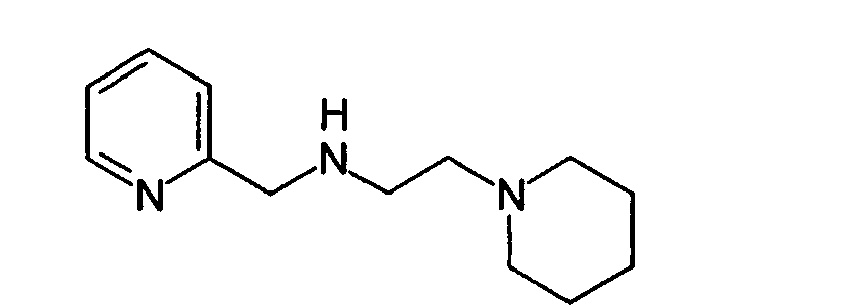


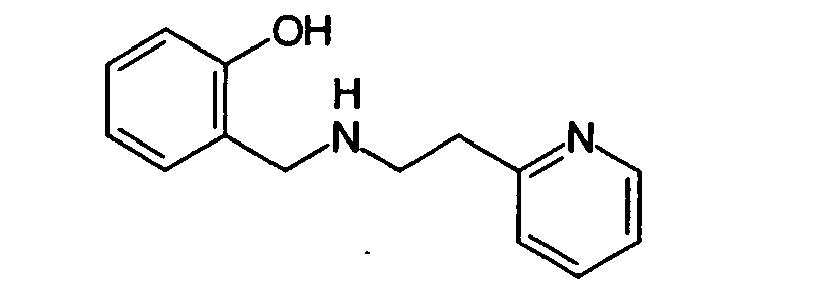

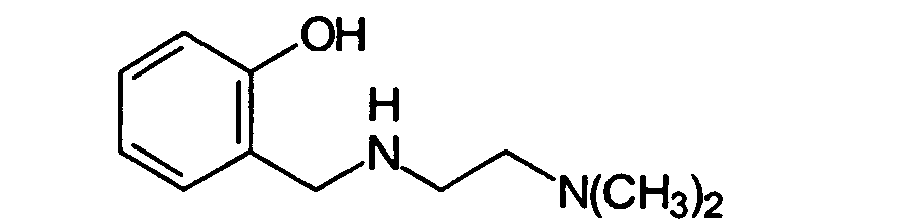


- Nachfolgend sind erfindungsgemäß besonders bevorzugt verwendbare tripodale Liganden, wobei die kovalente Bindung zwischen dem Träger, beispielsweise ein Merrifield-Harz, und den nachstehenden tripodalen Liganden, bevorzugt über die Methylgruppe in 6-Position des tripodalen Liganden, ausbildbar ist, aufgeführt:


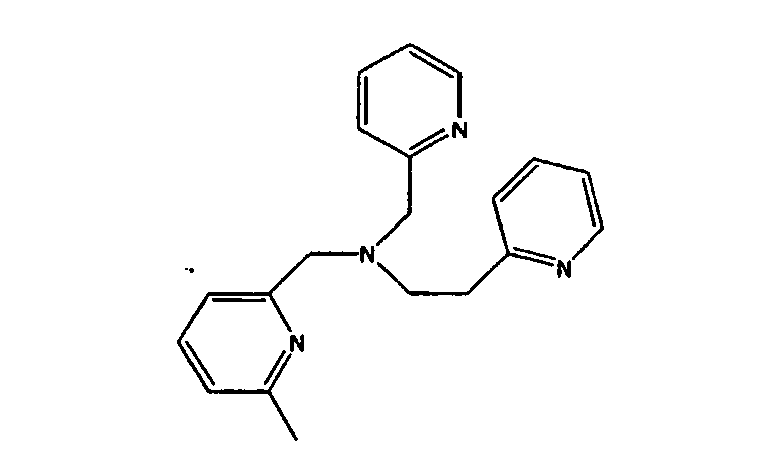

- Erfindungsgemäß bevorzugt verwendbare Heptadentate Liganden, bei denen die kovalente Bindung mit dem Träger, beispielsweise ein Merrifield-Harz, über die zentrale OH-Gruppe des Liganden ausbildbar ist, sind nachfolgend dargestellt:


- Weitere erfindungsgemäß bevorzugt verwendbare Bleichkatalysatorkomplex(e) die mit wenigstens einem organischem Liganden an einen Träger kovalent gebunden werden können, weisen die nachstehende allgemeine Formel (A1) auf:
[MaLkXn]Ym
worin: - M steht für ein Metall ausgewählt aus der Gruppe: Mn(II)-(III)-(IV)-(V), Cu(I)-(II)-(III), Fe(I)-(II)-(III)-(IV), Co(I)-(II)-(III), Ni(I)-(II)-(III), Cr(II)-(III)-(IV)-(V)-(VI)-(VII), Ti(II)-(III)-(IV), V(II)-(III)-(IV)-(V), Mo(II)-(III)-(IV)-(V)-(VI), W(IV)-(V)-(VI), Pd(II), Ru(II)-(III)-(IV)-(V) und/oder Ag(I)-(II); vorzugsweise Mn(II)-(III)-(IV)-(V), Cu(I)-(II), Fe(II)-(III)-(IV) und/oder Co(I)-(II)-(III);
- L steht für einen in der Beschreibung aufgeführten Liganden, der gegebenfalls protoniert oder deprotoniert sein kann;
- X steht für ein koordinierfähiges Molekül und/oder eine Gruppe, umfassend mono-, bi- oder tri-geladene Anionen und/oder ein beliebiges neutrales Molekül geeignet zur mono-, bi- oder tridentat-Koordination eines Metalls, wie O2-, RBO2 2-, RCOO-, RCONR-, OH-, NO3 -, NO2 -, NO, CO, S2-, RS-, PO4 3-, PO3OR3-, H2O, CO3 2-, HCO3-, ROH, NRR'R", RCN, Cl-, Br-, OCN-, SCN-, CN-, N3-, F-, l-, RO-, ClO4 -, SO4 2-, HSO4 -, SO3 2- und/oder RSO3 -, und besonders bevorzugt O2-, RBO2 2-, RCOO-, OH-, NO3 -, NO2 -, NO, CO, CN-, S2-, RS-, PO4 3-, H2O, CO3 2-, HCO3-, ROH, NRR'R", RCN, Cl-, Br-, OCN-, SCN-, N3-, F-, l-, RO-, ClO4 -, SO4 2-, HSO4 -, SO3 2- und/oder RSO3 - und noch bevorzugter CF3SO3 -;
- Y steht für ein nicht koordinierendes Gegenion, vorzugsweise ausgewählt aus der Gruppe, umfassend ClO4 -, BR4 -, [FeCl4]-, PF6 -, RCOO-, NO3 -, NO2 -, RO-, N+RR'R"R"', Cl-, Br-, F-, l-, RSO3 -, S2O6 2-, OCN-, SCN-, Li+, Ba2+, Na+, Mg2+, K+, Ca 2+, Cs+, PR4 +, RBO2 2-, SO4 2-, HSO4 -, SO3 2-, SbCl6 -, CuCl4 2-, CN, PO4 3-, HPO4 2-, H2PO4 -, CO3 2-, HCO3 - und/oder BF4 - und noch bevorzugter ClO4 -, BR4 -, [FeCl4]-, PF6 -, RCOO-, NO3 -, NO2 -, RO-, N+RR'R"R"', Cl-, Br-, F-, l-, RSO3 -, CF3SO3 -, S2O6 2-, OCN-, SCN-, Li+, Ba2+, Na+, Mg2+, K+, Ca2+, PR4 +, SO4 2-, HSO4 -, SO3 2- und/oder BF4 -;
- R, R', R", R'" stehen unabhängig voneinander für -H, -OH, -OR (worin R=Alkyl, Alkenyl, Cycloalkyl, Heterocycloalkyl, Aryl, Heteroaryl oder Carbonyl - Gruppe), - OAr, Alkyl, Alkenyl, Cycloalkyl, Heterocycloalkyl, Aryl, Heteroaryl und/oder Carbonyl - Gruppe, jedes R, Ar, Alkyl, Alkenyl, Cycloalkyl, Heterocycloalkyl, Aryl, Heteroaryl und/oder Carbonyl - Gruppe kann optional durch wenigstens eine Gruppe E substituiert sein oder R6 zusammen mit R7 und/oder unabhängig davon R8 zusammen mit R9 stehen für O, worin E für funktionelle Gruppen steht umfassend O, S, P, N, Se, Halogen und/oder jeden beliebigen Elektronen Donor- und/oder ziehende Gruppen steht; und R, R', R", R'" vorzugsweise steht für H, substituiertes Alkyl oder substituiertes Aryl, noch bevorzugter für H oder substituiertes Phenyl, Naphthyl oder C1-4-alkyl;
- a = steht für eine ganze Zahl von zwischen 1 bis 10, vorzugsweise 1 bis 4;
- k = steht für eine ganze Zahl von zwischen 1 bis 10;
- n = 0 oder steht für eine ganze Zahl von zwischen 1 bis 10, vorzugsweise 1 bis 4;
- m = 0 oder steht für eine ganze Zahl von zwischen 1 bis 20, vorzugsweise 1 bis 8.
- Vorzugsweise weist der kovalent mit dem Träger verbindbare organische Ligand L die allgemeine Formel (BI) auf:

g = 0 oder steht für eine ganze Zahl von zwischen 1 bis 6;
r = steht für eine ganze Zahl von zwischen 1 bis 6;
s = 0 oder steht für eine ganze Zahl von zwischen 1 bis 6;
Z1, Z2 stehen unabhängig voneinander für ein Heteroatom oder einen heterocyclischen oder heteroaromatischen Ring, Z1 und/oder Z2 können optional substituiert sein mit wenigstens einer funktionalen Gruppe E, wie unten angegeben;
Q1, Q2 stehen unabhängig für eine Gruppe mit der nachstehenden Formel:
10>d+e+f>1; d=0-9; e=0-9; f=0-9;
jedes Y1 ist unabhängig voneinander ausgewählt aus der Gruppe -O-, -S-, -SO-, - SO2 -, -(G1)N-, -( G1)( G2)N- (worin G1 und/oder G2 nachfolgend definiert sind), - C(O)-, Arylene, Alkylene, Heteroarylene, -P- und/oder -P(O)-;
wenn s>1, jede -[-Z1 (R1)-(Q1 )r-]- Gruppe ist unabhängig voneinander definiert;
R1, R2, R6, R7, R8, R9 stehen unabhängig voneinander für -H, -OH, -OR (worin R=Alkyl, Alkenyl, Cycloalkyl, Heterocycloalkyl, Aryl, Heteroaryl oder Carbonyl - Gruppe), -OAr, Alkyl, Alkenyl, Cycloalkyl, Heterocycloalkyl, Aryl, Heteroaryl und/oder Carbonyl - Gruppe, jedes R, Ar, Alkyl, Alkenyl, Cycloalkyl, Heterocycloalkyl, Aryl, Heteroaryl und/oder Carbonyl - Gruppe können durch wenigstens eine funktionelle Gruppe E substituiert sein, oder R6 zusammen mit R7 und/oder unabhängig davon R8 zusammen mit R9 Sauerstoff sein;
E steht für funktionelle Gruppen, enthaltend O, S, P, N, Se, Halogen, und/oder jeden beliebigen Elektronendonator und/oder jede beliebige elektronenziehende Gruppe, vorzugsweise steht E für -OH, mono- oder Polycarboxylat - Derivate, Aryl, Heteroaryl, Sulphonat, Thiol (-RSH), Thioether (-R-S-R'), Disulphide (-RSSR'), Dithiolene, Mono- oder Polyphosphonate, Mono- der Polyphosphate, Elektronen-Donor-Gruppen und/oder elektronenziehende Gruppen, und/oder Gruppen mit der Formel (G1)( G2)N-, (G1)( G2) (G3)N-, (G1)( G2)N-C(O)-, G3O- und/oder G3C(O)-,
worin jedes G1, G2 und/oder G3 unabhängig voneinander steht für H, Alkyl, Electronen-Donor-Groupen und/oder Elektronen ziehende Gruppen, einschließlich der vorgenannten;
R1-R9 kann eine verbrückende Gruppe sein, vorzugsweise gebunden mit einem anderen Teil eines Vertreters der selben allgemeinen Formel; - T1, T2 stehen unabhängig voneinander für R4 oder R5, worin R4 oder R5 definiert ist wie R1-R9, oder wenn g=0 und/oder s>0, R1 mit R4, und/oder R2 mit R5, können unabhängig voneinander für =CH-R10 stehen, worin R10 definiert ist wie R1-R9; oder
T1, T2 kann -T2-T1- sein, optional können sie eine kovalente Bindung ausbilden, wenn s>1 und/oder g>0;
wenn Z1 und/oder Z2 = N oder T1 und T2 stehen für eine für eine Einfachbindung und/oder R1 und/oder R2 fehlen, Q1 und/oder Q2 stehen unabhängig voneinander für eine Gruppe der allgemeinen Formel:
=CH-[-Y1-]e-CH=,
worin wenigstens zwei von R1, R2, R6, R7, R8 und/oder R9 unabhängig voneinander mittels einer kovalenten Bindung verbunden sind;
wenn Z1 und/oder Z2 = Sauerstoff, können R1 und/oder R2 fehlen;
wenn Z1 und/oder Z2 = S, N, P, B oder Si dann können R1 und/oder R2 fehlen; wenn Z1 und/oder Z2 = für ein Heteroatom stehen, substituiert mit einer funktionalen Gruppe E, dann können R1 und/oder R2 und/oder R4 und/oder R5 fehlen. - Die Gruppen Z1 und/oder Z2 stehen für ein Heteroatom wie N, P, 0, S, B und/oder Si, vorzugsweise für einen substituierten heterocyclischen Ring oder gegebenenfalls für einen substituierten heteroaromatischen Ring ausgewählt aus der Gruppe, umfassend Pyridine, Pyrimidine, Pyrazine, Pyrazidine, Pyrazole, Pyrrole, Imidazole, Benzimidazole, Quinoline, Isoquinoline, Carbazole, Triazole, Indole, Isoindole, Furane, Thiophene, Oxazole und/oder Thiazole.
- Die Gruppe R1-R9 ist vorzugsweise -H, Hydroxy-C0-C20-alkyl, Halo- C0-C20-alkyl, Nitroso, Formyl- C0-C20-alkyl, Carboxyl- C0-C20-alkyl und/oder Ester und/oder Salze davon, Carbamoyl- C0-C20-alkyl, Sulpho- C0-C20-alkyl und/oder Ester und/oder Salze davon, Sulphamoyl- C0-C20-alkyl, Amino- C0-C20-alkyl, Aryl- C0-C20-alkyl, Heteroaryl- C0-C20-alkyl, C0-C20-Alkyl, Alkoxy- C0-C8-alkyl, Carbonyl- C0-C6-alkoxy und/oder Aryl- C0-C6-alkyl und/oder C0-C20-alkylamide.
- Wenigstens ein R1-R9 kann eine verbrückende Gruppe sein, welches ein Ligandmolekül mit einem Molekül eines anderen Liganden verbindet, vorzugsweise mit einem Liganden der gleichen Formel.
- Die verbrückende Gruppe hat vorzugsweise die Formel -Cn'(R11)(R12)-(D)p-Cm'(R11)(R12)- und verbindet die beiden Moleküle, worin p is 0 oder 1, D ist ein Heteroatom oder eine ein Heteroatom-enthaltende Gruppe, oder ist Bestandteil eines aromatischen oder gesättigten homonuclearen oder heteronuclearen Rings, n' ist eine ganze Zahl von zwischen 1 bis 4, m' ist eine ganze Zahl von zwischen 1 bis 4, mit der Ausnahme, dass wenn n'+m' ≤ 4 ist, R11 und/oder R12 sind unabhängig ausgewählt aus der Gruppe, umfassend -H, NR13, und/oder OR14, Alkyl, Aryl, optional substituiert, und R13 und/oder R14 = -H, Alkyl, Aryl, beide optional substituiert. Alternativ oder zusätzlich können wenigstens zwei von R1-R9 Brückengruppen verbindende Atome sein, vorzugsweise Heteroatome, wobei die verbrückende Gruppe Alkylen, Hydroxyalkylen oder Heteroaryl aufweist. Eine weitere erfindungsgemäß verwendbare modifizierte Gruppe basiert auf der Formel (BI), wobei die Gruppen T1 und/oder T2 eine Einfachbindung ausbilden und s>1 ist, gemäß der allgemeinen Formel (BII):

- Vorzugsweise erfindungsgemäß verwendbar sind organische Liganden gemäß der allgemeinen Formel (BII), worin s'=1, 2 oder 3; r=g=h=1; d=2 oder 3; e=f=0; R6=R7=H ist, vorzugsweise so, dass der Ligand(en) eine der nachfolgenden Strukturen aufweist:


- Bei diesen bevorzugten Beispielen ist R1, R2, R3 und/oder R4 unabhängig ausgewählt aus der Gruppe, umfassend -H, Alkyl, Aryl, Heteroaryl, und/oder wenigstens eins der R1-R4 steht für eine verbrückende Gruppe gebunden zu einem Molekül der gleichen Formel und/oder wenigstens zwei der R1-R4 bilden zusammen eine verbrückende Gruppe verbunden mit N Atomen der gleichen Verbindung, vorzugsweise ist die verbrückende Gruppe Alkylen oder Hydroxy-Alkylen oder eine Heteroaryl enthaltende Brücke, vorzugsweise Heteroarylen. Noch bevorzugter, R1, R2, R3 und/oder R4 sind unabhängig voneinander ausgewählt aus der Gruppe, umfassend -H, Methyl, Ethyl, Isopropyl, Stickstoff enthaltendes Heteroaryl, oder eine das Molekül der selben allgemeinen Formel verbrückende Gruppe oder eine das Molekül der selben allgemeinen Formel über N Atome verbrückende Gruppe, wobei diese vorzugsweise Alkylen oder Hydroxy-Alkylen ist.
- Der vorgenannte Komplex [MaLkXn]Ym umfasst vorzugsweise:
- M=Mn(II)-(IV), Cu(I)-(III), Fe(II)-(III), Co(II)-(III);
- X=CH3CN, OH2, Cl-, Br-, OCN-, N3 -, SCN-, OH-, O2 -, PO4 3-, C6H5BO2 2-, RCOO-;
- Y=ClO4 -, BPh4 -, Br-, Cl-, [FeCl4]-, PF6 -, NO3 -
- a=1, 2, 3, 4;
- n=0, 1, 2, 3, 4, 5, 6, 7, 8, 9;
- m=1, 2, 3, 4; und/oder
- k=1, 2, 4.
- Gemäß der allgemeinen Formel (BII) bei der s'=2; r=g=h=1; d=f=0; e=1; und/oder jedes Y1 ist unabhängig voneinander Alkylen oder Heteroarylen. Der Ligand hat vorzugsweise die allgemeine Formel:

- A1, A2, A3, A4 sind unabhängig voneinander ausgewählt aus der Gruppe, umfassend C1-9-Alkylen oder Heteroarylen Gruppen; und/oder N1 und/oder N2 stehen unabhängig voneinander für ein Heteroatom oder eine Heteroarylen Gruppe.
- Vorzugsweise N1 steht für einen aliphatischen Stickstoff, N2 steht für eine Heteroarylen Gruppe, R1, R2, R3, R4 stehen jedes unabhängig voneinander für - H, Alkyl, Aryl oder Heteroaryl, und/oder A1, A2, A3, A4 steht jedes für -CH2-.
- Eines der R1-R4 kann für eine das Molekül der selben allgemeinen Formel verbrückende Gruppe stehen und/oder wenigstens zwei der R1-R4 können für eine das Molekül der selben allgemeinen Formel über N-Atome verbrückende Gruppe stehen, vorzugsweise ist die verbrückende Gruppe Alkylen oder Hydroxy-Alkylen oder eine Heteroaryl enthaltende Brücke, vorzugsweise Heteroarylen. Vorzugsweise R1, R2, R3 und/oder R4 sind unabhängig voneinander ausgewählt aus der Gruppe, umfassend -H, Methyl, Ethyl, Isopropyl, Stickstoff enthaltendes Heteroaryl, oder eine das Molekül der selben allgemeinen Formel verbrückende Gruppe oder eine das Molekül der selben allgemeinen Formel über N Atome verbrückende Alkylen oder Hydroxy-Alkylen Gruppe.
- Vorzugsweise hat der Ligand die allgemeine Formel:

- Der Komplex [MaLkXn]Ym umfaßt vorzugsweise:
- M=Fe(II)-(III), Mn(II)-(IV), Cu(II), Co(II)-(III);
- X= CH3CN, OH2, Cl-, Br-, OCN-, N3 -, SCN-, OH-, O2 -, PO4 3-, C6H5BO2 2-, RCOO-;
- Y= ClO4 -, BPh4 -, Br-, Cl-, [FeCl4]-, PF6 -, NO3 -;
- a=1, 2, 3, 4;
- n=0, 1, 2, 3, 4, 5, 6, 7, 8, 9;
- m=1, 2, 3, 4; und/oder
- k=1, 2, 4.
- Ein weiterer erfindungsgemäß verwendbarer Ligand der sich kovalent an den Träger verbinden läßt basiert auf der allgemeinen Formel(BII), mit s'=2 und/oder r=g=h=1, gemäß der allgemeinen Formel:
worin:
- Alternativ, jedes Z1-Z4 steht für N; R1-R4 fehlt; beide Q1 und/oder Q3 stehen für =CH-[-Y1-]e-CH=; und/oder beide Q2 und/oder Q4 stehen für -CH2-[-Y1-]n-CH2-.
- Vorzugsweise weist der erfindungsgemäß verwendbare Ligand, der sich kovalent an den Träger binden läßt, die allgemeine Formel auf:

- A steht für ein optional substituiertes Alkylen, optional unterbrochen durch ein Heteroatom; und/oder n ist Null oder eine ganze Zahl von zwischen 1 bis 5.
- Vorzugsweise stehen R1-R6 für Wasserstoff, n=1 und/oder A=-CH2-, -CHOH-, - CH2N(R)CH2- oder -CH2CH2N(R)CH2CH2-, worin R steht für Wasserstoff oder Alkyl, weiter bevorzugt steht A für -CH2-, -CHOH- oder -CH2CH2NHCH2CH2-.
- Weiter ist bevorzugt wenn der entsprechende Komplex [MaLkXn]Ym umfaßt:
- M=Mn(II)-(IV), Co(II)-(III), Fe(II)-(III);
- X= CH3CN, OH2, Cl-, Br-, OCN-, N3 -, SCN-, OH-, O2 -, PO4 3-, C6H5BO2 2-, RCOO-;
- Y= ClO4 -, BPh4 -, Br-, Cl-, [FeCl4]-, PF6 -, NO3 -;
- a=1, 2, 3, 4;
- n=0, 1, 2, 3, 4, 5, 6, 7, 8, 9;
- m=1, 2, 3, 4; und/oder
- k=1,2,4.
- Bei einer weiteren Modifikation von (BI), stehen T1 und/oder T2 unabhängig voneinander für die Gruppen R4, R5, wie definiert für R1-R9, gemäß der allgemeinen Formel(BIII):

- Bei dieser allgemeinen Formel(BIII), ist s=1; r=1; g=0; d=f=1; e=1-4; Y1=-CH2-; und/oder R1 zusammen mit R4, und/oder R2 zusammen mit R5, stehen

- Vorzugsweise ist dieser Ligand ausgewählt aus der Gruppe umfassend:

- R1 und/oder R2 ausgewählt sind aus der Gruppe, umfassend Phenole, Heteroaryl-C0-C20-alkyle, optional substituiert; R3 und/oder R4 sind ausgewählt aus der Gruppe, umfassend -H, Alkyl, Aryl, optional substituierte Phenole, Heteroaryl-C0-C20-alkyle, Alkylaryl, Aminoalkyl, Alkoxy; weiter bevorzugt R1 und/oder R2 sind ausgewählt aus der Gruppe, umfassend optional substituierte Phenole, Heteroaryl- C0-C2-alkyle, R3 und/oder R4 sind ausgewählt aus der Gruppe, umfassend -H, Alkyl, Aryl, optional substituierte Phenole und/oder Stickstoff-Heteroaryl-C0-C2-alkyl.
- Der entsprechende Komplex [MaLkXn]Ym kann vorzugsweise umfassen:
- M=Mn(II)-(IV), Co(II)-(III), Fe(II)-(III);
- X= CH3CN, OH2, Cl-, Br-, OCN-, N3 -, SCN-, OH-, O2 -, PO4 3-, C6H5BO2 2-, RCOO-;
- Y= ClO4 -, BPh4 -, Br-, Cl-, [FeCl4]-, PF6 -, NO3 -;
- a=1, 2, 3, 4;
- n=0, 1, 2, 3, 4, 5, 6, 7, 8, 9;
- m=1, 2, 3, 4; und/oder
- k=1, 2, 4.
- Bei einer weiteren Variante gemäß der allgemeinen Formel(BIII), ist s=1; r=1; g=0; d=f=1; e=1-4; Y1=-C(R')(R"), worin R' und/oder R", unabhängig voneinander definiert, wie R1-R9, sind.
- Vorzugsweise weist der erfindungsgemäß verwendbare Ligand die allgemeine Formel auf:

- Die Gruppen R1, R2, R3, R4, R5 in dieser Formel sind vorzugsweise -H oder C0-C20-Alkyl, n=0 oder 1, R6 ist -H, Alkyl, -OH oder -SH, und/oder R7, R8, R9, R10 sind vorzugsweise jedes unabhängig voneinander ausgewählt aus der Gruppe, umfassend -H, C0-C20-Alkyl, Heteroaryl- C0-C20-Alkyl, Alkoxy- C0-C8-Alkyl und/oder Amino-C0-C20-Alkyl.
- Der entsprechende Komplex [MaLkXn]Ym umfaßt vorzugsweise:
- M=Mn(II)-(IV), Fe(II)-(III), Cu(II), Co(II)-(III);
- X= CH3CN, OH2, Cl-, Br-, OCN-, N3 -, SCN-, OH-, O2 -, PO4 3-, C6H5BO2 2-, RCOO ;
- Y= ClO4 -, BPh4 -, Br-, Cl-, [FeCl4]-, PF6 -, NO3 -;
- a=1, 2, 3, 4;
- n=0, 1, 2, 3, 4;
- m=0, 1, 2, 3, 4, 5, 6, 7, 8; und/oder
- k=1,2,3,4.
- Ein weiterer erfindungsgemäß geeigneter Ligand, der kovalent an einen Träger bindet, besitzt die allgemeine Formel(BIII), s=0; g=1; d=e=0; f=1-4. Vorzugsweise hat dieser Ligand die allgemeine Formel:

- Noch bevorzugter ist, wenn der Ligand die nachfolgende allgemeine Formel aufweist:

- R1, R2, R3 definiert sind, wie R2, R4, R5.
- Der entsprechende Komplex [MaLkXn]Ym ist nachfolgend angegeben:
- M=Mn(II)-(IV), Fe(II)-(III), Cu(II), Co(II)-(III);
- X= CH3CN, OH2, Cl-, Br-, OCN-, N3 -, SCN-, OH-, O2 -, PO4 3-, C6H5BO2 2-, RCOO-;
- Y= ClO4 -, BPh4 -, Br-, Cl-, [FeCl4]-, PF6 -, NO3 -;
- a=1, 2, 3, 4;
- n=0, 1, 2, 3, 4;
- m=0, 1, 2, 3, 4, 5, 6, 7, 8; und/oder
- k=1, 2, 3, 4.
- Noch ein weiterer erfindungsgemäß verwendbarer Komplex, der über wenigstens einen organischen Liganden an einen Träger kovalent bindbar ist, weist die allgemeine Formel(A) auf:
[LMXn]zYq
worin - M steht für Fe in der Oxidationsstufe II, III, IV oder V, Mn in der Oxidationsstufe II, III, IV, VI oder VII, Cu in der Oxidationsstufe I, II oder III, Co in der Oxidationsstufe II, III oder IV, oder Cr in der Oxidationsstufe II-VI;
- X steht für ein koordinationsfähiges Atom oder Molekül;
- n steht für Null oder eine ganze Zahl im Bereich von zwischen 0 bis 3;
- z steht für die Ladung des Komplexes und ist eine ganze Zahl, welche positiv, ull oder negativ sein kann;
- Y steht für ein Gegenion, wobei das Gegenion abhängig von der Ladung des Komplexes ist;
- q=z/[Ladung Y]; und/oder
- L steht für einen pentadentaten Liganden der allgemeinen Formel(B):

- jedes R1, R2 unabhängig voneinander, stehen für -R4-R5,
- R3 steht für Wasserstoff, optional substituiertes Alkyl, Aryl oder Arylalkyl, oder -R4-R5,
- jedes R4 stehen unabhängig voneinander für eine Einfachbindung oder optional substituiertes Alkylen, Alkenylen, Oxyalkylen, Aminoalkylen, Alkylen Ether, Carboxylester oder Carboxylamid, und/oder
- jedes R5 steht unabhängig voneinander für eine optional N-substituierte Aminoalkyl - Gruppe oder eine optional substituierte Heteroaryl - Gruppe ausgewählt aus der Gruppe, umfassend Pyridinyl, Pyrazinyl, Pyrazolyl, Pyrrolyl, Imidazolyl, Benzimidazolyl, Pyrimidinyl, Triazolyl und/oder Thiazolyl.
- Der Ligand L hat die allgemeine Formel(B), wie oben angegeben, und ist ein pentadentater Ligand. Der Begriff 'pentadentat' bedeutet im Sinne dieser Erfindung, dass fünf Heteroatome das Metall M - lon in dem Metall-Komplex koordinieren können.
Gemäß der Formel (B), ist ein koordinierendes Heteroatom der Stickstoff, der in der Methylamin - Kette (Peptidkette) enthalten ist, und/oder ein koordinierendes Heteroatom ist vorzugsweise enthalten in jedem der vier R1 und/oder R2 SeitenGruppen. Vorzugsweise sind alle koordinierenden Heteroatome Stickstoffatome. - Der Ligand L der Formel (B) umfaßt vorzugsweise wenigstens zwei substituierte oder unsubstituierte Heteroaryl-Gruppen in den vier Seitengruppen. Die Heteroaryl-Gruppe ist vorzugsweise eine Pyridin-2-yl Gruppe und/oder, wenn substituiert, vorzugsweise eine Methyl- oder Ethyl-substituierte Pyridin-2-yl Gruppe. Noch bevorzugter, die Heteroaryl Gruppe ist eine unsubstituierte Pyridin-2-yl Gruppe. Vorzugsweise ist die Heteroaryl-Gruppe mit Methylamin, vorzugsweise über das N Atom davon, mittels einer Methylen - Gruppe, verbunden. Vorzugsweise enthält der Ligand L der Formel (B) wenigstens eine substituierte Amino-Alkyl Seiten-Gruppe, weiter bevorzugt zwei Aminoethyl SeitenGruppen, noch bevorzugter 2-(N-Alkyl)aminoethyl oder 2-(N,N-dialkyl)aminoethyl.
- In Formel (B) steht vorzugsweise R1 für Pyridin-2-yl oder R2 steht für Pyridin-2-yl-methyl. vorzugsweise stehen R2 oder R1 für 2-Aminoethyl, 2-(N-(m)Ethyl)aminoethyl oder 2-(N,N-di(m)Ethyl)aminoethyl. Wenn substituiert, steht R5 vorzugsweise für 3-Methylpyridin-2-yl. R3 steht vorzugsweise für Wasserstoff, Benzyl oder Methyl.
- Beispiele bevorzugter erfindungsgemäß verwendbarer Liganden L gemäß Formel (B) in deren einfachsten Form sind:
- (i) Pyridin-2-yl enthaltende Liganden wie:
- N,N-Bis(pyridin-2-yl-Methyl)-bis(pyridin-2-yl)methylamin;
- N,N-Bis(pyrazol-1-yl-Methyl)-bis(pyridin-2-yl)methylamin;
- N,N-Bis(imidazol-2-yl-Methyl)-bis(pyridin-2-yl)methylamin;
- N,N-Bis(1,2,4-triazol-1-yl-Methyl)-bis(pyridin-2-yl)methylamin;
- N,N-Bis(pyridin-2-yl-Methyl)-bis(pyrazol-1-yl)methylamin;
- N,N-Bis(pyridin-2-yl-Methyl)-bis(imidazol-2-yl)methylamin;
- N,N-Bis(pyridin-2-yl-Methyl)-bis(1,2,4-triazol-1-yl)methylamin;
- N,N-Bis(pyridin-2-yl-Methyl)-1,1-bis(pyridin-2-yl)-1-aminoethan;
- N,N-Bis(pyridin-2-yl-Methyl)-1,1-bis(pyridin-2-yl)-2-phenyl-1-aminoethan;
- N,N-Bis(pyrazol-1-yl-Methyl)-1,1-bis(pyridin-2-yl)-1-aminoethan;
- N,N-Bis(pyrazol-1-yl-Methyl)-1,1-bis(pyridin-2-yl)-2-phenyl-1-aminoethan;
- N,N-Bis(imidazol-2-yl-Methyl)-1,1-bis(pyridin-2-yl)-1-aminoethan;
- N,N-Bis(imidazol-2-yl-Methyl)-1,1 -bis(pyridin-2-yl)-2-phenyl-1 -aminoethan;
- N,N-Bis(1,2,4-triazol-1-yl-Methyl)-1,1-bis(pyridin-2-yl)-1-aminoethan;
- N,N-Bis(1,2,4-triazol-1-yl-Methyl)-1,1-bis(pyridin-2-yl)-2-phenyl-1-aminoethan;
- N,N-Bis(pyridin-2-yl-Methyl)-1,1-bis(pyrazol-1-yl)-1-aminoethan;
- N,N-Bis(pyridin-2-yl-Methyl)-1,1-bis(pyrazol-1-yl)-2-phenyl-1-aminoethan;
- N,N-Bis(pyridin-2-y)-Methyl)-1,1-bis(imidazo)-2-yl)-1-aminoethan;
- N,N-Bis(pyridin-2-y)-Methyl)-1,1 -bis(imidazol-2-yl)-2-phenyl-1-aminoethan;
- N,N-Bis(pyridin-2-yl-Methyl)-1,1-bis(1,2,4-triazol-1-yl)-1-aminoethan;
- N,N-Bis(pyridin-2-yl-Methyl)-1,1-bis(1,2,4-triazol-1-yl)-1-aminoethan;
- N,N-Bis(pyridin-2-yl-Methyl)-1,1-bis(pyridin-2-yl)-1-aminoethan;
- N,N-Bis(pyridin-2-yl-Methyl)-1,1-bis(pyridin-2-yl)-1-aminohexan;
- N,N-Bis(pyridin-2-yl-Methyl)-1,1-bis(pyridin-2-yl)-2-phenyl-1-aminoethan;
- N,N-Bis(pyridin-2-yl-Methyl)-1,1-bis(pyridin-2-yl)-2-(4-sulphonic acid-phenyl)-1-aminoethan;
- N,N-Bis(pyridin-2-yl-Methyl)-1,1-bis(pyridin-2-yl)-2-(pyridin-2-yl)-1-aminoethan;
- N,N-Bis(pyridin-2-yl-Methyl)-1,1-bis(pyridin-2-yl)-2-(pyridin-3-yl)-1-aminoethan;
- N,N-Bis(pyridin-2-yl-Methyl)-1,1-bis(pyridin-2-yl)-2-(pyridin-4-yl)-1-aminoethan;
- N,N-Bis(pyridin-2-yl-Methyl)-1,1-bis(pyridin-2-yl)-2-(1-Alkyl-pyridinium-4-yl)-1-minoethan;
- N,N-Bis(pyridin-2-yl-Methyl)-1,1-bis(pyridin-2-yl)-2-(1-Alkyl-pyridinium-3-yl)-1-aminoethan;
- N,N-Bis(pyridin-2-yl-Methyl)-1,1-bis(pyridin-2-yl)-2-(1-Alkyl-pyridinium-2-yl)-1-aminoethan;
- (ii) 2-Aminoethyl enthaltende Liganden wie:
- N,N-Bis(2-(N-Alkyl)amino-Ethyl)-bis(pyridin-2-yl)methylamin;
- N,N-Bis(2-(N-Alkyl)amino-Ethyl)-bis(pyrazol-1-yl)methylamin;
- N,N-Bis(2-(N-Alkyl)amino-Ethyl)-bis(imidazol-2-yl)methylamin;
- N,N-Bis(2-(N-Alkyl)amino-Ethyl)-bis(1,2,4-triazol-1-yl)methylamin;
- N,N-Bis(2-(N,N-dialkyl)amino-Ethyl)-bis(pyridin-2-yl)methylamin;
- N,N-Bis(2-(N,N-dialkyl)amino-Ethyl)-bis(pyrazol-1-yl)methylamin;
- N,N-Bis(2-(N,N-dialkyl)amino-Ethyl)-bis(imidazol-2-yl)methylamin;
- N,N-Bis(2-(N,N-dialkyl)amino-Ethyl)-bis(1,2,4-triazol-1-yl)methylamin;
- N,N-Bis(pyridin-2-yl-Methyl)-bis(2-amino-Ethyl)methylamin;
- N,N-Bis(pyrazol-1-yl-Methyl)-bis(2-amino-Ethyl)methylamin;
- N,N-Bis(imidazol-2-yl-Methyl)-bis(2-amino-Ethyl)methylamin;
- N,N-Bis(1,2,4-triazol-1-yl-Methyl)-bis(2-amino-Ethyl)methylamin.
- Besonders bevorzugte Liganden:
- N,N-Bis(pyridin-2-yl-Methyl)-bis(pyridin-2-yl)methylamin, nachfolgend bezeichnet als N4Py;
- N,N-Bis(pyridin-2-yl-Methyl)-1,1-bis(pyridin-2-yl)-1-aminoethan, nachfolgend bezeichnet als MeN4Py;
- N,N-Bis(pyridin-2-yl-methyl)-1,1-bis(pyridin-2-yl)-2-phenyl-1-aminoethane, nachfolgend bezeichnet als BzN4Py.
- Ein weiterer erfindungsgemäß verwendbarer Ligandenkomplex basiert auf der allgemeinen Komplex-Formel (A) und Ligand (B) wie oben angegeben, aber mit der Ausnahme das R3 für Wasserstoff steht.
- Alternativ bildet die organische Substanz einen Komplex der allgemeine Formel (A), wie oben angegeben, aus, aber mit der Ausnahme das L für einen pentadentaten oder hexadentaten Ligand der allgemeinen Formel (C) steht:
R1R1N-W-N R1R2
worin: - jedes R1 unabhängig voneinander steht für -R3 -V, worin R3 steht für optional substituiertes Alkylen, Alkenylen, Oxyalkylen, Aminoalkylen oder Alkylen Ether, und/oder V steht für eine optional substituierte Heteroaryl Gruppe ausgewählt aus der Gruppe, umfassend Pyridinyl, Pyrazinyl, Pyrazolyl, Pyrrolyl, Imidazolyl, Benzimidazolyl, Pyrimidinyl, Triazolyl und/oder Thiazolyl;
- W steht für eine optional substituierte Alkylen-Brücken-Gruppe ausgewählt aus der Gruppe, umfassend -CH2CH2-, -CH2CH2CH2-, -CH2CH2CH2CH2-, -CH2-C6H4-CH2-, -CH2- C6H10-CH2-, und/oder-CH2-C10H6-CH2-; und/oder
- R2 steht für ein Gruppe ausgewählt aus der Gruppe, umfassend R1, und/oder Alkyl, Aryl und/oder Arylalkyl - Gruppen, optional substituiert mit einem Substituenten ausgewählt aus der Gruppe, umfassend Hydroxy, Alkoxy, Phenoxy, Carboxylat, Carboxamid, Carboxylester, Sulphonat, Amin, Alkylamin und/oder N+(R4)3, worin R4 ist ausgewählt aus der Gruppe, umfassend Wasserstoff, Alkanyl, Alkenyl, Arylalkanyl, Arylalkenyl, Oxyalkanyl, Oxyalkenyl, Aminoalkanyl, Aminoalkenyl, Alkanylether und/oder Alkenylether.
- Der Ligand L hat die allgemeine Formel(C), wie oben angegeben, und ist ein pentadentater Ligand oder, wenn R1= R2, kann dieser ein hexadentater Ligand sein. Der Begriff 'pentadentat' bedeutet im Sinne dieser Erfindung, wie oben angegeben, das fünf Heteroatome das Metall M - Ion in dem Metall-Komplex koordinieren können. Der Begriff 'hexadentat' bedeutet im Sinne dieser Erfindung, das im Prinzip sechs Heteroatome das Metall M - lon in dem Metall-Komplex koordinieren können. Bei hexadentaten Liganden koordinieren in der Regel aber meistens nur maximal fünf der sechs Liganden.
- In der Formel (C), sind zwei Heteroatome durch eine Brücken-Gruppe W verbunden und/oder wenigstens ein koordinierendes Heteroatom ist in jeder der drei R1 Gruppen enthalten. Vorzugsweise ist das koordinierende Heteroatom ein Stickstoffatom.
- Der Ligand L der Formel (C) umfaßt wenigstens eine optional substituierte Heteroaryl -Gruppe in jeder der drei R1 Gruppen. Vorzugsweise ist die Heteroaryl-Gruppe eine Pyridin-2-yl-Gruppe, insbesondere eine Methyl- oder Ethyl-substituierte Pyridin-2-yl-Gruppe. Die Heteroaryl-Gruppe ist über ein N Atom in Formel (C) verbunden, vorzugsweise über eine Alkylen - Gruppe und weiter bevorzugt über eine Methylen-Gruppe. Am meisten bevorzugt ist die Heteroaryl - Gruppe eine 3-Methyl-pyridin-2-yl - Gruppe, welche zu einem N Atom über Methylen verbunden ist.
- Die Gruppe R2 in Formel (C) ist eine substituierte oder unsubstituierte Alkyl, Aryl oder Arylalkyl Gruppe, oder eine Gruppe R1. Vorzugsweise ist R2 unterschiedlich zu jeder der R1 Gruppen in der oben angegebenen Formel. Vorzugsweise ist R2 Methyl, Ethyl, Benzyl, 2-Hydroxyethyl oder 2-Methoxyethyl. Noch bevorzugter, R2 ist Methyl oder Ethyl.
Die Brückengruppe W kann eine substituierte oder unsubstituierte Alkylen Gruppe ausgewählt aus der Gruppe, umfassend -CH2CH2-, -CH2CH2CH2-, -CH2CH-2CH2CH2-, -CH2-C6H4-CH2-, -CH2-C6H10-CH2-, und/oder -CH2-C10H6-CH2-, sein (worin -C6H4-, -C6H10-, -C10H6- kann ortho-, para-, oder meta-C6H4-, - C6H10-, -C10H6- sein). Vorzugsweise ist die Brückengruppe W eine Ethylen oder 1,4-Butylen Gruppe, noch bevorzugter eine Ethylen-Gruppe. - Vorzugsweise steht V für substituiertes Pyridin-2-yl, insbesondere für Methylsubstituiertes oder Ethyl-substituiertes Pyridin-2-yl, und/oder noch bevorzugter steht V für 3-Methylpyridin-2-yl.
- Beispiele bevorzugter Liganden der Formel (C) in ihrer einfachsten Form sind:
- N-Methyl-N,N',N'-tris(3-Methyl-pyridin-2-ylmethyl)ethylen-1,2-diamin;
- N-Ethyl-N,N',N'-tris(3-Methyl-pyridin-2-ylmethyl)ethylen-1,2-diamin;
- N-Benzyl-N,N', N'-tris(3-Methyl-pyridin-2-ylmethyl)ethylen-1,2-diamin;
- N-(2-hydroxyethyl)-N,N',N'-tris(3-Methyl-pyridin-2-ylmethyl)ethylen-1,2-diamin;
- N-(2-methoxyethyl)-N,N',N'-tris(3-Methyl-pyridin-2-ylmethyl)ethylen-1,2-diamin;
- N-Methyl-N,N',N'-tris(5-Methyl-pyridin-2-ylmethyl)ethylen-1,2-diamin;
- N-Ethyl-N, N',N'-tris(5-Methyl-pyridin-2-ylmethyl)ethylen-1,2-diamin;
- N-benzyl-N,N',N'-tris(5-Methyl-pyridin-2-ylmethyl)ethylen-1,2-diamin;
- N-(2-hydroxyethyl)-N,N',N'-tris(5-Methyl-pyridin-2-ylmethyl)ethylen-1,2-diamin;
- N-(2-methoxyethyl)-N,N',N'-tris(5-Methyl-pyridin-2-ylmethyl)ethylen-1,2-diamin;
- N-Methyl-N,N',N'-tris(3-Ethyl-pyridin-2-ylmethyl)ethylen-1,2-diamin;
- N-Ethyl-N,N',N'-tris(3-Ethyl-pyridin-2-ylmethyl)ethylen-1,2-diamin;
- N-benzyl-N,N',N'-tris(3-Ethyl-pyridin-2-ylmethyl)ethylen-1,2-diamin;
- N-(2-hydroxyethyl)-N,N',N'-tris(3-Ethyl-pyridin-2-ylmethyl)ethylen-1,2-diamin;
- N-(2-methoxyethyl)-N,N',N'-tris(3-Ethyl-pyridin-2-ylmethyl)ethylen-1,2-diamin;
- N-Methyl-N,N',N'-tris(5-Ethyl-pyridin-2-ylmethyl)ethylen-1,2-diamin;
- N-Ethyl-N,N',N'-tris(5-Ethyl-pyridin-2-ylmethyl)ethylen-1,2-diamin;
- N-Benzyl-N,N',N'-tris(5-Ethyl-pyridin-2-ylmethyl)ethylen-1,2-diamin; und/oder
- N-(2-methoxyethyl)-N,N',N'-tris(5-Ethyl-pyridin-2-ylmethyl)ethylen-1,2-diamin.
- Besonders bevorzugte erfindungsgemäß verwendbare Liganden, die kovalent an einen Träger gebunden werden können, sind:
- N-Methyl-N,N',N'-tris(3-Methyl-pyridin-2-ylmethyl)ethylen-1,2-diamin;
- N-Ethyl-N,N',N'-tris(3-Methyl-pyridin-2-ylmethyl)ethylen-1,2-diamin;
- N-benzyl-N,N',N'-tris(3-Methyl-pyridin-2-ylmethyl)ethylen-1,2-diamin;
- N-(2-Hydroxyethyl)-N,N',N'-tris(3-Methyl-pyridin-2-ylmethyl)ethylen-1,2-diamin; und/oder
- N-(2-methoxyethyl)-N,N',N'-tris(3-Methyl-pyridin-2-ylmethyl)ethylen-1,2-diamin.
- Am meisten bevorzugte erfindungsgemäß verwendbare Liganden, die kovalent an einen Träger gebunden werden können, sind:
- N-Methyl-N,N',N'-tris(3-Methyl-pyridin-2-ylmethyl)ethylen-1,2-diamin; und/oder
- N-Ethyl-N, N',N'-tris(3-Methyl-pyridin-2-ylmethyl)ethylen-1,2-diamin.
- Vorzugsweise ist das Metall M in Formel (A) Fe oder Mn, noch bevorzugter Fe. Bevorzugt koordinierende Atome/Moleküle X in Formel (A) können ausgewählt sein aus der Gruppe, umfassend R6OH, NR6 3, R6CN, R6OO-, R6S-, R6O-, R6COO-, OCN-, SCN-, N3 -, CN-, F-, Cl-, Br-, l-, O2 -, NO3 -, NO2 -, SO4 2-, SO3 2-, PO4 3- und/oder aromatische N Donor ausgewählt aus der Gruppe, umfassend Pyridine, Pyrazine, Pyrazole, Pyrrole, Imidazole, Benzimidazole, Pyrimidine, Triazole und/oder Thiazole, worin R6 vorzugsweise ausgewählt ist aus der Gruppe, umfassend Wasserstoff, optional substituiertes Alkyl und/oder optional substituiertes Aryl. X kann außerdem LMO- oder LMOO- sein, worin M ein Übergangsmetall und L ein Ligand ist, wie oben angegeben. Das koordinierungsfähige X ist vorzugsweise ausgewählt aus der Gruppe, umfassend CH3CN, H2O, F-, Cl-, Br-, OOH6, R6COO-, R6O-, LMO-, und/oder LMOO- worin R6 für Wasserstoff oder optional substituiertes Phenyl, Naphthyl, oder C1-C4 Alkyl, steht.
Das Gegenion Y in Formel (A) gleicht die Ladung z des durch den Liganden L gebildeten Komplex, des Metall M und/oder des koordinierenden X, aus. Wenn die Ladung z positiv ist, kann Y ein Anion, beispielsweise R7COO-, BPh4 -, ClO4 -, BF4 -, PF6 -, R7SO3 -, R7SO4 -, SO4 2-, NO3 -, F-, Cl-, Br-, oder I-, mit R7 = Wasserstoff, optional substituiertes Alkyl oder optional substituiertes Aryl. Wenn z ist negativ, ist Y ein übliches Kation, beispielsweise ein Alkalimetall, Erdalkalimetall oder ein (Alkyl)ammoniumkation.
Geeignete Gegenionen Y sind auch solche die die Bildung lagerstabiler Feststoffe bewirken. Bevorzugte Gegenionen bevorzugter Metallkomplexe sind ausgewählt aus der Gruppe, umfassend R7COO-, ClO4 -, BF4 -, PF6 -, R7SO3 - (insbesondere CF3SO3 -), R7SO4 -, SO4 2-, NO3 -, F-, Cl-, Br-, und/oder I-, worin R7steht für Wasserstoff oder optional substituiertes Phenyl, Naphthyl oder C1-C4 Alkyl. Ein weiterer geeigneter erfindungsgemäß verwendbarer, an einen Träger über wenigstens einen Liganden kovalent bindbarer Ligandenkomplex, weist die nachstehende allgemeine Formel(D) auf:
[{M' aL}bXc]zYq
worin: - M' steht für Wasserstoff oder ein Metall ausgewählt aus der Gruppe, umfassend Ti, V, Co, Zn, Mg, Ca, Sr, Ba, Na, K, und/oder Li;
- X steht für eine koordinierendes Atom/Molekül;
- a steht für eine ganze Zahl im Bereich von zwischen 1 bis 5;
- b steht für eine ganze Zahl im Bereich von zwischen 1 bis 4;
- c steht für Null oder eine ganze Zahl im Bereich von zwischen 0 bis 5;
- z steht für die Ladung der Verbindung und ist eine ganze Zahl , welche positiv, Null oder negativ sein kann;
- Y steht für ein Gegenion, das abhängig von der Ladung der Verbindung ausgewählt ist;
- q=z/[Ladung Y]; und/oder
- L steht für ein pentadentaten Liganden der allgemeinen Formel (B) oder (C) wie oben angegeben.
- Eine geeignete organische Substanz umfaßt einen macrocyclischen Ligand der Formel (E):

- Z1 und/oder Z2 unabhängig voneinander ausgewählt sind aus der Gruppe, umfassend monocyclische oder polycyclische aromatische Ringstrukturen, die optional wenigstens ein Heteroatom aufweisen, wobei jede aromatische Ringstruktur mit wenigstens einem Substituenten substituiert sein kann; Y1 und/oder Y2 sind unabhängig voneinander ausgewählt aus der Gruppe, umfassend C, N, O, Si, P und/oder S Atome;
- A1 und/oder A2 sind unabhängig voneinander ausgewählt aus der Gruppe, umfassend Wasserstoff, Alkyl, Alkenyl und/oder Cycloalkyl, wobei jedes Alkyl, Alkenyl und/oder Cycloalkyl kann optional substituiert sein durch wenigstens eine Gruppe ausgewählt aus der Gruppe, umfassend Hydroxy, Aryl, Heteroaryl, Sulphonate, Phosphate, Elektronen-Donor-Gruppen und/oder elektronenziehende Gruppen, und/oder Gruppen der Formel (G1)(G2N-, G3OC(O)-, G3O- und/oder G3C(O)-, worin jedes G1, G2 und/oder G3 unabhängig voneinander ausgewählt ist aus der Gruppe, umfassend Wasserstoff und/oder Alkyl, und/oder Elektron-Donor-Gruppe und/oder elektronenziehende Gruppen (zusätzlich zu den vorgenannten);
- i und/oder j sind ausgewählt aus der Gruppe, umfassend 0, 1 und/oder 2 entsprechend der Valenz Y1 und/oder Y2;
- jedes Q1-Q4 ist unabhängig voneinander ausgewählt aus der Gruppe gemäß der nachstehenden Formel:

- 10>a+b+c>2 und/oder d≥1;
- jedes Y3 ist unabhängig voneinander ausgewählt aus der Gruppe, umfassend -O-, -S-, -SO-, -SO2-, -(G1)N- (worin G1 wie oben angegeben ist), -C(O)-, Arylen, Heteroarylen, -P- und/oder -P(O)-;
- jedes A3-A6 ist unabhängig voneinander ausgewählt aus der Gruppe, umfassend die oben angegeben Gruppen A1 und/oder A2; und
worin wenigstens zwei der A1-A6 eine Brücken-Gruppe ausbilden, vorausgesetzt das A1 und/oder A2 gebunden sind, ohne gleichzeitig an A3-A6 gebunden zu sein; die A1 und/oder A2 verbindende Brückengruppe kann wenigstens eine CarbonylGruppe aufweisen. - Bevorzugte Elektronen-Donor-Gruppen umfassen Alkyl (z.B. Methyl), Alkoxy (z.B. Methoxy), Phenoxy, und/oder unsubstituierte, monosubstituierte und/oder disubstituierte Amin - Gruppen. Bevorzugte Elektronen ziehende Gruppen umfassen Nitro, Carboxy, Sulphonyl und/oder Halogen.
- Der Ligand der Formel (E) kann als Ligandenkomplex mit Übergangsmetallatom oder ohne Übergangsmetallatom vorliegen. In der nicht Übergangsmetall komplexierten Form kann das Übergangsmetall aus der gebrauchsfertigen Zusammensetzung, d.h. dem Mittel, oder beispielsweise aus einem zusammen mit dem Mittel am Einsatzort verwendeten fluiden Medium, wie Wasser, stammen. Leitungswasser weisen üblicherweise ausreichende Spuren an Übergangsmetallen auf.
- Ein weiterer erfindungsgemäß verwendbarer Ligand, der kovalent an einen Träger bindbar ist, weist die nachstehende Formel (E) mit einem Gegenion der Formel (F) auf:
[HxL]zYq
worin: - H ist ein Wasserstoffatom;
- Y ist ein Gegenanion, wobei das Gegenion abhängig von der Ladung des Komplexes ist;
- x ist eine ganze Zahl, so dass wenigstens ein Stickstoff Atom von L protoniert ist;
- z steht für die Ladung des Komplexes und/oder ist eine ganze Zahl, die positiv oder Null ist;
- q=z/[Ladung von Y]; und/oder
- L ist ein Ligand der Formel (E) wie oben angegeben.
- In einer weiter erfindungsgemäß verwendbaren Ausführungsform bildet die organische Substanz einen Metalkomplex der Formel (G), basierend auf der lonenpaarbildung der Formel (F):
[MxL]zYq
worin: - L, Y, x, z und/oder q wie in Formel (F) oben definiert sind und/oder M ist ein Metall ausgewählt aus der Gruppe, umfassend Mn in Oxidationsstufen II-V, Fe II-V, Cu I-III, Co I-III, Ni I-III, Cr II-VI, W IV-VI, Pd V, Ru II-IV, V III-IV und/oder Mo IV-VI. Bevorzugt ist ein Komplex der Formel (G) worin M für Mn, Co, Fe oder Cu steht. Weiterhin ist eine organische Substanz bevorzugt die einen Komplex der Formel

- M steht für ein Fe Atom mit der Oxidationsstufe II oder III, Mn Atom mit der Oxidationsstufe II, III, IV oder V, Cu Atom mit der Oxidationsstufe I, II oder III, oder Co Atom mit der Oxidationsstufe II, III oder IV;
- X ist eine verbrückende Gruppe oder eine nicht verbrückende Gruppe zwischen M, vorzugsweise Fe Atom(en), Y ist ein Gegenion, x und/oder y sind ≥1, 0=<n=<3 und z ist die Ladung des Metallkomplexes, und p="z/Ladung" von Y; R1 und/oder R2 stehen unabhängig voneinander für wenigstens einen Ringsubstituenten, ausgewählt aus der Gruppe, umfassend Wasserstoff und/oder Elektronen-Donor und/oder Elektronen ziehende Gruppen, R3 bis R8 stehen unabhängig voneinander für Wasserstoff, Alkyl, Hydroxyalkyl, Alkenyl oder Derivate davon, wenn diese durch wenigstens eine Elektronen-Donor und/oder Elektronen ziehende Gruppen substituiert sind.
- In dem Komplex der Formel (H) steht M vorzugsweise für ein Fe Atom in der Oxidationsstufe II oder III oder ein Mn Atom in der Oxidationsstufe II, III, IV, oder V. Vorzugsweise ist die Oxidationsstufe von M = III.
Wenn M = Fe ist, liegt der Komplex der Formel (H) vorzugsweise in der Form eines Fe-Salzes vor, wie (im oxidiertem Zustand) Dihalo-2,11-diazo[3.3](2,6)pyridinophan, Dihalo-4-methoxy-2,11-diazo[ 3.3](2,6)pyridinophan und/oder Mischungen davon, insbesondere in der Form eines Chloridsalzes. - Wenn M = Mn ist, liegt der Komplex der Formel (H) vorzugsweise in der Form eines Mn-Salzes vor (im oxidiertem Zusatand), wie N,N'-Dimethyl-2,11-diazo[3.3](2,6)pyridinophan, insbesondere in der Form eines Monohexafluorophosphat-Salz.
- Vorzugsweise ist X ausgewählt aus der Gruppe, umfassend H2O, OH-, O2 -, SH-, S2-, SO4 2-, NR9R10 -, RCOO-, NR9R10R11, Cl-, Br-, F-, N3 - und/oder Kombinationen davon, worin R9, R10 und/oder R11 unabhängig voneinander ausgewählt sind aus der Gruppe, umfassend -H, C1-4 Alkyl und/oder Aryl, optional mit wenigstens einer Electronen ziehenden und/oder Elektronen-Donor Gruppe. Noch bevorzugter ist X ein Halogen, insbesondere ein Fluoridion.
- In den Formeln (F), (G) und/oder (H) ist das anionische Gegenion Y vorzugsweise ausgewählt aus der Gruppe, umfassend Cl-, Br-, I-, NO3 -, ClO4 -, SCN-, PF6 -, RSO3 -, RSO4 -, CF3SO3 -, BPh4 -, und/oder OAc-. Ein kationisches Gegenion ist vorzugsweise nicht vorhanden.
- In Formel (H), R1 und/oder R2 sind vorzugsweise beide Wasserstoff; R3 und/oder R4 sind vorzugsweise C1-4 Alkyl, insbesondere Methyl; R5-R8 sind vorzugsweise jeweils Wasserstoff.
Der Fe oder Mn haltige Katalysator der Formel (H) kann als ein Monomer, Dimer oder Oligomer vorliegen. Ein weiterer erfindungsgemäß verwendbarer Ligand kann den Komplex der allgemeinen Formel (A1) ausbilden, worin L für einen Liganden der allgemeinen Formel steht, oder ein protoniertes oder deprotoniertes Analogon davon ist:
- Z1, Z2 und/oder Z3 unabhängig voneinander für eine Koordinationsgruppe stehen, ausgewählt aus der Gruppe, umfassend Carboxylat, Amido, -NH-C(NH)NH2, Hydroxyphenyl, optional substituierten heterocyclischen Ring oder optional substituierten heteroaromatischen Ring, ausgewählt aus der Gruppe, umfassend Pyridin, Pyrimidin, Pyrazin, Pyrazol, Imidazol, Benzimidazol, Quinolin, Quinoxalin, Triazol, Isoquinolin, Carbazol, Indol, Isoindol, Oxazol und/oder Thiazol; Q1, Q2 und/oder Q3 stehen unabhängig voneinander für eine Gruppe mit der Formel:

- 5≥a+b+c≥1; a=0-5; b=0-5; c=0-5; n=1 oder 2 ist. Vorzugsweise ist Q1, Q2 und/oder Q3 so definiert, dass a=b=0, c=1 oder 2, und/oder n=1 ist. Vorzugsweise stehen Q1, Q2 und/oder Q3 unabhängig voneinander für eine Gruppe, ausgewählt aus der Gruppe umfassend, -CH2- und/oder -CH2CH2-. Y steht unabhängig voneinander für ein Gruppe, ausgewählt aus der Gruppe, umfassend -O-, -S-, - SO-, -S02-, -C(O)-, Arylen, Alkylen, Heteroarylen, Heterocycloalkylen, -(G)P-, - P(O)- und/oder -(G)N-, worin G ausgewählt ist aus der Gruppe, umfassend Wasserstoff, Alkyl, Aryl, Arylalkyl, Cycloalkyl, jede, ausgenommen Wasserstoff, kann durch wenigstens eine Gruppen E funktionalisiert sein;
- R5, R6, R7, R8 stehen unabhängig voneinander für eine Gruppe ausgewählt aus der Gruppe, umfassend Wasserstoff, Hydroxyl, Halogen, -R und/oder -OR, worin R steht für Alkyl, Alkenyl, Cycloalkyl, Heterocycloalkyl, Aryl, Heteroaryl oder eine Carbonyl-Derivat Gruppe, R kann durch wenigstens eine Gruppen E funktionalisiert sein, oder R5 zusammen mit R6, oder R7 zusammen mit R8, oder beide, steht für Sauerstoff, oder R5 zusammen mit R7 und/oder unabhängig R6 zusammen mit R8, oder R5 zusammen mit R8 und/oder unabhängig R6 zusammen mit R7, steht für C1-6-Alkylen, gegebenenfalls substituiert durch C1-4-Alkyl, -F, -Cl, -Br oder -I; und/oder E steht unabhängig voneinander für eine functionale Gruppe ausgewählt aus der Gruppe, umfassend -F, -Cl, -Br, -I, -OH, - OR', NH2, -NHR', -N(R')2, -N(R')3 +, -C(O)R', -OC(O)R', -COOH, -COO- (Na+, K+), - COOR', -C(O)NH2, -C(O)NHR', -C(O)N(R')2, Heteroaryl, -R', -SR', -SH, -P(R')2, - P(O)(R')2-P(O)(OH)2, -P(O)(OR')2, -NO2, -SO3H, -SO3- (Na+, K+) -S(O)2R', - NHC(O)R', und/oder -N(R')C(O)R', worin R' steht für Cycloalkyl, Aryl, Arylalkyl, oder Alkyl optional substituiert durch -F, -Cl, -Br, -I, -NH3 +, -SO3H, -SO3- (Na+,K+), -COOH, -COO-(Na+,K+), -P(O)(OH)2, oder -P(O) (O-(Na+,K+))2.
- Bevorzugt sind Liganden, wie oben angegeben, mit Z1, Z2 und/oder Z, die unabhängig voneinander stehen für eine koordinierende Gruppe, ausgewählt aus der Gruppe, umfassend optional substituiertes Pyridin-2-yl, optional substituiertes Imidazol-2-yl, optional substituiertes Imidazol-4-yl, optional substituiertes Pyrazol-1-yl, und/oder optional substituiertes Quinolin-2-yl. Noch bevorzugter sind Liganden, wie oben angegeben, mit Z1, Z1 und/oder Z3 enthaltend optional substituiertes Pyridin-2-yl Gruppen. Am meisten bevorzugt sind die nachfolgenden Liganden L umfassend Tris(Pyridin-2-ylmethyl)amin, Tris(3-Methyl-pyridin-2-ylmethyl)amin, Tris(5-Methyl-pyridin-2-ylmethyl)amin, und/oder Tris(6-Methyl-pyridin-2-ylmethyl)amin.
- Der entsprechend geeignete Komplex ist nachfolgend angegeben:
[MaLkXn]Ym
vorzugsweise: - M steht für ein Metal ausgewählt aus der Gruppe, umfassend Mn(II)-(III)(IV)-(V), Cu(I)-(II)-(III), Fe(II)-(III)-(IV)-(V), Co(I)-(II)-(III), Ti(II)-(III)-(IV), V(II)-(III)-(IV)-(V), Mo(II)-(III)-(IV)-(V)-(VI) und/oder W(IV)-(V)-(VI);
- X steht für ein koordinierendes Atom/Molekül ausgewählt aus der Gruppe, umfassend jedes mono, bi oder tri - Ladungandenanion und/oder jedes neutrale Molekül, dass zur mono, bi oder tridentaten Koordination von Metall geeignet ist;
- Y steht für jedes nicht-koordinierendes Gegenion;
- a steht für eine ganze Zahl von zwischen 1 bis 10;
- k steht für eine ganze Zahl von zwischen 1 bis 10;
- n steht für eine ganze Zahl von zwischen 1 bis 10;
- m steht für Null oder eine ganze Zahl von zwischen 1 bis 20.
- Am meisten bevorzugt ist der erfindungsgemäß verwendbare über wenigstens einen Liganden an einen Träger kovalent gebundene Bleichmittelkomplex, ausgewählt aus der Gruppe, umfassend Dimangan-tris-µ-oxo-Bis(1,4,7-trimethyl-1,4,7-triazacyclononan) bis(hexafluorophosphat), Dimangan-Bis-µ-oxo-µ-acetato-1,2-bis(4,7-dimethyl-1,4,7-triaza-1-cyclononyl)ethan-bis(hexafluorophosphate), Eisen-N,N'-bis(pyridin-2-ylmethylen)-1,1,-bis(pyridin-2-yl)aminoethan-bis-chlorid, Cobalt-pentamine-µ-acetatdichlorid, Eisen-(N-methyl-N,N',N'-tris(3-methyl-pyridin-2ylmethyl)-ethylendiamin)chloride-hexafluorphosphat und/oder Mischungen davon.
- Geeignet verwendbare über wenigstens einen Liganden an einen Träger kovalent verbindbare Bleichmittelkomplexe mit makrocyclischer Struktur sind außerdem beschrieben in EP-A-408 131, EP-A-384503, EP-A-458 398, U.S. Pat. No. 5,194,416, WO 96/06157 und/oder WO 98/39405 Weitere geeignet verwendbare über wenigstens einen Liganden an einen Träger kovalent verbindbare Bleichmittelkomplexe mit linearer Struktur sind beschrieben in EP-A-392592, WO97/48710, U.S. Pat. No. 5,580,485 und/oder EP-909 809. U.S. Pat. No. 5,705.
- Weitere Gegenstände der Erfindung ist die Verwendung von obengenannter Übergangsmetall-Bleichkatalysatoren mit einem vorbeschriebenen Liganden enthalten in Mitteln insbesondere Wasch-Reinigungs- und Desinfektionsmittel und ein Verfahren zur Aktivierung von Persauerstoffverbindungen unter Einsatz eines derartigen über einen solchen Liganden trägerfixierten Bleichkatalysators. Die Mittel können dabei auch portioniert, d.h. schon für die übliche Anwendungsmenge separat vorportioniert, vorliegen.
- Bei dem erfindungsgemäßen Verfahren und im Rahmen einer erfindungsgemäßen Verwendung kann der trägerfixierte Bleichkatalysator im Sinne eines Katalysators überall dort eingesetzt werden, wo es auf eine materialschonende Bleichwirkung ankommt, beispielsweise bei der Bleiche von Textilien oder Haaren, bei der Oxidation organischer oder anorganischer Zwischenprodukte und bei der Desinfektion.
- Die erfindungsgemäße Verwendung besteht im wesentlichen darin, Bedingungen zu schaffen, unter denen die Persauerstoffverbindung und der trägerfixierte Bleichkatalysator miteinander reagieren können, mit dem Ziel, stärker oxidierend wirkende Folgeprodukte zu erhalten. Solche Bedingungen liegen insbesondere dann vor, wenn beide Reaktionspartner in wäßriger Lösung aufeinandertreffen. Dies kann durch separate Zugabe der Persauerstoffverbindung und des trägerfixierten Bleichkatalysators zu einer gegebenenfalls wasch- oder reinigungsmittelhaltigen Lösung geschehen. Besonders vorteilhaft wird das erfindungsgemäße Verfahren jedoch unter Verwendung eines erfindungsgemäßen Wasch-, Reinigungs- oder Desinfektionsmittels, das den trägerfixierten Bleichkatalysator und gegebenenfalls ein peroxidisches Oxidationsmittel enthält, durchgeführt. Die Persauerstoffverbindung kann auch separat, in Substanz oder als vorzugsweise wäßrige Lösung oder Suspension, zur Lösung zugegeben werden, wenn ein persauerstofffreies Mittel verwendet wird.
- Je nach Verwendungszweck können die Bedingungen weit variiert werden. So kommen neben rein wäßrigen Lösungen auch Mischungen aus Wasser und geeigneten organischen Lösungsmitteln als Reaktionsmedium in Frage. Die Einsatzmengen an Persauerstoffverbindungen werden im allgemeinen so gewählt, daß in den Lösungen zwischen 10 ppm und 10 % Aktivsauerstoff, vorzugsweise zwischen 50 und 5000 ppm Aktivsauerstoff vorhanden sind. Auch die verwendete Menge an trägerfixiertem Bleichkatalysator, bezogen auf den Bleichkatalysator ohne Träger, hängt vom Anwendungszweck ab. Je nach gewünschtem Aktivierungsgrad werden 0,00001 Mol bis 0,025 Mol, vorzugsweise 0,0001 Mol bis 0,002 Mol Katalysator pro Mol Persauerstoffverbindung verwendet, doch können in besonderen Fällen diese Grenzen auch über- oder unterschritten werden.
- Ein Wasch-, Reinigungs- oder Desinfektionsmittel enthält, wobei die Gew.-% Angaben auf den Bleichkatalysator ohne Träger bezogen sind, vorzugsweise 0,0025 Gew.-% bis 0,25 Gew.-%, insbesondere 0,01 Gew.-% bis 0,1 Gew.-% des Bleichkatalysators. Vorzugsweise weisen derartige Wasch-, Reinigungs- oder Desinfektionsmittel Bleichkatalysator(en) mit Ligand(en) gemäß Formel I oder Formel II neben üblichen, mit dem Bleichkatalysator verträglichen Inhaltsstoffen auf.
- Der trägerfixierte Bleichkatalysator kann in im Prinzip bekannter Weise an Trägerstoffe adsorbiert und/oder in Hüllsubstanzen eingebettet sein.
- Die Wasch-, Reinigungs- und Desinfektionsmittel, die als insbesondere pulverförmige Feststoffe, in nachverdichteter Teilchenform, als homogene Lösungen oder Suspensionen vorliegen können, können außer dem erfindungsgemäß verwendeten trägerfixiertem Bleichkatalysator im Prinzip alle bekannten und in derartigen Mitteln üblichen Inhaltsstoffe enthalten. Die erfindungsgemäßen Mittel können anionische Tenside, kationische Tenside, amphotere Tenside, Buildersubstanzen, Bleichmittel, Bleichaktivatoren, Bleichstabilisatoren, weitere Bleichkatalysatoren, Enzyme, Polymere, Cobuilder, Alkalisierungsmittel, Acidifizierungsmittel, Antiredepositionsmittel, Silberschutzmittel, Färbemittel, optische Aufheller, UV-Schutzsubstanzen, Weichspüler, Duftstoffe, schmutzabweisende Stoffe, Anti-Knitter-Stoffe, antibakterielle Stoffe, Farbschutzstoffe, Verfärbungsinhibitoren, Vitamine, Schichtsilikate, geruchskomplexierende Substanzen, Klarspüler, Schauminhibitoren, Schäumungsmittel, Konservierungsmittel und/oder Hilfsmittel aufweisen.
- Bevorzugt weisen die Mittel insbesondere Buildersubstanzen, oberflächenaktive Tenside, organische und/oder anorganische Persauerstoffverbindungen, wassermischbare organische Lösungsmittel, Enzyme, Sequestrierungsmittel, Elektrolyte, pH-Regulatoren und weitere Hilfsstoffe, wie optische Aufheller, Vergrauungsinhibitoren, Farbübertragungsinhibitoren, Schaumregulatoren, zusätzliche Persauerstoff-Aktivatoren, Farb- und Duftstoffe auf.
- Ein Desinfektionsmittel kann zur Verstärkung der Desinfektionswirkung gegenüber speziellen Keimen zusätzlich zu den bisher genannten Inhaltsstoffen übliche antimikrobielle Wirkstoffe enthalten. Derartige antimikrobielle Zusatzstoffe sind in den erfindungsgemäßen Desinfektionsmitteln vorzugsweise nicht über 10 Gew.-%, besonders bevorzugt von 0,1 Gew.-% bis 5 Gew.-%, enthalten.
- Zusätzlich zu den Übergangsmetall-Bleichkatalysatoren mit den vorbeschriebenen Liganden, insbesondere in Kombination mit anorganischen Persauerstoffverbindungen, können in den Mitteln konventionelle Bleichaktivatoren, das heißt Verbindungen, die unter Perhydrolysebedingungen gegebenenfalls substituierte Perbenzoesäure und/oder aliphatische Peroxocarbonsäuren mit 1 bis 10 C-Atomen, insbesondere 2 bis 4 C-Atomen ergeben, eingesetzt werden.
- In den Mittel(n) verwendbare Tensid(e), umfassen anionische, nichtionische, kationische und/oder amphotere Tenside. Bevorzugt sind aus anwendungstechnischer Sicht bei Textilwaschmitteln Mischungen aus anionischen und nichtionischen Tensiden, wobei der Anteil der anionischen Tenside größer sein sollte als der Anteil an nichtionischen Tensiden. Der Gesamttensidgehalt des Mittels, beispielsweise bei Wasch-, Pflege- oder Reinigungsmittelzusammensetzung, liegt vorzugsweise unterhalb von 30 Gew.-%, bezogen auf das gesamte Mittel.
- Als nichtionische Tenside werden vorzugsweise alkoxylierte, vorteilhafterweise ethoxylierte, insbesondere primäre Alkohole mit vorzugsweise 8 bis 18 C-Atomen und durchschnittlich 1 bis 12 Mol Ethylenoxid (EO) pro Mol Alkohol eingesetzt, in denen der Alkoholrest linear oder bevorzugt in 2-Stellung methylverzweigt sein kann bzw. lineare und methylverzweigte Reste im Gemisch enthalten kann, so wie sie üblicherweise in Oxoalkoholresten vorliegen. Insbesondere sind jedoch Alkoholethoxylate mit linearen Resten aus Alkoholen nativen Ursprungs mit 12 bis 18 C-Atomen, z.B. aus Kokos-, Palm-, Talgfett- oder Oleylalkohol, und durchschnittlich 2 bis 8 EO pro Mol Alkohol bevorzugt. Zu den bevorzugten ethoxylierten Alkoholen gehören beispielsweise C12-14-Alkohole mit 3 EO, 4 EO oder 7 EO, C9-11-Alkohol mit 7 EO, C13-15-Alkohole mit 3 EO, 5 EO, 7 EO oder 8 EO, C12-18-Alkohole mit 3 EO, 5 EO oder 7 EO und Mischungen aus diesen, wie Mischungen aus C12-14-Alkohol mit 3 EO und C12-18-Alkohol mit 7 EO. Die angegebenen Ethoxylierungsgrade stellen statistische Mittelwerte dar, die für ein spezielles Produkt eine ganze oder eine gebrochene Zahl sein können. Bevorzugte Alkoholethoxylate weisen eine eingeengte Homologenverteilung auf (narrow range ethoxylates, NRE). Zusätzlich zu diesen nichtionischen Tensiden können auch Fettalkohole mit mehr als 12 EO eingesetzt werden. Beispiele hierfür sind Talgfettalkohol mit 14 EO, 25 EO, 30 EO oder 40 EO. Auch nichtionische Tenside, die EO- und PO-Gruppen zusammen im Molekül enthalten, sind erfindungsgemäß einsetzbar. Hierbei können Blockcopolymere mit EO-PO-Blockeinheiten bzw. PO-EO-Blockeinheiten eingesetzt werden, aber auch EO-PO-EO-Copolymere bzw. PO-EO-PO-Copolymere. Selbstverständlich sind auch gemischt alkoxylierte Niotenside einsetzbar, in denen EO- und PO-Einheiten nicht blockweise sondern statistisch verteilt sind. Solche Produkte sind durch gleichzeitige Einwirkung von Ethylen- und Propylenoxid auf Fettalkohole erhältlich.
- Außerdem können als weitere nichtionische Tenside auch Alkylglykoside der allgemeinen Formel RO(G)x eingesetzt werden, in der R einen primären geradkettigen oder methylverzweigten, insbesondere in 2-Stellung methylverzweigten aliphatischen Rest mit 8 bis 22, vorzugsweise 12 bis 18 C-Atomen bedeutet und G das Symbol ist, das für eine Glykoseeinheit mit 5 oder 6 C-Atomen, vorzugsweise für Glucose, steht. Der Oligomerisierungsgrad x, der die Verteilung von Monoglykosiden und Oligoglykosiden angibt, ist eine beliebige Zahl zwischen 1 und 10; vorzugsweise liegt x bei 1,2 bis 1,4.
- Eine weitere Klasse bevorzugt eingesetzter nichtionischer Tenside, die entweder als alleiniges nichtionisches Tensid oder in Kombination mit anderen nichtionischen Tensiden eingesetzt werden, sind alkoxylierte, vorzugsweise ethoxylierte oder ethoxylierte und propoxylierte Fettsäurealkylester, vorzugsweise mit 1 bis 4 Kohlenstoffatomen in der Alkylkette, insbesondere Fettsäuremethylester.
- Auch nichtionische Tenside vom Typ der Aminoxide, beispielsweise N-Kokosalkyl-N,N-dimethylaminoxid und N-Talgalkyl-N,N-dihydroxyethylaminoxid, und der Fettsäurealkanolamide können geeignet sein. Die Menge dieser nichtionischen Tenside beträgt vorzugsweise nicht mehr als die der ethoxylierten Fettalkohole, insbesondere nicht mehr als die Hälfte davon.
- Weitere geeignete Tenside sind Polyhydroxyfettsäureamide der Formel (TI),

- Zur Gruppe der Polyhydroxyfettsäureamide gehören auch Verbindungen der Formel (TII),

- [Z] wird vorzugsweise durch reduktive Aminierung eines Zuckers erhalten, beispielsweise Glucose, Fructose, Maltose, Lactose, Galactose, Mannose oder Xylose. Die N-Alkoxy- oder N-Aryloxy-substituierten Verbindungen können dann durch Umsetzung mit Fettsäuremethylestern in Gegenwart eines Alkoxids als Katalysator in die gewünschten Polyhydroxyfettsäureamide überführt werden.
- Der Gehalt bevorzugter, für die Textilwäsche geeigneter Wasch-, Pflege- oder Reinigungsmittelzusammensetzungen an nichtionischen Tensiden beträgt 5 bis 20 Gew.-%, vorzugsweise 7 bis 15 Gew.-% und insbesondere 9 bis 14 Gew.-%, jeweils bezogen auf das gesamte Mittel.
- In maschinellen Geschirrspülmitteln werden vorzugsweise schwachschäumende nichtionische Tenside eingesetzt. Mit besonderem Vorzug enthalten erfindungsgemäße maschinellen Geschirrspülmittel ein nichtionisches Tensid, das einen Schmelzpunkt oberhalb Raumtemperatur aufweist. Demzufolge sind bevorzugte Mittel dadurch gekennzeichnet, daß sie nichtionische(s) Tensid(e) mit einem Schmelzpunkt oberhalb von 20°C, vorzugsweise oberhalb von 25°C, besonders bevorzugt zwischen 25 und 60°C und insbesondere zwischen 26,6 und 43,3°C, enthalten.
- Geeignete Niotenside, die Schmelz- bzw. Erweichungspunkte im genannten Temperaturbereich aufweisen, sind beispielsweise schwachschäumende nichtionische Tenside, die bei Raumtemperatur fest oder hochviskos sein können. Werden bei Raumtemperatur hochviskose Niotenside eingesetzt, so ist bevorzugt, daß diese eine Viskosität oberhalb von 20 Pas, vorzugsweise oberhalb von 35 Pas und insbesondere oberhalb 40 Pas aufweisen. Auch Niotenside, die bei Raumtemperatur wachsartige Konsistenz besitzen, sind bevorzugt.
- Bevorzugt bei Raumtemperatur feste einzusetzende Niotenside sind ausgewählt aus den Gruppen der alkoxylierten Niotenside, insbesondere der ethoxylierten primären Alkohole und Mischungen dieser Tenside mit strukturell komplizierter aufgebauten Tensiden wie Polyoxypropylen/Polyoxyethylen/Polyoxypropylen (PO/EO/PO)-Tenside. Solche (PO/EO/PO)-Niotenside zeichnen sich darüber hinaus durch gute Schaumkontrolle aus.
- In einer bevorzugten Ausführungsform der vorliegenden Erfindung ist das nichtionische Tensid mit einem Schmelzpunkt oberhalb Raumtemperatur ein ethoxyliertes Niotensid, das aus der Reaktion von einem Monohydroxyalkanol oder Alkylphenol mit 6 bis 20 C-Atomen mit vorzugsweise mindestens 12 Mol, besonders bevorzugt mindestens 15 Mol, insbesondere mindestens 20 Mol Ethylenoxid pro Mol Alkohol bzw. Alkylphenol hervorgegangen ist.
- Ein besonders bevorzugtes bei Raumtemperatur festes, einzusetzendes Niotensid wird aus einem geradkettigen Fettalkohol mit 16 bis 20 Kohlenstoffatomen (C16-20-Alkohol), vorzugsweise einem C18-Alkohol und mindestens 12 Mol, vorzugsweise mindestens 15 Mol und insbesondere mindestens 20 Mol Ethylenoxid gewonnen. Hierunter sind die sogenannten "narrow range ethoxylates" (siehe oben) besonders bevorzugt.
- Demnach enthalten besonders bevorzugte erfindungsgemäße Mittel ethoxylierte(s) Niotensid(e), das/die aus C6-20-Monohydroxyalkanolen oder C6-20-Alkylphenolen oder C16-20-Fettalkoholen und mehr als 12 Mol, vorzugsweise mehr als 15 Mol und insbesondere mehr als 20 Mol Ethylenoxid pro Mol Alkohol gewonnen wurde(n).
- Das Niotensid besitzt vorzugsweise zusätzlich Propylenoxideinheiten im Molekül. Vorzugsweise machen solche PO-Einheiten bis zu 25 Gew.-%, besonders bevorzugt bis zu 20 Gew.-% und insbesondere bis zu 15 Gew.-% der gesamten Molmasse des nichtionischen Tensids aus. Besonders bevorzugte nichtionische Tenside sind ethoxylierte Monohydroxyalkanole oder Alkylphenole, die zusätzlich Polyoxyethylen-Polyoxypropylen Blockcopolymereinheiten aufweisen. Der Alkohol- bzw. Alkylphenolteil solcher Niotensidmoleküle macht dabei vorzugsweise mehr als 30 Gew.-%, besonders bevorzugt mehr als 50 Gew.-% und insbesondere mehr als 70 Gew.-% der gesamten Molmasse solcher Niotenside aus. Bevorzugte Klarspülmittel sind dadurch gekennzeichnet, daß sie ethoxylierte und propoxylierte Niotenside enthalten, bei denen die Propylenoxideinheiten im Molekül bis zu 25 Gew.-%, bevorzugt bis zu 20 Gew.-% und insbesondere bis zu 15 Gew.-% der gesamten Molmasse des nichtionischen Tensids ausmachen, enthalten.
- Weitere besonders bevorzugt einzusetzende Niotenside mit Schmelzpunkten oberhalb Raumtemperatur enthalten 40 bis 70% eines Polyoxypropylen/Polyoxyethylen/Polyoxypropylen-Blockpolymerblends, der 75 Gew.-% eines umgekehrten Block-Copolymers von Polyoxyethylen und Polyoxypropylen mit 17 Mol Ethylenoxid und 44 Mol Propylenoxid und 25 Gew.-% eines Block-Copolymers von Polyoxyethylen und Polyoxypropylen, initiiert mit Trimethylolpropan und enthaltend 24 Mol Ethylenoxid und 99 Mol Propylenoxid pro Mol Trimethylolpropan.
- Nichtionische Tenside, die mit besonderem Vorzug eingesetzt werden können, sind beispielsweise unter dem Namen Poly Tergent® SLF-18 von der Firma Olin Chemicals erhältlich.
- Ein weiter bevorzugtes Wasch-, Pflege- oder Reinigungsmittel enthält nichtionische Tenside der Formel
R1O[CH2CH(CH3)O]x[CH2CH2O]y[CH2CH(OH)R2],
in der R1 für einen linearen oder verzweigten aliphatischen Kohlenwasserstoffrest mit 4 bis 18 Kohlenstoffatomen oder Mischungen hieraus steht, R2 einen linearen oder verzweigten Kohlenwasserstoffrest mit 2 bis 26 Kohlenstoffatomen oder Mischungen hieraus bezeichnet und x für Werte zwischen 0,5 und 1,5 und y für einen Wert von mindestens 15 steht. - Weitere bevorzugt einsetzbare Niotenside sind die endgruppenverschlossenen Poly(oxyalkylierten) Niotenside der Formel
R1O[CH2CH(R3)O]x[CH2]kCH(OH)[CH2]jOR2
- in der R1 und R2 für lineare oder verzweigte, gesättigte oder ungesättigte, aliphatische oder aromatische Kohlenwasserstoffreste mit 1 bis 30 Kohlenstoffatomen stehen, R3 für H oder einen Methyl-, Ethyl-, n-Propyl-, isoPropyl, n-Butyl-, 2-Butyl- oder 2-Methyl-2-Butylrest steht, x für Werte zwischen 1 und 30, k und j für Werte zwischen 1 und 12, vorzugsweise zwischen 1 und 5 stehen. Wenn der Wert x ≥ 2 ist, kann jedes R3 in der obenstehenden Formel unterschiedlich sein. R1 und R2 sind vorzugsweise lineare oder verzweigte, gesättigte oder ungesättigte, aliphatische oder aromatische Kohlenwasserstoffreste mit 6 bis 22 Kohlenstoffatomen, wobei Reste mit 8 bis 18 C-Atomen besonders bevorzugt sind. Für den Rest R3 sind H, -CH3 oder -CH2CH3 besonders bevorzugt. Besonders bevorzugte Werte für x liegen im Bereich von 1 bis 20, insbesondere von 6 bis 15.
- Wie vorstehend beschrieben, kann jedes R3 in der obenstehenden Formel unterschiedlich sein, falls x ≥2 ist. Hierdurch kann die Alkylenoxideinheit in der eckigen Klammer variiert werden. Steht x beispielsweise für 3, kann der Rest R3 ausgewählt werden, um Ethylenoxid- (R3 = H) oder Propylenoxid- (R3 = CH3) Einheiten zu bilden, die in jedweder Reihenfolge aneinandergefügt sein können, beispielsweise (EO)(PO)(EO), (EO)(EO)(PO), (EO)(EO)(EO), (PO)(EO)(PO), (PO)(PO)(EO) und (PO)(PO)(PO). Der Wert 3 für x ist hierbei beispielhaft gewählt worden und kann durchaus größer sein, wobei die Variationsbreite mit steigenden x-Werten zunimmt und beispielsweise eine große Anzahl (EO)-Gruppen, kombiniert mit einer geringen Anzahl (PO)-Gruppen einschließt, oder umgekehrt.
- Insbesondere bevorzugte endgruppenverschlossenen Poly(oxyalkylierte) Alkohole der obenstehenden Formel weisen Werte von k = 1 und j = 1 auf, so daß sich die vorstehende Formel zu
R1O[CH2CH(R3)O]xCH2CH(OH)CH2OR2
vereinfacht. In der letztgenannten Formel sind R1, R2 und R3 wie oben definiert und x steht für Zahlen von 1 bis 30, vorzugsweise von 1 bis 20 und insbesonders von 6 bis 18. Besonders bevorzugt sind Tenside, bei denen die Reste R1 und R2 9 bis 14 C-Atome aufweisen, R3 für H steht und x Werte von 6 bis 15 annimmt. - Faßt man die letztgenannten Aussagen zusammen, sind Wasch-, Pflege- oder Reinigungsmittel bevorzugt, die endgruppenverschlossenen Poly(oxyalkylierten) Niotenside der Formel
R1O[CH2CH(R3)O]x[CH2]kCH(OH)[CH2]jOR2
enthalten, in der R1 und R2 für lineare oder verzweigte, gesättigte oder ungesättigte, aliphatische oder aromatische Kohlenwasserstoffreste mit 1 bis 30 Kohlenstoffatomen stehen, R3 für H oder einen Methyl-, Ethyl-, n-Propyl-, isoPropyl, n-Butyl-, 2-Butyl- oder 2-Methyl-2-Butylrest steht, x für Werte zwischen 1 und 30, k und j für Werte zwischen 1 und 12, vorzugsweise zwischen 1 und 5 stehen, wobei Tenside des Typs
R1O[CH2CH(R3)O]xCH2CH(OH)CH2OR2
in denen x für Zahlen von 1 bis 30, vorzugsweise von 1 bis 20 und insbesonder von 6 bis 18 steht, besonders bevorzugt sind. - In Verbindung mit den genannten Tensiden können auch anionische, kationische und/oder amphotere Tenside eingesetzt werden, wobei diese wegen ihres Schaumverhaltens in maschinellen Geschirrspülmitteln nur untergeordnete Bedeutung besitzen und zumeist nur in Mengen unterhalb von 10 Gew.-%, meistens sogar unterhalb von 5 Gew.-%, beispielsweise von 0,01 bis 2,5 Gew.-%, jeweils bezogen auf das Mittel, eingesetzt werden. Die Mittel können somit als Tensidkomponente auch anionische, kationische und/oder amphotere Tenside enthalten.
- Als kationische Aktivsubstanzen können die erfindungsgemäßen Mittel beispielsweise kationische Verbindungen der Formeln (TIII), (TIV) oder (TV) enthalten:


- Als anionische Tenside werden beispielsweise solche vom Typ der Sulfonate und Sulfate eingesetzt. Als Tenside vom Sulfonat-Typ kommen dabei vorzugsweise C9-13-Alkylbenzolsulfonate, Olefinsulfonate, d.h. Gemische aus Alken- und Hydroxyalkansulfonaten sowie Disulfonaten, wie man sie beispielsweise aus C12-18-Monoolefinen mit end- oder innenständiger Doppelbindung durch Sulfonieren mit gasförmigem Schwefeltrioxid und anschließende alkalische oder saure Hydrolyse der Sulfonierungsprodukte erhält, in Betracht. Geeignet sind auch Alkansulfonate, die aus C12-18-Alkanen beispielsweise durch Sulfochlorierung oder Sulfoxidation mit anschließender Hydrolyse bzw. Neutralisation gewonnen werden. Ebenso sind auch die Ester von α-Sulfofettsäuren (Estersulfonate), z.B. die α-sulfonierten Methylester der hydrierten Kokos-, Palmkern- oder Talgfettsäuren geeignet.
- Weitere geeignete Aniontenside sind sulfierte Fettsäureglycerinester. Unter Fettsäureglycerinestern sind die Mono-, Di- und Triester sowie deren Gemische zu verstehen, wie sie bei der Herstellung durch Veresterung von einem Monoglycerin mit 1 bis 3 Mol Fettsäure oder bei der Umesterung von Triglyceriden mit 0,3 bis 2 Mol Glycerin erhalten werden. Bevorzugte sulfierte Fettsäureglycerinester sind dabei die Sulfierprodukte von gesättigten Fettsäuren mit 6 bis 22 Kohlenstoffatomen, beispielsweise der Capronsäure, Caprylsäure, Caprinsäure, Myristinsäure, Laurinsäure, Palmitinsäure, Stearinsäure oder Behensäure.
- Als Alk(en)ylsulfate werden die Alkali- und insbesondere die Natriumsalze der Schwefelsäurehalbester der C12-C18-Fettalkohole, beispielsweise aus Kokosfettalkohol, Talgfettalkohol, Lauryl-, Myristyl-, Cetyl- oder Stearylalkohol oder der C10-C20-Oxoalkohole und diejenigen Halbester sekundärer Alkohole dieser Kettenlängen bevorzugt. Weiterhin bevorzugt sind Alk(en)ylsulfate der genannten Kettenlänge, welche einen synthetischen, auf petrochemischer Basis hergestellten geradkettigen Alkylrest enthalten, die ein analoges Abbauverhalten besitzen wie die adäquaten Verbindungen auf der Basis von fettchemischen Rohstoffen. Aus waschtechnischem Interesse sind die C12-C16-Alkylsulfate und C12-C15-Alkylsulfate sowie C14-C15-Alkylsulfate bevorzugt. Auch 2,3-Alkylsulfate, welche beispielsweise gemäß den US-Patentschriften 3,234,258 oder 5,075,041 hergestellt werden und als Handelsprodukte der Shell Oil Company unter dem Namen DAN® erhalten werden können, sind geeignete Aniontenside.
- Auch die Schwefelsäuremonoester der mit 1 bis 6 Mol Ethylenoxid ethoxylierten geradkettigen oder verzweigten C7-21-Alkohole, wie 2-Methyl-verzweigte C9-11-Alkohole mit im Durchschnitt 3,5 Mol Ethylenoxid (EO) oder C12-18-Fettalkohole mit 1 bis 4 EO, sind geeignet. Sie werden in Reinigungsmitteln aufgrund ihres hohen Schaumverhaltens nur in relativ geringen Mengen, beispielsweise in Mengen von 1 bis 5 Gew.-%, eingesetzt.
- Weitere geeignete Aniontenside sind auch die Salze der Alkylsulfobernsteinsäure, die auch als Sulfosuccinate oder als Sulfobernsteinsäureester bezeichnet werden und die Monoester und/oder Diester der Sulfobernsteinsäure mit Alkoholen, vorzugsweise Fettalkoholen und insbesondere ethoxylierten Fettalkoholen darstellen. Bevorzugte Sulfosuccinate enthalten C8-18-Fettalkoholreste oder Mischungen aus diesen. Insbesondere bevorzugte Sulfosuccinate enthalten einen Fettalkoholrest, der sich von ethoxylierten Fettalkoholen ableitet, die für sich betrachtet nichtionische Tenside darstellen (Beschreibung siehe unten). Dabei sind wiederum Sulfosuccinate, deren Fettalkohol-Reste sich von ethoxylierten Fettalkoholen mit eingeengter Homologenverteilung ableiten, besonders bevorzugt. Ebenso ist es auch möglich, Alk(en)ylbernsteinsäure mit vorzugsweise 8 bis 18 Kohlenstoffatomen in der Alk(en)ylkette oder deren Salze einzusetzen.
- Als weitere anionische Tenside kommen insbesondere Seifen in Betracht. Geeignet sind gesättigte und ungesättigte Fettsäureseifen, wie die Salze der Laurinsäure, Myristinsäure, Palmitinsäure, Stearinsäure, (hydrierten) Erucasäure und Behensäure sowie insbesondere aus natürlichen Fettsäuren, z.B. Kokos-, Palmkern-, Olivenöl- oder Talgfettsäuren, abgeleitete Seifengemische.
- Die anionischen Tenside einschließlich der Seifen können in Form ihrer Natrium-, Kalium- oder Ammoniumsalze sowie als lösliche Salze organischer Basen, wie Mono-, Di- oder Triethanolamin, vorliegen. Vorzugsweise liegen die anionischen Tenside in Form ihrer Natrium- oder Kaliumsalze, insbesondere in Form der Natriumsalze vor.
- Der Gehalt bevorzugter erfindungsgemäßer Textilwaschmittel an anionischen Tensiden beträgt 5 bis 25 Gew.-%, vorzugsweise 7 bis 22 Gew.-% und insbesondere 10 bis 20 Gew.-%, jeweils bezogen auf das gesamte Mittel.
- Im Rahmen der vorliegenden Erfindung enthalten bevorzugt verwendete Mittel zusätzlich einen oder mehrere Stoffe aus der Gruppe der Gerüststoffe, Bleichmittel, Bleichaktivatoren, Enzyme, Elektrolyte, nichtwäßrigen Lösungsmittel, pH-Stellmittel, Duftstoffe, Parfümträger, Fluoreszenzmittel, Farbstoffe, Hydrotope, Schauminhibitoren, Silikonöle, Antiredepositionsmittel, optischen Aufheller, Vergrauungsinhibitoren, Einlaufverhinderer, Knitterschutzmittel, Farbübertragungsinhibitoren, antimikrobiellen Wirkstoffe, Germizide, Fungizide, Antioxidantien, Korrosionsinhibitoren, Antistatika, Bügelhilfsmittel, Phobier- und Imprägniermittel, Quell- und Schiebefestmittel sowie UV-Absorber.
- Als Gerüststoffe, die in den Mitteln enthalten sein können, sind insbesondere Phosphate, Silikate, Aluminiumsilikate (insbesondere Zeolithe), Carbonate, Salze organischer Di- und Polycarbonsäuren sowie Mischungen dieser Stoffe zu nennen.
- Der Einsatz der allgemein bekannten Phosphate als Buildersubstanzen ist möglich, sofern ein derartiger Einsatz nicht aus ökologischen Gründen vermieden werden sollte. Unter der Vielzahl der kommerziell erhältlichen Phosphate haben die Alkalimetallphosphate unter besonderer Bevorzugung von Pentanatrium- bzw. Pentakaliumtriphosphat (Natrium- bzw. Kaliumtripolyphosphat) in der Wasch- und Reinigungsmittel-Industrie die größte Bedeutung.
- Alkalimetallphosphate ist dabei die summarische Bezeichnung für die Alkalimetall-(insbesondere Natrium- und Kalium-) -Salze der verschiedenen Phosphorsäuren, bei denen man Metaphosphorsäuren (HPO3)n und Orthophosphorsäure H3PO4 neben höhermolekularen Vertretern unterscheiden kann. Die Phosphate vereinen dabei mehrere Vorteile in sich: Sie wirken als Alkaliträger, verhindern Kalkbeläge auf Maschinenteilen bzw. Kalkinkrustationen in Geweben und tragen überdies zur Reinigungsleistung bei.
- Natriumdihydrogenphosphat, NaH2PO4, existiert als Dihydrat (Dichte 1,91 gcm-3, Schmelzpunkt 60°) und als Monohydrat (Dichte 2,04 gcm-3). Beide Salze sind weiße, in Wasser sehr leicht lösliche Pulver, die beim Erhitzen das Kristallwasser verlieren und bei 200°C in das schwach saure Diphosphat (Dinatriumhydrogendiphosphat, Na2H2P2O7), bei höherer Temperatur in Natiumtrimetaphosphat (Na3P3O9) und Maddrellsches Salz (siehe unten), übergehen. NaH2PO4 reagiert sauer; es entsteht, wenn Phosphorsäure mit Natronlauge auf einen pH-Wert von 4,5 eingestellt und die Maische versprüht wird. Kaliumdihydrogenphosphat (primäres oder einbasiges Kaliumphosphat, Kaliumbiphosphat, KDP), KH2PO4, ist ein weißes Salz der Dichte 2,33 gcm-3, hat einen Schmelzpunkt 253° [Zersetzung unter Bildung von Kaliumpolyphosphat (KPO3)x] und ist leicht löslich in Wasser.
- Dinatriumhydrogenphosphat (sekundäres Natriumphosphat), Na2HPO4, ist ein farbloses, sehr leicht wasserlösliches kristallines Salz. Es existiert wasserfrei und mit 2 Mol. (Dichte 2,066 gcm-3, Wasserverlust bei 95°), 7 Mol. (Dichte 1,68 gcm-3, Schmelzpunkt 48° unter Verlust von 5 H2O) und 12 Mol. Wasser (Dichte 1,52 gcm-3, Schmelzpunkt 35° unter Verlust von 5 H2O), wird bei 100° wasserfrei und geht bei stärkerem Erhitzen in das Diphosphat Na4P2O7 über. Dinatriumhydrogenphosphat wird durch Neutralisation von Phosphorsäure mit Sodalösung unter Verwendung von Phenolphthalein als Indikator hergestellt. Dikaliumhydrogenphosphat (sekundäres od. zweibasiges Kaliumphosphat), K2HPO4, ist ein amorphes, weißes Salz, das in Wasser leicht löslich ist.
- Trinatriumphosphat, tertiäres Natriumphosphat, Na3PO4, sind farblose Kristalle, die als Dodecahydrat eine Dichte von 1,62 gcm-3 und einen Schmelzpunkt von 73-76°C (Zersetzung), als Decahydrat (entsprechend 19-20% P2O5) einen Schmelzpunkt von 100°C und in wasserfreier Form (entsprechend 39-40% P2O5) eine Dichte von 2,536 gcm-3 aufweisen. Trinatriumphosphat ist in Wasser unter alkalischer Reaktion leicht löslich und wird durch Eindampfen einer Lösung aus genau 1 Mol Dinatriumphosphat und 1 Mol NaOH hergestellt. Trikaliumphosphat (tertiäres oder dreibasiges Kaliumphosphat), K3PO4, ist ein weißes, zerfließliches, körniges Pulver der Dichte 2,56 gcm-3, hat einen Schmelzpunkt von 1340° und ist in Wasser mit alkalischer Reaktion leicht löslich. Es entsteht z.B. beim Erhitzen von Thomasschlacke mit Kohle und Kaliumsulfat. Trotz des höheren Preises werden in der Reinigungsmittel-Industrie die leichter löslichen, daher hochwirksamen, Kaliumphosphate gegenüber entsprechenden Natrium-Verbindungen vielfach bevorzugt.
- Tetranatriumdiphosphat (Natriumpyrophosphat), Na4P2O7, existiert in wasserfreier Form (Dichte 2,534 gcm-3, Schmelzpunkt 988°, auch 880° angegeben) und als Decahydrat (Dichte 1,815-1,836 gcm-3, Schmelzpunkt 94° unter Wasserverlust). Bei Substanzen sind farblose, in Wasser mit alkalischer Reaktion lösliche Kristalle. Na4P2O7 entsteht beim Erhitzen von Dinatriumphosphat auf >200° oder indem man Phosphorsäure mit Soda im stöchiometrischem Verhältnis umsetzt und die Lösung durch Versprühen entwässert. Das Decahydrat komplexiert Schwermetall-Salze und Härtebildner und verringert daher die Härte des Wassers. Kaliumdiphosphat (Kaliumpyrophosphat), K4P2O7, existiert in Form des Trihydrats und stellt ein farbloses, hygroskopisches Pulver mit der Dichte 2,33 gcm-3 dar, das in Wasser löslich ist, wobei der pH-Wert der 1%igen Lösung bei 25° 10,4 beträgt. Durch Kondensation des NaH2PO4 bzw. des KH2PO4 entstehen höhermol. Natrium- und Kaliumphosphate, bei denen man cyclische Vertreter, die Natrium- bzw. Kaliummetaphosphate und kettenförmige Typen, die Natrium- bzw. Kaliumpolyphosphate, unterscheiden kann. Insbesondere für letztere sind eine Vielzahl von Bezeichnungen in Gebrauch: Schmelz- oder Glühphosphate, Grahamsches Salz, Kurrolsches und Maddrellsches Salz. Alle höheren Natrium- und Kaliumphosphate werden gemeinsam als kondensierte Phosphate bezeichnet.
- Das technisch wichtige Pentanatriumtriphosphat, Na5P3O10 (Natriumtripolyphosphat), ist ein wasserfrei oder mit 6 H2O kristallisierendes, nicht hygroskopisches, weißes, wasserlösliches Salz der allgemeinen Formel NaO-[P(O)(ONa)-O]n-Na mit n=3. In 100 g Wasser lösen sich bei Zimmertemperatur etwa 17 g, bei 60° ca. 20 g, bei 100° rund 32 g des kristallwasserfreien Salzes; nach zweistündigem Erhitzen der Lösung auf 100° entstehen durch Hydrolyse etwa 8% Orthophosphat und 15% Diphosphat. Bei der Herstellung von Pentanatriumtriphosphat wird Phosphorsäure mit Sodalösung oder Natronlauge im stöchiometrischen Verhältnis zur Reaktion gebracht und die Lsg. durch Versprühen entwässert. Ähnlich wie Grahamsches Salz und Natriumdiphosphat löst Pentanatriumtriphosphat viele unlösliche Metall-Verbindungen (auch Kalkseifen usw.). Pentakaliumtriphosphat, K5P3O10 (Kaliumtripolyphosphat), kommt beispielsweise in Form einer 50 Gew.-%igen Lösung (> 23% P2O5, 25% K2O) in den Handel. Die Kaliumpolyphosphate finden in der Wasch- und Reinigungsmittel-Industrie breite Verwendung. Weiter existieren auch Natriumkaliumtripolyphosphate, welche ebenfalls im Rahmen der vorliegenden Erfindung einsetzbar sind. Diese entstehen beispielsweise, wenn man Natriumtrimetaphosphat mit KOH hydrolysiert:
(NaPO3)3 + 2 KOH → Na3K2P3O10 + H2O
- Diese sind genau wie Natriumtripolyphosphat, Kaliumtripolyphosphat oder Mischungen aus diesen beiden einsetzbar; auch Mischungen aus Natriumtripolyphosphat und Natriumkaliumtripolyphosphat oder Mischungen aus Kaliumtripolyphosphat und Natriumkaliumtripolyphosphat oder Gemische aus Natriumtripolyphosphat und Kaliumtripolyphosphat und Natriumkaliumtripolyphosphat sind einsetzbar.
- Geeignete kristalline, schichtförmige Natriumsilikate besitzen die allgemeine Formel NaMSixO2x+1 H2O, wobei M Natrium oder Wasserstoff bedeutet, x eine Zahl von 1,9 bis 4 und y eine Zahl von 0 bis 20 ist und bevorzugte Werte für x 2, 3 oder 4 sind. Bevorzugte kristalline Schichtsilikate der angegebenen Formel sind solche, in denen M für Natrium steht und x die Werte 2 oder 3 annimmt. Insbesondere sind sowohl β- als auch δ-Natriumdisilikate Na2Si2O5·yH2O bevorzugt.
- Einsetzbar sind auch amorphe Natriumsilikate mit einem Modul Na2O: SiO2 von 1:2 bis 1:3,3, vorzugsweise von 1:2 bis 1:2,8 und insbesondere von 1:2 bis 1:2,6, welche löseverzögert sind und Sekundärwascheigenschaften aufweisen. Die Löseverzögerung gegenüber herkömmlichen amorphen Natriumsilikaten kann dabei auf verschiedene Weise, beispielsweise durch Oberflächenbehandlung, Compoundierung, Kompaktierung/ Verdichtung oder durch Übertrocknung hervorgerufen worden sein. lm Rahmen dieser Erfindung wird unter dem Begriff "amorph" auch "röntgenamorph" verstanden. Dies heißt, daß die Silikate bei Röntgenbeugungsexperimenten keine scharfen Röntgenreflexe liefern, wie sie für kristalline Substanzen typisch sind, sondern allenfalls ein oder mehrere Maxima der gestreuten Röntgenstrahlung, die eine Breite von mehreren Gradeinheiten des Beugungswinkels aufweisen. Es kann jedoch sehr wohl sogar zu besonders guten Buildereigenschaften führen, wenn die Silikatpartikel bei Elektronenbeugungsexperimenten verwaschene oder sogar scharfe Beugungsmaxima liefern. Dies ist so zu interpretieren, daß die Produkte mikrokristalline Bereiche der Größe 10 bis einige Hundert nm aufweisen, wobei Werte bis max. 50 nm und insbesondere bis max. 20 nm bevorzugt sind. Derartige sogenannte röntgenamorphe Silikate, weisen ebenfalls eine Löseverzögerung gegenüber den herkömmlichen Wassergläsern auf. Insbesondere bevorzugt sind verdichtete/kompaktierte amorphe Silikate, compoundierte amorphe Silikate und übertrocknete röntgenamorphe Silikate.
- Der eingesetzte feinkristalline, synthetische und gebundenes Wasser enthaltende Zeolith ist vorzugsweise Zeolith A und/oder P. Als Zeolith P wird Zeolith MAP® (Handelsprodukt der Firma Crosfield) besonders bevorzugt. Geeignet sind jedoch auch Zeolith X sowie Mischungen aus A, X und/oder P. Kommerziell erhältlich und im Rahmen der vorliegenden Erfindung bevorzugt einsetzbar ist beispielsweise auch ein Co-Kristallisat aus Zeolith X und Zeolith A (ca. 80 Gew.-% Zeolith X), das von der Firma CONDEA Augusta S.p.A. unter dem Markennamen VEGOBOND AX® vertrieben wird und durch die Formel
nNa2O · (1-n)K2O · Al2O3 · (2 - 2,5)SiO2 · (3,5 - 5,5) H2O
beschrieben werden kann. Der Zeolith kann als sprühgetrocknetes Pulver oder auch als ungetrocknete, von ihrer Herstellung noch feuchte, stabilisierte Suspension zum Einsatz kommen. Für den Fall, daß der Zeolith als Suspension eingesetzt wird, kann diese geringe Zusätze an nichtionischen Tensiden als Stabilisatoren enthalten, beispielsweise 1 bis 3 Gew.-%, bezogen auf Zeolith, an ethoxylierten C12-C18-Fettalkoholen mit 2 bis 5 Ethylenoxidgruppen, C12-C14-Fettalkoholen mit 4 bis 5 Ethylenoxidgruppen oder ethoxylierten Isotridecanolen. Geeignete Zeolithe weisen eine mittlere Teilchengröße von weniger als 10 µm (Volumenverteilung; Meßmethode: Coulter Counter) auf und enthalten vorzugsweise 18 bis 22 Gew.-%, insbesondere 20 bis 22 Gew.-% an gebundenem Wasser. - Weitere wichtige Gerüststoffe sind insbesondere die Carbonate, Citrate und Silikate. Bevorzugt werden Trinatriumcitrat und/oder Pentanatriumtripolyphosphat und/oder Natriumcarbonat und/oder Natriumbicarbonat und/oder Gluconate und/oder silikatische Builder aus der Klasse der Disilikate und/oder Metasilikate eingesetzt.
- Als weitere Bestandteile können Alkaliträger zugegen sein. Als Alkaliträger gelten Alkalimetallhydroxide, Alkalimetallcarbonate, Alkalimetallhydrogencarbonate, Alkalimetallsesquicarbonate, Alkalisilikate, Alkalimetasilikate, und Mischungen der vorgenannten Stoffe, wobei im Sinne dieser Erfindung bevorzugt die Alkalicarbonate, insbesondere Natriumcarbonat, Natriumhydrogencarbonat oder Natriumsesquicarbonat eingesetzt werden.
- Besonders bevorzugt ist ein Buildersystem enthaltend eine Mischung aus Tripolyphosphat und Natriumcarbonat.
- Ebenfalls besonders bevorzugt ist ein Buildersystem enthaltend eine Mischung aus Tripolyphosphat und Natriumcarbonat und Natriumdisilikat.
- Daneben können weitere Inhaltsstoffe zugegen sein, wobei Wasch-, Pflege- oder Reinigungsmittel bevorzugt sind, die zusätzlich einen oder mehrere Stoffe aus der Gruppe der Acidifizierungsmittel, Chelatkomplexbildner oder der belagsinhibierenden Polymere enthalten.
- Als Acidifizierungsmittel bieten sich sowohl anorganische Säuren als auch organische Säuren an, sofern diese mit den übrigen Inhaltsstoffen verträglich sind. Aus Gründen des Verbraucherschutzes und der Handhabungssicherheit sind insbesondere die festen Mono-, Oligo- und Polycarbonsäuren einsetzbar. Aus dieser Gruppe wiederum bevorzugt sind Citronensäure, Weinsäure, Bernsteinsäure, Malonsäure, Adipinsäure, Maleinsäure, Fumarsäure, Oxalsäure sowie Polyacrylsäure. Auch die Anhydride dieser Säuren können als Acidifizierungsmittel eingesetzt werden, wobei insbesondere Maleinsäureanhydrid und Bernsteinsäureanhydrid kommerziell verfügbar sind. Organische Sulfonsäuren wie Amidosulfonsäure sind ebenfalls einsetzbar. Kommerziell erhältlich und als Acidifizierungsmittel im Rahmen der vorliegenden Erfindung ebenfalls bevorzugt einsetzbar ist Sokalan® DCS (Warenzeichen der BASF), ein Gemisch aus Bernsteinsäure (max. 31 Gew.-%), Glutarsäure (max. 50 Gew.-%) und Adipinsäure (max. 33 Gew.-%).
- Eine weitere mögliche Gruppe von Inhaltsstoffen stellen die Chelatkomplexbildner dar. Chelatkomplexbildner sind Stoffe, die mit Metallionen cyclische Verbindungen bilden, wobei ein einzelner Ligand mehr als eine Koordinationsstelle an einem Zentralatom besetzt, d. h. mind. "zweizähnig" ist. In diesem Falle werden also normalerweise gestreckte Verbindungen durch Komplexbildung über ein lon zu Ringen geschlossen. Die Zahl der gebundenen Liganden hängt von der Koordinationszahl des zentralen lons ab.
- Gebräuchliche und im Rahmen der vorliegenden Erfindung bevorzugte Chelatkomplexbilder sind beispielsweise Polyoxycarbonsäuren, Polyamine, Ethylendiamintetraessigsäure (EDTA) und Nitrilotriessigsäure (NTA). Auch komplexbildende Polymere, also Polymere, die entweder in der Hauptkette selbst oder seitenständig zu dieser funktionelle Gruppen tragen, die als Liganden wirken können und mit geeigneten Metall-Atomen in der Regel unter Bildung von ChelatKomplexen reagieren, sind einsetzbar. Die Polymergebundenen Liganden der entstehenden Metall-Komplexe können dabei aus nur einem Makromolekül stammen oder aber zu verschiedenen Polymerketten gehören. Letzteres führt zur Vernetzung des Materials, sofern die komplexbildenden Polymere nicht bereits zuvor über kovalente Bindungen vernetzt waren.
- Komplexierende Gruppen (Liganden) üblicher komplexbildender Polymere sind Iminodi-essigsäure-, Hydroxychinolin-, Thioharnstoff-, Guanidin-, Dithiocarbamat-, Hydroxamsäure-, Amidoxim-, Aminophosphorsäure-, (cycl.) Polyamino-, Mercapto-, 1,3-Dicarbonyl- und Kronenether-Reste mit z. T. sehr spezif. Aktivitäten gegenüber Ionen unterschiedlicher Metalle. Basispolymere vieler auch kommerziell bedeutender komplexbildender Polymere sind Polystyrol, Polyacrylate, Polyacrylnitrile, Polyvinylalkohole, Polyvinylpyridine und Polyethylenimine. Auch natürliche Polymere wie Cellulose, Stärke od. Chitin sind komplexbildende Polymere. Darüber hinaus können diese durch polymeranaloge Umwandlungen mit weiteren Ligand-Funktionalitäten versehen werden.
- Besonders bevorzugt sind Mittel, insbesondere Wasch-, Pflege- und/oder Reinigungsmittel, die ein oder mehrere Chelatkomplexbildner aus den Gruppen der
- (i) Polycarbonsäuren, bei denen die Summe der Carboxyl- und gegebenenfalls Hydroxylgruppen mindestens 5 beträgt,
- (ii) stickstoffhaltigen Mono- oder Polycarbonsäuren,
- (iii) geminalen Diphosphonsäuren,
- (iv) Aminophosphonsäuren,
- (v) Phosphonopolycarbonsäuren,
- (vi) Cyclodextrine
- Alle Komplexbildner des Standes der Technik können eingesetzt werden. Diese können unterschiedlichen chemischen Gruppen angehören. Vorzugsweise werden einzeln oder im Gemisch miteinander eingesetzt:
- a) Polycarbonsäuren, bei denen die Summe der Carboxyl- und gegebenenfalls Hydroxylgruppen mindestens 5 beträgt wie Gluconsäure,
- b) stickstoffhaltige Mono- oder Polycarbonsäuren wie Ethylendiamintetraessigsäure (EDTA), N-Hydroxyethylethylendiamintriessigsäure, Diethylentriaminpentaessigsäure, Hydroxyethyliminodiessigsäure, Nitridodiessigsäure-3-propionsäure, Isoserindiessigsäure, N,N-Di-(β-hydroxyethyl)-glycin, N-(1,2-Dicarboxy-2-hydroxyethyl)-glycin, N-(1,2-Dicarboxy-2-hydroxyethyl)-asparaginsäure oder Nitrilotriessigsäure (NTA),
- c) geminale Diphosphonsäuren wie 1-Hydroxyethan-1,1-diphosphonsäure (HEDP), deren höhere Homologe mit bis zu 8 Kohlenstoffatomen sowie Hydroxy- oder Aminogruppen-haltige Derivate hiervon und 1-Aminoethan-1,1-diphosphonsäure, deren höhere Homologe mit bis zu 8 Kohlenstoffatomen sowie Hydroxy- oder Aminogruppen-haltige Derivate hiervon,
- d) Aminophosphonsäuren wie Ethylendiamintetra(methylenphosphonsäure), Di-ethylen-triaminpenta(methylenphosphonsäure) oder Nitrilotri(methylen-phosphonsäure),
- e) Phosphonopolycarbonsäuren wie 2-Phosphonobutan-1,2,4-tricarbonsäure sowie
- f) Cyclodextrine.
- Als Polycarbonsäuren a) werden im Rahmen dieser Patentanmeldung Carbonsäuren -auch Monocarbonsäuren- verstanden, bei denen die Summe aus Carboxyl- und den im Molekül enthaltenen Hydroxylgruppen mindestens 5 beträgt. Komplexbildner aus der Gruppe der stickstoffhaltigen Polycarbonsäuren, insbesondere EDTA, sind bevorzugt. Bei den erfindungsgemäß erforderlichen alkalischen pH-Werten der Behandlungslösungen liegen diese Komplexbildner zumindest teilweise als Anionen vor. Es ist unwesentlich, ob sie in Form der Säuren oder in Form von Salzen eingebracht werden. Im Falle des Einsatzes als Salze sind Alkali-, Ammonium- oder Alkylammoniumsalze, insbesondere Natriumsalze, bevorzugt.
- Belagsinhibierende Polymere können ebenfalls in den erfindungsgemäßen Mitteln enthalten sein. Diese Stoffe, die chemisch verschieden aufgebaut sein könne, stammen beispielsweise aus den Gruppen der niedermolekularen Polyacrylate mit Molmassen zwischen 1000 und 20.000 Dalton, wobei Polymere mit Molmassen unter 15.000 Dalton bevorzugt sind.
- Belagsinhibierende Polymere können auch Cobuildereigenschaften aufweisen. Als organische Cobuilder können in den erfindungsgemäßen maschinellen Geschirrspülmitteln insbesondere Polycarboxylate / Polycarbonsäuren, polymere Polycarboxylate, Asparaginsäure, Polyacetale, Dextrine, weitere organische Cobuilder (siehe unten) sowie Phosphonate eingesetzt werden. Diese Stoffklassen werden nachfolgend beschrieben.
- Brauchbare organische Gerüstsubstanzen sind beispielsweise die in Form ihrer Natriumsalze einsetzbaren Polycarbonsäuren, wobei unter Polycarbonsäuren solche Carbonsäuren verstanden werden, die mehr als eine Säurefunktion tragen. Beispielsweise sind dies Citronensäure, Adipinsäure, Bernsteinsäure, Glutarsäure, Äpfelsäure, Weinsäure, Maleinsäure, Fumarsäure, Zuckersäuren, Aminocarbonsäuren, Nitrilotriessigsäure (NTA), sofern ein derartiger Einsatz aus ökologischen Gründen nicht zu beanstanden ist, sowie Mischungen aus diesen. Bevorzugte Salze sind die Salze der Polycarbonsäuren wie Citronensäure, Adipinsäure, Bernsteinsäure, Glutarsäure, Weinsäure, Zuckersäuren und Mischungen aus diesen.
- Auch die Säuren an sich können eingesetzt werden. Die Säuren besitzen neben ihrer Builderwirkung typischerweise auch die Eigenschaft einer Säuerungskomponente und dienen somit auch zur Einstellung eines niedrigeren und milderen pH-Wertes des Mittels, wie von Wasch- oder Reinigungsmitteln. Insbesondere sind hierbei Citronensäure, Bernsteinsäure, Glutarsäure, Adipinsäure, Gluconsäure und beliebige Mischungen aus diesen zu nennen.
- Als Builder bzw. Belagsinhibitor sind weiter polymere Polycarboxylate geeignet, dies sind beispielsweise die Alkalimetallsalze der Polyacrylsäure oder der Polymethacrylsäure, beispielsweise solche mit einer relativen Molekülmasse von 500 bis 70000 g/mol.
- Bei den für polymere Polycarboxylate angegebenen Molmassen handelt es sich im Sinne dieser Schrift um gewichtsmittlere Molmassen Mw der jeweiligen Säureform, die grundsätzlich mittels Gelpermeationschromatographie (GPC) bestimmt wurden, wobei ein UV-Detektor eingesetzt wurde. Die Messung erfolgte dabei gegen einen externen Polyacrylsäure-Standard, der aufgrund seiner strukturellen Verwandtschaft mit den untersuchten Polymeren realistische Molgewichtswerte liefert. Diese Angaben weichen deutlich von den Molgewichtsangaben ab, bei denen Polystyrolsulfonsäuren als Standard eingesetzt werden. Die gegen Polystyrolsulfonsäuren gemessenen Molmassen sind in der Regel deutlich höher als die in dieser Schrift angegebenen Molmassen.
- Geeignete Polymere sind insbesondere Polyacrylate, die bevorzugt eine Molekülmasse von 500 bis 20000 g/mol aufweisen. Aufgrund ihrer überlegenen Löslichkeit können aus dieser Gruppe wiederum die kurzkettigen Polyacrylate, die Molmassen von 1000 bis 10000 g/mol, und besonders bevorzugt von 1000 bis 4000 g/mol, aufweisen, bevorzugt sein.
- Besonders bevorzugt werden in den Mitteln sowohl Polyacrylate als auch Copolymere aus ungesättigten Carbonsäuren, Sulfonsäuregruppen-haltigen Monomeren sowie gegebenenfalls weiteren ionischen oder nichtionogenen Monomeren eingesetzt. Die Sulfonsäuregruppen-haltigen Copolymere werden weiter unten ausführlich beschrieben.
- Geeignet sind weiterhin copolymere Polycarboxylate, insbesondere solche der Acrylsäure mit Methacrylsäure und der Acrylsäure oder Methacrylsäure mit Maleinsäure. Als besonders geeignet haben sich Copolymere der Acrylsäure mit Maleinsäure erwiesen, die 50 bis 90 Gew.-% Acrylsäure und 50 bis 10 Gew.-% Maleinsäure enthalten. Ihre relative Molekülmasse, bezogen auf freie Säuren, beträgt im allgemeinen 2000 bis 70000 g/mol, vorzugsweise 20000 bis 50000 g/mol und insbesondere 30000 bis 40000 g/mol.
- Die (co-)polymeren Polycarboxylate können entweder als Pulver oder als wäßrige Lösung eingesetzt werden. Der Gehalt der Mittel an (co-)polymeren Polycarboxylaten beträgt vorzugsweise 0,5 bis 20 Gew.-%, insbesondere 3 bis 10 Gew.-%.
- Insbesondere bevorzugt sind auch biologisch abbaubare Polymere aus mehr als zwei verschiedenen Monomereinheiten, beispielsweise solche, die als Monomere Salze der Acrylsäure und der Maleinsäure sowie Vinylalkohol bzw. Vinylalkohol-Derivate oder die als Monomere Salze der Acrylsäure und der 2-Alkylallylsulfonsäure sowie Zucker-Derivate enthalten. Weitere bevorzugte Copolymere sind solche, die als Monomere vorzugsweise Acrolein und Acrylsäure/Acrylsäuresalze bzw. Acrolein und Vinylacetat aufweisen.
- Ebenso sind als weitere bevorzugte Buildersubstanzen polymere Aminodicarbonsäuren, deren Salze oder deren Vorläufersubstanzen zu nennen. Besonders bevorzugt sind Polyasparaginsäuren bzw. deren Salze und Derivate, die neben Cobuilder-Eigenschaften auch eine bleichstabilisierende Wirkung aufweisen.
- Weitere geeignete Buildersubstanzen sind Polyacetale, welche durch Umsetzung von Dialdehyden mit Polyolcarbonsäuren, welche 5 bis 7 C-Atome und mindestens 3 Hydroxylgruppen aufweisen, erhalten werden können. Bevorzugte Polyacetale werden aus Dialdehyden wie Glyoxal, Glutaraldehyd, Terephthalaldehyd sowie deren Gemischen und aus Polyolcarbonsäuren wie Gluconsäure und/oder Glucoheptonsäure erhalten.
- Weitere geeignete organische Buildersubstanzen sind Dextrine, beispielsweise Oligomere bzw. Polymere von Kohlenhydraten, die durch partielle Hydrolyse von Stärken erhalten werden können. Die Hydrolyse kann nach üblichen, beispielsweise säure- oder enzymkatalysierten Verfahren durchgeführt werden. Vorzugsweise handelt es sich um Hydrolyseprodukte mit mittleren Molmassen im Bereich von 400 bis 500000 g/mol. Dabei ist ein Polysaccharid mit einem Dextrose-Äquivalent (DE) im Bereich von 0,5 bis 40, insbesondere von 2 bis 30 bevorzugt, wobei DE ein gebräuchliches Maß für die reduzierende Wirkung eines Polysaccharids im Vergleich zu Dextrose, welche ein DE von 100 besitzt, ist. Brauchbar sind sowohl Maltodextrine mit einem DE zwischen 3 und 20 und Trockenglucosesirupe mit einem DE zwischen 20 und 37 als auch sogenannte Gelbdextrine und Weißdextrine mit höheren Molmassen im Bereich von 2000 bis 30000 g/mol.
- Bei den oxidierten Derivaten derartiger Dextrine handelt es sich um deren Umsetzungsprodukte mit Oxidationsmitteln, welche in der Lage sind, mindestens eine Alkoholfunktion des Saccharidrings zur Carbonsäurefunktion zu oxidieren. Ein an C6 des Saccharidrings oxidiertes Produkt kann besonders vorteilhaft sein.
- Auch Oxydisuccinate und andere Derivate von Disuccinaten, vorzugsweise Ethylendiamindisuccinat, sind weitere geeignete Cobuilder. Dabei wird Ethylendiamin-N,N'-disuccinat (EDDS) bevorzugt in Form seiner Natrium- oder Magnesiumsalze verwendet. Weiterhin bevorzugt sind in diesem Zusammenhang auch Glycerindisuccinate und Glycerintrisuccinate. Geeignete Einsatzmengen liegen in zeolithhaltigen und/oder silicathaltigen Formulierungen bei 3 bis 15 Gew.%.
- Weitere brauchbare organische Cobuilder sind beispielsweise acetylierte Hydroxycarbonsäuren bzw. deren Salze, welche gegebenenfalls auch in Lactonform vorliegen können und welche mindestens 4 Kohlenstoffatome und mindestens eine Hydroxygruppe sowie maximal zwei Säuregruppen enthalten.
- Eine weitere Substanzklasse mit Cobuildereigenschaften stellen die Phosphonate dar. Dabei handelt es sich insbesondere um Hydroxyalkan- bzw. Aminoalkanphosphonate. Unter den Hydroxyalkanphosphonaten ist das 1-Hydroxyethan-1,1-diphosphonat (HEDP) von besonderer Bedeutung als Cobuilder. Es wird vorzugsweise als Natriumsalz eingesetzt, wobei das Dinatriumsalz neutral und das Tetranatriumsalz alkalisch (pH 9) reagiert. Als Aminoalkanphosphonate kommen vorzugsweise Ethylendiamintetramethylenphosphonat (EDTMP), Diethylentriaminpentamethylenphosphonat (DTPMP) sowie deren höhere Homologe in Frage. Sie werden vorzugsweise in Form der neutral reagierenden Natriumsalze, z. B. als Hexanatriumsalz der EDTMP bzw. als Hepta- und Octa-Natriumsalz der DTPMP, eingesetzt. Als Builder wird dabei aus der Klasse der Phosphonate bevorzugt HEDP verwendet. Die Aminoalkanphosphonate besitzen zudem ein ausgeprägtes Schwermetallbindevermögen. Dementsprechend kann es, insbesondere wenn die Mittel auch Bleiche enthalten, bevorzugt sein, Aminoalkanphosphonate, insbesondere DTPMP, einzusetzen, oder Mischungen aus den genannten Phosphonaten zu verwenden.
- Zusätzlich zu den Stoffen aus den genannten Stoffklassen können die Mittel weitere übliche Inhaltsstoffe von Wasch-, Pflege- oder Reinigungsmitteln enthalten, wobei insbesondere Bleichmittel, Bleichaktivatoren, Enzyme, Silberschutzmittel, Farb- und Duftstoffe von Bedeutung sind. Diese Stoffe werden nachstehend beschrieben.
- Unter den als Bleichmittel dienenden, in Wasser H2O2 liefernden Verbindungen haben das Natriumperborattetrahydrat und das Natriumperboratmonohydrat besondere Bedeutung. Weitere brauchbare Bleichmittel sind beispielsweise Natriumpercarbonat, Peroxypyrophosphate, Citratperhydrate sowie H2O2 liefernde persaure Salze oder Persäuren, wie Perbenzoate, Peroxophthalate, Diperazelainsäure, Phthaloiminopersäure oder Diperdodecandisäure.
- Um beim Waschen bei Temperaturen von 60 °C und darunter eine verbesserte Bleichwirkung zu erreichen, können Bleichaktivatoren in die Wasch- und Reinigungsmittelformkörper eingearbeitet werden. Als Bleichaktivatoren können Verbindungen, die unter Perhydrolysebedingungen aliphatische Peroxocarbonsäuren mit vorzugsweise 1 bis 10 C-Atomen, insbesondere 2 bis 4 C-Atomen, und/oder gegebenenfalls substituierte Perbenzoesäure ergeben, eingesetzt werden. Geeignet sind Substanzen, die 0- und/oder N-Acylgruppen der genannten C-Atomzahl und/oder gegebenenfalls substituierte Benzoylgruppen tragen. Bevorzugt sind mehrfach acylierte Alkylendiamine, insbesondere Tetraacetylethylendiamin (TAED), acylierte Triazinderivate, insbesondere 1,5-Diacetyl-2,4-dioxohexahydro-1,3,5-triazin (DADHT), acylierte Glykolurile, insbesondere Tetraacetylglykoluril (TAGU), N-Acylimide, insbesondere N-Nonanoylsuccinimid (NOSI), acylierte Phenolsulfonate, insbesondere n-Nonanoyl- oder Isononanoyloxybenzolsulfonat (n- bzw. iso-NOBS), Carbonsäureanhydride, insbesondere Phthalsäureanhydrid, acylierte mehrwertige Alkohole, insbesondere Triacetin, Ethylenglykoldiacetat und 2,5-Diacetoxy-2,5-dihydrofuran.
- Zusätzlich zu den konventionellen Bleichaktivatoren oder an deren Stelle können auch sogenannte Bleichkatalysatoren verwendet werden. Bei diesen Stoffen handelt es sich um bleichverstärkende Übergangsmetallsalze bzw. Übergangsmetallkomplexe wie beispielsweise Mn-, Fe-, Co-, Ru - oder Mo-Salenkomplexe oder -carbonylkomplexe. Auch Mn-, Fe-, Co-, Ru-, Mo-, Ti-, V- und Cu-Komplexe mit stickstoffhaltigen Tripod-Liganden sowie Co-, Fe-, Cu- und Ru-Amminkomplexe sind als Bleichkatalysatoren verwendbar.
- Als Enzyme kommen insbesondere solche aus der Klassen der Hydrolasen wie der Proteasen, Esterasen, Lipasen bzw. lipolytisch wirkende Enzyme, Amylasen, Cellulasen bzw. andere Glykosylhydrolasen und Gemische der genannten Enzyme in Frage. Alle diese Hydrolasen tragen in der Wäsche zur Entfernung von Verfleckungen wie protein-, fett- oder stärkehaltigen Verfleckungen und Vergrauungen bei. Cellulasen und andere Glykosylhydrolasen können darüber hinaus durch das Entfernen von Pilling und Mikrofibrillen zur Farberhaltung und zur Erhöhung der Weichheit des Textils beitragen. Zur Bleiche bzw. zur Hemmung der Farbübertragung können auch Oxireduktasen eingesetzt werden. Besonders gut geeignet sind aus Bakterienstämmen oder Pilzen wie Bacillus subtilis, Bacillus licheniformis, Streptomyceus griseus und Humicola insolens gewonnene enzymatische Wirkstoffe. Vorzugsweise werden Proteasen vom Subtilisin-Typ und insbesondere Proteasen, die aus Bacillus lentus gewonnen werden, eingesetzt. Dabei sind Enzymmischungen, beispielsweise aus Protease und Amylase oder Protease und Lipase bzw. lipolytisch wirkenden Enzymen oder Protease und Cellulase oder aus Cellulase und Lipase bzw. lipolytisch wirkenden Enzymen oder aus Protease, Amylase und Lipase bzw. lipolytisch wirkenden Enzymen oder Protease, Lipase bzw. lipolytisch wirkenden Enzymen und Cellulase, insbesondere jedoch Protease und/oder Lipase-haltige Mischungen bzw. Mischungen mit lipolytisch wirkenden Enzymen von besonderem Interesse. Beispiele für derartige lipolytisch wirkende Enzyme sind die bekannten Cutinasen. Auch Peroxidasen oder Oxidasen haben sich in einigen Fällen als geeignet erwiesen. Zu den geeigneten Amylasen zählen insbesondere α-Amylasen, Iso-Amylasen, Pullulanasen und Pektinasen. Als Cellulasen werden vorzugsweise Cellobiohydrolasen, Endoglucanasen und β-Glucosidasen, die auch Cellobiasen genannt werden, bzw. Mischungen aus diesen eingesetzt. Da sich verschiedene Cellulase-Typen durch ihre CMCase- und Avicelase-Aktivitäten unterscheiden, können durch gezielte Mischungen der Cellulasen die gewünschten Aktivitäten eingestellt werden.
- Die Enzyme können an Trägerstoffe adsorbiert oder in Hüllsubstanzen eingebettet sein, um sie gegen vorzeitige Zersetzung zu schützen. Der Anteil der Enzyme, Enzymmischungen oder Enzymgranulate kann beispielsweise etwa 0,1 bis 5 Gew.-%, vorzugsweise 0,12 bis etwa 2 Gew.-% betragen.
- Enzyme werden nach dem Stand der Technik in erster Linie einer Reinigungsmittel-Zubereitung zugesetzt, insbesondere einem GeschirrPflegemittel zugesetzt, das für den Hauptspülgang bestimmt ist. Nachteil war dabei, dass das Wirkungsoptimum verwendeter Enzyme die Temperaturwahl beschränkte und auch Probleme bei der Stabilität der Enzyme im stark alkalischen Milieu auftraten. Mit den erfindungsgemäßen Wasch- oder Reinigungsmittel-Portionen ist es möglich, Enzyme in ein separates Kompartiment einzuführen und diese dann auch im Vorspülgang zu verwenden und damit den Vorspülgang zusätzlich zum Hauptspülgang für eine Enzymeinwirkung auf Verschmutzungen des Spülguts zu nutzen.
- Besonders bevorzugt ist es, der für den Vorspülgang vorgesehenen waschaktiven Zubereitung oder Teilportion einer Reinigungsmittel- und/oder Pflegemittel-Portion Enzyme zuzusetzen und eine derartige Zubereitung dann - weiter bevorzugt - mit einem bereits bei niedriger Temperatur wasserlöslichen Material eines flexiblen, vorzugsweise elastischen, Hohlkörpers zu umfassen, um beispielsweise die enzymhaltige Zubereitung vor einem Wirkungsverlust durch Umgebungsbedingungen zu schützen. Die Enzyme sind weiter bevorzugt für den Einsatz unter den Bedingungen des Vorpflegegangs, also beispielsweise in kaltem Wasser, optimiert.
- Vorteilhaft können die Reinigungsmittel dann sein, wenn die Enzymzubereitungen flüssig vorliegen, wie sie teilweise im Handel angeboten werden, weil dann eine schnelle Wirkung erwartet werden kann, die bereits im (relativ kurzen und in kaltem Wasser durchgeführten) Vorspülgang eintritt. Auch wenn- wie üblich- die Enzyme in fester Form eingesetzt werden und diese mit einer Hohlkörper-Umfassung aus einem wasserlöslichen Material versehen sind, das bereits in kaltem Wasser löslich ist, können die Enzyme bereits vor dem Hauptwaschgang bzw. Hauptreinigungsgang ihre Wirkung entfalten. Vorteil der Verwendung einer Umfassung aus wasserlöslichem Material, insbesondere aus kaltwasserlöslichem Material ist, dass das Enzym/die Enzyme in kaltem Wasser nach Auflösen der Umfassung schnell zur Wirkung kommt/kommen. Damit kann deren Wirkungszeit ausgedehnt werden, was dem Wasch- bzw. Spülergebnis zugute kommt.
- Die Reinigungsmittel für das maschinelle Geschirrspülen können zum Schutze des Spülgutes oder der Maschine Korrosionsinhibitoren enthalten, wobei besonders Silberschutzmittel im Bereich des maschinellen Geschirrspülens eine besondere Bedeutung haben. Einsetzbar sind die bekannten Substanzen des Standes der Technik. Allgemein können vor allem Silberschutzmittel ausgewählt aus der Gruppe der Triazole, der Benzotriazole, der Bisbenzotriazole, der Aminotriazole, der Alkylaminotriazole und der Übergangsmetallsalze oder -komplexe eingesetzt werden. Besonders bevorzugt zu verwenden sind Benzotriazol und/oder Alkylaminotriazol. Man findet in Reinigerformulierungen darüber hinaus häufig aktivchlorhaltige Mittel, die das Korrodieren der Silberoberfläche deutlich vermindern können. In chlorfreien Reinigern werden besonders Sauerstoff- und stickstoffhaltige organische redoxaktive Verbindungen, wie zwei- und dreiwertige Phenole, z. B. Hydrochinon, Brenzkatechin, Hydroxyhydrochinon, Gallussäure, Phloroglucin, Pyrogallol bzw. Derivate dieser Verbindungsklassen. Auch salz- und komplexartige anorganische Verbindungen, wie Salze der Metalle Mn, Ti, Zr, Hf, V, Co und Ce finden häufig Verwendung. Bevorzugt sind hierbei die Übergangsmetallsalze, die ausgewählt sind aus der Gruppe der Mangan und/oder Cobaltsalze und/oder -komplexe, besonders bevorzugt der Cobalt(ammin)-Komplexe, der Cobalt(acetat)-Komplexe, der Cobalt-(Carbonyl)-Komplexe, der Chloride des Cobalts oder Mangans und des Mangansulfats. Ebenfalls können Zinkverbindungen zur Verhinderung der Korrosion am Spülgut eingesetzt werden.
- Als Elektrolyte aus der Gruppe der anorganischen Salze kann eine breite Anzahl der verschiedensten Salze eingesetzt werden. Bevorzugte Kationen sind die Alkali- und Erdalkalimetalle, bevorzugte Anionen sind die Halogenide und Sulfate. Aus herstellungstechnischer Sicht ist der Einsatz von NaCl oder MgCl2 in den erfindungsgemäßen Mitteln bevorzugt. Der Anteil an Elektrolyten in den erfindungsgemäßen Mitteln beträgt üblicherweise 0,5 bis 5 Gew.-%.
- Nichtwäßrige Lösungsmittel, die in den Mitteln eingesetzt werden können, stammen beispielsweise aus der Gruppe ein- oder mehrwertigen Alkohole, Alkanolamine oder Glycolether, sofern sie im angegebenen Konzentrationsbereich mit Wasser mischbar sind. Vorzugsweise werden die Lösungsmittel ausgewählt aus Ethanol, n- oder i-Propanol, Butanolen, Glykol, Propan- oder Butandiol, Glycerin, Diglykol, Propyl- oder Butyldiglykol, Hexylenglycol, Ethylenglykolmethylether, Ethylenglykolethylether, Ethylenglykolpropylether, Ethylenglykolmono-n-butylether, Diethylenglykolmethylether, Diethylenglykolethylether, Propylenglykolmethyl-, -ethyl- oder -propylether, Dipropylenglykolmonomethyl-, oder -ethylether, Diisopropylenglykolmonomethyl-, oder -ethylether, Methoxy-, Ethoxy- oder Butoxytriglykol, 1-Butoxyethoxy-2-propanol, 3-Methyl-3-methoxybutanol, Propylenglykol-t-butylether sowie Mischungen dieser Lösungsmittel. Nichtwäßrige Lösungsmittel können in den erfindungsgemäßen Flüssigwaschmitteln in Mengen zwischen 0,5 und 10 Gew.-%, bevorzugt aber unter 5 Gew.-% und insbesondere unterhalb von 3 Gew.-% eingesetzt werden.
- Um den pH-Wert der Mittel in den gewünschten Bereich zu bringen, kann der Einsatz von pH-Stellmitteln angezeigt sein.Einsetzbar sind hier sämtliche bekannten Säuren bzw. Laugen, sofern sich ihr Einsatz nicht aus anwendungstechnischen oder ökologischen Gründen bzw. aus Gründen des Verbraucherschutzes verbietet. Üblicherweise überschreitet die Menge dieser Stellmittel 5 Gew.-% der Gesamtformulierung nicht.
- Um den ästhetischen Eindruck der Mittel zu verbessern, können sie mit geeigneten Farbstoffen eingefärbt werden. Bevorzugte Farbstoffe, deren Auswahl dem Fachmann keinerlei Schwierigkeit bereitet, besitzen eine hohe Lagerstabilität und Unempfindlichkeit gegenüber den übrigen Inhaltsstoffen der Mittel und gegen Licht sowie keine ausgeprägte Substantivität gegenüber Textilfasern, um diese nicht anzufärben.
- Als Schauminhibitoren, die in den Mitteln eingesetzt werden können, kommen beispielsweise Seifen, Paraffine oder Silikonöle in Betracht, die gegebenenfalls auf Trägermaterialien aufgebracht sein können. Geeignete Antiredepositionsmittel, die auch als soil repellents bezeichnet werden, sind beispielsweise nichtionische Celluloseether wie Methylcellulose und Methylhydroxypropylcellulose mit einem Anteil an Methoxygruppen von 15 bis 30 Gew.-% und an Hydroxypropylgruppen von 1 bis 15 Gew.-%, jeweils bezogen auf den nichtionischen Celluloseether sowie die aus dem Stand der Technik bekannten Polymere der Phthalsäure und/oder Terephthalsäure bzw. von deren Derivaten, insbesondere Polymere aus Ethylenterephthalaten und/oder Polyethylenglycolterephthalaten oder anionisch und/oder nichtionisch modifizierten Derivaten von diesen. Insbesondere bevorzugt von diesen sind die sulfonierten Derivate der Phthalsäure- und Terephthalsäure-Polymere.
- Optische Aufheller (sogenannte "Weißtöner") können den Mitteln zugesetzt werden, um Vergrauungen und Vergilbungen der behandelten Textilien zu beseitigen. Diese Stoffe ziehen auf die Faser auf und bewirken eine Aufhellung und vorgetäuschte Bleichwirkung, indem sie unsichtbare Ultraviolettstrahlung in sichtbares längerwelliges Licht umwandeln, wobei das aus dem Sonnenlicht absorbierte ultraviolette Licht als schwach bläuliche Fluoreszenz abgestrahlt wird und mit dem Gelbton der vergrauten bzw. vergilbten Wäsche reines Weiß ergibt. Geeignete Verbindungen stammen beispielsweise aus den Substanzklassen der 4,4'-Diamino-2,2'-stilbendisulfonsäuren (Flavonsäuren), 4,4'-Distyryl-biphenylen, Methylumbelliferone, Cumarine, Dihydrochinolinone, 1,3-Diarylpyrazoline, Naphthalsäureimide, Benzoxazol-, Benzisoxazol- und Benzimidazol-Systeme sowie der durch Heterocyclen substituierten Pyrenderivate. Die optischen Aufheller werden üblicherweise in Mengen zwischen 0,05 und 0,3 Gew.-%, bezogen auf das fertige Mittel, eingesetzt.
- Vergrauungsinhibitoren haben die Aufgabe, den von der Faser abgelösten Schmutz in der Flotte suspendiert zu halten und so das Wiederaufziehen des Schmutzes zu verhindern. Hierzu sind wasserlösliche Kolloide meist organischer Natur geeignet, beispielsweise Leim, Gelatine, Salze von Ethersulfonsäuren der Stärke oder der Cellulose oder Salze von sauren Schwefelsäureestern der Cellulose oder der Stärke. Auch wasserlösliche, saure Gruppen enthaltende Polyamide sind für diesen Zweck geeignet. Weiterhin lassen sich lösliche Stärkepräparate und andere als die obengenannten Stärkeprodukte verwenden, z.B. abgebaute Stärke, Aldehydstärken usw. Auch Polyvinylpyrrolidon ist brauchbar. Bevorzugt werden jedoch Celluloseether wie Carboxymethylcellulose (Na-Salz), Methylcellulose, Hydroxyalkylcellulose und Mischether wie Methylhydroxyethylcellulose, Methylhydroxypropylcellulose, Methylcarboxymethylcellulose und deren Gemische in Mengen von 0,1 bis 5 Gew.-%, bezogen auf die Mittel, eingesetzt
- Werden die Mittel als Mittel für das maschinelle Geschirrspülen konfektioniert, so können weitere Inhaltsstoffe eingesetzt werden. An maschinell gespültes Geschirr werden heute häufig höhere Anforderungen gestellt als an manuell gespültes Geschirr. So wird auch ein von Speiseresten völlig gereinigtes Geschirr dann als nicht einwandfrei bewertet, wenn es nach dem maschinellen Geschirrspülen noch weißliche, auf Wasserhärte oder anderen mineralischen Salzen beruhende Flecken aufweist, die mangels Netzmittel aus eingetrockneten Wassertropfen stammen. Um glasklares und fleckenloses Geschirr zu erhalten, setzt man daher heute mit Erfolg Klarspüler ein. Der Zusatz von Klarspüler am Ende des Spülprogramms sorgt dafür, daß das Wasser möglichst vollständig vom Spülgut abläuft, so daß die unterschiedlichen Oberflächen am Ende des Spülprogramms rückstandsfrei und makellos glänzend sind. Das maschinelle Reinigen von Geschirr in Haushaltsgeschirrspülmaschinen umfaßt üblicherweise einen Vorspülgang, einen Hauptspülgang und einen Klarspülgang, die von Zwischenspülgängen unterbrochen werden. Bei den meisten Maschinen ist der Vorspülgang für stark verschmutztes Geschirr zuschaltbar, wird aber nur in Ausnahmefällen vom Verbraucher gewählt, so daß in den meisten Maschinen ein Hauptspülgang, ein Zwischenspülgang mit reinem Wasser und ein Klarspülgang durchgeführt werden. Die Temperatur des Hauptspülgangs variiert dabei je nach Maschinentyp und Programmstufenwahl zwischen 40 und 65°C. Im Klarspülgang werden aus einem Dosiertank in der Maschine Klarspülmittel zugegeben, die üblicherweise als Hauptsbestandteil nichtionische Tenside enthalten. Solche Klarspüler liegen in flüssiger Form vor und sind im Stand der Technik breit beschrieben. lhre Aufgabe besteht vornehmlich darin, Kalkflecken und Beläge auf dem Geschirr zu verhindern.
- Die Mittel können als "normale" Reiniger formuliert werden, welche zusammen mit handelsüblichen Ergänzungsmitteln (Klarspüler, Regeneriersalz) eingesetzt werden. Mit besonderem Vorteil kann aber mit den erfindungsgemäßen Produkten auf die zusätzliche Dosierung von Klarspülmitteln verzichtet werden. Diese sogenannten "2in1"-Produkte führen zu einer Vereinfachung der Handhabung und nehmen dem Verbraucher die Last der zusätzlichen Dosierung zweier unterschiedlicher Produkte (Reiniger und Klarspüler) ab.
- Selbst beim Einsatz von "2in1"-Produkten sind zum Betrieb einer Haushaltsgeschirrspülmaschine in Zeitabständen zwei Dosiervorgänge erforderlich, da nach einer bestimmten Anzahl von Spülvorgängen das Regeneriersalz im Wasserenthärtungssystem der Maschine nachgefüllt werden muß. Diese Wasserenthärtungssysteme bestehen aus lonenaustauscherpolymeren, welche das der Maschine zulaufende Hartwasser enthärten und im Anschluß an das Spülprogramm durch eine Spülung mit Salzwasser regeneriert werden.
- Es lassen sich aber auch erfindungsgemäße Produkte, welche als sogenannte "3in1"-Produkte die herkömmlichen Reiniger, Klarspüler und eine Salzersatzfunktion in sich vereinen, bereitstellen.
- Im Rahmen der vorliegenden Erfindung können dem erfindungsgemäßen Mittel auch ungesättigte Carbonsäuren der Formel TVI als Monomer zugesetzt werden,
R1(R2)C=C(R3)COOH (TVI),
in der R1 bis R3 unabhängig voneinander für -H -CH3, einen geradkettigen oder verzweigten gesättigten Alkylrest mit 2 bis 12 Kohlenstoffatomen, einen geradkettigen oder verzweigten, ein- oder mehrfach ungesättigten Alkenylrest mit 2 bis 12 Kohlenstoffatomen, mit -NH2, -OH oder -COOH substituierte Alkyl- oder Alkenylreste wie vorstehend definiert oder für -COOH oder -COOR4 steht, wobei R4 ein gesättigter oder ungesättigter, geradkettigter oder verzweigter Kohlenwasserstoffrest mit 1 bis 12 Kohlenstoffatomen ist. - Unter den ungesättigten Carbonsäuren, die sich durch die Formel (TVI) beschreiben lassen, sind insbesondere Acrylsäure (R1 = R2 = R3 = H), Methacrylsäure (R1 = R2 = H; R3 = CH3) und/oder Maleinsäure (R1 = COOH; R2 = R3 = H) bevorzugt.
- Bei den Sulfonsäuregruppen-haltigen Monomeren sind solche der Formel (TVII) bevorzugt,
R5(R6)C=C(R7)-X-SO3H (TVII),
in der R5 bis R7 unabhängig voneinander für -H -CH3, einen geradkettigen oder verzweigten gesättigten Alkylrest mit 2 bis 12 Kohlenstoffatomen, einen geradkettigen oder verzweigten, ein- oder mehrfach ungesättigten Alkenylrest mit 2 bis 12 Kohlenstoffatomen, mit -NH2, -OH oder -COOH substituierte Alkyl- oder Alkenylreste wie vorstehend definiert oder für -COOH oder -COOR4 steht, wobei R4 ein gesättigter oder ungesättigter, geradkettigter oder verzweigter Kohlenwasserstoffrest mit 1 bis 12 Kohlenstoffatomen ist, und X für eine optional vorhandene Spacergruppe steht, die ausgewählt ist aus -(CH2)n- mit n = 0 bis 4, -COO-(CH2)k- mit k = 1 bis 6, -C(O)-NH-C(CH3)2- und -C(O)-NH-CH(CH2CH3)-. - Unter diesen Monomeren bevorzugt sind solche der Formeln (TVIIa), (TVIIb) und/oder (TVIIc),
H2C=CH-X-SO3H (TVIIa),
H2C=C(CH3)-X-SO3H (TVIIb),
HO3S-X-(R6)C=C(R7)-X-SO3H (TVIIc),
in denen R6 und R7 unabhängig voneinander ausgewählt sind aus -H, -CH3,CH2CH3, -CH2CH2CH3, -CH(CH3)2 und X für eine optional vorhandene Spacergruppe steht, die ausgewählt ist aus -(CH2)n- mit n = 0 bis 4, -COO-(CH2)k-mit k = 1 bis 6, -C(O)-NH-C(CH3)2- und -C(O)-NH-CH(CH2CH3)-. - Besonders bevorzugte Sulfonsäuregruppen-haltige Monomere sind dabei 1-Acrylamido-1-propansulfonsäure (X = -C(O)NH-CH(CH2CH3) in Formel (TVIIa), 2-Acrylamido-2-propansulfonsäure (X = -C(O)NH-C(CH3)2 in Formel (TVIIa), 2-Acrylamido-2-methyl-1-propansulfonsäure (X = -C(O)NH-CH(CH3)CH2- in Formel (TVIIa), 2-Methacrylamido-2-methyl-1-propansulfonsäure (X = -C(O)NH-CH(CH3)CH2- in Formel (TVIIb), 3-Methacrylamido-2-hydroxy-propansulfonsäure (X = -C(O)NH-CH2CH(OH)CH2- in Formel VIIb), Allylsulfonsäure (X = CH2 in Formel (TVIIa), Methallylsulfonsäure (X = CH2 in Formel (TVIIb), Allyloxybenzolsulfonsäure (X = -CH2-O-C6H4- in Formel (TXVIIa), Methallyloxybenzolsulfonsäure (X = -CH2-O-C6H4- in Formel Vllb), 2-Hydroxy-3-(2-propenyloxy)propansulfonsäure, 2-Methyl-2-propenl-sulfonsäure (X = CH2 in Formel (TVIIb), Styrolsulfonsäure (X = C6H4 in Formel (TVIIa)), Vinylsulfonsäure (X nicht vorhanden in Formel (TVIIa)), 3-Sulfopropylacrylat (X = -C(O)NH-CH2CH2CH2- in Formel (TVIIa)), 3-Sulfopropylmethacrylat (X = -C(O)NH-CH2CH2CH2- in Formel (TVIIb)), Sulfomethacrylamid (X = -C(O)NH- in Formel (TVIIb)), Sulfomethylmethacrylamid (X = -C(O)NH-CH2- in Formel (TVIIb)) sowie wasserlösliche Salze der genannten Säuren.
- Als weitere ionische oder nichtionogene Monomere kommen insbesondere ethylenisch ungesättigte Verbindungen in Betracht. Vorzugsweise beträgt der Gehalt der erfindungsgemäß eingesetzten Polymere an Monomeren der Grupp iii) weniger als 20 Gew.-%, bezogen auf das Polymer. Besonders bevorzugt zu verwendende Polymere bestehen lediglich aus Monomeren der Gruppen i) und ii).
- Zusammenfassend sind Copolymere aus
- i) ungesättigten Carbonsäuren der Formel (TVI).
R1(R2)C=C(R3)COOH (TVI),
in der R1 bis R3 unabhängig voneinander für -H -CH3, einen geradkettigen oder verzweigten gesättigten Alkylrest mit 2 bis 12 Kohlenstoffatomen, einen geradkettigen oder verzweigten, ein- oder mehrfach ungesättigten Alkenylrest mit 2 bis 12 Kohlenstoffatomen, mit -NH2, -OH oder -COOH substituierte Alkyl- oder Alkenylreste wie vorstehend definiert oder für -COOH oder -COOR4 steht, wobei R4 ein gesättigter oder ungesättigter, geradkettigter oder verzweigter Kohlenwasserstoffrest mit 1 bis 12 Kohlenstoffatomen ist, - ii) Sulfonsäuregruppen-haltigen Monomeren der Formel (TVII)
R5(R6)C=C(R7)-X-SO3H (TVII),
in der R5 bis R7 unabhängig voneinander für -H -CH3, einen geradkettigen oder verzweigten gesättigten Alkylrest mit 2 bis 12 Kohlenstoffatomen, einen geradkettigen oder verzweigten, ein- oder mehrfach ungesättigten Alkenylrest mit 2 bis 12 Kohlenstoffatomen, mit -NH2, -OH oder -COOH substituierte Alkyl- oder Alkenylreste wie vorstehend definiert oder für -COOH oder -COOR4 steht, wobei R4 ein gesättigter oder ungesättigter, geradkettigter oder verzweigter Kohlenwasserstoffrest mit 1 bis 12 Kohlenstoffatomen ist, und X für eine optional vorhandene Spacergruppe steht, die ausgewählt ist aus -(CH2)n- mit n = 0 bis 4, -COO-(CH2)k- mit k = 1 bis 6, -C(O)-NH-C(CH3)2- und -C(O)-NH-CH(CH2CH3)- - iii) gegebenenfalls weiteren ionischen oder nichtionogenen Monomeren besonders bevorzugt.
- Besonders bevorzugte Copolymere bestehen aus
- i) einer oder mehrerer ungesättigter Carbonsäuren aus der Gruppe Acrylsäure, Methacrylsäure und/oder Maleinsäure
- ii) einem oder mehreren Sulfonsäuregruppen-haltigen Monomeren der Formeln (TVIIa), (TVIIb) und/oder (TVIIc):
H2C=CH-X-SO3H (TVIIa),
H2C=C(CH3)-X-SO3H (TVIIb),
HO3S-X-(R6)C=C(R7)-X-SO3H (TVIIc),
in der R6 und R7 unabhängig voneinander ausgewählt sind aus -H, -CH3, -CH2CH3, -CH2CH2CH3, -CH(CH3)2 und X für eine optional vorhandene Spacergruppe steht, die ausgewählt ist aus -(CH2)n- mit n = 0 bis 4, -COO-(CH2)k mit k = 1 bis 6, -C(O)-NH-C(CH3)2- und -C(O)-NH-CH(CH2CH3)- - iii) gegebenenfalls weiteren ionischen oder nichtionogenen Monomeren.
- Die erfindungsgemäß in den Mitteln anthaltenen Copolymere können die Monomere aus den Gruppen i) und ii) sowie gegebenenfalls iii) in variierenden Mengen enthalten, wobei sämtliche Vertreter aus der Gruppe i) mit sämtlichen Vertretern aus der Gruppe ii) und sämtlichen Vertretern aus der Gruppe iii) kombiniert werden können. Besonders bevorzugte Polymere weisen bestimmte Struktureinheiten auf, die nachfolgend beschrieben werden.
- So sind beispielsweise erfindungsgemäße Mittel bevorzugt, die dadurch gekennzeichnet sind, daß sie ein oder mehrere Copolymere enthalten, die Struktureinheiten der Formel (TVIII)
-[CH2-CHCOOH]m-[CH2-CHC(O)-Y-SO3H]p- (TVIII),
enthalten, in der m und p jeweils für eine ganze natürliche Zahl zwischen 1 und 2000 sowie Y für eine Spacergruppe steht, die ausgewählt ist aus substituierten oder unsubstituierten aliphatischen, aromatischen oder araliphatischen Kohlenwasserstoffresten mit 1 bis 24 Kohlenstoffatomen, wobei Spacergruppen, in denen Y für -O-(CH2)n- mit n = 0 bis 4, für -O-(C6H4)-, für -NH-C(CH3)2- oder -NH-CH(CH2CH3)- steht, bevorzugt sind. - Diese Polymere werden durch Copolymerisation von Acrylsäure mit einem Sulfonsäuregruppen-haltigen Acrylsäurederivat hergestellt. Copolymerisiert man das Sulfonsäuregruppen-haltige Acrylsäurederivat mit Methacrylsäure, gelangt man zu einem anderen Polymer, dessen Einsatz in den erfindungsgemäßen Mitteln ebenfalls bevorzugt und dadurch gekennzeichnet ist, daß die Mittel ein oder mehrere Copolymere enthalten, die Struktureinheiten der Formel (TIX)
-[CH2-C(CH3)COOH]m-[CH2-CHC(O)-Y-SO3H]p- (TIX),
enthalten, in der m und p jeweils für eine ganze natürliche Zahl zwischen 1 und 2000 sowie Y für eine Spacergruppe steht, die ausgewählt ist aus substituierten oder unsubstituierten aliphatischen, aromatischen oder araliphatischen Kohlenwasserstoffresten mit 1 bis 24 Kohlenstoffatomen, wobei Spacergruppen, in denen Y für -O-(CH2)n- mit n = 0 bis 4, für -O-(C6H4)-, für -NH-C(CH3)2- oder -NH-CH(CH2CH3)- steht, bevorzugt sind. - Völlig analog lassen sich Acrylsäure und/oder Methacrylsäure auch mit Sulfonsäuregruppen-haltigen Methacrylsäurederivaten copolymerisieren, wodurch die Struktureinheiten im Molekül verändert werden. So sind erfindungsgemäße Mittel, die ein oder mehrere Copolymere enthalten, welche Struktureinheiten der Formel (TX)
-[CH2-CHCOOH]m-[CH2-C(CH3)C(O)-Y-SO3H]p- (TX),
enthalten, in der m und p jeweils für eine ganze natürliche Zahl zwischen 1 und 2000 sowie Y für eine Spacergruppe steht, die ausgewählt ist aus substituierten oder unsubstituierten aliphatischen, aromatischen oder araliphatischen Kohlenwasserstoffresten mit 1 bis 24 Kohlenstoffatomen, wobei Spacergruppen, in denen Y für -O-(CH2)n- mit n = 0 bis 4, für -O-(C6H4)-, für -NH-C(CH3)2- oder -NH-CH(CH2CH3)- steht, bevorzugt sind, ebenfalls eine bevorzugte Ausführungsform der vorliegenden Erfindung, genau wie auch Mittel bevorzugt sind, die dadurch gekennzeichnet sind, daß sie ein oder mehrere Copolymere enthalten, die Struktureinheiten der Formel (TXI)
-[CH2-C(CH3)COOH]m-[CH2-C(CH3)C(O)-Y-SO3H]p- (TXI),
enthalten, in der m und p jeweils für eine ganze natürliche Zahl zwischen 1 und 2000 sowie Y für eine Spacergruppe steht, die ausgewählt ist aus substituierten oder unsubstituierten aliphatischen, aromatischen oder araliphatischen Kohlenwasserstoffresten mit 1 bis 24 Kohlenstoffatomen, wobei Spacergruppen, in denen Y für -O-(CH2)n- mit n = 0 bis 4, für -O-(C6H4)-, für -NH-C(CH3)2- oder -NH-CH(CH2CH3)- steht, bevorzugt sind. - Anstelle von Acrylsäure und/oder Methacrylsäure bzw. in Ergänzung hierzu kann auch Maleinsäure als besonders bevorzugtes Monomer aus der Gruppe i) eingesetzt werden. Man gelangt auf diese Weise zu erfindungsgemäß bevorzugten Mitteln, die dadurch gekennzeichnet sind, daß sie ein oder mehrere Copolymere enthalten, die Struktureinheiten der Formel (TXI)
-[HOOCCH-CHCOOH]m-[CH2-CHC(O)-Y-SO3H]p- (TXI),
enthalten, in der m und p jeweils für eine ganze natürliche Zahl zwischen 1 und 2000 sowie Y für eine Spacergruppe steht, die ausgewählt ist aus substituierten oder unsubstituierten aliphatischen, aromatischen oder araliphatischen Kohlenwasserstoffresten mit 1 bis 24 Kohlenstoffatomen, wobei Spacergruppen, in denen Y für -O-(CH2)n- mit n = 0 bis 4, für -O-(C6H4)-, für -NH-C(CH3)2- oder -NH-CH(CH2CH3)- steht, bevorzugt sind und zu Mitteln, welche dadurch gekennzeichnet sind, daß sie ein oder mehrere Copolymere enthalten, die Struktureinheiten der Formel (XII)
-[HOOCCH-CHCOOH]m-[CH2-C(CH3)C(O)O-Y-SO3H]p- (TXII),
enthalten, in der m und p jeweils für eine ganze natürliche Zahl zwischen 1 und 2000 sowie Y für eine Spacergruppe steht, die ausgewählt ist aus substituierten oder unsubstituierten aliphatischen, aromatischen oder araliphatischen Kohlenwasserstoffresten mit 1 bis 24 Kohlenstoffatomen, wobei Spacergruppen, in denen Y für -O-(CH2)n- mit n = 0 bis 4, für -O-(C6H4)-, für -NH-C(CH3)2- oder -NH-CH(CH2CH3)- steht, bevorzugt sind. - Zusammenfassend sind maschinelle Geschirrspülmittel bevorzugt, die als Inhaltsstoff b) ein oder mehrere Copolymere enthält, die Struktureinheiten der Formeln (TVII) und/oder (TVIII) und/oder (TIX) und/oder (TX) und/oder (TXI) und/oder (TXII)
-[CH2-CHCOOH]m-[CH2-CHC(O)-Y-SO3H]p- (TVII),
-[CH2-C(CH3)COOH]m-[CH2-CHC(O)-Y-SO3H]p- (TVIII),
-[CH2-CHCOOH]m-[CH2-C(CH3)C(O)-Y-SO3H]p- (TIX),
-[CH2-C(CH3)COOH]m-[CH2-C(CH3)C(O)-Y-SO3H]p- (TX),
-[HOOCCH-CHCOOH]m-[CH2-CHC(O)-Y-SO3H]p- (TXI),
-[HOOCCH-CHCOOH]m-[CH2-C(CH3)C(O)O-Y-SO3H]p- (TXII),
enthalten, in denen m und p jeweils für eine ganze natürliche Zahl zwischen 1 und 2000 sowie Y für eine Spacergruppe steht, die ausgewählt ist aus substituierten oder unsubstituierten aliphatischen, aromatischen oder araliphatischen Kohlenwasserstoffresten mit 1 bis 24 Kohlenstoffatomen, wobei Spacergruppen, in denen Y für -O-(CH2)n- mit n = 0 bis 4, für -O-(C6H4)-, für -NH-C(CH3)2- oder -NH-CH(CH2CH3)- steht, bevorzugt sind. - In den Polymeren können die Sulfonsäuregruppen ganz oder teilweise in neutralisierter Form vorliegen, d.h. daß das acide Wasserstoffatom der Sulfonsäuregruppe in einigen oder allen Sulfonsäuregruppen gegen Metallionen, vorzugsweise Alkalimetallionen und insbesondere gegen Natriumionen, ausgetauscht sein kann. Entsprechende Mittel, die dadurch gekennzeichnet sind, daß die Sulfonsäuregruppen im Copolymer teil- oder vollneutralisiert vorliegen, sind erfindungsgemäß bevorzugt.
- Die Monomerenverteilung der in den erfindungsgemäßen Mitteln eingesetzten Copolymeren beträgt bei Copolymeren, die nur Monomere aus den Gruppen i) und ii) enthalten, vorzugsweise jeweils 5 bis 95 Gew.-% i) bzw. ii), besonders bevorzugt 50 bis 90 Gew.-% Monomer aus der Gruppe i) und 10 bis 50 Gew.-% Monomer aus der Gruppe ii), jeweils bezogen auf das Polymer.
- Bei Terpolymeren sind solche besonders bevorzugt, die 20 bis 85 Gew.-% Monomer aus der Gruppe i), 10 bis 60 Gew.-% Monomer aus der Gruppe ii) sowie 5 bis 30 Gew.-% Monomer aus der Gruppe iii) enthalten.
- Die Molmasse der in den erfindungsgemäßen Mitteln eingesetzten Polymere kann variiert werden, um die Eigenschaften der Polymere dem gewünschten Verwendungszweck anzupassen. Bevorzugte maschinelle Geschirrspülmittel sind dadurch gekennzeichnet, daß die Copolymere Molmassen von 2000 bis 200.000 gmol-1, vorzugsweise von 4000 bis 25.000 gmol-1 und insbesondere von 5000 bis 15.000 gmol-1 aufweisen.
- Der Gehalt an einem oder mehreren Copolymeren in den Mitteln kann je nach Anwendungszweck und gewünschter Produktleistung varieren, wobei bevorzugte erfindungsgemäße maschinelle Geschirrspülmittel dadurch gekennzeichnet sind, daß sie das bzw. die Copolymer(e) in Mengen von 0,25 bis 50 Gew.-%, vorzugsweise von 0,5 bis 35 Gew.-%, besonders bevorzugt von 0,75 bis 20 Gew.-% und insbesondere von 1 bis 15 Gew.-% enthalten.
- Wie bereits weiter oben erwähnt, werden in den Mitteln besonders bevorzugt sowohl Polyacrylate als auch die vorstehend beschriebenen Copolymere aus ungesättigten Carbonsäuren, Sulfonsäuregruppen-haltigen Monomeren sowie gegebenenfalls weiteren ionischen oder nichtionogenen Monomeren eingesetzt. Die Polyacrylate wurden dabei weiter oben ausführlich beschrieben. Besonders bevorzugt sind Kombinationen aus den vorstehend beschriebenen Sulfonsäuregruppen-haltigen Copolymeren mit Polyacrylaten niedriger Molmasse, beispielsweise im Bereich zwischen 1000 und 4000 Dalton. Solche Polyacrylate sind kommerziell unter dem Handelsnamen Sokalan® PA15 bzw. Sokalan® PA25 (BASF) erhältlich.
- Die Mittel können auch als Weichspüler oder Waschzusatzmittel konfektioniert werden. Je nach gewünschtem Verwendungszweck können weitere Inhaltsstoffe eingesetzt werden. Weichspülerzusammensetzungen für die Spülbadavivage sind im Stand der Technik breit beschrieben. Üblicherweise enthalten diese Zusammensetzungen als Aktivsubstanz eine kationische quartäre Ammoniumverbindung, die in Wasser dispergiert wird. Je nach Gehalt der fertigen Weichmacherzusammensetzung an Aktivsubstanz spricht man von verdünnten, anwendungsfertigen Produkten (Aktivsubstanzgehalte unter 7 Gew.-%) oder sogenannten Konzentraten (Aktivsubstanzgehalt über 7 Gew.-%). Wegen des geringeren Volumens und den damit gleichzeitig verringerten Verpackungs- und Transportkosten besitzen die Textilweichmacherkonzentrate Vorteile aus ökologischer Sicht und haben sich im Markt mehr und mehr durchgesetzt. Aufgrund der Einarbeitung von kationischen Verbindungen, die nur eine geringe Wasserlöslichkeit aufweisen, liegen übliche Weichspülerzusammensetzungen in Form von Dispersionen vor, besitzen ein milchig-trübes Aussehen und sind nicht durchscheinend. Aus Gründen der Produktästhetik kann es aber auch gewünscht sein, dem Verbraucher durchscheinende, klare Weichspüler zur Verfügung zu stellen, die sich optisch von den bekannten Produkten abheben.
- Als textilweichmachende Aktivsubstanz enthalten Weichspüler vorzugsweise kationische Tenside, die bereits weiter oben ausführlich beschrieben wurden (Formeln TXII, TXIII und TXIV). Besonders bevorzugt enthalten diese erfindungsgemäße Mittel sogenannte Esterquats. Während es eine Vielzahl möglicher Verbindungen aus dieser Substanzklasse gibt, werden erfindungsgemäß mit besonderem Vorzug Esterquats eingesetzt, die sich durch Umsetzung von Trialkanolaminen mit einer Mischung aus Fettsäuren und Dicarbonsäuren, gegebenenfalls nachfolgende Alkoxylierung des Reaktionsproduktes und Quaternierung in an sich bekannter Weise herstellen lassen, wie es in der DE 195 39 846 beschrieben ist.
- Die auf diese Weise hergestellten Esterquats eignen sich in hervorragender Weise zur Herstellung erfindungsgemäßer Portionen, die als Weichspüler eingesetzt werden können. Da je nach Wahl des Trialkanolamins, der Fettsäuren und der Dicarbonsäuren sowie des Quaternierungsmittels eine Vielzahl geeigneter Produkte hergestellt und in den erfindungsgemäßen Mitteln eingesetzt werden kann, ist eine Beschreibung der erfindungsgemäß vorzugsweise einzusetzenden Esterquats über ihren Herstellungsweg präziser als die Angabe einer allgemeinen Formel.
- Die genannten Komponenten, die miteinander zu den vorzugsweise einzusetzenden Esterquats reagieren, können in variierenden Mengenverhältnissen zueinander eingesetzt werden. Im Rahmen der vorliegenden Erfindung sind Weichspüler bevorzugt, in denen ein Umsetzungsprodukt von Trialkanolaminen mit einer Mischung aus Fettsäuren und Dicarbonsäuren im molaren Verhältnis 1:10 bis 10:1, vorzugsweise 1:5 bis 5:1, das gegebenenfalls alkoxyliert und anschließend in an sich bekannter Weise quaterniert wurde, in Mengen von 2 bis 60, vorzugsweise 3 bis 35 und insbesondere 5 bis 30 Gew.-% enthalten ist. Besonders bevorzugt ist dabei die Verwendung von Triethanolamin, so daß weitere bevorzugte Weichspüler der vorliegenden Erfindung ein Umsetzungsprodukt von Triethanolamin mit einer Mischung aus Fettsäuren und Dicarbonsäuren im molaren Verhältnis 1:10 bis 10:1, vorzugsweise 1:5 bis 5:1, das gegebenenfalls alkoxyliert und anschließend in an sich bekannter Weise quaterniert wurde, in Mengen von 2 bis 60, vorzugsweise 3 bis 35 und insbesondere 5 bis 30 Gew.-% enthalten.
- Als Fettsäuren können im Reaktionsgemisch zur Herstellung der Esterquats sämtliche aus pflanzlichen oder tierischen Ölen und Fetten gewonnenen Säuren verwendet werden. Dabei kann im Rekationsgemisch als Fettsäure durchaus auch eine bei Raumtemperatur nicht-feste, d.h. pastöse bis flüssige, Fettsäure eingesetzt werden.
- Die Fettsäuren können unabhängig von ihrem Aggregatzustand gesättigt oder einbis mehrfach ungesättigt sein. Selbstverständlich können nicht nur "reine" Fettsäuren eingesetzt werden, sondern auch die bei der Spaltung aus Fetten und Ölen gewonnenen technischen Fettsäuregemische, wobei diese Gemische aus ökonomischer Sicht wiederum deutlich bevorzugt sind.
- So lassen sich in den Reaktionsmischungen zur Herstellung der Esterquats für die klaren wäßrigen Weichspüler beispielsweise einzelne Spezies oder Gemische folgender Säuren einsetzen: Caprylsäure, Pelargonsäure, Caprinsäure, Laurinsäure, Myristinsäure, Palmitinsäure, Stearinsäure, Octadecan-12-ol-säure, Arachinsäure, Behensäure, Lignocerinsäure, Cerotinsäure, Melissinsäure, 10-Undecensäure, Petroselinsäure, Petroselaidinsäure, Ölsäure, Elaidinsäure, Ricinolsäure, Linolaidinsäure, α- und β-Eläosterainsäure, Gadoleinsäure, Erucasäure, Brassidinsäure. Selbstverständlich sind auch die Fettsäuren mit ungerader Anzahl von C-Atomen einsetzbar, beispielsweise Undecansäure, Tridecansäure, Pentadecansäure, Heptadecansäure, Nonadecansäure, Heneicosansäure, Tricosansäure, Pentacosansäure, Heptacosansäure.
- Die Verwendung von Fettsäuren der Formel XIII im Reaktionsgemisch zur Herstellung der Esterquats bevorzugt, so daß bevorzugte Weichspüler ein Umsetzungsprodukt von Trialkanolaminen mit einer Mischung aus Fettsäuren der Formel TXIII,
R1-CO-OH (TXIII)
- in der R1-CO- für einen aliphatischen, linearen oder verzweigten Acylrest mit 6 bis 22 Kohlenstoffatomen und 0 und/oder 1, 2 oder 3 Doppelbindungen steht und Dicarbonsäuren im molaren Verhältnis 1:10 bis 10:1, vorzugsweise 1:5 bis 5:1, das gegebenenfalls alkoxyliert und anschließend in an sich bekannter Weise quaterniert wurde, in Mengen von 2 bis 60, vorzugsweise 3 bis 35 und insbesondere 5 bis 30 Gew.-% in den Mitteln enthalten.
- Als Dicarbonsäuren, die sich zur Herstellung der in den einzusetzenden Esterquats eignen, kommen vor allem gesättigte oder ein- bzw. mehrfach ungesättigte α,ωDicarbonsäuren in Betracht. Beispielhaft seien hier die gesättigten Spezies Oxalsäure, Malonsäure, Bernsteinsäure, Glutarsäure, Adipinsäure, Pimelinsäure, Korksäure, Azelainsäure, Sebacinsäure, Undecan- und Dodecansäure, Brassylsäure, Tetra- und Pentadecansäure, Thapisäure sowie Hepta-, Octa- und Nonadecansäure, Eicosan- und Heneicosansäure sowie Phellogensäure genannt. Vorzugsweise im Reaktionsgemisch eingesetzt werden dabei Dicarbonsäuren, die der allgemeinen Formel XIII folgen, so daß erfindungsgemäße Mittel bevorzugt sind, die ein Umsetzungsprodukt von Trialkanolaminen mit einer Mischung aus Fettsäuren und Dicarbonsäuren der Formel TXIV,
HO-OC-[X]-CO-OH (TXIV)
in der X für eine gegebenenfalls hydroxysubstituierte Alkylengruppe mit 1 bis 10 Kohlenstoffatomen steht, im molaren Verhältnis 1:10 bis 10:1, vorzugsweise 1:5 bis 5:1, das gegebenenfalls alkoxyliert und anschließend in an sich bekannter Weise quaterniert wurde, in Mengen von 2 bis 60, vorzugsweise 3 bis 35 und insbesondere 5 bis 30 Gew.-% in den Mitteln enthalten. - Unter der Vielzahl der herstellbaren und einsetzbaren Esterquats haben sich wiederum solche besonders bewährt, in denen das Alkanolamin Treithanolamin und die Dicarbonsäure Adipinsäure ist. Somit sind im Rahmen der vorliegenden Erfindung Mittel besonders bevorzugt, die ein Umsetzungsprodukt von Triethanolamin mit einer Mischung aus Fettsäuren und Adipinsäure im molaren Verhältnis 1:5 bis 5:1, vorzugsweise 1:3 bis 3:1, das anschließend in an sich bekannter Weise quaterniert wurde, in Mengen von 2 bis 60, vorzugsweise 3 bis 35 und insbesondere 5 bis 30 Gew.-% in den Mitteln enthalten
- Die Mittel können - und_abhängig davon, ob sie als Textilwaschmittel, Waschhilfsmittel oder Weichspüler formuliert werden - auch mit weiteren Zusatznutzen ausgestattet werden. Hier sind beispielsweise farbübertragungsinhibierende Zusammensetzungen, Mittel mit "Anti-Grau-Formel", Mittel mit Bügelerleichterung, Mittel mit besonderer Duftfreisetzung, Mittel mit verbesserter Schmutzablösung bzw. Verhinderung von Wiederanschmutzung, antibakterielle Mittel, UV-Schutzmittel, farbauffrischende Mittel usw. formulierbar. Einige Beispiele werden nachstehend erläutert:
- Da textile Flächengebilde, insbesondere aus Reyon, Zellwolle, Baumwolle und deren Mischungen, zum Knittern eigen können, weil die Einzelfasern gegen Durchbiegen, Knicken. Pressen und Quetschen quer zur Faserrichtung empfindlich sind, können die erfindungsgemäßen Mittel synthetische Knitterschutzmittel enthalten. Hierzu zählen beispielsweise synthetische Produkte auf der Basis von Fettsäuren, Fettsäureestern. Fettsäureamiden, -alkylolestern, -alkylolamiden oder Fettalkoholen, die meist mit Ethylenoxid umgesetzt sind, oder Produkte auf der Basis von Lecithin oder modifizierter Phosphorsäureester.
- Zur Bekämpfung von Mikroorganismen können die erfindungsgemäßen Mittel antimikrobielle Wirkstoffe enthalten. Hierbei unterscheidet man je nach antimikrobiellem Spektrum und Wirkungsmechanismus zwischen Bakteriostatika und Bakteriziden, Fungistatika und Fungiziden usw. Wichtige Stoffe aus diesen Gruppen sind beispielsweise Benzalkoniumchloride, Alkylarlylsulfonate, Halogenphenole und Phenolmercuriacetat, wobei bei den erfindungemäßen Mitteln auch gänzlich auf diese Verbindungen verzichtet werden kann.
- Um unerwünschte, durch Sauerstoffeinwirkung und andere oxidative Prozesse verursachte Veränderungen an den Mitteln und/oder den behandelten Textilien zu verhindern, können die Mittel Antioxidantien enthalten. Zu dieser Verbindungsklasse gehören beispielsweise substituierte Phenole, Hydrochinone, Brenzcatechnine und aromatische Amine sowie organische Sulfide, Polysulfide, Dithiocarbamate, Phosphite und Phosphonate.
- Ein erhöhter Tragekomfort kann aus der zusätzlichen Verwendung von Antistatika resultieren, die den erfindungsgemäßen Mitteln zusätzlich beigefügt werden. Antistatika vergrößern die Oberflächenleitfähigkeit und ermöglichen damit ein verbessertes Abfließen gebildeter Ladungen. Äußere Antistatika sind in der Regel Substanzen mit wenigstens einem hydrophilen Molekülliganden und geben auf den Oberflächen einen mehr oder minder hygroskopischen Film. Diese zumeist grenzflächenaktiven Antistatika lassen sich in stickstoffhaltige (Amine, Amide, quartäre Ammoniumverbindungen), phosphorhaltige (Phosphorsäureester) und schwefelhaltige (Alkylsulfonate, Alkylsulfate) Antistatika unterteilen. Lauryl- (bzw.
- Stearyl-) dimethylbenzylammoniumchloride eignen sich als Antistatika für Textilien bzw. als Zusatz zu Waschmitteln, wobei zusätzlich ein Avivageeffekt erzielt wird.
- Zur Verbesserung des Wasserabsorptionsvermögens, der Wiederbenetzbarkeit der behandelten Textilien und zur Erleichterung des Bügelns der behandelten Textilien können in den Mitteln beispielsweise Silikonderivate eingesetzt werden. Diese verbessern zusätzlich das Ausspülverhalten der erfindungsgemäßen Mittel durch ihre schauminhibierenden Eigenschaften. Bevorzugte Silikonderivate sind beispielsweise Polydialkyl- oder Alkylarylsiloxane, bei denen die Alkylgruppen ein bis fünf C-Atome aufweisen und ganz oder teilweise fluoriert sind. Bevorzugte Silikone sind Polydimethylsiloxane, die gegebenenfalls derivatisiert sein können und dann aminofunktionell oder quaterniert sind bzw. Si-OH-, Si-H- und/oder Si-Cl-Bindungen aufweisen. Die Viskositäten der bevorzugten Silikone liegen bei 25°C im Bereich zwischen 100 und 100.000 Centistokes, wobei die Silikone in Mengen zwischen 0,2 und 5 Gew.%, bezogen auf das gesamte Mittel eingesetzt werden können.
- Schließlich können die Mittel auch UV-Absorber enthalten, die auf die behandelten Textilien aufziehen und die Lichtbeständigkeit der Fasern verbessern. Verbindungen, die diese gewünschten Eigenschaften aufweisen, sind beispielsweise die durch strahlungslose Desaktivierung wirksamen Verbindungen und Derivate des Benzophenons mit Substituenten in 2- und/oder 4-Stellung. Weiterhin sind auch substituierte Benzotriazole, in 3-Stellung Phenylsubstituierte Acrylate (Zimtsäurederivate), gegebenenfalls mit Cyanogruppen in 2-Stellung, Salicylate, organische Ni-Komplexe sowie Naturstoffe wie Umbelliferon und die körpereigene Urocansäure geeignet.
- Weitere denkbare und in speziellen Ausführungsformen bevorzugte Additive sind Tenside, die insbesondere die Löslichkeit der wasserlöslichen Wandung des flexiblen, vorzugsweise elastischen, Hohlkörpers oder der Kompartimentierungs-Einrichtung beeinflussen können, aber auch deren Benetzbarkeit und die Schaumbildung beim Auflösen steuern können, sowie Schauminhibitoren, aber auch Bitterstoffe, die ein versehentliches Verschlucken solcher Hohlkörper oder Teile solcher Hohlkörper durch Kinder verhindern können.
- Duftstoffe werden den Waschmittel-, Reinigungsmittel- und/oder Pflegemitteln zugesetzt, um den ästhetischen Gesamteindruck der Produkte zu verbessern und dem Verbraucher neben der technischen Leistung (Weichspülergebnis) ein sensorisch typisches und unverwechselbares Produkt zur Verfügung zu stellen. Als Parfümöle oder Duftstoffe können einzelne Riechstoff-Verbindungen verwendet werden, beispielsweise die synthetischen Produkte vom Typ der Ester, Ether, Aldehyde, Ketone, Alkohole und Kohlenwasserstoffe. Riechstoff-Verbindungen vom Typ der Ester sind beispielsweise Benzylacetat, Phenoxyethylisobutyrat, p-t-Butylcyclohexylacetat, Linalylacetat, Dimethylbenzylcarbinylacetat, Phenylethylacetat, Linalylbenzoat, Benzylformiat, Ethylmethylphenylglycinat, Allylcyclohexylpropionat, Styrallylpropionat und Benzylsalicylat. Zu den Ethern zählen beispielsweise Benzylethylether. Zu den Aldehyden zählen z. B. lineare Alkanale mit 8 bis 18 C-Atomen, Citral, Citronellal, Citronellyloxyacetaldehyd, Cyclamenaldehyd, Hydroxycitronellal, Lileal und Bourgeonal.
- Zu den Ketonen zählen die lonone, α-Isomethylionon, und Methylcedrylketon. Zu den Alkoholen zählen Anethol, Citronellol, Eugenol, Geraniol, Linalool, Phenylethylalkohol und Terpineol. Zu den Kohlenwasserstoffen zählen hauptsächlich Terpene wie Limonen und Pinen. Bevorzugt werden Mischungen verschie-dener Riechstoffe verwendet, die so aufeinander abgestimmt sind, dass sie gemeinsam eine ansprechende Duftnote erzeugen. Solche Parfümöle können auch natürliche Riechstoff-Gemische enthalten, wie sie aus pflanzlichen Quellen zugänglich sind. Beispiele sind Pine-, Citrus-, Jasmin-, Patchouli-, Rosen- oder Ylang-Ylang-Öl. Ebenfalls geeignet sind Muskatöl, Salbeiöl, Kamillenöl, Nelkenöl, Melissenöl, Minzöl, Zimtblätteröl, Lindenblütenöl, Wacholderbeeröl, Vetiveröl, Olibanumöl, Galbanumöl und Labdanumöl sowie Orangenblütenöl, Neroliol, Orangenschalenöl und Sandelholzöl.
- Üblicherweise liegt der Gehalt an Duftstoffen im Bereich bis zu 2 Gew.-% der gesamten Waschmittel-, Reinigungsmittel- oder Pflegemittel-Portion.
- Die Duftstoffe können direkt in die waschaktive(n), reinigungsaktive(n) oder pflegeaktive(n) Zubereitung(en) eingearbeitet werden; es kann aber auch vorteilhaft sein, die Duftstoffe auf Träger aufzubringen, die die Haftung des Parfüms auf der Wäsche verstärken und durch eine langsamere Duftfreisetzung für lang-anhaltenden Duft von Textilien sorgen. Als solche Trägermaterialien haben sich beispielsweise Cyclodextrine bewährt. Dabei können die Cyclodextrin-Parfüm-Komplexe zusätzlich noch mit weiteren Hilfsstoffen beschichtet werden.
- Die trägerfixiertern Bleichkatalysatoren werden zum Bleichen von Farben, insbesondere von Haarfarben und/oder Farbanschmutzungen auf harten und/oder weichen Oberflächen, vorzugsweise zum Bleichen von farbigen Anschmutzungen beim Waschen von Textilien, verwendet.
- Die trägerfixiertern Bleichkatalysatoren lassen sich in flüssigen, festen und/oder gelförmigen Mitteln, insbesondere Reinigungsmitteln, verwenden, vorzugsweise zum Bleichen von harten Oberflächen, wie Geschirr und/oder zum Bleichen von farbigen Anschmutzungen auf oder in Oberflächen.
- Der trägerfixierter, erfindungsgemäße verwendete Bleichkatalysator, insbesondere die Mittel enthaltend den trägerfixierten Bleichkatalysator, können in eine Dosierkammer, vorzugsweise Klarspülkammer oder Waschmaschinenspülkammer, eingebracht werden. Die trägerfixierten Bleichkatalysator(en) enthaltenden Mittel können in flüssiger, fester, und/oder gelförmiger Form vorliegen, die dabei auch portioniert, d.h. schon für die übliche Anwendungsmenge separat vorportioniert, vorliegen können.
- Besonders bevorzugt kann es sein, die Form der trägerfixierte Bleichkatalysatoren so zu gestalten, dass sie einfarch wiederverwendbar sind.
- Als Träger sind dann insbesondere Formkörper. Gewebe und/oder Partikel auf denen die Bleichkatalysatoren fixiert sind geeignet. Bevorzugt können die Partikel auch in Formkörpern oder Geweben eingesetzt werden.
- Geeignet sind beispielsweise Tücher, auf denen die Bleichkatalysatoren fixiert sind, oder geeignete Vorrichtungen, die auf Trägern insbesondere auf Partikeln, fixierte Bleichkatalysatoren enthaltend. Solche Vorrichtungen, z.B. Säckchen die auf Partikeln fixierte Bleichkatalysatoren z.B. als Granulat enthalten, können zur Wasch- bzw Spülflotte hinzugegeben, nach dem Wasch- bzw. Spülvorgang leicht entfernt und so im nächster Vorgang wieder zugesetzt werden. Voraussetzung ist es dass die Vorrichtung für die entsprechenden Verwendungen in geeigneter Form vorliegen und den Kontakt mit Flüssigkeiten insbesondere Wasser (z.B. die Spül-oder Waschflotte) und andere Lösungsmittel, ihre Wirkungsmöglichkeit entfalten, d.h. die Aktivierung von Persauerstoffverbindungen zu ermöglichen.
- Die Mittel können als Wasch-, Reinigungs-, Pflege- und/oder Haarbehandlungsmittel (insbesondere zur Färbung, bevorzugt Haarbleiche), Baustoffe, Kosmetika (beispielsweise zur Bleichung von Flecken und/oder Verfärbungen, insbesondere auf Zähnen oder der Haut), Klebstoffe, antibakterielle Mittel und/oder Desinfektionsmittel verwendet werden.
- Die Mittel können je nach Anwendungszweck anionische Tenside, kationische Tenside, amphotere Tenside, Buildersubstanzen, Bleichmittel, Bleichaktivatoren, Bleichstabilisatoren, weitere Bleichkatalysatoren, Enzyme, Polymere, Cobuilder, Alkalisierungsmittel, Acidifizierungsmittel, Antiredepositionsmittel, Silberschutzmittel, Färbemittel, optische Aufheller, UV-Schutzsubstanzen, Weichspüler, Duftstoffe, schmutzabweisende Stoffe, Anti-Knitter-Stoffe, antibakterielle Stoffe, Farbschutzstoffe, Verfärbungsinhibitoren, Vitamine, Schichtsilikate, -geruchskomplexierende Substanzen, Klarspüler, Schauminhibitoren, Schäumungsmittel, Konservierungsmittel und/oder Hilfsmittel aufweisen. Insbesondere die bereits weiter oben beschriebenen Inhaltsstoffe sind hierfür einsetzbar.
- Verfahren zur Messung der Stabilität der erfindungsgemäß verwendbaren trägerfixierten Bleichkatalysatoren.
- Es wurden 500 mg trägerfixierter Bleichkatalysator mit einem Gehalt an Übergangsmetall von > 200 mg/l in 1 L Wasser oder 1 L Waschflotte (Waschmittel-Waschflotte Megaperls, Firma Henkel übliche empfohlene Anwenderdosierung) mit einer Wassertemperatur von 40 °C für 1 Stunde gegeben, nach Entfernen der trägerfixierten Bleichkatalysatoren, wies der Restwassergehalt Übergangsmetallrückstände von < 0,02 mg/l, vorzugsweise von < 0,01 mg/l und besonders bevorzugt von < 0,001 mg/l auf. (Nachweisgrenze < 10 mikrogramm/L)
- Die Beispiele 1 bis 2 geben Verfahren zur Herstellung von erfindungsgemäß verwendbaren Liganden an. Die Beispiele 3 bis 4 geben Verfahren zur Herstellung der erfindungsgemäß verwendeten an Träger über Ligand(en) gebundene Bleichkatalysator(en) an.
- 10.80 g (0.1 mol) 2-Methylpyridylamin wurden in 50 ml Methanol gelöst und mit 10.82 g (0.101 mol) 2-Pyridylcarboxaldehyd versetzt und zwei Stunden bei Raumtemperatur gerührt. Danach wurden bei 0 °C im Eisbad innerhalb von 15 Minuten 1.9 g (0.050 mol) Natriumborhydrid hinzugegeben und die Lösung nach Beendigung der Gasentwicklung über Nacht bei Raumtemperatur gerührt. Die Lösung wurde mit halbkonzentrierter HCl versetzt, um noch nicht umgesetztes Hydrid zu vernichten und dann fünfmal mit je 20 ml Chloroform extrahiert. Die vereinigten organischen Phasen wurden verworfen, die wässrige Phase mit verdünnter NaOH auf einen pH-Wert von 8 gebracht und fünfmal mit je 20 ml Chloroform extrahiert. Die vereinigten organischen Phasen wurden über MgSO4 getrocknet, das Lösungsmittel am Rotationsverdampfer abgetrennt und der Rückstand bei 2.5 Torr /165 °C fraktioniert destilliert.
- In einem 250 ml Dreihalskolben wurden 4.98 g (0.025 mol) Bis(2-pyridylmethyl)amin in 100 ml Methanol gelöst und mit 3.33 g (0.0275 mol) 6-Methyl-2-pyridylaldehyd sowie 4.2 g (0.07 mol) Essigsäure versetzt. Die auf 0 °C abgekühlte Lösung wurde mit 1.38 g (0.022 mol) Natriumcyanoborhydrid, in 50 ml Methanol suspendiert, versetzt. Der entstehende Cyanwasserstoff wurde mit alkalischer KMnO4-Lösung oxidiert. Nach drei Tagen Rühren bei Raumtemperatur wurde durch Zugabe von konz. HCl nicht umgesetztes Hydrid vernichtet. Das Methanol wurde am Rotationsverdampfer abgetrennt, der Rückstand mit Wasser aufgenommen und mit NaOH alkalisch gemacht, wobei sich ein braunes Öl abscheidet, welches fünfmal mit je 20 ml Chloroform extrahiert wurde. Die vereinigten organischen Phasen wurden über MgSO4 getrocknet und das Lösungsmittel am Rotationsverdampfer abgetrennt. Das Produkt ließ man in Ligroin (Sdp.: 80-110 °C) auskristallisieren.
- In einem 250 ml Dreihalskolben wurde 1 Äquivalent Bis(2-pyridylmethyl)amin in 100 ml THF gelöst und mit 1 Äquivalent 2,6-bis(chloromethyl)-Pyridin sowie 4 Äquivalenten N,N-Diiisopropylethylamid versetzt. Die Lösung wurde bei Raumtemperatur 7 Tage gerührt. Die Lösung wurde filtiert und das Filtrat säulenchromatographisch gereinigt.
- In einem 250 ml Dreihalskolben wurden 4 g (0.02 mol) Bis(2-pyridylmethyl)amin (bpa) in 100 ml Acetonitril gelöst und in dieser Lösung 10 g (ca. 0.01 mol Cl) Merrifield-Harz (chlormethyliertes Polystyrol) suspendiert. Diese Suspension wurde mit 100 mg (0.7 mol) Natriumiodid versetzt und 48 Stunden unter Rückfluß erhitzt. Das Merrifield-Harz (chlormethyliertes Polystyrol) wurde abfiltriert und mit 25 ml Acetonitril, 25 ml einer 10%igen wässrigen 1:1 Mischung aus Methanol und Kaliumcarbonat, einer wäßrigen 1:1 Mischung aus Methanol und Wasser sowie 25 ml Methanol und Ethanol gewaschen. Der erhaltene Feststoff wurde im Vakuum getrocknet.

- In einem 250 ml Dreihalskolben wurden unter Stickstoff 1 Äquivalent ((6-Chlormethyl-2-pyridyl)methyl)bis(2-pyridylmethyl)amin (Cl-me1tpa) in 100 ml Tetrahydrofuran gelöst und zu einer Suspension von jeweils 1 Äquivalent n-Butyllithium (in Heptan gelöst) und Merrifield-Harz (chlormethyliertes Polystyrol) gegeben und bei Raumtemperatur über Nacht gerührt. Das Merrifield-Harz (chlormethyliertes Polystyrol) wurde abfiltriert und mit 25 ml Acetonitril, 25 ml einer 10%igen wäßrigen 1:1 Mischung aus Methanol und Kaliumcarbonat, einer wäßrigen 1:1 Mischung aus Methanol und Wasser sowie 25 ml Methanol und Ethanol gewaschen. Der erhaltene Feststoff wurde im Vakuum getrocknet.

- In einem 250 ml Dreihalskolben wurden unter Stickstoff 1 Äquivalent des Natrium-Alkoholats von ((6-Hydroxy-methyl-2-pyridyl)methyl)bis(2-pyridylmethyl)amin (HO-me1tpa) in 100 ml Tetrahydrofuran gelöst und zu einer Suspension von 1 Äquivalent Merrifield-Harz (chlormethyliertes Polystyrol, Fa. Fluka) gegeben und bei Raumtemperatur über Nacht gerührt. Das Merrifield-Harz (chlormethyliertes Polystyrol) wurde abfiltriert und mit 25 ml Acetonitril, 25 ml einer 10%igen wäßrigen 1:1 Mischung aus Methanol und Kaliumcarbonat, einer wäßrigen 1:1 Mischung aus Methanol und Wasser sowie 25 ml Methanol und Ethanol gewaschen. Der erhaltene Feststoff wurde im Vakuum getrocknet.
- In einem 50 ml Kolben werden 1 g (0.008 mol) Triazacyclononan (Fa. Fluka) und 1 g (0.008 mol) N,N-Dimethylformamid-dimethylacetal (Fa. Fluka) in Tetrahydrofuran gelöst und bei 85°C unter Rückfluß 3 h gerührt. Zu dieser Lösung wird 1g Merrifield-Harz (chlormethyliertes Polystyrol) gegeben und die Suspension 1 h bei Raumtemperatur gerührt. Das Merrifield-Harz (chlormethyliertes Polystyrol) wird abfiltriert und mit 25 ml Acetonitril, 25 ml einer 10%igen wäßrigen 1:1 Mischung aus Methanol und Kaliumcarbonat, einer wäßrigen 1:1 Mischung aus Methanol und Wasser sowie 25 ml Methanol und Ethanol gewaschen. Der erhaltene Feststoff wird im Vakuum getrocknet.
Anschließend wird das Harz mit 25 Äquivalenten NaOH in Ethanol versetzt und 24 h unter Rückfluß gerührt. Abschließend wird das Merrifield-Harz (chlormethyliertes Polystyrol) abfiltriert und mit 25 ml Acetonitril, 25 ml einer 10%igen wäßrigen 1:1 Mischung aus Methanol und Kaliumcarbonat, einer wäßrigen 1:1 Mischung aus Methanol und Wasser sowie 25 ml Methanol und Ethanol gewaschen. Der erhaltene Feststoff wird im Vakuum getrocknet.
- Auf Merrifield-Harz (chlormethyliertes Polystyrol) fixierte Liganden werden in 5 ml Acetonitril suspendiert und mit einer äquimolaren Lösung von Mn(ClO4)2·6H2O oder Fe(ClO4)3 oder Mn(OAc)3 (Fa. Fluka) in 5 ml Wasser gegeben und 10 Minuten gerührt. Das beladene Merrifield-Harz (chlormethyliertes Polystyrol) wird anschließend im Vakuum getrocknet.
- Zum Test verschiedener fixierter Komplexe bezüglich ihres Bleichverhaltens wird der zeitliche Verlauf der Extinktion einer Morin-Lösung bei 400 nm beobachtet. Für diese spektroskopischen Untersuchungen wurde in einer Durchflußküvette eine wäßrige Morin-Lösung [5 mg Morin /l, Fa. Fluka] vorgelegt und der im Reaktionsgefäß befindlichen Morinlösung bei einem konstanten pH-Wert von 9,5 (mit Hilfe eines pH-Stat-Gerätes oder Puffer) 980mg/L Perborat-Monohydrat (Fluka), entspricht dem Gehalt von 4,9 g/l in einer Standard-Waschmittelformulierung, hinzugegeben. Die zu testenden Katalysatoren waren unlöslich. Zwei Minuten nach Start des Gerätes werden die "Kugeln" mit den zu testenden Substanzen zugesetzt, so daß im Reaktionsgefäß das komplexierte Übergangsmetall dann mit einer Konzentration von 0.25 mg/l vorliegt. Durch einen Filter konnte der Übergang der Produkte in die Durchflußküvette verhindert werden.
-
Tabelle 1: maximale Entfärbung Beladung mit Ligand Übergangsmetall max. Entfärbung Merrifield 1.5 mmol/ bpa Fe3+ 5 % Merrifield 2.5 mmol/ bpa Mn2+ 30 % Merrifield 2.5 mmol/ bpa Mn3/4+ 40% Merrifield 1 mmol/ bpa Mn2+ 30 % Merrifield 5.5 mmol/ bpa Mn2+ 38 % Merrifield 2.5 mmol/ bpa Mn3/4+ 25 % Merrifield 5.5 mmol/ bpa Mn3/4+ 17 % Perborat 14 % -
Tabelle 2: Entfärbung durch Mn-tacn in [%] Zeit [min] (fixiert) (gelöst) 0 0 0 5 60 60 10 83 88 15 89 94 20 90 84 25 91 84 30 92 99 - Zum Test verschiedener fixierter Komplexe bezüglich der mehrfachen Nutzung wird der zeitliche Verlauf der Extinktion einer Morin-Lösung bei 400 nm über 3 mal 30 Minuten beobachtet. Eingesetzt wurde ein makrozyklisches Ligandensystem mit Mn3+/4+ beladen, weitere Details wie in Beispiel 8 beschrieben. Nach dem jeweiligen Test wird der Katalysator abfiltriert, getrocknet und anschließend nochmals eingesetzt
Tabelle 3: Mehrfachnutzung Zeit [min] Entfärbung Entfärbung Entfärbung Perborat 1. Test 2. Test 3. Test 0 0 0 0 0 5 78 46 44 3 10 90 71 58 5 15 90 82 71 7 20 94 88 75 8 25 94 91 78 10 30 95 92 85 10 - Beim dritten Test konnte mit dem gleichen Material trotz leichter Verluste bei der Rückgewinnung eine Entfärbung von 85 % erzielt werden (Tabelle 3). Eine mehrfache Nutzung ist damit selbst ohne Wiederbeladung mit Übergangsmetall denkbar.
- Für die Bleichkatalysatoren nach Beispiel 3 und 7 wurde der an die Waschlauge abgegebene Mangangehalt gemessen. In eine Waschlauge mit 980mg/L Perborat-Monohydrat, entspricht 4,9g/L Waschmittelformulierung bzw. handelsübliche Waschmittel ohne Übergangsmetallbleichkatalysatoren (Persil color und Persil megaperls, Henkel KGaA) mit der vorgegebenen Dosierung wurden 500 mg/L polymerfixierte Katalysatoren zugesetzt. Der Mangangehalt (mg Mn/L) wurde per Atom-Absorptionsspektroskopie aus Proben nach 90 Minuten Waschzyklus bei 60°C ohne Wäsche in einem Laborlaunderometer (Dreifachbestimmung, in Tabelle 4 sind die Maximalwerte angegeben) bestimmt.
Tabelle 4: Konzentration von Übergangmetallen in Waschwasser Lösung mit Persil megaperls + Katalysatoren, Zeit mg Mn/l t=0 t=90 min < 0.05 < 0.05 0.06 0.12 0.07 0.12 - Im Waschwasser war auch nach 90 min praktisch kein Mangan nachweisbar. Eine Textilschädigung aufgrund der Anhaftung des Übergangsmetalls auf den Textilien kann daher ausgeschlossen werden.
Claims (23)
- Verwendung von trägerfixierten Bleichkatalysatoren zur Katalyse von Peroxidverbindungen zum Bleichen von Farben, insbesondere von Haarfarben und/oder Farbanschmutzungen auf und/oder in harten und/oder weichen Oberflächen, dadurch gekennzeichnet, dass der oder die trägerfixierten Bleichkatalysatoren über wenigstens einen organischen Liganden des Bleichkatalysators kovalent an einen Träger gebunden ist und wobei der oder die Bleichkatalysatoren einen Komplex mit wenigstens einem Übergangsmetall ausbilden.
- Verwendung nach Anspruch 1, dadurch gekennzeichnet, dass wenigstens ein an einen Träger kovalent gebundener Ligand ein Übergangsmetall freier Liganden ist, der mit einem Übergangsmetall chelatisiert, das von einer anderen Quelle, vorzugsweise aus der Bleichmittelzusammensetzung und/oder zugesetztem Wasser, abstammt, und so den Übergangsmetall aufweisenden Komplex gemäß Anspruch 1 ausbildet.
- Verwendung nach Anspruch 1 oder 2, wobei das Übergangsmetall ausgewählt ist aus der Gruppe, umfassend Mangan, Eisen, Cobalt, Ruthenium, Molybdän, Titan, Vanadium und/oder Kupfer.
- Verwendung nach einem der vorherigen Ansprüche, dadurch gekennzeichnet, dass der organische Ligand ein mono- oder multipodaler Ligand, vorzugsweise dipodaler, tripodaler, tetrapodaler, pentapodaler oder hexapodaler Ligand ist.
- Verwendung nach einem der vorherigen Ansprüche, dadurch gekennzeichnet, dass der organische Ligand über eine Einfach-, Doppel- oder Dreifach-Bindung an den Träger kovalent gebunden ist.
- Verwendung nach einem der vorherigen Ansprüche, dadurch gekennzeichnet, dass der organische Ligand über wenigstens ein Stickstoffatom des Liganden mittels einer kovalenten Bindung an den Träger gebunden ist.
- Verwendung nach einem der vorherigen Ansprüche, dadurch gekennzeichnet, dass der kovalent an einen Träger bindbare organische Ligand vorzugsweise ausgewählt ist aus der Gruppe umfassend:Bis(2-pyridylmethyl)amin, (2-Pyridylmethyl)(2-(2-pyridyl)-ethyl)amin, (2-Pyridylmethyl)(3-(N,N-dimethylamino)-propyl)amin, (2-Pyridylmethyl)(2-(N,N-dimethylamino)-ethyl)amin, (2-Pyridylmethyl)(2-hydroxyethyl)amin, (2-Pyridylmethyl)(3-hydroxypropyl)amin, (2-Pyridylmethyl)(2-N-morpholinoethyl)amin, (2-Pyridylmethyl)(2-N-piperidinoethyl)amin, (2-Pyridylmethyl)(2-N-pyrrolidinoethyl)amin, (2-Pyridylmethyl)(2-N-piperazinoethyl)amin, (2-Hydroxybenzyl)(2-pyridylmethyl)amin, (2-Hydroxybenzyl)(2-(2-pyridyl)-ethyl)amin, (2-Hydroxybenzyl)(3-(N,N-dimethylamino)-propyl)amin, (2-Hydroxybenzyl) 2-(N,N-dimethylamino)-ethyl)amin, (2-Hydroxybenzyl)(2-hydroxyethyl)amin, (2-Hydroxybenzyl)(3-hydroxypropyl)amin, (2-Hydroxybenzyl)(2-N-morpholinoethyl)amin, (2-Hydroxybenzyl)(2-N-piperidinoethyl)amin, (2-Hydroxybenzyl)(2-N-pyrrolidinoethyl)amin, (2-Hydroxybenzyl)(2-N-piperazinoethyl)amin, ((6-Methyl-2-pyridyl)methyl)bis(2-pyridylmethyl)amin, Bis((6-Methyl-2-pyridyl)methyl)(2-pyridylmethyl)amin, Tris((6-methyl-2-pyridyl)methyl)amin, [(Benzimidazol-2-yl)methyl][(6-Methyl-2-pyridyl)methyl)(2-pyridyl)methyl]amin,Bis[(Benzimidazol-2-yl)methyl][(6-Methyl-2-pyridyl)methyl)]amin, [(5,6-dimethylbenzimidazol-2-yl)methyl][(6-Methyl-2-pyridyl)methyl)(2-pyridyl)methyl]amin, Bis[(5,6-dimethylbenzimidazol-2-yl)methyl][(6-Methyl-2-pyridyl)methyl)]amin, [(2-pyridyl)methyl(6-Methyl-2-pyridyl)(2-chinolyl)methyl]amin, Bis[(2-chinolyl)(6-Methyl-2-pyridyl) methyl]amin, [(2-pyridyl)methyl](2-N-morpholinoethyl)][(6-methyl-2-pyridyl)-methyl]amin,[(2-pyridyl)methyl](2-N-piperidinoethyl)][(6-methyl-2-pyridyl)-methyl]amin, pmap [2-(2-pyridyl)ethyl][(2-pyridyl)methyl])][(6-methyl-2-pyridyl)-methyl]amin, pmea [(2-pyridyl)methyl][2-(2-pyridyl)ethyl])][(6-methyl-2-pyridyl)-methyl]amin, N,N,N',N'-Tetrakis[2-benzimidazolylmethyl]-1,3-diamino-2-propanol, N,N,N',N'-Tetrakis[2-(5,6-dimethyl)-benzimidazolylmethyl]-1,3-diamino-2-propanol, N,N,N',N'-Tetrakis[2-(2-hydroxyethyl)-benzimidazolylmethyl]-1,3-diamino-2-propanol und/oder N,N,N',N'-Tetrakis[2-(1-methyl)-imidazolylmethyl]-1,3-diamino-2-propanol.
- Verwendung nach einem der vorherigen Ansprüche, dadurch gekennzeichnet, dass der Träger ein Polymer aufweist, das wenigstens einen zur Ausbildung einer kovalenten Bindung geeigneten Substituenten und/oder funktionelle Gruppe enthält, vorzugsweise ausgewählt aus der Gruppe umfassend -H, -OH, -NH2, -NH-R, -Halogen, -SH, -Si-OR, -C=C, -C≡C, -OR, -NCO, -COOH, -COOR, -CHO, -CN, -NH-C=O, -O=C-O-C=O und/oder Epoxid.
- Verwendung nach einem der vorherigen Ansprüche, dadurch gekennzeichnet, dass das zur Ausbildung einer kovalenten Bindung an wenigstens einen Liganden geeignete Polymer ausgewählt ist aus der Gruppe umfassend Polyvinylchlorid, Polybutadien, Polychlorbutadien, Polyvinilydenchlorid, Polyacrylnitril, Polydichlormethyloxaisobutan, Polyurethan, Polystyrole, Polymethacrylate, Polyvinylalkohole, Polyethylenimine, Cellulose, Chitosan, Polysiloxane, Polyamide, Polyamine, Polyformaldehyde, Polyethylen, Polypropylen, Polytetrafluorethylen, Polyisobutylen, Polydimethylpheylenoxid, Chlormethyliertes Polystyrol und/oder Polyisocyanate, wobei Chlormethyliertes Polystyrol am meisten bevorzugt ist.
- Verwendung nach einem der vorherigen Ansprüche, dadurch gekennzeichnet, dass der Träger ein Formkörper, vorzugsweise Pulver, Partikel, Agglomerat und/oder Faser ist und vorzugsweise ein Tuch ist.
- Verwendung nach Anspruch 10 dadurch gekennzeichnet, dass die Partikel vorzugsweise einen Partikeldurchmesser von 20 µm und 1 mm und vorzugsweise zwischen 200 µm und 0,6 mm aufweisen.
- Verwendung nach einem der vorherigen Ansprüche, dadurch gekennzeichnet, dass das Übergangsmetall im Bleichkatalysator-Komplex Eisen und/oder Mangan ist.
- Verwendung nach einem der vorherigen Ansprüche, dadurch gekennzeichnet, dass das Übergangsmetall in der Oxidationsstufe +2, +3 oder +4 vorliegt.
- Verwendung nach einem der vorherigen Ansprüche, dadurch gekennzeichnet, dass der trägerfixierte Bleichkatalysator Persauerstoffverbindungen ausgewählt aus der Gruppe umfassend organische Persäuren, Wasserstoffperoxid, Perborat und/oder Percarbonat aktiviert.
- Verwendung nach einem der vorherigen Ansprüche, dadurch gekennzeichnet, dass der trägerfixierte Bleichkatalysator bei einem pH-Wert von zwischen 7-14, vorzugsweise 8-10 und bevorzugt ≥ 9,5 regenerierbar ist.
- Verwendung nach einem der vorherigen Ansprüche, dadurch gekennzeichnet, dass das Restwasser von in 1 L Wasser oder von in 1 L Waschflotte mit einer Wassertemperatur von 40 °C für 1 Stunde behandelten trägerfixierten Bleichkatalysatoren mit einem Gehalt an Übergangsmetall von > 200 mg/l, nach Entfernen der trägerfixierten Bleichkatalysatoren einen Restwassergehalt an Übergangsmetallrückständen von ≤ 0,02 mg/l, vorzugsweise von ≤ 0,01 mg/l und besonders bevorzugt von ≤ 0,001 mg/l, aufweist.
- Verwendung nach einem der vorherigen Ansprüche, dadurch gekennzeichnet, dass der an einen Träger kovalent bindende Ligand ausgewählt ist aus der Gruppe umfassend Pyridin-2-yl enthaltende Liganden, 2-Aminoethyl enthaltende Liganden, N-Methyl-N,N',N'-tris(3-methyl-pyridin-2-ylmethyl)-ethylen-1,2-diamin und/oder N-Ethyl-N,N',N'-tris(3-methyl-pyridin-2-ylmethyl)-ethylen-1,2-diamin.
- Verwendung nach einem der vorstehenden Ansprüche, dadurch gekennzeichnet, dass die trägerfixierten Bleichkatalysatoren zum Bleichen von farbigen Anschmutzungen beim Waschen von Textilien eingesetzt werden.
- Verwendung der trägerfixierten Bleichkatalysatoren nach einem der vorherigen Ansprüche in flüssigen, festen und/oder gelförmigen Mitteln, insbesondere Reinigungsmitteln, für harte Oberflächen, insbesondere für Geschirr, zum Bleichen von farbigen Anschmutzungen.
- Verwendung der trägerfixierten Bleichkatalysatoren nach einem der vorherigen Ansprüche, wobei flüssige, feste, und/oder gelförmige trägerfixiertere Bleichkatalysatoren in eine Dosierkammer, vorzugsweise Klarspülkammer oder Waschmaschinenspülkammer, eingebracht werden.
- Verwendung eines Mittels mit trägerfixierten Bleichkatalysatoren nach einem der vorherigen Ansprüche, dadurch gekennzeichnet, dass es 0,0025 Gew.-% bis 0,25 Gew.-%, insbesondere 0,01 Gew.-% bis 0,1 Gew.-% Bleichkatalysator(en) enthält.
- Verwendung eines Mittels mit trägerfixierten Bleichkatalysatoren nach einem der vorherigen Ansprüche, dadurch gekennzeichnet, dass es ein Wasch-, Reinigungs-, Pflege-, Haarbehandlungs-, Baustoff, Kosmetika, Klebstoff, Antibakterielles Mittel und/oder Desinfektionsmittel ist.
- Verwendung eines Mittels mit trägerfixierten Bleichkatalysatoren nach einem der vorherigen Ansprüche, dadurch gekennzeichnet, dass es anionische Tenside, kationische Tenside, amphotere Tenside, Buildersubstanzen, Bleichmittel, Bleichaktivatoren, Bleichstabilisatoren, Bleichkatalysatoren, Enzyme, Polymere, Cobuilder, Alkalisierungsmittel, Acidifizierungsmittel, Antiredepositionsmittel, Silberschutzmittel, Färbemittel, optische Aufheller, UV-Schutzsubstanzen, Weichspüler, Duftstoffe, schmutzabweisende Stoffe, Anti-Knitter-Stoffe, antibakterielle Stoffe, Farbschutzstoffe, Verfärbungsinhibitoren, Vitamine, Schichtsilikate, geruchskomplexierende Substanzen, Klarspüler, Schauminhibitoren, Schäumungsmittel, Konservierungsmittel und/oder Hilfsmittel aufweist.
Applications Claiming Priority (3)
| Application Number | Priority Date | Filing Date | Title |
|---|---|---|---|
| DE10163331A DE10163331A1 (de) | 2001-12-21 | 2001-12-21 | Trägerfixierte Bleichkatalysatorkomplexverbindungen geeignet als Katalysatoren für Persauerstoffverbindungen |
| DE10163331 | 2001-12-21 | ||
| PCT/EP2002/014290 WO2003054128A1 (de) | 2001-12-21 | 2002-12-16 | Trägerfixierte bleichkatalysatorkomplexverbindungen geeignet als katalysatoren für persauerstoffverbindungen |
Publications (2)
| Publication Number | Publication Date |
|---|---|
| EP1456337A1 EP1456337A1 (de) | 2004-09-15 |
| EP1456337B1 true EP1456337B1 (de) | 2007-01-24 |
Family
ID=7710413
Family Applications (1)
| Application Number | Title | Priority Date | Filing Date |
|---|---|---|---|
| EP02795195A Expired - Lifetime EP1456337B1 (de) | 2001-12-21 | 2002-12-16 | Verwendung von träger fixierten bleichkatalysatorkomplexverbindungen als katalysatoren für persauerstoffverbindungen |
Country Status (7)
| Country | Link |
|---|---|
| US (1) | US7335629B2 (de) |
| EP (1) | EP1456337B1 (de) |
| AT (1) | ATE352606T1 (de) |
| AU (1) | AU2002360982A1 (de) |
| DE (2) | DE10163331A1 (de) |
| ES (1) | ES2280610T3 (de) |
| WO (1) | WO2003054128A1 (de) |
Families Citing this family (45)
| Publication number | Priority date | Publication date | Assignee | Title |
|---|---|---|---|---|
| DE10345820A1 (de) | 2003-09-30 | 2005-04-28 | Henkel Kgaa | Verfahren zur Entfernung von Sauerstoff |
| EP1718342A4 (de) | 2004-02-12 | 2009-07-22 | Molecular Insight Pharm Inc | Technetium- und rhenium-bis(heteroaryl) komplexe und anwendungsverfahren |
| US7250367B2 (en) * | 2004-09-01 | 2007-07-31 | Micron Technology, Inc. | Deposition methods using heteroleptic precursors |
| DE102005027660A1 (de) * | 2005-06-15 | 2006-12-28 | Henkel Kgaa | Dosiervorrichtung |
| DE102005063059A1 (de) * | 2005-12-29 | 2007-07-12 | Henkel Kgaa | Reinigungsmittel mit bleichkatalytisch aktiven Komplexen |
| CA2641591A1 (en) * | 2006-02-08 | 2007-08-16 | Sumitomo Chemical Company, Limited | Multinuclear complex and polymer thereof |
| JP2007238603A (ja) * | 2006-02-08 | 2007-09-20 | Sumitomo Chemical Co Ltd | 多核錯体、及びその重合体 |
| DE102007008655A1 (de) * | 2007-02-20 | 2008-08-21 | Henkel Ag & Co. Kgaa | Siderophor-Metall-Komplexe als Bleichkatalysatoren |
| DE102007017657A1 (de) | 2007-04-12 | 2008-10-16 | Henkel Ag & Co. Kgaa | Tris/heterocyclyl)-Metallkomplexe als Bleichkatalysatoren |
| BRPI0810557A2 (pt) * | 2007-04-25 | 2016-07-19 | Reckitt Benckiser Nv | composição |
| WO2009055128A2 (en) * | 2007-08-17 | 2009-04-30 | Massachusetts Institute Of Technology | Compositions for chemical and biological defense |
| BRPI0909022B1 (pt) | 2008-04-09 | 2020-11-10 | Basf Se | uso de pelo menos um composto, composição detergente, limpadora, desinfetante ou alvejante, e, grânulo |
| US8349449B2 (en) * | 2008-05-15 | 2013-01-08 | The Clorox Company | Polymer active complex fibers |
| GB0813460D0 (en) * | 2008-07-23 | 2008-08-27 | Reckitt Benckiser Nv | Container |
| GB0908642D0 (en) * | 2009-05-20 | 2009-06-24 | Reckitt Benckiser Nv | Composition |
| GB0909362D0 (en) * | 2009-06-01 | 2009-07-15 | Reckitt Benckiser Nv | Composition |
| DE102009026811A1 (de) * | 2009-06-08 | 2010-12-09 | Henkel Ag & Co. Kgaa | Schonendes Bleichmittel |
| DE102009027158A1 (de) * | 2009-06-24 | 2010-12-30 | Henkel Ag & Co. Kgaa | Maschinelles Geschirrspülmittel |
| GB201006076D0 (en) | 2010-04-12 | 2010-05-26 | Xeros Ltd | Novel cleaning apparatus and method |
| WO2012000846A1 (en) | 2010-06-28 | 2012-01-05 | Basf Se | Metal free bleaching composition |
| GB201015277D0 (en) | 2010-09-14 | 2010-10-27 | Xeros Ltd | Novel cleaning method |
| GB201100627D0 (en) | 2011-01-14 | 2011-03-02 | Xeros Ltd | Improved cleaning method |
| GB201100918D0 (en) | 2011-01-19 | 2011-03-02 | Xeros Ltd | Improved drying method |
| CN104145012A (zh) | 2011-10-25 | 2014-11-12 | 巴斯夫欧洲公司 | 丙烯酸酯共聚物作为抗污垢再沉积剂和去污剂在洗衣过程中的用途 |
| US20140298591A1 (en) | 2011-10-25 | 2014-10-09 | Basf Se | Use of comb or block copolymers as soil antiredeposition agents and soil release agents in laundry processes |
| CN103174011A (zh) * | 2011-11-24 | 2013-06-26 | 东华大学 | 四氮双环十四烷金属配合物在纺织品低温练漂助剂中的应用 |
| US10837949B1 (en) * | 2012-03-22 | 2020-11-17 | Piers Richard Warburton | Peracetic acid sensor with filter to remove hydrogen peroxide |
| GB201212098D0 (en) | 2012-07-06 | 2012-08-22 | Xeros Ltd | New cleaning material |
| CO6880015A1 (es) * | 2012-08-28 | 2014-02-28 | Univ Ind De Santander | Material util en la remocion de contaminantes en matrices liquidas |
| KR20150135489A (ko) | 2013-03-27 | 2015-12-02 | 바스프 에스이 | 세탁 과정에서 오염물 방출제로서 블록 공중합체 |
| GB201319782D0 (en) | 2013-11-08 | 2013-12-25 | Xeros Ltd | Cleaning method and apparatus |
| GB201320784D0 (en) | 2013-11-25 | 2014-01-08 | Xeros Ltd | Improved cleaning Apparatus and method |
| HUE035705T2 (en) | 2013-11-27 | 2018-05-28 | Basf Se | Random copolymers in the washing process as a dirt remover |
| US9624119B2 (en) * | 2014-06-13 | 2017-04-18 | Ecolab Usa Inc. | Enhanced catalyst stability in activated peroxygen and/or alkaline detergent formulations |
| US10196592B2 (en) | 2014-06-13 | 2019-02-05 | Ecolab Usa Inc. | Enhanced catalyst stability for alkaline detergent formulations |
| US20180155263A1 (en) * | 2014-09-17 | 2018-06-07 | Novoform Technologies Llc | Methods and catalysts for converting methane to methanol |
| WO2017186480A1 (en) | 2016-04-26 | 2017-11-02 | Basf Se | Metal free bleaching composition |
| EP3444328A1 (de) * | 2017-08-18 | 2019-02-20 | The Procter & Gamble Company | Reinigungsmittel |
| WO2019035037A1 (en) * | 2017-08-18 | 2019-02-21 | The Procter & Gamble Company | CLEANING KIT |
| US11225631B2 (en) | 2018-03-19 | 2022-01-18 | Ecolab Usa Inc. | Acidic liquid detergent compositions containing bleach catalyst and free of anionic surfactant |
| WO2021026410A1 (en) | 2019-08-07 | 2021-02-11 | Ecolab Usa Inc. | Polymeric and solid-supported chelators for stabilization of peracid-containing compositions |
| CN111041808B (zh) * | 2019-12-18 | 2022-11-18 | 太仓宝霓实业有限公司 | 一种低温氧漂精练剂及其制备方法 |
| CN114456280B (zh) * | 2022-02-24 | 2022-12-20 | 上海科汭新材料有限责任公司 | 一种改性壳聚糖及其制备方法及用途 |
| CN115181214B (zh) * | 2022-07-28 | 2023-10-03 | 深圳百市达生物技术有限公司 | 双氧水漂白无垢型稳定剂及其制备方法 |
| CN118459042A (zh) * | 2024-05-10 | 2024-08-09 | 湖南大学 | 一种强化污泥厌氧处理的方法 |
Family Cites Families (26)
| Publication number | Priority date | Publication date | Assignee | Title |
|---|---|---|---|---|
| US3234258A (en) | 1963-06-20 | 1966-02-08 | Procter & Gamble | Sulfation of alpha olefins |
| US3873668A (en) * | 1973-03-27 | 1975-03-25 | Du Pont | Cupric, nickelous and argentous ion-selective chelating resins |
| US4104466A (en) * | 1974-03-13 | 1978-08-01 | Eishun Tsuchida | Polymeric metal complex and method of manufacturing the same |
| DE2645079A1 (de) * | 1976-10-06 | 1978-04-13 | Bayer Ernst | Polymere sauerstofftraeger und verfahren zu ihrer herstellung |
| US4230828A (en) * | 1978-12-11 | 1980-10-28 | The University Of Illinois Foundation | Polymer bound multidentate complexes |
| ES2075132T3 (es) | 1989-02-22 | 1995-10-01 | Unilever Nv | Uso de metalo-porfirinas como catalizadores de blanqueo. |
| GB8908416D0 (en) | 1989-04-13 | 1989-06-01 | Unilever Plc | Bleach activation |
| GB8915781D0 (en) | 1989-07-10 | 1989-08-31 | Unilever Plc | Bleach activation |
| GB9003741D0 (en) | 1990-02-19 | 1990-04-18 | Unilever Plc | Bleach activation |
| DE69125310T2 (de) | 1990-05-21 | 1997-07-03 | Unilever Nv | Bleichmittelaktivierung |
| US5075041A (en) | 1990-06-28 | 1991-12-24 | Shell Oil Company | Process for the preparation of secondary alcohol sulfate-containing surfactant compositions |
| EP0544490A1 (de) | 1991-11-26 | 1993-06-02 | Unilever Plc | Bleich- und Reinigungsmittelzusammensetzungen |
| US5194416A (en) | 1991-11-26 | 1993-03-16 | Lever Brothers Company, Division Of Conopco, Inc. | Manganese catalyst for activating hydrogen peroxide bleaching |
| CA2085642A1 (en) * | 1991-12-20 | 1993-06-21 | Ronald Hage | Bleach activation |
| US5560748A (en) * | 1994-06-10 | 1996-10-01 | The Procter & Gamble Company | Detergent compositions comprising large pore size redox catalysts |
| AU2614895A (en) | 1994-06-13 | 1996-01-05 | Unilever N.V. | Bleach activation |
| WO1996006157A1 (en) | 1994-08-19 | 1996-02-29 | Unilever N.V. | Detergent bleach composition |
| DE19539846C1 (de) | 1995-10-26 | 1996-11-21 | Henkel Kgaa | Esterquats |
| US5850086A (en) | 1996-06-21 | 1998-12-15 | Regents Of The University Of Minnesota | Iron complexes for bleach activation and stereospecific oxidation |
| AU731577B2 (en) | 1997-03-07 | 2001-04-05 | Procter & Gamble Company, The | Bleach compositions containing metal bleach catalyst, and bleach activators and/or organic percarboxylic acids |
| AT405056B (de) * | 1997-04-01 | 1999-05-25 | Buchmeiser Michael Rudolf Mag | Mittel zur extraktion von metallionen |
| CA2248476A1 (en) | 1997-10-01 | 1999-04-01 | Unilever Plc | Bleach activation |
| DE19942224A1 (de) * | 1999-09-03 | 2001-03-08 | Henkel Kgaa | Verwendung von Übergangsmetallkomplexverbindungen zur Verstärkung der Bleichwirkung von Persauerstoffverbindungen in sauren Systemen |
| BR0016676A (pt) | 1999-12-23 | 2002-10-15 | Unilever Nv | Composição alvejante, e, métodos de alvejamento e para preparar uma composição alvejante |
| DE10019878A1 (de) * | 2000-04-20 | 2001-10-25 | Clariant Gmbh | Bleichaktive Dendrimer-Liganden und deren Metall-Komplexe |
| DE10029601A1 (de) * | 2000-06-15 | 2001-12-20 | Degussa | Polymervergrößerte Katalysatoren, Verfahren zur Herstellung und Verwendung |
-
2001
- 2001-12-21 DE DE10163331A patent/DE10163331A1/de not_active Ceased
-
2002
- 2002-12-16 WO PCT/EP2002/014290 patent/WO2003054128A1/de not_active Ceased
- 2002-12-16 ES ES02795195T patent/ES2280610T3/es not_active Expired - Lifetime
- 2002-12-16 AU AU2002360982A patent/AU2002360982A1/en not_active Abandoned
- 2002-12-16 DE DE50209388T patent/DE50209388D1/de not_active Expired - Lifetime
- 2002-12-16 AT AT02795195T patent/ATE352606T1/de not_active IP Right Cessation
- 2002-12-16 EP EP02795195A patent/EP1456337B1/de not_active Expired - Lifetime
-
2004
- 2004-06-21 US US10/873,071 patent/US7335629B2/en not_active Expired - Fee Related
Also Published As
| Publication number | Publication date |
|---|---|
| ES2280610T3 (es) | 2007-09-16 |
| WO2003054128A1 (de) | 2003-07-03 |
| DE50209388D1 (de) | 2007-03-15 |
| ATE352606T1 (de) | 2007-02-15 |
| EP1456337A1 (de) | 2004-09-15 |
| US20040266641A1 (en) | 2004-12-30 |
| US7335629B2 (en) | 2008-02-26 |
| AU2002360982A1 (en) | 2003-07-09 |
| DE10163331A1 (de) | 2003-07-10 |
Similar Documents
| Publication | Publication Date | Title |
|---|---|---|
| US7335629B2 (en) | Support-fixed bleaching catalyst complex compounds suitable as catalysts for peroxygen compounds | |
| EP3567094B1 (de) | Reinigungsmittel | |
| EP2118255B1 (de) | Reinigungsmittel | |
| EP2118254B1 (de) | Reinigungsmittel | |
| DE102009001693A1 (de) | 4-Aminopyridin-Derivate als Katalysatoren für die Spaltung organischer Ester | |
| DE102007017654A1 (de) | Bis(hydroxychinolin)-Metallkomplexe als Bleichkatalysatoren | |
| DE102008014759A1 (de) | Verwendung von Imidazolium-Salzen in Wasch- und Reinigungsmitteln | |
| EP2129761A1 (de) | Reinigungsmittel | |
| DE102007017656A1 (de) | Biheteroaryl-Metallkomplexe als Bleichkatalysatoren | |
| DE102007017657A1 (de) | Tris/heterocyclyl)-Metallkomplexe als Bleichkatalysatoren | |
| DE102004005344A1 (de) | Maschinelles Geschirrspülmittel #### | |
| EP1453943A1 (de) | Portioniert wasch- und reinigungsmittelzusammensetzung | |
| EP2188361A2 (de) | Reinigungsmittel | |
| DE10312617A1 (de) | Keimreduzierendes Wasch- oder Reinigungsmittel und Verfahren zu seiner Herstellung | |
| EP1723222A1 (de) | Bleichaktivatoren und verfahren zu ihrer herstellung | |
| WO2000060046A1 (de) | Maschinelle geschirrspülmittel mit teilchenförmigem klarspüler | |
| DE10360842A1 (de) | Waschmittelsystem mit verzögerter Färbemittelwirkung | |
| WO2009037012A2 (de) | Reinigungsmittel | |
| DE10164137B4 (de) | Wasch-, Reinigungs- und/oder Pflegemittel-Formulierung enthaltender Formkörper mit erhöhter Lagerstabilität sowie Verfahren zu seiner Herstellung | |
| EP3942007B1 (de) | Neue anionische tenside und wasch- und reinigungsmittel, welche diese enthalten | |
| EP1664256B1 (de) | Maschinelle geschirrspülmittel mit speziellen polymeren | |
| DE102007023875A1 (de) | Reinigungsmittel | |
| WO2000065016A1 (de) | Leistungsgesteigerte teilchenförmige reinigungsmittel für das maschinelle geschirrspülen | |
| WO2005017084A1 (de) | Geschirrspülmittel mit verbesserter duftwahrnehmung | |
| WO2017102473A1 (de) | Partikuläres mittel zur verstärkung der bleichwirkung |
Legal Events
| Date | Code | Title | Description |
|---|---|---|---|
| PUAI | Public reference made under article 153(3) epc to a published international application that has entered the european phase |
Free format text: ORIGINAL CODE: 0009012 |
|
| 17P | Request for examination filed |
Effective date: 20040611 |
|
| AK | Designated contracting states |
Kind code of ref document: A1 Designated state(s): AT BE BG CH CY CZ DE DK EE ES FI FR GB GR IE IT LI LU MC NL PT SE SI SK TR |
|
| AX | Request for extension of the european patent |
Extension state: RO |
|
| RIN1 | Information on inventor provided before grant (corrected) |
Inventor name: BREYER, JACQUES Inventor name: DOERING, STEVE Inventor name: GENTSCHEV, PAVEL Inventor name: MACHIN, ANTONIO |
|
| 17Q | First examination report despatched |
Effective date: 20050321 |
|
| GRAP | Despatch of communication of intention to grant a patent |
Free format text: ORIGINAL CODE: EPIDOSNIGR1 |
|
| RIC1 | Information provided on ipc code assigned before grant |
Ipc: C11D 3/39 20060101AFI20060721BHEP Ipc: A61Q 5/00 20060101ALI20060721BHEP Ipc: C11D 3/37 20060101ALI20060721BHEP Ipc: A61K 8/22 20060101ALI20060721BHEP Ipc: C08F 8/42 20060101ALI20060721BHEP Ipc: A61K 8/49 20060101ALI20060721BHEP Ipc: C08F 8/32 20060101ALI20060721BHEP |
|
| RTI1 | Title (correction) |
Free format text: USE OF SUPPORT-FIXED BLEACHING CATALYST COMPLEX COMPOUNDS AS CATALYSTS FOR PEROXIDE COMPOUNDS |
|
| GRAS | Grant fee paid |
Free format text: ORIGINAL CODE: EPIDOSNIGR3 |
|
| GRAA | (expected) grant |
Free format text: ORIGINAL CODE: 0009210 |
|
| AK | Designated contracting states |
Kind code of ref document: B1 Designated state(s): AT BE BG CH CY CZ DE DK EE ES FI FR GB GR IE IT LI LU MC NL PT SE SI SK TR |
|
| PG25 | Lapsed in a contracting state [announced via postgrant information from national office to epo] |
Ref country code: SI Free format text: LAPSE BECAUSE OF FAILURE TO SUBMIT A TRANSLATION OF THE DESCRIPTION OR TO PAY THE FEE WITHIN THE PRESCRIBED TIME-LIMIT Effective date: 20070124 Ref country code: NL Free format text: LAPSE BECAUSE OF FAILURE TO SUBMIT A TRANSLATION OF THE DESCRIPTION OR TO PAY THE FEE WITHIN THE PRESCRIBED TIME-LIMIT Effective date: 20070124 Ref country code: FI Free format text: LAPSE BECAUSE OF FAILURE TO SUBMIT A TRANSLATION OF THE DESCRIPTION OR TO PAY THE FEE WITHIN THE PRESCRIBED TIME-LIMIT Effective date: 20070124 Ref country code: IE Free format text: LAPSE BECAUSE OF FAILURE TO SUBMIT A TRANSLATION OF THE DESCRIPTION OR TO PAY THE FEE WITHIN THE PRESCRIBED TIME-LIMIT Effective date: 20070124 Ref country code: DK Free format text: LAPSE BECAUSE OF FAILURE TO SUBMIT A TRANSLATION OF THE DESCRIPTION OR TO PAY THE FEE WITHIN THE PRESCRIBED TIME-LIMIT Effective date: 20070124 |
|
| REG | Reference to a national code |
Ref country code: GB Ref legal event code: FG4D Free format text: NOT ENGLISH |
|
| REG | Reference to a national code |
Ref country code: CH Ref legal event code: EP |
|
| REG | Reference to a national code |
Ref country code: IE Ref legal event code: FG4D Free format text: LANGUAGE OF EP DOCUMENT: GERMAN |
|
| REF | Corresponds to: |
Ref document number: 50209388 Country of ref document: DE Date of ref document: 20070315 Kind code of ref document: P |
|
| PG25 | Lapsed in a contracting state [announced via postgrant information from national office to epo] |
Ref country code: SE Free format text: LAPSE BECAUSE OF FAILURE TO SUBMIT A TRANSLATION OF THE DESCRIPTION OR TO PAY THE FEE WITHIN THE PRESCRIBED TIME-LIMIT Effective date: 20070424 |
|
| PG25 | Lapsed in a contracting state [announced via postgrant information from national office to epo] |
Ref country code: BG Free format text: LAPSE BECAUSE OF THE APPLICANT RENOUNCES Effective date: 20070425 |
|
| GBT | Gb: translation of ep patent filed (gb section 77(6)(a)/1977) |
Effective date: 20070419 |
|
| PG25 | Lapsed in a contracting state [announced via postgrant information from national office to epo] |
Ref country code: PT Free format text: LAPSE BECAUSE OF FAILURE TO SUBMIT A TRANSLATION OF THE DESCRIPTION OR TO PAY THE FEE WITHIN THE PRESCRIBED TIME-LIMIT Effective date: 20070625 |
|
| NLV1 | Nl: lapsed or annulled due to failure to fulfill the requirements of art. 29p and 29m of the patents act | ||
| ET | Fr: translation filed | ||
| REG | Reference to a national code |
Ref country code: IE Ref legal event code: FD4D |
|
| REG | Reference to a national code |
Ref country code: ES Ref legal event code: FG2A Ref document number: 2280610 Country of ref document: ES Kind code of ref document: T3 |
|
| PLBE | No opposition filed within time limit |
Free format text: ORIGINAL CODE: 0009261 |
|
| STAA | Information on the status of an ep patent application or granted ep patent |
Free format text: STATUS: NO OPPOSITION FILED WITHIN TIME LIMIT |
|
| 26N | No opposition filed |
Effective date: 20071025 |
|
| PG25 | Lapsed in a contracting state [announced via postgrant information from national office to epo] |
Ref country code: GR Free format text: LAPSE BECAUSE OF FAILURE TO SUBMIT A TRANSLATION OF THE DESCRIPTION OR TO PAY THE FEE WITHIN THE PRESCRIBED TIME-LIMIT Effective date: 20070425 |
|
| BERE | Be: lapsed |
Owner name: HENKEL K.G.A.A. Effective date: 20071231 |
|
| PG25 | Lapsed in a contracting state [announced via postgrant information from national office to epo] |
Ref country code: MC Free format text: LAPSE BECAUSE OF NON-PAYMENT OF DUE FEES Effective date: 20071231 |
|
| REG | Reference to a national code |
Ref country code: CH Ref legal event code: PL |
|
| PG25 | Lapsed in a contracting state [announced via postgrant information from national office to epo] |
Ref country code: BE Free format text: LAPSE BECAUSE OF NON-PAYMENT OF DUE FEES Effective date: 20071231 |
|
| PG25 | Lapsed in a contracting state [announced via postgrant information from national office to epo] |
Ref country code: LI Free format text: LAPSE BECAUSE OF NON-PAYMENT OF DUE FEES Effective date: 20071231 Ref country code: CH Free format text: LAPSE BECAUSE OF NON-PAYMENT OF DUE FEES Effective date: 20071231 |
|
| PG25 | Lapsed in a contracting state [announced via postgrant information from national office to epo] |
Ref country code: EE Free format text: LAPSE BECAUSE OF FAILURE TO SUBMIT A TRANSLATION OF THE DESCRIPTION OR TO PAY THE FEE WITHIN THE PRESCRIBED TIME-LIMIT Effective date: 20070124 |
|
| PG25 | Lapsed in a contracting state [announced via postgrant information from national office to epo] |
Ref country code: AT Free format text: LAPSE BECAUSE OF NON-PAYMENT OF DUE FEES Effective date: 20071216 |
|
| PG25 | Lapsed in a contracting state [announced via postgrant information from national office to epo] |
Ref country code: CY Free format text: LAPSE BECAUSE OF FAILURE TO SUBMIT A TRANSLATION OF THE DESCRIPTION OR TO PAY THE FEE WITHIN THE PRESCRIBED TIME-LIMIT Effective date: 20070124 |
|
| PG25 | Lapsed in a contracting state [announced via postgrant information from national office to epo] |
Ref country code: LU Free format text: LAPSE BECAUSE OF NON-PAYMENT OF DUE FEES Effective date: 20071216 |
|
| PG25 | Lapsed in a contracting state [announced via postgrant information from national office to epo] |
Ref country code: TR Free format text: LAPSE BECAUSE OF FAILURE TO SUBMIT A TRANSLATION OF THE DESCRIPTION OR TO PAY THE FEE WITHIN THE PRESCRIBED TIME-LIMIT Effective date: 20070124 |
|
| PGFP | Annual fee paid to national office [announced via postgrant information from national office to epo] |
Ref country code: SK Payment date: 20141119 Year of fee payment: 13 |
|
| REG | Reference to a national code |
Ref country code: FR Ref legal event code: PLFP Year of fee payment: 14 |
|
| REG | Reference to a national code |
Ref country code: SK Ref legal event code: MM4A Ref document number: E 1785 Country of ref document: SK Effective date: 20151216 |
|
| PG25 | Lapsed in a contracting state [announced via postgrant information from national office to epo] |
Ref country code: SK Free format text: LAPSE BECAUSE OF NON-PAYMENT OF DUE FEES Effective date: 20151216 |
|
| REG | Reference to a national code |
Ref country code: FR Ref legal event code: PLFP Year of fee payment: 15 |
|
| PGFP | Annual fee paid to national office [announced via postgrant information from national office to epo] |
Ref country code: DE Payment date: 20161213 Year of fee payment: 15 Ref country code: CZ Payment date: 20161215 Year of fee payment: 15 Ref country code: GB Payment date: 20161222 Year of fee payment: 15 |
|
| PGFP | Annual fee paid to national office [announced via postgrant information from national office to epo] |
Ref country code: ES Payment date: 20161213 Year of fee payment: 15 Ref country code: FR Payment date: 20161222 Year of fee payment: 15 |
|
| PGFP | Annual fee paid to national office [announced via postgrant information from national office to epo] |
Ref country code: IT Payment date: 20161223 Year of fee payment: 15 |
|
| REG | Reference to a national code |
Ref country code: DE Ref legal event code: R119 Ref document number: 50209388 Country of ref document: DE |
|
| PG25 | Lapsed in a contracting state [announced via postgrant information from national office to epo] |
Ref country code: CZ Free format text: LAPSE BECAUSE OF NON-PAYMENT OF DUE FEES Effective date: 20171216 |
|
| GBPC | Gb: european patent ceased through non-payment of renewal fee |
Effective date: 20171216 |
|
| REG | Reference to a national code |
Ref country code: FR Ref legal event code: ST Effective date: 20180831 |
|
| PG25 | Lapsed in a contracting state [announced via postgrant information from national office to epo] |
Ref country code: FR Free format text: LAPSE BECAUSE OF NON-PAYMENT OF DUE FEES Effective date: 20180102 Ref country code: DE Free format text: LAPSE BECAUSE OF NON-PAYMENT OF DUE FEES Effective date: 20180703 Ref country code: IT Free format text: LAPSE BECAUSE OF NON-PAYMENT OF DUE FEES Effective date: 20171216 |
|
| PG25 | Lapsed in a contracting state [announced via postgrant information from national office to epo] |
Ref country code: GB Free format text: LAPSE BECAUSE OF NON-PAYMENT OF DUE FEES Effective date: 20171216 |
|
| REG | Reference to a national code |
Ref country code: ES Ref legal event code: FD2A Effective date: 20190703 |
|
| PG25 | Lapsed in a contracting state [announced via postgrant information from national office to epo] |
Ref country code: ES Free format text: LAPSE BECAUSE OF NON-PAYMENT OF DUE FEES Effective date: 20171217 |