EP1453473B1 - Emollients und kosmetische zusammensetzungen enthaltend 2-methyl-1,3-propandioldiester - Google Patents
Emollients und kosmetische zusammensetzungen enthaltend 2-methyl-1,3-propandioldiester Download PDFInfo
- Publication number
- EP1453473B1 EP1453473B1 EP02799052A EP02799052A EP1453473B1 EP 1453473 B1 EP1453473 B1 EP 1453473B1 EP 02799052 A EP02799052 A EP 02799052A EP 02799052 A EP02799052 A EP 02799052A EP 1453473 B1 EP1453473 B1 EP 1453473B1
- Authority
- EP
- European Patent Office
- Prior art keywords
- acid
- oil
- fatty
- esters
- derivatives
- Prior art date
- Legal status (The legal status is an assumption and is not a legal conclusion. Google has not performed a legal analysis and makes no representation as to the accuracy of the status listed.)
- Expired - Lifetime
Links
Classifications
-
- A—HUMAN NECESSITIES
- A61—MEDICAL OR VETERINARY SCIENCE; HYGIENE
- A61Q—SPECIFIC USE OF COSMETICS OR SIMILAR TOILETRY PREPARATIONS
- A61Q5/00—Preparations for care of the hair
-
- A—HUMAN NECESSITIES
- A61—MEDICAL OR VETERINARY SCIENCE; HYGIENE
- A61K—PREPARATIONS FOR MEDICAL, DENTAL OR TOILETRY PURPOSES
- A61K8/00—Cosmetics or similar toiletry preparations
- A61K8/18—Cosmetics or similar toiletry preparations characterised by the composition
- A61K8/30—Cosmetics or similar toiletry preparations characterised by the composition containing organic compounds
- A61K8/33—Cosmetics or similar toiletry preparations characterised by the composition containing organic compounds containing oxygen
- A61K8/37—Esters of carboxylic acids
- A61K8/375—Esters of carboxylic acids the alcohol moiety containing more than one hydroxy group
-
- A—HUMAN NECESSITIES
- A61—MEDICAL OR VETERINARY SCIENCE; HYGIENE
- A61Q—SPECIFIC USE OF COSMETICS OR SIMILAR TOILETRY PREPARATIONS
- A61Q19/00—Preparations for care of the skin
Definitions
- the invention relates to novel oil bodies based on esters, which are easy to incorporate into cosmetic and pharmaceutical preparations, have good dermatological compatibility and provide cosmetic formulations with a particularly light skin sensation.
- Preparations used to cleanse and care for human skin and hair usually contain a number of surfactants, especially oil and water.
- surfactants especially oil and water.
- hydrocarbons, ester oils and vegetable and animal oils / fats / waxes are used as oil bodies / emollients.
- new oil bodies and emulsifier mixtures are continuously being developed and tested.
- the object of the present invention was to provide new emollients for cosmetic applications which, like ester oils, have a certain polarity with predominantly lipophilic properties and can be incorporated into a large number of cosmetic formulations.
- diesters of 2-methly-1,3-propanediol are dermatologically well tolerated, lead to sensory light products and are also easily incorporated in cold processes.
- the invention relates to the use of 2-methyl-1,3-propanediol diesters of the formula (I) in which R 1 and R 2 independently of one another represent a saturated or unsaturated, branched or unbranched C 6 -C 30 -alkyl group or an aromatic radical. Particularly preferred is the use of such diesters in which R 1 and R 2 are independently a linear, saturated C 12 -C 24 alkyl group.
- Benzoic acid radicals are suitable, for example, as aromatic radicals.
- R 1 and R 2 are identical, so that they are symmetrical diesters.
- Diesters of 2-methyl-1,3-propanediol are known from the JP-A 59055853 known as lubricants and solvents for paints.
- the class of compounds has a combination of polar and lipophilic properties, making them particularly suitable as an emollient for cosmetic applications.
- Suitable tin catalysts for example tin oxalate (z. B. Fascat ® 2001), tin oxide (SnO, Fascat ® 2000) and tin IV catalysts such as dibutyltin Fascat ® 4200), Dibutlyzinnoxid (Fascat ® 4201), and dibutyl tin laurate are (Fascat ® 4202).
- Tin oxide (SnO) is preferably suitable according to the invention.
- the emollients of the invention allow the preparation of stable cosmetic and pharmaceutical emulsions.
- Another object of the present invention are therefore cosmetic and / or pharmaceutical preparations containing at least one 2-methyl-1,3-propanediol diester according to claim 4, preferably a 2-methyl-1,3-propanediol C 12 -C 24 - diester in which R 1 and R 2 are identical.
- the 2-methyl-1,3-propanediol diester in an amount of 0.1 to 50 wt .-% and in particular 0.1 to 40 wt .-% in the preparations.
- Particular preference is given to amounts of from 1 to 30% by weight and in particular from 1 to 20% by weight.
- compositions for personal care for.
- the compounds of the invention can also be used in surfactant-containing formulations such.
- the cosmetic formulations contain a number of other auxiliaries and additives, such as surfactants, other oils, emulsifiers, pearlescent waxes, bodying agents, thickeners, superfatting agents, stabilizers, polymers, silicone compounds, fats, waxes, lecithins, phospholipids, biogenic agents, UV Anti-light factors, antioxidants, deodorants, antiperspirants, antidandruff agents, film formers, swelling agents, insect repellents, self-tanner, tyrosine inhibitors (depigmenting agents), hydrotropes, solubilizers, preservatives, perfume oils, dyes, etc., which are listed below by way of example.
- auxiliaries and additives such as surfactants, other oils, emulsifiers, pearlescent waxes, bodying agents, thickeners, superfatting agents, stabilizers, polymers, silicone compounds, fats, waxes, lecithins, phospholipids, biogenic agents, UV Anti-light
- Surfactants which may be present are anionic, nonionic, cationic and / or amphoteric or zwitterionic surfactants.
- surfactant-containing cosmetic preparations such as shower gels, foam baths, shampoos, etc.
- at least one anionic surfactant is included.
- the proportion of surfactants is usually about 0.1 to 30, preferably 5 to 25 and especially 10 to 20 wt .-%.
- anionic surfactants are soaps, alkylbenzenesulfonates, alkanesulfonates, olefinsulfonates, alkyl ether sulfonates, glycerol ether sulfonates, ⁇ -methyl ester sulfonates, sulfo fatty acids, alkyl sulfates, fatty alcohol ether sulfates, glycerol ether sulfates, fatty acid ether sulfates, hydroxy mixed ether sulfates, monoglyceride (ether) sulfates, fatty acid amide (ether) sulfates, mono- and dialkyl sulfosuccinates , Mono- and dialkylsulfosuccinamates, sulfotriglycerides, amide soaps, ether carboxylic acids and their salts, fatty acid isethionates, fatty acid sarcosinates,
- anionic surfactants contain polyglycol ether chains, these may have a conventional, but preferably a narrow homolog distribution.
- Typical examples of nonionic surfactants are fatty alcohol polyglycol ethers, alkylphenol polyglycol ethers, fatty acid polyglycol ethers, fatty acid amide polyglycol ethers, fatty amine polyglycol ethers, alkoxylated triglycerides, mixed ethers, optionally partially oxidized alk (en) yloligoglycosides or glucuronic acid derivatives, fatty acid N-alkylglucamides, protein hydrolysates (especially wheat-based vegetable products).
- Nonionic surfactants contain polyglycol ether chains, these may have a conventional, but preferably a narrow homolog distribution.
- Typical examples of cationic surfactants are quaternary ammonium compounds such as dimethyl distearyl ammonium chloride and ester quats, especially quaternized fatty acid trialkanolamine ester salts.
- Typical examples of amphoteric or zwitterionic surfactants are alkylbetaines, alkylamidobetaines, aminopropionates, aminoglycinates, imidazolinium betaines and sulfobetaines.
- surfactants mentioned are exclusively known compounds. As regards the structure and production of these substances, reference should be made to relevant reviews in this field.
- Typical examples of particularly suitable mild, ie particularly skin-compatible, surfactants are fatty alcohol polyglycol ether sulfates, monoglyceride sulfates, mono- and / or dialkyl sulfosuccinates, fatty acid isethionates, Fatty acid sarcosinates, fatty acid taurides, fatty acid glutamates, ⁇ -olefinsulfonates, ether carboxylic acids, alkyl oligoglucosides, fatty acid glucamides, alkylamidobetaines, amphoacetals and / or protein fatty acid condensates, the latter preferably based on wheat proteins.
- Oil bodies usually contain a number of other oil bodies and emollients that help to further optimize the sensory properties.
- the oil bodies are usually contained in a total amount of 0.1-50 wt .-%, preferably 5 - 25 wt .-% and in particular 5 - 15 wt .-%.
- Examples of oil bodies are Guerbet alcohols based on fatty alcohols having 6 to 18, preferably 8 to 10 carbon atoms, esters of linear C 6 -C 22 fatty acids with linear or branched C 6 -C 22 fatty alcohols or esters of branched C 6 -C 13 carboxylic acids with linear or branched C 6 -C 22 fatty alcohols, such as. B.
- esters of linear C 6 -C 22 -fatty acids with branched alcohols in particular 2-ethylhexanol, esters of C 18 -C 38 -alkylhydroxycarboxylic acids with linear or branched C 6 -C 22 fatty alcohols, in particular dioctyl malates, esters of linear and / or branched fatty acids with polyhydric alcohols (such as propylene glycol, dimerdiol or trimer triol) and / or Guerbet alcohols, triglycerides based on C 6 -C 10 fatty acids, liquid mono- / di- / triglyceride mixtures based on C 6 - C 18 fatty acids, esters of C 6 -C 22 fatty alcohols and / or Guerbet alcohols with aromatic carboxylic acids, in particular benzoic acid, esters of C 2 -C 12 dicarboxylic acids with linear or branched alcohols having 1 to 22 carbon atoms or
- Dicaprylyl carbonates (Cetiol® CC)
- Guerbetcarbonate based on fatty alcohols having 6 to 18, preferably 8 to 10 C atoms esters of benzoic acid with linear and / or branched C 6 -C 22 alcohols (eg Finsolv® TN), linear or branched, symmetrical or unsymmetrical dialkyl ethers having 6 to 22 carbon atoms per alkyl group, such as.
- Finsolv® TN linear or branched, symmetrical or unsymmetrical dialky
- dicaprylyl ethers (Cetiol® OE), ring-opening products of epoxidized fatty acid esters with polyols, silicone oils (Cyclomethicone, Siliciummethicontypen, etc.) and / or aliphatic or naphthenic hydrocarbons, such as.
- silicone oils Cyclomethicone, Siliciummethicontypen, etc.
- aliphatic or naphthenic hydrocarbons such as.
- squalane squalene or dialkylcyclohexanes into consideration.
- the addition products of ethylene oxide and / or of propylene oxide to fatty alcohols, fatty acids, alkylphenols or castor oil are known, commercially available products. These are mixtures of homologues whose mean degree of alkoxylation corresponds to the ratio of the amounts of ethylene oxide and / or propylene oxide and substrate, with which the addition reaction is carried out corresponds. C 12/18 fatty acid mono- and diesters of addition products of ethylene oxide with glycerol are known as refatting agents for cosmetic preparations.
- sorbitan sorbitan As sorbitan sorbitan, sorbitan sesquiisostearate, Sorbitan, sorbitan triisostearate, sorbitan monooleate, sorbitan dioleate, trioleate, Sorbitanmonoerucat, Sorbitansesquierucat, Sorbitandierucat, Sorbitantrierucat, Sorbitanmonoricinoleat, Sorbitansesquiricinoleat, Sorbitandiricinoleat, Sorbitantriricinoleat, Sorbitanmonohydroxystearat, Sorbitansesquihydroxystearat, Sorbitandihydroxystearat, Sorbitantrihydroxystearat, Sorbitanmonotartrat, Sorbitansesquitartrat, Sorbitanditartrat come , Sorbitan tritartrate, sorbitan monocitrate, sorbitan siccitrate, sorbitan di-citrate,
- polyglycerol esters are polyglyceryl-2 dipolyhydroxystearates (Dehymuls® PGPH), polyglycerol-3-diisostearates (Lameform® TGI), polyglyceryl-4 isostearates (Isolan® GI 34), polyglyceryl-3 oleates, diisostearoyl polyglyceryl-3 diisostearates (Isolan ® PDI), Polyglyceryl-3 Methylglucose Distearate (Tego Care® 450), Polyglyceryl-3 Beeswax (Cera Bellina®), Polyglyceryl-4 Caprate (Polyglycerol Caprate T2010 / 90), Polyglyceryl-3 Cetyl Ether (Chimexane® NL), Polyglyceryl -3 Distearates (Cremophor® GS 32) and Polyglyceryl Polyvricinoleate (Admul® WOL 1403) Polyglyceryl
- polystyrene resin examples include the mono-, di- and triesters of trimethylolpropane or pentaerythritol with lauric acid, coconut fatty acid, tallow fatty acid, palmitic acid, stearic acid, oleic acid, behenic acid and the like, which are optionally reacted with from 1 to 30 mol of ethylene oxide.
- Typical anionic emulsifiers are aliphatic fatty acids having 12 to 22 carbon atoms, such as palmitic acid, stearic acid or behenic acid, and dicarboxylic acids having 12 to 22 carbon atoms, such as azelaic acid or sebacic acid.
- zwitterionic surfactants can be used as emulsifiers.
- Zwitterionic surfactants are those surface-active compounds which carry at least one quaternary ammonium group and at least one carboxylate and one sulfonate group in the molecule.
- Particularly suitable zwitterionic surfactants are the so-called betaines, such as N-alkyl-N, N-dimethylammonium glycinates, for example cocoalkyldimethylammonium glycinate, N-acylaminopropyl-N, N-dimethylammonium glycinates, for example cocoacylaminopropyldimethylammonium glycinate, and 2-alkyl-3-carboxylmethyl 3-hydroxyethylimidazolines each having 8 to 18 carbon atoms in the alkyl or acyl group and cocoacylaminoethylhydroxyethylcarboxymethylglycinate.
- betaines such as N-alkyl-N, N-dimethylammonium glycinates, for example cocoalkyldimethylammonium glycinate, N-acylaminopropyl-N, N-dimethylammonium glycinates, for example cocoacylamin
- fatty acid amide derivative known under the CTFA name Cocamidopropyl Betaine .
- ampholytic surfactants are understood to mean those surface-active compounds which, apart from a C 8/18 -alkyl or acyl group in the molecule, are at least contain a free amino group and at least one -COOH or -SO 3 H group and are capable of forming internal salts.
- ampholytic surfactants are N-alkylglycines, N-alkylpropionic acids, N-alkylaminobutyric acids, N-alkyliminodipropionic acids, N-hydroxyethyl-N-alkylamidopropylglycines, N-alkyltaurines, N-alkylsarcosines, 2-alkylaminopropionic acids and alkylaminoacetic acids each having about 8 to 18 C atoms in the alkyl group.
- Particularly preferred ampholytic surfactants are N-cocoalkylaminopropionate, cocoacylaminoethylaminopropionate and C 12/18 acylsarcosine.
- cationic surfactants are also suitable as emulsifiers, those of the esterquat type, preferably methyl-quaternized difatty acid triethanolamine ester salts, being particularly preferred.
- Fats and waxes are added to the personal care products as care ingredients and also to increase the consistency of the cosmetics.
- Typical examples of fats are glycerides, ie solid or liquid vegetable or animal products consisting essentially of mixed glycerol esters of higher fatty acids.
- Fettklarepartialglyceride ie technical mono- and / or diesters of glycerol with fatty acids having 12 to 18 carbon atoms such as glycerol monoldilaurate, palmitate or stearate come into question.
- waxes include natural waxes, such as.
- montan ester waxes Sasol waxes, hydrogenated jojoba waxes and synthetic waxes such.
- lecithins In addition to the fats come as additives also fat-like Substances such as lecithins and phospholipids in question.
- lecithin those skilled in the art will understand those glycerophospholipids which are formed from fatty acids, glycerol, phosphoric acid and choline by esterification.
- Lecithins are therefore often referred to in the art as Phosphatidylcholine (PC).
- PC Phosphatidylcholine
- Examples of natural lecithins include the cephalins, which are also referred to as phosphatidic acids and derivatives of 1,2-diacyl-sn-glycerol-3-phosphoric acids.
- phospholipids are usually understood as meaning mono- and preferably diesters of phosphoric acid with glycerol (glycerol phosphates), which are generally regarded as fats.
- glycerol phosphates glycerol phosphates
- sphingosines or sphingolipids are also suitable.
- Suitable pearlescing waxes are, for example: alkylene glycol esters, especially ethylene glycol distearate; Fatty acid alkanolamides, especially coconut fatty acid diethanolamide; Partial glycerides, especially stearic acid monoglyceride; Esters of polybasic, optionally hydroxy-substituted carboxylic acids with fatty alcohols having 6 to 22 carbon atoms, especially long-chain esters of tartaric acid; Fatty substances, such as fatty alcohols, fatty ketones, fatty aldehydes, fatty ethers and fatty carbonates, which in total have at least 24 carbon atoms, especially lauron and distearyl ether; Fatty acids such as stearic acid, hydroxystearic acid or behenic acid, ring-opening products of olefin epoxides having 12 to 22 carbon atoms with fatty alcohols having 12 to 22 carbon atoms and / or polyols having 2 to 15 carbon atoms
- Fatty alcohols or hydroxy fatty alcohols having 12 to 22 and preferably 16 to 18 carbon atoms and, in addition, partial glycerides, fatty acids or hydroxyfatty acids may be considered as further consistency factors. Preference is given to a combination of these substances with alkyl oligoglucosides and / or fatty acid N-methylglucamides of the same chain length and / or polyglycerol poly-12-hydroxystearates.
- Suitable thickeners are, for example, Aerosil types (hydrophilic silicic acids), polysaccharides, in particular xanthan gum, guar guar, agar agar, alginates and tyloses, carboxymethyl cellulose and hydroxyethyl and hydroxypropyl cellulose, and also higher molecular weight polyethylene glycol mono- and diesters of fatty acids, polyacrylates, (e.g., Carbopole® and Pemulen® grades from Goodrich, Synthalene® from Sigma, Keltrol grades from Kelco, sepiolite grades from Seppic, Salcare grades from Allied Colloids), polyacrylamides, polymers, polyvinyl alcohol, and polyvinylpyrrolidone.
- Aerosil types hydrophilic silicic acids
- polysaccharides in particular xanthan gum, guar guar, agar agar, alginates and tyloses, carboxymethyl cellulose and hydroxyethyl and
- Be particularly effective bentonites such.
- Bentone® Gel VS-5PC which is a mixture of cyclopentasiloxane, disteardimonium hectorite and propylene carbonate.
- surfactants such as, for example, ethoxylated fatty acid glycerides, esters of fatty acids with polyols, for example pentaerythritol or trimethylolpropane, fatty alcohol ethoxylates with narrow homolog distribution or alkyl oligoglucosides and also electrolytes, such as common salt and ammonium chloride.
- substances such as lanolin and lecithin as well as polyethoxylated or acylated lanolin and lecithin derivatives, polyol fatty acid esters, monoglycerides and fatty acid alkanolamides can be used, the latter also serving as foam stabilizers.
- metal salts of fatty acids such as.
- magnesium, aluminum and / or zinc stearate or ricinoleate can be used.
- Suitable cationic polymers are, for example, cationic cellulose derivatives, such as. A quaternized hydroxyethylcellulose available under the name Polymer JR 400® from Amerchol, cationic starch, copolymers of diallylammonium salts and acrylamides, quaternized vinylpyrrolidone / vinylimidazole polymers, such as e.g.
- Luviquat® condensation products of polyglycols and amines, quaternized collagen polypeptides such as lauryldimonium hydroxypropyl hydrolyzed collagen (Lamequat®L / Grünau), quaternized wheat polypeptides, polyethylenimine, cationic silicone polymers such as e.g. B.
- Amodimethicone, copolymers of adipic acid and Dimethylaminohydroxypropyldiethylentriamin (Cartaretine® / Sandoz), copolymers of acrylic acid with dimethyl-diallyl ammonium chloride (Merquat® 550 / Chemviron), polyaminopolyamides and their crosslinked water-soluble polymers, cationic chitin derivatives such as quaternized chitosan, optionally microcrystalline distributed, condensation products of dihaloalkylene, such as. B. dibromobutane with bis-dialkylamines, such as. Bis-dimethylamino-1,3-propane, cationic guar gum, such as B. Jaguar® CBS, Jaguar® C-17, Jaguar® C-16 from Celanese, quaternized ammonium salt polymers such. Mirapol® A-15, Mirapol® AD-1, Mirapol® AZ-1 from Miranol.
- anionic, zwitterionic, amphoteric and nonionic polymers include vinyl acetate / crotonic acid copolymers, vinylpyrrolidone-vinyl acrylate copolymers, vinyl acetate / butyl maleate / isobornyl acrylate copolymers, methyl vinyl ether / maleic anhydride copolymers and their esters, uncrosslinked and polyols crosslinked polyacrylic acids, acrylamidopropyltrimethylammonium chloride / acrylate copolymers , Octylacrylamide / methyl methacrylate / tert-butylaminoethyl methacrylate / 2-hydroxypropyl methacrylate copolymers, polyvinylpyrrolidone, vinylpyrrolidone / vinyl acetate copolymers, vinylpyrrolidone / dimethylaminoethyl methacrylate / vinylcaprolactam terpolymers and optionally
- Suitable silicone compounds are, for example, dimethylpolysiloxanes, methylphenylpolysiloxanes, cyclic silicones and amino, fatty acid, alcohol, polyether, epoxy, fluorine, glycoside and / or alkyl-modified silicone compounds which may be both liquid and resin-form at room temperature.
- simethicones which are mixtures of dimethicones having an average chain length of from 200 to 300 dimethylsiloxane units and hydrogenated silicates.
- UV sunscreen and antioxidants UV sunscreen and antioxidants
- UV-A filter in particular derivatives of benzoylmethane are suitable, such as 1- (4'-tert-butylphenyl) -3- (4'-methoxyphenyl) propane-1,3-dione, 4-tert-butyl 4'-methoxydibenzoylmethane (Parsol® 1789), 1-phenyl-3- (4'-isopropylphenyl) -propane-1,3-dione and enamine compounds as described in U.S.P. DE 19712033 A1 (BASF).
- the UV-A and UV-B filters can also be used in mixtures. Particularly favorable combinations consist of the derivatives of benzoylmethane ,, z.
- insoluble photoprotective pigments namely finely dispersed metal oxides or salts
- suitable metal oxides are in particular zinc oxide and titanium dioxide and, in addition, oxides of iron, zirconium, silicon, manganese, aluminum and cerium and mixtures thereof.
- salts silicates (talc), barium sulfate or zinc stearate can be used.
- the oxides and salts are used in the form of the pigments for skin-care and skin-protecting emulsions and decorative cosmetics.
- the particles should have an average diameter of less than 100 nm, preferably between 5 and 50 nm and in particular between 15 and 30 nm.
- the pigments may have a spherical shape, but it is also possible to use those particles which have an ellipsoidal or otherwise deviating shape from the spherical shape.
- the pigments may also be surface treated, i. H. hydrophilized or hydrophobized.
- Typical examples are coated titanium dioxides, such as. Titanium dioxide T 805 (Degussa) or Eusolex® T2000 (Merck).
- Suitable hydrophobic coating agents are in particular silicones and in particular trialkoxyoctylsilanes or simethicones.
- sunscreens so-called micro- or nanopigments are preferably used.
- micronized zinc oxide is used.
- secondary light stabilizers of the antioxidant type which interrupt the photochemical reaction chain which is triggered when UV radiation penetrates into the skin.
- Typical examples thereof are amino acids (eg glycine, histidine, tyrosine, tryptophan) and their derivatives, imidazoles (eg urocanic acid) and their derivatives, peptides such as D, L-carnosine, D-carnosine, L-camosine and their derivatives (eg anserine), carotenoids, carotenes (eg ⁇ -carotene, ⁇ -carotene, lycopene) and their derivatives, chlorogenic acid and its derivatives, lipoic acid and its derivatives (eg dihydrolipoic acid), aurothioglucose , Propylthiouracil and other thiols (eg thioredoxin, glutathione, cysteine, cystine, cystine, cyst
- biogenic active substances include tocopherol, tocopherol acetate, tocopherol palmitate, ascorbic acid, (deoxy) ribonucleic acid and their fragmentation products, ⁇ -glucans, retinol, bisabolol, allantoin, phytantriol, panthenol, AHA acids, amino acids, ceramides, pseudoceramides, essential oils, plant extracts, such as B. Prunusex Eclipse, Bambaranussex Exercise and vitamin complexes to understand.
- deodorants counteract, cover or eliminate body odors. Body odors are caused by the action of skin bacteria on apocrine sweat, forming unpleasant-smelling degradation products. Accordingly, deodorants contain active ingredients which act as anti-sprouting agents, enzyme inhibitors, odor absorbers or odor maskers.
- germ-inhibiting agents are basically all effective against Gram-positive bacteria substances such.
- B 4-hydroxybenzoic acid and its salts and esters, N- (4-chlorophenyl) -N '- (3,4-dichlorophenyl) urea, 2,4,4'-trichloro-2'-hydroxy-diphenyl ether (triclosan), 4-chloro-3,5-dimethylphenol, 2,2'-methylenebis (6-bromo-4-chlorophenol), 3-methyl-4- (1-methylethyl) phenol, 2-benzyl-4-chlorophenol, 3- (4-chlorophenoxy) -1,2-propanediol, 3-iodo-2-propynyl butylcarbamate, chlorhexidine, 3,4,4'-trichlorocarbanilide (TTC), antibacterial fragrances, thymol, thyme oil, eugenol, clove oil, menthol, mint oil , Famesol, phenoxyethanol
- esterase inhibitors are suitable as enzyme inhibitors.
- These are preferably trialkyl citrates such as trimethyl citrate, tripropyl citrate, triisopropyl citrate, tributyl citrate and in particular triethyl citrate (Hydagen® CAT).
- the substances inhibit the enzyme activity and thereby reduce odors.
- esterase inhibitors include sterol sulfates or phosphates, such as, for example, lanosterol, cholesterol, campesterol, stigmasterol and sitosterol sulfate or phosphate, dicarboxylic acids and their esters, for example glutaric acid, glutaric acid monoethyl ester, glutaric acid diethyl ester, adipic acid, Adipic acid monoethyl ester, diethyl adipate, malonic acid and diethyl malonate, hydroxycarboxylic acids and their esters such as citric acid, malic acid, tartaric acid or diethyl tartrate, and zinc glycinate.
- dicarboxylic acids and their esters for example glutaric acid, glutaric acid monoethyl ester, glutaric acid diethyl ester, adipic acid, Adipic acid monoethyl ester, diethyl adipate, malonic acid and diethyl mal
- Suitable odor absorbers are substances that absorb and largely retain odor-forming compounds. They reduce the partial pressure of the individual components and thus also reduce their propagation speed. It is important that perfumes must remain undisturbed. Odor absorbers have no activity against bacteria. They contain, for example, as a main component of a complex zinc salt of ricinoleic acid or special, largely odorless fragrances, which are known in the art as "fixatives", such. B. Extracts of Labdanum or Styrax or certain Abietinklarivate. Odor maskers are fragrances or perfume oils which, in addition to their function as odor maskers, give the deodorants their respective scent. Examples of perfume oils are mixtures of natural and synthetic fragrances.
- Natural fragrances are extracts of flowers, stems and leaves, fruits, fruit peel, roots, woods, herbs and grasses, needles and twigs, as well as resins and balsams. Farther come from animal raw materials such as civet and Castoreum.
- Typical synthetic fragrance compounds are ester type products, ethers, aldehydes, ketones, alcohols and hydrocarbons. Fragrance compounds of the ester type are e.g.
- the ethers include, for example, benzyl ethyl ether to the aldehydes z. B.
- the linear alkanals having 8 to 18 carbon atoms citral, citronellal, citronellyloxyacetaldehyde, cyclamen aldehyde, hydroxycitronellal, lilial and bourgeonal, to the ketones z.
- the alcohols include anethole, citronellol, eugenol, isoeugenol, geraniol, linalool, phenylethyl alcohol and terpineol
- the hydrocarbons include mainly the terpenes and balsams.
- mixtures of different fragrances are used, which together produce an attractive fragrance.
- perfume oils eg. B. sage oil, camomile oil, clove oil, lemon balm oil, mint oil, cinnamon oil, lime blossom oil, juniper berry oil, vetiver oil, oliban oil, galbanum oil, labdanum oil and lavandin oil.
- bergamot oil dihydromyrcenol, lilial, lyral, citronellol, phenylethyl alcohol, ⁇ -hexylcinnamaldehyde, geraniol, benzylacetone, cyclamen aldehyde, linalool, Boisambrene Forte, Ambroxan, indole, hedione, Sandelice, citron oil, tangerine oil, orange oil, Allylamylglycolat, Cyclovertal, Lavandinöl, Muskateller Sage oil, ⁇ -damascone, geranium oil Bourbon, cyclohexyl salicylate, Vertofix Coeur, Iso-E-Super, fixolide NP, evernyl, iraldeine gamma, phenylacetic acid, geranyl acetate, benzyl acetate, rose oxide, romilate, iroty
- Usual water-soluble additives are z. As preservatives, water-soluble fragrances, pH adjuster, z. B. buffer mixtures, water-soluble thickeners, eg. B. water-soluble natural or synthetic polymers such. As xanthan gum, hydroxyethyl cellulose, polyvinylpyrrolidone or high molecular weight polyethylene oxides.
- Typical film formers are, for example, chitosan, microcrystalline chitosan, quaternized chitosan, polyvinylpyrrolidone, vinylpyrrolidone-vinyl acetate copolymers, polymers of the acrylic acid series, quaternary cellulose derivatives, collagen, hyaluronic acid or salts thereof and similar compounds.
- Anti-dandruff agents used are Piroctone Olamine (1-hydroxy-4-methyl-6- (2,4,4-trimethylpentyl) -2- (1H) -pyridinone monoethanolamine salt), Baypival® (climbazole), Ketoconazole®, (4-acetyl-1 - ⁇ - 4- [2- (2,4-dichlorophenyl) r-2- (1H-imidazol-1-ylmethyl) -1,3-dioxylan-c-4-ylmethoxyphenyl ⁇ piperazine, ketoconazole, elubiol, selenium disulfide, sulfur colloidal, sulfur polyethyleneglycol sorbitan monooleate, sulfurrizinol polyethoxylate, black tea distillates, salicylic acid (resp.
- Suitable swelling agents for aqueous phases are montmorillonites, clay minerals, pemulen and alkyl-modified carbopol types (Goodrich). Other suitable polymers or swelling agents can the overview by R. Lochhead in Cosm.Toil. 108, 95 (1993 ) .
- insect repellents are, for example, N, N-diethyl-m-toluamide, 1,2-pentanediol or 3- (Nn-butyl-N-acetyl-amino) propionic acid-ethyl ester), which under the name Insect Repellent ® 3535 sold by Merck KGaA, as well as Butylacetylaminopropionate in question.
- Hydrotropes such as, for example, ethanol, isopropyl alcohol, or polyols can also be used to improve the flow behavior.
- Polyols contemplated herein preferably have from 2 to 15 carbon atoms and at least two hydroxyl groups.
- the polyols may contain other functional groups, in particular amino groups, or be modified with nitrogen.
- Typical examples are:
- Suitable preservatives are, for example, phenoxyethanol, formaldehyde solution, parabens, pentanediol or sorbic acid and the silver complexes known under the name Surfacine® and the further classes of compounds listed in Appendix 6, Parts A and B of the Cosmetics Regulation.
- Natural fragrances are extracts of flowers (lily, lavender, roses, jasmine, neroli, ylang-ylang), stems and leaves (geranium, patchouli, petitgrain), fruits (aniseed, coriander, caraway, juniper), fruit peel (bergamot, lemon, Oranges), roots (macis, angelica, celery, cardamom, costus, iris, calmus), woods (pine, sandal, guaiac, cedar, rosewood), herbs and grasses (tarragon, lemongrass, sage, thyme), Needles and twigs (spruce, fir, pine, pines), resins and balsams (galbanum, elemi, benzoin, myrrh, olibanum, opoponax).
- Typical synthetic fragrance compounds are ester type products, ethers, aldehydes, ketones, alcohols and hydrocarbons. Fragrance compounds of the ester type are e.g.
- the ethers include, for example, benzyl ethyl ether to the aldehydes z. B.
- the linear alkanals having 8 to 18 carbon atoms citral, citronellal, citronellyloxyacetaldehyde, cyclamen aldehyde, hydroxycitronellal, lilial and bourgeonal, to the ketones z.
- the alcohols include anethole, citronellol, eugenol, isoeugenol, geraniol, linalool, phenylethyl alcohol and terpineol
- the hydrocarbons include mainly the terpenes and balsams.
- mixtures of different fragrances are used, which together produce an attractive fragrance.
- perfume oils eg. B. sage oil, camomile oil, clove oil, lemon balm oil, mint oil, cinnamon oil, lime blossom oil, juniper berry oil, vetiver oil, oliban oil, galbanum oil, labolanum oil and lavandin oil.
- bergamot oil dihydromyrcenol, lilial, lyral, citronellol, phenylethyl alcohol, ⁇ -hexylcinnamaldehyde, geraniol, benzylacetone, cyclamen aldehyde, linalool, Boisambrene Forte, Ambroxan, indole, hedione, Sandelice, citron oil, tangerine oil, orange oil, Allylamylglycolat, Cyclovertal, Lavandinöl, Muskateller Sage oil, ⁇ -damascone, geranium oil Bourbon, cyclohexyl salicylate, Vertofix Coeur, Iso-E-Super, fixolide NP, evernyl, iraldeine gamma, phenylacetic acid, geranyl acetate, benzyl acetate, rose oxide, romilllat, irot
- Suitable flavors are, for example, peppermint oil, spearmint oil, aniseed oil, stearic oil, caraway oil, eucalyptus oil, fennel oil, lemon oil, wintergreen oil, clove oil, menthol and the like.
- Dyes which may be used are those which are suitable and approved for cosmetic purposes. Examples are Kochillerot A (CI 16255), Patent Blue V (CI42051), Indigotin (CI73015 Chlorophyllin (CI75810), Quinoline Yellow (CI47005), Titanium Dioxide (CI77891), Indanthrene Blue RS (CI 69800) and Krapplack (CI58000) as well as Luminol These dyes are usually used in concentrations of 0.001 to 0.1 wt .-%, based on the total mixture.
Landscapes
- Health & Medical Sciences (AREA)
- Life Sciences & Earth Sciences (AREA)
- Animal Behavior & Ethology (AREA)
- General Health & Medical Sciences (AREA)
- Public Health (AREA)
- Veterinary Medicine (AREA)
- Dermatology (AREA)
- Emergency Medicine (AREA)
- Birds (AREA)
- Epidemiology (AREA)
- Cosmetics (AREA)
- Acyclic And Carbocyclic Compounds In Medicinal Compositions (AREA)
Abstract
Description
- Die Erfindung betrifft neuartige Ölkörper auf Esterbasis, die leicht in kosmetische und pharmazeutische Zubereitungen einarbeitbar sind, eine gute dermatologische Verträglichkeit aufweisen und kosmetischen Formulierungen ein besonders leichtes Hautgefühle vermitteln.
- Im Bereich kosmetischer Emulsionen für die Haut- und Haarpflege werden vom Verbraucher eine Vielzahl von Anforderungen gestellt: Abgesehen von den reinigenden und pflegenden Effekten, die den Anwendungszweck bestimmen, wird Wert auf so unterschiedliche Parameter wie höchstmögliche dermatologische Verträglichkeit, gute rückfettende Eigenschaften, elegantes Erscheinungsbild, optimaler sensorischer Eindruck und Lagerstabilität gelegt.
- Zubereitungen, die zur Reinigung und Pflege der menschlichen Haut und der Haare eingesetzt werden, enthalten in der Regel neben einer Reihe von oberflächenaktiven Substanzen, vor allem Ölkörper und Wasser. Als Ölkörper/Emollients werden beispielsweise Kohlenwasserstoffe, Esteröle sowie pflanzliche und tierische Öle/Fette/Wachse eingesetzt. Um die hohen Anforderungen des Marktes bezüglich sensorischer Eigenschaften und optimaler dermatologische Verträglichkeit zu erfüllen, werden kontinuierlich neue Ölkörper und Emulgator-Gemische entwickelt und getestet.
- Aufgabe der vorliegenden Erfindung war es, neue Emollients für kosmetische Applikationen zur Verfügung zu stellen, die ähnlich Esterölen eine gewisse Polarität mit vorwiegend lipohilen Eigenschaften aufweisen und in eine Vielzahl kosmetischer Formulierungen einarbeitbar sind. Überraschenderweise wurde gefunden, dass Diester des 2-Methly-1,3-Propandiols dermatologisch gut verträglich sind, zu sensorisch leichten Produkten führen und auch leicht in Kaltprozessen einarbeitbar sind.
- Gegenstand der Erfindung ist die Verwendung von 2-Methyl-1,3-Propandioldiestern der Formel (I)
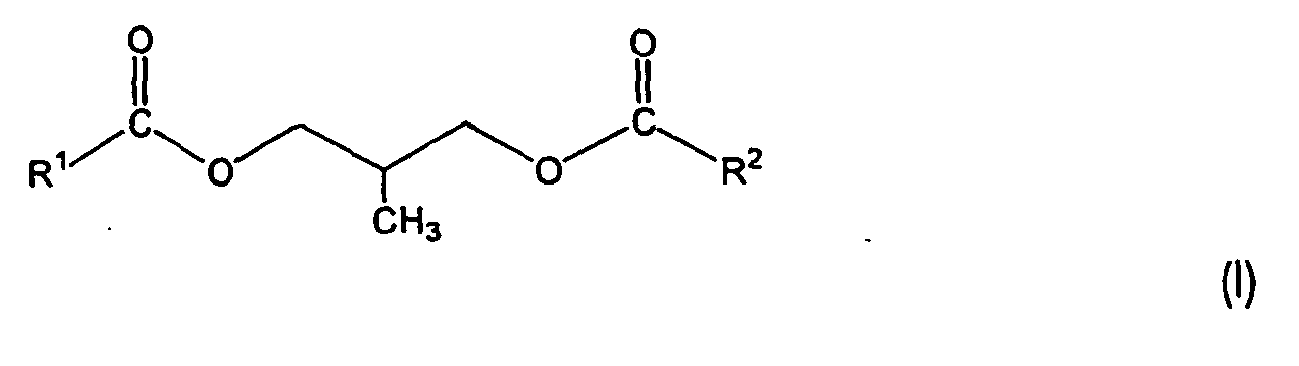
- Diester des 2-Methyl-1,3-Propandiols sind aus der
JP-A 59055853 - Überraschenderweise zeigte sich, dass die Verbindungsklasse eine Kombination aus polaren und lipophilen Eigenschaften aufweist, die sie besonders geeignet als Emollient für kosmetische Applikationen macht.
- Die Verbindungen können nach gängigen Veresterungsverfahren des Standes der Technik hergestellt werden, d. h. beispielsweise ohne Katalysator oder unter Säurekatalyse. Die Ausbeuten sind jedoch in diesem Fall nicht zufriedenstellend und oft entstehen unerwünschte Nebenprodukte, deren Abtrennung Schwierigkeiten bereitet. Geeigneter ist ein Veresterungsverfahren, bei dem Zinnkatalysatoren eingesetzt werden, in einem Verfahren zur Herstellung von 2-Methyl-1,3-Propandioldiestem gemäß Formel (I), in der R1 und R2 unabhängig voneinander für eine gesättigte oder ungesättigte, verzweigte oder unverzweigte C12-C24-Alkylgruppe oder einen aromatischen Rest stehen, wobei man:
- (a) 2-Methyl-1,3-Propandiol in Gegenwart eines Zinn-Katalysators mit einer Carbonsäure R1-COOH und/oder R2-COOH im Überschuss solange verestert, bis die Wasserbildung beendet ist
- (b) das Reaktionsprodukt über Tonsil abfiltriert und
- (c) den Diester durch fraktionierte Destillation reinigt.
- Als Zinn-Katalysatoren geeignet sind beispielsweise Zinnoxalat (z. B. Fascat® 2001), Zinnoxid (SnO, Fascat® 2000) sowie Zinn-IV-Katalysatoren wie Dibutylzinndiacetat Fascat® 4200), Dibutlyzinnoxid (Fascat® 4201), und Dibutylzinnlaurat (Fascat® 4202). Erfindungsgemäß bevorzugt geeignet ist Zinnoxid (SnO).
- Die erfindungsgemäßen Emollients erlauben die Herstellung stabiler kosmetischer und pharmazeutischer Emulsionen. Ein weiterer Gegenstand der vorliegenden Erfindung sind daher kosmetische und/oder pharmazeutische Zubereitungen, die wenigstens einen 2-Methyl-1,3-Propandioldiester enthalten gemäß Anspruch 4, vorzugsweise einen 2-Methyl-1,3-Propandiol-C12-C24-diester, bei dem R1 und R2 identisch sind. Vorzugsweise ist der 2-Methyl-1,3-Propandioldiester in einer Menge von 0,1 - 50 Gew.-% und insbesondere 0,1 bis 40 Gew.-% in den Zubereitungen enthalten. Besonders bevorzugt sind Einsatzmengen von 1- 30 Gew.-% und insbesondere 1 - 20 Gew.-%.
- Vorzugsweise handelt es sich hierbei um Formulierungen zur Körperpflege, z. B. Cremes, Milchen, Lotionen, sprühbare Emulsionen, Produkte zur Eliminierung des Körpergeruchs etc. Die erfindungsgemäßen Verbindungen lassen sich auch in tensidhaltigen Formulierungen wie z. B. Schaum- und Duschbädem, Haarshampoos und Pflegespülungen einsetzen. Je nach Applikationszweck enthalten die kosmetischen Formulierungen eine Reihe weiterer Hilfs- und Zusatzstoffe, wie beispielsweise Tenside, weitere Ölkörper, Emulgatoren, Perlglanzwachse, Konsistenzgeber, Verdickungsmittel, Überfettungsmittel, Stabilisatoren, Polymere, Siliconverbindungen, Fette, Wachse, Lecithine, Phospholipide, biogene Wirkstoffe, UV-Lichtschutzfaktoren, Antioxidantien, Deodorantien, Antitranspirantien, Antischuppenmittel, Filmbildner, Quellmittel, Insektenrepellentien, Selbstbräuner, Tyrosininhibitoren (Depigmentierungsmittel), Hydrotrope, Solubilisatoren, Konservierungsmittel, Parfümöle, Farbstoffe etc., die nachstehend exemplarisch aufgelistet sind.
- Als oberflächenaktive Stoffe können anionische, nichtionische, kationische und/oder amphotere bzw. zwitterionische Tenside enthalten sein. In tensidhaltigen kosmetischen Zubereitungen, wie beispielsweise Duschgelen, Schaumbädern, Shampoos etc. ist vorzugsweise wenigstens ein anionisches Tensid enthalten. Der Anteil der Tenside liegt hier üblicherweise bei etwa 0,1 bis 30, vorzugsweise 5 bis 25 und insbesondere 10 bis 20 Gew.-%.
- Typische Beispiele für anionische Tenside sind Seifen, Alkylbenzolsulfonate, Alkansulfonate, Olefinsulfonate, Alkylethersulfonate, Glycerinethersulfonate, α-Methylestersulfonate, Sulfofettsäuren, Alkylsulfate, Fettalkoholethersulfate, Glycerinethersulfate, Fettsäureethersulfate, Hydroxymischethersulfate, Monoglycerid(ether)sulfate, Fettsäureamid(ether)sulfate, Mono- und Dialkylsulfosuccinate, Mono- und Dialkylsulfosuccinamate, Sulfotriglyceride, Amidseifen, Ethercarbonsäuren und deren Salze, Fettsäureisethionate, Fettsäuresarcosinate, Fettsäuretauride, N-Acylaminosäuren, wie beispielsweise Acyllactylate, Acyltartrate, Acylglutamate und Acylaspartate, Alkyloligoglucosidsulfate, Proteinfettsäurekondensate (insbesondere pflanzliche Produkte auf Weizenbasis) und Alkyl(ether)phosphate. Sofern die anionischen Tenside Polyglycoletherketten enthalten, können diese eine konventionelle, vorzugsweise jedoch eine eingeengte Homologenverteilung aufweisen. Typische Beispiele für nichtionische Tenside sind Fettalkoholpolyglycolether, Alkylphenolpolyglycolether, Fettsäurepolyglycolester, Fettsäureamidpolyglycolether, Fettaminpolyglycolether, alkoxylierte Triglyceride, Mischether bzw. Mischformale, gegebenenfalls partiell oxidierte Alk(en)yloligoglykoside bzw. Glucoronsäurederivate, Fettsäure-N-alkylglucamide, Proteinhydrolysate (insbesondere pflanzliche Produkte auf Weizenbasis), Polyolfettsäureester, Zuckerester, Sorbitanester, Polysorbate und Aminoxide. Sofern die nichtionischen Tenside Polyglycoletherketten enthalten, können diese eine konventionelle, vorzugsweise jedoch eine eingeengte Homologenverteilung aufweisen. Typische Beispiele für kationische Tenside sind quartäre Ammoniumverbindungen, wie beispielsweise das Dimethyldistearylammoniumchlorid, und Esterquats, insbesondere quatemierte Fettsäuretrialkanolaminestersalze. Typische Beispiele für amphotere bzw. zwitterionische Tenside sind Alkylbetaine, Alkylamidobetaine, Aminopropionate, Aminoglycinate, lmidazoliniumbetaine und Sulfobetaine. Bei den genannten Tensiden handelt es sich ausschließlich um bekannte Verbindungen. Hinsichtlich Struktur und Herstellung dieser Stoffe sei auf einschlägige Übersichtsarbeiten auf diesem Gebiet verwiesen. Typische Beispiele für besonders geeignete milde, d. h. besonders hautverträgliche Tenside sind Fettalkoholpolyglycolethersulfate, Monoglyceridsulfate, Mono- und/oder Dialkylsulfosuccinate, Fettsäureisethionate, Fettsäuresarcosinate, Fettsäuretauride, Fettsäureglutamate, α-Olefinsulfonate, Ethercarbonsäuren, Alkyloligoglucoside, Fettsäureglucamide, Alkylamidobetaine, Amphoacetale und/oder Proteinfettsäurekondensate, letztere vorzugsweise auf Basis von Weizenproteinen.
- Körperpflegemittel, wie Cremes, Lotionen und Milchen, enthalten üblicherweise eine Reihe weiterer Ölkörper und Emollients, die dazu beitragen die sensorischen Eigenschaften weiter zu optimieren. Die Ölkörper sind üblicherweise in einer Gesamtmenge von 0,1 - 50 Gew.-%, vorzugsweise 5 - 25 Gew.-% und insbesondere 5 - 15 Gew.-% enthalten. Als Ölkörper kommen beispielsweise Guerbetalkohole auf Basis von Fettalkoholen mit 6 bis 18, vorzugsweise 8 bis 10 Kohlenstoffatomen, Ester von linearen C6-C22-Fettsäuren mit linearen oder verzweigten C6-C22-Fettalkoholen bzw. Ester von verzweigten C6-C13-Carbonsäuren mit linearen oder verzweigten C6-C22-Fettalkoholen, wie z. B. Myristylmyristat, Myristylpalmitat, Myristylstearat, Myristylisostearat, Myristyloleat, Myristylbehenat, Myristylerucat, Cetylmyristat, Cetylpalmitat, Cetylstearat, Cetylisostearat, Cetyloleat, Cetylbehenat, Cetylerucat, Stearylmyristat, Stearylpalmitat, Stearylstearat, Stearylisostearat, Stearyloleat, Stearylbehenat, Stearylerucat, Isostearylmyristat, Isostearylpalmitat, Isostearylstearat, Isostearylisostearat, Isostearyloleat, Isostearylbehenat, Isostearyloleat, Oleylmyristat, Oleylpalmitat, Oleylstearat, Oleylisostearat, Oleyloleat, Oleylbehenat, Oleylerucat, Behenylmyristat, Behenylpalmitat, Behenylstearat, Behenylisostearat, Behenyloleat, Behenylbehenat, Behenylerucat, Erucylmyristat, Erucylpalmitat, Erucylstearat, Erucylisostearat, Erucyloleat, Erucylbehenat und Erucylerucat. Daneben eignen sich Ester von linearen C6-C22-Fettsäuren mit verzweigten Alkoholen, insbesondere 2-Ethylhexanol, Ester von C18-C38-Alkylhydroxycarbonsäuren mit linearen oder verzweigten C6-C22-Fettalkoholen, insbesondere Dioctyl Malate, Ester von linearen und/oder verzweigten Fettsäuren mit mehrwertigen Alkoholen (wie z. B. Propylenglycol, Dimerdiol oder Trimertriol) und/oder Guerbetalkoholen, Triglyceride auf Basis C6-C10-Fettsäuren, flüssige Mono-/Di-/Triglyceridmischungen auf Basis von C6-C18-Fettsäuren, Ester von C6-C22-Fettalkoholen und/oder Guerbetalkoholen mit aromatischen Carbonsäuren, insbesondere Benzoesäure, Ester von C2-C12-Dicarbonsäuren mit linearen oder verzweigten Alkoholen mit 1 bis 22 Kohlenstoffatomen oder Polyolen mit 2 bis 10 Kohlenstoffatomen und 2 bis 6 Hydroxylgruppen, pflanzliche Öle, verzweigte primäre Alkohole, substituierte Cyclohexane, lineare und verzweigte C6-C22-Fettalkoholcarbonate, wie z. B. Dicaprylyl Carbonate (Cetiol® CC), Guerbetcarbonate auf Basis von Fettalkoholen mit 6 bis 18, vorzugsweise 8 bis 10 C Atomen, Ester der Benzoesäure mit linearen und/oder verzweigten C6-C22-Alkoholen (z. B. Finsolv® TN), lineare oder verzweigte, symmetrische oder unsymmetrische Dialkylether mit 6 bis 22 Kohlenstoffatomen pro Alkylgruppe, wie z. B. Dicaprylyl Ether (Cetiol® OE), Ringöffnungsprodukte von epoxidierten Fettsäureestern mit Polyolen, Siliconöle (Cyclomethicone, Siliciummethicontypen u. a.) und/oder aliphatische bzw. naphthenische Kohlenwasserstoffe, wie z. B. wie Squalan, Squalen oder Dialkylcyclohexane in Betracht.
- Als Emulgatoren kommen beispielsweise nichtionogene Tenside aus mindestens einer der folgenden Gruppen in Frage:
- ➢ Anlagerungsprodukte von 2 bis 30 Mol Ethylenoxid und/ oder 0 bis 5 Mol Propylenoxid an lineare Fettalkohole mit 8 bis 22 C-Atomen, an Fettsäuren mit 12 bis 22 C-Atomen, an Alkylphenole mit 8 bis 15 C-Atomen in der Alkylgruppe sowie Alkylamine mit 8 bis 22 Kohlenstoffatomen im Alkylrest
- ➢ Alkyloligoglykoside mit 8 bis 22 Kohlenstoffatomen im Alkylrest und deren ethoxylierte Analoga
- ➢ Anlagerungsprodukte von 1 bis 15 Mol Ethylenoxid an Ricinusöl und/oder gehärtetes Ricinusöl
- ➢ Anlagerungsprodukte von 15 bis 60 Mol Ethylenoxid an Ricinusöl und/oder gehärtetes Ricinusöl
- ➢ Partialester von Glycerin und/oder Sorbitan mit ungesättigten, linearen oder gesättigten, verzweigten Fettsäuren mit 12 bis 22 Kohlenstoffatomen und/oder Hydroxycarbonsäuren mit 3 bis 18 Kohlenstoffatomen sowie deren Addukte mit 1 bis 30 Mol Ethylenoxid
- ➢ Rartialester-von Polyglycerin (durchschnittlicher Eigenkondensationsgrad 2 bis 8), Polyethylenglycol (Molekulargewicht 400 bis 5000), Trimethylolpropan, Pentaerythrit, Zuckeralkoholen (z. B. Sorbit), Alkylglucosiden (z. B. Methylglucosid, Butylglucosid, Laurylglucosid) sowie Polyglucosiden (z. B. Cellulose) mit gesättigten und/oder ungesättigten, linearen oder verzweigten Fettsäuren mit 12 bis 22 Kohlenstoffatomen und/oder Hydroxycarbonsäuren mit 3 bis 18 Kohlenstoffatomen sowie deren Addukte mit 1 bis 30 Mol Ethylenoxid
- ➢ Mischester aus Pentaerythrit, Fettsäuren, Citronensäure und Fettalkohol und/oder Mischester von Fettsäuren mit 6 bis 22 Kohlenstoffatomen, Methylglucose und Polyolen, vorzugsweise Glycerin oder Polyglycerin.
- ➢ Mono-, Di- und Trialkylphosphate sowie Mono-, Di- und/oder Tri-PEG-alkylphosphate und deren Salze
- ➢ Wollwachsalkohole
- ➢ Polysiloxan-Polyalkyl-Polyether-Copolymere bzw. entsprechende Derivate
- ➢ Block-Copolymere z. B. Polyethylenglycol-30 Dipolyhydroxystearate
- ➢ Polymeremulgatoren, z. B. Pemulen-Typen (TR-1 ,TR-2) von Goodrich
- ➢ Polyalkylenglycole sowie
- ➢ Glycerincarbonat.
- Die Anlagerungsprodukte von Ethylenoxid und/oder von Propylenoxid an Fettalkohole, Fettsäuren, Alkylphenole oder an Ricinusöl stellen bekannte, im Handel erhältliche Produkte dar. Es handelt sich dabei um Homologengemische, deren mittlerer Alkoxylierungsgrad dem Verhältnis der Stoffmengen von Ethylenoxid und/ oder Propylenoxid und Substrat, mit denen die Anlagerungsreaktion durchgeführt wird, entspricht. C12/18-Fettsäuremono- und -diester von Anlagerungsprodukten von Ethylenoxid an Glycerin sind als Rückfettungsmittel für kosmetische Zubereitungen bekannt.
- Als Sorbitanester kommen Sorbitanmonoisostearat, Sorbitansesquiisostearat, Sorbitandiisostearat, Sorbitantriisostearat, Sorbitanmonooleat, Sorbitansesquioleat, Sorbitan-dioleat, Sorbitantrioleat, Sorbitanmonoerucat, Sorbitansesquierucat, Sorbitandierucat, Sorbitantrierucat, Sorbitanmonoricinoleat, Sorbitansesquiricinoleat, Sorbitandiricinoleat, Sorbitantriricinoleat, Sorbitanmonohydroxystearat, Sorbitansesquihydroxystearat, Sorbitandihydroxystearat, Sorbitantrihydroxystearat, Sorbitanmonotartrat, Sorbitansesquitartrat, Sorbitanditartrat, Sorbitantritartrat, Sorbitanmonocitrat, Sorbitansesquicitrat, Sorbitandicitrat, Sorbitantricitrat, Sorbitanmonomaleat, Sorbitansesquimaleat, Sorbitan-dimaleat, Sorbitantrimaleat sowie deren technische Gemische. Ebenfalls geeignet sind Anlagerungsprodukte von 1 bis 30, vorzugsweise 5 bis 10 Mol Ethylenoxid an die genannten Sorbitanester.
- Typische Beispiele für geeignete Polyglycerinester sind Polyglyceryl-2 Dipolyhydroxystearate (Dehymuls® PGPH), Polyglycerin-3-Diisostearate (Lameform® TGI), Polyglyceryl-4 Isostearate (Isolan® GI 34), Polyglyceryl-3 Oleate, Diisostearoyl Polyglyceryl-3 Diisostearate (Isolan® PDI), Polyglyceryl-3 Methylglucose Distearate (Tego Care® 450), Polyglyceryl-3 Beeswax (Cera Bellina®), Polyglyceryl-4 Caprate (Polyglycerol Caprate T2010/90), Polyglyceryl-3 Cetyl Ether (Chimexane® NL), Polyglyceryl-3 Distearate (Cremophor® GS 32) und Polyglyceryl Polyvricinoleate (Admul® WOL 1403) Polyglyceryl Dimerate Isostearate sowie deren Gemische. Beispiele für weitere geeignete Polyolester sind die gegebenenfalls mit 1 bis 30 Mol Ethylenoxid umgesetzten Mono-, Di- und Triester von Trimethylolpropan oder Pentaerythrit mit Laurinsäure, Kokosfettsäure, Talgfettsäure, Palmitinsäure, Stearinsäure, Ölsäure, Behensäure und dergleichen.
- Typische anionische Emulgatoren sind aliphatische Fettsäuren mit 12 bis 22 Kohlenstoffatomen, wie beispielsweise Palmitinsäure, Stearinsäure oder Behensäure, sowie Dicarbonsäuren mit 12 bis 22 Kohlenstoffatomen, wie beispielsweise Azelainsäure oder Sebacinsäure.
- Weiterhin konnen als Emulgatoren zwitterionische Tenside verwendet werden. Als zwitterionische Tenside werden solche oberflächenaktiven Verbindungen bezeichnet, die im Molekül mindestens eine quartäre Ammoniumgruppe und mindestens eine Carboxylat- und eine Sulfonatgruppe tragen. Besonders geeignete zwitterionische Tenside sind die sogenannten Betaine wie die N-Alkyl-N,N-dimethylammoniumglycinate, beispielsweise das Kokosalkyldimethylammoniumglycinat, N-Acylaminopropyl-N,N-dimethylammonium-glycinate, beispielsweise das Kokosacylaminopropyldimethyl-ammoniumglycinat, und 2-Alkyl-3-carboxylmethyl-3-hydroxyethylimidazoline mit jeweils 8 bis 18 C-Atomen in der Alkyl- oder Acylgruppe sowie das Kokosacylaminoethylhydroxyethylcarboxymethylglycinat. Besonders bevorzugt ist das unter der CTFA-Bezeichnung Cocamidopropyl Betaine bekannte Fettsäureamid-Derivat. Ebenfalls geeignete Emulgatoren sind ampholytische Tenside. Unter ampholytischen Tensiden werden solche oberflächenaktiven Verbindungen verstanden, die außer einer C8/18-Alkyl- oder Acylgruppe im Molekül mindestens eine freie Aminogruppe und mindestens eine -COOH- oder -SO3H-Gruppe enthalten und zur Ausbildung innerer Salze befähigt sind. Beispiele für geeignete ampholytische Tenside sind N-Alkylglycine, N-Alkylpropion-säuren, N-Alkylaminobuttersäuren, N-Alkyliminodipropionsäuren, N-Hydroxyethyl-N-alkylamidopropylglycine, N-Alkyltaurine, N-Alkylsarcosine, 2-Alkylaminopropionsäuren und Alkylaminoessigsäuren mit jeweils etwa 8 bis 18 C-Atomen in der Alkylgruppe. Besonders bevorzugte ampholytische Tenside sind das N-Kokosalkylaminopropionat, das Kokosacylaminoethylaminopropionat und das C12/18-Acylsarcosin. Schließlich kommen auch Kationtenside als Emulgatoren in Betracht, wobei solche vom Typ der Esterquats, vorzugsweise methylquatemierte Difettsäuretriethanolaminester-Salze, besonders bevorzugt sind.
- Bevorzugt im Sinne der Erfindung sind kosmetische und/oder pharmazeutische Zubereitungen, die
- (a) 0,1 - 50 Gew.-% wenigstens eines 2-Methyl-1,3-Propandioldiesters gemäß Anspruch 1
- (b) 0,1 - 20 Gew.-% Tenside und/oder Emulgatoren und/oder Coemulgatoren
- (c) 0,1 - 40 Gew.-% weiterer Ölkörper und
- (d) 0 - 98 Gew.-% Wasser
- Fette und Wachse werden den Körperpflegeprodukten als Pflegestoffe zugesetzt und auch, um die Konsistenz der Kosmetika zu erhöhen. Typische Beispiele für Fette sind Glyceride, d. h. feste oder flüssige pflanzliche oder tierische Produkte, die im wesentlichen aus gemischten Glycerinestern höherer Fettsäuren bestehen. Auch Fettsäurepartialglyceride, d. h. technische Mono- und/oder Diester des Glycerins mit Fettsäuren mit 12 bis 18 Kohlenstoffatomen wie etwa Glycerinmonoldilaurat, -palmitat oder -stearat kommen hierfür in Frage. Als Wachse kommen u. a. natürlichen Wachse, wie z. B. Candelillawachs, Carnaubawachs, Japanwachs, Espartograswachs, Korkwachs, Guarumawachs, Reiskeimölwachs, Zuckerrohrwachs, Ouricurywachs, Montanwachs, Bienenwachs, Schellackwachs, Walrat, Lanolin (Wollwachs), Bürzelfett, Ceresin, Ozokerit (Erdwachs), Petrolatum, Paraffinwachse, Mikrowachse; chemisch modifizierte Wachse (Hartwachse), wie z. B. Montanesterwachse, Sasolwachse, hydrierte Jojobawachse sowie synthetische Wachse, wie z. B. Polyalkylenwachse und Polyethylenglycolwachse in Frage. Neben den Fetten kommen als Zusatzstoffe auch fettähnliche Substanzen, wie Lecithine und Phospholipide in Frage. Unter der Bezeichnung Lecithine versteht der Fachmann diejenigen Glycero-Phospholipide, die sich aus Fettsäuren, Glycerin, Phosphorsäure und Cholin durch Veresterung bilden. Lecithine werden in der Fachwelt daher auch häufig als Phosphatidylcholine (PC). Als Beispiele für natürliche Lecithine seien die Kephaline genannt, die auch als Phosphatidsäuren bezeichnet werden und Derivate der 1,2-Diacyl-sn-glycerin-3-phosphorsäuren darstellen. Dem gegenüber versteht man unter Phospholipiden gewöhnlich Mono- und vorzugsweise Diester der Phosphorsäure mit Glycerin (Glycerinphosphate), die allgemein zu den Fetten gerechnet werden. Daneben kommen auch Sphingosine bzw. Sphingolipide in Frage.
- Als Perlglanzwachse kommen beispielsweise in Frage: Alkylenglycolester, speziell Ethylenglycoldistearat; Fettsäurealkanolamide, speziell Kokosfettsäurediethanolamid; Partialglyceride, speziell Stearinsäuremonoglycerid; Ester von mehrwertigen, gegebenenfalls hydroxy-substituierte Carbonsäuren mit Fettalkoholen mit 6 bis 22 Kohlenstoffatomen, speziell langkettige Ester der Weinsäure; Fettstoffe, wie beispielsweise Fettalkohole, Fettketone, Fettaldehyde, Fettether und Fettcarbonate, die in Summe mindestens 24 Kohlenstoffatome aufweisen, speziell Lauron und Distearylether; Fettsäuren wie Stearinsäure, Hydroxystearinsäure oder Behensäure, Ringöffnungsprodukte von Olefinepoxiden mit 12 bis 22 Kohlenstoffatomen mit Fettalkoholen mit 12 bis 22 Kohlenstoffatomen und/oder Polyolen mit 2 bis 15 Kohlenstoffatomen und 2 bis 10 Hydroxylgruppen sowie deren Mischungen.
- Als weitere Konsistenzgeber kommen in erster Linie Fettalkohole oder Hydroxyfettalkohole mit 12 bis 22 und vorzugsweise 16 bis 18 Kohlenstoffatomen und daneben Partialglyceride, Fettsäuren oder Hydroxyfettsäuren in Betracht. Bevorzugt ist eine Kombination dieser Stoffe mit Alkyloligoglucosiden und/oder Fettsäure-N-methylglucamiden gleicher Kettenlänge und/oder Polyglycerinpoly-12-hydroxystearaten. Geeignete Verdickungsmittel sind beispielsweise Aerosil-Typen (hydrophile Kieselsäuren), Polysaccharide, insbesondere Xanthan-Gum, Guar-Guar, Agar-Agar, Alginate und Tylosen, Carboxymethylcellulose und Hydroxyethyl- und Hydroxypropylcellulose, ferner höhermolekulare Polyethylenglycolmono- und -diester von Fettsäuren, Polyacrylate, (z. B. Carbopole® und Pemulen-Typen von Goodrich; Synthalene® von Sigma; Keltrol-Typen von Kelco; Sepigel-Typen von Seppic; Salcare-Typen von Allied Colloids), Polyacrylamide, Polymere, Polyvinylalkohol und Polyvinylpyrrolidon.
- Als besonders wirkungsvoll haben sich auch Bentonite, wie z. B. Bentone® Gel VS-5PC (Rheox) erwiesen, bei dem es sich um eine Mischung aus Cyclopentasiloxan, Disteardimonium Hectorit und Propylencarbonat handelt. Weiter in Frage kommen Tenside, wie beispielsweise ethoxylierte Fettsäureglyceride, Ester von Fettsäuren mit Polyolen wie beispielsweise Pentaerythrit oder Trimethylolpropan, Fettalkoholethoxylate mit eingeengter Homologenverteilung oder Alkyloligoglucoside sowie Elektrolyte wie Kochsalz und Ammoniumchlorid.
- Als Überfettungsmittel können Substanzen wie beispielsweise Lanolin und Lecithin sowie polyethoxylierte oder acylierte Lanolin- und Lecithinderivate, Polyolfettsäureester, Monoglyceride und Fettsäurealkanolamide verwendet werden, wobei die letzteren gleichzeitig als Schaumstabilisatoren dienen.
- Als Stabilisatoren können Metallsalze von Fettsäuren, wie z. B. Magnesium-, Aluminium- und/oder Zinkstearat bzw. -ricinoleat eingesetzt werden.
- Geeignete kationische Polymere sind beispielsweise kationische Cellulosederivate, wie z. B. eine quaternierte Hydroxyethylcellulose, die unter der Bezeichnung Polymer JR 400® von Amerchol erhältlich ist, kationische Stärke, Copolymere von Diallylammoniumsalzen und Acrylamiden, quatemierte Vinylpyrrolidon/Vinylimidazol-Polymere, wie z. B. Luviquat® (BASF), Kondensationsprodukte von Polyglycolen und Aminen, quaternierte Kollagenpolypeptide, wie beispielsweise Lauryldimonium Hydroxypropyl Hydrolyzed Collagen (Lamequat®L/Grünau), quatemierte Weizenpolypeptide, Polyethylenimin, kationische Siliconpolymere, wie z. B. Amodimethicone, Copolymere der Adipinsäure und Dimethylaminohydroxypropyldiethylentriamin (Cartaretine®/Sandoz), Copolymere der Acrylsäure mit Dimethyl-diallylammoniumchlorid (Merquat® 550/Chemviron), Polyaminopolyamide sowie deren vernetzte wasserlöslichen Polymere, kationische Chitinderivate wie beispielsweise quatemiertes Chitosan, gegebenenfalls mikrokristallin verteilt, Kondensationsprodukte aus Dihalogenalkylen, wie z. B. Dibrombutan mit Bisdialkylaminen, wie z. B. Bis-Dimethylamino-1,3-propan, kationischer Guar-Gum, wie z. B. Jaguar® CBS, Jaguar® C-17, Jaguar® C-16 der Firma Celanese, quatemierte Ammoniumsalz-Polymere, wie z. B. Mirapol® A-15, Mirapol® AD-1, Mirapol® AZ-1 der Firma Miranol.
- Als anionische, zwitterionische, amphotere und nichtionische Polymere kommen beispielsweise Vinylacetat/Crotonsäure-Copolymere, VinylpyrrolidonNinylacrylat-Copolymere, Vinylacetat/Butylmaleat/Isobornylacrylat-Copolymere, Methylvinylether/Maleinsäureanhydrid-Copolymere und deren Ester, unvernetzte und mit Polyolen vernetzte Polyacrylsäuren, Acrylamidopropyltrimethylammoniumchlorid/Acrylat-Copolymere, Octylacrylamid/Methylmethacrylat/tert.-Butylaminoethylmethacrylat/2-Hydroxypropvlmethacrylat-Copolymere, Polyvinylpyrrolidon, Vinylpyrrolidon/Vinylacetat-Copolymere, Vinylpyrrolidon/ Dimethylaminoethylmethacrylat/Vinylcaprolactam-Terpolymere sowie gegebenenfalls derivatisierte Celluloseether und Silicone in Frage.
- Geeignete Siliconverbindungen sind beispielsweise Dimethylpolysiloxane, Methylphenylpolysiloxane, cyclische Silicone sowie amino-, fettsäure-, alkohol-, polyether-, epoxy-, fluor-, glykosid- und/oder alkylmodifizierte Siliconverbindungen, die bei Raumtemperatur sowohl flüssig als auch harzförmig vorliegen können. Weiterhin geeignet sind Simethicone, bei denen es sich um Mischungen aus Dimethiconen mit einer durchschnittlichen Kettenlänge von 200 bis 300 Dimethylsiloxan-Einheiten und hydrierten Silicaten handelt.
- Unter UV-Lichtschutzfaktoren sind beispielsweise bei Raumtemperatur flüssig oder kristallin vorliegende organische Substanzen (Lichtschutzfilter) zu verstehen, die in der Lage sind, ultraviolette Strahlen zu absorbieren und die aufgenommene Energie in Form längerwelliger Strahlung, z. B. Wärme wieder abzugeben. UVB-Filter können öllöslich oder wasserlöslich sein. Als öllösliche Substanzen sind z. B. zu nennen:
- ➢ 3-Benzylidencampher bzw. 3-Benzylidennorcampher und dessen Derivate, z. B. 3-(4-Methylbenzyliden)campher wie in der
EP 0693471 B1 beschrieben - ➢ 4-Aminobenzoesäurederivate, vorzugsweise 4-(Dimethylamino)benzoesäure-2-ethyl-hexylester, 4-(Dimethylamino)benzoesäure-2-octylester und 4-(Dimethylamino)benzoe-säureamylester
- ➢ Ester der Zimtsäure, vorzugsweise 4-Methoxyzimtsäure-2-ethylhexylester, 4-Methoxyzimtsäurepropylester, 4-Methoxyzimtsäureisoamylester 2-Cyano-3,3-phenylzimtsäure-2-ethylhexylester (Octocrylene)
- ➢ Ester der Salicylsäure, vorzugsweise Salicylsäure-2-ethylhexylester, Salicylsäure-4-iso-propylbenzylester, Salicylsäurehomomenthylester
- ➢ Derivate des Benzophenons, vorzugsweise 2-Hydroxy-4-methoxybenzophenon, 2-Hydroxy-4-methoxy-4'-methylbenzophenon, 2,2'-Dihydroxy-4-methoxybenzophenon
- ➢ Ester der Benzalmalonsäure, vorzugsweise 4-Methoxybenzmalonsäuredi-2-ethylhexyl-ester
- ➢ Triazinderivate, wie z. B. 2,4,6-Trianilino-(p-carbo-2'-ethyl-1'-hexyloxy)-1,3,5-triazin und Octyl Triazon, wie in der
EP 0818450 A1 beschrieben oder Dioctyl Butamido Triazone (Uvasorb® HEB) - ➢ Propan-1,3-dione, wie z. B. 1-(4-tert.Butylphenyl)-3-(4'methoxyphenyl)propan-1,3-dion
- ➢ Ketotricyclo(5.2.1.0)decan-Derivate, wie in der
EP 0694521 B1 beschrieben. - Als wasserlösliche Substanzen kommen in Frage:
- ➢ 2-Phenylbenzimidazol-5-sulfonsäure und deren Alkali-, Erdalkali-, Ammonium-, Alkylammonium-, Alkanolammonium- und Glucammoniumsalze
- ➢ Sulfonsäurederivate von Benzophenonen, vorzugsweise 2-Hydroxy-4-methoxybenzo-phenon-5-sulfonsäure und ihre Salze
- ➢ Sulfonsäurederivate des 3-Benzylidencamphers, wie z. B. 4-(2-Oxo-3-bomylidenmethyl) benzolsulfonsäure und 2-Methyl-5-(2-oxo-3-bomyliden)sulfonsäure und deren Salze.
- Als typische UV-A-Filter kommen insbesondere Derivate des Benzoylmethans in Frage, wie beispielsweise 1-(4'-tert.Butylphenyl)-3-(4'-methoxyphenyl)propan-1,3-dion, 4-tert.-Butyl-4'-methoxydibenzoylmethan (Parsol® 1789), 1-Phenyl-3-(4'-isopropylphenyl)-propan-1,3-dion sowie Enaminverbindungen, wie beschrieben in der
DE 19712033 A1 (BASF). Die UV-A und UV-B-Filter können selbstverständlich auch in Mischungen eingesetzt werden. Besonders günstige Kombinationen bestehen aus den Derivate des Benzoylmethans,, z. B. 4-tert.-Butyl-4'-methoxydibenzoylmethan (Parsol® 1789) und 2-Cyano-3,3-phenylzimtsäure-2-ethyl-hexylester (Octocrylene) in Kombination mit Ester der Zimtsäure, vorzugsweise 4-Methoxyzimtsäure-2-ethylhexylester und/oder 4-Methoxyzimtsäurepropylester und/oder 4-Methoxyzimtsäureisoamylester. Vorteilhaft werden deartige Kombinationen mit wasserlöslichen Filtern wie z. B. 2-Phenylbenzimidazol-5-sulfonsäure und deren Alkali-, Erdalkali-, Ammonium-, Alkylammonium-, Alkanolammonium- und Glucammoniumsalze kombiniert. - Neben den genannten löslichen Stoffen kommen für diesen Zweck auch unlösliche Lichtschutzpigmente, nämlich feindisperse Metalloxide bzw. Salze in Frage. Beispiele für geeignete Metalloxide sind insbesondere Zinkoxid und Titandioxid und daneben Oxide des Eisens, Zirkoniums, Siliciums, Mangans, Aluminiums und Cers sowie deren Gemische. Als Salze können Silicate (Talk), Bariumsulfat oder Zinkstearat eingesetzt werden. Die Oxide und Salze werden in Form der Pigmente für hautpflegende und hautschützende Emulsionen und dekorative Kosmetik verwendet. Die Partikel sollten dabei einen mittleren Durchmesser von weniger als 100 nm, vorzugsweise zwischen 5 und 50 nm und insbesondere zwischen 15 und 30 nm aufweisen. Sie können eine sphärische Form aufweisen, es können jedoch auch solche Partikel zum Einsatz kommen, die eine ellipsoide oder in sonstiger Weise von der sphärischen Gestalt abweichende Form besitzen. Die Pigmente können auch oberflächenbehandelt, d. h. hydrophilisiert oder hydrophobiert vorliegen. Typische Beispiele sind gecoatete Titandioxide, wie z. B. Titandioxid T 805 (Degussa) oder Eusolex® T2000 (Merck). Als hydrophobe Coatingmittel kommen dabei vor allem Silicone und dabei speziell Trialkoxyoctylsilane oder Simethicone in Frage. In Sonnenschutzmitteln werden bevorzugt sogenannte Mikro- oder Nanopigmente eingesetzt. Vorzugsweise wird mikronisiertes Zinkoxid verwendet.
- Neben den beiden vorgenannten Gruppen primärer Lichtschutzstoffe können auch sekundäre Lichtschutzmittel vom Typ der Antioxidantien eingesetzt werden, die die photochemische Reaktionskette unterbrechen, welche ausgelöst wird, wenn UV-Strahlung in die Haut eindringt. Typische Beispiele hierfür sind Aminosäuren (z. B. Glycin, Histidin, Tyrosin, Tryptophan) und deren Derivate, Imidazole (z. B. Urocaninsäure) und deren Derivate, Peptide wie D,L-Carnosin, D-Carnosin, L-Camosin und deren Derivate (z. B. Anserin), Carotinoide, Carotine (z. B. α-Carotin, β-Carotin, Lycopin) und deren Derivate, Chlorogensäure und deren Derivate, Liponsäure und deren Derivate (z. B. Dihydroliponsäure), Aurothioglucose, Propylthiouracil und andere Thiole (z. B. Thioredoxin, Glutathion, Cystein, Cystin, Cystamin und deren Glycosyl-, N-Acetyl-, Methyl-, Ethyl-, Propyl-, Amyl-, Butyl- und Lauryl-, Palmitoyl-, Oleyl- γ-Linoleyl-, Cholesteryl- und Glycerylester) sowie deren Salze, Dilaurylthiodipropionat, Distearylthiodipropionat, Thiodipropionsäure und deren Derivate (Ester, Ether, Peptide, Lipide, Nukleotide, Nukleoside und Salze) sowie Sulfoximinverbindungen (z. B. Buthioninsulfoximine, Homocysteinsulfoximin, Butioninsulfone, Penta-, Hexa-, Heptathioninsulfoximin) in sehr geringen verträglichen Dosierungen (z. B. pmol bis µmol/kg), ferner (Metall)-Chelatoren (z. B. α-Hydroxyfettsäuren, Palmitinsäure, Phytinsäure, Lactoferrin), α-Hydroxysäuren (z. B. Citronensäure, Milchsäure, Äpfelsäure), Huminsäure, Gallensäure, Gallenextrakte, Bilirubin, Biliverdin, EDTA, EGTA und deren Derivate, ungesättigte Fettsäuren und deren Derivate (z. B. γ-Linolensäure, Linolsäure, Ölsäure), Folsäure und deren Derivate, Ubichinon und Ubichinol und deren Derivate, Vitamin C und Derivate (z. B. Ascorbylpalmitat, Mg-Ascorbylphosphat, Ascorbylacetat), Tocopherole und Derivate (z. B. Vitamin-E-acetat), Vitamin A und Derivate (Vitamin-A-palmitat) sowie Koniferylbenzoat des Benzoeharzes, Rutinsäure und deren Derivate, α-Glycosylrutin, Ferulasäure, Furfurylidenglucitol, Carnosin, Butylhydroxytoluol, Butylhydroxyanisol, Nordihydroguajakharzsäure, Nordihydroguajaretsäure, Trihydroxybutyrophenon, Harnsäure und deren Derivate, Mannose und deren Derivate, Superoxid-Dismutase, Zink und dessen Derivate (z. B. ZnO, ZnSO4) Selen und dessen Derivate (z. B. Selen-Methionin), Stilbene und deren Derivate (z. B. Stilbenoxid, trans-Stilbenoxid) und die erfindungsgemäß geeigneten Derivate (Salze, Ester, Ether, Zucker, Nukleotide, Nukleoside, Peptide und Lipide) dieser genannten Wirkstoffe.
- Unter biogenen Wirkstoffen sind beispielsweise Tocopherol, Tocopherolacetat, Tocopherolpalmitat, Ascorbinsäure, (Desoxy)Ribonucleinsäure und deren Fragmentierungsprodukte, β-Glucane, Retinol, Bisabolol, Allantoin, Phytantriol, Panthenol, AHA-Säuren, Aminosäuren, Ceramide, Pseudoceramide, essentielle Öle, Pflanzenextrakte, wie z. B. Prunusextrakt, Bambaranussextrakt und Vitaminkomplexe zu verstehen.
- Kosmetische Deodorantien (Desodorantien) wirken Körpergerüchen entgegen, überdecken oder beseitigen sie. Körpergerüche entstehen durch die Einwirkung von Hautbakterien auf apokrinen Schweiß, wobei unangenehm riechende Abbauprodukte gebildet werden. Dementsprechend enthalten Deodorantien Wirkstoffe, die als keimhemmende Mittel, Enzyminhibitoren, Geruchsabsorber oder Geruchsüberdecker fungieren.
- Als keimhemmende Mittel sind grundsätzlich alle gegen grampositive Bakterien wirksamen Stoffe geeignet, wie z. B. 4-Hydroxybenzoesäure und ihre Salze und Ester, N-(4-Chlorphenyl)-N'-(3,4-dichlorphenyl)hamstoff, 2,4,4'-Trichlor-2'-hydroxy-diphenylether (Triclosan), 4-Chlor-3,5-dimethylphenol, 2,2'-Methylen-bis(6-brom-4-chlorphenol), 3-Methyl-4-(1-methylethyl)-phenol, 2-Benzyl-4-chlorphenol, 3-(4-Chlorphenoxy)-1,2-propandiol, 3-lod-2-propinylbutylcarbamat, Chlorhexidin, 3,4,4'-Trichlorcarbanilid (TTC), antibakterielle Riechstoffe, Thymol, Thymianöl, Eugenol, Nelkenöl, Menthol, Minzöl, Famesol, Phenoxyethanol, Glycerinmonocaprinat, Glycerinmonocaprylat, Glycerinmonolaurat (GML), Diglycerinmonocaprinat (DMC), Salicylsäure-N-alkylamide wie z. B. Salicylsäure-n-octylamid oder Salicylsäure-n-decylamid.
- Als Enzyminhibitoren sind beispielsweise Esteraseinhibitoren geeignet. Hierbei handelt es sich vorzugsweise um Trialkylcitrate wie Trimethylcitrat, Tripropylcitrat, Triisopropylcitrat, Tributylcitrat und insbesondere Triethylcitrat (Hydagen® CAT). Die Stoffe inhibieren die Enzymaktivität und reduzieren dadurch die Geruchsbildung. Weitere Stoffe, die als Esteraseinhibitoren in Betracht kommen, sind Sterolsulfate oder -phosphate, wie beispielsweise Lanosterin-, Cholesterin-, Campesterin-, Stigmasterin- und Sitosterinsulfat bzw -phosphat, Dicarbonsäuren und deren Ester, wie beispielsweise Glutarsäure, Glutarsäuremonoethylester, Glutarsäurediethylester, Adipinsäure, Adipinsäuremonoethylester, Adipinsäurediethylester, Malonsäure und Malonsäurediethylester, Hydroxycarbonsäuren und deren Ester wie beispielsweise Citronensäure, Äpfelsäure, Weinsäure oder Weinsäurediethylester, sowie Zinkglycinat.
- Als Geruchsabsorber eignen sich Stoffe, die geruchsbildende Verbindungen aufnehmen und weitgehend festhalten können. Sie senken den Partialdruck der einzelnen Komponenten und verringern so auch ihre Ausbreitungsgeschwindigkeit. Wichtig ist, dass dabei Parfums unbeeinträchtigt bleiben müssen. Geruchsabsorber haben keine Wirksamkeit gegen Bakterien. Sie enthalten beispielsweise als Hauptbestandteil ein komplexes Zinksalz der Ricinolsäure oder spezielle, weitgehend geruchsneutrale Duftstoffe, die dem Fachmann als "Fixateure" bekannt sind, wie z. B. Extrakte von Labdanum bzw. Styrax oder bestimmte Abietinsäurederivate. Als Geruchsüberdecker fungieren Riechstoffe oder Parfümöle, die zusätzlich zu ihrer Funktion als Geruchsüberdecker den Deodorantien ihre jeweilige Duftnote verleihen. Als Parfümöle seien beispielsweise genannt Gemische aus natürlichen und synthetischen Riechstoffen. Natürliche Riechstoffe sind Extrakte von Blüten, Stengeln und Blättern, Früchten, Fruchtschalen, Wurzeln, Hölzern, Kräutern und Gräsern, Nadeln und Zweigen sowie Harzen und Balsamen. Weiterhin kommen tierische Rohstoffe in Frage, wie beispielsweise Zibet und Castoreum. Typische synthetische Riechstoffverbindungen sind Produkte vom Typ der Ester, Ether, Aldehyde, Ketone, Alkohole und Kohlenwasserstoffe. Riechstoffverbindungen vom Typ der Ester sind z. B. Benzylacetat, p-tert.-Butylcyclohexylacetat, Linalylacetat, Phenylethylacetat, Linalylbenzoat, Benzylformiat, Allylcyclohexylpropionat, Styrallylpropionat und Benzylsalicylat. Zu den Ethern zählen beispielsweise Benzylethylether, zu den Aldehyden z. B. die linearen Alkanale mit 8 bis 18 Kohlenstoffatomen, Citral, Citronellal, Citronellyloxyacetaldehyd, Cyclamenaldehyd, Hydroxycitronellal, Lilial und Bourgeonal, zu den Ketonen z. B. die Jonone und Methylcedrylketon, zu den Alkoholen Anethol, Citronellol, Eugenol, Isoeugenol, Geraniol, Linalool, Phenylethylalkohol und Terpineol, zu den Kohlenwasserstoffen gehören hauptsächlich die Terpene und Balsame. Bevorzugt werden jedoch Mischungen verschiedener Riechstoffe verwendet, die gemeinsam eine ansprechende Duftnote erzeugen. Auch ätherische Öle geringerer Flüchtigkeit, die meist als Aromakomponenten verwendet werden, eignen sich als Parfümöle, z. B. Salbeiöl, Kamillenöl, Nelkenöl, Melissenöl, Minzenöl, Zimtblätteröl, Lindenblütenöl, Wacholderbeerenöl, Vetiveröl, Olibanöl, Galbanumöl, Labdanumöl und Lavandinöl. Vorzugsweise werden Bergamotteöl, Dihydromyrcenol, Lilial, Lyral, Citronellol, Phenylethylalkohol, α-Hexylzimtaldehyd, Geraniol, Benzylaceton, Cyclamenaldehyd, Linalool, Boisambrene Forte, Ambroxan, Indol, Hedione, Sandelice, Citronenöl, Mandarinenöl, Orangenöl, Allylamylglycolat, Cyclovertal, Lavandinöl, Muskateller Salbeiöl, β-Damascone, Geraniumöl Bourbon, Cyclohexylsalicylat, Vertofix Coeur, Iso-E-Super, Fixolide NP, Evernyl, Iraldein gamma, Phenylessigsäure, Geranylacetat, Benzylacetat, Rosenoxid, Romilat, Irotyl und Floramat allein oder in Mischungen, eingesetzt.
- Antitranspirantien (Antiperspirantien) reduzieren durch Beeinflussung der Aktivität der ekkrinen Schweißdrüsen die Schweißbildung, und wirken somit Achselnässe und Körpergeruch entgegen. Wässrige oder wasserfreie Formulierungen von Antitranspirantien enthalten typischerweise folgende Inhaltsstoffe:
- ➢ adstringierende Wirkstoffe
- ➢ Ölkomponenten
- ➢ nichtionische Emulgatoren
- ➢ Coemulgatoren
- ➢ Konsistenzgeber
- ➢ Hilfsstoffe wie z. B. Verdicker oder Komplexierungsmittel und/oder
- ➢ nichtwässrige Lösungsmittel wie z. B. Ethanol, Propylenglykol und/oder Glycerin.
- Als adstringierende Antitranspirant-Wirkstoffe eignen sich vor allem Salze des Aluminiums, Zirkoniums oder des Zinks. Solche geeigneten antihydrotisch wirksamen Wirkstoffe sind z. B. Aluminiumchlorid, Aluminiumchlorhydrat, Aluminiumdichlorhydrat, Aluminiumsesquichlorhydrat und deren Komplexverbindungen z. B. mit Propylenglycol-1,2. Aluminiumhydroxyallantoinat, Aluminiumchloridtartrat, Aluminium-Zirkonium-Trichlorohydrat, Aluminium-Zirkonium-tetrachlorohydrat, Aluminium-Zirkonium-pentachlorohydrat und deren Komplexverbindungen z. B. mit Aminosäuren wie Glycin. Daneben können in Antitranspirantien übliche öllösliche und wasserlösliche Hilfsmittel in geringeren Mengen enthalten sein. Solche öllöslichen Hilfsmittel können z. B. sein:
- ➢ entzündungshemmende, hautschützende oder wohlriechende ätherische Öle,
- ➢ synthetische hautschützende Wirkstoffe und/oder
- ➢ öllösliche Parfümöle.
- Übliche wasserlösliche Zusätze sind z. B. Konservierungsmittel, wasserlösliche Duftstoffe, pH-Wert-Stellmittel, z. B. Puffergemische, wasserlösliche Verdickungsmittel, z. B. wasserlösliche natürliche oder synthetische Polymere wie z. B. Xanthan-Gum, Hydroxyethylcellulose, Polyvinylpyrrolidon oder hochmolekulare Polyethylenoxide.
- Gebräuchliche Filmbildner sind beispielsweise Chitosan, mikrokristallines Chitosan, quaterniertes Chitosan, Polyvinylpyrrolidon, Vinylpyrrolidon-Vinylacetat-Copolymerisate, Polymere der Acrylsäurereihe, quaternäre Cellulose-Derivate, Kollagen, Hyaluronsäure bzw. deren Salze und ähnliche Verbindungen.
- Als Antischuppenwirkstoffe kommen Pirocton Olamin (1-Hydroxy-4-methyl-6-(2,4,4-trimythylpentyl)-2-(1H)-pyridinonmonoethanolaminsalz), Baypival® (Climbazole), Ketoconazol®, (4-Acetyl-1-{-4-[2-(2.4-dichlorphenyl) r-2-(1H-imidazol-1-ylmethyl)-1,3-dioxylan-c-4-ylmethoxyphenyl}piperazin, Ketoconazol, Elubiol, Selendisulfid, Schwefel kolloidal, Schwefelpolyehtylenglykolsorbitanmonooleat, Schwefelrizinolpolyehtoxylat, Schwfel-teer Destillate, Salicylsäure (bzw. in Kombination mit Hexachlorophen), Undexylensäure Monoethanolamid Sulfosuccinat Na-Salz, Lamepon® UD (Protein-Undecylensäurekondensat), Zinkpyrithion, Aluminiumpyrithion und Magnesiumpyrithion / Dipyrithion-Magnesiumsulfat in Frage.
- Als Quellmittel für wässrige Phasen können Montmorillonite, Clay Mineralstoffe, Pemulen sowie alkylmodifizierte Carbopoltypen (Goodrich) dienen. Weitere geeignete Polymere bzw. Quellmittel können der Übersicht von R.Lochhead in Cosm.Toil. 108, 95 (1993 ) entnommen werden.
- Als Insekten-Repellentien kommen beispielsweise N,N-Diethyl-m-toluamid, 1,2-Pentandiol oder 3-(N-n-Butyl-N-acetyl-amino)-propionic acid-ethyl ester), welches unter der Bezeichnung Insect Repellent® 3535 von der Merck KGaA vertrieben wird, sowie Butylacetylaminopropionate in Frage.
- Als Selbstbräuner eignet sich Dihydroxyaceton. Als Tyrosinhinbitoren, die die Bildung von Melanin verhindern und Anwendung in Depigmentierungsmitteln finden, kommen beispielsweise Arbutin, Ferulasäure, Kojisäure, Cumarinsäure und Ascorbinsäure (Vitamin C) in Frage.
- Zur Verbesserung des Fließverhaltens können ferner Hydrotrope, wie beispielsweise Ethanol, Isopropylalkohol, oder Polyole eingesetzt werden. Polyole, die hier in Betracht kommen, besitzen vorzugsweise 2 bis 15 Kohlenstoffatome und mindestens zwei Hydroxylgruppen. Die Polyole können noch weitere funktionelle Gruppen, insbesondere Aminogruppen, enthalten bzw. mit Stickstoff modifiziert sein.
-
- ➢ Glycerin
- ➢ Alkylenglycole, wie beispielsweise Ethylenglycol, Diethylenglycol, Propylenglycol, Butylenglycol, Hexylenglycol sowie Polyethylenglycole mit einem durchschnittlichen Molekulargewicht von 100 bis 1.000 Dalton
- ➢ technische Oligoglyceringemische mit einem Eigenkondensationsgrad von 1,5 bis 10 wie etwa technische Diglyceringemische mit einem Diglyceringehalt von 40 bis 50 Gew.-%
- ➢ Methyolverbindungen, wie insbesondere Trimethylolethan, Trimethylolpropan, Trimethylolbutan, Pentaerythrit und Dipentaerythrit
- ➢ Niedrigalkylglucoside, insbesondere solche mit 1 bis 8 Kohlenstoffen im Alkylrest, wie beispielsweise Methyl- und Butylglucosid
- ➢ Zuckeralkohole mit 5 bis 12 Kohlenstoffatomen, wie beispielsweise Sorbit oder Mannit
- ➢ Zucker mit 5 bis 12 Kohlenstoffatomen, wie beispielsweise Glucose oder Saccharose
- ➢ Aminozucker, wie beispielsweise Glucamin
- ➢ Dialkoholamine, wie Diethanolamin oder 2-Amino-1,3-propandiol.
- Als Konservierungsmittel eignen sich beispielsweise Phenoxyethanol, Formaldehydlösung, Parabene, Pentandiol oder Sorbinsäure sowie die unter der Bezeichnung Surfacine® bekannten Silberkomplexe und die in Anlage 6, Teil A und B der Kosmetikverordnung aufgeführten weiteren Stoffklassen.
- Als Parfümöle seien genannt Gemische aus natürlichen und synthetischen Riechstoffen. Natürliche Riechstoffe sind Extrakte von Blüten (Lilie, Lavendel, Rosen, Jasmin, Neroli, Ylang-Ylang), Stengeln und Blättern (Geranium, Patchouli, Petitgrain), Früchten (Anis, Koriander, Kümmel, Wacholder), Fruchtschalen (Bergamotte, Zitrone, Orangen), Wurzeln (Macis, Angelica, Sellerie, Kardamon, Costus, Iris, Calmus), Hölzern (Pinien-, Sandel-, Guajak-, Zedem-, Rosenholz), Kräutern und Gräsern (Estragon, Lemongras, Salbei, Thymian), Nadeln und Zweigen (Fichte, Tanne, Kiefer, Latschen), Harzen und Balsamen (Galbanum, Elemi, Benzoe, Myrrhe, Olibanum, Opoponax). Weiterhin kommen tierische Rohstoffe in Frage, wie beispielsweise Zibet und Castoreum. Typische synthetische Riechstoffverbindungen sind Produkte vom Typ der Ester, Ether, Aldehyde, Ketone, Alkohole und Kohlenwasserstoffe. Riechstoffverbindungen vom Typ der Ester sind z. B. Benzylacetat, Phenoxyethylisobutyrat, p-tert.-Butylcyclohexylacetat, Linalylacetat, Dimethylbenzylcarbinylacetat, Phenylethylacetat, Linalylbenzoat, Benzylformiat, Ethylmethylphenylglycinat, Allylcyclohexylpropionat, Styrallylpropionat und Benzylsalicylat. Zu den Ethern zählen beispielsweise Benzylethylether, zu den Aldehyden z. B. die linearen Alkanale mit 8 bis 18 Kohlenstoffatomen, Citral, Citronellal, Citronellyloxyacetaldehyd, Cyclamenaldehyd, Hydroxycitronellal, Lilial und Bourgeonal, zu den Ketonen z. B. die Jonone, α-Isomethylionon und Methylcedrylketon, zu den Alkoholen Anethol, Citronellol, Eugenol, Isoeugenol, Geraniol, Linalool, Phenylethylalkohol und Terpineol, zu den Kohlenwasserstoffen gehören hauptsächlich die Terpene und Balsame. Bevorzugt werden jedoch Mischungen verschiedener Riechstoffe verwendet, die gemeinsam eine ansprechende Duftnote erzeugen. Auch ätherische Öle geringerer Flüchtigkeit, die meist als Aromakomponenten verwendet werden, eignen sich als Parfümöle, z. B. Salbeiöl, Kamillenöl, Nelkenöl, Melissenöl, Minzenöl, Zimtblätteröl, Lindenblütenöl, Wacholderbeerenöl, Vetiveröl, Olibanöl, Galbanumöl, Labolanumöl und Lavandinöl. Vorzugsweise werden Bergamotteöl, Dihydromyrcenol, Lilial, Lyral, Citronellol, Phenylethylalkohol, α-Hexylzimtaldehyd, Geraniol, Benzylaceton, Cyclamenaldehyd, Linalool, Boisambrene Forte, Ambroxan, Indol, Hedione, Sandelice, Citronenöl, Mandarinenöl, Orangenöl, Allylamylglycolat, Cyclovertal, Lavandinöl, Muskateller Salbeiöl, β-Damascone, Geraniumöl Bourbon, Cyclohexylsalicylat, Vertofix Coeur, Iso-E-Super, Fixolide NP, Evernyl, Iraldein gamma, Phenylessigsäure, Geranylacetat, Benzylacetat, Rosenoxid, Romilllat, Irotyl und Floramat allein oder in Mischungen, eingesetzt.
- Als Aromen kommen beispielsweise Pfefferminzöl, Krauseminzöl, Anisöl, Stemanisöl, Kümmelöl, Eukalyptusöl, Fenchelöl, Citronenöl, Wintergrünöl, Nelkenöl, Menthol und dergleichen in Frage.
- Als Farbstoffe können die für kosmetische Zwecke geeigneten und zugelassenen Substanzen verwendet werden. Beispiele sind Kochenillerot A (C.I. 16255), Patentblau V (C.I.42051), Indigotin (C.I.73015 Chlorophyllin (C.I.75810), Chinolingelb (C.I.47005), Titandioxid (C.I.77891), Indanthrenblau RS (C.I. 69800) und Krapplack (C.I.58000). Als Lumineszenzfarbstoff kann auch Luminol enthalten sein. Diese Farbstoffe werden üblicherweise in Konzentrationen von 0,001 bis 0,1 Gew.-%, bezogen auf die gesamte Mischung, eingesetzt.
-
I 1 mol = 90,1 g 2-Methyl-1,3-Propandiol II 2,5 mol = 500,8 g Laurinsäure III 5,9 g SnO - In einem 1-L-Kolben mit Wasserabscheider und N2-Begasung lässt man die Mischung (I + II + III) bei 220 °C mehrere Stunden reagieren, bis kein Wasser mehr entsteht. Nach Abkühlung des Reaktionsgemisches, wird Tonsil zugegeben, und der Katalysator und das Tonsil anschließend durch Filtration über eine D2-Glasfilternutsche entfernt. Das Rohprodukt aus 1,2 % Monoester, 87,6 % Diester und 9,6 % Laurinsäure wird bei 230°C Sumpf- und 212°C Brüdentemperatur bei 0,03 mPa über eine 250-mm-Vigreux-Kolonne destilliert, um den Anteil des Diesters auf 98,0 % zu erhöhen.
Claims (4)
- Verwendung von 2-Methyl-1,3-Propandioldiestem der Formel (I)
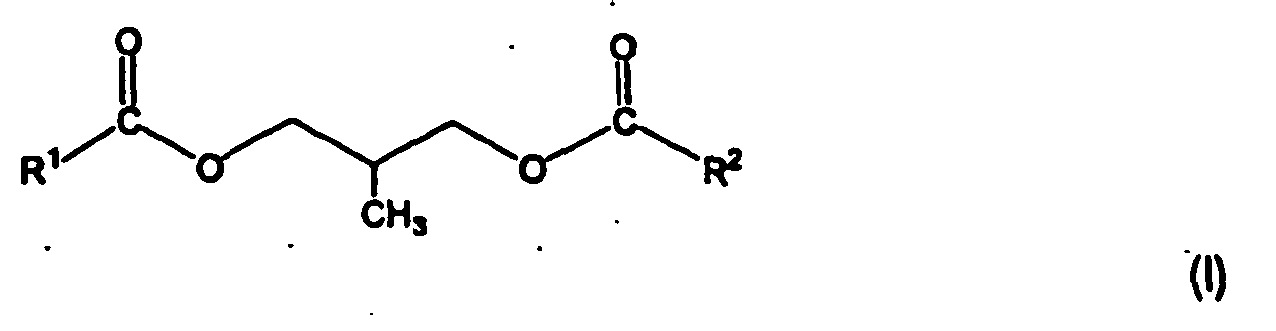
- Verwendung gemäß Anspruch 1, dadurch gekennzeichnet, dass R1 und R2 unabhängig voneinander für eine lineare, gesättigte C12-C24-Alkylgruppe stehen.
- Verwendung gemäß Anspruch 1 und/oder 2 als Emollient.
- Kosmetische und/oder pharmazeutische Zubereitung enthaltend(e) 0,1 - 50 Gew.-% wenigstens eines 2-Methyl-1,3-Propandioldiesters gemäß Anspruch 1(f) 0,1 - 20 Gew.-% Tenside und/oder Emulgatoren und/oder Coemulgatore(g) 0,1 - 40 Gew.-% weiterer Ölkörper(h) 0 - 98 Gew.-% Wasser.bezogen auf die gesamtzusammensetzung
Applications Claiming Priority (3)
| Application Number | Priority Date | Filing Date | Title |
|---|---|---|---|
| DE10160682A DE10160682A1 (de) | 2001-12-11 | 2001-12-11 | Emollients und kosmetische Zusammensetzungen |
| DE10160682 | 2001-12-11 | ||
| PCT/EP2002/013695 WO2003053373A2 (de) | 2001-12-11 | 2002-12-04 | Emollients und kosmetische zusammensetzungen enthaltend 2-methyl-1,3-propandioldiester |
Publications (2)
| Publication Number | Publication Date |
|---|---|
| EP1453473A2 EP1453473A2 (de) | 2004-09-08 |
| EP1453473B1 true EP1453473B1 (de) | 2010-03-03 |
Family
ID=7708717
Family Applications (1)
| Application Number | Title | Priority Date | Filing Date |
|---|---|---|---|
| EP02799052A Expired - Lifetime EP1453473B1 (de) | 2001-12-11 | 2002-12-04 | Emollients und kosmetische zusammensetzungen enthaltend 2-methyl-1,3-propandioldiester |
Country Status (7)
| Country | Link |
|---|---|
| US (1) | US20050019353A1 (de) |
| EP (1) | EP1453473B1 (de) |
| JP (1) | JP2005516019A (de) |
| AU (1) | AU2002364280A1 (de) |
| DE (2) | DE10160682A1 (de) |
| ES (1) | ES2341437T3 (de) |
| WO (1) | WO2003053373A2 (de) |
Families Citing this family (32)
| Publication number | Priority date | Publication date | Assignee | Title |
|---|---|---|---|---|
| ES2410587T3 (es) | 2004-01-22 | 2013-07-02 | University Of Miami | Formulaciones tópicas de coenzima Q10 y métodos de uso |
| US7557301B2 (en) * | 2004-09-28 | 2009-07-07 | Southwire Company | Method of manufacturing electrical cable having reduced required force for installation |
| US10763008B2 (en) | 2004-09-28 | 2020-09-01 | Southwire Company, Llc | Method of manufacturing electrical cable, and resulting product, with reduced required installation pulling force |
| US7749024B2 (en) | 2004-09-28 | 2010-07-06 | Southwire Company | Method of manufacturing THHN electrical cable, and resulting product, with reduced required installation pulling force |
| ES2424750T7 (es) | 2005-03-17 | 2021-03-01 | Cognis Ip Man Gmbh | Mezclas cosméticas que contienen ésteres a base de 2-propilheptanol |
| BRPI0503875A (pt) * | 2005-09-26 | 2007-06-12 | Natura Cosmeticos Sa | composição cosmética multifuncional, processo para preparar a referida composição cosmética e produto cosmético |
| EP1889640A1 (de) | 2006-08-18 | 2008-02-20 | Cognis IP Management GmbH | Kosmetische Zusammensetzungen enthaltend Ester auf Basis von 2-Butyl-1-octanol |
| EP1889641A1 (de) | 2006-08-18 | 2008-02-20 | Cognis IP Management GmbH | Kosmetische Zusammensetzungen enthaltend Ester auf Basis von 2-Ethylbutanol |
| US8800967B2 (en) | 2009-03-23 | 2014-08-12 | Southwire Company, Llc | Integrated systems facilitating wire and cable installations |
| MX337408B (es) | 2007-03-22 | 2016-03-03 | Berg Llc | Formulaciones topicas que tienen biodisponibilidad aumentada. |
| EP1985279A1 (de) | 2007-04-26 | 2008-10-29 | Cognis IP Management GmbH | Kosmetische Zusammensetzungen enthaltend Ester auf Basis von 2-Propylheptanol |
| EP1990041A1 (de) | 2007-05-07 | 2008-11-12 | Cognis IP Management GmbH | Kosmetische Zusammensetzungen enthaltend Ester auf Basis von 2-Propylheptansäure |
| DE102007027371A1 (de) * | 2007-06-11 | 2008-12-18 | Cognis Oleochemicals Gmbh | Verfahren zur Herstellung einer Verbindung aufweisend mindestens eine Ester-Gruppe |
| WO2009126764A1 (en) | 2008-04-11 | 2009-10-15 | Cytotech Labs, Llc | Methods and use of inducing apoptosis in cancer cells |
| US8986586B2 (en) | 2009-03-18 | 2015-03-24 | Southwire Company, Llc | Electrical cable having crosslinked insulation with internal pulling lubricant |
| EA023913B1 (ru) * | 2009-05-11 | 2016-07-29 | БЕРГ ФАРМА ЭлЭлСи | Способы лечения метаболических нарушений, использующие эпиметаболические переключатели, многоаспектные внутриклеточные молекулы или факторы влияния |
| MX2012003563A (es) | 2009-09-24 | 2012-04-30 | Unilever Nv | Agente desinfectante que comprende eugenol, terpineol y timol. |
| US8658576B1 (en) | 2009-10-21 | 2014-02-25 | Encore Wire Corporation | System, composition and method of application of same for reducing the coefficient of friction and required pulling force during installation of wire or cable |
| KR101907411B1 (ko) | 2010-03-12 | 2018-10-12 | 베르그 엘엘씨 | 코엔자임 Q10(CoQ10)의 정맥내 제형 및 이의 사용 방법 |
| US10325696B2 (en) | 2010-06-02 | 2019-06-18 | Southwire Company, Llc | Flexible cable with structurally enhanced conductors |
| CN103608323B (zh) | 2011-04-04 | 2016-08-17 | 博格有限责任公司 | 治疗中枢神经系统肿瘤的方法 |
| CN107095863A (zh) | 2011-06-17 | 2017-08-29 | 博格有限责任公司 | 可吸入药物组合物 |
| WO2013064360A2 (en) | 2011-11-03 | 2013-05-10 | Unilever N.V. | A personal cleaning composition |
| US9352371B1 (en) | 2012-02-13 | 2016-05-31 | Encore Wire Corporation | Method of manufacture of electrical wire and cable having a reduced coefficient of friction and required pulling force |
| US11328843B1 (en) | 2012-09-10 | 2022-05-10 | Encore Wire Corporation | Method of manufacture of electrical wire and cable having a reduced coefficient of friction and required pulling force |
| US10056742B1 (en) | 2013-03-15 | 2018-08-21 | Encore Wire Corporation | System, method and apparatus for spray-on application of a wire pulling lubricant |
| EP2983654B1 (de) | 2013-04-08 | 2025-11-12 | BPGbio, Inc. | Behandlung von krebs mit coenzym-q10-kombinationstherapien |
| WO2015035094A1 (en) | 2013-09-04 | 2015-03-12 | Berg Llc | Methods of treatment of cancer by continuous infusion of coenzyme q10 |
| US10431350B1 (en) | 2015-02-12 | 2019-10-01 | Southwire Company, Llc | Non-circular electrical cable having a reduced pulling force |
| US20170189350A1 (en) | 2015-11-16 | 2017-07-06 | Berg Llc | Methods of treatment of temozolomide-resistant glioma using coenzyme q10 |
| JP2019506464A (ja) * | 2015-12-08 | 2019-03-07 | ケミラ・オー・ウー・イィー | 液体状ポリマー組成物 |
| US20240122891A1 (en) * | 2019-10-16 | 2024-04-18 | Symrise Ag | Compositions with antimicrobial properties |
Family Cites Families (17)
| Publication number | Priority date | Publication date | Assignee | Title |
|---|---|---|---|---|
| US3441600A (en) * | 1966-06-16 | 1969-04-29 | Sinclair Research Inc | Liquid esters of neoalkyl polyols and neoalkyl fatty acids |
| US3523084A (en) * | 1966-06-16 | 1970-08-04 | Sinclair Research Inc | Lubricating oil ester base composition containing liquid esters of neoalkyl polyols and neoalkyl fatty acids |
| FR1526996A (fr) * | 1967-02-14 | 1968-05-31 | Produit de beauté | |
| JPS581798A (ja) * | 1981-05-08 | 1983-01-07 | Hitachi Ltd | 難燃性絶縁油 |
| EP0103893A3 (de) * | 1982-09-22 | 1986-03-19 | Daicel Chemical Industries, Ltd. | Macrocyclische Diester |
| JPS5955853A (ja) * | 1982-09-22 | 1984-03-31 | Daicel Chem Ind Ltd | 2−メチル−1,3−プロパンジオ−ルの脂肪族カルボン酸誘導体 |
| HU202743B (en) * | 1988-06-24 | 1991-04-29 | Richter Gedeon Vegyeszet | Active ingredient composition comprising medicinal herb extracts, cosmetics comprising such active ingredient and process for producing medicinal and veterinary compositions |
| DE4426215A1 (de) * | 1994-07-23 | 1996-01-25 | Merck Patent Gmbh | Ketotricyclo [5.2.1.0] decan-Derivate |
| DE4426216A1 (de) * | 1994-07-23 | 1996-01-25 | Merck Patent Gmbh | Benzyliden-Norcampher-Derivate |
| US5766517A (en) * | 1995-12-21 | 1998-06-16 | Cooper Industries, Inc. | Dielectric fluid for use in power distribution equipment |
| EP1293504A3 (de) * | 1996-07-08 | 2003-11-05 | Ciba SC Holding AG | Triazinderivate als UV-Filter in kosmetischen Mitteln |
| ES2246501T3 (es) * | 1996-11-29 | 2006-02-16 | Basf Aktiengesellschaft | Preparados cosmeticos y farmaceuticos que contienen filtros uv-a fotoestables. |
| DE19705573C2 (de) * | 1997-02-14 | 2003-02-20 | Beiersdorf Ag | Verwendung von Heptansäure-2.2-dimethyl-1.3-propandiolester |
| US5958851A (en) * | 1998-05-11 | 1999-09-28 | Waverly Light And Power | Soybean based transformer oil and transmission line fluid |
| US6111129A (en) * | 1998-11-04 | 2000-08-29 | Uniroyal Chemical Company, Inc. | Process for the preparation of alkanediol-diaminobenzoates |
| US6342209B1 (en) * | 2000-05-04 | 2002-01-29 | Revlon Consumer Products Corporation | Cosmetic compositions containing film forming polymers plasticized with esters and malic acid |
| FR2825621B1 (fr) * | 2001-06-12 | 2003-09-05 | Fiabila | Composition cosmetique pour les ongles, sans phtalate, sans camphre ni solvant aromatique |
-
2001
- 2001-12-11 DE DE10160682A patent/DE10160682A1/de not_active Withdrawn
-
2002
- 2002-12-04 ES ES02799052T patent/ES2341437T3/es not_active Expired - Lifetime
- 2002-12-04 WO PCT/EP2002/013695 patent/WO2003053373A2/de not_active Ceased
- 2002-12-04 EP EP02799052A patent/EP1453473B1/de not_active Expired - Lifetime
- 2002-12-04 JP JP2003554133A patent/JP2005516019A/ja active Pending
- 2002-12-04 US US10/498,599 patent/US20050019353A1/en not_active Abandoned
- 2002-12-04 DE DE50214263T patent/DE50214263D1/de not_active Expired - Lifetime
- 2002-12-04 AU AU2002364280A patent/AU2002364280A1/en not_active Abandoned
Also Published As
| Publication number | Publication date |
|---|---|
| EP1453473A2 (de) | 2004-09-08 |
| ES2341437T3 (es) | 2010-06-21 |
| WO2003053373A3 (de) | 2004-01-15 |
| AU2002364280A8 (en) | 2003-07-09 |
| AU2002364280A1 (en) | 2003-07-09 |
| JP2005516019A (ja) | 2005-06-02 |
| DE10160682A1 (de) | 2003-06-18 |
| WO2003053373A2 (de) | 2003-07-03 |
| US20050019353A1 (en) | 2005-01-27 |
| DE50214263D1 (de) | 2010-04-15 |
Similar Documents
| Publication | Publication Date | Title |
|---|---|---|
| EP2012741B1 (de) | Verdickungsmittel | |
| DE10160682A1 (de) | Emollients und kosmetische Zusammensetzungen | |
| EP1286758B1 (de) | Emulgatoren | |
| EP1330230B1 (de) | Verwendung von fettalkoholen als solubilisierungsmittel | |
| EP1524029B1 (de) | Selbstemulgierende Zubereitungen | |
| DE10212528A1 (de) | Ölphasen für kosmetische Mittel | |
| EP1485063B1 (de) | Ölkörper für kosmetische zusammensetzungen enthaltend cyclohexylcyclohexan | |
| DE10059238A1 (de) | Verdickungsmittel | |
| EP1472211B1 (de) | Weichmacher und kosmetische zusammensetzungen | |
| WO2001074302A1 (de) | Pro-liposomal verkapselte zubereitungen | |
| EP1421929A2 (de) | Emollients und kosmetische Zubereitungen | |
| EP1254655B1 (de) | Verwendung von Esterquats | |
| EP1283854B1 (de) | Lösungsvermittler | |
| EP1446220B1 (de) | Emulgator-gemisch | |
| EP1254654B2 (de) | Verwendung von kationischen Zubereitungen | |
| EP1264633B1 (de) | Verwendung von Alkyl(ether)phosphaten(I) | |
| DE19945578B4 (de) | Kosmetische und/oder pharmazeutische Zubereitungen und deren Verwendung | |
| EP1374845B1 (de) | Kosmetische Zubereitungen | |
| DE19945577B4 (de) | Kosmetische und/oder pharmazeutische Zubereitungen und deren Verwendung | |
| EP1264634B1 (de) | Verwendung von Alkyl(ether)phosphaten | |
| EP1264632A1 (de) | Verwendung von Alkyl(ether)phosphaten(III) | |
| EP1206428B1 (de) | Verwendung von hydroxyethern in kosmetischen und pharmazeutischen zubereitungen | |
| EP1374846A1 (de) | Hochviskose ölhaltige Zubereitungen | |
| EP1254909A1 (de) | Phosphorsäureester | |
| EP1264631A1 (de) | Polymere Emulgatoren |
Legal Events
| Date | Code | Title | Description |
|---|---|---|---|
| PUAI | Public reference made under article 153(3) epc to a published international application that has entered the european phase |
Free format text: ORIGINAL CODE: 0009012 |
|
| 17P | Request for examination filed |
Effective date: 20040602 |
|
| AK | Designated contracting states |
Kind code of ref document: A2 Designated state(s): AT BE BG CH CY CZ DE DK EE ES FI FR GB GR IE IT LI LU MC NL PT SE SI SK TR |
|
| AX | Request for extension of the european patent |
Extension state: AL LT LV MK RO |
|
| RAP1 | Party data changed (applicant data changed or rights of an application transferred) |
Owner name: COGNIS IP MANAGEMENT GMBH |
|
| 17Q | First examination report despatched |
Effective date: 20071213 |
|
| RIC1 | Information provided on ipc code assigned before grant |
Ipc: A61K 8/37 20060101AFI20090724BHEP Ipc: A61Q 5/00 20060101ALI20090724BHEP Ipc: A61Q 19/00 20060101ALI20090724BHEP |
|
| GRAP | Despatch of communication of intention to grant a patent |
Free format text: ORIGINAL CODE: EPIDOSNIGR1 |
|
| GRAS | Grant fee paid |
Free format text: ORIGINAL CODE: EPIDOSNIGR3 |
|
| GRAA | (expected) grant |
Free format text: ORIGINAL CODE: 0009210 |
|
| AK | Designated contracting states |
Kind code of ref document: B1 Designated state(s): DE ES FR GB IT |
|
| REG | Reference to a national code |
Ref country code: GB Ref legal event code: FG4D Free format text: NOT ENGLISH |
|
| REF | Corresponds to: |
Ref document number: 50214263 Country of ref document: DE Date of ref document: 20100415 Kind code of ref document: P |
|
| REG | Reference to a national code |
Ref country code: ES Ref legal event code: FG2A Ref document number: 2341437 Country of ref document: ES Kind code of ref document: T3 |
|
| PLBE | No opposition filed within time limit |
Free format text: ORIGINAL CODE: 0009261 |
|
| STAA | Information on the status of an ep patent application or granted ep patent |
Free format text: STATUS: NO OPPOSITION FILED WITHIN TIME LIMIT |
|
| 26N | No opposition filed |
Effective date: 20101206 |
|
| PGFP | Annual fee paid to national office [announced via postgrant information from national office to epo] |
Ref country code: GB Payment date: 20131227 Year of fee payment: 12 |
|
| PGFP | Annual fee paid to national office [announced via postgrant information from national office to epo] |
Ref country code: IT Payment date: 20131219 Year of fee payment: 12 |
|
| PGFP | Annual fee paid to national office [announced via postgrant information from national office to epo] |
Ref country code: ES Payment date: 20140128 Year of fee payment: 12 |
|
| GBPC | Gb: european patent ceased through non-payment of renewal fee |
Effective date: 20141204 |
|
| PG25 | Lapsed in a contracting state [announced via postgrant information from national office to epo] |
Ref country code: GB Free format text: LAPSE BECAUSE OF NON-PAYMENT OF DUE FEES Effective date: 20141204 |
|
| REG | Reference to a national code |
Ref country code: FR Ref legal event code: PLFP Year of fee payment: 14 |
|
| PG25 | Lapsed in a contracting state [announced via postgrant information from national office to epo] |
Ref country code: IT Free format text: LAPSE BECAUSE OF NON-PAYMENT OF DUE FEES Effective date: 20141204 |
|
| REG | Reference to a national code |
Ref country code: ES Ref legal event code: FD2A Effective date: 20160127 |
|
| PGFP | Annual fee paid to national office [announced via postgrant information from national office to epo] |
Ref country code: FR Payment date: 20151228 Year of fee payment: 14 |
|
| PG25 | Lapsed in a contracting state [announced via postgrant information from national office to epo] |
Ref country code: ES Free format text: LAPSE BECAUSE OF NON-PAYMENT OF DUE FEES Effective date: 20141205 |
|
| PGFP | Annual fee paid to national office [announced via postgrant information from national office to epo] |
Ref country code: DE Payment date: 20160302 Year of fee payment: 14 |
|
| REG | Reference to a national code |
Ref country code: DE Ref legal event code: R119 Ref document number: 50214263 Country of ref document: DE |
|
| REG | Reference to a national code |
Ref country code: FR Ref legal event code: ST Effective date: 20170831 |
|
| PG25 | Lapsed in a contracting state [announced via postgrant information from national office to epo] |
Ref country code: FR Free format text: LAPSE BECAUSE OF NON-PAYMENT OF DUE FEES Effective date: 20170102 |
|
| PG25 | Lapsed in a contracting state [announced via postgrant information from national office to epo] |
Ref country code: DE Free format text: LAPSE BECAUSE OF NON-PAYMENT OF DUE FEES Effective date: 20170701 |