EP1452862A1 - Gassensitiver Feldeffekttransistor mit einer gassensitiven Schicht und Verfahren zu deren Herstellung - Google Patents
Gassensitiver Feldeffekttransistor mit einer gassensitiven Schicht und Verfahren zu deren Herstellung Download PDFInfo
- Publication number
- EP1452862A1 EP1452862A1 EP04100809A EP04100809A EP1452862A1 EP 1452862 A1 EP1452862 A1 EP 1452862A1 EP 04100809 A EP04100809 A EP 04100809A EP 04100809 A EP04100809 A EP 04100809A EP 1452862 A1 EP1452862 A1 EP 1452862A1
- Authority
- EP
- European Patent Office
- Prior art keywords
- gas
- barium
- layer
- sensitive
- effect transistor
- Prior art date
- Legal status (The legal status is an assumption and is not a legal conclusion. Google has not performed a legal analysis and makes no representation as to the accuracy of the status listed.)
- Ceased
Links
- 230000005669 field effect Effects 0.000 title claims abstract description 18
- 238000000034 method Methods 0.000 title claims abstract description 8
- AYJRCSIUFZENHW-UHFFFAOYSA-L barium carbonate Chemical compound [Ba+2].[O-]C([O-])=O AYJRCSIUFZENHW-UHFFFAOYSA-L 0.000 claims abstract description 35
- QVQLCTNNEUAWMS-UHFFFAOYSA-N barium oxide Chemical compound [Ba]=O QVQLCTNNEUAWMS-UHFFFAOYSA-N 0.000 claims abstract description 35
- JRPBQTZRNDNNOP-UHFFFAOYSA-N barium titanate Chemical compound [Ba+2].[Ba+2].[O-][Ti]([O-])([O-])[O-] JRPBQTZRNDNNOP-UHFFFAOYSA-N 0.000 claims abstract description 25
- 229910002113 barium titanate Inorganic materials 0.000 claims abstract description 25
- 230000008859 change Effects 0.000 claims abstract description 11
- 230000008569 process Effects 0.000 claims abstract description 7
- 238000004519 manufacturing process Methods 0.000 claims abstract description 6
- CURLTUGMZLYLDI-UHFFFAOYSA-N Carbon dioxide Chemical compound O=C=O CURLTUGMZLYLDI-UHFFFAOYSA-N 0.000 claims description 78
- 229910002092 carbon dioxide Inorganic materials 0.000 claims description 39
- 239000001569 carbon dioxide Substances 0.000 claims description 39
- QPLDLSVMHZLSFG-UHFFFAOYSA-N Copper oxide Chemical compound [Cu]=O QPLDLSVMHZLSFG-UHFFFAOYSA-N 0.000 claims description 15
- 239000000843 powder Substances 0.000 claims description 10
- 239000000654 additive Substances 0.000 claims description 7
- 239000011230 binding agent Substances 0.000 claims description 5
- VTYYLEPIZMXCLO-UHFFFAOYSA-L Calcium carbonate Chemical compound [Ca+2].[O-]C([O-])=O VTYYLEPIZMXCLO-UHFFFAOYSA-L 0.000 claims description 4
- 238000007650 screen-printing Methods 0.000 claims description 3
- 238000004544 sputter deposition Methods 0.000 claims description 3
- 229910000019 calcium carbonate Inorganic materials 0.000 claims description 2
- MRELNEQAGSRDBK-UHFFFAOYSA-N lanthanum oxide Inorganic materials [O-2].[O-2].[O-2].[La+3].[La+3] MRELNEQAGSRDBK-UHFFFAOYSA-N 0.000 claims description 2
- KTUFCUMIWABKDW-UHFFFAOYSA-N oxo(oxolanthaniooxy)lanthanum Chemical compound O=[La]O[La]=O KTUFCUMIWABKDW-UHFFFAOYSA-N 0.000 claims description 2
- IATRAKWUXMZMIY-UHFFFAOYSA-N strontium oxide Inorganic materials [O-2].[Sr+2] IATRAKWUXMZMIY-UHFFFAOYSA-N 0.000 claims description 2
- XLOMVQKBTHCTTD-UHFFFAOYSA-N zinc oxide Inorganic materials [Zn]=O XLOMVQKBTHCTTD-UHFFFAOYSA-N 0.000 claims description 2
- 235000010216 calcium carbonate Nutrition 0.000 claims 1
- 238000005289 physical deposition Methods 0.000 claims 1
- 239000007789 gas Substances 0.000 description 52
- 238000005259 measurement Methods 0.000 description 17
- 239000000463 material Substances 0.000 description 13
- 230000035945 sensitivity Effects 0.000 description 13
- 238000006243 chemical reaction Methods 0.000 description 11
- 239000005751 Copper oxide Substances 0.000 description 10
- 229910000431 copper oxide Inorganic materials 0.000 description 10
- GWEVSGVZZGPLCZ-UHFFFAOYSA-N Titan oxide Chemical compound O=[Ti]=O GWEVSGVZZGPLCZ-UHFFFAOYSA-N 0.000 description 6
- 239000000203 mixture Substances 0.000 description 6
- 238000003491 array Methods 0.000 description 5
- 230000010354 integration Effects 0.000 description 5
- 230000004044 response Effects 0.000 description 5
- 238000001179 sorption measurement Methods 0.000 description 5
- 239000010408 film Substances 0.000 description 4
- BASFCYQUMIYNBI-UHFFFAOYSA-N platinum Chemical compound [Pt] BASFCYQUMIYNBI-UHFFFAOYSA-N 0.000 description 4
- BVKZGUZCCUSVTD-UHFFFAOYSA-L Carbonate Chemical compound [O-]C([O-])=O BVKZGUZCCUSVTD-UHFFFAOYSA-L 0.000 description 3
- 239000001856 Ethyl cellulose Substances 0.000 description 3
- ZZSNKZQZMQGXPY-UHFFFAOYSA-N Ethyl cellulose Chemical compound CCOCC1OC(OC)C(OCC)C(OCC)C1OC1C(O)C(O)C(OC)C(CO)O1 ZZSNKZQZMQGXPY-UHFFFAOYSA-N 0.000 description 3
- QVGXLLKOCUKJST-UHFFFAOYSA-N atomic oxygen Chemical compound [O] QVGXLLKOCUKJST-UHFFFAOYSA-N 0.000 description 3
- 238000005516 engineering process Methods 0.000 description 3
- 229920001249 ethyl cellulose Polymers 0.000 description 3
- 235000019325 ethyl cellulose Nutrition 0.000 description 3
- 238000010438 heat treatment Methods 0.000 description 3
- 238000012544 monitoring process Methods 0.000 description 3
- 239000001301 oxygen Substances 0.000 description 3
- 229910052760 oxygen Inorganic materials 0.000 description 3
- 239000000523 sample Substances 0.000 description 3
- 239000004065 semiconductor Substances 0.000 description 3
- BVKZGUZCCUSVTD-UHFFFAOYSA-M Bicarbonate Chemical compound OC([O-])=O BVKZGUZCCUSVTD-UHFFFAOYSA-M 0.000 description 2
- 229910021193 La 2 O 3 Inorganic materials 0.000 description 2
- 230000004913 activation Effects 0.000 description 2
- 230000000996 additive effect Effects 0.000 description 2
- WUOACPNHFRMFPN-UHFFFAOYSA-N alpha-terpineol Chemical compound CC1=CCC(C(C)(C)O)CC1 WUOACPNHFRMFPN-UHFFFAOYSA-N 0.000 description 2
- UCVMQZHZWWEPRC-UHFFFAOYSA-L barium(2+);hydrogen carbonate Chemical compound [Ba+2].OC([O-])=O.OC([O-])=O UCVMQZHZWWEPRC-UHFFFAOYSA-L 0.000 description 2
- BVKZGUZCCUSVTD-UHFFFAOYSA-N carbonic acid Chemical class OC(O)=O BVKZGUZCCUSVTD-UHFFFAOYSA-N 0.000 description 2
- SQIFACVGCPWBQZ-UHFFFAOYSA-N delta-terpineol Natural products CC(C)(O)C1CCC(=C)CC1 SQIFACVGCPWBQZ-UHFFFAOYSA-N 0.000 description 2
- 238000005240 physical vapour deposition Methods 0.000 description 2
- 229910052697 platinum Inorganic materials 0.000 description 2
- 239000000758 substrate Substances 0.000 description 2
- 229940116411 terpineol Drugs 0.000 description 2
- 239000004408 titanium dioxide Substances 0.000 description 2
- PNEYBMLMFCGWSK-UHFFFAOYSA-N Alumina Chemical compound [O-2].[O-2].[O-2].[Al+3].[Al+3] PNEYBMLMFCGWSK-UHFFFAOYSA-N 0.000 description 1
- PQJOCVGDOUXSDX-UHFFFAOYSA-L C(=O)=O.C([O-])([O-])=O.[Ba+2] Chemical compound C(=O)=O.C([O-])([O-])=O.[Ba+2] PQJOCVGDOUXSDX-UHFFFAOYSA-L 0.000 description 1
- OKTJSMMVPCPJKN-UHFFFAOYSA-N Carbon Chemical compound [C] OKTJSMMVPCPJKN-UHFFFAOYSA-N 0.000 description 1
- XUIMIQQOPSSXEZ-UHFFFAOYSA-N Silicon Chemical compound [Si] XUIMIQQOPSSXEZ-UHFFFAOYSA-N 0.000 description 1
- 229910004116 SrO 2 Inorganic materials 0.000 description 1
- 238000004378 air conditioning Methods 0.000 description 1
- 238000000137 annealing Methods 0.000 description 1
- 239000003990 capacitor Substances 0.000 description 1
- 229910052799 carbon Inorganic materials 0.000 description 1
- 239000000919 ceramic Substances 0.000 description 1
- 230000001934 delay Effects 0.000 description 1
- 238000005137 deposition process Methods 0.000 description 1
- 238000013461 design Methods 0.000 description 1
- 238000001514 detection method Methods 0.000 description 1
- 238000011161 development Methods 0.000 description 1
- 238000009826 distribution Methods 0.000 description 1
- 238000005265 energy consumption Methods 0.000 description 1
- 238000011156 evaluation Methods 0.000 description 1
- 238000000855 fermentation Methods 0.000 description 1
- 230000004151 fermentation Effects 0.000 description 1
- 230000006872 improvement Effects 0.000 description 1
- 238000009434 installation Methods 0.000 description 1
- 230000007246 mechanism Effects 0.000 description 1
- 229910044991 metal oxide Inorganic materials 0.000 description 1
- 150000004706 metal oxides Chemical class 0.000 description 1
- 238000005065 mining Methods 0.000 description 1
- 210000001331 nose Anatomy 0.000 description 1
- 230000003287 optical effect Effects 0.000 description 1
- 239000008188 pellet Substances 0.000 description 1
- 238000002360 preparation method Methods 0.000 description 1
- 230000002035 prolonged effect Effects 0.000 description 1
- 238000005215 recombination Methods 0.000 description 1
- 230000006798 recombination Effects 0.000 description 1
- 239000003507 refrigerant Substances 0.000 description 1
- 230000029058 respiratory gaseous exchange Effects 0.000 description 1
- 229910052710 silicon Inorganic materials 0.000 description 1
- 239000010703 silicon Substances 0.000 description 1
- 238000003860 storage Methods 0.000 description 1
- 239000010409 thin film Substances 0.000 description 1
- 230000007704 transition Effects 0.000 description 1
- 238000002604 ultrasonography Methods 0.000 description 1
Images

Classifications
-
- G—PHYSICS
- G01—MEASURING; TESTING
- G01N—INVESTIGATING OR ANALYSING MATERIALS BY DETERMINING THEIR CHEMICAL OR PHYSICAL PROPERTIES
- G01N27/00—Investigating or analysing materials by the use of electric, electrochemical, or magnetic means
- G01N27/002—Investigating or analysing materials by the use of electric, electrochemical, or magnetic means by investigating the work function voltage
-
- G—PHYSICS
- G01—MEASURING; TESTING
- G01N—INVESTIGATING OR ANALYSING MATERIALS BY DETERMINING THEIR CHEMICAL OR PHYSICAL PROPERTIES
- G01N33/00—Investigating or analysing materials by specific methods not covered by groups G01N1/00 - G01N31/00
- G01N33/0004—Gaseous mixtures, e.g. polluted air
- G01N33/0009—General constructional details of gas analysers, e.g. portable test equipment
- G01N33/0027—General constructional details of gas analysers, e.g. portable test equipment concerning the detector
- G01N33/0036—General constructional details of gas analysers, e.g. portable test equipment concerning the detector specially adapted to detect a particular component
- G01N33/004—CO or CO2
Definitions
- the invention relates to a gas sensitive field effect transistor, which is equipped with a gas sensitive layer to by evaluating the change in work function on the gas-sensitive layer to detect certain target gases.
- carbon dioxide CO 2
- CO 2 carbon dioxide
- Low-power carbon dioxide sensors can be used, for example find as threshold sensors for indoor air monitoring, for example in rooms with air conditioning systems that use carbon dioxide operated as a refrigerant, in fermentation cellars, in storage rooms for agricultural products or in mining.
- [2] reports an improvement in sensitivity by adding additives such as ZnO 2 , SrO 2 , La 2 O 3 or Ag in the range of about 1-2 percent by weight.
- Another publication [3] proposes a mechanism for gas sensitivity. The following is then reported: Copper oxide is a p-type semiconductor, barium titanate is an n-type semiconductor. Space charge zones are said to be present at the transitions between the two semiconductor materials, depletion zones being formed on both sides of the material contact by recombination of holes in the copper oxide with the electrons of the barium titanate. Because of the low charge density in the barium titanate, these have a greater extent in the copper oxide.
- Oxygen is to be adsorbed on air on both metal oxides, which binds electrons when adsorbed on barium titanate or holes when adsorbed on copper oxide.
- the adsorption of carbon dioxide is intended to displace adsorbed oxygen, which increases the electron density in the barium titanate. This is said to have a direct impact on the expansion of the space charge zone and could be measured as a change in the capacity of the material mixture.
- [4] describes the production of a gas-sensitive layer as a screen-printed thick layer.
- the gas sensitivity is read out by measuring the sensor resistance in the temperature range between 450 -600 ° C with a maximum sensitivity at 550 ° C. Additives are said to increase the sensitivity of CO 2 .
- the reaction can only take place in the presence of atmospheric moisture and carbon dioxide. If one of these components is missing, the barium hydrogen carbonate Ba (HCO 3 ) 2 , which is only present in small amounts, decomposes very quickly.
- the invention has for its object a permanent and highly sensitive to a target gas, especially carbon dioxide, to provide gas sensitive layer in a gas sensitive Field effect transistor can be used as a gas sensitive layer is. Furthermore, the task of reproducible production of the gas sensitive layer.
- the solution to this Task is done by the subject of the pa Claims 1 and 5.
- Advantageous refinements can are taken from the subclaims.
- the invention is based on the knowledge that the adsorption of a target gas on the gas sensitive layer by barium titanate is guaranteed by which at the same time sufficient stability of the gas-sensitive layer can be achieved is.
- An equilibrium reaction generating a measurement signal is the reaction between the example of the target gas carbon dioxide Barium carbonate and barium hydrogen carbonate in the presence of moisture, especially humidity. Consequently both the adsorption and the detection are sufficient Sensitivity guaranteed on a gas sensitive layer.
- the gas sensitive layer is now in a field effect transistor integrated and sensor signals are generated, based on the principle of measuring the change in work function based.
- the response time of the sensor is sufficient short and is about 1 minute.
- the sensor can at Be operated at room temperature.
- the gas sensitive layer is prepared on the Basis of barium titanate with an excess of barium oxide.
- a layer made from it becomes carbon dioxide-containing Atmosphere tempered. Through the reaction of carbon dioxide at high temperatures of at least 500 ° C Part of the excess barium oxide converted to barium carbonate.
- a later measurement can be done in the presence of moisture the proportion of carbon dioxide in the surrounding Atmosphere can be measured.
- the gas-sensitive layer can be formed as a thin layer become.
- a deposition process used for this is for example the PVD process (Physical Vapor Deposition) or cathode sputtering.
- An advantageous embodiment of the invention provides that to improve the gas sensitivity, the layer material consisting of barium titanate with an excess of barium oxide is mixed with copper oxide in a molar ratio of 1: 1.
- the annealing of the layer to activate the gas sensitivity in a carbon dioxide atmosphere is also carried out here.
- excess barium oxide or part of the copper oxide is converted to barium carbonate.
- the gas-sensitive reaction of the BaTiO 3 or BaTiO 3 / CuO thick film is shown by changing the work function.
- the basis for the gas sensitive material is a barium titanate with an excess of barium oxide.
- the powder becomes made a printable paste by adding a binder, which is processed into a thick layer by screen printing that is several hours in air to burn out the binder and then annealed under a carbon dioxide atmosphere becomes.
- a binder which is processed into a thick layer by screen printing that is several hours in air to burn out the binder and then annealed under a carbon dioxide atmosphere becomes.
- Hydrogen carbonates can form from moisture, so the percentage of carbon dioxide in the surrounding Atmosphere increases.
- the gas sensitive Layer can be prepared as a thin layer, for example with a process like sputtering.
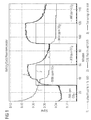
- An example of carbon dioxide measurements is shown in Fig. 1. The measurement is preferred executed with the help of the Kelvin probe, the gas sensitive layer was at room temperature. oxygen content and humidity were kept constant during the measurement. To seeing is a quick response of the sensor material to the Concentration change with a short response time of approx. a minute.
- a barium titanate powder produced in this way is mixed with copper oxide (CuO) powder in a molar ratio of 1: 1 mixed well. Subsequently there is no heat treatment.
- CuO copper oxide
- a mixture of 50 percent by weight powder has been found to be advantageous exposed with 50 weight percent binder.
- Thick layers are made by screen printing.
- As a substrate is alumina ceramic with a purity of 99.9% used.
- the layer is electrically connected via a platinum electrode.
- the printed layers will be first dried (1 hour at 230 ° C) to the terpineol drive out and then at 600 ° C for 4 hours Air burned in. The ethyl cellulose burns. Subsequently the layer is activated in a carbon dioxide atmosphere (4 hours at 600 ° C). Pure barium titanate layers can also be baked at 800 ° C and activated at 700 ° C under a carbon dioxide atmosphere.
- Fig. 1 there are three different signals versus time applied.
- Curve 1 represents the course of the relative Moisture represents.
- Curve 2 shows the time course of the higher Carbon dioxide concentrations.
- Curve 2 gives the real thing Sensor signal again, which without significant delays at a carbon dioxide concentration of 9000 ppm responds to the corresponding carbon dioxide concentration. The In this case, the concentration stroke of the carbon dioxide goes off 300 ppm to 9000 ppm.
- Fig. 2 shows a sensor signal in which the sensor is kept at 150 ° C operating temperature. It can be seen that, starting from a concentration of 300 ppm CO 2 after a concentration stroke to 3000 ppm CO 2, a clear signal change can be seen. Another concentration stroke from 3000 ppm to 9000 ppm CO 2 can also be clearly shown.
Landscapes
- Chemical & Material Sciences (AREA)
- Chemical Kinetics & Catalysis (AREA)
- Electrochemistry (AREA)
- Physics & Mathematics (AREA)
- Health & Medical Sciences (AREA)
- Life Sciences & Earth Sciences (AREA)
- Analytical Chemistry (AREA)
- Biochemistry (AREA)
- General Health & Medical Sciences (AREA)
- General Physics & Mathematics (AREA)
- Immunology (AREA)
- Pathology (AREA)
- Investigating Or Analyzing Materials By The Use Of Fluid Adsorption Or Reactions (AREA)
Abstract
Description
- Der Betrieb bei Raumtemperatur und geringfügig darüber erlaubt den Einsatz in Bereichen, in denen nur ein geringer Energieverbrauch durch Sensoren zulässig ist, wie beispielsweise beim Batteriebetrieb, in explosionsgeschützten Bereichen, bei direktem Anschluss an Datenbusse ohne zusätzliche Hilfsenergie für sogenannte Niedrigenergie-Sensoren (Low-Power-Sensors).
- Eine vollständige Kompatibilität der Herstellung des Bauelementes mit der eingeführten Siliziumtechnologie.
- Eine einfache Realisierung von Sensor-Arrays mit unterschiedlich gasempfindlichen Sensoren zum Ausschluss von Querempfindlichkeiten oder zum Aufbau von elektronischen Nasen.
- Vollständige bzw. teilweise Integration des Sensors in seine Auswerte-Elektronik durch monolithischen Aufbau.
Kupferoxid ist ein p-Halbleiter, Bariumtitanat ist ein n-Halbleiter. An den Übergängen zwischen beiden Halbleitermaterialien sollen Raumladungszonen vorhanden sein, wobei sich durch Rekombination von Löchern des Kupferoxids mit den Elektronen des Bariumtitanats zu beiden Seiten des Materialkontaktes Verarmungszonen ausbilden. Diese haben wegen der geringen Ladungsdichte im Bariumtitanat eine größere Ausdehnung im Kupferoxid. Unter Luft soll Sauerstoff auf beiden Metalloxiden adsorbiert werden, wobei dieser Elektronen bei einer Adsorption auf Bariumtitanat bzw. Löcher bei einer Adsorption auf Kupferoxid bindet. Durch die Adsorption von Kohlendioxid soll adsorbierter Sauerstoff verdrängt werden, wodurch sich die Elektronendichte im Bariumtitanat erhöht. Dies soll unmittelbaren Einfluss auf die Ausdehnung der Raumladungszone haben und könnte als Änderung der Kapazität des Materialgemisches gemessen werden.
- die Haftung der Bariumkarbonat-Dickschichten ist sehr schlecht und erlaubt kaum einen sicheren Einbau in einem gassensitiven Feldeffekttransistor.
- Die Ansprechzeit ist zu hoch und liegt weit über einer Minute bei Raumtemperatur.
- Die Schicht deaktiviert nach mehreren Wochen sehr stark, kann jedoch durch Erwärmung auf über 100°C unter feuchter, kohlendioxidhaltiger Luft reaktiviert werden.
- Fig. 1
- zeigt ein Sensorsignal, das der Austrittsarbeitsdifferenz beim Wechsel einer Kohlendioxidkonzentration bei Raumtemperatur entspricht,
- Fig. 2
- zeigt ein Sensorsignal, das der Austrittsarbeitsdifferenz beim Wechsel einer Kohlendioxidkonzentration bei 150°C Betriebstemperatur entspricht.
- die Adsorption des Zielgases am Bariumtitanat,
- die Gleichgewichtsreaktion zum Hydrogencarbonat in Anwesenheit von Luftfeuchte, wenn das Zielgas Kohlendioxid ist. Die Sensoreigenschaften können durch Additive im Bereich von 1-3 Gewichtsprozent weiter verbessert werden. Als Additive kommen u.a. La2O3, SrO, ZnO, CaCO3 in Frage.
Es werden Titandioxid und Bariumcarbonat-Pulver in einem molaren Verhältnis gemischt, so wie der Bariumoxid-Überschuss eingestellt werden soll. Für ein Bariumtitanat mit 5 Mol % Bariumoxid-Überschuss wird von einer Menge von 1 Mol Titandioxid und 1,05 Mol Bariumcarbonat ausgegangen. Die Pulver werden so gut wie möglich vermischt und anschließend 15 Stunden bei 1300°C gesintert. Die Sintermasse wird gemahlen und anschließend noch einmal 15 Stunden bei 1300°C getempert.
Claims (7)
- Gassensitiver Feldeffekttransistor (FET) mit einer gassensitiven Schicht, mit der Sensorsignale durch Messung der Änderung der Austrittsarbeit generierbar sind, wobei die gassensitive Schicht aus Bariumtitanat (BaTiO3) mit einem Überschuss an Bariumoxid (BaO) besteht und ein Teil der Schicht oberflächlich als Bariumcarbonat (BaCO3) ausgebildet ist.
- Gassensitiver Feldeffekttransistor (FET) nach Anspruch 1, bei dem die gassensitive Schicht aus Bariumtitanat (Ba-TiO3) mit Bariumoxid (BaO)-Überschuss besteht, im MolVerhältnis 1:1 Kupferoxid (CuO) enthält und ein Teil der Schicht oberflächlich als Bariumcarbonat (BaCO3) ausgebildet ist.
- Gassensitiver Feldeffekttransistor (FET) nach Anspruch 1, bei dem die gassensitive Schicht aus Bariumtitanat (Ba-TiO3) ohne Bariumoxid (BaO)-Überschuss besteht, im MolVerhältnis 1:1 Kupferoxid (CuO) enthält und ein Teil der Schicht oberflächlich als Bariumcarbonat (BaCO3) ausgebildet ist.
- Gassensitiver Feldeffekttransistor (FET) nach einem der vorhergehenden Ansprüche, bei dem in der gassensitiven Schicht Additive mit einem Anteil im Bereich von 1-3 Gewichtsprozent in Form von La2O3, SrO, ZnO oder CaCO3 enthalten sind.
- Gassensitiver Feldeffekttransistor (FET) nach einem der vorhergehenden Ansprüche, bei dem die gassensitive Schicht eine getemperte Dünn- oder Dickschicht mit Anteilen von Bariumcarbonat (BaCO3) ist.
- Verfahren zur Herstellung einer gassensitiven Schicht in einem gassensitiven Feldeffekttransistor, bei demBariumtitanatpulver mit Bariumoxid-Überschuss mit Binder gemischt wird, so dass eine Paste entsteht,durch Siebdruck hergestellte Dickschichten, mehrere Stunden unter Luft und anschließend unter Kohlendioxid-Atmosphäre bei Temperaturen von mehr als 500 °C getempert werden, wobei Bariumoxid zu Bariumcarbonat umgewandelt wird.
- Verfahren zur Herstellung einer gassensitiven Schicht in einem gassensitiven Feldeffekttransistor, bei dem eine Dünnschicht aus Bariumtitanat mit Bariumoxid-Überschuss in einem physikalischen Abscheide-Verfahren, insbesondere Kathodenzerstäubung, hergestellt wird und diese Dünnschicht mehrere Stunden unter Luft und anschließend unter Kohlendioxid (CO2) bei Temperaturen von mehr als 500 °C getempert werden, wobei Bariumoxid zu Bariumcarbonat umgesetzt wird.
Applications Claiming Priority (2)
| Application Number | Priority Date | Filing Date | Title |
|---|---|---|---|
| DE10308882 | 2003-02-28 | ||
| DE10308882 | 2003-02-28 |
Publications (1)
| Publication Number | Publication Date |
|---|---|
| EP1452862A1 true EP1452862A1 (de) | 2004-09-01 |
Family
ID=32748128
Family Applications (1)
| Application Number | Title | Priority Date | Filing Date |
|---|---|---|---|
| EP04100809A Ceased EP1452862A1 (de) | 2003-02-28 | 2004-03-01 | Gassensitiver Feldeffekttransistor mit einer gassensitiven Schicht und Verfahren zu deren Herstellung |
Country Status (1)
| Country | Link |
|---|---|
| EP (1) | EP1452862A1 (de) |
Cited By (2)
| Publication number | Priority date | Publication date | Assignee | Title |
|---|---|---|---|---|
| EP1770392A1 (de) * | 2005-09-30 | 2007-04-04 | Micronas GmbH | Gassenitiver Feldeffekttransistor zur Detektion von Chlor |
| DE102006046225A1 (de) * | 2006-09-29 | 2008-04-03 | Siemens Ag | Gassensoren zur Erfassung von Bestandteilen in und Bedingungen von Luft und/oder Optimierung der Konzentration von Bestandteilen und von Bedingungen von Luft in einem Innenraum |
Citations (4)
| Publication number | Priority date | Publication date | Assignee | Title |
|---|---|---|---|---|
| DE4212854A1 (de) * | 1992-04-16 | 1993-10-21 | Siemens Ag | Sensoranordnung zur Bestimmung eines Sauerstoffpartialdruckes in einem Gasgemisch |
| US5993624A (en) * | 1995-12-07 | 1999-11-30 | Matsushita Electric Industrial Co., Ltd. | Carbon dioxide gas sensor |
| EP1085320A1 (de) * | 1999-09-13 | 2001-03-21 | Interuniversitair Micro-Elektronica Centrum Vzw | Vorrichtung auf Basis von organischem Material zur Erfassung eines Probenanalyts |
| EP1176418A2 (de) * | 2000-07-25 | 2002-01-30 | Siemens Aktiengesellschaft | Potentialgesteuerter Gassensor |
-
2004
- 2004-03-01 EP EP04100809A patent/EP1452862A1/de not_active Ceased
Patent Citations (4)
| Publication number | Priority date | Publication date | Assignee | Title |
|---|---|---|---|---|
| DE4212854A1 (de) * | 1992-04-16 | 1993-10-21 | Siemens Ag | Sensoranordnung zur Bestimmung eines Sauerstoffpartialdruckes in einem Gasgemisch |
| US5993624A (en) * | 1995-12-07 | 1999-11-30 | Matsushita Electric Industrial Co., Ltd. | Carbon dioxide gas sensor |
| EP1085320A1 (de) * | 1999-09-13 | 2001-03-21 | Interuniversitair Micro-Elektronica Centrum Vzw | Vorrichtung auf Basis von organischem Material zur Erfassung eines Probenanalyts |
| EP1176418A2 (de) * | 2000-07-25 | 2002-01-30 | Siemens Aktiengesellschaft | Potentialgesteuerter Gassensor |
Non-Patent Citations (5)
| Title |
|---|
| FLEISCHER M ET AL: "Low-power gas sensors based on work-function measurement in low-cost hybrid flip-chip technology", SENSORS AND ACTUATORS B, ELSEVIER SEQUOIA S.A., LAUSANNE, CH, vol. 80, no. 3, 1 December 2001 (2001-12-01), pages 169 - 173, XP004311804, ISSN: 0925-4005 * |
| HAEUSLER A ET AL: "A novel thick film conductive type CO2 sensor", SENSORS AND ACTUATORS B, ELSEVIER SEQUOIA S.A., LAUSANNE, CH, vol. 34, no. 1-3, 1 August 1996 (1996-08-01), pages 388 - 395, XP004078011, ISSN: 0925-4005 * |
| ISHIHARA T ET AL: "Improved sensitivity of CuO-BaTiO3 capacitive-type CO2 sensor by additives", SENSORS AND ACTUATORS B, ELSEVIER SEQUOIA S.A., LAUSANNE, CH, vol. 28, no. 1, 1 July 1995 (1995-07-01), pages 49 - 54, XP004004388, ISSN: 0925-4005 * |
| LEE M-S ET AL: "A new process for fabricating CO2-sensing layers based on BaTiO3 and additives", SENSORS AND ACTUATORS B, ELSEVIER SEQUOIA S.A., LAUSANNE, CH, vol. 68, no. 1-3, 25 August 2000 (2000-08-25), pages 293 - 299, XP004216629, ISSN: 0925-4005 * |
| LIAO B ET AL: "Study on CuO-BaTiO3 semiconductor CO2 sensor", SENSORS AND ACTUATORS B, ELSEVIER SEQUOIA S.A., LAUSANNE, CH, vol. 80, no. 3, 1 December 2001 (2001-12-01), pages 208 - 214, XP004311810, ISSN: 0925-4005 * |
Cited By (2)
| Publication number | Priority date | Publication date | Assignee | Title |
|---|---|---|---|---|
| EP1770392A1 (de) * | 2005-09-30 | 2007-04-04 | Micronas GmbH | Gassenitiver Feldeffekttransistor zur Detektion von Chlor |
| DE102006046225A1 (de) * | 2006-09-29 | 2008-04-03 | Siemens Ag | Gassensoren zur Erfassung von Bestandteilen in und Bedingungen von Luft und/oder Optimierung der Konzentration von Bestandteilen und von Bedingungen von Luft in einem Innenraum |
Similar Documents
| Publication | Publication Date | Title |
|---|---|---|
| EP0723662A1 (de) | Sensor zum nachweis von stickoxid | |
| EP0947829B1 (de) | Gassensor zur Detektion von Kohlendioxid durch Messung der Austrittsarbeit von Karbonaten oder Phosphaten | |
| EP0799417B1 (de) | Sensor zum nachweis von brennbaren gasen | |
| DE69326199T2 (de) | Gassensor und seine herstellung | |
| EP0806656A2 (de) | Gassensor und Verfahren zur Herstellung eines Gassensors | |
| DE3610363A1 (de) | Verfahren zum kontinuierlichen ueberwachen von konzentrationen von gasfoermigen bestandteilen in gasgemischen, ausgenommen o(pfeil abwaerts)2(pfeil abwaerts) | |
| US4052691A (en) | Humidity sensor | |
| DE2603542B2 (de) | Feuchteabhängiger keramischer Widerstand | |
| DE2641577C3 (de) | Feuchteabhängiges Keramikwiderstandselement auf Metalloxidbasis | |
| EP1101103B1 (de) | Abgassonde, bei der die den heizer vom festelektrolyten trennende isolationsschicht durch sintern eines mit porenbildner versetzten al2o3-haltigen materials gebildet wird | |
| DE10109676A1 (de) | NOx-Gasdetektionsvorrichtung | |
| EP1738160A1 (de) | Fet-basierter sensor zur detektion von reduzierenden gasen oder alkohol, herstellungs- und betriebsverfahren | |
| US5993624A (en) | Carbon dioxide gas sensor | |
| DE102018005701A1 (de) | Gassensor-Kalibrier-Verfahren | |
| EP0512500B1 (de) | Sauerstoff-Sensor und Verfahren zu seiner Herstellung | |
| DE102014226810A1 (de) | Sensor zur Messung der Kohlenstoffdioxidkonzentration in einem Gasgemisch und Verfahren zu seiner Herstellung | |
| DE19956303A1 (de) | Brandmelder mit Gassensoren | |
| EP1019710B1 (de) | Sauerstoffsensor | |
| DE102009031773B4 (de) | Potentiometrischer Sensor zur kombinierten Bestimmung der Konzentration eines ersten und eines zweiten Gasbestandteils einer Gasprobe, insbesondere zur kombinierten Bestimmung von CO2 und O2, entsprechendes Bestimmungsverfahren und Verwendung derselben | |
| DE19701418A1 (de) | Sensitive Schicht für den Einsatz in Halbleiter-Gassensoren | |
| DE2838230A1 (de) | Sauerstoffsensor | |
| WO2009068405A1 (de) | Gassensor mit geringem leistungsverbrauch | |
| DE4334410A1 (de) | Dünnschicht-Gassensor | |
| US6325905B1 (en) | Solid electrolyte type carbon dioxide gas sensor element | |
| EP0005480A1 (de) | Gassensoren |
Legal Events
| Date | Code | Title | Description |
|---|---|---|---|
| PUAI | Public reference made under article 153(3) epc to a published international application that has entered the european phase |
Free format text: ORIGINAL CODE: 0009012 |
|
| AK | Designated contracting states |
Kind code of ref document: A1 Designated state(s): AT BE BG CH CY CZ DE DK EE ES FI FR GB GR HU IE IT LI LU MC NL PL PT RO SE SI SK TR |
|
| AX | Request for extension of the european patent |
Extension state: AL LT LV MK |
|
| 17P | Request for examination filed |
Effective date: 20050301 |
|
| AKX | Designation fees paid |
Designated state(s): AT BE BG CH CY CZ DE DK EE ES FI FR GB GR HU IE IT LI LU MC NL PL PT RO SE SI SK TR |
|
| RAP1 | Party data changed (applicant data changed or rights of an application transferred) |
Owner name: MICRONAS GMBH |
|
| 17Q | First examination report despatched |
Effective date: 20070416 |
|
| STAA | Information on the status of an ep patent application or granted ep patent |
Free format text: STATUS: THE APPLICATION HAS BEEN REFUSED |
|
| 18R | Application refused |
Effective date: 20100528 |