EP1448809B1 - Verfahren zur herstellung von flächengebilden für gasdiffusionselektroden - Google Patents
Verfahren zur herstellung von flächengebilden für gasdiffusionselektroden Download PDFInfo
- Publication number
- EP1448809B1 EP1448809B1 EP02792766A EP02792766A EP1448809B1 EP 1448809 B1 EP1448809 B1 EP 1448809B1 EP 02792766 A EP02792766 A EP 02792766A EP 02792766 A EP02792766 A EP 02792766A EP 1448809 B1 EP1448809 B1 EP 1448809B1
- Authority
- EP
- European Patent Office
- Prior art keywords
- mixture
- atoms
- powder
- rolling
- sheet
- Prior art date
- Legal status (The legal status is an assumption and is not a legal conclusion. Google has not performed a legal analysis and makes no representation as to the accuracy of the status listed.)
- Expired - Lifetime
Links
Classifications
-
- H—ELECTRICITY
- H01—ELECTRIC ELEMENTS
- H01M—PROCESSES OR MEANS, e.g. BATTERIES, FOR THE DIRECT CONVERSION OF CHEMICAL ENERGY INTO ELECTRICAL ENERGY
- H01M4/00—Electrodes
- H01M4/86—Inert electrodes with catalytic activity, e.g. for fuel cells
- H01M4/8605—Porous electrodes
-
- C—CHEMISTRY; METALLURGY
- C25—ELECTROLYTIC OR ELECTROPHORETIC PROCESSES; APPARATUS THEREFOR
- C25B—ELECTROLYTIC OR ELECTROPHORETIC PROCESSES FOR THE PRODUCTION OF COMPOUNDS OR NON-METALS; APPARATUS THEREFOR
- C25B11/00—Electrodes; Manufacture thereof not otherwise provided for
-
- C—CHEMISTRY; METALLURGY
- C25—ELECTROLYTIC OR ELECTROPHORETIC PROCESSES; APPARATUS THEREFOR
- C25B—ELECTROLYTIC OR ELECTROPHORETIC PROCESSES FOR THE PRODUCTION OF COMPOUNDS OR NON-METALS; APPARATUS THEREFOR
- C25B11/00—Electrodes; Manufacture thereof not otherwise provided for
- C25B11/02—Electrodes; Manufacture thereof not otherwise provided for characterised by shape or form
- C25B11/03—Electrodes; Manufacture thereof not otherwise provided for characterised by shape or form perforated or foraminous
- C25B11/031—Porous electrodes
-
- C—CHEMISTRY; METALLURGY
- C25—ELECTROLYTIC OR ELECTROPHORETIC PROCESSES; APPARATUS THEREFOR
- C25B—ELECTROLYTIC OR ELECTROPHORETIC PROCESSES FOR THE PRODUCTION OF COMPOUNDS OR NON-METALS; APPARATUS THEREFOR
- C25B11/00—Electrodes; Manufacture thereof not otherwise provided for
- C25B11/02—Electrodes; Manufacture thereof not otherwise provided for characterised by shape or form
- C25B11/03—Electrodes; Manufacture thereof not otherwise provided for characterised by shape or form perforated or foraminous
- C25B11/031—Porous electrodes
- C25B11/032—Gas diffusion electrodes
-
- C—CHEMISTRY; METALLURGY
- C25—ELECTROLYTIC OR ELECTROPHORETIC PROCESSES; APPARATUS THEREFOR
- C25B—ELECTROLYTIC OR ELECTROPHORETIC PROCESSES FOR THE PRODUCTION OF COMPOUNDS OR NON-METALS; APPARATUS THEREFOR
- C25B11/00—Electrodes; Manufacture thereof not otherwise provided for
- C25B11/04—Electrodes; Manufacture thereof not otherwise provided for characterised by the material
- C25B11/051—Electrodes formed of electrocatalysts on a substrate or carrier
- C25B11/073—Electrodes formed of electrocatalysts on a substrate or carrier characterised by the electrocatalyst material
- C25B11/091—Electrodes formed of electrocatalysts on a substrate or carrier characterised by the electrocatalyst material consisting of at least one catalytic element and at least one catalytic compound; consisting of two or more catalytic elements or catalytic compounds
- C25B11/093—Electrodes formed of electrocatalysts on a substrate or carrier characterised by the electrocatalyst material consisting of at least one catalytic element and at least one catalytic compound; consisting of two or more catalytic elements or catalytic compounds at least one noble metal or noble metal oxide and at least one non-noble metal oxide
-
- H—ELECTRICITY
- H01—ELECTRIC ELEMENTS
- H01M—PROCESSES OR MEANS, e.g. BATTERIES, FOR THE DIRECT CONVERSION OF CHEMICAL ENERGY INTO ELECTRICAL ENERGY
- H01M4/00—Electrodes
- H01M4/86—Inert electrodes with catalytic activity, e.g. for fuel cells
- H01M4/88—Processes of manufacture
- H01M4/8825—Methods for deposition of the catalytic active composition
- H01M4/8828—Coating with slurry or ink
-
- Y—GENERAL TAGGING OF NEW TECHNOLOGICAL DEVELOPMENTS; GENERAL TAGGING OF CROSS-SECTIONAL TECHNOLOGIES SPANNING OVER SEVERAL SECTIONS OF THE IPC; TECHNICAL SUBJECTS COVERED BY FORMER USPC CROSS-REFERENCE ART COLLECTIONS [XRACs] AND DIGESTS
- Y02—TECHNOLOGIES OR APPLICATIONS FOR MITIGATION OR ADAPTATION AGAINST CLIMATE CHANGE
- Y02E—REDUCTION OF GREENHOUSE GAS [GHG] EMISSIONS, RELATED TO ENERGY GENERATION, TRANSMISSION OR DISTRIBUTION
- Y02E60/00—Enabling technologies; Technologies with a potential or indirect contribution to GHG emissions mitigation
- Y02E60/30—Hydrogen technology
- Y02E60/50—Fuel cells
Definitions
- the invention relates to a process for the production of fabrics for gas diffusion electrodes, especially for use in electrolysis cells, by Rolling a powder mixture containing at least one catalyst or a Catalyst mixture and a binder.
- EP-A 297 377 are methods for producing a plastic-bonded gas diffusion electrode with metallic electrocatalysts in which dry powder mixtures containing at least one binder, e.g. Polytetrafluoroethylene (PTFE), and a catalyst metal and / or a non-metallic Compound of a catalyst-forming metal, e.g. silver or copper oxide, rolled into sheets and then to a mechanical support, such as a metal mesh, fleece or fabric applied become. The application to the mechanical support takes place in particular by rolling or pressing.
- PTFE Polytetrafluoroethylene
- a catalyst metal and / or a non-metallic Compound of a catalyst-forming metal e.g. silver or copper oxide
- a disadvantage of the known methods is that at the beginning and / or during the Rolling process, the sheet stick to the rolling surface instead of itself to replace by itself. Therefore, can be produced no fabrics, which the necessary for the technical handling surface, for example in the case of electrochemical production of chlorine from aqueous solutions of alkali chloride or aqueous solutions of hydrogen chloride a length of 2 to 3 meters and a width of 30 to 40 cm.
- the fabric must be regarding its density and thickness over its entire surface sufficient homogeneity exhibit.
- the rolling process must interrupted to clean the rollers. This is done with the help of mechanical stripping aids, e.g. a knife, this is how the sheet is made very easily damaged and is no longer available for further processing.
- Another disadvantage of known method is that two or more sheets, which although the have the same composition and produced under the same rolling conditions were no longer the same characteristics, especially the same Thickness and density, and thus have the same electrochemical activity, if in the meantime one or more fabrics with a different composition and / or produced under other rolling parameters.
- the object of the present invention is to provide a process for the preparation of Fabrics for gas diffusion electrodes by rolling a dry To provide powder mixture in which the sheet is not attached to the Roll surfaces adheres.
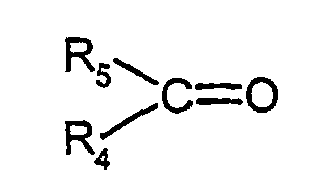
- the sheet is produced by rolling a powder mixture containing at least one binder and a catalyst or a catalyst mixture, according to the invention on the roll surfaces of Roller pair before contacting with the powder mixture a liquid organic compound, in particular an alcohol of the general formula in which R 1 , R 2 and R 3 are identical or different and are hydrogen or aliphatic or cycloaliphatic alkyl radicals, where R 1 , R 2 and R 3 together comprise a maximum of 8 C atoms, or for aryl radicals having 6 C atoms, wherein maximally one of the radicals R 1 , R 2 or R 3 represents such an aryl radical in which one or more hydrogen atoms are optionally replaced by an alkyl radical having a maximum of 8 carbon atoms, or a mixture of such alcohols and / or a ketone of the general one formula wherein R 4 and R 5 are the same or different and are
- Preferred organic liquid compounds for the treatment of the rolls are conventional organic solvents, in particular ethanol, isobutyl ketone or Acetone.
- the liquid organic compound may, for example, before the rolling process the roll surfaces are sprayed on or with the help of brushes, brushes, Cloths or the like be applied to the roll surfaces.
- the subsequent Drying takes place by evaporation at room temperature or is with the help of a Hot air stream or the like. accelerated.
- the roll surfaces can be dried also rubbed off.
- a second preferred embodiment of the method according to the invention is optionally in addition to the treatment of the roll surfaces with the liquid organic compound, before rolling the dry powder mixture milled powder of polytetrafluoroethylene rolled into a sheet.
- Particularly preferred is a combination of the two preferred embodiments the method according to the invention.
- the first milled powdered polytetrafluoroethylene powders into a sheet then the liquid organic compound becomes on the roll surfaces applied, then the roll surfaces are dried before the dry powder mixture to a fabric for gas diffusion electrodes is rolled.
- the preferably dry powder mixture for the sheet material may consist of a binder, for example a polymer such as polytetrafluoroethylene (PTFE), and a catalyst or a catalyst mixture. It is also possible that one of the components of the powder mixture is carbon or a carbon-containing compound. Likewise, the powder mixture, additives such as ammonium bicarbonate, which act as a pore former, included.
- the catalyst or catalyst mixture may consist, for example, of the non-metallic compound of a catalyst-forming metal or of mixtures of metal and the non-metallic compounds of a catalyst-forming metal. Furthermore, mixtures of different metals or metal compounds, preferably noble metals, can be used.
- the moisture content of the powder mixture is at most 0.5% by weight of H 2 O, preferably at most 0.3% by weight of H 2 O. If it is a sheet for use as a gas diffusion electrode in the electrolysis of an aqueous solution of alkali metal chloride, in particular sodium chloride, the compound containing the catalyst metal is in particular silver (I) oxide.
- the inventive method allows the production of homogeneous fabrics with eg a length of 2 m and a width of 0.4 m.
- the homogeneity of the fabric relates in particular to its thickness and density. It influences the electrochemical activity of the gas diffusion electrode.
- a sufficient electrochemical activity is characterized in that the cell voltage is a maximum of 2.5 V at a current density of 4 kA / m 2 .
- the pretreatment of the roll surfaces according to the invention with the liquid Organic compound is especially sufficient if only Powder mixtures of the same composition and under substantially identical Conditions are successively rolled.
- a change in the roll surface for example, thereby occurs that different powder mixtures, e.g. Powder blends with different Compositions relating to their constituents and / or their Weight ratios, successively rolled on the same roll mill.
- the changed roll surface have sheets that the same Have composition and are produced under the same rolling parameters, especially no longer the same thickness and density, and therefore the same electrochemical activity, on.
- a sheet which consists of a Powder mixture consisting of 90 wt .-% silver (I) oxide and 10 wt .-% PTFE was not made again with the same thickness and density, if, before rolling, first a mixture consisting of 80% by weight Silver (I) oxide and 20 wt .-% PTFE is rolled.
- the treatment according to the invention the roll surface alone with one of the organic solvents or a mixture of the organic solvents achieved in the fabrics no longer the desired properties. Also the treatment of the roll surfaces with conventional cleaners, as they are from the household are known, e.g. Scouring agents such as Sidol® or Frosch® did not provide any improved Properties of the fabrics.
- the surface texture could For example, be restored by removing the roll body and their surface is turned off or ground.
- the removal of the Roll body from the roll mill and the mechanical twisting or grinding However, the roll surfaces inevitably leads to long downtime and to given by the calibration process or grinding process tolerances, which the Worsen concentricity of the rolls.
- the inventive method is characterized by its simplicity, its low expenditure on additional materials and additional work steps.
- Preferred organic liquid compounds are furthermore those whose Boiling point in the range of 30 to 150 ° C, more preferably in the range of 40 to 100 ° C lie. This ensures a rapid drying by evaporation, which is particularly advantageous if during the rolling process the Surfaces are treated with the solvent without affecting the rolling process is interrupted.
- the peripheral speed is the rollers independently of each other preferably 0.3 to 6 m / min.
- the rolling of the polytetrafluoroethylene powder is carried out according to the invention Process preferably under a holding force of 0.05 to 15 kN / cm.
- the temperature of the polytetrafluoroethylene powder during rolling is preferably 10 to 70 ° C.
- the grinding of the polytetrafluoroethylene powder according to the invention Process is preferably carried out in a mill with high-speed knives, such as e.g. described in DE 2,941,774, wherein the peripheral speed of rotating knife at least 15 m / s, preferably at least 25 m / s, especially preferably 40 m / s.
- the PTFE gets a fibrous Structure, therefore, it is preferable to use those polyfluoroethylene powders belonging to Tend to fibrillation.
- These include, for example, the TF 2021 PTFE, TF 2053 or TF 2029 from DYNEON.
- the rolling of the powder mixture can be done with conventional roller bodies, such as in the production of such fabrics or in the compaction of Powders are used.
- the individual rollers can be different Have diameter, which are preferably at most 15 cm, and with different speeds, especially at peripheral speeds in the range of 0.05 to 19 m / min, run.
- the roll surfaces should be a Have roughness, in which the powder mixture even with more uniform Speed can be recovered.
- the goal is to create a homogeneous sheet manufacture.
- the surface roughness be adapted to the roller.
- the Surface roughness of the roll measured as Ra number, is preferably between 0.05 ⁇ m and 1.5 ⁇ m.
- the rolling of the dry powder mixtures is such that the dry Powder mixture is metered onto the nip, the roll body, the powder draw in and condense it into a sheet.
- the fabric produced has a thickness of 0.05 to 0.8 mm, preferably 0.15 to 0.7 mm, on.
- the electrically conductive carrier is, for example, to a metal net, a metal fleece or a metal mesh. Furthermore, it can be a Carbon web, carbon web or carbon web or equivalent Net etc. from other electrically conductive materials.
- the Sheet is preferably formed by rolling into the substrate, i. the network or the like, connected.
- a powder mixture consisting of silver (I) oxide and polytetrafluoroethylene (PTFE) with a composition of 90% by weight of silver (I) oxide and 10% by weight of PTFE was carried out by means of a high speed hammer mill from IKA, type M20, in Milled 15 seconds each with cooling and then on a roll mill from Wetzel with two roll bodies of width 40 cm and the diameter 13 cm rolled under a clamping force of 2.2 kN / cm. In front Rolling was done with the roll surfaces with ethanol containing 0.2% by volume. Methyl isobutyl ketone was added, rubbed with a cloth and the roll surfaces then dried in air at room temperature. After this Drying, the powder mixture was applied to the nip. When rolling The peripheral speed of the rollers was 1.35 m / min. The fabric did not adhere to the roll surface and had a thickness of 0.35 mm at a density of 4.65 g / ml.
- Example 1 After the rolling process described in Example 1 with pretreatment of Roll surface was on the same roll mill from a powder mixture 80% by weight of silver (I) oxide and 20% by weight of PTFE, analogously to Example 1 was milled under the conditions described in Example 1. When then again a milled mixture consisting of 90 wt.% Silver (I) oxide and 10% by weight of PTFE were rolled, the thickness of the Sheet of 0.5 mm at a density of 4.7 g / ml, i. the sheet pointed a larger thickness and a higher density than found in Example 1.
- Example 1 The properties of the fabric described in Example 1 could only be achieved again after ground PTFE powder from DYNEON, type TF 2053, on which roll mill had been rolled into a sheet.
- the Speed of the rollers was adjusted so that the peripheral speed 1.35 m / min.
- the clamping force was 0.8 kN / cm.
- the temperature of the PTFE powder was 22 ° C.
- the PTFE powder was in a laboratory mill of Fa. IKA, type M20, with Milling knives in each 150 ml fractions ground for 60 s and on Room temperature has been cooled.
Landscapes
- Chemical & Material Sciences (AREA)
- Chemical Kinetics & Catalysis (AREA)
- Electrochemistry (AREA)
- Engineering & Computer Science (AREA)
- Organic Chemistry (AREA)
- Metallurgy (AREA)
- Materials Engineering (AREA)
- General Chemical & Material Sciences (AREA)
- Manufacturing & Machinery (AREA)
- Electrodes For Compound Or Non-Metal Manufacture (AREA)
- Inert Electrodes (AREA)
- Catalysts (AREA)
- Battery Electrode And Active Subsutance (AREA)
Description


Claims (10)
- Verfahren zur Herstellung von Flächengebilden für Gasdiffusionselektroden, insbesondere für den Einsatz in Elektrolysezellen, bei welchem das Flächengebilde mittels eines Walzenpaares durch Walzen einer trockenen Pulvermischung, enthaltend wenigstens einen Katalysator oder eine Katalysatormischung und einen Binder, hergestellt wird, dadurch gekennzeichnet, dass auf die Walzenoberflächen des Walzenpaares vor dem Inkontaktbringen mit der Pulvermischung eine flüssige organische Verbindung, insbesondere ein Alkohol der allgemeinen Formelworin R1, R2 und R3 gleich oder verschieden sind und für Wasserstoff stehen oder für aliphatische oder cycloaliphatische Alkylreste, wobei R1, R2 und R3 zusammen maximal 8 C-Atome umfassen, oder für Arylreste mit 6 C-Atomen, wobei maximal einer der Reste R1, R2 oder R3 für einen solchen Arylrest seht, in welchem gegebenenfalls ein oder mehrere Wasserstoffatome durch einen Alkylrest mit maximal 8 C-Atomen ersetzt ist, oder eine Mischung derartiger Alkohole und/oder ein Keton der allgemeinen Formel
 worin R4 und R5 gleich oder verschieden sind und für aliphatische oder cycloaliphatische Alkylreste stehen, wobei R4 und R5 zusammen maximal 8 C-Atome umfassen, oder für Arylreste mit 6 C-Atomen, wobei maximal einer der Reste R4 oder R5 für einen solchen Arylrest seht, in welchem gegebenenfalls ein oder mehrere Wasserstoffatome durch einen Alkylrest mit maximal 8 C-Atomen ersetzt ist, oder eine Mischung derartiger Ketone und/oder ein Ester der allgemeinen Formel
 worin R6 und R7 gleich oder verschieden sind und für aliphatische oder cycloaliphatische Alkylreste stehen, wobei R6 und R7 zusammen maximal 8 C-Atome umfassen, oder R7 für einen Arylrest mit 6 C-Atomen seht, in welchem gegebenenfalls ein oder mehrere Wasserstoffatome durch einen Alkylrest mit maximal 8 C-Atomen ersetzt ist, oder eine Mischung derartiger Ester vollflächig aufgetragen wird und anschließend die Walzenoberflächen getrocknet werden.
- Verfahren zur Herstellung von Flächengebilden für Gasdiffusionselektroden, insbesondere für den Einsatz in Elektrolysezellen, bei welchem das Flächengebilde mittels eines Walzenpaares durch Walzen einer trockenen Pulvermischung, enthaltend wenigstens einen Katalysator oder eine Katalysatormischung und einen Binder, hergestellt wird, dadurch gekennzeichnet, dass, gegebenenfalls zusätzlich zu der Behandlung der Walzenoberflächen mit einer flüssigen organischen Verbindung, vor dem Walzen der trockenen Pulvermischung aufgemahlenes Pulver aus Polytetrafluorethylen zu einem Flächengebilde verwalzt wird.
- Verfahren nach Anspruch 1 oder 2, dadurch gekennzeichnet, dass zuerst das aufgemahlene Pulver aus Polytetrafluorethylen zu einem Flächengebilde verwalzt wird, dann auf die Walzenoberflächen die flüssige organische Verbindung aufgetragen wird und die Walzenoberflächen getrocknet werden und anschließend die trockene Pulvermischung zu einem Flächengebilde für Gasdiffusionselektroden verwalzt wird.
- Verfahren nach einem der Ansprüche 1 - 3, dadurch gekennzeichnet, dass die flüssige organische Verbindung Ethanol, Isobutylketon oder Aceton ist.
- Verfahren nach einem der Ansprüche 1 - 4, dadurch gekennzeichnet, dass die flüssige organische Verbindung einen Siedepunkt im Bereich von 30° bis 150°C hat.
- Verfahren nach Anspruch 5, dadurch gekennzeichnet, dass die flüssige organische Verbindung einen Siedepunkt im Bereich von 40° bis 100°C hat.
- Verfahren nach einem der Ansprüche 1 - 6, dadurch gekennzeichnet, dass beim Verwalzen des Polytetrafluorethylenpulvers die Umfangsgeschwindigkeit der Walzen unabhängig voneinander 0,3 bis 6 m/min betragen.
- Verfahren nach einem der Ansprüche 1 - 7, dadurch gekennzeichnet, dass das Verwalzen des Polytetrafluorethylenpulvers unter einer Zuhaltekraft von 0,05 bis 15 kN/cm erfolgt.
- Verfahren nach einem der Ansprüche 1 - 8, dadurch gekennzeichnet, dass beim Verwalzen des Polytetrafluorethylenpulvers die Temperatur des Pulvers aus Polytetrafluorethylen 10 bis 70°C beträgt.
- Verfahren nach einem der Ansprüche 1 - 9, dadurch gekennzeichnet, dass das Pulver aus Polytetrafluorethylen mit einer Mühle mit schnell laufenden Messern aufgemahlen wird, wobei die Umfangsgeschwindigkeit der rotierenden Messer mindestens 15 m/s, bevorzugt mindestens 25 m/s beträgt.
Applications Claiming Priority (3)
| Application Number | Priority Date | Filing Date | Title |
|---|---|---|---|
| DE10157521 | 2001-11-23 | ||
| DE10157521A DE10157521A1 (de) | 2001-11-23 | 2001-11-23 | Behandlung der Walzen bei der Herstellung von Gasdiffusionselektroden |
| PCT/EP2002/012811 WO2003044245A2 (de) | 2001-11-23 | 2002-11-15 | Verfahren zur herstellung von flächengebilden für gasdiffusionselektroden |
Publications (2)
| Publication Number | Publication Date |
|---|---|
| EP1448809A2 EP1448809A2 (de) | 2004-08-25 |
| EP1448809B1 true EP1448809B1 (de) | 2005-07-20 |
Family
ID=7706723
Family Applications (1)
| Application Number | Title | Priority Date | Filing Date |
|---|---|---|---|
| EP02792766A Expired - Lifetime EP1448809B1 (de) | 2001-11-23 | 2002-11-15 | Verfahren zur herstellung von flächengebilden für gasdiffusionselektroden |
Country Status (12)
| Country | Link |
|---|---|
| US (1) | US20050079599A1 (de) |
| EP (1) | EP1448809B1 (de) |
| JP (1) | JP2005509753A (de) |
| KR (1) | KR20050044580A (de) |
| CN (1) | CN1589509A (de) |
| AT (1) | ATE299958T1 (de) |
| AU (1) | AU2002358507A1 (de) |
| DE (2) | DE10157521A1 (de) |
| ES (1) | ES2246021T3 (de) |
| HU (1) | HUP0401996A2 (de) |
| PT (1) | PT1448809E (de) |
| WO (1) | WO2003044245A2 (de) |
Families Citing this family (9)
| Publication number | Priority date | Publication date | Assignee | Title |
|---|---|---|---|---|
| DE10148599A1 (de) | 2001-10-02 | 2003-04-10 | Bayer Ag | Verfahren zur Herstellung von Gasdiffusionselektroden aus trockenen Pulvermischungen mittels Walzen |
| US20050250011A1 (en) * | 2004-04-02 | 2005-11-10 | Maxwell Technologies, Inc. | Particle packaging systems and methods |
| US20070122698A1 (en) | 2004-04-02 | 2007-05-31 | Maxwell Technologies, Inc. | Dry-particle based adhesive and dry film and methods of making same |
| US20060246343A1 (en) * | 2004-04-02 | 2006-11-02 | Maxwell Technologies, Inc. | Dry particle packaging systems and methods of making same |
| DE102005023615A1 (de) * | 2005-05-21 | 2006-11-23 | Bayer Materialscience Ag | Verfahren zur Herstellung von Gasdiffusionselektroden |
| DE102010042004A1 (de) * | 2010-10-05 | 2012-04-05 | Bayer Materialscience Aktiengesellschaft | Verfahren zur Herstellung von transport- und lagerstabilen Sauerstoffverzehrelektroden |
| DE102010054159A1 (de) | 2010-12-10 | 2012-06-14 | Bayer Materialscience Aktiengesellschaft | Verfahren zum Einbau von Sauerstoffverzehrelektroden in elektrochemischen Zellen und elektrochemische Ze lle |
| DE102011005454A1 (de) | 2011-03-11 | 2012-09-13 | Bayer Materialscience Aktiengesellschaft | Verfahren zur Herstellung von Sauerstoffverzehrelektroden |
| JP7668475B2 (ja) * | 2020-03-11 | 2025-04-25 | パナソニックIpマネジメント株式会社 | 電極の製造方法および電極合材 |
Family Cites Families (15)
| Publication number | Priority date | Publication date | Assignee | Title |
|---|---|---|---|---|
| US2963746A (en) * | 1957-03-22 | 1960-12-13 | Ici Ltd | Manufacture of porous sheet material from powdered polymers |
| NL301119A (de) * | 1962-11-29 | |||
| US3676222A (en) * | 1970-09-10 | 1972-07-11 | Monsanto Res Corp | Conductive carbon membrane electrode |
| US4287232A (en) * | 1978-06-28 | 1981-09-01 | United Technologies Corporation | Dry floc method for making an electrochemical cell electrode |
| DE2941774C2 (de) * | 1979-10-16 | 1985-03-21 | Varta Batterie Ag, 3000 Hannover | Verfahren und Vorrichtung zur Herstellung einer kunststoffgebundenen Aktivkohleschicht für dünne Gasdiffusionselektroden |
| DE3710168A1 (de) * | 1987-03-27 | 1988-10-13 | Varta Batterie | Verfahren zur herstellung einer kunststoffgebundenen gasdiffusionselektrode mit metallischen elektrokatalysatoren |
| DE3722019A1 (de) * | 1987-07-03 | 1989-01-12 | Varta Batterie | Verfahren zur herstellung einer kunststoffgebundenen gasdiffusionselektrode, die einen manganoxidkatalysator der ueberwiegenden zusammensetzung mno(pfeil abwaerts)2(pfeil abwaerts)o(pfeil abwaerts)3(pfeil abwaerts)* x mn(pfeil abwaerts)5(pfeil abwaerts)o(pfeil abwaerts)8(pfeil abwaerts) enthaelt |
| US5527497A (en) * | 1992-11-26 | 1996-06-18 | Canon Kabushiki Kaisha | Process and apparatus for manufacturing substrate sheet for optical recording mediums, and process for preparing stamper |
| US6136376A (en) * | 1998-10-23 | 2000-10-24 | Macro Specialty Industries, Inc. | Process for treating metal rolls |
| JP2000298829A (ja) * | 1999-04-13 | 2000-10-24 | Sony Corp | 磁気記録媒体の製造方法及び製造装置 |
| WO2001045644A2 (en) * | 1999-12-23 | 2001-06-28 | Combe International Ltd. | Dental adhesive device and method for producing same |
| US6823584B2 (en) * | 2001-05-03 | 2004-11-30 | Ballard Power Systems Inc. | Process for manufacturing a membrane electrode assembly |
| US6702970B2 (en) * | 2001-05-03 | 2004-03-09 | Advanced Energy Technology Inc. | Process to reduce sticking during surface treatment of graphite articles |
| DE10148599A1 (de) * | 2001-10-02 | 2003-04-10 | Bayer Ag | Verfahren zur Herstellung von Gasdiffusionselektroden aus trockenen Pulvermischungen mittels Walzen |
| US6867159B2 (en) * | 2002-12-04 | 2005-03-15 | Ballard Power Systems Inc. | Application of an ionomer layer to a substrate and products related thereto |
-
2001
- 2001-11-23 DE DE10157521A patent/DE10157521A1/de not_active Withdrawn
-
2002
- 2002-11-15 DE DE50203704T patent/DE50203704D1/de not_active Expired - Fee Related
- 2002-11-15 ES ES02792766T patent/ES2246021T3/es not_active Expired - Lifetime
- 2002-11-15 PT PT02792766T patent/PT1448809E/pt unknown
- 2002-11-15 HU HU0401996A patent/HUP0401996A2/hu unknown
- 2002-11-15 CN CNA028229924A patent/CN1589509A/zh active Pending
- 2002-11-15 AT AT02792766T patent/ATE299958T1/de not_active IP Right Cessation
- 2002-11-15 WO PCT/EP2002/012811 patent/WO2003044245A2/de not_active Ceased
- 2002-11-15 AU AU2002358507A patent/AU2002358507A1/en not_active Abandoned
- 2002-11-15 JP JP2003545860A patent/JP2005509753A/ja active Pending
- 2002-11-15 KR KR1020047007810A patent/KR20050044580A/ko not_active Withdrawn
- 2002-11-15 US US10/496,510 patent/US20050079599A1/en not_active Abandoned
- 2002-11-15 EP EP02792766A patent/EP1448809B1/de not_active Expired - Lifetime
Also Published As
| Publication number | Publication date |
|---|---|
| AU2002358507A8 (en) | 2003-06-10 |
| HUP0401996A2 (hu) | 2005-03-29 |
| US20050079599A1 (en) | 2005-04-14 |
| ES2246021T3 (es) | 2006-02-01 |
| EP1448809A2 (de) | 2004-08-25 |
| AU2002358507A1 (en) | 2003-06-10 |
| ATE299958T1 (de) | 2005-08-15 |
| DE50203704D1 (de) | 2005-08-25 |
| DE10157521A1 (de) | 2003-06-05 |
| WO2003044245A2 (de) | 2003-05-30 |
| PT1448809E (pt) | 2005-10-31 |
| WO2003044245A3 (de) | 2004-01-08 |
| KR20050044580A (ko) | 2005-05-12 |
| CN1589509A (zh) | 2005-03-02 |
| JP2005509753A (ja) | 2005-04-14 |
Similar Documents
| Publication | Publication Date | Title |
|---|---|---|
| EP1446849B1 (de) | Verfahren zur herstellung von gasdiffusionselektroden | |
| DE2941774C2 (de) | Verfahren und Vorrichtung zur Herstellung einer kunststoffgebundenen Aktivkohleschicht für dünne Gasdiffusionselektroden | |
| EP1728896B1 (de) | Verfahren zur Herstellung von Gasdiffusionselektroden | |
| DE2512885C2 (de) | Verfahren zur Herstellung eines elektrisch geladenen Faserfilters | |
| EP1448809B1 (de) | Verfahren zur herstellung von flächengebilden für gasdiffusionselektroden | |
| DE2362895A1 (de) | Schneidwerkzeug und verfahren zu dessen herstellung | |
| EP1239528A2 (de) | Verfahren zur Herstellung einer mehrschichtigen Elektrode oder Membran-Elektrodenverbundeinheit, und Gasdiffusionselektrode | |
| DE1078649B (de) | Verfahren zur Herstellung von Elektroden fuer galvanische Elemente | |
| DE3211474A1 (de) | Geformte gegenstaende aus poroesem kohlenstoff | |
| DE2534464B2 (de) | Verfahren zur herstellung einer mikroporoesen bahn und deren verwendung als diaphragma | |
| DE112015001736T5 (de) | Kohlenstoffnanoröhren-Verbundmaterial und Verfahren zu dessen Erzeugung | |
| EP0926753A2 (de) | Verfahren zur Herstellung von Funktionsschichten für Brennstoffzellen | |
| DE1932426B2 (de) | Geformte Enzymkörper und Verfahren zu ihrer Herstellung | |
| DE3810218C2 (de) | ||
| DE2208632B2 (de) | Verfahren zur Herstellung von kohlehaltigen Gaselektroden mit hydrophober Rückschicht | |
| DE2413221C3 (de) | Verfahren zur Herstellung von porösen Polytetrafluoräthylenfolien und Vorrichtung zur Durchführung des Verfahrens | |
| EP2498327A2 (de) | Verfahren zur Herstellung von Sauerstoffverzehrelektroden | |
| DE2318911C3 (de) | Verfahren zur Herstellung von Faserblättern | |
| DE3406418A1 (de) | Verfahren zum aufbringen eines abriebbestaendigen und/oder korrosionsbestaendigen ueberzuges auf einem gegenstand mit unregelmaessiger oberflaeche | |
| DE2055672B2 (de) | Verfahren und vorrichtung zur herstellung einer tabakfolie | |
| DE2747204A1 (de) | Verfahren zum verbessern der verarbeitungseigenschaften von pulverfoermigen polyolefinen | |
| DE66804C (de) | Verfahren zur Aufbereitung von Graphit | |
| DE2446021A1 (de) | Verfahren zum formen von pulver, insbesondere von schiess- oder sprengpulver | |
| DE19940015A1 (de) | Verfahren und Vorrichtung zur Herstellung einer Elektrode | |
| DE1692944A1 (de) | Verfahren und Vorrichtung zur Herstellung eines bandfoermigen Materials unter Verwendung einer faserigen Traegersubstanz und eines Staubes,insbesondere zur Herstellung von Tabakfolien |
Legal Events
| Date | Code | Title | Description |
|---|---|---|---|
| PUAI | Public reference made under article 153(3) epc to a published international application that has entered the european phase |
Free format text: ORIGINAL CODE: 0009012 |
|
| AK | Designated contracting states |
Kind code of ref document: A2 Designated state(s): AT BE BG CH CY CZ DE DK EE ES FI FR GB GR IE IT LI LU MC NL PT SE SK TR |
|
| AX | Request for extension of the european patent |
Extension state: AL LT LV MK RO SI |
|
| 17P | Request for examination filed |
Effective date: 20040708 |
|
| GRAP | Despatch of communication of intention to grant a patent |
Free format text: ORIGINAL CODE: EPIDOSNIGR1 |
|
| GRAS | Grant fee paid |
Free format text: ORIGINAL CODE: EPIDOSNIGR3 |
|
| GRAA | (expected) grant |
Free format text: ORIGINAL CODE: 0009210 |
|
| RIN1 | Information on inventor provided before grant (corrected) |
Inventor name: POPPELREUTER, GUENTER Inventor name: GESTERMANN, FRITZ Inventor name: BULAN, ANDREAS |
|
| AK | Designated contracting states |
Kind code of ref document: B1 Designated state(s): AT BE BG CH CY CZ DE DK EE ES FI FR GB GR IE IT LI LU MC NL PT SE SK TR |
|
| PG25 | Lapsed in a contracting state [announced via postgrant information from national office to epo] |
Ref country code: TR Free format text: LAPSE BECAUSE OF FAILURE TO SUBMIT A TRANSLATION OF THE DESCRIPTION OR TO PAY THE FEE WITHIN THE PRESCRIBED TIME-LIMIT Effective date: 20050720 Ref country code: SK Free format text: LAPSE BECAUSE OF FAILURE TO SUBMIT A TRANSLATION OF THE DESCRIPTION OR TO PAY THE FEE WITHIN THE PRESCRIBED TIME-LIMIT Effective date: 20050720 Ref country code: IE Free format text: LAPSE BECAUSE OF FAILURE TO SUBMIT A TRANSLATION OF THE DESCRIPTION OR TO PAY THE FEE WITHIN THE PRESCRIBED TIME-LIMIT Effective date: 20050720 Ref country code: FI Free format text: LAPSE BECAUSE OF FAILURE TO SUBMIT A TRANSLATION OF THE DESCRIPTION OR TO PAY THE FEE WITHIN THE PRESCRIBED TIME-LIMIT Effective date: 20050720 Ref country code: EE Free format text: LAPSE BECAUSE OF FAILURE TO SUBMIT A TRANSLATION OF THE DESCRIPTION OR TO PAY THE FEE WITHIN THE PRESCRIBED TIME-LIMIT Effective date: 20050720 Ref country code: CZ Free format text: LAPSE BECAUSE OF FAILURE TO SUBMIT A TRANSLATION OF THE DESCRIPTION OR TO PAY THE FEE WITHIN THE PRESCRIBED TIME-LIMIT Effective date: 20050720 |
|
| REG | Reference to a national code |
Ref country code: GB Ref legal event code: FG4D Free format text: NOT ENGLISH |
|
| REG | Reference to a national code |
Ref country code: CH Ref legal event code: EP |
|
| REG | Reference to a national code |
Ref country code: IE Ref legal event code: FG4D Free format text: LANGUAGE OF EP DOCUMENT: GERMAN |
|
| REF | Corresponds to: |
Ref document number: 50203704 Country of ref document: DE Date of ref document: 20050825 Kind code of ref document: P |
|
| PGFP | Annual fee paid to national office [announced via postgrant information from national office to epo] |
Ref country code: PT Payment date: 20051014 Year of fee payment: 4 |
|
| GBT | Gb: translation of ep patent filed (gb section 77(6)(a)/1977) |
Effective date: 20050927 |
|
| PG25 | Lapsed in a contracting state [announced via postgrant information from national office to epo] |
Ref country code: SE Free format text: LAPSE BECAUSE OF FAILURE TO SUBMIT A TRANSLATION OF THE DESCRIPTION OR TO PAY THE FEE WITHIN THE PRESCRIBED TIME-LIMIT Effective date: 20051020 Ref country code: GR Free format text: LAPSE BECAUSE OF FAILURE TO SUBMIT A TRANSLATION OF THE DESCRIPTION OR TO PAY THE FEE WITHIN THE PRESCRIBED TIME-LIMIT Effective date: 20051020 Ref country code: DK Free format text: LAPSE BECAUSE OF FAILURE TO SUBMIT A TRANSLATION OF THE DESCRIPTION OR TO PAY THE FEE WITHIN THE PRESCRIBED TIME-LIMIT Effective date: 20051020 Ref country code: BG Free format text: LAPSE BECAUSE OF FAILURE TO SUBMIT A TRANSLATION OF THE DESCRIPTION OR TO PAY THE FEE WITHIN THE PRESCRIBED TIME-LIMIT Effective date: 20051020 |
|
| PGFP | Annual fee paid to national office [announced via postgrant information from national office to epo] |
Ref country code: FR Payment date: 20051026 Year of fee payment: 4 |
|
| REG | Reference to a national code |
Ref country code: PT Ref legal event code: SC4A Effective date: 20050822 |
|
| PG25 | Lapsed in a contracting state [announced via postgrant information from national office to epo] |
Ref country code: CY Free format text: LAPSE BECAUSE OF FAILURE TO SUBMIT A TRANSLATION OF THE DESCRIPTION OR TO PAY THE FEE WITHIN THE PRESCRIBED TIME-LIMIT Effective date: 20051115 Ref country code: AT Free format text: LAPSE BECAUSE OF NON-PAYMENT OF DUE FEES Effective date: 20051115 |
|
| PG25 | Lapsed in a contracting state [announced via postgrant information from national office to epo] |
Ref country code: MC Free format text: LAPSE BECAUSE OF NON-PAYMENT OF DUE FEES Effective date: 20051130 Ref country code: LU Free format text: LAPSE BECAUSE OF NON-PAYMENT OF DUE FEES Effective date: 20051130 |
|
| PGFP | Annual fee paid to national office [announced via postgrant information from national office to epo] |
Ref country code: BE Payment date: 20051130 Year of fee payment: 4 |
|
| PGFP | Annual fee paid to national office [announced via postgrant information from national office to epo] |
Ref country code: DE Payment date: 20051216 Year of fee payment: 4 |
|
| REG | Reference to a national code |
Ref country code: ES Ref legal event code: FG2A Ref document number: 2246021 Country of ref document: ES Kind code of ref document: T3 |
|
| REG | Reference to a national code |
Ref country code: IE Ref legal event code: FD4D |
|
| ET | Fr: translation filed | ||
| PLBE | No opposition filed within time limit |
Free format text: ORIGINAL CODE: 0009261 |
|
| STAA | Information on the status of an ep patent application or granted ep patent |
Free format text: STATUS: NO OPPOSITION FILED WITHIN TIME LIMIT |
|
| 26N | No opposition filed |
Effective date: 20060421 |
|
| PGFP | Annual fee paid to national office [announced via postgrant information from national office to epo] |
Ref country code: ES Payment date: 20061102 Year of fee payment: 5 |
|
| PG25 | Lapsed in a contracting state [announced via postgrant information from national office to epo] |
Ref country code: LI Free format text: LAPSE BECAUSE OF NON-PAYMENT OF DUE FEES Effective date: 20061130 Ref country code: CH Free format text: LAPSE BECAUSE OF NON-PAYMENT OF DUE FEES Effective date: 20061130 Ref country code: BE Free format text: LAPSE BECAUSE OF NON-PAYMENT OF DUE FEES Effective date: 20061130 |
|
| PGFP | Annual fee paid to national office [announced via postgrant information from national office to epo] |
Ref country code: IT Payment date: 20061130 Year of fee payment: 5 |
|
| PGFP | Annual fee paid to national office [announced via postgrant information from national office to epo] |
Ref country code: GB Payment date: 20061227 Year of fee payment: 5 |
|
| PG25 | Lapsed in a contracting state [announced via postgrant information from national office to epo] |
Ref country code: PT Free format text: LAPSE BECAUSE OF NON-PAYMENT OF DUE FEES Effective date: 20070515 |
|
| REG | Reference to a national code |
Ref country code: PT Ref legal event code: MM4A Free format text: LAPSE DUE TO NON-PAYMENT OF FEES Effective date: 20070515 |
|
| PG25 | Lapsed in a contracting state [announced via postgrant information from national office to epo] |
Ref country code: NL Free format text: LAPSE BECAUSE OF NON-PAYMENT OF DUE FEES Effective date: 20070601 Ref country code: DE Free format text: LAPSE BECAUSE OF NON-PAYMENT OF DUE FEES Effective date: 20070601 |
|
| REG | Reference to a national code |
Ref country code: CH Ref legal event code: PL |
|
| NLV4 | Nl: lapsed or anulled due to non-payment of the annual fee |
Effective date: 20070601 |
|
| REG | Reference to a national code |
Ref country code: FR Ref legal event code: ST Effective date: 20070731 |
|
| BERE | Be: lapsed |
Owner name: *BAYER MATERIALSCIENCE A.G. Effective date: 20061130 |
|
| PG25 | Lapsed in a contracting state [announced via postgrant information from national office to epo] |
Ref country code: FR Free format text: LAPSE BECAUSE OF NON-PAYMENT OF DUE FEES Effective date: 20061130 |
|
| GBPC | Gb: european patent ceased through non-payment of renewal fee |
Effective date: 20071115 |
|
| PG25 | Lapsed in a contracting state [announced via postgrant information from national office to epo] |
Ref country code: GB Free format text: LAPSE BECAUSE OF NON-PAYMENT OF DUE FEES Effective date: 20071115 |
|
| REG | Reference to a national code |
Ref country code: ES Ref legal event code: FD2A Effective date: 20071116 |
|
| PG25 | Lapsed in a contracting state [announced via postgrant information from national office to epo] |
Ref country code: ES Free format text: LAPSE BECAUSE OF NON-PAYMENT OF DUE FEES Effective date: 20071116 |
|
| PG25 | Lapsed in a contracting state [announced via postgrant information from national office to epo] |
Ref country code: IT Free format text: LAPSE BECAUSE OF NON-PAYMENT OF DUE FEES Effective date: 20071115 |